Cell Quotes (146 quotes)
Cells Quotes
Cells Quotes
… however useful the words may have been in the past, they have now become handicaps to the further development of knowledge. Words like botany and zoology imply that plants and animals are quite different things. … But the differences rapidly become blurred when we start looking at the world through a microscope. … The similarities between plants and animals became more important than their differences with the discoveries that both were built up of cells, had sexual reproduction,… nutrition and respiration … and with the development of evolutionary theory.
In The Forest and the Sea (1960), 7.
[Beyond natural history] Other biological sciences take up the study at other levels of organization: dissecting the individual into organs and tissues and seeing how these work together, as in physiology; reaching down still further to the level of cells, as in cytology; and reaching the final biological level with the study of living molecules and their interactions, as in biochemistry. No one of these levels can be considered as more important than any other.
In The Nature of Natural History (1961, 2014), 7.
[Describing a freshman seminar titled “How the Tabby Cat Got Her Stripes or The Silence of the Genes”:] The big idea we start with is: “How is the genome interpreted, and how are stable decisions that affect gene expression inherited from one cell to the next? This is one of the most competitive areas of molecular biology at the moment, and the students are reading papers that in some instances were published this past year. As a consequence, one of the most common answers I have to give to their questions is, “We just don't know.”
As quoted by Kitta MacPherson in 'Exploring Epigenetics: President Shirley Tilghman in the Classroom,'
Princeton University Undergraduate Admission web page accessed 14 Oct 2013.
[The octopus has] an amazing skin, because there are up to 20 million of these chromatophore pigment cells and to control 20 million of anything is going to take a lot of processing power. ... These animals have extraordinarily large, complicated brains to make all this work. ... And what does this mean about the universe and other intelligent life? The building blocks are potentially there and complexity will arise. Evolution is the force that's pushing that. I would expect, personally, a lot of diversity and a lot of complicated structures. It may not look like us, but my personal view is that there is intelligent life out there.
From transcript of PBS TV program Nova episode 'Origins: Where are the Aliens?' (2004).
[The parasite that causes malaria] edges through the cells of the stomach wall of the mosquito and forms a cyst which grows and eventually bursts to release hundreds of “sporozoites” into the body cavity of the mosquito … As far as we can tell, the parasite does not harm the mosquito … It has always seemed to me, though, that these growing cysts … must at least give the mosquito something corresponding to a stomach-ache.
In The Prevalence of People (1955, 1962), 165.
Les Leucocytes Et L'esprit De Sacrifice. — Il semble, d'après les recherches de De Bruyne (Phagocytose, 1895) et de ceux qui le citent, que les leucocytes des Lamellibranches — probablement lorsqu'ils ont phagocyté, qu'ils se sont chargés de résidus et de déchets, qu'ils ont, en un mot, accompli leur rôle et bien fait leur devoir — sortent du corps de l'animal et vont mourir dans le milieu ambiant. Ils se sacrifient. Après avoir si bien servi l'organisme par leur activité, ils le servent encore par leur mort en faisant place aux cellules nouvelles, plus jeunes.
N'est-ce pas la parfaite image du désintéressement le plus noble, et n'y a-t-il point là un exemple et un modèle? Il faut s'en inspirer: comme eux, nous sommes les unités d'un grand corps social; comme eux, nous pouvons le servir et envisager la mort avec sérénité, en subordonnant notre conscience individuelle à la conscience collective. (30 Jan 1896)
Leukocytes and The Spirit Of Sacrifice. - It seems, according to research by De Bruyne (Phagocytosis, 1885) and those who quote it, that leukocytes of Lamellibranches [bivalves] - likely when they have phagocytized [ingested bacteria], as they become residues and waste, they have, in short, performed their role well and done their duty - leave the body of the animal and will die in the environment. They sacrifice themselves. Having so well served the body by their activities, they still serve in their death by making room for new younger cells.
Isn't this the perfect image of the noblest selflessness, and thereby presents an example and a model? It should be inspiring: like them, we are the units of a great social body, like them, we can serve and contemplate death with equanimity, subordinating our individual consciousness to collective consciousness.
N'est-ce pas la parfaite image du désintéressement le plus noble, et n'y a-t-il point là un exemple et un modèle? Il faut s'en inspirer: comme eux, nous sommes les unités d'un grand corps social; comme eux, nous pouvons le servir et envisager la mort avec sérénité, en subordonnant notre conscience individuelle à la conscience collective. (30 Jan 1896)
Leukocytes and The Spirit Of Sacrifice. - It seems, according to research by De Bruyne (Phagocytosis, 1885) and those who quote it, that leukocytes of Lamellibranches [bivalves] - likely when they have phagocytized [ingested bacteria], as they become residues and waste, they have, in short, performed their role well and done their duty - leave the body of the animal and will die in the environment. They sacrifice themselves. Having so well served the body by their activities, they still serve in their death by making room for new younger cells.
Isn't this the perfect image of the noblest selflessness, and thereby presents an example and a model? It should be inspiring: like them, we are the units of a great social body, like them, we can serve and contemplate death with equanimity, subordinating our individual consciousness to collective consciousness.
In Recueil d'Œuvres de Léo Errera: Botanique Générale (1908), 194. Google translation by Webmaster. Please give feedback if you can improve it.
Omnis cellula e cellula.
Every cell is derived from another cell.
Every cell is derived from another cell.
In Annales des Sciences naturelles (1825), 6, 224, trans. By Henry Harris in The Birth of the Cell (1999), 33. This aphorism was later popularized by Rudolf Virchow, who is often incorrectly given credit for the dictum that Raspail originated. Also on this website, see Virchow’s quote beginning, “Where a cell arises…” (1858).
Omnis cellula e cellula
Every cell from a cell.
Every cell from a cell.
The doctrine he popularized (but did not originate). Given, for example, in the Latin form, in Lecture II 'Physiological Tissues' (17 Feb 1858) given to the Pathological Institute of Berlin, as translated by Frank Chance in Cellular Pathology (1860), 27-28. Also translated as: “Every cell stems from another cell”. Part of a longer quote on this page that begins: “Where a cell arises…”. Although popularized by Virchow, the aphorism was actually coined by François-Vincent Raspail.
A band of bacterial brothers
Swigging ATP with some others,
In a jocular fit,
They laughed ’til they split
Now they’re all microbial mothers.
Swigging ATP with some others,
In a jocular fit,
They laughed ’til they split
Now they’re all microbial mothers.
In History of Life (1989). As quoted and cited in Jon Fripp, Michael Fripp and Deborah Fripp, Speaking of Science (2000), 20. Note: Cell division consumes energy provided by hydrolysis of ATP (adenosine triphosphate). ATP is the primary energy carrier in all living organisms on earth.
A cell has a history; its structure is inherited, it grows, divides, and, as in the embryo of higher animals, the products of division differentiate on complex lines. Living cells, moreover, transmit all that is involved in their complex heredity. I am far from maintaining that these fundamental properties may not depend upon organisation at levels above any chemical level; to understand them may even call for different methods of thought; I do not pretend to know. But if there be a hierarchy of levels we must recognise each one, and the physical and chemical level which, I would again say, may be the level of self-maintenance, must always have a place in any ultimate complete description.
'Some Aspects of Biochemistry', The Irish Journal of Medical Science (1932), 79, 346.
A cell is regarded as the true biological atom.
The Physiology of Common Life (1860), 297.
A cell of a higher organism contains a thousand different substances, arranged in a complex system. This great organized system was not discovered by chemical or physical methods; they are inadequate to its refinement and delicacy and complexity.
'The Cell in Relation to its Environment', Journal of the Maryland Academy of Sciences (1931), 2, 25.
A nutritive centre, anatomically considered, is merely a cell, the nucleus of which is the permanent source of successive broods of young cells, which from time to time fill the cavity of their parent, and carrying with them the cell wall of the parent, pass off in certain directions, and under various forms, according to the texture or organ of which their parent forms a part.
Anatomical and Pathological Observations (1845), 2.
A study of Dr. [Florence] Sabin’s work shows the greatness of her achievement and the character of her mind. She has dealt with the primary and fundamental problem of the cell—the unit of plant and animal life. All through her investigations she has followed the cell, seeking the secret of differentiations by newer and finer methods, both physical and chemical. Always through her work runs the great strong, continuous cord of cell differentiations. This is one of the great concepts of man, for all life begins as a single cell. I have known and followed Dr. Sabin’s work since her student days, and have lately been more closely associated with her in her tuberculosis studies. She is all in mind and spirit and ideals that man or woman ever accomplishes. She belongs to the great students of both sexes, for when these have the brains and the will to work I see little difference.
In Genevieve Parkhurst, 'Dr. Sabin, Scientist: Winner Of Pictorial Review’s Achievement Award', Pictorial Review (Jan 1930), 2.
According to the older view, for every single effect of a serum, there was a separate substance, or at least a particular chemical group... A normal serum contained as many different haemagglutinins as it agglutinated different cells. The situation was undoubtedly made much simpler if, to use the Ehrlich terminology... the separate haptophore groups can combine with an extremely large number of receptors in stepwise differing quantities as a stain does with different animal tissues, though not always with the same intensity. A normal serum would therefore visibly affect such a large number of different blood cells... not because it contained countless special substances, but because of the colloids of the serum, and therefore of the agglutinins by reason of their chemical constitution and the electrochemical properties resulting from it. That this manner of representation is a considerable simplification is clear; it also opens the way to direct experimental testing by the methods of structural chemistry.
'Die Theorien der Antikorperbildung ... ', Wiener klinische Wöchenschrift (1909), 22, 1623-1631. Trans. Pauline M. H. Mazumdar.
All cell biologists are condemned to suffer an incurable secret sorrow: the size of the objects of their passion. … But those of us enamored of the cell must resign ourselves to the perverse, lonely fascination of a human being for things invisible to the naked human eye.
Opening sentence from The Center of Life: A Natural History of the Cell (1977, 1978), 5.
All of our experience indicates that life can manifest itself only in a concrete form, and that it is bound to certain substantial loci. These loci are cells and cell formations. But we are far from seeking the last and highest level of understanding in the morphology of these loci of life. Anatomy does not exclude physiology, but physiology certainly presupposes anatomy. The phenomena that the physiologist investigates occur in special organs with quite characteristic anatomical arrangements; the various morphological parts disclosed by the anatomist are the bearers of properties or, if you will, of forces probed by the physiologist; when the physiologist has established a law, whether through physical or chemical investigation, the anatomist can still proudly state: This is the structure in which the law becomes manifest.
In 'Cellular-Pathologie', Archiv für pathologische Anatomie und Physiologie und fur klinische Medizin (1855), 8, 19, as translated in LellandJ. Rather, 'Cellular Pathology', Disease, Life, and Man: Selected Essays by Rudolf Virchow (1958), 84.
All of today’s DNA, strung through all the cells of the earth, is simply an extension and elaboration of [the] first molecule.
In The Medusa and the Snail: More Notes of a Biology Watcher (1974, 1979), 27.
All tissues are formed from cells and every cell from a cell. [? Misquoted]
Although apparently misquoted and misattributed, Webmaster includes this as an interesting variant, presumably, of Raspail’s Omnis cellula e cellula dictum (also popularized by Rudolf Virchow). The above quote was given as an aphorism apparently misattributed as “Schwann’s Law,” in by J.W. Young, in 'Causation of Tumors', Western Medical Review (15 Jul 1898), 3, 262. Webmaster has not yet found another source either with this wording, or as “Schwann’s Law.” Webmaster suspects J.W. Young misquoted and misattributed the quote.
An attempt to study the evolution of living organisms without reference to cytology would be as futile as an account of stellar evolution which ignored spectroscopy.
'Foreword', in C.D. Darlington, Recent Advances in Cytology (1937), v.
An irrefutable proof that such single-celled primaeval animals really existed as the direct ancestors of Man, is furnished according to the fundamental law of biogeny by the fact that the human egg is nothing more than a simple cell.
Natürlche Schöpfungsgeschichte, trans. E. R. Lankester, The History of Creation (1892), Vol. 2, 381.
And yet in a funny way our lack of success led to our breakthrough; because, since we could not get a cell line off the shelf doing what we wanted, we were forced to construct it. And the original experiment ... developed into a method for the production of hybridomas ... [which] was of more importance than our original purpose.
From Nobel Lecture (8 Dec 1984), collected in Tore Frängsmyr and Jan Lindsten (eds.), Nobel Lectures in Physiology Or Medicine: 1981-1990 (1993), 256-257.
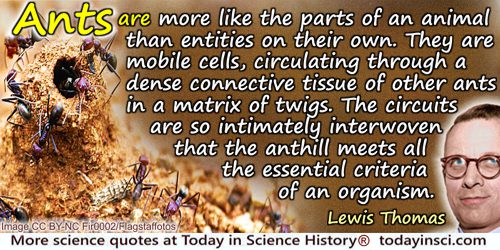
Ants are more like the parts of an animal than entities on their own. They are mobile cells, circulating through a dense connective tissue of other ants in a matrix of twigs. The circuits are so intimately interwoven that the anthill meets all the essential criteria of an organism.
In 'Antaeus in Manhattan', The Lives of a Cell: Notes of a Biology Watcher (1974), 63.
Any living cell carries with it the experience of a billion years of experimentation by its ancestors. (1949)
From Transactions of the Connecticut Academy of Arts and Sciences (Dec 1949), 38. Used as epigraph (without citation) to Chap 6, in Arnold Jay Levine, Viruses: A Scientific American Library Book (1991), 113.
As I have already mentioned, wherever cells are formed, this tough fluid precedes the first solid structures that indicate the presence of future cells. Moreover, we must assume that this substance furnishes the material for the formation of the nucleus and of the primitive sac, not only because these structures are closely apposed to it, but also because,they react to iodine in the same way. We must assume also that the organization of this substance is the process that inaugurates the formation of new cells. It therefore seems justifiable for me to propose a name that refers to its physiological function: I propose the word protoplasma.
H. Mohl, Botanisch Zeitung (1846), 4, col. 73, trans. Henry Harris, The Birth of the Cell (1999), 75.
As soon as we touch the complex processes that go on in a living thing, be it plant or animal, we are at once forced to use the methods of this science [chemistry]. No longer will the microscope, the kymograph, the scalpel avail for the complete solution of the problem. For the further analysis of these phenomena which are in flux and flow, the investigator must associate himself with those who have labored in fields where molecules and atoms, rather than multicellular tissues or even unicellular organisms, are the units of study.
'Experimental and Chemical Studies of the Blood with an Appeal for More Extended Chemical Training for the Biological and Medical Investigator', Science (6 Aug 1915), 42, 176.
As the human fetus develops, its changing form seems to retrace the whole of human evolution from the time we were cosmic dust to the time we were single-celled organisms in the primordial sea to the time we were four-legged, land-dwelling reptiles and beyond, to our current status as largebrained, bipedal mammals. Thus, humans seem to be the sum total of experience since the beginning of the cosmos.
From interview with James Reston, Jr., in Pamela Weintraub (ed.), The Omni Interviews (1984), 99. Previously published in magazine, Omni (May 1982).
At fertilization, these two “haploid” nuclei are added together to make a “diploid” nucleus that now contains 2a, 2b and so on; and, by the splitting of each chromosome and the regulated karyokinetic separation of the daughter chromosomes, this double series is inherited by both of the primary blastomeres. In the resulting resting nuclei the individual chromosomes are apparently destroyed. But we have the strongest of indications that, in the stroma of the resting nucleus, every one of the chromosomes that enters the nucleus survives as a well-defined region; and as the cell prepares for its next division this region again gives rise to the same chromosome (Theory of the Individuality of the Chromosomes). In this way the two sets of chromosomes brought together at fertilization are inherited by all the cells of the new individual. It is only in the germinal cells that the so called reduction division converts the double series into a single one. Out of the diploid state, the haploid is once again generated.
In Arch. Zellforsch, 1909, 3, 181, trans. Henry Harris, The Birth of the Cell (1999), 171-2.
Biology as a discipline would benefit enormously if we could bring together the scientists working at the opposite ends of the biological spectrum. Students of organisms who know natural history have abundant questions to offer the students of molecules and cells. And molecular and cellular biologists with their armory of techniques and special insights have much to offer students of organisms and ecology.
In 'The role of natural history in contemporary biology', BioScience (1986), 36, 328-329.
Biology has become dissection. A living thing is too complicated to be understood. It must be stripped down like some strange machine, and its parts removed, correlated, enlarged, analysed, and tested to see what they are made of and how they work. The microscope has been followed by the ultramicroscope and all the ingenious instrumentation of modern physics and chemistry. The complexity in structure revealed at one magnification is increased at a higher; the reactions discovered by specialists in one technique amplify without finality the discoveries of others. The biologist, searching into the mystery of life, probes more deeply and studies, of necessity, smaller bits and happenings. So the substance and the ways of the living are broken down, and from the pieces tomes are gathered in encyclopaedic summary; what is known of a cell, or of part of a cell, may fill a volume.
In 'Preface', The Life of Plants (1964, 2002), xiii.
Biology is a science of three dimensions. The first is the study of each species across all levels of biological organization, molecule to cell to organism to population to ecosystem. The second dimension is the diversity of all species in the biosphere. The third dimension is the history of each species in turn, comprising both its genetic evolution and the environmental change that drove the evolution. Biology, by growing in all three dimensions, is progressing toward unification and will continue to do so.
In 'Systematics and the Future of Biology', Systematics and the Origin of Species: on Ernst Mayr's 100th anniversary, Volume 102, Issues 22-26 (2005), 1.
Borel makes the amusing supposition of a million monkeys allowed to play upon the keys of a million typewriters. What is the chance that this wanton activity should reproduce exactly all of the volumes which are contained in the library of the British Museum? It certainly is not a large chance, but it may be roughly calculated, and proves in fact to be considerably larger than the chance that a mixture of oxygen and nitrogen will separate into the two pure constituents. After we have learned to estimate such minute chances, and after we have overcome our fear of numbers which are very much larger or very much smaller than those ordinarily employed, we might proceed to calculate the chance of still more extraordinary occurrences, and even have the boldness to regard the living cell as a result of random arrangement and rearrangement of its atoms. However, we cannot but feel that this would be carrying extrapolation too far. This feeling is due not merely to a recognition of the enormous complexity of living tissue but to the conviction that the whole trend of life, the whole process of building up more and more diverse and complex structures, which we call evolution, is the very opposite of that which we might expect from the laws of chance.
The Anatomy of Science (1926), 158-9.
Cancer cells invade surrounding tissue, make their way into blood vessels, and spread throughout the body. What are they searching for? My guess is oxygen.
In Acceptance Remarks, 2016 Lasker Awards Ceremony, published in 'Oxygen Sensing – An Essential Process for Survival', on laskerfoundation.org website.
Cell genetics led us to investigate cell mechanics. Cell mechanics now compels us to infer the structures underlying it. In seeking the mechanism of heredity and variation we are thus discovering the molecular basis of growth and reproduction. The theory of the cell revealed the unity of living processes; the study of the cell is beginning to reveal their physical foundations.
Recent Advances in Cytology (1937), 562.
Cells are required to stick precisely to the point. Any ambiguity, any tendency to wander from the matter at hand, will introduce grave hazards for the cells, and even more for the host in which they live. … There is a theory that the process of aging may be due to the cumulative effect of imprecision, a gradual degrading of information. It is not a system that allows for deviating.
In 'Information', The Lives of a Cell: Notes of a Biology Watcher (1974), 110-111.
Cellular pathology is not an end if one cannot see any alteration in the cell. Chemistry brings the clarification of living processes nearer than does anatomy. Each anatomical change must have been preceded by a chemical one.
Attributed in H. Coper and H. Herken, Deutsche Medizini Wochenschrift (18 Oct 1963), 88, No. 42, 2035, in the original German, “Nach der Überlieferung durch His soll Virchow geäußert haben: ‘Die Zellular-pathologie ist nicht am Ende, wenn man an einer Zelle keine Veränderungen mehr sehen kann. Die Chemie steht der Erklärung der Lebensvorgänge näher als die Anatomie. Jede anatomische Verände-rung setzt notwendig eine chemische voraus.’” As translated in Angel Pentschew,'Morphology and morphogenesis of lead encephalopathy', Acta Neuropathologica (Sep 1965) 5, No. 2, 133-160, as cited in I. Arthur Michaelson and Mitchell W. Sauerhoff, 'Animal Models of Human Disease: Severe and Mild Lead Encephalopathy in the Neonatal Rat', Environmental Health Perspectives (May 1974), 7, 204 & 223 footnote. Note: Although given in quotation marks in the original German text, the subject quote is almost definitely NOT verbatim, but only a paraphrase of Virchow’s teachings. The German text introduces the subject quote with, “Nach der Überlieferung durch His soll Virchow geäußert haben:…” which means, “According to tradition Virchow is said to have expressed:…” (using Google translate). However, it is useful as a succinct statement to the effect of what Virchow might say to summarize his doctrine.
Developmental Biology, in capitals, is the wave of the future. The creeping reductionism of biochemistry and molecular biology has taken over the cell and heredity, and looks covetously toward the heights of development and evolution. Recent literature is last year. Ancient literature is a decade ago. The rest is history, doubtfully alive. There is no time and often no opportunity to find and study the work of experimental biologists of 50 or 100 years ago, yet that was a time when the world was fresh.
Developmental biology was a lowercase phrase that graduated about 1950 and had previously lived under the cloak of Experimental Zoology
Developmental biology was a lowercase phrase that graduated about 1950 and had previously lived under the cloak of Experimental Zoology
In obituary by Charles R. Scriver, Biographical Memoirs of Fellows of the Royal Society (Nov 1999), 45, 33.
Every complete set of chromosomes contains the full code; so there are, as a rule, two copies of the latter in the fertilized egg cell, which forms the earliest stage of the future individual. In calling the structure of the chromosome fibres a code-script we mean that the all-penetrating mind, once conceived by Laplace, to which every causal connection lay immediately open, could tell from their structure whether the egg would develop, under suitable conditions, into a black cock or into a speckled hen, into a fly or a maize plant, a rhododendron, a beetle, a mouse or a woman. To which we may add, that the appearances of the egg cells are very often remarkably similar; and even when they are not, as in the case of the comparatively gigantic eggs of birds and reptiles, the difference is not so much in the relevant structures as in the nutritive material which in these cases is added for obvious reasons.
But the term code-script is, of course, too narrow. The chromosome structures are at the same time instrumental in bringing about the development they foreshadow. They are law-code and executive power?or, to use another simile, they are architect's plan and builder’s craft-in one.
But the term code-script is, of course, too narrow. The chromosome structures are at the same time instrumental in bringing about the development they foreshadow. They are law-code and executive power?or, to use another simile, they are architect's plan and builder’s craft-in one.
In What is Life? : The Physical Aspect of the Living Cell (1944), 20-21.
Every living thing is made of cells, and everything a living thing does is done by the cells that make it up.
In The Center of Life: A Natural History of the Cell (1977, 1978), 6.
Food is at present obtained almost entirely from the energy of the sunlight. The radiation from the sun produces from the carbonic acid in the air more or less complicated carbon compounds which serve us in plants and vegetables. We use the latent chemical energy of these to keep our bodies warm, we convert it into muscular effort. We employ it in the complicated process of digestion to repair and replace the wasted cells of our bodies. … If the gigantic sources of power become available, food would be produced without recourse to sunlight. Vast cellars, in which artificial radiation is generated, may replace the cornfields and potato patches of the world.
From 'Fifty Years Hence', Strand Magazine (Dec 1931). Reprinted in Popular Mechanics (Mar 1932), 57, No. 3, 396-397.
For the philosopher, order is the entirety of repetitions manifested, in the form of types or of laws, by perceived objects. Order is an intelligible relation. For the biologist, order is a sequence in space and time. However, according to Plato, all things arise out of their opposites. Order was born of the original disorder, and the long evolution responsible for the present biological order necessarily had to engender disorder.
An organism is a molecular society, and biological order is a kind of social order. Social order is opposed to revolution, which is an abrupt change of order, and to anarchy, which is the absence of order.
I am presenting here today both revolution and anarchy, for which I am fortunately not the only one responsible. However, anarchy cannot survive and prosper except in an ordered society, and revolution becomes sooner or later the new order. Viruses have not failed to follow the general law. They are strict parasites which, born of disorder, have created a very remarkable new order to ensure their own perpetuation.
An organism is a molecular society, and biological order is a kind of social order. Social order is opposed to revolution, which is an abrupt change of order, and to anarchy, which is the absence of order.
I am presenting here today both revolution and anarchy, for which I am fortunately not the only one responsible. However, anarchy cannot survive and prosper except in an ordered society, and revolution becomes sooner or later the new order. Viruses have not failed to follow the general law. They are strict parasites which, born of disorder, have created a very remarkable new order to ensure their own perpetuation.
'Interaction Among Virus, Cell, and Organism', Nobel Lecture (11 Dec 1965). In Nobel Lectures: Physiology or Medicine 1963-1970 (1972), 174.
Fossils, be it understood, are given botanical names and spoken of as if they were species, but they are merely the bits, however wonderfully preserved, of extinct beings: we are apt to forget in the explicit elegance of the structures made by cell-walls, that it is the living protoplasm which is plant life and makes species.
In The Life of Plants (1964, 2002), 177.
Further study of the division phenomena requires a brief discussion of the material which thus far I have called the stainable substance of the nucleus. Since the term nuclear substance could easily result in misinterpretation..., I shall coin the term chromatin for the time being. This does not indicate that this substance must be a chemical compound of a definite composition, remaining the same in all nuclei. Although this may be the case, we simply do not know enough about the nuclear substances to make such an assumption. Therefore, we will designate as chromatin that substance, in the nucleus, which upon treatment with dyes known as nuclear stains does absorb the dye. From my description of the results of staining resting and dividing cells... it follows that the chromatin is distributed throughout the whole resting nucleus, mostly in the nucleoli, the network, and the membrane, but also in the ground-substance. In nuclear division it accumulates exclusively in the thread figures. The term achromatin suggests itself automatically for the unstainable substance of the nucleus. The terms chromatic and achromatic which will be used henceforth are thus explained.
Growth for the sake of growth is the ideology of the cancer cell.
In 'Arizona: How Big is Enough?', One Life at a Time, Please (1988), 21.
Heredity is to-day the central problem of biology. This problem may be approached from many sides—that of the breeder, the experimenter, the statistician, the physiologist, the embryologist, the cytologist—but the mechanism of heredity can be studied best by the investigation of the germ cells and their development.
From Address of the vice-president and chairman of Section F, Zoology, American Association for the Advancement of Science, Chicago Meeting (1907-8). Published in 'The Mechanism of Heredity', Science (17 Jan 1908), 27, No. 691, 89-90.
I am more and more convinced that the ant colony is not so much composed of separate individuals as that the colony is a sort of individual, and each ant like a loose cell in it. Our own blood stream, for instance, contains hosts of white corpuscles which differ little from free-swimming amoebae. When bacteria invade the blood stream, the white corpuscles, like the ants defending the nest, are drawn mechanically to the infected spot, and will die defending the human cell colony. I admit that the comparison is imperfect, but the attempt to liken the individual human warrior to the individual ant in battle is even more inaccurate and misleading. The colony of ants with its component numbers stands half way, as a mechanical, intuitive, and psychical phenomenon, between our bodies as a collection of cells with separate functions and our armies made up of obedient privates. Until one learns both to deny real individual initiative to the single ant, and at the same time to divorce one's mind from the persuasion that the colony has a headquarters which directs activity … one can make nothing but pretty fallacies out of the polity of the ant heap.
In An Almanac for Moderns (1935), 121
I defend the following postulate as an indisputable principle: that each nerve fibre originates as a process from a single cell. This is its genetic, nutritive, and functional center; all other connections of the fibre are either indirect or secondary.
'Zur Geschichte des menschlichen Rückenmarkes und der Nervenwurzeln' (1887). Trans. Edwin Clarke and C. D. O'Malley, The Human Brain and Spinal Cord (1968), 103.
I have divers times endeavoured to see and to know, what parts the Blood consists of; and at length I have observ'd, taking some Blood out of my own hand, that it consists of small round globuls driven through a Crystalline humidity or water.
Letter to Henry Oldenburg (Royal Society, 7 Apr 1674). Translated from the original Dutch, and published in 'More Microscopical Observations made by the same M. Leewenhoeck', Philosophical Transactions of the Royal Society (1 Jan 1674), 9, No. 102, 23.
I remember vividly my student days, spending hours at the light microscope, turning endlessly the micrometric screw, and gazing at the blurred boundary which concealed the mysterious ground substance where the secret mechanisms of cell life might be found.
Nobel Lecture, The Coming Age of the Cell, 12 Dec 1974
I see the whole of humankind becoming a single, integrated organism. … I look upon each of us as I would an individual cell in the organism, each of us playing his or her respective role.
From interview with James Reston, Jr., in Pamela Weintraub (ed.), The Omni Interviews (1984), 109. Previously published in magazine, Omni (May 1982).
I should like to compare this rearrangement which the proteins undergo in the animal or vegetable organism to the making up of a railroad train. In their passage through the body parts of the whole may be left behind, and here and there new parts added on. In order to understand fully the change we must remember that the proteins are composed of Bausteine united in very different ways. Some of them contain Bausteine of many kinds. The multiplicity of the proteins is determined by many causes, first through the differences in the nature of the constituent Bausteine; and secondly, through differences in the arrangement of them. The number of Bausteine which may take part in the formation of the proteins is about as large as the number of letters in the alphabet. When we consider that through the combination of letters an infinitely large number of thoughts may be expressed, we can understand how vast a number of the properties of the organism may be recorded in the small space which is occupied by the protein molecules. It enables us to understand how it is possible for the proteins of the sex-cells to contain, to a certain extent, a complete description of the species and even of the individual. We may also comprehend how great and important the task is to determine the structure of the proteins, and why the biochemist has devoted himself with so much industry to their analysis.
'The Chemical Composition of the Cell', The Harvey Lectures (1911), 7, 45.
I think Buddhists should not be afraid of science. Science can help Buddhism to discover more deeply the teaching of the Buddha. For example, the Avatamsaka Sutra says that the one is made of the many, and the many can be found in the one. This is something that can be proven by science. Out of a cell, they can duplicate a whole body. In one cell, the whole genetic heritage can be found, and you can make a replica of the whole body. In the one, you see the many.
In Melvin McLeod (ed.), 'Love without Limit: An Interview with Thich Nhat Hanh', The Best Buddhist Writing 2007 (2007), 75.
I took a good clear piece of Cork and with a Pen-knife sharpen'd as keen as a Razor, I cut a piece of it off, and thereby left the surface of it exceeding smooth, then examining it very diligently with a Microscope, me thought I could perceive it to appear a little porous; but I could not so plainly distinguish them, as to be sure that they were pores, much less what Figure they were of: But judging from the lightness and yielding quality of the Cork, that certainly the texture could not be so curious, but that possibly, if I could use some further diligence, I might find it to be discernable with a Microscope, I with the same sharp Penknife, cut off from the former smooth surface an exceeding thin piece of it with a deep plano-convex Glass, I could exceedingly plainly perceive it to be all perforated and porous, much like a Honey-comb, but that the pores of it were not regular; yet it was not unlike a Honey-comb in these particulars.
First, in that it had a very little solid substance, in comparison of the empty cavity that was contain'd between, ... for the Interstitia or walls (as I may so call them) or partitions of those pores were neer as thin in proportion to their pores as those thin films of Wax in a Honey-comb (which enclose and constitute the sexangular cells) are to theirs.
Next, in that these pores, or cells, were not very deep, but constituted of a great many little Boxes, separated out of one continued long pore, by certain Diaphragms...
I no sooner discerned these (which were indeed the first microscopical pores I ever saw, and perhaps, that were ever seen, for I had not met with any Writer or Person, that had made any mention of them before this) but me thought I had with the discovery of them, presently hinted to me the true and intelligible reason of all the Phænomena of Cork.
First, in that it had a very little solid substance, in comparison of the empty cavity that was contain'd between, ... for the Interstitia or walls (as I may so call them) or partitions of those pores were neer as thin in proportion to their pores as those thin films of Wax in a Honey-comb (which enclose and constitute the sexangular cells) are to theirs.
Next, in that these pores, or cells, were not very deep, but constituted of a great many little Boxes, separated out of one continued long pore, by certain Diaphragms...
I no sooner discerned these (which were indeed the first microscopical pores I ever saw, and perhaps, that were ever seen, for I had not met with any Writer or Person, that had made any mention of them before this) but me thought I had with the discovery of them, presently hinted to me the true and intelligible reason of all the Phænomena of Cork.
Micrographia, or some Physiological Descriptions of Minute Bodies made by Magnifying Glasses with Observations and Inquiries thereupon (1665), 112-6.
I would picture myself as a virus, or as a cancer cell, for example, and try to sense what it would be like to be either. I would also imagine myself as the immune system, and I would try to reconstruct what I would do as an immune system engaged in combating a virus or cancer cell. When I had played through a series of such scenarios on a particular problem and had acquired new insights, I would design laboratory experiments accordingly… Based upon the results of the experiment, I would then know what question to ask next… When I observed phenomena in the laboratory that I did not understand, I would also ask questions as if interrogating myself: “Why would I do that if I were a virus or a cancer cell, or the immune system?” Before long, this internal dialogue became second nature to me; I found that my mind worked this way all the time.
In Anatomy of Reality: Merging of Intuition and Reason (1983), 7, footnote b, as quoted and cited in Roger Frantz, Two Minds: Intuition and Analysis in the History of Economic Thought (2006), 7.
If a single cell, under appropriate conditions, becomes a man in the space of a few years, there can surely be no difficulty in understanding how, under appropriate conditions, a cell may, in the course of untold millions of years, give origin to the human race.
Principles of Biology (1865, 1872), 350.
If they needed to, twenty-five furtive cells could hide under this period.
In The Center of Life: A Natural History of the Cell (1977, 1978), 8.
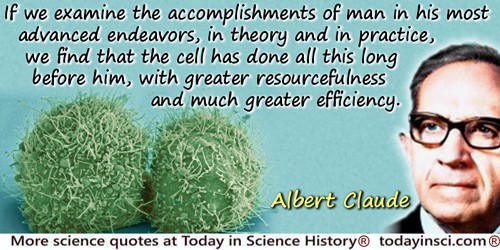
If we examine the accomplishments of man in his most advanced endeavors, in theory and in practice, we find that the cell has done all this long before him, with greater resourcefulness and much greater efficiency.
Nobel Lecture, The Coming Age of the Cell, 12 Dec 1974
If you can modify a cell, it’s only a short step to modifying a mouse, and if you can modify a mouse, it’s only a step to modifying a higher animal, even man.
Reported in 1981, expressing concern for the future of gene-splicing.
Reported in 1981, expressing concern for the future of gene-splicing.
In 'Shaping Life in the Lab', Time (9 Mar 1981).
In its most primitive form, life is, therefore, no longer bound to the cell, the cell which possesses structure and which can be compared to a complex wheel-work, such as a watch which ceases to exist if it is stamped down in a mortar. No, in its primitive form life is like fire, like a flame borne by the living substance;—like a flame which appears in endless diversity and yet has specificity within it;—which can adopt the form of the organic world, of the lank grass-leaf and of the stem of the tree.
Address given at the 1913 meeting of the Koninklijke Akademie van Wetenschappen in Amsterdam. Trans. in G. Van Iterson, Jr, L. E. Den Dooren De Jong and A. J. Kluyver, Martinus Willem Beilerinck: His Life and Work (1940), 120.
In the long course of cell life on this earth it remained, for our age for our generation, to receive the full ownership of our inheritance. We have entered the cell, the Mansion of our birth, and started the inventory of our acquired wealth.
Talking about the new information revealed by electron microscopy Nobel Lecture, The Coming Age of the Cell, 12 Dec 1974
In trying to evaluate Hopkins' unique contribution to biochemistry it may perhaps be said that he alone amongst his contemporaries succeeded in formulating the subject. Among others whose several achievements in their own fields may have surpassed his, no one has ever attempted to unify and correlate biochemical knowledge so as to form a comprehensible picture of the cell and its relation to life, reproduction and function.
'Sir F. G. Hopkins' Teaching and Scientific Influence'. In J. Needham and E. Baldwin (eds.), Hopkins and Biochemistry, 1861-1947 (1949), 36.
Is it absurd to imagine that our social behavior, from amoeba to man, is also planned and dictated, from stored Information, by the cells? And that the time has come for men to be entrusted with the task, through heroic efforts, of bringing life to other worlds?
From Nobel Prize Lecture (Dec 1974), 'The Coming Age of the Cell'. Collected in Jan Lindsten (ed.) Nobel Lectures, Physiology or Medicine 1971-1980 (1992).
It appears unlikely that the role of the genes in development is to be understood so long as the genes are considered as dictatorial elements in the cellular economy. It is not enough to know what a gene does when it manifests itself. One must also know the mechanisms determining which of the many gene-controlled potentialities will be realized.
'The Role of the Cytoplasm in Heredity', in William D. McElroy and Bentley Glass (eds.), A Symposium on the Chemical Basis of Heredity (1957), 162.
It is easy to make out three areas where scientists will be concentrating their efforts in the coming decades. One is in physics, where leading theorists are striving, with the help of experimentalists, to devise a single mathematical theory that embraces all the basic phenomena of matter and energy. The other two are in biology. Biologists—and the rest of us too—would like to know how the brain works and how a single cell, the fertilized egg cell, develops into an entire organism
Article 'The View From Mars', in Annals of the New York Academy of Sciences: Research Facilities of the Future (1994), 735, 37.
It is important to realize that life on this planet has spent about three-quarters of its existence in single-celled form, and even today the majority of organisms still exist as single cells. The evolutionary pressure to become complex is evidently not very great.
and Robert Shapiro
It is not a simple life to be a single cell, although I have no right to say so, having been a single cell so long ago myself that I have no memory at all of that stage in my life.
In A Long Line of Cells: Collected Essays (1990), 244.
It is not so much that the cells make the plant; it is rather that the plant makes the cells.
Quoted in The New Statesman (17 Apr 1920), 15, No. 366, 40. If you know the primary source, please contact Webmaster.
It is possible to state as a general principle that the mesodermic phagocytes, which originally (as in the sponges of our days) acted as digestive cells, retained their role to absorb the dead or weakened parts of the organism as much as different foreign intruders.
'Uber die Pathologische Bedeutung der Intracellularen Verduung', Fortschritte der Medizin (1884), 17, 558-569. Trans. Alfred I. Tauber and Leon Chernyak, Metchnikoff and the Origins of Immunology (1991), 141.
It is structure that we look for whenever we try to understand anything. All science is built upon this search; we investigate how the cell is built of reticular material, cytoplasm, chromosomes; how crystals aggregate; how atoms are fastened together; how electrons constitute a chemical bond between atoms. We like to understand, and to explain, observed facts in terms of structure. A chemist who understands why a diamond has certain properties, or why nylon or hemoglobin have other properties, because of the different ways their atoms are arranged, may ask questions that a geologist would not think of formulating, unless he had been similarly trained in this way of thinking about the world.
‘The Place of Chemistry In the Integration of the Sciences’, Main Currents in Modern Thought (1950), 7, 110.
It is the task of science, as a collective human undertaking, to describe from the external side, (on which alone agreement is possible), such statistical regularity as there is in a world “in which every event has a unique aspect, and to indicate where possible the limits of such description. It is not part of its task to make imaginative interpretation of the internal aspect of reality—what it is like, for example, to be a lion, an ant or an ant hill, a liver cell, or a hydrogen ion. The only qualification is in the field of introspective psychology in which each human being is both observer and observed, and regularities may be established by comparing notes. Science is thus a limited venture. It must act as if all phenomena were deterministic at least in the sense of determinable probabilities. It cannot properly explain the behaviour of an amoeba as due partly to surface and other physical forces and partly to what the amoeba wants to do, with out danger of something like 100 per cent duplication. It must stick to the former. It cannot introduce such principles as creative activity into its interpretation of evolution for similar reasons. The point of view indicated by a consideration of the hierarchy of physical and biological organisms, now being bridged by the concept of the gene, is one in which science deliberately accepts a rigorous limitation of its activities to the description of the external aspects of events. In carrying out this program, the scientist should not, however, deceive himself or others into thinking that he is giving an account of all of reality. The unique inner creative aspect of every event necessarily escapes him.
In 'Gene and Organism', American Naturalist, (1953), 87, 17.
Just as a tree constitutes a mass arranged in a definite manner, in which, in every single part, in the leaves as in the root, in the trunk as in the blossom, cells are discovered to be the ultimate elements, so is it also with the forms of animal life. Every animal presents itself as a sum of vital unities, every one of which manifests all the characteristics of life. The characteristics and unity of life cannot be limited to anyone particular spot in a highly developed organism (for example, to the brain of man), but are to be found only in the definite, constantly recurring structure, which every individual element displays. Hence it follows that the structural composition of a body of considerable size, a so-called individual, always represents a kind of social arrangement of parts, an arrangement of a social kind, in which a number of individual existences are mutually dependent, but in such a way, that every element has its own special action, and, even though it derive its stimulus to activity from other parts, yet alone effects the actual performance of its duties.
In Lecture I, 'Cells and the Cellular Theory' (1858), Rudolf Virchow and Frank Chance (trans.) ,Cellular Pathology (1860), 13-14.
Lately, however, on abandoning the brindled and grey mosquitos and commencing similar work on a new, brown species, of which I have as yet obtained very few individuals, I succeeded in finding in two of them certain remarkable and suspicious cells containing pigment identical in appearance to that of the parasite of malaria. As these cells appear to me to be very worthy of attention … I think it would be advisable to place on record a brief description both of the cells and of the mosquitos.
In 'On Some Peculiar Pigmented Cells Found in Two Mosquitoes Fed on Malarial Blood', British Medical Journal (18 Dec 1897), 1786. Ross continued this study and identified how malaria was transmitted.
Let him look at that dazzling light hung aloft as an eternal lamp to lighten the universe; let him behold the earth, a mere dot compared with the vast circuit which that orb describes, and stand amazed to find that the vast circuit itself is but a very fine point compared with the orbit traced by the stars as they roll their course on high. But if our vision halts there, let imagination pass beyond; it will fail to form a conception long before Nature fails to supply material. The whole visible world is but an imperceptible speck in the ample bosom of Nature. No notion comes near it. Though we may extend our thought beyond imaginable space, yet compared with reality we bring to birth mere atoms. Nature is an infinite sphere whereof the centre is everywhere, the circumference nowhere. In short, imagination is brought to silence at the thought, and that is the most perceptible sign of the all-power of God.
Let man reawake and consider what he is compared with the reality of things; regard himself lost in this remote corner of Nature; and from the tiny cell where he lodges, to wit the Universe, weigh at their true worth earth, kingdoms, towns, himself. What is a man face to face with infinity?
Let man reawake and consider what he is compared with the reality of things; regard himself lost in this remote corner of Nature; and from the tiny cell where he lodges, to wit the Universe, weigh at their true worth earth, kingdoms, towns, himself. What is a man face to face with infinity?
Pensées (1670), Section 1, aphorism 43. In H. F. Stewart (ed.), Pascal’s Pensées (1950), 19.
Life arose as a living molecule or protogene, the progression from this stage to that of the ameba is at least as great as from ameba to man. All the essential problems of living organisms are already solved in the one-celled (or, as many now prefer to say, noncellular) protozoan and these are only elaborated in man or the other multicellular animals. The step from nonlife to life may not have been so complex, after all, and that from cell to multicellular organism is readily comprehensible. The change from protogene to protozoan was probably the most complex that has occurred in evolution, and it may well have taken as long as the change from protozoan to man.
The Meaning of Evolution: A Study of the History of Life and of its Significance for Man (1949), 16
Life is order, death is disorder. A fundamental law of Nature states that spontaneous chemical changes in the universe tend toward chaos. But life has, during milliards of years of evolution, seemingly contradicted this law. With the aid of energy derived from the sun it has built up the most complicated systems to be found in the universe—living organisms. Living matter is characterized by a high degree of chemical organisation on all levels, from the organs of large organisms to the smallest constituents of the cell. The beauty we experience when we enjoy the exquisite form of a flower or a bird is a reflection of a microscopic beauty in the architecture of molecules.
The Nobel Prize for Chemistry: Introductory Address'. Nobel Lectures: Chemistry 1981-1990 (1992), 69.
Like the furtive collectors of stolen art, we [cell biologists] are forced to be lonely admirers of spectacular architecture, exquisite symmetry, dramas of violence and death, mobility, self-sacrifice and, yes, rococo sex.
…...
Man … begins life as an ambiguous speck of matter which can in no way be distinguished from the original form of the lowest animal or plant. He next becomes a cell; his life is precisely that of the animalcule. Cells cluster round this primordial cell, and the man is so far advanced that he might be mistaken for an undeveloped oyster; he grows still more, and it is clear that he might even be a fish; he then passes into a stage which is common to all quadrupeds, and next assumes a form which can only belong to quadrupeds of the higher type. At last the hour of birth approaches; coiled within the dark womb he sits, the image of an ape; a caricature of the man that is to be. He is born, and for some time he walks only on all fours; he utters only inarticulate sounds; and even in his boyhood his fondness for climbing trees would seem to be a relic of the old arboreal life.
In The Martyrdom of Man (1876), 393.
Man is a creature composed of countless millions of cells: a microbe is composed of only one, yet throughout the ages the two have been in ceaseless conflict.
…...
Mathematics is not a book confined within a cover and bound between brazen clasps, whose contents it needs only patience to ransack; it is not a mine, whose treasures may take long to reduce into possession, but which fill only a limited number of veins and lodes; it is not a soil, whose fertility can be exhausted by the yield of successive harvests; it is not a continent or an ocean, whose area can be mapped out and its contour defined: it is limitless as that space which it finds too narrow for its aspirations; its possibilities are as infinite as the worlds which are forever crowding in and multiplying upon the astronomer’s gaze; it is as incapable of being restricted within assigned boundaries or being reduced to definitions of permanent validity, as the consciousness of life, which seems to slumber in each monad, in every atom of matter, in each leaf and bud cell, and is forever ready to burst forth into new forms of vegetable and animal existence.
From Commemoration Day Address (22 Feb 1877) at Johns Hopkins University, Baltimore, collected in The Collected Mathematical Papers: (1870-1883) (1909), 77-78.
No matter how we twist and turn we shall always come back to the cell. The eternal merit of Schwann does not lie in his cell theory that has occupied the foreground for so long, and perhaps will soon be given up, but in his description of the development of the various tissues, and in his demonstration that this development (hence all physiological activity) is in the end traceable back to the cell. Now if pathology is nothing but physiology with obstacles, and diseased life nothing but healthy life interfered with by all manner of external and internal influences then pathology too must be referred back to the cell.
In 'Cellular-Pathologie', Archiv für pathologische Anatomie und Physiologie und fur klinische Medizin (1855), 8, 13-14, as translated in LellandJ. Rather, 'Cellular Pathology', Disease, Life, and Man: Selected Essays by Rudolf Virchow (1958), 81.
No one has ever done this before, … What we are trying to do here is to create a stem cell line without injuring an embryo. Our cells can go on to become a healthy, kicking baby.
…...
Not only do the various components of the cells form a living system, in which the capacity to live, react, and reproduce is dependent on the interactions of all the members of the system; but this living system is identical with the genetic system. The form of life is determined not only by the specific nature of the hereditary units but also by the structure and arrangement of the system. The whole system is more than the sum of its parts, and the effect of each of the components depends on and is influenced by all previous reactions, whose sequence is in turn determined by the whole idiotype.
'Cytoplasmic Inheritance in Epilobium and Its Theoretical Significance', Advances in Genetics (1954), 6, 320.
Of the nucleosides from deoxyribonucleic acids, all that was known with any certainty [in the 1940s] was that they were 2-deoxy-D-ribosides of the bases adenine, guanine, thymine and cytosine and it was assumed that they were structurally analogous to the ribonucleosides. The chemistry of the nucleotides—the phosphates of the nucleosides—was in a correspondingly primitive state. It may well be asked why the chemistry of these groups of compounds was not further advanced, particularly since we recognize today that they occupy a central place in the history of the living cell. True, their full significance was for a long time unrecognized and emerged only slowly as biochemical research got into its stride but I think a more important reason is to be found in the physical properties of compounds of the nucleotide group. As water-soluble polar compounds with no proper melting points they were extremely difficult to handle by the classic techniques of organic chemistry, and were accordingly very discouraging substances to early workers. It is surely no accident that the major advances in the field have coincided with the appearance of new experimental techniques such as paper and ion-exchange chromatography, paper electrophoresis, and countercurrent distribution, peculiarly appropriate to the compounds of this group.
In 'Synthesis in the Study of Nucleotides', Nobel Lecture, 11 December 1957. In Nobel Lectures: Chemistry 1942-1962 (1964), 524.
On the whole, at least in the author's experience, the preparation of species-specific antiserum fractions and the differentiation of closely related species with precipitin sera for serum proteins does not succeed so regularly as with agglutinins and lysins for blood cells. This may be due to the fact that in the evolutional scale the proteins undergo continuous variations whereas cell antigens are subject to sudden changes not linked by intermediary stages.
The Specificity of Serological Reactions (1936), 12-3.
One day when the whole family had gone to a circus to see some extraordinary performing apes, I remained alone with my microscope, observing the life in the mobile cells of a transparent star-fish larva, when a new thought suddenly flashed across my brain. It struck me that similar cells might serve in the defence of the organism against intruders. Feeling that there was in this something of surpassing interest, I felt so excited that I began striding up and down the room and even went to the seashore in order to collect my thoughts.
I said to myself that, if my supposition was true, a splinter introduced into the body of a star-fish larva, devoid of blood-vessels or of a nervous system, should soon be surrounded by mobile cells as is to be observed in a man who runs a splinter into his finger. This was no sooner said than done.
There was a small garden to our dwelling, in which we had a few days previously organised a 'Christmas tree' for the children on a little tangerine tree; I fetched from it a few rose thorns and introduced them at once under the skin of some beautiful star-fish larvae as transparent as water.
I was too excited to sleep that night in the expectation of the result of my experiment, and very early the next morning I ascertained that it had fully succeeded.
That experiment formed the basis of the phagocyte theory, to the development of which I devoted the next twenty-five years of my life.
I said to myself that, if my supposition was true, a splinter introduced into the body of a star-fish larva, devoid of blood-vessels or of a nervous system, should soon be surrounded by mobile cells as is to be observed in a man who runs a splinter into his finger. This was no sooner said than done.
There was a small garden to our dwelling, in which we had a few days previously organised a 'Christmas tree' for the children on a little tangerine tree; I fetched from it a few rose thorns and introduced them at once under the skin of some beautiful star-fish larvae as transparent as water.
I was too excited to sleep that night in the expectation of the result of my experiment, and very early the next morning I ascertained that it had fully succeeded.
That experiment formed the basis of the phagocyte theory, to the development of which I devoted the next twenty-five years of my life.
In Olga Metchnikoff, Life of Elie Metchnikoff 1845-1916 (1921), 116-7.
One of the many useful properties of giant nerve fibres is that samples of protoplasm or axoplasm as it is usually called can be obtained by squeezing out the contents from a cut end … As in many other cells there is a high concentration of potassium ions and relatively low concentration of sodium and chloride ions. This is the reverse of the situation in the animals’ blood or in sea water, where sodium and chloride are the dominant ions and potassium is relatively dilute.
The Conduction of the Nervous Impulse (1964), 27.
Our children will enjoy in their homes electrical energy too cheap to meter. … Transmutation of the elements, unlimited power, ability to investigate the working of living cells by tracer atoms, the secret of photosynthesis about to be uncovered, these and a host of other results, all in about fifteen short years. It is not too much to expect that our children will know of great periodic regional famines in the world only as matters of history, will travel effortlessly over the seas and under the and through the air with a minimum of danger and at great speeds, and will experience a life span far longer than ours, as disease yields and man comes to understand what causes him to age.
Speech at the 20th anniversary of the National Association of Science Writers, New York City (16 Sep 1954), as quoted in 'Abundant Power From Atom Seen', New York Times (17 Sep 1954) 5.
Oxygen is the vital ingredient for the survival of every cell in our bodies. Too little–or too much–can spell disaster. Understanding how evolution has equipped cells to detect and respond to fluctuating oxygen levels helps answer fundamental questions.
Commenting on the significance of the work by new Nobel Prize winner, Gregg Semenza. As quoted in Reuters online article, Niklas Pollard and Kate Kelland, 'Nobel Medicine Prize won by doctors for work on cells’ response to oxygen' (2019).
Rudolf Virchow, often referred to as the father of modern pathology, broke sharply with such traditional concepts by proposing that the basis of all disease is injury to the smallest living unit of the body, namely, the cell. More than a century later, both clinical and experimental
pathology remain rooted in Virchow’s cellular pathology.
In Emanuel Rubin and John L. Farber (eds.), Pathology (1944), 2.
Science tries to answer the question: ‘How?’ How do cells act in the body? How do you design an airplane that will fly faster than sound? How is a molecule of insulin constructed? Religion, by contrast, tries to answer the question: ‘Why?’ Why was man created? Why ought I to tell the truth? Why must there be sorrow or pain or death? Science attempts to analyze how things and people and animals behave; it has no concern whether this behavior is good or bad, is purposeful or not. But religion is precisely the quest for such answers: whether an act is right or wrong, good or bad, and why.
Science and Imagination, ch. 4, Basic Books (1967).
Simple molecules combine to make powerful chemicals. Simple cells combine to make powerful life-forms. Simple electronics combine to make powerful computers. Logically, all things are created by a combination of simpler, less capable components. Therefore, a supreme being must be in our future, not our origin. What if “God” is the consciousness that will be created when enough of us are connected by the Internet?!!
Thoughts by character Dogbert in Dilbert cartoon strip (11 Feb 1996).
Since disease originates in the elementary cell, the organization and microscopic functions of which reproduce the general organization exactly and in all its relationships, nothing is more suited to simplifying the work of classification and of systematic division than to take the elementary cell as the basis of division.
As quoted in article, Marc Klein,'François-Vincent Raspail', in Charles Coulston Gillispie (ed.), Dictionary of Scientific Biography (1975). Vol.11, 300-301.
So, let’s say you want to change the human body. You want to fix a mistake. You want to repair something. You want to improve something. Well, if you’re going to reprogram human genetic material, you need a delivery system, and nothing works better than virus. It’s like a suitcase. Yes, pack in genetic mutation infect the body and the vector loads into the target cells Getting it where you want it, how you want it, is the nightmare. Unless you have a map.
From screenplay for The Bourne Legacy (2012), written by Tony and Dan Gilroy. Spoken by fictional character Dr. Marta Shearing, played by Rachel Weisz.
Surely the mitochondrion that first entered another cell was not thinking about the future benefits of cooperation and integration; it was merely trying to make its own living in a tough Darwinian world
Wonderful Life: the Burgess Shale and the Nature of History (1990), 310.
The ability of a cell to sense these broken ends, to direct them towards each other, and then to unite them so that the union of the two DNA strands is correctly oriented, is a particularly revealing example of the sensitivity of cells to all that is going on within them. They make wise decisions and act on them.
(8 Dec 1983) The Significance of Responses of the Genome to Challenge, Nobel Lecture
The ability of the genes to vary and, when they vary (mutate), to reproduce themselves in their new form, confers on these cell elements, as Muller has so convincingly pointed out, the properties of the building blocks required by the process of evolution. Thus, the cell, robbed of its noblest prerogative, was no longer the ultimate unit of life. This title was now conferred on the genes, subcellular elements, of which the cell nucleus contained many thousands and, more precisely, like Noah’s ark, two of each kind.
Nucleo-cytoplasmic Relations in Micro-Organisms: Their Bearing on Cell Heredity and Differentiation (1953), 2-3.
The advances of biology during the past 20 years have been breathtaking, particularly in cracking the mystery of heredity. Nevertheless, the greatest and most difficult problems still lie ahead. The discoveries of the 1970‘s about the chemical roots of memory in nerve cells or the basis of learning, about the complex behavior of man and animals, the nature of growth, development, disease and aging will be at least as fundamental and spectacular as those of the recent past.
As quoted in 'H. Bentley Glass', New York Times (12 Jan 1970), 96.
The ancestors of the higher animals must be regarded as one-celled beings, similar to the Amœbæ which at the present day occur in our rivers, pools, and lakes. The incontrovertible fact that each human individual develops from an egg, which, in common with those of all animals, is a simple cell, most clearly proves that the most remote ancestors of man were primordial animals of this sort, of a form equivalent to a simple cell. When, therefore, the theory of the animal descent of man is condemned as a “horrible, shocking, and immoral” doctrine, tho unalterable fact, which can be proved at any moment under the microscope, that the human egg is a simple cell, which is in no way different to those of other mammals, must equally be pronounced “horrible, shocking, and immoral.”
Translated from his Ueber die Entstehung und den Stammbaum des Menschengeschlechts, (1873), Vol. 2, as an epigraph to Chap. 6, The Evolution of Man, (1879), Vol 1, 120-121.
The axis cylinders of all nerve fibers (motor, secretory, sensitive and sensory, conducting centrifugally or centripetally) have been proved to proceed directly from the cells. A connection with a fiber network, or an origin from such a network, does not take place.
In 'Uber einige neuere Forschungen im Gebiete der Anatomie des Centralnervensystems', Deutsche Medizirusche Wochenschrlft (1891), 7, 1352. Trans. Edwin Clarke and L. S. Jacyna, Nineteenth Century Origins of Neuroscientific Concepts (1987), 99.
The blueprints for the construction of one human being requires only a meter of DNA and one tiny cell. … even Mozart started out this way.
In The Center of Life: A Natural History of the Cell (1977, 1978), 8.
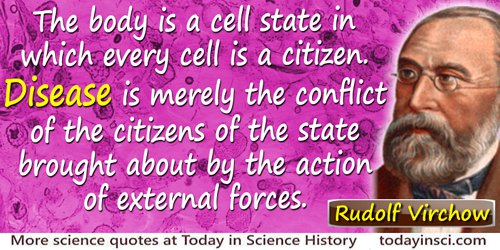
The body is a cell state in which every cell is a citizen. Disease is merely the conflict of the citizens of the state brought about by the action of external forces. (1858)
From Die Cellularpathologie (1858). As cited in Alan Lindsay Mackay, A Dictionary of Scientific Quotations (1991), 250. Although widely quoted in this form, Webmaster has not yet been able to pin down the source of the translation in these few words. (It might be in Rudolph Virchow translated by Lelland J. Rather, Disease, Life, and Man: Selected Essays (1958), 142-9.) If you know the exact citation to the primary source, please contact Webmaster.
The cause of nutrition and growth resides not in the organism as a whole but in the separate elementary parts—the cells.
Mikroskopische Untersuchungen über die Uebereinstimmung in der Struktur und dem Wachsthum der Thiere und Pflanzen (1839). Microscopic Researches into the Accordance in the Structure and Growth of Animals and Plants, trans. Henry Smith (1847), 192.
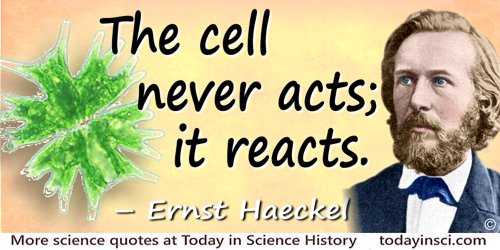
The cell never acts; it reacts.
Generelle Morphology (1866).
The cell was the first invention of the animal kingdom, and all higher animals are and must be cellular in structure. Our tissues were formed ages on ages ago; they have all persisted. Most of our organs are as old as worms. All these are very old, older than the mountains.
In The Whence and Whither of Man; a Brief History of his Origin and Development through Conformity to Environment; being the Morse Lectures of 1895. (1896), 173. The Morse lectureship was founded by Prof. Samuel F.B. Morse in 1865 at Union Theological Seminary, the lectures to deal with “the relation of the Bible to any of the sciences.”
The cell, this elementary keystone of living nature, is far from being a peculiar chemical giant molecule or even a living protein and as such is not likely to fall prey to the field of an advanced chemistry. The cell is itself an organism, constituted of many small units of life.
Quoted in Joseph S. Fruton, Proteins, Enzymes, Genes: The Interplay of Chemistry and Biology (1999), 59.
The cell, too, has a geography, and its reactions occur in colloidal apparatus, of which the form, and the catalytic activity of its manifold surfaces, must efficiently contribute to the due guidance of chemical reactions.
'Some Aspects of Biochemistry', The Irish Journal of Medical Science (1932), 79, 344.
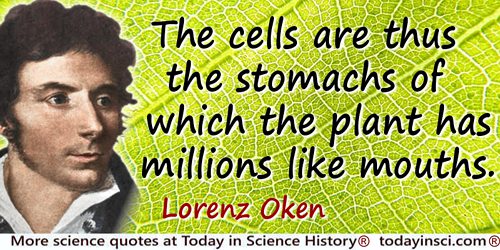
The cells are thus the stomachs of which the plant has millions like mouths.
In Lorenz Oken, trans. by Alfred Tulk, Elements of Physiophilosophy (1847), 264.
The construction of an analogue computer or a supersonic airplane is simple when compared to the mixture of space and evolutionary eons represented by a cell.
In 'The Wisdom of Wilderness', Life (22 Dec 1967), 63, No. 25, 10.
The curiosity remains… to grasp more clearly how the same matter, which in physics and chemistry displays orderly and reproducible and relatively simple properties, arranges itself in the most astounding fashions as soon as it is drawn into the orbit of the living organism. The closer one looks at these performances of matter in living organisms the more impressive the show becomes. The meanest living cell becomes a magic puzzle box full of elaborate and changing molecules.
From 'Life: The Magic Puzzle Box', Transactions of the Connecticut Academy of Arts and Sciences (Dec 1949), 38, 173-190.
The elementary parts of all tissues are formed of cells in an analogous, though very diversified manner, so that it may be asserted, that there is one universal principle of development for the elementary parts of organisms, however different, and that this principle is the formation of cells.
Mikroskopische Untersuchungen über die Uebereinstimmung in der Struktur und dem Wachsthum der Thiere und Pflanzen (1839). Microscopic Researches into the Accordance in the Structure and Growth of Animals and Plants, trans. Henry Smith (1847), 165.
The extracellular genesis of cells in animals seemed to me, ever since the publication of the cell theory [of Schwann], just as unlikely as the spontaneous generation of organisms. These doubts produced my observations on the multiplication of blood cells by division in bird and mammalian embryos and on the division of muscle bundles in frog larvae. Since then I have continued these observations in frog larvae, where it is possible to follow the history of tissues back to segmentation.
'Ueber extracellulare Eutstehung thierischer Zelleu und üüber Vermehrung derselben durch Theilung', Archiv für Anatomie, Physiologie und Wissenschaftliche Medicin (1852), 1, 49-50. Quoted in Erwin H. Ackerknecht, Rudolf Virchow: Doctor Statesman Anthropologist (1953), 83-4.
The first observation of cancer cells in the smear of the uterine cervix gave me one of the greatest thrills I ever experienced during my scientific career.
Quoted on web page http://www.whonamedit.com/doctor.cfm/2402.html
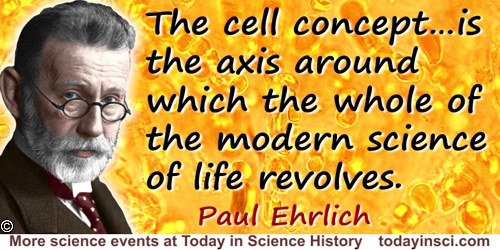
The history of the knowledge of the phenomena of life and of the organized world can be divided into two main periods. For a long time anatomy, and particularly the anatomy of the human body, was the α and ω of scientific knowledge. Further progress only became possible with the discovery of the microscope. A long time had yet to pass until through Schwann the cell was established as the final biological unit. It would mean bringing coals to Newcastle were I to describe here the immeasurable progress which biology in all its branches owes to the introduction of this concept of the cell concept. For this concept is the axis around which the whole of the modern science of life revolves.
Nobel Lecture (11 Dec 1908) 'Partial Cell Functions.' Collected in Nobel Lectures: Physiology or Medicine 1901-1921 (1967), 304.
The history of the universe is in every one of us. Every particle in our bodies has a multibillion-year past, every cell and every bodily organ has a multimillion-year past, and many of our ways of thinking have multithousand-year pasts.
As co-author with Nancy Ellen Abrams, in The View from the Center of the Universe: Discovering Our Extraordinary Place in the Cosmos (2006), 151.
The injurious agent in cigarettes comes principally from the burning paper wrapper. The substance thereby formed is called “acrolein.” It has a violent action on the nerve centers, producing degeneration of the cells of the brain, which is quite rapid among boys. Unlike most narcotics, this degeneration is permanent and uncontrollable. I employ no person who smokes cigarettes.
[From the Laboratory of Thomas A. Edison, Orange, N.J., April 26, 1914.]
[From the Laboratory of Thomas A. Edison, Orange, N.J., April 26, 1914.]
Quoted in Henry Ford, The Case Against the Little White Slaver (1914), Vol. 1, 5.
The mechanist is intimately convinced that a precise knowledge of the chemical constitution, structure, and properties of the various organelles of a cell will solve biological problems. This will come in a few centuries. For the time being, the biologist has to face such concepts as orienting forces or morphogenetic fields. Owing to the scarcity of chemical data and to the complexity of life, and despite the progresses of biochemistry, the biologist is still threatened with vertigo.
Problems of Morphogenesis in Ciliates: The Kinetosomes in Development, Reproduction and Evolution (1950), 92-3.
The microscope has shown me that all the varied forms in the animal tissues are nothing but transformed cells. … All my work has authorized me to apply to animals as to plants the doctrine of the individuality of the cells.
From his preliminary announcement (1838). As quoted in William Dobinson Halliburton, A Textbook of Chemical Physiology and Pathology (1891) 186.
The most intensely social animals can only adapt to group behavior. Bees and ants have no option when isolated, except to die. There is really no such creature as a single individual; he has no more life of his own than a cast off cell marooned from the surface of your skin.
In The Lives of a Cell (1974), 63.
The nucleic acids, as constituents of living organisms, are comparable In importance to proteins. There is evidence that they are Involved In the processes of cell division and growth, that they participate In the transmission of hereditary characters, and that they are important constituents of viruses. An understanding of the molecular structure of the nucleic acids should be of value In the effort to understand the fundamental phenomena of life.
[Co-author with American chemist, B. Corey (1897-1971)]
[Co-author with American chemist, B. Corey (1897-1971)]
'A Proposed Structure for the Nucleic Acids', Proceedings of the National Academy of Sciences (1953), 39, 84.
The nucleus has to take care of the inheritance of the heritable characters, while the surrounding cytoplasm is concerned with accommodation or adaptation to the environment.
Generelle Morphologie (1866), Vol. 1, 287-8. Trans. Ernst Mayr, The Growth of Biological Thought: Diversity, Evolution and Inheritance (1982), 672.
The present knowledge of the biochemical constitution of the cell was achieved largely by the use of destructive methods. Trained in the tradition of the theory of solutions, many a biochemist tends, even today, to regard the cell as a “bag of enzymes”. However, everyone realizes now that the biochemical processes studied in vitro may have only a remote resemblance to the events actually occurring in the living cell.
Nucleo-cytoplasmic Relations in Micro-Organisms: Their Bearing on Cell Heredity and Differentiation (1953), 108.
The relative importance of the white and gray matter is often misunderstood. Were it not for the manifold connection of the nerve cells in the cortex by the tens of millions of fibres which make up the under-estimated white matter, such a brain would be useless as a telephone or telegraph station with all the interconnecting wires destroyed.
Address to the American Association for the Advancement of Science in Philadelphia (28 Dec 1904), as quoted in 'Americans of Future Will Have Best Brains', New York Times (29 Dec 1904), 6.
The skeletal striated muscle cell of amphibia therefore resembles the cardiac striated muscle cell in the property of “all or none” contraction. The difference which renders it possible to obtain 'submaximal' contractions from a whole skeletal muscle but not from a whole heart is not a difference in the functional capabilities of the two types of cell; it depends upon the fact that cardiac muscle cells are connected one with another, whereas skeletal muscle cells are isolated by their sarcolemma. The 'submaximal' contraction of a skeletal muscle is the maximal contraction of less than all its fibres.
'The “All or None” Contraction of the Amphibian Skeletal Muscle Fibre', Journal of Physiology (1909), 38, 133.
The theory is confirmed that pea hybrids form egg and pollen cells, which, in their constitution, represent in equal numbers all constant forms which result for the combination of the characters united in fertilization.
As collected in Forest Ray Moulton (ed.), The Autobiography of Science (1945), 586.
The uniformity of the earth’s life, more astonishing than its diversity, is accountable by the high probability that we derived, originally, from some single cell, fertilized in a bolt of lightning as the earth cooled. It is from the progeny of this parent cell that we take our looks; we still share genes around, and the resemblance of the enzymes of grasses to those of whales is a family resemblance.
In The Lives of a Cell (1974), 5.
The varieties of chemical substances actually found in living things are vastly more restricted than the possible varieties. A striking illustration is that if one molecule each of all the possible types of proteins were made, they would together weigh more than the observable universe. Obviously there are a fantastically large number of protein types that are not made by living cells.
In The Closing Circle: Nature, Man, and Technology (2014).
There are living systems; there is no living “matter.” No substance, no single molecule, extracted and isolated from a living being possess, of its own, the aforementioned paradoxical properties. They are present in living systems only; that is to say, nowhere below the level of the cell.
Inaugural lecture on taking the chair of molecular biology, Collège de France (3 Nov 1967). From Biology to Ethics (1969), 5.
There is a finite number of species of plants and animals—even of insects—upon the earth. … Moreover, the universality of the genetic code, the common character of proteins in different species, the generality of cellular structure and cellular reproduction, the basic similarity of energy metabolism in all species and of photosynthesis in green plants and bacteria, and the universal evolution of living forms through mutation and natural selection all lead inescapably to a conclusion that, although diversity may be great, the laws of life, based on similarities, are finite in number and comprehensible to us in the main even now.
Presidential Address (28 Dec 1970) to the American Association for the Advancement of Science. 'Science: Endless Horizons or Golden Age?', Science (8 Jan 1971), 171, No. 3866, 24.
These results demonstrate that there is a new polymerase inside the virions of RNA tumour viruses. It is not present in supernatents of normal cells but is present in virions of avian sarcoma and leukemia RNA tumour viruses. The polymerase seems to catalyse the incorporation of deoxyrinonucleotide triphosphates into DNA from an RNA template. Work is being performed to characterize further the reaction and the product. If the present results and Baltimore's results with Rauscher leukemia virus are upheld, they will constitute strong evidence that the DNA proviruses have a DNA genome when they are in virions. This result would have strong implications for theories of viral carcinogenesis and, possibly, for theories of information transfer in other biological systems. [Co-author with American virologist Satoshi Mizutani]
'RNA-dependent DNA Polymerase in Virions of Rous Sarcoma Virus', Nature (1970), 226, 1213.
They are babies in waiting, life on ice.
On sperm cells frozen for preservation
On sperm cells frozen for preservation
'Quickening Debate over Life on Ice' Time (2 Jul 1984)
This is only one step in a much larger project. I discovered (no, not me: my team) the function of sugar nucleotides in cell metabolism. I want others to understood this, but it is not easy to explain: this is not a very noteworthy deed, and we hardly know even a little.
[replying when asked about the significance of his Nobel prize-winning achievement.]
[replying when asked about the significance of his Nobel prize-winning achievement.]
As quoted in John H. Exto, Crucible of Science: The Story of the Cori Laboratory (2013), 52.
Thus a nerve element, a nerve entity, or ‘neuron’, as I propose to call it, consists‥of the following pieces:—(a) a nerve cell, (b) the nerve process, (c) its collaterals, and (d) the end-branching.
[Coining the word ‘neuron’ in the sense of a nerve cell.]
[Coining the word ‘neuron’ in the sense of a nerve cell.]
In original German text by Waldeyer in Berliner Klin. Wochenschr. (13 July 1891), 691:1. As translated in Brain (1891), 14, 569. Note: The word ‘neuron’ was used earlier in difference senses, now obsolete, by B.T. Lowne (1883) for the neural part of the compound eye of athropods, and by B.G. Wilder (1884) for the neuraxis.
To regulate something always requires two opposing factors. You cannot regulate by a single factor. To give an example, the traffic in the streets could not be controlled by a green light or a red light alone. It needs a green light and a red light as well. The ratio between retine and promine determines whether there is any motion, any growth, or not. Two different inclinations have to be there in readiness to make the cells proliferate.
In Ralph W. Moss, Free Radical (1988), 186.
![Albert Claude quote: Until 1930 or thereabout biologists [using microscopes]](https://todayinsci.com/C/Claude_Albert/ClaudeAlbert-Distant500x250px.jpg)
Until 1930 or thereabout biologists [using microscopes], in the situation of Astronomers and Astrophysicists, were permitted to see the objects of their interest, but not to touch them; the cell was as distant from us, as the stars and galaxies were from them.
Nobel Lecture, The Coming Age of the Cell, 12 Dec 1974
We are made of cells. And of stars. The Universe outside of us has made the universe inside us.
Opening sentence from The Center of Life: A Natural History of the Cell (1977, 1978), 5.

We are now in the mountains and they are in us, kindling enthusiasm, making every nerve quiver, filling every pore and cell of us. Our flesh-and-bone tabernacle seems transparent as glass to the beauty about us, as if truly an inseparable part of it, thrilling with the air and trees, streams and rocks, in the waves of the sun,—a part of all nature, neither old nor young, sick nor well, but immortal.
In My First Summer in the Sierra (1911), 20. Based on Muir’s original journals and sketches of his 1869 stay in the Sierra.
We do not know of any enzymes or other chemical defined organic substances having specifically acting auto-catalytic properties such as to enable them to construct replicas of themselves. Neither was there a general principle known that would result in pattern-copying; if there were, the basis of life would be easier to come by. Moreover, there was no evidence to show that the enzymes were not products of hereditary determiners or genes, rather than these genes themselves, and they might even be products removed by several or many steps from the genes, just as many other known substances in the cell must be. However, the determiners or genes themselves must conduct, or at least guide, their own replication, so as to lead to the formation of genes just like themselves, in such wise that even their own mutations become .incorporated in the replicas. And this would probably take place by some kind of copying of pattern similar to that postulated by Troland for the enzymes, but requiring some distinctive chemical structure to make it possible. By virtue of this ability of theirs to replicate, these genes–or, if you prefer, genetic material–contained in the nuclear chromosomes and in whatever other portion of the cell manifests this property, such as the chloroplastids of plants, must form the basis of all the complexities of living matter that have arisen subsequent to their own appearance on the scene, in the whole course of biological evolution. That is, this genetic material must underlie all evolution based on mutation and selective multiplication.
'Genetic Nucleic Acid', Perspectives in Biology and Medicine (1961), 5, 6-7.
We may regard the cell quite apart from its familiar morphological aspects, and contemplate its constitution from the purely chemical standpoint. We are obliged to adopt the view, that the protoplasm is equipped with certain atomic groups, whose function especially consists in fixing to themselves food-stuffs, of importance to the cell-life. Adopting the nomenclature of organic chemistry, these groups may be designated side-chains. We may assume that the protoplasm consists of a special executive centre (Leistungs-centrum) in connection with which are nutritive side-chains… The relationship of the corresponding groups, i.e., those of the food-stuff, and those of the cell, must be specific. They must be adapted to one another, as, e.g., male and female screw (Pasteur), or as lock and key (E. Fischer).
Croonian Lecture, 'On Immunity with Special Reference to Cell Life', Proceedings of the Royal Society of London, 1900, 66, 433-434.
We must ascribe to all cells an independent vitality; that is, such combinations of molecules as occur in any single cell are capable of setting free the power by which it is enabled to take up fresh molecules.
In Theodor Schwann and Henry Smith (trans.), 'Theory of the Cells', Microscopical Researches Into the Accordance in the Structure and Growth of Animals and Plants (1839, 1847), 192.
What politicians do not understand is that [Ian] Wilmut discovered not so much a technical trick as a new law of nature. We now know that an adult mammalian cell can fire up all the dormant genetic instructions that shut down as it divides and specializes and ages, and thus can become a source of new life. You can outlaw technique; you cannot repeal biology.
Writing after Wilmut's successful cloning of the sheep, Dolly, that research on the cloning of human beings cannot be suppressed.
Writing after Wilmut's successful cloning of the sheep, Dolly, that research on the cloning of human beings cannot be suppressed.
'A Special Report on Cloning'. Charles Krauthammer in Time (10 Mar 1997).
What we call man is a mechanism made up of … uncrystallized matter … all the colloid matter of his mechanism is concentrated in a countless number of small cells. … [T]hese cells [are] dwelling places, communes, a walled town within which are many citizens. ... [T]hese are the units of life and when they pass out into space man as we think we know him is dead, a mere machine from which the crew have left,so to speak. ... [T]hese units are endowed with great intelligence. They have memories, they must be divided into countless thousands of groups, most are workers, there are directing groups. Some are chemists, they manufacture the most complicated chemicals that are secreted by the glands.
Diary and Sundry Observations of Thomas Alva Edison (1948), 203-44. In Mark Seltzer, Serial Killers (1998), 215-6.
Where a cell arises, there a cell must have previously existed (omnis cellula e cellula), just as an animal can spring only from an animal, a plant only from a plant. In this manner, although there are still a few spots in the body where absolute demonstration has not yet been afforded, the principle is nevertheless established, that in the whole series of living things, whether they be entire plants or animal organisms, or essential constituents of the same, an eternal law of continuous development prevails.
In Lecture II 'Physiological Tissues' (17 Feb 1858), as translated by Frank Chance in Cellular Pathology: As Based Upon Physiological and Pathological Histology. Twenty Lectures Delivered in the Pathological Institute of Berlin During the Months of February, March and April, 1858 (1860), 27-28.
With moth cytochrome C there are 30 differences and 74 identities. With bread yeast and humans, there are about 45 amino acids that are different and about 59 that are identical. Think how close together man and this other organism, bread yeast, are. What is the probability that in 59 positions the same choice out of 20 possibilities would have been made by accident? It is impossibly small. There is, there must be, a developmental explanation of this. The developmental explanation is that bread yeast and man have a common ancestor, perhaps two billion years ago. And so we see that not only are all men brothers, but men and yeast cells, too, are at least close cousins, to say nothing about men and gorillas or rhesus monkeys. It is the duty of scientists to dispel ignorance of such relationships.
'The Social Responsibilities of Scientists and Science', The Science Teacher (1933), 33, 15.
With NMR we don’t touch the cell at all. We can follow it through time, watch its development.
Describing the benefits of the newly developed nuclear magnetic resonance imaging microscope. As quoted in L. Davis, 'Seeing the Cell and Letting it Live', Science News (19 Jul 1986), 130, No. 3, 39. Reference to Letter, James B. Aguayo, et al.,'Nuclear Magnetic Resonance Imaging of a Single Cell', Nature (10 Jul 1986), 322, 190–191, which announced the first NMR images of a single cell.
Within the nucleus [of a cell] is a network of fibers, a sap fills the interstices of the network. The network resolves itself into a definite number of threads at each division of the cell. These threads we call chromosomes. Each species of animals and plants possesses a characteristic number of these threads which have definite size and sometimes a specific shape and even characteristic granules at different levels. Beyond this point our strongest microscopes fail to penetrate.
In A Critique of the Theory of Evolution (1916), 91.
You cannot put a rope around the neck of an idea; you cannot put an idea up against a barrack-square wall and riddle it with bullets; you cannot confine it in the strongest prison cell that your slaves could ever build.
Death of Thomas Ashe
 In science it often happens that scientists say, 'You know that's a really good argument; my position is mistaken,' and then they would actually change their minds and you never hear that old view from them again. They really do it. It doesn't happen as often as it should, because scientists are human and change is sometimes painful. But it happens every day. I cannot recall the last time something like that happened in politics or religion.
(1987) --
In science it often happens that scientists say, 'You know that's a really good argument; my position is mistaken,' and then they would actually change their minds and you never hear that old view from them again. They really do it. It doesn't happen as often as it should, because scientists are human and change is sometimes painful. But it happens every day. I cannot recall the last time something like that happened in politics or religion.
(1987) -- 





.jpg)


