Cause And Effect Quotes (21 quotes)
Dilbert: Evolution must be true because it is a logical conclusion of the scientific method.
Dogbert: But science is based on the irrational belief that because we cannot perceive reality all at once, things called “time” and “cause and effect” exist.
Dilbert: That’s what I was taught and that’s what I believe.
Dogbert: Sounds cultish.
Dogbert: But science is based on the irrational belief that because we cannot perceive reality all at once, things called “time” and “cause and effect” exist.
Dilbert: That’s what I was taught and that’s what I believe.
Dogbert: Sounds cultish.
Dilbert comic strip (8 Feb 1992).
Error of confounding cause and effect.—There is no more dangerous error than confounding consequence with cause: I call it the intrinsic depravity of reason. … I take an
example: everybody knows the book of the celebrated Comaro, in which he recommends his spare diet as a recipe for a long and happy life,—for a virtuous life also. Few books have been read so much… I believe hardly any book … has caused so much harm, has shortened so many lives, as this well-meant curiosity. The source of this mischief is in confounding consequence with cause. The candid Italian saw in his diet the cause of his long life, while the prerequisite to long life, the extraordinary slowness of the metabolic process, small consumption, was the cause of his spare diet. He was not at liberty to eat little or much; his frugality—was not of “free will;” he became sick when he ate more.
From 'The Four Great Errors', The Twilight of the Idols (1888), collected in Thomas Common (trans.), The Works of Friedrich Nietzsche (1896), Vol. 11, 139.
I believe in logic, the sequence of cause and effect, and in science its only begotten son our law, which was conceived by the ancient Greeks, thrived under Isaac Newton, suffered under Albert Einstein…
That fragment of a 'creed for materialism' which a friend in college had once shown him rose through Donald's confused mind.
That fragment of a 'creed for materialism' which a friend in college had once shown him rose through Donald's confused mind.
Stand on Zanzibar (1969)
A science cannot be played with. If an hypothesis is advanced that obviously brings into direct sequence of cause and effect all the phenomena of human history, we must accept it, and if we accept it, we must teach it.
In The Degradation of the Democratic Dogma (1919), 131.
A science cannot be played with. If an hypothesis is advanced that obviously brings into direct sequence of cause and effect all the phenomena of human history, we must accept it, and if we accept it, we must teach it.
In The Degradation of the Democratic Dogma (1919), 131.
All science is concerned with the relationship of cause and effect. Each scientific discovery increases man’s ability to predict the consequences of his actions and thus his ability to control future events.
…...
Considering it as thus established, that heat is not a substance, but a dynamical form of mechanical effect, we perceive that there must be an equivalence between mechanical work and heat, as between cause and effect.
In 'On the Dynamical Theory of Heat, with Numerical Results Deduced from Mr. Joule's Equivalent of a Thermal Unit, and M. Regnault's Observations on Steam' (1851). In Mathematical and Physical Papers (1882-1911), Vol. 1, 175.
In its earliest development knowledge is self-sown. Impressions force themselves upon men’s senses whether they will or not, and often against their will. The amount of interest in which these impressions awaken is determined by the coarser pains and pleasures which they carry in their train or by mere curiosity; and reason deals with the materials supplied to it as far as that interest carries it, and no further. Such common knowledge is rather brought than sought; and such ratiocination is little more than the working of a blind intellectual instinct. It is only when the mind passes beyond this condition that it begins to evolve science. When simple curiosity passes into the love of knowledge as such, and the gratification of the æsthetic sense of the beauty of completeness and accuracy seems more desirable that the easy indolence of ignorance; when the finding out of the causes of things becomes a source of joy, and he is accounted happy who is successful in the search, common knowledge passes into what our forefathers called natural history, whence there is but a step to that which used to be termed natural philosophy, and now passes by the name of physical science.
In this final state of knowledge the phenomena of nature are regarded as one continuous series of causes and effects; and the ultimate object of science is to trace out that series, from the term which is nearest to us, to that which is at the farthest limit accessible to our means of investigation.
The course of nature as it is, as it has been, and as it will be, is the object of scientific inquiry; whatever lies beyond, above, or below this is outside science. But the philosopher need not despair at the limitation on his field of labor; in relation to the human mind Nature is boundless; and, though nowhere inaccessible, she is everywhere unfathomable.
In this final state of knowledge the phenomena of nature are regarded as one continuous series of causes and effects; and the ultimate object of science is to trace out that series, from the term which is nearest to us, to that which is at the farthest limit accessible to our means of investigation.
The course of nature as it is, as it has been, and as it will be, is the object of scientific inquiry; whatever lies beyond, above, or below this is outside science. But the philosopher need not despair at the limitation on his field of labor; in relation to the human mind Nature is boundless; and, though nowhere inaccessible, she is everywhere unfathomable.
The Crayfish: an Introduction to the Study of Zoölogy (1880), 2-3. Excerpted in Popular Science (Apr 1880), 16, 789-790.
In speaking of cause and effect we arbitrarily give relief to those elements to whose connection we have to attend … in the respect in which it is important to us. [But t]here is no cause nor effect in nature; nature has but an individual existence; nature simply is.
In The Science of Mechanics (1893), 483.
One should not wrongly reify “cause” and “effect,” as the natural scientists do (and whoever, like them, now “naturalizes” in his thinking), according to the prevailing mechanical doltishness which makes the cause press and push until it “effects” its end; one should use “cause” and “effect” only as pure concepts, that is to say, as conventional fictions for the purpose of designation and communication—not for explanation.
In Beyond Good and Evil (1886). Trans. W. Kaufmann (ed.), Basic Writings of Nietzsche (1968), 219.
Recurrences of like cases in which A is always connected with B, that is, like results under like circumstances, that is again, the essence of the connection of cause and effect, exist but in the abstraction which we perform for the purpose of mentally reproducing the facts. Let a fact become familiar, and we no longer require this putting into relief of its connecting marks, our attention is no longer attracted to the new and surprising, and we cease to speak of cause and effect.
In The Science of Mechanics (1893), 483.
Science quickens and cultivates directly the faculty of observation, which in very many persons lies almost dormant through life, the power of accurate and rapid generalizations, and the mental habit of method and arrangement; it accustoms young persons to trace the sequence of cause and effect; it familiarizes then with a kind of reasoning which interests them, and which they can promptly comprehend; and it is perhaps the best corrective for that indolence which is the vice of half-awakened minds, and which shrinks from any exertion that is not, like an effort of memory, merely mechanical.
Report of the Royal Commission on Education (1861), Parliamentary Papers (1864), Vol 20, 32-33, as cited in Paul White, Thomas Huxley: Making the "Man of Science" (2003), 77, footnote. Also quoted in John Lubbock, The Pleasures of Life (1887, 2007), 63.
Scientific research can reduce superstition by encouraging people to think and survey things in terms of cause and effect. Certain it is that a conviction, akin to religious feeling, of the rationality or intelligibility of the world lies behind all scientific work of a higher order.
From 'Scientific Truth' in Essays in Science (1934, 2004), 11.
So use all that is called Fortune. Most men gamble with her, and gain all, and lose all, as her wheel rolls. But do thou leave as unlawful these winnings, and deal with Cause and Effect, the Chancellors of God.
From 'Self-Reliance', collected in The Complete Works of Ralph Waldo Emerson (1903), 89.
The man in the street will, therefore, twist the statement that the scientist has come to the end of meaning into the statement that the scientist has penetrated as far as he can with the tools at his command, and that there is something beyond the ken of the scientist. This imagined beyond, which the scientist has proved he cannot penetrate, will become the playground of the imagination of every mystic and dreamer. The existence of such a domain will be made the basis of an orgy of rationalizing. It will be made the substance of the soul; the spirits of the dead will populate it; God will lurk in its shadows; the principle of vital processes will have its seat here; and it will be the medium of telepathic communication. One group will find in the failure of the physical law of cause and effect the solution of the age-long problem of the freedom of the will; and on the other hand the atheist will find the justification of his contention that chance rules the universe.
Reflections of a Physicist (1950),102-3.
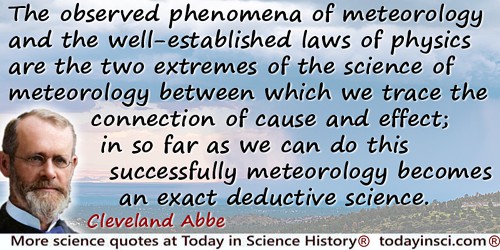
The observed phenomena of meteorology and the well-established laws of physics are the two extremes of the science of meteorology between which we trace the connection of cause and effect; in so far as we can do this successfully meteorology becomes an exact deductive science.
In 'The Meteorological Work of the U.S. Signal Service, 1870 to 1891', U.S. Department of Agriculture, Weather Bureau, Bulletin No. 11, Report of the International Meteorological Congress, Chicago, Ill., August 21-24, 1893 (1894), 242.
The role of biology today, like the role of every other science, is simply to describe, and when it explains it does not mean that it arrives at finality; it only means that some descriptions are so charged with significance that they expose the relationship of cause and effect.
As quoted in Isaac Asimov and Jason A. Shulman (eds.), Isaac Asimov’s Book of Science and Nature Quotations (1988), 37. Webmaster so far has not found the primary source (can you help?)
The thinker makes a great mistake when he asks after cause and effect. They both together make up the invisible phenomenon.
…...
Thus one becomes entangled in contradictions if one speaks of the probable position of the electron without considering the experiment used to determine it ... It must also be emphasized that the statistical character of the relation depends on the fact that the influence of the measuring device is treated in a different manner than the interaction of the various parts of the system on one another. This last interaction also causes changes in the direction of the vector representing the system in the Hilbert space, but these are completely determined. If one were to treat the measuring device as a part of the system—which would necessitate an extension of the Hilbert space—then the changes considered above as indeterminate would appear determinate. But no use could be made of this determinateness unless our observation of the measuring device were free of indeterminateness. For these observations, however, the same considerations are valid as those given above, and we should be forced, for example, to include our own eyes as part of the system, and so on. The chain of cause and effect could be quantitatively verified only if the whole universe were considered as a single system—but then physics has vanished, and only a mathematical scheme remains. The partition of the world into observing and observed system prevents a sharp formulation of the law of cause and effect. (The observing system need not always be a human being; it may also be an inanimate apparatus, such as a photographic plate.)
The Physical Principles of the Quantum Theory, trans. Carl Eckart and Frank C. Hoyt (1949), 58.
Tis evident that all reasonings concerning matter of fact are founded on the relation of cause and effect, and that we can never infer the existence of one object from another, unless they be connected together, either mediately or immediately... Here is a billiard ball lying on the table, and another ball moving toward it with rapidity. They strike; and the ball which was formerly at rest now acquires a motion. This is as perfect an instance of the relation of cause and effect as any which we know, either by sensation or reflection.
An Abstract of A Treatise on Human Nature (1740), ed. John Maynard Keynes and Piero Sraffa (1938), 11.
We have no other notion of cause and effect, but that of certain objects, which have always conjoin’d together, and which in all past instances have been found inseparable. We cannot penetrate into the reason of the conjunction. We only observe the thing itself, and always find that from the constant conjunction the objects acquire an union in the imagination.
A Treatise on Human Nature (1739-40), ed. L. A. Selby-Bigge (1888), book 1, part 3, section 6, 93.
 In science it often happens that scientists say, 'You know that's a really good argument; my position is mistaken,' and then they would actually change their minds and you never hear that old view from them again. They really do it. It doesn't happen as often as it should, because scientists are human and change is sometimes painful. But it happens every day. I cannot recall the last time something like that happened in politics or religion.
(1987) --
In science it often happens that scientists say, 'You know that's a really good argument; my position is mistaken,' and then they would actually change their minds and you never hear that old view from them again. They really do it. It doesn't happen as often as it should, because scientists are human and change is sometimes painful. But it happens every day. I cannot recall the last time something like that happened in politics or religion.
(1987) -- 




