Calculation Quotes (136 quotes)
Calculations Quotes
Calculations Quotes
…comparing the capacity of computers to the capacity of the human brain, I’ve often wondered, where does our success come from? The answer is synthesis, the ability to combine creativity and calculation, art and science, into whole that is much greater than the sum of its parts.
In How Life Imitates Chess: Making the Right Moves, from the Board to the Boardroom (2007), 4.
’Tis late; the astronomer in his lonely height
Exploring all the dark, descries from far
Orbs that like distant isles of splendor are,
And mornings whitening in the infinite.…
He summons one disheveled, wandering star,—
Return ten centuries hence on such a night.
That star will come. It dare not by one hour
Cheat science, or falsify her calculation;
Men will have passed, but watchful in the tower
Man shall remain in sleepless contemplation;
And should all men have perished there in turn,
Truth in their stead would watch that star’s return.
Exploring all the dark, descries from far
Orbs that like distant isles of splendor are,
And mornings whitening in the infinite.…
He summons one disheveled, wandering star,—
Return ten centuries hence on such a night.
That star will come. It dare not by one hour
Cheat science, or falsify her calculation;
Men will have passed, but watchful in the tower
Man shall remain in sleepless contemplation;
And should all men have perished there in turn,
Truth in their stead would watch that star’s return.
From poem, 'The Appointment', as translated by Arthur O’Shaughnessy, collected in Samuel Waddington (ed.), The Sonnets of Europe (1886), 154.
“Conservation” (the conservation law) means this … that there is a number, which you can calculate, at one moment—and as nature undergoes its multitude of changes, this number doesn't change. That is, if you calculate again, this quantity, it'll be the same as it was before. An example is the conservation of energy: there's a quantity that you can calculate according to a certain rule, and it comes out the same answer after, no matter what happens, happens.
'The Great Conservation Principles', The Messenger Series of Lectures, No. 3, Cornell University, 1964. From transcript of BBC programme (11 Dec 1964).
“Every moment dies a man,/ Every moment one is born”:
I need hardly point out to you that this calculation would tend to keep the sum total of the world's population in a state of perpetual equipoise whereas it is a well-known fact that the said sum total is constantly on the increase. I would therefore take the liberty of suggesting that in the next edition of your excellent poem the erroneous calculation to which I refer should be corrected as follows:
'Every moment dies a man / And one and a sixteenth is born.” I may add that the exact figures are 1.167, but something must, of course, be conceded to the laws of metre.
I need hardly point out to you that this calculation would tend to keep the sum total of the world's population in a state of perpetual equipoise whereas it is a well-known fact that the said sum total is constantly on the increase. I would therefore take the liberty of suggesting that in the next edition of your excellent poem the erroneous calculation to which I refer should be corrected as follows:
'Every moment dies a man / And one and a sixteenth is born.” I may add that the exact figures are 1.167, but something must, of course, be conceded to the laws of metre.
Unpublished letter to Tennyson in response to his Vision of Sin (1842). Quoted in Philip and Emily Morrison, Charles Babbage and his Calculating Engines: Selected Writings by Charles Babbage and Others (1961), xxiii.
[About the mechanical properties of the molecules of a chemical substance being studied:] They could be measured, but that would have taken several months. So someone said, ‘Let’s get Teller in and make him guess the data.’ We got him into a room and locked the door, so no one else could get at him, and he asked questions and did some figuring at the blackboard. He got the answers in about two hours, not entirely accurately, of course, but—as we found out when we got around to verifying them—close enough for the purpose.
Recalls the first time she was ever really awed by mental abilities of Edward Teller. She had joined the Manhattan Project, and needed data on the physical properties of molecules of a certain substance to get started on her assigned task of calculating its chemical properties. As quoted in Robert Coughlan, 'Dr. Edward Teller’s Magnificent Obsession', Life (6 Sep 1954), 61.
[Decimal currency is desirable because] by that means all calculations of interest, exchange, insurance, and the like are rendered much more simple and accurate, and, of course, more within the power of the great mass of people. Whenever such things require much labor, time, and reflection, the greater number who do not know, are made the dupes of the lesser number who do.
Letter to Congress (15 Jan 1782). 'Coinage Scheme Proposed by Robert Morris, Superintendent of Finance', from MS. letters and reports of the Superintendent of Finance, No, 137, Vol. 1, 289-300. Reprinted as Appendix, in Executive Documents, Senate of the U.S., Third Session of the Forty-Fifth Congress, 1878-79 (1879), 430.
[Urbain Jean Joseph] Le Verrier—without leaving his study, without even looking at the sky—had found the unknown planet [Neptune] solely by mathematical calculation, and, as it were, touched it with the tip of his pen!
In Camille Flammarion, Astronomy (1914), 171.
“The Universe repeats itself, with the possible exception of history.” Of all earthly studies history is the only one that does not repeat itself. ... Astronomy repeats itself; botany repeats itself; trigonometry repeats itself; mechanics repeats itself; compound long division repeats itself. Every sum if worked out in the same way at any time will bring out the same answer. ... A great many moderns say that history is a science; if so it occupies a solitary and splendid elevation among the sciences; it is the only science the conclusions of which are always wrong.
In 'A Much Repeated Repetition', Daily News (26 Mar 1904). Collected in G. K. Chesterton and Dale Ahlquist (ed.), In Defense of Sanity: The Best Essays of G.K. Chesterton (2011), 82.
Ath. There still remain three studies suitable for freemen. Calculation in arithmetic is one of them; the measurement of length, surface, and depth is the second; and the third has to do with the revolutions of the stars in reference to one another … there is in them something that is necessary and cannot be set aside, … if I am not mistaken, [something of] divine necessity; for as to the human necessities of which men often speak when they talk in this manner, nothing can be more ridiculous than such an application of the words.
Cle. And what necessities of knowledge are there, Stranger, which are divine and not human?
Ath. I conceive them to be those of which he who has no use nor any knowledge at all cannot be a god, or demi-god, or hero to mankind, or able to take any serious thought or charge of them.
Cle. And what necessities of knowledge are there, Stranger, which are divine and not human?
Ath. I conceive them to be those of which he who has no use nor any knowledge at all cannot be a god, or demi-god, or hero to mankind, or able to take any serious thought or charge of them.
— Plato
In Republic, Bk. 7, in Jowett, Dialogues of Plato (1897, 2010), Vol. 4, 331.
Dilbert: It took weeks but I’ve calculated a new theory about the origin of the universe. According to my calculations it didn’t start with a “Big Bang” at all—it was more of “Phhbwt” sound. You may be wondering about the practical applications of the “Little Phhbwt” theory.
Dogbert: I was wondering when you’ll go away.
Dogbert: I was wondering when you’ll go away.
Dilbert comic strip (1 Jan 1993)
Je me rends parfaitement compte du desagreable effet que produit sur la majorite de l'humanité, tout ce qui se rapporte, même au plus faible dègré, á des calculs ou raisonnements mathematiques.
I am well aware of the disagreeable effect produced on the majority of humanity, by whatever relates, even at the slightest degree to calculations or mathematical reasonings.
I am well aware of the disagreeable effect produced on the majority of humanity, by whatever relates, even at the slightest degree to calculations or mathematical reasonings.
From 'French Reply to Baron Czyllak' concerning the game at Monte Carlo, Monte Carlo Facts and Fallacies (1904), 290, originally published in L'Écho de la Mediterranée as a response to an earlier open letter by the Baron in the same magazine. Maxim defended his prior mathematical calculations about gambling games. At the end of his paper giving a cautionary mathematical analysis of 'The Gambler's Ruin', < a href="http://todayinsci.com/C/Coolidge_Julian/CoolidgeJulian-Quotations.htm">Julian Coolidge referenced this quotation, saying “it gives the best explanation which I have seen for the fact that the people continue to gamble.”
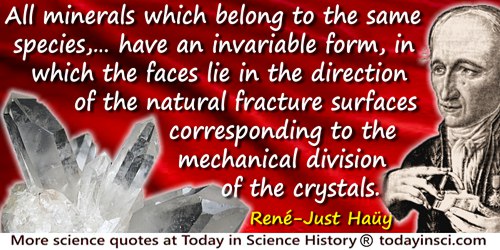
A casual glance at crystals may lead to the idea that they were pure sports of nature, but this is simply an elegant way of declaring one’s ignorance. With a thoughtful examination of them, we discover laws of arrangement. With the help of these, calculation portrays and links up the observed results. How variable and at the same time how precise and regular are these laws! How simple they are ordinarily, without losing anything of their significance! The theory which has served to develop these laws is based entirely on a fact, whose existence has hitherto been vaguely discerned rather than demonstrated. This fact is that in all minerals which belong to the same species, these little solids, which are the crystal elements and which I call their integrant molecules, have an invariable form, in which the faces lie in the direction of the natural fracture surfaces corresponding to the mechanical division of the crystals. Their angles and dimensions are derived from calculations combined with observation.
Traité de mineralogie … Publié par le conseil des mines (1801), Vol. 1, xiii-iv, trans. Albert V. and Marguerite Carozzi.
A scientist can be productive in various ways. One is having the ability to plan and carry out experiments, but the other is having the ability to formulate new ideas, which can be about what experiments can be carried out … by making [the] proper calculations. Individual scientists who are successful in their work are successful for different reasons.
Interview with George B. Kauffman and Laurie M. Kauffman, in 'Linus Pauling: Reflections', American Scientist (Nov-Dec 1994), 82, No. 6, 522.
A theoretical physicist can spend his entire lifetime missing the intellectual challenge of experimental work, experiencing none of the thrills and dangers — the overhead crane with its ten-ton load, the flashing skull and crossbones and danger, radioactivity signs. A theorist’s only real hazard is stabbing himself with a pencil while attacking a bug that crawls out of his calculations.
In Leon Lederman and Dick Teresi, The God Particle: If the Universe is the Answer, What is the
Question (1993), 15.
After the planet becomes theirs, many millions of years will have to pass before a beetle particularly loved by God, at the end of its calculations will find written on a sheet of paper in letters of fire that energy is equal to the mass multiplied by the square of the velocity of light. The new kings of the world will live tranquilly for a long time, confining themselves to devouring each other and being parasites among each other on a cottage industry scale.
'Beetles' Other People’s Trades (1985, trans. 1989).
All that we can hope from these inspirations, which are the fruits of unconscious work, is to obtain points of departure for such calculations. As for the calculations themselves, they must be made in the second period of conscious work which follows the inspiration, and in which the results of the inspiration are verified and the consequences deduced.
Science and Method (1914, 2003), 62.
An engineer, a physicist and a mathematician find themselves in an anecdote, indeed an anecdote quite similar to many that you have no doubt already heard.
After some observations and rough calculations the engineer realizes the situation and starts laughing.
A few minutes later the physicist understands too and chuckles to himself happily, as he now has enough experimental evidence to publish a paper.
This leaves the mathematician somewhat perplexed, as he had observed right away that he was the subject of an anecdote, and deduced quite rapidly the presence of humor from similar anecdotes, but considers this anecdote to be too trivial a corollary to be significant, let alone funny.
After some observations and rough calculations the engineer realizes the situation and starts laughing.
A few minutes later the physicist understands too and chuckles to himself happily, as he now has enough experimental evidence to publish a paper.
This leaves the mathematician somewhat perplexed, as he had observed right away that he was the subject of an anecdote, and deduced quite rapidly the presence of humor from similar anecdotes, but considers this anecdote to be too trivial a corollary to be significant, let alone funny.
In 'Zero Gravity: The Lighter Side of Science' APS News (Jun 2003), 12 No. 6.
And if you want the exact moment in time, it was conceived mentally on 8th March in this year one thousand six hundred and eighteen, but submitted to calculation in an unlucky way, and therefore rejected as false, and finally returning on the 15th of May and adopting a new line of attack, stormed the darkness of my mind. So strong was the support from the combination of my labour of seventeen years on the observations of Brahe and the present study, which conspired together, that at first I believed I was dreaming, and assuming my conclusion among my basic premises. But it is absolutely certain and exact that the proportion between the periodic times of any two planets is precisely the sesquialterate proportion of their mean distances.
Harmonice Mundi, The Harmony of the World (1619), book V, ch. 3. Trans. E. J. Aiton, A. M. Duncan and J. V. Field (1997), 411.
Anyone who has had actual contact with the making of the inventions that built the radio art knows that these inventions have been the product of experiment and work based on physical reasoning, rather than on the mathematicians' calculations and formulae. Precisely the opposite impression is obtained from many of our present day text books and publications.
Attributed.
As I had occasion to pass daily to and from the building-yard, while my boat was in progress, I have often loitered unknown near the idle groups of strangers, gathering in little circles, and heard various inquiries as to the object of this new vehicle. The language was uniformly that of scorn, or sneer, or ridicule. The loud laugh often rose at my expense; the dry jest; the wise calculation of losses and expenditures; the dull, but endless, repetition of “the Fulton folly”. Never did a single encouraging remark, a bright hope, or a warm wish, cross my path.
As quoted in Kirkpatrick Sale, The Fire of His Genius: Robert Fulton and the American Dream (2001), 10. Citing in end notes as from Story, Life and Letters, 24.
As scientists the two men were contrasting types—Einstein all calculation, Rutherford all experiment ... There was no doubt that as an experimenter Rutherford was a genius, one of the greatest. He worked by intuition and everything he touched turned to gold. He had a sixth sense.
(Reminiscence comparing his friend, Ernest Rutherford, with Albert Einstein, whom he also knew.)
(Reminiscence comparing his friend, Ernest Rutherford, with Albert Einstein, whom he also knew.)
Trial and Error: The Autobiography of Chaim Weizman (1949), 118. Quoted in A Force of Nature: The Frontier Genius of Ernest Rutherford (2007), 65-66.
As soon … as it was observed that the stars retained their relative places, that the times of their rising and setting varied with the seasons, that sun, moon, and planets moved among them in a plane, … then a new order of things began.… Science had begun, and the first triumph of it was the power of foretelling the future; eclipses were perceived to recur in cycles of nineteen years, and philosophers were able to say when an eclipse was to be looked for. The periods of the planets were determined. Theories were invented to account for their eccentricities; and, false as those theories might be, the position of the planets could be calculated with moderate certainty by them.
Lecture delivered to the Royal Institution (5 Feb 1864), 'On the Science of History'. Collected in Notices of the Proceedings at the Meetings of the Members of the Royal Institution of Great Britain with Abstracts of the Discourses (1866), Vol. 4, 187.
At the Egyptian city of Naucratis there was a famous old god whose name was Theuth; the bird which is called the Ibis was sacred to him, and he was the inventor of many arts, such as arithmetic and calculation and geometry and astronomy and draughts and dice, but his great discovery was the use of letters.
— Plato
In the Phaedrus. Collected in Plato the Teacher (1897), 171. A footnote gives that Naucratis was a city in the Delta of Egypt, on a branch of the Nile.
Basic research may seem very expensive. I am a well-paid scientist. My hourly wage is equal to that of a plumber, but sometimes my research remains barren of results for weeks, months or years and my conscience begins to bother me for wasting the taxpayer’s money. But in reviewing my life’s work, I have to think that the expense was not wasted.
Basic research, to which we owe everything, is relatively very cheap when compared with other outlays of modern society. The other day I made a rough calculation which led me to the conclusion that if one were to add up all the money ever spent by man on basic research, one would find it to be just about equal to the money spent by the Pentagon this past year.
Basic research, to which we owe everything, is relatively very cheap when compared with other outlays of modern society. The other day I made a rough calculation which led me to the conclusion that if one were to add up all the money ever spent by man on basic research, one would find it to be just about equal to the money spent by the Pentagon this past year.
In The Crazy Ape (1971).
But if anyone, well seen in the knowledge, not onely of Sacred and exotick History, but of Astronomical Calculation, and the old Hebrew Kalendar, shall apply himself to these studies, I judge it indeed difficult, but not impossible for such a one to attain, not onely the number of years, but even, of dayes from the Creation of the World.
In 'Epistle to the Reader', The Annals of the World (1658). As excerpted in Wallen Yep, Man Before Adam: A Correction to Doctrinal Theology, "The Missing Link Found" (2002), 18.
By science, then, I understand the consideration of all subjects, whether of a pure or mixed nature, capable of being reduced to measurement and calculation. All things comprehended under the categories of space, time and number properly belong to our investigations; and all phenomena capable of being brought under the semblance of a law are legitimate objects of our inquiries.
In Report of the British Association for the Advancement of Science (1833), xxviii.
Calculation touches, at most, certain phenomena of organic destruction. Organic creation, on the contrary, the evolutionary phenomena which properly constitute life, we cannot in any way subject to a mathematical treatment.
In Creative Evolution (1911).
Common sense is the measure of the possible; it is composed of experience and prevision; it is calculation applied to life.
Entry for 26 Dec 1852 in Amiel’s Journal: The Journal Intime of Henri-Frédéric Amiel, trans. Humphry Ward (1893), 34.
Creation science has not entered the curriculum for a reason so simple and so basic that we often forget to mention it: because it is false, and because good teachers understand why it is false. What could be more destructive of that most fragile yet most precious commodity in our entire intellectual heritage—good teaching—than a bill forcing our honorable teachers to sully their sacred trust by granting equal treatment to a doctrine not only known to be false, but calculated to undermine any general understanding of science as an enterprise?.
In 'The Verdict on Creationism' The Sketical Inquirer (Winter 1987/88), 12, 186.
Deaths, births, and marriages, considering how much they are separately dependent on the freedom of the human will, should seem to be subject to no law according to which any calculation could be made beforehand of their amount; and yet the yearly registers of these events in great countries prove that they go on with as much conformity to the laws of nature as the oscillations of the weather.
'Idea of a Universal history on a Cosmo-Political Plan' (1784). As translated by Thomas De Quinsey in The London Magazine (Oct 1824), 10, 385. Reprinted in 1859 by De Quincey in Vol. 8 of his Collective Edition of his writings.
Edward [Teller] isn’t the cloistered kind of scientist. He gets his ideas in conversation and develops them by trying them out on people. We were coming back from Europe on the Ile de France and I was standing in the ship’s nightclub when he came up and said, 'Freddie, I think I have an idea.’ It was something he’d just thought of about magnetohydrodynamics. I was a bachelor then and I’d located several good-looking girls on the ship, but I knew what I had to do, so I disappeared and started working on the calculations. I’d get something finished and start prowling on the deck again when Edward would turn up out of the night and we’d walk the deck together while he talked and I was the brick wall he was bouncing these things off of. By the end of the trip we had a paper. He’d had the ideas, and I’d done some solving of equations. But he insisted that we sign in alphabetical order, which put my name first.
As quoted in Robert Coughlan, 'Dr. Edward Teller’s Magnificent Obsession', Life (6 Sep 1954), 61-62.
Endowed with two qualities, which seemed incompatible with each other, a volcanic imagination and a pertinacity of intellect which the most tedious numerical calculations could not daunt, Kepler conjectured that the movements of the celestial bodies must be connected together by simple laws, or, to use his own expression, by harmonic laws. These laws he undertook to discover. A thousand fruitless attempts, errors of calculation inseparable from a colossal undertaking, did not prevent him a single instant from advancing resolutely toward the goal of which he imagined he had obtained a glimpse. Twenty-two years were employed by him in this investigation, and still he was not weary of it! What, in reality, are twenty-two years of labor to him who is about to become the legislator of worlds; who shall inscribe his name in ineffaceable characters upon the frontispiece of an immortal code; who shall be able to exclaim in dithyrambic language, and without incurring the reproach of anyone, “The die is cast; I have written my book; it will be read either in the present age or by posterity, it matters not which; it may well await a reader, since God has waited six thousand years for an interpreter of his words.”
In 'Eulogy on Laplace', in Smithsonian Report for the year 1874 (1875), 131-132.
Failure is central to engineering. Every single calculation that an engineer makes is a failure calculation. Successful engineering is all about understanding how things break or fail.
From an interview. As quoted in Cornelia Deanmay, 'An Engineer Who Revels in Success of Failure', New York Times (3 May 2006).
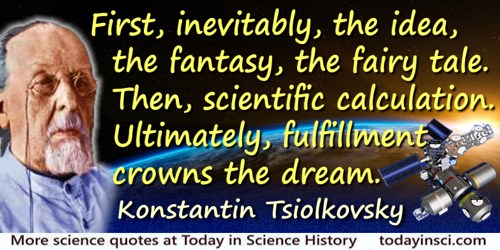
First, inevitably, the idea, the fantasy, the fairy tale. Then, scientific calculation. Ultimately, fulfillment crowns the dream.
First, the chief character, who is supposed to be a professional astronomer, spends his time fund raising and doing calculations at his desk, rather than observing the sky. Second, the driving force of a scientific project is institutional self-aggrandizement rather than intellectual curiosity.
[About the state of affairs in academia.]
[About the state of affairs in academia.]
In Marc J. Madou, Fundamentals of Microfabrication: the Science of Miniaturization (2nd ed., 2002), 535
Food production is now so energy-intensive that more carbon is emitted providing a person with enough calories to walk to the shops than a car would emit over the same distance.
Citing calculations made by environmentalist author, Chris Goodall.
Citing calculations made by environmentalist author, Chris Goodall.
'Walking to the shops damages planet more than going by car', in The Times (4 Aug 2007)
For we may remark generally of our mathematical researches, that these auxiliary quantities, these long and difficult calculations into which we are often drawn, are almost always proofs that we have not in the beginning considered the objects themselves so thoroughly and directly as their nature requires, since all is abridged and simplified, as soon as we place ourselves in a right point of view.
In Théorie Nouvelle de la Rotation des Corps (1834). As translated by Charles Thomas Whitley in Outlines of a New Theory of Rotatory Motion (1834), 4.
From man or angel the great Architect did wisely to conceal, and not divulge his secrets to be scanned by them who ought rather admire; or if they list to try conjecture, he his fabric of the heavens left to their disputes, perhaps to move his laughter at their quaint opinions wide hereafter, when they come to model heaven calculate the stars, how they will wield the mighty frame, how build, unbuild, contrive to save appearances, how gird the sphere with centric and eccentric scribbled o’er, and epicycle, orb in orb.
Paradise Lost (1674, 1754), Book 8, 231.
He [Lord Bacon] appears to have been utterly ignorant of the discoveries which had just been made by Kepler’s calculations … he does not say a word about Napier’s Logarithms, which had been published only nine years before and reprinted more than once in the interval. He complained that no considerable advance had been made in Geometry beyond Euclid, without taking any notice of what had been done by Archimedes and Apollonius. He saw the importance of determining accurately the specific gravities of different substances, and himself attempted to form a table of them by a rude process of his own, without knowing of the more scientific though still imperfect methods previously employed by Archimedes, Ghetaldus and Porta. He speaks of the εὕρηκα of Archimedes in a manner which implies that he did not clearly appreciate either the problem to be solved or the principles upon which the solution depended. In reviewing the progress of Mechanics, he makes no mention either of Archimedes, or Stevinus, Galileo, Guldinus, or Ghetaldus. He makes no allusion to the theory of Equilibrium. He observes that a ball of one pound weight will fall nearly as fast through the air as a ball of two, without alluding to the theory of acceleration of falling bodies, which had been made known by Galileo more than thirty years before. He proposed an inquiry with regard to the lever,—namely, whether in a balance with arms of different length but equal weight the distance from the fulcrum has any effect upon the inclination—though the theory of the lever was as well understood in his own time as it is now. … He speaks of the poles of the earth as fixed, in a manner which seems to imply that he was not acquainted with the precession of the equinoxes; and in another place, of the north pole being above and the south pole below, as a reason why in our hemisphere the north winds predominate over the south.
From Spedding’s 'Preface' to De Interpretations Naturae Proœmium, in The Works of Francis Bacon (1857), Vol. 3, 511-512. [Note: the Greek word “εὕρηκα” is “Eureka” —Webmaster.]
His [Thomas Edison] method was inefficient in the extreme, for an immense ground had to be covered to get anything at all unless blind chance intervened and, at first, I was almost a sorry witness of his doings, knowing that just a little theory and calculation would have saved him 90 per cent of the labor. But he had a veritable contempt for book learning and mathematical knowledge, trusting himself entirely to his inventor's instinct and practical American sense. In view of this, the truly prodigious amount of his actual accomplishments is little short of a miracle.
As quoted in 'Tesla Says Edison Was an Empiricist', The New York Times (19 Oct 1931), 25. In 1884, Tesla had moved to America to assist Edison in the designing of motors and generators.
I also ask you my friends not to condemn me entirely to the mill of mathematical calculations, and allow me time for philosophical speculations, my only pleasures.
Letter to Vincenzo Bianchi (17 Feb 1619). Johannes Kepler Gesammelte Werke (1937- ), Vol. 17, letter 827, l. 249-51, p. 327.
I am much occupied with the investigation of the physical causes [of motions in the Solar System]. My aim in this is to show that the celestial machine is to be likened not to a divine organism but rather to a clockwork … insofar as nearly all the manifold movements are carried out by means of a single, quite simple magnetic force. This physical conception is to be presented through calculation and geometry.
Letter to Ilerwart von Hohenburg (10 Feb 1605) Quoted in Holton, Johannes Kepler's Universe: Its Physics and Metaphysics, 342, as cited by Hylarie Kochiras, Force, Matter, and Metaphysics in Newton's Natural Philosophy (2008), 57.
I asked Fermi whether he was not impressed by the agreement between our calculated numbers and his measured numbers. He replied, “How many arbitrary parameters did you use for your calculations?" I thought for a moment about our cut-off procedures and said, “Four." He said, “I remember my friend Johnny von Neumann used to say, with four parameters I can fit an elephant, and with five I can make him wiggle his trunk.” With that, the conversation was over.
As given in 'A Meeting with Enrico Fermi', Nature (22 Jan 2004), 427, 297. As quoted in Steven A. Frank, Dynamics of Cancer: Incidence, Inheritance, and Evolution (2007), 87. Von Neumann meant nobody need be impressed when a complex model fits a data set well, because if manipulated with enough flexible parameters, any data set can be fitted to an incorrect model, even one that plots a curve on a graph shaped like an elephant!
I believe that the useful methods of mathematics are easily to be learned by quite young persons, just as languages are easily learned in youth. What a wondrous philosophy and history underlie the use of almost every word in every language—yet the child learns to use the word unconsciously. No doubt when such a word was first invented it was studied over and lectured upon, just as one might lecture now upon the idea of a rate, or the use of Cartesian co-ordinates, and we may depend upon it that children of the future will use the idea of the calculus, and use squared paper as readily as they now cipher. … When Egyptian and Chaldean philosophers spent years in difficult calculations, which would now be thought easy by young children, doubtless they had the same notions of the depth of their knowledge that Sir William Thomson might now have of his. How is it, then, that Thomson gained his immense knowledge in the time taken by a Chaldean philosopher to acquire a simple knowledge of arithmetic? The reason is plain. Thomson, when a child, was taught in a few years more than all that was known three thousand years ago of the properties of numbers. When it is found essential to a boy’s future that machinery should be given to his brain, it is given to him; he is taught to use it, and his bright memory makes the use of it a second nature to him; but it is not till after-life that he makes a close investigation of what there actually is in his brain which has enabled him to do so much. It is taken because the child has much faith. In after years he will accept nothing without careful consideration. The machinery given to the brain of children is getting more and more complicated as time goes on; but there is really no reason why it should not be taken in as early, and used as readily, as were the axioms of childish education in ancient Chaldea.
In Teaching of Mathematics (1902), 14.
I can see him now at the blackboard, chalk in one hand and rubber in the other, writing rapidly and erasing recklessly, pausing every few minutes to face the class and comment earnestly, perhaps on the results of an elaborate calculation, perhaps on the greatness of the Creator, perhaps on the beauty and grandeur of Mathematics, always with a capital M. To him mathematics was not the handmaid of philosophy. It was not a humanly devised instrument of investigation, it was Philosophy itself, the divine revealer of TRUTH.
Writing as a Professor Emeritus at Harvard University, a former student of Peirce, in 'Benjamin Peirce: II. Reminiscences', The American Mathematical Monthly (Jan 1925), 32, No. 1, 5.
I do hate sums. There is no greater mistake than to call arithmetic an exact science. There are permutations and aberrations discernible to minds entirely noble like mine; subtle variations which ordinary accountants fail to discover; hidden laws of number which it requires a mind like mine to perceive. For instance, if you add a sum from the bottom up, and then from the top down, the result is always different. Again if you multiply a number by another number before you have had your tea, and then again after, the product will be different. It is also remarkable that the Post-tea product is more likely to agree with other people’s calculations than the Pre-tea result.
Letter to Mrs Arthur Severn (Jul 1878), collected in The Letters of a Noble Woman (Mrs. La Touche of Harristown) (1908), 50. Also in 'Gleanings Far and Near', Mathematical Gazette (May 1924), 12, 95.
I do not remember how it got into my head to make first calculations related to rocket. It seems to me the first seeds were planted by famous fantaseour, J. Verne.
As quoted, without source, in LIFE: 100 People Who Changed the World (2010), 94.
I had made considerable advance ... in calculations on my favourite numerical lunar theory, when I discovered that, under the heavy pressure of unusual matters (two transits of Venus and some eclipses) I had committed a grievous error in the first stage of giving numerical value to my theory. My spirit in the work was broken, and I have never heartily proceeded with it since.
[Concerning his calculations on the orbital motion of the Moon.]
[Concerning his calculations on the orbital motion of the Moon.]
Private note (29 Sep 1890). In George Biddell Airy and Wilfrid Airy (ed.), Autobiography of Sir George Biddell Airy (1896), 350.
I have always felt that astronomical hypotheses should not be regarded as articles of faith, but should only serve as a framework for astronomical calculations, so that it does not matter whether they were right or wrong, as long as the phenomena can be characterized precisely. For who could possibly be certain as to whether the uneven movement of the sun, if we follow the hypotheses of Ptolemy, can be explained by assuming an epicycle or eccentricity. Both assumptions are plausible. That’s why I would consider it quite desirable for you to tell something about that in the preface. In this way you would appease the Aristotelians and the theologians, whose opposition you dread.
From surviving fragment of a Letter (20 Apr 1541) answering a query from Copernicus as to whether he should publish his book (De Revolutionibus). From the German in Leopold Friedrich Prowe, Nicolaus Coppernicus (1883), Vol. 1, Part 2, 521-522. Translated from Prowe by Webmaster using web resources. Original German: “Hypothesen nicht als Glaubens-Artikel zu betrachten seien, sondern nur als Grundlage für die astronomischen Rechnungen zu dienen hätten, so dass es nicht darauf ankomme, ob sie richtig oder falsch seien, wofern sich nur die Erscheinungen dadurch genau bestimmen liessen. »Denn wer dürfte uns wohl darüber sichere Auskunft geben, ob die ungleiche Bewegung der Sonne, wenn wir den Hypothesen des Ptolemaeus folgen, durch Annahme eines Epicykels oder der Ekcentricität zu erklären sei. Beide Annahmen sind gestattet. Daher würde ich—so schliesst Osiander—es für recht wünschenswerth erachten, wenn Du hierüber in der Vorrede etwas beibrächtest. Auf diese Weise würdest Du die Aristoteliker und die Theologen milder stimmen, von denen Du befürchtest, dass sie heftigen Widerspruch kundthun werden.«” Compare Latin text, from Johannes Kepler, 'Apologia Tychonia', Astronomi Opera Omnia (1858), Vol. 1, 246: “De hypothesibus ego sic sensi semper, non esse articulos fidei, sed fundamenta calculi ita ut, etiamsi falsae sint, modo motuum φαινομενα exacte exhibeant, nihil referat; quis enim nos certiores reddet, an Solis inaequalis motus nomine epicycli an nomine eccentricitatis contingat, si Ptolemaei hypotheses sequamur, cum id possit utrumque. Quare plausibile fore videretur, si hac de re in praefatione nonnihil attingeres. Sic enim placidiores redderes peripatheticos et theologos, quos contradicturos metuis.”
I have no doubt that certain learned men, now that the novelty of the hypotheses in this work has been widely reported—for it establishes that the Earth moves, and indeed that the Sun is motionless in the middle of the universe—are extremely shocked, and think that the scholarly disciplines, rightly established once and for all, should not be upset. But if they are willing to judge the matter thoroughly, they will find that the author of this work has committed nothing which deserves censure. For it is proper for an astronomer to establish a record of the motions of the heavens with diligent and skilful observations, and then to think out and construct laws for them, or rather hypotheses, whatever their nature may be, since the true laws cannot be reached by the use of reason; and from those assumptions the motions can be correctly calculated, both for the future and for the past. Our author has shown himself outstandingly skilful in both these respects. Nor is it necessary that these hypotheses should be true, nor indeed even probable, but it is sufficient if they merely produce calculations which agree with the observations. … For it is clear enough that this subject is completely and simply ignorant of the laws which produce apparently irregular motions. And if it does work out any laws—as certainly it does work out very many—it does not do so in any way with the aim of persuading anyone that they are valid, but only to provide a correct basis for calculation. Since different hypotheses are sometimes available to explain one and the same motion (for instance eccentricity or an epicycle for the motion of the Sun) an astronomer will prefer to seize on the one which is easiest to grasp; a philosopher will perhaps look more for probability; but neither will grasp or convey anything certain, unless it has been divinely revealed to him. Let us therefore allow these new hypotheses also to become known beside the older, which are no more probable, especially since they are remarkable and easy; and let them bring with them the vast treasury of highly learned observations. And let no one expect from astronomy, as far as hypotheses are concerned, anything certain, since it cannot produce any such thing, in case if he seizes on things constructed for another other purpose as true, he departs from this discipline more foolish than he came to it.
Although this preface would have been assumed by contemporary readers to be written by Copernicus, it was unsigned. It is now believed to have been written and added at press time by Andreas Osiander (who was then overseeing the printing of the book). It suggests the earth’s motion as described was merely a mathematical device, and not to be taken as absolute reality. Text as given in 'To the Reader on the Hypotheses in this Work', Copernicus: On the Revolutions of the Heavenly Spheres (1543), translated by Alistair Matheson Duncan (1976), 22-3. By adding this preface, Osiander wished to stave off criticism by theologians. See also the Andreas Osiander Quotes page of this website.
I like a deep and difficult investigation when I happen to have made it easy to myself, if not to all others; and there is a spirit of gambling in this, whether, as by the cast of a die, a calculation è perte de vue shall bring out a beautiful and perfect result or shall be wholly thrown away. Scientific investigations are a sort of warfare carried on in the closet or on the couch against all one’s contemporaries and predecessors; I have often gained a signal victory when I have been half asleep, but more frequently have found, upon being thoroughly awake, that the enemy had still the advantage of me, when I thought I had him fast in a corner, and all this you see keeps me alive.
Letter to Hudson Gurney, quoted in George Peacock, The Life of Thomas Young (1855), 239.
I read … that geometry is the art of making no mistakes in long calculations. I think that this is an underestimation of geometry. Our brain has two halves: one is responsible for the multiplication of polynomials and languages, and the other half is responsible for orientation of figures in space and all the things important in real life. Mathematics is geometry when you have to use both halves.
In S.H. Lui, 'An Interview with Vladimir Arnol’d', Notices of the AMS (Apr 1997) 44, No. 4, 438. Reprinted from the Hong Kong Mathematics Society (Feb 1996).
I was fascinated by the idea of broken symmetry, and wondered whether there could be any way of observing it experimentally. … When I learnt of observations suggesting that a supercurrent could flow through a sufficiently thin normal region between two superconductors, … I could see in principle how to calculate the supercurrent, but considered the calculation to be too difficult to be worth attempting.
Introductory remark of Nobel Lecture, 'The Discovery of Tunnelling Supercurrents' (12 Dec 1973), on nobelprize.org website.
I wish to God these calculations had been executed by steam.
…...
I would by all means have men beware, lest Æsop’s pretty fable of the fly that sate [sic] on the pole of a chariot at the Olympic races and said, “What a dust do I raise,” be verified in them. For so it is that some small observation, and that disturbed sometimes by the instrument, sometimes by the eye, sometimes by the calculation, and which may be owing to some real change in the heaven, raises new heavens and new spheres and circles.
'Of Vain Glory' (1625) in James Spedding, Robert Ellis and Douglas Heath (eds.), The Works of Francis Bacon (1887-1901), Vol. 6, 503.
If E is considered to be a continuously divisible quantity, this distribution is possible in infinitely many ways. We consider, however—this is the most essential point of the whole calculation—E to be composed of a well-defined number of equal parts and use thereto the constant of nature h = 6.55 ×10⁻²⁷ erg sec. This constant multiplied by the common frequency ν of the resonators gives us the energy element ε in erg, and dividing E by ε we get the number P of energy elements which must be divided over the N resonators.
[Planck’s constant, as introduced in 1900; subsequently written e = hν.]
[Planck’s constant, as introduced in 1900; subsequently written e = hν.]
In 'On the theory of the energy distribution law of the normal spectrum', in D. ter Haar and Stephen G. Brush, trans., Planck’s Original Papers in Quantum Physics (1972), 40.
![Nikola Tesla quote: If he [Thomas Edison] had a needle to find in a haystack, he would not stop to reason where it was most like](https://todayinsci.com/T/Tesla_Nikola/TeslaNikola-Haystack500x250px.jpg)
If he [Thomas Edison] had a needle to find in a haystack, he would not stop to reason where it was most likely to be, but would proceed at once with the feverish diligence of a bee, to examine straw after straw until he found the object of his search. … [J]ust a little theory and calculation would have saved him ninety percent of his labor.
As quoted in 'Tesla Says Edison Was an Empiricist', The New York Times (19 Oct 1931), 25. In 1884, Tesla had moved to America to assist Edison in the designing of motors and generators.
If I were forced to sum up in one sentence what the Copenhagen interpretation says to me, it would be “Shut up and calculate!”
In column, 'Reference Frame: What’s Wrong with this Pillow', Physics Today (Apr 1989), 9. The Copenhagen interpretation refers to quantum mechanics. Mermin has since asked, 'Could Feynman Have Said This?', in Physics Today (May 2004), 10, if Richard Feynman may have used the “Shut up and calculate” retort first, since there were numerous examples giving that attribution on the web. To date (6 Jun 2015), no response supporting Feynman as a source has ever been received by Mermin. This was confirmed in an email to the Webmaster, which stated, “Nobody ever sent me any evidence that Feynman had said it. I’ve concluded that he didn’t, but it’s hard to prove a negative.” The reasonable conclusion is that this would almost certainly be a misattribution by the so-called Matthew effect to a more-famous person. Even seen attributed to Paul Dirac! In a Physics Forum web post (28 May 2014) The Austrian remembers being taught by a QM lecturer who liked using the quote, but added: “there is not much else to do in QM anyway.”
If the world may be thought of as a certain definite quantity of force and as a certain definite number of centers of force—and every other representation remains indefinite and therefore useless—it follows that, in the great dice game of existence, it must pass through calculable number of combinations. In infinite time, every possible combination would at some time or another be realized; more: it would be realized an infinite number of times. And since between every combination and its next recurrence all other possible combinations would have to take place, and each of these combination conditions of the entire sequence of combinations in the same series, a circular movement of absolutely identical series is thus demonstrated: the world as a circular movement that has already repeated itself infinitely often and plays its game in infinitum. This conception is not simply a mechanistic conception; for if it were that, it would not condition an infinite recurrence of identical cases, but a final state. Because the world has not reached this, mechanistic theory must be considered an imperfect and merely provisional hypothesis.
The Will to Power (Notes written 1883-1888), book 4, no. 1066. Trans. W. Kaufmann and R. J. Hollingdale and ed. W. Kaufmann (1968), 549.
If we knew all the laws of Nature, we should need only one fact or the description of one actual phenomenon to infer all the particular results at that point. Now we know only a few laws, and our result is vitiated, not, of course, by any confusion or irregularity in Nature, but by our ignorance of essential elements in the calculation. Our notions of law and harmony are commonly confined to those instances which we detect, but the harmony which results from a far greater number of seemingly conflicting, but really concurring, laws which we have not detected, is still more wonderful. The particular laws are as our points of view, as to the traveler, a mountain outline varies with every step, and it has an infinite number of profiles, though absolutely but one form. Even when cleft or bored through, it is not comprehended in its entireness.
In Walden (1878), 311.
In 1684 Dr Halley came to visit him at Cambridge, after they had been some time together, the Dr asked him what he thought the Curve would be that would be described by the Planets supposing the force of attraction towards the Sun to be reciprocal to the square of their distance from it. Sr Isaac replied immediately that it would be an Ellipsis, the Doctor struck with joy & amazement asked him how he knew it, why saith he I have calculated it, whereupon Dr Halley asked him for his calculation without any farther delay. Sr Isaac looked among his papers but could not find it, but he promised him to renew it, & then to send it him.
[Recollecting Newton's account of the meeting after which Halley prompted Newton to write The Principia. When asking Newton this question, Halley was aware, without revealing it to Newton that Robert Hooke had made this hypothesis of plantary motion a decade earlier.]
[Recollecting Newton's account of the meeting after which Halley prompted Newton to write The Principia. When asking Newton this question, Halley was aware, without revealing it to Newton that Robert Hooke had made this hypothesis of plantary motion a decade earlier.]
Quoted in Richard Westfall, Never at Rest: A Biography of Isaac Newton (1980), 403.
In addition to instructing them in the holy Scriptures, they also taught their pupils poetry, astronomy, and the calculation of the church calendar.
— Bede
Referring to the teaching methods of Theodore, Archbishop of Canterbury, and Hadrian, abbot of Canterbury (A.D. 669).
In an enterprise such as the building of the atomic bomb the difference between ideas, hopes, suggestions and theoretical calculations, and solid numbers based on measurement, is paramount. All the committees, the politicking and the plans would have come to naught if a few unpredictable nuclear cross sections had been different from what they are by a factor of two.
Epigraph in Richard Rhodes, The Making of the Atomic Bomb (1986), 8.
In fact, Gentlemen, no geometry without arithmetic, no mechanics without geometry... you cannot count upon success, if your mind is not sufficiently exercised on the forms and demonstrations of geometry, on the theories and calculations of arithmetic ... In a word, the theory of proportions is for industrial teaching, what algebra is for the most elevated mathematical teaching.
... a l'ouverture du cours de mechanique industrielle á Metz (1827), 2-3, trans. Ivor Grattan-Guinness.
In no subject is there a rule, compliance with which will lead to new knowledge or better understanding. Skilful observations, ingenious ideas, cunning tricks, daring suggestions, laborious calculations, all these may be required to advance a subject. Occasionally the conventional approach in a subject has to be studiously followed; on other occasions it has to be ruthlessly disregarded. Which of these methods, or in what order they should be employed is generally unpredictable. Analogies drawn from the history of science are frequently claimed to be a guide; but, as with forecasting the next game of roulette, the existence of the best analogy to the present is no guide whatever to the future. The most valuable lesson to be learnt from the history of scientific progress is how misleading and strangling such analogies have been, and how success has come to those who ignored them.
'Cosmology', in Arthur Beer (ed.), Vistas in Astronomy (1956), Vol. 2, 1722.
In the year 1666 he retired again from Cambridge... to his mother in Lincolnshire & whilst he was musing in a garden it came into his thought that the power of gravity (wch brought an apple from the tree to the ground) was not limited to a certain distance from the earth but that this power must extend much farther than was usually thought. Why not as high as the moon said he to himself & if so that must influence her motion & perhaps retain her in her orbit, whereupon he fell a calculating what would be the effect of that supposition but being absent from books & taking the common estimate in use among Geographers & our seamen before Norwood had measured the earth, that 60 English miles were contained in one degree of latitude on the surface of the Earth his computation did not agree with his theory & inclined him then to entertain a notion that together with the force of gravity there might be a mixture of that force wch the moon would have if it was carried along in a vortex.
[The earliest account of Newton, gravity and an apple.]
[The earliest account of Newton, gravity and an apple.]
Memorandum of a conversation with Newton in August 1726. Quoted in Richard Westfall, Never at Rest: A Biography of Isaac Newton (1980), 154.
Indeed, the most important part of engineering work—and also of other scientific work—is the determination of the method of attacking the problem, whatever it may be, whether an experimental investigation, or a theoretical calculation. … It is by the choice of a suitable method of attack, that intricate problems are reduced to simple phenomena, and then easily solved.
In Engineering Mathematics: A Series of Lectures Delivered at Union College (1911, 1917), Vol. 2, 275.
It has been said that computing machines can only carry out the processes that they are instructed to do. This is certainly true in the sense that if they do something other than what they were instructed then they have just made some mistake. It is also true that the intention in constructing these machines in the first instance is to treat them as slaves, giving them only jobs which have been thought out in detail, jobs such that the user of the machine fully understands what in principle is going on all the time. Up till the present machines have only been used in this way. But is it necessary that they should always be used in such a manner? Let us suppose we have set up a machine with certain initial instruction tables, so constructed that these tables might on occasion, if good reason arose, modify those tables. One can imagine that after the machine had been operating for some time, the instructions would have altered out of all recognition, but nevertheless still be such that one would have to admit that the machine was still doing very worthwhile calculations. Possibly it might still be getting results of the type desired when the machine was first set up, but in a much more efficient manner. In such a case one would have to admit that the progress of the machine had not been foreseen when its original instructions were put in. It would be like a pupil who had learnt much from his master, but had added much more by his own work. When this happens I feel that one is obliged to regard the machine as showing intelligence.
Lecture to the London Mathematical Society, 20 February 1947. Quoted in B. E. Carpenter and R. W. Doran (eds.), A. M. Turing's Ace Report of 1946 and Other Papers (1986), 122-3.
It is admitted by all that a finished or even a competent reasoner is not the work of nature alone; the experience of every day makes it evident that education develops faculties which would otherwise never have manifested their existence. It is, therefore, as necessary to learn to reason before we can expect to be able to reason, as it is to learn to swim or fence, in order to attain either of those arts. Now, something must be reasoned upon, it matters not much what it is, provided it can be reasoned upon with certainty. The properties of mind or matter, or the study of languages, mathematics, or natural history, may be chosen for this purpose. Now of all these, it is desirable to choose the one which admits of the reasoning being verified, that is, in which we can find out by other means, such as measurement and ocular demonstration of all sorts, whether the results are true or not. When the guiding property of the loadstone was first ascertained, and it was necessary to learn how to use this new discovery, and to find out how far it might be relied on, it would have been thought advisable to make many passages between ports that were well known before attempting a voyage of discovery. So it is with our reasoning faculties: it is desirable that their powers should be exerted upon objects of such a nature, that we can tell by other means whether the results which we obtain are true or false, and this before it is safe to trust entirely to reason. Now the mathematics are peculiarly well adapted for this purpose, on the following grounds:
1. Every term is distinctly explained, and has but one meaning, and it is rarely that two words are employed to mean the same thing.
2. The first principles are self-evident, and, though derived from observation, do not require more of it than has been made by children in general.
3. The demonstration is strictly logical, taking nothing for granted except self-evident first principles, resting nothing upon probability, and entirely independent of authority and opinion.
4. When the conclusion is obtained by reasoning, its truth or falsehood can be ascertained, in geometry by actual measurement, in algebra by common arithmetical calculation. This gives confidence, and is absolutely necessary, if, as was said before, reason is not to be the instructor, but the pupil.
5. There are no words whose meanings are so much alike that the ideas which they stand for may be confounded. Between the meaning of terms there is no distinction, except a total distinction, and all adjectives and adverbs expressing difference of degrees are avoided.
1. Every term is distinctly explained, and has but one meaning, and it is rarely that two words are employed to mean the same thing.
2. The first principles are self-evident, and, though derived from observation, do not require more of it than has been made by children in general.
3. The demonstration is strictly logical, taking nothing for granted except self-evident first principles, resting nothing upon probability, and entirely independent of authority and opinion.
4. When the conclusion is obtained by reasoning, its truth or falsehood can be ascertained, in geometry by actual measurement, in algebra by common arithmetical calculation. This gives confidence, and is absolutely necessary, if, as was said before, reason is not to be the instructor, but the pupil.
5. There are no words whose meanings are so much alike that the ideas which they stand for may be confounded. Between the meaning of terms there is no distinction, except a total distinction, and all adjectives and adverbs expressing difference of degrees are avoided.
In On the Study and Difficulties of Mathematics (1898), chap. 1.
It is not surprising, in view of the polydynamic constitution of the genuinely mathematical mind, that many of the major heros of the science, men like Desargues and Pascal, Descartes and Leibnitz, Newton, Gauss and Bolzano, Helmholtz and Clifford, Riemann and Salmon and Plücker and Poincaré, have attained to high distinction in other fields not only of science but of philosophy and letters too. And when we reflect that the very greatest mathematical achievements have been due, not alone to the peering, microscopic, histologic vision of men like Weierstrass, illuminating the hidden recesses, the minute and intimate structure of logical reality, but to the larger vision also of men like Klein who survey the kingdoms of geometry and analysis for the endless variety of things that flourish there, as the eye of Darwin ranged over the flora and fauna of the world, or as a commercial monarch contemplates its industry, or as a statesman beholds an empire; when we reflect not only that the Calculus of Probability is a creation of mathematics but that the master mathematician is constantly required to exercise judgment—judgment, that is, in matters not admitting of certainty—balancing probabilities not yet reduced nor even reducible perhaps to calculation; when we reflect that he is called upon to exercise a function analogous to that of the comparative anatomist like Cuvier, comparing theories and doctrines of every degree of similarity and dissimilarity of structure; when, finally, we reflect that he seldom deals with a single idea at a tune, but is for the most part engaged in wielding organized hosts of them, as a general wields at once the division of an army or as a great civil administrator directs from his central office diverse and scattered but related groups of interests and operations; then, I say, the current opinion that devotion to mathematics unfits the devotee for practical affairs should be known for false on a priori grounds. And one should be thus prepared to find that as a fact Gaspard Monge, creator of descriptive geometry, author of the classic Applications de l’analyse à la géométrie; Lazare Carnot, author of the celebrated works, Géométrie de position, and Réflections sur la Métaphysique du Calcul infinitesimal; Fourier, immortal creator of the Théorie analytique de la chaleur; Arago, rightful inheritor of Monge’s chair of geometry; Poncelet, creator of pure projective geometry; one should not be surprised, I say, to find that these and other mathematicians in a land sagacious enough to invoke their aid, rendered, alike in peace and in war, eminent public service.
In Lectures on Science, Philosophy and Art (1908), 32-33.
It is notorious that the same discovery is frequently made simultaneously and quite independently, by different persons. Thus, to speak of only a few cases in late years, the discoveries of photography, of electric telegraphy, and of the planet Neptune through theoretical calculations, have all their rival claimants. It would seem, that discoveries are usually made when the time is ripe for them—that is to say, when the ideas from which they naturally flow are fermenting in the minds of many men.
Hereditary Genius (1869), 192.
It is now necessary to indicate more definitely the reason why mathematics not only carries conviction in itself, but also transmits conviction to the objects to which it is applied. The reason is found, first of all, in the perfect precision with which the elementary mathematical concepts are determined; in this respect each science must look to its own salvation .... But this is not all. As soon as human thought attempts long chains of conclusions, or difficult matters generally, there arises not only the danger of error but also the suspicion of error, because since all details cannot be surveyed with clearness at the same instant one must in the end be satisfied with a belief that nothing has been overlooked from the beginning. Every one knows how much this is the case even in arithmetic, the most elementary use of mathematics. No one would imagine that the higher parts of mathematics fare better in this respect; on the contrary, in more complicated conclusions the uncertainty and suspicion of hidden errors increases in rapid progression. How does mathematics manage to rid itself of this inconvenience which attaches to it in the highest degree? By making proofs more rigorous? By giving new rules according to which the old rules shall be applied? Not in the least. A very great uncertainty continues to attach to the result of each single computation. But there are checks. In the realm of mathematics each point may be reached by a hundred different ways; and if each of a hundred ways leads to the same point, one may be sure that the right point has been reached. A calculation without a check is as good as none. Just so it is with every isolated proof in any speculative science whatever; the proof may be ever so ingenious, and ever so perfectly true and correct, it will still fail to convince permanently. He will therefore be much deceived, who, in metaphysics, or in psychology which depends on metaphysics, hopes to see his greatest care in the precise determination of the concepts and in the logical conclusions rewarded by conviction, much less by success in transmitting conviction to others. Not only must the conclusions support each other, without coercion or suspicion of subreption, but in all matters originating in experience, or judging concerning experience, the results of speculation must be verified by experience, not only superficially, but in countless special cases.
In Werke [Kehrbach] (1890), Bd. 5, 105. As quoted, cited and translated in Robert Édouard Moritz, Memorabilia Mathematica; Or, The Philomath’s Quotation-Book (1914), 19.
It is possible to apply statistical methods to the calculation of nuclear processes provided that the energies involved are large in comparison with the lowest excitation energies of nuclei.
First sentence from Abstract to 'Statistics and Nuclear Reactions', Physical Review (1937), 52, No. 4, 295–303.
It is unworthy of excellent men to lose hours like slaves in the labour of calculation which could safely be relegated to anyone else if machines were used.
Describing, in 1685, the value to astronomers of the hand-cranked calculating machine he had invented in 1673.
Describing, in 1685, the value to astronomers of the hand-cranked calculating machine he had invented in 1673.
From 'Machina Arithmetica in qua non Aditio tantum Subtractio', as translated by Mark Kormes in David Eugene Smith, A Source Book in Mathematics (1929), 181.
It seems to me, that if statesmen had a little more arithmetic, or were accustomed to calculation, wars would be much less frequent.
Letter to his sister, Mrs. Jane Mecom (1787) just after the close of the Constitutional Convention. In Jared Sparks (ed.) The Works of Benjamin Franklin (1840), Vol. 10, 445.
It was about three o’clock at night when the final result of the calculation [which gave birth to quantum mechanics] lay before me ... At first I was deeply shaken ... I was so excited that I could not think of sleep. So I left the house ... and awaited the sunrise on top of a rock.
[That was “the night of Heligoland”.]
[That was “the night of Heligoland”.]
Quoted in Abraham Pais, Niels Bohr’s Times: in Physics, Philosophy, and Polity (1991), 275. Cited in Mauro Dardo, Nobel Laureates and Twentieth-Century Physics (2004), 179.
It was basic research in the photoelectric field—in the photoelectric effect that would one day lead to solar panels. It was basic research in physics that would eventually produce the CAT scan. The calculations of today's GPS satellites are based on the equations that Einstein put to paper more than a century ago.
Speech to the National Academy of Sciences Annual Meeting (27 Apr 2009).
It was his [Leibnitz’s] love of method and order, and the conviction that such order and harmony existed in the real world, and that our success in understanding it depended upon the degree and order which we could attain in our own thoughts, that originally was probably nothing more than a habit which by degrees grew into a formal rule. This habit was acquired by early occupation with legal and mathematical questions. We have seen how the theory of combinations and arrangements of elements had a special interest for him. We also saw how mathematical calculations served him as a type and model of clear and orderly reasoning, and how he tried to introduce method and system into logical discussions, by reducing to a small number of terms the multitude of compound notions he had to deal with. This tendency increased in strength, and even in those early years he elaborated the idea of a general arithmetic, with a universal language of symbols, or a characteristic which would be applicable to all reasoning processes, and reduce philosophical investigations to that simplicity and certainty which the use of algebraic symbols had introduced into mathematics.
A mental attitude such as this is always highly favorable for mathematical as well as for philosophical investigations. Wherever progress depends upon precision and clearness of thought, and wherever such can be gained by reducing a variety of investigations to a general method, by bringing a multitude of notions under a common term or symbol, it proves inestimable. It necessarily imports the special qualities of number—viz., their continuity, infinity and infinite divisibility—like mathematical quantities—and destroys the notion that irreconcilable contrasts exist in nature, or gaps which cannot be bridged over. Thus, in his letter to Arnaud, Leibnitz expresses it as his opinion that geometry, or the philosophy of space, forms a step to the philosophy of motion—i.e., of corporeal things—and the philosophy of motion a step to the philosophy of mind.
A mental attitude such as this is always highly favorable for mathematical as well as for philosophical investigations. Wherever progress depends upon precision and clearness of thought, and wherever such can be gained by reducing a variety of investigations to a general method, by bringing a multitude of notions under a common term or symbol, it proves inestimable. It necessarily imports the special qualities of number—viz., their continuity, infinity and infinite divisibility—like mathematical quantities—and destroys the notion that irreconcilable contrasts exist in nature, or gaps which cannot be bridged over. Thus, in his letter to Arnaud, Leibnitz expresses it as his opinion that geometry, or the philosophy of space, forms a step to the philosophy of motion—i.e., of corporeal things—and the philosophy of motion a step to the philosophy of mind.
In Leibnitz (1884), 44-45. [The first sentence is reworded to better introduce the quotation. —Webmaster]
It was shortly after midday on December 12, 1901, [in a hut on the cliffs at St. John’s, Newfoundland] that I placed a single earphone to my ear and started listening. The receiver on the table before me was very crude—a few coils and condensers and a coherer—no valves [vacuum tubes], no amplifiers, not even a crystal. I was at last on the point of putting the correctness of all my beliefs to test. … [The] answer came at 12:30. … Suddenly, about half past twelve there sounded the sharp click of the “tapper” … Unmistakably, the three sharp clicks corresponding to three dots sounded in my ear. “Can you hear anything, Mr. Kemp?” I asked, handing the telephone to my assistant. Kemp heard the same thing as I. … I knew then that I had been absolutely right in my calculations. The electric waves which were being sent out from Poldhu [Cornwall, England] had travelled the Atlantic, serenely ignoring the curvature of the earth which so many doubters considered a fatal obstacle. … I knew that the day on which I should be able to send full messages without wires or cables across the Atlantic was not far distant.
As quoted in Degna Marconi, My Father, Marconi (2000), 93.
It would be difficult and perhaps foolhardy to analyze the chances of further progress in almost every part of mathematics one is stopped by unsurmountable difficulties, improvements in the details seem to be the only possibilities which are left… All these difficulties seem to announce that the power of our analysis is almost exhausted, even as the power of ordinary algebra with regard to transcendental geometry in the time of Leibniz and Newton, and that there is a need of combinations opening a new field to the calculation of transcendental quantities and to the solution of the equations including them.
From Rapport historique sur les progrès des sciences mathématiques depuis 1789, et sur leur état actuel (1810), 131. As translated in George Sarton, The Study of the History of Mathematics (1936), 13. In the original French: “Il seroit difficile et peut-être téméraire d’analyser les chances que l’avenir offre à l’avancement des mathématiques: dans presque toutes les parties, on est arrêté par des difficultés insurmontables; des perfectionnements de détail semblent la seule chose qui reste à faire… Toutes ces difficultés semblent annoncer que la puissance de notre analyse est à-peu-près épuisée, comme celle de l’algèbre ordinaire l’étoit par rapport à la géométrie transcendante au temps de Leibnitz et de Newton, et qu’il faut des combinaisons qui ouvrent un nouveau champ au calcul des transcendantes et à la résolution des équations qui les contiennent.” Sarton states this comes from “the report on mathematical progress prepared for the French Academy of Sciences at Napoleon’s request”.
Man is a rational animal—so at least I have been told. … Aristotle, so far as I know, was the first man to proclaim explicitly that man is a rational animal. His reason for this view was … that some people can do sums. … It is in virtue of the intellect that man is a rational animal. The intellect is shown in various ways, but most emphatically by mastery of arithmetic. The Greek system of numerals was very bad, so that the multiplication table was quite difficult, and complicated calculations could only be made by very clever people.
From An Outline of Intellectual Rubbish (1937, 1943), 5. Collected in The Basic Writings of Bertrand Russell (2009), 45.
My entire life consisted of musings, calculations, practical works and trials. Many questions remain unanswered; many works are incomplete or unpublished. The most important things still lie ahead.
As quoted in Air & Space Smithsonian (2002), 17, 69.
My theory of electrical forces is that they are called into play in insulating media by slight electric displacements, which put certain small portions of the medium into a state of distortion which, being resisted by the elasticity of the medium, produces an electromotive force ... I suppose the elasticity of the sphere to react on the electrical matter surrounding it, and press it downwards.
From the determination by Kohlrausch and Weber of the numerical relation between the statical and magnetic effects of electricity, I have determined the elasticity of the medium in air, and assuming that it is the same with the luminiferous ether I have determined the velocity of propagation of transverse vibrations.
The result is
193088 miles per second
(deduced from electrical & magnetic experiments).
Fizeau has determined the velocity of light
= 193118 miles per second
by direct experiment.
This coincidence is not merely numerical. I worked out the formulae in the country, before seeing Webers [sic] number, which is in millimetres, and I think we have now strong reason to believe, whether my theory is a fact or not, that the luminiferous and the electromagnetic medium are one.
From the determination by Kohlrausch and Weber of the numerical relation between the statical and magnetic effects of electricity, I have determined the elasticity of the medium in air, and assuming that it is the same with the luminiferous ether I have determined the velocity of propagation of transverse vibrations.
The result is
193088 miles per second
(deduced from electrical & magnetic experiments).
Fizeau has determined the velocity of light
= 193118 miles per second
by direct experiment.
This coincidence is not merely numerical. I worked out the formulae in the country, before seeing Webers [sic] number, which is in millimetres, and I think we have now strong reason to believe, whether my theory is a fact or not, that the luminiferous and the electromagnetic medium are one.
Letter to Michael Faraday (19 Oct 1861). In P. M. Harman (ed.), The Scientific Letters and Papers of James Clerk Maxwell (1990), Vol. 1, 1846-1862, 684-6.
No anatomist ever discovered a system of organization, calculated to produce pain and disease; or, in explaining the parts of the human body, ever said, this is to irritate; this is to inflame; this duct is to convey the gravel to the kidneys; this gland to secrete the humour which forms the gout: if by chance he come at a part of which he knows not the use, the most he can say is, that it is useless; no one ever suspects that it is put there to incommode, to annoy, or torment.
The Principles of Moral and Political Philosophy (1785), Vol. 1, 79.
One should not understand this compulsion to construct concepts, species, forms, purposes, laws ('a world of identical cases') as if they enabled us to fix the real world; but as a compulsion to arrange a world for ourselves in which our existence is made possible:—we thereby create a world which is calculable, simplified, comprehensible, etc., for us.
The Will to Power (Notes written 1883-1888), book 3, no. 521. Trans. W. Kaufmann and R. J. Hollingdale and ed. W. Kaufmann (1968), 282.
Perhaps... some day the precision of the data will be brought so far that the mathematician will be able to calculate at his desk the outcome of any chemical combination, in the same way, so to speak, as he calculates the motions of celestial bodies.
Oeuvres (1862), Vol. 2, 550-1. Trans. John Heilbron, Weighing Imponderables and Other Quantitative Science around 1800 (1993), 14.
Peter Atkins, in his wonderful book Creation Revisited, uses a … personification when considering the refraction of a light beam, passing into a medium of higher refractive index which slows it down. The beam behaves as if trying to minimize the time taken to travel to an end point. Atkins imagines it as a lifeguard on a beach racing to rescue a drowning swimmer. Should he head straight for the swimmer? No, because he can run faster than he can swim and would be wise to increase the dry-land proportion of his travel time. Should he run to a point on the beach directly opposite his target, thereby minimizing his swimming time? Better, but still not the best. Calculation (if he had time to do it) would disclose to the lifeguard an optimum intermediate angle, yielding the ideal combination of fast running followed by inevitably slower swimming. Atkins concludes:
That is exactly the behaviour of light passing into a denser medium. But how does light know, apparently in advance, which is the briefest path? And, anyway, why should it care?
He develops these questions in a fascinating exposition, inspired by quantum theory.
That is exactly the behaviour of light passing into a denser medium. But how does light know, apparently in advance, which is the briefest path? And, anyway, why should it care?
He develops these questions in a fascinating exposition, inspired by quantum theory.
In 'Introduction to the 30th Anniversary Edition', The Selfish Gene: 30th Anniversary Edition (1976, 2006), xi-xii.
Since nothing can exist that does not fulfil the conditions which render its existence possible, the different parts each being must be co-ordinated in such a way as to render possible the existence of the being as a whole, not only in itself, but also in its relations with other beings, and the analysis of these conditions often leads to general laws which are as certain as those which are derived from calculation or from experiment.
Le Règne Animal distribué d' Après son Organisation (1817), 6. Translated in E. S. Russell, Form and Function: A Contribution to the History of Animal Morphology (1916), 34.
Since the beginning of the century, computational procedures have become so complicated that any progress by those means has become impossible, without the elegance which modern mathematicians have brought to bear on their research, and by means of which the spirit comprehends quickly and in one step a great many computations.
It is clear that elegance, so vaunted and so aptly named, can have no other purpose. …
[But, the simplifications produced by this elegance will soon outrun the problems supplied by analysis. What happens then?]
Go to the roots, of these calculations! Group the operations. Classify them according to their complexities rather than their appearances! This, I believe, is the mission of future mathematicians. This is the road on which I am embarking in this work.
It is clear that elegance, so vaunted and so aptly named, can have no other purpose. …
[But, the simplifications produced by this elegance will soon outrun the problems supplied by analysis. What happens then?]
Go to the roots, of these calculations! Group the operations. Classify them according to their complexities rather than their appearances! This, I believe, is the mission of future mathematicians. This is the road on which I am embarking in this work.
From the preface to his final manuscript, 'Two Memoirs in Pure Analysis', written (Dec 1831) while he was in Sainte Pélagie prison. Translation as quoted by B. Melvin Kiernan, 'The Development of Galois Theory from Lagrange to Artin', Archive for History of Exact Sciences (30 Dec 1971), 8, No. 1/2, 92. [The sentence in brackets above, is how Kiernan summarizes Galois, at the ellipsis. Kiernan introduces the conclusion with his own question.] Kiernan cites in a footnote Ecrits et Mémoires, 9. The French 'Preface' was published for the first time in René Taton, 'Les relations d’Evariste Galois Avec Les Mathématiciens de Son Temps', Revue d’Histoire des Sciences (1949), 1, No. 1-2, 114-130. [Six months after writing his manuscript, Galois died in a duel (31 May 1832), at just 20 years old. In the papers he left after his death, he had established the foundation of the powerful Permutational Group Theory, hence “Group the Operations.” —Webmaster] The full Preface, in translation, is on the MacTutor website, titled, 'Évariste Galois’ Preface written in Sainte Pélagie'.
Some of my cousins who had the great advantage of University education used to tease me with arguments to prove that nothing has any existence except what we think of it. … These amusing mental acrobatics are all right to play with. They are perfectly harmless and perfectly useless. ... I always rested on the following argument. … We look up to the sky and see the sun. Our eyes are dazzled and our senses record the fact. So here is this great sun standing apparently on no better foundation than our physical senses. But happily there is a method, apart altogether from our physical senses, of testing the reality of the sun. It is by mathematics. By means of prolonged processes of mathematics, entirely separate from the senses, astronomers are able to calculate when an eclipse will occur. They predict by pure reason that a black spot will pass across the sun on a certain day. You go and look, and your sense of sight immediately tells you that their calculations are vindicated. So here you have the evidence of the senses reinforced by the entirely separate evidence of a vast independent process of mathematical reasoning. We have taken what is called in military map-making “a cross bearing.” When my metaphysical friends tell me that the data on which the astronomers made their calculations, were necessarily obtained originally through the evidence of the senses, I say, “no.” They might, in theory at any rate, be obtained by automatic calculating-machines set in motion by the light falling upon them without admixture of the human senses at any stage. When it is persisted that we should have to be told about the calculations and use our ears for that purpose, I reply that the mathematical process has a reality and virtue in itself, and that onie discovered it constitutes a new and independent factor. I am also at this point accustomed to reaffirm with emphasis my conviction that the sun is real, and also that it is hot— in fact hot as Hell, and that if the metaphysicians doubt it they should go there and see.
In My Early Life (1930).
Taking … the mathematical faculty, probably fewer than one in a hundred really possess it, the great bulk of the population having no natural ability for the study, or feeling the slightest interest in it*. And if we attempt to measure the amount of variation in the faculty itself between a first-class mathematician and the ordinary run of people who find any kind of calculation confusing and altogether devoid of interest, it is probable that the former could not be estimated at less than a hundred times the latter, and perhaps a thousand times would more nearly measure the difference between them.
[* This is the estimate furnished me by two mathematical masters in one of our great public schools of the proportion of boys who have any special taste or capacity for mathematical studies. Many more, of course, can be drilled into a fair knowledge of elementary mathematics, but only this small proportion possess the natural faculty which renders it possible for them ever to rank high as mathematicians, to take any pleasure in it, or to do any original mathematical work.]
[* This is the estimate furnished me by two mathematical masters in one of our great public schools of the proportion of boys who have any special taste or capacity for mathematical studies. Many more, of course, can be drilled into a fair knowledge of elementary mathematics, but only this small proportion possess the natural faculty which renders it possible for them ever to rank high as mathematicians, to take any pleasure in it, or to do any original mathematical work.]
In Darwinism, chap. 15.
The art of drawing conclusions from experiments and observations consists in evaluating probabilities and in estimating whether they are sufficiently great or numerous enough to constitute proofs. This kind of calculation is more complicated and more difficult than it is commonly thought to be. … It is above all in medicine that the difficulty of evaluating the probabilities is greater.
Translated by I.M.L. Donaldson, from an undated document collected in Mémoires de Lavoisier, Oeuvres (1865), Tome III, 509. From the original French, “L’art de conclure d’après des expériences et des observations consiste à évaluer des probabilités, et à estimer si elles sont assez grandes ou assez multipliées pour constituer des preuves. Ce genre de calcul est plus compliqué et plus difficile qu’on ne pense. … C’est surtout en médecine que la difficulté d’évaluer les probabilités est plus grande.”
The computational formalism of mathematics is a thought process that is externalised to such a degree that for a time it becomes alien and is turned into a technological process. A mathematical concept is formed when this thought process, temporarily removed from its human vessel, is transplanted back into a human mold. To think ... means to calculate with critical awareness.
Mathematics and Physics (1981), Foreward. Reprinted in Mathematics as Metaphor: Selected Essays of Yuri I. Manin (2007), 90.
The deep study of nature is the most fruitful source of mathematical discoveries. By offering to research a definite end, this study has the advantage of excluding vague questions and useless calculations; besides it is a sure means of forming analysis itself and of discovering the elements which it most concerns us to know, and which natural science ought always to conserve.
Théorie Analytique de la Chaleur, Discours Préliminaire. Translation as in Robert Édouard Moritz, Memorabilia Mathematica; Or, The Philomath's Quotation-book (1914), 89.
The electrical engineer has an enormous advantage over other engineers; everything lends itself to exact calculation, and a completed machine or any of its parts may he submitted to the most searching electrical and magnetic tests, since these tests, unlike those applied by other engineers, do not destroy the body tested.
From Opening Address, Engineering Section, British Association meeting, Belfast. ,In Norman Lockyer (ed.), Nature (25 Sep 1902), 66, No. 1717, 536.
The end of the eighteenth and the beginning of the nineteenth century were remarkable for the small amount of scientific movement going on in this country, especially in its more exact departments. ... Mathematics were at the last gasp, and Astronomy nearly so—I mean in those members of its frame which depend upon precise measurement and systematic calculation. The chilling torpor of routine had begun to spread itself over all those branches of Science which wanted the excitement of experimental research.
Quoted in Sophia Elizabeth De Morgan, Memoir of Augustus De Morgan (1882), 41
The faith of scientists in the power and truth of mathematics is so implicit that their work has gradually become less and less observation, and more and more calculation. The promiscuous collection and tabulation of data have given way to a process of assigning possible meanings, merely supposed real entities, to mathematical terms, working out the logical results, and then staging certain crucial experiments to check the hypothesis against the actual empirical results. But the facts which are accepted by virtue of these tests are not actually observed at all. With the advance of mathematical technique in physics, the tangible results of experiment have become less and less spectacular; on the other hand, their significance has grown in inverse proportion. The men in the laboratory have departed so far from the old forms of experimentation—typified by Galileo's weights and Franklin's kite—that they cannot be said to observe the actual objects of their curiosity at all; instead, they are watching index needles, revolving drums, and sensitive plates. No psychology of 'association' of sense-experiences can relate these data to the objects they signify, for in most cases the objects have never been experienced. Observation has become almost entirely indirect; and readings take the place of genuine witness.
Philosophy in a New Key; A Study in Inverse the Symbolism of Reason, Rite, and Art (1942), 19-20.
The great liability of the engineer compared to men of other professions is that his works are out in the open where all can see them. … He cannot, like the architects, cover his failures with trees and vines. … If his works do not work, he is damned. That is the phantasmagoria that haunts his nights and dogs his days. He comes from the job at the end of the day resolved to calculate it again.
Reprint of his 1916 statement in 'Engineering as a Profession', Engineer’s Week (1954).
The influence of the mathematics of Leibnitz upon his philosophy appears chiefly in connection with his law of continuity and his prolonged efforts to establish a Logical Calculus. … To find a Logical Calculus (implying a universal philosophical language or system of signs) is an attempt to apply in theological and philosophical investigations an analytic method analogous to that which had proved so successful in Geometry and Physics. It seemed to Leibnitz that if all the complex and apparently disconnected ideas which make up our knowledge could be analysed into their simple elements, and if these elements could each be represented by a definite sign, we should have a kind of “alphabet of human thoughts.” By the combination of these signs (letters of the alphabet of thought) a system of true knowledge would be built up, in which reality would be more and more adequately represented or symbolized. … In many cases the analysis may result in an infinite series of elements; but the principles of the Infinitesimal Calculus in mathematics have shown that this does not necessarily render calculation impossible or inaccurate. Thus it seemed to Leibnitz that a synthetic calculus, based upon a thorough analysis, would be the most effective instrument of knowledge that could be devised. “I feel,” he says, “that controversies can never be finished, nor silence imposed upon the Sects, unless we give up complicated reasonings in favor of simple calculations, words of vague and uncertain meaning in favor of fixed symbols [characteres].” Thus it will appear that “every paralogism is nothing but an error of calculation.” “When controversies arise, there will be no more necessity of disputation between two philosophers than between two accountants. Nothing will be needed but that they should take pen in hand, sit down with their counting-tables, and (having summoned a friend, if they like) say to one another: Let us calculate.” This sounds like the ungrudging optimism of youth; but Leibniz was optimist enough to cherish the hope of it to his life’s end.
By Robert Latta in 'Introduction' to his translation of Gottfried Leibnitz, The Monadology and Other Philosophical Writings (1898), 85. Also quoted (omitting the last sentence) in Robert Édouard Moritz, Memorabilia Mathematica; Or, The Philomath’s Quotation-Book (1914), 205-206.
The language of analysis, most perfect of all, being in itself a powerful instrument of discoveries, its notations, especially when they are necessary and happily conceived, are so many germs of new calculi.
From Theorie Analytique des Probabilités (1812), 7. As translated in Robert Édouard Moritz, Memorabilia Mathematica; Or, The Philomath’s Quotation-book (1914), 200. From the original French, “La langue de l’Analyse, la plus parfaite de toutes, étant par elle-même un puissant instrument de découvertes, ses notations, lorsqu’elles sont nécessaires et heureusement imaginées, sont autant de germes de nouveaux calculs.”
The mathematician can afford to leave to his clients, the engineers, or perhaps the popular philosophers, the emotion of belief: for himself he keeps the lyrical pleasure of metre and of evolving equations: and it is a pleasant surprise to him and an added problem if he finds that the arts can use his calculations, or that the senses can verify them, much as if a composer found that sailors could heave better when singing his songs.
In 'Revolution in Science', Some Turns of Thought in Modern Philosophy (1933), 81.
The mind has its illusions as the sense of sight; and in the same manner that the sense of feeling corrects the latter, reflection and calculation correct the former.
A Philosophical Essay on Probabilities translated by F.W. Truscott and F.L. Emory (1902), 160.
The monogram of our national initials, which is the symbol for our monetary unit, the dollar, is almost as frequently conjoined to the figures of an engineer’s calculations as are the symbols indicating feet, minutes, pounds, or gallons. … This statement, while true in regard to the work of all engineers, applies particularly to that of the mechanical engineer…
'The Engineer as an Economist', Proceedings of the Chicago Meeting (25-28 May 1886)Transactions of the American Society of Mechanical Engineers (1886), 7, 428.
The more progress physical sciences make, the more they tend to enter the domain of mathematics, which is a kind of center to which they all converge. We may even judge of the degree of perfection to which a science has arrived by the facility with which it may be submitted to calculation.
In Eulogy of Quetelet by E. Mailly (1874).
The most useless investigation may prove to have the most startling practical importance: Wireless telegraphy might not yet have come if Clerk Maxwell had been drawn away from his obviously “useless” equations to do something of more practical importance. Large branches of chemistry would have remained obscure had Willard Gibbs not spent his time at mathematical calculations which only about two men of his generation could understand.
Quoted in Larry R. Squire (ed.), The History of Neuroscience in Autobiography (1996), Vol. 1, 350-351. The above is a highlight excerpted from a longer quote beginning “To prove to an indignant questioner ….” in this same collection for A. V. Hill.
The present state of the system of nature is evidently a consequence of what is in the preceding moment, and if we conceive of an intelligence which at a given instant knew all the forces acting in nature and the position of every object in the universe—if endowed with a brain sufficiently vast to make all necessary calculations—could describe with a single formula the motions of the largest astronomical bodies and those of the smallest atoms. To such an intelligence, nothing would be uncertain; the future, like the past, would be an open book.
As quoted in The Fascination of Physics by Jacqueline D. Spears and Dean Zollman (1986). Alternate translation: “The present state of the system of nature is evidently a consequence of what is in the preceding moment, and if we conceive of an intelligence which at a given instant comprehends all the relations of the entities of this universe, it could state the respective positions, motions, and general effects of all these entities at any time in the past or future.” In Harry Woolf, The Analytic spirit: essays in the history of science in honor of Henry Guerlac (1981), 91, the author states that “the language Laplace used was obviously borrowed from Concdorset, though now the words were reshuffled to express a new idea.”
The present state of the system of nature is evidently a consequence of what it was in the preceding moment, and if we conceive of an intelligence that at a given instant comprehends all the relations of the entities of this universe, it could state the respective position, motions, and general affects of all these entities at any time in the past or future. Physical astronomy, the branch of knowledge that does the greatest honor to the human mind, gives us an idea, albeit imperfect, of what such an intelligence would be. The simplicity of the law by which the celestial bodies move, and the relations of their masses and distances, permit analysis to follow their motions up to a certain point; and in order to determine the state of the system of these great bodies in past or future centuries, it suffices for the mathematician that their position and their velocity be given by observation for any moment in time. Man owes that advantage to the power of the instrument he employs, and to the small number of relations that it embraces in its calculations. But ignorance of the different causes involved in the production of events, as well as their complexity, taken together with the imperfection of analysis, prevents our reaching the same certainty about the vast majority of phenomena. Thus there are things that are uncertain for us, things more or less probable, and we seek to compensate for the impossibility of knowing them by determining their different degrees of likelihood. So it was that we owe to the weakness of the human mind one of the most delicate and ingenious of mathematical theories, the science of chance or probability.
'Recherches, 1º, sur l'Intégration des Équations Différentielles aux Différences Finies, et sur leur Usage dans la Théorie des Hasards' (1773, published 1776). In Oeuvres complètes de Laplace, 14 Vols. (1843-1912), Vol. 8, 144-5, trans. Charles Coulston Gillispie, Pierre-Simon Laplace 1749-1827: A Life in Exact Science (1997), 26.
The reason Dick's [Richard Feynman] physics was so hard for ordinary people to grasp was that he did not use equations. The usual theoretical physics was done since the time of Newton was to begin by writing down some equations and then to work hard calculating solutions of the equations. This was the way Hans [Bethe] and Oppy [Oppenheimer] and Julian Schwinger did physics. Dick just wrote down the solutions out of his head without ever writing down the equations. He had a physical picture of the way things happen, and the picture gave him the solutions directly with a minimum of calculation. It was no wonder that people who had spent their lives solving equations were baffled by him. Their minds were analytical; his was pictorial.
Quoted in Michio Kaku and Jennifer Trainer Thompson, Beyond Einstein: the Cosmic Quest for the Theory of the Universe (1987, 1999), 56-57, citing Freeman Dyson, Disturbing the Universe (1979, 1981), 55-56.
The science of calculation … becomes continually more necessary at each step of our progress, and … must ultimately govern the whole of the applications of science to the arts of life.
In 'Future Prospects', On the Economy of Machinery and Manufactures (1st ed., 1832), chap. 32, 278.
The science of calculation … is indispensable as far as the extraction of the square and cube roots: Algebra as far as the quadratic equation and the use of logarithms are often of value in ordinary cases: but all beyond these is but a luxury; a delicious luxury indeed; but not to be indulged in by one who is to have a profession to follow for his subsistence.
In Letter (18 Jun 1799) to William G. Munford. On founders.archives.gov website.
The student should not lose any opportunity of exercising himself in numerical calculation and particularly in the use of logarithmic tables. His power of applying mathematics to questions of practical utility is in direct proportion to the facility which he possesses in computation.
In Study and Difficulties of Mathematics (1902), chap. 12.
The theory of probabilities is at bottom only common sense reduced to calculation; it makes us appreciate with exactitude what reasonable minds feel by a sort of instinct, often without being able to account for it. … It is remarkable that [this] science, which originated in the consideration of games of chance, should have become the most important object of human knowledge.
From A Philosophical Essay on Probabilities. As given in epigraph, E.T. Bell, Men of Mathematics (2014), 71.
There is a strange disparity between the sciences of inert matter and those of life. Astronomy, mechanics, and physics are based on concepts which can be expressed, tersely and elegantly, in mathematical language. They have built up a universe as harmonious as the monuments of ancient Greece. They weave about it a magnificent texture of calculations and hypotheses. They search for reality beyond the realm of common thought up to unutterable abstractions consisting only of equations of symbols. Such is not the position of biological sciences. Those who investigate the phenomena of life are as if lost in an inextricable jungle, in the midst of a magic forest, whose countless trees unceasingly change their place and their shape. They are crushed under a mass of facts, which they can describe but are incapable of defining in algebraic equations.
Man the Unknown (1935), 1.
There is another approach to the extraterrestrial hypothesis of UFO origins. This assessment depends on a large number of factors about which we know little, and a few about which we know literally nothing. I want to make some crude numerical estimate of the probability that we are frequently visited by extraterrestrial beings.
Now, there is a range of hypotheses that can be examined in such a way. Let me give a simple example: Consider the Santa Claus hypothesis, which maintains that, in a period of eight hours or so on December 24-25 of each year, an outsized elf visits one hundred million homes in the United States. This is an interesting and widely discussed hypothesis. Some strong emotions ride on it, and it is argued that at least it does no harm.
We can do some calculations. Suppose that the elf in question spends one second per house. This isn't quite the usual picture—“Ho, Ho, Ho,” and so on—but imagine that he is terribly efficient and very speedy; that would explain why nobody ever sees him very much-only one second per house, after all. With a hundred million houses he has to spend three years just filling stockings. I have assumed he spends no time at all in going from house to house. Even with relativistic reindeer, the time spent in a hundred million houses is three years and not eight hours. This is an example of hypothesis-testing independent of reindeer propulsion mechanisms or debates on the origins of elves. We examine the hypothesis itself, making very straightforward assumptions, and derive a result inconsistent with the hypothesis by many orders of magnitude. We would then suggest that the hypothesis is untenable.
We can make a similar examination, but with greater uncertainty, of the extraterrestrial hypothesis that holds that a wide range of UFOs viewed on the planet Earth are space vehicles from planets of other stars.
Now, there is a range of hypotheses that can be examined in such a way. Let me give a simple example: Consider the Santa Claus hypothesis, which maintains that, in a period of eight hours or so on December 24-25 of each year, an outsized elf visits one hundred million homes in the United States. This is an interesting and widely discussed hypothesis. Some strong emotions ride on it, and it is argued that at least it does no harm.
We can do some calculations. Suppose that the elf in question spends one second per house. This isn't quite the usual picture—“Ho, Ho, Ho,” and so on—but imagine that he is terribly efficient and very speedy; that would explain why nobody ever sees him very much-only one second per house, after all. With a hundred million houses he has to spend three years just filling stockings. I have assumed he spends no time at all in going from house to house. Even with relativistic reindeer, the time spent in a hundred million houses is three years and not eight hours. This is an example of hypothesis-testing independent of reindeer propulsion mechanisms or debates on the origins of elves. We examine the hypothesis itself, making very straightforward assumptions, and derive a result inconsistent with the hypothesis by many orders of magnitude. We would then suggest that the hypothesis is untenable.
We can make a similar examination, but with greater uncertainty, of the extraterrestrial hypothesis that holds that a wide range of UFOs viewed on the planet Earth are space vehicles from planets of other stars.
The Cosmic Connection: An Extraterrestrial Perspective (1973), 200.
There is in every step of an arithmetical or algebraical calculation a real induction, a real inference from facts to facts, and what disguises the induction is simply its comprehensive nature, and the consequent extreme generality of its language.
In System of Logic, Bk. 2, chap. 6, 2.
There is no more common error than to assume that, because prolonged and accurate mathematical calculations have been made, the application of the result to some fact of nature is absolutely certain.
In An Introduction to Mathematics (1911), 27.
There was, I think, a feeling that the best science was that done in the simplest way. In experimental work, as in mathematics, there was “style” and a result obtained with simple equipment was more elegant than one obtained with complicated apparatus, just as a mathematical proof derived neatly was better than one involving laborious calculations. Rutherford's first disintegration experiment, and Chadwick's discovery of the neutron had a “style” that is different from that of experiments made with giant accelerators.
From 'Physics in a University Laboratory Before and After World War II', Proceedings of the Royal Society of London, Series A, (1975), 342, 463. As cited in Alan McComas, Galvani's Spark: The Story of the Nerve Impulse (2011), 107.
Think of Adam and Eve like an imaginary number, like the square root of minus one: you can never see any concrete proof that it exists, but if you include it in your equations, you can calculate all manner of things that couldn't be imagined without it.
In The Golden Compass (1995, 2001), 372-373.
This success permits us to hope that after thirty or forty years of observation on the new Planet [Neptune], we may employ it, in its turn, for the discovery of the one following it in its order of distances from the Sun. Thus, at least, we should unhappily soon fall among bodies invisible by reason of their immense distance, but whose orbits might yet be traced in a succession of ages, with the greatest exactness, by the theory of Secular Inequalities.
[Following the success of the confirmation of the existence of the planet Neptune, he considered the possibility of the discovery of a yet further planet.]
[Following the success of the confirmation of the existence of the planet Neptune, he considered the possibility of the discovery of a yet further planet.]
In John Pringle Nichol, The Planet Neptune: An Exposition and History (1848), 90.
Those who are unacquainted with the details of scientific investigation have no idea of the amount of labour expended in the determination of those numbers on which important calculations or inferences depend. They have no idea of the patience shown by a Berzelius in determining atomic weights; by a Regnault in determining coefficients of expansion; or by a Joule in determining the mechanical equivalent of heat.
In Sound: A Course of Eight Lectures Delivered at the Royal Institution of Great Britain (1867), 26.
Thought-economy is most highly developed in mathematics, that science which has reached the highest formal development, and on which natural science so frequently calls for assistance. Strange as it may seem, the strength of mathematics lies in the avoidance of all unnecessary thoughts, in the utmost economy of thought-operations. The symbols of order, which we call numbers, form already a system of wonderful simplicity and economy. When in the multiplication of a number with several digits we employ the multiplication table and thus make use of previously accomplished results rather than to repeat them each time, when by the use of tables of logarithms we avoid new numerical calculations by replacing them by others long since performed, when we employ determinants instead of carrying through from the beginning the solution of a system of equations, when we decompose new integral expressions into others that are familiar,—we see in all this but a faint reflection of the intellectual activity of a Lagrange or Cauchy, who with the keen discernment of a military commander marshalls a whole troop of completed operations in the execution of a new one.
In Populär-wissenschafliche Vorlesungen (1903), 224-225.
Thus died Negro Tom [Thomas Fuller], this untaught arithmetician, this untutored scholar. Had his opportunities of improvement been equal to those of thousands of his fellow-men, neither the Royal Society of London, the Academy of Science at Paris, nor even a Newton himself need have been ashamed to acknowledge him a brother in science.
[Thomas Fuller (1710-1790), although enslaved from Africa at age 14, was an arithmetical prodigy. He was known as the Virginia Calculator because of his exceptional ability with arithmetic calculations. His intellectual accomplishments were related by Dr. Benjamin Rush in a letter read to the Pennsylvania Society for the Abolition of Slavery.]
[Thomas Fuller (1710-1790), although enslaved from Africa at age 14, was an arithmetical prodigy. He was known as the Virginia Calculator because of his exceptional ability with arithmetic calculations. His intellectual accomplishments were related by Dr. Benjamin Rush in a letter read to the Pennsylvania Society for the Abolition of Slavery.]
— Obituary
From obituary in the Boston Columbian Centinal (29 Dec 1790), 14, No. 31. In George Washington Williams, History of the Negro Race in America from 1619 to 1880 (1882), Vol. 1, 400
To prove to an indignant questioner on the spur of the moment that the work I do was useful seemed a thankless task and I gave it up. I turned to him with a smile and finished, “To tell you the truth we don’t do it because it is useful but because it’s amusing.” The answer was thought of and given in a moment: it came from deep down in my soul, and the results were as admirable from my point of view as unexpected. My audience was clearly on my side. Prolonged and hearty applause greeted my confession. My questioner retired shaking his head over my wickedness and the newspapers next day, with obvious approval, came out with headlines “Scientist Does It Because It’s Amusing!” And if that is not the best reason why a scientist should do his work, I want to know what is. Would it be any good to ask a mother what practical use her baby is? That, as I say, was the first evening I ever spent in the United States and from that moment I felt at home. I realised that all talk about science purely for its practical and wealth-producing results is as idle in this country as in England. Practical results will follow right enough. No real knowledge is sterile. The most useless investigation may prove to have the most startling practical importance: Wireless telegraphy might not yet have come if Clerk Maxwell had been drawn away from his obviously “useless” equations to do something of more practical importance. Large branches of chemistry would have remained obscure had Willard Gibbs not spent his time at mathematical calculations which only about two men of his generation could understand. With this faith in the ultimate usefulness of all real knowledge a man may proceed to devote himself to a study of first causes without apology, and without hope of immediate return.
From lecture to a scientific society in Philadelphia on “The Mechanism of the Muscle” given by invitation after he received a Nobel Prize for that work. The quote is Hill’s response to a post-talk audience question asking disapprovingly what practical use the speaker thought there was in his research. The above quoted answer, in brief, is—for the intellectual curiosity. As quoted about Hill by Bernard Katz in his own autobiographical chapter, 'Sir Bernard Katz', collected in Larry R. Squire (ed.), The History of Neuroscience in Autobiography (1996), Vol. 1, 350-351. Two excerpts from the above have been highlighted as standalone quotes here in this same quote collection for A. V. Hill. They begin “All talk about science…” and “The most useless investigation may prove…”.
Two of his [Euler’s] pupils having computed to the 17th term, a complicated converging series, their results differed one unit in the fiftieth cipher; and an appeal being made to Euler, he went over the calculation in his mind, and his decision was found correct.
In Letters of Euler (1872), Vol. 2, 22.
Vous avez trouve par de long ennuis
Ce que Newton trouva sans sortir de chez lui.
Ce que Newton trouva sans sortir de chez lui.
In Letter to La Condamine, whose surveying expedition (after Newton’s death) had measured the arc at the equator. As Newton had calculated, the Earth was a flattened sphere, due to the effects of rotation and gravitational pull. Roughly translates as, “You have found by prolonged difficulty / What Newton found without leaving home.” In The Royal Society Newton Tercentenary Celebrations: 15-19 July 1946 (1946), 15. [Newton was born in 1642; the tercentenary celebration was delayed by WW II —Webmaster.]
Well, I think the curves of the four pillars of the monument, as the calculations have provided them,… give it a great sense of force and beauty.
From the original French, “Eh bien! je prétends que les courbes des quatre arêtes du monument, telles que le calcul les a fournies,… donneront une grand impression de force et de beauté,” in interview with Paul Bourde, in the newspaper Le Temps (14 Feb 1887), rebutting the protestations of many artists against the tower. Reprinted in 'Au Jour le Jour: Les Artistes Contre la Tour Eiffel', Gazette Anecdotique, Littéraire, Artistique et Bibliographique (Feb 1887), 126, and in Gustave Eiffel, Travaux Scientifiques Exécutés à la Tour de 300 Mètres de 1889 à 1900 (1900), 13-14. Also an epigraph, in French and with English translation, in Horst Hamann, Paris Vertical, (2004, 2006), 26.
What is mathematics? What is it for? What are mathematicians doing nowadays? Wasn't it all finished long ago? How many new numbers can you invent anyway? Is today’s mathematics just a matter of huge calculations, with the mathematician as a kind of zookeeper, making sure the precious computers are fed and watered? If it’s not, what is it other than the incomprehensible outpourings of superpowered brainboxes with their heads in the clouds and their feet dangling from the lofty balconies of their ivory towers?
Mathematics is all of these, and none. Mostly, it’s just different. It’s not what you expect it to be, you turn your back for a moment and it's changed. It's certainly not just a fixed body of knowledge, its growth is not confined to inventing new numbers, and its hidden tendrils pervade every aspect of modern life.
Mathematics is all of these, and none. Mostly, it’s just different. It’s not what you expect it to be, you turn your back for a moment and it's changed. It's certainly not just a fixed body of knowledge, its growth is not confined to inventing new numbers, and its hidden tendrils pervade every aspect of modern life.
Opening paragraphs of 'Preface', From Here to Infinity (1996), vii.
Whatever may happen to the latest theory of Dr. Einstein, his treatise represents a mathematical effort of overwhelming proportions. It is the more remarkable since Einstein is primarily a physicist and only incidentally a mathematician. He came to mathematics rather of necessity than by predilection, and yet he has here developed mathematical formulae and calculations springing from a colossal knowledge.
In 'Marvels at Einstein For His Mathematics', New York Times (4 Feb 1929), 3.
Wheeler’s First Moral Principle: Never make a calculation until you know the answer. Make an estimate before every calculation, try a simple physical argument (symmetry! invariance! conservation!) before every derivation, guess the answer to every paradox and puzzle. Courage: No one else needs to know what the guess is. Therefore make it quickly, by instinct. A right guess reinforces this instinct. A wrong guess brings the refreshment of surprise. In either case life as a spacetime expert, however long, is more fun!
In E.F. Taylor and J.A. Wheeler, Spacetime Physics (1992), 20.
When first I applied my mind to Mathematics I read straight away most of what is usually given by the mathematical writers, and I paid special attention to Arithmetic and Geometry because they were said to be the simplest and so to speak the way to all the rest. But in neither case did I then meet with authors who fully satisfied me. I did indeed learn in their works many propositions about numbers which I found on calculation to be true. As to figures, they in a sense exhibited to my eyes a great number of truths and drew conclusions from certain consequences. But they did not seem to make it sufficiently plain to the mind itself why these things are so, and how they discovered them. Consequently I was not surprised that many people, even of talent and scholarship, should, after glancing at these sciences, have either given them up as being empty and childish or, taking them to be very difficult and intricate, been deterred at the very outset from learning them. … But when I afterwards bethought myself how it could be that the earliest pioneers of Philosophy in bygone ages refused to admit to the study of wisdom any one who was not versed in Mathematics … I was confirmed in my suspicion that they had knowledge of a species of Mathematics very different from that which passes current in our time.
In Elizabeth S. Haldane (trans.) and G.R.T. Ross (trans.), 'Rules for the Direction of the Mind', The Philosophical Works of Descartes (1911, 1973), Vol. 1, Rule 4, 11.
When Newton saw an apple fall, he found
In that slight startle from his contemplation—
'Tis said (for I'll not answer above ground
For any sage's creed or calculation)—
A mode of proving that the earth turn'd round
In a most natural whirl, called 'gravitation';
And this is the sole mortal who could grapple,
Since Adam, with a fall, or with an apple.
In that slight startle from his contemplation—
'Tis said (for I'll not answer above ground
For any sage's creed or calculation)—
A mode of proving that the earth turn'd round
In a most natural whirl, called 'gravitation';
And this is the sole mortal who could grapple,
Since Adam, with a fall, or with an apple.
Don Juan (1821), Canto 10, Verse I. In Jerome J. McGann (ed.), Lord Byron: The Complete Poetical Works (1986), Vol. 5, 437.
When we consider all that Hipparchus invented or perfected, and reflect upon the number of his works, and the mass of calculations which they imply, we must regard him as one of the most astonishing men of antiquity, and as the greatest of all in the sciences which are not purely speculative, and which require a combination of geometrical knowledge with a knowledge of phenomena, to be observed only by diligent attention and refined instruments.
In Histoire de l’Astronomie Ancienne (1817), Vol. 1, 186. As translated in George Cornewall Lewis, An Historical Survey of the Astronomy of the Ancients (1862), 214. From the original French: “Quand on réunit tout ce qu’il a inventé ou perfectionné, et qu’on songe au nombre de ses ouvrages, à la quantité de calculs qu’ils supposent, on trouve dans Hipparque un des hommes les plus étonnans de l’antiquité, et le plus grand de tous dans les sciences qui ne sont pas purement spéculatives, et qui demandent qu’aux connaissances géométriques on réunisse des connaissances de faits particuliers et de phénomènes dont l’observation exige beaucoup d'assiduité et des instrumens perfectionnés.”
Who then can calculate the path of the molecule? how do we know that the creations of worlds are not determined by the fall of grains of sand?
Victor Hugo and Charles E. Wilbour (trans.), Les Misérables (1862), 41.
Why speculate when you can calculate?
Aphorism mentioned in Australian Federal Court, 1991 Federal Court Reports (1992), Vol. 31, 378.
With thermodynamics, one can calculate almost everything crudely; with kinetic theory, one can calculate fewer things, but more accurately; and with statistical mechanics, one can calculate almost nothing exactly.
Edward B. Stuart, Alan J. Brainard and Benjamin Gal-Or (eds.), A Critical Review of Thermodynamics (1970), 205.
You have only to take in what you please and leave out what you please; to select your own conditions of time and place; to multiply and divide at discretion; and you can pay the National Debt in half an hour. Calculation is nothing but cookery.
(1849). Epigraph, without citation, in M.J. Moroney, Facts From Figures (1951), 334.
 In science it often happens that scientists say, 'You know that's a really good argument; my position is mistaken,' and then they would actually change their minds and you never hear that old view from them again. They really do it. It doesn't happen as often as it should, because scientists are human and change is sometimes painful. But it happens every day. I cannot recall the last time something like that happened in politics or religion.
(1987) --
In science it often happens that scientists say, 'You know that's a really good argument; my position is mistaken,' and then they would actually change their minds and you never hear that old view from them again. They really do it. It doesn't happen as often as it should, because scientists are human and change is sometimes painful. But it happens every day. I cannot recall the last time something like that happened in politics or religion.
(1987) --