Burden Quotes (31 quotes)
[Having already asserted his opposition to communism in every respect by signing the regents' oath, his answer to a question why a non-Communist professor should refuse to take a non-Communist oath as a condition of University employment was that to do so would imply it was] up to an accused person to clear himself. ... That sort of thing is going on in Washington today and is a cause of alarm to thoughtful citizens. It is the method used in totalitarian countries. It sounds un-American to people who don’t like to be pushed around. If someone says I ought to do a certain thing the burden should be on him to show I why I should, not on me to show why I should not.
As quoted in 'Educator Scores Oath For Faculty', New York Times (16 Apr 1950), 31.
A multitude of words doth rather obscure than illustrate, they being a burden to the memory, and the first apt to be forgotten, before we come to the last. So that he that uses many words for the explaining of any subject, doth, like the cuttle-fish, hide himself, for the most part, in his own ink.
— John Ray
The Wisdom of God Manifested in the Works of the Creation (1691).
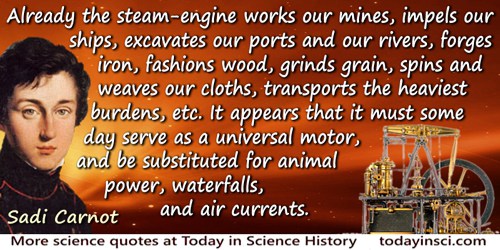
Already the steam-engine works our mines, impels our ships, excavates our ports and our rivers, forges iron, fashions wood, grinds grain, spins and weaves our cloths, transports the heaviest burdens, etc. It appears that it must some day serve as a universal motor, and be substituted for animal power, waterfalls, and air currents.
'Réflexions sur la puissance motrice du feu' (1824) translated by R.H. Thurston in Reflections on the Motive Power of Fire, and on Machines Fitted to Develop that Power (1890), 38.
Archimedes … had stated that given the force, any given weight might be moved, and even boasted, we are told, relying on the strength of demonstration, that if there were another earth, by going into it he could remove this. Hiero being struck with amazement at this, and entreating him to make good this problem by actual experiment, and show some great weight moved by a small engine, he fixed accordingly upon a ship of burden out of the king’s arsenal, which could not be drawn out of the dock without great labor and many men; and, loading her with many passengers and a full freight, sitting himself the while far off with no great endeavor, but only holding the head of the pulley in his hand and drawing the cords by degrees, he drew the ship in a straight line, as smoothly and evenly, as if she had been in the sea. The king, astonished at this, and convinced of the power of the art, prevailed upon Archimedes to make him engines accommodated to all the purposes, offensive and defensive, of a siege. … the apparatus was, in most opportune time, ready at hand for the Syracusans, and with it also the engineer himself.
— Plutarch
In John Dryden (trans.), Life of Marcellus.
Creatures that by a rule in nature teach
The act of order to a peopled kingdom.
They have a king and officers of sorts;
Where some, like magistrates, correct at home,
Others, like merchants, venture trade abroad,
Others, like soldiers, armed in their stings,
Make boot upon the summer's velvet buds;
Which pillage they with merry march bring home
To the tent-royal of their emperor.
Who, busied in his majesty, surveys
The singing masons building roofs of gold;
The civil citizens kneading up the honey;
The poor mechanic porters crowding
Their heavy burdens at his narrow gate;
The sad-eyed justice, with his surly hum,
Delivering o'er to executors pale
The lazy yawning drone.
The act of order to a peopled kingdom.
They have a king and officers of sorts;
Where some, like magistrates, correct at home,
Others, like merchants, venture trade abroad,
Others, like soldiers, armed in their stings,
Make boot upon the summer's velvet buds;
Which pillage they with merry march bring home
To the tent-royal of their emperor.
Who, busied in his majesty, surveys
The singing masons building roofs of gold;
The civil citizens kneading up the honey;
The poor mechanic porters crowding
Their heavy burdens at his narrow gate;
The sad-eyed justice, with his surly hum,
Delivering o'er to executors pale
The lazy yawning drone.
Henry V (1599), I, ii.
Darwin grasped the philosophical bleakness with his characteristic courage. He argued that hope and morality cannot, and should not, be passively read in the construction of nature. Aesthetic and moral truths, as human concepts, must be shaped in human terms, not ‘discovered’ in nature. We must formulate these answers for ourselves and then approach nature as a partner who can answer other kinds of questions for us–questions about the factual state of the universe, not about the meaning of human life. If we grant nature the independence of her own domain–her answers unframed in human terms–then we can grasp her exquisite beauty in a free and humble way. For then we become liberated to approach nature without the burden of an inappropriate and impossible quest for moral messages to assuage our hopes and fears. We can pay our proper respect to nature’s independence and read her own ways as beauty or inspiration in our different terms.
…...
Humanity has the stars in its future, and that future is too important to be lost under the burden of juvenile folly and ignorant superstition.
In 'The Deadly Information', Introduction written by Asimov for James Randi, Flim-Flam (1982), xiii.
I would rather have a big burden and a strong back, than a weak back and a caddy to carry life’s luggage.
Aphorism in The Philistine (Dec 1904), 20, No. 1, 26.
Language is the principal tool with which we communicate; but when words are used carelessly or mistakenly, what was intended to advance mutual understanding may in fact hinder it; our instrument becomes our burden
Irving M. Copi and Carl Cohen (probably? in their Introduction to Logic), In K. Srinagesh, The Principles of Experimental Research (2006), 15.
Mathematical instruction, in this as well as in other countries, is laboring under a burden of century-old tradition. Especially is this so with reference to the teaching of geometry. Our texts in this subject are still patterned more or less closely after the model of Euclid, who wrote over two thousand years ago, and whose text, moreover, was not intended for the use of boys and girls, but for mature men.
In Lectures on Fundamental Concepts of Algebra and Geometry (1911), 5.
Modern man is weighed down more by the burden of responsibility than by the burden of sin. We think him more a savior who shoulders our responsibilities than him who shoulders our sins. If instead of making decisions we have but to obey and do our duty, we feel it as a sort of salvation.
In The Passionate State of Mind (1955), 53.
Nobody since Newton has been able to use geometrical methods to the same extent for the like purposes; and as we read the Principia we feel as when we are in an ancient armoury where the weapons are of gigantic size; and as we look at them we marvel what manner of man he was who could use as a weapon what we can scarcely lift as a burthen.
From Speech delivered at the Dejeuner, after the Inauguration of the statue of Isaac Newton at Grantham. Collected in Edmund Fillingham King, A biographical sketch of Sir Isaac Newton (1858), 105.
![Ernest Henry Starling quote: Only by following out the injunction of our great predecessor [William Harvey] to search out and st](https://todayinsci.com/S/Starling_Ernest/StarlingErnest-Mastery500x250px.jpg)
Only by following out the injunction of our great predecessor [William Harvey] to search out and study the secrets of Nature by way of experiment, can we hope to attain to a comprehension of 'the wisdom of the body and the understanding of the heart,' and thereby to the mastery of disease and pain, which will enable us to relieve the burden of mankind.
'The Wisdom of the Body', The Lancet (1923), 205, 870.
Science and technology have freed humanity from many burdens and given us this new perspective and great power. This power can be used for the good of all. If wisdom governs our actions; but if the world is mad or foolish, it can destroy itself just when great advances and triumphs are almost without its grasp.
As quoted in Suranjan Das 'The Nehru Years in Indian politics', Edinburgh Papers on South Asian Studies (16 Nov 2001), 16, 230. As cited in M.J. Vinod and Meena Deshpande, Contemporary Political Theory (2013), 507. Vinod and Deshpande introduce the quote by writing “Nehru was largely instrumental for building a scientific temper and culture in India” and “emphasized the need for building national laboratories and research institutes.”
Science has gone a long way toward helping man to free himself from the burden of hard labor; yet, science itself is not a liberator. It creates means, not goals. It is up to men to utilize those means to achieve reasonable goals.
In 'I Am an American' (22 Jun 1940), Einstein Archives 29-092. Excerpted in David E. Rowe and Robert J. Schulmann, Einstein on Politics: His Private Thoughts and Public Stands on Nationalism, Zionism, War, Peace, and the Bomb (2007), 470. The British Library Sound Archive holds a recording of this statement by Einstein. It was during a radio broadcast for the Immigration and Naturalization Service, interviewed by a State Department Official. Einstein spoke following an examination on his application for American citizenship in Trenton, New Jersey. The attack on Pearl Harbor and America’s declaration of war on Japan was still over a year in the future.
Science is, perhaps, some kind of cosmic apple juice from the Garden of Eden. Those of it are doomed to carry the burden of original sin.
As quoted in Norman C. Harris, Updating Occupational Education (1973), 105. Also in News Summaries (9 Apr 1971), as cited in Bill Swainson (ed.),The Encarta Book of Quotations (2000), 134.
Standing now in diffused light, with the wind at my back, I experience suddenly a feeling of completeness–not a feeling of having achieved something or of being stronger than everyone who was ever here before, not a feeling of having arrived at the ultimate point, not a feeling of supremacy. Just a breath of happiness deep inside my mind and my breast. The summit seemed suddenly to me to be a refuge, and I had not expected to find any refuge up here. Looking at the steep, sharp ridges below us, I have the impression that to have come later would have been too late. Everything we now say to one another, we only say out of embarrassment. I don’t think anymore. As I pull the tape recorder, trancelike, from my rucksack, and switch it on wanting to record a few appropriate phrases, tears again well into my eyes. “Now we are on the summit of Everest,” I begin, “it is so cold that we cannot take photographs…” I cannot go on, I am immediately shaken with sobs. I can neither talk nor think, feeling only how this momentous experience changes everything. To reach only a few meters below the summit would have required the same amount of effort, the same anxiety and burden of sorrow, but a feeling like this, an eruption of feeling, is only possible on the summit itself.
In Everest: Expedition to the Ultimate (1979), 180.
That man can interrogate as well as observe nature was a lesson slowly learned in his evolution. Of the two methods by which he can do this, the mathematical and the experimental, both have been equally fruitful—by the one he has gauged the starry heights and harnessed the cosmic forces to his will; by the other he has solved many of the problems of life and lightened many of the burdens of humanity.
In 'The Evolution of the Idea of Experiment in Medicine', in C.G. Roland, Sir William Osler, 1849-1919: A Selection for Medical Students (1982), 103. As cited in William Osler and Mark E. Silverman (ed.), The Quotable Osler (2002), 249
The aether: Invented by Isaac Newton, reinvented by James Clerk Maxwell. This is the stuff that fills up the empty space of the universe. Discredited and discarded by Einstein, the aether is now making a Nixonian comeback. It’s really the vacuum, but burdened by theoretical, ghostly particles.
In Leon Lederman and Dick Teresi, The God Particle: If the Universe is the Answer, What is the
Question (1993, 2006), xiii.
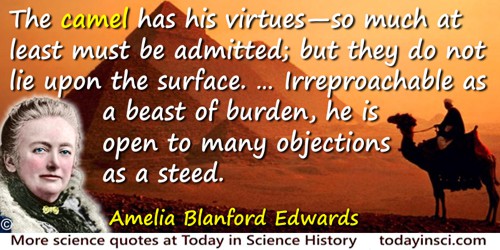
The camel has his virtues—so much at least must be admitted; but they do not lie upon the surface. … Irreproachable as a beast of burden, he is open to many objections as a steed.
In A Thousand Miles Up the Nile (1877), Vol. 1, 276.
The dependence on computers is merely the most recent—and the most extreme—example of how man relies on technology in order to escape the burden of acting as an independent agent. It helps him avoid the task of giving meaning to his life, of deciding and pursuing what is truly valuable.
From interview with New Age journal (1985), as quoted in obituary (2008) on M.I.T. News website.
The lover is moved by the thing loved, as the sense is by that which perceives, and it unites with it and they become one and the same thing... when the lover is united with the beloved it finds rest there; when the burden is laid down there it finds rest.
…...
The rich can pay when they have to pay [for medical care]. The poor receive free treatment from skilled specialists and can go, when necessary, to hospitals free of charge. But between seventy-five and ninety per cent. of our population, that which constitutes our very backbone, find it difficult to be relieved from the intolerable burden of illness.
In Genevieve Parkhurst, 'Dr. Sabin, Scientist: Winner Of Pictorial Review’s Achievement Award', Pictorial Review (Jan 1930), 70.
The right that must become paramount is not the right to procreate, but rather the right of every child to be born with a sound physical and mental constitution, based on a sound genotype. No parents will in that future time have the right to burden society with a malformed or mentally incompetent child. Just as every child must have the right to full educational opportunity and a sound nutrition, so every child has the inalienable right to a sound heritage.
Expressing concern that in a coming overpopulated world, “sacred rights of man must alter.” Presidential Address (28 Dec 1970) to the American Association for the Advancement of Science. 'Science: Endless Horizons or Golden Age?', Science (8 Jan 1971), 171, No. 3866, 24. As quoted in obituary by Douglas Martin, New York Times (20 Jan 2005).
The universality of parasitism as an offshoot of the predatory habit negatives the position taken by man that it is a pathological phenomenon or a deviation from the normal processes of nature. The pathological manifestations are only incidents in a developing parasitism. As human beings intent on maintaining man's domination over nature we may regard parasitism as pathological insofar as it becomes a drain upon human resources. In our efforts to protect ourselves we may make every kind of sacrifice to limit, reduce, and even eliminate parasitism as a factor in human life. Science attempts to define the terms on which this policy of elimination may or may not succeed. We must first of all thoroughly understand the problem, put ourselves in possession of all the facts in order to estimate the cost. Too often it has been assumed that parasitism was abnormal and that it needed only a slight force to reestablish what was believed to be a normal equilibrium without parasitism. On the contrary, biology teaches us that parasitism is a normal phenomenon and if we accept this view we shall be more ready to pay the price of freedom as a permanent and ever recurring levy of nature for immunity from a condition to which all life is subject. The greatest victory of man over nature in the physical realm would undoubtedly be his own delivery from the heavy encumbrance of parasitism with which all life is burdened.
Parasitism and Disease (1934), 4.
There was no point in telling your bosses everything; they were busy men, they didn’t want explanations. There was no point in burdening them. What they wanted was little stories that they felt they could understand, and then they’d go away and stop worrying.
In Terry Pratchett, Ian Stewart and Jack Cohen, Chap. 1, 'Splitting the Thaum', The Science of Discworld (1999), 16. Pratchett wrote the fantasy story told in the odd-numbered chapters (such as Chap. 1). Relevant real science is contributed by his co-authors, Stewart and Cohen, in the even-numbered chapters.
Those who have occasion to enter into the depths of what is oddly, if generously, called the literature of a scientific subject, alone know the difficulty of emerging with an unsoured disposition. The multitudinous facts presented by each corner of Nature form in large part the scientific man's burden to-day, and restrict him more and more, willy-nilly, to a narrower and narrower specialism. But that is not the whole of his burden. Much that he is forced to read consists of records of defective experiments, confused statement of results, wearisome description of detail, and unnecessarily protracted discussion of unnecessary hypotheses. The publication of such matter is a serious injury to the man of science; it absorbs the scanty funds of his libraries, and steals away his poor hours of leisure.
'Physiology, including Experimental Pathology and Experimental Physiology', Reports of the British Association for the Advancement of Science, 1899, 891-2.
Those…more fortunate in their mental equipment and eager to learn and to progress, have been chained to the dull and to the average and have been allowed to proceed only so fast as they were able to drag this burden with them. Search where we will,… there can be found few organized endeavors to facilitate the progress and early emergence of the brilliant students.
Co-author with Louis Jay Heath, in A New Basis for Social Progress (1917), 152.
Unless a man has talents to make something of himself, freedom is an irksome burden. Of what avail is freedom to choose if the self be ineffectual? We join a mass movement to escape individual responsibility, or, in the words of the ardent young Nazi, “to be free from freedom.”
In The True Believer: Thoughts on the Nature of Mass Movements (1951), 30.
We must have a relentless commitment to producing a meaningful, comprehensive energy package aimed at conservation, alleviating the burden of energy prices on consumers, decreasing our country’s dependency on foreign oil, and increasing electricity grid reliability.
…...
Words change their meanings, just as organism s evolve. We would impose an enormous burden on our economy if we insisted on payment in cattle every time we identified a bonus as a pecuniary advantage (from the Latin pecus, or cattle, a verbal fossil from a former commercial reality).
…...
 In science it often happens that scientists say, 'You know that's a really good argument; my position is mistaken,' and then they would actually change their minds and you never hear that old view from them again. They really do it. It doesn't happen as often as it should, because scientists are human and change is sometimes painful. But it happens every day. I cannot recall the last time something like that happened in politics or religion.
(1987) --
In science it often happens that scientists say, 'You know that's a really good argument; my position is mistaken,' and then they would actually change their minds and you never hear that old view from them again. They really do it. It doesn't happen as often as it should, because scientists are human and change is sometimes painful. But it happens every day. I cannot recall the last time something like that happened in politics or religion.
(1987) -- 





