Book Quotes (415 quotes)
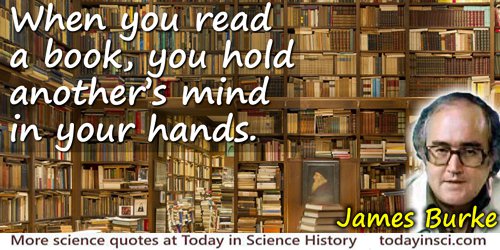
“Wu Li” was more than poetic. It was the best definition of physics that the conference would produce. It caught that certain something, that living quality that we were seeking to express in a book, that thing without which physics becomes sterile. “Wu” can mean either “matter” or “energy.” “Li” is a richly poetic word. It means “universal order” or “universal law.” It also means “organic patterns.” The grain in a panel of wood is Li. The organic pattern on the surface of a leaf is also Li, and so is the texture of a rose petal. In short, Wu Li, the Chinese word for physics, means “patterns of organic energy” (“matter/ energy” [Wu] + “universal order/organic patterns” [Li]). This is remarkable since it reflects a world view which the founders of western science (Galileo and Newton) simply did not comprehend, but toward which virtually every physical theory of import in the twentieth century is pointing!
In The Dancing Wu Li Masters: An Overview of the New Physics (1979), 5.
[Among the books he chooses, a statesman] ought to read interesting books on history and government, and books of science and philosophy; and really good books on these subjects are as enthralling as any fiction ever written in prose or verse.
In Theodore Roosevelt: An Autobiography (1913), 333.
[As a young teenager] Galois read [Legendre's] geometry from cover to cover as easily as other boys read a pirate yarn.
Men of Mathematics (1937, 1986), 364.
[Decoding the human genome sequence] is the most significant undertaking that we have mounted so far in an organized way in all of science. I believe that reading our blueprints, cataloguing our own instruction book, will be judged by history as more significant than even splitting the atom or going to the moon.
Interview (23 May 1998), 'Cracking the Code to Life', Academy of Achievement web site.
[Euclid's Elements] has been for nearly twenty-two centuries the encouragement and guide of that scientific thought which is one thing with the progress of man from a worse to a better state. The encouragement; for it contained a body of knowledge that was really known and could be relied on, and that moreover was growing in extent and application. For even at the time this book was written—shortly after the foundation of the Alexandrian Museum—Mathematics was no longer the merely ideal science of the Platonic school, but had started on her career of conquest over the whole world of Phenomena. The guide; for the aim of every scientific student of every subject was to bring his knowledge of that subject into a form as perfect as that which geometry had attained. Far up on the great mountain of Truth, which all the sciences hope to scale, the foremost of that sacred sisterhood was seen, beckoning for the rest to follow her. And hence she was called, in the dialect of the Pythagoreans, ‘the purifier of the reasonable soul.’
From a lecture delivered at the Royal Institution (Mar 1873), collected postumously in W.K. Clifford, edited by Leslie Stephen and Frederick Pollock, Lectures and Essays, (1879), Vol. 1, 296.
[First use of the term science fiction:] We hope it will not be long before we may have other works of Science-Fiction [like Richard Henry Horne's The Poor Artist], as we believe such books likely to fulfil a good purpose, and create an interest, where, unhappily, science alone might fail.
[Thomas] Campbell says, that “Fiction in Poetry is not the reverse of truth, but her soft and enchanting resemblance.” Now this applies especially to Science-Fiction, in which the revealed truths of Science may be given interwoven with a pleasing story which may itself be poetical and true—thus circulating a knowledge of Poetry of Science, clothed in a garb of the Poetry of life.
[Thomas] Campbell says, that “Fiction in Poetry is not the reverse of truth, but her soft and enchanting resemblance.” Now this applies especially to Science-Fiction, in which the revealed truths of Science may be given interwoven with a pleasing story which may itself be poetical and true—thus circulating a knowledge of Poetry of Science, clothed in a garb of the Poetry of life.
In A Little Earnest Book Upon a Great Old Subject (1851), 137.
[Herschel and Humboldt] stirred up in me a burning zeal to add even the most humble contribution to the noble structure of Natural Science. No one or a dozen other books influenced me nearly so much as these two. I copied out from Humboldt long passages about Teneriffe and read them aloud on one of [my walking excursions].
Autobiographies, (eds.) Michael Neve and Sharon Messenger (2002), Penguin edn., 36.
[My Book] will endeavour to establish the principle[s] of reasoning in ... [geology]; and all my geology will come in as illustration of my views of those principles, and as evidence strengthening the system necessarily arising out of the admission of such principles, which... are neither more nor less than that no causes whatever have from the earliest time to which we can look back, to the present, ever acted, but those now acting; and that they never acted with different degrees of energy from that which they now exert.
Letter to Roderick Murchison Esq. (15 Jan 1829). In Mrs Lyell (ed.), The Life, Letters and Journals of Sir Charles Lyell, Bart (1881), Vol. 1, 234.
[My dream dinner guest is] Charles Darwin. It’s an obvious answer, but it’s the truth. Think of any problem and before you start theorising, just check up whether Charles Darwin mentioned it in one of those green books sitting on your shelf. Whether it’s earthworms, human gestures or the origin of species, the observations that man made are unbelievable. He touched on so many subjects. Then, Alexander von Humboldt, the last polymath. There was no aspect of the natural world that he wasn’t curious about or didn’t write about in Kosmos, an extraordinary book.
From interview with Alice Roberts, 'Attenborough: My Life on Earth', The Biologist (Aug 2015), 62, No. 4, 16.
[Student:} I only use my math book on special equations.
From movie Rock 'n' Roll High School (1979). Writers, Richard Whitley, Russ Dvonch and Joseph McBride. In Larry Langman and Paul Gold, Comedy Quotes from the Movies (2001), 359.
[The Book of Genesis is] [p]rofoundly interesting and indeed pathetic to me are those attempts of the opening mind of man to appease its hunger for a Cause. But the Book of Genesis has no voice in scientific questions. It is a poem, not a scientific treatise. In the former aspect it is for ever beautiful; in the latter it has been, and it will continue to be, purely obstructive and hurtful.'
In 'Professor Virchow and Evolution', Fragments of Science (1879), Vol. 2, 377. Tyndall is quoting himself from “four years ago”&mdashthus c.1875.
[The Library of Congress] is a multimedia encyclopedia. These are the tentacles of a nation.
[Referring to the diverse holdings of the library, including motion pictures, photographs, recordings, posters and other historic objects which collectively far outnumber the books]
[Referring to the diverse holdings of the library, including motion pictures, photographs, recordings, posters and other historic objects which collectively far outnumber the books]
Quoted by Barbara Gamarekian in 'Working Profile: Daniel J. Boorstin. Helping the Library of Congress Fulfill Its Mission', New York Times (8 Jul 1983), B6.
[There] are still to be found text-books of the old sort, teaching Mathematics under the guise of Physics, presenting nothing but the dry husks of the latter.
A paper read at the Association for the Improvement of Geometrical Teaching (19 Jan 1889), 'The Vices of our Scientific Education', in Nature (6 Jun 1889), 40, 128.
[When I was a child] I grew up in Brooklyn, New York, and I was a street kid. … [T]here was one aspect of that environment that, for some reason, struck me as different, and that was the stars. … I could tell they were lights in the sky, but that wasn’t an explanation. I mean, what were they? Little electric bulbs on long black wires, so you couldn’t see what they were held up by? What were they? … My mother said to me, "Look, we’ve just got you a library card … get out a book and find the answer.” … It was in there. It was stunning. The answer was that the Sun was a star, except very far away. … The dazzling idea of a universe vast beyond imagining swept over me. … I sensed awe.
In 'Wonder and Skepticism', Skeptical Enquirer (Jan-Feb 1995), 19, No. 1.
Ac astronomye is an hard thyng,
And yvel for to knowe;
Geometrie and geomesie,
So gynful of speche,
Who so thynketh werche with tho two
Thryveth ful late,
For sorcerie is the sovereyn book
That to tho sciences bilongeth.
Now, astronomy is a difficult discipline, and the devil to learn;
And geometry and geomancy have confusing terminology:
If you wish to work in these two, you will not succeed quickly.
For sorcery is the chief study that these sciences entail.
And yvel for to knowe;
Geometrie and geomesie,
So gynful of speche,
Who so thynketh werche with tho two
Thryveth ful late,
For sorcerie is the sovereyn book
That to tho sciences bilongeth.
Now, astronomy is a difficult discipline, and the devil to learn;
And geometry and geomancy have confusing terminology:
If you wish to work in these two, you will not succeed quickly.
For sorcery is the chief study that these sciences entail.
In William Langland and B. Thomas Wright (ed.) The Vision and Creed of Piers Ploughman (1842), 186. Modern translation by Terrence Tiller in Piers Plowman (1981, 1999), 94.
Buch der Natur.
Book of Nature.
Book of Nature.
Phrase also written by Paracelsus following the title of the book by Konrad of Megenberg, Buch der Natur (c. 1350).
Der bis zur Vorrede, die ihn abweist, gelangte Leser hat das Buch für baares Geld gekauft und frägt, was ihn schadlos hält? – Meine letzte Zuflucht ist jetzt, ihn zu erinnern, daß er ein Buch, auch ohne es gerade zu lesen, doch auf mancherlei Art zu benutzen weiß. Es kann, so gut wie viele andere, eine Lücke seiner Bibliothek ausfüllen, wo es sich, sauber gebunden, gewiß gut ausnehmen wird. Oder auch er kann es seiner gelehrten Freundin auf die Toilette, oder den Theetisch legen. Oder endlich er kann ja, was gewiß das Beste von Allem ist und ich besonders rathe, es recensiren.
The reader who has got as far as the preface and is put off by that, has paid money for the book, and wants to know how he is to be compensated. My last refuge now is to remind him that he knows of various ways of using a book without precisely reading it. It can, like many another, fill a gap in his library, where, neatly bound, it is sure to look well. Or he can lay it on the dressing-table or tea-table of his learned lady friend. Or finally he can review it; this is assuredly the best course of all, and the one I specially advise.
The reader who has got as far as the preface and is put off by that, has paid money for the book, and wants to know how he is to be compensated. My last refuge now is to remind him that he knows of various ways of using a book without precisely reading it. It can, like many another, fill a gap in his library, where, neatly bound, it is sure to look well. Or he can lay it on the dressing-table or tea-table of his learned lady friend. Or finally he can review it; this is assuredly the best course of all, and the one I specially advise.
In Preface, written at Dresden in August 1818, first German edition, Die Welt als Wille und Vorstellung, 4 Bücher nebst einem Anhange der die Kritik der Kentischen Philosophie (1819), xv-xvi. As translated by E.F.J. Payne in The World as Will and Representation (1958, 1969), Vol. 1, xvii. In the preface, Schopenhauer is joking that some readers of his book may find his work does not interest them.
Error of confounding cause and effect.—There is no more dangerous error than confounding consequence with cause: I call it the intrinsic depravity of reason. … I take an
example: everybody knows the book of the celebrated Comaro, in which he recommends his spare diet as a recipe for a long and happy life,—for a virtuous life also. Few books have been read so much… I believe hardly any book … has caused so much harm, has shortened so many lives, as this well-meant curiosity. The source of this mischief is in confounding consequence with cause. The candid Italian saw in his diet the cause of his long life, while the prerequisite to long life, the extraordinary slowness of the metabolic process, small consumption, was the cause of his spare diet. He was not at liberty to eat little or much; his frugality—was not of “free will;” he became sick when he ate more.
From 'The Four Great Errors', The Twilight of the Idols (1888), collected in Thomas Common (trans.), The Works of Friedrich Nietzsche (1896), Vol. 11, 139.
Goldsmith: If you put a tub full of blood into a stable, the horses are like to go mad.
Johnson: I doubt that.
Goldsmith: Nay, sir, it is a fact well authenticated.
Thrale: You had better prove it before you put it into your book on natural history. You may do it in my stable if you will.
Johnson: Nay, sir, I would not have him prove it. If he is content to take his information from others, he may get through his book with little trouble, and without much endangering his reputation. But if he makes experiments for so comprehensive a book as his, there would be no end to them; his erroneous assertions would then fall upon himself: and he might be blamed for not having made experiments as to every particular.
Johnson: I doubt that.
Goldsmith: Nay, sir, it is a fact well authenticated.
Thrale: You had better prove it before you put it into your book on natural history. You may do it in my stable if you will.
Johnson: Nay, sir, I would not have him prove it. If he is content to take his information from others, he may get through his book with little trouble, and without much endangering his reputation. But if he makes experiments for so comprehensive a book as his, there would be no end to them; his erroneous assertions would then fall upon himself: and he might be blamed for not having made experiments as to every particular.
In James Boswell, The Life of Samuel Johnson, LL.D.: Comprehending an Account of His Studies and Numerous Works (1785, 1830), 229-230.
Lyveris to-forn us
Useden to marke
For selkouthes that thei seighen,
Hir sones for to teche;
And helden it an heigh science
Hir wittes to knowe.
Ac thorugh hir science soothly
Was nevere no soule y-saved,
Ne broght by hir bokes
To blisse ne to joye;
For alle hir kynde knowynges
Come but of diverse sightes.
Patriarkes and prophetes
Repreveden hir science,
And seiden hir wordes and hir wisdomes
Nas but a folye
And to the clergie of Crist
Counted it but a trufle.
Our ancestors in olden days used to record
The strange things they saw, and teach them to their sons;
And they held it a high science, to have knowledge of such things.
But no soul was ever saved by all that science,
Nor brought by books into eternal bliss;
Their science was only a series of sundry observations.
So patriarchs and prophets disapproved of their science,
And said their so-called words of wisdom were but folly—
And compared with Christian philosophy, a contemptible thing.
Useden to marke
For selkouthes that thei seighen,
Hir sones for to teche;
And helden it an heigh science
Hir wittes to knowe.
Ac thorugh hir science soothly
Was nevere no soule y-saved,
Ne broght by hir bokes
To blisse ne to joye;
For alle hir kynde knowynges
Come but of diverse sightes.
Patriarkes and prophetes
Repreveden hir science,
And seiden hir wordes and hir wisdomes
Nas but a folye
And to the clergie of Crist
Counted it but a trufle.
Our ancestors in olden days used to record
The strange things they saw, and teach them to their sons;
And they held it a high science, to have knowledge of such things.
But no soul was ever saved by all that science,
Nor brought by books into eternal bliss;
Their science was only a series of sundry observations.
So patriarchs and prophets disapproved of their science,
And said their so-called words of wisdom were but folly—
And compared with Christian philosophy, a contemptible thing.
In William Langland and B. Thomas Wright (ed.) The Vision and Creed of Piers Ploughman (1842), 235-236. Modern translation by Terrence Tiller in Piers Plowman (1981, 1999), 123.
Mahomet’s tombe at Mecha is said strangely to hang up, attracted by some invisible Loadstone, but the Memory of this Doctor will never fall to the ground, which his incomparable Book ‘De Magnete’ will support to Eternity.
In The History of the The Worthies of England (1662, 1840), Vol. 1, 515.
Qu'une goutee de vin tombe dans un verre d'eau; quelle que soit la loi du movement interne du liquide, nous verrons bientôt se colorer d'une teinte rose uniforme et à partir de ce moment on aura beau agiter le vase, le vin et l'eau ne partaîtront plus pouvoir se séparer. Tout cela, Maxwell et Boltzmann l'ont expliqué, mais celui qui l'a vu plus nettement, dans un livre trop peu lu parce qu'il est difficile à lire, c'est Gibbs dans ses principes de la Mécanique Statistique.
Let a drop of wine fall into a glass of water; whatever be the law that governs the internal movement of the liquid, we will soon see it tint itself uniformly pink and from th at moment on, however we may agitate the vessel, it appears that the wine and water can separate no more. All this, Maxwell and Boltzmann have explained, but the one who saw it in the cleanest way, in a book that is too little read because it is difficult to read, is Gibbs, in his Principles of Statistical Mechanics.
Let a drop of wine fall into a glass of water; whatever be the law that governs the internal movement of the liquid, we will soon see it tint itself uniformly pink and from th at moment on, however we may agitate the vessel, it appears that the wine and water can separate no more. All this, Maxwell and Boltzmann have explained, but the one who saw it in the cleanest way, in a book that is too little read because it is difficult to read, is Gibbs, in his Principles of Statistical Mechanics.
La valeur de la science. In Anton Bovier, Statistical Mechanics of Disordered Systems (2006), 3.
The Annotated Alice, of course, does tie in with math, because Lewis Carroll was, as you know, a professional mathematician. So it wasn’t really too far afield from recreational math, because the two books are filled with all kinds of mathematical jokes. I was lucky there in that I really didn’t have anything new to say in The Annotated Alice because I just looked over the literature and pulled together everything in the form of footnotes. But it was a lucky idea because that’s been the best seller of all my books.
In Anthony Barcellos, 'A Conversation with Martin Gardner', The Two-Year College Mathematics Journal (Sep 1979), 10, No. 4, 241.
A ... hypothesis may be suggested, which supposes the word 'beginning' as applied by Moses in the first of the Book of Genesis, to express an undefined period of time which was antecedent to the last great change that affected the surface of the earth, and to the creation of its present animal and vegetable inhabitants; during which period a long series of operations and revolutions may have been going on, which, as they are wholly unconnected with the history of the human race, are passed over in silence by the sacred historian, whose only concern with them was largely to state, that the matter of the universe is not eternal and self-existent but was originally created by the power of the Almighty.
Vindiciae Geologicae (1820), 31-2.
A book is a mirror: when a monkey looks in, no apostle can look out.
Aphorisms (1775-1779) trans. Franz H. Mautner and Henry Hatfield. In Fred R. Shapiro and Joseph Epstein, The Yale Book of Quotations (2006), 459:2.
A book should have either intelligibility or correctness; to combine the two is impossible, but to lack both is to be unworthy of a place as Euclid has occupied in education.
In essay, 'Mathematics and the Metaphysicians' (1901), collected in Mysticism and Logic: And Other Essays (1917), 73. The essay was also published as 'Recent Work in the Philosophy of Mathematics', in the American magazine, International Monthly.
A good preface must be at once the square root and the square of its book.
Critical Fragment 8 in Freidrich Schlegel and Peter Firchow (trans.), Friedrich Schlegel's Lucinde and the Fragments (1971), 144.
A great book is a mine as well as a mint: it suggests and excites as much thought as it presents in finished form.
From chapter 'Jottings from a Note-book', in Canadian Stories (1918), 182.
A hot topic of late, expressed most notably in Bernie Siegel’s best-selling books, has emphasized the role of positive attitude in combating such serious diseases as cancer. From the depths of my skeptical and rationalist soul, I ask the Lord to protect me from California touchie-feeliedom.
…...
A liberal education may be had at a very slight cost of time …[with] ten books which you may make close friends.
I. Old and New Testament.
II. Shakespeare.
III. Montaigne.
IV. Plutarch’s Lives.
V. Marcus Aurelius.
VI. Epictetus.
VII. Religio Medici.
VIII. Don Quixote.
IX. Emerson
X. Oliver Wendell Holmes—Breakfast-Table Series.
I. Old and New Testament.
II. Shakespeare.
III. Montaigne.
IV. Plutarch’s Lives.
V. Marcus Aurelius.
VI. Epictetus.
VII. Religio Medici.
VIII. Don Quixote.
IX. Emerson
X. Oliver Wendell Holmes—Breakfast-Table Series.
From 'Bed-Side Reading List For Medical Students', final page of Aequanimitas and Other Addresses (1904, 1906), 475.
A little science is something that they must have. I should like my nephews to know what air is, and water; why we breathe, and why wood burns; the nutritive elements essential to plant life, and the constituents of the soil. And it is no vague and imperfect knowledge from hearsay I would have them gain of these fundamental truths, on which depend agriculture and the industrial arts and our health itself; I would have them know these things thoroughly from their own observation and experience. Books here are insufficient, and can serve merely as aids to scientific experiment.
A man is known by the company his mind keeps. To live continually with noble books, with “high-erected thoughts seated in the heart of courtesy,” teaches the soul good manners.
In 'All Sorts of a Paper: Being Stray Leaves From a Note-Book', The Atlantic (1902), 90, No. 542, 735.
A man would have to be an idiot to write a book of laws for an apple tree telling it to bear apples and not thorns, seeing that the apple-tree will do it naturally and far better than any laws or teaching can prescribe.
On Secular Authority (1523). In Harro Höpfl (ed.), Luther and Calvin on Secular Authority (1991), 9.
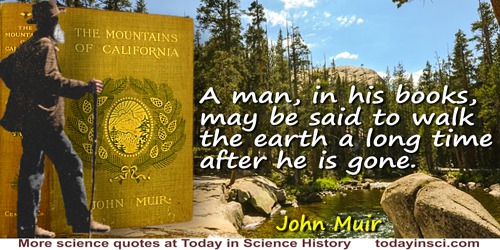
A man, in his books, may be said to walk the earth a long time after he is gone.
Quoted, without citation, in John Muir and Edwin Way Teale (ed.) The Wilderness World of John Muir (1954, 2001), Introduction, xx.
A mind which has once imbibed a taste for scientific enquiry, and has learnt the habit of applying its principles readily to the cases which occur, has within itself an inexhaustable source of pure and exciting contemplations:— One would think that Shakespeare had such a mind in view when he describes a contemplative man as finding
“Tongues in trees—books in running brooks—
Sermons in stones—and good in everything.”
Accustomed to trace the operations of general causes and the exemplification of general laws, in circumstances where the uninformed and uninquiring eye, perceives neither novelty nor beauty, he walks in the midst of wonders; every object which falls in his way elucidates some principle, affords some instruction and impresses him with a sense of harmony and order. Nor is it a mere passive pleasure which is thus communicated. A thousand questions are continually arising in his mind, a thousand objects of enquiry presenting themselves, which keep his faculties in constant exercise, and his thoughts perpetually on the wing, so that lassitude is excluded from his life, and that craving after artificial excitement and dissipation of the mind, which leads so many into frivolous, unworthy, and destructive pursuits, is altogether eradicated from his bosom.
“Tongues in trees—books in running brooks—
Sermons in stones—and good in everything.”
Accustomed to trace the operations of general causes and the exemplification of general laws, in circumstances where the uninformed and uninquiring eye, perceives neither novelty nor beauty, he walks in the midst of wonders; every object which falls in his way elucidates some principle, affords some instruction and impresses him with a sense of harmony and order. Nor is it a mere passive pleasure which is thus communicated. A thousand questions are continually arising in his mind, a thousand objects of enquiry presenting themselves, which keep his faculties in constant exercise, and his thoughts perpetually on the wing, so that lassitude is excluded from his life, and that craving after artificial excitement and dissipation of the mind, which leads so many into frivolous, unworthy, and destructive pursuits, is altogether eradicated from his bosom.
In Dionysius Lardner (ed.), Cabinet Cyclopaedia, Vol 1, Preliminary Discourse on the Study of Natural Philosophy (1831), 14-15.
A scientist reads many books in his lifetime, and knows he still has a lot to learn. A religious man barely reads one book, and thinks he knows everything.
A young person who reads a science book is confronted with a number of facts, x = ma … ma - me² … You never see in the scientific books what lies behind the discovery—the struggle and the passion of the person, who made that discovery.
From 'Asking Nature', collected in Lewis Wolpert and Alison Richards (eds.), Passionate Minds: The Inner World of Scientists (1997), 197.
According to the conclusion of Dr. Hutton, and of many other geologists, our continents are of definite antiquity, they have been peopled we know not how, and mankind are wholly unacquainted with their origin. According to my conclusions drawn from the same source, that of facts, our continents are of such small antiquity, that the memory of the revolution which gave them birth must still be preserved among men; and thus we are led to seek in the book of Genesis the record of the history of the human race from its origin. Can any object of importance superior to this be found throughout the circle of natural science?
An Elementary Treatise on Geology (1809), 82.
Adapting from the earlier book Gravitation, I wrote, “Spacetime tells matter how to move; matter tells spacetime how to curve.” In other words, a bit of matter (or mass, or energy) moves in accordance with the dictates of the curved spacetime where it is located. … At the same time, that bit of mass or energy is itself contributing to the curvature of spacetime everywhere.
With co-author Kenneth William Ford Geons, Black Holes, and Quantum Foam: A Life in Physics (1998, 2010), 235. Adapted from his earlier book, co-authored with Charles W. Misner and Kip S. Thorne, Gravitation (1970, 1973), 5, in which one of the ideas in Einstein’s geometric theory of gravity was summarized as, “Space acts on matter, telling it how to move. In turn, matter reacts back on space, telling it how to curve”.
After all, the Athanasian Creed is to me light and intelligible reading in comparison with much that now passes for science.
Samuel Bulter, Henry Festing Jones (ed.), The Note-Books of Samuel Butler (1917), 324.
After the birth of printing books became widespread. Hence everyone throughout Europe devoted himself to the study of literature... Every year, especially since 1563, the number of writings published in every field is greater than all those produced in the past thousand years. Through them there has today been created a new theology and a new jurisprudence; the Paracelsians have created medicine anew and the Copernicans have created astronomy anew. I really believe that at last the world is alive, indeed seething, and that the stimuli of these remarkable conjunctions did not act in vain.
De Stella Nova, On the New Star (1606), Johannes Kepler Gesammelte Werke (1937- ), Vol. 1, 330-2. Quoted in N. Jardine, The Birth of History and Philosophy of Science: Kepler's A Defence of Tycho Against Ursus With Essays on its Provenance and Significance (1984), 277-8.
After the German occupation of Holland in May 1940, the [last] two dark years of the war I spent hiding indoors from the Nazis, eating tulip bulbs to fill the stomach and reading Kramers' book “Quantum Theorie des Elektrons und der Strahlung” by the light of a storm lamp.
All of the books in the world contain no more information than is broadcast as video in a single large American city in a single year. Not all bits have equal value.
…...
Amoeba has her picture in the book,
Proud Protozoon!—Yet beware of pride,
All she can do is fatten and divide;
She cannot even read, or sew, or cook…
The Worm can crawl
But has no eyes to look.
The Jelly-fish can swim
But lacks a bride.
Proud Protozoon!—Yet beware of pride,
All she can do is fatten and divide;
She cannot even read, or sew, or cook…
The Worm can crawl
But has no eyes to look.
The Jelly-fish can swim
But lacks a bride.
Essay read at the Heretics Club, Cambridge (May 1922), 'Philosophic Ants', collected in Essays of a Biologist (1923), 176.
Among the older records, we find chapter after chapter of which we can read the characters, and make out their meaning: and as we approach the period of man’s creation, our book becomes more clear, and nature seems to speak to us in language so like our own, that we easily comprehend it. But just as we begin to enter on the history of physical changes going on before our eyes, and in which we ourselves bear a part, our chronicle seems to fail us—a leaf has been torn out from nature's record, and the succession of events is almost hidden from our eyes.
Letter 1 to William Wordsworth. Quoted in the appendix to W. Wordsworth, A Complete Guide to the Lakes, Comprising Minute Direction for the Tourist, with Mr Wordsworth's Description of the Scenery of the County and Three Letters upon the Geology of the Lake District (1842), 14.
An extraterrestrial being, newly arrived on Earth - scrutinizing what we mainly present to our children in television, radio, movies, newspapers, magazines, the comics, and many books - might easily conclude that we are intent on teaching them murder, rape, cruelty, superstition, credulity and consumerism.
…...
An incidental remark from a German colleague illustrates the difference between Prussian ways and our own. He had apparently been studying the progress of our various crews on the river, and had been struck with the fact that though the masters in charge of the boats seemed to say and do very little, yet the boats went continually faster and faster, and when I mentioned Dr. Young’s book to him, he made the unexpected but suggestive reply: “Mathematics in Prussia! Ah, sir, they teach mathematics in Prussia as you teach your boys rowing in England: they are trained by men who have been trained by men who have themselves been trained for generations back.”
In John Perry (ed.), Discussion on the Teaching of Mathematics (1901), 43. The discussion took place on 14 Sep 1901 at the British Association at Glasgow, during a joint meeting of the mathematics and physics sections with the education section. The proceedings began with an address by John Perry. Langley related this anecdote during the Discussion which followed.
And so, after many years, victory has come, and the romance of exploration, of high hopes and bitter disappointment, will in a few years simply be recorded in the text-books of organic chemistry in a few terse sentences.
Recent Developments in the Vitamin A Field', The Pedlar Lecture, 4 Dec 1947, Journal of the Chemical Society, Part I (1948), 393.
And when with excellent Microscopes I discern in otherwise invisible Objects the Inimitable Subtlety of Nature’s Curious Workmanship; And when, in a word, by the help of Anatomicall Knives, and the light of Chymicall Furnaces, I study the Book of Nature, and consult the Glosses of Aristotle, Epicurus, Paracelsus, Harvey, Helmont, and other learn'd Expositors of that instructive Volumne; I find my self oftentimes reduc’d to exclaim with the Psalmist, How manifold are thy works, O Lord? In wisdom hast thou made them all.
Some Motives and Incentives to the Love of God (1659), 56-7.
And yet the books which then I valued most
Are dearest to me now; for, having scanned,
Not heedlessly, the laws, and watched the forms
Of Nature, in that knowledge I possessed
A standard, often usefully applied,
Even when unconsciously, to things removed
From a familiar sympathy.
Are dearest to me now; for, having scanned,
Not heedlessly, the laws, and watched the forms
Of Nature, in that knowledge I possessed
A standard, often usefully applied,
Even when unconsciously, to things removed
From a familiar sympathy.
From 'The Prelude' in Book 5, collected in Henry Reed (ed.), The Complete Poetical Works of William Wordsworth (1851), 503.
Any chemist reading this book can see, in some detail, how I have spent most of my mature life. They can become familiar with the quality of my mind and imagination. They can make judgements about my research abilities. They can tell how well I have documented my claims of experimental results. Any scientist can redo my experiments to see if they still work—and this has happened! I know of no other field in which contributions to world culture are so clearly on exhibit, so cumulative, and so subject to verification.
From Design to Discovery (1990), 119-20.
Anyone who has had actual contact with the making of the inventions that built the radio art knows that these inventions have been the product of experiment and work based on physical reasoning, rather than on the mathematicians' calculations and formulae. Precisely the opposite impression is obtained from many of our present day text books and publications.
Attributed.
Are the humanistic and scientific approaches different? Scientists can calculate the torsion of a skyscraper at the wing-beat of a bird, or 155 motions of the Moon and 500 smaller ones in addition. They move in academic garb and sing logarithms. They say, “The sky is ours”, like priests in charge of heaven. We poor humanists cannot even think clearly, or write a sentence without a blunder, commoners of “common sense”. We never take a step without stumbling; they move solemnly, ever unerringly, never a step back, and carry bell, book, and candle.
Quoting himself in Stargazers and Gravediggers: Memoirs to Worlds in Collision (2012), 212.
Arithmetic, as we shall see by and by, is overdone, in a certain sense, in our schools; just so far as the teaching is based upon the concrete, so far is it profitable; but when the book-makers begin to make it too abstract, as they very often do, it becomes a torture to both teacher and learners, or, at best, a branch of imaginary knowledge unconnected with real life.
From 'Introduction', Mathematical Teaching and its Modern Methods (1886), 10.
![Augustus De Morgan quote: As to writing another book on geometry [to replace Euclid] the middle ages would have as soon thought](https://todayinsci.com/D/DeMorgan_Augustus/DeMorganAugustus-Testament500x250px.jpg)
As to writing another book on geometry [to replace Euclid] the middle ages would have as soon thought of composing another New Testament.
In George Edward Martin, The Foundations of Geometry and the Non-Euclidean Plane (1982), 130.
At the age of three I began to look around my grandfather’s library. My first knowledge of astronomy came from reading and looking at pictures at that time. By the time I was six I remember him buying books for me. … I think I was eight, he bought me a three-inch telescope on a brass mounting. It stood on a table. … So, as far back as I can remember, I had an early interest in science in general, astronomy in particular.
Oral History Transcript of interview with Dr. Jesse Greenstein by Paul Wright (31 Jul 1974), on website of American Institute of Physics.
At the end of the book [Zoonomia] he sums up his [Erasmus Darwin] views in the following sentences: “The world has been evolved, not created: it has arisen little by little from a small beginning, and has increased through the activity of the elemental forces embodied in itself, and so has rather grown than come into being at an almighty word.” “What a sublime idea of the infinite might of the great Architect, the Cause of all causes, the Father of all fathers, the Ens Entium! For if we would compare the Infinite, it would surely require a greater Infinite to cause the causes of effects than to produce the effects themselves.”
[This is a restatement, not a verbatim quote of the original words of Erasmus Darwin, who attributed the idea he summarized to David Hume.]
[This is a restatement, not a verbatim quote of the original words of Erasmus Darwin, who attributed the idea he summarized to David Hume.]
In August Weismann, John Arthur Thomson (trans.), Margaret R. Thomson (trans.) The Evolution Theory (1904), Vol. 1, 17-18. The verbatim form of the quote from Zoonomia, in context, can be seen on the webpage here for Erasmus Darwin. Later authors have quoted from Weismann's translated book, and given the reworded passage as a direct quote by Erasmus Darwin. Webmaster has found a verbatim form in Zoonomia (1794), but has been unable to find the wording used by Weismann in any primary source by Erasmus Darwin. The rewording is perhaps due to the translation of the quote into German for Weismann's original book, Vorträge über Descendenztheorie (1902) followed by another translation for the English edition.
Atomic energy bears that same duality that has faced man from time immemorial, a duality expressed in the Book of Books thousands of years ago: “See, I have set before thee this day life and good and death and evil … therefore choose life.”
In This I Do Believe edited by Edward R. Murrow (1949).
Authors have a greater right than any copyright, though it is generally unacknowledged or disregarded. They have a right to the reader’s civility. There are favorable hours for reading a book, as for writing it, and to these the author has a claim. Yet many people think that when they buy a book they buy with it the right to abuse the author.
In 'Table-Talk', The Poetical Works of Henry Wadsworth Longfellow: Volume 3 (1883), 1355.
Available energy is energy which we can direct into any desired channel. Dissipated energy is energy which we cannot lay hold of and direct at pleasure, such as the energy of the confused agitation of molecules which we call heat. Now, confusion, like the correlative term order, is not a property of material things in themselves, but only in relation to the mind which perceives them. A memorandum-book does not, provided it is neatly written, appear confused to an illiterate person, or to the owner who understands it thoroughly, but to any other person able to read it appears to be inextricably confused. Similarly the notion of dissipated energy could not occur to a being who could not turn any of the energies of nature to his own account, or to one who could trace the motion of every molecule and seize it at the right moment. It is only to a being in the intermediate stage, who can lay hold of some forms of energy while others elude his grasp, that energy appears to be passing inevitably from the available to the dissipated state.
'Diffusion', Encyclopaedia Britannica (1878). In W. D. Niven (ed.), The Scientific Papers of James Clerk Maxwell (1890), Vol. 2, 646.
Be careful about reading health books. You may die of a misprint.
In Mark Twain and Alex Ayres (ed.), The Wit & Wisdom of Mark Twain (1987), 97.
Book-knowledge is a poor resource … In many cases, ignorance is a good thing: the mind retains its freedom of investigation and does not stray along roads that lead nowhither, suggested by one’s reading. … Ignorance can have its advantages; the new is found far from the beaten track.
In Jean-Henri Fabre and Alexander Teixeira de Mattos (trans.), The Life and Love of the Insect (1918), 243.
Books and libraries and the will to use them are among the most important tools our nation has to diffuse knowledge and to develop our powers of creative wisdom.
Statement on the Occasion of National Library Week (16 Apr 1961). In Public Papers of the Presidents of the United States: John F. Kennedy, 1961 (1962), 125.
Books are fatal: they are the curse of the human race. Nine-tenths of existing books are nonsense, and the clever books are the refutation of that nonsense. The greatest misfortune that ever befell man was the invention of printing.
In Lothair (1879), Chap. 29, 137.
Books are merely records of what other people have thought and observed, the material is a far safer guide.
As quoted, without citation, in Vincent T. Andriole, 'Florence Rena Sabin—Teacher, Scientist, Citizen', Journal of the History of Medicine and Allied Sciences (Jul 1959), 14, No. 3, (July 1959), 324.
Books are not absolutely dead things, but do contain a potency of life in them to be as active as that soul was whose progeny they are.
In Areopagitica: A speech of Mr John Milton for the Liberty of Unlicenced printing to the Parliament of England (23 Nov 1644), 4.
Books are the carriers of civilization. Without books, history is silent, literature dumb, science crippled, thought and speculation at a standstill. Without books the development of civilization would have been impossible. They are engines of change, windows on the world, “lighthouses,” (as a poet said), “erected in the sea of time.”
In Authors League Bulletin (1979). As city in Charles Francis (ed.), Wisdom Well Said (2009), 48.
Books have always a secret influence on the understanding; we cannot at pleasure obliterate ideas; he that reads books of science, thogh without any fixed desire of improvement, will grow more knowing…
In Samuel Johnson and W. Jackson Bate (Ed.), ',The Adventurer, No. 137, Tuesday, 26 Febraury 1754.' The Selected Essays from the Rambler, Adventurer, and Idler (1968), 273.
Books must follow sciences, and not sciences books.
In 'A Proposal for Amending the Laws of England' (1616). Collected in The Works, with Several Additional Pieces Never Before Printed (1740), Vol. 4, 5.
Books won’t stay banned. They won’t burn. Ideas won’t go to jail. In the long run of history, the censor and the inquisitor have always lost. The only sure weapon against bad ideas is better ideas. The source of better ideas is wisdom. The surest path to wisdom is a liberal education.
From Essays on Education. In Alfred Whitney Griswold, 1906-1963: In Memoriam (1964), 24.
Bowing to the reality of harried lives, Rudwick recognizes that not everyone will read every word of the meaty second section; he even explicitly gives us permission to skip if we get ‘bogged down in the narrative.’ Readers absolutely must not do such a thing; it should be illegal. The publisher should lock up the last 60 pages, and deny access to anyone who doesn’t pass a multiple-choice exam inserted into the book between parts two and three.
…...
But for the persistence of a student of this university in urging upon me his desire to study with me the modern algebra I should never have been led into this investigation; and the new facts and principles which I have discovered in regard to it (important facts, I believe), would, so far as I am concerned, have remained still hidden in the womb of time. In vain I represented to this inquisitive student that he would do better to take up some other subject lying less off the beaten track of study, such as the higher parts of the calculus or elliptic functions, or the theory of substitutions, or I wot not what besides. He stuck with perfect respectfulness, but with invincible pertinacity, to his point. He would have the new algebra (Heaven knows where he had heard about it, for it is almost unknown in this continent), that or nothing. I was obliged to yield, and what was the consequence? In trying to throw light upon an obscure explanation in our text-book, my brain took fire, I plunged with re-quickened zeal into a subject which I had for years abandoned, and found food for thoughts which have engaged my attention for a considerable time past, and will probably occupy all my powers of contemplation advantageously for several months to come.
In Johns Hopkins Commemoration Day Address, Collected Mathematical Papers, Vol. 3, 76.
But indeed, the English generally have been very stationary in latter times, and the French, on the contrary, so active and successful, particularly in preparing elementary books, in the mathematical and natural sciences, that those who wish for instruction, without caring from what nation they get it, resort universally to the latter language.
Letter (29 Jan 1824) to Patrick K. Rodgers. Collected in Andrew A. Lipscomb (ed.), The Writings of Thomas Jefferson (1904), Vol. 16, 2.
But it is precisely mathematics, and the pure science generally, from which the general educated public and independent students have been debarred, and into which they have only rarely attained more than a very meagre insight. The reason of this is twofold. In the first place, the ascendant and consecutive character of mathematical knowledge renders its results absolutely insusceptible of presentation to persons who are unacquainted with what has gone before, and so necessitates on the part of its devotees a thorough and patient exploration of the field from the very beginning, as distinguished from those sciences which may, so to speak, be begun at the end, and which are consequently cultivated with the greatest zeal. The second reason is that, partly through the exigencies of academic instruction, but mainly through the martinet traditions of antiquity and the influence of mediaeval logic-mongers, the great bulk of the elementary text-books of mathematics have unconsciously assumed a very repellant form,—something similar to what is termed in the theory of protective mimicry in biology “the terrifying form.” And it is mainly to this formidableness and touch-me-not character of exterior, concealing withal a harmless body, that the undue neglect of typical mathematical studies is to be attributed.
In Editor’s Preface to Augustus De Morgan and Thomas J. McCormack (ed.), Elementary Illustrations of the Differential and Integral Calculus (1899), v.
But notwithstanding these Arguments are so convictive and demonstrative, its marvellous to see how some Popish Authors (Jesuites especially) strain their wits to defend their Pagan Master Aristotle his Principles. Bullialdus speaks of a Florentine Physitian, that all the Friends he had could ever perswade him once to view the Heavens through a Telescope, and he gave that reason for his refusal, because he was afraid that then his Eyes would make him stagger concerning the truth of Aristotle’s Principles, which he was resolved he would not call into question. It were well, if these Men had as great veneration for the Scripture as they have, for Aristotles (if indeed they be his) absurd Books de cælo Sed de his satis.
(Indicating a belief that the Roman Catholic church impeded the development of modern science.)
(Indicating a belief that the Roman Catholic church impeded the development of modern science.)
Kometographia, Or a Discourse Concerning Comets (Boston 1684). Quoted in Michael Garibaldi Hall, The Last American Puritan: The Life of Increase Mather, 1639-1723 (1988), 167.
By asking questions and quickly reading some books, [Melvin Calvin] felt comfortable in many fields of endeavor.
Co-author with Andrew A. Benson, 'Melvin Calvin', Biographical Memoirs of the US National Academy of Science.
By far the most important books for geology students were the quarries and clay pits, the cliffs and
creek beds, the road and railroad cuts in woods and fields. Our words and letters were the imprints of plants and animals in stone, the minerals and crystals, and our vast, inexhaustible, incorruptible, and infallible library was nature itself.
In Hans Cloos, Ernst Cloos (ed.) and Curt Dietz (ed.), Conversation With the Earth (1953, 1959), 28, as translated by E.B. Garside from the original German edition, Gespräch mit der Erde (1947).
Carry when walking a book, and a note-book to preserve the ideas, and a piece of bread in order to prolong the walk if need be.
From Appendix A, 'Extracts From the Unpublished Writings of Carnot', Reflections on the Motive Power of Heat (1890, 2nd ed. 1897), 205.
Chemical signs ought to be letters, for the greater facility of writing, and not to disfigure a printed book ... I shall take therefore for the chemical sign, the initial letter of the Latin name of each elementary substance: but as several have the same initial letter, I shall distinguish them in the following manner:— 1. In the class which I shall call metalloids, I shall employ the initial letter only, even when this letter is common to the metalloid and to some metal. 2. In the class of metals, I shall distinguish those that have the same initials with another metal, or a metalloid, by writing the first two letters of the word. 3. If the first two letters be common to two metals, I shall, in that case, add to the initial letter the first consonant which they have not in common: for example, S = sulphur, Si = silicium, St = stibium (antimony), Sn = stannum (tin), C = carbonicum, Co = colbaltum (colbalt), Cu = cuprum (copper), O = oxygen, Os = osmium, &c.
'Essay on the Cause of Chemical Proportions, and on some circumstances relating to them: together with a short and easy method of expressing them', Annals of Philosophy, 1814, 3,51-2.
Chemistry is an art that has furnished the world with a great number of useful facts, and has thereby contributed to the improvement of many arts; but these facts lie scattered in many different books, involved in obscure terms, mixed with many falsehoods, and joined to a great deal of false philosophy; so that it is not great wonder that chemistry has not been so much studied as might have been expected with regard to so useful a branch of knowledge, and that many professors are themselves but very superficially acquainted with it. But it was particularly to be expected, that, since it has been taught in universities, the difficulties in this study should have been in some measure removed, that the art should have been put into form, and a system of it attempted—the scattered facts collected and arranged in a proper order. But this has not yet been done; chemistry has not yet been taught but upon a very narrow plan. The teachers of it have still confined themselves to the purposes of pharmacy and medicine, and that comprehends a small branch of chemistry; and even that, by being a single branch, could not by itself be tolerably explained.
John Thomson, An Account of the Life, Lectures and Writings of William Cullen, M.D. (1832), Vol. 1, 40.
Copernicus … did not publish his book [on the nature of the solar system] until he was on his deathbed. He knew how dangerous it is to be right when the rest of the world is wrong.
In a speech at Waterville, Maine, July 30, 1885.
Darwin's Origin of Species had come into the theological world like a plough into an ant-hill. Everywhere those thus rudely awakened from their old comfort and repose had swarmed forth angry and confused. Reviews, sermons, books light and heavy, came flying at the new thinker from all sides.
From The Warfare of Science and Theology in Christendom (1898), 70.
Darwin’s book is very important and serves me as a basis in natural science for the class struggle in history. One has to put up with the crude English method of development, of course. Despite all deficiencies not only is the death-blow dealt here for the first time to “teleology” in the natural sciences, but their rational meaning is empirically explained.
Marx to Lasalle, 16 Jan 1861. In Marx-Engels Selected Correspondence, 1846-95, trans. Donna Torr (1934), 125.
Dirac politely refused Robert’s [Robert Oppenheimer] two proffered books: reading books, the Cambridge theoretician announced gravely, “interfered with thought.”
Alvarez: Adventures of a Physicist (1987), 87.
Direct observation of the testimony of the earth … is a matter of the laboratory, of the field naturalist, of indefatigable digging among the ancient archives of the earth’s history. If Mr. Bryan, with an open heart and mind, would drop all his books and all the disputations among the doctors and study first hand the simple archives of Nature, all his doubts would disappear; he would not lose his religion; he would become an evolutionist.
'Evolution and Religion', New York Times (5 Mar 1922), 91. Written in response to an article a few days earlier in which William Jennings Bryan challenged the theory of evolution as lacking proof.
Dirichlet was not satisfied to study Gauss’ Disquisitiones arithmetical once or several times, but continued throughout life to keep in close touch with the wealth of deep mathematical thoughts which it contains by perusing it again and again. For this reason the book was never placed on the shelf but had an abiding place on the table at which he worked. … Dirichlet was the first one, who not only fully understood this work, but made it also accessible to others.
In Dirichlet, Werke, Bd. 2, 315. As translated in Robert Édouard Moritz, Memorabilia Mathematica; Or, The Philomath’s Quotation-book (1914), 159.
Divers of Hermetic Books have such involv’d Obscuritys that they may justly be compar’d to Riddles written in Cyphers. For after a Man has surmounted the difficulty of decyphering the Words & Terms, he finds a new & greater difficulty to discover ye meaning of the seemingly plain Expression.
Fragment In Boyle papers. Cited by Lawrence Principe, 'Boyle's Alchemical Pursuits', In M. Hunter (ed.), Robert Boyle Reconsidered (1994), 95
Doubtless many can recall certain books which have greatly influenced their lives, and in my own case one stands out especially—a translation of Hofmeister's epoch-making treatise on the comparative morphology of plants. This book, studied while an undergraduate at the University of Michigan, was undoubtedly the most important factor in determining the trend of my botanical investigation for many years.
D.H. Campbell, 'The Centenary of Wilhelm Hofmeister', Science (1925), 62, No. 1597, 127-128. Cited in William C. Steere, Obituary, 'Douglas Houghton Campbell', American Bryological and Lichenological Society, The Bryologist (1953), 127. The book to which Cambell refers is W. Hofmeister, On the Germination, Development, and Fructification of the Higher Cryptogamia, and on the Fructification of the Coniferae, trans. by Frederick Currey (1862).
Dr. Paget was conducting a school examination, and in the course of his questions he happened to ask a small child the meaning of “Average.” He was utterly bewildered by the reply, “The thing that hens lay on,” until the child explained that he had read in a book that hens lay on an average so many eggs a year.
Anecdote jotted down by Lewis Carroll to possibly send to the magazine Punch, as given in Stuart Dodgson Collingwood, The Life and Letters of Lewis Carroll (1898), 157.
During my second year at Edinburgh [1826-27] I attended Jameson's lectures on Geology and Zoology, but they were incredible dull. The sole effect they produced on me was the determination never as long as I lived to read a book on Geology.
Charles Darwin, His Life Told in an Autobiographical Chapter and a Selected Series of his Published Letters (1892), 15. In Patrick Wyse Jackson, Four Centuries of Geological Travel (2007), 32.
During this [book preparation] time attacks have not been wanting—we must always be prepared for them. If they grow out of a scientific soil, they cannot but be useful, by laying bare weak points and stimulating to their correction; but if they proceed from that soil, from which the lilies of innocence and the palms of conciliation should spring up, where, however, nothing but the marsh-trefoil of credulity and the poisonous water-hemlock of calumniation grow, they deserve no attention.
From Carl Vogt and James Hunt (ed.), Lectures on Man: His Place in Creation, and in the History of the Earth (1861), Author's Preface, 2-3.
Each of us has read somewhere that in New Guinea pidgin the word for 'piano' is (I use English spelling) 'this fellow you hit teeth belonging to him he squeal all same pig'. I am inclined to doubt whether this expression is authentic; it looks just like the kind of thing a visitor to the Islands would facetiously invent. But I accept 'cut grass belong head belong me' for 'haircut' as genuine... Such phrases seem very funny to us, and make us feel very superior to the ignorant foreigners who use long winded expressions for simple matters. And then it is our turn to name quite a simple thing, a small uncomplicated molecule consisting of nothing more than a measly 11 carbons, seven hydrogens, one nitrogen and six oxygens. We sharpen our pencils, consult our rule books and at last come up with 3-[(1, 3- dihydro-1, 3-dioxo-2H-isoindol-2-yl) oxy]-3-oxopropanoic acid. A name like that could drive any self-respecting Papuan to piano-playing.
The Chemist's English (1990), 3rd Edition, 57.
Early in my school days a boy had a copy of the “Wonders of the World,” which I often read, and disputed with other boys about the veracity of some of the statements; and I believe that this book first gave me a wish to travel in remote countries, which was ultimately fulfilled by the voyage of the Beagle.
In Charles Darwin and Francis Darwin (ed.), 'Autobiography', The Life and Letters of Charles Darwin (1887, 1896), Vol. 1, 31.
Earth and sky, woods and fields, lakes and rivers, the mountain and the sea, are excellent schoolmasters, and teach some of us more than we can ever learn from books.
The Use of Life (1895), 70 or (2005), 66.
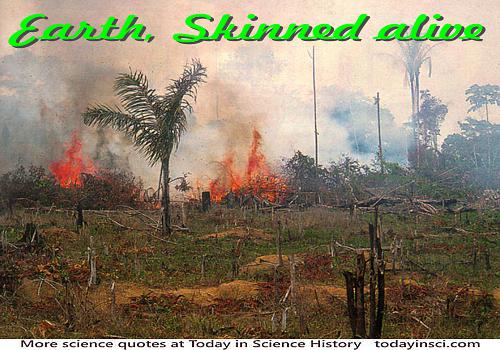
Deforestation of Amazon forest by burning to clear for grazing lands.
Credit: NASA LBA-ECO Project
Credit: NASA LBA-ECO Project
Earth, Skinned Alive.
[Headline for deforestation book review.]
[Headline for deforestation book review.]
Headline to book review by Stephen J. Pyne in New York Times (21 Apr 1991), BR19. (The book being reviewed was Kenton Miller and Laura Tangley, Trees of Life: Saving Tropical Forests and Their Biological Wealth.)
Endowed with two qualities, which seemed incompatible with each other, a volcanic imagination and a pertinacity of intellect which the most tedious numerical calculations could not daunt, Kepler conjectured that the movements of the celestial bodies must be connected together by simple laws, or, to use his own expression, by harmonic laws. These laws he undertook to discover. A thousand fruitless attempts, errors of calculation inseparable from a colossal undertaking, did not prevent him a single instant from advancing resolutely toward the goal of which he imagined he had obtained a glimpse. Twenty-two years were employed by him in this investigation, and still he was not weary of it! What, in reality, are twenty-two years of labor to him who is about to become the legislator of worlds; who shall inscribe his name in ineffaceable characters upon the frontispiece of an immortal code; who shall be able to exclaim in dithyrambic language, and without incurring the reproach of anyone, “The die is cast; I have written my book; it will be read either in the present age or by posterity, it matters not which; it may well await a reader, since God has waited six thousand years for an interpreter of his words.”
In 'Eulogy on Laplace', in Smithsonian Report for the year 1874 (1875), 131-132.
Eugene Dubois is no hero in my book, if only because I share the spirit of his unorthodoxies, but disagree so strongly with his version, and regard his supporting arguments as so weakly construed and so willfully blind to opposing evidence (the dogmatist within is always worse than the enemy without).
…...
Even fairly good students, when they have obtained the solution of the problem and written down neatly the argument, shut their books and look for something else. Doing so, they miss an important and instructive phase of the work. ... A good teacher should understand and impress on his students the view that no problem whatever is completely exhausted.
In How to Solve It: A New Aspect of Mathematical Method (2004), 14.
Ever since I was a boy, I’ve been fascinated by crazy science and such things as perpetual motion machines and logical paradoxes. I’ve always enjoyed keeping up with those ideas. I suppose I didn’t get into it seriously until I wrote my first book, Fads and Fallacies in the Name of Science. I was influenced by the Dianetics movement, now called Scientology, which was then promoted by John Campbell in Astounding Science Fiction. I was astonished at how rapidly the thing had become a cult.
In Scot Morris, 'Interview: Martin Gardner', Omni, 4, No. 4 (Jan 1982), 68.
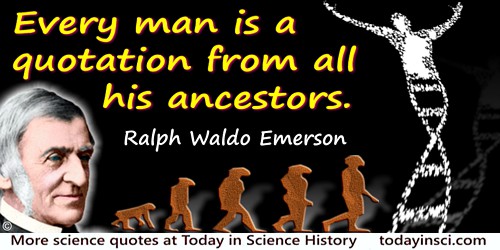
Every book is a quotation; and every house is a quotation out of all forests and mines and stone-quarries; and every man is a quotation from all his ancestors.
Epigraph for chapter 'Quotation and Originality', in Letters and Social Aims (1875, 1917), 176.
Every mathematical book that is worth reading must be read “backwards and forwards”, if I may use the expression. I would modify Lagrange’s advice a little and say, “Go on, but often return to strengthen your faith.” When you come on a hard or dreary passage, pass it over; and come back to it after you have seen its importance or found the need for it further on.
In Algebra, Part 2 (1889), Preface, viii.
Every new theory as it arises believes in the flush of youth that it has the long sought goal; it sees no limits to its applicability, and believes that at last it is the fortunate theory to achieve the 'right' answer. This was true of electron theory—perhaps some readers will remember a book called The Electrical Theory of the Universe by de Tunzelman. It is true of general relativity theory with its belief that we can formulate a mathematical scheme that will extrapolate to all past and future time and the unfathomed depths of space. It has been true of wave mechanics, with its first enthusiastic claim a brief ten years ago that no problem had successfully resisted its attack provided the attack was properly made, and now the disillusionment of age when confronted by the problems of the proton and the neutron. When will we learn that logic, mathematics, physical theory, are all only inventions for formulating in compact and manageable form what we already know, like all inventions do not achieve complete success in accomplishing what they were designed to do, much less complete success in fields beyond the scope of the original design, and that our only justification for hoping to penetrate at all into the unknown with these inventions is our past experience that sometimes we have been fortunate enough to be able to push on a short distance by acquired momentum.
The Nature of Physical Theory (1936), 136.
Evolution is the conviction that organisms developed their current forms by an extended history of continual transformation, and that ties of genealogy bind all living things into one nexus. Panselectionism is a denial of history, for perfection covers the tracks of time. A perfect wing may have evolved to its current state, but it may have been created just as we find it. We simply cannot tell if perfection be our only evidence. As Darwin himself understood so well, the primary proofs of evolution are oddities and imperfections that must record pathways of historical descent–the panda’s thumb and the flamingo’s smile of my book titles (chosen to illustrate this paramount principle of history).
…...
Evolution: At the Mind's Cinema
I turn the handle and the story starts:
Reel after reel is all astronomy,
Till life, enkindled in a niche of sky,
Leaps on the stage to play a million parts.
Life leaves the slime and through all ocean darts;
She conquers earth, and raises wings to fly;
Then spirit blooms, and learns how not to die,-
Nesting beyond the grave in others' hearts.
I turn the handle: other men like me
Have made the film: and now I sit and look
In quiet, privileged like Divinity
To read the roaring world as in a book.
If this thy past, where shall they future climb,
O Spirit, built of Elements and Time?
I turn the handle and the story starts:
Reel after reel is all astronomy,
Till life, enkindled in a niche of sky,
Leaps on the stage to play a million parts.
Life leaves the slime and through all ocean darts;
She conquers earth, and raises wings to fly;
Then spirit blooms, and learns how not to die,-
Nesting beyond the grave in others' hearts.
I turn the handle: other men like me
Have made the film: and now I sit and look
In quiet, privileged like Divinity
To read the roaring world as in a book.
If this thy past, where shall they future climb,
O Spirit, built of Elements and Time?
'Evolution: At the Mind's Cinema' (1922), in The Captive Shrew and Other Poems of a Biologist (1932), 55.
Evolution: The Modern Synthesis.
Book title
Book title
Evolution: The Modern Synthesis (1942).
Fifty years from now if an understanding of man’s origins, his evolution, his history, his progress is not in the common place of the school books we shall not exist.
In Ch. 13, 'The Long Childhood', The Ascent of Man, (2011), 328
For books [Charles Darwin] had no respect, but merely considered them as tools to be worked with. … he would cut a heavy book in half, to make it more convenient to hold. He used to boast that he had made Lyell publish the second edition of one of his books in two volumes, instead of in one, by telling him how he had been obliged to cut it in half. … his library was not ornamental, but was striking from being so evidently a working collection of books.
In Charles Darwin: His Life Told in an Autobiographical Chapter, and in a Selected Series of his Published Letters (1908), 96.
For Christmas, 1939, a girl friend gave me a book token which I used to buy Linus Pauling's recently published Nature of the Chemical Bond. His book transformed the chemical flatland of my earlier textbooks into a world of three-dimensional structures.
'What Holds Molecules Together', in I Wish I'd Made You Angry Earlier (1998), 165.
For it is too bad that there are so few who seek the truth and so few who do not follow a mistaken method in philosophy. This is not, however, the place to lament the misery of our century, but to rejoice with you over such beautiful ideas for proving the truth. So I add only, and I promise, that I shall read your book at leisure; for I am certain that I shall find the noblest things in it. And this I shall do the more gladly, because I accepted the view of Copernicus many years ago, and from this standpoint I have discovered from their origins many natural phenomena, which doubtless cannot be explained on the basis of the more commonly accepted hypothesis.
Letter (4 Aug 1597) to Kepler, expressing thanks and interest in the book Kepler sent him. As quoted in translation in Jackson J. Spielvogel, Western Civilization: Alternate Volume: Since 1300 (2010), Vol. 2, 494.
For it is too bad that there are so few who seek the truth and so few who do not follow a mistaken method in philosophy. This is not, however, the place to lament the misery of our century, but to rejoice with you over such beautiful ideas for proving the truth. So I add only, and I promise, that I shall read your book at leisure; for I am certain that I shall find the noblest things in it. And this I shall do the more gladly, because I accepted the view of Copernicus many years ago, and from this standpoint I have discovered from their origins many natural phenomena, which doubtless cannot be explained on the basis of the more commonly accepted hypothesis.
In Letter to Johannes Kepler. As quoted in The Portable Renaissance Reader (1968), 597.
For twenty pages perhaps, he read slowly, carefully, dutifully, with pauses for self-examination and working out examples. Then, just as it was working up and the pauses should have been more scrupulous than ever, a kind of swoon and ecstasy would fall on him, and he read ravening on, sitting up till dawn to finish the book, as though it were a novel. After that his passion was stayed; the book went back to the Library and he was done with mathematics till the next bout. Not much remained with him after these orgies, but something remained: a sensation in the mind, a worshiping acknowledgment of something isolated and unassailable, or a remembered mental joy at the rightness of thoughts coming together to a conclusion, accurate thoughts, thoughts in just intonation, coming together like unaccompanied voices coming to a close.
In Mr. Fortune’s Maggot (1927), 161.
Fortunate Newton…! Nature to him was an open book, whose letters he could read without effort.
In 'Foreword' to Isaac Newton, Opticks (1952), lix.
From the age of 13, I was attracted to physics and mathematics. My interest in these subjects derived mostly from popular science books that I read avidly. Early on I was fascinated by theoretical physics and determined to become a theoretical physicist. I had no real idea what that meant, but it seemed incredibly exciting to spend one's life attempting to find the secrets of the universe by using one's mind.
From 'Autobiography', in Tore Frängsmyr (ed.) Les Prix Nobel. The Nobel Prizes 2004, (2005).
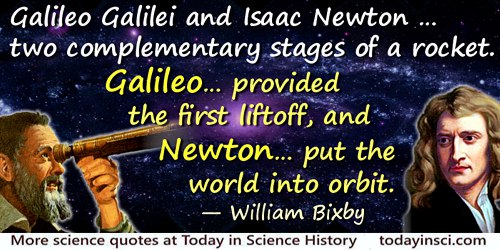
Galileo Galilei and Isaac Newton…. The relationship between these very different personalities is like that of two complementary stages of a rocket. Galileo, the argumentative “wrangler” who demanded that the universe be examined through a telescope rather than by means of a philosophy book, provided the first liftoff, and Newton, the secretive mathematician who searched among his notes to find a mislaid proof for universal gravitation, put the world into orbit.
In 'Foreword', The Universe of Galileo and Newton (1964), 7.
Geological strata are like pages in the book of time and need to be read by qualified experts to learn what happened at the Kennewick find site.
From 'Mystery of the First Americans: Claims for the Remains: C. Vance Haynes, Jr.', web page on pbs.org website.
George Sears, called Nessmuk, whose “Woodcraft,” published in 1884, was the first American book on forest camping, and is written with so much wisdom, wit, and insight that it makes Henry David Thoreau seem alien, humorless, and French.
Coming into the Country
Goethe said that he who cannot draw on 3,000 years of learning is living hand to mouth. It could just as well be said that individuals who do tap deeply into this rich cultural legacy are wealthy indeed. Yet the paradox is that much of this wisdom is buried in a sea of lesser books or like lost treasure beneath an ocean of online ignorance and trivia. That doesn’t mean that with a little bit of diligence you can’t tap into it. Yet many people, perhaps most, never take advantage of all this human experience. They aren’t obtaining knowledge beyond what they need to know for work or to get by. As a result, their view of our amazing world is diminished and their lives greatly circumscribed.
In An Embarrassment of Riches: Tapping Into the World's Greatest Legacy of Wealth (2013), 65.
Had I been present at the Creation, I would have given some useful hints for the better ordering of the universe.
Remarking on the complexity of Ptolemaic model of the universe after it was explained to him.
Footnote: Carlyle says, in his History of Frederick the Great, book ii. chap. vii. that this saying of Alphonso about Ptolemy's astronomy, 'that it seemed a crank machine; that it was pity the Creator had not taken advice,' is still remembered by mankind, — this and no other of his many sayings.
Remarking on the complexity of Ptolemaic model of the universe after it was explained to him.
Footnote: Carlyle says, in his History of Frederick the Great, book ii. chap. vii. that this saying of Alphonso about Ptolemy's astronomy, 'that it seemed a crank machine; that it was pity the Creator had not taken advice,' is still remembered by mankind, — this and no other of his many sayings.
In John Bartlett and Nathan Haskell Dole (Ed.), Familiar Quotations: A Collection of Passages, Phrases, and Proverbs Traced to Their Sources (1914), 954.
Had that wordy vacuum skull thought what this would do to every critical figure in science and engineering? … Throw away every book, table, instrument, and start over? I know that some of my ancestors did that in switching from old English units to MKS—but they did it to make things easier.
In The Moon Is a Harsh Mistress (1966), 160.
Hee who destroyes a good Booke, kills reason itselfe.
In Areopagitica: A speech of Mr John Milton for the Liberty of Unlicenced printing to the Parliament of England (23 Nov 1644), 4.
Heraclitus son of Bloson (or, according to some, of Herakon) of Ephesus. This man was at his prime in the 69th Olympiad. He grew up to be exceptionally haughty and supercilious, as is clear also from his book, in which he says: “Learning of many things does not teach intelligence; if so it would have taught Hesiod and Pythagoras, and again Xenophanes and Hecataeus.” … Finally he became a misanthrope, withdrew from the world, and lived in the mountains feeding on grasses and plants. However, having fallen in this way into a dropsy he came down to town and asked the doctors in a riddle if they could make a drought out of rainy weather. When they did not understand he buried himself in a cow-stall, expecting that the dropsy would be evaporated off by the heat of the manure; but even so he failed to effect anything, and ended his life at the age of sixty.
Diogenes Laertius 9.1. In G. S. Kirk, E. Raven, and M. Schofield (eds.), The Presocratic philosophers: A Critical History with a Selection of Texts (1983), 181.
His [Thomas Edison] method was inefficient in the extreme, for an immense ground had to be covered to get anything at all unless blind chance intervened and, at first, I was almost a sorry witness of his doings, knowing that just a little theory and calculation would have saved him 90 per cent of the labor. But he had a veritable contempt for book learning and mathematical knowledge, trusting himself entirely to his inventor's instinct and practical American sense. In view of this, the truly prodigious amount of his actual accomplishments is little short of a miracle.
As quoted in 'Tesla Says Edison Was an Empiricist', The New York Times (19 Oct 1931), 25. In 1884, Tesla had moved to America to assist Edison in the designing of motors and generators.
How often might a man, after he had jumbled a set of letters in a bag, fling them out upon the ground before they would fall into an exact poem, yea, or so much as make a good discourse in prose. And may not a little book be as easily made by chance as this great volume of the world.
In The Works of the Most Reverend Dr. John Tillotson (1714), 15.
I always feel as if my books came half out of Lyell's brain... & therefore that when seeing a thing never seen by Lyell, one yet saw it partially through his eyes.
Letter to Leonard Horner, 29 August 1844. In F. Burkhardt and S. Smith (eds.), The Correspondence of Charles Darwin 1844-1846 (1987), Vol. 3, 55.
I am now convinced that we have recently become possessed of experimental evidence of the discrete or grained nature of matter, which the atomic hypothesis sought in vain for hundreds and thousands of years. The isolation and counting of gaseous ions, on the one hand, which have crowned with success the long and brilliant researches of J.J. Thomson, and, on the other, agreement of the Brownian movement with the requirements of the kinetic hypothesis, established by many investigators and most conclusively by J. Perrin, justify the most cautious scientist in now speaking of the experimental proof of the atomic nature of matter, The atomic hypothesis is thus raised to the position of a scientifically well-founded theory, and can claim a place in a text-book intended for use as an introduction to the present state of our knowledge of General Chemistry.
In Grundriss der allgemeinen Chemie (4th ed., 1909), Preface, as cited by Erwin N. Hiebert and Hans-Gunther Korber in article on Ostwald in Charles Coulston Gillespie (ed.), Dictionary of Scientific Biography Supplement 1, Vol 15-16, 464.
I am stealing the golden vessels of the Egyptians to build a tabernacle to my God from them, far far away from the boundaries of Egypt. If you forgive me, I shall rejoice; if you are enraged with me, I shall bear it. See, I cast the die, and I write the book. Whether it is to be read by the people of the present or of the future makes no difference: let it await its reader for a hundred years, if God himself has stood ready for six thousand years for one to study him.
Harmonice Mundi, The Harmony of the World (1619), end of Introduction to Book V. Trans. E. J. Aiton, A. M. Duncan and J. V. Field (1997), 391.
I believe … that we can still have a genre of scientific books suitable for and accessible alike to professionals and interested laypeople. The concepts of science, in all their richness and ambiguity, can be presented without any compromise, without any simplification counting as distortion, in language accessible to all intelligent people … I hope that this book can be read with profit both in seminars for graduate students and–if the movie stinks and you forgot your sleeping pills–on the businessman’s special to Tokyo.
In Wonderful Life: The Burgess Shale and the Nature of History (1990), Preface, 16.
I can assure you, reader, that in a very few hours, even during the first day, you will learn more natural philosophy about things contained in this book, than you could learn in fifty years by reading the theories and opinions of the ancient philosophers. Enemies of science will scoff at the astrologers: saying, where is the ladder on which they have climbed to heaven, to know the foundation of the stars? But in this respect I am exempt from such scoffing; for in proving my written reason, I satisfy sight, hearing, and touch: for this reason, defamers will have no power over me: as you will see when you come to see me in my little Academy.
The Admirable Discourses (1580), trans. Aurele La Rocque (1957), 27.
I can see him [Sylvester] now, with his white beard and few locks of gray hair, his forehead wrinkled o’er with thoughts, writing rapidly his figures and formulae on the board, sometimes explaining as he wrote, while we, his listeners, caught the reflected sounds from the board. But stop, something is not right, he pauses, his hand goes to his forehead to help his thought, he goes over the work again, emphasizes the leading points, and finally discovers his difficulty. Perhaps it is some error in his figures, perhaps an oversight in the reasoning. Sometimes, however, the difficulty is not elucidated, and then there is not much to the rest of the lecture. But at the next lecture we would hear of some new discovery that was the outcome of that difficulty, and of some article for the Journal, which he had begun. If a text-book had been taken up at the beginning, with the intention of following it, that text-book was most likely doomed to oblivion for the rest of the term, or until the class had been made listeners to every new thought and principle that had sprung from the laboratory of his mind, in consequence of that first difficulty. Other difficulties would soon appear, so that no text-book could last more than half of the term. In this way his class listened to almost all of the work that subsequently appeared in the Journal. It seemed to be the quality of his mind that he must adhere to one subject. He would think about it, talk about it to his class, and finally write about it for the Journal. The merest accident might start him, but once started, every moment, every thought was given to it, and, as much as possible, he read what others had done in the same direction; but this last seemed to be his real point; he could not read without finding difficulties in the way of understanding the author. Thus, often his own work reproduced what had been done by others, and he did not find it out until too late.
A notable example of this is in his theory of cyclotomic functions, which he had reproduced in several foreign journals, only to find that he had been greatly anticipated by foreign authors. It was manifest, one of the critics said, that the learned professor had not read Rummer’s elementary results in the theory of ideal primes. Yet Professor Smith’s report on the theory of numbers, which contained a full synopsis of Kummer’s theory, was Professor Sylvester’s constant companion.
This weakness of Professor Sylvester, in not being able to read what others had done, is perhaps a concomitant of his peculiar genius. Other minds could pass over little difficulties and not be troubled by them, and so go on to a final understanding of the results of the author. But not so with him. A difficulty, however small, worried him, and he was sure to have difficulties until the subject had been worked over in his own way, to correspond with his own mode of thought. To read the work of others, meant therefore to him an almost independent development of it. Like the man whose pleasure in life is to pioneer the way for society into the forests, his rugged mind could derive satisfaction only in hewing out its own paths; and only when his efforts brought him into the uncleared fields of mathematics did he find his place in the Universe.
A notable example of this is in his theory of cyclotomic functions, which he had reproduced in several foreign journals, only to find that he had been greatly anticipated by foreign authors. It was manifest, one of the critics said, that the learned professor had not read Rummer’s elementary results in the theory of ideal primes. Yet Professor Smith’s report on the theory of numbers, which contained a full synopsis of Kummer’s theory, was Professor Sylvester’s constant companion.
This weakness of Professor Sylvester, in not being able to read what others had done, is perhaps a concomitant of his peculiar genius. Other minds could pass over little difficulties and not be troubled by them, and so go on to a final understanding of the results of the author. But not so with him. A difficulty, however small, worried him, and he was sure to have difficulties until the subject had been worked over in his own way, to correspond with his own mode of thought. To read the work of others, meant therefore to him an almost independent development of it. Like the man whose pleasure in life is to pioneer the way for society into the forests, his rugged mind could derive satisfaction only in hewing out its own paths; and only when his efforts brought him into the uncleared fields of mathematics did he find his place in the Universe.
In Florian Cajori, Teaching and History of Mathematics in the United States (1890), 266-267.
I can well appreciate, Holy Father, that as soon as certain people realise that in these books which I have written about the Revolutions of the spheres of the universe I attribute certain motions to the globe of the Earth, they will at once clamour for me to be hooted off the stage with such an opinion.
'To His Holiness Pope Paul III', in Copernicus: On the Revolutions of the Heavenly Spheres (1543), trans. A.M. Duncan (1976), 23.
I cannot write long books; I leave that for those who have nothing to say.
In The Decline and Fall of Science (1976), 6.
I devoted myself to studying the texts—the original and commentaries—in the natural sciences and metaphysics, and the gates of knowledge began opening for me. Next I sought to know medicine, and so read the books written on it. Medicine is not one of the difficult sciences, and therefore, I excelled in it in a very short time, to the point that distinguished physicians began to read the science of medicine under me. I cared for the sick and there opened to me some of the doors of medical treatment that are indescribable and can be learned only from practice. In addition I devoted myself to jurisprudence and used to engage in legal disputations, at that time being sixteen years old.
— Avicenna
W. E. Gohhnan, The Life of Ibn Sina: A Critical Edition and Annotated Translation (1974), 25-7.
I do ... humbly conceive (tho' some possibly may think there is too much notice taken of such a trivial thing as a rotten Shell, yet) that Men do generally rally too much slight and pass over without regard these Records of Antiquity which Nature have left as Monuments and Hieroglyphick Characters of preceding Transactions in the like duration or Transactions of the Body of the Earth, which are infinitely more evident and certain tokens than any thing of Antiquity that can be fetched out of Coins or Medals, or any other way yet known, since the best of those ways may be counterfeited or made by Art and Design, as may also Books, Manuscripts and Inscriptions, as all the Learned are now sufficiently satisfied, has often been actually practised; but those Characters are not to be Counterfeited by all the Craft in the World, nor can they be doubted to be, what they appear, by anyone that will impartially examine the true appearances of them: And tho' it must be granted, that it is very difficult to read them, and to raise a Chronology out of them, and to state the intervalls of the Times wherein such, or such Catastrophies and Mutations have happened; yet 'tis not impossible, but that, by the help of those joined to ' other means and assistances of Information, much may be done even in that part of Information also.
Lectures and Discourses of Earthquakes (1668). In The Posthumous Works of Robert Hooke, containing his Cutlerian Lectures and other Discourses read at the Meetings of the Illustrious Royal Society (1705), 411.
I expect to think that I would rather be author of your book [The Origin of Species] than of any other on Nat. Hist. Science.
Letter to Darwin (12 Dec 1859). Quoted in Leonard Huxley, Life and Letters of Sir Joseph Dalton Hooker (1918), Vol. 1, 511.
I gleaned more practical psychology and psychiatry from the Bible, than from all other books!
Quoted in Bob Phillips, Phillips' Book of Great Thoughts & Funny Sayings (1993), 42.
I grew up in Brooklyn, New York … a city neighborhood that included houses, lampposts, walls, and bushes. But with an early bedtime in the winter, I could look out my window and see the stars, and the stars were not like anything else in my neighborhood. [At age 5] I didn’t know what they were.
[At age 9] my mother … said to me, “You have a library card now, and you know how to read. Take the streetcar to the library and get a book on stars.” … I stepped up to the big librarian and asked for a book on stars. … I sat down and found out the answer, which was something really stunning.I found out that the stars are glowing balls of gas. I also found out that the Sun is a star but really close and that the stars are all suns except really far away I didn’t know any physics or mathematics at that time, but I could imagine how far you’d have to move the Sun away from us till it was only as bright as a star. It was in that library, reading that book, that the scale of the universe opened up to me. There was something beautiful about it.
At that young age, I already knew that I’d be very happy if I could devote my life to finding out more about the stars and the planets that go around them. And it’s been my great good fortune to do just that.
[At age 9] my mother … said to me, “You have a library card now, and you know how to read. Take the streetcar to the library and get a book on stars.” … I stepped up to the big librarian and asked for a book on stars. … I sat down and found out the answer, which was something really stunning.I found out that the stars are glowing balls of gas. I also found out that the Sun is a star but really close and that the stars are all suns except really far away I didn’t know any physics or mathematics at that time, but I could imagine how far you’d have to move the Sun away from us till it was only as bright as a star. It was in that library, reading that book, that the scale of the universe opened up to me. There was something beautiful about it.
At that young age, I already knew that I’d be very happy if I could devote my life to finding out more about the stars and the planets that go around them. And it’s been my great good fortune to do just that.
Quoted in interview with Jack Rightmyer, in 'Stars in His Eyes', Highlights For Children (1 Jan 1997). Ages as given in Tom Head (ed.), Conversations with Carl Sagan (2006), x.
I had a dislike for [mathematics], and ... was hopelessly short in algebra. ... [One extraordinary teacher of mathematics] got the whole year's course into me in exactly six [after-school] lessons of half an hour each. And how? More accurately, why? Simply because he was an algebra fanatic—because he believed that algebra was not only a science of the utmost importance, but also one of the greatest fascination. ... [H]e convinced me in twenty minutes that ignorance of algebra was as calamitous, socially and intellectually, as ignorance of table manners—That acquiring its elements was as necessary as washing behind the ears. So I fell upon the book and gulped it voraciously. ... To this day I comprehend the binomial theorem.
In Prejudices: third series (1922), 261-262.
For a longer excerpt, see H. L. Mencken's Recollections of School Algebra.
For a longer excerpt, see H. L. Mencken's Recollections of School Algebra.
I had no books as a child. I had real machines, and I went out to work in the fields. I was driving farm machinery at five, and fixing it at age seven or eight. It’s no accident that I worked on Hubble 50 to 60 years later. My books were nature; it was very important to how I related to the Earth, and the Earth from space. No doubt when I go into space, I go back into the cool soil of Earth. I’m always thinking of it. Nature was my book. Other people come from that tradition - Emerson, Thoreau, and especially Whitman. Look at what they said in their philosophy - go out and have a direct relationship with nature.
When asked by Discover magazine what books helped inspire his passion as an astronaut.
When asked by Discover magazine what books helped inspire his passion as an astronaut.
'The 1998 Discover Science Gift Guide: Fantastic Voyages Children's Books That Mattered', Discover (Dec 1998).
I had this experience at the age of eight. My parents gave me a microscope. I don’t recall why, but no matter. I then found my own little world, completely wild and unconstrained, no plastic, no teacher, no books, no anything predictable. At first I did not know the names of the water-drop denizens or what they were doing. But neither did the pioneer microscopists. Like them, I graduated to looking at butterfly scales and other miscellaneous objects. I never thought of what I was doing in such a way, but it was pure science. As true as could be of any child so engaged, I was kin to Leeuwenhoek, who said that his work “was not pursued in order to gain the praise I now enjoy, but chiefly from a craving after knowledge, which I notice resides in me more that most other men.”
In The Creation: An Appeal to Save Life on Earth (2010), 143-144.
I have heard by round about channel that Herschel says my book “is the law of higgledy-pigglety.”
Letter to C. Lyell, 10 December 1859. In F. Burkhardt and S. Smith (eds.), The Correspondence of Charles Darwin 1858-1859 (1991), Vol. 7, 423.
I have just finished my sketch of my species theory. If as I believe that my theory is true & if it be accepted even by one competent judge, it will be a considerable step in science. I therefore write this, in case of my sudden death, as my most solemn & last request, which I am sure you will consider the same as if legally entered in my will, that you will devote 400£ to its publication & further will yourself, or through Hensleigh [Wedgwood], take trouble in promoting it.
Letter to Emma Darwin, 5 July 1844. In F. Burkhardt and S. Smith (eds.), The Correspondence of Charles Darwin 1844-1846 (1987), Vol. 3, 43.
I have sold more books on physics than Madonna has on sex.
[Hawking adopted this statement from a remark made to him by his former post-doc, Nathan Myhrvold.]
[Hawking adopted this statement from a remark made to him by his former post-doc, Nathan Myhrvold.]
The Illustrated A Brief History of Time, Updated and Expanded Edition (1996), Foreward.
I hear one day the word “mountain,” and I ask someone “what is a mountain? I have never seen one.”
I join others in discussions of mountains.
One day I see in a book a picture of a mountain.
And I decide I must climb one.
I travel to a place where there is a mountain.
At the base of the mountain I see there are lots of paths to climb.
I start on a path that leads to the top of the mountain.
I see that the higher I climb, the more the paths join together.
After much climbing the many paths join into one.
I climb till I am almost exhausted but I force myself and continue to climb.
Finally I reach the top and far above me there are stars.
I look far down and the village twinkles far below.
It would be easy to go back down there but it is so beautiful up here.
I am just below the stars.
I join others in discussions of mountains.
One day I see in a book a picture of a mountain.
And I decide I must climb one.
I travel to a place where there is a mountain.
At the base of the mountain I see there are lots of paths to climb.
I start on a path that leads to the top of the mountain.
I see that the higher I climb, the more the paths join together.
After much climbing the many paths join into one.
I climb till I am almost exhausted but I force myself and continue to climb.
Finally I reach the top and far above me there are stars.
I look far down and the village twinkles far below.
It would be easy to go back down there but it is so beautiful up here.
I am just below the stars.
…...
I hope that in due time the chemists will justify their proceedings by some large generalisations deduced from the infinity of results which they have collected. For me I am left hopelessly behind and I will acknowledge to you that through my bad memory organic chemistry is to me a sealed book. Some of those here, [August] Hoffman for instance, consider all this however as scaffolding, which will disappear when the structure is built. I hope the structure will be worthy of the labour. I should expect a better and a quicker result from the study of the powers of matter, but then I have a predilection that way and am probably prejudiced in judgment.
Letter to Christian Schönbein (9 Dec 1852), The Letters of Faraday and Schoenbein, 1836-1862 (1899), 209-210.
I know that to personalize the Earth System as Gaia, as I have often done and continue to do in this book, irritates the scientifically correct, but I am unrepentant because metaphors are more than ever needed for a widespread comprehension of the true nature of the Earth and an understanding of the lethal dangers that lie ahead.
In The Revenge of Gaia: Earth’s Climate Crisis & The Fate of Humanity (2006, 2007), 188.
I know too much; I have stuffed too many of the facts of History and Science into my intellectuals. My eyes have grown dim over books; believing in geological periods, cave-dwellers, Chinese Dynasties, and the fixed stars has prematurely aged me.
In 'The Burden', Trivia (1917,1921), 156.
I love to read the dedications of old books written in monarchies—for they invariably honor some (usually insignificant) knight or duke with fulsome words of sycophantic insincerity, praising him as the light of the universe (in hopes, no doubt, for a few ducats to support future work); this old practice makes me feel like such an honest and upright man, by comparison, when I put a positive spin, perhaps ever so slightly exaggerated, on a grant proposal.
From essay 'The Razumovsky Duet', collected in The Dinosaur in a Haystack: Reflections in Natural History (1995, 1997), 263.
I profess to learn and to teach anatomy not from books but from dissections, not from the tenets of Philosophers but from the fabric of Nature.
De Motu Cordis (1628), The Circulation of the Blood and Other Writings, trans. Kenneth J. Franklin (1957), Dedication to Doctor Argent, 7.
I remember my first look at the great treatise of Maxwell’s when I was a young man… I saw that it was great, greater and greatest, with prodigious possibilities in its power… I was determined to master the book and set to work. I was very ignorant. I had no knowledge of mathematical analysis (having learned only school algebra and trigonometry which I had largely forgotten) and thus my work was laid out for me. It took me several years before I could understand as much as I possibly could. Then I set Maxwell aside and followed my own course. And I progressed much more quickly… It will be understood that I preach the gospel according to my interpretation of Maxwell.
From translations of a letter (24 Feb 1918), cited in Paul J. Nahin, Oliver Heaviside: The Life, Work, and Times of an Electrical Genius of the Victorian Age (2002), 24. Nahin footnotes that the words are not verbatim, but are the result of two translations. Heaviside's original letter in English was quoted, translated in to French by J. Bethenode, for the obituary he wrote, "Oliver Heaviside", in Annales des Posies Telegraphs (1925), 14, 521-538. The quote was retranslated back to English in Nadin's book. Bethenode footnoted that he made the original translation "as literally as possible in order not to change the meaning." Nadin assures that the retranslation was done likewise. Heaviside studyied Maxwell's two-volume Treatise on Electricity and Magnetism.
I shall always feel respect for every one who has written a book, let it be what it may, for I had no idea of the trouble which trying to write common English could cost one—And alas there yet remains the worst part of all correcting the press.
Letter to W. D. Fox, 7 July 1837, referring to his Journal of Researches. In F. Burkhardt and S. Smith (eds), The Correspondence of Charles Darwin 1837-1843 (1986), Vol. 2, 29.
I should like to draw attention to the inexhaustible variety of the problems and exercises which it [mathematics] furnishes; these may be graduated to precisely the amount of attainment which may be possessed, while yet retaining an interest and value. It seems to me that no other branch of study at all compares with mathematics in this. When we propose a deduction to a beginner we give him an exercise in many cases that would have been admired in the vigorous days of Greek geometry. Although grammatical exercises are well suited to insure the great benefits connected with the study of languages, yet these exercises seem to me stiff and artificial in comparison with the problems of mathematics. It is not absurd to maintain that Euclid and Apollonius would have regarded with interest many of the elegant deductions which are invented for the use of our students in geometry; but it seems scarcely conceivable that the great masters in any other line of study could condescend to give a moment’s attention to the elementary books of the beginner.
In Conflict of Studies (1873), 10-11.
I suppose that I tend to be optimistic about the future of physics. And nothing makes me more optimistic than the discovery of broken symmetries. In the seventh book of the Republic, Plato describes prisoners who are chained in a cave and can see only shadows that things outside cast on the cave wall. When released from the cave at first their eyes hurt, and for a while they think that the shadows they saw in the cave are more real than the objects they now see. But eventually their vision clears, and they can understand how beautiful the real world is. We are in such a cave, imprisoned by the limitations on the sorts of experiments we can do. In particular, we can study matter only at relatively low temperatures, where symmetries are likely to be spontaneously broken, so that nature does not appear very simple or unified. We have not been able to get out of this cave, but by looking long and hard at the shadows on the cave wall, we can at least make out the shapes of symmetries, which though broken, are exact principles governing all phenomena, expressions of the beauty of the world outside.
In Nobel Lecture (8 Dec 1989), 'Conceptual Foundations of the Unified Theory of Weak and Electromagnetic Interactions.' Nobel Lectures: Physics 1971-1980 (1992), 556.
I then shouted into M [the mouthpiece] the following sentence: “Mr. Watson—Come here—I want to see you.” To my delight he came and declared that he had heard and understood what I said. I asked him to repeat the words. He answered “You said—‘Mr. Watson—-come here—I want to see you.’” We then changed places and I listened at S [the reed receiver] while Mr. Watson read a few passages from a book into the mouth piece M. It was certainly the case that articulate sounds proceeded from S. The effect was loud but indistinct and muffled. If I had read beforehand the passage given by Mr. Watson I should have recognized every word. As it was I could not make out the sense—but an occasional word here and there was quite distinct. I made out “to” and “out” and “further”; and finally the sentence “Mr. Bell do you understand what I say? Do—you—un—der—stand—what—I—say” came quite clearly and intelligibly. No sound was audible when the armature S was removed.
Notebook, 'Experiments made by A. Graham Bell, vol. I'. Entry for 10 March 1876. Quoted in Robert V. Bruce, Bell: Alexander Graham Bell and the Conquest of Solitude (1973), 181.
I think understanding animals enriches your pleasure, finding out how to understand them is the great pleasure. I never stop reading books about man and animals; they’re always full of interesting stuff. I’ll turn the page and my eyes will be popping out.
Speaking at the launch of “David Attenborough’s Natural Curiosities” on Watch, the BBC TV channel (2 Feb 2015). As quoted in 'Sir David Attenborough Shocked By Rat on the Toilet' on femalefirst.co.uk website.
I want my books sold on airport bookstalls.
Interview with Deborah Solomon, 'The Science of Second-Guessing', in New York Times Magazine (12 Dec 2004), 37.
I was inspired by the remarks in those books; not by the parts in which everything was proved and demonstrated [but by] the remarks about the fact that this doesn’t make any sense. … So I had this as a challenge and an inspiration.
In his Nobel Prize Lecture (11 Dec 1965), 'The Development of the Space-Time View of Quantum Electrodynamics'. Collected in Stig Lundqvist, Nobel Lectures: Physics, 1963-1970 (1998), 156.
I will be moving through the book as if on a train looking out at the beautiful landscape of the Arts.
An opinion posted on yougov.com (13 Jan 2017) describing reading a novel set after the Russian Revolution with much historical background, stimulating the reader’s interest on the literature, painting and performing arts of the time.
I, Galileo Galilei, son of the late Vincenzo Galilei, of Florence, aged seventy years, being brought personally to judgment, and kneeling before your Most Eminent and Most Reverend Lords Cardinals, General Inquisitors of the universal Christian republic against heretical depravity, having before my eyes the Holy Gospels, which I touch with my own hands, swear that I have always believed, and now believe, and with the help of God will in future believe, every article which the Holy Catholic and Apostolic Church of Rome holds, teaches, and preaches. But because I have been enjoined by this Holy Office altogether to abandon the false opinion which maintains that the sun is the centre and immovable, and forbidden to hold, defend, or teach the said false doctrine in any manner, and after it hath been signified to me that the said doctrine is repugnant with the Holy Scripture, I have written and printed a book, in which I treat of the same doctrine now condemned, and adduce reasons with great force in support of the same, without giving any solution, and therefore have been judged grievously suspected of heresy; that is to say, that I held and believed that the sun is the centre of the universe and is immovable, and that the earth is not the centre and is movable; willing, therefore, to remove from the minds of your Eminences, and of every Catholic Christian, this vehement suspicion rightfully entertained toward me, with a sincere heart and unfeigned faith, I abjure, curse, and detest the said errors and heresies, and generally every other error and sect contrary to Holy Church; and I swear that I will never more in future say or assert anything verbally, or in writing, which may give rise to a similar suspicion of me; but if I shall know any heretic, or anyone suspected of heresy, that I will denounce him to this Holy Office, or to the Inquisitor or Ordinary of the place where I may be; I swear, moreover, and promise, that I will fulfil and observe fully, all the penances which have been or shall be laid on me by this Holy Office. But if it shall happen that I violate any of my said promises, oaths, and protestations (which God avert!), I subject myself to all the pains and punishments which have been decreed and promulgated by the sacred canons, and other general and particular constitutions, against delinquents of this description. So may God help me, and his Holy Gospels which I touch with my own hands. I, the above-named Galileo Galilei, have abjured, sworn, promised, and bound myself as above, and in witness thereof with my own hand have subscribed this present writing of my abjuration, which I have recited word for word. At Rome, in the Convent of Minerva, June 22, 1633. I, Galileo Galilei, have abjured as above with my own hand.
Abjuration, 22 Jun 1633. In J.J. Fahie, Galileo, His Life and Work (1903), 319-321.
I'm sure we would not have had men on the Moon if it had not been for Wells and Verne and the people who write about this and made people think about it. I'm rather proud of the fact that I know several astronauts who became astronauts through reading my books.
Address to US Congress, 1975. Science and Technology Committee, United States Congress, House, Future Space Programs, 1975, Hearings Before the Subcommittee on Space Science and Applications (1975), 206. Also in Arthur C. ClarkeThe View from Serendip (1977), 238.
I’m not an atheist and I don’t think I can call myself a pantheist. We are in the position of a little child entering a huge library filled with books in many different languages. The child knows someone must have written those books. It doe s not know how. The child dimly suspects a mysterious order in the arrangement of the books but doesn’t know what it is. That, it seems to me, is the attitude of even the most intelligent human being toward God.
…...
I’ve never made a discovery myself, unless by accident. If you write glibly, you fool people. When I first met Asimov, I asked him if he was a professor at Boston University. He said no and … asked me where I got my Ph.D. I said I didn’t have one and he looked startled. “You mean you’re in the same racket I am,” he said, “you just read books by the professors and rewrite them?” That’s really what I do.
Quoted in Sally Helgeson, 'Every Day', Bookletter (6 Dec 1976), 3, No. 8, 3. As quoted and cited in Dana Richards, 'Martin Gardner: A “Documentary”', collected in Elwyn R. Berlekamp and Tom Rodgers (ed.) The Mathemagician and Pied Puzzler: A Collection in Tribute to Martin Gardner (1999), 8-9.
If a given scientist had not made a given discovery, someone else would have done so a little later. Johann Mendel dies unknown after having discovered the laws of heredity: thirty-five years later, three men rediscover them. But the book that is not written will never be written. The premature death of a great scientist delays humanity; that of a great writer deprives it.
Pensées d'un Biologiste (1939). Translated in The Substance of Man (1962), 89.
If a man write a better book, preach a better sermon, or make a better mouse-trap than his neighbour, tho' he build his house in the woods, the world will make a beaten path to his door.
Attributed to Emerson by Sarah S. B. Yule, in her book Borrowings (compiled 1889, published 1893). Mrs Yule was quoted in The Docket (Feb 1912), that she wrote this in her notebook of memorable statements during an Emerson address. The Docket thus disproved Elbert Hubbard's claim to its authorship.
If a man, holding a belief which he was taught in childhood or persuaded of afterwards, keeps down and pushes away any doubts which arise about it in his mind, purposely avoids the reading of books and the company of men that call in question or discuss it, and regards as impious those questions which cannot easily be asked without disturbing it—the life of that man is one long sin against mankind.
In 'The Ethics of Belief', Contemporary Review (Jan 1877), collected in Leslie Stephen and Frederick Pollock (eds.), Lectures and Essays: By the Late William Kingdon Clifford, F.R.S. (1886), 346.
If I may paraphrase Hobbes's well-known aphorism, I would say that 'books are the money of Literature, but only the counters of Science.'
'Universities: Actual and Ideal' (1874). In Collected Essays (1893), Vol. 3, 213.
If I were to suggest that between the Earth and Mars there is a china teapot revolving about the sun in an elliptical orbit, nobody would be able to disprove my assertion provided I were careful to add that the teapot is too small to be revealed even by our most powerful telescopes. But if I were to go on to say that, since my assertion cannot be disproved, it is intolerable presumption on the part of human reason to doubt it, I should rightly be thought to be talking nonsense. If, however, the existence of such a teapot were affirmed in ancient books, taught as the sacred truth every Sunday, and instilled into the minds of children at school, hesitation to believe in its existence would become a mark of eccentricity and entitle the doubter to the attentions of the psychiatrist in an enlightened age or of the Inquisitor in an earlier time.
In unpublished manuscript, 'Is There a God', (5 Mar 1952) written for the magazine, Illustrated. Collected in Bertrand Russell, John G. Slater (ed.) and Peter Köllner (ed.) The Collected Papers of Bertran Russell: Volume II: Last Philosophical Testament: 1943-68 (1997), 547-548.
If indeed the Earth is, in its own slow way, a very dynamic body and we have regarded it as essentially static, we need to discard most of our old theories and books and start again with a new viewpoint and a new science.
In 'Reply to Beloussov', Geotimes (1968), 13, No. 12, 22. The public disagreement on seafloor spreading between Wilson and V.V. Beloussov is collected in Brainerd Mears, The Nature of Geology: Contemporary Readings (1970).
If the proof starts from axioms, distinguishes several cases, and takes thirteen lines in the text book … it may give the youngsters the impression that mathematics consists in proving the most obvious things in the least obvious way.
Mathematical Discovery: on Understanding, Learning, and Teaching Problem Solving (1981), 129.
If this [the Mysterium cosmographicum] is published, others will perhaps make discoveries I might have reserved for myself. But we are all ephemeral creatures (and none more so than I). I have, therefore, for the Glory of God, who wants to be recognized from the book of Nature, that these things may be published as quickly as possible. The more others build on my work the happier I shall be.
Letter to Michael Maestlin (3 Oct 1595). Johannes Kepler Gesammelte Werke (1937- ), Vol. 13, letter 23, l. 251, p. 39-40.
If this book were to be dedicated to its first and chief encouragement is should probably salute starlight, insects, the galaxies, and the fossil plants and animals.
From Of Stars and Men: The Human Response to an Expanding Universe (1958 Rev. Ed. 1964), Foreword.
If today you can take a thing like evolution and make it a crime to teach it in the public schools, tomorrow you can make it a crime to teach it in the private schools, and next year you can make it a crime to teach it to the hustings or in the church. At the next session you may ban books and the newspapers. Soon you may set Catholic against Protestant and Protestant against Protestant, and try to foist your own religion upon the minds of men. If you can do one you can do the other. Ignorance and fanaticism are ever busy and need feeding. Always it is feeding and gloating for more. Today it is the public school teachers; tomorrow the private. The next day the preachers and the lecturers, the magazines, the books, the newspapers. After a while, Your Honor, it is the setting of man against man and creed against creed until with flying banners and beating drums we are marching backward to the glorious ages of the sixteenth century when bigots lighted fagots to burn the men who dared to bring any intelligence and enlightenment and culture to the human mind.
Darrow’s concluding remarks before adjournment of the second day of the Scopes Monkey Trial, Dayton, Tennessee (Monday, 13 Jul 1925). In The World's Most Famous Court Trial: Tennessee Evolution Case: a Complete Stenographic Report of the Famous Court Test of the Tennessee Anti-Evolution Act, at Dayton, July 10 to 21, 1925 (1925), Second Day's Proceedings, 87.
If we peep into Dom Claude’s cell, we are introduced to a typical alchemist’s laboratory—a gloomy, dimly-lighted place, full of strange vessels, and furnaces, and melting-pots, spheres, and portions of skeletons hanging from the ceiling; the floor littered with stone bottles, pans, charcoal, aludels, and alembics, great parchment books covered with hieroglyphics; the bellows with its motto Spira, Spera; the hour-glass, the astrolabe, and over all cobwebs, and dust, and ashes. The walls covered with various aphorisms of the brotherhood; legends and memorials in many tongues; passages from the Smaragdine Table of Hermes Trismegistus; and looming out from all in great capitals, ’ANAΓKH.
In The Birth of Chemistry (1874), 100.
If you look over my Scientific American columns you will see that they get progressively more sophisticated as I began reading math books and learning more about the subject. There is no better way to learn anything than to write about it!
In Kendrick Frazier, 'A Mind at Play: An Interview with Martin Gardner', Skeptical Inquirer (Mar/Apr 1998), 22, No. 2, 36.
In 1912 I went to a book sale and bought ten books for fifty cents. One of the books was by Ostwald The Scientific Foundations of Analytical Chemistry. Ostwald wrote at the beginning of that book that analytical chemists are the maidservants of other chemists. This made quite an impression on me, because I didn't want to be a maidservant.
Comment during interview, Beckman Center (15 March 1984), as recorded on tape held by The Chemical Heritage Foundation, Philadelphia. Quotation provided by W. H. Brock.
In 1944 Erwin Schroedinger, stimulated intellectually by Max Delbruck, published a little book called What is life? It was an inspiration to the first of the molecular biologists, and has been, along with Delbruck himself, credited for directing the research during the next decade that solved the mystery of how 'like begat like.' Max was awarded this Prize in 1969, and rejoicing in it, he also lamented that the work for which he was honored before all the peoples of the world was not something which he felt he could share with more than a handful. Samuel Beckett's contributions to literature, being honored at the same time, seemed to Max somehow universally accessible to anyone. But not his. In his lecture here Max imagined his imprisonment in an ivory tower of science.
'The Polymerase Chain Reaction', Nobel Lecture (8 Dec 1993). In Nobel Lectures: Chemistry 1991-1995 (1997), 103.
In 1963, when I assigned the name “quark” to the fundamental constituents of the nucleon, I had the sound first, without the spelling, which could have been “kwork.” Then, in one of my occasional perusals of Finnegans Wake, by James Joyce, I came across the word “quark” in the phrase “Three quarks for Muster Mark.” Since “quark” (meaning, for one thing, the cry of a gull) was clearly intended to rhyme with “Mark,” as well as “bark” and other such words, I had to find an excuse to pronounce it as “kwork.” But the book represents the dreams of a publican named Humphrey Chimpden Earwicker. Words in the text are typically drawn from several sources at once, like the “portmanteau words” in Through the Looking Glass. From time to time, phrases occur in the book that are partially determined by calls for drinks at the bar. I argued, therefore, that perhaps one of the multiple sources of the cry “Three quarks for Muster Mark” might be pronunciation for “Three quarts for Mister Mark,” in which case the pronunciation “kwork” would not be totally unjustified. In any case, the number three fitted perfectly the way quarks occur in nature.
The Quark and the Jaguar (1994), 180.
In a scientific journal, a major consideration is whether the book reviewed has made a contribution to medical science. Cynics may well say that they know of no psychiatric text that would meet such conditions, and they may be right.
— Myre Sim
In book review by Myre Sim, about 'Ending the Cycle of Abuse', The Canadian Journal of Psychiatry (May 1997), 42:4, 425.
In despair, I offer your readers their choice of the following definitions of entropy. My authorities are such books and journals as I have by me at the moment.
(a) Entropy is that portion of the intrinsic energy of a system which cannot be converted into work by even a perfect heat engine.—Clausius.
(b) Entropy is that portion of the intrinsic energy which can be converted into work by a perfect engine.—Maxwell, following Tait.
(c) Entropy is that portion of the intrinsic energy which is not converted into work by our imperfect engines.—Swinburne.
(d) Entropy (in a volume of gas) is that which remains constant when heat neither enters nor leaves the gas.—W. Robinson.
(e) Entropy may be called the ‘thermal weight’, temperature being called the ‘thermal height.’—Ibid.
(f) Entropy is one of the factors of heat, temperature being the other.—Engineering.
I set up these bald statement as so many Aunt Sallys, for any one to shy at.
[Lamenting a list of confused interpretations of the meaning of entropy, being hotly debated in journals at the time.]
(a) Entropy is that portion of the intrinsic energy of a system which cannot be converted into work by even a perfect heat engine.—Clausius.
(b) Entropy is that portion of the intrinsic energy which can be converted into work by a perfect engine.—Maxwell, following Tait.
(c) Entropy is that portion of the intrinsic energy which is not converted into work by our imperfect engines.—Swinburne.
(d) Entropy (in a volume of gas) is that which remains constant when heat neither enters nor leaves the gas.—W. Robinson.
(e) Entropy may be called the ‘thermal weight’, temperature being called the ‘thermal height.’—Ibid.
(f) Entropy is one of the factors of heat, temperature being the other.—Engineering.
I set up these bald statement as so many Aunt Sallys, for any one to shy at.
[Lamenting a list of confused interpretations of the meaning of entropy, being hotly debated in journals at the time.]
In The Electrician (9 Jan 1903).
In fact, almost everything in this isle [Ireland] confers immunity to poison, and I have seen that folk suffering from snake-bite have drunk water in which scrapings from the leaves of books from Ireland had been steeped, and that this remedy checked the spreading poison and reduced the swelling.
— Bede
In her book My Life With the Chimpanzees, Goodall told the story of “Mike,” a chimp who maintained his dominance by kicking a series of kerosene cans ahead of him as he moved down a road, creating confusion and noise that made his rivals flee and cower. She told me she would be thinking of Mike as she watched [Donald Trump in] the upcoming debates.
In magazine article by 'When Donald Meets Hillary', The Atlantic (Oct 2016). The reporter stated “Jane Goodall … told me shortly before Trump won the GOP nomination.”
In July [1837] opened first note-book on Transmutation of Species. Had been greatly struck from about the month of previous March on character of South American fossils, and species on Galapagos Archipelago. These facts (especially latter), origin of all my views.
In Francis Darwin (ed.), The Life and Letters of Charles Darwin, Including an Autobiographical Chapter (1888), Vol. 1, 276.
In my opinion the English excel in the art of writing text-books for mathematical teaching; as regards the clear exposition of theories and the abundance of excellent examples, carefully selected, very few books exist in other countries which can compete with those of Salmon and many other distinguished English authors that could be named.
In Projective Geometry (1886), Preface.
In my youth I regarded the universe as an open book, printed in the language of physical equations, whereas now it appears to me as a text written in invisible ink, of which in our rare moments of grace we are able to decipher a small fragment.
From Epilogue in Bricks to Babel (1980).
In nature's infinite book of secrecy
A little I can read.
A little I can read.
In Antony and Cleopatra (1606-7), I, ii.
In science, as in life, learning and knowledge are distinct, and the study of things, and not of books, is the source of the latter.
In 'On The Study of Zoology', Lay Sermons, Addresses, and Reviews (1870), 112.
In science, read, by preference, the newest works; in literature, the oldest.
Caxtoniana: A Series of Essays on Life, Literature, and Manners (1863), Vol. I, 169.
In the beginning was the book of Nature. For eon after eon, the pages of the book turned with no human to read them. No eye wondered at the ignition of the sun, the coagulation of the earth, the birth of the moon, the solidification of a terrestrial continent, or the filling of the seas. Yet when the first primitive algae evolved to float on the waters of this ocean, a promise was born—a hope that someday all the richness and variety of the phenomena of the universe would be read with appreciative eyes.
Opening paragraph in Gary G. Tibbetts, How the Great Scientists Reasoned: The Scientific Method in Action (2012), 1.
In the company of friends, writers can discuss their books, economists the state of the economy, lawyers their latest cases, and businessmen their latest acquisitions, but mathematicians cannot discuss their mathematics at all. And the more profound their work, the less understandable it is.
Reflections: Mathematics and Creativity', New Yorker (1972), 47, No. 53, 39-45. In Douglas M. Campbell, John C. Higgins (eds.), Mathematics: People, Problems, Results (1984), Vol. 2, 7.
In the first book I shall describe all the positions of the spheres, along with the motions which I attribute to the Earth, so that the book will contain as it were the general structure of the universe. In the remaining books I relate the motions of the remaining stars, and all the spheres, to the mobility of the Earth, so that it can be thence established how far the motions and appearances of the remaining stars and spheres can be saved, if they are referred to the motions of the Earth.
'To His Holiness Pope Paul III', in Copernicus: On the Revolutions of the Heavenly Spheres (1543), trans, A. M. Duncan (1976), 26.
In the year 1666 he retired again from Cambridge... to his mother in Lincolnshire & whilst he was musing in a garden it came into his thought that the power of gravity (wch brought an apple from the tree to the ground) was not limited to a certain distance from the earth but that this power must extend much farther than was usually thought. Why not as high as the moon said he to himself & if so that must influence her motion & perhaps retain her in her orbit, whereupon he fell a calculating what would be the effect of that supposition but being absent from books & taking the common estimate in use among Geographers & our seamen before Norwood had measured the earth, that 60 English miles were contained in one degree of latitude on the surface of the Earth his computation did not agree with his theory & inclined him then to entertain a notion that together with the force of gravity there might be a mixture of that force wch the moon would have if it was carried along in a vortex.
[The earliest account of Newton, gravity and an apple.]
[The earliest account of Newton, gravity and an apple.]
Memorandum of a conversation with Newton in August 1726. Quoted in Richard Westfall, Never at Rest: A Biography of Isaac Newton (1980), 154.
In this age of space flight, when we use the modern tools of science to advance into new regions of human activity, the Bible ... this grandiose, stirring history of the gradual revelation and unfolding of the moral law ... remains in every way an up-to-date book. Our knowledge and use of the laws of nature that enable us to fly to the Moon also enable us to destroy our home planet with the atom bomb. Science itself does not address the question whether we should use the power at our disposal for good or for evil. The guidelines of what we ought to do are furnished in the moral law of God. It is no longer enough that we pray that God may be with us on our side. We must learn again that we may be on God's side.
Quoted in Bob Phillips, Phillips' Book of Great Thoughts & Funny Sayings (1993), 42.
It appears that the extremely important papers that trigger a revolution may not receive a proportionately large number of citations. The normal procedures of referencing are not used for folklore. A real scientific revolution, like any other revolution, is news. The Origin of Species sold out as fast as it could be printed and was denounced from the pulpit almost immediately. Sea-floor spreading has been explained, perhaps not well, in leading newspapers, magazines, books, and most recently in a color motion picture. When your elementary school children talk about something at dinner, you rarely continue to cite it.
'Citations in a Scientific Revolution', in R. Shagam et al., Studies in Earth and Space Sciences: A Memoir in Honor of Harry Hammond Hess (1972), 4.
It has been a Maxim with me for Sixty years at least, Never to be afraid of a Book.
In Letter (26 May 1817) to Thomas Jefferson.
It is a good thing from an uneducated man to read books of quotations.
In My Early Life: A Roving Commission (1930, 1987), 116.
It is a great thing to start life with a small number of really good books which are your very own.
In Through the Magic Door (1908), Chap. 2, 24.
It is a most gratifying sign of the rapid progress of our time that our best text-books become antiquated so quickly.
The Medical Sciences in the German Universities (1924), 49.
It is a profoundly erroneous truism, repeated by all copy-books and eminent people when they are making speeches, that we should cultivate habit of thinking of what we are doing. The precise opposite is the case. Civilization advances by extending the number of important operations which we can perform without thinking about them. Operations of thought are like cavalry charges in a battle—they are strictly limited in number, they require fresh horses, and must only be made at decisive moments.
In An Introduction to Mathematics (1911), 61.
It is a serious question whether America, following England’s lead, has not gone into problem-solving too extensively. Certain it is that we are producing no text-books in which the theory is presented in the delightful style which characterizes many of the French works … , or those of the recent Italian school, or, indeed, those of the continental writers in general.
In The Teaching of Elementary Mathematics (1902), 219.
It is a wrong business when the younger cultivators of science put out of sight and deprecate what their predecessors have done; but obviously that is the tendency of Huxley and his friends … It is very true that Huxley was bitter against the Bishop of Oxford, but I was not present at the debate. Perhaps the Bishop was not prudent to venture into a field where no eloquence can supersede the need for precise knowledge. The young naturalists declared themselves in favour of Darwin’s views which tendency I saw already at Leeds two years ago. I am sorry for it, for I reckon Darwin’s book to be an utterly unphilosophical one.
Letter to James D, Forbes (24 Jul 1860). Trinity College Cambridge, Whewell Manuscripts.
It is above all the duty of the methodical text-book to adapt itself to the pupil’s power of comprehension, only challenging his higher efforts with the increasing development of his imagination, his logical power and the ability of abstraction. This indeed constitutes a test of the art of teaching, it is here where pedagogic tact becomes manifest. In reference to the axioms, caution is necessary. It should be pointed out comparatively early, in how far the mathematical body differs from the material body. Furthermore, since mathematical bodies are really portions of space, this space is to be conceived as mathematical space and to be clearly distinguished from real or physical space. Gradually the student will become conscious that the portion of the real space which lies beyond the visible stellar universe is not cognizable through the senses, that we know nothing of its properties and consequently have no basis for judgments concerning it. Mathematical space, on the other hand, may be subjected to conditions, for instance, we may condition its properties at infinity, and these conditions constitute the axioms, say the Euclidean axioms. But every student will require years before the conviction of the truth of this last statement will force itself upon him.
In Methodisches Lehrbuch der Elementar-Mathemalik (1904), Teil I, Vorwort, 4-5.
It is much better to learn the elements of geology, of botany, or ornithology and astronomy by word of mouth from a companion than dully from a book.
'Concord Walks'. The Complete Works of Ralph Waldo Emerson (1904), Vol. 12, 176.
It is not so very important for a person to learn facts. For that he does not really need a college. He can learn them from books. The value of an education in a liberal arts college is not the learning of many facts but the training of the mind to think something that cannot be learned from textbooks.
1921, commenting on Thomas Edison’s opinion that a college education is useless, in Einstein: His Life and Times by Philipp Frank (1953).
It is one of the striking generalizations of biochemistry—which surprisingly is hardly ever mentioned in the biochemical text-books—that the twenty amino acids and the four bases, are, with minor reservations, the same throughout Nature. As far as I am aware the presently accepted set of twenty amino acids was first drawn up by Watson and myself in the summer of 1953 in response to a letter of Gamow's.
'On the Genetic Code', Nobel Lecture, 11 December 1962. In Nobel Lectures: Physiology or Medicine 1942-1962 (1964), 811.
It is possible to read books on Natural History with intelligence and profit, and even to make good observations, without a scientific groundwork of biological instruction; and it is possible to arrive at empirical facts of hygiene and medical treatment without any physiological instruction. But in all three cases the absence of a scientific basis will render the knowledge fragmentary and incomplete; and this ought to deter every one from offering an opinion on debatable questions which pass beyond the limit of subjective observations. The psychologist who has not prepared himself by a study of the organism has no more right to be heard on the genesis of the psychical states, or of the relations between body and mind, than one of the laity has a right to be heard on a question of medical treatment.
The Physical Basis of Mind (1877), 4.
It is probable that the scheme of physics will be enlarged so as to embrace the behaviour of living organisms under the influence of life and mind. Biology and psychology are not alien sciences; their operations are not solely mechanical, nor can they be formulated by physics as it is today; but they belong to a physical universe, and their mode of action ought to be capable of being formulated in terms of an enlarged physics in the future, in which the ether will take a predominant place. On the other hand it may be thought that those entities cannot be brought to book so easily, and that they will always elude our ken. If so, there will be a dualism in the universe, which posterity will find staggering, but that will not alter the facts.
In Past Years: an Autobiography (1932), 350. Quoted in book review, Waldehar Kaempfert, 'Sir Oliver Lodge Stands by the Old Physics', New York Times (21 Feb 1932), BR5.
It is said that the composing of the Lilavati was occasioned by the following circumstance. Lilavati was the name of the author’s daughter, concerning whom it appeared, from the qualities of the ascendant at her birth, that she was destined to pass her life unmarried, and to remain without children. The father ascertained a lucky hour for contracting her in marriage, that she might be firmly connected and have children. It is said that when that hour approached, he brought his daughter and his intended son near him. He left the hour cup on the vessel of water and kept in attendance a time-knowing astrologer, in order that when the cup should subside in the water, those two precious jewels should be united. But, as the intended arrangement was not according to destiny, it happened that the girl, from a curiosity natural to children, looked into the cup, to observe the water coming in at the hole, when by chance a pearl separated from her bridal dress, fell into the cup, and, rolling down to the hole, stopped the influx of water. So the astrologer waited in expectation of the promised hour. When the operation of the cup had thus been delayed beyond all moderate time, the father was in consternation, and examining, he found that a small pearl had stopped the course of the water, and that the long-expected hour was passed. In short, the father, thus disappointed, said to his unfortunate daughter, I will write a book of your name, which shall remain to the latest times—for a good name is a second life, and the ground-work of eternal existence.
In Preface to the Persian translation of the Lilavati by Faizi (1587), itself translated into English by Strachey and quoted in John Taylor (trans.) Lilawati, or, A Treatise on Arithmetic and Geometry by Bhascara Acharya (1816), Introduction, 3. [The Lilavati is the 12th century treatise on mathematics by Indian mathematician, Bhaskara Acharya, born 1114.]
It may be conceit, but I believe the subject will interest the public, and I am sure that the views are original.
Letter to his publisher, John Murray (5 Apr 1959). In Charles Darwin and Francis Darwin (ed.), The Life and Letters of Charles Darwin (1887), Vol. 2, 155.
It may be said of some very old places, as of some very old books, that they are destined to be forever new. The nearer we approach them, the more remote they seem: the more we study them, the more we have yet to learn. Time augments rather than diminishes their everlasting novelty; and to our descendants of a thousand years hence it may safely be predicted that they will be even more fascinating than to ourselves. This is true of many ancient lands, but of no place is it so true as of Egypt.
Opening remark in Pharaohs, Fellahs and Explorers (1891), 3.
Large physical objects like stars consist of a rather limited array of parts, more or less haphazardly arranged. The behaviour of physical, nonbiological objects is so simple that it is feasible to use existing mathematical language to describe it, which is why physics books are full of mathematics.
In The Blind Watchmaker (1986, 1996), 2.
Lay aside all conceit. Learn to read the book of Nature for yourself. Those who have succeeded best have followed for years some slim thread which once in a while has broadened out and disclosed some treasure worth a life-long search.
Lecture at a teaching laboratory on Penikese Island, Buzzard's Bay. Quoted from the lecture notes by David Starr Jordan, Science Sketches (1911), 145.
Let the young know they will never find a more interesting, more instructive book than the patient himself.
Attributed.
Little Birds are writing
Interesting books.
To be read by cooks:
Read, I say, not roasted—
Letterpress, when toasted,
Loses its good looks.
Interesting books.
To be read by cooks:
Read, I say, not roasted—
Letterpress, when toasted,
Loses its good looks.
In Sylvie and Bruno Concluded (1893), 371.
Look for knowledge not in books but in things themselves.
Non ex libris solum,sed ex rebus ipsis scientiam quaeritis.
Non ex libris solum,sed ex rebus ipsis scientiam quaeritis.
In De Magnete, Magnetisque Corporibus, et de Magno Magnete Tellure, On the Magnet,
Magnetic Bodies, and the Great Magnet Earth (1600). As translated in John Daintith, Biographical Encyclopedia of Scientists (2009), 291. A more literal translation is “Not only in books but in things themselves look for knowledge,” as translated by P. Fleury Mottelay (1893) in De Magnete (1958), xlix. Original Latin in De Magnete (1600), Praefatio, unpaginated second page of preface.
Many thanks for the sending me the book Biology of the Striped Skunk ... Frankly, I doubt whether I shall read it or not, unless I happen to have some intimate contact with a skunk which may induce me to learn more about him.
Undated letter to a member of the Natural History Survey. In D. S. Tarbell and A. Tarbell, Roger Adams, Scientist and Statesman (1981), 192.
Mathematics is not a book confined within a cover and bound between brazen clasps, whose contents it needs only patience to ransack; it is not a mine, whose treasures may take long to reduce into possession, but which fill only a limited number of veins and lodes; it is not a soil, whose fertility can be exhausted by the yield of successive harvests; it is not a continent or an ocean, whose area can be mapped out and its contour defined: it is limitless as that space which it finds too narrow for its aspirations; its possibilities are as infinite as the worlds which are forever crowding in and multiplying upon the astronomer’s gaze; it is as incapable of being restricted within assigned boundaries or being reduced to definitions of permanent validity, as the consciousness of life, which seems to slumber in each monad, in every atom of matter, in each leaf and bud cell, and is forever ready to burst forth into new forms of vegetable and animal existence.
From Commemoration Day Address (22 Feb 1877) at Johns Hopkins University, Baltimore, collected in The Collected Mathematical Papers: (1870-1883) (1909), 77-78.
Most books, after all, are ephemeral; their specifics, several years later, inspire about as much interest as daily battle reports from the Hundred Years’ War.
…...
Muscles are in a most intimate and peculiar sense the organs of the will. They have built all the roads, cities and machines in the world, written all the books, spoken all the words, and, in fact done everything that man has accomplished with matter. Character might be a sense defined as a plexus of motor habits.
Youth, Its Education, Regimen and Hygiene (1907), 7.
My books have sold largely in England, have been translated into many languages, and passed through several editions in foreign countries. I have heard it said that the success of a work abroad is the best test of its enduring value. I doubt whether this is at all trustworthy; but judged by this standard my name ought to last for a few years.
The Life and Letters of Charles Darwin (1896), 81-82.
My Design in this Book is not to explain the Properties of Light by Hypotheses, but to propose and prove them by Reason and Experiments: In order to which, I shall premise the following Definitions and Axioms.
Opticks (1704), Book 1, Part 1, Introduction, 1.
My father, and the father of my father, pitched their tents here before me. … For twelve hundred years have the true believers—and, praise be to God! all true wisdom is with them alone—been settled in this country, and not one of them ever heard of a palace underground. Neither did they who went before them. But lo! here comes a Frank from many days’ journey off, and he walks up to the very place, and he takes a stick … and makes a line here, and makes a line there. Here, says he, is the palace; there, says he, is the gate; and he shows us what has been all our lives beneath our feet, without our having known anything about it. Wonderful! Wonderful! Is it by books, is it by magic, is it by your prophets, that you have learnt wisdom?
(c. 1850) To Austin Layard, the English archaeologist who discovered and excavated Nineveh and Nimrud, 1845-1861.
My father’s collection of fossils was practically unnamed, but the appearance of Phillips’ book [Geology of the Yorkshire Coast], in which most of our specimens were figured, enabled us to remedy this defect. Every evening was devoted by us to accomplishing the work. This was my first introduction to true scientific study. … Phillips’ accurate volume initiated an entirely new order of things. Many a time did I mourn over the publication of this book, and the consequences immediately resulting from it. Instead of indulging in the games and idleness to which most lads are prone, my evenings throughout a long winter were devoted to the detested labour of naming these miserable stones. Such is the short-sightedness of boyhood. Pursuing this uncongenial work gave me in my thirteenth year a thorough practical familiarity with the palaeontological treasures of Eastern Yorkshire. This early acquisition happily moulded the entire course of my future life.
In Reminiscences of a Yorkshire naturalist (1896), 12.
My first knowledge of chemistry was gained as a schoolboy at Oberlin, Ohio, from reading a book on chemistry which my father studied in college in the forties. I still have the book.
In 'The Perkin Medal Award', The Journal of Industrial and Engineering Chemistry (Mar 1911), 3, No. 3, 146.
My interest in chemistry was started by reading Robert Kennedy Duncan’s popular books while a high school student in Des Moines, Iowa, so that after some delay when it was possible for me to go to college I had definitely decided to specialize in chemistry.
Letter (4 Apr 1932) to Pauline G. Beery. Hagley Museum and Library Collection, Wilmington, Delaware. 1784.) As cited in Matthew E. Hermes, Enough for One Lifetime: Wallace Carothers, Inventor of Nylon (1996), 13.
My observations of the young physicists who seem to be most like me and the friends I describe in this book tell me that they feel as we would if we had been chained to those same oars. Our young counterparts aren’t going into nuclear or particle physics (they tell me it’s too unattractive); they are going into condensed-matter physics, low-temperature physics, or astrophysics, where important work can still be done in teams smaller than ten and where everyone can feel that he has made an important contribution to the success of the experiment that every other member of the collaboration is aware of. Most of us do physics because it’s fun and because we gain a certain respect in the eyes of those who know what we’ve done. Both of those rewards seem to me to be missing in the huge collaborations that now infest the world of particle physics.
Alvarez: Adventures of a Physicist (1987), 198.
My third teacher was by far the wisest and most trustworthy, though he used neither books nor pictures, and was a poor lecturer. He was painfully silent, would talk only after repeated urging, and then often spoke almost unintelligibly in a language which had to be translated to be understood. But what he had to say was final and exhaustive, and could be passed on in good conscience to those who either would not or could not go directly to him for information. This teacher was Nature itself.
In Hans Cloos, Ernst Cloos (ed.) and Curt Dietz (ed.), Conversation With the Earth (1953, 1959), 249-250, as translated by E.B. Garside from the original German edition, Gespräch mit der Erde (1947). [In the original text, “nature itself” was in all lower case. Webmaster has capitalized “Nature” for emphasis, to compensate for the cropped context about the great importance of geology field trips as an instructor.]
Napoleon: M. Laplace, they tell me you have written this large book [Système du Monde] on the system of the universe, and have never even mentioned its Creator.
Laplace: I have no need for this hypothesis. (Je n’avais pas besoin de cette hypothèse-là.)
Laplace: I have no need for this hypothesis. (Je n’avais pas besoin de cette hypothèse-là.)
Quoted in Augustus De Morgan, Budget of Paradoxes (1915), Vol. 2, 2-3.
Never leave an unsolved difficulty behind. I mean, don’t go any further in that book till the difficulty is conquered. In this point, Mathematics differs entirely from most other subjects. Suppose you are reading an Italian book, and come to a hopelessly obscure sentence—don’t waste too much time on it, skip it, and go on; you will do very well without it. But if you skip a mathematical difficulty, it is sure to crop up again: you will find some other proof depending on it, and you will only get deeper and deeper into the mud.
From letter to Edith Rix with hints for studying (about Mar 1885), in Stuart Dodgson Collingwood, The Life and Letters of Lewis Carroll (1898), 241.
Never memorize what you can look up in books.
…...
Nothing before had ever made me thoroughly realise, though I had read various scientific books, that science consists in grouping facts so that general laws or conclusions may be drawn from them.
In Charles Darwin and Francis Darwin (ed.), Chap. 2, 'Autobiography', The Life and Letters of Charles Darwin: Including an Autobiographical Chapter (1887), Vol. 1, 48.
Nothing holds me ... I will indulge in my sacred fury; I will triumph over mankind by the honest confession that I have stolen the golden vases of the Egyptians to build up a tabernacle for my God, far away from the confines of Egypt. If you forgive me, I rejoice ; if you are angry, I can bear it. The die is cast; the book is written, to be read either now or by posterity, I care not which. It may well wait a century for a reader, as God has waited six thousand years for an observer.
As given in David Brewster, The Martyrs of Science (1841), 217.
O, what a precious book the one would be
That taught observers what they’re not to see!
That taught observers what they’re not to see!
Poem 'A Rhymed Lesson', from 'Urania', delivered before the Boston Mercantile Library Association (14 Oct 1846), collected in The Poetical Works of Oliver Wendell Holmes (1880), 58.
Oh God! that one might read the book of fate,
And see the revolution of the times
Make mountains level, and the continent,
Weary of solid firmness, melt itself
Into the sea.
And see the revolution of the times
Make mountains level, and the continent,
Weary of solid firmness, melt itself
Into the sea.
Henry V (1599), I, ii.
Oh, that my words were now written! Oh, that they were printed in a book! That with an graven with an iron pen and lead, in the rock for ever!
— Bible
Reference to the antiquity of iron and lead, from Job 19:23-24, in The Holy Bible (1746), 473.
Once early in the morning, at two or three in the morning, when the master was asleep, the books in the library began to quarrel with each other as to which was the king of the library. The dictionary contended quite angrily that he was the master of the library because without words there would be no communication at all. The book of science argued stridently that he was the master of the library for without science there would have been no printing press or any of the other wonders of the world. The book of poetry claimed that he was the king, the master of the library, because he gave surcease and calm to his master when he was troubled. The books of philosophy, the economic books, all put in their claims, and the clamor was great and the noise at its height when a small low voice was heard from an old brown book lying in the center of the table and the voice said, “The Lord is my shepherd, I shall not want.” And all of the noise and the clamor in the library ceased, and there was a hush in the library, for all of the books knew who the real master of the library was.
'Ministers of Justice', address delivered to the Eighty-Second Annual Convention of the Tennessee Bar Association at Gatlinburg (5 Jun 1963). In Tennessee Law Review (Fall 1963), 31, No. 1, 19.
One day the zoo-keeper noticed that the orangutan was reading two books—the Bible and Darwin’s Origin of Species. In surprise, he asked the ape,“Why are you reading both those books?”
“Well,” said the orangutan, “I just wanted to know if I was my brother’s keeper, or my keeper’s brother.”
“Well,” said the orangutan, “I just wanted to know if I was my brother’s keeper, or my keeper’s brother.”
In Jon Fripp, Michael Fripp and Deborah Fripp, Speaking of Science (2000), 27.
One man is as good as another until he has written a book.
In Evelyn Abbott and Lewis Campbell (eds.), The Letters of Benjamin Jowett (1897), Vol. 1, 248.
One of Euler’s main recreations was music, and by cultivating it he brought with it all his geometrical spirit; … he rested his serious researches and composed his Essay of a New Theory of Music, published in 1739; a book full of new ideas presented in a new point of view, but that did not have a great success, apparently for the sole reason that it contains too much of geometry for the musician and too much music for the geometer.
From his Eulogy of Leonhard Euler, read at the Imperial Academy of Sciences of Saint Petersburg (23 Oct 1783). Published in 'Éloge de Léonard Euler, Prononcé en Français par Nicolas Fuss'. Collected in Leonard Euler, Oeuvres Complètes en Français de L. Euler (1839), Vol. 1, xii. From the original French, “Un des principaux délassements d'Euler était la musique, et en la cultivant il y apporta tout son esprit géométrique; … il accordait à ses recherches profondes, il composa son Essai d'une nouvelle théorie de la musique, publié en 1739; ouvrage rempli d'idées neuves ou présentées sous un nouveau point de vue, mais qui n’eut pas un grand succès, apparemment par la seule raison qu’il renferme trop de géométrie pour le musicien et trop de musique pour le géomètre.” English version by Webmaster using Google translate.
One of the big misapprehensions about mathematics that we perpetrate in our classrooms is that the teacher always seems to know the answer to any problem that is discussed. This gives students the idea that there is a book somewhere with all the right answers to all of the interesting questions, and that teachers know those answers. And if one could get hold of the book, one would have everything settled. That’s so unlike the true nature of mathematics.
As quoted in L.A. Steen and D.J. Albers (eds.), Teaching Teachers, Teaching Students (1981), 89.
One striking peculiarity of mathematics is its unlimited power of evolving examples and problems. A student may read a book of Euclid, or a few chapters of Algebra, and within that limited range of knowledge it is possible to set him exercises as real and as interesting as the propositions themselves which he has studied; deductions which might have pleased the Greek geometers, and algebraic propositions which Pascal and Fermat would not have disdained to investigate.
In 'Private Study of Mathematics', Conflict of Studies and other Essays (1873), 82.
One-story intellects, two-story intellects, three-story intellects with skylights. All fact-collectors, who have no aim beyond their facts, are one-story men. Two-story men compare, reason, generalize, using the labors of the fact-collectors as well as their own. Three-story men idealize, imagine, predict; their best illumination comes from above, through the skylight. There are minds with large ground-floors, that can store an infinite amount of knowledge; some librarians, for instance, who know enough of books to help other people, without being able to make much other use of their knowledge, have intellects of this class. Your great working lawyer has two spacious stories; his mind is clear, because his mental floors are large, and he has room to arrange his thoughts so that lie can get at them,—facts below, principles above, and all in ordered series; poets are often narrow below, incapable of clear statement, and with small power of consecutive reasoning, but full of light, if sometimes rather bare of furniture, in the attics.
The Poet at the Breakfast Table (1883), 50.
Only for you, children of doctrine and learning, have we written this work. Examine this book, ponder the meaning we have dispersed in various places and gathered again; what we have concealed in one place we have disclosed in another, that it may be understood by your wisdom.
In De Occulta Philosophia (1531), Vol. 3, 65. As quoted and cited in epigraph, Umberto Eco and William Weaver (trans.), Foucault’s Pendulum (2007), Front matter before title page.
Only those works which are well-written will pass to posterity: the amount of knowledge, the uniqueness of the facts, even the novelty of the discoveries are no guarantees of immortality ... These things are exterior to a man but style is the man himself.
'Discours prononcé dans l'Académie française, Le Samedi 25 Aout 1753', Histoire Naturelle, Générale et Particulière, Avec la Description du Cabinet du Roi (1753), Vol. 7, xvi-xvii.
Our federal income tax law defines the tax y to be paid in terms of the income x; it does so in a clumsy enough way by pasting several linear functions together, each valid in another interval or bracket of income. An archaeologist who, five thousand years from now, shall unearth some of our income tax returns together with relics of engineering works and mathematical books, will probably date them a couple of centuries earlier, certainly before Galileo and Vieta.
From Address (1940), given at the Bicentennial Conference at the University of Pennsylvania, 'The Mathematical Way of Thinking'. Collected in Hermann Weyl and Peter Pesic (ed.), Levels of Infinity: Selected Writings on Mathematics and Philosophy (2012), 67.
Our great mistake in education is ... the worship of book-learning—the confusion of instruction and education. We strain the memory instead of cultivating the mind. … We ought to follow exactly the opposite course with children—to give them a wholesome variety of mental food, and endeavour to cultivate their tastes, rather than to fill their minds with dry facts.
The Pleasures of Life (Appleton, 1887), 183-184, or (2007), 71.
Our present work sets forth mathematical principles of philosophy. For the basic problem of philosophy seems to be to discover the forces of nature from the phenomena of motions and then to demonstrate the other phenomena from these forces. It is to these ends that the general propositions in books 1 and 2 are directed, while in book 3 our explanation of the system of the world illustrates these propositions.
The Principia: Mathematical Principles of Natural Philosophy (1687), 3rd edition (1726), trans. I. Bernard Cohen and Anne Whitman (1999), Preface to the first edition, 382.
People have now a-days got a strange opinion that every thing should be taught by lectures. Now, I cannot see that lectures can do as much good as reading the books from which the lectures are taken.
Entry for Feb 1776. In George Birkbeck-Hill (ed.), Boswell's Life of Johnson (1934-50), Vol. 2, 7.
People have now-a-days got a strange opinion that everything should be taught by lectures. Now, I cannot see that lectures can do so much good as reading the books from which the lectures are taken. I know nothing that can best be taught by lectures, except where experiments are to be shewn. You may teach chemistry by lectures.
Elements of Chemistry (1830)
People wonder why the novel is the most popular form of literature; people wonder why it is read more than books of science or books of metaphysics. The reason is very simple; it is merely that the novel is more true than they are. … In the fiery alphabet of every sunset is written “to be continued in our next.”
'On Certain Modern Writers and the institution of the Family' Heretics (1903). Collected in G. K. Chesterton and Dale Ahlquist (ed.), In Defense of Sanity: The Best Essays of G.K. Chesterton (2011), 82.
Peter Atkins, in his wonderful book Creation Revisited, uses a … personification when considering the refraction of a light beam, passing into a medium of higher refractive index which slows it down. The beam behaves as if trying to minimize the time taken to travel to an end point. Atkins imagines it as a lifeguard on a beach racing to rescue a drowning swimmer. Should he head straight for the swimmer? No, because he can run faster than he can swim and would be wise to increase the dry-land proportion of his travel time. Should he run to a point on the beach directly opposite his target, thereby minimizing his swimming time? Better, but still not the best. Calculation (if he had time to do it) would disclose to the lifeguard an optimum intermediate angle, yielding the ideal combination of fast running followed by inevitably slower swimming. Atkins concludes:
That is exactly the behaviour of light passing into a denser medium. But how does light know, apparently in advance, which is the briefest path? And, anyway, why should it care?
He develops these questions in a fascinating exposition, inspired by quantum theory.
That is exactly the behaviour of light passing into a denser medium. But how does light know, apparently in advance, which is the briefest path? And, anyway, why should it care?
He develops these questions in a fascinating exposition, inspired by quantum theory.
In 'Introduction to the 30th Anniversary Edition', The Selfish Gene: 30th Anniversary Edition (1976, 2006), xi-xii.
Philosophy [the universe] is written in that great book which ever lies before our eyes ... We cannot understand it if we do not first learn the language and grasp the symbols in which it is written. The book is written in the mathematical language ... without whose help it is humanly impossible to comprehend a single word of it, and without which one wanders in vain through a dark labyrinth.
…...
Philosophy is written in that great book that lies before our gaze—I mean the universe—but we cannot understand it if we do not first learn the language and grasp the symbols in which it is written.
In Francis Crick, The Astonishing Hypothesis: the Scientific Search for the Soul (1995), 203.
Philosophy is written in this grand book, the universe, which stands continually open to our gaze. But the book cannot be understood unless one first learns to comprehend the language and read the letters in which it is composed. It is written in the language of mathematics, and its characters are triangles, circles, and other geometric figures without which it is humanly impossible to understand a single word of it; without these, one wanders about in a dark labyrinth.
In 'The Assayer' (1623), trans. Stillman Drake, Discoveries and Opinions of Galileo (1957), 237-8.
Physics has in the main contented itself with studying the abridged edition of the book of nature.
In 'A Generalization of Weyl's Theory of the Electromagnetic and Gravitational Fields' in Proceedings of the Royal Society of London (1921), 99, Series A, 108.
Printer’s ink has been running a race against gunpowder these many, many years. Ink is handicapped, in a way, because you can blow up a man with gunpowder in half a second, while it may take twenty years to blow him up with a book. But the gunpowder destroys itself along with its victim, while a book can keep on exploding for centuries.
The Haunted Bookshop (1919), 127.
Pure mathematics was discovered by Boole in a work which he called “The Laws of Thought” (1854).… His book was in fact concerned with formal logic, and this is the same thing as mathematics.
In 'Recent Work on the Principles of Mathematics', The International Monthly (Jul-Dec 1901), 4, 83. Relevant context appears in a footnote in William Bragg Ewald, From Kant to Hilbert: A Source Book in the Foundations of Mathematics (1996), Vol. 1, 442, which gives: “Russell’s essay was written for a popular audience, and (as he notes) for an editor who asked
him to make the essay ‘as romantic as possible’. Russell’s considered appraisal of Boole was more
sober. For instance, in Our Knowledge of the External World, Lecture II, he says of Boole: ‘But in him and his successors, before Peano and Frege, the only thing really achieved, apart from certain details, was the invention of a mathematical symbolism for deducing consequences from the
premises which the newer methods shared with Aristotle.’”
Quite distinct from the theoretical question of the manner in which mathematics will rescue itself from the perils to which it is exposed by its own prolific nature is the practical problem of finding means of rendering available for the student the results which have been already accumulated, and making it possible for the learner to obtain some idea of the present state of the various departments of mathematics. … The great mass of mathematical literature will be always contained in Journals and Transactions, but there is no reason why it should not be rendered far more useful and accessible than at present by means of treatises or higher text-books. The whole science suffers from want of avenues of approach, and many beautiful branches of mathematics are regarded as difficult and technical merely because they are not easily accessible. … I feel very strongly that any introduction to a new subject written by a competent person confers a real benefit on the whole science. The number of excellent text-books of an elementary kind that are published in this country makes it all the more to be regretted that we have so few that are intended for the advanced student. As an example of the higher kind of text-book, the want of which is so badly felt in many subjects, I may mention the second part of Prof. Chrystal’s Algebra published last year, which in a small compass gives a great mass of valuable and fundamental knowledge that has hitherto been beyond the reach of an ordinary student, though in reality lying so close at hand. I may add that in any treatise or higher text-book it is always desirable that references to the original memoirs should be given, and, if possible, short historic notices also. I am sure that no subject loses more than mathematics by any attempt to dissociate it from its history.
In Presidential Address British Association for the Advancement of Science, Section A (1890), Nature, 42, 466.
Science aims at constructing a world which shall be symbolic of the world of commonplace experience. It is not at all necessary that every individual symbol that is used should represent something in common experience or even something explicable in terms of common experience. The man in the street is always making this demand for concrete explanation of the things referred to in science; but of necessity he must be disappointed. It is like our experience in learning to read. That which is written in a book is symbolic of a story in real life. The whole intention of the book is that ultimately a reader will identify some symbol, say BREAD, with one of the conceptions of familiar life. But it is mischievous to attempt such identifications prematurely, before the letters are strung into words and the words into sentences. The symbol A is not the counterpart of anything in familiar life.
From 'Introduction', The Nature of the Physical World (1928), xiii.
Science can explain why and how books are written; but it cannot account for the process being accompanied by consciousness.
Letter to E.C. Chapman (29 Jul 1891), Dan H. Laurence (ed.), Collected Letters (1965), Vol. 1, 303.
Science can never be a closed book. It is like a tree, ever growing, ever reaching new heights. Occasionally the lower branches, no longer giving nourishment to the tree, slough off. We should not be ashamed to change our methods; rather we should be ashamed never to do so.
Papers of Charles V. Chapin, M.D.: A Review of Public Health Realities (1934), 55.
Science has blown to atoms, as she can rend and rive in the rocks themselves; but in those rocks she has found, and read aloud, the great stone book which is the history of the earth, even when darkness sat upon the face of the deep. Along their craggy sides she has traced the footprints of birds and beasts, whose shapes were never seen by man. From within them she has brought the bones, and pieced together the skeletons, of monsters that would have crushed the noted dragons of the fables at a blow.
Book review of Robert Hunt, Poetry of Science (1848), in the London Examiner (1848). Although uncredited in print, biographers identified his authorship from his original handwritten work. Collected in Charles Dickens and Frederic George Kitton (ed.) Old Lamps for New Ones: And Other Sketches and Essays (1897), 87.
Scientific truth, like juristic truth, must come about by controversy. Personally this view is abhorrent to me. It seems to mean that scientific truth must transcend the individual, that the best hope of science lies in its greatest minds being often brilliantly and determinedly wrong, but in opposition, with some third, eclectically minded, middle-of-the-road nonentity seizing the prize while the great fight for it, running off with it, and sticking it into a textbook for sophomores written from no point of view and in defense of nothing whatsoever. I hate this view, for it is not dramatic and it is not fair; and yet I believe that it is the verdict of the history of science.
From Address of the President before the American Psychological Association at New York (28 Dec 1928) 'The Psychology of Controversy', Psychological Review (1929), 36, 98. Collected in Robert I. Watson and Donald T. Campbell (eds.), History, Psychology and Science: Selected Papers by Edwin Boring (1963), 68.
Scientists don’t really ever grow up. I read, as a 10-or-so-year-old, a book for kids by Einstein. I think it was The Meaning of Relativity. It was exciting! Science was compared to a detective story, replete with clues, and the solution was the search for a coherent account of all the known events. Then I remember some very entrapping biographies: Crucibles, by Bernard Jaffe, was the story of chemistry told through the lives of great chemists; Microbe Hunters, by Paul de Kruif, did the same for biologists. Also, the novel Arrowsmith, by Sinclair Lewis, about a medical researcher. These books were a crucial component of getting hooked into science.
When asked by Discover magazine what books helped inspire his passion as a scientist.
When asked by Discover magazine what books helped inspire his passion as a scientist.
In 'The 1998 Discover Science Gift Guide: Fantastic Voyages Children's Books That Mattered', Discover (Dec 1998).
Scientists have been only too willing to show their haughty disregard for philosophy. It is also true that in going against the practices of one’s own time and in ignoring the fashion prevailing in the schools and in books, one runs the risk of being very poorly received. But, after all, each philosopher works in his own way, and each brings to his philosophical speculations the imprint of his other studies and the turn of mind which they have given him. The theologian, the jurist, the mathematician, the physicist, and the philologist can each be recognised at a glance by the way in which he wears the mantle of philosophy.
From Essai sur les Fondements de nos Connaissances et sur les Caractères de la Critique Philosophique (1851), Preface, ii, as translated by Merritt H Moore in An Essay on the Foundations of Our Knowledge (1956), 3. From the original French: “Les savants à montrer volontiers leur peu d’estime pour la philosophie. Il est vrai qu’en allant ainsi contre les habitudes de son temps, et en s’écartant de la manière qui prévaut dans les écoles et dans les livres, on court grand risque d’être fort peu goûté: mais enfin, chacun philosophe à sa mode, et
porte dans la spéculation philosophique l’empreinte de ses autres études, le pli d’esprit que lui ont donné d’autres travaux. Le théologien, le légiste, le géomètre, le médecin, le philologue se laissent encore reconnaître à leur manière de draper le manteau du philosophe.” [Notice from the original French, “médecin”, was given by Moore as “physicist”, but a true translation would be “doctor” or “physician.” —Webmaster]
Scientists today are hampered by their low social and economic status. Long gone is the respect and independence given to Lavoisier, Darwin, Faraday, Maxwell, Perkin, Curie and Einstein. Hardly any laboratory scientist anywhere is as free as a good writer can be. Indeed I suspect that the only scientists we know well are those who can write entertaining books; the real contributors to knowledge are mostly unknown.
In The Revenge of Gaia: Earth’s Climate Crisis & The Fate of Humanity (2006, 2007), 93.
Season’d life of man preserv’d and stor’d up in Books.
In Areopagitica: A speech of Mr John Milton for the Liberty of Unlicenced printing to the Parliament of England (23 Nov 1644), 35. Or, without apostrophes, “Seasoned life of man preserved and stored up in books.”
Selborne is the secret, private parish inside each one of us.
Alluding to the Hampshire village of Selborne about which curate Gilbert White wrote A Natural History of Selborne, one of the most frequently published books in the English language.
Alluding to the Hampshire village of Selborne about which curate Gilbert White wrote A Natural History of Selborne, one of the most frequently published books in the English language.
The Naturalist in Britain: A Social History (1976), 51.
Several very eminent living paleontologists frequently emphasise the abruptness of some of the major changes that have occurred, and seek for an external cause. This is a heady wine and has intoxicated palaeontologists since the days when they could blame it all on Noah's flood. In fact, books are still being published by the lunatic fringe with the same explanation. In case this book should be read by some fundamentalist searching for straws to prop up his prejudices, let me state categorically that all my experience (such as it is) has led me to an unqualified acceptance of evolution by natural selection as a sufficient explanation for what I have seen in the fossil record
In The Nature of the Stratigraphical Record (1973), 19-20.
Since religion intrinsically rejects empirical methods, there should never be any attempt to reconcile scientific theories with religion. [An infinitely old universe, always evolving may not be compatible with the Book of Genesis. However, religions such as Buddhism get along without having any explicit creation mythology and are in no way contradicted by a universe without a beginning or end.] Creatio ex nihilo, even as religious doctrine, only dates to around AD 200. The key is not to confuse myth and empirical results, or religion and science.
Quoted in Anthony L. Peratt, 'Dean of the Plasma Dissidents', Washington Times, supplement: The World and I (May 1988),196.
So says the most ancient book of the Earth; thus it is written on its leaves of marble, lime, sand, slate, and clay: ... that our Earth has fashioned itself, from its chaos of substances and powers, through the animating warmth of the creative spirit, to a peculiar and original whole, by a series of preparatory revolutions, till at last the crown of its creation, the exquisite and tender creature man, was enabled to appear.
Outlines of a Philosophy of the History of Man (1803). Translated from 1784 Original, Vol. I, Book 10, 465-6.
Some books are like grindstones, good to sharpen your wits on just because you disagree from them.
Concluding remark in book review, no author credit, 'Dubois’s “Influence of Mind on Body”', The American Journal of Clinical Medicine (Jan 1907), 14, No. 1, 115. Also as filler on p.150 of the Feb 1907 issue, credited to E. M. Epstein.
Some books are to be tasted, others to be swallowed, and some few to be chewed and digested; that is, some books are to be read only in parts; other to be read, but not curiously; and some few to be read wholly, and with diligence and attention. Some books also may be read by deputy, and extracts made of them by others; but that would be only in the less important arguments, and the meaner sort of books; else distilled books are like common distilled waters, flashy things. Reading maketh a full man; conference a ready man; and writing an exact man. And therefore, if a man write little, he had need have a great memory; if he confer little, he had need have a present wit: and if he read little, he had need have much cunning, to seem to know that he doth not. Histories make men wise; poets witty; the mathematics subtile; natural philosophy deep; moral grave; logic and rhetoric able to contend. Abeunt studia in mores. [The studies pass into the manners.]
'Of Studies' (1625) in James Spedding, Robert Ellis and Douglas Heath (eds.), The Works of Francis Bacon (1887-1901), Vol. 6, 498.
Someone told me that each equation I included in the book would halve the sales.
In A Brief History of Time: From the Big Bang to Black Holes (1988, 1990), vi.
Something will have gone out of us as a people if we ever let the remaining wilderness be destroyed; if we permit the last virgin forests to be turned into comic books and plastic cigarette cases; if we drive the few remaining members of the wild species into zoos or to extinction; if we pollute the last clean air and dirty the last clean streams and push our paved roads through the last of the silence, so that never again will Americans be free in their own country from the noise, the exhausts, the stinks of human and automotive waste.
Letter (3 Dec 1960) written to David E. Pesonen of the Outdoor Recreation Resources Review Commission. Collected in 'Coda: Wilderness Letter', The Sound of Mountain Water: The Changing American West (1969), 146.
Sometime in my early teens, I started feeling an inner urgency, ups and downs of excitement and frustration, caused by such unlikely occupations as reading Granville’s course of calculus ... I found this book in the attic of a friend’s apartment. Among other standard stuff, it contained the notorious epsilon-delta definition of continuous functions. After struggling with this definition for some time (it was the hot Crimean summer, and I was sitting in the shadow of a dusty apple tree), I got so angry that I dug a shallow grave for the book between the roots, buried it there, and left in disdain. Rain started in an hour. I ran back to the tree and exhumed the poor thing. Thus, I discovered that I loved it, regardless.
'Mathematics as Profession and vocation', in V. Arnold et al. (eds.), Mathematics: Frontiers and Perspectives (2000), 153. Reprinted in Mathematics as Metaphor: Selected Essays of Yuri I. Manin (2007), 79.
Sometimes my courage fails me and I think I ought to stop working, live in the country and devote myself to gardening. But I am held by a thousand bonds, and I don't know when I shall be able to arrange things otherwise. Nor do I know whether, even by writing scientific books, I could live without the laboratory.
Letter to her sister Bronya, September 1927. In Eve Curie, Madame Curie (1938), 388.
Speaking of libraries: A big open-stack academic or public library is no small pleasure to work in. You’re, say, trying to do a piece on something in Nevada, and you go down to C Floor, deep in the earth, and out to what a miner would call a remote working face. You find 10995.497S just where the card catalog and the online computer thought it would be, but that is only the initial nick. The book you knew about has led you to others you did not know about. To the ceiling the shelves are loaded with books about Nevada. You pull them down, one at a time, and sit on the floor and look them over until you are sitting on a pile five feet high, at which point you are late home for dinner and you get up and walk away. It’s an incomparable boon to research, all that; but it is also a reason why there are almost no large open-stack libraries left in the world.
…...
Statistics are far from being the barren array of figures ingeniously and laboriously combined into columns and tables, which many persons are apt to suppose them. They constitute rather the ledger of a nation, in which, like the merchant in his books, the citizen can read, at one view, all of the results of a year or of a period of years, as compared with other periods, and deduce the profit or the loss which has been made, in morals, education, wealth or power.
Statistical View of the United States: A Compendium of the Seventh Census (1854), 9.
Study is like the heaven’s glorious sun,
That will not be deep-search’d with saucy looks:
Small have continual plodders ever won,
Save base authority from others’ books.
That will not be deep-search’d with saucy looks:
Small have continual plodders ever won,
Save base authority from others’ books.
Dialog for Biron, written in Love’s Labour Lost (1598), Act 1, Scene 1, line 74-77.
Surely the immutable laws of the universe can teach more impressive and exalted lessons than the holy books of all the religions on earth.
…...
Thanks to the freedom of our press and the electronic media, the voices of cranks are often louder and clearer than the voices of genuine scientists. Crank books—on how to lose weight without cutting down on calories, on how to talk to plants, on how to cure your ailments by rubbing your feet, on how to apply horoscopes to your pets, on how to use ESP in making business decisions, on how to sharpen razor blades by putting them under little models of the great Pyramid of Egypt—far outsell many books… I reserve the right of moral indignation.
As quoted, without citation, in obituary by Morton Schatzman, 'Martin Gardner: Scientific and Philosophical Writer Celebrated for his Ingenious Mathematical Puzzles and Games', Independent (28 May 2010).
That small word “Force,” they make a barber's block,
Ready to put on
Meanings most strange and various, fit to shock
Pupils of Newton....
The phrases of last century in this
Linger to play tricks—
Vis viva and Vis Mortua and Vis Acceleratrix:—
Those long-nebbed words that to our text books still
Cling by their titles,
And from them creep, as entozoa will,
Into our vitals.
But see! Tait writes in lucid symbols clear
One small equation;
And Force becomes of Energy a mere
Space-variation.
Ready to put on
Meanings most strange and various, fit to shock
Pupils of Newton....
The phrases of last century in this
Linger to play tricks—
Vis viva and Vis Mortua and Vis Acceleratrix:—
Those long-nebbed words that to our text books still
Cling by their titles,
And from them creep, as entozoa will,
Into our vitals.
But see! Tait writes in lucid symbols clear
One small equation;
And Force becomes of Energy a mere
Space-variation.
'Report on Tait's Lecture on Force:— B.A., 1876', reproduced in Bruce Clarke, Energy Forms: Allegory and Science in the Era of Classical Thermodynamics (2001), 19. Maxwell's verse was inspired by a paper delivered at the British Association (B.A.. He was satirizing a “considerable cofusion of nomenclature” at the time, and supported his friend Tait's desire to establish a redefinition of energy on a thermnodynamic basis.
The “grand old Book of God still stands”, and this grand old earth, the more its leaves are turned over and pondered, the more it will sustain, enlighten and illustrate the Sacred word.
In Science and the Bible, a Review of ‘The Six Days of Creation’ of Prof. Tayler Lewis (1856), 128-129. Published as Article III, from the Bibliotheca Sacra (Jan 1856). Prof. Lewis, a Professor of Greek, published a book (1855) based on his lecture series (1853) interpreting Scripture, which slighted scientific discoveries of Geology, such that Prof. Dana was moved to write his extensive rebuttal.
The ancients devoted a lifetime to the study of arithmetic; it required days to extract a square root or to multiply two numbers together. Is there any harm in skipping all that, in letting the school boy learn multiplication sums, and in starting his more abstract reasoning at a more advanced point? Where would be the harm in letting the boy assume the truth of many propositions of the first four books of Euclid, letting him assume their truth partly by faith, partly by trial? Giving him the whole fifth book of Euclid by simple algebra? Letting him assume the sixth as axiomatic? Letting him, in fact, begin his severer studies where he is now in the habit of leaving off? We do much less orthodox things. Every here and there in one’s mathematical studies one makes exceedingly large assumptions, because the methodical study would be ridiculous even in the eyes of the most pedantic of teachers. I can imagine a whole year devoted to the philosophical study of many things that a student now takes in his stride without trouble. The present method of training the mind of a mathematical teacher causes it to strain at gnats and to swallow camels. Such gnats are most of the propositions of the sixth book of Euclid; propositions generally about incommensurables; the use of arithmetic in geometry; the parallelogram of forces, etc., decimals.
In Teaching of Mathematics (1904), 12.
The average English author [of mathematical texts] leaves one under the impression that he has made a bargain with his reader to put before him the truth, the greater part of the truth, and nothing but the truth; and that if he has put the facts of his subject into his book, however difficult it may be to unearth them, he has fulfilled his contract with his reader. This is a very much mistaken view, because effective teaching requires a great deal more than a bare recitation of facts, even if these are duly set forth in logical order—as in English books they often are not. The probable difficulties which will occur to the student, the objections which the intelligent student will naturally and necessarily raise to some statement of fact or theory—these things our authors seldom or never notice, and yet a recognition and anticipation of them by the author would be often of priceless value to the student. Again, a touch of humour (strange as the contention may seem) in mathematical works is not only possible with perfect propriety, but very helpful; and I could give instances of this even from the pure mathematics of Salmon and the physics of Clerk Maxwell.
In Perry, Teaching of Mathematics (1902), 59-61.
The body of Benjamin Franklin, Printer (like the cover of an old book, its contents torn out and stripped of its lettering and gilding), lies here, food for worms; but the work shall not be lost, for it will (as he believed) appear once more in a new and more elegant edition, revised and corrected by the Author.
Epitaph on his tombstone
The book [Future of an Illusion] testifies to the fact that the genius of experimental science is not necessarily joined with the genius of logic or generalizing power.
…...
The book of knowledge of ingenious mechanical devices.
The Book of Knowledge of Ingenious Mechanical Devices (c. 1204 or 1206).
The book of Nature is the book of Fate. She turns the gigantic pages,—leaf after leaf,—never re-turning one. One leaf she lays down, a floor of granite; then a thousand ages, and a bed of slate; a thousand ages, and a measure of coal; a thousand ages, and a layer of marl and mud: vegetable forms appear; her first misshapen animals, zoophyte, trilobium, fish; then, saurians,—rude forms, in which she has only blocked her future statue, concealing under these unwieldy monsters the fine type of her coming king. The face of the planet cools and dries, the races meliorate, and man is born. But when a race has lived its term, it comes no more again.
From 'Fate', collected in The Complete Works of Ralph Waldo Emerson, Volume 6: The Conduct of Life (1860), 15. This paragraph is the prose version of his poem, 'Song of Nature'.
The books of the great scientists are gathering dust on the shelves of learned libraries. ... While the artist's communication is linked forever with its original form, that of the scientist is modified, amplified, fused with the ideas and results of others and melts into the stream of knowledge and ideas which forms our culture. The scientist has in common with the artist only this: that he can find no better retreat from the world than his work and also no stronger link with the world than his work.
From Nobel Lecture (10 Dec 1969), 'A Physicist's Renewed Look at Biology – Twenty Years Later.' in Nobel Lectures, Physiology or Medicine 1963-1970 (1972), 409.
The brown and charred rags that hung from the sides of it, I presently recognized as the decaying vestiges of books. They had long since dropped to pieces, and every semblance of print had left them. … Had I been a literary man I might, perhaps, have moralized upon the futility of all ambition.
In The Time Machine (1898), 160.
The child asks, “What is the moon, and why does it shine?” “What is this water and where does it run?” “What is this wind?” “What makes the waves of the sea?” “Where does this animal live, and what is the use of this plant?” And if not snubbed and stunted by being told not to ask foolish questions, there is no limit to the intellectual craving of a young child; nor any bounds to the slow, but solid, accretion of knowledge and development of the thinking faculty in this way. To all such questions, answers which are necessarily incomplete, though true as far as they go, may be given by any teacher whose ideas represent real knowledge and not mere book learning; and a panoramic view of Nature, accompanied by a strong infusion of the scientific habit of mind, may thus be placed within the reach of every child of nine or ten.
In 'Scientific Education', Lay Sermons, Addresses, and Reviews (1870), 71.
https://books.google.com/books?id=13cJAAAAIAAJ
Thomas Henry Huxley - 1870
The design of a book is the pattern of reality controlled and shaped by the mind of the writer. This is completely understood about poetry or fiction, but it is too seldom realized about books of fact. And yet the impulse which drives a man to poetry will send a man into the tide pools and force him to report what he finds there. Why is an expedition to Tibet undertaken, or a sea bottom dredged? Why do men, sitting at the microscope, examine the calcareous plates of a sea cucumber and give the new species a name, and write about it possessively? It would be good to know the impulse truly, not to be confused by the “services to science” platitudes or the other little mazes into which we entice our minds so that they will not know what we are doing.
In John Steinbeck and Edward Flanders Ricketts, Introduction to Sea of Cortez: a Leisurely Journal of Travel and Research (1941), opening paragraph. John Steinbeck had an interest in marine science before he met Ricketts. This book is an account of their trip in the Gulf of California, once called the Sea of Cortez, and recording the marine life to be found there.
The Designe of the Royall Society being the Improvement of Naturall knowledge all ways and meanes that tend thereunto ought to be made use of in the prosecution thereof. Naturall knowledge then being the thing sought for, we are to consider by what meanes it may soonest easiest and most certainly attaind. These meanes we shall the sooner find if we consider where tis to be had to wit in three places. first in bookes, 2dly in men. 3ly in the things themselves. and these three point us out the search of books. the converse & correspondence with men the Experimenting and Examining the things themselves under each of these there is a multitude of businesse to be done but the first hath the Least [and is] the most easily attained, the 2d hath a great Deal and requires much en[deavour] and Industry; and the 3d is infinite and the difficultest of all.
'Proposals for advancement of the R[oyal] S[ociety]' (c.1700), quoted in Michael Hunter, Establishing the New Science: The Experience of the Early Royal Society (1989), 232.
The earth is a book in which we read not only its history, but the history of the living things it has borne.
Epigraph in Isaac Asimov’s Book of Science and Nature Quotations (1988), 108.
The effects of general change in literature are most tellingly recorded not in alteration of the best products, but in the transformation of the most ordinary workaday books; for when potboilers adopt the new style, then the revolution is complete.
…...
The events of the past few years have led to a critical examination of the function of science in society. It used to be believed that the results of scientific investigation would lead to continuous progressive improvements in conditions of life; but first the War and then the economic crisis have shown that science can be used as easily for destructive and wasteful purposes, and voices have been raised demanding the cessation of scientific research as the only means of preserving a tolerable civilization. Scientists themselves, faced with these criticisms, have been forced to consider, effectively for the first time, how the work they are doing is connected around them. This book is an attempt to analyse this connection; to investigate how far scientists, individually and collectively, are responsible for this state of affairs, and to suggest what possible steps could be taken which would lead to a fruitful and not to a destructive utilization of science.
The Social Function of Science (1939), xlii.
The following story is true. There was a little boy, and his father said, “Do try to be like other people. Don’t frown.” And he tried and tried, but could not. So his father beat him with a strap; and then he was eaten up by lions. Reader, if young, take warning by his sad life and death. For though it may be an honour to be different from other people, if Carlyle’s dictum about the 30 million be still true, yet other people do not like it. So, if you are different, you had better hide it, and pretend to be solemn and wooden-headed. Until you make your fortune. For most wooden-headed people worship money; and, really, I do not see what else they can do. In particular, if you are going to write a book, remember the wooden-headed. So be rigorous; that will cover a multitude of sins. And do not frown.
From 'Electromagnetic Theory, CXII', The Electrician (23 Feb 1900), Vol. 44, 615.
The frontispiece of Mr. Lyell's book is enough to throw a Wernerian into fits.
Review of Murchison's Silurian System, Quarterly Review (1839), 64, 112.
The geometrical problems and theorems of the Greeks always refer to definite, oftentimes to rather complicated figures. Now frequently the points and lines of such a figure may assume very many different relative positions; each of these possible cases is then considered separately. On the contrary, present day mathematicians generate their figures one from another, and are accustomed to consider them subject to variation; in this manner they unite the various cases and combine them as much as possible by employing negative and imaginary magnitudes. For example, the problems which Apollonius treats in his two books De sectione rationis, are solved today by means of a single, universally applicable construction; Apollonius, on the contrary, separates it into more than eighty different cases varying only in position. Thus, as Hermann Hankel has fittingly remarked, the ancient geometry sacrifices to a seeming simplicity the true simplicity which consists in the unity of principles; it attained a trivial sensual presentability at the cost of the recognition of the relations of geometric forms in all their changes and in all the variations of their sensually presentable positions.
In 'Die Synthetische Geometrie im Altertum und in der Neuzeit', Jahresbericht der Deutschen Mathematiker Vereinigung (1902), 2, 346-347. As translated in Robert Édouard Moritz, Memorabilia Mathematica; Or, The Philomath’s Quotation-book (1914), 112. The spelling of the first “Apollonius” has been corrected from “Appolonius” in the original English text. From the original German, “Die geometrischen Probleme und Sätze der Griechen beziehen sich allemal auf bestimmte, oft recht komplizierte Figuren. Nun können aber die Punkte und Linien einer solchen Figur häufig sehr verschiedene Lagen zu einander annehmen; jeder dieser möglichen Fälle wird alsdann für sich besonders erörtert. Dagegen lassen die heutigen Mathematiker ihre Figuren aus einander entstehen und sind gewohnt, sie als veränderlich zu betrachten; sie vereinigen so die speziellen Fälle und fassen sie möglichst zusammen unter Benutzung auch negativer und imaginärer Gröfsen. Das Problem z. B., welches Apollonius in seinen zwei Büchern de sectione rationis behandelt, löst man heutzutage durch eine einzige, allgemein anwendbare Konstruktion; Apollonius selber dagegen zerlegt es in mehr als 80 nur durch die Lage verschiedene Fälle. So opfert, wie Hermann Hankel treffend bemerkt, die antike Geometrie einer scheinbaren Einfachheit die wahre, in der Einheit der Prinzipien bestehende; sie erreicht eine triviale sinnliche Anschaulichkeit auf Kosten der Erkenntnis vom Zusammenhang geometrischer Gestalten in aller Wechsel und in aller Veränderlichkeit ihrer sinnlich vorstellbaren Lage.”
The glimpses of chemical industry's services to man afforded by this book could be presented only by utilizing innumerable chemical products. The first outline of its plan began to take shape on chemically produced notepaper with the aid of a chemically-treated graphite held in a synthetic resin pencil. Early corrections were made with erasers of chemically compounded rubber. In its ultimate haven on the shelves of your bookcase, it will rest on a coating of chemical varnish behind a pane of chemically produced glass. Nowhere has it been separated from that industry's products.
Man in a Chemical World (1937), L'Envoi, 284.
The golden age of mathematics—that was not the age of Euclid, it is ours. Ours is the age when no less than six international congresses have been held in the course of nine years. It is in our day that more than a dozen mathematical societies contain a growing membership of more than two thousand men representing the centers of scientific light throughout the great culture nations of the world. It is in our time that over five hundred scientific journals are each devoted in part, while more than two score others are devoted exclusively, to the publication of mathematics. It is in our time that the Jahrbuch über die Fortschritte der Mathematik, though admitting only condensed abstracts with titles, and not reporting on all the journals, has, nevertheless, grown to nearly forty huge volumes in as many years. It is in our time that as many as two thousand books and memoirs drop from the mathematical press of the world in a single year, the estimated number mounting up to fifty thousand in the last generation. Finally, to adduce yet another evidence of a similar kind, it requires not less than seven ponderous tomes of the forthcoming Encyclopaedie der Mathematischen Wissenschaften to contain, not expositions, not demonstrations, but merely compact reports and bibliographic notices sketching developments that have taken place since the beginning of the nineteenth century.
In Lectures on Science, Philosophy and Art (1908), 8.
The Grand Canyon is carven deep by the master hand; it is the gulf of silence, widened in the desert; it is all time inscribing the naked rock; it is the book of earth.
In The Road of a Naturalist (1941), 206.
The great revelation of the quantum theory was that features of discreteness were discovered in the Book of Nature, in a context in which anything other than continuity seemed to be absurd according to the views held until then.
What is Life? (1944), 48.
The heart may give a lesson to the head,
And Learning wiser grow without his books.
And Learning wiser grow without his books.
In Hialmer Day Gould, New Practical Spelling (1905), 14.
The human mind is not capable of grasping the Universe. We are like a little child entering a huge library. The walls are covered to the ceilings with books in many different tongues. The child knows that someone must have written these books. It does not know who or how. It does not understand the languages in which they are written. But the child notes a definite plan in the arrangement of the books—a mysterious order which it does not comprehend, but only dimly suspects.
…...
The increasing technicality of the terminology employed is also a serious difficulty. It has become necessary to learn an extensive vocabulary before a book in even a limited department of science can be consulted with much profit. This change, of course, has its advantages for the initiated, in securing precision and concisement of statement; but it tends to narrow the field in which an investigator can labour, and it cannot fail to become, in the future, a serious impediment to wide inductive generalisations.
Year Book of Science (1892), preface, from review in Chemical News and Journal of Physical Science (14 Apr 1892), 65, 190.
The kind of lecture which I have been so kindly invited to give, and which now appears in book form, gives one a rare opportunity to allow the bees in one's bonnet to buzz even more noisily than usual.
From Assumption and Myth in Physical Theory (1967), v.
The large collection of problems which our modern Cambridge books supply will be found to be almost an exclusive peculiarity of these books; such collections scarcely exist in foreign treatises on mathematics, nor even in English treatises of an earlier date. This fact shows, I think, that a knowledge of mathematics may be gained without the perpetual working of examples. … Do not trouble yourselves with the examples, make it your main business, I might almost say your exclusive business, to understand the text of your author.
In 'Private Study of Mathematics', Conflict of Studies and other Essays (1873), 74.
The last level of metaphor in the Alice books is this: that life, viewed rationally and without illusion, appears to be a nonsense tale told by an idiot mathematician. At the heart of things science finds only a mad, never-ending quadrille of Mock Turtle Waves and Gryphon Particles. For a moment the waves and particles dance in grotesque, inconceivably complex patterns capable of reflecting on their own absurdity.
In 'Introduction', The Annotated Alice (1974), viii.
The last thing one settles in writing a book is what one should put first.
In Pensées (1670), Section 7, No. 29. As translated in Blaise Pascal and W.F. Trotter (trans.), 'Thoughts', No. 19, collected in Charles W. Eliot (ed.), The Harvard Classics (1910), Vol. 48, 14. Also seen translated as, “The last thing one knows when writing a book is what to put first.” From the original French, “La dernière chose qu’on trouve en faisant un ouvrage, est de savoir celle qu’il faut mettre la première,” in Ernest Havet (ed.), Pensées de Pascal (1892), 223.
The last thing one settles in writing a book is what one should put in first.
In Pensées. As translated by W.F. Trotter in Blaise Pascal: Thoughts, Letters, and Minor Works (1910), 14.
The love of experiment was very strong in him [Charles Darwin], and I can remember the way he would say, “I shan't be easy till I have tried it,” as if an outside force were driving him. He enjoyed experimenting much more than work which only entailed reasoning, and when he was engaged on one of his books which required argument and the marshalling of facts, he felt experimental work to be a rest or holiday.
In Charles Darwin: His Life Told in an Autobiographical Chapter, and in a Selected Series of his Published Letters (1908), 95.
The maladies that affect the clerks aforesaid arise from three causes. First, constant sitting, secondly, the incessant movement of the the hand and always in the same direction, thirdly, the strain on the mind from the effort not to disfigure the books by errors or cause loss to their employers when they add, subtract, or do other sums in arithmetic. The diseases brought about by sitting constantly are easily understood; they are obstructions of the viscera, e.g. the liver and spleen, indigestion in the stomach, numbness of the legs, a considerable hindrance in the circulation of the blood, and an unhealthy habit.
De Morbis Artificum (1713), supplement, ch. 2, translated by W.C. Wright (1964).
The meaning of geography is as much a sealed book to the person of ordinary intelligence and education as the meaning of a great cathedral would be to a backwoodsman, and yet no cathedral can be more suggestive of past history in its many architectural forms than is the land about us, with its innumerable and marvellously significant geographic forms. It makes one grieve to think of opportunity for mental enjoyment that is last because of the failure of education in this respect.
'Geographic Methods in Geologic Investigation', The National Geographic Magazine, 1889, 1, 23.
The mind is a vagrant thing ... Thinking is not analogous to a person working in a laboratory who invents something on company time.
Answering criticism that the book for which he won a Pulitzer Prize was written in the years he had been employed at the Smithsonian. He specified that did not write on the premises there, but only at home outside of working hours.
Answering criticism that the book for which he won a Pulitzer Prize was written in the years he had been employed at the Smithsonian. He specified that did not write on the premises there, but only at home outside of working hours.
Quoted by Barbara Gamarekian in 'Working Profile: Daniel J. Boorstin. Helping the Library of Congress Fulfill Its Mission', New York Times (8 Jul 1983), B6.
The more I learned about the use of pesticides, the more appalled I became. I realized that here was the material for a book. What I discovered was that everything which meant most to me as a naturalist was being threatened, and that nothing I could do would be more important.
Explaining her motivation for writing the book Silent Spring (1962), quoted in Always, Rachel: The Letters of Rachel Carson and Dorothy Freeman, 1952-1964 (1995), xxvii.
The most technologically efficient machine that man has invented is the book.
Quoted, without citation as epigraph in Claus Grupen, Astroparticle Physics (2005), ix. Need primary source. Can you help?
The nineteenth century is a turning point in history, simply on account of the work of two men, Darwin and Renan, the one the critic of the Book of Nature, the other the critic of the books of God. Not to recognise this is to miss the meaning of one of the most important eras in the progress of the world.
In Essay, 'The Critic as Artist With Some Remarks Upon the Importance of Doing Nothing and Discussing Everything', published in essay collection Intentions (1891), 174.
The oldest picture-book in our possession is the Midnight Sky.
In magazine article, The Nineteenth Century (Sep 1900), 48, 451.
The only objections that have occurred to me are, 1st that you have loaded yourself with an unnecessary difficulty in adopting Natura non facit saltum so unreservedly. … And 2nd, it is not clear to me why, if continual physical conditions are of so little moment as you suppose, variation should occur at all. However, I must read the book two or three times more before I presume to begin picking holes.
Comments after reading Darwin's book, Origin of Species.]
Comments after reading Darwin's book, Origin of Species.]
Letter to Charles Darwin (23 Nov 1859). In Charles Darwin and Francis Darwin (ed.), Charles Darwin: His Life Told in an Autobiographical Chapter, and in a Selected Series of His Published Letters (1892), 214.
The only place where a dollar is still worth one hundred cents today is in the problems in an arithmetic book.
In Evan Esar, 20,000 Quips and Quotes, 509.
The operations of the universe are unlimited, and in the great book of nature, man has scarcely read more than the title page or the preface.
Address (2 Jun 1874) at the Laying of the Cornerstone of the American Museum of Natural History, in Fifth and Sixth Annual Reports of the American Museum of Natural History (1 Dec 1874), 49.
The opinion of Bacon on this subject [geometry] was diametrically opposed to that of the ancient philosophers. He valued geometry chiefly, if not solely, on account of those uses, which to Plato appeared so base. And it is remarkable that the longer Bacon lived the stronger this feeling became. When in 1605 he wrote the two books on the Advancement of Learning, he dwelt on the advantages which mankind derived from mixed mathematics; but he at the same time admitted that the beneficial effect produced by mathematical study on the intellect, though a collateral advantage, was “no less worthy than that which was principal and intended.” But it is evident that his views underwent a change. When near twenty years later, he published the De Augmentis, which is the Treatise on the Advancement of Learning, greatly expanded and carefully corrected, he made important alterations in the part which related to mathematics. He condemned with severity the pretensions of the mathematicians, “delidas et faslum mathematicorum.” Assuming the well-being of the human race to be the end of knowledge, he pronounced that mathematical science could claim no higher rank than that of an appendage or an auxiliary to other sciences. Mathematical science, he says, is the handmaid of natural philosophy; she ought to demean herself as such; and he declares that he cannot conceive by what ill chance it has happened that she presumes to claim precedence over her mistress.
In 'Lord Bacon', Edinburgh Review (Jul 1837). Collected in Critical and Miscellaneous Essays: Contributed to the Edinburgh Review (1857), Vol. 1, 395.
The other book you may have heard of and perhaps read, but it is not one perusal which will enable any man to appreciate it. I have read it through five or six times, each time with increasing admiration. It will live as long as the ‘Principia’ of Newton. It shows that nature is, as I before remarked to you, a study that yields to none in grandeur and immensity. The cycles of astronomy or even the periods of geology will alone enable us to appreciate the vast depths of time we have to contemplate in the endeavour to understand the slow growth of life upon the earth. The most intricate effects of the law of gravitation, the mutual disturbances of all the bodies of the solar system, are simplicity itself compared with the intricate relations and complicated struggle which have determined what forms of life shall exist and in what proportions. Mr. Darwin has given the world a new science, and his name should, in my opinion, stand above that of every philosopher of ancient or modem times. The force of admiration can no further go!!!
Letter to George Silk (1 Sep 1860), in My Life (1905), Vol. I, 372-373.
The physics of undergraduate text-books is 90% true; the contents of the primary research journals of physics is 90% false.
In Reliable Knowledge: An Exploration of the Grounds for Belief in Science (1978, 1991), 40.
The pioneering practitioners of the new science [of the seventeenth century] knew that they were producing a new kind of knowledge and so they declared this newness in the titles of their books and articles. Thus we have Galileo’s Two New Sciences, Boyle’s New Experiments, Kepler’s New Astronomy, and Tartaglia’s New Science.
From The Triumph of Numbers: How Counting Shaped Modern Life (2005), 36.
The pre-Darwinian age had come to be regarded as a Dark Age in which men still believed that the book of Genesis was a standard scientific treatise, and that the only additions to it were Galileo’s demonstration of Leonardo da Vinci’s simple remark that the earth is a moon of the sun, Newton’s theory of gravitation, Sir Humphry Davy's invention of the safety-lamp, the discovery of electricity, the application of steam to industrial purposes, and the penny post.
Back to Methuselah: a Metabiological Pentateuch (1921), viii.
The present state of the system of nature is evidently a consequence of what is in the preceding moment, and if we conceive of an intelligence which at a given instant knew all the forces acting in nature and the position of every object in the universe—if endowed with a brain sufficiently vast to make all necessary calculations—could describe with a single formula the motions of the largest astronomical bodies and those of the smallest atoms. To such an intelligence, nothing would be uncertain; the future, like the past, would be an open book.
As quoted in The Fascination of Physics by Jacqueline D. Spears and Dean Zollman (1986). Alternate translation: “The present state of the system of nature is evidently a consequence of what is in the preceding moment, and if we conceive of an intelligence which at a given instant comprehends all the relations of the entities of this universe, it could state the respective positions, motions, and general effects of all these entities at any time in the past or future.” In Harry Woolf, The Analytic spirit: essays in the history of science in honor of Henry Guerlac (1981), 91, the author states that “the language Laplace used was obviously borrowed from Concdorset, though now the words were reshuffled to express a new idea.”
The preservation of a few samples of undeveloped territory is one of the most clamant issues before us today. Just a few more years of hesitation and the only trace of that wilderness which has exerted such a fundamental influence in molding American character will lie in the musty pages of pioneer books. … To avoid this catastrophe demands immediate action.
…...
The printed page is to thought what a nursery is to the first kiss.
From Aphorism 62 in Selected Aphorisms from the Lyceum (1797-1800). As translated by Luis H. Gray in Kuno Francke and Isidore Singer (eds.), The German Classics: Masterpieces of German Literature Translated Into English (1913), Vol. 4, 176.
The privilege is not allowed even to genius in this world to inspect its own elements, and read its own destiny, and it is perhaps well for mankid that it is so. Could we lift the curtain which hides our future lives, and glance hastily at the misfortunes, the vexations, and the disappointments which await us, we should be discouraged from attempting the performance of even of such deeds as are destined eventually to crown us with honor.
In a book of his reminiscenses, Oliver Hampton Smith, years after his first meeting with Morse, described the inventor - who had by then overcome the initial scepticism over his invention, but instead needed to vigorously defend his exclusive right of property in the magnetic telegraph.
In a book of his reminiscenses, Oliver Hampton Smith, years after his first meeting with Morse, described the inventor - who had by then overcome the initial scepticism over his invention, but instead needed to vigorously defend his exclusive right of property in the magnetic telegraph.
Early Indiana Trials and Sketches (1858), 414.
The problem for a writer of a text-book has come now, in fact, to be this—to write a book so neatly trimmed and compacted that no coach, on looking through it, can mark a single passage which the candidate for a minimum pass can safely omit. Some of these text-books I have seen, where the scientific matter has been, like the lady’s waist in the nursery song, compressed “so gent and sma’,” that the thickness barely, if at all, surpasses what is devoted to the publisher’s advertisements. We shall return, I verily believe, to the Compendium of Martianus Capella. The result of all this is that science, in the hands of specialists, soars higher and higher into the light of day, while educators and the educated are left more and more to wander in primeval darkness.
In Presidential Address British Association for the Advancement of Science (1885), Nature, 32, 448. [Martianus Capella, who flourished c.410-320, wrote a compendium of the seven liberal arts. —Webmaster]
The prohibition of science would be contrary to the Bible, which in hundreds of places teaches us how the greatness and the glory of God shine forth marvelously in all His works, and is to be read above all in the open book of the heavens. And let no one believe that the reading of the most exalted thoughts which are inscribed upon these pages is to be accomplished through merely staring up at the radiance of the stars. There are such profound secrets and such lofty conceptions that the night labors and the researches of hundreds and yet hundreds of the keenest minds, in investigations extending over thousands of years would not penetrate them, and the delight of the searching and finding endures forever.
As stated by William H. Hobbs, 'The Making of Scientific Theories,' Address of the president of Michigan Academy of Science at the Annual Meeting, Ann Arbor (28 Mar 1917) in Science (11 May 1917), N.S. 45, No. 1167, 443.
The question is, are we happy to suppose that our grandchildren may never be able to see an elephant except in a picture book?
As quoted in Jack Shepherd, "David Attenborough: 15 of the naturalist’s best quotes: In celebration of his 94th birthday", Independent (8 May 2017), on independent.co.uk website.
The Reason of making Experiments is, for the Discovery of the Method of Nature, in its Progress and Operations. Whosoever, therefore doth rightly make Experiments, doth design to enquire into some of these Operations; and, in order thereunto, doth consider what Circumstances and Effects, in the Experiment, will be material and instructive in that Enquiry, whether for the confirming or destroying of any preconceived Notion, or for the Limitation and Bounding thereof, either to this or that Part of the Hypothesis, by allowing a greater Latitude and Extent to one Part, and by diminishing or restraining another Part within narrower Bounds than were at first imagin'd, or hypothetically supposed. The Method therefore of making Experiments by the Royal Society I conceive should be this.
First, To propound the Design and Aim of the Curator in his present Enquiry.
Secondly, To make the Experiment, or Experiments, leisurely, and with Care and Exactness.
Thirdly, To be diligent, accurate, and curious, in taking Notice of, and shewing to the Assembly of Spectators, such Circumstances and Effects therein occurring, as are material, or at least, as he conceives such, in order to his Theory .
Fourthly, After finishing the Experiment, to discourse, argue, defend, and further explain, such Circumstances and Effects in the preceding Experiments, as may seem dubious or difficult: And to propound what new Difficulties and Queries do occur, that require other Trials and Experiments to be made, in order to their clearing and answering: And farther, to raise such Axioms and Propositions, as are thereby plainly demonstrated and proved.
Fifthly, To register the whole Process of the Proposal, Design, Experiment, Success, or Failure; the Objections and Objectors, the Explanation and Explainers, the Proposals and Propounders of new and farther Trials; the Theories and Axioms, and their Authors; and, in a Word the history of every Thing and Person, that is material and circumstantial in the whole Entertainment of the said Society; which shall be prepared and made ready, fairly written in a bound Book, to be read at the Beginning of the Sitting of the Society: The next Day of their Meeting, then to be read over and further discoursed, augmented or diminished, as the Matter shall require, and then to be sign'd by a certain Number of the Persons present, who have been present, and Witnesses of all the said Proceedings, who, by Subscribing their names, will prove undoubted testimony to Posterity of the whole History.
First, To propound the Design and Aim of the Curator in his present Enquiry.
Secondly, To make the Experiment, or Experiments, leisurely, and with Care and Exactness.
Thirdly, To be diligent, accurate, and curious, in taking Notice of, and shewing to the Assembly of Spectators, such Circumstances and Effects therein occurring, as are material, or at least, as he conceives such, in order to his Theory .
Fourthly, After finishing the Experiment, to discourse, argue, defend, and further explain, such Circumstances and Effects in the preceding Experiments, as may seem dubious or difficult: And to propound what new Difficulties and Queries do occur, that require other Trials and Experiments to be made, in order to their clearing and answering: And farther, to raise such Axioms and Propositions, as are thereby plainly demonstrated and proved.
Fifthly, To register the whole Process of the Proposal, Design, Experiment, Success, or Failure; the Objections and Objectors, the Explanation and Explainers, the Proposals and Propounders of new and farther Trials; the Theories and Axioms, and their Authors; and, in a Word the history of every Thing and Person, that is material and circumstantial in the whole Entertainment of the said Society; which shall be prepared and made ready, fairly written in a bound Book, to be read at the Beginning of the Sitting of the Society: The next Day of their Meeting, then to be read over and further discoursed, augmented or diminished, as the Matter shall require, and then to be sign'd by a certain Number of the Persons present, who have been present, and Witnesses of all the said Proceedings, who, by Subscribing their names, will prove undoubted testimony to Posterity of the whole History.
'Dr Hooke's Method of Making Experiments' (1664-5). In W. Derham (ed.), Philosophical Experiments and Observations Of the Late Eminent Dr. Robert Hooke, F.R.S. And Geom. Prof. Gresh. and Other Eminent Virtuoso's in his Time (1726), 26-8.
The recent ruling by the Supreme Court restricting obscenity in books, magazines and movies, requires that we re-examine our own journals for lewd contents. The recent chemical literature provides many examples of words and concepts whose double meaning and thinly veiled overtones are an affront to all clean chemists. What must a layman think of ‘coupling constants’, ‘tickling techniques’, or indeed ‘increased overlap’? The bounds of propriety are surely exceeded when heterocyclic chemists discuss homoenolization.
In Chemical Engineering News (8 Oct 1973), 68.
The Senses place before us the Characters of the Book of Nature; but these convey no knowledge to us, till we have discovered the Alphabet by which they are to be read.
In 'Aphorisms Concerning Ideas', The Philosophy of the Inductive Sciences (1840), Vol. 1, xvii.
The simplest schoolboy is now familiar with facts for which Archimedes would have sacrificed his life. What would we not give to make it possible for us to steal a look at a book that will serve primary schools in a hundred years?
In Souvenirs d’Enfance et de Jeunesse (1846), Preface, 13. From the original French, “Le simple écolier sait maintenant des vérités pour lesquelles Archimède eût sacrifié sa vie. Que ne donnerions-nous pas pour qu’il nous fût possible de jeter un coup d’œil furtif sur tel livre qui servira aux écoles primaires dans cent ans?”
The structure known, but not yet accessible by synthesis, is to the chemist what the unclimbed mountain, the uncharted sea, the untilled field, the unreached planet, are to other men … The unique challenge which chemical synthesis provides for the creative imagination and the skilled hand ensures that it will endure as long as men write books, paint pictures, and fashion things which are beautiful, or practical, or both.
In 'Art and Science in the Synthesis of Organic Compounds: Retrospect and Prospect', in Maeve O'Connor (ed.), Pointers and Pathways in Research (1963), 41.
The student should read his author with the most sustained attention, in order to discover the meaning of every sentence. If the book is well written, it will endure and repay his close attention: the text ought to be fairly intelligible, even without illustrative examples. Often, far too often, a reader hurries over the text without any sincere and vigorous effort to understand it; and rushes to some example to clear up what ought not to have been obscure, if it had been adequately considered. The habit of scrupulously investigating the text seems to me important on several grounds. The close scrutiny of language is a very valuable exercise both for studious and practical life. In the higher departments of mathematics the habit is indispensable: in the long investigations which occur there it would be impossible to interpose illustrative examples at every stage, the student must therefore encounter and master, sentence by sentence, an extensive and complicated argument.
In 'Private Study of Mathematics', Conflict of Studies and other Essays (1873), 67.
The surveyor ought to work in solitude. He must no more admit company while mapping than a writer admits visitors to his study while writing. This applies even to geological company, nay, even to the company of a skilled fellow-surveyor... The two authors of this book [Edward Greenly and Howell Williams] once thought that it would be pleasant to have a day's mapping together, and decided to break through their rule. The result was a ludicrous paralysis. The commonest operation seemed a mountain of difficulty. Next day the senior author (whose ground it was) swept an india-rubber over every line and went out again, when, hey presto! And all was clear.
Edward Greenly and Howell Williams, Methods in Geological Surveying (1930), 375-6.
The text-book is rare that stimulates its reader to ask, Why is this so? Or, How does this connect with what has been read elsewhere?
Preface to A. W. Stewart, Recent Advances in Organic Chemistry (1908), xiv.
The thirteen books of Euclid must have been a tremendous advance, probably even greater than that contained in the Principia of Newton.
In Article 'Eucleides', in Smith, Dictionary of Greek and Roman Biology and Mythology (1902).
The understanding between a non-technical writer and his reader is that he shall talk more or less like a human being and not like an Act of Parliament. I take it that the aim of such books must be to convey exact thought in inexact language... he can never succeed without the co-operation of the reader.
Messenger Lectures (1934), New Pathways in Science (1935), 279.
The volume now in press will make the new gospel of geology and mineralogy, and if I live to complete my mineralogical text-book, I shall do for the mineral what Darwin did for the organic world.
Letter to a friend (1886), as quoted in Paper read before the American Philosophical Society (1 Apr 1898) by James Douglas, printed as A Memoir of Thomas Sterry Hunt (1898), 12.
The vulgar opinion, then, which, on health reasons, condemns vegetable food and so much praises animal food, being so ill-founded, I have always thought it well to oppose myself to it, moved both by experience and by that refined knowledge of natural things which some study and conversation with great men have given me. And perceiving now that such my constancy has been honoured by some learned and wise physicians with their authoritative adhesion (della autorevole sequela), I have thought it my duty publicly to diffuse the reasons of the Pythagorean diet, regarded as useful in medicine, and, at the same time, as full of innocence, of temperance, and of health. And it is none the less accompanied with a certain delicate pleasure, and also with a refined and splendid luxury (non è privo nemmeno d’una certa delicate voluttà e d’un lusso gentile e splendido ancora), if care and skill be applied in selection and proper supply of the best vegetable food, to which the fertility and the natural character of our beautiful country seem to invite us. For my part I have been so much the more induced to take up this subject, because I have persuaded myself that I might be of service to intending diet-reformers, there not being, to my knowledge, any book of which this is the sole subject, and which undertakes exactly to explain the origin and the reasons of it.
From Dell Vitto Pitagorico (1743), (The Pythagorean Diet: for the Use of the Medical Faculty), as translated quotes in Howard Williams, The Ethics of Diet: A Catena of Authorities Deprecatory of the Practice of Flesh-Eating (1883), 158.
The way of pure research is opposed to all the copy-book maxims concerning the virtues of industry and a fixed purpose, and the evils of guessing, but it is damned useful when it comes off. It is the diametrical opposite of Edison’s reputed method of trying every conceivable expedient until he hit the right one. It requires, not diligence, but experience, information, and a good nose for the essence of a problem.
Letter to Paul de Kruif (3 Aug 1933), as quoted in Nathan Reingold, Science in America: A Documentary History 1900-1939 (1981), 409.
The winds, the sea, and the moving tides are what they are. If there is wonder and beauty and majesty in them, science will discover these qualities. If they are not there, science cannot create them. If there is poetry in my book about the sea, it is not because I deliberately put it there, but because no one could write truthfully about the sea and leave out the poetry.
Address upon receiving National Book Award at reception, Hotel Commodore, New York (27 Jan 1952). As cited in Linda Lear, Rachel Carson: Witness for Nature (1997), 219. She was referring to her book being recognized, The Sea Around Us.
The words are strung together, with their own special grammar—the laws of quantum theory—to form sentences, which are molecules. Soon we have books, entire libraries, made out of molecular “sentences.” The universe is like a library in which the words are atoms. Just look at what has been written with these hundred words! Our own bodies are books in that library, specified by the organization of molecules—but the universe and literature are organizations of identical, interchangeable objects; they are information systems.
In The Cosmic Code: Quantum Physics as the Language of Nature (1983), 255.
The world is a book and those who do not travel read only one page.
…...
The world’s the book where the eternal sense
Wrote his own thoughts; the living temple where,
Painting his very self, with figures fair
He filled the whole immense circumference.
Wrote his own thoughts; the living temple where,
Painting his very self, with figures fair
He filled the whole immense circumference.
In 'Some Sonnets of Campanella', The Cornhill Magazine (Nov 1877), 36, 549.
Then if the first argument remains secure (for nobody will produce a neater one, than the length of the periodic time is a measure of the size of the spheres), the order of the orbits follows this sequence, beginning from the highest: The first and highest of all is the sphere of the fixed stars, which contains itself and all things, and is therefore motionless. It is the location of the universe, to which the motion and position of all the remaining stars is referred. For though some consider that it also changes in some respect, we shall assign another cause for its appearing to do so in our deduction of the Earth’s motion. There follows Saturn, the first of the wandering stars, which completes its circuit in thirty years. After it comes Jupiter which moves in a twelve-year long revolution. Next is Mars, which goes round biennially. An annual revolution holds the fourth place, in which as we have said is contained the Earth along with the lunar sphere which is like an epicycle. In fifth place Venus returns every nine months. Lastly, Mercury holds the sixth place, making a circuit in the space of eighty days. In the middle of all is the seat of the Sun. For who in this most beautiful of temples would put this lamp in any other or better place than the one from which it can illuminate everything at the same time? Aptly indeed is he named by some the lantern of the universe, by others the mind, by others the ruler. Trismegistus called him the visible God, Sophocles' Electra, the watcher over all things. Thus indeed the Sun as if seated on a royal throne governs his household of Stars as they circle around him. Earth also is by no means cheated of the Moon’s attendance, but as Aristotle says in his book On Animals the Moon has the closest affinity with the Earth. Meanwhile the Earth conceives from the Sun, and is made pregnant with annual offspring. We find, then, in this arrangement the marvellous symmetry of the universe, and a sure linking together in harmony of the motion and size of the spheres, such as could be perceived in no other way. For here one may understand, by attentive observation, why Jupiter appears to have a larger progression and retrogression than Saturn, and smaller than Mars, and again why Venus has larger ones than Mercury; why such a doubling back appears more frequently in Saturn than in Jupiter, and still more rarely in Mars and Venus than in Mercury; and furthermore why Saturn, Jupiter and Mars are nearer to the Earth when in opposition than in the region of their occultation by the Sun and re-appearance. Indeed Mars in particular at the time when it is visible throughout the night seems to equal Jupiter in size, though marked out by its reddish colour; yet it is scarcely distinguishable among stars of the second magnitude, though recognized by those who track it with careful attention. All these phenomena proceed from the same course, which lies in the motion of the Earth. But the fact that none of these phenomena appears in the fixed stars shows their immense elevation, which makes even the circle of their annual motion, or apparent motion, vanish from our eyes.
'Book One. Chapter X. The Order of the Heavenly Spheres', in Copernicus: On the Revolutions of the Heavenly Spheres (1543), trans. A. M. Duncan (1976), 49-51.
Theorists write all the popular books on science: Heinz Pagels, Frank Wilczek, Stephen Hawking, Richard Feynman, et al. And why not? They have all that spare time.
In Leon Lederman and Dick Teresi, The God Particle: If the Universe is the Answer, What is the
Question (1993), 15.
There are four classes of Idols which beset men’s minds. To these for distinction’s sake I have assigned names,—calling the first class Idols of the Tribe; the second, Idols of the Cave; the third, Idols of the Market Place; the fourth, Idols of the Theatre …
The Idols of the Tribe have their foundation in human nature itself, and in the tribe or race of men. For it is a false assertion that the sense of man is the measure of things. On the contrary, all perceptions as well of the sense as of the mind are according to the measure of the individual and not according to the measure of the universe. And the human understanding is like a false mirror, which, receiving rays irregularly, distorts and discolours the nature of things by mingling its own nature with it.
The Idols of the Cave are the idols of the individual man. For every one (besides the errors common to human nature in general) has a cave or den of his own, which refracts and discolours the light of nature; owing either to his own proper and peculiar nature; or to his education and conversation with others; or to the reading of books, and the authority of those whom he esteems and admires; or to the differences of impressions, accordingly as they take place in a mind preoccupied and predisposed or in a mind indifferent and settled; or the like.
There are also Idols formed by the intercourse and association of men with each other, which I call Idols of the Market-place, on account of the commerce and consort of men there. For it is by discourse that men associate; and words are imposed according to the apprehension of the vulgar, and therefore the ill and unfit choice of words wonderfully obstructs the understanding. Nor do the definitions or explanations where with in some things learned men are wont to guard and defend themselves, by any means set the matter right. But words plainly force and overrule the understanding, and throw all into confusion, and lead men away into numberless empty controversies and idle fancies.
Lastly, there are Idols which have immigrated into men’s minds from the various dogmas of philosophies, and also from wrong laws of demonstration. These I call Idols of the Theatre; because in my judgment all the received systems are but so many stage-plays, representing worlds of their own creation after an unreal and scenic fashion.
The Idols of the Tribe have their foundation in human nature itself, and in the tribe or race of men. For it is a false assertion that the sense of man is the measure of things. On the contrary, all perceptions as well of the sense as of the mind are according to the measure of the individual and not according to the measure of the universe. And the human understanding is like a false mirror, which, receiving rays irregularly, distorts and discolours the nature of things by mingling its own nature with it.
The Idols of the Cave are the idols of the individual man. For every one (besides the errors common to human nature in general) has a cave or den of his own, which refracts and discolours the light of nature; owing either to his own proper and peculiar nature; or to his education and conversation with others; or to the reading of books, and the authority of those whom he esteems and admires; or to the differences of impressions, accordingly as they take place in a mind preoccupied and predisposed or in a mind indifferent and settled; or the like.
There are also Idols formed by the intercourse and association of men with each other, which I call Idols of the Market-place, on account of the commerce and consort of men there. For it is by discourse that men associate; and words are imposed according to the apprehension of the vulgar, and therefore the ill and unfit choice of words wonderfully obstructs the understanding. Nor do the definitions or explanations where with in some things learned men are wont to guard and defend themselves, by any means set the matter right. But words plainly force and overrule the understanding, and throw all into confusion, and lead men away into numberless empty controversies and idle fancies.
Lastly, there are Idols which have immigrated into men’s minds from the various dogmas of philosophies, and also from wrong laws of demonstration. These I call Idols of the Theatre; because in my judgment all the received systems are but so many stage-plays, representing worlds of their own creation after an unreal and scenic fashion.
From Novum Organum (1620), Book 1, Aphorisms 39, 41-44. Translated as The New Organon: Aphorisms Concerning the Interpretation of Nature and the Kingdom of Man), collected in James Spedding, Robert Ellis and Douglas Heath (eds.), The Works of Francis Bacon (1857), Vol. 4, 53-55.
There are only two kinds of math books. Those you cannot read beyond the first sentence, and those you cannot read beyond the first page.
Attributed, but without reference. For example, in John Mitchinson, John Lloyd, If Ignorance Is Bliss, Why Aren't There More Happy People? (2009), 31. If you know the primary source, please contact Webmaster.
There came in February the issue of Life saying on the cover “Dr. Teller Refutes 9000 Scientists”… I wrote to Life and said first that Teller hadn’t refuted 9000 scientists and second I felt that they should publish the article that I had written… They sent the article back and said that they didn’t want it and then I offered it to Look. The editor of Look called me and said they couldn’t get into a controversy with Life. Then I offered it to the Saturday Evening Post and the Ladies Home Journal and Readers Digest and none of them were interested in it. And then I thought, “What shall I do? I’ll have to write a book and see if I can’t get it published.”’
As quoted in Ted Goertzel, et al., Linus Pauling: A Life in Science and Politics (1965, 1995), 46.
There can be no real conflict between the two Books of the Great Author. Both are revelations made by Him to man,—the earlier telling of God-made harmonies coming up from the deep past, and rising to their height when man appeared, the later teaching man's relations to his Maker, and speaking of loftier harmonies in the eternal future.
Conclusion of 'Cosmogony', the last chapter in Manual of Geology, Treating of the Principles of the Science (1863), 746.
There is always a strong inclination for a body of professionals to oppose an unorthodox view. Such a group has a considerable investment in orthodoxy: they have learned to interpret a large body of data in terms of the old view, and they have prepared lectures and perhaps written books with the old background. To think the whole subject through again when one is no longer young is not easy and involves admitting a partially misspent youth.
Referring to attitudes such as early opposition to Wegener’s theory of continental drift. In 'The Emergence of Plate Tectonics: a Personal View', Annual Review of Earth and Planetary Sciences, 3, 5.
There is nothing on earth, intended for innocent people, so horrible as a school. It is in some respects more cruel than a prison. In a prison for example, you are not forced to read books written by the warders and the governor.
In 'School', Misalliance: A Debate in One Sitting (1914, 1957), 24.
There is only one type of science and the various fields are chapters of the same book.
As quoted in Lewis Wolpert and Alison Richards (eds.), Passionate Minds: The Inner World of Scientists (1997), 2.
There’s my education in computers, right there; this is the whole thing, everything I took out of a book.
From talking with Howard Aiken, as quoted by author I. Bernard Cohen, in Howard Aiken: Portrait of a Computer Pioneer (2000), 66. Cohen list three particular books that Aiken said he read carefully: E. M. Horsburgh (ed.), Modem Instruments and Methods of Calculation: A Handbook of the Napier Tercentenary Exhibition (1914); D. Baxandall (ed.), Calculating Machines and Instruments: Catalogue of the Collections in the Science Museum (1926); and later, Charles Babbage, Passages from the Life of a Philosopher (1864).
Therefore on long pondering this uncertainty of mathematical traditions on the deduction of the motions of the system of the spheres, I began to feel disgusted that no more certain theory of the motions of the mechanisms of the universe, which has been established for us by the best and most systematic craftsman of all, was agreed by the philosophers, who otherwise theorised so minutely with most careful attention to the details of this system. I therefore set myself the task of reading again the books of all philosophers which were available to me, to search out whether anyone had ever believed that the motions of the spheres of the, universe were other than was supposed by those who professed mathematics in the schools.
'To His Holiness Pope Paul III', in Copernicus: On the Revolutions of the Heavenly Spheres (1543), trans. A. M. Duncan (1976), 25.
These rocks, these bones, these fossil forms and shells
Shall yet be touched with beauty and reveal
The secrets if the book of earth to man.
Shall yet be touched with beauty and reveal
The secrets if the book of earth to man.
In The Book of Earth (1925), 157.
They say that every formula halves the sales of a popular science book. This is rubbish–if it was true, then The Emperor’s New Mind by Roger Penrose would have sold one-eighth of a copy, whereas its actual sales were in the hundreds of thousands.
With co-author Jack Cohen. In Terry Pratchett, Ian Stewart and Jack Cohen, Chap. 2, 'Squash Court Science', The Science of Discworld (1999), 21, footnote. Pratchett wrote the fantasy story told in the odd-numbered chapters. Following each, relevant real science is provided by his co-authors, Stewart and Cohen, in the even-numbered chapters (such as Chap. 2), but which of the two wrote which lines, is not designated.
This boulder seemed like a curious volume, regularly paged, with a few extracts from older works. Bacon tells us that “some books are to be tasted, others to be swallowed, and some few to be chewed and digested.” Of the last honour I think the boulder fully worthy.
In The Story of a Boulder: or, Gleanings from the Note-book of a Field Geologist (1858), 4.
This is one of the greatest advantages of modern geometry over the ancient, to be able, through the consideration of positive and negative quantities, to include in a single enunciation the several cases which the same theorem may present by a change in the relative position of the different parts of a figure. Thus in our day the nine principal problems and the numerous particular cases, which form the object of eighty-three theorems in the two books De sectione determinata of Appolonius constitute only one problem which is resolved by a single equation.
In Histoire de la Géométrie, chap. 1, sect. 35.
This is the question
Marry
Children—(if it Please God)—Constant companion (& friend in old age) who will feel interested in one—object to be beloved and played with—better than a dog anyhow. Home, & someone to take care of house—Charms of music and female chit-chat.—These things good for one’s health.—but terrible loss of time.—
My God, it is Intolerable to think of spending ones whole life, like a neuter bee, working, working—& nothing after all.—No, no, won’t do. Imagine living all one’s day solitary in smoky dirty London House.—Only picture to yourself a nice soft wife on a sofa with good fire, & books & music perhaps-—Compare this vision with the dingy reality of Grt. Marlbro’ Street.
Not Marry
Freedom to go where one liked—choice of Society and little of it. —Conversation of clever men at clubs—Not forced to visit relatives, & to bend in every trifle. —to have the expense and anxiety of children—perhaps quarreling—Loss of time. —cannot read in the Evenings—fatness & idleness—Anxiety & responsibility—less money for books &c—if many children forced to gain one’s bread. —(but then it is very bad for ones health to work too much)
Perhaps my wife won’t like London; then the sentence is banishment & degradation into indolent, idle fool.
Marry—Marry—Marry Q.E.D.
It being proved necessary to Marry When? Soon or late?
Marry
Children—(if it Please God)—Constant companion (& friend in old age) who will feel interested in one—object to be beloved and played with—better than a dog anyhow. Home, & someone to take care of house—Charms of music and female chit-chat.—These things good for one’s health.—but terrible loss of time.—
My God, it is Intolerable to think of spending ones whole life, like a neuter bee, working, working—& nothing after all.—No, no, won’t do. Imagine living all one’s day solitary in smoky dirty London House.—Only picture to yourself a nice soft wife on a sofa with good fire, & books & music perhaps-—Compare this vision with the dingy reality of Grt. Marlbro’ Street.
Not Marry
Freedom to go where one liked—choice of Society and little of it. —Conversation of clever men at clubs—Not forced to visit relatives, & to bend in every trifle. —to have the expense and anxiety of children—perhaps quarreling—Loss of time. —cannot read in the Evenings—fatness & idleness—Anxiety & responsibility—less money for books &c—if many children forced to gain one’s bread. —(but then it is very bad for ones health to work too much)
Perhaps my wife won’t like London; then the sentence is banishment & degradation into indolent, idle fool.
Marry—Marry—Marry Q.E.D.
It being proved necessary to Marry When? Soon or late?
Notes on Marriage, July 1838. In F. Burkhardt and S. Smith (eds.), The Correspondence of Charles Darwin 1837-1843 (1986), Vol. 2, 444.
This whole theory of electrostatics constitutes a group of abstract ideas and general propositions, formulated in the clear and precise language of geometry and algebra, and connected with one another by the rules of strict logic. This whole fully satisfies the reason of a French physicist and his taste for clarity, simplicity and order. The same does not hold for the Englishman. These abstract notions of material points, force, line of force, and equipotential surface do not satisfy his need to imagine concrete, material, visible, and tangible things. 'So long as we cling to this mode of representation,' says an English physicist, 'we cannot form a mental representation of the phenomena which are really happening.' It is to satisfy the need that he goes and creates a model.
The French or German physicist conceives, in the space separating two conductors, abstract lines of force having no thickness or real existence; the English physicist materializes these lines and thickens them to the dimensions of a tube which he will fill with vulcanised rubber. In place of a family of lines of ideal forces, conceivable only by reason, he will have a bundle of elastic strings, visible and tangible, firmly glued at both ends to the surfaces of the two conductors, and, when stretched, trying both to contact and to expand. When the two conductors approach each other, he sees the elastic strings drawing closer together; then he sees each of them bunch up and grow large. Such is the famous model of electrostatic action imagined by Faraday and admired as a work of genius by Maxwell and the whole English school.
The employment of similar mechanical models, recalling by certain more or less rough analogies the particular features of the theory being expounded, is a regular feature of the English treatises on physics. Here is a book* [by Oliver Lodge] intended to expound the modern theories of electricity and to expound a new theory. In it are nothing but strings which move around pulleys, which roll around drums, which go through pearl beads, which carry weights; and tubes which pump water while others swell and contract; toothed wheels which are geared to one another and engage hooks. We thought we were entering the tranquil and neatly ordered abode of reason, but we find ourselves in a factory.
*Footnote: O. Lodge, Les Théories Modernes (Modern Views on Electricity) (1889), 16.
The French or German physicist conceives, in the space separating two conductors, abstract lines of force having no thickness or real existence; the English physicist materializes these lines and thickens them to the dimensions of a tube which he will fill with vulcanised rubber. In place of a family of lines of ideal forces, conceivable only by reason, he will have a bundle of elastic strings, visible and tangible, firmly glued at both ends to the surfaces of the two conductors, and, when stretched, trying both to contact and to expand. When the two conductors approach each other, he sees the elastic strings drawing closer together; then he sees each of them bunch up and grow large. Such is the famous model of electrostatic action imagined by Faraday and admired as a work of genius by Maxwell and the whole English school.
The employment of similar mechanical models, recalling by certain more or less rough analogies the particular features of the theory being expounded, is a regular feature of the English treatises on physics. Here is a book* [by Oliver Lodge] intended to expound the modern theories of electricity and to expound a new theory. In it are nothing but strings which move around pulleys, which roll around drums, which go through pearl beads, which carry weights; and tubes which pump water while others swell and contract; toothed wheels which are geared to one another and engage hooks. We thought we were entering the tranquil and neatly ordered abode of reason, but we find ourselves in a factory.
*Footnote: O. Lodge, Les Théories Modernes (Modern Views on Electricity) (1889), 16.
The Aim and Structure of Physical Theory (1906), 2nd edition (1914), trans. Philip P. Wiener (1954), 70-1.
Through the reading of popular scientific books I soon reached the conviction that much in the stories of the Bible could not be true. The consequence was a positively fanatic [orgy of] freethinking coupled with the impression that youth is intentionally being deceived by the state through lies; it was a crushing impression. Mistrust of every kind of authority grew out of this experience, a skeptical attitude toward the convictions that were alive in any specific social environment–an attitude that has never again left me, even though, later on, it has been tempered by a better insight into the causal connections.
In P. A. Schilpp, (ed.), Part I, 'Autobiographical Notes', Albert Einstein: Philosopher-Scientist (1949, 1959), Vol. 1, 5. Translated by the P.A. Schilpp, from Einstein’s original German manuscript, written at age 67, (p.2, 4): “Durch Lesen populärwissenschaftlicher Bücher kam ich bald zu der Ueberzeugung, dass vieles in den Erzählungen der Bibel nicht wahr sein konnte. Die Folge war eine geradezu fanatische Freigeisterei, verbunden mit dem Eindruck, dass die Jugend vom Staate mit Vorbedacht belogen wird; es war ein niederschmetternder Eindruck. Das Misstrauen gegen jede Art Autorität erwuchs aus diesem Erlebnis, eine skeptische Einstellung gegen die Ueberzeugungen, welche in der jeweiligen sozialen Umwelt lebendig waren—eine Einstellung, die mich nicht wieder verlassen hat, wenn sie auch später durch bessere Einsicht in die kausalen Zusammenhänge ihre ursprünglische Schärfe verloren haben.”.
Throughout his last half-dozen books, for example, Arthur Koestler has been conducting a campaign against his own misunderstanding of Darwinism. He hopes to find some ordering force, constraining evolution to certain directions and overriding the influence of natural selection ... Darwinism is not the theory of capricious change that Koestler imagines. Random variation may be the raw material of change, but natural selection builds good design by rejecting most variants while accepting and accumulating the few that improve adaptation to local environments.
In The Panda’s Thumb: More Reflections in Natural History (1990, 2010), 38.
Thus, we have three principles for increasing adequacy of data: if you must work with a single object, look for imperfections that record historical descent; if several objects are available, try to render them as stages of a single historical process; if processes can be directly observed, sum up their effects through time. One may discuss these principles directly or recognize the ‘little problems’ that Darwin used to exemplify them: orchids, coral reefs, and worms–the middle book, the first, and the last.
…...
Time’s arrow of ‘just history’ marks each moment of time with a distinctive brand. But we cannot, in our quest to understand history, be satisfied only with a mark to recognize each moment and a guide to order events in temporal sequence. Uniqueness is the essence of history, but we also crave some underlying generality, some principles of order transcending the distinction of moments–lest we be driven mad by Borges’s vision of a new picture every two thousand pages in a book without end. We also need, in short, the immanence of time’s cycle.
…...
To conclude, therefore, let no man out of a weak conceit of sobriety, or an ill-apply'd moderation, think or maintain, that a man can search too far or be too well studied in the book of God’s word, or in the book of God’s works; divinity or philosophy; but rather let men endeavour an endless progress or proficience in both.
In Of Proficience and Advancement of Learning Divine and Human (1605), collected in The Works of Francis Bacon (1711), Vol. 2, 417. Charles Darwin placed this quote on the title page of his On the Origin of Species.
To excavate is to open a book written in the language that the centuries have spoken into the earth.
In Who Said what (and When, and Where, and How) in 1971 (1972), 9.
To fully understand the mathematical genius of Sophus Lie, one must not turn to books recently published by him in collaboration with Dr. Engel, but to his earlier memoirs, written during the first years of his scientific career. There Lie shows himself the true geometer that he is, while in his later publications, finding that he was but imperfectly understood by the mathematicians accustomed to the analytic point of view, he adopted a very general analytic form of treatment that is not always easy to follow.
In Lectures on Mathematics (1911), 9.
To limit the press is to insult a nation; to prohibit reading of certain books is to declare the inhabitants to be either fools or slaves: such a prohibition ought to fill them with disdain.
From the original French, “Les semences des découvertes présentées à tous par le hazard, sont stériles, si l’attention ne les séconde,” in 'Notes', De l'Homme, de ses Facultés Intellectuelles, et de son Éducation (1773), Tome 1, 383. English version from Claude Adrien Helvétius and W. Hooper (trans.), 'Notes', A Treatise on Man, His Intellectual Faculties and His Education: A Posthumous Work of M. Helvetius (1777), Note 53, 375.
TO MY WIFE-who made the writing of my previous book a pleasure and writing of the present one a necessity.
Boranes in Organic Chemistry (1972), dedication.
To present a scientific subject in an attractive and stimulating manner is an artistic task, similar to that of a novelist or even a dramatic writer. The same holds for writing textbooks.
— Max Born
My Life & My Views (1968), 48.
To study the phenomenon of disease without books is to sail uncharted sea, while to study books without patients is not to go to sea at all.
Address for the Dedication of the New Building of the Boston Medical Library (12 Jan 1901). Printed as 'Books and Men', The Boston Medical and Surgical Journal (17 Jan 1901), 144, No. 3, 60.
Train yourselves. Don’t wait to be fed knowledge out of a book. Get out and seek it. Make explorations. Do your own research work. Train your hands and your mind. Become curious. Invent your own problems and solve them. You can see things going on all about you. Inquire into them. Seek out answers to your own questions. There are many phenomena going on in nature the explanation of which cannot be found in books. Find out why these phenomena take place. Information a boy gets by himself is enormously more valuable than that which is taught to him in school.
In 'Dr. Irving Langmuir', Boys' Life (Jul 1941), 12.
Truth is an abstract word which most men use indifferently in their books and judgments, for error and falsehood.
In 'Truth', Philosophical Dictionary (1824), Vol. 6, 297.
Unfortunately what is little recognized is that the most worthwhile scientific books are those in which the author clearly indicates what he does not know; for an author most hurts his readers by concealing difficulties.
English version as given in Nicholas J. Rose, Mathematical Maxims and Minims (1988). Also seen (without citation) as an epigraph in Morris Kline, Mathematical Thought From Ancient to Modern Times (1990), Vol. 2, 752. From the original French, “C’est que, malheureusement, on ne se doute pas que le livre le plus précieux du plus savant serait celui où il dirait tout ce qu’il ne sait pas, c’est qu’on ne se doute pas qu’un auteur ne nuit* jamais tant à ses lecteurs que quand il dissimule une difficulté.” In 'Deux Mémoires d’Analyse Pure par E. Galois: Préface' (8 Oct 1831), collected in Jules Tannery (ed.), Manuscrits de Évariste Galois (1908), 27. A footnote indicates that the word “nuit” comes from an indistinct original. Since “nuit” (night) is an obvious error, Webmaster suggests the word “bruit” might make better sense, but is open to a better suggestion.
Until I became a published writer, I remained completely ignorant of books on how to write and courses on the subject ... they would have spoiled my natural style; made me observe caution; would have hedged me with rules.
In Isaac Asimov and Janet Asimov (ed.), It's Been a Good Life (2002), 38.
Until we consider animal life to be worthy of the consideration and reverence we bestow upon old books and pictures and historic monuments, there will always be the animal refugee living a precarious life on the edge of extermination, dependent for existence on the charity of a few human beings.
In Encounters With Animals (1970), 105.
Was it not the great philosopher and mathematician Leibnitz who said that the more knowledge advances the more it becomes possible to condense it into little books?
Opening remark in 'Introductory Note', Outline of Science: A Plain Story Simply Told (1922), Vol. 1, iii. Webmaster has not yet identified the quote in Leibnitz's original words (translated). If you know the primary source, please contact Webmaster.
We are the children of a technological age. We have found streamlined ways of doing much of our routine work. Printing is no longer the only way of reproducing books. Reading them, however, has not changed...
…...
We have one of his [Newton’s] college memorandum-books, which is highly interesting. The following are some of the entries: “Drills, gravers, a hone, a hammer, and a mandril, 5s.;” “a magnet, 16s.;” “compasses, 2s.;” “glass bubbles, 4s.;” “at the tavern several other times, £1;” “spent on my cousin, 12s.;” “on other acquaintances, 10s.;” “Philosophical Intelligences, 9s. 6d.;” “lost at cards twice, 15s.;” “at the tavern twice, 3s. 6d.;” “to three prisms, £3;” “four ounces of putty, 1s. 4d.;” “Bacon’s Miscellanies, 1s. 6d.;” “a bible binding, 3s.;” “for oranges to my sister, 4s. 2d.;” “for aquafortis, sublimate, oyle pink, fine silver, antimony, vinegar, spirit of wine, white lead, salt of tartar, £2;” “Theatrum chemicum, £1 8s.”
In 'Sir Isaac Newton', People’s Book of Biography: Or, Short Lives of the Most Interesting Persons of All Ages and Countries (1868), 255.
We might expect that as we come close upon living nature the characters of our old records would grow legible and clear; but just when we begin to enter on the history of the physical changes going on before our eyes, and in which we ourselves bear a part, our chronicle seems to fail us: a leaf has been torn out from Nature’s book, and the succession of events is almost hidden from our eyes. [On gaps in the Pleistocene fossil record.]
As quoted by Hugh Miller in Lecture First, collected in Popular Geology: A Series of Lectures Read Before the Philosophical Institution of Edinburgh, with Descriptive Sketches from a Geologist's Portfolio (1859), 82-83.
We need to substitute for the book a device that will make it easy to transmit information without transporting material.
In Libraries of the Future (1965), 6.
We quote not only books and proverbs, but arts, sciences, religion, customs and laws; nay, we quote temples and houses, tables and chairs by imitation.
In Lecture, second in a series given at Freeman Place Chapel, Boston (Mar 1859), 'Quotation and Originality', Letters and Social Aims (1875, 1917), 178-179.
We started out by giving away [our maps and guides], and it was the wrong principle. The day I found a Michelin guide book used to prop up a wobbly table, we put a price on them.
As quoted by H.M. Davidson, in System: The Magazine of Business (Apr 1922), 41, 446.
We were about to abandon our efforts when the book of M. Mouillard fell into our hands, and we (since then) continued our investigations with the results before you.
From interview with M. Frank St. Lahm, L’Aerophile (Jul 1910). Quoted and cited in book review for L.P. Mouillard, Le Vol Sans Battement (Flight Without Flapping), in Journal of the United States Artillery (1912), 37, No. 2, 261.
What a book a Devil's chaplin might write on the clumsy, wasteful, blundering, low & horridly cruel works of nature!
Letter to J. D. Hooker, 13 July 1856. In F. Burkhardt and S. Smith (eds.), The Correspondence of Charles Darwin 1844-1846 (1987), Vol. 6, 178.
What I then got hold of, something frightful and dangerous, a problem with horns but not necessarily a bull, in any case a new problem—today I should say that it was the problem of science itself, science considered for the first time as problematic, as questionable. But the book in which my youthful courage and suspicion found an outlet—what an impossible book had to result from a task so uncongenial to youth! Constructed from a lot of immature, overgreen personal experiences, all of them close to the limits of communication, presented in the context of art—for the problem of science cannot be recognized in the context of science—a book perhaps for artists who also have an analytic and retrospective penchant (in other words, an exceptional type of artist for whom one might have to look far and wide and really would not care to look) …
In The Birth of Tragedy (1872). Collected in Friedrich Nietzsche and Walter Kaufmann (trans.), The Birth of Tragedy and The Case of Wagner (1967), 18.
What is the use of this history, what the use of all this minute research? I well know that it will not produce a fall in the price of pepper, a rise in that of crates of rotten cabbages, or other serious events of this kind, which cause fleets to be manned and set people face to face intent upon one another's extermination. The insect does not aim at so much glory. It confines itself to showing us life in the inexhaustible variety of its manifestations; it helps us to decipher in some small measure the obscurest book of all, the book of ourselves.
Introducing the natural history and his study of the insect Minotaurus typhoeus. In Jean-Henri Fabre and Alexander Teixeira de Mattos (trans.), The Life and Love of the Insect (1918), 128.
What is there about fire that's so lovely? ... It's perpetual motion; the thing man wanted to invent but never did. Or almost perpetual motion. ... What is fire? It's a mystery. Scientists give us gobbledegook about friction and molecules. But they don't really know.
[Fahrenheit 451 refers to the temperature at which book paper burns. In the short novel of this title 'firemen' burn books forbidden by the totalitaran regime.]
[Fahrenheit 451 refers to the temperature at which book paper burns. In the short novel of this title 'firemen' burn books forbidden by the totalitaran regime.]
Fahrenheit 451 (1953, 1996), 115.
What more powerful form of study of mankind could there be than to read our own instruction book?
From White House Announcement of the Completion of the First Survey of the Entire Human Genome Project, broadcast on the day of the publication of the first draft of the human genome. Quoted in transcript on the National Archives, Clinton White House web site, 'Text of Remarks on the Completion of the First Survey of the Entire Human Genome Project' (26 Jun 2000).
When he had a few moments for diversion, he [Napoleon] not unfrequently employed them over a book of logarithms, in which he always found recreation.
In Napoleon Bonaparte (1904), Vol. 1, chap. 10.
When I arrived in California to join the faculty of the New University which opened in October 1891, it was near the end of the dry season and probably no rain had fallen for three or four months. The bare cracked adobe fields surrounding the new buildings ... offered a decidedly unpromising outlook... A month or two later, however, there was a magical transformation. With the advent of the autumn rains the whole country quickly turned green, and a profusion of liverworts such as I had never seen before appeared on the open ground... I soon realized that right in my own backyard, so to speak, was a wealth of material such as I had never imagined would be my good fortune to encounter. ... Such an invitation to make a comprehensive study of the structure and development of the liverworts could not be resisted; and the next three years were largely devoted to this work which finally resulted in the publication of 'The Mosses and Ferns' in 1895.
In The Structure and Development of Mosses and Ferns (Archegoniatae) (1905, 3rd ed. 1918, rev. 1928). Cited in William C. Steere, Obituary, 'Douglas Houghton Campbell', American Bryological and Lichenological Society, The Bryologist (1953), 131.
When I was reading Mathematics for University honours, I would sometimes, after working a week or two at some new book, and mastering ten or twenty pages, get into a hopeless muddle, and find it just as bad the next morning. My rule was to begin the book again. And perhaps in another fortnight I had come to the old difficulty with impetus enough to get over it. Or perhaps not. I have several books that I have begun over and over again.
From letter to Edith Rix with hints for studying (about Mar 1885), in Stuart Dodgson Collingwood, The Life and Letters of Lewis Carroll (1898), 240-241.
When in many dissections, carried out as opportunity offered upon living animals, I first addressed my mind to seeing how I could discover the function and offices of the heart’s movement in animals through the use of my own eyes instead of through the books and writings of others, I kept finding the matter so truly hard and beset with difficulties that I all but thought, with Fracastoro, that the heart's movement had been understood by God alone.
De Motu Cordis (1628), The Circulation of the Blood and Other Writings, trans. Kenneth J. Franklin (1957), Chapter 1, author's motives for writing, 23.
When Ramanujan was sixteen, he happened upon a copy of Carr’s Synopsis of Mathematics. This chance encounter secured immortality for the book, for it was this book that suddenly woke Ramanujan into full mathematical activity and supplied him essentially with his complete mathematical equipment in analysis and number theory. The book also gave Ramanujan his general direction as a dealer in formulas, and it furnished Ramanujan the germs of many of his deepest developments.
In Mathematical Circles Squared (1972), 158. George Shoobridge Carr (1837-1914) wrote his Synopsis of Elementary Results in Mathematics in 1886.
When they have discovered truth in nature they fling it into a book, where it is in even worse hands.
Aphorism 62 in Notebook E (1775-1776), as translated by R.J. Hollingdale in Aphorisms (1990). Reprinted as The Waste Books (2000), 73.
When you read a book, you hold another’s mind in your hands.
Appears, without citation, in Helen Grenat, Wisdom Through the Ages (1998), 28.
Whenever a textbook is written of real educational worth, you may be quite certain that some reviewer will say that it will be difficult to teach from it. Of course it will be difficult to teach from it. It it were easy, the book ought to be burned; for it cannot be educational. In education as elsewhere, the broad primrose path leads to a nasty place. This evil path is represented by a book or a set of lectures which will practically enable the student to learn by heart all the questions likely to be asked at the next external examination.
In 'The Aims of Education', The Aims of Education: & Other Essays (1917), 6-7.
Whether we like it or not, the ultimate goal of every science is to become trivial, to become a well-controlled apparatus for the solution of schoolbook exercises or for practical application in the construction of engines.
'Nonequilibrium Thermodynamics', International Science and Technology (Oct 1963), 44.
Who does not know Maxwell’s dynamic theory of gases? At first there is the majestic development of the variations of velocities, then enter from one side the equations of condition and from the other the equations of central motions, higher and higher surges the chaos of formulas, suddenly four words burst forth: “Put n = 5.” The evil demon V disappears like the sudden ceasing of the basso parts in music, which hitherto wildly permeated the piece; what before seemed beyond control is now ordered as by magic. There is no time to state why this or that substitution was made, he who cannot feel the reason may as well lay the book aside; Maxwell is no program-musician who explains the notes of his composition. Forthwith the formulas yield obediently result after result, until the temperature-equilibrium of a heavy gas is reached as a surprising final climax and the curtain drops.
In Ceremonial Speech (15 Nov 1887) celebrating the 301st anniversary of the Karl-Franzens-University Graz. Published as Gustav Robert Kirchhoff: Festrede zur Feier des 301. Gründungstages der Karl-Franzens-Universität zu Graz (1888), 29-30, as translated in Robert Édouard Moritz, Memorabilia Mathematica; Or, The Philomath’s Quotation-book (1914), 187. From the original German, “Wer kennt nicht seine dynamische Gastheorie? – Zuerst entwickeln sich majestätisch die Variationen der Geschwindigkeiten, dann setzen von der einen Seite die Zustands-Gleichungen, von der anderen die Gleichungen der Centralbewegung ein, immer höher wogt das Chaos der Formeln; plötzlich ertönen die vier Worte: „Put n=5.“Der böse Dämon V verschwindet, wie in der Musik eine wilde, bisher alles unterwühlende Figur der Bässe plötzlich verstummt; wie mit einem Zauberschlage ordnet sich, was früher unbezwingbar schien. Da ist keine Zeit zu sagen, warum diese oder jene Substitution gemacht wird; wer das nicht fühlt, lege das Buch weg; Maxwell ist kein Programmmusiker, der über die Noten deren Erklärung setzen muss. Gefügig speien nun die Formeln Resultat auf Resultat aus, bis überraschend als Schlusseffect noch das Wärme-Gleichgewicht eines schweren Gases gewonnen wird und der Vorhang sinkt.” A condensed alternate translation also appears on the Ludwig Boltzmann Quotes page of this website.
Whoever looks at the insect world, at flies, aphides, gnats and innumerable parasites, and even at the infant mammals, must have remarked the extreme content they take in suction, which constitutes the main business of their life. If we go into a library or newsroom, we see the same function on a higher plane, performed with like ardor, with equal impatience of interruption, indicating the sweetness of the act. In the highest civilization the book is still the highest delight.
In Lecture, second in a series given at Freeman Place Chapel, Boston (Mar 1859), 'Quotation and Originality', in Letters and Social Aims (1875, 1917), 177.
Why did I decide to undertake my doctorate research in the exotic field of boron hydrides? As it happened, my girl friend, Sarah Baylen, soon to become my wife, presented me with a graduation gift, Alfred Stock's book, The Hydrides of Boron and Silicon. I read this book and became interested in the subject. How did it happen that she selected this particular book? This was the time of the Depression. None of us had much money. It appears she selected as her gift the most economical chemistry book ($2.06) available in the University of Chicago bookstore. Such are the developments that can shape a career.
'From Little Acorns Through to Tall Oaks From Boranes Through Organoboranes', Nobel Lecture (8 Dec) 1979. In Nobel Lectures: Chemistry, 1971-1980 (1993), 341.
Why is it that the self-aggrandizements of Cicero, the lecheries and whining of Ovid and the blatherings of that debauched old goose Seneca made it onto the Net before the works that give us solid technical information about what Rome was really good at, viz. the construction of her great buildings and works of engineering?
From headnotes written by Bill Thayer to his online transcription of Vitruvius: On Architecture.
Yet I also appreciate that we cannot win this battle to save species and environments without forging an emotional bond between ourselves and nature as well–for we will not fight to save what we do not love (but only appreciate in some abstract sense). So let them all continue–the films, the books, the television programs, the zoos, the little half acre of ecological preserve in any community, the primary school lessons, the museum demonstrations, even ... the 6:00 A.M. bird walks. Let them continue and expand because we must have visceral contact in order to love. We really must make room for nature in our hearts.
…...
Yet in this my stars were not Mercury as morning star in the angle of the seventh house, in quartile with Mars, but they were Copernicus, they were Tycho Brahe, without whose books of observations everything which has now been brought by me into the brightest daylight would lie buried in darkness.
Harmonice Mundi, The Harmony of the World (1619), book IV, Epilogue on Sublunary Nature. Trans. E. J. Aiton, A. M. Duncan and J. V. Field (1997), 377.
You may translate books of science exactly. ... The beauties of poetry cannot be preserved in any language except that in which it was originally written.
Quoted in James Boswell, The Life of Samuel Johnson, LL.D. (1826), Vol. 3, 29.
Young men should prove theorems, old men should write books.
Quoted by Freeman Dyson as the answer from G.H. Hardy about the book An Introduction to the Theory of Numbers. Dyson, while at Cambridge, had asked him why “he spent so much time and effort writing that marvellous book when he might be doing serious mathematics.” In Freeman Dyson 'A Walk Through Ramanujan's Garden', Lecture by Dyson at Ramanujan Centenary Conference (2 Jun 1987). Collected in Selected Papers of Freeman Dyson with Commentary (1996), 189. Also as quoted in 'Mathematician, Physicist, and Writer.' Interview (Jun 1990) with Donald J. Albers, The College Mathematics Journal (Jan 1994), 25, No. 1, 4.
Your scientists are the proofreaders, but not the authors of the Book of Nature.
In The Life of Christ (1954), 40
 In science it often happens that scientists say, 'You know that's a really good argument; my position is mistaken,' and then they would actually change their minds and you never hear that old view from them again. They really do it. It doesn't happen as often as it should, because scientists are human and change is sometimes painful. But it happens every day. I cannot recall the last time something like that happened in politics or religion.
(1987) --
In science it often happens that scientists say, 'You know that's a really good argument; my position is mistaken,' and then they would actually change their minds and you never hear that old view from them again. They really do it. It doesn't happen as often as it should, because scientists are human and change is sometimes painful. But it happens every day. I cannot recall the last time something like that happened in politics or religion.
(1987) -- 





.jpg)