Body Quotes (564 quotes)
... every chemical combination is wholly and solely dependent on two opposing forces, positive and negative electricity, and every chemical compound must be composed of two parts combined by the agency of their electrochemical reaction, since there is no third force. Hence it follows that every compound body, whatever the number of its constituents, can be divided into two parts, one of which is positively and the other negatively electrical.
Essai sur la théorie des proportions chemiques (1819), 98. Quoted by Henry M. Leicester in article on Bessel in Charles Coulston Gillespie (editor), Dictionary of Scientific Biography (1981), Vol. 2, 94.
... every step of the upward way is strewn with wreckage of body, mind, and morals.
Adolescence: Its Psychology and Its Relations to Physiology (1904), Vol. 1, xiv.
… for it is very probable, that the motion of gravity worketh weakly, both far from the earth, and also within the earth: the former because the appetite of union of dense bodies with the earth, in respect of the distance, is more dull: the latter, because the body hath in part attained its nature when it is some depth in the earth.
[Foreshadowing Newton's Universal Law of Gravitation (1687)]
[Foreshadowing Newton's Universal Law of Gravitation (1687)]
Sylva Sylvarum; or a Natural History in Ten Centuries (1627), Century 1, Experiment 33. Collected in The Works of Francis Bacon (1826), Vol 1, 255.
...it is not to be taken in the sense of our day, which we reckon by the course of the sun; but it must have another meaning, applicable to the
three days mentioned before the creation of the heavenly bodies.
three days mentioned before the creation of the heavenly bodies.
iv.26
...it would be a simple way of solving the goiter problem. And in addition to that it would be the biggest thing in a medical proposition to be carried out in the state of Michigan, and Michigan is a large place. And as I thought of the thing the more convinced I became that this oughtn't to be a personal thing, This ought to be something done by the Michigan State Medical Society as a body.
Recommending the addition of a trace of iodine to table salt.
Recommending the addition of a trace of iodine to table salt.
Opening address to the Medical Department of the University of Michigan, Sep 1914. Quoted by Howard Markel in 'When it Rains it Pours' : Endemic Goiter, Iodized Salt, and David Murray Cowie, M.D. American Journal of Public Health, Feb 1987, vol.77, No.2, page 222.
“These changes in the body,” he wrote in the review paper he sent to the American Journal of Physiology late in 1913, “are, each one of them, directly serviceable in making the organism more efficient in the struggle which fear or rage or pain may involve; for fear and rage are organic preparations for action, and pain is the most powerful known stimulus to supreme exertion. The organism which with the aid of increased adrenal secretion can best muster its energies, can best call forth sugar to supply the labouring muscles, can best lessen fatigue, and can best send blood to the parts essential in the run or the fight for life, is most likely to survive. Such, according to the view here propounded, is the function of the adrenal medulla at times of great emergency.”
Quoted in S. Benison, A. C. Barger and E. L. Wolfe, Walter B Cannon: The Life and Times of a Young Scientist (1987), 311.
“True is it, my incorporate friends,” quoth he, “That I receive the general food at first, Which you do live upon; and fit it is, Because I am the storehouse and the shop Of the whole body. But, if you do remember, I send it through the rivers of your blood, Even to the court, the heart, to th’ seat o’ th’ brain; And, through the cranks and offices of man, The strongest nerves and small inferior veins From me receive that natural competency Whereby they live. And though that all at once”— You, good friends, this says the belly, mark me.
[Told as a fable, this is the belly’s answer to a complaint from the other members of the body that it received all the food but did no work.] In Coriolanus (1623), Act 1, Scene 1, line 130-141. Webmaster’s note: The Fable of the Belly has its roots in antiquity. William Harvey delivered a lecture in Apr 1616 on his discovery the circulation of blood in the body, but did not publish until 1628.
[1665-08-22] I went on a walk to Greenwich, on my way seeing a coffin with a dead body in it, dead of plague. It lay in an open yeard. ... It was carried there last night, and the parish has not told anyone to bury it. This disease makes us more cruel to one another than we are to dogs.
Diary of Samuel Pepys (22 Aug 1665)
[Allowing embryonic stem cell research] … is also likely to lead to human cloning and the harvesting of body parts from babies conceived for this purpose.
An example of extreme prolife religious conservative opposition confusing public opinion.
An example of extreme prolife religious conservative opposition confusing public opinion.
Statement released 15 Jun 2004 from Focus on the Family organisation which he founded. Quoted in Eve Herold, George Daley, Stem Cell Wars (2007), 39.
[Euclid's Elements] has been for nearly twenty-two centuries the encouragement and guide of that scientific thought which is one thing with the progress of man from a worse to a better state. The encouragement; for it contained a body of knowledge that was really known and could be relied on, and that moreover was growing in extent and application. For even at the time this book was written—shortly after the foundation of the Alexandrian Museum—Mathematics was no longer the merely ideal science of the Platonic school, but had started on her career of conquest over the whole world of Phenomena. The guide; for the aim of every scientific student of every subject was to bring his knowledge of that subject into a form as perfect as that which geometry had attained. Far up on the great mountain of Truth, which all the sciences hope to scale, the foremost of that sacred sisterhood was seen, beckoning for the rest to follow her. And hence she was called, in the dialect of the Pythagoreans, ‘the purifier of the reasonable soul.’
From a lecture delivered at the Royal Institution (Mar 1873), collected postumously in W.K. Clifford, edited by Leslie Stephen and Frederick Pollock, Lectures and Essays, (1879), Vol. 1, 296.
[I have seen] workers in whom certain morbid affections gradually arise from some particular posture of the limbs or unnatural movements of the body called for while they work. Such are the workers who all day stand or sit, stoop or are bent double, who run or ride or exercise their bodies in all sorts of [excess] ways. ... the harvest of diseases reaped by certain workers ... [from] irregular motions in unnatural postures of the body.
translation published by the University of Chicago Press, 1940
[King Hiero II] requested Archimedes to consider [whether a crown was pure gold or alloyed with silver]. The latter, while the case was still on his mind, happened to go to the bath, and on getting into a tub observed that the more his body sank into it the more water ran out over the tub. As this pointed out the way to explain the case in question, without a moment’s delay, and transported with joy, he jumped out of the tub and rushed home naked, crying with a loud voice that he had found what he was seeking; for as he ran he shouted repeatedly in Greek, “Eὕρηκα, εὕρηκα.”
This famous anecdote, being written about two centuries after Archimedes, is of questionable authenticity, but Vitruvius provided the origin of the story as we know it. In De Architectura, Book 9, Introduction, Sec. 10. As translated in Morris Hicky Morgan (trans.), Vitruvius: The Ten Books on Architecture (1914), 254. Also seen translated as “While Archimedes was turning the problem over, he chanced to come to the place of bathing, and there, as he was sitting down in the tub, he noticed that the amount of water which flowed over the tub was equal to the amount by which his body was immersed. This showed him a means of solving the problem. … In his joy, he leapt out of the tub and, rushing naked towards his home, he cried out with a loud voice that he had found what he sought.” In Ivor Bulmer-Thomas, Selections Illustrating the History of Greek Mathematics (1939), 37.
[T]he human desire to escape the flesh, which took one form in asceticism, might take another form in the creation of machines. Thus, the wish to rise above the bestial body manifested itself not only in angels but in mechanical creatures. Certainly, once machines existed, humans clearly attached to them feelings of escape from the flesh.
The Fourth Discontinuity: The Co-Evolution of Humans and Machines (1993), 218.
[The body of law] has taxed the deliberative spirit of ages. The great minds of the earth have done it homage. It was the fruit of experience. Under it men prospered, all the arts flourished, and society stood firm. Every right and duty could be understood because the rules regulating each had their foundation in reason, in the nature and fitness of things; were adapted to the wants of our race, were addressed to the mind and to the heart; were like so many scraps of logic articulate with demonstration. Legislation, it is true occasionally lent its aid, but not in the pride of opinion, not by devising schemes inexpedient and untried, but in a deferential spirit, as a subordinate co-worker.
From biographical preface by T. Bigelow to Austin Abbott (ed.), Official Report of the Trial of Henry Ward Beecher (1875), Vol. 1, xii.
[The heart is] really a fascinating organ. It's about the only organ in the body that you can really witness its function. Doing things. And so on. Some of the other organs you can witness, like the intestines, will have this sort of peristaltic motion. But nothing that can compare with the activity of the human heart.
[The parasite that causes malaria] edges through the cells of the stomach wall of the mosquito and forms a cyst which grows and eventually bursts to release hundreds of “sporozoites” into the body cavity of the mosquito … As far as we can tell, the parasite does not harm the mosquito … It has always seemed to me, though, that these growing cysts … must at least give the mosquito something corresponding to a stomach-ache.
In The Prevalence of People (1955, 1962), 165.
[The root cap of a plant], having the power of directing the movements of the adjoining parts, acts like the brain of one of the lower animals; the brain being seated within the anterior end of the body, receiving impressions from the sense-organs, and directing the several movements.
[The scientist] believes passionately in facts, in measured facts. He believes there are no bad facts, that all facts are good facts, though they may be facts about bad things, and his intellectual satisfaction can come only from the acquisition of accurately known facts, from their organization into a body of knowledge, in which the inter-relationship of the measured facts is the dominant consideration.
'Scientist and Citizen', Speech to the Empire Club of Canada (29 Jan 1948), The Empire Club of Canada Speeches (29 Jan 1948), 209-221.
[When combustion occurs,] one body, at least, is oxygenated, and another restored, at the same time, to its combustible state... This view of combustion may serve to show how nature is always the same, and maintains her equilibrium by preserving the same quantities of air and water on the surface of our globe: for as fast as these are consumed in the various processes of combustion, equal quantities are formed, and rise regenerated like the Phoenix from her ashes.
Fulhame believed 'that water was the only source of oxygen, which oxygenates combustible bodies' and that 'the hydrogen of water is the only substance that restores bodies to their combustible state.'
Fulhame believed 'that water was the only source of oxygen, which oxygenates combustible bodies' and that 'the hydrogen of water is the only substance that restores bodies to their combustible state.'
An Essay on Combustion with a View to a New Art of Dyeing and Painting (1794), 179-180. In Marilyn Bailey Ogilvie and Joy Dorothy Harvey, The Biographical Dictionary of Women in Science (2000), 478.
[Wolfgang Bolyai] was extremely modest. No monument, said he, should stand over his grave, only an apple-tree, in memory of the three apples: the two of Eve and Paris, which made hell out of earth, and that of Newton, which elevated the earth again into the circle of the heavenly bodies.
In History of Elementary Mathematics (1910), 273.
Πάντα ῥεῖ : all things are in flux. It is inevitable that you are indebted to the past. You are fed and formed by it. The old forest is decomposed for the composition of the new forest. The old animals have given their bodies to the earth to furnish through chemistry the forming race, and every individual is only a momentary fixation of what was yesterday another’s, is today his and will belong to a third to-morrow. So it is in thought.
In Lecture, second in a series given at Freeman Place Chapel, Boston (Mar 1859), 'Quotation and Originality', collected in Letters and Social Aims (1875, 1917), 200. The Greek expression, “panta rei” is a quote from Heraclitus.
[Bibendum, the iconic Michelin Man, was inspired upon seeing a pile of tires resemble the body of a man.] All it needed was arms, for, being a Frenchman, it wanted to speak!
As quoted by H.M. Davidson, in System: The Magazine of Business (Apr 1922), 41, 446. The comment by Édouard Michelin, a former artist, refers to the idea that Frenchmen speak with hand gestures.
But how shall we this union well expresse?
Naught tyes the soule: her subtiltie is such
She moves the bodie, which she doth possesse.
Yet no part toucheth, but by Vertue's touch.
Then dwels she not therein as in a tent;
Nor as a pilot in his Ship doth sit;
Nor as the spider in his web is pent;
Nor as the Waxe retaines the print in it;
Nor as a Vessell water doth containe;
Nor as one Liquor in another shed;
Nor as the heate dath in the fire remaine;
Nor as a voice throughout the ayre is spred;
But as the faire and cheerfull morning light,
Doth here, and there, her silver beames impart,
And in an instant doth her selfe unite
To the transparent Aire, in all, and part:
Still resting whole, when blowes the Aire devide;
Abiding pure, when th' Aire is most corrupted;
Throughout the Aire her beames dispersing wide,
And when the Aire is tost, not interrupted:
So doth the piercing Soule the body fill;
Being all in all, and all in part diffus'd;
Indivisible, incorruptible still,
Not forc't, encountred, troubled or confus'd.
And as the Sunne above the light doth bring,
Tough we behold it in the Aire below;
So from th'eternall light the Soule doth spring,
Though in the Bodie she her powers do show.
Naught tyes the soule: her subtiltie is such
She moves the bodie, which she doth possesse.
Yet no part toucheth, but by Vertue's touch.
Then dwels she not therein as in a tent;
Nor as a pilot in his Ship doth sit;
Nor as the spider in his web is pent;
Nor as the Waxe retaines the print in it;
Nor as a Vessell water doth containe;
Nor as one Liquor in another shed;
Nor as the heate dath in the fire remaine;
Nor as a voice throughout the ayre is spred;
But as the faire and cheerfull morning light,
Doth here, and there, her silver beames impart,
And in an instant doth her selfe unite
To the transparent Aire, in all, and part:
Still resting whole, when blowes the Aire devide;
Abiding pure, when th' Aire is most corrupted;
Throughout the Aire her beames dispersing wide,
And when the Aire is tost, not interrupted:
So doth the piercing Soule the body fill;
Being all in all, and all in part diffus'd;
Indivisible, incorruptible still,
Not forc't, encountred, troubled or confus'd.
And as the Sunne above the light doth bring,
Tough we behold it in the Aire below;
So from th'eternall light the Soule doth spring,
Though in the Bodie she her powers do show.
From 'Nosce Teipsum' (1599), in Claire Howard (ed.), The Poems of Sir John Davies (1941), 151-2.
Discovery always carries an honorific connotation. It is the stamp of approval on a finding of lasting value. Many laws and theories have come and gone in the history of science, but they are not spoken of as discoveries. Kepler is said to have discovered the laws of planetary motion named after him, but no the many other 'laws' which he formulated. ... Theories are especially precarious, as this century profoundly testifies. World views can and do often change. Despite these difficulties, it is still true that to count as a discovery a finding must be of at least relatively permanent value, as shown by its inclusion in the generally accepted body of scientific knowledge.
Discovery in the Physical Sciences (1969). In Rodney P. Carlisle, Scientific American Inventions and Discoveries (2004), 179.
I. Animals have an electricity peculiar to themselves to which the name animal electricity is given.
II. The organs in which animal electricity acts above all others, and by which it is distributed throughout the whole body, are the nerves, and the most important organ of secretion is the brain.
II. The organs in which animal electricity acts above all others, and by which it is distributed throughout the whole body, are the nerves, and the most important organ of secretion is the brain.
Thierische Elektricitäund Reizbarkeit. Ein Beytrag zu den neuesten Entdeckungen üdiese Gegenstä(1795), 329. Quoted and trans. in Edwin Clarke and C. D. O'Malley, The Human Brain and Spinal Cord (1968), 180.
L’Astronomie est utile, parce qu’elle nous élève au-dessus de nous-mêmes; elle est utile, parce qu’elle est grande; elle est utile, parce qu’elle est belle… C’est elle qui nous montre combien l’homme est petit par le corps et combien il est grand par l’esprit, puisque cette immensité éclatante où son corps n’est qu’un point obscur, son intelligence peut l’embrasser tout entière et en goûter la silencieuse harmonie.
Astronomy is useful because it raises us above ourselves; it is useful because it is grand[; it is useful because it is beautiful]… It shows us how small is man’s body, how great his mind, since his intelligence can embrace the whole of this dazzling immensity, where his body is only an obscure point, and enjoy its silent harmony.
Astronomy is useful because it raises us above ourselves; it is useful because it is grand[; it is useful because it is beautiful]… It shows us how small is man’s body, how great his mind, since his intelligence can embrace the whole of this dazzling immensity, where his body is only an obscure point, and enjoy its silent harmony.
In La Valeur de la Science (1904), 276, translated by George Bruce Halsted, in The Value of Science (1907), 84. Webmaster added the meaning of “elle est utile, parce qu’elle est belle,” in brackets, which was absent in Halsted’s translation.
La nature veut que dans certains temps les hommes se succèdent les uns aux autres par le moyen de la mort; il leur est permis de se défendre contr’elle jusqu’à un certain point; mais passé cela, on aura beau faire de nouvelles découvertes dans l’Anatomie, on aura beau pénétrer de plus en plus dans les secrets de la structure du corps humain, on ne prendra point la Nature pour dupe, on mourra comme à l’ordinaire.
Nature intends that at fixed periods men should succeed each other by the instrumentality of death. They are allowed to keep it at bay up to a certain point; but when that is passed, it will be of no use to make new discoveries in anatomy, or to penetrate more and more into the secrets of the structure of the human body; we shall never outwit nature, we shall die as usual.
Nature intends that at fixed periods men should succeed each other by the instrumentality of death. They are allowed to keep it at bay up to a certain point; but when that is passed, it will be of no use to make new discoveries in anatomy, or to penetrate more and more into the secrets of the structure of the human body; we shall never outwit nature, we shall die as usual.
In 'Dialogue 5: Dialogues De Morts Anciens', Nouveaux Dialogues des Morts (2nd Ed., 1683), Vol. 1, 154-155. As translated in Craufurd Tait Ramage, Beautiful Thoughts from French and Italian Authors (1866), 113.
La puissance des mouches. Elles gagnent des batailles, empêchent notre âme d’agir, mangent notre corps.
Flies are so mighty that they win battles, paralyse our minds, eat up our bodies.
Flies are so mighty that they win battles, paralyse our minds, eat up our bodies.
Pensées (1670), No. 367, translated by A. J. Krailsheimer (1995), 6. Original French text in Pensées de Pascal: publiées dans leur texte authentique (1866), Vol. 1, 176, No. 120.
Les Leucocytes Et L'esprit De Sacrifice. — Il semble, d'après les recherches de De Bruyne (Phagocytose, 1895) et de ceux qui le citent, que les leucocytes des Lamellibranches — probablement lorsqu'ils ont phagocyté, qu'ils se sont chargés de résidus et de déchets, qu'ils ont, en un mot, accompli leur rôle et bien fait leur devoir — sortent du corps de l'animal et vont mourir dans le milieu ambiant. Ils se sacrifient. Après avoir si bien servi l'organisme par leur activité, ils le servent encore par leur mort en faisant place aux cellules nouvelles, plus jeunes.
N'est-ce pas la parfaite image du désintéressement le plus noble, et n'y a-t-il point là un exemple et un modèle? Il faut s'en inspirer: comme eux, nous sommes les unités d'un grand corps social; comme eux, nous pouvons le servir et envisager la mort avec sérénité, en subordonnant notre conscience individuelle à la conscience collective. (30 Jan 1896)
Leukocytes and The Spirit Of Sacrifice. - It seems, according to research by De Bruyne (Phagocytosis, 1885) and those who quote it, that leukocytes of Lamellibranches [bivalves] - likely when they have phagocytized [ingested bacteria], as they become residues and waste, they have, in short, performed their role well and done their duty - leave the body of the animal and will die in the environment. They sacrifice themselves. Having so well served the body by their activities, they still serve in their death by making room for new younger cells.
Isn't this the perfect image of the noblest selflessness, and thereby presents an example and a model? It should be inspiring: like them, we are the units of a great social body, like them, we can serve and contemplate death with equanimity, subordinating our individual consciousness to collective consciousness.
N'est-ce pas la parfaite image du désintéressement le plus noble, et n'y a-t-il point là un exemple et un modèle? Il faut s'en inspirer: comme eux, nous sommes les unités d'un grand corps social; comme eux, nous pouvons le servir et envisager la mort avec sérénité, en subordonnant notre conscience individuelle à la conscience collective. (30 Jan 1896)
Leukocytes and The Spirit Of Sacrifice. - It seems, according to research by De Bruyne (Phagocytosis, 1885) and those who quote it, that leukocytes of Lamellibranches [bivalves] - likely when they have phagocytized [ingested bacteria], as they become residues and waste, they have, in short, performed their role well and done their duty - leave the body of the animal and will die in the environment. They sacrifice themselves. Having so well served the body by their activities, they still serve in their death by making room for new younger cells.
Isn't this the perfect image of the noblest selflessness, and thereby presents an example and a model? It should be inspiring: like them, we are the units of a great social body, like them, we can serve and contemplate death with equanimity, subordinating our individual consciousness to collective consciousness.
In Recueil d'Œuvres de Léo Errera: Botanique Générale (1908), 194. Google translation by Webmaster. Please give feedback if you can improve it.
Omnes scientiae sunt connexae et fovent auxiliis sicut partes ejusdem totius, quarum quaelibet opus suum peragit non propter se sed pro aliis.
All sciences are connected; they lend each other material aid as parts of one great whole, each doing its own work, not for itself alone, but for the other parts; as the eye guides the body and the foot sustains it and leads it from place to place.
All sciences are connected; they lend each other material aid as parts of one great whole, each doing its own work, not for itself alone, but for the other parts; as the eye guides the body and the foot sustains it and leads it from place to place.
Opus Tertium [1266- 1268], chapter 4, Latin text quoted in J. B. Bury, The Idea of Progress (1920), 355 (footnote to page 25). In J. S. Brewer (ed.), Fr. Rogeri Bacon Opera ... inedita (1859), 18.
Qu. 31. Have not the small Particles of Bodies certain Powers, Virtues or Forces, by which they act at a distance, not only upon the Rays of Light for reflecting, refracting and reflecting them, but also upon one another for producing a great part of the Phænomena of Nature?
From Opticks, (1704, 2nd ed. 1718), Book 3, Query 31, 350.
Question: If you were to pour a pound of molten lead and a pound of molten iron, each at the temperature of its melting point, upon two blocks of ice, which would melt the most ice, and why?
Answer: This question relates to diathermancy. Iron is said to be a diathermanous body (from dia, through, and thermo, I heat), meaning that it gets heated through and through, and accordingly contains a large quantity of real heat. Lead is said to be an athermanous body (from a, privative, and thermo, I heat), meaning that it gets heated secretly or in a latent manner. Hence the answer to this question depends on which will get the best of it, the real heat of the iron or the latent heat of the lead. Probably the iron will smite furthest into the ice, as molten iron is white and glowing, while melted lead is dull.
Answer: This question relates to diathermancy. Iron is said to be a diathermanous body (from dia, through, and thermo, I heat), meaning that it gets heated through and through, and accordingly contains a large quantity of real heat. Lead is said to be an athermanous body (from a, privative, and thermo, I heat), meaning that it gets heated secretly or in a latent manner. Hence the answer to this question depends on which will get the best of it, the real heat of the iron or the latent heat of the lead. Probably the iron will smite furthest into the ice, as molten iron is white and glowing, while melted lead is dull.
Genuine student answer* to an Acoustics, Light and Heat paper (1880), Science and Art Department, South Kensington, London, collected by Prof. Oliver Lodge. Quoted in Henry B. Wheatley, Literary Blunders (1893), 180-1, Question 14. (*From a collection in which Answers are not given verbatim et literatim, and some instances may combine several students' blunders.)
Question: State what are the conditions favourable for the formation of dew. Describe an instrument for determining the dew point, and the method of using it.
Answer: This is easily proved from question 1. A body of gas as it ascends expands, cools, and deposits moisture; so if you walk up a hill the body of gas inside you expands, gives its heat to you, and deposits its moisture in the form of dew or common sweat. Hence these are the favourable conditions; and moreover it explains why you get warm by ascending a hill, in opposition to the well-known law of the Conservation of Energy.
Answer: This is easily proved from question 1. A body of gas as it ascends expands, cools, and deposits moisture; so if you walk up a hill the body of gas inside you expands, gives its heat to you, and deposits its moisture in the form of dew or common sweat. Hence these are the favourable conditions; and moreover it explains why you get warm by ascending a hill, in opposition to the well-known law of the Conservation of Energy.
Genuine student answer* to an Acoustics, Light and Heat paper (1880), Science and Art Department, South Kensington, London, collected by Prof. Oliver Lodge. Quoted in Henry B. Wheatley, Literary Blunders (1893), 179, Question 12. (*From a collection in which Answers are not given verbatim et literatim, and some instances may combine several students' blunders.)
Surtout l’astronomie et l’anatomie sont les deux sciences qui nous offrent le plus sensiblement deux grands caractères du Créateur; l’une, son immensité, par les distances, la grandeur, et le nombre des corps célestes; l’autre, son intelligence infinie, par la méchanique des animaux.
Above all, astronomy and anatomy are the two sciences which present to our minds most significantly the two grand characteristics of the Creator; the one, His immensity, by the distances, size, and number of the heavenly bodies; the other, His infinite intelligence, by the mechanism of animate beings.
Above all, astronomy and anatomy are the two sciences which present to our minds most significantly the two grand characteristics of the Creator; the one, His immensity, by the distances, size, and number of the heavenly bodies; the other, His infinite intelligence, by the mechanism of animate beings.
Original French and translation in Craufurd Tait Ramage (ed.) Beautiful Thoughts from French and Italian Authors (1866), 119-120.
The constancy of the internal environment is the condition for free and independent life: the mechanism that makes it possible is that which assured the maintenance, with the internal environment, of all the conditions necessary for the life of the elements.
Lectures on the Phenomena of Life Common to Animals and Plants (1878), trans. Hebbel E. Hoff, Roger Guillemin and Lucienne Guillemin (1974), 84.
Vacuum voco locum omnem in quo corpora sine resistentia movetur.
Vacuum I call every place in which a body is able to move without resistance.
Vacuum I call every place in which a body is able to move without resistance.
Original Latin from an unpublished line in a manuscript draft of additions and corrections to the second edition of the Principia held by Cambridge University Library, 'Definition II', MS Add 3965 sec 13 [53-94] Draft No. 3 Folio 422r. As quoted and cited in J.E. McGuire, Tradition and Innovation: Newton’s Metaphysics of Nature (1995, 2011), 139. English translation as given in Isaac Asimov and Jason A. Shulman (eds.), Isaac Asimov’s Book of Science and Nature Quotations (1988), 210.
1. Universal CHEMISTRY is the Art of resolving mixt, compound, or aggregate Bodies into their Principles; and of composing such Bodies from those Principles. 2. It has for its Subject all the mix’d, compound, and aggregate Bodies that are and resolvable and combinable and Resolution and Combination, or Destruction and Generation, for its Object. 3. Its Means in general, are either remote or immediate; that is, either Instruments or the Operations themselves. 4. Its End is either philosophical and theoretical; or medicinal, mechanical, œconomical, and practical. 5. Its efficient Cause is the Chemist.
In Philosophical Principles of Universal Chemistry: Or, The Foundation of a Scientifical Manner of Inquiring Into and Preparing the Natural and Artificial Bodies for the Uses of Life: Both in the Smaller Way of Experiment, and the Larger Way of Business (1730), 1. Footnote to (1.): “The justness of this Definition will appear from the scope and tenour of the Work; though it is rather adapted to the perfect, than the present imperfect state of Chemistry….” Footnote to (4): “Hence universal Chemistry is commodiously resolved into several Parts or Branches, under which it must be distinctly treated to give a just notion of its due extent and usefulness. For tho’ in common acceptation of the word, Chemistry is supposed to relate chiefly to the Art of Medicine, as it supplies that Art with Remedies, this in reality is but a very small part of its use, compared with the rest; numerous other Arts, Trades, and mechanical Employments, Merchandize itself, and all natural Philosophy, being as much, and some of them more, concern’d therewith….”
A body of work such as Pasteur’s is inconceivable in our time: no man would be given a chance to create a whole science. Nowadays a path is scarcely opened up when the crowd begins to pour in.
Pensées d’un Biologiste (1939). Translated in The Substance of Man (1962), Chap. 6.
A drop from the nose of Fleming, who had a cold, fell onto an agar plate where large yellow colonies of a contaminant had grown, and lysosyme was discovered. He made this important discovery because when he saw that the colonies of the contaminant were fading, his mind went straight to the right cause of the phenomenon he was observing—that the drop from his nose contained a lytic substance. And also immediately, he thought that this substance might be present in many secretions and tissues of the body. And he found this was so—the substance was in tears, saliva, leucocytes, skin, fingernails, mother's milk—thus very widely distributed in amounts and also in plants.
Personal recollections of Alexander Fleming by Lady Amelia Fleming. Quoted in Molecular Cloning (2001), Vol. 1, 153.
A fossil hunter needs sharp eyes and a keen search image, a mental template that subconsciously evaluates everything he sees in his search for telltale clues. A kind of mental radar works even if he isn’t concentrating hard. A fossil mollusk expert has a mollusk search image. A fossil antelope expert has an antelope search image. … Yet even when one has a good internal radar, the search is incredibly more difficult than it sounds. Not only are fossils often the same color as the rocks among which they are found, so they blend in with the background; they are also usually broken into odd-shaped fragments. … In our business, we don’t expect to find a whole skull lying on the surface staring up at us. The typical find is a small piece of petrified bone. The fossil hunter’s search therefore has to have an infinite number of dimensions, matching every conceivable angle of every shape of fragment of every bone on the human body.
Describing the skill of his co-worker, Kamoya Kimeu, who discovered the Turkana Boy, the most complete specimen of Homo erectus, on a slope covered with black lava pebbles.
Describing the skill of his co-worker, Kamoya Kimeu, who discovered the Turkana Boy, the most complete specimen of Homo erectus, on a slope covered with black lava pebbles.
Richard Leakey and Roger Lewin, Origins Reconsidered: In Search of What Makes Us Human (1992), 26.
A free soul ought not to pursue any study slavishly; for while bodily labors performed under constraint do not harm the body, nothing that is learned under compulsion stays with the mind.
— Plato
From The Republic 7 536e, as translated by Paul Shorey (1930).
A general State education is a mere contrivance for moulding people to be exactly like one another: and as the mould in which it casts them is that which pleases the predominant power in the government, whether this be a monarch, a priesthood, an aristocracy, or the majority of the existing generation in proportion as it is efficient and successful, it establishes a despotism over the mind, leading by a natural tendency to one over the body.
In On Liberty (1859), 190-191.
A healthy body is a guest-chamber for the soul; a sick body is a prison.
As quoted in a book review in The Royal Society of Health Journal (1955), 225.
A hundred devils leap into my body, if there be not more old drunkards than old physicians.
As translated to English by Thomas Urquart in Chap. 41, 'How the Monk made Gargantua sleep, and of his hours and breviaries', The Romance of Gargantua and Pantagruel (1838), 112. The original French quote is: “Cent diables me sautent au corps s’il n’y a plus de vieux yurognes, qu’il n’y a de vieux medecins.” From Chap. 41, Gargantua et Pantagruel collected in Les Oeuvres de M. François Rabelais, Docteur en médecine (1596), 132.
A layman will no doubt find it hard to understand how pathological disorders of the body and mind can be eliminated by 'mere' words. He will feel that he is being asked to believe in magic. And he will not be so very wrong, for the words which we use in our everyday speech are nothing other than watered-down magic. But we shall have to follow a roundabout path in order to explain how science sets about restoring to words a part at least of their former magical power.
Psychical (or Mental) Treatment (1905), In James Strachey (ed.), The Standard Edition of the Complete Psychological Works of Sigmund Freud (1953), Vol. 7, 283.
A man of about fifty-four years of age, had begun, five or six months before, to be somewhat emaciated in his whole body...a troublesome vomiting came on, of a fluid which resembl’d water, tinctur’d with soot.... Death took place.... In the stomach...was an ulcerated cancerous tumour.... Betwixt the stomach and the spleen were two glandular bodies, of the bigness of a bean, and in their colour, and substance, not much unlike that tumour which I have describ’d in the stomach.
About stomach cancer. In De Sedibus Causis Morborum (1761). Translated by Benjamin Alexander in The Seats and Causes of Diseases (1960), 43
A mathematical science is any body of propositions which is capable of an abstract formulation and arrangement in such a way that every proposition of the set after a certain one is a formal logical consequence of some or all the preceding propositions. Mathematics consists of all such mathematical sciences.
In Lectures on Fundamental Concepts of Algebra and Geometry (1911), 222.
A physician’s subject of study is necessarily the patient, and his first field for observation is the hospital. But if clinical observation teaches him to know the form and course of diseases, it cannot suffice to make him understand their nature; to this end he must penetrate into the body to find which of the internal parts are injured in their functions. That is why dissection of cadavers and microscopic study of diseases were soon added to clinical observation. But to-day these various methods no longer suffice; we must push investigation further and, in analyzing the elementary phenomena of organic bodies, must compare normal with abnormal states. We showed elsewhere how incapable is anatomy alone to take account of vital phenenoma, and we saw that we must add study of all physico-chemical conditions which contribute necessary elements to normal or pathological manifestations of life. This simple suggestion already makes us feel that the laboratory of a physiologist-physician must be the most complicated of all laboratories, because he has to experiment with phenomena of life which are the most complex of all natural phenomena.
From An Introduction to the Study of Experimental Medicine (1865), as translated by Henry Copley Greene (1957), 140-141.
A rock or stone is not a subject that, of itself, may interest a philosopher to study; but, when he comes to see the necessity of those hard bodies, in the constitution of this earth, or for the permanency of the land on which we dwell, and when he finds that there are means wisely provided for the renovation of this necessary decaying part, as well as that of every other, he then, with pleasure, contemplates this manifestation of design, and thus connects the mineral system of this earth with that by which the heavenly bodies are made to move perpetually in their orbits.
Theory of the Earth, with Proofs and l1lustrations, Vol. 1 (1795), 276.
A single and distinct luminous body causes stronger relief in the objects than a diffused light; as may be seen by comparing one side of a landscape illuminated by the sun, and one overshadowed by clouds, and illuminated only by the diffused light of the atmosphere.
…...
A time will come when science will transform [our bodies] by means which we cannot conjecture... And then, the earth being small, mankind will migrate into space, and will cross the airless Saharas which separate planet from planet, and sun from sun. The earth will become a Holy Land which will be visited by pilgrims from all quarters of the universe.
…...
According to the theory of aerodynamics, as may be readily demonstrated through wind tunnel experiments, the bumblebee is unable to fly. This is because the size, weight and shape of his body in relation to the total wingspread make flying impossible. But the bumblebee, being ignorant of these scientific truths, goes ahead and flies anyway—and makes a little honey every day.
Sign in a General Motors Corporation factory. As quoted in Ralph L. Woods, The Businessman's
Book of Quotations (1951), 249-50. Cited in Suzy Platt (ed)., Respectfully Quoted: A Dictionary of Quotations (1989), 118.
All change is relative. The universe is expanding relatively to our common material standards; our material standards are shrinking relatively to the size of the universe. The theory of the “expanding universe” might also be called the theory of the “shrinking atom”. …
:Let us then take the whole universe as our standard of constancy, and adopt the view of a cosmic being whose body is composed of intergalactic spaces and swells as they swell. Or rather we must now say it keeps the same size, for he will not admit that it is he who has changed. Watching us for a few thousand million years, he sees us shrinking; atoms, animals, planets, even the galaxies, all shrink alike; only the intergalactic spaces remain the same. The earth spirals round the sun in an ever-decreasing orbit. It would be absurd to treat its changing revolution as a constant unit of time. The cosmic being will naturally relate his units of length and time so that the velocity of light remains constant. Our years will then decrease in geometrical progression in the cosmic scale of time. On that scale man’s life is becoming briefer; his threescore years and ten are an ever-decreasing allowance. Owing to the property of geometrical progressions an infinite number of our years will add up to a finite cosmic time; so that what we should call the end of eternity is an ordinary finite date in the cosmic calendar. But on that date the universe has expanded to infinity in our reckoning, and we have shrunk to nothing in the reckoning of the cosmic being.
We walk the stage of life, performers of a drama for the benefit of the cosmic spectator. As the scenes proceed he notices that the actors are growing smaller and the action quicker. When the last act opens the curtain rises on midget actors rushing through their parts at frantic speed. Smaller and smaller. Faster and faster. One last microscopic blurr of intense agitation. And then nothing.
:Let us then take the whole universe as our standard of constancy, and adopt the view of a cosmic being whose body is composed of intergalactic spaces and swells as they swell. Or rather we must now say it keeps the same size, for he will not admit that it is he who has changed. Watching us for a few thousand million years, he sees us shrinking; atoms, animals, planets, even the galaxies, all shrink alike; only the intergalactic spaces remain the same. The earth spirals round the sun in an ever-decreasing orbit. It would be absurd to treat its changing revolution as a constant unit of time. The cosmic being will naturally relate his units of length and time so that the velocity of light remains constant. Our years will then decrease in geometrical progression in the cosmic scale of time. On that scale man’s life is becoming briefer; his threescore years and ten are an ever-decreasing allowance. Owing to the property of geometrical progressions an infinite number of our years will add up to a finite cosmic time; so that what we should call the end of eternity is an ordinary finite date in the cosmic calendar. But on that date the universe has expanded to infinity in our reckoning, and we have shrunk to nothing in the reckoning of the cosmic being.
We walk the stage of life, performers of a drama for the benefit of the cosmic spectator. As the scenes proceed he notices that the actors are growing smaller and the action quicker. When the last act opens the curtain rises on midget actors rushing through their parts at frantic speed. Smaller and smaller. Faster and faster. One last microscopic blurr of intense agitation. And then nothing.
In The Expanding Universe (1933) , 90-92.
All frescoes are as high finished as miniatures or enamels, and they are known to be unchangeable; but oil, being a body itself, will drink or absorb very little colour, and changing yellow, and at length brown, destroys every colour it is mixed with, especially every delicate colour. It turns every permanent white to a yellow and brown putty, and has compelled the use of that destroyer of colour, white lead, which, when its protecting oil is evaporated, will become lead again. This is an awful thing to say to oil painters ; they may call it madness, but it is true. All the genuine old little pictures, called cabinet pictures, are in fresco and not in oil. Oil was not used except by blundering ignorance till after Vandyke’s time ; but the art of fresco painting being lost, oil became a fetter to genius and a dungeon to art.
In 'Opinions', The Poems: With Specimens of the Prose Writings of William Blake (1885), 276-277.
All sedentary workers ... suffer from the itch, are a bad colour, and in poor condition ... for when the body is not kept moving the blood becomes tainted, its waste matter lodges in the skin, and the condition of the whole body deteriorates. (1700)
All that Anatomie can doe is only to shew us the gross and sensible parts of the body, or the vapid and dead juices all which, after the most diligent search, will be noe more able to direct a physician how to cure a disease than how to make a man; for to remedy the defects of a part whose organicall constitution and that texture whereby it operates, he cannot possibly know, is alike hard, as to make a part which he knows not how is made. Now it is certaine and beyond controversy that nature performs all her operations on the body by parts so minute and insensible that I thinke noe body will ever hope or pretend, even by the assistance of glasses or any other intervention, to come to a sight of them, and to tell us what organicall texture or what kinde offerment (for whether it be done by one or both of these ways is yet a question and like to be soe always notwithstanding all the endeavours of the most accurate dissections) separate any part of the juices in any of the viscera, or tell us of what liquors the particles of these juices are, or if this could be donne (which it is never like to be) would it at all contribute to the cure of the diseases of those very parts which we so perfectly knew.
'Anatomie' (1668). Quoted in Kenneth Dewhurst (ed.), Dr. Thomas Sydenham (1624-1689): His Life and Original Writings (1966), 85-6.
All the inventions and devices ever constructed by the human hand or conceived by the human mind, no matter how delicate, how intricate and complicated, are simple, childish toys compared with that most marvelously wrought mechanism, the human body. Its parts are far more delicate, and their mutual adjustments infinitely more accurate, than are those of the most perfect chronometer ever made.
In Plain Facts For Old and Young: Embracing the Natural History and Hygiene of Organic Life (1879, 1887), Revised Ed., 332.
All these delusions of Divination have their root and foundation from Astrology. For whether the lineaments of the body, countenance, or hand be inspected, whether dream or vision be seen, whether marking of entrails or mad inspiration be consulted, there must be a Celestial Figure first erected, by the means of whole indications, together with the conjectures of Signs and Similitudes, they endeavour to find out the truth of what is desired.
In The Vanity of the Arts and Sciences (1530), translation (1676), 108.
All those who think it paradoxical that so great a weight as the earth should not waver or move anywhere seem to me to go astray by making their judgment with an eye to their own affects and not to the property of the whole. For it would not still appear so extraordinary to them, I believe, if they stopped to think that the earth’s magnitude compared to the whole body surrounding it is in the ratio of a point to it. For thus it seems possible for that which is relatively least to be supported and pressed against from all sides equally and at the same angle by that which is absolutely greatest and homogeneous.
— Ptolemy
'The Almagest 1', in Ptolemy: the Almagest; Nicolaus Copernicus: On the Revolutions of the Heavenly Spheres; Johannes Kepler: Epitome of Copernican Astronomy: IV - V The Harmonies of the World: V, trans. R. Catesby Taliaferro (1952), 11.
Almighty God, to whose efficacious Word all things owe their original, abounding in his own glorious Essence with infinite goodness and fecundity, did in the beginning Create Man after his own likeness, Male and Female, created he them; the true distinction of which Sexes, consists merely in the different site of those parts of the body, wherein Generation necessarily requires a Diversity: for both Male and Female he impartially endued with the same, and altogether indifferent form of Soul, the Woman being possess’d of no less excellent Faculties of Mind, Reason, and Speech, than the Man, and equally with him aspiring to those Regions of Bliss and Glory, where there shall be no exception of Sex.
In Female Pre-eminence: Or, The Dignity and Excellency of that Sex above the Male, translation (1670).
Although a science fair can seem like a big “pain” it can help you understand important scientific principles, such as Newton’s First Law of Inertia, which states: “A body at rest will remain at rest until 8:45 p.m. the night before the science fair project is due, at which point the body will come rushing to the body’s parents, who are already in their pajamas, and shout, “I JUST REMEMBERED THE SCIENCE FAIR IS TOMORROW AND WE GOTTA GO TO THE STORE RIGHT NOW!”
'Science: It’s Just Not Fair', Miami Herald (22 Mar 1998)
Among natural bodies some have, and some have not, life; and by life we mean the faculties of self-nourishment, self-growth and self-decay. Thus every natural body partaking of life may be regarded as an essential existence; … but then it is an existence only in combination. … And since the organism is such a combination, being possessed of life, it cannot be the Vital Principle. Therefore it follows that the Vital Principle most be an essence, as being the form of a natural body, holding life in potentiality; but essence is a reality (entetechie). The Vital Principle is the original reality of a natural body endowed with potential life; this, however, is to be understood only of a body which may be organized. Thus the parts even of plants are organs, but they are organs that are altogether simple; as the leaf which is the covering of the pericarp, the pericarp of the fruit. If, then, there be any general formula for every kind of Vital Principle, it is—tthe primary reality of an organism.
In George Henry Lewes, Aristotle (1864), 231.
Among the scenes which are deeply impressed on my mind, none exceed in sublimity the primeval [tropical] forests, ... temples filled with the varied productions of the God of Nature. No one can stand in these solitudes unmoved, and not feel that there is more in man than the mere breath of his body.
In What Mr. Darwin Saw in His Voyage Round the World in the Ship “Beagle” 1879, 170.
Among the scenes which are deeply impressed on my mind, none exceed in sublimity the primeval forests undefaced by the hand of man; whether those of Brazil, where the powers of Life are predominant, or those of Tierra del Fuego, where Death and Decay prevail. Both are temples filled with the varied productions of the God of Nature: no one can stand in these solitudes unmoved, and not feel that there is more in man than the mere breath of his body.
Journal of Researches: into the Natural History and Geology of the Countries Visited During the Voyage of H.M.S. Beagle Round the World (1839), ch. XXIII, 604-5.
An antiquated Rolls-Royce—but still a Rolls-Royce.[Describing his elderly body after his lifetime interest in physical fitness.]
As quoted in the obituary, 'Sir Aldophe Abrahams, O.B.E. M.A., M.D., F.R.C.P.', The British Medical Journal (23 Dec 1967), 4, No. 5581, 748.
Anaxagoras of Clazomenae, son of Hegesiboulos, held that the first principles of things were the homoeomeries. For it seemed to him quite impossible that anything should come into being from the non-existent or be dissolved into it. Anyhow we take in nourishment which is simple and homogeneous, such as bread or water, and by this are nourished hair, veins, arteries, flesh, sinews, bones and all the other parts of the body. Which being so, we must agree that everything that exists is in the nourishment we take in, and that everything derives its growth from things that exist. There must be in that nourishment some parts that are productive of blood, some of sinews, some of bones, and so on-parts which reason alone can apprehend. For there is no need to refer the fact that bread and water produce all these things to sense-perception; rather, there are in bread and water parts which only reason can apprehend.
Aetius 1.3.5. In G. S. Kirk, J. E. Raven and M. Schofield (eds), The Presocratic Philosophers: A Critical History with a Selection of Texts (1983), p. 375.
And so I conclude that blood lives and is nourished of itself and in no way depends on any other part of the body as being prior to it or more excellent... So that from this we may perceive the causes not only of life in general... but also of longer or shorter life, of sleeping and waking, of skill, of strength and so forth.
Disputations Touching the Generation of Animals (1651), trans. Gweneth Whitteridge (1981), Chapter 52, 247. Alternate translation: “We conclude that blood lives of itself and that it depends in no ways upon any parts of the body. Blood is the cause not only of life in general, but also of longer or shorter life, of sleep and waking, of genius, aptitude, and strength. It is the first to live and the last to die.”
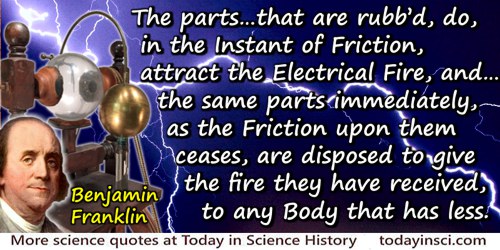
And we daily in our experiments electrise bodies plus or minus, as we think proper. [These terms we may use till your Philosophers give us better.] To electrise plus or minus, no more needs to be known than this, that the parts of the Tube or Sphere, that are rubb’d, do, in the Instant of Friction, attract the Electrical Fire, and therefore take it from the Thin rubbing; the same parts immediately, as the Friction upon them ceases, are disposed to give the fire they have received, to any Body that has less.
Letter 25 May 1747. Quoted in I. Bernard Cohen, Franklin and Newton: An Enquiry into Speculative Newtonian Experimental Science and Franklin’s Work in Electricity as an Example Thereof (1956), 439.
And, to prevent mistakes, I must advertize you, that I now mean by elements, as those chymists that speak plainest do by their principles, certain primitive or simple, or perfectly unmingled bodies; which not being made of any other bodies, or of one another, are the ingredients of which all those called perfectly mixt bodies are immediately compounded, and into which they are ultimately resolved: now whether there be any such body to be constantly met with in all, and each, of those that are said to be elemented bodies, is the thing I now question.
The Sceptical Chemist (2nd ed., 1661), Appendix, 354. As given in Henry M. Leicester and Herbert S. Klickstein, A Source Book in Chemistry 1400-1900 (1952), 42.
Any man who is intelligent must, on considering that health is of the utmost value to human beings, have the personal understanding necessary to help himself in diseases, and be able to understand and to judge what physicians say and what they administer to his body, being versed in each of these matters to a degree reasonable for a layman.
Affections, in Hippocrates, trans. P. Potter (1988), Vol. 5, 7.
Archimedes said Eureka,
Cos in English he weren't too aversed in,
when he discovered that the volume of a body in the bath,
is equal to the stuff it is immersed in,
That is the law of displacement,
Thats why ships don't sink,
Its a shame he weren't around in 1912,
The Titanic would have made him think.
Cos in English he weren't too aversed in,
when he discovered that the volume of a body in the bath,
is equal to the stuff it is immersed in,
That is the law of displacement,
Thats why ships don't sink,
Its a shame he weren't around in 1912,
The Titanic would have made him think.
From lyrics of song Sod’s Law.
As every circumstance relating to so capital a discovery as this (the greatest, perhaps, that has been made in the whole compass of philosophy, since the time of Sir Isaac Newton) cannot but give pleasure to all my readers, I shall endeavour to gratify them with the communication of a few particulars which I have from the best authority. The Doctor [Benjamin Franklin], after having published his method of verifying his hypothesis concerning the sameness of electricity with the matter lightning, was waiting for the erection of a spire in Philadelphia to carry his views into execution; not imagining that a pointed rod, of a moderate height, could answer the purpose; when it occurred to him, that, by means of a common kite, he could have a readier and better access to the regions of thunder than by any spire whatever. Preparing, therefore, a large silk handkerchief, and two cross sticks, of a proper length, on which to extend it, he took the opportunity of the first approaching thunder storm to take a walk into a field, in which there was a shed convenient for his purpose. But dreading the ridicule which too commonly attends unsuccessful attempts in science, he communicated his intended experiment to no body but his son, who assisted him in raising the kite.
The kite being raised, a considerable time elapsed before there was any appearance of its being electrified. One very promising cloud passed over it without any effect; when, at length, just as he was beginning to despair of his contrivance, he observed some loose threads of the hempen string to stand erect, and to avoid one another, just as if they had been suspended on a common conductor. Struck with this promising appearance, he inmmediately presented his knuckle to the key, and (let the reader judge of the exquisite pleasure he must have felt at that moment) the discovery was complete. He perceived a very evident electric spark. Others succeeded, even before the string was wet, so as to put the matter past all dispute, and when the rain had wetted the string, he collected electric fire very copiously. This happened in June 1752, a month after the electricians in France had verified the same theory, but before he had heard of any thing that they had done.
The kite being raised, a considerable time elapsed before there was any appearance of its being electrified. One very promising cloud passed over it without any effect; when, at length, just as he was beginning to despair of his contrivance, he observed some loose threads of the hempen string to stand erect, and to avoid one another, just as if they had been suspended on a common conductor. Struck with this promising appearance, he inmmediately presented his knuckle to the key, and (let the reader judge of the exquisite pleasure he must have felt at that moment) the discovery was complete. He perceived a very evident electric spark. Others succeeded, even before the string was wet, so as to put the matter past all dispute, and when the rain had wetted the string, he collected electric fire very copiously. This happened in June 1752, a month after the electricians in France had verified the same theory, but before he had heard of any thing that they had done.
The History and Present State of Electricity, with Original Experiments (1767, 3rd ed. 1775), Vol. 1, 216-7.
As mineralogy constitutes a part of chemistry, it is clear that this arrangement [of minerals] must derive its principles from chemistry. The most perfect mode of arrangement would certainly be to allow bodies to follow each other according to the order of their electro-chemical properties, from the most electro-negative, oxygen, to the most electro-positive, potassium; and to place every compound body according to its most electro-positive ingredient.
An Attempt to Establish a Pure Scientific System of Mineralogy (1814), trans. J. Black, 48.
As to a perfect Science of natural Bodies … we are, I think, so far from being capable of any such thing that I conclude it lost labour to seek after it.
In 'Extent of Human Knowledge', An Essay Concerning Humane Understanding (1700), Book 4, 335.
As to what Simplicius said last, that to contend whether the parts of the Sun, Moon, or other celestial body, separated from their whole, should naturally return to it, is a vanity, for that the case is impossible, it being clear by the demonstrations of Aristotle that the celestial bodies are impassible, impenetrable, unpartable, etc., I answer that none of the conditions whereby Aristotle distinguishes the celestial bodies from the elementary has any foundation other than what he deduces from the diversity of their natural motions; so that, if it is denied that the circular motion is peculiar to celestial bodies, and affirmed instead that it is agreeable to all naturally moveable bodies, one is led by necessary confidence to say either that the attributes of generated or ungenerated, alterable or unalterable, partable or unpartable, etc., equally and commonly apply to all bodies, as well to the celestial as to the elementary, or that Aristotle has badly and erroneously deduced those from the circular motion which he has assigned to celestial bodies.
Dialogue on the Great World Systems (1632). Revised and Annotated by Giorgio De Santillana (1953), 45.
As we celebrate the vernal equinox, let us marvel at the intricate dance of celestial bodies that govern the changing seasons. It’s a reminder of the profound interconnectedness of the cosmos and our place within it.
A fictional quote imagined in the style of an astronomer and SETI researcher (19 Mar 2024).
Astronomy, Benjamin mused, was a lot like a detective story with the clues revealed first, and the actual body only later—if ever.
Eater (2000). In Gary Westfahl, Science Fiction Quotations: From the Inner Mind to the Outer Limits (2006), 323.
August 29, 1662. The council and fellows of the Royal Society went in a body to Whitehall to acknowledge his Majesty’s royal grace to granting our charter and vouchsafing to be himself our founder; then the president gave an eloquent speech, to which his Majesty gave a gracious reply and we all kissed his hand. Next day, we went in like manner with our address to my Lord Chancellor, who had much prompted our patent.
Ax: 100 Every thing doth naturally persevere in yt state in wch it is unlesse it bee interrupted by some externall cause, hence… [a] body once moved will always keepe ye same celerity, quantity & determination of its motion.
Newton’s 'Waste Book' (1665). Quoted in Richard Westfall, Never at Rest: A Biography of Isaac Newton (1980), 145.
Because intelligence is our own most distinctive feature, we may incline to ascribe superior intelligence to the basic primate plan, or to the basic plan of the mammals in general, but this point requires some careful consideration. There is no question at all that most mammals of today are more intelligent than most reptiles of today. I am not going to try to define intelligence or to argue with those who deny thought or consciousness to any animal except man. It seems both common and scientific sense to admit that ability to learn, modification of action according to the situation, and other observable elements of behavior in animals reflect their degrees of intelligence and permit us, if only roughly, to compare these degrees. In spite of all difficulties and all the qualifications with which the expert (quite properly) hedges his conclusions, it also seems sensible to conclude that by and large an animal is likely to be more intelligent if it has a larger brain at a given body size and especially if its brain shows greater development of those areas and structures best developed in our own brains. After all, we know we are intelligent, even though we wish we were more so.
In The Meaning of Evolution: A Study of the History of Life and of its Significance for Man (1949), 78.
Being perpetually charmed by his familiar siren, that is, by his geometry, he [Archimedes] neglected to eat and drink and took no care of his person; that he was often carried by force to the baths, and when there he would trace geometrical figures in the ashes of the fire, and with his finger draws lines upon his body when it was anointed with oil, being in a state of great ecstasy and divinely possessed by his science.
— Plutarch
As translated in George Finlay Simmons, Calculus Gems: Brief Lives and Memorable Mathematics, (1992), 39.
Between this body [the earth] and the heavens there are suspended, in this aerial spirit, seven stars, separated by determinate spaces, which, on account of their motion, we call wandering.
In The Natural History of Pliny (1855), Vol. 1, 19-20.
Biological disciplines tend to guide research into certain channels. One consequence is that disciplines are apt to become parochial, or at least to develop blind spots, for example, to treat some questions as “interesting” and to dismiss others as “uninteresting.” As a consequence, readily accessible but unworked areas of genuine biological interest often lie in plain sight but untouched within one discipline while being heavily worked in another. For example, historically insect physiologists have paid relatively little attention to the behavioral and physiological control of body temperature and its energetic and ecological consequences, whereas many students of the comparative physiology of terrestrial vertebrates have been virtually fixated on that topic. For the past 10 years, several of my students and I have exploited this situation by taking the standard questions and techniques from comparative vertebrate physiology and applying them to insects. It is surprising that this pattern of innovation is not more deliberately employed.
In 'Scientific innovation and creativity: a zoologist’s point of view', American Zoologist (1982), 22, 233.
Bodies, projected in our air, suffer no resistance but from the air. Withdraw the air, as is done in Mr. Boyle's vacuum, and the resistance ceases. For in this void a bit of fine down and a piece of solid gold descend with equal velocity.
In 'General Scholium' from The Mathematical Principles of Natural Philosophy (1729), Vol. 2, Book 3, 388.
Body and mind, like man and wife, do not always agree to die together.
Reflection 324, in Lacon: Or Many Things in Few Words, Addressed to Those who Think (1820), 153.
Body and soul are not two different things, but only two different ways of perceiving the same thing. Similarly, physics and psychology are only different attempts to link our experiences together by way of systematic thought.
(1937). In Albert Einstein, the Human Side by Helen Dukas and Banesh Hoffman (1979), 38.
Body and soul cannot be separated for purposes of treatment, for they are one and indivisible. Sick minds must be healed as well as sick bodies.
Surgery, Gynaecology and Obstetrics (1931), 52, 488.
BODY-SNATCHER, n. A robber of grave-worms. One who supplies the young physicians with that with which the old physicians have supplied the undertaker.
The Collected Works of Ambrose Bierce (1911), Vol. 7, The Devil's Dictionary, 38-39.
But in nothing are swifts more singular than in their early retreat. They retire, as to the main body of them, by the tenth of August, and sometimes a few days sooner: and every straggler invariably withdraws by the twentieth, while their congeners, all of them, stay till the beginning of October; many of them all through that month, and some occasionally to the beginning of November. This early retreat is mysterious and wonderful, since that time is often the sweetest season in the year. But, what is more extraordinary, they begin to retire still earlier in the most southerly parts of Andalusia, where they can be no ways influenced by any defect of heat; or, as one might suppose, defect of food. Are they regulated in their motions with us by failure of food, or by a propensity to moulting, or by a disposition to rest after so rapid a life, or by what? This is one of those incidents in natural history that not only baffles our searches, but almost eludes our guesses!
In Letter to Daines Barrington, (28 Sep 1774), in The Natural History and Antiquities of Selborne (1789), 278.
But it is precisely mathematics, and the pure science generally, from which the general educated public and independent students have been debarred, and into which they have only rarely attained more than a very meagre insight. The reason of this is twofold. In the first place, the ascendant and consecutive character of mathematical knowledge renders its results absolutely insusceptible of presentation to persons who are unacquainted with what has gone before, and so necessitates on the part of its devotees a thorough and patient exploration of the field from the very beginning, as distinguished from those sciences which may, so to speak, be begun at the end, and which are consequently cultivated with the greatest zeal. The second reason is that, partly through the exigencies of academic instruction, but mainly through the martinet traditions of antiquity and the influence of mediaeval logic-mongers, the great bulk of the elementary text-books of mathematics have unconsciously assumed a very repellant form,—something similar to what is termed in the theory of protective mimicry in biology “the terrifying form.” And it is mainly to this formidableness and touch-me-not character of exterior, concealing withal a harmless body, that the undue neglect of typical mathematical studies is to be attributed.
In Editor’s Preface to Augustus De Morgan and Thomas J. McCormack (ed.), Elementary Illustrations of the Differential and Integral Calculus (1899), v.
But nothing is more estimable than a physician who, having studied nature from his youth, knows the properties of the human body, the diseases which assail it, the remedies which will benefit it, exercises his art with caution, and pays equal attention to the rich and the poor.
A Philosophical Dictionary: from the French? (2nd Ed.,1824), Vol. 5, 239-240.
But of this I can assure you that there is not a movement of any body of Men however small whether on Horse-back or on foot, nor an operation or March of any description nor any Service in the field that is not formed upon some mathematical principle, and in the performance of which the knowledge and practical application of the mathematicks will be found not only useful but necessary. The application of the Mathematicks to Gunnery, Fortification, Tactics, the survey and knowledge of formal Castrenantion etc. cannot be acquired without study.
Duke of Wellington to his son Douro (1826). Quoted in A Selection of the Private Correspondence of the First Duke of Wellington (1952), 44.
But, further, no animal can live upon a mixture of pure protein, fat and carbohydrate, and even when the necessary inorganic material is carefully supplied, the animal still cannot flourish. The animal body is adjusted to live either upon plant tissues or the tissues of other animals, and these contain countless substances other than the proteins, carbohydrates and fats... In diseases such as rickets, and particularly in scurvy, we have had for long years knowledge of a dietetic factor; but though we know how to benefit these conditions empirically, the real errors in the diet are to this day quite obscure. They are, however, certainly of the kind which comprises these minimal qualitative factors that I am considering.
'The Analyst and the Medical Man', The Analyst (1906), 31, 395-6.
By teaching us how to cultivate each ferment in its purity—in other words, by teaching us how to rear the individual organism apart from all others,—Pasteur has enabled us to avoid all these errors. And where this isolation of a particular organism has been duly effected it grows and multiplies indefinitely, but no change of it into another organism is ever observed. In Pasteur’s researches the Bacterium remained a Bacterium, the Vibrio a Vibrio, the Penicillium a Penicillium, and the Torula a Torula. Sow any of these in a state of purity in an appropriate liquid; you get it, and it alone, in the subsequent crop. In like manner, sow smallpox in the human body, your crop is smallpox. Sow there scarlatina, and your crop is scarlatina. Sow typhoid virus, your crop is typhoid—cholera, your crop is cholera. The disease bears as constant a relation to its contagium as the microscopic organisms just enumerated do to their germs, or indeed as a thistle does to its seed.
In 'Fermentation, and its Bearings on Surgery and Medicine', Essays on the FloatingMatter of the Air in Relation to Putrefaction and Infection (1881), 264.
Can we separate object and subject? Myself is nothing but a part of my body, my body is nothing but a part of my food, my food is nothing but a part of the earth, the earth is nothing but a part of the solar system.
In Sir William Withey Gull and Theodore Dyke Acland (ed.), A Collection of the Published Writings of William Withey Gull (1896), lii.
Cancer cells invade surrounding tissue, make their way into blood vessels, and spread throughout the body. What are they searching for? My guess is oxygen.
In Acceptance Remarks, 2016 Lasker Awards Ceremony, published in 'Oxygen Sensing – An Essential Process for Survival', on laskerfoundation.org website.
Chemistry is the science or study of those effects and qualities of matter which are discovered by mixing bodies variously together, or applying them to one another with a view to mixture, and by exposing them to different degrees of heat, alone, or in mixture with one another, in order to enlarge our knowledge of nature, and to promote the useful arts.
From the first of a series of lectures on chemistry, collected in John Robison (ed.), Lectures on the Elements of Chemistry: Delivered in the University of Edinburgh (1807), Vol. 1, 11.
Children are told that an apple fell on Isaac Newton’s head and he was led to state the law of gravity. This, of course, is pure foolishness. What Newton discovered was that any two particles in the universe attract each other with a force that is proportional to the product of their masses and inversely proportional to the square of the distance between them. This is not learned from a falling apple, but by observing quantities of data and developing a mathematical theory that can be verified by additional data. Data gathered by Galileo on falling bodies and by Johannes Kepler on motions of the planets were invaluable aids to Newton. Unfortunately, such false impressions about science are not universally outgrown like the Santa Claus myth, and some people who don’t study much science go to their graves thinking that the human race took until the mid-seventeenth century to notice that objects fall.
In How to Tell the Liars from the Statisticians (1983), 127.
Chymistry. … An art whereby sensible bodies contained in vessels … are so changed, by means of certain instruments, and principally fire, that their several powers and virtues are thereby discovered, with a view to philosophy or medicine.
An antiquated definition, as quoted in Samuel Johnson, entry for 'Chymistry' in Dictionary of the English Language (1785). Also in The Quarterly Journal of Science, Literature, and the Arts (1821), 284, wherein a letter writer (only identified as “C”) points out that this definition still appeared in the, then, latest Rev. Mr. Todd’s Edition of Johnson’s Dictionary, and that it showed “very little improvement of scientific words.” The letter included examples of better definitions by Black and by Davy. (See their pages on this website.)
Consider the hateful brew compounded with gleaming, deadly white lead whose fresh colour is like milk…. Over the victim’s jaws and in the grooves of the gums is plastered an astringent froth, and the furrow of the tongue turns rough on either side, and the depth of the throat grows somewhat dry, and from the pernicious venom follows a dry retching and hawking, for this affliction is severe; meanwhile his spirit sickens and he is worn out with mortal suffering. His body too grows chill, while sometimes his eyes behold strange illusions or else he drowses; nor can he bestir his limbs as heretofore, and he succumbs to the overmastering fatigue.
— Nicander
As translated by A.S.F. Gow and A.F. Scholfield in Nicander: The Poems and Portical Fragments (1953), 99.
Considered from the standpoint of chemistry, living bodies appear to us as laboratories of chemical processes, for they undergo perpetual changes in their material substrate. They draw materials from the outside world and combine them with the mass of their liquid and solid parts.
In 'Allgemeine Betrachtungen der orgauischen Korper', Physiologie des Menschen (1830), Vol. 1, 34. Trans. in Kenneth L. Caneva, Robert Mayer and the Conservation of Energy (1993), 7I.
Constant, or free, life is the third form of life; it belongs to the most highly organized animals. In it, life is not suspended in any circumstance, it unrolls along a constant course, apparently indifferent to the variations in the cosmic environment, or to the changes in the material conditions that surround the animal. Organs, apparatus, and tissues function in an apparently uniform manner, without their activity undergoing those considerable variations exhibited by animals with an oscillating life. This because in reality the internal environment that envelops the organs, the tissues, and the elements of the tissues does not change; the variations in the atmosphere stop there, so that it is true to say that physical conditions of the environment are constant in the higher animals; it is enveloped in an invariable medium, which acts as an atmosphere of its own in the constantly changing cosmic environment. It is an organism that has placed itself in a hot-house. Thus the perpetual changes in the cosmic environment do not touch it; it is not chained to them, it is free and independent.
Lectures on the Phenomena of Life Common to Animals and Plants (1878), trans. Hebbel E. Hoff, Roger Guillemin and Lucienne Guillemin (1974), 83.
Curiously enough man's body and his mind appear to differ in their climatic adaptations.
The Red Man's Continent: A Chronicle of Aboriginal America (1919), 10.
Cyberspace consists of transactions, relationships, and thought itself, arrayed like a standing wave in the web of our communications. Ours is a world that is both everywhere and nowhere, but it is not where bodies live. We are creating a world that all may enter without privilege or prejudice accorded by race, economic power, military force, or station of birth. We are creating a world where anyone, anywhere may express his or her beliefs, no matter how singular, without fear of being coerced into silence or conformity.
In 'A Declaration of the Independence of Cyberspace' (8 Feb 1996). Published on Electronic Frontier Foundation website. Reproduced in Lawrence Lessig, Code: Version 2.0) (2008), 303.
Diets were invented of the church, the workhouse and the hospital. They were started for the punishment of the spirit and have ended in the punishment of the body.
Martin H. Fischer, Howard Fabing (ed.) and Ray Marr (ed.), Fischerisms (1944).
Disease is an abnormal state of the body which primarily and independently produces a disturbance in the normal functions of the body. It may be an abnormality of temperament or form (structure). Symptom is a manifestation of some abnormal state in the body. It may be harmful as a colic pain or harmless as the flushing of cheeks in peripneumonia.
— Avicenna
'A Discussion of the Cause of Disease and Symptoms', in The Canon of Medicine, adapted by L. Bakhtiar (1999), 171.
Disease is not something personal and special, but only a manifestation of life under modified conditions, operating according to the same laws as apply to the living body at all times, from the first moment until death.
In Ian F. McNeely, Medicine on a Grand Scale: Rudolf Virchow, Liberalism, and the Public Health (2002), 26.
Disease makes men more physical, it leaves them nothing but body.
The Magic Mountain (1924, 1965), 178.
Dissection … teaches us that the body of man is made up of certain kinds of material, so differing from each other in optical and other physical characters and so built up together as to give the body certain structural features. Chemical examination further teaches us that these kinds of material are composed of various chemical substances, a large number of which have this characteristic that they possess a considerable amount of potential energy capable of being set free, rendered actual, by oxidation or some other chemical change. Thus the body as a whole may, from a chemical point of view, be considered as a mass of various chemical substances, representing altogether a considerable capital of potential energy.
From Introduction to A Text Book of Physiology (1876, 1891), Book 1, 1.
Do not Bodies and Light act mutually upon one another; that is to say, Bodies upon Light in emitting, reflecting, refracting and inflecting it, and Light upon Bodies for heating them, and putting their parts into a vibrating motion wherein heat consists?
Opticks (1704), Book 3, Query 5, 133.
Do not great Bodies conserve their heat the longest, their parts heating one another, and may not great dense and fix'd Bodies, when heated beyond a certain degree, emit Light so copiously, as by the Emission and Re-action of its Light, and the Reflexions and Refractions of its Rays within its Pores to grow still hotter, till it comes to a certain period of heat, such as is that of the Sun?
Opticks (1704), Book 3, Query II, 135.
Doubtless the reasoning faculty, the mind, is the leading and characteristic attribute of the human race. By the exercise of this, man arrives at the properties of the natural bodies. This is science, properly and emphatically so called. It is the science of pure mathematics; and in the high branches of this science lies the truly sublime of human acquisition. If any attainment deserves that epithet, it is the knowledge, which, from the mensuration of the minutest dust of the balance, proceeds on the rising scale of material bodies, everywhere weighing, everywhere measuring, everywhere detecting and explaining the laws of force and motion, penetrating into the secret principles which hold the universe of God together, and balancing worlds against worlds, and system against system. When we seek to accompany those who pursue studies at once so high, so vast, and so exact; when we arrive at the discoveries of Newton, which pour in day on the works of God, as if a second fiat had gone forth from his own mouth; when, further, we attempt to follow those who set out where Newton paused, making his goal their starting-place, and, proceeding with demonstration upon demonstration, and discovery upon discovery, bring new worlds and new systems of worlds within the limits of the known universe, failing to learn all only because all is infinite; however we may say of man, in admiration of his physical structure, that “in form and moving he is express and admirable,” it is here, and here without irreverence, we may exclaim, “In apprehension how like a god!” The study of the pure mathematics will of course not be extensively pursued in an institution, which, like this [Boston Mechanics’ Institute], has a direct practical tendency and aim. But it is still to be remembered, that pure mathematics lie at the foundation of mechanical philosophy, and that it is ignorance only which can speak or think of that sublime science as useless research or barren speculation.
In Works (1872), Vol. 1, 180.
During the half-century that has elapsed since the enunciation of the cell-theory by Schleiden and Schwann, in 1838-39, it has became ever more clearly apparent that the key to all ultimate biological problems must, in the last analysis, be sought in the cell. It was the cell-theory that first brought the structure of plants and animals under one point of view by revealing their common plan of organization. It was through the cell-theory that Kolliker and Remak opened the way to an understanding of the nature of embryological development, and the law of genetic continuity lying at the basis of inheritance. It was the cell-theory again which, in the hands of Virchaw and Max Schultze, inaugurated a new era in the history of physiology and pathology, by showing that all the various functions of the body, in health and in disease, are but the outward expression of cell-activities. And at a still later day it was through the cell-theory that Hertwig, Fol, Van Beneden, and Strasburger solved the long-standing riddle of the fertilization of the egg, and the mechanism of hereditary transmission. No other biological generalization, save only the theory of organic evolution, has brought so many apparently diverse phenomena under a common point of view or has accomplished more far the unification of knowledge. The cell-theory must therefore be placed beside the evolution-theory as one of the foundation stones of modern biology.
In The Cell in Development and Inheritance (1896), 1.
Each ray of light moves in the coordinate system 'at rest' with the definite, constant velocity V independent of whether this ray of light is emitted by a body at rest or a body in motion.
Annalen der Physik, 1905, 17, 891-921. Trans. John Stachel et al (eds.), The Collected Papers of Albert Einstein, Vol. 2, (1989), Doc. 23, 143.
Endowed with two qualities, which seemed incompatible with each other, a volcanic imagination and a pertinacity of intellect which the most tedious numerical calculations could not daunt, Kepler conjectured that the movements of the celestial bodies must be connected together by simple laws, or, to use his own expression, by harmonic laws. These laws he undertook to discover. A thousand fruitless attempts, errors of calculation inseparable from a colossal undertaking, did not prevent him a single instant from advancing resolutely toward the goal of which he imagined he had obtained a glimpse. Twenty-two years were employed by him in this investigation, and still he was not weary of it! What, in reality, are twenty-two years of labor to him who is about to become the legislator of worlds; who shall inscribe his name in ineffaceable characters upon the frontispiece of an immortal code; who shall be able to exclaim in dithyrambic language, and without incurring the reproach of anyone, “The die is cast; I have written my book; it will be read either in the present age or by posterity, it matters not which; it may well await a reader, since God has waited six thousand years for an interpreter of his words.”
In 'Eulogy on Laplace', in Smithsonian Report for the year 1874 (1875), 131-132.
Euclidean mathematics assumes the completeness and invariability of mathematical forms; these forms it describes with appropriate accuracy and enumerates their inherent and related properties with perfect clearness, order, and completeness, that is, Euclidean mathematics operates on forms after the manner that anatomy operates on the dead body and its members. On the other hand, the mathematics of variable magnitudes—function theory or analysis—considers mathematical forms in their genesis. By writing the equation of the parabola, we express its law of generation, the law according to which the variable point moves. The path, produced before the eyes of the student by a point moving in accordance to this law, is the parabola.
If, then, Euclidean mathematics treats space and number forms after the manner in which anatomy treats the dead body, modern mathematics deals, as it were, with the living body, with growing and changing forms, and thus furnishes an insight, not only into nature as she is and appears, but also into nature as she generates and creates,—reveals her transition steps and in so doing creates a mind for and understanding of the laws of becoming. Thus modern mathematics bears the same relation to Euclidean mathematics that physiology or biology … bears to anatomy.
If, then, Euclidean mathematics treats space and number forms after the manner in which anatomy treats the dead body, modern mathematics deals, as it were, with the living body, with growing and changing forms, and thus furnishes an insight, not only into nature as she is and appears, but also into nature as she generates and creates,—reveals her transition steps and in so doing creates a mind for and understanding of the laws of becoming. Thus modern mathematics bears the same relation to Euclidean mathematics that physiology or biology … bears to anatomy.
In Die Mathematik die Fackelträgerin einer neuen Zeit (1889), 38. As translated in Robert Édouard Moritz, Memorabilia Mathematica; Or, The Philomath’s Quotation-book (1914), 112-113.
Even the taking of medicine serves to make time go on with less heaviness. I have a sort of genius for physic and always had great entertainment in observing the changes of the human body and the effects produced by diet, labor, rest, and physical operations.
Every new body of discovery is mathematical in form, because there is no other guidance we can have.
(1931). As quoted, without citation, in Eric Temple Bell, 'They Say, What They Say, Let Them Say', Men of Mathematics (1937, 2014), Vol. 2, xvii. Webmaster has searched, but not yet found a primary source. Can you help?
Every body continues in its state of rest or uniform motion in a straight line, except in so far as it doesn’t. … The suggestion that the body really wanted to go straight but some mysterious agent made it go crooked is picturesque but unscientific.
Paraphasing Newton’s First Law of Motion. In a Gifford Lecture delivered at the University of Edinburgh (1927), 'Gravitation: The Law', The Nature of the Physical World (1928), 124.
Every body perseveres in its state of being at rest or of moving uniformly straight forward, except insofar as it is compelled to change its state by forces impressed.
The Principia: Mathematical Principles of Natural Philosophy (1687), 3rd edition (1726), trans. I. Bernard Cohen and Anne Whitman (1999), Axioms, or Laws of Motion, Law 1, 416.
Every creature has its own food, and an appropriate alchemist with the task of dividing it ... The alchemist takes the food and changes it into a tincture which he sends through the body to become blood and flesh. This alchemist dwells in the stomach where he cooks and works. The man eats a piece of meat, in which is both bad and good. When the meat reaches the stomach, there is the alchemist who divides it. What does not belong to health he casts away to a special place, and sends the good wherever it is needed. That is the Creator's decree... That is the virtue and power of the alchemist in man.
Volumen Medicinae Paramirum (c. 1520), in Paracelsus: Essential Readings, edited by Nicholas Goodrick-Clarke (1990), 50-1.
Every natural scientist who thinks with any degree of consistency at all will, I think, come to the view that all those capacities that we understand by the phrase psychic activities (Seelenthiitigkeiten) are but functions of the brain substance; or, to express myself a bit crudely here, that thoughts stand in the same relation to the brain as gall does to the liver or urine to the kidneys. To assume a soul that makes use of the brain as an instrument with which it can work as it pleases is pure nonsense; we would then be forced to assume a special soul for every function of the body as well.
In Physiologische Briefe für Gelbildete aIle Stünde (1845-1847), 3 parts, 206. as translated in Frederick Gregory, Scientific Materialism in Nineteenth Century Germany (1977), 64.
Facts are to the mind the same thing as food to the body. On the due digestion of facts depends the strength and wisdom of the one, just as vigor and health depend on the other. The wisest in council, the ablest in debate, and the most agreeable in the commerce of life is that man who has assimilated to his understanding the greatest number of facts.
Finally, since I thought that we could have all the same thoughts, while asleep, as we have while we are awake, although none of them is true at that time, I decided to pretend that nothing that ever entered my mind was any more true than the illusions of my dreams. But I noticed, immediately afterwards, that while I thus wished to think that everything was false, it was necessarily the case that I, who was thinking this, was something. When I noticed that this truth “I think, therefore I am” was so firm and certain that all the most extravagant assumptions of the sceptics were unable to shake it, I judged that I could accept it without scruple as the first principle of the philosophy for which I was searching. Then, when I was examining what I was, I realized that I could pretend that I had no body, and that there was no world nor any place in which I was present, but I could not pretend in the same way that I did not exist. On the contrary, from the very fact that I was thinking of doubting the truth of other things, it followed very evidently and very certainly that I existed; whereas if I merely ceased to think, even if all the rest of what I had ever imagined were true, I would have no reason to believe that I existed. I knew from this that I was a substance, the whole essence or nature of which was to think and which, in order to exist, has no need of any place and does not depend on anything material. Thus this self—that is, the soul by which I am what I am—is completely distinct from the body and is even easier to know than it, and even if the body did not exist the soul would still be everything that it is.
Discourse on Method in Discourse on Method and Related Writings (1637), trans. Desmond M. Clarke, Penguin edition (1999), Part 4, 24-5.
First, it must be a pleasure to study the human body the most miraculous masterpiece of nature and to learn about the smallest vessel and the smallest fiber. But second and most important, the medical profession gives the opportunity to alleviate the troubles of the body, to ease the pain, to console a person who is in distress, and to lighten the hour of death of many a sufferer.
Reasons for his choice of medicine as a career, from essay written during his last year in the Gymnasium (high school). As quoted in Leslie Dunn, Rudolf Virchow: Now You Know His Name (2012), 8-9.
Food is at present obtained almost entirely from the energy of the sunlight. The radiation from the sun produces from the carbonic acid in the air more or less complicated carbon compounds which serve us in plants and vegetables. We use the latent chemical energy of these to keep our bodies warm, we convert it into muscular effort. We employ it in the complicated process of digestion to repair and replace the wasted cells of our bodies. … If the gigantic sources of power become available, food would be produced without recourse to sunlight. Vast cellars, in which artificial radiation is generated, may replace the cornfields and potato patches of the world.
From 'Fifty Years Hence', Strand Magazine (Dec 1931). Reprinted in Popular Mechanics (Mar 1932), 57, No. 3, 396-397.
Food may be defined as material which, when taken into the body, serves to either form tissue or yield energy, or both. This definition includes all the ordinary food materials, since they both build tissue and yield energy. It includes sugar and starch, because they yield energy and form fatty tissue. It includes alcohol, because the latter is burned to yield energy, though it does not build tissue. It excludes creatin, creatininin, and other so-called nitrogeneous extractives of meat, and likewise thein or caffein of tea and coffee, because they neither build tissue nor yield energy, although they may, at times, be useful aids to nutrition.
Methods and Results of Investigations on the Chemistry and Economy of Food, Bulletin 21, US Department of Agriculture (1895). Quoted in Ira Wolinsky, Nutrition in Exercise and Sport (1998), 36.
For any two portions of fire, small or great, will exhibit the same ratio of solid to void; but the upward movement of the greater is quicker than that of the less, just as the downward movement of a mass of gold or lead, or of any other body endowed with weight, is quicker in proportion to its size.
On the Heavens, 309b, 11-5. In Jonathan Barnes (ed.), The Complete Works of Aristotle (1984), Vol. I, 505.
For some months the astronomer Halley and other friends of Newton had been discussing the problem in the following precise form: what is the path of a body attracted by a force directed toward a fixed point, the force varying in intensity as the inverse of the distance? Newton answered instantly, “An ellipse.” “How do you know?” he was asked. “Why, I have calculated it.” Thus originated the imperishable Principia, which Newton later wrote out for Halley. It contained a complete treatise on motion.
In The Handmaiden of the Sciences (1937), 37.
For the life of the flesh is in the blood.
— Bible
Leviticus 17:11.
For the mind is so intimately dependent upon the condition and relation of the organs of the body, that if any means can ever be found to render men wiser and more ingenious than hitherto, I believe that it is in medicine they must be sought for. It is true that the science of medicine, as it now exists, contains few things whose utility is very remarkable.
In A Discourse on Method (1637) as translated by John Veitch, Everyman’s Library: Philosophy & Theology: A Discourse on Method, Etc. (1912, 1916), 49-50. A later translation of this quote begins “Even the mind…” on this web page.
For truly in nature there are many operations that are far more than mechanical. Nature is not simply an organic body like a clock, which has no vital principle of motion in it; but it is a living body which has life and perception, which are much more exalted than a mere mechanism or a mechanical motion.
The Principles of the Most Ancient and Modern Philosophy (1692), trans. and ed. Allison Coudert and Taylor Corse (1996), 64.
For us, an atom shall be a small, spherical, homogeneous body or an essentially indivisible, material point, whereas a molecule shall be a separate group of atoms in any number and of any nature.
Annales de Chimie 1833, 52, 133. Trans. W. H. Brock.
For what is that which we call evil but the absence of good? In the bodies of animals, disease and wounds mean nothing but the absence of health; for when a cure is effected, that does not mean that the evils which were present—namely, the diseases and wounds—go away from the body and dwell elsewhere: they altogether cease to exist; for the wound or disease is not a substance, but a defect in the fleshly substance,—the flesh itself being a substance, and therefore something good, of which those evils—that is, privations of the good which we call health—are accidents. Just in the same way, what are called vices in the soul are nothing but privations of natural good. And when they are cured, they are not transferred elsewhere: when they cease to exist in the healthy soul, they cannot exist anywhere else.
In Marcus Dods (ed.), J.F. Shaw (trans.), The Enchiridion of Augustine, Chap. 9, collected in The Works of Aurelius Augustine, Bishop of Hippo: A new translation (1873), Vol. 9, 181-182.
For when I look at the moon I do not see a hostile, empty world. I see … a radiant body where man has taken his first steps into an endless frontier.
In David Scott and Alexei Leonov, Two Sides of the Moon: Our Story of the Cold War Space Race (2004), 390.
For, however much we may clench our teeth in anger, we cannot but confess, in opposition to Galen’s teaching but in conformity with the might of Aristotle’s opinion, that the size of the orifice of the hollow vein at the right chamber of the heart is greater than that of the body of the hollow vein, no matter where you measure the latter. Then the following chapter will show the falsity of Galen’s view that the hollow vein is largest at the point where it joins the hump of the liver.
From De Humani Corporis Fabrica Libri Septem (1543), Book III, 275, as translated by William Frank Richardson and John Burd Carman, in 'The Arguments Advanced by Galen in Opposition to Aristotl’s Views about the Origin of the Hollow Vein Do Not Have Oracular Authority', On The Fabric of the Human Body: Book III: The Veins And Arteries; Book IV: The Nerves (1998), 45.
Forests … are in fact the world’s air-conditioning system—the very lungs of the planet—and help to store the largest body of freshwater on the planet … essential to produce food for our planet’s growing population. The rainforests of the world also provide the livelihoods of more than a billion of the poorest people on this Earth… In simple terms, the rainforests, which encircle the world, are our very life-support system—and we are on the verge of switching it off.
Presidential Lecture (3 Nov 2008) at the Presidential Palace, Jakarta, Indonesia. On the Prince of Wales website.
From what has been said it is also evident, that the Whiteness of the Sun's Light is compounded all the Colours wherewith the several sorts of Rays whereof that Light consists, when by their several Refrangibilities they are separated from one another, do tinge Paper or any other white Body whereon they fall. For those Colours ... are unchangeable, and whenever all those Rays with those their Colours are mix'd again, they reproduce the same white Light as before.
Opticks (1704), Book 1, Part 2, Exper. XV, 114.
Gluttony is the source of all our infirmities, and the fountain of all our diseases. As a lamp is choked by a superabundance of oil, a fire extinguished by excess of fuel, so is the natural health of the body destroyed by intemperate diet.
In Louis Klopsch, Many Thoughts of Many Minds (1896), 110.
Gravitation is demonstrable by leaving a body unsupported.
In Sir William Withey Gull and Theodore Dyke Acland (ed.), A Collection of the Published Writings of William Withey Gull (1896), xlix.
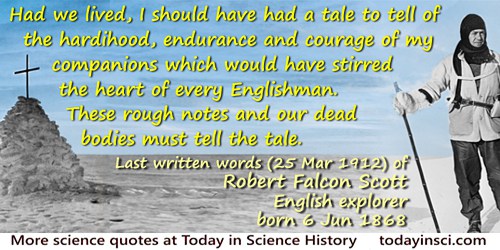
Had we lived, I should have had a tale to tell of the hardihood, endurance and courage of my companions which would have stirred the heart of every Englishman. These rough notes and our dead bodies must tell the tale, but surely, a great rich country like ours will see that those who are dependent on us are properly provided for.
[Final words in a 'Message to the Public' left written in his diary dated 25 March 1912, shortly before he died on the Ross Ice Barrier, Antarctica. When searchers found his body, on 12 Nov 1912, Scott was discovered sitting upright against the pole of the tent with the diary behind his head, as if for a pillow.]
[Final words in a 'Message to the Public' left written in his diary dated 25 March 1912, shortly before he died on the Ross Ice Barrier, Antarctica. When searchers found his body, on 12 Nov 1912, Scott was discovered sitting upright against the pole of the tent with the diary behind his head, as if for a pillow.]
Final words in a 'Message to the Public' left written in his diary dated 25 March 1912, shortly before he died on the Ross Ice Barrier, Antarctica. In Logan Marshall, The Story of Polar Conquest: The Complete History of Arctic and Antarctic (1913), 24-25.
by Logan Marshall - Polar regions - 1913
He [Heinrich Rose] looked upon the various substances that he was manipulating, as well as their reactions, under a thoroughly familial point of view: they were like so many children entrusted to his tutelage. Every time he explained simple, clear, well-defined phenomena, he assumed a jovial and smiling countenance; on the other hand, he almost got angry at certain mischievous bodies, the properties of which did not obey ordinary laws and troubled general theoretical views; in his eyes, this was unruly behavior.
As his student, about the lectures of Heinrich Rose, as quoted in entry by Stuart Pierson, 'Rose, Heinrich', in Charles Coulston Gillespie (ed.), Dictionary of Scientific Biography (1975), Vol.11, 541, citing Adolphe Remelé, 'Notice biographique sur le Professeur Henri Rose', in Moniteur Scientifique (1864), 2nd ser., 6, 385–389. [Remelé’s italics.]
He [Lord Bacon] appears to have been utterly ignorant of the discoveries which had just been made by Kepler’s calculations … he does not say a word about Napier’s Logarithms, which had been published only nine years before and reprinted more than once in the interval. He complained that no considerable advance had been made in Geometry beyond Euclid, without taking any notice of what had been done by Archimedes and Apollonius. He saw the importance of determining accurately the specific gravities of different substances, and himself attempted to form a table of them by a rude process of his own, without knowing of the more scientific though still imperfect methods previously employed by Archimedes, Ghetaldus and Porta. He speaks of the εὕρηκα of Archimedes in a manner which implies that he did not clearly appreciate either the problem to be solved or the principles upon which the solution depended. In reviewing the progress of Mechanics, he makes no mention either of Archimedes, or Stevinus, Galileo, Guldinus, or Ghetaldus. He makes no allusion to the theory of Equilibrium. He observes that a ball of one pound weight will fall nearly as fast through the air as a ball of two, without alluding to the theory of acceleration of falling bodies, which had been made known by Galileo more than thirty years before. He proposed an inquiry with regard to the lever,—namely, whether in a balance with arms of different length but equal weight the distance from the fulcrum has any effect upon the inclination—though the theory of the lever was as well understood in his own time as it is now. … He speaks of the poles of the earth as fixed, in a manner which seems to imply that he was not acquainted with the precession of the equinoxes; and in another place, of the north pole being above and the south pole below, as a reason why in our hemisphere the north winds predominate over the south.
From Spedding’s 'Preface' to De Interpretations Naturae Proœmium, in The Works of Francis Bacon (1857), Vol. 3, 511-512. [Note: the Greek word “εὕρηκα” is “Eureka” —Webmaster.]
He rules all things, not as the world soul but as the lord of all. And because of his dominion he is called Lord God Pantokrator. For 'god' is a relative word and has reference to servants, and godhood is the lordship of God, not over his own body as is supposed by those for whom God is the world soul, but over servants. The supreme God is an eternal, infinite, and absolutely perfect being; but a being, however perfect, without dominion is not the Lord God.
The Principia: Mathematical Principles of Natural Philosophy (1687), 3rd edition (1726), trans. I. Bernard Cohen and Anne Whitman (1999), General Scholium, 940-1.
He that knows the secrets of nature with Albertus Magnus, or the motions of the heavens with Galileo, or the cosmography of the moon with Hevelius, or the body of man with Galen, or the nature of diseases with Hippocrates, or the harmonies in melody with Orpheus, or of poesy with Homer, or of grammar with Lilly, or of whatever else with the greatest artist; he is nothing if he knows them merely for talk or idle speculation, or transient and external use. But he that knows them for value, and knows them his own, shall profit infinitely.
In Bertram Doben (ed.), Centuries of Meditations (1908), The Third Century, No. 41, 189-190.
He who wishes to explain Generation must take for his theme the organic body and its constituent parts, and philosophize about them; he must show how these parts originated, and how they came to be in that relation in which they stand to each other. But he who learns to know a thing not only from its phenomena, but also its reasons and causes; and who, therefore, not by the phenomena merely, but by these also, is compelled to say: “The thing must be so, and it cannot be otherwise; it is necessarily of such a character; it must have such qualities; it is impossible for it to possess others”—understands the thing not only historically but truly philosophically, and he has a philosophic knowledge of it. Our own Theory of Generation is to be such a philosphic comprehension of an organic body, a very different one from one merely historical. (1764)
Quoted as an epigraph to Chap. 2, in Ernst Haeckel, The Evolution of Man, (1886), Vol 1, 25.
Heat can evidently be a cause of motion only by virtue of the changes of volume or of form which it produces in bodies. These changes are not caused by uniform temperature but rather by alternations of heat and cold.
As translated in Reflections on the Motive Power of Heat and on Machines Fitted to Develop Power (1890, Rev. 1897), 49. Edited by R. H. Thurston, from the original French, Réflexions sur la Puissance Motrice du Feu (1824).
Heat can never pass from a colder to a warmer body without some other change, connected therewith, occurring at the same time.
'On a Modified Form of the Second Fundamental Theorem in the Mechanical Theory of Heat', Philosophical Magazine, 1856, 12, 86.
Hieron asked Archimedes to discover, without damaging it, whether a certain crown or wreath was made of pure gold, or if the goldsmith had fraudulently alloyed it with some baser metal. While Archimedes was turning the problem over in his mind, he chanced to be in the bath house. There, as he was sitting in the bath, he noticed that the amount of water that was flowing over the top of it was equal in volume to that part of his body that was immersed. He saw at once a way of solving the problem. He did not delay, but in his joy leaped out of the bath. Rushing naked through the streets towards his home, he cried out in a loud voice that he had found what he sought. For, as he ran, he repeatedly shouted in Greek; “Eureka! Eurekal I’ve found it! I’ve found it!”
Vitrivius Pollio, De Architectura, ix, prologue, section 10.
However dangerous might be the shock of a comet, it might be so slight, that it would only do damage at the part of the Earth where it actually struck; perhaps even we might cry quits if while one kingdom were devastated, the rest of the Earth were to enjoy the rarities which a body which came from so far might bring it. Perhaps we should be very surprised to find that the debris of these masses that we despised were formed of gold and diamonds; but who would be the most astonished, we, or the comet-dwellers, who would be cast on our Earth? What strange being each would find the other!
From 'Lettre sur la comète', Œuvres de M. Maupertuis (1752), 203. As quoted in Carl Sagan, Broca's Brain: Reflections on the Romance of Science (1979), 95-96.
I am convinced that an important stage of human thought will have been reached when the physiological and the psychological, the objective and the subjective, are actually united, when the tormenting conflicts or contradictions between my consciousness and my body will have been factually resolved or discarded.
Physiology of the Higher Nervous Activity (1932), 93-4.
I believe that women‐centred, physiologically accurate knowledge of what is normal related to our female bodies, menopause, menstrual cycles and many other aspects of our health does not exist.
Address to First Congress on Women, Health, and Work (Barcelona, 1996). As quoted in 'Aphorism of the Month', Journal of Epidemiology and Community Health (Dec 2007), 61, Suppl. 2, 932.
I call that part of the human body irritable, which becomes shorter upon being touched; very irritable if it contracts upon a slight touch, and the contrary if by a violent touch it contracts but little. I call that a sensible part of the human body, which upon being touched transmits the impression of it to the soul; and in brutes, in whom the existence of a soul is not so clear, I call those parts sensible, the Irritation of which occasions evident signs of pain and disquiet in the animal. On the contrary, I call that insensible, which being burnt, tore, pricked, or cut till it is quite destroyed, occasions no sign of pain nor convulsion, nor any sort of change in the situation of the body.
'A Treatise on the Sensible and Irritable Parts of Animals' (Read 1752). Trans. 1755 and reprinted in Bulletin of the Institute of the History of Medicine, 1936, 4(2), 658-9.
I call this Spirit, unknown hitherto, by the new name of Gas, which can neither be constrained by Vessels, nor reduced into a visible body, unless the feed being first extinguished. But Bodies do contain this Spirit, and do sometimes wholly depart into such a Spirit, not indeed, because it is actually in those very bodies (for truly it could not be detained, yea the whole composed body should I lie away at once) but it is a Spirit grown together, coagulated after the manner of a body, and is stirred up by an attained ferment, as in Wine, the juyce of unripe Grapes, bread, hydromel or water and Honey.
Oriatrike: Or, Physick Refined, trans. John Chandler (1662), 106.
I came by the horror naturally. Surgery is the one branch of medicine that is the most violent. After all, it’s violent to take up a knife and cut open a person’s body and rummage around with your hands. I think I was attracted to the horrific.
As quoted in Randy Hutter Epstein, 'Richard Selzer, Who Fictionalized Medicine’s Absurdity and Gore, Dies at 87', New York Times (15 Jun 2016). Explaining why his first fiction writing was horror stories.
I cannot imagine a God who rewards and punishes the objects of his creation, whose purposes are modeled after our own–a God, in short, who is but a reflection of human frailty. Neither can I believe that the individual survives the death of his body, although feeble souls harbor such thoughts through fear or ridiculous egotism. It is enough for me to contemplate the mystery of conscious life perpetuating itself through all eternity, to reflect upon the marvelous structure of the universe which we can dimly perceive, and to try humbly to comprehend even an infinitesimal part of the intelligence manifested in nature.
From 'What I Believe: Living Philosophies XIII', Forum and Century (Oct 1930), 84, No. 4, 194. Article in full, reprinted in Edward H. Cotton (ed.), Has Science Discovered God? A Symposium of Modern Scientific Opinion (1931), 97.
I did it [worked long hours] because I wanted to, not because I had to. I loved it and still do love it, That is what women must have in addition to diligence—a real and absorbing devotion to their work. They need now to have a bigger body of work to show.
In Genevieve Parkhurst, 'Dr. Sabin, Scientist: Winner Of Pictorial Review’s Achievement Award', Pictorial Review (Jan 1930), 71.
I do ... humbly conceive (tho' some possibly may think there is too much notice taken of such a trivial thing as a rotten Shell, yet) that Men do generally rally too much slight and pass over without regard these Records of Antiquity which Nature have left as Monuments and Hieroglyphick Characters of preceding Transactions in the like duration or Transactions of the Body of the Earth, which are infinitely more evident and certain tokens than any thing of Antiquity that can be fetched out of Coins or Medals, or any other way yet known, since the best of those ways may be counterfeited or made by Art and Design, as may also Books, Manuscripts and Inscriptions, as all the Learned are now sufficiently satisfied, has often been actually practised; but those Characters are not to be Counterfeited by all the Craft in the World, nor can they be doubted to be, what they appear, by anyone that will impartially examine the true appearances of them: And tho' it must be granted, that it is very difficult to read them, and to raise a Chronology out of them, and to state the intervalls of the Times wherein such, or such Catastrophies and Mutations have happened; yet 'tis not impossible, but that, by the help of those joined to ' other means and assistances of Information, much may be done even in that part of Information also.
Lectures and Discourses of Earthquakes (1668). In The Posthumous Works of Robert Hooke, containing his Cutlerian Lectures and other Discourses read at the Meetings of the Illustrious Royal Society (1705), 411.
I don’t understand why people insist on pitting concepts of evolution and creation against each other. Why can’t they see that spiritualism and science are one? That bodies evolve and souls evolve and the universe is a fluid package that marries them both in a wonderful package called a human being.
The Art of Racing in the Rain. Quoted in Kim Lim (ed.), 1,001 Pearls of Spiritual Wisdom: Words to Enrich, Inspire, and Guide Your Life (2014), 43
I finally saw that the blood, forced by the action of the left ventricle into the arteries, was distributed to the body at large, and its several parts, in the same manner as it is sent through the lungs, impelled by the right ventricle into the pulmonary artery, and that it then passed through the veins and along the vena cava, and so round to the left ventricle in the manner already indicated. Which motion we may be allowed to call circular, in the same way as Aristotle says that the air and the rain emulate the circular motion of the superior bodies; for the moist earth, warmed by the sun, evaporates; the vapours drawn upwards are condensed, and descending in the form of rain, moisten the earth again; and by this arrangement are generations of living things produced.
From William Harvey and Robert Willis (trans.), The Works of William Harvey, M.D. (1847), 46.
I found that I could find the energy…that I could find the determination to keep on going. I learned that your mind can amaze your body, it you just keep telling yourself, I can do it…I can do it…I can do it!
…...
I furnished the body that was needed to sit in the defendant’s chair. [Explaining his role in the Scopes Monkey Trial.]
As quoted in Newsweek, Vol. 69, 94.
I had a wonderful time the first time. I think I was probably more nervous back in those days because we did not know much about spaceflight in those days; we were sort of feeling our way and finding out what would happen to the human body in space and now we are putting the whole thing to work for everybody up here so I think I was a little more nervous the first time.
Replying to a Whetstone High School students’ question during a school forum held using a downlink with the Discovery Space Shuttle mission (31 Oct 1998). On NASA web page 'STS-95 Educational Downlink'. Sarah Ravely, Holleh Moheimani, Janara Walker asked, “Senator Glenn, were you more nervous being the first American to orbit the Earth or to be the oldest man ever in space?”
I had gone on a walk on a fine Sabbath afternoon. I had entered the Green [of Glasgow] by the gate at the foot of Charlotte Street—had passed the old washing-house. I was thinking upon the engine at the time, and had gone as far as the herd's house, when the idea came into my mind that as steam was an elastic body it would rush into a vacuum, and if a communication were made between the cylinder and an exhausted vessel it would rush into it, and might be there condensed without cooling the cylinder. I then saw that I must get rid of the condensed steam and injection water if I used a jet, as in Newcomen's engine. Two ways of doing this occurred to me. First, the water might be run off by a descending pipe, if an outlet could be got at the depth of 35 or 36 feet, and any air might be extracted by a small pump. The second was to make the pump large enough to extract both water and air. ... I had not walked further than the Golf-house when the whole thing was arranged in my mind.
[In Robert Hart's words, a recollection of the description of Watt's moment of inspiration, in May 1765, for improving Thomas Newcomen's steam engine.]
[In Robert Hart's words, a recollection of the description of Watt's moment of inspiration, in May 1765, for improving Thomas Newcomen's steam engine.]
In Robert Hart, 'Reminiscences of James Watt' (read 2 Nov 1857), Transactions of the Glasgow Archaeological Society (1859), Vol. 1, 1. Note that these are not the verbatim words of James Watt, but are only a recollection of them by Robert Hart, who is quoting as best he can from memory of a conversation he and his brother had with James Watt that took place over 43 years previously. In his Reminiscences, Hart explains, “I have accordingly thrown together the following brief narrative:— As these meetings took place forty-three years since, many observations that were made at the time may have escaped me at present; yet, when the same subjects are touched on, I have as distinct recollection of his treatment of them as if it were yesterday.”
I have accumulated a wealth of knowledge in innumerable spheres and enjoyed it as an always ready instrument for exercising the mind and penetrating further and further. Best of all, mine has been a life of loving and being loved. What a tragedy that all this will disappear with the used-up body!
In and Out of the Ivory Tower (1960), 311.
I have repeatedly had cause to refer to certain resemblances between the phenomena of irritability in the vegetable kingdom and those of the animal body, thus touching a province of investigation which has hitherto been far too little cultivated. In the last instance, indeed, I might say animal and vegetable life must of necessity agree in all essential points, including the phenomena of irritability also, since it is established that the animal organism is constructed entirely and simply from the properties of these substances that all vital movements both of plants and animals are to be explained.
Lectures on the Physiology of Plants (1887), 600.
I have said that the investigation for which the teeth of the shark had furnished an opportunity, was very near an end... But thereafter, while I was examining more carefully these details of both places and bodies [sedimentary deposits and shells], these day by day presented points of doubt to me as they followed one another in indissoluble connection, so that I saw myself again and again brought back to the starting-place, as it were, when I thought I was nearest the goal. I might compare those doubts to the heads of the Lernean Hydra, since when one of them had been got rid of, numberless others were born; at any rate, I saw that I was wandering about in a sort of labyrinth, where the nearer one approaches the exit, the wider circuits does one tread.
The Prodromus of Nicolaus Steno's Dissertation Concerning a Solid Body enclosed by Process of Nature within a Solid (1669), trans. J. G. Winter (1916), 206.
I have taken your advice, and the names used are anode cathode anions cations and ions; the last I shall have but little occasion for. I had some hot objections made to them here and found myself very much in the condition of the man with his son and ass who tried to please every body; but when I held up the shield of your authority, it was wonderful to observe how the tone of objection melted away.
Letter to William Whewell, 15 May 1834. In Frank A. J. L. James (ed.), The Correspondence of Michael Faraday (1993), Vol. 2, 186.
I know that certain minds would regard as audacious the idea of relating the laws which preside over the play of our organs to those laws which govern inanimate bodies; but, although novel, this truth is none the less incontestable. To hold that the phenomena of life are entirely distinct from the general phenomena of nature is to commit a grave error, it is to oppose the continued progress of science.
Leçons sur les Phenomenes Physiques de la Vie (1836-38), Vol. 1, 6. Trans. J. M. D. Olmsted, François Magendie (1944), 203.
I look upon a good physician, not so properly as a servant to nature, as one, that is a counsellor and friendly assistant, who, in his patient’s body, furthers those motions and other things, that he judges conducive to the welfare and recovery of it; but as to those, that he perceives likely to be hurtful, either by increasing the disease, or otherwise endangering the patient, he thinks it is his part to oppose or hinder, though nature do manifestly enough seem to endeavour the exercising or carrying on those hurtful motions.
Quoted In Barbara Kaplan (ed.) Divulging of Useful Truths in Physick: The Medical Agenda of Robert Boyle (1993), 125.
I maintain that the human mystery is incredibly demeaned by scientific reductionism, with its claim in promissory materialism to account eventually for all of the spiritual world in terms of patterns of neuronal activity. This belief must be classed as a superstition. ... We have to recognize that we are spiritual beings with souls existing in a spiritual world as well as material beings with bodies and brains existing in a material world.
In Evolution of the Brain: Creation of the Self (1991), 241.
I must begin with a good body of facts and not from a principle (in which I always suspect some fallacy) and then as much deduction as you please.
I propose to substitute the word 'autonomic'. The word implies a certain degree of independent action, but exercised under control of a higher power. The 'autonomic' nervous system means the nervous system of the glands and of the involuntary muscle; it governs the 'organic' functions of the body.
'On the Union of Cranial Autonomic (Visceral) Fibres w;th the Nerve Cells of the Superior Cervical Ganglion', The Journal of Physiology, 1898-99, 23, 241.
I realized both the upper and lower body must be held securely in place with one strap across the chest and one across the hips. The belt also needed an immovable anchorage point for the buckle as far down beside the occupant’s hip, so it could hold the body properly during a collision. It was just a matter of finding a solution that was simple, effective and could be put on conveniently with one hand.
as quoted in New York Times obituary, 26 Sep 2002
I require a term to express those bodies which can pass to the electrodes, or, as they are usually called, the poles. Substances are frequently spoken of as being electro-negative, or electro-positive, according as they go under the supposed influence of a direct attraction to the positive or negative pole. But these terms are much too significant for the use to which I should have to put them; for though the meanings are perhaps right, they are only hypothetical, and may be wrong; and then, through a very imperceptible, but still very dangerous, because continual, influence, they do great injury to science, by contracting and limiting the habitual view of those engaged in pursuing it. I propose to distinguish these bodies by calling those anions which go to the anode of the decomposing body; and those passing to the cathode, cations; and when I have occasion to speak of these together, I shall call them ions.
Philosophical Transactions of the Royal Society of London, 1834, 124, 79.
I say that the power of vision extends through the visual rays to the surface of non-transparent bodies, while the power possessed by these bodies extends to the power of vision.
…...
I shall explain a System of the World differing in many particulars from any yet known, answering in all things to the common Rules of Mechanical Motions: This depends upon three Suppositions. First, That all Cœlestial Bodies whatsoever, have an attraction or gravitating power towards their own Centers, whereby they attract not only their own parts, and keep them from flying from them, as we may observe the Earth to do, but that they do also attract all the other Cœlestial bodies that are within the sphere of their activity; and consequently that not only the Sun and Moon have an influence upon the body and motion the Earth, and the Earth upon them, but that Mercury also Venus, Mars, Saturn and Jupiter by their attractive powers, have a considerable influence upon its motion in the same manner the corresponding attractive power of the Earth hath a considerable influence upon every one of their motions also. The second supposition is this, That all bodies whatsoever that are put into a direct and simple motion, will continue to move forward in a streight line, till they are by some other effectual powers deflected and bent into a Motion, describing a Circle, Ellipse, or some other more compounded Curve Line. The third supposition is, That these attractive powers are so much the more powerful in operating, by how much the nearer the body wrought upon is to their own Centers. Now what these several degrees are I have not yet experimentally verified; but it is a notion, which if fully prosecuted as it ought to be, will mightily assist the Astronomer to reduce all the Cœlestial Motions to a certain rule, which I doubt will never be done true without it. He that understands the nature of the Circular Pendulum and Circular Motion, will easily understand the whole ground of this Principle, and will know where to find direction in Nature for the true stating thereof. This I only hint at present to such as have ability and opportunity of prosecuting this Inquiry, and are not wanting of Industry for observing and calculating, wishing heartily such may be found, having myself many other things in hand which I would first compleat and therefore cannot so well attend it. But this I durst promise the Undertaker, that he will find all the Great Motions of the World to be influenced by this Principle, and that the true understanding thereof will be the true perfection of Astronomy.
An Attempt to Prove the Motion of the Earth from Observations (1674), 27-8. Based on a Cutlerian Lecture delivered by Hooke at the Royal Society four years earlier.
I should like to compare this rearrangement which the proteins undergo in the animal or vegetable organism to the making up of a railroad train. In their passage through the body parts of the whole may be left behind, and here and there new parts added on. In order to understand fully the change we must remember that the proteins are composed of Bausteine united in very different ways. Some of them contain Bausteine of many kinds. The multiplicity of the proteins is determined by many causes, first through the differences in the nature of the constituent Bausteine; and secondly, through differences in the arrangement of them. The number of Bausteine which may take part in the formation of the proteins is about as large as the number of letters in the alphabet. When we consider that through the combination of letters an infinitely large number of thoughts may be expressed, we can understand how vast a number of the properties of the organism may be recorded in the small space which is occupied by the protein molecules. It enables us to understand how it is possible for the proteins of the sex-cells to contain, to a certain extent, a complete description of the species and even of the individual. We may also comprehend how great and important the task is to determine the structure of the proteins, and why the biochemist has devoted himself with so much industry to their analysis.
'The Chemical Composition of the Cell', The Harvey Lectures (1911), 7, 45.
I sometimes think there is a malign force loose in the universe that is the social equivalent of cancer, and it’s plastic. It infiltrates everything. It’s metastasis. It gets into every single pore of productive life. I mean there won’t be anything that isn’t made of plastic before long. They’ll be paving the roads with plastic before they’re done. Our bodies, our skeletons, will be replaced with plastic.
From Robert Begiebing, 'Twelfth Round: An Interview with Norman Mailer', collected in J. Michael Lennon (ed.), Conversations with Norman Mailer (1988), 321.
I strongly oppose cloning, as do most Americans. We recoil at the idea of growing human beings for spare body parts or creating life for our convenience. And while we must devote enormous energy to conquering disease, it is equally important that we pay attention to the moral concerns raised by the new frontier of human embryo stem cell research. Even the most noble ends do not justify any means.
'Address to the Nation on Stem Cell Research', (9 Aug 2001) in Public Papers Of The Presidents Of The United States, George W. Bush, 2001 (2004), Book 2, 955.
I submit a body of facts which cannot be invalidated. My opinions may be doubted, denied, or approved, according as they conflict or agree with the opinions of each individual who may read them; but their worth will be best determined by the foundation on which they rest—the incontrovertible facts.
Experiments and Observations on the Gastric Juice, and the Physiology of Digestion (1833), Preface.
I suppose that Dr. [Florence] Sabin is the most eminent of living women scientists. The knowledge she has derived from her studies has led to better understanding of the anatomy, physiology, and pathology of the body in health and in disease, and has been not only of theoretical but of practical value. It is of the nature of conspicuous social service to have added to the knowledge of our bodies, well and ill, and thus to have helped make them better instruments for the fulfilment of the purposes of society as a whole.
In Genevieve Parkhurst, 'Dr. Sabin, Scientist: Winner Of Pictorial Review’s Achievement Award', Pictorial Review (Jan 1930), 2.
I suppose the body to be just a statue or a machine made of earth.
The World and Other Writings (1633), trans. and ed. Stephen Gaukroger (1998), 99.
I think Buddhists should not be afraid of science. Science can help Buddhism to discover more deeply the teaching of the Buddha. For example, the Avatamsaka Sutra says that the one is made of the many, and the many can be found in the one. This is something that can be proven by science. Out of a cell, they can duplicate a whole body. In one cell, the whole genetic heritage can be found, and you can make a replica of the whole body. In the one, you see the many.
In Melvin McLeod (ed.), 'Love without Limit: An Interview with Thich Nhat Hanh', The Best Buddhist Writing 2007 (2007), 75.
I think that we shall have to get accustomed to the idea that we must not look upon science as a 'body of knowledge,' but rather as a system of hypotheses; that is to say, as a system of guesses or anticipations which in principle cannot be justified, but with which we work as long as they stand up to tests, and of which we are never justified in saying that we know they are 'true' or 'more or less certain' or even 'probable.'
The Logic of Scientific Discovery (1959), 317.
I used to measure the Heavens, now I measure the shadows of Earth. The mind belonged to Heaven, the body’s shadow lies here.
Epitaph that Kepler wrote for himself, a few months before he died. As translated from the original Latin, “Mensus eram coelos, nunc Terrae metior umbras. Mens coelestis erat, corporis umbra jacet.” In M. Caspar et al. (eds.), Johannes Kepler Gesammelte Werke (1937), 19, 393.
I used to think the human brain was the most fascinating part of the body. But then I realised, Well …look what’s telling me that?
In The Reader’s Digest (1998), 152, 166. (The ellipsis itself is part of the quote, indicating a pause.)
I wanted some new names to express my facts in Electrical science without involving more theory than I could help & applied to a friend Dr Nicholl [his doctor], who has given me some that I intend to adopt for instance, a body decomposable by the passage of the Electric current, I call an ‘electrolyte’ and instead of saying that water is electro chemically decomposed I say it is ‘electrolyzed’. The intensity above which a body is decomposed beneath which it conducts without decomposition I call the ‘Electrolyte intensity’ &c &c. What have been called: the poles of the battery I call the electrodes they are not merely surfaces of metal, but even of water & air, to which the term poles could hardly apply without receiving a new sense. Electrolytes must consist of two parts which during the electrolization, are determined the one in the one direction, and the other towards the poles where they are evolved; these evolved substances I call zetodes, which are therefore the direct constituents of electrolites.
Letter to William Whewell (24 Apr 1834). In Frank A. J. L. James (ed.), The Correspondence of Michael Faraday: Volume 2, 1832-1840 (1993), 176.
I well know what a spendidly great difference there is [between] a man and a bestia when I look at them from a point of view of morality. Man is the animal which the Creator has seen fit to honor with such a magnificent mind and has condescended to adopt as his favorite and for which he has prepared a nobler life; indeed, sent out for its salvation his only son; but all this belongs to another forum; it behooves me like a cobbler to stick to my last, in my own workshop, and as a naturalist to consider man and his body, for I know scarcely one feature by which man can be distinguished from apes, if it be not that all the apes have a gap between their fangs and their other teeth, which will be shown by the results of further investigation.
T. Fredbärj (ed.), Menniskans Cousiner (Valda Avhandlingar av Carl von Linné nr, 21) (1955), 4. Trans. Gunnar Broberg, 'Linnaeus's Classification of Man', in Tore Frängsmyr (ed.), Linnaeus: The Man and his Work (1983), 167.
I will now direct the attention of scientists to a previously unnoticed cause which brings about the metamorphosis and decomposition phenomena which are usually called decay, putrefaction, rotting, fermentation and moldering. This cause is the ability possessed by a body engaged in decomposition or combination, i.e. in chemical action, to give rise in a body in contact with it the same ability to undergo the same change which it experiences itself.
Annalen der Pharmacie 1839, 30, 262. Trans. W. H. Brock.
I would clarify that by ‘animal’ I understand a being that has feeling and that is capable of exercising life functions through a principle called soul; that the soul uses the body's organs, which are true machines, by virtue of its being the principal cause of the action of each of the machine's parts; and that although the placement that these parts have with respect to one another does scarcely anything else through the soul's mediation than what it does in pure machines, the entire machine nonetheless needs to be activated and guided by the soul in the same way as an organ, which, although capable of rendering different sounds through the placement of the parts of which it is composed, nonetheless never does so except through the guidance of the organist.
'La Mechanique des Animaux', in Oeuvres Diverses de Physique et de Mechanique (1721), Vol. 1, 329. Quoted in Jacques Roger, Keith R. Benson (ed.), Robert Ellrich (trans.), The Life Sciences in Eighteenth-Century French Thought, (1997), 273-4.
I would request that my body in death be buried, not cremated so that the energy content contained within in gets returned to the earth, so that flora and fauna can dine upon it just as I’ve dined upon flora and fauna throughout my life.
…...
If a body releases the energy L in the form of radiation, its mass is decreased by L/V2.
[Now expressed as E= mc2 where E=energy, m=mass, c=velocity of light. This relationship of mass and energy initiated the atomic era.]
[Now expressed as E= mc2 where E=energy, m=mass, c=velocity of light. This relationship of mass and energy initiated the atomic era.]
Annalen der Physik, 1905, 18, 639-641. Quoted in Alice Calaprice, The Quotable Einstein (1996), 165.
If a man would be alone, let him look at the stars. … One might think the atmosphere was made transparent with this design, to give man, in the heavenly bodies, the perpetual presence of the sublime.
In 'Nature', The Prose Works of Ralph Waldo Emerson (1870), Vol. 1, Chap 1, 7.
If an organised body is not in the situation and circumstances best adapted to its sustenance and propagation, then, in conceiving an indefinite variety among the individuals of that species, we must be assured, that, on the one hand, those which depart most from the best adapted constitution, will be most liable to perish, while, on the other hand, those organised bodies, which most approach to the best constitution for the present circumstances, will be best adapted to continue, in preserving themselves and multiplying the individuals of their race.
In An Investigation into the Principles of Knowledge (1794, 1999), Vol. 2, 501.
If everything in chemistry is explained in a satisfactory manner without the help of phlogiston, it is by that reason alone infinitely probable that the principle does not exist; that it is a hypothetical body, a gratuitous supposition; indeed, it is in the principles of good logic, not to multiply bodies without necessity.
'Reflexions sur le phlogistique', Mémoires de l'Académie des Sciences, 1783, 505-38. Reprinted in Oeuvres de Lavoisier (1864), Vol. 2, 623, trans. M. P. Crosland.
If feeling be not a property of matter, but owing to a superior principle, it must follow, that the motions of the heart, and other muscles of animals, after being separated from their bodies, are to be ascribed to this principle; and that any difficulties which may appear in this matter are owing to our ignorance of the nature of the soul, of the manner of its existence, and of its wonderful union with, and action upon the body.
In An Essay on the Vital and Other Involuntary Motions of Animals (1751), 389-390.
If indeed the Earth is, in its own slow way, a very dynamic body and we have regarded it as essentially static, we need to discard most of our old theories and books and start again with a new viewpoint and a new science.
In 'Reply to Beloussov', Geotimes (1968), 13, No. 12, 22. The public disagreement on seafloor spreading between Wilson and V.V. Beloussov is collected in Brainerd Mears, The Nature of Geology: Contemporary Readings (1970).
If one of these elements, heat, becomes predominant in any body whatsoever, it destroys and dissolves all the others with its violence. …Again if too much moisture enters the channels of a body, and thus introduces disproportion, the other elements, adulterated by the liquid, are impaired, and the virtues of the mixture dissolved. This defect, in turn, may arise from the cooling properties of moist winds and breezes blowing upon the body. In the same way, increase or diminution of the proportion of air or of the earthy which is natural to the body may enfeeble the other elements.
In De Architectura, Book 1, Chap 4, Sec. 6. As translated in Morris Hicky Morgan (trans.), Vitruvius: The Ten Books on Architecture (1914), 18-19.
If the juices of the body were more chymically examined, especially by a naturalist, that knows the ways of making fixed bodies volatile, and volatile fixed, and knows the power of the open air in promoting the former of those operations; it is not improbable, that both many things relating to the nature of the humours, and to the ways of sweetening, actuating, and otherwise altering them, may be detected, and the importance of such discoveries may be discerned.
Quoted In Barbara Kaplan (ed.) Divulging of Useful Truths in Physick: The Medical Agenda of Robert Boyle (1993), 92.
If the man of science chose to follow the example of historians and pulpit-orators, and to obscure strange and peculiar phenomena by employing a hollow pomp of big and sounding words, this would be his opportunity; for we have approached one of the greatest mysteries which surround the problem of animated nature and distinguish it above all other problems of science. To discover the relations of man and woman to the egg-cell would be almost equivalent of the egg-cell in the body of the mother, the transfer to it by means of the seed, of the physical and mental characteristics of the father, affect all the questions which the human mind has ever raised in regard to existence.
Quoted in Ernst Heinrich Philipp August Haeckel, The Evolution of Man (1897), vol 1, 148.
If the views we have ventured to advance be correct, we may almost consider {greek words} of the ancients to be realised in hydrogen, an opinion, by the by, not altogether new. If we actually consider the specific gravities of bodies in their gaseous state to represent the number of volumes condensed into one; or in other words, the number of the absolute weight of a single volume of the first matter ({greek words}) which they contain, which is extremely probable, multiples in weight must always indicate multiples in volume, and vice versa; and the specific gravities, or absolute weights of all bodies in a gaseous state, must be multiples of the specific gravity or absolute weight of the first matter, ({Greek words}), because all bodies in the gaseous state which unite with one another unite with reference to their volume.
'Correction of a Mistake in the Essay on the Relation between the Specific Gravities of Bodies in their Gaseous State and the Weights of their Atoms', Annals of Philosophy (1816), 7, 113.
If, then, the motion of every particle of matter in the universe were precisely reversed at any instant, the course of nature would be simply reversed for ever after. The bursting bubble of foam at the foot of a waterfall would reunite and descend into the water; the thermal motions would reconcentrate their energy, and throw the mass up the fall in drops re-forming into a close column of ascending water. Heat which had been generated by the friction of solids and dissipated by conduction, and radiation, and radiation with absorption, would come again to the place of contact, and throw the moving body back against the force to which it had previously yielded. Boulders would recover from the mud materials required to rebuild them into their previous jagged forms, and would become reunited to the mountain peak from which they had formerly broken away. And if also the materialistic hypothesis of life were true, living creatures would grow backwards, with conscious knowledge of the future but no memory of the past, and would become again unborn.
In 'The Kinetic Theory of the Dissipation of Energy', Nature (1874), 9, 442.
Impressed force is the action exerted on a body to change its state either of resting or of moving uniformly straight forward.
The Principia: Mathematical Principles of Natural Philosophy (1687), 3rd edition (1726), trans. I. Bernard Cohen and Anne Whitman (1999), Definition 4, 405.
In aristocratic ages, science is more particularly called upon to furnish gratification to the mind; in democracies, to the body.
In Alexis de Tocqueville and Henry Reeve (trans.), Democracy in America (1840, 1899), Vol. 2, 46.
In both social and natural sciences, the body of positive knowledge grows by the failure of a tentative hypothesis to predict phenomena the hypothesis professes to explain; by the patching up of that hypothesis until someone suggests a new hypothesis that more elegantly or simply embodies the troublesome phenomena, and so on ad infinitum. In both, experiment is sometimes possible, sometimes not (witness meteorology). In both, no experiment is ever completely controlled, and experience often offers evidence that is the equivalent of controlled experiment. In both, there is no way to have a self-contained closed system or to avoid interaction between the observer and the observed. The Gödel theorem in mathematics, the Heisenberg uncertainty principle in physics, the self-fulfilling or self-defeating prophecy in the social sciences all exemplify these limitations.
Inflation and Unemployment (1976), 348.
In Cairo, I secured a few grains of wheat that had slumbered for more than thirty centuries in an Egyptian tomb. As I looked at them this thought came into my mind: If one of those grains had been planted on the banks of the Nile the year after it grew, and all its lineal descendants had been planted and replanted from that time until now, its progeny would to-day be sufficiently numerous to feed the teeming millions of the world. An unbroken chain of life connects the earliest grains of wheat with the grains that we sow and reap. There is in the grain of wheat an invisible something which has power to discard the body that we see, and from earth and air fashion a new body so much like the old one that we cannot tell the one from the other.…This invisible germ of life can thus pass through three thousand resurrections.
In In His Image (1922), 33.
In deriving a body from the water type I intend to express that to this body, considered as an oxide, there corresponds a chloride, a bromide, a sulphide, a nitride, etc., susceptible of double compositions, or resulting from double decompositions, analogous to those presented by hydrochloric acid, hydrobromic acid, sulphuretted hydrogen, ammonia etc., or which give rise to the same compounds. The type is thus the unit of comparison for all the bodies which, like it, are susceptible of similar changes or result from similar changes.
Traité de Chimie Organique, 1856, 4, 587. Trans. J. R. Partington, A History of Chemistry, (1970), Vol. 4, 456.
In diabetes the thirst is greater for the fluid dries the body ... For the thirst there is need of a powerful remedy, for in kind it is the greatest of all sufferings, and when a fluid is drunk, it stimulates the discharge of urine.
Therapeutics of chronic diseases II, Ch. II, 485-6.
In every combustion there is disengagement of the matter of fire or of light. A body can burn only in pure air [oxygen]. There is no destruction or decomposition of pure air and the increase in weight of the body burnt is exactly equal to the weight of air destroyed or decomposed. The body burnt changes into an acid by addition of the substance that increases its weight. Pure air is a compound of the matter of fire or of light with a base. In combustion the burning body removes the base, which it attracts more strongly than does the matter of heat, which appears as flame, heat and light.
'Memoire sur la combustion en général', Mémoires de l'Académie des Sciences, 1777, 592. Reprinted in Oeuvres de Lavoisier (1864), Vol. 2, 225-33, trans. M. P. Crosland.
In experimenting on the arc, my aim was not so much to add to the large number of isolated facts that had already been discovered, as to form some idea of the bearing of these upon one another, and thus to arrive at a clear conception of what takes place in each part of the arc and carbons at every moment. The attempt to correlate all the known phenomena, and to bind them together into one consistent whole, led to the deduction of new facts, which, when duly tested by experiment, became parts of the growing body, and, themselves, opened up fresh questions, to be answered in their turn by experiment.
In The Electric Arc (1902), Preface, iii. Ayrton described the growth of her published work on the electric arc, from a series of articles in The Electrician in 1895-6, to the full book, which “has attained to its present proportions almost with the growth of an organic body.”
In fact, whenever energy is transmitted from one body to another in time, there must be a medium or substance in which the energy exists after it leaves one body and before it reaches the other ... and if we admit this medium as an hypothesis, I think it ought to occupy a prominent place in our investigations, and that we ought to endeavour to construct a mental representation of all the details of its action, and this has been my constant aim in this treatise.
A Treatise on Electricity and Magnetism (1873), Vol. 2, 438.
In general I would be cautious against … plays of fancy and would not make way for their reception into scientific astronomy, which must have quite a different character. Laplace’s cosmogenic hypotheses belong in that class. Indeed, I do not deny that I sometimes amuse myself in a similar manner, only I would never publish the stuff. My thoughts about the inhabitants of celestial bodies, for example, belong in that category. For my part, I am (contrary to the usual opinion) convinced … that the larger the cosmic body, the smaller are the inhabitants and other products. For example, on the sun trees, which in the same ratio would be larger than ours, as the sun exceeds the earth in magnitude, would not be able to exist, for on account of the much greater weight on the surface of the sun, all branches would break themselves off, in so far as the materials are not of a sort entirely heterogeneous with those on earth.
Letter to Heinrich Schumacher (7 Nov 1847). Quoted in G. Waldo Dunnington, Carl Friedrich Gauss: Titan of Science (2004), 411.
In man, then, let us take the amount that is extruded by the individual beats, and that cannot return into the heart because of the barrier set in its way by the valves, as half an ounce, or three drachms, or at least one drachm. In half an hour the heart makes over a thousand beats; indeed, in some individuals, and on occasion, two, three, or four thousand. If you multiply the drachms per beat by the number of beats you will see that in half an hour either a thousand times three drachms or times two drachms, or five hundred ounces, or other such proportionate quantity of blood has been passed through the heart into the arteries, that is, in all cases blood in greater amount than can be found in the whole of the body. Similarly in the sheep or the dog. Let us take it that one scruple passes in a single contraction of the heart; then in half an hour a thousand scruples, or three and a half pounds of blood, do so. In a body of this size, as I have found in the sheep, there is often not more than four pounds of blood.
In the above sort of way, by calculating the amount of blood transmitted [at each heart beat] and by making a count of the beats, let us convince ourselves that the whole amount of the blood mass goes through the heart from the veins to the arteries and similarly makes the pulmonary transit.
Even if this may take more than half an hour or an hour or a day for its accomplishment, it does nevertheless show that the beat of the heart is continuously driving through that organ more blood than the ingested food can supply, or all the veins together at any time contain.
In the above sort of way, by calculating the amount of blood transmitted [at each heart beat] and by making a count of the beats, let us convince ourselves that the whole amount of the blood mass goes through the heart from the veins to the arteries and similarly makes the pulmonary transit.
Even if this may take more than half an hour or an hour or a day for its accomplishment, it does nevertheless show that the beat of the heart is continuously driving through that organ more blood than the ingested food can supply, or all the veins together at any time contain.
De Motu Cordis (1628), The Circulation of the Blood and Other Writings, trans. Kenneth J. Franklin (1957), Chapter 9, 62-3.
In order to discover Truth in this manner by observation and reason, it is requisite we should fix on some principles whose certainty and effects are demonstrable to our senses, which may serve to explain the phenomena of natural bodies and account for the accidents that arise in them; such only are those which are purely material in the human body with mechanical and physical experiments … a physician may and ought to furnish himself with, and reason from, such things as are demonstrated to be true in anatomy, chemistry, and mechanics, with natural and experimental philosophy, provided he confines his reasoning within the bounds of truth and simple experiment.
As quoted in selection from the writings of Herman Boerhaave, collected in Oliver Joseph Thatcher (ed.), The Ideas that Have Influenced Civilization, in the Original Documents (1800), Vol. 6, 242.
In order to pursue chemotherapy successfully we must look for substances which possess a high affinity and high lethal potency in relation to the parasites, but have a low toxicity in relation to the body, so that it becomes possible to kill the parasites without damaging the body to any great extent. We want to hit the parasites as selectively as possible. In other words, we must learn to aim and to aim in a chemical sense. The way to do this is to synthesize by chemical means as many derivatives as possible of relevant substances.
'Ueber den jetzigen Stand der Chemotherapie'. Berichte der Deutschen Chemischen Gesellschagt, 1909, 42, 17-47. Translated in B. Holmstedt and G. Liljestrand (eds.), Readings in Pharmacology (1963), 286.
In science it is no crime to be wrong, unless you are (inappropriately) laying claim to truth. What matters is that science as a whole is a self-correcting mechanism in which both new and old notions are constantly under scrutiny. In other words, the edifice of scientific knowledge consists simply of a body of observations and ideas that have (so far) proven resistant to attack, and that are thus accepted as working hypotheses about nature.
In The Monkey in the Mirror: Essays on the Science of What Makes Us Human (2003), 9.
In science the insights of the past are digested and incorporated into the present in the same way that the genetic material of our ancestors is incorporated into the fabric of our body.
In ‘Tradition and Understanding’, School and Society (Nov 1969). As cited by Raymond Hide in 'A Note on Aspects of Classical Physics in the Twentieth Century', The Cultural Values of Science (2002), 357.
In so far as the mind is stronger than the body, so are the ills contracted by the mind more severe than those contracted by the body.
The Phillipics. In Mortimer Jerome Adler and Charles Lincoln Van Doren, Great Treasury of Western Thought (3rd Ed., 1977), 311.
In space there are countless constellations, suns and planets; we see only the suns because they give light; the planets remain invisible, for they are small and dark. There are also numberless earths circling around their suns, no worse and no less than this globe of ours. For no reasonable mind can assume that heavenly bodies that may be far more magnificent than ours would not bear upon them creatures similar or even superior to those upon our human earth.
As quoted in Dave Goldberg, The Universe in the Rearview Mirror: How Hidden Symmetries Shape Reality (2013), 74.
In the human body the central point is naturally the navel. For if a man be placed flat on his back, with his hands and feet extended, and a pair of compasses centered at his navel, the fingers and toes of his two hands and feet will touch the circumference of a circle described therefrom.
Leonardo da Vinci’s depiction of a man with outstretched limbs inscribed in a circle is thus called the Vitruvian Man (c. 1490). In De Architectura, Book 3, Chap 1, Sec. 3. As translated in Morris Hicky Morgan (trans.), Vitruvius: The Ten Books on Architecture (1914), 73.
In the mathematics I can report no deficience, except that it be that men do not sufficiently understand the excellent use of the pure mathematics, in that they do remedy and cure many defects in the wit and faculties intellectual. For if the wit be too dull, they sharpen it; if too wandering, they fix it; if too inherent in the sense, they abstract it. So that as tennis is a game of no use in itself, but of great use in respect it maketh a quick eye and a body ready to put itself into all postures; so in the mathematics, that use which is collateral and intervenient is no less worthy than that which is principal and intended.
As translated in John Fauvel and Jeremy Gray (eds.) A History of Mathematics: A Reader (1987), 290-291. From De Augmentis, Book 3, The Advancement of Learning (1605), Book 2. Reprinted in The Two Books of Francis Bacon: Of the Proficience and Advancement of Learning, Divine and Human (2009), 97.
In the real changes which animals undergo during their embryonic growth, in those external transformations as well as in those structural modifications within the body, we have a natural scale to measure the degree or the gradation of those full grown animals which corresponds in their external form and in their structure, to those various degrees in the metamorphoses of animals, as illustrated by embryonic changes, a real foundation for zoological classification.
From Lecture 4, collected in Twelve Lectures on Comparative Embryology: Delivered Before the Lowell Institute in Boston: December and January 1848-9 (1849), 29.
In the realm of science all attempts to find any evidence of supernatural beings, of metaphysical conceptions, as God, immortality, infinity, etc., thus far have failed, and if we are honest we must confess that in science there exists no God, no immortality, no soul or mind as distinct from the body.
In 'Religion and Modern Science', The Christian Register (16 Nov 1922), 101, 1089. The article is introduced as “the substance of an address to the Laymen’s League in All Soul’s Church (5 Nov 1922).
In the year 1692, James Bernoulli, discussing the logarithmic spiral [or equiangular spiral, ρ = αθ] … shows that it reproduces itself in its evolute, its involute, and its caustics of both reflection and refraction, and then adds: “But since this marvellous spiral, by such a singular and wonderful peculiarity, pleases me so much that I can scarce be satisfied with thinking about it, I have thought that it might not be inelegantly used for a symbolic representation of various matters. For since it always produces a spiral similar to itself, indeed precisely the same spiral, however it may be involved or evolved, or reflected or refracted, it may be taken as an emblem of a progeny always in all things like the parent, simillima filia matri. Or, if it is not forbidden to compare a theorem of eternal truth to the mysteries of our faith, it may be taken as an emblem of the eternal generation of the Son, who as an image of the Father, emanating from him, as light from light, remains ὁμοούσιος with him, howsoever overshadowed. Or, if you prefer, since our spira mirabilis remains, amid all changes, most persistently itself, and exactly the same as ever, it may be used as a symbol, either of fortitude and constancy in adversity, or, of the human body, which after all its changes, even after death, will be restored to its exact and perfect self, so that, indeed, if the fashion of Archimedes were allowed in these days, I should gladly have my tombstone bear this spiral, with the motto, ‘Though changed, I arise again exactly the same, Eadem numero mutata resurgo.’”
In 'The Uses of Mathesis', Bibliotheca Sacra, Vol. 32, 516-516. [The Latin phrase “simillima filia matri” roughly translates as “the daughter resembles the mother”. “Spira mirabilis” is Latin for “marvellous spiral”. The Greek word (?µ???s???) translates as “consubstantial”, meaning of the same substance or essence (used especially of the three persons of the Trinity in Christian theology). —Webmaster]
In true natural selection, if a body has what it takes to survive, its genes automatically survive because they are inside it. So the genes that survive tend to be, automatically, those genes that confer on bodies the qualities that assist them to survive.
The Blind Watchmaker (1996), 57
In using the present in order to reveal the past, we assume that the forces in the world are essentially the same through all time; for these forces are based on the very nature of matter, and could not have changed. The ocean has always had its waves, and those waves have always acted in the same manner. Running water on the land has ever had the same power of wear and transportation and mathematical value to its force. The laws of chemistry, heat, electricity, and mechanics have been the same through time. The plan of living structures has been fundamentally one, for the whole series belongs to one system, as much almost as the parts of an animal to the one body; and the relations of life to light and heat, and to the atmosphere, have ever been the same as now.
In 'Introduction', Manual of Geology: Treating of the Principles of the Science (1863), 7.
Inherent force of matter is the power of resisting by which every body, so far as it is able, perseveres in its state either of resting or of moving uniformly straight forward.
The Principia: Mathematical Principles of Natural Philosophy (1687), 3rd edition (1726), trans. I. Bernard Cohen and Anne Whitman (1999), Definition 3, 404.
Intellect in a weak body is “like gold in a spent swimmer’s pocket.”
In Getting on in the World; Or, Hints on Success in Life (1873), 55-56.
Is it not true that for every person the course of life is along the line of least resistance, and that in this the movement of humanity is like the movement of material bodies?
In preface to Scientific Memoirs (1878), xiv.
Is it possible that a promiscuous Jumble of Printing Letters should often fall into a Method and Order, which should stamp on Paper a coherent Discourse; or that a blind fortuitous Concourse of Atoms, not guided by an Understanding Agent, should frequently constitute the Bodies of any Species of Animals.
In 'Of Wrong Assent, or Error', An Essay Concerning Humane Understanding (1706), Book 4, 601.
Is not Fire a Body heated so hot as to emit Light copiously? For what else is a red hot Iron than Fire? And what else is a burning Coal than red hot Wood?
Opticks (1704), Book 3, Query 9, 134.
It is a good thing Heaven has not given us the power to change as much of our body as we would like to or as our theory would assert is necessary.
Aphorism 34 in Notebook D (1773-1775), as translated by R.J. Hollingdale in Aphorisms (1990). Reprinted as The Waste Books (2000), 48.
It is a most beautiful and delightful sight to behold the body of the moon.
In pamphlet, The Sidereal Messenger (1610), reprinted in The Sidereal Messenger of Galileo Galilei: And a Part of the Preface to the Preface to Kepler's Dioptrics Containing the Original Account of Galileo's Astronomical Discoveries (1880), 8.
It is above all the duty of the methodical text-book to adapt itself to the pupil’s power of comprehension, only challenging his higher efforts with the increasing development of his imagination, his logical power and the ability of abstraction. This indeed constitutes a test of the art of teaching, it is here where pedagogic tact becomes manifest. In reference to the axioms, caution is necessary. It should be pointed out comparatively early, in how far the mathematical body differs from the material body. Furthermore, since mathematical bodies are really portions of space, this space is to be conceived as mathematical space and to be clearly distinguished from real or physical space. Gradually the student will become conscious that the portion of the real space which lies beyond the visible stellar universe is not cognizable through the senses, that we know nothing of its properties and consequently have no basis for judgments concerning it. Mathematical space, on the other hand, may be subjected to conditions, for instance, we may condition its properties at infinity, and these conditions constitute the axioms, say the Euclidean axioms. But every student will require years before the conviction of the truth of this last statement will force itself upon him.
In Methodisches Lehrbuch der Elementar-Mathemalik (1904), Teil I, Vorwort, 4-5.
It is bad when the mind survives the body; and worse still when the body survives the mind; but, when both these survive our spirits, our hopes, and our health, this is worst of all.
Reflection 324, in Lacon: Or Many Things in Few Words, Addressed to Those who Think (1820), 152.
It is impossible for a self-acting machine, unaided by any external agency, to convey heat from one body to another at a higher temperature.
In 'On the Dynamical Theory of Heat, with Numerical Results Deduced from Mr Joule's Equivalent of a Thermal Unit, and M. Regnault's Observations on Steam' (1851). In Mathematical and Physical Papers (1882), Vol. 1, 181.
It is in moments of illness that we are compelled to recognize that we live not alone but chained to a creature of a different kingdom, whole worlds apart, who has no knowledge of us, and by whom it is impossible to make ourselves understood: our body.
'Le Côté de Guermantes', À la recherche du temps perdu (1913-27).
It is inconceivable, that inanimate brute matter should, without the mediation of something else, which is not material, operate upon and affect other matter without mutual contact … That gravity should be innate, inherent, and essential to matter, so that one body may act upon another at a distance, through a vacuum, without the mediation of anything else, by and through which their action and force may be conveyed from one to another, is to me so great an absurdity, that I believe no man who has in philosophical matters a competent faculty of thinking, can ever fall into it. Gravity must be caused by an agent, acting constantly according to certain laws; but whether this agent be material or immaterial, I have left to the consideration of my readers.
Third letter to Bentley, 25 Feb 1693. Quoted in The Works of Richard Bentley, D.D. (1838), Vol. 3, 212-3.
It is necessary that a surgeon should have a temperate and moderate disposition. That he should have well-formed hands, long slender fingers, a strong body, not inclined to tremble and with all his members trained to the capable fulfilment of the wishes of his mind. He should be of deep intelligence and of a simple, humble, brave, but not audacious disposition. He should be well grounded in natural science, and should know not only medicine but every part of philosophy; should know logic well, so as to be able to understand what is written, to talk properly, and to support what he has to say by good reasons.
Chirurgia Magna (1296, printed 1479), as translated by James Joseph Walsh in Old-Time Makers of Medicine (1911), 261.
It is not necessary to probe into the nature of things, as was done by those whom the Greeks call physici; nor need we be in alarm lest the Christian should be ignorant of the force and number of the elements—the motion, and order, and eclipses of the heavenly bodies; the form of the heavens; the species and the natures of animals, plants, stones, fountains, rivers, mountains; about chronology and distances; the signs of coming storms; and a thousand other things which those philosophers either have found out, or think they have found out. … It is enough for the Christian to believe that the only cause of all created things, whether heavenly or earthly … is the goodness of the Creator, the one true God.
In Marcus Dods (ed.), J.F. Shaw (trans.), The Enchiridion of Augustine, Chap. 9, collected in The Works of Aurelius Augustine, Bishop of Hippo: A new translation (1873), Vol. 9, 180-181. The physici are natural philosophers.
It is not the organs—that is, the character and form of the animal’s bodily parts—that have given rise to its habits and particular structures. It is the habits and manner of life and the conditions in which its ancestors lived that have in the course of time fashioned its bodily form, its organs and qualities.
In Jean Lamarck and Hugh Elliot (trans.) Zoological Philosophy: An Exposition with Regard to the Natural History of Animals (1914), 114.
It is possible to read books on Natural History with intelligence and profit, and even to make good observations, without a scientific groundwork of biological instruction; and it is possible to arrive at empirical facts of hygiene and medical treatment without any physiological instruction. But in all three cases the absence of a scientific basis will render the knowledge fragmentary and incomplete; and this ought to deter every one from offering an opinion on debatable questions which pass beyond the limit of subjective observations. The psychologist who has not prepared himself by a study of the organism has no more right to be heard on the genesis of the psychical states, or of the relations between body and mind, than one of the laity has a right to be heard on a question of medical treatment.
The Physical Basis of Mind (1877), 4.
It is the business of scientists to explain away the magic in the world. The largest coherent body of magic remaining is the behavior of (humans) and animals.
In paper co-authored by William G. Quinn and James L. Gould, 'Nerves and genes', Nature (1 Mar 1979), 278, No. 5699, 23. As partially quoted in Michael F. Roberts and Anne E. Kruchten, Receptor Biology (2016), 238.
It is the destiny of the sciences, which must necessarily be in the hands of a few, that the utility of their progress should be invisible to the greater part of mankind, especially if those sciences are associated with unobtrusive pursuits. Let a greater facility in using our navigable waters and opening new lines of communication but once exist, simply because at present we know vastly better how to level the ground and construct locks and flood-gates—what does it amount to? The workmen have had their labors lightened, but they themselves have not the least idea of the skill of the geometer who directed them; they have been put in motion nearly as the body is by a soul of which it knows nothing; the rest of the world has even less perception of the genius which presided over the enterprise, and enjoys the success it has attained only with a species of ingratitude.
As quoted in Joseph Henry, 'Report of the Secretary', Annual Report of the Board of Regents of the Smithsonian Institution for 1859 (1860), 16-17. Webmaster has not yet been able to locate a primary source for this quote.
It seems wonderful to everyone that sometimes stones are found that have figures of animals inside and outside. For outside they have an outline, and when they are broken open, the shapes of the internal organs are found inside. And Avicenna says that the cause of this is that animals, just as they are, are sometimes changed into stones, and especially [salty] stones. For he says that just as the Earth and Water are material for stones, so animals, too, are material for stones. And in places where a petrifying force is exhaling, they change into their elements and are attacked by the properties of the qualities [hot, cold, moist, dry] which are present in those places, and in the elements in the bodies of such animals are changed into the dominant element, namely Earth mixed with Water; and then the mineralizing power converts [the mixture] into stone, and the parts of the body retain their shape, inside and outside, just as they were before. There are also stones of this sort that are [salty] and frequently not hard; for it must be a strong power which thus transmutes the bodies of animals, and it slightly burns the Earth in the moisture, so it produces a taste of salt.
De Mineralibus (On Minerals) (c.1261-1263), Book I, tract 2, chapter 8, trans. Dorothy Wyckoff (1967), 52-53.
Its [mathematical analysis] chief attribute is clearness; it has no means for expressing confused ideas. It compares the most diverse phenomena and discovers the secret analogies which unite them. If matter escapes us, as that of air and light because of its extreme tenuity, if bodies are placed far from us in the immensity of space, if man wishes to know the aspect of the heavens at successive periods separated by many centuries, if gravity and heat act in the interior of the solid earth at depths which will forever be inaccessible, mathematical analysis is still able to trace the laws of these phenomena. It renders them present and measurable, and appears to be the faculty of the human mind destined to supplement the brevity of life and the imperfection of the senses, and what is even more remarkable, it follows the same course in the study of all phenomena; it explains them in the same language, as if in witness to the unity and simplicity of the plan of the universe, and to make more manifest the unchangeable order which presides over all natural causes.
From Théorie Analytique de la Chaleur (1822), Discours Préliminaire, xiv, (Theory of Heat, Introduction), as translated by Alexander Freeman in The Analytical Theory of Heat (1878), 7.
Just as a tree constitutes a mass arranged in a definite manner, in which, in every single part, in the leaves as in the root, in the trunk as in the blossom, cells are discovered to be the ultimate elements, so is it also with the forms of animal life. Every animal presents itself as a sum of vital unities, every one of which manifests all the characteristics of life. The characteristics and unity of life cannot be limited to anyone particular spot in a highly developed organism (for example, to the brain of man), but are to be found only in the definite, constantly recurring structure, which every individual element displays. Hence it follows that the structural composition of a body of considerable size, a so-called individual, always represents a kind of social arrangement of parts, an arrangement of a social kind, in which a number of individual existences are mutually dependent, but in such a way, that every element has its own special action, and, even though it derive its stimulus to activity from other parts, yet alone effects the actual performance of its duties.
In Lecture I, 'Cells and the Cellular Theory' (1858), Rudolf Virchow and Frank Chance (trans.) ,Cellular Pathology (1860), 13-14.
Just as in the animal and vegetable kingdoms, an individual comes into being, so to speak, grows, remains in being, declines and passes on, will it not be the same for entire species? If our faith did not teach us that animals left the Creator's hands just as they now appear and, if it were permitted to entertain the slightest doubt as to their beginning and their end, may not a philosopher, left to his own conjectures, suspect that, from time immemorial, animal life had its own constituent elements, scattered and intermingled with the general body of matter, and that it happened when these constituent elements came together because it was possible for them to do so; that the embryo formed from these elements went through innumerable arrangements and developments, successively acquiring movement, feeling, ideas, thought, reflection, consciousness, feelings, emotions, signs, gestures, sounds, articulate sounds, language, laws, arts and sciences; that millions of years passed between each of these developments, and there may be other developments or kinds of growth still to come of which we know nothing; that a stationary point either has been or will be reached; that the embryo either is, or will be, moving away from this point through a process of everlasting decay, during which its faculties will leave it in the same way as they arrived; that it will disappear for ever from nature-or rather, that it will continue to exist there, but in a form and with faculties very different from those it displays at this present point in time? Religion saves us from many deviations, and a good deal of work. Had religion not enlightened us on the origin of the world and the universal system of being, what a multitude of different hypotheses we would have been tempted to take as nature's secret! Since these hypotheses are all equally wrong, they would all have seemed almost equally plausible. The question of why anything exists is the most awkward that philosophy can raise- and Revelation alone provides the answer.
Thoughts on the Interpretation of Nature and Other Philosophical Works (1753/4), ed. D. Adams (1999), Section LVIII, 75-6.
Just as, in civil History, one consults title-deeds, one studies coins, one deciphers ancient inscriptions, in order to determine the epochs of human revolutions and to fix the dates of moral [i.e. human] events; so, in Natural History, one must excavate the archives of the world, recover ancient monuments from the depths of the earth, collect their remains, and assemble in one body of proofs all the evidence of physical changes that enable us to reach back to the different ages of Nature. This, then, is the order of the times indicated by facts and monuments: these are six epochs in the succession of the first ages of Nature; six spaces of duration, the limits of which although indeterminate are not less real; for these epochs are not like those of civil History ... that we can count and measure exactly; nevertheless we can compare them with each other and estimate their relative duration.
'Des Époques de la Nature', Histoire Naturelle, Générale et Particulière contenant les Époques de la Nature (1778), Supplement Vol. 9, 1-2, 41. Trans. Martin J. Rudwick.
Kepler’s laws, although not rigidly true, are sufficiently near to the truth to have led to the discovery of the law of attraction of the bodies of the solar system. The deviation from complete accuracy is due to the facts, that the planets are not of inappreciable mass, that, in consequence, they disturb each other's orbits about the Sun, and, by their action on the Sun itself, cause the periodic time of each to be shorter than if the Sun were a fixed body, in the subduplicate ratio of the mass of the Sun to the sum of the masses of the Sun and Planet; these errors are appreciable although very small, since the mass of the largest of the planets, Jupiter, is less than 1/1000th of the Sun's mass.
In Isaac Newton and Percival Frost (ed.) Newton’s Principia: Sections I, II, III (1863), 216.
Know then thyself, presume not God to scan;
The proper study of Mankind is Man.
Plac'd on this isthmus of a middle state,
A being darkly wise, and rudely great:
With too much knowledge for the Sceptic side,
With too much weakness for the Stoic's pride,
He hangs between; in doubt to act, or rest;
In doubt to deem himself a God, or Beast;
In doubt his Mind or Body to prefer,
Born but to die, and reas'ning but to err;
Alike in ignorance, his reason such,
Whether he thinks too little, or too much:
Chaos of Thought and Passion, all confus'd;
Still by himself abus'd, or disabus'd;
Created half to rise, and half to fall;
Great lord of all things, yet a prey to all;
Sole judge of Truth, in endless Error hurl'd:
The glory, jest, and riddle of the world!
... Superior beings, when of late they saw
A mortal Man unfold all Nature's law,
Admir'd such wisdom in an earthly shape,
And shew'd a NEWTON as we shew an Ape.
The proper study of Mankind is Man.
Plac'd on this isthmus of a middle state,
A being darkly wise, and rudely great:
With too much knowledge for the Sceptic side,
With too much weakness for the Stoic's pride,
He hangs between; in doubt to act, or rest;
In doubt to deem himself a God, or Beast;
In doubt his Mind or Body to prefer,
Born but to die, and reas'ning but to err;
Alike in ignorance, his reason such,
Whether he thinks too little, or too much:
Chaos of Thought and Passion, all confus'd;
Still by himself abus'd, or disabus'd;
Created half to rise, and half to fall;
Great lord of all things, yet a prey to all;
Sole judge of Truth, in endless Error hurl'd:
The glory, jest, and riddle of the world!
... Superior beings, when of late they saw
A mortal Man unfold all Nature's law,
Admir'd such wisdom in an earthly shape,
And shew'd a NEWTON as we shew an Ape.
'An Essay on Man' (1733-4), Epistle II. In John Butt (ed.), The Poems of Alexander Pope (1965), 516-7.
Knowledge and wonder are the dyad of our worthy lives as intellectual beings. Voyager did wonders for our knowledge, but performed just as mightily in the service of wonder–and the two elements are complementary, not independent or opposed. The thought fills me with awe–a mechanical contraption that could fit in the back of a pickup truck, traveling through space for twelve years, dodging around four giant bodies and their associated moons, and finally sending exquisite photos across more than four light-hours of space from the farthest planet in our solar system.
…...
Knox was engaged in a theological discussion with scientist John Scott Haldane. “In a universe containing millions of planets,” reasoned Haldane, “is it not inevitable that life should appear on at least one of them?”
“Sir,” replied Knox, “if Scotland Yard found a body in your cabin trunk, would you tell them: ‘There are millions of trunks in the world; surely one of them must contain a body?’ I think they would still want to know who put it there.”
“Sir,” replied Knox, “if Scotland Yard found a body in your cabin trunk, would you tell them: ‘There are millions of trunks in the world; surely one of them must contain a body?’ I think they would still want to know who put it there.”
Quoted in Clifton Fadiman and André Bernard (eds.), Bartlett's Book of Anecdotes (2000), 324. See also Richard Hazelett and Dean Turner, Benevolent Living (1990), 49, citing John J. McAleer
Language is simply alive, like an organism. We all tell each other this, in fact, when we speak of living languages, and I think we mean something more than an abstract metaphor. We mean alive. Words are the cells of language, moving the great body, on legs. Language grows and evolves, leaving fossils behind. The individual words are like different species of animals. Mutations occur. Words fuse, and then mate. Hybrid words and wild varieties or compound words are the progeny. Some mixed words are dominated by one parent while the other is recessive. The way a word is used this year is its phenotype, but it has deeply immutable meanings, often hidden, which is its genotype.... The separate languages of the Indo-European family were at one time, perhaps five thousand years ago, maybe much longer, a single language. The separation of the speakers by migrations had effects on language comparable to the speciation observed by Darwin on various islands of the Galapagos. Languages became different species, retaining enough resemblance to an original ancestor so that the family resemblance can still be seen.
in 'Living Language,' The Lives of a Cell: Notes of a Biology Watcher, (1974, 1984), 106.
Leaving those [exercises] of the Body, I shall proceed to such Recreations as adorn the Mind; of which those of the Mathematicks are inferior to none.
In Pleasure with Profit: Consisting of Recreations of Divers Kinds (1694), v.
Let me tell you how at one time the famous mathematician Euclid became a physician. It was during a vacation, which I spent in Prague as I most always did, when I was attacked by an illness never before experienced, which manifested itself in chilliness and painful weariness of the whole body. In order to ease my condition I took up Euclid’s Elements and read for the first time his doctrine of ratio, which I found treated there in a manner entirely new to me. The ingenuity displayed in Euclid’s presentation filled me with such vivid pleasure, that forthwith I felt as well as ever.
Selbstbiographie (1875), 20. In Robert Édouard Moritz, Memorabilia Mathematica; Or, The Philomath's Quotation-book (1914), 146.
Let the clean air blow the cobwebs from your body. Air is medicine.
Quoted in Reader's Digest (Mar 1922).
Let the surgeon take care to regulate the whole regimen of the patient's life for joy and happiness by promising that he will soon be well, by allowing his relatives and special friends to cheer him and by having someone tell him jokes, and let him be solaced also by music on the viol or psaltery. The surgeon must forbid anger, hatred, and sadness in the patient, and remind him that the body grows fat from joy and thin from sadness.
In James Joseph Walsh, Old-Time Makers of Medicine (1911), 270.
Let us only imagine that birds had studied their own development and that it was they in turn who investigated the structure of the adult mammal and of man. Wouldn’t their physiological textbooks teach the following? “Those four and two-legged animals bear many resemblances to embryos, for their cranial bones are separated, and they have no beak, just as we do in the first live or six days of incubation; their extremities are all very much alike, as ours are for about the same period; there is not a single true feather on their body, rather only thin feather-shafts, so that we, as fledglings in the nest, are more advanced than they shall ever be … And these mammals that cannot find their own food for such a long time after their birth, that can never rise freely from the earth, want to consider themselves more highly organized than we?”
Über Entwicklungsgeschichte der Thiere: Beobachtung und Reflexion (1828), 203. Trans. Stephen Jay Gould, Ontogeny and Phylogeny (1977), 54.
Let us suppose that an ichthyologist is exploring the life of the ocean. He casts a net into the water and brings up a fishy assortment. Surveying his catch, he proceeds in the usual manner of a scientist to systematise what it reveals. He arrives at two generalisations:
(1) No sea-creature is less than two inches long.
(2) All sea-creatures have gills.
These are both true of his catch, and he assumes tentatively that they will remain true however often he repeats it.
In applying this analogy, the catch stands for the body of knowledge which constitutes physical science, and the net for the sensory and intellectual equipment which we use in obtaining it. The casting of the net corresponds to observation; for knowledge which has not been or could not be obtained by observation is not admitted into physical science.
An onlooker may object that the first generalisation is wrong. “There are plenty of sea-creatures under two inches long, only your net is not adapted to catch them.” The icthyologist dismisses this objection contemptuously. “Anything uncatchable by my net is ipso facto outside the scope of icthyological knowledge. In short, what my net can't catch isn't fish.” Or—to translate the analogy—“If you are not simply guessing, you are claiming a knowledge of the physical universe discovered in some other way than by the methods of physical science, and admittedly unverifiable by such methods. You are a metaphysician. Bah!”
(1) No sea-creature is less than two inches long.
(2) All sea-creatures have gills.
These are both true of his catch, and he assumes tentatively that they will remain true however often he repeats it.
In applying this analogy, the catch stands for the body of knowledge which constitutes physical science, and the net for the sensory and intellectual equipment which we use in obtaining it. The casting of the net corresponds to observation; for knowledge which has not been or could not be obtained by observation is not admitted into physical science.
An onlooker may object that the first generalisation is wrong. “There are plenty of sea-creatures under two inches long, only your net is not adapted to catch them.” The icthyologist dismisses this objection contemptuously. “Anything uncatchable by my net is ipso facto outside the scope of icthyological knowledge. In short, what my net can't catch isn't fish.” Or—to translate the analogy—“If you are not simply guessing, you are claiming a knowledge of the physical universe discovered in some other way than by the methods of physical science, and admittedly unverifiable by such methods. You are a metaphysician. Bah!”
In 'Selective Subjectivism', The Philosophy of Physical Science (1938, 2012), 16.
Life—a spiritual pickle preserving the body from decay.
Quoted in Kim Lim (ed.), 1,001 Pearls of Spiritual Wisdom: Words to Enrich, Inspire, and Guide Your Life (2014), 15
Life, in a body whose order and state of affairs can make it manifest, is assuredly, as I have said, a real power that gives rise to numerous phenomena. This power has, however, neither goal nor intention. It can do only what it does; it is only a set of acting causes, not a particular being. I was the first to establish this truth at a time when life was still thought to be a principle, an archeia, a being of some sort.
'Système Analytique des Connaissances Positives de l’Homme, restreintes a celles qui proviennent directement ou indirectement de I'observation' (1820), trans. M. H. Shank and quoted in Madeleine Barthélemy-Madaule, Lamarck the Mythical Precursor: A Study of the Relations between Science and Ideology (1982), 102.
Light is always propagated in empty space with a definite velocity, “c,” which is independent of the state of motion of the emitting body.
̈Machines which do not receive their motion from heat, those which have for a motor the force of men or of animal, a waterfall, an air current, etc., can be studied even to their smallest details by the mechanical theory. All cases are foreseen, all imaginable movements are referred to these general principles, firmly established, and applicable under all circumstances. This is the character of a complete theory. A similar theory is evidently needed for heat-engines. A similar theory is evidently needed for heat-engines. We shall have it only when the laws of Physics shall be extended enough, generalized enough, to make known beforehand all of the effects of heat acting in a determined manner on any body.
As translated in Reflections on the Motive Power of Heat and on Machines Fitted to Develop Power (1890, Rev. 1897), 44. Edited by R. H. Thurston, from the original French, Réflexions sur la Puissance Motrice du Feu (1824).
Man has two conditions of existence in the body. Hardly two creatures can be less alike than an infant and a man. The whole fetal state is a preparation for birth ... The human brain, in its earlier stage, resembles that of a fish: as it is developed, it resembles more the cerebral mass of a reptile; in its increase, it is like that of a bird, and slowly, and only after birth, does it assume the proper form and consistence of the human encephalon.
Attributed.
Man is a part of nature, not something contrasted with nature. His thoughts and his bodily movements follow the same laws that describe the motions of stars and atoms.
Opening of What I Believe (1925), 1.
Man is but a perambulating tool-box and workshop or office, fashioned for itself by a piece of very clever slime, as the result of long experience. ... Hence we speak of man's body as his “trunk.”
Samuel Butler, Henry Festing Jones (ed.), The Note-Books of Samuel Butler (1917), 18.
Man is occupied and has been persistently occupied since his separate evolution, with three kinds of struggle: first with the massive unintelligent forces of nature, heat and cold, winds, rivers, matter and energy; secondly, with the things closer to him, animals and plants, his own body, its health and disease; and lastly, with his desires and fears, his imaginations and stupidities.
In The World, the Flesh and the Devil (1929).
Mathematics is a body of knowledge, but it contains no truths.
In Mathematics in Western Culture (1954), 9.
Mathematics is a type of thought which seems ingrained in the human mind, which manifests itself to some extent with even the primitive races, and which is developed to a high degree with the growth of civilization. … A type of thought, a body of results, so essentially characteristic of the human mind, so little influenced by environment, so uniformly present in every civilization, is one of which no well-informed mind today can be ignorant.
In Teaching of Mathematics in the Elementary and the Secondary School (1906), 14.
Medicine deals with the states of health and disease in the human body. It is a truism of philosophy that a complete knowledge of a thing can only be obtained by elucidating its causes and antecedents, provided, of course, such causes exist. In medicine it is, therefore, necessary that causes of both health and disease should be determined.
— Avicenna
'Concerning the Subject-Matter of Medicine', in The Canon of Medicine, adapted by L. Bakhtiar (1999), 11.
Medicine is essentially a learned profession. Its literature is ancient, and connects it with the most learned periods of antiquity; and its terminology continues to be Greek or Latin. You cannot name a part of the body, and scarcely a disease, without the use of a classical term. Every structure bears upon it the impress of learning, and is a silent appeal to the student to cultivate an acquaintance with the sources from which the nomenclature of his profession is derived.
From Address (Oct 1874) delivered at Guy’s Hospital, 'On The Study of Medicine', printed in British Medical journal (1874), 2, 425. Collected in Sir William Withey Gull and Theodore Dyke Acland (ed.), A Collection of the Published Writings of William Withey Gull (1896), 11.
Medicine is the science by which we learn the various states of the human body in health and when not in health, and the means by which health is likely to be lost and, when lost, is likely to be restored back to health. In other words, it is the art whereby health is conserved and the art whereby it is restored after being lost. While some divide medicine into a theoretical and a practical [applied] science, others may assume that it is only theoretical because they see it as a pure science. But, in truth, every science has both a theoretical and a practical side.
— Avicenna
'The Definition of Medicine', in The Canon of Medicine, adapted by L. Bakhtiar (1999), 9.
Modern cytological work involves an intricacy of detail, the significance of which can be appreciated by the specialist alone; but Miss Stevens had a share in a discovery of importance, and her work will be remembered for this, when the minutiae of detailed investigations that she carried out have become incorporated in the general body of the subject.
In obituary, 'The Scientific Work of Miss N.M. Steves', Science (11 Oct 1912), 36, No. 928, 468.
Motion with respect to the universal ocean of aether eludes us. We say, “Let V be the velocity of a body through the aether”, and form the various electromagnetic equations in which V is scattered liberally. Then we insert the observed values, and try to eliminate everything which is unknown except V. The solution goes on famously; but just as we have got rid of all the other unknowns, behold! V disappears as well, and we are left with the indisputable but irritating conclusion —
0 = 0
This is a favourite device that mathematical equations resort to, when we propound stupid questions.
0 = 0
This is a favourite device that mathematical equations resort to, when we propound stupid questions.
From Gifford Lecture, Edinburgh, (1927), 'Relativity', collected in The Nature of the Physical World (1928), 30.
Mr. Hobbes told me that the cause of his Lordship’s [Francis Bacon s] death was trying an experiment: viz., as he was taking the air in a coach with Dr. Witherborne, a Scotchman, physician to the King, towards Highgate, snow lay on the ground, and it came into my Lord’s thoughts, why flesh might not be preserved in snow as in salt. They were resolved they would try the experiment presently. They alighted out of the coach and went into a poor woman s house at the bottom of Highgate Hill and bought a hen and made the woman exenterate it, and then stuffed the body with snow, and my Lord did help to do it himself The snow so chilled him that he immediately fell so extremely ill that he could not return to his lodgings.
In Brief Lives (late 17th century), as excerpted in The Retrospective Review (1821), 292.
Mr. Hobbes told me that the cause of his Lordship's [Francis Bacon's] death was trying an Experiment: viz. as he was taking the aire in a Coach with Dr. Witherborne (a Scotchman, Physitian to the King) towards High-gate, snow lay on the ground, and it came into my Lord's thoughts, why flesh might not be preserved in snow, as in Salt. They were resolved they would try the Experiment presently. They alighted out of the Coach and went into a poore woman's house at the bottom of Highgate hill, and bought a Hen, and made the woman exenterate it, and then stuffed the body with Snow, and my Lord did help to doe it himselfe. The Snow so chilled him that he immediately fell so extremely ill, that he could not return to his Lodging.
John Aubrey, Brief Lives (1680), edited by Oliver Lawson Dick (1949), 16.
My main thesis will be that in the study of the intermediate processes of metabolism we have to deal not with complex substances which elude ordinary chemical methods, but with the simple substances undergoing comprehensible reactions... I intend also to emphasise the fact that it is not alone with the separation and identification of products from the animal that our present studies deal; but with their reactions in the body; with the dynamic side of biochemical phenomena.
'The Dynamic Side of Biochemistry', Address (11 Sep 1913) in Report on the 83rd Meeting of the British Association for the Advancement of Science (1914), 653.
Natural science is founded on minute critical views of the general order of events taking place upon our globe, corrected, enlarged, or exalted by experiments, in which the agents concerned are placed under new circumstances, and their diversified properties separately examined. The body of natural science, then, consists of facts; is analogy,—the relation of resemblance of facts by which its different parts are connected, arranged, and employed, either for popular use, or for new speculative improvements.
'Introductory Lecture to the Chemistry of Nature' (1807), in J. Davy (ed.), The Collected Works of Sir Humphry Davy (1839-40), Vol 8, 167-8.
Nature has but one plan of operation, invariably the same in the smallest things as well as in the largest, and so often do we see the smallest masses selected for use in Nature, that even enormous ones are built up solely by fitting these together. Indeed, all Nature’s efforts are devoted to uniting the smallest parts of our bodies in such a way that all things whatsoever, however diverse they may be, which coalesce in the structure of living things construct the parts by means of a sort of compendium.
'On the Developmental Process', in H. B. Adelmann (ed.), Marcello Malpighi and the Evolution of Embryology (1966), Vol. 2, 843.
Nature offers us a thousand simple pleasures—plays of light and color, fragrance in the air, the sun’s warmth on skin and muscle, the audible rhythm of life’s stir and push—for the price of merely paying attention. What joy! But how unwilling or unable many of us are to pay this price in an age when manufactured sources of stimulation and pleasure are everywhere at hand. For me, enjoying nature’s pleasures takes conscious choice, a choice to slow down to seed time or rock time, to still the clamoring ego, to set aside plans and busyness, and to simply to be present in my body, to offer myself up.
In Sisters of the Earth: Women’s Prose and Poetry (1991), 43.
Nature prefers the more probable states to the less probable because in nature processes take place in the direction of greater probability. Heat goes from a body at higher temperature to a body at lower temperature because the state of equal temperature distribution is more probable than a state of unequal temperature distribution.
'The Atomic Theory of Matter', third lecture at Columbia University (1909), in Max Planck and A. P. Wills (trans.), Eight Lectures on Theoretical Physics (1915), 44.
Nature when more shy in one, hath more freely confest and shewn herself in another; and a Fly sometimes hath given greater light towards the true knowledge of the structure and the uses of the Parts in Humane Bodies, than an often repeated dissection of the same might have done … We must not therefore think the meanest of the Creation vile or useless, since that in them in lively Characters (if we can but read) we may find the knowledge of a Deity and ourselves … In every Animal there is a world of wonders; each is a Microcosme or a world in it self.
Phocrena, or the Anatomy of a Porpess, dissected at Gresham College: With a Prreliminary Discourse Concerning Anatomy, and a Natural History of Animals (1680), 2-3.
Nature, … in order to carry out the marvelous operations [that occur] in animals and plants has been pleased to construct their organized bodies with a very large number of machines, which are of necessity made up of extremely minute parts so shaped and situated as to form a marvelous organ, the structure and composition of which are usually invisible to the naked eye without the aid of a microscope. … Just as Nature deserves praise and admiration for making machines so small, so too the physician who observes them to the best of his ability is worthy of praise, not blame, for he must also correct and repair these machines as well as he can every time they get out of order.
'Reply to Doctor Sbaraglia' in Opera Posthuma (1697), in H. B. Adelmann (ed.), Marcello Malpighi and the Evolution of Embryology (1966), Vol. 1, 568.
Nature, everywhere the most amazingly and outstandingly remarkable producer of living bodies, being most carefully arranged according to physical, mechanical, and chemical laws, does not give even the smallest hint of its extraordinary and tireless workings and quite clearly points to its work as being alone worthy of a benign and omnipotent God; and it carries this bright quality in all of its traces, in that, just as all of its general mechanisms rejoice, so also do all of their various smallest component parts rejoice in the depth of wisdom, in the height of perfection, and in the lofty arrangement of forms and qualities, which lie far beyond every investigation of the human mind.
'Inaugural Physico-Medical Dissertation on the Blood and the Circulation of the Microcosm' (1749). Trans. Arthur Donovan and Joseph Prentiss, James Hutton's Medical Dissertation (1980), 29.
Nature, the parent of all things, designed the human backbone to be like a keel or foundation. It is because we have a backbone that we can walk upright and stand erect. But this was not the only purpose for which Nature provided it; here, as elsewhere, she displayed great skill in turning the construction of a single member to a variety of different uses.
It Provides a Path for the Spinal Marrow, Yet is Flexible.
Firstly, she bored a hole through the posterior region of the bodies of all the vertebrae, thus fashioning a suitable pathway for the spinal marrow which would descend through them.
Secondly, she did not make the backbone out of one single bone with no joints. Such a unified construction would have afforded greater stability and a safer seat for the spinal marrow since, not having joints, the column could not have suffered dislocations, displacements, or distortions. If the Creator of the world had paid such attention to resistance to injury and had subordinated the value and importance of all other aims in the fabric of parts of the body to this one, he would certainly have made a single backbone with no joints, as when someone constructing an animal of wood or stone forms the backbone of one single and continuous component. Even if man were destined only to bend and straighten his back, it would not have been appropriate to construct the whole from one single bone. And in fact, since it was necessary that man, by virtue of his backbone, be able to perform a great variety of movements, it was better that it be constructed from many bones, even though as a result of this it was rendered more liable to injury.
It Provides a Path for the Spinal Marrow, Yet is Flexible.
Firstly, she bored a hole through the posterior region of the bodies of all the vertebrae, thus fashioning a suitable pathway for the spinal marrow which would descend through them.
Secondly, she did not make the backbone out of one single bone with no joints. Such a unified construction would have afforded greater stability and a safer seat for the spinal marrow since, not having joints, the column could not have suffered dislocations, displacements, or distortions. If the Creator of the world had paid such attention to resistance to injury and had subordinated the value and importance of all other aims in the fabric of parts of the body to this one, he would certainly have made a single backbone with no joints, as when someone constructing an animal of wood or stone forms the backbone of one single and continuous component. Even if man were destined only to bend and straighten his back, it would not have been appropriate to construct the whole from one single bone. And in fact, since it was necessary that man, by virtue of his backbone, be able to perform a great variety of movements, it was better that it be constructed from many bones, even though as a result of this it was rendered more liable to injury.
From De Humani Corporis Fabrica Libri Septem: (1543), Book I, 57-58, as translated by William Frank Richardson, in 'Nature’s Skill in Creating a Backbone to Hold Us Erect', On The Fabric of the Human Body: Book I: The Bones and Cartilages (1998), 138.
New scientific ideas never spring from a communal body, however organized, but rather from the head of an individually inspired researcher who struggles with his problems in lonely thought and unites all his thought on one single point which is his whole world for the moment.
Address on the 25th anniversary of the Kaiser-Wilhelm Gesellschaft (Jan 1936). Quoted in Surviving the Swastika: Scientific Research in Nazi Germany (1993), 97.
Ninety-nine and nine-tenths of the earth’s volume must forever remain invisible and untouchable. Because more than 97 per cent of it is too hot to crystallize, its body is extremely weak. The crust, being so thin, must bend, if, over wide areas, it becomes loaded with glacial ice, ocean water or deposits of sand and mud. It must bend in the opposite sense if widely extended loads of such material be removed. This accounts for … the origin of chains of high mountains … and the rise of lava to the earth’s surface.
Presidential speech to the Geological Society of America at Cambridge, Mass. (1932). As quoted in New York Times (20 Sep 1957), 23. Also summarized in Popular Mechanics (Apr 1933), 513.
No anatomist ever discovered a system of organization, calculated to produce pain and disease; or, in explaining the parts of the human body, ever said, this is to irritate; this is to inflame; this duct is to convey the gravel to the kidneys; this gland to secrete the humour which forms the gout: if by chance he come at a part of which he knows not the use, the most he can say is, that it is useless; no one ever suspects that it is put there to incommode, to annoy, or torment.
The Principles of Moral and Political Philosophy (1785), Vol. 1, 79.
No body can desire more ardently than myself to concur in whatever may promote useful science, and I view no science with more partiality than Natural history.
Letter (24 May 1807) from Jefferson in Washington to G.C. de la Coste.
No national improvement can come from outside. It must come from within… But improved feeling has no chance of spreading throughout the body politic without that machinery of infection which we know by the name of education.
In paper 'On Social Unrest', The Daily Mail (1912). Collected and cited in A Sheaf (1916), 197-198.
No one can know and understand everything. Even individual scientists are ignorant about most of the body of scientific knowledge, and it is not simply that biologists do not understand quantum mechanics.
From review, 'Billions and Billions of Demons', of the book, The Demon-Haunted World: Science as a Candle in the Dark, by Carl Sagan, in New York Review of Books (9 Jan 1997).
No physician, in so far as he is a physician, considers his own good in what he prescribes, but the good of his patient; for the true physician is also a ruler having the human body as a subject, and is not a mere money-maker.
— Plato
In Plato and B. Jowett (trans.), The Dialogues of Plato (1875), Vol. 3, 211.
Not one of them [formulae] can be shown to have any existence, so that the formula of one of the simplest of organic bodies is confused by the introduction of unexplained symbols for imaginary differences in the mode of combination of its elements… It would be just as reasonable to describe an oak tree as composed of blocks and chips and shavings to which it may be reduced by the hatchet, as by Dr Kolbe’s formula to describe acetic acid as containing the products which may be obtained from it by destructive influences. A Kolbe botanist would say that half the chips are united with some of the blocks by the force parenthesis; the other half joined to this group in a different way, described by a buckle; shavings stuck on to these in a third manner, comma; and finally, a compound of shavings and blocks united together by a fourth force, juxtaposition, is joined to the main body by a fifth force, full stop.
'On Dr. Kolbe's Additive Formulae', Quarterly Journal of the Chemical Society (1855), 7, 133-4.
Nothing, however, is more common than energy in money-making, quite independent of any higher object than its accumulation. A man who devotes himself to this pursuit, body and soul, can scarcely fail to become rich. Very little brains will do; spend less than you earn; add guinea to guinea; scrape and save; and the pile of gold will gradually rise.
In Self-help: With Illustrations of Character and Conduct (1859, 1861), 301-302.
Now, all causes of natural effects must be expressed by means of lines, angles and figures, for otherwise it is impossible to grasp their explanation. This is evident as follows. A natural agent multiplies its power from itself to the recipient, whether it acts on sense or on matter. This power is sometimes called species, sometimes a likeness, and it is the same thing whatever it may be called; and the agent sends the same power into sense and into matter, or into its own contrary, as heat sends the same thing into the sense of touch and into a cold body. For it does not act, by deliberation and choice, and therefore it acts in a single manner whatever it encounters, whether sense or something insensitive, whether something animate or inanimate. But the effects are diversified by the diversity of the recipient, for when this power is received by the senses, it produces an effect that is somehow spiritual and noble; on the other hand, when it is received by matter, it produces a material effect. Thus the sun produces different effects in different recipients by the same power, for it cakes mud and melts ice.
De Uneis, Angulis et Figuris seu Fractionibus Reflexionibus Radiorum (On Lines, Angles and Figures or On the Refraction and Reflection of Rays) [1230/31], trans. D. C. Lindberg, quoted in E. Grant (ed.), A Source Book in Medieval Science (1974), 385-6.
Nursing at its highest level encompasses the teaching of the individual to know his body and its functions for the maintenance and promotion of health and prevention of disease. Self-care can be, and is, very efficacious when people are encouraged and guided to learn to care for themselves, whenever possible.
As quoted in American Nurses’ Association, Contemporary Minority Leaders in Nursing: Afro-American, Hispanic, Native American Perspectives (1983), 92.
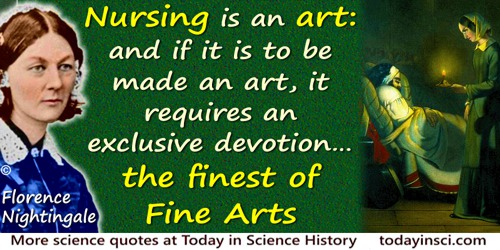
Nursing is an art: and if it is to be made an art, it requires an exclusive devotion as hard a preparation as any painter’s or sculptor’s work; for what is the having to do with dead canvas or dead marble, compared with having to do with the living body, the temple of God’s spirit? It is one of the Fine Arts: I had almost said, the finest of Fine Arts.
First published as a eulogy to an unnamed nurse in 'Una and the Lion', Good Words (1 Jun 1868), 360-366. Reprinted in Una and the Lion (1871), 6.
OCEAN, n. A body of water occupying about two-thirds of a world made for man—who has no gills.
The Collected Works of Ambrose Bierce (1911), Vol. 7, The Devil's Dictionary, 235.
Of all the constituents of the human body, bone is the hardest, the driest, the earthiest, and the coldest; and, excepting only the teeth, it is devoid of sensation. God, the great Creator of all things, formed its substance to this specification with good reason, intending it to be like a foundation for the whole body; for in the fabric of the human body bones perform the same function as do walls and beams in houses, poles in tents, and keels and ribs in boats.
Bones Differentiated by Function
Some bones, by reason of their strength, form as it were props for the body; these include the tibia, the femur, the spinal vertebrae, and most of the bony framework. Others are like bastions, defense walls, and ramparts, affording natural protection to other parts; examples are the skull, the spines and transverse processes of the vertebrae, the breast bone, the ribs. Others stand in front of the joints between certain bones, to ensure that the joint does not move too loosely or bend to too acute an angle. This is the function of the tiny bones, likened by the professors of anatomy to the size of a sesame seed, which are attached to the second internode of the thumb, the first internode of the other four fingers and the first internodes of the five toes. The teeth, on the other hand, serve specifically to cut, crush, pound and grind our food, and similarly the two ossicles in the organ of hearing perform a specifically auditory function.
Bones Differentiated by Function
Some bones, by reason of their strength, form as it were props for the body; these include the tibia, the femur, the spinal vertebrae, and most of the bony framework. Others are like bastions, defense walls, and ramparts, affording natural protection to other parts; examples are the skull, the spines and transverse processes of the vertebrae, the breast bone, the ribs. Others stand in front of the joints between certain bones, to ensure that the joint does not move too loosely or bend to too acute an angle. This is the function of the tiny bones, likened by the professors of anatomy to the size of a sesame seed, which are attached to the second internode of the thumb, the first internode of the other four fingers and the first internodes of the five toes. The teeth, on the other hand, serve specifically to cut, crush, pound and grind our food, and similarly the two ossicles in the organ of hearing perform a specifically auditory function.
From De Humani Corporis Fabrica Libri Septem: (1543), Book I, 1, as translated by William Frank Richardson, in 'Nature of Bone; Function of Bones', On The Fabric of the Human Body: Book I: The Bones and Cartilages (1998), 1.
Of several bodies all equally larger and distant, that most brightly illuminated will appear to the eye nearest and largest.
…...
On careful examination the physicist finds that in the sense in which he uses language no meaning at all can be attached to a physical concept which cannot ultimately be described in terms of some sort of measurement. A body has position only in so far as its position can be measured; if a position cannot in principle be measured, the concept of position applied to the body is meaningless, or in other words, a position of the body does not exist. Hence if both the position and velocity of electron cannot in principle be measured, the electron cannot have the same position and velocity; position and velocity as expressions of properties which an electron can simultaneously have are meaningless.
Reflections of a Physicist (1950), 90.
Once it happened that all the other members of a man mutinied against the stomach, which they accused as the single, idle, uncontributing part in the entire body, while the rest were put to hardships and the expense of much labor to supply and minister to its appetites. However, the stomach merely ridiculed the fatuity of the members, who appeared not to be aware that the stomach certainly does receive the general nourishment, but only to return it again and distribute it amongst the rest.
Fable related by Menenius Agrippa to resolve a grievance of plebeians against the social hierarchy, described in 'Life of Coriolanus', collected in A.H. Clough (ed.), Plutarch’s Lives of Illustrious Men (1859, 1881), 155.
One day when the whole family had gone to a circus to see some extraordinary performing apes, I remained alone with my microscope, observing the life in the mobile cells of a transparent star-fish larva, when a new thought suddenly flashed across my brain. It struck me that similar cells might serve in the defence of the organism against intruders. Feeling that there was in this something of surpassing interest, I felt so excited that I began striding up and down the room and even went to the seashore in order to collect my thoughts.
I said to myself that, if my supposition was true, a splinter introduced into the body of a star-fish larva, devoid of blood-vessels or of a nervous system, should soon be surrounded by mobile cells as is to be observed in a man who runs a splinter into his finger. This was no sooner said than done.
There was a small garden to our dwelling, in which we had a few days previously organised a 'Christmas tree' for the children on a little tangerine tree; I fetched from it a few rose thorns and introduced them at once under the skin of some beautiful star-fish larvae as transparent as water.
I was too excited to sleep that night in the expectation of the result of my experiment, and very early the next morning I ascertained that it had fully succeeded.
That experiment formed the basis of the phagocyte theory, to the development of which I devoted the next twenty-five years of my life.
I said to myself that, if my supposition was true, a splinter introduced into the body of a star-fish larva, devoid of blood-vessels or of a nervous system, should soon be surrounded by mobile cells as is to be observed in a man who runs a splinter into his finger. This was no sooner said than done.
There was a small garden to our dwelling, in which we had a few days previously organised a 'Christmas tree' for the children on a little tangerine tree; I fetched from it a few rose thorns and introduced them at once under the skin of some beautiful star-fish larvae as transparent as water.
I was too excited to sleep that night in the expectation of the result of my experiment, and very early the next morning I ascertained that it had fully succeeded.
That experiment formed the basis of the phagocyte theory, to the development of which I devoted the next twenty-five years of my life.
In Olga Metchnikoff, Life of Elie Metchnikoff 1845-1916 (1921), 116-7.
One of the grandest generalizations formulated by modern biological science is that of the continuity of life; the protoplasmic activity within each living body now on earth has continued without cessation from the remote beginnings of life on our planet, and from that period until the present no single organism has ever arisen save in the form of a bit of living protoplasm detached from a pre-existing portion; the eternal flame of life once kindled upon this earth has passed from organism to organism, and is still, going on existing and propagating, incarnated within the myriad animal and plant forms of everyday life.
In History of the Human Body (1919), 1.
One of the great triumphs of 20th Century astrophysics, was tracing the elements of your body, of all the elements around us, to the actions of stars—that crucible in the centers of stars that cooked basic elements into heavier elements, light elements into heavy elements. (I say “cooked”—I mean thermonuclear fusion.) The heat brings them together, gets you bigger atoms, that then do other interesting chemical things, fleshing out the contents of the Periodic Table.
From interview, The Science Studio video series of The Science Network website, episode 'The Moon, the Tides and why Neil DeGrasse Tyson is Colbert’s God' (20 Jan 2011), time 20:53-21:25.
One of the most curious and interesting reptiles which I met with in Borneo was a large tree-frog, which was brought me by one of the Chinese workmen. He assured me that he had seen it come down in a slanting direction from a high tree, as if it flew. On examining it, I found the toes very long and fully webbed to their very extremity, so that when expanded they offered a surface much larger than the body. The forelegs were also bordered by a membrane, and the body was capable of considerable inflation. The back and limbs were of a very deep shining green colour, the undersurface and the inner toes yellow, while the webs were black, rayed with yellow. The body was about four inches long, while the webs of each hind foot, when fully expanded, covered a surface of four square inches, and the webs of all the feet together about twelve square inches. As the extremities of the toes have dilated discs for adhesion, showing the creature to be a true tree frog, it is difficult to imagine that this immense membrane of the toes can be for the purpose of swimming only, and the account of the Chinaman, that it flew down from the tree, becomes more credible. This is, I believe, the first instance known of a “flying frog,” and it is very interesting to Darwinians as showing that the variability of the toes which have been already modified for purposes of swimming and adhesive climbing, have been taken advantage of to enable an allied species to pass through the air like the flying lizard. It would appear to be a new species of the genus Rhacophorus, which consists of several frogs of a much smaller size than this, and having the webs of the toes less developed.
Malay Archipelago
One of the most poetic facts I know about the universe is that essentially every atom in your body was once inside a star that exploded. Moreover, the atoms in your left hand probably came from a different star than did those in your right. We are all, literally, star children, and our bodies made of stardust.
In A Universe from Nothing: Why There Is Something Rather than Nothin (2012, pb 2013), 17.
One orbit, with a radius of 42,000 kilometers, has a period of exactly 24 hours. A body in such an orbit, if its plane coincided with that of the Earth’s equator, would revolve with the Earth and would thus be stationary above the same spot on the planet. It would remain fixed in the sky of a whole hemisphere ... [to] provide coverage to half the globe, and for a world service three would be required, though more could be readily utilized. (1945) [Predidicting geosynchronous communication satellites]
In 'Can Rocket Stations Give Worldwide Coverage?', Wireless World (Oct 1945). Quoted and cited in Arthur C. Clarke, Greetings, Carbon-Based Bipeds!: Collected Essays, 1934-1998, 22.
One reason which has led the organic chemist to avert his mind from the problems of Biochemistry is the obsession that the really significant happenings in the animal body are concerned in the main with substances of such high molecular weight and consequent vagueness of molecular structure as to make their reactions impossible of study by his available and accurate methods. There remains, I find, pretty widely spread, the feeling—due to earlier biological teaching—that, apart from substances which are obviously excreta, all the simpler products which can be found in cells or tissues are as a class mere objects, already too remote from the fundamental biochemical events to have much significance. So far from this being the case, recent progress points in the clearest way to the fact that the molecules with which a most important and significant part of the chemical dynamics of living tissues is concerned are of a comparatively simple character.
In 'The Dynamic Side of Biochemistry', Address (11 Sep 1913) in Report on the 83rd Meeting of the British Association for the Advancement of Science (1914), 657-8.
![Ernest Henry Starling quote: Only by following out the injunction of our great predecessor [William Harvey] to search out and st](https://todayinsci.com/S/Starling_Ernest/StarlingErnest-Mastery500x250px.jpg)
Only by following out the injunction of our great predecessor [William Harvey] to search out and study the secrets of Nature by way of experiment, can we hope to attain to a comprehension of 'the wisdom of the body and the understanding of the heart,' and thereby to the mastery of disease and pain, which will enable us to relieve the burden of mankind.
'The Wisdom of the Body', The Lancet (1923), 205, 870.
Our minds are lazier than our bodies.
…...
Our view is that there is a matter of the perceptible bodies, but that this is not separable but is always together with a contrariety, from which the so-called “elements” come to be.
As quoted in Christopher Shields, The Oxford Handbook of Aristotle (2012). 218.
People say the effect is only on the mind. It is no such thing. The effect is on the body, too. Little as we know about the way in which we are affected by form, by color, and light, we do know this, that they have an actual physical effect. Variety of form and brilliancy of color in the objects presented to patients, are actual means of recovery.
Notes on Nursing: What it is and what it is not (1860), 84.
Perfect health is above gold; a sound body before riches.
Ecclesiasticus
Philosophers say, that Man is a Microcosm, or little World, resembling in Miniature every Part of the Great: And, in my Opinion, the Body Natural may be compared to the Body Politic: and if this be so, how can the Epicureans Opinion be true, that the Universe was formed by a fortuitous Concourse of Atoms; which I will no more believe, than that the accidental Jumbling of the Letters of the Alphabet, could fall by Chance into a most ingenious and learned Treatise of Philosophy. Risum teneatis Amici, Hor.
In 'A Tritical Essay Upon the Faculties of the Mind' (6 Aug 1707), collected in various volumes and editions, for example, The Works of J.S, D.D, D.S.P.D.: Volume 1: Miscellanies in Prose (1739), 173. An earlier, undated, fourth volume of Miscellanies gives the 6 Aug 1707 date the essay was written. The final Latin phrase can be translated as, “Can you help laughing, friends?” attributed to Horace. In Jonathan Swift and Temple Scott (ed.), The Prose Works of Jonathan Swift: A Tale of a Tub: the Battle of the Books, and Other Early Works (1897, reprint 1907), Vol. 1, 291, the editor footnotes that “this essay is a parody on the pseudo-philosophical essays of the time, in which all sense was lost in the maze of inconsequential quotations.” Indeed, the rest of the essay is, by design, a jumble of disjointed thoughts and makes next to no sense.
Physics is NOT a body of indisputable and immutable Truth; it is a body of well-supported probable opinion only .... Physics can never prove things the way things are proved in mathematics, by eliminating ALL of the alternative possibilities. It is not possible to say what the alternative possibilities are.... Write down a number of 20 figures; if you multiply this by a number of, say, 30 figures, you would arrive at some enormous number (of either 49 or 50 figures). If you were to multiply the 30-figure number by the 20-figure number you would arrive at the same enormous 49- or 50-figure number, and you know this to be true without having to do the multiplying. This is the step you can never take in physics.
In Science is a Sacred Cow (1950), 68, 88, 179.
Physio-philosophy has to show how, and in accordance indeed with what laws, the Material took its origin; and, therefore, how something derived its existence from nothing. It has to portray the first periods of the world's development from nothing; how the elements and heavenly bodies originated; in what method by self-evolution into higher and manifold forms, they separated into minerals, became finally organic, and in Man attained self-consciousness.
In Lorenz Oken, trans. by Alfred Tulk, Elements of Physiophilosophy (1847), 1.
Plasticity, then, in the wide sense of the word, means the possession of a structure weak enough to yield to an influence, but strong enough not to yield all at once. Each relatively stable phase of equilibrium in such a structure is marked by what we may call a new set of habits. Organic matter, especially nervous tissue, seems endowed with a very extraordinary degree of plasticity of this sort ; so that we may without hesitation lay down as our first proposition the following, that the phenomena of habit in living beings are due to plasticity of the organic materials of which their bodies are composed.
'The Laws of Habit', The Popular Science Monthly (Feb 1887), 434.
Poore soule, in this thy flesh what do'st thou know?
Thou know'st thy selfe so little, as thou know'st not.
How thou did'st die, nor how thou wast begot.
Thou neither know'st how thou at first camest in,
Nor how thou took'st the poyson of mans sin.
Nor dost thou, (though thou know'st, that thou art so)
By what way thou art made immortall, know.
Thou art too narrow, wretch, to comprehend
Even thy selfe; yea though thou wouldst but bend
To know thy body. Have not all soules thought
For many ages, that our body'is wrought
Of Ayre, and Fire, and other Elements?
And now they thinke of new ingredients,
And one soule thinkes one, and another way
Another thinkes, and 'tis an even lay.
Knowst thou but how the stone doth enter in
The bladder's Cave, and never breake the skin?
Knowst thou how blood, which to the hart doth flow,
Doth from one ventricle to th'other go?
And for the putrid stuffe, which thou dost spit,
Knowst thou how thy lungs have attracted it?
There are no passages, so that there is
(For aught thou knowst) piercing of substances.
And of those many opinions which men raise
Of Nailes and Haires, dost thou know which to praise?
What hope have we to know our selves, when wee
Know not the least things, which for our use bee?
Thou know'st thy selfe so little, as thou know'st not.
How thou did'st die, nor how thou wast begot.
Thou neither know'st how thou at first camest in,
Nor how thou took'st the poyson of mans sin.
Nor dost thou, (though thou know'st, that thou art so)
By what way thou art made immortall, know.
Thou art too narrow, wretch, to comprehend
Even thy selfe; yea though thou wouldst but bend
To know thy body. Have not all soules thought
For many ages, that our body'is wrought
Of Ayre, and Fire, and other Elements?
And now they thinke of new ingredients,
And one soule thinkes one, and another way
Another thinkes, and 'tis an even lay.
Knowst thou but how the stone doth enter in
The bladder's Cave, and never breake the skin?
Knowst thou how blood, which to the hart doth flow,
Doth from one ventricle to th'other go?
And for the putrid stuffe, which thou dost spit,
Knowst thou how thy lungs have attracted it?
There are no passages, so that there is
(For aught thou knowst) piercing of substances.
And of those many opinions which men raise
Of Nailes and Haires, dost thou know which to praise?
What hope have we to know our selves, when wee
Know not the least things, which for our use bee?
Of the Progresse of the Soule. The Second Anniversarie, I. 254-280. The Works of John Donne (Wordsworth edition 1994), 196-7.
Pride is a sense of worth derived from something that is not organically part of us, while self-esteem derives from the potentialities and achievements of the self. We are proud when we identify ourselves with an imaginary self, a leader, a holy cause, a collective body or possessions. There is fear and intolerance in pride; it is sensitive and uncompromising. The less promise and potency in the self, the more imperative is the need for pride. The core of pride is self-rejection.
In The Passionate State of Mind (1955), 23.
Psychology is a part of the science of life or biology. … As the physiologist inquires into the way in which the so-called “functions” of the body are performed, so the psychologist studies the so-called “faculties” of the mind.
In Hume (1879), 50.
Recognize that the very molecules that make up your body, the atoms that construct the molecules, are traceable to the crucibles that were once the centers of high mass stars that exploded their chemically rich guts into the galaxy, enriching pristine gas clouds with the chemistry of life. So that we are all connected to each other biologically, to the earth chemically and to the rest of the universe atomically. That’s kinda cool! That makes me smile and I actually feel quite large at the end of that. It’s not that we are better than the universe, we are part of the universe. We are in the universe and the universe is in us.
From a History Channel TV show, (?) The Universe.
Red is the color in which the interior of the body is painted. If an operation be thought of as a painting in progress, and blood red the color on the brush, it must be suitably restrained and attract no undue attention; yet any insufficiency of it will increase the perishability of the canvas.
In 'Letter to a Young Surgeon II', Letters to a Young Doctor (1996), 47.
Rudolf Virchow, often referred to as the father of modern pathology, broke sharply with such traditional concepts by proposing that the basis of all disease is injury to the smallest living unit of the body, namely, the cell. More than a century later, both clinical and experimental
pathology remain rooted in Virchow’s cellular pathology.
In Emanuel Rubin and John L. Farber (eds.), Pathology (1944), 2.
Sarcophagus is a stone that devours dead bodies, for in Greek σάρκος means “flesh” and φαγώ “eating”. Some of the ancients first made coffins for the dead of this stone because in the space of thirty days it consumed the dead… . For this reason stone monuments are called sarcophagi.
From De Mineralibus (c.1261-1263), as translated by Dorothy Wyckoff, Book of Minerals (1967), 116.
Science deals with judgments on which it is possible to obtain universal agreement. These judgments do not concern individual facts and events, but the invariable association of facts and events known as the laws of science. Agreement is secured by observation and experiment—impartial courts of appeal to which all men must submit if they wish to survive. The laws are grouped and explained by theories of ever increasing generality. The theories at first are ex post facto—merely plausible interpretations of existing bodies of data. However, they frequently lead to predictions that can be tested by experiments and observations in new fields, and, if the interpretations are verified, the theories are accepted as working hypotheses until they prove untenable. The essential requirements are agreement on the subject matter and the verification of predictions. These features insure a body of positive knowledge that can be transmitted from person to person, and that accumulates from generation to generation.
From manuscript on English Science in the Renaissance (1937), Edwin Hubble collection, Box 2, Huntington Library, San Marino, California. As cited by Norriss S. Hetherington in 'Philosophical Values and Observation in Edwin Hubble's Choice of a Model of the Universe', Historical Studies in the Physical Sciences (1982), 13, No. 1, 41. (Hetherington comments parenthetically that the references to court, judgment and appeal may be attributable to his prior experiences as a Rhodes Scholar reading Roman law at Oxford, and to a year's practice as an attorney in Louisville, Kentucky.)
Science does not mean an idle resting upon a body of certain knowledge; it means unresting endeavor and continually progressing development toward an end which the poetic intuition may apprehend, but which the intellect can never fully grasp.
In The Philosophy of Physics (1936). Collected in The New Science: 3 Complete Works (1959), 290.
Science is a body of truths which offers clear and certain knowledge about the real world and is therefore superior to tradition philosophy religion dogma and superstition which offer shadowy knowledge about an ideal world.
Need primary source (can you help?).
Science is a way of thinking much more than it is a body of knowledge.
Broca’s Brain: Reflections on the Romance of Science (1979, 1986), 15.
Science is in a literal sense constructive of new facts. It has no fixed body of facts passively awaiting explanation, for successful theories allow the construction of new instruments—electron microscopes and deep space probes—and the exploration of phenomena that were beyond description—the behavior of transistors, recombinant DNA, and elementary particles, for example. This is a key point in the progressive nature of science—not only are there more elegant or accurate analyses of phenomena already known, but there is also extension of the range of phenomena that exist to be described and explained.
Co-author with Michael A. Arbib, English-born professor of computer science and biomedical engineering (1940-)
Co-author with Michael A. Arbib, English-born professor of computer science and biomedical engineering (1940-)
Michael A. Arbib and Mary B. Hesse, The Construction of Reality (1986), 8.
Science is not about building a body of known “facts”. It is a method for asking awkward questions and subjecting them to a reality-check, thus avoiding the human tendency to believe whatever makes us feel good.
With co-author Jack Cohen. In Terry Pratchett, Ian Stewart and Jack Cohen, Chap. 10, 'The Shape of Things', The Science of Discworld (1999), 78. Pratchett wrote the fantasy story told in the odd-numbered chapters. Following each, relevant real science is provided by his co-authors, Stewart and Cohen, in the even-numbered chapters (such as Chap. 10), but which of the two wrote which lines, is not designated.
Science is the one human activity that is truly progressive. The body of positive knowledge is transmitted from generation to generation.
In The Realm of the Nebulae (1936), 1.
Science tries to answer the question: ‘How?’ How do cells act in the body? How do you design an airplane that will fly faster than sound? How is a molecule of insulin constructed? Religion, by contrast, tries to answer the question: ‘Why?’ Why was man created? Why ought I to tell the truth? Why must there be sorrow or pain or death? Science attempts to analyze how things and people and animals behave; it has no concern whether this behavior is good or bad, is purposeful or not. But religion is precisely the quest for such answers: whether an act is right or wrong, good or bad, and why.
Science and Imagination, ch. 4, Basic Books (1967).
Science will continue to surprise us with what it discovers and creates; then it will astound us by devising new methods to surprise us. At the core of science’s self-modification is technology. New tools enable new structures of knowledge and new ways of discovery. The achievement of science is to know new things; the evolution of science is to know them in new ways. What evolves is less the body of what we know and more the nature of our knowing.
'Speculations on the Future of Science'. In Clifford A. Pickover, Archimedes to Hawking: Laws of Science and the Great Minds Behind Them (2008), 172.
Scientific physiology has the task of determining the functions of the animal body and deriving them as a necessary consequence from its elementary conditions.
Lehrbuch der Physiologie des Menschens (1852), Vol 1, 1. Trans. Paul F. Cranefield, 'The Organic Physics of 1847 and the Biophysics of Today', Journal of the History of Medicine and Allied Sciences (1957), 12, 410.
Scientists [still] refuse to consider man as an object of scientific scrutiny except through his body. The time has come to realise that an interpretation of the universe—even a positivist one—remains unsatisfying unless it covers the interior as well as the exterior of things; mind as well as matter. The true physics is that which will, one day, achieve the inclusion of man in his wholeness in a coherent picture of the world.
In Teilhard de Chardin and Bernard Wall (trans.), The Phenomenon of Man (1959, 2008), 36. Originally published in French as Le Phénomene Humain (1955).
She has the sort of body you go to see in marble. She has golden hair. Quickly, deftly, she reaches with both hands behind her back and unclasps her top. Setting it on her lap, she swivels ninety degrees to face the towboat square. Shoulders back, cheeks high, she holds her pose without retreat. In her ample presentation there is defiance of gravity. There is no angle of repose. She is a siren and these are her songs.
…...
Signs and symptoms indicate the present, past and future states of the three states of the body (health, illness, neutrality). According to Galen, knowledge of the present state is of advantage only to the patient as it helps him to follow the proper course of management. Knowledge of the past state is useful only to the physician inasmuch as its disclosure by him to the patient brings him a greater respect for his professional advice. Knowledge of the future state is useful to both. It gives an opportunity to the patient to be forewarned to adopt necessary preventative measures and it enhances the reputation of the physician by correctly forecasting the future developments.
— Avicenna
'The Signs and Symptoms (Diagnosis): General Remarks,' in The Canon of Medicine, adapted by L. Bakhtiar (1999), 259.
Since as the Creation is, so is the Creator also magnified, we may conclude in consequence of an infinity, and an infinite all-active power, that as the visible creation is supposed to be full of siderial systems and planetary worlds, so on, in like similar manner, the endless Immensity is an unlimited plenum of creations not unlike the known Universe.… That this in all probability may be the real case, is in some degree made evident by the many cloudy spots, just perceivable by us, as far without our starry Regions, in which tho’ visibly luminous spaces, no one Star or particular constituent body can possibly be distinguished; those in all likelyhood may be external creation, bordering upon the known one, too remote for even our Telescopes to reach.
In The Universe and the Stars: Being an Original Theory on the Visible Creation, Founded on the Laws of Nature (1750, 1837), 143-144.
Since Pawlow [Pavlov] and his pupils have succeeded in causing the secretion of saliva in the dog by means of optic and acoustic signals, it no longer seems strange to us that what the philosopher terms an 'idea' is a process which can cause chemical changes in the body.
The Mechanistic Conception of Life (1912), 63.
Sometimes I doubt whether there is divine justice; all parts of the human body get tired eventually—except the tongue. And I feel this is unjust.
Such is the character of mathematics in its profounder depths and in its higher and remoter zones that it is well nigh impossible to convey to one who has not devoted years to its exploration a just impression of the scope and magnitude of the existing body of the science. An imagination formed by other disciplines and accustomed to the interests of another field may scarcely receive suddenly an apocalyptic vision of that infinite interior world. But how amazing and how edifying were such a revelation, if it only could be made.
In Lectures on Science, Philosophy and Art (1908), 6.
Surely the claim of mathematics to take a place among the liberal arts must now be admitted as fully made good. Whether we look at the advances made in modern geometry, in modern integral calculus, or in modern algebra, in each of these three a free handling of the material employed is now possible, and an almost unlimited scope is left to the regulated play of fancy. It seems to me that the whole of aesthetic (so far as at present revealed) may be regarded as a scheme having four centres, which may be treated as the four apices of a tetrahedron, namely Epic, Music, Plastic, and Mathematic. There will be found a common plane to every three of these, outside of which lies the fourth; and through every two may be drawn a common axis opposite to the axis passing through the other two. So far is certain and demonstrable. I think it also possible that there is a centre of gravity to each set of three, and that the line joining each such centre with the outside apex will intersect in a common point the centre of gravity of the whole body of aesthetic; but what that centre is or must be I have not had time to think out.
In 'Proof of the Hitherto Undemonstrated Fundamental Theorem of Invariants', Collected Mathematical Papers (1909), Vol. 3, 123.
Symptoms are the body’s mother tongue; signs are in a foreign language.
…...
Take care of your body. It’s the only place you have to live.
— Jim Rohn
Found quoted in various books, but without a citation. Webmaster has found no primary source yet. Can you help?
That many very remarkable change and involuntary motions are sudden produced in the body by various affections of the mind, is undeniably evinced from a number of facts. Thus fear often causes a sudden and uncommon flow of pale urine. Looking much at one troubled with sore eyes, has sometimes affected the spectator with the same disease.—Certain sounds cause a shivering over the whole body.—The noise of a bagpipe has raised in some persons an inclination to make urine.—The sudden appearance of any frightful object, will, in delicate people, cause an uncommon palpitation of the heart.—The sight of an epileptic person agitated with convulsions, has brought on an epilepsy; and yawning is so very catching, as frequently to be propagated through whole companies.
In An Essay on the Vital and Other Involuntary Motions of Animals (1751), 253-254.
That the Anatomy of the Nerves yields more pleasant and profitable Speculations, than the Theory of any parts besides in the animated Body: for from hence the true and genuine Reasons are drawn of very many Actions and Passions that are wont to happen in our Body, which otherwise seem most difficult and unexplicable; and no less from this Fountain the hidden Causes of Diseases and their Symptoms, which commonly are ascribed to the Incantations of Witches, may be found out and clearly laid open. But as to our observations about the Nerves, from our following Discourse it will plainly appear, that I have not trod the paths or footsteps of others, nor repeated what hath been before told.
In Anatomy of the Brain and Nerves (1664), trans. Samuel Pordage (1681), reprinted in William Peindel (ed.), Thomas Willis: Anatomy of the Brain and Nerves (1965), Vol. 2, 125.
That the machine of Heaven is not a hard and impervious body full of various real spheres, as up to now has been believed by most people. It will be proved that it extends everywhere, most fluid and simple, and nowhere presents obstacles as was formerly held, the circuits of the Planets being wholly free and without the labour and whirling round of any real spheres at all, being divinely governed under a given law.
De Mundi Aetherei Recentioribus Phaenomenis (On Recent Phenomena in the Aetherial World) (1588). Quoted in M. Boas Hall, The Scientific Renaissance 1450-1630 (1962), 117.
That there is a Spring, or Elastical power in the Air we live in. By which ελατνρ [elater] or Spring of the Air, that which I mean is this: That our Air either consists of, or at least abounds with, parts of such a nature, that in case they be bent or compress'd by the weight of the incumbent part of the Atmosphere, or by any other Body, they do endeavour, as much as in them lies, to free themselves from that pressure, by bearing against the contiguous Bodies that keep them bent.
New Experiments Physico-Mechanical Touching the Spring of the Air (1660), 22.
The Qualities then that are in Bodies rightly considered, are of Three sorts.
First, the Bulk, Figure, Number, Situation, and Motion, or Rest of their solid Parts; those are in them, whether we perceive them or no; and when they are of that size, that we can discover them, we have by these an Idea of the thing, as it is in it self, as is plain in artificial things. These I call primary Qualities.
Secondly, The Power that is in any Body, by Reason of its insensible primary Qualities, to operate after a peculiar manner on any of our Senses, and thereby produce in us the different Ideas of several Colours, Sounds, Smells, Tastes, etc. These are usually called sensible Qualities.
Thirdly, The Power that is in any Body, by Reason of the particular Constitution of its primary Qualities, to make such a change in the Bulk, Figure, Texture, and Motion of another Body, as to make it operate on our Senses, differently from what it did before. Thus the Sun has a Power to make Wax white, and Fire to make Lead fluid. These are usually called Powers.
First, the Bulk, Figure, Number, Situation, and Motion, or Rest of their solid Parts; those are in them, whether we perceive them or no; and when they are of that size, that we can discover them, we have by these an Idea of the thing, as it is in it self, as is plain in artificial things. These I call primary Qualities.
Secondly, The Power that is in any Body, by Reason of its insensible primary Qualities, to operate after a peculiar manner on any of our Senses, and thereby produce in us the different Ideas of several Colours, Sounds, Smells, Tastes, etc. These are usually called sensible Qualities.
Thirdly, The Power that is in any Body, by Reason of the particular Constitution of its primary Qualities, to make such a change in the Bulk, Figure, Texture, and Motion of another Body, as to make it operate on our Senses, differently from what it did before. Thus the Sun has a Power to make Wax white, and Fire to make Lead fluid. These are usually called Powers.
An Essay Concerning Human Understanding (1690). Edited by Peter Nidditch (1975), Book 2, Chapter 8, Section 23, 140-1.
The actual evolution of mathematical theories proceeds by a process of induction strictly analogous to the method of induction employed in building up the physical sciences; observation, comparison, classification, trial, and generalisation are essential in both cases. Not only are special results, obtained independently of one another, frequently seen to be really included in some generalisation, but branches of the subject which have been developed quite independently of one another are sometimes found to have connections which enable them to be synthesised in one single body of doctrine. The essential nature of mathematical thought manifests itself in the discernment of fundamental identity in the mathematical aspects of what are superficially very different domains. A striking example of this species of immanent identity of mathematical form was exhibited by the discovery of that distinguished mathematician … Major MacMahon, that all possible Latin squares are capable of enumeration by the consideration of certain differential operators. Here we have a case in which an enumeration, which appears to be not amenable to direct treatment, can actually be carried out in a simple manner when the underlying identity of the operation is recognised with that involved in certain operations due to differential operators, the calculus of which belongs superficially to a wholly different region of thought from that relating to Latin squares.
In Presidential Address British Association for the Advancement of Science, Sheffield, Section A,
Nature (1 Sep 1910), 84, 290.
The arguments for the two substances [mind and body] have, we believe, entirely lost their validity; they are no longer compatible with ascertained science and clear thinking. The one substance with two sets of properties, two sides, the physical and the mental—a double-faced unity—would appear to comply with all the exigencies of the case. … The mind is destined to be a double study—to conjoin the mental philosopher with the physical philosopher.
From concluding paragraph in Mind and Body: The Theories of their Relation (1872), 195.
The art of causing intemperance and health to exist in the same body is as chimerical as the philosopher’s stone, judicial astrology, and the theology of the magi.
From the original French, “L'art de faire subsister ensemble l'intempérance et la santé, est un art aussi chimérique que la pierre philosophale, l'astrologie judiciaire, et la théologie des magies”, in Zadig. Accompanied with the translation in Craufurd Tait Ramage, Beautiful Thoughts from French and Italian Authors (1866), 371.
The bird which is drawn to the water by its need of finding there the prey on which it lives, separates the digits of its feet in trying to strike the water and move about on the surface. The skin which unites these digits at their base acquires the habit of being stretched by these continually repeated separations of the digits; thus in course of time there are formed large webs which unite the digits of ducks, geese, etc., as we actually find them. In the same way efforts to swim, that is to push against the water so as to move about in it, have stretched the membranes between the digits of frogs, sea-tortoises, the otter, beaver, etc.
On the other hand, a bird which is accustomed to perch on trees and which springs from individuals all of whom had acquired this habit, necessarily has longer digits on its feet and differently shaped from those of the aquatic animals that I have just named. Its claws in time become lengthened, sharpened and curved into hooks, to clasp the branches on which the animal so often rests.
We find in the same way that the bird of the water-side which does not like swimming and yet is in need of going to the water's edge to secure its prey, is continually liable to sink into the mud. Now this bird tries to act in such a way that its body should not be immersed in the liquid, and hence makes its best efforts to stretch and lengthen its legs. The long-established habit acquired by this bird and all its race of continually stretching and lengthening its legs, results in the individuals of this race becoming raised as though on stilts, and gradually obtaining long, bare legs, denuded of feathers up to the thighs and often higher still.
On the other hand, a bird which is accustomed to perch on trees and which springs from individuals all of whom had acquired this habit, necessarily has longer digits on its feet and differently shaped from those of the aquatic animals that I have just named. Its claws in time become lengthened, sharpened and curved into hooks, to clasp the branches on which the animal so often rests.
We find in the same way that the bird of the water-side which does not like swimming and yet is in need of going to the water's edge to secure its prey, is continually liable to sink into the mud. Now this bird tries to act in such a way that its body should not be immersed in the liquid, and hence makes its best efforts to stretch and lengthen its legs. The long-established habit acquired by this bird and all its race of continually stretching and lengthening its legs, results in the individuals of this race becoming raised as though on stilts, and gradually obtaining long, bare legs, denuded of feathers up to the thighs and often higher still.
Philosophie Zoologique (1809), Vol. 1, 249-50, trans. Hugh Elliot (1914), 119-20.
The blood in the animal body is impelled in a circle and is in a state of ceaseless motion … and that it is the sole and only end of the motion and contraction of the heart.
In On the Motion of the Heart and Blood (1628) as in edition based on the translation by Willis, Alex. Bowie (ed.), (1889), 71.
The body [of man] is but a pair of pincers set over a bellows and a stew pan and the whole thing fixed on stilts.
Samuel Butler, Henry Festing Jones (ed.), The Note-Books of Samuel Butler (1917), 18.
The body is a cell state in which every cell is a citizen. Disease is merely the conflict of the citizens of the state brought about by the action of external forces. (1858)
From Die Cellularpathologie (1858). As cited in Alan Lindsay Mackay, A Dictionary of Scientific Quotations (1991), 250. Although widely quoted in this form, Webmaster has not yet been able to pin down the source of the translation in these few words. (It might be in Rudolph Virchow translated by Lelland J. Rather, Disease, Life, and Man: Selected Essays (1958), 142-9.) If you know the exact citation to the primary source, please contact Webmaster.
The body is most fully developed from thirty to thirty-five years of age, the mind at about forty-nine.
Rhetoric, II, xiv.
The body knows what it needs. That’s why some things taste good.
Aphorism as given by the fictional character Dezhnev Senior, in Fantastic Voyage II: Destination Brain (1987), 78.
The body may be healed but not the mind.
Chinese proverb.
The body of Benjamin Franklin, Printer (like the cover of an old book, its contents torn out and stripped of its lettering and gilding), lies here, food for worms; but the work shall not be lost, for it will (as he believed) appear once more in a new and more elegant edition, revised and corrected by the Author.
Epitaph on his tombstone
The body of man has in itself blood, phlegm, yellow bile and black bile; these make up the nature of this body, and through these he feels pain or enjoys health. Now he enjoys the most perfect health when these elements are duly proportioned to one another in respect of compounding, power and bulk, and when they are perfectly mingled.
Nature of Man, in Hippocrates, trans. W. H. S. Jones (1931), Vol. 4, II.
The body of science is not, as it is sometimes thought, a huge coherent mass of facts, neatly arranged in sequence, each one attached to the next by a logical string. In truth, whenever we discover a new fact it involves the elimination of old ones. We are always, as it turns out, fundamentally in error.
In 'On Science and Certainty', Discover Magazine (Oct 1980)
The body of the earth is of the nature of a fish... because it draws water as its breath instead of air.
'Philosophy', in The Notebooks of Leonardo da Vinci, trans. E. MacCurdy (1938), Vol. 1 70.
The body of the Earth, large, sluggish and inapt for motion, is not to be disturbed by movement (especially three movements), any more than the Aetherial Lights [stars] are to be shifted, so that such ideas are opposed both to physical principles and to the authority of the Holy Writ which many time: confirms the stability of the Earth (as we shall discuss more fully elsewhere).
De Mundi Aetherei Recentioribus Phaenomenis (On Recent Phenomena in the Aetherial World) (1588). Quoted in M. Boas Hall, The Scientific Renaissance 1450-1630 (1962), 115.
The brain that isn’t used rusts. The brain that is used responds. The brain is exactly like any other part of the body: it can be strengthened by proper exercise, by proper use. Put your arm in a sling and keep it there for a considerable length of time, and, when you take it out, you find that you can’t use it. In the same way, the brain that isn’t used suffers atrophy.
As quoted from an interview by B.C. Forbes in The American Magazine (Jan 1921), 10.
The calculus is to mathematics no more than what experiment is to physics, and all the truths produced solely by the calculus can be treated as truths of experiment. The sciences must proceed to first causes, above all mathematics where one cannot assume, as in physics, principles that are unknown to us. For there is in mathematics, so to speak, only what we have placed there… If, however, mathematics always has some essential obscurity that one cannot dissipate, it will lie, uniquely, I think, in the direction of the infinite; it is in that direction that mathematics touches on physics, on the innermost nature of bodies about which we know little….
In Elements de la géométrie de l'infini (1727), Preface, ciii. Quoted as a footnote to Michael S. Mahoney, 'Infinitesimals and Transcendent Relations: The Mathematics of Motion in the Late Seventeenth Century', collected in David C. Lindberg and Robert S. Westman (eds.), Reappraisals of the Scientific Revolution (1990), 489-490, footnote 46
The cerebrum I consider as the grand organ by which the mind is united to the body. Into it all the nerves from the external organs of the senses enter; and from it all the nerves which are agents of the will pass out.
Idea of a New Anatomy of the Brain (1811), 27.
The changing of Bodies into Light, and Light into Bodies, is very conformable to the Course of Nature, which seems delighted with Transmutations.
Opticks, 2nd edition (1718), Book 3, Query 30, 349.
The chemist studies the effects produced by heat and by mixture, in all bodies, or mixtures of bodies, natural or artificial, and studies them with a view to the improvement of arts, and the knowledge of nature.
Restating his own definition in fewer words, from the first of a series of lectures on chemistry, collected in John Robison (ed.), Lectures on the Elements of Chemistry: Delivered in the University of Edinburgh (1807), Vol. 1, 11.
The combination of some data and an aching desire for an answer does not ensure that a reasonable answer can be extracted from a given body of data.
In 'Sunset Salvo', The American Statistician (Feb 1986), 40, No. 1, 74-75.
The constant conditions which are maintained in the body might be termed equilibria. That word, however, has come to have fairly exact meaning as applied to relatively simple physico-chemical states, in closed systems, where known forces are balanced. The coordinated physiological processes which maintain most of the steady states in the organism are so complex and so peculiar to living beings—involving, as they may, the brain and nerves, the heart, lungs, kidneys and spleen, all working cooperatively—that I have suggested a special designation for these states, homeostasis. The word does not imply something set and immobile, a stagnation. It means a condition—a condition which may vary, but which is relatively constant.
In The Wisdom of the Body (1932), 24.
The determination of the average man is not merely a matter of speculative curiosity; it may be of the most important service to the science of man and the social system. It ought necessarily to precede every other inquiry into social physics, since it is, as it were, the basis. The average man, indeed, is in a nation what the centre of gravity is in a body; it is by having that central point in view that we arrive at the apprehension of all the phenomena of equilibrium and motion.
A Treatise on Man and the Development of his Faculties (1842). Reprinted with an introduction by Solomon Diamond (1969), 96.
The development of statistics are causing history to be rewritten. Till recently the historian studied nations in the aggregate, and gave us only the story of princes, dynasties, sieges, and battles. Of the people themselves—the great social body with life, growth, sources, elements, and laws of its own—he told us nothing. Now statistical inquiry leads him into the hovels, homes, workshops, mines, fields, prisons, hospitals, and all places where human nature displays its weakness and strength. In these explorations he discovers the seeds of national growth and decay, and thus becomes the prophet of his generation.
Speech (16 Dec 1867) given while a member of the U.S. House of Representatives, introducing resolution for the appointment of a committee to examine the necessities for legislation upon the subject of the ninth census to be taken the following year. Quoted in John Clark Ridpath, The Life and Work of James A. Garfield (1881), 217.
The digestive canal is in its task a complete chemical factory. The raw material passes through a long series of institutions in which it is subjected to certain mechanical and, mainly, chemical processing, and then, through innumerable side-streets, it is brought into the depot of the body. Aside from this basic series of institutions, along which the raw material moves, there is a series of lateral chemical manufactories, which prepare certain reagents for the appropriate processing of the raw material.
Speech to the Society of Russian Physicians (Dec 1874). as translated in Daniel P. Todes, Pavlov’s Physiology Factory: Experiment, Interpretation, Laboratory Enterprise (2002), 155.
The dogma of the Ghost in the Machine ... maintains that there exist both bodies and minds; that there occur physical processes and mental processes; that there are mechanical causes of corporeal movements and mental causes of corporeal movements.
The Concept of Mind (1949), 22.
The drinking of litharge causes oppression of the stomach, belly and intestines, with intense griping pains;… it suppresses the urine, while the body swells and acquires an unsightly leaden hue.
As quoted in H.A. Waldron, 'Lead Poisoning in the Ancient World', Medical History (Oct 1973). 17, No. 4, 395.
The earliest of my childhood recollections is being taken by my grandfather when he set out in the first warm days of early spring with a grubbing hoe (we called it a mattock) on his shoulder to seek the plants, the barks and roots from which the spring medicine for the household was prepared. If I could but remember all that went into that mysterious decoction and the exact method of preparation, and with judicious advertisement put the product upon the market, I would shortly be possessed of wealth which might be made to serve the useful purpose of increasing the salaries of all pathologists. … But, alas! I remember only that the basic ingredients were dogwood bark and sassafras root, and to these were added q.s. bloodroot, poke and yellow dock. That the medicine benefited my grandfather I have every reason to believe, for he was a hale, strong old man, firm in body and mind until the infection came against which even spring medicine was of no avail. That the medicine did me good I well know, for I can see before me even now the green on the south hillside of the old pasture, the sunlight in the strip of wood where the dogwood grew, the bright blossoms and the delicate pale green of the leaf of the sanguinaria, and the even lighter green of the tender buds of the sassafras in the hedgerow, and it is good to have such pictures deeply engraved in the memory.
From address, 'A Medical Retrospect'. Published in Yale Medical Journal (Oct 1910), 17, No. 2, 57. [Note: q.s. in an abbreviation for quantum sufficit meaning “as much as is sufficient,” when used as a quantity specification in medicine and pharmacology. -Webmaster]
The electrical engineer has an enormous advantage over other engineers; everything lends itself to exact calculation, and a completed machine or any of its parts may he submitted to the most searching electrical and magnetic tests, since these tests, unlike those applied by other engineers, do not destroy the body tested.
From Opening Address, Engineering Section, British Association meeting, Belfast. ,In Norman Lockyer (ed.), Nature (25 Sep 1902), 66, No. 1717, 536.
The electrical matter consists of particles extremely subtile, since it can permeate common matter, even the densest metals, with such ease and freedom as not to receive any perceptible resistance.
If anyone should doubt whether the electrical matter passes through the substance of bodies, or only over along their surfaces, a shock from an electrified large glass jar, taken through his own body, will probably convince him.
Electrical matter differs from common matter in this, that the parts of the latter mutually attract, those of the former mutually repel each other.
If anyone should doubt whether the electrical matter passes through the substance of bodies, or only over along their surfaces, a shock from an electrified large glass jar, taken through his own body, will probably convince him.
Electrical matter differs from common matter in this, that the parts of the latter mutually attract, those of the former mutually repel each other.
'Opinions and Conjectures, Concerning the Properties and Effects of the Electrical Matter, arising from Experiments and Observations, made at Philadelphia, 1749.' In I. Bernard Cohen (ed.), Benjamin Franklin's Experiments (1941), 213.
The elements of the living body have the chemical peculiarity of forming with each other most numerous combinations and very large molecules, consisting of five, six or even seven different elements.
In discourse (10 Dec 1893) to General Meeting, Nassau Association for Natural Science, Wiesbaden, Germany. Printed in 'The Distribution of the Organic Elements', The Chemical News and Journal of Industrial Science (1895), 71, No. 1832, 19.
The ends to be attained [in Teaching of Mathematics in the secondary schools] are the knowledge of a body of geometrical truths, the power to draw correct inferences from given premises, the power to use algebraic processes as a means of finding results in practical problems, and the awakening of interest in the science of mathematics.
In 'Aim of the Mathematical Instruction', International Commission on Teaching of Mathematics, American Report: United States Bureau of Education: Bulletin 1912, No. 4, 7.
The entire cosmos is made out of one and the same world-stuff, operated by the same energy as we ourselves. “Mind” and “matter” appears as two aspects of our unitary mind-bodies. There is no separate supernatural realm: all phenomena are part of one natural process of evolution. There is no basic cleavage between science and religion; they are both organs of evolving humanity.
In essay, 'The New Divinity', originally published in The Twentieth Century (1962), 170, 9. Collected in Essays of a Humanist (1964), 218.
The entire human body is disposed for a vertical posture.
The estimate we form of the intellectual capacity of our race, is founded on an examination of those productions which have resulted from the loftiest flights of individual genius, or from the accumulated labors of generations of men, by whose long-continued exertions a body of science has been raised up, surpassing in its extent the creative powers of any individual, and demanding for its development a length of time, to which no single life extends.
In The Ninth Bridgewater Treatise: A Fragment (1838), 30.
The evolution of higher and of lower forms of life is as well and as soundly established as the eternal hills. It has long since ceased to be a theory; it is a law of Nature as universal in living things as is the law of gravitation in material things and in the motions of the heavenly spheres.
Evolution and Religion in Education (1926), 118.
The eye is the window of the human body through which it feels its way and enjoys the beauty of the world.
…...
The first acquaintance which most people have with mathematics is through arithmetic. That two and two make four is usually taken as the type of a simple mathematical proposition which everyone will have heard of. … The first noticeable fact about arithmetic is that it applies to everything, to tastes and to sounds, to apples and to angels, to the ideas of the mind and to the bones of the body.
In An Introduction to Mathematics (1911), 9.
The first question which you will ask and which I must try to answer is this, “What is the use of climbing Mount Everest ?” and my answer must at once be, “It is no use.” There is not the slightest prospect of any gain whatsoever. Oh, we may learn a little about the behavior of the human body at high altitudes, and possibly medical men may turn our observation to some account for the purposes of aviation. But otherwise nothing will come of it. We shall not bring back a single bit of gold or silver, not a gem, nor any coal or iron. We shall not find a single foot of earth that can be planted with crops to raise food. It’s no use. So, if you cannot understand that there is something in man which responds to the challenge of this mountain and goes out to meet it, that the struggle is the struggle of life itself upward and forever upward, then you won’t see why we go. What we get from this adventure is just sheer joy. And joy is, after all, the end of life. We do not live to eat and make money. We eat and make money to be able to enjoy life. That is what life means and what life is for.
…...
The following story (here a little softened from the vernacular) was narrated by Lord Kelvin himself when dining at Trinity Hall:
A certain rough Highland lad at the university had done exceedingly well, and at the close of the session gained prizes both in mathematics and in metaphysics. His old father came up from the farm to see his son receive the prizes, and visited the College. Thomson was deputed to show him round the place. “Weel, Mr. Thomson,” asked the old man, “and what may these mathematics be, for which my son has getten a prize?” “I told him,” replied Thomson, “that mathematics meant reckoning with figures, and calculating.” “Oo ay,” said the old man, “he’ll ha’ getten that fra’ me: I were ever a braw hand at the countin’.” After a pause he resumed: “And what, Mr. Thomson, might these metapheesics be?” “I endeavoured,” replied Thomson, “to explain how metaphysics was the attempt to express in language the indefinite.” The old Highlander stood still and scratched his head. “Oo ay: may be he’ll ha’ getten that fra’ his mither. She were aye a bletherin’ body."
A certain rough Highland lad at the university had done exceedingly well, and at the close of the session gained prizes both in mathematics and in metaphysics. His old father came up from the farm to see his son receive the prizes, and visited the College. Thomson was deputed to show him round the place. “Weel, Mr. Thomson,” asked the old man, “and what may these mathematics be, for which my son has getten a prize?” “I told him,” replied Thomson, “that mathematics meant reckoning with figures, and calculating.” “Oo ay,” said the old man, “he’ll ha’ getten that fra’ me: I were ever a braw hand at the countin’.” After a pause he resumed: “And what, Mr. Thomson, might these metapheesics be?” “I endeavoured,” replied Thomson, “to explain how metaphysics was the attempt to express in language the indefinite.” The old Highlander stood still and scratched his head. “Oo ay: may be he’ll ha’ getten that fra’ his mither. She were aye a bletherin’ body."
As given in Life of Lord Kelvin (1910), Vol. 2, 1124, footnote. [Note: William Thomson, later became Lord Kelvin. —Webmaster]
The frying pan you should give to your enemy. Food should not be prepared in fat. Our bodies are adapted to a stone age diet of roots and vegetables.
The fundamental act of medical care is assumption of responsibility. Surgery has assumed responsibility for disease which is largely acute, local or traumatic. This is responsibility for the entire range of injuries and wounds, local infections, benign and malignant tumors, as well as a large fraction of those pathologic processes and anomalies which are localized in the organs of the body. The study of surgery is a study of these diseases, the conditions and details of their care.
Metabolic Care of the Surgical Patient (1959), Preface. In Loyal Davis, David C. Sabiston, Jr., David C. Sabiston, Frederick Christopher, Davis-Christopher Textbook of Surgery (1972), 19.
The generalized theory of relativity has furnished still more remarkable results. This considers not only uniform but also accelerated motion. In particular, it is based on the impossibility of distinguishing an acceleration from the gravitation or other force which produces it. Three consequences of the theory may be mentioned of which two have been confirmed while the third is still on trial: (1) It gives a correct explanation of the residual motion of forty-three seconds of arc per century of the perihelion of Mercury. (2) It predicts the deviation which a ray of light from a star should experience on passing near a large gravitating body, the sun, namely, 1".7. On Newton's corpuscular theory this should be only half as great. As a result of the measurements of the photographs of the eclipse of 1921 the number found was much nearer to the prediction of Einstein, and was inversely proportional to the distance from the center of the sun, in further confirmation of the theory. (3) The theory predicts a displacement of the solar spectral lines, and it seems that this prediction is also verified.
Studies in Optics (1927), 160-1.
The globe of this earth … [is] … not just a machine but also a organised body as it has a regenerative power.
'Theory of the Earth', Transactions of the Royal Society of Edinburgh (1788), as quoted in Keith S. Thomson, 'Vestiges of James Hutton', American Scientist (May-Jun 2001), 89, No. 3, 213.
The heat produced in maximal muscular effort, continued for twenty minutes, would be so great that, if it were not promptly dissipated, it would cause some of the albuminous substances of the body to become stiff, like a hard-boiled egg.
The history of the knowledge of the phenomena of life and of the organized world can be divided into two main periods. For a long time anatomy, and particularly the anatomy of the human body, was the α and ω of scientific knowledge. Further progress only became possible with the discovery of the microscope. A long time had yet to pass until through Schwann the cell was established as the final biological unit. It would mean bringing coals to Newcastle were I to describe here the immeasurable progress which biology in all its branches owes to the introduction of this concept of the cell concept. For this concept is the axis around which the whole of the modern science of life revolves.
Nobel Lecture (11 Dec 1908) 'Partial Cell Functions.' Collected in Nobel Lectures: Physiology or Medicine 1901-1921 (1967), 304.
The history of the universe is in every one of us. Every particle in our bodies has a multibillion-year past, every cell and every bodily organ has a multimillion-year past, and many of our ways of thinking have multithousand-year pasts.
As co-author with Nancy Ellen Abrams, in The View from the Center of the Universe: Discovering Our Extraordinary Place in the Cosmos (2006), 151.
The human body is the only machine in which there are no spare parts.
The human mind treats a new idea the way the body treats a strange protein; it rejects it.
The Art of the Soluble (1967). Quoted in Colin J. Sanderson, Understanding Genes and GMOs (2007), 1.
The idea of an atom has been so constantly associated with incredible assumptions of infinite strength, absolute rigidity, mystical actions at a distance, and individuality, that chemists and many other reasonable naturalists of modern times, losing all patience with it, have dismissed it to the realms of metaphysics, and made it smaller than ‘anything we can conceive.’ But if atoms are inconceivably small, why are not all chemical actions infinitely swift? Chemistry is powerless to deal with this question, and many others of paramount importance, if barred by the hardness of its fundamental assumptions, from contemplating the atom as a real portion of matter occupying a finite space, and forming not an immeasurably small constituent of any palpable body.
Sir William Thomson and Peter Guthrie Tait, A Treatise on Natural Philosophy (1883), Vol. I, Part 2, 495.
The Indian may now become a free man; free from the thralldom of the tribe; free from the domination of the reservation system; free to enter into the body of our citizens. This bill may therefore be considered as the Magna Carta of the Indians of our country.
On the General Allotment Act (The Dawes Severalty Act) passed 8 Feb 1887. The Act had tragic negative consequences for Indian tribal life. Quoted from David Phillips Hansen, Native Americans, The Mainline Church, and the Quest for Interracial Justice (2017), 62.
The ingenious but nevertheless somewhat artificial assumptions of [Bohr’s model of the atom], …
are replaced by a much more natural assumption in de Broglie’s wave phenomena. The wave phenomenon forms the real “body” of the atom. It replaces the individual punctiform electrons, which in Bohr’s model swarm around the nucleus.
From 'Our Image of Matter', collected in Werner Heisenberg, Max Born, Erwin Schrödinger, Pierre Auger, On Modern Physics (1961), 50. Webmaster note: “punctiform” means composed of points.
The inhibitory nerves are of as fundamental importance in the economy of the body as the motor nerves. No evidence exists that the same nerve fibre is sometimes capable of acting as a motor nerve, sometimes as a nerve of inhibition, but on the contrary the latter nerves form a separate and complete nervous system subject to as definite anatomical and histological laws as the former.
'On the Structure, Distribution and Function of the Nerves which Innervate the Visceral and Vascular Systems', The Journal of Physiology, 1886, 7, 40.
The interior parts of the earth and its internal depths are a region totally impervious to the eye of mortal man, and can least of all be approached by those ordinary paths of hypothesis adopted by naturalists and geologists. The region designed for the existence of man, and of every other creature endowed with organic life, as well as the sphere opened to the perception of man's senses, is confined to a limited space between the upper and lower parts of the earth, exceedingly small in proportion to the diameter, or even semi-diameter of the earth, and forming only the exterior surface, or outer skin, of the great body of the earth.
In Friedrich von Schlegel and James Burton Robertson (trans.), The Philosophy of History (1835), 20.
The language of the genes has a simple alphabet, not with twenty-six letters, but just four. These are the four different DNA bases—adenine, guanine, cytosine and thymine (A, G, C and T for short). The bases are arranged in words of three letters such as CGA or TGG. Most of the words code for different amino acids, which themselves are joined together to make proteins, the building blocks of the body.
The Language of the Genes: Biology, History and the Evolutionary Future (1993), 3.
The laws of Coexistence;—the adaptation of structure to function; and to a certain extent the elucidation of natural affinities may be legitimately founded upon the examination of fully developed species;—But to obtain an insight into the laws of development,—the signification or bedeutung, of the parts of an animal body demands a patient examination of the successive stages of their development, in every group of Animals.
'Lecture Four, 9 May 1837', The Hunterian Lectures in Comparative Anatomy, May-June 1837, ed. Phillip Reid Sloan (1992), 191.
The light of the body is the eye.
— Bible
(circa 325 A.D.)
The magnetic force is animate, or imitates a soul; in many respects it surpasses the human soul while it is united to an organic body.
In De Magnete. Cited in Gerrit L. Verschuur, Hidden Attraction (1996), 31.
The mass of a body is a measure of its energy content.
…...
The means by which I preserve my own health are, temperance, early rising, and spunging the body every morning with cold water, a practice I have pursued for thirty years ; and though I go from this heated theatre into the squares of the Hospital, in the severest winter nights, with merely silk stockings on my legs, yet I scarcely ever have a cold...
'Lecture 3, Treatment of Inflammation', The Lectures of Sir Astley Cooper (1825), Vol. 1, 58.Lectures on surgery, Lect. 3.
The mind likes a strange idea as little as the body likes a strange protein and resists it with similar energy. It would not perhaps be too fanciful to say that a new idea is the most quickly acting antigen known to science. If we watch ourselves honestly we shall often find that we have begun to argue against a new idea even before it has been completely stated.
In The Collected Papers of Wilfred Trotter, FRS (1941), 186. This is seen in several places attributed to W.I.B. Beveridge. However,it appears in his The Art of Scientific Investigation (1950), 109, where it is clearly shown as a quote from Wilfred Trotter, with a footnote citing the source as Collected Papers. (The quote has been removed from the Beveridge page on this web site 29 Jun 2015.)
The most important distinction between the two qualities [talent and genius] is this: one, in conception, follows mechanical processes; the other, vital. Talent feebly conceives objects with the senses and understanding; genius, fusing all its powers together in the alembic of an impassioned imagination, clutches every thing in the concrete, conceives objects as living realities, gives body to spiritual abstractions, and spirit to bodily appearances, and like
“A gate of steel
Fronting the sun, receives and renders back
His figure and his heat!”
“A gate of steel
Fronting the sun, receives and renders back
His figure and his heat!”
In 'Genius', Wellman’s Miscellany (Dec 1871), 4, No. 6, 203. The quotation at the end is from Wiliam Shakespeare, Tr. & Cress. iii, 3.
The nations may be divided in everything else, but they all share a single body of science.
Epigraph in Isaac Asimov’s Book of Science and Nature Quotations (1988), 270.
The Native writer and educator Greg Cajete has written that we humans have the gifts of using mind, body, emotion, and spirit to understand the world—and that we cannot claim to truly understand unless we learn to use all four.
From interview with Stephanie Muise (19 May 2015) published on web site of Northland College.
The nature of matter, or body considered in general, consists not in its being something which is hard or heavy or coloured, or which affects the senses in any way, but simply in its being something which is extended in length, breadth and depth.
Principles of Philosophy (1644), trans. V. R. and R. P. Miller (1983), 40.
The nature of the atoms, and the forces called into play in their chemical union; the interactions between these atoms and the non-differentiated ether as manifested in the phenomena of light and electricity; the structures of the molecules and molecular systems of which the atoms are the units; the explanation of cohesion, elasticity, and gravitation—all these will be marshaled into a single compact and consistent body of scientific knowledge.
In Light Waves and Their Uses? (1902), 163.
The new mathematics is a sort of supplement to language, affording a means of thought about form and quantity and a means of expression, more exact, compact, and ready than ordinary language. The great body of physical science, a great deal of the essential facts of financial science, and endless social and political problems are only accessible and only thinkable to those who have had a sound training in mathematical analysis, and the time may not be very remote when it will be understood that for complete initiation as an efficient citizen of the great complex world-wide States that are now developing, it is as necessary to be able to compute, to think in averages and maxima and minima, as it is now to be able to read and write.
Mankind in the Making (1903), 204. This is seen in a shorter form, somewhat misquoted in a paraphrase as: “Statistical thinking will one day be as necessary for efficient citizenship as the ability to read and write.” However, note that in fact, Wells refers only to “mathematical analysis” such as “averages and maxima and minima” — and did not specify (more complex) “statistics” at all! For citation of the paraphrase, see Samuel Wilks Quotations on this site.
The occurrence of an internal skeleton, in definite relations to the other organ systems, and the articulation of the body into homologous segments, are points in the general organization of Vertebrates to which especial weight must be given. This metameric structure is more or less definitely expressed in most of the organs, and as it extends to the axial skeleton, the latter also gradually articulates into separate segments, the vertebrae. The latter, however, must be regarded only as the partial expression of a general articulation of the body which is all the more important in consequence of its appearing prior to the articulation of the originally inarticulate axial skeleton. Hence this general articulation may be considered as a primitive vertebral structure, to which the articulation of the axial skeleton is related as a secondary process of the same sort.
As translated and quoted in Ernst Haeckel and E. Ray Lankester (trans.) as epigraph for Chap. 11, The History of Creation (1886), Vol. 1, 328-329.
The only similarity between the car and the human body is that if something is seriously wrong with the design of the former you can send it back to its maker.
A Sense of Asher (1972), 86.
The only sure foundations of medicine are, an intimate knowledge of the human body, and observation on the effects of medicinal substances on that. The anatomical and clinical schools, therefore, are those in which the young physician should be formed. If he enters with innocence that of the theory of medicine, it is scarcely possible he should come out untainted with error. His mind must be strong indeed, if, rising above juvenile credulity, it can maintain a wise infidelity against the authority of his instructors, and the bewitching delusions of their theories.
In letter to Caspar Wistar (21 Jun 1807), collected in Thomas Jefferson Randolph (ed.), Memoir, Correspondence, And Miscellanies, From The Papers Of Thomas Jefferson (1829), Vol. 4, 93.
The opinion I formed from attentive observation of the facts and phenomena, is as follows. When ice, for example, or any other solid substance, is changing into a fluid by heat, I am of opinion that it receives a much greater quantity of heat than that what is perceptible in it immediately after by the thermometer. A great quantity of heat enters into it, on this occasion, without making it apparently warmer, when tried by that instrument. This heat, however, must be thrown into it, in order to give it the form of a fluid; and I affirm, that this great addition of heat is the principal, and most immediate cause of the fluidity induced. And, on the other hand, when we deprive such a body of its fluidity again, by a diminution of its heat, a very great quantity of heat comes out of it, while it is assuming a solid form, the loss of which heat is not to be perceived by the common manner of using the thermometer. The apparent heat of the body, as measured by that instrument, is not diminished, or not in proportion to the loss of heat which the body actually gives out on this occasion; and it appears from a number of facts, that the state of solidity cannot be induced without the abstraction of this great quantity of heat. And this confirms the opinion, that this quantity of heat, absorbed, and, as it were, concealed in the composition of fluids, is the most necessary and immediate cause of their fluidity.
Lectures on the Elements of Chemistry, delivered in the University of Edinburgh (1803), Vol. I, 116-7.
The other experiment (which I shall hardly, I confess, make again, because it was cruel) was with a dog, which, by means of a pair of bellows, wherewith I filled his lungs, and suffered them to empty again, I was able to preserve alive as long as I could desire, after I had wholly opened the thorax, and cut off all the ribs, and opened the belly. Nay, I kept him alive above an hour after I had cut off the pericardium and the mediastinum, and had handled and turned his lungs and heart and all the other parts of its body, as I pleased. My design was to make some enquiries into the nature of respiration. But though I made some considerable discovery of the necessity of fresh air, and the motion of the lungs for the continuance of the animal life, yet I could not make the least discovery in this of what I longed for, which was, to see, if I could by any means discover a passage of the air of the lungs into either the vessels or the heart; and I shall hardly be induced to make any further trials of this kind, because of the torture of this creature: but certainly the enquiry would be very noble, if we could any way find a way so to stupify the creature, as that it might not be sensible.
Letter from Robert Hooke to Robert Boyle (10 Nov 1664). In M. Hunter, A. Clericuzio and L. M. Principe (eds.), The Correspondence of Robert Boyle (2001), Vol. 2, 399.
The part of the soul which desires meats and drinks and the other things of which it has need by reason of the bodily nature, they (the gods) placed between the midriff and the boundary of the navel, contriving in all this region a sort of manager for the food of the body, and that there they bound it down like a wild animal which was chained up with man, and must be nourished if man is to exist.
— Plato
In Plato and B. Jowett (trans.), The Dialogues of Plato: Republic (3rd ed., 1892), Vol. 3, 492.
The poets did well to conjoin music and medicine, in Apollo, because the office of medicine is but to tune the curious harp of man's body and reduce it to harmony.
The Advancement of Learning (1605), Book 2. Reprinted in The Two Books of Francis Bacon: Of the Proficience and Advancement of Learning, Divine and Human (2009), 106.
The power of the eye could not be extended further in the opened living animal, hence I had believed that this body of the blood breaks into the empty space, and is collected again by a gaping vessel and by the structure of the walls. The tortuous and diffused motion of the blood in divers directions, and its union at a determinate place offered a handle to this. But the dried lung of the frog made my belief dubious. This lung had, by chance, preserved the redness of the blood in (what afterwards proved to be) the smallest vessels, where by means of a more perfect lens, no more there met the eye the points forming the skin called Sagrino, but vessels mingled annularly. And, so great is the divarication of these vessels as they go out, here from a vein, there from an artery, that order is no longer preserved, but a network appears made up of the prolongations of both vessels. This network occupies not only the whole floor, but extends also to the walls, and is attached to the outgoing vessel, as I could see with greater difficulty but more abundantly in the oblong lung of a tortoise, which is similarly membranous and transparent. Here it was clear to sense that the blood flows away through the tortuous vessels, that it is not poured into spaces but always works through tubules, and is dispersed by the multiplex winding of the vessels.
De Pulmonibus (1661), trans. James Young, Proceedings of the Royal Society of Medicine (1929-30), 23, 8.
The present state of electrical science seems peculiarly unfavorable to speculation … to appreciate the requirements of the science, the student must make himself familiar with a considerable body of most intricate mathematics, the mere retention of which in the memory materially interferes with further progress. The first process therefore in the effectual study of the science, must be one of simplification and reduction of the results of previous investigation to a form in which the mind can grasp them.
First sentence of Maxwell’s first paper (read 10 Dec 1855), 'On Faraday’s Lines of Force', Transactions of the Cambridge Philosophical Society (1857), Vol. X, part I. Collected in William Davidson Niven (ed.), The Scientific Papers of James Clerk Maxwell (1890), Vol. 1, 155.
The process of natural selection has been summed up in the phrase “survival of the fittest.” This, however, tells only part of the story. “Survival of the existing” in many cases covers more of the truth. For in hosts of cases the survival of characters rests not on any special usefulness or fitness, but on the fact that individuals possessing these characters have inhabited or invaded a certain area. The principle of utility explains survivals among competing structures. It rarely accounts for qualities associated with geographic distribution.
The nature of animals which first colonize a district must determine what the future fauna will be. From their specific characters, which are neither useful nor harmful, will be derived for the most part the specific characters of their successors.
It is not essential to the meadow lark that he should have a black blotch on the breast or the outer tail-feather white. Yet all meadow larks have these characters just as all shore larks have the tiny plume behind the ear. Those characters of the parent stock, which may be harmful in the new relations, will be eliminated by natural selection. Those especially helpful will be intensified and modified, but the great body of characters, the marks by which we know the species, will be neither helpful nor hurtful. These will be meaningless streaks and spots, variations in size of parts, peculiar relations of scales or hair or feathers, little matters which can neither help nor hurt, but which have all the persistence heredity can give.
The nature of animals which first colonize a district must determine what the future fauna will be. From their specific characters, which are neither useful nor harmful, will be derived for the most part the specific characters of their successors.
It is not essential to the meadow lark that he should have a black blotch on the breast or the outer tail-feather white. Yet all meadow larks have these characters just as all shore larks have the tiny plume behind the ear. Those characters of the parent stock, which may be harmful in the new relations, will be eliminated by natural selection. Those especially helpful will be intensified and modified, but the great body of characters, the marks by which we know the species, will be neither helpful nor hurtful. These will be meaningless streaks and spots, variations in size of parts, peculiar relations of scales or hair or feathers, little matters which can neither help nor hurt, but which have all the persistence heredity can give.
Foot-notes to Evolution. A Series of Popular Addresses on the Evolution of Life (1898), 218.
The production of heat alone is not sufficient to give birth to the impelling power: it is necessary that there should also be cold; without it the heat would be useless. And in fact, if we should find about us only bodies as hot as our furnaces, how can we condense steam? What should we do with it if once produced? We should not presume that we might discharge it into the atmosphere, as is done in some engines; the atmosphere would not receive it. It does receive it under the actual condition of things only because…it is at a lower temperature, otherwise it…would be already saturated.
As translated in Reflections on the Motive Power of Heat and on Machines Fitted to Develop Power (1890, Rev. 1897), 46-47. Edited by R. H. Thurston, from the original French, Réflexions sur la Puissance Motrice du Feu (1824).
The production of motion in steam-engines is always accompanied by a circumstance on which we should fix our attention. This circumstance is the re-establishing of equilibrium in the caloric; that is, its passage from a body in which the temperature is more or less elevated, to another in which it is lower.
As translated in Reflections on the Motive Power of Heat and on Machines Fitted to Develop Power (1890, Rev. 1897), 44-45. Edited by R. H. Thurston, from the original French, Réflexions sur la Puissance Motrice du Feu (1824).
The production of motion in the steam engine always occurs in circumstances which it is necessary to recognize, namely when the equilibrium of caloric is restored, or (to express this differently) when caloric passes from the body at one temperature to another body at a lower temperature.
In 'Réflexions sur la Puissance Motrice du Feu et sur les Machines Propres a Développer cette Puissance' (1824). As translated by Robert Fox, Reflexions on the Motive Power of Fire (1986), 64.
The progress of science depends less than is usually believed on the efforts and performance of the individual genius ... many important discoveries have been made by men of ordinary talents, simply because chance had made them, at the proper time and in the proper place and circumstances, recipients of a body of doctrines, facts and techniques that rendered almost inevitable the recognition of an important phenomenon. It is surprising that some historian has not taken malicious pleasure in writing an anthology of 'one discovery' scientists. Many exciting facts have been discovered as a result of loose thinking and unimaginative experimentation, and described in wrappings of empty words. One great discovery does not betoken a great scientist; science now and then selects insignificant standard bearers to display its banners.
Louis Pasteur, Free Lance of Science (1986), 368
The psyche is distinctly more complicated and inaccessible than the body. It is, so to speak, the half of the world which comes into existence only when we become conscious of it. For that reason the psyche is not only a personal but a world problem, and the psychiatrist has to deal with an entire world.
From Erinnerungen, Träume, Gedanken, as translated in Memories, Dreams, Reflections (1963), 132.
The puritanical potentialities of science have never been forecast. If it evolves a body of organized rites, and is established as a religion, hierarchically organized, things more than anything else will be done in the name of 'decency.' The coarse fumes of tobacco and liquors, the consequent tainting of the breath and staining of white fingers and teeth, which is so offensive to many women, will be the first things attended to.
Wyndham Lewis: an Anthology of his Prose (1969), 170.
The qualities of bodies, which admit neither intension nor remission of degrees, and which are found to belong to fill bodies within the reach of our experiments, are to be esteemed the universal qualities of all bodies whatsoever.
From Isaac Newton, Rules of Reasoning in Philosophy, Rule 3, as translated by Andrew Motte in The Mathematical Principles of Natural Philosophy (1803), Vol. 2, 160.
The reformer [of the body of law] who would seek to improve such a system in any material degree, mistakes his vocation. That task had better be left to time and experience. He will often find it impossible to know what to eradicate and what to spare, and in plucking up the tares, the wheat may sometimes be destroyed. “The pound of flesh” may be removed, indeed, but with it will come, gushing forth, the blood of life.
From biographical preface by T. Bigelow to Austin Abbott (ed.), Official Report of the Trial of Henry Ward Beecher (1875), Vol. 1, xii.
The responsibility for maintaining the composition of the blood in respect to other constituents devolves largely upon the kidneys. It is no exaggeration to say that the composition of the blood is determined not by what the mouth ingests but by what the kidneys keep; they are the master chemists of our internal environment, which, so to speak, they synthesize in reverse. When, among other duties, they excrete the ashes of our body fires, or remove from the blood the infinite variety of foreign substances which are constantly being absorbed from our indiscriminate gastrointestinal tracts, these excretory operations are incidental to the major task of keeping our internal environment in an ideal, balanced state. Our glands, our muscles, our bones, our tendons, even our brains, are called upon to do only one kind of physiological work, while our kidneys are called upon to perform an innumerable variety of operations. Bones can break, muscles can atrophy, glands can loaf, even the brain can go to sleep, without immediately endangering our survival, but when the kidneys fail to manufacture the proper kind of blood neither bone, muscle, gland nor brain can carry on.
'The Evolution of the Kidney', Lectures on the Kidney (1943), 3.
The result of all these experiments has given place to a new division of the parts of the human body, which I shall follow in this short essay, by distinguishing those which are susceptible of Irritability and Sensibility, from those which are not. But the theory, why some parts of the human body are endowed with these properties, while others are not, I shall not at all meddle with. For I am persuaded that the source of both lies concealed beyond the reach of the knife and microscope, beyond which I do not chuse to hazard many conjectures, as I have no desire of teaching what I am ignorant of myself. For the vanity of attempting to guide others in paths where we find ourselves in the dark, shews, in my humble opinion, the last degree of arrogance and ignorance.
'A Treatise on the Sensible and Irritable Parts of Animals' (Read 1752). Trans. 1755 and reprinted in Bulletin of the Institute of the History of Medicine, 1936, 4(2), 657-8.
The shortest and surest way of arriving at real knowledge is to unlearn the lessons we have been taught, to remount to first principles, and take no body’s word about them.
In Letters, on the Spirit of Patriotism: On the Idea of a Patriot King (1749), 78.
The significance of a fact is relative to [the general body of scientific] knowledge. To say that a fact is significant in science, is to say that it helps to establish or refute some general law; for science, though it starts from observation of the particular, is not concerned essentially with the particular, but with the general. A fact, in science, is not a mere fact, but an instance. In this the scientist differs from the artist, who, if he deigns to notice facts at all, is likely to notice them in all their particularity.
In The Scientific Outlook (1931, 2009), 38.
The smallest particles of matter were said [by Plato] to be right-angled triangles which, after combining in pairs, ... joined together into the regular bodies of solid geometry; cubes, tetrahedrons, octahedrons and icosahedrons. These four bodies were said to be the building blocks of the four elements, earth, fire, air and water ... [The] whole thing seemed to be wild speculation. ... Even so, I was enthralled by the idea that the smallest particles of matter must reduce to some mathematical form ... The most important result of it all, perhaps, was the conviction that, in order to interpret the material world we need to know something about its smallest parts.
[Recalling how as a teenager at school, he found Plato's Timaeus to be a memorable poetic and beautiful view of atoms.]
[Recalling how as a teenager at school, he found Plato's Timaeus to be a memorable poetic and beautiful view of atoms.]
In Werner Heisenberg and A.J. Pomerans (trans.) The Physicist's Conception of Nature (1958), 58-59. Quoted in Jagdish Mehra and Helmut Rechenberg, The Historical Development of Quantum Theory (2001), Vol. 2, 12. Cited in Mauro Dardo, Nobel Laureates and Twentieth-Century Physics (2004), 178.
The soul and body rive not more in parting
Than greatness going off.
Than greatness going off.
Antony and Cleopatra (1606-7), IV, xiii.
The soul seems to be a very tenuous substance … [and] seems to be made of a most subtle texture, extremely mobile or active corpuscles, not unlike those of flame or heat; indeed, whether they are spherical, as the authors of atoms propound, or pyramidical as Plato thought, or some other form, they seem from their own motion and penetration through bodies to create the heat which is in the animal.
As quoted in Margaret J. Osler and Paul Lawrence Farber (eds.), Religion, Science, and Worldview: Essays in Honor of Richard S. Westfall (2002), 169.
The specific character of the greater part of the toxins which are known to us (I need only instance such toxins as those of tetanus and diphtheria) would suggest that the substances produced for effecting the correlation of organs within the body, through the intermediation of the blood stream, might also belong to this class, since here also specificity of action must be a distinguishing characteristic. These chemical messengers, however, or 'hormones' (from όρμάω, I excite or arouse), as we might call them, have to be carried from the organ where they are produced to the organ which they affect by means of the blood stream and the continually recurring physiological needs of the organism must determine their repeated production and circulation through the body.
'The Chemical Correlation of the Functions of the Body', The Lancet (1905), ii, 340.
The spectral density of black body radiation ... represents something absolute, and since the search for the absolutes has always appeared to me to be the highest form of research, I applied myself vigorously to its solution.
In Michael Dudley Sturge , Statistical and Thermal Physics (2003), 201.
The steady states of the fluid matrix of the body are commonly preserved by physiological reactions, i.e., by more complicated processes than are involved in simple physico-chemical equilibria. Special designations, therefore, are appropriate:—“homeostasis” to designate stability of the organism; “homeostatic conditions,” to indicate details of the stability; and “homeostatic reactions,” to signify means for maintaining stability.
'Physiological Regulation of Normal States: Some Tentative Postulates Concerning Biological Homeostatics', 1926. Reprinted in L. L. Langley (ed.), Homeostasis: Origins of the Concept (1973), 246.
The strongest cause in the generation of diseases is the predisposition of the body which is likely to fall ill.
As quoted in Robert Taylor, White Coat Tales: Medicine's Heroes, Heritage, and Misadventures (2010), 125.
The sublime discoveries of Newton, and, together with these, his not less fruitful than wonderful application, of the higher mathesis to the movement of the celestial bodies, and to the laws of light, gave almost religious sanction to the corpuscular system and mechanical theory. It became synonymous with philosophy itself. It was the sole portal at which truth was permitted to enter. The human body was treated an hydraulic machine... In short, from the time of Kepler to that of Newton, and from Newton to Hartley, not only all things in external nature, but the subtlest mysteries of life, organization, and even of the intellect and moral being, were conjured within the magic circle of mathematical formulae.
Hints Towards the Formation of a more Comprehensive Theory of Life (1848). In The Collected Works of Samuel Taylor Coleridge: Shorter Works and Fragments (1995), H. J. Jackson and J. R. de J. Jackson (eds.), Vol. 11, 1, 498.
The sun … is a body of great size and power, the ruler, not only of the seasons and of the different climates, but also of the stars themselves and of the heavens. When we consider his operations, we must regard him as the life, or rather the mind of the universe, the chief regulator and the God of nature; he also lends his light to the other stars. He is the most illustrious and excellent, beholding all things and hearing all things.
In The Natural History of Pliny (1855), Vol. 1, 20.
The theory of evolution has often been perverted so as to indicate that what is merely animal and brutal must gain the ascendancy. The contrary seems to me to be the case, for in man it is the spirit, and not the body, which is the deciding factor.
In Proceedings of Linnean Society of London (1913), 36.
The thermal agency by which mechanical effect may be obtained is the transference of heat from one body to another at a lower temperature.
'Réflexions sur la puissance motrice du feu' (1824) translated by R.H. Thurston in Reflections on the Motive Power of Fire, and on Machines Fitted to Develop that Power (1890), 139.
The trouble about always trying to preserve the health of the body is that it is so difficult to do it without destroying the health of the mind.
In 'The Health of the Mind', Illustrated London News (10 Aug 1929), collected in Selected Essays (1955), 22.
The vehicle explodes, literally explodes, off the pad. The simulator shakes you a little bit, but the actual liftoff shakes your entire body and soul.
Epigraph in George N. Bullen, Successful Composites Technology Transfer: Applying NASA Innovations to Industry (2015), 21.
The venereal Disease first invaded the Spaniards and Italians, before the Efficacy of Mercury was known. … By the Use of Mercury, given with Discretion, so as to raise a Salivation; after the Use of which the whole Body, in a manner, seems to grow young again.
In Dr. Boerhaave's Academical Lectures on the Theory of Physic (1746), Vol. 6, 266-267.
The weight of any heavy body of known weight at a particular distance from the center of the world varies according to the variation of its distance therefrom: so that as often as it is removed from the center, it becomes heavier, and when brought near to it, is lighter. On this account, the relation of gravity to gravity is as the relation of distance to distance from the center.
From Book of the Balance of Wisdom. As cited in an epigraph in Charles W. Misner, Kip S. Thorne and John Archibald Wheeler, Gravity (1973), 37.
The whole art of making experiments in chemistry is founded on the principle: we must always suppose an exact equality or equation between the principles of the body examined and those of the products of its analysis.
From Traité Élémentaire de Chimie (1789), 140. Translation as given in James Riddick Partington, A Short History of Chemistry (1960), 124. This is an alternate translation of part of the same passage on this page that begins “We may lay it down as an incontestible axiom…”
The words are strung together, with their own special grammar—the laws of quantum theory—to form sentences, which are molecules. Soon we have books, entire libraries, made out of molecular “sentences.” The universe is like a library in which the words are atoms. Just look at what has been written with these hundred words! Our own bodies are books in that library, specified by the organization of molecules—but the universe and literature are organizations of identical, interchangeable objects; they are information systems.
In The Cosmic Code: Quantum Physics as the Language of Nature (1983), 255.
Then I had shown, in the same place, what the structure of the nerves and muscles of the human body would have to be in order for the animal spirits in the body to have the power to move its members, as one sees when heads, soon after they have been cut off, still move and bite the ground even though they are no longer alive; what changes must be made in the brain to cause waking, sleep and dreams; how light, sounds, odours, tastes, warmth and all the other qualities of external objects can impress different ideas on it through the senses; how hunger, thirst, and the other internal passions can also send their ideas there; what part of the brain should be taken as “the common sense”, where these ideas are received; what should be taken as the memory, which stores the ideas, and as the imagination, which can vary them in different ways and compose new ones and, by the same means, distribute the animal spirits to the muscles, cause the limbs of the body to move in as many different ways as our own bodies can move without the will directing them, depending on the objects that are present to the senses and the internal passions in the body. This will not seem strange to those who know how many different automata or moving machines can be devised by human ingenuity, by using only very few pieces in comparison with the larger number of bones, muscles, nerves, arteries, veins and all the other parts in the body of every animal. They will think of this body like a machine which, having been made by the hand of God, is incomparably better structured than any machine that could be invented by human beings, and contains many more admirable movements.
Discourse on Method in Discourse on Method and Related Writings (1637), trans. Desmond M. Clarke, Penguin edition (1999), Part 5, 39-40.
There are three distinctions in the kinds of bodies, or three states, which have more especially claimed the attention of philosophical chemists; namely, those which are marked by the terms elastic fluids, liquids, and solids. A very familiar instance is exhibited to us in water, of a body, which, in certain circumstances, is capable of assuming all the three states. In steam we recognise a perfectly elastic fluid, in water, a perfect liquid, and in ice of a complete solid. These observations have tacitly led to the conclusion which seems universally adopted, that all bodies of sensible magnitude, whether liquid or solid, are constituted of a vast number of extremely small particles, or atoms of matter bound together by a force of attraction.
A New System of Chemical Philosophy (1808), Vol. 1, 141.
There are three ruling ideas, three so to say, spheres of thought, which pervade the whole body of mathematical science, to some one or other of which, or to two or all three of them combined, every mathematical truth admits of being referred; these are the three cardinal notions, of Number, Space and Order.
Arithmetic has for its object the properties of number in the abstract. In algebra, viewed as a science of operations, order is the predominating idea. The business of geometry is with the evolution of the properties of space, or of bodies viewed as existing in space.
Arithmetic has for its object the properties of number in the abstract. In algebra, viewed as a science of operations, order is the predominating idea. The business of geometry is with the evolution of the properties of space, or of bodies viewed as existing in space.
In 'A Probationary Lecture on Geometry, York British Association Report (1844), Part 2; Collected Mathematical Papers, Vol. 2, 5.
There are various causes for the generation of force: a tensed spring, an air current, a falling mass of water, fire burning under a boiler, a metal that dissolves in an acid—one and the same effect can be produced by means of all these various causes. But in the animal body we recognise only one cause as the ultimate cause of all generation of force, and that is the reciprocal interaction exerted on one another by the constituents of the food and the oxygen of the air. The only known and ultimate cause of the vital activity in the animal as well as in the plant is a chemical process.
'Der Lebensprocess im Thiere und die Atmosphare', Annalen der Chemie und Pharmacie (1841), 41, 215-7. Trans. Kenneth L. Caneva, Robert Mo.yer and the Conservation of Energy (1993), 78.
There cannot be a body of rules without a rationale, and this rationale constitutes the science.
In A Treatise on the Methods of Observation and Reasoning in (1852), 148.
There have, however, always been men of high and disciplined spirituality who have insisted on their direct experience of something greater than themselves. Their conviction of the reality of a spiritual life apart from and transcending the life of the body may not lend itself to scientific proof or disproof; nevertheless the remarkable transformation in personality seen in those who rightfully lay claim to such experience is as objective as tomorrow's sunrise. Millions of lesser men draw strength from the contacts they can make through prayer and meditation with this aspect of the inner life.
at a convention of scientists in 1967 at the University of Notre Dame
There is no consumption, unless that which is lost by one body passes into another. Explanation. In nature there is no annihilation; and therefore the thing which is consumed either passes into the air, or is received into some adjacent body.
"Provisional Rules. Concerning the Duration of Life and the Form of Death. Rule 1.' Historia Vitæ et Mortis. Translation in Francis Bacon, James Spedding (ed.) et al., Philosophical Works of Francis Bacon (1861) Vol. 2, 320."
There is no end of hypotheses about consciousness, particularly by philosophers. But most of these are not what we might call principled scientific theories, based on observables and related to the functions of the brain and body. Several theories of consciousness based on functionalism and on the machine model of the mind... have recently been proposed. These generally come in two flavors: one in which consciousness is assumed to be efficacious, and another in which it is considered an epiphenomenon. In the first, consciousness is likened to the executive in a computer systems program, and in the second, to a fascinating but more or less useless by-product of computation.
Bright and Brilliant Fire, On the Matters of the Mind (1992), 112.
There is no gene ‘for’ such unambiguous bits of morphology as your left kneecap or your fingernail ... Hundreds of genes contribute to the building of most body parts and their action is channeled through a kaleidoscopic series of environmental influences: embryonic and postnatal, internal and external. Parts are not translated genes, and selection doesn’t even work directly on parts.
…...
There is no kind of material, no body, and no thing that can be produced or conceived of, which is not made up of elementary particles; and nature does not admit of a truthful exploration in accordance with the doctrines of the physicists without an accurate demonstration of the primary causes of things, showing how and why they are as they are.
In De Architectura, Book 2, Chap 1, Sec. 9. As translated in Morris Hicky Morgan (trans.), Vitruvius: The Ten Books on Architecture (1914), 41.
There is no more potent antidote to the corroding influence of mammon than the presence in the community of a body of men devoted to science, living for investigation and caring nothing for the lust of the eyes and the pride of life.
In address at the University of Minnesota, "Teacher and Student" (1892) collected in Aequanimitas: With Other Addresses to Medical Students, Nurses and Practitioners of Medicine (1904), 29.
There is no question in my mind that we live in one of the truly bestial centuries in human history. There are plenty of signposts for the future historian, and what do they say? They say ‘Auschwitz’ and ‘Dresden’ and ‘Hiroshima’ and ‘Vietnam’ and ‘Napalm.’ For many years we all woke up to the daily body count on the radio. And if there were a way to kill people with the B Minor Mass, the Pentagon—Madison Avenue axis would have found it.
In Voices in the Labyrinth: Nature, Man, and Science (1979), 2.
There is nothing more certain in nature than that it is impossible for any body to be utterly annihilated.
[Stating the conservation of matter.]
[Stating the conservation of matter.]
Sylva Sylvarum; or a Natural History in Ten Centuries (1627), Century 1, Experiment 100. Collected in The Works of Francis Bacon (1826), Vol 1, 285.
There is probably no other science which presents such different appearances to one who cultivates it and to one who does not, as mathematics. To this person it is ancient, venerable, and complete; a body of dry, irrefutable, unambiguous reasoning. To the mathematician, on the other hand, his science is yet in the purple bloom of vigorous youth, everywhere stretching out after the “attainable but unattained” and full of the excitement of nascent thoughts; its logic is beset with ambiguities, and its analytic processes, like Bunyan’s road, have a quagmire on one side and a deep ditch on the other and branch off into innumerable by-paths that end in a wilderness.
In 'The Theory of Transformation Groups', (A review of Erster Abschnitt, Theorie der Transformationsgruppen (1888)), Bulletin New York Mathematical Society (1893), 2 (First series), 61.
There is scarce a single Humour in the Body of a Man, or of any other Animal, in which our Glasses do not discover Myriads of living Creatures.
In The Spectator (25 Oct 1712), No. 519, as collected in Vol. 7 (1729, 10th ed.), 84.
There is, however, no genius so gifted as not to need control and verification. ... [T]he brightest flashes in the world of thought are incomplete until they have been proved to have their counterparts in the world of fact. Thus the vocation of the true experimentalist may be defined as the continued exercise of spiritual insight, and its incessant correction and realisation. His experiments constitute a body, of which his purified intuitions are, as it were, the soul.
In 'Vitality', Scientific Use of the Imagination and Other Essays (1872), 43.
There might have been a hundred or a thousand life-bearing planets, had the course of evolution of the universe been a little different, or there might have been none at all. They would probably add, that, as life and man have been produced, that shows that their production was possible; and therefore, if not now then at some other time, if not here then in some other planet of some other sun, we should be sure to have come into existence; or if not precisely the same as we are, then something a little better or a little worse.
From Conclusion to Man's Place in the Universe: A Study of the Results of Scientific Research (1903), 315.
There were details like clothing, hair styles and the fragile objects that hardly ever survive for the archaeologist—musical instruments, bows and arrows, and body ornaments depicted as they were worn. … No amounts of stone and bone could yield the kinds of information that the paintings gave so freely
As quoted in Current Biography Yearbook (1985), 259.
There were taken apples, and … closed up in wax. … After a month's space, the apple inclosed in was was as green and fresh as the first putting in, and the kernals continued white. The cause is, for that all exclusion of open air, which is ever predatory, maintaineth the body in its first freshness and moisture.
[In the U.S., since the 1920s, (to replace the fruit's original wax coating that is lost in the cleaning process after harvesting), natural waxes, such as carnauba wax, are applied in an extremely thin coating, to reduce loss of moisture and maintain crispness and appearance.]
[In the U.S., since the 1920s, (to replace the fruit's original wax coating that is lost in the cleaning process after harvesting), natural waxes, such as carnauba wax, are applied in an extremely thin coating, to reduce loss of moisture and maintain crispness and appearance.]
Sylva Sylvarum; or a Natural History in Ten Centuries (1627), Century 4, Experiment 350-317. Collected in The Works of Francis Bacon (1826), Vol 1, 350-351.
There’s a new science out called orthomolecular medicine. You correct the chemical imbalance with amino acids and vitamins and minerals that are naturally in the body.
…...
Therefore the solid body of the earth is reasonably considered as being the largest relative to those moving against it and as remaining unmoved in any direction by the force of the very small weights, and as it were absorbing their fall. And if it had some one common movement, the same as that of the other weights, it would clearly leave them all behind because of its much greater magnitude. And the animals and other weights would be left hanging in the air, and the earth would very quickly fallout of the heavens. Merely to conceive such things makes them appear ridiculous.
— Ptolemy
'The Almagest 1', in Ptolemy: the Almagest; Nicolaus Copernicus: On the Revolutions of the Heavenly Spheres; Johannes Kepler: Epitome of Copernican Astronomy: IV - V The Harmonies of the World: V, trans. R. Catesby Taliaferro (1952), 11.
These duplicates in those parts of the body, without which a man might have very well subsisted, though not so well as with them, are a plain demonstration of an all-wise Contriver, as those more numerous copyings which are found among the vessels of the same body are evident demonstrations that they could not be the work of chance. This argument receives additional strength if we apply it to every animal and insect within our knowledge, as well as to those numberless living creatures that are objects too minute for a human eye: and if we consider how the several species in this whole world of life resemble one another in very many particulars, so far as is convenient for their respective states of existence, it is much more probable that a hundred millions of dice should be casually thrown a hundred millions of times in the same number than that the body of any single animal should be produced by the fortuitous concourse of matter.
In The Spectator (22 Nov 1712), No. 543, as collected in Vol. 4 (1721, 10th ed.), 48.
These principles have given me a way of explaining naturally the union or rather the mutual agreement [conformité] of the soul and the organic body. The soul follows its own laws, and the body likewise follows its own laws; and they agree with each other in virtue of the pre-established harmony between all substances, since they are all representations of one and the same universe.
The Monadology and Other Philosophical Writings (1714), trans. Robert Latta (1898), 262.
These white crystals is what’s left of the human body when you take the water away, which makes up 96% of our bodies. Without water, we’re all just three or four pounds of chemicals.
In TV episode, spoken by character Dr. McCoy, 'The Omega Glory', Star Trek (1968).
This ability to incorporate the past gives the sharpest diagnostic tool, if one asks whether a body of knowledge is a science or not. Do present practitioners have to go back to an original work of the past? Or has it been incorporated? … Science is cumulative, and embodies its past.
'The Case of Leavis and the Serious Case’, Times Literary Supplement (9 Jul 1970), 737-740. Collected in Public Affairs (1971), 95.
This fundamental discovery that all bodies owe their origin to arrangements of single initial corpuscular type is the beacon that lights the history of the universe to our eyes. In its own way, matter obeyed from the beginning that great law of biology to which we shall have to recur time and time again, the law of “complexification.”
In Teilhard de Chardin and Bernard Wall (trans.), The Phenomenon of Man (1959, 2008), 48. Originally published in French as Le Phénomene Humain (1955).
This guy's not an ordinary, garden-variety drunk. Far from it. Last year he donated his body to science, and he's preserving it in alcohol until they can use it.
In Ashton Applewhite, William R. Evans and Andrew Frothingham, And I Quote (2003), 182.
This is the patent-age of new inventions
For killing bodies, and for saving souls,
All propagated with the best intentions;
Sir Humphrey Davy's lantern, by which coals
Are safely mined for in the mode he mentions,
Tombuctoo travels, voyages to the Poles,
Are ways to benefit mankind, as true,
Perhaps, as shooting them at Waterloo.
For killing bodies, and for saving souls,
All propagated with the best intentions;
Sir Humphrey Davy's lantern, by which coals
Are safely mined for in the mode he mentions,
Tombuctoo travels, voyages to the Poles,
Are ways to benefit mankind, as true,
Perhaps, as shooting them at Waterloo.
Don Juan (1819, 1858), Canto I, CXXXII, 36. Although aware of scientific inventions, the poet seemed to view them with suspicion. Davy invented his safety lamp in 1803. Sir W.E. Parry made a voyage to the Arctic Regions (4 Apr to 18 Nov 1818).
This organ deserves to be styled the starting point of life and the sun of our microcosm just as much as the sun deserves to be styled the heart of the world. For it is by the heart's vigorous beat that the blood is moved, perfected, activated, and protected from injury and coagulation. The heart is the tutelary deity of the body, the basis of life, the source of all things, carrying out its function of nourishing, warming, and activating body as a whole. But we shall more fittingly speak of these matters when we consider the final cause of this kind of movement.
De Motu Cordis (1628), The Circulation of the Blood and Other Writings, trans. Kenneth J. Franklin (1957), Chapter 8, 59. Alternate translation: “The heart is the beginning of life; the sun of the microcosm, even as the sun in his turn might well be designated the heart of the world; for it is the heart by whose virtue and pulse the blood is moved, perfected, made apt to nourish, and is preserved from corruption and coagulation; it is the household divinity which, discharging its function, nourishes, cherishes, quickens the whole body, and is indeed the foundation of life, the source of all action. … The heart, like the prince in a kingdom, in whose hands lie the chief highest authority, rules over all; it is the original and foundation from which all power is derived, on which all power depends in the animal body.” In translation by Geoffrey Keynes (1953), 59.
This planet is essentially a body of crystallized and uncrystallized igneous material. The final philosophy of earth history will therefore be founded on igneous-rock geology.
In Igneous Rocks and their Origin (1914), 1.
This work should commence with the conception of man, and should describe the nature of the womb, and how the child inhabits it, and in what stage it dwells there, and the manner of its quickening and feeding, and its growth, and what interval there is between one stage of growth and another, and what thing drives it forth from the body of the mother, and for what reason it sometimes emerges from the belly of its mother before the due time.
'Anatomy', in The Notebooks of Leonardo da Vinci, trans. E. MacCurdy (1938), Vol. 1, 139.
This, as you know, is my opinion, that as the body when it tyrannizes over the mind ruins and destroys all its soundness, so in the same way when the mind becomes the tyrant, and not merely the true lord, it wastes and destroys the soundness of the body first, and then their common bond of union … and sins against prudence and charity.
![Giovanni Battista Morgagni quote: Those who have dissected or inspected many [bodies] have at least learnt to doubt; while other](https://todayinsci.com/M/Morgagni_Giovanni/MorgagniGiovanni-DoubtThm.jpg)
Those who have dissected or inspected many [bodies] have at least learnt to doubt; while others who are ignorant of anatomy and do not take the trouble to attend it are in no doubt at all.
Letter xvi, Art. 25, as translated by Benjamin Alexander. Cited in Edward W. Adams, 'Founders of Modern Medicine II: Giovanni Battista Morgagni', Medical Library and Historical Journal (1903), Vol. 1, 276.
Though human ingenuity may make various inventions which, by the help of various machines answering the same end, it will never devise any inventions more beautiful, nor more simple, nor more to the purpose than Nature does; because in her inventions nothing is wanting, and nothing is superfluous, and she needs no counterpoise when she makes limbs proper for motion in the bodies of animals.
W. An. IV. 184a (7). Translated by Jean Paul Richter, in 'Physiology', The Literary Works of Leonardo da Vinci: Compiled and Edited from the Original Manuscripts (1883), Vol. 2, 126, selection 837.
Though we must not without further consideration condemn a body of reasoning merely because it is easy, nevertheless we must not allow ourselves to be lured on merely by easiness; and we should take care that every problem which we choose for attack, whether it be easy or difficult, shall have a useful purpose, that it shall contribute in some measure to the up-building of the great edifice.
From 'On Some Recent Tendencies in Geometric Investigation', Rivista di Matematica (1891), 63. In Bulletin American Mathematical Society (1904), 465.
Three engineering students were discussing who designed the human body. One said, “It was a mechanical engineer. Just look at all the joints and levers.” The second said, “No, it was an electrical engineer. The nervous system has thousands of electrical connections.” The last said, “Obviously, it was a civil engineer. Who else would run a toxic waste pipeline through a major recreation area?”
Through seven figures come sensations for a man; there is hearing for sounds, sight for the visible, nostril for smell, tongue for pleasant or unpleasant tastes, mouth for speech, body for touch, passages outwards and inwards for hot or cold breath. Through these come knowledge or lack of it.
Regimen, in Hippocrates, trans. W. H. S. Jones (1931), Vol. 4, 261.
Thus far I have produced a various and, in my judgement, incontrovertible body of facts, to show that the whole earth has been subjected to a recent and universal inundation.
Reliquire Diluvianae (1824), 224.
Time out of mind—or, rather, ever since Nicolas Le Fèvre … pointed out that chemistry was the art of separations as well as of transmutations—it has been recognized that, with every increase of temperature, or dissociating power, bodies were separated from each other.
In The Chemistry of the Sun (1887), x.
Time was when all the parts of the subject were dissevered, when algebra, geometry, and arithmetic either lived apart or kept up cold relations of acquaintance confined to occasional calls upon one another; but that is now at an end; they are drawn together and are constantly becoming more and more intimately related and connected by a thousand fresh ties, and we may confidently look forward to a time when they shall form but one body with one soul.
In Presidential Address to British Association (19 Aug 1869), 'A Plea for the Mathematician', published in Nature (6 Jan 1870), 1, 262.
To a body of infinite size there can be ascribed neither center nor boundary ... Just as we regard ourselves as at the center of that universally equidistant circle, which is the great horizon and the limit of our own encircling ethereal region, so doubtless the inhabitants of the moon believe themselves to be at the center (of a great horizon) that embraces this earth, the sun, and the stars, and is the boundary of the radii of their own horizon. Thus the earth no more than any other world is at the center; moreover no points constitute determined celestial poles for our earth, just as she herself is not a definite and determined pole to any other point of the ether, or of the world-space; and the same is true for all other bodies. From various points of view these may all be regarded either as centers, or as points on the circumference, as poles, or zeniths and so forth. Thus the earth is not in the center of the universe; it is central only to our own surrounding space.
Irving Louis Horowitz, The Renaissance Philosophy of Giordano Bruno (1952), 60.
To characterize the import of pure geometry, we might use the standard form of a movie-disclaimer: No portrayal of the characteristics of geometrical figures or of the spatial properties of relationships of actual bodies is intended, and any similarities between the primitive concepts and their customary geometrical connotations are purely coincidental.
From 'Geometry and Empirical Science', collected in Carl Hempel and James H. Fetzer (ed.), The Philosophy of Carl G. Hempel: Studies in Science, Explanation, and Rationality (2001), Chap. 2, 24. Also Carl Hempel, 'Geometry and Empirical Science', collected in J.R. Newman (ed.), The World of Mathematics (1956), Vol. 3, 1641.
To choose a rough example, think of a thorn which has stuck in a finger and produces an inflammation and suppuration. Should the thorn be discharged with the pus, then the finger of another individual may be pricked with it, and the disease may be produced a second time. In this case it would not be the disease, not even its product, that would be transmitted by the thorn, but rather the stimulus which engendered it. Now supposing that the thorn is capable of multiplying in the sick body, or that every smallest part may again become a thorn, then one would be able to excite the same disease, inflammation and suppuration, in other individuals by transmitting any of its smallest parts. The disease is not the parasite but the thorn. Diseases resemble one another, because their causes resemble each other. The contagion in our sense is therefore not the germ or seed of the disease, but rather the cause of the disease. For example, the egg of a taenia is not the product of a worm disease even though the worm disease may have been the cause, which first gave rise to the taenia in the intestinal contents—nor of the individual afflicted with the worm disease, but rather of the parasitic body, which, no matter how it may have come into the world at first, now reproduces itself by means of eggs, and produces the symptoms of the worm disease, at least in part. It is not the seed of the disease; the latter multiplies in the sick organism, and is again excreted at the end of the disease.
'On Miasmata and Contagia', trans. G. Rosen, Bulletin of the Institute of the History of Medicine (1938), 6, 924.
To demonstrate experimentally that a microscopic organism actually is the cause of a disease and the agent of contagion, I know no other way, in the present state of Science, than to subject the microbe (the new and happy term introduced by M. Sédillot) to the method of cultivation out of the body.
Paper read to the French Academy of Sciences (29 Apr 1878), published in Comptes Rendus de l'Academie des Sciences, 86, 1037-43, as translated by H.C.Ernst. Collected in Charles W. Eliot (ed.) The Harvard Classics, Vol. 38; Scientific Papers: Physiology, Medicine, Surgery, Geology (1910), 364.
To emphasize this opinion that mathematicians would be unwise to accept practical issues as the sole guide or the chief guide in the current of their investigations, ... let me take one more instance, by choosing a subject in which the purely mathematical interest is deemed supreme, the theory of functions of a complex variable. That at least is a theory in pure mathematics, initiated in that region, and developed in that region; it is built up in scores of papers, and its plan certainly has not been, and is not now, dominated or guided by considerations of applicability to natural phenomena. Yet what has turned out to be its relation to practical issues? The investigations of Lagrange and others upon the construction of maps appear as a portion of the general property of conformal representation; which is merely the general geometrical method of regarding functional relations in that theory. Again, the interesting and important investigations upon discontinuous two-dimensional fluid motion in hydrodynamics, made in the last twenty years, can all be, and now are all, I believe, deduced from similar considerations by interpreting functional relations between complex variables. In the dynamics of a rotating heavy body, the only substantial extension of our knowledge since the time of Lagrange has accrued from associating the general properties of functions with the discussion of the equations of motion. Further, under the title of conjugate functions, the theory has been applied to various questions in electrostatics, particularly in connection with condensers and electrometers. And, lastly, in the domain of physical astronomy, some of the most conspicuous advances made in the last few years have been achieved by introducing into the discussion the ideas, the principles, the methods, and the results of the theory of functions. … the refined and extremely difficult work of Poincare and others in physical astronomy has been possible only by the use of the most elaborate developments of some purely mathematical subjects, developments which were made without a thought of such applications.
In Presidential Address British Association for the Advancement of Science, Section A, (1897), Nature, 56, 377.
To prove that tuberculosis is caused by the invasion of bacilli, and that it is a parasitic disease primarily caused by the growth and multiplication of bacilli, it is necessary to isolate the bacilli from the body, to grow them in pure culture until they are freed from every disease product of the animal organism, and, by introducing isolated bacilli into animals, to reproduce the same morbid condition that is known to follow from inoculation with spontaneously developed tuberculous material.
'The Etiology of Tuberculosis' (1882), Essays of Robert Koch (1987), trans. K. Codell Carter, 87.
Tobacco, in its various forms, is one of the most mischievous of all drugs. There is perhaps no other drug which injures the body in so many ways and so universally as does tobacco. Some drugs offer a small degree of compensation for the evil effects which they produce; but tobacco has not a single redeeming feature and gives nothing in return.
In Tobaccoism: or, How Tobacco Kills (1922), Preface, 7.
Too early and perverse sexual satisfaction injures not merely the mind, but also the body; inasmuch as it induces neuroses of the sexual apparatus (irritable weakness of the centres governing erection and ejaculation; defective pleasurable feeling in coitus), while, at the same time, it maintains the imagination and libido in continuous excitement.
Psychopathia Sexualis: With Special Reference to Contrary Sexual Instinct: A Medico-Legal Study (1886), trans. Charles Gilbert Chaddock (1892), 189.
Tree…
he watching you.
You look at tree,
he listen to you.
He got no finger,
he can’t speak.
But that leaf...
he pumping, growing,
growing in the night.
While you sleeping
you dream something.
Tree and grass same thing.
They grow with your body,
with your feeling.
he watching you.
You look at tree,
he listen to you.
He got no finger,
he can’t speak.
But that leaf...
he pumping, growing,
growing in the night.
While you sleeping
you dream something.
Tree and grass same thing.
They grow with your body,
with your feeling.
Poem from Gagadju Man Bill Neidjie: The Environmental and Spiritual Philosophy of a Senior
Traditional Owner, Kakadu National Park, Northern Territory Australia (2002), 40.
True and constant vigour of body is the effect of health, which is much better preserved with watery, herbaceous, frugal, and tender food, than with vinous, abundant, hard, and gross flesh (che col cameo vinoso ed unto abundante e duro). And in a sound body, a clear intelligence, and desire to suppress the mischievous inclinations (voglie dannose), and to conquer the irrational passions, produces true worth.
From Dell Vitto Pitagorico (1743), (The Pythagorean Diet: for the Use of the Medical Faculty), as translated quotes in Howard Williams, The Ethics of Diet: A Catena of Authorities Deprecatory of the Practice of Flesh-Eating (1883), 158.
Unconscious, perhaps, of the remote tendency of his own labours, he [Joseph Black] undermined that doctrine of material heat, which he seemed to support. For, by his advocacy of latent heat, he taught that its movements constantly battle, not only some of our senses, but all of them; and that, while our feelings make us believe that heat is lost, our intellect makes us believe that it is not lost. Here, we have apparent destructability, and real indestructibility. To assert that a body received heat without its temperature rising, was to make the understanding correct the touch, and defy its dictates. It was a bold and beautiful paradox, which required courage as well as insight to broach, and the reception of which marks an epoch in the human mind, because it was an immense step towards idealizing matter into force.
History of Civilization in England (1861), Vol. 2, 494.
Unless you make yourself equal to God, you cannot understand God: for the like is not intelligible save to the like. Make yourself grow to a greatness beyond measure, by a bound free yourself from the body; raise yourself above all time, become Eternity; then you will understand God. Believe that nothing is impossible for you, think yourself immortal and capable of understanding all, all arts, all sciences, the nature of every living being. Mount higher than the highest height; descend lower than the lowest depth. Draw into yourself all sensations of everything created, fire and water, dry and moist, imagining that you are everywhere, on earth, in the sea, in the sky, that you are not yet born, in the maternal womb, adolescent, old, dead, beyond death. If you embrace in your thought all things at once, times, places, substances, qualities, quantities, you may understand God.
Quoted in F. A. Yales, Giordano Bruno and the Hermetic Tradition (1964), 198.
Vary the mental and bodily exercises with dancing, horsemanship, swimming, fencing with sword and with sabre, shooting with gun and pistol, skating, the sling, stilts, tennis, bowls; hop on one foot, cross the arms, jump high and far, turn on one foot propped against the wall, exercise in shirt in the evening to get up a perspiration before going to bed; turning, joinery, gardening, reading while walking, declamation, singing, violin, versification, musical composition; eight hours of sleep; a walk on awakening, before and after eating; great sobriety; eat slowly, little, and often; avoid idleness and useless meditation.
From Appendix A, 'Extracts From the Unpublished Writings of Carnot', Reflections on the Motive Power of Heat (1890, 2nd ed. 1897), 205-206.
We all felt the majesty of the body. In a very short period of time we had seen something that was bigger than each of us. A lot of people, even those who were not religious, were reverent and attributed the success to God. As we saw the artificial heart beat in Dr. Clark, the feeling was not aren't we great, but aren't we small.
[Comment after surgery for the world's first human implant of a total artificial heart in the chest of dentist Dr. Barney Clark ]
[Comment after surgery for the world's first human implant of a total artificial heart in the chest of dentist Dr. Barney Clark ]
Quoted by Lawrence K. Altman in “Clark's Surgeon Was ‘Worried To Death’&rdquo, New York Times (12 Apr 1983), C2.
We are as yet got little farther than to the surface of things: yet ought we not to be discouraged; though we can never hope to attain to the complete knowledge of the texture, or constituent frame and nature of bodies, yet may we reasonably expect by this method of experiments, to make farther and farther advances abundantly sufficient to reward our pains.
In 'Preface', Statical Essays: Containing Hæmastatics (1769), Vol. 2, ii.
We are going through the body-snatching phase right now, and there are all these Burke and Hare attitudes towards geneticists-that they are playing God and that DNA is sacred. No, it’s not. It’s no more sacred than your toenails. Basically, we are not going to make long-term medical progress without understanding how the genes work.
[Referring to the similarity of fears and superstitions in genetics as once were associated with anatomy ]
[Referring to the similarity of fears and superstitions in genetics as once were associated with anatomy ]
Quoted by Sean O’Hagan, in 'End of sperm report', The Observer (14 Sep 2002).
We are led to establish this proposition. The driving power of heat is independent of the agents used to realize it; its value is uniquely fixed by the temperatures of the bodies between which the transfer of caloric is made.
As translated in Reflections on the Motive Power of Heat and on Machines Fitted to Develop Power (1890, Rev. 1897), 68. Edited by R. H. Thurston, from the original French, Réflexions sur la Puissance Motrice du Feu (1824).
We are led to think of diseases as isolated disturbances in a healthy body, not as the phases of certain periods of bodily development.
The Significance of Skin Affections in the Classification of Disease', St. Georges Hospital Reports (1867), Vol. 2, 189.
We are not to consider the world as the body of God: he is an uniform being, void of organs, members, or parts; and they are his creatures, subordinate to him, and subservient to his will.
From 'Query 31', Opticks (1704, 2nd ed., 1718), 379.
We come therefore now to that knowledge whereunto the ancient oracle directeth us, which is the knowledge of ourselves; which deserveth the more accurate handling, by how much it toucheth us more nearly. This knowledge, as it is the end and term of natural philosophy in the intention of man, so notwithstanding it is but a portion of natural philosophy in the continent of nature. And generally let this be a rule, that all partitions of knowledges be accepted rather for lines and veins, than for sections and separations; and that the continuance and entireness of knowledge be preserved. For the contrary hereof hath made particular sciences to become barren, shallow, and erroneous; while they have not been nourished and maintained from the common fountain. So we see Cicero the orator complained of Socrates and his school, that he was the first that separated philosophy and rhetoric; whereupon rhetoric became an empty and verbal art. So we may see that the opinion of Copernicus touching the rotation of the earth, which astronomy itself cannot correct because it is not repugnant to any of the phenomena, yet natural philosophy may correct. So we see also that the science of medicine, if it be destituted and forsaken by natural philosophy, it is not much better than an empirical practice. With this reservation therefore we proceed to Human Philosophy or Humanity, which hath two parts: the one considereth man segregate, or distributively; the other congregate, or in society. So as Human Philosophy is either Simple and Particular, or Conjugate and Civil. Humanity Particular consisteth of the same parts whereof man consisteth; that is, of knowledges that respect the Body, and of knowledges that respect the Mind. But before we distribute so far, it is good to constitute. For I do take the consideration in general and at large of Human Nature to be fit to be emancipate and made a knowledge by itself; not so much in regard of those delightful and elegant discourses which have been made of the dignity of man, of his miseries, of his state and life, and the like adjuncts of his common and undivided nature; but chiefly in regard of the knowledge concerning the sympathies and concordances between the mind and body, which, being mixed, cannot be properly assigned to the sciences of either.
The Advancement of Learning (1605) in James Spedding, Robert Ellis and Douglas Heath (eds.), The Works of Francis Bacon (1887-1901), Vol. 3, 366-7.
We do not ask what hope of gain makes a little bird warble, since we know that it takes delight in singing because it is for that very singing that the bird was made, so there is no need to ask why the human mind undertakes such toil in seeking out these secrets of the heavens. ... And just as other animals, and the human body, are sustained by food and drink, so the very spirit of Man, which is something distinct from Man, is nourished, is increased, and in a sense grows up on this diet of knowledge, and is more like the dead than the living if it is touched by no desire for these things.
Mysterium Cosmographicum. Translated by A. M. Duncan in The Secret of the Universe (1981), 55.
We do not belong to this material world that science constructs for us. We are not in it; we are outside. We are only spectators. The reason why we believe that we are in it, that we belong to the picture, is that our bodies are in the picture. Our bodies belong to it. Not only my own body, but those of my friends, also of my dog and cat and horse, and of all the other people and animals. And this is my only means of communicating with them.
…...
We do not inhabit a perfected world where natural selection ruthlessly scrutinizes all organic structures and then molds them for optimal utility. Organisms inherit a body form and a style of embryonic development; these impose constraint s upon future change and adaptation. In many cases, evolutionary pathways reflect inherited patterns more than current environmental demands. These inheritances constrain, but they also provide opportunity. A potentially minor genetic change ... entails a host of complex, nonadaptive consequences ... What ‘play’ would evolution have if each structure were built for a restricted purpose and could be used for nothing else? How could humans learn to write if our brain had not evolved for hunting, social cohesion, or whatever, and could not transcend the adaptive boundaries of its original purpose?
…...
We do not know that any one of the bodies denominated elementary absolutely indecomposable.
In A New System of Chemical Philosophy (1808), 221-222.
We expect that the study of lunar geology will help to answer some longstanding questions about the early evolution of the earth. The moon and the earth are essentially a two-planet system, and the two bodies are probably closely related in origin. In this connection the moon is of special interest because its surface has not been subjected to the erosion by running water that has helped to shape the earth’s surface.
In Scientific American (Sep 1964). As cited in '50, 100 & 150 Years Ago', Scientific American (Dec 2014), 311, No. 6, 98.
We may lay it down as an incontestible axiom, that, in all the operations of art and nature, nothing is created; an equal quantity of matter exists both before and after the experiment; the quality and quantity of the elements remain precisely the same; and nothing takes place beyond changes and modifications in the combination of these elements. Upon this principle the whole art of performing chemical experiments depends: We must always suppose an exact equality between the elements of the body examined and those of the products of its analysis.
Elements of Chemistry trans. Robert. Kerr, (1790, 5th Ed. 1802), Vol. 1, 226.
We might call it the transformational content of the body … But as I hold it better to borrow terms for important magnitudes from the ancient languages, so that they may be adopted unchanged in all modern languages, I propose to call [it] the entropy of the body, from the Greek word “trope” for “transformation” I have intentionally formed the word “entropy” to be as similar as possible to the word “energy”; for the two magnitudes to be denoted by these words are so nearly allied in their physical meanings, that a certain similarity in designation appears to be desirable.
In 'The Bulldog: A Profile of Ludwig Boltzmann', The American Scholar (1 Jan 1999), 99.
We must also teach science not as the bare body of fact, but more as human endeavor in its historic context—in the context of the effects of scientific thought on every kind of thought. We must teach it as an intellectual pursuit rather than as a body of tricks.
In Kermit Lansner, Second-Rate Brains: A Factual, Perceptive Report by Top Scientists, Educators, Journalists, and Their Urgent Recommendations (1958), 31. Note: Dr. I.I. Rabi was chairman of President Eisenhower's Science Advisory Committee.
We must never stop dreaming. Dreams provide nourishment for the soul, just as a meal does for the body.
The Pilgrimage. Quoted in Kim Lim (ed.), 1,001 Pearls of Spiritual Wisdom: Words to Enrich, Inspire, and Guide Your Life (2014), 239
We must therefore bear the undoubtedly bad effect s of the weak surviving and propagating their kind; but there appears to be at least one check in steady action, namely that the weaker and inferior members of society do not marry so freely as the sound; and this check might be indefinitely increased by the weak in body or mind refraining from marriage, though this is more to be hoped for than expected.
…...
We need to remember that we are spiritual beings spending some time in a human body.
Quoted in Kim Lim (ed.), 1,001 Pearls of Spiritual Wisdom: Words to Enrich, Inspire, and Guide Your Life (2014), 32
We see a universe marvelously arranged and obeying certain laws, but only dimly understand these laws. Our limited minds cannot grasp the mysterious force that moves the constellations. I am fascinated by Spinoza’s pantheism, but admire even more his contributions to modern thought because he is the first philosopher to deal with the soul and the body as one, not two separate things.
…...
We set out, therefore, with the supposition that an organised body is not produced by a fundamental power which is guided in its operation by a definite idea, but is developed, according to blind laws of necessity, by powers which, like those of inorganic nature, are established by the very existence of matter. As the elementary materials of organic nature are not different from those of the inorganic kingdom, the source of the organic phenomena can only reside in another combination of these materials, whether it be in a peculiar mode of union of the elementary atoms to form atoms of the second order, or in the arrangement of these conglomerate molecules when forming either the separate morphological elementary parts of organisms, or an entire organism.
Mikroskopische Untersuchungen über die Uebereinstimmung in der Struktur und dem Wachsthum der Thiere und Pflanzen (1839). Microscopic Researches into the Accordance in the Structure and Growth of Animals and Plants, trans. Henry Smith (1847), 190-1.
We stand by the river and admire the great body of water flowing so sweetly on; could you trace it back to its source, you might find a mere rivulet, but meandering on, joined by other streams and by secret springs, and fed by the rains and dews of heaven, it gathers volume and force, makes its way through the gorges of the mountains, plows, widens and deepens its channel through the provinces, and attains its present majesty.
From Address (1 Aug 1875), 'The Growth of Principles' at Saratoga. Collected in William L. Snyder (ed.), Great Speeches by Great Lawyers: A Collection of Arguments and Speeches (1901), 246.
What happens when you place an insupportable strain on a mass, such that it cannot remain where it is? While leaving it nowhere to go? This is … the oldest proto-paradox, the one about the irresistible force and the immovable body. The mass implodes. It is squeezed out of its own world into some other.
In Glory Road (1963, 1981), 114.
What has been learned in physics stays learned. People talk about scientific revolutions. The social and political connotations of revolution evoke a picture of a body of doctrine being rejected, to be replaced by another equally vulnerable to refutation. It is not like that at all. The history of physics has seen profound changes indeed in the way that physicists have thought about fundamental questions. But each change was a widening of vision, an accession of insight and understanding. The introduction, one might say the recognition, by man (led by Einstein) of relativity in the first decade of this century and the formulation of quantum mechanics in the third decade are such landmarks. The only intellectual casualty attending the discovery of quantum mechanics was the unmourned demise of the patchwork quantum theory with which certain experimental facts had been stubbornly refusing to agree. As a scientist, or as any thinking person with curiosity about the basic workings of nature, the reaction to quantum mechanics would have to be: “Ah! So that’s the way it really is!” There is no good analogy to the advent of quantum mechanics, but if a political-social analogy is to be made, it is not a revolution but the discovery of the New World.
From Physics Survey Committee, U.S. National Academy of Sciences, National
Research Council, 'The Nature of Physics', in report Physics in Perspective (1973), 61-62. As cited in I. Bernard Cohen, Revolution in Science (1985), 554-555.
What I may attempt is to dispel the feeling that in using the eye of the body or the eye of the soul, and incorporating what is thereby revealed in our conception of reality, we are doing something irrational and disobeying the leading of truth which as scientists we are pledged to serve.
Swarthmore Lecture (1929) at Friends’ House, London, printed in Science and the Unseen World (1929), 49.
What is mathematics? What is it for? What are mathematicians doing nowadays? Wasn't it all finished long ago? How many new numbers can you invent anyway? Is today’s mathematics just a matter of huge calculations, with the mathematician as a kind of zookeeper, making sure the precious computers are fed and watered? If it’s not, what is it other than the incomprehensible outpourings of superpowered brainboxes with their heads in the clouds and their feet dangling from the lofty balconies of their ivory towers?
Mathematics is all of these, and none. Mostly, it’s just different. It’s not what you expect it to be, you turn your back for a moment and it's changed. It's certainly not just a fixed body of knowledge, its growth is not confined to inventing new numbers, and its hidden tendrils pervade every aspect of modern life.
Mathematics is all of these, and none. Mostly, it’s just different. It’s not what you expect it to be, you turn your back for a moment and it's changed. It's certainly not just a fixed body of knowledge, its growth is not confined to inventing new numbers, and its hidden tendrils pervade every aspect of modern life.
Opening paragraphs of 'Preface', From Here to Infinity (1996), vii.
What is the shape of space? Is it flat, or is it bent? Is it nicely laid out, or is it warped and shrunken? Is it finite, or is it infinite? Which of the following does space resemble more: (a) a sheet of paper, (b) an endless desert, (c) a soap bubble, (d) a doughnut, (e) an Escher drawing, (f) an ice cream cone, (g) the branches of a tree, or (h) a human body?
The Fourth Dimension: And How to Get There (1985), 91.
What matters in science is the body of findings and generalizations available today: a time-defined cross-section of the process of scientific discovery. I see the advance of science as self-erasing in the sense that only those elements survive that have become part of the active body of knowledge.
In A Slot Machine, A Broken Test Tube (1985), 123.
What signifies Philosophy that does not apply to some Use? May we not learn from hence, that black Clothes are not so fit to wear in a hot Sunny Climate or Season, as white ones; because in such Cloaths the Body is more heated by the Sun when we walk abroad, and are at the same time heated by the Exercise, which double Heat is apt to bring on putrid dangerous Fevers? The Soldiers and Seamen, who must march and labour in the Sun, should in the East or West Indies have an Uniform of white?
Letter to Miss Mary Stevenson, 20 Sep 1761. In Albert Henry Smyth (ed.), The Writings of Benjamin Franklin (1906), Vol. 4, 115.
Whatever State of the Human Body doth disorder the Vital, the natural, or even the Animal Functions of the same is call’d a Disease.
Aphorism No. 1 in Boerhaave’s Aphorisms: Concerning The Knowledge and Cure of Diseases (1715), 1
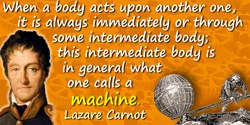
When a body acts upon another one, it is always immediately or through some intermediate body; this intermediate body is in general what one calls a machine.
In Essai sur les machines en général (1783), art. 8, as translated by Ivor Grattan-Guinness.
When I undertake the dissection of a human cadaver I pass a stout rope tied like a noose beneath the lower jaw and through the two zygomas up to the top of the head, either more toward the forehead or more toward the occiput according as I want the cadaver to hang with its head up or down. The longer end of the noose I run through a pulley fixed to a beam in the room so that I may raise or lower the cadaver as it hangs there or may turn it round in any direction to suit my purpose; and should I so wish I can allow it to recline at an angle upon a table, since a table can easily be placed underneath the pulley. This is how the cadaver was suspended for drawing all the muscle tables... though while that one was being drawn the rope was passed around the occiput so as to show the muscles in the neck. If the lower jaw has been removed in the course of dissection, or the zygomas have been broken, the hollows for the temporal muscles will nonetheless hold the noose sufficiently firmly. You must take care not to put the noose around the neck, unless some of the muscles connected to the occipital bone have already been cut away. It is best to suspend the cadaver like this because a human body lying on a table is very difficult to turn over on to its chest or its back.
From De Humani Corporis Fabrica Libri Septem (1543), Book II, 268, as translated by William Frank Richardson and John Burd Carman, in 'How the Cadaver Can Be Held Erect While These Muscles are Dissected', On The Fabric of the Human Body: Book II: The Ligaments and Muscles (1998), 234.
When intersected by a plane, the sphere displays in this section the circle, the genuine image of the created mind, placed in command of the body which it is appointed to rule; and this circle is to the sphere as the human mind is to the Mind Divine.
As quoted in Wolfgang Pauli, 'The Influence of Archetypal Ideas on the Scientific Theories of Kepler', as translated and collected in Writings on Physics and Philosophy (1994), 225. With Latin from Harmonia Mundi, Liber IV, Caput 1, collected in Christian Frisch (ed.), Opera Omnia (1864), Vol. 5, 223: “ plano vero sectum sphaericum circulum sectione repraesentat, mentis creatae, quae corpori regendo sit praefecta, genuinam imaginem, quae in ea proportione sit ad sphaericum, ut est mens humana ad divinam,”
When someone with an artificial heart dies, I think they should take out the heart, hook it up to an artificial body, and let it go at that.
In Napalm and Silly Putty (2001), 276.
When the body becomes Your mirror,
how can it serve?
When the mind becomes Your mind,
what is left to remember?
Once my life is Your gesture,
how can I pray?
When all my awareness is Yours,
what can there be to know?
how can it serve?
When the mind becomes Your mind,
what is left to remember?
Once my life is Your gesture,
how can I pray?
When all my awareness is Yours,
what can there be to know?
Quoted in Kim Lim (ed.), 1,001 Pearls of Spiritual Wisdom: Words to Enrich, Inspire, and Guide Your Life (2014), 190
When the face, the back of the hand, or another part of the body the sensitivity of which is not too weakened by touch is brought near an electrified conductor, there is felt the impression of a fresh breeze, of a light breath, or of a cobweb.
In biography article by Louis Dulieu, in Charles Coulston Gillispie, Dictionary of Scientific Biographt (1980), Vol. 2, 83.
When the morning breezes blow toward the town at sunrise, if they bring with them mists from marshes and, mingled with the mist, the poisonous breath of the creatures of the marshes to be wafted into the bodies of the inhabitants, they will make the site unhealthy.
In De Architectura, Book 1, Chap 4, Sec. 1. As translated in Morris Hicky Morgan (trans.), Vitruvius: The Ten Books on Architecture (1914), 16.
When you get up here in space and you go into the weightlessness environment, your body is not sure what really just happened to it. So your stomach, intestines, and that stuff kind of shuts down for a few hours to figure out what is going on and during that timeframe your body is not doing much with your food. After your body figures out that it can handle the new environment, everything cranks back up and your food, stomach and intestines and all start working like normal.
Replying to a Mifflin Middle School students’ question during a school forum held using a downlink with the Discovery Space Shuttle mission (31 Oct 1998). On NASA web page 'STS-95 Educational Downlink'. Mike Tomolillo, Philip Slater asked, “Commander Brown, how does space affect the digestive system?”
Where a body is in motion, there exists space and time, the simplest sentient creature in this world would thus be a measure of them. Our hearing, and perhaps our seeing too, consists of a counting of oscillations.
Aphorism 54 in Notebook D (1773-1775), as translated by R.J. Hollingdale in Aphorisms (1990). Reprinted as The Waste Books (2000), 52.
Where a cell arises, there a cell must have previously existed (omnis cellula e cellula), just as an animal can spring only from an animal, a plant only from a plant. In this manner, although there are still a few spots in the body where absolute demonstration has not yet been afforded, the principle is nevertheless established, that in the whole series of living things, whether they be entire plants or animal organisms, or essential constituents of the same, an eternal law of continuous development prevails.
In Lecture II 'Physiological Tissues' (17 Feb 1858), as translated by Frank Chance in Cellular Pathology: As Based Upon Physiological and Pathological Histology. Twenty Lectures Delivered in the Pathological Institute of Berlin During the Months of February, March and April, 1858 (1860), 27-28.
Whether moral and social phenomena are really exceptions to the general certainty and uniformity of the course of nature; and how far the methods, by which so many of the laws of the physical world have been numbered among truths irrevocably acquired and universally assented to, can be made instrumental to the gradual formation of a similar body of received doctrine in moral and political science.
A System of Logic, Ratiocinative and Inductive (1858), v.
While we maintain the unity of the human species, we at the same time repel the depressing assumption of superior and inferior races of men. There are nations more susceptible of cultivation, more highly civilized, more enobled by mental cultivation than others, but none in themselves nobler than others. All are in like degree designed for freedom; a freedom which, in the ruder conditions of society, belongs only to the individual, but which, in social states enjoying political institutions, appertains as a right to the whole body of the community.
In Cosmos: A Sketch of a Physical Description of the Universe (1850), Vol. 1, 358, as translated by E.C. Otté.
Who could have believed that … the introduction into the human body of a small particle of matter from a cow’s udder might be the means of saving thousands of human lives? We learn from these and innumerable similar instances that the highest truths lie hid in the simplest facts; that, unlike human proclamations, nature’s teachings are not by sound of trumpet, but often in the stillest voice, by indirect hints and obscure suggestions.
From Address (Oct 1874) delivered at Guy’s Hospital, 'On The Study of Medicine', printed in British Medical journal (1874), 2, 425. Collected in Sir William Withey Gull and Theodore Dyke Acland (ed.), A Collection of the Published Writings of William Withey Gull (1896), 109.
Why may we not say, that all Automata (Engines that move themselves by springs and wheeles as doth a watch) have an artificiall life? For what is the Heart, but a Spring; and the Nerves, but so many Strings; and the Joynts, but so many Wheeles, giving motion to the whole Body, such as was intended by the Artificer? Art goes yet further, imitating the rationall and most excellent worke of Nature, Man. For by Art is created the great LEVIATHAN called a COMMON-WEALTH, or STATE, (in latine CIVITAS) which is but an Artificiall Man; though of greater stature and strength than the Naturall, for whose protection and defence it was intended; and in which, the Soveraignty is an Artificiall Soul, as giving life and motion to the whole body.
Leviathan (1651), ed. C. B. Macpherson (1968), Part I, Introduction, 81.
Why must our bodies be so large compared with the atom?
What is Life? In Marc J. Madou, Fundamentals of Microfabrication: the Science of Miniaturization (2nd ed., 2002), 1.
Why there is one Body in or System qualified to give Light and Heat to all ye rest, I know no reason, but because ye author of the Systeme thought it convenient.
Letter to Bentley (10 Dec 1692). In The Works of Richard Bentley (1838), Vol. 3, 204.
With savages, the weak in body or mind are soon eliminated; and those that survive commonly exhibit a vigorous state of health. We civilised men, on the other hand, do our utmost to check the process of elimination; we build asylums for the imbecile, the maimed, and the sick; we institute poor-laws; and our medical men exert their utmost skill to save the life of every one to the last moment.
…...
Without consciousness the mind-body problem would be much less interesting. With consciousness it seems hopeless.
Moral Questions (1979), 166.
Without preparing fluorine, without being able to separate it from the substances with which it is united, chemistry has been able to study and to analyze a great number of its compounds. The body was not isolated, and yet its place was marked in our classifications. This well demonstrates the usefulness of a scientific theory, a theory which is regarded as true during a certain time, which correlates facts and leads the mind to new hypotheses, the first causes of experimentation; which, little by little, destroy the theory itself, in order to replace it by another more in harmony with the progress of science.
[Describing the known history of fluorine compounds before his isolation of the element.]
[Describing the known history of fluorine compounds before his isolation of the element.]
'Fluorine', lecture at the Royal Institution (28 May 1897), translated from the French, in Proceedings of the Royal Institution (1897). In Annual Report of the Board of Regents of the Smithsonian Institution to July 1897 (1898), 262.
Without the slightest doubt there is something through which material and spiritual energy hold togehter and are complementary. In the last analysis, somehow or other, there must be a single energy operating in the world. And the first idea that occurs to us is that the 'soul' must be as it were the focal point of transformation at which, from all the points of nature, the forces of bodies converge, to become interiorised and sublimated in beauty and truth.
In Teilhard de Chardin and Bernard Wall (trans.), The Phenomenon of Man (1959, 2008), 63. Originally published in French as Le Phénomene Humain (1955).
Work done on any system of bodies (in Newton’s statement, the parts of any machine) has its equivalent in work done against friction, molecular forces, or gravity, if there be no acceleration; but if there be acceleration, part of the work is expended in overcoming the resistance to acceleration, and the additional kinetic energy developed is equivalent to the work so spent.
In William Thomson and Peter Guthrie Tait, Treatise on Natural Philosophy (1867), Vol. 1, 186.
Wouldst thou enjoy a long Life, a healthy Body, and a vigorous Mind, and be acquainted also with the wonderful Works of God? labour in the first place to bring thy Appetite into Subjection to Reason.
In Poor Richard's Almanack (1742).
Ye ugly, creepin’, blastit wonner,
Detested, shunn’d by saunt an’ sinner!
How dare ye set your fit upon her,
Sae fine a lady?
Gae somewhere else, and seek your dinner
On some poor body.
Detested, shunn’d by saunt an’ sinner!
How dare ye set your fit upon her,
Sae fine a lady?
Gae somewhere else, and seek your dinner
On some poor body.
From poem, 'To A Louse: On Seeing One On A Lady’s Bonnet, At Church' (1786).
You may not divide the seamless coat of learning. What education has to impart is an intimate sense for the power of ideas, for the beauty of ideas, and for the structure of ideas, together with a particular body of knowledge which has peculiar reference to the life of the being possessing it.
In 'The Aims of Education', The Aims of Education and Other Essays (1929), 23.
 In science it often happens that scientists say, 'You know that's a really good argument; my position is mistaken,' and then they would actually change their minds and you never hear that old view from them again. They really do it. It doesn't happen as often as it should, because scientists are human and change is sometimes painful. But it happens every day. I cannot recall the last time something like that happened in politics or religion.
(1987) --
In science it often happens that scientists say, 'You know that's a really good argument; my position is mistaken,' and then they would actually change their minds and you never hear that old view from them again. They really do it. It doesn't happen as often as it should, because scientists are human and change is sometimes painful. But it happens every day. I cannot recall the last time something like that happened in politics or religion.
(1987) -- 





.jpg)


