Blood Quotes (144 quotes)

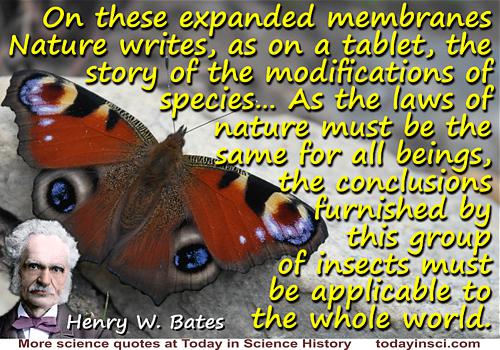
… on these expanded membranes [butterfly wings] Nature writes, as on a tablet, the story of the modifications of species, so truly do all changes of the organisation register themselves thereon. Moreover, the same colour-patterns of the wings generally show, with great regularity, the degrees of blood-relationship of the species. As the laws of nature must be the same for all beings, the conclusions furnished by this group of insects must be applicable to the whole world.
From The Naturalist on the River Amazons: A record of Adventures, Habits of Animals, Sketches of Brazilian and Indian life, and Aspects of Nature under the Equator, During Eleven Years of Travel (1864), 413.
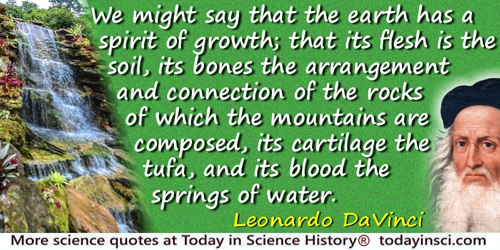
... we might say that the earth has a spirit of growth; that its flesh is the soil, its bones the arrangement and connection of the rocks of which the mountains are composed, its cartilage the tufa, and its blood the springs of water.
…...
“These changes in the body,” he wrote in the review paper he sent to the American Journal of Physiology late in 1913, “are, each one of them, directly serviceable in making the organism more efficient in the struggle which fear or rage or pain may involve; for fear and rage are organic preparations for action, and pain is the most powerful known stimulus to supreme exertion. The organism which with the aid of increased adrenal secretion can best muster its energies, can best call forth sugar to supply the labouring muscles, can best lessen fatigue, and can best send blood to the parts essential in the run or the fight for life, is most likely to survive. Such, according to the view here propounded, is the function of the adrenal medulla at times of great emergency.”
Quoted in S. Benison, A. C. Barger and E. L. Wolfe, Walter B Cannon: The Life and Times of a Young Scientist (1987), 311.
“True is it, my incorporate friends,” quoth he, “That I receive the general food at first, Which you do live upon; and fit it is, Because I am the storehouse and the shop Of the whole body. But, if you do remember, I send it through the rivers of your blood, Even to the court, the heart, to th’ seat o’ th’ brain; And, through the cranks and offices of man, The strongest nerves and small inferior veins From me receive that natural competency Whereby they live. And though that all at once”— You, good friends, this says the belly, mark me.
[Told as a fable, this is the belly’s answer to a complaint from the other members of the body that it received all the food but did no work.] In Coriolanus (1623), Act 1, Scene 1, line 130-141. Webmaster’s note: The Fable of the Belly has its roots in antiquity. William Harvey delivered a lecture in Apr 1616 on his discovery the circulation of blood in the body, but did not publish until 1628.
[Describing the effects of over-indulgence in wine:]
But most too passive, when the blood runs low
Too weakly indolent to strive with pain,
And bravely by resisting conquer fate,
Try Circe's arts; and in the tempting bowl
Of poisoned nectar sweet oblivion swill.
Struck by the powerful charm, the gloom dissolves
In empty air; Elysium opens round,
A pleasing frenzy buoys the lightened soul,
And sanguine hopes dispel your fleeting care;
And what was difficult, and what was dire,
Yields to your prowess and superior stars:
The happiest you of all that e'er were mad,
Or are, or shall be, could this folly last.
But soon your heaven is gone: a heavier gloom
Shuts o'er your head; and, as the thundering stream,
Swollen o'er its banks with sudden mountain rain,
Sinks from its tumult to a silent brook,
So, when the frantic raptures in your breast
Subside, you languish into mortal man;
You sleep, and waking find yourself undone,
For, prodigal of life, in one rash night
You lavished more than might support three days.
A heavy morning comes; your cares return
With tenfold rage. An anxious stomach well
May be endured; so may the throbbing head;
But such a dim delirium, such a dream,
Involves you; such a dastardly despair
Unmans your soul, as maddening Pentheus felt,
When, baited round Citheron's cruel sides,
He saw two suns, and double Thebes ascend.
But most too passive, when the blood runs low
Too weakly indolent to strive with pain,
And bravely by resisting conquer fate,
Try Circe's arts; and in the tempting bowl
Of poisoned nectar sweet oblivion swill.
Struck by the powerful charm, the gloom dissolves
In empty air; Elysium opens round,
A pleasing frenzy buoys the lightened soul,
And sanguine hopes dispel your fleeting care;
And what was difficult, and what was dire,
Yields to your prowess and superior stars:
The happiest you of all that e'er were mad,
Or are, or shall be, could this folly last.
But soon your heaven is gone: a heavier gloom
Shuts o'er your head; and, as the thundering stream,
Swollen o'er its banks with sudden mountain rain,
Sinks from its tumult to a silent brook,
So, when the frantic raptures in your breast
Subside, you languish into mortal man;
You sleep, and waking find yourself undone,
For, prodigal of life, in one rash night
You lavished more than might support three days.
A heavy morning comes; your cares return
With tenfold rage. An anxious stomach well
May be endured; so may the throbbing head;
But such a dim delirium, such a dream,
Involves you; such a dastardly despair
Unmans your soul, as maddening Pentheus felt,
When, baited round Citheron's cruel sides,
He saw two suns, and double Thebes ascend.
The Art of Preserving Health: a Poem in Four Books (2nd. ed., 1745), Book IV, 108-110.
[When questioned on his longevity] First of all, I selected my ancestors very wisely. ... They were long-lived, healthy people. Then, as a chemist, I know how to eat, how to exercise, keep my blood circulating. ... I don't worry. I don't get angry at people. I don't worry about things I can't help. I do what I can to make the world a better place to live, but I don't complain if things aren't right. As a scientist I take the world as I find it.
[About celebrating his 77th birthday by swimming a half mile in 22 minutes] I used swim fins and webbed gloves because a man of intelligence should apply his power efficiently, not just churn the water.
[About celebrating his 77th birthday by swimming a half mile in 22 minutes] I used swim fins and webbed gloves because a man of intelligence should apply his power efficiently, not just churn the water.
As quoted in obituary by Wallace Turner, 'Joel Hildebrand, 101', New York Times (3 May 1983), D27.
Blut ist ein ganz besondrer Saft.
Blood is a very special juice.
Blood is a very special juice.
In Faust, Part I (1808), scene in Faust’s study, line 1740. As translated by Stuart Atkins in Faust I & II, (1984, 1994), 45. Said by Mephistopheles, as Faust pledges his soul with his blood on the devil’s pact. Also translated by Bayard Taylor as “Blood is a juice of rarest quality,” in Faust: A Tragedy (1872), Part 1, 62. Also seen as “Blood is a very unusual fluid.”
Goldsmith: If you put a tub full of blood into a stable, the horses are like to go mad.
Johnson: I doubt that.
Goldsmith: Nay, sir, it is a fact well authenticated.
Thrale: You had better prove it before you put it into your book on natural history. You may do it in my stable if you will.
Johnson: Nay, sir, I would not have him prove it. If he is content to take his information from others, he may get through his book with little trouble, and without much endangering his reputation. But if he makes experiments for so comprehensive a book as his, there would be no end to them; his erroneous assertions would then fall upon himself: and he might be blamed for not having made experiments as to every particular.
Johnson: I doubt that.
Goldsmith: Nay, sir, it is a fact well authenticated.
Thrale: You had better prove it before you put it into your book on natural history. You may do it in my stable if you will.
Johnson: Nay, sir, I would not have him prove it. If he is content to take his information from others, he may get through his book with little trouble, and without much endangering his reputation. But if he makes experiments for so comprehensive a book as his, there would be no end to them; his erroneous assertions would then fall upon himself: and he might be blamed for not having made experiments as to every particular.
In James Boswell, The Life of Samuel Johnson, LL.D.: Comprehending an Account of His Studies and Numerous Works (1785, 1830), 229-230.
A single kind of red cell is supposed to have an enormous number of different substances on it, and in the same way there are substances in the serum to react with many different animal cells. In addition, the substances which match each kind of cell are different in each kind of serum. The number of hypothetical different substances postulated makes this conception so uneconomical that the question must be asked whether it is the only one possible. ... We ourselves hold that another, simpler, explanation is possible.
Landsteiner and Adriano Sturli, 'Hamagglutinine normaler Sera', Wiener klinische Wochenschrift (1902), 15, 38-40. Trans. Pauline M. H. Mazumdar.
According to the historian D. B. McIntyre (1963), James Hutton, often known as the father of geology, said in a lecture before the Royal Society of Edinburgh in the 1790s that he thought of the Earth as a superorganism and that its proper study would be by physiology. Hutton went on to make the analogy between the circulation of the blood, discovered by Harvey, and the circulation of the nutrient elements of the Earth and of the way that sunlight distills water from the oceans so that it may later fall as rain and so refresh the earth.
In 'The Earth as a Living Organism', Essay collected in E. O. Wilson and F. M. Peter (eds.), Biodiversity (1988), Chap. 56, 488. [Notes: Donald Bertram McIntyre (1923–2009) was a geologist. Hutton had medical training early in his life. According to Mirriam-Webster’s dictionary, the first known use of the word “superorganism” was “circa 1899”—so Hutton did not use that word. However, McIntyre did adopt that sophisticated word to describe Hutton’s thought, twice, in Philosophy of Geology (1963), 7 & 10. Thus, McIntyre and Lovelock freely embroidered whatever Hutton actually wrote, perhaps over-stepping. Cándido Manuel García Cruz criticizes that these “assertions are merely a misinterpretation” although “Hutton has nevertheless an holistic view which is closer to the Alfred N. Whitehead’s organic mechanicism than the James Lovelock’s Gaia Hypothesis,” as quoted from the abstract of his article 'From James Hutton’s «Theory of the Earth» to James Lovelock’s «Gaia Hypothesis»', Asclepio; Archivo Iberoamericano de Historia de la Medicina y Antropología Médica (Jun 2007), 59, No. 1, 65-100. Thus, it is best to read his own words in James Hutton, Theory of the Earth, which at length describes the “terrestrial system” as a “machine of a peculiar construction.” —Webmaster]
According to the older view, for every single effect of a serum, there was a separate substance, or at least a particular chemical group... A normal serum contained as many different haemagglutinins as it agglutinated different cells. The situation was undoubtedly made much simpler if, to use the Ehrlich terminology... the separate haptophore groups can combine with an extremely large number of receptors in stepwise differing quantities as a stain does with different animal tissues, though not always with the same intensity. A normal serum would therefore visibly affect such a large number of different blood cells... not because it contained countless special substances, but because of the colloids of the serum, and therefore of the agglutinins by reason of their chemical constitution and the electrochemical properties resulting from it. That this manner of representation is a considerable simplification is clear; it also opens the way to direct experimental testing by the methods of structural chemistry.
'Die Theorien der Antikorperbildung ... ', Wiener klinische Wöchenschrift (1909), 22, 1623-1631. Trans. Pauline M. H. Mazumdar.
Alcmaeon maintains that the bond of health is the 'equal balance' of the powers, moist and dry, cold and hot, bitter and sweet, and the rest, while the 'supremacy' of one of them is the cause of disease; for the supremacy of either is destructive. Illness comes aboutdirectly through excess of heat or cold, indirectly through surfeit or deficiency of nourishment; and its centre is either the blood or the marrow or the brain. It sometimes arises in these centres from external causes, moisture of some sort or environment or exhaustion or hardship or similar causes. Health on the other hand is the proportionate admixture of the qualities.
About Alcmaeon of Croton. In Clarence J. Glacken, Traces on the Rhodian Shore: Nature and Culture in Western Thought from Ancient Times to the End of the Eighteenth Century (1976) 11.
All sedentary workers ... suffer from the itch, are a bad colour, and in poor condition ... for when the body is not kept moving the blood becomes tainted, its waste matter lodges in the skin, and the condition of the whole body deteriorates. (1700)
America has never been united by blood or birth or soil. We are bound by ideals that move us beyond our backgrounds, lift us above our interests and teach us what it means to be citizens. Every child must be taught these principles. Every citizen must uphold them. And every immigrant, by embracing these ideals, makes our country more, not less, American.
…...
Amphibious Animals link the Terrestrial and Aquatique together; Seals live at Land and at Sea, and Porpoises have the warm Blood and Entrails of a Hog, not to mention what is confidently reported of Mermaids or Sea-men.
In An Essay Concerning Humane Understanding (1689, 1706, 5th ed.), 381. This was later quoted verbatim in Joseph Addison The Spectator (25 Oct 1712), No. 519, as collected in Vol. 7 (1729, 10th ed.), 176. Quote collections attributing to Addison are in error.
An objective measure of the effects upon blood production was the chief basis of our conclusions that by feeding liver, significant improvement had been obtained.
From Nobel Prize Lecture (12 Dec 1934), collected in Nobel Lectures, Physiology or Medicine 1922-1941 (1965).
Anaxagoras of Clazomenae, son of Hegesiboulos, held that the first principles of things were the homoeomeries. For it seemed to him quite impossible that anything should come into being from the non-existent or be dissolved into it. Anyhow we take in nourishment which is simple and homogeneous, such as bread or water, and by this are nourished hair, veins, arteries, flesh, sinews, bones and all the other parts of the body. Which being so, we must agree that everything that exists is in the nourishment we take in, and that everything derives its growth from things that exist. There must be in that nourishment some parts that are productive of blood, some of sinews, some of bones, and so on-parts which reason alone can apprehend. For there is no need to refer the fact that bread and water produce all these things to sense-perception; rather, there are in bread and water parts which only reason can apprehend.
Aetius 1.3.5. In G. S. Kirk, J. E. Raven and M. Schofield (eds), The Presocratic Philosophers: A Critical History with a Selection of Texts (1983), p. 375.
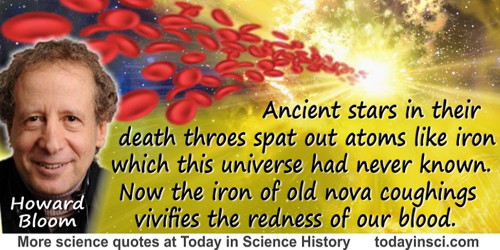
Ancient stars in their death throes spat out atoms like iron which this universe had never known. ... Now the iron of old nova coughings vivifies the redness of our blood.
Global Brain: The Evolution of Mass Mind from the Big Bang to the 21st century (2003), 223. Quoted in Rob Brezsny, Pronoia Is the Antidote for Paranoia (2005), 228.
And so I conclude that blood lives and is nourished of itself and in no way depends on any other part of the body as being prior to it or more excellent... So that from this we may perceive the causes not only of life in general... but also of longer or shorter life, of sleeping and waking, of skill, of strength and so forth.
Disputations Touching the Generation of Animals (1651), trans. Gweneth Whitteridge (1981), Chapter 52, 247. Alternate translation: “We conclude that blood lives of itself and that it depends in no ways upon any parts of the body. Blood is the cause not only of life in general, but also of longer or shorter life, of sleep and waking, of genius, aptitude, and strength. It is the first to live and the last to die.”
Aristotle, in spite of his reputation, is full of absurdities. He says that children should be conceived in the Winter, when the wind is in the North, and that if people marry too young the children will be female. He tells us that the blood of females is blacker then that of males; that the pig is the only animal liable to measles; that an elephant suffering from insomnia should have its shoulders rubbed with salt, olive-oil, and warm water; that women have fewer teeth than men, and so on. Nevertheless, he is considered by the great majority of philosophers a paragon of wisdom.
From An Outline of Intellectual Rubbish (1937, 1943), 19. Collected in The Basic Writings of Bertrand Russell (2009), 63.
As an organ is exercised, circulation is more particularly directed to it and is more readily performed in it. Consequently, all its secretions and excretions increase. The more an organ is exercised, the more it is nourished.
'Réflexions sur les corps organisés et les sciences dont ils sont l'objet', Magasin Encyclopedique, III (1799), 471. Trans. Jonathan Mandelbaum in Pietro Corsi, The Age of Lamarck (1988), 75.
As to Science, she has never sought to ally herself to civil power. She has never attempted to throw odium or inflict social ruin on any human being. She has never subjected anyone to mental torment, physical torture, least of all to death, for the purpose of upholding or promoting her ideas. She presents herself unstained by cruelties and crimes. But in the Vatican—we have only to recall the Inquisition—the hands that are now raised in appeals to the Most Merciful are crimsoned. They have been steeped in blood!
History of the Conflict between Religion and Science (1875), xi.
At first men try with magic charms
To fertilize the earth,
To keep their flocks and herds from harm
And bring new young to birth.
Then to capricious gods they turn
To save from fire or flood;
Their smoking sacrifices burn
On altars red with blood.
Next bold philosopher and sage
A settled plan decree
And prove by thought or sacred page
What Nature ought to be.
But Nature smiles—a Sphinx-like smile
Watching their little day
She waits in patience for a while—
Their plans dissolve away.
Then come those humbler men of heart
With no completed scheme,
Content to play a modest part,
To test, observe, and dream.
Till out of chaos come in sight
Clear fragments of a Whole;
Man, learning Nature’s ways aright
Obeying, can control.
To fertilize the earth,
To keep their flocks and herds from harm
And bring new young to birth.
Then to capricious gods they turn
To save from fire or flood;
Their smoking sacrifices burn
On altars red with blood.
Next bold philosopher and sage
A settled plan decree
And prove by thought or sacred page
What Nature ought to be.
But Nature smiles—a Sphinx-like smile
Watching their little day
She waits in patience for a while—
Their plans dissolve away.
Then come those humbler men of heart
With no completed scheme,
Content to play a modest part,
To test, observe, and dream.
Till out of chaos come in sight
Clear fragments of a Whole;
Man, learning Nature’s ways aright
Obeying, can control.
Epigraph in A History of Science and Its Relation with Philosophy & Religion (1968), vi.
At the bidding of a Peter the Hermit many millions of men swarmed to the East; the words of an hallucinated person … have created the force necessary to triumph over the Graeco-Roman world; an obscure monk like Luther set Europe ablaze and bathed in blood. The voice of a Galileo or a Newton will never have the least echo among the masses. The inventors of genius transform a civilization. The fanatics and the hallucinated create history.
From Les Premières Civilisations (1889), 171. English in The Psychology of Peoples (1898), Book 1, Chap. 1, 204, tweaked by Webmaster. Original French text: “A la voix d'un Pierre l'Ermite, plusieurs millions d'hommes se sont précipités sur l'Orient; les paroles d'un halluciné … ont créé la force nécessaire pour triompher du vieux monde gréco-romain; un moine obscur, comme Luther, a mis l'Europe à feu et à sang. Ce n’est pas parmi les foules que la voix d’un Galilée ou d’un Newton aura jamais le plus faible écho. Les inventeurs de génie transforment une civilisation. Les fanatiques et les hallucinés créent l’histoire.”
Blood mixture and the result drop in the racial level is the sole cause of the dying out of old cultures; for men do not perish as a result of lost wars, but by the loss of that force of resistance which is continued only in pure blood. All who are not of good race in this world are chaff.
Mein Kampf (1925-26), American Edition (1943), 296. In William Lawrence Shirer, The Rise and Fall of the Third Reich (1990), 88.
But I think that in the repeated and almost entire changes of organic types in the successive formations of the earth—in the absence of mammalia in the older, and their very rare appearance (and then in forms entirely. unknown to us) in the newer secondary groups—in the diffusion of warm-blooded quadrupeds (frequently of unknown genera) through the older tertiary systems—in their great abundance (and frequently of known genera) in the upper portions of the same series—and, lastly, in the recent appearance of man on the surface of the earth (now universally admitted—in one word, from all these facts combined, we have a series of proofs the most emphatic and convincing,—that the existing order of nature is not the last of an uninterrupted succession of mere physical events derived from laws now in daily operation: but on the contrary, that the approach to the present system of things has been gradual, and that there has been a progressive development of organic structure subservient to the purposes of life.
'Address to the Geological Society, delivered on the Evening of the 18th of February 1831', Proceedings of the Geological Society (1834), 1, 305-6.
By destroying the biological character of phenomena, the use of averages in physiology and medicine usually gives only apparent accuracy to the results. From our point of view, we may distinguish between several kinds of averages: physical averages, chemical averages and physiological and pathological averages. If, for instance, we observe the number of pulsations and the degree of blood pressure by means of the oscillations of a manometer throughout one day, and if we take the average of all our figures to get the true or average blood pressure and to learn the true or average number of pulsations, we shall simply have wrong numbers. In fact, the pulse decreases in number and intensity when we are fasting and increases during digestion or under different influences of movement and rest; all the biological characteristics of the phenomenon disappear in the average. Chemical averages are also often used. If we collect a man's urine during twenty-four hours and mix all this urine to analyze the average, we get an analysis of a urine which simply does not exist; for urine, when fasting, is different from urine during digestion. A startling instance of this kind was invented by a physiologist who took urine from a railroad station urinal where people of all nations passed, and who believed he could thus present an analysis of average European urine! Aside from physical and chemical, there are physiological averages, or what we might call average descriptions of phenomena, which are even more false. Let me assume that a physician collects a great many individual observations of a disease and that he makes an average description of symptoms observed in the individual cases; he will thus have a description that will never be matched in nature. So in physiology, we must never make average descriptions of experiments, because the true relations of phenomena disappear in the average; when dealing with complex and variable experiments, we must study their various circumstances, and then present our most perfect experiment as a type, which, however, still stands for true facts. In the cases just considered, averages must therefore be rejected, because they confuse, while aiming to unify, and distort while aiming to simplify. Averages are applicable only to reducing very slightly varying numerical data about clearly defined and absolutely simple cases.
From An Introduction to the Study of Experimental Medicine (1865), as translated by Henry Copley Greene (1957), 134-135.
By the act of generation nothing more is done than to ferment the sperm of ye female by the sperm of ye male that it may thereby become fit nourishment for ye Embryo: ffor ye nourishment of all animals is prepared by ferment & the ferment is taken from animals of the same kind, & makes the nourishment subtile & spiritual. In adult animals the nourishmt is fermented by the choler and pancreatic juice both wch come from the blood. The Embryo not being able to ferment its own nourishment wch comes from the mothers blood has it fermented by the sperm wch comes from ye fathers blood, & by this nourishment it swells, drops off from ye Ovarium & begins to grow with a life distinct from that of ye mother.
From 'Quæst 25' in Draft version of The Queries manuscript, Add. MS. 3970, folio 235 held by the University of Cambridge Library. As quoted and cited in R.W. Home, 'Force, Electricity, and Living Matter', from Margaret J. Osler and Paul Lawrence Farber (eds.), Religion, Science, and Worldview: Essays in Honor of Richard S. Westfall (2002), 113.
Cancer cells invade surrounding tissue, make their way into blood vessels, and spread throughout the body. What are they searching for? My guess is oxygen.
In Acceptance Remarks, 2016 Lasker Awards Ceremony, published in 'Oxygen Sensing – An Essential Process for Survival', on laskerfoundation.org website.
Every creature has its own food, and an appropriate alchemist with the task of dividing it ... The alchemist takes the food and changes it into a tincture which he sends through the body to become blood and flesh. This alchemist dwells in the stomach where he cooks and works. The man eats a piece of meat, in which is both bad and good. When the meat reaches the stomach, there is the alchemist who divides it. What does not belong to health he casts away to a special place, and sends the good wherever it is needed. That is the Creator's decree... That is the virtue and power of the alchemist in man.
Volumen Medicinae Paramirum (c. 1520), in Paracelsus: Essential Readings, edited by Nicholas Goodrick-Clarke (1990), 50-1.
For the life of the flesh is in the blood.
— Bible
Leviticus 17:11.
From my close observation of writers ... they fall in to two groups: 1) those who bleed copiously and visibly at any bad review, and 2) those who bleed copiously and secretly at any bad review.
In Gold: The Final Science Fiction Collection? (2003).
From thus meditating on the great similarity of the structure of the warm-blooded animals, and at the same time of the great changes they undergo both before and after their nativity; and by considering in how minute a portion of time many of the changes of animals above described have been produced; would it be too bold to imagine that, in the great length of time since the earth began to exist, perhaps millions of ages before the commencement of the history of mankind would it be too bold to imagine that all warm-blooded animals have arisen from one living filament, which THE GREAT FIRST CAUSE endued with animality, with the power of acquiring new parts, attended with new propensities, directed by irritations, sensations, volitions and associations, and thus possessing the faculty of continuing to improve by its own inherent activity, and of delivering down these improvements by generation to its posterity, world without end!
Zoonomia, Or, The Laws of Organic Life, in three parts (1803), Vol. 1, 397.
Fundamentally, as is readily seen, there exists neither force nor matter. Both are abstractions of things, such as they are, looked at from different standpoints. They complete and presuppose each other. Isolated they are meaningless. … Matter is not a go-cart, to and from which force, like a horse, can be now harnessed, now loosed. A particle of iron is and remains exactly the same thing, whether it shoot through space as a meteoric stone, dash along on the tire of an engine-wheel, or roll in a blood-corpuscle through the veins of a poet. … Its properties are eternal, unchangeable, untransferable.
From the original German text in 'Über die Lebenskraft', Preface to Untersuchungen über tierische Elektrizität (1848), xliii. As translated in Ludwig Büchner, Force and Matter: Or, Principles of the Natural Order of the Universe (1891), 1.
Generations to come, it may be, will scarcely believe that such a one as this ever in flesh and blood walked upon this earth.
…...
Given one has before oneself a strong, healthy, youth rich in spirited blood and a powerless, weak, cachectic old man scarcely capable of breathing. If now the physician wishes to practise the rejuvenating art on the latter, he should make silver tubes which fit into each other: open then the artery of the healthy person and introduce one of the tubes into it and fasten it into the artery; thereupon he opens also the artery of the ill person...
[First detailed description of blood transfusion (1615)]
[First detailed description of blood transfusion (1615)]
In N.S.R. Maluf, 'History of Blood Transfusion', Journal of the History of Medicine and Allied Sciences (1954), 9, No. 1, 59.
HEART, n. An automatic, muscular blood- pump. Figuratively, this useful organ is said to be the seat of emotions and sentiments—a very pretty fancy which, however, is nothing but a survival of a once universal belief. It is now known that the sentiments and emotions reside in the stomach, being evolved from food by chemical action of the gastric fluid. The exact process by which a beefsteak becomes a feeling—tender or not, according to the age of the animal from which it was cut; the successive stages of elaboration through which a caviar sandwich is transmuted to a quaint fancy and reappears as a pungent epigram; the marvelous functional methods of converting a hard-boiled egg into religious contrition, or a cream-puff into a sigh of sensibility—these things have been patiently ascertained by M. Pasteur, and by him expounded with convincing lucidity.
The Collected Works of Ambrose Bierce (1911), Vol. 7, The Devil's Dictionary, 133-134.
However much the pits may be apparent, yet none, as far as can be comprehended by the senses, passes through the septum of the heart from the right ventricle into the left. I have not seen even the most obscure passages by which the septum of the ventricles is pervious, although they are mentioned by professors of anatomy since they are convinced that blood is carried from the right ventricle into the left. As a result—as I shall declare more openly elsewhere—I am in no little doubt regarding the function of the heart in this part.
In De Humani Corporis Fabrica Libri Septem [Seven Books on the Structure of the Human Body] (revised ed. 1555), 734. Quoted and trans. in Charles Donald O'Malley, Andreas Vesalius of Brussels, 1514-1564 (1964), 281.
However, on many occasions, I examined normal blood and normal tissues and there was no possibility of overlooking bacteria or confusing them with granular masses of equal size. I never found organisms. Thus, I conclude that bacteria do not occur in healthy human or animal tissues.
'Investigations of the Etiology of Wound Infections' (1878), Essays of Robert Koch (1987), trans. K. Codell Carter, 27.
Human blood is a testament to life’s origin in the ocean: its chemical composition is nearly identical to that of sea-water.
In 'Ocean Policy and Reasonable Utopias', The Forum (Summer 1981), 16, No. 5, 900.
Humanities are inseparable from human creations, whether these be philosophic, scientific, technical, or artistic and literary. They exist in everything to which men have imparted their virtues or vices, their joys or sufferings. There are blood and tears in geometry as well as in art, blood and tears but also innumerable joys, the purest that men can experience themselves or share with others.
In A History of Science: Hellenistic Science and Culture in the Last Three Centuries B.C. (1959), ix.
I am inclined to think I shall owe ten years of my life to the good effects of the gas, for I inhale about 20 gallons every day in showing patients how to commence. The gas is just like air, only containing a little more oxygen. Oxygen is what gives life and vitality to the blood. We live on oxygen.
Quoted in The Electrical Review (11 Aug 1893), Vol. 33, 143.
I am more and more convinced that the ant colony is not so much composed of separate individuals as that the colony is a sort of individual, and each ant like a loose cell in it. Our own blood stream, for instance, contains hosts of white corpuscles which differ little from free-swimming amoebae. When bacteria invade the blood stream, the white corpuscles, like the ants defending the nest, are drawn mechanically to the infected spot, and will die defending the human cell colony. I admit that the comparison is imperfect, but the attempt to liken the individual human warrior to the individual ant in battle is even more inaccurate and misleading. The colony of ants with its component numbers stands half way, as a mechanical, intuitive, and psychical phenomenon, between our bodies as a collection of cells with separate functions and our armies made up of obedient privates. Until one learns both to deny real individual initiative to the single ant, and at the same time to divorce one's mind from the persuasion that the colony has a headquarters which directs activity … one can make nothing but pretty fallacies out of the polity of the ant heap.
In An Almanac for Moderns (1935), 121
I could clearly see that the blood is divided and flows through tortuous vessels and that it is not poured out into spaces, but is always driven through tubules and distributed by the manifold bendings of the vessels... [F]rom the simplicity Nature employs in all her works, we may conclude... that the network I once believed to be nervous [that is, sinewy] is really a vessel intermingled with the vesicles and sinuses and carrying the mass of blood to them or away from them... though these elude even the keenest sight because of their small size... From these considerations it is highly probable that the question about the mutual union and anastomosis of the vessels can be solved; for if Nature once circulates the blood within vessels and combines their ends in a network, it is probable that they are joined by anastomosis at other times too.
'The Return to Bologna 1659-1662', in H. B. Adelmann (ed.), Marcello Malpighi and the Evolution of Embryology (1966), Vol. 1, 194-5.
I feel that the recent ruling of the United States Army and Navy regarding the refusal of colored blood donors is an indefensible one from any point of view. As you know, there is no scientific basis for the separation of the bloods of different races except on the basis of the individual blood types or groups. (1942)
Spencie Love, One Blood: The Death and Resurrection of Charles R. Drew (1996), 155-56, quoting as it appeared in Current Biography (1944), 180.
I finally saw that the blood, forced by the action of the left ventricle into the arteries, was distributed to the body at large, and its several parts, in the same manner as it is sent through the lungs, impelled by the right ventricle into the pulmonary artery, and that it then passed through the veins and along the vena cava, and so round to the left ventricle in the manner already indicated. Which motion we may be allowed to call circular, in the same way as Aristotle says that the air and the rain emulate the circular motion of the superior bodies; for the moist earth, warmed by the sun, evaporates; the vapours drawn upwards are condensed, and descending in the form of rain, moisten the earth again; and by this arrangement are generations of living things produced.
From William Harvey and Robert Willis (trans.), The Works of William Harvey, M.D. (1847), 46.
I have divers times endeavoured to see and to know, what parts the Blood consists of; and at length I have observ'd, taking some Blood out of my own hand, that it consists of small round globuls driven through a Crystalline humidity or water.
Letter to Henry Oldenburg (Royal Society, 7 Apr 1674). Translated from the original Dutch, and published in 'More Microscopical Observations made by the same M. Leewenhoeck', Philosophical Transactions of the Royal Society (1 Jan 1674), 9, No. 102, 23.
I have heard him [William Harvey] say, that after his Booke of the Circulation of the Blood came-out, that he fell mightily in his Practize, and that 'twas beleeved by the vulgar that he was crack-brained.
Brief Lives (1680), edited by Oliver Lawson Dick (1949), 131.
I have recently observed and stated that the serum of normal people is capable of clumping the red cells of other healthy individuals... As commonly expressed, it can be said that in these cases at least two different kinds of agglutinins exist, one kind in A, the other in B, both together in C. The cells are naturally insensitive to the agglutinins in their own serum.
Ueber Agglutinationserscheinungen normalen menschlichen Blutes', Wiener klinische Wochenschrift (1901), 14, 1132-1134. Trans. Pauline M. H. Mazumdar.
I have seen a thousand sunsets and sunrises, on land where it floods forest and mountains with honey coloured light, at sea where it rises and sets like a blood orange in a multicoloured nest of cloud, slipping in and out of the vast ocean. I have seen a thousand moons: harvest moons like gold coins, winter moons as white as ice chips, new moons like baby swans’ feathers.
Letter to Lee McGeorge (31 Jul 1978). Collected in Letters of Note: Volume 2: An Eclectic Collection of Correspondence (2016), 76.
I would not have it inferred ... that I am, as yet, an advocate for the hypothesis of chemical life. The doctrine of the vitality of the blood, stands in no need of aid from that speculative source. If it did, I would certainly abandon it. For, notwithstanding the fashionableness of the hypothesis in Europe, and the ascendancy it has gained over some minds in this country [USA], it will require stubborn facts to convince me that man with all his corporeal and intellectual attributes is nothing but hydro-phosphorated oxyde of azote ... When the chemist declares, that the same laws which direct the crystallization of spars, nitre and Glauber's salts, direct also the crystallization of man, he must pardon me if I neither understand him, nor believe him.
Medical Theses (1805), 391-2, footnote.
I've known rivers:
I've known rivers ancient as the world and older than the flow of human blood in human veins.
My soul has grown deep like the rivers.
I've known rivers ancient as the world and older than the flow of human blood in human veins.
My soul has grown deep like the rivers.
The Negro Speaks of Rivers (1926).
If a small animal and a lighted candle be placed in a closed flask, so that no air can enter, in a short time the candle will go out, nor will the animal long survive. ... The animal is not suffocated by the smoke of the candle. ... The reason why the animal can live some time after the candle has gone out seems to be that the flame needs a continuous rapid and full supply of nitro-aereal particles. ... For animals, a less aereal spirit is sufficient. ... The movements of the lungs help not a little towards sucking in aereal particles which may remain in said flask and towards transferring them to the blood of the animal.
Remarking (a hundred years before Priestley identified oxygen) that a component of the air is taken into the blood.
Remarking (a hundred years before Priestley identified oxygen) that a component of the air is taken into the blood.
Quoted in William Stirling, Some Apostles of Physiology (1902), 45.
If any person thinks the examination of the rest of the animal kingdom an unworthy task, he must hold in like disesteem the study of man. For no one can look at the primordia of the human frame—blood, flesh, bones, vessels, and the like—without much repugnance. Moreover, in every inquiry, the examination of material elements and instruments is not to be regarded as final, but as ancillary to the conception of the total form. Thus, the true object of architecture is not bricks, mortar or timber, but the house; and so the principal object of natural philosophy is not the material elements, but their composition, and the totality of the form to which they are subservient, and independently of which they have no existence.
On Parts of Animals, Book 1, Chap 5, 645a, 26-36. In W. Ogle (trans.), Aristotle on the Parts of Animals (1882), 17. Alternate translations: “primodia” = “elements”; “Moreover ... Thus” = “Moreover, when anyone of the parts or structures, be it which it may, is under discussion, it must not be supposed that it is its material composition to which attention is being directed or which is the object of the discussion, but rather the total form. Similarly”; “form ... subservient, and” = “totality of the substance.” See alternate translation in Jonathan Barnes (ed.), The Complete Works of Aristotle (1984), Vol. 1, 1004.
If the love of surgery is a proof of a person’s being adapted for it, then certainly I am fitted to he a surgeon; for thou can’st hardly conceive what a high degree of enjoyment I am from day to day experiencing in this bloody and butchering department of the healing art. I am more and more delighted with my profession.
Letter to his father (1853). In John Vaughan, 'Lord Lister', The Living Age (1918), 297, 361. Reprinted from The Fortnightly Review (1918), 109, 417- .
If the mysterious influence to which the dissymmetry of nature is due should come to change in sense or direction, the constituting elements of all living beings would take an inverse dissymmetry. Perhaps a new world would be presented to us. Who could foresee the organization of living beings, if the cellulose, which is right, should become left, if the left albumen of the blood should become right? There are here mysteries which prepare immense labours for the future, and from this hour invite the most serious meditations in science.
Lecture (3 Feb 1860), to the Chemical Society of Paris, 'On the Molecular Dissymetry of Natural Organic Products', reprinted in The Chemical News and Journal of Industrial Science (3 May 1862), 5, No. 126, 248.
If thou examinest a man having a break in the column of his nose, his nose being disfigured, and a [depression] being in it, while the swelling that is on it protrudes, [and] he had discharged blood from both his nostrils, thou shouldst say concerning him: “One having a break in the column of his nose. An ailment which I will treat. “Thou shouldst cleanse [it] for him [with] two plugs of linen. Thou shouldst place two [other] plugs of linen saturated with grease in the inside of his two nostrils. Thou shouldst put [him] at his mooring stakes until the swelling is drawn out. Thou shouldst apply for him stiff rolls of linen by which his nose is held fast. Thou shouldst treat him afterward [with] lint, every day until he recovers.
(circa 1700 B.C.) From “The Edwin Smith Surgical Papyrus”, an ancient Egyptian document regarded as the earliest known historical record of scientific thought. As translated in James Henry Breasted, The Edwin Smith Surgical Papyrus: Published in Facsimile and Hieroglyphic Transliteration with Translation and Commentary (1930), 440.
If we want an answer from nature, we must put our questions in acts, not words, and the acts may take us to curious places. Some questions were answered in the laboratory, others in mines, others in a hospital where a surgeon pushed tubes in my arteries to get blood samples, others on top of Pike’s Peak in the Rocky Mountains, or in a diving dress on the bottom of the sea. That is one of the things I like about scientific research. You never know where it will take you next.
From essay 'Some Adventures of a Biologist', as quoted in Ruth Moore, Man, Time, And Fossils (1953), 174.
In attempting to discover how much blood passes from the veins into the arteries I made dissections of living animals, opened up arteries in them, and carried out various other investigations. I also considered the symmetry and size of the ventricles of the heart and of the vessels which enter and leave them (since Nature, who does nothing purposelessly, would not purposelessly have given these vessels such relatively large size). I also recalled the elegant and carefully contrived valves and fibres and other structural artistry of the heart; and many other points. I considered rather often and with care all this evidence, and took correspondingly long trying to assess how much blood was transmitted and in how short a time. I also noted that the juice of the ingested food could not supply this amount without our having the veins, on the one hand, completely emptied and the arteries, on the other hand, brought to bursting through excessive inthrust of blood, unless the blood somehow flowed back again from the arteries into the veins and returned to the right ventricle of the heart. In consequence, I began privately to consider that it had a movement, as it were, in a circle.
De Motu Cordis (1628), The Circulation of the Blood and Other Writings, trans. Kenneth j. Franklin (1957), Chapter 8, 57-8.
In cold countries the aqueous particles of the blood is exhaled slightly by perspiration; it remains in great abundance. One can therefore make use of spirituous liquors without the blood coagulating. It is full of humours. Strong liquors, which give movement to the blood, may be suitable there.
From De l’Esprit, xiv., Chap 10. In Craufurd Tait Ramage (ed.), Beautiful Thoughts from French and Italian Authors (1866), 210.
In man, then, let us take the amount that is extruded by the individual beats, and that cannot return into the heart because of the barrier set in its way by the valves, as half an ounce, or three drachms, or at least one drachm. In half an hour the heart makes over a thousand beats; indeed, in some individuals, and on occasion, two, three, or four thousand. If you multiply the drachms per beat by the number of beats you will see that in half an hour either a thousand times three drachms or times two drachms, or five hundred ounces, or other such proportionate quantity of blood has been passed through the heart into the arteries, that is, in all cases blood in greater amount than can be found in the whole of the body. Similarly in the sheep or the dog. Let us take it that one scruple passes in a single contraction of the heart; then in half an hour a thousand scruples, or three and a half pounds of blood, do so. In a body of this size, as I have found in the sheep, there is often not more than four pounds of blood.
In the above sort of way, by calculating the amount of blood transmitted [at each heart beat] and by making a count of the beats, let us convince ourselves that the whole amount of the blood mass goes through the heart from the veins to the arteries and similarly makes the pulmonary transit.
Even if this may take more than half an hour or an hour or a day for its accomplishment, it does nevertheless show that the beat of the heart is continuously driving through that organ more blood than the ingested food can supply, or all the veins together at any time contain.
In the above sort of way, by calculating the amount of blood transmitted [at each heart beat] and by making a count of the beats, let us convince ourselves that the whole amount of the blood mass goes through the heart from the veins to the arteries and similarly makes the pulmonary transit.
Even if this may take more than half an hour or an hour or a day for its accomplishment, it does nevertheless show that the beat of the heart is continuously driving through that organ more blood than the ingested food can supply, or all the veins together at any time contain.
De Motu Cordis (1628), The Circulation of the Blood and Other Writings, trans. Kenneth J. Franklin (1957), Chapter 9, 62-3.
Intravenous injections of extract from dog’s pancreas, removed from seven to ten weeks after ligation of the ducts, invariably exercises a reducing influence upon the percentage sugar of the blood and the amount of sugar excreted in the urine … the extent and duration of the reduction varies directly with the amount of extract injected.
Frederick Grant Banting and Charles Herbert Best, 'The Internal Secretion of the Pancreas', Journal of Laboratory and Clinical Medicine, 1922, 7, 251-266.
It [the nineteenth century] was the time of those classical explorers who set out into the unknown [of Africa], without the expense of a large expedition, alone or with only a few companions, for whom traveling was an end in itself, unselfish and harmless, with little money and with no blood sacrifice other than their own.
From obituary by Schweinfurth for famous African explorer Gerhard Rohlfs. In Konrad Guenther, Georg Schweinfurth-Lebensbüd eines Afrikaforschers (1954), 57-58. As quoted and cited in Kathrin Fritsch, '"You Have Everything Confused And Mixed Up…!" Georg Schweinfurth, Knowledge And Cartography Of Africa In The 19th Century', History in Africa (2009), 36, 89. Fritsch clarifies that traveling “alone” referred to absense of other Europeans, but would be joined up with “indigenous travelers as soon as possible or hired knowledgeable locals.” Also, “unknown” refers to most Europeans, but travel was in fact, “through settled areas, sometimes also traversed by ancient trading routes,” and typically not true wilderness.
It has occurred to me that possibly the white corpuscles may have the office of picking up and digesting bacterial organisms when by any means they find their way into the blood. The propensity exhibited by the leukocytes for picking up inorganic granules is well known, and that they may be able not only to pick up but to assimilate, and so dispose of, the bacteria which come in their way does not seem to me very improbable in view of the fact that amoebae, which resemble them so closely, feed upon bacteria and similar organisms.
'A Contribution to the Study of the Bacterial Organisms Commonly Found Upon Exposed Mucous Surfaces and in the Alimentary Canal of Healthy Individuals', Studies from the Biological Laboratory (1883), 2, 175.
It is the destiny of wine to be drunk, and it is the destiny of glucose to be oxidized. But it was not oxidized immediately: its drinker kept it in his liver for more than a week, well curled up and tranquil, as a reserve aliment for a sudden effort; an effort that he was forced to make the following Sunday, pursuing a bolting horse. Farewell to the hexagonal structure: in the space of a few instants the skein was unwound and became glucose again, and this was dragged by the bloodstream all the way to a minute muscle fiber in the thigh, and here brutally split into two molecules of lactic acid, the grim harbinger of fatigue: only later, some minutes after, the panting of the lungs was able to supply the oxygen necessary to quietly oxidize the latter. So a new molecule of carbon dioxide returned to the atmosphere, and a parcel of the energy that the sun had handed to the vine-shoot passed from the state of chemical energy to that of mechanical energy, and thereafter settled down in the slothful condition of heat, warming up imperceptibly the air moved by the running and the blood of the runner. 'Such is life,' although rarely is it described in this manner: an inserting itself, a drawing off to its advantage, a parasitizing of the downward course of energy, from its noble solar form to the degraded one of low-temperature heat. In this downward course, which leads to equilibrium and thus death, life draws a bend and nests in it.
The Periodic Table (1975), trans. Raymond Rosenthal (1984), 192-3.
It’s not the critic who counts; not the man which points out how the strong man stumbles or where the doer of deeds could have done them better. The credit belongs to the man who is actually in the arena, whose face is marred by dust and sweat and blood; who strives valiantly; who errs, who comes short again and again … who knows great enthusiasms, the great devotions; who spends himself in a worthy cause; who at the best knows in the end the triumph of high achievement, and who at the worst, if he fails, at least fails while daring greatly, so that his place shall never be with those cold and timid souls who neither know victory nor defeat.
In Joseph A. Califano, Jr., Inside: A Public and Private Life (2005), 356.
Leaves are the Parts, or Bowels of a Plant, which perform the same Office to Sap, as the Lungs of an Animal do to Blood; that is, they purify or cleanse it of the Recrements, or fuliginous Steams, received in the Circulation, being the unfit Parts of the Food; and perhaps some decay’d Particles, which fly off the Vessels, thro’ which Blood and Sap do pass respectively. Besides which Use, the Nitro-aerious Particles may there enter, to keep up the vital Ferment or Flame.
In The Horse-Hoeing Husbandry (1733), 7.
Let out the blood, let out the disease.
Centuries-old aphorism popular up to the end of the 19th century
Life is a five to four decision in the Supreme Court of the Mind. Counteract the hopelessness. You can change that one vote. Sit down and turn blood into ink.
As quoted in 'In memoriam—Jack J. Leedy (1921–2004)', Journal of Poetry Therapy (2004), 17, No. 4, 231.
M. Waldman … concluded with a panegyric upon modern chemistry…:— “The ancient teachers of this science” said he, “Promised impossibilities and performed nothing. The modern masters promise very little; they know that metals cannot be transmuted and that the elixir of life is a chimera. But these philosophers seem only made to dabble in dirt, and their eyes to pore over the microscope or crucible, have indeed performed miracles. They penetrate into the recesses of nature and show how she works in her hiding-places. They ascend into the heavens; they have discovered how the blood circulates, and the nature of the air we breathe. They can command the thunders of heaven, mimic the earthquake, and even mock the invisible world with its own shadows.”
In Frankenstein: Or, The Modern Prometheus (1823), Vol. 1, 73-74. Webmaster note: In the novel, when the fictional characters meet, M. Waldman, professor of chemistry, sparks Victor Frankenstein’s interest in science. Shelley was age 20 when the first edition of the novel was published anonymously (1818).
MAGNITUDE, n. Size. Magnitude being purely relative, nothing is large and nothing small. If everything in the universe were increased in bulk one thousand diameters nothing would be any larger than it was before, but if one thing remained unchanged all the others would be larger than they had been. To an understanding familiar with the relativity of magnitude and distance the spaces and masses of the astronomer would be no more impressive than those of the microscopist. For anything we know to the contrary, the visible universe may be a small part of an atom, with its component ions, floating in the life-fluid (luminiferous ether) of some animal. Possibly the wee creatures peopling the corpuscles of our own blood are overcome with the proper emotion when contemplating the unthinkable distance from one of these to another.
The Collected Works of Ambrose Bierce (1911), Vol. 7, The Devil's Dictionary, 209.
Make no little plans. They have no magic to stir men’s blood and probably themselves will not be realized. Make big plans; aim high in hope and work. … Let your watchword be order and your beacon beauty,
(1907) As quoted in 'Closing In', Charles Moore, Daniel H. Burnham, Architect, Planner of Cities (1921), Vol. 2, 147.
Man may be the captain of his fate, but he is also the victim of his blood sugar.
Indicating the burden of diabetes.
Indicating the burden of diabetes.
Transactions of the Medical Society of London (1962), 78:16.
Mankind never gains anything without cost. There never has been a bloodless victory over nature.
From newspaper interview, as few weeks after the funeral of cosmonaut Komarov. As quoted in Space World (1974), 10.
Napoleon and other great men were makers of empires, but these eight men whom I am about to mention were makers of universes and their hands were not stained with the blood of their fellow men. I go back 2,500 years and how many can I count in that period? I can count them on the fingers of my two hands. Pythagoras, Ptolemy, Kepler, Copernicus, Aristotle, Galileo, Newton and Einstein—and I still have two fingers left vacant.
Speech (28 Oct 1930) at the Savoy Hotel, London in Einstein’s honor sponsored by a committee to help needy Jews in Eastern Europe. In Albert Einstein, Cosmic Religion: With Other Opinions and Aphorisms (1931), 31.
Natural historians tend to avoid tendentious preaching in this philosophical mode (although I often fall victim to such temptations in these essays). Our favored style of doubting is empirical: if I wish to question your proposed generality, I will search for a counterexample in flesh and blood. Such counterexamples exist in abundance, for the form a staple in a standard genre of writing in natural history–the “wonderment of oddity” or “strange ways of the beaver” tradition.
In 'Reversing Established Orders', Leonardo’s Mountain of Clams and the Diet of Worms (2011), 394.
None but a naturalist can understand the intense excitement I experienced when I at length captured it [a hitherto unknown species of butterfly]. On taking it out of my net and opening the glorious wings, my heart began to beat, violently, the blood rushed to my head, and I felt much more like fainting than I have done when in apprehension of immediate death. I had a headache the rest of the day, so great was the excitement produced by what will appear to most people a very inadequate cause.
The Malay Archipelago (1890), 257-258.
Nurse, it was I who discovered that leeches have red blood.
(1832). Attributed - on his deathbed when the nurse came to apply leeches. In Barnaby Conrad, Famous Last Words (1961), 78.
Observation by means of the microscope will reveal more wonderful things than those viewed in regard to mere structure and connection: for while the heart is still beating the contrary (i.e., in opposite directions in the different vessels) movement of the blood is observed in the vessels—though with difficulty—so that the circulation of the blood is clearly exposed.
De Pulmonibus (1661), trans. James Young, Proceedings of the Royal Society of Medicine (1929-30), 23, 8.
On coming down the stairs at dinner Tris [Trismegistus = Frankland] who walked before me seemed impressed by a mechanical impulse which impelled him along the corridor with a fervid velocity. On reaching the stair bottom I discovered the cause of the attraction. Miss Edmondson, like a pure planet, had checked his gravitating tendencies and lo! He stood radiant with smiles dropping joysparkes from his eyes as he clasped her hand. His countenance became a transparency through which the full proportions of his soul shone manifest; his blood tingled from his eyebrows to his finger ends, and wealthy with rich emotions his face became the avenue of what he felt.
Journals of John Tyndall, 18 Jan 1848. Royal Institution Archives.
On hearing the news [of being awarded a Nobel Prize], a friend who knows me only too well, sent me this laconic message: 'Blood, toil, sweat and tears always were a good mixture'.
Nobel Banquet Speech (10 Dec 1962).
On the whole, at least in the author's experience, the preparation of species-specific antiserum fractions and the differentiation of closely related species with precipitin sera for serum proteins does not succeed so regularly as with agglutinins and lysins for blood cells. This may be due to the fact that in the evolutional scale the proteins undergo continuous variations whereas cell antigens are subject to sudden changes not linked by intermediary stages.
The Specificity of Serological Reactions (1936), 12-3.
One day when the whole family had gone to a circus to see some extraordinary performing apes, I remained alone with my microscope, observing the life in the mobile cells of a transparent star-fish larva, when a new thought suddenly flashed across my brain. It struck me that similar cells might serve in the defence of the organism against intruders. Feeling that there was in this something of surpassing interest, I felt so excited that I began striding up and down the room and even went to the seashore in order to collect my thoughts.
I said to myself that, if my supposition was true, a splinter introduced into the body of a star-fish larva, devoid of blood-vessels or of a nervous system, should soon be surrounded by mobile cells as is to be observed in a man who runs a splinter into his finger. This was no sooner said than done.
There was a small garden to our dwelling, in which we had a few days previously organised a 'Christmas tree' for the children on a little tangerine tree; I fetched from it a few rose thorns and introduced them at once under the skin of some beautiful star-fish larvae as transparent as water.
I was too excited to sleep that night in the expectation of the result of my experiment, and very early the next morning I ascertained that it had fully succeeded.
That experiment formed the basis of the phagocyte theory, to the development of which I devoted the next twenty-five years of my life.
I said to myself that, if my supposition was true, a splinter introduced into the body of a star-fish larva, devoid of blood-vessels or of a nervous system, should soon be surrounded by mobile cells as is to be observed in a man who runs a splinter into his finger. This was no sooner said than done.
There was a small garden to our dwelling, in which we had a few days previously organised a 'Christmas tree' for the children on a little tangerine tree; I fetched from it a few rose thorns and introduced them at once under the skin of some beautiful star-fish larvae as transparent as water.
I was too excited to sleep that night in the expectation of the result of my experiment, and very early the next morning I ascertained that it had fully succeeded.
That experiment formed the basis of the phagocyte theory, to the development of which I devoted the next twenty-five years of my life.
In Olga Metchnikoff, Life of Elie Metchnikoff 1845-1916 (1921), 116-7.
One of the many useful properties of giant nerve fibres is that samples of protoplasm or axoplasm as it is usually called can be obtained by squeezing out the contents from a cut end … As in many other cells there is a high concentration of potassium ions and relatively low concentration of sodium and chloride ions. This is the reverse of the situation in the animals’ blood or in sea water, where sodium and chloride are the dominant ions and potassium is relatively dilute.
The Conduction of the Nervous Impulse (1964), 27.
One would have to have been brought up in the “spirit of militarism” to understand the difference between Hiroshima and Nagasaki on the one hand, and Auschwitz and Belsen on the other. The usual reasoning is the following: the former case is one of warfare, the latter of cold-blooded slaughter. But the plain truth is that the people involved are in both instances nonparticipants, defenseless old people, women, and children, whose annihilation is supposed to achieve some political or military objective.… I am certain that the human race is doomed, unless its instinctive detestation of atrocities gains the upper hand over the artificially constructed judgment of reason.
— Max Born
In The Born-Einstein Letters: Correspondence Between Albert Einstein and Max Born (1971), 205. Born’s commentary (at age 86) added for the book, printed after letter to Albert Einstein, 8 Nov 1953.
Poore soule, in this thy flesh what do'st thou know?
Thou know'st thy selfe so little, as thou know'st not.
How thou did'st die, nor how thou wast begot.
Thou neither know'st how thou at first camest in,
Nor how thou took'st the poyson of mans sin.
Nor dost thou, (though thou know'st, that thou art so)
By what way thou art made immortall, know.
Thou art too narrow, wretch, to comprehend
Even thy selfe; yea though thou wouldst but bend
To know thy body. Have not all soules thought
For many ages, that our body'is wrought
Of Ayre, and Fire, and other Elements?
And now they thinke of new ingredients,
And one soule thinkes one, and another way
Another thinkes, and 'tis an even lay.
Knowst thou but how the stone doth enter in
The bladder's Cave, and never breake the skin?
Knowst thou how blood, which to the hart doth flow,
Doth from one ventricle to th'other go?
And for the putrid stuffe, which thou dost spit,
Knowst thou how thy lungs have attracted it?
There are no passages, so that there is
(For aught thou knowst) piercing of substances.
And of those many opinions which men raise
Of Nailes and Haires, dost thou know which to praise?
What hope have we to know our selves, when wee
Know not the least things, which for our use bee?
Thou know'st thy selfe so little, as thou know'st not.
How thou did'st die, nor how thou wast begot.
Thou neither know'st how thou at first camest in,
Nor how thou took'st the poyson of mans sin.
Nor dost thou, (though thou know'st, that thou art so)
By what way thou art made immortall, know.
Thou art too narrow, wretch, to comprehend
Even thy selfe; yea though thou wouldst but bend
To know thy body. Have not all soules thought
For many ages, that our body'is wrought
Of Ayre, and Fire, and other Elements?
And now they thinke of new ingredients,
And one soule thinkes one, and another way
Another thinkes, and 'tis an even lay.
Knowst thou but how the stone doth enter in
The bladder's Cave, and never breake the skin?
Knowst thou how blood, which to the hart doth flow,
Doth from one ventricle to th'other go?
And for the putrid stuffe, which thou dost spit,
Knowst thou how thy lungs have attracted it?
There are no passages, so that there is
(For aught thou knowst) piercing of substances.
And of those many opinions which men raise
Of Nailes and Haires, dost thou know which to praise?
What hope have we to know our selves, when wee
Know not the least things, which for our use bee?
Of the Progresse of the Soule. The Second Anniversarie, I. 254-280. The Works of John Donne (Wordsworth edition 1994), 196-7.
Red is the color in which the interior of the body is painted. If an operation be thought of as a painting in progress, and blood red the color on the brush, it must be suitably restrained and attract no undue attention; yet any insufficiency of it will increase the perishability of the canvas.
In 'Letter to a Young Surgeon II', Letters to a Young Doctor (1996), 47.
Seeing therefore the variety of Motion which we find in the World is always decreasing, there is a necessity of conserving and recruiting it by active Principles, such as are the cause of Gravity, by which Planets and Comets keep their Motions in their Orbs, and Bodies acquire great Motion in falling; and the cause of Fermentation, by which the Heart and Blood of Animals are kept in perpetual Motion and Heat; the inward Parts of the Earth are constantly warm'd, and in some places grow very hot; Bodies burn and shine, Mountains take fire, the Caverns of the Earth are blown up, and the Sun continues violently hot and lucid, and warms all things by his Light. For we meet with very little Motion in the World, besides what is owing to these active Principles.
From Opticks, (1704, 2nd ed. 1718), Book 3, Query 31, 375.
Segregationalists will even argue that God was the first segregationalist. “Red birds and blue birds don't fly together”, they contend. … They turn to some pseudo-scientific writing and argue that the Negro’s brain is smaller than the white man’s brain. They do not know, or they refuse to know that the idea of an inferior or superior race has been refuted by the best evidence of the science of anthropology. Great anthropologists, like Ruth Benedict, Margaret Mead, and Melville J. Herskovits, agree that, although there may be inferior and superior individuals within all races, there is no superior or inferior race. And segregationalists refuse to acknowledge that there are four types of blood, and these four types are found within every racial group.
'Love in Action', Strength To Love (1963, 1981), 45-46.
Some have supposed that the mosquito is of a devout turn, and never will partake of a meal without first saying grace. The devotions of some men are but a preface to blood-sucking.
In Proverbs from Plymouth Pulpit (1887), 9.
That brain of mine is something more than merely mortal; as time will show; (if only my breathing & some other etceteras do not make too rapid a progress towards instead of from mortality).
Before ten years are over, the Devil’s in it if I haven’t sucked out some of the life-blood from the mysteries of this universe, in a way that no purely mortal lips or brains could do.
Before ten years are over, the Devil’s in it if I haven’t sucked out some of the life-blood from the mysteries of this universe, in a way that no purely mortal lips or brains could do.
In letter to Charles Babbage (5 Jul 1843). British Library Additional Manuscripts, MSS 37192, folio 349. As quoted and cited in Dorothy Stein (ed.), 'This First Child of Mine', Ada: A Life and a Legacy (1985), 110.
The assumption we have made … is that marriages and the union of gametes occur at random. The validity of this assumption may now be examined. “Random mating” obviously does not mean promiscuity; it simply means, as already explained above, that in the choice of mates for marriage there is neither preference for nor aversion to the union of persons similar or dissimilar with respect to a given trait or gene. Not all gentlemen prefer blondes or brunettes. Since so few people know what their blood type is, it is even safer to say that the chances of mates being similar or dissimilar in blood type are determined simply by the incidence of these blood types in a given Mendelian population.
[Co-author with Theodosius Dobzhansky]
[Co-author with Theodosius Dobzhansky]
In Radiation, Genes and Man (1960), 107.
The biggest animal that has ever lived on our planet: a blue whale. … It’s far bigger than even the biggest dinosaur. Its tongue weighs as much as an elephant. Its heart is the size of a car. And some of its blood vessels are so wide that you could swim down them.
Narration from 'Introduction' of the BBC TV series The Blue Planet (2001), Ep. 1. Text accompanies 'Blue whale breach', video clip on BBC website.
The blood corpuscles take up the atmospheric oxygen in the lungs, and the vital chemical process accordingly depends essentially on the combination of oxygen absorbed by blood corpuscles with the combustible constituents of the blood to form carbonic acid and water.
Quoted in Joseph Stewart Fruton Proteins, Enzymes, Genes: The Interplay of Chemistry and Biology (1999), 240.
The blood in the animal body is impelled in a circle and is in a state of ceaseless motion … and that it is the sole and only end of the motion and contraction of the heart.
In On the Motion of the Heart and Blood (1628) as in edition based on the translation by Willis, Alex. Bowie (ed.), (1889), 71.
The blood, the fountain whence the spirits flow,
The generous stream that waters every part,
And motion, vigour, and warm life conveys
To every Particle that moves or lives;
This vital fluid, thro' unnumber'd tubes
Pour'd by the heart, and to the heart again
Refunded; scourg'd forever round and round;
Enrag'd with heat and toil, at last forgets
Its balmy nature; virulent and thin
It grows; and now, but that a thousand gates
Are open to its flight, it would destroy
The parts it cherish' d and repair'd before.
Besides, the flexible and tender tubes
Melt in the mildest, most nectareous tide
That ripening Nature rolls; as in the stream
Its crumbling banks; but what the vital force
Of plastic fluids hourly batters down,
That very force, those plastic particles
Rebuild: so mutable the state of man.
For this the watchful appetite was given,
Daily with fresh materials to repair
This unavoidable expense of life,
This necessary waste of flesh and blood.
Hence the concoctive powers, with various art,
Subdue the cruder aliments to chyle;
The chyle to blood; the foamy purple tide
To liquors, which through finer arteries
To different parts their winding course pursue;
To try new changes, and new forms put on,
Or for the public, or some private use.
The generous stream that waters every part,
And motion, vigour, and warm life conveys
To every Particle that moves or lives;
This vital fluid, thro' unnumber'd tubes
Pour'd by the heart, and to the heart again
Refunded; scourg'd forever round and round;
Enrag'd with heat and toil, at last forgets
Its balmy nature; virulent and thin
It grows; and now, but that a thousand gates
Are open to its flight, it would destroy
The parts it cherish' d and repair'd before.
Besides, the flexible and tender tubes
Melt in the mildest, most nectareous tide
That ripening Nature rolls; as in the stream
Its crumbling banks; but what the vital force
Of plastic fluids hourly batters down,
That very force, those plastic particles
Rebuild: so mutable the state of man.
For this the watchful appetite was given,
Daily with fresh materials to repair
This unavoidable expense of life,
This necessary waste of flesh and blood.
Hence the concoctive powers, with various art,
Subdue the cruder aliments to chyle;
The chyle to blood; the foamy purple tide
To liquors, which through finer arteries
To different parts their winding course pursue;
To try new changes, and new forms put on,
Or for the public, or some private use.
The Art of Preserving Health (1744), book 2, I. 12-23, p.15-16.
The body of man has in itself blood, phlegm, yellow bile and black bile; these make up the nature of this body, and through these he feels pain or enjoys health. Now he enjoys the most perfect health when these elements are duly proportioned to one another in respect of compounding, power and bulk, and when they are perfectly mingled.
Nature of Man, in Hippocrates, trans. W. H. S. Jones (1931), Vol. 4, II.
The Chinese, who aspire to be thought an enlightened nation, to this day are ignorant of the circulation of the blood; and even in England the man who made that noble discovery lost all his practice in the consequence of his ingenuity; and Hume informs us that no physician in the United Kingdom who had attained the age of forty ever submitted to become a convert to Harvey’s theory, but went on preferring numpsimus to sumpsimus to the day of his death.
Reflection 352, in Lacon: or Many things in Few Words; Addressed to Those Who Think (1820), 164-165.
The climate of Colorado contains more of the essential elements which effectively promote health than that of any other country. These requisites are found in the chemical composition of the atmosphere; in the dry, pure, clean, soft, yet stimulating breezes which quicken circulation and multiply the corpuscles of the blood; in the tonic effect and exhilarating influence of the ozone; in the flood of its life-giving germ-destroying sunshine …
From F.H. Faus, 'Pike’s Peak Region Calls', Rock Island Magazine (Aug 1920), 15, No. 8, 4.
The degree 48 … in my thermometers holds the middle between between the limit of the most intense cold obtained artificially in a mixture of water, of ice and of sal-ammoniac or even of sea-salt, and the limit of heat which is found in the blood of a healthy man.
From 'Experimenta circa gradum caloris liquorum nonnullorum ebullientium instituta', Philosophical Transactions (1724), 33, 1, as translated in William Francis Magie, A Source Book in Physics (1935), 131. Hence, Fahrenheit specified the upper and lower fixed points of his temperature scale, ranging from 0 to 96.
The diseases which are hard to cure in neighborhoods… are catarrh, hoarseness, coughs, pleurisy, consumption, spitting of blood, and all others that are cured not by lowering the system but by building it up. They are hard to cure, first, because they are originally due to chills; secondly, because the patient's system being already exhausted by disease, the air there, which is in constant agitation owing to winds and therefore deteriorated, takes all the sap of life out of their diseased bodies and leaves them more meager every day. On the other hand, a mild, thick air, without drafts and not constantly blowing back and forth, builds up their frames by its unwavering steadiness, and so strengthens and restores people who are afflicted with these diseases.
In De Architectura, Book 1, Chap 6, Sec. 3. As translated in Morris Hicky Morgan (trans.), Vitruvius: The Ten Books on Architecture (1914), 25.
The doctrine of foods is of great ethical and political significance. Food becomes blood, blood becomes heart and brain, thoughts and mind stuff. Human fare is the foundation of human culture and thought. Would you improve a nation? Give it, instead of declamations against sin, better food. Man is what he eats [Der Mensch ist, was er isst].
Advertisement to Moleschott, Lehre der Nahrungsmittel: Für das Volk (1850).
The earth does not belong to us; we belong to the earth. All things are connected, like the blood which unites one family. Mankind did not weave the web of life. We are but one strand within it. Whatever we do to the web, we do to ourselves.
Fictional speech from script for ABC TV movie, Home (1972). The words by the screenwriter were inspired from an Earth Day gathering in 1970, where Perry heard a historical account by physician Dr. Henry Smith. The doctor’s words were published in a Seattle newspaper, written up to 33 years after being present, when in Dec 1854 Chief Seattle made an impassioned speech, in the language of his own people, the Suquwamish. The Chief, with other tribal leaders, were meeting with the Territorial Governor who was trying to get them to sign away their lands and instead receive protection on a reservation. Dr. Smith may not have been fluent in the language of the Suquwamish, although he did make some notes at the time. But he wrote poetry, making embellishment or invention likely, so it is questionable whether his newspaper account is reliable in providing the Chief’s actual words. In turn, Perry has made clear that his script provided a fictional representation of the Chief. The televised quote, however became mythical, and is incorrectly passed along as attributed to Chief Seattle in 1854, but the truth is the words are contemporary, written by Perry, a screenwriter. Also seen as: “Humankind has not woven the web of life. We are but one thread within it. Whatever we do to the web, we do to ourselves. All things are bound together. All things connect.”
The Earth is a very small stage in a vast cosmic arena. Think of the rivers of blood spilled by all those generals and emperors, so that, in glory and triumph, they could become the momentary masters of a fraction of a dot. Think of the endless cruelties visited by the inhabitants of one corner of this pixel on the scarcely distinguishable inhabitants of some other corner, how frequent their misunderstandings, how eager they are to kill one another, how fervent their hatreds.
…...
The experiment of transfusing the blood of one dog into another was made before the Society by Mr King and Mr Thomas Coxe, upon a little mastiff and a spaniel, with very good success, the former bleeding to death, and the latter receiving the blood of the other, and emitting so much of his own as to make him capable of receiving the other.
From the Minutes of the Royal Society recording the first blood transfusion (14 Nov 1666). Quoted in Marjorie Hope Nicolson, Pepys's Diary and the New Science (1965), 70.
The explosions [of dying stars] scattered the heavy elements as a fine dust through space. By the time it made the Sun, the primordial gas of the Milky Way was sufficiently enriched with heavier elements for rocky planets like the Earth to form. And from the rocks atoms escaped for eventual incorporation in living things: carbon, nitrogen, oxygen, phosphorus and sulphur for all living tissue; calcium for bones and teeth; sodium and potassium for the workings of nerves and brains; the iron colouring blood red… and so on.
No other conclusion of modern research testifies more clearly to mankind’s intimate connections with the universe at large and with the cosmic forces at work among the stars.
In The Key to the Universe: A Report on the New Physics (1977), 33.
The extracellular genesis of cells in animals seemed to me, ever since the publication of the cell theory [of Schwann], just as unlikely as the spontaneous generation of organisms. These doubts produced my observations on the multiplication of blood cells by division in bird and mammalian embryos and on the division of muscle bundles in frog larvae. Since then I have continued these observations in frog larvae, where it is possible to follow the history of tissues back to segmentation.
'Ueber extracellulare Eutstehung thierischer Zelleu und üüber Vermehrung derselben durch Theilung', Archiv für Anatomie, Physiologie und Wissenschaftliche Medicin (1852), 1, 49-50. Quoted in Erwin H. Ackerknecht, Rudolf Virchow: Doctor Statesman Anthropologist (1953), 83-4.
The first drizzling shower is born...
[Then] the flood comes down,
Threatening with deluge this devoted town. ...
Now from all parts the swelling kennels flow,
And bear their trophies with them as they go:
Filth of all hues and odors seem to tell
What street they sailed from, by their sight and smell.
They, as each torrent drives with rapid force,
From Smithfield or St. Pulchre’s shape their course,
And in huge confluence joined at Snow Hill ridge,
Fall from the conduit prone to Holborn Bridge.
Sweepings from butchers’ stalls, dung, guts, and blood.
Drowned puppies, stinking sprats, all drenched in mud,
Dead cats, and turnip tops, come tumbling down the flood.
[Then] the flood comes down,
Threatening with deluge this devoted town. ...
Now from all parts the swelling kennels flow,
And bear their trophies with them as they go:
Filth of all hues and odors seem to tell
What street they sailed from, by their sight and smell.
They, as each torrent drives with rapid force,
From Smithfield or St. Pulchre’s shape their course,
And in huge confluence joined at Snow Hill ridge,
Fall from the conduit prone to Holborn Bridge.
Sweepings from butchers’ stalls, dung, guts, and blood.
Drowned puppies, stinking sprats, all drenched in mud,
Dead cats, and turnip tops, come tumbling down the flood.
Poem, 'A Description of a City Shower', first published in the Tatler, No. 238 (17 Oct 1710). Reprinted in Pope and Swift's Miscellanies in Prose and Verse (1711, 1721), 225-227. Swift wrote at the time in London that the street surface open gutters (kennels) were the primary means for handling stormwater flows and disposing of every kind of human and animal waste. “Devoted” means overwhelmed. Smithfield was a market with butchers' shops and cattle and sheep pens. St. Sepulchre refers to a church in Holborn. The Holborn Conduit was taken down in 1746. Below Holborn Bridge ran the Fleet Ditch (a stagnant remnant of the former Fleet River after its water supply had been diverted). It was joined by a stream called Snow Hill. Notes printed with the poem collected in Jay Parini, The Wadsworth Anthology Of Poetry (2005), 723-724.
The future can be anything we want it to be, providing we have the faith and that we realize that peace, no less than war, required 'blood and sweat and tears.'
The honor you have given us goes not to us as a crew, but to ... all Americans, who believed, who persevered with us. What Apollo has begun we hope will spread out in many directions, not just in space, but underneath the seas, and in the cities to tell us unforgettably what we will and must do. There are footprints on the moon. Those footprints belong to each and every one of you, to all mankind. They are there because of the blood, sweat, and tears of millions of people. Those footprints are the symbol of true human spirit.
From his acceptance speech (13 Aug 1969) for the Medal of Freedom presented to him as one of the three astronauts on the first manned moon landing mission. In Leon Wagener, One Giant Leap: Neil Armstrong's Stellar American Journey (2004), 226.
The inspired and expired air may be sometimes very useful, by condensing and cooling the blood that passeth through the lungs; I hold that the depuration of the blood in that passage, is not only one of the ordinary, but one of the principal uses of respiration.
New Experiments ... Touching the Spring of Air. In Works, Vol 1, 113. Quoted in Barbara Kaplan (ed.), Divulging of Useful Truths in Physick: The Medical Agenda of Robert Boyle (1993), 85.
The maladies that affect the clerks aforesaid arise from three causes. First, constant sitting, secondly, the incessant movement of the the hand and always in the same direction, thirdly, the strain on the mind from the effort not to disfigure the books by errors or cause loss to their employers when they add, subtract, or do other sums in arithmetic. The diseases brought about by sitting constantly are easily understood; they are obstructions of the viscera, e.g. the liver and spleen, indigestion in the stomach, numbness of the legs, a considerable hindrance in the circulation of the blood, and an unhealthy habit.
De Morbis Artificum (1713), supplement, ch. 2, translated by W.C. Wright (1964).
The man who discovers a new scientific truth has previously had to smash to atoms almost everything he had learnt, and arrives at the new truth with hands blood stained from the slaughter of a thousand platitudes.
The Revolt of the Masses: Authorised Translation From the Spanish (1950), 116
The mercury light doesn't show red. It makes the blood in your skin look blue-black. But see how splendidly it brings out the green in the plants.
From George MacAdam, 'Steinmetz, Electricity's Mastermind, Enters Politics', New York Times (2 Nov 1913), SM3. Answering the reporter’s question about why he lit the cactus collection in his conservatory with the blue light from a mercury lamp, which makes a man look like a corpse.
The natural sciences are sometimes said to have no concern with values, nor to seek morality and goodness, and therefore belong to an inferior order of things. Counter-claims are made that they are the only living and dynamic studies... Both contentions are wrong. Language, Literature and Philosophy express, reflect and contemplate the world. But it is a world in which men will never be content to stay at rest, and so these disciplines cannot be cut off from the great searching into the nature of things without being deprived of life-blood.
Presidential Address to Classical Association, 1959. In E. J. Bowen's obituary of Hinshelwood, Chemistry in Britain (1967), Vol. 3, 536.
The nitrogen in our DNA, the calcium in our teeth, the iron in our blood, the carbon in our apple pies were made in the interiors of collapsing stars. We are made of starstuff.
In Cosmos (1980), 233.
The power of the eye could not be extended further in the opened living animal, hence I had believed that this body of the blood breaks into the empty space, and is collected again by a gaping vessel and by the structure of the walls. The tortuous and diffused motion of the blood in divers directions, and its union at a determinate place offered a handle to this. But the dried lung of the frog made my belief dubious. This lung had, by chance, preserved the redness of the blood in (what afterwards proved to be) the smallest vessels, where by means of a more perfect lens, no more there met the eye the points forming the skin called Sagrino, but vessels mingled annularly. And, so great is the divarication of these vessels as they go out, here from a vein, there from an artery, that order is no longer preserved, but a network appears made up of the prolongations of both vessels. This network occupies not only the whole floor, but extends also to the walls, and is attached to the outgoing vessel, as I could see with greater difficulty but more abundantly in the oblong lung of a tortoise, which is similarly membranous and transparent. Here it was clear to sense that the blood flows away through the tortuous vessels, that it is not poured into spaces but always works through tubules, and is dispersed by the multiplex winding of the vessels.
De Pulmonibus (1661), trans. James Young, Proceedings of the Royal Society of Medicine (1929-30), 23, 8.
The reactions follow a pattern, which is valid for the blood of all humans... Basically, in fact, there are four different types of human blood, the so-called blood groups. The number of the groups follows from the fact that the erythrocytes evidently contain substances (iso-agglutinogens) with two different structures, of which both may be absent, or one or both present, in the erythrocytes of a person. This alone would still not explain the reactions; the active substances of the sera, the iso-agglutinins, must also be present in a specific distribution. This is actually the case, since every serum contains those agglutinins which react with the agglutinogens not present in the cells—a remarkable phenomenon, the cause of which is not yet known for certain.
'On Individual Differences in Human Blood', Nobel Lecture (11 Dec 1930). In Nobel Lectures: Physiology or Medicine 1922-1941 (1965), 235.
The reformer [of the body of law] who would seek to improve such a system in any material degree, mistakes his vocation. That task had better be left to time and experience. He will often find it impossible to know what to eradicate and what to spare, and in plucking up the tares, the wheat may sometimes be destroyed. “The pound of flesh” may be removed, indeed, but with it will come, gushing forth, the blood of life.
From biographical preface by T. Bigelow to Austin Abbott (ed.), Official Report of the Trial of Henry Ward Beecher (1875), Vol. 1, xii.
The responsibility for maintaining the composition of the blood in respect to other constituents devolves largely upon the kidneys. It is no exaggeration to say that the composition of the blood is determined not by what the mouth ingests but by what the kidneys keep; they are the master chemists of our internal environment, which, so to speak, they synthesize in reverse. When, among other duties, they excrete the ashes of our body fires, or remove from the blood the infinite variety of foreign substances which are constantly being absorbed from our indiscriminate gastrointestinal tracts, these excretory operations are incidental to the major task of keeping our internal environment in an ideal, balanced state. Our glands, our muscles, our bones, our tendons, even our brains, are called upon to do only one kind of physiological work, while our kidneys are called upon to perform an innumerable variety of operations. Bones can break, muscles can atrophy, glands can loaf, even the brain can go to sleep, without immediately endangering our survival, but when the kidneys fail to manufacture the proper kind of blood neither bone, muscle, gland nor brain can carry on.
'The Evolution of the Kidney', Lectures on the Kidney (1943), 3.
The robot is going to lose. Not by much. But when the final score is tallied, flesh and blood is going to beat the damn monster.
In The Money Game (1967), 154.
The so-called science of poll-taking is not a science at all but mere necromancy. People are unpredictable by nature, and although you can take a nation's pulse, you can't be sure that the nation hasn't just run up a flight of stairs, and although you can take a nation's blood pressure, you can’t be sure that if you came back in twenty minutes you’d get the same reading. This is a damn fine thing.
.
In 'Polling' (13 Nov 1948), collected in Writings from The New Yorker, 1925-1976 (1976, 2006), 60.
The so-called science of psychology is now in chaos, with no sign that order is soon to be restored. It is hard to find two of its professors who agree, and when the phenomenon is encountered it usually turns out that one of them is not a psychologist at all, but simply a teacher of psychology. … Not even anthropology offers a larger assortment of conflicting theories, or a more gaudy band of steaming and blood-sweating professors.
From book review (of Psychology: A Simplification) in American Mercury (Jul 1927), 582-583. Collected in A Mencken Chrestomathy (1949, 1956), 317.
The specific character of the greater part of the toxins which are known to us (I need only instance such toxins as those of tetanus and diphtheria) would suggest that the substances produced for effecting the correlation of organs within the body, through the intermediation of the blood stream, might also belong to this class, since here also specificity of action must be a distinguishing characteristic. These chemical messengers, however, or 'hormones' (from όρμάω, I excite or arouse), as we might call them, have to be carried from the organ where they are produced to the organ which they affect by means of the blood stream and the continually recurring physiological needs of the organism must determine their repeated production and circulation through the body.
'The Chemical Correlation of the Functions of the Body', The Lancet (1905), ii, 340.
There are those who say that the human kidney was created to keep the blood pure, or more precisely, to keep our internal environment in an ideal balanced state. This I must deny. I grant that the human kidney is a marvelous organ, but I cannot grant that it was purposefully designed to excrete urine or to regulate the composition of the blood or to subserve the physiological welfare of Homo sapiens in any sense. Rather I contend that the human kidney manufactures the kind of urine that it does, and it maintains the blood in the composition which that fluid has, because this kidney has a certain functional architecture; and it owes that architecture not to design or foresight or to any plan, but to the fact that the earth is an unstable sphere with a fragile crust, to the geologic revolutions that for six hundred million years have raised and lowered continents and seas, to the predacious enemies, and heat and cold, and storms and droughts; to the unending succession of vicissitudes that have driven the mutant vertebrates from sea into fresh water, into desiccated swamps, out upon the dry land, from one habitation to another, perpetually in search of the free and independent life, perpetually failing, for one reason or another, to find it.
From Fish to Philosopher (1953), 210-1.
These changes—the more rapid pulse, the deeper breathing, the increase of sugar in the blood, the secretion from the adrenal glands—were very diverse and seemed unrelated. Then, one wakeful night, after a considerable collection of these changes had been disclosed, the idea flashed through my mind that they could be nicely integrated if conceived as bodily preparations for supreme effort in flight or in fighting. Further investigation added to the collection and confirmed the general scheme suggested by the hunch.
The Way of an Investigator: A Scientist's Experiences in Medical Research (1945), 59-60.
These days at ten o’clock at night a most alarming wonder has manifested itself in the skies. The firmament was rent asunder and through this gap one could distinguish chariots and armies, riders with yellow, white, red and black standards, though to do battle against each other. This awesome and unusual vision continued from ten at night till about two of the morning, and was witnessed with alarm and dismay by many honest and trustworthy people. The significance thereof is known but to God Almighty, Who may graciously prevent the shedding of innocent blood.
'Frightful Apparition in the Sky at Vienna. From Vienna, the 11th day of August 1590'. As quoted in George Tennyson Matthews (ed.) News and Rumor in Renaissance Europe: The Fugger Newsletters (1959), 188. A handwritten collection of news reports (1568-1604) by the powerful banking and merchant house of Fugger in Ausburg.
This is the right cavity of the two cavities of the heart. When the blood in this cavity has become thin, it must be transferred into the left cavity, where the pneuma is generated. But there is no passage between these two cavities, the substance of the heart there being impermeable. It neither contains a visible passage, as some people have thought, nor does it contain an invisible passage which would permit the passage of blood, as Galen thought. The pores of the heart there are compact and the substance of the heart is thick. It must, therefore, be that when the blood has become thin, it is passed into the arterial vein [pulmonary artery] to the lung, in order to be dispersed inside the substance of the lung, and to mix with the air. The finest parts of the blood are then strained, passing into the venous artery [pulmonary vein] reaching the left of the two cavities of the heart, after mixing with the air and becoming fit for the generation of pneuma.
Albert Z. Iskandar, 'Ibn al-Nafis', In Charles Coulston Gillispie (ed.), Dictionary of Scientific Biography (1974), Vol. 9, 603.
This organ deserves to be styled the starting point of life and the sun of our microcosm just as much as the sun deserves to be styled the heart of the world. For it is by the heart's vigorous beat that the blood is moved, perfected, activated, and protected from injury and coagulation. The heart is the tutelary deity of the body, the basis of life, the source of all things, carrying out its function of nourishing, warming, and activating body as a whole. But we shall more fittingly speak of these matters when we consider the final cause of this kind of movement.
De Motu Cordis (1628), The Circulation of the Blood and Other Writings, trans. Kenneth J. Franklin (1957), Chapter 8, 59. Alternate translation: “The heart is the beginning of life; the sun of the microcosm, even as the sun in his turn might well be designated the heart of the world; for it is the heart by whose virtue and pulse the blood is moved, perfected, made apt to nourish, and is preserved from corruption and coagulation; it is the household divinity which, discharging its function, nourishes, cherishes, quickens the whole body, and is indeed the foundation of life, the source of all action. … The heart, like the prince in a kingdom, in whose hands lie the chief highest authority, rules over all; it is the original and foundation from which all power is derived, on which all power depends in the animal body.” In translation by Geoffrey Keynes (1953), 59.
This pure species of air [oxygen] has the property of combining with the blood and … this combination constitutes its red colour.
From 'Expériences sur la respiration des animaux, et sur les changemens qui arrivent à l’air en passant par leur poumon', Histoire de l’Académie Royale des Sciences for 1777 (1780) as translated by Thomas Henry in 'Experiments on the Respiration of Animals on the Changes effected on the Air passing through their Lungs', Essays, on the Effects Produced by Various Processes on Atmospheric Air, etc. (1783), 13-14. Also in John F. Fulton, Selected Readings in the History of Physiology (1930), 125.
This, however, seems to be certain: the ichor, that is, the material I have mentioned that finally becomes red, exists before the heart begins to beat, but the heart exists and even beats before the blood reddens.
'On the Formation of the Chick in the Egg' (1673), in H. B. Adelmann (ed.), Marcello Malpighi and the Evolution of Embryology (1966), Vol. 2, 957.
Those who work standing ... carpenters, sawyers, carvers, blacksmiths, masons ... are liable to varicose veins ... [because] the strain on the muscles is such that the circulation of the blood is retarded. Standing even for a short time proves exhausting compared with walking and running though it be for a long time ... Nature delights and is restored by alternating and varied actions.
Though Hippocrates understood not the Circulation of the Blood, yet by accurately observing the Effects of the Disease, which he looked upon as an unknown Entity, and by remarking the Endeavours of Nature, by which the Disease tended to either Health or Recovery, did from thence deduce a proper Method of Cure, namely by assisting the salutary Endeavours of Nature, and by resisting those of the Disease; and thus Hippocrates, ignorant of the Causes, cured Disease as well as ourselves, stocked with so many Discoveries.
In Dr. Boerhaave's Academical Lectures on the Theory of Physic (1746), Vol. 6, 352.
True spite is a commonplace in human societies, undoubtedly because human beings are keenly aware of their own blood lines and have the intelligence to plot intrigue. Human beings are unique in the degree of their capacity to lie to other members of their own species.
In Sociobiology (1975), 119.
Two contrary laws seem to be wrestling with each other nowadays: the one, a law of blood and of death, ever imagining new means of destruction and forcing nations to be constantly ready for the battlefield—the other, a law of peace, work and health, ever evolving new means for delivering man from he scourges which beset him. The one seeks violent conquests, the other the relief of humanity. The latter places one human life above any victory: while the former would sacrifice hundreds and thousands of lives to the ambition of one.
Address at the Inauguration of the Pasteur Institute. In René Vallery-Radot, The Life of Pasteur, translated by Mrs. R. L. Devonshire (1919), 444.
Vivisection is blood-lust, screened behind the sacred name of science.
In Elbert Hubbard (ed. and publ.), The Philistine (1907), 26, 187.
We all came from the sea. And it is an interesting biological fact that all of us have, in our veins the exact same percentage of salt in our blood that exists in the ocean, and, therefore, we have salt in our blood, in our sweat, in our tears.
Speech at the America’s Cup Dinner (14 Sep 1962).
We are disappointed if the cold-blooded scientist assures us that Man cannot exist on Mars. … We do resent a restraint on our imagination. We should like to believe in marvelous men on Venus.
From Harlow Shapley and Cecilia H. Payne, eds., The Universe of Stars: Radio Talks from the Harvard Observatory (1926, Rev. Ed., 1929). As quoted and cited in Marcel Chotkowski LaFollette, Science on the Air: Popularizers and Personalities on Radio and Early Television (2009), 42 & 287.
We do not doubt to assert, that air does not serve for the motion of the lungs, but rather to communicate something to the blood ... It is very likely that it is the fine nitrous particles, with which the air abounds, that are communicated to the blood through the lungs.
Tractatus duo. Quorum prior agit de respiratione: alter de rachitude (1668), 43. Quoted in Robert G. Frank Jr., Harvey and the Oxford Physiologists (1980), 228.
We greatly want a brief word to express the science of improving stock, which is by no means confined to questions of judicious mating, but which, especially in the case of man, takes cognisance of all influences that tend in however remote a degree to give to the more suitable races or strains of blood a better chance of prevailing speedily over the less suitable than they otherwise would have had. The word eugenics would sufficiently express the idea; it is at least a neater word and a more generalised one than viviculture, which I once ventured to use.
First use of the term Eugenics.
First use of the term Eugenics.
Inquiries into Human Faculty and its Development (1883), 25, footnote.
Well loved he garlic, onions, and eke leeks,
And for to drinken strong wine, red as blood.
And for to drinken strong wine, red as blood.
Why Become Extinct? Authors with varying competence have suggested that dinosaurs disappeared because the climate deteriorated (became suddenly or slowly too hot or cold or dry or wet), or that the diet did (with too much food or not enough of such substances as fern oil; from poisons in water or plants or ingested minerals; by bankruptcy of calcium or other necessary elements). Other writers have put the blame on disease, parasites, wars, anatomical or metabolic disorders (slipped vertebral discs, malfunction or imbalance of hormone and endocrine systems, dwindling brain and consequent stupidity, heat sterilization, effects of being warm-blooded in the Mesozoic world), racial old age, evolutionary drift into senescent overspecialization, changes in the pressure or composition of the atmosphere, poison gases, volcanic dust, excessive oxygen from plants, meteorites, comets, gene pool drainage by little mammalian egg-eaters, overkill capacity by predators, fluctuation of gravitational constants, development of psychotic suicidal factors, entropy, cosmic radiation, shift of Earth’s rotational poles, floods, continental drift, extraction of the moon from the Pacific Basin, draining of swamp and lake environments, sunspots, God’s will, mountain building, raids by little green hunters in flying saucers, lack of standing room in Noah’s Ark, and palaeoweltschmerz.
'Riddles of the Terrible Lizards', American Scientist (1964) 52, 231.
Why grass is green, or why our blood is red
Are mysteries which none have reach’d unto.
Are mysteries which none have reach’d unto.
You and I are flesh and blood, but we are also stardust.
On the formation of the planet earth, in Invitation to Biology (3rd ed., 1981), 15, or (5th ed. 1994), 19.
 In science it often happens that scientists say, 'You know that's a really good argument; my position is mistaken,' and then they would actually change their minds and you never hear that old view from them again. They really do it. It doesn't happen as often as it should, because scientists are human and change is sometimes painful. But it happens every day. I cannot recall the last time something like that happened in politics or religion.
(1987) --
In science it often happens that scientists say, 'You know that's a really good argument; my position is mistaken,' and then they would actually change their minds and you never hear that old view from them again. They really do it. It doesn't happen as often as it should, because scientists are human and change is sometimes painful. But it happens every day. I cannot recall the last time something like that happened in politics or religion.
(1987) --