Bird Quotes (165 quotes)
... all the great scientists have one thing in common: each snatched from the subtle motions of nature one irrevocable secret; each caught one feather of the plumage of the Great White Bird that symbolizes everlasting truth.
With co-author Justus J. Schifferes, in The Autobiography of Science (1945).
[In my early youth, walking with my father,] “See that bird?” he says. “It’s a Spencer’s warbler.” (I knew he didn’t know the real name.) “Well, in Italian, it’s a Chutto Lapittida. In Portuguese, it’s a Bom da Peida. In Chinese, it’s a Chung-long-tah, and in Japanese, it’s a Katano Tekeda. You can know the name of that bird in all the languages of the world, but when you’re finished, you’ll know absolutely nothing whatever about the bird. You’ll only know about humans in different places, and what they call the bird. So let’s look at the bird and see what it’s doing—that’s what counts.” (I learned very early the difference between knowing the name of something and knowing something.)
In 'The Making of a Scientist', What Do You Care What Other People Think?": Further Adventures of a Curious Character (2001), 13-14.
[Wind power is] for the birds, [tidal power] is for the fish, [and solar power makes sense chiefly in tropical places where the sun shines regularly and where there is plenty of human labor to dust off the mirrors that focus the sun’s rays in solar furnaces].
In address at City College, reported in Victor K. McElheny, 'Hans Bethe Urges U.S. Drive for Atom Power and Coal', The New York Times (14 Dec 1974), 58. Notice that almost all the statement above is in the the reporter’s own words, summarizing what Bethe said. The article context shows Bethe strongly supporting nuclear fission power plants. Bethe also stated—quoting in the reporter’s own words in the article—that: “solar power is three times as expensive as nuclear, while wind power could deliver only a tenth as much as solar, and tidal power can be harnessed in only a few places.” [The quote is from 1974, and of course, the situation for alternative power has very much improved decades later. —Webmaster]
Ac kynde wit cometh
Of alle kynnes syghtes,
Of briddes and of beestes,
Of tastes of truthe and of deceites.
Mother-Wit comes from all kinds of experiences,
Of birds and beasts and of tests both true and false.
Of alle kynnes syghtes,
Of briddes and of beestes,
Of tastes of truthe and of deceites.
Mother-Wit comes from all kinds of experiences,
Of birds and beasts and of tests both true and false.
In William Langland and B. Thomas Wright (ed.) The Vision and Creed of Piers Ploughman (1842), 235. Modern translation by Terrence Tiller in Piers Plowman (1981, 1999), 123.
A believer is a bird in a cage, a free-thinker is an eagle parting the clouds with tireless wing.
From 'Individuality', collected in The Gods, and Other Lectures (1874), 190.
A bird is an instrument working according to mathematical law, which instrument it is within the capacity of man to reproduce with all its movements, but not with a corresponding degree of strength, though it is deficient only in the power of maintaining equilibrium. We may therefore say that such an instrument constructed by man is lacking in nothing except the life of the bird, and this life must needs be supplied from that of man.
'Of the Bird's Movement' from Codice Atlantico 161 r.a., in Leonardo da Vinci's Notebooks, trans. E. MacCurdy (1906), Vol. 1, 153.
A bird maintains itself in the air by imperceptible balancing, when near to the mountains or lofty ocean crags; it does this by means of the curves of the winds which as they strike against these projections, being forced to preserve their first impetus bend their straight course towards the sky with divers revolutions, at the beginning of which the birds come to a stop with their wings open, receiving underneath themselves the continual buffetings of the reflex courses of the winds.
'Flight', in The Notebooks of Leonardo da Vinci, trans. E. MacCurdy (1938), Vol. 1, 471.
A good ornithologist should be able to distinguish birds by their air as well as by their colors and shape; on the ground as well as on the wing, and in the bush as well as in the hand. For, though it must not be said that every species of birds has a manner peculiar to itself, yet there is somewhat, in most genera at least, that at first sight discriminates them and enables a judicious observer to pronounce upon them with some certainty.
Letter (7 Aug 1778) to Daines Barrington, collected in The Natural History of Selborne (1829), 274.
A grove of giant redwoods or sequoias should be kept just as we keep a great or beautiful cathedral. The extermination of the passenger pigeon meant that mankind was just so much poorer; exactly as in the case of the destruction of the cathedral at Rheims. And to lose the chance to see frigate-birds soaring in circles above the storm, or a file of pelicans winging their way homeward across the crimson afterglow of the sunset, or a myriad terns flashing in the bright light of midday as they hover in a shifting maze above the beach—why, the loss is like the loss of a gallery of the masterpieces of the artists of old time.
In A Book-Lover's Holidays in the Open (1916), 316-317.
A large proportion of mankind, like pigeons and partridges, on reaching maturity, having passed through a period of playfulness or promiscuity, establish what they hope and expect will be a permanent and fertile mating relationship. This we call marriage.
Genetics And Man (1964), 298.
A work of genius is something like the pie in the nursery song, in which the four and twenty blackbirds are baked. When the pie is opened, the birds begin to sing. Hereupon three fourths of the company run away in a fright; and then after a time, feeling ashamed, they would fain excuse themselves by declaring, the pie stank so, they could not sit near it. Those who stay behind, the men of taste and epicures, say one to another, We came here to eat. What business have birds, after they have been baked, to be alive and singing? This will never do. We must put a stop to so dangerous an innovation: for who will send a pie to an oven, if the birds come to life there? We must stand up to defend the rights of all the ovens in England. Let us have dead birds..dead birds for our money. So each sticks his fork into a bird, and hacks and mangles it a while, and then holds it up and cries, Who will dare assert that there is any music in this bird’s song?
Co-author with his brother Augustus William Hare Guesses At Truth, By Two Brothers: Second Edition: With Large Additions (1848), Second Series, 86. (The volume is introduced as “more than three fourths new.” This quote is identified as by Julius; Augustus had died in 1833.)
Adam is fading out. It is on account of Darwin and that crowd. I can see that he is not going to last much longer. There's a plenty of signs. He is getting belittled to a germ—a little bit of a speck that you can't see without a microscope powerful enough to raise a gnat to the size of a church. They take that speck and breed from it: first a flea; then a fly, then a bug, then cross these and get a fish, then a raft of fishes, all kinds, then cross the whole lot and get a reptile, then work up the reptiles till you've got a supply of lizards and spiders and toads and alligators and Congressmen and so on, then cross the entire lot again and get a plant of amphibiums, which are half-breeds and do business both wet and dry, such as turtles and frogs and ornithorhyncuses and so on, and cross-up again and get a mongrel bird, sired by a snake and dam'd by a bat, resulting in a pterodactyl, then they develop him, and water his stock till they've got the air filled with a million things that wear feathers, then they cross-up all the accumulated animal life to date and fetch out a mammal, and start-in diluting again till there's cows and tigers and rats and elephants and monkeys and everything you want down to the Missing Link, and out of him and a mermaid they propagate Man, and there you are! Everything ship-shape and finished-up, and nothing to do but lay low and wait and see if it was worth the time and expense.
'The Refuge of the Derelicts' collected in Mark Twain and John Sutton Tuckey, The Devil's Race-Track: Mark Twain's Great Dark Writings (1980), 340-41.
- 1980
All fresh meat is eaten in a state of decay. The process may not have proceeded so far that the dull human nose can discover it, but a carrion bird or a carrion fly can smell it from afar.
In New Dietetics: What to Eat and How (1921), 384.
All Nature bristles with the marks of interrogation—among the grass and the petals of flowers, amidst the feathers of birds and the hairs of mammals, on mountain and moorland, in sea and sky-everywhere. It is one of the joys of life to discover those marks of interrogation, these unsolved and half-solved problems and try to answer their questions.
In Riddles of Science (1932), 5.
Although I must say that research problems I worked on were frequently the result of serendipity and often grew out of my interest in some species or some environment which I found to be particularly appealing—marine birds and tropical islands for example.
Bartholomew, April 1993, unpublished remarks when receiving the Miller Award from the Cooper Ornithological Society.
And of every living thing of all flesh, you shall bring two of every sort into the ark, to keep them alive with you; they shall be male and female. Of the birds according to their kinds, and of the animals according to their kinds, of every creeping thing of the ground according to its kind.
— Bible
(circa 725 B.C.)
Are the humanistic and scientific approaches different? Scientists can calculate the torsion of a skyscraper at the wing-beat of a bird, or 155 motions of the Moon and 500 smaller ones in addition. They move in academic garb and sing logarithms. They say, “The sky is ours”, like priests in charge of heaven. We poor humanists cannot even think clearly, or write a sentence without a blunder, commoners of “common sense”. We never take a step without stumbling; they move solemnly, ever unerringly, never a step back, and carry bell, book, and candle.
Quoting himself in Stargazers and Gravediggers: Memoirs to Worlds in Collision (2012), 212.
Art thou the bird whom Man loves best,
The pious bird with the scarlet breast,
Our little English Robin;
The bird that comes about our doors
When autumn winds are sobbing?
The pious bird with the scarlet breast,
Our little English Robin;
The bird that comes about our doors
When autumn winds are sobbing?
From poem, 'The Redbreast and Butterfly', collected in The Poetical Works of William Wordsworth: Complete in One Volume (1828), 72.
As Crystallography was born of a chance observation by Haüy of the cleavage-planes of a single fortunately fragile specimen, … so out of the slender study of the Norwich Spiral has sprung the vast and interminable Calculus of Cyclodes, which strikes such far-spreading and tenacious roots into the profoundest strata of denumeration, and, by this and the multitudinous and multifarious dependent theories which cluster around it, reminds one of the Scriptural comparison of the Kingdom of Heaven “to a grain of mustard-seed which a man took and cast into his garden, and it grew and waxed a great tree, and the fowls of the air lodged in the branches of it.”
From 'Outline Trace of the Theory of Reducible Cyclodes', Proceedings of the London Mathematical Society (1869), 2, 155, collected in Collected Mathematical Papers of James Joseph Sylvester (1908), Vol. 2, 683-684.
As our researches have made clear, an animal high in the organic scale only reaches this rank by passing through all the intermediate states which separate it from the animals placed below it. Man only becomes man after traversing transitional organisatory states which assimilate him first to fish, then to reptiles, then to birds and mammals.
Annales des Sciences Naturelles (1834), 2 (ii), 248. Trans. in E. S. Russell, Form and Function (1916), 82.
As the air to a bird, or the sea to a fish, so is contempt to the contemptible.
In 'Proverbs', The Poems: With Specimens of the Prose Writings of William Blake (1885), 281.
At a distance in the meadow I hear still, at long intervals, the hurried commencement of the bobolink s strain, the bird just dashing into song, which is as suddenly checked, as it were, by the warder of the seasons, and the strain is left incomplete forever. Like human beings they are inspired to sing only for a short season.
(29 Jun 1851). In Henry David Thoreau and Bradford Torrey (ed.), The Writings of Henry Thoreau: Journal: II: 1850-September 15, 1851 (1906), 275.
At the bottom of every leaf-stem is a cradle, and in it is an infant germ; the winds will rock it, the birds will sing to it all summer long, but the next season it will unfold and go alone.
In Proverbs from Plymouth Pulpit (1887), 7.
At the Egyptian city of Naucratis there was a famous old god whose name was Theuth; the bird which is called the Ibis was sacred to him, and he was the inventor of many arts, such as arithmetic and calculation and geometry and astronomy and draughts and dice, but his great discovery was the use of letters.
— Plato
In the Phaedrus. Collected in Plato the Teacher (1897), 171. A footnote gives that Naucratis was a city in the Delta of Egypt, on a branch of the Nile.
Because I was less tied to Parliament, because I was freer to travel and investigate and explore, I found myself often with the odd jobs which nobody else wanted or had time for. One of these, I remember, was a study of the myxomatosis problem. Myxomatosis was a disease fatal to rabbits and without a cure—there had been prolonged examination of it on the Continent where there were dreams of eradicating or anyway reducing the rabbit population. A French chemical scientist carried out a series of experiments in the park of his chateau, with a view to rabbit control. He let the virus loose, apparently unaware that it could be carried by birds and insects. Very soon myxomatosis had spread like wildfire through France.
In Reflect on Things Past: The Memoirs of Lord Carrington (1089), 97.
Birds ... are sensitive indicators of the environment, a sort of “ecological litmus paper,” ... The observation and recording of bird populations over time lead inevitably to environmental awareness and can signal impending changes.
In Peterson Field Guide to Birds of North America (2008), 10.
Birds sing sweetly; but someone awakened by them at 5 A.M. of a summer morning might dispute the adverb.
Epigraph in Isaac Asimov’s Book of Science and Nature Quotations (1988), 197.
Birds’ songs express joy, beauty, and purity, and evoke in us vitality and love. So many beings in the universe love us unconditionally. The trees, the water, and the air don’t ask anything of us; they just love us. Even though we need this kind of love, we continue to destroy them. By destroying the animals, the air, and the trees, we are destroying ourselves. We must learn to practice unconditional love for all beings so that the animals, the air, the trees, and the minerals can continue to be themselves.
In Love in Action: Writings on Nonviolent Social Change (1993), 131-132.
Butterflies may be better indicators of the health of our environment than birds.
In Roger Tory Peterson’s Dozen Birding Hot Spots (1976), 202.
Conservation is a bird that flies faster than the shot we aim at it.
In Aldo Leopold and Luna B. Leopold, Round River (1972), 145.
Descriptive science is powerless to portray for me the bird or the flower or the friend I love; only art and literature can do that. Science deals with fixed concepts, art with fluid concepts.
From essay, 'A Prophet of the Soul', Under the Apple-Trees (1916), 210.
Earth has few secrets from the birds.
In The Bird: Its Form and Function (1906), Vol. 1, 18.
Enthusiasm for the global-warming scare also ensures that heatwaves make headlines, while contrary symptoms, such as this winter’s billion-dollar loss of Californian crops to unusual frost, are relegated to the business pages. The early arrival of migrant birds in spring provides colourful evidence for a recent warming of the northern lands. But did anyone tell you that in east Antarctica the Adélie penguins and Cape petrels are turning up at their spring nesting sites around nine days later than they did 50 years ago? While sea-ice has diminished in the Arctic since 1978, it has grown by 8% in the Southern Ocean.
In 'An experiment that hints we are wrong on climate change', The Sunday Times (11 Feb 2007).
Environmental extremists ... wouldn’t let you build a house unless it looked like a bird’s nest.
As quoted by Kathy Koch, 'Candidates Come Clean on Environmental Positions', in the Florida newspaper Lakeland Ledger (25 Oct 1980), 11A.
Eugen Bleuler (who in 1911 coined the word 'schizophrenia') once said that in the end his patients were stranger to him than the birds in his garden. But if they're strangers to us, what are we to them?
Hurry Down Sunshine (2009), 26.
Every bird which flies has the thread of the infinite in its claw. Germination includes the hatching of a meteor and the tap of a swallow's bill breaking the egg, and it leads forward the birth of an earth-worm and the advent of Socrates.
Victor Hugo and Charles E. Wilbour (trans.), Les Misérables (1862), 41.
Every complete set of chromosomes contains the full code; so there are, as a rule, two copies of the latter in the fertilized egg cell, which forms the earliest stage of the future individual. In calling the structure of the chromosome fibres a code-script we mean that the all-penetrating mind, once conceived by Laplace, to which every causal connection lay immediately open, could tell from their structure whether the egg would develop, under suitable conditions, into a black cock or into a speckled hen, into a fly or a maize plant, a rhododendron, a beetle, a mouse or a woman. To which we may add, that the appearances of the egg cells are very often remarkably similar; and even when they are not, as in the case of the comparatively gigantic eggs of birds and reptiles, the difference is not so much in the relevant structures as in the nutritive material which in these cases is added for obvious reasons.
But the term code-script is, of course, too narrow. The chromosome structures are at the same time instrumental in bringing about the development they foreshadow. They are law-code and executive power?or, to use another simile, they are architect's plan and builder’s craft-in one.
But the term code-script is, of course, too narrow. The chromosome structures are at the same time instrumental in bringing about the development they foreshadow. They are law-code and executive power?or, to use another simile, they are architect's plan and builder’s craft-in one.
In What is Life? : The Physical Aspect of the Living Cell (1944), 20-21.
God gives every bird his food, but does not throw it into the nest.
Seen, for example, in 'Home and Foreign Gossip', Harpers Weekly: A Journal of Civilization (1869), 13, 187, identified with other examples as a "Danish proverb".
God gives every bird his food, but he does not throw it into the nest.
As quoted, without citation, in John Walker, A Fork in the Road: Answers to Daily Dilemmas from the Teachings of Jesus Christ (2005), 99.
God said, “Let the earth produce vegetation… . Let the earth produce every kind of living creature. …” God said, “Let us make man in our image, in the likeness of ourselves, and let them be masters of the fish of the sea, the birds of heaven, the cattle, all the wild beasts, and all the reptiles that crawl upon the earth. “
— Bible
(circa 725 B.C.)
GOOSE, n. A bird that supplies quills for writing. These, by some occult process of nature, are penetrated and suffused with various degrees of the bird's intellectual energies and emotional character, so that when inked and drawn mechanically across paper by a person called an "author," there results a very fair and accurate transcript of the fowl's thought and feeling. The difference in geese, as discovered by this ingenious method, is considerable: many are found to have only trivial and insignificant powers, but some are seen to be very great geese indeed.
The Collected Works of Ambrose Bierce (1911), Vol. 7, The Devil's Dictionary, 119-120.
Half the modern drugs could well be thrown out the window except that the birds might eat them
Martin H. Fischer, Howard Fabing (ed.) and Ray Marr (ed.), Fischerisms (1944).
Have you ever observed a humming-bird moving about in an aerial dance among the flowers—a living prismatic gem that changes its colour with every change of position— … its exquisite form, its changeful splendour, its swift motions and intervals of aërial suspension, it is a creature of such fairy-like loveliness as to mock all description.
In Green Mansions: A Romance of the Tropical Forest (1916),
He is a fool who lets slip a bird in the hand for a bird in the bush.
— Plutarch
In 'Of Garrulity, or Talkativeness', Plutarch's Lives (1874), Vol. 4, 229. Plutarch refers to this as a common “saying”, so, he did not originate it but the saying dates back to at least his era.
High in the North in a land called Svithjod there is a mountain. It is a hundred miles long and a hundred miles high and once every thousand years a little bird comes to this mountain to sharpen its beak. When the mountain has thus been worn away a single day of eternity will have passed
In The Story of America (1921). As cited in David Blatner, Spectrums: Our Mind-boggling Universe from Infinitesimal to Infinity (2012), 24.
His [Marvin Minsky’s] basic interest seemed to be in the workings of the human mind and in making machine models of the mind. Indeed, about that time he and a friend made one of the first electronic machines that could actually teach itself to do something interesting. It monitored electronic “rats” that learned to run mazes. It was being financed by the Navy. On one notable occasion, I remember descending to the basement of Memorial Hall, while Minsky worked on it. It had an illuminated display panel that enabled one to follow the progress of the “rats.” Near the machine was a hamster in a cage. When the machine blinked, the hamster would run around its cage happily. Minsky, with his characteristic elfin grin, remarked that on a previous day the Navy contract officer had been down to see the machine. Noting the man’s interest in the hamster, Minsky had told him laconically, “The next one we build will look like a bird.”
Hold fast to dreams for if dreams die, life is a broken winged bird that cannot fly.
…...
How hard to realize that every camp of men or beast has this glorious starry firmament for a roof! … In such places standing alone on the mountain-top it is easy to realize that whatever special nests we make—leaves and moss like the marmots and birds, or tents or piled stone—we all dwell in a house of one room—the world with the firmament for its roof—and are sailing the celestial spaces without leaving any track.
Journal Entry, written while camping on top of Quarry Mountain, seven or eight miles from the front of Muir Glacier, Alaska (18 Jul 1890). In John Muir and Linnie Marsh Wolfe (ed.), John of the Mountains: The Unpublished Journals of John Muir (1938, 1979), 321.
How lavish nature has adorn’d the year
How the pale primrose and blue violet spring,
And birds essay their throats disus’d to sing.
How the pale primrose and blue violet spring,
And birds essay their throats disus’d to sing.
Hudson is at his best about the greatest living English stylist ... Besides this he is the finest living observer, and the greatest living lover of bird and animal life, and of Nature in her moods.
Letter to A.A. Knopf, 4 Jan 1915.
I abide in a goodly Museum,
Frequented by sages profound:
'Tis a kind of strange mausoleum,
Where the beasts that have vanished abound.
There's a bird of the ages Triassic,
With his antediluvian beak,
And many a reptile Jurassic,
And many a monster antique.
Frequented by sages profound:
'Tis a kind of strange mausoleum,
Where the beasts that have vanished abound.
There's a bird of the ages Triassic,
With his antediluvian beak,
And many a reptile Jurassic,
And many a monster antique.
'Ballad of the Ichthyosaurus', Dreams to Sell (1887), 14.
I am aware of some of the tragic repercussions of the chemical fight against insects taking place in France and elsewhere, and I deplore them. Modern man no longer knows how to foresee or to forestall. He will end by destroying the earth from which he and other living creatures draw their food. Poor bees, poor birds, poor men...
In Ann Cottrell Free (ed.), Animals, Nature and Albert Schweitzer (1982). Rachel Carson dedicated her book Silent Spring (1962) to Albert Schweitzer, with his words, “Modern man no longer knows how to foresee or to forestall. He will end by destroying the earth.”
I am besotted with birds of paradise. Watching them display is the most extraordinary thing I’ve ever seen in my life.
From interview with Alice Roberts, 'Attenborough: My Life on Earth', The Biologist (Aug 2015), 62, No. 4, 16.
I came into the room, which was half dark, and presently spotted Lord Kelvin in the audience and realised that I was in for trouble at the last part of my speech dealing with the age of the earth, where my views conflicted with his. To my relief, Kelvin fell fast asleep, but as I came to the important point, I saw the old bird sit up, open an eye and cock a baleful glance at me! Then a sudden inspiration came, and I said Lord Kelvin had limited the age of the earth, provided no new source was discovered. That prophetic utterance refers to what we are now considering tonight, radium! Behold! the old boy beamed upon me.
The italicized phrase refers to “no new source” of energy. Concerning a Lecture by Rutherford, at the Royal Institution, dealing with the energy of subterranean radium, which had an effect prolonging the heat of the Earth. Arthur S. Eve wrote that Rutherford “used to tell humorous stories about this lecture long afterwards:” — followed by the subject quote above, as its own paragraph. As given in Arthur S. Eve, Rutherford: Being the Life and Letters of the Rt. Hon. Lord Rutherford, O.M. (1939), 107. The story lacks quotation marks, and thus should be regarded as perhaps Eve’s own words giving a faithful recollection, rather than Rutherford’s verbatim words. (However, note that the style used throughout the book is to omit quotation marks from their own separate paragraph.)
I can no more explain why I like “natural history” than why I like California canned peaches; nor why I do not care for that enormous brand of natural history which deals with invertebrates any more than why I do not care for brandied peaches. All I can say is that almost as soon as I began to read at all I began to like to read about the natural history of beasts and birds and the more formidable or interesting reptiles and fishes.
In 'My Life as a Naturalist', American Museum Journal (May 1918), 18, 321. As cited in Maurice Garland Fulton (ed.) Roosevelt's Writings: Selections from the Writings of Theodore Roosevelt (1920), 247.
I have stated, that in the thirteen species of ground-finches [in the Galapagos Islands], a nearly perfect gradation may be traced, from a beak extraordinarily thick, to one so fine, that it may be compared to that of a warbler. I very much suspect, that certain members of the series are confined to different islands; therefore, if the collection had been made on any one island, it would not have presented so perfect a gradation. It is clear, that if several islands have each their peculiar species of the same genera, when these are placed together, they will have a wide range of character. But there is not space in this work, to enter on this curious subject.
Journal of Researches: into the Natural History and Geology of the Countries Visited During the Voyage of H.M.S. Beagle Round the World (1839), ch. XIX, 475.
I heard there the nightingale in all its perfection: and I do not hesitate to pronounce that in America it would be deemed a bird of the third rank only, our mocking-bird and fox-coloured thrush being unquestionably superior to it.
Letter (21 Jun 1785) to Mrs. John (Abigail) Adams. Collected in Paul Leicester Ford (ed.), The Writings of Thomas Jefferson: 1784-1787 (1894), 63.
I searched along the changing edge
Where, sky-pierced now the cloud had broken.
I saw no bird, no blade of wing,
No song was spoken.
I stood, my eyes turned upward still
And drank the air and breathed the light.
Then, like a hawk upon the wind,
I climbed the sky, I made the flight.
Where, sky-pierced now the cloud had broken.
I saw no bird, no blade of wing,
No song was spoken.
I stood, my eyes turned upward still
And drank the air and breathed the light.
Then, like a hawk upon the wind,
I climbed the sky, I made the flight.
…...
I sometimes see a bird’s nest in a thorn or other bush half full of acorns and hazel-nut shells, where evidently some mouse or squirrel has left them.
24 August 1858. In Wild Fruits: Thoreau’s Rediscovered Last Manuscript (2000), 162.
I spent a long hot night here for the benefit of hosts of mosquitoes, and began to feel geology a rude trade, saying, with St. Bernard, “Je me vois un petit oiseau, sans plumes, presque toujours hors de son nid, exposé aux orages.”
In The Shoe and Canoe: Or Pictures of Travel in the Canadas (1850), 237. Describing camping overnight on a trip along the St. Lawrence river. The French sentence is given by Google Translate as “I see myself as a little bird, without feathers, almost always out of its nest, exposed to thunderstorms.”
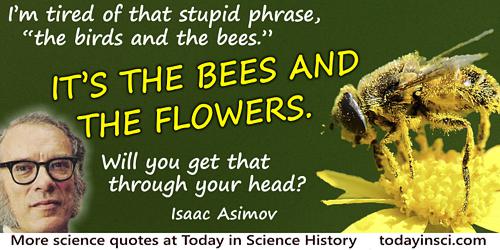
I’m tired of that stupid phrase, “the birds and the bees” which is supposed to represent “the facts of life” or the beginnings of the sex instruction of the young. … Well for heaven’s sake, has anyone ever tried to explain sex by talking about the birds and the bees? What have the birds and the bees to do with it? IT’S THE BEES AND THE FLOWERS. Will you get that through your head? IT’S THE BEES AND THE FLOWERS. The bee travels to one flower and picks up pollen from the stamens. The pollen contains the male sex cells of the plant. The bee then travels to another flower (of the same species) and the pollen brushes off onto the pistil, which contains the female sex cells of the plant. … Now in the human being … we don’t rely on bees to do it for us.
From Isaac Asimov’s letter in 'Hue and Cry' letter column in magazine, James L. Quinn (ed.), IF: Worlds of Science Fiction (Dec 1957), 7, No. 6, 119
If I had to choose, I would rather have birds than airplanes.
In 'Is Civilization Progress?', Reader’s Digest (Jul 1964).
If one be bird-witted, that is easily distracted and unable to keep his attention as long as he should, mathematics provides a remedy; for in them if the mind be caught away but a moment, the demonstration has to be commenced anew.
In De Augmentis, Bk. 6; Advancement of Learning, Bk. 2.
If the germ plasm wants to swim in the ocean, it makes itself a fish; if the germ plasm wants to fly in the air, it makes itself a bird. If it wants to go to Harvard, it makes itself a man. The strangest thing of all is that the germ plasm that we carry around within us has done all those things. There was a time, hundreds of millions of years ago, when it was making fish. Then … amphibia … reptiles … mammals, and now it’s making men.
In talk, 'Origin of Death' (1970). Wald gave the context whereby the most one-celled organisms continued to reproduce by cell division.
If we and the rest of the backboned animals were to disappear overnight, the rest of the world would get on pretty well. But if [the invertebrates] were to disappear, the world’s ecosystems would collapse. disappear, the land’s ecosystems would collapse. The soil would lose its fertility. Many of the plants would no longer be pollinated. Lots of animals, amphibians, reptiles, birds, mammals would have nothing to eat. And our fields and pastures would be covered with dung and carrion.
From BBC TV series Life in the Undergrowth (2005). As cited in Simon Barnes, History of the World in 100 Animals (2020), end of Chap. 72.
In 1810, the Triumph man-of-war and Phipps schooner received on board several tons of quicksilver, saved from the wreck of a vessel near Cadiz. In consequence of the rolling of the bags the mercury escaped, and the whole of the crews became more or less affected. In the space of three weeks, two hundred men were salivated, two died, and all the animals—cats, dogs, sheep, fowls, a canary bird, nay, even the rats, mice and cockroaches were destroyed.
[The leather bags of mercury had been salvaged and stored without the original wooden cases. Some were stowed in sleeping quarters, and the in same hold as spirit rations.]
[The leather bags of mercury had been salvaged and stored without the original wooden cases. Some were stowed in sleeping quarters, and the in same hold as spirit rations.]
The Edinburgh Medical And Surgical Journal, 6. Quoted in Alva Curtis, A Fair Examination and Criticism of All the Medical Systems in Vogue (1855), 38. For more information on the incident, see John Emsley, The Elements of Murder (2006), 38-9.
In all works on Natural History, we constantly find details of the marvellous adaptation of animals to their food, their habits, and the localities in which they are found. But naturalists are now beginning to look beyond this, and to see that there must be some other principle regulating the infinitely varied forms of animal life. It must strike every one, that the numbers of birds and insects of different groups having scarcely any resemblance to each other, which yet feed on the same food and inhabit the same localities, cannot have been so differently constructed and adorned for that purpose alone. Thus the goat-suckers, the swallows, the tyrant fly-catchers, and the jacamars, all use the same kind ‘Of food, and procure it in the same manner: they all capture insects on the wing, yet how entirely different is the structure and the whole appearance of these birds!
In A Narrative of Travels on the Amazon and Rio Negro (1853), 83-84.
In modern Europe, the Middle Ages were called the Dark Ages. Who dares to call them so now? … Their Dante and Alfred and Wickliffe and Abelard and Bacon; their Magna Charta, decimal numbers, mariner’s compass, gunpowder, glass, paper, and clocks; chemistry, algebra, astronomy; their Gothic architecture, their painting,—are the delight and tuition of ours. Six hundred years ago Roger Bacon explained the precession of the equinoxes, and the necessity of reform in the calendar; looking over how many horizons as far as into Liverpool and New York, he announced that machines can be constructed to drive ships more rapidly than a whole galley of rowers could do, nor would they need anything but a pilot to steer; carriages, to move with incredible speed, without aid of animals; and machines to fly into the air like birds.
In 'Progress of Culture', an address read to the Phi Beta Kappa Society at Cambridge, 18 July 1867. Collected in Works of Ralph Waldo Emerson (1883), 475.
In order to see birds it is necessary to become a part of the silence. One has to sit still like a mystic and wait. One soon learns that fussing, instead of achieving things, merely prevents things from happening.
First essay collected in Solomon in All his Glory (1922), 12. Also seen reprinted titled 'Kingfisher' in The New Statesman (1921), 17, 619. “Solomon in All His Glory” refers to a kingfisher, the subject of the essay.
![Rachel Carson quote: In that dawn chorus [of birds] one hears the throb of life itself.](https://todayinsci.com/C/Carson_Rachel/CarsonRachel-Dawn500x250px.jpg)
In that dawn chorus [of birds] one hears the throb of life itself.
In The Sense of Wonder (1956, 1965), 69
In the mountains of Parma and Piacenza, multitudes of shells and corals filled with worm-holes may be seen still adhering to the rocks, and when I was making the great horse at Milan a large sack of those which had been found in these parts was brought to my workshop by some peasants... The red stone of the mountains of Verona is found with shells all intermingled, which have become part of this stone... And if you should say that these shells have been and still constantly are being created in such places as these by the nature of the locality or by potency of the heavens in these spots, such an opinion cannot exist in brains possessed of any extensive powers of reasoning because the years of their growth are numbered upon the outer coverings of their shells; and both small and large ones may be seen; and these would not have grown without feeding, or fed without movement, and here [embedded in rock] they would not have been able to move... The peaks of the Apennines once stood up in a sea, in the form of islands surrounded by salt water... and above the plains of Italy where flocks of birds are flying today, fishes were once moving in large shoals.
'Physical Geography', in The Notebooks of Leonardo da Vinci, trans. E. MacCurdy (1938), Vol. 1, 355-6, 359.
In view of all the nests brimming over with eager mouths, it is a good thing that deciduous woodlands provide an incredible wealth of food for the birds that live there. There are … arthropods, snails and … the prodigious menu of nuts, seeds and juicy berries.
In The Amateur Naturalist (1989), 126.
Indians walk softly and hurt the landscape hardly more than the birds and squirrels, and their brush and bark huts last hardly longer than those of wood rats, while their more enduring monuments, excepting those wrought on the forests by the fires they made to improve their hunting grounds, vanish in a few centuries.
In My First Summer in the Sierra (1911), 73. Based on Muir’s original journals and sketches of his 1869 stay in the Sierra.
Is man a peculiar organism? Does he originate in a wholly different way from a dog, bird, frog, or fish? and does he thereby justify those who assert that he has no place in nature, and no real relationship with the lower world of animal life? Or does he develop from a similar embryo, and undergo the same slow and gradual progressive modifications? The answer is not for an instant doubtful, and has not been doubtful for the last thirty years. The mode of man’s origin and the earlier stages of his development are undoubtedly identical with those of the animals standing directly below him in the scale; without the slightest doubt, he stands in this respect nearer the ape than the ape does to the dog. (1863)
As quoted in Ernst Haeckel and E. Ray Lankester (trans.) as epigraph for Chap. 12, The History of Creation (1886), Vol. 1, 364.
It is an ill bird that fouls its own nest.
In use at least as early as 1839, for example in 'Craven' (ed.), The Sporting Review (Aug 1839), 132. Webmaster found subsequent examples being applied metaphorically to criticism of speech, politics or social conduct, rather than any literal interpretation concerning pollution.
It is curious to observe with what different degrees of architectonic skill Providence has endowed birds of the same genus, and so nearly correspondent in their general mode of life! for while the swallow and the house-martin discover the greatest address in raising and securely fixing crusts or shells of loam as cunabula for their young, the bank-martin terebrates a round and regular hole in the sand or earth, which is serpentine, horizontal, and about two feet deep. At the inner end of this burrow does this bird deposit, in a good degree of safety, her rude nest, consisting of fine grasses and feathers, usually goose-feathers, very inartificially laid together.
In Letter to Daines Barrington, (26 Feb 1774), in The Natural History and Antiquities of Selborne (1789), 176.
It is interesting to contemplate an entangled bank, clothed with many plants of many kinds, with birds singing on the bushes, with various insects flitting about, and with worms crawling through the damp earth, and to reflect that these elaborately constructed forms, so different from each other, and dependent on each other in so complex a manner, have all been produced by laws acting around us. These laws, taken in the largest sense, being Growth with Reproduction; Inheritance which is almost implied by reproduction; Variability from the indirect and direct action of the external conditions of life, and from use and disuse; a Ratio of Increase so high as to lead to a Struggle for Life, and as a consequence to Natural Selection, entailing Divergence of Character and the Extinction of less-improved forms.
Concluding remarks in final chapter, The Origin of Species (1859), 490.
It is perhaps a law of nature that when a species (or group) fits itself to a place not previously occupied, and in which it is subject to no opposition from beings of its own class, or where it attains so great a perfection as to be able easily to overcome all opposition, the character eventually loses its original plasticity, or tendency to vary, since improvement in such a case would be superfluous, and becomes, so to speak, crystallized in that form which continues thereafter unaltered. … [Such as] the humming-bird.
In The Naturalist in La Plata (1895), 40.
Learn from the Birds what food the thickets yield;
Learn from the Beasts the physick of the field:
The Arts of building from the Bee receive;
Learn of the Mole to plough, the Worm to weave.
Learn from the Beasts the physick of the field:
The Arts of building from the Bee receive;
Learn of the Mole to plough, the Worm to weave.
In 'Epistle III', Essay on Man,: Being the First Book of Ethic Epistles (1734), 47.
Let us only imagine that birds had studied their own development and that it was they in turn who investigated the structure of the adult mammal and of man. Wouldn’t their physiological textbooks teach the following? “Those four and two-legged animals bear many resemblances to embryos, for their cranial bones are separated, and they have no beak, just as we do in the first live or six days of incubation; their extremities are all very much alike, as ours are for about the same period; there is not a single true feather on their body, rather only thin feather-shafts, so that we, as fledglings in the nest, are more advanced than they shall ever be … And these mammals that cannot find their own food for such a long time after their birth, that can never rise freely from the earth, want to consider themselves more highly organized than we?”
Über Entwicklungsgeschichte der Thiere: Beobachtung und Reflexion (1828), 203. Trans. Stephen Jay Gould, Ontogeny and Phylogeny (1977), 54.
Let us suppose that we have laid on the table... [a] piece of glass... and let us homologize this glass to a whole order of plants or birds. Let us hit this glass a blow in such a manner as but to crack it up. The sectors circumscribed by cracks following the first blow may here be understood to represent families. Continuing, we may crack the glass into genera, species and subspecies to the point of finally having the upper right hand corner a piece about 4 inches square representing a sub-species.
Space, Time, Form: The Biological Synthesis (1962, issued 1964), 209.
Life is inseparable from water. For all terrestrial animals, including birds, the inescapable need for maintaining an adequate state of hydration in a hostile, desiccating environment is a central persistent constraint which exerts a sustained selective pressure on every aspect of the life cycle. It has been said, with some justification, that the struggle for existence is a struggle for free energy for doing physiological work. It can be said with equal justification for terrestrial organisms that the struggle for existence is a struggle to maintain an aqueous internal environment in which energy transformations for doing work can take place.
In 'The water economy of seed-eating birds that survive without drinking', Proceedings of the International Ornithological Congress (1972), 15, 237-238.
Life is order, death is disorder. A fundamental law of Nature states that spontaneous chemical changes in the universe tend toward chaos. But life has, during milliards of years of evolution, seemingly contradicted this law. With the aid of energy derived from the sun it has built up the most complicated systems to be found in the universe—living organisms. Living matter is characterized by a high degree of chemical organisation on all levels, from the organs of large organisms to the smallest constituents of the cell. The beauty we experience when we enjoy the exquisite form of a flower or a bird is a reflection of a microscopic beauty in the architecture of molecules.
The Nobel Prize for Chemistry: Introductory Address'. Nobel Lectures: Chemistry 1981-1990 (1992), 69.
Little Birds are writing
Interesting books.
To be read by cooks:
Read, I say, not roasted—
Letterpress, when toasted,
Loses its good looks.
Interesting books.
To be read by cooks:
Read, I say, not roasted—
Letterpress, when toasted,
Loses its good looks.
In Sylvie and Bruno Concluded (1893), 371.
Magic and all that is ascribed to it is a deep presentiment of the powers of science. The shoes of swiftness, the sword of sharpness, the power of subduing the elements, of using the secret virtues of minerals, of understanding the voices of birds, are the obscure efforts of the mind in a right direction.
From 'History', collected in The Complete Works of Ralph Waldo Emerson (1903), 34.
Man alone amongst the animals speaks and has gestures and expression which we call rational, because he alone has reason in him. And if anyone should say in contradiction that certain birds talk, as seems to be the case with some, especially the magpie and the parrot, and that certain beasts have expression or gestures, as the ape and some others seem to have, I answer that it is not true that they speak, nor that they have gestures, because they have no reason, from which these things need proceed; nor do they purpose to signify anything by them, but they merely reproduce what they see and hear.
In 'The Third Treatise', The Convivio of Dante Alighieri (1903), Chap. 7, 175. This footnoted: Compare De Vulgari Eloquentia, Book 1, Chap 2: 43-65.
Man has two conditions of existence in the body. Hardly two creatures can be less alike than an infant and a man. The whole fetal state is a preparation for birth ... The human brain, in its earlier stage, resembles that of a fish: as it is developed, it resembles more the cerebral mass of a reptile; in its increase, it is like that of a bird, and slowly, and only after birth, does it assume the proper form and consistence of the human encephalon.
Attributed.
Man studied birds for centuries, trying to learn how to make a machine to fly like them. He never did do the trick; his final success came when he broke away entirely and tried new methods.
Published under the name Don A. Stuart, 'Who Goes There?', Astounding Stories (Aug 1938). In Robert Silverberg, Ben Bova and Science Fiction Writers of America, The Science Fiction Hall of Fame (1973), Vol. 2, 62.
Man, by reason of his greater intellect, can more reasonably hope to equal birds in knowledge than to equal nature in the perfection of her machinery.
In The Papers of Wilbur and Orville Wright: 1899-1905 (1953), 15.
Many animals even now spring out of the soil,
Coalescing from the rains and the heat of the sun.
Small wonder, then, if more and bigger creatures,
Full-formed, arose from the new young earth and sky.
The breed, for instance, of the dappled birds
Shucked off their eggshells in the springtime, as
Crickets in summer will slip their slight cocoons
All by themselves, and search for food and life.
Earth gave you, then, the first of mortal kinds,
For all the fields were soaked with warmth and moisture.
Coalescing from the rains and the heat of the sun.
Small wonder, then, if more and bigger creatures,
Full-formed, arose from the new young earth and sky.
The breed, for instance, of the dappled birds
Shucked off their eggshells in the springtime, as
Crickets in summer will slip their slight cocoons
All by themselves, and search for food and life.
Earth gave you, then, the first of mortal kinds,
For all the fields were soaked with warmth and moisture.
On the Nature of Things, trans. Anthony M. Esolen (1995), Book 5, lines 794-803, 181.
Mr. Darwin in the Zoological Gardens. Frank Darwin told me his father was once standing near the hippopotamus cage when a little boy and girl, aged four and five, came up. The hippopotamus shut his eyes for a minute. “That bird’s dead,” said the little girl; “come along.”
Samuel Butler, Henry Festing Jones (ed.), The Note-Books of Samuel Butler (1917), 243. Francis Darwin was a son of Charles Darwin.
Natural history is a matter of observation; it is a harvest which you gather when and where you find it growing. Birds and squirrels and flowers are not always in season, but philosophy we have always with us. It is a crop which we can grow and reap at all times and in all places and it has its own value and brings its own satisfaction.
From Under the Apple-Trees (1916), Preface.
Never to have seen anything but the temperate zone is to have lived on the fringe of the world. Between the Tropic of Capricorn and the Tropic of Cancer live the majority of all the plant species, the vast majority of the insects, most of the strange ... quadrupeds, all of the great and most of the poisonous snakes and large lizards, most of the brilliantly colored sea fishes, and the strangest and most gorgeously plumaged of the birds.
Exploring For Plants (1930), 329.
Now when you cut a forest, an ancient forest in particular, you are not just removing a lot of big trees and a few birds fluttering around in the canopy. You are drastically imperiling a vast array of species within a few square miles of you. The number of these species may go to tens of thousands. … Many of them are still unknown to science, and science has not yet discovered the key role undoubtedly played in the maintenance of that ecosystem, as in the case of fungi, microorganisms, and many of the insects.
From On Human Nature (2000). As quoted in John H. Morgan, Naturally Good: A Behavioral History of Moral Development (2005), 251-252.
Nowhere is water so beautiful as in the desert for nowhere else is it so scarce. By definition. Water, like a human being or a tree or a bird or a song gains value by rarity, singularity, isolation. In a humid climate water is common. In the desert each drop is precious.
Essay in Desert Images, collected in Beyond the Wall: Essays from the Outside (1984), 82.
On consideration, it is not surprising that Darwin's finches should recognize their own kind primarily by beak characters. The beak is the only prominent specific distinction, and it features conspicuously both in attacking behaviour, when the birds face each other and grip beaks, and also in courtship, when food is passed from the beak of the male to the beak of the female. Hence though the beak differences are primarily correlated with differences in food, secondarily they serve as specific recognition marks, and the birds have evolved behaviour patterns to this end.
Darwin's Finches (1947), 54.
On entering his [John James Audubon] room, I was astonished and delighted to find that it was turned into a museum. The walls were festooned with all kinds of birds’ eggs, carefully blown out and strung on a thread. The chimney-piece was covered with stuffed squirrels, raccoons, and opossums; and the shelves around were likewise crowded with specimens, among which were fishes, frogs, snakes, lizards, and other reptiles. Besides these stuffed varieties, many paintings were arrayed on the walls, chiefly of birds.
In Richard Rhodes, John James Audubon: The Making of an American (2004), 36.
One more word on “designed laws” and “undesigned results.” - I see a bird which I want for food, take my gun and kill it, I do this designedly.—An innocent and good man stands under a tree and is killed by a flash of lightning. Do you believe (& I really should like to hear) that God designedly killed this man? Many or most persons do believe this; I can’t and don’t.—If you believe so, do you believe that when a swallow snaps up a gnat that God designed that that particular swallow should snap up that particular gnat at that particular instant? I believe that the man and the gnat are in the same predicament. If the death of neither man nor gnat are designed, I see no good reason to believe that their first birth or production should be necessarily designed.
Letter to Asa Gray, 3 July 1860. In F. Burkhardt and S. Smith (eds.), The Correspondence of Charles Darwin 1860 (1993), Vol. 8, 275.
OSTRICH, n. A large bird to which (for its sins, doubtless) nature has denied that hinder toe in which so many pious naturalists have seen a conspicuous evidence of design. The absence of a good working pair of wings is no defect, for, as has been ingeniously pointed out, the ostrich does not fly.
The Collected Works of Ambrose Bierce (1911), Vol. 7, The Devil's Dictionary, 241.
Over increasingly large areas of the United States, spring now comes unheralded by the return of the birds, and the early mornings are strangely silent where once they were filled with the beauty of bird song.
On the effect of chemical insecticides and fertilizers. In 'And No Birds Sing', Silent Spring (1962), Ch. 8, 103.
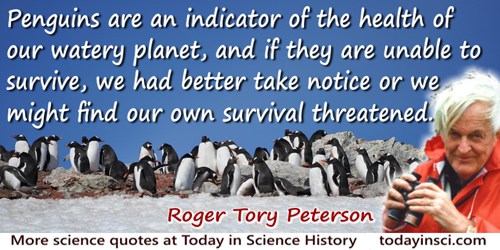
Penguins are an indicator of the health of our watery planet, and if they are unable to survive, we had better take notice or we might find our own survival threatened.
In Penguins (1998), 160.
Perfect as the wing of a bird may be, it will never enable the bird to fly if unsupported by the air. Facts are the air of science. Without them a man of science can never rise. Without them your theories are vain surmises. But while you are studying, observing, experimenting, do not remain content with the surface of things. Do not become a mere recorder of facts, but try to penetrate the mystery of their origin. Seek obstinately for the laws that govern them.
Translation of a note, 'Bequest of Pavlov to the Academic Youth of his Country', written a few days before his death for a student magazine, The Generation of the Victors. As published in 'Pavlov and the Spirit of Science', Nature (4 Apr 1936), 137, 572.
Philosophy of Science is about as much use to scientists as ornithology is to birds.
Attributed. Frequently quoted, but primary source is lacking. For example, Steven Weinberg quoted it in a talk at the Tercentenary Celebration of Newton's Principia, 'Newtonianism, Reductionism and the Art of Congressional Testimony' (See Nature (3 Dec 1987), 330, No. 6147, 433). Weinberg states “I’ve heard the remark (although I forget the source).” Any attribution to Stephen Weinberg is thus incorrect, although it appears thus in, for example, the Oxford Dictionary of Scientific Quotations. Other sources most often attribute the subject quote to Richard Feynman, though still without a documented source. So Webmaster moved the quote from the Weinberg page to this Feynman page 1 Jul 2015. If you know a primary source, please contact Webmaster.
Quietly, like a night bird, floating, soaring, wingless.
We glide from shore to shore, curving and falling
but not quite touching;
Earth: a distant memory seen in an instant of repose,
crescent shaped, ethereal, beautiful,
I wonder which part is home, but I know it doesn’t matter . . .
the bond is there in my mind and memory;
Earth: a small, bubbly balloon hanging delicately
in the nothingness of space.
We glide from shore to shore, curving and falling
but not quite touching;
Earth: a distant memory seen in an instant of repose,
crescent shaped, ethereal, beautiful,
I wonder which part is home, but I know it doesn’t matter . . .
the bond is there in my mind and memory;
Earth: a small, bubbly balloon hanging delicately
in the nothingness of space.
…...
Quite likely the twentieth century is destined to see the natural forces which will enable us to fly from continent to continent with a speed far exceeding that of a bird.
'The Outlook for the Flying Machine'. The Independent: A Weekly Magazine (22 Oct 1903), 2510.
Science has blown to atoms, as she can rend and rive in the rocks themselves; but in those rocks she has found, and read aloud, the great stone book which is the history of the earth, even when darkness sat upon the face of the deep. Along their craggy sides she has traced the footprints of birds and beasts, whose shapes were never seen by man. From within them she has brought the bones, and pieced together the skeletons, of monsters that would have crushed the noted dragons of the fables at a blow.
Book review of Robert Hunt, Poetry of Science (1848), in the London Examiner (1848). Although uncredited in print, biographers identified his authorship from his original handwritten work. Collected in Charles Dickens and Frederic George Kitton (ed.) Old Lamps for New Ones: And Other Sketches and Essays (1897), 87.
See, thro' this air, this ocean, and this earth,
All matter quick, and bursting into birth.
Above, how high progressive life may go!
Around, how wide! how deep extend below!
Vast chain of being, which from God began,
Natures ethereal, human, angel, man,
Beast, bird, fish, insect! what no eye can see,
No glass can reach! from Infinite to thee,
From thee to Nothing—On superior pow'rs
Were we to press, inferior might on ours:
Or in the full creation leave a void,
Where, one step broken, the great scale's destroy'd:
From Nature's chain whatever link you strike,
Tenth or ten thousandth, breaks the chain alike.
All matter quick, and bursting into birth.
Above, how high progressive life may go!
Around, how wide! how deep extend below!
Vast chain of being, which from God began,
Natures ethereal, human, angel, man,
Beast, bird, fish, insect! what no eye can see,
No glass can reach! from Infinite to thee,
From thee to Nothing—On superior pow'rs
Were we to press, inferior might on ours:
Or in the full creation leave a void,
Where, one step broken, the great scale's destroy'd:
From Nature's chain whatever link you strike,
Tenth or ten thousandth, breaks the chain alike.
'An Essay on Man' (1733-4), Epistle I. In John Butt (ed.), The Poems of Alexander Pope (1965), 513.
Seeing this gradation and diversity of structure in one small, intimately related group of birds, one might really fancy that from an original paucity of birds in this archipelago, one species had been taken and modified for different ends.
[Comment added to the second edition (1845) of Voyage of the Beagle (1839) concerning the variations he found of finches in the Galapagos Islands. In the first edition (p.461) he had merely described the thirteen allied species of finch but without further commentary.]
[Comment added to the second edition (1845) of Voyage of the Beagle (1839) concerning the variations he found of finches in the Galapagos Islands. In the first edition (p.461) he had merely described the thirteen allied species of finch but without further commentary.]
Voyage of the Beagle, 2nd ed., (1845), 380.
Segregationalists will even argue that God was the first segregationalist. “Red birds and blue birds don't fly together”, they contend. … They turn to some pseudo-scientific writing and argue that the Negro’s brain is smaller than the white man’s brain. They do not know, or they refuse to know that the idea of an inferior or superior race has been refuted by the best evidence of the science of anthropology. Great anthropologists, like Ruth Benedict, Margaret Mead, and Melville J. Herskovits, agree that, although there may be inferior and superior individuals within all races, there is no superior or inferior race. And segregationalists refuse to acknowledge that there are four types of blood, and these four types are found within every racial group.
'Love in Action', Strength To Love (1963, 1981), 45-46.
So out of the ground the Lord God formed every beast of the field and every bird of the air, and brought them to the man to see what he would call them; and whatever the man called every living creature, that was its name. The man gave names to all cattle, and to the birds of the air, and to every beast of the field… .
— Bible
(circa 725 B.C.)
Some men who call themselves pessimists because they cannot read good into the operations of nature forget that they cannot read evil. In morals the law of competition no more justifies personal, official, or national selfishness or brutality than the law of gravity justifies the shooting of a bird.
…...
Speaking about symmetry, look out our window, and you may see a cardinal attacking its reflection in the window. The cardinal is the only bird we have who often does this. If it has a nest nearby, the cardinal thinks there is another cardinal trying to invade its territory. It never realizes it is attacking its own reflection. Cardinals don’t know much about mirror symmetry!
In István Hargittai, 'A Great Communicator of Mathematics and Other Games: A Conversation with Martin Gardner', The Mathematical Intelligencer. (1997), 194(4), 36-40. Quoted in István and Magdolna Hargittai, In Our Own Image (2000), 9.
Surely no child, and few adults, have ever watched a bird in flight without envy.
Isaac Asimov and Jason A. Shulman, Isaac Asimov’s Book of Science and Nature Quotations (1988), 3.
The [mechanical] bird I have described ought to be able by the help of the wind to rise to a great height, and this will prove to be its safety; since even if… revolutions [of the winds] were to befall it, it would still have time to regain a condition of equilibrium; provided that its various parts have a great power of resistance, so that they can safely withstand the fury and violence of the descent, by the aid of the defenses which I have mentioned; and its joints should be made of strong tanned hide, and sewn with cords of strong raw silk. And let no one encumber himself with iron bands, for these are very soon broken at the joints or else they become worn out, and consequently it is well not to encumber oneself with them.
'Of the Bird’s Movement' from Sul Voio degli Uccelli, 8 [7] r. in Leonardo da Vinci's Notebooks, trans. E. MacCurdy (1906), 153-4.
The acquired [space exploration] technology has immediately been aimed at practical and profitable applications: worldwide communications, global positioning systems for ships and aircraft, and remote sensing to better know our planet and monitor its resources and to trace migrations of whales, fish, and birds. Unfortunately, it is now almost monopolized by the military.
Written for 'Foreword' to Kevin W. Kelley (ed.), The Home Planet (1988), paragraph 5 (unpaginated).
The bird is a creature of the air, the fish is a creature of the water, and man is a creature of the mind.
In From Atlantis to the Sphinx (1996), 347.
The bird which is drawn to the water by its need of finding there the prey on which it lives, separates the digits of its feet in trying to strike the water and move about on the surface. The skin which unites these digits at their base acquires the habit of being stretched by these continually repeated separations of the digits; thus in course of time there are formed large webs which unite the digits of ducks, geese, etc., as we actually find them. In the same way efforts to swim, that is to push against the water so as to move about in it, have stretched the membranes between the digits of frogs, sea-tortoises, the otter, beaver, etc.
On the other hand, a bird which is accustomed to perch on trees and which springs from individuals all of whom had acquired this habit, necessarily has longer digits on its feet and differently shaped from those of the aquatic animals that I have just named. Its claws in time become lengthened, sharpened and curved into hooks, to clasp the branches on which the animal so often rests.
We find in the same way that the bird of the water-side which does not like swimming and yet is in need of going to the water's edge to secure its prey, is continually liable to sink into the mud. Now this bird tries to act in such a way that its body should not be immersed in the liquid, and hence makes its best efforts to stretch and lengthen its legs. The long-established habit acquired by this bird and all its race of continually stretching and lengthening its legs, results in the individuals of this race becoming raised as though on stilts, and gradually obtaining long, bare legs, denuded of feathers up to the thighs and often higher still.
On the other hand, a bird which is accustomed to perch on trees and which springs from individuals all of whom had acquired this habit, necessarily has longer digits on its feet and differently shaped from those of the aquatic animals that I have just named. Its claws in time become lengthened, sharpened and curved into hooks, to clasp the branches on which the animal so often rests.
We find in the same way that the bird of the water-side which does not like swimming and yet is in need of going to the water's edge to secure its prey, is continually liable to sink into the mud. Now this bird tries to act in such a way that its body should not be immersed in the liquid, and hence makes its best efforts to stretch and lengthen its legs. The long-established habit acquired by this bird and all its race of continually stretching and lengthening its legs, results in the individuals of this race becoming raised as though on stilts, and gradually obtaining long, bare legs, denuded of feathers up to the thighs and often higher still.
Philosophie Zoologique (1809), Vol. 1, 249-50, trans. Hugh Elliot (1914), 119-20.
The birds can fly,
An’ why can’t I?
An’ why can’t I?
In poem, 'Darius Green and his Flying-Machine', Vagabonds: And Other Poems (1869), 115.
The blue distance, the mysterious Heavens, the example of birds and insects flying everywhere, are always beckoning Humanity to rise into the air.
In The Successes of Air Balloons in the 19th Century (1901), 1.
The colours of insects and many smaller animals contribute to conceal them from the larger ones which prey upon them. Caterpillars which feed on leaves are generally green; and earth-worms the colour of the earth which they inhabit; butter-flies, which frequent flowers, are coloured like them; small birds which frequent hedges have greenish backs like the leaves, and light-coloured bellies like the sky, and are hence less visible to the hawk who passes under them or over them.
The Botanic Garden (1791), part 2, note to canto I, line 375, page 38.
The commonest forms of amateur natural history in the United States are probably gardening, bird watching, the maintenance of aquarium fish, and nature photography.
In The Nature of Natural History (1950, 1990), 265.
The day dawned grey and dreary
The sky made of silver
While the first snowflakes
Began to fall.
A lone bird chirped
In a tree bare of its leaves.
Standing on a lonely road
I stood watching as the world
Started changing.
And I embraced the winter
With memories of summer’s warmth
Still in my heart.
And soon the snowflakes
Began to dance about me
And I twirled around and around
As everything
Turned into a winter wonderland.
The sky made of silver
While the first snowflakes
Began to fall.
A lone bird chirped
In a tree bare of its leaves.
Standing on a lonely road
I stood watching as the world
Started changing.
And I embraced the winter
With memories of summer’s warmth
Still in my heart.
And soon the snowflakes
Began to dance about me
And I twirled around and around
As everything
Turned into a winter wonderland.
…...
The desire to fly after the fashion of the birds is an idea handed down to us by our ancestors who, in their grueling travels across trackless lands in prehistoric times, looked enviously on the birds soaring freely through space, at full speed, above all obstacles, on the infinite highway of the air.
In The Papers of Wilbur and Orville Wright: Including the Chanute-Wright Letters (1953), 934.
The Earth Speaks, clearly, distinctly, and, in many of the realms of Nature, loudly, to William Jennings Bryan, but he fails to hear a single sound. The earth speaks from the remotest periods in its wonderful life history in the Archaeozoic Age, when it reveals only a few tissues of its primitive plants. Fifty million years ago it begins to speak as “the waters bring forth abundantly the moving creatures that hath life.” In successive eons of time the various kinds of animals leave their remains in the rocks which compose the deeper layers of the earth, and when the rocks are laid bare by wind, frost, and storm we find wondrous lines of ascent invariably following the principles of creative evolution, whereby the simpler and more lowly forms always precede the higher and more specialized forms.
The earth speaks not of a succession of distinct creations but of a continuous ascent, in which, as the millions of years roll by, increasing perfection of structure and beauty of form are found; out of the water-breathing fish arises the air-breathing amphibian; out of the land-living amphibian arises the land-living, air-breathing reptile, these two kinds of creeping things resembling each other closely. The earth speaks loudly and clearly of the ascent of the bird from one kind of reptile and of the mammal from another kind of reptile.
This is not perhaps the way Bryan would have made the animals, but this is the way God made them!
The earth speaks not of a succession of distinct creations but of a continuous ascent, in which, as the millions of years roll by, increasing perfection of structure and beauty of form are found; out of the water-breathing fish arises the air-breathing amphibian; out of the land-living amphibian arises the land-living, air-breathing reptile, these two kinds of creeping things resembling each other closely. The earth speaks loudly and clearly of the ascent of the bird from one kind of reptile and of the mammal from another kind of reptile.
This is not perhaps the way Bryan would have made the animals, but this is the way God made them!
The Earth Speaks to Bryan (1925), 5-6. Osborn wrote this book in response to the Scopes Monkey Trial, where William Jennings Bryan spoke against the theory of evolution. They had previously been engaged in the controversy about the theory for several years. The title refers to a Biblical verse from the Book of Job (12:8), “Speak to the earth and it shall teach thee.”
The embryos of mammals, of birds, lizards, and snakes are, in their earliest states, exceedingly like one another, both as a whole and in the mode of development of their parts, indeed we can often distinguish such embryos only by their size. I have two little embryos in spirit [alcohol] to which I have omitted to attach the names. I am now quite unable to say to what class they belong.
The extracellular genesis of cells in animals seemed to me, ever since the publication of the cell theory [of Schwann], just as unlikely as the spontaneous generation of organisms. These doubts produced my observations on the multiplication of blood cells by division in bird and mammalian embryos and on the division of muscle bundles in frog larvae. Since then I have continued these observations in frog larvae, where it is possible to follow the history of tissues back to segmentation.
'Ueber extracellulare Eutstehung thierischer Zelleu und üüber Vermehrung derselben durch Theilung', Archiv für Anatomie, Physiologie und Wissenschaftliche Medicin (1852), 1, 49-50. Quoted in Erwin H. Ackerknecht, Rudolf Virchow: Doctor Statesman Anthropologist (1953), 83-4.
The gentleman [Mr. Taber] from New York says [agricultural research] is all foolish. Yes; it was foolish when Burbank was experimenting with wild cactus. It was foolish when the Wright boys went down to Kitty Hawk and had a contraption there that they were going to fly like birds. It was foolish when Robert Fulton tried to put a boiler into a sail boat and steam it up the Hudson. It was foolish when one of my ancestors thought the world was round and discovered this country so that the gentleman from New York could become a Congressman. (Laughter.) ... Do not seek to stop progress; do not seek to put the hand of politics on these scientific men who are doing a great work. As the gentleman from Texas points out, it is not the discharge of these particular employees that is at stake, it is all the work of investigation, of research, of experimentation that has been going on for years that will be stopped and lost.
Speaking (28 Dec 1932) as a member of the 72nd Congress, early in the Great Depression, in opposition to an attempt to eliminate a small amount from the agricultural appropriation bill. As quoted in 'Mayor-Elect La Guardia on Research', Science (1933), New Series, 78, No. 2031, 511.
The human soul is like a bird that is born in a cage. Nothing can deprive it of its natural longings, or obliterate the mysterious remembrance of its heritage.
Quoted in Kim Lim (ed.), 1,001 Pearls of Spiritual Wisdom: Words to Enrich, Inspire, and Guide Your Life (2014), 6
The infinite variations in the ways creatures fulfill the same requirement—to fuel energy needs—constantly astound me. Booby birds and pelicans … actually performed underwater dives, descending some twenty feet below the surface and then flapping their wings to fly through water. Totally encrusted with tiny diamond bubbles—like the jeweled nightingales of Asian emperors—they soared around below for nearly half a minute.
In Jacques Cousteau and Susan Schiefelbein, The Human, the Orchid, and the Octopus: Exploring and Conserving Our Natural World (2007), 282.
The larger our great cities grow, the more irresistible becomes the attraction which they exert on the children of the country, who are fascinated by them, as the birds are fascinated by the lighthouse or the moths by the candle.
In The Task of Social Hygiene (1912), 178.
The only part of evolution in which any considerable interest is felt is evolution applied to man. A hypothesis in regard to the rocks and plant life does not affect the philosophy upon which one's life is built. Evolution applied to fish, birds and beasts would not materially affect man's view of his own responsibilities except as the acceptance of an unsupported hypothesis as to these would be used to support a similar hypothesis as to man. The evolution that is harmful—distinctly so—is the evolution that destroys man’s family tree as taught by the Bible and makes him a descendant of the lower forms of life. This … is a very vital matter.
'God and Evolution', New York Times (26 Feb 1922), 84. Rebuttals were printed a few days later from Henry Fairfield Osborn and Edwin Grant Conklin.
The process of natural selection has been summed up in the phrase “survival of the fittest.” This, however, tells only part of the story. “Survival of the existing” in many cases covers more of the truth. For in hosts of cases the survival of characters rests not on any special usefulness or fitness, but on the fact that individuals possessing these characters have inhabited or invaded a certain area. The principle of utility explains survivals among competing structures. It rarely accounts for qualities associated with geographic distribution.
The nature of animals which first colonize a district must determine what the future fauna will be. From their specific characters, which are neither useful nor harmful, will be derived for the most part the specific characters of their successors.
It is not essential to the meadow lark that he should have a black blotch on the breast or the outer tail-feather white. Yet all meadow larks have these characters just as all shore larks have the tiny plume behind the ear. Those characters of the parent stock, which may be harmful in the new relations, will be eliminated by natural selection. Those especially helpful will be intensified and modified, but the great body of characters, the marks by which we know the species, will be neither helpful nor hurtful. These will be meaningless streaks and spots, variations in size of parts, peculiar relations of scales or hair or feathers, little matters which can neither help nor hurt, but which have all the persistence heredity can give.
The nature of animals which first colonize a district must determine what the future fauna will be. From their specific characters, which are neither useful nor harmful, will be derived for the most part the specific characters of their successors.
It is not essential to the meadow lark that he should have a black blotch on the breast or the outer tail-feather white. Yet all meadow larks have these characters just as all shore larks have the tiny plume behind the ear. Those characters of the parent stock, which may be harmful in the new relations, will be eliminated by natural selection. Those especially helpful will be intensified and modified, but the great body of characters, the marks by which we know the species, will be neither helpful nor hurtful. These will be meaningless streaks and spots, variations in size of parts, peculiar relations of scales or hair or feathers, little matters which can neither help nor hurt, but which have all the persistence heredity can give.
Foot-notes to Evolution. A Series of Popular Addresses on the Evolution of Life (1898), 218.
The sedge is wither’d from the lake,
And no birds sing.
And no birds sing.
From his ballad, 'La Belle Dame sans Merci' (1820), collected in The Poetical Works of John Keats (1895), 446. Used as epigraph in Rachel Carson, Silent Spring (1962), vii.
The seeds of things have mysterious workings. In the water they become Break Vine, on the edges of the water they become Frog’s Robe. If they sprout on the slopes they become Hill Slippers. If Hill Slippers get rich soil, they turn into Crow’s Feet. The roots of Crow’s Feet turn into maggots and their leaves turn into butterflies. Before long the butterflies are transformed and turn into insects that live under the stove; they look like snakes and their name is Ch’u-t’o. After a thousand days, the Ch’u-t’o insects become birds called Dried Leftover Bones. The saliva of the Dried Leftover Bones becomes Ssu-mi bugs and the Ssu-mi bugs become Vinegar Eaters. I-lo bugs are born from the Vinegar Eaters, and Huang-shuang bugs from Chiu-yu bugs. Chiu-yu bugs are born from Mou-jui bugs and Mou-jui bugs are born from Rot Grubs and Rot Grubs are born from Sheep’s Groom. Sheep’s Groom couples with bamboo that has not sprouted for a long while and produces Green Peace plants. Green Peace plants produce leopards and leopards produce horses and horses produce men. Men in time return again to the mysterious workings. So all creatures come out of the mysterious workings and go back into them again.
An ancient consideration of transmutation of species, which—over two millenia ago—anticipated the modern theory of evolution. As translated by Burton Watson in The Complete Works Of Chuang Tzu (1968, 2013), 143-144.
The study of economics does not seem to require any specialised gifts of an unusually high order. Is it not, intellectually regarded, a very easy subject compared with the higher branches of philosophy and pure science? Yet good, or even competent, economists are the rarest of birds. An easy subject, at which very few excel! The paradox finds its explanation, perhaps, in that the master-economist must possess a rare combination of gifts. He must reach a high standard in several different directions and must combine talents not often found together. He must be mathematician, historian, statesman, philosopher—in some degree. He must understand symbols and speak in words. He must contemplate the particular in terms of the general, and touch abstract and concrete in the same flight of thought. He must study the present in the light of the past for the purposes of the future. No part of man's nature or his institutions must lie entirely outside his regard. He must be purposeful and disinterested in a simultaneous mood; as aloof and incorruptible as an artist, yet sometimes as near the earth as a politician.
'Alfred Marshall: 1842-1924' (1924). In Geoffrey Keynes (ed.), Essays in Biography (1933), 170.
The time has come to link ecology to economic and human development. When you have seen one ant, one bird, one tree, you have not seen them all. What is happening to the rain forests of Madagascar and Brazil will affect us all.
Quoted in Jamie Murphy and Andrea Dorfman, 'The Quiet Apocalypse,' Time (13 Oct 1986).
The time will come when people will travel in stages moved by steam engines, from city to city, almost as fast as birds fly,—fifteen or twenty miles an hour. Passing through the air with such velocity, changing the scene in such rapid succession, will be the most exhilarating exercise.
(about 1804). As quoted in Henry Howe, 'Oliver Evans', Memoirs of the Most Eminent American Mechanics: (1840), 80.
The United States at this moment occupies a lamentable position as being perhaps the chief offender among civilized nations in permitting the destruction and pollution of nature. Our whole modern civilization is at fault in the matter. But we in America are probably most at fault ... We treasure pictures and sculpture. We regard Attic temples and Roman triumphal arches and Gothic cathedrals as of priceless value. But we are, as a whole, still in that low state of civilization where we do not understand that it is also vandalism wantonly to destroy or permit the destruction of what is beautiful in nature, whether it be a cliff, a forest, or a species of mammal or bird. Here in the United States we turn our rivers and streams into sewers and dumping-grounds, we pollute the air, we destroy forests and exterminate fishes, birds and mammals'not to speak of vulgarizing charming landscapes with hideous advertisements.
'Our Vanishing Wild Life', The Outlook, 25 Jan 1913. In Donald Davidson (Ed.) The Wisdom of Theodore Roosevelt (2003), 19.
The world is full of signals that we don’t perceive. Tiny creatures live in a different world of unfamiliar forces. Many animals of our scale greatly exceed our range of perception for sensations familiar to us ... What an imperceptive lot we are. Surrounded by so much, so fascinating and so real, that we do not see (hear, smell, touch, taste) in nature, yet so gullible and so seduced by claims for novel power that we mistake the tricks of mediocre magicians for glimpses of a psychic world beyond our ken. The paranormal may be a fantasy; it is certainly a haven for charlatans. But ‘parahuman’ powers of perception lie all about us in birds, bees, and bacteria.
…...
There are some viviparous flies, which bring forth 2,000 young. These in a little time would fill the air, and like clouds intercept the rays of the sun, unless they were devoured by birds, spiders, and many other animals.
Oeconomia Naturae, The Oeconomy of Nature. Trans Benjamin Stillingfleet, Miscellaneous Tracts Relating to Natural History (1775), revised edition, 1777, 119.
There are still many unsolved problems about bird life, among which are the age that birds attain, the exact time at which some birds acquire their adult dress, and the changes which occur in this with years. Little, too, is known about the laws and routes of bird migration, and much less about the final disposition of the untold thousands which are annually produced.
There is nothing in which the birds differ more from man than the way in which they can build and yet leave a landscape as it was before.
In The Blue Lion, and Other Essays (1923), 29.
There is symbolic as well as actual beauty in the migration of the birds, the ebb and flow of the tides, the folded bud ready for the spring. There is something infinitely healing in the repeated refrains of nature—the assurance that dawn comes after night, and spring after the winter.
In The Sense of Wonder (1956, 1965), 88-89.
Through the naturalist’s eyes, a sparrow can be as interesting as a bird of paradise, the behaviour of a mouse as interesting as that of a tiger, and a humble lizard as fascinating as a crocodile. … Our planet is beautifully intricate, brimming over with enigmas to be solved and riddles to be unravelled.
In The Amateur Naturalist (1989), 7.
Throughout all of human history, we have taken, taken, taken, from the natural world. All creatures, however large or small, do this as a way of making a living. Humans, though, have gone way beyond what elephants have done to the planet or what birds or what any fish in the sea is capable of doing.
In interview with Pierce Nahigyan, 'Dr. Sylvia Earle: “We’re Literally Destroying The Systems That Keep Us Alive”', Huffington Post (6 Jan 2016).
Timorous readers, however, need entertain no feverish fear, on, visiting the Isle of Sheppey, of encountering either wild elephants, crocodiles, sharks, serpents, or man-eating birds of huge dimensions, bearing strange names, and armed with sets of teeth for masticating and digestive purposes, as the author can assure them that they all died out a million or so of years ago, before he undertook to look up their records and write the history of this wonderful little island. Visitors may, however, honestly deplore the absence of the feathery palm trees bearing the luscious date and the lacteous cocoa-nut; but by prosecuting a diligent search they may, at least, be consoled by procuring some of these, rare fossil remains, reminiscent of an incalculable period of time when our particular portion of this hemisphere performed its diurnal revolutions in the immediate zone of the tropics.
Quoted in Augustus A. Daly, History of the Isle of Sheppey (1975), 250.
To speak of this subject you must... explain the nature of the resistance of the air, in the second the anatomy of the bird and its wings, in the third the method of working the wings in their various movements, in the fourth the power of the wings and the tail when the wings are not being moved and when the wind is favorable to serve as guide in various movements.
…...
Tolstoi explains somewhere in his writings why, in his opinion, “Science for Science's sake” is an absurd conception. We cannot know all the facts since they are infinite in number. We must make a selection ... guided by utility ... Have we not some better occupation than counting the number of lady-birds in existence on this planet?
In Science and Method (1914, 2003), 15
Tonight, the moon came out, it was nearly full.
Way down here on earth, I could feel it’s pull.
The weight of gravity or just the lure of life,
Made me want to leave my only home tonight.
I’m just wondering how we know where we belong
Is it in the arc of the moon, leaving shadows on the lawn
In the path of fireflies and a single bird at dawn
Singing in between here and gone
Way down here on earth, I could feel it’s pull.
The weight of gravity or just the lure of life,
Made me want to leave my only home tonight.
I’m just wondering how we know where we belong
Is it in the arc of the moon, leaving shadows on the lawn
In the path of fireflies and a single bird at dawn
Singing in between here and gone
…...
Trees are more than just havens for animals, birds, insects, and humans; they are also the lungs of the earth. Just as we breathe oxygen into our lungs and exhale carbon dioxide, so trees breathe carbon dioxide into their leaves and exhale oxygen.
In If You Love This Planet: A Plan to Save the Earth (1992, 2009), 51.
Vultures are homely, but they clean up all the garbage and that’s good. And they’re elegant in the sky.
As quoted by Lisa Foderado in 'In The Studio With Roger Tory Peterson; Reluctant Earthling', The New York Times (26 Aug 1993), C1.
We do not ask for what useful purpose the birds do sing, for song is their pleasure since they were created for singing. Similarly, we ought not to ask why the human mind troubles to fathom the secrets of the heavens ... The diversity of the phenomena of Nature is so great, and the treasures hidden in the heavens so rich, precisely in order that the human mind shall never be lacking in fresh nourishment.
From Mysterium Cosmographicum. Quote as translated in Carl Sagan, Cosmos (1980, 1985), 32.
We do not ask what hope of gain makes a little bird warble, since we know that it takes delight in singing because it is for that very singing that the bird was made, so there is no need to ask why the human mind undertakes such toil in seeking out these secrets of the heavens. ... And just as other animals, and the human body, are sustained by food and drink, so the very spirit of Man, which is something distinct from Man, is nourished, is increased, and in a sense grows up on this diet of knowledge, and is more like the dead than the living if it is touched by no desire for these things.
Mysterium Cosmographicum. Translated by A. M. Duncan in The Secret of the Universe (1981), 55.
We had various kinds of tape-recorded concerts and popular music. But by the end of the flight what we listened to most was Russian folk songs. We also had recordings of nature sounds: thunder, rain, the singing of birds. We switched them on most frequently of all, and we never grew tired of them. It was as if they returned us to Earth.
…...
We live in a glass-soaked civilization, but as for the bird in the Chinese proverb who finds it so difficult to discover air, the substance is almost invisible to us. To use a metaphor drawn from glass, it may be revealing for us to re-focus, to stop looking through glass, and let our eyes dwell on it for a moment to contemplate its wonder. [Co-author with Gerry Martin.]
Glass: A World History (2002), 4.
What is it to see, in an Eagle glide
Which fills a human heart with so much pride?
Is it that it soars effortless above the Earth
That steals us from our own limits & dearth?
Trapped in our seas of befuddling sludge
We try and try but cannot budge.
And then to see a mortal; with such ease take wing
Up in a breeze that makes our failing spirits sing?
Do we, vicarious birds, search in it our childishness -
When we too were young & yearned in heart to fly?
Taking flights of fancy through adolescent nights
Listening little, heeding less, knowing not why?
From its highest perch in the forest of snow
Majestic - the Eagle soars alone.
Riding thermals, lording clouds
Till dropping silent from the sky as a stone
But we, so quick and ready to fold
Give up our wings at the whiff of age
Losing years, cursing time, wasting spirit
Living out entire lives in futile rage!
Which fills a human heart with so much pride?
Is it that it soars effortless above the Earth
That steals us from our own limits & dearth?
Trapped in our seas of befuddling sludge
We try and try but cannot budge.
And then to see a mortal; with such ease take wing
Up in a breeze that makes our failing spirits sing?
Do we, vicarious birds, search in it our childishness -
When we too were young & yearned in heart to fly?
Taking flights of fancy through adolescent nights
Listening little, heeding less, knowing not why?
From its highest perch in the forest of snow
Majestic - the Eagle soars alone.
Riding thermals, lording clouds
Till dropping silent from the sky as a stone
But we, so quick and ready to fold
Give up our wings at the whiff of age
Losing years, cursing time, wasting spirit
Living out entire lives in futile rage!
…...
What shall we say of the intelligence, not to say religion, of those who are so particular to distinguish between fishes and reptiles and birds, but put a man with an immortal soul in the same circle with the wolf, the hyena, and the skunk? What must be the impression made upon children by such a degradation of man?
When I was a boy, I could cycle out of town and be in fields in ten minutes. I knew where the birds’ nests and badger setts were. Now children’s mothers would tell them they need someone to go with them, to make sure they weren’t molested by a sexual deviant.
Commenting on today’s increased anxiety with health and safety culture. As reported by Adam Lusher in 'Sir David Attenborough', Daily Mail (28 Feb 2014).
When not protected by law, by popular favor or superstition, or by other special circumstances, [birds] yield very readily to the influences of civilization, and, though the first operations of the settler are favorable to the increase of many species, the great extension of rural and of mechanical industry is, in a variety of ways, destructive even to tribes not directly warred upon by man.
In Man and Nature, (1864), 93-93.
When you’re really shipwrecked, you do really find what you want. When you’re really on a desert island, you never find it a desert. If we were really besieged in this garden we’d find a hundred English birds and English berries that we never knew were here.
In Manalive (1912), 58.
Why does such and such animal feed only on flesh, while another on plants? Where does one get the finesse of its sense of smell, or that of its hearing? What is the source of the prodigious strength of the muscles of birds? How is this force used to produce this amazing movement of flight? How does it come about that the bird sees equally well at quite different distances? What is the cause of the range and variety of its voice? Why is a reptile so lethargic? Why does a worm stay alive long after being divided? Why can a zoophyte live equally well with some parts of its body cut off? Is it presumed there could be natural history without these questions, and thousands of others like them, and do we think we can answer without a thorough comparative anatomy?
From 'Lettre à M. de la Cépède', collected in G. L. Duvernpy (ed.) Leçons d’Anatomie Comparée de Georges Cuvier: Tome IV, Première Partie: Corrigée et Augmentée (2nd ed. 1833), xxij. As translated and tweaked by Webmaster using online translation sites from the original French: “Pourquoi tel animal ne se nourrit-il que de chair, tel autre que de végétaux? D’où celui-ci tire-t-il la finesse de son odorat, ou celle de son ouïe? Quelle est la source de la force prodigieux des muscles des oiseaux? Comment cette force est-elle employée à produire ce mouvement si étonnant du vol? D’où viens que l’oiseau voit également bien à des distances si differentes? Quelles sont les causes de l’etendue, et de la variété de sa voix? Pourquoi tel reptile, est-il si engourdie? Pourquoi tel ver, conserve-t-il de la vie long-temps après être divisé? Pourquoi tel zoophyte peut-il vivre égalment bien, quelque partie de son corps que l’on en retranche. Suppose-t-on qu’il puisse exister une histoire naturelle sans ces questions, et des millieurs d’autres semblables, et des milliers d’autres semblables, y soient traitées, et croit-on pouvoir y répondre sans une anatomie compárée profonde?” [John Abernethy used this quote in a lecture to illustrate what animating motive caused Cuvier to strive so hard to find answers.]
With respect to those who may ask why Nature does not produce new beings? We may enquire of them in turn, upon what foundation they suppose this fact? What it is that authorizes them to believe this sterility in Nature? Know they if, in the various combinations which she is every instant forming, Nature be not occupied in producing new beings, without the cognizance of these observers? Who has informed them that this Nature is not actually assembling, in her immense elaboratory, the elements suitable to bring to light, generations entirely new, that will have nothing in common with those of the species at present existing? What absurdity then, or what want of just inference would there be, to imagine that the man, the horse, the fish, the bird will be no more? Are these animals so indispensably requisite to Nature, that without them she cannot continue her eternal course? Does not all change around us? Do we not ourselves change? ... Nature contains no one constant form.
The System of Nature (1770), trans. Samuel Wilkinson (1820), Vol. 1, 94-95.
Without birds to feed on them, the insects would multiply catastrophically. ... The insects, not man or other proud species, are really the only ones fitted for survival in the nuclear age. ... The cockroach, a venerable and hardy species, will take over the habitats of the foolish humans, and compete only with other insects or bacteria.
As quoted in obituary by Douglas Martin, New York Times (20 Jan 2005).
Yet I also appreciate that we cannot win this battle to save species and environments without forging an emotional bond between ourselves and nature as well–for we will not fight to save what we do not love (but only appreciate in some abstract sense). So let them all continue–the films, the books, the television programs, the zoos, the little half acre of ecological preserve in any community, the primary school lessons, the museum demonstrations, even ... the 6:00 A.M. bird walks. Let them continue and expand because we must have visceral contact in order to love. We really must make room for nature in our hearts.
…...
You must not know too much, or be too precise or scientific about birds and trees and flowers and water-craft; a certain free margin, and even vagueless—perhaps ignorance, credulity—helps your enjoyment of these things.
Specimen Days in America (1887), 282.
 In science it often happens that scientists say, 'You know that's a really good argument; my position is mistaken,' and then they would actually change their minds and you never hear that old view from them again. They really do it. It doesn't happen as often as it should, because scientists are human and change is sometimes painful. But it happens every day. I cannot recall the last time something like that happened in politics or religion.
(1987) --
In science it often happens that scientists say, 'You know that's a really good argument; my position is mistaken,' and then they would actually change their minds and you never hear that old view from them again. They really do it. It doesn't happen as often as it should, because scientists are human and change is sometimes painful. But it happens every day. I cannot recall the last time something like that happened in politics or religion.
(1987) -- 






.jpg)
