Biography Quotes (258 quotes)
...a man estimable for his learning, amiable for his life, and venerable for his piety. Arbuthnot was a man of great comprehension, skilful in his profession, versed in the sciences, acquainted with ancient literature, and able to animate his mass of knowledge by a bright and active imagination; a scholar with great brilliance of wit; a wit who, in the crowd of life, retained and discovered a noble ardour of religious zeal.
The Lives of the English Poets (1826), vol. 2, 257.
...I believe there exists, & I feel within me, an instinct for the truth, or knowledge or discovery, of something of the same nature as the instinct of virtue, & that our having such an instinct is reason enough for scientific researches without any practical results ever ensuing from them.
The Correspondence of Charles Darwin, Vol. 4. (1847-50)
...learning chiefly in mathematical sciences can so swallow up and fix one's thought, as to possess it entirely for some time; but when that amusement is over, nature will return, and be where it was, being rather diverted than overcome by such speculations.
An Exposition of the Thirty-nine Articles of the Church of England (1850), 154
[An appealing problem is] a combination of being fairly concrete—so one can understand concretely examples—and also connecting with a lot of other ideas. For example, you see the analysis in a minimal surface equation, but then you also realize it has connections with other geometric questions that are not just analysis. I am definitely very attracted to the idea that there are a lot of different facets in mathematics and seeing the connections.
From Allyn Jackson, 'Interview with Karen Uhlenbeck', part of Celebratio Mathematica on the celebratio.org website.
[At high school in Cape Town] my interests outside my academic work were debating, tennis, and to a lesser extent, acting. I became intensely interested in astronomy and devoured the popular works of astronomers such as Sir Arthur Eddington and Sir James Jeans, from which I learnt that a knowledge of mathematics and physics was essential to the pursuit of astronomy. This increased my fondness for those subjects.
'Autobiography of Allan M. Cormack,' Les Prix Nobel/Nobel Lectures 1979, editted by Wilhelm Odelberg.
[Chemistry] laboratory work was my first challenge. ... I still carry the scars of my first discovery—that test-tubes are fragile.
Edward Teller with Judith L. Shoolery, Memoirs: A Twentieth-Century Journey in Science and Politics (2001), 42.
[Flürscheim] was good at unanswerable arguments.
Obituary for Flürscheim, Journal of the Chemical Society, 1956, 1087.
[Freud's] great strength, though sometimes also his weakness, was the quite extraordinary respect he had for the singular fact... When he got hold of a simple but significant fact he would feel, and know, that it was an example of something general or universal, and the idea of collecting statistics on the matter was quite alien to him.
The Life and Work of Sigmund Freud (1953), Vol 1, 96-7.
[George] Uhlenbeck was a highly gifted physicist. One of his remarkable traits was he would read every issue of The Physical Review from cover to cover.
'The Physical Review Then and Now', in H. Henry Stroke, Physical Review: The First Hundred Years: a Selection of Seminal Papers and Commentaries, Vol. 1, 3.
[Herschel and Humboldt] stirred up in me a burning zeal to add even the most humble contribution to the noble structure of Natural Science. No one or a dozen other books influenced me nearly so much as these two. I copied out from Humboldt long passages about Teneriffe and read them aloud on one of [my walking excursions].
Autobiographies, (eds.) Michael Neve and Sharon Messenger (2002), Penguin edn., 36.
[I doubt that in today's world, I and Francis Crick would ever have had our Eureka moment.] I recently went to my staircase at Clare College, Cambridge and there were women there! he said, with an enormous measure of retrospective sexual frustration. There have been a lot of convincing studies recently about the loss of productivity in the Western male. It may be that entertainment culture now is so engaging that it keeps people satisfied. We didn't have that. Science was much more fun than listening to the radio. When you are 16 or 17 and in that inherently semi-lonely period when you are deciding whether to be an intellectual, many now don't bother.
(Response when asked how he thought the climate of scientific research had changed since he made his discovery of the structure of life in 1953.)
(Response when asked how he thought the climate of scientific research had changed since he made his discovery of the structure of life in 1953.)
Quoted by Tim Adams in 'The New Age of Ignorance', The Observer (30 Jun 2007).
[I] learnt, for the first time, the joys of substituting hard, disciplined study for the indulgence of day-dreaming.
[Comment on his successful undergraduate studies at the University of St. Andrews.]
[Comment on his successful undergraduate studies at the University of St. Andrews.]
As quoted in Obituary, The Times (24 Mar 2010)
[John Scott Haldane] preferred to work on himself or other human beings who were sufficiently interested in the work to ignore pain or fear … [His] object was not to achieve this state of [pain or fear] but to achieve knowledge which could save other men's lives. His attitute was much more like a good soldier who will risk his life and endure wounds in order to gain victory than that of an ascetic who deliberately undergoes pain. The soldier does not get himself wounded deliberately, and my father did not seek pain in his work though he greeted pain which would have made some people writhe or groan, with laughter.
In R.W. Clark, JBS: The Life and Work of J.B.S. Haldane (1968), quoted in Lawrence K. Altman, Who Goes First? (1986), 215.
[Referring to Fourier’s mathematical theory of the conduction of heat] … Fourier's great mathematical poem…
In W. Thomson and P. G. Tait, Treatise on Natural Philosophy. Reprinted as Principles of Mechanics and Dynamics (2000), 470.
[The new term] Physicist is both to my mouth and ears so awkward that I think I shall never use it. The equivalent of three separate sounds of i in one word is too much.
Quoted in Sydney Ross, Nineteenth-Century Attitudes: Men of Science (1991), 10.
[Thomas Henry] Huxley is a very genial, comfortable being—yet with none of the noisy and windy geniality of some folks here, whom you find with their backs turned when you are responding to the remarks that they have made you.
Letter to William James (29 Mar 1877). In Percy Lubbock (ed.), The Letters of Henry James (1920), Vol. 1, 52. Also in Justin Wintle and Richard Kenin (eds.), The Dictionary of Biographical Quotation of British and American Subjects (1978), 402.
[W.H.R.] Rivers is the Rider Haggard of anthropology; I shall be the Conrad.
[Drawing parallel with popular novelists.]
[Drawing parallel with popular novelists.]
Attributed. As quoted in Raymond Firth, Malinowski as Scientist and as Man (1964), 6. However, Michael W. Young in his biography found that Malinowski in fact (in a letter to Mrs. Seligman, 1918) wrote only a comment upon re-reading Rivers' Melenesians, that the book 'reads like Rider Haggard rather than Joseph Conrad. It is rather a pursuit of fact than of the philosophical importance of fact.' See Malinowski. Odyssey of an anthropologist, 1884-1920 (2004), 237.
[Walter] Baade, like all scientists of substance, had a set view of how things were put together, to be sure a view to be always challenged by the scientist himself, but defended as well against all less informed mortals who objected without simon-pure reasons.
From Owen Gingerich in Physics Today (1994), 47, No.12, 34-40. As quoted and cited in Donald Lynden-Bell and François Schweizer, 'Allan Rex Sandage: 18 June 1926—13 November 2010', Biographical Memoirs of Fellows of the Royal Society (2012), Vol. 58, 251.
[When his physician father died of a heart attack:] It was then and there that I gave myself to medicine the way a monk gives himself to God. Not to have done so would have seemed an act of filial impiety. Since I could not find him in the flesh, I would find him in the work he did.
In Down From Troy: A Doctor Comes of Age (1992), 136.
[When I was a child] I grew up in Brooklyn, New York, and I was a street kid. … [T]here was one aspect of that environment that, for some reason, struck me as different, and that was the stars. … I could tell they were lights in the sky, but that wasn’t an explanation. I mean, what were they? Little electric bulbs on long black wires, so you couldn’t see what they were held up by? What were they? … My mother said to me, "Look, we’ve just got you a library card … get out a book and find the answer.” … It was in there. It was stunning. The answer was that the Sun was a star, except very far away. … The dazzling idea of a universe vast beyond imagining swept over me. … I sensed awe.
In 'Wonder and Skepticism', Skeptical Enquirer (Jan-Feb 1995), 19, No. 1.
[About Gauss’ mathematical writing style] He is like the fox, who effaces his tracks in the sand with his tail.
In G. F. Simmons, Calculus Gems (1992), 177.
Ce que nous connaissons est peu de chose; ce que nous ignorons est immense.
What we know is not much. What we do not know is immense.
Commonly said to be his last words. However, different true last words are stated by Augustus De Morgan.
What we know is not much. What we do not know is immense.
Commonly said to be his last words. However, different true last words are stated by Augustus De Morgan.
Quoted in Augustus De Morgan, Budget of Paradoxes (1915), Vol. 2, 3.
Coelorum perrupit claustra.
(He broke through the barriers of the heavens.)
(He broke through the barriers of the heavens.)
Epitaph for William Herschel in Upton Church, where he is buried. Quoted in G. J. Whitrow, The Structure of the Universe: An Introduction to Cosmology (1959), 16. Also on memorial tile in Westminster Abbey.
L’homme ne poursuit que des chimères.
Man follows only phantoms.
Man follows only phantoms.
His true last words, according to De Morgan. As quoted in Augustus De Morgan, Budget of Paradoxes (1915), Vol. 2, 3.
Lisez Euler, lisez Euler, c’est notre maître à tous.
(Read Euler, read Euler, he is our master in everything.)
(Read Euler, read Euler, he is our master in everything.)
Quoted in Petr Beckmann, A History of Pi, 157.
Raffiniert ist der Herr Gott, aber boshaft ist er nicht.
The Lord God is subtle, but malicious he is not.
The Lord God is subtle, but malicious he is not.
Remark during Einstein’s first visit to Princeton University (Apr/May 1921), responding to the news that a “non aether drift” had been found by Mount Vernon Observatory. As quoted by Banesh Hoffmann, in Albert Einstein: Creator and Rebel (1972), 146. Later posted in the Einstein lounge at the Princeton Department of Mathematics Department. Einstein’s own translation given to Derek Price was “God is slick, but he ain't mean” (1946).
When asked what he meant by a miracle:
Oh, anything with a probability of less than 20%.
Oh, anything with a probability of less than 20%.
Attributed.
A circumstance which influenced my whole career more than any other … was my friendship with Professor Henslow … a man who knew every branch of science…. During the latter half of my time at Cambridge [I] took long walks with him on most days; so that I was called by some of the dons “the man who walks with Henslow.”
In Charles Darwin and Francis Darwin (ed.), 'Autobiography', The Life and Letters of Charles Darwin (1887, 1896), Vol. 1, 44.
A Dr van’t Hoff of the veterinary college at Utrecht, appears to have no taste for exact chemical investigation. He finds it a less arduous task to mount Pegasus (evidently borrowed from the veterinary school) and to proclaim in his La Chemie dans l’espace how, during his bold fight to the top of the chemical Parnassus, the atoms appeared to him to have grouped themselves together throughout universal space. … I should have taken no notice of this matter had not Wislicenus oddly enough written a preface to the pamphlet, and not by way of a joke but in all seriousness recommended it a worthwhile performance.
'Signs of the Times', Journal fur Praktische Chemie, 15, 473. Trans. W. H. Brock.
A great deal of my work is just playing with equations and seeing what they give.
Quoted in Frank Wilczek, ',The Dirac Equation'. Proceedings of the Dirac Centennial Symposium (2003), 45.
A surprising number [of novels] have been read aloud to me, and I like all if moderately good, and if they do not end unhappily—against which a law ought to be passed.
Francis Darwin (ed.), The Life and Letters of Charles Darwin, Including an Autobiographical Chapter (1888), Vol. 1, 101.
About the year 1772, being then an apprentice to a wheel-wright, or wagon maker, I laboured to discover some means of propelling land carriages without animal power. … one of my brothers [told me of] blacksmith’s boys, who, for amusement, had stopped up the touch hole of a gun barrel, then put in about a gill of water, and rammed down a tight wad; after which they put the breech in the smith’s fire, when it discharged itself with as loud a crack as if it had been loaded with powder. It immediately occurred to me, that here was the power to propel any wagon, if I could only apply it.
From 'On the Origin of Steam Boats and Steam Wagons', Thomas Cooper (ed.), The Emporium of Arts and Sciences (Feb 1814), 2, No. 2, 205.
According to Gandhi, the seven sins are wealth without works, pleasure without conscience, knowledge without character, commerce without morality, science without humanity, worship without sacrifice, and politics without principle. Well, Hubert Humphrey may have sinned in the eyes of God, as we all do, but according to those definitions of Gandhi’s, it was Hubert Humphrey without sin.
Eulogy at funeral of Vice President Hubert Humphrey, St. Paul, Minnesota (16 Jan 1978). In Public Papers of the Presidents of the United States: Jimmy Carter (1978), Vol. 1, 82.
Alfred Nobel - pitiable half-creature, should have been stifled by humane doctor when he made his entry yelling into life. Greatest merits: Keeps his nails clean and is never a burden to anyone. Greatest fault: Lacks family, cheerful spirits, and strong stomach. Greatest and only petition: Not to be buried alive. Greatest sin: Does not worship Mammon. Important events in his life: None.
Letter (1887) from Alfred to his brother, Ludwig. In Erik Bergengre, Alfred Nobel: the Man and His Work (1960), 177.
Although I am primarily an experimental physicist, theoretical physics is my hobby.
Although the time of death is approaching me, I am not afraid of dying and going to Hell or (what would be considerably worse) going to the popularized version of Heaven. I expect death to be nothingness and, for removing me from all possible fears of death, I am thankful to atheism.
In John Altson, Patti Rae Miliotis, What Happened to Grandpa? (2009).
As a child I read a lot, and I read everything. I’d go to the library and then stay up all night reading. I used to read under the desk in school … I read all of the books on science in the library and was frustrated when there was nothing left to read.
In 'A Personal Profile of Karen K. Uhlenbeck', collected in Susan Ambrose et al., Journeys of Women in Science and Engineering, No Universal Constants (1999).
As a second year high school chemistry student, I still have a vivid memory of my excitement when I first saw a chart of the periodic table of elements. The order in the universe seemed miraculous, and I wanted to study and learn as much as possible about the natural sciences.
In Tore Frängsmyr and Jan E. Lindsten (eds.), Nobel Lectures: Physiology Or Medicine: 1981-1990 (1993), 555.
As for hailing [the new term] scientist as 'good', that was mere politeness: Faraday never used the word, describing himself as a natural philosopher to the end of his career.
Nineteenth-Century Attitudes: Men of Science (1991), 10.
As I review the nature of the creative drive in the inventive scientists that have been around me, as well as in myself, I find the first event is an urge to make a significant intellectual contribution that can be tangible embodied in a product or process.
Quoted in New York Times (2 Mar 1991), 1 and 29.
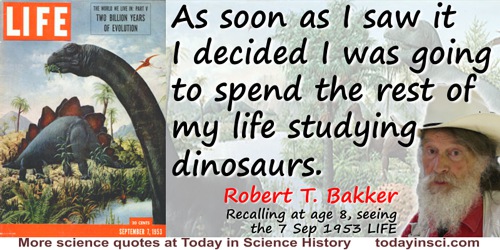
As soon as I saw it I decided I was going to spend the rest of my life studying dinosaurs.
Recalling his reaction, at age 8, when he saw Rudolph Zallinger’s mural of dinosaurs, the cover story of the 7 Sep 1953 Life magazine.
Ask her to wait a moment. I am almost done.
When told, while working, that his wife was dying.
When told, while working, that his wife was dying.
Quoted in E.T. Bell, Men of Mathematics, (1937).
At about the age of sixteen, I began to feel uneasy. My confidence in adults began to be shaken. They were not smarter than us kids. They just had fixed ideas and stuck to them even if they disagreed among themselves. They were dragging us along a road to an unknown destination; they had no goal, just something to escape from: nature. … It was better to begin to look for a safer, side track. I began to feel like a prisoner calmly preparing to jump off a train that was on a wrong track.
In Ch. 1, 'Farewell to Civilization', Fatu-Hiva (1974), 6.
At the age of eleven, I began Euclid, with my brother as my tutor. ... I had not imagined that there was anything so delicious in the world. After I had learned the fifth proposition, my brother told me that it was generally considered difficult, but I had found no difficulty whatsoever. This was the first time it had dawned on me that I might have some intelligence.
In Autobiography: 1872-1914 (1967), Vol. 1, 37-38.
At the moment I am occupied by an investigation with Kirchoff which does not allow us to sleep. Kirchoff has made a totally unexpected discovery, inasmuch as he has found out the cause for the dark lines in the solar spectrum and can produce these lines artificially intensified both in the solar spectrum and in the continuous spectrum of a flame, their position being identical with that of Fraunhofer’s lines. Hence the path is opened for the determination of the chemical composition of the Sun and the fixed stars.
Letter to H.E. Roscoe (Nov 1859). In The Life and Experiences of Sir Henry Enfield Roscoe (1906), 81.
At the moment I am occupied by an investigation with Kirchoff which does not allow us to sleep. Kirchoff has made a totally unexpected discovery, inasmuch as he has found out the cause for the dark lines in the solar spectrum and can produce these lines artificially intensified both in the solar spectrum and in the continuous spectrum of a flame, their position being identical with that of Fraunhofer’s lines. Hence the path is opened for the determination of the chemical composition of the Sun and the fixed stars.
Letter to H.E. Roscoe (Nov 1859). In The Life and Experiences of Sir Henry Enfield Roscoe (1906), 71.
Be ashamed to die until you have won some victory for humanity.
Epitaph on monument over his grave. Quoted in Thomas Williams Bicknell et al., Education (1912), 647
Before his [Sir Astley Cooper’s] time, operations were too often frightful alternatives or hazardous compromises; and they were not seldom considered rather as the resource of despair than as a means of remedy; he always made them follow, as it were, in the natural course of treatment; he gave them a scientific character; and he moreover, succeeded, in a great degree, in divesting them of their terrors, by performing them unostentatiously, simply, confidently, and cheerfully, and thereby inspiring the patient with hope of relief, where previously resignation under misfortune had too often been all that could be expected from the sufferer.
In John Forbes (ed.), British and Foreign Medical Review (Jul 1840), 10, No. 19, 104. In Bransby Blake Cooper, The Life of Sir Astley Cooper (1843), Vol. 2, 37.
Before I was born, my father told my mother, “If it’s a boy, he’s going to be a scientist.”
In 'The Making of a Scientist', What Do You Care What Other People Think?": Further Adventures of a Curious Character (2001), 12. The editor of the the book, Ralph Leighton, footnoted that Feynman’s younger sister, Joan, has a Ph.D. in physics, in spite of this preconception that only boys are destined to be scientists.
Biographical history, as taught in our public schools, is still largely a history of boneheads: ridiculous kings and queens, paranoid political leaders, compulsive voyagers, ignorant generals—the flotsam and jetsam of historical currents. The men who radically altered history, the great creative scientists and mathematicians, are seldom mentioned if at all.
Opening paragraph of book review, 'Adventures Of a Mathematician: The Man Who Invented the H-Bomb', New York Times (9 May 1976), 201.
Biographies are but the clothes and buttons of the man—the biography of the man himself cannot be written.
In Mark Twain’s Autobiography (1924), Vol. 2, 2.
Biography is one of the new terrors of death.
But nothing ever put 'Hoppy' in the shade. No one could fail to recognize in the little figure... the authentic gold of intellectual inspiration, the Fundator et Primus Abbas of biochemistry in England.
Co-author with D. M. Needham,
Co-author with D. M. Needham,
'F. G. Hopkins' Personal Influence'. In J. Needham and E. Baldwin (eds.), Hopkins and Biochemistry, 1861-1947 (1949), 115.
By asking questions and quickly reading some books, [Melvin Calvin] felt comfortable in many fields of endeavor.
Co-author with Andrew A. Benson, 'Melvin Calvin', Biographical Memoirs of the US National Academy of Science.
By the early 1960s Pauling had earned a reputation for being audacious, intuitive, charming, irreverent, self-promoting, self-reliant, self-involved to the point of arrogance and correct about almost everything.
In Force of Nature: The Life of Linus Pauling (1995), 13.
Charles Darwin, the Abraham of scientific men—a searcher as obedient to the command of truth as was the patriarch to the command of God.
In 'Science and Man', Fragments of Science (1879), Vol. 2, 370.
Pesidential Address to the Birmingham and Midland Institute, 1877, in 'Science and Man', Fragments of Science for Unscientific People: A Series of Detached Essays, Addresses, and Reviews (1879), Vol. 2, 370.
Cuvier had even in his address & manner the character of a superior Man, much general power & eloquence in conversation & great variety of information on scientific as well as popular subjects. I should say of him that he is the most distinguished man of talents I have ever known on the continent: but I doubt if He be entitled to the appellation of a Man of Genius.
J. Z. Fullmer, 'Davy's Sketches of his Contemporaries', Chymia, 1967, 12, 132.
Davy was the type of all the jumped-up second-raters of all time.
Spoken by the fictional character, Luard, an unhappy school chemistry teacher in the novel The Search (1932), 21.
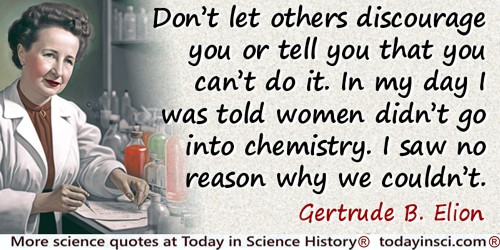
Don’t be afraid of hard work. Nothing worthwhile comes easily. Don’t let others discourage you or tell you that you can’t do it. In my day I was told women didn’t go into chemistry. I saw no reason why we couldn’t.
from her lecture notes
Dr. [Allan] Sandage was a man of towering passions and many moods, and for years, you weren't anybody in astronomy if he had not stopped speaking to you.
In Obituary, 'Allan Sandage, 84, Astronomer, Dies; Charted Cosmos’s Age and Expansion', New York Times (17 Nov 2010), B19.
During my pre-college years I went on many trips with my father into the oil fields to visit their operations. … I puttered around the machine, electronics, and automobile shops while he carried on his business. Both of my parents are inveterate do-it-yourselfers, almost no task being beneath their dignity or beyond their ingenuity. Having picked up a keen interest in electronics from my father, I used to fix radios and later television sets for fun and spending money. I built my own hi-fi set and enjoyed helping friends with their amateur radio transmitters, but lost interest as soon as they worked.
Remarks on how his high school interests foreshadowed his career as a radio astronomer. From autobiography in Stig Lundqvist (ed.) Nobel Lectures, Physics 1971-1980 (1992).
During my second year at Edinburgh [1826-27] I attended Jameson's lectures on Geology and Zoology, but they were incredible dull. The sole effect they produced on me was the determination never as long as I lived to read a book on Geology.
Charles Darwin, His Life Told in an Autobiographical Chapter and a Selected Series of his Published Letters (1892), 15. In Patrick Wyse Jackson, Four Centuries of Geological Travel (2007), 32.
Early in my school career, I turned out to be an incorrigible disciplinary problem. I could understand what the teacher was saying as fast as she could say it, I found time hanging heavy, so I would occasionally talk to my neighbor. That was my great crime, I talked in school.
In In Memory Yet Green: the Autobiography of Isaac Asimov, 1920-1954 (1979), 73.
Education in my family was not merely emphasized, it was our raison d'être. Virtually all of our aunts and uncles had Ph.D.s in science or engineering, and it was taken for granted that the next generation of Chu's were to follow the family tradition. When the dust had settled, my two brothers and four cousins collected three MDs, four Ph.D.s and a law degree. I could manage only a single advanced degree.
Autobiography in Gösta Ekspong (ed.), Nobel Lectures: Physics 1996-2000 (2002), 115.
Emil Fischer represents a symbol of Germany's greatness.
'Emil Fischer Wissenschaftliche Arbeiten', Naturwissenschaften, 1919, 7, 843. Trans. Joseph S. Froton, Contrasts in Scientific Style: Research Groups in the Chemical and Biomedical Sciences (1990), 167.
Equations are more important to me, because politics is for the present, but an equation is something for eternity.
Quoted in Carl Seelig (ed.), Helle Zeit, Dunkle Zeit: In Memoriam Albert Einstein (1956), 71.
Even if I could be Shakespeare I think that I should still choose to be Faraday.
In 1925, attributed. Walter M. Elsasser, Memoirs of a Physicist in the Atomic Age (1978), epigraph.
For me too, the periodic table was a passion. ... As a boy, I stood in front of the display for hours, thinking how wonderful it was that each of those metal foils and jars of gas had its own distinct personality.
[Referring to the periodic table display in the Science Museum, London, with element samples in bottles]
[Referring to the periodic table display in the Science Museum, London, with element samples in bottles]
Letter to Oliver Sacks. Quoted in Oliver Sacks, Uncle Tungsten: Memories of a Chemical Boyhood (2001), footnote, 203.
For three days now this angel, almost too heavenly for earth has been my fiancée … Life stands before me like an eternal spring with new and brilliant colours. Upon his engagement to Johanne Osthof of Brunswick; they married 9 Oct 1805.
Letter to Farkas Wolfgang Bolyai (1804). Quoted in Stephen Hawking, God Created the Integers: The Mathematical Breakthroughs (2005), 567.
Formerly Milton's Paradise Lost had been my chief favourite, and in my excursions during the voyage of the Beagle, when I could take only a single small volume, I always chose Milton.
Nora Barlow (ed.), The Autobiography of Charles Darwin, 1809-1882 (1958), 85.
From earliest memory I wanted to be a surgeon, possibly influenced by the qualities of our family doctor who cared for our childhood ailments.
In Tore Frängsmyr and Jan E. Lindsten (eds.), Nobel Lectures: Physiology Or Medicine: 1981-1990 (1993), 555.
Good people are seldom fully recognised during their lifetimes, and here, there are serious problems of corruption. One day it will be realised that my findings should have been acknowledged.
It was difficult, but she always smiled when asked why she went on when recognition eluded her in her own country.
It was difficult, but she always smiled when asked why she went on when recognition eluded her in her own country.
Quoted in obituary by Anthony Tucker, 'Alice Stewart', The Guardian newspaper (28 Jun 2002).
Haldane could have made a success of any one of half a dozen careers—as mathematician, classical scholar, philosopher, scientist, journalist or imaginative writer. On his life’s showing he could not have been a politician, administrator (heavens, no!), jurist or, I think, a critic of any kind. In the outcome he became one of the three or four most influential biologists of his generation.
Essay, 'J.B.S.', in Pluto’s Republic: Incorporating The Art of the Soluble and Induction and Intuition in Scientific Thought (1982), collected in The Strange Case of the Spotted Mice and Other Classic Essays on Science (1996), 87.
He [Robert Hooke] is but of midling stature, something crooked, pale faced, and his face but little belowe, but his head is lardge; his eie full and popping, and not quick; a grey eie. He haz a delicate head of haire, browne, and of an excellent moist curle. He is and ever was very temperate, and moderate in dyet, etc. As he is of prodigious inventive head, so is a person of great vertue and goodnes. Now when I have sayd his Inventive faculty is so great, you cannot imagine his Memory to be excellent, for they are like two Bucketts, as one goes up, the other goes downe. He is certainly the greatest Mechanick this day in the World.
Brief Lives (1680), edited by Oliver Lawson Dick (1949), 165.
Heraclitus son of Bloson (or, according to some, of Herakon) of Ephesus. This man was at his prime in the 69th Olympiad. He grew up to be exceptionally haughty and supercilious, as is clear also from his book, in which he says: “Learning of many things does not teach intelligence; if so it would have taught Hesiod and Pythagoras, and again Xenophanes and Hecataeus.” … Finally he became a misanthrope, withdrew from the world, and lived in the mountains feeding on grasses and plants. However, having fallen in this way into a dropsy he came down to town and asked the doctors in a riddle if they could make a drought out of rainy weather. When they did not understand he buried himself in a cow-stall, expecting that the dropsy would be evaporated off by the heat of the manure; but even so he failed to effect anything, and ended his life at the age of sixty.
Diogenes Laertius 9.1. In G. S. Kirk, E. Raven, and M. Schofield (eds.), The Presocratic philosophers: A Critical History with a Selection of Texts (1983), 181.
His [Erwin Schrödinger's] private life seemed strange to bourgeois people like ourselves. But all this does not matter. He was a most lovable person, independent, amusing, temperamental, kind and generous, and he had a most perfect and efficient brain.
— Max Born
In My Life, Recollections of a Nobel Laureate (1978), 270. Quoted by Walter Moore, Schrödinger: Life and Thought (1992), 6.
His genius now began to mount upwards apace & shine out with more strength, & as he told me himself, he excelled particularly in making verses... In everything he undertook he discovered an application equal to the pregnancy of his parts & exceeded the most sanguine expectations his master had conceived of him.
[About Newton's recollection of being a schoolboy at Grantham, written by Conduitt about 65 years after that time.]
[About Newton's recollection of being a schoolboy at Grantham, written by Conduitt about 65 years after that time.]
Quoted in Richard Westfall, Never at Rest: A Biography of Isaac Newton (1980), 65. Footnoted Keynes MS 130.2, p. 32-3, in the collection at King's College, Cambridge.
His mother’s favorite, he [Freud] possessed the self-confidence that told him he would achieve something worth while in life, and the ambition to do so, though for long the direction this would take remained uncertain.
In The Life and Work of Sigmund Freud: The Formative Years and the Great Discoveries, 1856-1900 (1957), 15.
How to start on my adventure—how to become a forester—was not so simple. There were no schools of Forestry in America. … Whoever turned his mind toward Forestry in those days thought little about the forest itself and more about its influences, and about its influence on rainfall first of all. So I took a course in meteorology, which has to do with weather and climate. and another in botany, which has to do with the vegetable kingdom—trees are unquestionably vegetable. And another in geology, for forests grow out of the earth. Also I took a course in astronomy, for it is the sun which makes trees grow. All of which is as it should be, because science underlies the forester’s knowledge of the woods. So far I was headed right. But as for Forestry itself, there wasn’t even a suspicion of it at Yale. The time for teaching Forestry as a profession was years away.
In Breaking New Ground (1947, 1998), 3.
I admired Bohr very much. We had long talks together, long talks in which Bohr did practically all the talking.
Recalling his Sep 1926-Feb 1927 stay in Copenhagen.
Recalling his Sep 1926-Feb 1927 stay in Copenhagen.
In History of Twentieth Century Physics (1977), 109. In A. Pais, 'Playing With Equations, the Dirac Way'. Behram N. Kursunoglu (Ed.) and Eugene Paul Wigner (Ed.), Paul Adrien Maurice Dirac: Reminiscences about a Great Physicist (1990), 94.
I admit that Mendeleev has two wives, but I have only one Mendeleev.
Mendeleev advised the Tsar on matters of oil and other chemical products. A prominent bureaucrat in a similar situation, cited Mendeleev's bigamy to win his own pardon from the Czar. This reputed reply indicates the importance of Mendeleev to the Czar. Mendeleev had remarried too soon after his divorce from his first wife, without waiting the seven years required by the Russian civil and ecclesiastic laws of the time. The Orthodox priest, whom Mendeleev had bribed to perform the marriage, was defrocked. In Robert L. Weber, Droll Science (1987), 17. Earlier accounts in Ralph Oesper, The Human Side of Scientists (1975), 129, and Eduard Färber, Great Chemists (1961), 726. The Czar is identified as Alexander III in Michael D. Gordin, A Well-Ordered Thing: Dmitrii Mendeleev and the Shadow of the Periodic Table, which references the quotation to O. E. Ozarovskoi, D. I. Mendeleev v vospominaniiakh, 139. Webmaster has seen only anecdotal sources, and reserves judgment regarding the historical accuracy of the quotation.
I am a misanthrope, but exceedingly benevolent; I am very cranky, and am a super-idealist. ... I can digest philosophy better than food.
In Ake Erlandsson, 'The Nobel Library of the Swediah Academy', Libri (1999), 167.
I am almost thanking God that I was never educated, for it seems to me that 999 of those who are so, expensively and laboriously, have lost all before they arrive at my age—& remain like Swift's Stulbruggs—cut and dry for life, making no use of their earlier-gained treasures:—whereas, I seem to be on the threshold of knowledge.
In Vivien Noakes, Edward Lear: the Life of a Wanderer (1969), 22.
I am an atheist, out and out. It took me a long time to say it. I’ve been an atheist for years and years, but somehow I felt it was intellectually unrespectable to say one was an atheist, because it assumed knowledge that one didn't have. Somehow, it was better to say one was a humanist or an agnostic. I finally decided that I’m a creature of emotion as well as of reason. Emotionally, I am an atheist. I don't have the evidence to prove that God doesn’t exist, but I so strongly suspect he doesn’t that I don’t want to waste my time.
'Isaac Asimov on Science and the Bible'. In Sidney Hook, et. al. On the Barricades: Religion and Free Inquiry in Conflict (1989), 329.
I am not aware that I have deserved any notoriey, and I have no taste for its buzz.
In Robert Shaplen, 'Annals Of Science: Adventures of a Pacifist', The New Yorker (22 Mar 1958), 41; without a reference, but cited elsewhere as in H. Schuck, 'Alfred Nobel: A Biographical Sketch' in The Nobel Foundation (ed.), Nobel: The Man and His Prize (1951), 18.
I am perhaps more proud of having helped to redeem the character of the cave-man than of any other single achievement of mine in the field of anthropology.
Quoted in Closing Address by Dr. Henry Sloane Coffin, president of the Union Theological Seminary, New York, at the Memorial Service for Osborn at St. Bartholomew's Church, N.Y. (18 Dec 1935). In 'Henry Fairfield Osborn', Supplement to Natural History (Feb 1936), 37:2, 134. Bound in Kofoid Collection of Pamphlets on Biography, University of California.
I am turned into a sort of machine for observing facts & grinding out conclusions, & am never happy except when at work.
From Letter to John Maurice Herbert (25 Dec 1880). Quoted without the final phrase about being “happy…at work”, in Adrian J. Desmond and James Richard Moore, Darwin (1994), 644, as a remark Darwin “was heard to sigh”, suspecting that his largest botany book, the 600-page Movement in Plants, was “as dull as ditchwater” (in the words of Desmond and Moore). Subject quote collected as the full sentence, in Charles Darwin, Frederick Burkhardt, (ed.) and James A. Secord (ed.), The Correspondence of Charles Darwin: Volume 28, 1880 (2021), 46. [Note: Whether or not Darwin was “heard to sigh…dull as ditchwater” (for which Webmaster, as yet, has not found in a primary source), Darwin did write his Plants book was “very dull” (or at least the first chapter, describing the circumnutation movements of seedling plants), in a letter concerning its translation to J. V. Carus (14 Sep 1880). —Webmaster]
I approached the bulk of my schoolwork as a chore rather than an intellectual adventure. The tedium was relieved by a few courses that seem to be qualitatively different. Geometry was the first exciting course I remember. Instead of memorizing facts, we were asked to think in clear, logical steps. Beginning from a few intuitive postulates, far reaching consequences could be derived, and I took immediately to the sport of proving theorems.
Autobiography in Gösta Ekspong (ed.), Nobel Lectures: Physics 1996-2000 (2002), 115.
I attained a triumph so complete that it is now rare to meet an American with marks of small pox on his face... Benefits are valuable according to their duration and extent, like the showers from heaven, but the benign remedy Vaccination saves millions of lives every century, like the blessing of the sun, universal and everlasting.
(Remark made near the end of his life.)
(Remark made near the end of his life.)
I believe that the laws of physics such as they are, such as they have been taught to us, are not the inevitable truth. We believe in the laws, or we experiment* with them each day, yet I believe it is possible to consider the existence of a universe in which these laws would be extended, changed a very tiny bit, in a precisely demarcated way. Consequently we immediately achieve extraordinary results, different yet certainly not far from the truth. After all, every century or two a new scientist comes along who changes the laws of physics, isn’t that so? After Newton there were many who did, and there were even more after Einstein, right? We have to wait to see how the laws in question will change over time, then… In any case, without being a scientist myself I can still hope to reach parallel results, if you will, in art.
Epigraph, in James Housefield, Playing with Earth and Sky: Astronomy, Geography, and the Art of Marcel Duchamp (2016), ix. As modified by James Housefield, from Guy Viau interview of Marcel Duchamp on Canadian Radio Television (17 July 1960), 'Simply Change Your Name', translated by Sarah Skinner Kilborne in Tout-Fait: the Marcel Duchamp Studies Online Journal 2, no. 4 (2002). [*Note: Where the Housefield in the Epigraph uses the word “experiment”, the original French gives “expérimentons”, which in the unmodified translation by Sarah Skinner Kilborne is written more correctly as “experience.” —Webmaster]
I built the solenoid and with great expectations late one evening I pressed the switch which sent a current of 40 amperes through the coil. The result was spectacular—a deafening explosion, the apparatus disappeared, all windows were blown in or out, a wall caved in, and thus ended my pioneering experiment on liquid hydrogen cooled coils! [Recalling the result of his experiment, on 31 Mar 1930, to maximize the magnetic field by cooling the coils of an electromagnet in liquid hydrogen to reduce their resistance.]
'Magnets I have Known', Lecture Notes in Physics (1983), 177, 542-548. Quoted from his memoirs in M.J.M. Leask, 'Obituary: Professor Nicholas Kurti', The Independent (27 Nov 1998).
I can still recall vividly how Freud said to me, “My dear Jung, promise me never to abandon the sexual theory. That is the most essential thing of all. You see, we must make a dogma of it, an unshakable bulwark” … In some astonishment I asked him, “A bulwark-against what?” To which he replied, “Against the black tide of mud”—and here he hesitated for a moment, then added—“of occultism.”
Memories, Dreams, Reflections (1963), 147-8.
I cannot serve as an example for younger scientists to follow. What I teach cannot be learned. I have never been a “100 percent scientist.” My reading has always been shamefully nonprofessional. I do not own an attaché case, and therefore cannot carry it home at night, full of journals and papers to read. I like long vacations, and a catalogue of my activities in general would be a scandal in the ears of the apostles of cost-effectiveness. I do not play the recorder, nor do I like to attend NATO workshops on a Greek island or a Sicilian mountain top; this shows that I am not even a molecular biologist. In fact, the list of what I have not got makes up the American Dream. Readers, if any, will conclude rightly that the Gradus ad Parnassum will have to be learned at somebody else’s feet.
In Heraclitean Fire: Sketches from a Life before Nature (1978), 7.
I chucked the law for astronomy, and I knew that even if I were second-rate or third-rate, it was astronomy that mattered.
As quoted in Nicholas U. Mayall, Biographical Memoir, 'Edwin Powell Hubble: 1889—1953', Memoirs of the National Academy of Sciences (1970), Vol. 41, 179.
I did some very technical work in partial differential equations, made an unsuccessful pass at shock waves, worked in scale invariant variational problems, made a poor stab at three manifold topology, learned gauge field theory and then some about applications to four manifolds, and have recently been working in equations with algebraic infinite symmetries. I find that I am bored with anything I understand. My excuse is that I am too poor an expositor to want to spend time on formal matters.
In 'A Personal Profile of Karen K. Uhlenbeck', collected in Susan Ambrose et al., Journeys of Women in Science and Engineering, No Universal Constants (1999).
I did try “to make things clear,” first to myself (an important point) and then to my students and somehow to make “these dry bones live.”
His response on his 80th birthday (1929) recognition of his mathematical contributions and teachings by his former students. As quoted by R.T. Glazebrook in Obituary Notices of Fellows of the Royal Society (Dec 1935), 392.
I do not want to label myself a crystallographer as against a physicist and think indeed that though my research is concerned with crystals it is the physical side of it which attracts me.
In Letter (3 Jun 1929) to Ernest Rutherford, in Royal Society Archives, as quoted in David Phillips, Biographical Memoirs of Fellows of the Royal Society (Nov 1979), 25, 104.
I do not want to write beyond this point, because those days when I studied relentlessly are nostalgic to me; and on the other hand, I am sad when I think how I have become increasingly preoccupied with matters other than study.
Explaining why he went no further in his autobiography than 1934, the year he published his paper describing his great discovery, the meson theory. From the original Japanese autobiography Tabibito, translated as The Traveler (1982), 207.
I gambled on having the strength to live two lives, one for myself and one for the world.
Journal entry (in her late 30s), as quoted in Margaret Mead, 'Search: 1920-1930', An Anthropologist at Work (1959, 2011), 3.
I got a four year scholarship to Harvard, and while I was there they wanted to groom me for work in the Star Wars program designing weapons ignited by hydrogen bombs. I didn't want to do that. I thought about how many scientists had died in World War II.
Quoted in Nina L. Diamond, Voices of Truth (2000), 326.
I grew up in Brooklyn, New York … a city neighborhood that included houses, lampposts, walls, and bushes. But with an early bedtime in the winter, I could look out my window and see the stars, and the stars were not like anything else in my neighborhood. [At age 5] I didn’t know what they were.
[At age 9] my mother … said to me, “You have a library card now, and you know how to read. Take the streetcar to the library and get a book on stars.” … I stepped up to the big librarian and asked for a book on stars. … I sat down and found out the answer, which was something really stunning.I found out that the stars are glowing balls of gas. I also found out that the Sun is a star but really close and that the stars are all suns except really far away I didn’t know any physics or mathematics at that time, but I could imagine how far you’d have to move the Sun away from us till it was only as bright as a star. It was in that library, reading that book, that the scale of the universe opened up to me. There was something beautiful about it.
At that young age, I already knew that I’d be very happy if I could devote my life to finding out more about the stars and the planets that go around them. And it’s been my great good fortune to do just that.
[At age 9] my mother … said to me, “You have a library card now, and you know how to read. Take the streetcar to the library and get a book on stars.” … I stepped up to the big librarian and asked for a book on stars. … I sat down and found out the answer, which was something really stunning.I found out that the stars are glowing balls of gas. I also found out that the Sun is a star but really close and that the stars are all suns except really far away I didn’t know any physics or mathematics at that time, but I could imagine how far you’d have to move the Sun away from us till it was only as bright as a star. It was in that library, reading that book, that the scale of the universe opened up to me. There was something beautiful about it.
At that young age, I already knew that I’d be very happy if I could devote my life to finding out more about the stars and the planets that go around them. And it’s been my great good fortune to do just that.
Quoted in interview with Jack Rightmyer, in 'Stars in His Eyes', Highlights For Children (1 Jan 1997). Ages as given in Tom Head (ed.), Conversations with Carl Sagan (2006), x.
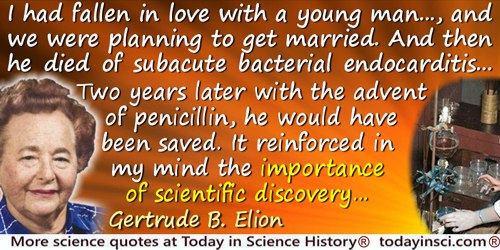
I had fallen in love with a young man..., and we were planning to get married. And then he died of subacute bacterial endocarditis... Two years later with the advent of penicillin, he would have been saved. It reinforced in my mind the importance of scientific discovery...
Quoted in Susan Ambrose et al., Journeys of Women in Science and Engineering: No Universal Constants (1997)
I had intended to major in physics … I could never seem to get the labs to come out right. So I switched to math and have been interested in it ever since.
In 'A Personal Profile of Karen K. Uhlenbeck', collected in Susan Ambrose et al., Journeys of Women in Science and Engineering, No Universal Constants (1999). Uhlenbeck’s father was an engineer and her father-in-law was a famous physicist.
I had no books as a child. I had real machines, and I went out to work in the fields. I was driving farm machinery at five, and fixing it at age seven or eight. It’s no accident that I worked on Hubble 50 to 60 years later. My books were nature; it was very important to how I related to the Earth, and the Earth from space. No doubt when I go into space, I go back into the cool soil of Earth. I’m always thinking of it. Nature was my book. Other people come from that tradition - Emerson, Thoreau, and especially Whitman. Look at what they said in their philosophy - go out and have a direct relationship with nature.
When asked by Discover magazine what books helped inspire his passion as an astronaut.
When asked by Discover magazine what books helped inspire his passion as an astronaut.
'The 1998 Discover Science Gift Guide: Fantastic Voyages Children's Books That Mattered', Discover (Dec 1998).
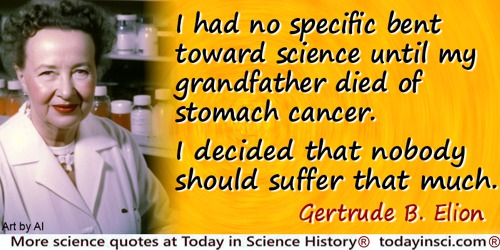
I had no specific bent toward science until my grandfather died of stomach cancer. I decided that nobody should suffer that much.
Quoted in Azhar Saleem Virk, Inspiration from Lives of Famous People (2003).
I have accumulated a wealth of knowledge in innumerable spheres and enjoyed it as an always ready instrument for exercising the mind and penetrating further and further. Best of all, mine has been a life of loving and being loved. What a tragedy that all this will disappear with the used-up body!
In and Out of the Ivory Tower (1960), 311.
I have been branded with folly and madness for attempting what the world calls impossibilities, and even from the great engineer, the late James Watt, who said ... that I deserved hanging for bringing into use the high-pressure engine. This has so far been my reward from the public; but should this be all, I shall be satisfied by the great secret pleasure and laudable pride that I feel in my own breast from having been the instrument of bringing forward new principles and new arrangements of boundless value to my country, and however much I may be straitened in pecuniary circumstances, the great honour of being a useful subject can never be taken from me, which far exceeds riches.
From letter to Davies Gilbert, written a few months before Trevithick's last illness. Quoted in Francis Trevithick, Life of Richard Trevithick: With an Account of his Inventions (1872), Vol. 2, 395-6.
I have been described on more than one occasion as belonging to something called the 'Functional School of Social Anthropology' and even as being its leader, or one of its leaders. This Functional School does not really exist; it is a myth invented by Professor Malinowski ... There is no place in natural science for 'schools' in this sense, and I regard social anthropology as a branch of natural science. ... I conceive of social anthropology as the theoretical natural science of human society, that is, the investigation of social phenomena by methods essentially similar to those used in the physical and biological sciences. I am quite willing to call the subject 'comparative sociology', if anyone so wishes.
In A. Kuper, Anthropologists and Anthropology: The Modern British School (1983), 36.
I have from my childhood, in conformity with the precepts of a mother void of all imaginary fear, been in the constant habit of taking toads in my hand, and applying them to my nose and face as it may happen. My motive for doing this very frequently is to inculcate the opinion I have held, since I was told by my mother, that the toad is actually a harmless animal; and to whose manner of life man is certainly under some obligation as its food is chiefly those insects which devour his crops and annoy him in various ways.
Letter to an unknown correspondent, quoted by Bowdler Sharpe, The Natural History and Antiquities of Selborne (1900), Vol. 1, 69. In Averil M. Lysaght, Joseph Banks in Newfoundland and Labrador, 1766: his Diary, Manuscripts, and Collections (1971), 44.
I have indeed lived and worked to my taste either in art or science. What more could a man desire? Knowledge has always been my goal. There is much that I shall leave behind undone…but something at least I was privileged to leave for the world to use, if it so intends…As the Latin poet said I will leave the table of the living like a guest who has eaten his fill. Yes, if I had another life to spend, I certainly would not waste it. But that cannot be, so why complain?
Letter to R. C. Craw, quoted in Tuatara (1984) Vol. 27 (1): 5-7
I have little patience with scientists who take a board of wood, look for its thinnest part and drill a great number of holes where drilling is easy.
P. Frank in 'Einstein's Philosophy of Science', Reviews of Modern Physics (1949).
I have never done anything “useful.” No discovery of mine has made, or is likely to make, directly or indirectly, for good or ill, the least difference to the amenity of the world... Judged by all practical standards, the value of my mathematical life is nil; and outside mathematics it is trivial anyhow. I have just one chance of escaping a verdict of complete triviality, that I may be judged to have created something worth creating. And that I have created something is undeniable: the question is about its value. [The things I have added to knowledge do not differ from] the creations of the other artists, great or small, who have left some kind of memorial beind them.
Concluding remarks in A Mathmatician's Apology (1940, 2012), 150-151.
I have no desire to write my own biography, as long as I have strength and means to do better work.
Passages From the Life of a Philosopher (1864), vii.
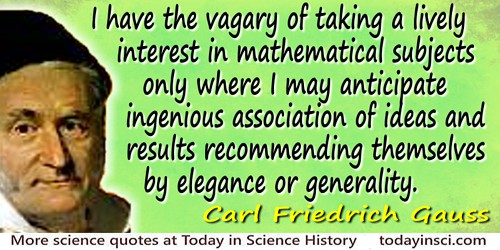
I have the vagary of taking a lively interest in mathematical subjects only where I may anticipate ingenious association of ideas and results recommending themselves by elegance or generality.
Letter to Heinrich Schumacher (17 Sep 1808). Quoted in G. Waldo Dunnington, Carl Friedrich Gauss: Titan of Science (2004), 416.
I have tried lately to read Shakespeare, and found it so intolerably dull that it nauseated me.
Charles Darwin: His Life Told in an Autobiographical Chapter, and in a Selected Series of his Published Letters, edited by Francis Darwin (1892), 50.
I love fools’ experiments. I am always making them.
Lankester gives this wording as his own recollection in E. Ray Lankester, 'Charles Robert Darwin', collected in C.D. Warner (ed.), Library of the World’s Best Literature Ancient and Modern (1896), Vol. 2, 4391. As a recollection, the quote may not be verbatim, but the sense is correct. Compare Francis Darwin (ed.), The Life and Letters of Charles Darwin (1902), 126. “These rather wild trials he called ‘fool’s experiments,’ and enjoyed extremely.”
I now think the answer is very simple: it’s true. God did create the universe about 13.7 billion years ago, and of necessity has involved Himself with His creation ever since. The purpose of this universe is something that only God knows for sure, but it is increasingly clear to modern science that the universe was exquisitely fine-tuned to enable human life.
In Letter (May 2005), sent to the Hope College 2005 Alumni Banquet, read in lieu of accepting an award in person, because of declining health from cancer.
I observed on most collected stones the imprints of innumerable plant fragments which were so different from those which are growing in the Lyonnais, in the nearby provinces, and even in the rest of France, that I felt like collecting plants in a new world… The number of these leaves, the way they separated easily, and the great variety of plants whose imprints I saw, appeared to me just as many volumes of botany representing in the same quarry the oldest library of the world.
In 'Examen des causes des Impressions des Plantes marquees sur certaines Pierres des environs de Saint-Chaumont dans le Lionnais', Memoires de l’ Academie Royale des Sciences (1718), 364, as trans. by Albert V. and Marguerite Carozzi.
I possess every good quality, but the one that distinguishes me above all is modesty.
from The Natural History of a Savant, trans. Oliver Lodge (1927).
I remember my father had a sermon he used to preach when we were in Florida, in which he gave a reference to the Southern Cross—about the stars, the colors, in the Southern Cross, which thrilled me very much. I must have been around 5 years old. ... Now, it turns out that the Southern Cross itself does have one red star, together with three blue ones.
'Oral History Transcript: Dr. William Wilson Morgan' (8 Aug 1978) in the Niels Bohr Library & Archives.
I said to myself, if there's a group of these people that are so courageous and so selfless, somebody ought to carry their damn banner and do something about. That's 1965. I was 20 years old. I said I was going to commit my career to curing paralysis.
Referring to the paralyzed veteran volunteers in the spinal cord injury laboratory with whom Green worked while attending medical school.
Referring to the paralyzed veteran volunteers in the spinal cord injury laboratory with whom Green worked while attending medical school.
Quoted in Jennifer Kay 'Neurosurgeon Barth Green: Football player's treatment available to all', Associated Press news report, USA Today website (posted 27 Sep 2007).
I spent most of a lifetime trying to be a mathematician—and what did I learn. What does it take to be one? I think I know the answer: you have to be born right, you must continually strive to become perfect, you must love mathematics more than anything else, you must work at it hard and without stop, and you must never give up.
In I Want to be a Mathematician: an Automathography (1985), 400.
I started studying law, but this I could stand just for one semester. I couldn’t stand more. Then I studied languages and literature for two years. After two years I passed an examination with the result I have a teaching certificate for Latin and Hungarian for the lower classes of the gymnasium, for kids from 10 to 14. I never made use of this teaching certificate. And then I came to philosophy, physics, and mathematics. In fact, I came to mathematics indirectly. I was really more interested in physics and philosophy and thought about those. It is a little shortened but not quite wrong to say: I thought I am not good enough for physics and I am too good for philosophy. Mathematics is in between.
From interview on his 90th birthday. In D J Albers and G L Alexanderson (eds.), Mathematical People: Profiles and Interviews (1985), 245-254.
I think Dr. Arbuthnot the first man among the wits of the age. He was the most universal genius, being an excellent physician, a man of deep learning, and a man of much humour.
As quoted, without citation in John Dennis, The Age of Pope (1894, 1926), 176. In James Boswell’s Life of Johnson, “the wits of the age” is written as “them” meaning, from the context, the wits of the age of Queen Anne (1702-1714).
I think of myself as a journalist who writes mainly about math and science, and a few other fields of interest.
In Kendrick Frazier, 'A Mind at Play: An Interview with Martin Gardner', Skeptical Inquirer (Mar/Apr 1998), 22, No. 2, 36.
I wanted to be a scientist from my earliest school days. The crystallizing moment came when I first caught on that stars are mighty suns, and how staggeringly far away they must be to appear to us as mere points of light. I’m not sure I even knew the word science then, but I was gripped by the prospect of understanding how things work, of helping to uncover deep mysteries, of exploring new worlds.
In 'With Science on Our Side', Washington Post (9 Jan 1994).
I was 5 when I went up my first 10,000ft mountain, with my parents, and I have been climbing ever since.
From interview with Rudraneil Sengupta, 'Reinhold Messner: When You’re Alone, Fear is All on You', Mint (1 Mar 2014). A business newspaper in India, also online at livemint.com website.
I was at my best at a little past forty, when I was a professor at Oxford.
In A Mathematician’s Apology (1940, reprint with Foreward by C.P. Snow 1992), 148.
I was born under a water sign—Cancer, the crab—and I always felt I was born in Detroit by mistake, … I should have been born on the West Coast.
As quoted in John Przybys, 'Whaling Wall’s Artist Looks For a New Canvas', . Las Vegas Review-Journal (22 Feb 1994).
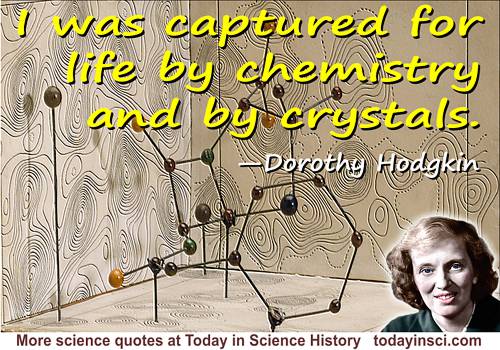
I was captured for life by chemistry and by crystals.
Oxford Dictionary of Quotations, 6th ed.
I was fascinated by fractional distillation as a method while still a school-boy, and built in the cellar of my home, which was my combined workshop and laboratory, distillation columns, packed with coke of graded size, some five feet in height. They were made from coffee tins (obtained from the kitchen), with the bottoms removed and soldered together! Experience with them served me in good stead and by the time I graduated I had a good understanding of the problems of fractional distillation.
Nobel Lectures in Chemistry (1999), Vol. 3, 359-360.
I was graduated from the College of Physicians and Surgeons in 1904. The practice of medicine did not appeal to me, for I preferred to work in the laboratory.
As quoted in Arnold H. Eggert, The Hoagland Laboratory (1960), 125.
I was introduced to Mr. Davy, who has rooms adjoining mine (in the Royal Institution); he is a very agreeable and intelligent young man, and we have interesting conversation in an evening; the principal failing in his character as a philosopher is that he does not smoke.
Letter to John Rothwell, January 1804. Quoted in J. P. Millington, John Dalton (1906), 141.
I was often humiliated to see men disputing for a piece of bread, just as animals might have done. My feelings on this subject have very much altered since I have been personally exposed to the tortures of hunger. I have discovered, in fact, that a man, whatever may have been his origin, his education, and his habits, is governed, under certain circumstances, much more by his stomach than by his intelligence and his heart.
In François Arago, trans. by William Henry Smyth, Baden Powell and Robert Grant, 'The History of My Youth: An Autobiography of Francis Arago', Biographies of Distinguished Scientific Men (1859), Vol. 1, 55.
I was pretty good in science. But again, because of the small budget, in science class we couldn’t do experiments in order to prove theories. We just believed everything. Actually I think that class was call Religion. Religion was always an easy class. All you had to do was suspend the logic and reasoning you were taught in all the other classes.
In autobiography, Brain Droppings (1998), 227.
I was x years old in the year x2.
When asked about his age (43).
When asked about his age (43).
Quoted in H. Eves, In Mathematical Circles (1969).
I will frankly tell you that my experience in prolonged scientific investigations convinces me that a belief in God—a God who is behind and within the chaos of vanishing points of human knowledge—adds a wonderful stimulus to the man who attempts to penetrate into the regions of the unknown.
As quoted in E.P. Whipple, 'Recollections of Agassiz', in Henry Mills Alden (ed.), Harper's New Monthly Magazine (June 1879), 59, 103.
I wish I had my beta-blockers handy.
[Comment when told that he had won a Nobel prize, referring to the drug he discovered for the treatment of heart disease.]
[Comment when told that he had won a Nobel prize, referring to the drug he discovered for the treatment of heart disease.]
As quoted in Obituary, The Times (24 Mar 2010)
I’m gradually managing to cram my mind more and more full of things. I’ve got this beautiful mind and it’s going to die, and it’ll all be gone. And then I say, not in my case. Every idea I’ve ever had I’ve written down, and it’s all there on paper. And I won’t be gone; it’ll be there.
'Isaac Asimov Speaks' with Bill Moyers in The Humanist (Jan/Feb 1989), 49. Reprinted in Carl Howard Freedman (ed.), Conversations with Isaac Asimov (2005), 139.
I’ve never consciously tried to keep myself out of anything I write, and I’ve always talked clearly when people interview me. I don’t think my life is too interesting. It’s lived mainly inside my brain.
As quoted by Lawrence Toppman, 'Mastermind', The Charlotte Observer (20 Jun 1993), 1E, 6E. As quoted and cited in Dana Richards, 'Martin Gardner: A “Documentary”', collected in Elwyn R. Berlekamp and Tom Rodgers (ed.) The Mathemagician and Pied Puzzler: A Collection in Tribute to Martin Gardner (1999), 3.
I’ve never made a discovery myself, unless by accident. If you write glibly, you fool people. When I first met Asimov, I asked him if he was a professor at Boston University. He said no and … asked me where I got my Ph.D. I said I didn’t have one and he looked startled. “You mean you’re in the same racket I am,” he said, “you just read books by the professors and rewrite them?” That’s really what I do.
Quoted in Sally Helgeson, 'Every Day', Bookletter (6 Dec 1976), 3, No. 8, 3. As quoted and cited in Dana Richards, 'Martin Gardner: A “Documentary”', collected in Elwyn R. Berlekamp and Tom Rodgers (ed.) The Mathemagician and Pied Puzzler: A Collection in Tribute to Martin Gardner (1999), 8-9.
If A is a success in life, I should say the formula is A = X + Y + Z, X being work and Y being play. … … [Z] is keeping your mouth shut.
Reply to question about what Einstein considered “the best formula for success in life,” asked by S.J. Woolf in an interview at Einstein's home, published as 'Einstein’s Own Corner of Space’, New York Times (18 Aug 1929), Sunday Magazine, 1. Also stated in Carl Seelig, Albert Einstein: A Documentary Biography (1956), 54, as “A (Success) = X (Work) + Y (Play) + Z (Keep your mouth shut).
If all history is only an amplification of biography, the history of science may be most instructively read in the life and work of the men by whom the realms of Nature have been successively won.
The Founders of Geology (1905), 4.
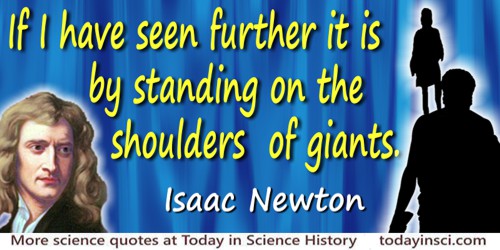
If I have seen further it is by standing on the shoulders of giants.
[Original spelling: 'ye sholders of Giants.']
[Original spelling: 'ye sholders of Giants.']
Letter to Robert Hooke (5 Feb 1675-6).In H. W. Turnbull (ed.), The Correspondence of Isaac Newton, 1, 1661-1675 (1959), Vol. 1, 416. Note that Newton may have been using the quotation as used earlier by Robert Burton in The Anatomy of Melancholy (1624). In the early twelfth century, Bernard of Chartres made a similar statement: 'Pigmies placed on the shoulders of giants see more than the giants themselves.' For exhaustive treatment of the earlier sources of this aphorism, see Robert K. Merton, On the Shoulders of Giants (1965).
If I were entering adulthood now instead of in the environment of fifty years ago, I would choose a career that kept me in touch with nature more than science. … Too few natural areas remain; both by intent and by indifference we have insulated ourselves from the wilderness that produced us.
In 'The Wisdom of Wilderness', Life (22 Dec 1967), 63, No. 25, 10.
If I would be a young man again and had to decide how to make my living, I would not try to become a scientist or scholar or teacher. I would rather choose to be a plumber or a peddler in the hope to find that modest degree of independence still available under present circumstances.
According to Ralph Keyes, The Quote Verifier: Who Said What, Where, and When (2006), 53, on other occasions Einstein said “he might rather have been a musician, or light-house keeper”; however it is a “popular misquotation” that refers to being a watchmaker.
If some great Power would agree to make me always think what is true and do what is right, on condition of being turned into a sort of clock and wound up every morning before I got out of bed, I should instantly close with the offer.
'On Descartes' "Discourse Touching the Method of Using One's Reason Rightly and of Seeking Scientific Truth'" (1870). In Collected Essays (1893), Vol. 1, 192-3.
If the world had but a dozen Arbuthnots I would burn my [Gulliver's] Travels.
Letter to Pope, dated 29 Sep 1725, when Arbuthnot was seriously ill
Letter to Pope, dated 29 Sep 1725, when Arbuthnot was seriously ill
Jonathan Swift, Thomas Sheridan (ed.) John Nichols (ed.) The Works of the Rev. Jonathan Swift, (1808) , Vol. 11, 297-8.
If you look over my Scientific American columns you will see that they get progressively more sophisticated as I began reading math books and learning more about the subject. There is no better way to learn anything than to write about it!
In Kendrick Frazier, 'A Mind at Play: An Interview with Martin Gardner', Skeptical Inquirer (Mar/Apr 1998), 22, No. 2, 36.
In 1945, therefore, I proved a sentimental fool; and Mr. Truman could safely have classified me among the whimpering idiots he did not wish admitted to the presidential office. For I felt that no man has the right to decree so much suffering, and that science, in providing and sharpening the knife and in upholding the ram, had incurred a guilt of which it will never get rid. It was at that time that the nexus between science and murder became clear to me. For several years after the somber event, between 1947 and 1952, I tried desperately to find a position in what then appeared to me as a bucolic Switzerland,—but I had no success.
Heraclitean Fire: Sketches from a Life before Nature (1978), 4.
In assessing Audubon, whose firm grip on the popular imagination has scarcely lessened since 1826, we must as historians of science seriously ask who would remember him if he had not been an artist of great imagination and flair. ... The chances seem to be very poor that had he not been an artist, he would be an unlikely candidate for a dictionary of scientific biography, if remembered to science at all.
In Charles Coulston Gillespie (ed.), Dictionary of Scientific Biography (1972), Vol. 1, 331.
In college I largely wasted my opportunities. My worst subjects were drawing and science. Almost my only memory of the chemistry class was of making some sulfuric acid into a foul-smelling concoction and dropping it into another student’s pocket.
From My Own Story (1957), 55.
In describing the honourable mission I charged him with, M. Pernety informed me that he made my name known to you. This leads me to confess that I am not as completely unknown to you as you might believe, but that fearing the ridicule attached to a female scientist, I have previously taken the name of M. LeBlanc in communicating to you those notes that, no doubt, do not deserve the indulgence with which you have responded.
Explaining her use of a male psuedonym.
Explaining her use of a male psuedonym.
Letter to Carl Friedrich Gauss (1807)
In honoring the Wright Brothers, it is customary and proper to recognize their contribution to scientific progress. But I believe it is equally important to emphasize the qualities in their pioneering life and the character in man that such a life produced. The Wright Brothers balanced sucess with modesty, science with simplicity. At Kitty Hawk their intellects and senses worked in mutual support. They represented man in balance, and from that balance came wings to lift a world.
Speech, quoted in Leonard Mosley, Lindbergh (2000), 347. In 1949, Lindbergh gave a speech when he received the Wright Brothers Memorial Trophy.
In Melvin Calvin’s office there were four photographs: Michael Polanyi, Joel Hildebrand, Gilbert N. Lewis, and Ernest O. Lawrence. These scientists were his mentors: Polanyi for introducing him to the chemistry of phthalocyanine; Hildebrand for bringing him to Berkeley; Lewis, perhaps his most influential teacher; and Lawrence, who provided him the opportunity to work with the new scientific tool of radioactive carbon, which enabled the search for the path of carbon in photosynthesis to be successful.
Co-author with Marilyn Taylor and Robert E. Connick, obituary, 'Melvin Calvin', Proceedings of the American Philosophical Society (Dec 2000), 144, No. 4, 454.
In the old days, they killed the messenger who brought the bad news... a Cassandra is never popular in her time.
Quoted in Gayle Jacoba Greene The Woman Who Knew Too Much (1999).
In the spring of 1760, [I] went to William and Mary college, where I continued two years. It was my great good fortune, and what probably fixed the destinies of my life, that Dr. William Small of Scotland, was then Professor of Mathematics, a man profound in most of the useful branches of science, with a happy talent of communication, correct and gentlemanly manners, and an enlarged and liberal mind. He, most happily for me, became soon attached to me, and made me his daily companion when not engaged in the school; and from his conversation I got my first views of the expansion of science, and of the system of things in which we are placed.
In Thomas Jefferson and Andrew Adgate Lipscomb (ed.), The Writings of Thomas Jefferson (1904), Vol. 1, 3.
In trying to evaluate Hopkins' unique contribution to biochemistry it may perhaps be said that he alone amongst his contemporaries succeeded in formulating the subject. Among others whose several achievements in their own fields may have surpassed his, no one has ever attempted to unify and correlate biochemical knowledge so as to form a comprehensible picture of the cell and its relation to life, reproduction and function.
'Sir F. G. Hopkins' Teaching and Scientific Influence'. In J. Needham and E. Baldwin (eds.), Hopkins and Biochemistry, 1861-1947 (1949), 36.
Injustice or oppression in the next street...or any spot inhabited by men was a personal affront to Thomas Addis and his name, from its early alphabetical place, was conspicuous on lists of sponsors of scores of organizations fighting for democracy and against fascism. He worked on more committees than could reasonably have been expected of so busy a man... Tom Addis was happy to have a hand in bringing to the organization of society some of the logic of science and to further that understanding and to promote that democracy which are the only enduring foundations of human dignity.
Kevin V. Lemley and Linus Pauling, 'Thomas Addis: 1881-1949', Biographical Memoirs, National Academy of Sciences, 63, 27-29.
IODINE
It was Courtois discover'd Iodine
(In the commencement of this century),
Which, with its sisters, bromine and chlorine,
Enjoys a common parentage - the sea;
Although sometimes 'tis found, with other things,
In minerals and many saline springs.
But yet the quantity is so minute
In the great ocean, that a chemist might,
With sensibilities the most acute,
Have never brought this element to light,
Had he not thought it were as well to try
Where ocean's treasures concentrated lie.
And Courtois found that several plants marine,
Sponges, et cetera, exercise the art
Of drawing from the sea its iodine
In quantities sufficient to impart
Its properties; and he devised a plan
Of bringing it before us - clever man!
It was Courtois discover'd Iodine
(In the commencement of this century),
Which, with its sisters, bromine and chlorine,
Enjoys a common parentage - the sea;
Although sometimes 'tis found, with other things,
In minerals and many saline springs.
But yet the quantity is so minute
In the great ocean, that a chemist might,
With sensibilities the most acute,
Have never brought this element to light,
Had he not thought it were as well to try
Where ocean's treasures concentrated lie.
And Courtois found that several plants marine,
Sponges, et cetera, exercise the art
Of drawing from the sea its iodine
In quantities sufficient to impart
Its properties; and he devised a plan
Of bringing it before us - clever man!
Discursive Chemical Notes in Rhyme (1876) by the Author of the Chemical Review, a B.
It has become, in my view, a bit too trendy to regard the acceptance of death as something tantamount to intrinsic dignity. Of course I agree with the preacher of Ecclesiastes that there is a time to love and a time to die - and when my skein runs out I hope to face the end calmly and in my own way. For most situations, however, I prefer the more martial view that death is the ultimate enemy - and I find nothing reproachable in those who rage mightily against the dying of the light.
Bully for Brontosaurus: Reflections on Natural History (1991).
It is given to but few men to achieve immortality, still less to achieve Olympian rank, during their own lifetime. In a generation that witnesses one of the greatest revolutions in the entire history of science [Ernest Rutherford] was universally acknowledged as the leading explorer of the vast infinitely complex universe within the atom, a universe that he was first to penetrate.
(Rutherford's death was front page news in the New York Times.)
(Rutherford's death was front page news in the New York Times.)
William L. Lawrence, New York Times (20 Oct 1937), 18.
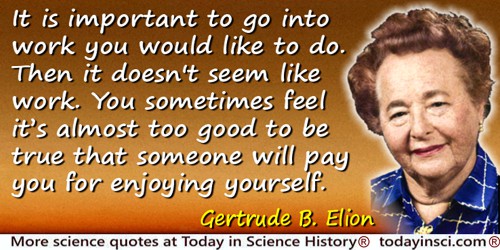
It is important to go into work you would like to do. Then it doesn't seem like work. You sometimes feel it's almost too good to be true that someone will pay you for enjoying yourself. I've been very fortunate that my work led to useful drugs for a variety of serious illnesses. The thrill of seeing people get well who might otherwise have died of diseases like leukemia, kidney failure, and herpes virus encephalitis cannot be described in words.
From her lecture notes.
It is not easy to name another Voyager or Traveller who has given more useful information to the world; to whom the Merchant and Mariner are so much indebted; or who has communicated his information in a more unembarrassed and intelligible manner. And this he has done in a style perfectly unassuming, equally free from affectation and from the most distant appearance of invention.
Describing Captain William Dampier in A Chronological History of the Voyages and Discoveries in the South Sea or Pacific Ocean: Vol. 4(1816), 486. [A similar quote found on the web is “It is not easy to name another sailor who has supplied such valuable information to the world; he had a passion for reporting exactly as he saw it, with a delicate and perfect style; he felt an unending curiosity that made his accounts have a unique delicate touch.” For this, Webmaster has so far not identified it in a primary source by Burney. Please contact if you know it. —Webmaster.]
It is not knowledge, but the act of learning, not possession but the act of getting there, which grants the greatest enjoyment. When I have clarified and exhausted a subject, then I turn away from it, in order to go into darkness again; the never-satisfied man is so strange if he has completed a structure, then it is not in order to dwell in it peacefully,but in order to begin another. I imagine the world conqueror must feel thus, who, after one kingdom is scarcely conquered, stretches out his arms for others.
Letter to Farkas Wolfgang Bolyai (2 Sep 1808). Quoted in G. Waldo Dunnington, Carl Friedrich Gauss: Titan of Science (2004), 416.
It is told of Faraday that he refused to be called a physicist; he very much disliked the new name as being too special and particular and insisted on the old one, philosopher, in all its spacious generality: we may suppose that this was his way of saying that he had not over-ridden the limiting conditions of class only to submit to the limitation of a profession.
Commentary (Jun 1962), 33, 461-77. Cited by Sydney Ross in Nineteenth-Century Attitudes: Men of Science (1991), 11.
It was eerie. I saw myself in that machine. I never thought my work would come to this.
Upon seeing a distorted image of his face, reflected on the inside cylindrical surface of the bore while inside an MRI (magnetic-resonance-imaging) machine—a device made possible by his early physical researches on nuclear magnetic resonance (1938).
Upon seeing a distorted image of his face, reflected on the inside cylindrical surface of the bore while inside an MRI (magnetic-resonance-imaging) machine—a device made possible by his early physical researches on nuclear magnetic resonance (1938).
Quoted from conversation with the author, John S. Rigden, in Rabi, Scientist and Citizen (2000), xxii. Rabi was recalling having an MRI, in late 1987, a few months before his death. He had been awarded the Nobel Prize in 1944, for his discovery of the magnetic resonance method.
It would be as if you were appointed to be copy editor to Dante. If you were the assistant to Dante, and then Dante died, and then you had in your possession the whole of “The Divine Comedy,” what would you do?
On the challenge of taking over (from the late Edwin Hubble) and continuing the universe expansion research at the new 200-inch telescope on Palomar Mountain, California. It was just as the telescope was going into operation, and Sandage was a fresh Ph.D. at age 27. As quoted in Obituary, 'Allan Sandage, 84, Astronomer, Dies; Charted Cosmos’s Age and Expansion', New York Times (17 Nov 2010), B19.
John Bardeen was an avid golfer and a good one. Whenever possible, he sought out golf courses during research or consulting trips. According to the stories, he was as proud of hitting a “hole in one” as he was to win a second Nobel Prize.
In 'John Bardeen: A Place to Win Two Nobel Prizes and Make a Hole in One', collected in Lillian Hoddeson (ed.), No Boundaries: University of Illinois Vignettes (2004), Chap. 16, 257.
John Dalton was a very singular Man, a quaker by profession & practice: He has none of the manners or ways of the world. A tolerable mathematician He gained his livelihood I believe by teaching the mathematics to young people. He pursued science always with mathematical views. He seemed little attentive to the labours of men except when they countenanced or confirmed his own ideas... He was a very disinterested man, seemed to have no ambition beyond that of being thought a good Philosopher. He was a very coarse Experimenter & almost always found the results he required.—Memory & observation were subordinate qualities in his mind. He followed with ardour analogies & inductions & however his claims to originality may admit of question I have no doubt that he was one of the most original philosophers of his time & one of the most ingenious.
J. Z. Fullmer, 'Davy's Sketches of his Contemporaries', Chymia, 1967, 12, 133-134.
John looked ruddy and plump, with a pair of cheeks like a trumpeter.
Describing John Bull.
Describing John Bull.
The History of John Bull
Laennec—this Herschel of the human thorax.
Inaugural address in Zurich (7 Nov 1840) 'Ueber den gegenwärtigen Zustand der Medizin', 402. Trans. Arleen M. Tuchman, 'From the Lecture to the Laboratory: the Institutionalization of Scientific Medicine at the University of Heidelberg', in William Coleman and Frederic L. Holmes (eds.), The Investigative Enterprise: Experimental Physiology in Nineteenth Century Medicine (1988), 90.
Let me tell you how at one time the famous mathematician Euclid became a physician. It was during a vacation, which I spent in Prague as I most always did, when I was attacked by an illness never before experienced, which manifested itself in chilliness and painful weariness of the whole body. In order to ease my condition I took up Euclid’s Elements and read for the first time his doctrine of ratio, which I found treated there in a manner entirely new to me. The ingenuity displayed in Euclid’s presentation filled me with such vivid pleasure, that forthwith I felt as well as ever.
Selbstbiographie (1875), 20. In Robert Édouard Moritz, Memorabilia Mathematica; Or, The Philomath's Quotation-book (1914), 146.

Like thousands of other boys, I had a little chemical laboratory in our cellar and think that some of our friends thought me a bit crazy.
Quoted in 'Langmuir Winner Stumped Einstein”, New York Times (23 Aug 1931), N2.
Littlewood, on Hardy’s own estimate, is the finest mathematician he has ever known. He was the man most likely to storm and smash a really deep and formidable problem; there was no one else who could command such a combination of insight, technique and power.
(1943). In Béla Bollobás, Littlewood's Miscellany (1986), Foreward, 22.
Maybe I was young and 'cute' (after all, I was only twenty then), but I've learned over the years that when you put white lab coats on chemists, they all look alike!
(6 Jul 1989) recalling being denied a laboratory job in her youth, since - allegedly - her physical attractiveness would be distracting to male coworkers. quoted in Feminine Ingenuity by Anne L. MacDonald (1992)
Melvin [Calvin]’s marvellous technique for delivering a scientific lecture was unique. His mind must have roamed constantly, especially in planning lectures. His remarkable memory enabled him to formulate a lecture or manuscript with no breaks in the sequence of his thoughts. His lectures usually began hesitatingly, as if he had little idea of how to begin or what to say. This completely disarmed his audiences, who would try to guess what he might have to say. Soon enough, however, his ideas would coalesce, to be delivered like an approaching freight train, reaching a crescendo of information at breakneck speed and leaving his rapt audience nearly overwhelmed.
Co-author with Andrew A. Benson, 'Melvin Calvin', Biographical Memoirs of the US National Academy of Science.
Most children have a bug period, and I never grew out of mine.
In Naturalist (1994, 2006), 53.
Mr. Dalton's aspect and manner were repulsive. There was no gracefulness belonging to him. His voice was harsh and brawling; his gait stiff and awkward; his style of writing and conversation dry and almost crabbed. In person he was tall, bony, and slender. He never could learn to swim: on investigating this circumstance he found that his spec. grav. as a mass was greater than that of water; and he mentioned this in his lectures on natural philosophy in illustration of the capability of different persons for attaining the art of swimming. Independence and simplicity of manner and originality were his best qualities. Though in comparatively humble circumstances he maintained the dignity of the philosophical character. As the first distinct promulgator of the doctrine that the elements of bodies unite in definite proportions to form chemical compounds, he has acquired an undying fame.
Dr John Davy's (brother of Humphry Davy) impressions of Dalton written in c.1830-31 in Malta.
Dr John Davy's (brother of Humphry Davy) impressions of Dalton written in c.1830-31 in Malta.
Quoted in W. C. Henry, Memoirs of the Life and Scientific Researches of John Dalton (1854), 217-8.
My ambition was to bring to bear on medicine a chemical approach. I did that by chemical manipulation of viruses and chemical ways of thinking in biomedical research.
From interview (1980) quoted in New York Times (24 Jun 1995), 9.
My dear nephew was only in his sixth year when I came to be detached from the family circle. But this did not hinder John and I from remaining the most affectionate friends, and many a half or whole holiday he was allowed to spend with me, was dedicated to making experiments in chemistry, where generally all boxes, tops of tea-canisters, pepper-boxes, teacups, &c., served for the necessary vessels, and the sand-tub furnished the matter to be analysed. I only had to take care to exclude water, which would have produced havoc on my carpet.
Letter to Lady Herschel, 6 Sep 1833. Quoted in Memoir and Correspondence of Caroline Herschel (1876), 259.
My first knowledge of chemistry was gained as a schoolboy at Oberlin, Ohio, from reading a book on chemistry which my father studied in college in the forties. I still have the book.
In 'The Perkin Medal Award', The Journal of Industrial and Engineering Chemistry (Mar 1911), 3, No. 3, 146.
My interest in Science had many roots. Some came from my mother … while I was in my early teens. She fell in love with science,… [from] classes on the Foundations of Physical Science. … I was infected by [her] professor second hand, through hundreds of hours of conversations at my mother’s knees. It was from my mother that I first learned of Archimedes, Leonardo da Vinci, Galileo, Kepler, Newton, and Darwin. We spent hours together collecting single-celled organisms from a local pond and watching them with a microscope.
From 'Richard E. Smalley: Biographical', collected in Tore Frängsmyr (ed.), Les Prix Nobel: The Nobel Prizes 1996 (1997).
My interest in the biology of tissue and organ transplantation arose from my [WW II] military experience at Valley Forge General Hospital in Pennsylvania … a major plastic surgical center. While there, I spent all my available spare time on the plastic surgical wards which were jammed with hundreds of battle casualties. I enjoyed talking to the patients, helping with dressings, and observing the results of the imaginative reconstructive surgical operations.
As a First Lieutenant with only a nine-month surgical internship, randomly assigned to VFGH to await overseas duty. In Tore Frängsmyr and Jan E. Lindsten (eds.), Nobel Lectures: Physiology Or Medicine: 1981-1990 (1993), 556.
My lectures were highly esteemed, but I am of opinion my operations rather kept down my practice, than increased it.
Quoted in Bransby Blake Cooper, The Life of Sir Astley Cooper (1843), Vol. 2, 471.
My life has been filled with adventures linked together like pearls on a thread. Pearls rarely turn up in oysters served to you on a plate; you have to dive for them.
In 'Foreword to the 35th Anniversary Edition', Kon-Tiki: Across the Pacific by Raft (1990), xi.
My mind seems to have become a kind of machine for grinding general laws out of large collections of facts, but why this should have caused the atrophy of that part of the brain that alone on which the higher tastes depend, I cannot conceive. A man with a mind more highly organised or better constituted than mine would not, I suppose, have thus suffered, and if I had to live my life over again, I would have made a rule to read some poetry and listen to some music at least once every week; for perhaps the parts of my brain now atrophied would thus have been kept alive through use.
In Charles Darwin and Francis Darwin (ed.), Charles Darwin: His Life Told in an Autobiographical Chapter, and in a Selected Series of His Published Letters (1892), 51.
My price is five dollars for a miniature on ivory, and I have engaged three or four at that price. My price for profiles is one dollar, and everybody is willing to engage me at that price.
Explaining how as an artist he would create income to pay his debts while at college.
Explaining how as an artist he would create income to pay his debts while at college.
Letter to his parents (25 Jun 1810). Samuel F.B. Morse: His Letters and Journals (1914), vol. 1, 20.
My reflection, when I first made myself master of the central idea of the “Origin”, was, “How extremely stupid not to have thought of that!”
'On the Reception of the Origin of Species'. In F. Darwin (ed.), The Life and Letters of Charles Darwin, Including an Autobiographical Chapter (1888), Vol. 2, 197.
Napoleon: M. Laplace, they tell me you have written this large book [Système du Monde] on the system of the universe, and have never even mentioned its Creator.
Laplace: I have no need for this hypothesis. (Je n’avais pas besoin de cette hypothèse-là.)
Laplace: I have no need for this hypothesis. (Je n’avais pas besoin de cette hypothèse-là.)
Quoted in Augustus De Morgan, Budget of Paradoxes (1915), Vol. 2, 2-3.
No sooner than I had begun to read this great work [Frasier, The Golden Bough], than I became immersed in it and enslaved by it. I realized then that anthropology, as presented by Sir James Frasier, is a great science, worthy of as much devotion as any of her elder and more exact sister studies, and I became bound to the service of Frazerian anthropology.
In A. Kuper, Anthropologists and Anthropology: The Modern British School (1973), 23. Quoted in Michael W. Young, Malinowski: Odyssey of an Anthropologist, 1881-1920 (2004), 4.
Nothing can be more improving to a young naturalist, than a journey in a distant country.
Journal of Researches: into the Natural History and Geology of the Countries Visited During the Voyage of H.M.S. Beagle Round the World (1839), ch. XXIII, 607.
Now, I must tell you of a strange experience which bore fruit in my later life. … We had a cold [snap] drier that ever observed before. People walking in the snow left a luminous trail behind them and a snowball thrown against an obstacle gave a flare of light like a loaf of sugar hit with a knife. [As I stroked] Mačak’s back, [it became] a sheet of light and my hand produced a shower of sparks. … My father … remarked, this is nothing but electricity, the same thing you see on the trees in a storm. My mother seemed alarmed. Stop playing with the cat, she said, he might start a fire. I was thinking abstractly. Is nature a cat? If so, who strokes its back? It can only be God, I concluded. …
I cannot exaggerate the effect of this marvelous sight on my childish imagination. Day after day I asked myself what is electricity and found no answer. Eighty years have gone by since and I still ask the same question, unable to answer it.
I cannot exaggerate the effect of this marvelous sight on my childish imagination. Day after day I asked myself what is electricity and found no answer. Eighty years have gone by since and I still ask the same question, unable to answer it.
Letter to Miss Pola Fotitch, 'A Story of Youth Told by Age' (1939). In John Ratzlaff, editor, Tesla Said (1984), 283-84. Cited in Marc J. Seifer, Wizard: The Life and Times of Nikola Tesla (1998), 5.
Nurse, it was I who discovered that leeches have red blood.
(1832). Attributed - on his deathbed when the nurse came to apply leeches. In Barnaby Conrad, Famous Last Words (1961), 78.
On coming down the stairs at dinner Tris [Trismegistus = Frankland] who walked before me seemed impressed by a mechanical impulse which impelled him along the corridor with a fervid velocity. On reaching the stair bottom I discovered the cause of the attraction. Miss Edmondson, like a pure planet, had checked his gravitating tendencies and lo! He stood radiant with smiles dropping joysparkes from his eyes as he clasped her hand. His countenance became a transparency through which the full proportions of his soul shone manifest; his blood tingled from his eyebrows to his finger ends, and wealthy with rich emotions his face became the avenue of what he felt.
Journals of John Tyndall, 18 Jan 1848. Royal Institution Archives.
On Saturday, I was a surgeon in South Africa, very little known ... [and] ... On Monday, I was world renowned.
In Janie B. Butts and Karen Rich, Nursing Ethics (2005), 59.
On the morning of 1 November 1956 the US physicist John Bardeen dropped the frying-pan of eggs that he was cooking for breakfast, scattering its contents on the kitchen floor. He had just heard that he had won the Nobel Prize for Physics along with William Shockley and Walter Brattain for their invention of the transistor. That evening Bardeen was startled again, this time by a parade of his colleagues from the University of Illinois marching to the door of his home bearing champagne and singing “For He’s a Jolly Good Fellow”.
In Abstract for 'John Bardeen: An Extraordinary Physicist', Physics World (2008), 21, No. 4, 22.
One of the attractions of mathematics … that had a great impact on my choosing a career—I wanted a career where I didn’t have to work with other people … to work in an area where I compete only with myself and didn’t have to deal with the negative aspects of competition.
In 'A Personal Profile of Karen K. Uhlenbeck', collected in Susan Ambrose et al., Journeys of Women in Science and Engineering, No Universal Constants (1999).
One of the grandest figures that ever frequented Eastern Yorkshire was William Smith, the distinguished Father of English Geology. My boyish reminiscence of the old engineer, as he sketched a triangle on the flags of our yard, and taught me how to measure it, is very vivid. The drab knee-breeches and grey worsted stockings, the deep waistcoat, with its pockets well furnished with snuff—of which ample quantities continually disappeared within the finely chiselled nostril—and the dark coat with its rounded outline and somewhat quakerish cut, are all clearly present to my memory.
From Reminiscences of a Yorkshire Naturalist (1896), 13.
Our age is retrospective. It builds the sepulchres of the fathers. It writes biographies, histories, and criticism. The foregoing generations beheld God and nature face to face; we, through their eyes. Why should not we also enjoy an original relation to the universe.
Opening sentences of his first published book (at first, anonymously), 'Introduction', Nature (1836), 5.
Our most distinguished “man of science” was the then veteran John Dalton. He was rarely absent from his seat in a warm corner of the room during the meetings of the Literary and Philosophical Society. Though a sober-minded Quaker, he was not devoid of some sense of fun; and there was a tradition amongst us, not only that he had once been a poet, but that, although a bachelor, two manuscript copies were still extant of his verses on the subject of matrimonial felicity; and it is my belief there was foundation for the tradition. The old man was sensitive on the subject of his age. Dining one day ... he was placed between two ladies ... [who] resolved to extract from him some admission on the tender point, but in vain. Though never other than courteous, Dalton foiled all their feminine arts and retained his secret. ... Dalton's quaint and diminutive figure was a strongly individualized one.
In Reminiscences of a Yorkshire Naturalist (1896), 73-74.
People ask me often [whether] the Nobel Prize [was] the thing you were aiming for all your life, and I say that would be crazy. Nobody would aim for a Nobel Prize because, if you didn’t get it, your whole life would be wasted. What we were aiming at was getting people well, and the satisfaction of that is much greater than any prize you can get.
Quoted in interview by Mary Ellen Avery (1997).
Perhaps the earliest memories I have are of being a stubborn, determined child. Through the years my mother has told me that it was fortunate that I chose to do acceptable things, for if I had chosen otherwise no one could have deflected me from my path. ... The Chairman of the Physics Department, looking at this record, could only say 'That A- confirms that women do not do well at laboratory work'. But I was no longer a stubborn, determined child, but rather a stubborn, determined graduate student. The hard work and subtle discrimination were of no moment.
Autobiography, Nobel Foundation
Physics isn’t what I do, it’s what I am.
As given by Henry Yang, Chancellor, University of California, Santa Barbara, quoted in Catherine Offord, 'Nobel Laureate Dies', The Scientist (25 Apr 2016).
Political science without biography is a form of taxidermy.
Psychopathology and Politics (1930), 1.
Ros Yalow and Sol Berson [her research partner] were the Toscaninis of the field... Most others were, if not organ-grinders, followers.
Quoted in Eugene Straus, Rosalyn Yalow, Nobel Laureate: Her Life and Work in Medicine, 1.
Science is a wonderful thing if one does not have to earn one’s living at it. One should earn one’s living by work of which one is sure one is capable. Only when we do not have to be accountable to anybody can we find joy in scientific endeavor.
Reply to a 24 Mar 1951 letter from a student uncertain whether to pursue astronomy, while not outstanding in mathematics. In Albert Einstein, Helen Dukas (ed.) and Banesh Hoffmann (ed.), Albert Einstein, The Human Side (1981), 57.
Scientists don’t really ever grow up. I read, as a 10-or-so-year-old, a book for kids by Einstein. I think it was The Meaning of Relativity. It was exciting! Science was compared to a detective story, replete with clues, and the solution was the search for a coherent account of all the known events. Then I remember some very entrapping biographies: Crucibles, by Bernard Jaffe, was the story of chemistry told through the lives of great chemists; Microbe Hunters, by Paul de Kruif, did the same for biologists. Also, the novel Arrowsmith, by Sinclair Lewis, about a medical researcher. These books were a crucial component of getting hooked into science.
When asked by Discover magazine what books helped inspire his passion as a scientist.
When asked by Discover magazine what books helped inspire his passion as a scientist.
In 'The 1998 Discover Science Gift Guide: Fantastic Voyages Children's Books That Mattered', Discover (Dec 1998).
She [Chien-Shiung Wu] is a slave driver. She is the image of the militant woman so well known in Chinese literature as either empress or mother.
As quoted in 'Queen of Physics', Newsweek (20 May 1963), No. 61, 20. Note: Chien-Shiung Wu was Segrè’s student.
Since my mother is the type that’s called schizophrenogenic in the literature—she's the one who makes crazy people, crazy children—I was awfully curious to find out why I didn’t go insane.
Quoted in Colin Wilson,New Pathways in Psychology: Maslow and the Post-Freudian Revolution (1972, 2001), 155-56.
Sir Hiram Maxim is a genuine and typical example of the man of science, romantic, excitable, full of real but somewhat obvious poetry, a little hazy in logic and philosophy, but full of hearty enthusiasm and an honorable simplicity. He is, as he expresses it, “an old and trained engineer,” and is like all of the old and trained engineers I have happened to come across, a man who indemnifies himself for the superhuman or inhuman concentration required for physical science by a vague and dangerous romanticism about everything else.
In G.K. Chesterton, 'The Maxims of Maxim', Daily News (25 Feb 1905). Collected in G. K. Chesterton and Dale Ahlquist (ed.), In Defense of Sanity: The Best Essays of G.K. Chesterton (2011), 87.
Sir Humphrey Davy
Abominated gravy.
He lived in the odium
Of having discovered sodium.
.
Abominated gravy.
He lived in the odium
Of having discovered sodium.
.
Said to have been written as a schoolboy during a chemistry class at St. Paul’s School. Fromn Edmund Clerihew Bentley, 'Sir Humphrey [sic] Davy', Biography for Beginners (1905). An example of a clerihew, an irregular form of biographical humorous verse, devised by the author. Collected in Complete Clerihews (2008), 38. Schoolboy comment as quoted in Alan L. Mackay, A Dictionary of Scientific Quotations (1991), 26. Note the correct spelling for Davy’s name is Humphry.
So little done, so much to do.
Reputed to be his last words.
Sometime in my early teens, I started feeling an inner urgency, ups and downs of excitement and frustration, caused by such unlikely occupations as reading Granville’s course of calculus ... I found this book in the attic of a friend’s apartment. Among other standard stuff, it contained the notorious epsilon-delta definition of continuous functions. After struggling with this definition for some time (it was the hot Crimean summer, and I was sitting in the shadow of a dusty apple tree), I got so angry that I dug a shallow grave for the book between the roots, buried it there, and left in disdain. Rain started in an hour. I ran back to the tree and exhumed the poor thing. Thus, I discovered that I loved it, regardless.
'Mathematics as Profession and vocation', in V. Arnold et al. (eds.), Mathematics: Frontiers and Perspectives (2000), 153. Reprinted in Mathematics as Metaphor: Selected Essays of Yuri I. Manin (2007), 79.
Son of a railroad engineer in the western United States, sometimes newspaper man in San Francisco, [Edward] Condon’s scientific career combined the abstract with the practical, theory and observation in a unique way.
From 'Edward Uhler Condon, A Personal Recollection', presented at the Fourth International Conference on Atomic Physics, published in the Proceedings of this conference by G. zu Pulitz et al. (eds.), Atomic Physics (1975), Vol. 4, as collected in Asim O. Barut, Halis Odabasi and Alwyn van der Merwe (eds.), Selected Popular Writings of E.U. Condon (1991), 1.
That was the turning point. It was as though the signal was there, 'This is the disease you're going to have to work against.' I never really stopped to think about anything else. It was that sudden.
Autobiography, Nobel Foundation
The Times is getting more detestable (but that is too weak word) than ever.
Letter to Asa Gray, 23 February 1863. In F. Burkhardt and S. Smith (eds.), The Correspondence of Charles Darwin 1863 (1999), Vol. 11, 167.
The achievements of the Beagle did not just depend on FitzRoy’s skill as a hydrographer, nor on Darwin’s skill as a natural scientist, but on the thoroughly effective fashion in which everyone on board pulled together. Of course Darwin and FitzRoy had their quarrels, but all things considered, they were remarkably infrequent. To have shared such cramped quarters for nearly five years with a man often suffering from serious depression, prostrate part of the time with sea sickness, with so little friction, Darwin must have been one of the best-natured
people ever! This is, indeed, apparent in his letters. And anyone who has participated in a scientific expedition will agree that when he wrote from Valparaiso in July 1834 that ‘The Captain keeps all smooth by rowing everyone in turn, which of course he has as much right to do as a gamekeeper to shoot partridges on the first of September’, he was putting a finger on an important ingredient in the Beagle’s success.
From Introduction to The Beagle Record (1979, 2012), 9.
The aim of science is to discover and illuminate truth. And that, I take it, is the aim of literature, whether biography or history or fiction. It seems to me, then, that there can be no separate literature of science.
Address upon receiving National Book Award at reception, Hotel Commodore, New York (27 Jan 1952). As cited in Linda Lear, Rachel Carson: Witness for Nature (1997), 219.
The appearance of Professor Benjamin Peirce, whose long gray hair, straggling grizzled beard and unusually bright eyes sparkling under a soft felt hat, as he walked briskly but rather ungracefully across the college yard, fitted very well with the opinion current among us that we were looking upon a real live genius, who had a touch of the prophet in his make-up.
Writing as a Professor Emeritus at Harvard University, a former student of Peirce, in 'Benjamin Peirce: II. Reminiscences', The American Mathematical Monthly (Jan 1925), 32, No. 1, 5.
The cult of individual personalities is always, in my view, unjustified. To be sure, nature distributes her gifts variously among her children. But there are plenty of the well-endowed ones too, thank God, and I am firmly convinced that most of them live quiet, unregarded lives. It strikes me as unfair, and even in bad taste, to select a few of them for boundless admiration, attributing superhuman powers of mind and character to them. This has been my fate, and the contrast between the popular estimate of my powers and achievements and the reality is simply grotesque. The consciousness of this extraordinary state of affairs would be unbearable but for one great consoling thought: it is a welcome symptom in an age which is commonly denounced as materialistic, that it makes heroes of men whose ambitions lie wholly in the intellectual and moral sphere. This proves that knowledge and justice are ranked above wealth and power by a large section of the human race. My experience teaches me that this idealistic outlook is particularly prevalent in America, which is usually decried as a particularly materialistic country.
From Mein Weltbild, as translated by Alan Harris (trans.), 'Some Notes on my American Impressions', The World as I See It (1956, 1993), 37-38.
The days of my youth extend backward to the dark ages, for I was born when the rush-light, the tallow-dip or the solitary blaze of the hearth were common means of indoor lighting, and an infrequent glass bowl, raised 8 or 10 feet on a wooden post, and containing a cup full of evil-smelling train-oil with a crude cotton wick stuck in it, served to make the darkness visible out of doors. In the chambers of the great, the wax candle or, exceptionally, a multiplicity of them, relieved the gloom on state occasions, but as a rule, the common people, wanting the inducement of indoor brightness such as we enjoy, went to bed soon after sunset.
Reminiscence written by Swan “in his old age”, as quoted in Kenneth Raydon Swan, Sir Joseph Swan (1946), 1-2.
The history of men of science has one peculiar advantage, as it shows the importance of little things in producing great results. Smeaton learned his principle of constructing a lighthouse, by noticing the trunk of a tree to be diminished from a curve to a cyclinder ... and Newton, turning an old box into a water-clock, or the yard of a house into a sundial, are examples of those habits of patient observation which scientific biography attractively recommends.
Pleasures, Objects, and Advantages of Literature (1855), 129.
The love of experiment was very strong in him [Charles Darwin], and I can remember the way he would say, “I shan't be easy till I have tried it,” as if an outside force were driving him. He enjoyed experimenting much more than work which only entailed reasoning, and when he was engaged on one of his books which required argument and the marshalling of facts, he felt experimental work to be a rest or holiday.
In Charles Darwin: His Life Told in an Autobiographical Chapter, and in a Selected Series of his Published Letters (1908), 95.
The magnificent title of the Functional School of Anthropology has been bestowed on myself, in a way on myself, and to a large extent out of my own sense of irresponsibility.
In A. Kuper, Anthropologists and Anthropology: The Modern British School (1983), 1.
The means by which I preserve my own health are, temperance, early rising, and spunging the body every morning with cold water, a practice I have pursued for thirty years ; and though I go from this heated theatre into the squares of the Hospital, in the severest winter nights, with merely silk stockings on my legs, yet I scarcely ever have a cold...
'Lecture 3, Treatment of Inflammation', The Lectures of Sir Astley Cooper (1825), Vol. 1, 58.Lectures on surgery, Lect. 3.
The mind of this man [Adme Mariotte] was highly capable of all learning, and the works published by him attest to the highest erudition. In 1667, on the strength of a singular doctrine, he was elected to the Academy. In him, sharp inventiveness always shone forth combined with the industry to carry through, as the works referred to in the course of this treatise will testify. His cleverness in the design of experiments was almost incredible, and he carried them out with minimal expense.
Translated from the Latin in Regiae Scientiarum Academiae Historia (1698), 233.
The moment after, I began to respire 20 quarts of unmingled nitrous oxide. A thrilling, extending from the chest to the extremities, was almost immediately produced. I felt a sense of tangible extension highly pleasurable in every limb; my visible impressions were dazzling, and apparently magnified, I heard distinctly every sound in the room and was perfectly aware of my situation. By degrees, as the pleasurable sensations increased, I last all connection with external things; trains of vivid visible images rapidly passed through my mind, and were connected with words in such a manner, as to produce perceptions perfectly novel. I existed in a world of newly connected and newly modified ideas. I theorised—I imagined that I made discoveries. When I was awakened from this semi-delirious trance by Dr. Kinglake, who took the bag from my mouth, indignation and pride were the first feelings produced by the sight of the persons about me. My emotions were enthusiastic and sublime; and for a minute I walked round the room, perfectly regardless of what was said to me. As I recovered my former state of mind, I felt an inclination to communicate the discoveries I had made during the experiment. I endeavoured to recall the ideas, they were feeble and indistinct; one collection of terms, however, presented itself: and with the most intense belief and prophetic manner, I exclaimed to Dr Kinglake, 'Nothing exists but thoughts!—the universe is composed of impressions, ideas, pleasures and pains!'
Researches, Chemical and Philosophical (1800), in J. Davy (ed.), The Collected Works of Sir Humphry Davy (1839-40), Vol 3, 289-90.
The poetic beauty of Davy's mind never seems to have left him. To that circumstance I would ascribe the distinguishing feature in his character, and in his discoveries,—a vivid imagination sketching out new tracts in regions unexplored, for the judgement to select those leading to the recesses of abstract truth.
Presidential Address to the Royal Society on Davy's Death, 1829. Quoted in J. Davy, Fragmentary Remains of Sir Humphry Davy (1858), 314.
The principal impetus for my entering a career in science … was the successful launching of Sputnik in 1957, and the then current belief that science and technology was going to be where the action was in the coming decades.
From 'Richard E. Smalley: Biographical', collected in Tore Frängsmyr (ed.), Les Prix Nobel: The Nobel Prizes 1996 (1997).
The reason Dick's [Richard Feynman] physics was so hard for ordinary people to grasp was that he did not use equations. The usual theoretical physics was done since the time of Newton was to begin by writing down some equations and then to work hard calculating solutions of the equations. This was the way Hans [Bethe] and Oppy [Oppenheimer] and Julian Schwinger did physics. Dick just wrote down the solutions out of his head without ever writing down the equations. He had a physical picture of the way things happen, and the picture gave him the solutions directly with a minimum of calculation. It was no wonder that people who had spent their lives solving equations were baffled by him. Their minds were analytical; his was pictorial.
Quoted in Michio Kaku and Jennifer Trainer Thompson, Beyond Einstein: the Cosmic Quest for the Theory of the Universe (1987, 1999), 56-57, citing Freeman Dyson, Disturbing the Universe (1979, 1981), 55-56.
The spectral density of black body radiation ... represents something absolute, and since the search for the absolutes has always appeared to me to be the highest form of research, I applied myself vigorously to its solution.
In Michael Dudley Sturge , Statistical and Thermal Physics (2003), 201.
The voyage of the Beagle has been by far the most important event in my life and has determined my whole career; yet it depended on so small a circumstance as my uncle offering to drive me 30 miles to Shrewsbury, which few uncles would have done, and on such a trifle as the shape of my nose.
At the end of a particular drive, his uncle, Josiah Wedgwood, convinced Darwin’s reluctant father that Charles should voyage on the Beagle. Captain Fitz-Roy believed he could read a man’s character from the shape of his nose. In Charles Darwin and Francis Darwin (ed.), 'Autobiography', The Life and Letters of Charles Darwin (1887, 1896), Vol. 1, 51.
The work I have done has, already, been adequately rewarded and recognized. Imagination reaches out repeatedly trying to achieve some higher level of understanding, until suddenly I find myself momentarily alone before one new corner of nature’s pattern of beauty and true majesty revealed. That was my reward.
Nobel Banquet Speech (10 Dec 1965).
The year 1918 was the time of the great influenza epidemic, the schools were closed. And this was when, as far as I can remember, the first explicitly strong interest in astronomy developed ... I took a piece of bamboo, and sawed a piece in the middle of each end, to put a couple of spectacle lenses in it. Well, the Pleiades looked nice because the stars were big. I thought I was looking at stars magnified. Well, they weren’t. It was a little thing with two lenses at random on each end, and all you got were extra focal images, big things, but I thought I was looking at star surfaces. I was 12 years old.
'Oral History Transcript: Dr. William Wilson Morgan' (8 Aug 1978) in the Niels Bohr Library & Archives.
There was one quality of mind which seemed to be of special and extreme advantage in leading him [Charles Darwin] to make discoveries. It was the power of never letting exceptions pass unnoticed. Everybody notices a fact as an exception when it is striking or frequent, but he had a special instinct for arresting an exception. A point apparently slight and unconnected with his present work is passed over by many a man almost unconsciously with some half-considered explanation, which is in fact no explanation. It was just these things that he seized on to make a start from. In a certain sense there is nothing special in this procedure, many discoveries being made by means of it. I only mention it because, as I watched him at work, the value of this power to an experimenter was so strongly impressed upon me.
In Charles Darwin: His Life Told in an Autobiographical Chapter, and in a Selected Series of his Published Letters (1908), 94-95.
This is the question
Marry
Children—(if it Please God)—Constant companion (& friend in old age) who will feel interested in one—object to be beloved and played with—better than a dog anyhow. Home, & someone to take care of house—Charms of music and female chit-chat.—These things good for one’s health.—but terrible loss of time.—
My God, it is Intolerable to think of spending ones whole life, like a neuter bee, working, working—& nothing after all.—No, no, won’t do. Imagine living all one’s day solitary in smoky dirty London House.—Only picture to yourself a nice soft wife on a sofa with good fire, & books & music perhaps-—Compare this vision with the dingy reality of Grt. Marlbro’ Street.
Not Marry
Freedom to go where one liked—choice of Society and little of it. —Conversation of clever men at clubs—Not forced to visit relatives, & to bend in every trifle. —to have the expense and anxiety of children—perhaps quarreling—Loss of time. —cannot read in the Evenings—fatness & idleness—Anxiety & responsibility—less money for books &c—if many children forced to gain one’s bread. —(but then it is very bad for ones health to work too much)
Perhaps my wife won’t like London; then the sentence is banishment & degradation into indolent, idle fool.
Marry—Marry—Marry Q.E.D.
It being proved necessary to Marry When? Soon or late?
Marry
Children—(if it Please God)—Constant companion (& friend in old age) who will feel interested in one—object to be beloved and played with—better than a dog anyhow. Home, & someone to take care of house—Charms of music and female chit-chat.—These things good for one’s health.—but terrible loss of time.—
My God, it is Intolerable to think of spending ones whole life, like a neuter bee, working, working—& nothing after all.—No, no, won’t do. Imagine living all one’s day solitary in smoky dirty London House.—Only picture to yourself a nice soft wife on a sofa with good fire, & books & music perhaps-—Compare this vision with the dingy reality of Grt. Marlbro’ Street.
Not Marry
Freedom to go where one liked—choice of Society and little of it. —Conversation of clever men at clubs—Not forced to visit relatives, & to bend in every trifle. —to have the expense and anxiety of children—perhaps quarreling—Loss of time. —cannot read in the Evenings—fatness & idleness—Anxiety & responsibility—less money for books &c—if many children forced to gain one’s bread. —(but then it is very bad for ones health to work too much)
Perhaps my wife won’t like London; then the sentence is banishment & degradation into indolent, idle fool.
Marry—Marry—Marry Q.E.D.
It being proved necessary to Marry When? Soon or late?
Notes on Marriage, July 1838. In F. Burkhardt and S. Smith (eds.), The Correspondence of Charles Darwin 1837-1843 (1986), Vol. 2, 444.
This theory [the oxygen theory] is not as I have heard it described, that of the French chemists, it is mine (elle est la mienne); it is a property which I claim from my contemporaries and from posterity.
Memoires de Chimie (1805), Vol. 2, 87, trans. M. P. Crosland.
Three passions, simple but overwhelmingly strong, have governed my life: the longing for love, the search for knowledge, and unbearable pity for the suffering of mankind.
The Autobiography of Betrand Russell (1998), 9, first sentence of the Prologue.
To me old age is always fifteen years older than I am.
Commenting on his 85th birthday.
Commenting on his 85th birthday.
Quoted in Newsweek (29 Aug 1955). In Alfred J. Kolatch, Great Jewish Quotations (1996), 38.
To me there never has been a higher source of earthly honour or distinction than that connected with advances in science. I have not possessed enough of the eagle in my character to make a direct flight to the loftiest altitudes in the social world; and I certainly never endeavored to reach those heights by using the creeping powers of the reptile, who, in ascending, generally chooses the dirtiest path, because it is the easiest.
In Maturin Murray Ballou, Treasury of Thought (1894), 459.
To my deep mortification my father once said to me, “You care for nothing but shooting, dogs, and rat-catching, and you will be a disgrace to yourself and all your family.”
Despite this, perhaps rare, angry or unjust outburst, Darwin regarded his father as “the kindest man I ever knew and whose memory I love with all my heart.” In Charles Darwin and Francis Darwin (ed.), 'Autobiography', The Life and Letters of Charles Darwin (1887, 1896), Vol. 1, 30.
To punish me for my contempt for authority, fate made me an authority myself.
Letter to Mileva Marie (12 Dec 1901), as cited in Walter Isaacson, Einstein: His Life and Universe (2008), 33.
Towards the end of his life, he [Ernest Rutherford] said, “I’ve just finished reading some of my early papers, and you know, when I’d finished I said to myself, ‘Rutherford, my boy, you used to be a damned clever fellow.’”
As quoted in 'The Rutherford Memorial Lecture' (29 Mar 1939), Memorial Lectures Delivered Before the Chemical Society (1951), Vol. 4, 183. Although quoted without source, note that Tizard and Rutherford were friends.
Tyndall, ... I must remain plain Michael Faraday to the last; and let me now tell you, that if accepted the honour which the Royal Society desires to confer upon me, I would not answer for the integrity of my intellect for a single year.
On being offered the Presidency of the Royal Society.
On being offered the Presidency of the Royal Society.
John Tyndall, Faraday as a Discoverer (1868), 157-8.
Underneath his sweetness and gentleness was the heat of a volcano. [Michael Faraday] was a man of excitable and fiery nature; but through high self-discipline he had converted the fire into a central glow and motive power of life, instead of permitting it to waste itself in useless passion.
In Faraday as a Discoverer (1868), 37.
We have chosen to write the biography of our disease because we love it platonically — as Amy Lowell loved Keats — and have sought its acquaintance wherever we could find it. And in this growing intimacy we have become increasingly impressed with the influence that this and other infectious diseases, which span — in their protoplasmic continuities — the entire history of mankind, have had upon the fates of men.
Rats, Lice and History (1935)
We may be sure, that if Lyell were now living he would frankly recognize new facts, as soon as they were established, and would not shrink from any modification of his theory which these might demand. Great as were his services to geology, this, perhaps, is even greater—for the lesson applies to all sciences and to all seekers alter knowledge—that his career, from first to lost, was the manifestation of a judicial mind, of a noble spirit, raised far above all party passions and petty considerations, of an intellect great in itself, but greater still in its grand humility; that he was a man to whom truth was as the “pearl of price,” worthy of the devotion and, if need be, the sacrifice of a life.
Conclusion in Charles Lyell and Modern Geology (1895), 213.
We must raise the salaries of our operators or they will all be taken from us, that is, all that are good for anything. You will recollect that, at the first meeting of the Board of Directors, I took the ground that 'it was our policy to make the office of operator desirable, to pay operators well and make their situation so agreeable that intelligent men and men of character will seek the place and dread to lose it.' I still think so, and, depend upon it, it is the soundest economy to act on this principle.
Letter to T.S. Faxton, one of his lieutenants (15 Mar 1848). Samuel F. B. Morse, His Letters and Journals (1914), vol. 2, 274.
Well, in the first place, it leads to great anxiety as to whether it’s going to be correct or not … I expect that’s the dominating feeling. It gets to be rather a fever…
At age 60, when asked about his feelings on discovering the Dirac equation.
At age 60, when asked about his feelings on discovering the Dirac equation.
"Interview with T. Kuhn (7 May 1963), Niels Bohr Library, American Intitute of Physics, New York. In A. Pais, 'Playing With Equations, the Dirac Way'. Behram N. Kursunoglu (Ed.) and Eugene Paul Wigner (Ed.), Paul Adrien Maurice Dirac: Reminiscences about a Great Physicist (1990), 110.
What can I say of the perpetual motion machine that is my husband? What makes Francis run? It is a mysterious and propelling force which, injected into all mankind, would solve all the problems that plague this day and age.
Describing her husband, opthalmologist Francis Heed Adler.
Describing her husband, opthalmologist Francis Heed Adler.
Investigative Ophthalmology (Feb 1968), 7 No. 1, 4.
When [Erwin Schrödinger] went to the Solvay conferences in Brussels, he would walk from the station to the hotel where the delegates stayed, carrying all his luggage in a rucksack and looking so like a tramp that it needed a great deal of argument at the reception desk before he could claim a room.
Quoted in Robert L. Weber, Pioneers of Science: Nobel Prize Winners in Physics (1980), 100.
When April wind wakes the call for the soil, I hold the plough as my only hold upon the earth, and, as I follow through the fresh and fragrant furrow, I am planted with every foot-step, growing, budding, blooming in a spirit of spring.
When my parents moved to Washington with me as a 9-year-old, when my father had a temporary job in the government, I found myself five blocks from the National Zoo and just beyond Rock Creek Park. And so while I was going through the end of grammar school, I proceeded to spend all of my time in that zoo and then exploring Rock Creek Park. And I became then and there a lifetime professional scientific naturalist…. Seeing people who are actually engaged and studying it and treasuring it and making a lot of it was just enough to make me want to study any subject so that I could be like one of them.
From interview with National Geographic, in Andrew Revkin, 'Conservation Legend Has Big Plans For Future', on nationalgeographic.com website.
While reading in a textbook of chemistry, … I came across the statement, “nitric acid acts upon copper.” I was getting tired of reading such absurd stuff and I determined to see what this meant. Copper was more or less familiar to me, for copper cents were then in use. I had seen a bottle marked “nitric acid” on a table in the doctor’s office where I was then “doing time.” I did not know its peculiarities, but I was getting on and likely to learn. The spirit of adventure was upon me. Having nitric acid and copper, I had only to learn what the words “act upon” meant … I put one of them [cent] on the table, opened the bottle marked “nitric acid”; poured some of the liquid on the copper; and prepared to make an observation. But what was this wonderful thing which I beheld? The cent was already changed, and it was no small change either. A greenish blue liquid foamed and fumed over the cent and over the table. The air in the neighborhood of the performance became colored dark red. A great colored cloud arose. This was disagreeable and suffocating—how should I stop this? I tried to get rid of the objectionable mess by picking it up and throwing it out of the window, which I had meanwhile opened. I learned another fact—nitric acid not only acts upon copper but it acts upon fingers. The pain led to another unpremeditated experiment. I drew my fingers across my trousers and another fact was discovered. Nitric acid acts upon trousers. Taking everything into consideration, that was the most impressive experiment, and, relatively, probably the most costly experiment I have ever performed.
In F.H. Getman, The Life of Ira Remsen (1940), 9.
With a thousand joys I would accept a nonacademic job for which industriousness, accuracy, loyalty, and such are sufficient without specialized knowledge, and which would give a comfortable living and sufficient leisure, in order to sacrifice to my gods [mathematical research]. For example, I hope to get the editting of the census, the birth and death lists in local districts, not as a job, but for my pleasure and satisfaction...
Letter to Heinrich Olbers (26 Oct 1802). Quoted in G. Waldo Dunnington, Carl Friedrich Gauss: Titan of Science (2004), 415.
You ask whether I am going over to the history of science... no, I am not as old as that.
Said on his retirement c.1969.
Young man, if I could remember the names of these particles, I would have been a botanist.
Given as a reply to Leon M. Lederman (then a young researcher) when he asked Fermi for his opinion of the evidence of a particle named the K-zero-two, while standing next to him in a conference lunch line. Lederman wrote his recollection of the answer in his book, The God Particle: If the Universe is the Answer, what is the Question? (1993), 15. Lederman mentioned this statement much earlier, as “If I could remember the names of these particles, I would have been a botanist,” in a lecture (9 Jan 1963) on 'Neutrino Physics,' collected in Brookhaven Lecture Series (Dec 1963), 23, 1.
 In science it often happens that scientists say, 'You know that's a really good argument; my position is mistaken,' and then they would actually change their minds and you never hear that old view from them again. They really do it. It doesn't happen as often as it should, because scientists are human and change is sometimes painful. But it happens every day. I cannot recall the last time something like that happened in politics or religion.
(1987) --
In science it often happens that scientists say, 'You know that's a really good argument; my position is mistaken,' and then they would actually change their minds and you never hear that old view from them again. They really do it. It doesn't happen as often as it should, because scientists are human and change is sometimes painful. But it happens every day. I cannot recall the last time something like that happened in politics or religion.
(1987) -- 





