Belief Quotes (626 quotes)
Believe Quotes
Believe Quotes
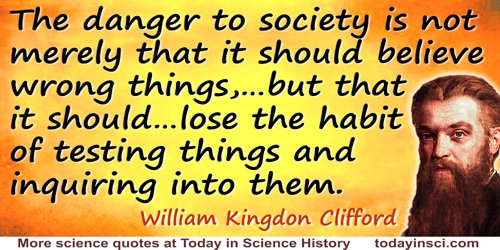
... If I let myself believe anything on insufficient evidence, there may be no great harm done by the mere belief; it may be true after all, or I may never have occasion to exhibit it in outward acts. But I cannot help doing this great wrong towards Man, that I make myself credulous. The danger to society is not merely that it should believe wrong things, though that is great enough; but that it should become credulous, and lose the habit of testing things and inquiring into them; for then it must sink back into savagery.
The Scientific Basis of Morals (1884), 28.
‘Be not afraid of life. Believe that life is worth living, and your belief will help create the fact.
Quoted in Kim Lim (ed.), 1,001 Pearls of Spiritual Wisdom: Words to Enrich, Inspire, and Guide Your Life (2014), 245
‘I was reading an article about “Mathematics”. Perfectly pure mathematics. My own knowledge of mathematics stops at “twelve times twelve,” but I enjoyed that article immensely. I didn’t understand a word of it; but facts, or what a man believes to be facts, are always delightful. That mathematical fellow believed in his facts. So do I. Get your facts first, and’—the voice dies away to an almost inaudible drone—’then you can distort ‘em as much as you please.’
In 'An Interview with Mark Twain', in Rudyard Kipling, From Sea to Sea (1899), Vol. 2, 180.
“Time’s noblest offspring is the last.” This line of Bishop Berkeley’s expresses the real cause of the belief in progress in the animal creation.
Leonard G. Wilson (ed.), Sir Charles Lyell’s Scientific Journals on the Species Question (1970), 162.
[A]s you know, scientific education is fabulously neglected … This is an evil that is inherited, passed on from generation to generation. The majority of educated persons are not interested in science, and are not aware that scientific knowledge forms part of the idealistic background of human life. Many believe—in their complete ignorance of what science really is—that it has mainly the ancillary task of inventing new machinery, or helping to invent it, for improving our conditions of life. They are prepared to leave this task to the specialists, as they leave the repairing of their pipes to the plumber. If persons with this outlook decide upon the curriculum of our children, the result is necessarily such as I have just described it.
Opening remarks of the second of four public lectures for the Dublin Institute for Advanced Studies at University College, Dublin (Feb 1950), The Practical Achievements of Science Tending to Obliterate its True Import', collected in Science and Humanism: Physics in Our Time (1951). Reprinted in 'Nature and the Greeks' and 'Science and Humanism' (1996), 113.
[An artist] will sooner and with more certainty, establish the character of skeletons, than the most learned anatomist, whose eye has not been accustomed to seize on every peculiarity.
Asserting his (incorrect) belief that the fossil teeth of the mastodon revealed it was a carnivorous animal.]
Asserting his (incorrect) belief that the fossil teeth of the mastodon revealed it was a carnivorous animal.]
In An Historical Disquisition on the Mammoth, or, Great American Incognitum, an Extinct, Immense, Carnivorous Animal, whose Fossil Remains Have Been Found in North America (1903), 38-39, which was published for his London exhibit of a mastodon skeleton. As cited in Michele L. Aldrich article on Peale, in Charles Coulston Gillespie, Dictionary of Scientific Biography (1978), Vol. 15-16, 472.
[Dubious attribution] I was wise enough never to grow up, while fooling most people into believing that I had.
Although seen widely circulated on the web, Webmaster has so far been unable to verify any primary source. Found in few books, but without any citation, for example as early as Joel Goodman, Laffirmations: 1001 Ways to Add Humor to Your Life and Work (1995), 305.
[Florence Nightingale] was a great administrator, and to reach excellence here is impossible without being an ardent student of statistics. Florence Nightingale has been rightly termed the “Passionate Statistician.” Her statistics were more than a study, they were indeed her religion. For her, Quetelet was the hero as scientist, and the presentation copy of his Physique Sociale is annotated by her on every page. Florence Nightingale believed—and in all the actions of her life acted upon that belief—that the administrator could only be successful if he were guided by statistical knowledge. The legislator—to say nothing of the politician—too often failed for want of this knowledge. Nay, she went further: she held that the universe—including human communities—was evolving in accordance with a divine plan; that it was man's business to endeavour to understand this plan and guide his actions in sympathy with it. But to understand God's thoughts, she held we must study statistics, for these are the measure of his purpose. Thus the study of statistics was for her a religious duty.
In Karl Pearson, The Life, Letters and Labours of Francis Galton (1924), Vol. 2, 414-5.
[Isaac Newton] regarded the Universe as a cryptogram set by the Almighty—just as he himself wrapt the discovery of the calculus in a cryptogram when he communicated with Leibniz. By pure thought, by concentration of mind, the riddle, he believed, would be revealed to the initiate.
In 'Newton, the Man' (1946). In Geoffrey Keynes (ed.), Essays in Biography, 2nd edition (1951), 314.
[L]et us not overlook the further great fact, that not only does science underlie sculpture, painting, music, poetry, but that science is itself poetic. The current opinion that science and poetry are opposed is a delusion. … On the contrary science opens up realms of poetry where to the unscientific all is a blank. Those engaged in scientific researches constantly show us that they realize not less vividly, but more vividly, than others, the poetry of their subjects. Whoever will dip into Hugh Miller’s works on geology, or read Mr. Lewes's “Seaside Studies,” will perceive that science excites poetry rather than extinguishes it. And whoever will contemplate the life of Goethe will see that the poet and the man of science can co-exist in equal activity. Is it not, indeed, an absurd and almost a sacrilegious belief that the more a man studies Nature the less he reveres it? Think you that a drop of water, which to the vulgar eye is but a drop of water, loses anything in the eye of the physicist who knows that its elements are held together by a force which, if suddenly liberated, would produce a flash of lightning? Think you that what is carelessly looked upon by the uninitiated as a mere snow-flake, does not suggest higher associations to one who has seen through a microscope the wondrously varied and elegant forms of snow-crystals? Think you that the rounded rock marked with parallel scratches calls up as much poetry in an ignorant mind as in the mind of a geologist, who knows that over this rock a glacier slid a million years ago? The truth is, that those who have never entered upon scientific pursuits know not a tithe of the poetry by which they are surrounded. Whoever has not in youth collected plants and insects, knows not half the halo of interest which lanes and hedge-rows can assume. Whoever has not sought for fossils, has little idea of the poetical associations that surround the places where imbedded treasures were found. Whoever at the seaside has not had a microscope and aquarium, has yet to learn what the highest pleasures of the seaside are. Sad, indeed, is it to see how men occupy themselves with trivialities, and are indifferent to the grandest phenomena—care not to understand the architecture of the Heavens, but are deeply interested in some contemptible controversy about the intrigues of Mary Queen of Scots!—are learnedly critical over a Greek ode, and pass by without a glance that grand epic written by the finger of God upon the strata of the Earth!
In Education: Intellectual, Moral, and Physical (1889), 82-83.
[Man] … his origin, his growth, his hopes and fears, his loves and his beliefs are but the outcome of accidental collocations of atoms; that no fire, no heroism, no intensity of thought and feeling can preserve an individual life beyond the grave; that all the labour of the ages, all the devotion, all the inspiration, all the noonday brightness of human genius are destined to extinction in the vast death of the solar system, and that the whole temple of Man's achievement must inevitably be buried beneath the debris of a universe in ruins…
From 'A Free Man's Worship', Independent Review (Dec 1903). Collected in Mysticism and Logic: And Other Essays (1918), 47-48.
[Receiving a university scholarship] was fundamentally important to me, to be able to afford going to school, and I still believe so strongly in the value of public education and state-funded universities.
As quoted in Anna Azvolinsky, 'Fearless About Folding', The Scientist (Jan 2016).
[Richard Feynman] believed in the primacy of doubt, not as a blemish upon our ability to know but as the essence of knowing. The alternative to uncertainty is authority, against which science has fought for centuries.
In Genius: The Life and Science of Richard Feynman (1992), 371-372.
![James Watson quote: [Science moves] with the spirit of an adventure characterized both by youthful arrogance and by the belief t](https://todayinsci.com/W/Watson_James/WatsonJames-Pretty500x250px.jpg)
[Science proceeds with] the spirit of an adventure characterized both by youthful arrogance and by the belief that the truth, once found, would be simple as well as pretty.
In The Double Helix: A Personal Account of the Discovery of the Structure of DNA (1968, 2001), Preface, xi.
[Scientists] have learned to respect nothing but evidence, and to believe that their highest duty lies in submitting to it however it may jar against their inclinations.
From Man’s Place in Nature (1894), 109
[The scientist] believes passionately in facts, in measured facts. He believes there are no bad facts, that all facts are good facts, though they may be facts about bad things, and his intellectual satisfaction can come only from the acquisition of accurately known facts, from their organization into a body of knowledge, in which the inter-relationship of the measured facts is the dominant consideration.
'Scientist and Citizen', Speech to the Empire Club of Canada (29 Jan 1948), The Empire Club of Canada Speeches (29 Jan 1948), 209-221.
[To the cultures of Asia and the continent of Africa] it is the Western impact which has stirred up the winds of change and set the processes of modernization in motion. Education brought not only the idea of equality but also another belief which we used to take for granted in the West—the idea of progress, the idea that science and technology can be used to better human conditions. In ancient society, men tended to believe themselves fortunate if tomorrow was not worse than today and anyway, there was little they could do about it.
Lecture at State University of Iowa (6 Apr 1961). In Barbara Ward, The Unity of the Free World (1961), 12.
[Almost certainly not by Einstein.] The more I study science, the more I believe in God.
No cited primary source has been found, so it is almost certainly falsely linked with Einstein. Also, it is not compatible with Einstein’s documented statements on his religious views. See, for example, the quote beginning “It was, of course, a lie what you read about my religious convictions….” The subject quote is included here so readers may find this disclaimer.
[Concerning the former belief that there were no genetic connections among species:] This view, as a rounded whole and in all its essential elements, has very recently disappeared from science. It died a royal death with Agassiz.
— Asa Gray
From lecture 'Scientific Beliefs', as published in Natural Science and Religion: Two Lectures delivered to the Theological School of Yale College (1880), Vol. 3, Lecture 1, 35.
Belief may be a regrettably unavoidable biological weakness to be kept under the control of criticism: but commitment is for Popper an outright crime.
In 'Falsification and the Methodology of Scientific Research Programmes', in I. Lakatos and A. Musgrave (eds.), Criticism and the Growth of Knowledge: Proceedings of the International Colloquium in the Philosophy of Science, London 1965 (1970), Vol. 4, 92.
Dilbert: Evolution must be true because it is a logical conclusion of the scientific method.
Dogbert: But science is based on the irrational belief that because we cannot perceive reality all at once, things called “time” and “cause and effect” exist.
Dilbert: That’s what I was taught and that’s what I believe.
Dogbert: Sounds cultish.
Dogbert: But science is based on the irrational belief that because we cannot perceive reality all at once, things called “time” and “cause and effect” exist.
Dilbert: That’s what I was taught and that’s what I believe.
Dogbert: Sounds cultish.
Dilbert comic strip (8 Feb 1992).
Dilbert: You joined the “Flat Earth Society?”
Dogbert: I believe the earth must be flat. There is no good evidence to support the so-called “round earth theory.”
Dilbert: I think Christopher Columbus would disagree.
Dogbert: How convenient that your best witness is dead.
Dogbert: I believe the earth must be flat. There is no good evidence to support the so-called “round earth theory.”
Dilbert: I think Christopher Columbus would disagree.
Dogbert: How convenient that your best witness is dead.
Dilbert comic strip (9 Oct 1989).
Douter de tout ou tout croire, ce sont deux solutions également commodes, qui l’une et l’autre nous dispensent de défléchir.
To doubt everything and to believe everything are two equally convenient solutions; each saves us from thinking.
To doubt everything and to believe everything are two equally convenient solutions; each saves us from thinking.
From 'Introduction', La Science et l’Hypothèse (1902), 2. Translation by George Bruce Halsted, 'Introduction', Science and Hypothesis (New York, 1905), 1. In 'Author’s Preface', Science and Hypothesis (London 1905), xxii, it is translated more closely as “To doubt everything and to believe everything are two equally convenient solutions; both dispense with the necessity of reflection.”
Kein Sieger glaubt an den Zufall.
No victor believes in chance.
No victor believes in chance.
The Gay Science (1882), book 3, no. 258, trans. W. Kaufmann (1974), 217.
Notre folie à nous autres est de croire aussi que toute la nature, sans exception, est destinée à nos usages.
We, too, are silly enough to believe that all nature is intended for our benefit.
We, too, are silly enough to believe that all nature is intended for our benefit.
In 'Premier Soir', Entretiens Sur La Pluralité Des Mondes (1686). French and translation in Craufurd Tait Ramage, Beautiful Thoughts from French and Italian Authors (1866), 117.
Pour accomplir de grandes choses il ne suffit pas d'agir il faut rêver; il ne suffit pas de calculer, il faut croire.
To accomplish great things, we must not only act but also dream, not only plan but also believe.
[Referring to the Suez Canal, initiated by Ferdinand de Lesseps.]
To accomplish great things, we must not only act but also dream, not only plan but also believe.
[Referring to the Suez Canal, initiated by Ferdinand de Lesseps.]
Speech (24 Dec 1896) upon election to the French Academy, in the vacant place of the late Ferdinand de Lesseps, Discours de Réception de M. Anatole France: Séance de l'Académie Française du 24 Décembre 1896 (1897), 21.
Thomasina: Every week I plot your equations dot for dot, x’s against y’s in all manner of algebraical relation, and every week they draw themselves as commonplace geometry, as if the world of forms were nothing but arcs and angles. God’s truth, Septimus, if there is an equation for a curve like a bell, there must be an equation for one like a bluebell, and if a bluebell, why not a rose? Do we believe nature is written in numbers?
Septimus: We do.
Thomasina: Then why do your shapes describe only the shapes of manufacture?
Septimus: I do not know.
Thomasina: Armed thus, God could only make a cabinet.
Septimus: We do.
Thomasina: Then why do your shapes describe only the shapes of manufacture?
Septimus: I do not know.
Thomasina: Armed thus, God could only make a cabinet.
In the play, Acadia (1993), Scene 3, 37.
~~[need primary source]~~ One of the most frightening things in the Western world and in this country in particular is the number of people who believe in things that are scientifically false. If someone tells me that the earth is less than 10000 years old in my opinion he should see a psychiatrist.
As quoted, without citation, in Joan Konner, The Atheist’s Bible: An Illustrious Collection of Irreverent Thought (2007), 46. Webmaster is dubious about authenticity, and as yet, has been unable to find a reliable primary source - can you help?
~~[Unverified]~~ To really know is science; to merely believe you know is ignorance.
Webmaster, as yet, has found no primary source showing Hippocrates as author for this quote. Although widely seen, it is always without citation. Similar unverified quotes attributed to Hippocrates are: “Science is the father of knowledge, but opinion breeds ignorance,” and “There are, in fact, two things: science and opinion; the former begets knowledge, the latter ignorance.”
A primâ facie argument in favour of the efficacy of prayer is therefore to be drawn from the very general use of it. The greater part of mankind, during all the historic ages, have been accustomed to pray for temporal advantages. How vain, it may be urged, must be the reasoning that ventures to oppose this mighty consensus of belief! Not so. The argument of universality either proves too much, or else it is suicidal.
'Statistical Inquiries into the Efficacy of Prayer', Fortnightly Review, 1872, 12, 126.
A celebrated author and divine has written to me that “he has gradually learnt to see that it is just as noble a conception of the Deity to believe that He created a few original forms capable of self-development into other and needful forms, as to believe that He required a fresh act of creation to supply the voids caused by the action of His laws.”
In Origin of Species (1860), 417.
A century ago, Darwin and his friends were thought to be dangerous atheists, but their heresy simply replaced a benevolent personal deity called God by a benevolent impersonal deity called Evolution. In their different ways Bishop Wilberforce and T.H. Huxley both believed in Fate.
From transcript of BBC radio Reith Lecture (12 Nov 1967), 'A Runaway World', on the bbc.co.uk website.
A fact is a simple statement that everyone believes. It is innocent, unless found guilty. A hypothesis is a novel suggestion that no one wants to believe. It is guilty until found effective.
Edward Teller, Wendy Teller, Wilson Talley, Conversations on the Dark Secrets of Physics (1991, 2002), Footnote, 69.
A farmer believes what goes down must come up.
A few months after a devastating defeat at Fredericksburg,… President Abraham Lincoln signed into law an act creating the National Academy of Sciences—in the midst of civil war. Lincoln refused to accept that our nation’s sole purpose was mere survival. He created this academy, founded the land grant colleges, and began the work of the transcontinental railroad, believing that we must add—and I quote—“the fuel of interest to the fire of genius in the discovery … of new and useful things.”
Speech to the National Academy of Sciences Annual Meeting (27 Apr 2009).
A great man, [who] was convinced that the truths of political and moral science are capable of the same certainty as those that form the system of physical science, even in those branches like astronomy that seem to approximate mathematical certainty.
He cherished this belief, for it led to the consoling hope that humanity would inevitably make progress toward a state of happiness and improved character even as it has already done in its knowledge of the truth.
He cherished this belief, for it led to the consoling hope that humanity would inevitably make progress toward a state of happiness and improved character even as it has already done in its knowledge of the truth.
Describing administrator and economist Anne-Robert-Jacques Turgot in Essai sur l’application de l’analyse à la probabilité des décisions rendues à la pluralité des voix (1785), i. Cited epigraph in Charles Coulston Gillispie, Science and Polity in France: The End of the Old Regime (2004), 3
A humanitarian is a man who believes that no human being should be sacrificed to a project—especially to the project of perfecting nuclear weapons to kill hundreds of millions of people.
From 'A Nobel Scientist Speaks: Every Test Kills', Liberation (Feb 1958), 2, No. 11. Also quoted in Barbara Marinacci and Ramesh Saligrama Krishnamurthy, Linus Pauling on Peace: A Scientist Speaks Out on Humanism and World Survival: Writings and Talks by Linus Pauling (1998), 118.
A lecturer should … give them [the audience] full reason to believe that all his powers have been exerted for their pleasure and instruction.
In Letter to his friend Benjamin Abbott (11 Jun 1813), collected in Bence Jones, Life and Letters of Faraday, Vol. 1, 73. Faraday was age 21, less than a year since completing his bookbinder apprenticeship, and had decided upon “giving up trade and taking to science.” From several letters, various opinions about lecturing were gathered in an article, 'Faraday on Scientific Lecturing', Norman Locker (ed.), Nature (23 Oct 1873), 8, 524.
A magician of old waved a wand that he might banish disease, a physician to-day peers through a microscope to detect the bacillus of that disease and plan its defeat. The belief in miracles was premature, that is all; it was based on dreams now coming true.
From chapter 'Jottings from a Note-book', in Canadian Stories (1918), 176.
A man must cling to the belief that the incomprehensible is comprehensible; otherwise he would not try to fathom it.
In The Maxims and Reflections of Goethe (1906), 194.
A man who is convinced of the truth of his religion is indeed never tolerant. At the least, he is to feel pity for the adherent of another religion but usually it does not stop there. The faithful adherent of a religion will try first of all to convince those that believe in another religion and usually he goes on to hatred if he is not successful. However, hatred then leads to persecution when the might of the majority is behind it.
…...
A man who speaks out honestly and fearlessly that which he knows, and that which he believes, will always enlist the good will and the respect, however much he may fail in winning the assent, of his fellow men.
Reflection #295, Thomas Henry Huxley and Henrietta A. Huxley (ed.), Aphorisms and Reflections from the Works of T.H. Huxley (1907).
A metaphysician is one who believes it when toxins from a dilapidated liver makes his brain whisper that mind is the boss of liver.
In A Mencken Chrestomathy (1949, 1956), 615.
A mind not wholly wishful to reach the truth, or to rest it in or obey it when found, is to that extent a mind impervious to truth an incapable of unbiased belief.
Recent Theistic Discussion: the twentieth series of Croall Lectures (1921), 78. In The Homiletic Review, Vol. 83-84 (1922), Vol. 84, 290.
A number of years ago, when I was a freshly-appointed instructor, I met, for the first time, a certain eminent historian of science. At the time I could only regard him with tolerant condescension.
I was sorry of the man who, it seemed to me, was forced to hover about the edges of science. He was compelled to shiver endlessly in the outskirts, getting only feeble warmth from the distant sun of science-in-progress; while I, just beginning my research, was bathed in the heady liquid heat up at the very center of the glow.
In a lifetime of being wrong at many a point, I was never more wrong. It was I, not he, who was wandering in the periphery. It was he, not I, who lived in the blaze.
I had fallen victim to the fallacy of the “growing edge;” the belief that only the very frontier of scientific advance counted; that everything that had been left behind by that advance was faded and dead.
But is that true? Because a tree in spring buds and comes greenly into leaf, are those leaves therefore the tree? If the newborn twigs and their leaves were all that existed, they would form a vague halo of green suspended in mid-air, but surely that is not the tree. The leaves, by themselves, are no more than trivial fluttering decoration. It is the trunk and limbs that give the tree its grandeur and the leaves themselves their meaning.
There is not a discovery in science, however revolutionary, however sparkling with insight, that does not arise out of what went before. “If I have seen further than other men,” said Isaac Newton, “it is because I have stood on the shoulders of giants.”
I was sorry of the man who, it seemed to me, was forced to hover about the edges of science. He was compelled to shiver endlessly in the outskirts, getting only feeble warmth from the distant sun of science-in-progress; while I, just beginning my research, was bathed in the heady liquid heat up at the very center of the glow.
In a lifetime of being wrong at many a point, I was never more wrong. It was I, not he, who was wandering in the periphery. It was he, not I, who lived in the blaze.
I had fallen victim to the fallacy of the “growing edge;” the belief that only the very frontier of scientific advance counted; that everything that had been left behind by that advance was faded and dead.
But is that true? Because a tree in spring buds and comes greenly into leaf, are those leaves therefore the tree? If the newborn twigs and their leaves were all that existed, they would form a vague halo of green suspended in mid-air, but surely that is not the tree. The leaves, by themselves, are no more than trivial fluttering decoration. It is the trunk and limbs that give the tree its grandeur and the leaves themselves their meaning.
There is not a discovery in science, however revolutionary, however sparkling with insight, that does not arise out of what went before. “If I have seen further than other men,” said Isaac Newton, “it is because I have stood on the shoulders of giants.”
Adding A Dimension: Seventeen Essays on the History of Science (1964), Introduction.
A paradigm is an all-encompassing idea, a model providing a way of looking at the world such that an array of diverse observations is united under one umbrella of belief, and a series of related questions are thus answered. Paradigms provide broad understanding, a certain “comfort level,” the psychological satisfaction associated with a mystery solved. What is important here, and perhaps surprising at first glance, is that a paradigm need not have much to do with reality. It does not have to be factual. It just needs to be satisfying to those whom it serves. For example, all creation myths, including the Judeo-Christian story of Adam and Eve in the Garden of Eden, are certainly paradigms, at least to those who subscribe to the particular faith that generated the myth.
From John Krichter, The Balance of Nature: Ecology's Enduring Myth (2009), 20.
A scientist is a man who changes his beliefs according to reality; a theist is a man who changes reality to match his beliefs.
In Dave Lane, Isn’t Religion Weird? Quotations for Atheists (2008), 10, with no citation. If you know the primary source, please contact Webmaster, who has meanwhile only tentatively assumed that the quote comes from Volker Braun the German playwright (but has confirmed it is not from Volker Braun the physicist).
A statistician is a person who believes that if you put your head in a furnace and your feet in a bucket of iced water, on the average you should feel reasonably comfortable.
Found, for example, in Planning a Prevention Program: A Handbook for the Youth Worker in an Alcohol Service Agency (1977), 3.
A superficial knowledge of mathematics may lead to the belief that this subject can be taught incidentally, and that exercises akin to counting the petals of flowers or the legs of a grasshopper are mathematical. Such work ignores the fundamental idea out of which quantitative reasoning grows—the equality of magnitudes. It leaves the pupil unaware of that relativity which is the essence of mathematical science. Numerical statements are frequently required in the study of natural history, but to repeat these as a drill upon numbers will scarcely lend charm to these studies, and certainly will not result in mathematical knowledge.
In Primary Arithmetic: First Year, for the Use of Teachers (1897), 26-27.
A superficial knowledge of mathematics may lead to the belief that this subject can be taught incidentally, and that exercises akin to counting the petals of flowers or the legs of a grasshopper are mathematical. Such work ignores the fundamental idea out of which quantitative reasoning grows—the equality of magnitudes. It leaves the pupil unaware of that relativity which is the essence of mathematical science. Numerical statements are frequently required in the study of natural history, but to repeat these as a drill upon numbers will scarcely lend charm to these studies, and certainly will not result in mathematical knowledge.
In Primary Arithmetic: First Year, for the Use of Teachers (1897), 26-27.
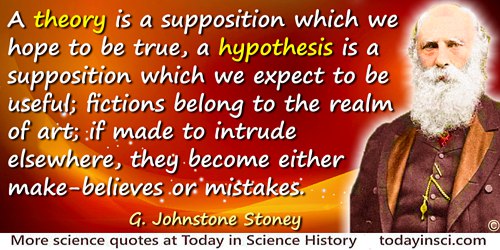
A theory is a supposition which we hope to be true, a hypothesis is a supposition which we expect to be useful; fictions belong to the realm of art; if made to intrude elsewhere, they become either make-believes or mistakes.
As quoted by William Ramsay, in 'Radium and Its Products', Harper’s Magazine (Dec 1904), 52. The first part, about suppositions, appears in a paper read by G. Johnson Stoney to the American Philosophical Society, Philadelphia (3 Apr 1903), printed in 'On the Dependence of What Apparently Takes Place in Nature Upon What Actually Occurs in the Universe of Real Existences', Proceedings of the American Philosophical Society Held at Philadelphia for Promoting Useful Knowledge (Apr-May 1903) 42, No. 173, 107. If you know a primary source for the part on fictions and mistakes, please contact Webmaster.
A very sincere and serious freshman student came to my office with a question that had clearly been troubling him deeply. He said to me, ‘I am a devout Christian and have never had any reason to doubt evolution, an idea that seems both exciting and well documented. But my roommate, a proselytizing evangelical, has been insisting with enormous vigor that I cannot be both a real Christian and an evolutionist. So tell me, can a person believe both in God and in evolution?’ Again, I gulped hard, did my intellectual duty, a nd reassured him that evolution was both true and entirely compatible with Christian belief –a position that I hold sincerely, but still an odd situation for a Jewish agnostic.
…...
A visitor to Niels Bohr's country cottage, noticing a horseshoe hanging on the wall, teasing the eminent scientist about this ancient superstition. “Can it be true that you, of all people, believe it will bring you luck?'
'Of course not,' replied Bohr, 'but I understand it brings you luck whether you believe it or not.'”
'Of course not,' replied Bohr, 'but I understand it brings you luck whether you believe it or not.'”
As described in Clifton Fadiman (ed.), André Bernard (ed.), Bartlett's Book of Anecdotes (2000), 68.
A year spent in artificial intelligence is enough to make one believe in God.
Epigrams of Programming
After all, we scientific workers … like women, are the victims of fashion: at one time we wear dissociated ions, at another electrons; and we are always loth to don rational clothing; some fixed belief we must have manufactured for us: we are high or low church, of this or that degree of nonconformity, according to the school in which we are brought up—but the agnostic is always rare of us and of late years the critic has been taboo.
'The Thirst of Salted Water or the Ions Overboard', Science Progress (1909), 3, 643.
After having a wash I proceeded to the bar where—believe it or not—there was a white-coated barman who was not only serving drinks but also cigarettes! I hastened forward and rather timidly said ‘Can I have some cigarettes?’
‘What’s your rank?’ was the slightly unexpected reply.
‘I am afraid I haven’t got one,’ I answered.
‘Nonsense—everyone who comes here has a rank.’
‘I’m sorry but I just don’t have one.’
‘Now that puts me in a spot,’ said the barman, ‘for orders about cigarettes in this camp are clear—twenty for officers and ten for other ranks. Tell me what exactly are you?’
Now I really wanted those cigarettes so I drew myself up and said ‘I am the Professor of Chemistry at Manchester University.’
The barman contemplated me for about thirty seconds and then said ‘I’ll give you five.’
Since that day I have had few illusions about the importance of professors!
‘What’s your rank?’ was the slightly unexpected reply.
‘I am afraid I haven’t got one,’ I answered.
‘Nonsense—everyone who comes here has a rank.’
‘I’m sorry but I just don’t have one.’
‘Now that puts me in a spot,’ said the barman, ‘for orders about cigarettes in this camp are clear—twenty for officers and ten for other ranks. Tell me what exactly are you?’
Now I really wanted those cigarettes so I drew myself up and said ‘I am the Professor of Chemistry at Manchester University.’
The barman contemplated me for about thirty seconds and then said ‘I’ll give you five.’
Since that day I have had few illusions about the importance of professors!
In A Time to Remember: The Autobiography of a Chemist (1983), 59. This event took place after a visit to the Defence Research Establishment at Porton to observe a demonstration of a new chemical anti-tank weapon (1941).
Agnosticism is of the essence of science, whether ancient or modern. It simply means that a man shall not say he knows or believes that for which he has no grounds for professing to believe.
In Life and Letters of Thomas Henry Huxley (1913), Vol. 3, 98, footnote 2.
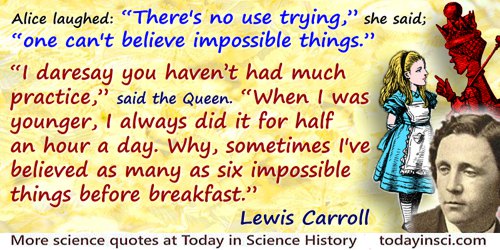
Alice laughed: “There’s no use trying,” she said; “one can’t believe impossible things.” “I daresay you haven’t had much practice,” said the Queen. “When I was younger, I always did it for half an hour a day. Why, sometimes I’ve believed as many as six impossible things before breakfast.”
In Through the Looking-glass: And what Alice Found There (1875), 100.
All of modern physics is governed by that magnificent and thoroughly confusing discipline called quantum mechanics ... It has survived all tests and there is no reason to believe that there is any flaw in it.... We all know how to use it and how to apply it to problems; and so we have learned to live with the fact that nobody can understand it.
…...
All that we can do, is to keep steadily in mind that each organic being is striving to increase at a geometrical ratio; that each at some period of its life, during some season of the year, during each generation or at intervals, has to struggle for life, and to suffer great destruction. When we reflect on this struggle, we may console ourselves with the full belief, that the war of nature is not incessant, that no fear is felt, that death is generally prompt, and that the vigorous, the healthy, and the happy survive and multiply.
From On the Origin of Species by Means of Natural Selection; or, The Preservation of Favoured Races in the Struggle for Life (1861), 76.
All the more recent work on alkaptonuria has... strengthened the belief that the homogentisic acid excreted is derived from tyrosin, but why alkaptonuric individuals pass the benzene ring of their tyrosin unbroken and how and where the peculiar chemical change from tyrosin to homogentisic acid is brought about, remain unsolved problems.
'The Incidence of Alkaptonuria: A Study in Chemical Individuality', The Lancet, 1902, 2, 1616.
Americans have always believed that—within the law—all kinds of people should be allowed to take the initiative in all kinds of activities. And out of that pluralism has come virtually all of our creativity. Freedom is real only to the extent that there are diverse alternatives.
Speech to the Council on Foundations (16 May 1979). In 'Infinite Variety: The Nonprofit Sector', Grant's Magazine (1979), Vol. 2-3, 17.
An autocratic system of coercion, in my opinion, soon degenerates. For force always attracts men of low morality, and I believe it to be an invariable rule that tyrants of genius are succeeded by scoundrels. For this reason I have always been passionately opposed to systems such as we see in Italy and Russia to-day.
In The World As I See It (1934), 240.
An idea isn’t responsible for the people who believe in it.
Column, 'The Sun Dial', New York Sun (1918?). Cited in Bill Swainson, Encarta Book of Quotations (2000), 613.
An idealist believes the short run doesn’t count. A cynic believes the long run doesn’t matter. A realist believes that what is done or left undone in the short run determines the long run.
From column 'Thoughts at Large,' Chicago Sun-Times. Quoted in Reader’s Digest (May 1979).
An optimist is someone who believes the future is uncertain.
No primary source found, so Webmaster believes this is merely anonymous. However, in Arnold O. Allen, Probability, Statistics, and Queueing Theory (1990), it is attributed to Edward Teller; but also occasionally seen on the Web attributed to Leo Szilard. If you know a primary source, please contact Webmaster.
And above all things, never think that you’re not good enough yourself. A man should never think that. My belief is that in life people will take you at your own reckoning.
…...
And from this such small difference of eight minutes [of arc] it is clear why Ptolemy, since he was working with bisection [of the linear eccentricity], accepted a fixed equant point… . For Ptolemy set out that he actually did not get below ten minutes [of arc], that is a sixth of a degree, in making observations. To us, on whom Divine benevolence has bestowed the most diligent of observers, Tycho Brahe, from whose observations this eight-minute error of Ptolemy’s in regard to Mars is deduced, it is fitting that we accept with grateful minds this gift from God, and both acknowledge and build upon it. So let us work upon it so as to at last track down the real form of celestial motions (these arguments giving support to our belief that the assumptions are incorrect). This is the path I shall, in my own way, strike out in what follows. For if I thought the eight minutes in [ecliptic] longitude were unimportant, I could make a sufficient correction (by bisecting the [linear] eccentricity) to the hypothesis found in Chapter 16. Now, because they could not be disregarded, these eight minutes alone will lead us along a path to the reform of the whole of Astronomy, and they are the matter for a great part of this work.
Astronomia Nova, New Astronomy (1609), ch. 19, 113-4, Johannes Kepler Gesammelte Werke (1937-), Vol. 3, 177-8.
And I believe there are many Species in Nature, which were never yet taken notice of by Man, and consequently of no use to him, which yet we are not to think were created in vain; but it’s likely … to partake of the overflowing Goodness of the Creator, and enjoy their own Beings. But though in this sense it be not true, that all things were made for Man; yet thus far it is, that all the Creatures in the World may be some way or other useful to us, at least to exercise our Wits and Understandings, in considering and contemplating of them, and so afford us Subject of Admiring and Glorifying their and our Maker. Seeing them, we do believe and assert that all things were in some sense made for us, we are thereby obliged to make use of them for those purposes for which they serve us, else we frustrate this End of their Creation.
— John Ray
The Wisdom of God Manifested in the Works of the Creation (1691), 169-70.
And so to those of you who may be vitalists I would make this prophecy: what everyone believed yesterday, and you believe today, only cranks will believe tomorrow.
In 'The Prospect Before Us', Of Molecules and Men (1966), 99.
And yet I think that the Full House model does teach us to treasure variety for its own sake–for tough reasons of evolutionary theory and nature’s ontology, and not from a lamentable failure of thought that accepts all beliefs on the absurd rationale that disagreement must imply disrespect. Excellence is a range of differences, not a spot. Each location on the range can be occupied by an excellent or an inadequate representative– and we must struggle for excellence at each of these varied locations. In a society driven, of ten unconsciously, to impose a uniform mediocrity upon a former richness of excellence–where McDonald’s drives out the local diner, and the mega-Stop & Shop eliminates the corner Mom and Pop–an understanding and defense of full ranges as natural reality might help to stem the tide and preserve the rich raw material of any evolving system: variation itself.
…...
Anthropology has reached that point of development where the careful investigation of facts shakes our firm belief in the far-reaching theories that have been built up. The complexity of each phenomenon dawns on our minds, and makes us desirous of proceeding more cautiously. Heretofore we have seen the features common to all human thought. Now we begin to see their differences. We recognize that these are no less important than their similarities, and the value of detailed studies becomes apparent. Our aim has not changed, but our method must change. We are still searching for the laws that govern the growth of human culture, of human thought; but we recognize the fact that before we seek for what is common to all culture, we must analyze each culture by careful and exact methods, as the geologist analyzes the succession and order of deposits, as the biologist examines the forms of living matter. We see that the growth of human culture manifests itself in the growth of each special culture. Thus we have come to understand that before we can build up the theory of the growth of all human culture, we must know the growth of cultures that we find here and there among the most primitive tribes of the Arctic, of the deserts of Australia, and of the impenetrable forests of South America; and the progress of the civilization of antiquity and of our own times. We must, so far as we can, reconstruct the actual history of mankind, before we can hope to discover the laws underlying that history.
The Jesup North Pacific Expedition: Memoir of the American Museum of Natural History (1898), Vol. 1, 4.
Antiessentialist thinking forces us to view the world differently. We must accept shadings and continua as fundamental. We lose criteria for judgment by comparison to some ideal: short people, retarded people, people of other beliefs, colors, and religions are people of full status.
…...
Any demanding high technology tends to develop influential and dedicated constituencies of those who link its commercial success with both the public welfare and their own. Such sincerely held beliefs, peer pressures, and the harsh demands that the work i
Foreign Affairs (Oct 1976).
Anyone who believes in indefinite growth in anything physical, on a physically finite planet, is either mad—or an economist.
Expressing concern about ecosystems ruined by the arrival of man. As quoted by Philip Maughan, 'Sixty Years of Attenborough Through the Eyes of the New Statesman', New Statesman (21 Dec 2012), 141, No. 5138, 34. The quote came from Attenborough writing in an April 2013 issue of the same periodical.
As an empiricist I continue to think of the conceptual scheme of science as a tool, ultimately, for predicting future experience in the light of past experience. Physical objects are conceptually imported into the situation as convenient intermediaries—not by definition in terms of experience, but simply as irreducible posits comparable, epistemologically, to the gods of Homer. For my part I do, qua lay physicist, believe in physical objects and not in Homer's gods; and I consider it a scientific error to believe otherwise. But in point of epistemological footing the physical objects and the gods differ only in degree and not in kind. Both sorts of entities enter our conception only as cultural posits. The myth of physical objects is epistemologically superior to most in that it has proved more efficacious than other myths as a device for working a manageable structure into the flux of experience.
From A Logical Point of View (1953), 44. [Note: “qua” means “in the character or role of,” thus “qua lay physicist” means “in the role of lay physicist,” or perhaps even (?) “putting on my lay physicist hat.” —Webmaster]
As an undergraduate who believed himself destined to be a mathematician I happened upon “Man and Superman” and as I read it at a library table I felt like Saul of Tarsus when the light broke. “If literature,” I said to myself, “can be like this then literature is the stuff for me.” And to this day I never see a differential equation written out without breathing a prayer of thanks.
In 'An Open Letter to George Bernard Shaw', Saturday Review (21 Jul 1956), 39, 12. ollected in If You Don't Mind My Saying So: Essays on Man and Nature (1964), 391.
As belief shrinks from this world, it is more necessary than ever that someone believe. Wild-eyed men in caves. Nuns in black. Monks who do not speak. We are left to believe... Hell is when no one believes.
White Noise. Quoted in Kim Lim (ed.), 1,001 Pearls of Spiritual Wisdom: Words to Enrich, Inspire, and Guide Your Life (2014), 24
As compared with Europe, our climate and traditions all pre-dispose us to a life of inaction and ease. We are influenced either by religious sentiment, class patriotism or belief in kismet, whereas the activities of Western nations rest on an economic basis. While they think and act in conformity with economic necessities, we expect to prosper without acquiring the scientific precision, the inventive faculty, the thoroughness, the discipline and restraints of modern civilisation.
Speech (16 Mar 1912), at Central College Bangalore Visvesvaraya. Collected in Speeches: 1910-11 to 1916-17: by Sir Mokshagundam Visvesvaraya (1917), 23.
As far as I see, such a theory [of the primeval atom] remains entirely outside any metaphysical or religious question. It leaves the materialist free to deny any transcendental Being. He may keep, for the bottom of space-time, the same attitude of mind he has been able to adopt for events occurring in non-singular places in space-time. For the believer, it removes any attempt to familiarity with God, as were Laplace’s chiquenaude or Jeans’ finger. It is consonant with the wording of Isaiah speaking of the “Hidden God” hidden even in the beginning of the universe … Science has not to surrender in face of the Universe and when Pascal tries to infer the existence of God from the supposed infinitude of Nature, we may think that he is looking in the wrong direction.
From 'The Primeval Atom Hypothesis and the Problem of Clusters of Galaxies', in R. Stoops (ed.), La Structure et l'Evolution de l'Univers (1958), 1-32. As translated in Helge Kragh, Cosmology and Controversy: The Historical Development of Two Theories of the Universe (1996), 60.
As to rocket ships flying between America and Europe, I believe it is worth seriously trying for. Thirty years ago persons who were developing flying were laughed at as mad, and that scorn hindered aviation. Now we heap similar ridicule upon stratoplane or rocket ships for trans-Atlantic flights.
Predicting high-altitude jet aircraft for routine long-distance travel. As quoted by Gobind Behari Lal, Universal Service Science Editor, as printed in 'Prof. Piccard Reaches U.S.', Syracuse Journal (13 Jan 1933), 4.
Astronomers and physicists, dealing habitually with objects and quantities far beyond the reach of the senses, even with the aid of the most powerful aids that ingenuity has been able to devise, tend almost inevitably to fall into the ways of thinking of men dealing with objects and quantities that do not exist at all, e.g., theologians and metaphysicians. Thus their speculations tend almost inevitably to depart from the field of true science, which is that of precise observation, and to become mere soaring in the empyrean. The process works backward, too. That is to say, their reports of what they pretend actually to see are often very unreliable. It is thus no wonder that, of all men of science, they are the most given to flirting with theology. Nor is it remarkable that, in the popular belief, most astronomers end by losing their minds.
Minority Report: H. L. Mencken’s Notebooks (1956), Sample 74, 60.
At this stage you must admit that whatever is seen to be sentient is nevertheless composed of atoms that are insentient. The phenomena open to our observation so not contradict this conclusion or conflict with it. Rather they lead us by the hand and compel us to believe that the animate is born, as I maintain, of the insentient.
In On the Nature of the Universe, translated by R. E. Latham (1951, 1994), 59.
Atheism is nothing more than the noises reasonable people make in the presence of unjustified religious beliefs.
In Letter to a Christian Nation (2006, 2008), 51.
Bad science contributes to the steady dumbing down of our nation. Crude beliefs get transmitted to political leaders and the result is considerable damage to society. We see this happening now in the rapid rise of the religious right and how it has taken over large segments of the Republican Party.
As quoted in Kendrick Frazier, 'A Mind at Play: An Interview with Martin Gardner', Skeptical Inquirer (Mar/Apr 1998), 22, No. 2, 37.
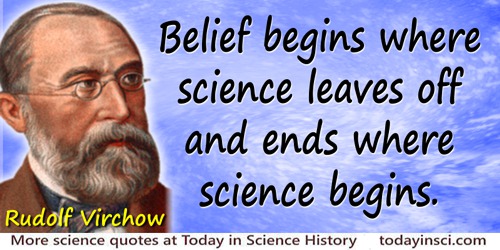
Belief begins where science leaves off and ends where science begins.
In Fielding Hudson Garrison, An Introduction to the History of Medicine (1929), 14.
Belief cannot be reckoned with in terms of science, for science and faith are mutually exclusive.
In Fielding Hudson Garrison, An Introduction to the History of Medicine (1966), 576.
Belief has no place as far as science reaches, and may be first permitted to take root where science stops.
Translation of the original German: “Soweit die Wissenschaft reicht, kein Glaube existirt und der Glaube erst da anfangen darf, wo die Wissenschaft aufhört”, from 'Der Mensch' (1849), collected in Gesammelte abhandlungen zur wissenschaftlichen medicin (1856), 6. As translated in Lelland J. Rather (ed.), 'On Man', Disease, Life, and Man: Selected Essays (1958), 83. Google translate gives “As far as science goes, no faith exists and faith can only begin where science ends.”
Belief is a luxury—only those who have real knowledge have a right to believe; otherwise belief is merely plausible opinion.
In On Love & Psychological Exercises: With Some Aphorisms & Other Essays (1998), 55.
Believing, as I do, in the continuity of nature, I cannot stop abruptly where our microscopes cease to be of use. Here the vision of the mind authoritatively supplements the vision of the eye. By a necessity engendered and justified by science I cross the boundary of the experimental evidence, and discern in that Matter which we, in our ignorance of its latent powers, and notwithstanding our professed reverence for its Creator, have hitherto covered with opprobrium, the promise and potency of all terrestrial Life.
'Address Delivered Before The British Association Assembled at Belfast', (19 Aug 1874). Fragments of Science for Unscientific People: A Series of Detached Essays, Lectures, and Reviews (1892), Vol. 2, 191.
Bell’s theorem is easy to understand but hard to believe.
…...
Both religion and natural science require a belief in God for their activities, to the former He is the starting point, and to the latter the goal of every thought process. To the former He is the foundation, to the latter, the crown of the edifice of every generalized world view.
Lecture, 'Religion and Natural Science' (1937) In Max Planck and Frank Gaynor (trans.), Scientific Autobiography and Other Papers (1949), 184.
But for the persistence of a student of this university in urging upon me his desire to study with me the modern algebra I should never have been led into this investigation; and the new facts and principles which I have discovered in regard to it (important facts, I believe), would, so far as I am concerned, have remained still hidden in the womb of time. In vain I represented to this inquisitive student that he would do better to take up some other subject lying less off the beaten track of study, such as the higher parts of the calculus or elliptic functions, or the theory of substitutions, or I wot not what besides. He stuck with perfect respectfulness, but with invincible pertinacity, to his point. He would have the new algebra (Heaven knows where he had heard about it, for it is almost unknown in this continent), that or nothing. I was obliged to yield, and what was the consequence? In trying to throw light upon an obscure explanation in our text-book, my brain took fire, I plunged with re-quickened zeal into a subject which I had for years abandoned, and found food for thoughts which have engaged my attention for a considerable time past, and will probably occupy all my powers of contemplation advantageously for several months to come.
In Johns Hopkins Commemoration Day Address, Collected Mathematical Papers, Vol. 3, 76.
But here I stop–short of any deterministic speculation that attributes specific behaviors to the possession of specific altruist or opportunist genes. Our genetic makeup permits a wide range of behaviors–from Ebenezer Scrooge before to Ebenezer Scrooge after. I do not believe that the miser hoards through opportunist genes or that the philanthropist gives because nature endowed him with more than the normal complement of altruist genes. Upbringing, culture, class, status, and all the intangibles that we call ‘free will,’ determine how we restrict our behaviors from the wide spectrum–extreme altruism to extreme selfishness–that our genes permit.
…...
But notwithstanding these Arguments are so convictive and demonstrative, its marvellous to see how some Popish Authors (Jesuites especially) strain their wits to defend their Pagan Master Aristotle his Principles. Bullialdus speaks of a Florentine Physitian, that all the Friends he had could ever perswade him once to view the Heavens through a Telescope, and he gave that reason for his refusal, because he was afraid that then his Eyes would make him stagger concerning the truth of Aristotle’s Principles, which he was resolved he would not call into question. It were well, if these Men had as great veneration for the Scripture as they have, for Aristotles (if indeed they be his) absurd Books de cælo Sed de his satis.
(Indicating a belief that the Roman Catholic church impeded the development of modern science.)
(Indicating a belief that the Roman Catholic church impeded the development of modern science.)
Kometographia, Or a Discourse Concerning Comets (Boston 1684). Quoted in Michael Garibaldi Hall, The Last American Puritan: The Life of Increase Mather, 1639-1723 (1988), 167.
But, you might say, “none of this shakes my belief that 2 and 2 are 4.” You are quite right, except in marginal cases—and it is only in marginal cases that you are doubtful whether a certain animal is a dog or a certain length is less than a meter. Two must be two of something, and the proposition “2 and 2 are 4” is useless unless it can be applied. Two dogs and two dogs are certainly four dogs, but cases arise in which you are doubtful whether two of them are dogs. “Well, at any rate there are four animals,” you may say. But there are microorganisms concerning which it is doubtful whether they are animals or plants. “Well, then living organisms,” you say. But there are things of which it is doubtful whether they are living organisms or not. You will be driven into saying: “Two entities and two entities are four entities.” When you have told me what you mean by “entity,” we will resume the argument.
In Basic Writings, 1903-1959 (1961), 108.
Changes That Have Occurred in the Globe: When we have seen with our own eyes a mountain progressing into a plain; that is to say, an immense boulder separating from this mountain and covering the fields; an entire castle broken into pieces over the ground; a river swallowed up which then bursts out from its abyss; clear marks of a vast amount of water having once flooded regions now inhabited, and a hundred vestiges of other transformations, then we are much more willing to believe that great changes altered the face of the earth, than a Parisian lady who knows only that the place where her house was built was once a cultivated field. However, a lady from Naples who has seen the buried ruins of Herculaneum, is much less subject to the bias which leads us to believe that everything has always been as it is today.
From article 'Changements arrivées dans le globe', in Dictionnaire philosophique (1764), collected in Œuvres Complètes de Voltaire (1878), Vol. 2, 427-428. Translated by Ian Ellis, from the original French: “Changements arrivées dans le globe: Quand on a vu de ses yeux une montagne s’avancer dans une plaine, c’est-à-dire un immense rocher de cette montagne se détacher et couvrir des champs, un château tout entier enfoncé dans la terre, un fleuve englouti qui sort ensuite de son abîme, des marques indubitables qu’un vaste amas d’eau inondait autrefois un pays habité aujourd’hui, et cent vestiges d’autres révolutions, on est alors plus disposé à croire les grands changements qui ont altéré la face du monde, que ne l’est une dame de Paris qui sait seulement que la place où est bâtie sa maison était autrefois un champ labourable. Mais une dame de Naples, qui a vu sous terre les ruines d’Herculanum, est encore moins asservie au préjugé qui nous fait croire que tout a toujours été comme il est aujourd’hui.”
Committees are dangerous things that need most careful watching. I believe that a research committee can do one useful thing and one only. It can find the workers best fitted to attack a particular problem, bring them together, give them the facilities they need, and leave them to get on with the work. It can review progress from time to time, and make adjustments; but if it tries to do more, it will do harm.
Attributed without citation in W.I.B. Beveridge, The Art of Scientific Investigation (1951), 118.
Concerning the alchemist, Mamugnano, no one harbors doubts any longer about his daily experiments in changing quicksilver into gold. It was realized that his craft did not go beyond one pound of quicksilver… . Thus the belief is now held that his allegations to produce a number of millions have been a great fraud.
'Further Successes by Bragadini. From Vienna on the 26th day of January 1590'. As quoted in George Tennyson Matthews (ed.) News and Rumor in Renaissance Europe: The Fugger Newsletters (1959), 179. A handwritten collection of news reports (1568-1604) by the powerful banking and merchant house of Fugger in Ausburg.
Confucius once said: “our greatest glory is not in never falling, but in getting up every time we do”. Scholars believe he was referring to roller coasters.
The anonymous quote includes an embedded quote misattributed to Confucius; it is not in his writings. It is first seen written (… but in rising every time we fall) by Oliver Goldmith, in The Citizen of the World: or, Letters from a Chinese Philosopher, Residing in London, to His Friends in the East (1762). The imaginary letters are from an invented character, Lien Chi Altangi, and include Goldsmith’s probably fictional reference to Confucius for verisimilitude. See the quoteinvestigator.com website for more details.
Connected by innumerable ties with abstract science, Physiology is yet in the most intimate relation with humanity; and by teaching us that law and order, and a definite scheme of development, regulate even the strangest and wildest manifestations of individual life, she prepares the student to look for a goal even amidst the erratic wanderings of mankind, and to believe that history offers something more than an entertaining chaos—a journal of a toilsome, tragi-comic march nowither.
In 'Educational Value of Natural History Sciences', Lay Sermons, Addresses, and Reviews (1870), 97.
Could this have just happened? Was it an accident that a bunch of flotsam and jetsam suddenly started making these orbits of its own accord? I can't believe that. … Some power put all this into orbit and keeps it there.
Reflecting on the orderliness of the whole universe, printed in Reader’s Digest (Jul 1962), 38. As cited in Tiebet Joshua, Bible Versus Science: Which is More Authentic? (2015), Sec. 4.1.
Create a vision and never let the environment, other people’s beliefs, or the limits of what has been done in the past shape your decisions. Ignore conventional wisdom.
…...
Cyberspace consists of transactions, relationships, and thought itself, arrayed like a standing wave in the web of our communications. Ours is a world that is both everywhere and nowhere, but it is not where bodies live. We are creating a world that all may enter without privilege or prejudice accorded by race, economic power, military force, or station of birth. We are creating a world where anyone, anywhere may express his or her beliefs, no matter how singular, without fear of being coerced into silence or conformity.
In 'A Declaration of the Independence of Cyberspace' (8 Feb 1996). Published on Electronic Frontier Foundation website. Reproduced in Lawrence Lessig, Code: Version 2.0) (2008), 303.
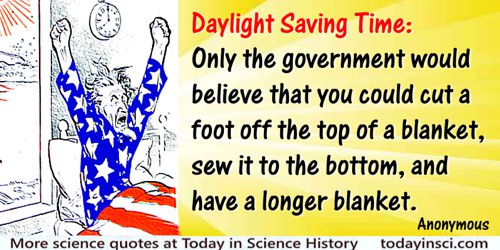
Daylight Saving Time: Only the government would believe that you could cut a foot off the top of a blanket, sew it to the bottom, and have a longer blanket.
Debate is an art form. It is about the winning of arguments. It is not about the discovery of truth. There are certain rules and procedures to debate that really have nothing to do with establishing fact–which creationists have mastered. Some of those rules are: never say anything positive about your own position because it can be attacked, but chip away at what appear to be the weaknesses in your opponent’s position. They are good at that. I don’t think I could beat the creationists at debate. I can tie them. But in courtrooms they are terrible, because in courtrooms you cannot give speeches. In a courtroom you have to answer direct questions about the positive status of your belief. We destroyed them in Arkansas. On the second day of the two-week trial we had our victory party!
…...
Descartes, the father of modern philosophy … would never—so he assures us—have been led to construct his philosophy if he had had only one teacher, for then he would have believed what he had been told; but, finding that his professors disagreed with each other, he was forced to conclude that no existing doctrine was certain.
From 'Philosophy For Laymen', collected in Unpopular Essays (1950, 1996), 57.
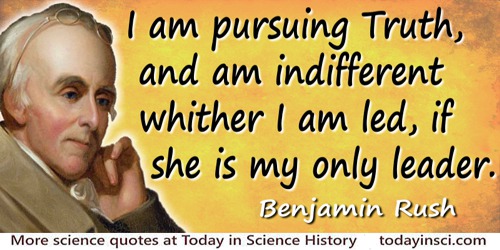
Dissections daily convince us of our ignorance of disease, and cause us to blush at our prescriptions. What mischief have we done under the belief of false facts and false theories! We have assisted in multiplying diseases; we have done more; we have increased their mortality. ... I am pursuing Truth, and am indifferent whither I am led, if she is my only leader.
From a public lecture by Rush. Quoted by Isaac Jennings, in Medical Reform; a Treatise on Man's Physical Being and Disorders (1847), 33.
Drugs are not always necessary. Belief in recovery always is.
Anatomy of an Illness As Perceived by the Patient: Reflections on Healing (2005), 55.
During seasons of great pestilence men have often believed the prophecies of crazed fanatics, that the end of the world was come. Credulity is always greatest in times of calamity. Prophecies of all sorts are rife on such occasions, and are readily believed, whether for good or evil.
From Memoirs of Extraordinary Popular Delusions (1841), Vol. 1, 170.
During the time that [Karl] Landsteiner gave me an education in the field of imununology, I discovered that he and I were thinking about the serologic problem in very different ways. He would ask, What do these experiments force us to believe about the nature of the world? I would ask, What is the most. simple and general picture of the world that we can formulate that is not ruled by these experiments? I realized that medical and biological investigators were not attacking their problems the same way that theoretical physicists do, the way I had been in the habit of doing.
‘Molecular Disease’, Pfizer Spectrum (1958), 6:9, 234.
Each of the major sciences has contributed an essential ingredient in our long retreat from an initial belief in our own cosmic importance. Astronomy defined our home as a small planet tucked away in one corner of an average galaxy among millions; biology took away our status as paragons created in the image of God; geology gave us the immensity of time and taught us how little of it our own species has occupied.
…...
Early in my school days a boy had a copy of the “Wonders of the World,” which I often read, and disputed with other boys about the veracity of some of the statements; and I believe that this book first gave me a wish to travel in remote countries, which was ultimately fulfilled by the voyage of the Beagle.
In Charles Darwin and Francis Darwin (ed.), 'Autobiography', The Life and Letters of Charles Darwin (1887, 1896), Vol. 1, 31.
Enhydros is a variety of geode. The name comes from the water it contains. It is always round, smooth, and very white but will sway back and forth when moved. Inside it is a liquid just as in an egg, as Pliny, our Albertus, and others believed, and it may even drip water. Liquid bitumen, sometimes with a pleasant odor, is found enclosed in rock just as in a vase.
As translated by Mark Chance Bandy and Jean A. Bandy from the first Latin Edition of 1546 in De Natura Fossilium: (Textbook of Mineralogy) (2004), 104. Originally published by Geological Society of America as a Special Paper (1955). There are other translations with different wording.
Euclid and Archimedes are allowed to be knowing, and to have demonstrated what they say: and yet whosoever shall read over their writings without perceiving the connection of their proofs, and seeing what they show, though he may understand all their words, yet he is not the more knowing. He may believe, indeed, but does not know what they say, and so is not advanced one jot in mathematical knowledge by all his reading of those approved mathematicians.
In Conduct of the Understanding, sect. 24.
Euler was a believer in God, downright and straightforward. The following story is told by Thiebault, in his Souvenirs de vingt ans de séjour à Berlin, … Thiebault says that he has no personal knowledge of the truth of the story, but that it was believed throughout the whole of the north of Europe. Diderot paid a visit to the Russian Court at the invitation of the Empress. He conversed very freely, and gave the younger members of the Court circle a good deal of lively atheism. The Empress was much amused, but some of her counsellors suggested that it might be desirable to check these expositions of doctrine. The Empress did not like to put a direct muzzle on her guest’s tongue, so the following plot was contrived. Diderot was informed that a learned mathematician was in possession of an algebraical demonstration of the existence of God, and would give it him before all the Court, if he desired to hear it. Diderot gladly consented: though the name of the mathematician is not given, it was Euler. He advanced toward Diderot, and said gravely, and in a tone of perfect conviction:
Monsieur, (a + bn) / n = x, donc Dieu existe; repondez!
Diderot, to whom algebra was Hebrew, was embarrassed and disconcerted; while peals of laughter rose on all sides. He asked permission to return to France at once, which was granted.
Diderot, to whom algebra was Hebrew, was embarrassed and disconcerted; while peals of laughter rose on all sides. He asked permission to return to France at once, which was granted.
In Budget of Paradoxes (1878), 251. [The declaration in French expresses, “therefore God exists; please answer!” This Euler-Diderot anecdote, as embellished by De Morgan, is generally regarded as entirely fictional. Diderot before he became an encyclopedist was an accomplished mathematician and fully capable of recognizing—and responding to—the absurdity of an algebraic expression in proving the existence of God. See B.H. Brown, 'The Euler-Diderot Anecdote', The American Mathematical Monthly (May 1942), 49, No. 5, 392-303. —Webmaster.]
Even in the dark times between experimental breakthroughs, there always continues a steady evolution of theoretical ideas, leading almost imperceptibly to changes in previous beliefs.
In Nobel Lecture (8 Dec 1989), 'Conceptual Foundations of the Unified Theory of Weak and Electromagnetic Interactions.'
Ever since celestial mechanics in the skillful hands of Leverrier and Adams led to the world-amazed discovery of Neptune, a belief has existed begotten of that success that still other planets lay beyond, only waiting to be found.
…...
Everest for me, and I believe for the world, is the physical and symbolic manifestation of overcoming odds to achieve a dream.
…...
Every new theory as it arises believes in the flush of youth that it has the long sought goal; it sees no limits to its applicability, and believes that at last it is the fortunate theory to achieve the 'right' answer. This was true of electron theory—perhaps some readers will remember a book called The Electrical Theory of the Universe by de Tunzelman. It is true of general relativity theory with its belief that we can formulate a mathematical scheme that will extrapolate to all past and future time and the unfathomed depths of space. It has been true of wave mechanics, with its first enthusiastic claim a brief ten years ago that no problem had successfully resisted its attack provided the attack was properly made, and now the disillusionment of age when confronted by the problems of the proton and the neutron. When will we learn that logic, mathematics, physical theory, are all only inventions for formulating in compact and manageable form what we already know, like all inventions do not achieve complete success in accomplishing what they were designed to do, much less complete success in fields beyond the scope of the original design, and that our only justification for hoping to penetrate at all into the unknown with these inventions is our past experience that sometimes we have been fortunate enough to be able to push on a short distance by acquired momentum.
The Nature of Physical Theory (1936), 136.
Everybody firmly believes in it [Nomal Law of Errors] because the mathematicians imagine it is a fact of observation, and observers that it is a theory of mathematics.
…...
Evolution has encountered no intellectual trouble; no new arguments have been offered. Creationism is a home-grown phenomenon of American sociocultural history—a splinter movement … who believe that every word in the Bible must be literally true, whatever such a claim might mean.
Leonardo's Mountain of Clams and the Diet of Worms: Essays on Natural History (1998), 270.
Facts are certainly the solid and true foundation of all sectors of nature study ... Reasoning must never find itself contradicting definite facts; but reasoning must allow us to distinguish, among facts that have been reported, those that we can fully believe, those that are questionable, and those that are false. It will not allow us to lend faith to those that are directly contrary to others whose certainty is known to us; it will not allow us to accept as true those that fly in the face of unquestionable principles.
Memoires pour Servir a l'Histoire des Insectes (1736), Vol. 2, xxxiv. Quoted in Jacques Roger, The Life Sciences in Eighteenth-Century French Thought, ed. Keith R. Benson and trans. Robert Ellrich (1997), 165.
Faith is a wondrous thing; it is not only capable of moving mountains, but also of making you believe that a herring is a race horse.
In Andre Gide et al., "The God That Failed" (1952), 39
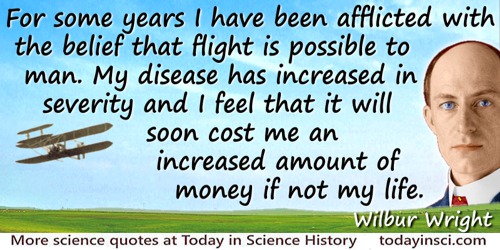
For some years I have been afflicted with the belief that flight is possible to man. My disease has increased in severity and I feel that it will soon cost me an increased amount of money if not my life.
Opening line his first letter (13 May 1900) to Octave Chanute. In Marvin W. McFarland (ed.) The Papers of Wilbur and Orville Wright: 1899-1905 (1953), Vol. 1, 13.
For the essence of science, I would suggest, is simply the refusal to believe on the basis of hope.
In Robert Paul Wolff, Barrington Moore, Herbert Marcuse, A Critique of Pure Tolerance (1965), 55. Worded as 'Science is the refusal to believe on the basis of hope,' the quote is often seen attributed to C. P. Snow as in, for example, Richard Alan Krieger, Civilization's Quotations: Life's Ideal (2002), 314. If you know the time period or primary print source for the C.P. Snow quote, please contact Webmaster.
For the sake of our children and our future, we must do more to combat climate change. Now, it’s true that no single event makes a trend. But the fact is the 12 hottest years on record have all come in the last 15. Heat waves, droughts, wildfires, floods—all are now more frequent and more intense. We can choose to believe that Superstorm Sandy, and the most severe drought in decades, and the worst wildfires some states have ever seen were all just a freak coincidence. Or we can choose to believe in the overwhelming judgment of science—and act before it’s too late.
From second State of the Union Address (12 Feb 2013) at the U.S. Capitol.
For, dear me, why abandon a belief
Merely because it ceases to be true.
Cling to it long enough, and not a doubt
It will turn true again, for so it goes.
Most of the change we think we see in life
Is due to truths being in and out of favour.
Merely because it ceases to be true.
Cling to it long enough, and not a doubt
It will turn true again, for so it goes.
Most of the change we think we see in life
Is due to truths being in and out of favour.
'The Black Cottage'. In Edward Connery Latham (ed.), The Poetry of Robert Frost (1971), 77.
Fractal is a word invented by Mandelbrot to bring together under one heading a large class of objects that have [played] … an historical role … in the development of pure mathematics. A great revolution of ideas separates the classical mathematics of the 19th century from the modern mathematics of the 20th. Classical mathematics had its roots in the regular geometric structures of Euclid and the continuously evolving dynamics of Newton. Modern mathematics began with Cantor’s set theory and Peano’s space-filling curve. Historically, the revolution was forced by the discovery of mathematical structures that did not fit the patterns of Euclid and Newton. These new structures were regarded … as “pathological,” .… as a “gallery of monsters,” akin to the cubist paintings and atonal music that were upsetting established standards of taste in the arts at about the same time. The mathematicians who created the monsters regarded them as important in showing that the world of pure mathematics contains a richness of possibilities going far beyond the simple structures that they saw in Nature. Twentieth-century mathematics flowered in the belief that it had transcended completely the limitations imposed by its natural origins.
Now, as Mandelbrot points out, … Nature has played a joke on the mathematicians. The 19th-century mathematicians may not have been lacking in imagination, but Nature was not. The same pathological structures that the mathematicians invented to break loose from 19th-century naturalism turn out to be inherent in familiar objects all around us.
Now, as Mandelbrot points out, … Nature has played a joke on the mathematicians. The 19th-century mathematicians may not have been lacking in imagination, but Nature was not. The same pathological structures that the mathematicians invented to break loose from 19th-century naturalism turn out to be inherent in familiar objects all around us.
From 'Characterizing Irregularity', Science (12 May 1978), 200, No. 4342, 677-678. Quoted in Benoit Mandelbrot, The Fractal Geometry of Nature (1977, 1983), 3-4.
Galileo was no idiot. Only an idiot could believe that science requires martyrdom—that may be necessary in religion, but in time a scientific result will establish itself.
As quoted, without citation, in Harold Eves, Mathematical Circles Squared (1971). Collected in Bill Swainson, The Encarta Book of Quotations (2000), 361.
Gates is the ultimate programming machine. He believes everything can be defined, examined, reduced to essentials, and rearranged into a logical sequence that will achieve a particular goal.
Generations to come, it may be, will scarcely believe that such a one as this ever in flesh and blood walked upon this earth.
…...
Gentlemen and ladies, this is ordinary alcohol, sometimes called ethanol; it is found in all fermented beverages. As you well know, it is considered by many to be poisonous, a belief in which I do not concur. If we subtract from it one CH2-group we arrive at this colorless liquid, which you see in this bottle. It is sometimes called methanol or wood alcohol. It is certainly more toxic than the ethanol we have just seen. Its formula is CH3OH. If, from this, we subtract the CH2-group, we arrive at a third colorless liquid, the final member of this homologous series. This compound is hydrogen hydroxide, best known as water. It is the most poisonous of all.
In Ralph Oesper, The Human Side of Scientists (1975), 189.
God cannot punish man for not believing when he could so easily have enlightened and convinced him.
From Appendix A, 'Extracts From the Unpublished Writings of Carnot', Reflections on the Motive Power of Heat (1890, 2nd ed. 1897), 216.
God does not die on the day when we cease to believe in a personal deity, but we die on the day when our lives cease to be illumined by the steady radiance, renewed daily, of a wonder, the source of which is beyond all reason.
Written in his spiritual diary, published posthumously, Markings (1963), 56.
God pity the man of science who believes in nothing but what he can prove by scientific methods; for if ever a human being needed divine pity, he does.
Every-Day Topics, a Book of Briefs (1882), 5.
Good lawyers know that in many cases where the decisions are correct, the reasons that are given to sustain them may be entirely wrong. This is a thousand times more likely to be true in the practice of medicine than in that of the law, and hence the impropriety, not to say the folly, in spending your time in the discussion of medical belief and theories of cure that are more ingenious and seductive than they are profitable.
Introductory lecture (22 Sep 1885), Hahnemann Medical College, Chicago, printed in United States Medical Investigator (1885), 21, 526.
He [Sylvester] had one remarkable peculiarity. He seldom remembered theorems, propositions, etc., but had always to deduce them when he wished to use them. In this he was the very antithesis of Cayley, who was thoroughly conversant with everything that had been done in every branch of mathematics.
I remember once submitting to Sylvester some investigations that I had been engaged on, and he immediately denied my first statement, saying that such a proposition had never been heard of, let alone proved. To his astonishment, I showed him a paper of his own in which he had proved the proposition; in fact, I believe the object of his paper had been the very proof which was so strange to him.
I remember once submitting to Sylvester some investigations that I had been engaged on, and he immediately denied my first statement, saying that such a proposition had never been heard of, let alone proved. To his astonishment, I showed him a paper of his own in which he had proved the proposition; in fact, I believe the object of his paper had been the very proof which was so strange to him.
As quoted by Florian Cajori, in Teaching and History of Mathematics in the United States (1890), 268.
He [the unnamed author] warns the heads of parties against believing their own lies.
In Proposals for Printing a Very Curious Discourse … intitled, Ψευδολογια Πολιτικη; or, a Treatise of the Art of Political Lying: With an Abstract of the First Volume of the Said Treatise (1712), 19. Printed without an author name, but believed to be written by the satirist John Arbuthnot, or sometimes attributed to Jonathan Swift.
He that believes, without having any Reason for believing, may be in love with his own Fancies; but neither seeks Truth as he ought, nor pays the Obedience due to his Maker, who would have him use those discerning Faculties he has given him, to keep him out of Mistake and Errour.
In 'Of Reason', Essay Concerning Humane Understanding (1690), Book 4, Ch. 17, Sec. 24, 347.
He who does not believe that God is above all is either a fool or has no experience of life.
From the original Latin, “Deum qui non summum putet, Aut stultum aut rerum esse imperitum existumem,” in Incert. Fragment XV. As translated in Thomas Benfield Harbottle, Dictionary of Quotations (Classical) (1897), 44.
He who would know what geometry is, must venture boldly into its depths and learn to think and feel as a geometer. I believe that it is impossible to do this, and to study geometry as it admits of being studied and am conscious it can be taught, without finding the reason invigorated, the invention quickened, the sentiment of the orderly and beautiful awakened and enhanced, and reverence for truth, the foundation of all integrity of character, converted into a fixed principle of the mental and moral constitution, according to the old and expressive adage “abeunt studia in mores”.
In 'A Probationary Lecture on Geometry, in Collected Mathematical Papers (1908), Vol. 2, 9. [The Latin phrase, “abeunt studia in mores” translates as “studies pass on into character”. —Webmaster]
HEART, n. An automatic, muscular blood- pump. Figuratively, this useful organ is said to be the seat of emotions and sentiments—a very pretty fancy which, however, is nothing but a survival of a once universal belief. It is now known that the sentiments and emotions reside in the stomach, being evolved from food by chemical action of the gastric fluid. The exact process by which a beefsteak becomes a feeling—tender or not, according to the age of the animal from which it was cut; the successive stages of elaboration through which a caviar sandwich is transmuted to a quaint fancy and reappears as a pungent epigram; the marvelous functional methods of converting a hard-boiled egg into religious contrition, or a cream-puff into a sigh of sensibility—these things have been patiently ascertained by M. Pasteur, and by him expounded with convincing lucidity.
The Collected Works of Ambrose Bierce (1911), Vol. 7, The Devil's Dictionary, 133-134.
Hellenic science is a victory of rationalism, which appears greater, not smaller, when one is made to realize that it had been won in spite of the irrational beliefs of the Greek people; all in all, it was a triumph of reason in the face of unreason. Some knowledge of Greek superstitions is needed not only for a proper appreciation of that triumph but also for the justification of occasional failures, such as the many Platonic aberrations.
In A History of Science: Volume 1: Ancient Science Through the Golden Age of Greece (1952), ix.
Hereafter we shall be compelled to acknowledge that the only distinction between species and well-marked varieties is, that the latter are known, or believed to be connected at the present day by intermediate gradations whereas species were formerly thus connected.
From On the Origin of Species by Means of Natural Selection; or, The Preservation of Favoured Races in the Struggle for Life (1861), 421.
Hogwash! … On our way to the moon, and on the moon, I worked as hard as John Young and it took me another six years before I found out the truth about God. In the days of Apollo and long afterwards I still believed in the theory of evolution and rejected the Biblical creation story. [Commenting on an American reporter’s printed intimation that Lunar Module pilots “had less things to do and had time to look out the spaceship’s window, or to explore the surroundings. Afterwards they could not cope with what they had seen, felt and experienced.”]
As quoted in Colin Burgess, Footprints in the Dust: The Epic Voyages of Apollo, 1969-1975 (2010), 422. Burgess introduced the quote with: “Charles Moss Duke Jr. has always been wrongly labeled as the astronaut who found God during his Apollo 16 mission, but even though he did eventually become a born-again Christian, this life-altering epiphany came some years after the event.” Burgess explained that Duke dislikes “misinformed characterizations of himself and his Apollo colleagues and of the religious impact of his own lunar mission.” [The ellipsis in the subject quote spans from one paragraph to the next in Burgess’ book. The ellipsis was added by Webmaster, on the assumption that the word “Hogwash!” belongs with the statement in the following paragraph.]
Hope is a pathological belief in the occurrence of the impossible.
In A Mencken Chrestomathy (1949, 1956), 617.
Hope is the bedrock of this nation. The belief that our destiny will not be written for us, but by us, by all those men and women who are not content to settle for the world as it is, who have the courage to remake the world as it should be.
From address to supporters after the Iowa Caucuses, as provided by Congressional Quarterly via The Associated Press, published in New York Times (3 Jan 2008).
Humanity should accept that science has eliminated the justification for believing in cosmic purpose, and that any survival of purpose is inspired only by sentiment.
In 'Will Science Ever Fail?', New Scientist (8 Aug 1992), 135, No. 1883, 32-35.
Humans are not by nature the fact-driven, rational beings we like to think we are. We get the facts wrong more often than we think we do. And we do so in predictable ways: we engage in wishful thinking. We embrace information that supports our beliefs and reject evidence that challenges them. Our minds tend to take shortcuts, which require some effort to avoid … [and] more often than most of us would imagine, the human mind operates in ways that defy logic.
As co-author with Kathleen Hall Jamieson, in unSpun: Finding Facts in a World of Disinformation (2007), 69.
I am a believer in unconscious cerebration. The brain is working all the time, though we do not know it. At night it follows up what we think in the daytime. When I have worked a long time on one thing, I make it a point to bring all the facts regarding it together before I retire; I have often been surprised at the results… We are thinking all the time; it is impossible not to think.
In Orison Swett Marden, 'Bell Telephone Talk: Hints on Success by Alexander G. Bell', How They Succeeded: Life Stories of Successful Men Told by Themselves (1901), 33.
I am a Christian which means that I believe in the deity of Christ, like Tycho de Brahe, Copernicus, Descartes, Newton, Leibnitz, Pascal ... like all great astronomers mathematicians of the past.
…...
I am a great believer in the simplicity of things and as you probably know I am inclined to hang on to broad & simple ideas like grim death until evidence is too strong for my tenacity.
Letter to Irving Langmuir (10 Jun 1919). Quoted in Nathan Reingold and Ida H. Reingold, Science in America: A Documentary History 1900-1939 (1981), 354.
I am a hard-core believer that the clean desktop is the way to go…. At the same time, we told OEMs that if they were going to put a bunch of icons on the desktop, then so were we.
From interview with Peter Galli, 'Allchin: Staying the Course on XP', on eWeek website (13 Aug 2001), anticipating the launch of Windows XP.
I am astonished that in the United States a scientist gets into such trouble because of his scientific beliefs; that your activity in 1957 and 1958 in relation to the petition to the United Nations asking for a bomb-test agreement causes you now to be called before the authorities and ordered to give the names of the scientists who have the same opinions that you have and who have helped you to gather signatures to the petition. I think that I must be dreaming!
Letter to Linus Pauling (23 Jul 1960). As quoted on the Linus Pauling and the International Peace Movement website at scarc.library.oregonstate.edu.
I am confident that if we recommit ourselves to discovery; if we support science education to create the next generation of scientists and engineers right here in America; if we have the vision to believe and invest in things unseen, then we can lead the world into a new future of peace and prosperity.
From weekly Democratic address as President-Elect, online video (20 Dec 2008), announcing his selection of science and technology advisers. C-Span video 282995-102.
I am willing to believe that my unobtainable sixty seconds within a sponge or a flatworm might not reveal any mental acuity that I would care to ca ll consciousness. But I am also confident ... that vultures and sloths, as close evolutionary relatives with the same basic set of organs, lie on our side of any meaningful (and necessarily fuzzy) border–and that we are therefore not mistaken when we look them in the eye and see a glimmer of emotional and conceptual affinity.
…...
I believe … that we can still have a genre of scientific books suitable for and accessible alike to professionals and interested laypeople. The concepts of science, in all their richness and ambiguity, can be presented without any compromise, without any simplification counting as distortion, in language accessible to all intelligent people … I hope that this book can be read with profit both in seminars for graduate students and–if the movie stinks and you forgot your sleeping pills–on the businessman’s special to Tokyo.
In Wonderful Life: The Burgess Shale and the Nature of History (1990), Preface, 16.
I believe [the Department of Energy] should be judged not by the money we direct to a particular State or district, company, university or national lab, but by the character of our decisions. The Department of Energy serves the country as a Department of Science, a Department of Innovation, and a Department of Nuclear Security.
In letter (1 Feb 2013) to Energy Department employees announcing his decision not to serve a second term.
I believe a blade of grass is no less than the journey-work of the stars.
In Leaves of Grass (1855), 34.
I believe in “intelligence,” and I believe also that there are inherited differences in intellectual ability, but I do not believe that intelligence is a simple scalar endowment that can be quantified by attaching a single figure to it—an I.Q. or the like.
In Advice to a Young Scientist (1979), 25. Footnoted with reference to his own earlier review article of books about IQ, in which he stated “misgivings about whether it is indeed possible to attach a single-number valuation to an endowment as complex and as various as intelligence.” That review was titled 'Unnatural Science', in New York Review of Books (3 Feb 1977), 24, No. 1, 13,
I believe in an immortal soul. science has proved that nothing disintegrates into nothingness. Life and soul, therefore, cannot disintegrate into nothingness, and so are immortal.
…...
I believe in Christianity as I believe that the sun has risen: not only because I see it, but because by it I see everything else.
Quoted in Kim Lim (ed.), 1,001 Pearls of Spiritual Wisdom: Words to Enrich, Inspire, and Guide Your Life (2014), 10
I believe in Darwin and God together.
Quoted in Kim Lim (ed.), 1,001 Pearls of Spiritual Wisdom: Words to Enrich, Inspire, and Guide Your Life (2014), 34
I believe in everything until it’s disproved. So I believe in fairies, the myths, dragons… . Who’s to say that dreams and nightmares aren’t as real as the here and now?
Quoted in Kim Lim (ed.), 1,001 Pearls of Spiritual Wisdom: Words to Enrich, Inspire, and Guide Your Life (2014), 10
I believe in evidence. I believe in observation, measurement, and reasoning, confirmed by independent observers. I’ll believe anything, no matter how wild and ridiculous, if there is evidence for it. The wilder and more ridiculous something is, however, the firmer and more solid the evidence will have to be.
After stating he did definitely not believe in flying saucers, ancient astronauts, Bermuda Triangle or life after death, he explained what he would believe in. From editorial, 'Don’t You Believe?', Isaac Asimov's Science Fiction Magazine (18 Jan 1982), 6, No. 1, 6.
Collected in The Roving Mind (1983), 43.
I believe in intuition and inspiration. Imagination is more important than knowledge. For knowledge is limited, whereas imagination embraces the entire world, stimulating progress, giving birth to evolution. It is, strictly speaking, a real factor in scientific research.
Cosmic Religion: With Other Opinions and Aphorisms (1931), 97.
I believe in only one thing: liberty; but I do not believe in liberty enough to want to force it upon anyone.
…...
I believe in Spinoza’s God, Who reveals Himself in the lawful harmony of the world, not in a God Who concerns Himself with the fate and the doings of mankind.
Response to cablegram from Rabbi Herbert Goldstein of the International Synagogue in New York, asking “Do you believe in God?” As quoted in Victor J. Stenger, Has Science Found God? (2003), 91.
I believe in the wisdom of often saying “probably” and “perhaps.”
In This Week Magazine (19 Dec 1937). As epigraph citing the magazine title in Elmer Beneken Mode, Elements of Statistics (1942, 1961), 121. Magazine date cited for another Hilton quote from it, in John T. Moore, Fundamental Principles of Mathematics (1960), 470.
I believe myself to possess a most singular combination of qualities exactly fitted to make me pre-eminently a discoverer of the hidden realities of nature… the belief has been forced upon me…
Firstly: Owing to some peculiarity in my nervous system, I have perceptions of some things, which no one else has… and intuitive perception of… things hidden from eyes, ears, & ordinary senses…
Secondly: my sense reasoning faculties;
Thirdly: my concentration faculty, by which I mean the power not only of throwing my whole energy & existence into whatever I choose, but also of bringing to bear on anyone subject or idea, a vast apparatus from all sorts of apparently irrelevant & extraneous sources…
Well, here I have written what most people would call a remarkably mad letter; & yet certainly one of the most logical, sober-minded, cool, pieces of composition, (I believe), that I ever framed.
Firstly: Owing to some peculiarity in my nervous system, I have perceptions of some things, which no one else has… and intuitive perception of… things hidden from eyes, ears, & ordinary senses…
Secondly: my sense reasoning faculties;
Thirdly: my concentration faculty, by which I mean the power not only of throwing my whole energy & existence into whatever I choose, but also of bringing to bear on anyone subject or idea, a vast apparatus from all sorts of apparently irrelevant & extraneous sources…
Well, here I have written what most people would call a remarkably mad letter; & yet certainly one of the most logical, sober-minded, cool, pieces of composition, (I believe), that I ever framed.
Lovelace Papers, Bodleian Library, Oxford University, 42, folio 12 (6 Feb 1841). As quoted and cited in Dorothy Stein (ed.), 'This First Child of Mine', Ada: A Life and a Legacy (1985), 86.
I believe natural beauty has a necessary place in the spiritual development of any individual or any society. I believe that whenever we substitute something man-made and artificial for a natural feature of the earth, we have retarded some part of man’s spiritual growth.
As quoted in Linda Lear, Rachel Carson: Witness for Nature (1997), 259.
I believe no woman could have invented calculus.
…...
I believe scientists have a duty to share the excitement and pleasure of their work with the general public, and I enjoy the challenge of presenting difficult ideas in an understandable way.
From Autobiography in Wilhelm Odelberg (ed.), Les Prix Nobel en 1974/Nobel Lectures (1975)
I believe sustainable use is the greatest propaganda in wildlife conservation at the moment.
…...
I believe television is going to be the test of the modern world, and that in this new opportunity to see beyond the range of our vision we shall discover either a new and unbearable disturbance of the general peace or a saving radiance in the sky. We shall stand or fall by television—of that I am quite sure
In 'Removal' (Jul 1938), collected in One Man's Meat (1942), 3.
I believe that a scientist looking at nonscientific problems is just as dumb as the next guy—and when he talks about a nonscientific matter, he will sound as naive as anyone untrained in the matter.
In 'The Value of Science' (Dec 1955), collected in The Pleasure of Finding Things Out: The Best Short Works of Richard P. Feynman (1999, 2005), 142.
I believe that certain erroneous developments in particle theory ... are caused by a misconception by some physicists that it is possible to avoid philosophical arguments altogether. Starting with poor philosophy, they pose the wrong questions. It is only a slight exaggeration to say that good physics has at times been spoiled by poor philosophy.
In 'The Nature of Elementary Particles', collected in Elena Castellani, Interpreting Bodies: Classical and Quantum Objects in Modern Physics (1998), 211. From Physics Today (1976), 29, No. 3, 32.
I believe that in every person is a kind of circuit which resonates to intellectual discovery—and the idea is to make that resonance work
Quoted by Dennis Meredith, in 'Carl Sagan's Cosmic Connection and Extraterrestrial Life-Wish', Science Digest (Jun 1979), 85, 37. Reproduced in Carl Sagan and Tom Head (editor), Conversations With Sagan (2006), 54.
I believe that natural history has lost much by the vague general treatment that is so common.
From 'Note to the Reader', introducing Wild Animals I Have Known (1898), 9. The author explains this is his motivation for writing true stories about individual animals as real characters.
I believe that only scientists can understand the universe. It is not so much that I have confidence in scientists being right, but that I have so much in nonscientists being wrong.
Webmaster has not yet been able to confirm this attribution. If you know an original print citation, please contact Webmaster.
I believe that pipe smoking contributes to a somewhat calm and objective judgment in all human affairs.
…...
I believe that producing pictures, as I do, is almost solely a question of wanting so very much to do it well.
As quoted on the website mcescher.com, without citation.
I believe that the laws of physics such as they are, such as they have been taught to us, are not the inevitable truth. We believe in the laws, or we experiment* with them each day, yet I believe it is possible to consider the existence of a universe in which these laws would be extended, changed a very tiny bit, in a precisely demarcated way. Consequently we immediately achieve extraordinary results, different yet certainly not far from the truth. After all, every century or two a new scientist comes along who changes the laws of physics, isn’t that so? After Newton there were many who did, and there were even more after Einstein, right? We have to wait to see how the laws in question will change over time, then… In any case, without being a scientist myself I can still hope to reach parallel results, if you will, in art.
Epigraph, in James Housefield, Playing with Earth and Sky: Astronomy, Geography, and the Art of Marcel Duchamp (2016), ix. As modified by James Housefield, from Guy Viau interview of Marcel Duchamp on Canadian Radio Television (17 July 1960), 'Simply Change Your Name', translated by Sarah Skinner Kilborne in Tout-Fait: the Marcel Duchamp Studies Online Journal 2, no. 4 (2002). [*Note: Where the Housefield in the Epigraph uses the word “experiment”, the original French gives “expérimentons”, which in the unmodified translation by Sarah Skinner Kilborne is written more correctly as “experience.” —Webmaster]
I believe that the medical treatment of the various abnormal conditions arising in infants is in the future to be largely dietetic rather than by means of drugs.
Preface to the First Edition (Oct 1895). In Pediatrics: the hygienic and medical treatment of children (5th. ed., 1906), ix.
I believe that the present laws of physics are at least incomplete without a translation into terms of mental phenomena.
In 'Physics and the Explanation of Life', Foundations of Physics 1970, I, 35-45.
I believe that the science of chemistry alone almost proves the existence of an intelligent creator.
…...
I believe that the useful methods of mathematics are easily to be learned by quite young persons, just as languages are easily learned in youth. What a wondrous philosophy and history underlie the use of almost every word in every language—yet the child learns to use the word unconsciously. No doubt when such a word was first invented it was studied over and lectured upon, just as one might lecture now upon the idea of a rate, or the use of Cartesian co-ordinates, and we may depend upon it that children of the future will use the idea of the calculus, and use squared paper as readily as they now cipher. … When Egyptian and Chaldean philosophers spent years in difficult calculations, which would now be thought easy by young children, doubtless they had the same notions of the depth of their knowledge that Sir William Thomson might now have of his. How is it, then, that Thomson gained his immense knowledge in the time taken by a Chaldean philosopher to acquire a simple knowledge of arithmetic? The reason is plain. Thomson, when a child, was taught in a few years more than all that was known three thousand years ago of the properties of numbers. When it is found essential to a boy’s future that machinery should be given to his brain, it is given to him; he is taught to use it, and his bright memory makes the use of it a second nature to him; but it is not till after-life that he makes a close investigation of what there actually is in his brain which has enabled him to do so much. It is taken because the child has much faith. In after years he will accept nothing without careful consideration. The machinery given to the brain of children is getting more and more complicated as time goes on; but there is really no reason why it should not be taken in as early, and used as readily, as were the axioms of childish education in ancient Chaldea.
In Teaching of Mathematics (1902), 14.
I believe that until comparatively recent times, say a hundred years ago, few scientists would have regarded the word useful as applicable to their work. … If Euclid and Newton did scoff at utility, how useful their work now appears! Where would modern technology be without geometry, without dynamics, without the differential calculus?
From Lecture (28 Nov 1957) in the Queen’s University, Belfast, 'Is the Study of its History a Brake on the Progress of Science', printed in Hermethena (1958), 19, 31-32.
I believe the best test of a model is how well can the modeller answer the questions, ‘What do you know now that you did not know before?’ and ‘How can you find out if it is true?’
In Francis Crick, The Astonishing Hypothesis: the Scientific Search for the Soul (1995), 177.
I believe the universe created us—we are an audience for miracles.
Quoted in Kim Lim (ed.), 1,001 Pearls of Spiritual Wisdom: Words to Enrich, Inspire, and Guide Your Life (2014), 7
I believe with Schopenhauer that one of the strongest motives that lead men to art and science is escape from everyday life with its painful crudity and hopeless dreariness, from the fetters of one’s own ever shifting desires. A finely tempered nature longs to escape from personal life into the world of objective perception and thought; this desire may be compared with the townsman’s irresistible longing to escape from his noisy, cramped surroundings into the silence of high mountains, where the eye ranges freely through the still, pure air and fondly traces out the restful contours apparently built for eternity.
Address at The Physical Society, Berlin (1918) for Max Planck’s 60th birthday, 'Principles of Research', collected in Essays in Science (1934) 2.
I can’t prove it, but I’m pretty sure that people gain a selective advantage from believing in things they can’t prove.
In David Stokes, Nicholas Wilson and Martha Mador, Entrepreneurship (2009), 190.
I cannot anyhow be contented to view this wonderful universe, and especially the nature of man, and to conclude that everything is the result of brute force. I am inclined to look at everything as resulting from designed laws, with the details, whether good or bad, left to the working out of what we call chance. Not that this notion at all satisfies me. I feel most deeply that the whole subject is too profound for the human intellect. A dog might as well speculate on the mind of Newton. Let each man hope and believe what he can.
Letter to Asa Gray (22 May 1860). In Charles Darwin and Francis Darwin (ed.), Charles Darwin: His Life Told in an Autobiographical Chapter, and in a Selected Series of His Published Letters (1892), 236.
I cannot imagine a God who rewards and punishes the objects of his creation, whose purposes are modeled after our own–a God, in short, who is but a reflection of human frailty. Neither can I believe that the individual survives the death of his body, although feeble souls harbor such thoughts through fear or ridiculous egotism. It is enough for me to contemplate the mystery of conscious life perpetuating itself through all eternity, to reflect upon the marvelous structure of the universe which we can dimly perceive, and to try humbly to comprehend even an infinitesimal part of the intelligence manifested in nature.
From 'What I Believe: Living Philosophies XIII', Forum and Century (Oct 1930), 84, No. 4, 194. Article in full, reprinted in Edward H. Cotton (ed.), Has Science Discovered God? A Symposium of Modern Scientific Opinion (1931), 97.
I cannot seriously believe in it [quantum theory] because the theory cannot be reconciled with the idea that physics should represent a reality in time and space, free from spooky actions at a distance [spukhafte Fernwirkungen].
Letter to Max Born (3 Mar 1947). In Born-Einstein Letters (1971), 158.
I do believe that a scientist is a freelance personality. We’re driven by an impulse which is one of curiosity, which is one of the basic instincts that a man has. So we are … driven … not by success, but by a sort of passion, namely the desire of understanding better, to possess, if you like, a bigger part of the truth. I do believe that science, for me, is very close to art.
From 'Asking Nature', collected in Lewis Wolpert and Alison Richards (eds.), Passionate Minds: The Inner World of Scientists (1997), 197.
I do not believe in freedom of the will. Schopenhauer’s words: ‘Man can do what he wants, but he cannot will what he wills’ accompany me in all situations throughout my life and reconcile me with the actions of others even if they are rather painful to me. This awareness of the lack of freedom of will preserves me from taking too seriously myself and my fellow men as acting and deciding individuals and from losing my temper.
…...
I do not believe that a moral philosophy can ever be founded on a scientific basis. … The valuation of life and all its nobler expressions can only come out of the soul’s yearning toward its own destiny. Every attempt to reduce ethics to scientific formulas must fail. Of that I am perfectly convinced.
In 'Science and God: A Dialogue', Forum and Century (June 1930), 83, 374. Einstein’s dialogue was with James Murphy and J.W.N. Sullivan. Excerpted in David E. Rowe and Robert J. Schulmann, Einstein on Politics: His Private Thoughts and Public Stands on Nationalism, Zionism, War, Peace, and the Bomb (2007), 230. The book introduces this quote as Einstein’s reply when Murphy asked, in the authors’ words, “how far he thought modern science might be able to go toward establishing practical ideals of life on the ruins of religious ideals.”
I do not believe that a real understanding of the nature of elementary particles can ever be achieved without a simultaneous deeper understanding of the nature of spacetime itself.
From 'Structure of Spacetime', in Cécile DeWitt-Morette and John Archibald Wheeler (eds.), Battelles Rencontres: Lectures in Mathematics and Physics (1968), 122.
I do not believe that God ever created a man and then got so “put out” over the job that He damned him.
Aphorism in The Philistine (Apr 1905), 20, No. 5, 160.
I do not believe that science per se is an adequate source of happiness, nor do I think that my own scientific outlook has contributed very greatly to my own happiness, which I attribute to defecating twice a day with unfailing regularity. Science in itself appears to me neutral, that is to say, it increases men’s power whether for good or for evil. An appreciation of the ends of life is something which must be superadded to science if it is to bring happiness, but only the kind of society to which science is apt to give rise. I am afraid you may be disappointed that I am not more of an apostle of science, but as I grow older, and no doubt—as a result of the decay of my tissues, I begin to see the good life more and more as a matter of balance and to dread all over-emphasis upon anyone ingredient.
Letter to W. W. Norton, Publisher (27 Jan 1931). In The Autobiography of Bertrand Russell, 1914-1944 (1968), Vol. 2, 200.
I do not personally want to believe that we already know the equations that determine the evolution and fate of the universe; it would make life too dull for me as a scientist. … I hope, and believe, that the Space Telescope might make the Big Bang cosmology appear incorrect to future generations, perhaps somewhat analogous to the way that Galileo’s telescope showed that the earth-centered, Ptolemaic system was inadequate.
From 'The Space Telescope (the Hubble Space Telescope): Out Where the Stars Do Not Twinkle', in NASA Authorization for Fiscal Year 1978: Hearings before the Committee on Commerce, Science and Transportation, United States Senate, 95th Congress, first session on S.365 (1977), 124. This was testimony to support of authorization for NASA beginning the construction of the Space Telescope, which later became known as the Hubble Space Telescope.
I do not see any reason to assume that the heuristic significance of the principle of general relativity is restricted to gravitation and that the rest of physics can be dealt with separately on the basis of special relativity, with the hope that later on the whole may be fitted consistently into a general relativistic scheme. I do not think that such an attitude, although historically understandable, can be objectively justified. The comparative smallness of what we know today as gravitational effects is not a conclusive reason for ignoring the principle of general relativity in theoretical investigations of a fundamental character. In other words, I do not believe that it is justifiable to ask: What would physics look like without gravitation?
…...
I don’t believe in evolution, like people believe in God … Science and technology are not advanced by people who believe, but by people who don’t know but are doing their best to find out.
With co-author Jack Cohen. In Terry Pratchett, Ian Stewart and Jack Cohen, Chap. 4, 'Science and Magic', The Science of Discworld (1999), 36-37. Pratchett wrote the fantasy story told in the odd-numbered chapters. Following each, relevant real science is provided by his co-authors, Stewart and Cohen, in the even-numbered chapters (such as Chap. 4), but which of the two wrote which lines, is not designated. For the subject quote, the wider context suggests co-author Jack Cohen was relating his own experience.
I don’t believe in God, but I miss him.
Quoted in Kim Lim (ed.), 1,001 Pearls of Spiritual Wisdom: Words to Enrich, Inspire, and Guide Your Life (2014), 154
I don’t believe in mathematics.
A offhand remark when discussing the rigid rules of mathematics in a café conversation with engineer Gustave Ferrière. As quoted in Denis Brian, Einstein—A Life (1996), 76.
I don’t think many people remember what life was like in those days. This was the era when the Russians were claiming superiority, and they could make a pretty good case—they put up Sputnik in ’57; they had already sent men into space to orbit the earth. There was this fear that perhaps communism was the wave of the future. The astronauts, all of us, really believed we were locked in a battle of democracy versus communism, where the winner would dominate the world.
As reported by Howard Wilkinson in 'John Glenn Had the Stuff U.S. Heroes are Made of', The Cincinnati Enquirer (20 Feb 2002).
I first met J. Robert Oppenheimer on October 8, 1942, at Berkeley, Calif. There we discussed the theoretical research studies he was engaged in with respect to the physics of the bomb. Our discussions confirmed my previous belief that we should bring all of the widely scattered theoretical work together. … He expressed complete agreement, and it was then that the idea of the prompt establishment of a Los Alamos was conceived.”
In 'Some Recollections of July 16, 1945', Bulletin of the Atomic Scientists (Jun 1970), 26, No. 6, 21.
I fully support the goal of species protection and conservation and believe that recovery and ultimately delisting of species should be the U.S. Fish and Wildlife Service’s top priority under ESA.
…...
I had an immense advantage over many others dealing with the problem inasmuch as I had no fixed ideas derived from long-established practice to control and bias my mind, and did not suffer from the general belief that whatever is, is right.
In Sir Henry Bessemer, F.R.S.: An Autobiography (1905), 93.
I had never doubted my own abilities, but I was quite prepared to believe that “the world” would decline to recognize them.
In Postscript to the Outsider (1967), 3.
I have always assumed, and I now assume, that he [Robert Oppenheimer] is loyal to the United States. I believe this, and I shall believe it until I see very conclusive proof to the opposite. … [But] I thoroughly disagreed with him in numerous issues and his actions frankly appeared to me confused and complicated. To this extent I feel that I would like to see the vital interests of this country in hands which I understand better, and therefore trust more.
After Teller paid tribute to Oppenheimer’s talents, especially his “very outstanding achievement” as the wartime organizer and director of Los Alamos, Teller continued his testimony to the Gray board hearings (28 Apr 1954) in the Atomic Energy Commission building, “In the Matter of J. Robert Oppenheimer.” The subject quotes were excerpted from Teller’s answers to their questions. As given in Robert Coughlan, 'Dr. Edward Teller’s Magnificent Obsession', Life (6 Sep 1954), 72-74.
I have always used the world of make-believe with a certain desperation.
In An Anthropologist at Work (1959, 2011), 140.
I have an old belief that a good observer really means a good theorist.
Letter to Henry Walter Bates (22 Nov 1860). In F. Darwin and A.C. Seward (eds.), More Letters of Charles Darwin (1903), 176. Contrast with what he wrote to J.D. Hooker (11 Jan 1844): “Do not indulge in the loose speculations so easily started by every smatterer and wandering collector.” Ibid. 39.
I have approximate answers and possible beliefs in different degrees of certainty about different things, but I am not absolutely sure of anything, and of many things I don’t know anything about but I don’t have to know an answer.
Interview, in BBC TV program, 'The Pleasure of Finding Things Out', Horizon (23 Nov 1981). As quoted in Caroline Baillie, Alice Pawley, Donna M. Riley, Engineering and Social Justice: In the University and Beyond (2012), 108.
I have just received copies of “To-day” containing criticisms of my letter. I am in no way surprised to find that these criticisms are not only unfair and misleading in the extreme. They are misleading in so far that anyone reading them would be led to believe the exact opposite of the truth. It is quite possible that I, an old and trained engineer and chronic experimenter, should put an undue value upon truth; but it is common to all scientific men. As nothing but the truth is of any value to them, they naturally dislike things that are not true. ... While my training has, perhaps, warped my mind so that I put an undue value upon truth, their training has been such as to cause them to abhor exact truth and logic.
[Replying to criticism by Colonel Acklom and other religious parties attacking Maxim's earlier contribution to the controversy about the modern position of Christianity.]
[Replying to criticism by Colonel Acklom and other religious parties attacking Maxim's earlier contribution to the controversy about the modern position of Christianity.]
In G.K. Chesterton, 'The Maxims of Maxim', Daily News (25 Feb 1905). Collected in G. K. Chesterton and Dale Ahlquist (ed.), In Defense of Sanity: The Best Essays of G.K. Chesterton (2011), 86.
I have long held an opinion, almost amounting to conviction, in common I believe with many other lovers of natural knowledge, that the various forms under which the forces of matter are made manifest have one common origin; or, in other words, are so directly related and mutually dependent, that they are convertible, as it were, one into another, and possess equivalents of power in their action.
Paper read to the Royal Institution (20 Nov 1845). 'On the Magnetization of Light and the Illumination of Magnetic Lines of Force', Series 19. In Experimental Researches in Electricity (1855), Vol. 3, 1. Reprinted from Philosophical Transactions (1846), 1.
I have long since come to see that no one deserves either praise or blame for the ideas that come to him, but only for the actions resulting therefrom. Ideas and beliefs are certainly not voluntary acts. They come to us—we hardly know how or whence, and once they have got possession of us we can not reject or change them at will. It is for the common good that the promulgation of ideas should be free—uninfluenced by either praise or blame, reward or punishment. But the actions which result from our ideas may properly be so treated, because it is only by patient thought and work, that new ideas, if good and true, become adopted and utilized; while, if untrue or if not adequately presented to the world, they are rejected or forgotten.
In 'The Origin of the Theory of Natural Selection', Popular Science Monthly (1909), 74, 400.
I have often pondered over the roles of knowledge or experience, on the one hand, and imagination or intuition, on the other, in the process of discovery. I believe that there is a certain fundamental conflict between the two, and knowledge, by advocating caution, tends to inhibit the flight of imagination. Therefore, a certain naivete, unburdened by conventional wisdom, can sometimes be a positive asset.
In R. Langlands, 'Harish-Chandra', Biographical Memoirs of Fellows of the Royal Society (1985), Vol. 31, 206.
I intend to interpret Tuscarora values, beliefs, and institutions not as relics of the past, not as a step on the acculturation ladder to the successful emulation of White culture … but as a viable way of life that can stand on its own as an alternative among other American life styles.
Expressing his aim as author in Tuscarora: A History (2012), 27-28.
I invite you to entertain some new beliefs about dolphins … [that] these Cetacea with huge brains are more intelligent than any man or woman..
A statement showing his enthusiasm, but overstating the intelligence of dolphins. In Communication between Man and Dolphin: The Possibilities of Talking with Other Species (1978), 1.
I know too much; I have stuffed too many of the facts of History and Science into my intellectuals. My eyes have grown dim over books; believing in geological periods, cave-dwellers, Chinese Dynasties, and the fixed stars has prematurely aged me.
In 'The Burden', Trivia (1917,1921), 156.
I maintain that the human mystery is incredibly demeaned by scientific reductionism, with its claim in promissory materialism to account eventually for all of the spiritual world in terms of patterns of neuronal activity. This belief must be classed as a superstition. ... We have to recognize that we are spiritual beings with souls existing in a spiritual world as well as material beings with bodies and brains existing in a material world.
In Evolution of the Brain: Creation of the Self (1991), 241.
I met a man once who told me that far from believing in the square root of minus one, he didn't believe in minus one. This is at any rate a consistent attitude.
Attributed.
I pray every day and I think everybody should. I don’t think you can be up here and look out the window as I did the first day and look out at the Earth from this vantage point. We’re not so high compared to people who went to the moon and back. But to look out at this kind of creation out here and not believe in God is, to me, impossible. It just strengthens my faith.
From NASA transcript of News Conference by downlink from Space Shuttle Discovery during its STS-95 Mission in Earth orbit (5 Nov 1998). In response to question from Paul Hoveston of USA Today asking John Glenn about how the space flight strengthened his faith and if he had any time to pray in orbit.
I read somewhere that some people believe that the entire universe is a matrix of living thought. And I said, “Man, if that’s not a definition of God, I don’t know what is.”
Quoted in Kim Lim (ed.), 1,001 Pearls of Spiritual Wisdom: Words to Enrich, Inspire, and Guide Your Life (2014), 33
I remember asking an adult, “What goes on inside a cocoon?” and he said, “The caterpillar is totally broken down into a kind of soup. And then it starts again.” And I remember saying, “That can’t be right.” As a procedure, you can’t imagine how it evolved.
From 'Interview: Of Mind and Matter: David Attenborough Meets Richard Dawkins', The Guardian (11 Sep 2010).
I see no reason to believe that a creator of protoplasm or primeval matter, if such there be, has any reason to be interested in our insignificant race in a tiny corner of the universe, and still less in us, as still more insignificant individuals. Again, I see no reason why the belief that we are insignificant or fortuitous should lessen our faith.
Letter to her father, Ellis Franklin, undated, perhaps summer 1940 while she was an undergraduate at Cambridge. Excerpted in Brenda Maddox, The Dark Lady of DNA (2002), 61.
I shall devote only a few lines to the expression of my belief in the importance of science for mankind…. … [I]t is by…daily striving after knowledge that man has raised himself to the unique position he occupies on earth, and that his power and well-being have continually increased.
In opening paragraph of 'Memorandum by Madame Curie, Member of the Committee, on the Question of International Scolarships for the Advancement of the Sciences and the Development of Laboratories' published by the League of Nations, Committee on Intellectual Co-operation, Geneva (16 Jun 1926)
I simply believe that some part of the human Self or Soul is not subject to the laws of space and time.
In The Guardian, (19 Jul 1975), 9. Also quoted in Kim Lim (ed.), 1,001 Pearls of Spiritual Wisdom: Words to Enrich, Inspire, and Guide Your Life (2014), 36
I stand almost with the others. They believe the world was made for man, I believe it likely that it was made for man; they think there is proof, astronomical mainly, that it was made for man, I think there is evidence only, not proof, that it was made for him. It is too early, yet, to arrange the verdict, the returns are not all in. When they are all in, I think that they will show that the world was made for man; but we must not hurry, we must patiently wait till they are all in.
Attributed.
I suppose that the first chemists seemed to be very hard-hearted and unpoetical persons when they scouted the glorious dream of the alchemists that there must be some process for turning base metals into gold. I suppose that the men who first said, in plain, cold assertion, there is no fountain of eternal youth, seemed to be the most cruel and cold-hearted adversaries of human happiness. I know that the economists who say that if we could transmute lead into gold, it would certainly do us no good and might do great harm, are still regarded as unworthy of belief. Do not the money articles of the newspapers yet ring with the doctrine that we are getting rich when we give cotton and wheat for gold rather than when we give cotton and wheat for iron?
'The Forgotten Man' (1883). In The Forgotten Man and Other Essays (1918), 468.
I suppose the truth is that when it comes to believing things without actual evidence, we all incline to what we find most attractive.
In Lost Horizon (1933, 1962), 194.
I suspect that the changes that have taken place during the last century in the average man's fundamental beliefs, in his philosophy, in his concept of religion. in his whole world outlook, are greater than the changes that occurred during the preceding four thousand years all put together. ... because of science and its applications to human life, for these have bloomed in my time as no one in history had had ever dreamed could be possible.
In The Autobiography of Robert A. Millikan (1951, 1980), xii.
I suspect that the most important effect of World War II on physical science lay in the change in the attitude of people to science. The politicians and the public were convinced that science was useful and were in no position to argue about the details. A professor of physics might be more sinister than he was in the 1930s, but he was no longer an old fool with a beard in a comic-strip. The scientists or at any rate the physicists, had changed their attitude. They not only believed in the interest of science for themselves, they had acquired also a belief that the tax-payer should and would pay for it and would, in some unspecified length of run, benefit by it.
'The Effect of World War II on the Development of Knowledge in the Physical Sciences', Proceedings of the Royal Society of London, 1975, Series A, 342, 532.
I think each individual is never a plane but a polyhedron. Naturally, whenever a ray of light falls on a face, a vertex, an edge of this polyhedron; the arc that it reflects is undoubtedly variable, very complex and single or multicoloured. I don’t believe in plane men, I think we’re all multiple. We don’t have a double life, we have a multiple life. However, it is no less true that we’re thought to have a common denominator. I think I am or I aspire to be an honest man that tries not to bother too many people in this valley of tears.
From Cela Foundation biography webpage.
I think popular belief in bogus sciences is steadily increasing. … Almost every paper except the New York Times, not to mention dozens of magazines, features a horoscope column. Professional astrologers now outnumber astronomers.
As quoted in Kendrick Frazier, 'A Mind at Play: An Interview with Martin Gardner', Skeptical Inquirer (Mar/Apr 1998), 22, No. 2, 37.
I think there is something more important than believing: Action! The world is full of dreamers, there aren’t enough who will move ahead and begin to take concrete steps to actualize their vision.
…...
I told him that for a modern scientist, practicing experimental research, the least that could be said, is that we do not know. But I felt that such a negative answer was only part of the truth. I told him that in this universe in which we live, unbounded in space, infinite in stored energy and, who knows, unlimited in time, the adequate and positive answer, according to my belief, is that this universe may, also, possess infinite potentialities.
Nobel Lecture, The Coming Age of the Cell, 12 Dec 1974
I was pretty good in science. But again, because of the small budget, in science class we couldn’t do experiments in order to prove theories. We just believed everything. Actually I think that class was call Religion. Religion was always an easy class. All you had to do was suspend the logic and reasoning you were taught in all the other classes.
In autobiography, Brain Droppings (1998), 227.
I was there when Abbe Georges Lemaître first proposed this [Big Bang] theory. ... There is no rational reason to doubt that the universe has existed indefinitely, for an infinite time. .... It is only myth that attempts to say how the universe came to be, either four thousand or twenty billion years ago.
[Expressing his belief that the Big Bang is a myth devised to explain creation. He said he heard Lemaître (who was, at the time both a member of the Catholic hierarchy and an accomplished scientist) say in private that this theory was a way to reconcile science with St. Thomas Aquinas' theological dictum of creatio ex nihilo—creation out of nothing.]
[Expressing his belief that the Big Bang is a myth devised to explain creation. He said he heard Lemaître (who was, at the time both a member of the Catholic hierarchy and an accomplished scientist) say in private that this theory was a way to reconcile science with St. Thomas Aquinas' theological dictum of creatio ex nihilo—creation out of nothing.]
Quoted in Anthony L. Peratt, 'Dean of the Plasma Dissidents', Washington Times, supplement: The World and I (May 1988),196.
I will frankly tell you that my experience in prolonged scientific investigations convinces me that a belief in God—a God who is behind and within the chaos of vanishing points of human knowledge—adds a wonderful stimulus to the man who attempts to penetrate into the regions of the unknown.
As quoted in E.P. Whipple, 'Recollections of Agassiz', in Henry Mills Alden (ed.), Harper's New Monthly Magazine (June 1879), 59, 103.
I will simply express my strong belief, that that point of self-education which consists in teaching the mind to resist its desires and inclinations, until they are proved to be right, is the most important of all, not only in things of natural philosophy, but in every department of dally life.
'Observations On Mental Education', a lecture before the Prince Consort and the Royal Institution, 6 May 1854. Experimental researches in chemistry and physics (1859), 477.
I would “like” to be positivistic, [and do] research; but I can’t impress myself sufficiently by the “importance” of any possible research which I can imagine, to embark upon it.… The terrible secret is that I don’t believe in natural science. And yet I do, I do.
From notebook K12 manuscript, 2-3. As quoted and cited in Allan Beveridge, Portrait of the Psychiatrist as a Young Man: The Early Writing and Work of R.D. Laing, 1927-1960 (2011), 45.
I would be the last to deny that the greatest scientific pioneers belonged to an aristocracy of the spirit and were exceptionally intelligent, something that we as modest investigators will never attain, no matter how much we exert ourselves. Nevertheless … I continue to believe that there is always room for anyone with average intelligence … to utilize his energy and … any man could, if he were so inclined, be the sculptor of his own brain, and that even the least gifted may, like the poorest land that has been well-cultivated and fertilized, produce an abundant harvest..
From Preface to the second edition, Reglas y Consejos sobre Investigacíon Cientifica: Los tónicos de la voluntad. (1897), as translated by Neely and Larry W. Swanson, in Advice for a Young Investigator (1999), xv.
I would like to emphasize strongly my belief that the era of computing chemists, when hundreds if not thousands of chemists will go to the computing machine instead of the laboratory for increasingly many facets of chemical information, is already at hand. There is only one obstacle, namely that someone must pay for the computing time.
'Spectroscopy, Molecular Orbitals, and Chemical Bonding', Nobel Lecture (12 Dec 1966). In Nobel Lectures: Chemistry 1963-1970 (1972), 159.
I would not be confident in everything I say about the argument: but one thing I would fight for to the end, both in word and in deed if I were able—that if we believe we should try to find out what is not known, we should be better and braver and less idle than if we believed that what we do not know is impossible to find out and that we need not even try.
…...
I’m a lapel-clutcher by nature. I’m always running up to people and shaking them and saying, “Have you heard?” I believe man has a compulsion to communicate and his evolutionary success is due to it. And I’ve got it. I relive the pleasure I found in it when I tell someone about it.
In Justine de Lacy, 'Around the World With Attenborough', New York Times (27 Jan 1985), Sec. 2, 25.
I’m sure that science can’t ever explain everything and I can give you the reasons for that decision … I believe that scientific knowledge has fractal properties; that no matter how much we learn, whatever is left, however small it may seem, is just as infinitely complex as the whole was to start with. That, I think is the secret of the universe.
In It’s Been a Good Life (2009), 258, cited as from I. Asimov: A Memoir (1994), 481.
I’ve caught belief like a disease. I’ve fallen into belief like I fell in love.
Quoted in Kim Lim (ed.), 1,001 Pearls of Spiritual Wisdom: Words to Enrich, Inspire, and Guide Your Life (2014), 10
If a man, holding a belief which he was taught in childhood or persuaded of afterwards, keeps down and pushes away any doubts which arise about it in his mind, purposely avoids the reading of books and the company of men that call in question or discuss it, and regards as impious those questions which cannot easily be asked without disturbing it—the life of that man is one long sin against mankind.
In 'The Ethics of Belief', Contemporary Review (Jan 1877), collected in Leslie Stephen and Frederick Pollock (eds.), Lectures and Essays: By the Late William Kingdon Clifford, F.R.S. (1886), 346.
If a nonnegative quantity was so small that it is smaller than any given one, then it certainly could not be anything but zero. To those who ask what the infinitely small quantity in mathematics is, we answer that it is actually zero. Hence there are not so many mysteries hidden in this concept as they are usually believed to be. These supposed mysteries have rendered the calculus of the infinitely small quite suspect to many people. Those doubts that remain we shall thoroughly remove in the following pages, where we shall explain this calculus.
…...
If atoms do, by chance, happen to combine themselves into so many shapes, why have they never combined together to form a house or a slipper? By the same token, why do we not believe that if innumerable letters of the Greek alphabet were poured all over the market-place they would eventually happen to form the text of the Iliad?
The Essays of Michel de Montaigne, Book 2, Chapter 12, 'Apology for Raymond Sebond', trans. M. A. Screech (1991), 612.
If history and science have taught us anything, it is that passion and desire are not the same as truth. The human mind evolved to believe in the gods. It did not evolve to believe in biology.
Consilience: The Unity of Knowledge (1998, 1999), 286
If I were not an atheist, I would believe in a God who would choose to save people on the basis of the totality of their lives and not the pattern of their words. I think he would prefer an honest and righteous atheist to a TV preacher whose every word is
…...
If it were possible to transfer the methods of physical or of biological science directly to the study of man, the transfer would long ago have been made ... We have failed not for lack of hypotheses which equate man with the rest of the universe, but for lack of a hypothesis (short of animism) which provides for the peculiar divergence of man ... Let me now state my belief that the peculiar factor in man which forbids our explaining his actions upon the ordinary plane of biology is a highly specialized and unstable biological complex, and that this factor is none other than language.
Linguistics as a Science (1930), 555.
If people do not believe that mathematics is simple, it is only because they do not realize how complicated life is.
In speech to first national meeting of the Association for Computing Machinery (1947), as quoted in Franz L. Alt, 'Archaeology of computers: Reminiscences, 1945-1947', Communications of the ACM (Jul 1972), 15, No. 7, 694.
If the man doesn’t believe as we do, we say he is a crank, and that settles it. I mean, it does nowadays, because now we can’t burn him.
In Following the Equator: A Journey Around the World (1898), 514.
If the study of all these sciences which we have enumerated, should ever bring us to their mutual association and relationship, and teach us the nature of the ties which bind them together, I believe that the diligent treatment of them will forward the objects which we have in view, and that the labor, which otherwise would be fruitless, will be well bestowed.
— Plato
…...
If they believe it [evolution], they go back to scoff at the religion of their parents.
From the transcript of the Scopes Monkey Trial fifth day's proceedings (16 Jul 1925) in John Thomas Scopes, The World's Most Famous Court Trial: Tennessee Evolution Case: a Complete Stenographic Report of the Famous Court Test of the Tennessee Anti-Evolution Act, at Dayton, July 10 to 21, 1925, Including Speeches and Arguments of Attorneys (1925), 175.
If time is treated in modern physics as a dimension on a par with the dimensions of space, why should we a priori exclude the possibility that we are pulled as well as pushed along its axis? The future has, after all, as much or as little reality as the past, and there is nothing logically inconceivable in introducing, as a working hypothesis, an element of finality, supplementary to the element of causality, into our equations. It betrays a great lack of imagination to believe that the concept of “purpose” must necessarily be associated with some anthropomorphic deity.
In 'Epilogue', The Sleepwalkers: A History of Man’s Changing Vision of the Universe (1959, 1968), 537.
If we long to believe that the stars rise and set for us, that we are the reason there is a Universe, does science do us a disservice in deflating our conceits
…...
If we make a couple of discoveries here and there we need not believe things will go like this for ever. An acrobat can leap higher than a farm-hand, and one acrobat higher than another, yet the height no man can overleap is still very low. Just as we hit water when we dig in the earth, so we discover the incomprehensible sooner or later.
Aphorisms, trans. R. J. Hollingdale (1990), 92.
If we may believe our logicians, man is distinguished from all other creatures by the faculty of laughter.
In The Spectator (26 Sep 1712), No. 494, as collected in Vol. 7 (1729, 10th ed.), 84.
If we stay strong, then I believe we can stabilize the world and have peace based on force. Now, peace based on force is not as good as peace based on agreement, but … I think that for the time being the only peace that we can have is the peace based on force.
From debate (20 Feb 1958) between Linus Pauling and Edward Teller on WQED-TV, San Francisco. Transcript published as Fallout and Disarmament: The Pauling-Teller Debate (1958). Reprinted in 'Fallout and Disarmament: A Debate between Linus Pauling and Edward Teller', Daedalus (Spring 1958), 87, No. 2, 154.
If weak or fallacious arguments are mixed with strong ones, it is natural for opponents to refute the former and to believe that the whole position has been refuted.
'The Emergence of Plate Tectonics: A Personal View', Annual Review of Earth and Planetary Sciences, 1975, 3, 5.
If you advertise to tell lies, it will ruin you, but if you advertise to tell the public the truth, and particularly to give information, it will bring you success. I learned early that to tell a man how best to use tires, and to make him want them, was far better than trying to tell him that your tire is the best in the world. If you believe that yours is, let your customer find it out.
As quoted by H.M. Davidson, in System: The Magazine of Business (Apr 1922), 41, 446.
If you don’t behave as you believe, you will end by believing as you behave.
Quoted in Kim Lim (ed.), 1,001 Pearls of Spiritual Wisdom: Words to Enrich, Inspire, and Guide Your Life (2014), 258
If you want to achieve conservation, the first thing you have to do is persuade people that the natural world is precious, beautiful, worth saving and complex. If people don’t understand that and don’t believe that in their hearts, conservation doesn't stand a chance. That’s the first step, and that is what I do.
From interview with Michael Bond, 'It’s a Wonderful Life', New Scientist (14 Dec 2002), 176, No. 2373, 48.
If, as I have reason to believe, I have disintegrated the nucleus of the atom, this is of greater significance than the war.
[Apology to the international anti-submarine committee for being absent from several meetings during World War I.]
[Apology to the international anti-submarine committee for being absent from several meetings during World War I.]
(Jun 1919). Quoted in D. Wilson, Rutherford: Simple Genius (1983), 405, as cited in Laurie M. Brown, Abraham Pais, Brian Pippard, Twentieth Century Physics (1995), Vol. 1, 113.
Imagine the people who believe such things and who are not ashamed to ignore, totally, all the patient findings of thinking minds through all the centuries since the Bible was written. And it is these ignorant people, the most uneducated, the most unimaginative, the most unthinking among us, who would make themselves the guides and leaders of us all; who would force their feeble and childish beliefs on us; who would invade our schools and libraries and homes. I personally resent it bitterly.
In The Roving Mind (1983), 26.
In 1925 [state legislators] prohibited by law the teaching of evolution in Tennessee. … Anti-evolutionists feared that a scientific idea would undermine religious belief. In the present…, pro-evolutionists fear that a religious idea will undermine scientific belief. The former had insufficient confidence in religion; the latter, insufficient confidence in science.
In Building a Bridge to the 18th Century: How the Past Can Improve Our Future (1999), 167.
In a famous passage, René Descartes tells us that he considered himself to be placed in three simultaneous domiciles, patiently recognizing his loyalties to the social past, fervidly believing in a final solution of nature’s secrets and in the meantime consecrated to the pursuit of scientific doubt. Here we have the half way house of the scientific laboratory, of the scientific mind in the midst of its campaign.
In 'The Three Dimensions of Time', Part I, 'The Classic of Science', A Classic and a Founder (1937), collected in Rosenstock-Huessy Papers (1981), Vol. 1, 14.
In a sense Shapley’s telling me that space was transparent, which I shouldn’t have believed, illustrates a fundamental problem in science, believing what people tell you. Go and find it out for yourself. That same error has persisted in my life and in many other people’s. Authorities are not always authorities on everything; they often cling to their own mistakes.
Oral History Transcript of interview with Dr. Jesse Greenstein by Paul Wright (31 Jul 1974), on website of American Institute of Physics.
In departing from any settled opinion or belief, the variation, the change, the break with custom may come gradually; and the way is usually prepared; but the final break is made, as a rule, by some one individual, … who sees with his own eyes, and with an instinct or genius for truth, escapes from the routine in which his fellows live. But he often pays dearly for his boldness.
In The Harveian Oration, delivered before the Royal College of Physicians of London (18 Oct 1906). Printed in 'The Growth of Truth, as Illustrated in the Discovery of the Circulation of Blood', The Lancet (27 Oct 1906), Vol. 2, Pt. 2, 1114.
In mathematics it is notorious that we start from absurdities to reach a realm of law, and our whole (mathematical) conception of the world is based on a foundation which we believe to have no existence.
In The Dance of Life (1923), 86.
In matters eternal it is Belief that makes all works visible, in matters corporeal it is the light of Nature that reveals things invisible.
From “In den Ewigen dingen macht der Glaube alle werck sichtbar: in den leiblichen unsichtbarlichen dingen macht das liecht der Natur alle ding sichtbar.” Vorrede in die Bücher Morbor. Invisib. Huser I, 87. As cited in Walter Pagel, Paracelsus: An Introduction to Philosophical Medicine in the Era of the Renaissance (2nd rev. ed., 1982), 54.
In modern times the belief that the ultimate explanation of all things was to be found in Newtonian mechanics was an adumbration of the truth that all science, as it grows towards perfection, becomes mathematical in its ideas.
In An Introduction to Mathematics (1911), 13-14. [To suggest, disclose, or outline partially, produces an “adumbration”, which gives only the main facts and not the details. —Webmaster]
In my understanding of God I start with certain firm beliefs. One is that the laws of nature are not broken. We do not, of course, know all these laws yet, but I believe that such laws exist. I do not, therefore, believe in the literal truth of some miracles which are featured in the Christian Scriptures, such as the Virgin Birth or water into wine. ... God works, I believe, within natural laws, and, according to natural laws, these things happen.
Essay 'Science Will Never Give Us the Answers to All Our Questions', collected in Henry Margenau, and Roy Abraham Varghese (eds.), Cosmos, Bios, Theos (1992), 66.
In passing, I firmly believe that research should be offset by a certain amount of teaching, if only as a change from the agony of research. The trouble, however, I freely admit, is that in practice you get either no teaching, or else far too much.
From 'The Mathematician's Art of Work' (1967) in Béla Bollobás (ed.) Littlewood's Miscellany (1986), 194.
In the modern world, science and society often interact in a perverse way. We live in a technological society, and technology causes political problems. The politicians and the public expect science to provide answers to the problems. Scientific experts are paid and encouraged to provide answers. The public does not have much use for a scientist who says, “Sorry, but we don’t know.” The public prefers to listen to scientists who give confident answers to questions and make confident predictions of what will happen as a result of human activities. So it happens that the experts who talk publicly about politically contentious questions tend to speak more clearly than they think. They make confident predictions about the future, and end up believing their own predictions. Their predictions become dogmas which they do not question. The public is led to believe that the fashionable scientific dogmas are true, and it may sometimes happen that they are wrong. That is why heretics who question the dogmas are needed.
Frederick S. Pardee Distinguished Lecture (Oct 2005), Boston University. Collected in 'Heretical Thoughts About Science and Society', A Many-Colored Glass: Reflections on the Place of Life in the Universe (2007), 43-44.
In the whole history of the world there was never a race with less liking for abstract reasoning than the Anglo-Saxon. … Common-sense and compromise are believed in, logical deductions from philosophical principles are looked upon with suspicion, not only by legislators, but by all our most learned professional men.
In Teaching of Mathematics (1902), 20-21.
In this age of specialization men who thoroughly know one field are often incompetent to discuss another. … The old problems, such as the relation of science and religion, are still with us, and I believe present as difficult dilemmas as ever, but they are not often publicly discussed because of the limitations of specialization.
Opening statement, in transcript of talk to the Caltech Lunch Forum (2 May 1956), 'The Relation of Science and Religion', collected in Richard Phillips Feynman and Jeffrey Robbins (ed.), The Pleasure of Finding Things Out: The Best Short Works of Richard P. Feynman (1999, 2005), 245-246.
Individual thinkers since the days of Ezekiel and Isaiah have asserted that the despoliation of land is not only inexpedient but wrong. Society, however, has not yet affirmed their belief. I regard the present conservation movement as the embryo of such an affirmation.
In 'The Ethical Sequence', A Sand County Almanac, and Sketches Here and There (1949, 1987), 203.
It has been recognized that hydrogen bonds restrain protein molecules to their native configurations, and I believe that as the methods of structural chemistry are further applied to physiological problems it will be found that the significance of the hydrogen bond for physiology is greater than that of any other single structural feature.
Nature of the Chemical Bond and the Structure of Molecules and Crystals (1939), 265.
It has hitherto been a serious impediment to the progress of knowledge, that is in investigating the origin or causes of natural productions, recourse has generally been had to the examination, both by experiment and reasoning, of what might be rather than what is. The laws or processes of nature we have every reason to believe invariable. Their results from time to time vary, according to the combinations of influential circumstances; but the process remains the same. Like the poet or the painter, the chemist may, and no doubt often' does, create combinations which nature never produced; and the possibility of such and such processes giving rise to such and such results, is no proof whatever that they were ever in natural operation.
Considerations on Volcanoes (1825), 243.
It is … a sign of the times—though our brothers of physics and chemistry may smile to hear me say so—that biology is now a science in which theories can be devised: theories which lead to predictions and predictions which sometimes turn out to be correct. These facts confirm me in a belief I hold most passionately—that biology is the heir of all the sciences.
From Nobel Banquet speech (10 Dec 1960).
It is a good principle in science not to believe any “fact”—however well attested—until it fits into some accepted frame of reference. Occasionally, of course, an observation can shatter the frame and force the construction of a new one, but that is extremely rare. Galileos and Einsteins seldom appear more than once per century, which is just as well for the equanimity of mankind.
In Opening of Chap 14, 'Search', 2061: Odyssey Three (1987, 1989), 62.
It is a great deal easier to believe in the existence of parapsychological phenomena, if one is ignorant of, or indifferent to, the nature of scientific evidence.
Epigraph in Isaac Asimov’s Book of Science and Nature Quotations (1988), 207.
It is a vulgar belief that our astronomical knowledge dates only from the recent century when it was rescued from the monks who imprisoned Galileo; but Hipparchus…who among other achievements discovered the precession of the eqinoxes, ranks with the Newtons and the Keplers; and Copernicus, the modern father of our celestial science, avows himself, in his famous work, as only the champion of Pythagoras, whose system he enforces and illustrates. Even the most modish schemes of the day on the origin of things, which captivate as much by their novelty as their truth, may find their precursors in ancient sages, and after a careful analysis of the blended elements of imagination and induction which charaterise the new theories, they will be found mainly to rest on the atom of Epicurus and the monad of Thales. Scientific, like spiritual truth, has ever from the beginning been descending from heaven to man.
Lothair (1879), preface, xvii.
It is admitted, on all hands, that the Scriptures are not intended to resolve physical questions, or to explain matters in no way related to the morality of human actions; and if, in consequence of this principle, a considerable latitude of interpretation were not allowed, we should continue at this moment to believe, that the earth is flat; that the sun moves round the earth; and that the circumference of a circle is no more than three times its diameter.
In The Works of John Playfair: Vol. 1: Illustrations of the Huttonian Theory of the Earth (1822), 137.
It is almost irresistible for humans to believe that we have some special relation to the universe, that human life is not just a more-or-less farcical outcome of a chain of accidents reaching back to the first three minutes, but that we were somehow built in from the beginning.
The First Three Minutes: A Modern View of the Origin of the Universe (1977), 154.
It is always better to have no ideas than false ones; to believe nothing than to believe what is wrong.
In Letter (19 Jul 1788) to James Madison. Collected in Thomas Jefferson Randolph, Memoirs, Correspondence, and Private Papers of Thomas Jefferson (1829), Vol. 2, 223.
It is easier to believe than to be scientifically instructed.
In The Conduct of the Understanding (1794, 1801), 58.
It is easy to overlook this thought that life just is. As humans we are inclined to feel that life must have a point. We have plans and aspirations and desires. We want to take constant advantage of the intoxicating existence we’ve been endowed with. But what’s life to a lichen? Yet its impulse to exist, to be, is every bit as strong as ours-arguably even stronger. If I were told that I had to spend decades being a furry growth on a rock in the woods, I believe I would lose the will to go on. Lichens don’t. Like virtually all living things, they will suffer any hardship; endure any insult, for a moment’s additions existence. Life, in short just wants to be.
…...
It is hard to believe that a man is telling the truth when you know that you would lie if you were in his place.
…...
It is hard to sneak a look at God’s cards. But that he would choose to play dice with the world … is something I cannot believe for a single moment.
On quantum theory. In Letter (21 Mar 1942) to his student-colleague, Cornel Lanczos. In Yale Book of Quotations (2006), 229. Also seen paraphrased as, “I cannot believe that God would choose to play dice with the universe.”
It is high time that laymen abandoned the misleading belief that scientific enquiry is a cold dispassionate enterprise, bleached of imaginative qualities, and that a scientist is a man who turns the handle of discovery; for at every level of endeavour scientific research is a passionate undertaking and the Promotion of Natural Knowledge depends above all on a sortee into what can be imagined but is not yet known.
The Times Literary Supplement (London), 1963 October 25 (p. 850)
It is my belief that the basic knowledge that we're providing to the world will have a profound impact on the human condition and the treatments for disease and our view of our place on the biological continuum.
From Text of Remarks on the Completion of the First Survey of the First Survey of the Entire Human Genome Project (26 Jun 2000).
It is not I who seek to base Man's dignity upon his great toe, or insinuate that we are lost if an Ape has a hippocampus minor. On the contrary, I have done my best to sweep away this vanity. I have endeavoured to show that no absolute structural line of demarcation, wider than that between the animals which immediately succeed us in the scale, can be drawn between the animal world and ourselves; and I may add the expression of my belief that the attempt to draw a physical distinction is equally futile, and that even the highest facuities of feeling and of intellect begin to germinate in lower forms of life. At the same time, no one is more strongly convinced than I am of the vastness of the gulf between civilized man and the brutes; or is more certain that whether from them or not, he is assuredly not of them.
'On the Relations of Man to the Lower Animals' (1863). In Collected Essays (1894), Vol. 7. 152-3.
It is not necessary to probe into the nature of things, as was done by those whom the Greeks call physici; nor need we be in alarm lest the Christian should be ignorant of the force and number of the elements—the motion, and order, and eclipses of the heavenly bodies; the form of the heavens; the species and the natures of animals, plants, stones, fountains, rivers, mountains; about chronology and distances; the signs of coming storms; and a thousand other things which those philosophers either have found out, or think they have found out. … It is enough for the Christian to believe that the only cause of all created things, whether heavenly or earthly … is the goodness of the Creator, the one true God.
In Marcus Dods (ed.), J.F. Shaw (trans.), The Enchiridion of Augustine, Chap. 9, collected in The Works of Aurelius Augustine, Bishop of Hippo: A new translation (1873), Vol. 9, 180-181. The physici are natural philosophers.
It is not possible to find in all geometry more difficult and more intricate questions or more simple and lucid explanations [than those given by Archimedes]. Some ascribe this to his natural genius; while others think that incredible effort and toil produced these, to all appearance, easy and unlaboured results. No amount of investigation of yours would succeed in attaining the proof, and yet, once seen, you immediately believe you would have discovered it; by so smooth and so rapid a path he leads you to the conclusion required.
— Plutarch
In John Dryden (trans.), Life of Marcellus.
It is not the business of science to inherit the earth, but to inherit the moral imagination; because without that, man and beliefs and science will perish together.
In The Ascent of Man (1973, 2011), 323.
It is now necessary to indicate more definitely the reason why mathematics not only carries conviction in itself, but also transmits conviction to the objects to which it is applied. The reason is found, first of all, in the perfect precision with which the elementary mathematical concepts are determined; in this respect each science must look to its own salvation .... But this is not all. As soon as human thought attempts long chains of conclusions, or difficult matters generally, there arises not only the danger of error but also the suspicion of error, because since all details cannot be surveyed with clearness at the same instant one must in the end be satisfied with a belief that nothing has been overlooked from the beginning. Every one knows how much this is the case even in arithmetic, the most elementary use of mathematics. No one would imagine that the higher parts of mathematics fare better in this respect; on the contrary, in more complicated conclusions the uncertainty and suspicion of hidden errors increases in rapid progression. How does mathematics manage to rid itself of this inconvenience which attaches to it in the highest degree? By making proofs more rigorous? By giving new rules according to which the old rules shall be applied? Not in the least. A very great uncertainty continues to attach to the result of each single computation. But there are checks. In the realm of mathematics each point may be reached by a hundred different ways; and if each of a hundred ways leads to the same point, one may be sure that the right point has been reached. A calculation without a check is as good as none. Just so it is with every isolated proof in any speculative science whatever; the proof may be ever so ingenious, and ever so perfectly true and correct, it will still fail to convince permanently. He will therefore be much deceived, who, in metaphysics, or in psychology which depends on metaphysics, hopes to see his greatest care in the precise determination of the concepts and in the logical conclusions rewarded by conviction, much less by success in transmitting conviction to others. Not only must the conclusions support each other, without coercion or suspicion of subreption, but in all matters originating in experience, or judging concerning experience, the results of speculation must be verified by experience, not only superficially, but in countless special cases.
In Werke [Kehrbach] (1890), Bd. 5, 105. As quoted, cited and translated in Robert Édouard Moritz, Memorabilia Mathematica; Or, The Philomath’s Quotation-Book (1914), 19.
It is often claimed that knowledge multiplies so rapidly that nobody can follow it. I believe this is incorrect. At least in science it is not true. The main purpose of science is simplicity and as we understand more things, everything is becoming simpler. This, of course, goes contrary to what everyone accepts.
Edward Teller, Wendy Teller, Wilson Talley, Conversations on the Dark Secrets of Physics (1991, 2002), 2.
It is one of the signs of the times that modern chemists hold themselves bound and consider themselves in a position to give an explanation for everything, and when their knowledge fails them to make sure of supernatural explanations. Such a treatment of scientific subjects, not many degrees removed from a belief in witches and spirit-rapping, even Wislicenus considers permissible.
In H. Kolbe, 'Sign of the Times', Journal für Praktische Chemie (1877), 15, 473. Trans. W. H. Brock.
It is so easy to believe in pleasant impossibilities.
In novel, Half a Million of Money (1865), Vol. 2, 122.
It is still believed, apparently, that there is some thing mysteriously laudable about achieving viable offspring. I have searched the sacred and profane scriptures, for many years, but have yet to find any ground for this notion. To have a child is no more creditable than to have rheumatism–and no more discreditable. Ethically, it is absolutely meaningless. And practically, it is mainly a matter of chance.
…...
It is undesirable to believe a proposition when there is no ground whatever for supposing it to be true.
In Sceptical Essays (1928), ii.
It is well known that theoretical physicists cannot handle experimental equipment; it breaks whenever they touch it. Pauli was such a good theoretical physicist that something usually broke in the lab whenever he merely stepped across the threshold. A mysterious event that did not seem at first to be connected with Pauli's presence once occurred in Professor J. Franck's laboratory in Göttingen. Early one afternoon, without apparent cause, a complicated apparatus for the study of atomic phenomena collapsed. Franck wrote humorously about this to Pauli at his Zürich address and, after some delay, received an answer in an envelope with a Danish stamp. Pauli wrote that he had gone to visit Bohr and at the time of the mishap in Franck's laboratory his train was stopped for a few minutes at the Göttingen railroad station. You may believe this anecdote or not, but there are many other observations concerning the reality of the Pauli Effect!
From Thirty Years That Shook Physics: The Story of Quantum Theory (1966), 64. Note the so-called Pauli Effect is merely anecdotal to provide humor about supposed parapsychology phenomena in coincidences involving Pauli; it should not be confused with scientifically significant Pauli Exclusion Principle.
It is wrong always, everywhere, and for anyone to believe anything on insufficient evidence.
In 'The Ethics of Belief', Contemporary Review (Jan 1877), collected in Leslie Stephen and Frederick Pollock (eds.), Lectures and Essays: By the Late William Kingdon Clifford, F.R.S. (1886), 346.
It may be conceit, but I believe the subject will interest the public, and I am sure that the views are original.
Letter to his publisher, John Murray (5 Apr 1959). In Charles Darwin and Francis Darwin (ed.), The Life and Letters of Charles Darwin (1887), Vol. 2, 155.
It must happen that in some cases the author is not understood, or is very imperfectly understood; and the question is what is to be done. After giving a reasonable amount of attention to the passage, let the student pass on, reserving the obscurity for future efforts. … The natural tendency of solitary students, I believe, is not to hurry away prematurely from a hard passage, but to hang far too long over it; the just pride that does not like to acknowledge defeat, and the strong will that cannot endure to be thwarted, both urge to a continuance of effort even when success seems hopeless. It is only by experience we gain the conviction that when the mind is thoroughly fatigued it has neither the power to continue with advantage its course in .an assigned direction, nor elasticity to strike out a new path; but that, on the other hand, after being withdrawn for a time from the pursuit, it may return and gain the desired end.
In 'Private Study of Mathematics', Conflict of Studies and other Essays (1873), 68.
It reveals to me the causes of many natural phenomena that are entirely incomprehensible in the light of the generally accepted hypotheses. To refute the latter I collected many proofs, but I do not publish them ... I would dare to publish my speculations if there were people men like you.
[Declaring his belief in the heliocentric theory of Copernicus.]
[Declaring his belief in the heliocentric theory of Copernicus.]
Letter to Kepler (1596). Quoted in Will Durant, Ariel Duran, The Age of Reason Begins (1961), 603. From Hermann Kesten, Copernicus and His World, translated by E.B. Ashton (pseud.) and Norbert Guterman (1945), 348-349.
It seems now clear that a belief in the functional importance of all enzymes found in bacteria is possible only to those richly endowed with Faith.
In J. Needham (ed.) and D.E. Green (ed.), Perspectives in Biochemistry (1937). Quoted in 'Obituary Notice: Marjory Stephenson, 1885–1948', Biochemistry Journal (1950), 46:4, 383.
It was shortly after midday on December 12, 1901, [in a hut on the cliffs at St. John’s, Newfoundland] that I placed a single earphone to my ear and started listening. The receiver on the table before me was very crude—a few coils and condensers and a coherer—no valves [vacuum tubes], no amplifiers, not even a crystal. I was at last on the point of putting the correctness of all my beliefs to test. … [The] answer came at 12:30. … Suddenly, about half past twelve there sounded the sharp click of the “tapper” … Unmistakably, the three sharp clicks corresponding to three dots sounded in my ear. “Can you hear anything, Mr. Kemp?” I asked, handing the telephone to my assistant. Kemp heard the same thing as I. … I knew then that I had been absolutely right in my calculations. The electric waves which were being sent out from Poldhu [Cornwall, England] had travelled the Atlantic, serenely ignoring the curvature of the earth which so many doubters considered a fatal obstacle. … I knew that the day on which I should be able to send full messages without wires or cables across the Atlantic was not far distant.
As quoted in Degna Marconi, My Father, Marconi (2000), 93.
It would seem at first sight as if the rapid expansion of the region of mathematics must be a source of danger to its future progress. Not only does the area widen but the subjects of study increase rapidly in number, and the work of the mathematician tends to become more and more specialized. It is, of course, merely a brilliant exaggeration to say that no mathematician is able to understand the work of any other mathematician, but it is certainly true that it is daily becoming more and more difficult for a mathematician to keep himself acquainted, even in a general way, with the progress of any of the branches of mathematics except those which form the field of his own labours. I believe, however, that the increasing extent of the territory of mathematics will always be counteracted by increased facilities in the means of communication. Additional knowledge opens to us new principles and methods which may conduct us with the greatest ease to results which previously were most difficult of access; and improvements in notation may exercise the most powerful effects both in the simplification and accessibility of a subject. It rests with the worker in mathematics not only to explore new truths, but to devise the language by which they may be discovered and expressed; and the genius of a great mathematician displays itself no less in the notation he invents for deciphering his subject than in the results attained. … I have great faith in the power of well-chosen notation to simplify complicated theories and to bring remote ones near and I think it is safe to predict that the increased knowledge of principles and the resulting improvements in the symbolic language of mathematics will always enable us to grapple satisfactorily with the difficulties arising from the mere extent of the subject.
In Presidential Address British Association for the Advancement of Science, Section A., (1890), Nature, 42, 466.
It’s fine if you as an adult want to run around pretending or claiming that you don’t believe in evolution, but if we educate a generation of people who don’t believe in science, that’s a recipe for disaster. … The main idea in all of biology is evolution. To not teach it to our young people is wrong.
— Bill Nye
As quoted in Sarah Fecht, 'Science Guy Bill Nye Explains Why Evolution Belongs in Science Education', Popular Mechanics (4 Feb 2011).
John Bahcall, an astronomer on the Institute of Advanced Study faculty since 1970 likes to tell the story of his first faculty dinner, when he found himself seated across from Kurt Gödel, … a man dedicated to logic and the clean certainties of mathematical abstraction. Bahcall introduced himself and mentioned that he was a physicist. Gödel replied, “I don’t believe in natural science.”
As stated in Adam Begley, 'The Lonely Genius Club', New York Magazine (30 Jan 1995), 63.
Judged superficially, a progressive saturation of the germ plasm of a species with mutant genes a majority of which are deleterious in their effects is a destructive process, a sort of deterioration of the genotype which threatens the very existence of the species and can finally lead only to its extinction. The eugenical Jeremiahs keep constantly before our eyes the nightmare of human populations accumulating recessive genes that produce pathological effects when homozygous. These prophets of doom seem to be unaware of the fact that wild species in the state of nature fare in this respect no better than man does with all the artificality of his surroundings, and yet life has not come to an end on this planet. The eschatological cries proclaiming the failure of natural selection to operate in human populations have more to do with political beliefs than with scientific findings.
Genetics and Origin of Species (1937), 126.
Just by studying mathematics we can hope to make a guess at the kind of mathematics that will come into the physics of the future ... If someone can hit on the right lines along which to make this development, it m may lead to a future advance in which people will first discover the equations and then, after examining them, gradually learn how to apply the ... My own belief is that this is a more likely line of progress than trying to guess at physical pictures.
'The Evolution of the Physicist's Picture of Nature', Scientific American, May 1963, 208, 47. In Steve Adams, Frontiers (2000), 57.
Lawyers have to make a living and can only do so by inducing people to believe that a straight line is crooked. This accounts for their penchant for politics, where they can usually find everything crooked enough to delight their hearts.
As quoted in Harry Black, Canada and the Nobel Prize: Biographies, Portraits and Fascinating Facts (2002), 19.
Leibnitz believed he saw the image of creation in his binary arithmetic in which he employed only two characters, unity and zero. Since God may be represented by unity, and nothing by zero, he imagined that the Supreme Being might have drawn all things from nothing, just as in the binary arithmetic all numbers are expressed by unity with zero. This idea was so pleasing to Leibnitz, that he communicated it to the Jesuit Grimaldi, President of the Mathematical Board of China, with the hope that this emblem of the creation might convert to Christianity the reigning emperor who was particularly attached to the sciences.
In 'Essai Philosophique sur les Probabiliés', Oeuvres (1896), t. 7, 119.
Leo Szilard’s Ten Commandments:
1. Recognize the connections of things and the laws of conduct of men, so that you may know what you are doing.
2. Let your acts be directed towards a worthy goal, but do not ask if they will reach it; they are to be models and examples, not means to an end.
3. Speak to all men as you do to yourself, with no concern for the effect you make, so that you do not shut them out from your world; lest in isolation the meaning of life slips out of sight and you lose the belief in the perfection of the creation.
4. Do not destroy what you cannot create.
5. Touch no dish, except that you are hungry.
6. Do not covet what you cannot have.
7. Do not lie without need.
8. Honor children. Listen reverently to their words and speak to them with infinite love.
9. Do your work for six years; but in the seventh, go into solitude or among strangers, so that the memory of your friends does not hinder you from being what you have become.
10. Lead your life with a gentle hand and be ready to leave whenever you are called.
1. Recognize the connections of things and the laws of conduct of men, so that you may know what you are doing.
2. Let your acts be directed towards a worthy goal, but do not ask if they will reach it; they are to be models and examples, not means to an end.
3. Speak to all men as you do to yourself, with no concern for the effect you make, so that you do not shut them out from your world; lest in isolation the meaning of life slips out of sight and you lose the belief in the perfection of the creation.
4. Do not destroy what you cannot create.
5. Touch no dish, except that you are hungry.
6. Do not covet what you cannot have.
7. Do not lie without need.
8. Honor children. Listen reverently to their words and speak to them with infinite love.
9. Do your work for six years; but in the seventh, go into solitude or among strangers, so that the memory of your friends does not hinder you from being what you have become.
10. Lead your life with a gentle hand and be ready to leave whenever you are called.
Circulated by Mrs. Szilard in July 1964, in a letter to their friends (translated by Dr. Jacob
Bronowski). As printed in Robert J. Levine, Ethics and Regulation of Clinical Research (1988), 431.
Life is not a miracle. It is a natural phenomenon, and can be expected to appear whenever there is a planet whose conditions duplicate those of the earth.
[Stating his belief that planets supporting life cannot be rare.]
[Stating his belief that planets supporting life cannot be rare.]
Lecture at New York Academy of Medicine. Quoted in article, 'Life Begins,' Time (24 Nov 1952).
Man is a credulous animal, and must believe something; in the absence of good grounds for belief, he will be satisfied with bad ones.
…...
Man is naturally metaphysical and arrogant, and is thus capable of believing that the ideal creations of his mind, which express his feelings, are identical with reality. From this it follows that the experimental method is not really natural to him.
Man is no new-begot child of the ape, bred of a struggle for existence upon brutish lines—nor should the belief that such is his origin, oft dinned into his ears by scientists, influence his conduct. Were he to regard himself as an extremely ancient type, distinguished chiefly by the qualities of his mind, and to look upon the existing Primates as the failures of his line, as his misguided and brutish collaterals, rather than as his ancestors, I think it would be something gained for the ethical outlook of Homo—and also it would be consistent with present knowledge.
The Origin of Man (1918), a pamphlet published by The Society for the Promotion of Christian Knowledge, reprinted in Arthur Dendy (ed.), Animal Life and Human Progress (1919), 131.
Many scientists are atheists or agnostics who want to believe that the natural world they study is all there is, and being only human, they try to persuade themselves that science gives them grounds for that belief. It’s an honorable belief, but it isn’t a research finding.
In 'Oppressed by Evolution', Discover (Mar 1998), 83. Cited in Eugenie Carol Scott, Evolution vs. Creationism: an Introduction (2005), 67.
Materialism in its literal sense is long since dead. …It is …belief in the universal dominance of scientific law which is nowadays generally meant by materialism.
Swarthmore Lecture (1929) at Friends’ House, London, printed in Science and the Unseen World (1929), 50-51.
Mathematicians … believed that prediction was just a function of keeping track of things. If you knew enough, you could predict anything. … Chaos theory throws it right out the window because …
in fact there are great categories of phenomena that are inherently unpredictable.
In novel, Jurassic Park (1990, 1991), 158.
Mathematicians have tried in vain to this day to discover some order in the sequence of prime numbers, and we have reason to believe that it is a mystery into which the human mind will never penetrate.
As quoted in G. Simmons Calculus Gems (1992).
Mathematics, from the earliest times to which the history of human reason can reach, has followed, among that wonderful people of the Greeks, the safe way of science. But it must not be supposed that it was as easy for mathematics as for logic, in which reason is concerned with itself alone, to find, or rather to make for itself that royal road. I believe, on the contrary, that there was a long period of tentative work (chiefly still among the Egyptians), and that the change is to be ascribed to a revolution, produced by the happy thought of a single man, whose experiments pointed unmistakably to the path that had to be followed, and opened and traced out for the most distant times the safe way of a science. The history of that intellectual revolution, which was far more important than the passage round the celebrated Cape of Good Hope, and the name of its fortunate author, have not been preserved to us. … A new light flashed on the first man who demonstrated the properties of the isosceles triangle (whether his name was Thales or any other name), for he found that he had not to investigate what he saw in the figure, or the mere concepts of that figure, and thus to learn its properties; but that he had to produce (by construction) what he had himself, according to concepts a priori, placed into that figure and represented in it, so that, in order to know anything with certainty a priori, he must not attribute to that figure anything beyond what necessarily follows from what he has himself placed into it, in accordance with the concept.
In Critique of Pure Reason, Preface to the Second Edition, (1900), 690.
Men attribute to chance those events of the causes of which they are ignorant. If they succeed in divining these causes, chance disappears. To say that a thing has happened by chance, is to say that we have not been able to foresee it. I do not myself believe that any other acceptation can be given to this word. What to an ignorant man is chance, cannot be chance to one better instructed.
From Appendix A, 'Extracts From the Unpublished Writings of Carnot', Reflections on the Motive Power of Heat (1890, 2nd ed. 1897), 215-216.
Men become civilized, not in proportion to their willingness to believe, but in proportion to their readiness to doubt.
…...
Men prefer to believe that they are degenerated angels, rather than elevated apes.
In The Martyrdom of Man (14th ed., 1892), 392.
Men who believe too firmly in their theories, do not believe enough in the theories of others. So … these despisers of their fellows … make experiments only to destroy a theory, instead of to seek the truth.
From An Introduction to the Study of Experimental Medicine (1927, 1957), as translated by Henry Copley Greene (1957), 38. From the original French by Claude Bernard: “Ceux qui croient trop à leurs théories ne croient pas assez à celles des autres. Alors … ces contempteurs d'autrui … font des expériences que pour détruire une théorie, au lieu de les faire pour chercher la vérité.” (1865), 68. A Google translation gives: “Those who believe too much in their theories do not believe enough in those of others. So … these despisers of others … do experiments only to destroy a theory, instead of doing them to seek the truth.”
Most Mens Learning is nothing but History duly taken up. If I quote Thomas Aquinas for some Tenet, and believe it, because the School-Men say so, that is but History. Few men make themselves Masters of the things they write or speak.
In John Selden, Richard Milward (ed.), 'Learning', Table-Talk of John Selden (1689, 1856), 85.
Most of the scientists in their twenties and thirties who went in 1939 to work on wartime problems were profoundly affected by their experience. The belief that Rutherford's boys were the best boys, that we could do anything that was do-able and could master any subject in a few days was of enormous value.
'The Effect of World War II on the Development of Knowledge in the Physical Sciences', Proceedings of the Royal Society of London, 1975, Series A, 342, 531.
Most people like to believe something is or is not true. Great scientists tolerate ambiguity very well. They believe the theory enough to go ahead; they doubt it enough to notice the errors and faults so they can step forward and create the new replacement theory. If you believe too much you’ll never notice the flaws; if you doubt too much you won’t get started. It requires a lovely balance.
'You and Your Research', Bell Communications Research Colloquium Seminar, 7 Mar 1986.
Most people today still believe, perhaps unconsciously, in the heliocentric universe. ... Every newspaper in the land has a section on astrology, yet few have anything at all on astronomy.
[Realizing that his plasma universe may take a long time to penetrate the popular consciousness. When addressing a number of physicists with the first half of the quote, the groups was at first incredulous, but nodded agreement upon hearing the remainder of the quote.]
[Realizing that his plasma universe may take a long time to penetrate the popular consciousness. When addressing a number of physicists with the first half of the quote, the groups was at first incredulous, but nodded agreement upon hearing the remainder of the quote.]
Quoted in Anthony L. Peratt, 'Dean of the Plasma Dissidents', Washington Times, supplement: The World and I (May 1988),196.
Most pilots learn, when they pin on their wings and go out and get in a fighter, especially, that one thing you don’t do, you don’t believe anything anybody tells you about an airplane.
My belief (is) that one should take a minimum of care and preparation over first experiments. If they are unsuccessful one is not then discouraged since many possible reasons for failure can be thought of, and improvements can be made. Much can often be learned by the repetition under different conditions, even if the desired result is not obtained. If every conceivable precaution is taken at first, one is often too discouraged to proceed at all.
Nobel Lectures in Chemistry (1999), Vol. 3, 364.
My decision to leave applied mathematics for economics was in part tied to the widely-held popular belief in the 1960s that macroeconomics had made fundamental inroads into controlling business cycles and stopping dysfunctional unemployment and inflation.
Nobel Banquet Speech (1995). Collected in Tore Frängsmyr (ed.), Les Prix Nobel/Nobel Lectures/The Nobel Prizes.
My deeply held belief is that if a god of anything like the traditional sort exists, our curiosity and intelligence were provided by such a god…on the other hand if such a god does not exist then our curiosity and intelligence are the essential tools for survival. In either case the enterprise of knowledge is essential for the welfare of the human species.
In Broca’s Brain: Reflections on the Romance of Science (1979), 341.
My judgment is that research in 'Star Wars' is going to fail, and I believe this so strongly that I'm willing to stake my professional reputation on this. I don't believe anybody is going to build this thing.
My picture of the world is drawn in perspective and not like a model to scale. The foreground is occupied by human beings and the stars are all as small as three-penny bits. I don't really believe in astronomy, except as a complicated description of part of the course of human and possibly animal sensation. I apply my perspective not merely to space but also to time. In time the world will cool and everything will die; but that is a long time off still and its present value at compound discount is almost nothing.
From a paper read to the Apostles, a Cambridge discussion society (1925). In 'The Foundations of Mathematics' (1925), collected in Frank Plumpton Ramsey and D.H. Mellor (ed.), Philosophical Papers (1990), Epilogue, 249. Citation to the paper, in Nils-Eric Sahlin, The Philosophy of F.P. Ramsey (1990), 225.
My reading of Aristotle leads me to believe that in all his work he had always before him the question; What light does this throw on man? But the question was not phrased in his mind—at least, so it appears to me—in the sense of “What light does this throw upon the origin of man,” but rather in the sense “What light does this throw on the way in which man functions and behaves here and now?”
Considering Aristotle as an anthropologist. In 'Review: The Discovery of Man by Stanley Casson', Isis (Jun 1941), 33, No. 2, 303.
Nature does not know extinction; all it knows is transformation. … Everything science has taught me—and continues to teach me—strengthens my belief in the continuity of our spiritual existence after death. Nothing disappears without a trace.
Wehner von Braun article in This Week Magazine (24 Jan 1960), 2. Excerpted in Viola Walden, Sword Scrapbook (1980), 66.
Nearly every understanding is gained by a painful struggle in which belief and unbelief are dramatically interwoven.
In Quest: An Autobiography (1980), 200.
Never believe that the atom is a complex mystery—it is not. The atom is what we find when we look for the underlying architecture in nature, whose bricks are as few, as simple and orderly as possible.
Quoted in Andrew Jon Rotter, Hiroshima (2008), 7, without citation. Also in 'ABC of the Atom'. Reader's Digest (Feb 1952), 40, 25.
Never forget that tyranny most often springs from a fanatical faith in the absoluteness of one’s beliefs.
In Ashley Montagu (ed.), Science and Creationism (1984), Introduction, 9.
Nevertheless, it is even harder for the average ape to believe that he has descended from man.
In a collection of his own work, which he selected, A Mencken Chrestomathy (1949, 1956), 618. He specifies the epigrams are his work, on p. 615. First appeared as a page-bottom filler, without attribution (there), in George Jean Nathan and H.L. Mencken (eds.), The Smart Set: A Magazine of Cleverness (1916), 48, No. 1, 200.
No comfort should be drawn from the spurious belief that because extinction is a natural process, man is merely another Darwinian agent.
In 'Edward O. Wilson: The Biological Diversity Crisis: A Challenge to Science', Issues in Science and Technology (Fall 1985), 2, No. 1, 25.
No degree of commitment to beliefs makes them knowledge.
In Radio Lecture (30 Jun 1973) broadcast by the Open University, collected in Imre Lakatos, John Worrall (ed.) and Gregory Currie (ed.), 'Introduction: Science and Pseudoscience', The Methodology of Scientific Research Programmes (1978, 1980), Vol. 1, 1.
No one believes the results of the computational modeler except the modeler, for only he understands the premises. No one doubts the experimenter’s results except the experimenter, for only he knows his mistakes.
See a similar idea expressed by W.I.B. Beveredge, beginning “No one believes an hypothesis…” on the W.I.B. Beveredge Quotes web page on this site.
No true geologist holds by the development hypothesis;—it has been resigned to sciolists and smatterers;—and there is but one other alternative. They began to be, through the miracle of creation. From the evidence furnished by these rocks we are shut down either to belief in miracle, or to something else infinitely harder of reception, and as thoroughly unsupported by testimony as it is contrary to experience. Hume is at length answered by the severe truths of the stony science.
The Foot-prints of the Creator: Or, The Asterolepis of Stromness (1850, 1859), 301.
No! What we need are not prohibitory marriage laws, but a reformed society, an educated public opinion which will teach individual duty in these matters. And it is to the women of the future that I look for the needed reformation. Educate and train women so that they are rendered independent of marriage as a means of gaining a home and a living, and you will bring about natural selection in marriage, which will operate most beneficially upon humanity. When all women are placed in a position that they are independent of marriage, I am inclined to think that large numbers will elect to remain unmarried—in some cases, for life, in others, until they encounter the man of their ideal. I want to see women the selective agents in marriage; as things are, they have practically little choice. The only basis for marriage should be a disinterested love. I believe that the unfit will be gradually eliminated from the race, and human progress secured, by giving to the pure instincts of women the selective power in marriage. You can never have that so long as women are driven to marry for a livelihood.
In 'Heredity and Pre-Natal Influences. An Interview With Dr. Alfred Russel Wallace', Humanitarian (1894), 4, 87.
Nobody knows how the stand of our knowledge about the atom would be without him. Personally, [Niels] Bohr is one of the amiable colleagues I have met. He utters his opinions like one perpetually groping and never like one who believes himself to be in possession of the truth.
Quoted in Bill Becker, 'Pioneer of the Atom', New York Times Sunday Magazine (20 Oct 1957), 52.
Not believing in force is the same thing as not believing in gravitation.
As quoted in G. Maximov, The Guillotine at Work (1940).
Not to destroy but to construct,
I hold the unconquerable belief
that science and peace will triumph over ignorance and war
that nations will come together
not to destroy but to construct
and that the future belongs to those
who accomplish most for humanity.
[His 1956 Christmas card.]
I hold the unconquerable belief
that science and peace will triumph over ignorance and war
that nations will come together
not to destroy but to construct
and that the future belongs to those
who accomplish most for humanity.
[His 1956 Christmas card.]
In Respectfully Quoted: A Dictionary of Quotations (1980), 366-367. The card used a variant of Louis Pasteur's earlier remark in 1892 (q.v.)
Nothing can be believed unless it is first understood; and that for any one to preach to others that which either he has not understood nor they have understood is absurd.
From Historia Calamitatum, Chap. 9. As translated in Arthur Penrhyn Stanley, 'The Word Amen' reprinted from The Independent in Friends' Intelligencer (1872), Vol. 28, 575.
Nothing in the entire universe ever perishes, believe me, but things vary, and adopt a new form. The phrase “being born” is used for beginning to be something different from what one was before, while “dying” means ceasing to be the same. Though this thing may pass into that, and that into this, yet the sums of things remains unchanged.
…...
Nothing is more flatly contradicted by experience than the belief that a man, distinguished in one of the departments of science is more likely to think sensibly about ordinary affairs than anyone else.
In 'Has the Intellect A Function?', The Collected Papers of Wilfred Trotter, FRS (1941), 181.
Nothing is so firmly believed as what we least know; nor any people so confident as those who entertain us with fabulous stories, such as your alchemists, judicial astrologers, fortune-tellers, and physicians.
In Charles Cotton (trans.), Essays of Michael Seigneur de Montaigne: In Three Books (1693), Vol. 1, 339.
O you who believe!
Seek help in patience and prayer.
Truly! Allah is with the patient.
Seek help in patience and prayer.
Truly! Allah is with the patient.
— Quran
Surah al-Baqarah 2:153. Quoted in Kim Lim (ed.), 1,001 Pearls of Spiritual Wisdom: Words to Enrich, Inspire, and Guide Your Life (2014), 178
Observe the practice of many physicians; do not implicitly believe the mere assertion of your master; be something better than servile learner; go forth yourselves to see and compare!
In Armand Trousseau, as translated by P. Victor and John Rose Cormack, Lectures on Clinical Medicine: Delivered at the Hôtel-Dieu, Paris (1873), Vol. 1, 40.
Of all heroes, Spinoza was Einstein’s greatest. No one expressed more strongly than he a belief in the harmony, the beauty, and most of all the ultimate comprehensibility of nature.
In obituary 'Albert Einstein', National Academy of Sciences, Biographical Memoirs, Vol. 51, (1980), 101
Of all the Prizes endowed by Alfred Nobel, only one has an ambiguous name—the Prize for Physiology or Medicine. Nobel believed that physiology was an experimental science like physics and chemistry. On the other hand, medicine was an empirical art that would rarely merit a scientific prize. To the contrary, however, many of the advances in biology during the subsequent 85 years were made by people trained in medicine who were attempting to solve medical problems.
In Banquet Speech, 'The Nobel Prize in Physiology or Medicine 1985', on website nobelprize.org. Published in Les Prix Nobel, 1985: Nobel Prizes, Presentations, Biographies and Lectures (1986).
Of the two eminent engineers in the recent construction of railways in England, Mr. Brunel went straight from terminus to terminus, through mountains, over streams, crossing highways, cutting ducal estates in two, and shooting through this man’s cellar, and that man’s attic window, and so arriving at his end, at great pleasure to geometers, but with cost to his company. Mr. Stephenson, on the contrary, believing that the river knows the way, followed his valley, as implicitly as our Western Railroad follows the Westfield River, and turned out to be the safest and cheapest engineer.
In 'Wealth', Power, Wealth, Illusions (1860, 1875), 80.
Oh, don't tell me of facts, I never believe facts; you know, [George] Canning said nothing was so fallacious as facts, except figures.
Lady Saba Holland, A Memoir of The Reverend Sydney Smith (1854), 253.
On principle, there is nothing new in the postulate that in the end exact science should aim at nothing more than the description of what can really be observed. The question is only whether from now on we shall have to refrain from tying description to a clear hypothesis about the real nature of the world. There are many who wish to pronounce such abdication even today. But I believe that this means making things a little too easy for oneself.
…...
One feature which will probably most impress the mathematician accustomed to the rapidity and directness secured by the generality of modern methods is the deliberation with which Archimedes approaches the solution of any one of his main problems. Yet this very characteristic, with its incidental effects, is calculated to excite the more admiration because the method suggests the tactics of some great strategist who foresees everything, eliminates everything not immediately conducive to the execution of his plan, masters every position in its order, and then suddenly (when the very elaboration of the scheme has almost obscured, in the mind of the spectator, its ultimate object) strikes the final blow. Thus we read in Archimedes proposition after proposition the bearing of which is not immediately obvious but which we find infallibly used later on; and we are led by such easy stages that the difficulties of the original problem, as presented at the outset, are scarcely appreciated. As Plutarch says: “It is not possible to find in geometry more difficult and troublesome questions, or more simple and lucid explanations.” But it is decidedly a rhetorical exaggeration when Plutarch goes on to say that we are deceived by the easiness of the successive steps into the belief that anyone could have discovered them for himself. On the contrary, the studied simplicity and the perfect finish of the treatises involve at the same time an element of mystery. Though each step depends on the preceding ones, we are left in the dark as to how they were suggested to Archimedes. There is, in fact, much truth in a remark by Wallis to the effect that he seems “as it were of set purpose to have covered up the traces of his investigation as if he had grudged posterity the secret of his method of inquiry while he wished to extort from them assent to his results.” Wallis adds with equal reason that not only Archimedes but nearly all the ancients so hid away from posterity their method of Analysis (though it is certain that they had one) that more modern mathematicians found it easier to invent a new Analysis than to seek out the old.
In The Works of Archimedes (1897), Preface, vi.
One has a feeling that one has a kind of home in this timeless community of human beings that strive for truth ... I have always believed that Jesus meant by the Kingdom of God the small group scattered all through time of intellectually and ethically valuable people.
…...
One of the commonest dietary superstitions of the day is a belief in instinct as a guide to dietary excellence ... with a corollary that the diets of primitive people are superior to diets approved by science ... [and even] that light might be thrown on the problems of human nutrition by study of what chimpanzees eat in their native forests. ... Such notions are derivative of the eighteenth-century fiction of the happy and noble savage.
Nutrition and Public Health', League of Nations Health Organization Quarterly Bulletin (1935) 4, 323–474. In Kenneth J. Carpenter, 'The Work of Wallace Aykroyd: International Nutritionist and Author', The Journal of Nutrition (2007), 137, 873-878.
One of the greatest superstitions of our time is the belief that it has none.
In The Decline and Fall of Science (1976).
One of the main purposes of scientific inference is to justify beliefs which we entertain already; but as a rule they are justified with a difference. Our pre-scientific general beliefs are hardly ever without exceptions; in science, a law with exceptions can only be tolerated as a makeshift. Scientific laws, when we have reason to think them accurate, are different in form from the common-sense rules which have exceptions: they are always, at least in physics, either differential equations, or statistical averages. It might be thought that a statistical average is not very different from a rule with exceptions, but this would be a mistake. Statistics, ideally, are accurate laws about large groups; they differ from other laws only in being about groups, not about individuals. Statistical laws are inferred by induction from particular statistics, just as other laws are inferred from particular single occurrences.
The Analysis of Matter (1927), 191.
One of the most constant characteristics of beliefs is their intolerance. It is even more uncompromising as the belief is stronger. Men dominated by a certitude cannot tolerate those who do not accept it.
From Les Opinions et les Croyances: Genèse—Évolution (1911), 235. As translated in review of that book by: Samuel N. Reep, The American Journal of Sociology (1913), 18, No. 6, 814 (first and last sentences). Original French text: “Un des caractères généraux les plus constants des croyances est leur intolérance. Elle est d’autant plus intransigeante que la croyance est plus forte. Les hommes dominés par une certitude ne peuvent tolérer ceux qui ne l’acceptent pas.” The second sentence as translated by Webmaster from the original French. Also seen translated as, “The stronger the belief, the greater its intolerance.”
One of the most curious and interesting reptiles which I met with in Borneo was a large tree-frog, which was brought me by one of the Chinese workmen. He assured me that he had seen it come down in a slanting direction from a high tree, as if it flew. On examining it, I found the toes very long and fully webbed to their very extremity, so that when expanded they offered a surface much larger than the body. The forelegs were also bordered by a membrane, and the body was capable of considerable inflation. The back and limbs were of a very deep shining green colour, the undersurface and the inner toes yellow, while the webs were black, rayed with yellow. The body was about four inches long, while the webs of each hind foot, when fully expanded, covered a surface of four square inches, and the webs of all the feet together about twelve square inches. As the extremities of the toes have dilated discs for adhesion, showing the creature to be a true tree frog, it is difficult to imagine that this immense membrane of the toes can be for the purpose of swimming only, and the account of the Chinaman, that it flew down from the tree, becomes more credible. This is, I believe, the first instance known of a “flying frog,” and it is very interesting to Darwinians as showing that the variability of the toes which have been already modified for purposes of swimming and adhesive climbing, have been taken advantage of to enable an allied species to pass through the air like the flying lizard. It would appear to be a new species of the genus Rhacophorus, which consists of several frogs of a much smaller size than this, and having the webs of the toes less developed.
Malay Archipelago
One of the symptoms of approaching nervous breakdown is the belief that one's work is terribly important.
Autobiography
Only reason can convince us of those three fundamental truths without a recognition of which there can be no effective liberty: that what we believe is not necessarily true; that what we like is not necessarily good; and that all questions are open.
In Civilization: An Essay (1928), 125.
Ordinary knowledge is awareness of external facts; ordinary belief, conviction on inadequate grounds.
In On Love & Psychological Exercises: With Some Aphorisms & Other Essays (1998), 57.
Our abiding belief is that just as the workmen in the tunnel of St. Gothard, working from either end, met at last to shake hands in the very central root of the mountain, so students of nature and students of Christianity will yet join hands in the unity of reason and faith, in the heart of their deepest mysteries.
…...
Our aim [with poetry therapy] is to help the individual learn the art of helping himself or herself. We believe strongly with Walt Whitman, who wrote, “I am larger, better than I thought/I did not know I held so much goodness.”
As given in obituary, Myrna Oliver, 'Arthur Lerner; Promoted Use of Poetry in Therapy', Los Angeles Times (8 Apr 1998), quoting from a The Times article (1987).
Our belief is not a belief. Our principles are not a faith. We do not rely solely upon science and reason, because these are necessary rather than sufficient factors, but we distrust anything that contradicts science or outrages reason.
…...
Our credulity is greatest concerning the things we know least about. And since we know least about ourselves, we are ready to believe all that is said about us. Hence the mysterious power of both flattery and calumny.... It is thus with most of us: we are what other people say we are. We know ourselves chiefly by hearsay.
In The Passionate State of Mind (1955), 80.
Our enmity to the serpent, which often exists together with a mythic and anthropomorphic belief in the serpent’s enmity to us, might be regarded as purely traditional, having its origin in the Scriptural narrative of man’s disobedience and expulsion from Paradise.
In The Book of a Naturalist (1919), 178.
Our kindness may be the most persuasive argument for that which we believe.
…...
Our most distinguished “man of science” was the then veteran John Dalton. He was rarely absent from his seat in a warm corner of the room during the meetings of the Literary and Philosophical Society. Though a sober-minded Quaker, he was not devoid of some sense of fun; and there was a tradition amongst us, not only that he had once been a poet, but that, although a bachelor, two manuscript copies were still extant of his verses on the subject of matrimonial felicity; and it is my belief there was foundation for the tradition. The old man was sensitive on the subject of his age. Dining one day ... he was placed between two ladies ... [who] resolved to extract from him some admission on the tender point, but in vain. Though never other than courteous, Dalton foiled all their feminine arts and retained his secret. ... Dalton's quaint and diminutive figure was a strongly individualized one.
In Reminiscences of a Yorkshire Naturalist (1896), 73-74.
Our spirit is often led astray by its own delusions; it is even frightened by its own work, believes that it sees what it fears, and in the horror of night sees at last the objects which itself has produced.
Translation of the original French, “Souvent de ses erreurs notre âme est obsedée; De son ouvrage même elle est intimidée, Croit voir ce qu’elle craint, et dans l’horreur des nuits, Voit enfin les objets qu’elle-même a produits.” From Sémiramis, Act 1, Scene 5. Accompanied with the translation in Craufurd Tait Ramage, Beautiful Thoughts from French and Italian Authors (1866), 364.
Our world will yet grow so subtle that it will be as ludicrous to believe in a god as it is today to believe in ghosts.
Aphorism 57 in Notebook D (1773-1775), as translated by R.J. Hollingdale in Aphorisms (1990). Reprinted as The Waste Books (2000), 52.
Peasants have believed in dowsing, and scientists used to believe that dowsing was only a belief of peasants. Now there are so many scientists who believe in dowsing that the suspicion comes to me that it may only be a myth after all.
Wild Talents (1932). In The Complete Books of Charles Fort (1975), 1049.
Penetrating so many secrets, we cease to believe in the Unknowable. But there it sits, nevertheless, calmly licking its chops.
John Mitchinson and John Lloyd, If Ignorance Is Bliss, Why Aren't There More Happy People?: Smart Quotes for Dumb Times (2009), 217.
People are always blaming their circumstances for what they are. I don’t believe in circumstances. The people who get on in this world are the people who get up and look for the circumstances they want, and if they can’t find them, make them.
…...
People may believe correct things for the damnedest and weirdest of wrong reasons.
…...
Persecution is used in theology, not in arithmetic, because in arithmetic there is knowledge, but in theology there is only opinion. So whenever you find yourself getting angry about a difference of opinion, be on your guard, you will probably find, on examination, that your belief is going beyond what the evidence warrants?
In An Outline of Intellectual Rubbish (1943), 22.
Philosophers say, that Man is a Microcosm, or little World, resembling in Miniature every Part of the Great: And, in my Opinion, the Body Natural may be compared to the Body Politic: and if this be so, how can the Epicureans Opinion be true, that the Universe was formed by a fortuitous Concourse of Atoms; which I will no more believe, than that the accidental Jumbling of the Letters of the Alphabet, could fall by Chance into a most ingenious and learned Treatise of Philosophy. Risum teneatis Amici, Hor.
In 'A Tritical Essay Upon the Faculties of the Mind' (6 Aug 1707), collected in various volumes and editions, for example, The Works of J.S, D.D, D.S.P.D.: Volume 1: Miscellanies in Prose (1739), 173. An earlier, undated, fourth volume of Miscellanies gives the 6 Aug 1707 date the essay was written. The final Latin phrase can be translated as, “Can you help laughing, friends?” attributed to Horace. In Jonathan Swift and Temple Scott (ed.), The Prose Works of Jonathan Swift: A Tale of a Tub: the Battle of the Books, and Other Early Works (1897, reprint 1907), Vol. 1, 291, the editor footnotes that “this essay is a parody on the pseudo-philosophical essays of the time, in which all sense was lost in the maze of inconsequential quotations.” Indeed, the rest of the essay is, by design, a jumble of disjointed thoughts and makes next to no sense.
Politicians, real-estate agents, used-car salesmen, and advertising copy-writers are expected to stretch facts in self-serving directions, but scientists who falsify their results are regarded by their peers as committing an inexcusable crime. Yet the sad fact is that the history of science swarms with cases of outright fakery and instances of scientists who unconsciously distorted their work by seeing it through lenses of passionately held beliefs.
Science Good, Bad and Bogus (1981), 123.
Politicians, real-estate agents, used-car salesmen, and advertising copy-writers are expected to stretch facts in self-serving directions, but scientists who falsify their results are regarded by their peers as committing an inexcusable crime. Yet the sad fact is that the history of science swarms with cases of outright fakery and instances of scientists who unconsciously distorted their work by seeing it through lenses of passionately held beliefs.
In 'Great Fakes Of Science', Science Good, Bad and Bogus (1983), 123. Excerpted in John Carey (ed.), Eyewitness to Science (1995), 451.
Preconceived ideas are like searchlights which illumine the path of experimenter and serve him as a guide to interrogate nature. They become a danger only if he transforms them into fixed ideas – this is why I should like to see these profound words inscribed on the threshold of all the temples of science: “The greatest derangement of the mind is to believe in something because one wishes it to be so.”
Speech (8 Jul 1876), to the French Academy of Medicine. As translated in René J. Dubos, Louis Pasteur, Free Lance of Science (1950, 1986), 376. Date of speech identified in Maurice B. Strauss, Familiar Medical Quotations (1968), 502.
Professor Cayley has since informed me that the theorem about whose origin I was in doubt, will be found in Schläfli’s De Eliminatione. This is not the first unconscious plagiarism I have been guilty of towards this eminent man whose friendship I am proud to claim. A more glaring case occurs in a note by me in the Comptes Rendus, on the twenty-seven straight lines of cubic surfaces, where I believe I have followed (like one walking in his sleep), down to the very nomenclature and notation, the substance of a portion of a paper inserted by Schlafli in the Mathematical Journal, which bears my name as one of the editors upon the face.
In Philosophical Transactions of the Royal Society (1864), 642.
Progress is achieved by exchanging our theories for new ones which go further than the old, until we find one based on a larger number of facts. … Theories are only hypotheses, verified by more or less numerous facts. Those verified by the most facts are the best, but even then they are never final, never to be absolutely believed.
From An Introduction to the Study of Experimental Medicine (1865), as translated by Henry Copley Greene (1957), 165.
Psychological experiments have shown … that humans tend to seek out even weak evidence to support their existing beliefs, and to ignore evidence that undercuts those beliefs. In the process, we apply stringent tests to evidence we don't want to hear, while letting slide uncritically into our minds any information that suits our needs.
As co-author with Kathleen Hall Jamieson, in unSpun: Finding Facts in a World of Disinformation (2007), 69-70.
Psychologism is, I believe, correct only in so far as it insists upon what may be called “methodological individualism” as opposed to “methodological collectivism”; it rightly insists that the “behaviour” and the “actions” of collectives, such as states or social groups, must be reduced to the behaviour and to the actions of human individuals. But the belief that the choice of such an individualist method implies the choice of a psychological method is mistaken.
In The Open Society and Its Enemies (1945), Vol. 22, 87.
Qualified scientists in Washington believe that the atom-blasting of Japan is the start toward heating plants the size of telephone booths for great factories, and motor-car trips of 1,000 hours on one gram of fuel. One expert estimated that with a few grams of uranium it might be possible to power the Queen Mary from Europe to the U.S. and back again. One of America’s leading scientists, Doctor Vollrath, said that the new discovery brings man’s attempt to reach the moon within bounds of possibility.
The Maple Leaf (8 Aug 1945), 4.
Rather than believe that Watson and Crick made the DNA structure, I would rather stress that the structure made Watson and Crick.
In What Mad Pursuit: A Personal View of Scientific Discovery (1988), 76.
Reality is that which, when you stop believing in it, doesn’t go away.
From speech (1978) 'How To Build A Universe That Doesn't Fall Apart Two Days Later', collected in I Hope I Shall Arrive Soon and The Shifting Realities of Philip K. Dick. Originally given as an answer to a question from a girl college student in Canada who needed a definition of reality for a philosophy class paper.
Rejoice when other scientists do not believe what you know to be true. It will give you extra time to work on it in peace. When they start claiming that they have discovered it before you, look for a new project.
'Resolution and Reconstitution of Biological Pathways from 1919 to 1984', Federation Proceedings (1983), 12, 2902.
Removing the teeth will cure something, including the foolish belief that removing the teeth will cure everything.
Research is industrial prospecting. The oil prospectors use every scientific means to find new paying wells. Oil is found by each one of a number of methods. My own group of men are prospecting in a different field, using every possible scientific means. We believe there are still things left to be discovered. We have only stumbled upon a few barrels of physical laws from the great pool of knowledge. Some day we are going to hit a gusher.
'Industrial Prospecting', an address to the Founder Societies of Engineers (20 May 1935). In National Research Council, Reprint and Circular Series of the National Research Council (1933), No. 107, 1.
Science adjusts its views based on what’s observed.
Faith is the denial of observation so that belief can be preserved.
Faith is the denial of observation so that belief can be preserved.
In Storm: The Animated Movie (2011).
Science can have a purifying effect on religion, freeing it from beliefs of a pre-scientific age and helping us to a truer conception of God. At the same time, I am far from believing that science will ever give us the answers to all our questions.
Essay 'Science Will Never Give Us the Answers to All Our Questions', collected in Henry Margenau, and Roy Abraham Varghese (eds.), Cosmos, Bios, Theos (1992), 65.
Science doesn’t in the slightest depend on trust. It depends completely on the belief that you can demonstrate something for yourself. I don’t have to trust anybody, though I can choose to.
From interview with Anthony Liversidge, in 'Walter Gilbert', Omni (Nov 1992), 15, No. 2.
Science gives us the grounds of premises from which religious truths are to be inferred; but it does not set about inferring them, much less does it reach the inference; that is not its province. It brings before us phenomena, and it leaves us, if we will, to call them works of design, wisdom, or benevolence; and further still, if we will, to proceed to confess an Intelligent Creator. We have to take its facts, and to give them a meaning, and to draw our own conclusions from them. First comes Knowledge, then a view, then reasoning, then belief. This is why Science has so little of a religious tendency; deductions have no power of persuasion. The heart is commonly reached, not through the reason, but through the imagination, by means of direct impressions, by the testimony of facts and events, by history, by description. Persons influence us, voices melt us, looks subdue us, deeds inflame us. Many a man will live and die upon a dogma; no man will be a martyr for a conclusion.
Letter collected in Tamworth Reading Room: Letters on an Address Delivered by Sir Robert Peel, Bart., M.P. on the Establishment of a Reading Room at Tamworth (1841), 32. Excerpted in John Henry Newman, An Essay in Aid of a Grammar of Assent (1870), 89 & 94 footnote.
Science is not about building a body of known “facts”. It is a method for asking awkward questions and subjecting them to a reality-check, thus avoiding the human tendency to believe whatever makes us feel good.
With co-author Jack Cohen. In Terry Pratchett, Ian Stewart and Jack Cohen, Chap. 10, 'The Shape of Things', The Science of Discworld (1999), 78. Pratchett wrote the fantasy story told in the odd-numbered chapters. Following each, relevant real science is provided by his co-authors, Stewart and Cohen, in the even-numbered chapters (such as Chap. 10), but which of the two wrote which lines, is not designated.
Science is teaching man to know and reverence truth, and to believe that only so far as he knows and loves it can he live worthily on earth, and vindicate the dignity of his spirit.
In Where are We and Whither Tending?: Three Lectures on the Reality and Worth of Human Progress (1886), 26.
Science is the belief in the ignorance of experts.
From address to the National Science Teachers’ Association convention (Apr 1966), 'What Is Science?', collected in Richard Phillips Feynman and Jeffrey Robbins (ed.), The Pleasure of Finding Things Out: The Best Short Works of Richard P. Feynman (1999, 2005), 187.
Science is the key to our future, and if you don’t believe in science, then you’re holding everybody back.
— Bill Nye
As quoted in Sarah Fecht, 'Science Guy Bill Nye Explains Why Evolution Belongs in Science Education', Popular Mechanics (4 Feb 2011).
Science is, I believe, nothing but trained and organized common sense.
Lecture (22 Jul 1854) delivered at St Martin’s Hall, published as a booklet, On the Educational Value of the Natural History Sciences (1854), 12.
Science recognizes no personal powers in the universe responsive to the prayers and needs of men. Belief in mysterious powers which constitutes, according to our definition, the conceptual aspect of religion is usually an animistic belief in personal powers. Science in effect denies the existence of spiritual beings which religion affirms.
Religion in Human Affairs (1929), 470.
Science would have us believe that such accuracy, leading to certainty, is the only criterion of knowledge, would make the trial of Galileo the paradigm of the two points of view which aspire to truth, would suggest, that is, that the cardinals represent only superstition and repression, while Galileo represents freedom. But there is another criterion which is systematically neglected in this elevation of science. Man does not now—and will not ever—live by the bread of scientific method alone. He must deal with life and death, with love and cruelty and despair, and so must make conjectures of great importance which may or may not be true and which do not lend themselves to experimentation: It is better to give than to receive; Love thy neighbor as thyself; Better to risk slavery through non-violence than to defend freedom with murder. We must deal with such propositions, must decide whether they are true, whether to believe them, whether to act on them—and scientific method is no help for by their nature these matters lie forever beyond the realm of science.
In The End of the Modern Age (1973), 89.
Science, being human enquiry, can hear no answer except an answer couched somehow in human tones. Primitive man stood in the mountains and shouted against a cliff; the echo brought back his own voice, and he believed in a disembodied spirit. The scientist of today stands counting out loud in the face of the unknown. Numbers come back to him—and he believes in the Great Mathematician.
Concluding paragraph of chapter, 'Physics, Astronomy, and Mathematics: Or Beyond Common-Sense', contributed to Naomi Mitchison (ed.), An Outline For Boys And Girls And Their Parents (1932), 357.
Scientific research is based on the idea that everything that takes place is determined by laws of nature, and therefore this holds for the actions of people. For this reason, a research scientist will hardly be inclined to believe that events could be influenced by a prayer, i.e. by a wish addressed to a supernatural Being.
However, it must be admitted that our actual knowledge of these laws is only imperfect and fragmentary, so that, actually, the belief in the existence of basic all-embracing laws in Nature also rests on a sort of faith. All the same this faith has been largely justified so far by the success of scientific research.
However, it must be admitted that our actual knowledge of these laws is only imperfect and fragmentary, so that, actually, the belief in the existence of basic all-embracing laws in Nature also rests on a sort of faith. All the same this faith has been largely justified so far by the success of scientific research.
Letter (24 Jan 1936) replying to a letter (19 Jan 1936) asking if scientists pray, from Phyllis Wright in the sixth grade of a New York City Sunday School. Einstein Archive Reel 52-337. In Albert Einstein, Helen Dukas (ed.) and Banesh Hoffmann (ed.), Albert Einstein, The Human Side (1981), 32-33.
Scientists and particularly the professional students of evolution are often accused of a bias toward mechanism or materialism, even though believers in vitalism and in finalism are not lacking among them. Such bias as may exist is inherent in the method of science. The most successful scientific investigation has generally involved treating phenomena as if they were purely materialistic, rejecting any metaphysical hypothesis as long as a physical hypothesis seems possible. The method works. The restriction is necessary because science is confined to physical means of investigation and so it would stultify its own efforts to postulate that its subject is not physical and so not susceptible to its methods.
The Meaning of Evolution: A Study of the History of Life and of its Significance for Man (1949), 127.
Self-education is, I firmly believe, the only kind of education there is.
In Science Past, Science Future (1975), 208.
Since 1849 I have studied incessantly, under all its aspects, a question which was already in my mind [since 1832. I confess that my scheme is still a mere dream, and I do not shut my eyes to the fact that so long as I alone believe it to be possible, it is virtually impossible. ... The scheme in question is the cutting of a canal through the Isthmus of Suez. This has been thought of from the earliest historical times, and for that very reason is looked upon as impracticable. Geographical dictionaries inform us indeed that the project would have been executed long ago but for insurmountable obstacles. [On his inspiration for the Suez Canal.]
Letter to M.S.A. Ruyssenaers, Consul-General for Holland in Egypt, from Paris (8 Jul 1852), seeking support. Collected in Ferdinand de Lesseps, The Suez Canal: Letters and Documents Descriptive of Its Rise and Progress in 1854-1856 (1876), 2.
Since being in New York and working a little with the clinical group here, I have found that the younger and the abler women in clinical medicine do not want separate societies and separate organizations and I believe that the day is happily gone by when there is any advantage to women in such separation.
In Letter (1 Apr 1933) to Bertha Van Hoosen. As quoted in Patricia J. F. Rosof, 'The Quiet Feminism of Dr. Florence Sabin: Helping Women Achieve in Science and Medicine', Gender Forum (2009), No. 24. (M.S. in Box U-We, APS).
So far as modern science is concerned, we have to abandon completely the idea that by going into the realm of the small we shall reach the ultimate foundations of the universe. I believe we can abandon this idea without any regret. The universe is infinite in all directions, not only above us in the large but also below us in the small. If we start from our human scale of existence and explore the content of the universe further and further, we finally arrive, both in the large and in the small, at misty distances where first our senses and then even our concepts fail us.
To the German Society of Scientists and Physicists, Braunschweig, Germany (Sep 1896). As quoted in Anton Z. Capri, Quips, Quotes, and Quanta: An Anecdotal History of Physics (2011), 20. Wiechert was reporting his measurement of the mass of the moving particles in a cathode ray beam (electrons).
So great is the effect of cleanliness upon man, that it extends even to his moral character. Virtue never dwelt long with filth and nastiness; nor do I believe there ever was a person scrupulously attentive to cleanliness, who was a consummate villain.
In Essays, Political, Economical, and Philosophical (1798), Vol. 1, 35.
So-called extraordinary events always split into two extremes naturalists who have not witnessed them: those who believe blindly and those who do not believe at all. The latter have always in mind the story of the golden goose; if the facts lie slightly beyond the limits of their knowledge, they relegate them immediately to fables. The former have a secret taste for marvels because they seem to expand Nature; they use their imagination with pleasure to find explanations. To remain doubtful is given to naturalists who keep a middle path between the two extremes. They calmly examine facts; they refer to logic for help; they discuss probabilities; they do not scoff at anything, not even errors, because they serve at least the history of the human mind; finally, they report rather than judge; they rarely decide unless they have good evidence.
Quoted in Albert V. Carozzi, Histoire des sciences de la terre entre 1790 et 1815 vue à travers les documents inédités de la Societé de Physique et d'Histoire Naturelle de Genève, trans. Albert V. and Marguerite Carozzi. (1990), 175.
Some authors seem to believe that hypotheses are the natural product of observations as is the case for a pear tree which produces pears; therefore only one exists which is ‘the real and the good one’.
In 'Anatomie comparée des hypothèses sur les plissements de couverture (Ie jura plissée)', The Bulletin of the Geological Institutions of the University of Uppsala (1961), Vol. 40, 180-181, trans. Albert V. and Marguerite Carozzi.
Some beliefs may be subject to such instant, brutal and unambiguous rejection. For example: no left-coiling periwinkle has ever been found among millions of snails examined. If I happen to find one during my walk on Nobska beach tomorrow morning, a century of well nurtured negative evidence will collapse in an instant.
'A Foot Soldier for Evolution', In Eight Little Piggies (1994), 452.
Some of my youthful readers are developing wonderful imaginations. This pleases me. Imagination has brought mankind through the Dark Ages to its present state of civilization. Imagination led Columbus to discover America. Imagination led Franklin to discover electricity. Imagination has given us the steam engine, the telephone, the talking-machine and the automobile, for these things had to be dreamed of before they became realities. So I believe that dreams—day dreams, you know, with your eyes wide open and your brain-machinery whizzing—are likely to lead to the betterment of the world. The imaginative child will become the imaginative man or woman most apt to create, to invent, and therefore to foster civilization. A prominent educator tells me that fairy tales are of untold value in developing imagination in the young. I believe it.
Opening paragraph of preface, 'To My Readers', The Lost Princess of Oz (1917), 13.
Some of the scientists, I believe, haven’t they been changing their opinion a little bit on global warming? There’s a lot of differing opinions and before we react I think it’s best to have the full accounting, full understanding of what’s taking place.
Presidential Debate (2000). In Historic Documents of 2000 (2001), 823.
Some people believe in fate, others don’t. I do, and I don't. It may seem at times as if invisible fingers move us about like puppets on strings. But for sure, we are not born to be dragged along. We can grab the strings ourselves and adjust our course at every crossroad, or take off at any little trail into the unknown.
Opening paragraph in 'Foreword to the 35th Anniversary Edition', Kon-Tiki: Across the Pacific by Raft (1990), xi.
Some things need to be believed to be seen.
…...
Some think that the earth remains at rest. But Philolaus the Pythagorean believes that, like the sun and moon, it revolves around the fire in an oblique circle. Heraclides of Pontus, and Ephantus the Pythagorean make the earth move, not in a progressive motion, but like a wheel in a rotation from west to east about its own center.
From Preface to Book on the Revolutions.
Some years ago John Kenneth Galbraith wrote in an essay on his efforts at writing a history of economics: “As one approaches the present, one is filled with a sense of hopelessness; in a year and possibly even a month, there is now more economic comment in the supposedly serious literature than survives from the whole of the thousand years commonly denominated as the Middle Ages … anyone who claims to be familiar with it all is a confessing liar.” I believe that all physicists would subscribe to the same sentiments regarding their own professional literature. I do at any rate.
In H. Henry Stroke, 'The Physical Review Then and Now', Physical Review: The First Hundred Years: a Selection of Seminal Papers and Commentaries, Vol. 1, 1.
Statistician: A man who believes figures don’t lie, but admits that under analysis some of them won’t stand up either.
From Evan Esar, Esar’s Comic Dictionary (1943), as cited in Raymond Rowe and Joseph Chamberlain, A Spoonful of Sugar: 1,001 Quotations (2007), 56.
Statistics is, or should be, about scientific investigation and how to do it better, but many statisticians believe it is a branch of mathematics.
In Technometrics (1990), 32, 251-252.
Suppose an individual believes something with his whole heart; suppose further that he has a commitment to this belief and he has taken irrevocable actions because of it; finally, suppose that he is presented with evidence, unequivocal and undeniable evidence, that his belief is wrong: what will happen? The individual will frequently emerge, not only unshaken, but even more convinced of the truth of his beliefs than ever before. Indeed, he may even show a new fervor for convincing and converting other people to his view.
In When Prophecy Fails (1956), 3.
Suppose physics soon succeeds, as Stephen Hawking and a few other physicists hope and believe, in reducing physics to a single equation or a small set of equations that will “explain” all of nature’s fundamental laws. We can then ask the unanswerable question, "Why this set of equations?”
In Introduction, The Night Is Large: Collected Essays 1938-1995 (1996), xvii.
Suppose you were given a watch, a tube to sight with and a string, and then asked to determine the distance to the nearest star. Or you were asked the chemical composition, pressure or temperature of the Sun. A hundred or more years ago, these questions seemed impossible. Now astronomers are answering them all the time, and they believe their answers. Why? Because there are many parallel ways and tests, and they all give the same answers.
As quoted in John Noble Wilford, 'Sizing up the Cosmos: An Astronomers Quest', New York Times (12 Mar 1991), C10.
Taken on the whole, I would believe that Gandhi’s views were the most enlightened of all the political men in our time. We should strive to do things in his spirit ... not to use violence in fighting for our cause, but by non-participation in what we believe is evil.
…...
Tell a man that there are 300 billion stars in the universe, and he’ll believe you. Tell him that a bench has wet paint upon it and he’ll have to touch it to be sure.
Occasionally seen attributed to Albert Einstein, but without citation, so it is most likely anonymous.
That ability to impart knowledge … what does it consist of? … a deep belief in the interest and importance of the thing taught, a concern about it amounting to a sort of passion. A man who knows a subject thoroughly, a man so soaked in it that he eats it, sleeps it and dreams it—this man can always teach it with success, no matter how little he knows of technical pedagogy. That is because there is enthusiasm in him, and because enthusiasm is almost as contagious as fear or the barber’s itch. An enthusiast is willing to go to any trouble to impart the glad news bubbling within him. He thinks that it is important and valuable for to know; given the slightest glow of interest in a pupil to start with, he will fan that glow to a flame. No hollow formalism cripples him and slows him down. He drags his best pupils along as fast as they can go, and he is so full of the thing that he never tires of expounding its elements to the dullest.
This passion, so unordered and yet so potent, explains the capacity for teaching that one frequently observes in scientific men of high attainments in their specialties—for example, Huxley, Ostwald, Karl Ludwig, Virchow, Billroth, Jowett, William G. Sumner, Halsted and Osler—men who knew nothing whatever about the so-called science of pedagogy, and would have derided its alleged principles if they had heard them stated.
This passion, so unordered and yet so potent, explains the capacity for teaching that one frequently observes in scientific men of high attainments in their specialties—for example, Huxley, Ostwald, Karl Ludwig, Virchow, Billroth, Jowett, William G. Sumner, Halsted and Osler—men who knew nothing whatever about the so-called science of pedagogy, and would have derided its alleged principles if they had heard them stated.
In Prejudices: third series (1922), 241-2.
For a longer excerpt, see H.L. Mencken on Teaching, Enthusiasm and Pedagogy.
For a longer excerpt, see H.L. Mencken on Teaching, Enthusiasm and Pedagogy.
That the great majority of those who leave school should have some idea of the kind of evidence required to substantiate given types of belief does not seem unreasonable. Nor is it absurd to expect that they should go forth with a lively interest in the ways in which knowledge is improved and a marked distaste for all conclusions reached in disharmony with the methods of scientific inquiry.
Address to Section L, Education, of the American Association for the Advancement of Science, at Boston (1909), 'Science as Subject-Matter and as Method'. Published in Science (28 Jan 1910), N.S. Vol. 31, No. 787, 126.
That the Universe was formed by a fortuitous Concourse of Atoms, I will no more believe than that the accidental Jumbling of the Letters of the Alphabet would fall by Chance into a most ingenious and learned Treatise of Philosophy, Risum teneatis Amici, Hor.
In 'A Tritical Essay Upon the Faculties of the Mind' (6 Aug 1707), collected in various volumes and editions, for example, The Works of J.S, D.D, D.S.P.D.: Volume 1: Miscellanies in Prose (1739), 173. An earlier, undated, fourth volume of Miscellanies gives the 6 Aug 1707 date the essay was written. The final Latin phrase can be translated as, “Can you help laughing, friends?” attributed to Horace.
The American, by nature, is optimistic. He is experimental, an inventor and a builder who builds best when called upon to build greatly. Arouse his will to believe in himself, give him a great goal to believe in, and he will create the means to reach it.
Given with date 1 Jan 1960 in Brian M. Thomsen, The Dream That Will Not Die: Inspiring Words of John, Robert, and Edward Kennedy (2010), 79. Webmaster has not seen a primary document for this quote. Although it is widely circulated, the origin is usually never cited. If you know the primary source, please contact Webmaster.
The amount of knowledge which we can justify from evidence directly available to us can never be large. The overwhelming proportion of our factual beliefs continue therefore to be held at second hand through trusting others, and in the great majority of cases our trust is placed in the authority of comparatively few people of widely acknowledged standing.
Personal Knowledge (1958), 208.
The beginning of a revolution is in reality the end of a belief.
From the original French, “Les revolutions qui commencent sont en réalité des croyances qui finissent.” in Psychologie des Foules (1895), 130. English text in The Crowd: A Study of the Popular Mind (1897), Book 2, Chap. 4, 143. [Note: The original French uses plurals, and could be translated: “Revolutions that begin are actually beliefs that end.” —Webmaster]
The belief in an all-powerful Being, who loves us and watches over us, gives to the mind great strength to endure misfortune.
From Appendix A, 'Extracts From the Unpublished Writings of Carnot', Reflections on the Motive Power of Heat (1890, 2nd ed. 1897), 217.
The belief in the immortality of the human soul is a dogma which is in hopeless contradiction with the most solid empirical truths of modern science.
In Wonders of Life (1904), 66.
The belief is growing on me that the disease is communicated by the bite of the mosquito. … She always injects a small quantity of fluid with her bite—what if the parasites get into the system in this manner.
Letter (27 May 1896) to Patrick Manson. In The Great Malaria Problem and Its Solution: From the Memoirs of Ronald Ross (1988), 72. Ross asked for Manson’s opinion; the ellipsis above, in full is: “What do you think?” As quoted in William Derek Foster, A History of Parasitology (1965), 173. (It was for this insight that Ross was awarded a Nobel Prize.)
The belief that all things are created solely for the utility of man has stained with many errors that most noble part of physics which deals with the ends of things.
R.W. Home (ed.), Aepinus's Essay on the Theory of Electricity and Magnetism (1979), 399.
The belief that mathematics, because it is abstract, because it is static and cold and gray, is detached from life, is a mistaken belief. Mathematics, even in its purest and most abstract estate, is not detached from life. It is just the ideal handling of the problems of life, as sculpture may idealize a human figure or as poetry or painting may idealize a figure or a scene. Mathematics is precisely the ideal handling of the problems of life, and the central ideas of the science, the great concepts about which its stately doctrines have been built up, are precisely the chief ideas with which life must always deal and which, as it tumbles and rolls about them through time and space, give it its interests and problems, and its order and rationality. That such is the case a few indications will suffice to show. The mathematical concepts of constant and variable are represented familiarly in life by the notions of fixedness and change. The concept of equation or that of an equational system, imposing restriction upon variability, is matched in life by the concept of natural and spiritual law, giving order to what were else chaotic change and providing partial freedom in lieu of none at all. What is known in mathematics under the name of limit is everywhere present in life in the guise of some ideal, some excellence high-dwelling among the rocks, an “ever flying perfect” as Emerson calls it, unto which we may approximate nearer and nearer, but which we can never quite attain, save in aspiration. The supreme concept of functionality finds its correlate in life in the all-pervasive sense of interdependence and mutual determination among the elements of the world. What is known in mathematics as transformation—that is, lawful transfer of attention, serving to match in orderly fashion the things of one system with those of another—is conceived in life as a process of transmutation by which, in the flux of the world, the content of the present has come out of the past and in its turn, in ceasing to be, gives birth to its successor, as the boy is father to the man and as things, in general, become what they are not. The mathematical concept of invariance and that of infinitude, especially the imposing doctrines that explain their meanings and bear their names—What are they but mathematicizations of that which has ever been the chief of life’s hopes and dreams, of that which has ever been the object of its deepest passion and of its dominant enterprise, I mean the finding of the worth that abides, the finding of permanence in the midst of change, and the discovery of a presence, in what has seemed to be a finite world, of being that is infinite? It is needless further to multiply examples of a correlation that is so abounding and complete as indeed to suggest a doubt whether it be juster to view mathematics as the abstract idealization of life than to regard life as the concrete realization of mathematics.
In 'The Humanization of Teaching of Mathematics', Science, New Series, 35, 645-46.
The biggest danger we face is overfishing. We have too many boats out there. We literally could fish out our oceans, some scientists believe, in the next 40, 50, 60 years. We are trending in that direction. … Every year, for the first time in history, we catch fewer and fewer fish with more and more sophisticated boats going out trying to find them.
From transcript of PBS TV interview by Tavis Smiley (28 Mar 2011).
The Christian church, in its attitude toward science, shows the mind of a more or less enlightened man of the Thirteenth Century. It no longer believes that the earth is flat, but it is still convinced that prayer can cure after medicine fails.
…...
The claims of certain so-called scientific men as to 'science overthrowing religion' are as baseless as the fears of certain sincerely religious men on the same subject. The establishment of the doctrine of evolution in out time offers no more justification for upsetting religious beliefs than the discovery of the facts concerning the solar system a few centuries ago. Any faith sufficiently robust to stand the—surely very slight—strain of admitting that the world is not flat and does not move round the sun need have no apprehensions on the score of evolution, and the materialistic scientists who gleefully hail the discovery of the principle of evolution as establishing their dreary creed might with just as much propriety rest it upon the discovery of the principle of gravity.
'The Search for Truth in a Reverent Spirit', (originally published in The Outlook, 2 Dec 1911). In The Works of Theodore Roosevelt (1913), Vol. 26, 256.
The critical mathematician has abandoned the search for truth. He no longer flatters himself that his propositions are or can be known to him or to any other human being to be true; and he contents himself with aiming at the correct, or the consistent. The distinction is not annulled nor even blurred by the reflection that consistency contains immanently a kind of truth. He is not absolutely certain, but he believes profoundly that it is possible to find various sets of a few propositions each such that the propositions of each set are compatible, that the propositions of each such set imply other propositions, and that the latter can be deduced from the former with certainty. That is to say, he believes that there are systems of coherent or consistent propositions, and he regards it his business to discover such systems. Any such system is a branch of mathematics.
In George Edward Martin, The Foundations of Geometry and the Non-Euclidean Plane (1982), 94. Also in Science (1912), New Series, 35, 107.
The day will come when some more powerful man will get fame and riches from my invention, but nobody will believe that poor John Fitch can do anything worthy of attention.
Quoted from his manuscript autobiography (cited as in the Franklin Library, Philadelphia), in James T. Lloyd, Lloyd's Steamboat Directory: And Disasters of the Western Waters (1856), 24.
The difference between a vision and a hallucination is how many people you can get to believe they see it, too.
From 'Quotable Spaf' on his faculty webpage at purdue.com with note that it is his own original aphorism.
The difference between myth and science is the difference between divine inspiration of “unaided reason” (as Bertrand Russell put it) on the one hand and theories developed in observational contact with the real world on the other. It is the difference between the belief in prophets and critical thinking, between Credo quia absurdum (I believe because it is absurd–Tertullian) and De omnibus est dubitandum (Everything should be questioned–Descartes). To try to write a grand cosmical drama leads necessarily to myth. To try to let knowledge substitute ignorance in increasingly large regions of space and time is science.
In 'Cosmology: Myth or Science?' Journal of Astrophysics and Astronomy (1984), 5, 79-98.
The Earth was small, light blue, and so touchingly alone, our home that must be defended like a holy relic. The Earth was absolutely round. I believe I never knew what the word round meant until I saw Earth from space.
As quoted in Kevin W. Kelly, The Home Planet (1988), 24.
The empiricist ... thinks he believes only what he sees, but he is much better at believing than at seeing.
Scepticism and Animal Faith: An Introduction to a System of Philosophy (1923), 201.
The essayist is … sustained by the childish belief that everything he thinks about, everything that happens to him, is of general interest.
First line of Foreword in Essays of E.B. White (1977, 2014), vii.
The fact is that up to now the free society has not been good for the intellectual. It has neither accorded him a superior status to sustain his confidence nor made it easy for him to acquire an unquestioned sense of social usefulness. For he derives his sense of usefulness mainly from directing, instructing, and planning-from minding other people’s business-and is bound to feel superfluous and neglected where people believe themselves competent to manage individual and communal affairs, and are impatient of supervision and regulation. A free society is as much a threat to the intellectual’s sense of worth as an automated economy is to the workingman’s sense of worth. Any social order that can function with a minimum of leadership will be anathema to the intellectual.
In 'Concerning Individual Freedom', The Ordeal of Change (1963), 141.
The fact that stares one in the face is that people of the greatest sincerity and of all levels of intelligence differ and have always differed in their religious beliefs. Since at most one faith can be true, it follows that human beings are extremely liable to believe firmly and honestly in something untrue in the field of revealed religion. One would have expected this obvious fact to lead to some humility, to some thought that however deep one's faith, one may conceivably be mistaken. Nothing is further from the believer, any believer, than this elementary humility. All in his power … must have his faith rammed down their throats. In many cases children are indeed indoctrinated with the disgraceful thought that they belong to the one group with superior knowledge who alone have a private wire to the office of the Almighty, all others being less fortunate than they themselves.
From 'Religion is a Good Thing', collected in R. Duncan and M. Wesson-Smith (eds.) Lying Truths: A Critical Scruting of Current Beliefs and Conventions (1979), 205. As quoted in Paul Davies, God and the New Physics (1984), 6-7.
The facts of life do not penetrate to the sphere in which our beliefs are cherished; they did not engender those beliefs, and they are powerless to destroy them.
Swann’s Way. Quoted in Kim Lim (ed.), 1,001 Pearls of Spiritual Wisdom: Words to Enrich, Inspire, and Guide Your Life (2014), 40
The first successes were such that one might suppose all the difficulties of science overcome in advance, and believe that the mathematician, without being longer occupied in the elaboration of pure mathematics, could turn his thoughts exclusively to the study of natural laws.
From Preface to Traité de calcul différentiel et de calcul intégral (1864-70), i. Quoted in address to the section of Algebra and Analysis, International Congress of Arts and Sciences, St. Louis (22 Sep 1904), 'On the Development of Mathematical Analysis and its Relation to Certain Other Sciences,' as translated by M.W. Haskell in Bulletin of the American Mathematical Society (May 1905), 11, 408.
The future belongs to those who believe in the beauty of their dreams.
…...
The future of humanity is uncertain, even in the most prosperous countries, and the quality of life deteriorates; and yet I believe that what is being discovered about the infinitely large and the infinitely small is sufficient to absolve this end of the century and millennium. What a very few are acquiring in knowledge of the physical world will perhaps cause this period not to be judged as a pure return to barbarism.
In 'News from the Sky', Other People’s Trades (1989), 23-24.
The good thing about science is that it’s true whether or not you believe in it.
Catchphrase used in various broadcast interviews, for example, Real Time with Bill Maher (4 Feb 2011).
The great mathematician fully, almost ruthlessly, exploits the domain of permissible reasoning and skirts the impermissible. … [I]t is hard to believe that our reasoning power was brought, by Darwin’s process of natural selection, to the perfection which it seems to possess.
In 'The Unreasonable Effectiveness of Mathematics in the Natural Sciences,' Communications in Pure and Applied Mathematics (Feb 1960), 13, No. 1 (February 1960). Collected in Eugene Paul Wigner, A.S. Wightman (ed.), Jagdish Mehra (ed.), The Collected Works of Eugene Paul Wigner (1955), Vol. 6, 536.
The greatest threat to our planet is the belief that someone else will save it.
…...
The Greeks made Space the subject-matter of a science of supreme simplicity and certainty. Out of it grew, in the mind of classical antiquity, the idea of pure science. Geometry became one of the most powerful expressions of that sovereignty of the intellect that inspired the thought of those times. At a later epoch, when the intellectual despotism of the Church, which had been maintained through the Middle Ages, had crumbled, and a wave of scepticism threatened to sweep away all that had seemed most fixed, those who believed in Truth clung to Geometry as to a rock, and it was the highest ideal of every scientist to carry on his science “more geometrico.”
In Space,Time, Matter, translated by Henry Leopold Brose (1952), 1.
The highest
court is in the end one’s own conscience and conviction—that goes for you and for Einstein and every other physicist—and before any science there is first of all belief. For me, it is belief in a complete lawfulness in everything that happens.
Letter from Planck to Niels Bohr (19 Oct 1930). As cited in J. L. Heilbron, The Dilemmas of an Upright Man: Max Planck As Spokesman for German Science (1987), 143.
The Historic Method may be described as the comparison of the forms of an idea, or a usage, or a belief, at any given time, with the earlier forms from which they were evolved, or the later forms into which they were developed and the establishment from such a comparison, of an ascending and descending order among the facts. It consists in the explanation of existing parts in the frame of society by connecting them with corresponding parts in some earlier frame; in the identification of present forms in the past, and past forms in the present. Its main process is the detection of corresponding customs, opinions, laws, beliefs, among different communities, and a grouping of them into general classes with reference to some one common feature. It is a certain way of seeking answers to various questions of origin, resting on the same general doctrine of evolution, applied to moral and social forms, as that which is being applied with so much ingenuity to the series of organic matter.
On Compromise (1874), 22-3.
The history of civilization proves beyond doubt just how sterile the repeated attempts of metaphysics to guess at nature’s laws have been. Instead, there is every reason to believe that when the human intellect ignores reality and concentrates within, it can no longer explain the simplest inner workings of life’s machinery or of the world around us.
From Reglas y Consejos sobre Investigacíon Cientifica: Los tónicos de la voluntad. (1897), as translated by Neely and Larry W. Swanson, in Advice for a Young Investigator (1999), 2.
The human brain is a machine which alone accounts for all our actions, our most private thoughts, our beliefs. ... To choose a spouse, a job, a religious creed—or even choose to rob a bank—is the peak of a causal chain that runs back to the origin of life and down to the nature of atoms and molecules.
The Mind Machine (1998), 145. In Vinoth Ramachandra, Subverting Global Myths: Theology and the Public Issues Shaping our World (2008), 179.
The human race believes in not taking its problems seriously enough to solve them.
In The Decline and Fall of Science (1976), 170.
The idea of atomic energy is illusionary but it has taken so powerful a hold on the minds, that although I have preached against it for twenty-five years, there are still some who believe it to be realizable.
Quoted in 'Tesla, 75, Predicts New Power Source', New York Times (5 Jul 1931), Section 2, 1.
The idea that time may vary from place to place is a difficult one, but it is the idea Einstein used, and it is correct—believe it or not.
…...
The ideal government of all reflective men, from Aristotle onward, is one which lets the individual alone–one which barely escapes being no government at all. This ideal, I believe, will be realized in the world twenty or thirty centuries after I have passed from these scenes and taken up my public duties in Hell.
…...
The improver of natural knowledge absolutely refuses to acknowledge authority as such. For him, scepticism is the highest of duties, blind faith the one unpardonable sin. The man of science has learned to believe in justification, not by faith, but by verification.
In Lecture (7 Jan 1866), a Lay Sermon delivered at St. Martin’s Hall, 'Advisableness of Improving Natural Knowledge', Lay Sermons, Addresses, and Reviews (1872), 18. Previously published in Fortnightly Review.
The institutional goal of science is the extension of certified knowledge. The technical methods employed toward this end provide the relevant definition of knowledge: empirically confirmed and logically consistent predictions. The institutional imperatives (mores) derive from the goal and the methods. The entire structure of technical and moral norms implements the final objective. The technical norm of empirical evidence, adequate, valid and reliable, is a prerequisite for sustained true prediction; the technical norm of logical consistency, a prerequisite for systematic and valid prediction. The mores of science possess a methodologic rationale but they are binding, not only because they are procedurally efficient, but because they are believed right and good. They are moral as well as technical prescriptions. Four sets of institutional imperatives–universalism, communism, disinterestedness, organized scepticism–comprise the ethos of modern science.
Social Theory and Social Structure (1957), 552-3.
The law of conservation of energy tells us we can't get something for nothing, but we refuse to believe it.
In Isaac Asimov's Book of Science and Nature Quotations (1988), 75.
The laws of nature, as we understand them, are the foundation of our knowledge in natural things. So much as we know of them has been developed by the successive energies of the highest intellects, exerted through many ages. After a most rigid and scrutinizing examination upon principle and trial, a definite expression has been given to them; they have become, as it were, our belief or trust. From day to day we still examine and test our expressions of them. We have no interest in their retention if erroneous. On the contrary, the greatest discovery a man could make would be to prove that one of these accepted laws was erroneous, and his greatest honour would be the discovery.
Experimental researches in chemistry and physics (1859), 469.
The literature [Nobel] laureate of this year has said that an author can do anything as long as his readers believe him.
A scientist cannot do anything that is not checked and rechecked by scientists of this network before it is accepted.
A scientist cannot do anything that is not checked and rechecked by scientists of this network before it is accepted.
Banquet speech accepting Nobel Prize in Physiology or Medicine (10 Dec 1982). In Wilhelm Odelberg (editor) Les Prix Nobel. The Nobel Prizes 1982 (1983)
The major religions on the Earth contradict each other left and right. You can’t all be correct. And what if all of you are wrong? It’s a possibility, you know. You must care about the truth, right? Well, the way to winnow through all the differing contentions is to be skeptical. I’m not any more skeptical about your religious beliefs than I am about every new scientific idea I hear about. But in my line of work, they’re called hypotheses, not inspiration and not revelation.
Contact (1997), 162.
The many who believe they are the wiser for reading accounts of experiments deceive themselves. It is as impossible to learn science from hearsay as to gain wisdom from proverbs.
Said by the fictional character Lydia in Cashel Byron’s Profession (1886, 1906), 87-88.
The mathematical facts worthy of being studied are those which, by their analogy with other facts, are capable of leading us to the knowledge of a physical law. They reveal the kinship between other facts, long known, but wrongly believed to be strangers to one another.
From Lecture to the Psychological Society, Paris, 'Mathematical Creation', translation collected in James Roy Newman The World of Mathematics (1956), Vol. 4, 2043.
The mathematician can afford to leave to his clients, the engineers, or perhaps the popular philosophers, the emotion of belief: for himself he keeps the lyrical pleasure of metre and of evolving equations: and it is a pleasant surprise to him and an added problem if he finds that the arts can use his calculations, or that the senses can verify them, much as if a composer found that sailors could heave better when singing his songs.
In 'Revolution in Science', Some Turns of Thought in Modern Philosophy (1933), 81.
The mind of God we believe is cosmic music, the music of strings resonating through 11 dimensional hyperspace. That is the mind of God.
From online article with video 'Math is the Mind of God', (29 Dec 2012) on website of bigthink.com.
The moment after, I began to respire 20 quarts of unmingled nitrous oxide. A thrilling, extending from the chest to the extremities, was almost immediately produced. I felt a sense of tangible extension highly pleasurable in every limb; my visible impressions were dazzling, and apparently magnified, I heard distinctly every sound in the room and was perfectly aware of my situation. By degrees, as the pleasurable sensations increased, I last all connection with external things; trains of vivid visible images rapidly passed through my mind, and were connected with words in such a manner, as to produce perceptions perfectly novel. I existed in a world of newly connected and newly modified ideas. I theorised—I imagined that I made discoveries. When I was awakened from this semi-delirious trance by Dr. Kinglake, who took the bag from my mouth, indignation and pride were the first feelings produced by the sight of the persons about me. My emotions were enthusiastic and sublime; and for a minute I walked round the room, perfectly regardless of what was said to me. As I recovered my former state of mind, I felt an inclination to communicate the discoveries I had made during the experiment. I endeavoured to recall the ideas, they were feeble and indistinct; one collection of terms, however, presented itself: and with the most intense belief and prophetic manner, I exclaimed to Dr Kinglake, 'Nothing exists but thoughts!—the universe is composed of impressions, ideas, pleasures and pains!'
Researches, Chemical and Philosophical (1800), in J. Davy (ed.), The Collected Works of Sir Humphry Davy (1839-40), Vol 3, 289-90.
The Nihilists do not believe in nothing; they only believe in nothing that does not commend itself to themselves; that is, they will not allow that anything may be beyond their comprehension. As their comprehension is not great their creed is, after all, very nearly nihil.
Samuel Butler, Henry Festing Jones (ed.), The Note-Books of Samuel Butler (1917), 216.
The original Hippocratic oath… says that you should keep the patient alive under all circumstances. … And that’s a reasonably well defined goal since keeping the patient alive is biologically unambiguous. But to use science for the good of society is not so well defined, therefore I think [a scientific oath analogous to the Hippocratic oath] could never be written. The only unwritten oath is, of course, that you should be reasonably honest. That is, in fact, carried out to the extent that, although many things you read in the journals are wrong, it is assumed that the author at least believed that he was right. So much so that if somebody deliberately sets out to cheat he can get away with it for years. The number of celebrated cases of cheating or hoaxes would make a long story. But our whole scientific discourse is based on the premise that everybody is trying at least to tell the truth, within the limits of his personality; that can be some limit. … HIPPOCRATIC OATH FOR SCIENTISTS? IMPOSSIBLE TO BE UNAMBIGUOUS.
In 'Homo Scientificus According to Beckett', collected in William Beranek, Jr. (ed.),Science, Scientists, and Society, (1972), 135-. Excerpted in Ann E. Kammer, Science, Sex, and Society (1979), 279-280.
The philosopher has no objections to a physicist’s beliefs, so long as they are not advanced in the form of a philosophy.
From 'Philosophie der Raum-Zeit-Lehre' (1927). English version in 'The Philosophical Significance of Relativity' in P.A. Schilpp (ed.), Albert Einstein, Philosopher-Scientist (1949), 293.
Readings in Philosophy of Science: Introduction to the Foundations ...
https://books.google.com/books?id=BnwGAQAAIAAJ
Philip Paul Wiener - 1953
The power of the eye could not be extended further in the opened living animal, hence I had believed that this body of the blood breaks into the empty space, and is collected again by a gaping vessel and by the structure of the walls. The tortuous and diffused motion of the blood in divers directions, and its union at a determinate place offered a handle to this. But the dried lung of the frog made my belief dubious. This lung had, by chance, preserved the redness of the blood in (what afterwards proved to be) the smallest vessels, where by means of a more perfect lens, no more there met the eye the points forming the skin called Sagrino, but vessels mingled annularly. And, so great is the divarication of these vessels as they go out, here from a vein, there from an artery, that order is no longer preserved, but a network appears made up of the prolongations of both vessels. This network occupies not only the whole floor, but extends also to the walls, and is attached to the outgoing vessel, as I could see with greater difficulty but more abundantly in the oblong lung of a tortoise, which is similarly membranous and transparent. Here it was clear to sense that the blood flows away through the tortuous vessels, that it is not poured into spaces but always works through tubules, and is dispersed by the multiplex winding of the vessels.
De Pulmonibus (1661), trans. James Young, Proceedings of the Royal Society of Medicine (1929-30), 23, 8.
The pre-Darwinian age had come to be regarded as a Dark Age in which men still believed that the book of Genesis was a standard scientific treatise, and that the only additions to it were Galileo’s demonstration of Leonardo da Vinci’s simple remark that the earth is a moon of the sun, Newton’s theory of gravitation, Sir Humphry Davy's invention of the safety-lamp, the discovery of electricity, the application of steam to industrial purposes, and the penny post.
Back to Methuselah: a Metabiological Pentateuch (1921), viii.
The precise moment at which a great belief is doomed is easily recognizable; it is the moment when its value begins to be called into question.
From Psychologie des Foules (1895), 130. English text in The Crowd: A Study of the Popular Mind (1897), Book 2, Chap. 4, 143. Original French text: “Le jour précis où une grande croyance est marquée pour mourir est facile à reconnaître; c’est celui où sa valeur commence à être discutée.”
The principal impetus for my entering a career in science … was the successful launching of Sputnik in 1957, and the then current belief that science and technology was going to be where the action was in the coming decades.
From 'Richard E. Smalley: Biographical', collected in Tore Frängsmyr (ed.), Les Prix Nobel: The Nobel Prizes 1996 (1997).
The Principle of Uncertainty is a bad name. In science or outside of it we are not uncertain; our knowledge is merely confined, within a certain tolerance. We should call it the Principle of Tolerance. And I propose that name in two senses: First, in the engineering sense, science has progressed, step by step, the most successful enterprise in the ascent of man, because it has understood that the exchange of information between man and nature, and man and man, can only take place with a certain tolerance. But second, I also use the word, passionately, about the real world. All knowledge, all information between human beings, can only be exchanged within a play of tolerance. And that is true whether the exchange is in science, or in literature, or in religion, or in politics, or in any form of thought that aspires to dogma. It’s a major tragedy of my lifetime and yours that scientists were refining, to the most exquisite precision, the Principle of Tolerance, and turning their backs on the fact that all around them, tolerance was crashing to the ground beyond repair. The Principle of Uncertainty or, in my phrase, the Principle of Tolerance, fixed once for all the realization that all knowledge is limited. It is an irony of history that at the very time when this was being worked out there should rise, under Hitler in Germany and other tyrants elsewhere, a counter-conception: a principle of monstrous certainty. When the future looks back on the 1930s it will think of them as a crucial confrontation of culture as I have been expounding it, the ascent of man, against the throwback to the despots’ belief that they have absolute certainty. It is said that science will dehumanize people and turn them into numbers. That is false: tragically false. Look for yourself. This is the concentration camp and crematorium at Auschwitz. This is where people were turned into numbers. Into this pond were flushed the ashes of four million people. And that was not done by gas. It was done by arrogance. It was done by dogma. It was done by ignorance. When people believe that they have absolute knowledge, with no test in reality this is how they behave. This is what men do when they aspire to the knowledge of gods. Science is a very human form of knowledge. We are always at the brink of the known; we always feel forward for what is to be hoped. Every judgment in science stands on the edge of error, and is personal. Science is a tribute to what we can know although we are fallible. In the end, the words were said by Oliver Cromwell: “I beseech you, in the bowels of Christ: Think it possible you may be mistaken.” We have to cure ourselves of the itch for absolute knowledge and power. We have to close the distance between the push-button order and the human act. We have to touch people. [Referring to Heisenberg’s Uncertainty Principle.]
'Knowledge or Certainty,' episode 11, The Ascent of Man (1972), BBC TV series.
The probability of an event is the reason we have to believe that it has taken place, or that it will take place.
In 'Règles générales des probabilités', Recherches sur la Probabilités des Jugemens (1837), Chap. 1, 30, as translated in George Boole, An Investigation of the Laws of Thought (1854), 244. From the original French, “La probabilité d’un événement est la raison que nous avons de croire qu’il aura ou qu’il a eu lieu.”
The problem is that people think faith is something to be admired. In fact, faith means you believe in something for which you have no evidence.
In God and the Folly of Faith: The Incompatibility of Science (2012), 18.
The radical novelty of modern science lies precisely in the rejection of the belief, which is at the heart of all popular religion, that the forces which move the stars and atoms are contingent upon the preferences of the human heart.
In A Preface to Morals (1929, 1982), 127.
The reason I have made films about the undersea lies simply is my belief that people will protect what they love. Yet we love only what we know.
In Jacques Cousteau and Susan Schiefelbein, The Human, the Orchid, and the Octopus: Exploring and Conserving Our Natural World (2007), 202.
The release of atomic energy has not created a new problem. It has merely made more urgent the necessity of solving an existing one … I do not believe that civilization will be wiped out in a war fought with the atomic bomb. Perhaps two thirds of the people of the Earth would be killed.
In interview with Raymond Swing, 'Einstein on the Atomic Bomb' Atlantic Monthly, (Nov 1945), 176, No. 5, 43.
The scientific method is a potentiation of common sense, exercised with a specially firm determination not to persist in error if any exertion of hand or mind can deliver us from it. Like other exploratory processes, it can be resolved into a dialogue between fact and fancy, the actual and the possible; between what could be true and what is in fact the case. The purpose of scientific enquiry is not to compile an inventory of factual information, nor to build up a totalitarian world picture of Natural Laws in which every event that is not compulsory is forbidden. We should think of it rather as a logically articulated structure of justifiable beliefs about nature. It begins as a story about a Possible World—a story which we invent and criticise and modify as we go along, so that it ends by being, as nearly as we can make it, a story about real life.
Induction and Intuition in Scientific Thought (1969), 59.
The scientist has to take 95 per cent of his subject on trust. He has to because he can't possibly do all the experiments, therefore he has to take on trust the experiments all his colleagues and predecessors have done. Whereas a mathematician doesn't have to take anything on trust. Any theorem that's proved, he doesn't believe it, really, until he goes through the proof himself, and therefore he knows his whole subject from scratch. He's absolutely 100 per cent certain of it. And that gives him an extraordinary conviction of certainty, and an arrogance that scientists don't have.
Essay, 'Private Games', in Lewis Wolpert and Alison Richards, (eds.), A Passion for Science (1988), 61.
The search of youth, I believe, is not for all-permissibility, but rather for new ways of directly facing up to what truly counts.
In Identity: Youth and Crisis (1968), 37.
The so-called Pythagoreans applied themselves to mathematics, and were the first to develop this science; and through studying it they came to believe that its principles are the principles of everything.
In Metaphysics, 1-985b, as translated by Hugh Tredennick (1933). Also seen translated as, “The so-called Pythagoreans, who were the first to take up mathematics, not only advanced this subject, but saturated with it, they fancied that the principles of mathematics were the principles of all things.”
The statistics of nihilism … “No matter how many times something new has been observed, it cannot be believed until it has been observed again.” I have also reduced my attitude toward this form of statistics to an axiom: “No matter how bad a thing you say about it, it is not bad enough.”
In Seeing Red: Redshifts, Cosmology and Academic Science (1998), 75.
The strangest thing of all is that our ulama these days have divided science into two parts. One they call Muslim science, and one European science. Because of this they forbid others to teach some of the useful sciences. They have not understood that science is that noble thing that has no connection with any nation, and is not distinguished by anything but itself. Rather, everything that is known is known by science, and every nation that becomes renowned becomes renowned through science. Men must be related to science, not science to men. How very strange it is that the Muslims study those sciences that are ascribed to Aristotle with the greatest delight, as if Aristotle were one of the pillars of the Muslims. However, if the discussion relates to Galileo, Newton, and Kepler, they consider them infidels. The father and mother of science is proof, and proof is neither Aristotle nor Galileo. The truth is where there is proof, and those who forbid science and knowledge in the belief that they are safeguarding the Islamic religion are really the enemies of that religion. Lecture on Teaching and Learning (1882).
In Nikki R. Keddie, An Islamic Response to Imperialism (1983), 107.
The total number of people who understand relativistic time, even after eighty years since the advent of special relativity, is still much smaller than the number of people who believe in horoscopes.
'Classical to Quantum: A Generalized Phase Transition', in A. van der Merwe et al. (eds.) Microphysical Reality and Quantum Formalism (1987), 145.
The totality of our so-called knowledge or beliefs, from the most casual matters of geography and history to the profoundest laws of atomic physics or even of pure mathematics and logic, is a man-made fabric which impinges on experience only along the edges. Or, to change the figure, total science is like a field of force whose boundary conditions are experience. A conflict with experience at the periphery occasions readjustments in the interior of the field. Truth values have to be redistributed over some of our statements. Reevaluation of some statements entails reevaluation of others, because of their logical interconnections—the logical laws being in turn simply certain further statements of the system, certain further elements of the field.
'Two Dogmas of Experience,' in Philosophical Review (1951). Reprinted in From a Logical Point of View (1953), 42.
The unavoidable conclusion is that the unprecedented meekness of the majority is responsible for the increase in violence. Social stability is the product of an equilibrium between a vigorous majority and violent minorities. Disorder does not come from an increased inner pressure or from the interaction of explosive ingredients. There is no reason to believe that the nature of the violent minorities is now greatly different from what it was in the past. What has changed is the will and ability of the majority to react.
In 'Thoughts on the Present', First Things, Last Things (1971), 110.
The virtue of a logical proof is not that it compels belief but that it suggests doubts.
In Foundations of Euclidean Geometry (1927), viii. This quote is often seen mis-attributed to Morris Kline, who merely quoted it without citation in his books. The idea was expressed earlier by Bertrand Russell as, “It is one of the chief merits of proofs that they instill a certain skepticism about the result proved.” See the Bertrand Russell Quotes page on this website.
The wildest stretch of the imagination of that time would not have permitted us to believe that within a space of fifteen years actually thousands of these machines would be in the air engaged in deadly combat.
From radio message (16 Dec 1923) broadcast on Station WLW, Cincinnati for 20th anniversay of the first flight. As quoted in Peter L. Jakab and Rick Young (eds.), The Published Writings of Wilbur and Orville Wright (2004).
The wish to believe, even against evidence, fuels all the pseudosciences from astrology to creationism.
The world has arisen in some way or another. How it originated is the great question, and Darwin's theory, like all other attempts, to explain the origin of life, is thus far merely conjectural. I believe he has not even made the best conjecture possible in the present state of our knowledge.
In Evolution and Permanence of Type (1874), 12.
The world probably being of much greater antiquity than physical science has thought to be possible, it is interesting and harmless to speculate whether man has shared with the world its more remote history. … Some of the beliefs and legends which have come down to us from antiquity are so universal and deep-rooted that we have are accustomed to consider them almost as old as the race itself. One is tempted to inquire how far the unsuspected aptness of some of these beliefs and sayings to the point of view so recently disclosed is the result of mere chance or coincidence, and how far it may be evidence of a wholly unknown and unsuspected ancient civilization of which all other relic has disappeared.
In 'The Elixir of Life', The Interpretation of Radium: Being the Substance of Six Free Popular Lectures Delivered at the University of Glasgow (1909, 1912), 248-250. The original lectures of early 1908, were greatly edited, rearranged and supplemented by the author for the book form.
There are a few honest anti-vivisectionists … I have not met any of them, but I am quite prepared to believe that they exist.
In Possible Worlds (1945), 251.
There are still people among us who believe that the golden age was in the past. We are devoted to past ideals … There is a yearning for the old ideals and a half-hearted acquiescence in the new and, on the whole, the genius of the people is for standing still.
Speech (3 Jun 1914), 'Address to the Mycore Economic Conference'. Collected in Speeches: 1910-11 to 1916-17: by Sir Mokshagundam Visvesvaraya (1917), 149.
There are two objectionable types of believers: those who believe the incredible and those who believe that 'belief' must be discarded and replaced by 'the scientific method'.
— Max Born
Natural Philosophy of Cause and Chance (1964), 209.
There are two ways to slide easily through life; to believe everything or to doubt everything. Both ways save us from thinking.
Manhood of Humanity (1921), 4. Sometimes seen misquoted as 'slice through life.'
There are, and always have been, destructive pseudo-scientific notions linked to race and religion; these are the most widespread and damaging. Hopefully, educated people can succeed in shedding light into these areas of prejudice and ignorance, for as Voltaire once said: “Men will commit atrocities as long as they believe absurdities.”
From an article in a periodical of Miami-Dade Junior College by Bernard Sussman, 'Exclusive Interview with Martin Gardner', Southwind (Fall 1968), 3, No. 1, 7-11. As quoted and cited in Dana Richards, 'Martin Gardner: A “Documentary”', collected in Elwyn R. Berlekamp and Tom Rodgers (ed.) The Mathemagician and Pied Puzzler: A Collection in Tribute to Martin Gardner (1999), 11.
There can be no scientific foundation of religion, and belief must always remain the foundation of religion, while that of science is logical reasoning from facts, that is, sense perceptions; and all that we can say is, that the two, science and religion, are not necessarily incompatible, but are different and unrelated activities of the human mind.
In 'Religion and Modern Science', The Christian Register (16 Nov 1922), 101, 1089. The article is introduced as “the substance of an address to the Laymen’s League in All Soul’s Church (5 Nov 1922).
There is no belief, however foolish, that will not gather its faithful adherents who will defend it to the death.
In The Stars in Their Courses? (1971), 36.
There is no more reason to believe that man descended from some inferior animal than there is to believe that a stately mansion has descended from a small cottage.
There is not, we believe, a single example of a medicine having been received permanently into the Materia Medica upon the sole ground of its physical, chemical, or physiological properties. Nearly every one has become a popular remedy before being adopted or even tried by physicians; by far the greater number were first employed in countries which were and are now in a state of scientific ignorance....
Therapeutics and Materia Medica (2006), 31
There is nothing which Nature so clearly reveals, and upon which science so strongly insists, as the universal reign of law, absolute, universal, invariable law... Not one jot or tittle of the laws of Nature are unfulfilled. I do not believe it is possible to state this fact too strongly... Everything happens according to law, and, since law is the expression of Divine will, everything happens according to Divine will, i.e. is in some sense ordained, decreed.
Lecture 18, 'Predestination and Free-Will', Religion and Science: A Series of Sunday Lectures (1874), 278.
There is, I conceive, no contradiction in believing that mind is at once the cause of matter and of the development of individualised human minds through the agency of matter. And when, further on, [Mr Frederick F. Cook] asks, ‘Does mortality give consciousness to spirit, or does spirit give consciousness for a limited period to mortality?’ I would reply, ‘Neither the one nor the other; but, mortality is the means by which a permanent individuality is given to spirit.’
In 'Harmony of Spiritualism and Science', Light (1885), 5, 352.
There isn’t one, not one, instance where it’s known what pattern of neural connectivity realizes a certain cognitive content, inate or learned, in either the infant’s nervous system or the adult’s. To be sure, our brains must somehow register the contents of our mental states. The trouble is: Nobody knows how—by what neurological means—they do so. Nobody can look at the patterns of connectivity (or of anything else) in a brain and figure out whether it belongs to somebody who knows algebra, or who speaks English, or who believes that Washington was the Father of his country.
In Critical Condition: Polemic Essays on Cognitive science and the Philosophy of the Mind (1988), 269-71. In Vinoth Ramachandra, Subverting Global Myths: Theology and the Public Issues Shaping our World (2008), 180.
There may be fairies at the bottom of the garden. There is no evidence of it, but you can’t prove that there aren’t any so shouldn’t we be agnostic with respect to fairies? The trouble with the agnostic argument is that it can be applied to anything. There is an infinite number of hypothetical beliefs we could hold which we can’t positively disprove. On the whole, people don’t believe in most of them, such as fairies, unicorns, dragons, Father Christmas, and so on. But on the whole they do believe in a creator God, together with whatever particular baggage goes with the religion of their parents.
From speech at the Edinburgh International Science Festival (15 Apr 1992), published in the Independent newspaper. Included in excerpt in Alec Fisher, The Logic of Real Arguments (2004), 84. The full speech was reprinted in The Nullifidian, (Dec 1994). Transcribed online in the Richard Dawkins archive, article 89, titled: Lecture from 'The Nullifidian' (Dec 94).
There might have been a hundred or a thousand life-bearing planets, had the course of evolution of the universe been a little different, or there might have been none at all. They would probably add, that, as life and man have been produced, that shows that their production was possible; and therefore, if not now then at some other time, if not here then in some other planet of some other sun, we should be sure to have come into existence; or if not precisely the same as we are, then something a little better or a little worse.
From Conclusion to Man's Place in the Universe: A Study of the Results of Scientific Research (1903), 315.
There’s a lot of scientific data that I found out as a scientist that actually show that this is really a young Earth. I believe that the Earth is about 9,000 years old. I believe that it was created in six days as we know them. That’s what the Bible says. And what I’ve come to learn is that it’s the manufacturer’s handbook, is what I call it. It ... teaches us how to run all our public policy.
[Demonstrating the uncompromising substitution of his religious ideology for centuries of scientific facts while he is responsible for setting important public policy on matters of science.]
[Demonstrating the uncompromising substitution of his religious ideology for centuries of scientific facts while he is responsible for setting important public policy on matters of science.]
From speech (27 Sep 2012) to a sportman's banquet at Liberty Baptist Church, Hartwell, Georgia, as quoted in Matt Pearce, 'U.S. Rep. Paul Broun: Evolution a lie ‘from the pit of hell’', Los Angeles Times (7 Oct 2012).
There’s pretty good evidence that we generally don’t truly want good information—but rather information that confirms our prejudices. We may believe intellectually in the clash of opinions, but in practice we like to embed ourselves in the reassuring womb of an echo chamber.
In New York Times (18 Mar 2009).
Think of how many religions attempt to validate themselves with prophecy. Think of how many people rely on these prophecies, however vague, however unfulfilled, to support or prop up their beliefs. Yet has there ever been a religion with the prophetic accuracy and reliability of science? ... No other human institution comes close.
The Demon-Haunted World: Science as a Candle in the Dark (1997), 30.
This [the fact that the pursuit of mathematics brings into harmonious action all the faculties of the human mind] accounts for the extraordinary longevity of all the greatest masters of the Analytic art, the Dii Majores of the mathematical Pantheon. Leibnitz lived to the age of 70; Euler to 76; Lagrange to 77; Laplace to 78; Gauss to 78; Plato, the supposed inventor of the conic sections, who made mathematics his study and delight, who called them the handles or aids to philosophy, the medicine of the soul, and is said never to have let a day go by without inventing some new theorems, lived to 82; Newton, the crown and glory of his race, to 85; Archimedes, the nearest akin, probably, to Newton in genius, was 75, and might have lived on to be 100, for aught we can guess to the contrary, when he was slain by the impatient and ill mannered sergeant, sent to bring him before the Roman general, in the full vigour of his faculties, and in the very act of working out a problem; Pythagoras, in whose school, I believe, the word mathematician (used, however, in a somewhat wider than its present sense) originated, the second founder of geometry, the inventor of the matchless theorem which goes by his name, the pre-cognizer of the undoubtedly mis-called Copernican theory, the discoverer of the regular solids and the musical canon who stands at the very apex of this pyramid of fame, (if we may credit the tradition) after spending 22 years studying in Egypt, and 12 in Babylon, opened school when 56 or 57 years old in Magna Græcia, married a young wife when past 60, and died, carrying on his work with energy unspent to the last, at the age of 99. The mathematician lives long and lives young; the wings of his soul do not early drop off, nor do its pores become clogged with the earthy particles blown from the dusty highways of vulgar life.
In Presidential Address to the British Association, Collected Mathematical Papers, Vol. 2 (1908), 658.
This false belief that we own the Earth, or are its stewards, allow us to pay lip service to environmental policies and programmes but to continue with business as usual.
In The Revenge of Gaia: Earth’s Climate Crisis & The Fate of Humanity (2006, 2007), 173.
This is really the cornerstone of our situation. Now, I believe what we should try to bring about is the general conviction that the first thing you have to abolish is war at all costs, and every other point of view must be of secondary importance.
…...
This leads us to ask for the reasons which call for this new theory of transmutation. The beginning of things must needs lie in obscurity, beyond the bounds of proof, though within those of conjecture or of analogical inference. Why not hold fast to the customary view, that all species were directly, instead of indirectly, created after their respective kinds, as we now behold them,--and that in a manner which, passing our comprehension, we intuitively refer to the supernatural? Why this continual striving after “the unattained and dim,”—these anxious endeavors, especially of late years, by naturalists and philosophers of various schools and different tendencies, to penetrate what one of them calls “the mystery of mysteries,” the origin of species? To this, in general, sufficient answer may be found in the activity of the human intellect, “the delirious yet divine desire to know,” stimulated as it has been by its own success in unveiling the laws and processes of inorganic Nature,—in the fact that the principal triumphs of our age in physical science have consisted in tracing connections where none were known before, in reducing heterogeneous phenomena to a common cause or origin, in a manner quite analogous to that of the reduction of supposed independently originated species to a common ultimate origin,—thus, and in various other ways, largely and legitimately extending the domain of secondary causes. Surely the scientific mind of an age which contemplates the solar system as evolved from a common, revolving, fluid mass,— which, through experimental research, has come to regard light, heat, electricity, magnetism, chemical affinity, and mechanical power as varieties or derivative and convertible forms of one force, instead of independent species,—which has brought the so-called elementary kinds of matter, such as the metals, into kindred groups, and raised the question, whether the members of each group may not be mere varieties of one species,—and which speculates steadily in the direction of the ultimate unity of matter, of a sort of prototype or simple element which may be to the ordinary species of matter what the protozoa or component cells of an organism are to the higher sorts of animals and plants,—the mind of such an age cannot be expected to let the old belief about species pass unquestioned.
— Asa Gray
'Darwin on the Origin of Species', The Atlantic Monthly (Jul 1860), 112-3. Also in 'Natural Selection Not Inconsistent With Natural Theology', Darwiniana: Essays and Reviews Pertaining to Darwinism (1876), 94-95.
Tho' there be no such Thing as Chance in the World; our Ignorance of the real Ccause of any Event has the same Influence on the Understanding, and begets a like Species of Belief or Opinion.
An Enquiry Concerning Human Understanding (1748), 93.
Those who believe in telekinetics, raise my hand.
In Juanita Rose Violini, Almanac of the Infamous, the Incredible, and the Ignored (2009), 56. If you know a primary source, please contact Webmaster, who has not yet found a primary source for this quote, although occasionally seen attributed to Vonnegut.
Juanita Rose Violini
Those who have taken upon them to lay down the law of nature as a thing already searched out and understood, whether they have spoken in simple assurance or professional affectation, have therein done philosophy and the sciences great injury. For as they have been successful in inducing belief, so they have been effective in quenching and stopping inquiry; and have done more harm by spoiling and putting an end to other men's efforts than good by their own. Those on the other hand who have taken a contrary course, and asserted that absolutely nothing can be known — whether it were from hatred of the ancient sophists, or from uncertainty and fluctuation of mind, or even from a kind of fullness of learning, that they fell upon this opinion — have certainly advanced reasons for it that are not to be despised; but yet they have neither started from true principles nor rested in the just conclusion, zeal and affectation having carried them much too far...
Now my method, though hard to practice, is easy to explain; and it is this. I propose to establish progressive stages of certainty. The evidence of the sense, helped and guarded by a certain process of correction, I retain. But the mental operation which follows the act of sense I for the most part reject; and instead of it I open and lay out a new and certain path for the mind to proceed in, starting directly from the simple sensuous perception.
Now my method, though hard to practice, is easy to explain; and it is this. I propose to establish progressive stages of certainty. The evidence of the sense, helped and guarded by a certain process of correction, I retain. But the mental operation which follows the act of sense I for the most part reject; and instead of it I open and lay out a new and certain path for the mind to proceed in, starting directly from the simple sensuous perception.
Novum Organum (1620)
Though much new light is shed by ... studies in radioactivity, the nucleus of the atom, with its hoard of energy, thus continues to present us with a fascinating mystery. ... Our assault on atoms has broken down the outer fortifications. We feel that we know the fundamental rules according to which the outer part of the atom is built. The appearance and properties of the electron atmosphere are rather familiar. Yet that inner citadel, the atomic nucleus, remains unconquered, and we have reason to believe that within this citadel is secreted a great treasure. Its capture may form the main objective of the physicists’ next great drive.
'Assault on Atoms' (Read 23 Apr 1931 at Symposium—The Changing World) Proceedings of the American Philosophical Society (1931), 70, No. 3, 229.
Thucydides noted, presciently, as it turned out, that if Sparta and Athens were reduced to ruins, no one would believe that the two were comparable civilizations, for Sparta did not build great monuments. I would go further—Sparta did not fund great plays, it did not nourish great philosophy or science. Athens did. And so to us, Greece is Athens, and Sparta is a strange anomaly, an afterthought in history. That’s what happens when you stop funding the arts, humanities and sciences. History forgets you.
From @medievalhistory as quoted on webpage titled Whewell’s Gazette (22 Mar 2017), Year 3, Vol. #31, on Wordpress site of whewellsghost.
Thus a statement may be pseudoscientific even if it is eminently ‘plausible’ and everybody believes in it, and it may he scientifically valuable even if it is unbelievable and nobody believes in it. A theory may even be of supreme scientific value even if no one understands it, let alone believes it.
In Radio Lecture (30 Jun 1973) broadcast by the Open University, collected in Imre Lakatos, John Worrall (ed.) and Gregory Currie (ed.), 'Introduction: Science and Pseudoscience', The Methodology of Scientific Research Programmes (1978, 1980), Vol. 1, 1.
To be genuinely thoughtful, we must be willing to sustain and protract that state of doubt which is the stimulus to thorough enquiry, so as not to accept an idea or make a positive assertion of a belief, until justifying reasons have been found.
In How We Think (1933), 16.
To be in a world which is a hell, to be of that world and neither to believe in or guess at anything but that world is not merely hell but the only possible damnation: the act of a man damning himself. It may be—I hope it is—redemption to guess and perhaps perceive that the universe, the hell which we see for all its beauty, vastness, majesty, is only part of a whole which is quite unimaginable.
Lecture (11 Apr 1980), Hamburg, Germany. Collected in 'Belief and Creativity',A Moving Target (1982), 201.
To believe in a God means to see that the facts of the world are not the end of the matter.
Quoted in Kim Lim (ed.), 1,001 Pearls of Spiritual Wisdom: Words to Enrich, Inspire, and Guide Your Life (2014), 41
To believe that if we could have but this or that we would be happy is to suppress the realization that the cause of our unhappiness is in our inadequate and blemished selves. Excessive desire is thus a means of suppressing our sense of worthlessness.
In The Passionate State of Mind (1955), aph. 6.
To believe that the assertion that God is an explanation (of anything, let alone everything) is intellectually contemptible, for it amounts to an admission of ignorance packaged into the pretence of an explanation. To aver that “God did it” is worse than an admission of ignorance, for it shrouds ignorance in deceit.
In 'Religion - The Antithesis to Science', Chemistry & Industry (Feb 1997).
To deny, to believe, and to doubt well are to a man what the race is to a horse.
In Pensées (1670), Section 25, No. 49. As translated in Blaise Pascal and W.F. Trotter (trans.), 'Thoughts', No. 260, collected in Charles W. Eliot (ed.), The Harvard Classics (1910), Vol. 48, 95. A similar translation is in W.H. Auden and L. Kronenberger (eds.) The Viking Book of Aphorisms (1966), 354. From the original French, “Nier, croire, et douter bien, sont à l’homme ce que le courir est au cheval.” in Ernest Havet (ed.), Pensées de Pascal (1892), 513-514.
To emphasize this opinion that mathematicians would be unwise to accept practical issues as the sole guide or the chief guide in the current of their investigations, ... let me take one more instance, by choosing a subject in which the purely mathematical interest is deemed supreme, the theory of functions of a complex variable. That at least is a theory in pure mathematics, initiated in that region, and developed in that region; it is built up in scores of papers, and its plan certainly has not been, and is not now, dominated or guided by considerations of applicability to natural phenomena. Yet what has turned out to be its relation to practical issues? The investigations of Lagrange and others upon the construction of maps appear as a portion of the general property of conformal representation; which is merely the general geometrical method of regarding functional relations in that theory. Again, the interesting and important investigations upon discontinuous two-dimensional fluid motion in hydrodynamics, made in the last twenty years, can all be, and now are all, I believe, deduced from similar considerations by interpreting functional relations between complex variables. In the dynamics of a rotating heavy body, the only substantial extension of our knowledge since the time of Lagrange has accrued from associating the general properties of functions with the discussion of the equations of motion. Further, under the title of conjugate functions, the theory has been applied to various questions in electrostatics, particularly in connection with condensers and electrometers. And, lastly, in the domain of physical astronomy, some of the most conspicuous advances made in the last few years have been achieved by introducing into the discussion the ideas, the principles, the methods, and the results of the theory of functions. … the refined and extremely difficult work of Poincare and others in physical astronomy has been possible only by the use of the most elaborate developments of some purely mathematical subjects, developments which were made without a thought of such applications.
In Presidential Address British Association for the Advancement of Science, Section A, (1897), Nature, 56, 377.
To God all things are fair and good and right, but men hold some things wrong and some right.
Fragment R.P. 45, quoted in John Burnet, Early Greek Philosophy (1908), 151.
To preach conservation at such a time, when all our resources, national and otherwise are being sacrificed in unprecedented measure, might seem to some anomalous, even ironical. ... But we firmly believe, and now are more acutely aware than ever, that conservation is basically related to the peace of the world and the future of the race.
Breaking New Ground
To see every day how people get the name “genius” just as the wood-lice in the
cellar the name “millipede”—not because they have that many feet, but because most people don't want to count to 14—this has had the result that I don't believe anyone any more without checking.
Lichtenberg: Aphorisms & Letters (1969), 48, translated by Franz H. Mautner and Henry Hatfield.
To suggest that God specifically created a worm to torture small African children is blasphemy as far as I can see. The Archbishop of Canterbury doesn’t believe that.
From Interview with Simon Gage, 'David Attenborough: I’m not an animal lover', in Metro newspaper (29 Jan 2013, London).
To the east was our giant neighbor Makalu, unexplored and unclimbed, and even on top of Everest the mountaineering instinct was sufficient strong to cause me to spend some moments conjecturing as to whether a route up that mountain might not exist. Far away across the clouds the great bulk of Kangchenjunga loomed on the horizon. To the west, Cho Oyu, our old adversary from 1952, dominated the scene and we could see the great unexplored ranges of Nepal stretching off into the distance. The most important photograph, I felt, was a shot down the north ridge, showing the North Col and the old route that had been made famous by the struggles of those great climbers of the 1920s and 1930s. I had little hope of the results being particularly successful, as I had a lot of difficulty in holding the camera steady in my clumsy gloves, but I felt that they would at least serve as a record. After some ten minutes of this, I realized that I was becoming rather clumsy-fingered and slow-moving, so I quickly replaced my oxygen set and experience once more the stimulating effect of even a few liters of oxygen. Meanwhile, Tenzing had made a little hole in the snow and in it he placed small articles of food – a bar of chocolate, a packet of biscuits and a handful of lollies. Small offerings, indeed, but at least a token gifts to the gods that all devoted Buddhists believe have their home on this lofty summit. While we were together on the South Col two days before, Hunt had given me a small crucifix that he had asked me to take to the top. I, too, made a hole in the snow and placed the crucifix beside Tenzing’s gifts.
As quoted in Whit Burnett, The Spirit of Adventure: The Challenge (1955), 349.
True Agnosticism will not forget that existence, motion, and law-abiding operation in nature are more stupendous miracles than any recounted by the mythologies, and that there may be things, not only in the heavens and earth, but beyond the intelligible universe, which “are not dreamt of in our philosophy.” The theological “gnosis” would have us believe that the world is a conjurer’s house; the anti-theological “gnosis” talks as if it were a “dirt-pie,” made by the two blind children, Law and Force. Agnosticism simply says that we know nothing of what may be behind phenomena.
In Life and Letters of Thomas Henry Huxley (1913), Vol. 3, 98, footnote 3.
Ultra-modern physicists [are tempted to believe] that Nature in all her infinite variety needs nothing but mathematical clothing [and are] strangely reluctant to contemplate Nature unclad. Clothing she must have. At the least she must wear a matrix, with here and there a tensor to hold the queer garment together.
As quoted by Stephen T. Keith and Pierre Quédec, in 'Magnetism and Magnetic Materials', an article collected in Out of the Crystal Maze: Chapters from The History of Solid State Physics (1992), 361.
Understanding is the reward of faith. Therefore, do not seek to understand in order to believe, but believe that thou mayest understand; since “except ye believe ye shall not understand.”
From Tractate 29, as translated by Marcus Dods in Saint Augustine (Bishop of Hippo), The Works of Aurelius Augustine: A New Translation (1873), Vol. 10, 405.
Undeterred by poverty, failure, domestic tragedy, and persecution, but sustained by his mystical belief in an attainable mathematical harmony and perfection of nature, Kepler persisted for fifteen years before finding the simple regularity [of planetary orbits] he sought… . What stimulated Kepler to keep slaving all those fifteen years? An utter absurdity. In addition to his faith in the mathematical perfectibility of astronomy, Kepler also believed wholeheartedly in astrology. This was nothing against him. For a scientist of Kepler’s generation astrology was as respectable scientifically and mathematically as the quantum theory or relativity is to theoretical physicists today. Nonsense now, astrology was not nonsense in the sixteenth century.
In The Handmaiden of the Sciences (1937), 30.
We are all worms. But I do believe that I am a glow-worm.
At age 19. In Violet Bonham-Carter, Winston Churchill: An Intimate Portrait (1965), 4. A quote as recollected of a conversation he had with her, which she describes as “words I shall always remember.” His age was given in the narrative.
We are disappointed if the cold-blooded scientist assures us that Man cannot exist on Mars. … We do resent a restraint on our imagination. We should like to believe in marvelous men on Venus.
From Harlow Shapley and Cecilia H. Payne, eds., The Universe of Stars: Radio Talks from the Harvard Observatory (1926, Rev. Ed., 1929). As quoted and cited in Marcel Chotkowski LaFollette, Science on the Air: Popularizers and Personalities on Radio and Early Television (2009), 42 & 287.
We believe in the possibility of a theory which is able to give a complete description of reality, the laws of which establish relations between the things themselves and not merely between their probabilities ... God does not play dice.
…...
We believe one magnificent highway of this kind [the Lincoln Highway], in actual existence, will stimulate as nothing else could the building of enduring highways everywhere that will not only be a credit to the American people but that will also mean much to American agriculture and American commerce.
From Letter (24 Sep 1912) to his friend, the publisher Elbert Hubbard asking for help facilitating fund-raising. In Jane Watts Fisher, Fabulous Hoosier: A Story of American Achievement (1947), 79.
We believe that ‘buckytubes’ are best thought of as a new miracle polymer, However, in this case, the polymer conducts electricity, and that’s a new play.
In Paul Dempsey. 'The Good of Small Things', Power Engineer (Feb/Mar 2005), 23. Note: ‘Buckytubes’ refers to nanotubes.
We believe that each molecular vibration disturbs the ether; that spectra are thus begotten, each wavelength of light resulting from a molecular tremor of corresponding wavelength. The molecule is, in fact, the sender, the ether the wire, and the eye the receiving instrument, in this new telegraphy.
In Studies in Spectrum Analysis (1878), 118-119.
We believe that interest in nature leads to knowledge,
which is followed by understanding,
and later, appreciation.
Once respect is gained
it is a short step to responsibility,
and ultimately action
to preserve our Earth.
which is followed by understanding,
and later, appreciation.
Once respect is gained
it is a short step to responsibility,
and ultimately action
to preserve our Earth.
…...
We believe that when men reach beyond this planet, they should leave their national differences behind them.
…...
We cannot expect in the immediate future that all women who seek it will achieve full equality of opportunity. But if women are to start moving towards that goal, we must believe in ourselves or no one else will believe in us; we must match our aspirations with the competence, courage and determination to succeed.
From a speech given to students in Stockholm, Sweden, Oct 1977 as quoted in The Decade of Women (1980) by Suzanne Levine and Harriet Lyons
We do not belong to this material world that science constructs for us. We are not in it; we are outside. We are only spectators. The reason why we believe that we are in it, that we belong to the picture, is that our bodies are in the picture. Our bodies belong to it. Not only my own body, but those of my friends, also of my dog and cat and horse, and of all the other people and animals. And this is my only means of communicating with them.
…...
We don't know what we are talking about. Many of us believed that string theory was a very dramatic break with our previous notions of quantum theory. But now we learn that string theory, well, is not that much of a break. The state of physics today is like it was when we were mystified by radioactivity. They were missing something absolutely fundamental. We are missing perhaps something as profound as they were back then.
Closing address to the 23rd Solvay Conference in Physics, Brussels, Belgium (Dec 2005). Quoted in Ashok Sengupta, Chaos, Nonlinearity, Complexity: The Dynamical Paradigm of Nature (2006), vii. Cite in Alfred B. Bortz, Physics: Decade by Decade (2007), 206.
We find it hard to believe that other people’s thoughts are as silly as our own, but they probably are.
The Mind in the Making
We have no organ at all for knowledge, for ‘truth’: we ‘know’ (or believe or imagine) precisely as much as may be useful in the interest of the human herd, the species: and even what is here called ‘usefulness’ is in the end only a belief, something imagined and perhaps precisely that most fatal piece of stupidity by which we shall one day perish.
Sämtliche Werke: Kritische Studienausgabe, vol. 3, p. 593, eds. Giorgio Colli and Mazzino Montinari, Berlin, de Gruyter (1980). The Gay Science, second edition, 'Fifth Book: We Fearless Ones,' section 354 (1887).
We have to believe that everything has a cause, as the spider spins its web in order to catch flies. But it does this before it knows there are such things as flies.
Aphorisms, trans. R. J. Hollingdale (1990), 112.
We must keep our freedom of mind, … and must believe that in nature what is absurd, according to our theories, is not always impossible.
In An Introduction to the Study of Experimental Medicine (1927, 1957), 38, as translated by Henry Copley Greene. From the original French by Claude Bernard: “Il faut garder sa liberté d'esprit, et croire que dans la nature l'absurde suivant nos théories n'est pas toujours impossible.” (1865), 67. A Google translation gives: “You have to keep your freedom of mind, … and believe that in nature the absurd according to our theories is not always impossible.”
We must remain, in a word, in an intellectual disposition which seems paradoxical, but which, in my opinion, represents the true mind of the investigator. We must have a robust faith and yet not believe.
[Often seen summarized as: The investigator should have a robust faith—and yet not believe.]
[Often seen summarized as: The investigator should have a robust faith—and yet not believe.]
Introduction to the Study of Experimental Medicine (1865). In Alan S. Weber, Nineteenth Century Science: a Selection of Original Texts (2000), 333.
We need to engage and inspire today’s youth to do a much better job of protecting the planet and our future than we have. My grandfather raised me believing in the power of youth to change the world. … Education and young people are key to making sure we don’t keep repeating our mistakes.
In 'Gulf Dispatch: Time to Tap Power of Teens', CNN Blog (23 Jul 2010).
We now realize with special clarity, how much in error are those theorists who believe that theory comes inductively from experience.
In section 3, 'The Field Concept', Physics and Reality (1936), collected in Essays in Physics (1950), 28.
We took on things which people might think would take a year or two. They weren't particularly hard. What was hard was believing they weren't hard.
[Recalling high-pressure, short-deadline problem solving leading up to planned release date of Polaroid instant color film.]
[Recalling high-pressure, short-deadline problem solving leading up to planned release date of Polaroid instant color film.]
Quoted in Alix Kerr, 'What It Took: Intuition, Goo,' Life (25 Jan 1963), 54, No. 4, 86.
We want to explore. We’re curious people. Look back over history, people have put their lives at stake to go out and explore... We believe in what we’re doing. Now it’s time to go.
…...
We were very privileged to leave on the Moon a plaque ... saying, ‘For all Mankind’. Perhaps in the third millennium a wayward stranger will read the plaque at Tranquility Base. We’ll let history mark that this was the age in which that became a fact. I was struck this morning in New York by a proudly waved but uncarefully scribbled sign. It said, ‘Through you we touched the Moon.’ It was our privilege today to touch America. I suspect perhaps the most warm, genuine feeling that all of us could receive came through the cheers and shouts and, most of all, the smiles of our fellow Americans. We hope and think that those people shared our belief that this is the beginning of a new era—the beginning of an era when man understands the universe around him, and the beginning of the era when man understands himself.
Acceptance speech (13 Aug 1969), upon receiving the Medal of Freedom as a member of the first manned moon-landing mission. In James R. Hansen, First Man: The Life of Neil A. Armstrong (2005), 569.
We will be able to depart this life with the quiet peace-giving notion, that we were permitted to contribute to the happiness of many who will live after us. In our long lives we endeavored to unfold the collective consciousness. In our lives we have known hell and heaven; the final balance, however, is that we helped pave the way to dynamic harmony in this earthly house. That, I believe, is the meaning of this life.
Letter to old unnamed friend (Jul 1981), quoted in Willem J. M. van der Linden, 'In Memoriam: R. W. van Bemmelen', Netherlands Journal of Geosciences, Geologie en Mijnbouw (1984), 63, No. 1.
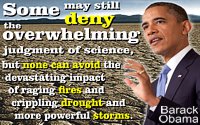
We, the people, still believe that our obligations as Americans are not just to ourselves, but to all posterity. We will respond to the threat of climate change, knowing that the failure to do so would betray our children and future generations. Some may still deny the overwhelming judgment of science, but none can avoid the devastating impact of raging fires and crippling drought and more powerful storms.
In Second Inaugural Address (21 Jan 2013) at the United States Capitol.
Were I to make the announcement and to run, the reasons I would run is because I have a great belief in this country [America]. … There’s more natural resources than any nation in the world; the greatest education population in the world; the greatest technology of any country in the world; the greatest capacity for innovation in the world; and the greatest political system in the world.
Answer to “Why do you want to be President,” interview with Roger Mudd, CBS TV documentary (12 Oct 1979). In Jim Lehrer and James Lehrer, Tension City: Inside the Presidential Debates (2011), 184.
What Pasteur and Langmuir believed—and what history has shown—is that both epidemiologists and laboratory scientists can make independent discoveries that have significant scientific impact, but collaboration across these disciplines has a synergistic effect, yielding public health data that are stronger than either discipline can provide alone
These words are not quoted directly from Walter R. Dowdle, but are a paraphrase of an explanation of an epigraph attributed to him: [“Alexander Langmuir was quoted in the early 1960s instructing incoming Epidemic Intelligence Service (EIS) officers that the only need for the laboratory in an outbreak investigation was to ‘prove their conclusions were right.’— Walter R. Dowdle (2011)”], to Chap. 9, M. Shannon Keckler, Reynolds M. Salerno, and Michael W. Shaw, 'Optimizing Epidemiology–Laboratory Collaborations' in Centers for Disease Control and Prevention, The CDC Field Epidemiology Manual (2018), 188. These authors paraphrased and expanded on a footnoted reference for which Dowdle was the corresponding author: “Langmuir’s point was not to denigrate the laboratory but to emphasize the power of an investigation based on a solid clinical case definition and established field epidemiologic principles,” in Walter R. Dowdle, Leonard W. Mayer, Karen K. Steinberg, Neelam D. Ghiya and Tanja Popovic (co-authors), 'CDC Laboratory Contributions to Public Health', Morbidity and Mortality Weekly Report, Supplements (7 Oct 2011), 60, 27. [This epigraph was complemented by another: “Sans laboratoires les savants sont des soldats sans armes.”. Without laboratories men of science are soldiers without arms. — Louis Pasteur (1923).]
What terrible questions we are learning to ask! The former men believed in magic, by which temples, cities, and men were swallowed up, and all trace of them gone. We are coming on the secret of a magic which sweeps out of men's minds all vestige of theism and beliefs which they and their fathers held and were framed upon.
In 'Illusions', The Atlantic Monthly (Nov 1858), 1, 60.
What to-day is to be believed is to-morrow to be cast aside, certainly has been the law of advancement, and seemingly must continue to be so. With what a babel of discordant voices does it [medicine] celebrate its two thousand years of experience!
…...
What we believe, endorse, agree with, and depend on is representable and, increasingly, represented on the Web. We all have to ensure that the society we build with the Web is the sort we intend.
Weaving The Web: The Original Design and Ultimate Destiny of the World Wide Web (2004), 123.
What’s needed more than anything else, I believe, is an energetic program of technological detoxification. We must admit that we are intoxicated with our science and technology and that we tire deeply committed to a Faustian bargain that is rapidly killing us spiritually and may eventually kill us all physically.
From interview with Marion Long, 'The Turncoat of the Computer Revolution', New Age Journal (1985), II, No. 5, 49-51, as quoted in Lester W. Milbrath, Envisioning a Sustainable Society: Learning Our Way Out (1989), 258.
Whatever may have been imputed to some other studies under the notion of insignificancy and loss of time, yet these [mathematics], I believe, never caused repentance in any, except it was for their remissness in the prosecution of them.
In 'On the Usefulness of Mathematics', Works (1840), Vol. 2, 69.
Whatever universe a professor believes in must at any rate be a universe that lends itself to lengthy discourse. A universe definable in two sentences is something for which the professorial intellect has no use. No faith in anything of that cheap kind!
First of eight lectures on ‘Pragmatism: A New Name For an Old Way of Thinking’ given at the Lowell Institute, Boston and the Departments of Philosophy and Psychology, Columbia University. In The Popular Science Monthly (Mar 1907), 193.
When … a large number of renegade specialists and amateurs believe contrary to the most prestigious experts, the latter say, well science is not democratic, it is what the people who know the most say—that is what counts!
In Seeing Red: Redshifts, Cosmology and Academic Science (1998), 273.
When a believing person prays, great things happen.
— Bible
James 5:13-16. Quoted in Kim Lim (ed.), 1,001 Pearls of Spiritual Wisdom: Words to Enrich, Inspire, and Guide Your Life (2014), 177
When all beliefs are challenged together, the just and necessary ones have a chance to step forward and to re-establish themselves alone.
In The Life of Reason: Reasons in Science (1905-06).
When ever we turn in these days of iron, steam and electricity we find that Mathematics has been the pioneer. Were its back bone removed, our material civilization would inevitably collapse. Modern thought and belief would have been altogether different, had Mathematics not made the various sciences exact.
The Teaching of Mathematics in the Elementary and the Secondary School (1907), 13.
When I entered the field of space physics in 1956, I recall that I fell in with the crowd believing, for example, that electric fields could not exist in the highly conducting plasma of space. It was three years later that I was shamed by S. Chandrasekhar into investigating Alfvén's work objectively. My degree of shock and surprise in finding Alfvén right and his critics wrong can hardly be described. I learned that a cosmic ray acceleration mechanism basically identical to the famous mechanism suggested by Fermi in 1949 had [previously] been put forth by Alfvén.
Quoted in Anthony L. Peratt, 'Dean of the Plasma Dissidents', Washington Times, supplement: The World and I (May 1988), 195.
When the first mathematical, logical, and natural uniformities, the first laws, were discovered, men were so carried away by the clearness, beauty and simplification that resulted, that they believed themselves to have deciphered authentically the eternal thoughts of the Almighty.
From Lecture (Nov 1906) at the Lowell Institute, Boston. Published in 'The Present Dilemma in Philosophy',Pragmatism: A New Name for Some Old Ways of Thinking: Popular Lectures on Philosophy (1907), 56.
When the intensity of emotional conviction subsides, a man who is in the habit of reasoning will search for logical grounds in favor of the belief which he finds in himself.
In Mysticism and Logic (2004), 15.
When we survey our lives and endeavours we soon observe that almost the whole of our actions and desires are bound up with the existence of other human beings. We see that our whole nature resembles that of the social animals. We eat food that others have grown, wear clothes that others have made, live in houses that others have built. The greater part of our knowledge and beliefs has been communicated to us by other people through the medium of a language which others have created. Without language our mental capacities would be poor indeed, comparable to those of the higher animals; we have, therefore, to admit that we owe our principal advantage over the beasts to the fact of living in human society. The individual, if left alone from birth would remain primitive and beast-like in his thoughts and feelings to a degree that we can hardly conceive. The individual is what he is and has the significance that he has not so much in virtue of his individuality, but rather as a member of a great human society, which directs his material and spiritual existence from the cradle to the grave.
In 'Society and Personality', The World As I See It (1935, 2007), 8.
When you can dump a load of bricks on a corner lot, and let me watch them arrange themselves into a house — when you can empty a handful of springs and wheels and screws on my desk, and let me see them gather themselves together into a watch — it will be easier for me to believe that all these thousands of worlds could have been created, balanced, and set to moving in their separate orbits, all without any directing intelligence at all.
In 'If A Man Die, Shall He Live again?', More Power To You: Fifty Editorials From Every Week (1917), 218-219.
When, however, you see the specification, you will see that the fundamental principles are contained therein. I do not, however, claim even the credit of inventing it, as I do not believe a mere description of an idea that has never been reduced to practice—in the strict sense of that phrase—should be dignified with the name invention.
Letter (5 Mar 1877) to Alexander Graham Bell. Quoted in The Bell Telephone (1908), 168.
Whenever there is a simple error that most laymen fall for, there is always a slightly more sophisticated version of the same problem that experts fall for.
As quoted in Brooks Jackson and Kathleen Hall Jamieson, unSpun: Finding Facts in a World of Disinformation (2007), 70-71.
Wherever possible, scientists experiment. Which experiments suggest themselves often depends on which theories currently prevail. Scientists are intent of testing those theories to the breaking point. They do not trust what is intuitively obvious. That the Earth is flat was once obvious. That heavy bodies fall faster than light ones was once obvious. That bloodsucking leeches cure most diseases was once obvious. That some people are naturally and by divine decree slaves was once obvious. That there is such a place as the center of the Universe, and that the Earth sits in that exalted spot was once obvious. That there is an absolute standard of rest was once obvious. The truth may be puzzling or counterintuitive. It may contradict deeply held beliefs. Experiment is how we get a handle on it.
In The Demon-Haunted World: Science As A Candle in the Dark (1995), 36.
While the method of the natural sciences is... analytic, the method of the social sciences is better described as compositive or synthetic. It is the so-called wholes, the groups of elements which are structurally connected, which we learn to single out from the totality of observed phenomena... Insofar as we analyze individual thought in the social sciences the purpose is not to explain that thought, but merely to distinguish the possible types of elements with which we shall have to reckon in the construction of different patterns of social relationships. It is a mistake... to believe that their aim is to explain conscious action ... The problems which they try to answer arise only insofar as the conscious action of many men produce undesigned results... If social phenomena showed no order except insofar as they were consciously designed, there would indeed be no room for theoretical sciences of society and there would be, as is often argued, only problems of psychology. It is only insofar as some sort of order arises as a result of individual action but without being designed by any individual that a problem is raised which demands a theoretical explanation... people dominated by the scientistic prejudice are often inclined to deny the existence of any such order... it can be shown briefly and without any technical apparatus how the independent actions of individuals will produce an order which is no part of their intentions... The way in which footpaths are formed in a wild broken country is such an instance. At first everyone will seek for himself what seems to him the best path. But the fact that such a path has been used once is likely to make it easier to traverse and therefore more likely to be used again; and thus gradually more and more clearly defined tracks arise and come to be used to the exclusion of other possible ways. Human movements through the region come to conform to a definite pattern which, although the result of deliberate decision of many people, has yet not be consciously designed by anyone.
…...
While we keep an open mind on this question of vitalism, or while we lean, as so many of us now do, or even cling with a great yearning, to the belief that something other than the physical forces animates the dust of which we are made, it is rather the business of the philosopher than of the biologist, or of the biologist only when he has served his humble and severe apprenticeship to philosophy, to deal with the ultimate problem. It is the plain bounden duty of the biologist to pursue his course unprejudiced by vitalistic hypotheses, along the road of observation and experiment, according to the accepted discipline of the natural and physical sciences. … It is an elementary scientific duty, it is a rule that Kant himself laid down, that we should explain, just as far as we possibly can, all that is capable of such explanation, in the light of the properties of matter and of the forms of energy with which we are already acquainted.
From Presidential Address to Zoological Section of the British Association for the Advancement of Science. As quoted in H.V. Neal, 'The Basis of Individuality in Organisms: A Defense of Vitalism', Science (21 Jul 1916), 44 N.S., No. 1125, 82.
Who could believe an ant in theory?
A giraffe in blueprint?
Ten thousand doctors of what’s possible
Could reason half the jungle out of being.
A giraffe in blueprint?
Ten thousand doctors of what’s possible
Could reason half the jungle out of being.
In The Achievement of John Ciardi: A Comprehensive Selection of His Poems (1969), 73.
Who could believe in the prophecies ... that the world would end this summer, while one milkweed with faith matured its seeds.
In William Ellery Channing, Thoreau, the Poet-Naturalist: with Memorial Verses (1873), 205. Also identified as Journal entry (24 Sep 1851), collected in Bradford Torrey (ed.), The Writings of Henry David Thoreau: Journal (1906), Vol. 3, 18.
Who would believe that so small a space could contain the images of all the universe?
…...
Who—aside from certain big children who are indeed found in the natural sciences—still believes that the findings of astronomy, biology, physics, or chemistry could teach us anything about the meaning of the world?
From a Speech (1918) presented at Munich University, published in 1919, and collected in 'Wissenschaft als Beruf', Gessammelte Aufsätze zur Wissenschaftslehre (1922), 524-525. As given in H.H. Gerth and C. Wright-Mills (translators and eds.), 'Science as a Vocation', Max Weber: Essays in Sociology (1946), 142.
Whoever … proves his point and demonstrates the prime truth geometrically should be believed by all the world, for there we are captured.
In J. Heidrich (ed.), 'Von Menschlicher Proportion', Albrecht Dürer’s Schriftlicher Nachlass (1920), 270. From the original German: “Welcher aber … durch die Geometria sein Ding beweist und die gründliche Wahrheit anzeigt, dem soll alle Welt glauben. Denn da ist man gefangen.”
Why are you so sure parallel lines exist?
Believe nothing, merely because you have been told it, or because it is traditional, or because you have imagined it.
Believe nothing, merely because you have been told it, or because it is traditional, or because you have imagined it.
In George Edward Martin, The Foundations of Geometry and the Non-Euclidean Plane (1982), 47.
William James used to preach the “will to believe.” For my part, I should wish to preach the “will to doubt.” … What is wanted is not the will to believe, but the wish to find out, which is the exact opposite.
From Conway Memorial Lecture, South Place Institute, London (24 Mar 1922), printed as Free Thought and Official Propaganda (1922), 14. Collected in Sceptical Essays (1928, 2004), 129.
Within a hundred years of physical and chemical science, men will know what the atom is. It is my belief when science reaches this stage, God will come down to earth with His big ring of keys and will say to humanity, 'Gentlemen, it is closing time.'
Quoted in Ralph Oesper, The Human Side of Scientists (1975), 17.
You believe in the God who plays dice, and I in complete law and order in a world that objectively exists, and which I, in a wildly speculative way, am trying to capture. … Even the great initial success of the quantum theory does not make me believe in the fundamental dice-game, although I am well aware that our younger colleagues interpret this as a consequence of senility. No doubt the day will come when we will see whose instinctive attitude was the correct one.
Letter to Max Born (7 Sep 1944). In Born-Einstein Letters, 146. Einstein Archives 8-207. In Albert Einstein, Alice Calaprice, Freeman Dyson, The Ultimate Quotable Einstein (2011), 393-394. Often seen paraphrased as “I cannot believe that God plays dice with the cosmos.” Also see a related quote about God playing dice on the Stephen W. Hawking Quotes page of this website.
You bring me the deepest joy that can be felt by a man [Pasteur himself] whose invincible belief is that Science and Peace will triumph over Ignorance and War, that nations will unite, not to destroy, but to build, and that the future will belong to those who will have done most for suffering humanity. But whether our efforts are or are not favored by life, let us be able to say, when we come near to the great goal, “I have done what I could.”
Speech at the Sorbonne, Paris, France (27 Dec 1892) where his 70th birth was recognized. His son presented the speech due to the weakness of Pastuer's voice. In René Vallery-Radot, The Life of Pasteur, R. L. Devonshire (trans.) (1902), Vol. 2, 297.
You cannot believe in God until you believe in yourself.
Quoted in Kim Lim (ed.), 1,001 Pearls of Spiritual Wisdom: Words to Enrich, Inspire, and Guide Your Life (2014), 249
You must never believe all these things which the scientists say because they always want more than they can get—they are never satisfied.
[Responding to a complaint of inadequate support for research.]
[Responding to a complaint of inadequate support for research.]
Quoted in Senate Internal Security Subcommittee, Nuclear Scientist Defect to the United States (1965). In Daniel S. Greenberg, The Politics of Pure Science (1999), 156, footnote.
You see, if the height of the mercury [barometer] column is less on the top of a mountain than at the foot of it (as I have many reasons for believing, although everyone who has so far written about it is of the contrary opinion), it follows that the weight of the air must be the sole cause of the phenomenon, and not that abhorrence of a vacuum, since it is obvious that at the foot of the mountain there is more air to have weight than at the summit, and we cannot possibly say that the air at the foot of the mountain has a greater aversion to empty space than at the top.
In letter to brother-in-law Perier (Nov 1647) as given in Daniel Webster Hering, Physics: the Science of the Forces of Nature (1922), 114. As also stated by Hering, Perier conducted an experiment on 19 Sep 1648 comparing readings on two barometers, one at the foot, and another at the top of 4,000-ft Puy-de-Dôme neighboring mountain.
Young people—they care. They know that this is the world that they’re going to grow up in, that they’re going to spend the rest of their lives in. But, I think it’s more idealistic than that. They actually believe that humanity, human species, has no right to destroy and despoil regardless.
As quoted, without source, in Kate Ng, 'David Attenborough turns 95: His best quotes on nature, sustainability and humankind', Independent (8 May 2021).
Your theories are those which you and many other people find easiest and pleasantest to believe, but, so far as I can see, they have no foundation other than they lead to a pleasant view of life … I agree that faith is essential to success in life … but I do not accept your definition of faith, i.e. belief in life after death. In my view, all that is necessary for faith is the belief that by doing our best we shall come nearer to success and that success in our aims (the improvement of the lot of mankind, present and future) is worth attaining … I maintain that faith in this world is perfectly possible without faith in another world.
Letter to her father, Ellis Franklin (undated, summer 1940? while she was an undergraduate at Cambridge). Excerpted in Brenda Maddox, The Dark Lady of DNA (2002), 61.
 In science it often happens that scientists say, 'You know that's a really good argument; my position is mistaken,' and then they would actually change their minds and you never hear that old view from them again. They really do it. It doesn't happen as often as it should, because scientists are human and change is sometimes painful. But it happens every day. I cannot recall the last time something like that happened in politics or religion.
(1987) --
In science it often happens that scientists say, 'You know that's a really good argument; my position is mistaken,' and then they would actually change their minds and you never hear that old view from them again. They really do it. It doesn't happen as often as it should, because scientists are human and change is sometimes painful. But it happens every day. I cannot recall the last time something like that happened in politics or religion.
(1987) -- 





.jpg)
