Being Quotes (1276 quotes)
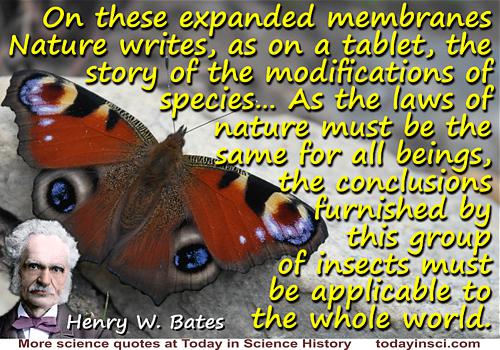
… on these expanded membranes [butterfly wings] Nature writes, as on a tablet, the story of the modifications of species, so truly do all changes of the organisation register themselves thereon. Moreover, the same colour-patterns of the wings generally show, with great regularity, the degrees of blood-relationship of the species. As the laws of nature must be the same for all beings, the conclusions furnished by this group of insects must be applicable to the whole world.
From The Naturalist on the River Amazons: A record of Adventures, Habits of Animals, Sketches of Brazilian and Indian life, and Aspects of Nature under the Equator, During Eleven Years of Travel (1864), 413.
… our “Physick” and “Anatomy” have embraced such infinite varieties of being, have laid open such new worlds in time and space, have grappled, not unsuccessfully, with such complex problems, that the eyes of Vesalius and of Harvey might be dazzled by the sight of the tree that has grown out of their grain of mustard seed.
A Lay Sermon, delivered at St. Martin's Hall (7 Jan 1866), 'On the Advisableness of Improving Natural Knowledge', published in The Fortnightly Review (1866), Vol. 3, 629.
... semantics ... is a sober and modest discipline which has no pretensions of being a universal patent-medicine for all the ills and diseases of mankind, whether imaginary or real. You will not find in semantics any remedy for decayed teeth or illusions of grandeur or class conflict. Nor is semantics a device for establishing that everyone except the speaker and his friends is speaking nonsense
In 'The Semantic Conception of Truth and the Foundations of Semantics', collected in
Leonard Linsky (ed.), Semantics and the Philosophy of Language: A Collection of Readings (1952), 17.
… the truth is that the knowledge of external nature and of the sciences which that knowledge requires or includes, is not the great or the frequent business of the human mind. Whether we provide for action or conversation, whether we wish to be useful or pleasing, the first requisite is the religious and moral knowledge of right and wrong; the next is an acquaintance with the history of mankind, and with those examples which may be said to embody truth, and prove by events the reasonableness of opinions. Prudence and justice are virtues, and excellencies, of all times and of all places; we are perpetually moralists, but we are geometricians only by chance. Our intercourse with intellectual nature is necessary; our speculations upon matter are voluntary, and at leisure. Physical knowledge is of such rare emergence, that one man may know another half his life without being able to estimate his skill in hydrostatics or astronomy; but his moral and prudential character immediately appears.
In Lives of the Poets (1779-81).
… There can be no doubt about faith and not reason being the ultima ratio. Even Euclid, who has laid himself as little open to the charge of credulity as any writer who ever lived, cannot get beyond this. He has no demonstrable first premise. He requires postulates and axioms which transcend demonstration, and without which he can do nothing. His superstructure indeed is demonstration, but his ground his faith. Nor again can he get further than telling a man he is a fool if he persists in differing from him. He says “which is absurd,” and declines to discuss the matter further. Faith and authority, therefore, prove to be as necessary for him as for anyone else.
In The Way of All Flesh (1917), 319-320.
...learning chiefly in mathematical sciences can so swallow up and fix one's thought, as to possess it entirely for some time; but when that amusement is over, nature will return, and be where it was, being rather diverted than overcome by such speculations.
An Exposition of the Thirty-nine Articles of the Church of England (1850), 154
...the study of butterflies—creatures selected as the types of airiness and frivolity—instead of being despised, will some day be valued as one of the most important branches of Biological science.
From The Naturalist on the River Amazons: A record of Adventures, Habits of Animals, Sketches of Brazilian and Indian life, and Aspects of Nature under the Equator, During Eleven Years of Travel (1864), 413.
’Tis evident, that as common Air when reduc’d to half Its wonted extent, obtained near about twice as forcible a Spring as it had before; so this thus- comprest Air being further thrust into half this narrow room, obtained thereby a Spring about as strong again as that It last had, and consequently four times as strong as that of the common Air. And there is no cause to doubt, that If we had been here furnisht with a greater quantity of Quicksilver and a very long Tube, we might by a further compression of the included Air have made It counter-balance “the pressure” of a far taller and heavier Cylinder of Mercury. For no man perhaps yet knows how near to an infinite compression the Air may be capable of, If the compressing force be competently increast.
A Defense of the Doctrine Touching the Spring and Weight of the Air (1662), 62.
“In order to ascertain the height of the tree I must be in such a position that the top of the tree is exactly in a line with the top of a measuring-stick—or any straight object would do, such as an umbrella—which I shall secure in an upright position between my feet. Knowing then that the ratio that the height of the tree bears to the length of the measuring stick must equal the ratio that the distance from my eye to the base of the tree bears to my height, and knowing (or being able to find out) my height, the length of the measuring stick and the distance from my eye to the base of the tree, I can, therefore, calculate the height of the tree.”
“What is an umbrella?”
“What is an umbrella?”
In Mr. Fortune’s Maggot (1927), 175.
“Science in itself” is nothing, for it exists only in the human beings who are its bearers.
In 'Standpoints in Scientific Medicine', Disease, Life, and Man: Selected Essays (1958), 42.
“She can't do sums a bit!” the Queens said together, with great emphasis.
“Can you do sums?” Alice said, turning suddenly on the White Queen, for she didn't like being found fault with so much.
The Queen gasped and shut her eyes. “I can do Addition, if you give me time-but I can do Subtraction, under any circumstances!”
“Can you do sums?” Alice said, turning suddenly on the White Queen, for she didn't like being found fault with so much.
The Queen gasped and shut her eyes. “I can do Addition, if you give me time-but I can do Subtraction, under any circumstances!”
Through the Looking Glass and What Alice Found There (1871, 1897), 191.
(1) A robot may not injure a human being, or, through inaction, allow a human being to come to harm.
(2) A robot must obey the orders given it by human beings except where such orders would conflict with the first law.
(3) A robot must protect its own existence as long as such protection does not conflict with the First or Second Law.
(2) A robot must obey the orders given it by human beings except where such orders would conflict with the first law.
(3) A robot must protect its own existence as long as such protection does not conflict with the First or Second Law.
'The Three Laws of Robotics', in I, Robot (1950), Frontispiece.
[1665-04-30] ...Great fear of the sicknesses here in the City, it being said that two or three houses are already shut up. God preserve us all.
Diary of Samuel Pepys (30 Apr 1665)
[1665-06-07] ...This day, much against my will, I did in Drury Lane see two or three houses marked with a red cross upon the doors, and 'Lord have mercy upon us' writ there - which was a sad sight to me, being the first of that kind that to my remembrance I ever saw. It put me into an ill conception of myself and my smell, so that I was forced to buy some roll-tobacco to smell to and chaw - which took away the apprehension.
Diary of Samuel Pepys (7 Jun 1665)
[1665-06-10] ...In the evening home to supper, and there to my great trouble hear that the plague is come into the City (though it hath these three or four weeks since its beginning been wholly out of the City); but where it begin but in my good friend and neighbour's, Dr Burnett in Fanchurch Street - which in both points troubles me mightily. To the office to finish my letters, and then home to bed, being troubled at the sickness ... and particularly how to put my things and estate in order, in case it should please God to call me away.
Diary of Samuel Pepys (10 Jun 1665)
[1665-06-17] It stroke me very deep this afternoon, going with a hackney-coach from my Lord Treasurer's down Holborne - the coachman I found to drive easily and easily; at last stood still, and came down hardly able to stand; and told me that he was suddenly stroke very sick and almost blind. So I light and went into another coach, with a sad heart for the poor man and trouble for myself, lest he should have been stroke with the plague - being at that end of the town that I took him up. But God have mercy upon us all.
Diary of Samuel Pepys (17 Jun 1665)
[1665-07-31] ...Thus we end this month, as I said, after the greatest glut of content that ever I had; only, under some difficulty because of the plague, which grows mightily upon us, the last week being about 1700 or 1800 of the plague. ...
Diary of Samuel Pepys (31 Jul 1665)
[1665-08-16] ...Hence to the Exchange, which I have not been a great while. But Lord, how sad a sight it is to see the streets empty of people, and very few upon the Change - jealous of every door that one sees shut up, lest it should be the plague - and about us, two shops in three, if not more, generally shut up. ... It was dark before I could get home; and so land at church-yard stairs, where to my great trouble I met a dead Corps, of the plague, in the narrow ally, just bringing down a little pair of stairs - but I thank God I was not much disturbed at it. However, I shall beware of being late abroad again.
Diary of Samuel Pepys (16 Aug 1665)
[1665-08-31] Up, and after putting several things in order to my removal to Woolwich, the plague having a great increase this week beyond all expectation, of almost 2000 - making the general Bill 7000, odd 100 and the plague above 6000 .... Thus this month ends, with great sadness upon the public through the greateness of the plague, everywhere through the Kingdom almost. Every day sadder and sadder news of its increase. In the City died this week 7496; and all of them, 6102 of the plague. But it is feared that the true number of the dead this week is near 10000 - partly from the poor that cannot be taken notice of through the greatness of the number, and partly from the Quakers and others that will not have any bell ring for them. As to myself, I am very well; only, in fear of the plague, and as much of an Ague, by being forced to go early and late to Woolwich, and my family to lie there continually.
Diary of Samuel Pepys (31 August 1665)
[1665-10-16] But Lord, how empty the streets are, and melancholy, so many poor sick people in the streets, full of sores, and so many sad stories overheard as I walk, everybody talking of this dead, and that man sick, and so many in this place, and so many in that. And they tell me that in Westminster there is never a physitian, and but one apothecary left, all being dead - but that there are great hopes of a great decrease this week. God send it.
Diary of Samuel Pepys (16 Oct 1665)
[1665-11-22] I heard this day that the plague is come very low; that is 600 and odd - and great hopes of a further decrease, because of this day's being a very exceeding hard frost - and continues freezing. ...
Diary of Samuel Pepys (22 Nov 1665)
[A crowd] thinks in images, and the image itself calls up a series of other images, having no logical connection with the first … A crowd scarcely distinguishes between the subjective and the objective. It accepts as real the images invoked in its mind, though they most often have only a very distant relation with the observed facts. * * * Crowds being only capable of thinking in images are only to be impressed by images. It is only images that terrify or attract them and become motives of action.
From Psychologie des Foules (1895), 29 & 56. English text in The Crowd: A Study of the Popular Mind (1897), Book 1, Chap 2, 22 & last sentence, 55. Original French text: “[La foule] pense par images, et l’image évoquée en évoque elle-même une série d’autres n’ayant aucun lien logique avec la première. … La foule ne sépare guère le subjectif de l’objectif. Elle admet comme réelles les images évoquées dans son esprit, et qui le plus souvent n’ont qu’une parenté lointaine avec le fait observé. * * * Les foules, ne pouvant penser que par images,ne se laissent impressionner que par des images. Seules les images les terrifient ou les séduisent, et deviennent des mobiles d’action.”
[A key to success] is being able to talk to camera without a teleprompter. … If you believe something and want to make clear what you are talking about, you ought to be able to articulate it without a teleprompter.
From interview with Michael Bond, 'It’s a Wonderful Life', New Scientist (14 Dec 2002), 176, No. 2373, 48.
[A man] must learn to understand the motives of human beings, their illusions, and their sufferings human beings, their illusions, and their sufferings in order to acquire a proper relationship to individual fellow-men and to the community. These precious things … primarily constitutes and preserves culture. This is what I have in mind when I recommend the “humanities” as important, not just dry specialized knowledge in the fields of history and philosophy.
From interview with Benjamin Fine, 'Einstein Stresses Critical Thinking', New York Times (5 Oct 1952), 37.
[About the mechanical properties of the molecules of a chemical substance being studied:] They could be measured, but that would have taken several months. So someone said, ‘Let’s get Teller in and make him guess the data.’ We got him into a room and locked the door, so no one else could get at him, and he asked questions and did some figuring at the blackboard. He got the answers in about two hours, not entirely accurately, of course, but—as we found out when we got around to verifying them—close enough for the purpose.
Recalls the first time she was ever really awed by mental abilities of Edward Teller. She had joined the Manhattan Project, and needed data on the physical properties of molecules of a certain substance to get started on her assigned task of calculating its chemical properties. As quoted in Robert Coughlan, 'Dr. Edward Teller’s Magnificent Obsession', Life (6 Sep 1954), 61.
[Alchemists] finde out men so covetous of so much happiness, whom they easily perswade that they shall finde greater Riches in Hydargyrie [mercury], than Nature affords in Gold. Such, whom although they have twice or thrice already been deluded, yet they have still a new Device wherewith to deceive um again; there being no greater Madness…. So that the smells of Coles, Sulphur, Dung, Poyson, and Piss, are to them a greater pleasure than the taste of Honey; till their Farms, Goods, and Patrimonies being wasted, and converted into Ashes and Smoak, when they expect the rewards of their Labours, births of Gold, Youth, and Immortality, after all their Time and Expences; at length, old, ragged, famisht, with the continual use of Quicksilver [mercury] paralytick, onely rich in misery, … a laughing-stock to the people: … compell’d to live in the lowest degree of poverty, and … at length compell’d thereto by Penury, they fall to Ill Courses, as Counterfeiting of Money.
In The Vanity of the Arts and Sciences (1530), translation (1676), 313.
[All phenomena] are equally susceptible of being calculated, and all that is necessary, to reduce the whole of nature to laws similar to those which Newton discovered with the aid of the calculus, is to have a sufficient number of observations and a mathematics that is complex enough.
Unpublished Manuscript. Quoted In Frank Edward Manuel and Fritzie Prigohzy Manuel, Utopian Thought in the Western World (1979, 2009), 493.
[American] Motherhood is like being a crack tennis player or ballet dancer—it lasts just so long, then it’s over. We’ve made an abortive effort to turn women into people. We’ve sent them to school and put them in slacks. But we’ve focused on wifehood and reproductivity with no clue about what to do with mother after the children have left home. We’ve found no way of using the resources of women in the 25 years of post-menopausal zest. As a result many women seem to feel they should live on the recognition and care of society.
As quoted in interview with Frances Glennon, 'Student and Teacher of Human Ways', Life (14 Sep 1959), 147.
[An] old Pythagorean prejudice … thought it a crime to eat eggs; because an egg was a microcosm, or universe in little; the shell being the earth; the white, water; fire, the yolk; and the air found between the shell and the white.
'Common Cookery'. Household Words (26 Jan 1856), 13, 43. An English weekly magazine edited by Charles Dickens.
[Boundless curiosity.] That’s what being alive is about. I mean, it’s the fun of it all, making sense of it, understanding it. There’s a great pleasure in knowing why trees shed their leaves in winter. Everybody knows they do, but why? If you lose that, then you’ve lost pleasure.
From interview with Sophie Elmhirst, 'I Think the BBC Has Strayed From the Straight and Narrow', New Statesman (10 Jan 2011), 140, No. 5035, 32.
[Concerning] phosphorescent bodies, and in particular to uranium salts whose phosphorescence has a very brief duration. With the double sulfate of uranium and potassium ... I was able to perform the following experiment: One wraps a Lumière photographic plate with a bromide emulsion in two sheets of very thick black paper, such that the plate does not become clouded upon being exposed to the sun for a day. One places on the sheet of paper, on the outside, a slab of the phosphorescent substance, and one exposes the whole to the sun for several hours. When one then develops the photographic plate, one recognizes that the silhouette of the phosphorescent substance appears in black on the negative. If one places between the phosphorescent substance and the paper a piece of money or a metal screen pierced with a cut-out design, one sees the image of these objects appear on the negative. One can repeat the same experiments placing a thin pane of glass between the phosphorescent substance and the paper, which excludes the possibility of chemical action due to vapors which might emanate from the substance when heated by the sun's rays. One must conclude from these experiments that the phosphorescent substance in question emits rays which pass through the opaque paper and reduces silver salts.
[Although the sun is irrelevant, and he misinterprets the role of phosphorescence, he has discovered the effect of radioactivity.]
[Although the sun is irrelevant, and he misinterprets the role of phosphorescence, he has discovered the effect of radioactivity.]
Read at French Academy of Science (24 Feb 1896). In Comptes Rendus (1896), 122, 420. As translated by Carmen Giunta on the Classic Chemistry web site.
[Creationists] make it sound as though a “theory” is something you dreamt up after being drunk all night.
Remark to the National Center Against Censorship (NCAC)(1980). In Norman A. Johnson, Darwinian Detectives (2007), 27.
[Defining Life] The special activity of organized beings.
Duges, "Physiologie Comparée." In The British Controversialist and Literary Magazine (1865), 234.
[Defining Life] the sum of the phenomena proper to organized beings. In consists essentially in this, that organized beings are all, during a certain time, the centres to which foreign substances penetrate and are appropriated, and from which others issue.
Béclard, "Anatomie Générale." In The British Controversialist and Literary Magazine (1865), 234.
[Florence Nightingale] was a great administrator, and to reach excellence here is impossible without being an ardent student of statistics. Florence Nightingale has been rightly termed the “Passionate Statistician.” Her statistics were more than a study, they were indeed her religion. For her, Quetelet was the hero as scientist, and the presentation copy of his Physique Sociale is annotated by her on every page. Florence Nightingale believed—and in all the actions of her life acted upon that belief—that the administrator could only be successful if he were guided by statistical knowledge. The legislator—to say nothing of the politician—too often failed for want of this knowledge. Nay, she went further: she held that the universe—including human communities—was evolving in accordance with a divine plan; that it was man's business to endeavour to understand this plan and guide his actions in sympathy with it. But to understand God's thoughts, she held we must study statistics, for these are the measure of his purpose. Thus the study of statistics was for her a religious duty.
In Karl Pearson, The Life, Letters and Labours of Francis Galton (1924), Vol. 2, 414-5.
[Geology] may be looked upon as the history of the earth’s changes during preparation for the reception of organized beings, a history, which has all the character of a great epic.
Paper read to the Linnean Society, 7 Feb 1843. In George Wilson and Archibald Geikie, Memoir of Edward Forbes F.R.S. (1861), 343.
[I] browsed far outside science in my reading and attended public lectures - Bertrand Russell, H. G. Wells, Huxley, and Shaw being my favorite speakers. (The last, in a meeting at King's College, converted me to vegetarianism - for most of two years!).
Autobiography collected in Gardner Lindzey (ed.), A History of Psychology in Autobiography (1973), Vol. 6, 64.
[I]magine you want to know the sex of your unborn child. There are several approaches. You could, for example, do what the late film star ... Cary Grant did before he was an actor: In a carnival or fair or consulting room, you suspend a watch or a plumb bob above the abdomen of the expectant mother; if it swings left-right it's a boy, and if it swings forward-back it's a girl. The method works one time in two. Of course he was out of there before the baby was born, so he never heard from customers who complained he got it wrong. ... But if you really want to know, then you go to amniocentesis, or to sonograms; and there your chance of being right is 99 out of 100. ... If you really want to know, you go to science.
In 'Wonder and Skepticism', Skeptical Enquirer (Jan-Feb 1995), 19, No. 1.
[It] is not the nature of things for any one man to make a sudden, violent discovery; science goes step by step and every man depends on the work of his predecessors. When you hear of a sudden unexpected discovery—a bolt from the blue—you can always be sure that it has grown up by the influence of one man or another, and it is the mutual influence which makes the enormous possibility of scientific advance. Scientists are not dependent on the ideas of a single man, but on the combined wisdom of thousands of men, all thinking of the same problem and each doing his little bit to add to the great structure of knowledge which is gradually being erected.
Concluding remark in Lecture ii (1936) on 'Forty Years of Physics', revised and prepared for publication by J.A. Ratcliffe, collected in Needham and Pagel (eds.), Background to Modern Science: Ten Lectures at Cambridge Arranged by the History of Science Committee, (1938), 73-74. Note that the words as prepared for publication may not be verbatim as spoken in the original lecture by the then late Lord Rutherford.
[John Scott Haldane] preferred to work on himself or other human beings who were sufficiently interested in the work to ignore pain or fear … [His] object was not to achieve this state of [pain or fear] but to achieve knowledge which could save other men's lives. His attitute was much more like a good soldier who will risk his life and endure wounds in order to gain victory than that of an ascetic who deliberately undergoes pain. The soldier does not get himself wounded deliberately, and my father did not seek pain in his work though he greeted pain which would have made some people writhe or groan, with laughter.
In R.W. Clark, JBS: The Life and Work of J.B.S. Haldane (1968), quoted in Lawrence K. Altman, Who Goes First? (1986), 215.
[My friends and I studied science to get away from] the stench of Fascist truths which tainted the sky. ... [T]he chemistry and physics on which we fed, besides being nourishment vital in themselves, were an antidote to Fascism. ... [T]hey were clear and distinct and verifiable at every step, and not a tissue of lies and emptiness like the radio and the newspapers.
The Periodic Table, trans. Raymond Rosenthal (1986), 42. In Vinoth Ramachandra, Subverting Global Myths: Theology and the Public Issues Shaping our World (2008), 170.
[On gold, silver, mercury, platinum, palladium, rhodium, iridium, osmium:] As in their physical properties so in their chemical properties. Their affinities being weaker, (the noble metals) do not present that variety of combinations, belonging to the more common metals, which renders them so extensively useful in the arts; nor are they, in consequence, so necessary and important in the operations of nature. They do not assist in her hands in breaking down rocks and strata into soil, nor do they help man to make that soil productive or to collect for him its products.
From 13th Lecture in 1818, in Bence Jones, The Life and Letters of Faraday (1870), Vol. 1, 254.
[On mediocrity] What we have today is a retreat into low-level goodness. Men are all working hard building barbecues, being devoted to their wives and spending time with their children. Many of us feel, “We never had it so good!” After three wars and a depression, we’re impressed by the rising curve. All we want is it not to blow up.
As quoted in interview with Frances Glennon, 'Student and Teacher of Human Ways', Life (14 Sep 1959), 147.
[Public cynicism towards professional expertise is] entirely wrong, and it’s the road back to the cave. The way we got out of the caves and into modern civilisation is through the process of understanding and thinking. Those things were not done by gut instinct. Being an expert does not mean that you are someone with a vested interest in something; it means you spend your life studying something. You’re not necessarily right–but you’re more likely to be right than someone who’s not spent their life studying it.
As quoted in interview with Decca Aitkenhead, 'Prof Brian Cox: Being anti-expert – that’s the way back to the cave', The Guardian (2 Jul 2016)
[T]here are some common animal behaviors that seem to favor the development of intelligence, behaviors that might lead to brainy beasts on many worlds. Social interaction is one of them. If you're an animal that hangs out with others, then there's clearly an advantage in being smart enough to work out the intentions of the guy sitting next to you (before he takes your mate or your meal). And if you're clever enough to outwit the other members of your social circle, you'll probably have enhanced opportunity to breed..., thus passing on your superior intelligence. ... Nature—whether on our planet or some alien world—will stumble into increased IQ sooner or later.
Seth Shostak, Alex Barnett, Cosmic Company: the Search for Life in the Universe (2003), 62 & 67.
[The blame for the future 'plight of civilization] must rest on scientific men, equally with others, for being incapable of accepting the responsibility for the profound social upheavals which their own work primarily has brought about in human relationships.
Quoted in Thaddeus Trenn, 'The Central Role of Energy in Soddy's Holistic and Critical Approach to Nuclear Science, Economics, and Social Responsibility', British Journal for the History of Science (1979), 42, 261.
[The Elements] are mutually bound together, the lighter being restrained by the heavier, so that they cannot fly off; while, on the contrary, from the lighter tending upwards, the heavier are so suspended, that they cannot fall down. Thus, by an equal tendency in an opposite direction, each of them remains in its appropriate place, bound together by the never-ceasing revolution of the world.
In The Natural History of Pliny (1855), Vol. 1, 19.
[The root cap of a plant], having the power of directing the movements of the adjoining parts, acts like the brain of one of the lower animals; the brain being seated within the anterior end of the body, receiving impressions from the sense-organs, and directing the several movements.
[The surplus of basic knowledge of the atomic nucleus was] largely used up [during the war with the atomic bomb as the dividend.] We must, without further delay restore this surplus in preparation for the important peacetime job for the nucleus - power production. ... Many of the proposed applications of atomic power - even for interplanetary rockets - seem to be within the realm of possibility provided the economic factor is ruled out completely, and the doubtful physical and chemical factors are weighted heavily on the optimistic side. ... The development of economic atomic power is not a simple extrapolation of knowledge gained during the bomb work. It is a new and difficult project to reach a satisfactory answer. Needless to say, it is vital that the atomic policy legislation now being considered by the congress recognizes the essential nature of this peacetime job, and that it not only permits but encourages the cooperative research-engineering effort of industrial, government and university laboratories for the task. ... We must learn how to generate the still higher energy particles of the cosmic rays - up to 1,000,000,000 volts, for they will unlock new domains in the nucleus.
Addressing the American Institute of Electrical Engineering, in New York (24 Jan 1946). In Schenectady Gazette (25 Jan 1946),
[The toughest part of being in charge is] killing ideas that are great but poorly timed. And delivering tough feedback that’s difficult to hear but that I know will help people—and the team—in the long term.
In Issie Lapowsky, 'Scott Belsky', Inc. (Nov 2013), 140. Biography in Context,
[The] first postulate of the Principle of Uniformity, namely, that the laws of nature are invariant with time, is not peculiar to that principle or to geology, but is a common denominator of all science. In fact, instead of being an assumption or an ad hoc hypothesis, it is simply a succinct summation of the totality of all experimental and observational evidence.
'Critique of the Principle of Uniformity', in C. C. Albritton (ed.), Uniformity and Simplicity (1967), 29.
[There] are cases where there is no dishonesty involved but where people are tricked into false results by a lack of understanding about what human beings can do to themselves in the way of being led astray by subjective effects, wishful thinking or threshold interactions. These are examples of pathological science. These are things that attracted a great deal of attention. Usually hundreds of papers have been published upon them. Sometimes they have lasted for fifteen or twenty years and then they gradually die away.
[Coining the term “pathological science” for the self-deceiving application of science to a phenomenon that doesn't exist.]
[Coining the term “pathological science” for the self-deceiving application of science to a phenomenon that doesn't exist.]
From a Colloquium at The Knolls Research Laboratory (18 Dec 1953). Transcribed and edited by R. N. Hall. In General Electric Laboratories, Report No. 68-C-035 (April 1968).
[Thomas Henry] Huxley is a very genial, comfortable being—yet with none of the noisy and windy geniality of some folks here, whom you find with their backs turned when you are responding to the remarks that they have made you.
Letter to William James (29 Mar 1877). In Percy Lubbock (ed.), The Letters of Henry James (1920), Vol. 1, 52. Also in Justin Wintle and Richard Kenin (eds.), The Dictionary of Biographical Quotation of British and American Subjects (1978), 402.
'[R]eductionism' is one of those things, like sin, that is only mentioned by people who are against it. To call oneself a reductionist will sound, in some circles, a bit like admitting to eating babies. But, just as nobody actually eats babies, so nobody is really a reductionist in any sense worth being against.
The Blind Watchmaker (1996), 13.
..und Juwele wägt man nicht mit der Krämerwaage
... and jewels are not weighed on a grocery scale.
Comment on Dirichlet's publication as being not prolific, but profound.
... and jewels are not weighed on a grocery scale.
Comment on Dirichlet's publication as being not prolific, but profound.
Letter to Alexander von Humbolt (9 Jul 1845). In Jagdish Mehra and Helmut Rechenberg, The Historical Development of Quantum Theory, 267.
By
[About Francis Baily] The history of the astronomy of the nineteenth century will be incomplete without a catalogue of his labours. He was one of the founders of the Astronomical Society, and his attention to its affairs was as accurate and minute as if it had been a firm of which he was the chief clerk, with expectation of being taken into partnership.
In Supplement to the Penny Cyclopaedia. Quoted in Sophia Elizabeth De Morgan, Memoir of Augustus De Morgan (1882), 46
[Bibendum, the iconic Michelin Man, was inspired upon seeing a pile of tires resemble the body of a man.] All it needed was arms, for, being a Frenchman, it wanted to speak!
As quoted by H.M. Davidson, in System: The Magazine of Business (Apr 1922), 41, 446. The comment by Édouard Michelin, a former artist, refers to the idea that Frenchmen speak with hand gestures.
[Elementary student, laying a cocoon on the teacher's desk:] That is serendipity. The caterpillar thinks it is dying but it is really being born.
As quoted, without citation, by Marcus Bach, 'Serendiptiy in the Business World', in The Rotarian (Oct 1981), 139, No. 4, 40.
But how shall we this union well expresse?
Naught tyes the soule: her subtiltie is such
She moves the bodie, which she doth possesse.
Yet no part toucheth, but by Vertue's touch.
Then dwels she not therein as in a tent;
Nor as a pilot in his Ship doth sit;
Nor as the spider in his web is pent;
Nor as the Waxe retaines the print in it;
Nor as a Vessell water doth containe;
Nor as one Liquor in another shed;
Nor as the heate dath in the fire remaine;
Nor as a voice throughout the ayre is spred;
But as the faire and cheerfull morning light,
Doth here, and there, her silver beames impart,
And in an instant doth her selfe unite
To the transparent Aire, in all, and part:
Still resting whole, when blowes the Aire devide;
Abiding pure, when th' Aire is most corrupted;
Throughout the Aire her beames dispersing wide,
And when the Aire is tost, not interrupted:
So doth the piercing Soule the body fill;
Being all in all, and all in part diffus'd;
Indivisible, incorruptible still,
Not forc't, encountred, troubled or confus'd.
And as the Sunne above the light doth bring,
Tough we behold it in the Aire below;
So from th'eternall light the Soule doth spring,
Though in the Bodie she her powers do show.
Naught tyes the soule: her subtiltie is such
She moves the bodie, which she doth possesse.
Yet no part toucheth, but by Vertue's touch.
Then dwels she not therein as in a tent;
Nor as a pilot in his Ship doth sit;
Nor as the spider in his web is pent;
Nor as the Waxe retaines the print in it;
Nor as a Vessell water doth containe;
Nor as one Liquor in another shed;
Nor as the heate dath in the fire remaine;
Nor as a voice throughout the ayre is spred;
But as the faire and cheerfull morning light,
Doth here, and there, her silver beames impart,
And in an instant doth her selfe unite
To the transparent Aire, in all, and part:
Still resting whole, when blowes the Aire devide;
Abiding pure, when th' Aire is most corrupted;
Throughout the Aire her beames dispersing wide,
And when the Aire is tost, not interrupted:
So doth the piercing Soule the body fill;
Being all in all, and all in part diffus'd;
Indivisible, incorruptible still,
Not forc't, encountred, troubled or confus'd.
And as the Sunne above the light doth bring,
Tough we behold it in the Aire below;
So from th'eternall light the Soule doth spring,
Though in the Bodie she her powers do show.
From 'Nosce Teipsum' (1599), in Claire Howard (ed.), The Poems of Sir John Davies (1941), 151-2.
Dass die bis jetzt unzerlegten chemischen Elemente absolut unzerlegbare Stoffe seien, ist gegenwärtig mindestens sehr unwahrscheinlich. Vielmehr scheint es, dass die Atome der Elemente nicht die letzten, sondern nur die näheren Bestandtheile der Molekeln sowohl der Elemente wie der Verbindungen bilden, die Molekeln oder Molecule als Massentheile erster, die Atome als solche zweiter Ordnung anzusehen sind, die ihrerseits wiederum aus Massentheilchen einer dritten höheren Ordnung bestehen werden.
That the as yet undivided chemical elements are absolutely irreducible substances, is currently at least very unlikely. Rather it seems, that the atoms of elements are not the final, but only the immediate constituents of the molecules of both the elements and the compounds—the Molekeln or molecule as foremost division of matter, the atoms being considered as second order, in turn consisting of matter particles of a third higher order.
[Speculating in 1870, on the existence of subatomic particles, in opening remark of the paper by which he became established as co-discoverer of the Periodic Law.]
That the as yet undivided chemical elements are absolutely irreducible substances, is currently at least very unlikely. Rather it seems, that the atoms of elements are not the final, but only the immediate constituents of the molecules of both the elements and the compounds—the Molekeln or molecule as foremost division of matter, the atoms being considered as second order, in turn consisting of matter particles of a third higher order.
[Speculating in 1870, on the existence of subatomic particles, in opening remark of the paper by which he became established as co-discoverer of the Periodic Law.]
'Die Natur der chemischen Elemente als Function ihrer Atomgewichte' ('The Nature of the Chemical Elements as a Function of their Atomic Weight'), Annalen der Chemie (1870), supp. b, 354. Original German paper reprinted in Lothar Meyer and Dmitry Ivanovich Mendeleyev, Das natürliche System der chemischen Elemente: Abhandlungen (1895), 9. Translation by Webmaster, with punctuation faithful to the original, except a comma was changed to a dash to improve readability.
Der ganze Mensch ist nur ein Wirbelbein.
The whole of a human being is merely a vertebra.
The whole of a human being is merely a vertebra.
Quoted in Henry Harris, The Birth of the Cell (1999), 62.
Energie is the operation, efflux or activity of any being: as the light of the Sunne is the energie of the Sunne, and every phantasm of the soul is the energie of the soul.
[The first recorded definition of the term energy in English]
[The first recorded definition of the term energy in English]
In Platonica: A Platonicall Song of the Soul (1642). In this book of poems, More uses the word energie many times, and in the opening section, 'To the Reader'. The definition quoted appears at the end of the book in 'The interpretation of the more unusual names or words that occurre in the foregoing Poems.'
Les causes primordiales ne nous sont point connues; mais elles sont assujetties à des lois simples et constantes, que l’on peut découvrir par l’observation, et dont l’étude est l’objet de la philosophie naturelle.
Primary causes are unknown to us; but are subject to simple and constant laws, which may be discovered by observation, the study of them being the object of natural philosophy.
Primary causes are unknown to us; but are subject to simple and constant laws, which may be discovered by observation, the study of them being the object of natural philosophy.
Opening statement from 'Discours Préliminaire' to Théorie Analytique de la Chaleur (1822), i, translated by Alexander Freeman in The Analytical Theory of Heat (1878), 1.
Les grands ponts étant … des monuments qui peuvent servir à faire connoître la magnificence et le génie d’une nation, on ne sauroit trop s’occuper des moyens d’en perfectionner l’architecture, qui peut d’ailleurs être susceptible de variété, en conservant toujours, dans les formes et la décoration, le caractere de solidité qui lui est propre.
Great bridges being monuments which serve to make known the grandeur and genius of a nation, we cannot pay too much attention to means for perfecting their architecture; this may be varied in treatment, but there must ever be conserved, in form and in decoration, the indispensable character of solidity.
Great bridges being monuments which serve to make known the grandeur and genius of a nation, we cannot pay too much attention to means for perfecting their architecture; this may be varied in treatment, but there must ever be conserved, in form and in decoration, the indispensable character of solidity.
In Description des projets et de la construction des ponts de Neuilli, de Mantes, d'Orléans, de Louis XVI, etc. (1777, New ed. 1788), 630. Translated by D. B. Steinman, as quoted in 'Some Reflections on the architecture of Bridges', Engineering and Contracting (26 Dec 1917), 48, No. 26, 536. Also seen translated as, “A great bridge is a great monument which should serve to make known the splendour and genius of a nation; one should not occupy oneself with efforts to perfect it architecturally, for taste is always susceptible to change, but to conserve always in its form and decoration the character of solidity which is proper.”
Negative Capability, that is when man is capable of being in uncertainties, Mysteries, doubts, without any irritable reaching after fact & reason—Coleridge, for instance, would let go by a fine isolated verisimilitude caught from the Penetralium of mystery, from being incapable of remaining content with half knowledge.
Letter to George and Thomas Keats (21 Dec 1817). In H. E. Rollins (ed.), Letters of John Keats (1958), Vol. 1, 193-4.
Question: A hollow indiarubber ball full of air is suspended on one arm of a balance and weighed in air. The whole is then covered by the receiver of an air pump. Explain what will happen as the air in the receiver is exhausted.
Answer: The ball would expand and entirely fill the vessell, driving out all before it. The balance being of greater density than the rest would be the last to go, but in the end its inertia would be overcome and all would be expelled, and there would be a perfect vacuum. The ball would then burst, but you would not be aware of the fact on account of the loudness of a sound varying with the density of the place in which it is generated, and not on that in which it is heard.
Answer: The ball would expand and entirely fill the vessell, driving out all before it. The balance being of greater density than the rest would be the last to go, but in the end its inertia would be overcome and all would be expelled, and there would be a perfect vacuum. The ball would then burst, but you would not be aware of the fact on account of the loudness of a sound varying with the density of the place in which it is generated, and not on that in which it is heard.
Genuine student answer* to an Acoustics, Light and Heat paper (1880), Science and Art Department, South Kensington, London, collected by Prof. Oliver Lodge. Quoted in Henry B. Wheatley, Literary Blunders (1893), 181, Question 21. (*From a collection in which Answers are not given verbatim et literatim, and some instances may combine several students' blunders.)
Ratbert (as lab rat, to scientist): Doc, we have to talk. Every day you feed me over a hundred pounds of macaroni and cheese. At first I thought you were just being a good host. But lately I’ve been thinking it could be something far more sinister.
Scientist (thinking): Macaroni and cheese causes paranoia.
Scientist (thinking): Macaroni and cheese causes paranoia.
Dilbert cartoon strip (24 Jul 1990).
Replying to G. H. Hardy’s suggestion that the number of a taxi (1729) was “dull”: No, it is a very interesting number; it is the smallest number expressible as a sum of two cubes in two different ways, the two ways being 1³ + 12³ and 9³ + 10³.
Proceedings of the London Mathematical Society (26 May 1921).
Salviati: …Now you see how easy it is to understand.
Sagredo: So are all truths, once they are discovered; the point is in being able to discover them.
[Commonly seen merged in a paraphrase as: All truths are easy to understand once they are discovered; the point is to discover them.]
Sagredo: So are all truths, once they are discovered; the point is in being able to discover them.
[Commonly seen merged in a paraphrase as: All truths are easy to understand once they are discovered; the point is to discover them.]
Lines of two characters in Dialogue Concerning the Two Chief World Systems (1632), as translated by S. Drake (1967). As quoted and cited in Barnaby Sheppard, The Logic of Infinity (2014), 398 & 440 footnote. Galileo’s work is written as a series of dialogues over four days between Salviati (supporting the Copernican system), Sagredo (a neutral layman) and Simplicio (supporting the Ptolemaic system).
Surtout l’astronomie et l’anatomie sont les deux sciences qui nous offrent le plus sensiblement deux grands caractères du Créateur; l’une, son immensité, par les distances, la grandeur, et le nombre des corps célestes; l’autre, son intelligence infinie, par la méchanique des animaux.
Above all, astronomy and anatomy are the two sciences which present to our minds most significantly the two grand characteristics of the Creator; the one, His immensity, by the distances, size, and number of the heavenly bodies; the other, His infinite intelligence, by the mechanism of animate beings.
Above all, astronomy and anatomy are the two sciences which present to our minds most significantly the two grand characteristics of the Creator; the one, His immensity, by the distances, size, and number of the heavenly bodies; the other, His infinite intelligence, by the mechanism of animate beings.
Original French and translation in Craufurd Tait Ramage (ed.) Beautiful Thoughts from French and Italian Authors (1866), 119-120.
Temporis filia veritas; cui me obstetricari non pudet.
Truth is the daughter of time, and I feel no shame in being her midwife.
Truth is the daughter of time, and I feel no shame in being her midwife.
Opening remark from 'Narratio de observatis a se quatuor Jovis satellitibus erronibus, quos Galilaeus Galilaeus Mathematicus Florentinus jure inventionis medicaea sidera nuncupavit' (Account of personal observations of the four moving satellites of Jupiter, which Florentine Mathematician Galileo Galilei had the right of discovery to Name as the Medicicaean Stars) (observed 30 Aug 1610, written 11 Sep 1610, printed about Oct 1610) in which he confirmed having seen the things announced by Galileo in Mar 1610. Collected in Cav. Giambatista Venturi, Memorie e Lettere Inedite Finora o Disperse di Galileo Galilei (Memoirs and Letters, Previously Unpublished or Missing, of Galileo Galilei) (1811), Vol 1, 144.
Theologus esse volebam: diu angebar: Deus ecce mea opera etiam in astronomia celebratur.
I wanted to become a theologian. For a long time I was restless. Now, however, behold how through my effort God is being celebrated in astronomy.
I wanted to become a theologian. For a long time I was restless. Now, however, behold how through my effort God is being celebrated in astronomy.
Letter to Michael Maestlin (3 Oct 1595). Johannes Kepler Gesammelte Werke (1937- ), Vol. 13, letter 23, l. 256-7, p. 40. As translated in Owen Gingerich, 'Johannes Kepler' article in Charles Coulston Gillespie (ed.) Dictionary of Scientific Biography (1973), Vol. 7, 291.
Also seen translated as “I wanted to become a theologian; for a long time I was unhappy. Now, behold, God is praised by my work even in astronomy.”
~~[No source found]~~ There’s no sense in being precise when you don't even know what you're talking about.
Webmaster has looked for, but so far has been unable to find, a primary source with this wording. Please help if you can. Meanwhile it is included here to note its status.
230(231-1) ... is the greatest perfect number known at present, and probably the greatest that ever will be discovered; for; as they are merely curious without being useful, it is not likely that any person will attempt to find a number beyond it.
In An Elementary Investigation of the Theory of Numbers (1811), 43. The stated number, which evaluates as 2305843008139952128 was discovered by Euler in 1772 as the eighth known perfect number. It has 19 digits. By 2013, the 48th perfect number found had 34850340 digits.
363 feet of gleaming white equipment being pushed up through the blue skies of Florida...
— NASA
…...
A bird maintains itself in the air by imperceptible balancing, when near to the mountains or lofty ocean crags; it does this by means of the curves of the winds which as they strike against these projections, being forced to preserve their first impetus bend their straight course towards the sky with divers revolutions, at the beginning of which the birds come to a stop with their wings open, receiving underneath themselves the continual buffetings of the reflex courses of the winds.
'Flight', in The Notebooks of Leonardo da Vinci, trans. E. MacCurdy (1938), Vol. 1, 471.
A cosmic mystery of immense proportions, once seemingly on the verge of solution, has deepened and left astronomers and astrophysicists more baffled than ever. The crux ... is that the vast majority of the mass of the universe seems to be missing.
[Reporting a Nature article discrediting explanation of invisible mass being due to neutrinos]
[Reporting a Nature article discrediting explanation of invisible mass being due to neutrinos]
In 'If Theory is Right, Most of Universe is Still “Missing”', New York Times (11 Sep 1984).
A few of the results of my activities as a scientist have become embedded in the very texture of the science I tried to serve—this is the immortality that every scientist hopes for. I have enjoyed the privilege, as a university teacher, of being in a position to influence the thought of many hundreds of young people and in them and in their lives I shall continue to live vicariously for a while. All the things I care for will continue for they will be served by those who come after me. I find great pleasure in the thought that those who stand on my shoulders will see much farther than I did in my time. What more could any man want?
In 'The Meaning of Death,' in The Humanist Outlook edited by A. J. Ayer (1968) [See Gerald Holton and Sir Isaac Newton].
A first step in the study of civilization is to dissect it into details, and to classify these in their proper groups. Thus, in examining weapons, they are to be classed under spear, club, sling, bow and arrow, and so forth; among textile arts are to be ranged matting, netting, and several grades of making and weaving threads; myths are divided under such headings as myths of sunrise and sunset, eclipse-myths, earthquake-myths, local myths which account for the names of places by some fanciful tale, eponymic myths which account for the parentage of a tribe by turning its name into the name of an imaginary ancestor; under rites and ceremonies occur such practices as the various kinds of sacrifice to the ghosts of the dead and to other spiritual beings, the turning to the east in worship, the purification of ceremonial or moral uncleanness by means of water or fire. Such are a few miscellaneous examples from a list of hundreds … To the ethnographer, the bow and arrow is the species, the habit of flattening children’s skulls is a species, the practice of reckoning numbers by tens is a species. The geographical distribution of these things, and their transmission from region to region, have to be studied as the naturalist studies the geography of his botanical and zoological species.
In Primitive Culture (1871), Vol. 1, 7.
A formative influence on my undergraduate self was the response of a respected elder statesmen of the Oxford Zoology Department when an American visitor had just publicly disproved his favourite theory. The old man strode to the front of the lecture hall, shook the American warmly by the hand and declared in ringing, emotional tones: “My dear fellow, I wish to thank you. I have been wrong these fifteen years.” And we clapped our hands red. Can you imagine a Government Minister being cheered in the House of Commons for a similar admission? “Resign, Resign” is a much more likely response!
From a talk, 'Science, Delusion and the Appetite for Wonder', (21 Dec 1996), published on edge.org website.
A good theoretical physicist today might find it useful to have a wide range of physical viewpoints and mathematical expressions of the same theory (for example, of quantum electrodynamics) available to him. This may be asking too much of one man. Then new students should as a class have this. If every individual student follows the same current fashion in expressing and thinking about electrodynamics or field theory, then the variety of hypotheses being generated to understand strong interactions, say, is limited. Perhaps rightly so, for possibly the chance is high that the truth lies in the fashionable direction. But, on the off-chance that it is in another direction—a direction obvious from an unfashionable view of field theory—who will find it?
In his Nobel Prize Lecture (11 Dec 1965), 'The Development of the Space-Time View of Quantum Electrodynamics'. Collected in Stig Lundqvist, Nobel Lectures: Physics, 1963-1970 (1998), 177.
A great ball of fire about a mile in diameter, changing colors as it kept shooting upward, from deep purple to orange, expanding, growing bigger, rising as it was expanding, an elemental force freed from its bonds after being chained for billions of years.
On the first atomic explosion in New Mexico, 16 Jul 1945.
On the first atomic explosion in New Mexico, 16 Jul 1945.
From 'Drama of the Atomic Bomb Found Climax in July 16 Test', in New York Times (26 Sep 1945). This was the first of a series of articles by Laurence, who was the only civilian witness of the first bomb test. He was on a flight to see the dropping of a bomb on Nagasaki. Laurence, science writer for the NYT, had been requested for service to the War Department to explain the atomic bomb to the lay public.
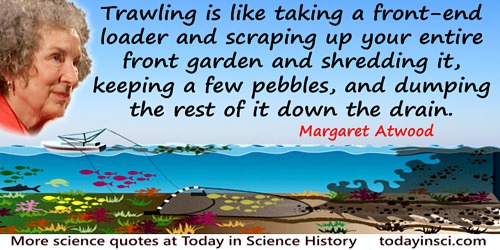
A huge net is being dragged across the sea floor, destroying everything in its path. Ahead of it bloom undersea forests and their hundreds and thousands of living creatures, both plant and animal; behind it is a desert. The net is pulled to the surface and most of the dead and dying life forms in it are thrown out. A few marketable species are retained. [Trawling] is like taking a front-end loader and scraping up your entire front garden and shredding it, keeping a few pebbles, and dumping the rest of it down the drain.
In Payback: Debt and the Shadow Side of Wealth (2008), 191.
A human being is part of the whole, called by us “Universe”; a part limited in time and space. He experiences himself, his thoughts and feelings as something separated from the rest—a kind of optical delusion of his consciousness. This delusion is a kind of prison for us, restricting us to our personal desires and to affection for a few persons nearest us. Our task must be to free ourselves from this prison by widening our circle of compassion to embrace all living creatures and the whole of nature in its beauty. Nobody is able to achieve this completely but the striving for such achievement is, in itself, a part of the liberation and a foundation for inner security.
In Letter (4 Mar 1950), replying to a grieving father over the loss of a young son. In Dear Professor Einstein: Albert Einstein’s Letters to and from Children (2002), 184.
A human being should be able to change a diaper, plan an invasion, butcher a hog, conn a ship, design a building, write a sonnet, balance accounts, build a wall, set a bone, comfort the dying, take orders, give orders, cooperate, act alone, solve equations, analyze a new problem, pitch manure, program a computer, cook a tasty meal, fight efficiently, die gallantly. Specialization is for insects.
In Time Enough for Love: The Lives of Lazarus Long (1973), 265.
A humanitarian is a man who believes that no human being should be sacrificed to a project—especially to the project of perfecting nuclear weapons to kill hundreds of millions of people.
From 'A Nobel Scientist Speaks: Every Test Kills', Liberation (Feb 1958), 2, No. 11. Also quoted in Barbara Marinacci and Ramesh Saligrama Krishnamurthy, Linus Pauling on Peace: A Scientist Speaks Out on Humanism and World Survival: Writings and Talks by Linus Pauling (1998), 118.
A layman will no doubt find it hard to understand how pathological disorders of the body and mind can be eliminated by 'mere' words. He will feel that he is being asked to believe in magic. And he will not be so very wrong, for the words which we use in our everyday speech are nothing other than watered-down magic. But we shall have to follow a roundabout path in order to explain how science sets about restoring to words a part at least of their former magical power.
Psychical (or Mental) Treatment (1905), In James Strachey (ed.), The Standard Edition of the Complete Psychological Works of Sigmund Freud (1953), Vol. 7, 283.
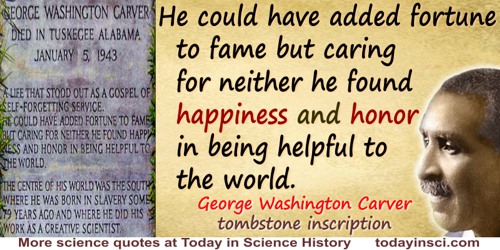
A life that stood out as a gospel of self-forgetting service.
He could have added fortune to fame but caring for neither he found happiness and honor in being helpful to the world.
The centre of his world was the south where he was born in slavery some 79 years ago and where he did his work as a creative scientist.
He could have added fortune to fame but caring for neither he found happiness and honor in being helpful to the world.
The centre of his world was the south where he was born in slavery some 79 years ago and where he did his work as a creative scientist.
Epitaph on tombstone at Tuskegee University Campus Cemetery, Alabama.
A mathematical truth is timeless, it does not come into being when we discover it. Yet its discovery is a very real event, it may be an emotion like a great gift from a fairy.
In 'Science and Religion', Mind and Matter (1958), collected in What is Life?: With Mind and Matter and Autobiographical Sketches (2012), 142.
A mathematician’s work is mostly a tangle of guesswork, analogy, wishful thinking and frustration, and proof, far from being the core of discovery, is more often than not a way of making sure that our minds are not playing tricks.
In Rota's 'Introduction' written (1980) to preface Philip J. Davis and Reuben Hersh, The Mathematical Experience (1981, 2012), xxii.
A men whose every word is nothing but the truth is not a human being but a god! Gods do not die, whereas Aristotle is lying in a grave now.
From the play Galileo Galilei (2001) .
A multitude of words doth rather obscure than illustrate, they being a burden to the memory, and the first apt to be forgotten, before we come to the last. So that he that uses many words for the explaining of any subject, doth, like the cuttle-fish, hide himself, for the most part, in his own ink.
— John Ray
The Wisdom of God Manifested in the Works of the Creation (1691).
A number of years ago, when I was a freshly-appointed instructor, I met, for the first time, a certain eminent historian of science. At the time I could only regard him with tolerant condescension.
I was sorry of the man who, it seemed to me, was forced to hover about the edges of science. He was compelled to shiver endlessly in the outskirts, getting only feeble warmth from the distant sun of science-in-progress; while I, just beginning my research, was bathed in the heady liquid heat up at the very center of the glow.
In a lifetime of being wrong at many a point, I was never more wrong. It was I, not he, who was wandering in the periphery. It was he, not I, who lived in the blaze.
I had fallen victim to the fallacy of the “growing edge;” the belief that only the very frontier of scientific advance counted; that everything that had been left behind by that advance was faded and dead.
But is that true? Because a tree in spring buds and comes greenly into leaf, are those leaves therefore the tree? If the newborn twigs and their leaves were all that existed, they would form a vague halo of green suspended in mid-air, but surely that is not the tree. The leaves, by themselves, are no more than trivial fluttering decoration. It is the trunk and limbs that give the tree its grandeur and the leaves themselves their meaning.
There is not a discovery in science, however revolutionary, however sparkling with insight, that does not arise out of what went before. “If I have seen further than other men,” said Isaac Newton, “it is because I have stood on the shoulders of giants.”
I was sorry of the man who, it seemed to me, was forced to hover about the edges of science. He was compelled to shiver endlessly in the outskirts, getting only feeble warmth from the distant sun of science-in-progress; while I, just beginning my research, was bathed in the heady liquid heat up at the very center of the glow.
In a lifetime of being wrong at many a point, I was never more wrong. It was I, not he, who was wandering in the periphery. It was he, not I, who lived in the blaze.
I had fallen victim to the fallacy of the “growing edge;” the belief that only the very frontier of scientific advance counted; that everything that had been left behind by that advance was faded and dead.
But is that true? Because a tree in spring buds and comes greenly into leaf, are those leaves therefore the tree? If the newborn twigs and their leaves were all that existed, they would form a vague halo of green suspended in mid-air, but surely that is not the tree. The leaves, by themselves, are no more than trivial fluttering decoration. It is the trunk and limbs that give the tree its grandeur and the leaves themselves their meaning.
There is not a discovery in science, however revolutionary, however sparkling with insight, that does not arise out of what went before. “If I have seen further than other men,” said Isaac Newton, “it is because I have stood on the shoulders of giants.”
Adding A Dimension: Seventeen Essays on the History of Science (1964), Introduction.
A person who is religiously enlightened appears to me to be one who has, to the best of his ability, liberated himself from the fetters of his selfish desires and is preoccupied with thoughts, feelings, and aspirations to which he clings because of their superpersonal value. It seems to me that what is important is the force of this superpersonal content and the depth of the conviction concerning its overpowering meaningfulness, regardless of whether any attempt is made to unite this content with a divine Being, for otherwise it would not be possible to count Buddha and Spinoza as religious personalities. Accordingly, a religious person is devout in the sense that he has no doubt of the significance and loftiness of those superpersonal objects and goals which neither require nor are capable of rational foundation. They exist with the same necessity and matter-of-factness as he himself. In this sense religion is the age-old endeavor of mankind to become clearly and completely conscious of these values and goals and constantly to strengthen and extend their effect. If one conceives of religion and science according to these definitions then a conflict between them appears impossible. For science can only ascertain what is, but not what should be, and outside of its domain value judgments of all kinds remain necessary.
…...
A science calling itself “psychology” and professing to be a science of the human mind (not merely the sick mind), ought to form its estimate of human beings by taking into account healthy minds as well as sick ones.
In Introduction to the New Existentialism (1966), 15.
A science or an art may be said to be “useful” if its development increases, even indirectly, the material well-being and comfort of men, it promotes happiness, using that word in a crude and commonplace way.
In A Mathematician's Apology (1940, 2012), 115.
A scientist should be the happiest of men. Not that science isn't serious; but as everyone knows, being serious is one way of being happy, just as being gay is one way of being unhappy.
Nobel banquet speech (10 Dec 1967). In Ragnar Granit (ed.), Les Prix Nobel en 1967 (1968).
A sound Physics of the Earth should include all the primary considerations of the earth's atmosphere, of the characteristics and continual changes of the earth's external crust, and finally of the origin and development of living organisms. These considerations naturally divide the physics of the earth into three essential parts, the first being a theory of the atmosphere, or Meteorology, the second, a theory of the earth's external crust, or Hydrogeology, and the third, a theory of living organisms, or Biology.
Hydrogéologie (1802), trans. A. V. Carozzi (1964), 18.
A statistician is one who has learned how to get valid evidence from statistics and how (usually) to avoid being misled by irrelevant facts. It’s too bad that we apply the same name to this kind of person that we use for those who only tabulate. It’s as if we had the same name for barbers and brain surgeons because they both work on the head.
In How to Tell the Liars from the Statisticians (1983), 1.
A study of Disease—of Pestilences methodically prepared and deliberately launched upon man and beast—is certainly being pursued in the laboratories of more than one great country. Blight to destroy crops, Anthrax to slay horses and cattle, Plague to poison not armies but whole districts—such are the lines along which military science is remorselessly advancing.
'Shall We All Commit Suicide?'. Pall Mall (Sep 1924). Reprinted in Thoughts and Adventures (1932), 250.
A theory has only the alternative of being right or wrong. A model has a third possibility: it may be right, but irrelevant.
Manfred Eigen, 'The Origin of Biological Information', in Jagdish Mehra (ed.), The Physicists's Conception of Nature (1973), 618.
A time will come when science will transform [our bodies] by means which we cannot conjecture... And then, the earth being small, mankind will migrate into space, and will cross the airless Saharas which separate planet from planet, and sun from sun. The earth will become a Holy Land which will be visited by pilgrims from all quarters of the universe.
…...
A tool is but the extension of a man’s hand, and a machine is but a complex tool. He that invents a machine augments the power of a man and the well being of mankind.
In Proverbs from Plymouth Pulpit (1887), 44. It appears as one of the quotations featured in one of the hallways of the first floor of the U.S. Capitols House wing, which are known as the Cox Corridors, after Allyn Cox, the artist who decorated them.
A work of morality, politics, criticism will be more elegant, other things being equal, if it is shaped by the hand of geometry.
From Préface sur l'Utilité des Mathématiques et de la Physique (1729), as translated in Florian Cajori, Mathematics in Liberal Education (1928), 61.
About 6 or 8 years ago My Ingenious friend Mr John Robinson having [contrived] conceived that a fire engine might be made without a Lever—by Inverting the Cylinder & placing it above the mouth of the pit proposed to me to make a model of it which was set about by having never Compleated & I [being] having at that time Ignorant little knoledge of the machine however I always thought the Machine Might be applied to [more] other as valuable purposes [than] as drawing Water.
Entry in notebook (1765). The bracketed words in square brackets were crossed out by Watt. in Eric Robinson and Douglas McKie (eds.), Partners in Science: Letters of James Watt and Joseph Black (1970), 434.
About ten months ago [1609] a report reached my ears that a certain Fleming [Hans Lippershey] had constructed a spyglass, by means of which visible objects, though very distant from the eye of the observer, were distinctly seen as if nearby... Of this truly remarkable effect several experiences were related, to which some persons gave credence while others denied them. A few days later the report was confirmed to me in a letter from a noble Frenchman at Paris, Jacques Badovere, which caused me to apply myself wholeheartedly to enquire into the means by which I might arrive at the invention of a similar instrument. This I did shortly afterwards, my basis being the theory of refraction. First I prepared a tube of lead, at the ends of which I fitted two glass lenses, both plane on one side while on the other side one was spherically convex and the other concave.
The Starry Messenger (1610), trans. Stillman Drake, Discoveries and Opinions of Galileo (1957), 28-9.
About the year 1772, being then an apprentice to a wheel-wright, or wagon maker, I laboured to discover some means of propelling land carriages without animal power. … one of my brothers [told me of] blacksmith’s boys, who, for amusement, had stopped up the touch hole of a gun barrel, then put in about a gill of water, and rammed down a tight wad; after which they put the breech in the smith’s fire, when it discharged itself with as loud a crack as if it had been loaded with powder. It immediately occurred to me, that here was the power to propel any wagon, if I could only apply it.
From 'On the Origin of Steam Boats and Steam Wagons', Thomas Cooper (ed.), The Emporium of Arts and Sciences (Feb 1814), 2, No. 2, 205.
Absorbed in the special investigation, I paid no heed to the edifice which was meanwhile unconsciously building itself up. Having however completed the comparison of the fossil species in Paris, I wanted, for the sake of an easy revision of the same, to make a list according to their succession in geological formations, with a view of determining the characteristics more exactly and bringing them by their enumeration into bolder relief. What was my joy and surprise to find that the simplest enumeration of the fossil fishes according to their geological succession was also a complete statement of the natural relations of the families among themselves; that one might therefore read the genetic development of the whole class in the history of creation, the representation of the genera and species in the several families being therein determined; in one word, that the genetic succession of the fishes corresponds perfectly with their zoological classification, and with just that classification proposed by me.
Quoted in Elizabeth Cary Agassiz (ed.), Louis Agassiz: His Life and Correspondence (1885), Vol. I, 203-4.
According to the theory of aerodynamics, as may be readily demonstrated through wind tunnel experiments, the bumblebee is unable to fly. This is because the size, weight and shape of his body in relation to the total wingspread make flying impossible. But the bumblebee, being ignorant of these scientific truths, goes ahead and flies anyway—and makes a little honey every day.
Sign in a General Motors Corporation factory. As quoted in Ralph L. Woods, The Businessman's
Book of Quotations (1951), 249-50. Cited in Suzy Platt (ed)., Respectfully Quoted: A Dictionary of Quotations (1989), 118.
Add to this the pride of achievement; the desire to rank among the successful souls on earth, and we have the factors which have brought some of the ablest of human beings into the limelight that revealed them to an admiring world, as leaders and examples.
Quoted, without citation, in front matter to T. A. Edison Foundation, Lewis Howard Latimer: A Black Inventor: a Biography and Related Experiments You Can Do (1973). If you know the primary source, please contact Webmaster.
After some experiments made one day at my house upon the phosphorus, a little piece of it being left negligently upon the table in my chamber, the maid making the bed took it up in the bedclothes she had put on the table, not seeing the little piece. The person who lay afterwards in the bed, waking at night and feeling more than ordinary heat, perceived that the coverlet was on fire.
Quoted in John Emsley, The 13th Element: The Sordid Tale of Murder, Fire, and Phosphorus (2000), 11.
After the planet becomes theirs, many millions of years will have to pass before a beetle particularly loved by God, at the end of its calculations will find written on a sheet of paper in letters of fire that energy is equal to the mass multiplied by the square of the velocity of light. The new kings of the world will live tranquilly for a long time, confining themselves to devouring each other and being parasites among each other on a cottage industry scale.
'Beetles' Other People’s Trades (1985, trans. 1989).
All cell biologists are condemned to suffer an incurable secret sorrow: the size of the objects of their passion. … But those of us enamored of the cell must resign ourselves to the perverse, lonely fascination of a human being for things invisible to the naked human eye.
Opening sentence from The Center of Life: A Natural History of the Cell (1977, 1978), 5.
All change is relative. The universe is expanding relatively to our common material standards; our material standards are shrinking relatively to the size of the universe. The theory of the “expanding universe” might also be called the theory of the “shrinking atom”. …
:Let us then take the whole universe as our standard of constancy, and adopt the view of a cosmic being whose body is composed of intergalactic spaces and swells as they swell. Or rather we must now say it keeps the same size, for he will not admit that it is he who has changed. Watching us for a few thousand million years, he sees us shrinking; atoms, animals, planets, even the galaxies, all shrink alike; only the intergalactic spaces remain the same. The earth spirals round the sun in an ever-decreasing orbit. It would be absurd to treat its changing revolution as a constant unit of time. The cosmic being will naturally relate his units of length and time so that the velocity of light remains constant. Our years will then decrease in geometrical progression in the cosmic scale of time. On that scale man’s life is becoming briefer; his threescore years and ten are an ever-decreasing allowance. Owing to the property of geometrical progressions an infinite number of our years will add up to a finite cosmic time; so that what we should call the end of eternity is an ordinary finite date in the cosmic calendar. But on that date the universe has expanded to infinity in our reckoning, and we have shrunk to nothing in the reckoning of the cosmic being.
We walk the stage of life, performers of a drama for the benefit of the cosmic spectator. As the scenes proceed he notices that the actors are growing smaller and the action quicker. When the last act opens the curtain rises on midget actors rushing through their parts at frantic speed. Smaller and smaller. Faster and faster. One last microscopic blurr of intense agitation. And then nothing.
:Let us then take the whole universe as our standard of constancy, and adopt the view of a cosmic being whose body is composed of intergalactic spaces and swells as they swell. Or rather we must now say it keeps the same size, for he will not admit that it is he who has changed. Watching us for a few thousand million years, he sees us shrinking; atoms, animals, planets, even the galaxies, all shrink alike; only the intergalactic spaces remain the same. The earth spirals round the sun in an ever-decreasing orbit. It would be absurd to treat its changing revolution as a constant unit of time. The cosmic being will naturally relate his units of length and time so that the velocity of light remains constant. Our years will then decrease in geometrical progression in the cosmic scale of time. On that scale man’s life is becoming briefer; his threescore years and ten are an ever-decreasing allowance. Owing to the property of geometrical progressions an infinite number of our years will add up to a finite cosmic time; so that what we should call the end of eternity is an ordinary finite date in the cosmic calendar. But on that date the universe has expanded to infinity in our reckoning, and we have shrunk to nothing in the reckoning of the cosmic being.
We walk the stage of life, performers of a drama for the benefit of the cosmic spectator. As the scenes proceed he notices that the actors are growing smaller and the action quicker. When the last act opens the curtain rises on midget actors rushing through their parts at frantic speed. Smaller and smaller. Faster and faster. One last microscopic blurr of intense agitation. And then nothing.
In The Expanding Universe (1933) , 90-92.
All frescoes are as high finished as miniatures or enamels, and they are known to be unchangeable; but oil, being a body itself, will drink or absorb very little colour, and changing yellow, and at length brown, destroys every colour it is mixed with, especially every delicate colour. It turns every permanent white to a yellow and brown putty, and has compelled the use of that destroyer of colour, white lead, which, when its protecting oil is evaporated, will become lead again. This is an awful thing to say to oil painters ; they may call it madness, but it is true. All the genuine old little pictures, called cabinet pictures, are in fresco and not in oil. Oil was not used except by blundering ignorance till after Vandyke’s time ; but the art of fresco painting being lost, oil became a fetter to genius and a dungeon to art.
In 'Opinions', The Poems: With Specimens of the Prose Writings of William Blake (1885), 276-277.
All infections, of whatever type, with no exceptions, are products of parasitic beings; that is, by living organisms that enter in other living organisms, in which they find nourishment, that is, food that suits them, here they hatch, grow and reproduce themselves.
Quoted in English in Paolo Mazzarello, The Hidden Structure: A Scientific Biography of Camillo Golgi (1999), trans. and ed. Henry A. Buchtel and Aldo Hadiani, 19.
All life is linked together in such a way that no part of the chain is unimportant. Frequently, upon the action of some of these minute beings depends the material success or failure of a great commonwealth.
Insect Life: An Introduction To Nature-Study And A Guide For Teachers (1897), 1.
All Nature is linked together by invisible bonds and every organic creature, however low, however feeble, however dependent, is necessary to the well-being of some other among the myriad forms of life.
From Man and Nature (1864), 109.
All other men, being born of woman, have a navel, by reason of the umbilical vessels inserted into it, which from the placenta carry nourishment to children in the womb of their mothers; but it could not be so with our first parents. It cannot be believed that God gave them navels which would have been altogether useless.
A Treatise of Laws of Nature (1727).
All sciences originated among the sons of Israel, the reason being the existence of prophecy among them which made their perfection in the sciences amazing.
— Averroes
In Benzion Netanyahu, Don Isaac Abravanel, Statesman and Philosopher (1953, 1998), 100. Footnote gives: See Abravanel’s Comm, on Gen., io.i (f. 48, col. 4). The corresponding passage in Happoint ha-Happalah (Hebrew translation of Averroes’ Destruction of the Destruction, by Kalonymos ben David ben Todros, Bodleian Library, Michael Collection, Ms. 293, ff. 137b-138a) is somewhat different. Abravanel might have used the other Hebrew translation (MS. in Leyden) of Averroes' work (cf. Steinschneider, Uebersetzungen, pp. 333-4).
All that we can do, is to keep steadily in mind that each organic being is striving to increase at a geometrical ratio; that each at some period of its life, during some season of the year, during each generation or at intervals, has to struggle for life, and to suffer great destruction. When we reflect on this struggle, we may console ourselves with the full belief, that the war of nature is not incessant, that no fear is felt, that death is generally prompt, and that the vigorous, the healthy, and the happy survive and multiply.
From On the Origin of Species by Means of Natural Selection; or, The Preservation of Favoured Races in the Struggle for Life (1861), 76.
All the different classes of beings which taken together make up the universe are, in the ideas of God who knows distinctly their essential gradations, only so many ordinates of a single curve so closely united that it would be impossible to place others between any two of them, since that would imply disorder and imperfection. Thus men are linked with the animals, these with the plants and these with the fossils which in turn merge with those bodies which our senses and our imagination represent to us as absolutely inanimate. And, since the law of continuity requires that when the essential attributes of one being approximate those of another all the properties of the one must likewise gradually approximate those of the other, it is necessary that all the orders of natural beings form but a single chain, in which the various classes, like so many rings, are so closely linked one to another that it is impossible for the senses or the imagination to determine precisely the point at which one ends and the next begins?all the species which, so to say, lie near the borderlands being equivocal, at endowed with characters which might equally well be assigned to either of the neighboring species. Thus there is nothing monstrous in the existence zoophytes, or plant-animals, as Budaeus calls them; on the contrary, it is wholly in keeping with the order of nature that they should exist. And so great is the force of the principle of continuity, to my thinking, that not only should I not be surprised to hear that such beings had been discovered?creatures which in some of their properties, such as nutrition or reproduction, might pass equally well for animals or for plants, and which thus overturn the current laws based upon the supposition of a perfect and absolute separation of the different orders of coexistent beings which fill the universe;?not only, I say, should I not be surprised to hear that they had been discovered, but, in fact, I am convinced that there must be such creatures, and that natural history will perhaps some day become acquainted with them, when it has further studied that infinity of living things whose small size conceals them for ordinary observation and which are hidden in the bowels of the earth and the depth of the sea.
Lettre Prétendue de M. De Leibnitz, à M. Hermann dont M. Koenig a Cité le Fragment (1753), cxi-cxii, trans. in A. O. Lovejoy, Great Chain of Being: A Study of the History of an Idea (1936), 144-5.
All the experiments which have been hitherto carried out, and those that are still being daily performed, concur in proving that between different bodies, whether principles or compounds, there is an agreement, relation, affinity or attraction (if you will have it so), which disposes certain bodies to unite with one another, while with others they are unable to contract any union: it is this effect, whatever be its cause, which will help us to give a reason for all the phenomena furnished by chemistry, and to tie them together.
From Elemens de Chymie Theorique (1749). As quoted, in Trevor Harvey Levere, Affinity and Matter: Elements of Chemical Philosophy, 1800-1865 (1971), 17.
All the human culture, all the results of art, science and technology that we see before us today, are almost exclusively the creative product of the Aryan. This very fact admits of the not unfounded inference that he alone was the founder of all higher humanity, therefore representing the prototype of all that we understand by the word 'man.' He is the Prometheus of mankind from whose shining brow the divine spark of genius has sprung at all times, forever kindling anew that fire of knowledge which illuminated the night of silent mysteries and thus caused man to climb the path to mastery over the other beings of the earth ... It was he who laid the foundations and erected the walls of every great structure in human culture.
Mein Kampf (1925-26), American Edition (1943), 290. In William Lawrence Shirer, The Rise and Fall of the Third Reich (1990), 86-87.
All things are made of atoms—little particles that move around in perpetual motion, attracting each other when they are a little distance apart, but repelling upon being squeezed into one another. In that one sentence ... there is an enormous amount of information about the world.
His suggestion that the most valuable information on scientific knowledge in a single sentence using the fewest words is to state the atomic hypothesis.
His suggestion that the most valuable information on scientific knowledge in a single sentence using the fewest words is to state the atomic hypothesis.
Six Easy Pieces (1995), 4.
All things that come into being and grow are earth and water.
Quoted in Arthur Fairbanks (ed. And trans.), The First Philosophers of Greece (1898), 69, fragment 10.
All truth passes through three stages. First, it is ridiculed. Second, it is violently opposed. Third, it is accepted as being self-evident. [Caution: expressed in this wording, it is likely misattributed.]
Schopenhauer did write a different reflection with this theme, much less tersely, on how the acceptance of truth has “only one short victory celebration is granted between the two long periods where it is despised as paradox and condemned as trivial.” See the Introduction to The World as Will and Representation (1819), xvi. The “three stages” quote is included here so it may be found with this caution: it is questionable that Schopenhauer expressed this idea with this wording. Although widely repeated, Webmaster has not yet found any citation to a primary source for these words. (Schopenhauer was German, so any quote in English represents a translation.) According to Ralph Keys, diligent search by scholars has found no written source in German, either. The sentiment has been variously restated and attributed to other authors. A somewhat better-documented version of the “three stages of truth” is attributed to Louis Agassiz, though still with only second-person references. See Ralph Keyes, The Quote Verifier (2006), 225-226.
Almighty God, to whose efficacious Word all things owe their original, abounding in his own glorious Essence with infinite goodness and fecundity, did in the beginning Create Man after his own likeness, Male and Female, created he them; the true distinction of which Sexes, consists merely in the different site of those parts of the body, wherein Generation necessarily requires a Diversity: for both Male and Female he impartially endued with the same, and altogether indifferent form of Soul, the Woman being possess’d of no less excellent Faculties of Mind, Reason, and Speech, than the Man, and equally with him aspiring to those Regions of Bliss and Glory, where there shall be no exception of Sex.
In Female Pre-eminence: Or, The Dignity and Excellency of that Sex above the Male, translation (1670).
Almost daily we shudder as prophets of doom announce the impending end of civilization and universe. We are being asphyxiated, they say, by the smoke of the industry; we are suffocating in the ever growing mountain of rubbish. Every new project depicts its measureable effects and is denounced by protesters screaming about catastrophe, the upsetting of the land, the assault on nature. If we accepted this new mythology we would have to stop pushing roads through the forest, harnessing rivers to produce the electricity, breaking grounds to extract metals, enriching the soil with chemicals, killing insects, combating viruses … But progress—basically, an effort to organise a corner of land and make it more favourable for human life—cannot be baited. Without the science of pomiculture, for example, trees will bear fruits that are small, bitter, hard, indigestible, and sour. Progress is desirable.
Uncredited. In Lachman Mehta, Stolen Treasure (2012), 117.
Although my Aachen colleagues and students at first regarded the “pure mathematician” with suspicion, I soon had the satisfaction of being accepted a useful member not merely in teaching but also engineering practice; thus I was requested to render expert opinions and to participate in the Ingenieurverein [engineering association].
As quoted in Paul Forman and Armin Hermann, 'Sommerfeld, Arnold (Johannes Wilhelm)', Biography in Dictionary of Scientific Biography (1975), Vol. 12, 527. Cited from 'Autobiographische Skizze', Gesammelte Schriften, Vol 4, 673–682.
Among natural bodies some have, and some have not, life; and by life we mean the faculties of self-nourishment, self-growth and self-decay. Thus every natural body partaking of life may be regarded as an essential existence; … but then it is an existence only in combination. … And since the organism is such a combination, being possessed of life, it cannot be the Vital Principle. Therefore it follows that the Vital Principle most be an essence, as being the form of a natural body, holding life in potentiality; but essence is a reality (entetechie). The Vital Principle is the original reality of a natural body endowed with potential life; this, however, is to be understood only of a body which may be organized. Thus the parts even of plants are organs, but they are organs that are altogether simple; as the leaf which is the covering of the pericarp, the pericarp of the fruit. If, then, there be any general formula for every kind of Vital Principle, it is—tthe primary reality of an organism.
In George Henry Lewes, Aristotle (1864), 231.
Among the studies to which the [Rockefeller] Foundation is giving support is a series in a relatively new field, which may be called molecular biology, in which delicate modern techniques are being used to investigate ever more minute details of certain life processes.
In 'Molecular Biology', Annual Report of the Rockefeller Foundation (1938), 203-4. Reprinted in a letter to Science (6 Nov 1970), 170, 582.
An event experienced is an event perceived, digested, and assimilated into the substance of our being, and the ratio between the number of cases seen and the number of cases assimilated is the measure of experience.
Address, opening of 1932-3 session of U.C.H. Medical School (4 Oct 1932), 'Art and Science in medicine', The Collected Papers of Wilfred Trotter, FRS (1941), 98.
An experiment is an observation that can be repeated, isolated and varied. The more frequently you can repeat an observation, the more likely are you to see clearly what is there and to describe accurately what you have seen. The more strictly you can isolate an observation, the easier does your task of observation become, and the less danger is there of your being led astray by irrelevant circumstances, or of placing emphasis on the wrong point. The more widely you can vary an observation, the more clearly will the uniformity of experience stand out, and the better is your chance of discovering laws.
In A Text-Book of Psychology (1909), 20.
An extra-terrestrial philosopher, who had watched a single youth up to the age of twenty-one and had never come across any other human being, might conclude that it is the nature of human beings to grow continually taller and wiser in an indefinite progress towards perfection; and this generalization would be just as well founded as the generalization which evolutionists base upon the previous history of this planet.
Scientific Method in Philosophy (1914), 12.
An extraterrestrial being, newly arrived on Earth - scrutinizing what we mainly present to our children in television, radio, movies, newspapers, magazines, the comics, and many books - might easily conclude that we are intent on teaching them murder, rape, cruelty, superstition, credulity and consumerism.
…...
An idea must not be condemned for being a little shy and incoherent; all new ideas are shy when introduced first among our old ones. We should have patience and see whether the incoherency is likely to wear off or to wear on, in which latter case the sooner we get rid of them the better.
In Samuel Butler and Henry Festing Jones (ed.), 'Higgledy-Piggledy', The Note-books of Samuel Butler (1912, 1917), 216-217.
An idea must not be condemned for being a little shy and incoherent; all new ideas are shy when introduced first among our old ones. We should have patience and see whether the incoherency is likely to wear off or to wear on, in which latter case the sooner we get rid of them the better.
Samuel Butler, Henry Festing Jones (ed.), The Note-Books of Samuel Butler (1917), 216-217.
An indispensable hypothesis, even though still far from being a guarantee of success, is however the pursuit of a specific aim, whose lighted beacon, even by initial failures, is not betrayed.
Nobel Lecture (2 Jun 1920), in Nobel Lectures in Physics, 1901-1921 (1998), 407.
An iron rod being placed on the outside of a building from the highest part continued down into the moist earth, in any direction strait or crooked, following the form of the roof or other parts of the building, will receive the lightning at its upper end, attracting it so as to prevent it's striking any other part; and, affording it a good conveyance into the earth, will prevent its damaging any part of the building.
Of Lightning, and the Method (now used in America) of securing Buildings and Persons from its mischievous Effects', Paris 1767. In I. Bernard Cohen (ed.), Benjamin Franklin's Experiments (1941), 390.
Anaxagoras of Clazomenae, son of Hegesiboulos, held that the first principles of things were the homoeomeries. For it seemed to him quite impossible that anything should come into being from the non-existent or be dissolved into it. Anyhow we take in nourishment which is simple and homogeneous, such as bread or water, and by this are nourished hair, veins, arteries, flesh, sinews, bones and all the other parts of the body. Which being so, we must agree that everything that exists is in the nourishment we take in, and that everything derives its growth from things that exist. There must be in that nourishment some parts that are productive of blood, some of sinews, some of bones, and so on-parts which reason alone can apprehend. For there is no need to refer the fact that bread and water produce all these things to sense-perception; rather, there are in bread and water parts which only reason can apprehend.
Aetius 1.3.5. In G. S. Kirk, J. E. Raven and M. Schofield (eds), The Presocratic Philosophers: A Critical History with a Selection of Texts (1983), p. 375.
Anaximenes ... also says that the underlying nature is one and infinite ... but not undefined as Anaximander said but definite, for he identifies it as air; and it differs in its substantial nature by rarity and density. Being made finer it becomes fire; being made thicker it becomes wind, then cloud, then (when thickened still more) water, then earth, then stones; and the rest come into being from these.
Simplicius, Commentary on Aristotle’s Physics, 24, 26-31, quoting Theophrastus on Anaximenes. In G. S. Kirk, J. E. Raven and M.Schofield (eds), The Presocratic Philosophers: A Critical History with a Selection of Texts (1983), p. 145.
Anaximenes ... declared that air is the principle of existing things; for from it all things come-to-be and into it they are again dissolved. As our soul, he says, being air holds us together and controls us, so does wind [or breath] and air enclose the whole world.
Aetius, 1, 3, 4. In G. S. Kirk, J. E. Raven and M.Schofield (eds), The Presocratic Philosophers: A Critical History with a Selection of Texts (1983), p. 158-9.
Anaximenes ... said that infinite air was the principle, from which the things that are becoming, and that are, and that shall be, and gods and things divine, all come into being, and the rest from its products. The form of air is of this kind: whenever it is most equable it is invisible to sight, but is revealed by the cold and the hot and the damp and by movement. It is always in motion; for things that change do not change unless there be movement. Through becoming denser or finer it has different appearances; for when it is dissolved into what is finer it becomes fire, while winds, again, are air that is becoming condensed, and cloud is produced from air by felting. When it is condensed still more, water is produced; with a further degree of condensation earth is produced, and when condensed as far as possible, stones. The result is that the most influential components of the generation are opposites, hot and cold.
Hippolytus, Refutation, 1.7.1. In G. S. Kirk, J. E. Raven and M. Schofield (eds.), The Presocratic Philosophers: A Critical History with a Selection of Texts (1983), p. 145.
And as to the faculties of the mind, setting aside the arts grounded upon words, and especially that skill of proceeding upon generall, and infallible rules, called Science; which very few have, and but in few things; as being not a native faculty, born within us; nor attained, (as Prudence,) while we look after somewhat else.
Leviathan (1651), ed. C. B. Macpherson (1968), Part 1, Chapter 13, 183.
And by the influence of heat, light, and electrical powers, there is a constant series of changes [in animal and vegetal substances]; matter assumes new forms, the destruction of one order of beings tends to the conservation of another, solution and consolidation, decay and renovation, are connected, and whilst the parts of the system, continue in a state of fluctuation and change, the order and harmony of the whole remain unalterable.
The Elements of Agricultural Chemistry (1813), in J. Davy (ed.) The Collected Works of Sir Humphry Davy(1839-40), Vol 7, 182.
And for rejecting such a Medium, we have the Authority of those the oldest and most celebrated Philosophers of Greece and Phoenicia, who made a Vacuum, and Atoms, and the Gravity of Atoms, the first Principles of their Philosophy; tacitly attributing Gravity to some other Cause than dense Matter. Later Philosophers banish the Consideration of such a Cause out of natural Philosophy, feigning Hypotheses for explaining all things mechanically, and referring other Causes to Metaphysicks: Whereas the main Business of natural Philosophy is to argue from Phaenomena without feigning Hypotheses, and to deduce Causes from Effects, till we come to the very first Cause, which certainly is not mechanical; and not only to unfold the Mechanism of the World, but chiefly to resolve these and such like Questions. What is there in places almost empty of Matter, and whence is it that the Sun and Planets gravitate towards one another, without dense Matter between them? Whence is it that Nature doth nothing in vain; and whence arises all that Order and Beauty which we see in the World? ... does it not appear from phaenomena that there is a Being incorporeal, living, intelligent, omnipresent, who in infinite space, as it were in his Sensory, sees the things themselves intimately, and thoroughly perceives them, and comprehends them wholly by their immediate presence to himself.
In Opticks, (1704, 2nd. Ed. 1718), Book 3, Query 28, 343-5. Newton’s reference to “Nature does nothing in vain” recalls the axiom from Aristotle, which may be seen as “Natura nihil agit frustra” in the Aristotle Quotes on this web site.
And I believe there are many Species in Nature, which were never yet taken notice of by Man, and consequently of no use to him, which yet we are not to think were created in vain; but it’s likely … to partake of the overflowing Goodness of the Creator, and enjoy their own Beings. But though in this sense it be not true, that all things were made for Man; yet thus far it is, that all the Creatures in the World may be some way or other useful to us, at least to exercise our Wits and Understandings, in considering and contemplating of them, and so afford us Subject of Admiring and Glorifying their and our Maker. Seeing them, we do believe and assert that all things were in some sense made for us, we are thereby obliged to make use of them for those purposes for which they serve us, else we frustrate this End of their Creation.
— John Ray
The Wisdom of God Manifested in the Works of the Creation (1691), 169-70.
And so I conclude that blood lives and is nourished of itself and in no way depends on any other part of the body as being prior to it or more excellent... So that from this we may perceive the causes not only of life in general... but also of longer or shorter life, of sleeping and waking, of skill, of strength and so forth.
Disputations Touching the Generation of Animals (1651), trans. Gweneth Whitteridge (1981), Chapter 52, 247. Alternate translation: “We conclude that blood lives of itself and that it depends in no ways upon any parts of the body. Blood is the cause not only of life in general, but also of longer or shorter life, of sleep and waking, of genius, aptitude, and strength. It is the first to live and the last to die.”
And, to prevent mistakes, I must advertize you, that I now mean by elements, as those chymists that speak plainest do by their principles, certain primitive or simple, or perfectly unmingled bodies; which not being made of any other bodies, or of one another, are the ingredients of which all those called perfectly mixt bodies are immediately compounded, and into which they are ultimately resolved: now whether there be any such body to be constantly met with in all, and each, of those that are said to be elemented bodies, is the thing I now question.
The Sceptical Chemist (2nd ed., 1661), Appendix, 354. As given in Henry M. Leicester and Herbert S. Klickstein, A Source Book in Chemistry 1400-1900 (1952), 42.
Another diversity of Methods is according to the subject or matter which is handled; for there is a great difference in delivery of the Mathematics, which are the most abstracted of knowledges, and Policy, which is the most immersed…, yet we see how that opinion, besides the weakness of it, hath been of ill desert towards learning, as that which taketh the way to reduce learning to certain empty and barren generalities; being but the very husks and shells of sciences, all the kernel being forced out and expulsed with the torture and press of the method.
Advancement of Learning, Book 2. In James Spedding, The Works of Francis Bacon (1863), Vol. 6, 292-293. Peter Pešić, explains that 'By Mathematics, he had in mind a sterile and rigid scheme of logical classifications, called dichotomies in his time,' inLabyrinth: A Search for the Hidden Meaning of Science (2001), 73.
Anthropology is the study of human beings as creatures of society. It fastens its attention upon those physical characteristics and industrial techniques, those conventions and values, which distinguish one community from all others that belong to a different tradition.
In 'The Science of Custom', Patterns of Culture (1934, 2005), 1.
Ants are so much like human beings as to be an embarrassment. They farm fungi, raise aphids as livestock, launch armies into wars, use chemical sprays to alarm and confuse enemies, capture slaves…. They exchange information ceaselessly. They do everything but watch television.
(1974) In 'On Societies as Organisms', A Long Line of Cells: Collected Essays (1990), 10.
Any man who is intelligent must, on considering that health is of the utmost value to human beings, have the personal understanding necessary to help himself in diseases, and be able to understand and to judge what physicians say and what they administer to his body, being versed in each of these matters to a degree reasonable for a layman.
Affections, in Hippocrates, trans. P. Potter (1988), Vol. 5, 7.
Archimedes … had stated that given the force, any given weight might be moved, and even boasted, we are told, relying on the strength of demonstration, that if there were another earth, by going into it he could remove this. Hiero being struck with amazement at this, and entreating him to make good this problem by actual experiment, and show some great weight moved by a small engine, he fixed accordingly upon a ship of burden out of the king’s arsenal, which could not be drawn out of the dock without great labor and many men; and, loading her with many passengers and a full freight, sitting himself the while far off with no great endeavor, but only holding the head of the pulley in his hand and drawing the cords by degrees, he drew the ship in a straight line, as smoothly and evenly, as if she had been in the sea. The king, astonished at this, and convinced of the power of the art, prevailed upon Archimedes to make him engines accommodated to all the purposes, offensive and defensive, of a siege. … the apparatus was, in most opportune time, ready at hand for the Syracusans, and with it also the engineer himself.
— Plutarch
In John Dryden (trans.), Life of Marcellus.
Archimedes was not free from the prevailing notion that geometry was degraded by being employed to produce anything useful. It was with difficulty that he was induced to stoop from speculation to practice. He was half ashamed of those inventions which were the wonder of hostile nations, and always spoke of them slightingly as mere amusements, as trifles in which a mathematician might be suffered to relax his mind after intense application to the higher parts of his science.
In Lord Bacon', Edinburgh Review (Jul 1887), in Critical and Miscellaneous Essays (1879), Vol. 1, 395.
Architecture has its political Use; publick Buildings being the Ornament of a Country; it establishes a Nation, draws People and Commerce; makes the People love their native Country, which Passion is the Original of all great Actions in a Common-wealth…. Architecture aims at Eternity.
In Charles Henry Bellenden Ker, Sir Christopher Wren (1828), 1.
Are you aware that humanity is just a blip? Not even a blip. Just a fraction of a fraction of what the universe has been and will become? Talk about perspective. I figure I can’t feel so entirely stupid about saying what I said because, first of all, it’s true. And second of all, there will be no remnant of me or my stupidity. No fossil or geographical shift that can document, really, even the most important historical human beings, let alone my paltry admissions.
In novel, The Rug Merchant (2006), 119.
Art arises in those strange complexities of action that are called human beings. It is a kind of human behavior. As such it is not magic, except as human beings are magical. Nor is it concerned in absolutes, eternities, “forms,” beyond those that may reside in the context of the human being and be subject to his vicissitudes. Art is not an inner state of consciousness, whatever that may mean. Neither is it essentially a supreme form of communication. Art is human behavior, and its values are contained in human behavior.
In Art Is Action: A Discussion of Nine Arts in a Modern World (1939), 1.
Arts and sciences in one and the same century have arrived at great perfection; and no wonder, since every age has a kind of universal genius, which inclines those that live in it to some particular studies; the work then, being pushed on by many hands, must go forward.
In Samuel Austin Allibone, Prose Quotations from Socrates to Macaulay (1880), 45.
As a boy I had liked both drawing and physics, and I always abhorred the role of being a spectator. In 1908, when I was 15, I designed, built and flew a toy model airplane which won the then-famous James Gordon Bennett Cup. By 16 I had discovered that design could be fun and profitable, and this lesson has never been lost on me.
On the official Raymond Loewry website.
As a nation, we are too young to have true mythic heroes, and we must press real human beings into service. Honest Abe Lincoln the legend is quite a different character from Abraham Lincoln the man. And so should they be. And so should both be treasured, as long as they are distinguished. In a complex and confusing world, the perfect clarity of sports provides a focus for legitimate, utterly unambiguous support or disdain. The Dodgers are evil, the Yankees good. They really are, and have been for as long as anyone in my family can remember.
…...
As an antiquary of a new order, I have been obliged to learn the art of deciphering and restoring these remains, of discovering and bringing together, in their primitive arrangement, the scattered and mutilated fragments of which they are composed, of reproducing in all their original proportions and characters, the animals to which these fragments formerly belonged, and then of comparing them with those animals which still live on the surface of the earth; an art which is almost unknown, and which presupposes, what had scarcely been obtained before, an acquaintance with those laws which regulate the coexistence of the forms by which the different parts of organized being are distinguished.
'Preliminary discourse', to Recherches sur les Ossemens Fossiles (1812), trans. R. Kerr Essay on the Theory of the Earth (1813), 1-2.
As every circumstance relating to so capital a discovery as this (the greatest, perhaps, that has been made in the whole compass of philosophy, since the time of Sir Isaac Newton) cannot but give pleasure to all my readers, I shall endeavour to gratify them with the communication of a few particulars which I have from the best authority. The Doctor [Benjamin Franklin], after having published his method of verifying his hypothesis concerning the sameness of electricity with the matter lightning, was waiting for the erection of a spire in Philadelphia to carry his views into execution; not imagining that a pointed rod, of a moderate height, could answer the purpose; when it occurred to him, that, by means of a common kite, he could have a readier and better access to the regions of thunder than by any spire whatever. Preparing, therefore, a large silk handkerchief, and two cross sticks, of a proper length, on which to extend it, he took the opportunity of the first approaching thunder storm to take a walk into a field, in which there was a shed convenient for his purpose. But dreading the ridicule which too commonly attends unsuccessful attempts in science, he communicated his intended experiment to no body but his son, who assisted him in raising the kite.
The kite being raised, a considerable time elapsed before there was any appearance of its being electrified. One very promising cloud passed over it without any effect; when, at length, just as he was beginning to despair of his contrivance, he observed some loose threads of the hempen string to stand erect, and to avoid one another, just as if they had been suspended on a common conductor. Struck with this promising appearance, he inmmediately presented his knuckle to the key, and (let the reader judge of the exquisite pleasure he must have felt at that moment) the discovery was complete. He perceived a very evident electric spark. Others succeeded, even before the string was wet, so as to put the matter past all dispute, and when the rain had wetted the string, he collected electric fire very copiously. This happened in June 1752, a month after the electricians in France had verified the same theory, but before he had heard of any thing that they had done.
The kite being raised, a considerable time elapsed before there was any appearance of its being electrified. One very promising cloud passed over it without any effect; when, at length, just as he was beginning to despair of his contrivance, he observed some loose threads of the hempen string to stand erect, and to avoid one another, just as if they had been suspended on a common conductor. Struck with this promising appearance, he inmmediately presented his knuckle to the key, and (let the reader judge of the exquisite pleasure he must have felt at that moment) the discovery was complete. He perceived a very evident electric spark. Others succeeded, even before the string was wet, so as to put the matter past all dispute, and when the rain had wetted the string, he collected electric fire very copiously. This happened in June 1752, a month after the electricians in France had verified the same theory, but before he had heard of any thing that they had done.
The History and Present State of Electricity, with Original Experiments (1767, 3rd ed. 1775), Vol. 1, 216-7.
As evolutionary time is measured, we have only just turned up and have hardly had time to catch breath, still marveling at our thumbs, still learning to use the brand-new gift of language. Being so young, we can be excused all sorts of folly and can permit ourselves the hope that someday, as a species, we will begin to grow up.
From 'Introduction' written by Lewis Thomas for Horace Freeland Judson, The Search for Solutions (1980, 1987), xvii.
As far as I see, such a theory [of the primeval atom] remains entirely outside any metaphysical or religious question. It leaves the materialist free to deny any transcendental Being. He may keep, for the bottom of space-time, the same attitude of mind he has been able to adopt for events occurring in non-singular places in space-time. For the believer, it removes any attempt to familiarity with God, as were Laplace’s chiquenaude or Jeans’ finger. It is consonant with the wording of Isaiah speaking of the “Hidden God” hidden even in the beginning of the universe … Science has not to surrender in face of the Universe and when Pascal tries to infer the existence of God from the supposed infinitude of Nature, we may think that he is looking in the wrong direction.
From 'The Primeval Atom Hypothesis and the Problem of Clusters of Galaxies', in R. Stoops (ed.), La Structure et l'Evolution de l'Univers (1958), 1-32. As translated in Helge Kragh, Cosmology and Controversy: The Historical Development of Two Theories of the Universe (1996), 60.
As geologists, we learn that it is not only the present condition of the globe that has been suited to the accommodation of myriads of living creatures, but that many former states also have been equally adapted to the organization and habits of prior races of beings. The disposition of the seas, continents, and islands, and the climates have varied; so it appears that the species have been changed, and yet they have all been so modelled, on types analogous to those of existing plants and animals, as to indicate throughout a perfect harmony of design and unity of purpose. To assume that the evidence of the beginning or end of so vast a scheme lies within the reach of our philosophical inquiries, or even of our speculations, appears to us inconsistent with a just estimate of the relations which subsist between the finite powers of man and the attributes of an Infinite and Eternal Being.
Concluding remark, Principles of Geology(1833), Vol. 3, 384-5.
As he approached the place where a meeting of doctors was being held, he saw some elegant limousines and remarked, “The surgeons have arrived.” Then he saw some cheaper cars and said, “The physicians are here, too.” ... And when he saw a row of overshoes inside, under the hat rack, he is reported to have remarked, “Ah, I see there are laboratory men here.”
The Way of an Investigator (1945, 1965), 207.
As I look back over my efforts, I would characterize my contributions as being largely in the realm of model building. ... I perceive myself as rather uninhibited, with a certain mathematical facility and more interest in the broad aspect of a problem than the delicate nuances. I am more interested in discovering what is over the next rise than in assiduously cultivating the beautiful garden close at hand.
'Men, Mines and Molecules', Annual Review of Physical Chemistry, 1977, 28, 13.
As man advances in civilisation, and small tribes are united into larger communities, the simplest reason would tell each individual that he ought to extend his social instincts and sympathies to all the members of the same nation, though personally unknown to him. This point being once reached, there is only an artificial barrier to prevent his sympathies extending to the men of all nations and races.
…...
As natural selection works solely by and for the good of each being, all corporeal and mental endowments will tend to progress towards perfection.
On the Origin of Species by Means of Natural Selection (1866), 577.
As one recalls some of the monstrous situations under which human beings have lived and live their lives, one marvels at man’s meekness and complacency. It can only be explained by the quality of flesh to become calloused to situations that if faced suddenly would provoke blisters and revolt.
From Why We Behave Like Human Beings (1925), 469
As physicists have arranged an extensive series of effects under the general term of Heat, so they have named another series Light, and a third they have called Electricity. We find ... that all these principles are capable of being produced through the medium of living bodies, for nearly all animals have the power of evolving heat; many insects, moreover, can voluntarily emit light; and the property of producing electricity is well evinced in the terrible shock of the electric eel, as well as in that of some other creatures. We are indeed in the habit of talking of the Electric fluid, or the Galvanic fluid, but this in reality is nothing but a licence of expression suitable to our finite and material notions.
In the Third Edition of Elements of Electro-Metallurgy: or The Art of Working in Metals by the Galvanic Fluid (1851), 1.
As to a perfect Science of natural Bodies … we are, I think, so far from being capable of any such thing that I conclude it lost labour to seek after it.
In 'Extent of Human Knowledge', An Essay Concerning Humane Understanding (1700), Book 4, 335.
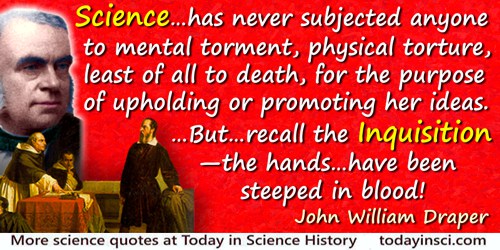
As to Science, she has never sought to ally herself to civil power. She has never attempted to throw odium or inflict social ruin on any human being. She has never subjected anyone to mental torment, physical torture, least of all to death, for the purpose of upholding or promoting her ideas. She presents herself unstained by cruelties and crimes. But in the Vatican—we have only to recall the Inquisition—the hands that are now raised in appeals to the Most Merciful are crimsoned. They have been steeped in blood!
History of the Conflict between Religion and Science (1875), xi.
As to what Simplicius said last, that to contend whether the parts of the Sun, Moon, or other celestial body, separated from their whole, should naturally return to it, is a vanity, for that the case is impossible, it being clear by the demonstrations of Aristotle that the celestial bodies are impassible, impenetrable, unpartable, etc., I answer that none of the conditions whereby Aristotle distinguishes the celestial bodies from the elementary has any foundation other than what he deduces from the diversity of their natural motions; so that, if it is denied that the circular motion is peculiar to celestial bodies, and affirmed instead that it is agreeable to all naturally moveable bodies, one is led by necessary confidence to say either that the attributes of generated or ungenerated, alterable or unalterable, partable or unpartable, etc., equally and commonly apply to all bodies, as well to the celestial as to the elementary, or that Aristotle has badly and erroneously deduced those from the circular motion which he has assigned to celestial bodies.
Dialogue on the Great World Systems (1632). Revised and Annotated by Giorgio De Santillana (1953), 45.
As we survey all the evidence, the thought insistently arises that some supernatural agency—or, rather, Agency—must be involved. Is it possible that suddenly, without intending to, we have stumbled upon scientific proof of the existence of a Supreme Being? Was it God who stepped in and so providentially crafted the cosmos for our benefit?
In The Symbiotic Universe: Life and Mind in the Cosmos (1988), 27.
Astronomy affords the most extensive example of the connection of physical sciences. In it are combined the sciences of number and quantity, or rest and motion. In it we perceive the operation of a force which is mixed up with everything that exists in the heavens or on earth; which pervades every atom, rules the motion of animate and inanimate beings, and is a sensible in the descent of the rain-drop as in the falls of Niagara; in the weight of the air, as in the periods of the moon.
On the Connexion of the Physical Sciences (1858), 1.
Astronomy is, not without reason, regarded, by mankind, as the sublimest of the natural sciences. Its objects so frequently visible, and therefore familiar, being always remote and inaccessible, do not lose their dignity.
In Elements of Chemistry: In the Order of the Lectures Given in Yale College (1830), 11.
Astronomy teaches the correct use of the sun and the planets. These may be put on a frame of little sticks and turned round. This causes the tides. Those at the ends of the sticks are enormously far away. From time to time a diligent searching of the sticks reveals new planets. The orbit of the planet is the distance the stick goes round in going round. Astronomy is intensely interesting; it should be done at night, in a high tower at Spitzbergen. This is to avoid the astronomy being interrupted. A really good astronomer can tell when a comet is coming too near him by the warning buzz of the revolving sticks.
In Literary Lapses (1928), 128.
At a distance in the meadow I hear still, at long intervals, the hurried commencement of the bobolink s strain, the bird just dashing into song, which is as suddenly checked, as it were, by the warder of the seasons, and the strain is left incomplete forever. Like human beings they are inspired to sing only for a short season.
(29 Jun 1851). In Henry David Thoreau and Bradford Torrey (ed.), The Writings of Henry Thoreau: Journal: II: 1850-September 15, 1851 (1906), 275.
At first, the people talking about ecology were only defending the fishes, the animals, the forest, and the river. They didn’t realize that human beings were in the forest—and that these humans were the real ecologists, because they couldn’t live without the forest and the forest couldn’t be saved without them.
Quoted in Andrew Revkin, The Burning Season
At length being at Clapham where there is, on the common, a large pond which, I observed to be one day very rough with the wind, I fetched out a cruet of oil and dropt a little of it on the water. I saw it spread itself with surprising swiftness upon the surface; but the effect of smoothing the waves was not produced; for I had applied it first on the leeward side of the pond, where the waves were largest, and the wind drove my oil back upon the shore. I then went to the windward side, where they began to form; and there the oil, though not more than a tea-spoonful, produced an instant calm over a space several yards square, which spread amazingly, and extended itself gradually till it reached the leeside, making all that quarter of the pond, perhaps half an acre, as smooth as a looking-glass.
[Experiment to test an observation made at sea in 1757, when he had seen the wake of a ship smoothed, explained by the captain as presumably due to cooks emptying greasy water in to the sea through the scuppers.]
[Experiment to test an observation made at sea in 1757, when he had seen the wake of a ship smoothed, explained by the captain as presumably due to cooks emptying greasy water in to the sea through the scuppers.]
Letter, extract in 'Of the still of Waves by Means of Oil The Gentleman's Magazine (1775), Vol. 45, 82.
At quite uncertain times and places,
The atoms left their heavenly path,
And by fortuitous embraces,
Engendered all that being hath.
And though they seem to cling together,
And form 'associations' here,
Yet, soon or late, they burst their tether,
And through the depths of space career.
The atoms left their heavenly path,
And by fortuitous embraces,
Engendered all that being hath.
And though they seem to cling together,
And form 'associations' here,
Yet, soon or late, they burst their tether,
And through the depths of space career.
From 'Molecular Evolution', Nature, 8, 1873. In Lewis Campbell and William Garnett, The Life of James Clerk Maxwell (1882), 637.
At the beginning of this debate Stephen [Hawking] said that he thinks that he is a positivist, whereas I am a Platonist. I am happy with him being a positivist, but I think that the crucial point here is, rather, that I am a realist. Also, if one compares this debate with the famous debate of Bohr and Einstein, some seventy years ago, I should think that Stephen plays the role of Bohr, whereas I play Einstein's role! For Einstein argued that there should exist something like a real world, not necessarily represented by a wave function, whereas Bohr stressed that the wave function doesn't describe a 'real' microworld but only 'knowledge' that is useful for making predictions.
Debate at the Isaac Newton Institute of the Mathematical Sciences, Cambridge University (1994), transcribed in Stephen Hawking and Roger Penrose, The Nature of Space and Time (1996), 134-135.
At the end of the book [Zoonomia] he sums up his [Erasmus Darwin] views in the following sentences: “The world has been evolved, not created: it has arisen little by little from a small beginning, and has increased through the activity of the elemental forces embodied in itself, and so has rather grown than come into being at an almighty word.” “What a sublime idea of the infinite might of the great Architect, the Cause of all causes, the Father of all fathers, the Ens Entium! For if we would compare the Infinite, it would surely require a greater Infinite to cause the causes of effects than to produce the effects themselves.”
[This is a restatement, not a verbatim quote of the original words of Erasmus Darwin, who attributed the idea he summarized to David Hume.]
[This is a restatement, not a verbatim quote of the original words of Erasmus Darwin, who attributed the idea he summarized to David Hume.]
In August Weismann, John Arthur Thomson (trans.), Margaret R. Thomson (trans.) The Evolution Theory (1904), Vol. 1, 17-18. The verbatim form of the quote from Zoonomia, in context, can be seen on the webpage here for Erasmus Darwin. Later authors have quoted from Weismann's translated book, and given the reworded passage as a direct quote by Erasmus Darwin. Webmaster has found a verbatim form in Zoonomia (1794), but has been unable to find the wording used by Weismann in any primary source by Erasmus Darwin. The rewording is perhaps due to the translation of the quote into German for Weismann's original book, Vorträge über Descendenztheorie (1902) followed by another translation for the English edition.
At the moment I am occupied by an investigation with Kirchoff which does not allow us to sleep. Kirchoff has made a totally unexpected discovery, inasmuch as he has found out the cause for the dark lines in the solar spectrum and can produce these lines artificially intensified both in the solar spectrum and in the continuous spectrum of a flame, their position being identical with that of Fraunhofer’s lines. Hence the path is opened for the determination of the chemical composition of the Sun and the fixed stars.
Letter to H.E. Roscoe (Nov 1859). In The Life and Experiences of Sir Henry Enfield Roscoe (1906), 81.
At the moment I am occupied by an investigation with Kirchoff which does not allow us to sleep. Kirchoff has made a totally unexpected discovery, inasmuch as he has found out the cause for the dark lines in the solar spectrum and can produce these lines artificially intensified both in the solar spectrum and in the continuous spectrum of a flame, their position being identical with that of Fraunhofer’s lines. Hence the path is opened for the determination of the chemical composition of the Sun and the fixed stars.
Letter to H.E. Roscoe (Nov 1859). In The Life and Experiences of Sir Henry Enfield Roscoe (1906), 71.
At the outset do not be worried about this big question—Truth. It is a very simple matter if each one of you starts with the desire to get as much as possible. No human being is constituted to know the truth, the whole truth, and nothing but the truth; and even the best of men must be content with fragments, with partial glimpses, never the full fruition. In this unsatisfied quest the attitude of mind, the desire, the thirst—a thirst that from the soul must arise!—the fervent longing, are the be-all and the end-all.
'The Student Life' (1905). In G. L. Keynes (ed.), Selected Writings of Sir William Osler (1951), 172.
At the sight of a single bone, of a single piece of bone, I recognize and reconstruct the portion of the whole from which it would have been taken. The whole being to which this fragment belonged appears in my mind's eye.
Cited by Geoffroy Saint-Hilaire, Comptes-Rendus de l’Académie des Sciences. 1837, 7, 116. Trans. Franck Bourdier, 'Geoffroy Saint-Hilaire versus Cuvier: The Campaign for Paleontological Evolution (1825- 1838)', Cecil J. Schneer (ed.), Toward a History of Geology (1969), 44.
Available energy is energy which we can direct into any desired channel. Dissipated energy is energy which we cannot lay hold of and direct at pleasure, such as the energy of the confused agitation of molecules which we call heat. Now, confusion, like the correlative term order, is not a property of material things in themselves, but only in relation to the mind which perceives them. A memorandum-book does not, provided it is neatly written, appear confused to an illiterate person, or to the owner who understands it thoroughly, but to any other person able to read it appears to be inextricably confused. Similarly the notion of dissipated energy could not occur to a being who could not turn any of the energies of nature to his own account, or to one who could trace the motion of every molecule and seize it at the right moment. It is only to a being in the intermediate stage, who can lay hold of some forms of energy while others elude his grasp, that energy appears to be passing inevitably from the available to the dissipated state.
'Diffusion', Encyclopaedia Britannica (1878). In W. D. Niven (ed.), The Scientific Papers of James Clerk Maxwell (1890), Vol. 2, 646.
Bacon himself was very ignorant of all that had been done by mathematics; and, strange to say, he especially objected to astronomy being handed over to the mathematicians. Leverrier and Adams, calculating an unknown planet into a visible existence by enormous heaps of algebra, furnish the last comment of note on this specimen of the goodness of Bacon’s view… . Mathematics was beginning to be the great instrument of exact inquiry: Bacon threw the science aside, from ignorance, just at the time when his enormous sagacity, applied to knowledge, would have made him see the part it was to play. If Newton had taken Bacon for his master, not he, but somebody else, would have been Newton.
In Budget of Paradoxes (1872), 53-54.
Beasts have not the high advantages which we possess; but they have some which we have not. They have not our hopes, but then they have not our fears; they are subject like us to death, but it is without being aware of it; most of them are better able to preserve themselves than we are, and make a less bad use of their passions.
In Edwin Davies, Other Men's Minds, Or, Seven Thousand Choice Extracts (1800), 55.
Because a fact seems strange to you, you conclude that it is not one. ... All science, however, commences by being strange. Science is successive. It goes from one wonder to another. It mounts by a ladder. The science of to-day would seem extravagant to the science of a former time. Ptolemy would believe Newton mad.
In Victor Hugo and Lorenzo O'Rourke (trans.) Victor Hugo's Intellectual Autobiography: (Postscriptum de ma vie) (1907), 322.
Before an experiment can be performed, it must be planned—the question to nature must be formulated before being posed. Before the result of a measurement can be used, it must be interpreted—nature's answer must be understood properly. These two tasks are those of the theorist, who finds himself always more and more dependent on the tools of abstract mathematics. Of course, this does not mean that the experimenter does not also engage in theoretical deliberations. The foremost classical example of a major achievement produced by such a division of labor is the creation of spectrum analysis by the joint efforts of Robert Bunsen, the experimenter, and Gustav Kirchoff, the theorist. Since then, spectrum analysis has been continually developing and bearing ever richer fruit.
'The Meaning and Limits of Exact Science', Science (30 Sep 1949), 110, No. 2857, 325. Advance reprinting of chapter from book Max Planck, Scientific Autobiography (1949), 110.
Being a fish out of water is tough, but that’s how you evolve. I think that’s scientifically accurate—I don’t know, I had a liberal arts education.
From Commencement Speech (22 May 2017) at Grinnell College, Iowa. As quoted in Jeff Charis-Carlson, 'Comedian Kumail Nanjiani offers advice for Grinnell grads, takes on Steve King', Des Moines Register (22 May 2017).
Being a language, mathematics may be used not only to inform but also, among other things, to seduce.
From Fractals: Form, Chance and Dimension (1977), 20.
Being also in accord with Goethe that discoveries are made by the age and not by the individual, I should consider the instances to be exceedingly rare of men who can be said to be living before their age, and to be the repository of knowledge quite foreign to the thought of the time. The rule is that a number of persons are employed at a particular piece of work, but one being a few steps in advance of the others is able to crown the edifice with his name, or, having the ability to generalise already known facts, may become in time to be regarded as their originator. Therefore it is that one name is remembered whilst those of coequals have long been buried in obscurity.
In Historical Notes on Bright's Disease, Addison's Disease, and Hodgkin's Disease', Guy's Hospital Reports (1877), 22, 259-260.
Being an only child is a disease in itself.
As quoted in Dorothy Stein, People who Count: Population and Politics, Women and Children (1995), 111, citing T.L. Smith (ed.) Aspects of Childhood Life and Education (1907).
Being in love with the one parent and hating the other are among the essential constituents of the stock of psychical impulses which is formed at that time and which is of such importance in determining the symptoms of the later neurosis... This discovery is confirmed by a legend that has come down to us from classical antiquity: a legend whose profound and universal power to move can only be understood if the hypothesis I have put forward in regard to the psychology of children has an equally universal validity. What I have in mind is the legend of King Oedipus and Sophocles' drama which bears his name.
The Interpretation of Dreams (1900), In James Strachey (ed.) The Standard Edition of the Complete Psychological Works of Sigmund Freud (1953), Vol. 4, 260-1.
Being perpetually charmed by his familiar siren, that is, by his geometry, he [Archimedes] neglected to eat and drink and took no care of his person; that he was often carried by force to the baths, and when there he would trace geometrical figures in the ashes of the fire, and with his finger draws lines upon his body when it was anointed with oil, being in a state of great ecstasy and divinely possessed by his science.
— Plutarch
As translated in George Finlay Simmons, Calculus Gems: Brief Lives and Memorable Mathematics, (1992), 39.
Being the inventor of sex would seem to be a sufficient distinction for a creature just barely large enough to be seen by the naked eye.
[Comment about Volvox, a freshwater green algae, which appears indetermimately plantlike and animal-like during its reproductive cycle.]
[Comment about Volvox, a freshwater green algae, which appears indetermimately plantlike and animal-like during its reproductive cycle.]
The Great Chain of Life (1957), 28.
Being the most striking manifestation of the art of metal structures by which our engineers have shown in Europe, it [the Eiffel Tower] is one of the most striking of our modern national genius.
English version by Webmaster using Google Translate, from the original French, “Étant la plus saisissante manifestation de l’art des constructions métalliques par lesquelles nos ingénieurs se sont illustrés en Europe, elle est une des formes les plus frappantes de notre génie national moderne.” From interview of Eiffel by Paul Bourde, in the newspaper Le Temps (14 Feb 1887). Reprinted in 'Au Jour le Jour: Les Artistes Contre la Tour Eiffel', Gazette Anecdotique, Littéraire, Artistique et Bibliographique (Feb 1887), 126, and in Gustave Eiffel, Travaux Scientifiques Exécutés à la Tour de 300 Mètres de 1889 à 1900 (1900), 14. Also quoted in review of the Gustave Eiffel’s book La Tour Eiffel (1902), in Nature (30 Jan 1902), 65, 292.
Being well-informed about science is not the same thing as understanding science.
In Science and Common Sense (1951), 4. As quoted and cited in NGSS Lead States, Next Generation Science Standards: For States, By States (2013), Vol. 1, 97.
Beneath multiple specific and individual distinctions, beneath innumerable and incessant transformations, at the bottom of the circular evolution without beginning or end, there hides a law, a unique nature participated in by all beings, in which this common participation produces a ground of common harmony.
A.W. Grabau, Stratigraphy of China (1928), title page.
Between the lowest and the highest degree of spiritual and corporal perfection, there is an almost infinite number of intermediate degrees. The succession of degrees comprises the Universal Chain. It unites all beings, ties together all worlds, embraces all the spheres. One SINGLE BEING is outside this chain, and this is HE who made it.
Contemplation de la nature (1764), Vol. I, 27. Trans. Stephen Jay Gould, Ontogeny and Phylogeny (1977), 23.
Biological disciplines tend to guide research into certain channels. One consequence is that disciplines are apt to become parochial, or at least to develop blind spots, for example, to treat some questions as “interesting” and to dismiss others as “uninteresting.” As a consequence, readily accessible but unworked areas of genuine biological interest often lie in plain sight but untouched within one discipline while being heavily worked in another. For example, historically insect physiologists have paid relatively little attention to the behavioral and physiological control of body temperature and its energetic and ecological consequences, whereas many students of the comparative physiology of terrestrial vertebrates have been virtually fixated on that topic. For the past 10 years, several of my students and I have exploited this situation by taking the standard questions and techniques from comparative vertebrate physiology and applying them to insects. It is surprising that this pattern of innovation is not more deliberately employed.
In 'Scientific innovation and creativity: a zoologist’s point of view', American Zoologist (1982), 22, 233.
Biology cannot go far in its subject without being met by mind.
In 'The Brain Collaborates With Psyche', Man On His Nature: The Gifford Lectures, Edinburgh 1937-8 (1940), 290-291.
Biology occupies a position among the sciences both marginal and central. Marginal because, the living world, constituting only a tiny and very “special” part of the universe, it does not seem likely that the study of living beings will ever uncover general laws applicable outside the biosphere. But if the ultimate aim of the whole of science is indeed, as I believe, to clarify man's relationship to the universe, then biology must be accorded a central position, since of all the disciplines it is the one that endeavours to go most directly to the heart of the problems that must be resolved before that of “human nature” can even be framed in other than metaphysical terms.
In Jacques Monod and Austryn Wainhouse (trans.), Chance and Necessity: An Essay on the Natural Philosophy of Modern Biology (1971), xi.
Biophilia, if it exists, and I believe it exists, is the innately emotional affiliation of human beings to other living organisms.
'Biophilia and the Conservation Ethic', essay in The Biophilia Hypothesis, editted by Stephen R. Kellert (1997), 31.
Both history of nature and history of humanity are 'historical' and yet cannot dispense with uniformity. In both there is 'uniformity' ('science') as well as non-uniformity ('history'); in both 'history respects itself and 'history does not repeat itself. But, as even the history of humanity has its uniformitarian features, uniformity can still less be dispensed with in 'history' of nature, which, being one of the natural sciences, is less historical and, consequently, more uniformitarian.
Natural Law and Divine Miracle: The Principle of Uniformity in Geology, Biology and Theology (1963), 151.
Business is just about enabling human beings, nothing more, nothing less. Businesses need to recognize this fundamental fact.
As quoted on imdb.com bigraphy page for Bruce Dickinson.
But among all these many departments of research, these many branches of industry, new and old, which are being rapidly expanded, there is one dominating all others in importance—one which is of the greatest significance for the comfort and welfare, not to say for the existence, of mankind, and that is the electrical transmission of power.
Speech (12 Jan 1897) at a gala inaugurating power service from Niagara Falls to Buffalo, NY. Printed in 'Tesla on Electricity', The Electrical Review (27 Jan 1897), 30, No. 3, 47.
But for us, it’s different. Look again at that dot. That’s here. That’s home. That’s us. On it everyone you love, everyone you know, everyone you ever heard of, every human being who ever was, lived out their lives. The aggregate of our joy and suffering, thousands of confident religions, ideologies, and economic doctrines, every hunter and forager, every hero and coward, every creator and destroyer of civilization, every king and peasant, every young couple in love, every mother and father, hopeful child, inventor and explorer, every teacher of morals, every corrupt politician, every “superstar,” every “supreme leader,” every saint and sinner in the history of our species lived there - on a mote of dust suspended in a sunbeam.
…...
But I don’t have to know an answer. I don’t feel frightened by not knowing things, by being lost in a mysterious universe without any purpose, which is the way it really is, so far as I can tell. It doesn’t frighten me.
In Richard Feynman and Jeffrey Robbins (ed.), The Pleasure of Finding Things Out: The Best Short Works of Richard Feynman (1999), 25, last sentence of Chap. 1. The chapter, with the same title as the book, is an edited transcript of an interview with Feynman made for the BBC television program Horizon (1981).
But I shall certainly admit a system as empirical or scientific only if it is capable of being tested by experience. These considerations suggest that not the verifiability but the falsifiability of a system is to be taken as a criterion of demarcation. In other words: I shall not require of a scientific system that it shall be capable of being singled out, once and for all, in a positive sense; but I shall require that its logical form shall be such that it can be singled out, by means of empirical tests, in a negative sense: it must be possible for an empirical scientific system to be refuted by experience. (1959)
The Logic of Scientific Discovery: Logik Der Forschung (1959, 2002), 18.
But if any skillful minister of nature shall apply force to matter, and by design torture and vex it, in order to [effect] its annihilation, it, on the contrary being brought under this necessity, changes and transforms itself into a strange variety of shapes and appearances; for nothing but the power of the Creator can annihilate, or truly destroy it.
As quoted in M.J. Gorton, 'The Weather', Popular Science News (1889), 23, No. 8, 115.
But in the heavens we discover by their light, and by their light alone, stars so distant from each other that no material thing can ever have passed from one to another; and yet this light, which is to us the sole evidence of the existence of these distant worlds, tells us also that each of them is built up of molecules of the same kinds as those which we find on earth. A molecule of hydrogen, for example, whether in Sirius or in Arcturus, executes its vibrations in precisely the same time. Each molecule, therefore, throughout the universe, bears impressed on it the stamp of a metric system as distinctly as does the metre of the Archives at Paris, or the double royal cubit of the Temple of Karnac ... the exact quantity of each molecule to all others of same kind gives it, as Sir John Herschel has well said, the essential character of a manufactured article and precludes the idea of its being external and self-existent.
'Molecules', 1873. In W. D. Niven (ed.), The Scientific Papers of James Clerk Maxwell (1890), Vol. 2, 375-6.
But it is necessary to insist more strongly than usual that what I am putting before you is a model—the Bohr model atom—because later I shall take you to a profounder level of representation in which the electron instead of being confined to a particular locality is distributed in a sort of probability haze all over the atom.
Messenger Lectures (1934), New Pathways in Science (1935), 34.
But it is not given to every electrician to die in so glorious a manner as the justly envied Richmann.
[G. W. Richmann died from being hit by lightning, which he had been investigating.]
[G. W. Richmann died from being hit by lightning, which he had been investigating.]
The History and Present State of Electricity, with Original Experiments (1767), 3rd edition (1775), Vol. 1, 108.
But many of our imaginations and investigations of nature are futile, especially when we see little living animals and see their legs and must judge the same to be ten thousand times thinner than a hair of my beard, and when I see animals living that are more than a hundred times smaller and am unable to observe any legs at all, I still conclude from their structure and the movements of their bodies that they do have legs... and therefore legs in proportion to their bodies, just as is the case with the larger animals upon which I can see legs... Taking this number to be about a hundred times smaller, we therefore find a million legs, all these together being as thick as a hair from my beard, and these legs, besides having the instruments for movement, must be provided with vessels to carry food.
Letter to N. Grew, 27 Sep 1678. In The Collected Letters of Antoni van Leeuwenhoek (1957), Vol. 2, 391.
But the idea that any of the lower animals have been concerned in any way with the origin of man—is not this degrading? Degrading is a term, expressive of a notion of the human mind, and the human mind is liable to prejudices which prevent its notions from being invariably correct. Were we acquainted for the first time with the circumstances attending the production of an individual of our race, we might equally think them degrading, and be eager to deny them, and exclude them from the admitted truths of nature.
But the World being once fram’d, and the course of Nature establish’d, the Naturalist, (except in some few cases, where God, or Incorporeal Agents interpose), has recourse to the first Cause but for its general and ordinary Support and Influence, whereby it preserves Matter and Motion from Annihilation or Desition; and in explicating particular phenomena, considers onely the Size, Shape, Motion, (or want of it) Texture, and the resulting Qualities and Attributes of the small particles of Matter.
The Origine of Formes and Qualities (1666), 194.
But, however many ways there may be of being alive, it is certain that there are vastly more ways of being dead, or rather not alive.
The Blind Watchmaker (1996), 9.
By God’s mercy British and American science outpaced all German efforts. … This revelation of the secrets of nature, long mercifully withheld from man, should arouse the most solemn reflections in the mind and conscience of every human being capable of comprehension. We must indeed pray that these awful agencies will be made to conduce to peace among the nations, and that instead of wreaking measureless havoc upon the entire globe, may become a perennial fountain of world prosperity.
[Concerning use of the atomic bomb.]
[Concerning use of the atomic bomb.]
Statement drafted by Churchill following the use of an atomic bomb on Hiroshima. Due to the change in government, the statement was released by Clement Attlee (6 Aug 1945). In Sir Winston Churchill, Victory: War Speeches by the Right Hon. Winston Churchill (1946), 289.
By science, then, I understand the consideration of all subjects, whether of a pure or mixed nature, capable of being reduced to measurement and calculation. All things comprehended under the categories of space, time and number properly belong to our investigations; and all phenomena capable of being brought under the semblance of a law are legitimate objects of our inquiries.
In Report of the British Association for the Advancement of Science (1833), xxviii.
By the act of generation nothing more is done than to ferment the sperm of ye female by the sperm of ye male that it may thereby become fit nourishment for ye Embryo: ffor ye nourishment of all animals is prepared by ferment & the ferment is taken from animals of the same kind, & makes the nourishment subtile & spiritual. In adult animals the nourishmt is fermented by the choler and pancreatic juice both wch come from the blood. The Embryo not being able to ferment its own nourishment wch comes from the mothers blood has it fermented by the sperm wch comes from ye fathers blood, & by this nourishment it swells, drops off from ye Ovarium & begins to grow with a life distinct from that of ye mother.
From 'Quæst 25' in Draft version of The Queries manuscript, Add. MS. 3970, folio 235 held by the University of Cambridge Library. As quoted and cited in R.W. Home, 'Force, Electricity, and Living Matter', from Margaret J. Osler and Paul Lawrence Farber (eds.), Religion, Science, and Worldview: Essays in Honor of Richard S. Westfall (2002), 113.
By the classification of any series of objects, is meant the actual or ideal arrangement together of those which are like and the separation of those which are unlike ; the purpose of this arrangement being to facilitate the operations of the mind in clearly conceiving and retaining in the memory the characters of the objects in question.
In 'Lecture I: On the Classification of Animals', Lectures on the Elements of Comparative Anatomy: On the ... - (1864), 1.
By the early 1960s Pauling had earned a reputation for being audacious, intuitive, charming, irreverent, self-promoting, self-reliant, self-involved to the point of arrogance and correct about almost everything.
In Force of Nature: The Life of Linus Pauling (1995), 13.
By the worldly standards of public life, all scholars in their work are of course oddly virtuous. They do not make wild claims, they do not cheat, they do not try to persuade at any cost, they appeal neither to prejudice nor to authority, they are often frank about their ignorance, their disputes are fairly decorous, they do not confuse what is being argued with race, politics, sex or age, they listen patiently to the young and to the old who both know everything. These are the general virtues of scholarship, and they are peculiarly the virtues of science.
In Science and Human Values (1956).
Capitalism, though it may not always give the scientific worker a living wage, will always protect him, as being one of the geese which produce golden eggs for its table.
Daedalus or Science and the Future (1924), 6.
Cauchy is mad, and there is no way of being on good terms with him, although at present he is the only man who knows how mathematics should be treated. What he does is excellent, but very confused…
In Oeuvres (1826), Vol. 2, 259. As quoted and cited in Ernst Hairer and Gerhard Wanner Analysis by Its History (2008), 188. From the original French, “Cauchy est fou, et avec lui il n’y a pas moyen de s’entendre, bien que pour le moment il soit celui qui sait comment les mathématiques doivent être traitées. Ce qu’il fait est excellent, mais très brouillé….”
Chemistry affords two general methods of determining the constituent principles of bodies, the method of analysis, and that of synthesis. When, for instance, by combining water with alkohol, we form the species of liquor called, in commercial language, brandy or spirit of wine, we certainly have a right to conclude, that brandy, or spirit of wine, is composed of alkohol combined with water. We can produce the same result by the analytical method; and in general it ought to be considered as a principle in chemical science, never to rest satisfied without both these species of proofs. We have this advantage in the analysis of atmospherical air, being able both to decompound it, and to form it a new in the most satisfactory manner.
Elements of Chemistry (1790), trans. R. Kerr, 33.
Chemistry is an art that has furnished the world with a great number of useful facts, and has thereby contributed to the improvement of many arts; but these facts lie scattered in many different books, involved in obscure terms, mixed with many falsehoods, and joined to a great deal of false philosophy; so that it is not great wonder that chemistry has not been so much studied as might have been expected with regard to so useful a branch of knowledge, and that many professors are themselves but very superficially acquainted with it. But it was particularly to be expected, that, since it has been taught in universities, the difficulties in this study should have been in some measure removed, that the art should have been put into form, and a system of it attempted—the scattered facts collected and arranged in a proper order. But this has not yet been done; chemistry has not yet been taught but upon a very narrow plan. The teachers of it have still confined themselves to the purposes of pharmacy and medicine, and that comprehends a small branch of chemistry; and even that, by being a single branch, could not by itself be tolerably explained.
John Thomson, An Account of the Life, Lectures and Writings of William Cullen, M.D. (1832), Vol. 1, 40.
Children are to be guided to make a beginning in all the arts and sciences without interference with their spontaneity, the instinct of imitation being so used as to give them order without constraining them.
In Friedrich Fröbel and Josephine Jarvis (trans.), 'American Preface', The Education of Man (1885), vi.
Clinical ecology [is] a new branch of medicine aimed at helping people made sick by a failure to adapt to facets of our modern, polluted environment. Adverse reactions to processed foods and their chemical contaminants, and to indoor and outdoor air pollution with petrochemicals, are becoming more and more widespread and so far these reactions are being misdiagnosed by mainstream medical practitioners and so are not treated effectively.
Quoted in article 'Richard Mackarness', Contemporary Authors Online (2002).
Colour, Figure, Motion, Extension and the like, considered only so many Sensations in the Mind, are perfectly known, there being nothing in them which is not perceived. But if they are looked on as notes or Images, referred to Things or Archetypes existing without the Mind, then are we involved all in Scepticism.
A Treatise Concerning the Principles of Human Knowledge [first published 1710], (1734), 109.
Coming to the question of life being found on other planets, Professor Haldane apologized for discoursing, as a mere biologist, on a subject on which we had been expecting a lecture by a physicist [J. D. Bernal]. He mentioned three hypotheses:
(a) That life had a supernatural origin,
(b) That it originated from inorganic materials, and (c) That life is a constituent of the Universe and can only arise from pre-existing life. The first hypothesis, he said, should be taken seriously, and he would proceed to do so. From the fact that there are 400,000 species of beetle on this planet, but only 8,000 species of mammals, he concluded that the Creator, if he exists, has a special preference for beetles, and so we might be more likely to meet them than any other type of animal on a planet which would support life.
(a) That life had a supernatural origin,
(b) That it originated from inorganic materials, and (c) That life is a constituent of the Universe and can only arise from pre-existing life. The first hypothesis, he said, should be taken seriously, and he would proceed to do so. From the fact that there are 400,000 species of beetle on this planet, but only 8,000 species of mammals, he concluded that the Creator, if he exists, has a special preference for beetles, and so we might be more likely to meet them than any other type of animal on a planet which would support life.
In Mark Williamson, 'Haldane’s Special Preference', The Linnean, 1992, 8, 14.
Common sense … has the very curious property of being more correct retrospectively than prospectively. It seems to me that one of the principal criteria to be applied to successful science is that its results are almost always obvious retrospectively; unfortunately, they seldom are prospectively. Common sense provides a kind of ultimate validation after science has completed its work; it seldom anticipates what science is going to discover.
Quoted in A. De Reuck, M. Goldsmith and J. Knight (eds.), Decision Making in National Science Policy (1968), 96.
Compare ... the various quantities of the same element contained in the molecule of the free substance and in those of all its different compounds and you will not be able to escape the following law: The different quantities of the same element contained in different molecules are all whole multiples of one and the same quantity, which always being entire, has the right to be called an atom.
Sketch of a Course of Chemical Philosophy (1858), Alembic Club Reprint (1910), 11.
Compare the length of a moment with the period of ten thousand years; the first, however minuscule, does exist as a fraction of a second. But that number of years, or any multiple of it that you may name, cannot even be compared with a limitless extent of time, the reason being that comparisons can be drawn between finite things, but not between finite and infinite.
The Consolation of Philosophy [before 524], Book II, trans. P. G. Walsh (1999), 36.
Complexes are psychic contents which are outside the control of the conscious mind. They have been split off from consciousness and lead a separate existence in the unconscious, being at all times ready to hinder or to reinforce the conscious intentions.
A Psychological Theory of Types (1931), 79.
Computer science … jobs should be way more interesting than even going to Wall Street or being a lawyer--or, I can argue, than anything but perhaps biology, and there it’s just a tie.
From interview (24 May 2004) in Scientific American (Jun 2004), 45.
Computers are incredibly fast, accurate and stupid. Human beings are incredibly slow, inaccurate and brilliant. Together they are powerful beyond imagination.
Very often seen (?mis-)attributed to Albert Einstein, but there seems to be no authenticating primary source. (Webmaster has tried, but not yet found one.) Probably best regarded as Anonymous.
Consciousness is an electrical phenomenon which arises from a state of being which we can feel.
In On Love & Psychological Exercises: With Some Aphorisms & Other Essays (1998), 54.
Coolidge is a better example of evolution than either Bryan or Darrow, for he knows when not to talk, which is the biggest asset the monkey possesses over the human.
[Referring to the Scopes trial, with Darrow defending a teacher being prosecuted for teaching evolution in the state of Tennessee.]
[Referring to the Scopes trial, with Darrow defending a teacher being prosecuted for teaching evolution in the state of Tennessee.]
'Rogers Thesaurus'. Saturday Review (25 Aug 1962). In Will Rogers' Weekly Articles (1981), Vol. 2, 66.
Crowds are somewhat like the sphinx of ancient fable: It is necessary to arrive at a solution of the problems offered by their psychology or to resign ourselves to being devoured by them.
From Psychologie des Foules (1895), 90. English text in The Crowd: A Study of the Popular Mind (1897), Book 2, Chap. 2, 95. Original French text: “Les foules sont un peu comme le sphinx de la fable antique: il faut savoir résoudre les problèmes que leur psychologie nous pose, ou se résigner à être dévoré par elles.”
Cyberspace consists of transactions, relationships, and thought itself, arrayed like a standing wave in the web of our communications. Ours is a world that is both everywhere and nowhere, but it is not where bodies live. We are creating a world that all may enter without privilege or prejudice accorded by race, economic power, military force, or station of birth. We are creating a world where anyone, anywhere may express his or her beliefs, no matter how singular, without fear of being coerced into silence or conformity.
In 'A Declaration of the Independence of Cyberspace' (8 Feb 1996). Published on Electronic Frontier Foundation website. Reproduced in Lawrence Lessig, Code: Version 2.0) (2008), 303.
Dalton transformed the atomic concept from a philosophical speculation into a scientific theory—framed to explain quantitative observations, suggesting new tests and experiments, and capable of being given quantitative form through the establishment of relative masses of atomic particles.
Development of Concepts of Physics. In Clifford A. Pickover, Archimedes to Hawking: Laws of Science and the Great Minds Behind Them (2008), 175.
Daniel Bernoulli used to tell two little adventures, which he said had given him more pleasure than all the other honours he had received. Travelling with a learned stranger, who, being pleased with his conversation, asked his name; “I am Daniel Bernoulli,” answered he with great modesty; “and I,” said the stranger (who thought he meant to laugh at him) “am Isaac Newton.” Another time, having to dine with the celebrated Koenig, the mathematician, who boasted, with some degree of self-complacency, of a difficult problem he had solved with much trouble, Bernoulli went on doing the honours of his table, and when they went to drink coffee he presented Koenig with a solution of the problem more elegant than his own.
In A Philosophical and Mathematical Dictionary (1815), 1, 226.
Deprived, therefore, as regards this period, of any assistance from history, but relieved at the same time from the embarrassing interference of tradition, the archaeologist is free to follow the methods which have been so successfully pursued in geology—the rude bone and stone implements of bygone ages being to the one what the remains of extinct animals are to the other. The analogy may be pursued even further than this. Many mammalia which are extinct in Europe have representatives still living in other countries. Our fossil pachyderms, for instance, would be almost unintelligible but for the species which still inhabit some parts of Asia and Africa; the secondary marsupials are illustrated by their existing representatives in Australia and South America; and in the same manner, if we wish clearly to understand the antiquities of Europe, we must compare them with the rude implements and weapons still, or until lately, used by the savage races in other parts of the world. In fact, the Van Diemaner and South American are to the antiquary what the opossum and the sloth are to the geologist.
Pre-historic Times, as Illustrated by Ancient Remains, and the Manners and Customs of Modern Savages, (2nd ed. 1869, 1890), 429-430.
Disinterestedness is as great a puzzle and paradox as ever. Indeed, strictly speaking, it is a species of irrationality, or insanity, as regards the individual’s self; a contradiction of the most essential nature of a sentient being, which is to move to pleasure and from pain.
In On the Study of Character: Including an Estimate of Phrenology (1861), 202.
Dissection … teaches us that the body of man is made up of certain kinds of material, so differing from each other in optical and other physical characters and so built up together as to give the body certain structural features. Chemical examination further teaches us that these kinds of material are composed of various chemical substances, a large number of which have this characteristic that they possess a considerable amount of potential energy capable of being set free, rendered actual, by oxidation or some other chemical change. Thus the body as a whole may, from a chemical point of view, be considered as a mass of various chemical substances, representing altogether a considerable capital of potential energy.
From Introduction to A Text Book of Physiology (1876, 1891), Book 1, 1.
Distinguisht Link in Being’s endless Chain!
Midway from Nothing to the Deity!
Midway from Nothing to the Deity!
The Complaint: or, Night-Thoughts on Life, Death, and Immortality (1742, 1750), Night 1, 5.
Doctors are men who prescribe medicines of which they know little, to cure diseases of which they know less, in human beings of whom they know nothing. (1760)
In Robert Allan Weinberg, The Biology of Cancer (2006), 726. (Note: Webmaster has not yet found this quote, in this wording, in a major quotation reference book. If you know a primary print source, or correction, please contact Webmaster.)
Doing nothing is better than being busy doing nothing.
— Lao Tzu
Tao Te Ching. Quoted in Kim Lim (ed.), 1,001 Pearls of Spiritual Wisdom: Words to Enrich, Inspire, and Guide Your Life (2014), 183
Don't be impatient with me. Bear in mind that I hop around among all of you big beasts like a harmless and helpless frog who is afraid of being squashed.
Letter to Albert Einstein, 16 Aug 1920. In Martin J. Klein, Paul Ehrenfest: The Making of a Theoretical Physicist (1970), Vol. 1, 319.
Dr. Bhabha was a visionary. He had excellent command over electronics, physics and he saw the dream of India being a nuclear power. … He was a perfectionist and would leave no point of suspicion while working on any project. He was an inspiration.
Interview in newsletter of the Raja Ramanna Centre for Advanced Technology (Oct 2001), online.
Dr. Johnson ... sometimes employed himself in chymistry, sometimes in watering and pruning a vine, and sometimes in small experiments, at which those who may smile, should recollect that there are moments which admit of being soothed only by trifles.
Quoted in James Boswell, The Life of Samuel Johnson, LL.D. (1826), Vol. 3, 352.
During my pre-college years I went on many trips with my father into the oil fields to visit their operations. … I puttered around the machine, electronics, and automobile shops while he carried on his business. Both of my parents are inveterate do-it-yourselfers, almost no task being beneath their dignity or beyond their ingenuity. Having picked up a keen interest in electronics from my father, I used to fix radios and later television sets for fun and spending money. I built my own hi-fi set and enjoyed helping friends with their amateur radio transmitters, but lost interest as soon as they worked.
Remarks on how his high school interests foreshadowed his career as a radio astronomer. From autobiography in Stig Lundqvist (ed.) Nobel Lectures, Physics 1971-1980 (1992).
During my stay in London I resided for a considerable time in Clapham Road in the neighbourhood of Clapham Common... One fine summer evening I was returning by the last bus 'outside' as usual, through the deserted streets of the city, which are at other times so full of life. I fell into a reverie (Träumerei), and 10, the atoms were gambolling before my eyes! Whenever, hitherto, these diminutive beings had appeared to me, they had always been in motion: but up to that time I had never been able to discern the nature of their motion. Now, however, I saw how, frequently, two smaller atoms united to form a pair: how the larger one embraced the two smaller ones: how still larger ones kept hold of three or even four of the smaller: whilst the whole kept whirling in a giddy dance. I saw how the larger ones formed a chain, dragging the smaller ones after them but only at the ends of the chain. I saw what our past master, Kopp, my highly honoured teacher and friend has depicted with such charm in his Molekular-Welt: but I saw it long before him. The cry of the conductor 'Clapham Road', awakened me from my dreaming: but I spent part of the night in putting on paper at least sketches of these dream forms. This was the origin of the 'Structural Theory'.
Kekule at Benzolfest in Berichte (1890), 23, 1302.
During the three years which I spent at Cambridge my time was wasted, as far as the academical studies were concerned…. I attempted mathematics, … but I got on very slowly. The work was repugnant to me, chiefly from my not being able to see any meaning in the early steps in algebra. This impatience was very foolish…
In Charles Darwin and Francis Darwin (ed.), 'Autobiography', The Life and Letters of Charles Darwin (1887, 1896), Vol. 1, 40.
Each volcano is an independent machine—nay, each vent and monticule is for the time being engaged in its own peculiar business, cooking as it were its special dish, which in due time is to be separately served. We have instances of vents within hailing distance of each other pouring out totally different kinds of lava, neither sympathizing with the other in any discernible manner nor influencing other in any appreciable degree.
In Report on the Geology of the High Plateaus of Utah (1880), 115.
Education is an organic necessity of a human being.
In Thoughts Selected From the Writings of Horace Mann (1872), 235.
Energy of the tides is continuously being dissipated at a rate whose order of magnitude is a billion horsepower!
In The Tides: Pulse of the Earth (1968), 133.
ENGINEER, in the military art, an able expert man, who, by a perfect knowledge in mathematics, delineates upon paper, or marks upon the ground, all sorts of forts, and other works proper for offence and defence. He should understand the art of fortification, so as to be able, not only to discover the defects of a place, but to find a remedy proper for them; as also how to make an attack upon, as well as to defend, the place. Engineers are extremely necessary for these purposes: wherefore it is requisite that, besides being ingenious, they should be brave in proportion. When at a siege the engineers have narrowly surveyed the place, they are to make their report to the general, by acquainting him which part they judge the weakest, and where approaches may be made with most success. Their business is also to delineate the lines of circumvallation and contravallation, taking all the advantages of the ground; to mark out the trenches, places of arms, batteries, and lodgments, taking care that none of their works be flanked or discovered from the place. After making a faithful report to the general of what is a-doing, the engineers are to demand a sufficient number of workmen and utensils, and whatever else is necessary.
In Encyclopaedia Britannica or a Dictionary of Arts and Sciences (1771), Vol. 2, 497.
Engineering is not merely knowing and being knowledgeable, like a walking encyclopedia; engineering is not merely analysis; engineering is not merely the possession of the capacity to get elegant solutions to non-existent engineering problems; engineering is practicing the art of the organizing forces of technological change ... Engineers operate at the interface between science and society.
In Bert Scalzo, et al., Database Benchmarking: Practical Methods for Oracle & SQL Server (2007), 37.
Entrepreneurs must devote a portion of their minds to constantly processing uncertainty. So you sacrifice a degree of being present.
Replying to question, “What have you sacrificed for success.” In Issie Lapowsky, 'Scott Belsky', Inc. (Nov 2013), 140. Biography in Context,
Ere long intelligence—transmitted without wires—will throb through the earth like a pulse through a living organism. The wonder is that, with the present state of knowledge and the experiences gained, no attempt is being made to disturb the electrostatic or magnetic condition of the earth, and transmit, if nothing else, intelligence.
Electrical Engineer (24 Jun 1892), 11, 609.
Every body perseveres in its state of being at rest or of moving uniformly straight forward, except insofar as it is compelled to change its state by forces impressed.
The Principia: Mathematical Principles of Natural Philosophy (1687), 3rd edition (1726), trans. I. Bernard Cohen and Anne Whitman (1999), Axioms, or Laws of Motion, Law 1, 416.
Every consideration that did not relate to “what is best for the patient” was dismissed. This was Sir William [Gull]’s professional axiom. … But the carrying of it out not unfrequently involved him in difficulty, and led occasionally to his being misunderstood. … He would frequently refuse to repeat a visit or consultation on the ground that he wished the sufferer to feel that it was unnecessary.
In Memoir, as Editor, prefacing Sir William Withey Gull and Theodore Dyke Acland (ed.), A Collection of the Published Writings of William Withey Gull (1896), xviii.
Every form of life can be produced by physical forces in one of two ways: either by coming into being out of formless matter, or by the modification of an already existing form by a continued process of shaping. In the latter case the cause of this modification may lie either in the influence of a dissimilar male generative matter upon the female germ, or in the influence of other powers which operate only after procreation.
From Gottfried Reinhold Treviranus, The Biology or Philosophy of Animate Nature, as quoted in translation of Ernst Heinrich Philipp August Haeckel's 8th German edition with E. Ray Lankester (ed.), The History of Creation, or, the Development of the Earth and its Inhabitants by the Action of Natural Causes (1892), 95.
Every inhabitant of this planet must contemplate the day when this planet may no longer be habitable. Every man, woman and child lives under a nuclear sword of Damocles, hanging by the slenderest of threads, capable of being cut at any moment by accident or miscalculation or by madness. The weapons of war must be abolished before they abolish us.
Address to the United Nations General Assembly, (25 Sep 1961). On U.S. Department of State website.
Every lecture should state one main point and repeat it over and over, like a theme with variations. An audience is like a herd of cows, moving slowly in the direction they are being driven towards. If we make one point, we have a good chance that the audience will take the right direction; if we make several points, then the cows will scatter all over the field. The audience will lose interest and everyone will go back to the thoughts they interrupted in order to come to our lecture.
In 'Ten Lessons I Wish I Had Been Taught', Indiscrete Thoughts (2008), 196.
Every living being is also a fossil. Within it, all the way down to the microscopic structure of its proteins, it bears the traces if not the stigmata of its ancestry.
In Jacques Monod and Austryn Wainhouse (trans.), Chance and Necessity: An Essay on the Natural Philosophy of Modern Biology (1972), 160.
Every Man being conscious to himself, That he thinks, and that which his Mind is employ'd about whilst thinking, being the Ideas, that are there, 'tis past doubt, that Men have in their Minds several Ideas, such as are those expressed by the words, Whiteness, Hardness, Sweetness, Thinking, Motion, Man, Elephant, Army, Drunkenness, and others: It is in the first place then to be inquired, How he comes by them? I know it is a received Doctrine, That Men have native Ideas, and original Characters stamped upon their Minds, in their very first Being.
An Essay Concerning Human Understanding (1690). Edited by Peter Nidditch (1975), Book 2, Chapter 1, Section 1, 104.
Every phenomenon, however trifling it be, has a cause, and a mind infinitely powerful, and infinitely well-informed concerning the laws of nature could have foreseen it from the beginning of the ages. If a being with such a mind existed, we could play no game of chance with him; we should always lose.
Science and Method (1908), trans. Francis Maitland (1914), 65.
Every scientist, through personal study and research, completes himself and his own humanity. ... Scientific research constitutes for you, as it does for many, the way for the personal encounter with truth, and perhaps the privileged place for the encounter itself with God, the Creator of heaven and earth. Science shines forth in all its value as a good capable of motivating our existence, as a great experience of freedom for truth, as a fundamental work of service. Through research each scientist grows as a human being and helps others to do likewise.
Address to the members of the Pontifical Academy of Sciences (13 Nov 2000). In L’Osservatore Romano (29 Nov 2000), translated in English edition, 5.
Every time a significant discovery is being made one sets in motion a tremendous activity in laboratories and industrial enterprises throughout the world. It is like the ant who suddenly finds food and walks back to the anthill while sending out material called food attracting substance. The other ants follow the path immediately in order to benefit from the finding and continue to do so as long as the supply is rich.
Nobel Banquet speech (10 Dec 1982). In Wilhelm Odelberg (ed.), Les Prix Nobel. The Nobel Prizes 1982 (1983)
Everyone admits that the male is the primary efficient cause in generation, as being that in whom the species or form resides, and they further assert that his genitures emitted in coitus causes the egg both to exist and to be fertile. But how the semen of the cock produces the chick from the egg, neither the philosophers nor the physicians of yesterday or today have satisfactorily explained, or solved the problem formulated by Aristotle.
Disputations Touching the Generation of Animals (1651), trans. Gweneth Whitteridge (1981), Chapter 47, 214.
Everyone is aware of the difficult and menacing situation in which human society–shrunk into one community with a common fate–now finds itself, but only a few act accordingly. Most people go on living their every-day life: half frightened, half indifferent, they behold the ghostly tragicomedy which is being performed on the international stage before the eyes and ears of the world. But on that stage, on which the actors under the floodlights play their ordained parts, our fate of tomorrow, life or death of the nations, is being decided.
…...
Everything is determined … by forces over which we have no control. It is determined for the insect as well as the star. Human beings, vegetables, or cosmic dust—we all dance to a mysterious tune, intoned in the distance by an invisible piper.
In interview, George Sylvester Viereck, 'What Life Means to Einstein', The Saturday Evening Post (26 Oct 1929), 117.
Everything that comes into being seeks room for itself and desires duration: hence it drives something else from its place and shortens its duration.
In The Maxims and Reflections of Goethe (1906), 199.
Exercises in being obedient can not begin too early, and I have, during an almost daily observation of six years, discovered no harm from an early, consistent guiding of the germinating will, provided only this guiding be done with the greatest mildness and justice, as if the infant had already an insight into the benefits of obedience.
In W. Preyer and H.W. Brown (trans.), The Mind of the Child: The Senses and the Will: Observations Concerning the Mental Development of the Human Being in the First Years of Life (1888, 1890), Vol. 1, 345.
Exper. I. I made a small hole in a window-shutter, and covered it with a piece of thick paper, which I perforated with a fine needle. For greater convenience of observation I placed a small looking-glass without the window-shutter, in such a position as to reflect the sun's light, in a direction nearly horizontal, upon the opposite wall, and to cause the cone of diverging light to pass over a table on which were several little screens of card-paper. I brought into the sunbeam a slip of card, about one-thirtieth of an inch in breadth, and observed its shadow, either on the wall or on other cards held at different distances. Besides the fringes of colour on each side of the shadow, the shadow itself was divided by similar parallel fringes, of smaller dimensions, differing in number, according to the distance at which the shadow was observed, but leaving the middle of the shadow always white. Now these fringes were the joint effects of the portions of light passing on each side of the slip of card and inflected, or rather diffracted, into the shadow. For, a little screen being placed a few inches from the card, so as to receive either edge of the shadow on its margin, all the fringes which had before been observed in the shadow on the wall, immediately disappeared, although the light inflected on the other side was allowed to retain its course, and although this light must have undergone any modification that the proximity of the other edge of the slip of card might have been capable of occasioning... Nor was it for want of a sufficient intensity of light that one of the two portions was incapable of producing the fringes alone; for when they were both uninterrupted, the lines appeared, even if the intensity was reduced to one-tenth or one-twentieth.
'Experiments and Calculations Relative to Physical Optics' (read in 1803), Philosophical Transactions (1804), 94, 2-3.
Experimental physicists … walk a narrow path with pitfalls on either side. If we spend all our time developing equipment, we risk the appellation of “plumber,” and if we merely use the tools developed by others, we risk the censure of our peers for being parasitic.
In Nobel Lecture (11 Dec 1968), 'Recent Developments in Particle Physics', collected in Nobel Lectures: Physics 1963-1970 (1972), 241.
Experiments may be of two kinds: experiments of simple fact, and experiments of quantity. ...[In the latter] the conditions will ... vary, not in quality, but quantity, and the effect will also vary in quantity, so that the result of quantitative induction is also to arrive at some mathematical expression involving the quantity of each condition, and expressing the quantity of the result. In other words, we wish to know what function the effect is of its conditions. We shall find that it is one thing to obtain the numerical results, and quite another thing to detect the law obeyed by those results, the latter being an operation of an inverse and tentative character.
Principles of Science: A Treatise on Logic and Scientific Method (1874, 1892), 439.
Faced with the widespread destruction of the environment, people everywhere are coming to understand that we cannot continue to use the goods of the earth as we have in the past … [A] new ecological awareness is beginning to emerge which rather than being downplayed, ought to be encouraged to develop into concrete programs and initiatives. (8 Dec 1989)
The Ecological Crisis: A Common Responsibility. Quoted in Al Gore, Earth in the Balance: Ecology and the Human Spirit (2000), 262.
Failure is so much more interesting because you learn from it. That’s what we should be teaching children at school, that being successful the first time, there’s nothing in it. There’s no interest, you learn nothing actually.
Interview with Carole Cadwalladr, The Observer (9 May 2014).
Falsity cannot keep an idea from being beautiful; there are certain errors of such ingenuity that one could regret their not ranking among the achievements of the human mind.
Pensées d'un Biologiste (1939). Translated in The Substance of Man (1962), 89.
Far from being the basis of the good society, the family, with its narrow privacy and tawdry secrets, is the source of all our discontents.
From transcript of BBC radio Reith Lecture (12 Nov 1967), 'A Runaway World', on the bbc.co.uk website.
Far must thy researches go
Wouldst thou learn the world to know;
Thou must tempt the dark abyss
Wouldst thou prove what Being is;
Naught but firmness gains the prize,—
Naught but fullness makes us wise,—
Buried deep truth ever lies!
Wouldst thou learn the world to know;
Thou must tempt the dark abyss
Wouldst thou prove what Being is;
Naught but firmness gains the prize,—
Naught but fullness makes us wise,—
Buried deep truth ever lies!
In Edgar A. Bowring (trans.), The Poems of Schiller (1875), 260.
Few scientists acquainted with the chemistry of biological systems at the molecular level can avoid being inspired. Evolution has produced chemical compounds exquisitely organized to accomplish the most complicated and delicate of tasks. Many organic chemists viewing crystal structures of enzyme systems or nucleic acids and knowing the marvels of specificity of the immune systems must dream of designing and synthesizing simpler organic compounds that imitate working features of these naturally occurring compounds.
In 'The Design of Molecular Hosts, Guests, and Their Complexes', Nobel Lecture, 8 December 1987. In Nobel Lectures: Chemistry 1981-1990 (1992), 419.
First, as concerns the success of teaching mathematics. No instruction in the high schools is as difficult as that of mathematics, since the large majority of students are at first decidedly disinclined to be harnessed into the rigid framework of logical conclusions. The interest of young people is won much more easily, if sense-objects are made the starting point and the transition to abstract formulation is brought about gradually. For this reason it is psychologically quite correct to follow this course.
Not less to be recommended is this course if we inquire into the essential purpose of mathematical instruction. Formerly it was too exclusively held that this purpose is to sharpen the understanding. Surely another important end is to implant in the student the conviction that correct thinking based on true premises secures mastery over the outer world. To accomplish this the outer world must receive its share of attention from the very beginning.
Doubtless this is true but there is a danger which needs pointing out. It is as in the case of language teaching where the modern tendency is to secure in addition to grammar also an understanding of the authors. The danger lies in grammar being completely set aside leaving the subject without its indispensable solid basis. Just so in Teaching of Mathematics it is possible to accumulate interesting applications to such an extent as to stunt the essential logical development. This should in no wise be permitted, for thus the kernel of the whole matter is lost. Therefore: We do want throughout a quickening of mathematical instruction by the introduction of applications, but we do not want that the pendulum, which in former decades may have inclined too much toward the abstract side, should now swing to the other extreme; we would rather pursue the proper middle course.
Not less to be recommended is this course if we inquire into the essential purpose of mathematical instruction. Formerly it was too exclusively held that this purpose is to sharpen the understanding. Surely another important end is to implant in the student the conviction that correct thinking based on true premises secures mastery over the outer world. To accomplish this the outer world must receive its share of attention from the very beginning.
Doubtless this is true but there is a danger which needs pointing out. It is as in the case of language teaching where the modern tendency is to secure in addition to grammar also an understanding of the authors. The danger lies in grammar being completely set aside leaving the subject without its indispensable solid basis. Just so in Teaching of Mathematics it is possible to accumulate interesting applications to such an extent as to stunt the essential logical development. This should in no wise be permitted, for thus the kernel of the whole matter is lost. Therefore: We do want throughout a quickening of mathematical instruction by the introduction of applications, but we do not want that the pendulum, which in former decades may have inclined too much toward the abstract side, should now swing to the other extreme; we would rather pursue the proper middle course.
In Ueber den Mathematischen Unterricht an den hoheren Schulen; Jahresbericht der Deutschen Mathematiker Vereinigung, Bd. 11, 131.
First, by what means it is that a Plant, or any Part of it, comes to Grow, a Seed to put forth a Root and Trunk... How the Aliment by which a Plant is fed, is duly prepared in its several Parts ... How not only their Sizes, but also their Shapes are so exceedingly various ... Then to inquire, What should be the reason of their various Motions; that the Root should descend; that its descent should sometimes be perpendicular, sometimes more level: That the Trunk doth ascend, and that the ascent thereof, as to the space of Time wherein it is made, is of different measures... Further, what may be the Causes as of the Seasons of their Growth; so of the Periods of their Lives; some being Annual, others Biennial, others Perennial ... what manner the Seed is prepared, formed and fitted for Propagation.
'An Idea of a Philosophical History of Plants', in The Anatomy of Plants With an Idea of a Philosophical History of Plants and Several Other Lectures Read Before the Royal Society (1682), 3-4.
Focusing on the science-technology relationship may strike some as strange, because conventional wisdom views this relationship as an unproblematic given. … Technology is seen as being, at best, applied science … the conventional view perceives science as clearly preceding and founding technology. … Recent studies in the history of technology have begun to challenge this assumed dependency of technology on science. … But the conventional view of science is persistent.
In 'Technology and Science', Stephen V. Monsma (ed.), Responsible Technology: A Christian Perspective (1986), 78-79.
For a stone, when it is examined, will be found a mountain in miniature. The fineness of Nature’s work is so great, that, into a single block, a foot or two in diameter, she can compress as many changes of form and structure, on a small scale, as she needs for her mountains on a large one; and, taking moss for forests, and grains of crystal for crags, the surface of a stone, in by far the plurality of instances, is more interesting than the surface of an ordinary hill; more fantastic in form and incomparably richer in colour—the last quality being, in fact, so noble in most stones of good birth (that is to say, fallen from the crystalline mountain ranges).
Modern Painters, 4, Containing part 5 of Mountain Beauty (1860), 311.
For any one who is pervaded with the sense of causal law in all that happens, who accepts in real earnest the assumption of causality, the idea of a Being who interferes with the sequence of events in the world is absolutely impossible! Neither the religion of fear nor the social-moral religion can have, any hold on him. A God who rewards and punishes is for him unthinkable, because man acts in accordance with an inner and outer necessity, and would, in the eyes of God, be as little responsible as an inanimate object is for the movements which it makes. Science, in consequence, has been accused of undermining morals—but wrongly. The ethical behavior of man is better based on sympathy, education and social relationships, and requires no support from religion. Man’s plight would, indeed, be sad if he had to be kept in order through fear of punishment and hope of rewards after death.
From 'Religion and Science', The New York Times Magazine, (9 Nov 1930), 1. Article in full, reprinted in Edward H. Cotton (ed.), Has Science Discovered God? A Symposium of Modern Scientific Opinion (1931), 101. The wording differs significantly from the version collected in 'Religion And Science', Ideas And Opinions (1954), 39, giving its source as: “Written expressly for the New York Times Magazine. Appeared there November 9, 1930 (pp. 1-4). The German text was published in the Berliner Tageblatt, November 11, 1930.” This variant form of the quote from the book begins, “The man who is thoroughly convinced of the universal operation of the law of causation….” and is also on the Albert Einstein Quotes page on this website. As for why the difference, Webmaster speculates the book form editor perhaps used a revised translation from Einstein’s German article.
For books [Charles Darwin] had no respect, but merely considered them as tools to be worked with. … he would cut a heavy book in half, to make it more convenient to hold. He used to boast that he had made Lyell publish the second edition of one of his books in two volumes, instead of in one, by telling him how he had been obliged to cut it in half. … his library was not ornamental, but was striking from being so evidently a working collection of books.
In Charles Darwin: His Life Told in an Autobiographical Chapter, and in a Selected Series of his Published Letters (1908), 96.
For if there is any truth in the dynamical theory of gases the different molecules in a gas at uniform temperature are moving with very different velocities. Put such a gas into a vessel with two compartments [A and B] and make a small hole in the wall about the right size to let one molecule through. Provide a lid or stopper for this hole and appoint a doorkeeper, very intelligent and exceedingly quick, with microscopic eyes but still an essentially finite being.
Whenever he sees a molecule of great velocity coming against the door from A into B he is to let it through, but if the molecule happens to be going slow he is to keep the door shut. He is also to let slow molecules pass from B to A but not fast ones ... In this way the temperature of B may be raised and that of A lowered without any expenditure of work, but only by the intelligent action of a mere guiding agent (like a pointsman on a railway with perfectly acting switches who should send the express along one line and the goods along another).
I do not see why even intelligence might not be dispensed with and the thing be made self-acting.
Moral The 2nd law of Thermodynamics has the same degree of truth as the statement that if you throw a tumblerful of water into the sea you cannot get the same tumblerful of water out again.
Whenever he sees a molecule of great velocity coming against the door from A into B he is to let it through, but if the molecule happens to be going slow he is to keep the door shut. He is also to let slow molecules pass from B to A but not fast ones ... In this way the temperature of B may be raised and that of A lowered without any expenditure of work, but only by the intelligent action of a mere guiding agent (like a pointsman on a railway with perfectly acting switches who should send the express along one line and the goods along another).
I do not see why even intelligence might not be dispensed with and the thing be made self-acting.
Moral The 2nd law of Thermodynamics has the same degree of truth as the statement that if you throw a tumblerful of water into the sea you cannot get the same tumblerful of water out again.
Letter to John William Strutt (6 Dec 1870). In P. M. Hannan (ed.), The Scientific Letters and Papers of James Clerk Maxwell (1995), Vol. 2, 582-3.
For it being the nature of the mind of man (to the extreme prejudice of knowledge) to delight in the spacious liberty of generalities, as in a champion region, and not in the enclosures of particularity; the Mathematics were the goodliest fields to satisfy that appetite.
In De Augmentis, Bk. 8; Advancement of Learning, Bk. 2.
For man being the minister and interpreter of nature, acts and understands so far as he has observed of the order, the works and mind of nature, and can proceed no further; for no power is able to loose or break the chain of causes, nor is nature to be conquered but by submission: whence those twin intentions, human knowledge and human power, are really coincident; and the greatest hindrance to works is the ignorance of causes.
In The Great lnstauration.
For myself, I found that I was fitted for nothing so well as for the study of Truth; as having a mind nimble and versatile enough to catch the resemblances of things (which is the chief point) , and at the same time steady enough to fix and distinguish their subtler differences; as being gifted by nature with desire to seek, patience to doubt, fondness to meditate, slowness to assert, readiness to reconsider, carefulness to dispose and set in order; and as being a man that neither affects what is new nor admires what is old, and that hates every kind of imposture. So I thought my nature had a kind of familiarity and relationship with Truth.
From 'Progress of philosophical speculations. Preface to intended treatise De Interpretatione Naturæ (1603), in Francis Bacon and James Spedding (ed.), Works of Francis Bacon (1868), Vol. 3, 85.
For myself, I like a universe that, includes much that is unknown and, at the same time, much that is knowable. A universe in which everything is known would be static and dull, as boring as the heaven of some weak-minded theologians. A universe that is unknowable is no fit place for a thinking being. The ideal universe for us is one very much like the universe we inhabit. And I would guess that this is not really much of a coincidence.
Concluding paragraph, 'Can We know the Universe? Reflections on a Grain of Salt', Broca's Brain (1979, 1986), 21.
For science, God is simplythe stream of tendency in which all things seek to fulfil the law of their being.
In Literature and Dogma: An Essay Towards a Better Apprehension of the Bible (1873), 41.
For the time of making Observations none can ever be amiss; there being no season, nor indeed hardly any place where in some Natural Thing or other does not present it self worthy of Remark: yea there are some things that require Observation all the Year round, as Springs, Rivers, &c. Nor is there any Season amiss for the gathering Natural Things. Bodies of one kind or other presenting themselves at all times, and in Winter as well as Summer.
In Brief Instructions for Making Observations in all Parts of the World (1696), 10-11.
For the most part we humans live with the false impression of security and a feeling of being at home in a seemingly trustworthy physical and human environment. But when the expected course of everyday life is interrupted, we are like shipwrecked people on a miserable plank in the open sea, having forgotten where they came from and not knowing whither they are drifting. But once we fully accept this, life becomes easier and there is no longer any disappointment.
…...
For these two years I have been gravitating towards your doctrines, and since the publication of your primula paper with accelerated velocity. By about this time next year I expect to have shot past you, and to find you pitching into me for being more Darwinian than yourself. However, you have set me going, and must just take the consequences, for I warn you I will stop at no point so long as clear reasoning will take me further.
Thomas Henry Huxley, Leonard Huxley, Life and Letters of Thomas Henry Huxley (1901), 211.
For undemocratic reasons and for motives not of State, they arrive at their conclusions—largely inarticulate. Being void of self-expression they confide their views to none; but sometimes in a smoking room, one learns why things were done.
…...
For want of a nail the shoe was lost; for want of a shoe the horse was lost; and for want of a horse, the rider was lost, being overtaken and slain by the enemy; all for the want of a horse-shoe nail.
As given in Benjamin Franklin, The Way to Wealth; As Clearly Shewn in the Preface of an Old Pennsylvania Almanack, Intitled, Poor Richard Improved (1774), 8. There are various other wordings of this proverb, including loss of the knight or message, the battle, the kingdom: “For want of a nail, the shoe was lost; For want of a shoe, the horse was lost; For want of a horse, the rider was lost; For want of a rider, the battle was lost; For want of a battle, the kingdom was lost.”
For what are the whales being killed? For a few hundred jobs and products that are not needed, since there are cheap substitutes. If this continues, it will be the end of living and the beginning of survival. The world is being totaled.
Attributed.
For what is that which we call evil but the absence of good? In the bodies of animals, disease and wounds mean nothing but the absence of health; for when a cure is effected, that does not mean that the evils which were present—namely, the diseases and wounds—go away from the body and dwell elsewhere: they altogether cease to exist; for the wound or disease is not a substance, but a defect in the fleshly substance,—the flesh itself being a substance, and therefore something good, of which those evils—that is, privations of the good which we call health—are accidents. Just in the same way, what are called vices in the soul are nothing but privations of natural good. And when they are cured, they are not transferred elsewhere: when they cease to exist in the healthy soul, they cannot exist anywhere else.
In Marcus Dods (ed.), J.F. Shaw (trans.), The Enchiridion of Augustine, Chap. 9, collected in The Works of Aurelius Augustine, Bishop of Hippo: A new translation (1873), Vol. 9, 181-182.
For, dear me, why abandon a belief
Merely because it ceases to be true.
Cling to it long enough, and not a doubt
It will turn true again, for so it goes.
Most of the change we think we see in life
Is due to truths being in and out of favour.
Merely because it ceases to be true.
Cling to it long enough, and not a doubt
It will turn true again, for so it goes.
Most of the change we think we see in life
Is due to truths being in and out of favour.
'The Black Cottage'. In Edward Connery Latham (ed.), The Poetry of Robert Frost (1971), 77.
For, Mathematical Demonstrations being built upon the impregnable Foundations of Geometry and Arithmetick, are the only Truths, that can sink into the Mind of Man, void of all Uncertainty; and all other Discourses participate more or less of Truth, according as their Subjects are more or less capable of Mathematical Demonstration.
Inaugural lecture of Christopher Wren in his chair of astronomy at Gresham College (1657). From Parentelia (1741, 1951), 200-201.
Former arbiters of taste must have felt (as so many apostles of ‘traditional values’ and other highminded tags for restriction and conformity do today) that maintaining the social order required a concept of unalloyed heroism. Human beings so designated as role models had to embody all virtues of the paragon–which meant, of course, that they could not be described in their truly human and ineluctably faulted form.
…...
Forty years as an astronomer have not quelled my enthusiasm for lying outside after dark, staring up at the stars. It isn’t only the beauty of the night sky that thrills me. It’s the sense I have that some of those points of light—which ones I can’t even guess—are the home stars of beings not so different from us, daily cares and all, who look across space and wonder, just as we do.
In Frank Drake and Dava Sobel, Is Anyone Out There?: The Scientific Search for Extraterrestrial Intelligence (1992), 1.
Freedom lies in being bold.
…...
From the time of Aristotle it had been said that man is a social animal: that human beings naturally form communities. I couldn’t accept it. The whole of history and pre-history is against it. The two dreadful world wars we have recently been through, and the gearing of our entire economy today for defensive war belie it. Man's loathsome cruelty to man is his most outstanding characteristic; it is explicable only in terms of his carnivorous and cannibalistic origin. Robert Hartmann pointed out that both rude and civilised peoples show unspeakable cruelty to one another. We call it inhuman cruelty; but these dreadful things are unhappily truly human, because there is nothing like them in the animal world. A lion or tiger kills to eat, but the indiscriminate slaughter and calculated cruelty of human beings is quite unexampled in nature, especially among the apes. They display no hostility to man or other animals unless attacked. Even then their first reaction is to run away.
In Africa's Place In the Emergence of Civilisation (1959), 41.
From whence it is obvious to conclude that, since our Faculties are not fitted to penetrate into the internal Fabrick and real Essences of Bodies; but yet plainly discover to us the Being of a GOD, and the Knowledge of our selves, enough to lead us into a full and clear discovery of our Duty, and great Concernment, it will become us, as rational Creatures, to imploy those Faculties we have about what they are most adapted to, and follow the direction of Nature, where it seems to point us out the way.
An Essay Concerning Human Understanding (1690). Edited by Peter Nidditch (1975), Book 4, Chapter 12, Section 11, 646.
Further study of the division phenomena requires a brief discussion of the material which thus far I have called the stainable substance of the nucleus. Since the term nuclear substance could easily result in misinterpretation..., I shall coin the term chromatin for the time being. This does not indicate that this substance must be a chemical compound of a definite composition, remaining the same in all nuclei. Although this may be the case, we simply do not know enough about the nuclear substances to make such an assumption. Therefore, we will designate as chromatin that substance, in the nucleus, which upon treatment with dyes known as nuclear stains does absorb the dye. From my description of the results of staining resting and dividing cells... it follows that the chromatin is distributed throughout the whole resting nucleus, mostly in the nucleoli, the network, and the membrane, but also in the ground-substance. In nuclear division it accumulates exclusively in the thread figures. The term achromatin suggests itself automatically for the unstainable substance of the nucleus. The terms chromatic and achromatic which will be used henceforth are thus explained.
Furthermore, it’s equally evident that what goes on is actually one degree better than self-reproduction, for organisms appear to have gotten more elaborate in the course of time. Today's organisms are phylogenetically descended from others which were vastly simpler than they are, so much simpler, in fact, that it’s inconceivable, how any kind of description of the latter, complex organism could have existed in the earlier one. It’s not easy to imagine in what sense a gene, which is probably a low order affair, can contain a description of the human being which will come from it. But in this case you can say that since the gene has its effect only within another human organism, it probably need not contain a complete description of what is to happen, but only a few cues for a few alternatives. However, this is not so in phylogenetic evolution. That starts from simple entities, surrounded by an unliving amorphous milieu, and produce, something more complicated. Evidently, these organisms have the ability to produce something more complicated than themselves.
From lecture series on self-replicating machines at the University of Illinois, Lecture 5 (Dec 1949), 'Re-evaluation of the Problems of Complicated Automata—Problems of Hierarchy and Evolution', Theory of Self-Reproducing Automata (1966).
Gel’fand amazed me by talking of mathematics as though it were poetry. He once said about a long paper bristling with formulas that it contained the vague beginnings of an idea which could only hint at and which he had never managed to bring out more clearly. I had always thought of mathematics as being much more straightforward: a formula is a formula, and an algebra is an algebra, but Gel’fand found hedgehogs lurking in the rows of his spectral sequences!
In '1991 Ruth Lyttle Satter Prize', Notices of the American Mathematical Society (Mar 1991), 38, No. 3, 186. This is from her acceptance of the 1991 Ruth Lyttle Satter Prize.
Gentlemen, as we study the universe we see everywhere the most tremendous manifestations of force. In our own experience we know of but one source of force, namely will. How then can we help regarding the forces we see in nature as due to the will of some omnipresent, omnipotent being? Gentlemen, there must be a GOD.
As quoted in W. E. Byerly (writing as a Professor Emeritus at Harvard University, but a former student at a Peirce lecture on celestial mechanics), 'Benjamin Peirce: II. Reminiscences', The American Mathematical Monthly (Jan 1925), 32, No. 1, 6.
Geological facts being of an historical nature, all attempts to deduce a complete knowledge of them merely from their still, subsisting consequences, to the exclusion of unexceptionable testimony, must be deemed as absurd as that of deducing the history of ancient Rome solely from the medals or other monuments of antiquity it still exhibits, or the scattered ruins of its empire, to the exclusion of a Livy, a Sallust, or a Tacitus.
Geological Essays (1799), 5.
Geology has shared the fate of other infant sciences, in being for a while considered hostile to revealed religion; so like them, when fully understood, it will be found a potent and consistent auxiliary to it, exalting our conviction of the Power, and Wisdom, and Goodness of the Creator.
Geology and Mineralogy Considered with Reference to Natural Theology (1836), Vol. 1, 9.
Geometrical axioms are neither synthetic a priori conclusions nor experimental facts. They are conventions: our choice, amongst all possible conventions, is guided by experimental facts; but it remains free, and is only limited by the necessity of avoiding all contradiction. ... In other words, axioms of geometry are only definitions in disguise.
That being so what ought one to think of this question: Is the Euclidean Geometry true?
The question is nonsense. One might as well ask whether the metric system is true and the old measures false; whether Cartesian co-ordinates are true and polar co-ordinates false.
That being so what ought one to think of this question: Is the Euclidean Geometry true?
The question is nonsense. One might as well ask whether the metric system is true and the old measures false; whether Cartesian co-ordinates are true and polar co-ordinates false.
In George Edward Martin, The Foundations of Geometry and the Non-Euclidean Plane (1982), 110.
Get into any taxi and tell the driver you are a mathematician and the response is predictable … you will hear the immortal words: “I was never any good at mathematics.” My response is: “I was never any good at being a taxi driver so I went into mathematics.”
In paper, 'A Mathematician’s Survival Guide', pdf document linked from his homepage at math.missouri.edu (undated, but 2011 or earlier, indicated by an “accessed on” date elsewhere.) Collected in Peter Casazza, Steven G. Krantz and Randi D. Ruden (eds.) I, Mathematician (2005), 31.
Given for one instant an intelligence which could comprehend all the forces by which nature is animated and the respective situation of the beings which compose it—an intelligence sufficiently vast to submit these data to analysis, it would embrace in the same formula the movements of the greatest bodies in the universe and those of the lightest atom; to it nothing would be uncertain, and the future as the past would be present to its eyes.
Introduction to Oeuvres vol. VII, Theorie Analytique de Probabilites (1812-1820). As translated by Frederick Wilson Truscott and Frederick Lincoln Emory in A Philosophical Essay on Probabilities (1902), 4. [LaPlace is here expressing his belief in causal determinism.] From the original French, “Une intelligence qui, pour un instant donné, connaîtrait toutes les forces dont la nature est animée, et la situation respective des êtres qui la composent, si d’ailleurs elle était assez vaste pour soumettre ces données a l’analyse, embrasserait dans la même formula les mouvements des plus grand corps de l’univers et ceux du plus léger atome: rien ne serait incertain pour elle, et l’avenir comme le passé serait présent à ses yeux.”
Go into a room where the shutters are always shut (in a sick-room or a bed-room there should never be shutters shut), and though the room be uninhabited—though the air has never been polluted by the breathing of human beings, you will observe a close, musty smell of corrupt air—of air unpurified by the effect of the sun's rays.
Notes on Nursing: What it is and what it is not (1860), 120.
God pity the man of science who believes in nothing but what he can prove by scientific methods; for if ever a human being needed divine pity, he does.
Every-Day Topics, a Book of Briefs (1882), 5.
Going by railroad I do not consider as travelling at all; it is merely “being sent” to a place, and very little different from becoming a parcel.
In Modern Painters (1856, 1872), Vol. 3, 300.
James Wood, Dictionary of Quotations from Ancient and Modern, English and Foreign Sources (1893), 128:25.
Gradually, … the aspect of science as knowledge is being thrust into the background by the aspect of science as the power of manipulating nature. It is because science gives us the power of manipulating nature that it has more social importance than art. Science as the pursuit of truth is the equal, but not the superior, of art. Science as a technique, though it may have little intrinsic value, has a practical importance to which art cannot aspire.
In The Scientific Outlook (1931, 2009), xxiv.
GRAVITATION, n. The tendency of all bodies to approach one another with a strength proportioned to the quantity of matter they contain—the quantity of matter they contain being ascertained by the strength of their tendency to approach one another. This is a lovely and edifying illustration of how science, having made A the proof of B, makes B the proof of A.
The Collected Works of Ambrose Bierce (1911), Vol. 7, The Devil's Dictionary, 123.
Habit is thus the enormous fly-wheel of society, its most precious conservative agent. It alone is what keeps us all within the bounds of ordinance, and saves the children of fortune from the envious uprisings of the poor. It alone prevents the hardest and most repulsive walks of life from being deserted by those brought up to tread therein.
'The Laws of Habit', The Popular Science Monthly (Feb 1887), 447.
Haemoglobin is a very large molecule by ordinary standards, containing about ten thousand atoms, but the chances are that your haemoglobin and mine are identical, and significantly different from that of a pig or horse. You may be impressed by how much human beings differ from one another, but if you were to look into the fine details of the molecules of which they are constructed, you would be astonished by their similarity.
In Of Molecules and Men (1966, 2004), 6.
Half a century ago Oswald (1910) distinguished classicists and romanticists among the scientific investigators: the former being inclined to design schemes and to use consistently the deductions from working hypotheses; the latter being more fit for intuitive discoveries of functional relations between phenomena and therefore more able to open up new fields of study. Examples of both character types are Werner and Hutton. Werner was a real classicist. At the end of the eighteenth century he postulated the theory of “neptunism,” according to which all rocks including granites, were deposited in primeval seas. It was an artificial scheme, but, as a classification system, it worked quite satisfactorily at the time. Hutton, his contemporary and opponent, was more a romanticist. His concept of “plutonism” supposed continually recurrent circuits of matter, which like gigantic paddle wheels raise material from various depths of the earth and carry it off again. This is a very flexible system which opens the mind to accept the possible occurrence in the course of time of a great variety of interrelated plutonic and tectonic processes.
In 'The Scientific Character of Geology', The Journal of Geology (Jul 1961), 69, No. 4, 456-7.
He [Lord Bacon] appears to have been utterly ignorant of the discoveries which had just been made by Kepler’s calculations … he does not say a word about Napier’s Logarithms, which had been published only nine years before and reprinted more than once in the interval. He complained that no considerable advance had been made in Geometry beyond Euclid, without taking any notice of what had been done by Archimedes and Apollonius. He saw the importance of determining accurately the specific gravities of different substances, and himself attempted to form a table of them by a rude process of his own, without knowing of the more scientific though still imperfect methods previously employed by Archimedes, Ghetaldus and Porta. He speaks of the εὕρηκα of Archimedes in a manner which implies that he did not clearly appreciate either the problem to be solved or the principles upon which the solution depended. In reviewing the progress of Mechanics, he makes no mention either of Archimedes, or Stevinus, Galileo, Guldinus, or Ghetaldus. He makes no allusion to the theory of Equilibrium. He observes that a ball of one pound weight will fall nearly as fast through the air as a ball of two, without alluding to the theory of acceleration of falling bodies, which had been made known by Galileo more than thirty years before. He proposed an inquiry with regard to the lever,—namely, whether in a balance with arms of different length but equal weight the distance from the fulcrum has any effect upon the inclination—though the theory of the lever was as well understood in his own time as it is now. … He speaks of the poles of the earth as fixed, in a manner which seems to imply that he was not acquainted with the precession of the equinoxes; and in another place, of the north pole being above and the south pole below, as a reason why in our hemisphere the north winds predominate over the south.
From Spedding’s 'Preface' to De Interpretations Naturae Proœmium, in The Works of Francis Bacon (1857), Vol. 3, 511-512. [Note: the Greek word “εὕρηκα” is “Eureka” —Webmaster.]
He rules all things, not as the world soul but as the lord of all. And because of his dominion he is called Lord God Pantokrator. For 'god' is a relative word and has reference to servants, and godhood is the lordship of God, not over his own body as is supposed by those for whom God is the world soul, but over servants. The supreme God is an eternal, infinite, and absolutely perfect being; but a being, however perfect, without dominion is not the Lord God.
The Principia: Mathematical Principles of Natural Philosophy (1687), 3rd edition (1726), trans. I. Bernard Cohen and Anne Whitman (1999), General Scholium, 940-1.
He saw virus particles shaped like snakes, in negative images. They were white cobras tangled among themselves, like the hair of Medusa. They were the face of nature herself, the obscene goddess revealed naked. This life form thing was breathtakingly beautiful. As he stared at it, he found himself being pulled out of the human world into a world where moral boundaries blur and finally dissolve completely. He was lost in wonder and admiration, even though he knew that he was the prey.
The Hot Zone
He should avail himself of their resources in such ways as to advance the expression of the spirit in the life of mankind. He should use them so as to afford to every human being the greatest possible opportunity for developing and expressing his distinctively human capacity as an instrument of the spirit, as a centre of sensitive and intelligent awareness of the objective universe, as a centre of love of all lovely things, and of creative action for the spirit.
…...
He was 40 yeares old before he looked on Geometry; which happened accidentally. Being in a Gentleman's Library, Euclid's Elements lay open, and 'twas the 47 El. Libri 1 [Pythagoras' Theorem]. He read the proposition. By G-, sayd he (he would now and then sweare an emphaticall Oath by way of emphasis) this is impossible! So he reads the Demonstration of it, which referred him back to such a Proposition; which proposition he read. That referred him back to another, which he also read. Et sic deinceps [and so on] that at last he was demonstratively convinced of that trueth. This made him in love with Geometry .
Of Thomas Hobbes, in 1629.
Of Thomas Hobbes, in 1629.
Brief Lives (1680), edited by Oliver Lawson Dick (1949), 150.
He who would know what geometry is, must venture boldly into its depths and learn to think and feel as a geometer. I believe that it is impossible to do this, and to study geometry as it admits of being studied and am conscious it can be taught, without finding the reason invigorated, the invention quickened, the sentiment of the orderly and beautiful awakened and enhanced, and reverence for truth, the foundation of all integrity of character, converted into a fixed principle of the mental and moral constitution, according to the old and expressive adage “abeunt studia in mores”.
In 'A Probationary Lecture on Geometry, in Collected Mathematical Papers (1908), Vol. 2, 9. [The Latin phrase, “abeunt studia in mores” translates as “studies pass on into character”. —Webmaster]
HEART, n. An automatic, muscular blood- pump. Figuratively, this useful organ is said to be the seat of emotions and sentiments—a very pretty fancy which, however, is nothing but a survival of a once universal belief. It is now known that the sentiments and emotions reside in the stomach, being evolved from food by chemical action of the gastric fluid. The exact process by which a beefsteak becomes a feeling—tender or not, according to the age of the animal from which it was cut; the successive stages of elaboration through which a caviar sandwich is transmuted to a quaint fancy and reappears as a pungent epigram; the marvelous functional methods of converting a hard-boiled egg into religious contrition, or a cream-puff into a sigh of sensibility—these things have been patiently ascertained by M. Pasteur, and by him expounded with convincing lucidity.
The Collected Works of Ambrose Bierce (1911), Vol. 7, The Devil's Dictionary, 133-134.
Here arises a puzzle that has disturbed scientists of all periods. How can it be that mathematics, being after all a product of human thought which is independent of experience, is so admirably appropriate to the objects of reality? Is human reason, then, without experience, merely by taking thought, able to fathom the properties of real things?
From 'Geometry and Experience', an expanded form of an Address by Albert Einstein to the Prussian Academy of Sciences in Berlin (27 Jan 1921). In Albert Einstein, translated by G. B. Jeffery and W. Perrett, Sidelights on Relativity (1923).
His [J.J. Sylvester’s] lectures were generally the result of his thought for the preceding day or two, and often were suggested by ideas that came to him while talking. The one great advantage that this method had for his students was that everything was fresh, and we saw, as it were, the very genesis of his ideas. One could not help being inspired by such teaching.
As quoted by Florian Cajori, in Teaching and History of Mathematics in the United States (1890), 267-268.
His [Marvin Minsky’s] basic interest seemed to be in the workings of the human mind and in making machine models of the mind. Indeed, about that time he and a friend made one of the first electronic machines that could actually teach itself to do something interesting. It monitored electronic “rats” that learned to run mazes. It was being financed by the Navy. On one notable occasion, I remember descending to the basement of Memorial Hall, while Minsky worked on it. It had an illuminated display panel that enabled one to follow the progress of the “rats.” Near the machine was a hamster in a cage. When the machine blinked, the hamster would run around its cage happily. Minsky, with his characteristic elfin grin, remarked that on a previous day the Navy contract officer had been down to see the machine. Noting the man’s interest in the hamster, Minsky had told him laconically, “The next one we build will look like a bird.”
His genius now began to mount upwards apace & shine out with more strength, & as he told me himself, he excelled particularly in making verses... In everything he undertook he discovered an application equal to the pregnancy of his parts & exceeded the most sanguine expectations his master had conceived of him.
[About Newton's recollection of being a schoolboy at Grantham, written by Conduitt about 65 years after that time.]
[About Newton's recollection of being a schoolboy at Grantham, written by Conduitt about 65 years after that time.]
Quoted in Richard Westfall, Never at Rest: A Biography of Isaac Newton (1980), 65. Footnoted Keynes MS 130.2, p. 32-3, in the collection at King's College, Cambridge.
History without the history of science, to alter slightly an apothegm of Lord Bacon, resembles a statue of Polyphemus without his eye—that very feature being left out which most marks the spirit and life of the person. My own thesis is complementary: science taught ... without a sense of history is robbed of those very qualities that make it worth teaching to the student of the humanities and the social sciences.
'The History of Science and the Teaching of Science', in I. Bernard Cohen and Fletcher G. Watson (eds.), General Education in Science (1952), 71.
Homo sapiens is a compulsive communicator. Look at the number of people you see walking around talking on mobile phones. We seem to have an infinite capacity for communicating and being communicated with. I’m not sure how admirable it is, but it certainly demonstrates that we are social organisms.
From interview with Michael Bond, 'It’s a Wonderful Life', New Scientist (14 Dec 2002), 176, No. 2373, 48.
How strange is the lot of us mortals! Each of us is here for a brief sojourn; for what purpose he knows not, though he sometimes thinks he senses it. But without deeper reflection one knows from daily life that one exists for other people–first of all for those upon whose smiles and well-being our own happiness is wholly dependent, and then for the many, unknown to us, to whose destinies we are bound by the ties of sympathy. A hundred times every day I remind myself that my inner and outer life are based on the labors of other men, living and dead, and that I must exert myself in order to give in the same measure as I have received and am still receiving.
…...
How vast those Orbs must be, and how inconsiderable this Earth, the Theatre upon which all our mighty Designs, all our Navigations, and all our Wars are transacted, is when compared to them. A very fit consideration, and matter of Reflection, for those Kings and Princes who sacrifice the Lives of so many People, only to flatter their Ambition in being Masters of some pitiful corner of this small Spot.
…...
However dangerous might be the shock of a comet, it might be so slight, that it would only do damage at the part of the Earth where it actually struck; perhaps even we might cry quits if while one kingdom were devastated, the rest of the Earth were to enjoy the rarities which a body which came from so far might bring it. Perhaps we should be very surprised to find that the debris of these masses that we despised were formed of gold and diamonds; but who would be the most astonished, we, or the comet-dwellers, who would be cast on our Earth? What strange being each would find the other!
From 'Lettre sur la comète', Œuvres de M. Maupertuis (1752), 203. As quoted in Carl Sagan, Broca's Brain: Reflections on the Romance of Science (1979), 95-96.
However much we may enlarge our ideas of the time which has elapsed since the Niagara first began to drain the waters of the upper lakes, we have seen that this period was one only of a series, all belonging to the present zoological epoch; or that in which the living testaceous fauna, whether freshwater or marine, had already come into being. If such events can take place while the zoology of the earth remains almost stationary and unaltered, what ages may not be comprehended in those successive tertiary periods during which the Flora and Fauna of the globe have been almost entirely changed. Yet how subordinate a place in the long calendar of geological chronology do the successive tertiary periods themselves occupy! How much more enormous a duration must we assign to many antecedent revolutions of the earth and its inhabitants! No analogy can be found in the natural world to the immense scale of these divisions of past time, unless we contemplate the celestial spaces which have been measured by the astronomer.
Travels in North America (1845), Vol. 1, 51-2.
However, all scientific statements and laws have one characteristic in common: they are “true or false” (adequate or inadequate). Roughly speaking, our reaction to them is “yes” or “no.” The scientific way of thinking has a further characteristic. The concepts which it uses to build up its coherent systems are not expressing emotions. For the scientist, there is only “being,” but no wishing, no valuing, no good, no evil; no goal. As long as we remain within the realm of science proper, we can never meet with a sentence of the type: “Thou shalt not lie.” There is something like a Puritan's restraint in the scientist who seeks truth: he keeps away from everything voluntaristic or emotional.
Essays in Physics (1950), 68.
Hubble's observations suggested that there was a time, called the big bang, when the universe was infinitesimally small and infinitely dense. Under such conditions all the laws of science, and therefore all ability to predict the future, would break down. If there were events earlier than this time, then they could not affect what happens at the present time. Their existence can be ignored because it would have no observational consequences. One may say that time had a beginning at the big bang, in the sense that earlier times simply would not be defined. It should be emphasized that this beginning in time is very different from those that had been considered previously. In an unchanging universe a beginning in time is something that has to be imposed by some being outside the universe; there is no physical necessity for a beginning. One can imagine that God created the universe at literally any time in the past. On the other hand, if the universe is expanding, there may be physical reasons why there had to be a beginning. One could still imagine that God created the universe at the instant of the big bang, or even afterwards in just such a way as to make it look as though there had been a big bang, but it would be meaningless to suppose that it was created before the big bang. An expanding universe does not preclude a creator, but it does place limits on when he might have carried out his job!
A Brief History of Time: From the Big Bang to Black Holes (1988), 8-9.
Human beings are sea creatures, dependent on the oceans just as much as whales, herring or coral reefs.
In 'Can We Stop Killing Our Oceans Now, Please?', Huffington Post (14 Aug 2013).
Human beings can easily destroy every elephant on earth, but we are helpless against the mosquito.
Epigraph in Isaac Asimov’s Book of Science and Nature Quotations (1988), 80.
Human personality resembles a coral reef: a large hard/dead structure built and inhabited by tiny soft/live animals. The hard/dead part of our personality consists of habits, memories, and compulsions and will probably be explained someday by some sort of extended computer metaphor. The soft/live part of personality consists of moment-to-moment direct experience of being. This aspect of personality is familiar but somewhat ineffable and has eluded all attempts at physical explanation.
Quoted in article 'Nick Herbert', in Gale Cengage Learning, Contemporary Authors Online (2002).
Human societies are glued together with conversation and friendship. Conversation is the natural and characteristic activity of human beings. Friendship is the milieu within which we function.
In From Eros to Gaia (1992), 197.
Humans are not by nature the fact-driven, rational beings we like to think we are. We get the facts wrong more often than we think we do. And we do so in predictable ways: we engage in wishful thinking. We embrace information that supports our beliefs and reject evidence that challenges them. Our minds tend to take shortcuts, which require some effort to avoid … [and] more often than most of us would imagine, the human mind operates in ways that defy logic.
As co-author with Kathleen Hall Jamieson, in unSpun: Finding Facts in a World of Disinformation (2007), 69.
I accepted the Copernican position several years ago and discovered from thence the causes of many natural effects which are doubtless inexplicable by the current theories. I have written up many reasons and refutations on the subject, but I have not dared until now to bring them into the open, being warned by the fortunes of Copernicus himself, our master, who procured for himself immortal fame among a few but stepped down among the great crowd (for this is how foolish people are to be numbered), only to be derided and dishonoured. I would dare publish my thoughts if there were many like you; but since there are not, I shall forbear.
Letter to Johannes Kepler, 4 Aug 1597. Quoted in G. de Santillana, Crime of Galileo (1955), 11.
I always rejoice to hear of your being still employed in experimental researches into nature, and of the success you meet with. The rapid progress true science now makes, occasions my regretting sometimes that I was born so soon: it is impossible to imagine the height to which may be carried, in a thousand years, the power of man over matter; we may perhaps learn to deprive large masses of their gravity, and give them absolute levity for the sake of easy transport. Agriculture may diminish its labour and double its produce; all diseases may by sure means be prevented or cured (not excepting even that of old age), and our lives lengthened at pleasure even beyond the antediluvian standard. Oh! that moral science were in as fair a way of improvement; that men would cease to be wolves to one another; and that human beings would at length learn what they now improperly call humanity!
Letter to Dr Priestley, 8 Feb 1780. In Memoirs of Benjamin Franklin (1845), Vol. 2, 152.
I am by heritage a Jew, by citizenship a Swiss, and by makeup a human being, and only a human being, without any special attachment to any state or national entity whatsoever.
…...
I am credited with being one of the hardest workers and perhaps I am, if thought is the equivalent of labour, for I have devoted to it almost all of my waking hours. But if work is interpreted to be a definite performance in a specified time according to a rigid rule, then I may be the worst of idlers. Every effort under compulsion demands a sacrifice of life-energy. I never paid such a price. On the contrary, I have thrived on my thoughts.
In 'My Early Life', My Inventions: And Other Writings (2016), 1. Originally published in serial form in Part 1, 'My Early Life' in the series of articles, 'My Inventions', Electrical Experimenter magazine (1919).
I am persuaded that there is not in the nature of science anything unfavourable to religious feelings, and if I were not so persuaded I should be much puzzled to account for our being invested, as we so amply are, with the facilities that lead us to the discovery of scientific truth. It would be strange if our Creator should be found to be urging us on in a career which tended to be a forgetfulness of him.
Letter to H. J. Rose (19 Nov 1826). Quoted in I. Todhunter (ed.), William Whewell: An Account of His Writings with Selections From His Literary and Scientific Correspondence (1876), Vol. 2, 76.
I believe that life can go on forever. It takes a million years to evolve a new species, ten million for a new genus, one hundred million for a class, a billion for a phylum—and that’s usually as far as your imagination goes. In a billion years, it seems, intelligent life might be as different from humans as humans are from insects. But what would happen in another ten billion years? It’s utterly impossible to conceive of ourselves changing as drastically as that, over and over again. All you can say is, on that kind of time scale the material form that life would take is completely open. To change from a human being to a cloud may seem a big order, but it’s the kind of change you’d expect over billions of years.
Quoted in Omni (1986), 8, 38.
I believe that only scientists can understand the universe. It is not so much that I have confidence in scientists being right, but that I have so much in nonscientists being wrong.
Webmaster has not yet been able to confirm this attribution. If you know an original print citation, please contact Webmaster.
I call that part of the human body irritable, which becomes shorter upon being touched; very irritable if it contracts upon a slight touch, and the contrary if by a violent touch it contracts but little. I call that a sensible part of the human body, which upon being touched transmits the impression of it to the soul; and in brutes, in whom the existence of a soul is not so clear, I call those parts sensible, the Irritation of which occasions evident signs of pain and disquiet in the animal. On the contrary, I call that insensible, which being burnt, tore, pricked, or cut till it is quite destroyed, occasions no sign of pain nor convulsion, nor any sort of change in the situation of the body.
'A Treatise on the Sensible and Irritable Parts of Animals' (Read 1752). Trans. 1755 and reprinted in Bulletin of the Institute of the History of Medicine, 1936, 4(2), 658-9.
I call this Spirit, unknown hitherto, by the new name of Gas, which can neither be constrained by Vessels, nor reduced into a visible body, unless the feed being first extinguished. But Bodies do contain this Spirit, and do sometimes wholly depart into such a Spirit, not indeed, because it is actually in those very bodies (for truly it could not be detained, yea the whole composed body should I lie away at once) but it is a Spirit grown together, coagulated after the manner of a body, and is stirred up by an attained ferment, as in Wine, the juyce of unripe Grapes, bread, hydromel or water and Honey.
Oriatrike: Or, Physick Refined, trans. John Chandler (1662), 106.
I can see him [Sylvester] now, with his white beard and few locks of gray hair, his forehead wrinkled o’er with thoughts, writing rapidly his figures and formulae on the board, sometimes explaining as he wrote, while we, his listeners, caught the reflected sounds from the board. But stop, something is not right, he pauses, his hand goes to his forehead to help his thought, he goes over the work again, emphasizes the leading points, and finally discovers his difficulty. Perhaps it is some error in his figures, perhaps an oversight in the reasoning. Sometimes, however, the difficulty is not elucidated, and then there is not much to the rest of the lecture. But at the next lecture we would hear of some new discovery that was the outcome of that difficulty, and of some article for the Journal, which he had begun. If a text-book had been taken up at the beginning, with the intention of following it, that text-book was most likely doomed to oblivion for the rest of the term, or until the class had been made listeners to every new thought and principle that had sprung from the laboratory of his mind, in consequence of that first difficulty. Other difficulties would soon appear, so that no text-book could last more than half of the term. In this way his class listened to almost all of the work that subsequently appeared in the Journal. It seemed to be the quality of his mind that he must adhere to one subject. He would think about it, talk about it to his class, and finally write about it for the Journal. The merest accident might start him, but once started, every moment, every thought was given to it, and, as much as possible, he read what others had done in the same direction; but this last seemed to be his real point; he could not read without finding difficulties in the way of understanding the author. Thus, often his own work reproduced what had been done by others, and he did not find it out until too late.
A notable example of this is in his theory of cyclotomic functions, which he had reproduced in several foreign journals, only to find that he had been greatly anticipated by foreign authors. It was manifest, one of the critics said, that the learned professor had not read Rummer’s elementary results in the theory of ideal primes. Yet Professor Smith’s report on the theory of numbers, which contained a full synopsis of Kummer’s theory, was Professor Sylvester’s constant companion.
This weakness of Professor Sylvester, in not being able to read what others had done, is perhaps a concomitant of his peculiar genius. Other minds could pass over little difficulties and not be troubled by them, and so go on to a final understanding of the results of the author. But not so with him. A difficulty, however small, worried him, and he was sure to have difficulties until the subject had been worked over in his own way, to correspond with his own mode of thought. To read the work of others, meant therefore to him an almost independent development of it. Like the man whose pleasure in life is to pioneer the way for society into the forests, his rugged mind could derive satisfaction only in hewing out its own paths; and only when his efforts brought him into the uncleared fields of mathematics did he find his place in the Universe.
A notable example of this is in his theory of cyclotomic functions, which he had reproduced in several foreign journals, only to find that he had been greatly anticipated by foreign authors. It was manifest, one of the critics said, that the learned professor had not read Rummer’s elementary results in the theory of ideal primes. Yet Professor Smith’s report on the theory of numbers, which contained a full synopsis of Kummer’s theory, was Professor Sylvester’s constant companion.
This weakness of Professor Sylvester, in not being able to read what others had done, is perhaps a concomitant of his peculiar genius. Other minds could pass over little difficulties and not be troubled by them, and so go on to a final understanding of the results of the author. But not so with him. A difficulty, however small, worried him, and he was sure to have difficulties until the subject had been worked over in his own way, to correspond with his own mode of thought. To read the work of others, meant therefore to him an almost independent development of it. Like the man whose pleasure in life is to pioneer the way for society into the forests, his rugged mind could derive satisfaction only in hewing out its own paths; and only when his efforts brought him into the uncleared fields of mathematics did he find his place in the Universe.
In Florian Cajori, Teaching and History of Mathematics in the United States (1890), 266-267.
I can think of a few microorganisms, possibly the tubercle bacillus, the syphilis spirochete, the malarial parasite, and a few others, that have a selective advantage in their ability to infect human beings, but there is nothing to be gained, in an evolutionary sense, by the capacity to cause illness or death. Pathogenicity may be something of a disadvantage for most microbes…
In 'Germs', The Lives of a Cell: Notes of a Biology Watcher (1974), 90.
I cannot find anything showing early aptitude for acquiring languages; but that he [Clifford] had it and was fond of exercising it in later life is certain. One practical reason for it was the desire of being able to read mathematical papers in foreign journals; but this would not account for his taking up Spanish, of which he acquired a competent knowledge in the course of a tour to the Pyrenees. When he was at Algiers in 1876 he began Arabic, and made progress enough to follow in a general way a course of lessons given in that language. He read modern Greek fluently, and at one time he was furious about Sanskrit. He even spent some time on hieroglyphics. A new language is a riddle before it is conquered, a power in the hand afterwards: to Clifford every riddle was a challenge, and every chance of new power a divine opportunity to be seized. Hence he was likewise interested in the various modes of conveying and expressing language invented for special purposes, such as the Morse alphabet and shorthand. … I have forgotten to mention his command of French and German, the former of which he knew very well, and the latter quite sufficiently; …
In paper, 'William Kingdon Clifford', The Fortnightly Review (1879), 31, 671. Published in advance of Leslie Stephen and Frederick Pollock (eds.), Clifford’s Lectures and Essays (1879), Vol. 1, Introduction, 9. The 'Introduction' was written by Pollock.
I cannot let the year run out without sending you a sign of my continued existence and to extend my sincere wishes for the well-being of you and your dear ones in the New Year. We will not be able to send New Year greetings much longer; but even when we have passed away and have long since decomposed, the bonds that united us in life will remain and we shall be remembered as a not too common example of two men, who truly without envy and jealousy, contended and struggled in the same field, yet nevertheless remained always closely bound in friendship.
Letter from Liebig to Wohler (31 Dec 1871). Quoted in Ralph Oesper, The Human Side of Scientists (1975), 206.
I claim that many patterns of Nature are so irregular and fragmented, that, compared with Euclid—a term used in this work to denote all of standard geometry—Nature exhibits not simply a higher degree but an altogether different level of complexity … The existence of these patterns challenges us to study these forms that Euclid leaves aside as being “formless,” to investigate the morphology of the “amorphous.”
Cited as from Fractals: Form, Chance, and Dimension (1977), by J.W. Cannon, in review of The Fractal Geometry of Nature (1982) in The American Mathematical Monthly (Nov 1984), 91, No. 9, 594.
I devoted myself to studying the texts—the original and commentaries—in the natural sciences and metaphysics, and the gates of knowledge began opening for me. Next I sought to know medicine, and so read the books written on it. Medicine is not one of the difficult sciences, and therefore, I excelled in it in a very short time, to the point that distinguished physicians began to read the science of medicine under me. I cared for the sick and there opened to me some of the doors of medical treatment that are indescribable and can be learned only from practice. In addition I devoted myself to jurisprudence and used to engage in legal disputations, at that time being sixteen years old.
— Avicenna
W. E. Gohhnan, The Life of Ibn Sina: A Critical Edition and Annotated Translation (1974), 25-7.
I do feel that evolution is being controlled by some sort of divine engineer.
Quoted in Kim Lim (ed.), 1,001 Pearls of Spiritual Wisdom: Words to Enrich, Inspire, and Guide Your Life (2014), 38

I don't really care how time is reckoned so long as there is some agreement about it, but I object to being told that I am saving daylight when my reason tells me that I am doing nothing of the kind. I even object to the implication that I am wasting something valuable if I stay in bed after the sun has risen. As an admirer of moonlight I resent the bossy insistence of those who want to reduce my time for enjoying it. At the back of the Daylight Saving scheme I detect the bony, blue-fingered hand of Puritanism, eager to push people into bed earlier, and get them up earlier, to make them healthy, wealthy and wise in spite of themselves.
In The Diary of Samuel Marchbanks (1947), 75.
I don’t like rats but there’s not much else I don’t like. The problem with rats is they have no fear of human beings, they’re loaded with foul diseases, they would run the place given half the chance…
Interview by Simon Gage in 'David Attenborough: I’m not an animal lover', Metro newspaper (29 Jan 2013, London).
I don’t understand why people insist on pitting concepts of evolution and creation against each other. Why can’t they see that spiritualism and science are one? That bodies evolve and souls evolve and the universe is a fluid package that marries them both in a wonderful package called a human being.
The Art of Racing in the Rain. Quoted in Kim Lim (ed.), 1,001 Pearls of Spiritual Wisdom: Words to Enrich, Inspire, and Guide Your Life (2014), 43
I fancy you give me credit for being a more systematic sort of cove than I really am in the matter of limits of significance. What would actually happen would be that I should make out Pt (normal) and say to myself that would be about 50:1; pretty good but as it may not be normal we'd best not be too certain, or 100:1; even allowing that it may not be normal it seems good enough and whether one would be content with that or would require further work would depend on the importance of the conclusion and the difficulty of obtaining suitable experience.
Letter to E. S. Pearson, 18 May 1929. E. S. Pearson, '"Student" as Statistician', Biometrika, 1939, 30, 244.
I fear that the character of my knowledge is from year to year becoming more distinct and scientific; that, in exchange for vistas wide as heaven’s scope, I am being narrowed down to the field of the microscope. I see details, not wholes nor the shadow of the whole. I count some parts, and say, “I know.”
(19 Aug 1851). In Henry David Thoreau and Bradford Torrey (ed.), The Writings of Henry Thoreau: Journal: II: 1850-September 15, 1851 (1906), 406.
I felt an awesome responsibility, and I took the responsibility very seriously, of being a role model and opening another door to black Americans, but the important thing is not that I am black, but that I did a good job as a scientist and an astronaut. There will be black astronauts flying in later missions … and they, too, will be people who excel, not simply who are black … who can ably represent their people, their communities, their country.
I forget whether you take in the Times; for the chance of your not doing so, I send the enclosed rich letter. It is, I am sure, by Fitz-Roy. … It is a pity he did not add his theory of the extinction of Mastodon, etc., from the door of the Ark being made too small.
Letter (5 Dec 1859) to Charles Lyell. In Francis Darwin and Albert Charles Seward (eds.), More Letters of Charles Darwin: A Record of his Work in a Series of Hitherto Unpublished Letters (103), Vol. 1, 129. The referenced letters in the Times were on 1 Dec and 5 Dec 1859, signed under the pseudonym “Senex”, on the topic of “Works of Art in the Drift.”
I have looked further into space than ever human being did before me. I have observed stars of which the light, it can be proved, must take two million years to reach the earth.
Having identified Uranus (1781), the first planet discovered since antiquity. Quoted in Constance Anne Lubbock, The Herschel Chronicle: the Life-story of William Herschel and his Sister, Caroline Herschel (1933), 336.
I have a boundless admiration for the solitary genius which enabled [Hermann Oberth] to bring into focus all of the essential elements of a gigantic concept, together with the human greatness which allowed him, in shy reserve, to bear with equanimity the “crucify hims” as well as the “hosannas” of public opinion. I myself owe him a debt of gratitude not only for being the guiding light of my life, but also for my first contact with the theoretical and practical aspects of rocket technology and space travel.
Primary source needed for verification. (Can you help?)
I have accumulated a wealth of knowledge in innumerable spheres and enjoyed it as an always ready instrument for exercising the mind and penetrating further and further. Best of all, mine has been a life of loving and being loved. What a tragedy that all this will disappear with the used-up body!
In and Out of the Ivory Tower (1960), 311.
I have always liked horticulturists, people who make their living from orchards and gardens, whose hands are familiar with the feel of the bark, whose eyes are trained to distinguish the different varieties, who have a form memory. Their brains are not forever dealing with vague abstractions; they are satisfied with the romance which the seasons bring with them, and have the patience and fortitude to gamble their lives and fortunes in an industry which requires infinite patience, which raise hopes each spring and too often dashes them to pieces in fall. They are always conscious of sun and wind and rain; must always be alert lest they lose the chance of ploughing at the right moment, pruning at the right time, circumventing the attacks of insects and fungus diseases by quick decision and prompt action. They are manufacturers of a high order, whose business requires not only intelligence of a practical character, but necessitates an instinct for industry which is different from that required by the city dweller always within sight of other people and the sound of their voices. The successful horticulturist spends much time alone among his trees, away from the constant chatter of human beings.
I have been branded with folly and madness for attempting what the world calls impossibilities, and even from the great engineer, the late James Watt, who said ... that I deserved hanging for bringing into use the high-pressure engine. This has so far been my reward from the public; but should this be all, I shall be satisfied by the great secret pleasure and laudable pride that I feel in my own breast from having been the instrument of bringing forward new principles and new arrangements of boundless value to my country, and however much I may be straitened in pecuniary circumstances, the great honour of being a useful subject can never be taken from me, which far exceeds riches.
From letter to Davies Gilbert, written a few months before Trevithick's last illness. Quoted in Francis Trevithick, Life of Richard Trevithick: With an Account of his Inventions (1872), Vol. 2, 395-6.
I have been described on more than one occasion as belonging to something called the 'Functional School of Social Anthropology' and even as being its leader, or one of its leaders. This Functional School does not really exist; it is a myth invented by Professor Malinowski ... There is no place in natural science for 'schools' in this sense, and I regard social anthropology as a branch of natural science. ... I conceive of social anthropology as the theoretical natural science of human society, that is, the investigation of social phenomena by methods essentially similar to those used in the physical and biological sciences. I am quite willing to call the subject 'comparative sociology', if anyone so wishes.
In A. Kuper, Anthropologists and Anthropology: The Modern British School (1983), 36.
I have been driven to assume for some time, especially in relation to the gases, a sort of conducting power for magnetism. Mere space is Zero. One substance being made to occupy a given portion of space will cause more lines of force to pass through that space than before, and another substance will cause less to pass. The former I now call Paramagnetic & the latter are the diamagnetic. The former need not of necessity assume a polarity of particles such as iron has with magnetic, and the latter do not assume any such polarity either direct or reverse. I do not say more to you just now because my own thoughts are only in the act of formation, but this I may say: that the atmosphere has an extraordinary magnetic constitution, & I hope & expect to find in it the cause of the annual & diurnal variations, but keep this to yourself until I have time to see what harvest will spring from my growing ideas.
Letter to William Whewell, 22 Aug 1850. In L. Pearce Williams (ed.), The Selected Correspondence of Michael Faraday (1971), Vol. 2, 589.
I have never had any student or pupil under me to aid me with assistance; but have always prepared and made my experiments with my own hands, working & thinking at the same time. I do not think I could work in company, or think aloud, or explain my thoughts at the time. Sometimes I and my assistant have been in the Laboratory for hours & days together, he preparing some lecture apparatus or cleaning up, & scarcely a word has passed between us; — all this being a consequence of the solitary & isolated system of investigation; in contradistinction to that pursued by a Professor with his aids & pupils as in your Universities.
Letter to C. Ransteed, 16 Dec 1857. In L. Pearce Williams (ed.), The Selected Correspondence of Michael Faraday (1971), Vol. 2, 888.
I have now reached the point where I may indicate briefly what to me constitutes the essence of the crisis of our time. It concerns the relationship of the individual to society. The individual has become more conscious than ever of his dependence upon society. But he does not experience this dependence as a positive asset, as an organic tie, as a protective force, but rather as a threat to his natural rights, or even to his economic existence. Moreover, his position in society is such that the egotistical drives of his make-up are constantly being accentuated, while his social drives, which are by nature weaker, progressively deteriorate. All human beings, whatever their position in society, are suffering from this process of deterioration. Unknowingly prisoners of their own egotism, they feel insecure, lonely, and deprived of the naive, simple, and unsophisticated enjoyment of life. Man can find meaning in life, short and perilous as it is, only through devoting himself to society.
…...
I have said that mathematics is the oldest of the sciences; a glance at its more recent history will show that it has the energy of perpetual youth. The output of contributions to the advance of the science during the last century and more has been so enormous that it is difficult to say whether pride in the greatness of achievement in this subject, or despair at his inability to cope with the multiplicity of its detailed developments, should be the dominant feeling of the mathematician. Few people outside of the small circle of mathematical specialists have any idea of the vast growth of mathematical literature. The Royal Society Catalogue contains a list of nearly thirty- nine thousand papers on subjects of Pure Mathematics alone, which have appeared in seven hundred serials during the nineteenth century. This represents only a portion of the total output, the very large number of treatises, dissertations, and monographs published during the century being omitted.
In Presidential Address British Association for the Advancement of Science, Sheffield, Section A,
Nature (1 Sep 1910), 84, 285.
I heard there the nightingale in all its perfection: and I do not hesitate to pronounce that in America it would be deemed a bird of the third rank only, our mocking-bird and fox-coloured thrush being unquestionably superior to it.
Letter (21 Jun 1785) to Mrs. John (Abigail) Adams. Collected in Paul Leicester Ford (ed.), The Writings of Thomas Jefferson: 1784-1787 (1894), 63.
I intentionally left the question of the origin of life uncanvassed as being altogether ultra vires in the present state of our knowledge.
Letter (28 Mar 1882) to George C. Wallich—which Sir Gavin de Beer thinks was the last letter which Darwin is known to have dictated and signed before his death in 1882. In Gavin De Beer, 'Some Unpublished Letters of Charles Darwin', Notes and Records of the Royal Society (1959), 14, As quoted and cited in Lim Ramon, Self And The Phenomenon Of Life: A Biologist Examines Life From Molecules To Humanity (2017), 12-66.
I learned a lot of different things from different schools. MIT is a very good place…. It has developed for itself a spirit, so that every member of the whole place thinks that it’s the most wonderful place in the world—it’s the center, somehow, of scientific and technological development in the United States, if not the world … and while you don’t get a good sense of proportion there, you do get an excellent sense of being with it and in it, and having motivation and desire to keep on…
From Surely You’re Joking, Mr. Feynman!: Adventures of a Curious Character (1985), 51.
I like a deep and difficult investigation when I happen to have made it easy to myself, if not to all others; and there is a spirit of gambling in this, whether, as by the cast of a die, a calculation è perte de vue shall bring out a beautiful and perfect result or shall be wholly thrown away. Scientific investigations are a sort of warfare carried on in the closet or on the couch against all one’s contemporaries and predecessors; I have often gained a signal victory when I have been half asleep, but more frequently have found, upon being thoroughly awake, that the enemy had still the advantage of me, when I thought I had him fast in a corner, and all this you see keeps me alive.
Letter to Hudson Gurney, quoted in George Peacock, The Life of Thomas Young (1855), 239.
I like people. I like animals, too—whales and quail, dinosaurs and dodos. But I like human beings especially, and I am unhappy that the pool of human germ plasm, which determines the nature of the human race, is deteriorating.
[Stating his alarm for the effect of radioactive fallout on human heredity. The article containing the quote was published three days after he was awarded the 1962 Nobel Peace Prize.]
[Stating his alarm for the effect of radioactive fallout on human heredity. The article containing the quote was published three days after he was awarded the 1962 Nobel Peace Prize.]
Quoted in The New York Times (13 Oct 1962), 179.
I like the scientific spirit—the holding off, the being sure but not too sure, the willingness to surrender ideas when the evidence is against them: this is ultimately fine—it always keeps the way beyond open.
In Horace Traubel, With Walt Whitman in Camden (1906), Vol. 1, 101.
I maintain that the human mystery is incredibly demeaned by scientific reductionism, with its claim in promissory materialism to account eventually for all of the spiritual world in terms of patterns of neuronal activity. This belief must be classed as a superstition. ... We have to recognize that we are spiritual beings with souls existing in a spiritual world as well as material beings with bodies and brains existing in a material world.
In Evolution of the Brain: Creation of the Self (1991), 241.
I maintain there is much more wonder in science than in pseudoscience. And in addition, to whatever measure this term has any meaning, science has the additional virtue, and it is not an inconsiderable one, of being true.
Concluding remarks of keynote address at CSICOP conference, Pasadena, California (3 Apr 1987). Printed in 'The Burden of Skepticism', Skeptical Inquirer (1987), 12, No. 1. Collected in Kendrick Frazier (ed.), The Hundredth Monkey: And Other Paradigms of the Paranormal (1991), 9.
I must admit that I personally measure success in terms of the contributions an individual makes to her or his fellow human beings.
In Redbook, November 1978.
I now never make the preparations for penetrating into some small province of nature hitherto undiscovered without breathing a prayer to the Being who hides His secrets from me only to allure me graciously on to the unfolding of them.
As quoted in E.P. Whipple, 'Recollections of Agassiz', in Henry Mills Alden (ed.), Harper's New Monthly Magazine (June 1879), 59, 103.
I presume that few who have paid any attention to the history of the Mathematical Analysis, will doubt that it has been developed in a certain order, or that that order has been, to a great extent, necessary—being determined, either by steps of logical deduction, or by the successive introduction of new ideas and conceptions, when the time for their evolution had arrived. And these are the causes that operate in perfect harmony. Each new scientific conception gives occasion to new applications of deductive reasoning; but those applications may be only possible through the methods and the processes which belong to an earlier stage.
Explaining his choice for the exposition in historical order of the topics in A Treatise on Differential Equations (1859), Preface, v-vi.
I really enjoy good murder mystery writers, usually women, frequently English, because they have a sense of what the human soul is about and why people do dark and terrible things. I also read quite a lot in the area of particle physics and quantum mechanics, because this is theology. This is about the nature of being. This is what life is all about. I try to read as widely as I possibly can.
…...
I recall my own emotions: I had just been initiated into the mysteries of the complex number. I remember my bewilderment: here were magnitudes patently impossible and yet susceptible of manipulations which lead to concrete results. It was a feeling of dissatisfaction, of restlessness, a desire to fill these illusory creatures, these empty symbols, with substance. Then I was taught to interpret these beings in a concrete geometrical way. There came then an immediate feeling of relief, as though I had solved an enigma, as though a ghost which had been causing me apprehension turned out to be no ghost at all, but a familiar part of my environment.
In Tobias Dantzig and Joseph Mazur (ed.), 'The Two Realities', Number: The Language of Science (1930, ed. by Joseph Mazur 2007), 254.
I recognize nothing that is not material. In physics, chemistry and biology I see only mechanics. The Universe is nothing but an infinite and complex mechanism. Its complexity is so great that it borders on willfulness, suddenness, and randomness; it gives the illusion of free will possessed by conscious beings.
In Monism of the Universe (1931).
I remember being with my grandmother and mother and my uncle came in and asked what I wanted to be when grew up. I said ‘A doctor,’ which took him aback. He was expecting me to say ‘nurse’ or ‘actress.’ And my mother and grandmother laughed like, ‘Kids say the darndest things.’ I grew up in a time when women were not expected to do anything interesting.
As quoted in Anna Azvolinsky, 'Fearless About Folding', The Scientist (Jan 2016).
I require a term to express those bodies which can pass to the electrodes, or, as they are usually called, the poles. Substances are frequently spoken of as being electro-negative, or electro-positive, according as they go under the supposed influence of a direct attraction to the positive or negative pole. But these terms are much too significant for the use to which I should have to put them; for though the meanings are perhaps right, they are only hypothetical, and may be wrong; and then, through a very imperceptible, but still very dangerous, because continual, influence, they do great injury to science, by contracting and limiting the habitual view of those engaged in pursuing it. I propose to distinguish these bodies by calling those anions which go to the anode of the decomposing body; and those passing to the cathode, cations; and when I have occasion to speak of these together, I shall call them ions.
Philosophical Transactions of the Royal Society of London, 1834, 124, 79.
I shall conclude, for the time being, by saying that until Philosophers make observations (especially of mountains) that are longer, more attentive, orderly, and interconnected, and while they fail to recognize the two great agents, fire and water, in their distinct affects, they will not be able to understand the causes of the great natural variety in the disposition, structure, and other matter that can be observed in the terrestrial globe in a manner that truly corresponds to the facts and to the phenomena of Nature.
'Aleune Osservazioni Orittologiche fatte nei Monti del Vicentino', Giomale d’Italia, 1769, 5, 411, trans. Ezio Vaccari.
I shall devote only a few lines to the expression of my belief in the importance of science for mankind…. … [I]t is by…daily striving after knowledge that man has raised himself to the unique position he occupies on earth, and that his power and well-being have continually increased.
In opening paragraph of 'Memorandum by Madame Curie, Member of the Committee, on the Question of International Scolarships for the Advancement of the Sciences and the Development of Laboratories' published by the League of Nations, Committee on Intellectual Co-operation, Geneva (16 Jun 1926)
I should be the last to discard the law of organic heredity ... but the single word “heredity” cannot dispense science from the duty of making every possible inquiry into the mechanism of organic growth and of organic formation. To think that heredity will build organic beings without mechanical means is a piece of unscientific mysticism.
In 'On the Principles of Animal Morphology', Proceedings of the Royal Society of Edinburgh (1888), 15, 294-295. Original as Letter to Mr John Murray, communicated to the Society by Professor Sir William Turner. Page given as in collected volume published 1889.
I should object to any experimentation which can justly be called painful, for the purpose of elementary instruction ... [but I regret] a condition of the law which permits a boy to troll for pike, or set lines with live frog bait, for idle amusement; and, at the same time, lays the teacher of that boy open to the penalty of fine and imprisonment, if he uses the same animal for the purpose of exhibiting one of the most beautiful and instructive of physiological spectacles, the circulation in the web of the foot. ... [Maybe the frog is] inconvenienced by being wrapped up in a wet rag, and having his toes tied out ... But you must not inflict the least pain on a vertebrated animal for scientific purposes (though you may do a good deal in that way for gain or for sport) without due licence of the Secretary of State for the Home Department, granted under the authority of the Vivisection Act.
... [Yet, in] 1877, two persons may be charged with cruelty to animals. One has impaled a frog, and suffered the creature to writhe about in that condition for hours; the other has pained the animal no more than one of us would be pained by tying strings round his fingers, and keeping him in the position of a hydropathic patient. The first offender says, 'I did it because I find fishing very amusing,' and the magistrate bids him depart in peace; nay, probably wishes him good sport. The second pleads, 'I wanted to impress a scientific truth, with a distinctness attainable in no other way, on the minds of my scholars,' and the magistrate fines him five pounds.
I cannot but think that this is an anomalous and not wholly creditable state of things.
... [Yet, in] 1877, two persons may be charged with cruelty to animals. One has impaled a frog, and suffered the creature to writhe about in that condition for hours; the other has pained the animal no more than one of us would be pained by tying strings round his fingers, and keeping him in the position of a hydropathic patient. The first offender says, 'I did it because I find fishing very amusing,' and the magistrate bids him depart in peace; nay, probably wishes him good sport. The second pleads, 'I wanted to impress a scientific truth, with a distinctness attainable in no other way, on the minds of my scholars,' and the magistrate fines him five pounds.
I cannot but think that this is an anomalous and not wholly creditable state of things.
'On Elementary Instruction in Physiology'. Science and Culture (1882), 92.
I should regard them [the Elves interested in technical devices] as no more wicked or foolish (but in much the same peril) as Catholics engaged in certain kinds of physical research (e.g. those producing, if only as by-products, poisonous gases and explosives): things not necessarily evil, but which, things being as they are, and the nature and motives of the economic masters who provide all the means for their work being as they are, are pretty certain to serve evil ends. For which they will not necessarily be to blame, even if aware of them.
From Letter draft to Peter Hastings (manager of a Catholic bookshop in Oxford, who wrote about his enthusiasm for Lord of the Rings) (Sep 1954). In Humphrey Carpenter (ed.) assisted by Christopher Tolkien, The Letters of J.R.R. Tolkien (1995, 2014), 190, Letter No. 153.
I specifically paused to show that, if there were such machines with the organs and shape of a monkey or of some other non-rational animal, we would have no way of discovering that they are not the same as these animals. But if there were machines that resembled our bodies and if they imitated our actions as much as is morally possible, we would always have two very certain means for recognizing that, none the less, they are not genuinely human. The first is that they would never be able to use speech, or other signs composed by themselves, as we do to express our thoughts to others. For one could easily conceive of a machine that is made in such a way that it utters words, and even that it would utter some words in response to physical actions that cause a change in its organs—for example, if someone touched it in a particular place, it would ask what one wishes to say to it, or if it were touched somewhere else, it would cry out that it was being hurt, and so on. But it could not arrange words in different ways to reply to the meaning of everything that is said in its presence, as even the most unintelligent human beings can do. The second means is that, even if they did many things as well as or, possibly, better than anyone of us, they would infallibly fail in others. Thus one would discover that they did not act on the basis of knowledge, but merely as a result of the disposition of their organs. For whereas reason is a universal instrument that can be used in all kinds of situations, these organs need a specific disposition for every particular action.
Discourse on Method in Discourse on Method and Related Writings (1637), trans. Desmond M. Clarke, Penguin edition (1999), Part 5, 40.
I still find it hard to believe how far we have come, from the time I first flew on Friendship 7 and the Discovery flight. I go from being crammed into a capsule the size of a telephone booth to a place where I could live and work in space. … Amazing.
As quoted by Howard Wilkinson in 'John Glenn Had the Stuff U.S. Heroes are Made of', The Cincinnati Enquirer (20 Feb 2002).
I strongly oppose cloning, as do most Americans. We recoil at the idea of growing human beings for spare body parts or creating life for our convenience. And while we must devote enormous energy to conquering disease, it is equally important that we pay attention to the moral concerns raised by the new frontier of human embryo stem cell research. Even the most noble ends do not justify any means.
'Address to the Nation on Stem Cell Research', (9 Aug 2001) in Public Papers Of The Presidents Of The United States, George W. Bush, 2001 (2004), Book 2, 955.
I think chemistry is being frittered away by the hairsplitting of the organic chemists; we have new compounds discovered, which scarcely differ from the known ones and when discovered are valueless—very illustrations perhaps of their refinements in analysis, but very little aiding the progress of true science.
Letter to William Grove (5 Jan 1845), The Letters of Faraday and Schoenbein, 1836-1862 (1899), Footnote, 209.
I think I may fairly make two postulata. First, That food is necessary to the existence of man. Secondly, That the passion between the sexes is necessary and will remain nearly in its present state. These two laws ever since we have had any knowledge of mankind, appear to have been fixed laws of our nature; and, as we have not hitherto seen any alteration in them, we have no right to conclude that they will ever cease to be what they are now, without an immediate act of power in that Being who first arranged the system of the universe; and for the advantage of his creatures, still executes, according to fixed laws, all its various operations.
First 'Essay on the Principle of Population' (1798), reprinted in Parallel Chapters from the First and Second editions of An Essay on the Principle of Population (1895), 6.
I think my most important work has been done on the borderlines between different areas of science. My first work was in geophysics, a combination of physics and geology, and then at the Bell Laboratories, it was more a combination of physics and electrical engineering. That’s what I’m following more or less as time goes on. My appointment here at the university relates to physics and electrical engineering, but I have also worked in the borderline areas between physics and chemistry. I think reading widely and being interested in many different areas in science is important.
In Robert L. Burtch, 'Interview with a Nobel Laureate: Fifth Graders Learn About a Scientist We All Should Know', Science and Children, (Nov/Dec 1990), 28, No. 3, 16-17.
I think that a particle must have a separate reality independent of the measurements. That is an electron has spin, location and so forth even when it is not being measured. I like to think that the moon is there even if I am not looking at it.
…...
I think that the two things that almost any astronaut would describe [as most fun about being in space] are the weightlessness and the view of Earth. Weightlessness is just a lot of fun!
Interview conducted on Scholastic website (20 Nov 1998).
I think we are beginning to suspect that man is not a tiny cog that doesn’t really make much difference to the running of the huge machine but rather that there is a much more intimate tie between man and the universe than we heretofore suspected. … [Consider if] the particles and their properties are not somehow related to making man possible. Man, the start of the analysis, man, the end of the analysis—because the physical world is, in some deep sense, tied to the human being.
In The Intellectual Digest (Jun 1973), as quoted and cited in Mark Chandos, 'Philosophical Essay: Story Theory", Kosmoautikon: Exodus From Sapiens (2015).
I took a glass retort, capable of containing eight ounces of water, and distilled fuming spirit of nitre according to the usual method. In the beginning the acid passed over red, then it became colourless, and lastly again all red: no sooner did this happen, than I took away the receiver; and tied to the mouth of the retort a bladder emptied of air, which I had moistened in its inside with milk of lime lac calcis, (i.e. lime-water, containing more quicklime than water can dissolve) to prevent its being corroded by the acid. Then I continued the distillation, and the bladder gradually expanded. Here-upon I left every thing to cool, tied up the bladder, and took it off from the mouth of the retort.— I filled a ten-ounce glass with this air and put a small burning candle into it; when immediately the candle burnt with a large flame, of so vivid a light that it dazzled the eyes. I mixed one part of this air with three parts of air, wherein fire would not burn; and this mixture afforded air, in every respect familiar to the common sort. Since this air is absolutely necessary for the generation of fire, and makes about one-third of our common air, I shall henceforth, for shortness sake call it empyreal air, [literally fire-air] the air which is unserviceable for the fiery phenomenon, and which makes abut two-thirds of common air, I shall for the future call foul air [literally corrupted air].
Chemische Abhandlung von der Luft und dem Feuer (1777), Chemical Observations and Experiments on Air and Fire (1780), trans. J. R. Forster, 34-5.
I took him [Lawrence Bragg] to a young zoologist working on pattern formation in insect cuticles. The zoologist explained how disturbances introduced into these regular patterns pointed to their formation being governed by some kind of gradient. Bragg listened attentively and then exclaimed: “Your disturbed gradient behaves like a stream of sand running downhill and encountering an obstacle.” “Good heavens,” replied the zoologist, “I had been working on this problem for years before this simple analogy occurred to me and you think of it after twenty minutes.”
As quoted in David Phillips, Biographical Memoirs of Fellows of the Royal Society (Nov 1979), 25, 132, citing: Perutz, M.F. 1971 New Sci. & Sci. J. 8 July 1967.
I venture to assert that the feelings one has when the beautiful symbolism of the infinitesimal calculus first gets a meaning, or when the delicate analysis of Fourier has been mastered, or while one follows Clerk Maxwell or Thomson into the strange world of electricity, now growing so rapidly in form and being, or can almost feel with Stokes the pulsations of light that gives nature to our eyes, or track with Clausius the courses of molecules we can measure, even if we know with certainty that we can never see them I venture to assert that these feelings are altogether comparable to those aroused in us by an exquisite poem or a lofty thought.
In paper (May 1891) read before Bath Branch of the Teachers’ Guild, published in The Practical Teacher (July 1891), reprinted as 'Geometry', in Frederic Spencer, Chapters on the Aims and Practice of Teaching (1897), 194.
I wasn’t aware of Chargaff’s rules when he said them, but the effect on me was quite electric because I realized immediately that if you had this sort of scheme that John Griffith was proposing, of adenine being paired with thymine, and guanine being paired with cytosine, then you should get Chargaff’s rules.
I was very excited, but I didn’t actually tell Chargaff because it was something I was doing with John Griffith. There was a sort of musical comedy effect where I forgot what the bases were and I had to go to the library to check, and I went back to John Griffith to find out which places he said. Low and behold, it turned out that John Griffith’s ideas fitted in with Chargaff’s rules!
This was very exciting, and we thought “ah ha!” and we realized—I mean what anyone who is familiar with the history of science ought to realize—that when you have one-to-one ratios, it means things go to together. And how on Earth no one pointed out this simple fact in those years, I don’t know.
I was very excited, but I didn’t actually tell Chargaff because it was something I was doing with John Griffith. There was a sort of musical comedy effect where I forgot what the bases were and I had to go to the library to check, and I went back to John Griffith to find out which places he said. Low and behold, it turned out that John Griffith’s ideas fitted in with Chargaff’s rules!
This was very exciting, and we thought “ah ha!” and we realized—I mean what anyone who is familiar with the history of science ought to realize—that when you have one-to-one ratios, it means things go to together. And how on Earth no one pointed out this simple fact in those years, I don’t know.
From Transcript of documentary by VSM Productions, The DNA Story (1973). As excerpted on web page 'Chargaff’s Rules', Linus Pauling and the Race for DNA on website scarc.library.oregonstate.edu
I will have nothing to do with a bomb!
[Response to being invited (1943) to work with Otto Robert Frisch and some British scientists at Los Alamos during the Manhattan Project to create the atomic bomb.]
[Response to being invited (1943) to work with Otto Robert Frisch and some British scientists at Los Alamos during the Manhattan Project to create the atomic bomb.]
Ruth Sime, Lise Meitner: A Life in Physics (1996), 305.
I wish the lecturers to treat their subject as a strictly natural science, the greatest of all possible sciences, indeed, in one sense, the only science, that of Infinite Being, without reference to or reliance upon any supposed special exception or so-called miraculous revelation. I wish it considered just as astronomy or chemistry is.
Statement in deed of foundation of the Gifford Lectures on natural theology (1885).
Statement in deed of foundation of the Gifford Lectures on natural theology (1885).
Quoted in Michael A. Arbib and Mary B. Hesse, The Construction of Reality (1986), 1.
I would beg the wise and learned fathers (of the church) to consider with all diligence the difference which exists between matters of mere opinion and matters of demonstration. ... [I]t is not in the power of professors of the demonstrative sciences to alter their opinions at will, so as to be now of one way of thinking and now of another. ... [D]emonstrated conclusions about things in nature of the heavens, do not admit of being altered with the same ease as opinions to what is permissible or not, under a contract, mortgage, or bill of exchange.
Letter to Cristina di Lorena, Grand Duchess of Tuscany (the mother of his patron Cosmo), 1615. Quoted in Sedley Taylor, 'Galileo and Papal Infallibility' (Dec 1873), in Macmillan's Magazine: November 1873 to April 1874 (1874) Vol 29, 94.
I would clarify that by ‘animal’ I understand a being that has feeling and that is capable of exercising life functions through a principle called soul; that the soul uses the body's organs, which are true machines, by virtue of its being the principal cause of the action of each of the machine's parts; and that although the placement that these parts have with respect to one another does scarcely anything else through the soul's mediation than what it does in pure machines, the entire machine nonetheless needs to be activated and guided by the soul in the same way as an organ, which, although capable of rendering different sounds through the placement of the parts of which it is composed, nonetheless never does so except through the guidance of the organist.
'La Mechanique des Animaux', in Oeuvres Diverses de Physique et de Mechanique (1721), Vol. 1, 329. Quoted in Jacques Roger, Keith R. Benson (ed.), Robert Ellrich (trans.), The Life Sciences in Eighteenth-Century French Thought, (1997), 273-4.
I, Galileo Galilei, son of the late Vincenzo Galilei, of Florence, aged seventy years, being brought personally to judgment, and kneeling before your Most Eminent and Most Reverend Lords Cardinals, General Inquisitors of the universal Christian republic against heretical depravity, having before my eyes the Holy Gospels, which I touch with my own hands, swear that I have always believed, and now believe, and with the help of God will in future believe, every article which the Holy Catholic and Apostolic Church of Rome holds, teaches, and preaches. But because I have been enjoined by this Holy Office altogether to abandon the false opinion which maintains that the sun is the centre and immovable, and forbidden to hold, defend, or teach the said false doctrine in any manner, and after it hath been signified to me that the said doctrine is repugnant with the Holy Scripture, I have written and printed a book, in which I treat of the same doctrine now condemned, and adduce reasons with great force in support of the same, without giving any solution, and therefore have been judged grievously suspected of heresy; that is to say, that I held and believed that the sun is the centre of the universe and is immovable, and that the earth is not the centre and is movable; willing, therefore, to remove from the minds of your Eminences, and of every Catholic Christian, this vehement suspicion rightfully entertained toward me, with a sincere heart and unfeigned faith, I abjure, curse, and detest the said errors and heresies, and generally every other error and sect contrary to Holy Church; and I swear that I will never more in future say or assert anything verbally, or in writing, which may give rise to a similar suspicion of me; but if I shall know any heretic, or anyone suspected of heresy, that I will denounce him to this Holy Office, or to the Inquisitor or Ordinary of the place where I may be; I swear, moreover, and promise, that I will fulfil and observe fully, all the penances which have been or shall be laid on me by this Holy Office. But if it shall happen that I violate any of my said promises, oaths, and protestations (which God avert!), I subject myself to all the pains and punishments which have been decreed and promulgated by the sacred canons, and other general and particular constitutions, against delinquents of this description. So may God help me, and his Holy Gospels which I touch with my own hands. I, the above-named Galileo Galilei, have abjured, sworn, promised, and bound myself as above, and in witness thereof with my own hand have subscribed this present writing of my abjuration, which I have recited word for word. At Rome, in the Convent of Minerva, June 22, 1633. I, Galileo Galilei, have abjured as above with my own hand.
Abjuration, 22 Jun 1633. In J.J. Fahie, Galileo, His Life and Work (1903), 319-321.
I… formerly had two pair of spectacles, which I shifted occasionally, as in travelling I sometimes read, and often wanted to regard the prospects. Finding this change troublesome, and not always sufficiently ready, I had the glasses cut, and half of each kind associated in the same circle. … By this means, as I wear my spectacles constantly, I have only to move my eyes up or down, as I want to see distinctly far or near, the proper glasses being always ready.
Letter (23 May 1785) to George Wheatley). Collected in William Temple Franklin (ed.), The Works of Dr. Benjamin Franklin (1809), Vol. 6, 168.
I’m convinced that the best solutions are often the ones that are counterintuitive—that challenge conventional thinking—and end in breakthroughs. It is always easier to do things the same old way … why change? To fight this, keep your dissatisfaction index high and break with tradition. Don’t be too quick to accept the way things are being done. Question whether there’s a better way. Very often you will find that once you make this break from the usual way - and incidentally, this is probably the hardest thing to do—and start on a new track your horizon of new thoughts immediately broadens. New ideas flow in like water. Always keep your interests broad - don’t let your mind be stunted by a limited view.
1988
I’m not an atheist and I don’t think I can call myself a pantheist. We are in the position of a little child entering a huge library filled with books in many different languages. The child knows someone must have written those books. It doe s not know how. The child dimly suspects a mysterious order in the arrangement of the books but doesn’t know what it is. That, it seems to me, is the attitude of even the most intelligent human being toward God.
…...
I’m quite into the idea of engineering being beautiful.
As quoted in The Wire (2003), 32, dating it as a declaration made “back then” around the 1997 release of the Chiastic Slide album.
I’m sick of people thinking that efficiency is going to be sufficient. I’m sick of seeing people say, “I’m going to reduce my carbon footprint,” and think that being less bad is being good. … I want healthy, safe things in closed cycles, not just being less bad.
In interview with Kerry A. Dolan, 'William McDonough On Cradle-to-Cradle Design', Forbes (4 Aug 2010)
I’m tired of that stupid phrase, “the birds and the bees” which is supposed to represent “the facts of life” or the beginnings of the sex instruction of the young. … Well for heaven’s sake, has anyone ever tried to explain sex by talking about the birds and the bees? What have the birds and the bees to do with it? IT’S THE BEES AND THE FLOWERS. Will you get that through your head? IT’S THE BEES AND THE FLOWERS. The bee travels to one flower and picks up pollen from the stamens. The pollen contains the male sex cells of the plant. The bee then travels to another flower (of the same species) and the pollen brushes off onto the pistil, which contains the female sex cells of the plant. … Now in the human being … we don’t rely on bees to do it for us.
From Isaac Asimov’s letter in 'Hue and Cry' letter column in magazine, James L. Quinn (ed.), IF: Worlds of Science Fiction (Dec 1957), 7, No. 6, 119
I’m very good at integral and differential calculus,
I know the scientific names of beings animalculous:
In short, in matters vegetable, animal, and mineral,
I am the very model of a modern Major-General.
I know the scientific names of beings animalculous:
In short, in matters vegetable, animal, and mineral,
I am the very model of a modern Major-General.
In The Pirates of Penzance (1879), Act 1.
I’ve been very involved in science literacy because it’s critically important in our world today. … As a public, we’re asked to vote on issues, we’re asked to accept explanations, we’re asked to figure out what to do with our own health care, and you can’t do that unless you have some level of science literacy. Science literacy isn’t about figuring out how to solve equations like E=MC². Rather, it’s about being able to read an article in the newspaper about the environment, about health care and figuring out how to vote on it. It’s about being able to prepare nutritious meals. It’s about being able to think your way through the day.
As quoted in 'Then & Now: Dr. Mae Jemison' (19 Jun 2005) on CNN web site.
I've never seen a job being done by a five-hundred-person engineering team that couldn't be done better by fifty people.
Statement once told to the author, as quoted in Thomas J. Peters, Liberation Management: Necessary Disorganization for the Nanosecond Nineties (1992), 572.
If A is a success in life, I should say the formula is A = X + Y + Z, X being work and Y being play. … … [Z] is keeping your mouth shut.
Reply to question about what Einstein considered “the best formula for success in life,” asked by S.J. Woolf in an interview at Einstein's home, published as 'Einstein’s Own Corner of Space’, New York Times (18 Aug 1929), Sunday Magazine, 1. Also stated in Carl Seelig, Albert Einstein: A Documentary Biography (1956), 54, as “A (Success) = X (Work) + Y (Play) + Z (Keep your mouth shut).
If a man walked in the woods for love of them half of each day, he is in danger of being regarded as a loafer, but if he spends his whole day as a speculator shearing of those woods and making earth bald before her time, he is estimated as an industrious and enterprising citizen—as if a town had no interest in forests but to cut them down.
Walden. Quoted in Dr. N Sreedharan, Quotations of Wit and Wisdom (2007), 19.
If all sentient beings in the universe disappeared, there would remain a sense in which mathematical objects and theorems would continue to exist even though there would be no one around to write or talk about them. Huge prime numbers would continue to be prime, even if no one had proved them prime.
In When You Were a Tadpole and I Was a Fish: And Other Speculations About This and That (), 124.
If any human being earnestly desire to push on to new discoveries instead of just retaining and using the old; to win victories over Nature as a worker rather than over hostile critics as a disputant; to attain, in fact, clear and demonstrative knowlegde instead of attractive and probable theory; we invite him as a true son of Science to join our ranks.
Novum Organum (1620), 34, Preface.
If arithmetical skill is the measure of intelligence, then computers have been more intelligent than all human beings all along. If the ability to play chess is the measure, then there are computers now in existence that are more intelligent than any but a very few human beings. However, if insight, intuition, creativity, the ability to view a problem as a whole and guess the answer by the “feel” of the situation, is a measure of intelligence, computers are very unintelligent indeed. Nor can we see right now how this deficiency in computers can be easily remedied, since human beings cannot program a computer to be intuitive or creative for the very good reason that we do not know what we ourselves do when we exercise these qualities.
In Machines That Think (1983).
If at this moment I am not a worn-out, debauched, useless carcass of a man, if it has been or will be my fate to advance the cause of science, if I feel that I have a shadow of a claim on the love of those about me, if in the supreme moment when I looked down into my boy’s grave my sorrow was full of submission and without bitterness, it is because these agencies have worked upon me, and not because I have ever cared whether my poor personality shall remain distinct forever from the All from whence it came and whither it goes.
And thus, my dear Kingsley, you will understand what my position is. I may be quite wrong, and in that case I know I shall have to pay the penalty for being wrong. But I can only say with Luther, “Gott helfe mir, ich kann nichts anders [God help me, I cannot do otherwise].”
And thus, my dear Kingsley, you will understand what my position is. I may be quite wrong, and in that case I know I shall have to pay the penalty for being wrong. But I can only say with Luther, “Gott helfe mir, ich kann nichts anders [God help me, I cannot do otherwise].”
In Letter (23 Sep 1860) to Charles Kingsley, Life and Letters of Thomas Henry Huxley (1901), 237.
If Bacon erred here [in valuing mathematics only for its uses], we must acknowledge that we greatly prefer his error to the opposite error of Plato. We have no patience with a philosophy which, like those Roman matrons who swallowed abortives in order to preserve their shapes, takes pains to be barren for fear of being homely.
In 'Lord Bacon', Edinburgh Review (Jul 1837). Collected in Critical and Miscellaneous Essays: Contributed to the Edinburgh Review (1857), Vol. 1, 396.
If basketball was going to enable Bradley to make friends, to prove that a banker’s son is as good as the next fellow, to prove that he could do without being the greatest-end-ever at Missouri, to prove that he was not chicken, and to live up to his mother’s championship standards, and if he was going to have some moments left over to savor his delight in the game, he obviously needed considerable practice, so he borrowed keys to the gym and set a schedule for himself that he adhereded to for four full years—in the school year, three and a half hours every day after school, nine to five on Saturday, one-thirty to five on Sunday, and, in the summer, about three hours a day.
A Sense of Where You Are: Bill Bradley at Princeton
If Darwin were alive today the insect world would delight and astound him with its impressive verification of his theories of the survival of the fittest. Under the stress of intensive chemical spraying the weaker members of the insect populations are being weeded out… . Only the strong and fit remain to defy our efforts to control them.
In Silent Spring (1952, 1962), 263.
If entropy must constantly and continuously increase, then the universe is remorselessly running down, thus setting a limit (a long one, to be sure) on the existence of humanity. To some human beings, this ultimate end poses itself almost as a threat to their personal immortality, or as a denial of the omnipotence of God. There is, therefore, a strong emotional urge to deny that entropy must increase.
In Asimov on Physics (1976), 141. Also in Isaac Asimov’s Book of Science and Nature Quotations (1988), 279.
If feeling be not a property of matter, but owing to a superior principle, it must follow, that the motions of the heart, and other muscles of animals, after being separated from their bodies, are to be ascribed to this principle; and that any difficulties which may appear in this matter are owing to our ignorance of the nature of the soul, of the manner of its existence, and of its wonderful union with, and action upon the body.
In An Essay on the Vital and Other Involuntary Motions of Animals (1751), 389-390.
If I exist, God exists. With me it is a necessity of my being as it is with millions. They may not be able to talk about it, but from their life you can see that it is a part of their life.
Quoted in Kim Lim (ed.), 1,001 Pearls of Spiritual Wisdom: Words to Enrich, Inspire, and Guide Your Life (2014), 141
If it is possible to have a linear unit that depends on no other quantity, it would seem natural to prefer it. Moreover, a mensural unit taken from the earth itself offers another advantage, that of being perfectly analogous to all the real measurements that in ordinary usage are also made upon the earth, such as the distance between two places or the area of some tract, for example. It is far more natural in practice to refer geographical distances to a quadrant of a great circle than to the length of a pendulum.
'Histoire'. Histoire et Memoires de l’Academie Royale des Science de Paris (1788/1791), 9-10. In Charles Coulston Gillispie, Pierre-Simon Laplace, 1749-1827: A Life in Exact Science (2nd Ed., 2000), 151.
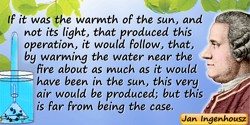
If it was the warmth of the sun, and not its light, that produced this operation, it would follow, that, by warming the water near the fire about as much as it would have been in the sun, this very air would be produced; but this is far from being the case.
In Tobias George Smollett (ed.), 'Experiments Upon Vegetables', The Critical Review, Or, Annals of Literature (1779), 48, 336.
If it were always necessary to reduce everything to intuitive knowledge, demonstration would often be insufferably prolix. This is why mathematicians have had the cleverness to divide the difficulties and to demonstrate separately the intervening propositions. And there is art also in this; for as the mediate truths (which are called lemmas, since they appear to be a digression) may be assigned in many ways, it is well, in order to aid the understanding and memory, to choose of them those which greatly shorten the process, and appear memorable and worthy in themselves of being demonstrated. But there is another obstacle, viz.: that it is not easy to demonstrate all the axioms, and to reduce demonstrations wholly to intuitive knowledge. And if we had chosen to wait for that, perhaps we should not yet have the science of geometry.
In Gottfried Wilhelm Leibnitz and Alfred Gideon Langley (trans.), New Essays Concerning Human Understanding (1896), 413-414.
If matter is not eternal, its first emergence into being is a miracle beside which all others dwindle into absolute insignificance. But, as has often been pointed out, the process is unthinkable; the sudden apocalypse of a material world out of blank nonentity cannot be imagined; its emergence into order out of chaos when “without form and void” of life, is merely a poetic rendering of the doctrine of its slow evolution.
In Nineteenth Century (Sep c.1879?). Quoted in John Tyndall, 'Professor Virchow and Evolution', Fragments of Science (1879), Vol. 2, 377.
If Melancholy increases so far, that from the great motion of the Liquid of the Brain the Patient be thrown into a wild Fury, it is call’d Madness.… The greatest Remedy for it is to throw the Patient unwarily into the Sea, and to keep him under Water as long as he can possibly bear without being quite stifled.
Aphorism No. 1118 and 1123 in Boerhaave’s Aphorisms: Concerning The Knowledge and Cure of Diseases (1715), 302-303.
If Nicolaus Copernicus, the distinguished and incomparable master, in this work had not been deprived of exquisite and faultless instruments, he would have left us this science far more well-established. For he, if anybody, was outstanding and had the most perfect understanding of the geometrical and arithmetical requisites for building up this discipline. Nor was he in any respect inferior to Ptolemy; on the contrary, he surpassed him greatly in certain fields, particularly as far as the device of fitness and compendious harmony in hypotheses is concerned. And his apparently absurd opinion that the Earth revolves does not obstruct this estimate, because a circular motion designed to go on uniformly about another point than the very center of the circle, as actually found in the Ptolemaic hypotheses of all the planets except that of the Sun, offends against the very basic principles of our discipline in a far more absurd and intolerable way than does the attributing to the Earth one motion or another which, being a natural motion, turns out to be imperceptible. There does not at all arise from this assumption so many unsuitable consequences as most people think.
From Letter (20 Jan 1587) to Christopher Rothman, chief astronomer of the Landgrave of Hesse. Webmaster seeks more information to better cite this source — please contact if you can furnish more. Webmaster originally found this quote introduced by an uncredited anonymous commentary explaining the context: “It was not just the Church that resisted the heliocentrism of Copernicus. Many prominent figures, in the decades following the 1543 publication of De Revolutionibus, regarded the Copernican model of the universe as a mathematical artifice which, though it yielded astronomical predictions of superior accuracy, could not be considered a true representation of physical reality.”
If some great Power would agree to make me always think what is true and do what is right, on condition of being turned into a sort of clock and wound up every morning before I got out of bed, I should instantly close with the offer.
'On Descartes' "Discourse Touching the Method of Using One's Reason Rightly and of Seeking Scientific Truth'" (1870). In Collected Essays (1893), Vol. 1, 192-3.
If the finding of Coines, Medals, Urnes, and other Monuments of famous Persons, or Towns, or Utensils, be admitted for unquestionable Proofs, that such Persons or things have, in former Times, had a being, certainly those Petrifactions may be allowed to be of equal Validity and Evidence, that there have been formerly such Vegetables or Animals. These are truly Authentick Antiquity not to be counterfeited, the Stamps, and Impressions, and Characters of Nature that are beyond the Reach and Power of Humane Wit and Invention, and are true universal Characters legible to all rational Men.
Lectures and Discourses of Earthquakes (1668). In The Posthumous Works of Robert Hooke, containing his Cutlerian Lectures and other Discourses read at the Meetings of the Illustrious Royal Society (1705), 449.
If the Humours of the Eye by old Age decay, so as by shrinking to make the Cornea and Coat of the Crystalline Humour grow flatter than before, the Light will not be refracted enough, and for want of a sufficient Refraction will not converge to the bottom of the Eye but to some place beyond it, and by consequence paint in the bottom of the Eye a confused Picture, and according to the Indistinctuess of this Picture the Object will appear confused. This is the reason of the decay of sight in old Men, and shews why their Sight is mended by Spectacles. For those Convex glasses supply the defect of plumpness in the Eye, and by increasing the Refraction make the rays converge sooner, so as to convene distinctly at the bottom of the Eye if the Glass have a due degree of convexity. And the contrary happens in short-sighted Men whose Eyes are too plump. For the Refraction being now too great, the Rays converge and convene in the Eyes before they come at the bottom; and therefore the Picture made in the bottom and the Vision caused thereby will not be distinct, unless the Object be brought so near the Eye as that the place where the converging Rays convene may be removed to the bottom, or that the plumpness of the Eye be taken off and the Refractions diminished by a Concave-glass of a due degree of Concavity, or lastly that by Age the Eye grow flatter till it come to a due Figure: For short-sighted Men see remote Objects best in Old Age, and therefore they are accounted to have the most lasting Eyes.
Opticks (1704), Book 1, Part 1, Axiom VII, 10-11.
If the love of surgery is a proof of a person’s being adapted for it, then certainly I am fitted to he a surgeon; for thou can’st hardly conceive what a high degree of enjoyment I am from day to day experiencing in this bloody and butchering department of the healing art. I am more and more delighted with my profession.
Letter to his father (1853). In John Vaughan, 'Lord Lister', The Living Age (1918), 297, 361. Reprinted from The Fortnightly Review (1918), 109, 417- .
If the mysterious influence to which the dissymmetry of nature is due should come to change in sense or direction, the constituting elements of all living beings would take an inverse dissymmetry. Perhaps a new world would be presented to us. Who could foresee the organization of living beings, if the cellulose, which is right, should become left, if the left albumen of the blood should become right? There are here mysteries which prepare immense labours for the future, and from this hour invite the most serious meditations in science.
Lecture (3 Feb 1860), to the Chemical Society of Paris, 'On the Molecular Dissymetry of Natural Organic Products', reprinted in The Chemical News and Journal of Industrial Science (3 May 1862), 5, No. 126, 248.
If the omniscient author of nature knew that the study of his works tends to make men disbelieve his Being or Attributes, he would not have given them so many invitations to study and contemplate Nature.
'Some considerations touching the usefulness of experimental philosophy' (1663). Quoted In Peter Gay, The Enlightenment (1977), 140.
If there’s one thing in physics I feel more responsible for than any other, it’s this perception of how everything fits together. I like to think of myself as having a sense of judgment. I’m willing to go anywhere, talk to anybody, ask any question that will make headway. I confess to being an optimist about things, especially about someday being able to understand how things are put together. So many young people are forced to specialize in one line or another that a young person can’t afford to try and cover this waterfront — only an old fogy who can afford to make a fool of himself. If I don't, who will?
Stated during a 1983 interview. Quoted in Dennis Overbye, 'John A. Wheeler, Physicist Who Coined the Term Black Hole, Is Dead at 96', New York Times (14 Apr 2008).
If these d'Hérelle bodies were really genes, fundamentally like our chromosome genes, they would give us an utterly new angle from which to attack the gene problem. They are filterable, to some extent isolable, can be handled in test-tubes, and their properties, as shown by their effects on the bacteria, can then be studied after treatment. It would be very rash to call these bodies genes, and yet at present we must confess that there is no distinction known between the genes and them. Hence we can not categorically deny that perhaps we may be able to grind genes in a mortar and cook them in a beaker after all. Must we geneticists become bacteriologists, physiological chemists and physicists, simultaneously with being zoologists and botanists? Let us hope so.
'Variation Due to Change in the Individual Gene', The American Naturalist (1922), 56, 48-9.
If thou examinest a man having a break in the column of his nose, his nose being disfigured, and a [depression] being in it, while the swelling that is on it protrudes, [and] he had discharged blood from both his nostrils, thou shouldst say concerning him: “One having a break in the column of his nose. An ailment which I will treat. “Thou shouldst cleanse [it] for him [with] two plugs of linen. Thou shouldst place two [other] plugs of linen saturated with grease in the inside of his two nostrils. Thou shouldst put [him] at his mooring stakes until the swelling is drawn out. Thou shouldst apply for him stiff rolls of linen by which his nose is held fast. Thou shouldst treat him afterward [with] lint, every day until he recovers.
(circa 1700 B.C.) From “The Edwin Smith Surgical Papyrus”, an ancient Egyptian document regarded as the earliest known historical record of scientific thought. As translated in James Henry Breasted, The Edwin Smith Surgical Papyrus: Published in Facsimile and Hieroglyphic Transliteration with Translation and Commentary (1930), 440.
If to-day you ask a physicist what he has finally made out the æther or the electron to be, the answer will not be a description in terms of billiard balls or fly-wheels or anything concrete; he will point instead to a number of symbols and a set of mathematical equations which they satisfy. What do the symbols stand for? The mysterious reply is given that physics is indifferent to that; it has no means of probing beneath the symbolism. To understand the phenomena of the physical world it is necessary to know the equations which the symbols obey but not the nature of that which is being symbolised. …this newer outlook has modified the challenge from the material to the spiritual world.
Swarthmore Lecture (1929) at Friends’ House, London, printed in Science and the Unseen World (1929), 30.
If Watson and I had not discovered the [DNA] structure, instead of being revealed with a flourish it would have trickled out and that its impact would have been far less. For this sort of reason Stent had argued that a scientific discovery is more akin to a work of art than is generally admitted. Style, he argues, is as important as content. I am not completely convinced by this argument, at least in this case.
What Mad Pursuit (1990), 76.
If we betake ourselves to the statistical method, we do so confessing that we are unable to follow the details of each individual case, and expecting that the effects of widespread causes, though very different in each individual, will produce an average result on the whole nation, from a study of which we may estimate the character and propensities of an imaginary being called the Mean Man.
'Does the Progress of Physical Science tend to give any advantage to the opinion of necessity (or determinism) over that of the continuency of Events and the Freedom of the Will?' In P. M. Hannan (ed.), The Scientific Letters and Papers of James Clerk Maxwell (1995), Vol. 2, 1862-1873, 818.
If we consider what science already has enabled men to know—the immensity of space, the fantastic philosophy of the stars, the infinite smallness of the composition of atoms, the macrocosm whereby we succeed only in creating outlines and translating a measure into numbers without our minds being able to form any concrete idea of it—we remain astounded by the enormous machinery of the universe.
Address (10 Sep 1934) to the International Congress of Electro-Radio Biology, Venice. In Associated Press, 'Life a Closed Book, Declares Marconi', New York Times (11 Sep 1934), 15.
If we evolved a race of Isaac Newtons, that would not be progress. For the price Newton had to pay for being a supreme intellect was that he was incapable of friendship, love, fatherhood, and many other desirable things. As a man he was a failure; as a monster he was superb.
Interview with J.W.N. Sullivan, Contemporary Mind, London, 1934. As cited in James Roy Newman, The World of Mathematics (1956), Vol. 4, 2222.
If we look at the problems raised by Aristotle, we are astonished at his gift of observation. What wonderful eyes the Greeks had for many things! Only they committed the mistake of being overhasty, of passing straightway from the phenomenon to the explanation of it, and thereby produced certain theories that are quite inadequate. But this is the mistake of all times, and still made in our own day.
In The Maxims and Reflections of Goethe (1906), 195.
If we sink to the biochemical level, then the human being has lost a great many synthetic abilities possessed by other species and, in particular, by plants and microorganisms. Our loss of ability to manufacture a variety of vitamins makes us dependent on our diet and, therefore, on the greater synthetic versatility of other creatures. This is as much a “degenerative” change as the tapeworm’s abandonment of a stomach it no longer needs, but since we are prejudiced in our own favor, we don’t mention it.
In 'The Modern Demonology' (Jan 1962). Collected in Asimov on Physics (1976), 150.
If we stay strong, then I believe we can stabilize the world and have peace based on force. Now, peace based on force is not as good as peace based on agreement, but … I think that for the time being the only peace that we can have is the peace based on force.
From debate (20 Feb 1958) between Linus Pauling and Edward Teller on WQED-TV, San Francisco. Transcript published as Fallout and Disarmament: The Pauling-Teller Debate (1958). Reprinted in 'Fallout and Disarmament: A Debate between Linus Pauling and Edward Teller', Daedalus (Spring 1958), 87, No. 2, 154.
If we use resources productively and take to heart the lessons learned from coping with the energy crisis, we face a future confronted only, as Pogo, once said, by insurmountable opportunities. The many crises facing us should be seen, then, not as threats, but as chances to remake the future so it serves all beings.
Utne Reader (Nov-Dec 1989).
If we were capable of following the progress of increase of the number of the parts of the most perfect animal, as they first formed in succession, from the very first to its state of full perfection, we should probably be able to compare it with some one of the incomplete animals themselves, of every order of animals in the Creation, being at no stage different from some of the inferior orders; or, in other words, if we were to take a series of animals, from the more imperfect to the perfect, we should probably find an imperfect animal, corresponding with some stage of the most perfect.
R. Owen (ed.), John Hunter's Observations on Animal Development (1841), 14.
If we wish to give an account of the atomic constitution of the aromatic compounds, we are bound to explain the following facts:
1) All aromatic compounds, even the most simple, are relatively richer in carbon than the corresponding compounds in the class of fatty bodies.
2) Among the aromatic compounds, as well as among the fatty bodies, a large number of homologous substances exist.
3) The most simple aromatic compounds contain at least six atoms of carbon.
4) All the derivatives of aromatic substances exhibit a certain family likeness; they all belong to the group of 'Aromatic compounds'. In cases where more vigorous reactions take place, a portion of the carbon is often eliminated, but the chief product contains at least six atoms of carbon These facts justify the supposition that all aromatic compounds contain a common group, or, we may say, a common nucleus consisting of six atoms of carbon. Within this nucleus a more intimate combination of the carbon atoms takes place; they are more compactly placed together, and this is the cause of the aromatic bodies being relatively rich in carbon. Other carbon atoms can be joined to this nucleus in the same way, and according to the same law, as in the case of the group of fatty bodies, and in this way the existence of homologous compounds is explained.
1) All aromatic compounds, even the most simple, are relatively richer in carbon than the corresponding compounds in the class of fatty bodies.
2) Among the aromatic compounds, as well as among the fatty bodies, a large number of homologous substances exist.
3) The most simple aromatic compounds contain at least six atoms of carbon.
4) All the derivatives of aromatic substances exhibit a certain family likeness; they all belong to the group of 'Aromatic compounds'. In cases where more vigorous reactions take place, a portion of the carbon is often eliminated, but the chief product contains at least six atoms of carbon These facts justify the supposition that all aromatic compounds contain a common group, or, we may say, a common nucleus consisting of six atoms of carbon. Within this nucleus a more intimate combination of the carbon atoms takes place; they are more compactly placed together, and this is the cause of the aromatic bodies being relatively rich in carbon. Other carbon atoms can be joined to this nucleus in the same way, and according to the same law, as in the case of the group of fatty bodies, and in this way the existence of homologous compounds is explained.
Bulletin de la Societé Chimique de France (1865), 1, 98. Trans. W. H. Brock.
If you are out to describe the truth, leave elegance to the tailor.
On being reproached that his formula of gravitation was longer and more cumbersome than Newton’s.
On being reproached that his formula of gravitation was longer and more cumbersome than Newton’s.
Quoted in J. H. Mitchell, Writing for Professional and Technical Journals (1968), Introduction.
If you could meet your grandkids as elderly citizens in the year 2100 … you would view them as being, basically, Greek gods… that's where we're headed.
In Brian Bolduc, 'Captain Michio and the World of Tomorrow', The Wall Street Journal (9 March 2012)
![Jane Goodall quote: If you look into their [chimpanzees] eyes, you know you’re looking into a thinking mind. They teach us that](https://todayinsci.com/G/Goodall_Jane/GoodallJane-EyesThm.jpg)
If you look into their [chimpanzees] eyes, you know you’re looking into a thinking mind. They teach us that we are not the only beings with personalities, minds capable of rational thought, altruism and a sense of humor. That leads to new respect for other animals, respect for the environment and respect for all life.
From interview by Tamar Lewin, 'Wildlife to Tireless Crusader, See Jane Run', New York Times (20 Nov 2000), F35.
If you want excellence, you must aim at perfection. It has its drawbacks but being finicky is essential.
Quoted in India Today (Apr 2008), 33, No 16, as cited on webpage of Dhirubhai Ambani Institute of Information and Communication Technology.
If you want to understand human beings, there are plenty of people to go to besides psychologists.... Most of these people are incapable of communicating their knowledge, but those who can communicate it are novelists. They are good novelists precisely because they are good psychologists.
In Science is a Sacred Cow (1950), 128.
If, again with the light of science, we trace forward into the future the condition of our globe, we are compelled to admit that it cannot always remain in its present condition; that in time, the store of potential energy which now exists in the sun and in the bodies of celestial space which may fall into it will be dissipated in radiant heat, and consequently the earth, from being the theatre of life, intelligence, of moral emotions, must become a barren waste.
Address (Jul 1874) at the grave of Joseph Priestley, in Joseph Henry and Arthur P. Molella, et al. (eds.), A Scientist in American Life: Essays and Lectures of Joseph Henry (1980), 120.
If, as I have reason to believe, I have disintegrated the nucleus of the atom, this is of greater significance than the war.
[Apology to the international anti-submarine committee for being absent from several meetings during World War I.]
[Apology to the international anti-submarine committee for being absent from several meetings during World War I.]
(Jun 1919). Quoted in D. Wilson, Rutherford: Simple Genius (1983), 405, as cited in Laurie M. Brown, Abraham Pais, Brian Pippard, Twentieth Century Physics (1995), Vol. 1, 113.
If, then, there must be something eternal, let us see what sort of Being it must be. And to that it is very obvious to Reason, that it must necessarily be a cogitative Being. For it is as impossible to conceive that ever bare incogitative Matter should produce a thinking intelligent Being, as that nothing should of itself produce Matter...
In Essay Concerning Human Understanding (1690, 1801), Book 4, Chap. 10, Sec. 10, 114.
Imaginary numbers are a fine and wonderful refuge of the divine spirit almost an amphibian between being and non-being. (1702)
[Alternate translation:] The Divine Spirit found a sublime outlet in that wonder of analysis, that portent of the ideal world, that amphibian between being and not-being, which we call the imaginary root of negative unity.
[Alternate translation:] The Divine Spirit found a sublime outlet in that wonder of analysis, that portent of the ideal world, that amphibian between being and not-being, which we call the imaginary root of negative unity.
Quoted in Félix Klein, Elementary Mathematics From an Advanced Standpoint: Arithmetic, Algebra, Analysis (1924), 56. Alternate translation as quoted in Tobias Dantzig, Number, the Language of Science: a Critical Survey Written for the Cultured Non-Mathematician (1930), 204
Imagine that … the world is something like a great chess game being played by the gods, and we are observers of the game. … If we watch long enough, we may eventually catch on to a few of the rules…. However, we might not be able to understand why a particular move is made in the game, merely because it is too complicated and our minds are limited…. We must limit ourselves to the more basic question of the rules of the game.
If we know the rules, we consider that we “understand” the world.
If we know the rules, we consider that we “understand” the world.
In 'Basic Physics', The Feynman Lectures on Physics (1964, 2013), Vol. 1, 2-1.
In 1905, a physicist measuring the thermal conductivity of copper would have faced, unknowingly, a very small systematic error due to the heating of his equipment and sample by the absorption of cosmic rays, then unknown to physics. In early 1946, an opinion poller, studying Japanese opinion as to who won the war, would have faced a very small systematic error due to the neglect of the 17 Japanese holdouts, who were discovered later north of Saipan. These cases are entirely parallel. Social, biological and physical scientists all need to remember that they have the same problems, the main difference being the decimal place in which they appear.
In William G. Cochran, Frederick Mosteller and John W. Tukey, 'Principles of Sampling', Journal of the American Statistical Society, 1954, 49, 31. Collected in Selected Papers of Frederick Mosteller (2006), 290.
In 1944 Erwin Schroedinger, stimulated intellectually by Max Delbruck, published a little book called What is life? It was an inspiration to the first of the molecular biologists, and has been, along with Delbruck himself, credited for directing the research during the next decade that solved the mystery of how 'like begat like.' Max was awarded this Prize in 1969, and rejoicing in it, he also lamented that the work for which he was honored before all the peoples of the world was not something which he felt he could share with more than a handful. Samuel Beckett's contributions to literature, being honored at the same time, seemed to Max somehow universally accessible to anyone. But not his. In his lecture here Max imagined his imprisonment in an ivory tower of science.
'The Polymerase Chain Reaction', Nobel Lecture (8 Dec 1993). In Nobel Lectures: Chemistry 1991-1995 (1997), 103.
In a crystal we have the clear evidence of the existence of a formative life-principle, and though we cannot understand the life of a crystal, it is none the less a living being.
In 'The Problem of Increasing Human Energy: With Special Reference to the Harnessing of the Sun’s Energy', Century Illustrated Magazine (Jun 1900), 60, No. 2, 180.
In acute diseases the physician must conduct his inquiries in the following way. First he must examine the face of the patient, and see whether it is like the faces of healthy people, and especially whether it is like its usual self. Such likeness will be the best sign, and the greatest unlikeness will be the most dangerous sign. The latter will be as follows. Nose sharp, eyes hollow, temples sunken, ears cold and contracted with their lobes turned outwards, the skin about the face hard and tense and parched, the colour of the face as a whole being yellow or black.
Prognostic, in Hippocrates, trans. W. H. S. Jones (1923), Vol. 2, 9.
In all spheres of science, art, skill, and handicraft it is never doubted that, in order to master them, a considerable amount of trouble must be spent in learning and in being trained. As regards philosophy, on the contrary, there seems still an assumption prevalent that, though every one with eyes and fingers is not on that account in a position to make shoes if he only has leather and a last, yet everybody understands how to philosophize straight away, and pass judgment on philosophy, simply because he possesses the criterion for doing so in his natural reason.
From Phänomenologie des Geistes (1807) as translated by J.B. Baillie in 'Preface', The Phenomenology of Mind (1910), Vol. 1, 67.
In an age of egoism, it is so difficult to persuade man that of all studies, the most important is that of himself. This is because egoism, like all passions, is blind. The attention of the egoist is directed to the immediate needs of which his senses give notice, and cannot be raised to those reflective needs that reason discloses to us; his aim is satisfaction, not perfection. He considers only his individual self; his species is nothing to him. Perhaps he fears that in penetrating the mysteries of his being he will ensure his own abasement, blush at his discoveries, and meet his conscience. True philosophy, always at one with moral science, tells a different tale. The source of useful illumination, we are told, is that of lasting content, is in ourselves. Our insight depends above all on the state of our faculties; but how can we bring our faculties to perfection if we do not know their nature and their laws! The elements of happiness are the moral sentiments; but how can we develop these sentiments without considering the principle of our affections, and the means of directing them? We become better by studying ourselves; the man who thoroughly knows himself is the wise man. Such reflection on the nature of his being brings a man to a better awareness of all the bonds that unite us to our fellows, to the re-discovery at the inner root of his existence of that identity of common life actuating us all, to feeling the full force of that fine maxim of the ancients: 'I am a man, and nothing human is alien to me.'
Considerations sur les diverses méthodes à suivre dans l'observation des peuples sauvages (1800) The Observation of Savage Peoples, trans. F. C. T. Moore (1969), 61.
In August, 1896, I exposed the sodium flame to large magnetic forces by placing it between the poles of a strong electromagnet. Again I studied the radiation of the flame by means of Rowland's mirror, the observations being made in the direction perpendicular to the lines of force. Each line, which in the absence of the effect of the magnetic forces was very sharply defined, was now broadened. This indicated that not only the original oscillations, but also others with greater and again others with smaller periods of oscillation were being radiated by the flame. The change was however very small. In an easily produced magnetic field it corresponded to a thirtieth of the distance between the two sodium lines, say two tenths of an Angstrom, a unit of measure whose name will always recall to physicists the meritorious work done by the father of my esteemed colleague.
'Light Radiation in a Magnetic Field', Nobel Lecture, 2 May 1903. In Nobel Lectures: Physics 1901-1921 (1967), 34-5.
In despair, I offer your readers their choice of the following definitions of entropy. My authorities are such books and journals as I have by me at the moment.
(a) Entropy is that portion of the intrinsic energy of a system which cannot be converted into work by even a perfect heat engine.—Clausius.
(b) Entropy is that portion of the intrinsic energy which can be converted into work by a perfect engine.—Maxwell, following Tait.
(c) Entropy is that portion of the intrinsic energy which is not converted into work by our imperfect engines.—Swinburne.
(d) Entropy (in a volume of gas) is that which remains constant when heat neither enters nor leaves the gas.—W. Robinson.
(e) Entropy may be called the ‘thermal weight’, temperature being called the ‘thermal height.’—Ibid.
(f) Entropy is one of the factors of heat, temperature being the other.—Engineering.
I set up these bald statement as so many Aunt Sallys, for any one to shy at.
[Lamenting a list of confused interpretations of the meaning of entropy, being hotly debated in journals at the time.]
(a) Entropy is that portion of the intrinsic energy of a system which cannot be converted into work by even a perfect heat engine.—Clausius.
(b) Entropy is that portion of the intrinsic energy which can be converted into work by a perfect engine.—Maxwell, following Tait.
(c) Entropy is that portion of the intrinsic energy which is not converted into work by our imperfect engines.—Swinburne.
(d) Entropy (in a volume of gas) is that which remains constant when heat neither enters nor leaves the gas.—W. Robinson.
(e) Entropy may be called the ‘thermal weight’, temperature being called the ‘thermal height.’—Ibid.
(f) Entropy is one of the factors of heat, temperature being the other.—Engineering.
I set up these bald statement as so many Aunt Sallys, for any one to shy at.
[Lamenting a list of confused interpretations of the meaning of entropy, being hotly debated in journals at the time.]
In The Electrician (9 Jan 1903).
In every living being there exists a capacity for endless diversity of form; each possesses the power of adapting its organization to the variations of the external world, and it is this power, called into activity by cosmic changes, which has enabled the simple zoophytes of the primitive world to climb to higher and higher stages of organization, and has brought endless variety into nature.
From Gottfried Reinold Treviranus, Biologie, oder Philosophie der lebenden Natur [Biology, or Philosophy of Animate Nature], quoted in Lecture 1, August Weismann (1904, 2nd German ed.) as translated in August Weismann, Margaret R. Thomson (trans.), The Evolution Theory, Vol 1., 18-19.
In fact, we will have to give up taking things for granted, even the apparently simple things. We have to learn to understand nature and not merely to observe it and endure what it imposes on us. Stupidity, from being an amiable individual defect, has become a social crime.
The Origin of Life (1967), 163.
In geometry, as in most sciences, it is very rare that an isolated proposition is of immediate utility. But the theories most powerful in practice are formed of propositions which curiosity alone brought to light, and which long remained useless without its being able to divine in what way they should one day cease to be so. In this sense it may be said, that in real science, no theory, no research, is in effect useless.
In 'Geometry', A Philosophical Dictionary, (1881), Vol. l, 374.
In human beings pure masculinity or femininity is not to be found either in a psychological or biological sense.
Three Essays on the Theory of Sexuality (1905), In James Strachey (ed.), The Standard Edition of the Complete Psychological Works of Sigmund Freud (1953), Vol. 7, 220, fn 1.
In its essence, the theory of natural selection is primarily an attempt to give an account of the probable mechanism of the origin of the adaptations of the organisms to their environment, and only secondarily an attempt to explain evolution at large. Some modern biologists seem to believe that the word 'adaptation' has teleological connotations, and should therefore be expunged from the scientific lexicon. With this we must emphatically disagree. That adaptations exist is so evident as to be almost a truism, although this need not mean that ours is the best of all possible worlds. A biologist has no right to close his eyes to the fact that the precarious balance between a living being and its environment must be preserved by some mechanism or mechanisms if life is to endure.
Genetics and Origin of Species (1937), 150.
In logic, A asserts and B denies. Assertions being proverbially untrue, the presumption would be in favor of B’s innocence were it not that denials are notoriously false.
The Unabridged Devil’s Dictionary (2000), 5.
In mathematics … we find two tendencies present. On the one hand, the tendency towards abstraction seeks to crystallise the logical relations inherent in the maze of materials ... being studied, and to correlate the material in a systematic and orderly
Geometry and the Imagination (New York, 1952).
In my work on Fossil Bones, I set myself the task of recognizing to which animals the fossilized remains which fill the surface strata of the earth belong. ... As a new sort of antiquarian, I had to learn to restore these memorials to past upheavals and, at the same time, to decipher their meaning. I had to collect and put together in their original order the fragments which made up these animals, to reconstruct the ancient creatures to which these fragments belonged, to create them once more with their proportions and characteristics, and finally to compare them to those alive today on the surface of the earth. This was an almost unknown art, which assumed a science hardly touched upon up until now, that of the laws which govern the coexistence of forms
of the various parts in organic beings.
Discours sur les révolutions du globe, (Discourse on the Revolutions of the Surface of the Globe), originally the introduction to Recherches sur les ossemens fossiles des quadrupèdes (1812). Translated by Ian Johnston from the 1825 edition. Online at Vancouver Island University website.
In no sense can the Neanderthal bones be regarded as the remains of a human being intermediate between men and apes.
In Evidence as to Man's Place in Nature (1863), 157.
In October 1838, that is, fifteen months after I had begun my systematic enquiry, I happened to read for amusement Malthus on Population, and being well prepared to appreciate the struggle for existence which everywhere goes on from long-continued observation of the habits of animals and plants, it at once struck me that under these circumstances favourable variations would tend to be, preserved, and unfavourable ones to be destroyed. The result of this would be the formation of new species. Here, then, I had at last got a theory by which to work; but I was so anxious to avoid prejudice, that I determined not for some time to write even the briefest sketch of it.
In Charles Darwin and Francis Darwin (ed.), Charles Darwin: His Life Told in an Autobiographical Chapter, and in a Selected Series of His Published Letters (1892), 40.
In one department of his [Joseph Black’s] lecture he exceeded any I have ever known, the neatness and unvarying success with which all the manipulations of his experiments were performed. His correct eye and steady hand contributed to the one; his admirable precautions, foreseeing and providing for every emergency, secured the other. I have seen him pour boiling water or boiling acid from a vessel that had no spout into a tube, holding it at such a distance as made the stream’s diameter small, and so vertical that not a drop was spilt. While he poured he would mention this adaptation of the height to the diameter as a necessary condition of success. I have seen him mix two substances in a receiver into which a gas, as chlorine, had been introduced, the effect of the combustion being perhaps to produce a compound inflammable in its nascent state, and the mixture being effected by drawing some string or wire working through the receiver's sides in an air-tight socket. The long table on which the different processes had been carried on was as clean at the end of the lecture as it had been before the apparatus was planted upon it. Not a drop of liquid, not a grain of dust remained.
In Lives of Men of Letters and Science, Who Flourished in the Time of George III (1845), 346-7.
In order that the facts obtained by observation and experiment may be capable of being used in furtherance of our exact and solid knowledge, they must be apprehended and analysed according to some Conceptions which, applied for this purpose, give distinct and definite results, such as can be steadily taken hold of and reasoned from.
Philosophy of the Inductive Sciences (1840), Vol. 2, 205.
In our search after the Knowledge of Substances, our want of Ideas, that are suitable to such a way of proceeding, obliges us to a quite different method. We advance not here, as in the other (where our abstract Ideas are real as well as nominal Essences) by contemplating our Ideas, and considering their Relations and Correspondencies; that helps us very little, for the Reasons, and in another place we have at large set down. By which, I think it is evident, that Substances afford Matter of very little general Knowledge; and the bare Contemplation of their abstract Ideas, will carry us but a very little way in the search of Truth and Certainty. What then are we to do for the improvement of our Knowledge in Substantial beings? Here we are to take a quite contrary Course, the want of Ideas of their real essences sends us from our own Thoughts, to the Things themselves, as they exist.
An Essay Concerning Human Understanding (1690). Edited by Peter Nidditch (1975), Book 4, Chapter 12, Section 9, 644.
In Pure Mathematics, where all the various truths are necessarily connected with each other, (being all necessarily connected with those hypotheses which are the principles of the science), an arrangement is beautiful in proportion as the principles are few; and what we admire perhaps chiefly in the science, is the astonishing variety of consequences which may be demonstrably deduced from so small a number of premises.
In Elements of the Philosophy of the Human Mind (1827), Vol. 3, Chap. 1, Sec. 8, 186.
In Science the paramount appeal is to the Intellect—its purpose being instruction; in Art, the paramount appeal is to the Emotions—its purpose being pleasure.
In The Principles of Success in Literature (1901), 63.
In scientific matters ... the greatest discoverer differs from the most arduous imitator and apprentice only in degree, whereas he differs in kind from someone whom nature has endowed for fine art. But saying this does not disparage those great men to whom the human race owes so much in contrast to those whom nature has endowed for fine art. For the scientists' talent lies in continuing to increase the perfection of our cognitions and on all the dependent benefits, as well as in imparting that same knowledge to others; and in these respects they are far superior to those who merit the honour of being called geniuses. For the latter's art stops at some point, because a boundary is set for it beyond which it cannot go and which has probably long since been reached and cannot be extended further.
The Critique of Judgement (1790), trans. J. C. Meredith (1991), 72.
In the alternation between inhaling and exhaling, between heaven and earth, between Yin and Yang, holiness is forever being created.
From Das Glasperlemspeil (1943) translated as The Glass Bead Game (1969, 1990), 119.
In the beginning God created Heaven and Earth … Which beginning of time, according to our Cronologie, fell upon the entrance of the night preceding the twenty third day of Octob. in the year of the Julian Calendar, 710 [or 4004 B.C.]. Upon the first day therefore of the world, or Octob. 23. being our Sunday, God, together with the highest Heaven, created the Angels. Then having finished, as it were, the roofe of this building, he fell in hand with the foundation of this wonderfull Fabrick of the World, he fashioned this lowermost Globe, consisting of the Deep, and of the Earth; all the Quire of Angels singing together and magnifying his name therefore … And when the Earth was void and without forme, and darknesse covered the face of the Deepe, on the very middle of the first day, the light was created; which God severing from the darknesses, called the one day, and the other night.
In 'Annals of the Old Testament', The Annals of the World (1658), excerpted in Louis A. Ruprecht, God Gardened East: A Gardener's Meditation on the Dynamics of Genesis (2008), 53-54.
In the beginning of the year 1665 I found the Method of approximating series & the Rule for reducing any dignity of any Bionomial into such a series. The same year in May I found the method of Tangents of Gregory & Slusius, & in November had the direct method of fluxions & the next year in January had the Theory of Colours & in May following I had entrance into ye inverse method of fluxions. And the same year I began to think of gravity extending to ye orb of the Moon & (having found out how to estimate the force with wch [a] globe revolving within a sphere presses the surface of the sphere) from Keplers rule of the periodic times of the Planets being in sesquialterate proportion of their distances from the center of their Orbs, I deduced that the forces wch keep the Planets in their Orbs must [be] reciprocally as the squares of their distances from the centers about wch they revolve: & thereby compared the force requisite to keep the Moon in her Orb with the force of gravity at the surface of the earth, & found them answer pretty nearly. All this was in the two plague years of 1665-1666. For in those days I was in the prime of my age for invention & minded Mathematicks & Philosophy more then than at any time since.
Quoted in Richard Westfall, Never at Rest: A Biography of Isaac Newton (1980), 143.
In the beginning the Universe was created. This has made a lot of people very angry and been widely regarded as a bad move. Many races believe it was created by some sort of god, though the Jatravartid people of Viltvodle VI believe that the entire Universe was in fact sneezed out of the nose of a being called the Great Green Arkleseizure.
In The Restaurant at the End of the Universe (1980, 1981), 1
In the case of elements, as in that of individuals, the determination of character is often attended with very great difficulty, a true estimate being only slowly arrived at, and when at last such an estimate is found, it can only be very partially expressed in words.
In The Encyclopaedia Britannica: Ninth Edition (1877), Vol. 5, 714.
In the firmament of science Mayer and Joule constitute a double star, the light of each being in a certain sense complementary to that of the other.
In Heat: A Mode of Motion (1800, 1915), 569.
In the history of physics, there have been three great revolutions in thought that first seemed absurd yet proved to be true. The first proposed that the earth, instead of being stationary, was moving around at a great and variable speed in a universe that is much bigger than it appears to our immediate perception. That proposal, I believe, was first made by Aristarchos two millenia ago ... Remarkably enough, the name Aristarchos in Greek means best beginning.
[The next two revolutions occurred ... in the early part of the twentieth century: the theory of relativity and the science of quantum mechanics...]
[The next two revolutions occurred ... in the early part of the twentieth century: the theory of relativity and the science of quantum mechanics...]
Edward Teller with Judith L. Shoolery, Memoirs: A Twentieth-Century Journey in Science and Politics (2001), 562.
In the last four days I have got the spectrum given by Tantalum. Chromium. Manganese. Iron. Nickel. Cobalt. and Copper and part of the Silver spectrum. The chief result is that all the elements give the same kind of spectrum, the result for any metal being quite easy to guess from the results for the others. This shews that the insides of all the atoms are very much alike, and from these results it will be possible to find out something of what the insides are made up of.
Letter to his mother (2 Nov 1913). In J. L. Heilbron (ed.), H. G. J. Moseley: The Life and Letters of an English Physicist 1887-1915 (1974), 209.
In the modern interpretation of Mendelism, facts are being transformed into factors at a rapid rate. If one factor will not explain the facts, then two are involved; if two prove insufficient, three will sometimes work out. The superior jugglery sometimes necessary to account for the results may blind us, if taken too naively, to the common-place that the results are often so excellently 'explained' because the explanation was invented to explain them. We work backwards from the facts to the factors, and then, presto! explain the facts by the very factors that we invented to account for them. I am not unappreciative of the distinct advantages that this method has in handling the facts. I realize how valuable it has been to us to be able to marshal our results under a few simple assumptions, yet I cannot but fear that we are rapidly developing a sort of Mendelian ritual by which to explain the extraordinary facts of alternative inheritance. So long as we do not lose sight of the purely arbitrary and formal nature of our formulae, little harm will be done; and it is only fair to state that those who are doing the actual work of progress along Mendelian lines are aware of the hypothetical nature of the factor-assumption.
'What are 'Factors' in Mendelian Explanations?', American Breeders Association (1909), 5, 365.
In the mountains of Parma and Piacenza, multitudes of shells and corals filled with worm-holes may be seen still adhering to the rocks, and when I was making the great horse at Milan a large sack of those which had been found in these parts was brought to my workshop by some peasants... The red stone of the mountains of Verona is found with shells all intermingled, which have become part of this stone... And if you should say that these shells have been and still constantly are being created in such places as these by the nature of the locality or by potency of the heavens in these spots, such an opinion cannot exist in brains possessed of any extensive powers of reasoning because the years of their growth are numbered upon the outer coverings of their shells; and both small and large ones may be seen; and these would not have grown without feeding, or fed without movement, and here [embedded in rock] they would not have been able to move... The peaks of the Apennines once stood up in a sea, in the form of islands surrounded by salt water... and above the plains of Italy where flocks of birds are flying today, fishes were once moving in large shoals.
'Physical Geography', in The Notebooks of Leonardo da Vinci, trans. E. MacCurdy (1938), Vol. 1, 355-6, 359.
In the present state of our knowledge, it would be useless to attempt to speculate on the remote cause of the electrical energy, or the reason why different bodies, after being brought into contact, should be found differently electrified; its relation to chemical affinity is, however, sufficiently evident. May it not be identical with it, and an essential property of matter?
Bakerian Lecture, 'On Some Chemical Agencies of Electricity', Philosophical Transactions of the Royal Society, 1807, 97, 39.
In the realm of science all attempts to find any evidence of supernatural beings, of metaphysical conceptions, as God, immortality, infinity, etc., thus far have failed, and if we are honest we must confess that in science there exists no God, no immortality, no soul or mind as distinct from the body.
In 'Religion and Modern Science', The Christian Register (16 Nov 1922), 101, 1089. The article is introduced as “the substance of an address to the Laymen’s League in All Soul’s Church (5 Nov 1922).
In the sense that [truth] means the reality about a human being it is probably impossible for a biographer to achieve. In the sense that it means a reasonable presentation of all the available facts it is more nearly possible, but even this limited goal is harder to reach than it appears to be. A biographer needs to be both humble and cautious.
Describing the difficulty of historical sources giving conflicting facts. From 'Getting at the Truth', The Saturday Review (19 Sep 1953), 36, No. 38, 11. Excerpted in Meta Riley Emberger and Marian Ross Hall, Scientific Writing (1955), 399.
In the study of this membrane [the retina] I for the first time felt my faith in Darwinism (hypothesis of natural selection) weakened, being amazed and confounded by the supreme constructive ingenuity revealed not only in the retina and in the dioptric apparatus of the vertebrates but even in the meanest insect eye. ... I felt more profoundly than in any other subject of study the shuddering sensation of the unfathomable mystery of life.
Recollections of My Life (1898), 576. Quoted in Sidney Perkowitz, Empire of Light (1999), 16.
In the world of science different levels of esteem are accorded to different kinds of specialist. Mathematicians have always been eminently respectable, and so are those who deal with hard lifeless theories about what constitutes the physical world: the astronomers, the physicists, the theoretical chemists. But the more closely the scientist interests himself in matters which are of direct human relevance, the lower his social status. The real scum of the scientific world are the engineers and the sociologists and the psychologists. Indeed, if a psychologist wants to rate as a scientist he must study rats, not human beings. In zoology the same rules apply. It is much more respectable to dissect muscle tissues in a laboratory than to observe the behaviour of a living animal in its natural habitat.
From transcript of BBC radio Reith Lecture (12 Nov 1967), 'A Runaway World', on the bbc.co.uk website.
In the year 1666 he retired again from Cambridge... to his mother in Lincolnshire & whilst he was musing in a garden it came into his thought that the power of gravity (wch brought an apple from the tree to the ground) was not limited to a certain distance from the earth but that this power must extend much farther than was usually thought. Why not as high as the moon said he to himself & if so that must influence her motion & perhaps retain her in her orbit, whereupon he fell a calculating what would be the effect of that supposition but being absent from books & taking the common estimate in use among Geographers & our seamen before Norwood had measured the earth, that 60 English miles were contained in one degree of latitude on the surface of the Earth his computation did not agree with his theory & inclined him then to entertain a notion that together with the force of gravity there might be a mixture of that force wch the moon would have if it was carried along in a vortex.
[The earliest account of Newton, gravity and an apple.]
[The earliest account of Newton, gravity and an apple.]
Memorandum of a conversation with Newton in August 1726. Quoted in Richard Westfall, Never at Rest: A Biography of Isaac Newton (1980), 154.
In the year 2000, the solar water heater behind me, which is being dedicated today, will still be here supplying cheap, efficient energy. A generation from now, this solar heater can either be a curiosity, a museum piece, an example of a road not taken, or it can be just a small part of one of the greatest and most exciting adventures ever undertaken by the American people: harnessing the power of the Sun to enrich our lives as we move away from our crippling dependence on foreign oil.
[The next President, Republican Ronald Reagan, removed the solar panels and gutted renewable energy research budgets. The road was not taken, nationally, in the eight years of his presidency. Several of the panels are, indeed, now in museums. Most were bought as government surplus and put to good use on a college roof.]
[The next President, Republican Ronald Reagan, removed the solar panels and gutted renewable energy research budgets. The road was not taken, nationally, in the eight years of his presidency. Several of the panels are, indeed, now in museums. Most were bought as government surplus and put to good use on a college roof.]
Speech, at dedication of solar panels on the White House roof, 'Solar Energy Remarks Announcing Administration Proposals' (20 Jun 1979).
In this great celestial creation, the catastrophy of a world, such as ours, or even the total dissolution of a system of worlds, may possibly be no more to the great Author of Nature, than the most common accident in life with us, and in all probability such final and general Doomsdays may be as frequent there, as even Birthdays or mortality with us upon the earth. This idea has something so cheerful in it, that I know I can never look upon the stars without wondering why the whole world does not become astronomers; and that men endowed with sense and reason should neglect a science they are naturally so much interested in, and so capable of enlarging their understanding, as next to a demonstration must convince them of their immortality, and reconcile them to all those little difficulties incident to human nature, without the least anxiety. All this the vast apparent provision in the starry mansions seem to promise: What ought we then not to do, to preserve our natural birthright to it and to merit such inheritance, which alas we think created all to gratify alone a race of vain-glorious gigantic beings, while they are confined to this world, chained like so many atoms to a grain of sand.
In The Universe and the Stars: Being an Original Theory on the Visible Creation, Founded on the Laws of Nature (1750, 1837), 132.
Inasmuch as science represents one way of dealing with the world, it does tend to separate its practitioners from the rest. Being a scientist resembles membership of a religious order and a scientist usually finds that he has more in common with a colleague on the other side of the world than with his next-door neighbor.
In A Dictionary of Scientific Quotations (1991).
Included in this ‘almost nothing,’ as a kind of geological afterthought of the last few million years, is the first development of self-conscious intelligence on this planet–an odd and unpredictable invention of a little twig on the mammalian evolutionary bush. Any definition of this uniqueness, embedded as it is in our possession of language, must involve our ability to frame the world as stories and to transmit these tales to others. If our propensity to grasps nature as story has distorted our perceptions, I shall accept this limit of mentality upon knowledge, for we receive in trade both the joys of literature and the core of our being.
…...
Indeed, nothing more beautifully simplifying has ever happened in the history of science than the whole series of discoveries culminating about 1914 which finally brought practically universal acceptance to the theory that the material world contains but two fundamental entities, namely, positive and negative electrons, exactly alike in charge, but differing widely in mass, the positive electron—now usually called a proton—being 1850 times heavier than the negative, now usually called simply the electron.
Time, Matter and Values (1932), 46. Cited in Karl Raimund Popper and William Warren Bartley (ed.), Quantum Theory and theSchism in Physics (1992), 37.
Induction. The mental operation by which from a number of individual instances, we arrive at a general law. The process, according to Hamilton, is only logically valid when all the instances included in the law are enumerated. This being seldom, if ever, possible, the conclusion of an Induction is usually liable to more or less uncertainty, and Induction is therefore incapable of giving us necessary (general) truths.
Stated as narrative, not a direct quote, by his biographer W.H.S. Monck in 'Glossary of Philosophical Terms', appended in Sir William Hamilton (1881), 181.
Innovations, free thinking is blowing like a storm; those that stand in front of it, ignorant scholars like you, false scientists, perverse conservatives, obstinate goats, resisting mules are being crushed under the weight of these innovations. You are nothing but ants standing in front of the giants; nothing but chicks trying to challenge roaring volcanoes!
From the play Galileo Galilei (2001) .
Instead of being presented with stereotypes by age, sex, color, class, or religion, children must have the opportunity to learn that within each range, some people are loathsome and some are delightful.
In Twentieth Century Faith: Hope and Survival (1972), 61.
Is no one inspired by our present picture of the universe? This value of science remains unsung by singers: you are reduced to hearing not a song or poem, but an evening lecture about it. This is not yet a scientific age.
Perhaps one of the reasons for this silence is that you have to know how to read music. For instance, the scientific article may say, “The radioactive phosphorus content of the cerebrum of the rat decreases to one-half in a period of two weeks.” Now what does that mean?
It means that phosphorus that is in the brain of a rat—and also in mine, and yours—is not the same phosphorus as it was two weeks ago. It means the atoms that are in the brain are being replaced: the ones that were there before have gone away.
So what is this mind of ours: what are these atoms with consciousness? Last week’s potatoes! They now can remember what was going on in my mind a year ago—a mind which has long ago been replaced. To note that the thing I call my individuality is only a pattern or dance, that is what it means when one discovers how long it takes for the atoms of the brain to be replaced by other atoms. The atoms come into my brain, dance a dance, and then go out—there are always new atoms, but always doing the same dance, remembering what the dance was yesterday.
Perhaps one of the reasons for this silence is that you have to know how to read music. For instance, the scientific article may say, “The radioactive phosphorus content of the cerebrum of the rat decreases to one-half in a period of two weeks.” Now what does that mean?
It means that phosphorus that is in the brain of a rat—and also in mine, and yours—is not the same phosphorus as it was two weeks ago. It means the atoms that are in the brain are being replaced: the ones that were there before have gone away.
So what is this mind of ours: what are these atoms with consciousness? Last week’s potatoes! They now can remember what was going on in my mind a year ago—a mind which has long ago been replaced. To note that the thing I call my individuality is only a pattern or dance, that is what it means when one discovers how long it takes for the atoms of the brain to be replaced by other atoms. The atoms come into my brain, dance a dance, and then go out—there are always new atoms, but always doing the same dance, remembering what the dance was yesterday.
'What do You Care What Other People Think?' Further Adventures of a Curious Character (1988), 244.
Is the very mechanism for the universe to come into being meaningless or unworkable or both unless the universe is guaranteed to produce life, consciousness and observership somewhere and for some little time in its history-to-be?
Quoted in P.C.W. Davies, God and the New Physics (1984), 39, from J.A. Wheeler, 'Genesis and observership', Foundational Problems in the Special Science (1977), 39.
It [buckyballs, C60 by Richard Smalley] was an absolutely electrifying discovery. Within a year or two, you couldn’t pick up a chemistry journal without one-third of the articles being about fullerenes.
As quoted in Eric Berger, Houston Chronicle (28 Oct 2005).
It [mathematics] is in the inner world of pure thought, where all entia dwell, where is every type of order and manner of correlation and variety of relationship, it is in this infinite ensemble of eternal verities whence, if there be one cosmos or many of them, each derives its character and mode of being,—it is there that the spirit of mathesis has its home and its life.
Is it a restricted home, a narrow life, static and cold and grey with logic, without artistic interest, devoid of emotion and mood and sentiment? That world, it is true, is not a world of solar light, not clad in the colours that liven and glorify the things of sense, but it is an illuminated world, and over it all and everywhere throughout are hues and tints transcending sense, painted there by radiant pencils of psychic light, the light in which it lies. It is a silent world, and, nevertheless, in respect to the highest principle of art—the interpenetration of content and form, the perfect fusion of mode and meaning—it even surpasses music. In a sense, it is a static world, but so, too, are the worlds of the sculptor and the architect. The figures, however, which reason constructs and the mathematic vision beholds, transcend the temple and the statue, alike in simplicity and in intricacy, in delicacy and in grace, in symmetry and in poise. Not only are this home and this life thus rich in aesthetic interests, really controlled and sustained by motives of a sublimed and supersensuous art, but the religious aspiration, too, finds there, especially in the beautiful doctrine of invariants, the most perfect symbols of what it seeks—the changeless in the midst of change, abiding things hi a world of flux, configurations that remain the same despite the swirl and stress of countless hosts of curious transformations.
Is it a restricted home, a narrow life, static and cold and grey with logic, without artistic interest, devoid of emotion and mood and sentiment? That world, it is true, is not a world of solar light, not clad in the colours that liven and glorify the things of sense, but it is an illuminated world, and over it all and everywhere throughout are hues and tints transcending sense, painted there by radiant pencils of psychic light, the light in which it lies. It is a silent world, and, nevertheless, in respect to the highest principle of art—the interpenetration of content and form, the perfect fusion of mode and meaning—it even surpasses music. In a sense, it is a static world, but so, too, are the worlds of the sculptor and the architect. The figures, however, which reason constructs and the mathematic vision beholds, transcend the temple and the statue, alike in simplicity and in intricacy, in delicacy and in grace, in symmetry and in poise. Not only are this home and this life thus rich in aesthetic interests, really controlled and sustained by motives of a sublimed and supersensuous art, but the religious aspiration, too, finds there, especially in the beautiful doctrine of invariants, the most perfect symbols of what it seeks—the changeless in the midst of change, abiding things hi a world of flux, configurations that remain the same despite the swirl and stress of countless hosts of curious transformations.
In 'The Universe and Beyond', Hibbert Journal (1904-1906), 3, 314.
It doesn't seem to me that this fantastically marvelous universe, this tremendous range of time and space and different kinds of animals, and all the different planets, and all these atoms with all their motions, and so on, all this complicated thing can merely be a stage so that God can watch human beings struggle for good and evil—which is the view that religion has. The stage is too big for the drama.
'Viewpoint' Interview (with Bill Stout) for Los Angeles KNXT television station (1 May 1959), printed in Michelle Feynman (ed.) Perfectly Reasonable Deviations (from the Beaten Track) (2006), Appendix I, 426. Also quoted in James Gleick, Genius: The Life and Science of Richard Feynman (1992), 372. Gleick adds that KNXT “felt obliged to suppress” the interview. It was not broadcast until after Feynman, asked to redo the interview, wrote back with a letter objecting to “a direct censorship of the expression of my views.”
It gave me great pleasure to tell you about the mysteries with which physics confronts us. As a human being, one has been endowed with just enough intelligence to be able to see clearly how utterly inadequate that intelligence is when confronted with what exists. If such humility could be conveyed to everybody, the world of human activities would be more appealing.
Letter (19 Sep 1932) replying to Queen Elizabeth of Belgium, in which she had complimented his lucid explanation of the casual and probabilistic theories in physics during a wander with her, in a park. As quoted in Albert Einstein, edited by Helen Dukas and Banesh Hoffman, Albert Einstein, The Human Side: Glimpses from His Archives (1979, 2013), 48.
It has become a cheap intellectual pastime to contrast the infinitesimal pettiness of man with the vastnesses of the stellar universes. Yet all such comparisons are illicit. We cannot compare existence and meaning; they are disparate. The characteristic life of a man is itself the meaning of vast stretches of existences, and without it the latter have no value or significance. There is no common measure of physical existence and conscious experience because the latter is the only measure there is of the former. The significance of being, though not its existence, is the emotion it stirs, the thought it sustains.
Philosophy and Civilization (1931), reprinted in David Sidorsky (ed.), John Dewey: The Essential Writings (1977), 7.
It has been asserted … that the power of observation is not developed by mathematical studies; while the truth is, that; from the most elementary mathematical notion that arises in the mind of a child to the farthest verge to which mathematical investigation has been pushed and applied, this power is in constant exercise. By observation, as here used, can only be meant the fixing of the attention upon objects (physical or mental) so as to note distinctive peculiarities—to recognize resemblances, differences, and other relations. Now the first mental act of the child recognizing the distinction between one and more than one, between one and two, two and three, etc., is exactly this. So, again, the first geometrical notions are as pure an exercise of this power as can be given. To know a straight line, to distinguish it from a curve; to recognize a triangle and distinguish the several forms—what are these, and all perception of form, but a series of observations? Nor is it alone in securing these fundamental conceptions of number and form that observation plays so important a part. The very genius of the common geometry as a method of reasoning—a system of investigation—is, that it is but a series of observations. The figure being before the eye in actual representation, or before the mind in conception, is so closely scrutinized, that all its distinctive features are perceived; auxiliary lines are drawn (the imagination leading in this), and a new series of inspections is made; and thus, by means of direct, simple observations, the investigation proceeds. So characteristic of common geometry is this method of investigation, that Comte, perhaps the ablest of all writers upon the philosophy of mathematics, is disposed to class geometry, as to its method, with the natural sciences, being based upon observation. Moreover, when we consider applied mathematics, we need only to notice that the exercise of this faculty is so essential, that the basis of all such reasoning, the very material with which we build, have received the name observations. Thus we might proceed to consider the whole range of the human faculties, and find for the most of them ample scope for exercise in mathematical studies. Certainly, the memory will not be found to be neglected. The very first steps in number—counting, the multiplication table, etc., make heavy demands on this power; while the higher branches require the memorizing of formulas which are simply appalling to the uninitiated. So the imagination, the creative faculty of the mind, has constant exercise in all original mathematical investigations, from the solution of the simplest problems to the discovery of the most recondite principle; for it is not by sure, consecutive steps, as many suppose, that we advance from the known to the unknown. The imagination, not the logical faculty, leads in this advance. In fact, practical observation is often in advance of logical exposition. Thus, in the discovery of truth, the imagination habitually presents hypotheses, and observation supplies facts, which it may require ages for the tardy reason to connect logically with the known. Of this truth, mathematics, as well as all other sciences, affords abundant illustrations. So remarkably true is this, that today it is seriously questioned by the majority of thinkers, whether the sublimest branch of mathematics,—the infinitesimal calculus—has anything more than an empirical foundation, mathematicians themselves not being agreed as to its logical basis. That the imagination, and not the logical faculty, leads in all original investigation, no one who has ever succeeded in producing an original demonstration of one of the simpler propositions of geometry, can have any doubt. Nor are induction, analogy, the scrutinization of premises or the search for them, or the balancing of probabilities, spheres of mental operations foreign to mathematics. No one, indeed, can claim preeminence for mathematical studies in all these departments of intellectual culture, but it may, perhaps, be claimed that scarcely any department of science affords discipline to so great a number of faculties, and that none presents so complete a gradation in the exercise of these faculties, from the first principles of the science to the farthest extent of its applications, as mathematics.
In 'Mathematics', in Henry Kiddle and Alexander J. Schem, The Cyclopedia of Education, (1877.) As quoted and cited in Robert Édouard Moritz, Memorabilia Mathematica; Or, The Philomath’s Quotation-book (1914), 27-29.
It hath been an old remark, that Geometry is an excellent Logic. And it must be owned that when the definitions are clear; when the postulata cannot be refused, nor the axioms denied; when from the distinct contemplation and comparison of figures, their properties are derived, by a perpetual well-connected chain of consequences, the objects being still kept in view, and the attention ever fixed upon them; there is acquired a habit of reasoning, close and exact and methodical; which habit strengthens and sharpens the mind, and being transferred to other subjects is of general use in the inquiry after truth.
In 'The Analyst', in The Works of George Berkeley (1898), Vol. 3, 10.
It is … genius which has given motion and progress to society; prevented the ossification of the human heart and brain; and though, in its processes, it may not ever have followed the rules laid down in primers, it has, at least, saved history from being the region of geology, and our present society from being a collection of fossil remains.
In 'Genius', Wellman’s Miscellany (Dec 1871), 4, No. 6, 204.
It is a good thing for a physician to have prematurely grey hair and itching piles. The first makes him appear to know more than he does, and the second gives him an expression of concern which the patient interprets as being on his behalf.
…...
It is a happy world after all. The air, the earth, the water teem with delighted existence. In a spring noon, or a summer evening, on whichever side I turn my eyes, myriads of happy beings crowd upon my view. “The insect youth are on the wing.” Swarms of new-born flies are trying their pinions in the air. Their sportive motions, their wanton mazes, their gratuitous activity testify their joy and the exultation they feel in their lately discovered faculties … The whole winged insect tribe, it is probable, are equally intent upon their proper employments, and under every variety of constitution, gratified, and perhaps equally gratified, by the offices which the author of their nature has assigned to them.
Natural Theology: or, Evidences of the Existence and Attributes of The Deity, Collected from the Appearances of Nature (1802), 490-1.
It is a matter of primary importance in the cultivation of those sciences in which truth is discoverable by the human intellect that the investigator should be free, independent, unshackled in his movement; that he should be allowed and enabled to fix his mind intently, nay, exclusively, on his special object, without the risk of being distracted every other minute in the process and progress of his inquiry by charges of temerariousness, or by warnings against extravagance or scandal.
In The Idea of a University Defined and Illustrated (1905), 471.
It is admitted by all that a finished or even a competent reasoner is not the work of nature alone; the experience of every day makes it evident that education develops faculties which would otherwise never have manifested their existence. It is, therefore, as necessary to learn to reason before we can expect to be able to reason, as it is to learn to swim or fence, in order to attain either of those arts. Now, something must be reasoned upon, it matters not much what it is, provided it can be reasoned upon with certainty. The properties of mind or matter, or the study of languages, mathematics, or natural history, may be chosen for this purpose. Now of all these, it is desirable to choose the one which admits of the reasoning being verified, that is, in which we can find out by other means, such as measurement and ocular demonstration of all sorts, whether the results are true or not. When the guiding property of the loadstone was first ascertained, and it was necessary to learn how to use this new discovery, and to find out how far it might be relied on, it would have been thought advisable to make many passages between ports that were well known before attempting a voyage of discovery. So it is with our reasoning faculties: it is desirable that their powers should be exerted upon objects of such a nature, that we can tell by other means whether the results which we obtain are true or false, and this before it is safe to trust entirely to reason. Now the mathematics are peculiarly well adapted for this purpose, on the following grounds:
1. Every term is distinctly explained, and has but one meaning, and it is rarely that two words are employed to mean the same thing.
2. The first principles are self-evident, and, though derived from observation, do not require more of it than has been made by children in general.
3. The demonstration is strictly logical, taking nothing for granted except self-evident first principles, resting nothing upon probability, and entirely independent of authority and opinion.
4. When the conclusion is obtained by reasoning, its truth or falsehood can be ascertained, in geometry by actual measurement, in algebra by common arithmetical calculation. This gives confidence, and is absolutely necessary, if, as was said before, reason is not to be the instructor, but the pupil.
5. There are no words whose meanings are so much alike that the ideas which they stand for may be confounded. Between the meaning of terms there is no distinction, except a total distinction, and all adjectives and adverbs expressing difference of degrees are avoided.
1. Every term is distinctly explained, and has but one meaning, and it is rarely that two words are employed to mean the same thing.
2. The first principles are self-evident, and, though derived from observation, do not require more of it than has been made by children in general.
3. The demonstration is strictly logical, taking nothing for granted except self-evident first principles, resting nothing upon probability, and entirely independent of authority and opinion.
4. When the conclusion is obtained by reasoning, its truth or falsehood can be ascertained, in geometry by actual measurement, in algebra by common arithmetical calculation. This gives confidence, and is absolutely necessary, if, as was said before, reason is not to be the instructor, but the pupil.
5. There are no words whose meanings are so much alike that the ideas which they stand for may be confounded. Between the meaning of terms there is no distinction, except a total distinction, and all adjectives and adverbs expressing difference of degrees are avoided.
In On the Study and Difficulties of Mathematics (1898), chap. 1.
It is agreed that all sound which is the material of music is of three sorts. First is harmonica, which consists of vocal music; second is organica, which is formed from the breath; third is rhythmica, which receives its numbers from the beat of the fingers. For sound is produced either by the voice, coming through the throat; or by the breath, coming through the trumpet or tibia, for example; or by touch, as in the case of the cithara or anything else that gives a tuneful sound on being struck.
Etymologies [c.600], Book III, chapter 19, quoted in E. Grant (ed.), A Source Book in Medieval Science (1974), trans. E. Brehaut (1912), revised by E. Grant, 10.
It is also vital to a valuable education that independent critical thinking be developed in the young human being, a development that is greatly jeopardized by overburdening with too much and too varied subjects. Overburdening necessarily leads to superficiality.
From interview with Benjamin Fine, 'Einstein Stresses Critical Thinking', New York Times (5 Oct 1952), 37. [Here, “superficiality” has been inserted as a correction for a typo, “superciality”, in the original text. —Webmaster]
It is among the psychoanalysts in particular that man is defined as a human being and woman as a female—whenever she behaves as a human being she is said to imitate the male.
The Second Sex (1949). Trans. H. M. Parshley (1953), 83.
It is an irony of fate that I myself have been the recipient of excessive admiration and reverence from my fellow-beings, through no fault, and no merit, of my own. The cause of this may well be the desire, unattainable for many, to understand the few ideas to which I have with my feeble powers attained through ceaseless struggle. I am quite aware that for any organisation to reach its goals, one man must do the thinking and directing and generally bear the responsibility. But the led must not be coerced, they must be able to choose their leader.
In 'What I Believe', Forum and Century (1930), 84, 193-194.
It is better to be a human being dissatisfied than a pig satisfied; better to be Socrates dissatisfied than a fool satisfied.
Utilitarianism (1861), 212.
It is clear, then, that though there may be countless instances of the perishing of unmoved movers, and though many things that move themselves perish and are succeeded by others that come into being, and though one thing that is unmoved moves one thing while another moves another, nevertheless there is something that comprehends them all, and that as something apart from each one of them, and this it is that is the cause of the fact that some things are and others are not and of the continuous process of change; and this causes the motion of the other movers, while they are the causes of the motion of other things. Motion, then, being eternal, the first mover, if there is but one, will be eternal also; if there are more than one, there will be a plurality of such eternal movers.
Physics, 258b, 32-259a, 8. In Jonathan Barnes (ed.), The Complete Works of Aristotle (1984), Vol. 1, 432.
It is curious to observe how differently these great men [Plato and Bacon] estimated the value of every kind of knowledge. Take Arithmetic for example. Plato, after speaking slightly of the convenience of being able to reckon and compute in the ordinary transactions of life, passes to what he considers as a far more important advantage. The study of the properties of numbers, he tells us, habituates the mind to the contemplation of pure truth, and raises us above the material universe. He would have his disciples apply themselves to this study, not that they may be able to buy or sell, not that they may qualify themselves to be shop-keepers or travelling merchants, but that they may learn to withdraw their minds from the ever-shifting spectacle of this visible and tangible world, and to fix them on the immutable essences of things.
Bacon, on the other hand, valued this branch of knowledge only on account of its uses with reference to that visible and tangible world which Plato so much despised. He speaks with scorn of the mystical arithmetic of the later Platonists, and laments the propensity of mankind to employ, on mere matters of curiosity, powers the whole exertion of which is required for purposes of solid advantage. He advises arithmeticians to leave these trifles, and employ themselves in framing convenient expressions which may be of use in physical researches.
Bacon, on the other hand, valued this branch of knowledge only on account of its uses with reference to that visible and tangible world which Plato so much despised. He speaks with scorn of the mystical arithmetic of the later Platonists, and laments the propensity of mankind to employ, on mere matters of curiosity, powers the whole exertion of which is required for purposes of solid advantage. He advises arithmeticians to leave these trifles, and employ themselves in framing convenient expressions which may be of use in physical researches.
In 'Lord Bacon', Edinburgh Review (Jul 1837). Collected in Critical and Miscellaneous Essays: Contributed to the Edinburgh Review (1857), Vol. 1, 394.
It is demonstrable from Geology that there was a period when no organic beings had existence: these organic beings must therefore have had a beginning subsequently to this period; and where is that beginning to be found, but in the will and fiat of an intelligent and all-wise Creator?
Vindiciae Geologicae (1820), 21.
It is distinctly proved, by this series of observations, that the reflex function exists in the medulla independently of the brain; in the medulla oblongata independently of the medulla spinalis; and in the spinal marrow of the anterior extremities, of the posterior extremities, and of the tail, independently of that of each other of these parts, respectively. There is still a more interesting and satisfactory mode of performing the experiment: it is to divide the spinal marrow between the nerves of the superior and inferior extremities. We have then two modes of animal life : the first being the assemblage of the voluntary and respiratory powers with those of the reflex function and irritability; the second, the two latter powers only: the first are those which obtain in the perfect animal, the second those which animate the foetus. The phenomena are precisely what might have been anticipated. If the spinal marrow be now destroyed, the irritability alone remains,—all the other phenomena having ceased.
'On the Reflex Function of the Medulla Oblongata and Medulla Spinalis,' Philosophical Transactions of the Royal Society, 1833, 123, 650.
It is easy to create an interstellar radio message which can be recognized as emanating unambiguously from intelligent beings. A modulated signal (‘beep,’ ‘beep-beep,’…) comprising the numbers 1, 2, 3, 5, 7, 11, 13, 17, 19, 23, 29, 31, for example, consists exclusively of the first 12 prime numbers…. A signal of this kind, based on a simple mathematical concept, could only have a biological origin. … But by far the most promising method is to send pictures.
From 'The Quest for Extraterrestrial Intelligence', in the magazine Smithsonian (May 1978), 43-44. Reprinted in Cosmic Search (Mar 1979), 1, No. 2, 5.
It is easy to overlook this thought that life just is. As humans we are inclined to feel that life must have a point. We have plans and aspirations and desires. We want to take constant advantage of the intoxicating existence we’ve been endowed with. But what’s life to a lichen? Yet its impulse to exist, to be, is every bit as strong as ours-arguably even stronger. If I were told that I had to spend decades being a furry growth on a rock in the woods, I believe I would lose the will to go on. Lichens don’t. Like virtually all living things, they will suffer any hardship; endure any insult, for a moment’s additions existence. Life, in short just wants to be.
…...
It is grindingly, creakingly, crashingly obvious that, if Darwinism were really a theory of chance, it couldn’t work. You don't need to be a mathematician or physicist to calculate that an eye or a haemoglobin molecule would take from here to infinity to self-assemble by sheer higgledy-piggledy luck. Far from being a difficulty peculiar to Darwinism, the astronomic improbability of eyes and knees, enzymes and elbow joints and all the other living wonders is precisely the problem that any theory of life must solve, and that Darwinism uniquely does solve. It solves it by breaking the improbability up into small, manageable parts, smearing out the luck needed, going round the back of Mount Improbable and crawling up the gentle slopes, inch by million-year inch. Only God would essay the mad task of leaping up the precipice in a single bound.
In Climbing Mount Improbable (1996), 67-8.
It is hard to think of fissionable materials when fashioned into bombs as being a source of happiness. However this may be, if with such destructive weapons men are to survive, they must grow rapidly in human greatness. A new level of human understanding is needed. The reward for using the atom’s power towards man’s welfare is great and sure. The punishment for its misuse would seem to be death and the destruction of the civilization that has been growing for a thousand years. These are the alternatives that atomic power, as the steel of Daedalus, presents to mankind. We are forced to grow to greater manhood.
Atomic Quest: A Personal Narrative (1956), xix.
It is imperative in the design process to have a full and complete understanding of how failure is being obviated in order to achieve success. Without fully appreciating how close to failing a new design is, its own designer may not fully understand how and why a design works. A new design may prove to be successful because it has a sufficiently large factor of safety (which, of course, has often rightly been called a “factor of ignorance”), but a design's true factor of safety can never be known if the ultimate failure mode is unknown. Thus the design that succeeds (ie, does not fail) can actually provide less reliable information about how or how not to extrapolate from that design than one that fails. It is this observation that has long motivated reflective designers to study failures even more assiduously than successes.
In Design Paradigms: Case Histories of Error and Judgment in Engineering (1994), 31.
books.google.comHenry Petroski - 1994
It is impossible to be a mathematician without being a poet in soul.
In a letter to Madame Schabelskoy, quoted in Sónya Kovalévsky: Her Recollections of Childhood, translated by Isabel F. Hapgood (1895), 316.
It is indeed an Opinion strangely prevailing amongst Men, that Houses, Mountains, Rivers, and in a word all sensible Objects have an Existence Natural or Real, distinct from their being perceived by the Understanding. But with how great an Assurance and Acquiescence soever this Principle may be entertained in the World; yet whoever shall find in his Heart to call it in Question, may, if I mistake not, perceive it to involve a manifest Contradiction. For what are the forementioned Objects but the things we perceive by Sense, and what do we perceive besides our own Ideas or Sensations; and is it not plainly repugnant that anyone of these or any Combination of them should exist unperceived?
A Treatise Concerning the Principles of Human Knowledge [first published 1710], (1734),38.
It is interesting to contemplate an entangled bank, clothed with many plants of many kinds, with birds singing on the bushes, with various insects flitting about, and with worms crawling through the damp earth, and to reflect that these elaborately constructed forms, so different from each other, and dependent on each other in so complex a manner, have all been produced by laws acting around us. These laws, taken in the largest sense, being Growth with Reproduction; Inheritance which is almost implied by reproduction; Variability from the indirect and direct action of the external conditions of life, and from use and disuse; a Ratio of Increase so high as to lead to a Struggle for Life, and as a consequence to Natural Selection, entailing Divergence of Character and the Extinction of less-improved forms.
Concluding remarks in final chapter, The Origin of Species (1859), 490.
It is not an easy paper to follow, for the items that require retention throughout the analysis are many, and it is fatal to one's understanding to lose track of any of them. Mastery of this paper, however, can give one the strong feeling of being ableto master anything else [one] might have to wrestle within biology.
Describing the paper 'A Correlation of Cytological and Genetic Crossings-over in Zea mays' published by Barbara McClintock and her student Harriet Creighton in the Proceedings of the National Academy of Sciences (1931).
Describing the paper 'A Correlation of Cytological and Genetic Crossings-over in Zea mays' published by Barbara McClintock and her student Harriet Creighton in the Proceedings of the National Academy of Sciences (1931).
Classic Papers in Genetics (1959), 156.
It is not so bad being ignorant if you are totally ignorant; the hard thing is knowing in some detail the reality of ignorance...
In The Medusa and the Snail: More Notes of a Biology Watcher (1974, 1979), 74.
It is of interest to note that while some dolphins are reported to have learned English—up to fifty words used in correct context—no human being has been reported to have learned delphinese.
This wording was quoted, without citation, as from a “news item”, in Vernon Ingraham (ed.), Survival: Readings on Environment (1971), Vol. 2, 69, but without any attribution to Carl Sagan. In The Cosmic Connection: An Extraterrestrial Perspective (1973), 136, Carl Sagan describes meeting in Winter 1963 with a researcher, John Lilly, and a dolphin called Elvar. Sagan wrote, “John believed that Elvar had learned some dozens of words of English. To the best of my knowledge, no human has ever learned a single word of delphinese.” Sagan thought he heard Elvar utter “More!”, and that “it was in context,” because he had been scratching the dolphin’s belly. Webmaster speculates the news item referred to a subsequent interview with Sagan during which this subject came up. Can you help identify the primary news source?
It is often said that all the conditions for the first production of a living being are now present, which could ever have been present. But if (and oh what a big if) we could conceive in some warm little pond with all sort of ammonia and phosphoric salts—light, heat, electricity present, that a protein compound was chemically formed, ready to undergo still more complex changes, at the present such matter would be instantly devoured, or absorbed, which would not have been the case before living creatures were formed.
Letter (1 Feb 1871) to Joseph Dalton Hooker. In The Life and Letters of Charles Darwin (1888), Vol. 3, 18.
It is one of the little ironies of our times that while the layman was being indoctrinated with the stereotype image of black holes as the ultimate cookie monsters, the professionals have been swinging round to the almost directly opposing view that black holes, like growing old, are really not so bad when you consider the alternative.
…...
It is perhaps a law of nature that when a species (or group) fits itself to a place not previously occupied, and in which it is subject to no opposition from beings of its own class, or where it attains so great a perfection as to be able easily to overcome all opposition, the character eventually loses its original plasticity, or tendency to vary, since improvement in such a case would be superfluous, and becomes, so to speak, crystallized in that form which continues thereafter unaltered. … [Such as] the humming-bird.
In The Naturalist in La Plata (1895), 40.
It is probable that the scheme of physics will be enlarged so as to embrace the behaviour of living organisms under the influence of life and mind. Biology and psychology are not alien sciences; their operations are not solely mechanical, nor can they be formulated by physics as it is today; but they belong to a physical universe, and their mode of action ought to be capable of being formulated in terms of an enlarged physics in the future, in which the ether will take a predominant place. On the other hand it may be thought that those entities cannot be brought to book so easily, and that they will always elude our ken. If so, there will be a dualism in the universe, which posterity will find staggering, but that will not alter the facts.
In Past Years: an Autobiography (1932), 350. Quoted in book review, Waldehar Kaempfert, 'Sir Oliver Lodge Stands by the Old Physics', New York Times (21 Feb 1932), BR5.
It is probably no exaggeration to suppose that in order to improve such an organ as the eye at all, it must be improved in ten different ways at once. And the improbability of any complex organ being produced and brought to perfection in any such way is an improbability of the same kind and degree as that of producing a poem or a mathematical demonstration by throwing letters at random on a table.
[Expressing his reservations about Darwin's proposed evolution of the eye by natural selection.]
[Expressing his reservations about Darwin's proposed evolution of the eye by natural selection.]
Opening address to the Belfast Natural History Society, as given in the 'Belfast Northern Whig,' (19 Nov 1866). As cited by Charles Darwin in The Variation of Animals & Plants Under Domestication (1868), 222.
It is related of the Socratic philosopher Aristippus that, being shipwrecked and cast ashore on the coast of the Rhodians, he observed geometrical figures drawn thereon, and cried out to his companions:"Let us be of good cheer, for I see the traces of man."
In Vitruvius Pollio and Morris Hicky Morgan (trans.), 'Book VI: Introduction', Vitruvius, the Ten Books on Architecture (1914), 167. From the original Latin, “Aristippus philosophus Socraticus, naufragio cum ejectus ad Rhodiensium litus animaduertisset Geometrica schemata descripta, exclama uisse ad comites ita dicitur, Bene speremus, hominum enim vestigia video.” In De Architectura libri decem (1552), 218.
It is requisite that we should here say something of Magick, which is so linked to Astrology, as being her near Kinswoman, that whoever professes Magick without Astrology, does nothing, but is altogether out of the way.
In The Vanity of the Arts and Sciences (1530), translation (1676), 109.
It is the duty of every man of good will to strive steadfastly in his own little world to make this teaching of pure humanity a living force, so far as he can. If he makes an honest attempt in this direction without being crushed and trampled under foot by his contemporaries, he may consider himself and the community to which he belongs lucky.
…...
It is the function of notions in science to be useful, to be interesting, to be verifiable and to acquire value from anyone of these qualities. Scientific notions have little to gain as science from being forced into relation with that formidable abstraction, “general truth.”
In paper delivered before the Royal College of Surgeons of England (15 Feb 1932), in 'The Commemoration of Great Men', British Medical Journal (1932), 1, 32. Collected in The Collected Papers of Wilfred Trotter, FRS (1941), 29.
It is the inefficiency and sham of … our schools … that save us from being dashed on the rocks of false doctrine instead of drifting down the midstream of mere ignorance.
Back to Methuselah: A Metabiological Pentateuch (1921), xii-xiii.
It is the task of science, as a collective human undertaking, to describe from the external side, (on which alone agreement is possible), such statistical regularity as there is in a world “in which every event has a unique aspect, and to indicate where possible the limits of such description. It is not part of its task to make imaginative interpretation of the internal aspect of reality—what it is like, for example, to be a lion, an ant or an ant hill, a liver cell, or a hydrogen ion. The only qualification is in the field of introspective psychology in which each human being is both observer and observed, and regularities may be established by comparing notes. Science is thus a limited venture. It must act as if all phenomena were deterministic at least in the sense of determinable probabilities. It cannot properly explain the behaviour of an amoeba as due partly to surface and other physical forces and partly to what the amoeba wants to do, with out danger of something like 100 per cent duplication. It must stick to the former. It cannot introduce such principles as creative activity into its interpretation of evolution for similar reasons. The point of view indicated by a consideration of the hierarchy of physical and biological organisms, now being bridged by the concept of the gene, is one in which science deliberately accepts a rigorous limitation of its activities to the description of the external aspects of events. In carrying out this program, the scientist should not, however, deceive himself or others into thinking that he is giving an account of all of reality. The unique inner creative aspect of every event necessarily escapes him.
In 'Gene and Organism', American Naturalist, (1953), 87, 17.
It is told of Faraday that he refused to be called a physicist; he very much disliked the new name as being too special and particular and insisted on the old one, philosopher, in all its spacious generality: we may suppose that this was his way of saying that he had not over-ridden the limiting conditions of class only to submit to the limitation of a profession.
Commentary (Jun 1962), 33, 461-77. Cited by Sydney Ross in Nineteenth-Century Attitudes: Men of Science (1991), 11.
It is unlikely that we will ever see a star being born. Stars are like animals in the wild. We may see the very young, but never their actual birth, which is a veiled and secret event. Stars are born inside thick clouds of dust and gas in the spiral arms of the galaxy, so thick that visible light cannot penetrate them.
Perfect Symmetry: The Search for the Beginning of Time (1985), 44.
It is well known, that on the Ohio, and in many parts of America further north, tusks, grinders, and skeletons of unparalleled magnitude are found in great numbers, some lying on the surface of the earth, and some a little below it ... But to whatever animal we ascribe these remains, it is certain that such a one has existed in America, and that it has been the largest of all terrestrial beings.
Notes on the State of Virginia (1782), 71, 77.
It is well-known that those who have charge of young infants, that it is difficult to feel sure when certain movements about their mouths are really expressive; that is when they really smile. Hence I carefully watched my own infants. One of them at the age of forty-five days, and being in a happy frame of mind, smiled... I observed the same thing on the following day: but on the third day the child was not quite well and there was no trace of a smile, and this renders it probable that the previous smiles were real.
The Expression of Emotions in Man and Animals
It just so happens that during the 1950s, the first great age of molecular biology, the English schools of Oxford and particularly of Cambridge produced more than a score of graduates of quite outstanding ability—much more brilliant, inventive, articulate and dialectically skillful than most young scientists; right up in the Jim Watson class. But Watson had one towering advantage over all of them: in addition to being extremely clever he had something important to be clever about.
From the postscript to 'Lucky Jim', New York Review of Books (28 Mar 1968). Also collected in 'Lucky Jim', Pluto’s Republic (1982), 275. Also excerpted in Richard Dawkins (ed.), The Oxford Book of Modern Science Writing (2008), 186.
It may be that in the practice of religion men have real evidence of the Being of God. If that is so, it is merely fallacious to refuse consideration of this evidence because no similar evidence is forthcoming from the study of physics, astronomy or biology.
In Nature, Man and God: Being the Gifford Lectures Delivered in the University of Glasgow in the Academical Years 1932-1933 and 1933-1934 (1934), 11.
It may metaphorically be said that natural selection is daily and hourly scrutinising, throughout the world, the slightest variations; rejecting those that are bad, preserving and adding up all that are good; silently and insensibly working, whenever and wherever opportunity offers, at the improvement of each organic being in relation to its organic and inorganic conditions of life. We see nothing of these slow changes in progress, until the hand of time has marked the lapse of ages...
The Origin of Species (1870), 80.
It must happen that in some cases the author is not understood, or is very imperfectly understood; and the question is what is to be done. After giving a reasonable amount of attention to the passage, let the student pass on, reserving the obscurity for future efforts. … The natural tendency of solitary students, I believe, is not to hurry away prematurely from a hard passage, but to hang far too long over it; the just pride that does not like to acknowledge defeat, and the strong will that cannot endure to be thwarted, both urge to a continuance of effort even when success seems hopeless. It is only by experience we gain the conviction that when the mind is thoroughly fatigued it has neither the power to continue with advantage its course in .an assigned direction, nor elasticity to strike out a new path; but that, on the other hand, after being withdrawn for a time from the pursuit, it may return and gain the desired end.
In 'Private Study of Mathematics', Conflict of Studies and other Essays (1873), 68.
It seems probable to me that God, in the beginning, formed matter in solid, massy, hard, impenetrable, moveable particles, of such sizes and figures, and with such other properties, and in such proportions to space, as most conduced to the end for which He formed them; and that these primitive particles, being solids, are incomparably harder than any porous bodies compounded of them, even so very hard as never to wear or break in pieces; no ordinary power being able to divide what God had made one in the first creation.
From Opticks (1704, 2nd ed., 1718), 375-376.
It seems that the increased number of scientific workers, their being split up into groups whose studies are limited to a small subject, and over-specialization have brought about a shrinking of intelligence. There is no doubt that the quality of any human group decreases when the number of the individuals composing this group increases beyond certain limits… The best way to increase the intelligence of scientists would be to decrease their number.
Man the Unknown (1935), 48-9.
It seems to me that there is a good deal of ballyhoo about scientific method. I venture to think that the people who talk most about it are the people who do least about it. Scientific method is what working scientists do, not what other people or even they themselves may say about it. No working scientist, when he plans an experiment in the laboratory, asks himself whether he is being properly scientific, nor is he interested in whatever method he may be using as method.
In Reflections of a Physicist (1955), 81.
It was shortly after midday on December 12, 1901, [in a hut on the cliffs at St. John’s, Newfoundland] that I placed a single earphone to my ear and started listening. The receiver on the table before me was very crude—a few coils and condensers and a coherer—no valves [vacuum tubes], no amplifiers, not even a crystal. I was at last on the point of putting the correctness of all my beliefs to test. … [The] answer came at 12:30. … Suddenly, about half past twelve there sounded the sharp click of the “tapper” … Unmistakably, the three sharp clicks corresponding to three dots sounded in my ear. “Can you hear anything, Mr. Kemp?” I asked, handing the telephone to my assistant. Kemp heard the same thing as I. … I knew then that I had been absolutely right in my calculations. The electric waves which were being sent out from Poldhu [Cornwall, England] had travelled the Atlantic, serenely ignoring the curvature of the earth which so many doubters considered a fatal obstacle. … I knew that the day on which I should be able to send full messages without wires or cables across the Atlantic was not far distant.
As quoted in Degna Marconi, My Father, Marconi (2000), 93.
It was, of course, a lie what you read about my religious convictions, a lie which is being systematically repeated. I do not believe in a personal God and I have never denied this but have expressed it clearly. If something is in me which can be called religious then it is the unbounded admiration for the structure of the world so far as our science can reveal it.
From Letter (24 Mar 1954) in Einstein archives. Quoted by Helen Dukas and Banesh Hoffman, Albert Einstein: The Human Side (1979, 2013), 43. Dukas was Einstein’s personal secretary for 28 years, so she knew his philosophy well.
It will be noticed that the fundamental theorem proved above bears some remarkable resemblances to the second law of thermodynamics. Both are properties of populations, or aggregates, true irrespective of the nature of the units which compose them; both are statistical laws; each requires the constant increase of a measurable quantity, in the one case the entropy of a physical system and in the other the fitness, measured by m, of a biological population. As in the physical world we can conceive the theoretical systems in which dissipative forces are wholly absent, and in which the entropy consequently remains constant, so we can conceive, though we need not expect to find, biological populations in which the genetic variance is absolutely zero, and in which fitness does not increase. Professor Eddington has recently remarked that “The law that entropy always increases—the second law of thermodynamics—holds, I think, the supreme position among the laws of nature.” It is not a little instructive that so similar a law should hold the supreme position among the biological sciences. While it is possible that both may ultimately be absorbed by some more general principle, for the present we should note that the laws as they stand present profound differences—-(1) The systems considered in thermodynamics are permanent; species on the contrary are liable to extinction, although biological improvement must be expected to occur up to the end of their existence. (2) Fitness, although measured by a uniform method, is qualitatively different for every different organism, whereas entropy, like temperature, is taken to have the same meaning for all physical systems. (3) Fitness may be increased or decreased by changes in the environment, without reacting quantitatively upon that environment. (4) Entropy changes are exceptional in the physical world in being irreversible, while irreversible evolutionary changes form no exception among biological phenomena. Finally, (5) entropy changes lead to a progressive disorganization of the physical world, at least from the human standpoint of the utilization of energy, while evolutionary changes are generally recognized as producing progressively higher organization in the organic world.
The Genetical Theory of Natural Selection (1930), 36.
It’s a basic fact about being human that sometimes the self seems to just melt away.
Quoted in Kim Lim (ed.), 1,001 Pearls of Spiritual Wisdom: Words to Enrich, Inspire, and Guide Your Life (2014), 7
It’s a case of many oceans around the world being degraded by negligence. The ocean is the lifeblood of our world. If we were to lose our fish that we appreciate so much by overfishing; or if we were to lose some of our favorite beaches to overbuilding and pollution, then how would we feel? It’s become a case of not knowing what you’ve got until it’s gone. But by no means is it too late.
From transcript of interview, 'Olympic Swimmer: Oceans Need Our help', NBC News Today web site (14 Nov 2008).
It’s humbling to think that all animals, including human beings, are parasites of the plant world.
Epigraph in Isaac Asimov’s Book of Science and Nature Quotations (1988), 39.
It’s important to always bear in mind that life occurs in historical time. Everyone in every culture lives in some sort of historical time, though it might not be perceived in the same way an outside observer sees it. It’s an interesting question, “When is now?” “Now” can be drawn from some point like this hour, this day, this month, this lifetime, or this generation. “Now” can also have occurred centuries ago; things like unfair treaties, the Trail of Tears, and the Black Hawk War, for instance, remain part of the “Now” from which many Native Americans view their place in time today. Human beings respond today to people and events that actually occurred hundreds or even thousands of years ago. Ethnohistorians have played a major role in showing how now is a social concept of time, and that time is part of all social life. I can only hope that their work will further the understanding that the study of social life is a study of change over time.
From Robert S. Grumet, 'An Interview with Anthony F. C. Wallace', Ethnohistory (Winter 1998), 45, No. 1, 127.
Jealousy was plainly exhibited when I fondled a large doll, and when I weighed his infant sister, he being then 15? months old. Seeing how strong a feeling of jealousy is in dogs, it would probably be exhibited by infants at any earlier age than just specified if they were tried in a fitting manner
Mind
John Dalton was a very singular Man, a quaker by profession & practice: He has none of the manners or ways of the world. A tolerable mathematician He gained his livelihood I believe by teaching the mathematics to young people. He pursued science always with mathematical views. He seemed little attentive to the labours of men except when they countenanced or confirmed his own ideas... He was a very disinterested man, seemed to have no ambition beyond that of being thought a good Philosopher. He was a very coarse Experimenter & almost always found the results he required.—Memory & observation were subordinate qualities in his mind. He followed with ardour analogies & inductions & however his claims to originality may admit of question I have no doubt that he was one of the most original philosophers of his time & one of the most ingenious.
J. Z. Fullmer, 'Davy's Sketches of his Contemporaries', Chymia, 1967, 12, 133-134.
July 11, 1656. Came home by Greenwich ferry, where I saw Sir J. Winter’s project of charring sea-coal to burn out the sulphur and render it sweet [coke]. He did it by burning the coals in such earthen pots as the glassmen melt their metal, so firing them without consuming them, using a bar of iron in each crucible, or pot, which bar has a hook at one end, that so the coals being melted in a furnace with other crude sea-coals under them, may be drawn out of the pots sticking to the iron, whence they are beaten off in great half-exhausted cinders, which being rekindled make a clear pleasant chamber-fire deprived of their sulphur and arsenic malignity. What success it may have, time will discover.
Just as in the animal and vegetable kingdoms, an individual comes into being, so to speak, grows, remains in being, declines and passes on, will it not be the same for entire species? If our faith did not teach us that animals left the Creator's hands just as they now appear and, if it were permitted to entertain the slightest doubt as to their beginning and their end, may not a philosopher, left to his own conjectures, suspect that, from time immemorial, animal life had its own constituent elements, scattered and intermingled with the general body of matter, and that it happened when these constituent elements came together because it was possible for them to do so; that the embryo formed from these elements went through innumerable arrangements and developments, successively acquiring movement, feeling, ideas, thought, reflection, consciousness, feelings, emotions, signs, gestures, sounds, articulate sounds, language, laws, arts and sciences; that millions of years passed between each of these developments, and there may be other developments or kinds of growth still to come of which we know nothing; that a stationary point either has been or will be reached; that the embryo either is, or will be, moving away from this point through a process of everlasting decay, during which its faculties will leave it in the same way as they arrived; that it will disappear for ever from nature-or rather, that it will continue to exist there, but in a form and with faculties very different from those it displays at this present point in time? Religion saves us from many deviations, and a good deal of work. Had religion not enlightened us on the origin of the world and the universal system of being, what a multitude of different hypotheses we would have been tempted to take as nature's secret! Since these hypotheses are all equally wrong, they would all have seemed almost equally plausible. The question of why anything exists is the most awkward that philosophy can raise- and Revelation alone provides the answer.
Thoughts on the Interpretation of Nature and Other Philosophical Works (1753/4), ed. D. Adams (1999), Section LVIII, 75-6.
Know then thyself, presume not God to scan;
The proper study of Mankind is Man.
Plac'd on this isthmus of a middle state,
A being darkly wise, and rudely great:
With too much knowledge for the Sceptic side,
With too much weakness for the Stoic's pride,
He hangs between; in doubt to act, or rest;
In doubt to deem himself a God, or Beast;
In doubt his Mind or Body to prefer,
Born but to die, and reas'ning but to err;
Alike in ignorance, his reason such,
Whether he thinks too little, or too much:
Chaos of Thought and Passion, all confus'd;
Still by himself abus'd, or disabus'd;
Created half to rise, and half to fall;
Great lord of all things, yet a prey to all;
Sole judge of Truth, in endless Error hurl'd:
The glory, jest, and riddle of the world!
... Superior beings, when of late they saw
A mortal Man unfold all Nature's law,
Admir'd such wisdom in an earthly shape,
And shew'd a NEWTON as we shew an Ape.
The proper study of Mankind is Man.
Plac'd on this isthmus of a middle state,
A being darkly wise, and rudely great:
With too much knowledge for the Sceptic side,
With too much weakness for the Stoic's pride,
He hangs between; in doubt to act, or rest;
In doubt to deem himself a God, or Beast;
In doubt his Mind or Body to prefer,
Born but to die, and reas'ning but to err;
Alike in ignorance, his reason such,
Whether he thinks too little, or too much:
Chaos of Thought and Passion, all confus'd;
Still by himself abus'd, or disabus'd;
Created half to rise, and half to fall;
Great lord of all things, yet a prey to all;
Sole judge of Truth, in endless Error hurl'd:
The glory, jest, and riddle of the world!
... Superior beings, when of late they saw
A mortal Man unfold all Nature's law,
Admir'd such wisdom in an earthly shape,
And shew'd a NEWTON as we shew an Ape.
'An Essay on Man' (1733-4), Epistle II. In John Butt (ed.), The Poems of Alexander Pope (1965), 516-7.
Know, oh Brother (May God assist thee and us by the Spirit from Him) that God, Exalted Be His Praise, when He created all creatures and brought all things into being, arranged them and brought them into existence by a process similar to the process of generation of numbers from one, so that the multiplicity [of numbers] should be a witness to his Oneness, and their classification and order an indication of the perfection of His wisdom in creation. And this would be a witness to the fact, too, that they [creatures] are related to Him who created them, in the same way as the numbers are related to the One which is prior to two, and which is the principle, origin and source of numbers, as we have shown in our treatise on arithmetic.
Rasa'il. In Seyyed Hossein Nasr, Science and Civilisation in Islam (1968), 155-6.
Knowledge and wisdom, far from being one,
Have ofttimes no connection. Knowledge dwells
In heads replete with thoughts of other men,
Wisdom in minds attentive to their own.
Knowledge is proud that he has learned so much,
Wisdom is humble that he knows no more.
Have ofttimes no connection. Knowledge dwells
In heads replete with thoughts of other men,
Wisdom in minds attentive to their own.
Knowledge is proud that he has learned so much,
Wisdom is humble that he knows no more.
The Task, Book 6, 'The Winter Walk at Noon' (published 1785). In William Cowper and Humphrey Sumner Milford (ed.), The Complete Poetical Works of William Cowper (1905), 221.
Knowledge and wonder are the dyad of our worthy lives as intellectual beings. Voyager did wonders for our knowledge, but performed just as mightily in the service of wonder–and the two elements are complementary, not independent or opposed. The thought fills me with awe–a mechanical contraption that could fit in the back of a pickup truck, traveling through space for twelve years, dodging around four giant bodies and their associated moons, and finally sending exquisite photos across more than four light-hours of space from the farthest planet in our solar system.
…...
Knowledge of the laws of nature offers humankind the only chance of survival in a changing environment. … The search for knowledge gives expression to a basic curiosity which appears to be the salient defining characteristic of human beings.
From opening paragraph of Preface, Quasars, Redshifts and Controversies (1987).
Knowledge, feeling, and choice are essentially eternal and unchangeable and numerically one in all men, nay in all sensitive beings.
…...
Krill, a vital food sources for sea life, is being snatched in vast quantities, with trawlers traveling halfway around the globe, generating ruinous carbon emissions in the form of global supply chains.
In 'Can We Stop Killing Our Oceans Now, Please?', Huffington Post (14 Aug 2013).
Language is a guide to 'social reality.' Though language is not ordinarily thought of as essential interest to the students of social science, it powerfully conditions all our thinking about social problems and processes. Human beings do not live in the objective world alone, nor alone in the world of social activity as ordinarily understood, but are very much at the mercy of the particular language which has become the medium of expression for their society. It is quite an illusion to imagine that one adjusts to reality essentially without the use of language and that language is merely an incidental means of solving specific problems of communication or reflection. The fact of the matter is that the 'real world' is to a large extent unconsciously built up on the language habits of the group. No two languages are ever sufficiently similar to be considered as representing the same social reality. The worlds in which different societies live are distinct worlds, not merely the same world with different labels attached.
'The Status of Linguistics as a Science', Language (1929), 5, 207-14. In David Mandelbaum (ed.), Selected Writings of Edward Sapir in Language, Culture, and Personality (1949), 162.
Language is the city to the building of which every human being brought a stone.
Laws, in their most general signification, are the necessary relations arising from the nature of things. In this sense all beings have their laws: the Deity His laws, the material world its laws, the intelligences superior to man their laws, the beasts their laws, man his laws.
The Spirit of the Laws (1748), Vol. 1, book 1, 1.
Learn to reverence night and to put away the vulgar fear of it, for, with the banishment of night from the experience of man, there vanishes as well a religious emotion, a poetic mood, which gives depth to the adventure of humanity. By day, space is one with the earth and with man - it is his sun that is shining, his clouds that are floating past; at night, space is his no more. When the great earth, abandoning day, rolls up the deeps of the heavens and the universe, a new door opens for the human spirit, and there are few so clownish that some awareness of the mystery of being does not touch them as they gaze. For a moment of night we have a glimpse of ourselves and of our world islanded in its stream of stars - pilgrims of mortality, voyaging between horizons across eternal seas of space and time. Fugitive though the instant be, the spirit of man is, during it, ennobled by a genuine moment of emotional dignity, and poetry makes its own both the human spirit and experience.
…...
Learning science, learning about nature, is more than the mere right of taxpayers; it is more than the mere responsibility of voters. It is the privilege of the human being.
In Jacques Cousteau and Susan Schiefelbein, The Human, the Orchid, and the Octopus: Exploring and Conserving Our Natural World (2007), 202.
Leibnitz believed he saw the image of creation in his binary arithmetic in which he employed only two characters, unity and zero. Since God may be represented by unity, and nothing by zero, he imagined that the Supreme Being might have drawn all things from nothing, just as in the binary arithmetic all numbers are expressed by unity with zero. This idea was so pleasing to Leibnitz, that he communicated it to the Jesuit Grimaldi, President of the Mathematical Board of China, with the hope that this emblem of the creation might convert to Christianity the reigning emperor who was particularly attached to the sciences.
In 'Essai Philosophique sur les Probabiliés', Oeuvres (1896), t. 7, 119.
Leo Szilard’s Ten Commandments:
1. Recognize the connections of things and the laws of conduct of men, so that you may know what you are doing.
2. Let your acts be directed towards a worthy goal, but do not ask if they will reach it; they are to be models and examples, not means to an end.
3. Speak to all men as you do to yourself, with no concern for the effect you make, so that you do not shut them out from your world; lest in isolation the meaning of life slips out of sight and you lose the belief in the perfection of the creation.
4. Do not destroy what you cannot create.
5. Touch no dish, except that you are hungry.
6. Do not covet what you cannot have.
7. Do not lie without need.
8. Honor children. Listen reverently to their words and speak to them with infinite love.
9. Do your work for six years; but in the seventh, go into solitude or among strangers, so that the memory of your friends does not hinder you from being what you have become.
10. Lead your life with a gentle hand and be ready to leave whenever you are called.
1. Recognize the connections of things and the laws of conduct of men, so that you may know what you are doing.
2. Let your acts be directed towards a worthy goal, but do not ask if they will reach it; they are to be models and examples, not means to an end.
3. Speak to all men as you do to yourself, with no concern for the effect you make, so that you do not shut them out from your world; lest in isolation the meaning of life slips out of sight and you lose the belief in the perfection of the creation.
4. Do not destroy what you cannot create.
5. Touch no dish, except that you are hungry.
6. Do not covet what you cannot have.
7. Do not lie without need.
8. Honor children. Listen reverently to their words and speak to them with infinite love.
9. Do your work for six years; but in the seventh, go into solitude or among strangers, so that the memory of your friends does not hinder you from being what you have become.
10. Lead your life with a gentle hand and be ready to leave whenever you are called.
Circulated by Mrs. Szilard in July 1964, in a letter to their friends (translated by Dr. Jacob
Bronowski). As printed in Robert J. Levine, Ethics and Regulation of Clinical Research (1988), 431.
Let us now declare the means whereby our understanding can rise to knowledge without fear of error. There are two such means: intuition and deduction. By intuition I mean not the varying testimony of the senses, nor the deductive judgment of imagination naturally extravagant, but the conception of an attentive mind so distinct and so clear that no doubt remains to it with regard to that which it comprehends; or, what amounts to the same thing, the self-evidencing conception of a sound and attentive mind, a conception which springs from the light of reason alone, and is more certain, because more simple, than deduction itself. …
It may perhaps be asked why to intuition we add this other mode of knowing, by deduction, that is to say, the process which, from something of which we have certain knowledge, draws consequences which necessarily follow therefrom. But we are obliged to admit this second step; for there are a great many things which, without being evident of themselves, nevertheless bear the marks of certainty if only they are deduced from true and incontestable principles by a continuous and uninterrupted movement of thought, with distinct intuition of each thing; just as we know that the last link of a long chain holds to the first, although we can not take in with one glance of the eye the intermediate links, provided that, after having run over them in succession, we can recall them all, each as being joined to its fellows, from the first up to the last. Thus we distinguish intuition from deduction, inasmuch as in the latter case there is conceived a certain progress or succession, while it is not so in the former; … whence it follows that primary propositions, derived immediately from principles, may be said to be known, according to the way we view them, now by intuition, now by deduction; although the principles themselves can be known only by intuition, the remote consequences only by deduction.
It may perhaps be asked why to intuition we add this other mode of knowing, by deduction, that is to say, the process which, from something of which we have certain knowledge, draws consequences which necessarily follow therefrom. But we are obliged to admit this second step; for there are a great many things which, without being evident of themselves, nevertheless bear the marks of certainty if only they are deduced from true and incontestable principles by a continuous and uninterrupted movement of thought, with distinct intuition of each thing; just as we know that the last link of a long chain holds to the first, although we can not take in with one glance of the eye the intermediate links, provided that, after having run over them in succession, we can recall them all, each as being joined to its fellows, from the first up to the last. Thus we distinguish intuition from deduction, inasmuch as in the latter case there is conceived a certain progress or succession, while it is not so in the former; … whence it follows that primary propositions, derived immediately from principles, may be said to be known, according to the way we view them, now by intuition, now by deduction; although the principles themselves can be known only by intuition, the remote consequences only by deduction.
In Rules for the Direction of the Mind, Philosophy of Descartes. [Torrey] (1892), 64-65.
Life became a science when interest shifted from the dissection of dead bodies to the study of action in living beings and the nature of the environment they live in.
From Why We Behave Like Human Beings (1925), Preface, xiv.
Life through many long periods has been manifested in a countless host of varying structures, all circumscribed by one general plan, each appointed to a definite place, and limited to an appointed duration. On the whole the earth has been thus more and more covered by the associated life of plants and animals, filling all habitable space with beings capable of enjoying their own existence or ministering to the enjoyment of others; till finally, after long preparation, a being was created capable of the wonderful power of measuring and weighing all the world of matter and space which surrounds him, of treasuring up the past history of all the forms of life, and considering his own relation to the whole. When he surveys this vast and co-ordinated system, and inquires into its history and origin, can he be at a loss to decide whether it be a work of Divine thought and wisdom, or the fortunate offspring of a few atoms of matter, warmed by the anima mundi, a spark of electricity, or an accidental ray of sunshine?
Life on the Earth: Its Origin and Succession (1860), 216-7.
Life, in a body whose order and state of affairs can make it manifest, is assuredly, as I have said, a real power that gives rise to numerous phenomena. This power has, however, neither goal nor intention. It can do only what it does; it is only a set of acting causes, not a particular being. I was the first to establish this truth at a time when life was still thought to be a principle, an archeia, a being of some sort.
'Système Analytique des Connaissances Positives de l’Homme, restreintes a celles qui proviennent directement ou indirectement de I'observation' (1820), trans. M. H. Shank and quoted in Madeleine Barthélemy-Madaule, Lamarck the Mythical Precursor: A Study of the Relations between Science and Ideology (1982), 102.
Life, therefore, has been often disturbed on this earth by terrible events—calamities which, at their commencement, have perhaps moved and overturned to a great depth the entire outer crust of the globe, but which, since these first commotions, have uniformly acted at a less depth and less generally. Numberless living beings have been the victims of these catastrophes; some have been destroyed by sudden inundations, others have been laid dry in consequence of the bottom of the seas being instantaneously elevated. Their races even have become extinct, and have left no memorial of them except some small fragments which the naturalist can scarcely recognise.
'Preliminary discourse', to Recherches sur les Ossemens Fossiles (1812), trans. R. Kerr Essay on the Theory of the Earth (1813), 16-7.
Like Molière’s M. Jourdain, who spoke prose all his life without knowing it, mathematicians have been reasoning for at least two millennia without being aware of all the principles underlying what they were doing. The real nature of the tools of their craft has become evident only within recent times A renaissance of logical studies in modern times begins with the publication in 1847 of George Boole’s The Mathematical Analysis of Logic.
Co-authored with James R. Newman in Gödel's Proof (1986, 2005), 30.
Like the lapwing being lately hatched, I do run as it were with the shell on my head.
In 'To the Reader', The Optick Glass of Humors (1607), 10.
Look round this universe. What an immense profusion of beings, animated and organized, sensible and active! You admire this prodigious variety and fecundity. But inspect a little more narrowly these living existences, the only beings worth regarding. How hostile and destructive to each other! How insufficient all of them for their own happiness! How contemptible or odious to the spectator! The whole presents nothing but the idea of a blind Nature, inpregnated by a great vivifying principle, and pouring forth from her lap, without discernment or parental care, her maimed and abortive children.
In Dialogues Concerning Natural Religion (1779), 219-220.
Looking back over the geological record it would seem that Nature made nearly every possible mistake before she reached her greatest achievement Man—or perhaps some would say her worst mistake of all. ... At last she tried a being of no great size, almost defenseless, defective in at least one of the more important sense organs; one gift she bestowed to save him from threatened extinction—a certain stirring, a restlessness, in the organ called the brain.
…...
MAGNITUDE, n. Size. Magnitude being purely relative, nothing is large and nothing small. If everything in the universe were increased in bulk one thousand diameters nothing would be any larger than it was before, but if one thing remained unchanged all the others would be larger than they had been. To an understanding familiar with the relativity of magnitude and distance the spaces and masses of the astronomer would be no more impressive than those of the microscopist. For anything we know to the contrary, the visible universe may be a small part of an atom, with its component ions, floating in the life-fluid (luminiferous ether) of some animal. Possibly the wee creatures peopling the corpuscles of our own blood are overcome with the proper emotion when contemplating the unthinkable distance from one of these to another.
The Collected Works of Ambrose Bierce (1911), Vol. 7, The Devil's Dictionary, 209.
Man appears to be the missing link between anthropoid apes and human beings.
Quoted by John Pfeiffer in 'When Man First Stood Up', New York Times (11 Apr 1965), Sunday magazine, 83.
Man has never been a particularly modest or self-deprecatory animal, and physical theory bears witness to this no less than many other important activities. The idea that thought is the measure of all things, that there is such a thing as utter logical rigor, that conclusions can be drawn endowed with an inescapable necessity, that mathematics has an absolute validity and controls experience—these are not the ideas of a modest animal. Not only do our theories betray these somewhat bumptious traits of self-appreciation, but especially obvious through them all is the thread of incorrigible optimism so characteristic of human beings.
In The Nature of Physical Theory (1936), 135-136.
Man is an eating animal, a drinking animal, and a sleeping animal, and one placed in a material world, which alone furnishes all the human animal can desire. He is gifted besides with knowing faculties, practically to explore and to apply the resources of this world to his use. These are realities. All else is nothing; conscience and sentiment are mere figments of the imagination. Man has but five gates of knowledge, the five senses; he can know nothing but through them; all else is a vain fancy, and as for the being of a God, the existence of a soul, or a world to come, who can know anything about them? Depend upon it, my dear madam, these are only the bugbears by which men of sense govern fools.
Attributed to Darwin by Mary Anne Schimmelpennick. Quoted in Christiana C. Hankin (ed.) Life of Mary Anne Schimmelpenninck (1858), Vol. I, 241-2.
Man is merely a frequent effect, a monstrosity is a rare one, but both are equally natural, equally inevitable, equally part of the universal and general order. And what is strange about that? All creatures are involved in the life of all others, consequently every species... all nature is in a perpetual state of flux. Every animal is more or less a human being, every mineral more or less a plant, every plant more or less an animal... There is nothing clearly defined in nature.
D'Alembert's Dream (1769), in Rameau's Nephew and D' Alembert's Dream, trans. Leonard Tancock (Penguin edition 1966), 181.
Man is only a moral being because he lives in society, since morality consists in solidarity with the group, and varies according to that solidarity. Cause all social life to vanish, and moral life would vanish at the same time, having no object to cling to.
The Division of Labour in Society (1893), trans. W. D. Halls (1984), 331.
Man must at all costs overcome the Earth’s gravity and have, in reserve, the space at least of the Solar System. All kinds of danger wait for him on the Earth… We are talking of disaster that can destroy the whole of mankind or a large part of it… For instance, a cloud of bolides [meteors] or a small planet a few dozen kilometers in diameter could fall on the Earth, with such an impact that the solid, liquid or gaseous blast produced by it could wipe off the face of the Earth all traces of man and his buildings. The rise of temperature accompanying it could alone scorch or kill all living beings… We are further compelled to take up the struggle against gravity, and for the utilization of celestial space and all its wealth, because of the overpopulation of our planet. Numerous other terrible dangers await mankind on the Earth, all of which suggest that man should look for a way into the Cosmos. We have said a great deal about the advantages of migration into space, but not all can be said or even imagined.
Man, being the servant and interpreter of Nature, can do and understand so much and so much only as he has observed in fact or thought of the course of nature; beyond this he neither knows anything nor can do anything.
From Novum Organum (1620), Book 1, Aphorism 1. As translated from the original Latin, “Homo enim naturae minister et interpres tantum facit et intelligit, quantum de naturae ordine, opere vel mente, observaverit: nec amplius scit, aut potest.” in The New Organon: Aphorisms Concerning the Interpretation of Nature and the Kingdom of Man), collected in James Spedding, Robert Ellis and Douglas Heath (eds.), The Works of Francis Bacon (1857), Vol. 4, 47. Also seen translated as “Man, as the minister and interpreter of nature, is limited in act and understanding by his observation of the order of nature; neither his understanding nor his power extends farther,” in Robert Routledge, Discoveries and Inventions of the 19th Century (1891), 697.
Man's health and well-being depends upon, among many things, the proper functioning of the myriad proteins that participate in the intricate synergisms of living systems.
Nobel Prize Banquet Speech (10 Dec 1972).
Many inventions are not suitable for the people at large because of their carelessness. Before a thing can be marketed to the masses, it must be made practically fool-proof. Its operation must be made extremely simple. That is one reason, I think, why the phonograph has been so universally adopted. Even a child can operate it. … Another reason is that people are far more willing to pay for being amused than for anything else.
As quoted from an interview by B.C. Forbes in The American Magazine (Jan 1921), 86.
Many persons nowadays seem to think that any conclusion must be very scientific if the arguments in favor of it are derived from twitching of frogs’ legs—especially if the frogs are decapitated—and that—on the other hand—any doctrine chiefly vouched for by the feelings of human beings—with heads on their shoulders—must be benighted and superstitious.
'Lowell Lectures on “The Brain and the Mind” (1876)' collected in Manuscript Lectures (1988), 29. [Note: Although Encarta book of Quotations (2000), 475, cites Pragmatism: A New Name for Old Ways of Thinking (1907), Webmaster is unable to find the subject quote in that source.]
Many scientists are atheists or agnostics who want to believe that the natural world they study is all there is, and being only human, they try to persuade themselves that science gives them grounds for that belief. It’s an honorable belief, but it isn’t a research finding.
In 'Oppressed by Evolution', Discover (Mar 1998), 83. Cited in Eugenie Carol Scott, Evolution vs. Creationism: an Introduction (2005), 67.
March 24, 1672. I saw the surgeon cut off the leg of a wounded sailor, the stout and gallant man enduring it with incredible patience without being bound to his chair as usual on such painful occasions. I had hardly courage enough to be present. Not being cut off high enough, the gangrene prevailed, and the second operation cost the poor creature his life.
Marie Curie is, of all celebrated beings, the only one whom fame has not corrupted.
As quoted in Eve Curie, Madame Curie: a Biography by Eve Curie (1937), xi.
Marxist philosophy holds that the most important problem does not lie in understanding the laws of the objective world and thus being able to explain it, but in applying the knowledge of these laws actively to change the world.
From 'On Practice,' (Jul 1937), in Quotations from Chairman Mao Tse-Tung (2017), 106.
Mathematical knowledge is not—as all Cambridge men are surely aware—the result of any special gift. It is merely the development of those conceptions of form and number which every human being possesses; and any person of average intellect can make himself a fair mathematician if he will only pay continuous attention; in plain English, think enough about the subject.
'Science', a lecture delivered at the Royal Institution. The Works of Charles Kingsley (1880), 241.
Mathematics … above all other subjects, makes the student lust after knowledge, fills him, as it were, with a longing to fathom the cause of things and to employ his own powers independently; it collects his mental forces and concentrates them on a single point and thus awakens the spirit of individual inquiry, self-confidence and the joy of doing; it fascinates because of the view-points which it offers and creates certainty and assurance, owing to the universal validity of its methods. Thus, both what he receives and what he himself contributes toward the proper conception and solution of a problem, combine to mature the student and to make him skillful, to lead him away from the surface of things and to exercise him in the perception of their essence. A student thus prepared thirsts after knowledge and is ready for the university and its sciences. Thus it appears, that higher mathematics is the best guide to philosophy and to the philosophic conception of the world (considered as a self-contained whole) and of one’s own being.
In Die Mathematik die Fackelträgerin einer neuen Zeit (1889), 40. As translated in Robert Édouard Moritz, Memorabilia Mathematica; Or, The Philomath’s Quotation-book (1914), 49.
Mathematics is being lazy. Mathematics is letting the principles do the work for you so that you do not have to do the work for yourself
In Marion Walter and Tom O'Brien, 'Memories of George Polya', Mathematics Teaching (Sep 1986), 116, 4.
Mathematics is like checkers in being suitable for the young, not too difficult, amusing, and without peril to the state.
— Plato
As given in Scripta Mathematica: A Quarterly Journal Devoted to the Philosophy, History, and Expository Treatment of Mathematics (1950), 17, 185.
Mathematics is not a book confined within a cover and bound between brazen clasps, whose contents it needs only patience to ransack; it is not a mine, whose treasures may take long to reduce into possession, but which fill only a limited number of veins and lodes; it is not a soil, whose fertility can be exhausted by the yield of successive harvests; it is not a continent or an ocean, whose area can be mapped out and its contour defined: it is limitless as that space which it finds too narrow for its aspirations; its possibilities are as infinite as the worlds which are forever crowding in and multiplying upon the astronomer’s gaze; it is as incapable of being restricted within assigned boundaries or being reduced to definitions of permanent validity, as the consciousness of life, which seems to slumber in each monad, in every atom of matter, in each leaf and bud cell, and is forever ready to burst forth into new forms of vegetable and animal existence.
From Commemoration Day Address (22 Feb 1877) at Johns Hopkins University, Baltimore, collected in The Collected Mathematical Papers: (1870-1883) (1909), 77-78.
Mathematics pursues its own course unrestrained, not indeed with an unbridled licence which submits to no laws, but rather with the freedom which is determined by its own nature and in conformity with its own being.
In Die Entwickelung der Mathematik in den letzten Jahrhunderten (1869), 20. As translated in Robert Édouard Moritz, Memorabilia Mathematica; Or, The Philomath’s Quotation-book (1914), 12. From the original German, “Die Mathematik folgt frei ihren eigenen Bahnen; zwar nicht mit der zügellosen Freiheit, die keinen Gesetzen unterliegt, sondern mit der Freiheit, die sich aus ihrer Natur heraus und mit ihr in Uebereinstimmung selbst determinirt.”
Medicine is the science by which we learn the various states of the human body in health and when not in health, and the means by which health is likely to be lost and, when lost, is likely to be restored back to health. In other words, it is the art whereby health is conserved and the art whereby it is restored after being lost. While some divide medicine into a theoretical and a practical [applied] science, others may assume that it is only theoretical because they see it as a pure science. But, in truth, every science has both a theoretical and a practical side.
— Avicenna
'The Definition of Medicine', in The Canon of Medicine, adapted by L. Bakhtiar (1999), 9.
Meine Herren, I do not see that the sex of the candidate is an argument against her admission as a Privatdozent. After all, the Senate is not a bathhouse.
Objecting to sex discrimination being the reason for the rejection of Emmy Noether’s application to join the faculty at the University of Gottingen. As quoted in Constance Reid, Hilbert: With an Appreciation of Hilbert’s Mathematical Work (1970), 143.
Men that looke no further than their outsides thinke health an appertinance unto life, and quarrell with their constitutions for being sick; but I that have examined the parts of man, and know upon what tender filaments that Fabrick hangs, doe wonder what we are not alwayes so; and considering the thousand dores that lead to death doe thanke my God that we can die but once.
Religio Medici (1642), Part I, Section 44. In L. C. Martin (ed.), Thomas Browne: Religio Medici and Other Works (1964), 42.
Mere infants of the universe, with no feel for infinity, no sense of place in time and space, we human beings have yet to comprehend the enormity of what we are doing: In a geological second, we are unraveling complexities it took eternity to create.
In Jacques Cousteau and Susan Schiefelbein, The Human, the Orchid, and the Octopus: Exploring and Conserving Our Natural World (2007), 107.
Metaphysics may be, after all, only the art of being sure of something that is not so and logic only the art of going wrong with confidence.
In The Modern Temper (1929), 228. The second part of this quote is often seen as a sentence by itself, and a number of authors cite it incorrectly. For those invalid attributions, see quote beginning “Logic is only the art…” on the Joseph Wood Krutch Quotes page of this website.
MIND, n. A mysterious form of matter secreted by the brain. Its chief activity consists in the endeavor to ascertain its own nature, the futility of the attempt being due to the fact that it has nothing but itself to know itself with.
The Collected Works of Ambrose Bierce (1911), Vol. 7, The Devil's Dictionary, 217.
Mistakes are at the very base of human thought feeding the structure like root nodules. If we were not provided with the knack of being wrong, we could never get anything useful done.
In The Medusa and the Snail (1979), 37.
Modern anthropology has taught us, through comparative investigation of so-called primitive cultures, that the social behavior of human beings may differ greatly, depending upon prevailing cultural patterns and the types of organisation which predominate in society. It is on this that those who are striving to improve the lot of man may ground their hopes: human beings are not condemned, because of their biological constitution, to annihilate each other or to be at the mercy of a cruel, self-inflicted fate.
…...
Montaigne simply turns his mind loose and writes whatever he feels like writing. Mostly, he wants to say that reason is not a special, unique gift of human beings, marking us off from the rest of nature.
In The Medusa and the Snail: More Notes of a Biology Watcher (1974, 1979), 147.
More discoveries have arisen from intense observation of very limited material than from statistics applied to large groups. The value of the latter lies mainly in testing hypotheses arising from the former. While observing one should cultivate a speculative, contemplative attitude of mind and search for clues to be followed up. Training in observation follows the same principles as training in any activity. At first one must do things consciously and laboriously, but with practice the activities gradually become automatic and unconscious and a habit is established. Effective scientific observation also requires a good background, for only by being familiar with the usual can we notice something as being unusual or unexplained.
The Art of Scientific Investigation (1950), 101.
Most people prefer to carry out the kinds of experiments that allow the scientist to feel that he is in full control of the situation rather than surrendering himself to the situation, as one must in studying human beings as they actually live.
In Blackberry Winter (1972), 321.
Most scientists think of science as being a kind of purifying intellectual machinery that leads to honesty, to the withering away of ignorance and wrong ideas, including, provided they are of the atheistic persuasion, those of religion.
In Pamela Weintraub (ed.), 'E. O. Wilson', The Omni Interviews (1984), 231.
Most, if not all, of the great ideas of modern mathematics have had their origin in observation. Take, for instance, the arithmetical theory of forms, of which the foundation was laid in the diophantine theorems of Fermat, left without proof by their author, which resisted all efforts of the myriad-minded Euler to reduce to demonstration, and only yielded up their cause of being when turned over in the blow-pipe flame of Gauss’s transcendent genius; or the doctrine of double periodicity, which resulted from the observation of Jacobi of a purely analytical fact of transformation; or Legendre’s law of reciprocity; or Sturm’s theorem about the roots of equations, which, as he informed me with his own lips, stared him in the face in the midst of some mechanical investigations connected (if my memory serves me right) with the motion of compound pendulums; or Huyghen’s method of continued fractions, characterized by Lagrange as one of the principal discoveries of that great mathematician, and to which he appears to have been led by the construction of his Planetary Automaton; or the new algebra, speaking of which one of my predecessors (Mr. Spottiswoode) has said, not without just reason and authority, from this chair, “that it reaches out and indissolubly connects itself each year with fresh branches of mathematics, that the theory of equations has become almost new through it, algebraic geometry transfigured in its light, that the calculus of variations, molecular physics, and mechanics” (he might, if speaking at the present moment, go on to add the theory of elasticity and the development of the integral calculus) “have all felt its influence”.
In 'A Plea for the Mathematician', Nature, 1, 238 in Collected Mathematical Papers, Vol. 2, 655-56.
Mostly, I spend my time being a mother to my two children, working in my organic garden, raising masses of sweet peas, being passionately involved in conservation, recycling and solar energy.
…...
Mr. [Granville T.] Woods says that he has been frequently refused work because of the previous condition of his race, but he has had great determination and will and never despaired because of disappointments. He always carried his point by persistent efforts. He says the day is past when colored boys will be refused work only because of race prejudice. There are other causes. First, the boy has not the nerve to apply for work after being refused at two or three places. Second, the boy should have some knowledge of mechanics. The latter could be gained at technical schools, which should be founded for the purpose. And these schools must sooner or later be established, and thereby, we should be enabled to put into the hands of our boys and girls the actual means of livelihood.
From William J. Simmons, Men of Mark: Eminent, Progressive and Rising (1887), 108.
Music is the pleasure the human soul experiences from counting without being aware that it is counting.
As quoted, without citation, in William L. Schaaf, 'The Highest Rung', National Mathematics Magazine (May 1942), 16, 8, 395.
My aim is to argue that the universe can come into existence without intervention, and that there is no need to invoke the idea of a Supreme Being in one of its numerous manifestations.
In The Creation (1981), Preface, vii. As quoted and cited in Karl W. Giberson and Donald A. Yerxa, Species of Origins: America's Search for a Creation Story (2002), 126 and footnote, 146.
My dear friend, to be both powerful and fair has always been difficult for mankind. Power and justice have always been seen like day and night; this being the case, when one of them is there the other disappears.
From the play Galileo Galilei (2001) .
My mother, my dad and I left Cuba when I was two [January, 1959]. Castro had taken control by then, and life for many ordinary people had become very difficult. My dad had worked [as a personal bodyguard for the wife of Cuban president Batista], so he was a marked man. We moved to Miami, which is about as close to Cuba as you can get without being there. It’s a Cuba-centric society. I think a lot of Cubans moved to the US thinking everything would be perfect. Personally, I have to say that those early years were not particularly happy. A lot of people didn’t want us around, and I can remember seeing signs that said: “No children. No pets. No Cubans.” Things were not made easier by the fact that Dad had begun working for the US government. At the time he couldn’t really tell us what he was doing, because it was some sort of top-secret operation. He just said he wanted to fight against what was happening back at home. [Estefan’s father was one of the many Cuban exiles taking part in the ill-fated, anti-Castro Bay of Pigs invasion to overthrow dictator Fidel Castro.] One night, Dad disappeared. I think he was so worried about telling my mother he was going that he just left her a note. There were rumors something was happening back home, but we didn’t really know where Dad had gone. It was a scary time for many Cubans. A lot of men were involved—lots of families were left without sons and fathers. By the time we found out what my dad had been doing, the attempted coup had taken place, on April 17, 1961. Initially he’d been training in Central America, but after the coup attempt he was captured and spent the next two years as a political prisoner in Cuba. That was probably the worst time for my mother and me. Not knowing what was going to happen to Dad. I was only a kid, but I had worked out where my dad was. My mother was trying to keep it a secret, so she used to tell me Dad was on a farm. Of course, I thought that she didn’t know what had really happened to him, so I used to keep up the pretense that Dad really was working on a farm. We used to do this whole pretending thing every day, trying to protect each other. Those two years had a terrible effect on my mother. She was very nervous, just going from church to church. Always carrying her rosary beads, praying her little heart out. She had her religion, and I had my music. Music was in our family. My mother was a singer, and on my father’s side there was a violinist and a pianist. My grandmother was a poet.
…...
My passionate sense of social justice and social responsibility has always contrasted oddly with my pronounced lack of need for direct contact with other human beings and human communities.
…...
My picture of the world is drawn in perspective and not like a model to scale. The foreground is occupied by human beings and the stars are all as small as three-penny bits. I don't really believe in astronomy, except as a complicated description of part of the course of human and possibly animal sensation. I apply my perspective not merely to space but also to time. In time the world will cool and everything will die; but that is a long time off still and its present value at compound discount is almost nothing.
From a paper read to the Apostles, a Cambridge discussion society (1925). In 'The Foundations of Mathematics' (1925), collected in Frank Plumpton Ramsey and D.H. Mellor (ed.), Philosophical Papers (1990), Epilogue, 249. Citation to the paper, in Nils-Eric Sahlin, The Philosophy of F.P. Ramsey (1990), 225.
My present and most fixed opinion regarding the nature of alcoholic fermentation is this: The chemical act of fermentation is essentially a phenomenon correlative with a vital act, beginning and ending with the latter. I believe that there is never any alcoholic fermentation without their being simultaneously the organization, development, multiplication of the globules, or the pursued, continued life of globules which are already formed.
In 'Memoire sur la fermentation alcoolique', Annales de Chemie et de Physique (1860), 58:3, 359-360, as translated in Joseph S. Fruton, Proteins, Enzymes, Genes: The Interplay of Chemistry and Biology (1999), 137.
My profession often gets bad press for a variety of sins, both actual and imagined: arrogance, venality, insensitivity to moral issues about the use of knowledge, pandering to sources of funding with insufficient worry about attendant degradation of values. As an advocate for science, I plead ‘mildly guilty now and then’ to all these charges. Scientists are human beings subject to all the foibles and temptations of ordinary life. Some of us are moral rocks; others are reeds. I like to think (though I have no proof) that we are better, on average, than members of many other callings on a variety of issues central to the practice of good science: willingness to alter received opinion in the face of uncomfortable data, dedication to discovering and publicizing our best and most honest account of nature’s factuality, judgment of colleagues on the might of their ideas rather than the power of their positions.
In Dinosaur in a Haystack: Reflections in Natural History (1997), 270.
My theory of electrical forces is that they are called into play in insulating media by slight electric displacements, which put certain small portions of the medium into a state of distortion which, being resisted by the elasticity of the medium, produces an electromotive force ... I suppose the elasticity of the sphere to react on the electrical matter surrounding it, and press it downwards.
From the determination by Kohlrausch and Weber of the numerical relation between the statical and magnetic effects of electricity, I have determined the elasticity of the medium in air, and assuming that it is the same with the luminiferous ether I have determined the velocity of propagation of transverse vibrations.
The result is
193088 miles per second
(deduced from electrical & magnetic experiments).
Fizeau has determined the velocity of light
= 193118 miles per second
by direct experiment.
This coincidence is not merely numerical. I worked out the formulae in the country, before seeing Webers [sic] number, which is in millimetres, and I think we have now strong reason to believe, whether my theory is a fact or not, that the luminiferous and the electromagnetic medium are one.
From the determination by Kohlrausch and Weber of the numerical relation between the statical and magnetic effects of electricity, I have determined the elasticity of the medium in air, and assuming that it is the same with the luminiferous ether I have determined the velocity of propagation of transverse vibrations.
The result is
193088 miles per second
(deduced from electrical & magnetic experiments).
Fizeau has determined the velocity of light
= 193118 miles per second
by direct experiment.
This coincidence is not merely numerical. I worked out the formulae in the country, before seeing Webers [sic] number, which is in millimetres, and I think we have now strong reason to believe, whether my theory is a fact or not, that the luminiferous and the electromagnetic medium are one.
Letter to Michael Faraday (19 Oct 1861). In P. M. Harman (ed.), The Scientific Letters and Papers of James Clerk Maxwell (1990), Vol. 1, 1846-1862, 684-6.
My thesis is that what we call 'science' is differentiated from the older myths not by being something distinct from a myth, but by being accompanied by a second-order tradition—that of critically discussing the myth. … In a certain sense, science is myth-making just as religion is.
Conjectures and Refutations: the Growth of Scientific Knowledge (2002), 170-171.
Myths and science fulfill a similar function: they both provide human beings with a representation of the world and of the forces that are supposed to govern it. They both fix the limits of what is considered as possible.
The Possible and the Actual (1982), 9.
Natural Magick therefore is that, which considering well the strength and force of Natural and Celestial beings, and with great curiosity labouring to discover their affections, produces into open Act the hidden and concealed powers of Nature.
In The Vanity of the Arts and Sciences (1530), translation (1676), 111.
Nature being capricious and taking pleasure in creating and producing a continuous sucession of lives and forms because she knows that they serve to increase her terrestrial substance, is more ready and swift in her creating than time is in destroying, and therefore she has ordained that many animals shall serve as food one for the other; and as this does not satisfy her desire she sends forth frequently certain noisome and pestilential vapours and continual plagues upon the vast accumulations and herds of animals and especially upon human beings who increase very rapidly because other animals do not feed upon them.
'Philosophy', in The Notebooks of Leonardo da Vinci, trans. E. MacCurdy (1938), Vol. 1 80.
Nature clasps all her creatures in a universal embrace; there is not one of them which she has not plainly furnished with all means necessary to the conservation of its being.
The Essays of Michel de Montaigne, Book 2, Chapter 12, 'Apology for Raymond Sebond', trans. M. A. Screech (1991), 509.
Nature does nothing without a purpose. In children may be observed the traces and seeds of what will one day be settled psychological habits, though psychologically a child hardly differs for the time being from an animal.
In D. W. Thompson (trans.), Historia Animalium, VIII, 1. Another translation of the first sentence is, “Nature does nothing uselessly.”
Nature in her unfathomable designs had mixed us of clay and flame, of brain and mind, that the two things hang indubitably together and determine each other’s being but how or why, no mortal may ever know.
Principles of Psychology (1918), 200.
Nature is the objective creditor of every living being.
In On Love & Psychological Exercises: With Some Aphorisms & Other Essays (1998), 57.
Nature is the system of laws established by the Creator for the existence of things and for the succession of creatures. Nature is not a thing, because this thing would be everything. Nature is not a creature, because this creature would be God. But one can consider it as an immense vital power, which encompasses all, which animates all, and which, subordinated to the power of the first Being, has begun to act only by his order, and still acts only by his concourse or consent ... Time, space and matter are its means, the universe its object, motion and life its goal.
'De la Nature: Premiere Vue', Histoire Naturelle, Générale et Particulière, Avec la Description du Cabinet du Roi (1764), Vol. 12, iii-iv. Trans. Phillip R. Sloan.
Nature never makes excellent things, for mean or no uses: and it is hardly to be conceived, that our infinitely wise Creator, should make so admirable a Faculty, as the power of Thinking, that Faculty which comes nearest the Excellency of his own incomprehensible Being, to be so idlely and uselesly employ’d, at least 1/4 part of its time here, as to think constantly, without remembering any of those Thoughts, without doing any good to it self or others, or being anyway useful to any other part of Creation.
An Essay Concerning Human Understanding (1690). Edited by Peter Nidditch (1975), Book 2, Chapter 1, Section 15, 113.
Nature produces those things which, being continually moved by a certain principle contained in themselves, arrive at a certain end.
In 'Physics' as quoted by Henry Fairfield Osborn in Address (29 Dec 1925) for the Opening of the new Peabody Museum of Yale University, 'The Origin of Species 1859-1925', The Scientific Monthly (Mar 1926), Vol. 22, 190.
Nature, displayed in its full extent, presents us with an immense tableau, in which all the order of beings are each represented by a chain which sustains a continuous series of objects, so close and so similar that their difference would be difficult to define. This chain is not a simple thread which is only extended in length, it is a large web or rather a network, which, from interval to interval, casts branches to the side in order to unite with the networks of another order.
'Les Oiseaux Qui Ne Peuvent Voler', Histoire Naturelle des Oiseaux (1770), Vol. I, 394. Trans. Phillip R. Sloan.
Nature, everywhere the most amazingly and outstandingly remarkable producer of living bodies, being most carefully arranged according to physical, mechanical, and chemical laws, does not give even the smallest hint of its extraordinary and tireless workings and quite clearly points to its work as being alone worthy of a benign and omnipotent God; and it carries this bright quality in all of its traces, in that, just as all of its general mechanisms rejoice, so also do all of their various smallest component parts rejoice in the depth of wisdom, in the height of perfection, and in the lofty arrangement of forms and qualities, which lie far beyond every investigation of the human mind.
'Inaugural Physico-Medical Dissertation on the Blood and the Circulation of the Microcosm' (1749). Trans. Arthur Donovan and Joseph Prentiss, James Hutton's Medical Dissertation (1980), 29.
Next to the word 'Nature,' 'the Great Chain of Being' was the sacred phrase of the eighteenth century, playing a part somewhat analogous to that of the blessed word 'evolution' in the late nineteenth.
The Great Chain of Being (1936), 184.
Ninety-nine and nine-tenths of the earth’s volume must forever remain invisible and untouchable. Because more than 97 per cent of it is too hot to crystallize, its body is extremely weak. The crust, being so thin, must bend, if, over wide areas, it becomes loaded with glacial ice, ocean water or deposits of sand and mud. It must bend in the opposite sense if widely extended loads of such material be removed. This accounts for … the origin of chains of high mountains … and the rise of lava to the earth’s surface.
Presidential speech to the Geological Society of America at Cambridge, Mass. (1932). As quoted in New York Times (20 Sep 1957), 23. Also summarized in Popular Mechanics (Apr 1933), 513.
No doubt, a scientist isn’t necessarily penalized for being a complex, versatile, eccentric individual with lots of extra-scientific interests. But it certainly doesn't help him a bit.
'The Historical Background to the Anti-Science Movement'. In Gordon Ethelbert Ward Wolstenholme, Civilization & Science in Conflict or Collaboration? (1972), 29.
No human being, however great or powerful, was ever so free as a fish.
In Mrs. L. C. Tuthill (ed.), Precious Thoughts: Moral and Religious. Gathered from the Works of John Ruskin (1867), 72.
No man can be a pure specialist without being in the strict sense an idiot.
In 'Maxims for Revolutionists: Education', in Man and Superman (1905), 230.
No matter how correct a mathematical theorem may appear to be, one ought never to be satisfied that there was not something imperfect about it until it also gives the impression of being beautiful.
As quoted in Desmond MacHale. Comic Sections (1993), 107, without citation. Please contact the Webmaster if you know the primary source.
No part of the world can be truly understood without a knowledge of its garment of vegetation, for this determines not only the nature of the animal inhabitants but also the occupations of the majority of human beings.
The Red Man's Continent: A Chronicle of Aboriginal America (1919), 88.
No sense being pessimistic, it probably wouldn't work anyway.
Thomas F. Shubnell, Greatest Jokes of the Century Book 2 (2008), 90.
No Single Atom, once in Being, lost,…
The Complaint: or, Night-Thoughts on Life, Death, and Immortality (1742, 1750), Night 6, 140.
No video, no photographs, no verbal descriptions, no lectures can provide the enchantment that a few minutes out-of-doors can: watch a spider construct a web; observe a caterpillar systematically ravaging the edge of a leaf; close your eyes, cup your hands behind your ears, and listen to aspen leaves rustle or a stream muse about its pools and eddies. Nothing can replace plucking a cluster of pine needles and rolling them in your fingers to feel how they’re put together, or discovering that “sedges have edges and grasses are round,” The firsthand, right-and-left-brain experience of being in the out-of-doors involves all the senses including some we’ve forgotten about, like smelling water a mile away. No teacher, no student, can help but sense and absorb the larger ecological rhythms at work here, and the intertwining of intricate, varied and complex strands that characterize a rich, healthy natural world.
Into the Field: A Guide to Locally Focused Teaching
Nobody, certainly, will deny that the idea of the existence of an omnipotent, just, and omnibeneficent personal God is able to accord man solace, help, and guidance; also, by virtue of its simplicity it is accessible to the most undeveloped mind. But, on the other hand, there are decisive weaknesses attached to this idea in its elf, which have been painfully felt since the beginning of history. That is, if this being is omnipotent, then every occurrence, including every human action, every human thought, and every human feeling and aspiration is also His work; how is it possible to think of holding men responsible for their deeds and thoughts before such an almighty Being? In giving out punishment and rewards He would to a certain extent be passing judgment on Himself. How can this be combined with the goodness and righteousness ascribed to Him?
…...
Nobody, I suppose, could devote many years to the study of chemical kinetics without being deeply conscious of the fascination of time and change: this is something that goes outside science into poetry; but science, subject to the rigid necessity of always seeking closer approximations to the truth, itself contains many poetical elements.
From Nobel Lecture (11 Dec 1956), collected in Nobel Lectures in Chemistry (1999), 474.
Not in the ground of need, not in bent and painful toil, but in the deep-centred play-instinct of the world, in the joyous mood of the eternal Being, which is always young, science has her origin and root; and her spirit, which is the spirit of genius in moments of elevation, is but a sublimated form of play, the austere and lofty analogue of the kitten playing with the entangled skein or of the eaglet sporting with the mountain winds.
In Mathematics (1907), 44.
Nothing can be unworthy of being investigated by man, which was thought worthy of being created by God.
In 'Report of the Secretary', Seventh Annual Report of the Board of Regents of the Smithsonian Institution for 1852 (1853), 15.
Nothing could be more admirable than the manner in which for forty years he [Joseph Black] performed this useful and dignified office. His style of lecturing was as nearly perfect as can well be conceived; for it had all the simplicity which is so entirely suited to scientific discourse, while it partook largely of the elegance which characterized all he said or did … I have heard the greatest understandings of the age giving forth their efforts in its most eloquent tongues—have heard the commanding periods of Pitt’s majestic oratory—the vehemence of Fox’s burning declamation—have followed the close-compacted chain of Grant’s pure reasoning—been carried away by the mingled fancy, epigram, and argumentation of Plunket; but I should without hesitation prefer, for mere intellectual gratification (though aware how much of it is derived from association), to be once more allowed the privilege which I in those days enjoyed of being present while the first philosopher of his age was the historian of his own discoveries, and be an eyewitness of those experiments by which he had formerly made them, once more performed with his own hands.
In 'Philosophers of the Time of George III', The Works of Henry, Lord Brougham, F.R.S. (1855), Vol. I, 19-21.
Nothing could have been worse for the development of my mind than Dr. Butler's school, as it was strictly classical, nothing else being taught, except a little ancient geography and history. The school as a means of education to me was simply a blank. During my whole life I have been singularly incapable of mastering any language. Especial attention was paid to versemaking, and this I could never do well. I had many friends, and got together a good collection of old verses, which by patching together, sometimes aided by other boys, I could work into any subject.
In Charles Darwin and Francis Darwin (ed.), Charles Darwin: His Life Told in an Autobiographical Chapter, and in a Selected Series of His Published Letters (1892), 8.
Nothing in the entire universe ever perishes, believe me, but things vary, and adopt a new form. The phrase “being born” is used for beginning to be something different from what one was before, while “dying” means ceasing to be the same. Though this thing may pass into that, and that into this, yet the sums of things remains unchanged.
…...
Nothing in the whole system of nature is isolated or unimportant. The fall of a leaf and the motion of a planet are governed by the same laws. … It is in the study of objects considered trivial and unworthy of notice by the casual observer that genius finds the most important and interesting phenomena. It was in the investigation of the varying colors of the soap-bubble that Newton detected the remarkable fact of the fits of easy reflection and easy refraction presented by a ray of light in its passage through space, and upon which he established the fundamental principle of the present generalization of the undulatory theory of light. … The microscopic organization of animals and plants is replete with the highest instruction; and, surely, in the language of one of the fathers of modern physical science, “nothing can be unworthy of being investigated by man which was thought worthy of being created by GOD.”
In 'Report of the Secretary', Seventh Annual Report of the Board of Regents of the Smithsonian Institution for 1852 (1853), 15.
Nothing is constant but change! All existence is a perpetual flux of “being and becoming!” That is the broad lesson of the evolution of the world.
As translated by Joseph McCabe in Haeckel's The Wonders of Life: a Popular Study of Biological Philosophy (1904), 100.
Nothing will ever equal that moment of joyous excitement which filled my whole being when I felt myself flying away from the earth. It was not mere pleasure; it was perfect bliss. Escaped from the frightful torments of persecution and of calumny, I felt that I was answering all in rising above all.
after making man's first ascent by hydrogen balloon in 1783 quoted in Wonderful Balloon Ascents: Or, the Conquest of the Skies by F. Marion
Now Freud may be right or he may be wrong in the place he gives to biology in human fate, but I think we must stop to consider whether this emphasis on biology, whether correct or incorrect, is not so far from being a reactionary idea that it is actually a liberating idea. It proposes to us that culture is not all-powerful. It suggests that there is a residue of human quality beyond the reach of cultural control, and that this residue of human quality, elemental as it may be, serves to bring culture itself under criticism and keeps it from being absolute.
In Freud and the Crisis of our Culture (1955), 48.
Now, the causes being four, it is the business of the student of nature to know about them all, and if he refers his problems back to all of them, he will assign the “why” in the way proper to his science—the matter, the form, the mover, that for the sake of which.
Physics, 198a, 22-4. In Jonathan Barnes (ed.), The Complete Works of Aristotle (1984), Vol. I, 338.
Nowhere is water so beautiful as in the desert for nowhere else is it so scarce. By definition. Water, like a human being or a tree or a bird or a song gains value by rarity, singularity, isolation. In a humid climate water is common. In the desert each drop is precious.
Essay in Desert Images, collected in Beyond the Wall: Essays from the Outside (1984), 82.
Number, place, and combination … the three intersecting but distinct spheres of thought to which all mathematical ideas admit of being referred.
In Philosophical Magazine (1844), 84, 285; Collected Mathematical Papers, Vol. 1, 91.
Objective conscience is the function of a normal being; the representative of God in the essence. Buried so deeply that it remains relatively indestructible.
In On Love & Psychological Exercises: With Some Aphorisms & Other Essays (1998), 52.
Observation is so wide awake, and facts are being so rapidly added to the sum of human experience, that it appears as if the theorizer would always be in arrears, and were doomed forever to arrive at imperfect conclusion; but the power to perceive a law is equally rare in all ages of the world, and depends but little on the number of facts observed.
In A Week on the Concord and Merrimack Rivers (1862), 383.
Obviously everyone wants to be successful, but I want to be looked back on as being very innovative, very trusted and ethical and ultimately making a big difference in the world.
Concerning philanthropy and investment in alternative energy research. In Tim Walker, 'Sergey Brin: Engine Driver', Independent (15 Jan 2010).
Occurrences that other men would have noted only with the most casual interest became for Whitney exciting opportunities to experiment. Once he became disturbed by a scientist's seemingly endless pursuit of irrelevant details in the course of an experiment, and criticized this as being as pointless as grabbing beans out of a pot, recording the numbers, and then analyzing the results. Later that day, after he had gone home, his simile began to intrigue him, and he asked himself whether it would really be pointless to count beans gathered in such a random manner. Another man might well have dismissed this as an idle fancy, but to Whitney an opportunity to conduct an experiment was not to be overlooked. Accordingly, he set a pot of beans beside his bed, and for several days each night before retiring he would take as many beans as he could grasp in one hand and make a note of how many were in the handful. After several days had passed he was intrigued to find that the results were not as unrewarding as he had expected. He found that each handful
contained more beans than the one before, indicating that with practice he was learning to grasp more and more beans. “This might be called research in morphology, the science of animal structure,” he mused. “My hand was becoming webbed … so I said to myself: never label a real experiment useless, it may reveal something unthought of but worth knowing.”
'Willis Rodney Whitney', National Academy of Sciences, Biographical Memoirs (1960), 358-359.
October 9, 1863
Always, however great the height of the balloon, when I have seen the horizon it has roughly appeared to be on the level of the car though of course the dip of the horizon is a very appreciable quantity or the same height as the eye. From this one might infer that, could the earth be seen without a cloud or anything to obscure it, and the boundary line of the plane approximately the same height as the eye, the general appearance would be that of a slight concavity; but I have never seen any part of the surface of the earth other than as a plane.
Towns and cities, when viewed from the balloon are like models in motion. I shall always remember the ascent of 9th October, 1863, when we passed over London about sunset. At the time when we were 7,000 feet high, and directly over London Bridge, the scene around was one that cannot probably be equalled in the world. We were still so low as not to have lost sight of the details of the spectacle which presented itself to our eyes; and with one glance the homes of 3,000,000 people could be seen, and so distinct was the view, that every large building was easily distinguishable. In fact, the whole of London was visible, and some parts most clearly. All round, the suburbs were also very distinct, with their lines of detached villas, imbedded as it were in a mass of shrubs; beyond, the country was like a garden, its fields, well marked, becoming smaller and smaller as the eye wandered farther and farther away.
Again looking down, there was the Thames, throughout its whole length, without the slightest mist, dotted over its winding course with innumerable ships and steamboats, like moving toys. Gravesend was visible, also the mouth of the Thames, and the coast around as far as Norfolk. The southern shore of the mouth of the Thames was not so clear, but the sea beyond was seen for many miles; when at a higher elevation, I looked for the coast of France, but was unable to see it. On looking round, the eye was arrested by the garden-like appearance of the county of Kent, till again London claimed yet more careful attention.
Smoke, thin and blue, was curling from it, and slowly moving away in beautiful curves, from all except one part, south of the Thames, where it was less blue and seemed more dense, till the cause became evident; it was mixed with mist rising from the ground, the southern limit of which was bounded by an even line, doubtless indicating the meeting of the subsoils of gravel and clay. The whole scene was surmounted by a canopy of blue, everywhere free from cloud, except near the horizon, where a band of cumulus and stratus extended all round, forming a fitting boundary to such a glorious view.
As seen from the earth, the sunset this evening was described as fine, the air being clear and the shadows well defined; but, as we rose to view it and its effects, the golden hues increased in intensity; their richness decreased as the distance from the sun increased, both right and left; but still as far as 90º from the sun, rose-coloured clouds extended. The remainder of the circle was completed, for the most part, by pure white cumulus of well-rounded and symmetrical forms.
I have seen London by night. I have crossed it during the day at the height of four miles. I have often admired the splendour of sky scenery, but never have I seen anything which surpassed this spectacle. The roar of the town heard at this elevation was a deep, rich, continuous sound the voice of labour. At four miles above London, all was hushed; no sound reached our ears.
Always, however great the height of the balloon, when I have seen the horizon it has roughly appeared to be on the level of the car though of course the dip of the horizon is a very appreciable quantity or the same height as the eye. From this one might infer that, could the earth be seen without a cloud or anything to obscure it, and the boundary line of the plane approximately the same height as the eye, the general appearance would be that of a slight concavity; but I have never seen any part of the surface of the earth other than as a plane.
Towns and cities, when viewed from the balloon are like models in motion. I shall always remember the ascent of 9th October, 1863, when we passed over London about sunset. At the time when we were 7,000 feet high, and directly over London Bridge, the scene around was one that cannot probably be equalled in the world. We were still so low as not to have lost sight of the details of the spectacle which presented itself to our eyes; and with one glance the homes of 3,000,000 people could be seen, and so distinct was the view, that every large building was easily distinguishable. In fact, the whole of London was visible, and some parts most clearly. All round, the suburbs were also very distinct, with their lines of detached villas, imbedded as it were in a mass of shrubs; beyond, the country was like a garden, its fields, well marked, becoming smaller and smaller as the eye wandered farther and farther away.
Again looking down, there was the Thames, throughout its whole length, without the slightest mist, dotted over its winding course with innumerable ships and steamboats, like moving toys. Gravesend was visible, also the mouth of the Thames, and the coast around as far as Norfolk. The southern shore of the mouth of the Thames was not so clear, but the sea beyond was seen for many miles; when at a higher elevation, I looked for the coast of France, but was unable to see it. On looking round, the eye was arrested by the garden-like appearance of the county of Kent, till again London claimed yet more careful attention.
Smoke, thin and blue, was curling from it, and slowly moving away in beautiful curves, from all except one part, south of the Thames, where it was less blue and seemed more dense, till the cause became evident; it was mixed with mist rising from the ground, the southern limit of which was bounded by an even line, doubtless indicating the meeting of the subsoils of gravel and clay. The whole scene was surmounted by a canopy of blue, everywhere free from cloud, except near the horizon, where a band of cumulus and stratus extended all round, forming a fitting boundary to such a glorious view.
As seen from the earth, the sunset this evening was described as fine, the air being clear and the shadows well defined; but, as we rose to view it and its effects, the golden hues increased in intensity; their richness decreased as the distance from the sun increased, both right and left; but still as far as 90º from the sun, rose-coloured clouds extended. The remainder of the circle was completed, for the most part, by pure white cumulus of well-rounded and symmetrical forms.
I have seen London by night. I have crossed it during the day at the height of four miles. I have often admired the splendour of sky scenery, but never have I seen anything which surpassed this spectacle. The roar of the town heard at this elevation was a deep, rich, continuous sound the voice of labour. At four miles above London, all was hushed; no sound reached our ears.
Travels in the Air (1871), 99-100.
Of … habitable worlds, such as the Earth, all which we may suppose to be of a terrestrial or terraqueous nature, and filled with beings of the human species, subject to mortality, it may not be amiss in this place to compute how many may he conceived within our finite view every clear Star-light night. … In all together then we may safely reckon 170,000,000, and yet be much within compass, exclusive Of the Comets which I judge to be by far the most numerous part of the creation.
In The Universe and the Stars: Being an Original Theory on the Visible Creation, Founded on the Laws of Nature (1750, 1837), 131-132.
Of Science generally we can remark, first, that it is the most perfect embodiment of Truth, and of the ways of getting at Truth. More than anything else does it impress the mind with the nature of Evidence, with the labour and precautions necessary to prove a thing. It is the grand corrective of the laxness of the natural man in receiving unaccredited facts and conclusions. It exemplifies the devices for establishing a fact, or a law, under every variety of circumstances; it saps the credit of everything that is affirmed without being properly attested.
In Education as a Science (1879), 147-148.
Of what use are the great number of petrifactions, of different species, shape and form which are dug up by naturalists? Perhaps the collection of such specimens is sheer vanity and inquisitiveness. I do not presume to say; but we find in our mountains the rarest animals, shells, mussels, and corals embalmed in stone, as it were, living specimens of which are now being sought in vain throughout Europe. These stones alone whisper in the midst of general silence.
Philosophia Botanica (1751), aphorism 132. Trans. Frans A. Stafleu, Linnaeus and the Linnaeans: The Spreading of their Ideas in Systematic Botany, 1735-1789 (1971), 56.
Ohm found that the results could be summed up in such a simple law that he who runs may read it, and a schoolboy now can predict what a Faraday then could only guess at roughly. By Ohm's discovery a large part of the domain of electricity became annexed by Coulomb's discovery of the law of inverse squares, and completely annexed by Green's investigations. Poisson attacked the difficult problem of induced magnetisation, and his results, though differently expressed, are still the theory, as a most important first approximation. Ampere brought a multitude of phenomena into theory by his investigations of the mechanical forces between conductors supporting currents and magnets. Then there were the remarkable researches of Faraday, the prince of experimentalists, on electrostatics and electrodynamics and the induction of currents. These were rather long in being brought from the crude experimental state to a compact system, expressing the real essence. Unfortunately, in my opinion, Faraday was not a mathematician. It can scarely be doubted that had he been one, he would have anticipated much later work. He would, for instance, knowing Ampere's theory, by his own results have readily been led to Neumann’s theory, and the connected work of Helmholtz and Thomson. But it is perhaps too much to expect a man to be both the prince of experimentalists and a competent mathematician.
From article 'Electro-magnetic Theory II', in The Electrician (16 Jan 1891), 26, No. 661, 331.
On becoming very intimate with Fitz-Roy, I heard that I had run a very narrow risk of being rejected, on account of the shape of my nose! He was an ardent disciple of Lavater, and was convinced that he could judge a man's character by the outline of his features. He doubted whether anyone with my nose could possess sufficient energy and determination for the voyage. I think he was well-satisfied that my nose had spoken falsely.
In Charles Darwin and Francis Darwin (ed.), The Life and Letters of Charles Darwin: Including an Autobiographical Chapter (1896), 50.
On hearing the news [of being awarded a Nobel Prize], a friend who knows me only too well, sent me this laconic message: 'Blood, toil, sweat and tears always were a good mixture'.
Nobel Banquet Speech (10 Dec 1962).
On the 20th of May 1747, I took twelve patients in the scurvy, on board the Salisbury at sea. Their cases were as similar as I could have them. They all in general had putrid gums, the spots and lassitude, with weakness of their knees. They lay together in one place, being a proper apartment for the sick in the fore-hold; and had one diet common to all, viz, water-gruel sweetened with sugar in the morning; fresh mutton-broth often times for dinner; at other times puddings, boiled biscuit with sugar, &c.; and for supper, barley and raisins, rice and currents, sago and wine, or the like.
Two of these were ordered each a quart of cider a-day. Two others took twenty-five gutta of elixir vitriol three times a-day, upon an empty stomach; using a gargle strongly acidulated with it for their mouths. Two others took two spoonfuls of vinegar three times a-day, upon an empty stomach; having their gruels and their other food well acidulated with it, as also the gargle for their mouth. Two of the worst patients, with the tendons in the ham rigid, (a symptom none of the rest had), were put under a course of sea-water. Of this they drank half a pint every day, and sometimes more or less as it operated, by way of gentle physics. The others had each two oranges and one lemon given them every day. These they eat with greediness, at different times, upon an empty stomach. They continued but six days under this course, having consumed the quantity that could be spared. The two remaining patients, took the bigness of a nutmeg three times a-day, of an electuary recommended by an hospital-surgeon, made of garlic, mustard-seed, rad. raphan. balsam of Peru, and gum myrrh; using for common drink, barley-water well acidulated with tamarinds; by a decoction of which, with the addition of cremor tartar, they were gently purged three or four times during the course.
The consequence was, that the most sudden and visible good effects were perceived from the use of the oranges and lemons; one of those who had taken them, being at the end of six days fit for duty. …
Next to the oranges, I thought the cider had the best effects.
Two of these were ordered each a quart of cider a-day. Two others took twenty-five gutta of elixir vitriol three times a-day, upon an empty stomach; using a gargle strongly acidulated with it for their mouths. Two others took two spoonfuls of vinegar three times a-day, upon an empty stomach; having their gruels and their other food well acidulated with it, as also the gargle for their mouth. Two of the worst patients, with the tendons in the ham rigid, (a symptom none of the rest had), were put under a course of sea-water. Of this they drank half a pint every day, and sometimes more or less as it operated, by way of gentle physics. The others had each two oranges and one lemon given them every day. These they eat with greediness, at different times, upon an empty stomach. They continued but six days under this course, having consumed the quantity that could be spared. The two remaining patients, took the bigness of a nutmeg three times a-day, of an electuary recommended by an hospital-surgeon, made of garlic, mustard-seed, rad. raphan. balsam of Peru, and gum myrrh; using for common drink, barley-water well acidulated with tamarinds; by a decoction of which, with the addition of cremor tartar, they were gently purged three or four times during the course.
The consequence was, that the most sudden and visible good effects were perceived from the use of the oranges and lemons; one of those who had taken them, being at the end of six days fit for duty. …
Next to the oranges, I thought the cider had the best effects.
A Treatise of the Scurvy (1753), 191-193. Quoted in Carleton Ellis and Annie Louise Macleod, Vital Factors of Foods: Vitamins and Nutrition (1922), 229-230.
On the whole, I cannot help saying that it appears to me not a little extraordinary, that a theory so new, and of such importance, overturning every thing that was thought to be the best established in chemistry, should rest on so very narrow and precarious a foundation, the experiments adduced in support of it being not only ambiguous or explicable on either hypothesis, but exceedingly few. I think I have recited them all, and that on which the greatest stress is laid, viz. That of the formation of water from the decomposition of the two kinds of air, has not been sufficiently repeated. Indeed it required so difficult and expensive an apparatus, and so many precautions in the use of it, that the frequent repetition of the experiment cannot be expected; and in these circumstances the practised experimenter cannot help suspecting the accuracy of the result and consequently the certainty of the conclusion.
Considerations on the Doctrine of Phlogiston (1796), 57-8.
Once human beings realize something can be done, they’re not satisfied until they’ve done it.
Cease Fire (1958). In Gary Westfahl, Science Fiction Quotations: From the Inner Mind to the Outer Limits (2006), 1.
Once the forest has been removed and the swamp starts being drained, that organic matter begins to oxidise and give off continuing emissions. It’s sort of like the goose that keeps on giving.
From interview with Inter Press Service (IPS), with Stephen de Tarczynski, 'Environment—Indonesia: Deforestation Causing More Than Landslides' (9 Mar 2008).
One amino acid does not a protein make—let alone a being.
From Oasis in Space (1988). Quoted in Peter Douglas Ward and Donald Brownlee, Rare Earth (2000), 55.
One cannot ignore half of life for the purposes of science, and then claim that the results of science give a full and adequate picture of the meaning of life. All discussions of “life” which begin with a description of man's place on a speck of matter in space, in an endless evolutionary scale, are bound to be half-measures, because they leave out most of the experiences which are important to use as human beings.
In Religion and the Rebel (1957), 309.
One Form of Failure. From a worldly point of view there is no mistake so great as that of being always right.
Samuel Butler, Henry Festing Jones (ed.), The Note-Books of Samuel Butler (1917), 224.
One general law, leading to the advancement of all organic beings, namely, multiply, vary, let the strongest live and the weakest die.
…...
One has a feeling that one has a kind of home in this timeless community of human beings that strive for truth ... I have always believed that Jesus meant by the Kingdom of God the small group scattered all through time of intellectually and ethically valuable people.
…...
One may be a mathematician of the first rank without being able to compute. It is possible to be a great computer without having the slightest idea of mathematics.
In Schriften, Zweiter Teil (1901), 223.
One never finds fossil bones bearing no resemblance to human bones. Egyptian mummies, which are at least three thousand years old, show that men were the same then. The same applies to other mummified animals such as cats, dogs, crocodiles, falcons, vultures, oxen, ibises, etc. Species, therefore, do not change by degrees, but emerged after the new world was formed. Nor do we find intermediate species between those of the earlier world and those of today's. For example, there is no intermediate bear between our bear and the very different cave bear. To our knowledge, no spontaneous generation occurs in the present-day world. All organized beings owe their life to their fathers. Thus all records corroborate the globe's modernity. Negative proof: the barbaritY of the human species four thousand years ago. Positive proof: the great revolutions and the floods preserved in the traditions of all peoples.
'Note prese al Corso di Cuvier. Corso di Geologia all'Ateneo nel 1805', quoted in Pietro Corsi, The Age of Lamarck, trans. J. Mandelbaum (1988), 183.
One night we were hauling long lines on the Faroe slope, working with an electric lamp hanging over the side in order to see the line, when like lightning flashes one squid after another shot towards the light; … In October 1902 we were one night steaming outside the slopes of the coast banks of Norway, and for many miles we could see the squids moving in the surface waters like luminous bubbles, resembling large milky white electric lamps being constantly lit and extinguished.
From Sir John Murray and Johan Hyort, The Depths of the Ocean (1912), 649.
One of the great commandments of science is, 'Mistrust arguments from authority'. (Scientists, being primates, and thus given to dominance hierarchies, of course do not always follow this commandment.)
The Demon-Haunted World: Science as a Candle in the Dark (1996), 31.
One of the great problems of the world today is undoubtedly this problem of not being able to talk to scientists, because we don’t understand science; they can’t talk to us because they don’t understand anything else, poor dears.
From dialogue in At the Drop of a Hat, revue performed by Michael Flanders and Donald Swann (1959).
One of the main purposes of scientific inference is to justify beliefs which we entertain already; but as a rule they are justified with a difference. Our pre-scientific general beliefs are hardly ever without exceptions; in science, a law with exceptions can only be tolerated as a makeshift. Scientific laws, when we have reason to think them accurate, are different in form from the common-sense rules which have exceptions: they are always, at least in physics, either differential equations, or statistical averages. It might be thought that a statistical average is not very different from a rule with exceptions, but this would be a mistake. Statistics, ideally, are accurate laws about large groups; they differ from other laws only in being about groups, not about individuals. Statistical laws are inferred by induction from particular statistics, just as other laws are inferred from particular single occurrences.
The Analysis of Matter (1927), 191.
One of the major goals when studying specific genetic diseases is to find the primary gene product, which in turn leads to a better understanding of the biochemical basis of the disorder. The bottom line often reads, 'This may lead to effective prenatal diagnosis and eventual eradication of the disease.' But we now have the ironic situation of being able to jump right to the bottom line without reading the rest of the page, that is, without needing to identify the primary gene product or the basic biochemical mechanism of the disease. The technical capability of doing this is now available. Since the degree of departure from our previous approaches and the potential of this procedure are so great, one will not be guilty of hyperbole in calling it the 'New Genetics'.
'Prenatal Diagnosis and the New Genetics', The American Journal of Human Genetics, 1980, 32:3, 453.
One of the most impressive discoveries was the origin of the energy of the stars, that makes them continue to burn. One of the men who discovered this was out with his girl friend the night after he realized that nuclear reactions must be going on in the stars in order to make them shine.
She said “Look at how pretty the stars shine!”
He said, “Yes, and right now I am the only man in the world who knows why they shine.”
She merely laughed at him. She was not impressed with being out with the only man who, at that moment, knew why stars shine. Well, it is sad to be alone, but that is the way it is in this world.
She said “Look at how pretty the stars shine!”
He said, “Yes, and right now I am the only man in the world who knows why they shine.”
She merely laughed at him. She was not impressed with being out with the only man who, at that moment, knew why stars shine. Well, it is sad to be alone, but that is the way it is in this world.
…...
One reason which has led the organic chemist to avert his mind from the problems of Biochemistry is the obsession that the really significant happenings in the animal body are concerned in the main with substances of such high molecular weight and consequent vagueness of molecular structure as to make their reactions impossible of study by his available and accurate methods. There remains, I find, pretty widely spread, the feeling—due to earlier biological teaching—that, apart from substances which are obviously excreta, all the simpler products which can be found in cells or tissues are as a class mere objects, already too remote from the fundamental biochemical events to have much significance. So far from this being the case, recent progress points in the clearest way to the fact that the molecules with which a most important and significant part of the chemical dynamics of living tissues is concerned are of a comparatively simple character.
In 'The Dynamic Side of Biochemistry', Address (11 Sep 1913) in Report on the 83rd Meeting of the British Association for the Advancement of Science (1914), 657-8.
One reason why mathematics enjoys special esteem, above all other sciences, is that its laws are absolutely certain and indisputable, while those of other sciences are to some extent debatable and in constant danger of being overthrown by newly discovered facts.
In Albert Einstein, translated by G.B. Jeffery and W. Perrett, 'Geometry and Experience',Sidelights on Relativity (1922), 27.
One stops being a child when one realizes that telling one’s trouble does not make it better.
Diary entry for 31 Oct 1937, The Burning Brand: Diaries 1935-1950 (1961), 66.
One-sixth gravity on the surface of the moon is just delightful. It’s not like being in zero gravity, you know. You can drop a pencil in zero gravity and look for it for three days. In one-sixth gravity, you just look down and there it is.
In Houston Chronicle (2004) as cited in Will Dunham, 'John Young, “most experienced” U.S. astronaut, dies at 87', on Reuters website (6 Jan 2018).
One-story intellects, two-story intellects, three-story intellects with skylights. All fact-collectors, who have no aim beyond their facts, are one-story men. Two-story men compare, reason, generalize, using the labors of the fact-collectors as well as their own. Three-story men idealize, imagine, predict; their best illumination comes from above, through the skylight. There are minds with large ground-floors, that can store an infinite amount of knowledge; some librarians, for instance, who know enough of books to help other people, without being able to make much other use of their knowledge, have intellects of this class. Your great working lawyer has two spacious stories; his mind is clear, because his mental floors are large, and he has room to arrange his thoughts so that lie can get at them,—facts below, principles above, and all in ordered series; poets are often narrow below, incapable of clear statement, and with small power of consecutive reasoning, but full of light, if sometimes rather bare of furniture, in the attics.
The Poet at the Breakfast Table (1883), 50.
Only human beings were given the power of speech, because only to them was it necessary. It was not necessary that either angels or the lower animals should be able to speak; rather, this power would have been wasted on them, and nature, of course, hates to do anything superfluous. …
As for the lower animals, since they are guided only by their natural instinct, it was not necessary for them to be given the power of speech. For all animals that belong to the same species are identical in respect of action and feeling; and thus they can know the actions and feelings of others by knowing their own. Between creatures of different species, on the other hand, not only was speech unnecessary, but it would have been injurious, since there could have been no friendly exchange between them.
In Dante Alighieri and Steven Botterill (trans.), De Vulgari Eloquentia (1305), Book 1, Chap 2. from the Latin original.
Other things being equal, the investigator is always the best instructor. The highest grade of instruction in any science can only be furnished by one who is thoroughly imbued with the scientific spirit, and who is actually engaged in original work.
Quoted in Frank R. Lillie, The Woods Hole Marine Biological Laboratory (1944), 37-8.
Our [scientists] enterprise, the exploration of nature’s secrets, had no beginning and will have no end. Exploration is as natural an activity for human beings as conversation.
In From Eros to Gaia (1992), 197.
Our ability to live and work on other places in the solar system will end up giving us the science and technology that we need to save the species. I’m talking about human beings. I’d hate to miss all that fun.
Told to Associated Press. As reported in Richard Goldstein, 'John Young, Who Led First Space Shuttle Mission, Dies at 87', New York Times (6 Jan 2018).
Our ancestors, when about to build a town or an army post, sacrificed some of the cattle that were wont to feed on the site proposed and examined their livers. If the livers of the first victims were dark-coloured or abnormal, they sacrificed others, to see whether the fault was due to disease or their food. They never began to build defensive works in a place until after they had made many such trials and satisfied themselves that good water and food had made the liver sound and firm. …healthfulness being their chief object.
In De Architectura, Book 1, Chap 4, Sec. 9. As translated in Morris Hicky Morgan (trans.), Vitruvius: The Ten Books on Architecture (1914), 20.
Our department is only 4 memorial services away from being excellent.
From 'Quotable Spaf' on his faculty webpage at purdue.com with the note that “was uttered after a particularly trying week.”
Our ignorance is God; what we know is science. When we abandon the doctrine that some infinite being created matter and force, and enacted a code of laws for their government ... the real priest will then be, not the mouth-piece of some pretended deity, but the interpreter of nature.
In The Gods, and Other Lectures, (1874), 56.
Our problem is that the climate crisis hatched in our laps at a moment in history when political and social conditions were uniquely hostile to a problem of this nature and magnitude—that moment being the tail end of the go-go ’80s, the blastoff point for the crusade to spread deregulated capitalism around the world. Climate change is a collective problem demanding collective action the likes of which humanity has never actually accomplished. Yet it entered mainstream consciousness in the midst of an ideological war being waged on the very idea of the collective sphere.
In 'The Change Within: The Obstacles We Face Are Not Just External', The Nation (12 May 2014).
Our situation on this earth seems strange. Every one of us appears here involuntarily and uninvited for a short stay, without knowing the whys and the wherefore. In our daily lives we only feel that man is here for the sake of others, for those whom we love and for many other beings whose fate is connected with our own. I am often worried at the thought that my life is based to such a large extent on the work of my fellow human beings and I am aware of my great indebtedness to them.
…...
Our treasure lies in the beehives of our knowledge. We are perpetually on our way thither, being by nature winged insects and honey gatherers of the mind. The only thing that lies close to our heart is the desire to bring something home to the hive.
The Genealogy of Morals (1887), as translated by Francis Golffing (1956), 149. In another translation, by Maudemarie Clark and Alan J. Swensen, it appears as: “It has rightly been said: ‘where your treasure is, there will your heart be also’; our treasure is where the beehives of our knowledge stand. We are forever underway towards them, as born winged animals and honey-gathers of the spirit, concerned will all our heart about only one thing—"bringing home" something.”
Our ultimate task is to find interpretative procedures that will uncover each bias and discredit its claims to universality. When this is done the eighteenth century can be formally closed and a new era that has been here a long time can be officially recognised. The individual human being, stripped of his humanity, is of no use as a conceptual base from which to make a picture of human society. No human exists except steeped in the culture of his time and place. The falsely abstracted individual has been sadly misleading to Western political thought. But now we can start again at a point where major streams of thought converge, at the other end, at the making of culture. Cultural analysis sees the whole tapestry as a whole, the picture and the weaving process, before attending to the individual threads.
As co-author with Baron Isherwood, The World of Goods: Towards an Anthropology of Consumption (1979, 2002), 41-42.
Overwhelming evidences of an intelligence and benevolent intention surround us, show us the whole of nature through the work of a free will and teach us that all alive beings depend on an eternal creator-ruler.
…...
Owing to this struggle for life, any variation, however slight and from whatever cause proceeding, if it be in any degree profitable to an individual of any species, in its infinitely complex relationship to other organic beings and to external nature, will tend to the preservation of that individual, and will generally be inherited by its offspring.
…...
Oxigen [oxygen], as you well know, is my hero as well as my foe, and being not only strong but inexhaustible in strategies and full of tricks, I was obliged to call up all my forces to lay hold of him, and make the subtle Being my prisoner.
Letter to Michael Faraday (11 Dec 1860), The Letters of Faraday and Schoenbein, 1836-1862 (1899), 340.
Paris ... On this side of the ocean it is difficult to understand the susceptibility of American citizens on the subject and precisely why they should so stubbornly cling to the biblical version. It is said in Genesis the first man came from mud and mud is not anything very clean. In any case if the Darwinian hypothesis should irritate any one it should only be the monkey. The monkey is an innocent animal—a vegetarian by birth. He never placed God on a cross, knows nothing of the art of war, does not practice lynch law and never dreams of assassinating his fellow beings. The day when science definitely recognizes him as the father of the human race the monkey will have no occasion to be proud of his descendants. That is why it must be concluded that the American Association which is prosecuting the teacher of evolution can be no other than the Society for Prevention of Cruelty to Animals.
[A cynical article in the French press on the Scopes Monkey Trial, whether it will decide “a monkey or Adam was the grandfather of Uncle Sam.”]
[A cynical article in the French press on the Scopes Monkey Trial, whether it will decide “a monkey or Adam was the grandfather of Uncle Sam.”]
Article from a French daily newspaper on the day hearings at the Scopes Monkey Trial began, Paris Soir (13 Jul 1925), quoted in 'French Satirize the Case', New York Times (14 Jul 1925), 3.
People have noted with admiration how the progress of scientific enquiry is like the growth of a coral reef; each generation of little toilers building a sure foundation on which their successors may build yet further. The simile is apt in many ways, and in one way in particular that is worth considering. When we see how industrious and how prolific are the coral insects, our chief astonishment should be, not how vast are the structures they have built, but how few and scattered. Why is not every coast lined with coral? Why is the abyss if ocean not bridged with it. The answer is that coral only lives under certain limitations; it can only thrive at certain depths, in water of certain temperatures and salinities; outside these limits it languishes and dies. Science is like coral in this. Scientific investigators can only work in certain spots of the ocean of Being, where they are at home, and all outside is unknown to them...
Scientific Method: An Inquiry into the Character and Validy of Natural Law (1923), 195. Quoted in Wilson Gee, Social science research methods (1950), 182.
Perfect concordance among reformers is not to be expected; and men who are honestly struggling towards the light cannot hope to attain at one bound to the complete truth. There is always a danger lest the fascination of a new discovery should lead us too far. Men of science, being human, are apt, like lovers, to exaggerate the perfections and be a little blind to the faults of the object of their choice.
'The Anniversary Address of the President', Quarterly Journal of the Geological Society of London, 1885, 41, 55.
Perhaps it is better in this present world of ours that a revolutionary idea or invention instead of being helped and patted be hampered and ill-treated in its adolescence—by want of means, by selfish interest, pedantry, stupidity and ignorance; that it be attacked and stifled; that it pass through bitter trials and tribulations, through the heartless strife of commercial existence. ... So all that was great in the past was ridiculed, condemned, combatted, suppressed—only to emerge all the more powerfully, all the more triumphantly from the struggle.
'The Transmission of Electrical Energy Without Wires As a Means for Furthering Peace', Electrical World and Engineer (7 Jan 1905), 24. Reproduced in John T. Ratzlaff, editor, Tesla Said (1984), 86. Also reprinted in Nikola Tesla, Miscellaneous Writings (2007), 58.
Perhaps the earliest memories I have are of being a stubborn, determined child. Through the years my mother has told me that it was fortunate that I chose to do acceptable things, for if I had chosen otherwise no one could have deflected me from my path. ... The Chairman of the Physics Department, looking at this record, could only say 'That A- confirms that women do not do well at laboratory work'. But I was no longer a stubborn, determined child, but rather a stubborn, determined graduate student. The hard work and subtle discrimination were of no moment.
Autobiography, Nobel Foundation
Perhaps there are somewhere in the infinite universe beings whose minds outrank our minds to the same extent as our minds surpass those of the insects. Perhaps there will once somewhere live beings who will look upon us with the same condescension as we look upon amoebae.
…...
Personality is the supreme realization of the innate idiosyncrasy of a living being. It is an act of high courage flung in the face of life.
In The Development of Personality (1953), 171.
https://books.google.com/books?id=
Carl Gustav Jung - 195
Physical science comes nearest to that complete system of exact knowledge which all sciences have before them as an ideal. Some fall far short of it. The physicist who inveighs against the lack of coherence and the indefiniteness of theological theories, will probably speak not much less harshly of the theories of biology and psychology. They also fail to come up to his standard of methodology. On the other side of him stands an even superior being—the pure mathematician—who has no high opinion of the methods of deduction used in physics, and does not hide his disapproval of the laxity of what is accepted as proof in physical science. And yet somehow knowledge grows in all these branches. Wherever a way opens we are impelled to seek by the only methods that can be devised for that particular opening, not over-rating the security of our finding, but conscious that in this activity of mind we are obeying the light that is in our nature.
Swarthmore Lecture (1929) at Friends’ House, London, printed in Science and the Unseen World (1929), 77-78.
Physical science enjoys the distinction of being the most fundamental of the experimental sciences, and its laws are obeyed universally, so far as is known, not merely by inanimate things, but also by living organisms, in their minutest parts, as single individuals, and also as whole communities. It results from this that, however complicated a series of phenomena may be and however many other sciences may enter into its complete presentation, the purely physical aspect, or the application of the known laws of matter and energy, can always be legitimately separated from the other aspects.
In Matter and Energy (1912), 9-10.
Physicists and astronomers see their own implications in the world being round, but to me it means that only one-third of the world is asleep at any given time and the other two-thirds is up to something.
Speech to American Bar Association, Atlanta, Ga. (22 Oct 1964), quoted in The Atlanta Constitution (23 Oct 1964), 10. In James H. Billington, Respectfully Quoted (2010), 380.
Plants, again, inasmuch as they are without locomotion, present no great variety in their heterogeneous pacts. For, when the functions are but few, few also are the organs required to effect them. ... Animals, however, that not only live but perceive, present a great multiformity of pacts, and this diversity is greater in some animals than in others, being most varied in those to whose share has fallen not mere life but life of high degree. Now such an animal is man.
Parts of Animals, 655b, 37-656a, 7. In Jonathan Barnes (ed.), The Complete Works of Aristotle (1984), Vol. I, 1021-2.
Plasticity is a double-edged sword; the more flexible an organism is the greater the variety of maladaptive, as well as adaptive, behaviors it can develop; the more teachable it is the more fully it can profit from the experiences of its ancestors and associates and the more it risks being exploited by its ancestors and associates.
In Gary William Flake, The Computational Beauty of Nature (2000), 361.
Plasticity, then, in the wide sense of the word, means the possession of a structure weak enough to yield to an influence, but strong enough not to yield all at once. Each relatively stable phase of equilibrium in such a structure is marked by what we may call a new set of habits. Organic matter, especially nervous tissue, seems endowed with a very extraordinary degree of plasticity of this sort ; so that we may without hesitation lay down as our first proposition the following, that the phenomena of habit in living beings are due to plasticity of the organic materials of which their bodies are composed.
'The Laws of Habit', The Popular Science Monthly (Feb 1887), 434.
Pope has elegantly said a perfect woman's but a softer man. And if we take in the consideration, that there can be but one rule of moral excellence for beings made of the same materials, organized after the same manner, and subjected to similar laws of Nature, we must either agree with Mr. Pope, or we must reverse the proposition, and say, that a perfect man is a woman formed after a coarser mold.
Letter XXII. 'No Characteristic Difference in Sex'. In Letters on Education with Observations on Religious and Metaphysical Subjects (1790), 128.
Pressure, no doubt, has always been a most important factor in the metamorphism of rocks; but there is, I think, at present some danger in over-estimating this, and representing a partial statement of truth as the whole truth. Geology, like many human beings, suffered from convulsions in its infancy; now, in its later years, I apprehend an attack of pressure on the brain.
In 'The Foundation-Stones of the Earth’s Crust', Nature, 1888, 39, 93.
Probably I am very naive, but I also think I prefer to remain so, at least for the time being and perhaps for the rest of my life.
…...
Progress, far from consisting in change, depends on retentiveness. When change is absolute there remains no being to improve and no direction is set for possible improvement: and when experience is not retained, as among savages, infancy is perpetual. Those who cannot remember the past are condemned to repeat it.
The Life of Reason, or the Phases of Human Progress (1954), 82.
Psychologists, like other scientists, pride themselves on being extremely modern, and therefore much better than any group of people that ever were before....
In Science is a Sacred Cow (1950), 118.
Pure mathematics and physics are becoming ever more closely connected, though their methods remain different. One may describe the situation by saying that the mathematician plays a game in which he himself invents the rules while the while the physicist plays a game in which the rules are provided by Nature, but as time goes on it becomes increasingly evident that the rules which the mathematician finds interesting are the same as those which Nature has chosen. … Possibly, the two subjects will ultimately unify, every branch of pure mathematics then having its physical application, its importance in physics being proportional to its interest in mathematics.
From Lecture delivered on presentation of the James Scott prize, (6 Feb 1939), 'The Relation Between Mathematics And Physics', printed in Proceedings of the Royal Society of Edinburgh (1938-1939), 59, Part 2, 124.
Pure mathematics proves itself a royal science both through its content and form, which contains within itself the cause of its being and its methods of proof. For in complete independence mathematics creates for itself the object of which it treats, its magnitudes and laws, its formulas and symbols.
In Die Mathematik die Fackelträgerin einer neuen Zeit (1889), 94. As translated in Robert Édouard Moritz, Memorabilia Mathematica; Or, The Philomath’s Quotation-book (1914), 11.
Questioning the status quo can result in banishment, imprisonment, ridicule or being burned at the stake, depending on your era, your locale, and the sacred cows you wish to butcher.
From post 're:The Pursuit of Knowledge, from Genesis to Google' to the 'Interesting People' List (6 Jan 2005) maintained by David J. Farber, now archived at interesting-people.org website.
Rachel Carson was the best thing America is capable of producing: a modest person, concerned, courageous, and profoundly right—all at the same time. Troubled by knowledge of an emerging threat to the web of life, she took pains to become informed, summoned her courage, breached her confines, and conveyed a diligently constructed message with eloquence enough to catalyze a new social movement. Her life addressed the promise and premise of being truly human.
In his Foreward to Rachel Carson, The Sea Around Us (1950, 2003), xvi.
Religion, in contrast to science, deploys the repugnant view that the world is too big for our understanding. Science, in contrast to religion, opens up the great questions of being to rational discussion, to discussion with the prospect of resolution and elucidation.
Essay collected in John Cornwell (ed.), 'The Limitless Power of Science', Nature's Imagination: The Frontiers of Scientific Vision (1995), 125.
Romantics might like to think of themselves as being composed of stardust. Cynics might prefer to think of themselves as nuclear waste.
In Big Bang: The Origin of the Universe (2005), 389.
Rutherford was as straightforward and unpretentious as a physicist as he was elsewhere in life, and that no doubt was one of the secrets of his success. “I was always a believer in simplicity, being a simple man myself,” he said. If a principle of physics could not be explained to a barmaid, he insisted, the problem was with the principle, not the barmaid.
In Great Physicists (2001), 328.
Saturated with that speculative spirit then pervading the Greek mind, he [Pythagoras] endeavoured to discover some principle of homogeneity in the universe. Before him, the philosophers of the Ionic school had sought it in the matter of things; Pythagoras looked for it in the structure of things. He observed the various numerical relations or analogies between numbers and the phenomena of the universe. Being convinced that it was in numbers and their relations that he was to find the foundation to true philosophy, he proceeded to trace the origin of all things to numbers. Thus he observed that musical strings of equal lengths stretched by weights having the proportion of 1/2, 2/3, 3/4, produced intervals which were an octave, a fifth and a fourth. Harmony, therefore, depends on musical proportion; it is nothing but a mysterious numerical relation. Where harmony is, there are numbers. Hence the order and beauty of the universe have their origin in numbers. There are seven intervals in the musical scale, and also seven planets crossing the heavens. The same numerical relations which underlie the former must underlie the latter. But where number is, there is harmony. Hence his spiritual ear discerned in the planetary motions a wonderful “Harmony of spheres.”
In History of Mathematics (1893), 67.
Scheele, it was said, never forgot anything if it had to do with chemistry. He never forgot the look, the feel, the smell of a substance, or the way it was transformed in chemical reactions, never forgot anything he read, or was told, about the phenomena of chemistry. He seemed indifferent, or inattentive, to most things else, being wholly dedicated to his single passion, chemistry. It was this pure and passionate absorption in phenomena—noticing everything, forgetting nothing—that constituted Scheele's special strength.
Uncle Tungsten: Memories of a Chemical Boyhood (2001), 44.
Science affects the average man and woman in two ways already. He or she benefits by its application driving a motor-car or omnibus instead of a horse-drawn vehicle, being treated for disease by a doctor or surgeon rather than a witch, and being killed with an automatic pistol or shell in place of a dagger or a battle-axe.
'The Scientific Point of View' In R.C. Prasad (ed.), Modern Essays: Studying Language Through Literature (1987), 26.
Science and mathematics [are] much more compelling and exciting than the doctrines of pseudoscience, whose practitioners were condemned as early as the fifth century B.C. by the Ionian philosopher Heraclitus as “night walkers, magicians, priests of Bacchus, priestesses of the wine-vat, mystery-mongers.” But science is more intricate and subtle, reveals a much richer universe, and powerfully evokes our sense of wonder. And it has the additional and important virtue—to whatever extent the word has any meaning—of being true.
Broca's Brain: Reflections on the Romance of Science (1979, 1986), 76.
Science by itself produces a very badly deformed man who becomes rounded out into a useful creative being only with great difficulty and large expenditure of time. … It is a much smaller matter to both teach and learn pure science than it is to intelligently apply this science to the solution of problems as they arise in daily life.
As quoted in Gary W. Matkin, Technology Transfer and the University (1990), 24.
Science can explain why and how books are written; but it cannot account for the process being accompanied by consciousness.
Letter to E.C. Chapman (29 Jul 1891), Dan H. Laurence (ed.), Collected Letters (1965), Vol. 1, 303.
Science enhances the moral value of life, because it furthers a love of truth and reverence—love of truth displaying itself in the constant endeavor to arrive at a more exact knowledge of the world of mind and matter around us, and reverence, because every advance in knowledge brings us face to face with the mystery of our own being.
In Max Planck and James Vincent Murphy (trans.), Where is Science Going?, (1932), 169.
Science has a simple faith, which transcends utility. Nearly all men of science, all men of learning for that matter, and men of simple ways too, have it in some form and in some degree. It is the faith that it is the privilege of man to learn to understand, and that this is his mission. If we abandon that mission under stress we shall abandon it forever, for stress will not cease. Knowledge for the sake of understanding, not merely to prevail, that is the essence of our being. None can define its limits, or set its ultimate boundaries.
Science is Not Enough (1967), 191.
Science has gone down into the mines and coal-pits, and before the safety-lamp the Gnomes and Genii of those dark regions have disappeared… Sirens, mermaids, shining cities glittering at the bottom of quiet seas and in deep lakes, exist no longer; but in their place, Science, their destroyer, shows us whole coasts of coral reef constructed by the labours of minute creatures; points to our own chalk cliffs and limestone rocks as made of the dust of myriads of generations of infinitesimal beings that have passed away; reduces the very element of water into its constituent airs, and re-creates it at her pleasure.
Book review of Robert Hunt, Poetry of Science (1848), in the London Examiner (1848). Although uncredited in print, biographers identified his authorship from his original handwritten work. Collected in Charles Dickens and Frederic George Kitton (ed.) Old Lamps for New Ones: And Other Sketches and Essays (1897), 86-87.
Science has its being in a perpetual mental restlessness.
From 'Poetry and Science', in W.H. Harlow, Essays and Studies by Members of the English Association (1932), Vol. 17, 12.
Science has made gods of us before we have deserved even to be men.
Pensées d’un Biologiste (1939). Translated in The Substance of Man (1962), 85.
Science has made us gods even before we are worthy of being men.
…...
Science is a human activity, and the best way to understand it is to understand the individual human beings who practise it. Science is an art form and not a philosophical method. The great advances in science usually result from new tools rather than from new doctrines. ... Every time we introduce a new tool, it always leads to new and unexpected discoveries, because Nature's imagination is richer
than ours.
Concluding remark from 'The Scientist As Rebel' American Mathemtical Monthly (1996), 103, 805. Reprinted in The Scientist as Rebel (2006), 17-18, identified as originally written for a lecture (1992), then published as an essay in the New York Review.
Science is being daily more and more personified and anthromorphized into a god. By and by they will say that science took our nature upon him, and sent down his only begotten son, Charles Darwin, or Huxley, into the world so that those who believe in him, &c.; and they will burn people for saying that science, after all, is only an expression for our ignorance of our own ignorance.
Samuel Butler, Henry Festing Jones (ed.), The Note-Books of Samuel Butler (1917), 32.
Science is dangerous. There is no question but that poison gas, genetic engineering, and nuclear weapons and power stations are terrifying. It may be that civilization is falling apart and the world we know is coming to an end. In that case, why no turn to religion and look forward to the Day of Judgment, ... [being] lifted into eternal bliss ... [and] watching the scoffers and disbelievers writhe forever in torment.
The 'Threat' of Creationism. In Ashley Montagu (ed.), Science and Creationism (1984), 192.
Science is the outcome of being prepared to live without certainty and therefore a mark of maturity. It embraces doubt and loose ends.
Quoted in interview by Tim Adams, 'This much I know: A.C. Grayling', The Observer (4 Jul 2009).
Science itself is a humanist in the sense that it doesn’t discriminate between human beings, but it is also morally neutral. It is no better or worse than the ethos for which it is used.
In 'Manipulating Life,' New York Post, January 24, 1968.
Science may have found a cure for most evils; but it has found no remedy for the worst of them all—the apathy of human beings.
In My Religion (2007), 162.
Science must have originated in the feeling of something being wrong.
In James Wood, Dictionary of Quotations from Ancient and Modern, English and Foreign Sources (1893), 382:29.
Science recognizes no personal powers in the universe responsive to the prayers and needs of men. Belief in mysterious powers which constitutes, according to our definition, the conceptual aspect of religion is usually an animistic belief in personal powers. Science in effect denies the existence of spiritual beings which religion affirms.
Religion in Human Affairs (1929), 470.
Science robs men of wisdom and usually converts them into phantom beings loaded up with facts.
In Miguel de Unamuno and John Ernest Crawford Flitch (trans.), 'Arbitrary Reflections Upon Europeanization', Essays and Soliloquies, (1925), 55.
Science through its physical technological consequences is now determining the relations which human beings, severally and in groups, sustain to one another. If it is incapable of developing moral techniques which will also determine those relations, the split in modern culture goes so deep that not only democracy but all civilized values are doomed.
In Freedom and Culture (1939).
Science usually advances by a succession of small steps, through a fog in which even the most keen-sighted explorer can seldom see more than a few paces ahead. Occasionally the fog lifts, an eminence is gained, and a wider stretch of territory can be surveyed—sometimes with startling results. A whole science may then seem to undergo a kaleidoscopic rearrangement, fragments of knowledge sometimes being found to fit together in a hitherto unsuspected manner. Sometimes the shock of readjustment may spread to other sciences; sometimes it may divert the whole current of human thought.
Opening paragraph, Physics and Philosophy (1943), 1.
Science was false by being unpoetical. It assumed to explain a reptile or a mollusk, and isolated it—which is hunting for life in graveyards. Reptile or mollusk or man or angel only exists in system, in relation.
In 'Letters and Social Aims: Poetry and Imagination', Prose works of Ralph Waldo Emerson (1880), Vol. 3, 199.
Science, being human enquiry, can hear no answer except an answer couched somehow in human tones. Primitive man stood in the mountains and shouted against a cliff; the echo brought back his own voice, and he believed in a disembodied spirit. The scientist of today stands counting out loud in the face of the unknown. Numbers come back to him—and he believes in the Great Mathematician.
Concluding paragraph of chapter, 'Physics, Astronomy, and Mathematics: Or Beyond Common-Sense', contributed to Naomi Mitchison (ed.), An Outline For Boys And Girls And Their Parents (1932), 357.
Science, in its ultimate ideal, consists of a set of propositions arranged in a hierarchy, the lowest level of the hierarchy being concerned with particular facts, and the highest with some general law, governing everything in the universe. The various levels in the hierarchy have a two-fold logical connection, travelling one up, one down; the upward connection proceeds by induction, the downward by deduction.
In The Scientific Outlook (1931, 2009), 38.
Science, though apparently transformed into pure knowledge, has yet never lost its character of being a craft; and that it is not the knowledge itself which can rightly be called science, but a special way of getting and of using knowledge. Namely, science is the getting of knowledge from experience on the assumption of uniformity in nature, and the use of such knowledge to guide the actions of men.
In 'On The Scientific Basis of Morals', Contemporary Review (Sep 1875), collected in Leslie Stephen and Frederick Pollock (eds.), Lectures and Essays: By the Late William Kingdon Clifford, F.R.S. (1886), 289.
Scientific knowledge is the most reliable and useful knowledge that human beings possess.
Scientific observation has established that education is not what the teacher gives; education is a natural process spontaneously carried out by the human individual, and is acquired not by listening to words but by experiences upon the environment. The task of the teacher becomes that of preparing a series of motives of cultural activity, spread over a specially prepared environment, and then refraining from obtrusive interference. Human teachers can only help the great work that is being done, as servants help the master. Doing so, they will be witnesses to the unfolding of the human soul and to the rising of a New Man who will not be a victim of events, but will have the clarity of vision to direct and shape the future of human society.
In Education For a New World (1946), 4.
Scientific practice is above all a story-telling practice. ... Biology is inherently historical, and its form of discourse is inherently narrative. ... Biology as a way of knowing the world is kin to Romantic literature, with its discourse about organic form and function. Biology is the fiction appropriate to objects called organisms; biology fashions the facts “discovered” about organic beings.
Primate Visions: Gender, Race and Nature in the World of Modern Science(1989), 4-5.
Scientific research is based on the idea that everything that takes place is determined by laws of nature, and therefore this holds for the actions of people. For this reason, a research scientist will hardly be inclined to believe that events could be influenced by a prayer, i.e. by a wish addressed to a supernatural Being.
However, it must be admitted that our actual knowledge of these laws is only imperfect and fragmentary, so that, actually, the belief in the existence of basic all-embracing laws in Nature also rests on a sort of faith. All the same this faith has been largely justified so far by the success of scientific research.
However, it must be admitted that our actual knowledge of these laws is only imperfect and fragmentary, so that, actually, the belief in the existence of basic all-embracing laws in Nature also rests on a sort of faith. All the same this faith has been largely justified so far by the success of scientific research.
Letter (24 Jan 1936) replying to a letter (19 Jan 1936) asking if scientists pray, from Phyllis Wright in the sixth grade of a New York City Sunday School. Einstein Archive Reel 52-337. In Albert Einstein, Helen Dukas (ed.) and Banesh Hoffmann (ed.), Albert Einstein, The Human Side (1981), 32-33.
Scientific truth, like juristic truth, must come about by controversy. Personally this view is abhorrent to me. It seems to mean that scientific truth must transcend the individual, that the best hope of science lies in its greatest minds being often brilliantly and determinedly wrong, but in opposition, with some third, eclectically minded, middle-of-the-road nonentity seizing the prize while the great fight for it, running off with it, and sticking it into a textbook for sophomores written from no point of view and in defense of nothing whatsoever. I hate this view, for it is not dramatic and it is not fair; and yet I believe that it is the verdict of the history of science.
From Address of the President before the American Psychological Association at New York (28 Dec 1928) 'The Psychology of Controversy', Psychological Review (1929), 36, 98. Collected in Robert I. Watson and Donald T. Campbell (eds.), History, Psychology and Science: Selected Papers by Edwin Boring (1963), 68.
Scientists are going to discover many subtle genetic factors in the makeup of human beings. Those discoveries will challenge the basic concepts of equality on which our society is based. Once we can say that there are differences between people that are easily demonstrable at the genetic level, then society will have to come to grips with understanding diversity—and we are not prepared for that.
(1983).
Scientists are not robotic inducing machines that infer structures of explanation only from regularities observed in natural phenomena (assuming, as I doubt, that such a style of reasoning could ever achieve success in principle). Scientists are human beings, immersed in culture, and struggling with all the curious tools of inference that mind permits ... Culture can potentiate as well as constrain–as Darwin’s translation of Adam Smith’s laissez-faire economic models into biology as the theory of natural selection. In any case, objective minds do not exist outside culture, so we must make the best of our ineluctable embedding.
…...
Scientists like ripping problems apart, collecting as much data as possible and then assembling the parts back together to make a decision. [Reflecting on being president of Princeton University.]
As quoted by Diane Cole in 'Shirley Tilghman, Educator: From Lab Table to President's Chair', U.S. News & World Reports (12 Nov 2007)
See, thro' this air, this ocean, and this earth,
All matter quick, and bursting into birth.
Above, how high progressive life may go!
Around, how wide! how deep extend below!
Vast chain of being, which from God began,
Natures ethereal, human, angel, man,
Beast, bird, fish, insect! what no eye can see,
No glass can reach! from Infinite to thee,
From thee to Nothing—On superior pow'rs
Were we to press, inferior might on ours:
Or in the full creation leave a void,
Where, one step broken, the great scale's destroy'd:
From Nature's chain whatever link you strike,
Tenth or ten thousandth, breaks the chain alike.
All matter quick, and bursting into birth.
Above, how high progressive life may go!
Around, how wide! how deep extend below!
Vast chain of being, which from God began,
Natures ethereal, human, angel, man,
Beast, bird, fish, insect! what no eye can see,
No glass can reach! from Infinite to thee,
From thee to Nothing—On superior pow'rs
Were we to press, inferior might on ours:
Or in the full creation leave a void,
Where, one step broken, the great scale's destroy'd:
From Nature's chain whatever link you strike,
Tenth or ten thousandth, breaks the chain alike.
'An Essay on Man' (1733-4), Epistle I. In John Butt (ed.), The Poems of Alexander Pope (1965), 513.
Several days after looking at the Earth a childish thought occurred to me - that we the cosmonauts are being deceived. If we are the first ones in space, then who was it who made the globe correctly? Then this thought was replaced by pride in the human capacity to see with our mind.
…...
Several very eminent living paleontologists frequently emphasise the abruptness of some of the major changes that have occurred, and seek for an external cause. This is a heady wine and has intoxicated palaeontologists since the days when they could blame it all on Noah's flood. In fact, books are still being published by the lunatic fringe with the same explanation. In case this book should be read by some fundamentalist searching for straws to prop up his prejudices, let me state categorically that all my experience (such as it is) has led me to an unqualified acceptance of evolution by natural selection as a sufficient explanation for what I have seen in the fossil record
In The Nature of the Stratigraphical Record (1973), 19-20.
Shall it any longer be said that a science [geology], which unfolds such abundant evidence of the Being and Attributes of God, can reasonably be viewed in any other light than as the efficient Auxiliary and Handmaid of Religion?
Geology and Mineralogy, Considered with Reference to Natural Theology (1836), Vol. I, 593.
Simple molecules combine to make powerful chemicals. Simple cells combine to make powerful life-forms. Simple electronics combine to make powerful computers. Logically, all things are created by a combination of simpler, less capable components. Therefore, a supreme being must be in our future, not our origin. What if “God” is the consciousness that will be created when enough of us are connected by the Internet?!!
Thoughts by character Dogbert in Dilbert cartoon strip (11 Feb 1996).
Since an organism is inseparable from its environment, any person who attempts to understand an organism’s distribution must keep constantly in mind that the item being studied is neither a stuffed skin, a pickled specimen, nor a dot on a map. It is not even the live organism held in the hand, caged in a laboratory, or seen in the field. It is a complex interaction between a self-sustaining physicochemical system and the environment. An obvious corollary is that to know the organism it is necessary to know its environment.
From 'The role of physiology in the distribution of terrestrial vertebrates', collected in C.L. Hubbs (ed.), Zoogeography: Publ. 51 (1958), 83.
Since many cases are known in which the specificities of antigens and enzymes appear to bear a direct relation to gene specificities, it seems reasonable to suppose that the gene’s primary and possibly sole function is in directing the final configurations of protein molecules.
Assuming that each specific protein of the organism has its unique configuration copied from that of a gene, it follows that every enzyme whose specificity depends on a protein should be subject to modification or inactivation through gene mutation. This would, of course, mean that the reaction normally catalyzed by the enzyme in question would either have its rate or products modified or be blocked entirely.
Such a view does not mean that genes directly “make” proteins. Regardless of precisely how proteins are synthesized, and from what component parts, these parts must themselves be synthesized by reactions which are enzymatically catalyzed and which in turn depend on the functioning of many genes. Thus in the synthesis of a single protein molecule, probably at least several hundred different genes contribute. But the final molecule corresponds to only one of them and this is the gene we visualize as being in primary control.
Assuming that each specific protein of the organism has its unique configuration copied from that of a gene, it follows that every enzyme whose specificity depends on a protein should be subject to modification or inactivation through gene mutation. This would, of course, mean that the reaction normally catalyzed by the enzyme in question would either have its rate or products modified or be blocked entirely.
Such a view does not mean that genes directly “make” proteins. Regardless of precisely how proteins are synthesized, and from what component parts, these parts must themselves be synthesized by reactions which are enzymatically catalyzed and which in turn depend on the functioning of many genes. Thus in the synthesis of a single protein molecule, probably at least several hundred different genes contribute. But the final molecule corresponds to only one of them and this is the gene we visualize as being in primary control.
In 'Genetics and Metabolism in Neurospora', Physiological Reviews, 1945, 25, 660.
Since nothing can exist that does not fulfil the conditions which render its existence possible, the different parts each being must be co-ordinated in such a way as to render possible the existence of the being as a whole, not only in itself, but also in its relations with other beings, and the analysis of these conditions often leads to general laws which are as certain as those which are derived from calculation or from experiment.
Le Règne Animal distribué d' Après son Organisation (1817), 6. Translated in E. S. Russell, Form and Function: A Contribution to the History of Animal Morphology (1916), 34.
Since science's competence extends to observable and measurable phenomena, not to the inner being of things, and to the means, not to the ends of human life, it would be nonsense to expect that the progress of science will provide men with a new type of metaphysics, ethics, or religion.
'Science and Ontology', Bulletin of Atomic Scientists (1949), 5, 200.
Sir James Jeans
Always says what he means
He is really perfectly serious
About the Universe being Mysterious.
Always says what he means
He is really perfectly serious
About the Universe being Mysterious.
E. C. Bentley, Baseless Biography (1939), 44.
So far as I have been able to observe thus far, the series of strata which compose the earth’s visible crust, seem to me to be divided into four general or successive, orders, without taking into consideration the sea. These four orders can be thought of as being four enormous strata ... which, wherever they are found, are seen to be placed one above the other, in a consistently uniform manner.
'Lettere Seconda ... sopra varie sue Osservazioni fatti in diverse parti del Territorio di Vicenza, ad altrove, appartenenti alIa Teoria terrestre, ed alIa Mineralogia') Nuova Raccolta di Opuscoli Scientificie Filologici, 1760,6,158, trans. Ezio Vaccari.
So far from science being irreligious, as many think, it is the neglect of science that is irreligious—it is the refusal to study the surrounding creation that is irreligious.
'What Knowledge is of Most Worth'. Lectures in Education delivered at the Royal Institution (1855). In The Westminster Review (Jul 1859), 22. Collected in Essays on Education and Kindred Subjects (1911), 41.
So long as a man remains a gregarious and sociable being, he cannot cut himself off from the gratification of the instinct of imparting what he is learning, of propagating through others the ideas and impressions seething in his own brain, without stunting and atrophying his moral nature and drying up the surest sources of his future intellectual replenishment.
In Address (22 Feb 1877) for Commemoration Day at Johns Hopkins University. Published as a pamphlet, and reprinted in The Collected Mathematical Papers of James Joseph Sylvester: (1870-1883) (1909), Vol. 3, 77.
So much goes into doing a transplant operation. All the way from preparing the patient, to procuring the donor. It’s like being an astronaut. The astronaut gets all the credit, he gets the trip to the moon, but he had nothing to do with the creation of the rocket, or navigating the ship. He's the privileged one who gets to drive to the moon. I feel that way in some of these more difficult operations, like the heart transplant.
So true is it that unnatural generally means only uncustomary, and that everything which is usual appears natural. The subjection of women to men being a universal custom, any departure from it quite naturally appears unnatural.
The Subjection of Women (1869), 270.
Society expresses its sympathy for the geniuses of the past to distract attention from the fact that it has no intention of being sympathetic to the geniuses of the present.
In The Decline and Fall of Science (1976), 4.
Society will pardon much to genius and special gifts; but, being in its nature conventional, it loves what is conventional, or what belongs to coming together.
Some guns were fired to give notice that the departure of the balloon was near. ... Means were used, I am told, to prevent the great balloon's rising so high as might endanger its bursting. Several bags of sand were taken on board before the cord that held it down was cut, and the whole weight being then too much to be lifted, such a quantity was discharged as would permit its rising slowly. Thus it would sooner arrive at that region where it would be in equilibrio with the surrounding air, and by discharging more sand afterwards, it might go higher if desired. Between one and two o’clock, all eyes were gratified with seeing it rise majestically from above the trees, and ascend gradually above the buildings, a most beautiful spectacle. When it was about two hundred feet high, the brave adventurers held out and waved a little white pennant, on both sides of their car, to salute the spectators, who returned loud claps of applause. The wind was very little, so that the object though moving to the northward, continued long in view; and it was a great while before the admiring people began to disperse. The persons embarked were Mr. Charles, professor of experimental philosophy, and a zealous promoter of that science; and one of the Messrs Robert, the very ingenious constructors of the machine.
While U.S. ambassador to France, writing about witnessing, from his carriage outside the garden of Tuileries, Paris, the first manned balloon ascent using hydrogen gas on the afternoon of 1 Dec 1783. A few days earlier, he had watched the first manned ascent in Montgolfier's hot-air balloon, on 21 Nov 1783.
While U.S. ambassador to France, writing about witnessing, from his carriage outside the garden of Tuileries, Paris, the first manned balloon ascent using hydrogen gas on the afternoon of 1 Dec 1783. A few days earlier, he had watched the first manned ascent in Montgolfier's hot-air balloon, on 21 Nov 1783.
Letter to Sir Charles Banks (1 Dec 1783). In The Writings of Benjamin Franklin: 1783-1788 (1906), Vol. 9, 119-120.
Some might accept evolution, if it allowed human beings to be created by God, but evolution won’t work halfway.
Epigraph in Isaac Asimov’s Book of Science and Nature Quotations (1988), 192.
Sometimes scientists change their minds. New developments cause a rethink. If this bothers you, consider how much damage is being done to the world by people for whom new developments do not cause a rethink.
In Terry Pratchett, Ian Stewart and Jack Cohen, revised introductory section, 'The Story Starts Here', The Science of Discworld (Rev. ed. 2002), 14, PPS. The section is initialed by all three coauthors. Which of them wrote which lines, is not designated.
Sometimes truth frightens us. And in fact we know that it is sometimes deceptive, that it is a phantom never showing itself for a moment except to ceaselessly flee, that it must be pursued further and ever further without ever being attained. … Yet truth should not be feared, for it alone is beautiful.
As translated by George Bruce Halsted, in 'The Value of Science', Popular Science Monthly (Sep 1906), 69 193.
Species do not grow more perfect: the weaker dominate the strong, again and again— the reason being that they are the great majority, and they are also cleverer. Darwin forgot the mind (—that is English!): the weak possess more mind. … To acquire mind, one must need mind—one loses it when one no longer needs it.
[Criticism of Darwin’s Origin of Species.]
[Criticism of Darwin’s Origin of Species.]
The Twilight of the Idols (1888), translated by R. J. Hollingdale, Twilight of the Idols and the Anti Christ (1990), 67. Also see alternate translations.
Srinivasa Ramanujan was the strangest man in all of mathematics, probably in the entire history of science. He has been compared to a bursting supernova, illuminating the darkest, most profound corners of mathematics, before being tragically struck down by tuberculosis at the age of
33... Working in total isolation from the main currents of his field, he was able to rederive 100 years’ worth of Western mathematics on his own. The tragedy of his life is that much of his work was wasted rediscovering known mathematics.
In Hyperspace:A Scientific Odyssey through Parallel Universes, Time Warps, and the Tenth Dimension (1994), 172.
Standing now in diffused light, with the wind at my back, I experience suddenly a feeling of completeness–not a feeling of having achieved something or of being stronger than everyone who was ever here before, not a feeling of having arrived at the ultimate point, not a feeling of supremacy. Just a breath of happiness deep inside my mind and my breast. The summit seemed suddenly to me to be a refuge, and I had not expected to find any refuge up here. Looking at the steep, sharp ridges below us, I have the impression that to have come later would have been too late. Everything we now say to one another, we only say out of embarrassment. I don’t think anymore. As I pull the tape recorder, trancelike, from my rucksack, and switch it on wanting to record a few appropriate phrases, tears again well into my eyes. “Now we are on the summit of Everest,” I begin, “it is so cold that we cannot take photographs…” I cannot go on, I am immediately shaken with sobs. I can neither talk nor think, feeling only how this momentous experience changes everything. To reach only a few meters below the summit would have required the same amount of effort, the same anxiety and burden of sorrow, but a feeling like this, an eruption of feeling, is only possible on the summit itself.
In Everest: Expedition to the Ultimate (1979), 180.
Statistical accounts are to be referred to as a dictionary by men of riper years, and by young men as a grammar, to teach them the relations and proportions of different statistical subjects, and to imprint them on the mind at a time when the memory is capable of being impressed in a lasting and durable manner, thereby laying the foundation for accurate and valuable knowledge.
In The Statistical Breviary: Shewing, on a Principle Entirely New, the Resources of Every State and Kingdom in Europe (1801), 5-6.
Statistically the probability of any one of us being here is so small that you would think the mere fact of existence would keep us all in a contented dazzlement of surprise. We are alive against the stupendous odds of genetics, infinitely outnumbered by all the alternates who might, except for luck, be in our places.
In 'On Probability and Possibility', The Lives of a Cell: Notes of a Biology Watcher (1974), 165.
Statistics are far from being the barren array of figures ingeniously and laboriously combined into columns and tables, which many persons are apt to suppose them. They constitute rather the ledger of a nation, in which, like the merchant in his books, the citizen can read, at one view, all of the results of a year or of a period of years, as compared with other periods, and deduce the profit or the loss which has been made, in morals, education, wealth or power.
Statistical View of the United States: A Compendium of the Seventh Census (1854), 9.
Success in the solution of a problem generally depends in a great measure on the selection of the most appropriate method of approaching it; many properties of conic sections (for instance) being demonstrable by a few steps of pure geometry which would involve the most laborious operations with trilinear co-ordinates, while other properties are almost self-evident under the method of trilinear co-ordinates, which it would perhaps be actually impossible to prove by the old geometry.
In Trilinear Coordinates and Other Methods of Modern Analytical Geometry of Two Dimensions (1866), 154.
Success is being able to make an impact in what matters most to you.
In Issie Lapowsky, 'Scott Belsky', Inc. (Nov 2013), 140. Biography in Context,
Such biological ideas as the “survival of the fittest,” whatever their doubtful value in natural science, are utterly useless in attempting to understand society … The life of a man in society, while it is incidentally a biological fact, has characteristics that are not reducible to biology and must be explained in the distinctive terms of a cultural analysis … the physical well-being of men is a result of their social organization and not vice versa … Social improvement is a product of advances in technology and social organization, not of breeding or selective elimination … Judgments as to the value of competition between men or enterprises or nations must be based upon social and not allegedly biological consequences; and … there is nothing in nature or a naturalistic philosophy of life to make impossible the acceptance of moral sanctions that can be employed for the common good.
Social Darwinism in American Thought 1860-1915 (1945), 176.
Such instances of the almost infinite unpredictability of man are known to social scientists, but they are no more affected by them than the asylum inmate is by being told that he is not Napoleon.
In Science is a Sacred Cow (1950), 156.
Such propositions are therefore called Eternal Truths, not because they are Eternal Truths, not because they are External Propositions actually formed, and antecedent to the Understanding, that at any time makes them; nor because they are imprinted on the Mind from any patterns, that are any where out of the mind, and existed before: But because, being once made, about abstract Ideas, so as to be true, they will, whenever they can be supposed to be made again at any time, past or to come, by a Mind having those Ideas, always actually be true. For names being supposed to stand perpetually for the same ideas, and the same ideas having immutably the same habitudes one to another, Propositions concerning any abstract Ideas that are once true, must needs be eternal Verities.
An Essay Concerning Human Understanding (1690). Edited by Peter Nidditch (1975), Book 4, Chapter 11, Section 14, 638-9.
Such startling announcements as these should be deprecated as being unworthy of science and mischievous to its true progress.
(1880), commenting on the manner in which Edison announced a successful light bulb. In Charles William Siemens and Edward Fisher Bamber (ed.), The Scientific Works of C. William Siemens: A Collection of Addresses, lectures, etc. (1889), Vol. 3, 221.
Sufficient knowledge and a solid background in the basic sciences are essential for all medical students. But that is not enough. A physician is not only a scientist or a good technician. He must be more than that—he must have good human qualities. He has to have a personal understanding and sympathy for the suffering of human beings.
From interview with Benjamin Fine, 'Einstein Stresses Critical Thinking', New York Times (5 Oct 1952), 37.
Suppose it were perfectly certain that the life and fortune of every one of us would, one day or other, depend upon his winning or losing a game of chess. Don't you think that we should all consider it to be a primary duty to learn at least the names and the moves of the pieces; to have a notion of a gambit, and a keen eye for all the means of giving and getting out of check? Do you not think that we should look with a disapprobation amounting to scorn upon the father who allowed his son, or the state which allowed its members, to grow up without knowing a pawn from a knight?
Yet, it is a very plain and elementary truth that the life, the fortune, and the happiness of every one of us, and, more or less, of those who are connected with us, do depend upon our knowing something of the rules of a game infinitely more difficult and complicated than chess. It is a game which has been played for untold ages, every man and woman of us being one of the two players in a game of his or her own. The chess-board is the world, the pieces are the phenomena of the universe, the rules of the game are what we call the laws of nature. The player on the other side is hidden from us. We know that his play is always fair, just, and patient. But also we know, to our cost, that he never overlooks a mistake, or makes the smallest allowance for ignorance. To the man who plays well the highest stakes are paid with that sort of overflowing generosity with which the strong shows delight in strength. And one who plays ill is checkmated—without haste, but without remorse.
Yet, it is a very plain and elementary truth that the life, the fortune, and the happiness of every one of us, and, more or less, of those who are connected with us, do depend upon our knowing something of the rules of a game infinitely more difficult and complicated than chess. It is a game which has been played for untold ages, every man and woman of us being one of the two players in a game of his or her own. The chess-board is the world, the pieces are the phenomena of the universe, the rules of the game are what we call the laws of nature. The player on the other side is hidden from us. We know that his play is always fair, just, and patient. But also we know, to our cost, that he never overlooks a mistake, or makes the smallest allowance for ignorance. To the man who plays well the highest stakes are paid with that sort of overflowing generosity with which the strong shows delight in strength. And one who plays ill is checkmated—without haste, but without remorse.
Address to the South London Working Men’s College. 'A Liberal Education; and Where to Find It', in David Masson, (ed.), Macmillan’s Magazine (Mar 1868), 17, 369. Also in 'A Liberal Education and Where to Find it' (1868). In Collected Essays (1893), Vol. 3, 82.
Suppose then I want to give myself a little training in the art of reasoning; suppose I want to get out of the region of conjecture and probability, free myself from the difficult task of weighing evidence, and putting instances together to arrive at general propositions, and simply desire to know how to deal with my general propositions when I get them, and how to deduce right inferences from them; it is clear that I shall obtain this sort of discipline best in those departments of thought in which the first principles are unquestionably true. For in all our thinking, if we come to erroneous conclusions, we come to them either by accepting false premises to start with—in which case our reasoning, however good, will not save us from error; or by reasoning badly, in which case the data we start from may be perfectly sound, and yet our conclusions may be false. But in the mathematical or pure sciences,—geometry, arithmetic, algebra, trigonometry, the calculus of variations or of curves,— we know at least that there is not, and cannot be, error in our first principles, and we may therefore fasten our whole attention upon the processes. As mere exercises in logic, therefore, these sciences, based as they all are on primary truths relating to space and number, have always been supposed to furnish the most exact discipline. When Plato wrote over the portal of his school. “Let no one ignorant of geometry enter here,” he did not mean that questions relating to lines and surfaces would be discussed by his disciples. On the contrary, the topics to which he directed their attention were some of the deepest problems,— social, political, moral,—on which the mind could exercise itself. Plato and his followers tried to think out together conclusions respecting the being, the duty, and the destiny of man, and the relation in which he stood to the gods and to the unseen world. What had geometry to do with these things? Simply this: That a man whose mind has not undergone a rigorous training in systematic thinking, and in the art of drawing legitimate inferences from premises, was unfitted to enter on the discussion of these high topics; and that the sort of logical discipline which he needed was most likely to be obtained from geometry—the only mathematical science which in Plato’s time had been formulated and reduced to a system. And we in this country [England] have long acted on the same principle. Our future lawyers, clergy, and statesmen are expected at the University to learn a good deal about curves, and angles, and numbers and proportions; not because these subjects have the smallest relation to the needs of their lives, but because in the very act of learning them they are likely to acquire that habit of steadfast and accurate thinking, which is indispensable to success in all the pursuits of life.
In Lectures on Teaching (1906), 891-92.
Suppose we loosely define a religion as any discipline whose foundations rest on an element of faith, irrespective of any element of reason which may be present. Quantum mechanics for example would be a religion under this definition. But mathematics would hold the unique position of being the only branch of theology possessing a rigorous demonstration of the fact that it should be so classified.
Concluding remark in 'Consistency and Completeness—A Résumé', The American Mathematical Monthly (May 1956), 63, No.5, 305.
Taking a very gloomy view of the future of the human race, let us suppose that it can only expect to survive for two thousand millions years longer, a period about equal to the past age of the earth. Then, regarded as a being destined to live for three-score years and ten, humanity although it has been born in a house seventy years old, is itself only three days old. But only in the last few minutes has it become conscious that the whole world does not centre round its cradle and its trappings, and only in the last few ticks of the clock has any adequate conception of the size of the external world dawned upon it. For our clock does not tick seconds, but years; its minutes are the lives of men.
EOS: Or the Wider Aspects of Cosmology (1928), 12-3.
Teachers can only help the great work that is being done, as servants help the master.
In Education For a New World (1946), 4. Part of a longer quote on the Maria Montessori page that begins “Scientific observation has established…”.
That mathematics “do not cultivate the power of generalization,”; … will be admitted by no person of competent knowledge, except in a very qualified sense. The generalizations of mathematics, are, no doubt, a different thing from the generalizations of physical science; but in the difficulty of seizing them, and the mental tension they require, they are no contemptible preparation for the most arduous efforts of the scientific mind. Even the fundamental notions of the higher mathematics, from those of the differential calculus upwards are products of a very high abstraction. … To perceive the mathematical laws common to the results of many mathematical operations, even in so simple a case as that of the binomial theorem, involves a vigorous exercise of the same faculty which gave us Kepler’s laws, and rose through those laws to the theory of universal gravitation. Every process of what has been called Universal Geometry—the great creation of Descartes and his successors, in which a single train of reasoning solves whole classes of problems at once, and others common to large groups of them—is a practical lesson in the management of wide generalizations, and abstraction of the points of agreement from those of difference among objects of great and confusing diversity, to which the purely inductive sciences cannot furnish many superior. Even so elementary an operation as that of abstracting from the particular configuration of the triangles or other figures, and the relative situation of the particular lines or points, in the diagram which aids the apprehension of a common geometrical demonstration, is a very useful, and far from being always an easy, exercise of the faculty of generalization so strangely imagined to have no place or part in the processes of mathematics.
In An Examination of Sir William Hamilton’s Philosophy (1878), 612-13.
That our being should consist of two fundamental elements [physical and psychical] offers I suppose no greater inherent improbability than that it should rest on one only.
The Integrative Action of the Nervous System (1947), Foreword to 1947 Edition, xx.
That the machine of Heaven is not a hard and impervious body full of various real spheres, as up to now has been believed by most people. It will be proved that it extends everywhere, most fluid and simple, and nowhere presents obstacles as was formerly held, the circuits of the Planets being wholly free and without the labour and whirling round of any real spheres at all, being divinely governed under a given law.
De Mundi Aetherei Recentioribus Phaenomenis (On Recent Phenomena in the Aetherial World) (1588). Quoted in M. Boas Hall, The Scientific Renaissance 1450-1630 (1962), 117.
The “British Association for the Promotion of Science,” … is almost necessary for the purposes of science. The periodical assemblage of persons, pursuing the same or différent branches of knowledge, always produces an excitement which is favourable to the development of new ideas; whilst the long period of repose which succeeds, is advantageous for the prosecution of the reasonings or the experiments then suggested; and the récurrence of the meeting in the succeeding year, will stimulate the activity of the inquirer, by the hope of being then enabled to produce the successful result of his labours.
In 'Future Prospects', On the Economy of Machinery and Manufactures (1st ed., 1832), chap. 32, 274. Note: The British Association for the Advancement of Science held its first meeting at York in 1831, the year before the first publication of this book in 1832.
The Mathematics are Friends to Religion, inasmuch as they charm the Passions, restrain the Impetuosity of the Imagination, and purge the Mind from Error and Prejudice. Vice is Error, Confusion, and false Reasoning; and all Truth is more or less opposite to it. Besides, Mathematical Studies may serve for a pleasant Entertainment for those Hours which young Men are apt to throw away upon their Vices; the Delightfulness of them being such as to make Solitude not only easy, but desirable.
In An Essay On the Usefulness of Mathematical Learning, (1701) 8-9.
The act of discovery, the act of being confronted with a new phenomenon, is a very passionate and very exciting moment in everyone’s life. It’s the reward for many, many years of effort and, also, of failures.
From 'Asking Nature', collected in Lewis Wolpert and Alison Richards (eds.), Passionate Minds: The Inner World of Scientists (1997), 197.
The actuality of us being cognizant and accepting of the fact we are but a speck of sand in a universe sized desert, whose existence is irrelevant to any facet of universal function is a hard pill to swallow. Knowing the world will go on for another billion years after death and you will have no recollection of anything, just as you have no recollection of the billion years before your birth is a mind-boggling intuition.
In White Guilt (2010), 90.
The ancestors of the higher animals must be regarded as one-celled beings, similar to the Amœbæ which at the present day occur in our rivers, pools, and lakes. The incontrovertible fact that each human individual develops from an egg, which, in common with those of all animals, is a simple cell, most clearly proves that the most remote ancestors of man were primordial animals of this sort, of a form equivalent to a simple cell. When, therefore, the theory of the animal descent of man is condemned as a “horrible, shocking, and immoral” doctrine, tho unalterable fact, which can be proved at any moment under the microscope, that the human egg is a simple cell, which is in no way different to those of other mammals, must equally be pronounced “horrible, shocking, and immoral.”
Translated from his Ueber die Entstehung und den Stammbaum des Menschengeschlechts, (1873), Vol. 2, as an epigraph to Chap. 6, The Evolution of Man, (1879), Vol 1, 120-121.
The art of being wise is the art of knowing what to overlook.
In The Principles of Psychology (1918), Vol. 2, 369.
The assumption we have made … is that marriages and the union of gametes occur at random. The validity of this assumption may now be examined. “Random mating” obviously does not mean promiscuity; it simply means, as already explained above, that in the choice of mates for marriage there is neither preference for nor aversion to the union of persons similar or dissimilar with respect to a given trait or gene. Not all gentlemen prefer blondes or brunettes. Since so few people know what their blood type is, it is even safer to say that the chances of mates being similar or dissimilar in blood type are determined simply by the incidence of these blood types in a given Mendelian population.
[Co-author with Theodosius Dobzhansky]
[Co-author with Theodosius Dobzhansky]
In Radiation, Genes and Man (1960), 107.
The Atoms or Particles, which now constitute Heaven and Earth, being once separate and diffused in the Mundane Space, like the supposed Chaos, could never without a God by their Mechanical affections have convened into this present Frame of Things or any other like it.
A Confutation of Atheism from the Origin and Frame of the World. (1693), Part II, 7.
The attainment of knowledge is the high and exclusive attribute of man, among the numberless myriads of animated beings, inhabitants of the terrestrial globe. On him alone is bestowed, by the bounty of the Creator of the universe, the power and the capacity of acquiring knowledge. Knowledge is the attribute of his nature which at once enables him to improve his condition upon earth, and to prepare him for the enjoyment of a happier existence hereafter.
Report, as chairman of a committee, on the establishment of the Smithsonian Institution (Jan 1836). In Josiah Quincy, Memoir of the life of John Quincy Adams (1858), 265.
The automatic computing engine now being designed at N.P.L. [National Physics Laboratory] is atypical large scale electronic digital computing machine. In a single lecture it will not be possible to give much technical detail of this machine, and most of what I shall say will apply equally to any other machine of this type now being planned. From the point of view of the mathematician the property of being digital should be of greater interest than that of being electronic. That it is electronic is certainly important because these machines owe their high speed to this, and without the speed it is doubtful if financial support for their construction would be forthcoming. But this is virtually all that there is to be said on that subject. That the machine is digital however has more subtle significance. It means firstly that numbers are represented by sequences of digits which can be as long as one wishes. One can therefore work to any desired degree of accuracy. This accuracy is not obtained by more careful machining of parts, control of temperature variations, and such means, but by a slight increase in the amount of equipment in the machine.
Lecture to the London Mathematical Society, 20 February 1947. Quoted in B. E. Carpenter and R. W. Doran (eds.), A. M. Turing's Ace Report of 1946 and Other Papers (1986), 106.
The belief that mathematics, because it is abstract, because it is static and cold and gray, is detached from life, is a mistaken belief. Mathematics, even in its purest and most abstract estate, is not detached from life. It is just the ideal handling of the problems of life, as sculpture may idealize a human figure or as poetry or painting may idealize a figure or a scene. Mathematics is precisely the ideal handling of the problems of life, and the central ideas of the science, the great concepts about which its stately doctrines have been built up, are precisely the chief ideas with which life must always deal and which, as it tumbles and rolls about them through time and space, give it its interests and problems, and its order and rationality. That such is the case a few indications will suffice to show. The mathematical concepts of constant and variable are represented familiarly in life by the notions of fixedness and change. The concept of equation or that of an equational system, imposing restriction upon variability, is matched in life by the concept of natural and spiritual law, giving order to what were else chaotic change and providing partial freedom in lieu of none at all. What is known in mathematics under the name of limit is everywhere present in life in the guise of some ideal, some excellence high-dwelling among the rocks, an “ever flying perfect” as Emerson calls it, unto which we may approximate nearer and nearer, but which we can never quite attain, save in aspiration. The supreme concept of functionality finds its correlate in life in the all-pervasive sense of interdependence and mutual determination among the elements of the world. What is known in mathematics as transformation—that is, lawful transfer of attention, serving to match in orderly fashion the things of one system with those of another—is conceived in life as a process of transmutation by which, in the flux of the world, the content of the present has come out of the past and in its turn, in ceasing to be, gives birth to its successor, as the boy is father to the man and as things, in general, become what they are not. The mathematical concept of invariance and that of infinitude, especially the imposing doctrines that explain their meanings and bear their names—What are they but mathematicizations of that which has ever been the chief of life’s hopes and dreams, of that which has ever been the object of its deepest passion and of its dominant enterprise, I mean the finding of the worth that abides, the finding of permanence in the midst of change, and the discovery of a presence, in what has seemed to be a finite world, of being that is infinite? It is needless further to multiply examples of a correlation that is so abounding and complete as indeed to suggest a doubt whether it be juster to view mathematics as the abstract idealization of life than to regard life as the concrete realization of mathematics.
In 'The Humanization of Teaching of Mathematics', Science, New Series, 35, 645-46.
The best men are always first discovered by their enemies: it is the adversary who turns on the searchlight, and the proof of excellence lies in being able to stand the gleam.
Aphorism in The Philistine (Dec 1904), 20, No. 1, 18.
The best thing about being a statistician is that you get to play in everyone’s backyard.
In David Leonhardt, 'John Tukey, 85, Statistician; Coined the Word ‘Software’', New York Times (28 Jul 2000). No citation, except “Mr. Tukey once told a colleague.”
The Big Idea that had been developed in the seventeenth century ... is now known as the scientific method. It says that the way to proceed when investigating how the world works is to first carry out experiments and/or make observations of the natural world. Then, develop hypotheses to explain these observations, and (crucially) use the hypothesis to make predictions about the future outcome of future experiments and/or observations. After comparing the results of those new observations with the predictions of the hypotheses, discard those hypotheses which make false predictions, and retain (at least, for the time being) any hypothesis that makes accurate predictions, elevating it to the status of a theory. Note that a theory can never be proved right. The best that can be said is that it has passed all the tests applied so far.
In The Fellowship: the Story of a Revolution (2005), 275.
The bird which is drawn to the water by its need of finding there the prey on which it lives, separates the digits of its feet in trying to strike the water and move about on the surface. The skin which unites these digits at their base acquires the habit of being stretched by these continually repeated separations of the digits; thus in course of time there are formed large webs which unite the digits of ducks, geese, etc., as we actually find them. In the same way efforts to swim, that is to push against the water so as to move about in it, have stretched the membranes between the digits of frogs, sea-tortoises, the otter, beaver, etc.
On the other hand, a bird which is accustomed to perch on trees and which springs from individuals all of whom had acquired this habit, necessarily has longer digits on its feet and differently shaped from those of the aquatic animals that I have just named. Its claws in time become lengthened, sharpened and curved into hooks, to clasp the branches on which the animal so often rests.
We find in the same way that the bird of the water-side which does not like swimming and yet is in need of going to the water's edge to secure its prey, is continually liable to sink into the mud. Now this bird tries to act in such a way that its body should not be immersed in the liquid, and hence makes its best efforts to stretch and lengthen its legs. The long-established habit acquired by this bird and all its race of continually stretching and lengthening its legs, results in the individuals of this race becoming raised as though on stilts, and gradually obtaining long, bare legs, denuded of feathers up to the thighs and often higher still.
On the other hand, a bird which is accustomed to perch on trees and which springs from individuals all of whom had acquired this habit, necessarily has longer digits on its feet and differently shaped from those of the aquatic animals that I have just named. Its claws in time become lengthened, sharpened and curved into hooks, to clasp the branches on which the animal so often rests.
We find in the same way that the bird of the water-side which does not like swimming and yet is in need of going to the water's edge to secure its prey, is continually liable to sink into the mud. Now this bird tries to act in such a way that its body should not be immersed in the liquid, and hence makes its best efforts to stretch and lengthen its legs. The long-established habit acquired by this bird and all its race of continually stretching and lengthening its legs, results in the individuals of this race becoming raised as though on stilts, and gradually obtaining long, bare legs, denuded of feathers up to the thighs and often higher still.
Philosophie Zoologique (1809), Vol. 1, 249-50, trans. Hugh Elliot (1914), 119-20.
The blueprints for the construction of one human being requires only a meter of DNA and one tiny cell. … even Mozart started out this way.
In The Center of Life: A Natural History of the Cell (1977, 1978), 8.
The brain of man, like that of all animals is double, being parted down its centre by a thin membrane. For this reason pain is not always felt in the same part of the head, but sometimes on one side, sometimes on the other, and occasionally all over.
The Sacred Disease, in Hippocrates, trans. W. H. S. Jones (1923), Vol. 2, 153.
The cause, then, philosophically speaking, is the sum total of the conditions, positive and negative, taken together; the whole of the contingencies of every description, which being realized, the consequent invariably follows.
A System of Logic, Ratiocinative and Inductive (1858), 200.
The celestial order and the beauty of the universe compel me to admit that there is some excellent and eternal Being, who deserves the respect and homage of men.
…...
The cell, this elementary keystone of living nature, is far from being a peculiar chemical giant molecule or even a living protein and as such is not likely to fall prey to the field of an advanced chemistry. The cell is itself an organism, constituted of many small units of life.
Quoted in Joseph S. Fruton, Proteins, Enzymes, Genes: The Interplay of Chemistry and Biology (1999), 59.
The century after the Civil War was to be an Age of Revolution—of countless, little-noticed revolutions, which occurred not in the halls of legislatures or on battlefields or on the barricades but in homes and farms and factories and schools and stores, across the landscape and in the air—so little noticed because they came so swiftly, because they touched Americans everywhere and every day. Not merely the continent but human experience itself, the very meaning of community, of time and space, of present and future, was being revised again and again, a new democratic world was being invented and was being discovered by Americans wherever they lived.
In The Americans: The Democratic Experience (1973, 1974), ix.
The chemical or physical inventor is always a Prometheus. There is no great invention, from fire to flying, which has not been hailed as an insult to some god. But if every physical and chemical invention is a blasphemy, every biological invention is a perversion. There is hardly one which, on first being brought to the notice of an observer from any nation which had not previously heard of their existence, would not appear to him as indecent and unnatural.
Lecture (4 Feb 1923) to the Heretics Society, Cambridge University, published in Daedalus; or, Science and the Future (1924), 44.
The chemists who uphold dualism are far from being agreed among themselves; nevertheless, all of them in maintaining their opinion, rely upon the phenomena of chemical reactions. For a long time the uncertainty of this method has been pointed out: it has been shown repeatedly, that the atoms put into movement during a reaction take at that time a new arrangement, and that it is impossible to deduce the old arrangement from the new one. It is as if, in the middle of a game of chess, after the disarrangement of all the pieces, one of the players should wish, from the inspection of the new place occupied by each piece, to determine that which it originally occupied.
Chemical Method (1855), 18.
The child asks, “What is the moon, and why does it shine?” “What is this water and where does it run?” “What is this wind?” “What makes the waves of the sea?” “Where does this animal live, and what is the use of this plant?” And if not snubbed and stunted by being told not to ask foolish questions, there is no limit to the intellectual craving of a young child; nor any bounds to the slow, but solid, accretion of knowledge and development of the thinking faculty in this way. To all such questions, answers which are necessarily incomplete, though true as far as they go, may be given by any teacher whose ideas represent real knowledge and not mere book learning; and a panoramic view of Nature, accompanied by a strong infusion of the scientific habit of mind, may thus be placed within the reach of every child of nine or ten.
In 'Scientific Education', Lay Sermons, Addresses, and Reviews (1870), 71.
https://books.google.com/books?id=13cJAAAAIAAJ
Thomas Henry Huxley - 1870
The constant conditions which are maintained in the body might be termed equilibria. That word, however, has come to have fairly exact meaning as applied to relatively simple physico-chemical states, in closed systems, where known forces are balanced. The coordinated physiological processes which maintain most of the steady states in the organism are so complex and so peculiar to living beings—involving, as they may, the brain and nerves, the heart, lungs, kidneys and spleen, all working cooperatively—that I have suggested a special designation for these states, homeostasis. The word does not imply something set and immobile, a stagnation. It means a condition—a condition which may vary, but which is relatively constant.
In The Wisdom of the Body (1932), 24.
The critical mathematician has abandoned the search for truth. He no longer flatters himself that his propositions are or can be known to him or to any other human being to be true; and he contents himself with aiming at the correct, or the consistent. The distinction is not annulled nor even blurred by the reflection that consistency contains immanently a kind of truth. He is not absolutely certain, but he believes profoundly that it is possible to find various sets of a few propositions each such that the propositions of each set are compatible, that the propositions of each such set imply other propositions, and that the latter can be deduced from the former with certainty. That is to say, he believes that there are systems of coherent or consistent propositions, and he regards it his business to discover such systems. Any such system is a branch of mathematics.
In George Edward Martin, The Foundations of Geometry and the Non-Euclidean Plane (1982), 94. Also in Science (1912), New Series, 35, 107.
The Designe of the Royall Society being the Improvement of Naturall knowledge all ways and meanes that tend thereunto ought to be made use of in the prosecution thereof. Naturall knowledge then being the thing sought for, we are to consider by what meanes it may soonest easiest and most certainly attaind. These meanes we shall the sooner find if we consider where tis to be had to wit in three places. first in bookes, 2dly in men. 3ly in the things themselves. and these three point us out the search of books. the converse & correspondence with men the Experimenting and Examining the things themselves under each of these there is a multitude of businesse to be done but the first hath the Least [and is] the most easily attained, the 2d hath a great Deal and requires much en[deavour] and Industry; and the 3d is infinite and the difficultest of all.
'Proposals for advancement of the R[oyal] S[ociety]' (c.1700), quoted in Michael Hunter, Establishing the New Science: The Experience of the Early Royal Society (1989), 232.
The desire for truth so prominent in the quest of science, a reaching out of the spirit from its isolation to something beyond, a response to beauty in nature and art, an Inner Light of conviction and guidance—are these as much a part of our being as our sensitivity to sense impressions?
Swarthmore Lecture (1929) at Friends’ House, London, printed in Science and the Unseen World (1929), 42-43.
The dexterous management of terms and being able to fend and prove with them, I know has and does pass in the world for a great part of learning; but it is learning distinct from knowledge, for knowledge consists only in perceiving the habitudes and relations of ideas one to another, which is done without words; the intervention of sounds helps nothing to it. And hence we see that there is least use of distinction where there is most knowledge: I mean in mathematics, where men have determined ideas with known names to them; and so, there being no room for equivocations, there is no need of distinctions.
In Conduct of the Understanding, Sect. 31.
The difficulties connected with my criterion of demarcation (D) are important, but must not be exaggerated. It is vague, since it is a methodological rule, and since the demarcation between science and nonscience is vague. But it is more than sharp enough to make a distinction between many physical theories on the one hand, and metaphysical theories, such as psychoanalysis, or Marxism (in its present form), on the other. This is, of course, one of my main theses; and nobody who has not understood it can be said to have understood my theory.
The situation with Marxism is, incidentally, very different from that with psychoanalysis. Marxism was once a scientific theory: it predicted that capitalism would lead to increasing misery and, through a more or less mild revolution, to socialism; it predicted that this would happen first in the technically highest developed countries; and it predicted that the technical evolution of the 'means of production' would lead to social, political, and ideological developments, rather than the other way round.
But the (so-called) socialist revolution came first in one of the technically backward countries. And instead of the means of production producing a new ideology, it was Lenin's and Stalin's ideology that Russia must push forward with its industrialization ('Socialism is dictatorship of the proletariat plus electrification') which promoted the new development of the means of production.
Thus one might say that Marxism was once a science, but one which was refuted by some of the facts which happened to clash with its predictions (I have here mentioned just a few of these facts).
However, Marxism is no longer a science; for it broke the methodological rule that we must accept falsification, and it immunized itself against the most blatant refutations of its predictions. Ever since then, it can be described only as nonscience—as a metaphysical dream, if you like, married to a cruel reality.
Psychoanalysis is a very different case. It is an interesting psychological metaphysics (and no doubt there is some truth in it, as there is so often in metaphysical ideas), but it never was a science. There may be lots of people who are Freudian or Adlerian cases: Freud himself was clearly a Freudian case, and Adler an Adlerian case. But what prevents their theories from being scientific in the sense here described is, very simply, that they do not exclude any physically possible human behaviour. Whatever anybody may do is, in principle, explicable in Freudian or Adlerian terms. (Adler's break with Freud was more Adlerian than Freudian, but Freud never looked on it as a refutation of his theory.)
The point is very clear. Neither Freud nor Adler excludes any particular person's acting in any particular way, whatever the outward circumstances. Whether a man sacrificed his life to rescue a drowning, child (a case of sublimation) or whether he murdered the child by drowning him (a case of repression) could not possibly be predicted or excluded by Freud's theory; the theory was compatible with everything that could happen—even without any special immunization treatment.
Thus while Marxism became non-scientific by its adoption of an immunizing strategy, psychoanalysis was immune to start with, and remained so. In contrast, most physical theories are pretty free of immunizing tactics and highly falsifiable to start with. As a rule, they exclude an infinity of conceivable possibilities.
The situation with Marxism is, incidentally, very different from that with psychoanalysis. Marxism was once a scientific theory: it predicted that capitalism would lead to increasing misery and, through a more or less mild revolution, to socialism; it predicted that this would happen first in the technically highest developed countries; and it predicted that the technical evolution of the 'means of production' would lead to social, political, and ideological developments, rather than the other way round.
But the (so-called) socialist revolution came first in one of the technically backward countries. And instead of the means of production producing a new ideology, it was Lenin's and Stalin's ideology that Russia must push forward with its industrialization ('Socialism is dictatorship of the proletariat plus electrification') which promoted the new development of the means of production.
Thus one might say that Marxism was once a science, but one which was refuted by some of the facts which happened to clash with its predictions (I have here mentioned just a few of these facts).
However, Marxism is no longer a science; for it broke the methodological rule that we must accept falsification, and it immunized itself against the most blatant refutations of its predictions. Ever since then, it can be described only as nonscience—as a metaphysical dream, if you like, married to a cruel reality.
Psychoanalysis is a very different case. It is an interesting psychological metaphysics (and no doubt there is some truth in it, as there is so often in metaphysical ideas), but it never was a science. There may be lots of people who are Freudian or Adlerian cases: Freud himself was clearly a Freudian case, and Adler an Adlerian case. But what prevents their theories from being scientific in the sense here described is, very simply, that they do not exclude any physically possible human behaviour. Whatever anybody may do is, in principle, explicable in Freudian or Adlerian terms. (Adler's break with Freud was more Adlerian than Freudian, but Freud never looked on it as a refutation of his theory.)
The point is very clear. Neither Freud nor Adler excludes any particular person's acting in any particular way, whatever the outward circumstances. Whether a man sacrificed his life to rescue a drowning, child (a case of sublimation) or whether he murdered the child by drowning him (a case of repression) could not possibly be predicted or excluded by Freud's theory; the theory was compatible with everything that could happen—even without any special immunization treatment.
Thus while Marxism became non-scientific by its adoption of an immunizing strategy, psychoanalysis was immune to start with, and remained so. In contrast, most physical theories are pretty free of immunizing tactics and highly falsifiable to start with. As a rule, they exclude an infinity of conceivable possibilities.
'The Problem of Demarcation' (1974). Collected in David Miller (ed.) Popper Selections (1985), 127-128.
The diseases which are hard to cure in neighborhoods… are catarrh, hoarseness, coughs, pleurisy, consumption, spitting of blood, and all others that are cured not by lowering the system but by building it up. They are hard to cure, first, because they are originally due to chills; secondly, because the patient's system being already exhausted by disease, the air there, which is in constant agitation owing to winds and therefore deteriorated, takes all the sap of life out of their diseased bodies and leaves them more meager every day. On the other hand, a mild, thick air, without drafts and not constantly blowing back and forth, builds up their frames by its unwavering steadiness, and so strengthens and restores people who are afflicted with these diseases.
In De Architectura, Book 1, Chap 6, Sec. 3. As translated in Morris Hicky Morgan (trans.), Vitruvius: The Ten Books on Architecture (1914), 25.
The dog writhing in the gutter, its back broken by a passing car, knows what it is to be alive. So too with the aged elk of the far north woods, slowly dying in the bitter cold of winter. The asphalt upon which the dog lies knows no pain. The snow upon which the elk has collapsed knows not the cold. But living beings do. … Are you conscious? Then you can feel more pain. … Perhaps we even suffer more than the dumb animals.
In The Symbiotic Universe: Life and Mind in the Cosmos (1988), 194-195. As quoted and cited in Robert E. Zinser, The Fascinated God: What Science Says to Faith and Faith to Scientists (2003), 521.
The earliest of my childhood recollections is being taken by my grandfather when he set out in the first warm days of early spring with a grubbing hoe (we called it a mattock) on his shoulder to seek the plants, the barks and roots from which the spring medicine for the household was prepared. If I could but remember all that went into that mysterious decoction and the exact method of preparation, and with judicious advertisement put the product upon the market, I would shortly be possessed of wealth which might be made to serve the useful purpose of increasing the salaries of all pathologists. … But, alas! I remember only that the basic ingredients were dogwood bark and sassafras root, and to these were added q.s. bloodroot, poke and yellow dock. That the medicine benefited my grandfather I have every reason to believe, for he was a hale, strong old man, firm in body and mind until the infection came against which even spring medicine was of no avail. That the medicine did me good I well know, for I can see before me even now the green on the south hillside of the old pasture, the sunlight in the strip of wood where the dogwood grew, the bright blossoms and the delicate pale green of the leaf of the sanguinaria, and the even lighter green of the tender buds of the sassafras in the hedgerow, and it is good to have such pictures deeply engraved in the memory.
From address, 'A Medical Retrospect'. Published in Yale Medical Journal (Oct 1910), 17, No. 2, 57. [Note: q.s. in an abbreviation for quantum sufficit meaning “as much as is sufficient,” when used as a quantity specification in medicine and pharmacology. -Webmaster]
The earliest signs of living things, announcing as they do a high complexity of organization, entirely exclude the hypothesis of a transmutation from lower to higher grades of being. The first fiat of Creation which went forth, doubtlessly ensured the perfect adaptation of animals to the surrounding media; and thus, whilst the geologist recognizes a beginning, he can see in the innumerable facts of the eye of the earliest crustacean, the same evidences of Omniscience as in the completion of the vertebrate form.
Siluria (1854), 469.
The earth is flat, being borne upon air, and similarly the sun, moon and the other heavenly bodies, which are all fiery, ride upon the air through their flatness.
Hippolytus, Refutation 1.7.4. In G. S. Kirk, J. E. Raven and M.Schofield (eds), The Presocratic Philosophers: A Critical History with a Selection of Texts (1983), p. 154.
The earth’s becoming at a particular period the residence of human beings, was an era in the moral, not in the physical world, that our study and contemplation of the earth, and the laws which govern its animate productions, ought no more to be considered in the light of a disturbance or deviation from the system, than the discovery of the satellites of Jupiter should be regarded as a physical event in the history of those heavenly bodies, however influential they may have become from that time in advancing the progress of sound philosophy among men.
In Principles of Geology, Being an Attempt to Explain the Former Changes of the of the Earth’s Surface, by Reference to Causes Now in Operation(1830), Vol. 1, 163.
The education explosion is producing a vast number of people who want to live significant, important lives but lack the ability to satisfy this craving for importance by individual achievement. The country is being swamped with nobodies who want to be somebodies.
From address to employees of the Phillips Petroleum Co. In Bartlesville, Oklahoma, excerpted in the Franklin, Indiana, The Daily Journal (23 Jan 1978), 2.
The efforts of most human-beings are consumed in the struggle for their daily bread, but most of those who are, either through fortune or some special gift, relieved of this struggle are largely absorbed in further improving their worldly lot. Beneath the effort directed toward the accumulation of worldly goods lies all too frequently the illusion that this is the most substantial and desirable end to be achieved; but there is, fortunately, a minority composed of those who recognize early in their lives that the most beautiful and satisfying experiences open to humankind are not derived from the outside, but are bound up with the development of the individual's own feeling, thinking and acting. The genuine artists, investigators and thinkers have always been persons of this kind. However inconspicuously the life of these individuals runs its course, none the less the fruits of their endeavors are the most valuable contributions which one generation can make to its successors.
In letter (1 May 1935), Letters to the Editor, 'The Late Emmy Noether: Professor Einstein Writes in Appreciation of a Fellow-Mathematician', New York Times (4 May 1935), 12.
The eminent scientist who once said we all behave like human beings obviously never drove a car.
In E.C. McKenzie, 14,000 Quips and Quotes for Speakers, Writers, Editors, Preachers, and Teachers (1990), 350.
The empirical basis of objective science has nothing “absolute” about it. Science does not rest upon solid bedrock. The bold structure of its theories rises, as it were, above a swamp. It is like a building erected on piles. The piles are driven down from above into the swamp, but not down to any natural or “given” base; and when we cease our attempts to drive our piles into a deeper layer, it is not because we have reached firm ground. We simply stop when we are satisfied that they are firm enough to carry the structure, at least for the time being.
The Logic of Scientific Discovery: Logik Der Forschung (1959, 2002), 94.
The enthusiasm of Sylvester for his own work, which manifests itself here as always, indicates one of his characteristic qualities: a high degree of subjectivity in his productions and publications. Sylvester was so fully possessed by the matter which for the time being engaged his attention, that it appeared to him and was designated by him as the summit of all that is important, remarkable and full of future promise. It would excite his phantasy and power of imagination in even a greater measure than his power of reflection, so much so that he could never marshal the ability to master his subject-matter, much less to present it in an orderly manner.
Considering that he was also somewhat of a poet, it will be easier to overlook the poetic flights which pervade his writing, often bombastic, sometimes furnishing apt illustrations; more damaging is the complete lack of form and orderliness of his publications and their sketchlike character, … which must be accredited at least as much to lack of objectivity as to a superfluity of ideas. Again, the text is permeated with associated emotional expressions, bizarre utterances and paradoxes and is everywhere accompanied by notes, which constitute an essential part of Sylvester’s method of presentation, embodying relations, whether proximate or remote, which momentarily suggested themselves. These notes, full of inspiration and occasional flashes of genius, are the more stimulating owing to their incompleteness. But none of his works manifest a desire to penetrate the subject from all sides and to allow it to mature; each mere surmise, conceptions which arose during publication, immature thoughts and even errors were ushered into publicity at the moment of their inception, with utmost carelessness, and always with complete unfamiliarity of the literature of the subject. Nowhere is there the least trace of self-criticism. No one can be expected to read the treatises entire, for in the form in which they are available they fail to give a clear view of the matter under contemplation.
Sylvester’s was not a harmoniously gifted or well-balanced mind, but rather an instinctively active and creative mind, free from egotism. His reasoning moved in generalizations, was frequently influenced by analysis and at times was guided even by mystical numerical relations. His reasoning consists less frequently of pure intelligible conclusions than of inductions, or rather conjectures incited by individual observations and verifications. In this he was guided by an algebraic sense, developed through long occupation with processes of forms, and this led him luckily to general fundamental truths which in some instances remain veiled. His lack of system is here offset by the advantage of freedom from purely mechanical logical activity.
The exponents of his essential characteristics are an intuitive talent and a faculty of invention to which we owe a series of ideas of lasting value and bearing the germs of fruitful methods. To no one more fittingly than to Sylvester can be applied one of the mottos of the Philosophic Magazine:
“Admiratio generat quaestionem, quaestio investigationem investigatio inventionem.”
Considering that he was also somewhat of a poet, it will be easier to overlook the poetic flights which pervade his writing, often bombastic, sometimes furnishing apt illustrations; more damaging is the complete lack of form and orderliness of his publications and their sketchlike character, … which must be accredited at least as much to lack of objectivity as to a superfluity of ideas. Again, the text is permeated with associated emotional expressions, bizarre utterances and paradoxes and is everywhere accompanied by notes, which constitute an essential part of Sylvester’s method of presentation, embodying relations, whether proximate or remote, which momentarily suggested themselves. These notes, full of inspiration and occasional flashes of genius, are the more stimulating owing to their incompleteness. But none of his works manifest a desire to penetrate the subject from all sides and to allow it to mature; each mere surmise, conceptions which arose during publication, immature thoughts and even errors were ushered into publicity at the moment of their inception, with utmost carelessness, and always with complete unfamiliarity of the literature of the subject. Nowhere is there the least trace of self-criticism. No one can be expected to read the treatises entire, for in the form in which they are available they fail to give a clear view of the matter under contemplation.
Sylvester’s was not a harmoniously gifted or well-balanced mind, but rather an instinctively active and creative mind, free from egotism. His reasoning moved in generalizations, was frequently influenced by analysis and at times was guided even by mystical numerical relations. His reasoning consists less frequently of pure intelligible conclusions than of inductions, or rather conjectures incited by individual observations and verifications. In this he was guided by an algebraic sense, developed through long occupation with processes of forms, and this led him luckily to general fundamental truths which in some instances remain veiled. His lack of system is here offset by the advantage of freedom from purely mechanical logical activity.
The exponents of his essential characteristics are an intuitive talent and a faculty of invention to which we owe a series of ideas of lasting value and bearing the germs of fruitful methods. To no one more fittingly than to Sylvester can be applied one of the mottos of the Philosophic Magazine:
“Admiratio generat quaestionem, quaestio investigationem investigatio inventionem.”
In Mathematische Annalen (1898), 50, 155-160. As translated in Robert Édouard Moritz, Memorabilia Mathematica; Or, The Philomath’s Quotation-book (1914), 176-178.
The existence of these patterns [fractals] challenges us to study forms that Euclid leaves aside as being formless, to investigate the morphology of the amorphous. Mathematicians have disdained this challenge, however, and have increasingly chosen to flee from nature by devising theories unrelated to anything we can see or feel.
The Fractal Geometry of Nature (1977, 1983), Introduction, xiii.
The experiments that we will do with the LHC [Large Hadron Collider] have been done billions of times by cosmic rays hitting the earth. ... They're being done continuously by cosmic rays hitting our astronomical bodies, like the moon, the sun, like Jupiter and so on and so forth. And the earth's still here, the sun's still here, the moon's still here. LHC collisions are not going to destroy the planet.
As quoted in Alan Boyle, 'Discovery of Doom? Collider Stirs Debate', article (8 Sep 2008) on a msnbc.com web page.
The external impressions which are made on the sensorial nerves are very quickly transmitted along the whole length of the nerves, as far as their origin; and having arrived there, they are reflected by a certain law, and pass on to certain and corresponding motor nerves, through which, being again very quickly transmitted to muscles, they excite certain and definite motions. This part, in which, as in a centre, the sensorial nerves, as well as the motor nerves, meet and communicate, and in which the impressions made on the sensorial nerves are reflected on the motor nerves, is designated by a term, now adopted by most physiologists, the sensorium commune.
A Dissertation on the Functions of the Nervous System (1784), trans. and ed. Thomas Laycock (1851), 429.
The fact that all normal children acquire essentially comparable grammars of great complexity with remarkable rapidity suggests that human beings are somehow specially designed to do this, with data-handling or 'hypothesis-formulating' ability of unknown character and complexity.
A review of B. F. Skinner, Verbal Behavior (1957). In Language: Journal of the Linguistic Society of America, 1959, 35, 57.
The fact that stares one in the face is that people of the greatest sincerity and of all levels of intelligence differ and have always differed in their religious beliefs. Since at most one faith can be true, it follows that human beings are extremely liable to believe firmly and honestly in something untrue in the field of revealed religion. One would have expected this obvious fact to lead to some humility, to some thought that however deep one's faith, one may conceivably be mistaken. Nothing is further from the believer, any believer, than this elementary humility. All in his power … must have his faith rammed down their throats. In many cases children are indeed indoctrinated with the disgraceful thought that they belong to the one group with superior knowledge who alone have a private wire to the office of the Almighty, all others being less fortunate than they themselves.
From 'Religion is a Good Thing', collected in R. Duncan and M. Wesson-Smith (eds.) Lying Truths: A Critical Scruting of Current Beliefs and Conventions (1979), 205. As quoted in Paul Davies, God and the New Physics (1984), 6-7.
The faculty for remembering is not diminished in proportion to what one has learnt, just as little as the number of moulds in which you cast sand lessens its capacity for being cast in new moulds.
Religion: a Dialogue, and Other Essays (1890), 99.
The fairest thing we can experience is the mysterious. It is the fundamental emotion which stands at the cradle of true science. He who knows it not, and can no longer wonder, no longer feel amazement, is as good as dead. We all had this priceless talent when we were young. But as time goes by, many of us lose it. The true scientist never loses the faculty of amazement. It is the essence of his being.
Newsweek (31 Mar 1958).
The familiar idea of a god who is omniscient: someone who knows everything … does not immediately ring alarm bells in our brains; it is plausible that such a being could exist. Yet, when it is probed more closely one can show that omniscience of this sort creates a logical paradox and must, by the standards of human reason, therefore be judged impossible or be qualified in some way. To see this consider this test statement:
This statement is not known to be true by anyone. Now consider the plight of our hypothetical Omniscient Being (“Big O”). Suppose first that this statement is true and Big O does not know it. Then Big O would not be omniscient. So, instead, suppose our statement is false. This means that someone must know the statement to be true; hence it must be true. So regardless of whether we assume at the outset that this statement is true or false, we are forced to conclude that it must be true! And therefore, since the statement is true, nobody (including Big O) can know that it is true. This shows that there must always be true statements that no being can know to be true. Hence there cannot be an Omniscient Being who knows all truths. Nor, by the same argument, could we or our future successors, ever attain such a state of omniscience. All that can be known is all that can be known, not all that is true.
In Impossibility: The Limits of Science and the Science of Limits (1999), 11.
The farther researches we make into this admirable scene of things, the more beauty and harmony we see in them: And the stronger and clearer convictions they give us, of the being, power and wisdom of the divine Architect, who has made all things to concur with a wonderful conformity, in carrying on, by various and innumerable combinations of matter, such a circulation of causes, and effects, as was necessary to the great ends of nature. And since we are assured that the all-wise Creator has observed the most exact proportions, of number, weight and measure, in the make of all things; the most likely way therefore, to get any insight into the nature of those parts of the creation, which come within our observation, must in all reason be to number, weigh and measure. And we have much encouragement to pursue this method, of searching into the nature of things, from the great success that has attended any attempts of this kind.
Vegetable Staticks (1727), xxxi.
The final result of our researches has widened the class of substances sensitive to light vibrations, until we can propound the fact of such sensitiveness being a general property of all matter.
In Paper (27 Aug 1880) read to the American Association for the Advancement of Science, 'On the Production and Reproduction of Sound by Light'. Printed in The American Journal of Science (Oct 1880), 20, 3rd Ser., No. 118, 305.
The first business of a teacher … should be to excite … curiosity. … This process saves a student from being (as many are) intellectually damaged by having a very good memory.
From Annotation to Essay 50, 'Of Studies', in Bacon’s Essays: With Annotations (1856), 446.
The first nonabsolute number is the number of people for whom the table is reserved. This will vary during the course of the first three telephone calls to the restaurant, and then bear no apparent relation to the number of people who actually turn up, or to the number of people who subsequently join them after the show/match/party/gig, or to the number of people who leave when they see who else has turned up.
The second nonabsolute number is the given time of arrival, which is now known to be one of the most bizarre of mathematical concepts, a recipriversexcluson, a number whose existence can only be defined as being anything other than itself. In other words, the given time of arrival is the one moment of time at which it is impossible that any member of the party will arrive. Recipriversexclusons now play a vital part in many branches of math, including statistics and accountancy and also form the basic equations used to engineer the Somebody Else’s Problem field.
The third and most mysterious piece of nonabsoluteness of all lies in the relationship between the number of items on the check [bill], the cost of each item, the number of people at the table and what they are each prepared to pay for. (The number of people who have actually brought any money is only a subphenomenon of this field.)
The second nonabsolute number is the given time of arrival, which is now known to be one of the most bizarre of mathematical concepts, a recipriversexcluson, a number whose existence can only be defined as being anything other than itself. In other words, the given time of arrival is the one moment of time at which it is impossible that any member of the party will arrive. Recipriversexclusons now play a vital part in many branches of math, including statistics and accountancy and also form the basic equations used to engineer the Somebody Else’s Problem field.
The third and most mysterious piece of nonabsoluteness of all lies in the relationship between the number of items on the check [bill], the cost of each item, the number of people at the table and what they are each prepared to pay for. (The number of people who have actually brought any money is only a subphenomenon of this field.)
Life, the Universe and Everything (1982, 1995), 47-48.
The first principles of the universe are atoms and empty space. Everything else is merely thought to exist. The worlds are unlimited. They come into being and perish. Nothing can come into being from that which is not nor pass away into that which is not. Further, the atoms are unlimited in size and number, and they are borne along in the whole universe in a vortex, and thereby generate all composite things—-fire, water, air, earth. For even these are conglomerations of given atoms. And it is because of their solidarity that these atoms are impassive and unalterable. The sun and the moon have been composed of such smooth and spherical masses [i.e. atoms], and so also the soul, which is identical with reason.
Diogenes Laertius IX, 44. Trans. R. D. Hicks (1925), Vol. 2, 453-5. An alternate translation of the opening is "Nothing exists except atoms and empty space; everything else is opinion."
The first successes were such that one might suppose all the difficulties of science overcome in advance, and believe that the mathematician, without being longer occupied in the elaboration of pure mathematics, could turn his thoughts exclusively to the study of natural laws.
From Preface to Traité de calcul différentiel et de calcul intégral (1864-70), i. Quoted in address to the section of Algebra and Analysis, International Congress of Arts and Sciences, St. Louis (22 Sep 1904), 'On the Development of Mathematical Analysis and its Relation to Certain Other Sciences,' as translated by M.W. Haskell in Bulletin of the American Mathematical Society (May 1905), 11, 408.
The forest is a peculiar organism of unlimited kindness and benevolence that makes no demands for its sustenance and extends generously the products of its life activity; it provides protection to all beings, offering shade even to the axeman who destroys it.
In Sergius Alexander Wilde, Forest Soils and Forest Growth (1946), 6.
The future of humanity is uncertain, even in the most prosperous countries, and the quality of life deteriorates; and yet I believe that what is being discovered about the infinitely large and the infinitely small is sufficient to absolve this end of the century and millennium. What a very few are acquiring in knowledge of the physical world will perhaps cause this period not to be judged as a pure return to barbarism.
In 'News from the Sky', Other People’s Trades (1989), 23-24.
The genotypic constitution of a gamete or a zygote may be parallelized with a complicated chemico-physical structure. This reacts exclusively in consequence of its realized state, but not in consequence of the history of its creation. So it may be with the genotypical constitution of gametes and zygotes: its history is without influence upon its reactions, which are determined exclusively by its actual nature. The genotype-conception is thus an 'ahistoric' view of the reactions of living beings—of course only as far as true heredity is concerned. This view is an analog to the chemical view, as already pointed out; chemical compounds have no compromising ante-act, H2O is always H2O, and reacts always in the same manner, whatsoever may be the 'history' of its formation or the earlier states of its elements. I suggest that it is useful to emphasize this 'radical' ahistoric genotype-conception of heredity in its strict antagonism to the transmission—or phenotype-view.
'The Genotype Conception of Heredity', The American Naturalist (1911), 45, 129.
The gold rush in Madre de Dios, Peru, exceeds the combined effects of all other causes of forest loss in the region, including from logging, ranching and agriculture. This is really important because we’re talking about a global biodiversity hotspot. The region’s incredible flora and fauna is being lost to gold fever.
As quoted by Rhett A. Butler in article 'Gold mining in the Amazon rainforest surges 400%' on monabay.com website (28 Oct 2013).
The gradual advance of Geology, during the last twenty years, to the dignity of a science, has arisen from the laborious and extensive collection of facts, and from the enlightened spirit in which the inductions founded on those facts have been deduced and discussed. To those who are unacquainted with this science, or indeed to any person not deeply versed in the history of this and kindred subjects, it is impossible to convey a just impression of the nature of that evidence by which a multitude of its conclusions are supported:—evidence in many cases so irresistible, that the records of the past ages, to which it refers, are traced in language more imperishable than that of the historian of any human transactions; the relics of those beings, entombed in the strata which myriads of centuries have heaped upon their graves, giving a present evidence of their past existence, with which no human testimony can compete.
The Ninth Bridgewater Treatise (1838), 47-8.
The great artifice of regarding small deviations from the truth as being the truth itself is at the same time the foundation of wit, where the whole thing would often collapse if we were to regard these deviations in a spirit of philosophical rigor.
Aphorism from Georg Christoph Lichtenberg and R.J. Hollingdale (trans.) 'Notebook A: 1765-1770', The Waste Books (1990), 4. Also seen translated as, “The great trick of regarding small departures from the truth as the truth itself—on which is founded the entire integral calculus—is also the basis of our witty speculations, where the whole thing would often collapse if we considered the departures with philosophical rigour,” for example, as quoted in FractalVision: Put Fractals to Work For You (1992), 5, citing Aphorisms: 1764-1799.
The great basic thought that the world is not to be comprehended as a complex of ready-made things, but as a complex of processes, in which the things apparently stable no less than their mind-images in our heads, the concepts, go through an uninterrupted change of coming into being and passing away, in which, in spite of all seeming accidents and of all temporary retrogression, a progressive development asserts itself in the end—this great fundamental thought has, especially since the time of Hegel, so thoroughly permeated ordinary consciousness that in this generality it is scarcely ever contradicted.
Ludwig Feuerbach and the Outcome of Classical German Philosophy (1886). C. P. Dutt (ed.) (1934), 54.
The great thing about being an astronaut is you kind of get to do a little bit of everything. I mean, we’re going to ride a rocket uphill.
…...
The greatest achievements in the science of this [twentieth] century are themselves the sources of more puzzlement than human beings have ever experienced. Indeed, it is likely that the twentieth century will be looked back at as the time when science provided the first close glimpse of the profundity of human ignorance. We have not reached solutions; we have only begun to discover how to ask questions.
In 'On Science and Certainty', Discover Magazine (Oct 1980).
The greatest marvel is not in the individual. It is in the succession, in the renewal and in the duration of the species that Nature would seem quite inconceivable. This power of producing its likeness that resides in animals and plants, this form of unity, always subsisting and appearing eternal, this procreative virtue which is perpetually expressed without ever being destroyed, is for us a mystery which, it seems, we will never be able to fathom.
'Histoire des Animaux', Histoire Naturelle, Générale et Particulière, avec la Description du Cabinet du Roi (1749), Vol. 2, 3. Trans. Phillip R. Sloan.
The Greeks are wrong to recognize coming into being and perishing; for nothing comes into being nor perishes, but is rather compounded or dissolved from things that are. So they would be right to call coming into being composition and perishing dissolution.
Simplicius, Commentary on Aristotle’s Physics, 163,20-4. In G. S. Kirk, J. E. Raven and M. Schofield (eds.), The Presocratic Philosophers: A Critical History with a Selection of Texts (1983), p. 358.
The Historic Method may be described as the comparison of the forms of an idea, or a usage, or a belief, at any given time, with the earlier forms from which they were evolved, or the later forms into which they were developed and the establishment from such a comparison, of an ascending and descending order among the facts. It consists in the explanation of existing parts in the frame of society by connecting them with corresponding parts in some earlier frame; in the identification of present forms in the past, and past forms in the present. Its main process is the detection of corresponding customs, opinions, laws, beliefs, among different communities, and a grouping of them into general classes with reference to some one common feature. It is a certain way of seeking answers to various questions of origin, resting on the same general doctrine of evolution, applied to moral and social forms, as that which is being applied with so much ingenuity to the series of organic matter.
On Compromise (1874), 22-3.
The history of mathematics, as of any science, is to some extent the story of the continual replacement of one set of misconceptions by another. This is of course no cause for despair, for the newly instated assumptions very often possess the merit of being closer approximations to truth than those that they replace.
In 'Consistency and Completeness—A Résumé', The American Mathematical Monthly (May 1956), 63, No.5, 295.
The history of science shows so many examples of the 'irrational' notions and theories of to-day becoming the 'rational' notions and theories of to-morrow, that it seems largely a matter of being accustomed to them whether they are considered rational or not, natural or not.
Natural Law and Divine Miracle: The Principle of Uniformity in Geology, Biology and Theology (1963),167.
The human understanding is of its own nature prone to suppose the existence of more order and regularity in the world than it finds. And though there be many things in nature which are singular and unmatched, yet it devises for them parallels and conjugates and relatives which do not exist. Hence the fiction that all celestial bodies move in perfect circles, spirals and dragons being (except in name) utterly rejected.
From Aphorism 45, Novum Organum, Book I (1620). Collected in James Spedding (ed.), The Works of Francis Bacon (1858), Vol. 4, 55.
The human understanding when it has once adopted an opinion (either as being the received opinion or as being agreeable to itself) draws all things else to support and agree with it. And though there be a greater number and weight of instances to be found on the other side, yet these it either neglects and despises, or else by some distinction sets aside and rejects, in order that by this great and pernicious predetermination the authority of its former conclusions may remain inviolate.
From Aphorism 46, Novum Organum, Book I (1620). Collected in James Spedding (ed.), The Works of Francis Bacon (1858), Vol. 4, 56.
The idea of an indivisible, ultimate atom is inconceivable by the lay mind. If we can conceive of an idea of the atom at all, we can conceive it as capable of being cut in half; indeed, we cannot conceive it at all unless we so conceive it. The only true atom, the only thing which we cannot subdivide and cut in half, is the universe. We cannot cut a bit off the universe and put it somewhere else. Therefore the universe is a true atom and, indeed, is the smallest piece of indivisible matter which our minds can conceive; and they cannot conceive it any more than they can the indivisible, ultimate atom.
Samuel Butler, Henry Festing Jones (ed.), The Note-Books of Samuel Butler (1917), 58.
The ideal government of all reflective men, from Aristotle onward, is one which lets the individual alone–one which barely escapes being no government at all. This ideal, I believe, will be realized in the world twenty or thirty centuries after I have passed from these scenes and taken up my public duties in Hell.
…...
The ideal of the supreme being is nothing but a regulative principle of reason which directs us to look upon all connection in the world as if it originated from an all-sufficient necessary cause.
Critique of Pure Reason (1781), trans. Norman Kemp Smith (1929), 517.
The ideas which these sciences, Geometry, Theoretical Arithmetic and Algebra involve extend to all objects and changes which we observe in the external world; and hence the consideration of mathematical relations forms a large portion of many of the sciences which treat of the phenomena and laws of external nature, as Astronomy, Optics, and Mechanics. Such sciences are hence often termed Mixed Mathematics, the relations of space and number being, in these branches of knowledge, combined with principles collected from special observation; while Geometry, Algebra, and the like subjects, which involve no result of experience, are called Pure Mathematics.
In The Philosophy of the Inductive Sciences (1868), Part 1, Bk. 2, chap. 1, sect. 4.
The images evoked by words being independent of their sense, they vary from age to age and from people to people, the formulas remaining identical. Certain transitory images are attached to certain words: the word is merely as it were the button of an electric bell that calls them up.
From Psychologie des Foules (1895), 91. English text in The Crowd: A Study of the Popular Mind (1897), Book 2, Chap. 2, 97. The original French text is, “Les images évoquées par les mots étant indépendantes de leur sens, varient d’âge en âge, de peuple à peuple, sous l’identité des formules. A certains mots s’attachent transitoirement certaines images: le mot n’est que le bouton d’appel qui les fait apparaître.” Notice the original French, “le bouton d’appel” translates more directly as “call button” and “of an electric bell” is added in translation for clarity, but is not in the French text. The ending could also be translated as “that makes them appear.”
The intellectual life of the whole of western society is increasingly being split into two polar groups… Literary intellectuals at one pole—at the other scientists, and as the most representative, the physical scientists. Between the two a gulf of mutual incomprehension—sometimes (particularly among the young) hostility and dislike, but most of all lack of understanding.
The Two Cultures and the Scientific Revolution: The Rede Lecture (1959), 4.
The Japanese are, to the highest degree, both aggressive and unaggressive, both militaristic and aesthetic, both insolent and polite, rigid and adaptable, submissive and resentful of being pushed around, loyal and treacherous, brave and timid, conservative and hospitable to new ways.
In The Chrysanthemum and the Sword: Patterns of Japanese Culture (1946, 2006), 2.
The knowledge of Natural-History, being Observation of Matters of Fact, is more certain than most others, and in my slender Opinion, less subject to Mistakes than Reasonings, Hypotheses, and Deductions are; ... These are things we are sure of, so far as our Senses are not fallible; and which, in probability, have been ever since the Creation, and will remain to the End of the World, in the same Condition we now find them.
A Voyage to the Islands Madera, Barbados, Nieves, S. Christophers and Jamaica: With the Natural History of the Herbs and Trees, Four-footed Beasts, Fishes, Birds, Insects, Reptiles, &c. of the Last of those Islands (1707), Vol. 1, 1.
The language of analysis, most perfect of all, being in itself a powerful instrument of discoveries, its notations, especially when they are necessary and happily conceived, are so many germs of new calculi.
From Theorie Analytique des Probabilités (1812), 7. As translated in Robert Édouard Moritz, Memorabilia Mathematica; Or, The Philomath’s Quotation-book (1914), 200. From the original French, “La langue de l’Analyse, la plus parfaite de toutes, étant par elle-même un puissant instrument de découvertes, ses notations, lorsqu’elles sont nécessaires et heureusement imaginées, sont autant de germes de nouveaux calculs.”
The last few meters up to the summit no longer seem so hard. On reaching the top, I sit down and let my legs dangle into space. I don’t have to climb anymore. I pull my camera from my rucksack and, in my down mittens, fumble a long time with the batteries before I have it working properly. Then I film Peter. Now, after the hours of torment, which indeed I didn’t recognize as torment, now, when the monotonous motion of plodding upwards is at an end, and I have nothing more to do than breathe, a great peace floods my whole being. I breathe like someone who has run the race of his life and knows that he may now rest forever. I keep looking all around, because the first time I didn’t see anything of the panorama I had expected from Everest, neither indeed did I notice how the wind was continually chasing snow across the summit. In my state of spiritual abstraction, I no longer belong to myself and to my eyesight. I am nothing more than a single, narrow, gasping lung, floating over the mists and the summits.
In Everest: Expedition to the Ultimate (1979), 180.
The laws of physics must provide a mechanism for the universe to come into being.
As restated in Alan Lindsay Mackay, A Dictionary of Scientific Quotations (1991), 260. Compare with P.C.W. Davies, God and the New Physics (1984), 39, for quotation footnoted from J.A. Wheeler, 'Genesis and observership', Foundational Problems in the Special Science (1977), 39.
The laws of thermodynamics, as empirically determined, express the approximate and probable behavior of systems of a great number of particles, or, more precisely, they express the laws of mechanics for such systems as they appear to beings who have not the fineness of perception to enable them to appreciate quantities of the order of magnitude of those which relate to single particles, and who cannot repeat their experiments often enough to obtain any but the most probable results.
Elementary Principles in Statististical Mechanics (1902), Preface, viii.
The layman is delighted to learn that after all, in spite of science being so impossibly difficult to understand, Scientists Are Human!
In What Mad Pursuit (1988), 83.
The layman, taught to revere scientists for their absolute respect for the observed facts, and for the judiciously detached and purely provisional manner in which they hold scientific theories (always ready to abandon a theory at the sight of any contradictory evidence) might well have thought that, at [Dayton C.] Miller's announcement of this overwhelming evidence of a “positive effect” [indicating that the speed of light is not independent from the motion of the observer, as Einstein's theory of relativity demands] in his presidential address to the American Physical Society on December 29th, 1925, his audience would have instantly abandoned the theory of relativity. Or, at the very least, that scientists—wont to look down from the pinnacle of their intellectual humility upon the rest of dogmatic mankind—might suspend judgment in this matter until Miller's results could be accounted for without impairing the theory of relativity. But no: by that time they had so well closed their minds to any suggestion which threatened the new rationality achieved by Einstein's world-picture, that it was almost impossible for them to think again in different terms. Little attention was paid to the experiments, the evidence being set aside in the hope that it would one day turn out to be wrong.
Personal Knowledge: Towards a Post-Critical Philosophy (1958, 1998), 13. Miller had earlier presented his evidence against the validity of the relativity theory at the annual meeting, 28 Apr 1925, of the National Academy of Sciences. Miller believed he had, by a much-refined and improved repetition of the so-called Michelson-Morley experiment, shown that there is a definite and measurable motion of the earth through the ether. In 1955, a paper by R.S. Shankland, et al., in Rev. Modern Phys. (1955), 27, 167, concluded that statistical fluctuations and temperature effects in the data had simulated what Miller had taken to be he apparent ether drift.
The little girl had the baking of a poet in her who, being told to be sure of her meaning before she spoke, said ‘How can I know what I think till I see what I say?’
In The Art of Thought (1926), 106.
The living being is stable. It must be so in order not to be destroyed, dissolved, or disintegrated by the colossal forces, often adverse, which surround it. By apparent contradiction it maintains its stability only if it is excitable and capable of modifying itself according to external stimuli and adjusting its response to the stimulation. In a sense it is stable because it is modifiable—the slight instability is the necessary condition for the true stability of the organism.
In Dictionnaire de Physiologie (1900), Vol. 4, 72. English as quoted in Walter Bradford Cannon, The Wisdom of the Body (1932), 21, with French source citation footnoted on 26.
The living human being seems to consist of nothing more than matter and energy. Spirit is merely an assumption.
Epigraph in Isaac Asimov’s Book of Science and Nature Quotations (1988), 214.
The loveliest theories are being overthrown by these damned experiments; it's no fun being a chemist anymore.
Liebig to Berzelius, 22 Jul 1834. Quoted in J. Carriere (ed.), Berzelius und Liebig: ihre Briefe (1898), 94. Trans. W. H. Brock.
The man who is thoroughly convinced of the universal operation of the law of causation cannot for a moment entertain the idea of a being who interferes in the course of events–provided, of course, that he takes the hypothesis of causality really seriously. He has no use for the religion of fear and equally little for social or moral religion. A God who rewards and punishes is inconceivable to him for the simple reason that a man’s actions are determined by necessity, external and internal, so that in God’s eyes he cannot be responsible, any more than an inanimate object is responsible for the motions it undergoes. Science has therefore been charged with undermining morality, but the charge is unjust. A man’s ethical behavior should be based effectually on sympathy, education, and social ties and needs; no religious basis is necessary. Man would indeed be in a poor way if he had to be restrained by fear of punishment and hopes of reward after death.
From 'Religion And Science', as collected in Ideas And Opinions (1954), 39, given its source as: “Written expressly for the New York Times Magazine. Appeared there November 9, 1930 (pp. 1-4). The German text was published in the Berliner Tageblatt, November 11, 1930.” The NYT Magazine article in full, is reprinted in Edward H. Cotton (ed.), Has Science Discovered God? A Symposium of Modern Scientific Opinion (1931), 101. This original version directly from the magazine has significantly different wording, beginning, “For anyone who is pervaded with the sense of causal law….” See this alternate form on the Albert Einstein Quotes page on this website. As for why the difference, Webmaster speculates the book form editor perhaps used a revised translation from Einstein’s German article.
The material universe must consist ... of bodies ... such that each of them exercises its own separate, independent, and invariable effect, a change of the total state being compounded of a number of separate changes each of which is solely due to a separate portion of the preceding state.
A Treatise on Probability (), 249. In Antony Flew, A Dictionary of Philosophy (1984), 30.
The mathematical facts worthy of being studied are those which, by their analogy with other facts, are capable of leading us to the knowledge of a physical law. They reveal the kinship between other facts, long known, but wrongly believed to be strangers to one another.
From Lecture to the Psychological Society, Paris, 'Mathematical Creation', translation collected in James Roy Newman The World of Mathematics (1956), Vol. 4, 2043.
The mathematical formulation of the physicist’s often crude experience leads in an uncanny number of cases to an amazingly accurate description of a large class of phenomena. This shows that the mathematical language has more to commend it than being the only language which we can speak; it shows that it is, in a very real sense, the correct language.
In 'The Unreasonable Effectiveness of Mathematics in the Natural Sciences,' Communications in Pure and Applied Mathematics (Feb 1960), 13, No. 1 (February 1960). Collected in Eugene Paul Wigner, A.S. Wightman (ed.), Jagdish Mehra (ed.), The Collected Works of Eugene Paul Wigner (1955), Vol. 6, 542.
The mathematician is perfect only in so far as he is a perfect being, in so far as he perceives the beauty of truth; only then will his work be thorough, transparent, comprehensive, pure, clear, attractive and even elegant. All this is necessary to resemble Lagrange.
In Wilhelm Meister, Wanderjahre, Zweites Buch, in 'Sprüche in Prosa' Natur, VI, 950.
The Mathematics are usually considered as being the very antipodes of Poesy. Yet Mathesis and Poesy are of the closest kindred, for they are both works of imagination. Poetry is a creation, a making, a fiction; and the Mathematics have been called, by an admirer of them, the sublimest and the most stupendous of fictions. It is true, they are not only μάθησις learning, but ποίησις, a creation.
From a review of William Rowan Hamilton’s, Lectures on Quaternions (1853), in 'The Imagination in Mathematics', The North American Review (Jul 1857), 85, No. 176, 229. Also in Robert Édouard Moritz, Memorabilia Mathematica; Or, The Philomath’s Quotation-book (1914), 189. The original text has “Poetry is a creation…” but the latter text gives “Poesy is a creation…”.
The mechanist is intimately convinced that a precise knowledge of the chemical constitution, structure, and properties of the various organelles of a cell will solve biological problems. This will come in a few centuries. For the time being, the biologist has to face such concepts as orienting forces or morphogenetic fields. Owing to the scarcity of chemical data and to the complexity of life, and despite the progresses of biochemistry, the biologist is still threatened with vertigo.
Problems of Morphogenesis in Ciliates: The Kinetosomes in Development, Reproduction and Evolution (1950), 92-3.
The method of definition is the method of discovering what the thing under consideration is by means of the definition of that thing in so far as it makes it known. This method involves two procedures, one being by composition and the other by resolution.
As quoted in Alistair Cameron Crombie, Robert Grosseteste and the Origins of Experimental Science, 1100-1700 (1971), 63.
The methods of science aren’t foolproof, but they are indefinitely perfectible. Just as important: there is a tradition of criticism that enforces improvement whenever and wherever flaws are discovered. The methods of science, like everything else under the sun, are themselves objects of scientific scrutiny, as method becomes methodology, the analysis of methods. Methodology in turn falls under the gaze of epistemology, the investigation of investigation itself—nothing is off limits to scientific questioning. The irony is that these fruits of scientific reflection, showing us the ineliminable smudges of imperfection, are sometimes used by those who are suspicious of science as their grounds for denying it a privileged status in the truth-seeking department—as if the institutions and practices they see competing with it were no worse off in these regards. But where are the examples of religious orthodoxy being simply abandoned in the face of irresistible evidence? Again and again in science, yesterday’s heresies have become today’s new orthodoxies. No religion exhibits that pattern in its history.
…...
The moon, which is a favorite of the poets and portrayed by the Buddhists as representing the esthetic qualities of peace, serenity and beauty, is now being conquered by man’s ever expanding knowledge of science and technology. What was a mere conceptional imagination is today a concrete reality. The American landing on the moon symbolizes the very acme of scientific achievement. It is indeed a phenomenal feat of far-reaching consequences for the world of science.
In 'Reactions to Man’s Landing on the Moon Show Broad Variations in Opinions', The New York Times (21 Jul 1969), 6.
The moral faculties are generally and justly esteemed as of higher value than the intellectual powers. But we should bear in mind that the activity of the mind in vividly recalling past impressions is one of the fundamental though secondary bases of conscience. This affords the strongest argument for educating and stimulating in all possible ways the intellectual faculties of every human being.
…...
The more I learned about the use of pesticides, the more appalled I became. I realized that here was the material for a book. What I discovered was that everything which meant most to me as a naturalist was being threatened, and that nothing I could do would be more important.
Explaining her motivation for writing the book Silent Spring (1962), quoted in Always, Rachel: The Letters of Rachel Carson and Dorothy Freeman, 1952-1964 (1995), xxvii.
The more important fundamental laws and facts of physical science have all been discovered, and these are now so firmly established that the possibility of their ever being supplanted in consequence of new discoveries is exceedingly remote.
In Light Waves and Their Uses (1903), 23-4.
The more important fundamental laws and facts of physical science have all been discovered, and these are now so firmly established that the possibility of their ever being supplanted in consequence of new discoveries is exceedingly remote. Nevertheless, it has been found that there are apparent exceptions to most of these laws, and this is particularly true when the observations are pushed to a limit, i.e., whenever the circumstances of experiment are such that extreme cases can be examined. Such examination almost surely leads, not to the overthrow of the law, but to the discovery of other facts and laws whose action produces the apparent exceptions. As instances of such discoveries, which are in most cases due to the increasing order of accuracy made possible by improvements in measuring instruments, may be mentioned: first, the departure of actual gases from the simple laws of the so-called perfect gas, one of the practical results being the liquefaction of air and all known gases; second, the discovery of the velocity of light by astronomical means, depending on the accuracy of telescopes and of astronomical clocks; third, the determination of distances of stars and the orbits of double stars, which depend on measurements of the order of accuracy of one-tenth of a second-an angle which may be represented as that which a pin's head subtends at a distance of a mile. But perhaps the most striking of such instances are the discovery of a new planet or observations of the small irregularities noticed by Leverrier in the motions of the planet Uranus, and the more recent brilliant discovery by Lord Rayleigh of a new element in the atmosphere through the minute but unexplained anomalies found in weighing a given volume of nitrogen. Many other instances might be cited, but these will suffice to justify the statement that “our future discoveries must be looked for in the sixth place of decimals.”
In Light Waves and Their Uses (1903), 23-4. Michelson had some years earlier referenced “an eminent physicist” that he did not name who had “remarked that the future truths of physical science are to be looked for in the sixth place of decimals,” near the end of his Convocation Address at the Dedication of the Ryerson Physical Laboratory at the University of Chicago, 'Some of the Objects and Methods of Physical Science' (4 Jul 1894), published in University of Chicago Quarterly Calendar (Aug 1894), 3, No.2, 15. Also
The more we realize our minuteness and our impotence in the face of cosmic forces, the more amazing becomes what human beings have achieved.
New Hopes for a Changing World (1952), 187.
The most painful thing about mathematics is how far away you are from being able to use it after you have learned it.
In J.R. Newman (ed.), 'Commentary on The Tears of Mathematics', The World of Mathematics (1956), 1978.
The motive for the study of mathematics is insight into the nature of the universe. Stars and strata, heat and electricity, the laws and processes of becoming and being, incorporate mathematical truths. If language imitates the voice of the Creator, revealing His heart, mathematics discloses His intellect, repeating the story of how things came into being. And Value of Mathematics, appealing as it does to our energy and to our honor, to our desire to know the truth and thereby to live as of right in the household of God, is that it establishes us in larger and larger certainties. As literature develops emotion, understanding, and sympathy, so mathematics develops observation, imagination, and reason.
In A Theory of Motives, Ideals and Values in Education (1907), 406.
The mutton in the study gathered over it a thick blanket of Penicillium. On the 13th [December 1875] it had assumed a light brown colour as if by a faint admixture of clay; but the infusion became transparent. The ‘clay’ here was the slime of dead or dormant Bacteria, the cause of their quiescence being the blanket of Penicillium. I found no active life in this tube, while all the others swarmed with Bacteria. In every case where the mould was thick and coherent the Bacteria died, or became dormant, and fell to the bottom of the sediment … The Bacteria which manufacture a green pigment appear to be uniformly victorious in their fight with the Penicillium.
From paper read to the Royal Institution (1 Jan 1876). In 'Professor Tyndall on the Optical Deportment of the Atmosphere in Relation to Putrefaction and Infection' , Philosophical Transactions of the Royal Society of London (1876), 166, 62.
The mythology of science asserts that with many different scientists all asking their own questions and evaluating the answers independently, whatever personal bias creeps into their individual answers is cancelled out when the large picture is put together. This might conceivably be so if scientists were women and men from all sorts of different cultural and social backgrounds who came to science with very different ideologies and interests. But since, in fact, they have been predominantly university-trained white males from privileged social backgrounds, the bias has been narrow and the product often reveals more about the investigator than about the subject being researched.
'Have Only Men Evolved?' Women Look at Biology Looking At Women, eds. Ruth Hubbard, Mary Sue Henifin, and Barbara Fried (1979).
The name chronic alcoholism applies to the collective symptoms of a disordered condition of the mental, motor, and sensory functions of the nervous system, these symptoms assuming a chronic form, and without their being immediately connected with any of those (organic) modifications of the central or peripheric portions of the nervous system which may be detected during life, or discovered after death by ocular inspection; such symptoms, moreover, affecting individuals who have persisted for a considerable length of time in the abuse of alcoholic liquors.
Published in Swedish in 1849. Translation quoted in William Marcet On Chronic Alcoholic Intoxication (1868), 21.
The natural history of these islands is eminently curious, and well deserves attention. Most of the organic productions are aboriginal creations, found nowhere else; there is even a difference between the inhabitants of the different islands; yet all show a marked relationship with those of America, though separated from that continent by an open space of ocean, between 500 and 600 miles in width. The archipelago is a little world within itself, or rather a satellite attached to America, whence it has derived a few stray colonists, and has received the general character of its indigenous productions. Considering the small size of these islands, we feel the more astonished at the number of their aboriginal beings, and at their confined range. Seeing every height crowned with its crater, and the boundaries of most of the lava-streams still distinct, we are led to believe that within a period, geologically recent, the unbroken ocean was here spread out. Hence, both in space and time, we seem to be brought somewhere near to that great fact—that mystery of mysteries—the first appearance of new beings on this earth.
Journal of Researches into the Natural History and Geology of the Countries Visited During the Voyage of H.M.S. Beagle Round the World, 2nd edn. (1845), 377-8.
The natural sciences are sometimes said to have no concern with values, nor to seek morality and goodness, and therefore belong to an inferior order of things. Counter-claims are made that they are the only living and dynamic studies... Both contentions are wrong. Language, Literature and Philosophy express, reflect and contemplate the world. But it is a world in which men will never be content to stay at rest, and so these disciplines cannot be cut off from the great searching into the nature of things without being deprived of life-blood.
Presidential Address to Classical Association, 1959. In E. J. Bowen's obituary of Hinshelwood, Chemistry in Britain (1967), Vol. 3, 536.
The nature of matter, or body considered in general, consists not in its being something which is hard or heavy or coloured, or which affects the senses in any way, but simply in its being something which is extended in length, breadth and depth.
Principles of Philosophy (1644), trans. V. R. and R. P. Miller (1983), 40.
The need to make music, and to listen to it, is universally expressed by human beings. I cannot imagine, even in our most primitive times, the emergence of talented painters to make cave paintings without there having been, near at hand, equally creative people making song. It is, like speech, a dominant aspect of human biology.
In 'The Music of This Sphere', The Lives of a Cell: Notes of a Biology Watcher (1974), 25.
The nineteenth century was naïve because it did not know the end of the story. It did not know what happens when dedicated idealists come to power; it did not know the intimate linkage between idealists and policemen, between being your brother’s keeper and being his jailkeeper.
In Before the Sabbath (1979), 120.
The novel feature of the structure is the manner in which the two chains are held together by the purine and pyrimidine bases. The planes of the bases are perpendicular to the fibre axis. They are joined together in pairs, a single base from one chain being hydrogen-bonded to a single base from the other chain, so that the two lie side by side with identical z-co-ordinates. One of the pair must be 11 purine and the other a pyrimidine for bonding to occur. The hydrogen bonds are made as follows: purine position I to pyrimidine position I; purine position 6 to pyrimidine position 6.
[Co-author with Francis Crick]
[Co-author with Francis Crick]
In 'Molecular Structure of Nucleic Acids', Nature (1953), 171, 737.
The observer is not he who merely sees the thing which is before his eyes, but he who sees what parts the thing is composed of. To do this well is a rare talent. One person, from inattention, or attending only in the wrong place, overlooks half of what he sees; another sets down much more than he sees, confounding it with what he imagines, or with what he infers; another takes note of the kind of all the circumstances, but being inexpert in estimating their degree, leaves the quantity of each vague and uncertain; another sees indeed the whole, but makes such an awkward division of it into parts, throwing into one mass things which require to be separated, and separating others which might more conveniently be considered as one, that the result is much the same, sometimes even worse than if no analysis had been attempted at all.
In A System of Logic Ratiocinative and Inductive (1858), 216.
The old Sussex tortoise, that I have mentioned to you so often, is become my property. I dug it out of its winter dormitory in March last, when it was enough awakened to express its resentments by hissing; and, packing it in a box with earth, carried it eighty miles in post-chaises. The rattle and hurry of the journey so perfectly roused it that, when I turned it out on a border, it walked twice down to the bottom of my garden; however, in the evening, the weather being cold, it buried it-self in the loose mound, and continues still concealed … When one reflects on the state of this strange being, it is a matter of wonder to find that Providence should bestow such a profusion of days, such a seeming waste of longevity, on a reptile that appears to relish it so little as to squander more than two-thirds of its existence in joyless stupor, and be lost to all sensation for months together in the profoundest of slumbers.
In Letter to Daines Barrington, (21 Apr 1780) in The Natural History and Antiquities of Selborne (1789), 357.
The one quality that seems to be so universal among eccentrics is … so subjective as to be incapable of being proved or disproved, yet … eccentrics appear to be happier than the rest of us.
From a summary his study of 1,000 people, done at Royal Edinburgh Hospital in Scotland. In David Weeks, David Joseph Weeks and Jamie James, Eccentrics (1995), 38.
The only thing harder to understand than a law of statistical origin would be a law that is not of statistical origin, for then there would be no way for it—or its progenitor principles—to come into being. On the other hand, when we view each of the laws of physics—and no laws are more magnificent in scope or better tested—as at bottom statistical in character, then we are at last able to forego the idea of a law that endures from everlasting to everlasting.
In 'Law without Law' (1979), in John Archibald Wheeler and Wojciech Hubert Zurek (eds.), Quantum Theory and Measurement (1983), 203.
The opinion appears to be gaining ground that this very general conception of functionality, born on mathematical ground, is destined to supersede the narrower notion of causation, traditional in connection with the natural sciences. As an abstract formulation of the idea of determination in its most general sense, the notion of functionality includes and transcends the more special notion of causation as a one-sided determination of future phenomena by means of present conditions; it can be used to express the fact of the subsumption under a general law of past, present, and future alike, in a sequence of phenomena. From this point of view the remark of Huxley that Mathematics “knows nothing of causation” could only be taken to express the whole truth, if by the term “causation” is understood “efficient causation.” The latter notion has, however, in recent times been to an increasing extent regarded as just as irrelevant in the natural sciences as it is in Mathematics; the idea of thorough-going determinancy, in accordance with formal law, being thought to be alone significant in either domain.
In Presidential Address British Association for the Advancement of Science, Sheffield, Section A,
Nature (1 Sep 1910), 84, 290.
The opinion of Bacon on this subject [geometry] was diametrically opposed to that of the ancient philosophers. He valued geometry chiefly, if not solely, on account of those uses, which to Plato appeared so base. And it is remarkable that the longer Bacon lived the stronger this feeling became. When in 1605 he wrote the two books on the Advancement of Learning, he dwelt on the advantages which mankind derived from mixed mathematics; but he at the same time admitted that the beneficial effect produced by mathematical study on the intellect, though a collateral advantage, was “no less worthy than that which was principal and intended.” But it is evident that his views underwent a change. When near twenty years later, he published the De Augmentis, which is the Treatise on the Advancement of Learning, greatly expanded and carefully corrected, he made important alterations in the part which related to mathematics. He condemned with severity the pretensions of the mathematicians, “delidas et faslum mathematicorum.” Assuming the well-being of the human race to be the end of knowledge, he pronounced that mathematical science could claim no higher rank than that of an appendage or an auxiliary to other sciences. Mathematical science, he says, is the handmaid of natural philosophy; she ought to demean herself as such; and he declares that he cannot conceive by what ill chance it has happened that she presumes to claim precedence over her mistress.
In 'Lord Bacon', Edinburgh Review (Jul 1837). Collected in Critical and Miscellaneous Essays: Contributed to the Edinburgh Review (1857), Vol. 1, 395.
The oranges, it is true, are not all exactly of the same size, but careful machinery sorts them so that automatically all those in one box are exactly similar. They travel along with suitable things being done to them by suitable machines at suitable points until they enter a suitable refrigerator car in which they travel to a suitable market. The machine stamps the word “Sunkist” upon them, but otherwise there is nothing to suggest that nature has any part in their production.
From 'Modern Homogeneity', collected in In Praise of Idleness and Other Essays (1935, 2004), 131.
The path of a cosmonaut is not an easy, triumphant march to glory, as some people make it out to be. You have to put in a lot of work, a lot of sweat, and have to get to know the meaning not just of joy but also of grief, before being allowed in the spacecraft cabin.
In First Man in Space: The Life and Achievement of Yuri Gagarin: a Collection (1984), 104. Cited as written as a foreword of a book at the request of the author.
The photons which constitute a ray of light behave like intelligent human beings: out of all possible curves they always select the one which will take them most quickly to their goal.
In Scientific Autobiography and Other Papers (1968), 186.
The physician being, then, truly a blind man, armed with a club, who, as chance directs the weight of his blow, will be certain of annihilating nature or the disease.
…...
The physicist is like someone who’s watching people playing chess and, after watching a few games, he may have worked out what the moves in the game are. But understanding the rules is just a trivial preliminary on the long route from being a novice to being a grand master. So even if we understand all the laws of physics, then exploring their consequences in the everyday world where complex structures can exist is a far more daunting task, and that’s an inexhaustible one I'm sure.
In Lewis Wolpert and Alison Richards, A Passion For Science (1988), 37.
The Principle of Uncertainty is a bad name. In science or outside of it we are not uncertain; our knowledge is merely confined, within a certain tolerance. We should call it the Principle of Tolerance. And I propose that name in two senses: First, in the engineering sense, science has progressed, step by step, the most successful enterprise in the ascent of man, because it has understood that the exchange of information between man and nature, and man and man, can only take place with a certain tolerance. But second, I also use the word, passionately, about the real world. All knowledge, all information between human beings, can only be exchanged within a play of tolerance. And that is true whether the exchange is in science, or in literature, or in religion, or in politics, or in any form of thought that aspires to dogma. It’s a major tragedy of my lifetime and yours that scientists were refining, to the most exquisite precision, the Principle of Tolerance, and turning their backs on the fact that all around them, tolerance was crashing to the ground beyond repair. The Principle of Uncertainty or, in my phrase, the Principle of Tolerance, fixed once for all the realization that all knowledge is limited. It is an irony of history that at the very time when this was being worked out there should rise, under Hitler in Germany and other tyrants elsewhere, a counter-conception: a principle of monstrous certainty. When the future looks back on the 1930s it will think of them as a crucial confrontation of culture as I have been expounding it, the ascent of man, against the throwback to the despots’ belief that they have absolute certainty. It is said that science will dehumanize people and turn them into numbers. That is false: tragically false. Look for yourself. This is the concentration camp and crematorium at Auschwitz. This is where people were turned into numbers. Into this pond were flushed the ashes of four million people. And that was not done by gas. It was done by arrogance. It was done by dogma. It was done by ignorance. When people believe that they have absolute knowledge, with no test in reality this is how they behave. This is what men do when they aspire to the knowledge of gods. Science is a very human form of knowledge. We are always at the brink of the known; we always feel forward for what is to be hoped. Every judgment in science stands on the edge of error, and is personal. Science is a tribute to what we can know although we are fallible. In the end, the words were said by Oliver Cromwell: “I beseech you, in the bowels of Christ: Think it possible you may be mistaken.” We have to cure ourselves of the itch for absolute knowledge and power. We have to close the distance between the push-button order and the human act. We have to touch people. [Referring to Heisenberg’s Uncertainty Principle.]
'Knowledge or Certainty,' episode 11, The Ascent of Man (1972), BBC TV series.
The progress of synthesis, or the building up of natural materials from their constituent elements, proceeds apace. Even some of the simpler albuminoids, a class of substances of great importance in the life process, have recently been artificially prepared. ... Innumerable entirely new compounds have been produced in the last century. The artificial dye-stuffs, prepared from materials occurring in coal-tar, make the natural colours blush. Saccharin, which is hundreds of times sweeter than sugar, is a purely artificial substance. New explosives, drugs, alloys, photographic substances, essences, scents, solvents, and detergents are being poured out in a continuous stream.
In Matter and Energy (1912), 45-46.
The progress of the individual mind is not only an illustration, but an indirect evidence of that of the general mind. The point of departure of the individual and of the race being the same, the phases of the mind of a man correspond to the epochs of the mind of the race. Now, each of us is aware, if he looks back upon his own history, that he was a theologian in his childhood, a metaphysician in his youth, and a natural philosopher in his manhood. All men who are up to their age can verify this for themselves.
The Positive Philosophy, trans. Harriet Martineau (1853), Vol. 1, 3.
The psychiatric interviewer is supposed to be doing three things: considering what the patient could mean by what he says; considering how he himself can best phrase what he wishes to communicate to the patient; and, at the same time, observing the general pattern of the events being communicated. In addition to that, to make notes which will be of more than evocative value, or come anywhere near being a verbatim record of what is said, in my opinion is beyond the capacity of most human beings.
From The Psychiatric Interview (1954, 1970), 48.
The psychoanalysis of individual human beings, however, teaches us with quite special insistence that the god of each of them is formed in the likeness of his father, that his personal relation to God depends on his relation to his father in the flesh and oscillates and changes along with that relation, and that at bottom God is nothing other than an exalted father.
(Originally published 1913). Totem and Taboo, vol. 13, pt. 4, sct. 6, Complete Works, Standard Edition, eds. James Strachey and Anna Freud (1953).
The pursuits of the greatest trifles may sometimes have a very good effect. The search after the philosopher’s stone has preserved chemistry; and the following astrology so much in former ages has been the cause of astronomy’s being so much advanced in ours. Sir Isaac Newton himself has owned that he began with studying judicial astrology, and that it was his pursuits of that idle and vain study which led him into the beauties and love of astronomy.
As recalled and recorded in Joseph Spence and Edmund Malone (ed.) Anecdotes, Observations, and Characters of Books and Men (1858), 159-160.
The Reader may here observe the Force of Numbers, which can be successfully applied, even to those things, which one would imagine are subject to no Rules. There are very few things which we know, which are not capable of being reduc’d to a Mathematical Reasoning, and when they cannot, it’s a sign our Knowledge of them is very small and confus’d; and where a mathematical reasoning can be had, it’s as great folly to make use of any other, as to grope for a thing in the dark when you have a Candle standing by you.
From 'Preface' to Of the Laws of Chance, or, a Method of the Hazards of Game (1692), The book was Arbuthnot’s translation of Christiaan Huygen, Tractatus de Rationciniis in Aleae Ludo, in which Huygen expanded on the work of Blaise Pascal in probability and statistics.
The real question is, Did God use evolution as His plan? If it could be shown that man, instead of being made in the image of God, is a development of beasts we would have to accept it, regardless of its effort, for truth is truth and must prevail. But when there is no proof we have a right to consider the effect of the acceptance of an unsupported hypothesis.
'God and Evolution', New York Times (26 Feb 1922), 84. Rebuttals were printed a few days later from Henry Fairfield Osborn and Edwin Grant Conklin.
The regularity with which we conclude that further advances in a particular field are impossible seems equaled only by the regularity with which events prove that we are of too limited vision. And it always seems to be those who have the fullest opportunity to know who are the most limited in view. What, then, is the trouble? I think that one answer should be: we do not realize sufficiently that the unknown is absolutely infinite, and that new knowledge is always being produced.
Quoted in Guy Suits, 'Willis Rodney Whitney', National Academy of Sciences, Biographical Memoirs (1960), 357.
The remotest discoveries of the Chemist, the Botanist, or the Mineralogist, will be as proper objects of the Poet’s art as any upon which it can be employed, if the time should ever come when these things shall be familiar to us, and the relations under which they are contemplated by the followers of these respective sciences shall be manifestly and palpably material to us as enjoying and suffering beings.
In W. J. B. Owen (ed.), Preface to the Lyrical Ballads (1800, 1957), 124-125.
The resources of the Deity cannot be so meagre, that, in order to create a human being endowed with reason, he must change a monkey into a man.
Methods of Study in Natural History (1863), Preface, iv.
The respect which in all ages and countries has ever been paid to inventors seems, indeed, to rest on something more profound than mere gratitude for the benefits which they have been the means of conferring on mankind; and to imply, if it does not express, a consciousness that by the grand and original conceptions of their minds they approach somewhat more nearly than their fellows to the qualities and pre-eminence of a higher order of being.
The Origin and Progress of the Mechanical Inventions of James Watt (1854), Vol.1, 2.
The responsibility for maintaining the composition of the blood in respect to other constituents devolves largely upon the kidneys. It is no exaggeration to say that the composition of the blood is determined not by what the mouth ingests but by what the kidneys keep; they are the master chemists of our internal environment, which, so to speak, they synthesize in reverse. When, among other duties, they excrete the ashes of our body fires, or remove from the blood the infinite variety of foreign substances which are constantly being absorbed from our indiscriminate gastrointestinal tracts, these excretory operations are incidental to the major task of keeping our internal environment in an ideal, balanced state. Our glands, our muscles, our bones, our tendons, even our brains, are called upon to do only one kind of physiological work, while our kidneys are called upon to perform an innumerable variety of operations. Bones can break, muscles can atrophy, glands can loaf, even the brain can go to sleep, without immediately endangering our survival, but when the kidneys fail to manufacture the proper kind of blood neither bone, muscle, gland nor brain can carry on.
'The Evolution of the Kidney', Lectures on the Kidney (1943), 3.
The routine produces. But each day, nevertheless, when you try to get started you have to transmogrify, transpose yourself; you have to go through some kind of change from being a normal human being, into becoming some kind of slave.
I simply don’t want to break through that membrane. I’d do anything to avoid it. You have to get there and you don’t want to go there because there’s so much pressure and so much strain and you just want to stay on the outside and be yourself. And so the day is a constant struggle to get going.
And if somebody says to me, You’re a prolific writer—it seems so odd. It’s like the difference between geological time and human time. On a certain scale, it does look like I do a lot. But that’s my day, all day long, sitting there wondering when I’m going to be able to get started. And the routine of doing this six days a week puts a little drop in a bucket each day, and that’s the key. Because if you put a drop in a bucket every day, after three hundred and sixty-five days, the bucket’s going to have some water in it.
I simply don’t want to break through that membrane. I’d do anything to avoid it. You have to get there and you don’t want to go there because there’s so much pressure and so much strain and you just want to stay on the outside and be yourself. And so the day is a constant struggle to get going.
And if somebody says to me, You’re a prolific writer—it seems so odd. It’s like the difference between geological time and human time. On a certain scale, it does look like I do a lot. But that’s my day, all day long, sitting there wondering when I’m going to be able to get started. And the routine of doing this six days a week puts a little drop in a bucket each day, and that’s the key. Because if you put a drop in a bucket every day, after three hundred and sixty-five days, the bucket’s going to have some water in it.
https://www.theparisreview.org/interviews/5997/john-mcphee-the-art-of-nonfiction-no-3-john-mcphee
The Science of crystallography has been accused of being overrun with women and has been likened to 'intellectual knitting.' ... The international figure for women in crystallography in 1981 was 14 per cent of the population of 8,174 entries in the World Directory of Crystallographers.
'Women in Crystallography', in Gabriele Kass-Simon, Patricia Farnes and Deborah NashWomen of Science (reprint 1993), 335-336.
The science of systematics has long been affected by profound philosophical preconceptions, which have been all the more influential for being usually covert, even subconscious.
The Major Features of Evolution (1953), 340.
The sciences, even the best,—mathematics and astronomy,—are like sportsmen, who seize whatever prey offers, even without being able to make any use of it.
Emerson's Complete Works (1883),62.
The scientific method is a potentiation of common sense, exercised with a specially firm determination not to persist in error if any exertion of hand or mind can deliver us from it. Like other exploratory processes, it can be resolved into a dialogue between fact and fancy, the actual and the possible; between what could be true and what is in fact the case. The purpose of scientific enquiry is not to compile an inventory of factual information, nor to build up a totalitarian world picture of Natural Laws in which every event that is not compulsory is forbidden. We should think of it rather as a logically articulated structure of justifiable beliefs about nature. It begins as a story about a Possible World—a story which we invent and criticise and modify as we go along, so that it ends by being, as nearly as we can make it, a story about real life.
Induction and Intuition in Scientific Thought (1969), 59.
The scientific world-picture vouchsafes a very complete understanding of all that happens–it makes it just a little too understandable. It allows you to imagine the total display as that of a mechanical clockwork which, for all that science knows, could go on just the same as it does, without there being consciousness, will, endeavor, pain and delight and responsibility connected with it–though they actually are. And the reason for this disconcerting situation is just this: that for the purpose of constructing the picture of the external world, we have used the greatly simplifying device of cutting our own personality out, removing it; hence it is gone, it has evaporated, it is ostensibly not needed.
…...
The scientist knows very well that he is approaching ultimate truth only in an asymptotic curve and is barred from ever reaching it; but at the same time he is proudly aware of being indeed able to determine whether a statement is a nearer or a less near approach to the truth.
In On Aggression (1966, 2002), 279.
The scientist or engineer—like every other human being bears also the responsibility of being a useful member of his community... and should speak on issues which can be addressed with competence—including joining hands with other citizens
Quoted in Thomas Hager, Force of Nature: The Life of Linus Pauling (1995), 347.
The sea from its extreme luminousness presented a wonderful and most beautiful appearance. Every part of the water which by day is seen as foam, glowed with a pale light. The vessel drove before her bows two billows of liquid phosphorus, and in her wake was a milky train. As far as the eye reached the crest of every wave was bright; and from the reflected light, the sky just above the horizon was not so utterly dark as the rest of the Heavens. It was impossible to behold this plane of matter, as if it were melted and consumed by heat, without being reminded of Milton’s description of the regions of Chaos and Anarchy.
The sense for style … is an aesthetic sense, based on admiration for the direct attainment of a foreseen end, simply and without waste. Style in art, style in literature, style in science, style in logic, style in practical execution have fundamentally the same aesthetic qualities, namely, attainment and restraint. The love of a subject in itself and for itself, where it is not the sleepy pleasure of pacing a mental quarter-deck, is the love of style as manifested in that study. Here we are brought back to the position from which we started, the utility of education. Style, in its finest sense, is the last acquirement of the educated mind; it is also the most useful. It pervades the whole being. The administrator with a sense for style hates waste; the engineer with a sense for style economises his material; the artisan with a sense for style prefers good work. Style is the ultimate morality of the mind.
In 'The Aims of Education', The Aims of Education and Other Essays (1929), 23.
The standard of proof is not very high for an investigation that announces that a plume is responsible for a bit of magma or a bit of chemistry found in, or near, or away from a volcano. The standard is being lowered all the time. Plumes were invented to explain small-scale features such as volcanoes. They were 100 kilometers wide. Then they were used to provide magmas 600 km away from a volcano, or to interact with distant ridges. Then the whole North Atlantic, from Canada to England needed to be serviced by a single plume. Then all of Africa. Then a bit of basalt on the East Pacific Rise was found to be similar to a Hawaiian basalt, so the plume influence was stretched to 5000 kilometers! No reviewer or editor has been found to complain yet. Superplumes are now routinely used to affect geology all around the Pacific. This is called creeping incredulity. It can also be called a Just-So Story.
Please contact Webmaster if you know the primary source for this quote.
The statistical method is required in the interpretation of figures which are at the mercy of numerous influences, and its object is to determine whether individual influences can be isolated and their effects measured. The essence of the method lies in the determination that we are really comparing like with like, and that we have not overlooked a relevant factor which is present in Group A and absent from Group B. The variability of human beings in their illnesses and in their reactions to them is a fundamental reason for the planned clinical trial and not against it.
Principles of Medical Statistics (1971), 13.
The strata of the earth are frequently very much bent, being raised in some places, and depressed in others, and this sometimes with a very quick ascent or descent; but as these ascents and descents, in a great measure, compensate one another, if we take a large extent of country together, we may look upon the whole set of strata, as lying nearly horizontally. What is very remarkable, however, in their situation, is, that from most, if not all, large tracts of high and mountainous countries, the strata lie in a situation more inclined to the horizon, than the country itself, the mountainous countries being generally, if not always, formed out of the lower strata of earth. This situation of the strata may be not unaptly represented in the following manner. Let a number of leaves of paper, of several different sorts or colours, be pasted upon one another; then bending them up together into a ridge in the middle, conceive them to be reduced again to a level surface, by a plane so passing through them, as to cut off all the part that had been raised; let the middle now be again raised a little, and this will be a good general representation of most, if not of all, large tracts of mountainous countries, together with the parts adjacent, throughout the whole world.
'Conjectures Concerning the Cause, and Observations upon the Phenomena of Earthquakes', Philosophical Transactions of the Royal Society of London (1760), 51, 584-5.
The strength of the computer lies in its being a logic machine. It does precisely what it is programed to do. This makes it fast and precise. It also makes it a total moron; for logic is essentially stupid.
In The Effective Executive (2006), 159.
The Struggle for Existence amongst all organic beings throughout the world, which inevitably follows from their high geometrical powers of increase ... This is the doctrine of Malthus, applied to the whole animal and vegetable kingdoms. As many more individuals of each species are born than can possibly survive; and as, consequently, there is a frequently recurring struggle for existence, it follows that any being, if it vary however slightly in any manner profitable to itself, under the complex and sometimes varying conditions of life, will have a better chance of surviving, and thus be naturally selected. From the strong principle of inheritance, any selected variety will tend to propagate its new and modified form.
From On the Origin of Species by Means of Natural Selection; or, The Preservation of Favoured Races in the Struggle for Life (1861), 12.
The sublime discoveries of Newton, and, together with these, his not less fruitful than wonderful application, of the higher mathesis to the movement of the celestial bodies, and to the laws of light, gave almost religious sanction to the corpuscular system and mechanical theory. It became synonymous with philosophy itself. It was the sole portal at which truth was permitted to enter. The human body was treated an hydraulic machine... In short, from the time of Kepler to that of Newton, and from Newton to Hartley, not only all things in external nature, but the subtlest mysteries of life, organization, and even of the intellect and moral being, were conjured within the magic circle of mathematical formulae.
Hints Towards the Formation of a more Comprehensive Theory of Life (1848). In The Collected Works of Samuel Taylor Coleridge: Shorter Works and Fragments (1995), H. J. Jackson and J. R. de J. Jackson (eds.), Vol. 11, 1, 498.
The subsequent course of nature, teaches, that God, indeed, gave motion to matter; but that, in the beginning, he so guided the various motion of the parts of it, as to contrive them into the world he design'd they should compose; and establish'd those rules of motion, and that order amongst things corporeal, which we call the laws of nature. Thus, the universe being once fram'd by God, and the laws of motion settled, and all upheld by his perpetual concourse, and general providence; the same philosophy teaches, that the phenomena of the world, are physically produced by the mechanical properties of the parts of matter; and, that they operate upon one another according to mechanical laws. 'Tis of this kind of corpuscular philosophy, that I speak.
'The Excellence and Grounds of the Mechanical Philosophy', In P. Shaw (ed.), The Philosophical Works of Robert Boyle (1725), Vol. 1, 187.
The terror of the thunderstorm led primitive man to the conception of a Supreme Being whose attribute was the thunderbolt. But when Franklin brought the lightning from the clouds and showed it to he a mere electric spark, when we learned to make the lightning harmless by the lightning-rod, and when finally we harnessed electricity to do our work, naturally our reverence for the thrower of the thunderbolt decayed. So the gods of experience vanished.
In 'Religion and Modern Science', The Christian Register (16 Nov 1922), 101, 1089. The article is introduced as “the substance of an address to the Laymen’s League in All Soul’s Church (5 Nov 1922).
The theory of evolution by natural selection is an ecological theory—founded on ecological observation by perhaps the greatest of all ecologists. It has been adopted by and brought up by the science of genetics, and ecologists, being modest people, are apt to forget their distinguished parenthood.
'A Darwinian Approach to Plant Ecology', Journal of Ecology, 1967, 55, 247.
The theory of probabilities is at bottom only common sense reduced to calculation; it makes us appreciate with exactitude what reasonable minds feel by a sort of instinct, often without being able to account for it. … It is remarkable that [this] science, which originated in the consideration of games of chance, should have become the most important object of human knowledge.
From A Philosophical Essay on Probabilities. As given in epigraph, E.T. Bell, Men of Mathematics (2014), 71.
The theory of probabilities is basically only common sense reduced to a calculus. It makes one estimate accurately what right-minded people feel by a sort of instinct, often without being able to give a reason for it.
Philosophical Essay on Probabilities (1814), 5th edition (1825), trans. Andrew I. Dale (1995), 124.
The three of us have worked on the development of the small and totally harmless fruit fly, Drosophila. This animal has been extremely cooperative in our hands - and has revealed to us some of its innermost secrets and tricks for developing from a single celled egg to a complex living being of great beauty and harmony. ... None of us expected that our work would be so successful or that our findings would ever have relevance to medicine.
Nobel Banquet Speech, 10 Dec 1995
The time when we could tolerate accounts presenting us the native as a distorted, childish charicature of a human being are gone. This picture is false, and like many other falsehoods, it has been killed by Science.
Argonauts of the Western Pacific (1961), 83.
The total quantity of all the forces capable of work in the whole universe remains eternal and unchanged throughout all their changes. All change in nature amounts to this, that force can change its form and locality, without its quantity being changed. The universe possesses, once for all, a store of force which is not altered by any change of phenomena, can neither be increased nor diminished, and which maintains any change which takes place on it.
The Conservation of Energy, from a Lecture, 1863. Trans. Edmund Blair Bolles (ed.), Galileo's Commandment: An Anthology of Science Writing (2000), 407.
The totality of our so-called knowledge or beliefs, from the most casual matters of geography and history to the profoundest laws of atomic physics or even of pure mathematics and logic, is a man-made fabric which impinges on experience only along the edges. Or, to change the figure, total science is like a field of force whose boundary conditions are experience. A conflict with experience at the periphery occasions readjustments in the interior of the field. Truth values have to be redistributed over some of our statements. Reevaluation of some statements entails reevaluation of others, because of their logical interconnections—the logical laws being in turn simply certain further statements of the system, certain further elements of the field.
'Two Dogmas of Experience,' in Philosophical Review (1951). Reprinted in From a Logical Point of View (1953), 42.
The tropical rain forests of the world harbor the majority of the planet’s species, yet this wealth of species is being quickly spent. While the exact numbers of species involved and the rate of forest clearing are still under debate, the trend is unmistakable—the richest terrestrial biome is being altered at a scale unparalleled in geologic history.
In The Fragmented Forest: Island Biogeography Theory and the Preservation of Biotic Diversity (1984),
The true mathematician is always a good deal of an artist, an architect, yes, of a poet. Beyond the real world, though perceptibly connected with it, mathematicians have intellectually created an ideal world, which they attempt to develop into the most perfect of all worlds, and which is being explored in every direction. None has the faintest conception of this world, except he who knows it.
In Jahresbericht der Deutschen Mathematiker Vereinigung, 32, 381. As translated in Robert Édouard Moritz, Memorabilia Mathematica; Or, The Philomath’s Quotation-Book (1914), 184.
The true scientist never loses the faculty of amusement. It is the essence of his being.
In The Peter Pyramid by Laurence J. Peter (1986).
The true spirit of delight, the exaltation, the sense of being more than man, which is the touchstone of highest excellence, is to be found in mathematics as surely as in poetry.
Essay, 'The Study of Mathematics' (1902), collected in Philosophical Essays (1910), 73-74. Also collected in Mysticism and Logic: And Other Essays (1919), 60.
The true value of a human being is determined primarily by the measure and the sense in which he has attained to liberation from the self.
…...
The two revolutions, I mean the annual revolutions of the declination and of the centre of the Earth, are not completely equal; that is the return of the declination to its original value is slightly ahead of the period of the centre. Hence it necessarily follows that the equinoxes and solstices seem to anticipate their timing, not because the sphere of the fixed stars moves to the east, but rather the equatorial circle moves to the west, being at an angle to the plane of the ecliptic in proportion to the declination of the axis of the terrestrial globe.
'Book Three. Chapter I. The Precession of the equinoxes and solstices', in Copernicus: On the Revolutions of the Heavenly Spheres (1543), trans. A. M. Duncan (1976), 141.
The understanding between a non-technical writer and his reader is that he shall talk more or less like a human being and not like an Act of Parliament. I take it that the aim of such books must be to convey exact thought in inexact language... he can never succeed without the co-operation of the reader.
Messenger Lectures (1934), New Pathways in Science (1935), 279.
The understanding must not however be allowed to jump and fly from particulars to axioms remote and of almost the highest generality (such as the first principles, as they are called, of arts and things), and taking stand upon them as truths that cannot be shaken, proceed to prove and frame the middle axioms by reference to them; which has been the practice hitherto, the understanding being not only carried that way by a natural impulse, but also by the use of syllogistic demonstration trained and inured to it. But then, and then only, may we hope well of the sciences when in a just scale of ascent, and by successive steps not interrupted or broken, we rise from particulars to lesser axioms; and then to middle axioms, one above the other; and last of all to the most general. For the lowest axioms differ but slightly from bare experience, while the highest and most general (which we now have) are notional and abstract and without solidity. But the middle are the true and solid and living axioms, on which depend the affairs and fortunes of men; and above them again, last of all, those which are indeed the most general; such, I mean, as are not abstract, but of which those intermediate axioms are really limitations.
The understanding must not therefore be supplied with wings, but rather hung with weights, to keep it from leaping and flying. Now this has never yet been done; when it is done, we may entertain better hopes of science.
The understanding must not therefore be supplied with wings, but rather hung with weights, to keep it from leaping and flying. Now this has never yet been done; when it is done, we may entertain better hopes of science.
From Novum Organum (1620), Book 1, Aphorism 104. Translated as The New Organon: Aphorisms Concerning the Interpretation of Nature and the Kingdom of Man), collected in James Spedding, Robert Ellis and Douglas Heath (eds.), The Works of Francis Bacon (1857), Vol. 4, 97.
The United States at this moment occupies a lamentable position as being perhaps the chief offender among civilized nations in permitting the destruction and pollution of nature. Our whole modern civilization is at fault in the matter. But we in America are probably most at fault ... We treasure pictures and sculpture. We regard Attic temples and Roman triumphal arches and Gothic cathedrals as of priceless value. But we are, as a whole, still in that low state of civilization where we do not understand that it is also vandalism wantonly to destroy or permit the destruction of what is beautiful in nature, whether it be a cliff, a forest, or a species of mammal or bird. Here in the United States we turn our rivers and streams into sewers and dumping-grounds, we pollute the air, we destroy forests and exterminate fishes, birds and mammals'not to speak of vulgarizing charming landscapes with hideous advertisements.
'Our Vanishing Wild Life', The Outlook, 25 Jan 1913. In Donald Davidson (Ed.) The Wisdom of Theodore Roosevelt (2003), 19.
The universality of parasitism as an offshoot of the predatory habit negatives the position taken by man that it is a pathological phenomenon or a deviation from the normal processes of nature. The pathological manifestations are only incidents in a developing parasitism. As human beings intent on maintaining man's domination over nature we may regard parasitism as pathological insofar as it becomes a drain upon human resources. In our efforts to protect ourselves we may make every kind of sacrifice to limit, reduce, and even eliminate parasitism as a factor in human life. Science attempts to define the terms on which this policy of elimination may or may not succeed. We must first of all thoroughly understand the problem, put ourselves in possession of all the facts in order to estimate the cost. Too often it has been assumed that parasitism was abnormal and that it needed only a slight force to reestablish what was believed to be a normal equilibrium without parasitism. On the contrary, biology teaches us that parasitism is a normal phenomenon and if we accept this view we shall be more ready to pay the price of freedom as a permanent and ever recurring levy of nature for immunity from a condition to which all life is subject. The greatest victory of man over nature in the physical realm would undoubtedly be his own delivery from the heavy encumbrance of parasitism with which all life is burdened.
Parasitism and Disease (1934), 4.
The universe came into being in a big bang, before which, Einstein’s theory instructs us, there was no before. Not only particles and fields of force had to come into being at the big bang, but the laws of physics themselves, and this by a process as higgledy-piggledy as genetic mutation or the second law of thermodynamics.
In 'The Computer and the Universe', International Journal of Theoretical Physics (1982), 21, 565.
The universe, as we see it, is the result of regularly working forces, having a causal connection with each other and therefore capable of being understood by human reason.
From Force and Matter: Or, Principles of the Natural Order of the Universe (1884), Preface to the 15th edition, x.
The unscientific person takes things as they are, and cares not for their origin. To study things from a scientific standpoint means to take an inventory of them—to find the process in which they are being produced; to connect them with other things; to see things in their causal process.
From a series of lectures at Johns Hopkins University. Lecture 5 (4 Feb 1893), 'Herbert Spencer and What Knowledge is of Most Worth', The Philosophy of Education (1893), 7.
The validity of mathematical propositions is independent of the actual world—the world of existing subject-matters—is logically prior to it, and would remain unaffected were it to vanish from being. Mathematical propositions, if true, are eternal verities.
In The Pastures of Wonder: The Realm of Mathematics and the Realm of Science (1929), 99.
The value of fundamental research does not lie only in the ideas it produces. There is more to it. It affects the whole intellectual life of a nation by determining its way of thinking and the standards by which actions and intellectual production are judged. If science is highly regarded and if the importance of being concerned with the most up-to-date problems of fundamental research is recognized, then a spiritual climate is created which influences the other activities. An atmosphere of creativity is established which penetrates every cultural frontier. Applied sciences and technology are forced to adjust themselves to the highest intellectual standards which are developed in the basic sciences. This influence works in many ways: some fundamental students go into industry; the techniques which are applied to meet the stringent requirements of fundamental research serve to create new technological methods. The style, the scale, and the level of scientific and technical work are determined in pure research; that is what attracts productive people and what brings scientists to those countries where science is at the highest level. Fundamental research sets the standards of modern scientific thought; it creates the intellectual climate in which our modern civilization flourishes. It pumps the lifeblood of idea and inventiveness not only into the technological laboratories and factories, but into every cultural activity of our time. The case for generous support for pure and fundamental science is as simple as that.
In 'Why Pure Science?' in Bulletin of the Atomic Scientists, 1965.
The violence in the world comes about because we human beings are forever creating barriers between men who are like us and men who are not like us.
From transcript of BBC radio Reith Lecture (12 Nov 1967), 'A Runaway World', on the bbc.co.uk website.
The vulgar opinion, then, which, on health reasons, condemns vegetable food and so much praises animal food, being so ill-founded, I have always thought it well to oppose myself to it, moved both by experience and by that refined knowledge of natural things which some study and conversation with great men have given me. And perceiving now that such my constancy has been honoured by some learned and wise physicians with their authoritative adhesion (della autorevole sequela), I have thought it my duty publicly to diffuse the reasons of the Pythagorean diet, regarded as useful in medicine, and, at the same time, as full of innocence, of temperance, and of health. And it is none the less accompanied with a certain delicate pleasure, and also with a refined and splendid luxury (non è privo nemmeno d’una certa delicate voluttà e d’un lusso gentile e splendido ancora), if care and skill be applied in selection and proper supply of the best vegetable food, to which the fertility and the natural character of our beautiful country seem to invite us. For my part I have been so much the more induced to take up this subject, because I have persuaded myself that I might be of service to intending diet-reformers, there not being, to my knowledge, any book of which this is the sole subject, and which undertakes exactly to explain the origin and the reasons of it.
From Dell Vitto Pitagorico (1743), (The Pythagorean Diet: for the Use of the Medical Faculty), as translated quotes in Howard Williams, The Ethics of Diet: A Catena of Authorities Deprecatory of the Practice of Flesh-Eating (1883), 158.
The way to eliminate the unfit is to keep them from being born… . We should not only check degeneration—negatively—but further evolution, positively, by artificial insemination and work for the production of a nobler and nobler race of beings.
(1910). In Elof Axel Carlson Genes, Radiation, and Society: The Life and Work of H.J. Muller (1981), 34.
The whole of the developments and operations of analysis are now capable of being executed by machinery ... As soon as an Analytical Engine exists, it will necessarily guide the future course of science.
Passages From the Life of a Philosopher (1864), 136-137.
The whole Terrestrial Globe was taken all to Pieces and dissolved at the Deluge, the Particles of Stone, Marble, and all other solid Fossils being dissevered, taken up into the Water, and there sustained with Sea-Shells and other Animal and Vegetable Bodyes: and that the present Earth consists, and was formed out of that promiscuous Mass of Sand, Earth, Shells, and the rest, falling down again, and subsiding from the Water.
In An Essay Towards a Natural History of the Earth (3rd ed., 1723), Preface.
The wintry clouds drop spangles on the mountains. If the thing occurred once in a century historians would chronicle and poets would sing of the event; but Nature, prodigal of beauty, rains down her hexagonal ice-stars year by year, forming layers yards in thickness. The summer sun thaws and partially consolidates the mass. Each winter's fall is covered by that of the ensuing one, and thus the snow layer of each year has to sustain an annually augmented weight. It is more and more compacted by the pressure, and ends by being converted into the ice of a true glacier, which stretches its frozen tongue far down beyond the limits of perpetual snow. The glaciers move, and through valleys they move like rivers.
The Glaciers of the Alps & Mountaineering in 1861 (1911), 247.
The wonderful arrangement and harmony of the cosmos would only originate in the plan of an almighty omniscient being. This is and remains my greatest comprehension.
…...
The word “electromagnetic” which is used to characterize the phenomena produced by the conducting wires of the voltaic pile, … were those which M. Oersted discovered, exhibited by an electric current and a magnet. I have determined to use the word electrodynamic in order to unite under a common name all these phenomena, and particularly to designate those which I have observed between two voltaic conductors. It expresses their true character, that of being produced by electricity in motion: while the electric attractions and repulsions, which have been known for a long time, are electrostatic phenomena produced by the unequal distribution of electricity at rest in the bodies in which they are observed.
New terminology introduced in 'Experiments on the New Electrodynamical Phenomena', Annales de Chemie et de Physique (1822), Series 2, Vol. 20, 60. As translated in Dagobert David Runes (ed.), A Treasury of World Science (1962), 5.
The work … was … so blinding that I could scarcely see afterwards, and the difficulty was increased by the fact that my microscope was almost worn out, the screws being rusted with sweat
from my hands and forehead, and my only remaining eye-piece being cracked… Fortunately my
invaluable oil-immersion object-glass remained good.
From 'Researches on Malaria', Journal of the Royal Army Medical Corps (May 1905), 4, No. 5, 549.
The world makes up for all its follies and injustices by being damnably sentimental.
…...
The world probably being of much greater antiquity than physical science has thought to be possible, it is interesting and harmless to speculate whether man has shared with the world its more remote history. … Some of the beliefs and legends which have come down to us from antiquity are so universal and deep-rooted that we have are accustomed to consider them almost as old as the race itself. One is tempted to inquire how far the unsuspected aptness of some of these beliefs and sayings to the point of view so recently disclosed is the result of mere chance or coincidence, and how far it may be evidence of a wholly unknown and unsuspected ancient civilization of which all other relic has disappeared.
In 'The Elixir of Life', The Interpretation of Radium: Being the Substance of Six Free Popular Lectures Delivered at the University of Glasgow (1909, 1912), 248-250. The original lectures of early 1908, were greatly edited, rearranged and supplemented by the author for the book form.
The world, nature, human beings, do not move like machines. The edges are never clear-cut, but always frayed. Nature never draws a line without smudging it.
From Great Contemporaries (1937), 113. Writing about Herbert Henry Asquith, British Prime Minister (1908-16), the context of this quote was the necessity for a leader to have flexibility of judgment in the face of change.
The young genius early exults in the contemplation of power and beauty. During Scott’s childhood, a frightful thunder-storm raged at Edinburgh, which made his brothers and the domestics huddle together in one room, shivering with fear at every peal. Young Walter was found lying on his back in the garden, the rain pitilessly pelting his face, while he, almost convulsed with delight, shouted, at every flash, “bonnie! bonnie!” Schiller was found by his father, on a similar occasion, perched upon a tree, and, on being harshly questioned as to his object, whimpered out that he wanted to see where the thunder came from.
In 'Genius', Wellman’s Miscellany (Dec 1871), 4, No. 6, 204. A variation of the anecdote about Walter Scott is given in George Gilfillan (ed.), 'Memoir of Sir Walter Scott', The Poetical Works of Sir Walter Scott: With memoir and critical dissertation (1857), viii. The anecdote about Schiller is of dubious authenticity, according to Charles Follen (ed.), The Life of Friedrich Schiller: Comprehending an Examination of His Works (1837), 7
Their specific effect on the glucosides might thus be explained by assuming that the intimate contact between the molecules necessary for the release of the chemical reaction is possible only with similar geometrical configurations. To give an illustration I will say that enzyme and glucoside must fit together like lock and key in order to be able to exercise a chemical action on each other. This concept has undoubtedly gained in probability and value for stereochemical research, after the phenomenon itself was transferred from the biological to the purely chemical field. It is an extension of the theory of asymmetry without being a direct consequence of it: for the conviction that the geometrical structure of the molecule even for optical isomers exercises such a great influence on the chemical affinities, in my opinion could only be gained by new actual observations.
'Einfluss der Configuration auf die wirkung der Enzyme', Berichte der deutschen Chemischen Gesellschaft, 1894, 27, 2985-93. Trans. B. Holmstedt and G. Liljestrand (eds.) Readings in Pharmacology (1963), 251.
Then I had shown, in the same place, what the structure of the nerves and muscles of the human body would have to be in order for the animal spirits in the body to have the power to move its members, as one sees when heads, soon after they have been cut off, still move and bite the ground even though they are no longer alive; what changes must be made in the brain to cause waking, sleep and dreams; how light, sounds, odours, tastes, warmth and all the other qualities of external objects can impress different ideas on it through the senses; how hunger, thirst, and the other internal passions can also send their ideas there; what part of the brain should be taken as “the common sense”, where these ideas are received; what should be taken as the memory, which stores the ideas, and as the imagination, which can vary them in different ways and compose new ones and, by the same means, distribute the animal spirits to the muscles, cause the limbs of the body to move in as many different ways as our own bodies can move without the will directing them, depending on the objects that are present to the senses and the internal passions in the body. This will not seem strange to those who know how many different automata or moving machines can be devised by human ingenuity, by using only very few pieces in comparison with the larger number of bones, muscles, nerves, arteries, veins and all the other parts in the body of every animal. They will think of this body like a machine which, having been made by the hand of God, is incomparably better structured than any machine that could be invented by human beings, and contains many more admirable movements.
Discourse on Method in Discourse on Method and Related Writings (1637), trans. Desmond M. Clarke, Penguin edition (1999), Part 5, 39-40.
Then I have more than an impression—it amounts to a certainty—that algebra is made repellent by the unwillingness or inability of teachers to explain why we suddenly start using a and b, what exponents mean apart from their handling, and how the paradoxical behavior of + and — came into being. There is no sense of history behind the teaching, so the feeling is given that the whole system dropped down readymade from the skies, to be used only by born jugglers. This is what paralyzes—with few exceptions—the infant, the adolescent, or the adult who is not a juggler himself.
In Teacher in America (1945), 82.
Theoretical and experimental physicists are now studying nothing at all—the vacuum. But that nothingness contains all of being.
The Cosmic Code: Quantum Physics as the Language of Nature (1982), 279.
There are as many species as the infinite being created diverse forms in the beginning, which, following the laws of generation, produced many others, but always similar to them: therefore there are as many species as we have different structures before us today.
Philosophia Botanica (1751), aphorism 157. Trans. Frans A. Stafleu, Linnaeus and the Linneans: The Spreading of their Ideas in Systematic Botany, 1735-1789 (1971), 63.
There are infinite worlds both like and unlike this world of ours. For the atoms being infinite in number... are borne on far out into space.
— Epicurus
Letter to Herodotus, in Epicurus: The Extant Remains (1926), trans. C. Bailey, 25.
There are living systems; there is no living “matter.” No substance, no single molecule, extracted and isolated from a living being possess, of its own, the aforementioned paradoxical properties. They are present in living systems only; that is to say, nowhere below the level of the cell.
Inaugural lecture on taking the chair of molecular biology, Collège de France (3 Nov 1967). From Biology to Ethics (1969), 5.
There are those who will say “unless we announce disasters, no one will listen”, but I’m not one of them. It’s not the sort of thing I would ever say. It’s quite the opposite of what I think and it pains me to see this quote being used repeatedly in this way. I would never say we should hype up the risk of climate disasters in order to get noticed.
In Steve Connor, 'Fabricated quote used to discredit climate scientist', The Independent (10 Feb 2010).
There are three ruling ideas, three so to say, spheres of thought, which pervade the whole body of mathematical science, to some one or other of which, or to two or all three of them combined, every mathematical truth admits of being referred; these are the three cardinal notions, of Number, Space and Order.
Arithmetic has for its object the properties of number in the abstract. In algebra, viewed as a science of operations, order is the predominating idea. The business of geometry is with the evolution of the properties of space, or of bodies viewed as existing in space.
Arithmetic has for its object the properties of number in the abstract. In algebra, viewed as a science of operations, order is the predominating idea. The business of geometry is with the evolution of the properties of space, or of bodies viewed as existing in space.
In 'A Probationary Lecture on Geometry, York British Association Report (1844), Part 2; Collected Mathematical Papers, Vol. 2, 5.
There are two classes [of scientists], those who want to know, and do not care whether others think they know or not, and those who do not much care about knowing, but care very greatly about being reputed as knowing.
Samuel Butler, Henry Festing Jones (ed.), The Note-Books of Samuel Butler (1917), 58.
There being only one universe to be explained, nobody could repeat the act of Newton, the luckiest of mortals
As stated, without quotation marks, without citation, in Alexandre Koyré, 'The Significance of the Newtonian Synthesis', The Journal of General Education (Jul 1950), 4, 265.
There is a great deal of emotional satisfaction in the elegant demonstration, in the elegant ordering of facts into theories, and in the still more satisfactory, still more emotionally exciting discovery that the theory is not quite right and has to be worked over again, very much as any other work of art—a painting, a sculpture has to be worked over in the interests of aesthetic perfection. So there is no scientist who is not to some extent worthy of being described as artist or poet.
'Scientist and Citizen', Speech to the Empire Club of Canada (29 Jan 1948), The Empire Club of Canada Speeches (29 Jan 1948), 209-221.
There is a lurking fear that some things are “not meant” to be known, that some inquiries are too dangerous for human beings to make.
In Broca’s Brain: Reflections of the Romance of Science (1979).
There is a science which investigates being as being and the attributes which belong to this in virtue of its own nature. Now this is not the same as any of the so-called special sciences; for none of these treats universally of being as being. They cut off a part of being and investigate the attribute of this part; this is what the mathematical sciences for instance do. Now since we are seeking the first principles and the highest causes, clearly there must be some thing to which these belong in virtue of its own nature. If then those who sought the elements of existing things were seeking these same principles, it is necessary that the elements must be elements of being not by accident but just because it is being. Therefore it is of being as being that we also must grasp the first causes.
'Book Gamma (1003a17-1011b23' in Metaphysics, trans. W.D. Ross (1924). Excerpt 'Being Qua Being', in Joseph Margolis and Jacques Catudal, The Quarrel between Invariance and Flux (2001), 18-19.
There is another approach to the extraterrestrial hypothesis of UFO origins. This assessment depends on a large number of factors about which we know little, and a few about which we know literally nothing. I want to make some crude numerical estimate of the probability that we are frequently visited by extraterrestrial beings.
Now, there is a range of hypotheses that can be examined in such a way. Let me give a simple example: Consider the Santa Claus hypothesis, which maintains that, in a period of eight hours or so on December 24-25 of each year, an outsized elf visits one hundred million homes in the United States. This is an interesting and widely discussed hypothesis. Some strong emotions ride on it, and it is argued that at least it does no harm.
We can do some calculations. Suppose that the elf in question spends one second per house. This isn't quite the usual picture—“Ho, Ho, Ho,” and so on—but imagine that he is terribly efficient and very speedy; that would explain why nobody ever sees him very much-only one second per house, after all. With a hundred million houses he has to spend three years just filling stockings. I have assumed he spends no time at all in going from house to house. Even with relativistic reindeer, the time spent in a hundred million houses is three years and not eight hours. This is an example of hypothesis-testing independent of reindeer propulsion mechanisms or debates on the origins of elves. We examine the hypothesis itself, making very straightforward assumptions, and derive a result inconsistent with the hypothesis by many orders of magnitude. We would then suggest that the hypothesis is untenable.
We can make a similar examination, but with greater uncertainty, of the extraterrestrial hypothesis that holds that a wide range of UFOs viewed on the planet Earth are space vehicles from planets of other stars.
Now, there is a range of hypotheses that can be examined in such a way. Let me give a simple example: Consider the Santa Claus hypothesis, which maintains that, in a period of eight hours or so on December 24-25 of each year, an outsized elf visits one hundred million homes in the United States. This is an interesting and widely discussed hypothesis. Some strong emotions ride on it, and it is argued that at least it does no harm.
We can do some calculations. Suppose that the elf in question spends one second per house. This isn't quite the usual picture—“Ho, Ho, Ho,” and so on—but imagine that he is terribly efficient and very speedy; that would explain why nobody ever sees him very much-only one second per house, after all. With a hundred million houses he has to spend three years just filling stockings. I have assumed he spends no time at all in going from house to house. Even with relativistic reindeer, the time spent in a hundred million houses is three years and not eight hours. This is an example of hypothesis-testing independent of reindeer propulsion mechanisms or debates on the origins of elves. We examine the hypothesis itself, making very straightforward assumptions, and derive a result inconsistent with the hypothesis by many orders of magnitude. We would then suggest that the hypothesis is untenable.
We can make a similar examination, but with greater uncertainty, of the extraterrestrial hypothesis that holds that a wide range of UFOs viewed on the planet Earth are space vehicles from planets of other stars.
The Cosmic Connection: An Extraterrestrial Perspective (1973), 200.
There is common misapprehension that the magnitude scale is itself some kind of instrument or apparatus. Visitors will ask to “see the scale,” and are disconcerted by being referred to tables and charts used for applying the scale to readings taken from the seismograms.
From interview with Henry Spall, as in an abridged version of Earthquake Information Bulletin (Jan-Feb 1980), 12, No. 1, that was on the USGS website.
There is more evidence to prove that saltness [of the sea] is due to the admixture of some substance, besides that which we have adduced. Make a vessel of wax and put it in the sea, fastening its mouth in such a way as to prevent any water getting in. Then the water that percolates through the wax sides of the vessel is sweet, the earthy stuff, the admixture of which makes the water salt, being separated off as it were by a filter.
[This is an example of Aristotle giving proof by experiment, in this case, of desalination by osmosis.]
[This is an example of Aristotle giving proof by experiment, in this case, of desalination by osmosis.]
Meteorology (350 B.C.), Book II, translated by E. W. Webster. Internet Classics Archive, (classics.mit.edu).
There is much that is true which does not admit of being calculated; just as there are a great many things that cannot be brought to the test of a decisive experiment.
In The Maxims and Reflections of Goethe (1906), 191.
There is much to be said for being a mathematician. To begin with, he has to be completely honest in his work, not from any superior morality, but because he simply cannot get away with a fake.
In 'The Mathematician’s Art of Work' (1967), collected in Béla Bollobás (ed.), Littlewood’s Miscellany (1986), 195.
There is no logical impossibility in the hypothesis that the world sprang into being five minutes ago, exactly as it then was, with a population that "remembered" a wholly unreal past. There is no logically necessary connection between events at different times; therefore nothing that is happening now or will happen in the future can disprove the hypothesis that the world began five minutes ago.
In The Analysis of Mind (1921) 159–160.
There is no more convincing proof of the truth of a comprehensive theory than its power of absorbing and finding a place for new facts, and its capability of interpreting phenomena which had been previously looked upon as unaccountable anomalies. It is thus that the law of universal gravitation and the undulatory theory of light have become established and universally accepted by men of science. Fact after fact has been brought forward as being apparently inconsistent with them, and one alter another these very facts have been shown to be the consequences of the laws they were at first supposed to disprove. A false theory will never stand this test. Advancing knowledge brings to light whole groups of facts which it cannot deal with, and its advocates steadily decrease in numbers, notwithstanding the ability and scientific skill with which it may have been supported.
From a review of four books on the subject 'Mimicry, and Other Protective Resemblances Among Animals', in The Westminster Review (Jul 1867), 88, 1. Wallace is identified as the author in the article as reprinted in William Beebe, The Book of Naturalists: An Anthology of the Best Natural History (1988), 108.
There is no question but that man’s heart outperforms all other hearts in existence. (The tortoise’s heart may last longer but it lives nowhere near as intensely.) Why man should be so long-lived is not known, but man, being what he is, is far more interested in asking why he does not live still longer.
In The Human Body: Its Structure and Operation (1963), 321. Also in Isaac Asimov’s Book of Science and Nature Quotations (1988), 216.
There is no study in the world which brings into more harmonious action all the faculties of the mind than [mathematics], … or, like this, seems to raise them, by successive steps of initiation, to higher and higher states of conscious intellectual being.
In Presidential Address to British Association (19 Aug 1869), 'A Plea for the Mathematician', published in Nature (6 Jan 1870), 1, 261.
There is no thing as a man who does not create mathematics and yet is a fine mathematics teacher. Textbooks, course material—these do not approach in importance the communication of what mathematics is really about, of where it is going, and of where it currently stands with respect to the specific branch of it being taught. What really matters is the communication of the spirit of mathematics. It is a spirit that is active rather than contemplative—a spirit of disciplined search for adventures of the intellect. Only as adventurer can really tell of adventures.
Reflections: Mathematics and Creativity', New Yorker (1972), 47, No. 53, 39-45. In Douglas M. Campbell, John C. Higgins (eds.), Mathematics: People, Problems, Results (1984), Vol. 2, 7.
There is not, we believe, a single example of a medicine having been received permanently into the Materia Medica upon the sole ground of its physical, chemical, or physiological properties. Nearly every one has become a popular remedy before being adopted or even tried by physicians; by far the greater number were first employed in countries which were and are now in a state of scientific ignorance....
Therapeutics and Materia Medica (2006), 31
There is one class of mind that loves to lean on rules and definitions, and another that discards them as far as possible. A faddist will generally ask for a definition of faddism, and one who is not a faddist will be impatient of being asked to give one.
Samuel Butler, Henry Festing Jones (ed.), The Note-Books of Samuel Butler (1917), 221.
There is one class of mind that loves to lean on rules and definitions, and another that discards them as far as possible. A faddist will generally ask for a definition of faddism, and one who is not a faddist will be impatient of being asked to give one.
Samuel Butler, Henry Festing Jones (ed.), The Note-Books of Samuel Butler (1917), 221.
There is something particularly human about using tools; the first and most important tool being language.
Epigraph in Isaac Asimov’s Book of Science and Nature Quotations (1988), 125.
There is something sublime in the secrecy in which the really great deeds of the mathematician are done. No popular applause follows the act; neither contemporary nor succeeding generations of the people understand it. The geometer must be tried by his peers, and those who truly deserve the title of geometer or analyst have usually been unable to find so many as twelve living peers to form a jury. Archimedes so far outstripped his competitors in the race, that more than a thousand years elapsed before any man appeared, able to sit in judgment on his work, and to say how far he had really gone. And in judging of those men whose names are worthy of being mentioned in connection with his,—Galileo, Descartes, Leibnitz, Newton, and the mathematicians created by Leibnitz and Newton’s calculus,—we are forced to depend upon their testimony of one another. They are too far above our reach for us to judge of them.
In 'Imagination in Mathematics', North American Review, 86, 223.
There may be some interest in one of my own discoveries in physics, entitled, “A Method of Approximating the Importance of a Given Physicist.” Briefly stated, after elimination of all differentials, the importance of a physicist can be measured by observation in the lobby of a building where the American Physical Society is in session. The importance of a given physicist varies inversely with his mean free path as he moves from the door of the meeting-room toward the street. His progress, of course, is marked by a series of scattering collisions with other physicists, during which he remains successively in the orbit of other individuals for a finite length of time. A good physicist has a mean free path of 3.6 ± 0.3 meters. The shortest m.f.p. measured in a series of observations between 1445 and 1947 was that of Oppenheimer (New York, 1946), the figure being 2.7 centimeters. I know. I was waiting for him on the street.
In 'A Newsman Looks at Physicists', Physics Today (May 1948), 1, No. 1, 33.
There may only be a small number of laws, which are self-consistent and which lead to complicated beings like ourselves. … And even if there is only one unique set of possible laws, it is only a set of equations. What is it that breathes fire into the equations and makes a universe for them to govern? Is the ultimate unified theory so compelling that it brings about its own existence?
Lecture (1987), 'The Origin of the Universe', collected in Black Holes And Baby Universes And Other Essays (1993), 99.
There was one quality of mind which seemed to be of special and extreme advantage in leading him [Charles Darwin] to make discoveries. It was the power of never letting exceptions pass unnoticed. Everybody notices a fact as an exception when it is striking or frequent, but he had a special instinct for arresting an exception. A point apparently slight and unconnected with his present work is passed over by many a man almost unconsciously with some half-considered explanation, which is in fact no explanation. It was just these things that he seized on to make a start from. In a certain sense there is nothing special in this procedure, many discoveries being made by means of it. I only mention it because, as I watched him at work, the value of this power to an experimenter was so strongly impressed upon me.
In Charles Darwin: His Life Told in an Autobiographical Chapter, and in a Selected Series of his Published Letters (1908), 94-95.
There was this huge world out there, independent of us human beings and standing before us like a great, eternal riddle, at least partly accessible to our inspection and thought. The contemplation of that world beckoned like a liberation.
…...
There’s a certain exuberance that comes from being out there on the edge of technology, where things are not certain, where there is some risk, and where you make something work.
As quoted in Douglas Martin, 'Joseph Gavin, Who Helped Put First Man on Moon, Dies at 90', New York Times (4 Nov 2010).
Therefore the solid body of the earth is reasonably considered as being the largest relative to those moving against it and as remaining unmoved in any direction by the force of the very small weights, and as it were absorbing their fall. And if it had some one common movement, the same as that of the other weights, it would clearly leave them all behind because of its much greater magnitude. And the animals and other weights would be left hanging in the air, and the earth would very quickly fallout of the heavens. Merely to conceive such things makes them appear ridiculous.
— Ptolemy
'The Almagest 1', in Ptolemy: the Almagest; Nicolaus Copernicus: On the Revolutions of the Heavenly Spheres; Johannes Kepler: Epitome of Copernican Astronomy: IV - V The Harmonies of the World: V, trans. R. Catesby Taliaferro (1952), 11.
These microscopic organisms form an entire world composed of species, families and varieties whose history, which has barely begun to be written, is already fertile in prospects and findings of the highest importance. The names of these organisms are very numerous and will have to be defined and in part discarded. The word microbe which has the advantage of being shorter and carrying a more general meaning, and of having been approved by my illustrious friend, M. Littré, the most competent linguist in France, is one we will adopt.
In paper read to the Académie de Medecine (Mar 1878). In Charles-Emile Sedillot, 'Influence de M. Pasteur sur les progres de la chirurgie' [Influence of Pasteur on the progress of surgery].
These parsons are so in the habit of dealing with the abstractions of doctrines as if there was no difficulty about them whatever, so confident, from the practice of having the talk all to themselves for an hour at least every week with no one to gainsay a syllable they utter, be it ever so loose or bad, that they gallop over the course when their field is Botany or Geology as if we were in the pews and they in the pulpit ... There is a story somewhere of an Englishman, Frenchman, and German being each called on to describe a camel. The Englishman immediately embarked for Egypt, the Frenchman went to the Jardin des Plantes, and the German shut himself up in his study and thought it out!
Letter to Asa Gray (29 Mar 1857). Quoted in Leonard Huxley, Life and Letters of Sir Joseph Dalton Hooker (1918), Vol. 1, 477.
These results demonstrate that there is a new polymerase inside the virions of RNA tumour viruses. It is not present in supernatents of normal cells but is present in virions of avian sarcoma and leukemia RNA tumour viruses. The polymerase seems to catalyse the incorporation of deoxyrinonucleotide triphosphates into DNA from an RNA template. Work is being performed to characterize further the reaction and the product. If the present results and Baltimore's results with Rauscher leukemia virus are upheld, they will constitute strong evidence that the DNA proviruses have a DNA genome when they are in virions. This result would have strong implications for theories of viral carcinogenesis and, possibly, for theories of information transfer in other biological systems. [Co-author with American virologist Satoshi Mizutani]
'RNA-dependent DNA Polymerase in Virions of Rous Sarcoma Virus', Nature (1970), 226, 1213.
These symptoms are formed in such a particular way that they form a disease group in themselves and thus merit being designated and described as a definite disease ... It is this group of symptoms which I wish to designate by the name Alcoholismus chronicus.
Alcoholismus chronicus: Chronisk alcoholisjudkom: Ett bidrag till dyskrasiarnas känndom (1849). Trans. quoted in John William Crowley, William L. White, Drunkard's Refuge (2004), 5.
They are the best physicians, who being great in learning most incline to the traditions of experience, or being distinguished in practice do not reflect the methods and generalities of art.
The Advancement of Learning, Bk IV, Ch. II.
Things may be opposite without being contrary.
Opposite, though one could not exist without the other. The North Pole is opposite to the South, but there could be no North Pole without a South.
Opposite, though one could not exist without the other. The North Pole is opposite to the South, but there could be no North Pole without a South.
In Sir William Withey Gull and Theodore Dyke Acland (ed.), A Collection of the Published Writings of William Withey Gull (1896), lxiv.
Things of all kinds are subject to a universal law which may be called the law of large numbers. It consists in the fact that, if one observes very considerable numbers of events of the same nature, dependent on constant causes and causes which vary irregularly, sometimes in one direction, sometimes in the other, it is to say without their variation being progressive in any definite direction, one shall find, between these numbers, relations which are almost constant.
Poisson’s Law of Large Numbers (16 Nov 1837), in Recherches sur la Probabilités (1837), 7. English version by Webmaster using Google Translate, from the original French, “Les choses de toutes natures sont soumises à une loi universelle qu’on) peut appeler la loi des grands nombres. Elle consiste en ce que, si l’on observe des nombres très considérables d’événements d’une même nature, dépendants de causes constantes et de causes qui varient irrégulièrement, tantôt dans un sens, tantôt daus l’autre, c’est-à-dire sans que leur variation soit progressive dans aucun sens déterminé, on trouvera, entre ces nombres, des rapports a très peu près constants.”
This Academy [at Lagado] is not an entire single Building, but a Continuation of several Houses on both Sides of a Street; which growing waste, was purchased and applied to that Use.
I was received very kindly by the Warden, and went for many Days to the Academy. Every Room hath in it ' one or more Projectors; and I believe I could not be in fewer than five Hundred Rooms.
The first Man I saw was of a meagre Aspect, with sooty Hands and Face, his Hair and Beard long, ragged and singed in several Places. His Clothes, Shirt, and Skin were all of the same Colour. He had been Eight Years upon a Project for extracting Sun-Beams out of Cucumbers, which were to be put into Vials hermetically sealed, and let out to warm the Air in raw inclement Summers. He told me, he did not doubt in Eight Years more, that he should be able to supply the Governor's Gardens with Sunshine at a reasonable Rate; but he complained that his Stock was low, and interested me to give him something as an Encouragement to Ingenuity, especially since this had been a very dear Season for Cucumbers. I made him a small Present, for my Lord had furnished me with Money on purpose, because he knew their Practice of begging from all who go to see them.
I saw another at work to calcine Ice into Gunpowder; who likewise shewed me a Treatise he had written concerning the Malleability of Fire, which he intended to publish.
There was a most ingenious Architect who had contrived a new Method for building Houses, by beginning at the Roof, and working downwards to the Foundation; which he justified to me by the life Practice of those two prudent Insects the Bee and the Spider.
In another Apartment I was highly pleased with a Projector, who had found a device of plowing the Ground with Hogs, to save the Charges of Plows, Cattle, and Labour. The Method is this: In an Acre of Ground you bury at six Inches Distance, and eight deep, a quantity of Acorns, Dates, Chestnuts, and other Masts or Vegetables whereof these Animals are fondest; then you drive six Hundred or more of them into the Field, where in a few Days they will root up the whole Ground in search of their Food, and make it fit for sowing, at the same time manuring it with their Dung. It is true, upon Experiment they found the Charge and Trouble very great, and they had little or no Crop. However, it is not doubted that this Invention may be capable of great Improvement.
I had hitherto seen only one Side of the Academy, the other being appropriated to the Advancers of speculative Learning.
Some were condensing Air into a dry tangible Substance, by extracting the Nitre, and letting the acqueous or fluid Particles percolate: Others softening Marble for Pillows and Pin-cushions. Another was, by a certain Composition of Gums, Minerals, and Vegetables outwardly applied, to prevent the Growth of Wool upon two young lambs; and he hoped in a reasonable Time to propagate the Breed of naked Sheep all over the Kingdom.
I was received very kindly by the Warden, and went for many Days to the Academy. Every Room hath in it ' one or more Projectors; and I believe I could not be in fewer than five Hundred Rooms.
The first Man I saw was of a meagre Aspect, with sooty Hands and Face, his Hair and Beard long, ragged and singed in several Places. His Clothes, Shirt, and Skin were all of the same Colour. He had been Eight Years upon a Project for extracting Sun-Beams out of Cucumbers, which were to be put into Vials hermetically sealed, and let out to warm the Air in raw inclement Summers. He told me, he did not doubt in Eight Years more, that he should be able to supply the Governor's Gardens with Sunshine at a reasonable Rate; but he complained that his Stock was low, and interested me to give him something as an Encouragement to Ingenuity, especially since this had been a very dear Season for Cucumbers. I made him a small Present, for my Lord had furnished me with Money on purpose, because he knew their Practice of begging from all who go to see them.
I saw another at work to calcine Ice into Gunpowder; who likewise shewed me a Treatise he had written concerning the Malleability of Fire, which he intended to publish.
There was a most ingenious Architect who had contrived a new Method for building Houses, by beginning at the Roof, and working downwards to the Foundation; which he justified to me by the life Practice of those two prudent Insects the Bee and the Spider.
In another Apartment I was highly pleased with a Projector, who had found a device of plowing the Ground with Hogs, to save the Charges of Plows, Cattle, and Labour. The Method is this: In an Acre of Ground you bury at six Inches Distance, and eight deep, a quantity of Acorns, Dates, Chestnuts, and other Masts or Vegetables whereof these Animals are fondest; then you drive six Hundred or more of them into the Field, where in a few Days they will root up the whole Ground in search of their Food, and make it fit for sowing, at the same time manuring it with their Dung. It is true, upon Experiment they found the Charge and Trouble very great, and they had little or no Crop. However, it is not doubted that this Invention may be capable of great Improvement.
I had hitherto seen only one Side of the Academy, the other being appropriated to the Advancers of speculative Learning.
Some were condensing Air into a dry tangible Substance, by extracting the Nitre, and letting the acqueous or fluid Particles percolate: Others softening Marble for Pillows and Pin-cushions. Another was, by a certain Composition of Gums, Minerals, and Vegetables outwardly applied, to prevent the Growth of Wool upon two young lambs; and he hoped in a reasonable Time to propagate the Breed of naked Sheep all over the Kingdom.
Gulliver's Travels (1726, Penguin ed. 1967), Part III, Chap. 5, 223.
This being the only living world we are ever likely to know, let us join to make the most of it.
Concluding remark in 'The Biological Diversity Crisis', Bioscience (Dec 1985), 35, No. 11, 705. Also collect in Paul R. Krausman and Bruce D. Leopold (eds.), Essential Readings in Wildlife Management and Conservation (2013), 472.
This compassion, or sympathy with the pains of others, ought also to extend to the brute creation, as far as our necessities will admit; for we cannot exist long without the destruction of other animal or vegetable beings either in their mature or embryon state. Such is the condition of mortality, that the first law of nature is “eat, or be eaten.” Hence for the preservation of our existence we may be supposed to have a natural right to kill those brute creatures, which we want to eat, or which want to eat us; but to destroy even insects wantonly shows an unreflecting mind, or a depraved heart.
In A Plan for the Conduct of Female Education in Boarding Schools (1797), 48.
This is the most exciting part of being human. It is using our brains in the highest way. Otherwise we are just healthy animals.
Quoted in Alix Kerr, 'What It Took: Intuition, Goo,' Life (25 Jan 1963), 54, No. 4, 86.
This is the question
Marry
Children—(if it Please God)—Constant companion (& friend in old age) who will feel interested in one—object to be beloved and played with—better than a dog anyhow. Home, & someone to take care of house—Charms of music and female chit-chat.—These things good for one’s health.—but terrible loss of time.—
My God, it is Intolerable to think of spending ones whole life, like a neuter bee, working, working—& nothing after all.—No, no, won’t do. Imagine living all one’s day solitary in smoky dirty London House.—Only picture to yourself a nice soft wife on a sofa with good fire, & books & music perhaps-—Compare this vision with the dingy reality of Grt. Marlbro’ Street.
Not Marry
Freedom to go where one liked—choice of Society and little of it. —Conversation of clever men at clubs—Not forced to visit relatives, & to bend in every trifle. —to have the expense and anxiety of children—perhaps quarreling—Loss of time. —cannot read in the Evenings—fatness & idleness—Anxiety & responsibility—less money for books &c—if many children forced to gain one’s bread. —(but then it is very bad for ones health to work too much)
Perhaps my wife won’t like London; then the sentence is banishment & degradation into indolent, idle fool.
Marry—Marry—Marry Q.E.D.
It being proved necessary to Marry When? Soon or late?
Marry
Children—(if it Please God)—Constant companion (& friend in old age) who will feel interested in one—object to be beloved and played with—better than a dog anyhow. Home, & someone to take care of house—Charms of music and female chit-chat.—These things good for one’s health.—but terrible loss of time.—
My God, it is Intolerable to think of spending ones whole life, like a neuter bee, working, working—& nothing after all.—No, no, won’t do. Imagine living all one’s day solitary in smoky dirty London House.—Only picture to yourself a nice soft wife on a sofa with good fire, & books & music perhaps-—Compare this vision with the dingy reality of Grt. Marlbro’ Street.
Not Marry
Freedom to go where one liked—choice of Society and little of it. —Conversation of clever men at clubs—Not forced to visit relatives, & to bend in every trifle. —to have the expense and anxiety of children—perhaps quarreling—Loss of time. —cannot read in the Evenings—fatness & idleness—Anxiety & responsibility—less money for books &c—if many children forced to gain one’s bread. —(but then it is very bad for ones health to work too much)
Perhaps my wife won’t like London; then the sentence is banishment & degradation into indolent, idle fool.
Marry—Marry—Marry Q.E.D.
It being proved necessary to Marry When? Soon or late?
Notes on Marriage, July 1838. In F. Burkhardt and S. Smith (eds.), The Correspondence of Charles Darwin 1837-1843 (1986), Vol. 2, 444.
This is the right cavity of the two cavities of the heart. When the blood in this cavity has become thin, it must be transferred into the left cavity, where the pneuma is generated. But there is no passage between these two cavities, the substance of the heart there being impermeable. It neither contains a visible passage, as some people have thought, nor does it contain an invisible passage which would permit the passage of blood, as Galen thought. The pores of the heart there are compact and the substance of the heart is thick. It must, therefore, be that when the blood has become thin, it is passed into the arterial vein [pulmonary artery] to the lung, in order to be dispersed inside the substance of the lung, and to mix with the air. The finest parts of the blood are then strained, passing into the venous artery [pulmonary vein] reaching the left of the two cavities of the heart, after mixing with the air and becoming fit for the generation of pneuma.
Albert Z. Iskandar, 'Ibn al-Nafis', In Charles Coulston Gillispie (ed.), Dictionary of Scientific Biography (1974), Vol. 9, 603.
This method is, to define as the number of a class the class of all classes similar to the given class. Membership of this class of classes (considered as a predicate) is a common property of all the similar classes and of no others; moreover every class of the set of similar classes has to the set of a relation which it has to nothing else, and which every class has to its own set. Thus the conditions are completely fulfilled by this class of classes, and it has the merit of being determinate when a class is given, and of being different for two classes which are not similar. This, then, is an irreproachable definition of the number of a class in purely logical terms.
The Principles of Mathematics (1903), 115.
This most beautiful system of the sun, planets, and comets could only proceed from the counsel and dominion of an intelligent and powerful Being.
In The Mathematical Principles of Natural Philosophy (1729), Vol. 2, 388.
This notion that “science” is something that belongs in a separate compartment of its own, apart from everyday life, is one that I should like to challenge. We live in a scientific age; yet we assume that knowledge of science is the prerogative of only a small number of human beings, isolated and priest-like in their laboratories. This is not true. It cannot be true. The materials of science are the materials of life itself. Science is part of the reality of living; it is the what, the how, and the why of everything in our experience. It is impossible to understand man without understanding his environment and the forces that have molded him physically and mentally.
Address upon receiving National Book Award at reception, Hotel Commodore, New York (27 Jan 1952). As cited in Linda Lear, Rachel Carson: Witness for Nature (1997), 218-219.
This relation logical implication is probably the most rigorous and powerful of all the intellectual enterprises of man. From a properly selected set of the vast number of prepositional functions a set can be selected from which an infinitude of prepositional functions can be implied. In this sense all postulational thinking is mathematics. It can be shown that doctrines in the sciences, natural and social, in history, in jurisprudence and in ethics are constructed on the postulational thinking scheme and to that extent are mathematical. Together the proper enterprise of Science and the enterprise of Mathematics embrace the whole knowledge-seeking activity of mankind, whereby “knowledge” is meant the kind of knowledge that admits of being made articulate in the form of propositions.
In Mathematics as a Culture Clue: And Other Essays (1947), 127.
This statistical regularity in moral affairs fully establishes their being under the presidency of law. Man is seen to be an enigma only as an individual: in the mass he is a mathematical problem.
Vestiges of the Natural History of Creation (1844), 331.
This theme of mutually invisible life at widely differing scales bears an important implication for the ‘culture wars’ that supposedly now envelop our universities and our intellectual discourse in general ... One side of this false dichotomy features the postmodern relativists who argue that all culturally bound modes of perception must be equally valid, and that no factual truth therefore exists. The other side includes the benighted, old-fashioned realists who insist that flies truly have two wings, and that Shakespeare really did mean what he thought he was saying. The principle of scaling provides a resolution for the false parts of this silly dichotomy. Facts are facts and cannot be denied by any rational being. (Often, facts are also not at all easy to determine or specify–but this question raises different issues for another time.) Facts, however, may also be highly scale dependent–and the perceptions of one world may have no validity or expression in the domain of another. The one-page map of Maine cannot recognize the separate boulders of Acadia, but both provide equally valid representations of a factual coastline.
The World as I See It (1999)
This whole theory of electrostatics constitutes a group of abstract ideas and general propositions, formulated in the clear and precise language of geometry and algebra, and connected with one another by the rules of strict logic. This whole fully satisfies the reason of a French physicist and his taste for clarity, simplicity and order. The same does not hold for the Englishman. These abstract notions of material points, force, line of force, and equipotential surface do not satisfy his need to imagine concrete, material, visible, and tangible things. 'So long as we cling to this mode of representation,' says an English physicist, 'we cannot form a mental representation of the phenomena which are really happening.' It is to satisfy the need that he goes and creates a model.
The French or German physicist conceives, in the space separating two conductors, abstract lines of force having no thickness or real existence; the English physicist materializes these lines and thickens them to the dimensions of a tube which he will fill with vulcanised rubber. In place of a family of lines of ideal forces, conceivable only by reason, he will have a bundle of elastic strings, visible and tangible, firmly glued at both ends to the surfaces of the two conductors, and, when stretched, trying both to contact and to expand. When the two conductors approach each other, he sees the elastic strings drawing closer together; then he sees each of them bunch up and grow large. Such is the famous model of electrostatic action imagined by Faraday and admired as a work of genius by Maxwell and the whole English school.
The employment of similar mechanical models, recalling by certain more or less rough analogies the particular features of the theory being expounded, is a regular feature of the English treatises on physics. Here is a book* [by Oliver Lodge] intended to expound the modern theories of electricity and to expound a new theory. In it are nothing but strings which move around pulleys, which roll around drums, which go through pearl beads, which carry weights; and tubes which pump water while others swell and contract; toothed wheels which are geared to one another and engage hooks. We thought we were entering the tranquil and neatly ordered abode of reason, but we find ourselves in a factory.
*Footnote: O. Lodge, Les Théories Modernes (Modern Views on Electricity) (1889), 16.
The French or German physicist conceives, in the space separating two conductors, abstract lines of force having no thickness or real existence; the English physicist materializes these lines and thickens them to the dimensions of a tube which he will fill with vulcanised rubber. In place of a family of lines of ideal forces, conceivable only by reason, he will have a bundle of elastic strings, visible and tangible, firmly glued at both ends to the surfaces of the two conductors, and, when stretched, trying both to contact and to expand. When the two conductors approach each other, he sees the elastic strings drawing closer together; then he sees each of them bunch up and grow large. Such is the famous model of electrostatic action imagined by Faraday and admired as a work of genius by Maxwell and the whole English school.
The employment of similar mechanical models, recalling by certain more or less rough analogies the particular features of the theory being expounded, is a regular feature of the English treatises on physics. Here is a book* [by Oliver Lodge] intended to expound the modern theories of electricity and to expound a new theory. In it are nothing but strings which move around pulleys, which roll around drums, which go through pearl beads, which carry weights; and tubes which pump water while others swell and contract; toothed wheels which are geared to one another and engage hooks. We thought we were entering the tranquil and neatly ordered abode of reason, but we find ourselves in a factory.
*Footnote: O. Lodge, Les Théories Modernes (Modern Views on Electricity) (1889), 16.
The Aim and Structure of Physical Theory (1906), 2nd edition (1914), trans. Philip P. Wiener (1954), 70-1.
Those afraid of the universe as it really is, those who pretend to nonexistent knowledge and envision a Cosmos centered on human beings will prefer the fleeting comforts of superstition. They avoid rather than confront the world. But those with the courage to explore the weave and structure of the Cosmos, even where it differs profoundly from their wishes and prejudices, will penetrate its deepest mysteries.
Cosmos (1985), 275.
Those intervening ideas, which serve to show the agreement of any two others, are called proofs; and where the agreement or disagreement is by this means plainly and clearly perceived, it is called demonstration; it being shown to the understanding, and the mind made to see that it is so. A quickness in the mind to find out these intermediate ideas, (that shall discover the agreement or disagreement of any other) and to apply them right, is, I suppose, that which is called sagacity.
In An Essay concerning Human Understanding, Bk. 6, chaps. 2, 3.
Those who intend to practise Midwifery, ought first of all to make themselves masters of anatomy, and acquire a competent knowledge in surgery and physic; because of their connections with the obstetric art, if not always, at least in many cases. He ought to take the best opportunities he can find of being well instructed; and of practising under a master, before he attempts to deliver by himself. ... He should also embrace every occasion of being present at real labours, ... he will assist the poor as well as the rich, behaving always with charity and compassion.
In A Treatise on the Theory and Practice of Midwifery (1766), 440-441.
Those who say "a penny for your thoughts" are usually being overgenerous.
Aphorism as given by the fictional character Dezhnev Senior, in Fantastic Voyage II: Destination Brain (1987), 229.
Three hundred and sixty five feet
Of gleaming white equipment
Being pushed up through
The blue skies of Florida.
Of gleaming white equipment
Being pushed up through
The blue skies of Florida.
— O.M.D.
Song lyrics, Apollo XI by Orchestral Manoeuvres In The Dark (O.M.D.)
Through fear of being shown to be vacuous, religion denies the awesome power of human comprehension. It seeks to thwart, by encouraging awe in things unseen, the disclosure of the emptiness of faith.
Essay collected in John Cornwell (ed.), 'The Limitless Power of Science', Nature's Imagination: The Frontiers of Scientific Vision (1995), 125.
Through the Middle Ages and down to the late eighteenth century, many philosophers, most men of science, and, indeed, most educated men, were to accept without question—the conception of the universe as a Great Chain of Being, composed of an immense, or—by the strict but seldom rigorously applied logic of the principle of continuity—of an infinite number of links ranging in hierarchical order from the meagerest kind of existents, which barely escape non-existence, through 'every possible' grade up to the ens perfectissimum—or, in a somewhat more orthodox version, to the highest possible kind of creature, between which and the Absolute Being the disparity was assumed to be infinite—every one of them differing from that immediately above and that immediately below it by the 'least possible' degree of difference.
The Great Chain of Being (1936), 59.
Through the reading of popular scientific books I soon reached the conviction that much in the stories of the Bible could not be true. The consequence was a positively fanatic [orgy of] freethinking coupled with the impression that youth is intentionally being deceived by the state through lies; it was a crushing impression. Mistrust of every kind of authority grew out of this experience, a skeptical attitude toward the convictions that were alive in any specific social environment–an attitude that has never again left me, even though, later on, it has been tempered by a better insight into the causal connections.
In P. A. Schilpp, (ed.), Part I, 'Autobiographical Notes', Albert Einstein: Philosopher-Scientist (1949, 1959), Vol. 1, 5. Translated by the P.A. Schilpp, from Einstein’s original German manuscript, written at age 67, (p.2, 4): “Durch Lesen populärwissenschaftlicher Bücher kam ich bald zu der Ueberzeugung, dass vieles in den Erzählungen der Bibel nicht wahr sein konnte. Die Folge war eine geradezu fanatische Freigeisterei, verbunden mit dem Eindruck, dass die Jugend vom Staate mit Vorbedacht belogen wird; es war ein niederschmetternder Eindruck. Das Misstrauen gegen jede Art Autorität erwuchs aus diesem Erlebnis, eine skeptische Einstellung gegen die Ueberzeugungen, welche in der jeweiligen sozialen Umwelt lebendig waren—eine Einstellung, die mich nicht wieder verlassen hat, wenn sie auch später durch bessere Einsicht in die kausalen Zusammenhänge ihre ursprünglische Schärfe verloren haben.”.
Throughout the last four hundred years, during which the growth of science had gradually shown men how to acquire knowledge of the ways of nature and mastery over natural forces, the clergy have fought a losing battle against science, in astronomy and geology, in anatomy and physiology, in biology and psychology and sociology. Ousted from one position, they have taken up another. After being worsted in astronomy, they did their best to prevent the rise of geology; they fought against Darwin in biology, and at the present time they fight against scientific theories of psychology and education. At each stage, they try to make the public forget their earlier obscurantism, in order that their present obscurantism may not be recognized for what it is.
From An Outline of Intellectual Rubbish (1937, 1943), 6. Collected in The Basic Writings of Bertrand Russell (2009), 47.
Thus it might be said, that the vegetable is only the sketch, nor rather the ground-work of the animal; that for the formation of the latter, it has only been requisite to clothe the former with an apparatus of external organs, by which it might be connected with external objects.
From hence it follows, that the functions of the animal are of two very different classes. By the one (which is composed of an habitual succession of assimilation and excretion) it lives within itself, transforms into its proper substance the particles of other bodies, and afterwards rejects them when they are become heterogeneous to its nature. By the other, it lives externally, is the inhabitant of the world, and not as the vegetable of a spot only; it feels, it perceives, it reflects on its sensations, it moves according to their influence, and frequently is enabled to communicate by its voice its desires, and its fears, its pleasures, and its pains.
The aggregate of the functions of the first order, I shall name the organic life, because all organized beings, whether animal or vegetable, enjoy it more or less, because organic texture is the sole condition necessary to its existence. The sum of the functions of the second class, because it is exclusively the property of the animal, I shall denominate the animal life.
From hence it follows, that the functions of the animal are of two very different classes. By the one (which is composed of an habitual succession of assimilation and excretion) it lives within itself, transforms into its proper substance the particles of other bodies, and afterwards rejects them when they are become heterogeneous to its nature. By the other, it lives externally, is the inhabitant of the world, and not as the vegetable of a spot only; it feels, it perceives, it reflects on its sensations, it moves according to their influence, and frequently is enabled to communicate by its voice its desires, and its fears, its pleasures, and its pains.
The aggregate of the functions of the first order, I shall name the organic life, because all organized beings, whether animal or vegetable, enjoy it more or less, because organic texture is the sole condition necessary to its existence. The sum of the functions of the second class, because it is exclusively the property of the animal, I shall denominate the animal life.
Physiological Researches on Life and Death (1815), trans. P. Gold, 22-3.
Thus one becomes entangled in contradictions if one speaks of the probable position of the electron without considering the experiment used to determine it ... It must also be emphasized that the statistical character of the relation depends on the fact that the influence of the measuring device is treated in a different manner than the interaction of the various parts of the system on one another. This last interaction also causes changes in the direction of the vector representing the system in the Hilbert space, but these are completely determined. If one were to treat the measuring device as a part of the system—which would necessitate an extension of the Hilbert space—then the changes considered above as indeterminate would appear determinate. But no use could be made of this determinateness unless our observation of the measuring device were free of indeterminateness. For these observations, however, the same considerations are valid as those given above, and we should be forced, for example, to include our own eyes as part of the system, and so on. The chain of cause and effect could be quantitatively verified only if the whole universe were considered as a single system—but then physics has vanished, and only a mathematical scheme remains. The partition of the world into observing and observed system prevents a sharp formulation of the law of cause and effect. (The observing system need not always be a human being; it may also be an inanimate apparatus, such as a photographic plate.)
The Physical Principles of the Quantum Theory, trans. Carl Eckart and Frank C. Hoyt (1949), 58.
Till the fifteenth century little progress appears to have been made in the science or practice of music; but since that era it has advanced with marvelous rapidity, its progress being curiously parallel with that of mathematics, inasmuch as great musical geniuses appeared suddenly among different nations, equal in their possession of this special faculty to any that have since arisen. As with the mathematical so with the musical faculty it is impossible to trace any connection between its possession and survival in the struggle for existence.
In 'Darwinism Applied to Man', Darwinism: An Exposition of the Theory of Natural Selection with Some of Its Applications (1901), Chap. 15, 468.
To arrive at the simplest truth, as Newton knew and practiced, requires years of contemplation. Not activity Not reasoning. Not calculating. Not busy behaviour of any kind. Not reading. Not talking. Not making an effort. Not thinking. Simply bearing in mind what it is one needs to know. And yet those with the courage to tread this path to real discovery are not only offered practically no guidance on how to do so, they are actively discouraged and have to set about it in secret, pretending meanwhile to be diligently engaged in the frantic diversions and to conform with the deadening personal opinions which are continually being thrust upon them.
In 'Appendix 1', The Laws of Form (1969), 110.
To call ourselves a Microcosme, or little world, I thought it onely a pleasant trope of Rhetorick, till my neare judgement and second thoughts told me there was a reall truth therein: for first wee are a rude masse, and in the ranke of creatures, which only are, and have a dull kinde of being not yet priviledged with life, or preferred to sense or reason; next we live the life of plants, the life of animals, the life of men, and at last the life of spirits, running on in one mysterious nature those five kinds of existence, which comprehend the creatures not onely of world, but of the Universe.
Religio Medici (1642), Part I, Section 34. In L. C. Martin (ed.), Thomas Browne: Religio Medici and Other Works (1964), 33.
To day we made the grand experiment of burning the diamond and certainly the phenomena presented were extremely beautiful and interesting… The Duke’s burning glass was the instrument used to apply heat to the diamond. It consists of two double convex lenses … The instrument was placed in an upper room of the museum and having arranged it at the window the diamond was placed in the focus and anxiously watched. The heat was thus continued for 3/4 of an hour (it being necessary to cool the globe at times) and during that time it was thought that the diamond was slowly diminishing and becoming opaque … On a sudden Sir H Davy observed the diamond to burn visibly, and when removed from the focus it was found to be in a state of active and rapid combustion. The diamond glowed brilliantly with a scarlet light, inclining to purple and, when placed in the dark, continued to burn for about four minutes. After cooling the glass heat was again applied to the diamond and it burned again though not for nearly so long as before. This was repeated twice more and soon after the diamond became all consumed. This phenomenon of actual and vivid combustion, which has never been observed before, was attributed by Sir H Davy to be the free access of air; it became more dull as carbonic acid gas formed and did not last so long.
Entry (Florence, 27 Mar 1814) in his foreign journal kept whilst on a continental tour with Sir Humphry Davy. In Michael Faraday, Bence Jones (ed.), The Life and Letters of Faraday (1870), Vol. 1, 119. Silvanus Phillips Thompson identifies the Duke as the Grand Duke of Tuscany, in Michael Faraday, His Life and Work (1901), 21.
To discover the laws of operative power in material productions, whether formed by man or brought into being by Nature herself, is the work of a science, and is indeed what we more especially term Science.
Lecture (26 Nov 1851), to the London Society of Arts, 'The General Bearing of the Great Exhibition on the Progress of Art and Science', collected in Lectures on the Results of the Great Exhibition of 1851' (1852), 7.
To every Form of being is assigned’
Thus calmly spoke the venerable Sage,
An active Principle:—howe’er remove!
From sense and observation, it subsists.
In all things, in all natures; in the stars
Of azure heaven, the unenduring clouds,
In flower and tree, in every pebbly stone
That paves the brooks, the stationary rocks,
The moving waters, and the invisible air.’
Thus calmly spoke the venerable Sage,
An active Principle:—howe’er remove!
From sense and observation, it subsists.
In all things, in all natures; in the stars
Of azure heaven, the unenduring clouds,
In flower and tree, in every pebbly stone
That paves the brooks, the stationary rocks,
The moving waters, and the invisible air.’
In The Excursion (1814). In The Works of William Wordsworth (1994), Book 9, 884.
To find fault with our ancestors for not having annual parliaments, universal suffrage, and vote by ballot, would be like quarrelling with the Greeks and Romans for not using steam navigation, when we know it is so safe and expeditious; which would be, in short, simply finding fault with the third century before Christ for not being the eighteenth century after. It was necessary that many other things should be thought and done, before, according to the laws of human affairs, it was possible that steam navigation should be thought of. Human nature must proceed step by step, in politics as well as in physics.
The Spirit of the Age (1831). Ed. Frederick A. von Hayek (1942), 48.
To get a human being takes a moment of pleasure, but to get a horse costs money.
Aphorism as given by the fictional character Dezhnev Senior, in Fantastic Voyage II: Destination Brain (1987), 126.
To get your name well enough known that you can run for a public office, some people do it by being great lawyers or philanthropists or business people or work their way up the political ladder. I happened to become known from a different route.
…...
To pick a hole–say in the 2nd law of Ωcs, that if two things are in contact the hotter cannot take heat from the colder without external agency.
Now let A & B be two vessels divided by a diaphragm and let them contain elastic molecules in a state of agitation which strike each other and the sides. Let the number of particles be equal in A & B but let those in A have equal velocities, if oblique collisions occur between them their velocities will become unequal & I have shown that there will be velocities of all magnitudes in A and the same in B only the sum of the squares of the velocities is greater in A than in B.
When a molecule is reflected from the fixed diaphragm CD no work is lost or gained.
If the molecule instead of being reflected were allowed to go through a hole in CD no work would be lost or gained, only its energy would be transferred from the one vessel to the other.
Now conceive a finite being who knows the paths and velocities of all the molecules by simple inspection but who can do no work, except to open and close a hole in the diaphragm, by means of a slide without mass.
Let him first observe the molecules in A and when lie sees one coming the square of whose velocity is less than the mean sq. vel. of the molecules in B let him open a hole & let it go into B. Next let him watch for a molecule in B the square of whose velocity is greater than the mean sq. vel. in A and when it comes to the hole let him draw and slide & let it go into A, keeping the slide shut for all other molecules.
Then the number of molecules in A & B are the same as at first but the energy in A is increased and that in B diminished that is the hot system has got hotter and the cold colder & yet no work has been done, only the intelligence of a very observant and neat fingered being has been employed. Or in short if heat is the motion of finite portions of matter and if we can apply tools to such portions of matter so as to deal with them separately then we can take advantage of the different motion of different portions to restore a uniformly hot system to unequal temperatures or to motions of large masses. Only we can't, not being clever enough.
Now let A & B be two vessels divided by a diaphragm and let them contain elastic molecules in a state of agitation which strike each other and the sides. Let the number of particles be equal in A & B but let those in A have equal velocities, if oblique collisions occur between them their velocities will become unequal & I have shown that there will be velocities of all magnitudes in A and the same in B only the sum of the squares of the velocities is greater in A than in B.
When a molecule is reflected from the fixed diaphragm CD no work is lost or gained.
If the molecule instead of being reflected were allowed to go through a hole in CD no work would be lost or gained, only its energy would be transferred from the one vessel to the other.
Now conceive a finite being who knows the paths and velocities of all the molecules by simple inspection but who can do no work, except to open and close a hole in the diaphragm, by means of a slide without mass.
Let him first observe the molecules in A and when lie sees one coming the square of whose velocity is less than the mean sq. vel. of the molecules in B let him open a hole & let it go into B. Next let him watch for a molecule in B the square of whose velocity is greater than the mean sq. vel. in A and when it comes to the hole let him draw and slide & let it go into A, keeping the slide shut for all other molecules.
Then the number of molecules in A & B are the same as at first but the energy in A is increased and that in B diminished that is the hot system has got hotter and the cold colder & yet no work has been done, only the intelligence of a very observant and neat fingered being has been employed. Or in short if heat is the motion of finite portions of matter and if we can apply tools to such portions of matter so as to deal with them separately then we can take advantage of the different motion of different portions to restore a uniformly hot system to unequal temperatures or to motions of large masses. Only we can't, not being clever enough.
Letter to Peter Guthrie Tait (11 Dec 1867). In P. M. Harman (ed.), The Scientific Letters and Papers of James Clerk Maxwell (1995), Vol. 2, 331-2.
To preach conservation at such a time, when all our resources, national and otherwise are being sacrificed in unprecedented measure, might seem to some anomalous, even ironical. ... But we firmly believe, and now are more acutely aware than ever, that conservation is basically related to the peace of the world and the future of the race.
Breaking New Ground
To say that mind is a product or function of protoplasm, or of its molecular changes, is to use words to which we can attach no clear conception. You cannot have, in the whole, what does not exist in any of the parts; and those who argue thus should put forth a definite conception of matter, with clearly enunciated properties, and show, that the necessary result of a certain complex arrangement of the elements or atoms of that matter, will be the production of self-consciousness. There is no escape from this dilemma—either all matter is conscious, or consciousness is something distinct from matter, and in the latter case, its presence in material forms is a proof of the existence of conscious beings, outside of, and independent of, what we term matter. The foregoing considerations lead us to the very important conclusion, that matter is essentially force, and nothing but force; that matter, as popularly understood, does not exist, and is, in fact, philosophically inconceivable. When we touch matter, we only really experience sensations of resistance, implying repulsive force; and no other sense can give us such apparently solid proofs of the reality of matter, as touch does. This conclusion, if kept constantly present in the mind, will be found to have a most important bearing on almost every high scientific and philosophical problem, and especially on such as relate to our own conscious existence.
In 'The Limits of Natural Selection as Applied to Man', last chapter of Contributions to the Theory of Natural Selection (1870), 365-366.
To see the clear, logical ideas gradually being disentangled from vagueness and confusion is vastly more instructive than simply starting with the logical ideas.
In 'Projective Geometery', Prelude to Mathematics (1955), 145.
To show, therefore, that we are capable of knowing, i.e. being certain that there is a God, and how we may come by this certainty, I think we need go no further than ourselves, and that undoubted knowledge we have of our own existence... For man knows that he himself exists... If any one pretends to be so sceptical as to deny his own existence, (for really to doubt of it is manifestly impossible,) let him for me enjoy his beloved happiness of being nothing, until hunger or some other pain convince him of the contrary... He knows also that nothing cannot produce a being; therefore something must have existed from eternity... Next, it is evident, that what had its being and beginning from another, must also have all that which is in and belongs to its being from another too. All the powers it has must be owing to and received from the same source. This eternal source, then, of all being must also be the source and original of all power; and so this eternal Being must be also the most powerful... And most knowing. Again, a man finds in himself perception and knowledge. We have then got one step further; and we are certain now that there is not only some being, but some knowing, intelligent being in the world. There was a time, then, when there was no knowing being, and when knowledge began to be; or else there has been also a knowing being from eternity...And therefore God.
Essay Concerning Human Understanding (1690), book 4, ch. 10, sec 19.
To speak of this subject you must... explain the nature of the resistance of the air, in the second the anatomy of the bird and its wings, in the third the method of working the wings in their various movements, in the fourth the power of the wings and the tail when the wings are not being moved and when the wind is favorable to serve as guide in various movements.
…...
To suppose that the eye, with all its inimitable contrivances for adjusting the focus to different distances, for admitting different amounts of light, and for the correction of spherical and chromatic aberration, could have been formed by natural selection, seems, I freely confess, absurd in the highest possible degree. When it was first said that the sun stood still and the world turned round, the common sense of mankind declared the doctrine false; but the old saying of Vox populi, vox Dei, as every philosopher knows, cannot be trusted in science. Reason tells me, that if numerous gradations from a perfect and complex eye to one very imperfect and simple, each grade being useful to its possessor, can be shown to exist; if further, the eye does vary ever so slightly, and the variations be inherited, which is certainly the case; and if any variation or modification in the organ be ever useful to an animal under changing conditions of life, then the difficulty of believing that a perfect and complex eye could be formed by natural selection, though insuperable by our imagination, can hardly be considered real.
On The Origin of Species by Means of Natural Selection (1859, 1882), 143-144.
To take one of the simplest cases of the dissipation of energy, the conduction of heat through a solid—consider a bar of metal warmer at one end than the other and left to itself. To avoid all needless complication, of taking loss or gain of heat into account, imagine the bar to be varnished with a substance impermeable to heat. For the sake of definiteness, imagine the bar to be first given with one half of it at one uniform temperature, and the other half of it at another uniform temperature. Instantly a diffusing of heat commences, and the distribution of temperature becomes continuously less and less unequal, tending to perfect uniformity, but never in any finite time attaining perfectly to this ultimate condition. This process of diffusion could be perfectly prevented by an army of Maxwell’s ‘intelligent demons’* stationed at the surface, or interface as we may call it with Prof. James Thomson, separating the hot from the cold part of the bar.
* The definition of a ‘demon’, according to the use of this word by Maxwell, is an intelligent being endowed with free will, and fine enough tactile and perceptive organisation to give him the faculty of observing and influencing individual molecules of matter.
* The definition of a ‘demon’, according to the use of this word by Maxwell, is an intelligent being endowed with free will, and fine enough tactile and perceptive organisation to give him the faculty of observing and influencing individual molecules of matter.
In 'The Kinetic Theory of the Dissipation of Energy', Nature (1874), 9, 442.
To the east was our giant neighbor Makalu, unexplored and unclimbed, and even on top of Everest the mountaineering instinct was sufficient strong to cause me to spend some moments conjecturing as to whether a route up that mountain might not exist. Far away across the clouds the great bulk of Kangchenjunga loomed on the horizon. To the west, Cho Oyu, our old adversary from 1952, dominated the scene and we could see the great unexplored ranges of Nepal stretching off into the distance. The most important photograph, I felt, was a shot down the north ridge, showing the North Col and the old route that had been made famous by the struggles of those great climbers of the 1920s and 1930s. I had little hope of the results being particularly successful, as I had a lot of difficulty in holding the camera steady in my clumsy gloves, but I felt that they would at least serve as a record. After some ten minutes of this, I realized that I was becoming rather clumsy-fingered and slow-moving, so I quickly replaced my oxygen set and experience once more the stimulating effect of even a few liters of oxygen. Meanwhile, Tenzing had made a little hole in the snow and in it he placed small articles of food – a bar of chocolate, a packet of biscuits and a handful of lollies. Small offerings, indeed, but at least a token gifts to the gods that all devoted Buddhists believe have their home on this lofty summit. While we were together on the South Col two days before, Hunt had given me a small crucifix that he had asked me to take to the top. I, too, made a hole in the snow and placed the crucifix beside Tenzing’s gifts.
As quoted in Whit Burnett, The Spirit of Adventure: The Challenge (1955), 349.
To the scientist, nature is always and merely a 'phenomenon,' not in the sense of being defective in reality, but in the sense of being a spectacle presented to his intelligent observation; whereas the events of history are never mere phenomena, never mere spectacles for contemplation, but things which the historian looks, not at, but through, to discern the thought within them.
The Idea of History (1946), 214.
Today, nothing is unusual about a scientific discovery's being followed soon after by a technical application: The discovery of electrons led to electronics; fission led to nuclear energy. But before the 1880's, science played almost no role in the advances of technology. For example, James Watt developed the first efficient steam engine long before science established the equivalence between mechanical heat and energy.
Edward Teller with Judith L. Shoolery, Memoirs: A Twentieth-Century Journey in Science and Politics (2001), 42.
Treat people as if they were what they ought to be, and you help them to become what they are capable of being.
…...
True rigor is productive, being distinguished in this from another rigor which is purely formal and tiresome, casting a shadow over the problems it touches.
From address to the section of Algebra and Analysis, International Congress of Arts and Sciences, St. Louis (22 Sep 1904), 'On the Development of Mathematical Analysis and its Relation to Certain Other Sciences,' as translated by M.W. Haskell in Bulletin of the American Mathematical Society (May 1905), 11, 417.
True spite is a commonplace in human societies, undoubtedly because human beings are keenly aware of their own blood lines and have the intelligence to plot intrigue. Human beings are unique in the degree of their capacity to lie to other members of their own species.
In Sociobiology (1975), 119.
Truth, like Gold, is not the less so, for being newly brought out of the Mine. ’Tis Trial and Examination must give it price, and not any antick Fashion: And though it be not yet current by the publick stamp; yet it may, for all that, be as old as Nature, and is certainly not the less genuine.
In 'The Epistle Dedicatory', Essay Concerning Human Understanding (1690), second unnumbered page.
Trying to determine the structure of a protein by UV spectroscopy was like trying to determine the structure of a piano by listening to the sound it made while being dropped down a flight of stairs.
…...
Two of his [Euler’s] pupils having computed to the 17th term, a complicated converging series, their results differed one unit in the fiftieth cipher; and an appeal being made to Euler, he went over the calculation in his mind, and his decision was found correct.
In Letters of Euler (1872), Vol. 2, 22.
Tyndall, ... I must remain plain Michael Faraday to the last; and let me now tell you, that if accepted the honour which the Royal Society desires to confer upon me, I would not answer for the integrity of my intellect for a single year.
On being offered the Presidency of the Royal Society.
On being offered the Presidency of the Royal Society.
John Tyndall, Faraday as a Discoverer (1868), 157-8.
Under certain given circumstances, and only under those circumstances, an agglomeration of men presents new characteristics very different from those of the individuals composing it. The sentiments and ideas of all the persons in the gathering take one and the same direction, and their conscious personality vanishes. A collective mind is formed, doubtless transitory, but presenting very clearly defined characteristics. The gathering has thus become what, in the absence of a better expression, I will call an organized crowd, or, if the term is considered preferable, a psychological crowd. It forms a single being and is subject to the law of the mental unity of crowds.
From Psychologie des Foules (1895), 12. English text in The Crowd: A Study of the Popular Mind (1897), Book 1, Chap. 1, 1-2. The original French text is, “Dans certaines circonstances données, et seulement dans ces circonstances, une agglomération d’hommes possède des caractères nouveaux fort différents de ceux des individus composant cette agglomération. La personnalité consciente s’évanouit, les sentiments et les idées de toutes les unités sont orientés dans une même direction. Il se forme une âme collective, transitoire sans doute, mais présentant des caractères très nets. La collectivité est alors devenue ce que, faute d’une expression meilleure, j’appellerai une foule organisée, ou, si l’on préfère, une foule psychologique. Elle forme un seul être et se trouve soumise à la loi de l'unité mentale des foules.”
Unfortunately, the study of organic remains is beset with two evils, which, though of an opposite character, do not neutralize each other so much as at first sight might be anticipated: the one consisting of a strong desire to find similar organic remains in supposed equivalent deposits, even at great distances; the other being an equally strong inclination to discover new species, often as it would seem for the sole purpose of appending the apparently magical word nobis.
In Geological Manual (1832), Preface, iii.
Unhappily for the physiologist, the subjects of the principal department of his science, that of animal physiology, are sentient beings; and every experiment, every new or unusual situation of such a being, is necessarily attended by pain or suffering of a bodily or mental kind.
A Critical and Experimental Essay on the Circulation of the Blood (1831), 1.
Unless one is a genius, it is best to aim at being intelligible.
The narrator (Mr. Carter), in The Dolly Dialogues, no. 15 (1894). (Full name: Anthony Hope Hawkins.).
Unless we choose to decentralize and to use applied science, not as the end to which human beings are to be made the means, but as the means to producing a race of free individuals, we have only two alternatives to choose from: either a number of national
Brave New World (1932, 1998), Preface, xvii.
Unless you make yourself equal to God, you cannot understand God: for the like is not intelligible save to the like. Make yourself grow to a greatness beyond measure, by a bound free yourself from the body; raise yourself above all time, become Eternity; then you will understand God. Believe that nothing is impossible for you, think yourself immortal and capable of understanding all, all arts, all sciences, the nature of every living being. Mount higher than the highest height; descend lower than the lowest depth. Draw into yourself all sensations of everything created, fire and water, dry and moist, imagining that you are everywhere, on earth, in the sea, in the sky, that you are not yet born, in the maternal womb, adolescent, old, dead, beyond death. If you embrace in your thought all things at once, times, places, substances, qualities, quantities, you may understand God.
Quoted in F. A. Yales, Giordano Bruno and the Hermetic Tradition (1964), 198.
Until its results have gone through the painful process of publication, preferably in a refereed journal of high standards, scientific research is just play. Publication is an indispensable part of science. “Publish or perish” is not an indictment of the system of academia; it is a partial prescription for creativity and innovation. Sustained and substantial publication favors creativity. Novelty of conception has a large component of unpredictability. ... One is often a poor judge of the relative value of his own creative efforts. An artist’s ranking of his own works is rarely the same as that of critics or of history. Most scientists have had similar experiences. One’s supply of reprints for a pot-boiler is rapidly exhausted, while a major monograph that is one’s pride and joy goes unnoticed. The strategy of choice is to increase the odds favoring creativity by being productive.
In 'Scientific innovation and creativity: a zoologist’s point of view', American Zoologist (1982), 22, 233-234.
Until we consider animal life to be worthy of the consideration and reverence we bestow upon old books and pictures and historic monuments, there will always be the animal refugee living a precarious life on the edge of extermination, dependent for existence on the charity of a few human beings.
In Encounters With Animals (1970), 105.
Untruth naturally afflicts historical information. There are various reasons that make this unavoidable. One of them is partisanship for opinions and schools … Another reason making untruth unavoidable in historical information is reliance upon transmitters … Another reason is unawareness of the purpose of an event … Another reason is unfounded assumption as to the truth of a thing. … Another reason is ignorance of how conditions conform with reality … Another reason is the fact that people as a rule approach great and high-ranking persons with praise and encomiums … Another reason making untruth unavoidable—and this one is more powerful than all the reasons previously mentioned—is ignorance of the nature of the various conditions arising in civilization. Every event (or phenomenon), whether (it comes into being in connection with some) essence or (as the result of an) action, must inevitably possess a nature peculiar to its essence as well as to the accidental conditions that may attach themselves to it.
In Ibn Khaldûn, Franz Rosenthal (trans.) and N.J. Dawood (ed.), The Muqaddimah: An Introduction to History (1967, 1969), Vol. 1, 35-36.
Very old and wide-spread is the opinion that forests have an important impact on rainfall. ... If forests enhance the amount and frequency of precipitation simply by being there, deforestation as part of agricultural expansion everywhere, must necessarily result in less rainfall and more frequent droughts. This view is most poignantly expressed by the saying: Man walks the earth and desert follows his steps! ... It is not surprising that under such circumstances the issue of a link between forests and climate has ... been addressed by governments. Lately, the Italian government has been paying special attention to reforestation in Italy and its expected improvement of the climate. ... It must be prevented that periods of heavy rainfall alternate with droughts. ...In the Unites States deforestation plays an important role as well and is seen as the cause for a reduction in rainfall. ... committee chairman of the American Association for Advancement of Science demands decisive steps to extend woodland in order to counteract the increasing drought. ... some serious concerns. In 1873, in Vienna, the congress for agriculture and forestry discussed the problem in detail; and when the Prussian house of representatives ordered a special commission to examine a proposed law pertaining to the preservation and implementation of forests for safeguarding, it pointed out that the steady decrease in the water levels of Prussian rivers was one of the most serious consequences of deforestation only to be rectified by reforestation programs. It is worth mentioning that ... the same concerns were raised in Russia as well and governmental circles reconsidered the issue of deforestation.
as quoted in Eduard Brückner - The Sources and Consequences of Climate Change and Climate Variability in Historical Times editted by N. Stehr and H. von Storch (2000)
Walking the streets of Tokyo with Hawking in his wheelchair ... I felt as if I were taking a walk through Galilee with Jesus Christ [as] crowds of Japanese silently streamed after us, stretching out their hands to touch Hawking's wheelchair. ... The crowds had streamed after Einstein [on Einstein's visit to Japan in 1922] as they streamed after Hawking seventy years later. ... They showed exquisite choice in their heroes. ... Somehow they understood that Einstein and Hawking were not just great scientists, but great human beings.
Foreward to Alice Calaprice, The Quotable Einstein (1996), xiii-xiv.
We academic scientists move within a certain sphere, we can go on being useless up to a point, in the confidence that sooner or later some use will be found for our studies. The mathematician, of course, prides himself on being totally useless, but usually turns out to be the most useful of the lot. He finds the solution but he is not interested in what the problem is: sooner or later, someone will find the problem to which his solution is the answer.
'Concluding Remarks', Proceedings of the Royal Society of London, Series A, A Discussion of New Materials, 1964, 282, 152-3.
We all agreed that your theory is crazy. The question which divides us is whether it is crazy enough to have a chance of being correct.
In The Ambidextrous Universe by Martin Gardner (1964).
We all know, from what we experience with and within ourselves, that our conscious acts spring from our desires and our fears. Intuition tells us that that is true also of our fellows and of the higher animals. We all try to escape pain and death, while we seek what is pleasant. We are all ruled in what we do by impulses; and these impulses are so organized that our actions in general serve for our self preservation and that of the race. Hunger, love, pain, fear are some of those inner forces which rule the individual’s instinct for self preservation. At the same time, as social beings, we are moved in the relations with our fellow beings by such feelings as sympathy, pride, hate, need for power, pity, and so on. All these primary impulses, not easily described in words, are the springs of man’s actions. All such action would cease if those powerful elemental forces were to cease stirring within us. Though our conduct seems so very different from that of the higher animals, the primary instincts are much alike in them and in us. The most evident difference springs from the important part which is played in man by a relatively strong power of imagination and by the capacity to think, aided as it is by language and other symbolical devices. Thought is the organizing factor in man, intersected between the causal primary instincts and the resulting actions. In that way imagination and intelligence enter into our existence in the part of servants of the primary instincts. But their intervention makes our acts to serve ever less merely the immediate claims of our instincts.
…...
We all pay an involuntary homage to antiquity – a “blind homage,” as Bacon calls it in his “Novum Organum,” which tends greatly to the obstruction of truth. To the great majority of mortal eyes, Time sanctifies everything that he does not destroy. The mere fact of anything being spared by the great foe makes it a favourite with us, who are sure to fall his victims.
From Memoirs of Extraordinary Popular Delusions (1841), Vol. 1, 314.
We are accustomed to say that every human being displays both male and female instinctual impulses, needs, and attributes, but the characteristics of what is male and female can only be demonstrated in anatomy, and not in psychology.
In Sigmund Freud and Joan Riviere (trans.), Civilization and Its Discontents (1930, 1994), 35.
We are concerned to understand the motivation for the development of pure mathematics, and it will not do simply to point to aesthetic qualities in the subject and leave it at that. It must be remembered that there is far more excitement to be had from creating something than from appreciating it after it has been created. Let there be no mistake about it, the fact that the mathematician is bound down by the rules of logic can no more prevent him from being creative than the properties of paint can prevent the artist. … We must remember that the mathematician not only finds the solutions to his problems, he creates the problems themselves.
In A Signpost to Mathematics (1951), 19. As quoted and cited in William L. Schaaf, 'Memorabilia Mathematica', The Mathematics Teacher (Mar 1957), 50, No. 3, 230. Note that this paper incorrectly attributes “A.H. Head”.
We are consuming our forests three times faster than they are being reproduced. Some of the richest timber lands of this continent have already been destroyed, and not replaced, and other vast areas are on the verge of destruction. Yet forests, unlike mines, can be so handled as to yield the best results of use, without exhaustion, just like grain fields.
Address to the Deep Waterway Convention, Memphis, Tennessee (4 Oct 1907), 'Our National Inland Waterways Policy'. In American Waterways (1908), 9.
We are just beginning to understand how molecular reaction systems have found a way to “organize themselves”. We know that processes of this nature ultimately led to the life cycle, and that (for the time being?) Man with his central nervous system, i.e. his memory, his mind, and his soul, stands at the end of this development and feels compelled to understand this development. For this purpose he must penetrate into the smallest units of time and space, which also requires new ideas to make these familiar concepts from physics of service in understanding what has, right into our century, appeared to be beyond the confines of space and time.
Answering “Where Now?” as the conclusion of his Nobel Lecture (11 Dec 1967) on 'Immeasurably Fast Reactions', published in Nobel Lectures, Chemistry 1963-1970 (1972).
We are not human beings having a spiritual experience. We are spiritual beings having a human experience.
Quoted in Kim Lim (ed.), 1,001 Pearls of Spiritual Wisdom: Words to Enrich, Inspire, and Guide Your Life (2014), 36
We are not to consider the world as the body of God: he is an uniform being, void of organs, members, or parts; and they are his creatures, subordinate to him, and subservient to his will.
From 'Query 31', Opticks (1704, 2nd ed., 1718), 379.
We are told that “Mathematics is that study which knows nothing of observation, nothing of experiment, nothing of induction, nothing of causation.” I think no statement could have been made more opposite to the facts of the case; that mathematical analysis is constantly invoking the aid of new principles, new ideas, and new methods, not capable of being defined by any form of words, but springing direct from the inherent powers and activities of the human mind, and from continually renewed introspection of that inner world of thought of which the phenomena are as varied and require as close attention to discern as those of the outer physical world (to which the inner one in each individual man may, I think, be conceived to stand somewhat in the same relation of correspondence as a shadow to the object from which it is projected, or as the hollow palm of one hand to the closed fist which it grasps of the other), that it is unceasingly calling forth the faculties of observation and comparison, that one of its principal weapons is induction, that it has frequent recourse to experimental trial and verification, and that it affords a boundless scope for the exercise of the highest efforts of the imagination and invention.
In Presidential Address to British Association, Exeter British Association Report (1869), pp. 1-9, in Collected Mathematical Papers, Vol. 2, 654.
We are, of course, extremely concerned that if this did, in fact, happen, that there is going to be a tremendous public outcry, and we will be concerned with what the Congress does, … Obviously, we are concerned about there being a backlash against the medical applications of this technology, which have, of course, the potential to cure millions of patients.
…...
We can see our forests vanishing, our water-powers going to waste, our soil being carried by floods into the sea; and the end of our coal and our iron is in sight. But our larger wastes of human effort, which go on every day through such of our acts as are blundering, ill-directed, or inefficient, … are less visible, less tangible, and are but vaguely appreciated.
In The Principles of Scientific Management (1911), 5.
We can see that, the constant in the law of gravitation being fixed, there may be some upper limit to the amount of matter possible; as more and more matter is added in the distant parts, space curves round and ultimately closes; the process of adding more matter must stop, because there is no more space, and we can only return to the region already dealt with. But there seems nothing to prevent a defect of matter, leaving space unclosed. Some mechanism seems to be needed, whereby either gravitation creates matter, or all the matter in the universe conspires to define a law of gravitation.
In Space, Time and Gravitation: An Outline of the General Relativity Theory (1920, 1921), 163.
We cannot despair of humanity, since we are ourselves human beings.
…...
We cannot hope to build a better world without improving the individual. Toward this end, each of us must work for his own highest development, accepting at the same time his share of responsibility in the general life of humanity—our particular duty being to aid those to whom we think we can be most useful.
Quoted in Eve Curie Labouisse and Eve Curie, trans. by Vincent Sheean, Madame Curie (1937), 53.
We cannot observe external things without some degree of Thought; nor can we reflect upon our Thoughts, without being influenced in the course of our reflection by the Things which we have observed.
In The Elements of Morality (1845), Vol 1, 1.
We claim to be more moral than other nations, and to conquer and govern and tax and plunder weaker peoples for their good! While robbing them we actually claim to be benefactors! And then we wonder, or profess to wonder, why other Governments hate us! Are they not fully justified in hating us? Is it surprising that they seek every means to annoy us, that they struggle to get navies to compete with us, and look forward to a time when some two or three of them may combine together and thoroughly humble and cripple us? And who can deny that any just Being, looking at all the nations of the earth with impartiality and thorough knowledge, would decide that we deserve to be humbled, and that it might do us good?
In 'Practical Politics', The Clarion (30 Sep 1904), 1.
We come no nearer the infinitude of the creative power of God, if we enclose the space of its revelation within a sphere described with the radius of the Milky Way, than if we were to limit it to a ball an inch in diameter. All that is finite, whatever has limits and a definite relation to unity, is equally far removed from the infinite... Eternity is not sufficient to embrace the manifestations of the Supreme Being, if it is not combined with the infinitude of space.
'Universal Natural History and Theory of the Heavens' (1755), part 2, ch.7. In W. Hastie (ed. and trans.), Kant's Cosmogony: As in his Essay on the Retardation of the Rotation of the Earth and his Natural History and Theory of the Heavens (1900), 139-40.
We come therefore now to that knowledge whereunto the ancient oracle directeth us, which is the knowledge of ourselves; which deserveth the more accurate handling, by how much it toucheth us more nearly. This knowledge, as it is the end and term of natural philosophy in the intention of man, so notwithstanding it is but a portion of natural philosophy in the continent of nature. And generally let this be a rule, that all partitions of knowledges be accepted rather for lines and veins, than for sections and separations; and that the continuance and entireness of knowledge be preserved. For the contrary hereof hath made particular sciences to become barren, shallow, and erroneous; while they have not been nourished and maintained from the common fountain. So we see Cicero the orator complained of Socrates and his school, that he was the first that separated philosophy and rhetoric; whereupon rhetoric became an empty and verbal art. So we may see that the opinion of Copernicus touching the rotation of the earth, which astronomy itself cannot correct because it is not repugnant to any of the phenomena, yet natural philosophy may correct. So we see also that the science of medicine, if it be destituted and forsaken by natural philosophy, it is not much better than an empirical practice. With this reservation therefore we proceed to Human Philosophy or Humanity, which hath two parts: the one considereth man segregate, or distributively; the other congregate, or in society. So as Human Philosophy is either Simple and Particular, or Conjugate and Civil. Humanity Particular consisteth of the same parts whereof man consisteth; that is, of knowledges that respect the Body, and of knowledges that respect the Mind. But before we distribute so far, it is good to constitute. For I do take the consideration in general and at large of Human Nature to be fit to be emancipate and made a knowledge by itself; not so much in regard of those delightful and elegant discourses which have been made of the dignity of man, of his miseries, of his state and life, and the like adjuncts of his common and undivided nature; but chiefly in regard of the knowledge concerning the sympathies and concordances between the mind and body, which, being mixed, cannot be properly assigned to the sciences of either.
The Advancement of Learning (1605) in James Spedding, Robert Ellis and Douglas Heath (eds.), The Works of Francis Bacon (1887-1901), Vol. 3, 366-7.
We did also at night see Jupiter and his girdle and satellites, very fine, with my twelve-foot glass, but could not Saturn, he being very dark.
Entry for 19 Aug 1666. In Samuel Pepys and Henry B. Wheatley (ed.), The Diary of Samuel Pepys (1895, 1900), Vol. 5, 382. He spent the day with Mr Reeves and Mr Spong.
We do not know how the scientists of the next century will define energy or in what strange jargon they will discuss it. But no matter what language the physicists use they will not come into contradiction with Blake. Energy will remain in some sense the lord and giver of life, a reality transcending our mathematical descriptions. Its nature lies at the heart of the mystery of our existence as animate beings in an inanimate universe.
In 'Energy in the Universe,' Scientific American, September 1971 [See William Blake].
We do not worry about being respected in towns through which we pass. But if we are going to remain in one for a certain time, we do worry. How long does this time have to be?
In Pensées (1670), Section 2, No. 7. As translated in in W.H. Auden and L. Kronenberger (eds.) The Viking Book of Aphorisms (1966), 135. Also translated as “We do not trouble ourselves about being esteemed in the towns through which we pass. But if we are to remain a little while there, we are so concerned. How long is necessary? A time commensurate with our vain and paltry life,” in Blaise Pascal and W.F. Trotter (trans.), 'Thoughts', No. 149, collected in Charles W. Eliot (ed.), The Harvard Classics (1910), Vol. 48, 60. From the original French, “Les villes par où on passe, on ne se soucie pas d’y être estimé. Mais, quand on y doit demeurer un peu de temps, on s’en soucie. Combien de temps faut-il? Un temps proportionné à notre durée vaine et chétive,” in Ernest Havet (ed.), Pensées de Pascal (1892), 123.
We find it a law of our state of being that where only observation can be made the growth of knowledge creeps; where experiment can be made knowledge leaps forward.
From Norman Lockyer Lecture delivered before the British Science Guild (19 Nov 1929), 'Medical Research: The Tree and the Fruit', in The British Medical Journal (30 Nov 1929), Vol. 2, No. 3595, 995. Fletcher introduces this statement as a “truism,” without mention of any prior person saying it. Yet it is very similar to a quote often seen, perhaps incorrectly, as a quote attributed to Michael Faraday: “A natural law regulates the advance of science. Where only observation can be made, the growth of knowledge creeps; where laboratory experiments can be carried on, knowledge leaps forward.” Webmaster has found no instance of this quote being made prior to 1929, which raises the suspicion that Faraday did not originate it — else why is it not easily found in his written work or quoted in a book in all the years since his time? If you know a primary source linking it to Faraday, please contact Webmaster.
We find that one of the most rewarding features of being scientists these days ... is the common bond which the search for truth provides to scholars of many tongues and many heritages. In the long run, that spirit will inevitably have a constructive effect on the benefits which man can derive from knowledge of himself and his environment.
Nobel Prize Banquet Speech (10 Dec 1972).
We have a right to expect that the best trained, the best educated men on the Pacific slope, the Rocky Mountains, and great plains States will take the lead in the preservation and right use of forests, in securing the right use of waters, and in seeing that our land policy is not twisted from its original purpose, but is perpetuated by amendment, by change when such change is necessary in the life of that purpose, the purpose being to turn the public domain into farms each to be the property of the man who actually tills it and makes his home in it.
Address at Leland Stanford, Jr., University, Palo Alto, California, 12 May 1903. Addresses and Presidential Messages of Theodore Roosevelt, 1902-1904 (1904), 198.
We have also here an acting cause to account for that balance so often observed in nature,—a deficiency in one set of organs always being compensated by an increased development of some others—powerful wings accompanying weak feet, or great velocity making up for the absence of defensive weapons; for it has been shown that all varieties in which an unbalanced deficiency occurred could not long continue their existen The action of this principle is exactly like that of the centrifugal governor of the steam engine, which checks and corrects any irregularities almost before they become evident; and in like manner no unbalanced deficiency in the animal kingdom can ever reach any conspicuous magnitude, because it would make itself felt at the very first step, by rendering existence difficult and extinction almost sure soon to follow.
In 'On the Tendency of Varieties to Depart Indefinitely from the Original Type', Journal of the Proceedings of the Linnean Society, Zoology (1858), 3, 61-62.
We have been forced to admit for the first time in history not only the possibility of the fact of the growth and decay of the elements of matter. With radium and with uranium we do not see anything but the decay. And yet, somewhere, somehow, it is almost certain that these elements must be continuously forming. They are probably being put together now in the laboratory of the stars. ... Can we ever learn to control the process. Why not? Only research can tell.
'The Significance of Radium,' an address delivered (in connection with the presentation of a gram of radium to Madame Curie) at the National Museum, Washington, D.C. (25 May 1921). In Science (1921), 54, No. 1383, 1921. In Rodney P. Carlisle, Scientific American Inventions and Discoveries (2004), 375.
We have been scourged by invisible thongs, attacked from impenetrable ambuscades, and it is only to-day that the light of science is being let in upon the murderous dominion of our foes.
From Lecture (19 Oct 1876) to the Glasgow Science Lectures Association, 'Fermentation, and its Bearings on the Phenomena of Disease,' printed in The Fortnightly Review (1 Nov 1876), 26 N.S., No. 119, 572.
We have here spoken of the prediction of facts of the same kind as those from which our rule was collected. But the evidence in favour of our induction is of a much higher and more forcible character when it enables us to explain and determine cases of a kind different from those which were contemplated in the formation of our hypothesis. The instances in which this has occurred, indeed, impress us with a conviction that the truth of our hypothesis is certain. No accident could give rise to such an extraordinary coincidence. No false supposition could, after being adjusted to one class of phenomena, so exactly represent a different class, when the agreement was unforeseen and contemplated. That rules springing from remote and unconnected quarters should thus leap to the same point, can only arise from that being where truth resides.
In The Philosophy of the Inductive Sciences (1840), Vol. 2, 230.
We have made many glass vessels... with tubes two cubits long. These were filled with mercury, the open end was closed with the finger, and the tubes were then inverted in a vessel where there was mercury. We saw that an empty space was formed and that nothing happened in the vessel where this space was formed ... I claim that the force which keeps the mercury from falling is external and that the force comes from outside the tube. On the surface of the mercury which is in the bowl rests the weight of a column of fifty miles of air. Is it a surprise that into the vessel, in which the mercury has no inclination and no repugnance, not even the slightest, to being there, it should enter and should rise in a column high enough to make equilibrium with the weight of the external air which forces it up?
Quoted in Archana Srinivasan, Great Inventors (2007), 27-28.
We have simply arrived too late in the history of the universe to see this primordial simplicity easily ... But although the symmetries are hidden from us, we can sense that they are latent in nature, governing everything about us. That's the most exciting idea I know: that nature is much simpler than it looks. Nothing makes me more hopeful that our generation of human beings may actually hold the key to the universe in our hands—that perhaps in our lifetimes we may be able to tell why all of what we see in this immense universe of galaxies and particles is logically inevitable.
Quoted in Nigel Calder, The Key to the Universe: A Report on the New Physics (1978), 185.
We have the hunger for eternity in our souls, the thought of eternity in our hearts, the destination for eternity written on our inmost being.
Quoted in Kim Lim (ed.), 1,001 Pearls of Spiritual Wisdom: Words to Enrich, Inspire, and Guide Your Life (2014), 5
We love to discover in the cosmos the geometrical forms that exist in the depths of our consciousness. The exactitude of the proportions of our monuments and the precision of our machines express a fundamental character of our mind. Geometry does not exist in the earthly world. It has originated in ourselves. The methods of nature are never so precise as those of man. We do not find in the universe the clearness and accuracy of our thought. We attempt, therefore, to abstract from the complexity of phenomena some simple systems whose components bear to one another certain relations susceptible of being described mathematically.
In Man the Unknown (1935), 8.
We maintain that there are two exhalations, one vaporous the other smoky, and these correspond to two kinds of bodies that originate in the earth, things quarried and things mined. The heat of the dry exhalation is the cause of all things quarried. Such are the kinds of stones that cannot be melted, and realgar, and ochre, and ruddle, and sulphur, and the other things of that kind, most things quarried being either coloured lye or, like cinnabar, a stone compounded of it. The vaporous exhalation is the cause of all things mined—things which are either fusible or malleable such as iron, copper, gold.
Meteorology, 378a, 19-28. In Jonathan Barnes (ed.), The Complete Works of Aristotle (1984), Vol. I, 607.
We may need simple and heroic legends for that peculiar genre of literature known as the textbook. But historians must also labor to rescue human beings from their legends in science–if only so that we may understand the process of scientific thought aright.
…...
We may regard geometry as a practical logic, for the truths which it considers, being the most simple and most sensible of all, are, for this reason, the most susceptible to easy and ready application of the rules of reasoning.
From 'De la Géométrie', Pensées de Monsieur d’Alembert (1774), 137. As translated in Robert Édouard Moritz, Memorabilia Mathematica; Or, The Philomath’s Quotation-Book (1914), 203. From the original French, “On peut regarder la géométrie comme une logique pratique, parce que les vérités dont elle s'occupe, étant les plus simples et les plus sensibles de toutes, sont par cette raison, les plus susceptibles d'une application facile et palpable des règles du raisonnement.”
We must avoid war under all possible circumstances, except, my opinion, one: when the freedom of human beings is at stake. … I don't want to kill anybody. I am passionately opposed to killing, but I'm even more passionately fond of freedom.
From debate (20 Feb 1958) between Linus Pauling and Edward Teller on WQED-TV, San Francisco. Transcript published as Fallout and Disarmament: The Pauling-Teller Debate (1958). Reprinted in 'Fallout and Disarmament: A Debate between Linus Pauling and Edward Teller', Daedalus (Spring 1958), 87, No. 2, 154 & 163.
We must draw our standards from the natural world. … We must honor with the humility of the wise the bounds of that natural world and the mystery which lies beyond them, admitting that there is something in the order of being which evidently exceeds all our competence.
In speech 'Politics and Conscience' written upon receiving an honorary degree from the University of Toulouse, delivered by Tom Stoppard because Havel was forbidden to travel abroad. First published in Czech, collected in The Natural World as Political Problem: Essays on Modern Man (1984). As translated by Erazim Kohák and Roger Scruton in Salisbury Review (Jan 1985), No. 2.
We must not overlook the role that extremists play. They are the gadflies that keep society from being too complacent or self-satisfied; they are, if sound, the spearhead of progress. If they are fundamentally wrong, free discussion will in time put an end to them.
I Remember (1940), 405.
We need a name for the new replicator, a noun that conveys the idea of a unit of cultural transmission, or a unit of imitation. 'Mimeme' comes from a suitable Greek root, but I want a monosyllable that sounds a bit like 'gene'. I hope my classicist friends will forgive me if I abbreviate mimeme to meme. If it is any consolation, it could alternatively be thought of as being related to 'memory', or to the French word même. It should be pronounced to rhyme with 'cream'.
In The Selfish Gene (1976).
We need to remember that we are spiritual beings spending some time in a human body.
Quoted in Kim Lim (ed.), 1,001 Pearls of Spiritual Wisdom: Words to Enrich, Inspire, and Guide Your Life (2014), 32
We ought then to consider the present state of the universe as the effect of its previous state and as the cause of that which is to follow. An intelligence that, at a given instant, could comprehend all the forces by which nature is animated and the respective situation of the beings that make it up, if moreover it were vast enough to submit these data to analysis, would encompass in the same formula the movements of the greatest bodies of the universe and those of the lightest atoms. For such an intelligence nothing would be uncertain, and the future, like the past, would be open to its eyes.
Philosophical Essay on Probabilities (1814), 5th edition (1825), trans. Andrew I. Dale (1995), 2.
We pass the word around; we ponder how the case is put by different people, we read the poetry; we meditate over the literature; we play the music; we change our minds; we reach an understanding. Society evolves this way. Not by shouting each other down, but by the unique capacity of unique, individual human beings to comprehend each other.
Essay, 'On Committees' collected in The Medusa and the Snail: More Notes of a Biology Watcher (1974, 1979), 120.
We scientists, whose tragic destiny it has been to help make the methods of annihilation ever more gruesome and more effective, must consider it our solemn and transcendent duty to do all in our power to prevent these weapons from being used for the brutal purpose for which they were invented.
In The New York Times, (29 Aug 1948).
We share the Earth not only with our fellow human beings, but with all the other creatures that live on the land, in the sea or in the air.
In Julia Martin, Ecological Responsibility: A Dialogue With Buddhism: A Collection of Essays & Talks (1997), viii.
We should admit in theory what is already very largely a case in practice, that the main currency of scientific information is the secondary sources in the forms of abstracts, reports, tables, &c., and that the primary sources are only for detailed reference by very few people. It is possible that the fate of most scientific papers will be not to be read by anyone who uses them, but with luck they will furnish an item, a number, some facts or data to such reports which may, but usually will not, lead to the original paper being consulted. This is very sad but it is the inevitable consequence of the growth of science. The number of papers that can be consulted is absolutely limited, no more time can be spent in looking up papers, by and large, than in the past. As the number of papers increase the chance of any one paper being looked at is correspondingly diminished. This of course is only an average, some papers may be looked at by thousands of people and may become a regular and fixed part of science but most will perish unseen.
'The Supply of Information to the Scientist: Some Problems of the Present Day', The Journal of Documentation, 1957, 13, 195.
We should have positive expectations of what is in the universe, not fears and dreads. We are made with the realization that we’re not Earthbound, and that our acceptance of the universe offers us room to explore and extend outward. It’s like being in a dark room and imagining all sorts of terrors. But when we turn on the light – technology - suddenly it’s just a room where we can stretch out and explore. If the resources here on Earth are limited, they are not limited in the universe. We are not constrained by the limitations of our planet. As children have to leave the security of family and home life to insure growth into mature adults, so also must humankind leave the security and familiarity of Earth to reach maturity and obtain the highest attainment possible for the human race.
…...
We talk about life as being dull as ditchwater, but is ditchwater dull? Naturalists with microscopes have told me that it teems with quiet fun.
'The Spice of Life', The Listener (1936). As cited, without initial phrase, in Bill Swainson (ed.), The Encarta Book of Quotations (2000), 201. Full sentences quote from Alzina Stone Dale, The Outline of Sanity: A Biography of G. K. Chesterton (2005), 288.
We think of something that has four legs and wags its tail as being alive. We look at a rock and say it’s not living. Yet when we get down to the no man’s land of virus particles and replicating molecules, we are hard put to define what is living and what is non-living.
From interview, 'The Seeds of Life', in The Omni Interviews (1984), 4.
We will look upon the earth and her sister planets as being with us, not for us.
From Ch. 6, 'Sisterhood as Cosmic Covenant', Beyond God the Father: Toward a Philosophy of Women’s Liberation (1973), 178.
Weight is caused by one element being situated in another; and it moves by the shortest line towards its centre, not by its own choice, not because the centre draws it to itself, but because the other intervening element cannot withstand it.
…...
Well, evolution is a theory. It is also a fact. And facts and theories are different things, not rungs in a hierarchy of increasing certainty. Facts are the world’s data. Theories are structures of ideas that explain and interpret facts. Facts do not go away while scientists debate rival theories for explaining them. Einstein’s theory of gravitation replaced Newton’s, but apples did not suspend themselves in mid-air pending the outcome. And human beings evolved from apelike ancestors whether they did so by Darwin’s proposed mechanism or by some other, yet to be discovered … Evolutionists make no claim for perpetual truth, though creationists often do (and then attack us for a style of argument that they themselves favor).
'Evolution as Fact and Theory', in Hen’s Teeth and Horse’s Toes: Further Reflections in Natural History (1983), 254-255.
Well, the people, I would say. There is no patent. Could you patent the sun?
[On being asked who owned the patent on his polio vaccine by journalist, Edward R. Murrow in 1954.]
[On being asked who owned the patent on his polio vaccine by journalist, Edward R. Murrow in 1954.]
Quoted in The Economist (14 Aug 1999), 11. In Howard Gardner, et al., Good Work (2002), 111.
What appear to be the most valuable aspects of the theoretical physics we have are the mathematical descriptions which enable us to predict events. These equations are, we would argue, the only realities we can be certain of in physics; any other ways we have of thinking about the situation are visual aids or mnemonics which make it easier for beings with our sort of macroscopic experience to use and remember the equations.
In The Lost Cause: Causation and the Mind-body Problem (2003).
What attracted me to immunology was that the whole thing seemed to revolve around a very simple experiment: take two different antibody molecules and compare their primary sequences. The secret of antibody diversity would emerge from that. Fortunately at the time I was sufficiently ignorant of the subject not to realise how naive I was being.
From Nobel Lecture (8 Dec 1984), collected in Tore Frängsmyr and Jan Lindsten (eds.), Nobel Lectures in Physiology Or Medicine: 1981-1990 (1993), 248.
What binds us to space-time is our rest mass, which prevents us from flying at the speed of light, when time stops and space loses meaning. In a world of light there are neither points nor moments of time; beings woven from light would live “nowhere” and “nowhen”; only poetry and mathematics are capable of speaking meaningfully about such things.
In 'Mathematics and Physics', collected in Mathematics as Metaphor: Selected Essays of Yuri I. Manin (2007), 130.
What can be more important than the science of life to any intelligent being who has the good fortune to be alive?
Epigraph in Isaac Asimov’s Book of Science and Nature Quotations (1988), 36.
What has been learned in physics stays learned. People talk about scientific revolutions. The social and political connotations of revolution evoke a picture of a body of doctrine being rejected, to be replaced by another equally vulnerable to refutation. It is not like that at all. The history of physics has seen profound changes indeed in the way that physicists have thought about fundamental questions. But each change was a widening of vision, an accession of insight and understanding. The introduction, one might say the recognition, by man (led by Einstein) of relativity in the first decade of this century and the formulation of quantum mechanics in the third decade are such landmarks. The only intellectual casualty attending the discovery of quantum mechanics was the unmourned demise of the patchwork quantum theory with which certain experimental facts had been stubbornly refusing to agree. As a scientist, or as any thinking person with curiosity about the basic workings of nature, the reaction to quantum mechanics would have to be: “Ah! So that’s the way it really is!” There is no good analogy to the advent of quantum mechanics, but if a political-social analogy is to be made, it is not a revolution but the discovery of the New World.
From Physics Survey Committee, U.S. National Academy of Sciences, National
Research Council, 'The Nature of Physics', in report Physics in Perspective (1973), 61-62. As cited in I. Bernard Cohen, Revolution in Science (1985), 554-555.
What is that we human beings ultimately depend on? We depend on our words. We are suspended in language. Our task is to communicate experience and ideas to others.
Quoted in Aage Petersen, 'The Philosophy of Niels Bohr', Bulletin of the Atomic Scientists, 1963, 19, 10.
What it is important to realize is that automation ... is an attempt to exercise control, not only of the mechanical process itself, but of the human being who once directed it: turning him from an active to a passive agent, and finally eliminating him all together.
In 'The Myth of the Machine,' The Pentagon of Power (1970).
What led me to my science and what fascinated me from a young age was the, by no means self-evident, fact that our laws of thought agree with the regularities found in the succession of impressions we receive from the external world, that it is thus possible for the human being to gain enlightenment regarding these regularities by means of pure thought
Max Planck and Ch. Scriba (ed), Wissenschaftliche Selbstbiographie (1990), 9. Quoted in Erhard Scheibe and Brigitte Falkenburg (ed), Between Rationalism and Empiricism: Selected Papers in the Philosophy of Physics (2001), 69
What politicians do not understand is that [Ian] Wilmut discovered not so much a technical trick as a new law of nature. We now know that an adult mammalian cell can fire up all the dormant genetic instructions that shut down as it divides and specializes and ages, and thus can become a source of new life. You can outlaw technique; you cannot repeal biology.
Writing after Wilmut's successful cloning of the sheep, Dolly, that research on the cloning of human beings cannot be suppressed.
Writing after Wilmut's successful cloning of the sheep, Dolly, that research on the cloning of human beings cannot be suppressed.
'A Special Report on Cloning'. Charles Krauthammer in Time (10 Mar 1997).
What renders a problem definite, and what leaves it indefinite, may best be understood from mathematics. The very important idea of solving a problem within limits of error is an element of rational culture, coming from the same source. The art of totalizing fluctuations by curves is capable of being carried, in conception, far beyond the mathematical domain, where it is first learnt. The distinction between laws and co-efficients applies in every department of causation. The theory of Probable Evidence is the mathematical contribution to Logic, and is of paramount importance.
In Education as a Science (1879), 151-152.
What the founders of modern science, among them Galileo, had to do, was not to criticize and to combat certain faulty theories, and to correct or to replace them by better ones. They had to do something quite different. They had to destroy one world and to replace it by another. They had to reshape the framework of our intellect itself, to restate and to reform its concepts, to evolve a new approach to Being, a new concept of knowledge, a new concept of science—and even to replace a pretty natural approach, that of common sense, by another which is not natural at all.
In 'Galileo and Plato', Journal of the History of Ideas (1943), 405.
What, then, is light according to the electromagnetic theory? It consists of alternate and opposite rapidly recurring transverse magnetic disturbances, accompanied with electric displacements, the direction of the electric displacement being at the right angles to the magnetic disturbance, and both at right angles to the direction of the ray.
'A Dynamical Theory of the Electromagnetic Field' (1864). In W. D. Niven (ed.), The Scientific Letters and Papers of James Clerk Maxwell(1890), Vol. 2, 1862-1973, 195.
What’s the best part of being a mathematician? I'm not a religious man, but it’s almost like being in touch with God when you’re thinking about mathematics. God is keeping secrets from us, and it’s fun to try to learn some of the secrets.
From interview with Donald J. Albers. In John H. Ewing and Frederick W. Gehring, Paul Halmos Celebrating 50 Years of Mathematics (1991), 21.
Wheeler hopes that we can discover, within the context of physics, a principle that will enable the universe to come into existence “of its own accord.” In his search for such a theory, he remarks: “No guiding principle would seem more powerful than the requirement that it should provide the universe with a way to come into being.” Wheeler likened this 'self-causing' universe to a self-excited circuit in electronics.
In God and the New Physics (1984), 39. Wheeler quotation footnoted 'From the Black Hole', in H. Woolf (Ed.),Some Strangeness in the Proportion (1980).
When a doctor arrives to attend some patient of the working class, he ought not to feel his pulse the moment he enters, as is nearly always done without regard to the circumstances of the man who lies sick; he should not remain standing while he considers what he ought to do, as though the fate of a human being were a mere trifle; rather let him condescend to sit down for awhile.
De Morbis Artificum Diatriba (1713) Trans. by W.C. Wright in A.L. Birmingham, Classics of Medicine Library (1983). Quoted in Edward J. Huth and T. J. Murray. Medicine in Quotations: Views of Health and Disease Through the Ages (2006), 288.
When air has been freshly and strongly tainted with putrefaction, so as to smell through the water, sprigs of mint have presently died, upon being put into it, their leaves turning black; but if they do not die presently, they thrive in a most surprizing manner. In no other circumstances have I ever seen vegetation so vigorous as in this kind of air, which is immediately fatal to animal life. Though these plants have been crouded in jars filled with this air, every leaf has been full of life; fresh shoots have branched out in various , and have grown much faster than other similiar plants, growing in the same exposure in common air.
This observation led me to conclude that plants, instead of affecting the air in the same manner with animal respiration, reverse the effects of breathing, and tend to keep the atmosphere sweet and wholesome, when it is become noxious, in consequence on animals living and breathing, or dying and putrefying in it.
In order to ascertain this, I took a quantity of air, made thoroughly noxious, by mice breathing and dying in it, and divided it into two parts; one of which I put into a phial immersed in water; and to the other (which was contained in a glass jar, standing in water) I put a sprig of mint. This was about the beginning of August 1771, and after eight or nine days, I found that a mouse lived perfectly well in that part of the air, in which the sprig of mint had grown, but died the moment it was put into the other part of the same original quantity of air; and which I had kept in the very same exposure, but without any plant growing in it.
This observation led me to conclude that plants, instead of affecting the air in the same manner with animal respiration, reverse the effects of breathing, and tend to keep the atmosphere sweet and wholesome, when it is become noxious, in consequence on animals living and breathing, or dying and putrefying in it.
In order to ascertain this, I took a quantity of air, made thoroughly noxious, by mice breathing and dying in it, and divided it into two parts; one of which I put into a phial immersed in water; and to the other (which was contained in a glass jar, standing in water) I put a sprig of mint. This was about the beginning of August 1771, and after eight or nine days, I found that a mouse lived perfectly well in that part of the air, in which the sprig of mint had grown, but died the moment it was put into the other part of the same original quantity of air; and which I had kept in the very same exposure, but without any plant growing in it.
'Observations on Different Kinds of Air', Philosophical Transactions (1772), 62, 193-4.
When an observation is made on any atomic system that has been prepared in a given way and is thus in a given state, the result will not in general be determinate, i.e. if the experiment is repeated several times under identical conditions several different results may be obtained. If the experiment is repeated a large number of times it will be found that each particular result will be obtained a definite fraction of the total number of times, so that one can say there is a definite probability of its being obtained any time that the experiment is performed. This probability the theory enables one to calculate. (1930)
The Principles of Quantum Mechanics 4th ed. (1981), 13-14
When entering on new ground we must not be afraid to express even risky ideas so as to stimulate research in all directions. As Priestley put it, we must not remain inactive through false modesty based on fear of being mistaken.
From An Introduction to the Study of Experimental Medicine (1865), as translated by Henry Copley Greene (1957), 164-165.
When first I applied my mind to Mathematics I read straight away most of what is usually given by the mathematical writers, and I paid special attention to Arithmetic and Geometry because they were said to be the simplest and so to speak the way to all the rest. But in neither case did I then meet with authors who fully satisfied me. I did indeed learn in their works many propositions about numbers which I found on calculation to be true. As to figures, they in a sense exhibited to my eyes a great number of truths and drew conclusions from certain consequences. But they did not seem to make it sufficiently plain to the mind itself why these things are so, and how they discovered them. Consequently I was not surprised that many people, even of talent and scholarship, should, after glancing at these sciences, have either given them up as being empty and childish or, taking them to be very difficult and intricate, been deterred at the very outset from learning them. … But when I afterwards bethought myself how it could be that the earliest pioneers of Philosophy in bygone ages refused to admit to the study of wisdom any one who was not versed in Mathematics … I was confirmed in my suspicion that they had knowledge of a species of Mathematics very different from that which passes current in our time.
In Elizabeth S. Haldane (trans.) and G.R.T. Ross (trans.), 'Rules for the Direction of the Mind', The Philosophical Works of Descartes (1911, 1973), Vol. 1, Rule 4, 11.
When I first read Plato and came upon this gradation of beings which rises from the lightest atom to the Supreme Being, I was struck with admiration. But when I looked at it more closely, the great phantom vanished. … At first the imagination takes a pleasure in seeing the imperceptible transition from inanimate to organic matter, from plants to zoophytes, from these to animals, from these to genii, … and finally angels.
As quoted in Arthur O. Lovejoy, The Great Chain of Being: A Study of the History of an Idea (2011), 252.
When I read about the way in which library funds are being cut and cut, I can only think that the door is closing and that American society has found one more way to destroy itself.
In I. Asimov: a Memoir (1994), 28.
When I touch that flower, I am not merely touching that flower. I am touching infinity. That little flower existed long before there were human beings on this earth. It will continue to exist for thousands, yes millions of years to come.
As quoted from a first-person conversation with the author, in Glenn Clark, The Man Who Talked With the Flowers: The Intimate Life Story of Dr. George Washington Carver (1939), 39.
When I undertake the dissection of a human cadaver I pass a stout rope tied like a noose beneath the lower jaw and through the two zygomas up to the top of the head, either more toward the forehead or more toward the occiput according as I want the cadaver to hang with its head up or down. The longer end of the noose I run through a pulley fixed to a beam in the room so that I may raise or lower the cadaver as it hangs there or may turn it round in any direction to suit my purpose; and should I so wish I can allow it to recline at an angle upon a table, since a table can easily be placed underneath the pulley. This is how the cadaver was suspended for drawing all the muscle tables... though while that one was being drawn the rope was passed around the occiput so as to show the muscles in the neck. If the lower jaw has been removed in the course of dissection, or the zygomas have been broken, the hollows for the temporal muscles will nonetheless hold the noose sufficiently firmly. You must take care not to put the noose around the neck, unless some of the muscles connected to the occipital bone have already been cut away. It is best to suspend the cadaver like this because a human body lying on a table is very difficult to turn over on to its chest or its back.
From De Humani Corporis Fabrica Libri Septem (1543), Book II, 268, as translated by William Frank Richardson and John Burd Carman, in 'How the Cadaver Can Be Held Erect While These Muscles are Dissected', On The Fabric of the Human Body: Book II: The Ligaments and Muscles (1998), 234.
When in doubt, make a fool of yourself. There is a microscopically thin line between being brilliantly creative and acting like the most gigantic idiot on earth. So what the hell, leap.
…...
When men are engaged in war and conquest, the tools of science become as dangerous as a razor in the hands of a child of three. We must not condemn man because his inventiveness and patient conquest of the forces of nature are being exploited for false and destructive purposes. Rather, we should remember that the fate of mankind hinges entirely upon man’s moral development.
In 'I Am an American' (22 Jun 1940), Einstein Archives 29-092. Excerpted in David E. Rowe and Robert J. Schulmann, Einstein on Politics: His Private Thoughts and Public Stands on Nationalism, Zionism, War, Peace, and the Bomb (2007), 470. The British Library Sound Archive holds a recording of this statement by Einstein. It was during a radio broadcast for the Immigration and Naturalization Service, interviewed by a State Department Official. Einstein spoke following an examination on his application for American citizenship in Trenton, New Jersey. The attack on Pearl Harbor and America’s declaration of war on Japan was still over a year in the future.
When one ponders on the tremendous journey of evolution over the past three billion years or so, the prodigious wealth of structures it has engendered, and the extraordinarily effective teleonomic performances of living beings from bacteria to man, one may well find oneself beginning to doubt again whether all this could conceiveably be the product of an enormous lottery presided over by natural selection, blindly picking the rare winners from among numbers drawn at random. [Nevertheless,] a detailed review of the accumulated modern evidence [shows] that this conception alone is compatible with the facts.
In Jacques Monod and Austryn Wainhouse (trans.), Chance and Necessity: An Essay on the Natural Philosophy of Modern Biology (1971), 138.
When one talked with M. Hermite, he never evoked a sensuous image, and yet you soon perceived that the most abstract entities were for him like living beings.
From La Valeur de la Science (1904), 32, as translated by George Bruce Halsted (trans.), in The Value of Science (1907), 24. From the French, “Quand on causait avec M. Hermite; jamais il n’évoquait une image sensible, et pourtant vous vous aperceviez bientôt que les entités les plus abstraites étaient, pour lui comme des êtres vivants.” Also as epigraph, “Talk with M. Hermite. He never evokes a concrete image, yet you soon perceive that the more abstract entities are to him like living creatures”, in Eric Temple Bell, Men of Mathematics, (1937), 448.
When some portion of the biosphere is rather unpopular with the human race–a crocodile, a dandelion, a stony valley, a snowstorm, an odd-shaped flint–there are three sorts of human being who are particularly likely still to see point in it and befriend it. They are poets, scientists and children. Inside each of us, I suggest, representatives of all these groups can be found.
Animals and Why They Matter; A Journey Around the Species Barrier (1983), 145.
When the child outgrows the narrow circle of family life … then comes the period of the school, whose object is to initiate him into the technicalities of intercommunication with his fellow-men, and to familiarize him with the ideas that underlie his civilization, and which he must use as tools of thought if he would observe and understand the phases of human life around him; for these … are invisible to the human being who has not the aid of elementary ideas with which to see them.
In Psychologic Foundations of Education: An Attempt to Show the Genesis of the Higher Faculties of the Mind (1907), 265.
When the so-called think tanks began to replace the thought processes of human beings, I called them the aseptic tanks.
Heraclitean Fire: Sketches from a Life before Nature (1978), 5.
When the solution is simple, God is answering. Where the world ceases to be the scene of our personal hopes and wishes, where we face it as free beings admiring, asking and observing, there we enter the realm of Art and Science.
…...
When the sun is covered by clouds, objects are less conspicuous, because there is little difference between the light and shade of the trees and the buildings being illuminated by the brightness of the atmosphere which surrounds the objects in such a way that the shadows are few, and these few fade away so that their outline is lost in haze.
…...
When we make the photon meet a tourmaline crystal, we are subjecting it to an observation. We are observing whether it is polarised parallel or perpendicular to the optic axis. The effect of making the observation is to force the photon entirely into the state of perpendicular polarisation. It has to make a sudden jump from being partly in each of these two states to being entirely in one or other of them. Which of the two states it will jump into cannot be predicted, but is governed only by probability laws. If it jumps into the perpendicular state it passes through the crystal and appears on the other side preserving this state of polarisation.
The Principles of Quantum Mechanics (1930).
When we no longer look at an organic being as a savage looks at a ship, as something wholly beyond his comprehension; when we regard every production of nature as one which has had a long history; when we contemplate every complex structure and instinct as the summing up of many contrivances, each useful to the possessor, in the same way as any great mechanical invention is the summing up of the labour, the experience, the reason, and even the blunders of numerous workmen; when we thus view each organic being, how far more interesting, I speak from experience, does the study of natural history become!
From the Conclusion of Origin of Species by Means of Natural Selection, Or the Preservation of Favoured Races in the Struggle for Life (3rd. ed., 1861), 521.
When we survey our lives and endeavours we soon observe that almost the whole of our actions and desires are bound up with the existence of other human beings. We see that our whole nature resembles that of the social animals. We eat food that others have grown, wear clothes that others have made, live in houses that others have built. The greater part of our knowledge and beliefs has been communicated to us by other people through the medium of a language which others have created. Without language our mental capacities would be poor indeed, comparable to those of the higher animals; we have, therefore, to admit that we owe our principal advantage over the beasts to the fact of living in human society. The individual, if left alone from birth would remain primitive and beast-like in his thoughts and feelings to a degree that we can hardly conceive. The individual is what he is and has the significance that he has not so much in virtue of his individuality, but rather as a member of a great human society, which directs his material and spiritual existence from the cradle to the grave.
In 'Society and Personality', The World As I See It (1935, 2007), 8.
When wireless is perfectly applied the whole earth will be converted into a huge brain, which in fact it is, all things being particles of a real and rhythmic whole. We shall be able to communicate with one another instantly, irrespective of distance. Not only this, but through television and telephony we shall see and hear one another as perfectly as though we were face to face, despite intervening distances of thousands of miles; and the instruments through which we shall be able to do this will be amazingly simple compared with our present telephone. A man will be able to carry one in his vest pocket.
From interview by John B. Kennedy, in 'When Woman is Boss', Collier’s Magazine (30 Jan 1926), 17.
When, in an experiment, all known causes being allowed for, there remain certain unexplained effects (excessively slight it may be), these must be carefully investigated, and every conceivable variation of arrangement of apparatus, etc., tried ; until, if possible, we manage so to exaggerate the residual phenomenon as to be able to detect its cause. It is here, perhaps, that in the present state of science we may most reasonably look for extensions of our knowledge
In William Thomson and Peter Guthrie Tait, Treatise on Natural Philosophy (1867), Vol. 1, 306.
Whenever Nature's bounty is in danger of exhaustion, the chemist has sought for a substitute. The conquest of disease has made great progress as a result of your efforts. Wherever we look, the work of the chemist has raised the level of our civilization and has increased the productive capacity of the nation. Waste materials, formerly cast aside, are now being utilized.
Speech to American Chemical Society, White House lawn (Apr 1924). Quoted in American Druggist (1925), 73, 19.
Where the world ceases to be the scene of our personal hopes and wishes, where we face it as free beings admiring, asking and observing, there we enter the realm of Art and Science. If what is seen is seen and experienced is portrayed in the language of logic, we are engaged in science. If it is communicated through forms whose connections are not accessible to the conscious mind but are recognized intuitively as meaningful, then we are engaged in art.
'What Artistic and Scientific Experience Have in Common', Menschen (27 Jan 1921). In Albert Einstein, Helen Dukas, Banesh Hoffmann, Albert Einstein, The Human Side (1981), 37-38. The article was published in a German magazine on modern art, upon a request from the editor, Walter Hasenclever, for a few paragraphs on the idea that there was a close connection between the artistic developments and the scientific results belonging to a given epoch. (The magazine name, and editor's name are given by Ze'ev Rosenkranz, The Einstein Scrapbook (2002), 27.
Whereas there is nothing more necessary for promoting the improvement of Philosophical Matters, than the communicating to such, as apply their Studies and Endeavours that way, such things as are discovered or put in practice by others; it is therefore thought fit to employ the Press, as the most proper way to gratifie those, whose engagement in such Studies, and delight in the advancement of Learning and profitable Discoveries, doth entitle them to the knowledge of what this Kingdom, or other parts of the World, do, from time to time, afford as well of the progress of the Studies, Labours, and attempts of the Curious and learned in things of this kind, as of their compleat Discoveries and performances: To the end, that such Productions being clearly and truly communicated, desires after solid and usefull knowledge may be further entertained, ingenious Endeavours and Undertakings cherished, and those, addicted to and conversant in such matters, may be invited and encouraged to search, try, and find out new things, impart their knowledge to one another, and contribute what they can to the Grand design of improving Natural knowledge, and perfecting all Philosophical Arts, and Sciences. All for the Glory of God, the Honour and Advantage of these Kingdoms, and the Universal Good of Mankind.
'Introduction', Philosophical Transactions (1665), 1, 1-2.
Wherefore also these Kinds [elements] occupied different places even before the universe was organised and generated out of them. Before that time, in truth, all these were in a state devoid of reason or measure, but when the work of setting in order this Universe was being undertaken, fire and water and earth and air, although possessing some traces of their known nature, were yet disposed as everything is likely to be in the absence of God; and inasmuch as this was then their natural condition, God began by first marking them out into shapes by means of forms and numbers.
— Plato
Timaeus 53ab, trans. R. G. Bury, in Plato: Timaeus, Critias, Cleitophon, Menexenus, Epistles (1929), 125-7.
While government and laws provide for the safety and well-being of assembled men, the sciences, letters and arts, less despotic and perhaps more powerful, spread garlands of flowers over the iron chains with which men are burdened, stifle in them the sense of that original liberty for which they seemed to have been born, make them love their slavery, and turn them into what is called civilized peoples.
In Discourse on the Sciences and Arts (1750).
While the law [of competition] may be sometimes hard for the individual, it is best for the race, because it insures the survival of the fittest in every department. We accept and welcome, therefore, as conditions to which we must accommodate ourselves, great inequality of environment, the concentration of business, industrial and commercial, in the hands of a few, and the law of competition between these, as being not only beneficial, but essential for the future progress of the race.
Wealth (1899), 655.
While the method of the natural sciences is... analytic, the method of the social sciences is better described as compositive or synthetic. It is the so-called wholes, the groups of elements which are structurally connected, which we learn to single out from the totality of observed phenomena... Insofar as we analyze individual thought in the social sciences the purpose is not to explain that thought, but merely to distinguish the possible types of elements with which we shall have to reckon in the construction of different patterns of social relationships. It is a mistake... to believe that their aim is to explain conscious action ... The problems which they try to answer arise only insofar as the conscious action of many men produce undesigned results... If social phenomena showed no order except insofar as they were consciously designed, there would indeed be no room for theoretical sciences of society and there would be, as is often argued, only problems of psychology. It is only insofar as some sort of order arises as a result of individual action but without being designed by any individual that a problem is raised which demands a theoretical explanation... people dominated by the scientistic prejudice are often inclined to deny the existence of any such order... it can be shown briefly and without any technical apparatus how the independent actions of individuals will produce an order which is no part of their intentions... The way in which footpaths are formed in a wild broken country is such an instance. At first everyone will seek for himself what seems to him the best path. But the fact that such a path has been used once is likely to make it easier to traverse and therefore more likely to be used again; and thus gradually more and more clearly defined tracks arise and come to be used to the exclusion of other possible ways. Human movements through the region come to conform to a definite pattern which, although the result of deliberate decision of many people, has yet not be consciously designed by anyone.
…...
While the vaccine discovery was progressive, the joy I felt at the prospect before me of being the instrument destined to take away from the world one of its greatest calamities [smallpox], blended with the fond hope of enjoying independence and domestic peace and happiness, was often so excessive that, in pursuing my favourite subject among the meadows, I have sometimes found myself in a kind of reverie.
John Baron, The Life of Dr. Jenner (1827), 140.
Who could believe an ant in theory?
A giraffe in blueprint?
Ten thousand doctors of what’s possible
Could reason half the jungle out of being.
A giraffe in blueprint?
Ten thousand doctors of what’s possible
Could reason half the jungle out of being.
In The Achievement of John Ciardi: A Comprehensive Selection of His Poems (1969), 73.
Who shall declare the time allotted to the human race, when the generations of the most insignificant insect also existed for unnumbered ages? Yet man is also to vanish in the ever-changing course of events. The earth is to be burnt up, and the elements are to melt with fervent heat—to be again reduced to chaos—possibly to be renovated and adorned for other races of beings. These stupendous changes may be but cycles in those great laws of the universe, where all is variable but the laws themselves and He who has ordained them.
Physical Geography (1848), Vol. 1, 2-3.
Who that has ever visited the borders of this classic sea, has not felt at the first sight of its waters a glow of reverent rapture akin to devotion, and an instinctive sensation of thanksgiving at being permitted to stand before these hallowed waves?
From Literary Papers (1855), 106. As quoted in On Early Explorations in the Mediterranean.In George Wilson and Archibald Geikie, Memoir of Edward Forbes F.R.S. (1861), 279. Geike introduces the Forbes quote as “the recollection of these, his earliest explorations in the Mediterranean,” as written down years later.
Who then understands the reciprocal flux and reflux of the infinitely great and the infinitely small, the echoing of causes in the abysses of being, and the avalanches of creation?
Victor Hugo and Charles E. Wilbour (trans.), Les Misérables (1862), 41.
Why Become Extinct? Authors with varying competence have suggested that dinosaurs disappeared because the climate deteriorated (became suddenly or slowly too hot or cold or dry or wet), or that the diet did (with too much food or not enough of such substances as fern oil; from poisons in water or plants or ingested minerals; by bankruptcy of calcium or other necessary elements). Other writers have put the blame on disease, parasites, wars, anatomical or metabolic disorders (slipped vertebral discs, malfunction or imbalance of hormone and endocrine systems, dwindling brain and consequent stupidity, heat sterilization, effects of being warm-blooded in the Mesozoic world), racial old age, evolutionary drift into senescent overspecialization, changes in the pressure or composition of the atmosphere, poison gases, volcanic dust, excessive oxygen from plants, meteorites, comets, gene pool drainage by little mammalian egg-eaters, overkill capacity by predators, fluctuation of gravitational constants, development of psychotic suicidal factors, entropy, cosmic radiation, shift of Earth’s rotational poles, floods, continental drift, extraction of the moon from the Pacific Basin, draining of swamp and lake environments, sunspots, God’s will, mountain building, raids by little green hunters in flying saucers, lack of standing room in Noah’s Ark, and palaeoweltschmerz.
'Riddles of the Terrible Lizards', American Scientist (1964) 52, 231.
Why had we come to the moon?
The thing presented itself to me as a perplexing problem. What is this spirit in man that urges him for ever to depart from happiness and security, to toil, to place himself in danger, to risk an even a reasonable certainty of death? It dawned upon me that there in the moon as a thing I ought always to have known, that man is not made to go about safe and comfortable and well fed and amused. ... against his interest, against his happiness, he is constantly being driven to do unreasonable things. Some force not himself impels him, and he must go.
The thing presented itself to me as a perplexing problem. What is this spirit in man that urges him for ever to depart from happiness and security, to toil, to place himself in danger, to risk an even a reasonable certainty of death? It dawned upon me that there in the moon as a thing I ought always to have known, that man is not made to go about safe and comfortable and well fed and amused. ... against his interest, against his happiness, he is constantly being driven to do unreasonable things. Some force not himself impels him, and he must go.
The First Men in the Moon (1901)
Willis Rodney Whitney ... once compared scientific research to a bridge being constructed by a builder who was fascinated by the construction problems involved. Basic research, he suggested, is such a bridge built wherever it strikes the builder's fancy—wherever the construction problems seem to him to be most challenging. Applied research, on the other hand, is a
bridge built where people are waiting to get across the river. The challenge to the builder's ingenuity and skill, Whitney pointed out, can be as great in one case as the other.
'Willis Rodney Whitney', National Academy of Sciences, Biographical Memoirs (1960), 351.
With respect to those who may ask why Nature does not produce new beings? We may enquire of them in turn, upon what foundation they suppose this fact? What it is that authorizes them to believe this sterility in Nature? Know they if, in the various combinations which she is every instant forming, Nature be not occupied in producing new beings, without the cognizance of these observers? Who has informed them that this Nature is not actually assembling, in her immense elaboratory, the elements suitable to bring to light, generations entirely new, that will have nothing in common with those of the species at present existing? What absurdity then, or what want of just inference would there be, to imagine that the man, the horse, the fish, the bird will be no more? Are these animals so indispensably requisite to Nature, that without them she cannot continue her eternal course? Does not all change around us? Do we not ourselves change? ... Nature contains no one constant form.
The System of Nature (1770), trans. Samuel Wilkinson (1820), Vol. 1, 94-95.
With the introduction of agriculture mankind entered upon a long period of meanness, misery, and madness, from which they are only now being freed by the beneficent operation of the machine.
In The Conquest of Happiness (1930), 152.
With the ministry’s motto ‘Research on a Shoestring’ emblazoned on his coat of arms, he has to struggle with a treasury more interested in surtax relief than national survival. [Responding to an earlier statement by British Science Minister, Lord Hailsham, that British scientists were being recruited by the U.S.]
Address at the Imperial College of Science and Technology, London (28 Feb 1963). In 'Hailsham Chided on Science's Role', New York Times (1 Mar 1963), 2. See also aron Hailsham's original statement using the link below.
With thought comprising a non-computational element, computers can never do what we human beings can.
In The Emperor's New Mind: Concerning Computers, Minds, and the Laws of Physics (1989). As quoted in Stan Franklin, Artificial Minds (1997), 99.
Without preparing fluorine, without being able to separate it from the substances with which it is united, chemistry has been able to study and to analyze a great number of its compounds. The body was not isolated, and yet its place was marked in our classifications. This well demonstrates the usefulness of a scientific theory, a theory which is regarded as true during a certain time, which correlates facts and leads the mind to new hypotheses, the first causes of experimentation; which, little by little, destroy the theory itself, in order to replace it by another more in harmony with the progress of science.
[Describing the known history of fluorine compounds before his isolation of the element.]
[Describing the known history of fluorine compounds before his isolation of the element.]
'Fluorine', lecture at the Royal Institution (28 May 1897), translated from the French, in Proceedings of the Royal Institution (1897). In Annual Report of the Board of Regents of the Smithsonian Institution to July 1897 (1898), 262.
Words were originally magic, and the word retains much of its old magical power even to-day, With words one man can make another blessed, or drive him to despair;… Words call forth effects and are the universal means of influencing human beings. Therefore let us not underestimate the use of words in psychotherapy.
From a series of 28 lectures for laymen, Part One, 'The Psychology of Errors'. Lecture 1, 'Introduction' collected in Sigmund Freud and G. Stanley Hall (trans.), A General Introduction to Psychoanalysis (1920), 3.
Xenophanes of Kolophon ... says that nothing comes into being, nor is anything destroyed, nor moved; and that the universe is one and is not subject to change.
Doxographists, Epiph. adv. Haer. iii. 9; Dox. 590. Quoted in Arthur Fairbanks (ed. And trans.), The First Philosophers of Greece (1898), 83.
You are surprised at my working simultaneously in literature and in mathematics. Many people who have never had occasion to learn what mathematics is confuse it with arithmetic and consider it a dry and arid science. In actual fact it is the science which demands the utmost imagination. One of the foremost mathematicians of our century says very justly that it is impossible to be a mathematician without also being a poet in spirit. It goes without saying that to understand the truth of this statement one must repudiate the old prejudice by which poets are supposed to fabricate what does not exist, and that imagination is the same as “making things up”. It seems to me that the poet must see what others do not see, and see more deeply than other people. And the mathematician must do the same.
In letter (1890), quoted in S. Kovalevskaya and Beatrice Stillman (trans. and ed.), Sofia Kovalevskaya: A Russian Childhood (2013), 35. Translated the Russian edition of Vospominaniya detstva (1974).
You can’t see oxygen being generated by trees, carbon dioxide being taken up by trees, but we get that. We’re beginning to understand the importance of forests. But the ocean has its forests, too. They just happen to be very small. They’re very small in size but they’re very large in numbers.
In interview with Pierce Nahigyan, 'Dr. Sylvia Earle: “We’re Literally Destroying The Systems That Keep Us Alive”', Huffington Post (6 Jan 2016).
You know the formula m over naught equals infinity, m being any positive number? [m/0 = ∞]. Well, why not reduce the equation to a simpler form by multiplying both sides by naught? In which case you have m equals infinity times naught [m = ∞ × 0]. That is to say, a positive number is the product of zero and infinity. Doesn't that demonstrate the creation of the Universe by an infinite power out of nothing? Doesn't it?
In Point Counter Point (1928), 162.
You may not divide the seamless coat of learning. What education has to impart is an intimate sense for the power of ideas, for the beauty of ideas, and for the structure of ideas, together with a particular body of knowledge which has peculiar reference to the life of the being possessing it.
In 'The Aims of Education', The Aims of Education and Other Essays (1929), 23.
You must have short range goals to keep you from being frustrated by short-range failures.
…...
You say Beasts are Machines like Watches? But put the Machine called a Dog, and the Machine called a Bitch to one another for some time, and there may result another little Machine; whereas two Watches might be together all their Life-time, without ever producing a third Watch. Now Madam de B— and I think, according to our Philosophy, that all things which being but two, are endued with the Virtue of making themselves three, are of a much higher Nature than a Machine.
'Letter XI to Mr. C: Upon his studying the Philosophy of Descartes', Letters of Gallantry (1685), trans. Mr Ozell (1715), 25.
Your aim is no better than your knowledge of chemistry.
[On being shot at by a Polish student whom Werner had failed in an examination.]
[On being shot at by a Polish student whom Werner had failed in an examination.]
In G. B. Kauffman, Alfred Werner (1966), 59.
Your creatures can come into being only, like shoot from stem, as part of an endlessly renewed process of evolution.
In Hymn of the Universe (1969), 22.
Your right to hold an opinion is not being contested. Your expectation that it be taken seriously is.
…...
 In science it often happens that scientists say, 'You know that's a really good argument; my position is mistaken,' and then they would actually change their minds and you never hear that old view from them again. They really do it. It doesn't happen as often as it should, because scientists are human and change is sometimes painful. But it happens every day. I cannot recall the last time something like that happened in politics or religion.
(1987) --
In science it often happens that scientists say, 'You know that's a really good argument; my position is mistaken,' and then they would actually change their minds and you never hear that old view from them again. They really do it. It doesn't happen as often as it should, because scientists are human and change is sometimes painful. But it happens every day. I cannot recall the last time something like that happened in politics or religion.
(1987) -- 





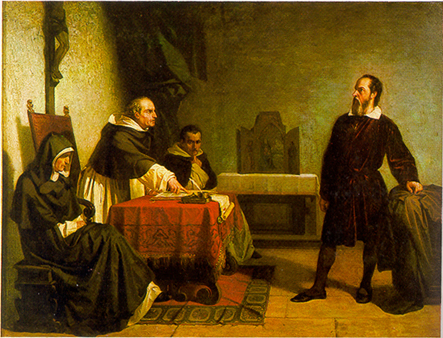





.jpg)