Behavior Quotes (132 quotes)
Behaviour Quotes, Behavioural Quotes, Behavioral Quotes
Behaviour Quotes, Behavioural Quotes, Behavioral Quotes
… and the thousands of fishes moved as a huge beast piercing the water. They appear united, inexorably bound by common fate. How comes this unity?
Seventeenth century. In Gary William Flake, The Computational Beauty of Nature (2000), 261.
[T]here are some common animal behaviors that seem to favor the development of intelligence, behaviors that might lead to brainy beasts on many worlds. Social interaction is one of them. If you're an animal that hangs out with others, then there's clearly an advantage in being smart enough to work out the intentions of the guy sitting next to you (before he takes your mate or your meal). And if you're clever enough to outwit the other members of your social circle, you'll probably have enhanced opportunity to breed..., thus passing on your superior intelligence. ... Nature—whether on our planet or some alien world—will stumble into increased IQ sooner or later.
Seth Shostak, Alex Barnett, Cosmic Company: the Search for Life in the Universe (2003), 62 & 67.
Nature and nurture are an inseparable blend of influences that work together to produce our behavior. A growing band of researchers are demonstrating that the bedrock of behaviors that make up the concerns of everyday life, such as sex, language, cooperation, and violence have been carved out by evolution over the eons, and this Stone Age legacy continues to influence modern life today.
In Stone Age Present: How Evolution Has Shaped Modern Life: From Sex, Violence and Language to Emotions, Morals and Communities, (1995), 25-26.
Question: Explain why pipes burst in cold weather.
Answer: People who have not studied acoustics think that Thor bursts the pipes, but we know that is nothing of the kind for Professor Tyndall has burst the mythologies and has taught us that it is the natural behaviour of water (and bismuth) without which all fish would die and the earth be held in an iron grip. (1881)
Answer: People who have not studied acoustics think that Thor bursts the pipes, but we know that is nothing of the kind for Professor Tyndall has burst the mythologies and has taught us that it is the natural behaviour of water (and bismuth) without which all fish would die and the earth be held in an iron grip. (1881)
Genuine student answer* to an Acoustics, Light and Heat paper (1881), Science and Art Department, South Kensington, London, collected by Prof. Oliver Lodge. Quoted in Henry B. Wheatley, Literary Blunders (1893), 186-7, Question 10. (*From a collection in which Answers are not given verbatim et literatim, and some instances may combine several students' blunders.) Webmaster notes that “fish would die” may refer to being taught that water's greatest density is at 4°C, and sinks below a frozen surface, so bodies of water can remain liquid underneath, to the benefit of the fish. The student was likely taught that bismuth, like water, expands when it freezes.
A good method of discovery is to imagine certain members of a system removed and then see how what is left would behave: for example, where would we be if iron were absent from the world: this is an old example.
Aphorism 258 in Notebook J (1789-1793), as translated by R. J. Hollingdale in Aphorisms (1990). Reprinted as The Waste Books (2000), 181.
An act cannot be defined by the end sought by the actor, for an identical system of behaviour may be adjustable to too many different ends without altering its nature.
Suicide: A Study in Sociology (1897), trans. J. A. Spaulding and G. Simpson (1952), 43.
Art arises in those strange complexities of action that are called human beings. It is a kind of human behavior. As such it is not magic, except as human beings are magical. Nor is it concerned in absolutes, eternities, “forms,” beyond those that may reside in the context of the human being and be subject to his vicissitudes. Art is not an inner state of consciousness, whatever that may mean. Neither is it essentially a supreme form of communication. Art is human behavior, and its values are contained in human behavior.
In Art Is Action: A Discussion of Nine Arts in a Modern World (1939), 1.
Because intelligence is our own most distinctive feature, we may incline to ascribe superior intelligence to the basic primate plan, or to the basic plan of the mammals in general, but this point requires some careful consideration. There is no question at all that most mammals of today are more intelligent than most reptiles of today. I am not going to try to define intelligence or to argue with those who deny thought or consciousness to any animal except man. It seems both common and scientific sense to admit that ability to learn, modification of action according to the situation, and other observable elements of behavior in animals reflect their degrees of intelligence and permit us, if only roughly, to compare these degrees. In spite of all difficulties and all the qualifications with which the expert (quite properly) hedges his conclusions, it also seems sensible to conclude that by and large an animal is likely to be more intelligent if it has a larger brain at a given body size and especially if its brain shows greater development of those areas and structures best developed in our own brains. After all, we know we are intelligent, even though we wish we were more so.
In The Meaning of Evolution: A Study of the History of Life and of its Significance for Man (1949), 78.
Behavioral avoidance, not physiological adaptations, is an organism’s primary response to an environmental challenge. This point is elementary, but it is by no means trivial.
From 'Interspecific comparison as a tool for ecological physiologists', collected in M.E. Feder, A.F. Bennett, W.W. Burggren, and R.B. Huey, (eds.), New Directions in Ecological Physiology (1987), 18.
Besides love and sympathy, animals exhibit other qualities connected with the social instincts which in us would be called moral.
Biological disciplines tend to guide research into certain channels. One consequence is that disciplines are apt to become parochial, or at least to develop blind spots, for example, to treat some questions as “interesting” and to dismiss others as “uninteresting.” As a consequence, readily accessible but unworked areas of genuine biological interest often lie in plain sight but untouched within one discipline while being heavily worked in another. For example, historically insect physiologists have paid relatively little attention to the behavioral and physiological control of body temperature and its energetic and ecological consequences, whereas many students of the comparative physiology of terrestrial vertebrates have been virtually fixated on that topic. For the past 10 years, several of my students and I have exploited this situation by taking the standard questions and techniques from comparative vertebrate physiology and applying them to insects. It is surprising that this pattern of innovation is not more deliberately employed.
In 'Scientific innovation and creativity: a zoologist’s point of view', American Zoologist (1982), 22, 233.
Bistromathics itself is simply a revolutionary new way of understanding the behavior of numbers. Just as Einstein observed that space was not an absolute but depended on the observer's movement in space, and that time was not an absolute, but depended on the observer's movement in time, so it is now realized that numbers are not absolute, but depend on the observer's movement in restaurants.
Life, the Universe and Everything (1982, 1995), 47.
But here I stop–short of any deterministic speculation that attributes specific behaviors to the possession of specific altruist or opportunist genes. Our genetic makeup permits a wide range of behaviors–from Ebenezer Scrooge before to Ebenezer Scrooge after. I do not believe that the miser hoards through opportunist genes or that the philanthropist gives because nature endowed him with more than the normal complement of altruist genes. Upbringing, culture, class, status, and all the intangibles that we call ‘free will,’ determine how we restrict our behaviors from the wide spectrum–extreme altruism to extreme selfishness–that our genes permit.
…...
Can the cultural evolution of higher ethical values gain a direction and momentum of its own and completely replace genetic evolution? I think not. The genes hold culture an a leash. The leash is very long, but inevitably values will be constrained in accordance with their effects in the human gene pool. The brain is a product of evolution. Human behaviour—like the deepest capacities for emotional response which drive and guide it—is the circuitous technique by which human genetic material has been and will be kept intact. Morality has no other demonstrable ultimate function.
In On Human Nature (1978), 167. In William Andrew Rottschaefer, The Biology and Psychology of Moral Agency (1998), 58.
Complex organisms cannot be construed as the sum of their genes, nor do genes alone build particular items of anatomy or behavior by them selves. Most genes influence several aspects of anatomy and behavior–as they operate through complex interactions with other genes and their products, and with environmental factors both within and outside the developing organism. We fall into a deep error, not just a harmful oversimplification, when we speak of genes ‘for’ particular items of anatomy or behavior.
In I Have Landed; The End of a Beginning in Natural History (2002, 2011), 234.
Culture can be regarded as a constitution of recipes for behavior … which are taught and learned on various levels of awareness; not all of the individuals in any society know all these recipes; and many of the recipes are alternative to one another.
Acknowledging the significance of variation for the culture concept. In The Modal Personality Structure of the Tuscarora Indians As Revealed by the Rorschach Test (1952), 61-62.
Even the humblest creature has to know how to react to the difference between food and toxin if it's to survive. ... Life and some level of intelligent behavior—discerning and doing what's best for one's survival—appear to go hand in hand.
In Life Everywhere: the Maverick Science of Astrobiology (2002), 140.
Everybody now wants to discover universal laws which will explain the structure and behavior of the nucleus of the atom. But actually our knowledge of the elementary particles that make up the nucleus is tiny. The situation calls for more modesty. We should first try to discover more about these elementary particles and about their laws. Then it will be the time for the major synthesis of what we really know, and the formulation of the universal law.
As quoted in Robert Coughlan, 'Dr. Edward Teller’s Magnificent Obsession', Life (6 Sep 1954), 74.
For any one who is pervaded with the sense of causal law in all that happens, who accepts in real earnest the assumption of causality, the idea of a Being who interferes with the sequence of events in the world is absolutely impossible! Neither the religion of fear nor the social-moral religion can have, any hold on him. A God who rewards and punishes is for him unthinkable, because man acts in accordance with an inner and outer necessity, and would, in the eyes of God, be as little responsible as an inanimate object is for the movements which it makes. Science, in consequence, has been accused of undermining morals—but wrongly. The ethical behavior of man is better based on sympathy, education and social relationships, and requires no support from religion. Man’s plight would, indeed, be sad if he had to be kept in order through fear of punishment and hope of rewards after death.
From 'Religion and Science', The New York Times Magazine, (9 Nov 1930), 1. Article in full, reprinted in Edward H. Cotton (ed.), Has Science Discovered God? A Symposium of Modern Scientific Opinion (1931), 101. The wording differs significantly from the version collected in 'Religion And Science', Ideas And Opinions (1954), 39, giving its source as: “Written expressly for the New York Times Magazine. Appeared there November 9, 1930 (pp. 1-4). The German text was published in the Berliner Tageblatt, November 11, 1930.” This variant form of the quote from the book begins, “The man who is thoroughly convinced of the universal operation of the law of causation….” and is also on the Albert Einstein Quotes page on this website. As for why the difference, Webmaster speculates the book form editor perhaps used a revised translation from Einstein’s German article.
For behavior, men learn it, as they take diseases, one of another.
As quoted in 'Solitude and Society', The Atlantic Monthly (Dec 1857), Vol. 1, 228.
For Linnaeus, Homo sapiens was both special and not special ... Special and not special have come to mean nonbiological and biological, or nurture and nature. These later polarizations are nonsensical. Humans are animals and everything we do lies within our biological potential ... the statement that humans are animals does not imply that our specific patterns of behavior and social arrangements are in any way directly determined by our genes. Potentiality and determination are different concepts.
…...
For you teach very clearly by your behaviour how slowly and how meagerly our senses proceed in the investigation of ever inexhaustible nature.
Elettricismo artificiale (1772), vii-viii, trans. in Antonio Pace, Franklin and Italy (1958), 58.
From all we have learnt about the structure of living matter, we must be prepared to find it working in a manner that cannot be reduced to the ordinary laws of physics. And that not on the ground that there is any “new force” or what not, directing the behavior of the single atoms within a living organism, but because the construction is different from anything we have yet tested in the physical laboratory.
What is Life? (1956), 74.
Genes make enzymes, and enzymes control the rates of chemical processes. Genes do not make ‘novelty seeking’ or any other complex and overt behavior. Predisposition via a long chain of complex chemical reactions, mediated through a more complex series of life’s circumstances, does not equal identification or even causation.
…...
He [Heinrich Rose] looked upon the various substances that he was manipulating, as well as their reactions, under a thoroughly familial point of view: they were like so many children entrusted to his tutelage. Every time he explained simple, clear, well-defined phenomena, he assumed a jovial and smiling countenance; on the other hand, he almost got angry at certain mischievous bodies, the properties of which did not obey ordinary laws and troubled general theoretical views; in his eyes, this was unruly behavior.
As his student, about the lectures of Heinrich Rose, as quoted in entry by Stuart Pierson, 'Rose, Heinrich', in Charles Coulston Gillespie (ed.), Dictionary of Scientific Biography (1975), Vol.11, 541, citing Adolphe Remelé, 'Notice biographique sur le Professeur Henri Rose', in Moniteur Scientifique (1864), 2nd ser., 6, 385–389. [Remelé’s italics.]
He is not a true man of science who does not bring some sympathy to his studies, and expect to learn something by behavior as well as by application. It is childish to rest in the discovery of mere coincidences, or of partial and extraneous laws.
In A Week on the Concord and Merrimack Rivers (1862), 381.
High energy prices lead to lower energy prices because of the supply and demand side behavioral changes that they induce.
In transcript, 'Treasury Secretary Snow Optimistic on Economy', PBS Newshour (23 Mar 2005), on pbs.org website.
Historically, science has pursued a premise that Nature can be understood fully, its future predicted precisely, and its behavior controlled at will. However, emerging knowledge indicates that the nature of Earth and biological systems transcends the limits of science, questioning the premise of knowing, prediction, and control. This knowledge has led to the recognition that, for civilized human survival, technological society has to adapt to the constraints of these systems.
As quoted in Chris Maser, Decision-Making for a Sustainable Environment: A Systemic Approach (2012), 4, citing N. Narasimhan, 'Limitations of Science and Adapting to Nature', Environmental Research Letters (Jul-Sep 2007), 2.
History teaches us that men and nations behave wisely once they have exhausted all other alternatives.
Speech, London (16 Dec 1970), 'Israel's International Relations in an Era of Peace', (1979), 22.
Human behaviour reveals uniformities which constitute natural laws. If these uniformities did not exist, then there would be neither social science nor political economy, and even the study of history would largely be useless. In effect, if the future actions of men having nothing in common with their past actions, our knowledge of them, although possibly satisfying our curiosity by way of an interesting story, would be entirely useless to us as a guide in life.
In Cours d’Economie Politique (1896-7), Vol. 2, 397.
I can say, if I like, that social insects behave like the working parts of an immense central nervous system: the termite colony is an enormous brain on millions of legs; the individual termite is a mobile neurone.
In Late Night Thoughts on Listening to Mahler's Ninth Symphony(1984), 224. Note: Spelling “neurone&rdwuo; [sic].
I would rather see the behavior of one white rat observed carefully from the moment of birth until death than to see a large volume of accurate statistical data on how 2,000 rats learned to open a puzzle box.
Introduction to G. V. Hamilton and Kenneth Macgowan, What Is Wrong with Marriage? (1929), xx.
If … you reward people for behavior that’s actually bad … then you’re going to encourage that behavior. Today, our [conservation] incentives aren’t set up well-you can make a lot of money burning fossil fuels, digging up wetlands, pumping fossil water out of aquifers that will take 10,000 years to recharge, overfishing species in international waters that are close to collapse, and so on.
From interview with Mark Tercek, 'Q&A With Ramez Naam: Dialogues on the Environment', Huffington Post (1 Jul 2013).
If diphtheria is a disease caused by a microorganism, it is essential that three postulates be fulfilled. The fulfilment of these postulates is necessary in order to demonstrate strictly the parasitic nature of a disease:
1) The organism must be shown to be constantly present in characteristic form and arrangement in the diseased tissue.
2) The organism which, from its behaviour appears to be responsible for the disease, must be isolated and grown in pure culture.
3) The pure culture must be shown to induce the disease experimentally.
An early statement of Koch's postulates.
1) The organism must be shown to be constantly present in characteristic form and arrangement in the diseased tissue.
2) The organism which, from its behaviour appears to be responsible for the disease, must be isolated and grown in pure culture.
3) The pure culture must be shown to induce the disease experimentally.
An early statement of Koch's postulates.
Mittheilungen aus den Kaiserliche Gesundheitsamt (1884) Vol. 2. Trans. T. D. Brock, Robert Koch: A Life in Medicine and Bacteriology (1988), 180.
If I would follow your advice and Jesus could perceive it, he, as a Jewish teacher, surely would not approve of such behavior.
…...
If we assume that there is only one enzyme present to act as an oxidizing agent, we must assume for it as many different degrees of activity as are required to explain the occurrence of the various colors known to mendelize (three in mice, yellow, brown, and black). If we assume that a different enzyme or group of enzymes is responsible for the production of each pigment we must suppose that in mice at least three such enzymes or groups of enzymes exist. To determine which of these conditions occurs in mice is not a problem for the biologist, but for the chemist. The biologist must confine his attention to determining the number of distinct agencies at work in pigment formation irrespective of their chemical nature. These agencies, because of their physiological behavior, the biologist chooses to call 'factors,' and attempts to learn what he can about their functions in the evolution of color varieties.
Experimental Studies of the Inheritance of Color in Mice (1913), 17-18.
If you defend a behavior by arguing that people are programmed directly for it, then how do you continue to defend it if your speculation is wrong, for the behavior then becomes unnatural and worthy of condemnation. Better to stick resolutely to a philosophical position on human liberty: what free adults do with each other in their own private lives is their business alone. It need not be vindicated–and must not be condemned–by genetic speculation.
…...
If you’re telling a story, it’s very tempting to personalise an animal. To start with, biologists said this fascination with one individual was just television storytelling. But they began to realise that, actually, it was a new way to understand behaviour–following the fortunes of one particular animal could be very revealing and have all kinds of implications in terms of the ecology and general behaviour of the animals in that area.
From interview with Alice Roberts, 'Attenborough: My Life on Earth', The Biologist (Aug 2015), 62, No. 4, 15.
In attempting to understand the elements out of which mental phenomena are compounded, it is of the greatest importance to remember that from the protozoa to man there is nowhere a very wide gap either in structure or in behaviour. From this fact it is a highly probable inference that there is also nowhere a very wide mental gap.
Lecture II, 'Instinct and Habit', The Analysis of Mind
In the world of science different levels of esteem are accorded to different kinds of specialist. Mathematicians have always been eminently respectable, and so are those who deal with hard lifeless theories about what constitutes the physical world: the astronomers, the physicists, the theoretical chemists. But the more closely the scientist interests himself in matters which are of direct human relevance, the lower his social status. The real scum of the scientific world are the engineers and the sociologists and the psychologists. Indeed, if a psychologist wants to rate as a scientist he must study rats, not human beings. In zoology the same rules apply. It is much more respectable to dissect muscle tissues in a laboratory than to observe the behaviour of a living animal in its natural habitat.
From transcript of BBC radio Reith Lecture (12 Nov 1967), 'A Runaway World', on the bbc.co.uk website.
Instead of saying that a man behaves because of the consequences which are to follow his behavior, we simply say that he behaves because of the consequences which have followed similar behavior in the past. This is, of course, the Law of Effect or operant conditioning.
In Science and Human Behavior (1953), 87.
Is it absurd to imagine that our social behavior, from amoeba to man, is also planned and dictated, from stored Information, by the cells? And that the time has come for men to be entrusted with the task, through heroic efforts, of bringing life to other worlds?
From Nobel Prize Lecture (Dec 1974), 'The Coming Age of the Cell'. Collected in Jan Lindsten (ed.) Nobel Lectures, Physiology or Medicine 1971-1980 (1992).
It doesn’t take a scientist to realize that a chimpanzee or a dog is an intelligent animal. Instead, it takes a bigoted human to suggest that it’s not.
In The Omni Interviews (1984), 73.
It is as if Cleopatra fell off her barge in 40 BC and hasn't hit the water yet.
[Illustrating how strange the behaviour of kaon particles, when first found in cosmic rays, which lived without predicted decay for a surprisingly long time—seemingly postponed a million billion times longer than early theory expected.]
[Illustrating how strange the behaviour of kaon particles, when first found in cosmic rays, which lived without predicted decay for a surprisingly long time—seemingly postponed a million billion times longer than early theory expected.]
In Frank Close, Michael Marten, Christine Sutton, The Particle Odyssey: a Journey to the Heart of the Matter (2004),75.
It is my view that a psychologist who is really going to get anywhere must respect human behaviour. Not only in the sense of considering it a worthwhile subject to study, but in the much more important sense of being willing to reject flippant and cynical views or at least of regarding them as a not very serious kind of sport and of believing that human beings are fundamentally decent.
From archive recording (3 Jun 1959) with to John C. Kenna, giving his recollection of his farewell speech to Cambridge Psychological Society (4 Mar 1952), in which he gave a summary of points he considered to be basic requirements for a good experimental psychologist. Point 6 of 7, from transcription of recording held at British Psychological Society History of Psychology Centre, London, as abridged on thepsychologist.bps.org.uk website.
It is probable that the scheme of physics will be enlarged so as to embrace the behaviour of living organisms under the influence of life and mind. Biology and psychology are not alien sciences; their operations are not solely mechanical, nor can they be formulated by physics as it is today; but they belong to a physical universe, and their mode of action ought to be capable of being formulated in terms of an enlarged physics in the future, in which the ether will take a predominant place. On the other hand it may be thought that those entities cannot be brought to book so easily, and that they will always elude our ken. If so, there will be a dualism in the universe, which posterity will find staggering, but that will not alter the facts.
In Past Years: an Autobiography (1932), 350. Quoted in book review, Waldehar Kaempfert, 'Sir Oliver Lodge Stands by the Old Physics', New York Times (21 Feb 1932), BR5.
It is strange that we know so little about the properties of numbers. They are our handiwork, yet they baffle us; we can fathom only a few of their intricacies. Having defined their attributes and prescribed their behavior, we are hard pressed to perceive the implications of our formulas.
In James R. Newman (ed.), 'Commentary on The Mysteries of Arithmetic', The World of Mathematics (1956), Vol. 1, 497.
It is the business of scientists to explain away the magic in the world. The largest coherent body of magic remaining is the behavior of (humans) and animals.
In paper co-authored by William G. Quinn and James L. Gould, 'Nerves and genes', Nature (1 Mar 1979), 278, No. 5699, 23. As partially quoted in Michael F. Roberts and Anne E. Kruchten, Receptor Biology (2016), 238.
It is the task of science, as a collective human undertaking, to describe from the external side, (on which alone agreement is possible), such statistical regularity as there is in a world “in which every event has a unique aspect, and to indicate where possible the limits of such description. It is not part of its task to make imaginative interpretation of the internal aspect of reality—what it is like, for example, to be a lion, an ant or an ant hill, a liver cell, or a hydrogen ion. The only qualification is in the field of introspective psychology in which each human being is both observer and observed, and regularities may be established by comparing notes. Science is thus a limited venture. It must act as if all phenomena were deterministic at least in the sense of determinable probabilities. It cannot properly explain the behaviour of an amoeba as due partly to surface and other physical forces and partly to what the amoeba wants to do, with out danger of something like 100 per cent duplication. It must stick to the former. It cannot introduce such principles as creative activity into its interpretation of evolution for similar reasons. The point of view indicated by a consideration of the hierarchy of physical and biological organisms, now being bridged by the concept of the gene, is one in which science deliberately accepts a rigorous limitation of its activities to the description of the external aspects of events. In carrying out this program, the scientist should not, however, deceive himself or others into thinking that he is giving an account of all of reality. The unique inner creative aspect of every event necessarily escapes him.
In 'Gene and Organism', American Naturalist, (1953), 87, 17.
It is time that science, having destroyed the religious basis for morality, accepted the obligation to provide a new and rational basis for human behavior—a code of ethics concerned with man’s needs on earth, not his rewards in heaven.
In 'Toward a New Morality,' IEEE Spectrum, 1972.
It was their individuality combined with the shyness of their behavior that remained the most captivating impression of this first encounter with the greatest of the great apes.
In Gorillas in the Mist (1983), 4
Large physical objects like stars consist of a rather limited array of parts, more or less haphazardly arranged. The behaviour of physical, nonbiological objects is so simple that it is feasible to use existing mathematical language to describe it, which is why physics books are full of mathematics.
In The Blind Watchmaker (1986, 1996), 2.
Like other addictions, tobacco use can be effectively treated. A wide variety of behavioral interventions have been used for years. In recognition of the important role that nicotine plays in maintaining tobacco use, nicotine replacement therapy is now available. Nicotine gum has been shown to relieve withdrawal symptoms following smoking cessation, and may enhance the effectiveness of behavioral treatments. These treatment measures should be made more widely available to smokers who need them. Unfortunately most party payors do not provide coverage for smoking cessation treatments. On the other hand, treatment for alcoholism and illicit drug use is often covered. And we should eliminate this double standard.
From press conference (16 May 1988) by C. Everett Koop for Surgeon General’s Report-Smoking & Nicotine Addiction being released that day. [In the present time, through the Affordable Care Act many public and private plans are required to cover all seven FDA-approved quit-smoking medications —Webmaster.]
Logic is not concerned with human behavior in the same sense that physiology, psychology, and social sciences are concerned with it. These sciences formulate laws or universal statements which have as their subject matter human activities as processes in time. Logic, on the contrary, is concerned with relations between factual sentences (or thoughts). If logic ever discusses the truth of factual sentences it does so only conditionally, somewhat as follows: if such-and-such a sentence is true, then such-and-such another sentence is true. Logic itself does not decide whether the first sentence is true, but surrenders that question to one or the other of the empirical sciences.
Logic (1937). In The Language of Wisdom and Folly: Background Readings in Semantics (1967), 44.
Man is an animal with primary instincts of survival. Consequently his ingenuity has developed first and his soul afterwards. The progress of science is far ahead of man's ethical behavior.
My Autobiography (1964), 471.
Man is not only part of a field, but a part and member of his group. When people are together, as when they are at work, then the most unnatural behavior, which only appears in late stages or abnormal cases, would be to behave as separate Egos. Under normal circumstances they work in common, each a meaningfully functioning part of the whole.
Lecture at the Kantgesellschaft (Kant Society), Berlin (17 Dec 1924), 'Über Gestalttheorie', as taken down in shorthand. Translated by N. Nairn-Allison in Social Research (1944), 11, 91.
Man’s unconscious… contains all the patterns of life and behaviour inherited from his ancestors, so that every human child, prior to consciousness, is possessed of a potential system of adapted psychic functioning.
The Basic Postulates of Analytical Psychology (1931), 186.
Many scientists have tried to make determinism and complementarity the basis of conclusions that seem to me weak and dangerous; for instance, they have used Heisenberg’s uncertainty principle to bolster up human free will, though his principle, which applies exclusively to the behavior of electrons and is the direct result of microphysical measurement techniques, has nothing to do with human freedom of choice. It is far safer and wiser that the physicist remain on the solid ground of theoretical physics itself and eschew the shifting sands of philosophic extrapolations.
In New Perspectives in Physics (1962), viii.
Mathematics is a form of poetry which transcends poetry in that it proclaims a truth; a form of reasoning which transcends reasoning in that it wants to bring about the truth it proclaims; a form of action, of ritual behavior, which does not find fulfilment in the act but must proclaim and elaborate a poetic form of truth.
'Why Mathematics Grows', Journal of the History of Ideas (Jan-Mar 1965), 26, No. 1, 3. In Salomon Bochner and Robert Clifford Gunning (ed.) Collected Papers of Salomon Bochner (1992), Vol. 4, 191. Footnoted as restating about Mathematics what was written about Myth by Henri Frankfort, et al., in The Intellectual Adventures of Ancient Man (1946), 8.
Meat-eating has not, to my knowledge, been recorded from other parts of the chimpanzee’s range in Africa, although if it is assumed that human infants are in fact taken for food, the report that five babies were carried off in West Africa suggests that carnivorous behavior may be widespread.
In 'Chimpanzees of the Gombe Stream Reserve', collected in Primate Behavior: Field Studies of Monkeys and Apes (1965), 473.
Modern anthropology has taught us, through comparative investigation of so-called primitive cultures, that the social behavior of human beings may differ greatly, depending upon prevailing cultural patterns and the types of organisation which predominate in society. It is on this that those who are striving to improve the lot of man may ground their hopes: human beings are not condemned, because of their biological constitution, to annihilate each other or to be at the mercy of a cruel, self-inflicted fate.
…...
Nature never “fails.” Nature complies with its own laws. Nature is the law. When Man lacks understanding of Nature’s laws and a Man-contrived structure buckles unexpectedly, it does not fail. It only demonstrates that Man did not understand Nature’s laws and behaviors. Nothing failed. Man’s knowledge or estimating was inadequate.
In "How Little I Know", in Saturday Review (12 Nov 1966), 152. Excerpted in Buckminster Fuller and Answar Dil, Humans in Universe (1983), 31.
No man treats a motorcar as foolishly as he treats another human being. When the car will not go, he does not attribute its annoying behavior to sin; he does not say, “You are a wicked motorcar, and I shall not give you any more petrol until you go.” He attempts to find out what is wrong and to set it right. An analogous way of treating human beings is, however, considered to be contrary to the truths of our holy religion.
In 'Has Religion Made Useful Contributions to Civilization?' (1930). Collected in The Collected Papers of Bertrand Russell: A Fresh Look at Empiricism 1927-42 (1996) 224.
No one should feel at all offended or threatened by the obvious fact that we are not all born entirely blank, or entirely the same, in our mixture of the broad behavioral propensities defining what we call ‘temperament.’
…...
No serious student of human behavior denies the potent influence of evolved biology upon our cultural lives. Our struggle is to figure out how biology affects us, not whether it does.
In An Urchin in the Storm: Essays about Books and Ideas (1988, 2010), 152.
On consideration, it is not surprising that Darwin's finches should recognize their own kind primarily by beak characters. The beak is the only prominent specific distinction, and it features conspicuously both in attacking behaviour, when the birds face each other and grip beaks, and also in courtship, when food is passed from the beak of the male to the beak of the female. Hence though the beak differences are primarily correlated with differences in food, secondarily they serve as specific recognition marks, and the birds have evolved behaviour patterns to this end.
Darwin's Finches (1947), 54.
One may summarize by saying that by a combination of behavior and physiology mammals can successfully occupy all but the most extreme environments on earth without anything more than quantitative shifts in the basic physiological pattern common to all.
From 'The role of physiology in the distribution of terrestrial vertebrates', collected in C.L. Hubbs (ed.), Zoogeography: Publ. 51 (1958), 87.
One of the most immediate consequences of the electrochemical theory is the necessity of regarding all chemical compounds as binary substances. It is necessary to discover in each of them the positive and negative constituents... No view was ever more fitted to retard the progress of organic chemistry. Where the theory of substitution and the theory of types assume similar molecules, in which some of the elements can be replaced by others without the edifice becoming modified either in form or outward behaviour, the electrochemical theory divides these same molecules, simply and solely, it may be said, in order to find in them two opposite groups, which it then supposes to be combined with each other in virtue of their mutual electrical activity... I have tried to show that in organic chemistry there exist types which are capable, without destruction, of undergoing the most singular transformations according to the nature of the elements.
Traité de Chemie Appliquée aux Arts, Vol. I (1828), 53. Trans. J. R. Partington, A History of Chemistry, Vol. 4, 366.
Our humanity rests upon a series of learned behaviors, woven together into patterns that are infinitely fragile and never directly inherited.
…...
Our lifetime may be the last that will be lived out in a technological society. If the world continues to behave as stupidly as it has behaved in the past, we are going to have an increase in population, an increase in violence. We will try to support the population by ripping up earth’s resources, producing pollution at a greater and greater rate, ending, perhaps, in a nuclear war. The earth will have its oil burnt up, most of its most easily available coal used up, its metals distributed thinly over the entire world. We simply won’t have the material basis to build up another technological civilization. The greater the population, the greater the pressure on technology to produce things. Also, there is a great deal of pressure to produce things that don’t directly relate to the quantity of people in the world, but are useless, energy wasting. Socrates is reported to have looked over a bazaar in great wonder and said, “How very many things there are that I do not need.” There are a great many things that we don’t need.
Interview in The Christian Science Monitor (27 Mar 1974), F1.
Over the years it has become clear that adjustments to the physical environment are behavioral as well as physiological and are inextricably intertwined with ecology and evolution. Consequently, a student of the physiology of adaptation should not only be a technically competent physiologist, but also be familiar with the evolutionary and ecological setting of the phenomenon that he or she is studying.
From 'Interspecific comparison as a tool for ecological physiologists', collected in M.E. Feder, A.F. Bennett, W.W. Burggren, and R.B. Huey, (eds.), New Directions in Ecological Physiology (1987), 17.
Perfect behavior is born of complete indifference.
Diary entry for 21 Feb 1940, The Burning Brand: Diaries 1935-1950 (1961), 169.
Peter Atkins, in his wonderful book Creation Revisited, uses a … personification when considering the refraction of a light beam, passing into a medium of higher refractive index which slows it down. The beam behaves as if trying to minimize the time taken to travel to an end point. Atkins imagines it as a lifeguard on a beach racing to rescue a drowning swimmer. Should he head straight for the swimmer? No, because he can run faster than he can swim and would be wise to increase the dry-land proportion of his travel time. Should he run to a point on the beach directly opposite his target, thereby minimizing his swimming time? Better, but still not the best. Calculation (if he had time to do it) would disclose to the lifeguard an optimum intermediate angle, yielding the ideal combination of fast running followed by inevitably slower swimming. Atkins concludes:
That is exactly the behaviour of light passing into a denser medium. But how does light know, apparently in advance, which is the briefest path? And, anyway, why should it care?
He develops these questions in a fascinating exposition, inspired by quantum theory.
That is exactly the behaviour of light passing into a denser medium. But how does light know, apparently in advance, which is the briefest path? And, anyway, why should it care?
He develops these questions in a fascinating exposition, inspired by quantum theory.
In 'Introduction to the 30th Anniversary Edition', The Selfish Gene: 30th Anniversary Edition (1976, 2006), xi-xii.
Physics does not change the nature of the world it studies, and no science of behavior can change the essential nature of man, even though both sciences yield technologies with a vast power to manipulate their subject matters.
In article 'Man', Proceedings of the American Philosophical Society (1964), 108, 482-85. Collected in Cumulative Record: Definitive Edition (2015).
Physics does not endeavour to explain nature. In fact, the great success of physics is due to a restriction of its objectives: it only endeavours to explain the regularities in the behavior of objects.
In 'Events, Laws of Nature, and Invariance Principles', Nobel Lecture (12 Dec 1963). in Nobel Lectures: Physics 1963-1970 (1972), 6.
Plants, generally speaking, meet the impact of the terrestrial environment head on, although of course they in turn modify the physical environment by adventitious group activity. The individual plant cannot select its habitat; its location is largely determined by the vagaries of the dispersal of seeds or spores and is thus profoundly affected by chance. Because of their mobility and their capacity for acceptance or rejection terrestrial animals, in contrast, can and do actively seek out and utilize the facets of the environment that allow their physiological capacities to function adequately. This means that an animal by its behavior can fit the environment to its physiology by selecting situations in which its physiological capacities can cope with physical conditions. If one accepts this idea, it follows that there is no such thing as The Environment, for there exist as many different terrestrial environments as there are species of animals.
From 'The role of physiology in the distribution of terrestrial vertebrates', collected in C.L. Hubbs (ed.), Zoogeography: Publ. 51 (1958), 84.
Plasticity is a double-edged sword; the more flexible an organism is the greater the variety of maladaptive, as well as adaptive, behaviors it can develop; the more teachable it is the more fully it can profit from the experiences of its ancestors and associates and the more it risks being exploited by its ancestors and associates.
In Gary William Flake, The Computational Beauty of Nature (2000), 361.
Psychologism is, I believe, correct only in so far as it insists upon what may be called “methodological individualism” as opposed to “methodological collectivism”; it rightly insists that the “behaviour” and the “actions” of collectives, such as states or social groups, must be reduced to the behaviour and to the actions of human individuals. But the belief that the choice of such an individualist method implies the choice of a psychological method is mistaken.
In The Open Society and Its Enemies (1945), Vol. 22, 87.
Psychologists must cease to be content with the sterile and narrow conception of their science as the science of consciousness, and must boldly assert its claim to be the positive science of mind in all its aspects and modes of functining, or, as I would prefer to say, the positive science of conduct or behavior.
An Introduction to Social Psychology (1928), 13.
Psychology, as the behaviorist views it, is a purely objective, experimental branch of natural science which needs introspection as little as do the sciences of chemistry and physics. It is granted that the behavior of animals can be investigated without appeal to consciousness. Heretofore the viewpoint has been that such data have value only in so far as they can be interpreted by analogy in terms of consciousness. The position is taken here that the behavior of man and the behavior of animals must be considered in the same plane.
In Psychology as the Behaviorist Views It (1913), 176.
Science is in a literal sense constructive of new facts. It has no fixed body of facts passively awaiting explanation, for successful theories allow the construction of new instruments—electron microscopes and deep space probes—and the exploration of phenomena that were beyond description—the behavior of transistors, recombinant DNA, and elementary particles, for example. This is a key point in the progressive nature of science—not only are there more elegant or accurate analyses of phenomena already known, but there is also extension of the range of phenomena that exist to be described and explained.
Co-author with Michael A. Arbib, English-born professor of computer science and biomedical engineering (1940-)
Co-author with Michael A. Arbib, English-born professor of computer science and biomedical engineering (1940-)
Michael A. Arbib and Mary B. Hesse, The Construction of Reality (1986), 8.
Science tries to answer the question: ‘How?’ How do cells act in the body? How do you design an airplane that will fly faster than sound? How is a molecule of insulin constructed? Religion, by contrast, tries to answer the question: ‘Why?’ Why was man created? Why ought I to tell the truth? Why must there be sorrow or pain or death? Science attempts to analyze how things and people and animals behave; it has no concern whether this behavior is good or bad, is purposeful or not. But religion is precisely the quest for such answers: whether an act is right or wrong, good or bad, and why.
Science and Imagination, ch. 4, Basic Books (1967).
Since natural selection demands only adequacy, elegance of design is not relevant; any combination of behavioural adjustment, physiological regulation, or anatomical accommodation that allows survival and reproduction may be favoured by selection. Since all animals are caught in a phylogenetic trap by the nature of past evolutionary adjustments, it is to be expected that a given environmental challenge will be met in a variety of ways by different animals. The delineation of the patterns of the accommodations of diverse types of organisms to the environment contributes much of the fascination of ecologically relevant physiology.
In 'The roles of physiology and behaviour in the maintenance of homeostasis in the desert environment.', Symposia of the Society for Experimental Biology (1964), 11.
So I want to admit the assumption which the astronomer—and indeed any scientist—makes about the Universe he investigates. It is this: that the same physical causes give rise to the same physical results anywhere in the Universe, and at any time, past, present, and future. The fuller examination of this basic assumption, and much else besides, belongs to philosophy. The scientist, for his part, makes the assumption I have mentioned as an act of faith; and he feels confirmed in that faith by his increasing ability to build up a consistent and satisfying picture of the universe and its behavior.
From Science and the Nation (1957), 49. Also quoted in Ronald Keast, Dancing in the Dark: The Waltz in Wonder of Quantum Metaphysics (2009), 106.
Sociobiology is not just any statement that biology, genetics, and evolutionary theory have something to do with human behavior. Sociobiology is a specific theory about the nature of genetic and evolutionary input into human behavior. It rests upon the view that natural selection is a virtually omnipotent architect, constructing organisms part by part as best solutions to problems of life in local environments. It fragments organisms into “traits,” explains their existence as a set of best solutions, and argues that each trait is a product of natural selection operating “for” the form or behavior in question. Applied to humans, it must view specific behaviors (not just general potentials) as adaptations built by natural selection and rooted in genetic determinants, for natural selection is a theory of genetic change. Thus, we are presented with unproved and unprovable speculations about the adaptive and genetic basis of specific human behaviors: why some (or all) people are aggressive, xenophobic, religious, acquisitive, or homosexual.
In Hen's Teeth and Horses Toes (1983, 2010), 242-243.
Sparrows are sociable, like a crowd of children begging from a tourist.
In 'Londoners', Solomon in All his Glory (1922), 68.
The advances of biology during the past 20 years have been breathtaking, particularly in cracking the mystery of heredity. Nevertheless, the greatest and most difficult problems still lie ahead. The discoveries of the 1970‘s about the chemical roots of memory in nerve cells or the basis of learning, about the complex behavior of man and animals, the nature of growth, development, disease and aging will be at least as fundamental and spectacular as those of the recent past.
As quoted in 'H. Bentley Glass', New York Times (12 Jan 1970), 96.
The Astonishing Hypothesis is that “You,” your joys and your sorrows, your memories and your ambitions, your sense of identity and free will, are in fact no more than the behaviour of a vast assembly of nerve cells and their associated molecules. As Lewis Carroll’s Alice might have phrased it: “You’re nothing but a pack of neurons.”
In 'Introduction', The Astonishing Hypothesis: The Scientific Search for Soul (1994), 3.
The cloning of humans is on most of the lists of things to worry about from Science, along with behaviour control, genetic engineering, transplanted heads, computer poetry and the unrestrained growth of plastic flowers.
In The Medusa and the Snail: More Notes of a Biology Watcher (1979), 51.
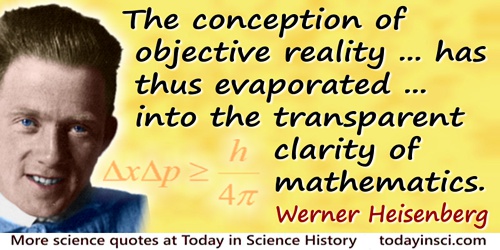
The conception of objective reality … has thus evaporated … into the transparent clarity of mathematics that represents no longer the behavior of particles but rather our knowledge of this behavior.
In 'The Representation of Nature in Contemporary Physics', Daedalus (1958), 87, 95-108. As cited in Karl Popper, Quantum Theory and the Schism in Physics (1992), 85.
The difficulties connected with my criterion of demarcation (D) are important, but must not be exaggerated. It is vague, since it is a methodological rule, and since the demarcation between science and nonscience is vague. But it is more than sharp enough to make a distinction between many physical theories on the one hand, and metaphysical theories, such as psychoanalysis, or Marxism (in its present form), on the other. This is, of course, one of my main theses; and nobody who has not understood it can be said to have understood my theory.
The situation with Marxism is, incidentally, very different from that with psychoanalysis. Marxism was once a scientific theory: it predicted that capitalism would lead to increasing misery and, through a more or less mild revolution, to socialism; it predicted that this would happen first in the technically highest developed countries; and it predicted that the technical evolution of the 'means of production' would lead to social, political, and ideological developments, rather than the other way round.
But the (so-called) socialist revolution came first in one of the technically backward countries. And instead of the means of production producing a new ideology, it was Lenin's and Stalin's ideology that Russia must push forward with its industrialization ('Socialism is dictatorship of the proletariat plus electrification') which promoted the new development of the means of production.
Thus one might say that Marxism was once a science, but one which was refuted by some of the facts which happened to clash with its predictions (I have here mentioned just a few of these facts).
However, Marxism is no longer a science; for it broke the methodological rule that we must accept falsification, and it immunized itself against the most blatant refutations of its predictions. Ever since then, it can be described only as nonscience—as a metaphysical dream, if you like, married to a cruel reality.
Psychoanalysis is a very different case. It is an interesting psychological metaphysics (and no doubt there is some truth in it, as there is so often in metaphysical ideas), but it never was a science. There may be lots of people who are Freudian or Adlerian cases: Freud himself was clearly a Freudian case, and Adler an Adlerian case. But what prevents their theories from being scientific in the sense here described is, very simply, that they do not exclude any physically possible human behaviour. Whatever anybody may do is, in principle, explicable in Freudian or Adlerian terms. (Adler's break with Freud was more Adlerian than Freudian, but Freud never looked on it as a refutation of his theory.)
The point is very clear. Neither Freud nor Adler excludes any particular person's acting in any particular way, whatever the outward circumstances. Whether a man sacrificed his life to rescue a drowning, child (a case of sublimation) or whether he murdered the child by drowning him (a case of repression) could not possibly be predicted or excluded by Freud's theory; the theory was compatible with everything that could happen—even without any special immunization treatment.
Thus while Marxism became non-scientific by its adoption of an immunizing strategy, psychoanalysis was immune to start with, and remained so. In contrast, most physical theories are pretty free of immunizing tactics and highly falsifiable to start with. As a rule, they exclude an infinity of conceivable possibilities.
The situation with Marxism is, incidentally, very different from that with psychoanalysis. Marxism was once a scientific theory: it predicted that capitalism would lead to increasing misery and, through a more or less mild revolution, to socialism; it predicted that this would happen first in the technically highest developed countries; and it predicted that the technical evolution of the 'means of production' would lead to social, political, and ideological developments, rather than the other way round.
But the (so-called) socialist revolution came first in one of the technically backward countries. And instead of the means of production producing a new ideology, it was Lenin's and Stalin's ideology that Russia must push forward with its industrialization ('Socialism is dictatorship of the proletariat plus electrification') which promoted the new development of the means of production.
Thus one might say that Marxism was once a science, but one which was refuted by some of the facts which happened to clash with its predictions (I have here mentioned just a few of these facts).
However, Marxism is no longer a science; for it broke the methodological rule that we must accept falsification, and it immunized itself against the most blatant refutations of its predictions. Ever since then, it can be described only as nonscience—as a metaphysical dream, if you like, married to a cruel reality.
Psychoanalysis is a very different case. It is an interesting psychological metaphysics (and no doubt there is some truth in it, as there is so often in metaphysical ideas), but it never was a science. There may be lots of people who are Freudian or Adlerian cases: Freud himself was clearly a Freudian case, and Adler an Adlerian case. But what prevents their theories from being scientific in the sense here described is, very simply, that they do not exclude any physically possible human behaviour. Whatever anybody may do is, in principle, explicable in Freudian or Adlerian terms. (Adler's break with Freud was more Adlerian than Freudian, but Freud never looked on it as a refutation of his theory.)
The point is very clear. Neither Freud nor Adler excludes any particular person's acting in any particular way, whatever the outward circumstances. Whether a man sacrificed his life to rescue a drowning, child (a case of sublimation) or whether he murdered the child by drowning him (a case of repression) could not possibly be predicted or excluded by Freud's theory; the theory was compatible with everything that could happen—even without any special immunization treatment.
Thus while Marxism became non-scientific by its adoption of an immunizing strategy, psychoanalysis was immune to start with, and remained so. In contrast, most physical theories are pretty free of immunizing tactics and highly falsifiable to start with. As a rule, they exclude an infinity of conceivable possibilities.
'The Problem of Demarcation' (1974). Collected in David Miller (ed.) Popper Selections (1985), 127-128.
The elements of human nature are the learning rules, emotional reinforcers, and hormonal feedback loops that guide the development of social behaviour into certain channels as opposed to others. Human nature is not just the array of outcomes attained in existing societies. It is also the potential array that might be achieved through conscious design by future societies. By looking over the realized social systems of hundreds of animal species and deriving the principles by which these systems have evolved, we can be certain that all human choices represent only a tiny subset of those theoretically possible. Human nature is, moreover, a hodgepodge of special genetic adaptations to an environment largely vanished, the world of the IceAge hunter-gatherer.
In On Human Nature (1978), 196.
The eminent scientist who once said we all behave like human beings obviously never drove a car.
In E.C. McKenzie, 14,000 Quips and Quotes for Speakers, Writers, Editors, Preachers, and Teachers (1990), 350.
The experience and behaviour that gets labelled schizophrenic is a special strategy that a person invents in order to live in an unlivable situation.
Politics of Experience (1967), 95.
The first question which you will ask and which I must try to answer is this, “What is the use of climbing Mount Everest ?” and my answer must at once be, “It is no use.” There is not the slightest prospect of any gain whatsoever. Oh, we may learn a little about the behavior of the human body at high altitudes, and possibly medical men may turn our observation to some account for the purposes of aviation. But otherwise nothing will come of it. We shall not bring back a single bit of gold or silver, not a gem, nor any coal or iron. We shall not find a single foot of earth that can be planted with crops to raise food. It’s no use. So, if you cannot understand that there is something in man which responds to the challenge of this mountain and goes out to meet it, that the struggle is the struggle of life itself upward and forever upward, then you won’t see why we go. What we get from this adventure is just sheer joy. And joy is, after all, the end of life. We do not live to eat and make money. We eat and make money to be able to enjoy life. That is what life means and what life is for.
…...
The habitat of an organism is the place where it lives, or the place where one would go to find it. The ecological niche, on the other hand, is the position or status of an organism within its community and ecosystem resulting from the organism’s structural adaptations, physiological responses and specific behavior (inherited and/or learned). The ecological niche of an organism depends not only on where it lives, but also on what it does. By analogy, it may be said that the habitat is the organism’s ‘address,’ and the niche is its ‘profession,’ biologically speaking.
Fundamentals of Ecology
The hallmark of scientific behaviour is a certain scepticism even towards one’s most cherished theories.
In Radio Lecture (30 Jun 1973) broadcast by the Open University, collected in Imre Lakatos, John Worrall (ed.) and Gregory Currie (ed.), 'Introduction: Science and Pseudoscience', The Methodology of Scientific Research Programmes (1978, 1980), Vol. 1, 1.
The hypothesis that man is not free is essential to the application of scientific method to the study of human behavior. The free inner man who is held responsible for the behavior of the external biological organism is only a prescientific substitute for the kinds of causes which are discovered in the course of a scientific analysis.
In Science and Human Behavior (1953), 447.
The laws of thermodynamics, as empirically determined, express the approximate and probable behavior of systems of a great number of particles, or, more precisely, they express the laws of mechanics for such systems as they appear to beings who have not the fineness of perception to enable them to appreciate quantities of the order of magnitude of those which relate to single particles, and who cannot repeat their experiments often enough to obtain any but the most probable results.
Elementary Principles in Statististical Mechanics (1902), Preface, viii.
The life history of the individual is first and foremost an accommodation to the patterns and standards traditionally handed down in his community. From the moment of birth the customs into which he is born shape his experience and behavior.
In 'The Science of Custom', Patterns of Culture (1934, 2005), 2-3.
The line separating investment and speculation, which is never bright and clear, becomes blurred still further when most market participants have recently enjoyed triumphs. Nothing sedates rationality like large doses of effortless money. After a heady experience of that kind, normally sensible people drift into behavior akin to that of Cinderella at the ball. They know that overstaying the festivities—that is, continuing to speculate in companies that have gigantic valuations relative to the cash they are likely to generate in the future—will eventually bring on pumpkins and mice. But they nevertheless hate to miss a single minute of what is one helluva party. Therefore, the giddy participants all plan to leave just seconds before midnight. There’s a problem, though: They are dancing in a room in which the clocks have no hands.
…...
The man who is thoroughly convinced of the universal operation of the law of causation cannot for a moment entertain the idea of a being who interferes in the course of events–provided, of course, that he takes the hypothesis of causality really seriously. He has no use for the religion of fear and equally little for social or moral religion. A God who rewards and punishes is inconceivable to him for the simple reason that a man’s actions are determined by necessity, external and internal, so that in God’s eyes he cannot be responsible, any more than an inanimate object is responsible for the motions it undergoes. Science has therefore been charged with undermining morality, but the charge is unjust. A man’s ethical behavior should be based effectually on sympathy, education, and social ties and needs; no religious basis is necessary. Man would indeed be in a poor way if he had to be restrained by fear of punishment and hopes of reward after death.
From 'Religion And Science', as collected in Ideas And Opinions (1954), 39, given its source as: “Written expressly for the New York Times Magazine. Appeared there November 9, 1930 (pp. 1-4). The German text was published in the Berliner Tageblatt, November 11, 1930.” The NYT Magazine article in full, is reprinted in Edward H. Cotton (ed.), Has Science Discovered God? A Symposium of Modern Scientific Opinion (1931), 101. This original version directly from the magazine has significantly different wording, beginning, “For anyone who is pervaded with the sense of causal law….” See this alternate form on the Albert Einstein Quotes page on this website. As for why the difference, Webmaster speculates the book form editor perhaps used a revised translation from Einstein’s German article.
The methods of science may be described as the discovery of laws, the explanation of laws by theories, and the testing of theories by new observations. A good analogy is that of the jigsaw puzzle, for which the laws are the individual pieces, the theories local patterns suggested by a few pieces, and the tests the completion of these patterns with pieces previously unconsidered. … The scientist likes to fancy … that sufficient pieces may be assembled to indicate eventually the entire pattern of the puzzle, and thus to reveal the structure and behavior of the physical universe as it appears to man.
The Nature of Science and Other Lectures (1954), 11.
The most intensely social animals can only adapt to group behavior. Bees and ants have no option when isolated, except to die. There is really no such creature as a single individual; he has no more life of his own than a cast off cell marooned from the surface of your skin.
In The Lives of a Cell (1974), 63.
The photons which constitute a ray of light behave like intelligent human beings: out of all possible curves they always select the one which will take them most quickly to their goal.
In Scientific Autobiography and Other Papers (1968), 186.
The quantum theory of gravity has opened up a new possibility, in which there would be no boundary to space-time and so there would be no need to specify the behaviour at the boundary. There would be no singularities at which the laws of science broke down and no edge of space-time at which one would have to appeal to God or some new law to set the boundary conditions for space-time. One could say: 'The boundary condition of the universe is that it has no boundary.' The universe would be completely self-contained and not affected by anything outside itself. It would neither be created nor destroyed. It would just BE.
A Brief History of Time: From the Big Bang to Black Holes (1988), 136.
The self-fulfilling prophecy is, in the beginning, a false definition of the situation evoking a new behavior which makes the originally false conception come true. The specious validity of the self-fulfilling prophecy perpetuates a reign of error. For the prophet will cite the actual course of events as proof that he was right from the very beginning. … Such are the perversities of social logic.
In article, 'The Self-Fulfilling Prophecy', The Antioch Review (Summer 1948), 8, No. 2, 195-196. Included as Chap. 7 of Social Theory and Social Structure (1949), 181-195. Note: Merton coined the expression “self-fulfilling prophecy.”
The striving to achieve an end is … the mark of behaviour; and behaviour is the characteristic of living things.
Psychology (1912), 20.
Then I have more than an impression—it amounts to a certainty—that algebra is made repellent by the unwillingness or inability of teachers to explain why we suddenly start using a and b, what exponents mean apart from their handling, and how the paradoxical behavior of + and — came into being. There is no sense of history behind the teaching, so the feeling is given that the whole system dropped down readymade from the skies, to be used only by born jugglers. This is what paralyzes—with few exceptions—the infant, the adolescent, or the adult who is not a juggler himself.
In Teacher in America (1945), 82.
There is a tendency to consider anything in human behavior that is unusual, not well known, or not well understood, as neurotic, psychopathic, immature, perverse, or the expression of some other sort of psychologic disturbance.
Sexual Behavior in the Human Female (1953), 195.
There is nothing distinctively scientific about the hypothetico-deductive process. It is not even distinctively intellectual. It is merely a scientific context for a much more general stratagem that underlies almost all regulative processes or processes of continuous control, namely feedback, the control of performance by the consequences of the act performed. In the hypothetico-deductive scheme the inferences we draw from a hypothesis are, in a sense, its logical output. If they are true, the hypothesis need not be altered, but correction is obligatory if they are false. The continuous feedback from inference to hypothesis is implicit in Whewell’s account of scientific method; he would not have dissented from the view that scientific behaviour can be classified as appropriately under cybernetics as under logic.
Induction and Intuition in Scientific Thought (1969), 54-5.
There is very little flexibility in the behavior of the Universe. What it does once, it does again.
Epigraph in Isaac Asimov’s Book of Science and Nature Quotations (1988), 167.
This brings me to the final point of my remarks, the relation between creativity and aging, a topic with which I have had substantial experience. Scientific research, until it has gone through the grueling and sometimes painful process of publication, is just play, and play is characteristic of young vertebrates, particularly young mammals. In some ways, scientific creativity is related to the exuberant behavior of young mammals. Indeed, creativity seems to be a natural characteristic of young humans. If one is fortunate enough to be associated with a university, even as one ages, teaching allows one to contribute to, and vicariously share, in the creativity of youth.”
In 'Integrative Biology: An Organismic Biologist’s Point of View', Integrative and Comparative Biology (2005), 45, 331.
This is the excellent foppery of the world: that when we are sick in fortune—often the surfeits of our own behaviour—we make guilty of our disasters the sun, the moon, and stars, as if we were villains on necessity, fools by heavenly compulsion, knaves, thieves, and treachers by spherical predominance, drunkards, liars, and adulterers, by an enforced obedience of planetary influence, and all that we are evil in, by a divine thrusting on. An admirable evasion of whoremaster man, to lay his goatish disposition on the charge of a star! My father compounded with my mother under the Dragon's tail and my nativity was under Ursa Major, so that it follows that I am rough and lecherous. Fut! I should have been that I am had the maidenliest star in the firmament twinkled on my bastardizing.
King Lear (1605-6), I, ii.
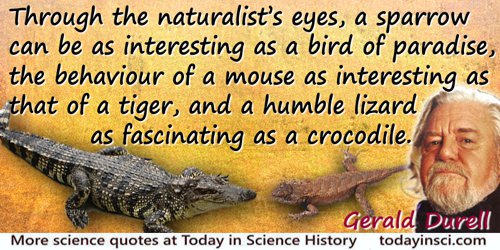
Through the naturalist’s eyes, a sparrow can be as interesting as a bird of paradise, the behaviour of a mouse as interesting as that of a tiger, and a humble lizard as fascinating as a crocodile. … Our planet is beautifully intricate, brimming over with enigmas to be solved and riddles to be unravelled.
In The Amateur Naturalist (1989), 7.
To arrive at the simplest truth, as Newton knew and practiced, requires years of contemplation. Not activity Not reasoning. Not calculating. Not busy behaviour of any kind. Not reading. Not talking. Not making an effort. Not thinking. Simply bearing in mind what it is one needs to know. And yet those with the courage to tread this path to real discovery are not only offered practically no guidance on how to do so, they are actively discouraged and have to set about it in secret, pretending meanwhile to be diligently engaged in the frantic diversions and to conform with the deadening personal opinions which are continually being thrust upon them.
In 'Appendix 1', The Laws of Form (1969), 110.
To be anthropocentric is to remain unaware of the limits of human nature, the significance of biological processes underlying human behavior, and the deeper meaning of long-term genetic evolution.
Tanner Lecture on Human Values, University of Michigan, 'Comparative Social Theory' (30 Mar 1979).
Truth and falsity, indeed understanding, is not necessarily something purely intellectual, remote from feelings and attitudes. ... It is in the total conduct of men rather than in their statements that truth or falsehood lives, more in what a man does, in his real reaction to other men and to things, in his will to do them justice, to live at one with them. Here lies the inner connection between truth and justice. In the realm of behavior and action, the problem recurs as to the difference between piece and part.
From 'On Truth', collected in Mary Henle (ed.), Documents of Gestalt Psychology (1961), 28.
We are recorders and reporters of the facts—not judges of the behavior we describe.
Recalled on his death 25 Aug 56
We cannot idealize technology. Technology is only and always the reflection of our own imagination, and its uses must be conditioned by our own values. Technology can help cure diseases, but we can prevent a lot of diseases by old-fashioned changes in behavior.
Remarks at Knoxville Auditorium Coliseum, Knoxville, Tennessee (10 Oct 1996) while seeking re-election. American Presidency Project web page.
We must examine the moral alchemy through which the in-group readily transmutes virtue into vice and vice into virtue, as the occasion may demand. … We begin with the engagingly simple formula of moral alchemy: the same behavior must be differently evaluated according to the person who exhibits it. For example, the proficient alchemist will at once know that the word “firm” is properly declined as follows:
I am firm,
Thou art obstinate,
He is pig-headed.
There are some, unversed in the skills of this science, who will tell you that one and the same term should be applied to all three instances of identical behavior.
I am firm,
Thou art obstinate,
He is pig-headed.
There are some, unversed in the skills of this science, who will tell you that one and the same term should be applied to all three instances of identical behavior.
In article, 'The Self-Fulfilling Prophecy', The Antioch Review (Summer 1948), 8, No. 2, 195-196. Included as Chap. 7 of Social Theory and Social Structure (1949), 201.
We need nothing to explain behavior but the ordinary laws of physics and chemistry. There are many things we cannot explain in behavior just as there are many things we cannot explain in physics and chemistry, but where objectively verifiable experimentation ends, hypothesis, and later theory, begin. But even theories and hypotheses must be couched in terms of what is already known about physical and chemical processes. … The Behaviorist cannot find consciousness in the test-tube of his science.
In The Battle Of Behaviorism: An Exposition and an Exposure (1927), 26.
We think we understand the regular reflection of light and X rays - and we should understand the reflections of electrons as well if electrons were only waves instead of particles ... It is rather as if one were to see a rabbit climbing a tree, and were to say ‘Well, that is rather a strange thing for a rabbit to be doing, but after all there is really nothing to get excited about. Cats climb trees - so that if the rabbit were only a cat, we would understand its behavior perfectly.’ Of course, the explanation might be that what we took to be a rabbit was not a rabbit at all but was actually a cat. Is it possible that we are mistaken all this time in supposing they are particles, and that actually they are waves?
Franklin Institute Journal Vol. 205, 597. Cited in New Scientist (14 Apr 1977), 66.
When I discuss intelligent life in the universe, I take this to include the human race, even though much of its behavior throughout history appears not to have been calculated to aid the survival of the species.
In 'A Step Backward For Civilization', The Washington Post (16 Feb 2014), Sec. A, 21.
When Richard Dawkins first published his idea of a meme, he made it clear he was speaking of “a unit of imitation” … Memes were supposed to be exclusive triumphs of humanity. But memes come in two different kinds—behavioral and verbal. … behavioral memes began brain-hopping long before there were such things as human minds.
In 'Threading a New Tapestry', Global Brain: The Evolution of Mass Mind from the Big Bang to the 21st Century (2000), 62.
When we react to life from the head without joining forces with the heart, it can lead us into childish, inelegant behavior that we don’t respect in ourselves. If we get the head in sync with the heart first, we have the power of their teamwork working for us and we can make the changes we know we need to make.
Doc Childre and Howard Martin
When you try to explain the behavior of water, remember to demonstrate the experiment first and the cause next.
As quoted in George H. de Thierry, Journal of the Boston Society of Civil Engineers (Jan 1928), 15, No. 1, 2.
While our behavior is still significantly controlled by our genetic inheritance, we have, through our brains, a much richer opportunity to blaze new behavioral and cultural pathways on short timescales.
The Dragons of Eden: Speculations on the Evolution of Human Intelligence (1977, 1986), 3.
Why does man behave like perfect idiot? This is the problem I wish to deal with.
The Crazy Ape (1970), 11.
With the nervous system intact the reactions of the various parts of that system, the 'simple reflexes', are ever combined into great unitary harmonies, actions which in their sequence one upon another constitute in their continuity what may be termed the 'behaviour'.
The Integrative Action of the Nervous System (1906), 237.
Without some idea of oxidation processes, of the chemical structure of food, and of the chemical reactions in digestion, visceral behavior is a blank. And without some understanding of visceral behavior, psychic behavior is up in the air.
From Why We Behave Like Human Beings (1925), xiv.
Zoocentrism is the primary fallacy of human sociobiology, for this view of human behavior rests on the argument that if the actions of ‘lower’ animals with simple nervous systems arise as genetic products of natural selection, then human behavior should have a similar basis.
…...
 In science it often happens that scientists say, 'You know that's a really good argument; my position is mistaken,' and then they would actually change their minds and you never hear that old view from them again. They really do it. It doesn't happen as often as it should, because scientists are human and change is sometimes painful. But it happens every day. I cannot recall the last time something like that happened in politics or religion.
(1987) --
In science it often happens that scientists say, 'You know that's a really good argument; my position is mistaken,' and then they would actually change their minds and you never hear that old view from them again. They really do it. It doesn't happen as often as it should, because scientists are human and change is sometimes painful. But it happens every day. I cannot recall the last time something like that happened in politics or religion.
(1987) -- 





