Beauty Quotes (316 quotes)
“But in the binary system,” Dale points out, handing back the squeezable glass, “the alternative to one isn’t minus one, it’s zero. That’s the beauty of it, mechanically.” “O.K. Gotcha. You’re asking me, What’s this minus one? I’ll tell you. It’s a plus one moving backward in time. This is all in the space-time foam, inside the Planck duration, don’t forget. The dust of points gives birth to time, and time gives birth to the dust of points. Elegant, huh? It has to be. It’s blind chance, plus pure math. They’re proving it, every day. Astronomy, particle physics, it’s all coming together. Relax into it, young fella. It feels great. Space-time foam.”
In Roger's Version: A Novel (1986), 304.
[Coleridge] selected an instance of what was called the sublime, in DARWIN, who imagined the creation of the universe to have taken place in a moment, by the explosion of a mass of matter in the womb, or centre of space. In one and the same instant of time, suns and planets shot into systems in every direction, and filled and spangled the illimitable void! He asserted this to be an intolerable degradation—referring, as it were, all the beauty and harmony of nature to something like the bursting of a barrel of gunpowder! that spit its combustible materials into a pock-freckled creation!
In Seamus Perry (eds.), Coleridge’s Responses: Vol. 1: Coleridge on Writers and Writing (2007), 338-339.
[Mathematics] is security. Certainty. Truth. Beauty. Insight. Structure. Architecture. I see mathematics, the part of human knowledge that I call mathematics, as one thing—one great, glorious thing. Whether it is differential topology, or functional analysis, or homological algebra, it is all one thing. … They are intimately interconnected, they are all facets of the same thing. That interconnection, that architecture, is secure truth and is beauty. That’s what mathematics is to me.
From interview with Donald J. Albers. In John H. Ewing and Frederick W. Gehring, Paul Halmos Celebrating 50 Years of Mathematics (1991), 13.
[T]here shall be love between the poet and the man of demonstrable science. In the beauty of poems are the tuft and final applause of science.
In Walt Whitman and William Michael Rossetti (ed.), 'Preface to the First Edition of Leaves of Grass', Poems By Walt Whitman (1868), 46.
[The attitude of the Renaissance towards the antique world was that] Archaeology to them was not a mere science for the antiquarian; it was a means by which they could touch the dry dust of antiquity into the very breath and beauty of life, and fill with the new wine of romanticism forms that else had been old and out-worn.
In his essay 'The Truth of Masks', collected in Intentions (1904), 213.
[There is an] immense advantage to be gained by ample space and appropriate surroundings in aiding the formation of a just idea of the beauty and interest of each specimen... Nothing detracts so much from the enjoyment ... from a visit to a museum as the overcrowding of the specimens exhibited.
Essays on Museums (1898), 33.
[There was] in some of the intellectual leaders a great aspiration to demonstrate that the universe ran like a piece of clock-work, but this was was itself initially a religious
aspiration. It was felt that there would be something defective in Creation itself—something not quite worthy of God—unless the whole system of the universe could be shown to be interlocking, so that it carried the pattern of reasonableness and orderliness. Kepler, inaugurating the scientist’s quest for a mechanistic universe in the seventeenth century, is significant here—his mysticism, his music of the spheres, his rational deity demand a system which has the beauty of a piece of mathematics.
In The Origins of Modern Science (1950), 105.

[W]hen Galileo discovered he could use the tools of mathematics and mechanics to understand the motion of celestial bodies, he felt, in the words of one imminent researcher, that he had learned the language in which God recreated the universe. Today we are learning the language in which God created life. We are gaining ever more awe for the complexity, the beauty, the wonder of God's most devine and sacred gift.
From White House Announcement of the Completion of the First Survey of the Entire Human Genome Project, broadcast on the day of the publication of the first draft of the human genome. Quoted in transcript on the National Archives, Clinton White House web site, 'Text of Remarks on the Completion of the First Survey of the Entire Human Genome Project' (26 Jun 2000).
Le savant n’étudie pas la nature parce que cela est utile; il l’étudie parce qu’il y prend plaisir et il y prend plaisir parce qu’elle est belle. Si la nature n’était pas belle, elle ne vaudrait pas la peine d’être connue, la vie ne vaudrait pas la peine d’être vécue.
The scientist does not study nature because it is useful to do so. He studies it because he takes pleasure in it, and he takes pleasure in it because it is beautiful. If nature were not beautiful, it would not be worth knowing, and life would not be worth living. I am not speaking, of course, of the beauty which strikes the senses, of the beauty of qualities and appearances. I am far from despising this, but it has nothing to do with science. What I mean is that more intimate beauty which comes from the harmonious order of its parts, and which a pure intelligence can grasp.
The scientist does not study nature because it is useful to do so. He studies it because he takes pleasure in it, and he takes pleasure in it because it is beautiful. If nature were not beautiful, it would not be worth knowing, and life would not be worth living. I am not speaking, of course, of the beauty which strikes the senses, of the beauty of qualities and appearances. I am far from despising this, but it has nothing to do with science. What I mean is that more intimate beauty which comes from the harmonious order of its parts, and which a pure intelligence can grasp.
In Science et Méthode (1920), 48, as translated by Francis Maitland, in Science and Method (1908, 1952), 15.
The Charms of Statistics.—It is difficult to understand why statisticians commonly limit their inquiries to Averages, and do not revel in more comprehensive views. Their souls seem as dull to the charm of variety as that of the native of one of our flat English counties, whose retrospect of Switzerland was that, if its mountains could be thrown into its lakes, two nuisances would be got rid of at once. An Average is but a solitary fact, whereas if a single other fact be added to it, an entire Normal Scheme, which nearly corresponds to the observed one, starts potentially into existence. Some people hate the very name of statistics, but I find them full of beauty and interest. Whenever they are not brutalised, but delicately handled by the higher methods, and are warily interpreted, their power of dealing with complicated phenomena is extraordinary. They are the only tools by which an opening can be cut through the formidable thicket of difficulties that bars the path of those who pursue the Science of man.
Natural Inheritance (1889), 62-3.
A Chinese tale tells of some men sent to harm a young girl who, upon seeing her beauty, become her protectors rather than her violators. That’s how I felt seeing the Earth for the first time. "I could not help but love and cherish her.
…...
A fire-mist and a planet,
A crystal and a cell,
A jellyfish and a saurian,
And caves where the cavemen dwell;
Then a sense of law and beauty,
And a face turned from the clod—
Some call it Evolution,
And others call it God.
A crystal and a cell,
A jellyfish and a saurian,
And caves where the cavemen dwell;
Then a sense of law and beauty,
And a face turned from the clod—
Some call it Evolution,
And others call it God.
'Each in his Own Tongue', in Kansas in Literature: Part One, Poetry (1900), 83.
A human being is part of the whole, called by us “Universe”; a part limited in time and space. He experiences himself, his thoughts and feelings as something separated from the rest—a kind of optical delusion of his consciousness. This delusion is a kind of prison for us, restricting us to our personal desires and to affection for a few persons nearest us. Our task must be to free ourselves from this prison by widening our circle of compassion to embrace all living creatures and the whole of nature in its beauty. Nobody is able to achieve this completely but the striving for such achievement is, in itself, a part of the liberation and a foundation for inner security.
In Letter (4 Mar 1950), replying to a grieving father over the loss of a young son. In Dear Professor Einstein: Albert Einstein’s Letters to and from Children (2002), 184.
A large number of areas of the brain are involved when viewing equations, but when one looks at a formula rated as beautiful it activates the emotional brain—the medial orbito-frontal cortex—like looking at a great painting or listening to a piece of music. … Neuroscience can’t tell you what beauty is, but if you find it beautiful the medial orbito-frontal cortex is likely to be involved; you can find beauty in anything.
As quoted in James Gallagher, 'Mathematics: Why The Brain Sees Maths As Beauty,' BBC News (13 Feb 2014), on bbc.co.uk web site.
A mind which has once imbibed a taste for scientific enquiry, and has learnt the habit of applying its principles readily to the cases which occur, has within itself an inexhaustable source of pure and exciting contemplations:— One would think that Shakespeare had such a mind in view when he describes a contemplative man as finding
“Tongues in trees—books in running brooks—
Sermons in stones—and good in everything.”
Accustomed to trace the operations of general causes and the exemplification of general laws, in circumstances where the uninformed and uninquiring eye, perceives neither novelty nor beauty, he walks in the midst of wonders; every object which falls in his way elucidates some principle, affords some instruction and impresses him with a sense of harmony and order. Nor is it a mere passive pleasure which is thus communicated. A thousand questions are continually arising in his mind, a thousand objects of enquiry presenting themselves, which keep his faculties in constant exercise, and his thoughts perpetually on the wing, so that lassitude is excluded from his life, and that craving after artificial excitement and dissipation of the mind, which leads so many into frivolous, unworthy, and destructive pursuits, is altogether eradicated from his bosom.
“Tongues in trees—books in running brooks—
Sermons in stones—and good in everything.”
Accustomed to trace the operations of general causes and the exemplification of general laws, in circumstances where the uninformed and uninquiring eye, perceives neither novelty nor beauty, he walks in the midst of wonders; every object which falls in his way elucidates some principle, affords some instruction and impresses him with a sense of harmony and order. Nor is it a mere passive pleasure which is thus communicated. A thousand questions are continually arising in his mind, a thousand objects of enquiry presenting themselves, which keep his faculties in constant exercise, and his thoughts perpetually on the wing, so that lassitude is excluded from his life, and that craving after artificial excitement and dissipation of the mind, which leads so many into frivolous, unworthy, and destructive pursuits, is altogether eradicated from his bosom.
In Dionysius Lardner (ed.), Cabinet Cyclopaedia, Vol 1, Preliminary Discourse on the Study of Natural Philosophy (1831), 14-15.
A painter makes patterns with shapes and colours, a poet with words. A painting may embody an “idea,” but the idea is usually commonplace and unimportant. In poetry, ideas count for a good deal more; but, as Housman insisted, the importance of ideas in poetry is habitually exaggerated. … The poverty of ideas seems hardly to affect the beauty of the verbal pattern. A mathematician, on the other hand, has no material to work with but ideas, and so his patterns are likely to last longer, since ideas wear less with time than words.
In A Mathematician’s Apology (1940, 2012), 84-85.
A peculiar beauty reigns in the realm of mathematics, a beauty which resembles not so much the beauty of art as the beauty of nature and which affects the reflective mind, which has acquired an appreciation of it, very much like the latter.
From Berliner Monatsberichte (1867), 395. As translated in Robert Édouard Moritz, Memorabilia Mathematica; Or, The Philomath’s Quotation-book (1914), 185.
A poet is, after all, a sort of scientist, but engaged in a qualitative science in which nothing is measurable. He lives with data that cannot be numbered, and his experiments can be done only once. The information in a poem is, by definition, not reproducible. ... He becomes an equivalent of scientist, in the act of examining and sorting the things popping in [to his head], finding the marks of remote similarity, points of distant relationship, tiny irregularities that indicate that this one is really the same as that one over there only more important. Gauging the fit, he can meticulously place pieces of the universe together, in geometric configurations that are as beautiful and balanced as crystals.
In The Medusa and the Snail: More Notes of a Biology Watcher (1974, 1995), 107.
A theory with mathematical beauty is more likely to be correct than an ugly one that fits some experimental data. God is a mathematician of a very high order, and He used very advanced mathematics in constructing the universe.
In Scientific American (May 1963). As quoted and cited in The Hutchinson Encyclopedia of Science (1998), 468.
A tree is beautiful, but what’s more, it has a right to life; like water, the sun and the stars, it is essential. Life on earth is inconceivable without trees. Forests create climate, climate influences peoples’ character, and so on and so forth. There can be neither civilization nor happiness if forests crash down under the axe, if the climate is harsh and severe, if people are also harsh and severe. ... What a terrible future!
In letter to A.S. Suvorin (18 Oct 1888).
Abstractness, sometimes hurled as a reproach at mathematics, is its chief glory and its surest title to practical usefulness. It is also the source of such beauty as may spring from mathematics.
In 'General Prospectus', The Development of Mathematics (1940, 2017), Chap. 1, 9.
Although the ocean’s surface seems at first to be completely homogeneous, after half a month we began to differentiate various seas and even different parts of oceans by their characteristic shades. We were astonished to discover that, during an flight, you have to learn anew not only to look, but also to see. At first the finest nuances of color elude you, but gradually your vision sharpens and your color perception becomes richer, and the planet spreads out before you with all its indescribable beauty.
…...
Among the memoirs of Kirchhoff are some of uncommon beauty. … Can anything be beautiful, where the author has no time for the slightest external embellishment?—But—; it is this very simplicity, the indispensableness of each word, each letter, each little dash, that among all artists raises the mathematician nearest to the World-creator; it establishes a sublimity which is equalled in no other art, something like it exists at most in symphonic music. The Pythagoreans recognized already the similarity between the most subjective and the most objective of the arts.
In Ceremonial Speech (15 Nov 1887) celebrating the 301st anniversary of the Karl-Franzens-University Graz. Published as Gustav Robert Kirchhoff: Festrede zur Feier des 301. Gründungstages der Karl-Franzens-Universität zu Graz (1888), 28-29, as translated in Robert Édouard Moritz, Memorabilia Mathematica; Or, The Philomath’s Quotation-book (1914), 186. From the original German, “Gerade unter den zuletzt erwähnten Abhandlungen Kirchhoff’s sind einige von ungewöhnlicher Schönheit. … kann etwas schön sein, wo dem Autor auch zur kleinsten äusseren Ausschmückung die Zeit fehlt?–Doch–; gerade durch diese Einfachheit, durch diese Unentbehrlichkeit jedes Wortes, jedes Buchstaben, jedes Strichelchens kömmt der Mathematiker unter allen Künstlern dem Weltenschöpfer am nächsten; sie begründet eine Erhabenheit, die in keiner Kunst ein Gleiches,–Aehnliches höchstens in der symphonischen Musik hat. Erkannten doch schon die Pythagoräer die Aehnlichkeit der subjectivsten und der objectivsten der Künste.”
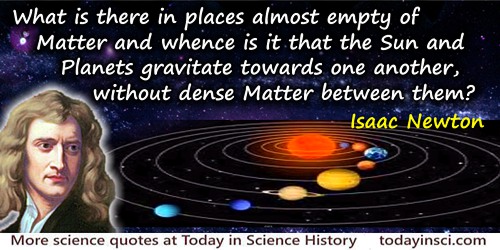
And for rejecting such a Medium, we have the Authority of those the oldest and most celebrated Philosophers of Greece and Phoenicia, who made a Vacuum, and Atoms, and the Gravity of Atoms, the first Principles of their Philosophy; tacitly attributing Gravity to some other Cause than dense Matter. Later Philosophers banish the Consideration of such a Cause out of natural Philosophy, feigning Hypotheses for explaining all things mechanically, and referring other Causes to Metaphysicks: Whereas the main Business of natural Philosophy is to argue from Phaenomena without feigning Hypotheses, and to deduce Causes from Effects, till we come to the very first Cause, which certainly is not mechanical; and not only to unfold the Mechanism of the World, but chiefly to resolve these and such like Questions. What is there in places almost empty of Matter, and whence is it that the Sun and Planets gravitate towards one another, without dense Matter between them? Whence is it that Nature doth nothing in vain; and whence arises all that Order and Beauty which we see in the World? ... does it not appear from phaenomena that there is a Being incorporeal, living, intelligent, omnipresent, who in infinite space, as it were in his Sensory, sees the things themselves intimately, and thoroughly perceives them, and comprehends them wholly by their immediate presence to himself.
In Opticks, (1704, 2nd. Ed. 1718), Book 3, Query 28, 343-5. Newton’s reference to “Nature does nothing in vain” recalls the axiom from Aristotle, which may be seen as “Natura nihil agit frustra” in the Aristotle Quotes on this web site.
Archimedes possessed so high a spirit, so profound a soul, and such treasures of highly scientific knowledge, that though these inventions [used to defend Syracuse against the Romans] had now obtained him the renown of more than human sagacity, he yet would not deign to leave behind him any commentary or writing on such subjects; but, repudiating as sordid and ignoble the whole trade of engineering, and every sort of art that lends itself to mere use and profit, he placed his whole affection and ambition in those purer speculations where there can be no reference to the vulgar needs of life; studies, the superiority of which to all others is unquestioned, and in which the only doubt can be whether the beauty and grandeur of the subjects examined, or the precision and cogency of the methods and means of proof, most deserve our admiration.
— Plutarch
In John Dryden (trans.), Life of Marcellus.
Art is the beautiful way of doing things. Science is the effective way of doing things. Business is the economic way of doing things.
Selected writings of Elbert Hubbard (1928), 101.
As an Art, Mathematics has its own standard of beauty and elegance which can vie with the more decorative arts. In this it is diametrically opposed to a Baroque art which relies on a wealth of ornamental additions. Bereft of superfluous addenda, Mathematics may appear, on first acquaintance, austere and severe. But longer contemplation reveals the classic attributes of simplicity relative to its significance and depth of meaning.
In The Skeleton Key of Mathematics (1949), 12.
As children we all possess a natural, uninhibited curiosity, a hunger for explanation, which seems to die slowly as we age—suppressed, I suppose, by the high value we place on conformity and by the need not to appear ignorant.
It betokens a conviction that somehow science is innately incomprehensible. It precludes reaching deeper, thereby denying the profound truth that understanding enriches experience, that explanation vastly enhances the beauty of the natural world in the eye of the beholder.
It betokens a conviction that somehow science is innately incomprehensible. It precludes reaching deeper, thereby denying the profound truth that understanding enriches experience, that explanation vastly enhances the beauty of the natural world in the eye of the beholder.
In Toward the Habit of Truth (1990).
As far as the meaning of life in general, or in the abstract, as far as I can see, there is none. If all of life were suddenly to disappear from earth and anywhere else it may exist, or if none had ever formed in the first place, I think the Universe would continue to exist without perceptible change. However, it is always possible for an individual to invest his own life with meaning that he can find significant. He can so order his life that he may find as much beauty and wisdom in it as he can, and spread as much of that to others as possible.
In a book proposal for The Meaning of Life edited by Hugh S. Moorhead, 1989.
As for everything else, so for a mathematical theory: beauty can be perceived but not explained.
President’s address (1883) to the British Association for the Advancement of Science, in The Collected Mathematical Papers (1895), Vol. 8, xxii.
As pure truth is the polar star of our science [mathematics], so it is the great advantage of our science over others that it awakens more easily the love of truth in our pupils. … If Hegel justly said, “Whoever does not know the works of the ancients, has lived without knowing beauty,” Schellbach responds with equal right, “Who does not know mathematics, and the results of recent scientific investigation, dies without knowing truth.”
From Didaktik und Methodik des Rechnens und der Mathematik (1908), 37. As quoted and translated in J.W.A. Young, Teaching of Mathematics in the Elementary and the Secondary School (1907), 44. From the original German, “Wenn Hegel mit Recht sagt: ‘Wer die Werke der Alten nicht kennt, der hat gelebt, ohne die Schönheit gekannt zu haben’, so erwidert Schellbach mit nicht minderem Recht: ‘Wer die Math. und die Resultate der neueren Naturforschung nicht gekannt hat, der stirbt, ohne die Wahrheit zu kennen.’”
As the skies appear to a man, so is his mind. Some see only clouds there; some, prodigies and portents; some rarely look up at all; their heads, like the brutes, are directed toward Earth. Some behold there serenity, purity, beauty ineffable. The world runs to see the panorama, when there is a panorama in the sky which few go to see.
…...
As we conquer peak after peak we see in front of us regions full of interest and beauty, but we do not see our goal, we do not see the horizon; in the distance tower still higher peaks, which will yield to those who ascend them still wider prospects, and deepen the feeling, the truth of which is emphasised by every advance in science, that “Great are the Works of the Lord.”
In Presidential Address to the British Association, as quoted in Arthur L. Foley, 'Recent Developments in Physical Science, The Popular Science Monthly (1910), 456.
At the origin, the [space travel] pioneers of the greatest adventure of all times were motivated by the drive to explore, by the pure spirit of conquest, by the lofty desire to open up new fields to human genius. … From their exceptional journeys, they all came back with the revelation of beauty. Beauty of the black sky, beauty and variety of our planet, beauty of the Earth seen from the Moon, girdled by a scintillating belt of equatorial thunderstorms. They all emphasize that our planet is one, that borderlines are artificial, that humankind is one single community on board spaceship Earth. They all insist that this fragile gem is at our mercy and that we must all endeavor to protect it.
Written for 'Foreword' to Kevin W. Kelley (ed.), The Home Planet (1988), paragraphs 6-7 (unpaginated).
Beauty is the first test: there is no permanent place in the world for ugly mathematics.
In A Mathematician’s Apology (1940, reprint with Foreward by C.P. Snow 1992), 85.
Beauty, I hear you ask, do not the Graces flee where integrals stretch forth their necks?
In Ceremonial Speech (15 Nov 1887) celebrating the 301st anniversary of the Karl-Franzens-University Graz. Published as Gustav Robert Kirchhoff: Festrede zur Feier des 301. Gründungstages der Karl-Franzens-Universität zy Graz (1888), 28-29, as translated in Robert Édouard Moritz, Memorabilia Mathematica; Or, The Philomath’s Quotation-book (1914), 186. From the original German, “Schönheit höre ich Sie da fragen; entfliehen nicht die Grazien, wo Integrate ihre Hälse reckon.” [In Greek mythology, the Graces are three beautiful daughters of Zeus personifying charm, grace, and beauty. —Webmaster]
Before I flew I was already aware of how small and vulnerable our planet is; but only when I saw it from space, in all its ineffable beauty and fragility, did I realize that humankind’s most urgent task is to cherish and preserve it for future generations.
In Jack Hassard and Julie Weisberg , Environmental Science on the Net: The Global Thinking Project (1999), 40.
Berzelius' symbols are horrifying. A young student in chemistry might as soon learn Hebrew as make himself acquainted with them... They appear to me equally to perplex the adepts in science, to discourage the learner, as well as to cloud the beauty and simplicity of the atomic theory.
Quoted in H. E. Roscoe, 'Presidential Address', Reports of the British Association for the Advancement of Science, 57th report, 1887, 7.
Birds’ songs express joy, beauty, and purity, and evoke in us vitality and love. So many beings in the universe love us unconditionally. The trees, the water, and the air don’t ask anything of us; they just love us. Even though we need this kind of love, we continue to destroy them. By destroying the animals, the air, and the trees, we are destroying ourselves. We must learn to practice unconditional love for all beings so that the animals, the air, the trees, and the minerals can continue to be themselves.
In Love in Action: Writings on Nonviolent Social Change (1993), 131-132.
Botany,—the science of the vegetable kingdom, is one of the most attractive, most useful, and most extensive departments of human knowledge. It is, above every other, the science of beauty.
Using pseudonym Peter Parley, in Peter Parley’s Cyclopedia of Botany (1838), ix. [This is a correction. Earlier on this website, the quote was identified as by Joseph Paxton, because that author’s name was on Google’s (erroneous) cover image of the book search result.]
But Chinese civilization has the overpowering beauty of the wholly other, and only the wholly other can inspire the deepest love and the profoundest desire to learn.
The Grand Titration (1969), 176.
But concerning vision alone is a separate science formed among philosophers, namely, optics, and not concerning any other sense ... It is possible that some other science may be more useful, but no other science has so much sweetness and beauty of utility. Therefore it is the flower of the whole of philosophy and through it, and not without it, can the other sciences be known.
Opus Majus [1266-1268], Part V, distinction I, chapter I, trans. R. B. Burke, The Opus Maius of Roger Bacon (1928), Vol. 2, 420.
But here it may be objected, that the present Earth looks like a heap of Rubbish and Ruines; And that there are no greater examples of confusion in Nature than Mountains singly or jointly considered; and that there appear not the least footsteps of any Art or Counsel either in the Figure and Shape, or Order and Disposition of Mountains and Rocks. Wherefore it is not likely they came so out of God's hands ... To which I answer, That the present face of the Earth with all its Mountains and Hills, its Promontaries and Rocks, as rude and deformed as they appear, seems to me a very beautiful and pleasant object, and with all the variety of Hills, and Valleys, and Inequalities far more grateful to behold, than a perfectly level Countrey without any rising or protuberancy, to terminate the sight: As anyone that hath but seen the Isle of Ely, or any the like Countrey must need acknowledge.
— John Ray
Miscellaneous Discourses Concerning the Dissolution and Changes of the World (1692), 165-6.
But the fact is that when wine is taken in moderation, it gives rise to a large amount of breath, whose character is balanced, and whose luminosity is strong and brilliant. Hence wine disposes greatly to gladness, and the person is subject to quite trivial exciting agents. The breath now takes up the impression of agents belonging to the present time more easily than it does those which relate to the future; it responds to agents conducive to delight rather than those conducive to a sense of beauty.
— Avicenna
'The External Causes of Delight and Sadness', in The Canon of Medicine, adapted by L. Bakhtiar (19-99), 149-50.
Can one think that because we are engineers, beauty does not preoccupy us or that we do not try to build beautiful, as well as solid and long lasting structures? Aren’t the genuine functions of strength always in keeping with unwritten conditions of harmony? … Besides, there is an attraction, a special charm in the colossal to which ordinary theories of art do not apply.
As translated in Henry Petroski, Remaking the World: Adventures in Engineering (1998), 173. From the original French in interview of Eiffel by Paul Bourde, in the newspaper Le Temps (14 Feb 1887). Quoted in 'Au Jour le Jour: Les Artistes Contre la Tour Eiffel', Gazette Anecdotique, Littéraire, Artistique et Bibliographique (Feb 1887), 126, and in Gustave Eiffel, Travaux Scientifiques Exécutés à la Tour de 300 Mètres de 1889 à 1900 (1900), 14. “Parce que nous sommes des ingénieurs, croit-on donc que la beauté ne nous préoccupe pas dans nos constructions et qu'en même temps que nous faisons solide et durable nous ne nous efforçons pas rletfaire élégant? Est-ce que les véritables conditions de la force ne sont pas toujours conformes aux conditions secrètes de l'harmonie?.… Il y a du reste dans le colossal une attraction, un charme propre auxquels les théories d'art ordinaires ne sont guère applicables.
Chess combines the beauty of mathematical structure with the recreational delights of a competitive game.
In 'Preface', Mathematics, Magic, and Mystery (1956), ix.
Common sense is the favorite daughter of Reason, and altho thare are menny other wimmin more attraktive for a time, thare is nothing but death kan rob common sense ov her buty.
In The Complete Works of Josh Billings (1876), 214.
Cosmic evolution may teach us how the good and evil tendencies of man may have come about; but, in itself, it is incompetent to furnish any better reason why what we call good is preferable to what we call evil than we had before. Some day, I doubt not, we shall arrive at an understanding of the evolution of the aesthetic faculty; but all the understanding in the world will neither increase nor diminish the force of the intuition that this is beautiful and that is ugly.
'Evolution and Ethics' (1893). In Collected Essays (1894), Vol. 9, 80.
Culture is activity of thought, and receptiveness to beauty and humane feeling. Scraps of information have nothing to do with it. A merely well informed man is the most useless bore on God’s earth. What we should aim at producing is men who possess both culture and expert knowledge in some special direction.
Opening sentences of Chapter 1,'The Aims of Education', in Aims of Education and Other Essays (1917), 1.
Darwin grasped the philosophical bleakness with his characteristic courage. He argued that hope and morality cannot, and should not, be passively read in the construction of nature. Aesthetic and moral truths, as human concepts, must be shaped in human terms, not ‘discovered’ in nature. We must formulate these answers for ourselves and then approach nature as a partner who can answer other kinds of questions for us–questions about the factual state of the universe, not about the meaning of human life. If we grant nature the independence of her own domain–her answers unframed in human terms–then we can grasp her exquisite beauty in a free and humble way. For then we become liberated to approach nature without the burden of an inappropriate and impossible quest for moral messages to assuage our hopes and fears. We can pay our proper respect to nature’s independence and read her own ways as beauty or inspiration in our different terms.
…...
Delusions are often functional. A mother’s opinions about her children’s beauty, intelligence, goodness, et cetera ad nauseam, keep her from drowning them at birth.
In 'From the Notebooks of Lazarus Long', Time Enough for Love: The Lives of Lazarus Long (1973), 257.
Diamond, for all its great beauty, is not nearly as interesting as the hexagonal plane of graphite. It is not nearly as interesting because we live in a three-dimensional space, and in diamond each atom is surrounded in all three directions in space by a full coordination. Consequently, it is very difficult for an atom inside the diamond lattice to be confronted with anything else in this 3D world because all directions are already taken up.
From Nobel Lecture (7 Dec 1996), 'Discovering the Fullerenes', collected in Ingmar Grenthe (ed.), Nobel Lectures, Chemistry 1996-2000 (2003).
Difficulties [in defining mathematics with full generality, yet simplicity] are but consequences of our refusal to see that mathematics cannot be defined without acknowledging its most obvious feature: namely, that it is interesting. Nowhere is intellectual beauty so deeply felt and fastidiously appreciated.
In Personal Knowledge (1958, 2012), 200,
Doubtless it is true that while consciousness is occupied in the scientific interpretation of a thing, which is now and again “a thing of beauty,” it is not occupied in the aesthetic appreciation of it. But it is no less true that the same consciousness may at another time be so wholly possessed by the aesthetic appreciation as to exclude all thought of the scientific interpretation. The inability of a man of science to take the poetic view simply shows his mental limitation; as the mental limitation of a poet is shown by his inability to take the scientific view. The broader mind can take both.
In An Autobiography (1904), Vol. 1, 485.
Dreams are renewable. No matter what our age or condition, there are still untapped possibilities within us and new beauty waiting to be born.
…...
During the eight days I spent in space, I realized that mankind needs height primarily to better know our long-suffering Earth, to see what cannot be seen close up. Not just to love her beauty, but also to ensure that we do not bring even the slightest harm to the natural world
In Jack Hassard and Julie Weisberg , Environmental Science on the Net: The Global Thinking Project (1999), 40.
Each and every loss becomes an instance of ultimate tragedy–something that once was, but shall never be known to us. The hump of the giant deer–as a nonfossilizable item of soft anatomy–should have fallen into the maw of erased history. But our ancestors provided a wondrous rescue, and we should rejoice mightily. Every new item can instruct us; every unexpected object possesses beauty for its own sake; every rescue from history’s great shredding machine is–and I don’t know how else to say this–a holy act of salvation for a bit of totality.
…...
Electricity is often called wonderful, beautiful; but it is so only in common with the other forces of nature. The beauty of electricity or of any other force is not that the power is mysterious, and unexpected, touching every sense at unawares in turn, but that it is under law, and that the taught intellect can even govern it largely. The human mind is placed above, and not beneath it, and it is in such a point of view that the mental education afforded by science is rendered super-eminent in dignity, in practical application and utility; for by enabling the mind to apply the natural power through law, it conveys the gifts of God to man.
Notes for a Friday Discourse at the Royal Institution (1858).
Euclid alone has looked on Beauty bare.
Let all who prate of Beauty hold their peace,
And lay them prone upon the earth and cease
To ponder on themselves, the while they stare
At nothing, intricately drawn nowhere
In shapes of shifting lineage; let geese
Gabble and hiss, but heroes seek release
From dusty bondage into luminous air.
O blinding hour, O holy, terrible day,
When first the shaft into his vision shone
Of light anatomized! Euclid alone
Has looked on Beauty bare. Fortunate they
Who, though once only and then but far away,
Have heard her massive sandal set on stone.
Let all who prate of Beauty hold their peace,
And lay them prone upon the earth and cease
To ponder on themselves, the while they stare
At nothing, intricately drawn nowhere
In shapes of shifting lineage; let geese
Gabble and hiss, but heroes seek release
From dusty bondage into luminous air.
O blinding hour, O holy, terrible day,
When first the shaft into his vision shone
Of light anatomized! Euclid alone
Has looked on Beauty bare. Fortunate they
Who, though once only and then but far away,
Have heard her massive sandal set on stone.
Poem, 'Euclid Alone Has Looked on Beauty Bare", collected in Wallace Warner Douglas and Hallett Darius Smith (eds.), The Critical Reader: Poems, Stories, Essays (1949), 110.
Euclid alone
Has looked on Beauty bare.
He turned away at once;
Far too polite to stare.
Has looked on Beauty bare.
He turned away at once;
Far too polite to stare.
Parody after Edna St. Vincent Millay. In The Mathematical Intelligencer (Fall 1994), 16, No. 4, 20.
Every physical fact, every expression of nature, every feature of the earth, the work of any and all of those agents which make the face of the world what it is, and as we see it, is interesting and instructive. Until we get hold of a group of physical facts, we do not know what practical bearings they may have, though right-minded men know that they contain many precious jewels, which science, or the expert hand of philosophy will not fail top bring out, polished, and bright, and beautifully adapted to man's purposes.
In The Physical Geography of the Sea (1855), 209-210. Maury was in particular referring to the potential use of deep-sea soundings.
Everywhere in nature we seek some certainty, but all this is nothing more than an arrangement of the dark feeling of our own. All the mathematical laws that we find in Nature are always suspicious to me, despite their beauty. They give me no pleasure. They are merely expedients. Everything is not true at close range.
From the original German, in Physikalische und Mathematische Schriften (1806), Vol. 4, 145, “Wir suchen in der Natur überall eine gewisse Bestimmtheit, aber das Alles ist weiter nichts, als Anordnung des dunkeln Gefühls unserer eigenen. Alle mathematischen Gesetze, die wir in der Natur finden, sind mir trotz ihrer Schönheit immer verdächtig. Sie Freuen mich nicht. Sie sind bloss Hülfsmittel. In der Nähe ist Alles nicht wahr.” English version by Webmaster using Google translate.
Evolution is a hard, inescapable mistress. There is just no room for compassion or good sportsmanship. Too many organisms are born, so, quite simply, a lot of them are going to have to die because there isn't enough food and space to go around. You can be beautiful, fast and strong, but it might not matter. The only thing that does matter is, whether you leave more children carrying your genes than the next person leaves. It’s true whether you’re a prince, a frog, or an American elm.
From The Center of Life: A Natural History of the Cell (1977, 1978), 37.
Falsity cannot keep an idea from being beautiful; there are certain errors of such ingenuity that one could regret their not ranking among the achievements of the human mind.
Pensées d'un Biologiste (1939). Translated in The Substance of Man (1962), 89.
First follow Nature, and your judgment frame
By her just standard, which is still the same:
Unerring nature, still divinely bright,
One clear, unchanged, and universal light,
Life, force, and beauty must to all impart,
At once the source, and end, and test of art.
By her just standard, which is still the same:
Unerring nature, still divinely bright,
One clear, unchanged, and universal light,
Life, force, and beauty must to all impart,
At once the source, and end, and test of art.
#039;Essay On Criticism#039;, Miscellaneous Poems and Translations: by Several Hands (1720), 38.
For me the most beautiful thing about Meccano is that it teaches you to think.
As quoted in by Hugh Schofield in web article 'Meccano Revives French Production' (23 Dec 2010).
For me, the study of these laws is inseparable from a love of Nature in all its manifestations. The beauty of the basic laws of natural science, as revealed in the study of particles and of the cosmos, is allied to the litheness of a merganser diving in a pure Swedish lake, or the grace of a dolphin leaving shining trails at night in the Gulf of California.
Nobel Banquet Speech (10 Dec 1969), in Wilhelm Odelberg (ed.),Les Prix Nobel en 1969 (1970).
For the harmony of the world is made manifest in Form and Number, and the heart and soul and all the poetry of Natural Philosophy are embodied in the concept of mathematical beauty.
In 'Epilogue', On Growth and Form (1917), 778-9.
Forty years as an astronomer have not quelled my enthusiasm for lying outside after dark, staring up at the stars. It isn’t only the beauty of the night sky that thrills me. It’s the sense I have that some of those points of light—which ones I can’t even guess—are the home stars of beings not so different from us, daily cares and all, who look across space and wonder, just as we do.
In Frank Drake and Dava Sobel, Is Anyone Out There?: The Scientific Search for Extraterrestrial Intelligence (1992), 1.
Great thinkers build their edifices with subtle consistency. We do our intellectual forebears an enormous disservice when we dismember their visions and scan their systems in order to extract a few disembodied ‘gems’–thoughts or claims still accepted as true. These disarticulated pieces then become the entire legacy of our ancestors, and we lose the beauty and coherence of older systems that might enlighten us by their unfamiliarity–and their consequent challenge in our fallible (and complacent) modern world.
…...
Happy is he who bears a god within himself, an ideal of beauty, and obeys him: an ideal of art, an ideal of the virtues of the Gospel. These are the living springs of great thoughts and great actions. All are illuminated by reflections of the sublime.
Speech (27 Apr 1882) on his reception into the Académie Française, as translated in Maurice Benjamin Strauss, Familiar Medical Quotations (1968), 490.
He plucks the pearls that stud the deep Admiring Beauty’s lap to fill;
He breaks the stubborn Marble’s sleep,
Rocks disappear before his skill:
With thoughts that swell his glowing soul
He bids the ore illume the page,
And, proudly scorning Time’s control,
Commences with an unborn age.
He breaks the stubborn Marble’s sleep,
Rocks disappear before his skill:
With thoughts that swell his glowing soul
He bids the ore illume the page,
And, proudly scorning Time’s control,
Commences with an unborn age.
Written for the Mechanics Celebration (1824). In 'Art—An Ode', as quoted and cited in Alpheus Cary, An Address Delivered Before the Massachusetts Charitable Mechanic Association (October 7th, 1824) (1824), 49.
He plucks the pearls that stud the deep Admiring Beauty’s lap to fill;
He breaks the stubborn Marble’s sleep,
Rocks disappear before his skill:
With thoughts that swell his glowing soul
He bids the ore illume the page,
And, proudly scorning Time’s control,
Commences with an unborn age.
He breaks the stubborn Marble’s sleep,
Rocks disappear before his skill:
With thoughts that swell his glowing soul
He bids the ore illume the page,
And, proudly scorning Time’s control,
Commences with an unborn age.
Written for the Mechanics Celebration (1824). In 'Art—An Ode', as quoted and cited in Alpheus Cary, An Address Delivered Before the Massachusetts Charitable Mechanic Association (October 7th, 1824) (1824), 49.
He was an admirable marksman, an expert swimmer, a clever rider, possessed of great activity [and] prodigious strength, and was notable for the elegance of his figure and the beauty of his features, and he aided nature by a careful attendance to his dress. Besides other accomplishments he was musical, a good fencer, danced well, and had some acquaintance with legerdemain tricks, worked in hair, and could plait willow baskets.
In Richard Rhodes, John James Audubon: The Making of an American (2004), 36.
Here is the element or power of conduct, of intellect and knowledge, of beauty, and of social life and manners, and all needful to build up a complete human life. … We have instincts responding to them all, and requiring them all, and we are perfectly civilized only when all these instincts of our nature—all these elements in our civilization have been adequately recognized and satisfied.
Collected in Tryon Edwards (ed.), A Dictionary of Thoughts: Being a Cyclopedia of Laconic Quotations from the Best Authors Both Ancient and Modern (1891), 75.
Here is this vast, savage, howling mother of ours, Nature, lying all around, with such beauty, and such affection for her children, as the leopard; and yet we are so early weaned from her breast to society, to that, culture which is exclusively an interaction of man on man.
Remarking how society becomes divorces individuals from nature. In essay, Walking (1862). Collected in The Writings of Henry David Thoreau (1893), Vol. 9, 291.
His spiritual insights were in three major areas: First, he has inspired mankind to see the world anew as the ultimate reality. Second, he perceived and described the physical universe itself as immanently divine. And finally, he challenged us to accept the ultimate demands of modern science which assign humanity no real or ultimate importance in the universe while also aspiring us to lives of spiritual celebration attuned to the awe, beauty and wonder about us.
Written about Robinson Jeffers by John Courtney, Vice-President of the Tor House Foundation, in online article, 'Robinson Jeffers - Pantheist poet' on pantheism.net website.
I ... express a wish that you may, in your generation, be fit to compare to a candle; that you may, like it, shine as lights to those about you; that, in all your actions, you may justify the beauty of the taper by making your deeds honourable and effectual in the discharge of your duty to your fellow-men.
The closing of the concluding lecture (8 Jan 1861) given to a juvenile audience at the Royal Institution, as published in A Course of Six Lectures on the Chemical History of a Candle (1861), 183. The tradition of these Christmas lectures continues to the present day.
I am among those who think that science has great beauty. A scientist in his laboratory is not only a technician: he is also a child placed before natural phenomena which impress him like a fairy tale. We should not allow it to be believed that all scientific progress can be reduced to mechanisms, machines, gearings, even though such machinery has its own beauty.
During a debate in Madrid, ',The Future of Culture' (1933). In Eve Curie Labouisse, Eve Curie and Vincent Sheean, Madame Curie (1937), 341
I am certain of nothing but the holiness of the Heart’s affections and the truth of Imagination—What the imagination seizes as Beauty must be truth—whether it existed before or not.
Letter to Benjamin Bailey (22 Nov 1817). In H. E. Rollins (ed.), Letters of John Keats (1958), Vol. 1, 184.
I am not insensible to natural beauty, but my emotional joys center on the improbable yet sometimes wondrous works of that tiny and accidental evolutionary twig called Homo sapiens. And I find, among these works, nothing more noble than the history of our struggle to understand nature—a majestic entity of such vast spatial and temporal scope that she cannot care much for a little mammalian afterthought with a curious evolutionary invention, even if that invention has, for the first time in so me four billion years of life on earth, produced recursion as a creature reflects back upon its own production and evolution. Thus, I love nature primarily for the puzzles and intellectual delights that she offers to the first organ capable of such curious contemplation.
…...
I am of the decided opinion, that mathematical instruction must have for its first aim a deep penetration and complete command of abstract mathematical theory together with a clear insight into the structure of the system, and doubt not that the instruction which accomplishes this is valuable and interesting even if it neglects practical applications. If the instruction sharpens the understanding, if it arouses the scientific interest, whether mathematical or philosophical, if finally it calls into life an esthetic feeling for the beauty of a scientific edifice, the instruction will take on an ethical value as well, provided that with the interest it awakens also the impulse toward scientific activity. I contend, therefore, that even without reference to its applications mathematics in the high schools has a value equal to that of the other subjects of instruction.
In 'Ueber das Lehrziel im mathemalischen Unterricht der höheren Realanstalten', Jahresbericht der Deutschen Mathematiker Vereinigung, 2, 192. (The Annual Report of the German Mathematical Association. As translated in Robert Édouard Moritz, Memorabilia Mathematica; Or, The Philomath’s Quotation-Book (1914), 73.
I am told that the wall paintings which we had the happiness of admiring in all their beauty and freshness [in the chapel she discovered at Abu Simbel] are already much injured. Such is the fate of every Egyptian monument, great or small. The tourist carves it over with names and dates, and in some instances with caricatures. The student of Egyptology, by taking wet paper “squeezes” sponges away every vestige of the original colour. The “Collector” buys and carries off everything of value that he can, and the Arab steals it for him. The work of destruction, meanwhile goes on apace. The Museums of Berlin, of Turin, of Florence are rich in spoils which tell their lamentable tale. When science leads the way, is it wonderful that ignorance should follow?
Quoted in Margaret S. Drower, The Early Years, in T.G.H. James, (ed.), Excavating in Egypt: The Egypt Exploration Society, 1882-1982 (1982), 10. As cited in Wendy M.K. Shaw, Possessors and Possessed: Museums, Archaeology, and the Visualization of History in the Late Ottoman Empire (2003), 37. Also quoted in Margaret S. Drower, Flinders Petrie: A Life in Archaeology (1995), 57.
I believe natural beauty has a necessary place in the spiritual development of any individual or any society. I believe that whenever we substitute something man-made and artificial for a natural feature of the earth, we have retarded some part of man’s spiritual growth.
As quoted in Linda Lear, Rachel Carson: Witness for Nature (1997), 259.
I can see him now at the blackboard, chalk in one hand and rubber in the other, writing rapidly and erasing recklessly, pausing every few minutes to face the class and comment earnestly, perhaps on the results of an elaborate calculation, perhaps on the greatness of the Creator, perhaps on the beauty and grandeur of Mathematics, always with a capital M. To him mathematics was not the handmaid of philosophy. It was not a humanly devised instrument of investigation, it was Philosophy itself, the divine revealer of TRUTH.
Writing as a Professor Emeritus at Harvard University, a former student of Peirce, in 'Benjamin Peirce: II. Reminiscences', The American Mathematical Monthly (Jan 1925), 32, No. 1, 5.
I do not believe that the present flowering of science is due in the least to a real appreciation of the beauty and intellectual discipline of the subject. It is due simply to the fact that power, wealth and prestige can only be obtained by the correct application of science.
In 'Some Reflections on the Present Status of Organic Chemistry', Science and Human Progress: Addresses at the Celebrations of the 50th Anniversary of the Mellon Institute (1963), 90.
I do not intend to go deeply into the question how far mathematical studies, as the representatives of conscious logical reasoning, should take a more important place in school education. But it is, in reality, one of the questions of the day. In proportion as the range of science extends, its system and organization must be improved, and it must inevitably come about that individual students will find themselves compelled to go through a stricter course of training than grammar is in a position to supply. What strikes me in my own experience with students who pass from our classical schools to scientific and medical studies, is first, a certain laxity in the application of strictly universal laws. The grammatical rules, in which they have been exercised, are for the most part followed by long lists of exceptions; accordingly they are not in the habit of relying implicitly on the certainty of a legitimate deduction from a strictly universal law. Secondly, I find them for the most part too much inclined to trust to authority, even in cases where they might form an independent judgment. In fact, in philological studies, inasmuch as it is seldom possible to take in the whole of the premises at a glance, and inasmuch as the decision of disputed questions often depends on an aesthetic feeling for beauty of expression, or for the genius of the language, attainable only by long training, it must often happen that the student is referred to authorities even by the best teachers. Both faults are traceable to certain indolence and vagueness of thought, the sad effects of which are not confined to subsequent scientific studies. But certainly the best remedy for both is to be found in mathematics, where there is absolute certainty in the reasoning, and no authority is recognized but that of one’s own intelligence.
In 'On the Relation of Natural Science to Science in general', Popular Lectures on Scientific Subjects, translated by E. Atkinson (1900), 25-26.
I grew up in Brooklyn, New York … a city neighborhood that included houses, lampposts, walls, and bushes. But with an early bedtime in the winter, I could look out my window and see the stars, and the stars were not like anything else in my neighborhood. [At age 5] I didn’t know what they were.
[At age 9] my mother … said to me, “You have a library card now, and you know how to read. Take the streetcar to the library and get a book on stars.” … I stepped up to the big librarian and asked for a book on stars. … I sat down and found out the answer, which was something really stunning.I found out that the stars are glowing balls of gas. I also found out that the Sun is a star but really close and that the stars are all suns except really far away I didn’t know any physics or mathematics at that time, but I could imagine how far you’d have to move the Sun away from us till it was only as bright as a star. It was in that library, reading that book, that the scale of the universe opened up to me. There was something beautiful about it.
At that young age, I already knew that I’d be very happy if I could devote my life to finding out more about the stars and the planets that go around them. And it’s been my great good fortune to do just that.
[At age 9] my mother … said to me, “You have a library card now, and you know how to read. Take the streetcar to the library and get a book on stars.” … I stepped up to the big librarian and asked for a book on stars. … I sat down and found out the answer, which was something really stunning.I found out that the stars are glowing balls of gas. I also found out that the Sun is a star but really close and that the stars are all suns except really far away I didn’t know any physics or mathematics at that time, but I could imagine how far you’d have to move the Sun away from us till it was only as bright as a star. It was in that library, reading that book, that the scale of the universe opened up to me. There was something beautiful about it.
At that young age, I already knew that I’d be very happy if I could devote my life to finding out more about the stars and the planets that go around them. And it’s been my great good fortune to do just that.
Quoted in interview with Jack Rightmyer, in 'Stars in His Eyes', Highlights For Children (1 Jan 1997). Ages as given in Tom Head (ed.), Conversations with Carl Sagan (2006), x.
I hate and fear 'science' because of my conviction that, for long to come if not for ever, it will be the remorseless enemy of mankind. I see it destroying all simplicity and gentleness of life, all the beauty of the world; I see it restoring barbarism under a mask of civilization; I see it darkening men's minds and hardening their hearts.
The Private Papers of Henry Ryecroft (1903), 268-9.
I have always been very fond of mathematics—for one short period, I even toyed with the possibility of abandoning chemistry in its favour. I enjoyed immensely both its conceptual and formal beauties, and the precision and elegance of its relationships and transformations. Why then did I not succumb to its charms? … because by and large, mathematics lacks the sensuous elements which play so large a role in my attraction to chemistry.I love crystals, the beauty of their forms and formation; liquids, dormant, distilling, sloshing! The fumes, the odors—good or bad, the rainbow of colors; the gleaming vessels of every size, shape and purpose.
In Arthur Clay Cope Address, Chicago (28 Aug 1973). In O. T. Benfey and P. J. T. Morris (eds.), Robert Burns Woodward. Architect and Artist in the World of Molecules (2001), 427.
I have enjoyed the trees and scenery of Kentucky exceedingly. How shall I ever tell of the miles and miles of beauty that have been flowing into me in such measure? These lofty curving ranks of lobing, swelling hills, these concealed valleys of fathomless verdure, and these lordly trees with the nursing sunlight glancing in their leaves upon the outlines of the magnificent masses of shade embosomed among their wide branches—these are cut into my memory to go with me forever.
Letter, written “among the hills of Bear Creek, seven miles southeast of Burkesville, Kentucky” (Sep 1867). In John Muir and William Frederick Badé (Ed.), A Thousand-Mile Walk to the Gulf (1916), xix. This was by far Muir's longest botanical excursion made in his earlier years.
I have never looked upon ease and happiness as ends in themselves–this critical basis I call the ideal of a pigsty. The ideals that have lighted my way, and time after time have given me new courage to face life cheerfully, have been Kindness, Beauty, and Truth. Without the sense of kinship with men of like mind, without the occupation with the objective world, the eternally unattainable in the field of art and scientific endeavors, life would have seemed empty to me. The trite objects of human efforts–possessions, outward success, luxury–have always seemed to me contemptible.
In 'What I Believe,' Forum and Century (1930).
I like a deep and difficult investigation when I happen to have made it easy to myself, if not to all others; and there is a spirit of gambling in this, whether, as by the cast of a die, a calculation è perte de vue shall bring out a beautiful and perfect result or shall be wholly thrown away. Scientific investigations are a sort of warfare carried on in the closet or on the couch against all one’s contemporaries and predecessors; I have often gained a signal victory when I have been half asleep, but more frequently have found, upon being thoroughly awake, that the enemy had still the advantage of me, when I thought I had him fast in a corner, and all this you see keeps me alive.
Letter to Hudson Gurney, quoted in George Peacock, The Life of Thomas Young (1855), 239.
I suppose that I tend to be optimistic about the future of physics. And nothing makes me more optimistic than the discovery of broken symmetries. In the seventh book of the Republic, Plato describes prisoners who are chained in a cave and can see only shadows that things outside cast on the cave wall. When released from the cave at first their eyes hurt, and for a while they think that the shadows they saw in the cave are more real than the objects they now see. But eventually their vision clears, and they can understand how beautiful the real world is. We are in such a cave, imprisoned by the limitations on the sorts of experiments we can do. In particular, we can study matter only at relatively low temperatures, where symmetries are likely to be spontaneously broken, so that nature does not appear very simple or unified. We have not been able to get out of this cave, but by looking long and hard at the shadows on the cave wall, we can at least make out the shapes of symmetries, which though broken, are exact principles governing all phenomena, expressions of the beauty of the world outside.
In Nobel Lecture (8 Dec 1989), 'Conceptual Foundations of the Unified Theory of Weak and Electromagnetic Interactions.' Nobel Lectures: Physics 1971-1980 (1992), 556.
I thank thee, O Lord, our Creator, that thou hast permitted me to look at the beauty in thy work of creation; I exult in the works of thy hands. See, I have completed the work to which I felt called; I have earned interest from the talent that thou hast given me. I have proclaimed the glory of thy works to the people who will read these demonstrations, to the extent that the limitations of my spirit would allow.
From Harmonia Mundi (1619), as cited in Philip Davis with Reuben Hersh, in The Mathematical Experience (1981), 111.
I think it is a peculiarity of myself that I like to play about with equations, just looking for beautiful mathematical relations which maybe don’t have any physical meaning at all. Sometimes they do.
At age 60.
At age 60.
"Interview with T. Kuhn (7 May 1963), Niels Bohr Library, American Intitute of Physics, New York. In A. Pais, 'Playing With Equations, the Dirac Way'. Behram N. Kursunoglu (Ed.) and Eugene Paul Wigner (Ed.), Paul Adrien Maurice Dirac: Reminiscences about a Great Physicist (1990), 109.
I wandered away on a glorious botanical and geological excursion, which has lasted nearly fifty years and is not yet completed, always happy and free, poor and rich, without thought of a diploma or of making a name, urged on and on through endless, inspiring Godful beauty.
[Shortly after leaving university in 1863, without completing a degree, at age 25, he began his first botanical foot journey along the Wisconsin River to the Mississippi.]
[Shortly after leaving university in 1863, without completing a degree, at age 25, he began his first botanical foot journey along the Wisconsin River to the Mississippi.]
The Story of My Boyhood and Youth (1913), 286.
I wept when I saw the color of the sea—how can a mere color make one cry? Or moonlight, or the luminescence of the sea in a pitch black night? … But if there is one thing which is more worthy of our admiration than natural beauty, it is the art of men who have conquered this never-ending sea so Fully in a struggle that has been going since the time of the Phoenicians.
In an article 'Voyage of a German Professor to Eldorado' describing his summer 1905 travels for a series of lectures at Berkeley in America. As quoted in, George Greenstein, 'The Bulldog: A Profile of Ludwig Boltzmann', The American Scholar (1 Jan 1999), 102.
I would liken science and poetry in their natural independence to those binary stars, often different in colour, which Herschel’s telescope discovered to revolve round each other. “There is one light of the sun,” says St. Paul, “and another of the moon, and another of the stars: star differeth from star in glory.” It is so here. That star or sun, for it is both, with its cold, clear, white light, is SCIENCE: that other, with its gorgeous and ever-shifting hues and magnificent blaze, is POETRY. They revolve lovingly round each other in orbits of their own, pouring forth and drinking in the rays which they exchange; and they both also move round and shine towards that centre from which they came, even the throne of Him who is the Source of all truth and the Cause of all beauty.
'The Alleged Antagonism between Poetry and Chemistry.' In Jesse Aitken Wilson, Memoirs of George Wilson. Quoted in Natural History Society of Montreal, 'Reviews and Notices of Books,' The Canadian Naturalist and Geologist (1861) Vol. 6, 393.
If every one were cast in the same mould, there would be no such thing as beauty.
The Descent of Man (1871), Vol. 2, 354.
If the universe is not meaningless, what is its meaning? For me, this meaning is to be found in the structure of the universe, which happens to be such as to produce thought by way of life and mind. Thought, in turn, is a faculty whereby the universe can reflect upon itself, discover its own structure, and apprehend such immanent entities as truth, beauty, goodness, and love. Such is the meaning of the universe, as I see it.
In Vital Dust: Life as a Cosmic Imperative (1995), 301.
If they would, for Example, praise the Beauty of a Woman, or any other Animal, they describe it by Rhombs, Circles, Parallelograms, Ellipses, and other geometrical terms …
In 'A Voyage to Laputa', Travels Into Several Remote Nations of the World by Captain Lemuel Gulliver (1726), Vol 2, Part 3, 26. (Gulliver’s Travels)
In 1975, ... [speaking with Shiing Shen Chern], I told him I had finally learned ... the beauty of fiber-bundle theory and the profound Chern-Weil theorem. I said I found it amazing that gauge fields are exactly connections on fiber bundles, which the mathematicians developed without reference to the physical world. I added, “this is both thrilling and puzzling, since you mathematicians dreamed up these concepts out of nowhere.” He immediately protested: “No, no. These concepts were not dreamed up. They were natural and real.”
In 'Einstein's Impact on Theoretical Physics', collected in Jong-Ping Hsu, Leonard Hsu (eds.), JingShin Theoretical Physics Symposium in Honor of Professor Ta-You Wu (1998), 70. Reprinted from Physics Today (Jun 1980), 49. The article was adapted from a talk given at the Second Marcel Grossman meeting, held in Trieste, Italy (Jul 1979), in honor of the 100th anniversary of the birth of Albert Einstein.
In early life I had felt a strong desire to devote myself to the experimental study of nature; and, happening to see a glass containing some camphor, portions of which had been caused to condense in very beautiful crystals on the illuminated side, I was induced to read everything I could obtain respecting the chemical and mechanical influences of light, adhesion, and capillary attraction.
In preface to Scientific Memoirs (1878), xii.
In its earliest development knowledge is self-sown. Impressions force themselves upon men’s senses whether they will or not, and often against their will. The amount of interest in which these impressions awaken is determined by the coarser pains and pleasures which they carry in their train or by mere curiosity; and reason deals with the materials supplied to it as far as that interest carries it, and no further. Such common knowledge is rather brought than sought; and such ratiocination is little more than the working of a blind intellectual instinct. It is only when the mind passes beyond this condition that it begins to evolve science. When simple curiosity passes into the love of knowledge as such, and the gratification of the æsthetic sense of the beauty of completeness and accuracy seems more desirable that the easy indolence of ignorance; when the finding out of the causes of things becomes a source of joy, and he is accounted happy who is successful in the search, common knowledge passes into what our forefathers called natural history, whence there is but a step to that which used to be termed natural philosophy, and now passes by the name of physical science.
In this final state of knowledge the phenomena of nature are regarded as one continuous series of causes and effects; and the ultimate object of science is to trace out that series, from the term which is nearest to us, to that which is at the farthest limit accessible to our means of investigation.
The course of nature as it is, as it has been, and as it will be, is the object of scientific inquiry; whatever lies beyond, above, or below this is outside science. But the philosopher need not despair at the limitation on his field of labor; in relation to the human mind Nature is boundless; and, though nowhere inaccessible, she is everywhere unfathomable.
In this final state of knowledge the phenomena of nature are regarded as one continuous series of causes and effects; and the ultimate object of science is to trace out that series, from the term which is nearest to us, to that which is at the farthest limit accessible to our means of investigation.
The course of nature as it is, as it has been, and as it will be, is the object of scientific inquiry; whatever lies beyond, above, or below this is outside science. But the philosopher need not despair at the limitation on his field of labor; in relation to the human mind Nature is boundless; and, though nowhere inaccessible, she is everywhere unfathomable.
The Crayfish: an Introduction to the Study of Zoölogy (1880), 2-3. Excerpted in Popular Science (Apr 1880), 16, 789-790.
In science, reason is the guide; in poetry, taste. The object of the one is truth, which is uniform and indivisible; the object of the other is beauty, which is multiform and varied.
Lacon: Many Things in Few Words (1820-22, 1866), 33.
In some respects medicine is directly opposed to the will of nature, which tends to perpetuate the strongest and best of the species, and to abandon the delicate to a thousand forms of destruction. This is what occurs among animals and savage men. Only the most robust attain the adult age, and these only reproduce the species. Medicine and the aids of the social state prolong the lives of feeble creatures whose posterity is usually equally feeble. Among the Spartans, barbarous regulations put an end to the existence of mal-formed infants, that the strength and beauty of the race might be preserved. Such regulations are antipathetic to our customs; nevertheless it might be desirable that we should devote ourselves to the preservation of the human race from the causes of weakness and degeneracy
From Appendix A, 'Extracts From the Unpublished Writings of Carnot', Reflections on the Motive Power of Heat (1890, 2nd ed. 1897), 210-211.
In things to be seen at once, much variety makes confusion, another vice of beauty. In things that are not seen at once, and have no respect one to another, great variety is commendable, provided this variety transgress not the rules of optics and geometry.
Quoted from the Parentalia in Charles Henry Bellenden Ker, Sir Christopher Wren (1828), 30. Published as a booklet in the series Lives of Eminent Persons (1833) by the Society for the Diffusion of Useful Knowledge. Also in W.H. Auden and L. Kronenberger (eds.) The Viking Book of Aphorisms (1966).
Intellectual beauty is sufficient unto itself, and only for it rather than for the future good of humanity does the scholar condemn himself to arduous and painful labors.
From Reglas y Consejos sobre Investigacíon Cientifica: Los tónicos de la voluntad. (1897), as translated by Neely and Larry W. Swanson, in Advice for a Young Investigator (1999), 51.
It goes so heavily with my disposition that this goodly frame, the earth, seems to me a sterile promontory. This most excellent canopy the air, look you, this brave o'erhanging, this majestic roof fretted with golden fire—why, it appears no other thing to me than a foul and pestilent congregation of vapours. What a piece of work is a man. How noble in reason, how infinite in faculty, in form and moving, how express and admirable, in action, how like an angel! in apprehension, how like a god—the beauty of the world, the paragon of animals! And yet to me, what is this quintessence of dust? Man delights not me—no, nor woman neither, though by your smiling you seem to say so.
Hamlet (1601), II, ii.
It has just occurred to me to ask if you are familiar with Lissajous’ experiments. I know nothing about them except what I found in Flammarion’s great “Astronomie Populaire.” One extraordinary chapter on numbers gives diagrams of the vibrations of harmonics—showing their singular relation to the geometrical designs of crystal-formation;—and the chapter is aptly closed by the Pythagorian quotation: Ἀεὶ ὁ θεὸς ὁ μέγας γεωμετρεῖ—“God geometrizes everywhere.” … I should imagine that the geometry of a fine opera would—were the vibrations outlined in similar fashion—offer a network of designs which for intricate beauty would double discount the arabesque of the Alhambra.
In letter to H.E. Krehbiel (1887), collected in Elizabeth Bisland The Writings of Lafcadio Hearn (1922), Vol. 14, 8.
It is a wholesome and necessary thing for us to turn again to the earth and in the contemplation of her beauties to know the sense of wonder and humility.
In 'The Exceeding Beauty of the Earth', This Week Magazine (1952). As cited in Karen F. Stein, Rachel Carson: Challenging Authors (2013), 55.
It is astonishing how much the word infinitely is misused: everything is infinitely more beautiful, infinitely better, etc. The concept must have something pleasing about it, or its misuse could not have become so general.
Aphorism 133 in Notebook J (1789-1793), as translated by R. J. Hollingdale in Aphorisms (1990). Reprinted as The Waste Books (2000), 155.
It is difficult to give an idea of the vast extent of modern mathematics. The word “extent” is not the right one: I mean extent crowded with beautiful detail—not an extent of mere uniformity such as an objectless plain, but of a tract of beautiful country seen at first in the distance, but which will bear to be rambled through and studied in every detail of hillside and valley, stream, rock, wood, and flower.
President’s address (1883) to the British Association for the Advancement of Science, in The Collected Mathematical Papers (1895), Vol. 8, xxii.
It is good to realize that if love and peace can prevail on Earth, and if we can teach our children to honor nature’s gifts, the joys and beauties of the outdoors will be here forever.
…...
It is known that the mathematics prescribed for the high school [Gymnasien] is essentially Euclidean, while it is modern mathematics, the theory of functions and the infinitesimal calculus, which has secured for us an insight into the mechanism and laws of nature. Euclidean mathematics is indeed, a prerequisite for the theory of functions, but just as one, though he has learned the inflections of Latin nouns and verbs, will not thereby be enabled to read a Latin author much less to appreciate the beauties of a Horace, so Euclidean mathematics, that is the mathematics of the high school, is unable to unlock nature and her laws.
In Die Mathematik die Fackelträgerin einer neuen Zeit (1889), 37-38. As translated in Robert Édouard Moritz, Memorabilia Mathematica; Or, The Philomath’s Quotation-book (1914), 112.
It is more important to have beauty in one's equations than to have them fit experiment... It seems that if one is working from the point of view of getting beauty in one's equations, and if one has really a sound insight, one is on a sure line of progress. If there is not complete agreement between the results of one's work and experiment, one should not allow oneself to be too discouraged, because the discrepancy may well be due to minor features that are not properly taken into account and that will get cleared up with further developments of the theory.
In 'The Evolution of the Physicist’s Picture of Nature', Scientific American, May 1963, 208, 47.
It is not sufficient to see and to know the beauty of a work. We must feel and be affected by it.
…...
It is often the scientist’s experience that he senses the nearness of truth when … connections are envisioned. A connection is a step toward simplification, unification. Simplicity is indeed often the sign of truth and a criterion of beauty.
In Toward the Habit of Truth (1990).
It is sometimes said that scientists are unromantic, that their passion to figure out robs the world of beauty and mystery. But is it not stirring to understand how the world actually works—that white light is made of colors, that color is the way we perceive the wavelengths of light, that transparent air reflects light, that in so doing it discriminates among the waves, and that the sky is blue for the same reason that the sunset is red? It does no harm to the romance of the sunset to know a little bit about it.
Pale Blue Dot: A Vision of the Human Future in Space (1994), 159.
It is the geniuses who, as pioneers, create the highways, and the cultivated who level and beautify them. Highway improvement would be a good thing in the sciences, so that we could get from one of them to another more easily.
Aphorism 39 in Notebook D (1773-1775), as translated by R.J. Hollingdale in Aphorisms (1990). Reprinted as The Waste Books (2000), 49.
It is the great beauty of our science that advancement in it, whether in a degree great or small, instead of exhausting the subject of research, opens the doors to further and more abundant knowledge, overflowing with beauty and utility.
From 'Experimental Researches in Electricity: Series VII: § 13. On the absolute quantity of Electricity associated with the particles or atoms of Matter', Philosophic Transactions, (text dated 31 Dec 1833, received 9 Jan 1834, read 13 Feb 1834). Collected in Experimental Researches in Electricity (1839), Vol. 1, 257.
It is the peculiar beauty of this method, gentlemen, and one which endears it to the really scientific mind, that under no circumstance can it be of the smallest possible utility.
Quoted as “It is reported that once in a lecture after explaining a new solution of an old problem he said…”, in Alexander Macfarlane, 'Henry John Stephen Smith', Lectures on Ten British Mathematicians of the Nineteenth Century (1916), 100.
It seems to me that the natural world is the greatest source of excitement; the greatest source of visual beauty, the greatest source of intellectual interest. It is the greatest source of so much in life that makes life worth living.
As quoted in Jack Shepherd, "David Attenborough: 15 of the naturalist’s best quotes: In celebration of his 94th birthday", Independent (8 May 2017), on independent.co.uk website.
It showed a kind of obscenity you see only in nature, an obscenity so extreme that it dissolves imperceptibly into beauty.
The Hot Zone
It would seem that more than function itself, simplicity is the deciding factor in the aesthetic equation. One might call the process beauty through function and simplification.
As quoted in Christian Science Monitor (7 May 1952).
Leopold’s Golden Rule of Ecology: A thing is right when it tends to preserve the integrity, stability and beauty of the biotic community. It is wrong when it tends otherwise.
In 'The Land Ethic: The Outlook', A Sand County Almanac, and Sketches Here and There (1949, 1987), 224-225.
Let me suggest to you a simple test one can apply to scientific activities to determine whether or not they can constitute the practice of physics. Is what you are doing beautiful? Many beautiful things are created without the use of physical knowledge, but I know of no really worthwhile physics that isn’t beautiful. Indeed, one of the most distressing symptoms of scientific illiteracy is the impression so often given to school children that science is a mechanistic activity subject to algorithmic description.
In 'Physics and the APS in 1979', Physics Today (Apr 1980), 33, No. 4, 50.
Life is order, death is disorder. A fundamental law of Nature states that spontaneous chemical changes in the universe tend toward chaos. But life has, during milliards of years of evolution, seemingly contradicted this law. With the aid of energy derived from the sun it has built up the most complicated systems to be found in the universe—living organisms. Living matter is characterized by a high degree of chemical organisation on all levels, from the organs of large organisms to the smallest constituents of the cell. The beauty we experience when we enjoy the exquisite form of a flower or a bird is a reflection of a microscopic beauty in the architecture of molecules.
The Nobel Prize for Chemistry: Introductory Address'. Nobel Lectures: Chemistry 1981-1990 (1992), 69.
Loss of teeth and marriage spoil a woman’s beauty.
African proverb
Make no little plans. They have no magic to stir men’s blood and probably themselves will not be realized. Make big plans; aim high in hope and work. … Let your watchword be order and your beacon beauty,
(1907) As quoted in 'Closing In', Charles Moore, Daniel H. Burnham, Architect, Planner of Cities (1921), Vol. 2, 147.
Many a genius has been slow of growth. Oaks that flourish for a thousand years do not spring up into beauty like a reed.
In The Spanish Drama: Lope de Vega and Calderon (1846), 60.
Many arts there are which beautify the mind of man; of all other none do more garnish and beautify it than those arts which are called mathematical.
The Elements of Geometric of the most ancient Philosopher Euclide of Megara (1570), Note to the Reader. In Robert Édouard Moritz, Memorabilia Mathematica; Or, The Philomath's Quotation-book (1914), 44.
Mathematical magic combines the beauty of mathematical structure with the entertainment value of a trick.
In 'Preface', Mathematics, Magic, and Mystery (1956), ix. Webmaster checked the actual page, in the 1956 edition, and there Gardner plainly uses the beginning words “Mathematical magic.” On page 113, Gardner credits Royal V. Heath for originating the term “Mathemagic,” used as Heath’s book title in 1933. Anywhere you see the quote incorrectly beginning with “Mathemagical mathematics…” or saying Gardner coined the term “mathemagical” obviously did not check the primary source.
Mathematics has beauties of its own—a symmetry and proportion in its results, a lack of superfluity, an exact adaptation of means to ends, which is exceedingly remarkable and to be found only in the works of the greatest beauty. … When this subject is properly and concretely presented, the mental emotion should be that of enjoyment of beauty, not that of repulsion from the ugly and the unpleasant.
In The Teaching of Mathematics in the Elementary and the Secondary School (1906), 44-45.
Mathematics is crystallized clarity, precision personified, beauty distilled and rigorously sublimated.
In The American Mathematical Monthly (1949), 56, 19. Excerpted in John Ewing (ed,), A Century of Mathematics: Through the Eyes of the Monthly (1996), 186.
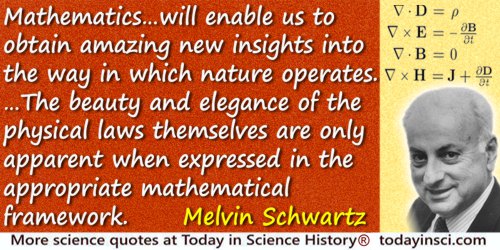
Mathematics is much more than a language for dealing with the physical world. It is a source of models and abstractions which will enable us to obtain amazing new insights into the way in which nature operates. Indeed, the beauty and elegance of the physical laws themselves are only apparent when expressed in the appropriate mathematical framework.
In Principles of Electrodynamics (1972, 1987), 105.
Mathematics is not only one of the most valuable inventions—or discoveries—of the human mind, but can have an aesthetic appeal equal to that of anything in art. Perhaps even more so, according to the poetess who proclaimed, “Euclid alone hath looked at beauty bare.”
From 'The Joy of Maths'. Collected in Arthur C. Clarke, Greetings, Carbon-Based Bipeds!: Collected Essays, 1934-1998, 460.
Mathematics make the mind attentive to the objects which it considers. This they do by entertaining it with a great variety of truths, which are delightful and evident, but not obvious. Truth is the same thing to the understanding as music to the ear and beauty to the eye. The pursuit of it does really as much gratify a natural faculty implanted in us by our wise Creator as the pleasing of our senses: only in the former case, as the object and faculty are more spiritual, the delight is more pure, free from regret, turpitude, lassitude, and intemperance that commonly attend sensual pleasures.
In An Essay on the Usefulness of Mathematical Learning (1701), 3-4.
Mathematics, rightly viewed, possesses not only truth, but supreme beauty—a beauty cold and austere, like that of sculpture, without appeal to any part of our weaker nature, without the gorgeous trappings of painting or music, yet sublimely pure, and capable of a stern perfection such as only the greatest art can show.
Essay, 'The Study of Mathematics' (1902), collected in Philosophical Essays (1910), 73-74. Also collected in Mysticism and Logic: And Other Essays (1918), 60.
Maxwell's equations… originally consisted of eight equations. These equations are not “beautiful.” They do not possess much symmetry. In their original form, they are ugly. …However, when rewritten using time as the fourth dimension, this rather awkward set of eight equations collapses into a single tensor equation. This is what a physicist calls “beauty.”
In 'Quantum Heresy', Hyperspace: A Scientific Odyssey Through Parallel Universes, Time Warps, and the Tenth Dimension (1995), 130. Note: For two “beauty” criteria, unifying symmetry and economy of expression, see quote on this page beginning “When physicists…”
Moreover the perfection of mathematical beauty is such … that whatsoever is most beautiful and regular is also found to be most useful and excellent.
In 'Epilogue', On Growth and Form (1917), 779.
Most of us have had moments in childhood when we touched the divine presence. We did not think it extraordinary because it wasn’t; it was just a beautiful moment filled with love. In those simple moments our hearts were alive, and we saw the poignant beauty of life vividly with wonder and appreciation.
David McArthur and Bruce McArthur
Most of us who become experimental physicists do so for two reasons; we love the tools of physics because to us they have intrinsic beauty, and we dream of finding new secrets of nature as important and as exciting as those uncovered by our scientific heroes.
In Nobel Lecture (11 Dec 1968), 'Recent Developments in Particle Physics', collected in Nobel Lectures: Physics 1963-1970 (1972), 241.
My work always tried to unite the true with the beautiful, but when I had to choose one or the other, I usually chose the beautiful.
As quoted by Freeman Dyson in Obituary for Hermann Weyl in Nature (10 Mar 1956). In James Roy Newman, The World of Mathematics (2000), Vol. 3, 1831.
Nature is no great mother who has borne us. She is our creation. It is our brain that she quickens to life. Things are because we see them, and what we see, and how we see it, depends on the Arts that have influenced us. To look at a thing is very different from seeing a thing. One does not see anything until one sees its beauty.
In 'Decay of Lying', The Writings of Oscar Wilde: Epigrams, Phrases and Philosophies For the Use of the Young (1907), 7.
Nature is painting for us, day after day, pictures of infinite beauty, if only we have the eyes to see them.
Attributed. (?) Webmaster has not, so far, been able to verify any primary source (can you help?). The quote appears in various books, attributed to Ruskin without any source citation, at least as early as Phyllis Hobe, Tapestries of Life (1974), 102. Whereas other Ruskin quotes appear in 19th century quote collections, but this one does not seem to be, leaves uncertainty. Or, perhaps it is a restatement of some longer text. Or in a periodical article.
Neither art nor science knows anything of moral approval or disapproval. Science is out of the reach of morals, for her eyes are fixed upon eternal truths. Art is out of the reach of morals, for her eyes are fixed upon things beautiful and immortal and ever-changing.
In his dialogue 'The Critic As Artist', collected in Intentions (1891), 156. Also collected in Oscariana: Epigrams (1895), 27.
Never regard study as a duty, but as the enviable opportunity to learn to know the liberating influence of beauty in the realm of the spirit for your own personal joy and to the profit of the community to which your later work belongs.
…...
No occupation is more worthy of an intelligent and enlightened mind, than the study of Nature and natural objects; and whether we labour to investigate the structure and function of the human system, whether we direct our attention to the classification and habits of the animal kingdom, or prosecute our researches in the more pleasing and varied field of vegetable life, we shall constantly find some new object to attract our attention, some fresh beauties to excite our imagination, and some previously undiscovered source of gratification and delight.
In A Practical Treatise on the Cultivation of the Dahlia (1838), 1-2.
Nonmathematical people sometimes ask me, “You know math, huh? Tell me something I’ve always wondered, What is infinity divided by infinity?” I can only reply, “The words you just uttered do not make sense. That was not a mathematical sentence. You spoke of ‘infinity’ as if it were a number. It’s not. You may as well ask, 'What is truth divided by beauty?’ I have no clue. I only know how to divide numbers. ‘Infinity,’ ‘truth,’ ‘beauty’—those are not numbers.”
From Prime Obsession: Bernhard Riemann and the Greatest Unsolved Problem in Mathematics (2003), 16.
Nothing is so beautiful as spring—
When weeds in wheels, shoot long and lovely and lush;...
When weeds in wheels, shoot long and lovely and lush;...
'Spring' (1877), reprinted in Gerard Manley Hopkins and Michael White (ed.) Some Poems of Gerard Manley Hopkins, (1945), 7.
Now do you not see that the eye embraces the beauty of the whole world? It counsels and corrects all the arts of mankind... it is the prince of mathematics, and the sciences founded on it are absolutely certain. It has measured the distances and sizes of the stars it has discovered the elements and their location... it has given birth to architecture and to perspective and to the divine art of painting.
…...
Now the American eagle is verging on extinction. Even the polar bear on its ice floes has become easy game for flying sportsmen. A peninsula named Udjung Kulon holds the last two or three dozen Javan rhinoceroses. The last known herd of Arabian oryx has been machine-gunned by a sheik. Blue whales have nearly been harpooned out of their oceans. Pollution ruins bays and rivers. Refuse litters beaches. Dam projects threaten Colorado canyons, Hudson valleys, every place of natural beauty that can be a reservoir for power. Obviously the scientific progress so alluring to me is destroying qualities of greater worth.
In 'The Wisdom of Wilderness', Life (22 Dec 1967), 63, No. 25, 8-9. (Note: the Arabian oryx is no longer listed as extinct.)
Nursing does not diminish the beauty of a woman’s breasts; it enhances their charm by making them look lived in and happy.
In 'From the Notebooks of Lazarus Long', Time Enough for Love: The Lives of Lazarus Long (1973), 258.
Of all heroes, Spinoza was Einstein’s greatest. No one expressed more strongly than he a belief in the harmony, the beauty, and most of all the ultimate comprehensibility of nature.
In obituary 'Albert Einstein', National Academy of Sciences, Biographical Memoirs, Vol. 51, (1980), 101
Of possible quadruple algebras the one that had seemed to him by far the most beautiful and remarkable was practically identical with quaternions, and that he thought it most interesting that a calculus which so strongly appealed to the human mind by its intrinsic beauty and symmetry should prove to be especially adapted to the study of natural phenomena. The mind of man and that of Nature’s God must work in the same channels.
As quoted in W. E. Byerly (writing as a Professor Emeritus at Harvard University, but a former student at a Peirce lecture on Hamilton’s new calculus of quaternions), 'Benjamin Peirce: II. Reminiscences', The American Mathematical Monthly (Jan 1925), 32, No. 1, 6.
On the afternoon of October 19, 1899, I climbed a tall cherry tree and, armed with a saw which I still have, and a hatchet, started to trim the dead limbs from the cherry tree. It was one of the quiet, colorful afternoons of sheer beauty which we have in October in New England, and as I looked towards the fields at the east, I imagined how wonderful it would be to make some device which had even the possibility of ascending to Mars. I was a different boy when I descended the tree from when I ascended for existence at last seemed very purposive.
In The Papers of Robert H. Goddard: 1898-1924 (1970), 9.
One is constantly reminded of the infinite lavishness and fertility of Nature—inexhaustible abundance amid what seems enormous waste. And yet when we look into any of her operations that lie within reach of our minds, we learn that no particle of her material is wasted or worn out. It is eternally flowing from use to use, beauty to yet higher beauty; and we soon cease to lament waste and death, and rather rejoice and exult in the imperishable, unspendable wealth of the universe.
In My First Summer in the Sierra (1911), 325. Based on Muir's original journals and sketches of his 1869 stay in the Sierra.
One of the greatest gifts science has brought to the world is continuing elimination of the supernatural, and it was a lesson that my father passed on to me, that knowledge liberates mankind from superstition. We can live our lives without the constant fear that we have offended this or that deity who must be placated by incantation or sacrifice, or that we are at the mercy of devils or the Fates. With increasing knowledge, the intellectual darkness that surrounds us is illuminated and we learn more of the beauty and wonder of the natural world.
…...
One of the petty ideas of philosophers is to elaborate a classification, a hierarchy of sciences. They all try it, and they are generally so fond of their favorite scheme that they are prone to attach an absurd importance to it. We must not let ourselves be misled by this. Classifications are always artificial; none more than this, however. There is nothing of value to get out of a classification of science; it dissembles more beauty and order than it can possibly reveal.
In 'The Teaching of the History of Science', The Scientific Monthly (Sep 1918), 194.
One of the things that makes the history of science so endlessly fascinating is to follow the slow education of our species in the sort of beauty to expect in nature.
In Dreams of a Final Theory: The Scientist's Search for the Ultimate Laws of Nature (1992), 158.
One summer night, out on a flat headland, all but surrounded by the waters of the bay, the horizons were remote and distant rims on the edge of space. Millions of stars blazed in darkness, and on the far shore a few lights burned in cottages. Otherwise there was no reminder of human life. My companion and I were alone with the stars: the misty river of the Milky Way flowing across the sky, the patterns of the constellations standing out bright and clear, a blazing planet low on the horizon. It occurred to me that if this were a sight that could be seen only once in a century, this little headland would be thronged with spectators. But it can be seen many scores of nights in any year, and so the lights burned in the cottages and the inhabitants probably gave not a thought to the beauty overhead; and because they could see it almost any night, perhaps they never will.
In The Sense of Wonder (1956), as condensed in Reader’s Digest (1986), 129, 174.
One way to open your eyes to unnoticed beauty is to ask yourself, “What if I had never seen this before? What if I knew I would never see it again?”
In The Sense of Wonder (1956, 2017), 59.
Over increasingly large areas of the United States, spring now comes unheralded by the return of the birds, and the early mornings are strangely silent where once they were filled with the beauty of bird song.
On the effect of chemical insecticides and fertilizers. In 'And No Birds Sing', Silent Spring (1962), Ch. 8, 103.
People are like stained glass windows: they sparkle and shine when the sun is out, but when the darkness sets in their true beauty is revealed only if there is a light within.
…...
Ploughing deep, your recipe for killing weeds, is also the recipe for almost every good thing in farming. … We now plough horizontally following the curvatures of the hills and hollows, on the dead level, however crooked the lines may be. Every furrow thus acts as a reservoir to receive and retain the waters, all of which go to the benefit of the growing plant, instead of running off into streams … In point of beauty nothing can exceed that of the waving lines and rows winding along the face of the hills and vallies.
In letter (17 Apr 1813) from Jefferson at Monticello to Charles Willson Peale. Collected in The Jefferson Papers: 1770-1826 (1900), 178-180.
Poets say science takes away from the beauty of the stars—mere globs of gas atoms. Nothing is “mere.” I too can see the stars on a desert night, and feel them. But do I see less or more? The vastness of the heavens stretches my imagination—stuck on this carousel my little eye can catch one-million-year-old light. A vast pattern—of which I am a part. … What is the pattern, or the meaning, or the “why?” It does not do harm to the mystery to know a little about it. For far more marvelous is the truth than any artists of the past imagined it. Why do the poets of the present not speak of it? What men are poets who can speak of Jupiter if he were a man, but if he is an immense spinning sphere of methane and ammonia must be silent?
In 'Astronomy', The Feynman Lectures on Physics (1961), Vol. 1, 3-6, footnote.
Positive, objective knowledge is public property. It can be transmitted directly from one person to another, it can be pooled, and it can be passed on from one generation to the next. Consequently, knowledge accumulates through the ages, each generation adding its contribution. Values are quite different. By values, I mean the standards by which we judge the significance of life. The meaning of good and evil, of joy and sorrow, of beauty, justice, success-all these are purely private convictions, and they constitute our store of wisdom. They are peculiar to the individual, and no methods exist by which universal agreement can be obtained. Therefore, wisdom cannot be readily transmitted from person to person, and there is no great accumulation through the ages. Each man starts from scratch and acquires his own wisdom from his own experience. About all that can be done in the way of communication is to expose others to vicarious experience in the hope of a favorable response.
The Nature of Science and Other Lectures (1954), 7.
Pure mathematics is, in its way, the poetry of logical ideas. One seeks the most general ideas of operation which will bring together in simple, logical and unified form the largest possible circle of formal relationships. In this effort toward logical beauty spiritual formulas are discovered necessary for the deeper penetration into the laws of nature.
In letter (1 May 1935), Letters to the Editor, 'The Late Emmy Noether: Professor Einstein Writes in Appreciation of a Fellow-Mathematician', New York Times (4 May 1935), 12.
Quantum field theory, which was born just fifty years ago from the marriage of quantum mechanics with relativity, is a beautiful but not very robust child.
In Nobel Lecture (8 Dec 1989), 'Conceptual Foundations of the Unified Theory of Weak and Electromagnetic Interactions.'
Read no newspapers, try to find a few friends who think as you do, read the wonderful writers of earlier times, Kant, Goethe, Lessing, and the classics of other lands, and enjoy the natural beauties of Munich’s surroundings. Make believe all the time that you are living, so to speak, on Mars among alien creatures and blot out any deeper interest in the actions of those creatures. Make friends with a few animals. Then you will become a cheerful man once more and nothing will be able to trouble you.
Letter (5 Apr 1933). As quoted in Jamie Sayen, Einstein in America: The Scientist’s Conscience in the Age of Hitler and Hiroshima (1985), 12. This is part of Einstein’s reply to a letter from a troubled, unemployed musician, presumably living in Munich.
Religions, in fact, like castles, sunsets and women, never reach their maximum of beauty until they are touched by decay.
…...
Rocks have, no doubt, their grandeur, and there is a beauty in running waters, and even in placid lakes; but, let the rock be naked of vegetation down to and around its base, and its grandeur is painful,—it seems a ruin.
Using pseudonym Peter Parley, in Peter Parley’s Cyclopedia of Botany (1838), Chap. 1, ix.
Saturated with that speculative spirit then pervading the Greek mind, he [Pythagoras] endeavoured to discover some principle of homogeneity in the universe. Before him, the philosophers of the Ionic school had sought it in the matter of things; Pythagoras looked for it in the structure of things. He observed the various numerical relations or analogies between numbers and the phenomena of the universe. Being convinced that it was in numbers and their relations that he was to find the foundation to true philosophy, he proceeded to trace the origin of all things to numbers. Thus he observed that musical strings of equal lengths stretched by weights having the proportion of 1/2, 2/3, 3/4, produced intervals which were an octave, a fifth and a fourth. Harmony, therefore, depends on musical proportion; it is nothing but a mysterious numerical relation. Where harmony is, there are numbers. Hence the order and beauty of the universe have their origin in numbers. There are seven intervals in the musical scale, and also seven planets crossing the heavens. The same numerical relations which underlie the former must underlie the latter. But where number is, there is harmony. Hence his spiritual ear discerned in the planetary motions a wonderful “Harmony of spheres.”
In History of Mathematics (1893), 67.
Science grows and Beauty dwindles.
'Locksley Hall Sixty Years After' (1886), collected in Alfred Tennyson and William James Rolfe (ed.) The Poetic and Dramatic Works of Alfred, Lord Tennyson (1898), 523.
Science is a boundless adventure of the human spirit, its insights afford terror as well as beauty, and it will continue to agitate the world with new findings and new powers.
In Francis Bello, Lawrence Lessing and George A.W. Boehm, Great American Scientists (1960, 1961), 4.
Science is beautiful when it makes simple explanations of phenomena or connections between different observations. Examples include the double helix in biology, and the fundamental equations of physics.
[Answer to question: What are the things you find most beautiful in science?]
[Answer to question: What are the things you find most beautiful in science?]
'Stephen Hawking: "There is no heaven; it's a fairy story"', interview in newspaper The Guardian (15 May 2011).
Science is not only compatible with spirituality; it is a profound source of spirituality. When we recognize our place in an immensity of light-years and in the passage of ages, when we grasp the intricacy, beauty, and subtlety of life, then that soaring feeling, that sense of elation and humility combined, is surely spiritual ... The notion that science and spirituality are somehow mutually exclusive does a disservice to both.
In Demon-Haunted World: Science as a Candle in the Dark (1995), 29.
Science is the Differential Calculus of the mind. Art the Integral Calculus; they may be beautiful when apart, but are greatest only when combined.
Quoted in The Complete Poems of Hugh MacDiarmid 1920-76 (1978), Vol. 2, 1360.
Science will never be able to reduce the value of a sunset to arithmetic. Nor can it reduce friendship or statesmanship to a formula. Laughter and love, pain and loneliness, the challenge of beauty and truth: these will always surpass the scientific mastery of nature.
As President, American Medical Association. From Commencement address at Emory University, Atlanta, 6 Jun 60
Science, also, is most largely indebted to these beauty-loving Greeks, for truth is one form of loveliness.
In The Collected Works of Theodore Parker: Discourses of Politics (1863), 78.
Scientific work, especially mathematical work which is purely conceptual, may indeed possess the appearance of beauty, because of the inner coherence which it shares with fine art, or may resemble a piece of architecture.
From 'Characters of the Beautiful', Beauty, Chap. 3, collected in Collected Works Of Samuel Alexander (2000), 51-52.
Scientists like myself merely use their gifts to show up that which already exists, and we look small compared to the artists who create works of beauty out of themselves. If a good fairy came and offered me back my youth, asking me which gifts I would rather have, those to make visible a thing which exists but which no man has ever seen before, or the genius needed to create, in a style of architecture never imagined before, the great Town Hall in which we are dining tonight, I might be tempted to choose the latter.
Nobel Banquet Speech (10 Dec 1962).
Scientists wrote beautifully through the 19th century and on into the early 20th. But somewhere after that, coincident with the explosive growth of research, the art of writing science suffered a grave setback, and the stultifying convention descended that the best scientific prose should sound like a non-human author addressing a mechanical reader.
In Boojums All the Way Through: Communicating Science in a Prosaic Age (1990), Preface, xii.
Since brass, nor stone, nor earth, nor boundless sea,
But bad mortality o'ersways their power,
How with this rage shall beauty hold a plea,
Whose action is no stronger than a flower?
But bad mortality o'ersways their power,
How with this rage shall beauty hold a plea,
Whose action is no stronger than a flower?
Sonnet 65.
So erst the Sage [Pythagoras] with scientific truth
In Grecian temples taught the attentive youth;
With ceaseless change how restless atoms pass
From life to life, a transmigrating mass;
How the same organs, which to-day compose
The poisonous henbane, or the fragrant rose,
May with to-morrow's sun new forms compile,
Frown in the Hero, in the Beauty smile.
Whence drew the enlighten'd Sage the moral plan,
That man should ever be the friend of man;
Should eye with tenderness all living forms,
His brother-emmets, and his sister-worms.
In Grecian temples taught the attentive youth;
With ceaseless change how restless atoms pass
From life to life, a transmigrating mass;
How the same organs, which to-day compose
The poisonous henbane, or the fragrant rose,
May with to-morrow's sun new forms compile,
Frown in the Hero, in the Beauty smile.
Whence drew the enlighten'd Sage the moral plan,
That man should ever be the friend of man;
Should eye with tenderness all living forms,
His brother-emmets, and his sister-worms.
The Temple of Nature (1803), canto 4, lines 417-28, page 163.
So why fret and care that the actual version of the destined deed was done by an upper class English gentleman who had circumnavigated the globe as a vigorous youth, lost his dearest daughter and his waning faith at the same time, wrote the greatest treatise ever composed on the taxonomy of barnacles, and eventually grew a white beard, lived as a country squire just south of London, and never again traveled far enough even to cross the English Channel? We care for the same reason that we love okapis, delight in the fossil evidence of trilobites, and mourn the passage of the dodo. We care because the broad events that had to happen, happened to happen in a certain particular way. And something unspeakably holy –I don’t know how else to say this–underlies our discovery and confirmation of the actual details that made our world and also, in realms of contingency, assured the minutiae of its construction in the manner we know, and not in any one of a trillion other ways, nearly all of which would not have included the evolution of a scribe to record the beauty, the cruelty, the fascination, and the mystery.
…...
Solitude in the presence of natural beauty and grandeur is the cradle of thought and aspirations which are not only good for the individual, but which society can ill do without.
John Stuart Mill and Sir William James Ashley (ed.), Principles of Political Economy (1848, 1917), 750.
Still there are moments when one feels free from one’s own identification with human limitations and inadequacies. At such moments, one imagines that one stands on some spot of a small planet, gazing in amazement at the cold yet profoundly moving beauty of the eternal, the unfathomable: life and death flow into one, and there is neither evolution nor destiny; only being.
From Letter (9 Jan 1939) to Queen Mother Elisabeth of Belgium asking for help to get his cousin out of wartime Germany. Einstein was already at the Institute for Advanced Study at Princeton in Ameerica. As quoted in The New Yorker (10 Mar 1973), 49, 46.
Study and, in general, the pursuit of truth and beauty is a sphere of activity in which we are permitted to remain children all of our lives.
…...
Symmetry, as wide or as narrow as you may define its meaning, is one idea by which man through the ages has tried to comprehend and create order, beauty and perfection.
Symmetry (1952), 5.
That which, to the anatomist, is the end,—is, to the sculptor, the means. The former desires details, for their own sake; the latter, that by means of them, he may kindle his work with life, and stamp it with beauty.
In 'Sculpture', The True and the Beautiful in Nature, Art, Morals, and Religion (1872), 205.
The beautiful is a manifestation of secret laws of nature, which but for this phenomenon would have remained hidden from us for ever.
Quoted in The Life of Goethe (1905), 101, citing Sprüche in Prosa, No. 197.
The beauty and genius of a work of art may be reconceived, though its first material expression be destroyed; a vanished harmony may yet again inspire the composer, but when the last individual of a race of living things breathes no more, another heaven and another earth must pass before such a one can be again.
In The Bird: Its Form and Function (1906), Vol. 1, 18.
The beauty of crystals lies in the planeness of their faces.
In The Natural History of Crystals (1924), 5.
The beauty of his better self lives on
In minds he touched with fire, in many an eye
He trained to Truth’s exact severity;
He was a teacher: why be grieved for him
Whose living word still stimulates the air?
In minds he touched with fire, in many an eye
He trained to Truth’s exact severity;
He was a teacher: why be grieved for him
Whose living word still stimulates the air?
[On Jean Louis Rodolphe Agassiz.] 'Ode on the Death of Agassiz' (1888). In The Poetical Works of James Russell Lowell (1978),381.
The beauty of life is, therefore, geometrical beauty of a type that Plato would have much appreciated.
The Origin of Life (1967), xiii.
The beauty of natural history programmes is that you can be straightforward and fascinate the 7s and the 70s. If you just present it as it is, all kinds of people of all ages and all educational backgrounds love it. That’s the joy of natural history—it’s a godsend for blokes like me.
In Rowan Hooper, 'One Minute With… David Attenborough', New Scientist (2 Feb 2013), 217, No. 2902, 25.
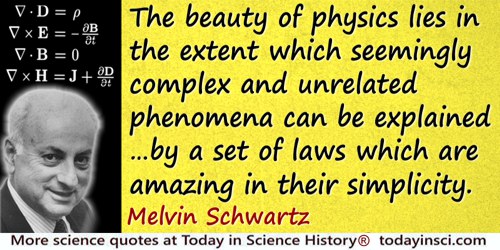
The beauty of physics lies in the extent which seemingly complex and unrelated phenomena can be explained and correlated through a high level of abstraction by a set of laws which are amazing in their simplicity.
In Principles of Electrodynamics (1972, 1987), 105.
The celestial order and the beauty of the universe compel me to admit that there is some excellent and eternal Being, who deserves the respect and homage of men.
…...
The chief forms of beauty are order and symmetry and definiteness, which the mathematical sciences demonstrate in a special degree.
As translated in Book 13, 1078.a3, Aristotle’s Metaphysics, a Revised Text with Introduction and Commentary by W. D. Ross (1924), Vol. 2, 416.
The desire for truth so prominent in the quest of science, a reaching out of the spirit from its isolation to something beyond, a response to beauty in nature and art, an Inner Light of conviction and guidance—are these as much a part of our being as our sensitivity to sense impressions?
Swarthmore Lecture (1929) at Friends’ House, London, printed in Science and the Unseen World (1929), 42-43.
The Earth Speaks, clearly, distinctly, and, in many of the realms of Nature, loudly, to William Jennings Bryan, but he fails to hear a single sound. The earth speaks from the remotest periods in its wonderful life history in the Archaeozoic Age, when it reveals only a few tissues of its primitive plants. Fifty million years ago it begins to speak as “the waters bring forth abundantly the moving creatures that hath life.” In successive eons of time the various kinds of animals leave their remains in the rocks which compose the deeper layers of the earth, and when the rocks are laid bare by wind, frost, and storm we find wondrous lines of ascent invariably following the principles of creative evolution, whereby the simpler and more lowly forms always precede the higher and more specialized forms.
The earth speaks not of a succession of distinct creations but of a continuous ascent, in which, as the millions of years roll by, increasing perfection of structure and beauty of form are found; out of the water-breathing fish arises the air-breathing amphibian; out of the land-living amphibian arises the land-living, air-breathing reptile, these two kinds of creeping things resembling each other closely. The earth speaks loudly and clearly of the ascent of the bird from one kind of reptile and of the mammal from another kind of reptile.
This is not perhaps the way Bryan would have made the animals, but this is the way God made them!
The earth speaks not of a succession of distinct creations but of a continuous ascent, in which, as the millions of years roll by, increasing perfection of structure and beauty of form are found; out of the water-breathing fish arises the air-breathing amphibian; out of the land-living amphibian arises the land-living, air-breathing reptile, these two kinds of creeping things resembling each other closely. The earth speaks loudly and clearly of the ascent of the bird from one kind of reptile and of the mammal from another kind of reptile.
This is not perhaps the way Bryan would have made the animals, but this is the way God made them!
The Earth Speaks to Bryan (1925), 5-6. Osborn wrote this book in response to the Scopes Monkey Trial, where William Jennings Bryan spoke against the theory of evolution. They had previously been engaged in the controversy about the theory for several years. The title refers to a Biblical verse from the Book of Job (12:8), “Speak to the earth and it shall teach thee.”
The elms of New England! They are as much a part of her beauty as the columns of the Parthenon were the glory of its architecture.
In Proverbs from Plymouth Pulpit (1887), 11.
The eye is the window of the human body through which it feels its way and enjoys the beauty of the world.
…...
The eye which can appreciate the naked and absolute beauty of a scientific truth is far more rare than that which is attracted by a moral one.
In A Week on the Concord and Merrimack Rivers (1862), 381.
The fairest thing we can experience is the mysterious. It is the fundamental emotion which stands at the cradle of true art and true science. He who knows it not and can no longer wonder, no longer feel amazement, is as good as dead, a snuffed-out candle. It was the experience of mystery–even if mixed with fear–that engendered religion. A knowledge of the existence of something we cannot penetrate, of the manifestations of the profoundest reason and the most radiant beauty, which are only accessible to our reason in their most elementary forms–it is this knowledge and this emotion that constitute the truly religious attitude; in this sense, and in this alone, I am a deeply religious man.
From 'What I Believe: Living Philosophies XIII', Forum and Century (Oct 1930), 84, No. 4, 193-194. Alan Harris (trans.), The World as I See It (1956, 1993), 5.
The famous set of pictures taken from the moon, [celebrate] the birth of a global consciousness that will help build a peaceful future for humankind. That future is in the hands of those who dedicate their lives to explore Teilhard de Chardin’s three infinities: the infinitely big, the infinitely small, and the infinitely complex. And from all the beauty they discover while crossing perpetually receding frontiers, they develop for nature and for humankind an infinite love.
From concluding paragraph written for 'Foreword' to Kevin W. Kelley (ed.), The Home Planet (1988), paragraph 8 (unpaginated).
The farther researches we make into this admirable scene of things, the more beauty and harmony we see in them: And the stronger and clearer convictions they give us, of the being, power and wisdom of the divine Architect, who has made all things to concur with a wonderful conformity, in carrying on, by various and innumerable combinations of matter, such a circulation of causes, and effects, as was necessary to the great ends of nature. And since we are assured that the all-wise Creator has observed the most exact proportions, of number, weight and measure, in the make of all things; the most likely way therefore, to get any insight into the nature of those parts of the creation, which come within our observation, must in all reason be to number, weigh and measure. And we have much encouragement to pursue this method, of searching into the nature of things, from the great success that has attended any attempts of this kind.
Vegetable Staticks (1727), xxxi.
The first principle of architectural beauty is that the essential lines of a construction be determined by a perfect appropriateness to its use.
From translation in J. Harriss, The Tallest Tower: Eiffel and the Belle Epoque (1975), 20, as quoted and cited by David P. Billington, 'Bridges and the New Art of Structural Engineering,' in National Research Council (U.S.). Transportation Research Board Subcommittee on Bridge Aesthetics, Bridge Aesthetics Around the World (1991), 67. From the original French in interview of Eiffel by Paul Bourde, in the newspaper Le Temps (14 Feb 1887). Reprinted in 'Au Jour le Jour: Les Artistes Contre la Tour Eiffel', Gazette Anecdotique, Littéraire, Artistique et Bibliographique (Feb 1887), 126, and in Gustave Eiffel, Travaux Scientifiques Exécutés à la Tour de 300 Mètres de 1889 à 1900 (1900), 14. “Le premier principe de l'esthétique architecturale est que les lignes essentielles d’un monument soient déterminées par la parfaite appropriation à sa destination.”
The future belongs to those who believe in the beauty of their dreams.
…...
The genius of Laplace was a perfect sledge hammer in bursting purely mathematical obstacles; but, like that useful instrument, it gave neither finish nor beauty to the results. In truth, in truism if the reader please, Laplace was neither Lagrange nor Euler, as every student is made to feel. The second is power and symmetry, the third power and simplicity; the first is power without either symmetry or simplicity. But, nevertheless, Laplace never attempted investigation of a subject without leaving upon it the marks of difficulties conquered: sometimes clumsily, sometimes indirectly, always without minuteness of design or arrangement of detail; but still, his end is obtained and the difficulty is conquered.
In 'Review of “Théorie Analytique des Probabilites” par M. le Marquis de Laplace, 3eme edition. Paris. 1820', Dublin Review (1837), 2, 348.
The glories and the beauties of form, color, and sound unite in the Grand Canyon—forms unrivaled even by the mountains, colors that vie with sunsets, and sounds that span the diapason from tempest to tinkling raindrop, from cataract to bubbling fountain.
In Canyons of the Colorado (1895), 397.
The Grand Cañon of the Colorado is a great innovation in modern ideas of scenery, and in our conceptions of the grandeur, beauty, and power of nature. As with all great innovations it is not to be comprehended in a day or a week, nor even in a month. It must be dwelt upon and studied, and the study must comprise the slow acquisition of the meaning and spirit of that marvelous scenery which characterizes the Plateau Country, and of which the great chasm is the superlative manifestation.
In Tertiary History of the Grand Cañon District: With Atlas (1882), Vol. 2, 141.
The great beauty of Darwin’s theory of evolution is that it explains how complex, difficult to understand things could have arisen step by plausible step, from simple, easy to understand beginnings. We start our explanation from almost infinitely simple beginnings: pure hydrogen and a huge amount of energy. Our scientific, Darwinian explanations carry us through a series of well-understood gradual steps to all the spectacular beauty and complexity of life.
From speech at the Edinburgh International Science Festival (15 Apr 1992), published in the Independent newspaper. Included in excerpt in Alec Fisher, The Logic of Real Arguments (2004), 84-85. The full speech was reprinted in The Nullifidian, (Dec 1994). Transcribed online in the Richard Dawkins archive, article 89, titled: Lecture from 'The Nullifidian' (Dec 94).
The great object I desire to accomplish by this institution [the Cooper Institute], is to open the avenues of scientific knowledge to the youth of our country, so unfolding the volume of Nature, that the young may see the beauties of creation.
Speech (17 Sep 1853), laying the foundation stone of the Cooper Institute, in New York Times (19 Sep 1853), 3. The article clarifies that although the ceremony was spoken of as the laying of the corner-stone, the basement stories were already completed at that time.
The great purpose of school can be realized better in dark, airless, ugly places … It is to master the physical self, to transcend the beauty of nature. School should develop the power to withdraw from the external world.
As quoted in various 21st century books, each time cited only as from the The Philosophy of Education (1906), with no page number. For example, in John Taylor Gatto, A Different Kind of Teacher: Solving the Crisis of American Schooling (2000), 61. Note: Webmaster is suspicious of the attribution of this quote. The Library of Congress lists no such title by Harris in 1906. The LOC does catalog this title by Harris for 1893, which is a 9-page pamphlet printing the text of a series of five lectures. These lectures do not contain this quote. William Torrey Harris was editor of the International Education Series of books, of which Vol. 1 was the translation by Anna Callender Bracket of The Philosophy of Education by Johann Karl Friedrich Rosenkranz (2nd ed. rev. 1886). The translation was previously published in The Journal of Speculative Philosophy (1872, -73, -74), Vols vi-viii. Webmaster does not find the quote in that book, either. Webmaster has so far been unable to verify this quote, in these words, or even find the quote in any 19th or 20th century publication (which causes more suspicion). If you have access to the primary source for this quote, please contact Webmaster.
The Greeks in the first vigour of their pursuit of mathematical truth, at the time of Plato and soon after, had by no means confined themselves to those propositions which had a visible bearing on the phenomena of nature; but had followed out many beautiful trains of research concerning various kinds of figures, for the sake of their beauty alone; as for instance in their doctrine of Conic Sections, of which curves they had discovered all the principal properties. But it is curious to remark, that these investigations, thus pursued at first as mere matters of curiosity and intellectual gratification, were destined, two thousand years later, to play a very important part in establishing that system of celestial motions which succeeded the Platonic scheme of cycles and epicycles. If the properties of conic sections had not been demonstrated by the Greeks and thus rendered familiar to the mathematicians of succeeding ages, Kepler would probably not have been able to discover those laws respecting the orbits and motions of planets which were the occasion of the greatest revolution that ever happened in the history of science.
In History of Scientific Ideas, Bk. 9, chap. 14, sect. 3.
The growth of a large business is merely a survival of the fittest. … The American Beauty rose can be produced in the splendor and fragrance which bring cheer to its beholder only by sacrificing the early buds which grow up around it. This is not an evil tendency in business. It is merely the working-out of a law of nature and a law of God.
From address to the Brown University YMCA, as quoted in 'Young Rockefeller: Defending Trusts, Uses American Beauty Similitude,' Cincinnati Enquirer (9 Feb 1902), 4, citing the New York Journal.
The ideals which have always shone before me and filled me with the joy of living are goodness, beauty, and truth. To make a goal of comfort or happiness has never appealed to me.
…...
The long fight to save wild beauty represents democracy at its best. It requires citizens to practice the hardest of virtues — self-restraint.
In Circle of the Seasons: The Journal of a Naturalist's Year (1953), 24.
The main duty of the historian of mathematics, as well as his fondest privilege, is to explain the humanity of mathematics, to illustrate its greatness, beauty and dignity, and to describe how the incessant efforts and accumulated genius of many generations have built up that magnificent monument, the object of our most legitimate pride as men, and of our wonder, humility and thankfulness, as individuals.
In The Study of the History of Mathematics (1936), 28.
The main species of beauty are orderly arrangement, proportion, and definiteness; and these are especially manifested by the mathematical sciences.
In Metaphysics, 13-1078a-b, as translated by Hugh Tredennick (1933). Also seen translated as, “The mathematical sciences particularly exhibit order, symmetry, and limitation; and these are the greatest forms of the beautiful.”
The material world begins to seem so trivial, so arbitrary, so ephemeral when contrasted with the timeless beauty of mathematics.
In The Mathematical Universe: An Alphabetical Journey Through the Great Proofs, Problems, and Personalities (1994), 160.
The mathematician is fascinated with the marvelous beauty of the forms he constructs, and in their beauty he finds everlasting truth.
In Lectures on the Philosophy of Mathematics (1918), 194. This quote by J.B. Shaw is also seen incorrectly attributed to G.B. Shaw, or George Bernard Shaw.
The mathematician is perfect only in so far as he is a perfect being, in so far as he perceives the beauty of truth; only then will his work be thorough, transparent, comprehensive, pure, clear, attractive and even elegant. All this is necessary to resemble Lagrange.
In Wilhelm Meister, Wanderjahre, Zweites Buch, in 'Sprüche in Prosa' Natur, VI, 950.
The mathematician's patterns … must be beautiful … Beauty is the first test; there is no permanent place in the world for ugly mathematics.
In A Mathematician's Apology (1940, 2012), 85.
The mathematician's patterns, like the painter's or the poet's must be beautiful; the ideas, like the colours or the words must fit together in a harmonious way.
In A Mathematician's Apology (1940, reprint with Foreward by C.P. Snow 1992), 85.
The moon, which is a favorite of the poets and portrayed by the Buddhists as representing the esthetic qualities of peace, serenity and beauty, is now being conquered by man’s ever expanding knowledge of science and technology. What was a mere conceptional imagination is today a concrete reality. The American landing on the moon symbolizes the very acme of scientific achievement. It is indeed a phenomenal feat of far-reaching consequences for the world of science.
In 'Reactions to Man’s Landing on the Moon Show Broad Variations in Opinions', The New York Times (21 Jul 1969), 6.
The moral principle inherent in evolution, that nothing can be gained in this world without an effort; the ethical principle inherent in evolution is that only the best has the right to survive; the spiritual principle in evolution is the evidence of beauty, of order, and of design in the daily myriad of miracles to which we owe our existence.
'Evolution and Religion', New York Times (5 Mar 1922), 91.
The most beautiful and deepest experience a man can have is the sense of the mysterious. It is the underlying principle of religion as well as all serious endeavour in art and science. He who never had this experience seems to me, if not dead, then at least blind. To sense that behind anything that can be experienced there is a something that our mind cannot grasp and whose beauty and sublimity reaches us only indirectly and as a feeble reflection, this is religiousness.
…...
The most beautiful emotion we can experience is the mystical. It is the power of all true art and science. He to whom this emotion is a stranger, who can no longer wonder and stand rapt in awe, is as good as dead. To know that what is impenetrable to us really exists, manifesting itself as the highest wisdom and the most radiant beauty, which our dull faculties can comprehend only in their most primitive forms — this knowledge, this feeling, is at the center of true religiousness. In this sense, and in this sense only, I belong to the rank of devoutly religious men.
As quoted in Philip Frank, Einstein: His Life and Times (1947), chap. 12, sec. 5 - “Einstein’s Attitude Toward Religion.”
The most beautiful thing we can experience is the mysterious. It is the source of all true art and science. He to whom this emotion is a stranger, who can no longer pause to wonder and stand rapt in awe, is as good as dead: his eyes are closed.
'The World As I See It', Forum and Century Oct 1930), 84, 193-194. Albert Einstein and Carl Seelig. Ideas and Opinions, based on Mein Weltbild (1954), 11.
The most distinct and beautiful statement of any truth [in science] must take at last the mathematical form.
A Week on the Concord and Merrimack Rivers (1862), 381.
The most extensive computation known has been conducted over the last billion years on a planet-wide scale: it is the evolution of life. The power of this computation is illustrated by the complexity and beauty of its crowning achievement, the human brain.
In Gary William Flake, The Computational Beauty of Nature (2000), 415.
The most important human endeavor is the striving for morality in our actions. Our inner balance and even our very existence depend on it. Only morality in our actions can give beauty and dignity to life.
In a letter to a minister in Brooklyn, N.Y. (20 Nov 1950), first paragraph, as quoted in Helen Dukas and Banesh Hoffmann (eds.), Albert Einstein: The Human Side (1979, 1981), 95.
The night spread out of the east in a great flood, quenching the red sunlight in a single minute. We wriggled by breathless degrees deep into our sleeping bags. Our sole thought was of comfort; we were not alive to the beauty or the grandeur of our position; we did not reflect on the splendor of our elevation. A regret I shall always have is that I did not muster up the energy to spend a minute or two stargazing. One peep I did make between the tent flaps into the night, and I remember dimly an appalling wealth of stars, not pale and remote as they appear when viewed through the moisture-laden air of lower levels, but brilliant points of electric blue fire standing out almost stereoscopically. It was a sight an astronomer would have given much to see, and here were we lying dully in our sleeping bags concerned only with the importance of keeping warm and comfortable.
…...
The northern ocean is beautiful, ... and beautiful the delicate intricacy of the snowflake before it melts and perishes, but such beauties are as nothing to him who delights in numbers, spurning alike the wild irrationality of life and baffling complexity of nature’s laws.
In Kandelman's Krim: A Realistic Fantasy (1957), 101.
The poetic beauty of Davy's mind never seems to have left him. To that circumstance I would ascribe the distinguishing feature in his character, and in his discoveries,—a vivid imagination sketching out new tracts in regions unexplored, for the judgement to select those leading to the recesses of abstract truth.
Presidential Address to the Royal Society on Davy's Death, 1829. Quoted in J. Davy, Fragmentary Remains of Sir Humphry Davy (1858), 314.
The prominent reason why a mathematician can be judged by none but mathematicians, is that he uses a peculiar language. The language of mathesis is special and untranslatable. In its simplest forms it can be translated, as, for instance, we say a right angle to mean a square corner. But you go a little higher in the science of mathematics, and it is impossible to dispense with a peculiar language. It would defy all the power of Mercury himself to explain to a person ignorant of the science what is meant by the single phrase “functional exponent.” How much more impossible, if we may say so, would it be to explain a whole treatise like Hamilton’s Quaternions, in such a wise as to make it possible to judge of its value! But to one who has learned this language, it is the most precise and clear of all modes of expression. It discloses the thought exactly as conceived by the writer, with more or less beauty of form, but never with obscurity. It may be prolix, as it often is among French writers; may delight in mere verbal metamorphoses, as in the Cambridge University of England; or adopt the briefest and clearest forms, as under the pens of the geometers of our Cambridge; but it always reveals to us precisely the writer’s thought.
In North American Review (Jul 1857), 85, 224-225.
The pure mathematician, like the musician, is a free creator of his world of ordered beauty.
In A History of Western Philosophy (1945), 33.
The pursuits of the greatest trifles may sometimes have a very good effect. The search after the philosopher’s stone has preserved chemistry; and the following astrology so much in former ages has been the cause of astronomy’s being so much advanced in ours. Sir Isaac Newton himself has owned that he began with studying judicial astrology, and that it was his pursuits of that idle and vain study which led him into the beauties and love of astronomy.
As recalled and recorded in Joseph Spence and Edmund Malone (ed.) Anecdotes, Observations, and Characters of Books and Men (1858), 159-160.
The research worker, in his efforts to express the fundamental laws of Nature in mathematical form, should strive mainly for mathematical beauty. He should take simplicity into consideration in a subordinate way to beauty. It often happens that the requirements of simplicity and beauty are the same, but where they clash, the latter must take precedence.
From Proceedings of the Royal Society of Edinburgh (1939), 59 122. In A. Pais, 'Playing With Equations, the Dirac Way'. Behram N. Kursunoglu (Ed.) and Eugene Paul Wigner (Ed.), Paul Adrien Maurice Dirac: Reminiscences about a Great Physicist (1990), 110.
The same society which receives the rewards of technology must, as a cooperating whole, take responsibility for control. To deal with these new problems will require a new conservation. We must not only protect the countryside and save it from destruction, we must restore what has been destroyed and salvage the beauty and charm of our cities. Our conservation must be not just the classic conservation of protection and development, but a creative conservation of restoration and innovation. Its concern is not with nature alone, but with the total relation between man and the world around him. Its object is not just man's welfare, but the dignity of man's spirit.
In his 'Message to Congress on Conservation and Restoration of Natural Beauty' written to Congress (8 Feb 1965). It was a broad initiative aimed at beautifying America, guaranteeing water and air quality, and preserving natural areas. In Lyndon B. Johnson: Containing the Public Messages, Speeches, and Statements of the President (1965), Vol.1, 156.
United States. President (1963-1969 : Johnson), Lyndon Baines Johnson, United States. Office of the Federal Register - 1970
The structure known, but not yet accessible by synthesis, is to the chemist what the unclimbed mountain, the uncharted sea, the untilled field, the unreached planet, are to other men … The unique challenge which chemical synthesis provides for the creative imagination and the skilled hand ensures that it will endure as long as men write books, paint pictures, and fashion things which are beautiful, or practical, or both.
In 'Art and Science in the Synthesis of Organic Compounds: Retrospect and Prospect', in Maeve O'Connor (ed.), Pointers and Pathways in Research (1963), 41.
The three of us have worked on the development of the small and totally harmless fruit fly, Drosophila. This animal has been extremely cooperative in our hands - and has revealed to us some of its innermost secrets and tricks for developing from a single celled egg to a complex living being of great beauty and harmony. ... None of us expected that our work would be so successful or that our findings would ever have relevance to medicine.
Nobel Banquet Speech, 10 Dec 1995
The trend of mathematics and physics towards unification provides the physicist with a powerful new method of research into the foundations of his subject. … The method is to begin by choosing that branch of mathematics which one thinks will form the basis of the new theory. One should be influenced very much in this choice by considerations of mathematical beauty. It would probably be a good thing also to give a preference to those branches of mathematics that have an interesting group of transformations underlying them, since transformations play an important role in modern physical theory, both relativity and quantum theory seeming to show that transformations are of more fundamental importance than equations.
From Lecture delivered on presentation of the James Scott prize, (6 Feb 1939), 'The Relation Between Mathematics And Physics', printed in Proceedings of the Royal Society of Edinburgh (1938-1939), 59, Part 2, 122.
The true beauty of nature is her amplitude; she exists neither for nor because of us, and possesses a staying power that all our nuclear arsenals cannot threaten (much as we can easily destroy our puny selves).
…...
The truth of the matter is that, though mathematics truth may be beauty, it can be only glimpsed after much hard thinking. Mathematics is difficult for many human minds to grasp because of its hierarchical structure: one thing builds on another and depends on it.
As co-author with D.T.E. Marjoram, Mathematics in a Changing World (1973).
The vast spread
Of darkness
That speaks of mystery
The darkness that reveals
The beauty that lies beneath
In the form of glittering
Stars, a countless beauty
That seemed to conceal
A million stories
That can make the mankind
Take a new look at life
And the majestic moon
That silently looks at mankind
Wondering how its serenity
Was disturbed by the little steps
Of a man from the beautiful earth
Yet softly smiling back
And let the world sleep
In its magical glow
A glow that soothes
The world’s senses
And forget the pain of reality
Of darkness
That speaks of mystery
The darkness that reveals
The beauty that lies beneath
In the form of glittering
Stars, a countless beauty
That seemed to conceal
A million stories
That can make the mankind
Take a new look at life
And the majestic moon
That silently looks at mankind
Wondering how its serenity
Was disturbed by the little steps
Of a man from the beautiful earth
Yet softly smiling back
And let the world sleep
In its magical glow
A glow that soothes
The world’s senses
And forget the pain of reality
…...
The vernal equinox is a celestial event that reminds us of the ever-changing nature of our planet and its orbit around the sun. It’s a moment to reflect on the wonders of astronomy and the beauty of the natural world.
A fictional quote imagined in the style of a science educator and engineer (19 Mar 2024).
The vernal equinox signals new beginnings, the promise of spring, and the potential for growth. It’s a reminder of the cyclical nature of our universe and the beauty of celestial mechanics.
A fictional quote imagined in the style of a renowned astrophysicist and science communicator (19 Mar 2024).
The winds, the sea, and the moving tides are what they are. If there is wonder and beauty and majesty in them, science will discover these qualities. If they are not there, science cannot create them. If there is poetry in my book about the sea, it is not because I deliberately put it there, but because no one could write truthfully about the sea and leave out the poetry.
Address upon receiving National Book Award at reception, Hotel Commodore, New York (27 Jan 1952). As cited in Linda Lear, Rachel Carson: Witness for Nature (1997), 219. She was referring to her book being recognized, The Sea Around Us.
The wintry clouds drop spangles on the mountains. If the thing occurred once in a century historians would chronicle and poets would sing of the event; but Nature, prodigal of beauty, rains down her hexagonal ice-stars year by year, forming layers yards in thickness. The summer sun thaws and partially consolidates the mass. Each winter's fall is covered by that of the ensuing one, and thus the snow layer of each year has to sustain an annually augmented weight. It is more and more compacted by the pressure, and ends by being converted into the ice of a true glacier, which stretches its frozen tongue far down beyond the limits of perpetual snow. The glaciers move, and through valleys they move like rivers.
The Glaciers of the Alps & Mountaineering in 1861 (1911), 247.
The work I have done has, already, been adequately rewarded and recognized. Imagination reaches out repeatedly trying to achieve some higher level of understanding, until suddenly I find myself momentarily alone before one new corner of nature’s pattern of beauty and true majesty revealed. That was my reward.
Nobel Banquet Speech (10 Dec 1965).
The world of ideas which it [mathematics] discloses or illuminates, the contemplation of divine beauty and order which it induces, the harmonious connexion of its parts, the infinite hierarchy and absolute evidence of the truths with which it is concerned, these, and such like, are the surest grounds of the title of mathematics to human regard, and would remain unimpeached and unimpaired were the plan of the universe unrolled like a map at our feet, and the mind of man qualified to take in the whole scheme of creation at a glance.
In Presidential Address to British Association (19 Aug 1869), 'A Plea for the Mathematician', published in Nature (6 Jan 1870), 1, 262. Collected in Collected Mathematical Papers (1908), Vol. 2, 659.
The world of mathematics, which you condemn, is really a beautiful world; it has nothing to do with life and death and human sordidness, but is eternal, cold and passionless. To me, pure, mathematics is one of the highest forms of art; it has a sublimity quite special to itself, and an immense dignity derived, from the fact that its world is exempt I, from change and time. I am quite serious in this. The only difficulty is that none but mathematicians can enter this enchanted region, and they hardly ever have a sense of beauty. And mathematics is the only thing we know of that is capable of perfection; in thinking about it we become Gods.
Letter to Helen Thomas (30 Dec 1901). Quoted in Nicholas Griffin (ed.), The Selected Letters of Bertrand Russell (1992), Vol. 1, 224.
The young genius early exults in the contemplation of power and beauty. During Scott’s childhood, a frightful thunder-storm raged at Edinburgh, which made his brothers and the domestics huddle together in one room, shivering with fear at every peal. Young Walter was found lying on his back in the garden, the rain pitilessly pelting his face, while he, almost convulsed with delight, shouted, at every flash, “bonnie! bonnie!” Schiller was found by his father, on a similar occasion, perched upon a tree, and, on being harshly questioned as to his object, whimpered out that he wanted to see where the thunder came from.
In 'Genius', Wellman’s Miscellany (Dec 1871), 4, No. 6, 204. A variation of the anecdote about Walter Scott is given in George Gilfillan (ed.), 'Memoir of Sir Walter Scott', The Poetical Works of Sir Walter Scott: With memoir and critical dissertation (1857), viii. The anecdote about Schiller is of dubious authenticity, according to Charles Follen (ed.), The Life of Friedrich Schiller: Comprehending an Examination of His Works (1837), 7
Theoretical physicists accept the need for mathematical beauty as an act of faith... For example, the main reason why the theory of relativity is so universally accepted is its mathematical beauty.
'Methods in Theoretical Physics', From A Life of Physics: Evening Lectures at the International Centre for Theoretical Physics, Trieste, Italy. A Special Supplement of the IAEA Bulletin (1968), 22.
There are but few saints among scientists, as among other men, but truth itself is a goal comparable to sanctity. As the Pythagoreans had already understood it more than twenty-four centuries ago, there is sanctity in pure knowledge, as there is in pure beauty, and the disinterested quest of truth is perhaps the greatest purification.
In The History of Science and the New Humanism (1987), 46-47.
There are few humanities that could surpass in discipline, in beauty, in emotional and aesthetic satisfaction, those humanities which are called mathematics, and the natural sciences.
'Scientist and Citizen', Speech to the Empire Club of Canada (29 Jan 1948), The Empire Club of Canada Speeches (29 Jan 1948), 209-221.
There can be but one opinion as to the beauty and utility of this analysis of Laplace; but the manner in which it has been hitherto presented has seemed repulsive to the ablest mathematicians, and difficult to ordinary mathematical students.[Co-author with Peter Guthrie Tait.]
In William Thomson Baron Kelvin, Peter Guthrie Tait, Treatise on Natural Philosophy (1879), Vol. 1, Preface, vii.
There is beauty in discovery. There is mathematics in music, a kinship of science and poetry in the description of nature, and exquisite form in a molecule. Attempts to place different disciplines in different camps are revealed as artificial in the face of the unity of knowledge. All illiterate men are sustained by the philosopher, the historian, the political analyst, the economist, the scientist, the poet, the artisan, and the musician.
From address (1958), upon being appointed Chancellor of the University of California.
There is beauty in space, and it is orderly. There is no weather, and there is regularity. It is predictable…. Everything in space obeys the laws of physics. If you know these laws, and obey them, space will treat you kindly. And don't tell me that man doesn't belong out there. Man belongs wherever he wants to go—and he’ll do plenty well when he gets there.
Quoted in 'Reach For The Stars', Time (17 Feb 1958), 71, 25.
There is certainly no absolute standard of beauty. That precisely is what makes its pursuit so interesting.
In 'For Public and Potent Building', The New York Times Magazine (9 Oct 1960), M34.
There is neither religion nor science beyond beauty.
In Kahlil Gibran: The Collected Works (2007), 206.
There is no excellent beauty that hath not some strangeness in the proportions.
'Of Beauty.' Bacon's Essays (1880), Essay 43, 433.
There is nothing, in itself, valuable or despicable, desirable or hateful, beautiful or deformed; but that these attributes arise from the particular constitution and fabric of human sentiment and affection.
Essay XVIII, 'The Sceptic', Essays and Treatises on Several Subjects (1742, New ed. 1767), Vol. 1, 184.
There is symbolic as well as actual beauty in the migration of the birds, the ebb and flow of the tides, the folded bud ready for the spring. There is something infinitely healing in the repeated refrains of nature—the assurance that dawn comes after night, and spring after the winter.
In The Sense of Wonder (1956, 1965), 88-89.
These Disciplines [mathematics] serve to inure and corroborate the Mind to a constant Diligence in Study; to undergo the Trouble of an attentive Meditation, and cheerfully contend with such Difficulties as lie in the Way. They wholly deliver us from a credulous Simplicity, most strongly fortify us against the Vanity of Scepticism, effectually restrain from a rash Presumption, most easily incline us to a due Assent, perfectly subject us to the Government of right Reason, and inspire us with Resolution to wrestle against the unjust Tyranny of false Prejudices. If the Fancy be unstable and fluctuating, it is to be poized by this Ballast, and steadied by this Anchor, if the Wit be blunt it is sharpened upon this Whetstone; if luxuriant it is pared by this Knife; if headstrong it is restrained by this Bridle; and if dull it is rouzed by this Spur. The Steps are guided by no Lamp more clearly through the dark Mazes of Nature, by no Thread more surely through the intricate Labyrinths of Philosophy, nor lastly is the Bottom of Truth sounded more happily by any other Line. I will not mention how plentiful a Stock of Knowledge the Mind is furnished from these, with what wholesome Food it is nourished, and what sincere Pleasure it enjoys. But if I speak farther, I shall neither be the only Person, nor the first, who affirms it; that while the Mind is abstracted and elevated from sensible Matter, distinctly views pure Forms, conceives the Beauty of Ideas, and investigates the Harmony of Proportions; the Manners themselves are sensibly corrected and improved, the Affections composed and rectified, the Fancy calmed and settled, and the Understanding raised and excited to more divine Contemplations. All which I might defend by Authority, and confirm by the Suffrages of the greatest Philosophers.
Prefatory Oration in Mathematical Lectures (1734), xxxi.
These rocks, these bones, these fossil forms and shells
Shall yet be touched with beauty and reveal
The secrets if the book of earth to man.
Shall yet be touched with beauty and reveal
The secrets if the book of earth to man.
In The Book of Earth (1925), 157.
Think, for a moment, of a cheetah, a sleek, beautiful animal, one of the fastest on earth, which roams freely on the savannas of Africa. In its natural habitat, it is a magnificent animal, almost a work of art, unsurpassed in speed or grace by any other animal. Now, think of a cheetah that has been captured and thrown into a miserable cage in a zoo. It has lost its original grace and beauty, and is put on display for our amusement. We see only the broken spirit of the cheetah in the cage, not its original power and elegance. The cheetah can be compared to the laws of physics, which are beautiful in their natural setting. The natural habitat of the laws of physics is a higher-dimensional space-time. However, we can only measure the laws of physics when they have been broken and placed on display in a cage, which is our three-dimensional laboratory. We only see the cheetah when its grace and beauty have been stripped away.
In Hyperspace by Michio Kaku (1994).
Those who dwell as scientists … among the beauties and mysteries of the earth are never alone or weary of life. Those who contemplate the beauty of the earth find reserves of strength that will endure as long as life lasts.
In The Sense of Wonder (1956, 1965), 88-89.
Though human ingenuity may make various inventions which, by the help of various machines answering the same end, it will never devise any inventions more beautiful, nor more simple, nor more to the purpose than Nature does; because in her inventions nothing is wanting, and nothing is superfluous, and she needs no counterpoise when she makes limbs proper for motion in the bodies of animals.
W. An. IV. 184a (7). Translated by Jean Paul Richter, in 'Physiology', The Literary Works of Leonardo da Vinci: Compiled and Edited from the Original Manuscripts (1883), Vol. 2, 126, selection 837.
To be in a world which is a hell, to be of that world and neither to believe in or guess at anything but that world is not merely hell but the only possible damnation: the act of a man damning himself. It may be—I hope it is—redemption to guess and perhaps perceive that the universe, the hell which we see for all its beauty, vastness, majesty, is only part of a whole which is quite unimaginable.
Lecture (11 Apr 1980), Hamburg, Germany. Collected in 'Belief and Creativity',A Moving Target (1982), 201.
To make “beauty” the objects of the æsthetic emotion, we must give to the word an over-strict and unfamiliar definition.
In Art (1913), 14.
To most people, I fancy, the stars are beautiful; but if you asked why, they would be at a loss to reply, until they remembered what they had heard about astronomy, and the great size and distance and possible habitation of those orbs. ... [We] persuade ourselves that the power of the starry heavens lies in the suggestion of astronomical facts.
In The Sense of Beauty: Being the Outlines of Aesthetic Theory (1896), 100-101.
Tyndall declared that he saw in Matter the promise and potency of all forms of life, and with his Irish graphic lucidity made a picture of a world of magnetic atoms, each atom with a positive and a negative pole, arranging itself by attraction and repulsion in orderly crystalline structure. Such a picture is dangerously fascinating to thinkers oppressed by the bloody disorders of the living world. Craving for purer subjects of thought, they find in the contemplation of crystals and magnets a happiness more dramatic and less childish than the happiness found by mathematicians in abstract numbers, because they see in the crystals beauty and movement without the corrupting appetites of fleshly vitality.
In Back to Methuselah: A Metabiological Pentateuch (1921), lxi-lxii.
Very great charm of shadow and light is to be found in the faces of those who sit in the doors of dark houses. The eye of the spectator sees that part of the face which is in shadow lost in the darkness of the house, and that part of the face which is lit draws its brilliancy from the splendor of the sky. From this intensification of light and shade the face gains greatly in relief and beauty by showing the subtlest shadows in the light part and the subtlest lights in the dark part.
…...
We are learning, too, that the love of beauty is one of Nature's greatest healers.
The Red Man's Continent: A Chronicle of Aboriginal America (1919), 86.
We are now in the mountains and they are in us, kindling enthusiasm, making every nerve quiver, filling every pore and cell of us. Our flesh-and-bone tabernacle seems transparent as glass to the beauty about us, as if truly an inseparable part of it, thrilling with the air and trees, streams and rocks, in the waves of the sun,—a part of all nature, neither old nor young, sick nor well, but immortal.
In My First Summer in the Sierra (1911), 20. Based on Muir’s original journals and sketches of his 1869 stay in the Sierra.
We especially need imagination in science. It is not all mathematics, nor all logic, but it is somewhat beauty and poetry.
In Phebe Mitchell Kendall (ed.), Maria Mitchell: Life, Letters, and Journals (1896), 186.
We ever long for visions of beauty,
We ever dream of unknown worlds.
We ever dream of unknown worlds.
Quoted in Carl Sagan, Broca’s Brain: Reflections on the Romance of Science (1979, 1986), 269.
We have hitherto considered those Ideas, in the reception whereof, the Mind is only passive, which are those simple ones received from Sensation and Reflection before-mentioned, whereof the Mind cannot make anyone to it self, nor have any Idea which does not wholy consist of them. But as these simple Ideas are observed to exist in several Combinations united together; so the Mind has a power to consider several of them united together, as one Idea; and that not only as they are united in external Objects, but as it self has joined them. Ideas thus made up of several simple ones put together, I call Complex; such as are Beauty, Gratitude, a Man, an Army, the Universe; which tough complicated various simple Ideas, made up of simple ones, yet are, when the Mind pleases, considered each by if self, as one entire thing, and signified by one name.
An Essay Concerning Human Understanding (1690). Edited by Peter Nidditch (1975), Book 2, Chapter 12, Section 1, 163-4.
We live in a wonderful world that is full of beauty, charm and adventure. There is no end to the adventures that we can have if only we seek them with our eyes open.
…...
We live only to discover beauty. All else is a form of waiting.
In Kahlil Gibran, Kahlil Gibran - The Collected Works (2007), 178.
We must not forget that when radium was discovered no one knew that it would prove useful in hospitals. The work was one of pure science. And this is a proof that scientific work must not be considered from the point of view of the direct usefulness of it. It must be done for itself, for the beauty of science, and then there is always the chance that a scientific discovery may become like the radium a benefit for humanity.
Lecture at Vassar College, Poughkeepsie, New York (14 May 1921). In Cambridge Editorial Partnership, Speeches that Changed the World, 53.
We pass with admiration along the great series of mathematicians, by whom the science of theoretical mechanics has been cultivated, from the time of Newton to our own. There is no group of men of science whose fame is higher or brighter. The great discoveries of Copernicus, Galileo, Newton, had fixed all eyes on those portions of human knowledge on which their successors employed their labors. The certainty belonging to this line of speculation seemed to elevate mathematicians above the students of other subjects; and the beauty of mathematical relations and the subtlety of intellect which may be shown in dealing with them, were fitted to win unbounded applause. The successors of Newton and the Bernoullis, as Euler, Clairaut, D’Alembert, Lagrange, Laplace, not to introduce living names, have been some of the most remarkable men of talent which the world has seen.
In History of the Inductive Sciences, Vol. 1, Bk. 4, chap. 6, sect. 6.
Well, I think the curves of the four pillars of the monument, as the calculations have provided them,… give it a great sense of force and beauty.
From the original French, “Eh bien! je prétends que les courbes des quatre arêtes du monument, telles que le calcul les a fournies,… donneront une grand impression de force et de beauté,” in interview with Paul Bourde, in the newspaper Le Temps (14 Feb 1887), rebutting the protestations of many artists against the tower. Reprinted in 'Au Jour le Jour: Les Artistes Contre la Tour Eiffel', Gazette Anecdotique, Littéraire, Artistique et Bibliographique (Feb 1887), 126, and in Gustave Eiffel, Travaux Scientifiques Exécutés à la Tour de 300 Mètres de 1889 à 1900 (1900), 13-14. Also an epigraph, in French and with English translation, in Horst Hamann, Paris Vertical, (2004, 2006), 26.
What beauty. I saw clouds and their light shadows on the distant dear earth…. The water looked like darkish, slightly gleaming spots…. When I watched the horizon, I saw the abrupt, contrasting transition from the earth’s light-colored surface to the absolutely black sky. I enjoyed the rich color spectrum of the earth. It is surrounded by a light blue aureole that gradually darkens, becomes turquoise, dark blue, violet, and finally coal black.
Describing his view while making the first manned orbit of the earth (12 Apr 1961). As quoted in Don Knefel, Writing and Life: A Rhetoric for Nonfiction with Readings (1986), 93.
Front Cover
What I remember most clearly was that when I put down a suggestion that seemed to me cogent and reasonable, Einstein did not in the least contest this, but he only said, 'Oh, how ugly.' As soon as an equation seemed to him to be ugly, he really rather lost interest in it and could not understand why somebody else was willing to spend much time on it. He was quite convinced that beauty was a guiding principle in the search for important results in theoretical physics.
quoted in Fearful Symmetry: The Search for Beauty in Modern Physics (1987)
What induces you, oh man, to depart from your home in town, to leave parents and friends, and go to the countryside over mountains and valleys, if it is not for the beauty of the world of nature?
…...
What makes the beauty of this flower which blows?
Not nourishing earth, nor air, nor heaven’s blue,
Nor sun, nor soil, nor the translucent dew;
But that which held in combination grows
Whole in each part, and perfect at the close.
Chemist nor botanist no more than you
Can see that pure necessity wherethrough
Beauty is born—a rose within the rose.
Not nourishing earth, nor air, nor heaven’s blue,
Nor sun, nor soil, nor the translucent dew;
But that which held in combination grows
Whole in each part, and perfect at the close.
Chemist nor botanist no more than you
Can see that pure necessity wherethrough
Beauty is born—a rose within the rose.
In 'A Rose', Memorial Volume: Selections from the Prose and Poetical Writings of the Late John Savary (1912), 41. The quoted lines begin the first stanza, which ends similarly: “Upon the shooting of a seed
Our world depends for daily bread.”
Our world depends for daily bread.”
What makes the theory of relativity so acceptable to physicists in spite of its going against the principle of simplicity is its great mathematical beauty. This is a quality which cannot be defined, any more than beauty in art can be defined, but which people who study mathematics usually have no difficulty in appreciating. … The restricted theory changed our ideas of space and time in a way that may be summarised by stating that the group of transformations to which the space-time continuum is subject must be changed from the Galilean group to the Lorentz group.
From Lecture delivered on presentation of the James Scott prize, (6 Feb 1939), 'The Relation Between Mathematics And Physics', printed in Proceedings of the Royal Society of Edinburgh (1938-1939), 59, Part 2, 123.
Whatever is Natural doth by that appear, adorned with all imaginable Elegance and Beauty. There are such inimitable gildings and embroideries in the smallest seeds of Plants, but especially in the parts of Animals, in the head or eye of a small Fly: such accurate order and symmetry in the frame of the most minute creatures, a Lowse or a Mite, as no man were able to conceive without seeing of them. Whereas the most curious works of Art, the sharpest finest Needle, doth appear as a blunt rough bar of iron, coming from the furnace or the forge. The most accurate engravings or embossments, seem such rude bungling deformed works, as if they had been done with a Mattock or a Trowel.
In Of the Principles and Duties of Natural Religion (1675, 1699), 80.
When I admire the wonders of a sunset or the beauty of the moon, my soul expands in the worship of the creator.
Quoted in Kim Lim (ed.), 1,001 Pearls of Spiritual Wisdom: Words to Enrich, Inspire, and Guide Your Life (2014), 165
When I am working on a problem, I never think about beauty … but when I have finished, if the solution is not beautiful, I know it is wrong.
Quoted in David J. Darling, The Universal Book of Mathematics (2004). 34.
When I orbited the Earth in a spaceship, I saw for the first time how beautiful our planet is. Mankind, let us preserve and increase this beauty, and not destroy it!
…...
When I saw the alpha-helix and saw what a beautiful, elegant structure it was, I was thunderstruck and was furious with myself for not having built this, but on the other hand, I wondered, was it really right?
So I cycled home for lunch and was so preoccupied with the turmoil in my mind that didn’t respond to anything. Then I had an idea, so I cycled back to the lab. I realized that I had a horse hair in a drawer. I set it up on the X-ray camera and gave it a two hour exposure, then took the film to the dark room with my heart in my mouth, wondering what it showed, and when I developed it, there was the 1.5 angstrom reflection which I had predicted and which excluded all structures other than the alpha-helix.
So on Monday morning I stormed into my professor’s office, into Bragg’s office and showed him this, and Bragg said, 'Whatever made you think of that?' And I said, 'Because I was so furious with myself for having missed that beautiful structure.' To which Bragg replied coldly, 'I wish I had made you angry earlier.'
So I cycled home for lunch and was so preoccupied with the turmoil in my mind that didn’t respond to anything. Then I had an idea, so I cycled back to the lab. I realized that I had a horse hair in a drawer. I set it up on the X-ray camera and gave it a two hour exposure, then took the film to the dark room with my heart in my mouth, wondering what it showed, and when I developed it, there was the 1.5 angstrom reflection which I had predicted and which excluded all structures other than the alpha-helix.
So on Monday morning I stormed into my professor’s office, into Bragg’s office and showed him this, and Bragg said, 'Whatever made you think of that?' And I said, 'Because I was so furious with myself for having missed that beautiful structure.' To which Bragg replied coldly, 'I wish I had made you angry earlier.'
From transcript of audio of Max Perutz in BBC programme, 'Lifestory: Linus Pauling' (1997). On 'Linus Pauling and the Race for DNA' webpage 'I Wish I Had Made You Angry Earlier.'
When physicists speak of “beauty” in their theories, they really mean that their theory possesses at least two essential features: 1. A unifying symmetry 2. The ability to explain vast amounts of experimental data with the most economical mathematical expressions.
In 'Quantum Heresy', Hyperspace: A Scientific Odyssey Through Parallel Universes, Time Warps, and the Tenth Dimension (1995), 127.
When the first mathematical, logical, and natural uniformities, the first laws, were discovered, men were so carried away by the clearness, beauty and simplification that resulted, that they believed themselves to have deciphered authentically the eternal thoughts of the Almighty.
From Lecture (Nov 1906) at the Lowell Institute, Boston. Published in 'The Present Dilemma in Philosophy',Pragmatism: A New Name for Some Old Ways of Thinking: Popular Lectures on Philosophy (1907), 56.
When the sexes differ in beauty, in the power of singing, or in producing what I have called instrumental music, it is almost invariably the male which excels the female.
The Descent of Man (1871), Vol. 2, 99.
When we contemplate the whole globe as one great dewdrop, striped and dotted with continents and islands, flying through space with other stars all singing and shining together as one, the whole universe appears as an infinite storm of beauty.
In The Writings of John Muir: Travels in Alaska (1915), 6.
When you are risen on the eastern horizon
You have filled every land with your beauty…
Though you are far away, your rays are on Earth.
You have filled every land with your beauty…
Though you are far away, your rays are on Earth.
…...
Whence is it that nature does nothing in vain; and whence arises all that order and beauty which we see in the world?
Part of a longer quote by Newton that begins: “And for rejecting such a medium we have the authority…. See the full quote, and citation, elsewhere in the collection of Newton quotes on this web site. Newton’s reference to “Nature does nothing in vain” recalls the axiom from Aristotle, which may be seen as “Natura nihil agit frustra” in the Aristotle Quotes on this web site.
Wherever there is number, there is beauty.
— Proclus
Quoted in Morris Kline, Mathematical Thought from Ancient to Modern Times (1990), Vol. 1, 131.
Who loves not knowledge? Who shall rail
Against her beauty? May she mix
With men and prosper! Who shall fix
Her pillars? Let her work prevail.
Against her beauty? May she mix
With men and prosper! Who shall fix
Her pillars? Let her work prevail.
From In Memoriam (1850), Canto CXI, collected in The Poetic and Dramatic Works of Alfred, Lord Tennyson (1898), 192.
Winter opened its vaults last night, flinging fistfuls of crystalline diamonds into the darkening sky. Like white-tulled ballerinas dancing gracefully on heaven’s stage, silent stars stood entranced by their intricate beauty. Motionless, I watched each lacy gem drift softly by my upturned face, as winter’s icy hands guided them gently on their swirling lazy way, and blanketed the waiting earth in cold splendor. The shivering rustling of reeds, the restless fingers of the trees snapping in the frosty air, broke the silent stillness, as winter quietly pulled up its white coverlet over the sleepy earth.
…...
Without the slightest doubt there is something through which material and spiritual energy hold togehter and are complementary. In the last analysis, somehow or other, there must be a single energy operating in the world. And the first idea that occurs to us is that the 'soul' must be as it were the focal point of transformation at which, from all the points of nature, the forces of bodies converge, to become interiorised and sublimated in beauty and truth.
In Teilhard de Chardin and Bernard Wall (trans.), The Phenomenon of Man (1959, 2008), 63. Originally published in French as Le Phénomene Humain (1955).
Without this language [mathematics] most of the intimate analogies of things would have remained forever unknown to us; and we should forever have been ignorant of the internal harmony of the world, which is the only true objective reality. …
This harmony … is the sole objective reality, the only truth we can attain; and when I add that the universal harmony of the world is the source of all beauty, it will be understood what price we should attach to the slow and difficult progress which little by little enables us to know it better.
This harmony … is the sole objective reality, the only truth we can attain; and when I add that the universal harmony of the world is the source of all beauty, it will be understood what price we should attach to the slow and difficult progress which little by little enables us to know it better.
From La Valeur de la Science, as translated by George Bruce Halsted, in 'The Value of Science', Popular Science Monthly (Sep 1906), 69 195-196.
Working is beautiful and rewarding, but acquisition of wealth for its own sake is disgusting.
A comment Bunsen often told his students.
A comment Bunsen often told his students.
Quoted in Ralph Oesper, The Human Side of Scientists (1975), 28.
You can recognize truth by its beauty and simplicity. When you get it right, it is obvious that it is right—at least if you have any experience—because usually what happens is that more comes out than goes in. … The inexperienced, the crackpots, and people like that, make guesses that are simple, but you can immediately see that they are wrong, so that does not count. Others, the inexperienced students, make guesses that are very complicated, and it sort of looks as if it is all right, but I know it is not true because the truth always turns out to be simpler than you thought.
In The Character of Physical Law (1965), 171.
You may not divide the seamless coat of learning. What education has to impart is an intimate sense for the power of ideas, for the beauty of ideas, and for the structure of ideas, together with a particular body of knowledge which has peculiar reference to the life of the being possessing it.
In 'The Aims of Education', The Aims of Education and Other Essays (1929), 23.
You may object that by speaking of simplicity and beauty I am introducing aesthetic criteria of truth, and I frankly admit that I am strongly attracted by the simplicity and beauty of mathematical schemes which nature presents us. You must have felt this too: the almost frightening simplicity and wholeness of the relationship, which nature suddenly spreads out before us.
Letter to Albert Einstein. In Ian Stewart, Why Beauty is Truth (), 278.
You may translate books of science exactly. ... The beauties of poetry cannot be preserved in any language except that in which it was originally written.
Quoted in James Boswell, The Life of Samuel Johnson, LL.D. (1826), Vol. 3, 29.
 In science it often happens that scientists say, 'You know that's a really good argument; my position is mistaken,' and then they would actually change their minds and you never hear that old view from them again. They really do it. It doesn't happen as often as it should, because scientists are human and change is sometimes painful. But it happens every day. I cannot recall the last time something like that happened in politics or religion.
(1987) --
In science it often happens that scientists say, 'You know that's a really good argument; my position is mistaken,' and then they would actually change their minds and you never hear that old view from them again. They really do it. It doesn't happen as often as it should, because scientists are human and change is sometimes painful. But it happens every day. I cannot recall the last time something like that happened in politics or religion.
(1987) --