Axiom Quotes (65 quotes)
… There can be no doubt about faith and not reason being the ultima ratio. Even Euclid, who has laid himself as little open to the charge of credulity as any writer who ever lived, cannot get beyond this. He has no demonstrable first premise. He requires postulates and axioms which transcend demonstration, and without which he can do nothing. His superstructure indeed is demonstration, but his ground his faith. Nor again can he get further than telling a man he is a fool if he persists in differing from him. He says “which is absurd,” and declines to discuss the matter further. Faith and authority, therefore, prove to be as necessary for him as for anyone else.
In The Way of All Flesh (1917), 319-320.
[Relativist] Rel. There is a well-known proposition of Euclid which states that “Any two sides of a triangle are together greater than the third side.” Can either of you tell me whether nowadays there is good reason to believe that this proposition is true?
[Pure Mathematician] Math. For my part, I am quite unable to say whether the proposition is true or not. I can deduce it by trustworthy reasoning from certain other propositions or axioms, which are supposed to be still more elementary. If these axioms are true, the proposition is true; if the axioms are not true, the proposition is not true universally. Whether the axioms are true or not I cannot say, and it is outside my province to consider.
[Pure Mathematician] Math. For my part, I am quite unable to say whether the proposition is true or not. I can deduce it by trustworthy reasoning from certain other propositions or axioms, which are supposed to be still more elementary. If these axioms are true, the proposition is true; if the axioms are not true, the proposition is not true universally. Whether the axioms are true or not I cannot say, and it is outside my province to consider.
In Space, Time and Gravitation: An Outline of the General Relativity Theory (1920, 1921), 1.
Natura nihil agit frustra [Nature does nothing in vain] is the only indisputible axiom in philosophy. There are no grotesques in nature; not any thing framed to fill up empty cantons, and unncecessary spaces.
Religio Medici (1642), Part I, Section 15. In Thomas Browne and Simon Wilkin (Ed.), The Works of Thomas Browne (1852), Vol. 2, 339. Brown begins by quoting the axiom from Aristotle, which may be seen for “Natura nihil agit frustra” in the Aristotle Quotes on this web site.
A professor … may be to produce a perfect mathematical work of art, having every axiom stated, every conclusion drawn with flawless logic, the whole syllabus covered. This sounds excellent, but in practice the result is often that the class does not have the faintest idea of what is going on. … The framework is lacking; students do not know where the subject fits in, and this has a paralyzing effect on the mind.
In A Concrete Approach to Abstract Algebra (1959), 1-2.
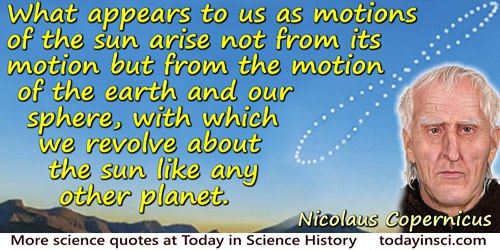
After I had addressed myself to this very difficult and almost insoluble problem, the suggestion at length came to me how it could be solved with fewer and much simpler constructions than were formerly used, if some assumptions (which are called axioms) were granted me. They follow in this order.
There is no one center of all the celestial circles or spheres.
The center of the earth is not the center of the universe, but only of gravity and of the lunar sphere.
All the spheres revolve about the sun as their mid-point, and therefore the sun is the center of the universe.
The ratio of the earth’s distance from the sun to the height of the firmament is so much smaller than the ratio of the earth’s radius to its distance from the sun that the distance from the earth to the sun is imperceptible in comparison with the height of the firmament.
Whatever motion appears in the firmament arises not from any motion of the firmament, but from the earth’s motion. The earth together with its circumjacent elements performs a complete rotation on its fixed poles in a daily motion, while the firmament and highest heaven abide unchanged.
What appears to us as motions of the sun arise not from its motion but from the motion of the earth and our sphere, with which we revolve about the sun like any other planet. The earth has, then, more than one motion.
The apparent retrograde and direct motion of the planets arises not from their motion but from the earth’s. The motion of the earth alone, therefore, suffices to explain so many apparent inequalities in the heavens.
There is no one center of all the celestial circles or spheres.
The center of the earth is not the center of the universe, but only of gravity and of the lunar sphere.
All the spheres revolve about the sun as their mid-point, and therefore the sun is the center of the universe.
The ratio of the earth’s distance from the sun to the height of the firmament is so much smaller than the ratio of the earth’s radius to its distance from the sun that the distance from the earth to the sun is imperceptible in comparison with the height of the firmament.
Whatever motion appears in the firmament arises not from any motion of the firmament, but from the earth’s motion. The earth together with its circumjacent elements performs a complete rotation on its fixed poles in a daily motion, while the firmament and highest heaven abide unchanged.
What appears to us as motions of the sun arise not from its motion but from the motion of the earth and our sphere, with which we revolve about the sun like any other planet. The earth has, then, more than one motion.
The apparent retrograde and direct motion of the planets arises not from their motion but from the earth’s. The motion of the earth alone, therefore, suffices to explain so many apparent inequalities in the heavens.
'The Commentariolus', in Three Copernican Treatises (c.1510), trans. E. Rosen (1939), 58-9.
All great achievements in science start from intuitive knowledge, namely, in axioms, from which deductions are then made. … Intuition is the necessary condition for the discovery of such axioms.
In Conversations with Einstein by Alexander Moszkowski (1970).
Anything at all that can be the object of scientific thought becomes dependent on the axiomatic method, and thereby indirectly on mathematics, as soon as it is ripe for the formation of a theory. By pushing ahead to ever deeper layers of axioms … we become ever more conscious of the unity of our knowledge. In the sign of the axiomatic method, mathematics is summoned to a leading role in science.
Address (11 Sep 1917), 'Axiomatisches Denken' delivered before the Swiss Mathematical Society in
Zürich. Translated by Ewald as 'Axiomatic Thought', (1918), in William Bragg Ewald, From Kant to Hilbert (1996), Vol. 2, 1115.
At first it seems obvious, but the more you think about it the stranger the deductions from this axiom seem to become; in the end you cease to understand what is meant by it.
As quoted, without citation, in Stories about Sets (1968), 84.
Before you generalize, formalize, and axiomatize there must be mathematical substance.
In Eberhard Zeidler, Applied Functional Analysis: main principles and their applications (1995), 282.
Ethical axioms are found and tested not very differently from the axioms of science. Truth is what stands the test of experience.
…...
Every consideration that did not relate to “what is best for the patient” was dismissed. This was Sir William [Gull]’s professional axiom. … But the carrying of it out not unfrequently involved him in difficulty, and led occasionally to his being misunderstood. … He would frequently refuse to repeat a visit or consultation on the ground that he wished the sufferer to feel that it was unnecessary.
In Memoir, as Editor, prefacing Sir William Withey Gull and Theodore Dyke Acland (ed.), A Collection of the Published Writings of William Withey Gull (1896), xviii.
Every definition implies an axiom, since it asserts the existence of the object defined. The definition then will not be justified, from the purely logical point of view, until we have ‘proved’ that it involves no contradiction either in its terms or with the truths previously admitted.
…...
Fiction is, indeed, an indispensable supplement to logic, or even a part of it; whether we are working inductively or deductively, both ways hang closely together with fiction: and axioms, though they seek to be primary verities, are more akin to fiction. If we had realized the nature of axioms, the doctrine of Einstein, which sweeps away axioms so familiar to us that they seem obvious truths, and substitutes others which seem absurd because they are unfamiliar, might not have been so bewildering.
In The Dance of Life (1923), 86.
For hundreds of pages the closely-reasoned arguments unroll, axioms and theorems interlock. And what remains with us in the end? A general sense that the world can be expressed in closely-reasoned arguments, in interlocking axioms and theorems.
In Constructions. 1974, 278.
For the saving the long progression of the thoughts to remote and first principles in every case, the mind should provide itself several stages; that is to say, intermediate principles, which it might have recourse to in the examining those positions that come in its way. These, though they are not self-evident principles, yet, if they have been made out from them by a wary and unquestionable deduction, may be depended on as certain and infallible truths, and serve as unquestionable truths to prove other points depending upon them, by a nearer and shorter view than remote and general maxims. … And thus mathematicians do, who do not in every new problem run it back to the first axioms through all the whole train of intermediate propositions. Certain theorems that they have settled to themselves upon sure demonstration, serve to resolve to them multitudes of propositions which depend on them, and are as firmly made out from thence as if the mind went afresh over every link of the whole chain that tie them to first self-evident principles.
In The Conduct of the Understanding, Sect. 21.
Geometrical axioms are neither synthetic a priori conclusions nor experimental facts. They are conventions: our choice, amongst all possible conventions, is guided by experimental facts; but it remains free, and is only limited by the necessity of avoiding all contradiction. ... In other words, axioms of geometry are only definitions in disguise.
That being so what ought one to think of this question: Is the Euclidean Geometry true?
The question is nonsense. One might as well ask whether the metric system is true and the old measures false; whether Cartesian co-ordinates are true and polar co-ordinates false.
That being so what ought one to think of this question: Is the Euclidean Geometry true?
The question is nonsense. One might as well ask whether the metric system is true and the old measures false; whether Cartesian co-ordinates are true and polar co-ordinates false.
In George Edward Martin, The Foundations of Geometry and the Non-Euclidean Plane (1982), 110.
Gödel proved that the world of pure mathematics is inexhaustible; no finite set of axioms and rules of inference can ever encompass the whole of mathematics; given any finite set of axioms, we can find meaningful mathematical questions which the axioms leave unanswered. I hope that an analogous Situation exists in the physical world. If my view of the future is correct, it means that the world of physics and astronomy is also inexhaustible; no matter how far we go into the future, there will always be new things happening, new information coming in, new worlds to explore, a constantly expanding domain of life, consciousness, and memory.
From Lecture 1, 'Philosophy', in a series of four James Arthur Lectures, 'Lectures on Time and its Mysteries' at New York University (Autumn 1978). Printed in 'Time Without End: Physics and Biology in an Open Universe', Reviews of Modern Physics (Jul 1979), 51, 449.
He never got drunk, he never got tired, and he never perspired.
[Harvard chemistry students’ axioms.]
[Harvard chemistry students’ axioms.]
As attributed in John D. Roberts, The Right Place at the Right Time (1990), 52.
I believe that the useful methods of mathematics are easily to be learned by quite young persons, just as languages are easily learned in youth. What a wondrous philosophy and history underlie the use of almost every word in every language—yet the child learns to use the word unconsciously. No doubt when such a word was first invented it was studied over and lectured upon, just as one might lecture now upon the idea of a rate, or the use of Cartesian co-ordinates, and we may depend upon it that children of the future will use the idea of the calculus, and use squared paper as readily as they now cipher. … When Egyptian and Chaldean philosophers spent years in difficult calculations, which would now be thought easy by young children, doubtless they had the same notions of the depth of their knowledge that Sir William Thomson might now have of his. How is it, then, that Thomson gained his immense knowledge in the time taken by a Chaldean philosopher to acquire a simple knowledge of arithmetic? The reason is plain. Thomson, when a child, was taught in a few years more than all that was known three thousand years ago of the properties of numbers. When it is found essential to a boy’s future that machinery should be given to his brain, it is given to him; he is taught to use it, and his bright memory makes the use of it a second nature to him; but it is not till after-life that he makes a close investigation of what there actually is in his brain which has enabled him to do so much. It is taken because the child has much faith. In after years he will accept nothing without careful consideration. The machinery given to the brain of children is getting more and more complicated as time goes on; but there is really no reason why it should not be taken in as early, and used as readily, as were the axioms of childish education in ancient Chaldea.
In Teaching of Mathematics (1902), 14.
If it were always necessary to reduce everything to intuitive knowledge, demonstration would often be insufferably prolix. This is why mathematicians have had the cleverness to divide the difficulties and to demonstrate separately the intervening propositions. And there is art also in this; for as the mediate truths (which are called lemmas, since they appear to be a digression) may be assigned in many ways, it is well, in order to aid the understanding and memory, to choose of them those which greatly shorten the process, and appear memorable and worthy in themselves of being demonstrated. But there is another obstacle, viz.: that it is not easy to demonstrate all the axioms, and to reduce demonstrations wholly to intuitive knowledge. And if we had chosen to wait for that, perhaps we should not yet have the science of geometry.
In Gottfried Wilhelm Leibnitz and Alfred Gideon Langley (trans.), New Essays Concerning Human Understanding (1896), 413-414.
If the proof starts from axioms, distinguishes several cases, and takes thirteen lines in the text book … it may give the youngsters the impression that mathematics consists in proving the most obvious things in the least obvious way.
Mathematical Discovery: on Understanding, Learning, and Teaching Problem Solving (1981), 129.
In general, we receive impressions only in consequence of motion, and we might establish it as an axiom that without motion there is no sensation.
In Elements of Chemistry: In a New Systematic Order, Containing All the Modern Discoveries (1790), 20.
In mathematics it [sophistry] had no place from the beginning: Mathematicians having had the wisdom to define accurately the terms they use, and to lay down, as axioms, the first principles on which their reasoning is grounded. Accordingly we find no parties among mathematicians, and hardly any disputes.
In Essays on the Intellectual Powers of Man, Essay 1, chap. 1.
In science nothing can be permanently accepted but that which is true, and whatever is accepted as true is challenged again and again. It is an axiom in science that no truth can be so sacred that it may not be questioned. When that which has been accepted as true has the least doubt thrown upon it, scientific men at once re-examine the subject. No opinion is sacred. “It ought to be” is never heard in scientific circles. “It seems to be” and “we think it is” is the modest language of scientific literature.
From address (1 Oct 1884), at inauguration of the Corcoran School of Science and Arts, Columbian University, Washington, D.C. Published in 'The Larger Import of Scientific Education', Popular Science Monthly (Feb 1885), 26, 455.
In this manner the whole substance of our geometry is reduced to the definitions and axioms which we employ in our elementary reasonings; and in like manner we reduce the demonstrative truths of any other science to the definitions and axioms which we there employ.
In The Philosophy of the Inductive Sciences: Founded Upon Their History (1840), Vol. 1, 67.
Induction and analogy are the special characteristics of modern mathematics, in which theorems have given place to theories and no truth is regarded otherwise than as a link in an infinite chain. “Omne exit in infinitum” is their favorite motto and accepted axiom.
In 'A Plea for the Mathematician', Nature, Vol. 1, 861. [The Latin phrase “Omne exit in infinitum” means “Everything goes to infinity”.
It cannot be that axioms established by argumentation should avail for the discovery of new works, since the subtlety of nature is greater many times over than the subtlety of argument. But axioms duly and orderly formed from particulars easily discover the way to new particulars, and thus render sciences active.
From Novum Organum (1620), Book 1, Aphorism 24. Translated as The New Organon: Aphorisms Concerning the Interpretation of Nature and the Kingdom of Man), collected in James Spedding, Robert Ellis and Douglas Heath (eds.), The Works of Francis Bacon (1857), Vol. 4, 51.
It hath been an old remark, that Geometry is an excellent Logic. And it must be owned that when the definitions are clear; when the postulata cannot be refused, nor the axioms denied; when from the distinct contemplation and comparison of figures, their properties are derived, by a perpetual well-connected chain of consequences, the objects being still kept in view, and the attention ever fixed upon them; there is acquired a habit of reasoning, close and exact and methodical; which habit strengthens and sharpens the mind, and being transferred to other subjects is of general use in the inquiry after truth.
In 'The Analyst', in The Works of George Berkeley (1898), Vol. 3, 10.
It is a peculiar feature in the fortune of principles of such high elementary generality and simplicity as characterise the laws of motion, that when they are once firmly established, or supposed to be so, men turn with weariness and impatience from all questionings of the grounds and nature of their authority. We often feel disposed to believe that truths so clear and comprehensive are necessary conditions, rather than empirical attributes of their subjects: that they are legible by their own axiomatic light, like the first truths of geometry, rather than discovered by the blind gropings of experience.
In An Introduction to Dynamics (1832), x.
It is above all the duty of the methodical text-book to adapt itself to the pupil’s power of comprehension, only challenging his higher efforts with the increasing development of his imagination, his logical power and the ability of abstraction. This indeed constitutes a test of the art of teaching, it is here where pedagogic tact becomes manifest. In reference to the axioms, caution is necessary. It should be pointed out comparatively early, in how far the mathematical body differs from the material body. Furthermore, since mathematical bodies are really portions of space, this space is to be conceived as mathematical space and to be clearly distinguished from real or physical space. Gradually the student will become conscious that the portion of the real space which lies beyond the visible stellar universe is not cognizable through the senses, that we know nothing of its properties and consequently have no basis for judgments concerning it. Mathematical space, on the other hand, may be subjected to conditions, for instance, we may condition its properties at infinity, and these conditions constitute the axioms, say the Euclidean axioms. But every student will require years before the conviction of the truth of this last statement will force itself upon him.
In Methodisches Lehrbuch der Elementar-Mathemalik (1904), Teil I, Vorwort, 4-5.
Lagrange, in one of the later years of his life, imagined that he had overcome the difficulty (of the parallel axiom). He went so far as to write a paper, which he took with him to the Institute, and began to read it. But in the first paragraph something struck him that he had not observed: he muttered: 'Il faut que j'y songe encore', and put the paper in his pocket.' [I must think about it again]
Budget of Paradoxes (1872), 173.
Like almost every subject of human interest, this one [mathematics] is just as easy or as difficult as we choose to make it. A lifetime may be spent by a philosopher in discussing the truth of the simplest axiom. The simplest fact as to our existence may fill us with such wonder that our minds will remain overwhelmed with wonder all the time. A Scotch ploughman makes a working religion out of a system which appalls a mental philosopher. Some boys of ten years of age study the methods of the differential calculus; other much cleverer boys working at mathematics to the age of nineteen have a difficulty in comprehending the fundamental ideas of the calculus.
In Teaching of Mathematics (1902), 19-20.
Mathematic is either Pure or Mixed: To Pure Mathematic belong those sciences which handle Quantity entirely severed from matter and from axioms of natural philosophy. These are two, Geometry and Arithmetic; the one handling quantity continued, the other dissevered. … Mixed Mathematic has for its subject some axioms and parts of natural philosophy, and considers quantity in so far as it assists to explain, demonstrate and actuate these.
In De Augmentis, Bk. 3; Advancement of Learning, Bk. 2.
Mathematicians pretend to count by means of a system supposed to satisfy the so-called Peano axioms. In fact, the piano has only 88 keys; hence, anyone counting with these axioms is soon played out.
In Mathematics Made Difficult (1971). As quoted in Michael Stueben and Diane Sandford,
Twenty Years Before the Blackboard (1998), 131.
Mathematics, once fairly established on the foundation of a few axioms and definitions, as upon a rock, has grown from age to age, so as to become the most solid fabric that human reason can boast.
In Essays on the Intellectual Powers of Man, 4th. Ed., 461.
My Design in this Book is not to explain the Properties of Light by Hypotheses, but to propose and prove them by Reason and Experiments: In order to which, I shall premise the following Definitions and Axioms.
Opticks (1704), Book 1, Part 1, Introduction, 1.
Nothing could be more obvious than that the earth is stable and unmoving, and that we are in the center of the universe. Modern Western science takes its beginning from the denial of this common sense axiom.
In The Discoverers (2011), 294.
Pure mathematics is a collection of hypothetical, deductive theories, each consisting of a definite system of primitive, undefined, concepts or symbols and primitive, unproved, but self-consistent assumptions (commonly called axioms) together with their logically deducible consequences following by rigidly deductive processes without appeal to intuition.
In 'Non-Euclidian Geometry of the Fourth Dimension', collected in Henry Parker Manning (ed.), The Fourth Dimension Simply Explained (1910), 58.
Research is fundamentally a state of mind involving continual reexamination of doctrines and axioms upon which current thought and action are based. It is, therefore, critical of existing practices.
In 'The Influence of Research in Bringing into Closer Relationship the Practice of Medicine and Public Health Activities', American Journal of Medical Sciences (Dec 1929), No. 178. As cited in Bill Swainson (ed.), The Encarta Book of Quotations (2000), 885.
Since the examination of consistency is a task that cannot be avoided, it appears necessary to axiomatize logic itself and to prove that number theory and set theory are only parts of logic. This method was prepared long ago (not least by Frege’s profound investigations); it has been most successfully explained by the acute mathematician and logician Russell. One could regard the completion of this magnificent Russellian enterprise of the axiomatization of logic as the crowning achievement of the work of axiomatization as a whole.
Address (11 Sep 1917), 'Axiomatisches Denken' delivered before the Swiss Mathematical Society in
Zürich. Translated by Ewald as 'Axiomatic Thought', (1918), in William Bragg Ewald, From Kant to Hilbert (1996), Vol. 2, 1113.
Stay your rude steps, or e’er your feet invade
The Muses’ haunts,ye sons of War and Trade!
Nor you, ye legion fiends of Church and Law,
Pollute these pages with unhallow’d paw!
Debased, corrupted, grovelling, and confin’d,
No definitions touch your senseless mind;
To you no Postulates prefer their claim,
No ardent Axioms your dull souls inflame;
For you no Tangents touch, no Angles meet,
No Circles join in osculation sweet!
The Muses’ haunts,ye sons of War and Trade!
Nor you, ye legion fiends of Church and Law,
Pollute these pages with unhallow’d paw!
Debased, corrupted, grovelling, and confin’d,
No definitions touch your senseless mind;
To you no Postulates prefer their claim,
No ardent Axioms your dull souls inflame;
For you no Tangents touch, no Angles meet,
No Circles join in osculation sweet!
From poem, with co-authors John Hookham Frere, George Canning and George Ellis, The Loves of the Triangles: A Mathematical and Philosophical Poem, Canto I, collected in Poetry of the Anti-Jacobin (1854), 124.
The axioms of geometry are—according to my way of thinking—not arbitrary, but sensible. statements, which are, in general, induced by space perception and are determined as to their precise content by expediency.
In George Edward Martin, The Foundations of Geometry and the Non-Euclidean Plane (1982), 142.
The constructions of the mathematical mind are at the same time free and necessary. The individual mathematician feels free to define his notions and set up his axioms as he pleases. But the question is will he get his fellow-mathematician interested in the constructs of his imagination. We cannot help the feeling that certain mathematical structures which have evolved through the combined efforts of the mathematical community bear the stamp of a necessity not affected by the accidents of their historical birth. Everybody who looks at the spectacle of modern algebra will be struck by this complementarity of freedom and necessity.
In 'A Half-Century of Mathematics',The American Mathematical Monthly (Oct 1951), 58, No. 8, 538-539.
The development of mathematics toward greater precision has led, as is well known, to the formalization of large tracts of it, so that one can prove any theorem using nothing but a few mechanical rules... One might therefore conjecture that these axioms and rules of inference are sufficient to decide any mathematical question that can at all be formally expressed in these systems. It will be shown below that this is not the case, that on the contrary there are in the two systems mentioned relatively simple problems in the theory of integers that cannot be decided on the basis of the axioms.
'On Formally Undecidable Propositions of Principia Mathematica and Related Systems I' (193 1), in S. Feferman (ed.), Kurt Gödel Collected Works: Publications 1929-1936 (1986), Vol. I, 145.
The full impact of the Lobatchewskian method of challenging axioms has probably yet to be felt. It is no exaggeration to call Lobatchewsky the Copernicus of Geometry,* for geometry is only a part of the vaster domain which he renovated; it might even be just to designate him as a Copernicus of all thought.
In Men of Mathematics (1937), 306. [It was William Kingdom Clifford who first specified that the originality of Lobachevsky’s geometry had a revolutionary effect in mathematics akin to the Copernican revolution in astronomy. * Note the absense of quotation marks. As far as I can find, so far, Clifford, himself, did not use the explicit phrase “Corpernicus of Geometry.” Please make contact if you find a primary source for Clifford writing that exact phase. Other quote collections that are copying each other with a parenthetical “[as did Clifford]” are NOT “primary sources.” That parenthetical remark AFAIK is not even attributed to Clifford, as verbatim, in the text of Bell’s book, at least not the one I checked. So far, I attribute the invention of that exact phrase to Bell, as his chapter title. It might, however, be in a paper by Clifford, or a transcript of a lecture, or a colleague’s recollection — none of which, so far, have I found —Webmaster]
The grand aim of all science is to cover the greatest number of empirical facts by logical deduction from the smallest possible number of hypotheses or axioms.
(1923). As quoted in Lincoln Barnett, The Universe and Dr. Einstein (1950), 110.
The inner circle of creative mathematicians have the well-kept trade secret that in a great many cases theorems come first and axioms second.
In 'The Narrow Mathematician', The American Mathematical Monthly (Jun-Jul 1962), 69, No. 6, 464.
The mathematician pays not the least regard either to testimony or conjecture, but deduces everything by demonstrative reasoning, from his definitions and axioms. Indeed, whatever is built upon conjecture, is improperly called science; for conjecture may beget opinion, but cannot produce knowledge.
In Essays on the Intellectual Powers of Man, Essay 1, chap. 3.
The maxim is, that whatever can be affirmed (or denied) of a class, may be affirmed (or denied) of everything included in the class. This axiom, supposed to be the basis of the syllogistic theory, is termed by logicians the dictum de omni et nullo.
A System of Logic, Ratiocinative and Inductive (1858), 117.
The Reason of making Experiments is, for the Discovery of the Method of Nature, in its Progress and Operations. Whosoever, therefore doth rightly make Experiments, doth design to enquire into some of these Operations; and, in order thereunto, doth consider what Circumstances and Effects, in the Experiment, will be material and instructive in that Enquiry, whether for the confirming or destroying of any preconceived Notion, or for the Limitation and Bounding thereof, either to this or that Part of the Hypothesis, by allowing a greater Latitude and Extent to one Part, and by diminishing or restraining another Part within narrower Bounds than were at first imagin'd, or hypothetically supposed. The Method therefore of making Experiments by the Royal Society I conceive should be this.
First, To propound the Design and Aim of the Curator in his present Enquiry.
Secondly, To make the Experiment, or Experiments, leisurely, and with Care and Exactness.
Thirdly, To be diligent, accurate, and curious, in taking Notice of, and shewing to the Assembly of Spectators, such Circumstances and Effects therein occurring, as are material, or at least, as he conceives such, in order to his Theory .
Fourthly, After finishing the Experiment, to discourse, argue, defend, and further explain, such Circumstances and Effects in the preceding Experiments, as may seem dubious or difficult: And to propound what new Difficulties and Queries do occur, that require other Trials and Experiments to be made, in order to their clearing and answering: And farther, to raise such Axioms and Propositions, as are thereby plainly demonstrated and proved.
Fifthly, To register the whole Process of the Proposal, Design, Experiment, Success, or Failure; the Objections and Objectors, the Explanation and Explainers, the Proposals and Propounders of new and farther Trials; the Theories and Axioms, and their Authors; and, in a Word the history of every Thing and Person, that is material and circumstantial in the whole Entertainment of the said Society; which shall be prepared and made ready, fairly written in a bound Book, to be read at the Beginning of the Sitting of the Society: The next Day of their Meeting, then to be read over and further discoursed, augmented or diminished, as the Matter shall require, and then to be sign'd by a certain Number of the Persons present, who have been present, and Witnesses of all the said Proceedings, who, by Subscribing their names, will prove undoubted testimony to Posterity of the whole History.
First, To propound the Design and Aim of the Curator in his present Enquiry.
Secondly, To make the Experiment, or Experiments, leisurely, and with Care and Exactness.
Thirdly, To be diligent, accurate, and curious, in taking Notice of, and shewing to the Assembly of Spectators, such Circumstances and Effects therein occurring, as are material, or at least, as he conceives such, in order to his Theory .
Fourthly, After finishing the Experiment, to discourse, argue, defend, and further explain, such Circumstances and Effects in the preceding Experiments, as may seem dubious or difficult: And to propound what new Difficulties and Queries do occur, that require other Trials and Experiments to be made, in order to their clearing and answering: And farther, to raise such Axioms and Propositions, as are thereby plainly demonstrated and proved.
Fifthly, To register the whole Process of the Proposal, Design, Experiment, Success, or Failure; the Objections and Objectors, the Explanation and Explainers, the Proposals and Propounders of new and farther Trials; the Theories and Axioms, and their Authors; and, in a Word the history of every Thing and Person, that is material and circumstantial in the whole Entertainment of the said Society; which shall be prepared and made ready, fairly written in a bound Book, to be read at the Beginning of the Sitting of the Society: The next Day of their Meeting, then to be read over and further discoursed, augmented or diminished, as the Matter shall require, and then to be sign'd by a certain Number of the Persons present, who have been present, and Witnesses of all the said Proceedings, who, by Subscribing their names, will prove undoubted testimony to Posterity of the whole History.
'Dr Hooke's Method of Making Experiments' (1664-5). In W. Derham (ed.), Philosophical Experiments and Observations Of the Late Eminent Dr. Robert Hooke, F.R.S. And Geom. Prof. Gresh. and Other Eminent Virtuoso's in his Time (1726), 26-8.
The reasoning of mathematicians is founded on certain and infallible principles. Every word they use conveys a determinate idea, and by accurate definitions they excite the same ideas in the mind of the reader that were in the mind of the writer. When they have defined the terms they intend to make use of, they premise a few axioms, or self-evident principles, that every one must assent to as soon as proposed. They then take for granted certain postulates, that no one can deny them, such as, that a right line may be drawn from any given point to another, and from these plain, simple principles they have raised most astonishing speculations, and proved the extent of the human mind to be more spacious and capacious than any other science.
In Diary, Works (1850), Vol. 2, 21.
The statistics of nihilism … “No matter how many times something new has been observed, it cannot be believed until it has been observed again.” I have also reduced my attitude toward this form of statistics to an axiom: “No matter how bad a thing you say about it, it is not bad enough.”
In Seeing Red: Redshifts, Cosmology and Academic Science (1998), 75.
The steady progress of physics requires for its theoretical formulation a mathematics which get continually more advanced. ... it was expected that mathematics would get more and more complicated, but would rest on a permanent basis of axioms and definitions, while actually the modern physical developments have required a mathematics that continually shifts its foundation and gets more abstract. Non-euclidean geometry and noncommutative algebra, which were at one time were considered to be purely fictions of the mind and pastimes of logical thinkers, have now been found to be very necessary for the description of general facts of the physical world. It seems likely that this process of increasing abstraction will continue in the future and the advance in physics is to be associated with continual modification and generalisation of the axioms at the base of mathematics rather than with a logical development of any one mathematical scheme on a fixed foundation.
Introduction to a paper on magnetic monopoles, 'Quantised singularities in the electromagnetic field', Proceedings of the Royal Society of Lonndon (1931), A, 133 60. In Helge Kragh, Dirac: a Scientific Biography (1990), 208.
The strength of all sciences is, as the strength of the old man’s faggot, in the band. For the harmony of a science, supporting each part the other, is and ought to be the true and brief confutation and suppression of all the smaller sort of objections; but, on the other side, if you take out every axiom, as the sticks of the faggot, one by one, you may quarrel with them and bend them and break them at your pleasure: so that, as was said of Seneca, Verborum minutiis rerum frangit pondera [that he broke up the weight and mass of the matter by verbal points and niceties], so a man may truly say of the schoolmen, Quaestionum minutiis scientiarum frangunt soliditatem [they broke up the solidarity and coherency of the sciences by the minuteness and nicety of their questions]. For were it not better for a man in fair room to set up one great light, or branching candlestick of lights, than to go about with a small watch-candle into every corner?
The Works of Francis Bacon (1864), Vol. 6, 123
The teaching of elementary mathematics should be conducted so that the way should be prepared for the building upon them of the higher mathematics. The teacher should always bear in mind and look forward to what is to come after. The pupil should not be taught what may be sufficient for the time, but will lead to difficulties in the future. … I think the fault in teaching arithmetic is that of not attending to general principles and teaching instead of particular rules. … I am inclined to attack Teaching of Mathematics on the grounds that it does not dwell sufficiently on a few general axiomatic principles.
In John Perry (ed.), Discussion on the Teaching of Mathematics (1901), 33. The discussion took place on 14 Sep 1901 at the British Association at Glasgow, during a joint meeting of the mathematics and physics sections with the education section. The proceedings began with an address by John Perry. Professor Hudson was the first speak in the Discussion which followed.
The teaching process, as commonly observed, has nothing to do with the investigation and establishment of facts, assuming that actual facts may ever be determined. Its sole purpose is to cram the pupils, as rapidly and as painlessly as possible, with the largest conceivable outfit of current axioms, in all departments of human thought—to make the pupil a good citizen, which is to say, a citizen differing as little as possible, in positive knowledge and habits of mind, from all other citizens.
From Baltimore Evening Sun (12 Mar 1923). Collected in A Mencken Chrestomathy (1949, 1956), 316.
The understanding must not however be allowed to jump and fly from particulars to axioms remote and of almost the highest generality (such as the first principles, as they are called, of arts and things), and taking stand upon them as truths that cannot be shaken, proceed to prove and frame the middle axioms by reference to them; which has been the practice hitherto, the understanding being not only carried that way by a natural impulse, but also by the use of syllogistic demonstration trained and inured to it. But then, and then only, may we hope well of the sciences when in a just scale of ascent, and by successive steps not interrupted or broken, we rise from particulars to lesser axioms; and then to middle axioms, one above the other; and last of all to the most general. For the lowest axioms differ but slightly from bare experience, while the highest and most general (which we now have) are notional and abstract and without solidity. But the middle are the true and solid and living axioms, on which depend the affairs and fortunes of men; and above them again, last of all, those which are indeed the most general; such, I mean, as are not abstract, but of which those intermediate axioms are really limitations.
The understanding must not therefore be supplied with wings, but rather hung with weights, to keep it from leaping and flying. Now this has never yet been done; when it is done, we may entertain better hopes of science.
The understanding must not therefore be supplied with wings, but rather hung with weights, to keep it from leaping and flying. Now this has never yet been done; when it is done, we may entertain better hopes of science.
From Novum Organum (1620), Book 1, Aphorism 104. Translated as The New Organon: Aphorisms Concerning the Interpretation of Nature and the Kingdom of Man), collected in James Spedding, Robert Ellis and Douglas Heath (eds.), The Works of Francis Bacon (1857), Vol. 4, 97.
There are … two fields for human thought and action—the actual and the possible, the realized and the real. In the actual, the tangible, the realized, the vast proportion of mankind abide. The great, region of the possible, whence all discovery, invention, creation proceed, and which is to the actual as a universe to a planet, is the chosen region of genius. As almost every thing which is now actual was once only possible, as our present facts and axioms were originally inventions or discoveries, it is, under God, to genius that we owe our present blessings. In the past, it created the present; in the present, it is creating the future.
In 'Genius', Wellman’s Miscellany (Dec 1871), 4, No. 6, 202.
There are and can be only two ways of searching into and discovering truth. The one flies from the senses and particulars to the most general axioms, and from these principles, the truth of which it takes for settled and immovable, proceeds to judgment and to the discovery of middle axioms. And this way is now in fashion. The other derives axioms from the senses and particulars, rising by a gradual and unbroken ascent, so that it arrives at the most general axioms last of all. This is the true way, but as yet untried.
From Novum Organum (1620), Book 1, Aphorism 20. Translated as The New Organon: Aphorisms Concerning the Interpretation of Nature and the Kingdom of Man), collected in James Spedding, Robert Ellis and Douglas Heath (eds.), The Works of Francis Bacon (1857), Vol. 4, 50.
These sciences, Geometry, Theoretical Arithmetic and Algebra, have no principles besides definitions and axioms, and no process of proof but deduction; this process, however, assuming a most remarkable character; and exhibiting a combination of simplicity and complexity, of rigour and generality, quite unparalleled in other subjects.
In The Philosophy of the Inductive Sciences (1858), Part 1, Bk. 2, chap. 1, sect. 2.
They [mathematicians] only take those things into consideration, of which they have clear and distinct ideas, designating them by proper, adequate, and invariable names, and premising only a few axioms which are most noted and certain to investigate their affections and draw conclusions from them, and agreeably laying down a very few hypotheses, such as are in the highest degree consonant with reason and not to be denied by anyone in his right mind. In like manner they assign generations or causes easy to be understood and readily admitted by all, they preserve a most accurate order, every proposition immediately following from what is supposed and proved before, and reject all things howsoever specious and probable which can not be inferred and deduced after the same manner.
In Mathematical Lectures (1734), 65-66.
Think of the image of the world in a convex mirror. ... A well-made convex mirror of moderate aperture represents the objects in front of it as apparently solid and in fixed positions behind its surface. But the images of the distant horizon and of the sun in the sky lie behind the mirror at a limited distance, equal to its focal length. Between these and the surface of the mirror are found the images of all the other objects before it, but the images are diminished and flattened in proportion to the distance of their objects from the mirror. ... Yet every straight line or plane in the outer world is represented by a straight line or plane in the image. The image of a man measuring with a rule a straight line from the mirror, would contract more and more the farther he went, but with his shrunken rule the man in the image would count out exactly the same results as in the outer world, all lines of sight in the mirror would be represented by straight lines of sight in the mirror. In short, I do not see how men in the mirror are to discover that their bodies are not rigid solids and their experiences good examples of the correctness of Euclidean axioms. But if they could look out upon our world as we look into theirs without overstepping the boundary, they must declare it to be a picture in a spherical mirror, and would speak of us just as we speak of them; and if two inhabitants of the different worlds could communicate with one another, neither, as far as I can see, would be able to convince the other that he had the true, the other the distorted, relation. Indeed I cannot see that such a question would have any meaning at all, so long as mechanical considerations are not mixed up with it.
In 'On the Origin and Significance of Geometrical Axioms,' Popular Scientific Lectures< Second Series (1881), 57-59. In Robert Édouard Moritz, Memorabilia Mathematica (1914), 357-358.
To the behaviourist a man is only a nexus of stimuli and responses, because the method of investigation, by its own definitions and axioms, is merely the study of the relations between stimuli and responses.
In A Shorter History of Science (1944), 137.
We may lay it down as an incontestible axiom, that, in all the operations of art and nature, nothing is created; an equal quantity of matter exists both before and after the experiment; the quality and quantity of the elements remain precisely the same; and nothing takes place beyond changes and modifications in the combination of these elements. Upon this principle the whole art of performing chemical experiments depends: We must always suppose an exact equality between the elements of the body examined and those of the products of its analysis.
Elements of Chemistry trans. Robert. Kerr, (1790, 5th Ed. 1802), Vol. 1, 226.
When we have amassed a great store of such general facts, they become the objects of another and higher species of classification, and are themselves included in laws which, as they dispose of groups, not individuals have a far superior degree of generality, till at length, by continuing the process, we arrive at axioms of the highest degree of generality of which science is capable. This process is what we mean by induction.
In A Preliminary Discourse on the Study of Natural Philosophy (1830), 102.
 In science it often happens that scientists say, 'You know that's a really good argument; my position is mistaken,' and then they would actually change their minds and you never hear that old view from them again. They really do it. It doesn't happen as often as it should, because scientists are human and change is sometimes painful. But it happens every day. I cannot recall the last time something like that happened in politics or religion.
(1987) --
In science it often happens that scientists say, 'You know that's a really good argument; my position is mistaken,' and then they would actually change their minds and you never hear that old view from them again. They really do it. It doesn't happen as often as it should, because scientists are human and change is sometimes painful. But it happens every day. I cannot recall the last time something like that happened in politics or religion.
(1987) -- 




