Average Quotes (89 quotes)
[In Adelie Land, Antarctica, a howling river of] wind, 50 miles wide, blows off the plateau, month in and month out, at an average velocity of 50 m.p.h. As a source of power this compares favorably with 6,000 tons of water falling every second over Niagara Falls. I will not further anticipate some H. G. Wells of the future who will ring the antarctic with power-producing windmills; but the winds of the Antarctic have to be felt to be believed, and nothing is quite impossible to physicists and engineers.
Speaking at convention of the British Association for the Advancement of Science, Norwich (1935). As quoted in 'Science: One Against Darwin', Time (23 Sep 1935).
[It has been ascertained by statistical observation that in engineering enterprises one man is killed for every million francs that is spent on the works.] Supposing you have to build a bridge at an expense of one hundred million francs, you must be prepared for the death of one hundred men. In building the Eiffel Tower, which was a construction costing six million and a half, we only lost four men, thus remaining below the average. In the construction of the Forth Bridge, 55 men were lost in over 45,000,000 francs’ worth of work. That would appear to be a large number according to the general rule, but when the special risks are remembered, this number shows as a very small one.
As quoted in 'M. Eiffel and the Forth Bridge', The Tablet (15 Mar 1890), 75, 400. Similarly quoted in Robert Harborough Sherard, Twenty Years in Paris: Being Some Recollections of a Literary Life (1905), 169, which adds to the end “, and reflects very great credit on the engineers for the precautions which they took on behalf of their men.” Sherard gave the context that Eiffel was at the inauguration [4 Mar 1890] of the Forth Bridge, and gave this compliment when conversing there with the Prince of Wales.
[Introducing two perfectly ordinary performers of average stature to a circus audience.]
The Punkwat twins! Brentwood is the world's smallest giant, whilst his brother, Elwood, is the largest midget in the world. They baffle science!
The Punkwat twins! Brentwood is the world's smallest giant, whilst his brother, Elwood, is the largest midget in the world. They baffle science!
As character Larson E. Whipsnade, circus ring-master, in movie, You Can't Cheat an Honest Man (1939). As transcribed in Simon Louvish, Man on the Flying Trapeze: The Life and Times of W. C. Fields (1999), 4.
Die durchschnittliche Lebensdauer einer physiologischen Wahrheit ist drei bis vier Jahre.
The average lifespan of a physiological truth is three or four years.
The average lifespan of a physiological truth is three or four years.
Attributed.

Every teacher certainly should know something of non-euclidean geometry. Thus, it forms one of the few parts of mathematics which, at least in scattered catch-words, is talked about in wide circles, so that any teacher may be asked about it at any moment. … Imagine a teacher of physics who is unable to say anything about Röntgen rays, or about radium. A teacher of mathematics who could give no answer to questions about non-euclidean geometry would not make a better impression.
On the other hand, I should like to advise emphatically against bringing non-euclidean into regular school instruction (i.e., beyond occasional suggestions, upon inquiry by interested pupils), as enthusiasts are always recommending. Let us be satisfied if the preceding advice is followed and if the pupils learn to really understand euclidean geometry. After all, it is in order for the teacher to know a little more than the average pupil.
On the other hand, I should like to advise emphatically against bringing non-euclidean into regular school instruction (i.e., beyond occasional suggestions, upon inquiry by interested pupils), as enthusiasts are always recommending. Let us be satisfied if the preceding advice is followed and if the pupils learn to really understand euclidean geometry. After all, it is in order for the teacher to know a little more than the average pupil.
In George Edward Martin, The Foundations of Geometry and the Non-Euclidean Plane (1982), 72.
L'homme moyen.
The average man.
The emergence of the concept.
The average man.
The emergence of the concept.
A Treatise on Man and the Development of his Faculties (1842). Reprinted with an introduction by Solomon Diamond (1969), 96.
The Charms of Statistics.—It is difficult to understand why statisticians commonly limit their inquiries to Averages, and do not revel in more comprehensive views. Their souls seem as dull to the charm of variety as that of the native of one of our flat English counties, whose retrospect of Switzerland was that, if its mountains could be thrown into its lakes, two nuisances would be got rid of at once. An Average is but a solitary fact, whereas if a single other fact be added to it, an entire Normal Scheme, which nearly corresponds to the observed one, starts potentially into existence. Some people hate the very name of statistics, but I find them full of beauty and interest. Whenever they are not brutalised, but delicately handled by the higher methods, and are warily interpreted, their power of dealing with complicated phenomena is extraordinary. They are the only tools by which an opening can be cut through the formidable thicket of difficulties that bars the path of those who pursue the Science of man.
Natural Inheritance (1889), 62-3.
A statistician is a person who believes that if you put your head in a furnace and your feet in a bucket of iced water, on the average you should feel reasonably comfortable.
Found, for example, in Planning a Prevention Program: A Handbook for the Youth Worker in an Alcohol Service Agency (1977), 3.
After an honest day’s work a mathematician goes off duty. Mathematics is very hard work, and dons tend to be above average in health and vigor. Below a certain threshold a man cracks up; but above it, hard mental work makes for health and vigor (also—on much historical evidence throughout the ages—for longevity). I have noticed lately that when I am working really hard I wake around 5.30 a.m. ready and eager to start; if I am slack, I sleep till I am called.
In 'The Mathematician’s Art of Work' (1967), collected in Béla Bollobás (ed.), Littlewood’s Miscellany (1986), 195.
Any child born into the hugely consumptionist way of life so common in the industrial world will have an impact that is, on average, many times more destructive than that of a child born in the developing world.
— Al Gore
Earth in the Balance: Ecology and the Human Spirit (2006), 308.
As advertising always convinces the sponsor even more than the public, the scientists have become sold, and remain sold, on the idea that they have the key to the Absolute, and that nothing will do for Mr. Average Citizen but to stuff himself full of electrons.
In Science is a Sacred Cow (1950), 26.
But as no two (theoreticians) agree on this (skin friction) or any other subject, some not agreeing today with what they wrote a year ago, I think we might put down all their results, add them together, and then divide by the number of mathematicians, and thus find the average coefficient of error. (1908)
In Artificial and Natural Flight (1908), 3. Quoted in John David Anderson, Jr., Hypersonic and High Temperature Gas Dynamics (2000), 335.
By destroying the biological character of phenomena, the use of averages in physiology and medicine usually gives only apparent accuracy to the results. From our point of view, we may distinguish between several kinds of averages: physical averages, chemical averages and physiological and pathological averages. If, for instance, we observe the number of pulsations and the degree of blood pressure by means of the oscillations of a manometer throughout one day, and if we take the average of all our figures to get the true or average blood pressure and to learn the true or average number of pulsations, we shall simply have wrong numbers. In fact, the pulse decreases in number and intensity when we are fasting and increases during digestion or under different influences of movement and rest; all the biological characteristics of the phenomenon disappear in the average. Chemical averages are also often used. If we collect a man's urine during twenty-four hours and mix all this urine to analyze the average, we get an analysis of a urine which simply does not exist; for urine, when fasting, is different from urine during digestion. A startling instance of this kind was invented by a physiologist who took urine from a railroad station urinal where people of all nations passed, and who believed he could thus present an analysis of average European urine! Aside from physical and chemical, there are physiological averages, or what we might call average descriptions of phenomena, which are even more false. Let me assume that a physician collects a great many individual observations of a disease and that he makes an average description of symptoms observed in the individual cases; he will thus have a description that will never be matched in nature. So in physiology, we must never make average descriptions of experiments, because the true relations of phenomena disappear in the average; when dealing with complex and variable experiments, we must study their various circumstances, and then present our most perfect experiment as a type, which, however, still stands for true facts. In the cases just considered, averages must therefore be rejected, because they confuse, while aiming to unify, and distort while aiming to simplify. Averages are applicable only to reducing very slightly varying numerical data about clearly defined and absolutely simple cases.
From An Introduction to the Study of Experimental Medicine (1865), as translated by Henry Copley Greene (1957), 134-135.
By research in pure science I mean research made without any idea of application to industrial matters but solely with the view of extending our knowledge of the Laws of Nature. I will give just one example of the ‘utility’ of this kind of research, one that has been brought into great prominence by the War—I mean the use of X-rays in surgery. Now, not to speak of what is beyond money value, the saving of pain, or, it may be, the life of the wounded, and of bitter grief to those who loved them, the benefit which the state has derived from the restoration of so many to life and limb, able to render services which would otherwise have been lost, is almost incalculable. Now, how was this method discovered? It was not the result of a research in applied science starting to find an improved method of locating bullet wounds. This might have led to improved probes, but we cannot imagine it leading to the discovery of X-rays. No, this method is due to an investigation in pure science, made with the object of discovering what is the nature of Electricity. The experiments which led to this discovery seemed to be as remote from ‘humanistic interest’ —to use a much misappropriated word—as anything that could well be imagined. The apparatus consisted of glass vessels from which the last drops of air had been sucked, and which emitted a weird greenish light when stimulated by formidable looking instruments called induction coils. Near by, perhaps, were great coils of wire and iron built up into electro-magnets. I know well the impression it made on the average spectator, for I have been occupied in experiments of this kind nearly all my life, notwithstanding the advice, given in perfect good faith, by non-scientific visitors to the laboratory, to put that aside and spend my time on something useful.
In Speech made on behalf of a delegation from the Conjoint Board of Scientific Studies in 1916 to Lord Crewe, then Lord President of the Council. In George Paget Thomson, J. J. Thomson and the Cavendish Laboratory in His Day (1965), 167-8.
Despite rapid progress in the right direction, the program of the average elementary school has been primarily devoted to teaching the fundamental subjects, the three R’s, and closely related disciplines… Artificial exercises, like drills on phonetics, multiplication tables, and formal writing movements, are used to a wasteful degree. Subjects such as arithmetic, language, and history include content that is intrinsically of little value. Nearly every subject is enlarged unwisely to satisfy the academic ideal of thoroughness… Elimination of the unessential by scientific study, then, is one step in improving the curriculum.
Dr. Paget was conducting a school examination, and in the course of his questions he happened to ask a small child the meaning of “Average.” He was utterly bewildered by the reply, “The thing that hens lay on,” until the child explained that he had read in a book that hens lay on an average so many eggs a year.
Anecdote jotted down by Lewis Carroll to possibly send to the magazine Punch, as given in Stuart Dodgson Collingwood, The Life and Letters of Lewis Carroll (1898), 157.
Each of the major sciences has contributed an essential ingredient in our long retreat from an initial belief in our own cosmic importance. Astronomy defined our home as a small planet tucked away in one corner of an average galaxy among millions; biology took away our status as paragons created in the image of God; geology gave us the immensity of time and taught us how little of it our own species has occupied.
…...
Fish does not now—nor can it ever—feed the world. … Many developed, wealthy nations … dine on seafood more for taste than for necessity. … not one would on average incur any protein deficiency even if fish were completely removed from its dinner tables.
In Jacques Cousteau and Susan Schiefelbein, The Human, the Orchid, and the Octopus: Exploring and Conserving Our Natural World (2007), 153.
For the average mind precedent sanctifies.
Aphorism in The Philistine (Apr 1905), 20, No. 5, 160.
Half the people you know are below average.
Has anyone ever given credit to the Black Death for the Renaissance—in other words, for modern civilization? … [It] exterminated such huge masses of the European proletariat that the average intelligence and enterprise of the race were greatly lifted, and that this purged and improved society suddenly functioned splendidly. … The best brains of the time, thus suddenly emancipated, began to function freely and magnificently. There ensued what we call the Renaissance.
From American Mercury (Jun 1924), 188-189. Collected in 'Eugenic Note', A Mencken Chrestomathy (1949, 1956), 376-377.
Have the changes which lead us from one geologic state to another been, on a long average uniform in their intensity, or have they consisted of epochs of paroxysmal and catastrophic action, interposed between periods of comparative tranquillity? These two opinions will probably for some time divide the geological world into two sects, which may perhaps be designated as the Uniformitarians and the Catastrophists.
In 'Review of Charles Lyell's Principles of Geology', Quarterly Review (1832), 47, 126.
Hell, if I could explain it to the average person, it wouldn't have been worth the Nobel prize.
After being awarded a Nobel Prize, he was frequently asked to explain what he had done, and would would give this answer. As stated in Lee Dye, 'Nobel Physicist R.P. Feynman of Caltech Dies', Los Angeles Times (16 Feb 1988). About this answer, the articles also states that, “Feynman once said, claiming he was told that by a New York cab driver.”
Historically, Statistics is no more than State Arithmetic, a system of computation by which differences between individuals are eliminated by the taking of an average. It has been used—indeed, still is used—to enable rulers to know just how far they may safely go in picking the pockets of their subjects.
In Facts from Figures (1951), 1.
I believe it to be of particular importance that the scientist have an articulate and adequate social philosophy, even more important than the average man should have a philosophy. For there are certain aspects of the relation between science and society that the scientist can appreciate better than anyone else, and if he does not insist on this significance no one else will, with the result that the relation of science to society will become warped, to the detriment of everybody.
Reflections of a Physicist (1950), 287.
I suspect that the changes that have taken place during the last century in the average man's fundamental beliefs, in his philosophy, in his concept of religion. in his whole world outlook, are greater than the changes that occurred during the preceding four thousand years all put together. ... because of science and its applications to human life, for these have bloomed in my time as no one in history had had ever dreamed could be possible.
In The Autobiography of Robert A. Millikan (1951, 1980), xii.
I think she [Rosalind Franklin] was a good experimentalist but certainly not of the first rank. She was simply not in the same class as Eigen or Bragg or Pauling, nor was she as good as Dorothy Hodgkin. She did not even select DNA to study. It was given to her. Her theoretical crystallography was very average.
Letter to Charlotte Friend (18 Sep 1979). In Francis Harry Compton Crick Papers, Wellcome Library for the History and Understanding of Medicine.
I was suffering from a sharp attack of intermittent fever, and every day during the cold and succeeding hot fits had to lie down for several hours, during which time I had nothing to do but to think over any subjects then particularly interesting me. One day something brought to my recollection Malthus's 'Principles of Population', which I had read about twelve years before. I thought of his clear exposition of 'the positive checks to increase'—disease, accidents, war, and famine—which keep down the population of savage races to so much lower an average than that of more civilized peoples. It then occurred to me that these causes or their equivalents are continually acting in the case of animals also; and as animals usually breed much more rapidly than does mankind, the destruction every year from these causes must be enormous in order to keep down the numbers of each species, since they evidently do not increase regularly from year to year, as otherwise the world would long ago have been densely crowded with those that breed most quickly. Vaguely thinking over the enormous and constant destruction which this implied, it occurred to me to ask the question, Why do some die and some live? The answer was clearly, that on the whole the best fitted live. From the effects of disease the most healthy escaped; from enemies, the strongest, swiftest, or the most cunning; from famine, the best hunters or those with the best digestion; and so on. Then it suddenly flashed upon me that this self-acting process would necessarily improve the race, because in every generation the inferior would inevitably be killed off and the superior would remain—that is, the fittest would survive.
[The phrase 'survival of the fittest,' suggested by the writings of Thomas Robert Malthus, was expressed in those words by Herbert Spencer in 1865. Wallace saw the term in correspondence from Charles Darwin the following year, 1866. However, Wallace did not publish anything on his use of the expression until very much later, and his recollection is likely flawed.]
[The phrase 'survival of the fittest,' suggested by the writings of Thomas Robert Malthus, was expressed in those words by Herbert Spencer in 1865. Wallace saw the term in correspondence from Charles Darwin the following year, 1866. However, Wallace did not publish anything on his use of the expression until very much later, and his recollection is likely flawed.]
My Life: A Record of Events and Opinions (1905), Vol. 1, 361-362, or in reprint (2004), 190.
I would be the last to deny that the greatest scientific pioneers belonged to an aristocracy of the spirit and were exceptionally intelligent, something that we as modest investigators will never attain, no matter how much we exert ourselves. Nevertheless … I continue to believe that there is always room for anyone with average intelligence … to utilize his energy and … any man could, if he were so inclined, be the sculptor of his own brain, and that even the least gifted may, like the poorest land that has been well-cultivated and fertilized, produce an abundant harvest..
From Preface to the second edition, Reglas y Consejos sobre Investigacíon Cientifica: Los tónicos de la voluntad. (1897), as translated by Neely and Larry W. Swanson, in Advice for a Young Investigator (1999), xv.
I’ve always thought that my exposure to competitive sports helped me a great deal in the operating room. It teaches you endurance, and it teaches you how to cope with defeat, and with complications of all sort. I think I’m a well-coordinated person, more than average, and I think that came through my interest in sports, and athletics. … [Playing basketball] You have to make decisions promptly, and that’s true in the operating room as well.
If a teacher is full of his subject, and can induce enthusiasm in his pupils; if his facts are concrete and naturally connected, the amount of material that an average child can assimilate without injury is as astonishing as is the little that will fag him if it is a trifle above or below or remote from him, or taught dully or incoherently.
In The North American Review (Mar 1883), No. 316, 289.
If the average man in the street were asked to name the benefits derived from sunshine, he would probably say “light and warmth” and there he would stop. But, if we analyse the matter a little more deeply, we will soon realize that sunshine is the one great source of all forms of life and activity on this old planet of ours. … [M]athematics underlies present-day civilization in much the same far-reaching manner as sunshine underlies all forms of life, and that we unconsciously share the benefits conferred by the mathematical achievements of the race just as we unconsciously enjoy the blessings of the sunshine.
From Address (25 Feb 1928) to National Council of Teachers of Mathematics, Boston. Abstract published in 'Mathematics and Sunshine', The Mathematics Teacher (May 1928), 21, No. 5, 245.
If we betake ourselves to the statistical method, we do so confessing that we are unable to follow the details of each individual case, and expecting that the effects of widespread causes, though very different in each individual, will produce an average result on the whole nation, from a study of which we may estimate the character and propensities of an imaginary being called the Mean Man.
'Does the Progress of Physical Science tend to give any advantage to the opinion of necessity (or determinism) over that of the continuency of Events and the Freedom of the Will?' In P. M. Hannan (ed.), The Scientific Letters and Papers of James Clerk Maxwell (1995), Vol. 2, 1862-1873, 818.
In former times, … when ships buffeted by storms threw a portion of their cargo overboard, it was recognized that those whose goods were sacrificed had a claim in equity to indemnification at the expense of those whose goods were safely delivered. The value of the lost goods was paid for by agreement between all those whose merchandise had been in the same ship. This sea damage to cargo in transit was known as “havaria” and the word came naturally to be applied to the compensation money which each individual was called upon to pay. From this Latin word derives our modern word average.
In 'On the Average', Facts From Figures (1951), Chap. 4, 34.
In the space of one hundred and seventy-six years the Lower Mississippi has shortened itself two hundred and forty-two miles. That is an average of a trifle over one mile and a third per year. Therefore, any calm person, who is not blind or idiotic, can see that in the old Oolitic Silurian Period, must a million years ago next November, the Lower Mississippi River was upward of one million three hundred thousand miles long, and stuck out over the Gulf of Mexico like a fishing-rod. And by the same token any person can see that seven hundred and forty-two years from now the Lower Mississippi will be only a mile and three-quarters long, and Cairo and New Orleans will have their streets joined together, and be plodding comfortably along under a single mayor and a mutual board of aldermen. There is something fascinating about science. One gets such wholesale returns of conjecture out of such a trifling investment of fact.
Life on the Mississippi (1883, 2000), 173.
In this generation, along with the dominating traits, the recessive ones also reappear, their individuality fully revealed, and they do so in the decisively expressed average proportion of 3:1, so that among each four plants of this generation three receive the dominating and one the recessive characteristic.
'Experiments on Plant Hybrids' (1865). In Curt Stern and Eva R. Sherwood (eds.), The Origin of Genetics: A Mendel Source Book (1966), 10.
Isaac Newton was born at Woolsthorpe, near Grantham, in Lincolnshire, on Christmas Day, 1642: a weakly and diminutive infant, of whom it is related that, at his birth, he might have found room in a quart mug. He died on March the 20th, 1727, after more than eighty-four years of more than average bodily health and vigour; it is a proper pendant to the story of the quart mug to state that he never lost more than one of his second teeth.
In Essays on the life and work of Newton (), 4.
It follows from the theory of relativity that mass and energy are both different manifestations of the same thing—a somewhat unfamiliar conception for the average man. Furthermore E=MC2, in which energy is put equal to mass multiplied with the square of the velocity of light, showed that a very small amount of mass may be converted into a very large amount of energy... the mass and energy were in fact equivalent.
As expressed in the Einstein film, produced by Nova Television (1979). Quoted in Alice Calaprice, The Quotable Einstein (1996), 183.
It is hardly possible to maintain seriously that the evil done by science is not altogether outweighed by the good. For example, if ten million lives were lost in every war, the net effect of science would still have been to increase the average length of life.
In A Mathematician's Apology (1940, 2012), 65.
It is interesting to note how many fundamental terms which the social sciences are trying to adopt from physics have as a matter of historical fact originated in the social field. Take, for instance, the notion of cause. The Greek aitia or the Latin causa was originally a purely legal term. It was taken over into physics, developed there, and in the 18th century brought back as a foreign-born kind for the adoration of the social sciences. The same is true of the concept of law of nature. Originally a strict anthropomorphic conception, it was gradually depersonalized or dehumanized in the natural sciences and then taken over by the social sciences in an effort to eliminate final causes or purposes from the study of human affairs. It is therefore not anomalous to find similar transformations in the history of such fundamental concepts of statistics as average and probability. The concept of average was developed in the Rhodian laws as to the distribution of losses in maritime risks. After astronomers began to use it in correcting their observations, it spread to other physical sciences; and the prestige which it thus acquired has given it vogue in the social field. The term probability, as its etymology indicates, originates in practical and legal considerations of probing and proving.
The Statistical View of Nature (1936), 327-8.
It is known that there are an infinite number of worlds, simply because there is an infinite amount of space for them to be in. However, not every one of them is inhabited. Therefore, there must be a finite number of inhabited worlds. Any finite number divided by infinity is as near to nothing as makes no odds, so the average population of all the planets in the Universe can be said to be zero. From this it follows that the population of the whole Universe is also zero, and that any people you may meet from time to time are merely the products of a deranged imagination.
In The Restaurant at the End of the Universe (1980, 2005), 142-143. Slightly revised from 'Fit the Fifth', The Original Hitchhiker Radio Scripts (1985), 102. The show was recorded for the BBC on 21 Feb 1978.
It usually takes me from five to seven years to perfect a thing. Some things I have been working on for twenty-five years—and some of them are still unsolved. My average would be about seven years. The incandescent light was the hardest one of all: it took many years not only of concentrated thought but also of world-wide research. The storage battery took eight years. It took even longer to perfect the phonograph.
As quoted from an interview by B.C. Forbes in The American Magazine (Jan 1921), 86.
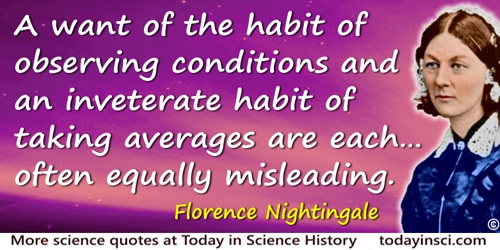
Let people who have to observe sickness and death look back and try to register in their observation the appearances which have preceded relapse, attack or death, and not assert that there were none, or that there were not the right ones. A want of the habit of observing conditions and an inveterate habit of taking averages are each of them often equally misleading.
Notes on Nursing: What it is, and What it is Not (1860), 67.
Like the statistician who was drowned in a lake of average depth six inches.
Saying.
Mathematical knowledge is not—as all Cambridge men are surely aware—the result of any special gift. It is merely the development of those conceptions of form and number which every human being possesses; and any person of average intellect can make himself a fair mathematician if he will only pay continuous attention; in plain English, think enough about the subject.
'Science', a lecture delivered at the Royal Institution. The Works of Charles Kingsley (1880), 241.
My experiments with single traits all lead to the same result: that from the seeds of hybrids, plants are obtained half of which in turn carry the hybrid trait (Aa), the other half, however, receive the parental traits A and a in equal amounts. Thus, on the average, among four plants two have the hybrid trait Aa, one the parental trait A, and the other the parental trait a. Therefore, 2Aa+ A +a or A + 2Aa + a is the empirical simple series for two differing traits.
Letter to Carl Nägeli, 31 Dec 1866. In Curt Stern and Eva R. Sherwood (eds.), The Origin of Genetics: A Mendel Source Book (1966), 63.
My Math teacher called me average. How mean!
My profession often gets bad press for a variety of sins, both actual and imagined: arrogance, venality, insensitivity to moral issues about the use of knowledge, pandering to sources of funding with insufficient worry about attendant degradation of values. As an advocate for science, I plead ‘mildly guilty now and then’ to all these charges. Scientists are human beings subject to all the foibles and temptations of ordinary life. Some of us are moral rocks; others are reeds. I like to think (though I have no proof) that we are better, on average, than members of many other callings on a variety of issues central to the practice of good science: willingness to alter received opinion in the face of uncomfortable data, dedication to discovering and publicizing our best and most honest account of nature’s factuality, judgment of colleagues on the might of their ideas rather than the power of their positions.
In Dinosaur in a Haystack: Reflections in Natural History (1997), 270.
Nevertheless, it is even harder for the average ape to believe that he has descended from man.
In a collection of his own work, which he selected, A Mencken Chrestomathy (1949, 1956), 618. He specifies the epigrams are his work, on p. 615. First appeared as a page-bottom filler, without attribution (there), in George Jean Nathan and H.L. Mencken (eds.), The Smart Set: A Magazine of Cleverness (1916), 48, No. 1, 200.
Oddly enough, eccentrics are happier and healthier than conformists. A study of 1,000 people found that eccentrics visit a doctor an average of just once every eight years, while conformists go twice a year. Eccentrics apparently enjoy better health because they feel less pressured to follow society’s rules, said the researcher who did the study at Royal Edinburgh Hospital in Scotland.
Eccentrics (1995).Study results in SELF magazine - 1992 National Enquirer.
Of itself an arithmetic average is more likely to conceal than to disclose important facts; it is of the nature of an abbreviation, and is often an excuse for laziness.
In The Nature and Purpose of the Measurement of Social Phenomena (1923), 46.
On the basis of the results recorded in this review, it can be claimed that the average sand grain has taken many hundreds of millions of years to lose 10 per cent. of its weight by abrasion and become subangular. It is a platitude to point to the slowness of geological processes. But much depends on the way things are put. For it can also be said that a sand grain travelling on the bottom of a river loses 10 million molecules each time it rolls over on its side and that representation impresses us with the high rate of this loss. The properties of quartz have led to the concentration of its grains on the continents, where they could now form a layer averaging several hundred metres thick. But to my mind the most astounding numerical estimate that follows from the present evaluations, is that during each and every second of the incredibly long geological past the number of quartz grains on earth has increased by 1,000 million.
'Sand-its Origin, Transportation, Abrasion and Accumulation', The Geological Society of South Africa (1959), Annexure to Volume 62, 31.
One of the main purposes of scientific inference is to justify beliefs which we entertain already; but as a rule they are justified with a difference. Our pre-scientific general beliefs are hardly ever without exceptions; in science, a law with exceptions can only be tolerated as a makeshift. Scientific laws, when we have reason to think them accurate, are different in form from the common-sense rules which have exceptions: they are always, at least in physics, either differential equations, or statistical averages. It might be thought that a statistical average is not very different from a rule with exceptions, but this would be a mistake. Statistics, ideally, are accurate laws about large groups; they differ from other laws only in being about groups, not about individuals. Statistical laws are inferred by induction from particular statistics, just as other laws are inferred from particular single occurrences.
The Analysis of Matter (1927), 191.
Phenomena unfold on their own appropriate scales of space and time and may be invisible in our myopic world of dimensions assessed by comparison with human height and times metered by human lifespans. So much of accumulating importance at earthly scales ... is invisible by the measuring rod of a human life. So much that matters to particles in the microscopic world of molecules ... either averages out to stability at our scale or simply stands below our limits of perception.
…...
Philosophers have said that if the same circumstances don't always produce the same results, predictions are impossible and science will collapse. Here is a circumstance—identical photons are always coming down in the same direction to the piece of glass—that produces different results. We cannot predict whether a given photon will arrive at A or B. All we can predict is that out of 100 photons that come down, an average of 4 will be reflected by the front surface. Does this mean that physics, a science of great exactitude, has been reduced to calculating only the probability of an event, and not predicting exactly what will happen? Yes. That's a retreat, but that's the way it is: Nature permits us to calculate only probabilities. Yet science has not collapsed.
QED: The Strange Theory of Light and Matter (1985), 19.
Science affects the average man and woman in two ways already. He or she benefits by its application driving a motor-car or omnibus instead of a horse-drawn vehicle, being treated for disease by a doctor or surgeon rather than a witch, and being killed with an automatic pistol or shell in place of a dagger or a battle-axe.
'The Scientific Point of View' In R.C. Prasad (ed.), Modern Essays: Studying Language Through Literature (1987), 26.
Scientific studies on marine reserves around the world show that if you close a place to fishing, the number of species increases 20 percent, the average size of a fish increases by a third, and the total weight of fish per hectare increases almost five times—in less than a decade.
From interview with Terry Waghorn, 'Can We Eat Our Fish and Protect Them Too?', Forbes (21 Feb 2012)
Successful—four flights on Thursday morning—took off with motors from level ground—average speed thirty miles an hour—longest flight 59 seconds—inform press—home for Christmas—Orville.
Telegram (17 Dec 1903) to his father, Bishop Wright, about the first flight in an airplane, at Kitty Hawk, N.C. As quoted in Heinz Gartmann, Rings Around the World: Man’s Progress From Steam Engine to Satellite (1959), 78.
That’s the news from Lake Wobegon, where all the women are strong, all the men are good-looking, and all the children are above average.
Closing words of many monologues on NPR program, A Prairie Home Companion. As quoted in Sarah Begley, 'Garrison Keillor to Say So Long to Lake Wobegon', Time (20 Jul 2015).
The assumptions of population thinking are diametrically opposed to those of the typologist. The populationist stresses the uniqueness of everything in the organic world. What is true for the human species,–that no two individuals are alike, is equally true for all other species of animals and plants ... All organisms and organic phenomena are composed of unique features and can be described collectively only in statistical terms. Individuals, or any kind of organic entities, form populations of which we can determine the arithmetic mean and the statistics of variation. Averages are merely statistical abstractions, only the individuals of which the populations are composed have reality. The ultimate conclusions of the population thinker and of the typologist are precisely the opposite. For the typologist, the type (eidos) is real and the variation. an illusion, while for the populationist the type (average) is an abstraction and only the variation is real. No two ways of looking at nature could be more different.
Darwin and the Evolutionary Theory in Biology (1959), 2.
The average English author [of mathematical texts] leaves one under the impression that he has made a bargain with his reader to put before him the truth, the greater part of the truth, and nothing but the truth; and that if he has put the facts of his subject into his book, however difficult it may be to unearth them, he has fulfilled his contract with his reader. This is a very much mistaken view, because effective teaching requires a great deal more than a bare recitation of facts, even if these are duly set forth in logical order—as in English books they often are not. The probable difficulties which will occur to the student, the objections which the intelligent student will naturally and necessarily raise to some statement of fact or theory—these things our authors seldom or never notice, and yet a recognition and anticipation of them by the author would be often of priceless value to the student. Again, a touch of humour (strange as the contention may seem) in mathematical works is not only possible with perfect propriety, but very helpful; and I could give instances of this even from the pure mathematics of Salmon and the physics of Clerk Maxwell.
In Perry, Teaching of Mathematics (1902), 59-61.
The average gambler will say “The player who stakes his whole fortune on a single play is a fool, and the science of mathematics can not prove him to be otherwise.” The reply is obvious: “The science of mathematics never attempts the impossible, it merely shows that other players are greater fools.”
Concluding remarks to his mathematical proof, with certain assumptions, that the best betting strategy for “Gambler’s Ruin” would be to always make his largest stake on his first play. In 'Gambler’s Ruin', Annals of Mathematics (Jul 1909), 2nd Series, 10, No. 4, 189. This is also seen, without primary source, quoted as “It is true that a man who does this is a fool. I have only proved that a man who does anything else is an even bigger fool,” in Harold Eves, Return to Mathematical Circles (1988), 39.
The average Ph.D. thesis is nothing but a transference of bones from one graveyard to another.
A Texan in England, (1945), 26.
The average scientist is good for at most one revolution. Even if he has the power to make one change in his category system and carry others along, success will make him a recognized leader, with little to gain from another revolution.
In An Introduction to General Systems Thinking (1975).
The conditions that direct the order of the whole of the living world around us, are marked by their persistence in improving the birthright of successive generations. They determine, at much cost of individual comfort, that each plant and animal shall, on the general average, be endowed at its birth with more suitable natural faculties than those of its representative in the preceding generation.
In 'The Observed Order of Events', Inquiries Into Human Faculty and Its Development (1882), 229.
The determination of the average man is not merely a matter of speculative curiosity; it may be of the most important service to the science of man and the social system. It ought necessarily to precede every other inquiry into social physics, since it is, as it were, the basis. The average man, indeed, is in a nation what the centre of gravity is in a body; it is by having that central point in view that we arrive at the apprehension of all the phenomena of equilibrium and motion.
A Treatise on Man and the Development of his Faculties (1842). Reprinted with an introduction by Solomon Diamond (1969), 96.
The difference between the long-term average of the graph and the ice age, 12,000 years ago, is just over 3°C. The IPCC 2001 report suggests that the line of the hockey stick graph might rise a further 5°C during this century. This is about twice as much as the temperature change from the ice age to pre-industrial times.
In The Revenge of Gaia: Earth’s Climate Crisis & The Fate of Humanity (2006, 2007), 67.
The figure of 2.2 children per adult female was felt to be in some respects absurd, and a Royal Commission suggested that the middle classes be paid money to increase the average to a rounder and more convenient number.
— Magazine
Quoted from Punch in epigraph, M.J. Moroney, 'On the Average', Facts From Figures (1951), Chap. 4, 34.
The magnitude of the railway works undertaken in this country will be still more clearly exhibited, if you consider the extent of the Earth-Works. Taking them at an average of 70,000 cubic yards to a mile, they will measure 550,000,000 cubic yards. What does this represent? We are accustomed to regard St. Paul’s as a test for height and space; but by the side of the pyramid of earth these works would rear, St. Paul’s would be but as a pigmy by a giant. Imagine a mountain half a mile in diameter at its base, and soaring into the clouds one mile and a half in height;—that would be the size of the mountain of earth which these earth-works would form.
From 'Railway System and its Results' (Jan 1856) read to the Institution of Civil Engineers, reprinted in Samuel Smiles, Life of George Stephenson (1857), 512.
The new mathematics is a sort of supplement to language, affording a means of thought about form and quantity and a means of expression, more exact, compact, and ready than ordinary language. The great body of physical science, a great deal of the essential facts of financial science, and endless social and political problems are only accessible and only thinkable to those who have had a sound training in mathematical analysis, and the time may not be very remote when it will be understood that for complete initiation as an efficient citizen of the great complex world-wide States that are now developing, it is as necessary to be able to compute, to think in averages and maxima and minima, as it is now to be able to read and write.
Mankind in the Making (1903), 204. This is seen in a shorter form, somewhat misquoted in a paraphrase as: “Statistical thinking will one day be as necessary for efficient citizenship as the ability to read and write.” However, note that in fact, Wells refers only to “mathematical analysis” such as “averages and maxima and minima” — and did not specify (more complex) “statistics” at all! For citation of the paraphrase, see Samuel Wilks Quotations on this site.
The processes concerned in simple descent are those of Family Variability and Reversion. It is well to define these words clearly. By family variability is meant the departure of the children of the same or similarly descended families from the ideal mean type of all of them. Reversion is the tendency of that ideal mean type to depart from the parent type, 'reverting' towards what may be roughly and perhaps fairly described as the average ancestral type. If family variability had been the only process in simple descent, the dispersion of the race would indefinitely increase with the number of the generations, but reversion checks this increase, and brings it to a standstill.
Typical Laws of Heredity (1877), 513.
The time is perhaps at hand when it will be recognized that for intelligent living in modern society it is as necessary to be able to think in averages, percentages, and deviations as it is to be able to read and write.
In 'Statistics in Modern Social Thought', collected in H. E. Barnes, et al. (eds.) Contemporary Social Theory (1940), 140.
The vast outpourings of publications by Professor Djerassi and his cohorts marks him as one of the most prolific scientific writers of our day... a plot of N, the papers published by Professor Djerassi in a given year, against T, the year (starting with 1945, T = 0) gives a good straight-line relationship. This line follows the equation N = 2.413T + 1.690 ... Assuming that the inevitable inflection point on the logistic curve is still some 10 years away, this equation predicts (a) a total of about 444 papers by the end of this year, (b) the average production of one paper per week or more every year beginning in 1966, and (c) the winning of the all-time productivity world championship in 10 years from now, in 1973. In that year Professor Djerassi should surpass the record of 995 items held by ...
Steroids Made it Possible (1990), 11-12.
There are about 3,000,000 people seriously ill in the United States…. More than half of this illness is preventable. If we count the value of each life lost at only $1700 and reckon the average earning lost by illness at $700 a year for grown men, we find that the economic gain from mitigation of preventable disease in the United States would exceed $1,500,000,000 a year. … This gain … can be secured through medical investigation and practice, school and factory hygiene, restriction of labor by women and children, the education of the people in both public and private hygiene, and through improving the efficiency of our health service, municipal, state, and national.
From 'National Efficiency', Report of the National Conservation Commission (Feb 1909), Vol. 1, 25. Collected in United States Congressional Serial Set (1909), Issue 5397, 60th Congress, 2nd Session, Senate, Document 676. In transmitting the report to Congress on 22 Jan 1909, President Theodore Roosevelt introduced this report as the “first inventory of natural resources,” which “presents a statement of our available capital in material resources, which are the means of progress.” [It is noteworthy that the above quoted commentary on “National Efficiency” was included with the inventory of mineral, lands, forest and lands of the United States. —Webmaster]
There is a higher average of good cooking at Oxford and Cambridge than elsewhere. The cooking is better than the curriculum. But there is no Chair of Cookery, it is taught by apprenticeship in the kitchens.
Samuel Butler, Henry Festing Jones (ed.), The Note-Books of Samuel Butler (1917), 222.
There is no form of prose more difficult to understand and more tedious to read than the average scientific paper.
The Astonishing Hypothesis: The Scientific Search for the Soul (1995), xiii.
Those…more fortunate in their mental equipment and eager to learn and to progress, have been chained to the dull and to the average and have been allowed to proceed only so fast as they were able to drag this burden with them. Search where we will,… there can be found few organized endeavors to facilitate the progress and early emergence of the brilliant students.
Co-author with Louis Jay Heath, in A New Basis for Social Progress (1917), 152.
To the average mathematician who merely wants to know his work is securely based, the most appealing choice is to avoid difficulties by means of Hilbert's program. Here one regards mathematics as a formal game and one is only concerned with the question of consistency ... . The Realist position is probably the one which most mathematicians would prefer to take. It is not until he becomes aware of some of the difficulties in set theory that he would even begin to question it. If these difficulties particularly upset him, he will rush to the shelter of Formalism, while his normal position will be somewhere between the two, trying to enjoy the best of two worlds.
In Axiomatic Set Theory (1971), 9-15. In Thomas Tymoczko, New Directions in the Philosophy of Mathematics: an Anthology (), 11-12.
Twenty centuries of “progress” have brought the average citizen a vote, a national anthem, a Ford, a bank account, and a high opinion of himself, but not the capacity to live in high density without befouling and denuding his environment, nor a conviction that such capacity, rather than such density, is the true test of whether he is civilized.
In Game Management (1933), 423.
Unavoidably, physics is usually expensive, and too many physicists find themselves with outdated or incomplete apparatus. The average factory worker in the United States has his productivity supported by a capital investment of $25,000 in machines and equipment. If physicists engaged in
small science were as well supported as the average factory worker, they would share a total of ¾ billion dollars of depreciated equipment. I seriously doubt that they are that well supported.
In 'Physics and the APS in 1979', Physics Today (Apr 1980), 33, No. 4, 50.
Universities…have been singularly unable to prescribe for themselves any satisfactory formulae for raising the average graduate to a position of maximum individuality and usefulness.
Co-author with Louis Jay Heath, in A New Basis for Social Progress (1917), 151.
We are insignificant creatures on a small rock orbiting a very average star in the outer suburbs
of one of a hundred thousand million galaxies.
From interview with Ken Campbell in Channel 4 TV program 'Beyond Our Ken', episode 3 of Reality on the Rocks (1995).
We have seen that a proton of energy corresponding to 30,000 volts can effect the transformation of lithium into two fast α-particles, which together have an energy equivalent of more than 16 million volts. Considering the individual process, the output of energy in the transmutation is more than 500 times greater than the energy carried by the proton. There is thus a great gain of energy in the single transmutation, but we must not forget that on an average more than 1000 million protons of equal energy must be fired into the lithium before one happens to hit and enter the lithium nucleus. It is clear in this case that on the whole the energy derived from transmutation of the atom is small compared with the energy of the bombarding particles. There thus seems to be little prospect that we can hope to obtain a new source of power by these processes. It has sometimes been suggested, from analogy with ordinary explosives, that the transmutation of one atom might cause the transmutation of a neighbouring nucleus, so that the explosion would spread throughout all the material. If this were true, we should long ago have had a gigantic explosion in our laboratories with no one remaining to tell the tale. The absence of these accidents indicates, as we should expect, that the explosion is confined to the individual nucleus and does not spread to the neighbouring nuclei, which may be regarded as relatively far removed from the centre of the explosion.
The Transmutation of the Atom (1933), 23-4
We should admit in theory what is already very largely a case in practice, that the main currency of scientific information is the secondary sources in the forms of abstracts, reports, tables, &c., and that the primary sources are only for detailed reference by very few people. It is possible that the fate of most scientific papers will be not to be read by anyone who uses them, but with luck they will furnish an item, a number, some facts or data to such reports which may, but usually will not, lead to the original paper being consulted. This is very sad but it is the inevitable consequence of the growth of science. The number of papers that can be consulted is absolutely limited, no more time can be spent in looking up papers, by and large, than in the past. As the number of papers increase the chance of any one paper being looked at is correspondingly diminished. This of course is only an average, some papers may be looked at by thousands of people and may become a regular and fixed part of science but most will perish unseen.
'The Supply of Information to the Scientist: Some Problems of the Present Day', The Journal of Documentation, 1957, 13, 195.
What a weak, credulous, incredulous, unbelieving, superstitious, bold, frightened, what a ridiculous world ours is, as far as concerns the mind of man. How full of inconsistencies, contradictions and absurdities it is. I declare that taking the average of many minds that have recently come before me … I should prefer the obedience, affections and instinct of a dog before it.
Letter to C. Schoenbein (25 Jul 1853). In Georg W.A. Kahlbaum and Francis V. Darbishire (eds.), The Letters of Faraday and Schoenbein, 1836-1862 (1899), 215.
When I came home not a single acre of Government, state, or private timberland was under systematic forest management anywhere on the most richly timbered of all continents. … When the Gay Nineties began, the common word for our forests was 'inexhaustible.' To waste timber was a virtue and not a crime. There would always be plenty of timber. … The lumbermen … regarded forest devastation as normal and second growth as a delusion of fools. … And as for sustained yield, no such idea had ever entered their heads. The few friends the forest had were spoken of, when they were spoken of at all, as impractical theorists, fanatics, or ‘denudatics,’ more or less touched in the head. What talk there was about forest protection was no more to the average American that the buzzing of a mosquito, and just about as irritating.
In Breaking New Ground (1947, 1998), 27.
When you look at the average American you realize there’s nothing nature enjoys more than a good joke.
In Napalm and Silly Putty (2001), 336-337.
Winwood Reade … remarks that while a man is an insoluble puzzle, in the aggregate he becomes a mathematical certainty. You can, for example, never foretell what any one man will do, but you can say with precision what an average number will be up to. Individuals vary, but percentages remain constant. So says the statistician.
Character Sherlock Holmes recommends Winwood Reade’s book The Martyrdom of Man to Dr. Watson in The Sign of the Four (1890), 196. Earlier in the novel, Holmes calls Reade’s book “one of the most remarkable ever penned.” Reade is a real person and his book was published in 1872. The actual statement in it reads: “As a single atom man is an enigma: as a whole he is a mathematical problem.”
Your average scientist is not a good PR person because he wants to get on with his science.
On BBC website, 'Climate change scientists losing “PR war”' (11 Feb 2010).
 In science it often happens that scientists say, 'You know that's a really good argument; my position is mistaken,' and then they would actually change their minds and you never hear that old view from them again. They really do it. It doesn't happen as often as it should, because scientists are human and change is sometimes painful. But it happens every day. I cannot recall the last time something like that happened in politics or religion.
(1987) --
In science it often happens that scientists say, 'You know that's a really good argument; my position is mistaken,' and then they would actually change their minds and you never hear that old view from them again. They really do it. It doesn't happen as often as it should, because scientists are human and change is sometimes painful. But it happens every day. I cannot recall the last time something like that happened in politics or religion.
(1987) -- 





