Atmosphere Quotes (121 quotes)
… the icy layers of the upper atmosphere contain conundrums enough to be worthy of humanity's greatest efforts.
Begrüssungsworte', Fourth conference of the International Commission for Scientific Aeronautics, St. Petersberg, 1904 (1905), 28-35. Quoted in Peter Lynch, The Emergence of Numerical Weather Prediction (2006), 97.
...the life of the planet began the long, slow process of modulating and regulating the physical conditions of the planet. The oxygen in today's atmosphere is almost entirely the result of photosynthetic living, which had its start with the appearance of blue-green algae among the microorganisms.
In Late Night Thoughts on Listening to Mahler's Ninth Symphony(1984), 74.
Qui ergo munitam vult habere navem habet etiam acum jaculo suppositam. Rotabitur enim et circumvolvetur acus, donec cuspis acus respiciat orientem sicque comprehendunt quo tendere debeant nautaw cum Cynosura latet in aeris turbatione; quamvis ad occasum numquam tendat, propter circuli brevitatem.
If then one wishes a ship well provided with all things, then one must have also a needle mounted on a dart. The needle will be oscillated and turn until the point of the needle directs itself to the East* [North], thus making known to sailors the route which they should hold while the Little Bear is concealed from them by the vicissitudes of the atmosphere; for it never disappears under the horizon because of the smallness of the circle it describes.
If then one wishes a ship well provided with all things, then one must have also a needle mounted on a dart. The needle will be oscillated and turn until the point of the needle directs itself to the East* [North], thus making known to sailors the route which they should hold while the Little Bear is concealed from them by the vicissitudes of the atmosphere; for it never disappears under the horizon because of the smallness of the circle it describes.
Latin text from Thomas Wright, 'De Utensilibus', A Volume of Vocabularies, (1857) as cited with translation in Park Benjamin, The Intellectual Rise in Electricity: A History (1895), 129.
Une même expression, dont les géomètres avaient considéré les propriétés abstraites, … représente'aussi le mouvement de la lumière dans l’atmosphère, quelle détermine les lois de la diffusion de la chaleur dans la matière solide, et quelle entre dans toutes les questions principales de la théorie des probabilités.
The same expression whose abstract properties geometers had considered … represents as well the motion of light in the atmosphere, as it determines the laws of diffusion of heat in solid matter, and enters into all the chief problems of the theory of probability.
The same expression whose abstract properties geometers had considered … represents as well the motion of light in the atmosphere, as it determines the laws of diffusion of heat in solid matter, and enters into all the chief problems of the theory of probability.
From Théorie Analytique de la Chaleur (1822), translated by Alexander Freeman in The Analytical Theory of Heat (1878), 7.
A single and distinct luminous body causes stronger relief in the objects than a diffused light; as may be seen by comparing one side of a landscape illuminated by the sun, and one overshadowed by clouds, and illuminated only by the diffused light of the atmosphere.
…...
A small bubble of air remained unabsorbed... if there is any part of the phlogisticated air [nitrogen] of our atmosphere which differs from the rest, and cannot be reduced to nitrous acid, we may safely conclude that it is not more than 1/120 part of the whole.
Cavendish did not realize the significance of the remaining small bubble. Not until a century later were the air’s Noble Gases appreciated.
Cavendish did not realize the significance of the remaining small bubble. Not until a century later were the air’s Noble Gases appreciated.
'Experiments on Air', read 2 June 1785, Philosophical Transactions of the Royal Society, 1785, 75, 382.
A sound Physics of the Earth should include all the primary considerations of the earth's atmosphere, of the characteristics and continual changes of the earth's external crust, and finally of the origin and development of living organisms. These considerations naturally divide the physics of the earth into three essential parts, the first being a theory of the atmosphere, or Meteorology, the second, a theory of the earth's external crust, or Hydrogeology, and the third, a theory of living organisms, or Biology.
Hydrogéologie (1802), trans. A. V. Carozzi (1964), 18.
About two-thirds of the oxygen in our atmosphere is produced in the surface waters of the sea by phytoplankton, the minute forms of algae that give the sea its slightly green hue, and which initiate the entire food web of the ocean.
In 'Ocean Policy and Reasonable Utopias', The Forum (Summer 1981), 16, No. 5, 899-900.
Abraham Maslow, felt … [an] instinctive revolt against the “atmosphere” of Freudian psychology, with its emphasis on sickness and neurosis, and decided that he might obtain some equally interesting results if he studied extremely healthy people.
In Introduction to the New Existentialism (1966), 15.
Astronomy may be revolutionized more than any other field of science by observations from above the atmosphere. Study of the planets, the Sun, the stars, and the rarified matter in space should all be profoundly influenced by measurements from balloons, rockets, probes and satellites. ... In a new adventure of discovery no one can foretell what will be found, and it is probably safe to predict that the most important new discovery that will be made with flying telescopes will be quite unexpected and unforeseen. (1961)
Opening and closing of 'Flying Telescopes', Bulletin of the Atomic Scientists (May 1961), Vol. 17, No. 5, 191 and 194.
Big whorls have little whorls
Which feed on their velocity
And little whorls have lesser whorls,
And so on to viscosity.
[Concerning atmospheric turbulence.]
Which feed on their velocity
And little whorls have lesser whorls,
And so on to viscosity.
[Concerning atmospheric turbulence.]
Summary of paper, 'The Supply of Energy From and to Atmospheric Eddies' (1920). Quote reprinted in Weather Prediction by Numerical Process (1922), 66. Also quoted in Benoit Mandelbrot, The Fractal Geometry of Nature (1977, 1983), 402.
But when it has been shown by the researches of Pasteur that the septic property of the atmosphere depended not on the oxygen, or any gaseous constituent, but on minute organisms suspended in it, which owed their energy to their vitality, it occurred to me that decomposition in the injured part might be avoided without excluding the air, by applying as a dressing some material capable of destroying the life of the floating particles. Upon this principle I have based a practice.
'On the Antiseptic Principle in the Practice of Surgery', The British Medical Journal (1867), ii, 246.
By looking at the sun at different wavelengths, we can peel off the different layers in the (solar) atmosphere, just like peeling an onion.
Primary Source needed. Can you help?
Chemistry affords two general methods of determining the constituent principles of bodies, the method of analysis, and that of synthesis. When, for instance, by combining water with alkohol, we form the species of liquor called, in commercial language, brandy or spirit of wine, we certainly have a right to conclude, that brandy, or spirit of wine, is composed of alkohol combined with water. We can produce the same result by the analytical method; and in general it ought to be considered as a principle in chemical science, never to rest satisfied without both these species of proofs. We have this advantage in the analysis of atmospherical air, being able both to decompound it, and to form it a new in the most satisfactory manner.
Elements of Chemistry (1790), trans. R. Kerr, 33.
Constant, or free, life is the third form of life; it belongs to the most highly organized animals. In it, life is not suspended in any circumstance, it unrolls along a constant course, apparently indifferent to the variations in the cosmic environment, or to the changes in the material conditions that surround the animal. Organs, apparatus, and tissues function in an apparently uniform manner, without their activity undergoing those considerable variations exhibited by animals with an oscillating life. This because in reality the internal environment that envelops the organs, the tissues, and the elements of the tissues does not change; the variations in the atmosphere stop there, so that it is true to say that physical conditions of the environment are constant in the higher animals; it is enveloped in an invariable medium, which acts as an atmosphere of its own in the constantly changing cosmic environment. It is an organism that has placed itself in a hot-house. Thus the perpetual changes in the cosmic environment do not touch it; it is not chained to them, it is free and independent.
Lectures on the Phenomena of Life Common to Animals and Plants (1878), trans. Hebbel E. Hoff, Roger Guillemin and Lucienne Guillemin (1974), 83.
Error has indeed long darkened the horizon of medical science; and albeit there have been lightnings like coruscations of genius from time to time, still they have passed away, and left the atmosphere as dark as before.
Memoirs of John Abernethy (1854), 293.
Facts may belong to the past history of mankind, to the social statistics of our great cities, to the atmosphere of the most distant stars, to the digestive organs of a worm, or to the life of a scarcely visible bacillus. It is not the facts themselves which form science, but the method in which they are dealt with.
From The Grammar of Science (1892), 15.
For nature is a perpetuall circulatory worker, generating fluids out of solids, and solids out of fluids, fixed things out of volatile, & volatile out of fixed, subtile out of gross, & gross out of subtile, Some things to ascend & make the upper terrestriall juices, Rivers and the Atmosphere; & by consequence others to descend for a Requitall to the former. And as the Earth, so perhaps may the Sun imbibe this spirit copiously to conserve his Shineing, & keep the Planets from recedeing further from him. And they that will, may also suppose, that this Spirit affords or carryes with it thither the solary fewell & materiall Principle of Light; And that the vast aethereall Spaces between us, & the stars are for a sufficient repository for this food of the Sunn and Planets.
Letter to Oldenburg (7 Dec 1675). In H. W. Turnbull (ed.), The Correspondence of Isaac Newton, 1661-1675 (1959), Vol. 1, 366.
For the first time in my life I saw the horizon as a curved line. It was accentuated by a thin seam of dark blue light - our atmosphere. Obviously this was not the ocean of air I had been told it was so many times in my life. I was terrified by its fragile appearance.
…...
Forests are a fundamental component of our planet’s recovery. They are the best technology nature has for locking away carbon. And they are centers of biodiversity. Again, the two features work together. The wilder and more diverse forests are, the more effective they are at absorbing carbon from the atmosphere
From narration to Netflix TV program, A Life on Our Planet: My Witness Statement and a Vision for the Future (4 Oct 2020).
Genius can only breathe freely in an atmosphere of freedom. Persons of genius are, ex vi termini, more individual than any other people—less capable, consequently, of fitting themselves, without hurtful compression, into any of the small number of moulds which society provides in order to save its members the trouble of forming their own character.
In On Liberty (1859), 116. The Latin expression, “Ex vi terminii,” means “by definition”, though a literal translation is “from the strength of the border.”
Hop in a bathysphere, take in the atmosphere, it’s like New York, but with more fish.
HURRICANE, n. An atmospheric demonstration once very common but now generally abandoned for the tornado and cyclone. The hurricane is still in popular use in the West Indies and is preferred by certain old-fashioned sea-captains.
The Collected Works of Ambrose Bierce (1911), Vol. 7, The Devil's Dictionary, 143-144.
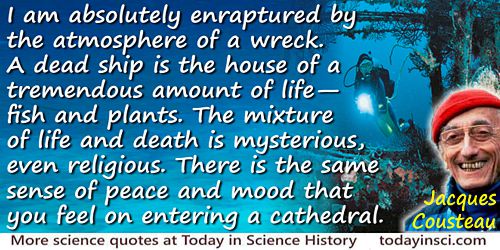
I am absolutely enraptured by the atmosphere of a wreck. A dead ship is the house of a tremendous amount of life—fish and plants. The mixture of life and death is mysterious, even religious. There is the same sense of peace and mood that you feel on entering a cathedral.
Quoted in 'Sport: Poet of the Depths', Time (28 Mar 1960)
I believe that the Dayton trial marked the beginning of the decline of fundamentalism. … I feel that restrictive legislation on academic freedom is forever a thing of the past, that religion and science may now address one another in an atmosphere of mutual respect and of a common quest for truth. I like to think that the Dayton trial had some part in bringing to birth this new era.
From 'Reflections—Forty Years After', in Jerry R. Tompkins (ed.), D-Days at Dayton: Reflections on the Scopes Trial(1965), 31. As quoted in Stephen Jay Gould, Hen’s Teeth and Horse’s Toes: Further Reflections in Natural History (1983), 274.
I have a peculiar theory about radium, and I believe it is the correct one. I believe that there is some mysterious ray pervading the universe that is fluorescing to it. In other words, that all its energy is not self-constructed but that there is a mysterious something in the atmosphere that scientists have not found that is drawing out those infinitesimal atoms and distributing them forcefully and indestructibly.
Quoted in 'Edison Fears Hidden Perils of the X-Rays', New York World (3 Aug 1903), 1.
I have been driven to assume for some time, especially in relation to the gases, a sort of conducting power for magnetism. Mere space is Zero. One substance being made to occupy a given portion of space will cause more lines of force to pass through that space than before, and another substance will cause less to pass. The former I now call Paramagnetic & the latter are the diamagnetic. The former need not of necessity assume a polarity of particles such as iron has with magnetic, and the latter do not assume any such polarity either direct or reverse. I do not say more to you just now because my own thoughts are only in the act of formation, but this I may say: that the atmosphere has an extraordinary magnetic constitution, & I hope & expect to find in it the cause of the annual & diurnal variations, but keep this to yourself until I have time to see what harvest will spring from my growing ideas.
Letter to William Whewell, 22 Aug 1850. In L. Pearce Williams (ed.), The Selected Correspondence of Michael Faraday (1971), Vol. 2, 589.
I have flown twice over Mount St. Helens out on our West Coast. I'm not a scientist and I don't know the figures, but I have a suspicion that that one little mountain has probably released more sulfur dioxide into the atmosphere of the world than has been released in the last ten years of automobile driving or things of that kind that people are so concerned about.
Address in Steubenville, Ohio (7 Oct 1980). As quoted in Douglas E. Kneeland, 'Teamsters Back Republican', New York Times (10 Oct 1980), D14. The article also stated that according to an E.P.A. spokesman, “all American manmade emissions of sulfur dioxide amounted to 81,000 tons a day, and the emissions from the volcano ranged from 500 to 2,000 tons a day.”
I think it is a sad reflection on our civilization that while we can and do measure the temperature in the atmosphere of Venus we do not know what goes on inside our soufflés.
[Remark made while demonstrating the progress of cooking a Soufflé à la Chartreuse, demonstrating its progress with thermocouples and chart recorders.]
[Remark made while demonstrating the progress of cooking a Soufflé à la Chartreuse, demonstrating its progress with thermocouples and chart recorders.]
Friday Evening Discourse at the Royal Institution, ‘The Physicist in the Kitchen’. In Proceedings of the Royal Institution (1969), 42/199, 451–67. Cited in article on Kurti by Ralph G. Scurlock in Oxford Dictionary of National Biography.
I think it would be a very rash presumption to think that nowhere else in the cosmos has nature repeated the strange experiment which she has performed on earth—that the whole purpose of creation has been staked on this one planet alone. It is probable that dotted through the cosmos there are other suns which provide the energy for life to attendant planets. It is apparent, however, that planets with just the right conditions of temperature, oxygen, water and atmosphere necessary for life are found rarely.
But uncommon as a habitable planet may be, non-terrestrial life exists, has existed and will continue to exist. In the absence of information, we can only surmise that the chance that it surpasses our own is as good as that it falls below our level.
But uncommon as a habitable planet may be, non-terrestrial life exists, has existed and will continue to exist. In the absence of information, we can only surmise that the chance that it surpasses our own is as good as that it falls below our level.
As quoted by H. Gordon Garbedian in 'Ten Great Riddles That Call For Solution by Scientists', New York Times (5 Oct 1930), XX4. Garbedian gave no citation to a source for Shapley’s words. However, part of this quote is very similar to that of Sir Arthur Eddington: “It would indeed be rash to assume that nowhere else has Nature repeated the strange experiment which she has performed on the earth,” from 'Man’s Place in the Universe', Harper’s Magazine (Oct 1928), 157 573.
I will not now discuss the Controversie betwixt some of the Modern Atomists, and the Cartesians; the former of whom think, that betwixt the Earth and the Stars, and betwixt these themselves there are vast Tracts of Space that are empty, save where the beams of Light do pass through them; and the later of whom tell us, that the Intervals betwixt the Stars and Planets (among which the Earth may perhaps be reckon'd) are perfectly fill'd, but by a Matter far subtiler than our Air, which some call Celestial, and others Æther. I shall not, I say, engage in this controversie, but thus much seems evident, That If there be such a Celestial Matter, it must ' make up far the Greatest part of the Universe known to us. For the Interstellar part of the world (If I may so stile it) bears so very great a proportion to the Globes, and their Atmospheres too, (If other Stars have any as well as the Earth,) that It Is almost incomparably Greater in respect of them, than all our Atmosphere is in respect of the Clouds, not to make the comparison between the Sea and the Fishes that swim in it.
A Continuation of New Experiments Physico-Mechanical, Touching the Spring and Weight of the Air, and their Effects (1669), 127.
If a man would be alone, let him look at the stars. … One might think the atmosphere was made transparent with this design, to give man, in the heavenly bodies, the perpetual presence of the sublime.
In 'Nature', The Prose Works of Ralph Waldo Emerson (1870), Vol. 1, Chap 1, 7.
If Lovelock hadn’t detected those CFCs [in the atmosphere above Antarctica] we’d all be living under the ocean in snorkels and fins to escape that poisonous sun.
As quoted in Jeff Goodell, How to Cool the Planet: Geoengineering and the Audacious Quest to Fix Earth’s Climate (2010), 95. Goodell noted that Nobel Prize-winning scientists Rowland and Molina hypothesized that sunlight split apart CFC molecules, releasing reactive chlorine atoms, that would burn a hole in the protective ozone layer of the atmosphere, increasing danger from more ultraviolet light penetrating to the earth. When the ozone hole was experimentally verified over Antarctica, the potential destruction to the planet on a grand scale was realized, CFCs were banned, and ozone depletion was halted. Rowland and Molina shared a 1995 Nobel Prize. Although earlier, Lovelock had recognized “no conceivable hazard” from CFCs in the earth’s atmosphere, he was nevertheless the first to detect them in the atmosphere over Antarctica. For this critical evidence, Lovelock was at least mentioned in the Nobel Prize press release.
If we imagine an observer to approach our planet from outer space, and, pushing aside the belts of red-brown clouds which obscure our atmosphere, to gaze for a whole day on the surface of the earth as it rotates beneath him, the feature, beyond all others most likely to arrest his attention would be the wedge-like outlines of the continents as they narrow away to the South.
The Face of the Earth (1904), Vol. 1, 1.
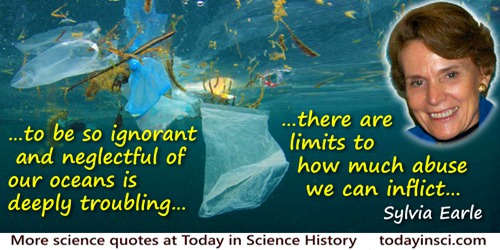
In a world that is rightly so concerned about climate change and the atmosphere, to be so ignorant and neglectful of our oceans is deeply troubling. However, … having woken up to this living disaster and having realized that there are limits to how much abuse we can inflict, it’s not too late to turn things around.
In 'Can We Stop Killing Our Oceans Now, Please?', Huffington Post (14 Aug 2013).
In discussing the state of the atmosphere following a nuclear exchange, we point especially to the effects of the many fires that would be ignited by the thousands of nuclear explosions in cities, forests, agricultural fields, and oil and gas fields. As a result of these fires, the loading of the atmosphere with strongly light absorbing particles in the submicron size range (1 micron = 10-6 m) would increase so much that at noon solar radiation at the ground would be reduced by at least a factor of two and possibly a factor of greater than one hundred.
Paul J. Crutzen -and John W. Birks (1946-, American chemist), 'The Atmosphere after a Nuclear War: Twilight at Noon', Ambio, 1982, 11, 115.
In fact, the thickness of the Earth's atmosphere, compared with the size of the Earth, is in about the same ratio as the thickness of a coat of shellac on a schoolroom globe is to the diameter of the globe. That's the air that nurtures us and almost all other life on Earth, that protects us from deadly ultraviolet light from the sun, that through the greenhouse effect brings the surface temperature above the freezing point. (Without the greenhouse effect, the entire Earth would plunge below the freezing point of water and we'd all be dead.) Now that atmosphere, so thin and fragile, is under assault by our technology. We are pumping all kinds of stuff into it. You know about the concern that chlorofluorocarbons are depleting the ozone layer; and that carbon dioxide and methane and other greenhouse gases are producing global warming, a steady trend amidst fluctuations produced by volcanic eruptions and other sources. Who knows what other challenges we are posing to this vulnerable layer of air that we haven't been wise enough to foresee?
In 'Wonder and Skepticism', Skeptical Enquirer (Jan-Feb 1995), 19, No. 1.
In science, attempts at formulating hierarchies are always doomed to eventual failure. A Newton will always be followed by an Einstein, a Stahl by a Lavoisier; and who can say who will come after us? What the human mind has fabricated must be subject to all the changes—which are not progress—that the human mind must undergo. The 'last words' of the sciences are often replaced, more often forgotten. Science is a relentlessly dialectical process, though it suffers continuously under the necessary relativation of equally indispensable absolutes. It is, however, possible that the ever-growing intellectual and moral pollution of our scientific atmosphere will bring this process to a standstill. The immense library of ancient Alexandria was both symptom and cause of the ossification of the Greek intellect. Even now I know of some who feel that we know too much about the wrong things.
Voices in the Labyrinth: Nature, Man, and Science (1979), 46.
In the celestial spaces above the Earth’s atmosphere; in which spaces, where there is no air to resist their motions, all bodies will move with the greatest freedom; and the Planets and Comets will constantly pursue their revolutions in orbits … by the mere laws of gravity.
In 'General Scholium' from The Mathematical Principles of Natural Philosophy (1729), Vol. 2, Book 3, 388.
In the early days of dealing with climate change, I wouldn’t go out on a limb one way or another, because I don’t have the qualifications there. But I do have the qualifications to measure the scientific community and see what the consensus is about climate change. I remember the moment when I suddenly thought it was incontrovertible. There was a lecture given by a distinguished American expert in atmospheric science and he showed a series of graphs about the temperature changes in the upper atmosphere. He plotted time against population growth and industrialisation. It was incontrovertible, and once you think it’s really totally incontrovertible, then you have a responsibility to say so.
From interview with Brian Cox and Robert Ince, in 'A Life Measured in Heartbeats', New Statesman (21 Dec 2012), 141, No. 5138, 32.
In the infancy of physical science, it was hoped that some discovery might be made that would enable us to emancipate ourselves from the bondage of gravity, and, at least, pay a visit to our neighbour the moon. The poor attempts of the aeronaut have shewn the hopelessness of the enterprise. The success of his achievement depends on the buoyant power of the atmosphere, but the atmosphere extends only a few miles above the earth, and its action cannot reach beyond its own limits. The only machine, independent of the atmosphere, we can conceive of, would be one on the principle of the rocket. The rocket rises in the air, not from the resistance offered by the atmosphere to its fiery stream, but from the internal reaction. The velocity would, indeed, be greater in a vacuum than in the atmosphere, and could we dispense with the comfort of breathing air, we might, with such a machine, transcend the boundaries of our globe, and visit other orbs.
God's Glory in the Heavens (1862, 3rd Ed. 1867) 3-4.
In using the present in order to reveal the past, we assume that the forces in the world are essentially the same through all time; for these forces are based on the very nature of matter, and could not have changed. The ocean has always had its waves, and those waves have always acted in the same manner. Running water on the land has ever had the same power of wear and transportation and mathematical value to its force. The laws of chemistry, heat, electricity, and mechanics have been the same through time. The plan of living structures has been fundamentally one, for the whole series belongs to one system, as much almost as the parts of an animal to the one body; and the relations of life to light and heat, and to the atmosphere, have ever been the same as now.
In 'Introduction', Manual of Geology: Treating of the Principles of the Science (1863), 7.
It is only necessary to check the comic books and Reader’s Digest to see the extent of the influence of applied science on the popular imagination. How much it is used to provide an atmosphere of endless thrill and excitement, quite apart from its accidental menace or utility, one can decide from such typical daily headlines as these:
London, March 10, 1947, Reuters: ROCKET TO MOON SEEN POSSIBLE BUT THOUSANDS TO DIE IN ATTEMPT
Cleveland, January 5, 1948.: LIFE SPAN OF 100, BE YOUNG AT 80, ATOM PREDICTION
Washington, June 11, 1947: SCIENTISTS AWAIT COW’S DEATH TO SOLVE MATHEMATICS PROBLEM
Needham Market, Suffolk, England. (U.P.): VICAR PROPOSES BABIES FOR YEARNING SPINSTERS, TEST-TUBE BABIES WILL PRODUCE ROBOTS
Washington, D.C., January 3, 1948. U.S. FLYER PASSING SONIC BARRIER OPENS NEW VISTAS OF DESTRUCTION ONE OF BRAVEST ACTS IN HISTORY
Those headlines represent “human interest” attempts to gear science to the human nervous system.
London, March 10, 1947, Reuters: ROCKET TO MOON SEEN POSSIBLE BUT THOUSANDS TO DIE IN ATTEMPT
Cleveland, January 5, 1948.: LIFE SPAN OF 100, BE YOUNG AT 80, ATOM PREDICTION
Washington, June 11, 1947: SCIENTISTS AWAIT COW’S DEATH TO SOLVE MATHEMATICS PROBLEM
Needham Market, Suffolk, England. (U.P.): VICAR PROPOSES BABIES FOR YEARNING SPINSTERS, TEST-TUBE BABIES WILL PRODUCE ROBOTS
Washington, D.C., January 3, 1948. U.S. FLYER PASSING SONIC BARRIER OPENS NEW VISTAS OF DESTRUCTION ONE OF BRAVEST ACTS IN HISTORY
Those headlines represent “human interest” attempts to gear science to the human nervous system.
In The Mechanical Bride: Folklore of Industrial Man (1967), 93.
It is something to be able to paint a particular picture or to carve a statue and so to make a few objects beautiful; but it is far more glorious to carve and paint the very atmosphere and medium through which we look, which morally we can do. To affect the quality of the day, that is the highest of arts.
In Walden: or, Life in the Woods (1854, 1893), 143.
It is the destiny of wine to be drunk, and it is the destiny of glucose to be oxidized. But it was not oxidized immediately: its drinker kept it in his liver for more than a week, well curled up and tranquil, as a reserve aliment for a sudden effort; an effort that he was forced to make the following Sunday, pursuing a bolting horse. Farewell to the hexagonal structure: in the space of a few instants the skein was unwound and became glucose again, and this was dragged by the bloodstream all the way to a minute muscle fiber in the thigh, and here brutally split into two molecules of lactic acid, the grim harbinger of fatigue: only later, some minutes after, the panting of the lungs was able to supply the oxygen necessary to quietly oxidize the latter. So a new molecule of carbon dioxide returned to the atmosphere, and a parcel of the energy that the sun had handed to the vine-shoot passed from the state of chemical energy to that of mechanical energy, and thereafter settled down in the slothful condition of heat, warming up imperceptibly the air moved by the running and the blood of the runner. 'Such is life,' although rarely is it described in this manner: an inserting itself, a drawing off to its advantage, a parasitizing of the downward course of energy, from its noble solar form to the degraded one of low-temperature heat. In this downward course, which leads to equilibrium and thus death, life draws a bend and nests in it.
The Periodic Table (1975), trans. Raymond Rosenthal (1984), 192-3.
It is to heat that should be attributed the vast movements observed on the Earth; the disturbances of the atmosphere are due to heat, the arising of clouds, the fall of rains and other aspects of weather, the currents of water crisscrossing the globe’s surface of which man manages to harness a small fraction; finally, earthquakes and volcanic eruptions are also caused by heat.
As translated by Webmaster from the original French: “C’est à la chaleur que doivent être attribués les grands mouvements qui frappent nos regards sur la terre; c’est à elle que sont dues les agitations de l’atmosphère, l’ascension des nuages, la chute des pluies et des autres météores, les courants d’eau qui sillonnent la surface du globe et dont l’homme est parvenue à employer pour son usage une faible partie; enfin les tremblements de terre, les éruptions volcaniques reconnaissent aussi pour cause la chaleur.” From Réflexions sur la Puissance Motrice du Feu et sur les Machines Propres a Développer cette Puissance (1824, 1878), 1-2. Also in N.-L.-S. Carnot and R. H. Thurston (ed.), Reflections on the Motive Power of Heat and on Machines Fitted to Develop That Power (1890, 2nd ed. 1897), 11 (in French), and 37-38 (in English) as: “To heat also are due the vast movements which take place on the earth. It causes the agitations of the atmosphere, the ascension of clouds, the fall of rain and of meteors*, the currents of water which channel the surface of the globe, and of which man has thus far employed but a small portion. Even earthquakes and volcanic eruptions are the result of heat.” [*Note the obsolete term “meteors” meaning atmospheric or meteorological phenomena, and does not refer here to rocks falling from space. —Webmaster]
It will be possible in a few more years to build radio controlled rockets which can be steered into such orbits beyond the limits of the atmosphere and left to broadcast scientific information back to the Earth. A little later, manned rockets will be able to make similar flights with sufficient excess power to break the orbit and return to Earth. (1945) [Predicting communications satellites.]
In 'Can Rocket Stations Give Worldwide Coverage?', Wireless World (Oct 1945). Quoted and cited in Arthur C. Clarke, Greetings, Carbon-Based Bipeds!: Collected Essays, 1934-1998, 21.
It will, perhaps appear probable, that one of the great laboratories of nature for cleaning and purifying the air of our atmosphere is placed in the substance of the leaves, and put in action by the influence of the light.
In Tobias George Smollett (ed.), 'Experiments Upon Vegetables', The Critical Review, Or, Annals of Literature (1779), 48, 336.
Jupiter is the largest of all the solar system’s planets, more than ten times bigger and three hundred times as massive as Earth. Jupiter is so immense it could swallow all the other planets easily. Its Great Red Spot, a storm that has raged for centuries, is itself wider than Earth. And the Spot is merely one feature visible among the innumerable vortexes and streams of Jupiter’s frenetically racing cloud tops. Yet Jupiter is composed mainly of the lightest elements, hydrogen and helium, more like a star than a planet. All that size and mass, yet Jupiter spins on its axis in less than ten hours, so fast that the planet is clearly not spherical: Its poles are noticeably flattened. Jupiter looks like a big, colorfully striped beach ball that’s squashed down as if some invisible child were sitting on it. Spinning that fast, Jupiter’s deep, deep atmosphere is swirled into bands and ribbons of multihued clouds: pale yellow, saffron orange, white, tawny yellow-brown, dark brown, bluish, pink and red. Titanic winds push the clouds across the face of Jupiter at hundreds of kilometers per hour.
— Ben Bova
Jupiter
Knowing he [Bob Serber] was going to the [first atom bomb] test, I asked him how he planned to deal with the danger of rattlesnakes. He said, “I’ll take along a bottle of whiskey.” … I ended by asking, “What would you do about those possibilities [of what unknown phenomena might cause a nuclear explosion to propagate in the atmosphere]?” Bob replied, “Take a second bottle of whiskey.”
Edward Teller with Judith L. Shoolery, Memoirs: A Twentieth-Century Journey in Science and Politics (2001), 211.
Let the mind rise from victory to victory over surrounding nature, let it but conquer for human life and activity not only the surface of the earth but also all that lies between the depth of the sea and the outer limits of the atmosphere; let it command for its service prodigious energy to flow from one part of the universe to the other, let it annihilate space for the transference of its thoughts.
In Ivan Pavlov and William Horsley Gantt (trans.), Lectures on Conditioned Reflexes (1928, 1941), Preface, 41.
Life can be thought of as water kept at the right temperature in the right atmosphere in the right light for a long enough period of time.
You and The Universe (1958), 145.
Man has generally been preoccupied with obtaining as much “production” from the landscape as possible, by developing and maintaining early successional types of ecosystems, usually monocultures. But, of course, man does not live by food and fiber alone; he also needs a balanced CO2-O2 atmosphere, the climactic buffer provided by oceans and masses of vegetation, and clean (that is, unproductive) water for cultural and industrial uses. Many essential life-cycle resources, not to mention recreational and esthetic needs, are best provided man by the less 'productive' landscapes. In other words, the landscape is not just a supply depot but is also the oikos—the home—in which we must live.
'The Strategy of Ecosystem Development. An Understanding of Ecological Succession Provides a Basis for Resolving Man's Conflict with Nature', Science (1969), 164, 266.
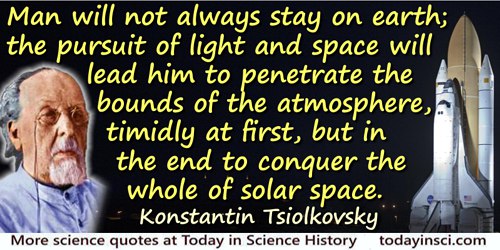
Man will not always stay on earth; the pursuit of light and space will lead him to penetrate the bounds of the atmosphere, timidly at first, but in the end to conquer the whole of solar space.
Epitaph he wrote for himself, engraved in bronze letters on the tall grey stone obelisk raised over his grave. As translated by Kenneth Syers and given in the English edition, Beyond the Planet Earth (1960) of K. Tsiolkovsky’s original Russian book (1920). Also seen translated as, “Mankind will not remain on the earth forever, but, in search of light and space, will at first timidly penetrate beyond the limits of the atmosphere and then finally conquer the spaces of the solar system.”
Mankind will not remain on Earth forever, but in its quest for light and space will at first timidly penetrate beyond the confines of the atmosphere, and later will conquer for itself all the space near the Sun.
…...
Men are weak now, and yet they transform the Earth’s surface. In millions of years their might will increase to the extent that they will change the surface of the Earth, its oceans, the atmosphere, and themselves. They will control the climate and the Solar System just as they control the Earth. They will travel beyond the limits of our planetary system; they will reach other Suns, and use their fresh energy instead of the energy of their dying luminary.
In Plan of Space Exploration (1926). Quote as translated in Vitaliĭ Ivanovich Sevastʹi︠a︡nov, Arkadiĭ Dmitrievich Ursul, I︠U︡riĭ Andreevich Shkolenko, The Universe and Civilisation (1981), 104.
Meteorology has ever been an apple of contention, as if the violent commotions of the atmosphere induced a sympathetic effect on the minds of those who have attempted to study them.
'Meteorology in its Connection with Agriculture', US Patent Office Annual Report Agricultural, 1858. In J. R. Fleming, Meteorology in America: 1800-1870 (1990), 23.
Methane is released by bogs, and some 45 million tons of the same gas, it has been calculated, are added to the atmosphere each year by the venting of intestinal gases by cattle and other large animals.
In The Intelligent Man's Guide to the Physical Sciences (1960, 1968), 120. Also in Isaac Asimov’s Book of Science and Nature Quotations (1988), 155.
My earliest impressions of wildlife and its pursuit retain a vivid sharpness of form, color, and atmosphere that half a century of professional wildlife experience has failed to obliterate or improve on.
In 'Red Legs Kicking', A Sand County Almanac, and Sketches Here and There (1949, 1987), 120.
Our atom of carbon enters the leaf, colliding with other innumerable (but here useless) molecules of nitrogen and oxygen. It adheres to a large and complicated molecule that activates it, and simultaneously receives the decisive message from the sky, in the flashing form of a packet of solar light; in an instant, like an insect caught by a spider, it is separated from its oxygen, combined with hydrogen and (one thinks) phosphorus, and finally inserted in a chain, whether long or short does not matter, but it is the chain of life. All this happens swiftly, in silence, at the temperature and pressure of the atmosphere, and gratis: dear colleagues, when we learn to do likewise we will be sicut Deus [like God], and we will have also solved the problem of hunger in the world.
Levi Primo and Raymond Rosenthal (trans.), The Periodic Table (1975, 1984), 227-228. In this final section of his book, Levi imagines the life of a carbon atom. He calls this his first “literary dream”. It came to him at Auschwitz.
Scientists themselves readily admit that they do not fully understand the consequences of our many-faceted assault upon the interwoven fabric of atmosphere, water, land and life in all its biological diversity. But things could also turn out to be worse than the current scientific best guess. In military affairs, policy has long been based on the dictum that we should be prepared for the worst case. Why should it be so different when the security is that of the planet and our long-term future?
Speech, 'Global Security Lecture' at Cambridge University (28 Apr 1993).
Since the discovery of oxygen the civilised world has undergone a revolution in manners and customs. The knowledge of the composition of the atmosphere, of the solid crust of the earth, of water, and of their influence upon the life of plants and animals, was linked to that discovery. The successful pursuit of innumerable trades and manufactures, the profitable separation of metals from their ores, also stand in the closest connection therewith.
Familiar Letters on Chemistry (1851), 5.
Standing beside each other, we feasted our eyes. Above us the cerulean sky deepened to an inky black as the remnants of the atmosphere gave way to the depths of space. The mighty Himalaya were now a sparkling relief map spread out before us and garnished with a gleaming lattice work of swirling glaciers. Even Cho Oyu, Lhotse and Makalu, all 8,000-meter giants, were dwarfed. To the east and west, Kanchenjunga and Shishapangma, two more great sentinels of the Himalaya, stood crystal clear over 100 kilometers away. To the north were the burnished plains of Tibet, and to the south the majestic peaks and lush foothills of Nepal. We stood on the crown jewel of the earth, the curved horizon spinning endlessly around us.
— Jo Gambi
…...
Such an atmosphere is un-American, the most un-American thing we have to contend with today. It is the climate of a totalitarian country in which scientists are expected to change their theories to match changes in the police state's propaganda line.
[Stinging rebuke of J. Parnell Thomas, Chairman, House Committee on Un-American activities, who had attacked Dr. Condon (1 Mar 1948) as a weak link in American atomic security.]
[Stinging rebuke of J. Parnell Thomas, Chairman, House Committee on Un-American activities, who had attacked Dr. Condon (1 Mar 1948) as a weak link in American atomic security.]
Opening address (13 Sep 1953) at the annual meeting of the American Association for the Advancement of Science where Condon would be elected as the new AAAS president. Obituary, New York Times (27 Mar 1974), 46.
Sylvester was incapable of reading mathematics in a purely receptive way. Apparently a subject either fired in his brain a train of active and restless thought, or it would not retain his attention at all. To a man of such a temperament, it would have been peculiarly helpful to live in an atmosphere in which his human associations would have supplied the stimulus which he could not find in mere reading. The great modern work in the theory of functions and in allied disciplines, he never became acquainted with …
What would have been the effect if, in the prime of his powers, he had been surrounded by the influences which prevail in Berlin or in Gottingen? It may be confidently taken for granted that he would have done splendid work in those domains of analysis, which have furnished the laurels of the great mathematicians of Germany and France in the second half of the present century.
What would have been the effect if, in the prime of his powers, he had been surrounded by the influences which prevail in Berlin or in Gottingen? It may be confidently taken for granted that he would have done splendid work in those domains of analysis, which have furnished the laurels of the great mathematicians of Germany and France in the second half of the present century.
In Address delivered at a memorial meeting at the Johns Hopkins University (2 May 1897), published in Bulletin of the American Mathematical Society (Jun 1897), 303. Also in Johns Hopkins University Circulars, 16 (1897), 54.
That there is a Spring, or Elastical power in the Air we live in. By which ελατνρ [elater] or Spring of the Air, that which I mean is this: That our Air either consists of, or at least abounds with, parts of such a nature, that in case they be bent or compress'd by the weight of the incumbent part of the Atmosphere, or by any other Body, they do endeavour, as much as in them lies, to free themselves from that pressure, by bearing against the contiguous Bodies that keep them bent.
New Experiments Physico-Mechanical Touching the Spring of the Air (1660), 22.
The atmosphere is much too near for dreams. It forces us to action. It is close to us. We are in it and of it. It rouses us both to study and to do. We must know its moods and also its motive forces.
From Address (16 Mar 1909) at Columbia University, printed in 'Meteorology of the Future', Popular Science Monthly (Dec 1910), 78, 22.
The attitude which the man in the street unconsciously adopts towards science is capricious and varied. At one moment he scorns the scientist for a highbrow, at another anathematizes him for blasphemously undermining his religion; but at the mention of a name like Edison he falls into a coma of veneration. When he stops to think, he does recognize, however, that the whole atmosphere of the world in which he lives is tinged by science, as is shown most immediately and strikingly by our modern conveniences and material resources. A little deeper thinking shows him that the influence of science goes much farther and colors the entire mental outlook of modern civilised man on the world about him.
Reflections of a Physicist (1950), 81.
The Aurora borealis may now become connected with magnetic disturbances and storms in a very distinct manner and if the variations of the atmosphere cause both, it will also tie both together by a common hub.
In 'The Scientific Grammar of Michael Faraday’s Diaries', Part I, 'The Classic of Science', A Classic and a Founder (1937), collected in Rosenstock-Huessy Papers (1981), Vol. 1, 10.
The bottom of the sea is the great laboratory, where loose materials are mineralized and formed into stone, the atmosphere is the region where stones are decomposed, and again resolved into earth.
In The Works of John Playfair: Vol. 1: Illustrations of the Huttonian Theory of the Earth (1822), 109.
The carbon output that melts the ice in the Arctic also causes ocean acidification, which results from the ocean absorbing excess carbon dioxide from the atmosphere (the same carbon dioxide that is the primary cause of global warming, hence the nickname “the other carbon problem”).
In 'What do the Arctic, a Thermostat and COP15 Have in Common?', Huffington Post (18 Mar 2010).
The climate of Colorado contains more of the essential elements which effectively promote health than that of any other country. These requisites are found in the chemical composition of the atmosphere; in the dry, pure, clean, soft, yet stimulating breezes which quicken circulation and multiply the corpuscles of the blood; in the tonic effect and exhilarating influence of the ozone; in the flood of its life-giving germ-destroying sunshine …
From F.H. Faus, 'Pike’s Peak Region Calls', Rock Island Magazine (Aug 1920), 15, No. 8, 4.
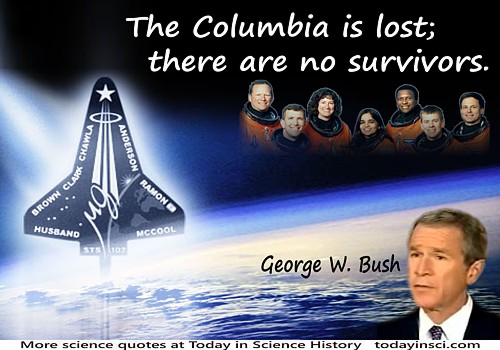
The Columbia is lost; there are no survivors. … In an age when space flight has come to seem almost routine, it is easy to overlook the dangers of travel by rocket, and the difficulties of navigating the fierce outer atmosphere of the Earth. These astronauts knew the dangers, and they faced them willingly, knowing they had a high and noble purpose in life. Because of their courage and daring idealism, we will miss them all the more. … The cause in which they died will continue. Mankind is led into the darkness beyond our world by the inspiration of discovery and the longing to understand. Our journey into space will go on.
Address to the Nation on the Space Shuttle Columbia tragedy, from the Cabinet Room (1 Feb 2003). In William J. Federer, A Treasury of Presidential Quotations (2004), 437.
The earth and its atmosphere constitute a vast distilling apparatus in which the equatorial ocean plays the part of the boiler, and the chill regions of the poles the part of the condenser. In this process of distillation heat plays quite as necessary a part as cold.
In Forms of Water in Clouds and Rivers, Ice and Glaciers (1872), 21.
The earth’s atmosphere is an imperfect window on the universe. Electromagnetic waves in the optical part of the spectrum (that is, waves longer than X rays and shorter than radio waves) penetrate to the surface of the earth only in a few narrow spectral bands. The widest of the transmitted bands corresponds roughly to the colors of visible light; waves in the flanking ultraviolet and infrared regions of the optical spectrum are almost totally absorbed by the atmosphere. In addition, atmospheric turbulence blurs the images of celestial objects, even when they are viewed through the most powerful ground-based telescopes.
in an article promoting the construction of the Hubble Space Telescope
in an article promoting the construction of the Hubble Space Telescope
Scientific American (July 1977)
The entire range of living matter on Earth from whales to viruses and from oaks to algae could be regarded as constituting a single living entity capable of maintaining the Earth’s atmosphere to suit its overall needs and endowed with faculties and powers far beyond those of its constituent parts.
In Gaia: A New Look at Life on Earth (1979), 9.
The Gaia Hypothesis asserts that Earth’s atmosphere is continually interacting with geology (the lithosphere). Earth’s cycling waters (the hydrosphere), and everything that lives (the biosphere). … The image is that the atmosphere is a circulatory system for life’s bio-chemical interplay. If the atmosphere is pan of a larger whole that has some of the qualities of an organism, one of those qualities we must now pray for is resilience.
In Praise of Nature
The great rapidity with which we add carbon gases to the air is as damaging as is the quantity.
From Lecture at the Royal Society, 'Climate Change on a Living Earth' (29 Oct 2007). As quoted on jameslovelock.org website.

The greater the man, the more he is soaked in the atmosphere of his time; only thus can he get a wide enough grasp of it to be able to change substantially the pattern of knowledge and action.
Science in History (1954), 22.
The highway system devours land resources and atmosphere at a rate that is impossible to sustain.
(1972).
The ionosphere had been critical in the development of atomic and molecular physics. … The upper regions of the atmosphere are a rich showcase of phenomena based on non-equilibrium energy distributions for both protons and electrons.
From 'Edward Uhler Condon, A Personal Recollection', presented at the Fourth International Conference on Atomic Physics, published in the Proceedings of this conference by G. zu Pulitz et al. (eds.), Atomic Physics (1975), Vol. 4, as collected in Asim O. Barut, Halis Odabasi and Alwyn van der Merwe (eds.), Selected Popular Writings of E.U. Condon (1991), 2.
The more important fundamental laws and facts of physical science have all been discovered, and these are now so firmly established that the possibility of their ever being supplanted in consequence of new discoveries is exceedingly remote. Nevertheless, it has been found that there are apparent exceptions to most of these laws, and this is particularly true when the observations are pushed to a limit, i.e., whenever the circumstances of experiment are such that extreme cases can be examined. Such examination almost surely leads, not to the overthrow of the law, but to the discovery of other facts and laws whose action produces the apparent exceptions. As instances of such discoveries, which are in most cases due to the increasing order of accuracy made possible by improvements in measuring instruments, may be mentioned: first, the departure of actual gases from the simple laws of the so-called perfect gas, one of the practical results being the liquefaction of air and all known gases; second, the discovery of the velocity of light by astronomical means, depending on the accuracy of telescopes and of astronomical clocks; third, the determination of distances of stars and the orbits of double stars, which depend on measurements of the order of accuracy of one-tenth of a second-an angle which may be represented as that which a pin's head subtends at a distance of a mile. But perhaps the most striking of such instances are the discovery of a new planet or observations of the small irregularities noticed by Leverrier in the motions of the planet Uranus, and the more recent brilliant discovery by Lord Rayleigh of a new element in the atmosphere through the minute but unexplained anomalies found in weighing a given volume of nitrogen. Many other instances might be cited, but these will suffice to justify the statement that “our future discoveries must be looked for in the sixth place of decimals.”
In Light Waves and Their Uses (1903), 23-4. Michelson had some years earlier referenced “an eminent physicist” that he did not name who had “remarked that the future truths of physical science are to be looked for in the sixth place of decimals,” near the end of his Convocation Address at the Dedication of the Ryerson Physical Laboratory at the University of Chicago, 'Some of the Objects and Methods of Physical Science' (4 Jul 1894), published in University of Chicago Quarterly Calendar (Aug 1894), 3, No.2, 15. Also
The most striking impression was that of an overwhelming bright light. I had seen under similar conditions the explosion of a large amount—100 tons—of normal explosives in the April test, and I was flabbergasted by the new spectacle. We saw the whole sky flash with unbelievable brightness in spite of the very dark glasses we wore. Our eyes were accommodated to darkness, and thus even if the sudden light had been only normal daylight it would have appeared to us much brighter than usual, but we know from measurements that the flash of the bomb was many times brighter than the sun. In a fraction of a second, at our distance, one received enough light to produce a sunburn. I was near Fermi at the time of the explosion, but I do not remember what we said, if anything. I believe that for a moment I thought the explosion might set fire to the atmosphere and thus finish the earth, even though I knew that this was not possible.
In Enrico Fermi: Physicist (1970), 147.
The overwhelming astonishment, the queerest structure we know about so far in the whole universe, the greatest of all cosmological scientific puzzles, confounding all our efforts to comprehend it, is the earth. We are only now beginning to appreciate how strange and splendid it is, how it catches the breath, the loveliest object afloat around the sun, enclosed in its own blue bubble of atmosphere, manufacturing and breathing its own oxygen, fixing its own nitrogen from the air into its own soil, generating its own weather at the surface of its rain forests, constructing its own carapace from living parts: chalk cliffs, coral reefs, old fossils from earlier forms of life now covered by layers of new life meshed together around the globe, Troy upon Troy.
In Late Night Thoughts on Listening to Mahler’s Ninth Symphony (1984), 22-23.
The pressure of public opinion is like the pressure of the atmosphere; you can’t see it-but, all the same, it is sixteen pounds to the square inch.
As quoted in Brander Matthews, 'Unfamiliar Quotation', New York Times Book Review and Magazine (2 Apr 1922), 2. Matthews states “I am not certain that I can repeat it [as given above] in his exact words, but it is to this effect. … That sentence was minted by Lowell beyond all question. … I can recall where I got it. Nearly forty years ago … he was visited by Julian Hawthorne [who] wrote a long report” which included “good things” from his conversation with Lowell. The above quote was one of Lowell’s utterances.
The primary rocks, … I regard as the deposits of a period in which the earth’s crust had sufficiently cooled down to permit the existence of a sea, with the necessary denuding agencies,—waves and currents,—and, in consequence, of deposition also; but in which the internal heat acted so near the surface, that whatever was deposited came, matter of course, to be metamorphosed into semi-plutonic forms, that retained only the stratification. I dare not speak of the scenery of the period. We may imagine, however, a dark atmosphere of steam and vapour, which for age after age conceals the face of the sun, and through which the light of moon or star never penetrates; oceans of thermal water heated in a thousand centres to the boiling point; low, half-molten islands, dim through the log, and scarce more fixed than the waves themselves, that heave and tremble under the impulsions of the igneous agencies; roaring geysers, that ever and anon throw up their intermittent jets of boiling fluid, vapour, and thick steam, from these tremulous lands; and, in the dim outskirts of the scene, the red gleam of fire, shot forth from yawning cracks and deep chasms, and that bears aloft fragments of molten rock and clouds of ashes. But should we continue to linger amid a scene so featureless and wild, or venture adown some yawning opening into the abyss beneath, where all is fiery and yet dark,—a solitary hell, without suffering or sin,—we would do well to commit ourselves to the guidance of a living poet of the true faculty,—Thomas Aird and see with his eyes.
Lecture Sixth, collected in Popular Geology: A Series of Lectures Read Before the Philosophical Institution of Edinburgh, with Descriptive Sketches from a Geologist's Portfolio (1859), 297-298.
The production of heat alone is not sufficient to give birth to the impelling power: it is necessary that there should also be cold; without it the heat would be useless. And in fact, if we should find about us only bodies as hot as our furnaces, how can we condense steam? What should we do with it if once produced? We should not presume that we might discharge it into the atmosphere, as is done in some engines; the atmosphere would not receive it. It does receive it under the actual condition of things only because…it is at a lower temperature, otherwise it…would be already saturated.
As translated in Reflections on the Motive Power of Heat and on Machines Fitted to Develop Power (1890, Rev. 1897), 46-47. Edited by R. H. Thurston, from the original French, Réflexions sur la Puissance Motrice du Feu (1824).
The ratio of the expanded air to the volume of that left above the mercury before the experiment is the same as that of twenty-eight inches of mercury, which is the whole weight of the atmosphere, to the excess of twenty-eight inches over the height at which [the mercury] remains after the experiment. This makes known sufficiently for one to take it as a certain rule of nature that air is condensed in proportion to the weight with which it is charged.
'De la Nature l’Air', collected in Oeuvres (1717), 152.
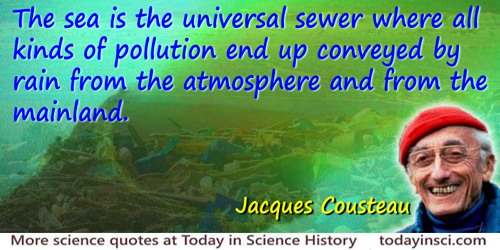
The sea is the universal sewer where all kinds of pollution end up conveyed by rain from the atmosphere and from the mainland.
Statement in testimony to the Twelfth Meeting With the Panel on Science and Technology (28 Jan 1971), printed in Proceedings Before the Committee on Science and Astronautics, U.S. House of Representatives, Ninety-Second Congress, First Session, No. 1 (1971), 325.
The sun's rays are the ultimate source of almost every motion which takes place on the surface of the earth. By their heat are produced all winds, and those disturbances in the electric equilibrium of the atmosphere which give rise to the phenomena of terrestrial magnetism. By their vivifying action vegetables are elaborated from inorganic matter, and become in their turn the support of animals and of man, and the sources of those great deposits of dynamical efficiency which are laid up for human use in our coal strata. By them the waters of the sea are made to circulate in vapor through the air, and irrigate the land, producing springs and rivers. By them are produced all disturbances of the chemical equilibrium of the elements of nature which, by a series of compositions and decompositions, give rise to new products, and originate a transfer of materials. Even the slow degradation of the solid constituents of the surface, in which its chief geological changes consist, and their diffusion among the waters of the ocean, are entirely due to the abrasion of the wind, rain, and tides, which latter, however, are only in part the effect of solar influence and the alternate action of the seasons.
from Outlines of Astronomy (1849), 237.
The term ‘community’ implies a diversity but at the same time a certain organized uniformity in the units. The units are the many individual plants that occur in every community, whether this be a beech-forest, a meadow, or a heath. Uniformity is established when certain atmospheric, terrestrial, and any of the other factors discussed in Section I are co-operating, and appears either because a certain, defined economy makes its impress on the community as a whole, or because a number of different growth-forms are combined to form a single aggregate which has a definite and constant guise.
Oecology of Plants: An Introduction to the Study of Plant Communities (1909), 91-92.
The thoughts of Plato and Machiavelli... don't seem quite enough armor for a world beset with splitting the atoms, urban guerrillas, nineteen varieties of psychotherapists, amplified guitars, napalm, computers, astronauts, and an atmosphere polluted simultaneously with auto exhaust and TV commercials.
The university imparts information, but it imparts it imaginatively. At least, this is the function which it should perform for society. A university which fails in this respect has no reason for existence. This atmosphere of excitement, arising from imaginative consideration, transforms knowledge. A fact is no longer a bare fact: it is invested with all its possibilities. It is no longer a bur. den on the memory: it is energising as the poet of our dreams, and as the architect of our purposes.
In 'Universities and Their Function', The Aims of Education: & Other Essays (1917), 139.
The vacuum-apparatus requires that its manipulators constantly handle considerable amounts of mercury. Mercury is a strong poison, particularly dangerous because of its liquid form and noticeable volatility even at room temperature. Its poisonous character has been rather lost sight of during the present generation. My co-workers and myself found from personal experience-confirmed on many sides when published—that protracted stay in an atmosphere charged with only 1/100 of the amount of mercury required for its saturation, sufficed to induce chronic mercury poisoning. This first reveals itself as an affection of the nerves, causing headaches, numbness, mental lassitude, depression, and loss of memory; such are very disturbing to one engaged in intellectual occupations.
Hydrides of Boron and Silicon (1933), 203.

The value of fundamental research does not lie only in the ideas it produces. There is more to it. It affects the whole intellectual life of a nation by determining its way of thinking and the standards by which actions and intellectual production are judged. If science is highly regarded and if the importance of being concerned with the most up-to-date problems of fundamental research is recognized, then a spiritual climate is created which influences the other activities. An atmosphere of creativity is established which penetrates every cultural frontier. Applied sciences and technology are forced to adjust themselves to the highest intellectual standards which are developed in the basic sciences. This influence works in many ways: some fundamental students go into industry; the techniques which are applied to meet the stringent requirements of fundamental research serve to create new technological methods. The style, the scale, and the level of scientific and technical work are determined in pure research; that is what attracts productive people and what brings scientists to those countries where science is at the highest level. Fundamental research sets the standards of modern scientific thought; it creates the intellectual climate in which our modern civilization flourishes. It pumps the lifeblood of idea and inventiveness not only into the technological laboratories and factories, but into every cultural activity of our time. The case for generous support for pure and fundamental science is as simple as that.
In 'Why Pure Science?' in Bulletin of the Atomic Scientists, 1965.
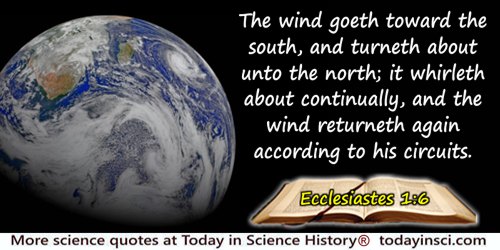
The wind goeth toward the south, and turneth about unto the north; it whirleth about continually, and the wind returneth again according to his circuits.
— Bible
King James Version, Ecclesiastes 1:6.
The world's forests need to be seen for what they are—giant global utilities, providing essential public services to humanity on a vast scale. They store carbon, which is lost to the atmosphere when they burn, increasing global warming. The life they support cleans the atmosphere of pollutants and feeds it with moisture. They act as a natural thermostat, helping to regulate our climate and sustain the lives of 1.4 billion of the poorest people on this Earth. And they do these things to a degree that is all but impossible to imagine.
Speech (25 Oct 2007) at the World Wildlife Fund gala dinner, Hampton Court Palace, announcing the Prince's Rainforests Project. On the Prince of Wales website.
There are, I believe, very few maxims in philosophy that have laid firmer hold upon the mind, than that air, meaning atmospherical air (free from various foreign matters, which were always supposed to be dissolved, and intermixed with it) is a simple elementary substance, indestructible, and unalterable, at least as much so as water is supposed to be. In the course of my enquiries, I was, however, soon satisfied that atmospherical air is not an unalterable thing; for that the phlogiston with which it becomes loaded from bodies burning in it, and animals breathing it, and various other chemical processes, so far alters and depraves it, as to render it altogether unfit for inflammation, respiration, and other purposes to which it is subservient; and I had discovered that agitation in water, the process of vegetation, and probably other natural processes, by taking out the superfluous phlogiston, restore it to its original purity.
'On Dephlogisticated Air, and the Constitution of the Atmosphere', in The Discovery of Oxygen, Part I, Experiments by Joseph Priestley 1775 (Alembic Club Reprint, 1894), 6.
There is no question that climate change is happening; the only arguable point is what part humans are playing in it. … Personally I would be absolutely astounded if population growth and industrialisation and all the stuff we are pumping into the atmosphere hadn’t changed the climatic balance. Of course it has. There is no valid argument for denial.
From interview with Nick Harding in 'Sir David Attenborough: ‘This awful summer? We've only ourselves to blame…’' The Independent (July 2012). On the website of independent.co.uk online.
Those who are finer and nobler are always alone — and necessarily so — and that because of this they can enjoy the purity of their own atmosphere.
Letter (5 Apr 1933). As quoted in Jamie Sayen, Einstein in America: The Scientist’s Conscience in the Age of Hitler and Hiroshima (1985), 12. This is part of Einstein’s reply to a letter from a troubled, unemployed musician, presumably living in Munich.
Those who nod sagely and quote the tragedy of the commons in relation to environmental problems from pollution of the atmosphere to poaching of national parks tend to forget that Garrett Hardin revised his conclusions many times…. He recognized, most importantly, that anarchy did not prevail on the common pastures of medieval England in the way he had described…. “A managed commons, though it may have other defects, is not automatically subject to the tragic fate of the unmanaged commons,” wrote Hardin…. At sea, where a common exists in most waters… None of Hardin’s requirements for a successfully managed common is fulfilled by high-seas fishery regimes.
In The End of the Line: How Overfishing is Changing the World and what We Eat (2004), 153-155.
Though much new light is shed by ... studies in radioactivity, the nucleus of the atom, with its hoard of energy, thus continues to present us with a fascinating mystery. ... Our assault on atoms has broken down the outer fortifications. We feel that we know the fundamental rules according to which the outer part of the atom is built. The appearance and properties of the electron atmosphere are rather familiar. Yet that inner citadel, the atomic nucleus, remains unconquered, and we have reason to believe that within this citadel is secreted a great treasure. Its capture may form the main objective of the physicists’ next great drive.
'Assault on Atoms' (Read 23 Apr 1931 at Symposium—The Changing World) Proceedings of the American Philosophical Society (1931), 70, No. 3, 229.
To make still bigger telescopes will be useless, for the light absorption and temperature variations of the earth’s atmosphere are what now limits the ability to see fine detail. If bigger telescopes are to be built, it will have to be for use in an airless observatory, perhaps an observatory on the moon.
(1965). In Isaac Asimov’s Book of Science and Nature Quotations (1988), 284.
To rest content with the bare enunciation of a truth, is to perform but one half of a task. As each atom of matter is involved in an atmosphere of properties and powers, which unites it to every mass of the universe, so each truth, however common it may be, is surrounded by impulses which, being awakened, pass from soul to soul like musical undulations, and which will be repeated through the echoes of space, and prolonged for all eternity.
In The Poetry of Science, Or: Studies of the Physical Phenomena of Nature (1848), xxii.
Unlike any creature that lived before, humans have become a geophysical force, swiftly changing the atmosphere and climate as well as the composition of the world’s fauna and flora. … Darwin’s dice have rolled badly for Earth.
In 'Is Humanity Suicidal?', In Search of Nature (1996), 184.
Until that afternoon, my thoughts on planetary atmospheres had been wholly concerned with atmospheric analysis as a method of life detection and nothing more. Now that I knew the composition of the Martian atmosphere was so different from that of our own, my mind filled with wonderings about the nature of the Earth. If the air is burning, what sustains it at a constant composition? I also wondered about the supply of fuel and the removal of the products of combustion. It came to me suddenly, just like a flash of enlightenment, that to persist and keep stable, something must be regulating the atmosphere and so keeping it at its constant composition. Moreover, if most of the gases came from living organisms, then life at the surface must be doing the regulation.
Homage to Gaia: The Life of an Independent Scholar (2000), 253.
We cannot hope to either understand or to manage the carbon in the atmosphere unless we understand and manage the trees and the soil too.
From From Eros to Gaia (1993). In Bill Swainson, Encarta Book of Quotations (2000), 299.
We have made many glass vessels... with tubes two cubits long. These were filled with mercury, the open end was closed with the finger, and the tubes were then inverted in a vessel where there was mercury. We saw that an empty space was formed and that nothing happened in the vessel where this space was formed ... I claim that the force which keeps the mercury from falling is external and that the force comes from outside the tube. On the surface of the mercury which is in the bowl rests the weight of a column of fifty miles of air. Is it a surprise that into the vessel, in which the mercury has no inclination and no repugnance, not even the slightest, to being there, it should enter and should rise in a column high enough to make equilibrium with the weight of the external air which forces it up?
Quoted in Archana Srinivasan, Great Inventors (2007), 27-28.
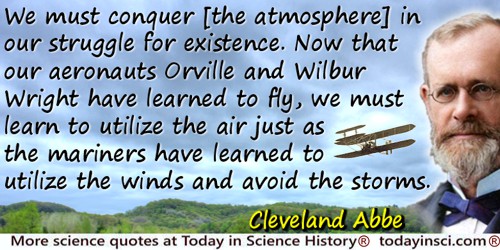
We must conquer [the atmosphere] in our struggle for existence. Now that our aeronauts Orville and Wilbur Wright have learned to fly, we must learn to utilize the air just as the mariners have learned to utilize the winds and avoid the storms.
From Address (16 Mar 1909) at Columbia University, printed in 'Meteorology of the Future', Popular Science Monthly (Dec 1910), 78, 22.
We need to think of “blue carbon” and other services provided by healthy marine ecosystems. Mangroves, seagrasses and coastal marshes are great sinks for atmospheric carbon.
From interview with Terry Waghorn, 'Can We Eat Our Fish and Protect Them Too?', Forbes (21 Feb 2012)
What parts of the interior or the atmosphere give rise to the various phenomena, or indeed, if these regions have any parts at all, are questions which we ask of the stars in vain.
In Modern Astrophysics (1924), 182.
Whatever plan of classification, founded on the natural relations of the elements, be adopted, in the practical study of chemistry, it will always be found most advantageous to commence with the consideration of the great constituents of the ocean and the atmosphere.
Introducing sections on oxygen and hydrogen, in Elementary Chemistry, Theoretical and Practical (1854), 104.
When [Humphry Davy] saw the minute globules of potassium burst through the crust of potash, and take fire as they entered the atmosphere, he could not contain his joy—he actually bounded about the room in ecstatic delight; some little time was required for him to compose himself to continue the experiment.
Quoted in Memoirs of the Life of Sir Humphry Davy, in J. Davy (ed.), The Collected Works of Sir Humphry Davy(1839-40), Vol 1, 109.
When air has been freshly and strongly tainted with putrefaction, so as to smell through the water, sprigs of mint have presently died, upon being put into it, their leaves turning black; but if they do not die presently, they thrive in a most surprizing manner. In no other circumstances have I ever seen vegetation so vigorous as in this kind of air, which is immediately fatal to animal life. Though these plants have been crouded in jars filled with this air, every leaf has been full of life; fresh shoots have branched out in various , and have grown much faster than other similiar plants, growing in the same exposure in common air.
This observation led me to conclude that plants, instead of affecting the air in the same manner with animal respiration, reverse the effects of breathing, and tend to keep the atmosphere sweet and wholesome, when it is become noxious, in consequence on animals living and breathing, or dying and putrefying in it.
In order to ascertain this, I took a quantity of air, made thoroughly noxious, by mice breathing and dying in it, and divided it into two parts; one of which I put into a phial immersed in water; and to the other (which was contained in a glass jar, standing in water) I put a sprig of mint. This was about the beginning of August 1771, and after eight or nine days, I found that a mouse lived perfectly well in that part of the air, in which the sprig of mint had grown, but died the moment it was put into the other part of the same original quantity of air; and which I had kept in the very same exposure, but without any plant growing in it.
This observation led me to conclude that plants, instead of affecting the air in the same manner with animal respiration, reverse the effects of breathing, and tend to keep the atmosphere sweet and wholesome, when it is become noxious, in consequence on animals living and breathing, or dying and putrefying in it.
In order to ascertain this, I took a quantity of air, made thoroughly noxious, by mice breathing and dying in it, and divided it into two parts; one of which I put into a phial immersed in water; and to the other (which was contained in a glass jar, standing in water) I put a sprig of mint. This was about the beginning of August 1771, and after eight or nine days, I found that a mouse lived perfectly well in that part of the air, in which the sprig of mint had grown, but died the moment it was put into the other part of the same original quantity of air; and which I had kept in the very same exposure, but without any plant growing in it.
'Observations on Different Kinds of Air', Philosophical Transactions (1772), 62, 193-4.
When the earth came alive it began constructing its own membrane, for the general purpose of editing the sun.
In The Lives of a Cell (1974), 171.
When the movement of the comets is considered and we reflect on the laws of gravity, it will be readily perceived that their approach to Earth might there cause the most woeful events, bring back the deluge, or make it perish in a deluge of fire, shatter it into small dust, or at least turn it from its orbit, drive away its Moon, or, still worse, the Earth itself outside the orbit of Saturn, and inflict upon us a winter several centuries long, which neither men nor animals would be able to bear. The tails even of comets would not be unimportant phenomena, if in taking their departure left them in whole or part in our atmosphere
From Cosmologische Briefe über die Einrichtung des Weltbaues (1761). As quoted in Carl Sagan, Broca’s Brain: Reflections on the Romance of Science (1986), 95.
When the sun is covered by clouds, objects are less conspicuous, because there is little difference between the light and shade of the trees and the buildings being illuminated by the brightness of the atmosphere which surrounds the objects in such a way that the shadows are few, and these few fade away so that their outline is lost in haze.
…...
When two minds of a high order, interested in kindred subjects, come together, their conversation is chiefly remarkable for the summariness of its allusions and the rapidity of its transitions. Before one of them is half through a sentence the other knows his meaning and replies. ... His mental lungs breathe more deeply, in an atmosphere more broad and vast...
In The Principles of Psychology (1918), Vol. 2, 370.
Why Become Extinct? Authors with varying competence have suggested that dinosaurs disappeared because the climate deteriorated (became suddenly or slowly too hot or cold or dry or wet), or that the diet did (with too much food or not enough of such substances as fern oil; from poisons in water or plants or ingested minerals; by bankruptcy of calcium or other necessary elements). Other writers have put the blame on disease, parasites, wars, anatomical or metabolic disorders (slipped vertebral discs, malfunction or imbalance of hormone and endocrine systems, dwindling brain and consequent stupidity, heat sterilization, effects of being warm-blooded in the Mesozoic world), racial old age, evolutionary drift into senescent overspecialization, changes in the pressure or composition of the atmosphere, poison gases, volcanic dust, excessive oxygen from plants, meteorites, comets, gene pool drainage by little mammalian egg-eaters, overkill capacity by predators, fluctuation of gravitational constants, development of psychotic suicidal factors, entropy, cosmic radiation, shift of Earth’s rotational poles, floods, continental drift, extraction of the moon from the Pacific Basin, draining of swamp and lake environments, sunspots, God’s will, mountain building, raids by little green hunters in flying saucers, lack of standing room in Noah’s Ark, and palaeoweltschmerz.
'Riddles of the Terrible Lizards', American Scientist (1964) 52, 231.
Why should one say that the machine does not live? It breathes, for its breath forms the atmosphere of some towns.
In Coningsby: Or The New Generation (1844), Vol. 2, Book 4, Ch.1, 7.
You will be astonished when I tell you what this curious play of carbon amounts to. A candle will burn some four, five, six, or seven hours. What, then, must be the daily amount of carbon going up into the air in the way of carbonic acid! ... Then what becomes of it? Wonderful is it to find that the change produced by respiration ... is the very life and support of plants and vegetables that grow upon the surface of the earth.
From the concluding lecture (8 Jan 1861) given to a juvenile audience at the Royal Institution, as published in A Course of Six Lectures on the Chemical History of a Candle (1861), 177.
 In science it often happens that scientists say, 'You know that's a really good argument; my position is mistaken,' and then they would actually change their minds and you never hear that old view from them again. They really do it. It doesn't happen as often as it should, because scientists are human and change is sometimes painful. But it happens every day. I cannot recall the last time something like that happened in politics or religion.
(1987) --
In science it often happens that scientists say, 'You know that's a really good argument; my position is mistaken,' and then they would actually change their minds and you never hear that old view from them again. They really do it. It doesn't happen as often as it should, because scientists are human and change is sometimes painful. But it happens every day. I cannot recall the last time something like that happened in politics or religion.
(1987) -- 





