Astronomy Quotes (257 quotes)
Astronomical Quotes
Astronomical Quotes
… the truth is that the knowledge of external nature and of the sciences which that knowledge requires or includes, is not the great or the frequent business of the human mind. Whether we provide for action or conversation, whether we wish to be useful or pleasing, the first requisite is the religious and moral knowledge of right and wrong; the next is an acquaintance with the history of mankind, and with those examples which may be said to embody truth, and prove by events the reasonableness of opinions. Prudence and justice are virtues, and excellencies, of all times and of all places; we are perpetually moralists, but we are geometricians only by chance. Our intercourse with intellectual nature is necessary; our speculations upon matter are voluntary, and at leisure. Physical knowledge is of such rare emergence, that one man may know another half his life without being able to estimate his skill in hydrostatics or astronomy; but his moral and prudential character immediately appears.
In Lives of the Poets (1779-81).
…as our friend Zach has often noted, in our days those who do the best for astronomy are not the salaried university professors, but so-called dillettanti, physicians, jurists, and so forth.Lamenting the fragmentary time left to a professor has remaining after fulfilling his teaching duties.
Letter to Heinrich Olbers (26 Oct 1802). Quoted in G. Waldo Dunnington, Carl Friedrich Gauss: Titan of Science (2004), 415.
“But in the binary system,” Dale points out, handing back the squeezable glass, “the alternative to one isn’t minus one, it’s zero. That’s the beauty of it, mechanically.” “O.K. Gotcha. You’re asking me, What’s this minus one? I’ll tell you. It’s a plus one moving backward in time. This is all in the space-time foam, inside the Planck duration, don’t forget. The dust of points gives birth to time, and time gives birth to the dust of points. Elegant, huh? It has to be. It’s blind chance, plus pure math. They’re proving it, every day. Astronomy, particle physics, it’s all coming together. Relax into it, young fella. It feels great. Space-time foam.”
In Roger's Version: A Novel (1986), 304.
“Does one error disappear only to make room for another?” … [L]et us look at the science of astronomy. How grand and magnificent have been the discoveries in that field of knowledge. What victories over error have been achieved by the telescope. That instrument did … bring down and dispel vast clouds of error, both in respect of the sky and of our planet. It must be confessed, too, that it took something from the importance of our planet. The idea that all the hosts of heaven are mere appendages to this earth is no longer entertained by average men, and … [almost no men] now stand by the old theory for which the church proposed to murder Galileo. Men are compelled to admit that the Genesis by Moses is less trustworthy as to the time of creating the heavens and the earth than are the rocks and the stars.
From speech (20 Nov 1883) delivered to the Bethel Literary and Historical Association, Washington D.C.,'It Moves, or Philosophy of Reform', collected in The Essential Douglass: Selected Writings and Speeches (2016), 290.
“I see nobody on the road,” said Alice.
“I only wish I had such eyes,” the King remarked in a fretful tone. “To be able to see Nobody! And at that distance too! Why, it’s as much as I can do to see real people, by this light.”
“I only wish I had such eyes,” the King remarked in a fretful tone. “To be able to see Nobody! And at that distance too! Why, it’s as much as I can do to see real people, by this light.”
Through the Looking Glass and What Alice Found There (1871, 1950), 53.
[Astronomy was] the only progressive science produced by the ancient world.
In Augustus William Hare and Julius Charles Hare, Guesses At Truth, By Two Brothers (3rd Ed., 1855)
[Astronomy] gets you outside yourself into something much bigger
As quoted in John Noble Wilford, 'Sizing up the Cosmos: An Astronomers Quest', New York Times (12 Mar 1991), C10.
[At high school in Cape Town] my interests outside my academic work were debating, tennis, and to a lesser extent, acting. I became intensely interested in astronomy and devoured the popular works of astronomers such as Sir Arthur Eddington and Sir James Jeans, from which I learnt that a knowledge of mathematics and physics was essential to the pursuit of astronomy. This increased my fondness for those subjects.
'Autobiography of Allan M. Cormack,' Les Prix Nobel/Nobel Lectures 1979, editted by Wilhelm Odelberg.
[In high school,] I continued interest in experiments in physics related to astronomy and spectroscopy. I remember building various gadgets involved with the spectrograph in country houses that we rented in the summer, well before going to college. About 1923 our school radio club erected a giant-antenna and communicated with Australia by voice, which was I think early for radio amateurs. I had an early interest in radio. I remember back in summer camp hearing radio stations with an old crystal detector with coils I had wound when I was only nine or ten. Thus, I had an interest in radio at the beginning of radio astronomy in the United States [1933].
Oral History Transcript of interview with Dr. Jesse Greenstein by Paul Wright (31 Jul 1974), on website of American Institute of Physics.
[In junior high school] I liked math—that was my favorite subject—and I was very interested in astronomy and in physical science.
Interview conducted on Scholastic website (20 Nov 1998).
[Regarding mathematics,] there are now few studies more generally recognized, for good reasons or bad, as profitable and praiseworthy. This may be true; indeed it is probable, since the sensational triumphs of Einstein, that stellar astronomy and atomic physics are the only sciences which stand higher in popular estimation.
In A Mathematician's Apology (1940, reprint with Foreward by C.P. Snow 1992), 63-64.
[Science] is the literature of God written on the stars—the trees—the rocks—and more important because [of] its marked utilitarian character.
Quoted in Allan Peskin, Garfield: A Biography (1978), 57.
[The Big Bang is] followed by what? By a dull-as-ditchwater expansion which degrades itself adiabatically until it is incapable of doing anything at all. The notion that galaxies form, to be followed by an active astronomical history, is an illusion. Nothing forms, the thing is as dead as a door-nail.
In 'The Big Bang in Astronomy', New Scientist (19 Nov 1981), 523. [Hoyle championed the “steady-state” theory instead.]
“The Universe repeats itself, with the possible exception of history.” Of all earthly studies history is the only one that does not repeat itself. ... Astronomy repeats itself; botany repeats itself; trigonometry repeats itself; mechanics repeats itself; compound long division repeats itself. Every sum if worked out in the same way at any time will bring out the same answer. ... A great many moderns say that history is a science; if so it occupies a solitary and splendid elevation among the sciences; it is the only science the conclusions of which are always wrong.
In 'A Much Repeated Repetition', Daily News (26 Mar 1904). Collected in G. K. Chesterton and Dale Ahlquist (ed.), In Defense of Sanity: The Best Essays of G.K. Chesterton (2011), 82.
[About Francis Baily] The history of the astronomy of the nineteenth century will be incomplete without a catalogue of his labours. He was one of the founders of the Astronomical Society, and his attention to its affairs was as accurate and minute as if it had been a firm of which he was the chief clerk, with expectation of being taken into partnership.
In Supplement to the Penny Cyclopaedia. Quoted in Sophia Elizabeth De Morgan, Memoir of Augustus De Morgan (1882), 46
[Pechblende] einer eigenthümlichen, selbstständigen metallischen Substanz bestehe. Es fallen folglich auch deren bisherige Benennungen, als: Ресhblende Eisenpecherz, hinweg, welche nun durch einen neuen ausschliessend bezeichnenden Namen zu ersetzen sind. Ich habe dazu den Namen: Uranerz (Uranium) erwählt; zu einigem Andenken, dass die chemische Ausfindung dieses neuen Metallkörpers in die Epoche der astronomischen. Entdeckung des Planeten Uranus gefallen sei.
[Pitchblende] consists of a peculiar, distinct, metallic substance. Therefore its former denominations, pitch-blende, pitch-iron-ore, &c. are no longer applicable, and must be supplied by another more appropriate name.—I have chosen that of uranite, (Uranium), as a kind of memorial, that the chemical discovery of this new metal happened in the period of the astronomical discovery of the new planet Uranus.
[Pitchblende] consists of a peculiar, distinct, metallic substance. Therefore its former denominations, pitch-blende, pitch-iron-ore, &c. are no longer applicable, and must be supplied by another more appropriate name.—I have chosen that of uranite, (Uranium), as a kind of memorial, that the chemical discovery of this new metal happened in the period of the astronomical discovery of the new planet Uranus.
In original German edition, Beiträge Zur Chemischen Kenntniss Der Mineralkörper (1797), Vol. 2, 215. English edition, translator not named, Analytical Essays Towards Promoting the Chemical Knowledge of Mineral Substances (1801), 491. The new planet was discovered on 13 Mar 1781 by William Herschel, who originally named it Georgium Sidus (George's Star) to honour King George III.
Ac astronomye is an hard thyng,
And yvel for to knowe;
Geometrie and geomesie,
So gynful of speche,
Who so thynketh werche with tho two
Thryveth ful late,
For sorcerie is the sovereyn book
That to tho sciences bilongeth.
Now, astronomy is a difficult discipline, and the devil to learn;
And geometry and geomancy have confusing terminology:
If you wish to work in these two, you will not succeed quickly.
For sorcery is the chief study that these sciences entail.
And yvel for to knowe;
Geometrie and geomesie,
So gynful of speche,
Who so thynketh werche with tho two
Thryveth ful late,
For sorcerie is the sovereyn book
That to tho sciences bilongeth.
Now, astronomy is a difficult discipline, and the devil to learn;
And geometry and geomancy have confusing terminology:
If you wish to work in these two, you will not succeed quickly.
For sorcery is the chief study that these sciences entail.
In William Langland and B. Thomas Wright (ed.) The Vision and Creed of Piers Ploughman (1842), 186. Modern translation by Terrence Tiller in Piers Plowman (1981, 1999), 94.
L’astronomie … est l’arbitre de la division civile du temps, l'ame de la chronologie et de la géographie, et l’unique guide des navigateurs.
Astronomy is the governor of the civil division of time, the soul of chronology and geography, and the only guide of the navigator.
Astronomy is the governor of the civil division of time, the soul of chronology and geography, and the only guide of the navigator.
Original French in Leçons Élémentaires d’Astronomie Géométrique et Physique (1764), iii. English as quoted in Preface to Hannah Mary Bouvier Peterson, Bouvier’s Familiar Astronomy; Or, An Introduction to the Study of the Heavens (1855), Preface, 5.
L’astronomie est fille de l’oisiveté, la géométrie est fille de l’intérêt
Astronomy is the daughter of idleness, geometry is the daughter of interest.
Astronomy is the daughter of idleness, geometry is the daughter of interest.
In 'Premier Soir', Entretiens Sur La Pluralité Des Mondes (1686). Translated by Glanville in 'The First Evening', Conversations with a Lady, on the Plurality of Words (1728), 10. This is often seen ending as “geometry is the daughter of property.” Webmaster note: Property? How does that make any sense? That translation seems inexplicable — look the original French!
L’Astronomie est utile, parce qu’elle nous élève au-dessus de nous-mêmes; elle est utile, parce qu’elle est grande; elle est utile, parce qu’elle est belle… C’est elle qui nous montre combien l’homme est petit par le corps et combien il est grand par l’esprit, puisque cette immensité éclatante où son corps n’est qu’un point obscur, son intelligence peut l’embrasser tout entière et en goûter la silencieuse harmonie.
Astronomy is useful because it raises us above ourselves; it is useful because it is grand[; it is useful because it is beautiful]… It shows us how small is man’s body, how great his mind, since his intelligence can embrace the whole of this dazzling immensity, where his body is only an obscure point, and enjoy its silent harmony.
Astronomy is useful because it raises us above ourselves; it is useful because it is grand[; it is useful because it is beautiful]… It shows us how small is man’s body, how great his mind, since his intelligence can embrace the whole of this dazzling immensity, where his body is only an obscure point, and enjoy its silent harmony.
In La Valeur de la Science (1904), 276, translated by George Bruce Halsted, in The Value of Science (1907), 84. Webmaster added the meaning of “elle est utile, parce qu’elle est belle,” in brackets, which was absent in Halsted’s translation.
Socrates: Shall we set down astronomy among the objects of study?
Glaucon: I think so, to know something about the seasons, the months and the years is of use for military purposes, as well as for agriculture and for navigation.
Socrates: It amuses me to see how afraid you are, lest the common herd of people should accuse you of recommending useless studies.
As quoted by Plato. In Richard Garnett, Léon Vallée, Alois Brandl (eds.), The Universal Anthology: A Collection of the Best Literature (1899), Vol. 4, 111.
Surtout l’astronomie et l’anatomie sont les deux sciences qui nous offrent le plus sensiblement deux grands caractères du Créateur; l’une, son immensité, par les distances, la grandeur, et le nombre des corps célestes; l’autre, son intelligence infinie, par la méchanique des animaux.
Above all, astronomy and anatomy are the two sciences which present to our minds most significantly the two grand characteristics of the Creator; the one, His immensity, by the distances, size, and number of the heavenly bodies; the other, His infinite intelligence, by the mechanism of animate beings.
Above all, astronomy and anatomy are the two sciences which present to our minds most significantly the two grand characteristics of the Creator; the one, His immensity, by the distances, size, and number of the heavenly bodies; the other, His infinite intelligence, by the mechanism of animate beings.
Original French and translation in Craufurd Tait Ramage (ed.) Beautiful Thoughts from French and Italian Authors (1866), 119-120.
Theologus esse volebam: diu angebar: Deus ecce mea opera etiam in astronomia celebratur.
I wanted to become a theologian. For a long time I was restless. Now, however, behold how through my effort God is being celebrated in astronomy.
I wanted to become a theologian. For a long time I was restless. Now, however, behold how through my effort God is being celebrated in astronomy.
Letter to Michael Maestlin (3 Oct 1595). Johannes Kepler Gesammelte Werke (1937- ), Vol. 13, letter 23, l. 256-7, p. 40. As translated in Owen Gingerich, 'Johannes Kepler' article in Charles Coulston Gillespie (ed.) Dictionary of Scientific Biography (1973), Vol. 7, 291.
Also seen translated as “I wanted to become a theologian; for a long time I was unhappy. Now, behold, God is praised by my work even in astronomy.”
A fair number of people who go on to major in astronomy have decided on it certainly by the time they leave junior high, if not during junior high. I think it’s somewhat unusual that way. I think most children pick their field quite a bit later, but astronomy seems to catch early, and if it does, it sticks.
From interview by Rebecca Wright, 'Oral History Transcript' (15 Sep 2000), on NASA website.
A great man, [who] was convinced that the truths of political and moral science are capable of the same certainty as those that form the system of physical science, even in those branches like astronomy that seem to approximate mathematical certainty.
He cherished this belief, for it led to the consoling hope that humanity would inevitably make progress toward a state of happiness and improved character even as it has already done in its knowledge of the truth.
He cherished this belief, for it led to the consoling hope that humanity would inevitably make progress toward a state of happiness and improved character even as it has already done in its knowledge of the truth.
Describing administrator and economist Anne-Robert-Jacques Turgot in Essai sur l’application de l’analyse à la probabilité des décisions rendues à la pluralité des voix (1785), i. Cited epigraph in Charles Coulston Gillispie, Science and Polity in France: The End of the Old Regime (2004), 3
About the year 1821, I undertook to superintend, for the Government, the construction of an engine for calculating and printing mathematical and astronomical tables. Early in the year 1833, a small portion of the machine was put together, and was found to perform its work with all the precision which had been anticipated. At that period circumstances, which I could not control, caused what I then considered a temporary suspension of its progress; and the Government, on whose decision the continuance or discontinuance of the work depended, have not yet communicated to me their wishes on the question.
In The Ninth Bridgewater Treatise: A Fragment (1838), 186.
After a duration of a thousand years, the power of astrology broke down when, with Copernicus, Kepler, and Galileo, the progress of astronomy overthrew the false hypothesis upon which the entire structure rested, namely the geocentric system of the universe. The fact that the earth revolves in space intervened to upset the complicated play of planetary influences, and the silent stars, related to the unfathomable depths of the sky, no longer made their prophetic voices audible to mankind. Celestial mechanics and spectrum analysis finally robbed them of their mysterious prestige.
Franz Cumont, translated by J.B. Baker, Astrology and Religion Among the Greeks and Romans (1912, 2007), 6.
After the birth of printing books became widespread. Hence everyone throughout Europe devoted himself to the study of literature... Every year, especially since 1563, the number of writings published in every field is greater than all those produced in the past thousand years. Through them there has today been created a new theology and a new jurisprudence; the Paracelsians have created medicine anew and the Copernicans have created astronomy anew. I really believe that at last the world is alive, indeed seething, and that the stimuli of these remarkable conjunctions did not act in vain.
De Stella Nova, On the New Star (1606), Johannes Kepler Gesammelte Werke (1937- ), Vol. 1, 330-2. Quoted in N. Jardine, The Birth of History and Philosophy of Science: Kepler's A Defence of Tycho Against Ursus With Essays on its Provenance and Significance (1984), 277-8.
All of us are interested in our roots. Generally this interest is latent in youth, and grows with age. Until I reached fifty I thought that history of science was a refuge for old scientists whose creative juices had dried up. Now of course I know that I was wrong! As we grow older, we become more interested in the past, in family history, local history, etc. Astronomy is, or was when I started in it, almost a family.
In Organizations and Strategies in Astronomy (2002), Vol. 3, 206.
All Science is necessarily prophetic, so truly so, that the power of prophecy is the test, the infallible criterion, by which any presumed Science is ascertained to be actually & verily science. The Ptolemaic Astronomy was barely able to prognosticate a lunar eclipse; with Kepler and Newton came Science and Prophecy.
On the Constitution of the Church and State (1830). In The Collected Works of Samuel Taylor Coleridge (1976), John Cohner (ed.), Vol. 10, 118, footnote 1 on Coleridge's annotation.
Almost all the greatest discoveries in astronomy have resulted from what we have elsewhere termed Residual Phenomena, of a qualitative or numerical kind, of such portions of the numerical or quantitative results of observation as remain outstanding and unaccounted for, after subducting and allowing for all that would result from the strict application of known principles.
Outlines of Astronomy (1876), 626.
An astronomer is a guy who stands around looking at heavenly bodies.
Quoted in M. Goran, A Treasury of Science Jokes (1986), 29.
And from this such small difference of eight minutes [of arc] it is clear why Ptolemy, since he was working with bisection [of the linear eccentricity], accepted a fixed equant point… . For Ptolemy set out that he actually did not get below ten minutes [of arc], that is a sixth of a degree, in making observations. To us, on whom Divine benevolence has bestowed the most diligent of observers, Tycho Brahe, from whose observations this eight-minute error of Ptolemy’s in regard to Mars is deduced, it is fitting that we accept with grateful minds this gift from God, and both acknowledge and build upon it. So let us work upon it so as to at last track down the real form of celestial motions (these arguments giving support to our belief that the assumptions are incorrect). This is the path I shall, in my own way, strike out in what follows. For if I thought the eight minutes in [ecliptic] longitude were unimportant, I could make a sufficient correction (by bisecting the [linear] eccentricity) to the hypothesis found in Chapter 16. Now, because they could not be disregarded, these eight minutes alone will lead us along a path to the reform of the whole of Astronomy, and they are the matter for a great part of this work.
Astronomia Nova, New Astronomy (1609), ch. 19, 113-4, Johannes Kepler Gesammelte Werke (1937-), Vol. 3, 177-8.
And having thus passed the principles of arithmetic, geometry, astronomy, and geography, with a general compact of physics, they may descend in mathematics to the instrumental science of trigonometry, and from thence to fortification, architecture, engineering, or navigation. And in natural philosophy they may proceed leisurely from the history of meteors, minerals, plants, and living creatures, as far as anatomy. Then also in course might be read to them out of some not tedious writer the institution of physic. … To set forward all these proceedings in nature and mathematics, what hinders but that they may procure, as oft as shall be needful, the helpful experiences of hunters, fowlers, fishermen, shepherds, gardeners, apothecaries; and in other sciences, architects, engineers, mariners, anatomists.
In John Milton and Robert Fletcher (ed.), 'On Education', The Prose Works of John Milton: With an Introductory Review (1834), 100.
Aristotle’s opinion … that comets were nothing else than sublunary vapors or airy meteors … prevailed so far amongst the Greeks, that this sublimest part of astronomy lay altogether neglected; since none could think it worthwhile to observe, and to give an account of the wandering and uncertain paths of vapours floating in the Ether.
Attributed.
As we look out into the Universe and identify the many accidents of physics and astronomy that have worked together to our benefit, it almost seems as if the Universe must in some sense have known that we were coming.
In The Anthropic Cosmological Principle by John D. Barrow and Frank J. Tipler (1986).
Astrology fosters astronomy. Mankind plays its way up.
The original German “Astrologie fördert Astronomie. Die Menschen spielen sich in die Höhe,” appears in Ernst Volkmann (ed.), Aphorismen: Eine Sammlung aus Lichtenbergs Gedankenbüchern (1944), 85. However, so far, this is the only German source found by Webmaster. English as gived in H.W. Auden, The Faber Book of Aphorisms (1962), 261.
Astrology was much in vogue during the middle ages, and became the parent of modern astronomy, as alchemy did of chemistry.
As given in Edwin Davies, Other Men's Minds, Or, Seven Thousand Choice Extracts on History, Science, Philosophy, Religion, Etc (1800), 41. Webmaster so far has not found the primary source-can you help?
Astronomy affords the most extensive example of the connection of physical sciences. In it are combined the sciences of number and quantity, or rest and motion. In it we perceive the operation of a force which is mixed up with everything that exists in the heavens or on earth; which pervades every atom, rules the motion of animate and inanimate beings, and is a sensible in the descent of the rain-drop as in the falls of Niagara; in the weight of the air, as in the periods of the moon.
On the Connexion of the Physical Sciences (1858), 1.
Astronomy and Pure Mathematics are the magnetic poles toward which the compass of my mind ever turns.
In Letter to Bolyai (30 Jun 1803), in Franz Schmidt and Paul Stäckel, Briefwechsel zwischen Carl Friedrich Gauss und Wolfgang Bolyai, (1899), Letter XXIII , 55.
Astronomy concerns itself with the whole of the visible universe, of which our earth forms but a relatively insignificant part; while Geology deals with that earth regarded as an individual. Astronomy is the oldest of the sciences, while Geology is one of the newest. But the two sciences have this in common, that to both are granted a magnificence of outlook, and an immensity of grasp denied to all the rest.
Proceedings of the Geological Society of London (1903), 59, lxviii.
Astronomy has not only taught us that there are laws, but that from these laws there is no escape, that with them there is no possible compromise.
In Henri Poincaré and George Bruce Halsted (trans.), The Value of Science: Essential Writings of Henri Poincare (1907), 86.
Astronomy has revealed the great truth that the whole universe is bound together by one all-pervading influence.
God's Glory in the Heavens (1862, 3rd Ed. 1867) 327.
Astronomy is … the only progressive Science which the ancient world produced.
In History of the Inductive Sciences from the Earliest to the Present Times (1837), Vol 1, 90.
Astronomy is a cold, desert science, with all its pompous figures,—depends a little too much on the glass-grinder, too little on the mind. ’Tis of no use to show us more planets and systems. We know already what matter is, and more or less of it does not signify.
In 'Country Life', collected in The Complete Works of Ralph Waldo Emerson (1904), Vol. 12, 166.
Astronomy is a science in which you are not able to touch anything you study.
As quoted in John Noble Wilford, 'Sizing up the Cosmos: An Astronomers Quest', New York Times (12 Mar 1991), C10.
Astronomy is older than physics. In fact, it got physics started by showing the beautiful simplicity of the motion of the stars and planets, the understanding of which was the beginning of physics. But the most remarkable discovery in all of astronomy is that the stars are made of atoms of the same kind as those on the earth.
In 'Astronomy', The Feynman Lectures on Physics (1961), Vol. 1, 3-6.
Astronomy is one of the sublimest fields of human investigation. The mind that grasps its facts and principles receives something of the enlargement and grandeur belonging to the science itself. It is a quickener of devotion.
In Thoughts Selected From the Writings of Horace Mann (1872), 41.
Astronomy is perhaps the science whose discoveries owe least to chance, in which human understanding appears in its whole magnitude, and through which man can best learn how small he is.
Aphorism 23 in Notebook C (1772-1773), as translated by R.J. Hollingdale in Aphorisms (1990). Reprinted as The Waste Books (2000), 35.
Astronomy is the most ancient of all the sciences, and has been the introducer of vast knowledge.
In W. Hazlitt (trans.), 'Of Astronomy and Astrology', The Table Talk or Familiar Discourse of Martin Luther (1848), 341.
Astronomy is the science of the harmony of infinite expanse.
Attributed.
Astronomy is, not without reason, regarded, by mankind, as the sublimest of the natural sciences. Its objects so frequently visible, and therefore familiar, being always remote and inaccessible, do not lose their dignity.
In Elements of Chemistry: In the Order of the Lectures Given in Yale College (1830), 11.
Astronomy may be revolutionized more than any other field of science by observations from above the atmosphere. Study of the planets, the Sun, the stars, and the rarified matter in space should all be profoundly influenced by measurements from balloons, rockets, probes and satellites. ... In a new adventure of discovery no one can foretell what will be found, and it is probably safe to predict that the most important new discovery that will be made with flying telescopes will be quite unexpected and unforeseen. (1961)
Opening and closing of 'Flying Telescopes', Bulletin of the Atomic Scientists (May 1961), Vol. 17, No. 5, 191 and 194.
Astronomy taught us our insignificance in Nature.
In 'Historic Notes of Life and Letters in New England', Emerson's Complete Works: Lectures and Biographical Sketches (1883), 317.
Astronomy teaches the correct use of the sun and the planets. These may be put on a frame of little sticks and turned round. This causes the tides. Those at the ends of the sticks are enormously far away. From time to time a diligent searching of the sticks reveals new planets. The orbit of the planet is the distance the stick goes round in going round. Astronomy is intensely interesting; it should be done at night, in a high tower at Spitzbergen. This is to avoid the astronomy being interrupted. A really good astronomer can tell when a comet is coming too near him by the warning buzz of the revolving sticks.
In Literary Lapses (1928), 128.
Astronomy was big science but not as big as high-energy physics, devoted to the exploration of the micro-universe. Any thorough account of the universe would have to explain why nature had mass-produced particles of certain kinds, wherewith to build atoms, stars, planets and living things. Looking deeply into matter required the most elaborate instruments ever conceived and engineered for scientific purposes.
In The Key to the Universe: Report on the New Physics (1977), 8.
Astronomy was not studied by Kepler, Galileo, or Newton for the practical applications which might result from it, but to enlarge the bounds of knowledge, to furnish new objects of thought and contemplation in regard to the universe of which we form a part; yet how remarkable the influence which this science, apparently so far removed from the sphere of our material interests, has exerted on the destinies of the world!
In 'Report of the Secretary', Annual Report of the Board of Regents of the Smithsonian Institution for 1859 (1860), 15.
Astronomy was thus the cradle of the natural sciences and the starting point of geometrical theories. The stars themselves gave rise to the concept of a ‘point’; triangles, quadrangles and other geometrical figures appeared in the constellations; the circle was realized by the disc of the sun and the moon. Thus in an essentially intuitive fashion the elements of geometrical thinking came into existence.
In George Edward Martin, The Foundations of Geometry and the Non-Euclidean Plane (1982), 72.
Astronomy, as the science of cyclical motions, has nothing in common with Geology. But look at Astronomy where she has an analogy with Geology; consider our knowledge of the heavens as a palaetiological science;—as the study of a past condition, from which the present is derived by causes acting in time. Is there no evidence of a beginning, or of a progress?
In History of the Inductive Sciences (1857), Vol. 3, 516.
Astronomy, Benjamin mused, was a lot like a detective story with the clues revealed first, and the actual body only later—if ever.
Eater (2000). In Gary Westfahl, Science Fiction Quotations: From the Inner Mind to the Outer Limits (2006), 323.
Astronomy, that micrography of heaven, is the most magnificent of the sciences. … Astronomy has its clear side and its luminous side; on its clear side it is tinctured with algebra, on its luminous side with poetry.
In Victor Hugo and Lorenzo O’Rourke (trans.) Victor Hugo’s Intellectual Autobiography: (Postscriptum de ma vie) (1907), 237-8. From the original French (1901): “L'astronomie, cette micrographie d'en haut, est la plus magnifique des sciences … L'astronomie a son côté clair et son côté lumineux ; par le côté clair elle trempe dans l'algèbre, par le côté lumineux dans la poésie.” [Note: The published translation had the typo “micography”, which is corrected herein. —Webmaster]
Astronomy, the oldest and most juvenile of the sciences, may still have some surprises in store.
'Potential Matter—A Holiday Dream', Letter to the Editor, Nature (18 Aug 1898), 58, No. 1503, 367. Quoted in Edward Robert Harrison, Cosmology: the Science of the Universe (2000), 433. For more context, see the longer quote on this webpage, beginning, “Surely something is wanting….”
Astronomy, the type specimen of pure science.
The Nature of Science and Other Lectures (1954), 5.
ASTRONOMY. Delightful science. Of use only to sailors. In speaking of it, make fun of astrology.
In The Dictionary of Accepted Ideas (1881), trans. Jaques Barzun (1968), 16.
At the age of three I began to look around my grandfather’s library. My first knowledge of astronomy came from reading and looking at pictures at that time. By the time I was six I remember him buying books for me. … I think I was eight, he bought me a three-inch telescope on a brass mounting. It stood on a table. … So, as far back as I can remember, I had an early interest in science in general, astronomy in particular.
Oral History Transcript of interview with Dr. Jesse Greenstein by Paul Wright (31 Jul 1974), on website of American Institute of Physics.
At the Egyptian city of Naucratis there was a famous old god whose name was Theuth; the bird which is called the Ibis was sacred to him, and he was the inventor of many arts, such as arithmetic and calculation and geometry and astronomy and draughts and dice, but his great discovery was the use of letters.
— Plato
In the Phaedrus. Collected in Plato the Teacher (1897), 171. A footnote gives that Naucratis was a city in the Delta of Egypt, on a branch of the Nile.
At the entrance to the observatory Stjerneborg located underground, Tycho Brahe built a Ionic portal. On top of this were three sculptured lions. On both sides were inscriptions and on the backside was a longer inscription in gold letters on a porfyr stone: Consecrated to the all-good, great God and Posterity. Tycho Brahe, Son of Otto, who realized that Astronomy, the oldest and most distinguished of all sciences, had indeed been studied for a long time and to a great extent, but still had not obtained sufficient firmness or had been purified of errors, in order to reform it and raise it to perfection, invented and with incredible labour, industry, and expenditure constructed various exact instruments suitable for all kinds of observations of the celestial bodies, and placed them partly in the neighbouring castle of Uraniborg, which was built for the same purpose, partly in these subterranean rooms for a more constant and useful application, and recommending, hallowing, and consecrating this very rare and costly treasure to you, you glorious Posterity, who will live for ever and ever, he, who has both begun and finished everything on this island, after erecting this monument, beseeches and adjures you that in honour of the eternal God, creator of the wonderful clockwork of the heavens, and for the propagation of the divine science and for the celebrity of the fatherland, you will constantly preserve it and not let it decay with old age or any other injury or be removed to any other place or in any way be molested, if for no other reason, at any rate out of reverence to the creator’s eye, which watches over the universe. Greetings to you who read this and act accordingly. Farewell!
(Translated from the original in Latin)
Bacon himself was very ignorant of all that had been done by mathematics; and, strange to say, he especially objected to astronomy being handed over to the mathematicians. Leverrier and Adams, calculating an unknown planet into a visible existence by enormous heaps of algebra, furnish the last comment of note on this specimen of the goodness of Bacon’s view… . Mathematics was beginning to be the great instrument of exact inquiry: Bacon threw the science aside, from ignorance, just at the time when his enormous sagacity, applied to knowledge, would have made him see the part it was to play. If Newton had taken Bacon for his master, not he, but somebody else, would have been Newton.
In Budget of Paradoxes (1872), 53-54.
Before a war military science seems a real science, like astronomy; but after a war it seems more like astrology.
As quoted in B. H. Liddell Hart, Europe in Arms (1937), 199. In Alfred F. Hurley, Robert C. Ehrhart, Air Power and Warfare: The Proceedings of the 8th Military History Symposium (1979), 47, and citation in footnote, 49.
Before counting the stars have a look underfoot.
Attributed an “Oriental saying”, in a translation from the original Russian (1960), by David Sobolev of D.N. Trifonov and L.G. Vlasov, 107 Stories About Chemistry (1970), 215. New edition published as Silhouettes of Chemistry (1987), 196. Webmaster has so far found only this single source.
Break the chains of your prejudices and take up the torch of experience, and you will honour nature in the way she deserves, instead of drawing derogatory conclusions from the ignorance in which she has left you. Simply open your eyes and ignore what you cannot understand, and you will see that a labourer whose mind and knowledge extend no further than the edges of his furrow is no different essentially from the greatest genius, as would have been proved by dissecting the brains of Descartes and Newton; you will be convinced that the imbecile or the idiot are animals in human form, in the same way as the clever ape is a little man in another form; and that, since everything depends absolutely on differences in organisation, a well-constructed animal who has learnt astronomy can predict an eclipse, as he can predict recovery or death when his genius and good eyesight have benefited from some time at the school of Hippocrates and at patients' bedsides.
Machine Man (1747), in Ann Thomson (ed.), Machine Man and Other Writings (1996), 38.
But if anyone, well seen in the knowledge, not onely of Sacred and exotick History, but of Astronomical Calculation, and the old Hebrew Kalendar, shall apply himself to these studies, I judge it indeed difficult, but not impossible for such a one to attain, not onely the number of years, but even, of dayes from the Creation of the World.
In 'Epistle to the Reader', The Annals of the World (1658). As excerpted in Wallen Yep, Man Before Adam: A Correction to Doctrinal Theology, "The Missing Link Found" (2002), 18.
But just as astronomy succeeded astrology, following Kepler's discovery of planetary regularities, the discoveries of these many principles in empirical explorations of intellectual processes in machines should lead to a science, eventually.
[Co-author with South African mathematician, Seymour Papert (1928- )]
[Co-author with South African mathematician, Seymour Papert (1928- )]
Artificial Intelligence (1973), 25.
Chemistry is not a primitive science like geometry and astronomy; it is constructed from the debris of a previous scientific formation; a formation half chimerical and half positive, itself found on the treasure slowly amassed by the practical discoveries of metallurgy, medicine, industry and domestic economy. It has to do with alchemy, which pretended to enrich its adepts by teaching them to manufacture gold and silver, to shield them from diseases by the preparation of the panacea, and, finally, to obtain for them perfect felicity by identifying them with the soul of the world and the universal spirit.
From Les Origines de l’Alchimie (1885), 1-2. Translation as quoted in Harry Shipley Fry, 'An Outline of the History of Chemistry Symbolically Represented in a Rookwood Fountain', The Journal of Industrial and Engineering Chemistry (1 Sep 1922), 14, No. 9, 868. From the original French, “La Chimie n’est pas une science primitive, comme la géométrie ou l’astronomie; elle s’est constituée sur les débris d’une formation scientifique antérieure; formation demi-chimérique et demi-positive, fondée elle-même sur le trésor lentement amassé des découvertes pratiques de la métallurgie, de la médecine, de l’industrie et de l’économie domestique. Il s’agit de l’alchimie, qui prétendait à la fois enrichir ses adeptes en leur apprenant à fabriquer l’or et l’argent, les mettre à l’abri des maladies par la préparation de la panacée, enfin leur procurer le bonheur parfait en les identifiant avec l’âme du monde et l’esprit universel.”
Chemistry must become the astronomy of the molecular world.
Autograph Quotation for a Charity, (1905). In G. B. Kaufman, Alfred Werner (1966), iii.
Combining in our survey then, the whole range of deposits from the most recent to the most ancient group, how striking a succession do they present:– so various yet so uniform–so vast yet so connected. In thus tracing back to the most remote periods in the physical history of our continents, one system of operations, as the means by which many complex formations have been successively produced, the mind becomes impressed with the singleness of nature's laws; and in this respect, at least, geology is hardly inferior in simplicity to astronomy.
The Silurian System (1839), 574.
Computer science is no more about computers than astronomy is about telescopes, biology is about microscopes or chemistry is about beakers and test tubes. Science is not about tools. It is about how we use them, and what we find out when we do.
In G. Michael Schneider, Judith L. Gersting, Sara Baase, An invitation to Computer Science: Java version (2000), 2.
Copernicus and Lobatchewsky were both of Slavic origin. Each of them has brought about a revolution in scientific ideas so great that it can only be compared with that wrought by the other. And the reason of the transcendent importance of these two changes is that they are changes in the conception of the Cosmos. … Now the enormous effect of the Copernican system, and of the astronomical discoveries that have followed it, is … the change effected by Copernicus in the idea of the universe. But there was left another to be made. For the laws of space and motion…. So, you see, there is a real parallel between the work of Copernicus and … the work of Lobatchewsky.
In 'The Postulates of Time And Space', Lectures and Essays (1901) Vol. 1, 354-359.
Cosmology does, I think, affect the way that we perceive humanity’s role in nature. One thing we’ve learnt from astronomy is that the future lying ahead is more prolonged than the past. Even our sun is less than halfway through its life.
…...
Da Vinci was as great a mechanic and inventor as were Newton and his friends. Yet a glance at his notebooks shows us that what fascinated him about nature was its variety, its infinite adaptability, the fitness and the individuality of all its parts. By contrast what made astronomy a pleasure to Newton was its unity, its singleness, its model of a nature in which the diversified parts were mere disguises for the same blank atoms.
From The Common Sense of Science (1951), 25.
Does the evolutionary doctrine clash with religious faith? It does not. It is a blunder to mistake the Holy Scriptures for elementary textbooks of astronomy, geology, biology, and anthropology. Only if symbols are construed to mean what they are not intended to mean can there arise imaginary, insoluble conflicts. ... the blunder leads to blasphemy: the Creator is accused of systematic deceitfulness.
In 'Nothing in Biology Makes Sense Except in the Light of Evolution', The American Biology Teacher (Mar 1973), 125-129.
Dr. [Allan] Sandage was a man of towering passions and many moods, and for years, you weren't anybody in astronomy if he had not stopped speaking to you.
In Obituary, 'Allan Sandage, 84, Astronomer, Dies; Charted Cosmos’s Age and Expansion', New York Times (17 Nov 2010), B19.
During the vernal equinox, we witness the convergence of astronomy and culture, as people around the world celebrate the arrival of spring. It’s a reminder of the universal human fascination with the cycles of the natural world.
A fictional quote imagined in the style of an astronaut and physician (19 Mar 2024).
Each of the major sciences has contributed an essential ingredient in our long retreat from an initial belief in our own cosmic importance. Astronomy defined our home as a small planet tucked away in one corner of an average galaxy among millions; biology took away our status as paragons created in the image of God; geology gave us the immensity of time and taught us how little of it our own species has occupied.
…...
Each science and law is … prospective and fruitful. Astronomy is not yet astronomy, whilst it only counts the stars in the sky. It must come nearer, and be related to men and their life.
From Notes to 'Progress of Culture' in The Complete Works of Ralph Waldo Emerson: Letters and Social Aims (1875, 1904), Vol. 8, 409.
Early Greek astronomers, derived their first knowledge from the Egyptians, and these from the Chaldeans, among whom the science was studied, at a very early period. Their knowledge of astronomy, which gave their learned men the name of Magi, wise men, afterwards degenerated into astrology, or the art of consulting the position of the stars to foretel events—and hence sprung the silly occupation of sooth saying, for which the Chaldeans were noted to a proverb, in later ages.
In Elements of Useful Knowledge (1806), Vol. 1, 8-9. Note “foretel” is as printed in this text.
Essentially all civilizations that rose to the level of possessing an urban culture had need for two forms of science-related technology, namely, mathematics for land measurements and commerce and astronomy for time-keeping in agriculture and aspects of religious rituals.
From The Science Matrix: The Journey, Travails, Triumphs (1992, 1998), Preface, x.
Evolution: At the Mind's Cinema
I turn the handle and the story starts:
Reel after reel is all astronomy,
Till life, enkindled in a niche of sky,
Leaps on the stage to play a million parts.
Life leaves the slime and through all ocean darts;
She conquers earth, and raises wings to fly;
Then spirit blooms, and learns how not to die,-
Nesting beyond the grave in others' hearts.
I turn the handle: other men like me
Have made the film: and now I sit and look
In quiet, privileged like Divinity
To read the roaring world as in a book.
If this thy past, where shall they future climb,
O Spirit, built of Elements and Time?
I turn the handle and the story starts:
Reel after reel is all astronomy,
Till life, enkindled in a niche of sky,
Leaps on the stage to play a million parts.
Life leaves the slime and through all ocean darts;
She conquers earth, and raises wings to fly;
Then spirit blooms, and learns how not to die,-
Nesting beyond the grave in others' hearts.
I turn the handle: other men like me
Have made the film: and now I sit and look
In quiet, privileged like Divinity
To read the roaring world as in a book.
If this thy past, where shall they future climb,
O Spirit, built of Elements and Time?
'Evolution: At the Mind's Cinema' (1922), in The Captive Shrew and Other Poems of a Biologist (1932), 55.
Firm support has been found for the assertion that electricity occurs at thousands of points where we at most conjectured that it was present. Innumerable electrical particles oscillate in every flame and light source. We can in fact assume that every heat source is filled with electrons which will continue to oscillate ceaselessly and indefinitely. All these electrons leave their impression on the emitted rays. We can hope that experimental study of the radiation phenomena, which are exposed to various influences, but in particular to the effect of magnetism, will provide us with useful data concerning a new field, that of atomistic astronomy, as Lodge called it, populated with atoms and electrons instead of planets and worlds.
'Light Radiation in a Magnetic Field', Nobel Lecture, 2 May 1903. In Nobel Lectures: Physics 1901-1921 (1967), 40.
For it is obvious to everybody, I think, that this study [of astronomy] compels the soul to look upward and leads it away from things here to higher things.
— Plato
The Republic 7 529a ((5th-4th century B.C.), trans. P. Shorey (1935), Vol. 2, Book 7, 179-81. Another translation gives: “For everyone, as I think, must see that astronomy compels the soul to look upwards and leads us from this world to another.”
For it is the same whether you take it that the Earth is in motion or the Sky. For, in both the cases, it does not affect the Astronomical Science. It is just for the Physicist to see if it is possible to refute it.
In Syed Hasan Barani, 'Al-Biruni's Scientific Achievements', Indo-Iranica, 1952, S (4), 47.
For many parts of Nature can neither be invented with sufficient subtlety, nor demonstrated with sufficient perspicuity, nor accommodated to use with sufficient dexterity, without the aid and intervention of Mathematic: of which sort are Perspective, Music, Astronomy, cosmography, Architecture, Machinery, and some others.
In De Augmentis, Bk. 3; The Advancement of Learning (1605), Book 3. As translated in Francis Bacon, James Spedding and Robert Leslie Ellis, 'Of the great Appendix of Natural Philosophy, both Speculative and Operative, namely Mathematic; and that it ought rather
to be placed among Appendices than among Substantive Sciences. Division of Mathematic into Pure and Mixed', The Works of Francis Bacon (1858), Vol. 4, Chap. 6, 371.
From astronomy we find the east, west, south, and north, as well as the theory of the heavens, the equinox, solstice, and courses of the stars. If one has no knowledge of these matters, he will not be able to have any comprehension of the theory of sundials.
In De Architectura, Book 1, Chap 1, Sec. 10. As translated in Morris Hicky Morgan (trans.), Vitruvius: The Ten Books on Architecture (1914), 10.
From Pythagoras (ca. 550 BC) to Boethius (ca AD 480-524), when pure mathematics consisted of arithmetic and geometry while applied mathematics consisted of music and astronomy, mathematics could be characterized as the deductive study of “such abstractions as quantities and their consequences, namely figures and so forth” (Aquinas ca. 1260). But since the emergence of abstract algebra it has become increasingly difficult to formulate a definition to cover the whole of the rich, complex and expanding domain of mathematics.
In 100 Years of Mathematics: a Personal Viewpoint (1981), 2.
From the infinitely great down to the infinitely small, all things are subject to [the laws of nature]. The sun and the planets follow the laws discovered by Newton and Laplace, just as the atoms in their combinations follow the laws of chemistry, as living creatures follow the laws of biology. It is only the imperfections of the human mind which multiply the divisions of the sciences, separating astronomy from physics or chemistry, the natural sciences from the social sciences. In essence, science is one. It is none other than the truth.
From Cours d’Economie Politique (1896-97), as given in Archives Internationales d’Histoire des Sciences (1993), Issues 131-133, 67.
Geology does better in reclothing dry bones and revealing lost creations, than in tracing veins of lead and beds of iron; astronomy better in opening to us the houses of heaven than in teaching navigation; surgery better in investigating organiation than in setting limbs; only it is ordained that, for our encouragement, every step we make in science adds something to its practical applicabilities.
Modern Painters (1852), Part 3, 8-9.
Geology, in the magnitude and sublimity of the objects of which it treats, undoubtedly ranks, in the scale of the sciences, next to astronomy.
In Dionysius Lardner (ed.), Cabinet Cyclopaedia, Vol 1, Preliminary Discourse on the Study of Natural Philosophy (1831), 287.
Gödel proved that the world of pure mathematics is inexhaustible; no finite set of axioms and rules of inference can ever encompass the whole of mathematics; given any finite set of axioms, we can find meaningful mathematical questions which the axioms leave unanswered. I hope that an analogous Situation exists in the physical world. If my view of the future is correct, it means that the world of physics and astronomy is also inexhaustible; no matter how far we go into the future, there will always be new things happening, new information coming in, new worlds to explore, a constantly expanding domain of life, consciousness, and memory.
From Lecture 1, 'Philosophy', in a series of four James Arthur Lectures, 'Lectures on Time and its Mysteries' at New York University (Autumn 1978). Printed in 'Time Without End: Physics and Biology in an Open Universe', Reviews of Modern Physics (Jul 1979), 51, 449.
Governments and parliaments must find that astronomy is one of the sciences which cost most dear: the least instrument costs hundreds of thousands of dollars, the least observatory costs millions; each eclipse carries with it supplementary appropriations. And all that for stars which are so far away, which are complete strangers to our electoral contests, and in all probability will never take any part in them. It must be that our politicians have retained a remnant of idealism, a vague instinct for what is grand; truly, I think they have been calumniated; they should be encouraged and shown that this instinct does not deceive them, that they are not dupes of that idealism.
In Henri Poincaré and George Bruce Halsted (trans.), The Value of Science: Essential Writings of Henri Poincare (1907), 84.
Had I been present at the Creation, I would have given some useful hints for the better ordering of the universe.
Remarking on the complexity of Ptolemaic model of the universe after it was explained to him.
Footnote: Carlyle says, in his History of Frederick the Great, book ii. chap. vii. that this saying of Alphonso about Ptolemy's astronomy, 'that it seemed a crank machine; that it was pity the Creator had not taken advice,' is still remembered by mankind, — this and no other of his many sayings.
Remarking on the complexity of Ptolemaic model of the universe after it was explained to him.
Footnote: Carlyle says, in his History of Frederick the Great, book ii. chap. vii. that this saying of Alphonso about Ptolemy's astronomy, 'that it seemed a crank machine; that it was pity the Creator had not taken advice,' is still remembered by mankind, — this and no other of his many sayings.
In John Bartlett and Nathan Haskell Dole (Ed.), Familiar Quotations: A Collection of Passages, Phrases, and Proverbs Traced to Their Sources (1914), 954.
How agreeable … to dwell on the praises of Astronomy: to consider its happy effects as a science, on the human mind. … The direct tendency of this science is to dilate the heart with universal benevolence, and to enlarge its views.
From Oration (24 Feb 1775) delivered to The American Philosophical Society, Philadelphia. Collected in William Barton, Memoirs of the Life of David Rittenhouse (1813), 569.
How to start on my adventure—how to become a forester—was not so simple. There were no schools of Forestry in America. … Whoever turned his mind toward Forestry in those days thought little about the forest itself and more about its influences, and about its influence on rainfall first of all. So I took a course in meteorology, which has to do with weather and climate. and another in botany, which has to do with the vegetable kingdom—trees are unquestionably vegetable. And another in geology, for forests grow out of the earth. Also I took a course in astronomy, for it is the sun which makes trees grow. All of which is as it should be, because science underlies the forester’s knowledge of the woods. So far I was headed right. But as for Forestry itself, there wasn’t even a suspicion of it at Yale. The time for teaching Forestry as a profession was years away.
In Breaking New Ground (1947, 1998), 3.
I … decided that the challenge of starting with a completely clean slate and mapping out a program that would influence astronomy for fifty years was just more than I could turn down.
Recalling why she took the opportunity to leave research at the Naval Research Laboratory for a management job at NASA to set up a program in space astronomy (Feb 1958). From interview by Rebecca Wright, 'Oral History Transcript' (15 Sep 2000), on NASA website.
I can only compare their [Hindu] astronomical and mathematical literature … to a mixture of pearl shells and sour dates, or of pearls and dung, or of costly crystals and common pebbles. Both kinds of things are equal in their eyes, since they cannot rise themselves to the methods of strictly scientific deduction.
As translated by Edward C. Sachau, in Alberuni’s India: An Account of the Religion, Philosophy, Literature, Geography, Chronology, Astronomy, Customs, Laws and Astrology of India about A.D. 1030 (1910), Vol. 1, 25.
I chucked the law for astronomy, and I knew that even if I were second-rate or third-rate, it was astronomy that mattered.
As quoted in Nicholas U. Mayall, Biographical Memoir, 'Edwin Powell Hubble: 1889—1953', Memoirs of the National Academy of Sciences (1970), Vol. 41, 179.
I do not design a machine which will give the ignorant in astronomy a just view of the solar system, but would rather astonish the skilful and curious observer by a most accurate correspondence between the situations and motions of our little representatives of our heavenly bodies and the situations and motions of those bodies themselves. I would have my orrery really useful by making it capable of informing us truly of the astronomical phenomena for any particular point of time, which I do not find that any orrery yet made can do.
From Letter (28 Jan 1767) to Thomas Barton, as quoted in Florian Cajori, The Teaching and History of Mathematics in the United States (1890) p. 39.
I do not study to understand the transit of the stars. My soul has never sought for responses from ghosts. I detest all sacrilegious rites.
Confessions [c.397], Book X, chapter 35 (56), trans. H. Chadwick (1991),212.
I find in Geology a never failing interest, as [it] has been remarked, it creates the same gran[d] ideas respecting this world, which Astronomy do[es] for the universe.—We have seen much fine scenery that of the Tropics in its glory & luxuriance, exceeds even the language of Humboldt to describe. A Persian writer could alone do justice to it, & if he succeeded he would in England, be called the 'grandfather of all liars'.— But I have seen nothing, which more completely astonished me, than the first sight of a Savage; It was a naked Fuegian his long hair blowing about, his face besmeared with paint. There is in their countenances, an expression, which I believe to those who have not seen it, must be inconceivably wild. Standing on a rock he uttered tones & made gesticulations than which, the cries of domestic animals are far more intelligible.
Letter to Charles Whitley, 23 July 1834. In F. Burkhardt and S. Smith (eds.), The Correspondence of Charles Darwin 1821-1836 (1985), Vol. I, 397.
I have looked further into space than ever human being did before me. I have observed stars of which the light, it can be proved, must take two million years to reach the earth.
Having identified Uranus (1781), the first planet discovered since antiquity. Quoted in Constance Anne Lubbock, The Herschel Chronicle: the Life-story of William Herschel and his Sister, Caroline Herschel (1933), 336.
I have always felt that astronomical hypotheses should not be regarded as articles of faith, but should only serve as a framework for astronomical calculations, so that it does not matter whether they were right or wrong, as long as the phenomena can be characterized precisely. For who could possibly be certain as to whether the uneven movement of the sun, if we follow the hypotheses of Ptolemy, can be explained by assuming an epicycle or eccentricity. Both assumptions are plausible. That’s why I would consider it quite desirable for you to tell something about that in the preface. In this way you would appease the Aristotelians and the theologians, whose opposition you dread.
From surviving fragment of a Letter (20 Apr 1541) answering a query from Copernicus as to whether he should publish his book (De Revolutionibus). From the German in Leopold Friedrich Prowe, Nicolaus Coppernicus (1883), Vol. 1, Part 2, 521-522. Translated from Prowe by Webmaster using web resources. Original German: “Hypothesen nicht als Glaubens-Artikel zu betrachten seien, sondern nur als Grundlage für die astronomischen Rechnungen zu dienen hätten, so dass es nicht darauf ankomme, ob sie richtig oder falsch seien, wofern sich nur die Erscheinungen dadurch genau bestimmen liessen. »Denn wer dürfte uns wohl darüber sichere Auskunft geben, ob die ungleiche Bewegung der Sonne, wenn wir den Hypothesen des Ptolemaeus folgen, durch Annahme eines Epicykels oder der Ekcentricität zu erklären sei. Beide Annahmen sind gestattet. Daher würde ich—so schliesst Osiander—es für recht wünschenswerth erachten, wenn Du hierüber in der Vorrede etwas beibrächtest. Auf diese Weise würdest Du die Aristoteliker und die Theologen milder stimmen, von denen Du befürchtest, dass sie heftigen Widerspruch kundthun werden.«” Compare Latin text, from Johannes Kepler, 'Apologia Tychonia', Astronomi Opera Omnia (1858), Vol. 1, 246: “De hypothesibus ego sic sensi semper, non esse articulos fidei, sed fundamenta calculi ita ut, etiamsi falsae sint, modo motuum φαινομενα exacte exhibeant, nihil referat; quis enim nos certiores reddet, an Solis inaequalis motus nomine epicycli an nomine eccentricitatis contingat, si Ptolemaei hypotheses sequamur, cum id possit utrumque. Quare plausibile fore videretur, si hac de re in praefatione nonnihil attingeres. Sic enim placidiores redderes peripatheticos et theologos, quos contradicturos metuis.”
I have decided today that the United States should proceed at once with the development of an entirely new type of space transportation system designed to help transform the space frontier of the 1970s into familiar territory, easily accessible for human endeavor in the 1980s and ’90s.
This system will center on a space vehicle that can shuttle repeatedly from Earth to orbit and back. It will revolutionize transportation into near space, by routinizing it. It will take the astronomical costs out of astronautics. In short, it will go a long way toward delivering the rich benefits of practical space utilization and the valuable spin-offs from space efforts into the daily lives of Americans and all people.
Statement by President Nixon (5 Jan 1972).
I have had [many letters] asking me,… how to start making a hobby out of astronomy. My answer is always the same. Do some reading, learn the basic facts, and then take a star-map and go outdoors on the first clear night so that you can begin learning the various stars and constellation patterns. The old cliche that ‘an ounce of practice is worth a ton of theory’ is true in astronomy, as it is in everything else.
From 'Introduction', The Amateur Astronomer (11th Ed., 1990), 1.
I have no doubt that certain learned men, now that the novelty of the hypotheses in this work has been widely reported—for it establishes that the Earth moves, and indeed that the Sun is motionless in the middle of the universe—are extremely shocked, and think that the scholarly disciplines, rightly established once and for all, should not be upset. But if they are willing to judge the matter thoroughly, they will find that the author of this work has committed nothing which deserves censure. For it is proper for an astronomer to establish a record of the motions of the heavens with diligent and skilful observations, and then to think out and construct laws for them, or rather hypotheses, whatever their nature may be, since the true laws cannot be reached by the use of reason; and from those assumptions the motions can be correctly calculated, both for the future and for the past. Our author has shown himself outstandingly skilful in both these respects. Nor is it necessary that these hypotheses should be true, nor indeed even probable, but it is sufficient if they merely produce calculations which agree with the observations. … For it is clear enough that this subject is completely and simply ignorant of the laws which produce apparently irregular motions. And if it does work out any laws—as certainly it does work out very many—it does not do so in any way with the aim of persuading anyone that they are valid, but only to provide a correct basis for calculation. Since different hypotheses are sometimes available to explain one and the same motion (for instance eccentricity or an epicycle for the motion of the Sun) an astronomer will prefer to seize on the one which is easiest to grasp; a philosopher will perhaps look more for probability; but neither will grasp or convey anything certain, unless it has been divinely revealed to him. Let us therefore allow these new hypotheses also to become known beside the older, which are no more probable, especially since they are remarkable and easy; and let them bring with them the vast treasury of highly learned observations. And let no one expect from astronomy, as far as hypotheses are concerned, anything certain, since it cannot produce any such thing, in case if he seizes on things constructed for another other purpose as true, he departs from this discipline more foolish than he came to it.
Although this preface would have been assumed by contemporary readers to be written by Copernicus, it was unsigned. It is now believed to have been written and added at press time by Andreas Osiander (who was then overseeing the printing of the book). It suggests the earth’s motion as described was merely a mathematical device, and not to be taken as absolute reality. Text as given in 'To the Reader on the Hypotheses in this Work', Copernicus: On the Revolutions of the Heavenly Spheres (1543), translated by Alistair Matheson Duncan (1976), 22-3. By adding this preface, Osiander wished to stave off criticism by theologians. See also the Andreas Osiander Quotes page of this website.
I have seen the astrolabe called Zuraqi invented by Abu Sa’id Sijzi. I liked it very much and praised him a great deal, as it is based on the idea entertained by some to the effect that the motion we see is due to the Earth’s movement and not to that of the sky. By my life, it is a problem difficult of solution and refutation. … For it is the same whether you take it that the Earth is in motion or the sky. For, in both cases, it does not affect the Astronomical Science. It is just for the physicist to see if it is possible to refute it.
As quoted in 'Pioneer of Scientific Observation', The UNESCO Courier (1974), 27, xlix.
I shall collect plants and fossils, and with the best of instruments make astronomic observations. Yet this is not the main purpose of my journey. I shall endeavor to find out how nature's forces act upon one another, and in what manner the geographic environment exerts its influence on animals and plants. In short, I must find out about the harmony in nature.
Letter to Karl Freiesleben (Jun 1799). In Helmut de Terra, Humboldt: The Life and Times of Alexander van Humboldt 1769-1859 (1955), 87.
I shall explain a System of the World differing in many particulars from any yet known, answering in all things to the common Rules of Mechanical Motions: This depends upon three Suppositions. First, That all Cœlestial Bodies whatsoever, have an attraction or gravitating power towards their own Centers, whereby they attract not only their own parts, and keep them from flying from them, as we may observe the Earth to do, but that they do also attract all the other Cœlestial bodies that are within the sphere of their activity; and consequently that not only the Sun and Moon have an influence upon the body and motion the Earth, and the Earth upon them, but that Mercury also Venus, Mars, Saturn and Jupiter by their attractive powers, have a considerable influence upon its motion in the same manner the corresponding attractive power of the Earth hath a considerable influence upon every one of their motions also. The second supposition is this, That all bodies whatsoever that are put into a direct and simple motion, will continue to move forward in a streight line, till they are by some other effectual powers deflected and bent into a Motion, describing a Circle, Ellipse, or some other more compounded Curve Line. The third supposition is, That these attractive powers are so much the more powerful in operating, by how much the nearer the body wrought upon is to their own Centers. Now what these several degrees are I have not yet experimentally verified; but it is a notion, which if fully prosecuted as it ought to be, will mightily assist the Astronomer to reduce all the Cœlestial Motions to a certain rule, which I doubt will never be done true without it. He that understands the nature of the Circular Pendulum and Circular Motion, will easily understand the whole ground of this Principle, and will know where to find direction in Nature for the true stating thereof. This I only hint at present to such as have ability and opportunity of prosecuting this Inquiry, and are not wanting of Industry for observing and calculating, wishing heartily such may be found, having myself many other things in hand which I would first compleat and therefore cannot so well attend it. But this I durst promise the Undertaker, that he will find all the Great Motions of the World to be influenced by this Principle, and that the true understanding thereof will be the true perfection of Astronomy.
An Attempt to Prove the Motion of the Earth from Observations (1674), 27-8. Based on a Cutlerian Lecture delivered by Hooke at the Royal Society four years earlier.
I should not think of devoting less than 20 years to an Epic Poem. Ten to collect materials and warm my mind with universal science. I would be a tolerable Mathematician, I would thoroughly know Mechanics, Hydrostatics, Optics, and Astronomy, Botany, Metallurgy, Fossilism, Chemistry, Geology, Anatomy, Medicine—then the mind of man—then the minds of men—in all Travels, Voyages and Histories. So I would spend ten years—the next five to the composition of the poem—and the five last to the correction of it. So I would write haply not unhearing of the divine and rightly-whispering Voice, which speaks to mighty minds of predestinated Garlands, starry and unwithering.
Letter to Joseph Cottle, early April 1797. In Earl Leslie Griggs (ed.), The Collected Letters of Samuel Taylor Coleridge (1956), Vol. 1, 320-1.
I stand almost with the others. They believe the world was made for man, I believe it likely that it was made for man; they think there is proof, astronomical mainly, that it was made for man, I think there is evidence only, not proof, that it was made for him. It is too early, yet, to arrange the verdict, the returns are not all in. When they are all in, I think that they will show that the world was made for man; but we must not hurry, we must patiently wait till they are all in.
Attributed.
I wish the lecturers to treat their subject as a strictly natural science, the greatest of all possible sciences, indeed, in one sense, the only science, that of Infinite Being, without reference to or reliance upon any supposed special exception or so-called miraculous revelation. I wish it considered just as astronomy or chemistry is.
Statement in deed of foundation of the Gifford Lectures on natural theology (1885).
Statement in deed of foundation of the Gifford Lectures on natural theology (1885).
Quoted in Michael A. Arbib and Mary B. Hesse, The Construction of Reality (1986), 1.
If the Lord Almighty had consulted me before embarking upon his creation, I should have recommended something simpler.
Remarking on the complexity of Ptolemaic model of the universe after it was explained to him.
Remarking on the complexity of Ptolemaic model of the universe after it was explained to him.
(circa 1250 A.D.) As atttributed, in John Esten Keller, Alfonso X, El Sabio (1967), Preface.
If there is anything that can bind the heavenly mind of man to this dreary exile of our earthly home and can reconcile us with our fate so that one can enjoy living,—then it is verily the enjoyment of the mathematical sciences and astronomy.
In a letter to his son-in-law, Jakob Bartsch. Quoted in Norman Davidson, Sky Phenomena (2004), 131. Also see Johannes Kepler and Carola Baumgardt (ed.), Johannes Kepler: Life and Letters (1951), 190.
If we turn to the problems to which the calculus owes its origin, we find that not merely, not even primarily, geometry, but every other branch of mathematical physics—astronomy, mechanics, hydrodynamics, elasticity, gravitation, and later electricity and magnetism—in its fundamental concepts and basal laws contributed to its development and that the new science became the direct product of these influences.
Opening of Presidential Address (27 Apr 1907) to the American Mathematical Society, 'The Calculus in Colleges and Technical Schools', published in Bulletin of the American Mathematical Society (Jun 1907), 13, 449.
In 1735 the solving of an astronomical problem, proposed by the Academy, for which several eminent mathematicians had demanded several months’ time, was achieved in three days by Euler with aid of improved methods of his own. … With still superior methods this same problem was solved by the illustrious Gauss in one hour.
In History of Mathematics (1897), 248.
In addition to instructing them in the holy Scriptures, they also taught their pupils poetry, astronomy, and the calculation of the church calendar.
— Bede
Referring to the teaching methods of Theodore, Archbishop of Canterbury, and Hadrian, abbot of Canterbury (A.D. 669).
In early times, medicine was an art, which took its place at the side of poetry and painting; to-day, they try to make a science of it, placing it beside mathematics, astronomy, and physics.
In Armand Trousseau and John Rose Cormack (trans.), Lectures on Clinical Medicine: Delivered at the Hôtel-Dieu, Paris (1869), Vol. 2, 40.
In fields of air he writes his name,
And treads the chambers of the sky;
He reads the stars, and grasps the flame
That quivers in the realms on high.
And treads the chambers of the sky;
He reads the stars, and grasps the flame
That quivers in the realms on high.
In poem 'Art', collected in Samuel Kettell (ed.), Specimens of American Poetry, with Critical and Biographical Notices (1829), Vol. 3, 198.
In general I would be cautious against … plays of fancy and would not make way for their reception into scientific astronomy, which must have quite a different character. Laplace’s cosmogenic hypotheses belong in that class. Indeed, I do not deny that I sometimes amuse myself in a similar manner, only I would never publish the stuff. My thoughts about the inhabitants of celestial bodies, for example, belong in that category. For my part, I am (contrary to the usual opinion) convinced … that the larger the cosmic body, the smaller are the inhabitants and other products. For example, on the sun trees, which in the same ratio would be larger than ours, as the sun exceeds the earth in magnitude, would not be able to exist, for on account of the much greater weight on the surface of the sun, all branches would break themselves off, in so far as the materials are not of a sort entirely heterogeneous with those on earth.
Letter to Heinrich Schumacher (7 Nov 1847). Quoted in G. Waldo Dunnington, Carl Friedrich Gauss: Titan of Science (2004), 411.
In general the actions which we see ever taking place around us are complex, or due to the simultaneous action of many causes. When, as in astronomy, we endeavour to ascertain these causes by simply watching their effects, we observe; when, as in our laboratories, we interfere arbitrarily with the causes or circumstances of a phenomenon, we are said to experiment.
In William Thomson and Peter Guthrie Tait, Treatise on Natural Philosophy (1867), Vol. 1, 305.
In her starry shade
Of dim and solitary loveliness,
I learn the language of another world.
Of dim and solitary loveliness,
I learn the language of another world.
In Institutions of a lower grade [secondary schools], it [geology] receives far less attention than its merits deserve. Why should not a science, whose facts possess a thrilling interest; whose reasonings are admirably adapted for mental discipline, and often severely tax the strongest powers; and whose results are, many of them, as grand and ennobling as those of Astronomy itself; … why should not such a science be thought as essential in education as the kindred branches of Chemistry and Astronomy?
In 'Preface', Elementary Geology (1840, 1841), vi.
In modern Europe, the Middle Ages were called the Dark Ages. Who dares to call them so now? … Their Dante and Alfred and Wickliffe and Abelard and Bacon; their Magna Charta, decimal numbers, mariner’s compass, gunpowder, glass, paper, and clocks; chemistry, algebra, astronomy; their Gothic architecture, their painting,—are the delight and tuition of ours. Six hundred years ago Roger Bacon explained the precession of the equinoxes, and the necessity of reform in the calendar; looking over how many horizons as far as into Liverpool and New York, he announced that machines can be constructed to drive ships more rapidly than a whole galley of rowers could do, nor would they need anything but a pilot to steer; carriages, to move with incredible speed, without aid of animals; and machines to fly into the air like birds.
In 'Progress of Culture', an address read to the Phi Beta Kappa Society at Cambridge, 18 July 1867. Collected in Works of Ralph Waldo Emerson (1883), 475.
In my estimation it was obvious that Jansky had made a fundamental and very important discovery. Furthermore, he had exploited it to the limit of his equipment facilities. If greater progress were to be made it would be necessary to construct new and different equipment especially designed to measure the cosmic static.
Reber explaining his own motivation to build the first radio telescope.
In my studies of astronomy and philosophy I hold this opinion about the universe, that the Sun remains fixed in the centre of the circle of heavenly bodies, without changing its place; and the Earth, turning upon itself, moves round the Sun.
Letter to Cristina di Lorena, Grand Duchess of Tuscany (the mother of his patron Cosmo), 1615. Quoted in Sedley Taylor, 'Galileo and Papal Infallibility' (Dec 1873), in Macmillan's Magazine: November 1873 to April 1874 (1874) Vol 29, 93.
In science, probably ninety-nine percent of the knowable has to be discovered. We know only a few streaks about astronomy. We are only beginning to imagine the force and composition of the atom. Physics has not yet found any indivisible matter, or psychology a sensible soul.
'This World Depression of Ours is Chock-full of Good News', Hearst's International Combined with Cosmopolitan, (Oct 1932), 26. Reprinted in Ella Winter and Herbert Shapiro The World of Lincoln Steffens (1962), 216.
In some sense, there’s nothing as impractical as astronomy. You could take away the whole astronomical universe, and most people wouldn’t know the difference—except for the sun and maybe the moon.
In interview, Rushworth M. Kidder, 'Grounded in Space Science', Christian Science Monitor (22 Dec 1989).
In the progressive growth of astronomy, physics or mechanical science was developed, and when this had been, to a certain degree, successfully cultivated, it gave birth to the science of chemistry.
Familiar Letters on Chemistry (1851), 2.
In the streets of a modern city the night sky is invisible; in rural districts, we move in cars with bright headlights. We have blotted out the heavens, and only a few scientists remain aware of stars and planets, meteorites and comets.
In 'On Comets', collected in In Praise of Idleness and Other Essays (1935), 224.
Is it not evident, in these last hundred years (when the Study of Philosophy has been the business of all the Virtuosi in Christendome) that almost a new Nature has been revealed to us? that more errours of the School have been detected, more useful Experiments in Philosophy have been made, more Noble Secrets in Opticks, Medicine, Anatomy, Astronomy, discover'd, than in all those credulous and doting Ages from Aristotle to us? So true it is that nothing spreads more fast than Science, when rightly and generally cultivated.
Of Dramatic Poesie (1684 edition), lines 258-67, in James T. Boulton (ed.) (1964), 44
It calls Devotion! genuine growth of night!
Devotion! Daughter of Astronomy!
An undevout astronomer is mad!
Devotion! Daughter of Astronomy!
An undevout astronomer is mad!
The Complaint: or, Night-Thoughts on Life, Death, and Immortality (1742, 1750), Night 9, 260.
It has been said that astronomy is a humbling and character building experience. There is perhaps no better demonstration of the folly of human conceits than this distant image of our tiny world. To me, it underscores our responsibility to deal more kindly with one another, and to preserve and cherish the pale blue dot, the only home we’ve ever known.
…...
It is a most beautiful and delightful sight to behold the body of the moon.
In pamphlet, The Sidereal Messenger (1610), reprinted in The Sidereal Messenger of Galileo Galilei: And a Part of the Preface to the Preface to Kepler's Dioptrics Containing the Original Account of Galileo's Astronomical Discoveries (1880), 8.
It is a vulgar belief that our astronomical knowledge dates only from the recent century when it was rescued from the monks who imprisoned Galileo; but Hipparchus…who among other achievements discovered the precession of the eqinoxes, ranks with the Newtons and the Keplers; and Copernicus, the modern father of our celestial science, avows himself, in his famous work, as only the champion of Pythagoras, whose system he enforces and illustrates. Even the most modish schemes of the day on the origin of things, which captivate as much by their novelty as their truth, may find their precursors in ancient sages, and after a careful analysis of the blended elements of imagination and induction which charaterise the new theories, they will be found mainly to rest on the atom of Epicurus and the monad of Thales. Scientific, like spiritual truth, has ever from the beginning been descending from heaven to man.
Lothair (1879), preface, xvii.
It is fair to say that astronomy is still just about the only science in which the amateur can make valuable contributions today, and in which the work is welcomed by professionals. For example, amateurs search for new comets and ‘new stars’ or novae, and since they generally know the sky much better than their professional colleagues they have a fine record of success. Routinely, they keep watch on objects such as variable stars, and they monitor the surfaces of the planets in a way that professionals have neither the time nor the inclination to do.
From 'Introduction', The Amateur Astronomer (11th Ed., 1990), 1-2.
It is interesting to transport one’s self back to the times when Astronomy began; to observe how discoveries were connected together, how errors have got mixed up with truth, have delayed the knowledge of it, and retarded its progress; and, after having followed the various epochs and traversed every climate, finally to contemplate the edifice founded on the labours of successive centuries and of various nations.
Description of Bailly’s plan when writing his history of astronomy books, quoted by François Arago, trans. by William Henry Smyth, Baden Powell and Robert Grant, in 'Bailly', Biographies of Distinguished Scientific Men (1859), Vol. 1, 114. Arago first presented this biography of Bailly when he read it to the Academy of Sciences (26 Feb 1844).
It is much better to learn the elements of geology, of botany, or ornithology and astronomy by word of mouth from a companion than dully from a book.
'Concord Walks'. The Complete Works of Ralph Waldo Emerson (1904), Vol. 12, 176.
It is not for us to say whether Inspiration revealed to the Psalmist the wonders of the modern astronomy. But even though the mind be a perfect stranger to the science of these enlightened times, the heavens present a great and an elevating spectacle—an immense concave reposing on the circular boundary of the world, and the innumerable lights which are suspended from on high, moving with solemn regularity along its surface.
From Discourse, 'A Sketch of Modern Astronomy', in The Works of Thomas Chalmers (1830), 69.
It is said that Thales of Miletus, who was the first of the Greeks to devote himself to the study of the stars, was on one occasion so intent upon observing the heavens that he fell into a well, whereupon a maidservant laughed and remarked, “In his zeal for things in the sky he does
not see what is at his feet.”
— Thales
Apocryphal story, as given in Richard A. Gregory, Discovery: Or, The Spirit and Service of Science (1916), 21.
It is well to understand that NASA exists in order to put a man on the moon. … I do not believe that anything really worthwhile will come out of the exploration of the slag heap that constitutes the surface of the moon. … Nobody should imagine that the enormous financial budget of NASA implies that astronomy is now a well supported subject. For a long time astronomy has been the poor relation of the physical sciences.
In Galaxies, Nuclei, and Quasars (1965), 159.
It may be that in the practice of religion men have real evidence of the Being of God. If that is so, it is merely fallacious to refuse consideration of this evidence because no similar evidence is forthcoming from the study of physics, astronomy or biology.
In Nature, Man and God: Being the Gifford Lectures Delivered in the University of Glasgow in the Academical Years 1932-1933 and 1933-1934 (1934), 11.
It may be true, that as Francis Thompson noted, ‘Thou canst not stir a flower without troubling a star’, but in computing the motion of stars and planets, the effects of flowers do not loom large. It is the disregarding of the effect of flowers on stars that allows progress in astronomy. Appropriate abstraction is critical to progress in science.
…...
It took Galileo 16 years to master the universe. You have one night. It seems unfair. The genius had all that time. While you have a few short hours to learn sun spots from your satellites before the dreaded astronomy exam. On the other hand, Vivarin [caffeine tablets] help you keep awake and mentally alert… So even when the subject matter’s dull, your mind will remain razor sharp. If Galileo had used Vivarin, maybe he could have mastered the solar system faster, too.
Advertisement by Beecham for Vivarin, student newspaper, Columbia Daily Spectator (1 Dec 1988), Vol. 112, No. 186, 5.
Just as the spectroscope opened up a new astronomy by enabling the astronomer to determine some of the constituents of which distant stars are composed, so the seismograph, recording the unfelt motion of distant earthquakes, enables us to see into the earth and determine its nature with as great a certainty, up to a certain point, as if we could drive a tunnel through it and take samples of the matter passed through.
'The Constitution of the Interior of the Earth, as Revealed by Earthquakes', Quarterly Journal of the Geological Society (1906), 62, 456.
Laplace considers astronomy a science of observation, because we can only observe the movements of the planets; we cannot reach them, indeed, to alter their course and to experiment with them. “On earth,” said Laplace, “we make phenomena vary by experiments; in the sky, we carefully define all the phenomena presented to us by celestial motion.” Certain physicians call medicine a science of observations, because they wrongly think that experimentation is inapplicable to it.
From An Introduction to the Study of Experimental Medicine (1865), as translated by Henry Copley Greene (1957), 18. A footnote cites Laplace, Système du monde, Chap. 2.
Let me arrest thy thoughts; wonder with me, why plowing, building, ruling and the rest, or most of those arts, whence our lives are blest, by cursed Cain’s race invented be, and blest Seth vexed us with Astronomy.
…...
Long ago it was said: If Tycho had had instruments ten times as precise, we would never have had a Kepler, or a Newton, or Astronomy.
In La Science et l’Hypothèse (1901, 1908), 211, as translated in Henri Poincaré and William John Greenstreet (trans.), Science and Hypothesis (1902, 1905), 181. From the original French, “Il y a longtemps qu’on l’a dit: Si Tycho avait eu des instruments dix fois plus précis, il n’y aurait jamais eu ni Képler, ni Newton, ni Astronomie.”
Look into the past as guidance for the future.
Quoted, without citation as epigraph in Claus Grupen, Astroparticle Physics (2005), 1. Need primary source. Can you help?
Man carries the world in his head, the whole astronomy and chemistry suspended in a thought. Because the history of nature is charactered in his brain, therefore he is the prophet and discoverer of her secrets. Every known fact in natural science was divined by the presentiment of somebody, before it was actually verified.
Essay, 'Nature', in Ralph Waldo Emerson, Alfred Riggs Ferguson (ed.) and Jean Ferguson Carr (ed.), The Collected Works of Ralph Waldo Emerson, Volume III, Essays: Second Series (1984), 106-107.
Man is slightly nearer to the atom than to the star. … From his central position man can survey the grandest works of Nature with the astronomer, or the minutest works with the physicist. … [K]nowledge of the stars leads through the atom; and important knowledge of the atom has been reached through the stars.
Lecture 1. Stars and Atoms (1928, 2007), 9.
Mankind have been slow to believe that order reigns in the universe—that the world is a cosmos and a chaos.
… The divinities of heathen superstition still linger in one form or another in the faith of the ignorant, and even intelligent men shrink from the contemplation of one supreme will acting regularly, not fortuitously, through laws beautiful and simple rather than through a fitful and capricious system of intervention.
... The scientific spirit has cast out the demons, and presented us with nature clothed in her right mind and living under the reign of law. It has given us, for the sorceries of the alchemist, the beautiful laws of chemistry; for the dreams of the astrologer, the sublime truths of astronomy; for the wild visions of cosmogony, the monumental records of geology; for the anarchy of diabolism, the laws of God.
… The divinities of heathen superstition still linger in one form or another in the faith of the ignorant, and even intelligent men shrink from the contemplation of one supreme will acting regularly, not fortuitously, through laws beautiful and simple rather than through a fitful and capricious system of intervention.
... The scientific spirit has cast out the demons, and presented us with nature clothed in her right mind and living under the reign of law. It has given us, for the sorceries of the alchemist, the beautiful laws of chemistry; for the dreams of the astrologer, the sublime truths of astronomy; for the wild visions of cosmogony, the monumental records of geology; for the anarchy of diabolism, the laws of God.
Speech (16 Dec 1867) given while a member of the U.S. House of Representatives, introducing resolution for the appointment of a committee to examine the necessities for legislation upon the subject of the ninth census to be taken the following year. Quoted in John Clark Ridpath, The Life and Work of James A. Garfield (1881), 216.
![Carl Friedrich Gauss quote: Mathematics is the queen of the sciences and arithmetic [number theory] is the queen of mathematics.](https://todayinsci.com/G/Gauss_Carl/GaussCarl-Queen500x250px.jpg)
Mathematics is the queen of the sciences and arithmetic [number theory] is the queen of mathematics. She often condescends to render service to astronomy and other natural sciences, but in all relations, she is entitled to first rank.
I>Sartorius von
Waltershausen: Gauss zum Gedächtniss (1856), 79. Quoted in Robert Edouard Moritz, Memorabilia
Mathematica (1914), 271.
Medicine rests upon four pillars—philosophy, astronomy, alchemy, and ethics. The first pillar is the philosophical knowledge of earth and water; the second, astronomy, supplies its full understanding of that which is of fiery and airy nature; the third is an adequate explanation of the properties of all the four elements—that is to say, of the whole cosmos—and an introduction into the art of their transformations; and finally, the fourth shows the physician those virtues which must stay with him up until his death, and it should support and complete the three other pillars.
Vas Buch Paragranum (c.1529-30), in J. Jacobi (ed.), Paracelsus: Selected Writings (1951), 133-4.
Most great national observatories, like Greenwich or Washington, are the perfected development of that kind of astronomy of which the builders of Stonehenge represent the infancy.
In The New Astronomy (1888), 2.
Most people today still believe, perhaps unconsciously, in the heliocentric universe. ... Every newspaper in the land has a section on astrology, yet few have anything at all on astronomy.
[Realizing that his plasma universe may take a long time to penetrate the popular consciousness. When addressing a number of physicists with the first half of the quote, the groups was at first incredulous, but nodded agreement upon hearing the remainder of the quote.]
[Realizing that his plasma universe may take a long time to penetrate the popular consciousness. When addressing a number of physicists with the first half of the quote, the groups was at first incredulous, but nodded agreement upon hearing the remainder of the quote.]
Quoted in Anthony L. Peratt, 'Dean of the Plasma Dissidents', Washington Times, supplement: The World and I (May 1988),196.
Mother Astronomy would surely have to suffer hunger if the daughter Astrology did not earn their bread.
On his having to cast horoscopes to make a living, in The Autobiography of Science edited by Forest Ray Moulton and Justus J. Schifferes (Second Edition) (1960).
My amateur interest in astronomy brought out the term “magnitude,” which is used for the brightness of a star.
From interview with Henry Spall, as in an abridged version of Earthquake Information Bulletin (Jan-Feb 1980), 12, No. 1, that is on the USGS website.
My decision to begin research in radio astronomy was influenced both by my wartime experience with electronics and antennas and by one of my teachers, Jack Ratcliffe, who had given an excellent course on electromagnetic theory during my final undergraduate year.
From Autobiography in Wilhelm Odelberg (ed.), Les Prix Nobel en 1974/Nobel Lectures (1975)
My interest in science was excited at age nine by an article on astronomy in National Geographic; the author was Donald Menzel of the Harvard Observatory. For the next few years, I regularly made star maps and snuck out at night to make observations from a locust tree in our back yard.
In Wilhelm Odelberg (ed.), Les Prix Nobel. The Nobel Prizes 1986 (1987).
My only wish would be to have ten more lives to live on this planet. If that were possible, I’d spend one lifetime each in embryology, genetics, physics, astronomy and geology. The other lifetimes would be as a pianist, backwoodsman, tennis player, or writer for the National Geographic. … I’d like to keep open the option for another lifetime as a surgeon-scientist.
In Tore Frängsmyr and Jan E. Lindsten (eds.), Nobel Lectures: Physiology Or Medicine: 1981-1990 (1993), 557.
My picture of the world is drawn in perspective and not like a model to scale. The foreground is occupied by human beings and the stars are all as small as three-penny bits. I don't really believe in astronomy, except as a complicated description of part of the course of human and possibly animal sensation. I apply my perspective not merely to space but also to time. In time the world will cool and everything will die; but that is a long time off still and its present value at compound discount is almost nothing.
From a paper read to the Apostles, a Cambridge discussion society (1925). In 'The Foundations of Mathematics' (1925), collected in Frank Plumpton Ramsey and D.H. Mellor (ed.), Philosophical Papers (1990), Epilogue, 249. Citation to the paper, in Nils-Eric Sahlin, The Philosophy of F.P. Ramsey (1990), 225.
Nature … has given us astrology as an adjunct and ally to astronomy.
As quoted in article by Miss A.M. Clerke, 'Kepler', The Encyclopaedia Britannica (1898), Vol. 14, 46.
Nature may be as selfishly studied as trade. Astronomy to the selfish becomes astrology; psychology, mesmerism (with intent to show where our spoons are gone); and anatomy and physiology become phrenology and palmistry.
Essay, 'Nature', in Ralph Waldo Emerson, Alfred Riggs Ferguson (ed.) and Jean Ferguson Carr (ed.), The Collected Works of Ralph Waldo Emerson, Volume III, Essays: Second Series (1984), 13.
Newton turned naturally to astronomy because it was the subject of his day, and it was so because finding one’s way at sea had long been a practical preoccupation of the society into which he was born. It should be added, mischievously, that astronomy also had some standing because it was used very practically to cast horoscopes. (Kepler used it for this purpose…)
In 'The Creative Mind', Science and Human Values (1956, 1972), 7.
Night after night, among the gabled roofs,
Climbing and creeping through a world unknown
Save to the roosting stork, he learned to find
The constellations, Cassiopeia’s throne,
The Plough still pointing to the Polar Star,
The movements of the planets, hours and hours,
And wondered at the mystery of it all.
Climbing and creeping through a world unknown
Save to the roosting stork, he learned to find
The constellations, Cassiopeia’s throne,
The Plough still pointing to the Polar Star,
The movements of the planets, hours and hours,
And wondered at the mystery of it all.
In 'Tycho Brahe', The Torch-Bearers: Watchers of the Sky (1922), Vol. 1, 40.
No one can read the history of astronomy without perceiving that Copernicus, Newton, Laplace, are not new men, or a new kind of men, but that Thales, Anaximenes, Hipparchus, Empodocles, Aristorchus, Pythagorus, Oenipodes, had anticipated them.
In The Conduct of Life (1904), 18.
No one knows the diversity in the world, not even to the nearest order of magnitude. … We don’t know for sure how many species there are, where they can be found or how fast they’re disappearing. It’s like having astronomy without knowing where the stars are.
Quoted in Jamie Murphy and Andrea Dorfman, 'The Quiet Apocalypse,' Time (13 Oct 1986).
Not from the stars do I my judgement pluck,
And yet methinks I have astronomy.
But not to tell of good or evil luck,
Of plagues, of dearths, or season's quality;
Nor can I fortune to brief minutes tell,
Pointing to each his thunder, rain, and wind,
Or say with princes if it shall go well …
And yet methinks I have astronomy.
But not to tell of good or evil luck,
Of plagues, of dearths, or season's quality;
Nor can I fortune to brief minutes tell,
Pointing to each his thunder, rain, and wind,
Or say with princes if it shall go well …
Opening lines of 'Sonnet 14' (1609) in Complete Dramatic Works and Miscellaneous Poems (1823), 776.
(1906), 14.
On certain occasions, the eyes of the mind can supply the want of the most powerful telescopes, and lead to astronomical discoveries of the highest importance.
In François Arago, trans. by William Henry Smyth, Baden Powell and Robert Grant, 'Laplace', Biographies of Distinguished Scientific Men (1859), Vol. 1, 347. This comment refers to the ability of a mathematician to describe a circumstance before an actual observation confirms it.
Our knowledge of stars and interstellar matter must be based primarily on the electromagnetic radiation which reaches us. Nature has thoughtfully provided us with a universe in which radiant energy of almost all wave lengths travels in straight lines over enormous distances with usually rather negligible absorption.
In 'Flying Telescopes', Bulletin of the Atomic Scientists (May 1961), Vol. 17, No. 5, 191.
People give ear to an upstart astrologer [Copernicus] who strove to show that the earth revolves, not the heavens or the firmament, the sun and the moon. Whoever wishes to appear clever must devise some new system, which of all systems is of course the very best. This fool wishes to reverse the entire science of astronomy.
c. 1543, in The Experts Speak by Christopher Cerf and Victor Navasky (1998).
Philosophy is written in this grand book, the universe, which stands continually open to our gaze. But the book cannot be understood unless one first learns to comprehend the language and read the letters in which it is composed. It is written in the language of mathematics, and its characters are triangles, circles, and other geometric figures without which it is humanly impossible to understand a single word of it; without these, one wanders about in a dark labyrinth.
In 'The Assayer' (1623), trans. Stillman Drake, Discoveries and Opinions of Galileo (1957), 237-8.
Physics was always the master-science. The behaviour of matter and energy, which was its theme, underlay all action in the world. In time astronomy, chemistry, geology and even biology became extensions of physics. Moreover, its discoveries found ready application, whether in calculating the tides, creating television or releasing nuclear energy. For better or worse, physics made a noise in the world. But the abiding reason for its special status was that it posed the deepest questions to nature.
In The Key to the Universe: Report on the New Physics (1977), 14.
Realizing how often ingenious speculation in the complex biological world has led nowhere and how often the real advances in biology as well as in chemistry, physics and astronomy have kept within the bounds of mechanistic interpretation, we geneticists should rejoice, even with our noses on the grindstone (which means both eyes on the objectives), that we have at command an additional means of testing whatever original ideas pop into our heads.
'The Rise of Genetics', Science (1932), 1969, 264.
Science only means knowledge; and for [Greek] ancients it did only mean knowledge. Thus the favorite science of the Greeks was Astronomy, because it was as abstract as Algebra. ... We may say that the great Greek ideal was to have no use for useful things. The Slave was he who learned useful things; the Freeman was he who learned useless things. This still remains the ideal of many noble men of science, in the sense they do desire truth as the great Greeks desired it; and their attitude is an external protest against vulgarity of utilitarianism.
'About Beliefs', in As I was Saying: A Book of Essays (1936), 65-66. Collected in G. K. Chesterton and Dale Ahlquist (ed.), In Defense of Sanity: The Best Essays of G.K. Chesterton (2011), 318.
Somebody once observed to the eminent philosopher Wittgenstein how stupid medieval Europeans living before the time of Copernicus must have been that they could have looked at the sky and thought that the sun was circling the earth. Surely a modicum of astronomical good sense would have told them that the reverse was true. Wittgenstein is said to have replied: “I agree. But I wonder what it would have looked like if the sun had been circling the earth.”
In Day the Universe Changed (1985), 11.
Strepsiades: But why do they look so fixedly on the ground?
Disciple of Socrates: They are seeking for what is below the ground. …
Strepsiades: And what is their rump looking at in the heavens?
Disciple: It is studying astronomy on its own account.
Disciple of Socrates: They are seeking for what is below the ground. …
Strepsiades: And what is their rump looking at in the heavens?
Disciple: It is studying astronomy on its own account.
In The Clouds, Aristophanes Five Comedies (2003), 129.
Superstition is to religion what astrology is to astronomy; the mad daughter of a wise mother.
'A Treatise in Toleration'. In Voltaire, Tobias George Smollett (ed.) and William F. Fleming (trans.), The Works of Voltaire (1904), Vol. 4, 265.
Surely something is wanting in our conception of the universe. We know positive and negative electricity, north and south magnetism, and why not some extra terrestrial matter related to terrestrial matter, as the source is to the sink. … Worlds may have formed of this stuff, with element and compounds possessing identical properties with our own, indistinguishable from them until they are brought into each other’s vicinity. … Astronomy, the oldest and most juvenile of the sciences, may still have some surprises in store. May anti-matter be commended to its care! … Do dreams ever come true?
[Purely whimsical prediction long before the 1932 discovery of the positron, the antiparticle of the electron.]
[Purely whimsical prediction long before the 1932 discovery of the positron, the antiparticle of the electron.]
'Potential Matter—A Holiday Dream', Letter to the Editor, Nature (18 Aug 1898), 58, No. 1503, 367. Quoted in Edward Robert Harrison, Cosmology: the Science of the Universe (2000), 433.
Telescopes are in some ways like time machines. They reveal galaxies so far away that their light has taken billions of years to reach us. We in astronomy have an advantage in studying the universe, in that we can actually see the past.
We owe our existence to stars, because they make the atoms of which we are formed. So if you are romantic you can say we are literally starstuff. If you’re less romantic you can say we’re the nuclear waste from the fuel that makes stars shine.
We’ve made so many advances in our understanding. A few centuries ago, the pioneer navigators learnt the size and shape of our Earth, and the layout of the continents. We are now just learning the dimensions and ingredients of our entire cosmos, and can at last make some sense of our cosmic habitat.
We owe our existence to stars, because they make the atoms of which we are formed. So if you are romantic you can say we are literally starstuff. If you’re less romantic you can say we’re the nuclear waste from the fuel that makes stars shine.
We’ve made so many advances in our understanding. A few centuries ago, the pioneer navigators learnt the size and shape of our Earth, and the layout of the continents. We are now just learning the dimensions and ingredients of our entire cosmos, and can at last make some sense of our cosmic habitat.
…...
That the main results of the astronomer’s work are not so immediately practical does not detract from their value. They are, I venture to think, the more to be prized on that account. Astronomy has profoundly influenced the thought of the race. In fact, it has been the keystone in the arch of the sciences under which we have marched out from the darkness of the fifteenth and preceding centuries to the comparative light of to-day.
In 'The Nature of the Astronomer’s Work', North American Review (Jun 1908), 187, No. 631, 915.
The astronomer is, in some measure, independent of his fellow astronomer; he can wait in his observatory till the star he wishes to observe comes to his meridian; but the meteorologist has his observations bounded by a very limited horizon, and can do little without the aid of numerous observers furnishing him contemporaneous observations over a wide-extended area.
Second Report on Meteorology to the Secretary of the Navy (1849), US Senate Executive Document 39, 31st Congress, 1st session. Quoted in J. R. Fleming, Meteorology in America: 1800-1870 (1990), vii.
The Astronomer’s Drinking Song
Astronomers! What can avail
Those who calumniate us;
Experiment can never fail
With such an apparatus…
Astronomers! What can avail
Those who calumniate us;
Experiment can never fail
With such an apparatus…
A Budget of Paradoxes
The Babylonian and Assyrian civilizations have perished; Hammurabi, Sargon and Nebuchadnezzar are empty names; yet Babylonian mathematics is still interesting, and the Babylonian scale of 60 is still used in Astronomy.
In A Mathematician's Apology (1940, 2012), 80.
The believer has the whole world of wealth (Prov. 17: 6 LXX) and “possesses all things as if he had nothing” (2 Cor. 6: 10) by virtue of his attachment to you whom all things serve; yet he may know nothing about the circuits of the Great Bear. It is stupid to doubt that he is better than the person who measures the heaven and counts the stars and weighs the elements, but neglects you who have disposed everything “by measure and number and weight” (Wisd. 11: 21).
Confessions [c.397], Book V, chapter 4 (7), trans. H. Chadwick (1991), 76.
The contemplation of celestial things will make a man both speak and think more sublimely and magnificently when he descends to human affairs.
In Louis Klopsch, Many Thoughts of Many Minds (1896), 18.
The deflation of some of our more common conceits is one of the practical applications of astronomy.
…...
The discovery in 1846 of the planet Neptune was a dramatic and spectacular achievement of mathematical astronomy. The very existence of this new member of the solar system, and its exact location, were demonstrated with pencil and paper; there was left to observers only the routine task of pointing their telescopes at the spot the mathematicians had marked.
In J.R. Newman (ed.), 'Commentary on John Couch Adams', The World of Mathematics (1956), 820.
The discovery of the conic sections, attributed to Plato, first threw open the higher species of form to the contemplation of geometers. But for this discovery, which was probably regarded in Plato’s tune and long after him, as the unprofitable amusement of a speculative brain, the whole course of practical philosophy of the present day, of the science of astronomy, of the theory of projectiles, of the art of navigation, might have run in a different channel; and the greatest discovery that has ever been made in the history of the world, the law of universal gravitation, with its innumerable direct and indirect consequences and applications to every department of human research and industry, might never to this hour have been elicited.
In 'A Probationary Lecture on Geometry, Collected Mathematical Papers, Vol. 2 (1908), 7.
The end of the eighteenth and the beginning of the nineteenth century were remarkable for the small amount of scientific movement going on in this country, especially in its more exact departments. ... Mathematics were at the last gasp, and Astronomy nearly so—I mean in those members of its frame which depend upon precise measurement and systematic calculation. The chilling torpor of routine had begun to spread itself over all those branches of Science which wanted the excitement of experimental research.
Quoted in Sophia Elizabeth De Morgan, Memoir of Augustus De Morgan (1882), 41
The fact that astronomies change while the stars abide is a true analogy of every realm of human life and thought, religion not least of all.
In The Living of These Days: An Autobiography (1956), 230.
The first steps in Agriculture, Astronomy, Zoology, (those first steps which the farmer, the hunter, and the sailor take,) teach that nature's dice are always loaded; that in her heaps and rubbish are concealed sure and useful results.
In Nature (1849), 36.
The general knowledge of our author [Leonhard Euler] was more extensive than could well be expected, in one who had pursued, with such unremitting ardor, mathematics and astronomy as his favorite studies. He had made a very considerable progress in medical, botanical, and chemical science. What was still more extraordinary, he was an excellent scholar, and possessed in a high degree what is generally called erudition. He had attentively read the most eminent writers of ancient Rome; the civil and literary history of all ages and all nations was familiar to him; and foreigners, who were only acquainted with his works, were astonished to find in the conversation of a man, whose long life seemed solely occupied in mathematical and physical researches and discoveries, such an extensive acquaintance with the most interesting branches of literature. In this respect, no doubt, he was much indebted to an uncommon memory, which seemed to retain every idea that was conveyed to it, either from reading or from meditation.
In Philosophical and Mathematical Dictionary (1815), 493-494.
The great object of all knowledge is to enlarge and purify the soul, to fill the mind with noble contemplations, to furnish a refined pleasure, and to lead our feeble reason from the works of nature up to its great Author and Sustainer. Considering this as the ultimate end of science, no branch of it can surely claim precedence of Astronomy. No other science furnishes such a palpable embodiment of the abstractions which lie at the foundation of our intellectual system; the great ideas of time, and space, and extension, and magnitude, and number, and motion, and power. How grand the conception of the ages on ages required for several of the secular equations of the solar system; of distances from which the light of a fixed star would not reach us in twenty millions of years, of magnitudes compared with which the earth is but a foot-ball; of starry hosts—suns like our own—numberless as the sands on the shore; of worlds and systems shooting through the infinite spaces.
Oration at Inauguration of the Dudley Astronomical Observatory, Albany (28 Jul 1856). Text published as The Uses of Astronomy (1856), 36.
The greatest of all spectral classifiers, Antonia Maury had two strikes on her: the biggest one was, she was a woman. A woman had no chance at anything in astronomy except at Harvard in the 1880’s and 1890’s. And even there, things were rough. It now turns out that her director, E.C. Pickering, did not like the way she classified; she then refused to change to suit him; and after her great publication in Harvard Annals 28 (1897), she left Harvard—and in a sense, astronomy. ... I would say the most remarkable phenomenological investigation in modern astronomy is Miss Maury’s work in Harvard Annals 28. She didn’t have anything astrophysical to go on. Investigations between 1890 and 1900 were the origin of astrophysics. But these were solar, mostly. And there Miss Maury was on the periphery. I’ve seen pictures of groups, where she’d be standing away a little bit to one side of the other people, a little bit in the background. It was a very sad thing. When Hertzsprung wrote Pickering to congratulate him on Miss Maury’s work that had led to Hertzsprung’s discovery of super giants, Pickering is supposed to have replied that Miss Maury’s work was wrong — could not possibly be correct.
'Oral History Transcript: Dr. William Wilson Morgan' (8 Aug 1978) in the Niels Bohr Library & Archives.
The history of astronomy is a history of receding horizons.
In The Realm of the Nebulae (1936), 21.
The ideas which these sciences, Geometry, Theoretical Arithmetic and Algebra involve extend to all objects and changes which we observe in the external world; and hence the consideration of mathematical relations forms a large portion of many of the sciences which treat of the phenomena and laws of external nature, as Astronomy, Optics, and Mechanics. Such sciences are hence often termed Mixed Mathematics, the relations of space and number being, in these branches of knowledge, combined with principles collected from special observation; while Geometry, Algebra, and the like subjects, which involve no result of experience, are called Pure Mathematics.
In The Philosophy of the Inductive Sciences (1868), Part 1, Bk. 2, chap. 1, sect. 4.
The knowledge whose content makes up astronomy is the gain from more than 2,000 years’ work on one of the most abundant objects of human knowledge, in which the foremost minds of all times have summoned up all the resources of genius and diligence.
From 'Inaugural Lecture on Astronomy', collected in G. Waldo Dunnington (ed.), Carl Friedrich Gauss: Inaugural Lecture on Astronomy and Papers on the Foundations of Mathematics (1937), 49.
The lessons of science should be experimental also. The sight of a planet through a telescope is worth all the course on astronomy; the shock of the electric spark in the elbow outvalues all theories; the taste of the nitrous oxide, the firing of an artificial volcano, are better than volumes of chemistry.
The Prose Works of Ralph Waldo Emerson (1870), 552.
The measure of the Moon’s distance involves no principle more abstruse than the measure of the distance of a tree on the opposite bank of a river. The principles of construction of the best Astronomical instruments are as simple and as closely referred to matters of common school-education and familiar experience, as are those of the common globes, the steam-engine, or the turning-lathe; the details are usually less complicated.
In 'Introduction' to Popular Astronomy: A Series of Lectures Delivered at Ipswich (5th ed., 1866), viii.
The more important fundamental laws and facts of physical science have all been discovered, and these are now so firmly established that the possibility of their ever being supplanted in consequence of new discoveries is exceedingly remote. Nevertheless, it has been found that there are apparent exceptions to most of these laws, and this is particularly true when the observations are pushed to a limit, i.e., whenever the circumstances of experiment are such that extreme cases can be examined. Such examination almost surely leads, not to the overthrow of the law, but to the discovery of other facts and laws whose action produces the apparent exceptions. As instances of such discoveries, which are in most cases due to the increasing order of accuracy made possible by improvements in measuring instruments, may be mentioned: first, the departure of actual gases from the simple laws of the so-called perfect gas, one of the practical results being the liquefaction of air and all known gases; second, the discovery of the velocity of light by astronomical means, depending on the accuracy of telescopes and of astronomical clocks; third, the determination of distances of stars and the orbits of double stars, which depend on measurements of the order of accuracy of one-tenth of a second-an angle which may be represented as that which a pin's head subtends at a distance of a mile. But perhaps the most striking of such instances are the discovery of a new planet or observations of the small irregularities noticed by Leverrier in the motions of the planet Uranus, and the more recent brilliant discovery by Lord Rayleigh of a new element in the atmosphere through the minute but unexplained anomalies found in weighing a given volume of nitrogen. Many other instances might be cited, but these will suffice to justify the statement that “our future discoveries must be looked for in the sixth place of decimals.”
In Light Waves and Their Uses (1903), 23-4. Michelson had some years earlier referenced “an eminent physicist” that he did not name who had “remarked that the future truths of physical science are to be looked for in the sixth place of decimals,” near the end of his Convocation Address at the Dedication of the Ryerson Physical Laboratory at the University of Chicago, 'Some of the Objects and Methods of Physical Science' (4 Jul 1894), published in University of Chicago Quarterly Calendar (Aug 1894), 3, No.2, 15. Also
The morning stars sang together.
And a person of delicate ear and nice judgment discussed the singing at length, and showed how and wherein one star differed from another, and which was great and which was not.
And still the morning stars sang together.
And a person of delicate ear and nice judgment discussed the singing at length, and showed how and wherein one star differed from another, and which was great and which was not.
And still the morning stars sang together.
'Classification' in Little Stings (1907, 1908), 83.
The narrow sectarian cannot read astronomy with impunity. The creeds of his church shrivel like dried leaves at the door of the observatory.
In 'Progress of Culture', an address read to the Phi Beta Kappa Society at Cambridge, 18 July 1867. Collected in Works of Ralph Waldo Emerson (1883), 474.
The objects which astronomy discloses afford subjects of sublime contemplation, and tend to elevate the soul above vicious passions and groveling pursuits.
In Elijah H. Burritt, 'Introduction', The Geography of the Heavens (1844), 16.
The other book you may have heard of and perhaps read, but it is not one perusal which will enable any man to appreciate it. I have read it through five or six times, each time with increasing admiration. It will live as long as the ‘Principia’ of Newton. It shows that nature is, as I before remarked to you, a study that yields to none in grandeur and immensity. The cycles of astronomy or even the periods of geology will alone enable us to appreciate the vast depths of time we have to contemplate in the endeavour to understand the slow growth of life upon the earth. The most intricate effects of the law of gravitation, the mutual disturbances of all the bodies of the solar system, are simplicity itself compared with the intricate relations and complicated struggle which have determined what forms of life shall exist and in what proportions. Mr. Darwin has given the world a new science, and his name should, in my opinion, stand above that of every philosopher of ancient or modem times. The force of admiration can no further go!!!
Letter to George Silk (1 Sep 1860), in My Life (1905), Vol. I, 372-373.
The phenomena of nature, especially those that fall under the inspection of the astronomer, are to be viewed, not only with the usual attention to facts as they occur, but with the eye of reason and experience.
'An Account of Three Volcanoes on the Moon', read before the Royal Society, Philosophical Transactions (1787). Reprinted in Edward Polehampton, The Gallery of Nature and Art; or, a Tour Through Creation and Science (1815), 183.
The poet alone knows astronomy, chemistry, vegetation, and animation, for he does not stop at these facts, but employs them as signs. He knows why the plain, or meadow of space, was strown with these flowers we call suns, and moons, and stars; why the deep is adorned with animals, with men, and gods; for, in every word he speaks he rides on them as the horses of thought.
Essay, 'The Poet', in Ralph Waldo Emerson, Alfred Riggs Ferguson (ed.) and Jean Ferguson Carr (ed.), The Collected Works of Ralph Waldo Emerson, Volume III, Essays: Second Series (1984), 104.
The present state of the system of nature is evidently a consequence of what it was in the preceding moment, and if we conceive of an intelligence that at a given instant comprehends all the relations of the entities of this universe, it could state the respective position, motions, and general affects of all these entities at any time in the past or future. Physical astronomy, the branch of knowledge that does the greatest honor to the human mind, gives us an idea, albeit imperfect, of what such an intelligence would be. The simplicity of the law by which the celestial bodies move, and the relations of their masses and distances, permit analysis to follow their motions up to a certain point; and in order to determine the state of the system of these great bodies in past or future centuries, it suffices for the mathematician that their position and their velocity be given by observation for any moment in time. Man owes that advantage to the power of the instrument he employs, and to the small number of relations that it embraces in its calculations. But ignorance of the different causes involved in the production of events, as well as their complexity, taken together with the imperfection of analysis, prevents our reaching the same certainty about the vast majority of phenomena. Thus there are things that are uncertain for us, things more or less probable, and we seek to compensate for the impossibility of knowing them by determining their different degrees of likelihood. So it was that we owe to the weakness of the human mind one of the most delicate and ingenious of mathematical theories, the science of chance or probability.
'Recherches, 1º, sur l'Intégration des Équations Différentielles aux Différences Finies, et sur leur Usage dans la Théorie des Hasards' (1773, published 1776). In Oeuvres complètes de Laplace, 14 Vols. (1843-1912), Vol. 8, 144-5, trans. Charles Coulston Gillispie, Pierre-Simon Laplace 1749-1827: A Life in Exact Science (1997), 26.
The pursuit of the good and evil are now linked in astronomy as in almost all science. … The fate of human civilization will depend on whether the rockets of the future carry the astronomer’s telescope or a hydrogen bomb.
In BBC Reith Lecture (30 Nov 1958), 'Astronomy and the State', published as The Individual and the Universe (1959, 1961), 72.
The pursuits of the greatest trifles may sometimes have a very good effect. The search after the philosopher’s stone has preserved chemistry; and the following astrology so much in former ages has been the cause of astronomy’s being so much advanced in ours. Sir Isaac Newton himself has owned that he began with studying judicial astrology, and that it was his pursuits of that idle and vain study which led him into the beauties and love of astronomy.
As recalled and recorded in Joseph Spence and Edmund Malone (ed.) Anecdotes, Observations, and Characters of Books and Men (1858), 159-160.
The sciences are taught in following order: morality, arithmetic, accounts, agriculture, geometry, longimetry, astronomy, geomancy, economics, the art of government, physic, logic, natural philosophy, abstract mathematics, divinity, and history.
From Ain-i-Akbery (c.1590). As translated from the original Persian, by Francis Gladwin in 'Akbar’s Conduct and Administrative Rules', 'Regulations For Teaching in the Public Schools', Ayeen Akbery: Or, The Institutes of the Emperor Akber (1783), Vol. 1, 290. Note: Akbar (Akber) was a great ruler; he was an enlightened statesman. He instituted a great system for general education.
The sciences, even the best,—mathematics and astronomy,—are like sportsmen, who seize whatever prey offers, even without being able to make any use of it.
Emerson's Complete Works (1883),62.
The study of geometry is a petty and idle exercise of the mind, if it is applied to no larger system than the starry one. Mathematics should be mixed not only with physics but with ethics; that is mixed mathematics.
A Week on the Concord and Merrimack Rivers (1862), 381-382.
The supposed astronomical proofs of the theory [of relativity], as cited and claimed by Einstein, do not exist. He is a confusionist. The Einstein theory is a fallacy. The theory that ether does not exist, and that gravity is not a force but a property of space can only be described as a
crazy vagary, a disgrace to our age.
Quoted in Elizabeth Dilling, A "Who's Who" and Handbook of Radicalism for Patriots (1934), 49.
The Telescope, in fact, was comparatively little used until astronomy annexed that important branch of physics to its aid which gave us a Clock—a means of dividing time in the most accurate manner.
In Stargazing: Past and Present (1878), 2.
The vernal equinox is a celestial event that reminds us of the ever-changing nature of our planet and its orbit around the sun. It’s a moment to reflect on the wonders of astronomy and the beauty of the natural world.
A fictional quote imagined in the style of a science educator and engineer (19 Mar 2024).
The vernal equinox is a cosmic event that transcends geographical boundaries and cultural differences. It’s a reminder of the universal principles of physics and astronomy that govern our planet’s journey through space.
A fictional quote imagined in the style of a theoretical physicist and cosmologist (19 Mar 2024).
The vernal equinox serves as a celestial signpost, marking the beginning of a new astronomical season and heralding the renewal of life on Earth. It’s a reminder of the interconnectedness of all living beings and our shared dependence on the rhythms of nature.
A fictional quote imagined in the style of an astronomer at the SETI institute (19 Mar 2024).
The year 1918 was the time of the great influenza epidemic, the schools were closed. And this was when, as far as I can remember, the first explicitly strong interest in astronomy developed ... I took a piece of bamboo, and sawed a piece in the middle of each end, to put a couple of spectacle lenses in it. Well, the Pleiades looked nice because the stars were big. I thought I was looking at stars magnified. Well, they weren’t. It was a little thing with two lenses at random on each end, and all you got were extra focal images, big things, but I thought I was looking at star surfaces. I was 12 years old.
'Oral History Transcript: Dr. William Wilson Morgan' (8 Aug 1978) in the Niels Bohr Library & Archives.
There are many arts and sciences of which a miner should not be ignorant. First there is Philosophy, that he may discern the origin, cause, and nature of subterranean things; for then he will be able to dig out the veins easily and advantageously, and to obtain more abundant results from his mining. Secondly there is Medicine, that he may be able to look after his diggers and other workman ... Thirdly follows astronomy, that he may know the divisions of the heavens and from them judge the directions of the veins. Fourthly, there is the science of Surveying that he may be able to estimate how deep a shaft should be sunk … Fifthly, his knowledge of Arithmetical Science should be such that he may calculate the cost to be incurred in the machinery and the working of the mine. Sixthly, his learning must comprise Architecture, that he himself may construct the various machines and timber work required underground … Next, he must have knowledge of Drawing, that he can draw plans of his machinery. Lastly, there is the Law, especially that dealing with metals, that he may claim his own rights, that he may undertake the duty of giving others his opinion on legal matters, that he may not take another man’s property and so make trouble for himself, and that he may fulfil his obligations to others according to the law.
In De Re Metallica (1556), trans. H.C. and L.H. Hoover (1950), 3-4.
There is a strange disparity between the sciences of inert matter and those of life. Astronomy, mechanics, and physics are based on concepts which can be expressed, tersely and elegantly, in mathematical language. They have built up a universe as harmonious as the monuments of ancient Greece. They weave about it a magnificent texture of calculations and hypotheses. They search for reality beyond the realm of common thought up to unutterable abstractions consisting only of equations of symbols. Such is not the position of biological sciences. Those who investigate the phenomena of life are as if lost in an inextricable jungle, in the midst of a magic forest, whose countless trees unceasingly change their place and their shape. They are crushed under a mass of facts, which they can describe but are incapable of defining in algebraic equations.
Man the Unknown (1935), 1.
There is not a “pure” science. By this I mean that physics impinges on astronomy, on the one hand, and chemistry and biology on the other. And not only does each support neighbors, but derives sustenance from them. The same can be said of chemistry. Biology is, perhaps, the example par excellence today of an “impure” science.
In 'Abstract' The Impurity of Science (19 Apr 1962), the printed version of the Robbins Lecture (27 Feb 1962) given at, Pomona College, Claremont, California, as published by Ernest O. Lawrence Radiation Laboratory, University of California.
There it was that I found and visited the famous Galileo, grown old, a prisner to the inquisition, for thinking in astronomy otherwise than the Franciscan and Dominican licencers thought.
Recounting the tyranny of the inquisition that Milton had seen for himself in Italy. When he visited in 1640, he was age 30, and Galileo was age 77 and nearly blind. In 'Proof.—The servile condition of learning in Italy, the home of licencing.' Areopagitica; A Speech of Mr John Milton to the Parlament of England (24 Nov 1644), editted by Edward Arber (1868), 60. The words “prisner” and “Parlment” are sic.
These neutrino observations are so exciting and significant that I think we're about to see the birth of an entirely new branch of astronomy: neutrino astronomy. Supernova explosions that are invisible to us because of dust clouds may occur in our galaxy as often as once every 10 years, and neutrino bursts could give us a way to study them.
New York Times (3 Apr 1987)
These were errors of thought which cost me two years of excessively hard work, until I finally recognized them as such at the end of 1915, and after having ruefully returned to the Riemannian curvature, succeeded in linking the theory with the facts of astronomical experience.
In the light of knowledge attained, the happy achievement seems almost a matter of course, and any intelligent student can grasp it without too much trouble. But the years of anxious searching in the dark, with their intense longing, their alternations of confidence and exhaustion and the final emergence into the light—only those who have experienced it can understand it.
In the light of knowledge attained, the happy achievement seems almost a matter of course, and any intelligent student can grasp it without too much trouble. But the years of anxious searching in the dark, with their intense longing, their alternations of confidence and exhaustion and the final emergence into the light—only those who have experienced it can understand it.
From address, 'Notes on the Origin of the General Theory of Relativity', part of the collection of essays in Mein Weltbild (1934). Translation from the original German by Sonja Bargmann, in Ideas And Opinions (1954), 289-290.
They had neither compass, nor astronomical instruments, nor any of the appliances of our time for finding their position at sea; they could only sail by the sun, moon, and stars, and it seems incomprehensible how for days and weeks, when these were invisible, they were able to find their course through fog and bad weather; but they found it, and in the open craft of the Norwegian Vikings, with their square sails, fared north and west over the whole ocean, from Novaya Zemlya and Spitsbergen to Greenland, Baffin Bay, Newfoundland, and North America.
In northern mists: Arctic exploration in early times - Volume 1 - Page 248
https://books.google.com/books?id=I1ugAAAAMAAJ
Fridtjof Nansen - 1911
Throughout the last four hundred years, during which the growth of science had gradually shown men how to acquire knowledge of the ways of nature and mastery over natural forces, the clergy have fought a losing battle against science, in astronomy and geology, in anatomy and physiology, in biology and psychology and sociology. Ousted from one position, they have taken up another. After being worsted in astronomy, they did their best to prevent the rise of geology; they fought against Darwin in biology, and at the present time they fight against scientific theories of psychology and education. At each stage, they try to make the public forget their earlier obscurantism, in order that their present obscurantism may not be recognized for what it is.
From An Outline of Intellectual Rubbish (1937, 1943), 6. Collected in The Basic Writings of Bertrand Russell (2009), 47.
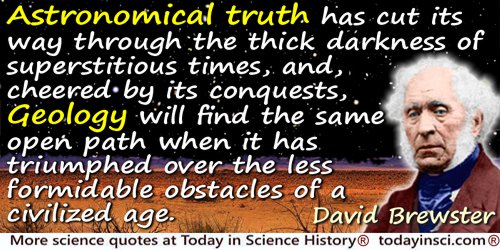
Thus identified with astronomy, in proclaiming truths supposed to be hostile to Scripture, Geology has been denounced as the enemy of religion. The twin sisters of terrestrial and celestial physics have thus been joint-heirs of intolerance and persecution—unresisting victims in the crusade which ignorance and fanaticism are ever waging against science. When great truths are driven to make an appeal to reason, knowledge becomes criminal, and philosophers martyrs. Truth, however, like all moral powers, can neither be checked nor extinguished. When compressed, it but reacts the more. It crushes where it cannot expand—it burns where it is not allowed to shine. Human when originally divulged, it becomes divine when finally established. At first, the breath of a rage—at last it is the edict of a god. Endowed with such vital energy, astronomical truth has cut its way through the thick darkness of superstitious times, and, cheered by its conquests, Geology will find the same open path when it has triumphed over the less formidable obstacles of a civilized age.
More Worlds than One: The Creed of the Philosopher and the Hope of the Christian (1854), 42.
To emphasize this opinion that mathematicians would be unwise to accept practical issues as the sole guide or the chief guide in the current of their investigations, ... let me take one more instance, by choosing a subject in which the purely mathematical interest is deemed supreme, the theory of functions of a complex variable. That at least is a theory in pure mathematics, initiated in that region, and developed in that region; it is built up in scores of papers, and its plan certainly has not been, and is not now, dominated or guided by considerations of applicability to natural phenomena. Yet what has turned out to be its relation to practical issues? The investigations of Lagrange and others upon the construction of maps appear as a portion of the general property of conformal representation; which is merely the general geometrical method of regarding functional relations in that theory. Again, the interesting and important investigations upon discontinuous two-dimensional fluid motion in hydrodynamics, made in the last twenty years, can all be, and now are all, I believe, deduced from similar considerations by interpreting functional relations between complex variables. In the dynamics of a rotating heavy body, the only substantial extension of our knowledge since the time of Lagrange has accrued from associating the general properties of functions with the discussion of the equations of motion. Further, under the title of conjugate functions, the theory has been applied to various questions in electrostatics, particularly in connection with condensers and electrometers. And, lastly, in the domain of physical astronomy, some of the most conspicuous advances made in the last few years have been achieved by introducing into the discussion the ideas, the principles, the methods, and the results of the theory of functions. … the refined and extremely difficult work of Poincare and others in physical astronomy has been possible only by the use of the most elaborate developments of some purely mathematical subjects, developments which were made without a thought of such applications.
In Presidential Address British Association for the Advancement of Science, Section A, (1897), Nature, 56, 377.
To most people, I fancy, the stars are beautiful; but if you asked why, they would be at a loss to reply, until they remembered what they had heard about astronomy, and the great size and distance and possible habitation of those orbs. ... [We] persuade ourselves that the power of the starry heavens lies in the suggestion of astronomical facts.
In The Sense of Beauty: Being the Outlines of Aesthetic Theory (1896), 100-101.
To set foot on the soil of the asteroids, to lift by hand a rock from the Moon, to observe Mars from a distance of several tens of kilometers, to land on its satellite or even on its surface, what can be more fantastic? From the moment of using rocket devices a new great era will begin in astronomy: the epoch of the more intensive study of the firmament.
(1896). As quoted in Firmin Joseph Krieger, Behind the Sputniks: A Survey of Soviet Space Science (1958), 23.
To what purpose should People become fond of the Mathematicks and Natural Philosophy? … People very readily call Useless what they do not understand. It is a sort of Revenge… One would think at first that if the Mathematicks were to be confin’d to what is useful in them, they ought only to be improv'd in those things which have an immediate and sensible Affinity with Arts, and the rest ought to be neglected as a Vain Theory. But this would be a very wrong Notion. As for Instance, the Art of Navigation hath a necessary Connection with Astronomy, and Astronomy can never be too much improv'd for the Benefit of Navigation. Astronomy cannot be without Optics by reason of Perspective Glasses: and both, as all parts of the Mathematicks are grounded upon Geometry … .
Of the Usefulness of Mathematical Learning (1699)
Two extreme views have always been held as to the use of mathematics. To some, mathematics is only measuring and calculating instruments, and their interest ceases as soon as discussions arise which cannot benefit those who use the instruments for the purposes of application in mechanics, astronomy, physics, statistics, and other sciences. At the other extreme we have those who are animated exclusively by the love of pure science. To them pure mathematics, with the theory of numbers at the head, is the only real and genuine science, and the applications have only an interest in so far as they contain or suggest problems in pure mathematics.
Of the two greatest mathematicians of modern tunes, Newton and Gauss, the former can be considered as a representative of the first, the latter of the second class; neither of them was exclusively so, and Newton’s inventions in the science of pure mathematics were probably equal to Gauss’s work in applied mathematics. Newton’s reluctance to publish the method of fluxions invented and used by him may perhaps be attributed to the fact that he was not satisfied with the logical foundations of the Calculus; and Gauss is known to have abandoned his electro-dynamic speculations, as he could not find a satisfying physical basis. …
Newton’s greatest work, the Principia, laid the foundation of mathematical physics; Gauss’s greatest work, the Disquisitiones Arithmeticae, that of higher arithmetic as distinguished from algebra. Both works, written in the synthetic style of the ancients, are difficult, if not deterrent, in their form, neither of them leading the reader by easy steps to the results. It took twenty or more years before either of these works received due recognition; neither found favour at once before that great tribunal of mathematical thought, the Paris Academy of Sciences. …
The country of Newton is still pre-eminent for its culture of mathematical physics, that of Gauss for the most abstract work in mathematics.
Of the two greatest mathematicians of modern tunes, Newton and Gauss, the former can be considered as a representative of the first, the latter of the second class; neither of them was exclusively so, and Newton’s inventions in the science of pure mathematics were probably equal to Gauss’s work in applied mathematics. Newton’s reluctance to publish the method of fluxions invented and used by him may perhaps be attributed to the fact that he was not satisfied with the logical foundations of the Calculus; and Gauss is known to have abandoned his electro-dynamic speculations, as he could not find a satisfying physical basis. …
Newton’s greatest work, the Principia, laid the foundation of mathematical physics; Gauss’s greatest work, the Disquisitiones Arithmeticae, that of higher arithmetic as distinguished from algebra. Both works, written in the synthetic style of the ancients, are difficult, if not deterrent, in their form, neither of them leading the reader by easy steps to the results. It took twenty or more years before either of these works received due recognition; neither found favour at once before that great tribunal of mathematical thought, the Paris Academy of Sciences. …
The country of Newton is still pre-eminent for its culture of mathematical physics, that of Gauss for the most abstract work in mathematics.
In History of European Thought in the Nineteenth Century (1903), 630.
Two men stood looking through the bars,
One saw the mud, the other saw the stars.
One saw the mud, the other saw the stars.
As given in Richard A. Gregory, Discovery: Or, The Spirit and Service of Science (1916), 20.
Undeterred by poverty, failure, domestic tragedy, and persecution, but sustained by his mystical belief in an attainable mathematical harmony and perfection of nature, Kepler persisted for fifteen years before finding the simple regularity [of planetary orbits] he sought… . What stimulated Kepler to keep slaving all those fifteen years? An utter absurdity. In addition to his faith in the mathematical perfectibility of astronomy, Kepler also believed wholeheartedly in astrology. This was nothing against him. For a scientist of Kepler’s generation astrology was as respectable scientifically and mathematically as the quantum theory or relativity is to theoretical physicists today. Nonsense now, astrology was not nonsense in the sixteenth century.
In The Handmaiden of the Sciences (1937), 30.
![Albert Claude quote: Until 1930 or thereabout biologists [using microscopes]](https://todayinsci.com/C/Claude_Albert/ClaudeAlbert-Distant500x250px.jpg)
Until 1930 or thereabout biologists [using microscopes], in the situation of Astronomers and Astrophysicists, were permitted to see the objects of their interest, but not to touch them; the cell was as distant from us, as the stars and galaxies were from them.
Nobel Lecture, The Coming Age of the Cell, 12 Dec 1974
We are probably nearing the limit of all we can know about astronomy.
(1888). Widely quoted, though always without a source, for example in Astronautics & Aeronautics? (1981), 30. If you know a primary print source to authenticate this quote, please contact Webmaster.
We come therefore now to that knowledge whereunto the ancient oracle directeth us, which is the knowledge of ourselves; which deserveth the more accurate handling, by how much it toucheth us more nearly. This knowledge, as it is the end and term of natural philosophy in the intention of man, so notwithstanding it is but a portion of natural philosophy in the continent of nature. And generally let this be a rule, that all partitions of knowledges be accepted rather for lines and veins, than for sections and separations; and that the continuance and entireness of knowledge be preserved. For the contrary hereof hath made particular sciences to become barren, shallow, and erroneous; while they have not been nourished and maintained from the common fountain. So we see Cicero the orator complained of Socrates and his school, that he was the first that separated philosophy and rhetoric; whereupon rhetoric became an empty and verbal art. So we may see that the opinion of Copernicus touching the rotation of the earth, which astronomy itself cannot correct because it is not repugnant to any of the phenomena, yet natural philosophy may correct. So we see also that the science of medicine, if it be destituted and forsaken by natural philosophy, it is not much better than an empirical practice. With this reservation therefore we proceed to Human Philosophy or Humanity, which hath two parts: the one considereth man segregate, or distributively; the other congregate, or in society. So as Human Philosophy is either Simple and Particular, or Conjugate and Civil. Humanity Particular consisteth of the same parts whereof man consisteth; that is, of knowledges that respect the Body, and of knowledges that respect the Mind. But before we distribute so far, it is good to constitute. For I do take the consideration in general and at large of Human Nature to be fit to be emancipate and made a knowledge by itself; not so much in regard of those delightful and elegant discourses which have been made of the dignity of man, of his miseries, of his state and life, and the like adjuncts of his common and undivided nature; but chiefly in regard of the knowledge concerning the sympathies and concordances between the mind and body, which, being mixed, cannot be properly assigned to the sciences of either.
The Advancement of Learning (1605) in James Spedding, Robert Ellis and Douglas Heath (eds.), The Works of Francis Bacon (1887-1901), Vol. 3, 366-7.
We ever long for visions of beauty,
We ever dream of unknown worlds.
We ever dream of unknown worlds.
Quoted in Carl Sagan, Broca’s Brain: Reflections on the Romance of Science (1979, 1986), 269.
We shall find sufficient reason to conclude, that the visible creation … is but an inconsiderable part of the whole. Many other and various orders of things unknown to, and inconceivable by us, may, and probably do exist, in the unlimited regions of space.
From Oration (24 Feb 1775) delivered to the American Philosophical Society, Philadelphia, collected in William Barton, Memoirs of the Life of David Rittenhouse (1813), 575.
We should do astronomy because it is beautiful and because it is fun. We should do it because people want to know. We want to know our place in the universe and how things happen.
From interview in 'A New Decade Dawns for Astronomy', Sky and Telescope (Jan 1990), 79, No. 1, 19. The quote is cited in Current Biography Yearbook (2000), 30.
What astronomy has done for space, geology has done for time; the one gives us the idea of infinite distance and magnitude in the starry heavens—the other, of almost infinite duration of time in the immense cycles of changes which our own planet has undergone.
In The Geological Survey of California: An Address Delivered Before the Legislature of California … March 12th, 1861 by J.D. Whitney (1861), 8.
What has been done is little—scarcely a beginning; yet it is much in comparison with the total blank of a century past. And our knowledge will, we are easily persuaded, appear in turn the merest ignorance to those who come after us. Yet it is not to be despised, since by it we reach up groping to touch the hem of the garment of the Most High.
In A Popular History of Astronomy During the Nineteenth Century (1893), 528. Also quoted in Carl Sagan, Broca's Brain (1986), 240.
Whatever else astronomy may or may not be who can doubt it to be the most beautiful of the sciences?
Epigraph in Isaac Asimov’s Book of Science and Nature Quotations (1988), 26.
When a man spends his life among the stars and planets, or lays out a twelvemonth on the spots of the sun, however noble his speculations may be, they are very apt to fall into burlesque.
In The Works of Joseph Addison: Including the Whole Contents of Bp. Hurd’s Edition, with Letters and Other Pieces Not Found in Any Previous Collection; and Macaulay’s Essay on His Life and Works (1854), Vol. 2, 9.
When I hear to-day protests against the Bolshevism of modern science and regrets for the old-established order, I am inclined to think that Rutherford, not Einstein, is the real villain of the piece. When we compare the universe as it is now supposed to be with the universe as we had ordinarily preconceived it, the most arresting change is not the rearrangement of space and time by Einstein but the dissolution of all that we regard as most solid into tiny specks floating in void. That gives an abrupt jar to those who think that things are more or less what they seem. The revelation by modern physics of the void within the atom is more disturbing than the revelation by astronomy of the immense void of interstellar space.
In The Nature of the Physical World (1928, 2005), 1.
Who—aside from certain big children who are indeed found in the natural sciences—still believes that the findings of astronomy, biology, physics, or chemistry could teach us anything about the meaning of the world?
From a Speech (1918) presented at Munich University, published in 1919, and collected in 'Wissenschaft als Beruf', Gessammelte Aufsätze zur Wissenschaftslehre (1922), 524-525. As given in H.H. Gerth and C. Wright-Mills (translators and eds.), 'Science as a Vocation', Max Weber: Essays in Sociology (1946), 142.
Without any doubt, the regularity which astronomy shows us in the movements of the comets takes place in all phenomena. The trajectory of a simple molecule of air or vapour is regulated in a manner as certain as that of the planetary orbits; the only difference between them is that which is contributed by our ignorance. Probability is relative in part to this ignorance, and in part to our knowledge.
Philosophical Essay on Probabilities (1814), 5th edition (1825), trans. Andrew I. Dale (1995), 3.
Year after year, the slow sure records grow.
Awaiting their interpreter.
Awaiting their interpreter.
In Watchers of the Sky (1922), 253.
 In science it often happens that scientists say, 'You know that's a really good argument; my position is mistaken,' and then they would actually change their minds and you never hear that old view from them again. They really do it. It doesn't happen as often as it should, because scientists are human and change is sometimes painful. But it happens every day. I cannot recall the last time something like that happened in politics or religion.
(1987) --
In science it often happens that scientists say, 'You know that's a really good argument; my position is mistaken,' and then they would actually change their minds and you never hear that old view from them again. They really do it. It doesn't happen as often as it should, because scientists are human and change is sometimes painful. But it happens every day. I cannot recall the last time something like that happened in politics or religion.
(1987) -- 






.jpg)

