Astronomer Quotes (98 quotes)
Astronomist Quotes
Astronomist Quotes
… just as the astronomer, the physicist, the geologist, or other student of objective science looks about in the world of sense, so, not metaphorically speaking but literally, the mind of the mathematician goes forth in the universe of logic in quest of the things that are there; exploring the heights and depths for facts—ideas, classes, relationships, implications, and the rest; observing the minute and elusive with the powerful microscope of his Infinitesimal Analysis; observing the elusive and vast with the limitless telescope of his Calculus of the Infinite; making guesses regarding the order and internal harmony of the data observed and collocated; testing the hypotheses, not merely by the complete induction peculiar to mathematics, but, like his colleagues of the outer world, resorting also to experimental tests and incomplete induction; frequently finding it necessary, in view of unforeseen disclosures, to abandon one hopeful hypothesis or to transform it by retrenchment or by enlargement:—thus, in his own domain, matching, point for point, the processes, methods and experience familiar to the devotee of natural science.
In Lectures on Science, Philosophy and Art (1908), 26
…by shortening the labours doubled the life of the astronomer.
On the benefit of Napier’s logarithms.
On the benefit of Napier’s logarithms.
Quoted in H. Eves, In Mathematical Circles (1969).
…The present revolution of scientific thought follows in natural sequence on the great revolutions at earlier epochs in the history of science. Einstein’s special theory of relativity, which explains the indeterminateness of the frame of space and time, crowns the work of Copernicus who first led us to give up our insistence on a geocentric outlook on nature; Einstein's general theory of relativity, which reveals the curvature or non-Euclidean geometry of space and time, carries forward the rudimentary thought of those earlier astronomers who first contemplated the possibility that their existence lay on something which was not flat. These earlier revolutions are still a source of perplexity in childhood, which we soon outgrow; and a time will come when Einstein’s amazing revelations have likewise sunk into the commonplaces of educated thought.
In The Theory of Relativity and its Influence on Scientific Thought (1922), 31-32
’Tis late; the astronomer in his lonely height
Exploring all the dark, descries from far
Orbs that like distant isles of splendor are,
And mornings whitening in the infinite.…
He summons one disheveled, wandering star,—
Return ten centuries hence on such a night.
That star will come. It dare not by one hour
Cheat science, or falsify her calculation;
Men will have passed, but watchful in the tower
Man shall remain in sleepless contemplation;
And should all men have perished there in turn,
Truth in their stead would watch that star’s return.
Exploring all the dark, descries from far
Orbs that like distant isles of splendor are,
And mornings whitening in the infinite.…
He summons one disheveled, wandering star,—
Return ten centuries hence on such a night.
That star will come. It dare not by one hour
Cheat science, or falsify her calculation;
Men will have passed, but watchful in the tower
Man shall remain in sleepless contemplation;
And should all men have perished there in turn,
Truth in their stead would watch that star’s return.
From poem, 'The Appointment', as translated by Arthur O’Shaughnessy, collected in Samuel Waddington (ed.), The Sonnets of Europe (1886), 154.
“On doit etre etonné ([Abbé Raynal]says) que l'Amerique n’ait pas encore produit un bon poëte, un habile mathematicien, un homme de génie dans un seul art, ou une seule science.” …“America has not yet produced one good poet.” When we shall have existed as a people as long as the Greeks did before they produced a Homer, the Romans a Virgil, the French a Racine and Voltaire, the English a Shakespeare and Milton, should this reproach be still true, we will enquire from what unfriendly causes it has proceeded, that the other countries of Europe and quarters of the earth shall not have inscribed any name in the roll of poets. But neither has America produced “one able mathematician, one man of genius in a single art or a single science.” … In physics we have produced a [Benjamin] Franklin, than whom no one of the present age has made more important discoveries, nor has enriched philosophy with more, or more ingenious solutions of the phaenomena, of nature. … [The quadrant invented by Godfrey, an American also, and with the aid of which the European nations traverse the globe, is called Hadley’s quadrant.] … We have supposed Mr. [David] Rittenhouse second to no astronomer living: that in genius he must be the first, because he is self-taught. As an artist he has exhibited as great a proof of mechanical genius as the world has ever produced. … We therefore suppose, that this reproach is as unjust as it is unkind; and that, of the geniuses which adorn the present age, America contributes its full share. [Compared to the much larger populations of European countries.]
The reference given by Jefferson for the original reproach by Abbé Raynal, an ellipsis above, is “7. Hist. Philos. p. 92. ed. Maestricht. 1774”. The original remark written in French, translates as: “One must be amazed that America has not yet produced a good poet, an able mathematician, one man of genius in a single art, or a single science.” Jefferson uses parts of it in English, to introduce his rebuttal. From Thomas Jefferson, Notes on the State of Virginia (1787), 107-110. A footnote adds that: “In a later edition of the Abbé Raynal’s work, he has withdrawn his censure…”
[At high school in Cape Town] my interests outside my academic work were debating, tennis, and to a lesser extent, acting. I became intensely interested in astronomy and devoured the popular works of astronomers such as Sir Arthur Eddington and Sir James Jeans, from which I learnt that a knowledge of mathematics and physics was essential to the pursuit of astronomy. This increased my fondness for those subjects.
'Autobiography of Allan M. Cormack,' Les Prix Nobel/Nobel Lectures 1979, editted by Wilhelm Odelberg.
[Gauss calculated the elements of the planet Ceres] and his analysis proved him to be the first of theoretical astronomers no less than the greatest of “arithmeticians.”
In History of Mathematics (3rd Ed., 1901), 458.
A century ago astronomers, geologists, chemists, physicists, each had an island of his own, separate and distinct from that of every other student of Nature; the whole field of research was then an archipelago of unconnected units. To-day all the provinces of study have risen together to form a continent without either a ferry or a bridge.
From chapter 'Jottings from a Note-book', in Canadian Stories (1918), 182-183.
A cosmic mystery of immense proportions, once seemingly on the verge of solution, has deepened and left astronomers and astrophysicists more baffled than ever. The crux ... is that the vast majority of the mass of the universe seems to be missing.
[Reporting a Nature article discrediting explanation of invisible mass being due to neutrinos]
[Reporting a Nature article discrediting explanation of invisible mass being due to neutrinos]
In 'If Theory is Right, Most of Universe is Still “Missing”', New York Times (11 Sep 1984).
A large part of the training of the engineer, civil and military, as far as preparatory studies are concerned; of the builder of every fabric of wood or stone or metal designed to stand upon the earth, or bridge the stream, or resist or float upon the wave; of the surveyor who lays out a building lot in a city, or runs a boundary line between powerful governments across a continent; of the geographer, navigator, hydrographer, and astronomer,—must be derived from the mathematics.
In 'Academical Education', Orations and Speeches on Various Occasions (1870), Vol. 3, 513.
A life spent in the routine of science need not destroy the attractive human element of a woman's nature.
Said of Williamina Paton Fleming 1857- 1911, American Astronomer.
Said of Williamina Paton Fleming 1857- 1911, American Astronomer.
Obituary of Williamina Paton Fleming, Science, 1911, 33, 988.
Abstruse mathematical researches … are … often abused for having no obvious physical application. The fact is that the most useful parts of science have been investigated for the sake of truth, and not for their usefulness. A new branch of mathematics, which has sprung up in the last twenty years, was denounced by the Astronomer Royal before the University of Cambridge as doomed to be forgotten, on account of its uselessness. Now it turns out that the reason why we cannot go further in our investigations of molecular action is that we do not know enough of this branch of mathematics.
In 'Conditions of Mental Development', Lectures and Essays (1901), Vol. 1, 115.
According to astronomers, next week Wednesday will occur twice. They say such a thing happens only once every 60,000 years and although they don’t know why it occurs, they’re glad they have an extra day to figure it out.
In Napalm and Silly Putty (2002), 105.
Although with the majority of those who study and practice in these capacities [engineers, builders, surveyors, geographers, navigators, hydrographers, astronomers], secondhand acquirements, trite formulas, and appropriate tables are sufficient for ordinary purposes, yet these trite formulas and familiar rules were originally or gradually deduced from the profound investigations of the most gifted minds, from the dawn of science to the present day. … The further developments of the science, with its possible applications to larger purposes of human utility and grander theoretical generalizations, is an achievement reserved for a few of the choicest spirits, touched from time to time by Heaven to these highest issues. The intellectual world is filled with latent and undiscovered truth as the material world is filled with latent electricity.
In Orations and Speeches, Vol. 3 (1870), 513.
An astronomer is a guy who stands around looking at heavenly bodies.
Quoted in M. Goran, A Treasury of Science Jokes (1986), 29.
An astronomer must be the wisest of men; his mind must be duly disciplined in youth; especially is mathematical study necessary; both an acquaintance with the doctrine of number, and also with that other branch of mathematics, which, closely connected as it is with the science of the heavens, we very absurdly call geometry, the measurement of the earth.
— Plato
From the 'Epilogue to the Laws' (Epinomis), 988-990. As quoted in William Whewell, History of the Inductive Sciences from the Earliest to the Present Time (1837), Vol. 1, 161. (Although referenced to Plato’s Laws, the Epinomis is regarded as a later addition, not by Plato himself.)
An undevout astronomer is mad.
The Complaint: or, Night-Thoughts on Life, Death, and Immortality (1742, 1750), Night 9, 260.
As a confirmed astronomer
I’m always for a better sky.
I’m always for a better sky.
From 'The Objection to Being Stepped On', collected in Edward Connery Latham (ed.), The Poetry of Robert Frost (1971), 451.
As a reminder to the prospective observer of extraterrestrial radio noise, I shall conclude by offering the following motto for radio astronomers (with apologies to Gertrude Stein): Signals in the grass, alas!
From address to the 101st Meeting of the American Astronomical Society, Gainesville, Florida (27 Dec 1958). Printed in 'An Account of the Discovery of Jupiter as a Radio Source', The Astronomical Journal (Mar 1959), 64, No. 2, 39.
Astronomers = Moon Starers = No More Stars
— Anagram
From 'The Anagram Hall of Fame' on the wordsmith.org website.
Astronomers and physicists, dealing habitually with objects and quantities far beyond the reach of the senses, even with the aid of the most powerful aids that ingenuity has been able to devise, tend almost inevitably to fall into the ways of thinking of men dealing with objects and quantities that do not exist at all, e.g., theologians and metaphysicians. Thus their speculations tend almost inevitably to depart from the field of true science, which is that of precise observation, and to become mere soaring in the empyrean. The process works backward, too. That is to say, their reports of what they pretend actually to see are often very unreliable. It is thus no wonder that, of all men of science, they are the most given to flirting with theology. Nor is it remarkable that, in the popular belief, most astronomers end by losing their minds.
Minority Report: H. L. Mencken’s Notebooks (1956), Sample 74, 60.
Astronomers have built telescopes which can show myriads of stars unseen before; but when a man looks through a tear in his own eye, that is a lens which opens reaches into the unknown, and reveals orbs which no telescope, however skilfully constructed, could do.
Life Thoughts (1858), 20.
Astronomers tell us that there are about 1023 stars in the universe. That’s a meaningful number to chemists—an Avogadro number of potential solar systems of which between 1 and 50 percent are estimated to have planets. … Planets are plentiful—and from this fact we can begin our exploration of how life might have evolved on any one of them.
In 'Cosmochemistry The Earliest Evolution', The Science Teacher (Oct 1983), 50, No. 7, 34.
Astronomers work always with the past; because light takes time to move from one place to another, they see things as they were, not as they are.
The Telescope Handbook and Star Atlas (1967), 33.
Astronomy teaches the correct use of the sun and the planets. These may be put on a frame of little sticks and turned round. This causes the tides. Those at the ends of the sticks are enormously far away. From time to time a diligent searching of the sticks reveals new planets. The orbit of the planet is the distance the stick goes round in going round. Astronomy is intensely interesting; it should be done at night, in a high tower at Spitzbergen. This is to avoid the astronomy being interrupted. A really good astronomer can tell when a comet is coming too near him by the warning buzz of the revolving sticks.
In Literary Lapses (1928), 128.
But that which will excite the greatest astonishment by far, and which indeed especially moved me to call the attention of all astronomers and philosophers, is this: namely, that I have observed four planets, neither known nor observed by any one of the astronomers before my time, which have their orbits round a certain bright star [Jupiter], one of those previously known, like Venus or Mercury round the sun, and are sometimes in front of it, sometimes behind it, though they never depart from it beyond certain limits. All of which facts were discovered and observed a few days ago by the help of a telescope devised by me, through God’s grace first enlightening my mind.
In pamphlet, The Sidereal Messenger (1610), reprinted in The Sidereal Messenger of Galileo Galilei: And a Part of the Preface to the Preface to Kepler's Dioptrics Containing the Original Account of Galileo's Astronomical Discoveries (1880), 9.
Dr. Walter Baade of Mount Wilson Observatory facetiously accused the present generation of Milky Way astronomers of not having looked sufficiently far beyond our “local swimming hole”.
At then-recent symposium of the American Astronomical Society, as stated in Leaflet The Cemter of the Galaxy (1948), No. 230, 254.
Early Greek astronomers, derived their first knowledge from the Egyptians, and these from the Chaldeans, among whom the science was studied, at a very early period. Their knowledge of astronomy, which gave their learned men the name of Magi, wise men, afterwards degenerated into astrology, or the art of consulting the position of the stars to foretel events—and hence sprung the silly occupation of sooth saying, for which the Chaldeans were noted to a proverb, in later ages.
In Elements of Useful Knowledge (1806), Vol. 1, 8-9. Note “foretel” is as printed in this text.
Exact science and its practical movements are no checks on the greatest poet, but always his encouragement and support … The sailor and traveller, the anatomist, chemist, astronomer, geologist, phrenologist, spiritualist, mathematician, historian and lexicographer are not poets, but they are the lawgivers of poets and their construction underlies the structure of every perfect poem.
In Walt Whitman and William Michael Rossetti (ed.), 'Preface to the First Edition of Leaves of Grass', Poems By Walt Whitman (1868), 46.
First, the chief character, who is supposed to be a professional astronomer, spends his time fund raising and doing calculations at his desk, rather than observing the sky. Second, the driving force of a scientific project is institutional self-aggrandizement rather than intellectual curiosity.
[About the state of affairs in academia.]
[About the state of affairs in academia.]
In Marc J. Madou, Fundamentals of Microfabrication: the Science of Miniaturization (2nd ed., 2002), 535
For it is the duty of an astronomer to compose the history of the celestial motions or hypotheses about them. Since he cannot in any certain way attain to the true causes, he will adopt whatever suppositions enable the motions to be computed correctly from the principles of geometry for the future as well as for the past.
From unauthorized preface Osiander anonymously added when he was entrusted with arranging the printing of the original work by Copernicus. As translated in Nicolaus Copernicus and Jerzy Dobrzycki (ed.), Nicholas Copernicus on the Revolutions (1978), xvi.
For many planet hunters, though, the ultimate goal is still greater (or actually, smaller) prey: terrestrial planets, like Earth, circling a star like the Sun. Astronomers already know that three such planets orbit at least one pulsar. But planet hunters will not rest until they are in sight of a small blue world, warm and wet, in whose azure skies and upon whose wind-whipped oceans shines a bright yellow star like our own.
…...
For some months the astronomer Halley and other friends of Newton had been discussing the problem in the following precise form: what is the path of a body attracted by a force directed toward a fixed point, the force varying in intensity as the inverse of the distance? Newton answered instantly, “An ellipse.” “How do you know?” he was asked. “Why, I have calculated it.” Thus originated the imperishable Principia, which Newton later wrote out for Halley. It contained a complete treatise on motion.
In The Handmaiden of the Sciences (1937), 37.
Forty years as an astronomer have not quelled my enthusiasm for lying outside after dark, staring up at the stars. It isn’t only the beauty of the night sky that thrills me. It’s the sense I have that some of those points of light—which ones I can’t even guess—are the home stars of beings not so different from us, daily cares and all, who look across space and wonder, just as we do.
In Frank Drake and Dava Sobel, Is Anyone Out There?: The Scientific Search for Extraterrestrial Intelligence (1992), 1.
Happy the men who made the first essay,
And to celestial regions found the way!
No earthly vices clogg’d their purer souls,
That they could soar so high as touch the poles:
Sublime their thoughts and from pollution clear,
Bacchus and Venus held no revels there;
From vain ambition free; no love of war
Possess’d their minds, nor wranglings at the bar;
No glaring grandeur captivates their eyes,
For such see greater glory in the skies:
Thus these to heaven attain.
And to celestial regions found the way!
No earthly vices clogg’d their purer souls,
That they could soar so high as touch the poles:
Sublime their thoughts and from pollution clear,
Bacchus and Venus held no revels there;
From vain ambition free; no love of war
Possess’d their minds, nor wranglings at the bar;
No glaring grandeur captivates their eyes,
For such see greater glory in the skies:
Thus these to heaven attain.
In Craufurd Tait Ramage (ed., trans.), Beautiful Thoughts From Latin Authors, with English Translations (1864),
However much we may enlarge our ideas of the time which has elapsed since the Niagara first began to drain the waters of the upper lakes, we have seen that this period was one only of a series, all belonging to the present zoological epoch; or that in which the living testaceous fauna, whether freshwater or marine, had already come into being. If such events can take place while the zoology of the earth remains almost stationary and unaltered, what ages may not be comprehended in those successive tertiary periods during which the Flora and Fauna of the globe have been almost entirely changed. Yet how subordinate a place in the long calendar of geological chronology do the successive tertiary periods themselves occupy! How much more enormous a duration must we assign to many antecedent revolutions of the earth and its inhabitants! No analogy can be found in the natural world to the immense scale of these divisions of past time, unless we contemplate the celestial spaces which have been measured by the astronomer.
Travels in North America (1845), Vol. 1, 51-2.
I am a Christian which means that I believe in the deity of Christ, like Tycho de Brahe, Copernicus, Descartes, Newton, Leibnitz, Pascal ... like all great astronomers mathematicians of the past.
…...
I have no doubt that certain learned men, now that the novelty of the hypotheses in this work has been widely reported—for it establishes that the Earth moves, and indeed that the Sun is motionless in the middle of the universe—are extremely shocked, and think that the scholarly disciplines, rightly established once and for all, should not be upset. But if they are willing to judge the matter thoroughly, they will find that the author of this work has committed nothing which deserves censure. For it is proper for an astronomer to establish a record of the motions of the heavens with diligent and skilful observations, and then to think out and construct laws for them, or rather hypotheses, whatever their nature may be, since the true laws cannot be reached by the use of reason; and from those assumptions the motions can be correctly calculated, both for the future and for the past. Our author has shown himself outstandingly skilful in both these respects. Nor is it necessary that these hypotheses should be true, nor indeed even probable, but it is sufficient if they merely produce calculations which agree with the observations. … For it is clear enough that this subject is completely and simply ignorant of the laws which produce apparently irregular motions. And if it does work out any laws—as certainly it does work out very many—it does not do so in any way with the aim of persuading anyone that they are valid, but only to provide a correct basis for calculation. Since different hypotheses are sometimes available to explain one and the same motion (for instance eccentricity or an epicycle for the motion of the Sun) an astronomer will prefer to seize on the one which is easiest to grasp; a philosopher will perhaps look more for probability; but neither will grasp or convey anything certain, unless it has been divinely revealed to him. Let us therefore allow these new hypotheses also to become known beside the older, which are no more probable, especially since they are remarkable and easy; and let them bring with them the vast treasury of highly learned observations. And let no one expect from astronomy, as far as hypotheses are concerned, anything certain, since it cannot produce any such thing, in case if he seizes on things constructed for another other purpose as true, he departs from this discipline more foolish than he came to it.
Although this preface would have been assumed by contemporary readers to be written by Copernicus, it was unsigned. It is now believed to have been written and added at press time by Andreas Osiander (who was then overseeing the printing of the book). It suggests the earth’s motion as described was merely a mathematical device, and not to be taken as absolute reality. Text as given in 'To the Reader on the Hypotheses in this Work', Copernicus: On the Revolutions of the Heavenly Spheres (1543), translated by Alistair Matheson Duncan (1976), 22-3. By adding this preface, Osiander wished to stave off criticism by theologians. See also the Andreas Osiander Quotes page of this website.
I recall words spoken by the late Professor H. N. Russell, the Princeton astronomer: the pursuit of an idea is as exciting as the pursuit of a whale, but when the problem has been solved, the work of writing up your paper is as hard and monotonous as cutting up blubber.
From Lecture (28 Nov 1957) in the Queen’s University, Belfast, 'Is the Study of its History a Brake on the Progress of Science', printed in Hermethena (1958), 19, 41.
I shall explain a System of the World differing in many particulars from any yet known, answering in all things to the common Rules of Mechanical Motions: This depends upon three Suppositions. First, That all Cœlestial Bodies whatsoever, have an attraction or gravitating power towards their own Centers, whereby they attract not only their own parts, and keep them from flying from them, as we may observe the Earth to do, but that they do also attract all the other Cœlestial bodies that are within the sphere of their activity; and consequently that not only the Sun and Moon have an influence upon the body and motion the Earth, and the Earth upon them, but that Mercury also Venus, Mars, Saturn and Jupiter by their attractive powers, have a considerable influence upon its motion in the same manner the corresponding attractive power of the Earth hath a considerable influence upon every one of their motions also. The second supposition is this, That all bodies whatsoever that are put into a direct and simple motion, will continue to move forward in a streight line, till they are by some other effectual powers deflected and bent into a Motion, describing a Circle, Ellipse, or some other more compounded Curve Line. The third supposition is, That these attractive powers are so much the more powerful in operating, by how much the nearer the body wrought upon is to their own Centers. Now what these several degrees are I have not yet experimentally verified; but it is a notion, which if fully prosecuted as it ought to be, will mightily assist the Astronomer to reduce all the Cœlestial Motions to a certain rule, which I doubt will never be done true without it. He that understands the nature of the Circular Pendulum and Circular Motion, will easily understand the whole ground of this Principle, and will know where to find direction in Nature for the true stating thereof. This I only hint at present to such as have ability and opportunity of prosecuting this Inquiry, and are not wanting of Industry for observing and calculating, wishing heartily such may be found, having myself many other things in hand which I would first compleat and therefore cannot so well attend it. But this I durst promise the Undertaker, that he will find all the Great Motions of the World to be influenced by this Principle, and that the true understanding thereof will be the true perfection of Astronomy.
An Attempt to Prove the Motion of the Earth from Observations (1674), 27-8. Based on a Cutlerian Lecture delivered by Hooke at the Royal Society four years earlier.
I think popular belief in bogus sciences is steadily increasing. … Almost every paper except the New York Times, not to mention dozens of magazines, features a horoscope column. Professional astrologers now outnumber astronomers.
As quoted in Kendrick Frazier, 'A Mind at Play: An Interview with Martin Gardner', Skeptical Inquirer (Mar/Apr 1998), 22, No. 2, 37.
I was a kind of a one-man army. I could solder circuits together, I could turn out things on the lathe, I could work with rockets and balloons. I’m a kind of a hybrid between an engineer and a physicist and astronomer.
Characterizing the self-reliance of scientists of his day, contrasted to the complexities of scientific undertakings today, when “the pattern is much more a team of people” who are “backed up by a technical staff that does most of these things.” In interview, Rushworth M. Kidder, 'Grounded in Space Science', Christian Science Monitor (22 Dec 1989).
In the world of science different levels of esteem are accorded to different kinds of specialist. Mathematicians have always been eminently respectable, and so are those who deal with hard lifeless theories about what constitutes the physical world: the astronomers, the physicists, the theoretical chemists. But the more closely the scientist interests himself in matters which are of direct human relevance, the lower his social status. The real scum of the scientific world are the engineers and the sociologists and the psychologists. Indeed, if a psychologist wants to rate as a scientist he must study rats, not human beings. In zoology the same rules apply. It is much more respectable to dissect muscle tissues in a laboratory than to observe the behaviour of a living animal in its natural habitat.
From transcript of BBC radio Reith Lecture (12 Nov 1967), 'A Runaway World', on the bbc.co.uk website.
In this great celestial creation, the catastrophy of a world, such as ours, or even the total dissolution of a system of worlds, may possibly be no more to the great Author of Nature, than the most common accident in life with us, and in all probability such final and general Doomsdays may be as frequent there, as even Birthdays or mortality with us upon the earth. This idea has something so cheerful in it, that I know I can never look upon the stars without wondering why the whole world does not become astronomers; and that men endowed with sense and reason should neglect a science they are naturally so much interested in, and so capable of enlarging their understanding, as next to a demonstration must convince them of their immortality, and reconcile them to all those little difficulties incident to human nature, without the least anxiety. All this the vast apparent provision in the starry mansions seem to promise: What ought we then not to do, to preserve our natural birthright to it and to merit such inheritance, which alas we think created all to gratify alone a race of vain-glorious gigantic beings, while they are confined to this world, chained like so many atoms to a grain of sand.
In The Universe and the Stars: Being an Original Theory on the Visible Creation, Founded on the Laws of Nature (1750, 1837), 132.
Interestingly, according to modern astronomers, space is finite. This is a very comforting thought—particularly for people who can never remember where they have left things.
Side Effects (1981), 36.
It calls Devotion! genuine growth of night!
Devotion! Daughter of Astronomy!
An undevout astronomer is mad!
Devotion! Daughter of Astronomy!
An undevout astronomer is mad!
The Complaint: or, Night-Thoughts on Life, Death, and Immortality (1742, 1750), Night 9, 260.
It is interesting to note how many fundamental terms which the social sciences are trying to adopt from physics have as a matter of historical fact originated in the social field. Take, for instance, the notion of cause. The Greek aitia or the Latin causa was originally a purely legal term. It was taken over into physics, developed there, and in the 18th century brought back as a foreign-born kind for the adoration of the social sciences. The same is true of the concept of law of nature. Originally a strict anthropomorphic conception, it was gradually depersonalized or dehumanized in the natural sciences and then taken over by the social sciences in an effort to eliminate final causes or purposes from the study of human affairs. It is therefore not anomalous to find similar transformations in the history of such fundamental concepts of statistics as average and probability. The concept of average was developed in the Rhodian laws as to the distribution of losses in maritime risks. After astronomers began to use it in correcting their observations, it spread to other physical sciences; and the prestige which it thus acquired has given it vogue in the social field. The term probability, as its etymology indicates, originates in practical and legal considerations of probing and proving.
The Statistical View of Nature (1936), 327-8.
It is unworthy of excellent men to lose hours like slaves in the labour of calculation which could safely be relegated to anyone else if machines were used.
Describing, in 1685, the value to astronomers of the hand-cranked calculating machine he had invented in 1673.
Describing, in 1685, the value to astronomers of the hand-cranked calculating machine he had invented in 1673.
From 'Machina Arithmetica in qua non Aditio tantum Subtractio', as translated by Mark Kormes in David Eugene Smith, A Source Book in Mathematics (1929), 181.
It must have appeared almost as improbable to the earlier geologists, that the laws of earthquakes should one day throw light on the origin of mountains, as it must to the first astronomers, that the fall of an apple should assist in explaining the motions of the moon.
Principles of Geology(1830-3), Vol. 3, 5.
It was an admirable reply of a converted astronomer, who, when interrogated concerning his comparative estimate of religion and the science he had formerly idolized, answered, 'I am now bound for heaven, and I take the stars in my way.'
In Tryon Edwards. A Dictionary of Thoughts (1908), 506.
John Bahcall, an astronomer on the Institute of Advanced Study faculty since 1970 likes to tell the story of his first faculty dinner, when he found himself seated across from Kurt Gödel, … a man dedicated to logic and the clean certainties of mathematical abstraction. Bahcall introduced himself and mentioned that he was a physicist. Gödel replied, “I don’t believe in natural science.”
As stated in Adam Begley, 'The Lonely Genius Club', New York Magazine (30 Jan 1995), 63.
Just as the spectroscope opened up a new astronomy by enabling the astronomer to determine some of the constituents of which distant stars are composed, so the seismograph, recording the unfelt motion of distant earthquakes, enables us to see into the earth and determine its nature with as great a certainty, up to a certain point, as if we could drive a tunnel through it and take samples of the matter passed through.
'The Constitution of the Interior of the Earth, as Revealed by Earthquakes', Quarterly Journal of the Geological Society (1906), 62, 456.
MAGNITUDE, n. Size. Magnitude being purely relative, nothing is large and nothing small. If everything in the universe were increased in bulk one thousand diameters nothing would be any larger than it was before, but if one thing remained unchanged all the others would be larger than they had been. To an understanding familiar with the relativity of magnitude and distance the spaces and masses of the astronomer would be no more impressive than those of the microscopist. For anything we know to the contrary, the visible universe may be a small part of an atom, with its component ions, floating in the life-fluid (luminiferous ether) of some animal. Possibly the wee creatures peopling the corpuscles of our own blood are overcome with the proper emotion when contemplating the unthinkable distance from one of these to another.
The Collected Works of Ambrose Bierce (1911), Vol. 7, The Devil's Dictionary, 209.
Man is slightly nearer to the atom than to the star. … From his central position man can survey the grandest works of Nature with the astronomer, or the minutest works with the physicist. … [K]nowledge of the stars leads through the atom; and important knowledge of the atom has been reached through the stars.
Lecture 1. Stars and Atoms (1928, 2007), 9.
Mathematics is not a book confined within a cover and bound between brazen clasps, whose contents it needs only patience to ransack; it is not a mine, whose treasures may take long to reduce into possession, but which fill only a limited number of veins and lodes; it is not a soil, whose fertility can be exhausted by the yield of successive harvests; it is not a continent or an ocean, whose area can be mapped out and its contour defined: it is limitless as that space which it finds too narrow for its aspirations; its possibilities are as infinite as the worlds which are forever crowding in and multiplying upon the astronomer’s gaze; it is as incapable of being restricted within assigned boundaries or being reduced to definitions of permanent validity, as the consciousness of life, which seems to slumber in each monad, in every atom of matter, in each leaf and bud cell, and is forever ready to burst forth into new forms of vegetable and animal existence.
From Commemoration Day Address (22 Feb 1877) at Johns Hopkins University, Baltimore, collected in The Collected Mathematical Papers: (1870-1883) (1909), 77-78.
Memories of childhood are unreliable. I am lucky to have documentary evidence dating from the age of nine. The evidence is an unfinished novel, found among my mother's papers forty-three years later, with the title Sir Phillip Roberts’ Ero-Lunar Collision. Sir Phillip is a professional astronomer, evidently a role model for a young scientist. The style of the novel is copied from Jules Verne; the story was suggested by the near approach of the asteroid Eros in the year 1931. Here is a sample of the dialogue:
“Will Eros really go right through our Sattelite?” said Major Forbes.
“Yes,” said Sir Phillip, “its speed, and its small weight and resistance, will bring it through our Sattelite, it will be a picture, suddenly rising white-hot from the Moon’s internal fires, followed by a stream of liquid lava.”
So it was Jules Verne and Eros that turned my infant thoughts to science.
“Will Eros really go right through our Sattelite?” said Major Forbes.
“Yes,” said Sir Phillip, “its speed, and its small weight and resistance, will bring it through our Sattelite, it will be a picture, suddenly rising white-hot from the Moon’s internal fires, followed by a stream of liquid lava.”
So it was Jules Verne and Eros that turned my infant thoughts to science.
Giving his own reason, in 'Seventy-Five Reasons to Become a Scientist', American Scientist (Sep-Oct 1988), 76, No. 5, 450. Dyson gives more background details in 'Preface', From Eros to Gaia (1992), viii. Dyson included all of his unfinished childhood novel as Chap. 1 of the same book, p.3-7. Note the word 9-yr-old Dyson knew in 1933, “Sattelite” [sic].
OBSERVATORY, n. A place where astronomers conjecture away the guesses of their predecessors.
The Collected Works of Ambrose Bierce (1911), Vol. 7, The Devil's Dictionary, 232.
Physicists and astronomers see their own implications in the world being round, but to me it means that only one-third of the world is asleep at any given time and the other two-thirds is up to something.
Speech to American Bar Association, Atlanta, Ga. (22 Oct 1964), quoted in The Atlanta Constitution (23 Oct 1964), 10. In James H. Billington, Respectfully Quoted (2010), 380.
Picture yourself during the early 1920's inside the dome of the [Mount Wilson Observatory]. …
[Milton] Humason is showing [Harlow] Shapley stars he had found in the Andromeda Nebula that appeared and disappeared on photographs of that object. The famous astronomer very patiently explains that these objects could not be stars because the Nebula was a nearby gaseous cloud within our own Milky Way system. Shapley takes his handkerchief from his pocket and wipes the identifying marks off the back of the photographic plate.
Of course, Hubble came along in 1924 and showed that it was just these Cepheid variable stars in the Andromeda Nebula which proved it was a separate galaxy system.
Of course, Hubble came along in 1924 and showed that it was just these Cepheid variable stars in the Andromeda Nebula which proved it was a separate galaxy system.
In Quasars, Redshifts and Controversies (1998), 168. Arp writes that this was “a piece of real history which I happen to know because it was told to me by one of the participants. It dramatically illustrate the critical role of discordant evidence.”
So I want to admit the assumption which the astronomer—and indeed any scientist—makes about the Universe he investigates. It is this: that the same physical causes give rise to the same physical results anywhere in the Universe, and at any time, past, present, and future. The fuller examination of this basic assumption, and much else besides, belongs to philosophy. The scientist, for his part, makes the assumption I have mentioned as an act of faith; and he feels confirmed in that faith by his increasing ability to build up a consistent and satisfying picture of the universe and its behavior.
From Science and the Nation (1957), 49. Also quoted in Ronald Keast, Dancing in the Dark: The Waltz in Wonder of Quantum Metaphysics (2009), 106.
So the astronomer is on common ground with the physicist both in the subject and in the predicate of the conclusion, but the physicist demonstrates the predicate to belong to the subject by nature, whereas the astronomer does not care whether it belongs by nature or not. What, therefore, is the predicate for the physicist, is abstracted as the subject for the pure mathematician.
As quoted in Alistair Cameron Crombie, Robert Grosseteste and the Origins of Experimental Science, 1100-1700 (1971), 94.
Some of my cousins who had the great advantage of University education used to tease me with arguments to prove that nothing has any existence except what we think of it. … These amusing mental acrobatics are all right to play with. They are perfectly harmless and perfectly useless. ... I always rested on the following argument. … We look up to the sky and see the sun. Our eyes are dazzled and our senses record the fact. So here is this great sun standing apparently on no better foundation than our physical senses. But happily there is a method, apart altogether from our physical senses, of testing the reality of the sun. It is by mathematics. By means of prolonged processes of mathematics, entirely separate from the senses, astronomers are able to calculate when an eclipse will occur. They predict by pure reason that a black spot will pass across the sun on a certain day. You go and look, and your sense of sight immediately tells you that their calculations are vindicated. So here you have the evidence of the senses reinforced by the entirely separate evidence of a vast independent process of mathematical reasoning. We have taken what is called in military map-making “a cross bearing.” When my metaphysical friends tell me that the data on which the astronomers made their calculations, were necessarily obtained originally through the evidence of the senses, I say, “no.” They might, in theory at any rate, be obtained by automatic calculating-machines set in motion by the light falling upon them without admixture of the human senses at any stage. When it is persisted that we should have to be told about the calculations and use our ears for that purpose, I reply that the mathematical process has a reality and virtue in itself, and that onie discovered it constitutes a new and independent factor. I am also at this point accustomed to reaffirm with emphasis my conviction that the sun is real, and also that it is hot— in fact hot as Hell, and that if the metaphysicians doubt it they should go there and see.
In My Early Life (1930).
Students of the heavens are separable into astronomers and astrologers as readily as the minor domestic ruminants into sheep and goats, but the separation of philosophers into sages and cranks seems to be more sensitive to frames of reference.
Theories and Things (1981), 192.
Suppose you were given a watch, a tube to sight with and a string, and then asked to determine the distance to the nearest star. Or you were asked the chemical composition, pressure or temperature of the Sun. A hundred or more years ago, these questions seemed impossible. Now astronomers are answering them all the time, and they believe their answers. Why? Because there are many parallel ways and tests, and they all give the same answers.
As quoted in John Noble Wilford, 'Sizing up the Cosmos: An Astronomers Quest', New York Times (12 Mar 1991), C10.
That the main results of the astronomer’s work are not so immediately practical does not detract from their value. They are, I venture to think, the more to be prized on that account. Astronomy has profoundly influenced the thought of the race. In fact, it has been the keystone in the arch of the sciences under which we have marched out from the darkness of the fifteenth and preceding centuries to the comparative light of to-day.
In 'The Nature of the Astronomer’s Work', North American Review (Jun 1908), 187, No. 631, 915.
The astronomer is severely handicapped as compared with other scientists. He is forced into a comparatively passive role. He cannot invent his own experiments as the physicist, the chemist or the biologist can. He cannot travel about the Universe examining the items that interest him. He cannot, for example, skin a star like an onion and see how it works inside.
In The Nature of the Universe (1950).
The astronomer is, in some measure, independent of his fellow astronomer; he can wait in his observatory till the star he wishes to observe comes to his meridian; but the meteorologist has his observations bounded by a very limited horizon, and can do little without the aid of numerous observers furnishing him contemporaneous observations over a wide-extended area.
Second Report on Meteorology to the Secretary of the Navy (1849), US Senate Executive Document 39, 31st Congress, 1st session. Quoted in J. R. Fleming, Meteorology in America: 1800-1870 (1990), vii.
The astronomer may speak to you of his understanding of space, but he cannot give you his understanding. … And he who is versed in the science of numbers can tell of the regions of weight and measure, but he cannot conduct you thither.
In Kahlil Gibran: The Collected Works (2007), 134.
The astronomer who catalogues the stars cannot add one atom to the universe; the poet can call an universe from the atom.
From Zanoni (1842), 6.
The astronomer who studies the motion of the stars is surely like a blind man who, with only a staff [mathematics] to guide him, must make a great, endless, hazardous journey that winds through innumerable desolate places. What will be the result? Proceeding anxiously for a while and groping his way with his staff, he will at some time, leaning upon it, cry out in despair to Heaven, Earth and all the Gods to aid him in his misery.
In The Sleepwalkers by Arthur Koestler (1968).
The Astronomer’s Drinking Song
Astronomers! What can avail
Those who calumniate us;
Experiment can never fail
With such an apparatus…
Astronomers! What can avail
Those who calumniate us;
Experiment can never fail
With such an apparatus…
A Budget of Paradoxes
The astronomers must be very clever to have found out the narnes of all the stars.
In The Physics Teacher, October 1970.
The astronomers said, ‘Give us matter and a little motion and we will construct the universe. It is not enough that we should have matter, we must also have a single impulse, one shove to launch the mass and generate the harmony of the centrifugal and centripetal forces.’ ... There is no end to the consequences of the act. That famous aboriginal push propagates itself through all the balls of the system, and through every atom of every ball.
From essay, 'Nature', collected in Ralph Waldo Emerson and J.E. Cabot (ed.), Emerson's Complete Works: Essays, Second Series (1884), Vol. 3, 176-177.
The astronomers with all their hypotheses give us no satisfying or abiding conception of the Universe. We are left as bewildered as ever.
In 'Tea', The Doctor’s Notebook (1937), 224.
The biologist can push it back to the original protist, and the chemist can push it back to the crystal, but none of them touch the real question of why or how the thing began at all. The astronomer goes back untold million of years and ends in gas and emptiness, and then the mathematician sweeps the whole cosmos into unreality and leaves one with mind as the only thing of which we have any immediate apprehension. Cogito ergo sum, ergo omnia esse videntur. All this bother, and we are no further than Descartes. Have you noticed that the astronomers and mathematicians are much the most cheerful people of the lot? I suppose that perpetually contemplating things on so vast a scale makes them feel either that it doesn’t matter a hoot anyway, or that anything so large and elaborate must have some sense in it somewhere.
As co-author with Robert Eustace, The Documents in the Case (1930), 72.
The chemist works along his own brilliant line of discovery and exposition; the astronomer has his special field to explore; the geologist has a well-defined sphere to occupy. It is manifest, however, that not one of these men can tell the whole tale, and make a complete story of creation. Another man is wanted. A man who, though not necessarily going into formal science, sees the whole idea, and speaks of it in its unity. This man is the theologian. He is not a chemist, an astronomer, a geologist, a botanist——he is more: he speaks of circles, not of segments; of principles, not of facts; of causes and purposes rather than of effects and appearances. Not that the latter are excluded from his study, but that they are so wisely included in it as to be put in their proper places.
In The People's Bible: Discourses Upon Holy Scripture: Vol. 1. Genesis (1885), 120.
The development of mathematics is largely a natural, not a purely logical one: mathematicians are continually answering questions suggested by astronomers or physicists; many essential mathematical theories are but the reflex outgrowth from physical puzzles.
In 'The Teaching of the History of Science', The Scientific Monthly (Sep 1918), 194.
The fate of human civilization will depend on whether the rockets of the future carry the astronomer’s telescope or a hydrogen bomb.
Concluding remark, BBC Reith Lecture (30 Nov 1958), 'Astronomy and the State', published as The Individual and the Universe (1959, 1961), 73.
The field cannot be well seen from within the field. The astronomer must have his diameter of the earth's orbit as a base to fix the parallax of any other star
In James Wood, Dictionary of Quotations from Ancient and Modern, English and Foreign Sources (1893), 427:37.
The field cannot well be seen from within the field. The astronomer must have his diameter of the earth’s orbit as a base to find the parallax of any star.
In Essay 10, 'Circles', Essays by R.W. Emerson (1841), 314.
The greatest of all spectral classifiers, Antonia Maury had two strikes on her: the biggest one was, she was a woman. A woman had no chance at anything in astronomy except at Harvard in the 1880’s and 1890’s. And even there, things were rough. It now turns out that her director, E.C. Pickering, did not like the way she classified; she then refused to change to suit him; and after her great publication in Harvard Annals 28 (1897), she left Harvard—and in a sense, astronomy. ... I would say the most remarkable phenomenological investigation in modern astronomy is Miss Maury’s work in Harvard Annals 28. She didn’t have anything astrophysical to go on. Investigations between 1890 and 1900 were the origin of astrophysics. But these were solar, mostly. And there Miss Maury was on the periphery. I’ve seen pictures of groups, where she’d be standing away a little bit to one side of the other people, a little bit in the background. It was a very sad thing. When Hertzsprung wrote Pickering to congratulate him on Miss Maury’s work that had led to Hertzsprung’s discovery of super giants, Pickering is supposed to have replied that Miss Maury’s work was wrong — could not possibly be correct.
'Oral History Transcript: Dr. William Wilson Morgan' (8 Aug 1978) in the Niels Bohr Library & Archives.
The Moon is a white strange world, great, white, soft-seeming globe in the night sky, and what she actually communicates to me across space I shall never fully know. But the Moon that pulls the tides, and the Moon that controls the menstrual periods of women, and the Moon that touches the lunatics, she is not the mere dead lump of the astronomist.... When we describe the Moon as dead, we are describing the deadness in ourselves. When we find space so hideously void, we are describing our own unbearable emptiness.
…...
The next care to be taken, in respect of the Senses, is a supplying of their infirmities with Instruments, and, as it were, the adding of artificial Organs to the natural; this in one of them has been of late years accomplisht with prodigious benefit to all sorts of useful knowledge, by the invention of Optical Glasses. By the means of Telescopes, there is nothing so far distant but may be represented to our view; and by the help of Microscopes, there is nothing so small, as to escape our inquiry; hence there is a new visible World discovered to the understanding. By this means the Heavens are open'd, and a vast number of new Stars, and new Motions, and new Productions appear in them, to which all the ancient Astronomers were utterly Strangers. By this the Earth it self, which lyes so neer us, under our feet, shews quite a new thing to us, and in every little particle of its matter, we now behold almost as great a variety of creatures as we were able before to reckon up on the whole Universe it self.
Micrographia, or some Physiological Descriptions of Minute Bodies made by Magnifying Glasses with Observations and Inquiries thereupon (1665), preface, sig. A2V.
The night spread out of the east in a great flood, quenching the red sunlight in a single minute. We wriggled by breathless degrees deep into our sleeping bags. Our sole thought was of comfort; we were not alive to the beauty or the grandeur of our position; we did not reflect on the splendor of our elevation. A regret I shall always have is that I did not muster up the energy to spend a minute or two stargazing. One peep I did make between the tent flaps into the night, and I remember dimly an appalling wealth of stars, not pale and remote as they appear when viewed through the moisture-laden air of lower levels, but brilliant points of electric blue fire standing out almost stereoscopically. It was a sight an astronomer would have given much to see, and here were we lying dully in our sleeping bags concerned only with the importance of keeping warm and comfortable.
…...
The phenomena of nature, especially those that fall under the inspection of the astronomer, are to be viewed, not only with the usual attention to facts as they occur, but with the eye of reason and experience.
'An Account of Three Volcanoes on the Moon', read before the Royal Society, Philosophical Transactions (1787). Reprinted in Edward Polehampton, The Gallery of Nature and Art; or, a Tour Through Creation and Science (1815), 183.
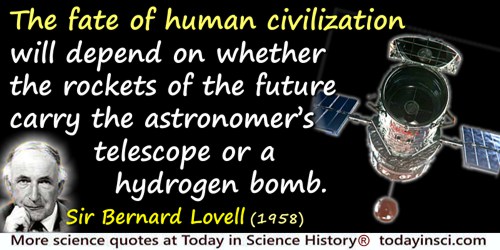
The pursuit of the good and evil are now linked in astronomy as in almost all science. … The fate of human civilization will depend on whether the rockets of the future carry the astronomer’s telescope or a hydrogen bomb.
In BBC Reith Lecture (30 Nov 1958), 'Astronomy and the State', published as The Individual and the Universe (1959, 1961), 72.
The school of Plato has advanced the interests of the race as much through geometry as through philosophy. The modern engineer, the navigator, the astronomer, built on the truths which those early Greeks discovered in their purely speculative investigations. And if the poetry, statesmanship, oratory, and philosophy of our day owe much to Plato’s divine Dialogues, our commerce, our manufactures, and our science are equally indebted to his Conic Sections. Later instances may be abundantly quoted, to show that the labors of the mathematician have outlasted those of the statesman, and wrought mightier changes in the condition of the world. Not that we would rank the geometer above the patriot, but we claim that he is worthy of equal honor.
In 'Imagination in Mathematics', North American Review, 85, 228.
The successful launching of the Sputnik was a demonstration of one of the highest scientific and technological achievements of man—a tantalizing invitation both to the militarist in search of ever more devastating means of destruction and to the astronomer searching for new means of carrying his instruments away from their earthbound environment.
In BBC Reith Lecture (9 Nov 1958), 'Astronomy Breaks Free', published as The Individual and the Universe (1959, 1961), 72.
The undevout astronomer must be mad.
[A favorite maxim, from Edward Young.]
[A favorite maxim, from Edward Young.]
As attributed in William Joseph Federer, America's God and Country: Encyclopedia of Quotations (1996), 291. But the line is from Edward Young, The Complaint: or, Night-Thoughts on Life, Death, and Immortality (1742, 1750), 'Night 9', 260: “It calls Devotion! genuine growth of night / Devotion! Daughter of Astronomy! / An undevout astronomer is mad.”
These earthly godfathers of heaven’s lights
That give a name to every fixed star,
Have no more profit of their shining nights
Than those that walk and wot not what they are.
That give a name to every fixed star,
Have no more profit of their shining nights
Than those that walk and wot not what they are.
The Sonnets, (1906), 169.
Those who study the stars have God for a teacher.
![Albert Claude quote: Until 1930 or thereabout biologists [using microscopes]](https://todayinsci.com/C/Claude_Albert/ClaudeAlbert-Distant500x250px.jpg)
Until 1930 or thereabout biologists [using microscopes], in the situation of Astronomers and Astrophysicists, were permitted to see the objects of their interest, but not to touch them; the cell was as distant from us, as the stars and galaxies were from them.
Nobel Lecture, The Coming Age of the Cell, 12 Dec 1974
Usually, only handfuls of dedicated amateur astronomers view such events. Billions of people saw Hale-Bopp. So, until a better comet comes along, it remains the great comet of our lives.
In 'Hale-Bopp + 10', Astronomy (Jul 2005), 33, No. 7, 76.
What caused me to undertake the catalog was the nebula I discovered above the southern horn of Taurus on September 12, 1758, while observing the comet of that year. ... This nebula had such a resemblance to a comet in its form and brightness that I endeavored to find others, so that astronomers would not confuse these same nebulae with comets just beginning to shine. I observed further with suitable refractors for the discovery of comets, and this is the purpose I had in mind in compiling the catalog.
After me, the celebrated Herschel published a catalog of 2000 which he has observed. This unveiling the sky, made with instruments of great aperture, does not help in the perusal of the sky for faint comets. Thus my object is different from his, and I need only nebulae visible in a telescope of two feet [focal length].
After me, the celebrated Herschel published a catalog of 2000 which he has observed. This unveiling the sky, made with instruments of great aperture, does not help in the perusal of the sky for faint comets. Thus my object is different from his, and I need only nebulae visible in a telescope of two feet [focal length].
Connaissance des Temps for 1800/1801. In Charles Coulston Gillespie (ed.), Dictionary of Scientific Biography (1974), Vol. 9, 330.
When I heard the learn’d astronomer,
When the proofs, the figures, were ranged in columns before me,
When I was shown the charts and diagrams, to add, divide, and measure them,
When I sitting heard the astronomer where he lectured with much applause in the lecture-room,
How soon unaccountable I became tired and sick,
Till rising and gliding out I wander’d by myself,
In the mystical moist night-air, and from time to time,
Look’d up in perfect silence at the stars.
When the proofs, the figures, were ranged in columns before me,
When I was shown the charts and diagrams, to add, divide, and measure them,
When I sitting heard the astronomer where he lectured with much applause in the lecture-room,
How soon unaccountable I became tired and sick,
Till rising and gliding out I wander’d by myself,
In the mystical moist night-air, and from time to time,
Look’d up in perfect silence at the stars.
In Leaves of Grass (1881, 1882), 214.
When I'm asked about the relevance to Black people of what I do, I take that as an affront. It presupposes that Black people have never been involved in exploring the heavens, but this is not so. Ancient African empires - Mali, Songhai, Egypt - had scientists, astronomers. The fact is that space and its resources belong to all of us, not to any one group.
In Current Biography Yearbook (1993), Vol. 54, 280.
When they [radio astronomers] grew weary at their electronic listening posts. When their eyes grew dim with looking at unrevealing dials and studying uneventful graphs, they could step outside their concrete cells and renew their dull spirits in communion with the giant mechanism they commanded, the silent, sensing instrument in which the smallest packets of energy, the smallest waves of matter, were detected in their headlong, eternal flight across the universe. It was the stethoscope with which they took the pulse of the all and noted the birth and death of stars, the probe which, here on an insignificant planet of an undistinguishable star on the edge of its galaxy, they explored the infinite.
The Listeners (1968, 1972), 12.
Yet the widespread [planetary theories], advanced by Ptolemy and most other [astronomers], although consistent with the numerical [data], seemed likewise to present no small difficulty. For these theories were not adequate unless they also conceived certain equalizing circles, which made the planet appear to move at all times with uniform velocity neither on its deferent sphere nor about its own [epicycle's] center … Therefore, having become aware of these [defects], I often considered whether there could perhaps be found a more reasonable arrangement of circles, from which every apparent irregularity would be derived while everything in itself would move uniformly, as is required by the rule of perfect motion.
From Nicholaus Copernicus, Edward Rosen (trans.), Pawel Czartoryski (ed.) 'Commentariolus', in Nicholas Copernicus: Minor Works (1985), 81-83. Excerpted in Lisa M. Dolling, Arthur F. Gianelli and Glenn N. Statile (eds.) The Tests of Time: Readings in the Development of Physical Theory (2003), 40.
 In science it often happens that scientists say, 'You know that's a really good argument; my position is mistaken,' and then they would actually change their minds and you never hear that old view from them again. They really do it. It doesn't happen as often as it should, because scientists are human and change is sometimes painful. But it happens every day. I cannot recall the last time something like that happened in politics or religion.
(1987) --
In science it often happens that scientists say, 'You know that's a really good argument; my position is mistaken,' and then they would actually change their minds and you never hear that old view from them again. They really do it. It doesn't happen as often as it should, because scientists are human and change is sometimes painful. But it happens every day. I cannot recall the last time something like that happened in politics or religion.
(1987) -- 





