Aspect Quotes (130 quotes)
…persons, with big wigs many of them and austere aspect, whom I take to be Professors of the Dismal Science…
Coining “Dismal Science” as a nickname for Political Economy (though used earlier referring to social science in an article, Dec 1849).
Coining “Dismal Science” as a nickname for Political Economy (though used earlier referring to social science in an article, Dec 1849).
'The Present Time', Latter Day Pamphlets, No. 1—Feb 1850, (1850), 43.
“Advance, ye mates! Cross your lances full before me. Well done! Let me touch the axis.” So saying, with extended arm, he grasped the three level, radiating lances at their crossed centre; while so doing, suddenly and nervously twitched them; meanwhile, glancing intently from Starbuck to Stubb; from Stubb to Flask. It seemed as though, by some nameless, interior volition, he would fain have shocked into them the same fiery emotion accumulated within the Leyden jar of his own magnetic life. The three mates quailed before his strong, sustained, and mystic aspect. Stubb and Flask looked sideways from him; the honest eye of Starbuck fell downright.
“In vain!&rsdquo; cried Ahab; “but, maybe, ’tis well. For did ye three but once take the full-forced shock, then mine own electric thing, that had perhaps expired from out me. Perchance, too, it would have dropped ye dead.…”
[Commentary by Henry Schlesinger: Electricity—mysterious and powerful as it seemed at the time—served as a perfect metaphor for Captain Ahab’s primal obsession and madness, which he transmits through the crew as if through an electrical circuit in Moby-Dick.]
“In vain!&rsdquo; cried Ahab; “but, maybe, ’tis well. For did ye three but once take the full-forced shock, then mine own electric thing, that had perhaps expired from out me. Perchance, too, it would have dropped ye dead.…”
[Commentary by Henry Schlesinger: Electricity—mysterious and powerful as it seemed at the time—served as a perfect metaphor for Captain Ahab’s primal obsession and madness, which he transmits through the crew as if through an electrical circuit in Moby-Dick.]
Extract from Herman Melville, Moby-Dick and comment by Henry Schlesinger from his The Battery: How Portable Power Sparked a Technological Revolution (2010), 64.
“Talent is a long patience.” We must look on what we wish to express long enough and with enough attention to discover an aspect that has not been seen and portrayed by another. There is, in everything, something unexplored, because we always use our eyes only with the recollection of what has been thought before on the subject we are contemplating.
From Pierre et Jean (1888), as translated by Alexina Loranger in 'Introduction', Pierre et Jean (Peter and John) (1890), 38-39. The opening words are quoted from Gustave Flaubert. From the original French, “Le talent est une longue patience. — Il s’agit de regarder tout ce qu’on veut exprimer assez longtemps et avec assez d’attention pour en découvrir un aspect qui n’ait été vu et dit par personne. Il y a, dans tout, de l’inexploré, parce que nous sommes habitués à ne nous servir de nos yeux qu’avec le souvenir de ce qu’on a pensé avant nous sur ce que nous contemplons.”
[My dream dinner guest is] Charles Darwin. It’s an obvious answer, but it’s the truth. Think of any problem and before you start theorising, just check up whether Charles Darwin mentioned it in one of those green books sitting on your shelf. Whether it’s earthworms, human gestures or the origin of species, the observations that man made are unbelievable. He touched on so many subjects. Then, Alexander von Humboldt, the last polymath. There was no aspect of the natural world that he wasn’t curious about or didn’t write about in Kosmos, an extraordinary book.
From interview with Alice Roberts, 'Attenborough: My Life on Earth', The Biologist (Aug 2015), 62, No. 4, 16.
[The Book of Genesis is] [p]rofoundly interesting and indeed pathetic to me are those attempts of the opening mind of man to appease its hunger for a Cause. But the Book of Genesis has no voice in scientific questions. It is a poem, not a scientific treatise. In the former aspect it is for ever beautiful; in the latter it has been, and it will continue to be, purely obstructive and hurtful.'
In 'Professor Virchow and Evolution', Fragments of Science (1879), Vol. 2, 377. Tyndall is quoting himself from “four years ago”&mdashthus c.1875.
[The nanotube] brings those properties you cannot get from other organic molecules. And it’s still carbon, so it has organic chemistry. Here is an object that has, to a superlative degree, the aspects that we hold most central to the inorganic world: hardness, toughness, terrific strength, thermal and electrical conductivity. Things you just can’t do with bone and wood. But it’s made out of carbon. It’s something that plays the game at the same level of perfection as molecules and life.
From interview in 'Wires of Wonder', Technology Review (Mar 2001), 104, No. 2, 88.
[When I was a child] I grew up in Brooklyn, New York, and I was a street kid. … [T]here was one aspect of that environment that, for some reason, struck me as different, and that was the stars. … I could tell they were lights in the sky, but that wasn’t an explanation. I mean, what were they? Little electric bulbs on long black wires, so you couldn’t see what they were held up by? What were they? … My mother said to me, "Look, we’ve just got you a library card … get out a book and find the answer.” … It was in there. It was stunning. The answer was that the Sun was a star, except very far away. … The dazzling idea of a universe vast beyond imagining swept over me. … I sensed awe.
In 'Wonder and Skepticism', Skeptical Enquirer (Jan-Feb 1995), 19, No. 1.
Socrates: Very good; let us begin then, Protarchus, by asking whether all this which they call the universe is left to the guidance of unreason and chance medley, or, on the contrary, as our fathers have declared, ordered and governed by a marvellous intelligence and wisdom.
Protarchus: Wide asunder are the two assertions, illustrious Socrates, for that which you were just now saying to me appears to be blasphemy, but the other assertion, that mind orders all things, is worthy of the aspect of the world…
Protarchus: Wide asunder are the two assertions, illustrious Socrates, for that which you were just now saying to me appears to be blasphemy, but the other assertion, that mind orders all things, is worthy of the aspect of the world…
— Plato
From 'Philebus', collected in The Dialogues of Plato (1875), Vol. 4, 70.
Wilst du ins Unendliche schreiten, Geh nur im Endlichen nach allen Seiten.
If you want to reach the infinite, explore every aspect of the finite.
If you want to reach the infinite, explore every aspect of the finite.
Jeremy Naydler (ed.), Goethe On Science: An Anthology of Goethe’s Scientific Writings (1996), 37.
A chemical compound once formed would persist for ever, if no alteration took place in surrounding conditions. But to the student of Life the aspect of nature is reversed. Here, incessant, and, so far as we know, spontaneous change is the rule, rest the exception—the anomaly to be accounted for. Living things have no inertia and tend to no equilibrium.
From Address (22 Jul 1854) delivered at St. Martin’s Hall, published as a pamphlet (1854), 7, and collected in 'Educational Value of Natural History Sciences', Lay Sermons, Addresses, and Reviews (1870), 75.
A hundred years ago … an engineer, Herbert Spencer, was willing to expound every aspect of life, with an effect on his admiring readers which has not worn off today.
Things do not happen quite in this way nowadays. This, we are told, is an age of specialists. The pursuit of knowledge has become a profession. The time when a man could master several sciences is past. He must now, they say, put all his efforts into one subject. And presumably, he must get all his ideas from this one subject. The world, to be sure, needs men who will follow such a rule with enthusiasm. It needs the greatest numbers of the ablest technicians. But apart from them it also needs men who will converse and think and even work in more than one science and know how to combine or connect them. Such men, I believe, are still to be found today. They are still as glad to exchange ideas as they have been in the past. But we cannot say that our way of life is well-fitted to help them. Why is this?
Things do not happen quite in this way nowadays. This, we are told, is an age of specialists. The pursuit of knowledge has become a profession. The time when a man could master several sciences is past. He must now, they say, put all his efforts into one subject. And presumably, he must get all his ideas from this one subject. The world, to be sure, needs men who will follow such a rule with enthusiasm. It needs the greatest numbers of the ablest technicians. But apart from them it also needs men who will converse and think and even work in more than one science and know how to combine or connect them. Such men, I believe, are still to be found today. They are still as glad to exchange ideas as they have been in the past. But we cannot say that our way of life is well-fitted to help them. Why is this?
In 'The Unification of Biology', New Scientist (11 Jan 1962), 13, No. 269, 72.
A living organism must be studied from two distinct aspects. One of these is the causal-analytic aspect which is so fruitfully applicable to ontogeny. The other is the historical descriptive aspect which is unravelling lines of phylogeny with ever-increasing precision. Each of these aspects may make suggestions concerning the possible significance of events seen under the other, but does not explain or translate them into simpler terms.
'Embryology and Evolution', in G. R. de Beer (ed.), Evolution: Essays on Aspects of Evolutionary Biology presented to Professor E. S. Goodrich on his Seventieth Birthday (1938), 76-7.
All science has God as its author and giver. Much is heard of the conflict between science and religion, and of the contrast between sacred and secular. There may be aspects of truth to which religion is the gate, as indeed there are aspects of truth to which particular sciences are the gate. But if there be a Creator, and if truth be one of his attributes, then everything that is true can claim his authorship, and every search for truth can claim his authority.
In Margaret Duggan (ed.), Through the Year with Michael Ramsey: Devotional Readings for Every Day (1975).
Almost all aspects of life are engineered at the molecular level, and without understanding molecules we can only have a very sketchy understanding of life itself.
What Mad Pursuit: A Personal View of Scientific Discovery (1988), 61.
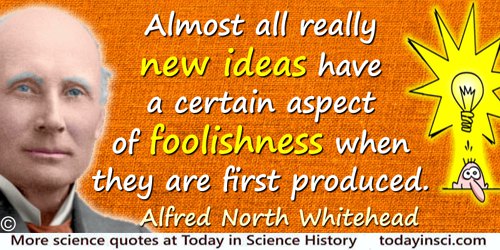
Almost all really new ideas have a certain aspect of foolishness when they are first produced.
In Science and the Modern World (1926, 2011), 60.
And so the great truth, now a paradox, may become a commonplace, that man is greater than his surroundings, and that the production of a breed of men and women, even in our great cities, less prone to disease, and pain, more noble in aspect, more rational in habits, more exultant in the pure joy of living, is not only scientifically possible, but that even the partial fulfillment of this dream, if dream it be, is the most worthy object towards which the lover of his kind can devote the best energies of his life.
In 'The Breed of Man', The Nineteenth Century, (Oct 1900), 669, as collected in Martin Polley (ed.), The History of Sport in Britain, 1880-1914: Sport, Education, and Improvement (2004), Vol. 2, 181.
And ye who wish to represent by words the form of man and all the aspects of his membrification, get away from that idea. For the more minutely you describe, the more you will confuse the mind of the reader and the more you will prevent him from a knowledge of the thing described. And so it is necessary to draw and describe.
From Notebooks (AnA, 14v; Cf. QII, 1), as translated by J. Playfair McMurrich, in Leonardo da Vinci the Anatomist (1930), 76, (Institution Publication 411, Carnegie Institution of Washington).
Anthropologists are highly individual and specialized people. Each of them is marked by the kind of work he or she prefers and has done, which in time becomes an aspect of that individual’s personality.
In Margaret Mead and Rhoda Bubendey Métraux (ed.), Margaret Mead, Some Personal Views (1979), 258.
As a scientist and geneticist I started to feel that science would probably soon reach the point where its interference into the life processes would be counterproductive if a properly designed governing policy was not implemented. A heavily overcrowded planet, ninety-five percent urbanized with nuclear energy as the main source of energy and with all aspects of life highly computerized, is not too pleasant a place for human life. The life of any individual soon will be predictable from birth to death. Medicine, able to cure almost everything, will make the load of accumulated defects too heavy in the next two or three centuries. The artificial prolongation of life, which looked like a very bright idea when I started research in aging about twenty-five years ago, has now lost its attractiveness for me. This is because I now know that the aging process is so multiform and complex that the real technology and chemistry of its prevention by artificial interference must be too complex and expensive. It would be the privilege of a few, not the method for the majority. I also was deeply concerned about the fact that most research is now either directly or indirectly related to military projects and objectives for power.
Quoted in 'Zhores A(leksandrovich) Medvedev', Contemporary Authors Online, Gale, 2002.
As I look back over my efforts, I would characterize my contributions as being largely in the realm of model building. ... I perceive myself as rather uninhibited, with a certain mathematical facility and more interest in the broad aspect of a problem than the delicate nuances. I am more interested in discovering what is over the next rise than in assiduously cultivating the beautiful garden close at hand.
'Men, Mines and Molecules', Annual Review of Physical Chemistry, 1977, 28, 13.
Before the seas and lands had been created, before the sky that covers everything, Nature displayed a single aspect only throughout the cosmos; Chaos was its name, a shapeless, unwrought mass of inert bulk and nothing more, with the discordant seeds of disconnected elements all heaped together in anarchic disarray.
Describing the creation of the universe from chaos, at the beginning of Book I of Metamorphoses, lines 5-9. As translated in Charles Martin (trans.), Metamorphoses (2004), 15.
But, as we consider the totality of similarly broad and fundamental aspects of life, we cannot defend division by two as a natural principle of objective order. Indeed, the ‘stuff’ of the universe often strikes our senses as complex and shaded continua, admittedly with faster and slower moments, and bigger and smaller steps, along the way. Nature does not dictate dualities, trinities, quarterings, or any ‘objective’ basis for human taxonomies; most of our chosen schemes, and our designated numbers of categories, record human choices from a cornucopia of possibilities offered by natural variation from place to place, and permitted by the flexibility of our mental capacities. How many seasons (if we wish to divide by seasons at all) does a year contain? How many stages shall we recognize in a human life?
…...
Certainly Lord Byron has expressed in words some aspects of spiritual turmoil; but our immortal natural historian has reconstructed worlds from bleached bones.
From 'La Peau de Chagrin' (1831). As translated as The Wild Ass’s Skin (1906) trans. Herbert J. Hunt, The Wild Ass’s Skin (1977), 40-1.
Chemistry teaches us to regard under one aspect, as various types of combustion or oxidation, the burning of a candle, the rusting of metals, the physiological process of respiration, and the explosion of gunpowder. In each process there is the one common fact that oxygen enters into new chemical combinations. Similarly to the physicist, the fall of the traditional apple of Newton, the revolution of the earth and planets round the sun, the apparitions of comets, and the ebb and flow of the tides are all phases of the universal law of gravitation. A race ignorant of the nature of combustion or of the law of gravitation, and ignorant of the need of such generalisations, could not be considered to have advanced far along the paths of scientific discovery.
In 'The Discovery of Radioactivity: Radioactivity, a New Science', The Interpretation of Radium and the Structure of the Atom (4th ed., 1920), 1.
Complex organisms cannot be construed as the sum of their genes, nor do genes alone build particular items of anatomy or behavior by them selves. Most genes influence several aspects of anatomy and behavior–as they operate through complex interactions with other genes and their products, and with environmental factors both within and outside the developing organism. We fall into a deep error, not just a harmful oversimplification, when we speak of genes ‘for’ particular items of anatomy or behavior.
In I Have Landed; The End of a Beginning in Natural History (2002, 2011), 234.
Dr. M.L. von Franz has explained the circle (or sphere) as a symbol of Self. It expresses the totality of the psyche in all its aspects, including the relationship between man and the whole of nature. It always points to the single most vital aspect of life, its ultimate wholeness.
In Aniela Jaffé, 'Symbolism in the Visual Arts', collected in Carl Jung (ed.), Man and His Symbols (1964, 1968), 266.
Dressed very plainly, usually with a plain brown skirt of tweed. No cosmetics. Neat but not ostentatious. After all, business was business. She [Florence Sabin] would lecture twice a week. Very rapidly spoken, a little muddy—she was so enthusiastic in trying to correlate the scientific and medical aspect of anatomy (histology). She would tear up her notes after each lecture so that she would have to work it over the next year.
Described by an unnamed student in associate professor Sabin’s histology class at Johns Hopkins University (1909), as quoted, without citation, in Vincent T. Andriole, 'Florence Rena Sabin—Teacher, Scientist, Citizen', Journal of the History of Medicine and Allied Sciences (Jul 1959), 14, No. 3, (July 1959), 325.
During my span of life science has become a matter of public concern and the l'art pour l'art standpoint of my youth is now obsolete. Science has become an integral and most important part of our civilization, and scientific work means contributing to its development. Science in our technical age has social, economic, and political functions, and however remote one's own work is from technical application it is a link in the chain of actions and decisions which determine the fate of the human race. I realized this aspect of science in its full impact only after Hiroshima.
— Max Born
My Life & My Views (1968), 49.
Einstein’s space is no closer to reality than Van Gogh’s sky. The glory of science is not in a truth more absolute than the truth of Bach or Tolstoy, but in the act of creation itself. The scientist’s discoveries impose his own order on chaos, as the composer or painter imposes his; an order that always refers to limited aspects of reality, and is based on the observer's frame of reference, which differs from period to period as a Rembrandt nude differs from a nude by Manet.
In The Act of Creation (1964), 252.
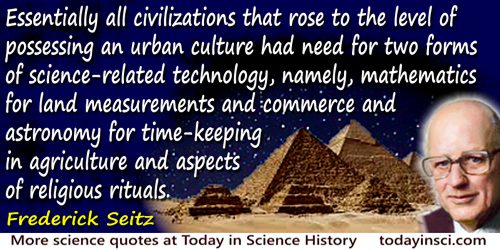
Essentially all civilizations that rose to the level of possessing an urban culture had need for two forms of science-related technology, namely, mathematics for land measurements and commerce and astronomy for time-keeping in agriculture and aspects of religious rituals.
From The Science Matrix: The Journey, Travails, Triumphs (1992, 1998), Preface, x.
Everything material which is the subject of knowledge has number, order, or position; and these are her first outlines for a sketch of the universe. If our feeble hands cannot follow out the details, still her part has been drawn with an unerring pen, and her work cannot be gainsaid. So wide is the range of mathematical sciences, so indefinitely may it extend beyond our actual powers of manipulation that at some moments we are inclined to fall down with even more than reverence before her majestic presence. But so strictly limited are her promises and powers, about so much that we might wish to know does she offer no information whatever, that at other moments we are fain to call her results but a vain thing, and to reject them as a stone where we had asked for bread. If one aspect of the subject encourages our hopes, so does the other tend to chasten our desires, and he is perhaps the wisest, and in the long run the happiest, among his fellows, who has learned not only this science, but also the larger lesson which it directly teaches, namely, to temper our aspirations to that which is possible, to moderate our desires to that which is attainable, to restrict our hopes to that of which accomplishment, if not immediately practicable, is at least distinctly within the range of conception.
From Presidential Address (Aug 1878) to the British Association, Dublin, published in the Report of the 48th Meeting of the British Association for the Advancement of Science (1878), 31.
FAUSTUS: How many heavens or spheres are there?
MEPHASTOPHILIS: Nine: the seven planets, the firmament, and the empyreal heaven.
FAUSTUS: But is there not coelum igneum, et crystallinum?
MEPH.: No Faustus, they be but fables.
FAUSTUS: Resolve me then in this one question: Why are not conjunctions, oppositions, aspects, eclipses all at one time, but in some years we have more, in some less?
MEPH.: Per inaequalem motum respectu totius.
FAUSTUS: Well, I am answered. Now tell me who made the world.
MEPH.: I will not.
FAUSTUS: Sweet Mephastophilis, tell me.
MEPH.: Move me not, Faustus.
FAUSTUS: Villain, have I not bound thee to tell me any thing?
MEPH.: Ay, that is not against our kingdom.
This is. Thou are damn'd, think thou of hell.
FAUSTUS: Think, Faustus, upon God that made the world!
MEPH.: Remember this.
MEPHASTOPHILIS: Nine: the seven planets, the firmament, and the empyreal heaven.
FAUSTUS: But is there not coelum igneum, et crystallinum?
MEPH.: No Faustus, they be but fables.
FAUSTUS: Resolve me then in this one question: Why are not conjunctions, oppositions, aspects, eclipses all at one time, but in some years we have more, in some less?
MEPH.: Per inaequalem motum respectu totius.
FAUSTUS: Well, I am answered. Now tell me who made the world.
MEPH.: I will not.
FAUSTUS: Sweet Mephastophilis, tell me.
MEPH.: Move me not, Faustus.
FAUSTUS: Villain, have I not bound thee to tell me any thing?
MEPH.: Ay, that is not against our kingdom.
This is. Thou are damn'd, think thou of hell.
FAUSTUS: Think, Faustus, upon God that made the world!
MEPH.: Remember this.
Doctor Faustus: A 1604-Version Edition, edited by Michael Keefer (1991), Act II, Scene iii, lines 60-77, 43-4.
For the little that one has reflected on the origin of our knowledge, it is easy to perceive that we can acquire it only by means of comparison. That which is absolutely incomparable is wholly incomprehensible. God is the only example that we could give here. He cannot be comprehended, because he cannot be compared. But all which is susceptible of comparison, everything that we can perceive by different aspects, all that we can consider relatively, can always be judged according to our knowledge.
'Histoire naturelle de l'Homme', Histoire Naturelle, Générale et Particulière, Avec la Description du Cabinet du Roi (1749), Vol. 2, 431. Trans. Phillip R. Sloan.
For the most part, Western medicine doctors are not healers, preventers, listeners, or educators. But they're damned good at saving a life and the other aspects kick the beam. It's about time we brought some balance back to the scale.
From packaging materials, through fibers, foams and surface coatings, to continuous extrusions and large-scale moldings, plastics have transformed almost every aspect of life. Without them, much of modern medicine would be impossible and the consumer electronics and computer industries would disappear. Plastic sewage and water pipes alone have made an immeasurable contribution to public health worldwide.
'Plastics—No Need To Apologize', Trends in Polymer Science (Jun 1996), 4, 172. In Paul C. Painter and Michael M. Coleman, Essentials of Polymer Science and Engineering (2008), 21.
From the aspect of energy, renewed by radio-active phenomena, material corpuscles may now be treated as transient reservoirs of concentrated power. Though never found in a state of purity, but always more or less granulated (even in light) energy nowadays represents for science the most primitive form of universal stuff.
In Teilhard de Chardin and Bernard Wall (trans.), The Phenomenon of Man (1959, 2008), 42. Originally published in French as Le Phénomene Humain (1955).
Gradually, … the aspect of science as knowledge is being thrust into the background by the aspect of science as the power of manipulating nature. It is because science gives us the power of manipulating nature that it has more social importance than art. Science as the pursuit of truth is the equal, but not the superior, of art. Science as a technique, though it may have little intrinsic value, has a practical importance to which art cannot aspire.
In The Scientific Outlook (1931, 2009), xxiv.
Hence, wherever we meet with vital phenomena that present the two aspects, physical and psychical there naturally arises a question as to the relations in which these aspects stand to each other.
History in its broadest aspect is a record of man's migrations from one environment to another.
The Red Man's Continent: A Chronicle of Aboriginal America (1919), 2.
How many times did the sun shine, how many times did the wind howl over the desolate tundras, over the bleak immensity of the Siberian taigas, over the brown deserts where the Earth’s salt shines, over the high peaks capped with silver, over the shivering jungles, over the undulating forests of the tropics! Day after day, through infinite time, the scenery has changed in imperceptible features. Let us smile at the illusion of eternity that appears in these things, and while so many temporary aspects fade away, let us listen to the ancient hymn, the spectacular song of the seas, that has saluted so many chains rising to the light.
In Tectonics of Asia (1924, 1977), 165, trans. Albert V. and Marguerite Carozzi.
Human personality resembles a coral reef: a large hard/dead structure built and inhabited by tiny soft/live animals. The hard/dead part of our personality consists of habits, memories, and compulsions and will probably be explained someday by some sort of extended computer metaphor. The soft/live part of personality consists of moment-to-moment direct experience of being. This aspect of personality is familiar but somewhat ineffable and has eluded all attempts at physical explanation.
Quoted in article 'Nick Herbert', in Gale Cengage Learning, Contemporary Authors Online (2002).
I am an organic chemist, albeit one who adheres to the definition of organic chemistry given by the great Swedish chemist Berzelius, namely, the chemistry of substances found in living matter, and my science is one of the more abstruse insofar as it rests on concepts and employs a jargon neither of which is a part of everyday experience. Nevertheless, organic chemistry deals with matters of truly vital Importance and in some of its aspects with which I myself have been particularly concerned it may prove to hold the keys to Life itself.
In 'Synthesis in the Study of Nucleotides', Nobel Lecture, 11 December 1957. In Nobel Lectures: Chemistry 1942-1962 (1964), 522.
I believe it to be of particular importance that the scientist have an articulate and adequate social philosophy, even more important than the average man should have a philosophy. For there are certain aspects of the relation between science and society that the scientist can appreciate better than anyone else, and if he does not insist on this significance no one else will, with the result that the relation of science to society will become warped, to the detriment of everybody.
Reflections of a Physicist (1950), 287.
I believe that women‐centred, physiologically accurate knowledge of what is normal related to our female bodies, menopause, menstrual cycles and many other aspects of our health does not exist.
Address to First Congress on Women, Health, and Work (Barcelona, 1996). As quoted in 'Aphorism of the Month', Journal of Epidemiology and Community Health (Dec 2007), 61, Suppl. 2, 932.
I have a boundless admiration for the solitary genius which enabled [Hermann Oberth] to bring into focus all of the essential elements of a gigantic concept, together with the human greatness which allowed him, in shy reserve, to bear with equanimity the “crucify hims” as well as the “hosannas” of public opinion. I myself owe him a debt of gratitude not only for being the guiding light of my life, but also for my first contact with the theoretical and practical aspects of rocket technology and space travel.
Primary source needed for verification. (Can you help?)
I regret that it has been necessary for me in this lecture to administer such a large dose of four-dimensional geometry. I do not apologize, because I am really not responsible for the fact that nature in its most fundamental aspect is four-dimensional. Things are what they are; and it is useless to disguise the fact that “what things are” is often very difficult for our intellects to follow.
From The Concept of Nature (1920, 1964), 118.
I think a strong claim can be made that the process of scientific discovery may be regarded as a form of art. This is best seen in the theoretical aspects of Physical Science. The mathematical theorist builds up on certain assumptions and according to well understood logical rules, step by step, a stately edifice, while his imaginative power brings out clearly the hidden relations between its parts. A well constructed theory is in some respects undoubtedly an artistic production. A fine example is the famous Kinetic Theory of Maxwell. ... The theory of relativity by Einstein, quite apart from any question of its validity, cannot but be regarded as a magnificent work of art.
Responding to the toast, 'Science!' at the Royal Academy of the Arts in 1932.)
Responding to the toast, 'Science!' at the Royal Academy of the Arts in 1932.)
Quoted in Lawrence Badash, 'Ernest Rutherford and Theoretical Physics,' in Robert Kargon and Peter Achinstein (eds.) Kelvin's Baltimore Lectures and Modern Theoretical Physics: Historical and Philosophical Perspectives (1987), 352.
I think people get it upside down when they say the unambiguous is the reality and the ambiguous is merely uncertainty about what is really unambiguous. Let’s turn it around the other way: the ambiguous is the reality and the unambiguous is merely a special case of it, where we finally manage to pin down some very special aspect.
In William Byers, How Mathematicians Think (2007), 25.
I thought it was a miracle that I got this faculty appointment and was so happy to be there for a few years that I just wanted to follow what was exciting for me. I didn’t have expectations of getting tenure. So this was an aspect of gender inequality that was extremely positive. It allowed me to be fearless.
As quoted in Anna Azvolinsky, 'Fearless About Folding', The Scientist (Jan 2016).
I’m not an historian but I can get interested—obsessively interested—with any aspect of the past, whether it’s palaeontology or archaeology or the very recent past.
Interview with Robert McCrum, in The Observer (26 Aug 2001).
If there is a lesson in our story it is that the manipulation, according to strictly self-consistent rules, of a set of symbols representing one single aspect of the phenomena may produce correct, verifiable predictions, and yet completely ignore all other aspects whose ensemble constitutes reality.
In 'Epilogue', The Sleepwalkers: A History of Man’s Changing Vision of the Universe (1959, 1968), 533.
If we consider that part of the theory of relativity which may nowadays in a sense be regarded as bone fide scientific knowledge, we note two aspects which have a major bearing on this theory. The whole development of the theory turns on the question of whether there are physically preferred states of motion in Nature (physical relativity problem). Also, concepts and distinctions are only admissible to the extent that observable facts can be assigned to them without ambiguity (stipulation that concepts and distinctions should have meaning). This postulate, pertaining to epistemology, proves to be of fundamental importance.
'Fundamental ideas and problems of the theory of relativity', Lecture delivered to the Nordic Assembly of Naturalists at Gothenburg, 11 Jul 1923. In Nobel Physics 1901-1921 (1998), 482.
In Euclid each proposition stands by itself; its connection with others is never indicated; the leading ideas contained in its proof are not stated; general principles do not exist. In modern methods, on the other hand, the greatest importance is attached to the leading thoughts which pervade the whole; and general principles, which bring whole groups of theorems under one aspect, are given rather than separate propositions. The whole tendency is toward generalization. A straight line is considered as given in its entirety, extending both ways to infinity, while Euclid is very careful never to admit anything but finite quantities. The treatment of the infinite is in fact another fundamental difference between the two methods. Euclid avoids it, in modern mathematics it is systematically introduced, for only thus is generality obtained.
In 'Geometry', Encyclopedia Britannica (9th edition).
In many aspects, the theoretical physicist is merely a philosopher in a working suit.
In Black Holes by Jean-Pierre Luminet (1987).
In my work I now have the comfortable feeling that I am so to speak on my own ground and territory and almost certainly not competing in an anxious race and that I shall not suddenly read in the literature that someone else had done it all long ago. It is really at this point that the pleasure of research begins, when one is, so to speak, alone with nature and no longer worries about human opinions, views and demands. To put it in a way that is more learned than clear: the philological aspect drops out and only the philosophical remains.
In Davis Baird, R.I.G. Hughes and Alfred Nordmann, Heinrich Hertz: Classical Physicist, Modern Philosopher (1998), 157.
In the history of scientific development the personal aspects of the process are usually omitted or played down to emphasize that the thing discovered is independent of the discoverer and that the result can be checked. But, as Einstein has pointed out, scientific concepts are 'created in the minds of men,' and in some way the nonprofessional aspects of life and mind are inevitably related to the professional.
American Institute of Physics, Center for History of Physics Newsletter (Fall 2004).
In the twenties the late Dr. Glenn Frank, an eminent social scientist, developed a new statement of the scientific code, which has been referred to as the “Five Fingers of the Scientific Method.” It may be outlined as follows: find the facts; filter the facts; focus the facts; face the facts; follow the facts. The facts or truths are found by experimentation; the motivation is material. The facts are filtered by research into the literature; the motivation is material. The facts are focused by the publication of results; again the motivation is material. Thus the first three-fifths of the scientific method have a material motivation. It is about time scientists acknowledge that there is more to the scientific convention than the material aspect. Returning to the fourth and fifth fingers of Dr. Frank's conception of the scientific method, the facts should be faced by the proper interpretation of them for society. In other words, a scientist must assume social responsibility for his discoveries, which means that he must have a moral motivation. Finally, in the fifth definition of the scientific method, the facts are to be followed by their proper application to everyday life in society, which means moral motivation through responsibility to society.
From 'Scientists and Society', American Scientist (Jul 1954), 42, No. 3, 495.
Intellectual evolution … is…, under all its aspects, a progress in representativeness of thought.
In The Principles of Psychology (1872), Vol. 2, 535.
It feels unacceptable to many people even to think of having a cosmology based on science. … They see fanciful origin stories as spicing up the culture. … Aspects of many origin stories can enrich our understanding of the scientific picture, but they cannot take its place.
As co-author with Nancy Ellen Abrams, in The View from the Center of the Universe: Discovering Our Extraordinary Place in the Cosmos (2006), 85.
It is a temptation for philosophers that they should weave a fairy tale of the adjustment of factors; and then as an appendix introduce the notion of frustration, as a secondary aspect. I suggest to you that this is the criticism to be made on the monistic idealisms of the nineteenth century, and even of the great Spinoza. It is quite incredible that the Absolute, as conceived in monistic philosophy, should evolve confusion about its own details.
In Modes of Thought (1938), 69-70.
It is certainly true in the United States that there is an uneasiness about certain aspects of science, particularly evolution, because it conflicts, in some people’s minds, with their sense of how we all came to be. But you know, if you are a believer in God, it’s hard to imagine that God would somehow put this incontrovertible evidence in front of us about our relationship to other living organisms and expect us to disbelieve it. I mean, that doesn't make sense at all.
From video of interview with Huffington post reporter at the 2014 Davos Annual Meeting, World Economic Forum (25 Jan 2014). On web page 'Dr. Francis Collins: “There Is An Uneasiness” About Evolution'
It is nothing short of scandalous that we probably only know one out of every ten species on earth, let alone where they are or, various aspects of their biology, and … unless we really know what there is, and where it is, we’re gonna make some mistakes without even knowing we’ve made them.
From Reith Lecture, 'Biodiversity', on BBC Radio 4 (19 Apr 2000). Transcript and audio on BBC website.
It is quite possible that mathematics was invented in the ancient Middle East to keep track of tax receipts and grain stores. How odd that out of this should come a subtle scientific language that can effectively describe and predict the most arcane aspects of the Universe.
Epigraph in Isaac Asimov’s Book of Science and Nature Quotations (1988), 265.
It is tautological to say that an organism is adapted to its environment. It is even tautological to say that an organism is physiologically adapted to its environment. However, just as in the case of many morphological characters, it is unwarranted to conclude that all aspects of the physiology of an organism have evolved in reference to a specific milieu. It is equally gratuitous to assume that an organism will inevitably show physiological specializations in its adaptation to a particular set of conditions. All that can be concluded is that the functional capacities of an organism are sufficient to have allowed persistence within its environment. On one hand, the history of an evolutionary line may place serious constraints upon the types of further physiological changes that are readily feasible. Some changes might require excessive restructuring of the genome or might involve maladaptive changes in related functions. On the other hand, a taxon which is successful in occupying a variety of environments may be less impressive in individual physiological capacities than one with a far more limited distribution.
In W.R. Dawson, G.A. Bartholomew, and A.F. Bennett, 'A Reappraisal of the Aquatic Specializations of the Galapagos Marine Iguana (Amblyrhynchus cristatus)', Evolution (1977), 31, 891.
It is the task of science, as a collective human undertaking, to describe from the external side, (on which alone agreement is possible), such statistical regularity as there is in a world “in which every event has a unique aspect, and to indicate where possible the limits of such description. It is not part of its task to make imaginative interpretation of the internal aspect of reality—what it is like, for example, to be a lion, an ant or an ant hill, a liver cell, or a hydrogen ion. The only qualification is in the field of introspective psychology in which each human being is both observer and observed, and regularities may be established by comparing notes. Science is thus a limited venture. It must act as if all phenomena were deterministic at least in the sense of determinable probabilities. It cannot properly explain the behaviour of an amoeba as due partly to surface and other physical forces and partly to what the amoeba wants to do, with out danger of something like 100 per cent duplication. It must stick to the former. It cannot introduce such principles as creative activity into its interpretation of evolution for similar reasons. The point of view indicated by a consideration of the hierarchy of physical and biological organisms, now being bridged by the concept of the gene, is one in which science deliberately accepts a rigorous limitation of its activities to the description of the external aspects of events. In carrying out this program, the scientist should not, however, deceive himself or others into thinking that he is giving an account of all of reality. The unique inner creative aspect of every event necessarily escapes him.
In 'Gene and Organism', American Naturalist, (1953), 87, 17.
It is to heat that should be attributed the vast movements observed on the Earth; the disturbances of the atmosphere are due to heat, the arising of clouds, the fall of rains and other aspects of weather, the currents of water crisscrossing the globe’s surface of which man manages to harness a small fraction; finally, earthquakes and volcanic eruptions are also caused by heat.
As translated by Webmaster from the original French: “C’est à la chaleur que doivent être attribués les grands mouvements qui frappent nos regards sur la terre; c’est à elle que sont dues les agitations de l’atmosphère, l’ascension des nuages, la chute des pluies et des autres météores, les courants d’eau qui sillonnent la surface du globe et dont l’homme est parvenue à employer pour son usage une faible partie; enfin les tremblements de terre, les éruptions volcaniques reconnaissent aussi pour cause la chaleur.” From Réflexions sur la Puissance Motrice du Feu et sur les Machines Propres a Développer cette Puissance (1824, 1878), 1-2. Also in N.-L.-S. Carnot and R. H. Thurston (ed.), Reflections on the Motive Power of Heat and on Machines Fitted to Develop That Power (1890, 2nd ed. 1897), 11 (in French), and 37-38 (in English) as: “To heat also are due the vast movements which take place on the earth. It causes the agitations of the atmosphere, the ascension of clouds, the fall of rain and of meteors*, the currents of water which channel the surface of the globe, and of which man has thus far employed but a small portion. Even earthquakes and volcanic eruptions are the result of heat.” [*Note the obsolete term “meteors” meaning atmospheric or meteorological phenomena, and does not refer here to rocks falling from space. —Webmaster]
It is well known that the man who first made public the theory of irrationals perished in a shipwreck in order that the inexpressible and unimaginable should ever remain veiled. And so the guilty man, who fortuitously touched on and revealed this aspect of living things, was taken to the place where he began and there is for ever beaten by the waves.
— Proclus
In scholium to Book X of Euclid t. V, 417 as quoted and cited in Ettore Carruccio and Isabel Quigly (trans.), Mathematics And Logic in History And in Contemporary Thought (1964), 27.
It remains a real world if there is a background to the symbols—an unknown quantity which the mathematical symbol x stands for. We think we are not wholly cut off from this background. It is to this background that our own personality and consciousness belong, and those spiritual aspects of our nature not to be described by any symbolism… to which mathematical physics has hitherto restricted itself.
Swarthmore Lecture (1929) at Friends’ House, London, printed in Science and the Unseen World (1929), 37-38.
It would be very unsafe, unwise, and incorrect to assume that a patient either can or wants to present all aspects of his or her personality fully to the eaxminer.
'Integration of Projective Techniques in the clinical case study.' In A. I. Rabin (Ed.), Assessment with projective techniques: A concise introduction (1981), 259. Cited in Donald J. Viglione and Bridget Rivera, 'Assessing Personality and Psychopathology with Projective Methods', in Irving B. Weiner et al., Handbook of Psychology (2003), 542.
Its [mathematical analysis] chief attribute is clearness; it has no means for expressing confused ideas. It compares the most diverse phenomena and discovers the secret analogies which unite them. If matter escapes us, as that of air and light because of its extreme tenuity, if bodies are placed far from us in the immensity of space, if man wishes to know the aspect of the heavens at successive periods separated by many centuries, if gravity and heat act in the interior of the solid earth at depths which will forever be inaccessible, mathematical analysis is still able to trace the laws of these phenomena. It renders them present and measurable, and appears to be the faculty of the human mind destined to supplement the brevity of life and the imperfection of the senses, and what is even more remarkable, it follows the same course in the study of all phenomena; it explains them in the same language, as if in witness to the unity and simplicity of the plan of the universe, and to make more manifest the unchangeable order which presides over all natural causes.
From Théorie Analytique de la Chaleur (1822), Discours Préliminaire, xiv, (Theory of Heat, Introduction), as translated by Alexander Freeman in The Analytical Theory of Heat (1878), 7.
Life is inseparable from water. For all terrestrial animals, including birds, the inescapable need for maintaining an adequate state of hydration in a hostile, desiccating environment is a central persistent constraint which exerts a sustained selective pressure on every aspect of the life cycle. It has been said, with some justification, that the struggle for existence is a struggle for free energy for doing physiological work. It can be said with equal justification for terrestrial organisms that the struggle for existence is a struggle to maintain an aqueous internal environment in which energy transformations for doing work can take place.
In 'The water economy of seed-eating birds that survive without drinking', Proceedings of the International Ornithological Congress (1972), 15, 237-238.
Living with my Indian friends I found I was a stranger in my native land. As time went on, the outward aspect of nature remained the same, but change was wrought in me. I learned to hear the echoes of a time when every living thing even the sky had a voice. That voice devoutly heard by the ancient people of America I desired to make audible to others.
On the plaque over her cremated remains in the patio of the Art Museum at Sante Fe. Edited by William Henry Homes from the preface she wrote in her last book, a small collection of Indian Games and Dances (1915). As stated in concluding pages of Joan T. Mark, A Stranger in Her Native Land: Alice Fletcher and the American Indians (1988), 354-355.
Mathematics as an expression of the human mind reflects the active will, the contemplative reason, and the desire for aesthetic perfection. Its basic elements are logic and intuition, analysis and construction, generality and individuality. Though different traditions may emphasize different aspects, it is only the interplay of these antithetic forces and the struggle for their synthesis that constitute the life, usefulness, and supreme value of mathematical science.
As co-author with Herbert Robbins, in What Is Mathematics?: An Elementary Approach to Ideas and Methods (1941, 1996), x.
Mathematics in its pure form, as arithmetic, algebra, geometry, and the applications of the analytic method, as well as mathematics applied to matter and force, or statics and dynamics, furnishes the peculiar study that gives to us, whether as children or as men, the command of nature in this its quantitative aspect; mathematics furnishes the instrument, the tool of thought, which we wield in this realm.
In Psychologic Foundations of Education (1898), 325.
Matter and mind are not separate, they are aspects of one energy. Look at the mind as a function of matter and you have science; look at matter as the product of the mind and you have religion.
…...
Maybe we have to accept that after reaching the deepest possible level of understanding science can offer, there will nevertheless be aspects of the universe that remain unexplained. Maybe we will have to accept that certain features of the universe are the way they are because of happenstance, accident, or divine choice.
In The Elegant Universe: Superstrings, Hidden Dimensions, and the Quest for the Ultimate Theory (2000), 385.
Most of the dangerous aspects of technological civilization arise, not from its complexities, but from the fact that modern man has become more interested in the machines and industrial goods themselves than in their use to human ends.
In A God Within (1972).
Mr. Dalton's aspect and manner were repulsive. There was no gracefulness belonging to him. His voice was harsh and brawling; his gait stiff and awkward; his style of writing and conversation dry and almost crabbed. In person he was tall, bony, and slender. He never could learn to swim: on investigating this circumstance he found that his spec. grav. as a mass was greater than that of water; and he mentioned this in his lectures on natural philosophy in illustration of the capability of different persons for attaining the art of swimming. Independence and simplicity of manner and originality were his best qualities. Though in comparatively humble circumstances he maintained the dignity of the philosophical character. As the first distinct promulgator of the doctrine that the elements of bodies unite in definite proportions to form chemical compounds, he has acquired an undying fame.
Dr John Davy's (brother of Humphry Davy) impressions of Dalton written in c.1830-31 in Malta.
Dr John Davy's (brother of Humphry Davy) impressions of Dalton written in c.1830-31 in Malta.
Quoted in W. C. Henry, Memoirs of the Life and Scientific Researches of John Dalton (1854), 217-8.
Nature, from one aspect, is the wicked step-mother of the fairy tales, beguiling us and using us for her own purposes—the evolution of substances.
In On Love & Psychological Exercises: With Some Aphorisms & Other Essays (1998), 56.
One of the endlessly alluring aspects of mathematics is that its thorniest paradoxes have a way of blooming into beautiful theories.
In 'Number', Scientific American (Sep 1964), 211, No. 3, 55.
Physical science enjoys the distinction of being the most fundamental of the experimental sciences, and its laws are obeyed universally, so far as is known, not merely by inanimate things, but also by living organisms, in their minutest parts, as single individuals, and also as whole communities. It results from this that, however complicated a series of phenomena may be and however many other sciences may enter into its complete presentation, the purely physical aspect, or the application of the known laws of matter and energy, can always be legitimately separated from the other aspects.
In Matter and Energy (1912), 9-10.
Physics is the basic science. One can easily argue that all other sciences are specialized aspects of physics.
Epigraph in Isaac Asimov’s Book of Science and Nature Quotations (1988), 210.
Physiology, in its analysis of the physiological functions of the sense organs, must use the results of subjective observation of sensations; and psychology, in its turn, needs to know the physiological aspects of sensory function, in order rightly to appreciate the psychological.
Psychologists must cease to be content with the sterile and narrow conception of their science as the science of consciousness, and must boldly assert its claim to be the positive science of mind in all its aspects and modes of functining, or, as I would prefer to say, the positive science of conduct or behavior.
An Introduction to Social Psychology (1928), 13.
Science appears to us with a very different aspect after we have found out that it is not in lecture rooms only, and by means of the electric light projected on a screen, that we may witness physical phenomena, but that we may find illustrations of the highest doctrines of science in games and gymnastics, in travelling by land and by water, in storms of the air and of the sea, and wherever there is matter in motion.
'Introductory Lecture on Experimental Physics' (1871). In W. D. Niven (ed.), The Scientific Papers of James Clerk Maxwell (1890), Vol. 2, 243.
Science is best defined as a careful, disciplined, logical search for knowledge about any and all aspects of the universe, obtained by examination of the best available evidence and always subject to correction and improvement upon discovery of better evidence. What's left is magic. And it doesn't work.
The Mask of Nostradamus: The Prophecies of the World’s Most Famous Seer (1993), 66.
Science is really about describing the way the universe works in one aspect or another in all branches of science—how a life-form works, how this works, how that works. ... You have to have a natural curiosity for that.
Quoted in press release 'Steven Chu Named Sixth Lab Director' (2004) on Lawrence Berkeley National Laboratory websire.
Science recognizes no personal powers in the universe responsive to the prayers and needs of men. Belief in mysterious powers which constitutes, according to our definition, the conceptual aspect of religion is usually an animistic belief in personal powers. Science in effect denies the existence of spiritual beings which religion affirms.
Religion in Human Affairs (1929), 470.
Scientific modes of thought cannot be developed and become generally accepted unless people renounce their primary, unreflecting, and spontaneous attempt to understand all their experience in terms of its purpose and meaning for themselves. The development that led to more adequate knowledge and increasing control of nature was therefore, considered from one aspect, also a development toward greater self-control by men.
The Civilizing Process: The Development of Manners—Changes in the Code of Conduct and Feeling in Early Modern Times (1939), trans. Edmund Jephcott (1978), 225. Originally published as Über den Prozess der Zivilisation.
Scientists have it within them to know what a future-directed society feels like, for science itself, in its human aspect, is just like that.
In A Postscript to Science and Government (1962).
Scripture and Nature agree in this, that all things were covered with water; how and when this aspect began, and how long it lasted, Nature says not, Scripture relates. That there was a watery fluid, however, at a time when animals and plants were not yet to be found, and that the fluid covered all things, is proved by the strata of the higher mountains, free from all heterogeneous material. And the form of these strata bears witness to the presence of a fluid, while the substance bears witness to the absence of heterogeneous bodies. But the similarity of matter and form in the strata of mountains which are different and distant from each other, proves that the fluid was universal.
The Prodromus of Nicolaus Steno's Dissertation Concerning a Solid Body enclosed by Process of Nature within a Solid (1669), trans. J. G. Winter (1916), 263-4.
Since 1849 I have studied incessantly, under all its aspects, a question which was already in my mind [since 1832. I confess that my scheme is still a mere dream, and I do not shut my eyes to the fact that so long as I alone believe it to be possible, it is virtually impossible. ... The scheme in question is the cutting of a canal through the Isthmus of Suez. This has been thought of from the earliest historical times, and for that very reason is looked upon as impracticable. Geographical dictionaries inform us indeed that the project would have been executed long ago but for insurmountable obstacles. [On his inspiration for the Suez Canal.]
Letter to M.S.A. Ruyssenaers, Consul-General for Holland in Egypt, from Paris (8 Jul 1852), seeking support. Collected in Ferdinand de Lesseps, The Suez Canal: Letters and Documents Descriptive of Its Rise and Progress in 1854-1856 (1876), 2.
Some recent work by E. Fermi and L. Szilard, which has been communicated to me in manuscript, leads me to expect that the element uranium may be turned into a new and important source of energy in the immediate future. Certain aspects of the situation seem to call for watchfulness and, if necessary, quick action on the part of the Administration. …
In the course of the last four months it has been made probable … that it may become possible to set up nuclear chain reactions in a large mass of uranium, by which vast amounts of power and large quantities of new radium-like elements would be generated. Now it appears almost certain that this could be achieved in the immediate future.
This new phenomenon would also lead to the construction of bombs, and it is conceivable—though much less certain—that extremely powerful bombs of a new type may thus be constructed. A single bomb of this type, carried by boat or exploded in a port, might well destroy the whole port altogether with some of the surrounding territory. However, such bombs might well prove to be too heavy for transportation by air.
In the course of the last four months it has been made probable … that it may become possible to set up nuclear chain reactions in a large mass of uranium, by which vast amounts of power and large quantities of new radium-like elements would be generated. Now it appears almost certain that this could be achieved in the immediate future.
This new phenomenon would also lead to the construction of bombs, and it is conceivable—though much less certain—that extremely powerful bombs of a new type may thus be constructed. A single bomb of this type, carried by boat or exploded in a port, might well destroy the whole port altogether with some of the surrounding territory. However, such bombs might well prove to be too heavy for transportation by air.
Letter to President Franklin P. Roosevelt, (2 Aug 1939, delivered 11 Oct 1939). In Otto Nathan and Heinz Norden (Eds.) Einstein on Peace (1960, reprinted 1981), 294-95.
That the fundamental aspects of heredity should have turned out to be so extraordinarily simple supports us in the hope that nature may, after all, be entirely approachable. Her much-advertised inscrutability has once more been found to be an illusion due to our ignorance. This is encouraging, for, if the world in which we live were as complicated as some of our friends would have us believe we might well despair that biology could ever become an exact science.
The Physical Basis of Heredity (1919), 15.
The action of the mind in the acquisition of knowledge of any sort is synthetic-analytic; that is, uniting and separating. These are the two sides, or aspects, of the one process. … There is no such thing as a synthetic activity that is not accompanied by the analytic; and there is no analytic activity that is not accompanied by the synthetic. Children cannot be taught to perform these knowing acts. It is the nature of the mind to so act when it acts at all.
In The Public-School Journal (Jan 1895), Vol. 14, 281-282.
The actual evolution of mathematical theories proceeds by a process of induction strictly analogous to the method of induction employed in building up the physical sciences; observation, comparison, classification, trial, and generalisation are essential in both cases. Not only are special results, obtained independently of one another, frequently seen to be really included in some generalisation, but branches of the subject which have been developed quite independently of one another are sometimes found to have connections which enable them to be synthesised in one single body of doctrine. The essential nature of mathematical thought manifests itself in the discernment of fundamental identity in the mathematical aspects of what are superficially very different domains. A striking example of this species of immanent identity of mathematical form was exhibited by the discovery of that distinguished mathematician … Major MacMahon, that all possible Latin squares are capable of enumeration by the consideration of certain differential operators. Here we have a case in which an enumeration, which appears to be not amenable to direct treatment, can actually be carried out in a simple manner when the underlying identity of the operation is recognised with that involved in certain operations due to differential operators, the calculus of which belongs superficially to a wholly different region of thought from that relating to Latin squares.
In Presidential Address British Association for the Advancement of Science, Sheffield, Section A,
Nature (1 Sep 1910), 84, 290.
The discoveries of science, the works of art are explorations—more, are explosions, of a hidden likeness. The discoverer or artist presents in them two aspects of nature and fuses them into one. This is the act of creation, in which an original thought is born, and it is the same act in original science and original art.
From Science and Human Values (1956), 30.
The entire cosmos is made out of one and the same world-stuff, operated by the same energy as we ourselves. “Mind” and “matter” appears as two aspects of our unitary mind-bodies. There is no separate supernatural realm: all phenomena are part of one natural process of evolution. There is no basic cleavage between science and religion; they are both organs of evolving humanity.
In essay, 'The New Divinity', originally published in The Twentieth Century (1962), 170, 9. Collected in Essays of a Humanist (1964), 218.
The experience was more fulfilling than I could have ever imagined. I have a newfound sense of wonder seeing the Earth and stars from such an incredible perspective. Certainly, through my training I was prepared for the technical aspects, but I had no idea that I would be flooded with such amazement and joy after seeing my first sunrise and sunset from space.
…...
The focal points of our different reflections have been called “science”’ or “art” according to the nature of their “formal” objects, to use the language of logic. If the object leads to action, we give the name of “art” to the compendium of rules governing its use and to their technical order. If the object is merely contemplated under different aspects, the compendium and technical order of the observations concerning this object are called “science.” Thus metaphysics is a science and ethics is an art. The same is true of theology and pyrotechnics.
Definition of 'Art', Encyclopédie (1751). Translated by Nelly S. Hoyt and Thomas Cassirer (1965), 4.
The idea of winning a doctor’s degree gradually assumed the aspect of a great moral struggle, and the moral fight possessed immense attraction for me.
In Pioneer Work in Opening the Medical Profession to Women (1895), 29.
The idea that something in food might be of advantage to patients with pernicious anemia was in my mind in 1912, when I was a house officer at the Massachusetts General Hospital…. Ever since my student days, when I had the opportunity, in my father’s wards at the Massachusetts General Hospital, … I have taken a deep interest in this disease. … Prolonged observation permitted me to become acquainted with the multiple variations and many aspects of the disease, and to realize that from a few cases it was difficult to determine the effect of therapeutic procedures.
From Nobel Prize Lecture (12 Dec 1934), collected in Nobel Lectures, Physiology or Medicine 1922-1941 (1965).
The labor of love aspect is important. The most successful scientists are not the most talented. But they are the ones who are impelled by curiosity. They’ve got to know what the answer is.
As quoted in Andrew Grant and Gaia Grant, Who Killed Creativity?: ...And How Do We Get It Back? (2012).
The mind-stuff is not spread in space and time. But we must presume that in some other way or aspect it can be differentiated into parts. Only here and there does it arise to the level of consciousness, but from such islands proceeds all knowledge. The latter includes our knowledge of the physical world.
From Gifford Lecture, Edinburgh, (1927), 'Reality', collected in The Nature of the Physical World (1928), 277.
The mortal enemies of man are not his fellows of another continent or race; they are the aspects of the physical world which limit or challenge his control, the disease germs that attack him and his domesticated plants and animals, and the insects that carry many of these germs as well as working notable direct injury. This is not even the age of man, however great his superiority in size and intelligence; it is literally the age of insects.
In Chap. 7, 'Some Human Implications', The Social Life of Animals (1938), 240-241. [Books that cite a source of The Social Life of Insects are incorrect. There is no such title in the Library of Congress catalog. —Webmaster]
The most revolutionary aspect of technology is its mobility. Anybody can learn it. It jumps easily over barriers of race and language. … The new technology of microchips and computer software is learned much faster than the old technology of coal and iron. It took three generations of misery for the older industrial countries to master the technology of coal and iron. The new industrial countries of East Asia, South Korea, and Singapore and Taiwan, mastered the new technology and made the jump from poverty to wealth in a single generation.
Infinite in All Directions: Gifford lectures given at Aberdeen, Scotland (2004), 270.
The need to make music, and to listen to it, is universally expressed by human beings. I cannot imagine, even in our most primitive times, the emergence of talented painters to make cave paintings without there having been, near at hand, equally creative people making song. It is, like speech, a dominant aspect of human biology.
In 'The Music of This Sphere', The Lives of a Cell: Notes of a Biology Watcher (1974), 25.
The ordinary naturalist is not sufficiently aware that when dogmatizing on what species are, he is grappling with the whole question of the organic world & its connection with the time past & with Man; that it involves the question of Man & his relation to the brutes, of instinct, intelligence & reason, of Creation, transmutation & progressive improvement or development. Each set of geological questions & of ethnological & zool. & botan. are parts of the great problem which is always assuming a new aspect.
Leonard G. Wilson (ed.), Sir Charles Lyell's Scientific Journals on the Species Question (1970), 164.
The philosophy that I have worked under most of my life is that the serious study of natural history is an activity which has far-reaching effects in every aspect of a person’s life. It ultimately makes people protective of the environment in a very committed way. It is my opinion that the study of natural history should be the primary avenue for creating environmentalists.
As quoted in William V. Mealy, Peter Friederici and Roger Tory Peterson Institute, Value in American Wildlife Art: Proceedings of the 1992 Forum (1992), 3.
The prevailing trend in modern physics is thus much against any sort of view giving primacy to ... undivided wholeness of flowing movement. Indeed, those aspects of relativity theory and quantum theory which do suggest the need for such a view tend to be de-emphasized and in fact hardly noticed by most physicists, because they are regarded largely as features of the mathematical calculus and not as indications of the real nature of things.
Wholeness and the Implicate Order? (1981), 14.
The progress of science has always been the result of a close interplay between our concepts of the universe and our observations on nature. The former can only evolve out of the latter and yet the latter is also conditioned greatly by the former. Thus in our exploration of nature, the interplay between our concepts and our observations may sometimes lead to totally unexpected aspects among already familiar phenomena.
'Weak Interactions and Nonconservation of Parity', Nobel Lecture, 11 Dec 1957. In Nobel Lectures: Physics 1942-1962 (1964), 417.
The saddest aspect of life right now is that science gathers knowledge faster than society gathers wisdom.
IIsaac Asimov's Book of Science and Nature Quotations (1988), 281.
The study of … simple cases would, I think, often be of advantage even to students whose mathematical attainments are sufficient to enable them to follow the solution of the more general cases. For in these simple cases the absence of analytical difficulties allows attention to be more easily concentrated on the physical aspects of the question, and thus gives the student a more vivid idea and a more manageable grasp of the subject than he would be likely to attain if he merely regarded electrical phenomena through a cloud of analytical symbols.
Elements of the Mathematical Theory of Electricity and Magnetism (189S), v-vi.
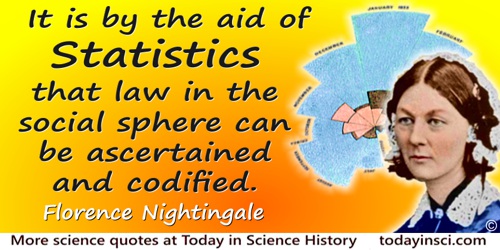
The true foundation of theology is to ascertain the character of God. It is by the aid of Statistics that law in the social sphere can be ascertained and codified, and certain aspects of the character of God thereby revealed. The study of statistics is thus a religious service.
As quoted by Florence Nightingale David in Games, Gods, and Gambling: A History of Probability and Statistical Ideas (1962, 1998), 103. David introduced the quote by saying “Florence Nightingale, after some lengthy calculations, wrote:”.
There have, however, always been men of high and disciplined spirituality who have insisted on their direct experience of something greater than themselves. Their conviction of the reality of a spiritual life apart from and transcending the life of the body may not lend itself to scientific proof or disproof; nevertheless the remarkable transformation in personality seen in those who rightfully lay claim to such experience is as objective as tomorrow's sunrise. Millions of lesser men draw strength from the contacts they can make through prayer and meditation with this aspect of the inner life.
at a convention of scientists in 1967 at the University of Notre Dame
There is an art to science, and science in art; the two are not enemies, but different aspects of the whole.
Epigraph in Isaac Asimov’s Book of Science and Nature Quotations (1988), 251.
This Academy [at Lagado] is not an entire single Building, but a Continuation of several Houses on both Sides of a Street; which growing waste, was purchased and applied to that Use.
I was received very kindly by the Warden, and went for many Days to the Academy. Every Room hath in it ' one or more Projectors; and I believe I could not be in fewer than five Hundred Rooms.
The first Man I saw was of a meagre Aspect, with sooty Hands and Face, his Hair and Beard long, ragged and singed in several Places. His Clothes, Shirt, and Skin were all of the same Colour. He had been Eight Years upon a Project for extracting Sun-Beams out of Cucumbers, which were to be put into Vials hermetically sealed, and let out to warm the Air in raw inclement Summers. He told me, he did not doubt in Eight Years more, that he should be able to supply the Governor's Gardens with Sunshine at a reasonable Rate; but he complained that his Stock was low, and interested me to give him something as an Encouragement to Ingenuity, especially since this had been a very dear Season for Cucumbers. I made him a small Present, for my Lord had furnished me with Money on purpose, because he knew their Practice of begging from all who go to see them.
I saw another at work to calcine Ice into Gunpowder; who likewise shewed me a Treatise he had written concerning the Malleability of Fire, which he intended to publish.
There was a most ingenious Architect who had contrived a new Method for building Houses, by beginning at the Roof, and working downwards to the Foundation; which he justified to me by the life Practice of those two prudent Insects the Bee and the Spider.
In another Apartment I was highly pleased with a Projector, who had found a device of plowing the Ground with Hogs, to save the Charges of Plows, Cattle, and Labour. The Method is this: In an Acre of Ground you bury at six Inches Distance, and eight deep, a quantity of Acorns, Dates, Chestnuts, and other Masts or Vegetables whereof these Animals are fondest; then you drive six Hundred or more of them into the Field, where in a few Days they will root up the whole Ground in search of their Food, and make it fit for sowing, at the same time manuring it with their Dung. It is true, upon Experiment they found the Charge and Trouble very great, and they had little or no Crop. However, it is not doubted that this Invention may be capable of great Improvement.
I had hitherto seen only one Side of the Academy, the other being appropriated to the Advancers of speculative Learning.
Some were condensing Air into a dry tangible Substance, by extracting the Nitre, and letting the acqueous or fluid Particles percolate: Others softening Marble for Pillows and Pin-cushions. Another was, by a certain Composition of Gums, Minerals, and Vegetables outwardly applied, to prevent the Growth of Wool upon two young lambs; and he hoped in a reasonable Time to propagate the Breed of naked Sheep all over the Kingdom.
I was received very kindly by the Warden, and went for many Days to the Academy. Every Room hath in it ' one or more Projectors; and I believe I could not be in fewer than five Hundred Rooms.
The first Man I saw was of a meagre Aspect, with sooty Hands and Face, his Hair and Beard long, ragged and singed in several Places. His Clothes, Shirt, and Skin were all of the same Colour. He had been Eight Years upon a Project for extracting Sun-Beams out of Cucumbers, which were to be put into Vials hermetically sealed, and let out to warm the Air in raw inclement Summers. He told me, he did not doubt in Eight Years more, that he should be able to supply the Governor's Gardens with Sunshine at a reasonable Rate; but he complained that his Stock was low, and interested me to give him something as an Encouragement to Ingenuity, especially since this had been a very dear Season for Cucumbers. I made him a small Present, for my Lord had furnished me with Money on purpose, because he knew their Practice of begging from all who go to see them.
I saw another at work to calcine Ice into Gunpowder; who likewise shewed me a Treatise he had written concerning the Malleability of Fire, which he intended to publish.
There was a most ingenious Architect who had contrived a new Method for building Houses, by beginning at the Roof, and working downwards to the Foundation; which he justified to me by the life Practice of those two prudent Insects the Bee and the Spider.
In another Apartment I was highly pleased with a Projector, who had found a device of plowing the Ground with Hogs, to save the Charges of Plows, Cattle, and Labour. The Method is this: In an Acre of Ground you bury at six Inches Distance, and eight deep, a quantity of Acorns, Dates, Chestnuts, and other Masts or Vegetables whereof these Animals are fondest; then you drive six Hundred or more of them into the Field, where in a few Days they will root up the whole Ground in search of their Food, and make it fit for sowing, at the same time manuring it with their Dung. It is true, upon Experiment they found the Charge and Trouble very great, and they had little or no Crop. However, it is not doubted that this Invention may be capable of great Improvement.
I had hitherto seen only one Side of the Academy, the other being appropriated to the Advancers of speculative Learning.
Some were condensing Air into a dry tangible Substance, by extracting the Nitre, and letting the acqueous or fluid Particles percolate: Others softening Marble for Pillows and Pin-cushions. Another was, by a certain Composition of Gums, Minerals, and Vegetables outwardly applied, to prevent the Growth of Wool upon two young lambs; and he hoped in a reasonable Time to propagate the Breed of naked Sheep all over the Kingdom.
Gulliver's Travels (1726, Penguin ed. 1967), Part III, Chap. 5, 223.
Through radio I look forward to a United States of the World. Radio is standardizing the peoples of the Earth, English will become the universal language because it is predominantly the language of the ether. The most important aspect of radio is its sociological influence. (1926)
As quoted (without citation) in Orrin Elmer Dunlap, Radio's 100 Men of Science: Biographical Narratives of Pathfinders (1944), 131.
Throughout history, engineers have served their neighbours, their towns and their countries by making tools, machines and countless other things that improve every aspect of life. From information technology to medical science and mining, from building roads to space travel, engineers are working to make a difference to our standard of living, and with it our health, wealth and happiness.
From a speech by The Queen at The Queen Elizabeth Prize for Engineering (25 Jun 2013).
Throughout history, engineers have served their neighbours, their towns and their countries by making tools, machines and countless other things that improve every aspect of life. From information technology to medical science and mining, from building roads to space travel, engineers are working to make a difference to our standard of living, and with it our health, wealth and happiness. At its heart, engineering is about using science to find creative, practical solutions. It is a noble profession.
In Speech (25 Jun 2013), for the 2013 Queen Elizabeth Prize for Engineering.
To us … the only acceptable point of view appears to be the one that recognizes both sides of reality—the quantitative and the qualitative, the physical and the psychical—as compatible with each other, and can embrace them simultaneously … It would be most satisfactory of all if physis and psyche (i.e., matter and mind) could be seen as complementary aspects of the same reality.
From Lecture at the Psychological Club of Zurich (1948), 'The Influence of Archetypal Ideas on the Scientific Theories of Kepler', collected in Writings on Physics and Philosophy (1994), 260, as translated by Robert Schlapp.
We are no longer tempted to condemn the spiritual aspects of our nature as illusory because of their lack of concreteness.
Swarthmore Lecture (1929) at Friends’ House, London, printed in Science and the Unseen World (1929), 33.
We do not know why we are born into the world, but we can try to find out what sort of a world it is—at least in its physical aspects.
As quoted in Gale E. Christianson, Edwin Hubble: Mariner of the Nebulae (1996), 183. Cited as from Edwin P. Hubble Manuscript Collection, Henry Huntington Library. San Manno, California, in writings of Grace Burke Hubble on E.P H. Characteristics, 2: 82(9). Box 7, 23.
We have corrupted the term research to mean study and experiment and development toward selected objectives, and we have even espoused secret and classified projects. This was not the old meaning of university research. We need a new term, or the revival of a still older one, to refer to the dedicated activities of the scholar, the intensive study of special aspects of a subject for its own sake, motivated by the love of knowledge and truth.
In 'Technology and National Research Policy', Bulletin of the Atomic Scientists (Oct 1953), 292.
We may regard the cell quite apart from its familiar morphological aspects, and contemplate its constitution from the purely chemical standpoint. We are obliged to adopt the view, that the protoplasm is equipped with certain atomic groups, whose function especially consists in fixing to themselves food-stuffs, of importance to the cell-life. Adopting the nomenclature of organic chemistry, these groups may be designated side-chains. We may assume that the protoplasm consists of a special executive centre (Leistungs-centrum) in connection with which are nutritive side-chains… The relationship of the corresponding groups, i.e., those of the food-stuff, and those of the cell, must be specific. They must be adapted to one another, as, e.g., male and female screw (Pasteur), or as lock and key (E. Fischer).
Croonian Lecture, 'On Immunity with Special Reference to Cell Life', Proceedings of the Royal Society of London, 1900, 66, 433-434.
We should remember that there was once a discipline called natural philosophy. Unfortunately, this discipline seems not to exist today. It has been renamed science, but science of today is in danger of losing much of the natural philosophy aspect.
[Pointing out the increasing specialization of science during the century to explain the resistance to his ideas,]
[Pointing out the increasing specialization of science during the century to explain the resistance to his ideas,]
(1986) Quoted in Anthony L. Peratt, 'Dean of the Plasma Dissidents', Washington Times, supplement: The World and I (May 1988),192.
What appear to be the most valuable aspects of the theoretical physics we have are the mathematical descriptions which enable us to predict events. These equations are, we would argue, the only realities we can be certain of in physics; any other ways we have of thinking about the situation are visual aids or mnemonics which make it easier for beings with our sort of macroscopic experience to use and remember the equations.
In The Lost Cause: Causation and the Mind-body Problem (2003).
What is mathematics? What is it for? What are mathematicians doing nowadays? Wasn't it all finished long ago? How many new numbers can you invent anyway? Is today’s mathematics just a matter of huge calculations, with the mathematician as a kind of zookeeper, making sure the precious computers are fed and watered? If it’s not, what is it other than the incomprehensible outpourings of superpowered brainboxes with their heads in the clouds and their feet dangling from the lofty balconies of their ivory towers?
Mathematics is all of these, and none. Mostly, it’s just different. It’s not what you expect it to be, you turn your back for a moment and it's changed. It's certainly not just a fixed body of knowledge, its growth is not confined to inventing new numbers, and its hidden tendrils pervade every aspect of modern life.
Mathematics is all of these, and none. Mostly, it’s just different. It’s not what you expect it to be, you turn your back for a moment and it's changed. It's certainly not just a fixed body of knowledge, its growth is not confined to inventing new numbers, and its hidden tendrils pervade every aspect of modern life.
Opening paragraphs of 'Preface', From Here to Infinity (1996), vii.
What of the future of this adventure? What will happen ultimately? We are going along guessing the laws; how many laws are we going to have to guess? I do not know. Some of my colleagues say that this fundamental aspect of our science will go on; but I think there will certainly not be perpetual novelty, say for a thousand years. This thing cannot keep on going so that we are always going to discover more and more new laws … It is like the discovery of America—you only discover it once. The age in which we live is the age in which we are discovering the fundamental laws of nature, and that day will never come again. Of course in the future there will be other interests … but there will not be the same things that we are doing now … There will be a degeneration of ideas, just like the degeneration that great explorers feel is occurring when tourists begin moving in on a territory.
In The Character of Physical Law (1965, 1994), 166.
When we reflect that all the aspects of Nature, all the emotions of the soul, and all the events of life, have been the subjects of poetry for hundreds and thousands of years, we can hardly wonder that there should be so many resemblances and coincidences of expression among poets, but rather that they are not more numerous and more striking.
In 'Table-Talk', The Poetical Works of Henry Wadsworth Longfellow: Volume 3 (1883), 1355.
 In science it often happens that scientists say, 'You know that's a really good argument; my position is mistaken,' and then they would actually change their minds and you never hear that old view from them again. They really do it. It doesn't happen as often as it should, because scientists are human and change is sometimes painful. But it happens every day. I cannot recall the last time something like that happened in politics or religion.
(1987) --
In science it often happens that scientists say, 'You know that's a really good argument; my position is mistaken,' and then they would actually change their minds and you never hear that old view from them again. They really do it. It doesn't happen as often as it should, because scientists are human and change is sometimes painful. But it happens every day. I cannot recall the last time something like that happened in politics or religion.
(1987) --