Arrangement Quotes (94 quotes)
… the reasoning process [employed in mathematics] is not different from that of any other branch of knowledge, … but there is required, and in a great degree, that attention of mind which is in some part necessary for the acquisition of all knowledge, and in this branch is indispensably necessary. This must be given in its fullest intensity; … the other elements especially characteristic of a mathematical mind are quickness in perceiving logical sequence, love of order, methodical arrangement and harmony, distinctness of conception.
In Treatise on Infinitesimal Calculus (1868), Vol. 8, 6.
... we might say that the earth has a spirit of growth; that its flesh is the soil, its bones the arrangement and connection of the rocks of which the mountains are composed, its cartilage the tufa, and its blood the springs of water.
…...
Les mathématiciens parviennent à la solution d’un problême par le simple arrangement des données, & en réduisant le raisonnement à des opérations si simples, à des jugemens si courts, qu’ils ne perdent jamais de vue l’évidence qui leur sert de guide.
Mathematicians come to the solution of a problem by the simple arrangement of the data, and reducing the reasoning to such simple operations, to judgments so brief, that they never lose sight of the evidence that serves as their guide.
Mathematicians come to the solution of a problem by the simple arrangement of the data, and reducing the reasoning to such simple operations, to judgments so brief, that they never lose sight of the evidence that serves as their guide.
From a paper read to the Académie Royales des Sciences (18 Apr 1787), printed in Méthode de Nomenclature Chimique (1787), 12. Translation from the French by Webmaster.
A casual glance at crystals may lead to the idea that they were pure sports of nature, but this is simply an elegant way of declaring one’s ignorance. With a thoughtful examination of them, we discover laws of arrangement. With the help of these, calculation portrays and links up the observed results. How variable and at the same time how precise and regular are these laws! How simple they are ordinarily, without losing anything of their significance! The theory which has served to develop these laws is based entirely on a fact, whose existence has hitherto been vaguely discerned rather than demonstrated. This fact is that in all minerals which belong to the same species, these little solids, which are the crystal elements and which I call their integrant molecules, have an invariable form, in which the faces lie in the direction of the natural fracture surfaces corresponding to the mechanical division of the crystals. Their angles and dimensions are derived from calculations combined with observation.
Traité de mineralogie … Publié par le conseil des mines (1801), Vol. 1, xiii-iv, trans. Albert V. and Marguerite Carozzi.
A crystal is like a class of children arranged for drill, but standing at ease, so that while the class as a whole has regularity both in time and space, each individual child is a little fidgety!
In Crystals and X-Rays (1948), 22.
A mathematical science is any body of propositions which is capable of an abstract formulation and arrangement in such a way that every proposition of the set after a certain one is a formal logical consequence of some or all the preceding propositions. Mathematics consists of all such mathematical sciences.
In Lectures on Fundamental Concepts of Algebra and Geometry (1911), 222.
All of our experience indicates that life can manifest itself only in a concrete form, and that it is bound to certain substantial loci. These loci are cells and cell formations. But we are far from seeking the last and highest level of understanding in the morphology of these loci of life. Anatomy does not exclude physiology, but physiology certainly presupposes anatomy. The phenomena that the physiologist investigates occur in special organs with quite characteristic anatomical arrangements; the various morphological parts disclosed by the anatomist are the bearers of properties or, if you will, of forces probed by the physiologist; when the physiologist has established a law, whether through physical or chemical investigation, the anatomist can still proudly state: This is the structure in which the law becomes manifest.
In 'Cellular-Pathologie', Archiv für pathologische Anatomie und Physiologie und fur klinische Medizin (1855), 8, 19, as translated in LellandJ. Rather, 'Cellular Pathology', Disease, Life, and Man: Selected Essays by Rudolf Virchow (1958), 84.
An Experiment, like every other event which takes place, is a natural phenomenon; but in a Scientific Experiment the circumstances are so arranged that the relations between a particular set of phenomena may be studied to the best advantage.
'General Considerations Concerning Scientific Apparatus', 1876. In W. D. Niven (ed.), The Scientific Papers of James Clerk Maxwell (1890), Vol. 2, 505.
Any country that wants to make full use of all its potential scientists and technologists … must not expect to get the women quite so simply as it gets the men. It seems to me that marriage and motherhood are at least as socially important as military service. Government regulations are framed to ensure (in the United Kingdom) that a man returning to work from military service is not penalized by his absence. Is it utopian, then, to suggest that any country that really wants a woman to return to a scientific career when her children no longer need her physical presence should make special arrangements to encourage her to do so?
In Impact of Science on Society (1970), 20 58. Commenting how for men who went to war, their jobs were held for them pending their return.
Are the atoms of the dextroacid (tartaric) grouped in the spirals of a right-hand helix or situated at the angles of an irregular tetrahedron, or arranged in such or such particular unsymmetrical fashion? We are unable to reply to these questions. But there can be no reason for doubting that the grouping of the atoms has an unsymmetrical arrangement with a non-superimposable image. It is not less certain that the atoms of the laevo-acid realize precisely an unsymmetrical arrangement of the inverse of the above.
Leçons de Chemie (1860), 25.
As an antiquary of a new order, I have been obliged to learn the art of deciphering and restoring these remains, of discovering and bringing together, in their primitive arrangement, the scattered and mutilated fragments of which they are composed, of reproducing in all their original proportions and characters, the animals to which these fragments formerly belonged, and then of comparing them with those animals which still live on the surface of the earth; an art which is almost unknown, and which presupposes, what had scarcely been obtained before, an acquaintance with those laws which regulate the coexistence of the forms by which the different parts of organized being are distinguished.
'Preliminary discourse', to Recherches sur les Ossemens Fossiles (1812), trans. R. Kerr Essay on the Theory of the Earth (1813), 1-2.
As mineralogy constitutes a part of chemistry, it is clear that this arrangement [of minerals] must derive its principles from chemistry. The most perfect mode of arrangement would certainly be to allow bodies to follow each other according to the order of their electro-chemical properties, from the most electro-negative, oxygen, to the most electro-positive, potassium; and to place every compound body according to its most electro-positive ingredient.
An Attempt to Establish a Pure Scientific System of Mineralogy (1814), trans. J. Black, 48.
![Robert Fulton quote: As the component parts of all new machines may be said to be old[,] it is a nice discriminating judgment,](https://todayinsci.com/F/Fulton_Robert/FultonRobert-Mechanic500x250px.jpg)
As the component parts of all new machines may be said to be old[,] it is a nice discriminating judgment, which discovers that a particular arrangement will produce a new and desired effect. ... Therefore, the mechanic should sit down among levers, screws, wedges, wheels, etc. like a poet among the letters of the alphabet, considering them as the exhibition of his thoughts; in which a new arrangement transmits a new idea to the world.
A Treatise on the Improvement of Canal Navigation (1796), preface, x.
Beware how you take away hope from any human being. Nothing is clearer than that the merciful Creator intends to blind most people as they pass down into the dark valley. Without very good reasons, temporal or spiritual, we should not interfere with his kind arrangements. It is the height of cruelty and the extreme of impertinence to tell your patient he must die, except you are sure that he wishes to know it, or that there is some particular cause for his knowing it. I should be especially unwilling to tell a child that it could not recover; if the theologians think it necessary, let them take the responsibility. God leads it by the hand to the edge of the precipice in happy unconsciousness, and I would not open its eyes to what he wisely conceals.
In Valedictory Address Delivered to the Medical Graduates at Harvard University, at the Annual Commencement, Wednesday, March 10, 1858) (1858), 14. Reprinted, as published in The Boston Medical and Surgical Journal (25 Mar 1858), 58, No. 8, 158.
Borel makes the amusing supposition of a million monkeys allowed to play upon the keys of a million typewriters. What is the chance that this wanton activity should reproduce exactly all of the volumes which are contained in the library of the British Museum? It certainly is not a large chance, but it may be roughly calculated, and proves in fact to be considerably larger than the chance that a mixture of oxygen and nitrogen will separate into the two pure constituents. After we have learned to estimate such minute chances, and after we have overcome our fear of numbers which are very much larger or very much smaller than those ordinarily employed, we might proceed to calculate the chance of still more extraordinary occurrences, and even have the boldness to regard the living cell as a result of random arrangement and rearrangement of its atoms. However, we cannot but feel that this would be carrying extrapolation too far. This feeling is due not merely to a recognition of the enormous complexity of living tissue but to the conviction that the whole trend of life, the whole process of building up more and more diverse and complex structures, which we call evolution, is the very opposite of that which we might expect from the laws of chance.
The Anatomy of Science (1926), 158-9.
By the classification of any series of objects, is meant the actual or ideal arrangement together of those which are like and the separation of those which are unlike ; the purpose of this arrangement being to facilitate the operations of the mind in clearly conceiving and retaining in the memory the characters of the objects in question.
In 'Lecture I: On the Classification of Animals', Lectures on the Elements of Comparative Anatomy: On the ... - (1864), 1.
Certain elements have the property of producing the same crystal form when in combination with an equal number of atoms of one or more common elements, and the elements, from his point of view, can be arranged in certain groups. For convenience I have called the elements belonging to the same group … isomorphous.
Originally published in 'Om Förhållandet emellan chemiska sammansättningen och krystallformen hos Arseniksyrade och Phosphorsyrade Salter', (On the Relation between the Chemical Composition and Crystal Form of Salts of Arsenic and Phosphoric Acids), Kungliga Svenska vetenskapsakademiens handlingar (1821), 4. In F. Szabadváry article on 'Eilhard Mitscherlich' in Charles Coulston Gillispie (ed.), Dictionary of Scientific Biography (1974), Vol. 9, 424; perhaps from J.R. Partington, A History of Chemistry, Vol. 4 (1964), 210.
Discoveries are not generally made in the order of their scientific arrangement: their connexions and relations are made out gradually; and it is only when the fermentation of invention has subsided that the whole clears into simplicity and order.
In 'The Equilibrium of Forces on a Point', Elementary Treatise on Mechanics (1819), Vol. 1, Preface, iii.
Entropy theory, on the other hand, is not concerned with the probability of succession in a series of items but with the overall distribution of kinds of items in a given arrangement.
In Entropy and Art: An Essay on Disorder and Order (1974), 19.
Everywhere in nature we seek some certainty, but all this is nothing more than an arrangement of the dark feeling of our own. All the mathematical laws that we find in Nature are always suspicious to me, despite their beauty. They give me no pleasure. They are merely expedients. Everything is not true at close range.
From the original German, in Physikalische und Mathematische Schriften (1806), Vol. 4, 145, “Wir suchen in der Natur überall eine gewisse Bestimmtheit, aber das Alles ist weiter nichts, als Anordnung des dunkeln Gefühls unserer eigenen. Alle mathematischen Gesetze, die wir in der Natur finden, sind mir trotz ihrer Schönheit immer verdächtig. Sie Freuen mich nicht. Sie sind bloss Hülfsmittel. In der Nähe ist Alles nicht wahr.” English version by Webmaster using Google translate.
Extinction has only separated groups: it has by no means made them; for if every form which has ever lived on this earth were suddenly to reappear, though it would be quite impossible to give definitions by which each group could be distinguished from other groups, as all would blend together by steps as fine as those between the finest existing varieties, nevertheless a natural classification, or at least a natural arrangement, would be possible.
From On the Origin of Species by Means of Natural Selection; or, The Preservation of Favoured Races in the Struggle for Life (1860), 431.
For Linnaeus, Homo sapiens was both special and not special ... Special and not special have come to mean nonbiological and biological, or nurture and nature. These later polarizations are nonsensical. Humans are animals and everything we do lies within our biological potential ... the statement that humans are animals does not imply that our specific patterns of behavior and social arrangements are in any way directly determined by our genes. Potentiality and determination are different concepts.
…...
From the intensity of the spots near the centre, we can infer that the protein molecules are relatively dense globular bodies, perhaps joined together by valency bridges, but in any event separated by relatively large spaces which contain water. From the intensity of the more distant spots, it can be inferred that the arrangement of atoms inside the protein molecule is also of a perfectly definite kind, although without the periodicities characterising the fibrous proteins. The observations are compatible with oblate spheroidal molecules of diameters about 25 A. and 35 A., arranged in hexagonal screw-axis. ... At this stage, such ideas are merely speculative, but now that a crystalline protein has been made to give X-ray photographs, it is clear that we have the means of checking them and, by examining the structure of all crystalline proteins, arriving at a far more detailed conclusion about protein structure than previous physical or chemical methods have been able to give.
'X-Ray Photographs of Crystalline Pepsin', Nature (1934), 133, 795.
Human evolution is nothing else but the natural continuation, at a collective level, of the perennial and cumulative process of “psychogenetic” arrangement of matter which we call life. … The whole history of mankind has been nothing else (and henceforth it will never be anything else) but an explosive outburst of ever-growing cerebration. … Life, if fully understood, is not a freak in the universe—nor man a freak in life. On the contrary, life physically culminates in man, just as energy physically culminates in life.
(1952). As quoted in Stephen Jay Gould, Hen's Teeth and Horse's Toes: Further Reflections in Natural History (1984, 1994), 246.
I … object to dividing the study of living processes into botany, zoology, and microbiology because by any such arrangement, the interrelations within the biological community get lost. Corals cannot be studied without reference to the algae that live with them; flowering plants without the insects that pollinate them; grasslands without the grazing mammals.
In The Forest and the Sea (1960), 7.
I am further inclined to think, that when our views are sufficiently extended, to enable us to reason with precision concerning the proportions of elementary atoms, we shall find the arithmetical relation alone will not be sufficient to explain their mutual action, and that we shall be obliged to acquire a geometric conception of their relative arrangement in all three dimensions of solid extension.
Paper. Read to the Royal Society (28 Jan 1808), in 'On Super-acid and Sub-acid salts', Philosophical Transactions of the Royal Society of London, (1808), 98, 101.
I finally saw that the blood, forced by the action of the left ventricle into the arteries, was distributed to the body at large, and its several parts, in the same manner as it is sent through the lungs, impelled by the right ventricle into the pulmonary artery, and that it then passed through the veins and along the vena cava, and so round to the left ventricle in the manner already indicated. Which motion we may be allowed to call circular, in the same way as Aristotle says that the air and the rain emulate the circular motion of the superior bodies; for the moist earth, warmed by the sun, evaporates; the vapours drawn upwards are condensed, and descending in the form of rain, moisten the earth again; and by this arrangement are generations of living things produced.
From William Harvey and Robert Willis (trans.), The Works of William Harvey, M.D. (1847), 46.
I have been branded with folly and madness for attempting what the world calls impossibilities, and even from the great engineer, the late James Watt, who said ... that I deserved hanging for bringing into use the high-pressure engine. This has so far been my reward from the public; but should this be all, I shall be satisfied by the great secret pleasure and laudable pride that I feel in my own breast from having been the instrument of bringing forward new principles and new arrangements of boundless value to my country, and however much I may be straitened in pecuniary circumstances, the great honour of being a useful subject can never be taken from me, which far exceeds riches.
From letter to Davies Gilbert, written a few months before Trevithick's last illness. Quoted in Francis Trevithick, Life of Richard Trevithick: With an Account of his Inventions (1872), Vol. 2, 395-6.
I shall now communicate to you some conjectures and experiments on magnetism…. I suppose then, that magnetical particles of matter are a necessary constituent part of … iron, though they are probably but a small proportion of the whole mass. These magnetical particles I suppose have each a north and a south pole, and that they retain their polarity, however the metal may be fused or otherwise wrought. In a piece of iron which shews no signs of magnetism these magnetical particles lie irregularly, with their poles pointing in all possible directions, they therefore mutually destroy each other’s effects. By giving magnetism to a piece of iron we do nothing more than arrange these particles, and when this is done it depends on the temper and situation of the iron whether that arrangement shall continue, that is, whether the piece of metal shall remain for a long time magnetical or not.
From 'An Account of some Experiments on Magnetism, in a Letter to John Page, Esquire, at Williamsburg', in Transactions of the American Philosophical Society (1786), 2, 179.
I should like to compare this rearrangement which the proteins undergo in the animal or vegetable organism to the making up of a railroad train. In their passage through the body parts of the whole may be left behind, and here and there new parts added on. In order to understand fully the change we must remember that the proteins are composed of Bausteine united in very different ways. Some of them contain Bausteine of many kinds. The multiplicity of the proteins is determined by many causes, first through the differences in the nature of the constituent Bausteine; and secondly, through differences in the arrangement of them. The number of Bausteine which may take part in the formation of the proteins is about as large as the number of letters in the alphabet. When we consider that through the combination of letters an infinitely large number of thoughts may be expressed, we can understand how vast a number of the properties of the organism may be recorded in the small space which is occupied by the protein molecules. It enables us to understand how it is possible for the proteins of the sex-cells to contain, to a certain extent, a complete description of the species and even of the individual. We may also comprehend how great and important the task is to determine the structure of the proteins, and why the biochemist has devoted himself with so much industry to their analysis.
'The Chemical Composition of the Cell', The Harvey Lectures (1911), 7, 45.
I’m not an atheist and I don’t think I can call myself a pantheist. We are in the position of a little child entering a huge library filled with books in many different languages. The child knows someone must have written those books. It doe s not know how. The child dimly suspects a mysterious order in the arrangement of the books but doesn’t know what it is. That, it seems to me, is the attitude of even the most intelligent human being toward God.
…...
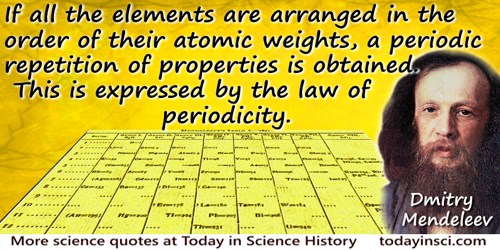
If all the elements are arranged in the order of their atomic weights, a periodic repetition of properties is obtained. This is expressed by the law of periodicity.
Principles of Chemistry (1905), Vol. 2, 17.
If diphtheria is a disease caused by a microorganism, it is essential that three postulates be fulfilled. The fulfilment of these postulates is necessary in order to demonstrate strictly the parasitic nature of a disease:
1) The organism must be shown to be constantly present in characteristic form and arrangement in the diseased tissue.
2) The organism which, from its behaviour appears to be responsible for the disease, must be isolated and grown in pure culture.
3) The pure culture must be shown to induce the disease experimentally.
An early statement of Koch's postulates.
1) The organism must be shown to be constantly present in characteristic form and arrangement in the diseased tissue.
2) The organism which, from its behaviour appears to be responsible for the disease, must be isolated and grown in pure culture.
3) The pure culture must be shown to induce the disease experimentally.
An early statement of Koch's postulates.
Mittheilungen aus den Kaiserliche Gesundheitsamt (1884) Vol. 2. Trans. T. D. Brock, Robert Koch: A Life in Medicine and Bacteriology (1988), 180.
If in the description of an experimental arrangement the expression 'position of a particle' can be used, then in the description of the same arrangement the expression 'velocity of a particle' can not be used, and vice versa. Experimental arrangements, one of which can be described with the help of the expression 'position of a particle' and the other with the help of the expression 'velocity' or, more exactly, 'momentum', are called complementary arrangements, and the descriptions are referred to as complementary descriptions.
Modern Science and its Philosophy (1949), 163-4.
If molecules can be structurally identical and yet possess dissimilar properties, this can be explained only on the ground that the difference is due to a different arrangement of the atoms in space.
In Annalen der Chemie (1873), 166, 47, translated in A. Ihde, The Development of Modern Chemistry (1964), 326.
If the arrangement of society is bad (as ours is), and a small number of people have power over the majority and oppress it, every victory over Nature will inevitably serve only to increase that power and that oppression.
In Science, Liberty and Peace by Aldous Huxley (1947).

If the present arrangements of society will not admit of woman’s free development, then society must be remodelled, and adapted to the great wants of humanity.
From letter (12 Aug 1848) to Emily Collins, reproduced in Elizabeth Cady Stanton, Susan Brownell Anthony, Matilda Joslyn Gage, History of Woman Suffrage (1881), Vol. 1, 91.
If we seek for the simplest arrangement, which would enable it [the eye] to receive and discriminate the impressions of the different parts of the spectrum, we may suppose three distinct sensations only to be excited by the rays of the three principal pure colours, falling on any given point of the retina, the red, the green, and the violet; while the rays occupying the intermediate spaces are capable of producing mixed sensations, the yellow those which belong to the red and green, and the blue those which belong to the green and violet.
'Chromatics', in Supplement to the Fourth, Fifth, and Sixth Editions of the Encyclopedia Britannica (1824), Vol. 3, 142.
In Pure Mathematics, where all the various truths are necessarily connected with each other, (being all necessarily connected with those hypotheses which are the principles of the science), an arrangement is beautiful in proportion as the principles are few; and what we admire perhaps chiefly in the science, is the astonishing variety of consequences which may be demonstrably deduced from so small a number of premises.
In Elements of the Philosophy of the Human Mind (1827), Vol. 3, Chap. 1, Sec. 8, 186.
In the center of everything rules the sun; for who in this most beautiful temple could place this luminary at another better place whence it can light up the whole at once? … In fact, the sun sitting on his royal throne guides the family of stars surrounding him. … In this arrangement we thus find an admirable harmony of the world, and a constant harmonious connection between the motion and the size of the orbits as could not be found otherwise.
In De Revolutionibus Orbium Coelestium (1543), Book 1, Ch. 10. As translated in Hermann Kesten, Copernicus and his World (1945), 182-183. From the original Latin: “In medio vero omnium residet Sol. Quis enim in hoc pulcherrimo templo lampadem hanc in alio vel meliori loco poneret, quam unde totum simul possit illuminare? … Ita profecto tanquam in solio regali Sol residens circum agentem gubernat Astrorum familiam. … Invenimus igitur sub hac ordinatione admirandam mundi symmetriam, ac certum harmoniae nexum motus et magnitudinis orbium: qualis alio modo reperiri non potest.” Corresponding translations also found in Charles Glenn Wallis (trans.), On the Revolutions of Heavenly Spheres (1939, 1995), 24-25, which gives: “In the center of all rests the sun. For who would place this lamp of a very beautiful temple in another or better place than this wherefrom it can illuminate everything at the same time? … And so the sun, as if resting on a kingly throne, governs the family of stars which wheel around. … Therefore in this ordering we find that the world has a wonderful commensurability and that there is a sure bond of harmony for the movement and magnitude of the orbital circles such as cannot be found in any other way.” The passage is translated in Robert Reinhold, 'After 500 Years, Now the Year of Copernicus', New York Times (28 Dec 1972), 33, as: “At rest in the middle of everything is the sun, for in this most beautiful temple, who would place this lamp in another or better position than that from which it can light up the whole thing at the same time? … As though seated on a royal throne, the sun governs the family of planets revolving around it.” Also seen translated in Edwin Arthur Burtt, The Metaphysical Foundations of Modern Physical Science (1925), 45, as: “Then in the middle of all stands the sun. For who, in our most beautiful temple, could set this light in another or better place, than that from which it can at once illuminate the whole? … And in fact does the sun, seated on his royal throne, guide his family of planets as they circle round him.” [Notice the original Latin reads “Astrorum familiam”, so the literal translation is “family of stars” rather than what we now call “planets.” —Webmaster]
In the year 1902 (while I was attempting to explain to an elementary class in chemistry some of the ideas involved in the periodic law) becoming interested in the new theory of the electron, and combining this idea with those which are implied in the periodic classification, I formed an idea of the inner structure of the atom which, although it contained certain crudities, I have ever since regarded as representing essentially the arrangement of electrons in the atom ... In accordance with the idea of Mendeleef, that hydrogen is the first member of a full period, I erroneously assumed helium to have a shell of eight electrons. Regarding the disposition in the positive charge which balanced the electrons in the neutral atom, my ideas were very vague; I believed I inclined at that time toward the idea that the positive charge was also made up of discrete particles, the localization of which determined the localization of the electrons.
Valence and the Structure of Atoms and Molecules (1923), 29-30.
INVENTOR, n. A person who makes an ingenious arrangement of wheels, levers and springs, and believes it civilization.
The Collected Works of Ambrose Bierce (1911), Vol. 7, The Devil's Dictionary, 173-174.
It is contrary to the usual order of things, that events so harmonious as those of the system of the world, should depend on such diversified agents as are supposed to exist in our artificial arrangements; and there is reason to anticipate a great reduction in the number of undecompounded bodies, and to expect that the analogies of nature will be found conformable to the refined operations of art. The more the phenomena of the universe are studied, the more distinct their connection appears, and the more simple their causes, the more magnificent their design, and the more wonderful the wisdom and power of their Author.
Elements of Chemical Philosophy (1812), in J. Davy (ed.), The Collected Works of Sir Humphry Davy(1839-40), Vol. 4, 42.
It is from this absolute indifference and tranquility of the mind, that mathematical speculations derive some of their most considerable advantages; because there is nothing to interest the imagination; because the judgment sits free and unbiased to examine the point. All proportions, every arrangement of quantity, is alike to the understanding, because the same truths result to it from all; from greater from lesser, from equality and inequality.
In On the Sublime and Beautiful, Part 3, sect. 2.
It is said that the composing of the Lilavati was occasioned by the following circumstance. Lilavati was the name of the author’s daughter, concerning whom it appeared, from the qualities of the ascendant at her birth, that she was destined to pass her life unmarried, and to remain without children. The father ascertained a lucky hour for contracting her in marriage, that she might be firmly connected and have children. It is said that when that hour approached, he brought his daughter and his intended son near him. He left the hour cup on the vessel of water and kept in attendance a time-knowing astrologer, in order that when the cup should subside in the water, those two precious jewels should be united. But, as the intended arrangement was not according to destiny, it happened that the girl, from a curiosity natural to children, looked into the cup, to observe the water coming in at the hole, when by chance a pearl separated from her bridal dress, fell into the cup, and, rolling down to the hole, stopped the influx of water. So the astrologer waited in expectation of the promised hour. When the operation of the cup had thus been delayed beyond all moderate time, the father was in consternation, and examining, he found that a small pearl had stopped the course of the water, and that the long-expected hour was passed. In short, the father, thus disappointed, said to his unfortunate daughter, I will write a book of your name, which shall remain to the latest times—for a good name is a second life, and the ground-work of eternal existence.
In Preface to the Persian translation of the Lilavati by Faizi (1587), itself translated into English by Strachey and quoted in John Taylor (trans.) Lilawati, or, A Treatise on Arithmetic and Geometry by Bhascara Acharya (1816), Introduction, 3. [The Lilavati is the 12th century treatise on mathematics by Indian mathematician, Bhaskara Acharya, born 1114.]
It is structure that we look for whenever we try to understand anything. All science is built upon this search; we investigate how the cell is built of reticular material, cytoplasm, chromosomes; how crystals aggregate; how atoms are fastened together; how electrons constitute a chemical bond between atoms. We like to understand, and to explain, observed facts in terms of structure. A chemist who understands why a diamond has certain properties, or why nylon or hemoglobin have other properties, because of the different ways their atoms are arranged, may ask questions that a geologist would not think of formulating, unless he had been similarly trained in this way of thinking about the world.
‘The Place of Chemistry In the Integration of the Sciences’, Main Currents in Modern Thought (1950), 7, 110.
It often happens that men, even of the best understandings and greatest circumspection, are guilty of that fault in reasoning which the writers on logick call the insufficient, or imperfect enumeration of parts, or cases: insomuch that I will venture to assert, that this is the chief, and almost the only, source of the vast number of erroneous opinions, and those too very often in matters of great importance, which we are apt to form on all the subjects we reflect upon, whether they relate to the knowledge of nature, or the merits and motives of human actions. It must therefore be acknowledged, that the art which affords a cure to this weakness, or defect, of our understandings, and teaches us to enumerate all the possible ways in which a given number of things may be mixed and combined together, that we may be certain that we have not omitted anyone arrangement of them that can lead to the object of our inquiry, deserves to be considered as most eminently useful and worthy of our highest esteem and attention. And this is the business of the art, or doctrine of combinations ... It proceeds indeed upon mathematical principles in calculating the number of the combinations of the things proposed: but by the conclusions that are obtained by it, the sagacity of the natural philosopher, the exactness of the historian, the skill and judgement of the physician, and the prudence and foresight of the politician, may be assisted; because the business of all these important professions is but to form reasonable conjectures concerning the several objects which engage their attention, and all wise conjectures are the results of a just and careful examination of the several different effects that may possibly arise from the causes that are capable of producing them.
Ars conjectandi (1713). In F. Maseres, The Doctrine of Permutations and Combinations (1795), 36.
It was his [Leibnitz’s] love of method and order, and the conviction that such order and harmony existed in the real world, and that our success in understanding it depended upon the degree and order which we could attain in our own thoughts, that originally was probably nothing more than a habit which by degrees grew into a formal rule. This habit was acquired by early occupation with legal and mathematical questions. We have seen how the theory of combinations and arrangements of elements had a special interest for him. We also saw how mathematical calculations served him as a type and model of clear and orderly reasoning, and how he tried to introduce method and system into logical discussions, by reducing to a small number of terms the multitude of compound notions he had to deal with. This tendency increased in strength, and even in those early years he elaborated the idea of a general arithmetic, with a universal language of symbols, or a characteristic which would be applicable to all reasoning processes, and reduce philosophical investigations to that simplicity and certainty which the use of algebraic symbols had introduced into mathematics.
A mental attitude such as this is always highly favorable for mathematical as well as for philosophical investigations. Wherever progress depends upon precision and clearness of thought, and wherever such can be gained by reducing a variety of investigations to a general method, by bringing a multitude of notions under a common term or symbol, it proves inestimable. It necessarily imports the special qualities of number—viz., their continuity, infinity and infinite divisibility—like mathematical quantities—and destroys the notion that irreconcilable contrasts exist in nature, or gaps which cannot be bridged over. Thus, in his letter to Arnaud, Leibnitz expresses it as his opinion that geometry, or the philosophy of space, forms a step to the philosophy of motion—i.e., of corporeal things—and the philosophy of motion a step to the philosophy of mind.
A mental attitude such as this is always highly favorable for mathematical as well as for philosophical investigations. Wherever progress depends upon precision and clearness of thought, and wherever such can be gained by reducing a variety of investigations to a general method, by bringing a multitude of notions under a common term or symbol, it proves inestimable. It necessarily imports the special qualities of number—viz., their continuity, infinity and infinite divisibility—like mathematical quantities—and destroys the notion that irreconcilable contrasts exist in nature, or gaps which cannot be bridged over. Thus, in his letter to Arnaud, Leibnitz expresses it as his opinion that geometry, or the philosophy of space, forms a step to the philosophy of motion—i.e., of corporeal things—and the philosophy of motion a step to the philosophy of mind.
In Leibnitz (1884), 44-45. [The first sentence is reworded to better introduce the quotation. —Webmaster]
Just as a tree constitutes a mass arranged in a definite manner, in which, in every single part, in the leaves as in the root, in the trunk as in the blossom, cells are discovered to be the ultimate elements, so is it also with the forms of animal life. Every animal presents itself as a sum of vital unities, every one of which manifests all the characteristics of life. The characteristics and unity of life cannot be limited to anyone particular spot in a highly developed organism (for example, to the brain of man), but are to be found only in the definite, constantly recurring structure, which every individual element displays. Hence it follows that the structural composition of a body of considerable size, a so-called individual, always represents a kind of social arrangement of parts, an arrangement of a social kind, in which a number of individual existences are mutually dependent, but in such a way, that every element has its own special action, and, even though it derive its stimulus to activity from other parts, yet alone effects the actual performance of its duties.
In Lecture I, 'Cells and the Cellular Theory' (1858), Rudolf Virchow and Frank Chance (trans.) ,Cellular Pathology (1860), 13-14.
Just as in the animal and vegetable kingdoms, an individual comes into being, so to speak, grows, remains in being, declines and passes on, will it not be the same for entire species? If our faith did not teach us that animals left the Creator's hands just as they now appear and, if it were permitted to entertain the slightest doubt as to their beginning and their end, may not a philosopher, left to his own conjectures, suspect that, from time immemorial, animal life had its own constituent elements, scattered and intermingled with the general body of matter, and that it happened when these constituent elements came together because it was possible for them to do so; that the embryo formed from these elements went through innumerable arrangements and developments, successively acquiring movement, feeling, ideas, thought, reflection, consciousness, feelings, emotions, signs, gestures, sounds, articulate sounds, language, laws, arts and sciences; that millions of years passed between each of these developments, and there may be other developments or kinds of growth still to come of which we know nothing; that a stationary point either has been or will be reached; that the embryo either is, or will be, moving away from this point through a process of everlasting decay, during which its faculties will leave it in the same way as they arrived; that it will disappear for ever from nature-or rather, that it will continue to exist there, but in a form and with faculties very different from those it displays at this present point in time? Religion saves us from many deviations, and a good deal of work. Had religion not enlightened us on the origin of the world and the universal system of being, what a multitude of different hypotheses we would have been tempted to take as nature's secret! Since these hypotheses are all equally wrong, they would all have seemed almost equally plausible. The question of why anything exists is the most awkward that philosophy can raise- and Revelation alone provides the answer.
Thoughts on the Interpretation of Nature and Other Philosophical Works (1753/4), ed. D. Adams (1999), Section LVIII, 75-6.
Let no one say that I have said nothing new; the arrangement of the subject is new. When we play tennis, we both play with the same ball, but one of us places it better.
In Pensées (1670), Section 7, No. 9. From Blaise Pascal and W.F. Trotter (trans.), 'Thoughts', collected in Charles W. Eliot (ed.), The Harvard Classics (1910), Vol. 48, 14. From the French, “Qu’on ne dise pas que je n’ai rien dit de nouveau: la disposition des matières est nouvelle. Quand on joue à la paume, c’est une même balle dont on joue l’un et l’autre; mais l’un la place mieux,” in Oeuvres Complètes de Blaise Pascal (1864), Vol. 1, 287.
Method means that arrangement of subject matter which makes it most effective in use. Never is method something outside of the material.
Democracy and Education: an Introduction to the Philosophy of Education (1916), 194.
Most classifications, whether of inanimate objects or of organisms, are hierarchical. There are “higher” and “lower” categories, there are higher and lower ranks. What is usually overlooked is that the use of the term “hierarchy” is ambiguous, and that two fundamentally different kinds of arrangements have been designated as hierarchical. A hierarchy can be either exclusive or inclusive. Military ranks from private, corporal, sergeant, lieutenant, captain, up to general are a typical example of an exclusive hierarchy. A lower rank is not a subdivision of a higher rank; thus, lieutenants are not a subdivision of captains. The scala naturae, which so strongly dominated thinking from the sixteenth to the eighteenth century, is another good illustration of an exclusive hierarchy. Each level of perfection was considered an advance (or degradation) from the next lower (or higher) level in the hierarchy, but did not include it.
The Growth of Biological Thought: Diversity, Evolution and Inheritance (1982), 205-6.
Most impediments to scientific understanding are conceptual locks, not factual lacks. Most difficult to dislodge are those biases that escape our scrutiny because they seem so obviously, even ineluctably, just. We know ourselves best and tend to view other creatures as mirrors of our own constitution and social arrangements. (Aristotle, and nearly two millennia of successors, designated the large bee that leads the swarm as a king.)
…...
Natural causes, as we know, are at work, which tend to modify, if they do not at length destroy, all the arrangements and dimensions of the earth and the whole solar system. But though in the course of ages catastrophes have occurred and may yet occur in the heavens, though ancient systems may be dissolved and new systems evolved out of their ruins, the molecules [i.e. atoms] out of which these systems are built—the foundation stones of the material universe—remain unbroken and unworn. They continue to this day as they were created—perfect in number and measure and weight.
Lecture to the British Association at Bradford, 'Molecules', Nature (1873), 8, 437-441. Reprinted in James Clerk Maxwell and W. D. Niven, editor, The Scientific Papers of James Clerk Maxwell (2003), 377.
By
Nature, everywhere the most amazingly and outstandingly remarkable producer of living bodies, being most carefully arranged according to physical, mechanical, and chemical laws, does not give even the smallest hint of its extraordinary and tireless workings and quite clearly points to its work as being alone worthy of a benign and omnipotent God; and it carries this bright quality in all of its traces, in that, just as all of its general mechanisms rejoice, so also do all of their various smallest component parts rejoice in the depth of wisdom, in the height of perfection, and in the lofty arrangement of forms and qualities, which lie far beyond every investigation of the human mind.
'Inaugural Physico-Medical Dissertation on the Blood and the Circulation of the Microcosm' (1749). Trans. Arthur Donovan and Joseph Prentiss, James Hutton's Medical Dissertation (1980), 29.
Not only do the various components of the cells form a living system, in which the capacity to live, react, and reproduce is dependent on the interactions of all the members of the system; but this living system is identical with the genetic system. The form of life is determined not only by the specific nature of the hereditary units but also by the structure and arrangement of the system. The whole system is more than the sum of its parts, and the effect of each of the components depends on and is influenced by all previous reactions, whose sequence is in turn determined by the whole idiotype.
'Cytoplasmic Inheritance in Epilobium and Its Theoretical Significance', Advances in Genetics (1954), 6, 320.
Pauling was shocked by the freedom with which the X-ray crystallographers of the time, including particularly Astbury, played with the intimate chemical structure of their models. They seemed to think that if the atoms were arranged in the right order and about the right distance apart, that was all that mattered, that no further restrictions need to be put on them.
Quoted by John Law in 'The Case of X-ray Protein Crystallography', collected in Gerard Lemaine (ed.), Perspectives on the Emergence of Scientific Disciplines, 1976, 140.
Physicists speak of the particle representation or the wave representation. Bohr's principle of complementarity asserts that there exist complementary properties of the same object of knowledge, one of which if known will exclude knowledge of the other. We may therefore describe an object like an electron in ways which are mutually exclusive—e.g., as wave or particle—without logical contradiction provided we also realize that the experimental arrangements that determine these descriptions are similarly mutually exclusive. Which experiment—and hence which description one chooses—is purely a matter of human choice.
The Cosmic Code: Quantum Physics as the Language of Nature (1982), 94.
Science is knowledge arranged and classified according to truth, facts, and the general laws of nature.
Interview in San Francisco Bulletin (22 Jan 1926). As cited in Michael C. and Linda Rose Thomsett, A Speaker's Treasury of Quotations: Maxims, Witticisms and Quips for Speeches and Presentations (2009), 102-103. Also in 'Science and Civilization', Prescott Evening Courier (3 Nov 1925), 6.
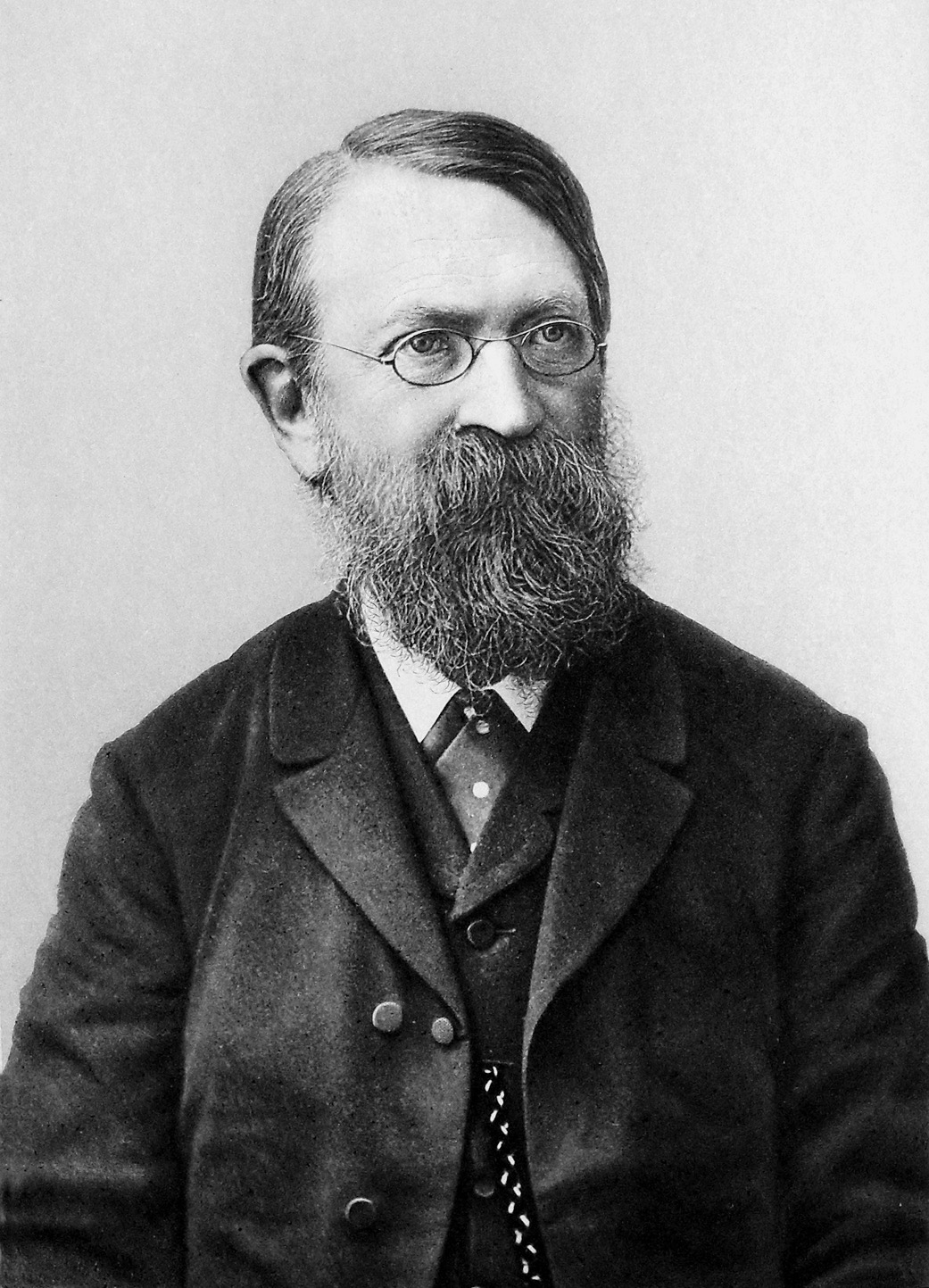
Science is, according to Mach, nothing but the comparison and orderly arrangement of factually given contents of our consciousness, in accord with certain gradually acquired points of view and methods. Therefore, physics and psychology differ from each other not so much in the subject matter, but rather only in the points of view of the arrangement and connection of the various topics.
Translation from obituary, 'Ernst Mach', Physikalische Zeitschrift (1 Apr 1916), 102. From the original German text: “Nach Mach ist Wissenschaft nichts anderes, als Vergleichung und Ordnung der uns tatsächlich gegebenen Bewußtseinsinhalte nach gewissen, von uns allmählich ertasteten Gesichtspunkten und Methoden. Physik und Psychologie unterscheiden sich also voneinander nicht in dem Gegenstände, sondern nur in den Gesichtspunkten der Anordnung und Verknüpfung des Stoffes.”
Science quickens and cultivates directly the faculty of observation, which in very many persons lies almost dormant through life, the power of accurate and rapid generalizations, and the mental habit of method and arrangement; it accustoms young persons to trace the sequence of cause and effect; it familiarizes then with a kind of reasoning which interests them, and which they can promptly comprehend; and it is perhaps the best corrective for that indolence which is the vice of half-awakened minds, and which shrinks from any exertion that is not, like an effort of memory, merely mechanical.
Report of the Royal Commission on Education (1861), Parliamentary Papers (1864), Vol 20, 32-33, as cited in Paul White, Thomas Huxley: Making the "Man of Science" (2003), 77, footnote. Also quoted in John Lubbock, The Pleasures of Life (1887, 2007), 63.
Science, in its ultimate ideal, consists of a set of propositions arranged in a hierarchy, the lowest level of the hierarchy being concerned with particular facts, and the highest with some general law, governing everything in the universe. The various levels in the hierarchy have a two-fold logical connection, travelling one up, one down; the upward connection proceeds by induction, the downward by deduction.
In The Scientific Outlook (1931, 2009), 38.
Scientists still do not appear to understand sufficiently that all earth sciences must contribute evidence toward unveiling the state of our planet in earlier times, and that the truth of the matter can only be reached by combing all this evidence. ... It is only by combing the information furnished by all the earth sciences that we can hope to determine 'truth' here, that is to say, to find the picture that sets out all the known facts in the best arrangement and that therefore has the highest degree of probability. Further, we have to be prepared always for the possibility that each new discovery, no matter what science furnishes it, may modify the conclusions we draw.
The Origins of Continents and Oceans
Somewhere in the arrangement of this world there seems to be a great concern about giving us delight, which shows that, in the universe, over and above the meaning of matter and forces, there is a message conveyed through the magic touch of personality. ...
Is it merely because the rose is round and pink that it gives me more satisfaction than the gold which could buy me the necessities of life, or any number of slaves. ... Somehow we feel that through a rose the language of love reached our hearts.
Is it merely because the rose is round and pink that it gives me more satisfaction than the gold which could buy me the necessities of life, or any number of slaves. ... Somehow we feel that through a rose the language of love reached our hearts.
The Religion of Man (1931), 102. Quoted in H. E. Hunter, The Divine Proportion (1970), 6.
The chemists who uphold dualism are far from being agreed among themselves; nevertheless, all of them in maintaining their opinion, rely upon the phenomena of chemical reactions. For a long time the uncertainty of this method has been pointed out: it has been shown repeatedly, that the atoms put into movement during a reaction take at that time a new arrangement, and that it is impossible to deduce the old arrangement from the new one. It is as if, in the middle of a game of chess, after the disarrangement of all the pieces, one of the players should wish, from the inspection of the new place occupied by each piece, to determine that which it originally occupied.
Chemical Method (1855), 18.
The conception of correspondence plays a great part in modern mathematics. It is the fundamental notion in the science of order as distinguished from the science of magnitude. If the older mathematics were mostly dominated by the needs of mensuration, modern mathematics are dominated by the conception of order and arrangement. It may be that this tendency of thought or direction of reasoning goes hand in hand with the modern discovery in physics, that the changes in nature depend not only or not so much on the quantity of mass and energy as on their distribution or arrangement.
In History of European Thought in the Nineteenth Century (1903), Vol. 2, 736.
The doctrine of evolution implies the passage from the most organised to the least organised, or, in other terms, from the most general to the most special. Roughly, we say that there is a gradual 'adding on' of the more and more special, a continual adding on of new organisations. But this 'adding on' is at the same time a 'keeping down'. The higher nervous arrangements evolved out of the lower keep down those lower, just as a government evolved out of a nation controls as well as directs that nation.
'Evolution and Dissolution of the Nervous System', British Medical Journal (1884), I, 662.
The ends of scientific classification are best answered, when the objects are formed into groups respecting which a greater number of general propositions can be made, and those propositions more important, than could be made respecting any other groups into which the same things could be distributed. ... A classification thus formed is properly scientific or philosophical, and is commonly called a Natural, in contradistinction to a Technical or Artificial, classification or arrangement.
A System of Logic, Ratiocinative and Inductive (1843), Vol. 2, Book 4, Chapter 7, 302-3.
The genius of Laplace was a perfect sledge hammer in bursting purely mathematical obstacles; but, like that useful instrument, it gave neither finish nor beauty to the results. In truth, in truism if the reader please, Laplace was neither Lagrange nor Euler, as every student is made to feel. The second is power and symmetry, the third power and simplicity; the first is power without either symmetry or simplicity. But, nevertheless, Laplace never attempted investigation of a subject without leaving upon it the marks of difficulties conquered: sometimes clumsily, sometimes indirectly, always without minuteness of design or arrangement of detail; but still, his end is obtained and the difficulty is conquered.
In 'Review of “Théorie Analytique des Probabilites” par M. le Marquis de Laplace, 3eme edition. Paris. 1820', Dublin Review (1837), 2, 348.
The human mind is not capable of grasping the Universe. We are like a little child entering a huge library. The walls are covered to the ceilings with books in many different tongues. The child knows that someone must have written these books. It does not know who or how. It does not understand the languages in which they are written. But the child notes a definite plan in the arrangement of the books—a mysterious order which it does not comprehend, but only dimly suspects.
…...
The main species of beauty are orderly arrangement, proportion, and definiteness; and these are especially manifested by the mathematical sciences.
In Metaphysics, 13-1078a-b, as translated by Hugh Tredennick (1933). Also seen translated as, “The mathematical sciences particularly exhibit order, symmetry, and limitation; and these are the greatest forms of the beautiful.”

The most fundamental difference between compounds of low molecular weight and macromolecular compounds resides in the fact that the latter may exhibit properties that cannot be deduced from a close examination of the low molecular weight materials. Not very different structures can be obtained from a few building blocks; but if 10,000 or 100,000 blocks are at hand, the most varied structures become possible, such as houses or halls, whose special structure cannot be predicted from the constructions that are possible with only a few building blocks... Thus, a chromosome can be viewed as a material whose macromolecules possess a well defined arrangement, like a living room in which each piece of furniture has its place and not, as in a warehouse, where the pieces of furniture are placed together in a heap without design.
Quoted, without citation, in Ralph E. Oesper (ed.), The Human Side of Scientists (1975), 175.
The most stable arrangement for an assemblage of molecules is one in which the component atoms and groups are packed together so that (a) the distances between neighbors are close to the equilibrium distance, (b) each atom or group has as many close neighbors as possible, and (c) there are no large unoccupied regions. In other words, each structure tends to be as 'close-packed' as possible, consistent with the 'sizes' of its component atoms or groups.
'The Structure of Fibrous Proteins', Chemical Reviews (1943), 32, 198.
The sciences of Natural History and Botany require so much time to be devoted to them that, however pleasing, they may be justly considered as improper objects for the man of business to pursue scientifically, so as to enter into the exact arrangement and classification of the different bodies of the animal, vegetable, and mineral kingdoms. But reading and personal observation will supply him with ample matter for reflection and admiration.
'On the Advantages of Literature and Philosophy in general and especially on the Consistency of Literary and Philosophical with Commercial Pursuits' (Read 3 Oct 1781). As quoted in Robert Angus Smith, A Centenary of Science in Manchester (1883), 79.
The transition from sea-floor spreading to plate tectonics is largely a change of emphasis. Sea-floor spreading is a view about the method of production of new oceans floor on the ridge axis. The magnetic lineations give the history of this production back into the late Mesozoic and illuminate the history of the new aseismic parts of the ocean floor. This naturally directed attention to the relation of the sea-floor to the continents. There are two approaches: in the first, one looks back in time to earlier arrangements of the continents; in the second, one considers the current problem of the disposal of the rapidly growing sea floor.
'The Emergence of Plate Tectonics: A Personal View', Annual Review of Earth and Planetary Sciences, 1975, 3, 20.
The true order of learning should be first, what is necessary; second, what is useful, and third, what is ornamental. To reverse this arrangement is like beginning to build at the top of the edifice.
Tryon Edwards and William Buell Sprague, The World’s Laconics: or, The Best Thoughts of the Best Authors (1853), 153.
The wonderful arrangement and harmony of the cosmos would only originate in the plan of an almighty omniscient being. This is and remains my greatest comprehension.
…...
The X-ray spectrometer opened up a new world. It proved to be a far more powerful method of analysing crystal structure…. One could examine the various faces of a crystal in succession, and by noting the angles at which and the intensity with which they reflected the X-rays, one could deduce the way in which the atoms were arranged in sheets parallel to these faces. The intersections of these sheets pinned down the positions of the atoms in space.… It was like discovering an alluvial gold field with nuggets lying around waiting to be picked up.… It was a glorious time when we worked far into every night with new worlds unfolding before us in the silent laboratory.
In The History of X-ray Analysis (1943), 9.
Then if the first argument remains secure (for nobody will produce a neater one, than the length of the periodic time is a measure of the size of the spheres), the order of the orbits follows this sequence, beginning from the highest: The first and highest of all is the sphere of the fixed stars, which contains itself and all things, and is therefore motionless. It is the location of the universe, to which the motion and position of all the remaining stars is referred. For though some consider that it also changes in some respect, we shall assign another cause for its appearing to do so in our deduction of the Earth’s motion. There follows Saturn, the first of the wandering stars, which completes its circuit in thirty years. After it comes Jupiter which moves in a twelve-year long revolution. Next is Mars, which goes round biennially. An annual revolution holds the fourth place, in which as we have said is contained the Earth along with the lunar sphere which is like an epicycle. In fifth place Venus returns every nine months. Lastly, Mercury holds the sixth place, making a circuit in the space of eighty days. In the middle of all is the seat of the Sun. For who in this most beautiful of temples would put this lamp in any other or better place than the one from which it can illuminate everything at the same time? Aptly indeed is he named by some the lantern of the universe, by others the mind, by others the ruler. Trismegistus called him the visible God, Sophocles' Electra, the watcher over all things. Thus indeed the Sun as if seated on a royal throne governs his household of Stars as they circle around him. Earth also is by no means cheated of the Moon’s attendance, but as Aristotle says in his book On Animals the Moon has the closest affinity with the Earth. Meanwhile the Earth conceives from the Sun, and is made pregnant with annual offspring. We find, then, in this arrangement the marvellous symmetry of the universe, and a sure linking together in harmony of the motion and size of the spheres, such as could be perceived in no other way. For here one may understand, by attentive observation, why Jupiter appears to have a larger progression and retrogression than Saturn, and smaller than Mars, and again why Venus has larger ones than Mercury; why such a doubling back appears more frequently in Saturn than in Jupiter, and still more rarely in Mars and Venus than in Mercury; and furthermore why Saturn, Jupiter and Mars are nearer to the Earth when in opposition than in the region of their occultation by the Sun and re-appearance. Indeed Mars in particular at the time when it is visible throughout the night seems to equal Jupiter in size, though marked out by its reddish colour; yet it is scarcely distinguishable among stars of the second magnitude, though recognized by those who track it with careful attention. All these phenomena proceed from the same course, which lies in the motion of the Earth. But the fact that none of these phenomena appears in the fixed stars shows their immense elevation, which makes even the circle of their annual motion, or apparent motion, vanish from our eyes.
'Book One. Chapter X. The Order of the Heavenly Spheres', in Copernicus: On the Revolutions of the Heavenly Spheres (1543), trans. A. M. Duncan (1976), 49-51.
There cannot be design without a designer; contrivance without a contriver; order without choice; arrangement, without any thing capable of arranging; subserviency and relation to a purpose; means suitable to an end, and executing their office in accomplishing that end, without the end ever having been contemplated, or the means accommodated to it. Arrangement, disposition of parts, subserviency of means to an end, relation of instruments to use, imply the preference of intelligence and mind.
Natural Theology: or, Evidences of the Existence and Attributes of The Deity, Collected from the Appearances of Nature (1802), 12.
These differences, they say, are three: shape, arrangement, and position; because they hold that what is differs only in contour, inter-contact, inclination.
Quoted in Aristotle, Metaphysics A 4 985b 13-16. Trans. Hugh Tredennick (1933), Vol. 1, 31.
This fundamental discovery that all bodies owe their origin to arrangements of single initial corpuscular type is the beacon that lights the history of the universe to our eyes. In its own way, matter obeyed from the beginning that great law of biology to which we shall have to recur time and time again, the law of “complexification.”
In Teilhard de Chardin and Bernard Wall (trans.), The Phenomenon of Man (1959, 2008), 48. Originally published in French as Le Phénomene Humain (1955).
This irrelevance of molecular arrangements for macroscopic results has given rise to the tendency to confine physics and chemistry to the study of homogeneous systems as well as homogeneous classes. In statistical mechanics a great deal of labor is in fact spent on showing that homogeneous systems and homogeneous classes are closely related and to a considerable extent interchangeable concepts of theoretical analysis (Gibbs theory). Naturally, this is not an accident. The methods of physics and chemistry are ideally suited for dealing with homogeneous classes with their interchangeable components. But experience shows that the objects of biology are radically inhomogeneous both as systems (structurally) and as classes (generically). Therefore, the method of biology and, consequently, its results will differ widely from the method and results of physical science.
Atom and Organism: A New Approach to Theoretical Biology (1966), 34.
Thought experiment is in any case a necessary precondition for physical experiment. Every experimenter and inventor must have the planned arrangement in his head before translating it into fact.
'On Thought Experiments' (1897), in Erwin H. Hiebert (ed.), Erkenntnis und Irrtum (1905), trans. Thomas J. McCormack and Paul Foulkes (1976), 184.
To learn… the ordinary arrangement of the different strata of minerals in the earth, to know from their habitual colocations and proximities, where we find one mineral; whether another, for which we are seeking, may be expected to be in its neighborhood, is useful.
In The Writings of Thomas Jefferson (1854), Vol. 7, 443.
To say that mind is a product or function of protoplasm, or of its molecular changes, is to use words to which we can attach no clear conception. You cannot have, in the whole, what does not exist in any of the parts; and those who argue thus should put forth a definite conception of matter, with clearly enunciated properties, and show, that the necessary result of a certain complex arrangement of the elements or atoms of that matter, will be the production of self-consciousness. There is no escape from this dilemma—either all matter is conscious, or consciousness is something distinct from matter, and in the latter case, its presence in material forms is a proof of the existence of conscious beings, outside of, and independent of, what we term matter. The foregoing considerations lead us to the very important conclusion, that matter is essentially force, and nothing but force; that matter, as popularly understood, does not exist, and is, in fact, philosophically inconceivable. When we touch matter, we only really experience sensations of resistance, implying repulsive force; and no other sense can give us such apparently solid proofs of the reality of matter, as touch does. This conclusion, if kept constantly present in the mind, will be found to have a most important bearing on almost every high scientific and philosophical problem, and especially on such as relate to our own conscious existence.
In 'The Limits of Natural Selection as Applied to Man', last chapter of Contributions to the Theory of Natural Selection (1870), 365-366.
We set out, therefore, with the supposition that an organised body is not produced by a fundamental power which is guided in its operation by a definite idea, but is developed, according to blind laws of necessity, by powers which, like those of inorganic nature, are established by the very existence of matter. As the elementary materials of organic nature are not different from those of the inorganic kingdom, the source of the organic phenomena can only reside in another combination of these materials, whether it be in a peculiar mode of union of the elementary atoms to form atoms of the second order, or in the arrangement of these conglomerate molecules when forming either the separate morphological elementary parts of organisms, or an entire organism.
Mikroskopische Untersuchungen über die Uebereinstimmung in der Struktur und dem Wachsthum der Thiere und Pflanzen (1839). Microscopic Researches into the Accordance in the Structure and Growth of Animals and Plants, trans. Henry Smith (1847), 190-1.
When Cayley had reached his most advanced generalizations he proceeded to establish them directly by some method or other, though he seldom gave the clue by which they had first been obtained: a proceeding which does not tend to make his papers easy reading. …
His literary style is direct, simple and clear. His legal training had an influence, not merely upon his mode of arrangement but also upon his expression; the result is that his papers are severe and present a curious contrast to the luxuriant enthusiasm which pervades so many of Sylvester’s papers. He used to prepare his work for publication as soon as he carried his investigations in any subject far enough for his immediate purpose. … A paper once written out was promptly sent for publication; this practice he maintained throughout life. … The consequence is that he has left few arrears of unfinished or unpublished papers; his work has been given by himself to the world.
His literary style is direct, simple and clear. His legal training had an influence, not merely upon his mode of arrangement but also upon his expression; the result is that his papers are severe and present a curious contrast to the luxuriant enthusiasm which pervades so many of Sylvester’s papers. He used to prepare his work for publication as soon as he carried his investigations in any subject far enough for his immediate purpose. … A paper once written out was promptly sent for publication; this practice he maintained throughout life. … The consequence is that he has left few arrears of unfinished or unpublished papers; his work has been given by himself to the world.
In Proceedings of London Royal Society (1895), 58, 23-24.
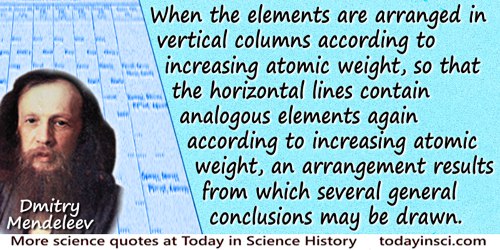
When the elements are arranged in vertical columns according to increasing atomic weight, so that the horizontal lines contain analogous elements again according to increasing atomic weight, an arrangement results from which several general conclusions may be drawn.
'The Relations of the Properties to the Atomic Weights of the Elements', Zeitschrift fur Chemie, 1869.
When you can dump a load of bricks on a corner lot, and let me watch them arrange themselves into a house — when you can empty a handful of springs and wheels and screws on my desk, and let me see them gather themselves together into a watch — it will be easier for me to believe that all these thousands of worlds could have been created, balanced, and set to moving in their separate orbits, all without any directing intelligence at all.
In 'If A Man Die, Shall He Live again?', More Power To You: Fifty Editorials From Every Week (1917), 218-219.
When, in an experiment, all known causes being allowed for, there remain certain unexplained effects (excessively slight it may be), these must be carefully investigated, and every conceivable variation of arrangement of apparatus, etc., tried ; until, if possible, we manage so to exaggerate the residual phenomenon as to be able to detect its cause. It is here, perhaps, that in the present state of science we may most reasonably look for extensions of our knowledge
In William Thomson and Peter Guthrie Tait, Treatise on Natural Philosophy (1867), Vol. 1, 306.
Why can the chemist not take the requisite numbers of atoms and simply put them together? The answer is that the chemist never has atoms at his disposal, and if he had, the direct combination of the appropriate numbers of atoms would lead only to a Brobdingnagian potpourri of different kinds of molecules, having a vast array of different structures. What the chemist has at hand always consists of substances, themselves made up of molecules, containing defined numbers of atoms in ordered arrangements. Consequently, in order to synthesize anyone substance, his task is that of combining, modifying, transforming, and tailoring known substances, until the total effect of his manipulations is the conversion of one or more forms of matter into another.
In 'Art and Science in the Synthesis of Organic Compounds: Retrospect and Prospect', in Maeve O'Connor (ed.), Pointers and Pathways in Research (1963), 28.
Yet the widespread [planetary theories], advanced by Ptolemy and most other [astronomers], although consistent with the numerical [data], seemed likewise to present no small difficulty. For these theories were not adequate unless they also conceived certain equalizing circles, which made the planet appear to move at all times with uniform velocity neither on its deferent sphere nor about its own [epicycle's] center … Therefore, having become aware of these [defects], I often considered whether there could perhaps be found a more reasonable arrangement of circles, from which every apparent irregularity would be derived while everything in itself would move uniformly, as is required by the rule of perfect motion.
From Nicholaus Copernicus, Edward Rosen (trans.), Pawel Czartoryski (ed.) 'Commentariolus', in Nicholas Copernicus: Minor Works (1985), 81-83. Excerpted in Lisa M. Dolling, Arthur F. Gianelli and Glenn N. Statile (eds.) The Tests of Time: Readings in the Development of Physical Theory (2003), 40.
 In science it often happens that scientists say, 'You know that's a really good argument; my position is mistaken,' and then they would actually change their minds and you never hear that old view from them again. They really do it. It doesn't happen as often as it should, because scientists are human and change is sometimes painful. But it happens every day. I cannot recall the last time something like that happened in politics or religion.
(1987) --
In science it often happens that scientists say, 'You know that's a really good argument; my position is mistaken,' and then they would actually change their minds and you never hear that old view from them again. They really do it. It doesn't happen as often as it should, because scientists are human and change is sometimes painful. But it happens every day. I cannot recall the last time something like that happened in politics or religion.
(1987) --