Application Quotes (260 quotes)
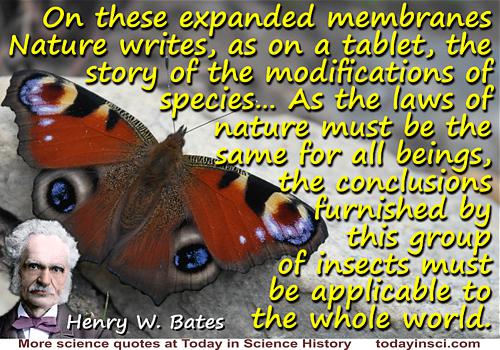
… on these expanded membranes [butterfly wings] Nature writes, as on a tablet, the story of the modifications of species, so truly do all changes of the organisation register themselves thereon. Moreover, the same colour-patterns of the wings generally show, with great regularity, the degrees of blood-relationship of the species. As the laws of nature must be the same for all beings, the conclusions furnished by this group of insects must be applicable to the whole world.
From The Naturalist on the River Amazons: A record of Adventures, Habits of Animals, Sketches of Brazilian and Indian life, and Aspects of Nature under the Equator, During Eleven Years of Travel (1864), 413.
[Davy's] March of Glory, which he has run for the last six weeks—within which time by the aid and application of his own great discovery, of the identity of electricity and chemical attractions, he has placed all the elements and all their inanimate combinations in the power of man; having decomposed both the Alkalies, and three of the Earths, discovered as the base of the Alkalies a new metal... Davy supposes there is only one power in the world of the senses; which in particles acts as chemical attractions, in specific masses as electricity, & on matter in general, as planetary Gravitation... when this has been proved, it will then only remain to resolve this into some Law of vital Intellect—and all human knowledge will be Science and Metaphysics the only Science.
In November 1807 Davy gave his famous Second Bakerian Lecture at the Royal Society, in which he used Voltaic batteries to “decompose, isolate and name” several new chemical elements, notably sodium and potassium.
In November 1807 Davy gave his famous Second Bakerian Lecture at the Royal Society, in which he used Voltaic batteries to “decompose, isolate and name” several new chemical elements, notably sodium and potassium.
Letter to Dorothy Wordsworth, 24 November 1807. In Earl Leslie Griggs (ed.), The Collected Letters of Samuel Taylor Coleridge (1956), Vol. 3, 38.
[Edison] definitely ended the distinction between the theoretical man of science and the practical man of science, so that today we think of scientific discoveries in connection with their possible present or future application to the needs of man. He took the old rule-of-thumb methods out of industry and substituted exact scientific knowledge, while, on the other hand, he directed scientific research into useful channels.
In My Friend Mr. Edison (1930). Quoted in Dyson Carter, If You Want to Invent (1939), 110.
[Euclid's Elements] has been for nearly twenty-two centuries the encouragement and guide of that scientific thought which is one thing with the progress of man from a worse to a better state. The encouragement; for it contained a body of knowledge that was really known and could be relied on, and that moreover was growing in extent and application. For even at the time this book was written—shortly after the foundation of the Alexandrian Museum—Mathematics was no longer the merely ideal science of the Platonic school, but had started on her career of conquest over the whole world of Phenomena. The guide; for the aim of every scientific student of every subject was to bring his knowledge of that subject into a form as perfect as that which geometry had attained. Far up on the great mountain of Truth, which all the sciences hope to scale, the foremost of that sacred sisterhood was seen, beckoning for the rest to follow her. And hence she was called, in the dialect of the Pythagoreans, ‘the purifier of the reasonable soul.’
From a lecture delivered at the Royal Institution (Mar 1873), collected postumously in W.K. Clifford, edited by Leslie Stephen and Frederick Pollock, Lectures and Essays, (1879), Vol. 1, 296.
[Experimental Physicist] Phys. I know that it is often a help to represent pressure and volume as height and width on paper; and so geometry may have applications to the theory of gases. But is it not going rather far to say that geometry can deal directly with these things and is not necessarily concerned with lengths in space?
[Mathematician] Math. No. Geometry is nowadays largely analytical, so that in form as well as in effect, it deals with variables of an unknown nature. …It is literally true that I do not want to know the significance of the variables x, y, z, t that I am discussing. …
Phys. Yours is a strange subject. You told us at the beginning that you are not concerned as to whether your propositions are true, and now you tell us you do not even care to know what you are talking about.
Math. That is an excellent description of Pure Mathematics, which has already been given by an eminent mathematician [Bertrand Russell].
[Mathematician] Math. No. Geometry is nowadays largely analytical, so that in form as well as in effect, it deals with variables of an unknown nature. …It is literally true that I do not want to know the significance of the variables x, y, z, t that I am discussing. …
Phys. Yours is a strange subject. You told us at the beginning that you are not concerned as to whether your propositions are true, and now you tell us you do not even care to know what you are talking about.
Math. That is an excellent description of Pure Mathematics, which has already been given by an eminent mathematician [Bertrand Russell].
In Space, Time and Gravitation: An Outline of the General Relativity Theory (1920, 1921), 14.
[For the] increase of knowledge and … the useful application of the knowledge gained, … there never is a sudden beginning; even the cloud change which portends the thunderstorm begins slowly.
From address, 'A Medical Retrospect'. Published in Yale Medical Journal (Oct 1910), 17, No. 2, 59.
[My favourite fellow of the Royal Society is the Reverend Thomas Bayes, an obscure 18th-century Kent clergyman and a brilliant mathematician who] devised a complex equation known as the Bayes theorem, which can be used to work out probability distributions. It had no practical application in his lifetime, but today, thanks to computers, is routinely used in the modelling of climate change, astrophysics and stock-market analysis.
Quoted in Max Davidson, 'Bill Bryson: Have faith, science can solve our problems', Daily Telegraph (26 Sep 2010)
[On the practical applications of particle physics research with the Large Hadron Collider.] Sometimes the public says, “What's in it for Numero Uno? Am I going to get better television reception? Am I going to get better Internet reception?” Well, in some sense, yeah. … All the wonders of quantum physics were learned basically from looking at atom-smasher technology. … But let me let you in on a secret: We physicists are not driven to do this because of better color television. … That's a spin-off. We do this because we want to understand our role and our place in the universe.
As quoted in Alan Boyle, 'Discovery of Doom? Collider Stirs Debate', article (8 Sep 2008) on a msnbc.com web page. The article writer included the information that Kaku noted that past discoveries from the world of particle physics ushered in many of the innovations we enjoy today, ranging from satellite communications and handheld media players to medical PET scanners (which put antimatter to practical use)."
[The surplus of basic knowledge of the atomic nucleus was] largely used up [during the war with the atomic bomb as the dividend.] We must, without further delay restore this surplus in preparation for the important peacetime job for the nucleus - power production. ... Many of the proposed applications of atomic power - even for interplanetary rockets - seem to be within the realm of possibility provided the economic factor is ruled out completely, and the doubtful physical and chemical factors are weighted heavily on the optimistic side. ... The development of economic atomic power is not a simple extrapolation of knowledge gained during the bomb work. It is a new and difficult project to reach a satisfactory answer. Needless to say, it is vital that the atomic policy legislation now being considered by the congress recognizes the essential nature of this peacetime job, and that it not only permits but encourages the cooperative research-engineering effort of industrial, government and university laboratories for the task. ... We must learn how to generate the still higher energy particles of the cosmic rays - up to 1,000,000,000 volts, for they will unlock new domains in the nucleus.
Addressing the American Institute of Electrical Engineering, in New York (24 Jan 1946). In Schenectady Gazette (25 Jan 1946),
[There] are cases where there is no dishonesty involved but where people are tricked into false results by a lack of understanding about what human beings can do to themselves in the way of being led astray by subjective effects, wishful thinking or threshold interactions. These are examples of pathological science. These are things that attracted a great deal of attention. Usually hundreds of papers have been published upon them. Sometimes they have lasted for fifteen or twenty years and then they gradually die away.
[Coining the term “pathological science” for the self-deceiving application of science to a phenomenon that doesn't exist.]
[Coining the term “pathological science” for the self-deceiving application of science to a phenomenon that doesn't exist.]
From a Colloquium at The Knolls Research Laboratory (18 Dec 1953). Transcribed and edited by R. N. Hall. In General Electric Laboratories, Report No. 68-C-035 (April 1968).
[Young] was afterwards accustomed to say, that at no period of his life was he particularly fond of repeating experiments, or even of very frequently attempting to originate new ones; considering that, however necessary to the advancement of science, they demanded a great sacrifice of time, and that when the fact was once established, that time was better employed in considering the purposes to which it might be applied, or the principles which it might tend to elucidate.
Hudson Gurney, Memoir of the Life of Thomas Young, M.D. F.R.S. (1831), 12-3.
[About Pierre de Fermat] It cannot be denied that he has had many exceptional ideas, and that he is a highly intelligent man. For my part, however, I have always been taught to take a broad overview of things, in order to be able to deduce from them general rules, which might be applicable elsewhere.
Quoted, without source, in The Grolier Library of Science Biographies (1996), Vol. 3, 191.
[When questioned on his longevity] First of all, I selected my ancestors very wisely. ... They were long-lived, healthy people. Then, as a chemist, I know how to eat, how to exercise, keep my blood circulating. ... I don't worry. I don't get angry at people. I don't worry about things I can't help. I do what I can to make the world a better place to live, but I don't complain if things aren't right. As a scientist I take the world as I find it.
[About celebrating his 77th birthday by swimming a half mile in 22 minutes] I used swim fins and webbed gloves because a man of intelligence should apply his power efficiently, not just churn the water.
[About celebrating his 77th birthday by swimming a half mile in 22 minutes] I used swim fins and webbed gloves because a man of intelligence should apply his power efficiently, not just churn the water.
As quoted in obituary by Wallace Turner, 'Joel Hildebrand, 101', New York Times (3 May 1983), D27.
Ath. There still remain three studies suitable for freemen. Calculation in arithmetic is one of them; the measurement of length, surface, and depth is the second; and the third has to do with the revolutions of the stars in reference to one another … there is in them something that is necessary and cannot be set aside, … if I am not mistaken, [something of] divine necessity; for as to the human necessities of which men often speak when they talk in this manner, nothing can be more ridiculous than such an application of the words.
Cle. And what necessities of knowledge are there, Stranger, which are divine and not human?
Ath. I conceive them to be those of which he who has no use nor any knowledge at all cannot be a god, or demi-god, or hero to mankind, or able to take any serious thought or charge of them.
Cle. And what necessities of knowledge are there, Stranger, which are divine and not human?
Ath. I conceive them to be those of which he who has no use nor any knowledge at all cannot be a god, or demi-god, or hero to mankind, or able to take any serious thought or charge of them.
— Plato
In Republic, Bk. 7, in Jowett, Dialogues of Plato (1897, 2010), Vol. 4, 331.
Derrière la série de Fourier, d’autres séries analogues sont entrées dans la domaine de l’analyse; elles y sont entrées par la même porte; elles ont été imaginées en vue des applications.
After the Fourier series, other series have entered the domain of analysis; they entered by the same door; they have been imagined in view of applications.
After the Fourier series, other series have entered the domain of analysis; they entered by the same door; they have been imagined in view of applications.
La valeur de la science. In Anton Bovier, Statistical Mechanics of Disordered Systems (2006), 74.
Dilbert: It took weeks but I’ve calculated a new theory about the origin of the universe. According to my calculations it didn’t start with a “Big Bang” at all—it was more of “Phhbwt” sound. You may be wondering about the practical applications of the “Little Phhbwt” theory.
Dogbert: I was wondering when you’ll go away.
Dogbert: I was wondering when you’ll go away.
Dilbert comic strip (1 Jan 1993)
Il n’existe pas de sciences appliquées, mais seulement des applications de la science.
There are no such things as applied sciences, only applications of science.
There are no such things as applied sciences, only applications of science.
Address (11 Sep 1872). In Comptes Rendus des Travaux du Congrès viticole et séricole de Lyon, 9-14 Septembre 1872, 49.
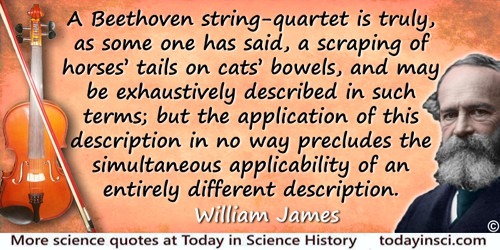
A Beethoven string-quartet is truly, as some one has said, a scraping of horses’ tails on cats’ bowels, and may be exhaustively described in such terms; but the application of this description in no way precludes the simultaneous applicability of an entirely different description.
In The Sentiment of Rationality (1882, 1907), 76.
A closer look at the course followed by developing theory reveals for a start that it is by no means as continuous as one might expect, but full of breaks and at least apparently not along the shortest logical path. Certain methods often afforded the most handsome results only the other day, and many might well have thought that the development of science to infinity would consist in no more than their constant application. Instead, on the contrary, they suddenly reveal themselves as exhausted and the attempt is made to find other quite disparate methods. In that event there may develop a struggle between the followers of the old methods and those of the newer ones. The former's point of view will be termed by their opponents as out-dated and outworn, while its holders in turn belittle the innovators as corrupters of true classical science.
In 'On the Development of the Methods of Theoretical Physics in Recent Times', Populäre Schriften, Essay 14. Address (22 Sep 1899) to the Meeting of Natural Scientists at Munich. Collected in Brian McGuinness (ed.), Ludwig Boltzmann: Theoretical Physics and Philosophical Problems, Selected Writings (1974), 79.
A discovery must be, by definition, at variance with existing knowledge. During my lifetime, I made two. Both were rejected offhand by the popes of the field. Had I predicted these discoveries in my applications, and had those authorities been my judges, it is evident what their decisions would have been.
In 'Dionysians and Apollonians', Science (2 Jun 1972), 176, 966. Reprinted in Mary Ritchie Key, The Relationship of Verbal and Nonverbal Communication (1980), 318.
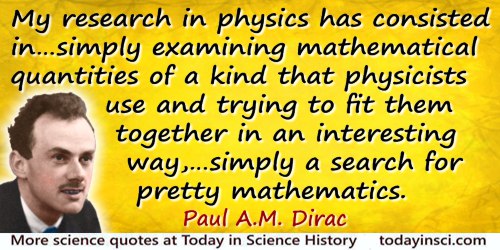
A good deal of my research in physics has consisted in not setting out to solve some particular problem, but simply examining mathematical quantities of a kind that physicists use and trying to fit them together in an interesting way, regardless of any application that the work may have. It is simply a search for pretty mathematics. It may turn out later to have an application. Then one has good luck. At age 78.
International Journal of Theoretical Physics (1982), 21, 603. In A. Pais, 'Playing With Equations, the Dirac Way'. Behram N. Kursunoglu (Ed.) and Eugene Paul Wigner (Ed.), Paul Adrien Maurice Dirac: Reminiscences about a Great Physicist (1990), 110.
A great department of thought must have its own inner life, however transcendent may be the importance of its relations to the outside. No department of science, least of all one requiring so high a degree of mental concentration as Mathematics, can be developed entirely, or even mainly, with a view to applications outside its own range. The increased complexity and specialisation of all branches of knowledge makes it true in the present, however it may have been in former times, that important advances in such a department as Mathematics can be expected only from men who are interested in the subject for its own sake, and who, whilst keeping an open mind for suggestions from outside, allow their thought to range freely in those lines of advance which are indicated by the present state of their subject, untrammelled by any preoccupation as to applications to other departments of science. Even with a view to applications, if Mathematics is to be adequately equipped for the purpose of coping with the intricate problems which will be presented to it in the future by Physics, Chemistry and other branches of physical science, many of these problems probably of a character which we cannot at present forecast, it is essential that Mathematics should be allowed to develop freely on its own lines.
In Presidential Address British Association for the Advancement of Science, Sheffield, Section A,
Nature (1 Sep 1910), 84, 286.
A reasonable content for general education today, then, seems to me to be as follows: First, a command of the principal linguistic tools essential to the pursuit of either science or art. Second, a familiarity with the scientific method and with its principal applications to both physical and social problems. And third, appreciation and practice of the arts, including literature. Furthermore, these three fields should be so integrated toward a common purpose that the question of their relative importance would not even arise. One does not ask which is the most important leg of a tripod.
In 'Education in a Scientific Age', Can Science Save Us? (1947, 2nd ed. 1961), 74-75.
A troubling question for those of us committed to the widest application of intelligence in the study and solution of the problems of men is whether a general understanding of the social sciences will be possible much longer. Many significant areas of these disciplines have already been removed by the advances of the past two decades beyond the reach of anyone who does not know mathematics; and the man of letters is increasingly finding, to his dismay, that the study of mankind proper is passing from his hands to those of technicians and specialists. The aesthetic effect is admittedly bad: we have given up the belletristic “essay on man” for the barbarisms of a technical vocabulary, or at best the forbidding elegance of mathematical syntax.
Opening paragraph of 'The Study of Man: Sociology Learns the Language of Mathematics' in Commentary (1 Sep 1952). Reprinted in James Roy Newman, The World of Mathematics (1956), Vol. 2, 1294.
About 6 or 8 years ago My Ingenious friend Mr John Robinson having [contrived] conceived that a fire engine might be made without a Lever—by Inverting the Cylinder & placing it above the mouth of the pit proposed to me to make a model of it which was set about by having never Compleated & I [being] having at that time Ignorant little knoledge of the machine however I always thought the Machine Might be applied to [more] other as valuable purposes [than] as drawing Water.
Entry in notebook (1765). The bracketed words in square brackets were crossed out by Watt. in Eric Robinson and Douglas McKie (eds.), Partners in Science: Letters of James Watt and Joseph Black (1970), 434.
Abstruse mathematical researches … are … often abused for having no obvious physical application. The fact is that the most useful parts of science have been investigated for the sake of truth, and not for their usefulness. A new branch of mathematics, which has sprung up in the last twenty years, was denounced by the Astronomer Royal before the University of Cambridge as doomed to be forgotten, on account of its uselessness. Now it turns out that the reason why we cannot go further in our investigations of molecular action is that we do not know enough of this branch of mathematics.
In 'Conditions of Mental Development', Lectures and Essays (1901), Vol. 1, 115.
Algebra applies to the clouds.
Victor Hugo and Charles E. Wilbour (trans.), Les Misérables (1862), 41.
All stable processes we shall predict. All unstable processes we shall control.
Describing John von Neumann's aspiration for the application of computers sufficiently large to solve the problems of meteorology, despite the sensitivity of the weather to small perturbations.
Describing John von Neumann's aspiration for the application of computers sufficiently large to solve the problems of meteorology, despite the sensitivity of the weather to small perturbations.
Infinite in All Directions (2004), 182. Dyson wrote his recollection of a talk given by Neumann at Princeton around 1950. The words are not a direct quotation, merely Dyson's description of Neumann's idea.
Almost all great advances have sprung originally from disinterested motives. Scientific discoveries have been made for their own sake and not for their utilization, and a race of men without a disinterested love of knowledge would never have achieved our present scientific technique. … Faraday, Maxwell, and Hertz, so far as can be discovered, never for a moment considered the possibility of any practical application of their investigations.
In The Scientific Outlook (1931), 152-153.
Almost all the greatest discoveries in astronomy have resulted from what we have elsewhere termed Residual Phenomena, of a qualitative or numerical kind, of such portions of the numerical or quantitative results of observation as remain outstanding and unaccounted for, after subducting and allowing for all that would result from the strict application of known principles.
Outlines of Astronomy (1876), 626.
Although with the majority of those who study and practice in these capacities [engineers, builders, surveyors, geographers, navigators, hydrographers, astronomers], secondhand acquirements, trite formulas, and appropriate tables are sufficient for ordinary purposes, yet these trite formulas and familiar rules were originally or gradually deduced from the profound investigations of the most gifted minds, from the dawn of science to the present day. … The further developments of the science, with its possible applications to larger purposes of human utility and grander theoretical generalizations, is an achievement reserved for a few of the choicest spirits, touched from time to time by Heaven to these highest issues. The intellectual world is filled with latent and undiscovered truth as the material world is filled with latent electricity.
In Orations and Speeches, Vol. 3 (1870), 513.
An inventor is an opportunist, one who takes occasion by the hand; who, having seen where some want exists, successfully applies the right means to attain the desired end. The means may be largely, or even wholly, something already known, or there may be a certain originality or discovery in the means employed. But in every case the inventor uses the work of others. If I may use a metaphor, I should liken him to the man who essays the conquest of some virgin alp. At the outset he uses the beaten track, and, as he progresses in the ascent, he uses the steps made by those who have preceded him, whenever they lead in the right direction; and it is only after the last footprints have died out that he takes ice-axe in hand and cuts the remaining steps, few or many, that lift him to the crowning height which is his goal.
In Kenneth Raydon Swan, Sir Joseph Swan (1946), 44.
An inventor is one who can see the applicability of means to supply demand five years before it is obvious to those skilled in the art.
Aphorism listed Frederick Seitz, The Cosmic Inventor: Reginald Aubrey Fessenden (1866-1932) (1999), 54, being Transactions of the American Philosophical Society, Held at Philadelphia For Promoting Useful Knowledge, Vol. 86, Pt. 6.
Archimedes was not free from the prevailing notion that geometry was degraded by being employed to produce anything useful. It was with difficulty that he was induced to stoop from speculation to practice. He was half ashamed of those inventions which were the wonder of hostile nations, and always spoke of them slightingly as mere amusements, as trifles in which a mathematician might be suffered to relax his mind after intense application to the higher parts of his science.
In Lord Bacon', Edinburgh Review (Jul 1887), in Critical and Miscellaneous Essays (1879), Vol. 1, 395.
As a rule, software systems do not work well until they have been used, and have failed repeatedly, in real applications.
As long as Algebra and Geometry have been separated, their progress has been slow and their usages limited; but when these two sciences were reunited, they lent each other mutual strength and walked together with a rapid step towards perfection.
From the original French, “Tant que l’Algèbre et la Géométrie ont été séparées, leur progrès ont été lents et leurs usages bornés; mais lorsque ces deux sciences se sont réunies, elles se sont prêté des forces mutuelles et ont marché ensemble d’un pas rapide vers la perfection,” in Leçons Élémentaires sur la Mathematiques, Leçon 5, as collected in J.A. Serret (ed.), Œuvres de Lagrange (1877), Tome 7, Leçon 15, 271. English translation above by Google translate, tweeked by Webmaster. Also seen translated as, “As long as algebra and geometry proceeded along separate paths, their advance was slow and their applications limited. But when these sciences joined company, they drew from each other fresh vitality and thenceforward marched on at a rapid pace toward perfection,” in Robert Édouard Moritz, Memorabilia Mathematica; Or, The Philomath’s Quotation-Book (1914), 81.
As science is more and more subject to grave misuse as well as to use for human benefit it has also become the scientist's responsibility to become aware of the social relations and applications of his subject, and to exert his influence in such a direction as will result in the best applications of the findings in his own and related fields. Thus he must help in educating the public, in the broad sense, and this means first educating himself, not only in science but in regard to the great issues confronting mankind today.
Message to University Students Studying Science', Kagaku Asahi 11, no. 6 (1951), 28-29. Quoted in Elof Axel Carlson, Genes, Radiation, and Society: The Life and Work of H. J. Muller (1981), 371.
As we continue to improve our understanding of the basic science on which applications increasingly depend, material benefits of this and other kinds are secured for the future.
Speech at the Nobel Banquet (10 Dec 1983) for his Nobel Prize in Chemistry. In Wilhelm Odelberg (ed.), Les Prix Nobel: The Nobel Prizes (1984), 43.
Astronomy was not studied by Kepler, Galileo, or Newton for the practical applications which might result from it, but to enlarge the bounds of knowledge, to furnish new objects of thought and contemplation in regard to the universe of which we form a part; yet how remarkable the influence which this science, apparently so far removed from the sphere of our material interests, has exerted on the destinies of the world!
In 'Report of the Secretary', Annual Report of the Board of Regents of the Smithsonian Institution for 1859 (1860), 15.
At the entrance to the observatory Stjerneborg located underground, Tycho Brahe built a Ionic portal. On top of this were three sculptured lions. On both sides were inscriptions and on the backside was a longer inscription in gold letters on a porfyr stone: Consecrated to the all-good, great God and Posterity. Tycho Brahe, Son of Otto, who realized that Astronomy, the oldest and most distinguished of all sciences, had indeed been studied for a long time and to a great extent, but still had not obtained sufficient firmness or had been purified of errors, in order to reform it and raise it to perfection, invented and with incredible labour, industry, and expenditure constructed various exact instruments suitable for all kinds of observations of the celestial bodies, and placed them partly in the neighbouring castle of Uraniborg, which was built for the same purpose, partly in these subterranean rooms for a more constant and useful application, and recommending, hallowing, and consecrating this very rare and costly treasure to you, you glorious Posterity, who will live for ever and ever, he, who has both begun and finished everything on this island, after erecting this monument, beseeches and adjures you that in honour of the eternal God, creator of the wonderful clockwork of the heavens, and for the propagation of the divine science and for the celebrity of the fatherland, you will constantly preserve it and not let it decay with old age or any other injury or be removed to any other place or in any way be molested, if for no other reason, at any rate out of reverence to the creator’s eye, which watches over the universe. Greetings to you who read this and act accordingly. Farewell!
(Translated from the original in Latin)
But of this I can assure you that there is not a movement of any body of Men however small whether on Horse-back or on foot, nor an operation or March of any description nor any Service in the field that is not formed upon some mathematical principle, and in the performance of which the knowledge and practical application of the mathematicks will be found not only useful but necessary. The application of the Mathematicks to Gunnery, Fortification, Tactics, the survey and knowledge of formal Castrenantion etc. cannot be acquired without study.
Duke of Wellington to his son Douro (1826). Quoted in A Selection of the Private Correspondence of the First Duke of Wellington (1952), 44.
But, contrary to the lady’s prejudices about the engineering profession, the fact is that quite some time ago the tables were turned between theory and applications in the physical sciences. Since World War II the discoveries that have changed the world are not made so much in lofty halls of theoretical physics as in the less-noticed labs of engineering and experimental physics. The roles of pure and applied science have been reversed; they are no longer what they were in the golden age of physics, in the age of Einstein, Schrödinger, Fermi and Dirac.
'The Age of Computing: a Personal Memoir', Daedalus (1992), 121, 120.
By an application of the theory of relativity to the taste of readers, today in Germany I am called a German man of science, and in England I am represented as a Swiss Jew. If I come to be regarded as a bête noire the descriptions will be reversed, and I shall become a Swiss Jew for the Germans and a German man of science for the English!
Times (28 Nov 1919). In Robert Andrews Famous Lines: a Columbia Dictionary of Familiar Quotations (1997), 414. Variations of this quote were made by Einstein on other occasions.
By no process of sound reasoning can a conclusion drawn from limited data have more than a limited application.
In Higher Mathematics for Students of Chemistry and Physics (1902), 2.
By research in pure science I mean research made without any idea of application to industrial matters but solely with the view of extending our knowledge of the Laws of Nature. I will give just one example of the ‘utility’ of this kind of research, one that has been brought into great prominence by the War—I mean the use of X-rays in surgery. Now, not to speak of what is beyond money value, the saving of pain, or, it may be, the life of the wounded, and of bitter grief to those who loved them, the benefit which the state has derived from the restoration of so many to life and limb, able to render services which would otherwise have been lost, is almost incalculable. Now, how was this method discovered? It was not the result of a research in applied science starting to find an improved method of locating bullet wounds. This might have led to improved probes, but we cannot imagine it leading to the discovery of X-rays. No, this method is due to an investigation in pure science, made with the object of discovering what is the nature of Electricity. The experiments which led to this discovery seemed to be as remote from ‘humanistic interest’ —to use a much misappropriated word—as anything that could well be imagined. The apparatus consisted of glass vessels from which the last drops of air had been sucked, and which emitted a weird greenish light when stimulated by formidable looking instruments called induction coils. Near by, perhaps, were great coils of wire and iron built up into electro-magnets. I know well the impression it made on the average spectator, for I have been occupied in experiments of this kind nearly all my life, notwithstanding the advice, given in perfect good faith, by non-scientific visitors to the laboratory, to put that aside and spend my time on something useful.
In Speech made on behalf of a delegation from the Conjoint Board of Scientific Studies in 1916 to Lord Crewe, then Lord President of the Council. In George Paget Thomson, J. J. Thomson and the Cavendish Laboratory in His Day (1965), 167-8.
Common sense is only the application of theories which have grown and been formulated unconsciously as result of experience.
From 'For Mans Use of God's Gifts', collected in Robert C. Goodpasture (ed.), Engineers and Ivory Towers (1952), 107.
Definition of Mathematics.—It has now become apparent that the traditional field of mathematics in the province of discrete and continuous number can only be separated from the general abstract theory of classes and relations by a wavering and indeterminate line. Of course a discussion as to the mere application of a word easily degenerates into the most fruitless logomachy. It is open to any one to use any word in any sense. But on the assumption that “mathematics” is to denote a science well marked out by its subject matter and its methods from other topics of thought, and that at least it is to include all topics habitually assigned to it, there is now no option but to employ “mathematics” in the general sense of the “science concerned with the logical deduction of consequences from the general premisses of all reasoning.”
In article 'Mathematics', Encyclopedia Britannica (1911, 11th ed.), Vol. 17, 880. In the 2006 DVD edition of the encyclopedia, the definition of mathematics is given as “The science of structure, order, and relation that has evolved from elemental practices of counting, measuring, and describing the shapes of objects.” [Premiss is a variant form of “premise”. —Webmaster]
Developing countries can leapfrog several stages in the development process through the application of bio-technology in agriculture.
In Arbind Prasad and Jagdish Prasad, Development Planning for Agriculture: Policies, Economic Implications, Inputs, Production and Marketing (1994), 93.
During my span of life science has become a matter of public concern and the l'art pour l'art standpoint of my youth is now obsolete. Science has become an integral and most important part of our civilization, and scientific work means contributing to its development. Science in our technical age has social, economic, and political functions, and however remote one's own work is from technical application it is a link in the chain of actions and decisions which determine the fate of the human race. I realized this aspect of science in its full impact only after Hiroshima.
— Max Born
My Life & My Views (1968), 49.
During the eighteenth and nineteenth centuries we can see the emergence of a tension that has yet to be resolved, concerning the attitude of scientists towards the usefulness of science. During this time, scientists were careful not to stress too much their relationships with industry or the military. They were seeking autonomy for their activities. On the other hand, to get social support there had to be some perception that the fruits of scientific activity could have useful results. One resolution of this dilemma was to assert that science only contributed at the discovery stage; others, industrialists for example, could apply the results. ... Few noted the ... obvious paradox of this position; that, if scientists were to be distanced from the 'evil' effects of the applications of scientific ideas, so too should they receive no credit for the 'good' or socially beneficial, effects of their activities.
Co-author with Philip Gummett (1947- ), -British social scientist
Co-author with Philip Gummett (1947- ), -British social scientist
Science, Technology and Society Today (1984), Introduction, 4.
During the school period the student has been mentally bending over his desk; at the University he should stand up and look around. For this reason it is fatal if the first year at the University be frittered away in going over the old work in the old spirit. At school the boy painfully rises from the particular towards glimpses at general ideas; at the University he should start from general ideas and study their applications to concrete cases.
In 'The Rhythm of Education', The Aims of Education and Other Essays (1929), 26.
Each scientist of course maintains the “purity” of his own research and repudiates violently any proposal to subject his pet research to the test of immediate applicability and “usefulness.” It is not the object of his research to be useful but to be sound.
In Science: the False Messiah (1927), 35.
Electricity is but yet a new agent for the arts and manufactures, and, doubtless, generations unborn will regard with interest this century, in which it has been first applied to the wants of mankind.
In Preface to the Third Edition ofElements of Electro-Metallurgy: or The Art of Working in Metals by the Galvanic Fluid (1851), viii.
Electricity is often called wonderful, beautiful; but it is so only in common with the other forces of nature. The beauty of electricity or of any other force is not that the power is mysterious, and unexpected, touching every sense at unawares in turn, but that it is under law, and that the taught intellect can even govern it largely. The human mind is placed above, and not beneath it, and it is in such a point of view that the mental education afforded by science is rendered super-eminent in dignity, in practical application and utility; for by enabling the mind to apply the natural power through law, it conveys the gifts of God to man.
Notes for a Friday Discourse at the Royal Institution (1858).
ELECTRICITY, n. The power that causes all natural phenomena not known to be caused by something else. It is the same thing as lightning, and its famous attempt to strike Dr. Franklin is one of the most picturesque incidents in that great and good man's career. The memory of Dr. Franklin is justly held in great reverence, particularly in France, where a waxen effigy of him was recently on exhibition, bearing the following touching account of his life and services to science:
Monsieur Franqulin, inventor of electricity. This illustrious savant, after having made several voyages around the world, died on the Sandwich Islands and was devoured by savages, of whom not a single fragment was ever recovered.
Electricity seems destined to play a most important part in the arts and industries. The question of its economical application to some purposes is still unsettled, but experiment has already proved that it will propel a street car better than a gas jet and give more light than a horse.
Monsieur Franqulin, inventor of electricity. This illustrious savant, after having made several voyages around the world, died on the Sandwich Islands and was devoured by savages, of whom not a single fragment was ever recovered.
Electricity seems destined to play a most important part in the arts and industries. The question of its economical application to some purposes is still unsettled, but experiment has already proved that it will propel a street car better than a gas jet and give more light than a horse.
The Cynic's Word Book (1906), 87. Also published later as The Devil's Dictionary.
Engineering is the application of scientific and mathematical principles to practical ends such as the design, manufacture, and operation of efficient and economical structures, machines, processes, and systems.
In Bernice Zeldin Schacter, Issues and Dilemmas of Biotechnology: A Reference Guide (1999), 1, citing the American Heritage Dictionary, 2nd College Edition.
Engineering is the art of directing the great sources of power in nature for the use and the convenience of people. In its modern form engineering involves people, money, materials, machines, and energy. It is differentiated from science because it is primarily concerned with how to direct to useful and economical ends the natural phenomena which scientists discover and formulate into acceptable theories. Engineering therefore requires above all the creative imagination to innovate useful applications of natural phenomena. It seeks newer, cheaper, better means of using natural sources of energy and materials.
In McGraw Hill, Science and Technology Encyclopedia
Engineering is the conscious application of science to the problems of economic production.
1910
Engineering is the practice of safe and economic application of the scientific laws governing the forces and materials of nature by means of organization, design and construction, for the general benefit of mankind.
1920
Engineering is the professional and systematic application of science to the efficient utilization of natural resources to produce wealth.
T. J. Hoover and John Charles Lounsbury (J.C.L.) Fish, The Engineering Profession (1941), 10.
Engineers apply the theories and principles of science and mathematics to research and develop economical solutions to practical technical problems. Their work is the link between scientific discoveries and commercial applications. Engineers design products, the machinery to build those products, the factories in which those products are made, and the systems that ensure the quality of the product and efficiency of the workforce and manufacturing process. They design, plan, and supervise the construction of buildings, highways, and transit systems. They develop and implement improved ways to extract, process, and use raw materials, such as petroleum and natural gas. They develop new materials that both improve the performance of products, and make implementing advances in technology possible. They harness the power of the sun, the earth, atoms, and electricity for use in supplying the Nation’s power needs, and create millions of products using power. Their knowledge is applied to improving many things, including the
quality of health care, the safety of food products, and the efficient operation of financial systems.
Bureau of Labor Statistics, Occupational Outlook Handbook (2000) as quoted in Charles R. Lord. Guide to Information Sources in Engineering (2000), 5. This definition has been revised and expanded over time in different issues of the Handbook.
Every hypothesis in physical science has to go through a period of difficult gestation and parturition before it can be brought out into the light of day and handed to others, ready-made in scientific form so that it will be, as it were, fool-proof in the hands of outsiders who wish to apply it.
In Max Planck and James Vincent Murphy (trans.), Where Is Science Going? (1932), 178.
Every well established truth is an addition to the sum of human power, and though it may not find an immediate application to the economy of every day life, we may safely commit it to the stream of time, in the confident anticipation that the world will not fail to realize its beneficial results.
In 'Report of the Secretary', Annual Report of the Board of Regents of the Smithsonian Institution for 1856 (1857), 20.
First, as concerns the success of teaching mathematics. No instruction in the high schools is as difficult as that of mathematics, since the large majority of students are at first decidedly disinclined to be harnessed into the rigid framework of logical conclusions. The interest of young people is won much more easily, if sense-objects are made the starting point and the transition to abstract formulation is brought about gradually. For this reason it is psychologically quite correct to follow this course.
Not less to be recommended is this course if we inquire into the essential purpose of mathematical instruction. Formerly it was too exclusively held that this purpose is to sharpen the understanding. Surely another important end is to implant in the student the conviction that correct thinking based on true premises secures mastery over the outer world. To accomplish this the outer world must receive its share of attention from the very beginning.
Doubtless this is true but there is a danger which needs pointing out. It is as in the case of language teaching where the modern tendency is to secure in addition to grammar also an understanding of the authors. The danger lies in grammar being completely set aside leaving the subject without its indispensable solid basis. Just so in Teaching of Mathematics it is possible to accumulate interesting applications to such an extent as to stunt the essential logical development. This should in no wise be permitted, for thus the kernel of the whole matter is lost. Therefore: We do want throughout a quickening of mathematical instruction by the introduction of applications, but we do not want that the pendulum, which in former decades may have inclined too much toward the abstract side, should now swing to the other extreme; we would rather pursue the proper middle course.
Not less to be recommended is this course if we inquire into the essential purpose of mathematical instruction. Formerly it was too exclusively held that this purpose is to sharpen the understanding. Surely another important end is to implant in the student the conviction that correct thinking based on true premises secures mastery over the outer world. To accomplish this the outer world must receive its share of attention from the very beginning.
Doubtless this is true but there is a danger which needs pointing out. It is as in the case of language teaching where the modern tendency is to secure in addition to grammar also an understanding of the authors. The danger lies in grammar being completely set aside leaving the subject without its indispensable solid basis. Just so in Teaching of Mathematics it is possible to accumulate interesting applications to such an extent as to stunt the essential logical development. This should in no wise be permitted, for thus the kernel of the whole matter is lost. Therefore: We do want throughout a quickening of mathematical instruction by the introduction of applications, but we do not want that the pendulum, which in former decades may have inclined too much toward the abstract side, should now swing to the other extreme; we would rather pursue the proper middle course.
In Ueber den Mathematischen Unterricht an den hoheren Schulen; Jahresbericht der Deutschen Mathematiker Vereinigung, Bd. 11, 131.
For just as musical instruments are brought to perfection of clearness in the sound of their strings by means of bronze plates or horn sounding boards, so the ancients devised methods of increasing the power of the voice in theaters through the application of the science of harmony.
In Vitruvius Pollio and Morris Hicky Morgan (trans.), 'Book V: Chapter III', Vitruvius, the Ten Books on Architecture (1914), 139. From the original Latin, “Ergo veteres Architecti, naturae vestigia persecuti, indagationibus vocis scandentes theatrorum perfecerunt gradationes: & quaesiuerunt per canonicam mathematicorum,& musicam rationem, ut quaecunq; vox effet in scena, clarior & suauior ad spectatorum perueniret aures. Uti enim organa in aeneis laminis, aut corneis, diesi ad chordarum sonituum claritatem perficiuntur: sic theatrorum, per harmonicen ad augendam vocem, ratiocinationes ab antiquis sunt constitutae.” In De Architectura libri decem (1552), 175.
FORTRAN —’the infantile disorder’—, by now nearly 20 years old, is hopelessly inadequate for whatever computer application you have in mind today: it is now too clumsy, too risky, and too expensive to use. PL/I —’the fatal disease’— belongs more to the problem set than to the solution set. It is practically impossible to teach good programming to students that have had a prior exposure to BASIC: as potential programmers they are mentally mutilated beyond hope of regeneration. The use of COBOL cripples the mind; its teaching should, therefore, be regarded as a criminal offence. APL is a mistake, carried through to perfection. It is the language of the future for the programming techniques of the past: it creates a new generation of coding bums.
…...
FORTRAN, ‘the infantile disorder’, by now nearly 20 years old, is hopelessly inadequate for whatever computer application you have in mind today: it is now too clumsy, too risky, and too expensive to use.
…...
From that night on, the electron—up to that time largely the plaything of the scientist—had clearly entered the field as a potent agent in the supplying of man's commercial and industrial needs… The electronic amplifier tube now underlies the whole art of communications, and this in turn is at least in part what has made possible its application to a dozen other arts. It was a great day for both science and industry when they became wedded through the development of the electronic amplifier tube.
The Autobiography of Robert A. Millikan (1951), 136.
Geometric writings are not rare in which one would seek in vain for an idea at all novel, for a result which sooner or later might be of service, for anything in fact which might be destined to survive in the science; and one finds instead treatises on trivial problems or investigations on special forms which have absolutely no use, no importance, which have their origin not in the science itself but in the caprice of the author; or one finds applications of known methods which have already been made thousands of times; or generalizations from known results which are so easily made that the knowledge of the latter suffices to give at once the former. Now such work is not merely useless; it is actually harmful because it produces a real incumbrance in the science and an embarrassment for the more serious investigators; and because often it crowds out certain lines of thought which might well have deserved to be studied.
From 'On Some Recent Tendencies in Geometric Investigations', Rivista di Matematica (1891), 43. In Bulletin American Mathematical Society (1904), 443.
Good design is not an applied veneer.
On the official Raymond Loewry website.
Gyroscope, n.: A wheel or disk mounted to spin rapidly about an axis and also free to rotate about one or both of two axes perpendicular to each other and the axis of spin so that a rotation of one of the two mutually perpendicular axes results from application of torque to the other when the wheel is spinning and so that the entire apparatus offers considerable opposition depending on the angular momentum to any torque that would change the direction of the axis of spin.
Webster's New Collegiate Dictionary (8th Ed., 1973), 513. (Webmaster comments: A definition which is perfectly easy to understand. Right?)
He is not a true man of science who does not bring some sympathy to his studies, and expect to learn something by behavior as well as by application. It is childish to rest in the discovery of mere coincidences, or of partial and extraneous laws.
In A Week on the Concord and Merrimack Rivers (1862), 381.
His genius now began to mount upwards apace & shine out with more strength, & as he told me himself, he excelled particularly in making verses... In everything he undertook he discovered an application equal to the pregnancy of his parts & exceeded the most sanguine expectations his master had conceived of him.
[About Newton's recollection of being a schoolboy at Grantham, written by Conduitt about 65 years after that time.]
[About Newton's recollection of being a schoolboy at Grantham, written by Conduitt about 65 years after that time.]
Quoted in Richard Westfall, Never at Rest: A Biography of Isaac Newton (1980), 65. Footnoted Keynes MS 130.2, p. 32-3, in the collection at King's College, Cambridge.
Honest investigation is but the application of common sense to the solution of the unknown. Science does not wait on Genius, but is the companion of Industry.
From address (1 Oct 1884), at inauguration of the Corcoran School of Science and Arts, Columbian University, Washington, D.C. Published in 'The Larger Import of Scientific Education', Popular Science Monthly (Feb 1885), 26, 453.
I am among the most durable and passionate participants in the scientific exploration of the solar system, and I am a long-time advocate of the application of space technology to civil and military purposes of direct benefit to life on Earth and to our national security.
In 'Is Human Spaceflight Obsolete?' Quoted in Issues in Science and Technology (Summer 2004).
I am of the decided opinion, that mathematical instruction must have for its first aim a deep penetration and complete command of abstract mathematical theory together with a clear insight into the structure of the system, and doubt not that the instruction which accomplishes this is valuable and interesting even if it neglects practical applications. If the instruction sharpens the understanding, if it arouses the scientific interest, whether mathematical or philosophical, if finally it calls into life an esthetic feeling for the beauty of a scientific edifice, the instruction will take on an ethical value as well, provided that with the interest it awakens also the impulse toward scientific activity. I contend, therefore, that even without reference to its applications mathematics in the high schools has a value equal to that of the other subjects of instruction.
In 'Ueber das Lehrziel im mathemalischen Unterricht der höheren Realanstalten', Jahresbericht der Deutschen Mathematiker Vereinigung, 2, 192. (The Annual Report of the German Mathematical Association. As translated in Robert Édouard Moritz, Memorabilia Mathematica; Or, The Philomath’s Quotation-Book (1914), 73.
I am particularly concerned to determine the probability of causes and results, as exhibited in events that occur in large numbers, and to investigate the laws according to which that probability approaches a limit in proportion to the repetition of events. That investigation deserves the attention of mathematicians because of the analysis required. It is primarily there that the approximation of formulas that are functions of large numbers has its most important applications. The investigation will benefit observers in identifying the mean to be chosen among the results of their observations and the probability of the errors still to be apprehended. Lastly, the investigation is one that deserves the attention of philosophers in showing how in the final analysis there is a regularity underlying the very things that seem to us to pertain entirely to chance, and in unveiling the hidden but constant causes on which that regularity depends. It is on the regularity of the main outcomes of events taken in large numbers that various institutions depend, such as annuities, tontines, and insurance policies. Questions about those subjects, as well as about inoculation with vaccine and decisions of electoral assemblies, present no further difficulty in the light of my theory. I limit myself here to resolving the most general of them, but the importance of these concerns in civil life, the moral considerations that complicate them, and the voluminous data that they presuppose require a separate work.
Philosophical Essay on Probabilities (1825), trans. Andrew I. Dale (1995), Introduction.
I distinguish two kinds of "applied" research: problem-solving research — government or commercially initiated, centrally managed and institutionally coupled to a plan for application of the results, useful science—investigator-initiated, competitively evaluated and widely communicated. Then we have basic science—useful also, also investigator-initiated, competitively evaluated and widely communicated.
In Confessions of a Technophile (1994), 31.
I do not believe that the present flowering of science is due in the least to a real appreciation of the beauty and intellectual discipline of the subject. It is due simply to the fact that power, wealth and prestige can only be obtained by the correct application of science.
In 'Some Reflections on the Present Status of Organic Chemistry', Science and Human Progress: Addresses at the Celebrations of the 50th Anniversary of the Mellon Institute (1963), 90.
I do not intend to go deeply into the question how far mathematical studies, as the representatives of conscious logical reasoning, should take a more important place in school education. But it is, in reality, one of the questions of the day. In proportion as the range of science extends, its system and organization must be improved, and it must inevitably come about that individual students will find themselves compelled to go through a stricter course of training than grammar is in a position to supply. What strikes me in my own experience with students who pass from our classical schools to scientific and medical studies, is first, a certain laxity in the application of strictly universal laws. The grammatical rules, in which they have been exercised, are for the most part followed by long lists of exceptions; accordingly they are not in the habit of relying implicitly on the certainty of a legitimate deduction from a strictly universal law. Secondly, I find them for the most part too much inclined to trust to authority, even in cases where they might form an independent judgment. In fact, in philological studies, inasmuch as it is seldom possible to take in the whole of the premises at a glance, and inasmuch as the decision of disputed questions often depends on an aesthetic feeling for beauty of expression, or for the genius of the language, attainable only by long training, it must often happen that the student is referred to authorities even by the best teachers. Both faults are traceable to certain indolence and vagueness of thought, the sad effects of which are not confined to subsequent scientific studies. But certainly the best remedy for both is to be found in mathematics, where there is absolute certainty in the reasoning, and no authority is recognized but that of one’s own intelligence.
In 'On the Relation of Natural Science to Science in general', Popular Lectures on Scientific Subjects, translated by E. Atkinson (1900), 25-26.
I have no patience with the doctrine of “pure science,”—that science is science only as it is uncontaminated by application in the arts of life: and I have no patience with the spirit that considers a piece of work to be legitimate only as it has direct bearing on the arts and affairs of men. We must discover all things that are discoverable and make a record of it: the application will take care of itself.
In 'The Survey Idea in Country Life', collected in John Phelan, Readings in Rural Sociology (1920), 480.
I have rather, however, been desirous of discovering new facts and new relations dependent on magneto-electric induction, than of exalting the force of those already obtained; being assured that the latter would find their full development hereafter.
Read 12 Jan 1832, reprinted from Philosophical Transactions of 1831-1828, in 'Second Series', Experimental Researches in Electricity: Volume 1 (1839), 47.
I learnt very quickly that the only reason that would be accepted for not attending a committee meeting was that one already had a previous commitment to attend a meeting of another organization on the same day. I therefore invented a society, the Orion Society, a highly secret and very exclusive society that spawned a multitude of committees, sub-committees, working parties, evaluation groups and so on that, regrettably, had a prior claim on my attention. Soon people wanted to know more about this club and some even decided that they would like to join it. However, it was always made clear to them that applications were never entertained and that if they were deemed to qualify for membership they would be discreetly approached at the appropriate time.
Loose Ends from Current Biology (1997), 14.
I looked for it [heavy hydrogen, deuterium] because I thought it should exist. I didn't know it would have industrial applications or be the basic for the most powerful weapon ever known [the nuclear bomb] … I thought maybe my discovery might have the practical value of, say, neon in neon signs.
[He was awarded the 1931 Nobel Prize in Chemistry for discovering deuterium.]
[He was awarded the 1931 Nobel Prize in Chemistry for discovering deuterium.]
Quoted in 'Moon-Struck Scientist,' New York Times (27 Apr 1961), 42.
I presume that few who have paid any attention to the history of the Mathematical Analysis, will doubt that it has been developed in a certain order, or that that order has been, to a great extent, necessary—being determined, either by steps of logical deduction, or by the successive introduction of new ideas and conceptions, when the time for their evolution had arrived. And these are the causes that operate in perfect harmony. Each new scientific conception gives occasion to new applications of deductive reasoning; but those applications may be only possible through the methods and the processes which belong to an earlier stage.
Explaining his choice for the exposition in historical order of the topics in A Treatise on Differential Equations (1859), Preface, v-vi.
I regarded as quite useless the reading of large treatises of pure analysis: too large a number of methods pass at once before the eyes. It is in the works of application that one must study them; one judges their utility there and appraises the manner of making use of them.
As reported by J. F. Maurice in Moniteur Universel (1814), 228.
I saw a horrible brown heap on the floor in the corner, which, but for previous experience in this dismal wise, I might not have suspected to be “the bed.” There was something thrown upon it and I asked what it was. “’Tis the poor craythur that stays here, sur; and ’tis very bad she is, ’tis very bad she’s been this long time, and ’tis better she’ll never be, and ’tis slape she doos all day, and ’tis wake she doos all night, and ‘tis the lead, Sur.” “The what?” “The lead, Sur. Sure, ’tis the lead-mills, where women gets took on at eighteen pence a day, Sur, when they makes application early enough, and is lucky and wanted, and ’tis lead-pisoned she is, Sur, and some of them gits lead-pisoned soon and some of them gets lead-pisoned later, and some but not many, niver, and ’tis all according to the constitooshun, Sur, and some constitooshuns is strong, and some is weak, and her constitooshun is lead-pisoned, bad as can be, Sur, and her brain is coming out at her ear, and it hurts her dreadful, and that’s what it is and niver no more and niver so less, Sur.”
In 'New Uncommercial Samples: A Small Star in the East', All the Year Round (19 Dec 1868), New Series, No. 3, 62.
I suspect that the changes that have taken place during the last century in the average man's fundamental beliefs, in his philosophy, in his concept of religion. in his whole world outlook, are greater than the changes that occurred during the preceding four thousand years all put together. ... because of science and its applications to human life, for these have bloomed in my time as no one in history had had ever dreamed could be possible.
In The Autobiography of Robert A. Millikan (1951, 1980), xii.
I think it would be desirable that this form of word [mathematics] should be reserved for the applications of the science, and that we should use mathematic in the singular to denote the science itself, in the same way as we speak of logic, rhetoric, or (own sister to algebra) music.
In Presidential Address to the British Association, Exeter British Association Report (1869); Collected Mathematical Papers, Vol. 2, 669.
I use the word nursing for want of a better. It has been limited to signify little more than the administration of medicines and the application of poultices. It ought to signify the proper use of fresh air, light, warmth, cleanliness, quiet, and the proper selection and administration of diet—all at the least expense of vital power to the patient.
Notes on Nursing: What it is and what it is not (1860), 2.
If a mathematician wishes to disparage the work of one of his colleagues, say, A, the most effective method he finds for doing this is to ask where the results can be applied. The hard pressed man, with his back against the wall, finally unearths the researches of another mathematician B as the locus of the application of his own results. If next B is plagued with a similar question, he will refer to another mathematician C. After a few steps of this kind we find ourselves referred back to the researches of A, and in this way the chain closes.
From final remarks in 'The Semantic Conception of Truth and the Foundations of Semantics' (1944), collected in Leonard Linsky (ed.), Semantics and the Philosophy of Language: A Collection of Readings (1952), 41.
If science could get rid of consciousness, it would have disposed of the only stumbling block to its universal application.
'Reply to Francis V. Raab', The Philosophy of Brand Blanshard (1980) 807.
If the human race ever stops acting on the basis of what it thinks it knows, paralyzed by fear that its knowledge may be wrong, then Homo sapiens will be making its application for membership in the dinosaur club.
To Plant a Seed (1972). In Gary Westfahl, Science Fiction Quotations: From the Inner Mind to the Outer Limits (2006), 2.
If the scientific method, and especially its application to human relations, is as important as we have contended, then our educational efforts must be judged largely by the degree to which they inculcate a familiarity with this method, and the reliable generalizations it has yielded thus far.
In 'Education in a Scientific Age', Can Science Save Us? (1947, 2nd ed. 1961), 66-67.
If you ask ... the man in the street ... the human significance of mathematics, the answer of the world will be, that mathematics has given mankind a metrical and computatory art essential to the effective conduct of daily life, that mathematics admits of countless applications in engineering and the natural sciences, and finally that mathematics is a most excellent instrumentality for giving mental discipline... [A mathematician will add] that mathematics is the exact science, the science of exact thought or of rigorous thinking.
Address (28 Mar 1912), Michigan School Masters' Club, Ann Arbor, 'The Humanization of the Teaching of Mathematics. Printed in Science (26 Apr 1912). Collected in The Human Worth of Rigorous Thinking: Essays and Addresses (1916), 65-66.
In every section of the entire area where the word science may properly be applied, the limiting factor is a human one. We shall have rapid or slow advance in this direction or in that depending on the number of really first-class men who are engaged in the work in question. ... So in the last analysis, the future of science in this country will be determined by our basic educational policy.
Quoted in Vannevar Bush, Science, the Endless Frontier: A Report to the President, July 1945. In Transactions of the Kansas Academy of Science: Volumes 48-49, 246.
In future times Tait will be best known for his work in the quaternion analysis. Had it not been for his expositions, developments and applications, Hamilton’s invention would be today, in all probability, a mathematical curiosity.
In Bibliotheca Mathematica (1903), 3, 189. As cited in Robert Édouard Moritz, Memorabilia Mathematica; Or, The Philomath’s Quotation-Book (1914), 178. [Note: Tait is Peter Guthrie Tait; Hamilton is Sir William Rowan Hamilton. —Webmaster]
In general the position as regards all such new calculi is this That one cannot accomplish by them anything that could not be accomplished without them. However, the advantage is, that, provided such a calculus corresponds to the inmost nature of frequent needs, anyone who masters it thoroughly is able—without the unconscious inspiration of genius which no one can command—to solve the respective problems, yea, to solve them mechanically in complicated cases in which, without such aid, even genius becomes powerless. Such is the case with the invention of general algebra, with the differential calculus, and in a more limited region with Lagrange’s calculus of variations, with my calculus of congruences, and with Möbius’s calculus. Such conceptions unite, as it were, into an organic whole countless problems which otherwise would remain isolated and require for their separate solution more or less application of inventive genius.
Letter (15 May 1843) to Schumacher, collected in Carl Friedrich Gauss Werke (1866), Vol. 8, 298, as translated in Robert Édouard Moritz, Memorabilia Mathematica; Or, The Philomath's Quotation-book (1914), 197-198. From the original German, “Überhaupt verhält es sich mit allen solchen neuen Calculs so, dass man durch sie nichts leisten kann, was nicht auch ohne sie zu leisten wäre; der Vortheil ist aber der, dass, wenn ein solcher Calcul dem innersten Wesen vielfach vorkommender Bedürfnisse correspondirt, jeder, der sich ihn ganz angeeignet hat, auch ohne die gleichsam unbewussten Inspirationen des Genies, die niemand erzwingen kann, die dahin gehörigen Aufgaben lösen, ja selbst in so verwickelten Fällen gleichsam mechanisch lösen kann, wo ohne eine solche Hülfe auch das Genie ohnmächtig wird. So ist es mit der Erfindung der Buchstabenrechnung überhaupt; so mit der Differentialrechnung gewesen; so ist es auch (wenn auch in partielleren Sphären) mit Lagranges Variationsrechnung, mit meiner Congruenzenrechnung und mit Möbius' Calcul. Es werden durch solche Conceptionen unzählige Aufgaben, die sonst vereinzelt stehen, und jedesmal neue Efforts (kleinere oder grössere) des Erfindungsgeistes erfordern, gleichsam zu einem organischen Reiche.”
In geometric and physical applications, it always turns out that a quantity is characterized not only by its tensor order, but also by symmetry.
Epigraph in Charles W. Misner, Kip S. Thorn and John Archibald Wheeler, Gravitation (1970, 1973), 47. Cited as “(1925),” with no source.
In science men have discovered an activity of the very highest value in which they are no longer, as in art, dependent for progress upon the appearance of continually greater genius, for in science the successors stand upon the shoulders of their predecessors; where one man of supreme genius has invented a method, a thousand lesser men can apply it. … In art nothing worth doing can be done without genius; in science even a very moderate capacity can contribute to a supreme achievement.
Essay, 'The Place Of Science In A Liberal Education.' In Mysticism and Logic: and Other Essays (1919), 41.
In the 1940s when I did my natural sciences degree in zoology it was very much laboratory-based. … I was not keen on the idea of spending the rest of my life in the lab. I also don’t think I would have been particularly good at it. I don't think I have as analytical a mind or the degree of application that one would need to become a first-rate research scientist.
From interview with Michael Bond, 'It’s a Wonderful Life', New Scientist (14 Dec 2002), 176, No. 2373, 48.
In the application of inductive logic to a given knowledge situation, the total evidence available must be used as a basis for determining the degree of confirmation.
In Logical Foundations of Probability (1950, 1962), 211.
In the present age the human mind must be coerced into theoretical studies; it runs of
its own accord to practical applications.
In Alexis de Tocqueville and Henry Reeve (trans.), Democracy in America (1840, 1899), Vol. 2, 48.
In the twenties the late Dr. Glenn Frank, an eminent social scientist, developed a new statement of the scientific code, which has been referred to as the “Five Fingers of the Scientific Method.” It may be outlined as follows: find the facts; filter the facts; focus the facts; face the facts; follow the facts. The facts or truths are found by experimentation; the motivation is material. The facts are filtered by research into the literature; the motivation is material. The facts are focused by the publication of results; again the motivation is material. Thus the first three-fifths of the scientific method have a material motivation. It is about time scientists acknowledge that there is more to the scientific convention than the material aspect. Returning to the fourth and fifth fingers of Dr. Frank's conception of the scientific method, the facts should be faced by the proper interpretation of them for society. In other words, a scientist must assume social responsibility for his discoveries, which means that he must have a moral motivation. Finally, in the fifth definition of the scientific method, the facts are to be followed by their proper application to everyday life in society, which means moral motivation through responsibility to society.
From 'Scientists and Society', American Scientist (Jul 1954), 42, No. 3, 495.
In truth, ideas and principles are independent of men; the application of them and their illustration is man's duty and merit. The time will come when the author of a view shall be set aside, and the view only taken cognizance of. This will be the millennium of Science.
Notes of hints to Mr Ramsey, Professor of Geology, University College London, 1847. In George Wilson and Archibald Geikie, Memoir of Edward Forbes F.R.S. (1861), 429.
Indeed, if one understands by algebra the application of arithmetic operations to composite magnitudes of all kinds, whether they be rational or irrational number or space magnitudes, then the learned Brahmins of Hindostan are the true inventors of algebra.
In Geschichte der Mathematik im Altertum und im Mittelalter (1874), 195. As translated in Robert Édouard Moritz, Memorabilia Mathematica; Or, The Philomath’s Quotation-book (1914), 284. From the original German, “Ja, wenn man unter Algebra die Anwendung arithmetischer Operationen auf zusammengesetzte Grössen aller Art, mögen sie rationale oder irrationale Zahl- oder Raumgrössen sein, versteht, so sind die gelehrten Brahmanen Hindustans die wahren Erfinder der Algebra.”
It has been asserted … that the power of observation is not developed by mathematical studies; while the truth is, that; from the most elementary mathematical notion that arises in the mind of a child to the farthest verge to which mathematical investigation has been pushed and applied, this power is in constant exercise. By observation, as here used, can only be meant the fixing of the attention upon objects (physical or mental) so as to note distinctive peculiarities—to recognize resemblances, differences, and other relations. Now the first mental act of the child recognizing the distinction between one and more than one, between one and two, two and three, etc., is exactly this. So, again, the first geometrical notions are as pure an exercise of this power as can be given. To know a straight line, to distinguish it from a curve; to recognize a triangle and distinguish the several forms—what are these, and all perception of form, but a series of observations? Nor is it alone in securing these fundamental conceptions of number and form that observation plays so important a part. The very genius of the common geometry as a method of reasoning—a system of investigation—is, that it is but a series of observations. The figure being before the eye in actual representation, or before the mind in conception, is so closely scrutinized, that all its distinctive features are perceived; auxiliary lines are drawn (the imagination leading in this), and a new series of inspections is made; and thus, by means of direct, simple observations, the investigation proceeds. So characteristic of common geometry is this method of investigation, that Comte, perhaps the ablest of all writers upon the philosophy of mathematics, is disposed to class geometry, as to its method, with the natural sciences, being based upon observation. Moreover, when we consider applied mathematics, we need only to notice that the exercise of this faculty is so essential, that the basis of all such reasoning, the very material with which we build, have received the name observations. Thus we might proceed to consider the whole range of the human faculties, and find for the most of them ample scope for exercise in mathematical studies. Certainly, the memory will not be found to be neglected. The very first steps in number—counting, the multiplication table, etc., make heavy demands on this power; while the higher branches require the memorizing of formulas which are simply appalling to the uninitiated. So the imagination, the creative faculty of the mind, has constant exercise in all original mathematical investigations, from the solution of the simplest problems to the discovery of the most recondite principle; for it is not by sure, consecutive steps, as many suppose, that we advance from the known to the unknown. The imagination, not the logical faculty, leads in this advance. In fact, practical observation is often in advance of logical exposition. Thus, in the discovery of truth, the imagination habitually presents hypotheses, and observation supplies facts, which it may require ages for the tardy reason to connect logically with the known. Of this truth, mathematics, as well as all other sciences, affords abundant illustrations. So remarkably true is this, that today it is seriously questioned by the majority of thinkers, whether the sublimest branch of mathematics,—the infinitesimal calculus—has anything more than an empirical foundation, mathematicians themselves not being agreed as to its logical basis. That the imagination, and not the logical faculty, leads in all original investigation, no one who has ever succeeded in producing an original demonstration of one of the simpler propositions of geometry, can have any doubt. Nor are induction, analogy, the scrutinization of premises or the search for them, or the balancing of probabilities, spheres of mental operations foreign to mathematics. No one, indeed, can claim preeminence for mathematical studies in all these departments of intellectual culture, but it may, perhaps, be claimed that scarcely any department of science affords discipline to so great a number of faculties, and that none presents so complete a gradation in the exercise of these faculties, from the first principles of the science to the farthest extent of its applications, as mathematics.
In 'Mathematics', in Henry Kiddle and Alexander J. Schem, The Cyclopedia of Education, (1877.) As quoted and cited in Robert Édouard Moritz, Memorabilia Mathematica; Or, The Philomath’s Quotation-book (1914), 27-29.
It has been recognized that hydrogen bonds restrain protein molecules to their native configurations, and I believe that as the methods of structural chemistry are further applied to physiological problems it will be found that the significance of the hydrogen bond for physiology is greater than that of any other single structural feature.
Nature of the Chemical Bond and the Structure of Molecules and Crystals (1939), 265.
It is a fraud of the Christian system to call the sciences human invention; it is only the application of them that is human.
In The Age of Reason (1794, 1834), 30.
It is characteristic of our age to endeavour to replace virtues by technology. That is to say, wherever possible we strive to use methods of physical or social engineering to achieve goals which our ancestors thought attainable only by the training of character. Thus, we try so far as possible to make contraception take the place of chastity, and anaesthetics to take the place of fortitude; we replace resignation by insurance policies and munificence by the Welfare State. It would be idle romanticism to deny that such techniques and institutions are often less painful and more efficient methods of achieving the goods and preventing the evils which unaided virtue once sought to achieve and avoid. But it would be an equal and opposite folly to hope that the take-over of virtue by technology may one day be complete, so that the necessity for the laborious acquisition of the capacity for rational choice by individuals can be replaced by the painless application of the fruits of scientific discovery over the whole field of human intercourse and enterprise.
'Mental Health in Plato's Republic', in The Anatomy of the Soul: Historical Essays in the Philosophy of Mind (1973), 26.
It is no paradox to say that in our most theoretical moods we may be nearest to our most practical applications.
In Introduction to Mathematics, 100.
It is not of the essence of mathematics to be conversant with the ideas of number and quantity. Whether as a general habit of mind it would be desirable to apply symbolic processes to moral argument, is another question.
An Investigation of the Laws of Thought (1854), 12.
It is not surprising, in view of the polydynamic constitution of the genuinely mathematical mind, that many of the major heros of the science, men like Desargues and Pascal, Descartes and Leibnitz, Newton, Gauss and Bolzano, Helmholtz and Clifford, Riemann and Salmon and Plücker and Poincaré, have attained to high distinction in other fields not only of science but of philosophy and letters too. And when we reflect that the very greatest mathematical achievements have been due, not alone to the peering, microscopic, histologic vision of men like Weierstrass, illuminating the hidden recesses, the minute and intimate structure of logical reality, but to the larger vision also of men like Klein who survey the kingdoms of geometry and analysis for the endless variety of things that flourish there, as the eye of Darwin ranged over the flora and fauna of the world, or as a commercial monarch contemplates its industry, or as a statesman beholds an empire; when we reflect not only that the Calculus of Probability is a creation of mathematics but that the master mathematician is constantly required to exercise judgment—judgment, that is, in matters not admitting of certainty—balancing probabilities not yet reduced nor even reducible perhaps to calculation; when we reflect that he is called upon to exercise a function analogous to that of the comparative anatomist like Cuvier, comparing theories and doctrines of every degree of similarity and dissimilarity of structure; when, finally, we reflect that he seldom deals with a single idea at a tune, but is for the most part engaged in wielding organized hosts of them, as a general wields at once the division of an army or as a great civil administrator directs from his central office diverse and scattered but related groups of interests and operations; then, I say, the current opinion that devotion to mathematics unfits the devotee for practical affairs should be known for false on a priori grounds. And one should be thus prepared to find that as a fact Gaspard Monge, creator of descriptive geometry, author of the classic Applications de l’analyse à la géométrie; Lazare Carnot, author of the celebrated works, Géométrie de position, and Réflections sur la Métaphysique du Calcul infinitesimal; Fourier, immortal creator of the Théorie analytique de la chaleur; Arago, rightful inheritor of Monge’s chair of geometry; Poncelet, creator of pure projective geometry; one should not be surprised, I say, to find that these and other mathematicians in a land sagacious enough to invoke their aid, rendered, alike in peace and in war, eminent public service.
In Lectures on Science, Philosophy and Art (1908), 32-33.
It is often held that scientific hypotheses are constructed, and are to be constructed, only after a detailed weighing of all possible evidence bearing on the matter, and that then and only then may one consider, and still only tentatively, any hypotheses. This traditional view however, is largely incorrect, for not only is it absurdly impossible of application, but it is contradicted by the history of the development of any scientific theory. What happens in practice is that by intuitive insight, or other inexplicable inspiration, the theorist decides that certain features seem to him more important than others and capable of explanation by certain hypotheses. Then basing his study on these hypotheses the attempt is made to deduce their consequences. The successful pioneer of theoretical science is he whose intuitions yield hypotheses on which satisfactory theories can be built, and conversely for the unsuccessful (as judged from a purely scientific standpoint).
Co-author with Raymond Arthur Lyttleton, in 'The Internal Constitution of the Stars', Occasional Notes of the Royal Astronomical Society 1948, 12, 90.
It is the constant attempt in this country [Canada] to make fundamental science responsive to the marketplace. Because technology needs science, it is tempting to require that scientific projects be justified in terms of the worth of the technology they can be expected to generate. The effect of applying this criterion is, however, to restrict science to developed fields where the links to technology are most evident. By continually looking for a short-term payoff we disqualify the sort of science that … attempts to answer fundamental questions, and, having answered them, suggests fundamentally new approaches in the realm of applications.
'A Scientist and the World He Lives In', Speech to the Empire Club of Canada (27 Nov 1986) in C. Frank Turner and Tim Dickson (eds.), The Empire Club of Canada Speeches 1986-1987 (1987), 149-161.
It is the technologist who is transforming at least the outward trappings of modern civilization and no hard and fast line can or should be drawn between those who apply science, and in the process make discoveries, and those who pursue what is sometimes called basic science.
Presidential Address to the Anniversary Meeting (30 Nov 1964) in the Proceedings of the Royal Society of London. Series A, Mathematical and Physical Sciences (5 Jan 1965), 283, No. 1392, xiii.
It is very desirable to have a word to express the Availability for work of the heat in a given magazine; a term for that possession, the waste of which is called Dissipation. Unfortunately the excellent word Entropy, which Clausius has introduced in this connexion, is applied by him to the negative of the idea we most naturally wish to express. It would only confuse the student if we were to endeavour to invent another term for our purpose. But the necessity for some such term will be obvious from the beautiful examples which follow. And we take the liberty of using the term Entropy in this altered sense ... The entropy of the universe tends continually to zero.
Sketch of Thermodynamics (1868), 100-2.
It is very remarkable that while the words Eternal, Eternity, Forever, are constantly in our mouths, and applied without hesitation, we yet experience considerable difficulty in contemplating any definite term which bears a very large proportion to the brief cycles of our petty chronicles. There are many minds that would not for an instant doubt the God of Nature to have existed from all Eternity, and would yet reject as preposterous the idea of going back a million of years in the History of His Works. Yet what is a million, or a million million, of solar revolutions to an Eternity?
Memoir on the Geology of Central France (1827), 165.
It must be for truth’s sake, and not for the sake of its usefulness to humanity, that the scientific man studies Nature. The application of science to the useful arts requires other abilities, other qualities, other tools than his; and therefore I say that the man of science who follows his studies into their practical application is false to his calling. The practical man stands ever ready to take up the work where the scientific man leaves it, and adapt it to the material wants and uses of daily life.
Methods of Study in Natural History (1863),24.
It needs scarcely be pointed out that in placing Mathematics at the head of Positive Philosophy, we are only extending the application of the principle which has governed our whole Classification. We are simply carrying back our principle to its first manifestation. Geometrical and Mechanical phenomena are the most general, the most simple, the most abstract of all,— the most irreducible to others, the most independent of them; serving, in fact, as a basis to all others. It follows that the study of them is an indispensable preliminary to that of all others. Therefore must Mathematics hold the first place in the hierarchy of the sciences, and be the point of departure of all Education whether general or special.
In Auguste Comte and Harriet Martineau (trans.), The Positive Philosophy (1858), Introduction, Chap. 2, 50.
Just now nuclear physicists are writing a great deal about hypothetical particles called neutrinos supposed to account for certain peculiar facts observed in β-ray disintegration. We can perhaps best describe the neutrinos as little bits of spin-energy that have got detached. I am not much impressed by the neutrino theory. In an ordinary way I might say that I do not believe in neutrinos… But I have to reflect that a physicist may be an artist, and you never know where you are with artists. My old-fashioned kind of disbelief in neutrinos is scarcely enough. Dare I say that experimental physicists will not have sufficient ingenuity to make neutrinos? Whatever I may think, I am not going to be lured into a wager against the skill of experimenters under the impression that it is a wager against the truth of a theory. If they succeed in making neutrinos, perhaps even in developing industrial applications of them, I suppose I shall have to believe—though I may feel that they have not been playing quite fair.
From Tarner Lecture, 'Discovery or Manufacture?' (1938), in The Philosophy of Physical Science (1939, 2012), 112.
Knowing what we now know about living systems—how they replicate and how they mutate—we are beginning to know how to control their evolutionary futures. To a considerable extent we now do that with the plants we cultivate and the animals we domesticate. This is, in fact, a standard application of genetics today. We could even go further, for there is no reason why we cannot in the same way direct our own evolutionary futures. I wish to emphasize, however—and emphatically—that whether we should do this and, if so, how, are not questions science alone can answer. They are for society as a whole to think about. Scientists can say what the consequences might be, but they are not justified in going further except as responsible members of society.
The Place of Genetics in Modern Biology (1959), 20.
Laplace’s equation is the most famous and most universal of all partial differential equations. No other single equation has so many deep and diverse mathematical relationships and physical applications.
In G.F.D. Duff and D. Naylor (co-authors), Differential Equations of Applied Mathematics (1966), 133.
Later scientific theories are better than earlier ones for solving puzzles in the often quite different environments to which they are applied. That is not a relativist's position, and it displays the sense in which I am a convinced believer in scientific progress.
The Structure of Scientific Revolutions, 2nd edition (1970), 206.
Long intervals frequently elapse between the discovery of new principles in science and their practical application… Those intellectual qualifications, which give birth to new principles or to new methods, are of quite a different order from those which are necessary for their practical application.
Reflections on the Decline of Science in England (1830), 16.
Magic is a faculty of wonderful virtue, full of most high mysteries, containing the most profound contemplation of most secret things, together with the nature, power, quality, substance and virtues thereof, as also the knowledge of whole Nature, and it doth instruct us concerning the differing and agreement of things amongst themselves, whence it produceth its wonderful effects, by uniting the virtues of things through the application of them one to the other.
In De Occulta Philosophia (1533), Vol. 1. Translation by J.F. (1651) reprinted as The Philosophy of Natural Magic (1913), 38-39.
Man cannot have an effect on nature, cannot adopt any of her forces, if he does not know the natural laws in terms of measurement and numerical relations. Here also lies the strength of the national intelligence, which increases and decreases according to such knowledge. Knowledge and comprehension are the joy and justification of humanity; they are parts of the national wealth, often a replacement for the materials that nature has too sparcely dispensed. Those very people who are behind us in general industrial activity, in application and technical chemistry, in careful selection and processing of natural materials, such that regard for such enterprise does not permeate all classes, will inevitably decline in prosperity; all the more so were neighbouring states, in which science and the industrial arts have an active interrelationship, progress with youthful vigour.
Kosmos (1845), vol.1, 35. Quoted in C. C. Gillispie (ed.), Dictionary of Scientific Biography (1970), vol. 6, 552.
Many errors, of a truth, consist merely in the application of the wrong names of things. For if a man says that the lines which are drawn from the centre of the circle to the circumference are not equal, he understands by the circle, at all events for the time, something else than mathematicians understand by it.
In 'Prop. 47: The human mind possesses an adequate knowledge of the eternal and infinite essence of God', Ethic, translated by William Hale White (1883), 93-94. Collected in The English and Foreign Philosophical Library, Vol. 21.
MATHEMATICS … the general term for the various applications of mathematical thought, the traditional field of which is number and quantity. It has been usual to define mathematics as “the science of discrete and continuous magnitude.”
Opening statement in article 'Mathematics', Encyclopedia Britannica (1911, 11th ed.), Vol. 17, 878. Whitehead then indicated this was an inadequate definition, which he then discussed at length and tried to give an improved definition later in the article. See the quote beginning “Definition of Mathematics…” on the Alfred North Whitehead Quotes page on this website.
Mathematics accomplishes really nothing outside of the realm of magnitude; marvellous, however, is the skill with which it masters magnitude wherever it finds it. We recall at once the network of lines which it has spun about heavens and earth; the system of lines to which azimuth and altitude, declination and right ascension, longitude and latitude are referred; those abscissas and ordinates, tangents and normals, circles of curvature and evolutes; those trigonometric and logarithmic functions which have been prepared in advance and await application. A look at this apparatus is sufficient to show that mathematicians are not magicians, but that everything is accomplished by natural means; one is rather impressed by the multitude of skilful machines, numerous witnesses of a manifold and intensely active industry, admirably fitted for the acquisition of true and lasting treasures.
In Werke [Kehrbach] (1890), Bd. 5, 101. As quoted, cited and translated in Robert Édouard Moritz, Memorabilia Mathematica; Or, The Philomath’s Quotation-Book (1914), 13.
Mathematics in its pure form, as arithmetic, algebra, geometry, and the applications of the analytic method, as well as mathematics applied to matter and force, or statics and dynamics, furnishes the peculiar study that gives to us, whether as children or as men, the command of nature in this its quantitative aspect; mathematics furnishes the instrument, the tool of thought, which we wield in this realm.
In Psychologic Foundations of Education (1898), 325.
Mathematics, including not merely Arithmetic, Algebra, Geometry, and the higher Calculus, but also the applied Mathematics of Natural Philosophy, has a marked and peculiar method or character; it is by preeminence deductive or demonstrative, and exhibits in a
nearly perfect form all the machinery belonging to this mode of obtaining truth. Laying down a very small number of first principles, either self-evident or requiring very little effort to prove them, it evolves a vast number of deductive truths and applications, by a procedure in the highest degree mathematical and systematic.
In Education as a Science (1879), 148.
Meine Herren, I do not see that the sex of the candidate is an argument against her admission as a Privatdozent. After all, the Senate is not a bathhouse.
Objecting to sex discrimination being the reason for the rejection of Emmy Noether’s application to join the faculty at the University of Gottingen. As quoted in Constance Reid, Hilbert: With an Appreciation of Hilbert’s Mathematical Work (1970), 143.
More than ever before in the history of science and invention, it is safe now to say what is possible and what is impossible. No one would claim for a moment that during the next five hundred years the accumulated stock of knowledge of geography will increase as it has during the last five hundred In the same way it may safely be affirmed that in electricity the past hundred years is not likely to be duplicated in the next, at least as to great, original, and far-reaching discoveries, or novel and almost revolutionary applications.
In A Century of Electricity (1890), 223.
Mr. [Granville T.] Woods says that he has been frequently refused work because of the previous condition of his race, but he has had great determination and will and never despaired because of disappointments. He always carried his point by persistent efforts. He says the day is past when colored boys will be refused work only because of race prejudice. There are other causes. First, the boy has not the nerve to apply for work after being refused at two or three places. Second, the boy should have some knowledge of mechanics. The latter could be gained at technical schools, which should be founded for the purpose. And these schools must sooner or later be established, and thereby, we should be enabled to put into the hands of our boys and girls the actual means of livelihood.
From William J. Simmons, Men of Mark: Eminent, Progressive and Rising (1887), 108.
My original decision to devote myself to science was a direct result of the discovery which has never ceased to fill me with enthusiasm since my early youth—the comprehension of the far from obvious fact that the laws of human reasoning coincide with the laws governing the sequences of the impressions we receive from the world about us; that, therefore, pure reasoning can enable man to gain an insight into the mechanism of the latter. In this connection, it is of paramount importance that the outside world is something independent from man, something absolute, and the quest for the laws which apply to this absolute appeared to me as the most sublime scientific pursuit in life.
'A Scientific Autobiography' (1948), in Scientific Autobiography and Other Papers, trans. Frank Gaynor (1950), 13.
My picture of the world is drawn in perspective and not like a model to scale. The foreground is occupied by human beings and the stars are all as small as three-penny bits. I don't really believe in astronomy, except as a complicated description of part of the course of human and possibly animal sensation. I apply my perspective not merely to space but also to time. In time the world will cool and everything will die; but that is a long time off still and its present value at compound discount is almost nothing.
From a paper read to the Apostles, a Cambridge discussion society (1925). In 'The Foundations of Mathematics' (1925), collected in Frank Plumpton Ramsey and D.H. Mellor (ed.), Philosophical Papers (1990), Epilogue, 249. Citation to the paper, in Nils-Eric Sahlin, The Philosophy of F.P. Ramsey (1990), 225.
Natural Magick is taken to be nothing else, but the chief power of all the natural Sciences; which therefore they call the top and perfection of Natural Philosophy, and which is indeed the active part of the same; which by the assistance of natural forces and faculties, through their mutual & opportune application, performs those things that are above Humane Reason.
In The Vanity of the Arts and Sciences (1530), translation (1676), 110.
Nearly all the great inventions which distinguish the present century are the results, immediately or remotely, of the application of scientific principles to practical purposes, and in most cases these applications have been suggested by the student of nature, whose primary object was the discovery of abstract truth.
In 'Report of the Secretary', Annual Report of the Board of Regents of the Smithsonian Institution for 1859 (1860), 15.
Never mind what two tons refers to. What is it? How has it entered in so definite a way into our exprerience? Two tons is the reading of the pointer when the elephant was placed on a weighing machine. Let us pass on. … And so we see that the poetry fades out of the problem, and by the time the serious application of exact science begins we are left only with pointer readings.
From Gifford Lecture, Edinburgh, (1927), 'Pointer Readings', collected in The Nature of the Physical World (1928), 252.
Newton[’s] Principia…is more biblical than just a text. It is the equivalent of Euclid’s elements. … These principles talk of the philosophy that is…exonerated by the success of application.
From review by an unnamed reader of Ernst Mach and Thomas J. McCormack (trans.), The Science of Mechanics: A Critical and Historical Exposition of Its Principles (1893), Google Books id=4OE2AAAAMAAJ.
No category of sciences exists to which one could give the name of applied sciences. There are science and the applications of science, linked together as fruit is to the tree that has borne it.
Il n’existe pas une catégorie de sciences auxquelles on puisse donner le nom de sciences appliquées. II y a la science et les applications de la science, liées entre elles comme le fruit à l’arbre qui l’a porté.
Il n’existe pas une catégorie de sciences auxquelles on puisse donner le nom de sciences appliquées. II y a la science et les applications de la science, liées entre elles comme le fruit à l’arbre qui l’a porté.
Original French in 'La Science en france: Pourquoi la France n’a pas trouvé d’hommes supérieurs au moment de péril', La Revue Scientifique de la France et de l’Étranger Revue des Cours Scientifique (22 Jul 1871), 2, No. 4, 74. Translation as given in Isaac Asimov and Jason A. Shulman (eds.), Isaac Asimov’s Book of Science and Nature Quotations (1988), 322. Another translation gives: “…there does not exist a category of science to which one can give the name applied science. There are science and the applications of science, bound together as the fruit to the tree which bears it.”
Nothing tends so much to the advancement of knowledge as the application of a new instrument. The native intellectual powers of men in different times are not so much the causes of the different success of their labors, as the peculiar nature of the means and artificial resources in their possession.
In Elements of Chemical Philosophy (1812), Vol. 1, Part 1, 28.
Of our three principal instruments for interrogating Nature,—observation, experiment, and comparison,—the second plays in biology a quite subordinate part. But while, on the one hand, the extreme complication of causes involved in vital processes renders the application of experiment altogether precarious in its results, on the other hand, the endless variety of organic phenomena offers peculiar facilities for the successful employment of comparison and analogy.
In 'University Reform', Darwinism and Other Essays (1893), 302.
Our civilization is an engineering civilization, and the prosperous life of the large population, which our earth now supports has become possible only by the work of the engineer. Engineering, however, is the application of science to the service of man, and so to-day science is the foundation, not only of our prosperity, but of our very existence, and thus necessarily has become the dominant power in our human society.
In 'Religion and Modern Science', The Christian Register (16 Nov 1922), 101, 1089. The article is introduced as “the substance of an address to the Laymen’s League in All Soul’s Church (5 Nov 1922).
Our delight in any particular study, art, or science rises and improves in proportion to the application which we bestow upon it. Thus, what was at first an exercise becomes at length an entertainment.
In The Spectator (2 Aug 1712), No. 447, collected in The Spectator (9th ed., 1728), Vol. 6, 225.
Our intelligence has brought us far, but it has also brought us to the brink of total destruction. It cuts both ways, its application sometimes terrifies us, but it also reveals a humbling, sobering perspective of our cosmological home.
…...
Our time is distinguished by wonderful achievements in the fields of scientific understanding and the technical application of those insights. Who would not be cheered by this? But let us not forget that human knowledge and skills alone cannot lead humanity to a happy and dignified life. Humanity has every reason to place the proclaimers of high moral standards and values above the discoverers of objective truth. What humanity owes to personalities like Buddha, Moses, and Jesus ranks for me higher than all the achievements of the inquiring constructive mind.
(Sep 1937). In Helen Dukas and Banesh Hoffman (eds.), Albert Einstein, the Human Side (1979), 70. The editors state that except being unrelated to “a ‘Preaching Mission’, nothing of any consequence is known of the circumstances that prompted its composition.”
Physical chemistry is all very well, but it does not apply to organic substances.
Quoted in L. E. Sutton's obituary of Nevil V. Sidgwick, Proceedings of the Chemical Society (1958), 312.
Physical science enjoys the distinction of being the most fundamental of the experimental sciences, and its laws are obeyed universally, so far as is known, not merely by inanimate things, but also by living organisms, in their minutest parts, as single individuals, and also as whole communities. It results from this that, however complicated a series of phenomena may be and however many other sciences may enter into its complete presentation, the purely physical aspect, or the application of the known laws of matter and energy, can always be legitimately separated from the other aspects.
In Matter and Energy (1912), 9-10.
Physics was always the master-science. The behaviour of matter and energy, which was its theme, underlay all action in the world. In time astronomy, chemistry, geology and even biology became extensions of physics. Moreover, its discoveries found ready application, whether in calculating the tides, creating television or releasing nuclear energy. For better or worse, physics made a noise in the world. But the abiding reason for its special status was that it posed the deepest questions to nature.
In The Key to the Universe: Report on the New Physics (1977), 14.
Practical application is found by not looking for it, and one can say that the whole progress of civilization rests on that principle.
In An Essay on the Psychology of Invention in the Mathematical Field (1945), 124.
Probably among all the pursuits of the University, mathematics pre-eminently demand self-denial, patience, and perseverance from youth, precisely at that period when they have liberty to act for themselves, and when on account of obvious temptations, habits of restraint and application are peculiarly valuable.
In The Conflict of Studies and other Essays (1873), 12.
Progress cannot long be made in the application of the sciences without cultivating the theory of them.
In Alexis de Tocqueville and Henry Reeve (trans.), Democracy in America (1840, 1899), Vol. 2, 37.
Proposals for forming a Public Institution for diffusing the knowledge of Mechanical Inventions, and for teaching, by Philosophical Lectures and Experiments, the application of Science to the common purposes of life.
Title of the pamphlet (Apr 1799) in which he proposed what is now the Royal Institution. As named in a notice under 'A Correct List of New Publications', The Monthly Magazine: Part 1 for 1799 from January to June, inclusive (Apr 1799), 7, Part 1, 221.
Pure mathematics … reveals itself as nothing but symbolic or formal logic. It is concerned with implications, not applications. On the other hand, natural science, which is empirical and ultimately dependent upon observation and experiment, and therefore incapable of absolute exactness, cannot become strictly mathematical. The certainty of geometry is thus merely the certainty with which conclusions follow from non-contradictory premises. As to whether these conclusions are true of the material world or not, pure mathematics is indifferent.
In 'Non-Euclidian Geometry of the Fourth Dimension', collected in Henry Parker Manning (ed.), The Fourth Dimension Simply Explained (1910), 58.
Pure mathematics and physics are becoming ever more closely connected, though their methods remain different. One may describe the situation by saying that the mathematician plays a game in which he himself invents the rules while the while the physicist plays a game in which the rules are provided by Nature, but as time goes on it becomes increasingly evident that the rules which the mathematician finds interesting are the same as those which Nature has chosen. … Possibly, the two subjects will ultimately unify, every branch of pure mathematics then having its physical application, its importance in physics being proportional to its interest in mathematics.
From Lecture delivered on presentation of the James Scott prize, (6 Feb 1939), 'The Relation Between Mathematics And Physics', printed in Proceedings of the Royal Society of Edinburgh (1938-1939), 59, Part 2, 124.
Science affects the average man and woman in two ways already. He or she benefits by its application driving a motor-car or omnibus instead of a horse-drawn vehicle, being treated for disease by a doctor or surgeon rather than a witch, and being killed with an automatic pistol or shell in place of a dagger or a battle-axe.
'The Scientific Point of View' In R.C. Prasad (ed.), Modern Essays: Studying Language Through Literature (1987), 26.
Science is intimately integrated with the whole social structure and cultural tradition. They mutually support one other—only in certain types of society can science flourish, and conversely without a continuous and healthy development and application of science such a society cannot function properly.
The Social System (1951, 1977), Chap. 8, 111. As a functionalist, Parsons argued that social practices had to be studied in terms of their function in maintaining society.
Science is not a system of certain, or -established, statements; nor is it a system which steadily advances towards a state of finality... And our guesses are guided by the unscientific, the metaphysical (though biologically explicable) faith in laws, in regularities which we can uncover—discover. Like Bacon, we might describe our own contemporary science—'the method of reasoning which men now ordinarily apply to nature'—as consisting of 'anticipations, rash and premature' and as 'prejudices'.
The Logic of Scientific Discovery (1959), 278.
Science only offers three kinds of interest: 1. Technical applications. 2. A game of chess. 3. A road to God. (Attractions are added to the game of chess in the shape of competitions, prizes, and medals.)
In Gravity and Grace, (1947, 1952), 186-187.
Scientific subjects do not progress necessarily on the lines of direct usefulness. Very many applications of the theories of pure mathematics have come many years, sometimes centuries, after the actual discoveries themselves. The weapons were at hand, but the men were not able to use them.
In Perry, Teaching of Mathematics (1902), 35.
Simple as the law of gravity now appears, and beautifully in accordance with all the observations of past and of present times, consider what it has cost of intellectual study. Copernicus, Galileo, Kepler, Euler, Lagrange, Laplace, all the great names which have exalted the character of man, by carrying out trains of reasoning unparalleled in every other science; these, and a host of others, each of whom might have been the Newton of another field, have all labored to work out, the consequences which resulted from that single law which he discovered. All that the human mind has produced—the brightest in genius, the most persevering in application, has been lavished on the details of the law of gravity.
in The Ninth Bridgewater Treatise: A Fragment (1838), 57.
Speculations apparently the most unprofitable have almost invariably been those from which the greatest practical applications have emanated.
In Dionysius Lardner (ed.), Cabinet Cyclopaedia, Vol 1, Preliminary Discourse on the Study of Natural Philosophy (1831), 11.
Technology means the systematic application of scientific or other organized knowledge to practical tasks.
In 'The Imperatives of Technology', The New Industrial State (1967), Chap. 2, 12.
The acquired [space exploration] technology has immediately been aimed at practical and profitable applications: worldwide communications, global positioning systems for ships and aircraft, and remote sensing to better know our planet and monitor its resources and to trace migrations of whales, fish, and birds. Unfortunately, it is now almost monopolized by the military.
Written for 'Foreword' to Kevin W. Kelley (ed.), The Home Planet (1988), paragraph 5 (unpaginated).
The active agent is readily filterable and the name “penicillin” has been given to filtrates of broth cultures of the mould. … It is suggested that it may be an efficient antiseptic for application to, or injection into, areas infected with penicillin-sensitive microbes.
From Fleming’s paper that was his first on the subject of penicillin, which he named, in 'On the Antibacterial Action of Cultures of a Penicillium, with Special Reference to Their Use in the Isolation of B. influenzae', British Journal of Experimental Pathology (1929), 10, 236.
The air of caricature never fails to show itself in the products of reason applied relentlessly and without correction. The observation of clinical facts would seem to be a pursuit of the physician as harmless as it is indispensable. [But] it seemed irresistibly rational to certain minds that diseases should be as fully classifiable as are beetles and butterflies. This doctrine … bore perhaps its richest fruit in the hands of Boissier de Sauvauges. In his Nosologia Methodica published in 1768 … this Linnaeus of the bedside grouped diseases into ten classes, 295 genera, and 2400 species.
In 'General Ideas in Medicine', The Lloyd Roberts lecture at House of the Royal Society of Medicine (30 Sep 1935), British Medical Journal (5 Oct 1935), 2, 609. In The Collected Papers of Wilfred Trotter, FRS (1941), 151.
The anxious precision of modern mathematics is necessary for accuracy, … it is necessary for research. It makes for clearness of thought and for fertility in trying new combinations of ideas. When the initial statements are vague and slipshod, at every subsequent stage of thought, common sense has to step in to limit applications and to explain meanings. Now in creative thought common sense is a bad master. Its sole criterion for judgment is that the new ideas shall look like the old ones, in other words it can only act by suppressing originality.
In Introduction to Mathematics (1911), 157.
The application of algebra to geometry…, far more than any of his metaphysical speculations, immortalized the name of Descartes, and constitutes the greatest single step ever made in the progress of the exact sciences.
In An Examination of Sir William Hamilton’s Philosophy (1865), 531.
The application of botanical and zoological evidence to determine the relative age of rocks—this chronometry of the earth's surface which was already present to the lofty mind of Hooke—indicates one of the most glorious epochs of modern geognosy, which has finally, on the Continent at least, been emancipated from the way of Semitic doctrines. Palaeontological investigations have imparted a vivifying breath of grace and diversity to the science of the solid structure of the earth.
Cosmos: A Sketch of a Physical Description of the Universe (1845-62), trans. E. C. Due (1849), Vol. 1, 272.
The calculus is the greatest aid we have to the appreciation of physical truth in the broadest sense of the word.
Conclusion of Presidential Address (27 Apr 1907) to the American Mathematical Society, 'The Calculus in Colleges and Technical Schools', published in Bulletin of the American Mathematical Society (Jun 1907), 13, 467.
The chemists work with inaccurate and poor measuring services, but they employ very good materials. The physicists, on the other hand, use excellent methods and accurate instruments, but they apply these to very inferior materials. The physical chemists combine both these characteristics in that they apply imprecise methods to impure materials.
Quoted in Ralph Oesper, The Human Side of Scientists (1975), 116.
The comparatively small progress toward universal acceptance made by the metric system seems to be due not altogether to aversion to a change of units, but also to a sort of irrepressible conflict between the decimal and binary systems of subdivision.
[Remarking in 1892 (!) that although decimal fractions were introduced about 1585, America retains measurements in halves, quarters, eights and sixteenths in various applications such as fractions of an inch, the compass or used by brokers.]
[Remarking in 1892 (!) that although decimal fractions were introduced about 1585, America retains measurements in halves, quarters, eights and sixteenths in various applications such as fractions of an inch, the compass or used by brokers.]
'Octonary Numeration', Bulletin of the New York Mathematical Society (1892),1, 1.
The deflation of some of our more common conceits is one of the practical applications of astronomy.
…...
The determining cause of most wars in the past has been, and probably will be of all wars in the future, the uncertainty of the result; war is acknowledged to be a challenge to the Unknown, it is often spoken of as an appeal to the God of Battles. The province of science is to foretell; this is true of every department of science. And the time must come—how soon we do not know—when the real science of war, something quite different from the application of science to the means of war, will make it possible to foresee with certainty the issue of a projected war. That will mark the end of battles; for however strong the spirit of contention, no nation will spend its money in a fight in which it knows it must lose.
Times Literary Supplement (28 Nov 1902), 353-4.
The discovery of the conic sections, attributed to Plato, first threw open the higher species of form to the contemplation of geometers. But for this discovery, which was probably regarded in Plato’s tune and long after him, as the unprofitable amusement of a speculative brain, the whole course of practical philosophy of the present day, of the science of astronomy, of the theory of projectiles, of the art of navigation, might have run in a different channel; and the greatest discovery that has ever been made in the history of the world, the law of universal gravitation, with its innumerable direct and indirect consequences and applications to every department of human research and industry, might never to this hour have been elicited.
In 'A Probationary Lecture on Geometry, Collected Mathematical Papers, Vol. 2 (1908), 7.
The equations of dynamics completely express the laws of the historical method as applied to matter, but the application of these equations implies a perfect knowledge of all the data. But the smallest portion of matter which we can subject to experiment consists of millions of molecules, not one of which ever becomes individually sensible to us. We cannot, therefore, ascertain the actual motion of anyone of these molecules; so that we are obliged to abandon the strict historical method, and to adopt the statistical method of dealing with large groups of molecules … Thus molecular science teaches us that our experiments can never give us anything more than statistical information, and that no law derived from them can pretend to absolute precision. But when we pass from the contemplation of our experiments to that of the molecules themselves, we leave a world of chance and change, and enter a region where everything is certain and immutable.
'Molecules' (1873). In W. D. Niven (ed.), The Scientific Papers of James Clerk Maxwell (1890), Vol. 2, 374.
The establishment of the periodic law may truly be said to mark a line in chemical science, and we anticipate that its application and and extension will be fraught With the most important consequences. It reminds us how important above all things is the correct determination of the fundamental constants of our science—the atomic weights of the elements, about which in many cases great uncertainty prevails; it is much to be desired that this may not long remain the case. It also affords the strongest encouragement to the chemist to persevere in the search for new elements.
In The Encyclopaedia Britannica: Ninth Edition (1877), Vol. 5, 714.
The fact that the proof of a theorem consists in the application of certain simple rules of logic does not dispose of the creative element in mathematics, which lies in the choice of the possibilities to be examined.
As co-author with Herbert Robbins, in What Is Mathematics?: An Elementary Approach to Ideas and Methods (1941, 1996), 15.
The first acquaintance which most people have with mathematics is through arithmetic. That two and two make four is usually taken as the type of a simple mathematical proposition which everyone will have heard of. … The first noticeable fact about arithmetic is that it applies to everything, to tastes and to sounds, to apples and to angels, to the ideas of the mind and to the bones of the body.
In An Introduction to Mathematics (1911), 9.
The first step in all physical investigations, even in those which admit of the application of mathematical reasoning and the deductive method afterwards, is the observation of natural phenomena; and the smallest error in such observation in the beginning is sufficient to vitiate the whole investigation afterwards. The necessity of strict and minute observation, then, is the first thing which the student of the physical sciences has to learn; and it is easy to see with what great advantage the habit thus acquired may be carried into everything else afterwards.
Presidential Address to Anniversary meeting of the Royal Society (30 Nov 1859), Proceedings of the Royal Society of London (1860), 10, 164-165.
The follow-on space shuttle program has fallen far short of the Apollo program in its appeal to human aspirations. The launching of the Hubble Space Telescope and the subsequent repair and servicing missions by skilled crews are highlights of the shuttle’s service to science. … Otherwise, the shuttle’s contribution to science has been modest, and its contribution to utilitarian applications of space technology has been insignificant.
In 'Is Human Spaceflight Obsolete?', Issues in Science and Technology (Summer 2004).
The fundamental laws necessary for the mathematical treatment of a large part of physics and the whole of chemistry are thus completely known, and the difficulty lies only in the fact that application of these laws leads to equations that are too complex to be solved.
'Quantum Mechanics of Many-Electron Systems', Proceedings of the Royal Society (1929), A, 123, 714-733. Quoted in Steven M. Bachrach, Computational Organic Chemistry, Preface, xiii.
The genius of Leonardo da Vinci imagined a flying machine, but it took the methodical application of science by those two American bicycle mechanics to create it.
In Time/CBS News, 'The Wright Brothers, People of the Century (1999), 42.
The greatest mathematicians, as Archimedes, Newton, and Gauss, always united theory and applications in equal measure.
In Elementarmathematik von höheren Standpunkte aus (1909), Bd. 2, 392.
The history of psychiatry to the present day is replete with examples of loose thinking and a failure to apply even the simplest rules of logic. “A Court of Statistical Appeal” has now been equated with scientific method.
— Myre Sim
Quoted in book review by Myre Sim about 'Ending the Cycle of Abuse', The Canadian Journal of Psychiatry (May 1997), 42:4, 425.
The hybridoma technology was a by-product of basic research. Its success in practical applications is to a large extent the result of unexpected and unpredictable properties of the method. It thus represents another clear-cut example of the enormous practical impact of an investment in research which might not have been considered commercially worthwhile, or of immediate medical relevance. It resulted from esoteric speculations, for curiosity’s sake, only motivated by a desire to understand nature.
From Nobel Lecture (8 Dec 1984), collected in Tore Frängsmyr and Jan Lindsten (eds.), Nobel Lectures in Physiology Or Medicine: 1981-1990 (1993), 267-268.
The hypothesis that man is not free is essential to the application of scientific method to the study of human behavior. The free inner man who is held responsible for the behavior of the external biological organism is only a prescientific substitute for the kinds of causes which are discovered in the course of a scientific analysis.
In Science and Human Behavior (1953), 447.
The incessant call in this country for practical results and the confounding of mechanical inventions with scientific discoveries has a very prejudicial influence on science. … A single scientific principle may include a thousand applications and is therefore though if not of immediate use of vastly more importance even in a practical view.
Presidential address to the American Association for the Advancement of Science (22 Aug 1850),The Papers of Joseph Henry, Vol. 8, 101-102.
The instinct to command others, in its primitive essence, is a carnivorous, altogether bestial and savage instinct. Under the influence of the mental development of man, it takes on a somewhat more ideal form and becomes somewhat ennobled, presenting itself as the instrument of reason and the devoted servant of that abstraction, or political fiction, which is called the public good. But in its essence it remains just as baneful, and it becomes even more so when, with the application of science, it extends its scope and intensifies the power of its action. If there is a devil in history, it is this power principle.
In Mikhail Aleksandrovich Bakunin, Grigorii Petrovich Maksimov, Max Nettlau, The political philosophy of Bakunin (1953), 248.
The life and soul of science is its practical application, and just as the great advances in mathematics have been made through the desire of discovering the solution of problems which were of a highly practical kind in mathematical science, so in physical science many of the greatest advances that have been made from the beginning of the world to the present time have been made in the earnest desire to turn the knowledge of the properties of matter to some purpose useful to mankind.
From 'Electrical Units of Measurement', a lecture delivered at the Institution of Civil Engineers, London (3 May 1883), Popular Lectures and Addresses Vol. 1 (1891), 86-87.
The life work of the engineer consists in the systematic application of natural forces and the systematic development of natural resources in the service of man.
Paper presented (15 Nov 1905) to the Association of American Agricultural Colleges and Experiment Stations, Washington, D.C., Proceedings of the 19th Annual Convention of the Association of American Agricultural Colleges and Experiment Stations (1906), Vol. 19-24, 90. Initials only given in this paper for H.W. Tyler (of Massachussetts); Webmaster tentatively matched with Harry Walter Tyler of M.I.T.
The man imbued with the proper spirit of science does not seek for immediate pecuniary reward from the practical applications of his discoveries, but derives sufficient gratification from his pursuit and the consciousness of enlarging the bounds of human contemplation, and the magnitude of human power, and leaves to others to gather the golden fruit he may strew along his pathway.
In Letter (3 Feb 1873) to the Committee of Arrangements, in Proceedings of the Farewell Banquet to Professor Tyndall (4 Feb 1873), 19. Reprinted as 'On the Importance of the Cultivation of Science', The Popular Science Monthly (1873), Vol. 2, 645.
The mathematicians are well acquainted with the difference between pure science, which has only to do with ideas, and the application of its laws to the use of life, in which they are constrained to submit to the imperfections of matter and the influence of accidents.
In Samuel Johnson and W. Jackson Bate (Ed.), ',The Rambler, No. 14, Saturday, 5 May 1750.' The Selected Essays from the Rambler, Adventurer, and Idler (1968), 40.
The middle third of the twentieth century was the era of hegemony of physics in American science. During that whole period Edward Uhler Condon was a leader in physics, in research of his own, in stimulating research in others, in applying physics, and in calling attention to the effects on all of us of its indiscriminate and irrational application. When he made his first contribution to theoretical physics in 1926, the word physics was not in the vocabularies of most Americans and the revolutionary concepts of quantum mechanics and relativity were just being worked out in Europe; by 1960 the applications of electronics and solid state physics had begun to change our lives irreversibly, and the implications of nuclear physics were manifest to everyone. Ed Condon contributed to each part of this explosive evolution.
From 'Edward Uhler Condon, 1902-1974', Reviews of Modern Physics (1975), 47, 1; as collected in Asim O. Barut, Halis Odabasi and Alwyn van der Merwe (eds.), Selected Popular Writings of E.U. Condon (1991), 42.
The mind may, as it appears to me, divide science into three parts. The first comprises the most theoretical principles, and those more abstract notions whose application is either unknown or very remote. The second is composed of those general truths which still belong to pure theory, but lead, nevertheless, by a straight and short road to practical results. Methods of application and means of execution make up the third. Each of these different portions of science may be separately cultivated, although reason and experience show that none of them can prosper long, if it be absolutely cut off from the two others.
In Alexis de Tocqueville and Henry Reeve (trans.), Democracy in America (1840, 1899), Vol. 2, 42-43.
The momentous laws of induction between currents and between currents and magnets were discovered by Michael Faraday in 1831-32. Faraday was asked: “What is the use of this discovery?” He answered: “What is the use of a child—it grows to be a man.” Faraday’s child has grown to be a man and is now the basis of all the modern applications of electricity.
In An Introduction to Mathematics (1911), 34-35.
The origin of a science is usually to be sought for not in any systematic treatise, but in the investigation and solution of some particular problem. This is especially the case in the ordinary history of the great improvements in any department of mathematical science. Some problem, mathematical or physical, is proposed, which is found to be insoluble by known methods. This condition of insolubility may arise from one of two causes: Either there exists no machinery powerful enough to effect the required reduction, or the workmen are not sufficiently expert to employ their tools in the performance of an entirely new piece of work. The problem proposed is, however, finally solved, and in its solution some new principle, or new application of old principles, is necessarily introduced. If a principle is brought to light it is soon found that in its application it is not necessarily limited to the particular question which occasioned its discovery, and it is then stated in an abstract form and applied to problems of gradually increasing generality.
Other principles, similar in their nature, are added, and the original principle itself receives such modifications and extensions as are from time to time deemed necessary. The same is true of new applications of old principles; the application is first thought to be merely confined to a particular problem, but it is soon recognized that this problem is but one, and generally a very simple one, out of a large class, to which the same process of investigation and solution are applicable. The result in both of these cases is the same. A time comes when these several problems, solutions, and principles are grouped together and found to produce an entirely new and consistent method; a nomenclature and uniform system of notation is adopted, and the principles of the new method become entitled to rank as a distinct science.
Other principles, similar in their nature, are added, and the original principle itself receives such modifications and extensions as are from time to time deemed necessary. The same is true of new applications of old principles; the application is first thought to be merely confined to a particular problem, but it is soon recognized that this problem is but one, and generally a very simple one, out of a large class, to which the same process of investigation and solution are applicable. The result in both of these cases is the same. A time comes when these several problems, solutions, and principles are grouped together and found to produce an entirely new and consistent method; a nomenclature and uniform system of notation is adopted, and the principles of the new method become entitled to rank as a distinct science.
In A Treatise on Projections (1880), Introduction, xi. Published as United States Coast and Geodetic Survey, Treasury Department Document, No. 61.
The point of mathematics is that in it we have always got rid of the particular instance, and even of any particular sorts of entities. So that for example, no mathematical truths apply merely to fish, or merely to stones, or merely to colours. So long as you are dealing with pure mathematics, you are in the realm of complete and absolute abstraction. … Mathematics is thought moving in the sphere of complete abstraction from any particular instance of what it is talking about.
In Science and the Modern World: Lowell Lectures, 1925 (1925), 31.
The popularisation of scientific doctrines is producing as great an alteration in the mental state of society as the material applications of science are effecting in its outward life. Such indeed is the respect paid to science, that the most absurd opinions may become current, provided they are expressed in language, the sound of which recals [sic] some well-known scientific phrase.
'Introductory Lecture on Experimental Physics' (1871). In W. D. Niven (ed.), The Scientific Papers of James Clerk Maxwell (1890), Vol. 2, 242.
The pre-Darwinian age had come to be regarded as a Dark Age in which men still believed that the book of Genesis was a standard scientific treatise, and that the only additions to it were Galileo’s demonstration of Leonardo da Vinci’s simple remark that the earth is a moon of the sun, Newton’s theory of gravitation, Sir Humphry Davy's invention of the safety-lamp, the discovery of electricity, the application of steam to industrial purposes, and the penny post.
Back to Methuselah: a Metabiological Pentateuch (1921), viii.
The process of discovery is very simple. An unwearied and systematic application of known laws to nature, causes the unknown to reveal themselves. Almost any mode of observation will be successful at last, for what is most wanted is method.
In A Week on the Concord and Merrimack Rivers (1862), 382.
The pursuit of pretty formulas and neat theorems can no doubt quickly degenerate into a silly vice, but so can the quest for austere generalities which are so very general indeed that they are incapable of application to any particular.
In Men of Mathematics (1937), Vol. 2, 488.
The results of mathematics are seldom directly applied; it is the definitions that are really useful. Once you learn the concept of a differential equation, you see differential equations all over, no matter what you do. This you cannot see unless you take a course in abstract differential equations. What applies is the cultural background you get from a course in differential equations, not the specific theorems. If you want to learn French, you have to live the life of France, not just memorize thousands of words. If you want to apply mathematics, you have to live the life of differential equations. When you live this life, you can then go back to molecular biology with a new set of eyes that will see things you could not otherwise see.
In 'A Mathematician's Gossip', Indiscrete Thoughts (2008), 213.
The rigid career path of a professor at a modern university is that One Must Build the Big Research Group, recruit doctoral students more vigorously than the head football coach, bombard the federal agencies with grant applications more numerous than the pollen falling from the heavens in spring, and leave the paper writing and the research to the postdocs, research associates, and students who do all the bench work and all the computer programming. A professor is chained to his previous topics by his Big Group, his network of contacts built up laboriously over decades, and the impossibility of large funding except in areas where the grantee has grown the group from a corner of the building to an entire floor. The senior tenure-track faculty at a research university–the “silverbacks” in anthropological jargon–are bound by invisible chains stronger than the strongest steel to a narrow range of what the Prevailing Consensus agrees are Very Important Problems. The aspiring scientist is confronted with the reality that his mentors are all business managers.
In his Foreword to Cornelius Lanczos, Discourse on Fourier Series, ix-x.
The science of calculation … becomes continually more necessary at each step of our progress, and … must ultimately govern the whole of the applications of science to the arts of life.
In 'Future Prospects', On the Economy of Machinery and Manufactures (1st ed., 1832), chap. 32, 278.
The significant thing about the Darbys and coke-iron is not that the first Abraham Darby “invented” a new process but that five generations of the Darby connection were able to perfect it and develop most of its applications.
In Essays on Culture Change (2003), Vol. 2, 200.
The speculative propositions of mathematics do not relate to facts; … all that we are convinced of by any demonstration in the science, is of a necessary connection subsisting between certain suppositions and certain conclusions. When we find these suppositions actually take place in a particular instance, the demonstration forces us to apply the conclusion. Thus, if I could form a triangle, the three sides of which were accurately mathematical lines, I might affirm of this individual figure, that its three angles are equal to two right angles; but, as the imperfection of my senses puts it out of my power to be, in any case, certain of the exact correspondence of the diagram which I delineate, with the definitions given in the elements of geometry, I never can apply with confidence to a particular figure, a mathematical theorem. On the other hand, it appears from the daily testimony of our senses that the speculative truths of geometry may be applied to material objects with a degree of accuracy sufficient for the purposes of life; and from such applications of them, advantages of the most important kind have been gained to society.
In Elements of the Philosophy of the Human Mind (1827), Vol. 3, Chap. 1, Sec. 3, 180.
The steam-engine in its manifold applications, the crime-decreasing gas-lamp, the lightning conductor, the electric telegraph, the law of storms and rules for the mariner's guidance in them, the power of rendering surgical operations painless, the measures for preserving public health, and for preventing or mitigating epidemics,—such are among the more important practical results of pure scientific research, with which mankind have been blessed and States enriched.
President's Address to the British Association, Leeds (1858). In Charles W. Vincent and James Mason (eds.), The Year-book of Facts in Science and Art (1859), title page.
The study of geometry is a petty and idle exercise of the mind, if it is applied to no larger system than the starry one. Mathematics should be mixed not only with physics but with ethics; that is mixed mathematics.
A Week on the Concord and Merrimack Rivers (1862), 381-382.
The study of mathematics is apt to commence in disappointment. The important applications of the science, the theoretical interest of its ideas, and the logical rigour of its methods all generate the expectation of a speedy introduction to processes of interest. We are told that by its aid the stars are weighed and the billions of molecules in a drop of water are counted. Yet, like the ghost of Hamlet's father, this great science eludes the efforts of our mental weapons to grasp it.
Opening to An Introduction to Mathematics (1911), 7.
The subject matter of the scientist is a crowd of natural events at all times; he presupposes that this crowd is not real but apparent, and seeks to discover the true place of events in the system of nature. The subject matter of the poet is a crowd of historical occasions of feeling recollected from the past; he presupposes that this crowd is real but should not be, and seeks to transform it into a community. Both science and art are primarily spiritual activities, whatever practical applications may be derived from their results. Disorder, lack of meaning, are spiritual not physical discomforts, order and sense spiritual not physical satisfactions.
The Dyer’s Hand and Other Essays (1965), 66.
The subject may appear an insignificant one, but we shall see that it possesses some interest; and the maxim “de minimis lex non curat” [the law is not concerned with trifles] does not apply to science.
In The Formation of Vegetable Mould Through the Action of Worms, With Some Observations on Their Habits. (1881), 2.
The sublime discoveries of Newton, and, together with these, his not less fruitful than wonderful application, of the higher mathesis to the movement of the celestial bodies, and to the laws of light, gave almost religious sanction to the corpuscular system and mechanical theory. It became synonymous with philosophy itself. It was the sole portal at which truth was permitted to enter. The human body was treated an hydraulic machine... In short, from the time of Kepler to that of Newton, and from Newton to Hartley, not only all things in external nature, but the subtlest mysteries of life, organization, and even of the intellect and moral being, were conjured within the magic circle of mathematical formulae.
Hints Towards the Formation of a more Comprehensive Theory of Life (1848). In The Collected Works of Samuel Taylor Coleridge: Shorter Works and Fragments (1995), H. J. Jackson and J. R. de J. Jackson (eds.), Vol. 11, 1, 498.
The technology [semiconductors] which has transformed practical existence is largely an application of what was discovered by these allegedly irresponsible [natural] philosophers.
Address on the Tercentenary of the Royal Society (1960). In Michael Dudley Sturge, Statistical and Thermal Physics (2003), 251.
The traditional mathematics professor of the popular legend is absentminded. He usually appears in public with a lost umbrella in each hand. He prefers to face a blackboard and to turn his back on the class. He writes a, he says b, he means c, but it should be d. Some of his sayings are handed down from generation to generation:
“In order to solve this differential equation you look at it till a solution occurs to you.”
“This principle is so perfectly general that no particular application of it is possible.”
“Geometry is the science of correct reasoning on incorrect figures.”
“My method to overcome a difficulty is to go round it.”
“What is the difference between method and device? A method is a device which you used twice.”
“In order to solve this differential equation you look at it till a solution occurs to you.”
“This principle is so perfectly general that no particular application of it is possible.”
“Geometry is the science of correct reasoning on incorrect figures.”
“My method to overcome a difficulty is to go round it.”
“What is the difference between method and device? A method is a device which you used twice.”
In How to Solve It: A New Aspect of Mathematical Method (2004), 208.
The transition from a paradigm in crisis to a new one from which a new tradition of normal science can emerge is far from a cumulative process, one achieved by an articulation or extension of the old paradigm. Rather it is a reconstruction of the field from new fundamentals, a reconstruction that changes some of the field's most elementary theoretical generalizations as well as many of its paradigm methods and applications. During the transition period there will be a large but never complete overlap between the problems that can be solved by the old and by the new paradigm. But there will also be a decisive difference in the modes of solution. When the transition is complete, the profession will have changed its view of the field, its methods, and its goals.
The Structure of Scientific Revolutions (1962), 84-5.
The value of mathematical instruction as a preparation for those more difficult investigations, consists in the applicability not of its doctrines but of its methods. Mathematics will ever remain the past perfect type of the deductive method in general; and the applications of mathematics to the simpler branches of physics furnish the only school in which philosophers can effectually learn the most difficult and important of their art, the employment of the laws of simpler phenomena for explaining and predicting those of the more complex. These grounds are quite sufficient for deeming mathematical training an indispensable basis of real scientific education, and regarding with Plato, one who is … as wanting in one of the most essential qualifications for the successful cultivation of the higher branches of philosophy
In System of Logic, Bk. 3, chap. 24, sect. 9.
The whole value of science consists in the power which it confers upon us of applying to one object the knowledge acquired from like objects; and it is only so far, therefore, as we can discover and register resemblances that we can turn our observations to account.
Principles of Science: A Treatise on Logic and Scientific Method (1874, 2nd ed., 1913), 1.
The world is anxious to admire that apex and culmination of modern mathematics: a theorem so perfectly general that no particular application of it is feasible.
In 'A Story With a Moral', Mathematical Gazette (Jun 1973), 57, No. 400, 87.
There are still psychologists who, in a basic misunderstanding, think that gestalt theory tends to underestimate the role of past experience. Gestalt theory tries to differentiate between and-summative aggregates, on the one hand, and gestalten, structures, on the other, both in sub-wholes and in the total field, and to develop appropriate scientific tools for investigating the latter. It opposes the dogmatic application to all cases of what is adequate only for piecemeal aggregates. The question is whether an approach in piecemeal terms, through blind connections, is or is not adequate to interpret actual thought processes and the role of the past experience as well. Past experience has to be considered thoroughly, but it is ambiguous in itself; so long as it is taken in piecemeal, blind terms it is not the magic key to solve all problems.
In Productive Thinking (1959), 65.
There cannot be a greater mistake than that of looking superciliously upon practical applications of science. The life and soul of science is its practical application .
In Lecture 'Electrical Units of Measurement' delivered at the Institution of Civil Engineers (3 May 1883). Collected in Popular Lectures and Addresses (1889), Vol. 1, 79.
There is no branch of mathematics, however abstract, which may not some day be applied to phenomena of the real world.
As quoted, without source, in D’Arcy Wentworth Thompson, On Growth and Form (1942), Vol. 1, 10. If you know the primary source, please contact Webmaster.
There is no more common error than to assume that, because prolonged and accurate mathematical calculations have been made, the application of the result to some fact of nature is absolutely certain.
In An Introduction to Mathematics (1911), 27.
There is no such thing as a special category of science called applied science; there is science and its applications, which are related to one another as the fruit is related to the tree that has borne it.
In Pasteur Vallery-Radot (ed.), Correspondance de Pasteur 1840-1895 (1940), Vol. 1, 315. Quoted in Patrice Debré and Elborg Forster (trans.), Louis Pasteur, (1994), 84.
There is no way to guarantee in advance what pure mathematics will later find application. We can only let the process of curiosity and abstraction take place, let mathematicians obsessively take results to their logical extremes, leaving relevance far behind, and wait to see which topics turn out to be extremely useful. If not, when the challenges of the future arrive, we won’t have the right piece of seemingly pointless mathematics to hand.
In 'The Unplanned Impact of Mathematics', Nature (14 Jul 2011), 475, No. 7355, 167.
There is not wholly unexpected surprise, but surprise nevertheless, that mathematics has direct application to the physical world about us.
In The American Mathematical Monthly (1949), 56, 19. Excerpted in John Ewing (ed,), A Century of Mathematics: Through the Eyes of the Monthly (1996), 186.
There is nothing opposed in Biometry and Mendelism. Your husband [W.F.R. Weldon] and I worked that out at Peppards [on the Chilterns] and you will see it referred in the Biometrika memoir. The Mendelian formula leads up to the “ancestral law.” What we fought against was the slovenliness in applying Mendel's categories and asserting that such formulae apply in cases when they did not.
Letter to Mrs.Weldon (12 Apr 1907). Quoted in M. E. Magnello, 'Karl Pearson's Mathematization of Inheritance: From Ancestral Heredity to Mendelian Genetics (1895-1909)', Annals of Science (1998), 55, 89.
Those who consider James Watt only as a great practical mechanic form a very erroneous idea of his character: he was equally distinguished as a natural philosopher and a chemist, and his inventions demonstrate his profound knowledge of those sciences, and that peculiar characteristic of genius, the union of them for practical application.
As reported in Proceedings of the Public Meeting held at Preemasons' Hall, on the 18th June, 1824, for Erecting a Monument to the Late James Watt (1824), 8.
Though the parallel is not complete, it is safe to say that science will never touch them unaided by its practical applications. Its wonders may be catalogued for purposes of education, they may be illustrated by arresting experiments, by numbers and magnitudes which startle or fatigue the imagination but they will form no familiar portion of the intellectual furniture of ordinary men unless they be connected, however remotely, with the conduct of ordinary life.
Decadence (1908), 53.
Though, probably, no competent geologist would contend that the European classification of strata is applicable to all other parts of the globe, yet most, if not all geologists, write as though it were so.
'Illogical Geology', The Universal Review (1859), 2, 54.
To ask what qualities distinguish good from routine scientific research is to address a question that should be of central concern to every scientist. We can make the question more tractable by rephrasing it, “What attributes are shared by the scientific works which have contributed importantly to our understanding of the physical world—in this case the world of living things?” Two of the most widely accepted characteristics of good scientific work are generality of application and originality of conception. . These qualities are easy to point out in the works of others and, of course extremely difficult to achieve in one’s own research. At first hearing novelty and generality appear to be mutually exclusive, but they really are not. They just have different frames of reference. Novelty has a human frame of reference; generality has a biological frame of reference. Consider, for example, Darwinian Natural Selection. It offers a mechanism so widely applicable as to be almost coexistent with reproduction, so universal as to be almost axiomatic, and so innovative that it shook, and continues to shake, man’s perception of causality.
In 'Scientific innovation and creativity: a zoologist’s point of view', American Zoologist (1982), 22, 230.
To come very near to a true theory, and to grasp its precise application, are two different things, as the history of science teaches us. Everything of importance has been said before by someone who did not discover it.
In The Organisation of Thought (1917), 127. Collected in The Interpretation of Science: Selected Essays (1961), 33.
To emphasize this opinion that mathematicians would be unwise to accept practical issues as the sole guide or the chief guide in the current of their investigations, ... let me take one more instance, by choosing a subject in which the purely mathematical interest is deemed supreme, the theory of functions of a complex variable. That at least is a theory in pure mathematics, initiated in that region, and developed in that region; it is built up in scores of papers, and its plan certainly has not been, and is not now, dominated or guided by considerations of applicability to natural phenomena. Yet what has turned out to be its relation to practical issues? The investigations of Lagrange and others upon the construction of maps appear as a portion of the general property of conformal representation; which is merely the general geometrical method of regarding functional relations in that theory. Again, the interesting and important investigations upon discontinuous two-dimensional fluid motion in hydrodynamics, made in the last twenty years, can all be, and now are all, I believe, deduced from similar considerations by interpreting functional relations between complex variables. In the dynamics of a rotating heavy body, the only substantial extension of our knowledge since the time of Lagrange has accrued from associating the general properties of functions with the discussion of the equations of motion. Further, under the title of conjugate functions, the theory has been applied to various questions in electrostatics, particularly in connection with condensers and electrometers. And, lastly, in the domain of physical astronomy, some of the most conspicuous advances made in the last few years have been achieved by introducing into the discussion the ideas, the principles, the methods, and the results of the theory of functions. … the refined and extremely difficult work of Poincare and others in physical astronomy has been possible only by the use of the most elaborate developments of some purely mathematical subjects, developments which were made without a thought of such applications.
In Presidential Address British Association for the Advancement of Science, Section A, (1897), Nature, 56, 377.
To him who devotes his life to science, nothing can give more happiness than increasing the number of discoveries, but his cup of joy is full when the results of his studies immediately find practical applications.
As quoted in René J. Dubos, Louis Pasteur, Free Lance of Science (1960, 1986), 85.
To Nature nothing can be added; from Nature nothing can be taken away; the sum of her energies is constant, and the utmost man can do in the pursuit of physical truth, or in the applications of physical knowledge, is to shift the constituents of the never-varying total. The law of conservation rigidly excludes both creation and annihilation. Waves may change to ripples, and ripples to waves; magnitude may be substituted for number, and number for magnitude; asteroids may aggregate to suns, suns may resolve themselves into florae and faunae, and floras and faunas melt in air: the flux of power is eternally the same. It rolls in music through the ages, and all terrestrial energy—the manifestations of life as well as the display of phenomena—are but the modulations of its rhythm.
Conclusion of Heat Considered as a Mode of Motion: Being a Course of Twelve Lectures Delivered at the Royal Institution of Great Britain in the Season of 1862 (1863), 449.
To some men knowledge of the universe has been an end possessing in itself a value that is absolute: to others it has seemed a means of useful applications.
In The Structure of Physical Chemistry (1951, 2005), 2.
To the manufacturer, chemistry has lately become fruitful of instruction and assistance. In the arts of brewing, tanning, dying, and bleaching, its doctrines are important guides. In making soap, glass, pottery, and all metallic wares, its principles are daily applied, and are capable of a still more useful application, as they become better understood.
From 'Chemistry', The Artist & Tradesman’s Guide: Embracing Some Leading Facts & Principles of Science, and a Variety of Matter Adapted to the Wants of the Artist, Mechanic, Manufacturer, and Mercantile Community (1827), 9.
Today, nothing is unusual about a scientific discovery's being followed soon after by a technical application: The discovery of electrons led to electronics; fission led to nuclear energy. But before the 1880's, science played almost no role in the advances of technology. For example, James Watt developed the first efficient steam engine long before science established the equivalence between mechanical heat and energy.
Edward Teller with Judith L. Shoolery, Memoirs: A Twentieth-Century Journey in Science and Politics (2001), 42.
Two extreme views have always been held as to the use of mathematics. To some, mathematics is only measuring and calculating instruments, and their interest ceases as soon as discussions arise which cannot benefit those who use the instruments for the purposes of application in mechanics, astronomy, physics, statistics, and other sciences. At the other extreme we have those who are animated exclusively by the love of pure science. To them pure mathematics, with the theory of numbers at the head, is the only real and genuine science, and the applications have only an interest in so far as they contain or suggest problems in pure mathematics.
Of the two greatest mathematicians of modern tunes, Newton and Gauss, the former can be considered as a representative of the first, the latter of the second class; neither of them was exclusively so, and Newton’s inventions in the science of pure mathematics were probably equal to Gauss’s work in applied mathematics. Newton’s reluctance to publish the method of fluxions invented and used by him may perhaps be attributed to the fact that he was not satisfied with the logical foundations of the Calculus; and Gauss is known to have abandoned his electro-dynamic speculations, as he could not find a satisfying physical basis. …
Newton’s greatest work, the Principia, laid the foundation of mathematical physics; Gauss’s greatest work, the Disquisitiones Arithmeticae, that of higher arithmetic as distinguished from algebra. Both works, written in the synthetic style of the ancients, are difficult, if not deterrent, in their form, neither of them leading the reader by easy steps to the results. It took twenty or more years before either of these works received due recognition; neither found favour at once before that great tribunal of mathematical thought, the Paris Academy of Sciences. …
The country of Newton is still pre-eminent for its culture of mathematical physics, that of Gauss for the most abstract work in mathematics.
Of the two greatest mathematicians of modern tunes, Newton and Gauss, the former can be considered as a representative of the first, the latter of the second class; neither of them was exclusively so, and Newton’s inventions in the science of pure mathematics were probably equal to Gauss’s work in applied mathematics. Newton’s reluctance to publish the method of fluxions invented and used by him may perhaps be attributed to the fact that he was not satisfied with the logical foundations of the Calculus; and Gauss is known to have abandoned his electro-dynamic speculations, as he could not find a satisfying physical basis. …
Newton’s greatest work, the Principia, laid the foundation of mathematical physics; Gauss’s greatest work, the Disquisitiones Arithmeticae, that of higher arithmetic as distinguished from algebra. Both works, written in the synthetic style of the ancients, are difficult, if not deterrent, in their form, neither of them leading the reader by easy steps to the results. It took twenty or more years before either of these works received due recognition; neither found favour at once before that great tribunal of mathematical thought, the Paris Academy of Sciences. …
The country of Newton is still pre-eminent for its culture of mathematical physics, that of Gauss for the most abstract work in mathematics.
In History of European Thought in the Nineteenth Century (1903), 630.
Undeveloped though the science [of chemistry] is, it already has great power to bring benefits. Those accruing to physical welfare are readily recognized, as in providing cures, improving the materials needed for everyday living, moving to ameliorate the harm which mankind by its sheer numbers does to the environment, to say nothing of that which even today attends industrial development. And as we continue to improve our understanding of the basic science on which applications increasingly depend, material benefits of this and other kinds are secured for the future.
Speech at the Nobel Banquet (10 Dec 1983) for his Nobel Prize in Chemistry. In Wilhelm Odelberg (ed.), Les Prix Nobel: The Nobel Prizes (1984), 43.
We are at the dawn of a new era, the era of “molecular biology” as I like to call it, and there is an urgency about the need for more intensive application of physics and chemistry, and specially of structure analysis, that is still not sufficiently appreciated.
'On the Structure of Biological Fibres and the Problem of Muscle', Proceedings of the Royal Society of London, 1947, 134, 326.
We are, of course, extremely concerned that if this did, in fact, happen, that there is going to be a tremendous public outcry, and we will be concerned with what the Congress does, … Obviously, we are concerned about there being a backlash against the medical applications of this technology, which have, of course, the potential to cure millions of patients.
…...
We come finally, however, to the relation of the ideal theory to real world, or “real” probability. If he is consistent a man of the mathematical school washes his hands of applications. To someone who wants them he would say that the ideal system runs parallel to the usual theory: “If this is what you want, try it: it is not my business to justify application of the system; that can only be done by philosophizing; I am a mathematician”. In practice he is apt to say: “try this; if it works that will justify it”. But now he is not merely philosophizing; he is committing the characteristic fallacy. Inductive experience that the system works is not evidence.
In A Mathematician’s Miscellany (1953). Reissued as Béla Bollobás (ed.), Littlewood’s Miscellany (1986), 73.
We do not learn by inference and deduction, and the application of mathematics to philosophy, but by direct intercourse and sympathy.
In 'Natural History of Massachusetts', The Dial: A Magazine for Literature, Philosophy, and Religion (Jul 1842), 3, No. 1, 40.
We have seen that the cytoplasm of nerve has a fluid consistency. Hence its molecules are free to move. According to the thermodynamic principle known as the Gibbs-Thompson rule, any substance in the interior of a liquid which will reduce the free energy of the surface of the liquid, will be concentrated in the surface. The composition of the surface is, therefore, determined by the composition of the fluid from which it is formed; and as the rule is one having universal application, it must hold also for the cytoplasm of nerve. We must think of the surface membrane, then, as a structure which is in equilibrium with the interior of the axon, or at least as one which deviates from equilibrium only because, for dynamic reasons, equilibrium cannot be attained.
With Joseph Erlanger (1874-1965), American physiologist.
With Joseph Erlanger (1874-1965), American physiologist.
Joseph Erlanger and Herbert S. Gasser (eds.), Electrical Signs of Nervous Activity (1937), 136.
We may regard geometry as a practical logic, for the truths which it considers, being the most simple and most sensible of all, are, for this reason, the most susceptible to easy and ready application of the rules of reasoning.
From 'De la Géométrie', Pensées de Monsieur d’Alembert (1774), 137. As translated in Robert Édouard Moritz, Memorabilia Mathematica; Or, The Philomath’s Quotation-Book (1914), 203. From the original French, “On peut regarder la géométrie comme une logique pratique, parce que les vérités dont elle s'occupe, étant les plus simples et les plus sensibles de toutes, sont par cette raison, les plus susceptibles d'une application facile et palpable des règles du raisonnement.”
Wealth is in applications of mind to nature, and the art of getting rich consists not in industry, much less in saving, but in a better order, in timeliness, in being at the right spot. … Steam is no stronger now, than it was a hundred years ago; but is put to better use.
In 'Wealth', Power, Wealth, Illusions (1860, 1975), 42.
What is a good definition? For the philosopher or the scientist, it is a definition which applies to all the objects to be defined, and applies only to them; it is that which satisfies the rules of logic. But in education it is not that; it is one that can be understood by the pupils.
Science and Method (1914, 2003), 117.
What is important is the gradual development of a theory, based on a careful analysis of the ... facts. ... Its first applications are necessarily to elementary problems where the result has never been in doubt and no theory is actually required. At this early stage the application serves to corroborate the theory. The next stage develops when the theory is applied to somewhat more complicated situations in which it may already lead to a certain extent beyond the obvious and familiar. Here theory and application corroborate each other mutually. Beyond lies the field of real success: genuine prediction by theory. It is well known that all mathematized sciences have gone through these successive stages of evolution.
'Formulation of the Economic Problem' in Theory of Games and Economic Behavior (1964), 8. Reprinted in John Von Neumann, F. Bródy (ed.) and Tibor Vámos (ed.), The Neumann Compendium (2000), 416.
What these two sciences of recognition, evolution and immunology, have in common is not found in nonbiological systems such as 'evolving' stars. Such physical systems can be explained in terms of energy transfer, dynamics, causes, and even 'information transfer'. But they do not exhibit repertoires of variants ready for interaction by selection to give a population response according to a hereditary principle. The application of a selective principle in a recognition system, by the way, does not necessarily mean that genes must be involved—it simply means that any state resulting after selection is highly correlated in structure with the one that gave rise to it and that the correlation continues to be propagated. Nor is it the case that selection cannot itself introduce variation. But a constancy or 'memory' of selected events is necessary. If changes occurred so fast that what was selected could not emerge in the population or was destroyed, a recognition system would not survive. Physics proper does not deal with recognition systems, which are by their nature biological and historical systems. But all the laws of physics nevertheless apply to recognition systems.
Bright and Brilliant Fire, On the Matters of the Mind (1992), 79.
When you are identifying science of the motion of water, remember to include under each subject its application and use, so that the science will be useful.
…...
Whether we like it or not, the ultimate goal of every science is to become trivial, to become a well-controlled apparatus for the solution of schoolbook exercises or for practical application in the construction of engines.
'Nonequilibrium Thermodynamics', International Science and Technology (Oct 1963), 44.
While it is never safe to affirm that the future of Physical Science has no marvels in store even more astonishing than those of the past, it seems probable that most of the grand underlying principles have been firmly established and that further advances are to be sought chiefly in the rigorous application of these principles to all the phenomena which come under our notice.
'Spectroscopy, Molecular Orbitals, and Chemical Bonding', Nobel Lecture (12 Dec 1966). In Nobel Lectures: Chemistry 1963-1970 (1972), 159.
While it is never safe to affirm that the future of Physical Science has no marvels in store even more astonishing than those of the past, it seems probable that most of the grand underlying principles have been firmly established, and that further advances are to be sought chiefly in the rigorous applications of these principles to all the phenomena which come under our notice. It is here that the science of measurement shows its importance—where the quantitative results are more to be desired than qualitative work. An eminent physicist has remarked that the future truths of Physical Science are to be looked for in the sixth place of decimals.
University of Chicago, Annual Register 1894-1895 (1894), 150. Michelson also incorporated these lines in his address, 'Some of the Objects and Methods of Physical Science', at the opening of the Physics and Electrical Engineering Laboratory at the University of Kansas, reprinted in The Electrical Engineer (1 Jan 1896), 21, No. 400, 9.
While up to this time contrary sexual instinct has had but an anthropological, clinical, and forensic interest for science, now, as a result of the latest investigations, there is some thought of therapy in this incurable condition, which so heavily burdens its victims, socially, morally, and mentally. A preparatory step for the application of therapeutic measures is the exact differentiation of the acquired from the congenital cases; and among the latter again, the assignment of the concrete case to its proper position in the categories that have been established empirically.
Psychopathia Sexualis: With Special Reference to Contrary Sexual Instinct: A Medico-Legal Study (1886), trans. Charles Gilbert Chaddock (1892), 319.
Will fluorine ever have practical applications?
It is very difficult to answer this question. I may, however, say in all sincerity that I gave this subject little thought when I undertook my researches, and I believe that all the chemists whose attempts preceded mine gave it no more consideration.
A scientific research is a search after truth, and it is only after discovery that the question of applicability can be usefully considered.
It is very difficult to answer this question. I may, however, say in all sincerity that I gave this subject little thought when I undertook my researches, and I believe that all the chemists whose attempts preceded mine gave it no more consideration.
A scientific research is a search after truth, and it is only after discovery that the question of applicability can be usefully considered.
Proceedings of the Royal Institution (1897). In Annual Report of the Board of Regents of the Smithsonian Institution to July 1897 (1898), 261.
Without theory, practice is but routine born of habit. Theory alone can bring forth and develop the spirit of invention. ... [Do not] share the opinion of those narrow minds who disdain everything in science which has not an immediate application. ... A theoretical discovery has but the merit of its existence: it awakens hope, and that is all. But let it be cultivated, let it grow, and you will see what it will become.
Inaugural Address as newly appointed Professor and Dean (Sep 1854) at the opening of the new Faculté des Sciences at Lille (7 Dec 1854). In René Vallery-Radot, The Life of Pasteur, translated by Mrs. R. L. Devonshire (1919), 76.
Would you have a man reason well, you must use him to it betimes; exercise his mind in observing the connection between ideas, and following them in train. Nothing does this better than mathematics, which therefore, I think should be taught to all who have the time and opportunity, not so much to make them mathematicians, as to make them reasonable creatures; for though we all call ourselves so, because we are born to it if we please, yet we may truly say that nature gives us but the seeds of it, and we are carried no farther than industry and application have carried us.
In Conduct of the Understanding, Sect. 6.
 In science it often happens that scientists say, 'You know that's a really good argument; my position is mistaken,' and then they would actually change their minds and you never hear that old view from them again. They really do it. It doesn't happen as often as it should, because scientists are human and change is sometimes painful. But it happens every day. I cannot recall the last time something like that happened in politics or religion.
(1987) --
In science it often happens that scientists say, 'You know that's a really good argument; my position is mistaken,' and then they would actually change their minds and you never hear that old view from them again. They really do it. It doesn't happen as often as it should, because scientists are human and change is sometimes painful. But it happens every day. I cannot recall the last time something like that happened in politics or religion.
(1987) --