Ape Quotes (54 quotes)
“They were apes only yesterday. Give them time.”
“Once an ape—always an ape.”…
“No, it will be different. … Come back here in an age or so and you shall see. …”
[The gods, discussing the Earth, in the movie version of Wells’ The Man Who Could Work Miracles (1936).]
“Once an ape—always an ape.”…
“No, it will be different. … Come back here in an age or so and you shall see. …”
[The gods, discussing the Earth, in the movie version of Wells’ The Man Who Could Work Miracles (1936).]
The Man Who Could Work Miracles: a film by H.G. Wells based on the short story (1936), 105-106. Quoted in Carl Sagan, Broca’s Brain (1979, 1986), 3.
Responding to the Bishop of Oxford, Samuel Wilberforce's question whether he traced his descent from an ape on his mother's or his father's side:
If then, said I, the question is put to me would I rather have a miserable ape for a grandfather or a man highly endowed by nature and possessing great means and influence and yet who employs those faculties for the mere purpose of introducing ridicule into a grave scientific discussion—I unhesitatingly affirm my preference for the ape.
If then, said I, the question is put to me would I rather have a miserable ape for a grandfather or a man highly endowed by nature and possessing great means and influence and yet who employs those faculties for the mere purpose of introducing ridicule into a grave scientific discussion—I unhesitatingly affirm my preference for the ape.
Letter to Dr. Dyster (9 Sep 1860), Huxley Papers, Imperial College of Science and Technology. Quoted in D.J. Foskett, 'Wilberforce and Huxley on Evolution' in a letter to Nature, 1953, 172, 920.
A man has no reason to be ashamed of having an ape for his grandfather. If there were an ancestor whom I should feel shame in recalling it would rather be a man—a man of restless and versatile intellect—who … plunges into scientific questions with which he has no real acquaintance, only to obscure them by an aimless rhetoric, and distract the attention of his hearers from the real point at issue by eloquent digressions and skilled appeals to religious prejudice.
As recollected in a letter written by an undergraduate, John Richard Green, writing to his friend, afterwards Professor Boyd Dawkins. This was Huxley's rebuttal to Bishop Samuel Wilberforce who ridiculed Darwin's theory of evolution at a meeting of the British Association at Oxford (30 Jun 1860). After hearing Wilberforce's speech, and before rising himself, Huxley is said to have remarked, “The Lord has delivered him into my hands!” (No transcript was taken at the time, so the words are not verbatim. The version above is commonly seen, and was said by Huxley to be fair in substance, if not wholely accurate. The letter excerpt is in Leonard Huxley (ed.), Life and Letters of Thomas Henry Huxley (1916), Vol. 1, 199. Additional accounts of the debate are given in the book.
All fossil anthropoids found hitherto have been known only from mandibular or maxillary fragments, so far as crania are concerned, and so the general appearance of the types they represented had been unknown; consequently, a condition of affairs where virtually the whole face and lower jaw, replete with teeth, together with the major portion of the brain pattern, have been preserved, constitutes a specimen of unusual value in fossil anthropoid discovery. Here, as in Homo rhodesiensis, Southern Africa has provided documents of higher primate evolution that are amongst the most complete extant. Apart from this evidential completeness, the specimen is of importance because it exhibits an extinct race of apes intermediate between living anthropoids and man ... Whether our present fossil is to be correlated with the discoveries made in India is not yet apparent; that question can only be solved by a careful comparison of the permanent molar teeth from both localities. It is obvious, meanwhile, that it represents a fossil group distinctly advanced beyond living anthropoids in those two dominantly human characters of facial and dental recession on one hand, and improved quality of the brain on the other. Unlike Pithecanthropus, it does not represent an ape-like man, a caricature of precocious hominid failure, but a creature well advanced beyond modern anthropoids in just those characters, facial and cerebral, which are to be anticipated in an extinct link between man and his simian ancestor. At the same time, it is equally evident that a creature with anthropoid brain capacity and lacking the distinctive, localised temporal expansions which appear to be concomitant with and necessary to articulate man, is no true man. It is therefore logically regarded as a man-like ape. I propose tentatively, then, that a new family of Homo-simidæ be created for the reception of the group of individuals which it represents, and that the first known species of the group be designated Australopithecus africanus, in commemoration, first, of the extreme southern and unexpected horizon of its discovery, and secondly, of the continent in which so many new and important discoveries connected with the early history of man have recently been made, thus vindicating the Darwinian claim that Africa would prove to be the cradle of mankind.
'Australopithicus africanus: The Man-Ape of South Africa', Nature, 1925, 115, 195.
Apes were invented because politicians were needed.
Aphorism as given by the fictional character Dezhnev Senior, in Fantastic Voyage II: Destination Brain (1987), 55.
As for me ... I would much rather be a perfected ape than a degraded Adam. Yes, if it is shown to me that my humble ancestors were quadrupedal animals, arboreal herbivores, brothers or cousins of those who were also the ancestors of monkeys and apes, far from blushing in shame for my species because of its genealogy and parentage, I will be proud of all that evolution has accomplished, of the continuous improvement which takes us up to the highest order, of the successive triumphs that have made us superior to all of the other species ... the splendid work of progress.
I will conclude in saying: the fixity of species is almost impossible, it contradicts the mode of succession and of the distribution of species in the sequence of extant and extinct creatures. It is therefore extremely likely that species are variable and are subject to evolution. But the causes, the mechanisms of this evolution are still unknown.
I will conclude in saying: the fixity of species is almost impossible, it contradicts the mode of succession and of the distribution of species in the sequence of extant and extinct creatures. It is therefore extremely likely that species are variable and are subject to evolution. But the causes, the mechanisms of this evolution are still unknown.
'Discussion sur la Machoire Humaine de la Naulette (Belgique)', Bulletin de la Societé d'Anthropologie de Paris, 2nd Series, I (1866), 595. Trans. Erik Trinkaus and Pat Shipman, The Neanderthals: Changing the Image of Mankind (1993), 103-4.
As I stood behind the coffin of my little son the other day, with my mind bent on anything but disputation, the officiating minister read, as part of his duty, the words, 'If the dead rise not again, let us eat and drink, for to-morrow we die.' I cannot tell you how inexpressibly they shocked me. Paul had neither wife nor child, or he must have known that his alternative involved a blasphemy against all that well best and noblest in human nature. I could have laughed with scorn. What! Because I am face to face with irreparable loss, because I have given back to the source from whence it came, the cause of a great happiness, still retaining through all my life the blessings which have sprung and will spring from that cause, I am to renounce my manhood, and, howling, grovel in bestiality? Why, the very apes know better, and if you shoot their young, the poor brutes grieve their grief out and do not immediately seek distraction in a gorge.
Letter to Charles Kingsley (23 Sep 1860). In L. Huxley, The Life and Letters of Thomas Henry Huxley (1903), Vol. 1, 318.
Break the chains of your prejudices and take up the torch of experience, and you will honour nature in the way she deserves, instead of drawing derogatory conclusions from the ignorance in which she has left you. Simply open your eyes and ignore what you cannot understand, and you will see that a labourer whose mind and knowledge extend no further than the edges of his furrow is no different essentially from the greatest genius, as would have been proved by dissecting the brains of Descartes and Newton; you will be convinced that the imbecile or the idiot are animals in human form, in the same way as the clever ape is a little man in another form; and that, since everything depends absolutely on differences in organisation, a well-constructed animal who has learnt astronomy can predict an eclipse, as he can predict recovery or death when his genius and good eyesight have benefited from some time at the school of Hippocrates and at patients' bedsides.
Machine Man (1747), in Ann Thomson (ed.), Machine Man and Other Writings (1996), 38.
Descended from the apes? My dear, we will hope it is not true. But if it is, let us pray that it may not become generally known.
Remark by the wife of a canon of Worcester Cathedral. Quoted in Ashley Montagu, Manʹs Most Dangerous Myth: the Fallacy of Race (1945), 27.
Formerly one sought the feeling of the grandeur of man by pointing to his divine origin: this has now become a forbidden way, for at its portal stands the ape, together with other gruesome beasts, grinning knowingly as if to say: no further in this direction! One therefore now tries the opposite direction: the way mankind is going shall serve as proof of his grandeur and kinship with God. Alas this, too, is vain! At the end of this way stands the funeral urn of the last man and gravedigger (with the inscription “nihil humani a me alienum puto”). However high mankind may have evolved—and perhaps at the end it will stand even lower than at the beginning!— it cannot pass over into a higher order, as little as the ant and the earwig can at the end of its “earthly course” rise up to kinship with God and eternal life. The becoming drags the has-been along behind it: why should an exception to this eternal spectacle be made on behalf of some little star or for any little species upon it! Away with such sentimentalities!
Daybreak: Thoughts on the Prejudices of Morality (1881), trans. R. J. Hollingdale (1982), 32.
From the time of Aristotle it had been said that man is a social animal: that human beings naturally form communities. I couldn’t accept it. The whole of history and pre-history is against it. The two dreadful world wars we have recently been through, and the gearing of our entire economy today for defensive war belie it. Man's loathsome cruelty to man is his most outstanding characteristic; it is explicable only in terms of his carnivorous and cannibalistic origin. Robert Hartmann pointed out that both rude and civilised peoples show unspeakable cruelty to one another. We call it inhuman cruelty; but these dreadful things are unhappily truly human, because there is nothing like them in the animal world. A lion or tiger kills to eat, but the indiscriminate slaughter and calculated cruelty of human beings is quite unexampled in nature, especially among the apes. They display no hostility to man or other animals unless attacked. Even then their first reaction is to run away.
In Africa's Place In the Emergence of Civilisation (1959), 41.
How I hate the man who talks about the “brute creation”, with an ugly emphasis on Brute. Only Christians are capable of it. As for me, I am proud of my close kinship with other animals. I take a jealous pride in my Simian ancestry. I like to think that I was once a magnificent hairy fellow living in the trees and that my frame has come down through geological time via sea jelly and worms and Amphioxus, Fish, Dinosaurs, and Apes. Who would exchange these for the pallid couple in the Garden of Eden?
In W.N.P. Barbellion, The Journal of a Disappointed Man (1919), 27-28.
How like to us is that filthy beast the ape.
From the original Latin, “Simia quam similis, turpissima bestia, nobis!” In De Natura Deorum, i, 35. As translated in Craufurd Tait Ramage, Beautiful Thoughts from Latin Authors, With English Translations (1864), 52. Also seen translated as “What an ugly beast the ape, and how like us.”
I have a friendly feeling towards pigs generally, and consider them the most intelligent of beasts, not excepting the elephant and the anthropoid ape—the dog is not to be mentioned in this connection. I also like his disposition and attitude towards all other creatures, especially man. He is not suspicious, or shrinkingly submissive, like horses, cattle, and sheep; nor an impudent devil-may-care like the goat; nor hostile like the goose; nor condescending like the cat; nor a flattering parasite like the dog. He views us from a totally different, a sort of democratic, standpoint as fellow-citizens and brothers, and takes it for granted, or grunted, that we understand his language, and without servility or insolence he has a natural, pleasant, camerados-all or hail-fellow-well-met air with us.
In The Book of a Naturalist (1919), 295-296.
I well know what a spendidly great difference there is [between] a man and a bestia when I look at them from a point of view of morality. Man is the animal which the Creator has seen fit to honor with such a magnificent mind and has condescended to adopt as his favorite and for which he has prepared a nobler life; indeed, sent out for its salvation his only son; but all this belongs to another forum; it behooves me like a cobbler to stick to my last, in my own workshop, and as a naturalist to consider man and his body, for I know scarcely one feature by which man can be distinguished from apes, if it be not that all the apes have a gap between their fangs and their other teeth, which will be shown by the results of further investigation.
T. Fredbärj (ed.), Menniskans Cousiner (Valda Avhandlingar av Carl von Linné nr, 21) (1955), 4. Trans. Gunnar Broberg, 'Linnaeus's Classification of Man', in Tore Frängsmyr (ed.), Linnaeus: The Man and his Work (1983), 167.
If man evolved from monkeys and apes, why do we still have monkeys and apes?
Usually seen without any source. Although sometimes attributed to George Carlin or Stephen Wright, Webmaster has, so far, identified no primary source. Can you help?
If some race of quadrumanous animals, especially one of the most perfect of them, were to lose, by force of circumstances or some other cause, the habit of climbing trees and grasping the branches with its feet in the same way as with its hands, in order to hold on to them; and if the individuals of this race were forced for a series of generations to use their feet only for walking, and to give up using their hands like feet; there is no doubt, according to the observations detailed in the preceding chapter, that these quadrumanous animals would at length be transformed into bimanous, and that the thumbs on their feet would cease to be separated from the other digits, when they only used their feet for walking.
Philosophie Zoologique (1809), Vol. 1, 349, trans. Hugh Elliot (1914), 170.
If the resident zoologist of Galaxy X had visited the earth 5 million years ago while making his inventory of inhabited planets in the universe, he would surely have corrected his earlier report that apes showed more promise than Old World monkeys and noted that monkeys had overcome an original disadvantage to gain domination among primates. (He will confirm this statement after his visit next year–but also add a footnote that one species from the ape bush has enjoyed an unusual and unexpected flowering, thus demanding closer monitoring.)
…...
In no sense can the Neanderthal bones be regarded as the remains of a human being intermediate between men and apes.
In Evidence as to Man's Place in Nature (1863), 157.
Infinite space cannot be conceived by anybody; finite but unbounded space is difficult to conceive but not impossible. … [We] are using a conception of space which must have originated a million years ago and has become rather firmly imbedded in human thought. But the space of Physics ought not to be dominated by this creation of the dawning mind of an enterprising ape."
In The Nature of the Physical World (1929), 80-81.
Is man a peculiar organism? Does he originate in a wholly different way from a dog, bird, frog, or fish? and does he thereby justify those who assert that he has no place in nature, and no real relationship with the lower world of animal life? Or does he develop from a similar embryo, and undergo the same slow and gradual progressive modifications? The answer is not for an instant doubtful, and has not been doubtful for the last thirty years. The mode of man’s origin and the earlier stages of his development are undoubtedly identical with those of the animals standing directly below him in the scale; without the slightest doubt, he stands in this respect nearer the ape than the ape does to the dog. (1863)
As quoted in Ernst Haeckel and E. Ray Lankester (trans.) as epigraph for Chap. 12, The History of Creation (1886), Vol. 1, 364.
It appears, nevertheless, that all such simple solutions of the problem of vertebrate ancestry are without warrant. They arise from a very common tendency of the mind, against which the naturalist has to guard himself,—a tendency which finds expression in the very widespread notion that the existing anthropoid apes, and more especially the gorilla, must be looked upon as the ancestors of mankind, if once the doctrine of the descent of man from ape-like forefathers is admitted. A little reflexion suffices to show that any given living form, such as the gorilla, cannot possibly be the ancestral form from which man was derived, since ex-hypothesi that ancestral form underwent modification and development, and in so doing, ceased to exist.
'Vertebrata', entry in Encyclopaedia Britannica, 9th edition (1899), Vol. 24, 180.
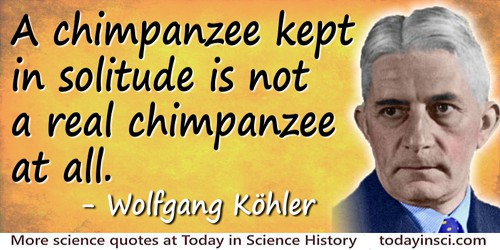
It is hardly an exaggeration to say that a chimpanzee kept in solitude is not a real chimpanzee at all.
The Mentality of Apes (1925), 293.
It is not I who seek to base Man's dignity upon his great toe, or insinuate that we are lost if an Ape has a hippocampus minor. On the contrary, I have done my best to sweep away this vanity. I have endeavoured to show that no absolute structural line of demarcation, wider than that between the animals which immediately succeed us in the scale, can be drawn between the animal world and ourselves; and I may add the expression of my belief that the attempt to draw a physical distinction is equally futile, and that even the highest facuities of feeling and of intellect begin to germinate in lower forms of life. At the same time, no one is more strongly convinced than I am of the vastness of the gulf between civilized man and the brutes; or is more certain that whether from them or not, he is assuredly not of them.
'On the Relations of Man to the Lower Animals' (1863). In Collected Essays (1894), Vol. 7. 152-3.
It is well-known that both rude and civilized peoples are capable of showing unspeakable, and as it is erroneously termed, inhuman cruelty towards each other. These acts of cruelty, murder and rapine are often the result of the inexorable logic of national characteristics, and are unhappily truly human, since nothing like them can be traced in the animal world. It would, for instance, be a grave mistake to compare a tiger with the bloodthirsty exectioner of the Reign of Terror, since the former only satisfies his natural appetite in preying on other mammals. The atrocities of the trials for witchcraft, the indiscriminate slaughter committed by the negroes on the coast of Guinea, the sacrifice of human victims made by the Khonds, the dismemberment of living men by the Battas, find no parallel in the habits of animals in their savage state. And such a comparision is, above all, impossible in the case of anthropoids, which display no hostility towards men or other animals unless they are first attacked. In this respect the anthropid ape stands on a higher plane than many men.
Robert Hartmann, Anthropoid Apes, 294-295.
It seemed that animals always behave in a manner showing the rightness of the philosophy entertained by the man who observes them… . Throughout the reign of Queen Victoria all apes were virtuous monogamists, but during the dissolute twenties their morals underwent a disastrous deterioration.
From 'Theory of Knowledge', My Philosophical Development (1959), collected in Robert E. Egner and Lester E. Denonn (eds), The Basic Writings of Bertrand Russell (1961), 225.
It was their individuality combined with the shyness of their behavior that remained the most captivating impression of this first encounter with the greatest of the great apes.
In Gorillas in the Mist (1983), 4
It would be an easy task to show that the characteristics in the organization of man, on account of which the human species and races are grouped as a distinct family, are all results of former changes of occupation, and of acquired habits, which have come to be distinctive of individuals of his kind. When, compelled by circumstances, the most highly developed apes accustomed themselves to walking erect, they gained the ascendant over the other animals. The absolute advantage they enjoyed, and the new requirements imposed on them, made them change their mode of life, which resulted in the gradual modification of their organization, and in their acquiring many new qualities, and among them the wonderful power of speech.
Quoted in Ernst Heinrich Philipp August Haeckel The Evolution of Man (1897), Vol. 1, 70.
Know then thyself, presume not God to scan;
The proper study of Mankind is Man.
Plac'd on this isthmus of a middle state,
A being darkly wise, and rudely great:
With too much knowledge for the Sceptic side,
With too much weakness for the Stoic's pride,
He hangs between; in doubt to act, or rest;
In doubt to deem himself a God, or Beast;
In doubt his Mind or Body to prefer,
Born but to die, and reas'ning but to err;
Alike in ignorance, his reason such,
Whether he thinks too little, or too much:
Chaos of Thought and Passion, all confus'd;
Still by himself abus'd, or disabus'd;
Created half to rise, and half to fall;
Great lord of all things, yet a prey to all;
Sole judge of Truth, in endless Error hurl'd:
The glory, jest, and riddle of the world!
... Superior beings, when of late they saw
A mortal Man unfold all Nature's law,
Admir'd such wisdom in an earthly shape,
And shew'd a NEWTON as we shew an Ape.
The proper study of Mankind is Man.
Plac'd on this isthmus of a middle state,
A being darkly wise, and rudely great:
With too much knowledge for the Sceptic side,
With too much weakness for the Stoic's pride,
He hangs between; in doubt to act, or rest;
In doubt to deem himself a God, or Beast;
In doubt his Mind or Body to prefer,
Born but to die, and reas'ning but to err;
Alike in ignorance, his reason such,
Whether he thinks too little, or too much:
Chaos of Thought and Passion, all confus'd;
Still by himself abus'd, or disabus'd;
Created half to rise, and half to fall;
Great lord of all things, yet a prey to all;
Sole judge of Truth, in endless Error hurl'd:
The glory, jest, and riddle of the world!
... Superior beings, when of late they saw
A mortal Man unfold all Nature's law,
Admir'd such wisdom in an earthly shape,
And shew'd a NEWTON as we shew an Ape.
'An Essay on Man' (1733-4), Epistle II. In John Butt (ed.), The Poems of Alexander Pope (1965), 516-7.
LITTRÉ. Snicker on hearing his name: “the gentleman who thinks we are descended from the apes.”
The Dictionary of Accepted Ideas (1881), trans. Jaques Barzun (1968), 59.
Man … begins life as an ambiguous speck of matter which can in no way be distinguished from the original form of the lowest animal or plant. He next becomes a cell; his life is precisely that of the animalcule. Cells cluster round this primordial cell, and the man is so far advanced that he might be mistaken for an undeveloped oyster; he grows still more, and it is clear that he might even be a fish; he then passes into a stage which is common to all quadrupeds, and next assumes a form which can only belong to quadrupeds of the higher type. At last the hour of birth approaches; coiled within the dark womb he sits, the image of an ape; a caricature of the man that is to be. He is born, and for some time he walks only on all fours; he utters only inarticulate sounds; and even in his boyhood his fondness for climbing trees would seem to be a relic of the old arboreal life.
In The Martyrdom of Man (1876), 393.
Man alone amongst the animals speaks and has gestures and expression which we call rational, because he alone has reason in him. And if anyone should say in contradiction that certain birds talk, as seems to be the case with some, especially the magpie and the parrot, and that certain beasts have expression or gestures, as the ape and some others seem to have, I answer that it is not true that they speak, nor that they have gestures, because they have no reason, from which these things need proceed; nor do they purpose to signify anything by them, but they merely reproduce what they see and hear.
In 'The Third Treatise', The Convivio of Dante Alighieri (1903), Chap. 7, 175. This footnoted: Compare De Vulgari Eloquentia, Book 1, Chap 2: 43-65.
Man appears to be the missing link between anthropoid apes and human beings.
Quoted by John Pfeiffer in 'When Man First Stood Up', New York Times (11 Apr 1965), Sunday magazine, 83.
Man is no new-begot child of the ape, bred of a struggle for existence upon brutish lines—nor should the belief that such is his origin, oft dinned into his ears by scientists, influence his conduct. Were he to regard himself as an extremely ancient type, distinguished chiefly by the qualities of his mind, and to look upon the existing Primates as the failures of his line, as his misguided and brutish collaterals, rather than as his ancestors, I think it would be something gained for the ethical outlook of Homo—and also it would be consistent with present knowledge.
The Origin of Man (1918), a pamphlet published by The Society for the Promotion of Christian Knowledge, reprinted in Arthur Dendy (ed.), Animal Life and Human Progress (1919), 131.
Men cannot help feeling a little ashamed of their cousin-german the Ape. His close yet grotesque and clumsy semblance of the human form is accompanied by no gleams of higher instinct. Our humble friend the dog, our patient fellow-labourer the horse, are nearer to us in this respect. The magnanimous and sagacious elephant, doomed though he be to all fours, is godlike compared with this spitefully ferocious creature. Strangely enough, too, the most repulsive and ferocious of all apekind, the recently discovered Gorilla is, the comparative anatomist assures us, nearest to us all: the most closely allied in structure to the human form.
In 'Our Nearest Relation', All Year Round (28 May 1859), 1, No. 5, 112. Charles Dickens was both the editor and publisher of this magazine. The author of the article remains unknown. The articles were by custom printed without crediting the author. Biographers have been able to use extant office records to identify various authors of other articles, but not this specific one. Dickens and Richard Owen were friends; they read each other’s work. Owen is known to have found at least a little time to write a few articles for Dickens’ magazines. Owen had given a talk at the Royal Institution (4 Feb 1859) titled 'On the Gorilla.' This would suggest why Dickens may have had a definite interest in publishing on this subject, regardless of who in fact wrote the article.
Men prefer to believe that they are degenerated angels, rather than elevated apes.
In The Martyrdom of Man (14th ed., 1892), 392.
Nevertheless, it is even harder for the average ape to believe that he has descended from man.
In a collection of his own work, which he selected, A Mencken Chrestomathy (1949, 1956), 618. He specifies the epigrams are his work, on p. 615. First appeared as a page-bottom filler, without attribution (there), in George Jean Nathan and H.L. Mencken (eds.), The Smart Set: A Magazine of Cleverness (1916), 48, No. 1, 200.
No existing form of anthropoid ape is even remotely related to the stock which has given rise to man.
In Henry Fairfield Osborn, 'Osborn States the Case For Evolution', New York Times (12 Jul 1925), XX1. Written in rebuttal to the anti-evolution publicity by William Jennings Bryan at the time of the Scopes Monkey Trial.
Of all the animals on earth, man is closest to the ape.
Aphorism 19 in Notebook B (1768-1771), as translated by R.J. Hollingdale in Aphorisms (1990). Reprinted as The Waste Books (2000), 21.
Of beasts, it is confess’d, the ape
Comes nearest us in human shape;
Like man he imitates each fashion,
And malice is his ruling passion.
Comes nearest us in human shape;
Like man he imitates each fashion,
And malice is his ruling passion.
In Poetical Essay, 'The Logicians Refuted', The Scots Magazine (1759),-21, 525.
Of beasts, it is confess’d, the ape
Comes nearest us in human shape;
Like man he imitates each fashion,
And malice is his ruling passion.
Comes nearest us in human shape;
Like man he imitates each fashion,
And malice is his ruling passion.
In Poetical Essay, 'The Logicians Refuted', The Scots Magazine (1759),-21, 525.
One day the zoo-keeper noticed that the orangutan was reading two books—the Bible and Darwin’s Origin of Species. In surprise, he asked the ape,“Why are you reading both those books?”
“Well,” said the orangutan, “I just wanted to know if I was my brother’s keeper, or my keeper’s brother.”
“Well,” said the orangutan, “I just wanted to know if I was my brother’s keeper, or my keeper’s brother.”
In Jon Fripp, Michael Fripp and Deborah Fripp, Speaking of Science (2000), 27.
One day when the whole family had gone to a circus to see some extraordinary performing apes, I remained alone with my microscope, observing the life in the mobile cells of a transparent star-fish larva, when a new thought suddenly flashed across my brain. It struck me that similar cells might serve in the defence of the organism against intruders. Feeling that there was in this something of surpassing interest, I felt so excited that I began striding up and down the room and even went to the seashore in order to collect my thoughts.
I said to myself that, if my supposition was true, a splinter introduced into the body of a star-fish larva, devoid of blood-vessels or of a nervous system, should soon be surrounded by mobile cells as is to be observed in a man who runs a splinter into his finger. This was no sooner said than done.
There was a small garden to our dwelling, in which we had a few days previously organised a 'Christmas tree' for the children on a little tangerine tree; I fetched from it a few rose thorns and introduced them at once under the skin of some beautiful star-fish larvae as transparent as water.
I was too excited to sleep that night in the expectation of the result of my experiment, and very early the next morning I ascertained that it had fully succeeded.
That experiment formed the basis of the phagocyte theory, to the development of which I devoted the next twenty-five years of my life.
I said to myself that, if my supposition was true, a splinter introduced into the body of a star-fish larva, devoid of blood-vessels or of a nervous system, should soon be surrounded by mobile cells as is to be observed in a man who runs a splinter into his finger. This was no sooner said than done.
There was a small garden to our dwelling, in which we had a few days previously organised a 'Christmas tree' for the children on a little tangerine tree; I fetched from it a few rose thorns and introduced them at once under the skin of some beautiful star-fish larvae as transparent as water.
I was too excited to sleep that night in the expectation of the result of my experiment, and very early the next morning I ascertained that it had fully succeeded.
That experiment formed the basis of the phagocyte theory, to the development of which I devoted the next twenty-five years of my life.
In Olga Metchnikoff, Life of Elie Metchnikoff 1845-1916 (1921), 116-7.
Quite recently the human descent theory has been stigmatized as the “gorilla theory of human ancestry.” All this despite the fact that Darwin himself, in the days when not a single bit of evidence regarding the fossil ancestors of man was recognized, distinctly stated that none of the known anthropoid apes, much less any of the known monkeys, should be considered in any way as ancestral to the human stock.
In Henry Fairfield Osborn, 'Osborn States the Case For Evolution', New York Times (12 Jul 1925), XX1. Written at the time of the Scopes Monkey Trial, in rebuttal of the anti-evolution position publicized by William Jennings Bryan.
The human species was born when one isolated group of bipedal apes got itself stuck and then speciated to get better survival value out of eating meat.
In Pamela Weintraub, The Omni Interviews (1984), 66.
The Javanese Anthropopithecus, which in its skull is more human than any other known anthropoid ape, already had an upright, erect posture, which has always been considered to be the exclusive privilege of humans. Thus this ancient
Report of 1892, quoted in Pat Shipman, The Man Who Found the Missing Link: The Extraordinary Life of Eugene Dubois (2001), 186.
The question is this: Is man an ape or an angel? I, my lord, am on the side of the angels.
[Debating Darwin's Origin of Species.]
[Debating Darwin's Origin of Species.]
Speech at the Diocesan Conference, Oxford (1864), chaired by Bishop Wilberforce. Quoted in James Anthony Froude, Lord Beaconsfield (4th ed. 1890), 176.
The social system that is necessary for learning and transmission of culture depends upon properties of the brain and endocrine system that reduce aggression, impose restraint and allow cooperation. Five hundred apes would not sit quietly and listen to another ape like the audience at this meeting.
From introductory remarks when opening a joint meeting of the British Academy and the Royal Society at the Wellcome Institute. Printed in 'The Emergence of Man', Philosophical Transactions of the Royal Society of London, Series B, Biological Sciences (May 8, 1981), 292, No. 1057, 5.
The whole inherent pride of human nature revolts at the idea that the lord of the creation is to be treated like any other natural object. No sooner does the naturalist discover the resemblance of some higher mammals, such as the ape, to man, than there is a general outcry against the presumptuous audacity that ventures to touch man in his inmost sanctuary. The whole fraternity of philosophers, who have never seen monkeys except in zoological gardens, at once mount the high horse, and appeal to the mind, the soul, to reason, to consciousness, and to all the rest of the innate faculties of man, as they are refracted in their own philosophical prisms.
From Carl Vogt and James Hunt (ed.), Lectures on Man: His Place in Creation, and in the History of the Earth (1861), 10.
There was an ape in the days that were earlier,
Centuries passed and his hair became curlier;
Centuries more gave a thumb to his wrist—
Then he was a man and a Positivist.
Centuries passed and his hair became curlier;
Centuries more gave a thumb to his wrist—
Then he was a man and a Positivist.
In The British Birds: A Communication From the Ghost of Aristophanes (1872), 48-49. [Note: A positivist holds that experimental investigation and observation are the only sources of substantial knowledge. —Webmaster]
We can see that there is only one substance in the universe and that man is the most perfect one. He is to the ape and the cleverest animals what Huygens's planetary clock is to one of Julien Leroy's watches. If it took more instruments, more cogs, more springs to show or tell the time, if it took Vaucanson more artistry to make his flautist than his duck, he would have needed even more to make a speaking machine, which can no longer be considered impossible, particularly at the hands of a new Prometheus. Thus, in the same way, nature needed more artistry and machinery to construct and maintain a machine which could continue for a whole century to tell all the beats of the heart and the mind; for we cannot tell the time from the pulse, it is at least the barometer of heat and liveliness, from which we can judge the nature of the soul.
Machine Man (1747), in Ann Thomson (ed.), Machine Man and Other Writings (1996), 33-4.
What is the question now placed before society with a glib assurance the most astounding? The question is this—Is man an ape or an angel? My Lord Bishop, I am on the side of the angels. … I repudiate with indignation and abhorrence those new fangled theories.
From Speech (25 Nov 1864) at Oxford Diocesan Conference, collected in Cornelius Brown (ed.), An Appreciative Life of the Earl of Beaconsfield (1881), Vol. 2, 58.
Where, then, must we look for primaeval Man? Was the oldest Homo sapiens pliocene or miocene, or yet more ancient? In still older strata do the fossilized bones of an ape more anthropoid, or a Man more pithecoid, than any yet known await the researches of some unborn paleontologist?
'On some Fossil Remains of Man' (1863). In Collected Essays (1894). Vol. 7, 208.
Yet man does recognise himself [as an animal]. But I ask you and the whole world for a generic differentia between man and ape which conforms to the principles of natural history, I certainly know of none... If I were to call man ape or vice versa, I should bring down all the theologians on my head. But perhaps I should still do it according to the rules of science.
Letter to Johann Gmelon (14 Jan 1747), quoted in Mary Gribbin, Flower Hunters (2008), 56.
 In science it often happens that scientists say, 'You know that's a really good argument; my position is mistaken,' and then they would actually change their minds and you never hear that old view from them again. They really do it. It doesn't happen as often as it should, because scientists are human and change is sometimes painful. But it happens every day. I cannot recall the last time something like that happened in politics or religion.
(1987) --
In science it often happens that scientists say, 'You know that's a really good argument; my position is mistaken,' and then they would actually change their minds and you never hear that old view from them again. They really do it. It doesn't happen as often as it should, because scientists are human and change is sometimes painful. But it happens every day. I cannot recall the last time something like that happened in politics or religion.
(1987) -- 




