Ant Quotes (34 quotes)
…indeed what reason may not go to Schoole to the wisdome of Bees, Aunts, and Spiders? what wise hand teacheth them to doe what reason cannot teach us? Ruder heads stand amazed at those prodigious pieces of nature, Whales, Elephants, Dromidaries and Camels; these I confesse, are the Colossus and Majestick pieces of her hand; but in these narrow Engines there is more curious Mathematicks, and the civilitie of these little Citizens more neatly sets forth the wisedome of their Maker.
In Religio Medici and Other Writings (1909), 17.
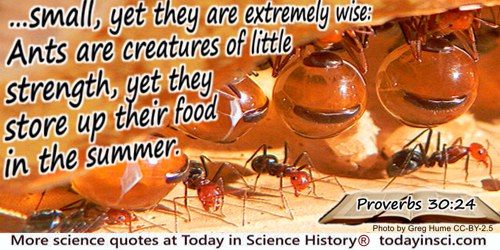
…small, yet they are extremely wise: Ants are creatures of little strength, yet they store up their food in the summer…
— Bible
In Proverbs, 'Sayings of Agur', Ch. 30, v.24-25 in The Bible: New International Version (2001), 364.
A bit of mould is a pleiad of flowers; a nebula is an ant-hill of stars.
Victor Hugo and Charles E. Wilbour (trans.), Les Misérables (1862), 41.
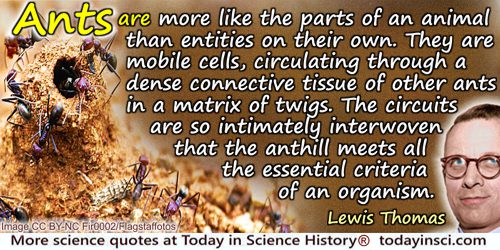
Ants are more like the parts of an animal than entities on their own. They are mobile cells, circulating through a dense connective tissue of other ants in a matrix of twigs. The circuits are so intimately interwoven that the anthill meets all the essential criteria of an organism.
In 'Antaeus in Manhattan', The Lives of a Cell: Notes of a Biology Watcher (1974), 63.
Ants are so much like human beings as to be an embarrassment. They farm fungi, raise aphids as livestock, launch armies into wars, use chemical sprays to alarm and confuse enemies, capture slaves…. They exchange information ceaselessly. They do everything but watch television.
(1974) In 'On Societies as Organisms', A Long Line of Cells: Collected Essays (1990), 10.
Darwin's Origin of Species had come into the theological world like a plough into an ant-hill. Everywhere those thus rudely awakened from their old comfort and repose had swarmed forth angry and confused. Reviews, sermons, books light and heavy, came flying at the new thinker from all sides.
From The Warfare of Science and Theology in Christendom (1898), 70.
Every time a significant discovery is being made one sets in motion a tremendous activity in laboratories and industrial enterprises throughout the world. It is like the ant who suddenly finds food and walks back to the anthill while sending out material called food attracting substance. The other ants follow the path immediately in order to benefit from the finding and continue to do so as long as the supply is rich.
Nobel Banquet speech (10 Dec 1982). In Wilhelm Odelberg (ed.), Les Prix Nobel. The Nobel Prizes 1982 (1983)
Formerly one sought the feeling of the grandeur of man by pointing to his divine origin: this has now become a forbidden way, for at its portal stands the ape, together with other gruesome beasts, grinning knowingly as if to say: no further in this direction! One therefore now tries the opposite direction: the way mankind is going shall serve as proof of his grandeur and kinship with God. Alas this, too, is vain! At the end of this way stands the funeral urn of the last man and gravedigger (with the inscription “nihil humani a me alienum puto”). However high mankind may have evolved—and perhaps at the end it will stand even lower than at the beginning!— it cannot pass over into a higher order, as little as the ant and the earwig can at the end of its “earthly course” rise up to kinship with God and eternal life. The becoming drags the has-been along behind it: why should an exception to this eternal spectacle be made on behalf of some little star or for any little species upon it! Away with such sentimentalities!
Daybreak: Thoughts on the Prejudices of Morality (1881), trans. R. J. Hollingdale (1982), 32.
Go to the ant, thou sluggard; consider her ways, and be wise.
— Bible
Proverbs 6:6. In Gary William Flake, The Computational Beauty of Nature (2000), 261.
Gold is found in our own part of the world; not to mention the gold extracted from the earth in India by the ants, and in Scythia by the Griffins. Among us it is procured in three different ways; the first of which is in the shape of dust, found in running streams. … A second mode of obtaining gold is by sinking shafts or seeking among the debris of mountains …. The third method of obtaining gold surpasses the labors of the giants even: by the aid of galleries driven to a long distance, mountains are excavated by the light of torches, the duration of which forms the set times for work, the workmen never seeing the light of day for many months together.
In Pliny and John Bostock (trans.), The Natural History of Pliny (1857), Vol. 6, 99-101.
Here are a few things to keep in mind the next time ants show up in the potato salad. The 8,800 known species of the family Formicidae make up from 10% to 15% of the world's animal biomass, the total weight of all fauna. They are the most dominant social insect in the world, found almost everywhere except in the polar regions. Ants turn more soil than earthworms; they prune, weed and police most of the earth’s carrion. Among the most gregarious of creatures, they are equipped with a sophisticated chemical communications system. To appreciate the strength and speed of this pesky invertebrate, consider that a leaf cutter the size of a man could run repeated four-minute miles while carrying 750 lbs. of potato salad.
From book review, 'Nature: Splendor in The Grass', Time (3 Sep 1990).
Here too all Forms of social Union find,
And hence let Reason, late, instruct mankind:
Here subterranean Works and Cities see,
There Towns aerial on the waving Tree.
Learn each small people’s Genius, Policies;
The Ants Republick, and the Realm of Bees;
How those in common all their stores bestow,
And Anarchy without confusion know.
And hence let Reason, late, instruct mankind:
Here subterranean Works and Cities see,
There Towns aerial on the waving Tree.
Learn each small people’s Genius, Policies;
The Ants Republick, and the Realm of Bees;
How those in common all their stores bestow,
And Anarchy without confusion know.
In 'Epistle III', Essay on Man,: Being the First Book of Ethic Epistles (1734), 47.
How narrow is the vision that exalts the busyness of the ant above the singing of the grasshopper.
In Kahlil Gibran: The Collected Works (2007), 203.
I always feel like our descendants—they're going to be upset with us for wrecking the planet anyway—but they're really going to be mad that we didn't even bother to take a good picture. [On the importance of thorough research of even a little ant species.]
Quoted from NPR radio interview, also published on NPR web page by Christopher Joyce, Morning Edition (1 Aug 2013).
I am more and more convinced that the ant colony is not so much composed of separate individuals as that the colony is a sort of individual, and each ant like a loose cell in it. Our own blood stream, for instance, contains hosts of white corpuscles which differ little from free-swimming amoebae. When bacteria invade the blood stream, the white corpuscles, like the ants defending the nest, are drawn mechanically to the infected spot, and will die defending the human cell colony. I admit that the comparison is imperfect, but the attempt to liken the individual human warrior to the individual ant in battle is even more inaccurate and misleading. The colony of ants with its component numbers stands half way, as a mechanical, intuitive, and psychical phenomenon, between our bodies as a collection of cells with separate functions and our armies made up of obedient privates. Until one learns both to deny real individual initiative to the single ant, and at the same time to divorce one's mind from the persuasion that the colony has a headquarters which directs activity … one can make nothing but pretty fallacies out of the polity of the ant heap.
In An Almanac for Moderns (1935), 121
I would like it if everyone could make the prejudice vanish as I have that there is really a problem whether ants are machines, whether my brother is a machine, whether we are in the world, or the world is in us, if perhaps behind the word there is matter, power pushes or not, or if Locke is right that the intellect is between us and things. Or whether we are free or not free…
Given as “fashioned from Boltzmann’s notes for his lecture on natural philosophy on October 26, 1904” and translated in John Blackmore (ed.), Ludwig Boltzmann: His Later Life and Philosophy, 1900-1906 (1995), 136. Blackmore indicates (p.133) that since Boltzmann spoke freely, this may not be verbatim for what he actually said, because he did not read his lectures from his notes. However, it does “rather accurately represent his thinking” at the time he wrote his lecture. His Lectures on Natural Philosophy (1903-1906) were reconstructed from Boltzmann’s shorthand notes by Ilse M. Fasol-Boltzmann (ed.), in Ludwig Boltzmann Principien der Naturfolosofti (1990). This quote is translated from p.109.
If we were bees, ants, or Lacedaemonian warriors, to whom personal fear does not exist and cowardice is the most shameful thing in the world, warring would go on forever. But luckily we are only men—and cowards.
In first Tarner Lecture, at Trinity College, Cambridge (Oct 1956), 'The Physical Basis of Consciousness', printed in Mind and Matter (1958), 14. Also collected in What is Life?: With Mind and Matter and Autobiographical Sketches (1992, 2012), 102.
In the wilderness, people think of danger from Indians, alligators, and jaguars. They are not the things you mind. It is the mosquitoes, the poisonous ants, the maribondo wasps that are perfectly awful. It is the borrachudos and plum flies—like the black flies of the north woods,
only worse … The day after I threw away my spare clothing ants ate up all my underwear. These were white ants. The driver ants try to eat the man instead of his clothes.
In National Geographic, Great Adventures with National Geographic: Exploring Land, Sea, and Sk (1963), 109. The last sentences about the white and driver ants, with slightly different wording, also appear in Theodore Roosevelt, 'A Journey in Central Brazil', The Geographical Journey (Feb 1915), 45, No. 2, 104, previously read to the Royal Geographic Society (16 Jun 1914).
Innovations, free thinking is blowing like a storm; those that stand in front of it, ignorant scholars like you, false scientists, perverse conservatives, obstinate goats, resisting mules are being crushed under the weight of these innovations. You are nothing but ants standing in front of the giants; nothing but chicks trying to challenge roaring volcanoes!
From the play Galileo Galilei (2001) .
It is the task of science, as a collective human undertaking, to describe from the external side, (on which alone agreement is possible), such statistical regularity as there is in a world “in which every event has a unique aspect, and to indicate where possible the limits of such description. It is not part of its task to make imaginative interpretation of the internal aspect of reality—what it is like, for example, to be a lion, an ant or an ant hill, a liver cell, or a hydrogen ion. The only qualification is in the field of introspective psychology in which each human being is both observer and observed, and regularities may be established by comparing notes. Science is thus a limited venture. It must act as if all phenomena were deterministic at least in the sense of determinable probabilities. It cannot properly explain the behaviour of an amoeba as due partly to surface and other physical forces and partly to what the amoeba wants to do, with out danger of something like 100 per cent duplication. It must stick to the former. It cannot introduce such principles as creative activity into its interpretation of evolution for similar reasons. The point of view indicated by a consideration of the hierarchy of physical and biological organisms, now being bridged by the concept of the gene, is one in which science deliberately accepts a rigorous limitation of its activities to the description of the external aspects of events. In carrying out this program, the scientist should not, however, deceive himself or others into thinking that he is giving an account of all of reality. The unique inner creative aspect of every event necessarily escapes him.
In 'Gene and Organism', American Naturalist, (1953), 87, 17.
It would seem that the ant works its way tentatively, and, observing where it fails, tries another place and succeeds.
In Wild Life in a Southern County (1897), 13.
It’s humbling to realise that the developmental gulf between a miniscule ant colony and our modern human civilisation is only a tiny fraction of the distance between a Type 0 and a Type III civilisation – a factor of 100 billion billion, in fact. Yet we have such a highly regarded view of ourselves, we believe a Type III civilisation would find us irresistible and would rush to make contact with us. The truth is, however, they may be as interested in communicating with humans as we are keen to communicate with ants.
'Star Makers', Cosmos (Feb 2006).
Physicists often quote from T. H. White’s epic novel The Once and Future King, where a society of ants declares, “Everything not forbidden is compulsory.” In other words, if there isn't a basic principle of physics forbidding time travel, then time travel is necessarily a physical possibility. (The reason for this is the uncertainty principle. Unless something is forbidden, quantum effects and fluctuations will eventually make it possible if we wait long enough. Thus, unless there is a law forbidding it, it will eventually occur.)
In Parallel Worlds: a Journey Through Creation, Higher Dimensions, and the Future of the Cosmos (2006), 136.
The ants and the bees are, in many ways, far more intelligent and ingenious; they manage their government with vastly less quarreling, wastefulness and imbecility.
From The Smart Set (Aug 1919), 61. Collected in 'Man’s Place in Nature', A Mencken Chrestomathy (1949, 1956), 4.
The great companies did not know that the line between hunger and anger is a thin line. And money that might have gone to wages went for gas, for guns, for agents and spies, for blacklists, for drilling. On the highways the people moved like ants and searched for work, for food. And the anger began to ferment.
In The Grapes of Wrath (1939), 388.
The interior of the rain forest is overwhelming in its complexity. There is not a bare surface anywhere. Branches are hung with curtains of mosses and sprays of orchids dangle among them. Tree trunks are filmed over with algae, studded by giant ferns, and wound about with vines. Ants travel in convoys across the ground and up the trees, and metallic beetles glint in sun-flecks on the forest floor. The forest itself is richly textured, stems embossed with every manner of protuberance, leaves ornamented by spines and pleats, scales and fringes. Long shafts of sunlight cut through the dark canopy and catch the flash of iridescent butterfly wings before diffusing in the vegetation below.
In 'In the Forest of the Waterbear', Gathering Moss: A Natural and Cultural History of Mosses (2003), 55.
The most intensely social animals can only adapt to group behavior. Bees and ants have no option when isolated, except to die. There is really no such creature as a single individual; he has no more life of his own than a cast off cell marooned from the surface of your skin.
In The Lives of a Cell (1974), 63.
The time has come to link ecology to economic and human development. When you have seen one ant, one bird, one tree, you have not seen them all. What is happening to the rain forests of Madagascar and Brazil will affect us all.
Quoted in Jamie Murphy and Andrea Dorfman, 'The Quiet Apocalypse,' Time (13 Oct 1986).
There are exactly eight entomologists worldwide with the general competence to identify tropical ants and termites.
In 'Edward O. Wilson: The Biological Diversity Crisis: A Challenge to Science', Issues in Science and Technology (Fall 1985), 2, No. 1, 27.
They look a little like the monster in ‘Alien.’ They’re horrifying to look at up close. That’s sort of what makes them fun. [About his microscopic study of ants.]
As quoted by Lindsay Whitehurst in 'University of Utah Scientist Discovers Terrifying Ant Species', The Salt Lake Tribune (31 Jul 2013)
Those who have handled sciences have been either men of experiment or men of dogmas. The men of experiment are like the ant; they only collect and use; the reasoners resemble spiders, who make cobwebs out of their own substance. But the bee takes a middle course; it gathers its material from the flowers of the garden and of the field, but transforms and digests it by a power of its own. Not unlike this is the true business of philosophy; for it neither relies solely or chiefly on the powers of the mind, nor does it take the matter which it gathers from natural history and mechanical experiments and lay it up in the memory whole, as it finds it; but lays it up in the understanding altered and digested. Therefore from a closer and purer league between these two faculties, the experimental and the rational (such as has never yet been made), much may be hoped.
From Novum Organum (1620), Book 1, Aphorism 95. Translated as The New Organon: Aphorisms Concerning the Interpretation of Nature and the Kingdom of Man), collected in James Spedding, Robert Ellis and Douglas Heath (eds.), The Works of Francis Bacon (1857), Vol. 4, 92-3.
When the great truth accidentally revealed and experimentally confirmed is fully recognized, that this planet, with all its appalling immensity, is to electric currents virtually no more than a small metal ball and that by this fact many possibilities, each baffling imagination and of incalculable consequence, are rendered absolutely sure of accomplishment; when the first plant is inaugurated and it is shown that a telegraphic message, almost as secret and non-interferable as a thought, can be transmitted to any terrestrial distance, the sound of the human voice, with all its intonations and inflections, faithfully and instantly reproduced at any other point of the globe, the energy of a waterfall made available for supplying light, heat or motive power, anywhere—on sea, or land, or high in the air—humanity will be like an ant heap stirred up with a stick: See the excitement coming!
In 'The Transmission of Electric Energy Without Wires', Electrical World and Engineer (5 Mar 1904), 43, No. 10, 431.
Whence we see spiders, flies, or ants entombed and preserved forever in amber, a more than royal tomb.
Historia Vitæ et Mortis. Translation in Francis Bacon, James Spedding (ed.) et al., Philosophical Works of Francis Bacon (1861) Vol. 2, 320.
Who could believe an ant in theory?
A giraffe in blueprint?
Ten thousand doctors of what’s possible
Could reason half the jungle out of being.
A giraffe in blueprint?
Ten thousand doctors of what’s possible
Could reason half the jungle out of being.
In The Achievement of John Ciardi: A Comprehensive Selection of His Poems (1969), 73.
 In science it often happens that scientists say, 'You know that's a really good argument; my position is mistaken,' and then they would actually change their minds and you never hear that old view from them again. They really do it. It doesn't happen as often as it should, because scientists are human and change is sometimes painful. But it happens every day. I cannot recall the last time something like that happened in politics or religion.
(1987) --
In science it often happens that scientists say, 'You know that's a really good argument; my position is mistaken,' and then they would actually change their minds and you never hear that old view from them again. They really do it. It doesn't happen as often as it should, because scientists are human and change is sometimes painful. But it happens every day. I cannot recall the last time something like that happened in politics or religion.
(1987) -- 





