Answer Quotes (390 quotes)
Answers Quotes, Answered Quotes, Answering Quotes
Answers Quotes, Answered Quotes, Answering Quotes
…comparing the capacity of computers to the capacity of the human brain, I’ve often wondered, where does our success come from? The answer is synthesis, the ability to combine creativity and calculation, art and science, into whole that is much greater than the sum of its parts.
In How Life Imitates Chess: Making the Right Moves, from the Board to the Boardroom (2007), 4.
'O tell me, when along the line
From my full heart the message flows,
What currents are induced in thine?
One click from thee will end my woes'.
Through many an Ohm the Weber flew,
And clicked the answer back to me,
'I am thy Farad, staunch and true,
Charged to a Volt with love for thee'.
From my full heart the message flows,
What currents are induced in thine?
One click from thee will end my woes'.
Through many an Ohm the Weber flew,
And clicked the answer back to me,
'I am thy Farad, staunch and true,
Charged to a Volt with love for thee'.
From 'Valentine from A Telegraph Clerk ♂ to a Telegraph Clerk ♀'. In Lewis Campbell and William Garnett, The Life of James Clerk Maxwell (1882), 631.
“Conservation” (the conservation law) means this … that there is a number, which you can calculate, at one moment—and as nature undergoes its multitude of changes, this number doesn't change. That is, if you calculate again, this quantity, it'll be the same as it was before. An example is the conservation of energy: there's a quantity that you can calculate according to a certain rule, and it comes out the same answer after, no matter what happens, happens.
'The Great Conservation Principles', The Messenger Series of Lectures, No. 3, Cornell University, 1964. From transcript of BBC programme (11 Dec 1964).
“Going fishing!” How often the question has been asked by acquaintances, as they have met me, with rod and basket, on an excursion after materials for microscopic study. “Yes!” has been the invariable answer, for it saved much detention and explanation; and now, behold! I offer them the results of that fishing. No fish for the stomach, but, as the old French microscopist Joblet observed, “some of the most remarkable fishes that have ever been seen”; and food-fishes for the intellect.
From 'Concluding Remarks', Fresh-Water Rhizopods of North America (1879), 295. Leidy explains how actively he pursued his interest in finding new microscopic life forms to examine by frequent exploration of suitable habitats in the neighborhood of Philadelphia, where he lived and taught.
“Of course they answer to their names?” the Gnat remarked carelessly.
“I never knew them to do it,” [said Alice.]
“What’s the use of them having names,” said the Gnat, “if they won’t answer to them?”
“No use to them,” said Alice; “but it’s useful to the people that name them, I suppose.”
“I never knew them to do it,” [said Alice.]
“What’s the use of them having names,” said the Gnat, “if they won’t answer to them?”
“No use to them,” said Alice; “but it’s useful to the people that name them, I suppose.”
In Through the Looking Glass and What Alice Found There (1871, 1897), 55.
“She can’t do Subtraction.” said the White Queen. “Can you do Division? Divide a loaf by a knife—what's the answer to that?”
“I suppose-” Alice was beginning, but the Red Queen answered for her.
“Bread-and-butter, of course.”
“I suppose-” Alice was beginning, but the Red Queen answered for her.
“Bread-and-butter, of course.”
Through the Looking Glass and What Alice Found There (1871, 1897), 189-190.
“Try another Subtraction sum. Take a bone from a dog: what remains?” [asked the Red Queen]
Alice considered. “The bone wouldn't remain, of course, if I took it—and the dog wouldn’t remain; it would come to bite me—and I’m sure I shouldn’t remain!”
“Then you think nothing would remain?” said the Red Queen.
“I think that’s the answer.”
“Wrong, as usual,” said the Red Queen, “the dog's temper would remain.”
Alice considered. “The bone wouldn't remain, of course, if I took it—and the dog wouldn’t remain; it would come to bite me—and I’m sure I shouldn’t remain!”
“Then you think nothing would remain?” said the Red Queen.
“I think that’s the answer.”
“Wrong, as usual,” said the Red Queen, “the dog's temper would remain.”
Through the Looking Glass and What Alice Found There (1871, 1897), 190-191.
“Why do you think it is…”, I asked Dr. Cook … “that brain surgery, above all else—even rocket science—gets singled out as the most challenging of human feats, the one demanding the utmost of human intelligence?”
[Dr. Cook answered,] “No margin for error.”
[Dr. Cook answered,] “No margin for error.”
In Lucky Man (2002), 208.
(1) I have told you more than I know about osteoporosis. (2) What I have told you is subject to change without notice. (3) I hope I raised more questions than I have given answers. (4) In any case, as usual, a lot more work is necessary.
Conclusion of one of his papers.
Conclusion of one of his papers.
In Barry G. Firkin, Judith A. Whitworth, Dictionary of Medical Eponyms (1996), 5.
[About the mechanical properties of the molecules of a chemical substance being studied:] They could be measured, but that would have taken several months. So someone said, ‘Let’s get Teller in and make him guess the data.’ We got him into a room and locked the door, so no one else could get at him, and he asked questions and did some figuring at the blackboard. He got the answers in about two hours, not entirely accurately, of course, but—as we found out when we got around to verifying them—close enough for the purpose.
Recalls the first time she was ever really awed by mental abilities of Edward Teller. She had joined the Manhattan Project, and needed data on the physical properties of molecules of a certain substance to get started on her assigned task of calculating its chemical properties. As quoted in Robert Coughlan, 'Dr. Edward Teller’s Magnificent Obsession', Life (6 Sep 1954), 61.
[After the flash of the atomic bomb test explosion] Fermi got up and dropped small pieces of paper … a simple experiment to measure the energy liberated by the explosion … [W]hen the front of the shock wave arrived (some seconds after the flash) the pieces of paper were displaced a few centimeters in the direction of propagation of the shock wave. From the distance of the source and from the displacement of the air due to the shock wave, he could calculate the energy of the explosion. This Fermi had done in advance having prepared himself a table of numbers, so that he could tell immediately the energy liberated from this crude but simple measurement. … It is also typical that his answer closely approximated that of the elaborate official measurements. The latter, however, were available only after several days’ study of the records, whereas Fermi had his within seconds.
In Enrico Fermi: Physicist (1970), 147-148.
[Consider] a fence or gate erected across a road] The more modern type of reformer goes gaily up to it and says, “I don't see the use of this; let us clear it away.” To which the more intelligent type of reformer will do well to answer: “If you don't see the use of it, I certainly won't let you clear it away. Go away and think. Then, when you can come back and tell me that you do see the use of it, I may allow you to destroy it.”
In The Thing (1929). Excerpt in Gilbert Keith Chesterton and Alvaro De Silva (ed.), Brave New Family: G.K. Chesterton on Men and Women, Children, Sex, Divorce (1990), 53. Note: This passage may be the source which John F. Kennedy had in mind when he wrote in his personal notebook, “Don't ever take a fence down until you know the reason why it was put up.” (see John F. Kennedy quotes on this site). The words in that terse paraphrase are those of Kennedy, and are neither those of Chesterton, or, as often attributed, Robert Frost (q.v.).
[Describing a freshman seminar titled “How the Tabby Cat Got Her Stripes or The Silence of the Genes”:] The big idea we start with is: “How is the genome interpreted, and how are stable decisions that affect gene expression inherited from one cell to the next? This is one of the most competitive areas of molecular biology at the moment, and the students are reading papers that in some instances were published this past year. As a consequence, one of the most common answers I have to give to their questions is, “We just don't know.”
As quoted by Kitta MacPherson in 'Exploring Epigenetics: President Shirley Tilghman in the Classroom,'
Princeton University Undergraduate Admission web page accessed 14 Oct 2013.
[Doubtful attribution; from docudrama script] Big questions get big answers.
This statement is in the script to the BBC TV docudrama Life Story (14 Sep 1987), a.k.a. Race for the Double Helix and shown as part of the Horizon science program series. The writing credits are William Nicholson, with James Watson (book). Webmaster has not yet found the quote in a primary source, especially not a source earlier than docudrama. Lacking another source, Webmaster wonders if this quote was created by the scriptwriter, and not verbatim from an original statement by Crick himself. Please contact if you know a primary source.
[Having already asserted his opposition to communism in every respect by signing the regents' oath, his answer to a question why a non-Communist professor should refuse to take a non-Communist oath as a condition of University employment was that to do so would imply it was] up to an accused person to clear himself. ... That sort of thing is going on in Washington today and is a cause of alarm to thoughtful citizens. It is the method used in totalitarian countries. It sounds un-American to people who don’t like to be pushed around. If someone says I ought to do a certain thing the burden should be on him to show I why I should, not on me to show why I should not.
As quoted in 'Educator Scores Oath For Faculty', New York Times (16 Apr 1950), 31.
[John] Dalton was a man of regular habits. For fifty-seven years he walked out of Manchester every day; he measured the rainfall, the temperature—a singularly monotonous enterprise in this climate. Of all that mass of data, nothing whatever came. But of the one searching, almost childlike question about the weights that enter the construction of these simple molecules—out of that came modern atomic theory. That is the essence of science: ask an impertinent question, and you are on the way to the pertinent answer.
The Ascent of Man (1973), 153.
[My dream dinner guest is] Charles Darwin. It’s an obvious answer, but it’s the truth. Think of any problem and before you start theorising, just check up whether Charles Darwin mentioned it in one of those green books sitting on your shelf. Whether it’s earthworms, human gestures or the origin of species, the observations that man made are unbelievable. He touched on so many subjects. Then, Alexander von Humboldt, the last polymath. There was no aspect of the natural world that he wasn’t curious about or didn’t write about in Kosmos, an extraordinary book.
From interview with Alice Roberts, 'Attenborough: My Life on Earth', The Biologist (Aug 2015), 62, No. 4, 16.
[Napoleon] directed Bourrienne to leave all his letters unopened for three weeks, and then observed with satisfaction how large a part of the correspondence had thus disposed of itself, and no longer required an answer.
Lecture, 'Napoleon', collected in Representative Men (1850), 177.
[Richard P.] Feynman's cryptic remark, “no one is that much smarter ...,” to me, implies something Feynman kept emphasizing: that the key to his achievements was not anything “magical” but the right attitude, the focus on nature's reality, the focus on asking the right questions, the willingness to try (and to discard) unconventional answers, the sensitive ear for phoniness, self-deception, bombast, and conventional but unproven assumptions.
In book review of James Gleick's Genius, 'Complexities of Feynman', Science, 259 (22 Jan 1993), 22
[Science] … gives us no answer to our question, what shall we do and how shall we live?
In What Is Art? (1898).
[The steamboat] will answer for sea voyages as well as for inland navigation, in particular for packets, where there may be a great number of passengers. He is also of opinion, that fuel for a short voyage would not exceed the weight of water for a long one, and it would produce a constant supply of fresh water. ... [T]he boat would make head against the most violent tempests, and thereby escape the danger of a lee shore; and that the same force may be applied to a pump to free a leaky ship of her water. ... [T]he good effects of the machine, is the almost omnipotent force by which it is actuated, and the very simple, easy, and natural way by which the screws or paddles are turned to answer the purpose of oars.
[This letter was written in 1785, before the first steamboat carried a man (Fitch) on 27 Aug 1787.]
[This letter was written in 1785, before the first steamboat carried a man (Fitch) on 27 Aug 1787.]
Letter to Benjamin Franklin (12 Oct 1785), in The Works of Benjamin Franklin (1882), Vol. 10, 232.
[The surplus of basic knowledge of the atomic nucleus was] largely used up [during the war with the atomic bomb as the dividend.] We must, without further delay restore this surplus in preparation for the important peacetime job for the nucleus - power production. ... Many of the proposed applications of atomic power - even for interplanetary rockets - seem to be within the realm of possibility provided the economic factor is ruled out completely, and the doubtful physical and chemical factors are weighted heavily on the optimistic side. ... The development of economic atomic power is not a simple extrapolation of knowledge gained during the bomb work. It is a new and difficult project to reach a satisfactory answer. Needless to say, it is vital that the atomic policy legislation now being considered by the congress recognizes the essential nature of this peacetime job, and that it not only permits but encourages the cooperative research-engineering effort of industrial, government and university laboratories for the task. ... We must learn how to generate the still higher energy particles of the cosmic rays - up to 1,000,000,000 volts, for they will unlock new domains in the nucleus.
Addressing the American Institute of Electrical Engineering, in New York (24 Jan 1946). In Schenectady Gazette (25 Jan 1946),
[When I was a child] I grew up in Brooklyn, New York, and I was a street kid. … [T]here was one aspect of that environment that, for some reason, struck me as different, and that was the stars. … I could tell they were lights in the sky, but that wasn’t an explanation. I mean, what were they? Little electric bulbs on long black wires, so you couldn’t see what they were held up by? What were they? … My mother said to me, "Look, we’ve just got you a library card … get out a book and find the answer.” … It was in there. It was stunning. The answer was that the Sun was a star, except very far away. … The dazzling idea of a universe vast beyond imagining swept over me. … I sensed awe.
In 'Wonder and Skepticism', Skeptical Enquirer (Jan-Feb 1995), 19, No. 1.
“The Universe repeats itself, with the possible exception of history.” Of all earthly studies history is the only one that does not repeat itself. ... Astronomy repeats itself; botany repeats itself; trigonometry repeats itself; mechanics repeats itself; compound long division repeats itself. Every sum if worked out in the same way at any time will bring out the same answer. ... A great many moderns say that history is a science; if so it occupies a solitary and splendid elevation among the sciences; it is the only science the conclusions of which are always wrong.
In 'A Much Repeated Repetition', Daily News (26 Mar 1904). Collected in G. K. Chesterton and Dale Ahlquist (ed.), In Defense of Sanity: The Best Essays of G.K. Chesterton (2011), 82.
Every teacher certainly should know something of non-euclidean geometry. Thus, it forms one of the few parts of mathematics which, at least in scattered catch-words, is talked about in wide circles, so that any teacher may be asked about it at any moment. … Imagine a teacher of physics who is unable to say anything about Röntgen rays, or about radium. A teacher of mathematics who could give no answer to questions about non-euclidean geometry would not make a better impression.
On the other hand, I should like to advise emphatically against bringing non-euclidean into regular school instruction (i.e., beyond occasional suggestions, upon inquiry by interested pupils), as enthusiasts are always recommending. Let us be satisfied if the preceding advice is followed and if the pupils learn to really understand euclidean geometry. After all, it is in order for the teacher to know a little more than the average pupil.
On the other hand, I should like to advise emphatically against bringing non-euclidean into regular school instruction (i.e., beyond occasional suggestions, upon inquiry by interested pupils), as enthusiasts are always recommending. Let us be satisfied if the preceding advice is followed and if the pupils learn to really understand euclidean geometry. After all, it is in order for the teacher to know a little more than the average pupil.
In George Edward Martin, The Foundations of Geometry and the Non-Euclidean Plane (1982), 72.
Quand le sol aura été interrogé, il répondra.
When the soil has been questioned, it will answer.
When the soil has been questioned, it will answer.
From La Seine-Inférieure Historique et Archéologique: Époques Gauloise, Romaine et Franque (1866), 388. Used as epigraph in Mortimer Wheeler, Archaeology from the Earth (1954), xii. English by Webmaster using Google translate.
Question: A hollow indiarubber ball full of air is suspended on one arm of a balance and weighed in air. The whole is then covered by the receiver of an air pump. Explain what will happen as the air in the receiver is exhausted.
Answer: The ball would expand and entirely fill the vessell, driving out all before it. The balance being of greater density than the rest would be the last to go, but in the end its inertia would be overcome and all would be expelled, and there would be a perfect vacuum. The ball would then burst, but you would not be aware of the fact on account of the loudness of a sound varying with the density of the place in which it is generated, and not on that in which it is heard.
Answer: The ball would expand and entirely fill the vessell, driving out all before it. The balance being of greater density than the rest would be the last to go, but in the end its inertia would be overcome and all would be expelled, and there would be a perfect vacuum. The ball would then burst, but you would not be aware of the fact on account of the loudness of a sound varying with the density of the place in which it is generated, and not on that in which it is heard.
Genuine student answer* to an Acoustics, Light and Heat paper (1880), Science and Art Department, South Kensington, London, collected by Prof. Oliver Lodge. Quoted in Henry B. Wheatley, Literary Blunders (1893), 181, Question 21. (*From a collection in which Answers are not given verbatim et literatim, and some instances may combine several students' blunders.)
Question: Account for the delicate shades of colour sometimes seen on the inside of an oyster shell. State and explain the appearance presented when a beam of light falls upon a sheet of glass on which very fine equi-distant parallel lines have been scratched very close to one another.
Answer: The delicate shades are due to putrefaction; the colours always show best when the oyster has been a bad one. Hence they are considered a defect and are called chromatic aberration.
The scratches on the glass will arrange themselves in rings round the light, as any one may see at night in a tram car.
Answer: The delicate shades are due to putrefaction; the colours always show best when the oyster has been a bad one. Hence they are considered a defect and are called chromatic aberration.
The scratches on the glass will arrange themselves in rings round the light, as any one may see at night in a tram car.
Genuine student answer* to an Acoustics, Light and Heat paper (1880), Science and Art Department, South Kensington, London, collected by Prof. Oliver Lodge. Quoted in Henry B. Wheatley, Literary Blunders (1893), 182, Question 27. (*From a collection in which Answers are not given verbatim et literatim, and some instances may combine several students' blunders.)
Question: Explain how to determine the time of vibration of a given tuning-fork, and state what apparatus you would require for the purpose.
Answer: For this determination I should require an accurate watch beating seconds, and a sensitive ear. I mount the fork on a suitable stand, and then, as the second hand of my watch passes the figure 60 on the dial, I draw the bow neatly across one of its prongs. I wait. I listen intently. The throbbing air particles are receiving the pulsations; the beating prongs are giving up their original force; and slowly yet surely the sound dies away. Still I can hear it, but faintly and with close attention; and now only by pressing the bones of my head against its prongs. Finally the last trace disappears. I look at the time and leave the room, having determined the time of vibration of the common “pitch” fork. This process deteriorates the fork considerably, hence a different operation must be performed on a fork which is only lent.
Answer: For this determination I should require an accurate watch beating seconds, and a sensitive ear. I mount the fork on a suitable stand, and then, as the second hand of my watch passes the figure 60 on the dial, I draw the bow neatly across one of its prongs. I wait. I listen intently. The throbbing air particles are receiving the pulsations; the beating prongs are giving up their original force; and slowly yet surely the sound dies away. Still I can hear it, but faintly and with close attention; and now only by pressing the bones of my head against its prongs. Finally the last trace disappears. I look at the time and leave the room, having determined the time of vibration of the common “pitch” fork. This process deteriorates the fork considerably, hence a different operation must be performed on a fork which is only lent.
Genuine student answer* to an Acoustics, Light and Heat paper (1880), Science and Art Department, South Kensington, London, collected by Prof. Oliver Lodge. Quoted in Henry B. Wheatley, Literary Blunders (1893), 176-7, Question 4. (*From a collection in which Answers are not given verbatim et literatim, and some instances may combine several students' blunders.)
Question: Explain why pipes burst in cold weather.
Answer: People who have not studied acoustics think that Thor bursts the pipes, but we know that is nothing of the kind for Professor Tyndall has burst the mythologies and has taught us that it is the natural behaviour of water (and bismuth) without which all fish would die and the earth be held in an iron grip. (1881)
Answer: People who have not studied acoustics think that Thor bursts the pipes, but we know that is nothing of the kind for Professor Tyndall has burst the mythologies and has taught us that it is the natural behaviour of water (and bismuth) without which all fish would die and the earth be held in an iron grip. (1881)
Genuine student answer* to an Acoustics, Light and Heat paper (1881), Science and Art Department, South Kensington, London, collected by Prof. Oliver Lodge. Quoted in Henry B. Wheatley, Literary Blunders (1893), 186-7, Question 10. (*From a collection in which Answers are not given verbatim et literatim, and some instances may combine several students' blunders.) Webmaster notes that “fish would die” may refer to being taught that water's greatest density is at 4°C, and sinks below a frozen surface, so bodies of water can remain liquid underneath, to the benefit of the fish. The student was likely taught that bismuth, like water, expands when it freezes.
Question: Explain why, in order to cook food by boiling, at the top of a high mountain, you must employ a different method from that used at the sea level.
Answer: It is easy to cook food at the sea level by boiling it, but once you get above the sea level the only plan is to fry it in its own fat. It is, in fact, impossible to boil water above the sea level by any amount of heat. A different method, therefore, would have to be employed to boil food at the top of a high mountain, but what that method is has not yet been discovered. The future may reveal it to a daring experimentalist.
Answer: It is easy to cook food at the sea level by boiling it, but once you get above the sea level the only plan is to fry it in its own fat. It is, in fact, impossible to boil water above the sea level by any amount of heat. A different method, therefore, would have to be employed to boil food at the top of a high mountain, but what that method is has not yet been discovered. The future may reveal it to a daring experimentalist.
Genuine student answer* to an Acoustics, Light and Heat paper (1880), Science and Art Department, South Kensington, London, collected by Prof. Oliver Lodge. Quoted in Henry B. Wheatley, Literary Blunders (1893), 178-9, Question 11. (*From a collection in which Answers are not given verbatim et literatim, and some instances may combine several students' blunders.)
Question: How would you disprove, experimentally, the assertion that white light passing through a piece of coloured glass acquires colour from the glass? What is it that really happens?
Answer: To disprove the assertion (so repeatedly made) that “white light passing through a piece of coloured glass acquires colour from the glass,” I would ask the gentleman to observe that the glass has just as much colour after the light has gone through it as it had before. That is what would really happen.
Answer: To disprove the assertion (so repeatedly made) that “white light passing through a piece of coloured glass acquires colour from the glass,” I would ask the gentleman to observe that the glass has just as much colour after the light has gone through it as it had before. That is what would really happen.
Genuine student answer* to an Acoustics, Light and Heat paper (1880), Science and Art Department, South Kensington, London, collected by Prof. Oliver Lodge. Quoted in Henry B. Wheatley, Literary Blunders (1893), 178, Question 8. (*From a collection in which Answers are not given verbatim et literatim, and some instances may combine several students' blunders.)
Question: If you walk on a dry path between two walls a few feet apart, you hear a musical note or “ring” at each footstep. Whence comes this?
Answer: This is similar to phosphorescent paint. Once any sound gets between two parallel reflectors or walls, it bounds from one to the other and never stops for a long time. Hence it is persistent, and when you walk between the walls you hear the sounds made by those who walked there before you. By following a muffin man down the passage within a short time you can hear most distinctly a musical note, or, as it is more properly termed in the question, a “ring” at every (other) step.
Answer: This is similar to phosphorescent paint. Once any sound gets between two parallel reflectors or walls, it bounds from one to the other and never stops for a long time. Hence it is persistent, and when you walk between the walls you hear the sounds made by those who walked there before you. By following a muffin man down the passage within a short time you can hear most distinctly a musical note, or, as it is more properly termed in the question, a “ring” at every (other) step.
Genuine student answer* to an Acoustics, Light and Heat paper (1880), Science and Art Department, South Kensington, London, collected by Prof. Oliver Lodge. Quoted in Henry B. Wheatley, Literary Blunders (1893), 175-6, Question 2. (*From a collection in which Answers are not given verbatim et literatim, and some instances may combine several students' blunders.)
Question: If you were to pour a pound of molten lead and a pound of molten iron, each at the temperature of its melting point, upon two blocks of ice, which would melt the most ice, and why?
Answer: This question relates to diathermancy. Iron is said to be a diathermanous body (from dia, through, and thermo, I heat), meaning that it gets heated through and through, and accordingly contains a large quantity of real heat. Lead is said to be an athermanous body (from a, privative, and thermo, I heat), meaning that it gets heated secretly or in a latent manner. Hence the answer to this question depends on which will get the best of it, the real heat of the iron or the latent heat of the lead. Probably the iron will smite furthest into the ice, as molten iron is white and glowing, while melted lead is dull.
Answer: This question relates to diathermancy. Iron is said to be a diathermanous body (from dia, through, and thermo, I heat), meaning that it gets heated through and through, and accordingly contains a large quantity of real heat. Lead is said to be an athermanous body (from a, privative, and thermo, I heat), meaning that it gets heated secretly or in a latent manner. Hence the answer to this question depends on which will get the best of it, the real heat of the iron or the latent heat of the lead. Probably the iron will smite furthest into the ice, as molten iron is white and glowing, while melted lead is dull.
Genuine student answer* to an Acoustics, Light and Heat paper (1880), Science and Art Department, South Kensington, London, collected by Prof. Oliver Lodge. Quoted in Henry B. Wheatley, Literary Blunders (1893), 180-1, Question 14. (*From a collection in which Answers are not given verbatim et literatim, and some instances may combine several students' blunders.)
Question: On freezing water in a glass tube, the tube sometimes breaks. Why is this? An iceberg floats with 1,000,000 tons of ice above the water line. About how many tons are below the water line?
Answer: The water breaks the tube because of capallarity. The iceberg floats on the top because it is lighter, hence no tons are below the water line. Another reason is that an iceberg cannot exceed 1,000,000 tons in weight: hence if this much is above water, none is below. Ice is exceptional to all other bodies except bismuth. All other bodies have 1090 feet below the surface and 2 feet extra for every degree centigrade. If it were not for this, all fish would die, and the earth be held in an iron grip.
P.S.—When I say 1090 feet, I mean 1090 feet per second.
Answer: The water breaks the tube because of capallarity. The iceberg floats on the top because it is lighter, hence no tons are below the water line. Another reason is that an iceberg cannot exceed 1,000,000 tons in weight: hence if this much is above water, none is below. Ice is exceptional to all other bodies except bismuth. All other bodies have 1090 feet below the surface and 2 feet extra for every degree centigrade. If it were not for this, all fish would die, and the earth be held in an iron grip.
P.S.—When I say 1090 feet, I mean 1090 feet per second.
Genuine student answer* to an Acoustics, Light and Heat paper (1880), Science and Art Department, South Kensington, London, collected by Prof. Oliver Lodge. Quoted in Henry B. Wheatley, Literary Blunders (1893), 179-80, Question 13. (*From a collection in which Answers are not given verbatim et literatim, and some instances may combine several students' blunders.)
Question: Show how the hypothenuse face of a right-angled prism may be used as a reflector. What connection is there between the refractive index of a medium and the angle at which an emergent ray is totally reflected?
Answer: Any face of any prism may be used as a reflector. The con nexion between the refractive index of a medium and the angle at which an emergent ray does not emerge but is totally reflected is remarkable and not generally known.
Answer: Any face of any prism may be used as a reflector. The con nexion between the refractive index of a medium and the angle at which an emergent ray does not emerge but is totally reflected is remarkable and not generally known.
Genuine student answer* to an Acoustics, Light and Heat paper (1880), Science and Art Department, South Kensington, London, collected by Prof. Oliver Lodge. Quoted in Henry B. Wheatley, Literary Blunders (1893), 182-3, Question 29. (*From a collection in which Answers are not given verbatim et literatim, and some instances may combine several students' blunders.)
Question: State the relations existing between the pressure, temperature, and density of a given gas. How is it proved that when a gas expands its temperature is diminished?
Answer: Now the answer to the first part of this question is, that the square root of the pressure increases, the square root of the density decreases, and the absolute temperature remains about the same; but as to the last part of the question about a gas expanding when its temperature is diminished, I expect I am intended to say I don't believe a word of it, for a bladder in front of a fire expands, but its temperature is not at all diminished.
Answer: Now the answer to the first part of this question is, that the square root of the pressure increases, the square root of the density decreases, and the absolute temperature remains about the same; but as to the last part of the question about a gas expanding when its temperature is diminished, I expect I am intended to say I don't believe a word of it, for a bladder in front of a fire expands, but its temperature is not at all diminished.
Genuine student answer* to an Acoustics, Light and Heat paper (1880), Science and Art Department, South Kensington, London, collected by Prof. Oliver Lodge. Quoted in Henry B. Wheatley, Literary Blunders (1893), 175, Question 1. (*From a collection in which Answers are not given verbatim et literatim, and some instances may combine several students' blunders.)
Question: State what are the conditions favourable for the formation of dew. Describe an instrument for determining the dew point, and the method of using it.
Answer: This is easily proved from question 1. A body of gas as it ascends expands, cools, and deposits moisture; so if you walk up a hill the body of gas inside you expands, gives its heat to you, and deposits its moisture in the form of dew or common sweat. Hence these are the favourable conditions; and moreover it explains why you get warm by ascending a hill, in opposition to the well-known law of the Conservation of Energy.
Answer: This is easily proved from question 1. A body of gas as it ascends expands, cools, and deposits moisture; so if you walk up a hill the body of gas inside you expands, gives its heat to you, and deposits its moisture in the form of dew or common sweat. Hence these are the favourable conditions; and moreover it explains why you get warm by ascending a hill, in opposition to the well-known law of the Conservation of Energy.
Genuine student answer* to an Acoustics, Light and Heat paper (1880), Science and Art Department, South Kensington, London, collected by Prof. Oliver Lodge. Quoted in Henry B. Wheatley, Literary Blunders (1893), 179, Question 12. (*From a collection in which Answers are not given verbatim et literatim, and some instances may combine several students' blunders.)
Question: What is the difference between a “real” and a “virtual” image? Give a drawing showing the formation of one of each kind.
Answer: You see a real image every morning when you shave. You do not see virtual images at all. The only people who see virtual images are those people who are not quite right, like Mrs. A. Virtual images are things which don't exist. I can't give you a reliable drawing of a virtual image, because I never saw one.
Answer: You see a real image every morning when you shave. You do not see virtual images at all. The only people who see virtual images are those people who are not quite right, like Mrs. A. Virtual images are things which don't exist. I can't give you a reliable drawing of a virtual image, because I never saw one.
Genuine student answer* to an Acoustics, Light and Heat paper (1880), Science and Art Department, South Kensington, London, collected by Prof. Oliver Lodge. Quoted in Henry B. Wheatley, Literary Blunders (1893), 177-8, Question 6. (*From a collection in which Answers are not given verbatim et literatim, and some instances may combine several students' blunders.)
Question: What is the reason that the hammers which strike the strings of a pianoforte are made not to strike the middle of the strings? Why are the bass strings loaded with coils of wire?
Answer: Because the tint of the clang would be bad. Because to jockey them heavily.
Answer: Because the tint of the clang would be bad. Because to jockey them heavily.
Genuine student answer* to an Acoustics, Light and Heat paper (1880), Science and Art Department, South Kensington, London, collected by Prof. Oliver Lodge. Quoted in Henry B. Wheatley, Literary Blunders (1893), 176, Question 3. (*From a collection in which Answers are not given verbatim et literatim, and some instances may combine several students' blunders.)
Question: Why do the inhabitants of cold climates eat fat? How would you find experimentally the relative quantities of heat given off when equal weights of sulphur, phosphorus, and carbon are thoroughly burned?
Answer: An inhabitant of cold climates (called Frigid Zoans) eats fat principally because he can't get no lean, also because he wants to rise is temperature. But if equal weights of sulphur phosphorus and carbon are burned in his neighbourhood he will give off eating quite so much. The relative quantities of eat given off will depend upon how much sulphur etc. is burnt and how near it is burned to him. If I knew these facts it would be an easy sum to find the answer.
Answer: An inhabitant of cold climates (called Frigid Zoans) eats fat principally because he can't get no lean, also because he wants to rise is temperature. But if equal weights of sulphur phosphorus and carbon are burned in his neighbourhood he will give off eating quite so much. The relative quantities of eat given off will depend upon how much sulphur etc. is burnt and how near it is burned to him. If I knew these facts it would be an easy sum to find the answer.
Genuine student answer* to an Acoustics, Light and Heat paper (1880), Science and Art Department, South Kensington, London, collected by Prof. Oliver Lodge. Quoted in Henry B. Wheatley, Literary Blunders (1893), 183, Question 32. (*From a collection in which Answers are not given verbatim et literatim, and some instances may combine several students' blunders.)
Ron Hutcheson, a Knight-Ridder reporter: [Mr. President, what are your] personal views [about the theory of] intelligent design?
President George W. Bush: [Laughing. You're] doing a fine job of dragging me back to the past [days as governor of Texas]. ... Then, I said that, first of all, that decision should be made to local school districts, but I felt like both sides ought to be properly taught...”
Hutcheson: Both sides ought to be properly taught?
President: Yes ... so people can understand what the debate is about.
Hutcheson: So the answer accepts the validity of “intelligent design” as an alternative to evolution?
President: I think that part of education is to expose people to different schools of thought, and I'm not suggesting—you're asking me whether or not people ought to be exposed to different ideas, and the answer is yes.
Hutcheson: So we've got to give these groups—...
President: [interrupting] Very interesting question, Hutch. [Laughter from other reporters]
President George W. Bush: [Laughing. You're] doing a fine job of dragging me back to the past [days as governor of Texas]. ... Then, I said that, first of all, that decision should be made to local school districts, but I felt like both sides ought to be properly taught...”
Hutcheson: Both sides ought to be properly taught?
President: Yes ... so people can understand what the debate is about.
Hutcheson: So the answer accepts the validity of “intelligent design” as an alternative to evolution?
President: I think that part of education is to expose people to different schools of thought, and I'm not suggesting—you're asking me whether or not people ought to be exposed to different ideas, and the answer is yes.
Hutcheson: So we've got to give these groups—...
President: [interrupting] Very interesting question, Hutch. [Laughter from other reporters]
From conversation with reporters at the White House (1 Aug 2005), as quoted by Matthew Cooper in 'Fanning the Controversy Over “Intelligent Design”', Time (3 Aug 2005). The Time writer stated, “The president has gone farther in questioning the widely-taught theories of evolution and natural selection than any president since Ronald Reagan, who advocated teaching creationism in public schools alongside evolution.” Just a few months later, in the nation's first case on that point, on 20 Dec 2005, “a federal judge [John E. Jones] ruled it was unconstitutional for a Pennsylvania school district to present intelligent design as an alternative in high school biology courses, because it is a religious viewpoint,” as reported by Laurie Goodstein in 'Judge Rejects Teaching Intelligent Design', New York Times (21 Dec 2005). Goodstein also wrote “Judge Jones, a Republican appointed by President Bush, concluded that intelligent design was not science,” and that “the evidence in the trial proved that intelligent design was 'creationism relabeled.' The Supreme Court has already ruled that creationism ... cannot be taught as science in a public school.”
The riddle does not exist. If a question can be put at all, then it can also be answered.
In Tractatus Logico Philosophicus (1922), 187 (statement 6.5).
Theories thus become instruments, not answers to enigmas, in which we can rest. We don’t lie back upon them, we move forward, and, on occasion, make nature over again by their aid.
Pragmatism, a New Name for Some Old Ways of Thinking: Popular Lectures on Philosophy (1907), 53.
A cis-immunologist will sometimes speak to a trans-immunologist; but the latter rarely answers.
'Summary: Waiting for the end', Cold Spring Harbor Symposia on Quantitative Biology (1967), 32, 591.
A dialogue is a discourse consisting of question and answer on some philosophical or political subject, with due regard to the characters of the persons introduced and the choice of diction. The dialectic is the art of discourse by which we either refute or establish some proposition by means of question and answer on the part of the interlocutors.
Epigraph in Imre Lakatos, Paul Feyerabend, For and Against Method: Including Lakatos's Lectures on Scientific Method and the Lakatos-Feyerabend Correspondence (2000), 1.
A good scientist is a person in whom the childhood quality of perennial curiosity lingers on. Once he gets an answer, he has other questions.
Quoted in James B. Simpson (ed.), Webster’s II New Riverside Desk Quotations (1992), 158; citing Fortune (Apr 1976).
A man may fulfill the object of his existence by asking a question he cannot answer, and attempting a task he cannot achieve.
Quoted in Kim Lim (ed.), 1,001 Pearls of Spiritual Wisdom: Words to Enrich, Inspire, and Guide Your Life (2014), 121
A paradigm is an all-encompassing idea, a model providing a way of looking at the world such that an array of diverse observations is united under one umbrella of belief, and a series of related questions are thus answered. Paradigms provide broad understanding, a certain “comfort level,” the psychological satisfaction associated with a mystery solved. What is important here, and perhaps surprising at first glance, is that a paradigm need not have much to do with reality. It does not have to be factual. It just needs to be satisfying to those whom it serves. For example, all creation myths, including the Judeo-Christian story of Adam and Eve in the Garden of Eden, are certainly paradigms, at least to those who subscribe to the particular faith that generated the myth.
From John Krichter, The Balance of Nature: Ecology's Enduring Myth (2009), 20.
A prominent official was asked to deliver an after-dinner speech at the banquet recently held in Cambridge, Mass., for the Mathematicians at the International Congress. “What do you wish me to speak about?" he asked. "About five minutes," was the answer.
Found as a space filler, Pi Mu Epsilon Journal (1949), 1, No. 1, 102.
A young man once asked [Erasmus Darwin] in, as he thought, an offensive manner, whether he did not find stammering very inconvenient. He answered, 'No, Sir, it gives me time for reflection, and saves me from asking impertinent questions.'
C. Darwin, The Life of Erasmus Darwin (1887), 40.
According to the Boshongo people of central Africa, in the beginning, there was only darkness, water, and the great god Bumba. One day Bumba, in pain from a stomach ache, vomited up the sun. The sun dried up some of the water, leaving land. Still in pain, Bumba vomited up the moon, the stars, and then some animals. The leopard, the crocodile, the turtle, and finally, man. This creation myth, like many others, tries to answer the questions we all ask. Why are we here? Where did we come from?
Lecture (1987), 'The Origin of the Universe', collected in Black Holes And Baby Universes And Other Essays (1993), 99.
After Gibbs, one the most distinguished [American scientists] was Langley, of the Smithsonian. … He had the physicist’s heinous fault of professing to know nothing between flashes of intense perception. … Rigidly denying himself the amusement of philosophy, which consists chiefly in suggesting unintelligible answers to insoluble problems, and liked to wander past them in a courteous temper, even bowing to them distantly as though recognizing their existence, while doubting their respectability.
The Education of Henry Adams: An Autobiography? (1918), 377.
After having a wash I proceeded to the bar where—believe it or not—there was a white-coated barman who was not only serving drinks but also cigarettes! I hastened forward and rather timidly said ‘Can I have some cigarettes?’
‘What’s your rank?’ was the slightly unexpected reply.
‘I am afraid I haven’t got one,’ I answered.
‘Nonsense—everyone who comes here has a rank.’
‘I’m sorry but I just don’t have one.’
‘Now that puts me in a spot,’ said the barman, ‘for orders about cigarettes in this camp are clear—twenty for officers and ten for other ranks. Tell me what exactly are you?’
Now I really wanted those cigarettes so I drew myself up and said ‘I am the Professor of Chemistry at Manchester University.’
The barman contemplated me for about thirty seconds and then said ‘I’ll give you five.’
Since that day I have had few illusions about the importance of professors!
‘What’s your rank?’ was the slightly unexpected reply.
‘I am afraid I haven’t got one,’ I answered.
‘Nonsense—everyone who comes here has a rank.’
‘I’m sorry but I just don’t have one.’
‘Now that puts me in a spot,’ said the barman, ‘for orders about cigarettes in this camp are clear—twenty for officers and ten for other ranks. Tell me what exactly are you?’
Now I really wanted those cigarettes so I drew myself up and said ‘I am the Professor of Chemistry at Manchester University.’
The barman contemplated me for about thirty seconds and then said ‘I’ll give you five.’
Since that day I have had few illusions about the importance of professors!
In A Time to Remember: The Autobiography of a Chemist (1983), 59. This event took place after a visit to the Defence Research Establishment at Porton to observe a demonstration of a new chemical anti-tank weapon (1941).
After we came out of the church, we stood talking for some time together of Bishop Berkeley’s ingenious sophistry to prove the non-existence of matter, and that every thing in the universe is merely ideal. I observed, that though we are satisfied his doctrine is not true, it is impossible to refute it. I never shall forget the alacrity with which Johnson answered, striking his foot with mighty force against a large stone, till he rebounded from it, “I refute it thus.”
In Boswell’s Life of Johnson (1820), Vol. 1, 218.
All children are curious and I wonder by what process this trait becomes developed in some and suppressed in others. I suspect again that schools and colleges help in the suppression insofar as they meet curiosity by giving the answers, rather than by some method that leads from narrower questions to broader questions. It is hard to satisfy the curiosity of a child, and even harder to satisfy the curiosity of a scientist, and methods that meet curiosity with satisfaction are thus not apt to foster the development of the child into the scientist. I don't advocate turning all children into professional scientists, although I think there would be advantages if all adults retained something of the questioning attitude, if their curiosity were less easily satisfied by dogma, of whatever variety.
The Nature of Natural History (1950, 1990), 256-257.
All Nature bristles with the marks of interrogation—among the grass and the petals of flowers, amidst the feathers of birds and the hairs of mammals, on mountain and moorland, in sea and sky-everywhere. It is one of the joys of life to discover those marks of interrogation, these unsolved and half-solved problems and try to answer their questions.
In Riddles of Science (1932), 5.
All of my life, I have been fascinated by the big questions that face us, and have tried to find scientific answers to them. If, like me, you have looked at the stars, and tried to make sense of what you see, you too have started to wonder what makes the universe exist.
From website for PBS program, Stephen Hawking's Universe (1997).
All scientists must focus closely on limited targets. Whether or not one’s findings on a limited subject will have wide applicability depends to some extent on chance, but biologists of superior ability repeatedly focus on questions the answers to which either have wide ramifications or lead to new areas of investigation. One procedure that can be effective is to attempt both reduction and synthesis; that is, direct a question at a phenomenon on one integrative level, identify its mechanism at a simpler level, then extrapolate its consequences to a more complex level of integration.
In 'Scientific innovation and creativity: a zoologist’s point of view', American Zoologist (1982), 22, 230-231,
All the fifty years of conscious brooding have brought me no closer to answer the question, “What are light quanta?” Of course today every rascal thinks he knows the answer, but he is deluding himself.
(1951). Quoted in Raymond W. Lam, Seasonal Affective Disorder and Beyond (1998), 1.
Always the beautiful answer who asks a more beautiful question.
From 'Introduction', Collected Poems of e e cummings (1938). Also collected in I: six nonlectures (1953), 66.

An experiment is a question which science poses to Nature, and a measurement is the recording of Nature's answer.
'The Meaning and Limits of Exact Science', Science (30 Sep 1949), 110, No. 2857, 325. Advance reprinting of chapter from book Max Planck, Scientific Autobiography (1949), 110.
And science, we should insist, better than other discipline, can hold up to its students and followers an ideal of patient devotion to the search to objective truth, with vision unclouded by personal or political motive, not tolerating any lapse from precision or neglect of any anomaly, fearing only prejudice and preconception, accepting nature’s answers humbly and with courage, and giving them to the world with an unflinching fidelity. The world cannot afford to lose such a contribution to the moral framework of its civilisation.
Concluding statements of Pilgrim Trust Lecture (22 Oct 1946) delivered at National Academy of Science Washington, DC. Published in 'The Freedom of Science', Proceedings of the American Philosophical Society (25 Feb 1947), 91, No. 1, 72.
Any scientist of any age who wants to make important discoveries must study important problems. Dull or piffling problems yield dull or piffling answers. It is not not enough that a problem should be “interesting.” … The problem must be such that it matters what the answer is—whether to science generally or to mankind.
From 'What Shall I Do Research On?', Advice to a Young Scientist (1979), 13.
Are we using science in ways that it wasn't intended to, in which case we should be a little careful, or are we using faith in ways that faith wasn't really designed for? There are certain questions that are better answered by one approach than the other, and if you start mixing that up, then you end up in … conflict.
From video of interview with Huffington post reporter at the 2014 Davos Annual Meeting, World Economic Forum (25 Jan 2014). On web page 'Dr. Francis Collins: “There Is An Uneasiness” About Evolution'
Arithmetic is numbers you squeeze from your head to your hand to your pencil to your paper till you get the answer.
From 'Arithmetic', Harvest Poems, 1910-1960 (1960), 115.
Arithmetic is where the answer is right and everything is nice and you can look out of the window and see the blue sky—or the answer is wrong and you have to start all over and try again and see how it comes out this time.
From 'Arithmetic', Harvest Poems, 1910-1960 (1960), 115.
As an answer to those who are in the habit of saying to every new fact, “What is its use?” Dr. Franklin says to such, “What is the use of an infant?” The answer of the experimentalist would be, “Endeavour to make it useful.”
From 5th Lecture in 1816, in Bence Jones, The Life and Letters of Faraday (1870), Vol. 1, 218.
As every circumstance relating to so capital a discovery as this (the greatest, perhaps, that has been made in the whole compass of philosophy, since the time of Sir Isaac Newton) cannot but give pleasure to all my readers, I shall endeavour to gratify them with the communication of a few particulars which I have from the best authority. The Doctor [Benjamin Franklin], after having published his method of verifying his hypothesis concerning the sameness of electricity with the matter lightning, was waiting for the erection of a spire in Philadelphia to carry his views into execution; not imagining that a pointed rod, of a moderate height, could answer the purpose; when it occurred to him, that, by means of a common kite, he could have a readier and better access to the regions of thunder than by any spire whatever. Preparing, therefore, a large silk handkerchief, and two cross sticks, of a proper length, on which to extend it, he took the opportunity of the first approaching thunder storm to take a walk into a field, in which there was a shed convenient for his purpose. But dreading the ridicule which too commonly attends unsuccessful attempts in science, he communicated his intended experiment to no body but his son, who assisted him in raising the kite.
The kite being raised, a considerable time elapsed before there was any appearance of its being electrified. One very promising cloud passed over it without any effect; when, at length, just as he was beginning to despair of his contrivance, he observed some loose threads of the hempen string to stand erect, and to avoid one another, just as if they had been suspended on a common conductor. Struck with this promising appearance, he inmmediately presented his knuckle to the key, and (let the reader judge of the exquisite pleasure he must have felt at that moment) the discovery was complete. He perceived a very evident electric spark. Others succeeded, even before the string was wet, so as to put the matter past all dispute, and when the rain had wetted the string, he collected electric fire very copiously. This happened in June 1752, a month after the electricians in France had verified the same theory, but before he had heard of any thing that they had done.
The kite being raised, a considerable time elapsed before there was any appearance of its being electrified. One very promising cloud passed over it without any effect; when, at length, just as he was beginning to despair of his contrivance, he observed some loose threads of the hempen string to stand erect, and to avoid one another, just as if they had been suspended on a common conductor. Struck with this promising appearance, he inmmediately presented his knuckle to the key, and (let the reader judge of the exquisite pleasure he must have felt at that moment) the discovery was complete. He perceived a very evident electric spark. Others succeeded, even before the string was wet, so as to put the matter past all dispute, and when the rain had wetted the string, he collected electric fire very copiously. This happened in June 1752, a month after the electricians in France had verified the same theory, but before he had heard of any thing that they had done.
The History and Present State of Electricity, with Original Experiments (1767, 3rd ed. 1775), Vol. 1, 216-7.
As I strayed into the study of an eminent physicist, I observed hanging against the wall, framed like a choice engraving, several dingy, ribbon-like strips of, I knew not what... My curiosity was at once aroused. What were they? ... They might be shreds of mummy-wraps or bits of friable bark-cloth from the Pacific, ... [or] remnants from a grandmother’s wedding dress... They were none of these... He explained that they were carefully-prepared photographs of portions of the Solar Spectrum. I stood and mused, absorbed in the varying yet significant intensities of light and shade, bordered by mystic letters and symbolic numbers. As I mused, the pale legend began to glow with life. Every line became luminous with meaning. Every shadow was suffused with light shining from behind, suggesting some mighty achievement of knowledge; of knowledge growing more daring in proportion to the remoteness of the object known; of knowledge becoming more positive in its answers, as the questions which were asked seemed unanswerable. No Runic legend, no Babylonish arrowhead, no Egyptian hieroglyph, no Moabite stone, could present a history like this, or suggest thoughts of such weighty import or so stimulate and exalt the imagination.
The Sciences of Nature Versus the Science of Man: A Plea for the Science of Man (1871), 7-9.
As to what Simplicius said last, that to contend whether the parts of the Sun, Moon, or other celestial body, separated from their whole, should naturally return to it, is a vanity, for that the case is impossible, it being clear by the demonstrations of Aristotle that the celestial bodies are impassible, impenetrable, unpartable, etc., I answer that none of the conditions whereby Aristotle distinguishes the celestial bodies from the elementary has any foundation other than what he deduces from the diversity of their natural motions; so that, if it is denied that the circular motion is peculiar to celestial bodies, and affirmed instead that it is agreeable to all naturally moveable bodies, one is led by necessary confidence to say either that the attributes of generated or ungenerated, alterable or unalterable, partable or unpartable, etc., equally and commonly apply to all bodies, as well to the celestial as to the elementary, or that Aristotle has badly and erroneously deduced those from the circular motion which he has assigned to celestial bodies.
Dialogue on the Great World Systems (1632). Revised and Annotated by Giorgio De Santillana (1953), 45.
Ask a follower of Bacon what [science] the new philosophy, as it was called in the time of Charles the Second, has effected for mankind, and his answer is ready; “It has lengthened life; it has mitigated pain; it has extinguished diseases; it has increased the fertility of the soil; it has given new securities to the mariner; it has furnished new arms to the warrior; it has spanned great rivers and estuaries with bridges of form unknown to our fathers; it has guided the thunderbolt innocuously from heaven to earth; it has lighted up the night with the splendour of the day; it has extended the range of the human vision; it has multiplied the power of the human muscles; it has accelerated motion; it has annihilated distance; it has facilitated intercourse, correspondence, all friendly offices, all dispatch of business; it has enabled man to descend to the depths of the sea, to soar into the air, to penetrate securely into the noxious recesses of the earth, to traverse the land in cars which whirl along without horses, to cross the ocean in ships which run ten knots an hour against the wind. These are but a part of its fruits, and of its first-fruits; for it is a philosophy which never rests, which has never attained, which is never perfect. Its law is progress. A point which yesterday was invisible is its goal to-day, and will be its starting-point to-morrow.”
From essay (Jul 1837) on 'Francis Bacon' in Edinburgh Review. In Baron Thomas Babington Macaulay and Lady Trevelyan (ed.) The Works of Lord Macaulay Complete (1871), Vol. 6, 222.
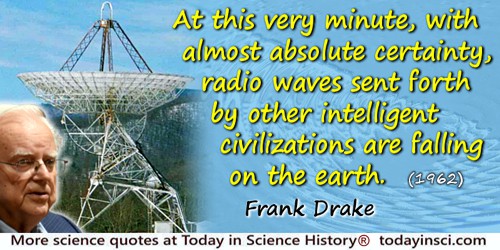
At this very minute, with almost absolute certainty, radio waves sent forth by other intelligent civilizations are falling on the earth. A telescope can be built that, pointed in the right place, and tuned to the right frequency, could discover these waves. Someday, from somewhere out among the stars, will come the answers to many of the oldest, most important, and most exciting questions mankind has asked.
In Intelligent Life in Space (1962), 111.
Atoms are round balls of wood invented by Dr. Dalton.
Answer given by a pupil to a question on atomic theory, as reported by Sir Henry Enfield Roscoe.
Answer given by a pupil to a question on atomic theory, as reported by Sir Henry Enfield Roscoe.
Reports of the British Association for the Advancement of Science, 57th report, 1887, 7.
Before an experiment can be performed, it must be planned—the question to nature must be formulated before being posed. Before the result of a measurement can be used, it must be interpreted—nature's answer must be understood properly. These two tasks are those of the theorist, who finds himself always more and more dependent on the tools of abstract mathematics. Of course, this does not mean that the experimenter does not also engage in theoretical deliberations. The foremost classical example of a major achievement produced by such a division of labor is the creation of spectrum analysis by the joint efforts of Robert Bunsen, the experimenter, and Gustav Kirchoff, the theorist. Since then, spectrum analysis has been continually developing and bearing ever richer fruit.
'The Meaning and Limits of Exact Science', Science (30 Sep 1949), 110, No. 2857, 325. Advance reprinting of chapter from book Max Planck, Scientific Autobiography (1949), 110.
Bread has been made (indifferent) from potatoes;
And galvanism has set some corpses grinning,
But has not answer'd like the apparatus
Of the Humane Society's beginning,
By which men are unsuffocated gratis:
What wondrous new machines have late been spinning.
And galvanism has set some corpses grinning,
But has not answer'd like the apparatus
Of the Humane Society's beginning,
By which men are unsuffocated gratis:
What wondrous new machines have late been spinning.
Don Juan (1819, 1858), Canto I, CXXX, 35. Aware of scientific experiments, the poet refers to the animating effects of electrical current on nerves of human corpses investigated by Professor Aldini (nephew of Galvani) on the body of Forster, a murderer (Jan-Feb 1803). Potato flour can be made by grinding dried grated potatoes.
But … the working scientist … is not consciously following any prescribed course of action, but feels complete freedom to utilize any method or device whatever which in the particular situation before him seems likely to yield the correct answer. … No one standing on the outside can predict what the individual scientist will do or what method he will follow.
In Reflections of a Physicist: A Collection of Essays (1955, 1980), 83.
But here it may be objected, that the present Earth looks like a heap of Rubbish and Ruines; And that there are no greater examples of confusion in Nature than Mountains singly or jointly considered; and that there appear not the least footsteps of any Art or Counsel either in the Figure and Shape, or Order and Disposition of Mountains and Rocks. Wherefore it is not likely they came so out of God's hands ... To which I answer, That the present face of the Earth with all its Mountains and Hills, its Promontaries and Rocks, as rude and deformed as they appear, seems to me a very beautiful and pleasant object, and with all the variety of Hills, and Valleys, and Inequalities far more grateful to behold, than a perfectly level Countrey without any rising or protuberancy, to terminate the sight: As anyone that hath but seen the Isle of Ely, or any the like Countrey must need acknowledge.
— John Ray
Miscellaneous Discourses Concerning the Dissolution and Changes of the World (1692), 165-6.
But I don’t have to know an answer. I don’t feel frightened by not knowing things, by being lost in a mysterious universe without any purpose, which is the way it really is, so far as I can tell. It doesn’t frighten me.
In Richard Feynman and Jeffrey Robbins (ed.), The Pleasure of Finding Things Out: The Best Short Works of Richard Feynman (1999), 25, last sentence of Chap. 1. The chapter, with the same title as the book, is an edited transcript of an interview with Feynman made for the BBC television program Horizon (1981).
But science is the collection of nature's answers; the humanities the collection of men's thoughts.
In Science and the Humanities: The Rickman Godlee Lecture Delivered At University College London 25 October 1956 (1956), 12.
Charlie Holloway (human): “What we hoped to achieve was to meet our makers. To get answers. Why they even made us in the first place.”
David (AI robot): “Why do you think your people made me?”
Charlie Holloway (human): “We made you because we could.”
David (AI robot): “Can you imagine how disappointing it would be for you to hear the same thing from your creator?”
Charlie Holloway (human): “I guess it’s good you can’t be disappointed.”
David (AI robot): “Why do you think your people made me?”
Charlie Holloway (human): “We made you because we could.”
David (AI robot): “Can you imagine how disappointing it would be for you to hear the same thing from your creator?”
Charlie Holloway (human): “I guess it’s good you can’t be disappointed.”
Prometheus (2012)
Chess is not a game. Chess is a well-defined form of computation. You may not be able to work out the answers, but in theory there must be a solution, a right procedure in any position. Now real games are not like that at all. Real life is not like that. Real life consists of bluffing, of little tactics of deception, of asking yourself what is the other man going to think I mean to do.
In Jacob Bronowski, The Ascent of Man (2011), 324. Although printed within single quote marks, these words are presumably not verbatim, but only a narrative recollection of a conversation with the author (during WWII, in a taxi, about von Neumann’s Theory of Games).
Chuang Tzu and Hui Tzu were standing on the bridge across the Hao River. Chuang Tzu said, “Look how the minnows are shooting to and fro! How joyful they are!”
“You are not a fish,” said Hui Tzu. “How can you know that the fishes are joyful?”
“You are not I,” answered Chuang Tzu, “How can you know I do not know about the joy of fishes? ... I know it from my own joy of the water.”
An ancient Chinese story
“You are not a fish,” said Hui Tzu. “How can you know that the fishes are joyful?”
“You are not I,” answered Chuang Tzu, “How can you know I do not know about the joy of fishes? ... I know it from my own joy of the water.”
An ancient Chinese story
As related in ‘Evolution of the Mind’, Scientific American (Jun 1957). Cited in Jo Carr, Beyond Fact: Nonfiction for Children and Young People (1982), 64.
Computers are useless. They can only give you answers.
This is a commonly seen paraphrase from his comment on mechanical brains. Originally quoted as “But they are useless. They can only give you answers,” in interview article by William Fifield, 'Pablo Picasso: A Composite Interview', in The Paris Review 32 (Summer-Fall 1964), 62. Describing the interview, Fifield himself set the context as “enormous new mechanical brains or calculating machines.” (These are now called computers.) Collected in William Fifield, In Search of Genius (1982), 145. As identified on the quoteinvestigator.com website. It is the paraphrase that is now more often seen, in for example, Herman Feshbach, 'Reflections on the Microprocessor Revolution: A Physicist’s Viewpoint', in Bruce M. Adkins (ed.), Man and Technology (1983), 100.
Daniel Bernoulli used to tell two little adventures, which he said had given him more pleasure than all the other honours he had received. Travelling with a learned stranger, who, being pleased with his conversation, asked his name; “I am Daniel Bernoulli,” answered he with great modesty; “and I,” said the stranger (who thought he meant to laugh at him) “am Isaac Newton.” Another time, having to dine with the celebrated Koenig, the mathematician, who boasted, with some degree of self-complacency, of a difficult problem he had solved with much trouble, Bernoulli went on doing the honours of his table, and when they went to drink coffee he presented Koenig with a solution of the problem more elegant than his own.
In A Philosophical and Mathematical Dictionary (1815), 1, 226.
Darwin grasped the philosophical bleakness with his characteristic courage. He argued that hope and morality cannot, and should not, be passively read in the construction of nature. Aesthetic and moral truths, as human concepts, must be shaped in human terms, not ‘discovered’ in nature. We must formulate these answers for ourselves and then approach nature as a partner who can answer other kinds of questions for us–questions about the factual state of the universe, not about the meaning of human life. If we grant nature the independence of her own domain–her answers unframed in human terms–then we can grasp her exquisite beauty in a free and humble way. For then we become liberated to approach nature without the burden of an inappropriate and impossible quest for moral messages to assuage our hopes and fears. We can pay our proper respect to nature’s independence and read her own ways as beauty or inspiration in our different terms.
…...
De Morgan was explaining to an actuary what was the chance that a certain proportion of some group of people would at the end of a given time be alive; and quoted the actuarial formula, involving p [pi], which, in answer to a question, he explained stood for the ratio of the circumference of a circle to its diameter. His acquaintance, who had so far listened to the explanation with interest, interrupted him and exclaimed, “My dear friend, that must be a delusion, what can a circle have to do with the number of people alive at a given time?”
In Mathematical Recreations and Problems (1896), 180; See also De Morgan’s Budget of Paradoxes (1872), 172.
Debate is an art form. It is about the winning of arguments. It is not about the discovery of truth. There are certain rules and procedures to debate that really have nothing to do with establishing fact–which creationists have mastered. Some of those rules are: never say anything positive about your own position because it can be attacked, but chip away at what appear to be the weaknesses in your opponent’s position. They are good at that. I don’t think I could beat the creationists at debate. I can tie them. But in courtrooms they are terrible, because in courtrooms you cannot give speeches. In a courtroom you have to answer direct questions about the positive status of your belief. We destroyed them in Arkansas. On the second day of the two-week trial we had our victory party!
…...
Do not enter upon research unless you can not help it. Ask yourself the “why” of every statement that is made and think out your own answer. If through your thoughtful work you get a worthwhile idea, it will get you. The force of the conviction will compel you to forsake all and seek the relief of your mind in research work.
From Cameron Prize Lecture (1928), delivered before the University of Edinburgh. As quoted in J.B. Collip 'Frederick Grant Banting, Discoverer of Insulin', The Scientific Monthly (May 1941), 52, No. 5, 473.
Does there truly exist an insuperable contradiction between religion and science? Can religion be superseded by science? The answers to these questions have, for centuries, given rise to considerable dispute and, indeed, bitter fighting. Yet, in my own mind there can be no doubt that in both cases a dispassionate consideration can only lead to a negative answer. What complicates the solution, however, is the fact that while most people readily agree on what is meant by “science,” they are likely to differ on the meaning of “religion.”
Replying to the Liberal Ministers’ Club of New York City. Published in >The Christian Register, (Jun 1948). As given in Ideas and Opinions (1954, 2010), 49-50.
Einstein, my upset stomach hates your theory [of General Relativity]—it almost hates you yourself! How am I to provide for my students? What am I to answer to the philosophers?!!
Letter to Albert Einstein, 20 Nov 1919. In Martin J. Klein, Paul Ehrenfest: The Making of a Theoretical Physicist (1970), Vol. 1, 315.
Even if there is only one possible unified theory, it is just a set of rules and equations. What is it that breathes fire into the equations and makes a universe for them to describe? The usual approach of science of constructing a mathematical model cannot answer the questions of why there should be a universe for the model to describe. Why does the universe go to all the bother of existing?
A Brief History of Time (1998), 190.
Every answer given arouses new questions. The progress of science is matched by an increase in the hidden and mysterious.
In Judaism and Science (1949).
Every new theory as it arises believes in the flush of youth that it has the long sought goal; it sees no limits to its applicability, and believes that at last it is the fortunate theory to achieve the 'right' answer. This was true of electron theory—perhaps some readers will remember a book called The Electrical Theory of the Universe by de Tunzelman. It is true of general relativity theory with its belief that we can formulate a mathematical scheme that will extrapolate to all past and future time and the unfathomed depths of space. It has been true of wave mechanics, with its first enthusiastic claim a brief ten years ago that no problem had successfully resisted its attack provided the attack was properly made, and now the disillusionment of age when confronted by the problems of the proton and the neutron. When will we learn that logic, mathematics, physical theory, are all only inventions for formulating in compact and manageable form what we already know, like all inventions do not achieve complete success in accomplishing what they were designed to do, much less complete success in fields beyond the scope of the original design, and that our only justification for hoping to penetrate at all into the unknown with these inventions is our past experience that sometimes we have been fortunate enough to be able to push on a short distance by acquired momentum.
The Nature of Physical Theory (1936), 136.
Every one who has seriously investigated a novel question, who has really interrogated Nature with a view to a distinct answer, will bear me out in saying that it requires intense and sustained effort of imagination.
In The Principles of Success in Literature (1901), 66.
Everyone doing his best is not the answer. It is necessary that people know what to do.
In Quality, Productivity, and Competitive Position (1982), ii. A similar quote often attributed to Deming, but without citation, is “It is not enough to do your best; you must know what to do, and then do your best.”
Everyone knows that in research there are no final answers, only insights that allow one to formulate new questions.
In A Slot Machine, A Broken Test Tube: An Autobiography (1984).
Everything around us is filled with mystery and magic. I find this no cause for despair, no reason to turn for solace to esoteric formulae or chariots of gods. On the contrary, our inability to find easy answers fills me with a fierce pride in our ambivalent biology … with a constant sense of wonder and delight that we should be part of anything so profound.
In Lifetide: A Biology of the Unconscious (1979), 14.
Examinations are formidable even to the best prepared, for the greatest fool may ask more than the wisest man can answer.
Lacon: Or, Many Things in Few Words (1865), 97.
Experimenters are the shock troops of science … An experiment is a question which science poses to Nature, and a measurement is the recording of Nature’s answer. But before an experiment can be performed, it must be planned–the question to nature must be formulated before being posed. Before the result of a measurement can be used, it must be interpreted–Nature’s answer must be understood properly. These two tasks are those of theorists, who find himself always more and more dependent on the tools of abstract mathematics.
'The Meaning and Limits of Exact Science', Science (30 Sep 1949), 110, No. 2857, 325. Advance reprinting of chapter from book Max Planck, Scientific Autobiography (1949), 110.
Far better an approximate answer to the right question, which is often vague, than an exact answer to the wrong question, which can always be made precise.
In 'The Future of Data Analysis', Annals of Mathematical Statistics (1962), 33, No. 1, 13-14.
FAUSTUS: How many heavens or spheres are there?
MEPHASTOPHILIS: Nine: the seven planets, the firmament, and the empyreal heaven.
FAUSTUS: But is there not coelum igneum, et crystallinum?
MEPH.: No Faustus, they be but fables.
FAUSTUS: Resolve me then in this one question: Why are not conjunctions, oppositions, aspects, eclipses all at one time, but in some years we have more, in some less?
MEPH.: Per inaequalem motum respectu totius.
FAUSTUS: Well, I am answered. Now tell me who made the world.
MEPH.: I will not.
FAUSTUS: Sweet Mephastophilis, tell me.
MEPH.: Move me not, Faustus.
FAUSTUS: Villain, have I not bound thee to tell me any thing?
MEPH.: Ay, that is not against our kingdom.
This is. Thou are damn'd, think thou of hell.
FAUSTUS: Think, Faustus, upon God that made the world!
MEPH.: Remember this.
MEPHASTOPHILIS: Nine: the seven planets, the firmament, and the empyreal heaven.
FAUSTUS: But is there not coelum igneum, et crystallinum?
MEPH.: No Faustus, they be but fables.
FAUSTUS: Resolve me then in this one question: Why are not conjunctions, oppositions, aspects, eclipses all at one time, but in some years we have more, in some less?
MEPH.: Per inaequalem motum respectu totius.
FAUSTUS: Well, I am answered. Now tell me who made the world.
MEPH.: I will not.
FAUSTUS: Sweet Mephastophilis, tell me.
MEPH.: Move me not, Faustus.
FAUSTUS: Villain, have I not bound thee to tell me any thing?
MEPH.: Ay, that is not against our kingdom.
This is. Thou are damn'd, think thou of hell.
FAUSTUS: Think, Faustus, upon God that made the world!
MEPH.: Remember this.
Doctor Faustus: A 1604-Version Edition, edited by Michael Keefer (1991), Act II, Scene iii, lines 60-77, 43-4.
Few will deny that even in the first scientific instruction in mathematics the most rigorous method is to be given preference over all others. Especially will every teacher prefer a consistent proof to one which is based on fallacies or proceeds in a vicious circle, indeed it will be morally impossible for the teacher to present a proof of the latter kind consciously and thus in a sense deceive his pupils. Notwithstanding these objectionable so-called proofs, so far as the foundation and the development of the system is concerned, predominate in our textbooks to the present time. Perhaps it will be answered, that rigorous proof is found too difficult for the pupil’s power of comprehension. Should this be anywhere the case,—which would only indicate some defect in the plan or treatment of the whole,—the only remedy would be to merely state the theorem in a historic way, and forego a proof with the frank confession that no proof has been found which could be comprehended by the pupil; a remedy which is ever doubtful and should only be applied in the case of extreme necessity. But this remedy is to be preferred to a proof which is no proof, and is therefore either wholly unintelligible to the pupil, or deceives him with an appearance of knowledge which opens the door to all superficiality and lack of scientific method.
In 'Stücke aus dem Lehrbuche der Arithmetik', Werke, Bd. 2 (1904), 296.
For every complex question there is a simple answer–and it's wrong.
Although often seen attributed to H.L. Mencken, webmaster has not found found a primary source, and no authoritative quote collection containing it. If you have a primary source, please contact webmaster, who meanwhile lists this quote as only being author unknown.
For scholars and laymen alike it is not philosophy but active experience in mathematics itself that can alone answer the question: What is mathematics?
As co-author with Herbert Robbins, in What Is Mathematics?: An Elementary Approach to Ideas and Methods (1941, 1996), xiii.
For some months the astronomer Halley and other friends of Newton had been discussing the problem in the following precise form: what is the path of a body attracted by a force directed toward a fixed point, the force varying in intensity as the inverse of the distance? Newton answered instantly, “An ellipse.” “How do you know?” he was asked. “Why, I have calculated it.” Thus originated the imperishable Principia, which Newton later wrote out for Halley. It contained a complete treatise on motion.
In The Handmaiden of the Sciences (1937), 37.
For, in mathematics or symbolic logic, reason can crank out the answer from the symboled equations—even a calculating machine can often do so—but it cannot alone set up the equations. Imagination resides in the words which define and connect the symbols—subtract them from the most aridly rigorous mathematical treatise and all meaning vanishes. Was it Eddington who said that we once thought if we understood 1 we understood 2, for 1 and 1 are 2, but we have since found we must learn a good deal more about “and”?
In 'The Biological Basis of Imagination', American Thought: 1947 (1947), 81.
Freud expressed the opinion—not quite in earnest, though, it seeemed to me—that philosophy was the most decent form of sublimation of repressed sexuality, nothing more. In response I put the question, 'What then is science, particularly psychoanalytic psychology?' Whereupon he, visibly a bit surprised, answered evasively: 'At least psychology has a social purpose.'
Recollection by Binswanger of conversation during his third visit to Vienna to see Freud (17-18 May 1913), in Gerhard Fichtner (ed.) and Arnold J. Pomerans (trans.), The Sigmund Freud-Ludwig Binswanger Correspondence 1908-1938 (2003), 237.
Freudian psychoanalytical theory is a mythology that answers pretty well to Levi-Strauss's descriptions. It brings some kind of order into incoherence; it, too, hangs together, makes sense, leaves no loose ends, and is never (but never) at a loss for explanation. In a state of bewilderment it may therefore bring comfort and relief … give its subject a new and deeper understanding of his own condition and of the nature of his relationship to his fellow men. A mythical structure will be built up around him which makes sense and is believable-in, regardless of whether or not it is true.
From 'Science and Literature', The Hope of Progress: A Scientist Looks at Problems in Philosophy, Literature and Science (1973), 29.
From him [Wilard Bennett] I learned how different a working laboratory is from a student laboratory. The answers are not known!
[While an undergraduate, doing experimental measurements in the laboratory of his professor, at Ohio State University.]
[While an undergraduate, doing experimental measurements in the laboratory of his professor, at Ohio State University.]
From autobiography on Nobel Prize website.
Geologists have usually had recourse for the explanation of these changes to the supposition of sundry violent and extraordinary catastrophes, cataclysms, or general revolutions having occurred in the physical state of the earth's surface.
As the idea imparted by the term Cataclysm, Catastrophe, or Revolution, is extremely vague, and may comprehend any thing you choose to imagine, it answers for the time very well as an explanation; that is, it stops further inquiry. But it also has had the disadvantage of effectually stopping the advance of science, by involving it in obscurity and confusion.
As the idea imparted by the term Cataclysm, Catastrophe, or Revolution, is extremely vague, and may comprehend any thing you choose to imagine, it answers for the time very well as an explanation; that is, it stops further inquiry. But it also has had the disadvantage of effectually stopping the advance of science, by involving it in obscurity and confusion.
Considerations on Volcanoes (1825), iv.
George Stephenson, with a sagacity of mind in advance of the science of his day, answered, when asked what was the ultimate cause of motion of his locomotive engine, ‘that it went by the bottled-up rays of the sun.’
From 'Fuel', Lecture delivered to the British Association at Bradford, printed in Nature (25 Sep 1873), 8, 443.
He [a good psychologist] must be able to give and to take incisive criticism without losing his respect either for himself or for the people and the views that he may try to upset. He has to be tolerant, but not indecisive, to be ruthless, but not unfair, to be honest about his assumptions as he is about his evidence, to ask questions when he doesn’t know and to hazard answers when he is convinced that he does, to give credit where credit is due and not to be too much worried if it seems to him that others do not always return the compliment.
From archive recording (3 Jun 1959) with to John C. Kenna, giving his recollection of his farewell speech to Cambridge Psychological Society (4 Mar 1952), in which he gave a summary of points he considered to be basic requirements for a good experimental psychologist. End of point 7 of 7, from transcription of recording held at British Psychological Society History of Psychology Centre, London, as abridged on thepsychologist.bps.org.uk website.
He attends constantly the Meetings both of ye Society and the Council; noteth the Observables said and done there; digesteth ym in private; takes care to have ym entered in the Journal- and Register-Books; reads over and corrects all entrys; sollicites the performances of taskes recommended and undertaken;
writes all Letters abroad and answers the returns made to ym, entertaining a correspondence with at least 30. persons; employs a great deal of time, and takes much pain in inquiring after and satisfying foorain demands about philosophical matters, dispenseth farr and near store of directions and inquiries for the society’s purpose, and sees them well recommended etc.
Description of his duties as Secretary of the Royal Society, in his own words, but in the third person. As quoted from A. Rupert Hall, 'Henry Oldenburg', in Charles Coulston Gillispie (ed.), Dictionary of National Biography (1974), Vol. 10, 201.
How can altruism, which by definition reduces personal fitness, possibly evolve by natural selection? The answer is kinship: if the genes causing the altruism are shared by two organisms because of common descent, and if the altruistic act by one organism increases the joint contribution of these genes to the next generation, the propensity to altruism will spread through the gene pool. This occurs even though the altruist makes less of a solitary contribution to the gene pool as the price of its altruistic act.
In Sociobiology (1975), 3-4.
Hubris is the greatest danger that accompanies formal data analysis, including formalized statistical analysis. The feeling of “Give me (or more likely even, give my assistant) the data, and I will tell you what the real answer is!” is one we must all fight against again and again, and yet again.
In 'Sunset Salvo', The American Statistician (Feb 1986), 40, No. 1, 75.
Human consciousness is just about the last surviving mystery. A mystery is a phenomenon that people don’t know how to think about—yet. There have been other great mysteries: the mystery of the origin of the universe, the mystery of life and reproduction, the mystery of the design to be found in nature, the mysteries of time, space, and gravity. These were not just areas of scientific ignorance, but of utter bafflement and wonder. We do not yet have the final answers to any of the questions of cosmology and particle physics, molecular genetics and evolutionary theory, but we do know how to think about them. The mysteries haven't vanished, but they have been tamed. They no longer overwhelm our efforts to think about the phenomena, because now we know how to tell the misbegotten questions from the right questions, and even if we turn out to be dead wrong about some of the currently accepted answers, we know how to go about looking for better answers. With consciousness, however, we are still in a terrible muddle. Consciousness stands alone today as a topic that often leaves even the most sophisticated thinkers tongue-tied and confused. And, as with all the earlier mysteries, there are many who insist—and hope—that there will never be a demystification of consciousness.
Consciousness Explained (1991), 21-22.
Human spirituality is to seek an answer to the question: “how can you make sense out of a world which does not seem to be intrinsically reasonable?”
Quoted in Kim Lim (ed.), 1,001 Pearls of Spiritual Wisdom: Words to Enrich, Inspire, and Guide Your Life (2014), 44
I am a simple man and I want simple answers.
Said to be a favorite line a favorite line of his when challenging his students. As stated, without citation in Robert Slater, Portraits in Silicon (1987), 88.
I am not bound to please thee with my answer.
…...
I am very astonished that the scientific picture of the real world around me is deficient. It gives a lot of factual information, puts all our experience in a magnificently consistent order, but it is ghastly silent about all and sundry that is really near to our heart, that really matters to us. It cannot tell us a word about red and blue, bitter and sweet, physical pain and physical delight; it knows nothing of beautiful and ugly, good or bad, God and eternity. Science sometimes pretends to answer questions in these domains, but the answers are very often so silly that we are not inclined to take them seriously.
…...
I believe the best test of a model is how well can the modeller answer the questions, ‘What do you know now that you did not know before?’ and ‘How can you find out if it is true?’
In Francis Crick, The Astonishing Hypothesis: the Scientific Search for the Soul (1995), 177.
I can live with doubt and uncertainty. I think it’s much more interesting to live not knowing than to have answers which might be wrong.
From transcript of a BBC television program, 'The Pleasure of Finding Things Out' (1981). In Richard Phillips Feynman and Jeffrey Robbins (ed.), The Pleasure of Finding Things Out: the Best Short Works of Richard P. Feynman (2000), 24.
I cannot answer your question, because I have not yet read that chapter in the textbook myself, but if you will come to me tomorrow I shall then have read it, and may be able to answer you.
In reply to a student’s question after a lecture. As given in quotation marks in T. Brailsford Robertson, The Spirit of Research (1931), Vol. 1, 161. Note: Robertson worked in Loeb’s lab, and may be giving a recollection in his own words, rather than a verbatim quote.
I could not help laughing at the ease with which he explained his process of deduction. “When I hear you give your reasons,” I remarked, “the thing always appears to me to be so ridiculously simple that I could easily do it myself, though at each successive instance of your reasoning I am baffled, until you explain your process. And yet I believe that my eyes are as good as yours.”
“Quite so,” he answered, lighting a cigarette, and throwing himself down into an arm-chair. “You see, but you do not observe. The distinction is clear. For example, you have frequently seen the steps which lead up from the hall to this room.”
“Frequently.”
“How often?”
“'Well, some hundreds of times.”
“Then how many are there?”
“How many! I don't know.”
“Quite so! You have not observed. And yet you have seen. That is just my point. Now, I know that there are seventeen steps, because I have both seen and observed.”
“Quite so,” he answered, lighting a cigarette, and throwing himself down into an arm-chair. “You see, but you do not observe. The distinction is clear. For example, you have frequently seen the steps which lead up from the hall to this room.”
“Frequently.”
“How often?”
“'Well, some hundreds of times.”
“Then how many are there?”
“How many! I don't know.”
“Quite so! You have not observed. And yet you have seen. That is just my point. Now, I know that there are seventeen steps, because I have both seen and observed.”
From 'Adventure I.—A Scandal in Bohemia', Adventures of Sherlock Holmes, in The Strand Magazine: An Illustrated Monthly (Jul 1891), 2, 62.
I do not maintain that the chief value of the study of arithmetic consists in the lessons of morality that arise from this study. I claim only that, to be impressed from day to day, that there is something that is right as an answer to the questions with which one is able to grapple, and that there is a wrong answer—that there are ways in which the right answer can be established as right, that these ways automatically reject error and slovenliness, and that the learner is able himself to manipulate these ways and to arrive at the establishment of the true as opposed to the untrue, this relentless hewing to the line and stopping at the line, must color distinctly the thought life of the pupil with more than a tinge of morality. … To be neighborly with truth, to feel one’s self somewhat facile in ways of recognizing and establishing what is right, what is correct, to find the wrong persistently and unfailingly rejected as of no value, to feel that one can apply these ways for himself, that one can think and work independently, have a real, a positive, and a purifying effect upon moral character. They are the quiet, steady undertones of the work that always appeal to the learner for the sanction of his best judgment, and these are the really significant matters in school work. It is not the noise and bluster, not even the dramatics or the polemics from the teacher’s desk, that abide longest and leave the deepest and stablest imprint upon character. It is these still, small voices that speak unmistakably for the right and against the wrong and the erroneous that really form human character. When the school subjects are arranged on the basis of the degree to which they contribute to the moral upbuilding of human character good arithmetic will be well up the list.
In Arithmetic in Public Education (1909), 18. As quoted and cited in Robert Édouard Moritz, Memorabilia Mathematica; Or, The Philomath’s Quotation-book (1914), 69.
I grew up in Brooklyn, New York … a city neighborhood that included houses, lampposts, walls, and bushes. But with an early bedtime in the winter, I could look out my window and see the stars, and the stars were not like anything else in my neighborhood. [At age 5] I didn’t know what they were.
[At age 9] my mother … said to me, “You have a library card now, and you know how to read. Take the streetcar to the library and get a book on stars.” … I stepped up to the big librarian and asked for a book on stars. … I sat down and found out the answer, which was something really stunning.I found out that the stars are glowing balls of gas. I also found out that the Sun is a star but really close and that the stars are all suns except really far away I didn’t know any physics or mathematics at that time, but I could imagine how far you’d have to move the Sun away from us till it was only as bright as a star. It was in that library, reading that book, that the scale of the universe opened up to me. There was something beautiful about it.
At that young age, I already knew that I’d be very happy if I could devote my life to finding out more about the stars and the planets that go around them. And it’s been my great good fortune to do just that.
[At age 9] my mother … said to me, “You have a library card now, and you know how to read. Take the streetcar to the library and get a book on stars.” … I stepped up to the big librarian and asked for a book on stars. … I sat down and found out the answer, which was something really stunning.I found out that the stars are glowing balls of gas. I also found out that the Sun is a star but really close and that the stars are all suns except really far away I didn’t know any physics or mathematics at that time, but I could imagine how far you’d have to move the Sun away from us till it was only as bright as a star. It was in that library, reading that book, that the scale of the universe opened up to me. There was something beautiful about it.
At that young age, I already knew that I’d be very happy if I could devote my life to finding out more about the stars and the planets that go around them. And it’s been my great good fortune to do just that.
Quoted in interview with Jack Rightmyer, in 'Stars in His Eyes', Highlights For Children (1 Jan 1997). Ages as given in Tom Head (ed.), Conversations with Carl Sagan (2006), x.
I have approximate answers and possible beliefs in different degrees of certainty about different things, but I am not absolutely sure of anything, and of many things I don’t know anything about but I don’t have to know an answer.
Interview, in BBC TV program, 'The Pleasure of Finding Things Out', Horizon (23 Nov 1981). As quoted in Caroline Baillie, Alice Pawley, Donna M. Riley, Engineering and Social Justice: In the University and Beyond (2012), 108.
I have been asked whether I would agree that the tragedy of the scientist is that he is able to bring about great advances in our knowledge, which mankind may then proceed to use for purposes of destruction. My answer is that this is not the tragedy of the scientist; it is the tragedy of mankind.
S. R. Weart and G. W. Sallard (eds.), Leo Szilard: His Version of the Facts (1978), 229.
I have had [many letters] asking me,… how to start making a hobby out of astronomy. My answer is always the same. Do some reading, learn the basic facts, and then take a star-map and go outdoors on the first clear night so that you can begin learning the various stars and constellation patterns. The old cliche that ‘an ounce of practice is worth a ton of theory’ is true in astronomy, as it is in everything else.
From 'Introduction', The Amateur Astronomer (11th Ed., 1990), 1.
I have often had cause to feel that my hands are cleverer than my head. That is a crude way of characterizing the dialectics of experimentation. When it is going well, it is like a quiet conversation with Nature. One asks a question and gets an answer, then one asks the next question and gets the next answer. An experiment is a device to make Nature speak intelligibly. After that, one only has to listen.
Nobel Lecture (12 Dec 1967). In Nobel Lectures: Physiology Or Medicine: (1999), Vol. 4 (1963-197), 292.
I have sometimes experienced from nitrous oxide, sensations similar to no others, and they have consequently been indescribable. This has been likewise often the case with other persons. Of two paralytic patients who were asked what they felt after breathing nitrous oxide, the first answered, “I do not know how, but very queer.” The second said, “I felt like the sound of a harp.”
Referring to his investigation of the effects of nitrous oxide (laughing gas).
I hope that in 50 years we will know the answer to this challenging question: are the laws of physics unique and was our big bang the only one? … According to some speculations the number of distinct varieties of space—each the arena for a universe with its own laws—could exceed the total number of atoms in all the galaxies we see. … So do we live in the aftermath of one big bang among many, just as our solar system is merely one of many planetary systems in our galaxy? (2006)
In 'Martin Rees Forecasts the Future', New Scientist (18 Nov 2006), No. 2578.
I learned, and later had to unlearn in order to become a scientist myself, that science is simply measurement and the answers are in print.
This View of Life: the World of an Evolutionist (1964), 27.
I never could do anything with figures, never had any talent for mathematics, never accomplished anything in my efforts at that rugged study, and to-day the only mathematics I know is multiplication, and the minute I get away up in that, as soon as I reach nine times seven— [He lapsed into deep thought, trying to figure nine times seven. Mr. McKelway whispered the answer to him.] I’ve got it now. It’s eighty-four. Well, I can get that far all right with a little hesitation. After that I am uncertain, and I can’t manage a statistic.
Speech at the New York Association for Promoting the Interests of the Blind (29 Mar 1906). In Mark Twain and William Dean Howells (ed.), Mark Twain’s Speeches? (1910), 323.
I now think the answer is very simple: it’s true. God did create the universe about 13.7 billion years ago, and of necessity has involved Himself with His creation ever since. The purpose of this universe is something that only God knows for sure, but it is increasingly clear to modern science that the universe was exquisitely fine-tuned to enable human life.
In Letter (May 2005), sent to the Hope College 2005 Alumni Banquet, read in lieu of accepting an award in person, because of declining health from cancer.
I ought to say that one of our first joint researches, so far as publication was concerned, had the peculiar effect of freeing me forever from the wiles of college football, and if that is a defect, make the most of it! Dr. Noyes and I conceived an idea on sodium aluminate solutions on the morning of the day of a Princeton-Harvard game (as I recall it) that we had planned to attend. It looked as though a few days' work on freezing-point determinations and electrical conductivities would answer the question. We could not wait, so we gave up the game and stayed in the laboratory. Our experiments were successful. I think that this was the last game I have ever cared about seeing. I mention this as a warning, because this immunity might attack anyone. I find that I still complainingly wonder at the present position of football in American education.
Address upon receiving the Perkin Medal Award, 'The Big Things in Chemistry', The Journal of Industrial and Engineering Chemistry (Feb 1921), 13, No. 2, 162-163.
I read them. Not to grade them. No, I read them to see how I am doing. Where am I failing? What don’t they understand? Why do they give wrong answers? Why do they have some point of view that I don’t think is right? Where am I failing? Where do I need to build up.
In The Essential Deming.
I shall never forget the sight. The vessel of crystallization was three quarters full of slightly muddy water—that is, dilute water-glass—and from the sandy bottom there strove upwards a grotesque little landscape of variously colored growths: a confused vegetation of blue, green, and brown shoots which reminded one of algae, mushrooms, attached polyps, also moss, then mussels, fruit pods, little trees or twigs from trees, here, and there of limbs. It was the most remarkable sight I ever saw, and remarkable not so much for its profoundly melancholy nature. For when Father Leverkühn asked us what we thought of it and we timidly answered him that they might be plants: “No,” he replied, “they are not, they only act that way. But do not think the less of them. Precisely because they do, because they try as hard as they can, they are worthy of all respect.”
It turned out that these growths were entirely unorganic in their origin; they existed by virtue of chemicals from the apothecary's shop.
It turned out that these growths were entirely unorganic in their origin; they existed by virtue of chemicals from the apothecary's shop.
Description of a “chemical garden” in Doktor Faustus: The Life of the German Composer Adrian Leverkühn, as Told by a Friend, (1947), 19.
I spent most of a lifetime trying to be a mathematician—and what did I learn. What does it take to be one? I think I know the answer: you have to be born right, you must continually strive to become perfect, you must love mathematics more than anything else, you must work at it hard and without stop, and you must never give up.
In I Want to be a Mathematician: an Automathography (1985), 400.
I then shouted into M [the mouthpiece] the following sentence: “Mr. Watson—Come here—I want to see you.” To my delight he came and declared that he had heard and understood what I said. I asked him to repeat the words. He answered “You said—‘Mr. Watson—-come here—I want to see you.’” We then changed places and I listened at S [the reed receiver] while Mr. Watson read a few passages from a book into the mouth piece M. It was certainly the case that articulate sounds proceeded from S. The effect was loud but indistinct and muffled. If I had read beforehand the passage given by Mr. Watson I should have recognized every word. As it was I could not make out the sense—but an occasional word here and there was quite distinct. I made out “to” and “out” and “further”; and finally the sentence “Mr. Bell do you understand what I say? Do—you—un—der—stand—what—I—say” came quite clearly and intelligibly. No sound was audible when the armature S was removed.
Notebook, 'Experiments made by A. Graham Bell, vol. I'. Entry for 10 March 1876. Quoted in Robert V. Bruce, Bell: Alexander Graham Bell and the Conquest of Solitude (1973), 181.
I think the next [21st] century will be the century of complexity. We have already discovered the basic laws that govern matter and understand all the normal situations. We don’t know how the laws fit together, and what happens under extreme conditions. But I expect we will find a complete unified theory sometime this century. The is no limit to the complexity that we can build using those basic laws.
[Answer to question: Some say that while the twentieth century was the century of physics, we are now entering the century of biology. What do you think of this?]
[Answer to question: Some say that while the twentieth century was the century of physics, we are now entering the century of biology. What do you think of this?]
'"Unified Theory" Is Getting Closer, Hawking Predicts', interview in San Jose Mercury News (23 Jan 2000), 29A. Answer quoted in Ashok Sengupta, Chaos, Nonlinearity, Complexity: The Dynamical Paradigm of Nature (2006), vii. Question included in Hans-Joachim Schellnhuber, Nicholas Stern and Mario Molina , Global Sustainability: a Nobel Cause (2010), 13. Cite from Brent Davis and Dennis J. Sumara, Complexity and Education: Inquiries Into Learning, Teaching, and Research (2006), 171.
I think there probably is life, maybe primitive life, in outer space. There might be very primitive life in our solar system—single-cell animals, that sort of thing. We may know the answer to that in five or ten years. There is very likely to be life in other solar systems, in planets around other stars. But we won’t know about that for a long time.
Interview conducted on Scholastic website (20 Nov 1998).
I thought existing zoo programmes were really not doing animals justice. They all looked like oddities, like bizarre stage things, when, really, in their own environment, they are wonderful answers to very complex questions.
Explaining his motivation for his earliest groundbreaking Zoo Quest nature TV series featuring on location filming. From interview with Alice Roberts, 'Attenborough: My Life on Earth', The Biologist (Aug 2015), 62, No. 4, 15.
I told him that for a modern scientist, practicing experimental research, the least that could be said, is that we do not know. But I felt that such a negative answer was only part of the truth. I told him that in this universe in which we live, unbounded in space, infinite in stored energy and, who knows, unlimited in time, the adequate and positive answer, according to my belief, is that this universe may, also, possess infinite potentialities.
Nobel Lecture, The Coming Age of the Cell, 12 Dec 1974
I was suffering from a sharp attack of intermittent fever, and every day during the cold and succeeding hot fits had to lie down for several hours, during which time I had nothing to do but to think over any subjects then particularly interesting me. One day something brought to my recollection Malthus's 'Principles of Population', which I had read about twelve years before. I thought of his clear exposition of 'the positive checks to increase'—disease, accidents, war, and famine—which keep down the population of savage races to so much lower an average than that of more civilized peoples. It then occurred to me that these causes or their equivalents are continually acting in the case of animals also; and as animals usually breed much more rapidly than does mankind, the destruction every year from these causes must be enormous in order to keep down the numbers of each species, since they evidently do not increase regularly from year to year, as otherwise the world would long ago have been densely crowded with those that breed most quickly. Vaguely thinking over the enormous and constant destruction which this implied, it occurred to me to ask the question, Why do some die and some live? The answer was clearly, that on the whole the best fitted live. From the effects of disease the most healthy escaped; from enemies, the strongest, swiftest, or the most cunning; from famine, the best hunters or those with the best digestion; and so on. Then it suddenly flashed upon me that this self-acting process would necessarily improve the race, because in every generation the inferior would inevitably be killed off and the superior would remain—that is, the fittest would survive.
[The phrase 'survival of the fittest,' suggested by the writings of Thomas Robert Malthus, was expressed in those words by Herbert Spencer in 1865. Wallace saw the term in correspondence from Charles Darwin the following year, 1866. However, Wallace did not publish anything on his use of the expression until very much later, and his recollection is likely flawed.]
[The phrase 'survival of the fittest,' suggested by the writings of Thomas Robert Malthus, was expressed in those words by Herbert Spencer in 1865. Wallace saw the term in correspondence from Charles Darwin the following year, 1866. However, Wallace did not publish anything on his use of the expression until very much later, and his recollection is likely flawed.]
My Life: A Record of Events and Opinions (1905), Vol. 1, 361-362, or in reprint (2004), 190.
I would never use a long word, even, where a short one would answer the purpose. I know there are professors in this country who “ligate” arteries. Other surgeons only tie them, and it stops the bleeding just as well.
'Scholastic and Bedside Teaching: An Introductory Lecture to the Medical Class of Harvard University, November 6, 1867'. Collected in Medical Essays 1842-1882 (1891), 302.
I, however, believe that for the ripening of experience the light of an intelligent theory is required. People are amused by the witticism that the man with a theory forces from nature that answer to his question which he wishes to have but nature never answers unless she is questioned, or to speak more accurately, she is always talking to us and with a thousand tongues but we only catch the answer to our own question.
Quoted in Major Greenwood, Epidemiology Historical and Experimental. The Herter Lectures for 1931 (1932), 13.
I’m very intense in my work. At any given moment, I think I know the answer to some problem, and that I’m right. Since science is the only self-correcting human institution I know of, you should not be frightened to take an extreme stand, if that causes the stand to be examined more thoroughly than it might be if you are circumspect. I’ve always been positive about the value of the Hubble constant, knowing full well that it probably isn’t solved.
As quoted in John Noble Wilford, 'Sizing up the Cosmos: An Astronomers Quest', New York Times (12 Mar 1991), C10.
Iamblichus in his treatise On the Arithmetic of Nicomachus observes p. 47- “that certain numbers were called amicable by those who assimilated the virtues and elegant habits to numbers.” He adds, “that 284 and 220 are numbers of this kind; for the parts of each are generative of each other according to the nature of friendship, as was shown by Pythagoras. For some one asking him what a friend was, he answered, another I (ετεϑος εγω) which is demonstrated to take place in these numbers.” [“Friendly” thus: Each number is equal to the sum of the factors of the other.]
In Theoretic Arithmetic (1816), 122. (Factors of 284 are 1, 2, 4 ,71 and 142, which give the sum 220. Reciprocally, factors of 220 are 1, 2, 4, 5, 10, 11 ,22, 44, 55 and 110, which give the sum 284.) Note: the expression “alter ego” is Latin for “the other I.”
If a nonnegative quantity was so small that it is smaller than any given one, then it certainly could not be anything but zero. To those who ask what the infinitely small quantity in mathematics is, we answer that it is actually zero. Hence there are not so many mysteries hidden in this concept as they are usually believed to be. These supposed mysteries have rendered the calculus of the infinitely small quite suspect to many people. Those doubts that remain we shall thoroughly remove in the following pages, where we shall explain this calculus.
…...
If a specific question has meaning, it must be possible to find operations by which an answer may be given to it ... I believe that many of the questions asked about social and philosophical subjects will be found to be meaningless when examined from the point of view of operations.
The Logic of Modern Physics (1960), 28.
If any layman were to ask a number of archaeologists to give, on the spur of the moment, a definition of archaeology, I suspect that such a person might find the answers rather confusing. He would, perhaps, sympathize with Socrates who, when he hoped to learn from the poets and artisans something about the arts they practised, was forced to go away with the conviction that, though they might themselves be able to accomplish something, they certainly could give no clear account to others of what they were trying to do.
Opening statement in lecture at Columbia University (8 Jan 1908), 'Archaeology'. Published by the Columbia University Press (1908).
If any one should ask me what I consider the most distinctive, progressive feature of California, I should answer promptly, its cable-car system. And it is not alone its system which seems to have reached a point of perfection, but the amazing length of the ride that is given you for the chink of a nickel. I have circled this city of San Francisco, … for this smallest of Southern coins.
In Letters from California (1888), 33.
If any woman were to hang a man for stealing her picture, although it were set in gold, it would be a new case in law; but, if he carried off the setting, and left the portrait, I would not answer for his safety.
Reflection 557, in Lacon: or Many things in Few Words; Addressed to Those Who Think (1820), 234.
If arithmetical skill is the measure of intelligence, then computers have been more intelligent than all human beings all along. If the ability to play chess is the measure, then there are computers now in existence that are more intelligent than any but a very few human beings. However, if insight, intuition, creativity, the ability to view a problem as a whole and guess the answer by the “feel” of the situation, is a measure of intelligence, computers are very unintelligent indeed. Nor can we see right now how this deficiency in computers can be easily remedied, since human beings cannot program a computer to be intuitive or creative for the very good reason that we do not know what we ourselves do when we exercise these qualities.
In Machines That Think (1983).
If education really educates, there will, in time, be more and more citizens who understand that relics of the old West add meaning and value to the new. Youth yet unborn will pole up the Missouri with Lewis and Clark, or climb the Sierras with James Capen Adams, and each generation in turn will ask: Where is the big white bear? It will be a sorry answer to say he went under while conservationists weren’t looking.
Conclusion from article 'The Grizzly—A Problem in Land Planning', in Outdoor America (6 Apr 1942), 7, 12.
If it be urged that the action of the potato is chemical and mechanical only, and that it is due to the chemical and mechanical effects of light and heat, the answer would seem to lie in an enquiry whether every sensation is not chemical and mechanical in its operation? Whether those things which we deem most purely spiritual are anything but disturbances of equilibrium in an infinite series of levers, beginning with those that are too small for microscopic detection, and going up to the human arm and the appliances which it makes use of? Whether there be not a molecular action of thought, whence a dynamical theory of the passions shall be deducible?
In Erewhon, Or, Over the Range (1872), 192.
If one of these people, in whom the chance-worship of our remoter ancestors thus strangely survives, should be within reach of the sea when a heavy gale is blowing, let him betake himself to the shore and watch the scene. Let him note the infinite variety of form and size of the tossing waves out at sea; or against the curves of their foam-crested breakers, as they dash against the rocks; let him listen to the roar and scream of the shingle as it is cast up and torn down the beach; or look at the flakes of foam as they drive hither and thither before the wind: or note the play of colours, which answers a gleam of sunshine as it falls upon their myriad bubbles. Surely here, if anywhere, he will say that chance is supreme, and bend the knee as one who has entered the very penetralia of his divinity. But the man of science knows that here, as everywhere, perfect order is manifested; that there is not a curve of the waves, not a note in the howling chorus, not a rainbow-glint on a bubble, which is other than a necessary consequence of the ascertained laws of nature; and that with a sufficient knowledge of the conditions, competent physico-mathematical skill could account for, and indeed predict, every one of these 'chance' events.
In 'On the Reception of the Origin of Species'. In Francis Darwin (ed.), The Life and Letters of Charles Darwin, Including an Autobiographical Chapter (1888), Vol. 2, 200-1.
If physics is too difficult for the physicists, the nonphysicist may wonder whether he should try at all to grasp its complexities and ambiguities. It is undeniably an effort, but probably one worth making, for the basic questions are important and the new experimental results are often fascinating. And if the layman runs into serious perplexities, he can be consoled with the thought that the points which baffle him are more than likely the ones for which the professionals have not found satisfactory answers.
From essay, 'Physics', contributed to James Roy Newman (ed.), What is Science?: Twelve Eminent Scientists and Philosophers Explain Their Various Fields to the Layman (1955), 102.
If the question were, “What ought to be the next objective in science?” my answer would be the teaching of science to the young, so that when the whole population grew up there would be a far more general background of common sense, based on a knowledge of the real meaning of the scientific method of discovering truth.
Marion Savin Selections from the Scientific Correspondence of Elihu Thomson (1971), v.
If to-day you ask a physicist what he has finally made out the æther or the electron to be, the answer will not be a description in terms of billiard balls or fly-wheels or anything concrete; he will point instead to a number of symbols and a set of mathematical equations which they satisfy. What do the symbols stand for? The mysterious reply is given that physics is indifferent to that; it has no means of probing beneath the symbolism. To understand the phenomena of the physical world it is necessary to know the equations which the symbols obey but not the nature of that which is being symbolised. …this newer outlook has modified the challenge from the material to the spiritual world.
Swarthmore Lecture (1929) at Friends’ House, London, printed in Science and the Unseen World (1929), 30.
If we do discover a complete unified theory, it should be in time understandable in broad principle by everyone, not just a few scientists. Then we shall all, philosophers, scientists and just ordinary people, be able to take part in the discussion of why it is that we and the universe exist. If we find the answer to that, it would be the ultimate triumph of human reason—for then we would know the mind of God.
A Brief History of Time (1988), 191.
If we want an answer from nature, we must put our questions in acts, not words, and the acts may take us to curious places. Some questions were answered in the laboratory, others in mines, others in a hospital where a surgeon pushed tubes in my arteries to get blood samples, others on top of Pike’s Peak in the Rocky Mountains, or in a diving dress on the bottom of the sea. That is one of the things I like about scientific research. You never know where it will take you next.
From essay 'Some Adventures of a Biologist', as quoted in Ruth Moore, Man, Time, And Fossils (1953), 174.
If you ask ... the man in the street ... the human significance of mathematics, the answer of the world will be, that mathematics has given mankind a metrical and computatory art essential to the effective conduct of daily life, that mathematics admits of countless applications in engineering and the natural sciences, and finally that mathematics is a most excellent instrumentality for giving mental discipline... [A mathematician will add] that mathematics is the exact science, the science of exact thought or of rigorous thinking.
Address (28 Mar 1912), Michigan School Masters' Club, Ann Arbor, 'The Humanization of the Teaching of Mathematics. Printed in Science (26 Apr 1912). Collected in The Human Worth of Rigorous Thinking: Essays and Addresses (1916), 65-66.
If you ask a person, “What were you thinking?” you may get an answer that is richer and more revealing of the human condition than any stream of thoughts a novelist could invent. I try to see through people’s faces into their minds and listen through their words into their lives, and what I find there is beyond imagining.
…...
If you ask mathematicians what they do, you always get the same answer. They think. They think about difficult and unusual problems. (They never think about ordinary problems—they just write down the answers.)
As translated from Russian in 'A byl li brak?', Literaturnaya Gazeta (5 Dec 1979), 49, 12, as quoted and cited in The American Mathematical Monthly (Nov 1980), 87, No. 97, 696.
If you ask me whether science has solved, or is likely to solve, the problem of this universe, I must shake my head in doubt. We have been talking of matter and force; but whence came matter, and whence came force? You remember the first Napoleon’s question, when the savans who accompanied him to Egypt discussed in his presence the problem of the universe, and solved it to their apparent satisfaction. He looked aloft to the starry heavens, and said—“It is all very well, gentlemen, but who made all these!” That question still remains unanswered, and science makes no attempt to answer it.
Lecture 'On Matter and Force', to nearly 3,000 working men, at the Dundee Meeting of the British Association for the Advancement of Science (Sep 1867), reported in 'Dundee Meeting, 1867', Chemical News and Journal of Physical Science (Nov 1867)
Ignorant people raise questions which were answered by the wise thousands of years ago.
In The Maxims and Reflections of Goethe (1906), 187.
Imagination comes first in both artistic and scientific creations, but in science there is only one answer and that has to be correct.
In 'Discoverers of the Double Helix', The Daily Telegraph (27 Apr 1987), in Max Perutz (ed.), Is Science Necessary: Essays on Science and Scientists (1991), 182.
Imagination only rarely leads one to a correct answer, and most of our ideas have to be discarded. Research workers ought not to be afraid of making mistakes provided they correct them in good time.
In The Art of Scientific Investigation (1950), 67.
In a recent newspaper interview I was asked what, above all, I associated with Socialism in this modern age. I answered that if there was one word I would use to identify modern Socialism it was “science.”
In The Relevance of British Socialism (1964), 41. See also Sir Alan Cottrell, Physics Bulletin (Mar 1976), 102.
In answer to the question, “Was the development of the atomic bomb by the United States necessary?” I reply unequivocally, “Yes.” To the question, “Is atomic energy a force for good or for evil?” I can only say, “As mankind wills it.”
Final statements in And Now It Can Be Told: The Story Of The Manhattan Project (1962), 415.
In crossing a heath, suppose I pitched my foot against a stone, and were asked how the stone came to be there, I might possibly answer, that, for any thing I knew to the contrary, it had lain there for ever: nor would it perhaps be very easy to shew the absurdity of this answer. But suppose I had found a watch upon the ground, and it should be enquired how the watch happened to be in that place, I should hardly think of the answer which I had before given, that, for any thing I knew, the watch might have always been there.
Natural Theology: or, Evidences of the Existence and Attributes of the Deity, Collected from the Appearances of Nature (1802), 1-2.
In early times, when the knowledge of nature was small, little attempt was made to divide science into parts, and men of science did not specialize. Aristotle was a master of all science known in his day, and wrote indifferently treatises on physics or animals. As increasing knowledge made it impossible for any one man to grasp all scientific subjects, lines of division were drawn for convenience of study and of teaching. Besides the broad distinction into physical and biological science, minute subdivisions arose, and, at a certain stage of development, much attention was, given to methods of classification, and much emphasis laid on the results, which were thought to have a significance beyond that of the mere convenience of mankind.
But we have reached the stage when the different streams of knowledge, followed by the different sciences, are coalescing, and the artificial barriers raised by calling those sciences by different names are breaking down. Geology uses the methods and data of physics, chemistry and biology; no one can say whether the science of radioactivity is to be classed as chemistry or physics, or whether sociology is properly grouped with biology or economics. Indeed, it is often just where this coalescence of two subjects occurs, when some connecting channel between them is opened suddenly, that the most striking advances in knowledge take place. The accumulated experience of one department of science, and the special methods which have been developed to deal with its problems, become suddenly available in the domain of another department, and many questions insoluble before may find answers in the new light cast upon them. Such considerations show us that science is in reality one, though we may agree to look on it now from one side and now from another as we approach it from the standpoint of physics, physiology or psychology.
But we have reached the stage when the different streams of knowledge, followed by the different sciences, are coalescing, and the artificial barriers raised by calling those sciences by different names are breaking down. Geology uses the methods and data of physics, chemistry and biology; no one can say whether the science of radioactivity is to be classed as chemistry or physics, or whether sociology is properly grouped with biology or economics. Indeed, it is often just where this coalescence of two subjects occurs, when some connecting channel between them is opened suddenly, that the most striking advances in knowledge take place. The accumulated experience of one department of science, and the special methods which have been developed to deal with its problems, become suddenly available in the domain of another department, and many questions insoluble before may find answers in the new light cast upon them. Such considerations show us that science is in reality one, though we may agree to look on it now from one side and now from another as we approach it from the standpoint of physics, physiology or psychology.
In article 'Science', Encyclopedia Britannica (1911), 402.
In experimenting on the arc, my aim was not so much to add to the large number of isolated facts that had already been discovered, as to form some idea of the bearing of these upon one another, and thus to arrive at a clear conception of what takes place in each part of the arc and carbons at every moment. The attempt to correlate all the known phenomena, and to bind them together into one consistent whole, led to the deduction of new facts, which, when duly tested by experiment, became parts of the growing body, and, themselves, opened up fresh questions, to be answered in their turn by experiment.
In The Electric Arc (1902), Preface, iii. Ayrton described the growth of her published work on the electric arc, from a series of articles in The Electrician in 1895-6, to the full book, which “has attained to its present proportions almost with the growth of an organic body.”
In mathematics, if a pattern occurs, we can go on to ask, Why does it occur? What does it signify? And we can find answers to these questions. In fact, for every pattern that appears, a mathematician feels he ought to know why it appears.
in Prelude to mathematics (1955), 23.
In my personal view, a failure to discover unimagined objects and answer unasked questions, once HST functions properly, would indicate a lack of imagination in stocking the Universe on the part of the Deity.
In Hubble Space Telescope flaw: hearing before the Committee on Science, Space, and Technology, U.S. House of Representatives, One Hundred First Congress, second session, July 13, 1990 (1990), 105.
In my youth I often asked what could be the use and necessity of smelting by putting powdered charcoal at the bottom of the furnace. Nobody could give me any other reason except that the metal and especially lead, could bury itself in the charcoal and so be protected against the action of the bellows which would calcine or dissipate it. Nevertheless it is evident that this does not answer the question. I accordingly examined the operation of a metallurgical furnace and how it was used. In assaying some litharge [lead oxide], I noticed each time a little charcoal fell into the crucible, I always obtained a bit of lead … I do not think up to the present time foundry-men ever surmised that in the operation of founding with charcoal there was something [phlogiston] which became corporeally united with the metal.
Traité de Soufre (1766), 64. French translation published 1766, first published in German in 1718.
In the 1920s, there was a dinner at which the physicist Robert W. Wood was asked to respond to a toast … “To physics and metaphysics.” Now by metaphysics was meant something like philosophy—truths that you could get to just by thinking about them. Wood took a second, glanced about him, and answered along these lines: The physicist has an idea, he said. The more he thinks it through, the more sense it makes to him. He goes to the scientific literature, and the more he reads, the more promising the idea seems. Thus prepared, he devises an experiment to test the idea. The experiment is painstaking. Many possibilities are eliminated or taken into account; the accuracy of the measurement is refined. At the end of all this work, the experiment is completed and … the idea is shown to be worthless. The physicist then discards the idea, frees his mind (as I was saying a moment ago) from the clutter of error, and moves on to something else. The difference between physics and metaphysics, Wood concluded, is that the metaphysicist has no laboratory.
In 'Wonder and Skepticism', Skeptical Enquirer (Jan-Feb 1995), 19, No. 1.
In the beginning of the year 1665 I found the Method of approximating series & the Rule for reducing any dignity of any Bionomial into such a series. The same year in May I found the method of Tangents of Gregory & Slusius, & in November had the direct method of fluxions & the next year in January had the Theory of Colours & in May following I had entrance into ye inverse method of fluxions. And the same year I began to think of gravity extending to ye orb of the Moon & (having found out how to estimate the force with wch [a] globe revolving within a sphere presses the surface of the sphere) from Keplers rule of the periodic times of the Planets being in sesquialterate proportion of their distances from the center of their Orbs, I deduced that the forces wch keep the Planets in their Orbs must [be] reciprocally as the squares of their distances from the centers about wch they revolve: & thereby compared the force requisite to keep the Moon in her Orb with the force of gravity at the surface of the earth, & found them answer pretty nearly. All this was in the two plague years of 1665-1666. For in those days I was in the prime of my age for invention & minded Mathematicks & Philosophy more then than at any time since.
Quoted in Richard Westfall, Never at Rest: A Biography of Isaac Newton (1980), 143.
In the modern world, science and society often interact in a perverse way. We live in a technological society, and technology causes political problems. The politicians and the public expect science to provide answers to the problems. Scientific experts are paid and encouraged to provide answers. The public does not have much use for a scientist who says, “Sorry, but we don’t know.” The public prefers to listen to scientists who give confident answers to questions and make confident predictions of what will happen as a result of human activities. So it happens that the experts who talk publicly about politically contentious questions tend to speak more clearly than they think. They make confident predictions about the future, and end up believing their own predictions. Their predictions become dogmas which they do not question. The public is led to believe that the fashionable scientific dogmas are true, and it may sometimes happen that they are wrong. That is why heretics who question the dogmas are needed.
Frederick S. Pardee Distinguished Lecture (Oct 2005), Boston University. Collected in 'Heretical Thoughts About Science and Society', A Many-Colored Glass: Reflections on the Place of Life in the Universe (2007), 43-44.
In the nature of life and in the principles of evolution we have had our answer. Of men elsewhere, and beyond, there will be none, forever.
In 'Little Men and Flying Sources', The Immense Journey (1957), 162.
Is man a peculiar organism? Does he originate in a wholly different way from a dog, bird, frog, or fish? and does he thereby justify those who assert that he has no place in nature, and no real relationship with the lower world of animal life? Or does he develop from a similar embryo, and undergo the same slow and gradual progressive modifications? The answer is not for an instant doubtful, and has not been doubtful for the last thirty years. The mode of man’s origin and the earlier stages of his development are undoubtedly identical with those of the animals standing directly below him in the scale; without the slightest doubt, he stands in this respect nearer the ape than the ape does to the dog. (1863)
As quoted in Ernst Haeckel and E. Ray Lankester (trans.) as epigraph for Chap. 12, The History of Creation (1886), Vol. 1, 364.
Is pure science to be considered as something potentially harmful? Answer: Most certainly! Every child knows that it is potentially exceedingly harmful. … The menace of blowing ourselves up by atom bombs, doing ourselves in by chemical or biological warfare, or by population explosion, is certainly with us. I consider the environment thing a trivial question, by comparison—like housekeeping. In any home, the dishes have to be washed, the floors swept, the beds made, and there must be rules as to who is allowed to produce how much stink and noise, and where in the house: When the garbage piles up, these questions become pressing. But they are momentary problems. Once the house is in order, you still want to live in it, not just sit around enjoying its orderliness. I would be sorry to see Caltech move heavily into this type of applied research. … SCIENCE POTENTIALLY HARMFUL? DEFINITELY.
In 'Homo Scientificus According to Beckett," collected in William Beranek, Jr. (ed.)Science, Scientists, and Society, (1972), 135. Excerpted in Ann E. Kammer, Science, Sex, and Society (1979), 277.
Is pure science to be regarded as overall beneficial to society? Answer: It depends much on what you consider benefits. If you look at health, long life, transportation, communication, education, you might be tempted to say yes. If you look at the enormous social-economic dislocations, at the prospect of an immense famine in India, brought on by the advances of public health science and nutrition science, at strains on our psyches due to the imbalance between technical developments and our limited ability to adjust to the pace of change, you might be tempted to say no. Clearly, the present state of the world—to which science has contributed much—leaves a great deal to be desired, and much to be feared. So I write down … SCIENCE BENEFICIAL? DOUBTFUL.
In 'Homo Scientificus According to Beckett," collected in William Beranek, Jr. (ed.)Science, Scientists, and Society, (1972), 135. Excerpted in Ann E. Kammer, Science, Sex, and Society (1979), 276.
It appears to me that those who rely simply on the weight of authority to prove any assertion, without searching out the arguments to support it, act absurdly. I wish to question freely and to answer freely without any sort of adulation. That well becomes any who are sincere in the search for truth.
Quoted in James Reston, Jr., Galileo, a Life, p. 9.
It is a common failing–and one that I have myself suffered from–to fall in love with a hypothesis and to be unwilling to take no for an answer. A love affair with a pet hypothesis can waste years of precious time. There is very often no finally decisive yes, though quite often there can be a decisive no.
Advice to a Young Scientist (1979), 73.
It is a natural inquiry to ask—To what most nearly are these new phenomena [the newly-born science of radioactivity and the spontaneous disintegration of elements] correlated? Is it possible to give, by the help of an analogy to familiar phenomena, any correct idea of the nature of this new phenomenon “Radioactivity”? The answer may surprise those who hold to the adage that there is nothing new under the sun. Frankly, it is not possible, because in these latest developments science has broken fundamentally new ground, and has delved one distinct step further down into the foundations of knowledge.
In The Interpretation of Radium: Being the Substance of Six Free Popular Lectures Delivered at the University of Glasgow (1909, 1912), 2. The original lectures of early 1908, were greatly edited, rearranged and supplemented by the author for the book form.
It is impossible to answer your question briefly; and I am not sure that I could do so, even if I wrote at some length. But I may say that the impossibility of conceiving that this grand and wondrous universe, with our conscious selves, arose through chance, seems to me the chief argument for the existence of God; but whether this is an argument of real value, I have never been able to decide.
[Replying to query about his religious views]
[Replying to query about his religious views]
Letter to a Dutch student (2 Apr 1873), in Charles Darwin and Sir Francis Darwin (ed.), The Life and Letters of Charles Darwin (1896), 276.
It is impossible to devise an experiment without a preconceived idea; devising an experiment, we said, is putting a question; we never conceive a question without an idea which invites an answer. I consider it, therefore, an absolute principle that experiments must always be devised in view of a preconceived idea, no matter if the idea be not very clear nor very well defined.
An Introduction to the Study of Experimental Medicine (1865, translation 1927, 1957), 23.
It is not enough to say that we cannot know or judge because all the information is not in. The process of gathering knowledge does not lead to knowing. A child's world spreads only a little beyond his understanding while that of a great scientist thrusts outward immeasurably. An answer is invariably the parent of a great family of new questions. So we draw worlds and fit them like tracings against the world about us, and crumple them when we find they do not fit and draw new ones.
In John Steinbeck and Edward Flanders Ricketts, Sea of Cortez: a Leisurely Journal of Travel and Research (1941), 165-66.
It is not only by the questions we have answered that progress may be measured, but also by those we are still asking. The passionate controversies of one era are viewed as sterile preoccupations by another, for knowledge alters what we seek as well as what we find.
In Freda Adler and Herbert Marcus Adler, Sisters in Crime (1975), 31.
It is not possession of the solution, but the recognition of the problem itself that provides a resource and the answers.
In Take Today: The Executive as Dropout (1972), 92.
It is the constant attempt in this country [Canada] to make fundamental science responsive to the marketplace. Because technology needs science, it is tempting to require that scientific projects be justified in terms of the worth of the technology they can be expected to generate. The effect of applying this criterion is, however, to restrict science to developed fields where the links to technology are most evident. By continually looking for a short-term payoff we disqualify the sort of science that … attempts to answer fundamental questions, and, having answered them, suggests fundamentally new approaches in the realm of applications.
'A Scientist and the World He Lives In', Speech to the Empire Club of Canada (27 Nov 1986) in C. Frank Turner and Tim Dickson (eds.), The Empire Club of Canada Speeches 1986-1987 (1987), 149-161.
It is the object of science to replace, or save, experiences, by the reproduction and anticipation of facts in thought. Memory is handier than experience, and often answers the same purpose. This economical office of science, which fills its whole life, is apparent at first glance; and with its full recognition all mysticism in science disappears.
In 'The Economy of Science', The Science of Mechanics: A Critical and Historical Exposition of Its Principles (1893), 4.
It is well known that theoretical physicists cannot handle experimental equipment; it breaks whenever they touch it. Pauli was such a good theoretical physicist that something usually broke in the lab whenever he merely stepped across the threshold. A mysterious event that did not seem at first to be connected with Pauli's presence once occurred in Professor J. Franck's laboratory in Göttingen. Early one afternoon, without apparent cause, a complicated apparatus for the study of atomic phenomena collapsed. Franck wrote humorously about this to Pauli at his Zürich address and, after some delay, received an answer in an envelope with a Danish stamp. Pauli wrote that he had gone to visit Bohr and at the time of the mishap in Franck's laboratory his train was stopped for a few minutes at the Göttingen railroad station. You may believe this anecdote or not, but there are many other observations concerning the reality of the Pauli Effect!
From Thirty Years That Shook Physics: The Story of Quantum Theory (1966), 64. Note the so-called Pauli Effect is merely anecdotal to provide humor about supposed parapsychology phenomena in coincidences involving Pauli; it should not be confused with scientifically significant Pauli Exclusion Principle.
It may be said “In research, if you know what you are doing, then you shouldn't be doing it.” In a sense, if the answer turns out to be exactly what you expected, then you have learned nothing new, although you may have had your confidence increased somewhat.
In Numerical Methods for Scientists and Engineers (1973), 704.
It means you can try to answer questions you thought the universe was going to have to do without.
On supercomputers, NY Times 3 Jul 84
It never occurred to me that there was going to be any stumbling block. Not that I had the answer, but [I had] the joy of going at it. When you have that joy, you do the right experiments. You let the material tell you where to go, and it tells you at every step what the next has to be because you're integrating with an overall brand new pattern in mind.
When asked how she could have worked for two years without knowing the outcome.
When asked how she could have worked for two years without knowing the outcome.
Quoted in Evelyn Fox Keller, A Feeling for the Organism: The Life and Work of Barbara McClintock (1984), 125.
It seems plain and self-evident, yet it needs to be said: the isolated knowledge obtained by a group of specialists in a narrow field has in itself no value whatsoever, but only in its synthesis with all the rest of knowledge and only inasmuch as it really contributes in this synthesis toward answering the demand, ‘Who are we?’
…...
It was an admirable reply of a converted astronomer, who, when interrogated concerning his comparative estimate of religion and the science he had formerly idolized, answered, 'I am now bound for heaven, and I take the stars in my way.'
In Tryon Edwards. A Dictionary of Thoughts (1908), 506.
It was not a spiritual experience for me; I didn’t feel close to God. … I didn’t think I needed God in my life at that stage. … I had about all of God that I thought I needed and that was one hour every Sunday morning…. I was a faithful attender at church.
More of his answer at a public talk to a question whether he actually felt close to God on the Moon, following: “The answer is no, I did not.” As quoted in Colin Burgess, Footprints in the Dust: The Epic Voyages of Apollo, 1969-1975 (2010), 422.
It was obvious—to me at any rate—that the answer was to why an enzyme is able to speed up a chemical reaction by as much as 10 million times. It had to do this by lowering the energy of activation—the energy of forming the activated complex. It could do this by forming strong bonds with the activated complex, but only weak bonds with the reactants or products.
Quoted In Thomas Hager, Force of Nature: The Life of Linus Pauling (1995), 284.
It was shortly after midday on December 12, 1901, [in a hut on the cliffs at St. John’s, Newfoundland] that I placed a single earphone to my ear and started listening. The receiver on the table before me was very crude—a few coils and condensers and a coherer—no valves [vacuum tubes], no amplifiers, not even a crystal. I was at last on the point of putting the correctness of all my beliefs to test. … [The] answer came at 12:30. … Suddenly, about half past twelve there sounded the sharp click of the “tapper” … Unmistakably, the three sharp clicks corresponding to three dots sounded in my ear. “Can you hear anything, Mr. Kemp?” I asked, handing the telephone to my assistant. Kemp heard the same thing as I. … I knew then that I had been absolutely right in my calculations. The electric waves which were being sent out from Poldhu [Cornwall, England] had travelled the Atlantic, serenely ignoring the curvature of the earth which so many doubters considered a fatal obstacle. … I knew that the day on which I should be able to send full messages without wires or cables across the Atlantic was not far distant.
As quoted in Degna Marconi, My Father, Marconi (2000), 93.
It was the method which attracted me [to physics]—the experimental method, which was born with physics, and is now universal in science. It’s asking a question of nature, and listening for the answer from nature … the way in which you’re going about asking the question and detecting the answer. And in my view it’s this kind of method that attracts me.
From 'Asking Nature', collected in Lewis Wolpert and Alison Richards (eds.), Passionate Minds: The Inner World of Scientists (1997), 197.
It would not be difficult to come to an agreement as to what we understand by science. Science is the century-old endeavor to bring together by means of systematic thought the perceptible phenomena of this world into as thoroughgoing an association as possible. To put it boldly, it is the attempt at the posterior reconstruction of existence by the process of conceptualization. But when asking myself what religion is I cannot think of the answer so easily. And even after finding an answer which may satisfy me at this particular moment, I still remain convinced that I can never under any circumstances bring together, even to a slight extent, the thoughts of all those who have given this question serious consideration.
…...
It’s a common occurrence in a forefront area of science, where the questions are tough and the measurements extremely difficult. You have different groups using different methods and they get different answers. You see it all the time, and the public rarely notices. But when it happens to be in cosmology, it makes headlines.
As quoted in John Moble Wilford, 'Astronomers Debate Conflicting Answers for the Age of the Universe', New York Times (27 Dec 1994), C9.
It’s a vacuous answer … To say that “God made the world” is simply a more or less sophisticated way of saying that we don't understand how the universe originated. A god, in so far as it is anything, is an admission of ignorance.
From Speech, Annual Meeting of the British Association for the Advancement of Science. As quoted in 'Professor Says Science Rules Out Belief in God', The Telegraph (11 Sep 1996). As cited in John C. Weaver and John David Weaver, Christianity and Science (1973, 1984), 22.
It’s no trick to get the right answer when you have all the data. The real creative trick is to get the right answer when you have only half of the data in hand and half of it is wrong and you don't know which half is wrong. When you get the right answer under these circumstances, you are doing something creative.
In autobiography, Following the Trail of Light: A Scientific Odyssey (1992), 134.
It’s the Heisenberg principle. Me asking the question changes the answer.
On caution collecting opinions from advisors to refine decision-making. As quoted in Michael Lewis, 'Obama’s Way', Vanity Fair (Oct 2012).
Its [science’s] effectiveness is almost inevitable because it narrows the possibility of refutation and failure. Science begins by saying it can only answer this type of question and ends by saying these are the only questions that can be asked. Once the implications and shallowness of this trick are fully realised, science will be humbled and we shall be free to celebrate ourselves once again.
From Understanding the Present: An Alternative History of Science (2004), 249.
Just as in the animal and vegetable kingdoms, an individual comes into being, so to speak, grows, remains in being, declines and passes on, will it not be the same for entire species? If our faith did not teach us that animals left the Creator's hands just as they now appear and, if it were permitted to entertain the slightest doubt as to their beginning and their end, may not a philosopher, left to his own conjectures, suspect that, from time immemorial, animal life had its own constituent elements, scattered and intermingled with the general body of matter, and that it happened when these constituent elements came together because it was possible for them to do so; that the embryo formed from these elements went through innumerable arrangements and developments, successively acquiring movement, feeling, ideas, thought, reflection, consciousness, feelings, emotions, signs, gestures, sounds, articulate sounds, language, laws, arts and sciences; that millions of years passed between each of these developments, and there may be other developments or kinds of growth still to come of which we know nothing; that a stationary point either has been or will be reached; that the embryo either is, or will be, moving away from this point through a process of everlasting decay, during which its faculties will leave it in the same way as they arrived; that it will disappear for ever from nature-or rather, that it will continue to exist there, but in a form and with faculties very different from those it displays at this present point in time? Religion saves us from many deviations, and a good deal of work. Had religion not enlightened us on the origin of the world and the universal system of being, what a multitude of different hypotheses we would have been tempted to take as nature's secret! Since these hypotheses are all equally wrong, they would all have seemed almost equally plausible. The question of why anything exists is the most awkward that philosophy can raise- and Revelation alone provides the answer.
Thoughts on the Interpretation of Nature and Other Philosophical Works (1753/4), ed. D. Adams (1999), Section LVIII, 75-6.
Knowing what we now know about living systems—how they replicate and how they mutate—we are beginning to know how to control their evolutionary futures. To a considerable extent we now do that with the plants we cultivate and the animals we domesticate. This is, in fact, a standard application of genetics today. We could even go further, for there is no reason why we cannot in the same way direct our own evolutionary futures. I wish to emphasize, however—and emphatically—that whether we should do this and, if so, how, are not questions science alone can answer. They are for society as a whole to think about. Scientists can say what the consequences might be, but they are not justified in going further except as responsible members of society.
The Place of Genetics in Modern Biology (1959), 20.
Let us then suppose the Mind to be, as we say, white Paper, void of all Characters, without any Ideas; How comes it to be furnished? Whence comes it by that vast store, which the busy and boundless Fancy of Man has painted on it, with an almost endless variety? Whence has it all the materials of Reason and Knowledge? To this I answer, in one word, from Experience: In that, all our Knowledge is founded; and from that it ultimately derives it self. Our Observation employ’d either about external, sensible Objects; or about the internal Operations of our Minds, perceived and reflected on by our selves, is that, which supplies our Understandings with all the materials of thinking.
In 'Of Ideas in general, and their Original', An Essay Concerning Human Understanding (1690), Book 2, Chap. 1, Sec. 2, 37.
Life is too complicated to permit a complete understanding through the study of whole organisms. Only by simplifying a biological problem—breaking it down into a multitude of individual problems—can you get the answers.
From interview with Neil A. Campbell, in 'Crossing the Boundaries of Science', BioScience (Dec 1986), 36, No. 11, 738.
Living is like working out a long addition sum, and if you make a mistake in the first two totals you will never find the right answer. It means involving oneself in a complicated chain of circumstances.
In The Burning Brand: Diaries 1935-1950 (1961), 56.
Man alone amongst the animals speaks and has gestures and expression which we call rational, because he alone has reason in him. And if anyone should say in contradiction that certain birds talk, as seems to be the case with some, especially the magpie and the parrot, and that certain beasts have expression or gestures, as the ape and some others seem to have, I answer that it is not true that they speak, nor that they have gestures, because they have no reason, from which these things need proceed; nor do they purpose to signify anything by them, but they merely reproduce what they see and hear.
In 'The Third Treatise', The Convivio of Dante Alighieri (1903), Chap. 7, 175. This footnoted: Compare De Vulgari Eloquentia, Book 1, Chap 2: 43-65.
Man does not limit himself to seeing; he thinks and insists on learning the meaning of phenomena whose existence has been revealed to him by observation. So he reasons, compares facts, puts questions to them, and by the answers which he extracts, tests one by another. This sort of control, by means of reasoning and facts, is what constitutes experiment, properly speaking; and it is the only process that we have for teaching ourselves about the nature of things outside us.
In Claude Bernard and Henry Copley Greene (trans.), An Introduction to the Study of Experimental Medicine (1927, 1957), 5.
Most manufacturers take resources out of the ground and convert them to products that are designed to be thrown away or incinerated within months. We call these “cradle to grave” product flows. Our answer to that is “cradle to cradle” design. Everything is reused—either returned to the soil as nontoxic “biological nutrients” that will biodegrade safely, or returned to industry as “technical nutrients” that can be infinitely recycled.
In interview article, 'Designing For The Future', Newsweek (15 May 2005).
My greatest hope for a future without another Deepwater Horizon disaster lies in our schools, living rooms and community centers, not in boardrooms, political chambers and big industry. If this happens again, we won’t have the luxury of the unknown to shield us from answering “Why?”
In 'Gulf Dispatch: Time to Tap Power of Teens', CNN Blog (23 Jul 2010).
Natural selection produces systems that function no better than necessary. It results in ad hoc adaptive solutions to immediate problems. Whatever enhances fitness is selected. The product of natural selection is not perfection but adequacy, not final answers but limited, short-term solutions.
In 'The role of natural history in contemporary biology', BioScience (1986), 36, 325.
Nature could not err, but knew exactly and infallibly. Our function was to ask her questions, to listen patiently to the answers, and to understand them correctly.
And to this end we went out into the field, time and time again. Often at brief intervals we returned to the same outcrop where our Pythia, nature, opened her mouth from time to time to utter her equivocal oracles. Time and again we studied the same stratification, or the same interpenetration of rocks, and yet each time advanced one step further, because of what we had learned on the last visit, because the previous impression had had time to settle, or because this time our eyes were a little keener and now observed what hitherto had escaped them.
And to this end we went out into the field, time and time again. Often at brief intervals we returned to the same outcrop where our Pythia, nature, opened her mouth from time to time to utter her equivocal oracles. Time and again we studied the same stratification, or the same interpenetration of rocks, and yet each time advanced one step further, because of what we had learned on the last visit, because the previous impression had had time to settle, or because this time our eyes were a little keener and now observed what hitherto had escaped them.
In Hans Cloos, Ernst Cloos (ed.) and Curt Dietz (ed.), Conversation With the Earth (1953, 1959), 28, as translated by E.B. Garside from the original German edition, Gespräch mit der Erde (1947).
Newton could not admit that there was any difference between him and other men, except in the possession of such habits as … perseverance and vigilance. When he was asked how he made his discoveries, he answered, “by always thinking about them;” and at another time he declared that if he had done anything, it was due to nothing but industry and patient thought: “I keep the subject of my inquiry constantly before me, and wait till the first dawning opens gradually, by little and little, into a full and clear light.”
In History of the Inductive Sciences, Bk. 7, chap, 1, sect. 5.
No aphorism is more frequently repeated in connection with field trials, than that we must ask Nature few questions, or, ideally, one question, at a time. The writer is convinced that this view is wholly mistaken. Nature, he suggests, will best respond to a logical and carefully thought out questionnaire; indeed, if we ask her a single question, she will often refuse to answer until some other topic has been discussed.
'The Arrangement of Field Experiments', The Journal of the Ministry of Agriculture, 1926, 33, 511.
No question is so difficult as that to which the answer is obvious.
Saying.
No question is so difficult to answer as that which the answer is obvious.
…...
No research will answer all queries that the future may raise. It is wiser to praise the work for what it has accomplished and then to formulate the problems still to be solved.
Letter to Dr. E. B. Krumhaar (11 Oct 1933), in Journal of Bacteriology (Jan 1934), 27, No. 1, 19.
No true geologist holds by the development hypothesis;—it has been resigned to sciolists and smatterers;—and there is but one other alternative. They began to be, through the miracle of creation. From the evidence furnished by these rocks we are shut down either to belief in miracle, or to something else infinitely harder of reception, and as thoroughly unsupported by testimony as it is contrary to experience. Hume is at length answered by the severe truths of the stony science.
The Foot-prints of the Creator: Or, The Asterolepis of Stromness (1850, 1859), 301.
Nobody in the world of policy appears to be asking what is best for society, wild fish or farmed fish. And what sort of farmed fish, anyway? Were this question to be asked, and answered honestly, we might find that our interests lay in prioritizing wild fish and making their ecosystems more productive by leaving them alone enough of the time.
In The End of the Line: How Overfishing Is Changing the World and What We Eat (2008), 313.
Now that we know nature thoroughly, a child can see that in making experiments we are simply paying nature compliments. It is no more than a ceremonial ritual. We know the answers in advance. We consult nature in the same way as great rulers consult their parliaments.
Aphorism 67 in Notebook E (1775-1776), as translated by R.J. Hollingdale in Aphorisms (1990). Reprinted as The Waste Books (2000), 73.
Now, I must tell you of a strange experience which bore fruit in my later life. … We had a cold [snap] drier that ever observed before. People walking in the snow left a luminous trail behind them and a snowball thrown against an obstacle gave a flare of light like a loaf of sugar hit with a knife. [As I stroked] Mačak’s back, [it became] a sheet of light and my hand produced a shower of sparks. … My father … remarked, this is nothing but electricity, the same thing you see on the trees in a storm. My mother seemed alarmed. Stop playing with the cat, she said, he might start a fire. I was thinking abstractly. Is nature a cat? If so, who strokes its back? It can only be God, I concluded. …
I cannot exaggerate the effect of this marvelous sight on my childish imagination. Day after day I asked myself what is electricity and found no answer. Eighty years have gone by since and I still ask the same question, unable to answer it.
I cannot exaggerate the effect of this marvelous sight on my childish imagination. Day after day I asked myself what is electricity and found no answer. Eighty years have gone by since and I still ask the same question, unable to answer it.
Letter to Miss Pola Fotitch, 'A Story of Youth Told by Age' (1939). In John Ratzlaff, editor, Tesla Said (1984), 283-84. Cited in Marc J. Seifer, Wizard: The Life and Times of Nikola Tesla (1998), 5.
Observation is simple, indefatigable, industrious, upright, without any preconceived opinion. Experiment is artificial, impatient, busy, digressive; passionate, unreliable. We see every day one experiment after another, the second outweighing the impression gained from the first, both, often enough, carried out by men who are neither much distinguished for their spirit, nor for carrying with them the truth of personality and self denial. Nothing is easier than to make a series of so-called interesting experiments. Nature can only in some way be forced, and in her distress, she will give her suffering answer. Nothing is more difficult than to explain it, nothing is more difficult than a valid physiological experiment. We consider as the first task of current physiology to point at it and comprehend it.
Inaugural lecture as docent of physiology at the University of Bonn (19 Oct) 1824. Published in Johannes Muller, Zur vergleichenden Physiologie des Gesichtssinnes des Menschen und der Thiere (1826), 20.
Oh these mathematicians make me tired! When you ask them to work out a sum they take a piece of paper, cover it with rows of A’s, B’s, and X's and Y’s … scatter a mess of flyspecks over them, and then give you an answer that’s all wrong!
Matthew Josephson, Edison (1959), 283.
On J-Day our profession will have a lot to answer for! We might at least have withheld our hands instead of making them work against God.
On two occasions I have been asked [by members of Parliament], “Pray, Mr. Babbage, if you put into the machine wrong figures, will the right answers come out?” I am not able rightly to apprehend the kind of confusion of ideas that could provoke such a question.
In 'Difference Engine No. 1', Passages from the Life of a Philosopher (1864), Chap. 5, 59.
One is always a long way from solving a problem until one actually has the answer.
…...
One naturally asks, what was the use of this great engine set at work ages ago to grind, furrow, and knead over, as it were, the surface of the earth? We have our answer in the fertile soil which spreads over the temperate regions of the globe. The glacier was God’s great plough.
In 'Ice-Period in America', Geological Sketches (1875), 99.
One of his followers said to him, “O Perfect One, why do you do this thing? For though we find joy in it, we know not the celestial reason nor the correspondency of it.” And Sabbah answered: “I will tell you first what I do; I will tell you the reasons afterward.”
In 'The Perfect One'. The Century Magazine (Dec 1918), 95, No. 2, 320. Collected in Ironical Tales (1927), 17.
One of the big misapprehensions about mathematics that we perpetrate in our classrooms is that the teacher always seems to know the answer to any problem that is discussed. This gives students the idea that there is a book somewhere with all the right answers to all of the interesting questions, and that teachers know those answers. And if one could get hold of the book, one would have everything settled. That’s so unlike the true nature of mathematics.
As quoted in L.A. Steen and D.J. Albers (eds.), Teaching Teachers, Teaching Students (1981), 89.
One of the earliest questions asked by an intelligent child is: “What is this made of?” “What is that made of?” And the answer is generally more or less satisfactory. For example, if the question relates to butter, the reply may be, “From cream.” It may be explained, besides, that when cream is beaten up, or churned, the butter separates, leaving skim-milk behind. But the question has not been answered. The child may ask, “Was the butter in the milk before it was churned? or has it been made out of the milk by the churning?” Possibly the person to whom the question is addressed may know that the milk contained the butter in the state of fine globules, and that the process of churning breaks up the globules, and causes them to stick together. The original question has not really been answered; and indeed it is not an easy one to reply to. Precisely such questions suggested themselves to the people of old, and they led to many speculations.
Opening paragraph of Modern Chemistry (1900, rev. 1907), 1.
Our confused wish finds expression in the confused question as to the nature of force and electricity. But the answer which we want is not really an answer to this question. It is not by finding out more and fresh relations and connections that it can be answered; but by removing the contradictions existing between those already known, and thus perhaps by reducing their number. When these painful contradictions are removed, the question as to the nature of force will not have been answered; but our minds, no longer vexed, will cease to ask illegitimate questions.
Principles of Mechanics (1899), 7-8.
Our failure to discern a universal good does not record any lack of insight or ingenuity, but merely demonstrates that nature contains no moral messages framed in human terms. Morality is a subject for philosophers, theologians, students of the humanities, indeed for all thinking people. The answers will not be read passively from nature; they do not, and cannot, arise from the data of science. The factual state of the world does not teach us how we, with our powers for good and evil, should alter or preserve it in the most ethical manner.
…...
Our mind, by virtue of a certain finite, limited capability, is by no means capable of putting a question to Nature that permits a continuous series of answers. The observations, the individual results of measurements, are the answers of Nature to our discontinuous questioning.
…...
Our scientific work in physics consists in asking questions about nature in the language that we possess and trying to get an answer from experiment by the means at our disposal. In this way quantum theory reminds us, as Bohr has put it, of the old wisdom that when searching for harmony in life one must never forget that in the drama of existence we are ourselves both players and spectators. It is understandable that in our scientific relation to nature our own activity becomes very important when we have to deal with parts of nature into which we can penetrate only by using the most elaborate tools.
The Copenhagen Interpretation of Quantum Theory (1958). In Steve Adams, Frontiers (2000), 13.
Pauli … asked me to tell him what was happening in America. I told him that Mrs. Wu is trying to measure whether parity is conserved. He answered me: “Mrs. Wu is wasting her time. I would bet you a large sum that parity is conserved.” When this letter came I already knew that parity is violated. I could have sent a telegram to Pauli that the bet was accepted. But I wrote him a letter. He said: “I could never let it out that this is possible. I am glad that we did not actually do the bet because I can risk to lose my reputation, but I cannot risk losing my capital.”
In Discussion after paper presented by Chien-Shiung Wu to the International Conference on the History of Original Ideas and Basic Discoveries, Erice, Sicily (27 Jul-4 Aug 1994), 'Parity Violation' collected in Harvey B. Newman, Thomas Ypsilantis (eds.), History of Original Ideas and Basic Discoveries in Particle Physics (1996), 381.
People have noted with admiration how the progress of scientific enquiry is like the growth of a coral reef; each generation of little toilers building a sure foundation on which their successors may build yet further. The simile is apt in many ways, and in one way in particular that is worth considering. When we see how industrious and how prolific are the coral insects, our chief astonishment should be, not how vast are the structures they have built, but how few and scattered. Why is not every coast lined with coral? Why is the abyss if ocean not bridged with it. The answer is that coral only lives under certain limitations; it can only thrive at certain depths, in water of certain temperatures and salinities; outside these limits it languishes and dies. Science is like coral in this. Scientific investigators can only work in certain spots of the ocean of Being, where they are at home, and all outside is unknown to them...
Scientific Method: An Inquiry into the Character and Validy of Natural Law (1923), 195. Quoted in Wilson Gee, Social science research methods (1950), 182.
Perhaps the most impressive illustration of all is to suppose that you could label the molecules in a tumbler of water. ... threw it anywhere you please on the earth, and went away from the earth for a few million years while all the water on the earth, the oceans, rivers, lakes and clouds had had time to mix up perfectly. Now supposing that perfect mixing had taken place, you come back to earth and draw a similar tumbler of water from the nearest tap, how many of those marked molecules would you expect to find in it? Well, the answer is 2000. There are 2000 times more molecules in a tumbler of water than there are tumblers of water in the whole earth.
In Lecture (1936) on 'Forty Years of Atomic Theory', collected in Needham and Pagel (eds.) in Background to Modern Science: Ten Lectures at Cambridge Arranged by the History of Science Committee, (1938), 99-100.
Philosophy … consists chiefly in suggesting unintelligible answers to insoluble problems..
In The Education of Henry Adams: An Autobiography (1918), 377.
Philosophy, though unable to tell us with certainty what is the true answer to the doubts which it raises, is able to suggest many possibilities which enlarge our thoughts and free them from the tyranny of custom.
In 'The Value of Philosophy', The Problems of Philosophy (1912), 157.
Physicians of the Utmost Fame
Were called at once; but when they came
They answered, as they took their Fees,
“There is no Cure for this Disease.”
Were called at once; but when they came
They answered, as they took their Fees,
“There is no Cure for this Disease.”
In 'Henry King', Cautionary Tales for Children (1907, 1908 edition), 18-19.
Pondering is answering questions from essence and answering them practically. One-third of one's time should be spent in pondering.
In On Love & Psychological Exercises: With Some Aphorisms & Other Essays (1998), 50.
Probably the most important skill that children learn is how to learn. … Too often we give children answers to remember rather than problems to solve. This is a mistake.
In 'Observing the Brain Through a Cat's Eyes', Saturday Review World (1974), 2, 132.
Professor Bethe … is a man who has this characteristic: If there’s a good experimental number you’ve got to figure it out from theory. So, he forced the quantum electrodynamics of the day to give him an answer [for the experimentally measured Lamb-shift of hydrogen], … and thus, made
the most important discovery in the history of the theory of quantum electrodynamics. He worked this out on the train from Ithaca, New York to Schenectady.
Bethe calculated, what Lamb had experimentally just measured, for the separation of the 2S½ and 2P½ of hydrogen. Both theory and measurement yielded about one thousand megacycles for the Lamb-shift. Feynman was at the time associated with Bethe at Cornell. In Feynman’s Nobel Prize Lecture (11 Dec 1965), 'The Development of the Space-Time View of Quantum Electrodynamics'. Collected in Stig Lundqvist, Nobel Lectures: Physics, 1963-1970 (1998), 170.
Putting on the spectacles of science in expectation of finding an answer to everything looked at signifies inner blindness.
The Voice of the Coyote (1947, 1961), xvi.
Question: How many legs has a horse?
Answer: Twelve; two in front, two behind, two on each side, and one in each corner.
Answer: Twelve; two in front, two behind, two on each side, and one in each corner.
Found as a space filler, Pi Mu Epsilon Journal (1949), 1, No. 1, 24.
Question: Why are Professors like the Mafia?
Answer: Because they usually only kill their own.
Answer: Because they usually only kill their own.
As given in William Reville, 'The Science of Writing a Good Joke', The Irish Times (5 Jun 2000).
Reason can answer questions, but imagination has to ask them.
In Kurt Hanks and Jay A. Parry, Wake Up Your Creative Genius (1991), 79.
Science advances through tentative answers to a series of more and more subtle questions which reach deeper and deeper into the essence of natural phenomena.
…...
Science can have a purifying effect on religion, freeing it from beliefs of a pre-scientific age and helping us to a truer conception of God. At the same time, I am far from believing that science will ever give us the answers to all our questions.
Essay 'Science Will Never Give Us the Answers to All Our Questions', collected in Henry Margenau, and Roy Abraham Varghese (eds.), Cosmos, Bios, Theos (1992), 65.
Science cannot answer the deepest questions. As soon as you ask why is there something instead of nothing, you have gone beyond science.
As quoted in John Noble Wilford, 'Sizing up the Cosmos: An Astronomers Quest', New York Times (12 Mar 1991), C10.
Science goes from question to question; big questions, and little, tentative answers. The questions as they age grow ever broader, the answers are seen to be more limited.
Nobel banquet speech (10 Dec 1967). In Ragnar Granit (ed.), Les Prix Nobel en 1967 (1968).
Science has hitherto been proceeding without the guidance of any rational theory of logic, and has certainly made good progress. It is like a computer who is pursuing some method of arithmetical approximation. Even if he occasionally makes mistakes in his ciphering, yet if the process is a good one they will rectify themselves. But then he would approximate much more rapidly if he did not commit these errors; and in my opinion, the time has come when science ought to be provided with a logic. My theory satisfies me; I can see no flaw in it. According to that theory universality, necessity, exactitude, in the absolute sense of these words, are unattainable by us, and do not exist in nature. There is an ideal law to which nature approximates; but to express it would require an endless series of modifications, like the decimals expressing surd. Only when you have asked a question in so crude a shape that continuity is not involved, is a perfectly true answer attainable.
Letter to G. F. Becker, 11 June 1893. Merrill Collection, Library of Congress. Quoted in Nathan Reingold, Science in Nineteenth-Century America: A Documentary History (1966), 231-2.
Science is a method for testing claims about the natural world, not an immutable compendium of absolute truths. The fundamentalists, by ‘knowing’ the answers before they start, and then forcing nature into the straitjacket of their discredited preconceptions, lie outside the domain of science–or of any honest intellectual inquiry.
…...
Science is beautiful when it makes simple explanations of phenomena or connections between different observations. Examples include the double helix in biology, and the fundamental equations of physics.
[Answer to question: What are the things you find most beautiful in science?]
[Answer to question: What are the things you find most beautiful in science?]
'Stephen Hawking: "There is no heaven; it's a fairy story"', interview in newspaper The Guardian (15 May 2011).
Science is wonderful at destroying metaphysical answers, but incapable of providing substitute ones. Science takes away foundations without providing a replacement. Whether we want to be there or not, science has put us in the position of having to live without foundations. It was shocking when Nietzsche said this, but today it is commonplace; our historical position—and no end to it is in sight—is that of having to philosophise without 'foundations'.
In Hilary Putnam (ed.), The Many Faces of Realism: The Paul Carns Lectures (1987), 29. Excerpt 'Realism and Reasonableness', in Joseph Margolis and Jacques Catudal, The Quarrel between Invariance and Flux (2001), 122.
Science is wonderfully equipped to answer the question “How?” but it gets terribly confused when you ask the question “Why?”
From Columbia Forum (1969), in Voices in the Labyrinth: Nature, Man and Science (1977), 8.
Science predicts that many different kinds of universe will be spontaneously created out of nothing. It is a matter of chance which we are in.
[Answer to question: You've said there is no reason to invoke God to light the blue touchpaper. Is our existence all down to luck?]
[Answer to question: You've said there is no reason to invoke God to light the blue touchpaper. Is our existence all down to luck?]
'Stephen Hawking: "There is no heaven; it's a fairy story"', interview in newspaper The Guardian (15 May 2011).
Science proceeds by successive answers to questions more and more subtle, coming nearer and nearer to the very essence of phenomena.
From Études sur la bière, Chap 6, Sec. vi. As translated by René J. Dubos, quoted and cited in Maurice B. Strauss, Familiar Medical Quotations (1968), 526.
Science sees everything mechanically, through part of the moving-instinctive centre. It has no answer to human needs in a crisis.
In On Love & Psychological Exercises: With Some Aphorisms & Other Essays (1998), 57.
Science tries to answer the question: ‘How?’ How do cells act in the body? How do you design an airplane that will fly faster than sound? How is a molecule of insulin constructed? Religion, by contrast, tries to answer the question: ‘Why?’ Why was man created? Why ought I to tell the truth? Why must there be sorrow or pain or death? Science attempts to analyze how things and people and animals behave; it has no concern whether this behavior is good or bad, is purposeful or not. But religion is precisely the quest for such answers: whether an act is right or wrong, good or bad, and why.
Science and Imagination, ch. 4, Basic Books (1967).
Science, being human enquiry, can hear no answer except an answer couched somehow in human tones. Primitive man stood in the mountains and shouted against a cliff; the echo brought back his own voice, and he believed in a disembodied spirit. The scientist of today stands counting out loud in the face of the unknown. Numbers come back to him—and he believes in the Great Mathematician.
Concluding paragraph of chapter, 'Physics, Astronomy, and Mathematics: Or Beyond Common-Sense', contributed to Naomi Mitchison (ed.), An Outline For Boys And Girls And Their Parents (1932), 357.
Science, which gave us this dread power, shows that it can be made a giant help to humanity, but science does not show us how to prevent its baleful use. So we have been appointed to obviate that peril by finding a meeting of the minds and the hearts of our people. Only in the will of mankind lies the answer.
In a plan presented to the U.N. Atomic Energy Commission, June 14, 1946.
Scientific method: to work like the devil to get the answer with no holds barred.
As quoted by Charles Hard Townes in essay, 'Unpredictability in Science and Technology', collected in Martin Moskovits (ed.), Science and Society, the John C. Polanyi Nobel Laureates Lectures (1995), 31.
Scientists repeatedly return to established theories to test them in new ways, and tend towards testiness with those priests, religious or secular, who know the answers already—whatever the questions are.
With co-author Jack Cohen. In Terry Pratchett, Ian Stewart and Jack Cohen, Chap. 10, 'The Shape of Things', The Science of Discworld (1999), 78. Pratchett wrote the fantasy story told in the odd-numbered chapters. Following each, relevant real science is provided by his co-authors, Stewart and Cohen, in the even-numbered chapters (such as Chap. 10), but which of the two wrote which lines, is not designated.
Shall an invention be patented or donated to the public freely? I have known some well-meaning scientific men to look askance at the patenting of inventions, as if it were a rather selfish and ungracious act, essentially unworthy. The answer is very simple. Publish an invention freely, and it will almost surely die from lack of interest in its development. It will not be developed and the world will not be benefited. Patent it, and if valuable, it will be taken up and developed into a business.
Address as M.I.T. acting president, to the graduating class (11 Jun 1920). Published in Massachusetts Institute of Technology, Technology Review (Jul 1920), 22, 420.
Should a scientist consider possible ramifications of his research and their effects on society,…? Answer: I think it is impossible for anybody, scientist or not, to foresee the ramifications. We might say that that is a definition of basic science. Vide Einstein’s discovery of 1905 of the equivalence of mass and energy and the development of atomic weaponry. … CONSIDER RAMIFICATIONS? IMPOSSIBLE.
In 'Homo Scientificus According to Beckett," collected in William Beranek, Jr. (ed.)Science, Scientists, and Society, (1972), 135. Excerpted in Ann E. Kammer, Science, Sex, and Society (1979), 277.
Since the measuring device has been constructed by the observer … we have to remember that what we observe is not nature itself but nature exposed to our method of questioning. Our scientific work in physics consists in asking questions about nature in the language that we possess and trying to get an answer from experiment by the means that are at our disposal.
Physics and Philosophy: The Revolution in Modern Science (1958), 78.
Some problems are just too complicated for rational logical solutions. They admit of insights, not answers.
In 'Profiles: A Scientist’s Advice II' by D. Lang, The New Yorker (26 Jan 1963).
Suppose [an] imaginary physicist, the student of Niels Bohr, is shown an experiment in which a virus particle enters a bacterial cell and 20 minutes later the bacterial cell is lysed and 100 virus particles are liberated. He will say: “How come, one particle has become 100 particles of the same kind in 20 minutes? That is very interesting. Let us find out how it happens! How does the particle get in to the bacterium? How does it multiply? Does it multiply like a bacterium, growing and dividing, or does it multiply by an entirely different mechanism ? Does it have to be inside the bacterium to do this multiplying, or can we squash the bacterium and have the multiplication go on as before? Is this multiplying a trick of organic chemistry which the organic chemists have not yet discovered ? Let us find out. This is so simple a phenomenon that the answers cannot be hard to find. In a few months we will know. All we have to do is to study how conditions will influence the multiplication. We will do a few experiments at different temperatures, in different media, with different viruses, and we will know. Perhaps we may have to break into the bacteria at intermediate stages between infection and lysis. Anyhow, the experiments only take a few hours each, so the whole problem can not take long to solve.”
[Eight years later] he has not got anywhere in solving the problem he set out to solve. But [he may say to you] “Well, I made a slight mistake. I could not do it in a few months. Perhaps it will take a few decades, and perhaps it will take the help of a few dozen other people. But listen to what I have found, perhaps you will be interested to join me.”
[Eight years later] he has not got anywhere in solving the problem he set out to solve. But [he may say to you] “Well, I made a slight mistake. I could not do it in a few months. Perhaps it will take a few decades, and perhaps it will take the help of a few dozen other people. But listen to what I have found, perhaps you will be interested to join me.”
From 'Experiments with Bacterial Viruses (Bacteriophages)', Harvey Lecture (1946), 41, 161-162. As cited in Robert Olby, The Path of the Double Helix: The Discovery of DNA (1974, 1994), 237.
Suppose you had a small electrical fire and... a structural engineer [looked] at your home’s wiring [and] reports that the wiring is “shot” and there is a 50% chance that your house would burn down in the next few years unless you replace all the wiring. The job will cost $20,000... so you get an independent assessment. The next engineer agrees with the first warning. You can either continue to shop for additional evaluations until you find the one engineer in 1,000 that is willing to give you the answer you want, “Your family is not in danger” or you can change the wiring.
[Comparing the urgency of action on climate change to a problem with electrical wiring in a house.]
[Comparing the urgency of action on climate change to a problem with electrical wiring in a house.]
From press conference at National Press Club (17 Sep 2008), 'Basic Research: Fueling America's Future'. Quoted on the Science Coalition website.
Suppose you were given a watch, a tube to sight with and a string, and then asked to determine the distance to the nearest star. Or you were asked the chemical composition, pressure or temperature of the Sun. A hundred or more years ago, these questions seemed impossible. Now astronomers are answering them all the time, and they believe their answers. Why? Because there are many parallel ways and tests, and they all give the same answers.
As quoted in John Noble Wilford, 'Sizing up the Cosmos: An Astronomers Quest', New York Times (12 Mar 1991), C10.
The answer to the Great Question of … Life, the Universe and Everything … is Forty-two
The Hitch Hiker’s Guide to the Galaxy (1979), Chapter 27.
The answers are always inside the problem, not outside.
(Attributed ??) This quote is often seen, but without a citation, even on the official Marshall McLuhan website. If you known a primary print source, please contact Webmaster.
The apodictic quality of mathematical thought, the certainty and correctness of its conclusions, are due, not to a special mode of ratiocination, but to the character of the concepts with which it deals. What is that distinctive characteristic? I answer: precision, sharpness, completeness,* of definition. But how comes your mathematician by such completeness? There is no mysterious trick involved; some ideas admit of such precision, others do not; and the mathematician is one who deals with those that do.
In 'The Universe and Beyond', Hibbert Journal (1904-1905), 3, 309. An editorial footnote indicates “precision, sharpness, completeness” — i.e., in terms of the absolutely clear and indefinable.
The arithmetic of life does not always have a logical answer.
Westfield State College
The best answer to the question, “Will computers ever be as smart as humans?” is probably “Yes, but only briefly”.
…...
The child asks, “What is the moon, and why does it shine?” “What is this water and where does it run?” “What is this wind?” “What makes the waves of the sea?” “Where does this animal live, and what is the use of this plant?” And if not snubbed and stunted by being told not to ask foolish questions, there is no limit to the intellectual craving of a young child; nor any bounds to the slow, but solid, accretion of knowledge and development of the thinking faculty in this way. To all such questions, answers which are necessarily incomplete, though true as far as they go, may be given by any teacher whose ideas represent real knowledge and not mere book learning; and a panoramic view of Nature, accompanied by a strong infusion of the scientific habit of mind, may thus be placed within the reach of every child of nine or ten.
In 'Scientific Education', Lay Sermons, Addresses, and Reviews (1870), 71.
https://books.google.com/books?id=13cJAAAAIAAJ
Thomas Henry Huxley - 1870
The combination of some data and an aching desire for an answer does not ensure that a reasonable answer can be extracted from a given body of data.
In 'Sunset Salvo', The American Statistician (Feb 1986), 40, No. 1, 74-75.
The conundrum that baffled Medieval philosophers, How many angels can dance on the head of a pin?, can have only one correct answer: All of them.
Please contact webmaster if you have information on a primary source for this quote.
The demand for certainty is one which is natural to man, but is nevertheless an intellectual vice. If you take your children for a picnic on a doubtful day, they will demand a dogmatic answer as to whether it will be fine or wet, and be disappointed in you when you cannot be sure.
From 'Philosophy For Laymen', collected in Unpopular Essays (1950, 1996), 38. This idea may be summarized as “What men want is not knowledge, but certainty” — a widely circulated aphorism attributed to Russell, but for which Webmaster has so far found no citation. (Perhaps it is a summary, never expressed in those exact words, but if you know the primary source, please contact Webmaster.)
The development of mathematics is largely a natural, not a purely logical one: mathematicians are continually answering questions suggested by astronomers or physicists; many essential mathematical theories are but the reflex outgrowth from physical puzzles.
In 'The Teaching of the History of Science', The Scientific Monthly (Sep 1918), 194.
The ends of scientific classification are best answered, when the objects are formed into groups respecting which a greater number of general propositions can be made, and those propositions more important, than could be made respecting any other groups into which the same things could be distributed. ... A classification thus formed is properly scientific or philosophical, and is commonly called a Natural, in contradistinction to a Technical or Artificial, classification or arrangement.
A System of Logic, Ratiocinative and Inductive (1843), Vol. 2, Book 4, Chapter 7, 302-3.
The first quality we know in matter is centrality,—we call it gravity,—which holds the universe together, which remains pure and indestructible in each mote, as in masses and planets, and from each atom rays out illimitable influence. To this material essence answers Truth, in the intellectual world,—Truth, whose centre is everywhere, and its circumference nowhere, whose existence we cannot disimagine,—the soundness and health of things, against which no blow can be struck but it recoils on the striker,—Truth, on whose side we always heartily are. And the first measure of a mind is its centrality, its capacity of truth, and its adhesion to it.
In 'Progress of Culture', an address read to the Phi Beta Kappa Society at Cambridge, 18 July 1867. Collected in Works of Ralph Waldo Emerson (1883), 477.
The first question which you will ask and which I must try to answer is this, “What is the use of climbing Mount Everest ?” and my answer must at once be, “It is no use.” There is not the slightest prospect of any gain whatsoever. Oh, we may learn a little about the behavior of the human body at high altitudes, and possibly medical men may turn our observation to some account for the purposes of aviation. But otherwise nothing will come of it. We shall not bring back a single bit of gold or silver, not a gem, nor any coal or iron. We shall not find a single foot of earth that can be planted with crops to raise food. It’s no use. So, if you cannot understand that there is something in man which responds to the challenge of this mountain and goes out to meet it, that the struggle is the struggle of life itself upward and forever upward, then you won’t see why we go. What we get from this adventure is just sheer joy. And joy is, after all, the end of life. We do not live to eat and make money. We eat and make money to be able to enjoy life. That is what life means and what life is for.
…...
THE fundamental questions in chemistry,—those questions the answers to which would convert chemistry into a branch of exact science, and enable us to predict with absolute certainty the result of every reaction—are (1) What is the nature of the forces which retain the several molecules or atoms of a compound together? and (2) How may their direction and amount be determined? We may safely say that, in the present state of the science, these questions cannot be answered; and it is extremely doubtful whether any future advances will render their solution possible.
Opening paragraph of his University of Edinburgh M.D. thesis, 'On the Theory of Chemical Combination' (1861).
The great question that has never been answered and which I have not been able to answer, despite my thirty years of research into the feminine soul, is 'What does a woman want?'
Freud once said to Marie Bonaparte.
Freud once said to Marie Bonaparte.
Quoted in Ernest Jones (ed.), Sigmund Freud: Life and Work (1955), Vol. 2, 468.
The Historic Method may be described as the comparison of the forms of an idea, or a usage, or a belief, at any given time, with the earlier forms from which they were evolved, or the later forms into which they were developed and the establishment from such a comparison, of an ascending and descending order among the facts. It consists in the explanation of existing parts in the frame of society by connecting them with corresponding parts in some earlier frame; in the identification of present forms in the past, and past forms in the present. Its main process is the detection of corresponding customs, opinions, laws, beliefs, among different communities, and a grouping of them into general classes with reference to some one common feature. It is a certain way of seeking answers to various questions of origin, resting on the same general doctrine of evolution, applied to moral and social forms, as that which is being applied with so much ingenuity to the series of organic matter.
On Compromise (1874), 22-3.
The hypothetical character of continual creation has been pointed out, but why is it more of a hypothesis to say that creation is taking place now than that it took place in the past? On the contrary, the hypothesis of continual creation is more fertile in that it answers more questions and yields more results, and results that are, at least in principle, observable. To push the entire question of creation into the past is to restrict science to a discussion of what happened after creation while forbidding it to examine creation itself. This is a counsel of despair to be taken only if everything else fails.
From Cosmology (), 152.
The labor of love aspect is important. The most successful scientists are not the most talented. But they are the ones who are impelled by curiosity. They’ve got to know what the answer is.
As quoted in Andrew Grant and Gaia Grant, Who Killed Creativity?: ...And How Do We Get It Back? (2012).
The literature of science is filled with answers found when the question propounded had an entirely different direction and end.
In John Steinbeck and Edward Flanders Ricketts Sea of Cortez: a Leisurely Journal of Travel and Research (1941), 179.
The major credit I think Jim and I deserve … is for selecting the right problem and sticking to it. It’s true that by blundering about we stumbled on gold, but the fact remains that we were looking for gold. Both of us had decided, quite independently of each other, that the central problem in molecular biology was the chemical structure of the gene. … We could not see what the answer was, but we considered it so important that we were determined to think about it long and hard, from any relevant point of view.
In What Mad Pursuit (1990), 74-75.
The meaning of human life and the destiny of man cannot be separable from the meaning and destiny of life in general. 'What is man?' is a special case of 'What is life?' Probably the human species is not intelligent enough to answer either question fully, but even such glimmerings as are within our powers must be precious to us. The extent to which we can hope to understand ourselves and to plan our future depends in some measure on our ability to read the riddles of the past. The present, for all its awesome importance to us who chance to dwell in it, is only a random point in the long flow of time. Terrestrial life is one and continuous in space and time. Any true comprehension of it requires the attempt to view it whole and not in the artificial limits of any one place or epoch. The processes of life can be adequately displayed only in the course of life throughout the long ages of its existence.
The Meaning of Evolution: A Study of the History of Life and of its Significance for Man (1949), 9.
The momentous laws of induction between currents and between currents and magnets were discovered by Michael Faraday in 1831-32. Faraday was asked: “What is the use of this discovery?” He answered: “What is the use of a child—it grows to be a man.” Faraday’s child has grown to be a man and is now the basis of all the modern applications of electricity.
In An Introduction to Mathematics (1911), 34-35.
The most important discoveries will provide answers to questions that we do not yet know how to ask and will concern objects that we can not yet imagine.
In Hubble Space Telescope flaw: hearing before the Committee on Science, Space, and Technology, U.S. House of Representatives, One Hundred First Congress, second session, July 13, 1990 (1990), 105.
The mythology of science asserts that with many different scientists all asking their own questions and evaluating the answers independently, whatever personal bias creeps into their individual answers is cancelled out when the large picture is put together. This might conceivably be so if scientists were women and men from all sorts of different cultural and social backgrounds who came to science with very different ideologies and interests. But since, in fact, they have been predominantly university-trained white males from privileged social backgrounds, the bias has been narrow and the product often reveals more about the investigator than about the subject being researched.
'Have Only Men Evolved?' Women Look at Biology Looking At Women, eds. Ruth Hubbard, Mary Sue Henifin, and Barbara Fried (1979).
The National Science Foundation asked the great “breakthrough” scientists what they felt to be the most dominantly favorable factor in their educational experience. The answer was almost uniformly, “Intimate association with a great, inspiring teacher.”
In "How Little I Know", in Saturday Review (12 Nov 1966), 152. Excerpted in Buckminster Fuller and Answar Dil, Humans in Universe (1983), 70.
The negative cautions of science are never popular. If the experimentalist would not commit himself, the social philosopher, the preacher, and the pedagogue tried the harder to give a short-cut answer.
In Coming of Age in Samoa (1928, 2001), 4.
The picture of scientific method drafted by modern philosophy is very different from traditional conceptions. Gone is the ideal of a universe whose course follows strict rules, a predetermined cosmos that unwinds itself like an unwinding clock. Gone is the ideal of the scientist who knows the absolute truth. The happenings of nature are like rolling dice rather than like revolving stars; they are controlled by probability laws, not by causality, and the scientist resembles a gambler more than a prophet. He can tell you only his best posits—he never knows beforehand whether they will come true. He is a better gambler, though, than the man at the green table, because his statistical methods are superior. And his goal is staked higher—the goal of foretelling the rolling dice of the cosmos. If he is asked why he follows his methods, with what title he makes his predictions, he cannot answer that he has an irrefutable knowledge of the future; he can only lay his best bets. But he can prove that they are best bets, that making them is the best he can do—and if a man does his best, what else can you ask of him?
The Rise of Scientific Philosophy (1951, 1973), 248-9. Collected in James Louis Jarrett and Sterling M. McMurrin (eds.), Contemporary Philosophy: A Book of Readings (1954), 376.
The Question is what is The Question?
Is it all a Magic Show?
Is Reality an Illusion?
What is the framework of The Machine?
Darwin’s Puzzle: Natural Selection?
Where does Space-Time come from?
Is there any answer except that it comes from consciousness?
What is Out There?
T’is Ourselves?
Or, is IT all just a Magic Show?
Einstein told me:
“If you would learn, teach!”
Is it all a Magic Show?
Is Reality an Illusion?
What is the framework of The Machine?
Darwin’s Puzzle: Natural Selection?
Where does Space-Time come from?
Is there any answer except that it comes from consciousness?
What is Out There?
T’is Ourselves?
Or, is IT all just a Magic Show?
Einstein told me:
“If you would learn, teach!”
Speaking at the American Physical Society, Philadelphia (Apr 2003). As quoted and cited in Jack Sarfatti, 'Wheeler's World: It From Bit?', collected in Frank H. Columbus and Volodymyr Krasnoholovets (eds.), Developments in Quantum Physics (2004), 42.
The questions we ask are "What?" and "How?" What are the facts and how are they related? If sometimes, in a moment of absent-mindedness or idle diversion, we ask the question "Why?" the answer escapes us.
In The Heavenly City of the Eighteenth-Century Philosophers (1932, 2003), 16
The regularity with which we conclude that further advances in a particular field are impossible seems equaled only by the regularity with which events prove that we are of too limited vision. And it always seems to be those who have the fullest opportunity to know who are the most limited in view. What, then, is the trouble? I think that one answer should be: we do not realize sufficiently that the unknown is absolutely infinite, and that new knowledge is always being produced.
Quoted in Guy Suits, 'Willis Rodney Whitney', National Academy of Sciences, Biographical Memoirs (1960), 357.
The scientific answer is relevant so far as concerns the sense-impressions… For the rest the human spirit must turn to the unseen world to which it itself belongs.
Swarthmore Lecture (1929) at Friends’ House, London, printed in Science and the Unseen World (1929), 43.
The scientific method … is nothing but the exclusion of subjective opinions as far as possible, by the devising of experiments where observation can give objective answers, yes or no, to questions whether events are causally connected.
In Science and the Humanities: The Rickman Godlee Lecture Delivered At University College London 25 October 1956 (1956), 12.
The scientific mind does not so much provide the right answers as ask the right questions.
From the original French, “Le savant n’est pas l’homme qui fournit les vraies réponses; c’est luis qui pose les vraies questions,” in Mythologiques, Vol. 1, Le Cru et le Cuit (1964), 15. As translated by John and Doreen Weightman, The Raw and the Cooked (1969, 1990), 7. Also seen translated elsewhere as “The scientist is not a person who gives the right answers, he’s one who asks the right questions.”
The scientist is not a person who gives the right answers, he’s one who asks the right questions.
Translation of the original French, “Le savant n’est pas l’homme qui fournit les vraies réponses; c’est luis qui pose les vraies questions,” in Mythologiques, Vol. 1, Le Cru et le Cuit (1964), 15. As seen in various books, with no credit to a translator, for example, in What a Piece of Work is Man!: Camp's Unfamiliar Quotations (1989), 283. Also translated as “The scientific mind does not so much provide the right answers as ask the right questions.”
The scientist, by the very nature of his commitment, creates more and more questions, never fewer. Indeed the measure of our intellectual maturity, one philosopher suggests, is our capacity to feel less and less satisfied with our answers to better problems.
Becoming: Basic Considerations for a Psychology of Personality (1955), 67.
The spectacular thing about Johnny [von Neumann] was not his power as a mathematician, which was great, or his insight and his clarity, but his rapidity; he was very, very fast. And like the modern computer, which no longer bothers to retrieve the logarithm of 11 from its memory (but, instead, computes the logarithm of 11 each time it is needed), Johnny didn’t bother to remember things. He computed them. You asked him a question, and if he didn’t know the answer, he thought for three seconds and would produce and answer.
From interview with Donald J. Albers. In John H. Ewing and Frederick W. Gehring, Paul Halmos Celebrating 50 Years of Mathematics (1991), 9.
The stern and stony eye of science seeks answers that are not grounded in the fundamentality of purpose.
In 'Will Science Ever Fail?', New Scientist (8 Aug 1992), 135, No. 1883, 32.
The still unanswered question is, do lions and tigers hybridize freely where they meet under natural conditions?
In 'Biodiversity Rising', The Diversity of Life (1992), 38.
The stories of Whitney’s love for experimenting are legion. At one time he received a letter asking if insects could live in a vacuum. Whitney took the letter to one of the members of his staff and asked the man if he cared to run an experiment on the subject. The man replied that there was no point in it, since it was well established that life could not exist without a supply of oxygen. Whitney, who was an inveterate student of wild life, replied that on his farm he had seen turtles bury themselves in mud each fall, and, although the mud was covered with ice and snow for months, emerge again in the spring. The man exclaimed, “Oh, you mean hibernation!” Whitney answered, “I don’t know what I mean, but I want to know if bugs can live in a vacuum.”
He proceeded down the hall and broached the subject to another member of the staff. Faced with the same lack of enthusiasm for pursuing the matter further, Whitney tried another illustration. “I’ve been told that you can freeze a goldfish solidly in a cake of ice, where he certainly can’t get much oxygen, and can keep him there for a month or two. But if you thaw him out carefully he seems none the worse for his experience.” The second scientist replied, “Oh, you mean suspended animation.” Whitney once again explained that his interest was not in the terms but in finding an answer to the question.
Finally Whitney returned to his own laboratory and set to work. He placed a fly and a cockroach in a bell jar and removed the air. The two insects promptly keeled over. After approximately two hours, however, when he gradually admitted air again, the cockroach waved its feelers and staggered to its feet. Before long, both the cockroach and the fly were back in action.
He proceeded down the hall and broached the subject to another member of the staff. Faced with the same lack of enthusiasm for pursuing the matter further, Whitney tried another illustration. “I’ve been told that you can freeze a goldfish solidly in a cake of ice, where he certainly can’t get much oxygen, and can keep him there for a month or two. But if you thaw him out carefully he seems none the worse for his experience.” The second scientist replied, “Oh, you mean suspended animation.” Whitney once again explained that his interest was not in the terms but in finding an answer to the question.
Finally Whitney returned to his own laboratory and set to work. He placed a fly and a cockroach in a bell jar and removed the air. The two insects promptly keeled over. After approximately two hours, however, when he gradually admitted air again, the cockroach waved its feelers and staggered to its feet. Before long, both the cockroach and the fly were back in action.
'Willis Rodney Whitney', National Academy of Sciences, Biographical Memoirs (1960), 357-358.
The symbol A is not the counterpart of anything in familiar life. To the child the letter A would seem horribly abstract; so we give him a familiar conception along with it. “A was an Archer who shot at a frog.” This tides over his immediate difficulty; but he cannot make serious progress with word-building so long as Archers, Butchers, Captains, dance round the letters. The letters are abstract, and sooner or later he has to realise it. In physics we have outgrown archer and apple-pie definitions of the fundamental symbols. To a request to explain what an electron really is supposed to be we can only answer, “It is part of the A B C of physics”.
In Introduction to The Nature of the Physical World (1928), xiv.
The technical genius which could find answers … was not cooped up in military or civilian bureaucracy, but was to be found in universities and in the people at large.
Quoted by Theodore von Karman, The Wind and Beyond: Theodore von Karman, Pioneer in Aviation and Pathfinder in Science (1967), 268. As cited in Office of Air Force History, Harnessing the Genie: Science and Technology Forecasting for the Air Force 1944-1986 (1988), 186.
Arnold was expressing the value of a balance between independent and government science.
The traditional disputes of philosophers are, for the most part, as unwarranted as they are unfruitful. The surest way to end them is to establish beyond question what should be the purpose and method of a philosophical enquiry. And this is by no means so difficult a task as the history of philosophy would lead one to suppose. For if there are any questions which science leaves it to philosophy to answer, a straightforward process of elimination must lead to their discovery.
Language, Truth and Logic (1960), 33.
The trouble with life isn’t that there is no answer, it’s that there are so many answers.
Journal entry, as a young woman, as quoted in Margaret Mead, Ruth Benedict: A Humanist in Anthropology (1974), 2.
The universe is governed by science. But science tells us that we can’t solve the equations, directly in the abstract. We need to use the effective theory of Darwinian natural selection of those societies most likely to survive. We assign them higher value.
[Answer to question: What is the value in knowing “Why are we here?”]
[Answer to question: What is the value in knowing “Why are we here?”]
'Stephen Hawking: "There is no heaven; it’s a fairy story"', interview in newspaper The Guardian (15 May 2011).
The worst primary school scolding I ever received was for ridiculing a classmate who asked, ‘What’s an atom?’ To my third grader’s mind, the question betrayed a level of ignorance more befitting a preschooler, but the teacher disagreed and banned me from recess for a week. I had forgotten the incident until a few years ago, while sitting in on a quantum mechanics class taught by a Nobel Prizewinning physicist. Midway through a brutally abstract lecture on the hydrogen atom, a plucky sophomore raised his hand and asked the very same question. To the astonishment of all, our speaker fell silent. He stared out the window for what seemed like an eternity before answering, ‘I don’t know.’
'The Secret Life of Atoms'. Discover (Jun 2007), 28:6, 52.
The young specialist in English Lit, having quoted me, went on to lecture me severely on the fact that in every century people have thought they understood the Universe at last, and in every century they were proved to be wrong. It follows that the one thing we can say about our modern “knowledge” is that it is wrong.
The young man then quoted with approval what Socrates had said on learning that the Delphic oracle had proclaimed him the wisest man in Greece. “If I am the wisest man,” said Socrates, “it is because I alone know that I know nothing.” The implication was that I was very foolish because I was under the impression I knew a great deal.
Alas, none of this was new to me. (There is very little that is new to me; I wish my correspondents would realize this.) This particular theme was addressed to me a quarter of a century ago by John Campbell, who specialized in irritating me. He also told me that all theories are proven wrong in time.
My answer to him was, “John, when people thought the Earth was flat, they were wrong. When people thought the Earth was spherical, they were wrong. But if you think that thinking the Earth is spherical is just as wrong as thinking the Earth is flat, then your view is wronger than both of them put together.”
The young man then quoted with approval what Socrates had said on learning that the Delphic oracle had proclaimed him the wisest man in Greece. “If I am the wisest man,” said Socrates, “it is because I alone know that I know nothing.” The implication was that I was very foolish because I was under the impression I knew a great deal.
Alas, none of this was new to me. (There is very little that is new to me; I wish my correspondents would realize this.) This particular theme was addressed to me a quarter of a century ago by John Campbell, who specialized in irritating me. He also told me that all theories are proven wrong in time.
My answer to him was, “John, when people thought the Earth was flat, they were wrong. When people thought the Earth was spherical, they were wrong. But if you think that thinking the Earth is spherical is just as wrong as thinking the Earth is flat, then your view is wronger than both of them put together.”
In The Relativity of Wrong (1989), 214.
There are in this world optimists who feel that any symbol that starts off with an integral sign must necessarily denote something that will have every property that they should like an integral to possess. This of course is quite annoying to us rigorous mathematicians; what is even more annoying is that by doing so they often come up with the right answer.
In 'Integrals Devised for Special Purposes', Bulletin of the American Mathematical Society (1963), 69, 611.
There are many questions which fools can ask that wise men cannot answer.
As quoted, without citation, in Howard W. Eves Return to Mathematical Circles, (1988), 84.
There are no shortcuts to moral insight. Nature is not intrinsically anything that can offer comfort or solace in human terms–if only because our species is such an insignificant latecomer in a world not constructed for us. So much the better. The answers to moral dilemmas are not lying out there, waiting to be discovered. They reside, like the kingdom of God, within us–the most difficult and inaccessible spot for any discovery or consensus.
…...
There are something like ten million million million million million million million million million million million million million million (1 with eighty zeroes after it) particles in the region of the universe that we can observe. Where did they all come from? The answer is that, in quantum theory, particles can be created out of energy in the form of particle/antiparticle pairs. But that just raises the question of where the energy came from. The answer is that the total energy of the universe is exactly zero. The matter in the universe is made out of positive energy. However, the matter is all attracting itself by gravity. Two pieces of matter that are close to each other have less energy than the same two pieces a long way apart, because you have to expend energy to separate them against the gravitational force that is pulling them together. Thus, in a sense, the gravitational field has negative energy. In the case of a universe that is approximately uniform in space, one can show that this negative gravitational energy exactly cancels the positive energy represented by the matter. So the total energy of the universe is zero.
A Brief History of Time: From the Big Bang to Black Holes (1988), 129.
There cannot be mental atrophy in any person who continues to observe, to remember what he observes, and to seek answers for his unceasing hows and whys about things.
From interview with Mary R. Mullett, 'How to Keep Young Mentally', The American Magazine (Dec 1921), 92, 68.
There is no area of the world that should not be investigated by scientists. There will always remain some questions that have not been answered. In general, these are the questions that have not yet been posed.
As quoted in J. Robert Moskin, Morality in America, 70-71. Otherwise unconfirmed in this form. Please contact webmaster if you know a primary print source.
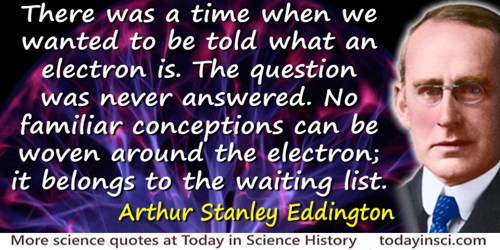
There was a time when we wanted to be told what an electron is. The question was never answered. No familiar conceptions can be woven around the electron; it belongs to the waiting list.
The Nature Of The Physical World (1928), 290.
There’s Nature and she’s going to come out the way She is. So therefore when we go to investigate we shouldn’t predecide what it is we’re looking for only to find out more about it. Now you ask: “Why do you try to find out more about it?” If you began your investigation to get an answer to some deep philosophical question, you may be wrong. It may be that you can’t get an answer to that particular question just by finding out more about the character of Nature. But that’s not my interest in science; my interest in science is to simply find out about the world and the more I find out the better it is, I like to find out...
…...
These creators, makers of the new, can never become obsolete, for in the arts there is no correct answer. The story of discoverers could be told in simple chronological order, since the latest science replaces what went before. But the arts are another story—a story of infinite addition. We must find order in the random flexings of the imagination.
In The Creators: A History of Heroes of the Imagination (1992), xv.
This is the forest primeval. The murmuring pines and the hemlocks,
Bearded with moss, and in garments green, indistinct in the twilight,
Stand like Druids of eld, with voices sad and prophetic,
Stand like harpers hoar, with beards that rest on their bosoms.
Loud from its rocky caverns, the deep-voiced neighboring ocean
Speaks, and in accents disconsolate answers the wail of the forest.
Bearded with moss, and in garments green, indistinct in the twilight,
Stand like Druids of eld, with voices sad and prophetic,
Stand like harpers hoar, with beards that rest on their bosoms.
Loud from its rocky caverns, the deep-voiced neighboring ocean
Speaks, and in accents disconsolate answers the wail of the forest.
From poem 'Evangeline: A Tale of Acadie' (1847), as collected in The Poetical Works of H.W. Longfellow (1855), 7.
This leads us to ask for the reasons which call for this new theory of transmutation. The beginning of things must needs lie in obscurity, beyond the bounds of proof, though within those of conjecture or of analogical inference. Why not hold fast to the customary view, that all species were directly, instead of indirectly, created after their respective kinds, as we now behold them,--and that in a manner which, passing our comprehension, we intuitively refer to the supernatural? Why this continual striving after “the unattained and dim,”—these anxious endeavors, especially of late years, by naturalists and philosophers of various schools and different tendencies, to penetrate what one of them calls “the mystery of mysteries,” the origin of species? To this, in general, sufficient answer may be found in the activity of the human intellect, “the delirious yet divine desire to know,” stimulated as it has been by its own success in unveiling the laws and processes of inorganic Nature,—in the fact that the principal triumphs of our age in physical science have consisted in tracing connections where none were known before, in reducing heterogeneous phenomena to a common cause or origin, in a manner quite analogous to that of the reduction of supposed independently originated species to a common ultimate origin,—thus, and in various other ways, largely and legitimately extending the domain of secondary causes. Surely the scientific mind of an age which contemplates the solar system as evolved from a common, revolving, fluid mass,— which, through experimental research, has come to regard light, heat, electricity, magnetism, chemical affinity, and mechanical power as varieties or derivative and convertible forms of one force, instead of independent species,—which has brought the so-called elementary kinds of matter, such as the metals, into kindred groups, and raised the question, whether the members of each group may not be mere varieties of one species,—and which speculates steadily in the direction of the ultimate unity of matter, of a sort of prototype or simple element which may be to the ordinary species of matter what the protozoa or component cells of an organism are to the higher sorts of animals and plants,—the mind of such an age cannot be expected to let the old belief about species pass unquestioned.
— Asa Gray
'Darwin on the Origin of Species', The Atlantic Monthly (Jul 1860), 112-3. Also in 'Natural Selection Not Inconsistent With Natural Theology', Darwiniana: Essays and Reviews Pertaining to Darwinism (1876), 94-95.
This was what the universities were turning out nowadays. The science-is-a-sacred-cow boys. People who believe you could pour mankind into a test-tube and titrate it, and come up with all the answers to the problems of the human race.
The Day the World Ended (1953). Quoted in Gary Westfahl, Science Fiction Quotations (2005), 320-321.
Thou shalt not answer questionnaires
Or quizzes upon World-Affairs,
Nor with compliance
Take any test. Thou shalt not sit
With statisticians nor commit
A social science.
Or quizzes upon World-Affairs,
Nor with compliance
Take any test. Thou shalt not sit
With statisticians nor commit
A social science.
Stanza from the Phi Beta Kappa poem 'Under Which Lyre (A Reactionary Tract for the Times)', which Auden wrote and delivered at the 1946 Victory Commencement of Harvard University (Jun 1946). Quoted in Adam Kirsch, 'A Poet's Warning', Harvard Magazine (Nov-Dec 2007) which gives more background on the poem. Also in Collected Poems of W.H. Auden (1976), 262.
Thought isn’t a form of energy. So how on Earth can it change material processes? That question has still not been answered.
As quoted in Eric Roston, The Carbon Age: How Life’s Core Element Has Become Civilization’s Gratest Threat (2009), 117.
To prove to an indignant questioner on the spur of the moment that the work I do was useful seemed a thankless task and I gave it up. I turned to him with a smile and finished, “To tell you the truth we don’t do it because it is useful but because it’s amusing.” The answer was thought of and given in a moment: it came from deep down in my soul, and the results were as admirable from my point of view as unexpected. My audience was clearly on my side. Prolonged and hearty applause greeted my confession. My questioner retired shaking his head over my wickedness and the newspapers next day, with obvious approval, came out with headlines “Scientist Does It Because It’s Amusing!” And if that is not the best reason why a scientist should do his work, I want to know what is. Would it be any good to ask a mother what practical use her baby is? That, as I say, was the first evening I ever spent in the United States and from that moment I felt at home. I realised that all talk about science purely for its practical and wealth-producing results is as idle in this country as in England. Practical results will follow right enough. No real knowledge is sterile. The most useless investigation may prove to have the most startling practical importance: Wireless telegraphy might not yet have come if Clerk Maxwell had been drawn away from his obviously “useless” equations to do something of more practical importance. Large branches of chemistry would have remained obscure had Willard Gibbs not spent his time at mathematical calculations which only about two men of his generation could understand. With this faith in the ultimate usefulness of all real knowledge a man may proceed to devote himself to a study of first causes without apology, and without hope of immediate return.
From lecture to a scientific society in Philadelphia on “The Mechanism of the Muscle” given by invitation after he received a Nobel Prize for that work. The quote is Hill’s response to a post-talk audience question asking disapprovingly what practical use the speaker thought there was in his research. The above quoted answer, in brief, is—for the intellectual curiosity. As quoted about Hill by Bernard Katz in his own autobiographical chapter, 'Sir Bernard Katz', collected in Larry R. Squire (ed.), The History of Neuroscience in Autobiography (1996), Vol. 1, 350-351. Two excerpts from the above have been highlighted as standalone quotes here in this same quote collection for A. V. Hill. They begin “All talk about science…” and “The most useless investigation may prove…”.
To understand [our cosmological roots]...is to give voice to the silent stars. Stand under the stars and say what you like to them. Praise them or blame them, question them, pray to them, wish upon them. The universe will not answer. But it will have spoken.
…...
Train yourselves. Don’t wait to be fed knowledge out of a book. Get out and seek it. Make explorations. Do your own research work. Train your hands and your mind. Become curious. Invent your own problems and solve them. You can see things going on all about you. Inquire into them. Seek out answers to your own questions. There are many phenomena going on in nature the explanation of which cannot be found in books. Find out why these phenomena take place. Information a boy gets by himself is enormously more valuable than that which is taught to him in school.
In 'Dr. Irving Langmuir', Boys' Life (Jul 1941), 12.
Tyndall, ... I must remain plain Michael Faraday to the last; and let me now tell you, that if accepted the honour which the Royal Society desires to confer upon me, I would not answer for the integrity of my intellect for a single year.
On being offered the Presidency of the Royal Society.
On being offered the Presidency of the Royal Society.
John Tyndall, Faraday as a Discoverer (1868), 157-8.
We [may] answer the question: “Why is snow white?” by saying, “For the same reason that soap-suds or whipped eggs are white”—in other words, instead of giving the reason for a fact, we give another example of the same fact. This offering a similar instance, instead of a reason, has often been criticised as one of the forms of logical depravity in men. But manifestly it is not a perverse act of thought, but only an incomplete one. Furnishing parallel cases is the necessary first step towards abstracting the reason imbedded in them all.
In The Principles of Psychology (1918), Vol. 2, 363-364.
We academic scientists move within a certain sphere, we can go on being useless up to a point, in the confidence that sooner or later some use will be found for our studies. The mathematician, of course, prides himself on being totally useless, but usually turns out to be the most useful of the lot. He finds the solution but he is not interested in what the problem is: sooner or later, someone will find the problem to which his solution is the answer.
'Concluding Remarks', Proceedings of the Royal Society of London, Series A, A Discussion of New Materials, 1964, 282, 152-3.
We are a bit of stellar matter gone wrong. We are physical machinery—puppets that strut and talk and laugh and die as the hand of time pulls the strings beneath. But there is one elementary inescapable answer. We are that which asks the question.
…...
We expect that the study of lunar geology will help to answer some longstanding questions about the early evolution of the earth. The moon and the earth are essentially a two-planet system, and the two bodies are probably closely related in origin. In this connection the moon is of special interest because its surface has not been subjected to the erosion by running water that has helped to shape the earth’s surface.
In Scientific American (Sep 1964). As cited in '50, 100 & 150 Years Ago', Scientific American (Dec 2014), 311, No. 6, 98.
We feel that even if all possible scientific questions be answered, the problems of life have still not been touched at all. Of course there is then no question left, and just this is the answer.
From the German, “Wir fühlen, dass selbst, wenn alle möglichen wissenschaftlichen Fragen beantwortet sind, unsere Lebensprobleme noch gar nicht berührt sind. Freilich bleibt dann eben keine Frage mehr; und eben dies ist die Antwort,” in Logisch-Philosophische Abhandlung (1921). German text with English translation in Tractatus Logico-Philosophicus (1922), 186-187.
We fooled ourselves into thinking this thing wouldn’t crash. When I was in astronaut training I asked, “what is the likelihood of another accident?” The answer I got was: one in 10,000, with an asterisk. The asterisk meant, “we don’t know.”
…...
We grow in time to trust the future for our answers.
In An Anthropologist at Work (1959, 2011), 134.
We live in an essential and unresolvable tension between our unity with nature and our dangerous uniqueness. Systems that attempt to place and make sense of us by focusing exclusively either on the uniqueness or the unity are doomed to failure. But we must not stop asking and questing because the answers are complex and ambiguous.
In 'Our Natural Place', Hen's Teeth and Horse’s Toes: Further Reflections in Natural History (1994, 2010), 250.
We may fairly claim for the study of Physics the recognition that it answers to an impulse implanted by nature in the constitution of man.
From 'On the Study of Physics', a Lecture delivered in the Royal Institution of Great Britain in the Spring of 1854. Collected in Fragments of Science for Unscientific People: A Series of Detached Essays, Lectures, and Reviews (1892), Vol. 1, 284.
We often frame our understanding of what the [Hubble] space telescope will do in terms of what we expect to find, and actually it would be terribly anticlimactic if in fact we find what we expect to find. … The most important discoveries will provide answers to questions that we do not yet know how to ask and will concern objects we have not yet imagined.
As quoted in Timothy Ferris, 'The Space Telescope: A Sign of Intelligent Life', New York Times (29 Apr 1990), A1.
We should seek the greatest value of our action.
[Answer to question: So here we are. What should we do?]
[Answer to question: So here we are. What should we do?]
'Stephen Hawking: "There is no heaven; it's a fairy story"', interview in newspaper The Guardian (15 May 2011).
We should therefore, with grace and optimism, embrace NOMA’s tough-minded demand: Acknowledge the personal character of these human struggles about morals and meanings, and stop looking for definite answers in nature’s construction. But many people cannot bear to surrender nature as a ‘transitional object’–a baby’s warm blanket for our adult comfort. But when we do (for we must) , nature can finally emerge in her true form: not as a distorted mirror of our needs, but as our most fascinating companion. Only then can we unite the patches built by our separate magisteria into a beautiful and coherent quilt called wisdom.
From essay, 'Non-overlapping Magisteria', Natural History magazine (Mar 1997), 106, 16–22 and 60–62. Collected in Rocks of Ages: Science and Religion in the Fullness of Life (1999), 178. [NOMA or Non-overlapping magisteria, is viewpoint advocated by Gould, that science and religion each represent different areas of inquiry, fact vs. values, and thus he aims to resolve the supposed conflict between science and religion. He draws the term “magisterium” from an encyclical of Pope Pius XII.
about science and religion. —Webmaster]
Were we in danger of stopping [the experiment] when we liked the answer? I realized then, as I have often said since, that nature does not “know” what experiment a scientist is trying to do. “God loves the noise as much as the signal.”
In Confessions of a Technophile (1994), 45, with embedded quote by Branscomb cited in footnote as from 'Physics and the APS in 1979', Physics Today (Apr 1980), 33, No. 4, 49.
What Is Mathematics? This question, if asked in earnest, has no answer.
'Why Mathematics Grows', Journal of the History of Ideas (Jan-Mar 1965), 26, No. 1, 3. In Salomon Bochner and Robert Clifford Gunning (ed.) Collected Papers of Salomon Bochner (1992), Vol. 4, 191.
What is the meaning of human life, or for that matter, of the life of any creature? To know an answer to this question means to be religious. Does it make any sense, then, to pose this question? I answer: The man who regards his own life and that of his fellow creatures as meaningless is not merely unhappy but hardly fit for life.
In Ideas and Opinions (1954), 11. A different translation is given in The World As I See It (1935), 1. From the original German in Mein Weltbild (1934).
What is the meaning of human life, or of organic life altogether? To answer this question at all implies a religion. Is there any sense then, you ask, in putting it? I answer, the man who regards his own life and that of his fellow creatures as meaningless is not merely unfortunate but almost disqualified for life.
In The World As I See It (1935), 1. A different translation is given in Ideas and Opinions (1954), 11. From the original German in Mein Weltbild (1934).
What makes planets go around the sun? At the time of Kepler, some people answered this problem by saying that there were angels behind them beating their wings and pushing the planets around an orbit. As you will see, the answer is not very far from the truth. The only difference is that the angels sit in a different direction and their wings push inward.
In The Character of Physical Law (1965), 18.
What quality is shared by all objects that provoke our aesthetic emotions? Only one answer seems possible—significant form. In each, lines and colors combined in a particular way; certain forms and relations of forms, stir our aesthetic emotions. These relations and combinations of lines and colours, these æsthetically moving forms, I call “Significant Form”; and “Significant Form” is the one quality common to all works of visual art.
In Art (1913), 8.
Whatever answers faith gives.. .such answers always give an infinite meaning to the finite existence of man; a meaning that is not destroyed by suffering, deprivation or death. This means only in faith can we find the meaning and possibility of life.
Quoted in Kim Lim (ed.), 1,001 Pearls of Spiritual Wisdom: Words to Enrich, Inspire, and Guide Your Life (2014), 19
Whatever the common-sense of earlier generations may have held in this respect, modern common-sense holds that the scientist’s answer is the only ultimately true one. In the last resort enlightened common-sense sticks by the opaque truth and refuses to go behind the returns given by the tangible facts.
From 'The Place of Science in Modern Civilisation', American Journal of Sociology (Mar 1906), 11, collected in The Place of Science in Modern Civilisation and Other Essays (1919), 4.
Wheeler’s First Moral Principle: Never make a calculation until you know the answer. Make an estimate before every calculation, try a simple physical argument (symmetry! invariance! conservation!) before every derivation, guess the answer to every paradox and puzzle. Courage: No one else needs to know what the guess is. Therefore make it quickly, by instinct. A right guess reinforces this instinct. A wrong guess brings the refreshment of surprise. In either case life as a spacetime expert, however long, is more fun!
In E.F. Taylor and J.A. Wheeler, Spacetime Physics (1992), 20.
When a [mercury] thermometer … was made (perhaps imperfect in many ways) the result answered to my prayer; and with great pleasure of mind I observed the truth [that water boils at a fixed degree of heat].
From 'Experimenta circa gradum caloris liquorum nonnullorum ebullientium instituta', Philosophical Transactions (1724), 33, 1, as translated in William Francis Magie, A Source Book in Physics (1935), 131.
When asked … [about] an underlying quantum world, Bohr would answer, “There is no quantum world. There is only an abstract quantum physical description. It is wrong to think that the task of physics is to find out how nature is. Physics concerns what we can say about Nature.”
As quoted in Aage Petersen, 'The Philosophy of Niels Bohr', Bulletin of the Atomic Scientists, 1963, 19, 12. Note: Bohr's remark, although in quotation marks, should not be regarded as a direct quote in these exact words. It is a generalised statement in Petersen’s words to represent Bohr’s viewpoint. This is explained in a footnote in Michael Frayn, The Human Touch (2007), 431 based on an article by N. David Mermin in Physics Today (Feb 2004).
When Galileo caused balls, the weights of which he had himself previously determined, to roll down an inclined plane; when Torricelli made the air carry a weight which he had calculated beforehand to be equal to that of a definite volume of water; or in more recent times, when Stahl changed metal into lime, and lime back into metal, by withdrawing something and then restoring it, a light broke upon all students of nature. They learned that reason has insight only into that which it produces after a plan of its own, and that it must not allow itself to be kept, as it were, in nature's leading-strings, but must itself show the way with principles of judgement based upon fixed laws, constraining nature to give answer to questions of reason's own determining. Accidental observations, made in obedience to no previously thought-out plan, can never be made to yield a necessary law, which alone reason is concerned to discover.
Critique of Pure Reason (1781), trans. Norman Kemp Smith (1929), 20.
When I listen to a soprano sing a Handel aria with an astonishing coloratura from that particular larynx, I say to myself, there has to be a biological reason that was useful at some stage. The larynx of a human being did not evolve without having some function. And the only function I can see is sexual attraction.
From 'Interview: Of Mind and Matter: David Attenborough Meets Richard Dawkins', The Guardian (11 Sep 2010).
When I was young, I said to God, “God, tell me the mystery of the universe.” But God answered, “That knowledge is for me alone”. So I said, “God, tell me the mystery of the peanut.” Then God said, “Well, George, that’s more nearly your size.” And he told me.
In Walter B. Knight, Knight’s Treasury of Illustrations (1956), 368, citing The Gospel Banner.
When Newton saw an apple fall, he found
In that slight startle from his contemplation—
'Tis said (for I'll not answer above ground
For any sage's creed or calculation)—
A mode of proving that the earth turn'd round
In a most natural whirl, called 'gravitation';
And this is the sole mortal who could grapple,
Since Adam, with a fall, or with an apple.
In that slight startle from his contemplation—
'Tis said (for I'll not answer above ground
For any sage's creed or calculation)—
A mode of proving that the earth turn'd round
In a most natural whirl, called 'gravitation';
And this is the sole mortal who could grapple,
Since Adam, with a fall, or with an apple.
Don Juan (1821), Canto 10, Verse I. In Jerome J. McGann (ed.), Lord Byron: The Complete Poetical Works (1986), Vol. 5, 437.
When the first “thermonuclear device” was approaching the test stage and someone asked Teller, “Will it work?” he had to admit that he didn’t know. “But you didn’t know that five years ago,” the questioner pointed out. “True,” Teller answered, “but now we don’t know on much better grounds.”
As given by in Robert Coughlan, 'Dr. Edward Teller’s Magnificent Obsession', Life (6 Sep 1954), 70.
When the late Sophus Lie … was asked to name the characteristic endowment of the mathematician, his answer was the following quaternion: Phantasie, Energie, Selbstvertrauen, Selbstkritik.
In Lectures on Philosophy, Science and Art (1908), 31. [“Quaternion” is used here in its meaning of a set of four people or things. The last four words, given in German, translate as “Imagination, Energy, Self-confidence, Self-criticism.” —Webmaster]
When the solution is simple, God is answering. Where the world ceases to be the scene of our personal hopes and wishes, where we face it as free beings admiring, asking and observing, there we enter the realm of Art and Science.
…...
When we are young, we think that science has to do with facts, with finding answers and solutions, and that it proceeds like an arrow from the primitive to the sophisticated, from mystery to light. But as we get older, we find that, while science does have to do with facts and laws, it has equally to do with wisdom.
In Introduction to Isaac Asimov and Jason A. Shulman (eds.), Isaac Asimov’s Book of Science and Nature Quotations (1988), xix.
When we say that scientific knowledge is unlimited, we mean that there is no question whose answer is in principle unattainable by science.
The Logical Structure of the World, trans. R. George (1967), 290. In Vinoth Ramachandra, Subverting Global Myths: Theology and the Public Issues Shaping our World (2008), 171.
Where any answer is possible, all answers are meaningless.
Referring to speculations (on “Not as We Know It” alien lifeforms) made in the total absence of evidence. In 'Fifty Million Big Brothers', The Magazine of Fantasy and Science Fiction (Nov 1978), 55, No. 5, 86.
While the method of the natural sciences is... analytic, the method of the social sciences is better described as compositive or synthetic. It is the so-called wholes, the groups of elements which are structurally connected, which we learn to single out from the totality of observed phenomena... Insofar as we analyze individual thought in the social sciences the purpose is not to explain that thought, but merely to distinguish the possible types of elements with which we shall have to reckon in the construction of different patterns of social relationships. It is a mistake... to believe that their aim is to explain conscious action ... The problems which they try to answer arise only insofar as the conscious action of many men produce undesigned results... If social phenomena showed no order except insofar as they were consciously designed, there would indeed be no room for theoretical sciences of society and there would be, as is often argued, only problems of psychology. It is only insofar as some sort of order arises as a result of individual action but without being designed by any individual that a problem is raised which demands a theoretical explanation... people dominated by the scientistic prejudice are often inclined to deny the existence of any such order... it can be shown briefly and without any technical apparatus how the independent actions of individuals will produce an order which is no part of their intentions... The way in which footpaths are formed in a wild broken country is such an instance. At first everyone will seek for himself what seems to him the best path. But the fact that such a path has been used once is likely to make it easier to traverse and therefore more likely to be used again; and thus gradually more and more clearly defined tracks arise and come to be used to the exclusion of other possible ways. Human movements through the region come to conform to a definite pattern which, although the result of deliberate decision of many people, has yet not be consciously designed by anyone.
…...
Who are we? The answer to this question is not only one of the tasks but the task of science.
…...
Why can the chemist not take the requisite numbers of atoms and simply put them together? The answer is that the chemist never has atoms at his disposal, and if he had, the direct combination of the appropriate numbers of atoms would lead only to a Brobdingnagian potpourri of different kinds of molecules, having a vast array of different structures. What the chemist has at hand always consists of substances, themselves made up of molecules, containing defined numbers of atoms in ordered arrangements. Consequently, in order to synthesize anyone substance, his task is that of combining, modifying, transforming, and tailoring known substances, until the total effect of his manipulations is the conversion of one or more forms of matter into another.
In 'Art and Science in the Synthesis of Organic Compounds: Retrospect and Prospect', in Maeve O'Connor (ed.), Pointers and Pathways in Research (1963), 28.
Why does such and such animal feed only on flesh, while another on plants? Where does one get the finesse of its sense of smell, or that of its hearing? What is the source of the prodigious strength of the muscles of birds? How is this force used to produce this amazing movement of flight? How does it come about that the bird sees equally well at quite different distances? What is the cause of the range and variety of its voice? Why is a reptile so lethargic? Why does a worm stay alive long after being divided? Why can a zoophyte live equally well with some parts of its body cut off? Is it presumed there could be natural history without these questions, and thousands of others like them, and do we think we can answer without a thorough comparative anatomy?
From 'Lettre à M. de la Cépède', collected in G. L. Duvernpy (ed.) Leçons d’Anatomie Comparée de Georges Cuvier: Tome IV, Première Partie: Corrigée et Augmentée (2nd ed. 1833), xxij. As translated and tweaked by Webmaster using online translation sites from the original French: “Pourquoi tel animal ne se nourrit-il que de chair, tel autre que de végétaux? D’où celui-ci tire-t-il la finesse de son odorat, ou celle de son ouïe? Quelle est la source de la force prodigieux des muscles des oiseaux? Comment cette force est-elle employée à produire ce mouvement si étonnant du vol? D’où viens que l’oiseau voit également bien à des distances si differentes? Quelles sont les causes de l’etendue, et de la variété de sa voix? Pourquoi tel reptile, est-il si engourdie? Pourquoi tel ver, conserve-t-il de la vie long-temps après être divisé? Pourquoi tel zoophyte peut-il vivre égalment bien, quelque partie de son corps que l’on en retranche. Suppose-t-on qu’il puisse exister une histoire naturelle sans ces questions, et des millieurs d’autres semblables, et des milliers d’autres semblables, y soient traitées, et croit-on pouvoir y répondre sans une anatomie compárée profonde?” [John Abernethy used this quote in a lecture to illustrate what animating motive caused Cuvier to strive so hard to find answers.]
Why does this magnificent applied science which saves work and makes life easier bring us so little happiness? … The simple answer runs: “Because we have not yet learned to make sensible use of it.”
Address to students of the California Institute of Technology, Pasadena, California (16 Feb 1931). In New York Times (17 Feb 1931), p. 6.
Why then be concerned about the conservation of wildlife when for all practical purposes we would be much better off if humans and their domestic animals and pets were the only living creatures on the face of the earth? There is no obvious and demolishing answer to this rather doubtful logic although in practice the destruction of all wild animals would certainly bring devastating changes to our existence on this planet as we know it today… The trouble is that everything in nature is completely interdependent. Tinker with one part of it and the repercussions ripple out in all directions… Wildlife—and that includes everything from microbes to blue whales and from a fungus to a redwood tree—has been so much part of life on the earth that we are inclined to take its continued existence for granted… Yet the wildlife of the world is disappearing, not because of a malicious and deliberate policy of slaughter and extermination, but simply because of a general and widespread ignorance and neglect.
World Wildlife Fund Dinner, York, (1969). As quoted and cited in 'The Mirror of a Duke', The Dorset Eye on dorseteye.com website
Why then does science work? The answer is that nobody knows. It is a complete mystery—perhaps the complete mystery&mdashwhy the human mind should be able to understand anything at all about the wider universe. ... Perhaps it is because our brains evolved through the working of natural law that they somehow resonate with natural law. ... But the mystery, really, is not that we are at one with the universe, but that we are so to some degree at odds with it, different from it, and yet can understand something about it. Why is this so?
Coming of Age in the Milky Way (1988), 385. In Vinoth Ramachandra, Subverting Global Myths: Theology and the Public Issues Shaping our World (2008), 185.
Will fluorine ever have practical applications?
It is very difficult to answer this question. I may, however, say in all sincerity that I gave this subject little thought when I undertook my researches, and I believe that all the chemists whose attempts preceded mine gave it no more consideration.
A scientific research is a search after truth, and it is only after discovery that the question of applicability can be usefully considered.
It is very difficult to answer this question. I may, however, say in all sincerity that I gave this subject little thought when I undertook my researches, and I believe that all the chemists whose attempts preceded mine gave it no more consideration.
A scientific research is a search after truth, and it is only after discovery that the question of applicability can be usefully considered.
Proceedings of the Royal Institution (1897). In Annual Report of the Board of Regents of the Smithsonian Institution to July 1897 (1898), 261.
With the extension of mathematical knowledge will it not finally become impossible for the single investigator to embrace all departments of this knowledge? In answer let me point out how thoroughly it is ingrained in mathematical science that every real advance goes hand in hand with the invention of sharper tools and simpler methods which, at the same time, assist in understanding earlier theories and in casting aside some more complicated developments.
In 'Mathematical Problems', Lecture at the International Congress of Mathematics, Paris, (8 Aug 1900). Translated by Dr. Maby Winton Newson in Bulletin of the American Mathematical Society (1902), 8, 479. As quoted and cited in Robert Édouard Moritz, Memorabilia Mathematica; Or, The Philomath's Quotation-book (1914), 94-95. It is reprinted in Jeremy Gray, The Hilbert Challenge (2000), 282.
With whom [do] the adherents of historicism actually empathize[?] The answer is inevitable: with the victor. And all rulers are the heirs of those who conquered before them. Hence, empathy with the victor invariably benefits the rulers. Historical materialists know what that means. Whoever has emerged victorious participates to this day in the triumphal procession in which the present rulers step over those who are lying prostrate. According to traditional practice, the spoils are carried along in the procession. They are called cultural treasures, and a historical materialist views them with cautious detachment. For without exception the cultural treasures he surveys have an origin which he cannot contemplate without horror. They owe their existence not only to the efforts of the great minds and talents who have created them, but also to the anonymous toil of their contemporaries. There is no document of civilization which is not at the same time a document of barbarism.
'Theses on the Philosophy of History' (completed 1940, first published 1950). In Illuminations, ed. Hannah Arendt and trans. Harry Zohn (1970), 258.
You propound a complicated arithmetical problem: say cubing a number containing four digits. Give me a slate and half an hour’s time, and I can produce a wrong answer.
Cashel Byron's Profession (1886, 1901), xxiii.
 In science it often happens that scientists say, 'You know that's a really good argument; my position is mistaken,' and then they would actually change their minds and you never hear that old view from them again. They really do it. It doesn't happen as often as it should, because scientists are human and change is sometimes painful. But it happens every day. I cannot recall the last time something like that happened in politics or religion.
(1987) --
In science it often happens that scientists say, 'You know that's a really good argument; my position is mistaken,' and then they would actually change their minds and you never hear that old view from them again. They really do it. It doesn't happen as often as it should, because scientists are human and change is sometimes painful. But it happens every day. I cannot recall the last time something like that happened in politics or religion.
(1987) -- 





.jpg)

.jpg)


