Ancestor Quotes (63 quotes)
[Everyone should know:] The unity of life that comes about through evolution, since we’re all descended from a single common ancestor. It’s almost too good to be true, that on one planet this extraordinary complexity of life should have come about by what is pretty much an intelligible process. And we're the only species capable of understanding it.
From 'Interview: Of Mind and Matter: David Attenborough Meets Richard Dawkins', The Guardian (11 Sep 2010),
[Other than fossils,] the most important of these other records of creation is, without doubt, ontogeny, that is, the history of the developmment of the organic individual (embryology and motamorphology). It briefly repeats in great and marked features the series of forms which the ancestors of the respective individuals have passed through from the beginning of their tribe. We have designated the palaeontological history of the development of the ancestors of a living form as the history of a tribe, or phylogeny, and we may therefore thus enunciate this exceedingly important biogenetic fundamental principle: “Ontogeny is a short and quick repetition, or recapitulation, of Phylogeny, determined by the laws of Inheritance and Adaptation.”
In Ernst Haeckel and E. Ray Lankester (trans.), The History of Creation (1876), Vol. 2, 33. Seen shortened to “Ontogeny recapitulates phylogeny.” This was Haeckel's (incorrect) answer to the vexing question of his time: what is the relationship between individual development (ontogeny) and the evolution of species and lineages (phylogeny)?
[When questioned on his longevity] First of all, I selected my ancestors very wisely. ... They were long-lived, healthy people. Then, as a chemist, I know how to eat, how to exercise, keep my blood circulating. ... I don't worry. I don't get angry at people. I don't worry about things I can't help. I do what I can to make the world a better place to live, but I don't complain if things aren't right. As a scientist I take the world as I find it.
[About celebrating his 77th birthday by swimming a half mile in 22 minutes] I used swim fins and webbed gloves because a man of intelligence should apply his power efficiently, not just churn the water.
[About celebrating his 77th birthday by swimming a half mile in 22 minutes] I used swim fins and webbed gloves because a man of intelligence should apply his power efficiently, not just churn the water.
As quoted in obituary by Wallace Turner, 'Joel Hildebrand, 101', New York Times (3 May 1983), D27.
Lyveris to-forn us
Useden to marke
For selkouthes that thei seighen,
Hir sones for to teche;
And helden it an heigh science
Hir wittes to knowe.
Ac thorugh hir science soothly
Was nevere no soule y-saved,
Ne broght by hir bokes
To blisse ne to joye;
For alle hir kynde knowynges
Come but of diverse sightes.
Patriarkes and prophetes
Repreveden hir science,
And seiden hir wordes and hir wisdomes
Nas but a folye
And to the clergie of Crist
Counted it but a trufle.
Our ancestors in olden days used to record
The strange things they saw, and teach them to their sons;
And they held it a high science, to have knowledge of such things.
But no soul was ever saved by all that science,
Nor brought by books into eternal bliss;
Their science was only a series of sundry observations.
So patriarchs and prophets disapproved of their science,
And said their so-called words of wisdom were but folly—
And compared with Christian philosophy, a contemptible thing.
Useden to marke
For selkouthes that thei seighen,
Hir sones for to teche;
And helden it an heigh science
Hir wittes to knowe.
Ac thorugh hir science soothly
Was nevere no soule y-saved,
Ne broght by hir bokes
To blisse ne to joye;
For alle hir kynde knowynges
Come but of diverse sightes.
Patriarkes and prophetes
Repreveden hir science,
And seiden hir wordes and hir wisdomes
Nas but a folye
And to the clergie of Crist
Counted it but a trufle.
Our ancestors in olden days used to record
The strange things they saw, and teach them to their sons;
And they held it a high science, to have knowledge of such things.
But no soul was ever saved by all that science,
Nor brought by books into eternal bliss;
Their science was only a series of sundry observations.
So patriarchs and prophets disapproved of their science,
And said their so-called words of wisdom were but folly—
And compared with Christian philosophy, a contemptible thing.
In William Langland and B. Thomas Wright (ed.) The Vision and Creed of Piers Ploughman (1842), 235-236. Modern translation by Terrence Tiller in Piers Plowman (1981, 1999), 123.
A first step in the study of civilization is to dissect it into details, and to classify these in their proper groups. Thus, in examining weapons, they are to be classed under spear, club, sling, bow and arrow, and so forth; among textile arts are to be ranged matting, netting, and several grades of making and weaving threads; myths are divided under such headings as myths of sunrise and sunset, eclipse-myths, earthquake-myths, local myths which account for the names of places by some fanciful tale, eponymic myths which account for the parentage of a tribe by turning its name into the name of an imaginary ancestor; under rites and ceremonies occur such practices as the various kinds of sacrifice to the ghosts of the dead and to other spiritual beings, the turning to the east in worship, the purification of ceremonial or moral uncleanness by means of water or fire. Such are a few miscellaneous examples from a list of hundreds … To the ethnographer, the bow and arrow is the species, the habit of flattening children’s skulls is a species, the practice of reckoning numbers by tens is a species. The geographical distribution of these things, and their transmission from region to region, have to be studied as the naturalist studies the geography of his botanical and zoological species.
In Primitive Culture (1871), Vol. 1, 7.
A man has no reason to be ashamed of having an ape for his grandfather. If there were an ancestor whom I should feel shame in recalling it would rather be a man—a man of restless and versatile intellect—who … plunges into scientific questions with which he has no real acquaintance, only to obscure them by an aimless rhetoric, and distract the attention of his hearers from the real point at issue by eloquent digressions and skilled appeals to religious prejudice.
As recollected in a letter written by an undergraduate, John Richard Green, writing to his friend, afterwards Professor Boyd Dawkins. This was Huxley's rebuttal to Bishop Samuel Wilberforce who ridiculed Darwin's theory of evolution at a meeting of the British Association at Oxford (30 Jun 1860). After hearing Wilberforce's speech, and before rising himself, Huxley is said to have remarked, “The Lord has delivered him into my hands!” (No transcript was taken at the time, so the words are not verbatim. The version above is commonly seen, and was said by Huxley to be fair in substance, if not wholely accurate. The letter excerpt is in Leonard Huxley (ed.), Life and Letters of Thomas Henry Huxley (1916), Vol. 1, 199. Additional accounts of the debate are given in the book.
All fossil anthropoids found hitherto have been known only from mandibular or maxillary fragments, so far as crania are concerned, and so the general appearance of the types they represented had been unknown; consequently, a condition of affairs where virtually the whole face and lower jaw, replete with teeth, together with the major portion of the brain pattern, have been preserved, constitutes a specimen of unusual value in fossil anthropoid discovery. Here, as in Homo rhodesiensis, Southern Africa has provided documents of higher primate evolution that are amongst the most complete extant. Apart from this evidential completeness, the specimen is of importance because it exhibits an extinct race of apes intermediate between living anthropoids and man ... Whether our present fossil is to be correlated with the discoveries made in India is not yet apparent; that question can only be solved by a careful comparison of the permanent molar teeth from both localities. It is obvious, meanwhile, that it represents a fossil group distinctly advanced beyond living anthropoids in those two dominantly human characters of facial and dental recession on one hand, and improved quality of the brain on the other. Unlike Pithecanthropus, it does not represent an ape-like man, a caricature of precocious hominid failure, but a creature well advanced beyond modern anthropoids in just those characters, facial and cerebral, which are to be anticipated in an extinct link between man and his simian ancestor. At the same time, it is equally evident that a creature with anthropoid brain capacity and lacking the distinctive, localised temporal expansions which appear to be concomitant with and necessary to articulate man, is no true man. It is therefore logically regarded as a man-like ape. I propose tentatively, then, that a new family of Homo-simidæ be created for the reception of the group of individuals which it represents, and that the first known species of the group be designated Australopithecus africanus, in commemoration, first, of the extreme southern and unexpected horizon of its discovery, and secondly, of the continent in which so many new and important discoveries connected with the early history of man have recently been made, thus vindicating the Darwinian claim that Africa would prove to be the cradle of mankind.
'Australopithicus africanus: The Man-Ape of South Africa', Nature, 1925, 115, 195.
An irrefutable proof that such single-celled primaeval animals really existed as the direct ancestors of Man, is furnished according to the fundamental law of biogeny by the fact that the human egg is nothing more than a simple cell.
Natürlche Schöpfungsgeschichte, trans. E. R. Lankester, The History of Creation (1892), Vol. 2, 381.
Any living cell carries with it the experience of a billion years of experimentation by its ancestors. (1949)
From Transactions of the Connecticut Academy of Arts and Sciences (Dec 1949), 38. Used as epigraph (without citation) to Chap 6, in Arnold Jay Levine, Viruses: A Scientific American Library Book (1991), 113.
As for me ... I would much rather be a perfected ape than a degraded Adam. Yes, if it is shown to me that my humble ancestors were quadrupedal animals, arboreal herbivores, brothers or cousins of those who were also the ancestors of monkeys and apes, far from blushing in shame for my species because of its genealogy and parentage, I will be proud of all that evolution has accomplished, of the continuous improvement which takes us up to the highest order, of the successive triumphs that have made us superior to all of the other species ... the splendid work of progress.
I will conclude in saying: the fixity of species is almost impossible, it contradicts the mode of succession and of the distribution of species in the sequence of extant and extinct creatures. It is therefore extremely likely that species are variable and are subject to evolution. But the causes, the mechanisms of this evolution are still unknown.
I will conclude in saying: the fixity of species is almost impossible, it contradicts the mode of succession and of the distribution of species in the sequence of extant and extinct creatures. It is therefore extremely likely that species are variable and are subject to evolution. But the causes, the mechanisms of this evolution are still unknown.
'Discussion sur la Machoire Humaine de la Naulette (Belgique)', Bulletin de la Societé d'Anthropologie de Paris, 2nd Series, I (1866), 595. Trans. Erik Trinkaus and Pat Shipman, The Neanderthals: Changing the Image of Mankind (1993), 103-4.
At the present time the fishing industry is, in some ways, at the stage at which primitive man was many centuries ago—we hunt the fish that Nature provides, just as our ancestors hunted animals for food. We have not yet begun to herd fish or to improve their quality—but one day we shall be forced to farm the seas as we do the land.
In 'Man Explores the Sea', Journal of the Royal Society of Arts (Sep 1963), 111, No. 5086, 787.
Beavers bred in captivity, inhabiting a concrete pool, will, if given the timber, fatuously go through all the motions of damming an ancestral stream.
In short story Work Suspended (1943) collected in Evelyn Waugh: The Complete Short Stories (1998), 320.
Despite the high long-term probability of extinction, every organism alive today, including every person reading this paper, is a link in an unbroken chain of parent-offspring relationships that extends back unbroken to the beginning of life on earth. Every living organism is a part of an enormously long success story—each of its direct ancestors has been sufficiently well adapted to its physical and biological environments to allow it to mature and reproduce successfully. Viewed thus, adaptation is not a trivial facet of natural history, but a biological attribute so central as to be inseparable from life itself.
In 'Integrative Biology: An Organismic Biologist’s Point of View', Integrative and Comparative Biology (2005), 45, 330.
Each and every loss becomes an instance of ultimate tragedy–something that once was, but shall never be known to us. The hump of the giant deer–as a nonfossilizable item of soft anatomy–should have fallen into the maw of erased history. But our ancestors provided a wondrous rescue, and we should rejoice mightily. Every new item can instruct us; every unexpected object possesses beauty for its own sake; every rescue from history’s great shredding machine is–and I don’t know how else to say this–a holy act of salvation for a bit of totality.
…...
Each has his own tree of ancestors, but at the top of all sits probably Arboreal.
'Pastoral'. Memories and Portraits (1887, 1915), 7.
Every book is a quotation; and every house is a quotation out of all forests and mines and stone-quarries; and every man is a quotation from all his ancestors.
Epigraph for chapter 'Quotation and Originality', in Letters and Social Aims (1875, 1917), 176.
Every living being is also a fossil. Within it, all the way down to the microscopic structure of its proteins, it bears the traces if not the stigmata of its ancestry.
In Jacques Monod and Austryn Wainhouse (trans.), Chance and Necessity: An Essay on the Natural Philosophy of Modern Biology (1972), 160.
Genetics seems to be everything to those who have convinced themselves they have arisen from worthy ancestors.
Epigraph in Isaac Asimov’s Book of Science and Nature Quotations (1988), 104.
GEOLOGY, n. The science of the earth's crust —to which, doubtless, will be added that of its interior whenever a man shall come up garrulous out of a well. The geological formations of the globe already noted are catalogued thus: The Primary, or lower one, consists of rocks, bones of mired mules, gas-pipes, miners' tools, antique statues minus the nose, Spanish doubloons and ancestors. The Secondary is largely made up of red worms and moles. The Tertiary comprises railway tracks, patent pavements, grass, snakes, mouldy boots, beer bottles, tomato cans, intoxicated citizens, garbage, anarchists, snap-dogs and fools.
The Collected Works of Ambrose Bierce (1911), Vol. 7, The Devil's Dictionary, 115.
Give me a dozen healthy infants, well-formed, and my own specified world to bring them up in and I’ll guarantee to take any one at random and train him to become any type of specialist I might select—doctor, lawyer, artist, merchant-chief and, yes, even beggar-man and thief, regardless of his talents, penchants, tendencies, abilities, vocations, and race of his ancestors. (1930)
Behaviorism (1998), 82.
Great thinkers build their edifices with subtle consistency. We do our intellectual forebears an enormous disservice when we dismember their visions and scan their systems in order to extract a few disembodied ‘gems’–thoughts or claims still accepted as true. These disarticulated pieces then become the entire legacy of our ancestors, and we lose the beauty and coherence of older systems that might enlighten us by their unfamiliarity–and their consequent challenge in our fallible (and complacent) modern world.
…...
If it is true as Whewell says, that the essence of the triumphs of Science and its progress consists in that it enables us to consider evident and necessary, views which our ancestors held to be unintelligible and were unable to comprehend, then the extension of the number concept to include the irrational, and we will at once add, the imaginary, is the greatest forward step which pure mathematics has ever taken.
In Theorie der Complexen Zahlensysteme (1867), 60. As translated in Robert Édouard Moritz, Memorabilia Mathematica; Or, The Philomath’s Quotation-book (1914), 281. From the original German, “Wenn es wahr ist, dass, wie Whewell meint, das Wesen der Triumphe der Wissenschaft und ihres Fortschrittes darin besteht, dass wir veranlasst werden, Ansichten, welche unsere Vorfahren für unbegreiflich hielten und unfähig waren zu begreifen, für evident und nothwendig zu halten, so war die Erweiterung des Zahlenbegriffes auf das Irrationale, und wollen wir sogleich hinzufügen, das Imaginäre, der grösste Fortschritt, den die reine Mathematik jemals gemacht hat.”
If new species arise very rapidly in small, peripherally isolated local populations, then the great expectation of insensibly graded fossil sequences is a chimera. A new species does not evolve in the area of its ancestors; it does not arise from the slow transformation of all its forbears.
co-author with Niles Eldridge (palaeontologist, 1943- )
co-author with Niles Eldridge (palaeontologist, 1943- )
'Punctuated Equilibria: An Alternative to Phyletic Gradualism', in Thomas J. M. Schopf (ed.), Models in Paleobiology (1972), 84.
If one of these people, in whom the chance-worship of our remoter ancestors thus strangely survives, should be within reach of the sea when a heavy gale is blowing, let him betake himself to the shore and watch the scene. Let him note the infinite variety of form and size of the tossing waves out at sea; or against the curves of their foam-crested breakers, as they dash against the rocks; let him listen to the roar and scream of the shingle as it is cast up and torn down the beach; or look at the flakes of foam as they drive hither and thither before the wind: or note the play of colours, which answers a gleam of sunshine as it falls upon their myriad bubbles. Surely here, if anywhere, he will say that chance is supreme, and bend the knee as one who has entered the very penetralia of his divinity. But the man of science knows that here, as everywhere, perfect order is manifested; that there is not a curve of the waves, not a note in the howling chorus, not a rainbow-glint on a bubble, which is other than a necessary consequence of the ascertained laws of nature; and that with a sufficient knowledge of the conditions, competent physico-mathematical skill could account for, and indeed predict, every one of these 'chance' events.
In 'On the Reception of the Origin of Species'. In Francis Darwin (ed.), The Life and Letters of Charles Darwin, Including an Autobiographical Chapter (1888), Vol. 2, 200-1.
In science the insights of the past are digested and incorporated into the present in the same way that the genetic material of our ancestors is incorporated into the fabric of our body.
In ‘Tradition and Understanding’, School and Society (Nov 1969). As cited by Raymond Hide in 'A Note on Aspects of Classical Physics in the Twentieth Century', The Cultural Values of Science (2002), 357.
In the course of individual development, inherited characters appear, in general, earlier than adaptive ones, and the earlier a certain character appears in ontogeny, the further back must lie in time when it was acquired by its ancestors.
Allgemeine Entwickelungsgeschichte der Organismen (1866), Vol. 2, 298. Trans. Stephen Jay Gould, Ontogeny and Phylogeny (1977), 81.
It appears, nevertheless, that all such simple solutions of the problem of vertebrate ancestry are without warrant. They arise from a very common tendency of the mind, against which the naturalist has to guard himself,—a tendency which finds expression in the very widespread notion that the existing anthropoid apes, and more especially the gorilla, must be looked upon as the ancestors of mankind, if once the doctrine of the descent of man from ape-like forefathers is admitted. A little reflexion suffices to show that any given living form, such as the gorilla, cannot possibly be the ancestral form from which man was derived, since ex-hypothesi that ancestral form underwent modification and development, and in so doing, ceased to exist.
'Vertebrata', entry in Encyclopaedia Britannica, 9th edition (1899), Vol. 24, 180.
It is characteristic of our age to endeavour to replace virtues by technology. That is to say, wherever possible we strive to use methods of physical or social engineering to achieve goals which our ancestors thought attainable only by the training of character. Thus, we try so far as possible to make contraception take the place of chastity, and anaesthetics to take the place of fortitude; we replace resignation by insurance policies and munificence by the Welfare State. It would be idle romanticism to deny that such techniques and institutions are often less painful and more efficient methods of achieving the goods and preventing the evils which unaided virtue once sought to achieve and avoid. But it would be an equal and opposite folly to hope that the take-over of virtue by technology may one day be complete, so that the necessity for the laborious acquisition of the capacity for rational choice by individuals can be replaced by the painless application of the fruits of scientific discovery over the whole field of human intercourse and enterprise.
'Mental Health in Plato's Republic', in The Anatomy of the Soul: Historical Essays in the Philosophy of Mind (1973), 26.
It is not the organs—that is, the character and form of the animal’s bodily parts—that have given rise to its habits and particular structures. It is the habits and manner of life and the conditions in which its ancestors lived that have in the course of time fashioned its bodily form, its organs and qualities.
In Jean Lamarck and Hugh Elliot (trans.) Zoological Philosophy: An Exposition with Regard to the Natural History of Animals (1914), 114.
It is probable that all organisms now alive are descended from one ancestor, for the following reason. Most of our structural molecules are asymmetrical, as shown by the fact that they rotate the plane of polarized light, and often form asymmetrical crystals. But of the two possible types of any such molecule, related to one another like a right and left boot, only one is found throughout living nature. The apparent exceptions to this rule are all small molecules which are not used in the building of the large structures which display the phenomena of life.
In 'The Origin of Life', The Inequality of Man: And Other Essays (1932), 157.
It would be our worst enemy who would wish us to live only on the glories of the past and die off from the face of the earth in sheer passivity. By continuous achievement alone we can justify our great ancestry. We do not honour our ancestors by the false claim that they are omniscient and had nothing more to learn.
From 'Sir J.C. Bose’s Address', Benares Hindu University 1905-1935 (1936), 423. Collected in J. Lourdusamy, Science and National Consciousness in Bengal: 1870-1930 (2004), 106.
Language is simply alive, like an organism. We all tell each other this, in fact, when we speak of living languages, and I think we mean something more than an abstract metaphor. We mean alive. Words are the cells of language, moving the great body, on legs. Language grows and evolves, leaving fossils behind. The individual words are like different species of animals. Mutations occur. Words fuse, and then mate. Hybrid words and wild varieties or compound words are the progeny. Some mixed words are dominated by one parent while the other is recessive. The way a word is used this year is its phenotype, but it has deeply immutable meanings, often hidden, which is its genotype.... The separate languages of the Indo-European family were at one time, perhaps five thousand years ago, maybe much longer, a single language. The separation of the speakers by migrations had effects on language comparable to the speciation observed by Darwin on various islands of the Galapagos. Languages became different species, retaining enough resemblance to an original ancestor so that the family resemblance can still be seen.
in 'Living Language,' The Lives of a Cell: Notes of a Biology Watcher, (1974, 1984), 106.
Man is no new-begot child of the ape, bred of a struggle for existence upon brutish lines—nor should the belief that such is his origin, oft dinned into his ears by scientists, influence his conduct. Were he to regard himself as an extremely ancient type, distinguished chiefly by the qualities of his mind, and to look upon the existing Primates as the failures of his line, as his misguided and brutish collaterals, rather than as his ancestors, I think it would be something gained for the ethical outlook of Homo—and also it would be consistent with present knowledge.
The Origin of Man (1918), a pamphlet published by The Society for the Promotion of Christian Knowledge, reprinted in Arthur Dendy (ed.), Animal Life and Human Progress (1919), 131.
Man’s unconscious… contains all the patterns of life and behaviour inherited from his ancestors, so that every human child, prior to consciousness, is possessed of a potential system of adapted psychic functioning.
The Basic Postulates of Analytical Psychology (1931), 186.
No self is of itself alone. It has a long chain of intellectual ancestors. The ‘I’ is chained to ancestry by many factors ... This is not mere allegory, but an eternal memory.
…...
Our ancestor was an animal which breathed water, had a swim-bladder, a great swimming tail, an imperfect skull & undoubtedly was an hermaphrodite! Here is a pleasant genealogy for mankind.
Letter to C. Lyell, 10 January 1860. In F. Burkhardt and S. Smith (eds.), The Correspondence of Charles Darwin 1860 (1993), Vol. 8, 29.
Our ancestors, when about to build a town or an army post, sacrificed some of the cattle that were wont to feed on the site proposed and examined their livers. If the livers of the first victims were dark-coloured or abnormal, they sacrificed others, to see whether the fault was due to disease or their food. They never began to build defensive works in a place until after they had made many such trials and satisfied themselves that good water and food had made the liver sound and firm. …healthfulness being their chief object.
In De Architectura, Book 1, Chap 4, Sec. 9. As translated in Morris Hicky Morgan (trans.), Vitruvius: The Ten Books on Architecture (1914), 20.
Our remote ancestors tried to interpret nature in terms of anthropomorphic concepts of their own creation and failed. The efforts of our nearer ancestors to interpret nature on engineering lines proved equally inadequate. Nature refused to accommodate herself to either of these man-made moulds. On the other hand, our efforts to interpret nature in terms of the concepts of pure mathematics have, so far, proved brilliantly successful. It would now seem to be beyond dispute that in some way nature is more closely allied to the concepts of pure mathematics than to those of biology or of engineering, and…the mathematical interpretation…fits objective nature incomparably better than the two previously tried.
In The Mysterious Universe (1930, Rev. Ed. 1942), 158.
People will not look forward to posterity, who never look backward to their ancestors.
Plasticity is a double-edged sword; the more flexible an organism is the greater the variety of maladaptive, as well as adaptive, behaviors it can develop; the more teachable it is the more fully it can profit from the experiences of its ancestors and associates and the more it risks being exploited by its ancestors and associates.
In Gary William Flake, The Computational Beauty of Nature (2000), 361.
Quite recently the human descent theory has been stigmatized as the “gorilla theory of human ancestry.” All this despite the fact that Darwin himself, in the days when not a single bit of evidence regarding the fossil ancestors of man was recognized, distinctly stated that none of the known anthropoid apes, much less any of the known monkeys, should be considered in any way as ancestral to the human stock.
In Henry Fairfield Osborn, 'Osborn States the Case For Evolution', New York Times (12 Jul 1925), XX1. Written at the time of the Scopes Monkey Trial, in rebuttal of the anti-evolution position publicized by William Jennings Bryan.
The ancestors of the higher animals must be regarded as one-celled beings, similar to the Amœbæ which at the present day occur in our rivers, pools, and lakes. The incontrovertible fact that each human individual develops from an egg, which, in common with those of all animals, is a simple cell, most clearly proves that the most remote ancestors of man were primordial animals of this sort, of a form equivalent to a simple cell. When, therefore, the theory of the animal descent of man is condemned as a “horrible, shocking, and immoral” doctrine, tho unalterable fact, which can be proved at any moment under the microscope, that the human egg is a simple cell, which is in no way different to those of other mammals, must equally be pronounced “horrible, shocking, and immoral.”
Translated from his Ueber die Entstehung und den Stammbaum des Menschengeschlechts, (1873), Vol. 2, as an epigraph to Chap. 6, The Evolution of Man, (1879), Vol 1, 120-121.
The chief cause which made the fusion of the different elements of society so imperfect was the extreme difficulty which our ancestors found in passing from place to place.
In The History of England From the Accession of James the Second (1849), Vol. 1, 365.
The contributions of physiological knowledge to an understanding of distribution are necessarily inferential. Distribution is a historical phenomenon, and the data ordinarily obtained by students of physiology are essentially instantaneous. However, every organism has a line of ancestors which extends back to the beginning of life on earth and which, during this immensity of time, has invariably been able to avoid, to adapt to, or to compensate for environmental changes.
From 'The role of physiology in the distribution of terrestrial vertebrates', collected in C.L. Hubbs (ed.), Zoogeography: Publ. 51 (1958), 84.
The desire to fly after the fashion of the birds is an idea handed down to us by our ancestors who, in their grueling travels across trackless lands in prehistoric times, looked enviously on the birds soaring freely through space, at full speed, above all obstacles, on the infinite highway of the air.
In The Papers of Wilbur and Orville Wright: Including the Chanute-Wright Letters (1953), 934.
The frillshark has many anatomical features similar to those of the ancient sharks that lived 25 to 30 million years ago. It has too many gills and too few dorsal fins for a modern shark, and its teeth, like those of fossil sharks, are three-pronged and briarlike. Some ichthyologists regard it as a relic derived from very ancient shark ancestors that have died out in the upper waters but, through this single species, are still carrying on their struggle for earthly survival, in the quiet of the deep sea.
In The Sea Around Us (1951), 54.
The gentleman [Mr. Taber] from New York says [agricultural research] is all foolish. Yes; it was foolish when Burbank was experimenting with wild cactus. It was foolish when the Wright boys went down to Kitty Hawk and had a contraption there that they were going to fly like birds. It was foolish when Robert Fulton tried to put a boiler into a sail boat and steam it up the Hudson. It was foolish when one of my ancestors thought the world was round and discovered this country so that the gentleman from New York could become a Congressman. (Laughter.) ... Do not seek to stop progress; do not seek to put the hand of politics on these scientific men who are doing a great work. As the gentleman from Texas points out, it is not the discharge of these particular employees that is at stake, it is all the work of investigation, of research, of experimentation that has been going on for years that will be stopped and lost.
Speaking (28 Dec 1932) as a member of the 72nd Congress, early in the Great Depression, in opposition to an attempt to eliminate a small amount from the agricultural appropriation bill. As quoted in 'Mayor-Elect La Guardia on Research', Science (1933), New Series, 78, No. 2031, 511.
The History of Evolution of Organisms consists of two kindred and closely connected parts: Ontogeny, which is the history of the evolution of individual organisms, and Phylogeny, which is the history of the evolution of organic tribes. Ontogency is a brief and rapid recapitulation of Phylogeny, dependent on the physiological functions of Heredity (reproduction) and Adaptation (nutrition). The individual organism reproduces in the rapid and short course of its own evolution the most important of the changes in form through which its ancestors, according to laws of Heredity and Adaptation, have passed in the slow and long course of their palaeontological evolution.
Translated from his Generelle Morphologie (1866) as an epigraph to Chap. 1, The Evolution of Man, (1886), Vol 1, 1-2.
The history of most fossil species includes two features particularly inconsistent with gradualism: 1. Stasis. Most species exhibit no directional change during their tenure on earth. They appear in the fossil record looking much the same as when they disappear; morphological change is usually limited and directionless. 2. Sudden appearance. In any local area, a species does not arise gradually by the steady transformation of its ancestors; it appears all at once and ‘fully formed.’
…...
The longest tyranny that ever sway’d
Was that wherein our ancestors betray’d
Their free-born reason to the Stagirite [Aristotle],
And made his torch their universal light.
So truth, while only one suppli'd the state,
Grew scarce, and dear, and yet sophisticate.
Was that wherein our ancestors betray’d
Their free-born reason to the Stagirite [Aristotle],
And made his torch their universal light.
So truth, while only one suppli'd the state,
Grew scarce, and dear, and yet sophisticate.
'To my Honour’d Friend, Dr Charleton' (1663), lines 1-6, in James Kinsley (ed.), The Poems and Fables of John Dryden (1962), 32.
The only way we are going to reduce disease, is to go backward to the diets and lifestyles of our ancestors.
The skein of human continuity must often become this tenuous across the centuries (hanging by a thread, in the old cliché), but the circle remains unbroken if I can touch the ink of Lavoisier’s own name, written by his own hand. A candle of light, nurtured by the oxygen of his greatest discovery, never burns out if we cherish the intellectual heritage of such unfractured filiation across the ages. We may also wish to contemplate the genuine physical thread of nucleic acid that ties each of us to the common bacterial ancestor of all living creatures, born on Lavoisier’s ancienne terre more than 3.5 billion years ago—and never since disrupted, not for one moment, not for one generation. Such a legacy must be worth preserving from all the guillotines of our folly.
From The Lying Stones of Marrakech (2000, 2011), 114, previously published in an article in Natural History Magazine. Gould was writing about tangibly having Lavoisier’s signature on proof plates bought at an auction. (The plates were made to accompany Lavoisier’s sole geological article of 1789.)
The theory here developed is that mega-evolution normally occurs among small populations that become preadaptive and evolve continuously (without saltation, but at exceptionally rapid rates) to radically different ecological positions. The typical pattern involved is probably this: A large population is fragmented into numerous small isolated lines of descent. Within these, inadaptive differentiation and random fixation of mutations occur. Among many such inadaptive lines one or a few are preadaptive, i.e., some of their characters tend to fit them for available ecological stations quite different from those occupied by their immediate ancestors. Such groups are subjected to strong selection pressure and evolve rapidly in the further direction of adaptation to the new status. The very few lines that successfully achieve this perfected adaptation then become abundant and expand widely, at the same time becoming differentiated and specialized on lower levels within the broad new ecological zone.
Tempo and Mode in Evolution (1944), 123.
This very sun, this very moon, these stars, this very order and revolution of the universe, is the same which your ancestors enjoyed, and which will be the admiration of your posterity.
From Essay 1, Chapter 19. In Craufurd Tait Ramage (ed.), Beautiful Thoughts from French and Italian Authors (1866), 164.
To find fault with our ancestors for not having annual parliaments, universal suffrage, and vote by ballot, would be like quarrelling with the Greeks and Romans for not using steam navigation, when we know it is so safe and expeditious; which would be, in short, simply finding fault with the third century before Christ for not being the eighteenth century after. It was necessary that many other things should be thought and done, before, according to the laws of human affairs, it was possible that steam navigation should be thought of. Human nature must proceed step by step, in politics as well as in physics.
The Spirit of the Age (1831). Ed. Frederick A. von Hayek (1942), 48.
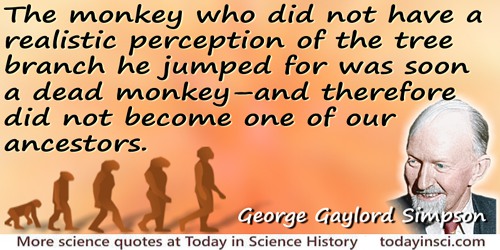
To put it crudely but graphically, the monkey who did not have a realistic perception of the tree branch he jumped for was soon a dead monkey—and therefore did not become one of our ancestors.
In This View of Life: The World of an Evolutionist (1963), 98.
We do not inherit the Earth from our ancestors, we borrow it from our children.
Widely seen quoted in various sources, attributed to various origins (Native Indian proverb, or Amish, or Kenyan, etc.). For example, in the Canadian House of Commons Debates, Official Report (1987), Vol. 5, 6088, it is given a “The Haidas said…” Webmaster has so far found no earlier example. This suggests its origin is relatively recent, and not an ancient proverb. If you know of an earlier source, please contact Webmaster.
We must not forget … that “influence” is not a simple, but on the contrary, a very complex, bilateral relation. We are not influenced by everything we read or learn. In one sense, and perhaps the deepest, we ourselves determine the influences we are submitting to; our intellectual ancestors are by no means given to, but are freely chosen by, us.
In From the Closed World to the Infinite Universe (1957) 5-6.
We were not the victims of ancestor worship. We had the benefits of a fresh start.
[Explaining why his company became a leader in the digital HDTV industry.]
[Explaining why his company became a leader in the digital HDTV industry.]
Quoted in Edmund L. Andrews, 'And Now for Something Substantially Different: Digital TV', New York Times (12 Jul 1992), 127.
WEATHER, n. The climate of an hour. A permanent topic of conversation among persons whom it does not interest, but who have inherited the tendency to chatter about it from naked arboreal ancestors whom it keenly concerned. The setting up of official weather bureaus and their maintenance in mendacity prove that even governments are accessible to suasion by the rude forefathers of the jungle.
The Collected Works of Ambrose Bierce (1911), Vol. 7, The Devil's Dictionary, 362-363.
Well, evolution is a theory. It is also a fact. And facts and theories are different things, not rungs in a hierarchy of increasing certainty. Facts are the world’s data. Theories are structures of ideas that explain and interpret facts. Facts do not go away while scientists debate rival theories for explaining them. Einstein’s theory of gravitation replaced Newton’s, but apples did not suspend themselves in mid-air pending the outcome. And human beings evolved from apelike ancestors whether they did so by Darwin’s proposed mechanism or by some other, yet to be discovered … Evolutionists make no claim for perpetual truth, though creationists often do (and then attack us for a style of argument that they themselves favor).
'Evolution as Fact and Theory', in Hen’s Teeth and Horse’s Toes: Further Reflections in Natural History (1983), 254-255.
Why it is that animals, instead of developing in a simple and straightforward way, undergo in the course of their growth a series of complicated changes, during which they often acquire organs which have no function, and which, after remaining visible for a short time, disappear without leaving a trace ... To the Darwinian, the explanation of such facts is obvious. The stage when the tadpole breathes by gills is a repetition of the stage when the ancestors of the frog had not advanced in the scale of development beyond a fish.
In The Works of Francis Maitland Balfour (1885), Vol. 1, 702.
With moth cytochrome C there are 30 differences and 74 identities. With bread yeast and humans, there are about 45 amino acids that are different and about 59 that are identical. Think how close together man and this other organism, bread yeast, are. What is the probability that in 59 positions the same choice out of 20 possibilities would have been made by accident? It is impossibly small. There is, there must be, a developmental explanation of this. The developmental explanation is that bread yeast and man have a common ancestor, perhaps two billion years ago. And so we see that not only are all men brothers, but men and yeast cells, too, are at least close cousins, to say nothing about men and gorillas or rhesus monkeys. It is the duty of scientists to dispel ignorance of such relationships.
'The Social Responsibilities of Scientists and Science', The Science Teacher (1933), 33, 15.
 In science it often happens that scientists say, 'You know that's a really good argument; my position is mistaken,' and then they would actually change their minds and you never hear that old view from them again. They really do it. It doesn't happen as often as it should, because scientists are human and change is sometimes painful. But it happens every day. I cannot recall the last time something like that happened in politics or religion.
(1987) --
In science it often happens that scientists say, 'You know that's a really good argument; my position is mistaken,' and then they would actually change their minds and you never hear that old view from them again. They really do it. It doesn't happen as often as it should, because scientists are human and change is sometimes painful. But it happens every day. I cannot recall the last time something like that happened in politics or religion.
(1987) -- 





