Anatomy Quotes (75 quotes)
… our “Physick” and “Anatomy” have embraced such infinite varieties of being, have laid open such new worlds in time and space, have grappled, not unsuccessfully, with such complex problems, that the eyes of Vesalius and of Harvey might be dazzled by the sight of the tree that has grown out of their grain of mustard seed.
A Lay Sermon, delivered at St. Martin's Hall (7 Jan 1866), 'On the Advisableness of Improving Natural Knowledge', published in The Fortnightly Review (1866), Vol. 3, 629.
La nature veut que dans certains temps les hommes se succèdent les uns aux autres par le moyen de la mort; il leur est permis de se défendre contr’elle jusqu’à un certain point; mais passé cela, on aura beau faire de nouvelles découvertes dans l’Anatomie, on aura beau pénétrer de plus en plus dans les secrets de la structure du corps humain, on ne prendra point la Nature pour dupe, on mourra comme à l’ordinaire.
Nature intends that at fixed periods men should succeed each other by the instrumentality of death. They are allowed to keep it at bay up to a certain point; but when that is passed, it will be of no use to make new discoveries in anatomy, or to penetrate more and more into the secrets of the structure of the human body; we shall never outwit nature, we shall die as usual.
Nature intends that at fixed periods men should succeed each other by the instrumentality of death. They are allowed to keep it at bay up to a certain point; but when that is passed, it will be of no use to make new discoveries in anatomy, or to penetrate more and more into the secrets of the structure of the human body; we shall never outwit nature, we shall die as usual.
In 'Dialogue 5: Dialogues De Morts Anciens', Nouveaux Dialogues des Morts (2nd Ed., 1683), Vol. 1, 154-155. As translated in Craufurd Tait Ramage, Beautiful Thoughts from French and Italian Authors (1866), 113.
Surtout l’astronomie et l’anatomie sont les deux sciences qui nous offrent le plus sensiblement deux grands caractères du Créateur; l’une, son immensité, par les distances, la grandeur, et le nombre des corps célestes; l’autre, son intelligence infinie, par la méchanique des animaux.
Above all, astronomy and anatomy are the two sciences which present to our minds most significantly the two grand characteristics of the Creator; the one, His immensity, by the distances, size, and number of the heavenly bodies; the other, His infinite intelligence, by the mechanism of animate beings.
Above all, astronomy and anatomy are the two sciences which present to our minds most significantly the two grand characteristics of the Creator; the one, His immensity, by the distances, size, and number of the heavenly bodies; the other, His infinite intelligence, by the mechanism of animate beings.
Original French and translation in Craufurd Tait Ramage (ed.) Beautiful Thoughts from French and Italian Authors (1866), 119-120.
Vergleichende Anatomie der Engel.
On the comparative anatomy of angels.
On the comparative anatomy of angels.
Vergleichende Anatomie der Engel: eine Skizze (1825). Written under the pseudonym of Dr Mises.
A man cannot marry before he has studied anatomy and has dissected at the least one woman.
The Physiology of Marriage (1826), trans. Sharon Marcus (1997), Aphorism XXVII, 63.
A man is as old as his arteries.
A physician’s subject of study is necessarily the patient, and his first field for observation is the hospital. But if clinical observation teaches him to know the form and course of diseases, it cannot suffice to make him understand their nature; to this end he must penetrate into the body to find which of the internal parts are injured in their functions. That is why dissection of cadavers and microscopic study of diseases were soon added to clinical observation. But to-day these various methods no longer suffice; we must push investigation further and, in analyzing the elementary phenomena of organic bodies, must compare normal with abnormal states. We showed elsewhere how incapable is anatomy alone to take account of vital phenenoma, and we saw that we must add study of all physico-chemical conditions which contribute necessary elements to normal or pathological manifestations of life. This simple suggestion already makes us feel that the laboratory of a physiologist-physician must be the most complicated of all laboratories, because he has to experiment with phenomena of life which are the most complex of all natural phenomena.
From An Introduction to the Study of Experimental Medicine (1865), as translated by Henry Copley Greene (1957), 140-141.
All of our experience indicates that life can manifest itself only in a concrete form, and that it is bound to certain substantial loci. These loci are cells and cell formations. But we are far from seeking the last and highest level of understanding in the morphology of these loci of life. Anatomy does not exclude physiology, but physiology certainly presupposes anatomy. The phenomena that the physiologist investigates occur in special organs with quite characteristic anatomical arrangements; the various morphological parts disclosed by the anatomist are the bearers of properties or, if you will, of forces probed by the physiologist; when the physiologist has established a law, whether through physical or chemical investigation, the anatomist can still proudly state: This is the structure in which the law becomes manifest.
In 'Cellular-Pathologie', Archiv für pathologische Anatomie und Physiologie und fur klinische Medizin (1855), 8, 19, as translated in LellandJ. Rather, 'Cellular Pathology', Disease, Life, and Man: Selected Essays by Rudolf Virchow (1958), 84.
All that Anatomie can doe is only to shew us the gross and sensible parts of the body, or the vapid and dead juices all which, after the most diligent search, will be noe more able to direct a physician how to cure a disease than how to make a man; for to remedy the defects of a part whose organicall constitution and that texture whereby it operates, he cannot possibly know, is alike hard, as to make a part which he knows not how is made. Now it is certaine and beyond controversy that nature performs all her operations on the body by parts so minute and insensible that I thinke noe body will ever hope or pretend, even by the assistance of glasses or any other intervention, to come to a sight of them, and to tell us what organicall texture or what kinde offerment (for whether it be done by one or both of these ways is yet a question and like to be soe always notwithstanding all the endeavours of the most accurate dissections) separate any part of the juices in any of the viscera, or tell us of what liquors the particles of these juices are, or if this could be donne (which it is never like to be) would it at all contribute to the cure of the diseases of those very parts which we so perfectly knew.
'Anatomie' (1668). Quoted in Kenneth Dewhurst (ed.), Dr. Thomas Sydenham (1624-1689): His Life and Original Writings (1966), 85-6.
Anatomists have ever been engaged in contention. And indeed, if a man has not such a degree of enthusiasm, and love of the art, as will make him impatient of unreasonable opposition and of encroachments upon his discoveries and his reputation, he will hardly become considerable in Anatomy or in any branch of natural knowledge.
Medical Commentaries (1764), Introduction, iii. In Charles Coulston Gillespie (ed.), Dictionary of Scientific Biography (1972), Vol. 6, 569.
Anatomy is the great ocean of intelligence upon which the true physician must sail. Bacteriology is but one little harbor.
In 'Advancement of Surgery', Journal of the American Medical Association (25 Feb 1893), 20, No. 8, 199.
Anatomy is to physiology as geography is to history; it describes the theatre of events.
De Naturali Parte Medicinae Libri Septem (1542), Ch. 1.
And having thus passed the principles of arithmetic, geometry, astronomy, and geography, with a general compact of physics, they may descend in mathematics to the instrumental science of trigonometry, and from thence to fortification, architecture, engineering, or navigation. And in natural philosophy they may proceed leisurely from the history of meteors, minerals, plants, and living creatures, as far as anatomy. Then also in course might be read to them out of some not tedious writer the institution of physic. … To set forward all these proceedings in nature and mathematics, what hinders but that they may procure, as oft as shall be needful, the helpful experiences of hunters, fowlers, fishermen, shepherds, gardeners, apothecaries; and in other sciences, architects, engineers, mariners, anatomists.
In John Milton and Robert Fletcher (ed.), 'On Education', The Prose Works of John Milton: With an Introductory Review (1834), 100.
And indeed I am not humming,
Thus to sing of Cl-ke and C-ming,
Who all the universe surpasses
in cutting up and making gases;
With anatomy and chemics,
Metaphysics and polemics,
Analyzing and chirugery,
And scientific surgery …
H-slow's lectures on the cabbage
Useful are as roots of Babbage;
Fluxions and beet-root botany,
Some would call pure monotony.
Thus to sing of Cl-ke and C-ming,
Who all the universe surpasses
in cutting up and making gases;
With anatomy and chemics,
Metaphysics and polemics,
Analyzing and chirugery,
And scientific surgery …
H-slow's lectures on the cabbage
Useful are as roots of Babbage;
Fluxions and beet-root botany,
Some would call pure monotony.
— Magazine
Punch in Cambridge (28 Jan 1834). In Mark Weatherall, Gentlemen, Scientists, and Medicine at Cambridge 1800-1940 (2000), Vol. 3,77. The professors named were William Clark (anatomy), James Cumming (chemistry) and Johns Stephens Henslow (botany).
And ye who wish to represent by words the form of man and all the aspects of his membrification, get away from that idea. For the more minutely you describe, the more you will confuse the mind of the reader and the more you will prevent him from a knowledge of the thing described. And so it is necessary to draw and describe.
From Notebooks (AnA, 14v; Cf. QII, 1), as translated by J. Playfair McMurrich, in Leonardo da Vinci the Anatomist (1930), 76, (Institution Publication 411, Carnegie Institution of Washington).
As long as museums and universities send out expeditions to bring to light new forms of living and extinct animals and new data illustrating the interrelations of organisms and their environments, as long as anatomists desire a broad comparative basis human for anatomy, as long as even a few students feel a strong curiosity to learn about the course of evolution and relationships of animals, the old problems of taxonomy, phylogeny and evolution will gradually reassert themselves even in competition with brilliant and highly fruitful laboratory studies in cytology, genetics and physiological chemistry.
'Genetics Versus Paleontology', The American Naturalist, 1917, 51, 623.
At the voice of comparative anatomy, every bone, and fragment of a bone, resumed its place. I cannot find words to express the pleasure I have in seeing, as I discovered one character, how all the consequences, which I predicted from it, were successively confirmed; the feet were found in accordance with the characters announced by the teeth; the teeth in harmony with those indicated beforehand by the feet; the bones of the legs and thighs, and every connecting portion of the extremities, were found set together precisely as I had arranged them, before my conjectures were verified by the discovery of the parts entire: in short, each species was, as it were, reconstructed from a single one of its component elements.
Geology and Mineralogy (1836), Vol. I, 83-4.
Cellular pathology is not an end if one cannot see any alteration in the cell. Chemistry brings the clarification of living processes nearer than does anatomy. Each anatomical change must have been preceded by a chemical one.
Attributed in H. Coper and H. Herken, Deutsche Medizini Wochenschrift (18 Oct 1963), 88, No. 42, 2035, in the original German, “Nach der Überlieferung durch His soll Virchow geäußert haben: ‘Die Zellular-pathologie ist nicht am Ende, wenn man an einer Zelle keine Veränderungen mehr sehen kann. Die Chemie steht der Erklärung der Lebensvorgänge näher als die Anatomie. Jede anatomische Verände-rung setzt notwendig eine chemische voraus.’” As translated in Angel Pentschew,'Morphology and morphogenesis of lead encephalopathy', Acta Neuropathologica (Sep 1965) 5, No. 2, 133-160, as cited in I. Arthur Michaelson and Mitchell W. Sauerhoff, 'Animal Models of Human Disease: Severe and Mild Lead Encephalopathy in the Neonatal Rat', Environmental Health Perspectives (May 1974), 7, 204 & 223 footnote. Note: Although given in quotation marks in the original German text, the subject quote is almost definitely NOT verbatim, but only a paraphrase of Virchow’s teachings. The German text introduces the subject quote with, “Nach der Überlieferung durch His soll Virchow geäußert haben:…” which means, “According to tradition Virchow is said to have expressed:…” (using Google translate). However, it is useful as a succinct statement to the effect of what Virchow might say to summarize his doctrine.
Complex organisms cannot be construed as the sum of their genes, nor do genes alone build particular items of anatomy or behavior by them selves. Most genes influence several aspects of anatomy and behavior–as they operate through complex interactions with other genes and their products, and with environmental factors both within and outside the developing organism. We fall into a deep error, not just a harmful oversimplification, when we speak of genes ‘for’ particular items of anatomy or behavior.
In I Have Landed; The End of a Beginning in Natural History (2002, 2011), 234.
Descriptive anatomy is to physiology what geography is to history, and just as it is not enough to know the typography of a country to understand its history, so also it is not enough to know the anatomy of organs to understand their functions.
Lectures on the Phenomena of Life Common to Animals and Plants (1878), trans. Hebbel E. Hoff, Roger Guillemin and Lucienne Guillemin (1974), 7.
Dressed very plainly, usually with a plain brown skirt of tweed. No cosmetics. Neat but not ostentatious. After all, business was business. She [Florence Sabin] would lecture twice a week. Very rapidly spoken, a little muddy—she was so enthusiastic in trying to correlate the scientific and medical aspect of anatomy (histology). She would tear up her notes after each lecture so that she would have to work it over the next year.
Described by an unnamed student in associate professor Sabin’s histology class at Johns Hopkins University (1909), as quoted, without citation, in Vincent T. Andriole, 'Florence Rena Sabin—Teacher, Scientist, Citizen', Journal of the History of Medicine and Allied Sciences (Jul 1959), 14, No. 3, (July 1959), 325.
Each and every loss becomes an instance of ultimate tragedy–something that once was, but shall never be known to us. The hump of the giant deer–as a nonfossilizable item of soft anatomy–should have fallen into the maw of erased history. But our ancestors provided a wondrous rescue, and we should rejoice mightily. Every new item can instruct us; every unexpected object possesses beauty for its own sake; every rescue from history’s great shredding machine is–and I don’t know how else to say this–a holy act of salvation for a bit of totality.
…...
Euclidean mathematics assumes the completeness and invariability of mathematical forms; these forms it describes with appropriate accuracy and enumerates their inherent and related properties with perfect clearness, order, and completeness, that is, Euclidean mathematics operates on forms after the manner that anatomy operates on the dead body and its members. On the other hand, the mathematics of variable magnitudes—function theory or analysis—considers mathematical forms in their genesis. By writing the equation of the parabola, we express its law of generation, the law according to which the variable point moves. The path, produced before the eyes of the student by a point moving in accordance to this law, is the parabola.
If, then, Euclidean mathematics treats space and number forms after the manner in which anatomy treats the dead body, modern mathematics deals, as it were, with the living body, with growing and changing forms, and thus furnishes an insight, not only into nature as she is and appears, but also into nature as she generates and creates,—reveals her transition steps and in so doing creates a mind for and understanding of the laws of becoming. Thus modern mathematics bears the same relation to Euclidean mathematics that physiology or biology … bears to anatomy.
If, then, Euclidean mathematics treats space and number forms after the manner in which anatomy treats the dead body, modern mathematics deals, as it were, with the living body, with growing and changing forms, and thus furnishes an insight, not only into nature as she is and appears, but also into nature as she generates and creates,—reveals her transition steps and in so doing creates a mind for and understanding of the laws of becoming. Thus modern mathematics bears the same relation to Euclidean mathematics that physiology or biology … bears to anatomy.
In Die Mathematik die Fackelträgerin einer neuen Zeit (1889), 38. As translated in Robert Édouard Moritz, Memorabilia Mathematica; Or, The Philomath’s Quotation-book (1914), 112-113.
Every great anthropologic and paleontologic discovery fits into its proper place, enabling us gradually to fill out, one after another, the great branching lines of human ascent and to connect with the branches definite phases of industry and art. This gives us a double means of interpretation, archaeological and anatomical. While many branches and links in the chain remain to be discovered, we are now in a position to predict with great confidence not only what the various branches will be like but where they are most like to be found.
In Henry Fairfield Osborn, 'Osborn States the Case For Evolution', New York Times (12 Jul 1925), XX1
Genetics as a whole is the great over-hyped science, and geneticists know that even if they don't say it. All that genetics really is is anatomy plus an enormous research group grant. It's what anatomists did in the fifteenth century-looking at the heart and seeing how it worked. Now, we are doing the same with DNA
Quoted by Sean O'Hagan, in 'End of sperm report', The Observer (14 Sep 2002).
Geology is intimately related to almost all the physical sciences, as is history to the moral. An historian should, if possible, be at once profoundly acquainted with ethics, politics, jurisprudence, the military art, theology; in a word, with all branches of knowledge, whereby any insight into human affairs, or into the moral and intellectual nature of man, can be obtained. It would be no less desirable that a geologist should be well versed in chemistry, natural philosophy, mineralogy, zoology, comparative anatomy, botany; in short, in every science relating to organic and inorganic nature. With these accomplishments the historian and geologist would rarely fail to draw correct and philosophical conclusions from the various monuments transmitted to them of former occurrences.
Principles of Geology (1830-3), Vol. 1, 2-3.
Hands-on experience at the critical time, not systematic knowledge, is what counts in the making of a naturalist. Better to be an untutored savage for a while, not to know the names or anatomical detail. Better to spend long stretches of time just searching and dreaming.
In Naturalist (1994), 11-12.
Herewith I offer you the Omnipotent Finger of God in the anatomy of a louse: wherein you will find miracles heaped on miracles and will see the wisdom of God clearly manifested in a minute point.
Letter to Melchisedec Thevenot (Apr 1678). In G. A. Lindeboom (ed.), The Letters of Jan Swammerdam to Melchisedec Thivenot (1975), 104-5.
However much the pits may be apparent, yet none, as far as can be comprehended by the senses, passes through the septum of the heart from the right ventricle into the left. I have not seen even the most obscure passages by which the septum of the ventricles is pervious, although they are mentioned by professors of anatomy since they are convinced that blood is carried from the right ventricle into the left. As a result—as I shall declare more openly elsewhere—I am in no little doubt regarding the function of the heart in this part.
In De Humani Corporis Fabrica Libri Septem [Seven Books on the Structure of the Human Body] (revised ed. 1555), 734. Quoted and trans. in Charles Donald O'Malley, Andreas Vesalius of Brussels, 1514-1564 (1964), 281.
I have destroyed almost the whole race of frogs, which does not happen in that savage Batrachomyomachia of Homer. For in the anatomy of frogs, which, by favour of my very excellent colleague D. Carolo Fracassato, I had set on foot in order to become more certain about the membranous substance of the lungs, it happened to me to see such things that not undeservedly I can better make use of that [saying] of Homer for the present matter—
“I see with my eyes a work trusty and great.”
For in this (frog anatomy) owing to the simplicity of the structure, and the almost complete transparency of the vessels which admits the eye into the interior, things are more clearly shown so that they will bring the light to other more obscure matters.
“I see with my eyes a work trusty and great.”
For in this (frog anatomy) owing to the simplicity of the structure, and the almost complete transparency of the vessels which admits the eye into the interior, things are more clearly shown so that they will bring the light to other more obscure matters.
De Pulmonibus (1661), trans. James Young, Proceedings of the Royal Society of Medicine (1929-30), 23, 7.
I have made many mistakes myself; in learning the anatomy of the eye I dare say, I have spoiled a hatfull; the best surgeon, like the best general, is he who makes the fewest mistakes.
Quoted in James Anthony Froude, John Tulloch and Thomas Carlyle, Fraser's Magazine (Nov 1862), 66, 574.
I have not been aware of any one else [than Joseph Leidy] in America interested in microscopic anatomy, and write to interest you in my investigation of the organ of hearing.
Describing Joseph Leidy in a letter to him (1852). As quoted, without further source detail, in Henry Fairfield Osborn, 'Biographical Memoir of Joseph Leidy', collected in National Academy of Sciences, Biographical Memoirs: Volume 7 (1913), 345.
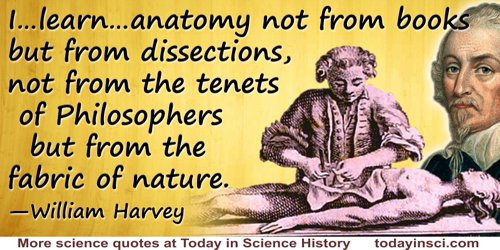
I profess to learn and to teach anatomy not from books but from dissections, not from the tenets of Philosophers but from the fabric of Nature.
De Motu Cordis (1628), The Circulation of the Blood and Other Writings, trans. Kenneth J. Franklin (1957), Dedication to Doctor Argent, 7.
I should not think of devoting less than 20 years to an Epic Poem. Ten to collect materials and warm my mind with universal science. I would be a tolerable Mathematician, I would thoroughly know Mechanics, Hydrostatics, Optics, and Astronomy, Botany, Metallurgy, Fossilism, Chemistry, Geology, Anatomy, Medicine—then the mind of man—then the minds of men—in all Travels, Voyages and Histories. So I would spend ten years—the next five to the composition of the poem—and the five last to the correction of it. So I would write haply not unhearing of the divine and rightly-whispering Voice, which speaks to mighty minds of predestinated Garlands, starry and unwithering.
Letter to Joseph Cottle, early April 1797. In Earl Leslie Griggs (ed.), The Collected Letters of Samuel Taylor Coleridge (1956), Vol. 1, 320-1.
I suppose that Dr. [Florence] Sabin is the most eminent of living women scientists. The knowledge she has derived from her studies has led to better understanding of the anatomy, physiology, and pathology of the body in health and in disease, and has been not only of theoretical but of practical value. It is of the nature of conspicuous social service to have added to the knowledge of our bodies, well and ill, and thus to have helped make them better instruments for the fulfilment of the purposes of society as a whole.
In Genevieve Parkhurst, 'Dr. Sabin, Scientist: Winner Of Pictorial Review’s Achievement Award', Pictorial Review (Jan 1930), 2.
In order to discover Truth in this manner by observation and reason, it is requisite we should fix on some principles whose certainty and effects are demonstrable to our senses, which may serve to explain the phenomena of natural bodies and account for the accidents that arise in them; such only are those which are purely material in the human body with mechanical and physical experiments … a physician may and ought to furnish himself with, and reason from, such things as are demonstrated to be true in anatomy, chemistry, and mechanics, with natural and experimental philosophy, provided he confines his reasoning within the bounds of truth and simple experiment.
As quoted in selection from the writings of Herman Boerhaave, collected in Oliver Joseph Thatcher (ed.), The Ideas that Have Influenced Civilization, in the Original Documents (1800), Vol. 6, 242.
In such sad circumstances I but see myself exalted by my own enemies, for in order to defeat some small works of mine they try to make the whole rational medicine and anatomy fall, as if I were myself these noble disciplines.
'Letter to Marescotti about the dispute with Sbaraglia and others, 1689(?)', in H. B. Adelmann (ed.), The Correspondence of Marcello Malpighi (1975), Vol. 4, 1561.
Is it not evident, in these last hundred years (when the Study of Philosophy has been the business of all the Virtuosi in Christendome) that almost a new Nature has been revealed to us? that more errours of the School have been detected, more useful Experiments in Philosophy have been made, more Noble Secrets in Opticks, Medicine, Anatomy, Astronomy, discover'd, than in all those credulous and doting Ages from Aristotle to us? So true it is that nothing spreads more fast than Science, when rightly and generally cultivated.
Of Dramatic Poesie (1684 edition), lines 258-67, in James T. Boulton (ed.) (1964), 44
Man, whose organization is regarded as the highest, departs from the vertebrate archetype; and it is because the study of anatomy is usually commenced from, and often confined to, his structure, that a knowledge of the archetype has been so long hidden from anatomists.
'The Lexington Papers', The Quarterly Review (1851), 89, 450-1.
Mathematics is no more the art of reckoning and computation than architecture is the art of making bricks or hewing wood, no more than painting is the art of mixing colors on a palette, no more than the science of geology is the art of breaking rocks, or the science of anatomy the art of butchering.
In Lectures on Science, Philosophy and Art (1908), 29.
My Lord said that he who knew men only in this way [from history] was like one who had got the theory of anatomy perfectly, but who in practice would find himself very awkward and liable to mistakes. That he again who knew men by observation was like one who picked up anatomy by practice, but who like all empirics would for a long time be liable to gross errors.
Nature may be as selfishly studied as trade. Astronomy to the selfish becomes astrology; psychology, mesmerism (with intent to show where our spoons are gone); and anatomy and physiology become phrenology and palmistry.
Essay, 'Nature', in Ralph Waldo Emerson, Alfred Riggs Ferguson (ed.) and Jean Ferguson Carr (ed.), The Collected Works of Ralph Waldo Emerson, Volume III, Essays: Second Series (1984), 13.
No knowledge can be more satisfactory to a man than that of his own frame, its parts, their functions and actions.
Letter (7 Oct 1814) to Thomas Cooper. Collected in The Writings of Thomas Jefferson: Correspondence (1854), 390.
No man should marry until he has studied anatomy and dissected at least one woman.
The Physiology of Marriage (2000), Meditation V, Aphorism 28, 41.
Of all the constituents of the human body, bone is the hardest, the driest, the earthiest, and the coldest; and, excepting only the teeth, it is devoid of sensation. God, the great Creator of all things, formed its substance to this specification with good reason, intending it to be like a foundation for the whole body; for in the fabric of the human body bones perform the same function as do walls and beams in houses, poles in tents, and keels and ribs in boats.
Bones Differentiated by Function
Some bones, by reason of their strength, form as it were props for the body; these include the tibia, the femur, the spinal vertebrae, and most of the bony framework. Others are like bastions, defense walls, and ramparts, affording natural protection to other parts; examples are the skull, the spines and transverse processes of the vertebrae, the breast bone, the ribs. Others stand in front of the joints between certain bones, to ensure that the joint does not move too loosely or bend to too acute an angle. This is the function of the tiny bones, likened by the professors of anatomy to the size of a sesame seed, which are attached to the second internode of the thumb, the first internode of the other four fingers and the first internodes of the five toes. The teeth, on the other hand, serve specifically to cut, crush, pound and grind our food, and similarly the two ossicles in the organ of hearing perform a specifically auditory function.
Bones Differentiated by Function
Some bones, by reason of their strength, form as it were props for the body; these include the tibia, the femur, the spinal vertebrae, and most of the bony framework. Others are like bastions, defense walls, and ramparts, affording natural protection to other parts; examples are the skull, the spines and transverse processes of the vertebrae, the breast bone, the ribs. Others stand in front of the joints between certain bones, to ensure that the joint does not move too loosely or bend to too acute an angle. This is the function of the tiny bones, likened by the professors of anatomy to the size of a sesame seed, which are attached to the second internode of the thumb, the first internode of the other four fingers and the first internodes of the five toes. The teeth, on the other hand, serve specifically to cut, crush, pound and grind our food, and similarly the two ossicles in the organ of hearing perform a specifically auditory function.
From De Humani Corporis Fabrica Libri Septem: (1543), Book I, 1, as translated by William Frank Richardson, in 'Nature of Bone; Function of Bones', On The Fabric of the Human Body: Book I: The Bones and Cartilages (1998), 1.
One subject, however I shall insist upon; that is, to explode the Linnæan obscenity in his characters of the Bivalves; not only for their licentiousness, but also that they are in no ways the parts expressed. Science should be chaste and delicate. Ribaldry at times has been passed for wit; but Linnæus alone passes it for terms of science. His merit in this part of natural history is, in my opinion, much debased thereby; and I can compare these his terms only to Spintriæ [Roman erotic bronze tokens], in a valuable collection of Roman coins. I therefore with due submission recommend to that otherwise great naturalist, to change them, and expunge this reproachable obscenity from his works.
From Preface to Elements of Conchology or, An introduction to the Knowledge of Shells (1776), iv-v. [Costa is offended by nomenclature adopted by Linnaeus for features of the opening of certain bivalve shells. Based on corresponding parts of surface appearance, Linnaeus used terms distinctive to human female anatomy. Costa was determined to eliminate the indelicate terms. —Webmaster]
Open up a few corpses: you will dissipate at once the darkness that observation alone could not dissipate.
Anatomie générale appliquée à la physiologie à la médecine (1801), avant-propos, xic.
Poore soule, in this thy flesh what do'st thou know?
Thou know'st thy selfe so little, as thou know'st not.
How thou did'st die, nor how thou wast begot.
Thou neither know'st how thou at first camest in,
Nor how thou took'st the poyson of mans sin.
Nor dost thou, (though thou know'st, that thou art so)
By what way thou art made immortall, know.
Thou art too narrow, wretch, to comprehend
Even thy selfe; yea though thou wouldst but bend
To know thy body. Have not all soules thought
For many ages, that our body'is wrought
Of Ayre, and Fire, and other Elements?
And now they thinke of new ingredients,
And one soule thinkes one, and another way
Another thinkes, and 'tis an even lay.
Knowst thou but how the stone doth enter in
The bladder's Cave, and never breake the skin?
Knowst thou how blood, which to the hart doth flow,
Doth from one ventricle to th'other go?
And for the putrid stuffe, which thou dost spit,
Knowst thou how thy lungs have attracted it?
There are no passages, so that there is
(For aught thou knowst) piercing of substances.
And of those many opinions which men raise
Of Nailes and Haires, dost thou know which to praise?
What hope have we to know our selves, when wee
Know not the least things, which for our use bee?
Thou know'st thy selfe so little, as thou know'st not.
How thou did'st die, nor how thou wast begot.
Thou neither know'st how thou at first camest in,
Nor how thou took'st the poyson of mans sin.
Nor dost thou, (though thou know'st, that thou art so)
By what way thou art made immortall, know.
Thou art too narrow, wretch, to comprehend
Even thy selfe; yea though thou wouldst but bend
To know thy body. Have not all soules thought
For many ages, that our body'is wrought
Of Ayre, and Fire, and other Elements?
And now they thinke of new ingredients,
And one soule thinkes one, and another way
Another thinkes, and 'tis an even lay.
Knowst thou but how the stone doth enter in
The bladder's Cave, and never breake the skin?
Knowst thou how blood, which to the hart doth flow,
Doth from one ventricle to th'other go?
And for the putrid stuffe, which thou dost spit,
Knowst thou how thy lungs have attracted it?
There are no passages, so that there is
(For aught thou knowst) piercing of substances.
And of those many opinions which men raise
Of Nailes and Haires, dost thou know which to praise?
What hope have we to know our selves, when wee
Know not the least things, which for our use bee?
Of the Progresse of the Soule. The Second Anniversarie, I. 254-280. The Works of John Donne (Wordsworth edition 1994), 196-7.
Sometimes I wonder whether there is any such thing as biology. The word was invented rather late—in 1809—and other words like botany, zoology, physiology, anatomy, have much longer histories and in general cover more coherent and unified subject matters. … I would like to see the words removed from dictionaries and college catalogues. I think they do more harm than good because they separate things that should not be separated…
In The Forest and the Sea (1960), 6-7.
That the Anatomy of the Nerves yields more pleasant and profitable Speculations, than the Theory of any parts besides in the animated Body: for from hence the true and genuine Reasons are drawn of very many Actions and Passions that are wont to happen in our Body, which otherwise seem most difficult and unexplicable; and no less from this Fountain the hidden Causes of Diseases and their Symptoms, which commonly are ascribed to the Incantations of Witches, may be found out and clearly laid open. But as to our observations about the Nerves, from our following Discourse it will plainly appear, that I have not trod the paths or footsteps of others, nor repeated what hath been before told.
In Anatomy of the Brain and Nerves (1664), trans. Samuel Pordage (1681), reprinted in William Peindel (ed.), Thomas Willis: Anatomy of the Brain and Nerves (1965), Vol. 2, 125.
The analysis of Nature into its individual parts, the grouping of the different natural processes and natural objects in definite classes, the study of the internal anatomy of organic bodies in their manifold forms—these were the fundamental conditions of the gigantic strides in our knowledge of Nature which have been made during the last four hundred years. But this method of investigation has also left us as a legacy the habit of observing natural objects and natural processes in their isolation, detached from the whole vast interconnection of things; and therefore not in their motion, but in their repose; not as essentially changing, but fixed constants; not in their life, but in their death.
Herr Eugen Dühring's Revolution in Science (Anti-Dühring), First Publication (1878). Trans. Emile Burns and ed. C.P. Dutt (1935), 27-8.
The anatomy of a little child, representing all parts thereof, is accounted a greater rarity than the skeleton of a man in full stature.
In The Church History of Britain (1842), Vol. 1, 165. Fuller’s context was to compare being studious in antiquity with after-ages when perfected.
The Chinese, who aspire to be thought an enlightened nation, to this day are ignorant of the circulation of the blood; and even in England the man who made that noble discovery lost all his practice in the consequence of his ingenuity; and Hume informs us that no physician in the United Kingdom who had attained the age of forty ever submitted to become a convert to Harvey’s theory, but went on preferring numpsimus to sumpsimus to the day of his death.
Reflection 352, in Lacon: or Many things in Few Words; Addressed to Those Who Think (1820), 164-165.
The excremental is all too intimately and inseparably bound up with the sexual; the position of the genitals—inter urinas et faeces—remains the decisive and unchangeable factor. One might say here, varying a well-known saying of the great Napoleon: 'Anatomy is destiny'.
On the Universal Tendency to Debasement in the Sphere of Love (Contributions to the Psychology of Love) (1912), In James Strachey (ed.), The Standard Edition of the Complete Psychological Works of Sigmund Freud (1957), Vol 11, 189.
The frillshark has many anatomical features similar to those of the ancient sharks that lived 25 to 30 million years ago. It has too many gills and too few dorsal fins for a modern shark, and its teeth, like those of fossil sharks, are three-pronged and briarlike. Some ichthyologists regard it as a relic derived from very ancient shark ancestors that have died out in the upper waters but, through this single species, are still carrying on their struggle for earthly survival, in the quiet of the deep sea.
In The Sea Around Us (1951), 54.
The geneticist to-day is in a rather difficult position. He must have at least a bowing acquaintance with anatomy, cytology, and mathematics. He must dabble in taxonomy, physics, and even psychology.
In 'The Biochemistry of the Individual' (1937), collected in Neurath Hans (ed.), Perspectives in Biochemistry (1989), 6.
The heart in all animals has cavities inside it… . The largest of all the three chambers is on the right and highest up; the least is on the left; and the medium one lies in between the other two.
In Historia Animalium, (The History of Animals), Book III, translated in William David Ross and John Alexander Smith (eds.), D’Arcy Wentwoth Thompson (trans.), Works Translated Into English (1910), Vol. 4, 512-513.
The heart is an exceedingly strong muscle. … It contains two separate cavities.
As translated by E.T. Withington in 'The Heart', Hippocratic Writings (1978), 348.
The history of the knowledge of the phenomena of life and of the organized world can be divided into two main periods. For a long time anatomy, and particularly the anatomy of the human body, was the α and ω of scientific knowledge. Further progress only became possible with the discovery of the microscope. A long time had yet to pass until through Schwann the cell was established as the final biological unit. It would mean bringing coals to Newcastle were I to describe here the immeasurable progress which biology in all its branches owes to the introduction of this concept of the cell concept. For this concept is the axis around which the whole of the modern science of life revolves.
Nobel Lecture (11 Dec 1908) 'Partial Cell Functions.' Collected in Nobel Lectures: Physiology or Medicine 1901-1921 (1967), 304.
The human mechanism is marvelous. But why not—it is the result of three-and-a-half billion years of tinkering.
Epigraph in Isaac Asimov’s Book of Science and Nature Quotations (1988), 12.
The natural history of an animal is the knowledge of the whole animal. Its internal structure is as much, and perhaps more, as its external form.
From 'Lettre à M. de la Cépède', collected in G. L. Duvernpy (ed.) Leçons d’Anatomie Comparée de Georges Cuvier: Tome IV, Première Partie: Corrigée et Augmentée (2nd ed. 1833), xxij. Translation using Google from the original French: “L'histoire naturelle d'un animal est la connaissance de tout l'animal. Sa structure interne est à lui autant, et peut-être plus, que sa forme extérieure.”
The only sure foundations of medicine are, an intimate knowledge of the human body, and observation on the effects of medicinal substances on that. The anatomical and clinical schools, therefore, are those in which the young physician should be formed. If he enters with innocence that of the theory of medicine, it is scarcely possible he should come out untainted with error. His mind must be strong indeed, if, rising above juvenile credulity, it can maintain a wise infidelity against the authority of his instructors, and the bewitching delusions of their theories.
In letter to Caspar Wistar (21 Jun 1807), collected in Thomas Jefferson Randolph (ed.), Memoir, Correspondence, And Miscellanies, From The Papers Of Thomas Jefferson (1829), Vol. 4, 93.
The plexus called rectiform [rete mirabile] by anatomists, is the most wonderful of the bodies located in this region. It encircles the gland [the hypophysis] itself and extends far to the rear; for nearly the whole base of the encephalon has this plexus lying beneath it. It is not a simple network but [looks] as if you had taken several fisherman’s nets and superimposed them. It is characteristic of this net of Nature’s, however, that the meshes of one layer are always attached to those of another, and it is impossible to remove anyone of them alone; for, one after another, the rest follow the one you are removing, because they are all attached to one another successively.
— Galen
On the Usefulness of the Parts of the Body, Book IX, 4. Trans. Margaret Tallmadge May (1968), Vol. 1, 430-1.
The result of all these experiments has given place to a new division of the parts of the human body, which I shall follow in this short essay, by distinguishing those which are susceptible of Irritability and Sensibility, from those which are not. But the theory, why some parts of the human body are endowed with these properties, while others are not, I shall not at all meddle with. For I am persuaded that the source of both lies concealed beyond the reach of the knife and microscope, beyond which I do not chuse to hazard many conjectures, as I have no desire of teaching what I am ignorant of myself. For the vanity of attempting to guide others in paths where we find ourselves in the dark, shews, in my humble opinion, the last degree of arrogance and ignorance.
'A Treatise on the Sensible and Irritable Parts of Animals' (Read 1752). Trans. 1755 and reprinted in Bulletin of the Institute of the History of Medicine, 1936, 4(2), 657-8.
The soul seems to be a very tenuous substance … [and] seems to be made of a most subtle texture, extremely mobile or active corpuscles, not unlike those of flame or heat; indeed, whether they are spherical, as the authors of atoms propound, or pyramidical as Plato thought, or some other form, they seem from their own motion and penetration through bodies to create the heat which is in the animal.
As quoted in Margaret J. Osler and Paul Lawrence Farber (eds.), Religion, Science, and Worldview: Essays in Honor of Richard S. Westfall (2002), 169.
The study of human anatomy is the basis of the investigation of the anatomy of all animals with a back-bone; and conversely, the anatomy of any animal of this class tends to throw light on that of man.
In 'Report of the Secretary', Seventh Annual Report of the Board of Regents of the Smithsonian Institution for 1852 (1853), 16.
The whole aim of comparative anatomy is to discover what structures are homologous.
A Laboratory Manual for Comparative Vertebrate Anatomy (1922), 3.
This is all very fine, but it won’t do—Anatomy—botany—Nonsense! Sir, I know an old woman in Covent Garden, who understands botany better, and as for anatomy, my butcher can dissect a joint full as well; no, young man, all that is stuff; you must go to the bedside, it is there alone you can learn disease!
Comment to Hans Sloane on Robert Boyle’s letter of introduction describing Sloane as a “ripe scholar, a good botanist, a skilful anatomist”.
Comment to Hans Sloane on Robert Boyle’s letter of introduction describing Sloane as a “ripe scholar, a good botanist, a skilful anatomist”.
Quoted in John D. Comrie, 'Life of Thomas Sydenham, M. D.', in Comrie (ed.), Selected Works of Thomas Sydenham (1922), 2.
![Giovanni Battista Morgagni quote: Those who have dissected or inspected many [bodies] have at least learnt to doubt; while other](https://todayinsci.com/M/Morgagni_Giovanni/MorgagniGiovanni-Doubt500x250px.jpg)
Those who have dissected or inspected many [bodies] have at least learnt to doubt; while others who are ignorant of anatomy and do not take the trouble to attend it are in no doubt at all.
Letter xvi, Art. 25, as translated by Benjamin Alexander. Cited in Edward W. Adams, 'Founders of Modern Medicine II: Giovanni Battista Morgagni', Medical Library and Historical Journal (1903), Vol. 1, 276.
Those who intend to practise Midwifery, ought first of all to make themselves masters of anatomy, and acquire a competent knowledge in surgery and physic; because of their connections with the obstetric art, if not always, at least in many cases. He ought to take the best opportunities he can find of being well instructed; and of practising under a master, before he attempts to deliver by himself. ... He should also embrace every occasion of being present at real labours, ... he will assist the poor as well as the rich, behaving always with charity and compassion.
In A Treatise on the Theory and Practice of Midwifery (1766), 440-441.
Throughout the last four hundred years, during which the growth of science had gradually shown men how to acquire knowledge of the ways of nature and mastery over natural forces, the clergy have fought a losing battle against science, in astronomy and geology, in anatomy and physiology, in biology and psychology and sociology. Ousted from one position, they have taken up another. After being worsted in astronomy, they did their best to prevent the rise of geology; they fought against Darwin in biology, and at the present time they fight against scientific theories of psychology and education. At each stage, they try to make the public forget their earlier obscurantism, in order that their present obscurantism may not be recognized for what it is.
From An Outline of Intellectual Rubbish (1937, 1943), 6. Collected in The Basic Writings of Bertrand Russell (2009), 47.
To speak of this subject you must... explain the nature of the resistance of the air, in the second the anatomy of the bird and its wings, in the third the method of working the wings in their various movements, in the fourth the power of the wings and the tail when the wings are not being moved and when the wind is favorable to serve as guide in various movements.
…...
We are accustomed to say that every human being displays both male and female instinctual impulses, needs, and attributes, but the characteristics of what is male and female can only be demonstrated in anatomy, and not in psychology.
In Sigmund Freud and Joan Riviere (trans.), Civilization and Its Discontents (1930, 1994), 35.
We are going through the body-snatching phase right now, and there are all these Burke and Hare attitudes towards geneticists-that they are playing God and that DNA is sacred. No, it’s not. It’s no more sacred than your toenails. Basically, we are not going to make long-term medical progress without understanding how the genes work.
[Referring to the similarity of fears and superstitions in genetics as once were associated with anatomy ]
[Referring to the similarity of fears and superstitions in genetics as once were associated with anatomy ]
Quoted by Sean O’Hagan, in 'End of sperm report', The Observer (14 Sep 2002).
Why does such and such animal feed only on flesh, while another on plants? Where does one get the finesse of its sense of smell, or that of its hearing? What is the source of the prodigious strength of the muscles of birds? How is this force used to produce this amazing movement of flight? How does it come about that the bird sees equally well at quite different distances? What is the cause of the range and variety of its voice? Why is a reptile so lethargic? Why does a worm stay alive long after being divided? Why can a zoophyte live equally well with some parts of its body cut off? Is it presumed there could be natural history without these questions, and thousands of others like them, and do we think we can answer without a thorough comparative anatomy?
From 'Lettre à M. de la Cépède', collected in G. L. Duvernpy (ed.) Leçons d’Anatomie Comparée de Georges Cuvier: Tome IV, Première Partie: Corrigée et Augmentée (2nd ed. 1833), xxij. As translated and tweaked by Webmaster using online translation sites from the original French: “Pourquoi tel animal ne se nourrit-il que de chair, tel autre que de végétaux? D’où celui-ci tire-t-il la finesse de son odorat, ou celle de son ouïe? Quelle est la source de la force prodigieux des muscles des oiseaux? Comment cette force est-elle employée à produire ce mouvement si étonnant du vol? D’où viens que l’oiseau voit également bien à des distances si differentes? Quelles sont les causes de l’etendue, et de la variété de sa voix? Pourquoi tel reptile, est-il si engourdie? Pourquoi tel ver, conserve-t-il de la vie long-temps après être divisé? Pourquoi tel zoophyte peut-il vivre égalment bien, quelque partie de son corps que l’on en retranche. Suppose-t-on qu’il puisse exister une histoire naturelle sans ces questions, et des millieurs d’autres semblables, et des milliers d’autres semblables, y soient traitées, et croit-on pouvoir y répondre sans une anatomie compárée profonde?” [John Abernethy used this quote in a lecture to illustrate what animating motive caused Cuvier to strive so hard to find answers.]
 In science it often happens that scientists say, 'You know that's a really good argument; my position is mistaken,' and then they would actually change their minds and you never hear that old view from them again. They really do it. It doesn't happen as often as it should, because scientists are human and change is sometimes painful. But it happens every day. I cannot recall the last time something like that happened in politics or religion.
(1987) --
In science it often happens that scientists say, 'You know that's a really good argument; my position is mistaken,' and then they would actually change their minds and you never hear that old view from them again. They really do it. It doesn't happen as often as it should, because scientists are human and change is sometimes painful. But it happens every day. I cannot recall the last time something like that happened in politics or religion.
(1987) -- 





.jpg)
