Alchemy Quotes (31 quotes)
[Alchemists] get a small livelihood by some Physical Experiments, as also by some Paints and effeminate Fucusses [cosmetics], which the Scriptures call the Oyntments of harlott; whence the Proverb, Every Alchymist is a Physician or a Sope-boyler.
In The Vanity of the Arts and Sciences (1530), translation (1676), 312-313.
[Hermetic philosophy (Alchemy) was the only Art which might be able] to complete and bring to light not only medicine but also a universal Philosophy.
…quaeque sola non Medicinam tantum, sed et universam Philosophiam valde perficere et illustrare possit.
…quaeque sola non Medicinam tantum, sed et universam Philosophiam valde perficere et illustrare possit.
Original Latin in The Theological Works of Isaac Barrow (1859), 46. Translation, with citation, in B.J.T. Dobbs, The Foundations of Newton's Alchemy (1983), 96.
Occult sciences. Those imaginary sciences of the middle ages which related to the influence of supernatural powers, such as alchemy, magic, necromancy, and astrology.
In Noah Webster, Noah Porter (supervising ed.) and Dorsey Gardner (ed.), Webster's Condensed Dictionary: A Condensed Dictionary of the English Language (1884, 1887), 385.
Yet ar ther fibicches in forceres
Of fele raennes makyng,
Experimentz of alkenamye
The peple to deceyve;
If thow thynke to do-wel,
Deel therwith nevere.
There are many men, also, who makes use of strange devices,
Alchemical experiments for the deception of others:
If you desire to do well, have no dealings with these.
Of fele raennes makyng,
Experimentz of alkenamye
The peple to deceyve;
If thow thynke to do-wel,
Deel therwith nevere.
There are many men, also, who makes use of strange devices,
Alchemical experiments for the deception of others:
If you desire to do well, have no dealings with these.
In William Langland and B. Thomas Wright (ed.) The Vision and Creed of Piers Ploughman (1842), 186. Modern translation by Terrence Tiller in Piers Plowman (1981, 1999), 94.
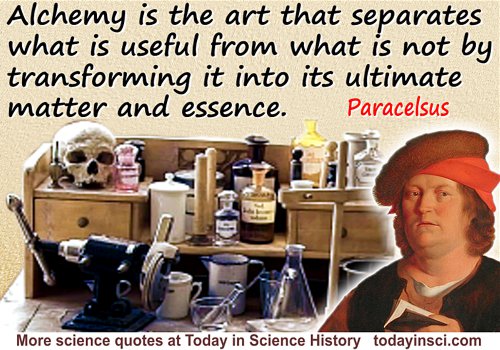
Alchemy is the art that separates what is useful from what is not by transforming it into its ultimate matter and essence.
In Labyrinthus Medicorum. Cap. V. Von dem Buch der alchimei, wie on dasselbig der
arzt kein arzt sein mag. Ed. Sudhoff, vol. XI, 188-189. As cited in Walter Pagel, Paracelsus: An Introduction to Philosophical Medicine in the Era of the Renaissance (2nd rev. ed., 1982), 113.
Alchemy. The link between the immemorial magic arts and modern science. Humankind’s first systematic effort to unlock the secrets of matter by reproducible experiment.
In Good Words to You (1987), 6.
Alchymy, or Chymistry, is …
An Art which good men bate, and most men blame,
Which her admirers practice to their shame,
Whose plain Impostures, easie to perceive,
Not onely others, but themselves deceive.
An Art which good men bate, and most men blame,
Which her admirers practice to their shame,
Whose plain Impostures, easie to perceive,
Not onely others, but themselves deceive.
In The Vanity of Arts and Sciences (1676), 312.
And yet surely to alchemy this right is due, that it may be compared to the husbandman whereof Æsop makes the fable, that when he died he told his sons that he had left unto them gold buried under the ground in his vineyard: and they digged over the ground, gold they found none, but by reason of their stirring and digging the mould about the roots of their vines, they had a great vintage the year following: so assuredly the search and stir to make gold hath brought to light a great number of good and fruitful inventions and experiments, as well for the disclosing of nature as for the use of man's life.
The Advancement of Learning (1605, 1712), Vol. 1, 15.
Ars est sine arte, cujus principium est mentiri, medium laborare, et finis mendicare.
The art is devoid of art, whose beginning is falsehood, its middle labour, and its end beggary.
[On the character of the delusive science of alchemy].
The art is devoid of art, whose beginning is falsehood, its middle labour, and its end beggary.
[On the character of the delusive science of alchemy].
In Henry Thomas Riley, Dictionary of Latin Quotations, Proverbs, Maxims, and Mottos (1866), 27.
Astrology was much in vogue during the middle ages, and became the parent of modern astronomy, as alchemy did of chemistry.
As given in Edwin Davies, Other Men's Minds, Or, Seven Thousand Choice Extracts on History, Science, Philosophy, Religion, Etc (1800), 41. Webmaster so far has not found the primary source-can you help?
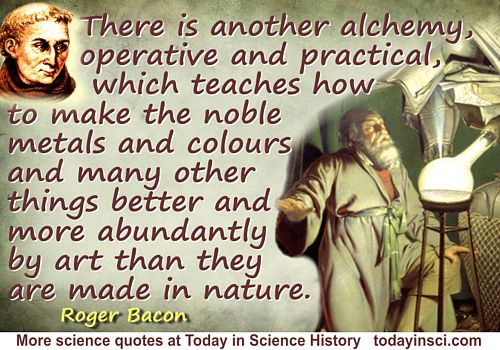
But there is another alchemy, operative and practical, which teaches how to make the noble metals and colours and many other things better and more abundantly by art than they are made in nature. And science of this kind is greater than all those preceding because it produces greater utilities. For not only can it yield wealth and very many other things for the public welfare, but it also teaches how to discover such things as are capable of prolonging human life for much longer periods than can be accomplished by nature … Therefore this science has special utilities of that nature, while nevertheless it confirms theoretical alchemy through its works.
Opus Tertium [1266-1268], chapter 12, quoted in A. C. Crombie, Augustine to Galileo (1959), Vol. I, 69.
Chemistry is not a primitive science like geometry and astronomy; it is constructed from the debris of a previous scientific formation; a formation half chimerical and half positive, itself found on the treasure slowly amassed by the practical discoveries of metallurgy, medicine, industry and domestic economy. It has to do with alchemy, which pretended to enrich its adepts by teaching them to manufacture gold and silver, to shield them from diseases by the preparation of the panacea, and, finally, to obtain for them perfect felicity by identifying them with the soul of the world and the universal spirit.
From Les Origines de l’Alchimie (1885), 1-2. Translation as quoted in Harry Shipley Fry, 'An Outline of the History of Chemistry Symbolically Represented in a Rookwood Fountain', The Journal of Industrial and Engineering Chemistry (1 Sep 1922), 14, No. 9, 868. From the original French, “La Chimie n’est pas une science primitive, comme la géométrie ou l’astronomie; elle s’est constituée sur les débris d’une formation scientifique antérieure; formation demi-chimérique et demi-positive, fondée elle-même sur le trésor lentement amassé des découvertes pratiques de la métallurgie, de la médecine, de l’industrie et de l’économie domestique. Il s’agit de l’alchimie, qui prétendait à la fois enrichir ses adeptes en leur apprenant à fabriquer l’or et l’argent, les mettre à l’abri des maladies par la préparation de la panacée, enfin leur procurer le bonheur parfait en les identifiant avec l’âme du monde et l’esprit universel.”
Chemistry is one of those branches of human knowledge which has built itself upon methods and instruments by which truth can presumably be determined. It has survived and grown because all its precepts and principles can be re-tested at any time and anywhere. So long as it remained the mysterious alchemy by which a few devotees, by devious and dubious means, presumed to change baser metals into gold, it did not flourish, but when it dealt with the fact that 56 g. of fine iron, when heated with 32 g. of flowers of sulfur, generated extra heat and gave exactly 88 g. of an entirely new substance, then additional steps could be taken by anyone. Scientific research in chemistry, since the birth of the balance and the thermometer, has been a steady growth of test and observation. It has disclosed a finite number of elementary reagents composing an infinite universe, and it is devoted to their inter-reaction for the benefit of mankind.
Address upon receiving the Perkin Medal Award, 'The Big Things in Chemistry', The Journal of Industrial and Engineering Chemistry (Feb 1921), 13, No. 2, 163.
Chymia, or Alchemy and Spagyrism, is the art of resolving compound bodies into their principles and of combining these again.
Fundamenta Chymiae (1720). Trans. J. R. Partington, A History of Chemistry (1961), Vol. 2, 664.
Concerning alchemy it is more difficult to discover the actual state of things, in that the historians who specialise in this field seem sometimes to be under the wrath of God themselves; for, like those who write of the Bacon-Shakespeare controversy or on Spanish politics, they seem to become tinctured with the kind of lunacy they set out to describe.
The Origins of Modern Science (1949), 115.
Divers of Hermetic Books have such involv’d Obscuritys that they may justly be compar’d to Riddles written in Cyphers. For after a Man has surmounted the difficulty of decyphering the Words & Terms, he finds a new & greater difficulty to discover ye meaning of the seemingly plain Expression.
Fragment In Boyle papers. Cited by Lawrence Principe, 'Boyle's Alchemical Pursuits', In M. Hunter (ed.), Robert Boyle Reconsidered (1994), 95
I have always looked upon alchemy in natural philosophy to be like enthusiasm in divinity, and to have troubled the world much to the same.
In The Works of Sir William Temple, Bart (1814), 506.
I prefer the spagyric chemical physicians, for they do not consort with loafers or go about gorgeous in satins, silks and velvets, gold rings on their fingers, silver daggers hanging at their sides and white gloves on their hands, but they tend their work at the fire patiently day and night. They do not go promenading, but seek their recreation in the laboratory, wear plain learthern dress and aprons of hide upon which to wipe their hands, thrust their fingers amongst the coals, into dirt and rubbish and not into golden rings. They are sooty and dirty like the smiths and charcoal burners, and hence make little show, make not many words and gossip with their patients, do not highly praise their own remedies, for they well know that the work must praise the master, not the master praise his work. They well know that words and chatter do not help the sick nor cure them... Therefore they let such things alone and busy themselves with working with their fires and learning the steps of alchemy. These are distillation, solution, putrefaction, extraction, calcination, reverberation, sublimination, fixation, separation, reduction, coagulation, tinction, etc.
Quoted in R. Oesper, The Human Side of Scientists (1975), 150. [Spagyric is a form of herbalism based on alchemic procedures of preparation.]
I submit that the traditional definition of psychiatry, which is still in vogue, places it alongside such things as alchemy and astrology, and commits it to the category of pseudo-science.
In The Myth of Mental Illness: Foundations of a Theory of Personal Conduct (1961), 1.
Mankind have been slow to believe that order reigns in the universe—that the world is a cosmos and a chaos.
… The divinities of heathen superstition still linger in one form or another in the faith of the ignorant, and even intelligent men shrink from the contemplation of one supreme will acting regularly, not fortuitously, through laws beautiful and simple rather than through a fitful and capricious system of intervention.
... The scientific spirit has cast out the demons, and presented us with nature clothed in her right mind and living under the reign of law. It has given us, for the sorceries of the alchemist, the beautiful laws of chemistry; for the dreams of the astrologer, the sublime truths of astronomy; for the wild visions of cosmogony, the monumental records of geology; for the anarchy of diabolism, the laws of God.
… The divinities of heathen superstition still linger in one form or another in the faith of the ignorant, and even intelligent men shrink from the contemplation of one supreme will acting regularly, not fortuitously, through laws beautiful and simple rather than through a fitful and capricious system of intervention.
... The scientific spirit has cast out the demons, and presented us with nature clothed in her right mind and living under the reign of law. It has given us, for the sorceries of the alchemist, the beautiful laws of chemistry; for the dreams of the astrologer, the sublime truths of astronomy; for the wild visions of cosmogony, the monumental records of geology; for the anarchy of diabolism, the laws of God.
Speech (16 Dec 1867) given while a member of the U.S. House of Representatives, introducing resolution for the appointment of a committee to examine the necessities for legislation upon the subject of the ninth census to be taken the following year. Quoted in John Clark Ridpath, The Life and Work of James A. Garfield (1881), 216.
Medicine rests upon four pillars—philosophy, astronomy, alchemy, and ethics. The first pillar is the philosophical knowledge of earth and water; the second, astronomy, supplies its full understanding of that which is of fiery and airy nature; the third is an adequate explanation of the properties of all the four elements—that is to say, of the whole cosmos—and an introduction into the art of their transformations; and finally, the fourth shows the physician those virtues which must stay with him up until his death, and it should support and complete the three other pillars.
Vas Buch Paragranum (c.1529-30), in J. Jacobi (ed.), Paracelsus: Selected Writings (1951), 133-4.
On consideration and by the advice of learned men, I thought it improper to unfold the secrets of the art (alchemy) to the vulgar, as few persons are capable of using its mysteries to advantage and without detriment.
Quiet this metal!
Let the manes put off their terror, let
them put off their aqueous bodies with fire.
Let them assume the milk-white bodies of agate.
Let them draw together the bones of the metal.
Let the manes put off their terror, let
them put off their aqueous bodies with fire.
Let them assume the milk-white bodies of agate.
Let them draw together the bones of the metal.
'The Alchemist: Chant for the Transmutation of Metal'. In T. S. Eliot (ed.), Ezra Pound: Selected Poems (1928), 61-2.
Rudenesse it selfe she doth refine,
Even like an Alchemist divine,
Grosse times of Iron turning
Into the purest forme of gold:
Not to corrupt, till heaven waxe old,
And be refin'd with burning.
Even like an Alchemist divine,
Grosse times of Iron turning
Into the purest forme of gold:
Not to corrupt, till heaven waxe old,
And be refin'd with burning.
From 'Hymnes of Astraea' (1599), Hymn 1 in Clare Howard (ed.), The Poems of John Davies (1941), 197.
The science of alchemy I like very well. I like it not only for the profits it brings in melting metals, in decocting, preparing, extracting, and distilling herbs, roots; I like it also for the sake of the allegory and secret signification, which is exceedingly fine, touching the resurrection of the dead at the last day.
In The Table Talk (1569).
The tragic element in poetry is like Saturn in alchemy,—the Malevolent, the Destroyer of Nature; but without it no true Aurum Potabile, or Elixir of Life, can be made.
In 'Table-Talk', The Poetical Works of Henry Wadsworth Longfellow: Volume 3 (1883), 1355.
The world hath been much abused by the opinion of making gold; the work itself I judge to be possible; but the means, hitherto propounded, to effect it are, in the practice, full of error and imposture; and in the theory, full of unfound imaginations.
From 'Experiment Solitary Touching the Making of Gold', Sylva Sylvarum: Or, a Natural History (1627), published posthumously by William Rawley. As collected and translated in The Works of Francis Bacon (1765), Vol. 1, 204. As quoted in Samuel Austin Allibone, Prose Quotations From Socrates to Macaulay (1876), 28.
Thus you may multiply each stone 4 times & no more for they will then become oyles shining in ye dark and fit for magicall uses. You may ferment them with ☉ [gold] and [silver], by keeping the stone and metal in fusion together for a day, & then project upon metalls. This is the multiplication of ye stone in vertue. To multiply it in weight ad to it of ye first Gold whether philosophic or vulgar.
Praxis (c.1693), quoted in Betty Jo Teeter Dobbs, The Janus Faces of Genius: The Role of Alchemy In Newton's Thought (1991), 304.
We modern chemists, the witnesses and workers of this “Age of Chemistry,” can learn something from the old alchemy, full as it was of errors and fantasies! … Let the Past furnish us a warning against too much phantasy in modern chemistry.
From 'What Can the Modern Chemist Learn From the Old Alchemy?', Introductory Lecture (1917), delivered at Cornell University, written in German, translated by L.F. Audrieth, and published in Salts, Acids, and Bases: Electrolytes Stereochemistry (1929), 1-2, as Vol. 4 of the George Fisher Baker Non-Resident Lectureship in Chemistry at Cornell University.
We must examine the moral alchemy through which the in-group readily transmutes virtue into vice and vice into virtue, as the occasion may demand. … We begin with the engagingly simple formula of moral alchemy: the same behavior must be differently evaluated according to the person who exhibits it. For example, the proficient alchemist will at once know that the word “firm” is properly declined as follows:
I am firm,
Thou art obstinate,
He is pig-headed.
There are some, unversed in the skills of this science, who will tell you that one and the same term should be applied to all three instances of identical behavior.
I am firm,
Thou art obstinate,
He is pig-headed.
There are some, unversed in the skills of this science, who will tell you that one and the same term should be applied to all three instances of identical behavior.
In article, 'The Self-Fulfilling Prophecy', The Antioch Review (Summer 1948), 8, No. 2, 195-196. Included as Chap. 7 of Social Theory and Social Structure (1949), 201.
What, then, shall we say about the receipts of alchemy, and about the diversity of its vessels and instruments? These are furnaces, glasses, jars, waters, oils, limes, sulphurs, salts, saltpeters, alums, vitriols, chrysocollae, copper greens, atraments, auripigments, fel vitri, ceruse, red earth, thucia, wax, lutum sapientiae, pounded glass, verdigris, soot, crocus of Mars, soap, crystal, arsenic, antimony, minium, elixir, lazarium, gold leaf salt niter, sal ammoniac, calamine stone, magnesia, bolus armenus, and many other things. Then, again, concerning herbs, roots, seeds, woods, stones, animals, worms, bone dust, snail shells, other shells, and pitch. These and the like, whereof there are some very farfetched in alchemy, are mere incumbrances of work; since even if Sol and Luna [gold and silver] could be made by them they rather hinder and delay than further one’s purpose.
In Paracelsus and Arthur Edward Waite (ed.), The Hermetic and Alchemical Writings of Paracelsus (1894), Vol. 1, 13.
 In science it often happens that scientists say, 'You know that's a really good argument; my position is mistaken,' and then they would actually change their minds and you never hear that old view from them again. They really do it. It doesn't happen as often as it should, because scientists are human and change is sometimes painful. But it happens every day. I cannot recall the last time something like that happened in politics or religion.
(1987) --
In science it often happens that scientists say, 'You know that's a really good argument; my position is mistaken,' and then they would actually change their minds and you never hear that old view from them again. They really do it. It doesn't happen as often as it should, because scientists are human and change is sometimes painful. But it happens every day. I cannot recall the last time something like that happened in politics or religion.
(1987) -- 





