Airplane Quotes (43 quotes)
“Logic” proved that airplanes can’t fly and that H-bombs won’t work and that stones don’t fall out of the sky. Logic is a way of saying that anything which didn't happen yesterday won't happen tomorrow.
In Glory Road (1963, 1981), 54.

Engineering, too, owes its most useful materials to the achievements of chemists in identifying, separating, and transforming materials: structural steel for the framework of bridges and buildings, portland cement for roadways and aqueducts, pure copper for the electrical industries, aluminum alloys for automobiles and airplanes, porcelain for spark plugs and electrical insulators. The triumphs of engineering skill rest on a chemical foundation.
In Fundamental Chemistry, and Elementary Textbook for College Classes (1936), 8.
Opfer müssen gebracht werden!
Sacrifices must be made!
Remark made when near death after breaking his spine in an airplane crash in a glider of his design.
Sacrifices must be made!
Remark made when near death after breaking his spine in an airplane crash in a glider of his design.
Quoted in Warren F. Phillips, Mechanics of Flight (2004), 371.
~~[Misquoted]~~ Heavier than air flying machines are impossible.
A viral quote with no known authentic source in these words. At best, it is consistent with quotes expressing doubt that are documented. For example, the quote which begins “I am afraid I am not in the flight for ‘aerial navigation’…” on the Lord Kelvin Quotes page of this website.

A bird is an instrument working according to mathematical law, which instrument it is within the capacity of man to reproduce with all its movements, but not with a corresponding degree of strength, though it is deficient only in the power of maintaining equilibrium. We may therefore say that such an instrument constructed by man is lacking in nothing except the life of the bird, and this life must needs be supplied from that of man.
'Of the Bird's Movement' from Codice Atlantico 161 r.a., in Leonardo da Vinci's Notebooks, trans. E. MacCurdy (1906), Vol. 1, 153.
Aeroplanes are not designed by science, but by art in spite of some pretence and humbug to the contrary. I do not mean to suggest that engineering can do without science, on the contrary, it stands on scientific foundations, but there is a big gap between scientific research and the engineering product which has to be bridged by the art of the engineer.
In John D. North, 'The Case for Metal Construction', The Journal of the Royal Aeronautical Society, (Jan 1923), 27, 11.
As a boy I had liked both drawing and physics, and I always abhorred the role of being a spectator. In 1908, when I was 15, I designed, built and flew a toy model airplane which won the then-famous James Gordon Bennett Cup. By 16 I had discovered that design could be fun and profitable, and this lesson has never been lost on me.
On the official Raymond Loewry website.
Can a physicist visualize an electron? The electron is materially inconceivable and yet, it is so perfectly known through its effects that we use it to illuminate our cities, guide our airlines through the night skies and take the most accurate measurements. What strange rationale makes some physicists accept the inconceivable electrons as real while refusing to accept the reality of a Designer on the ground that they cannot conceive Him?
In letter to California State board of Education (14 Sep 1972).
Does anyone believe that the difference between the Lebesgue and Riemann integrals can have physical significance, and that whether say, an airplane would or would not fly could depend on this difference? If such were claimed, I should not care to fly in that plane.
Paraphrased from American Mathematics Monthly (1998) 105, 640-50. Quoted in John De Pillis, 777 Mathematical Conversation Starters (2004), 136.
Fleets are not confined to the ocean, but now sail over the land. … All the power of the British Navy has not been able to prevent Zeppelins from reaching England and attacking London, the very heart of the British Empire. Navies do not protect against aerial attack. … Heavier-than-air flying machines of the aeroplane type have crossed right over the heads of armies, of million of men, armed with the most modern weapons of destruction, and have raided places in the rear. Armies do not protect against aerial war.
In 'Preparedness for Aerial Defense', Addresses Before the Eleventh Annual Convention of the Navy League of the United States, Washington, D.C., April 10-13, 1916 (1916), 70.
Flight by machines heavier than air is unpractical and insignificant, if not utterly impossible.
(1902). Widely quoted, though always without a source, for example in Laura Ward and Robert Allen, Foolish Words: The Most Stupid Words Ever Spoken (2003), 68. If you know a primary print source to authenticate this quote, please contact Webmaster.
I am well convinced that Aerial Navigation will form a most prominent feature in the progress of civilization. (1804)
In Aeronautical and Miscellaneous Note-book (ca. 1799-1826): of Sir George Cayley (1933), 80.
I used to sit in class and listen to the terms come floating down the room like paper airplanes. Geology was called a descriptive science, and with its pitted outwash plains and drowned rivers, its hanging tributaries and starved coastlines, it was nothing if not descriptive. It was a fountain of metaphor…
In Basin and Range (1981), 25.
I was always afraid of dying. Always. It was my fear that made me learn everything I could about my airplane and my emergency equipment, and kept me flying respectful of my machine and always alert in the cockpit.
I was interested in flying beginning at age 7, when a close family friend took me in his little airplane. And I remember looking at the wheel of the airplane as we rolled down the runway, because I wanted to remember the exact moment that I first went flying... the other thing growing up is that I was always interested in science.
…...
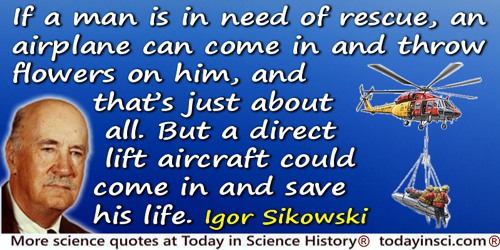
If a man is in need of rescue, an airplane can come in and throw flowers on him, and that’s just about all. But a direct lift aircraft could come in and save his life.
From 'Igor Sikorsky the Aviation Pioneer Speaks', Igor I. Sikorsky Historical Archives, sikorskyarchives.com.
If I had to choose, I would rather have birds than airplanes.
In 'Is Civilization Progress?', Reader’s Digest (Jul 1964).
If this plane were to crash, we could get a new start on this quasar problem.
Said to colleagues, dramatically cupping his hand over his brow, shortly after the take-off of a propeller plane leaving Austin, Texas, after the Second Texas Symposium for Relativistic Astrophysics in Dec 1964. Various different theories had been presented at the conference. The flight passengers included many of the major scientists in quasar research, including Margaret and Geoffrey Burbridge, Subrahmanyan Chandrasekhar, John Wheeler and Maarten Schmidt.
Said to colleagues, dramatically cupping his hand over his brow, shortly after the take-off of a propeller plane leaving Austin, Texas, after the Second Texas Symposium for Relativistic Astrophysics in Dec 1964. Various different theories had been presented at the conference. The flight passengers included many of the major scientists in quasar research, including Margaret and Geoffrey Burbridge, Subrahmanyan Chandrasekhar, John Wheeler and Maarten Schmidt.
As quoted by Arthur I. Miller, Empire of the Stars (2005), 226.
Imagine Aristotle revivified and visiting Manhattan. Nothing in our social, political, economic, artistic, sexual or religious life would mystify him, but he would be staggered by our technology. Its products—skyscrapers, cars, airplanes, television, pocket calculators—would have been impossible without calculus.
In book review, 'Adventures Of a Mathematician: The Man Who Invented the H-Bomb', New York Times (9 May 1976), 201.
In the summer after kindergarten, a friend introduced me to the joys of building plastic model airplanes and warships. By the fourth grade, I graduated to an erector set and spent many happy hours constructing devices of unknown purpose where the main design criterion was to maximize the number of moving parts and overall size. The living room rug was frequently littered with hundreds of metal “girders” and tiny nuts and bolts surrounding half-finished structures. An understanding mother allowed me to keep the projects going for days on end.
Autobiography in Gösta Ekspong (ed.), Nobel Lectures: Physics 1996-2000 (2002), 116.
It is apparent to me that the possibilities of the aeroplane, which two or three years ago were thought to hold the solution to the [flying machine] problem, have been exhausted, and that we must turn elsewhere.
…...
Let us hope that the advent of a successful flying machine, now only dimly foreseen and nevertheless thought to be possible, will bring nothing but good into the world; that it shall abridge distance, make all parts of the globe accessible, bring men into closer relation with each other, advance civilization, and hasten the promised era in which there shall be nothing but peace and goodwill among all men.
Concluding paragraph, Progress in Flying Machines (1894), 269.
Most pilots learn, when they pin on their wings and go out and get in a fighter, especially, that one thing you don’t do, you don’t believe anything anybody tells you about an airplane.
Nothing will ever equal that moment of joyous excitement which filled my whole being when I felt myself flying away from the earth. It was not mere pleasure; it was perfect bliss. Escaped from the frightful torments of persecution and of calumny, I felt that I was answering all in rising above all.
after making man's first ascent by hydrogen balloon in 1783 quoted in Wonderful Balloon Ascents: Or, the Conquest of the Skies by F. Marion
Others consider us superior because of our cultured ways and intellectual tendencies; our technology lets us drive cars, use word processors and travel great distances by air. Some of us live in air-conditioned houses and we are entertained by the media. We think that we are more intelligent than stone-agers, yet how many modern humans could live successfully in caves, or would know how to light wood fires for cooking, or make clothes and shoes from animal skins or bows and arrows good enough to keep their families fed?
In The Revenge of Gaia: Earth’s Climate Crisis & The Fate of Humanity (2006, 2007), 185

Our children will enjoy in their homes electrical energy too cheap to meter. … Transmutation of the elements, unlimited power, ability to investigate the working of living cells by tracer atoms, the secret of photosynthesis about to be uncovered, these and a host of other results, all in about fifteen short years. It is not too much to expect that our children will know of great periodic regional famines in the world only as matters of history, will travel effortlessly over the seas and under the and through the air with a minimum of danger and at great speeds, and will experience a life span far longer than ours, as disease yields and man comes to understand what causes him to age.
Speech at the 20th anniversary of the National Association of Science Writers, New York City (16 Sep 1954), as quoted in 'Abundant Power From Atom Seen', New York Times (17 Sep 1954) 5.
Quite likely the twentieth century is destined to see the natural forces which will enable us to fly from continent to continent with a speed far exceeding that of a bird.
'The Outlook for the Flying Machine'. The Independent: A Weekly Magazine (22 Oct 1903), 2510.
Samuel Pierpoint Langley, at that time regarded as one of the most distinguished scientists in the United States … evidently believed that a full sized airplane could be built and flown largely from theory alone. This resulted in two successive disastrous plunges into the Potomac River, the second of which almost drowned his pilot. This experience contrasts with that of two bicycle mechanics Orville and Wilbur Wright who designed, built and flew the first successful airplane. But they did this after hundreds of experiments extending over a number of years.
In article Total Quality: Its Origins and its Future (1995), published at the Center for Quality and Productivity Improvement.
Science tries to answer the question: ‘How?’ How do cells act in the body? How do you design an airplane that will fly faster than sound? How is a molecule of insulin constructed? Religion, by contrast, tries to answer the question: ‘Why?’ Why was man created? Why ought I to tell the truth? Why must there be sorrow or pain or death? Science attempts to analyze how things and people and animals behave; it has no concern whether this behavior is good or bad, is purposeful or not. But religion is precisely the quest for such answers: whether an act is right or wrong, good or bad, and why.
Science and Imagination, ch. 4, Basic Books (1967).
The construction of an analogue computer or a supersonic airplane is simple when compared to the mixture of space and evolutionary eons represented by a cell.
In 'The Wisdom of Wilderness', Life (22 Dec 1967), 63, No. 25, 10.
The crescendo of noise—whether it comes from truck or jackhammer, siren or airplane—is more than an irritating nuisance. It intrudes on privacy, shatters serenity, and can inflict pain. We dare not be complacent about this ever mounting volume of noise. In the years ahead, it can bring even more discomfort—and worse—to the lives of people.
In 'Special Message to the Congress on Conservation: “To Renew a Nation” (8 Mar 1968). Collected in Public Papers of the Presidents of the United States: Lyndon B. Johnson: 1968-69 (1970), 363.
https://books.google.com/books?isbn=1623768977
Johnson, Lyndon B. - 1970
The demonstration that no possible combination of known substances, known forms of machinery and known forms of force, can be united in a practical machine by which men shall fly along distances through the air, seems to the writer as complete as it is possible for the demonstration to be.
Side-lights on Astronomy and Kindred Fields of Popular Science (1906), 345.
The mathematician of to-day admits that he can neither square the circle, duplicate the cube or trisect the angle. May not our mechanicians, in like manner, be ultimately forced to admit that aerial flight is one of that great class of problems with which men can never cope… I do not claim that this is a necessary conclusion from any past experience. But I do think that success must await progress of a different kind from that of invention.
[Written following Samuel Pierpoint Langley's failed attempt to launch his flying machine from a catapult device mounted on a barge in Oct 1903. The Wright Brother's success came on 17 Dec 1903.]
[Written following Samuel Pierpoint Langley's failed attempt to launch his flying machine from a catapult device mounted on a barge in Oct 1903. The Wright Brother's success came on 17 Dec 1903.]
'The Outlook for the Flying Machine'. The Independent: A Weekly Magazine (22 Oct 1903), 2509.
The modern airplane creates a new geographical dimension. A navigable ocean of air blankets the whole surface of the globe. There are no distant places any longer: the world is small and the world is one.
…...
The oppressive weight of disaster and tragedy in our lives does not arise from a high percentage of evil among the summed total of all acts, but from the extraordinary power of exceedingly rare incidents of depravity to inflict catastrophic damage, especially in our technological age when airplanes can become powerful bombs. (An even more evil man, armed only with a longbow, could not have wreaked such havoc at the Battle of Agincourt in 1415.)
…...
The point [is] largely scientific in character …[concerning] the methods which can be invented or adopted or discovered to enable the Earth to control the Air, to enable defence from the ground to exercise control—indeed dominance—upon aeroplanes high above its surface. … science is always able to provide something. We were told that it was impossible to grapple with submarines, but methods were found … Many things were adopted in war which we were told were technically impossible, but patience, perseverance, and above all the spur of necessity under war conditions, made men’s brains act with greater vigour, and science responded to the demands.
[Remarks made in the House of Commons on 7 June 1935. His speculation was later proved correct with the subsequent development of radar during World War II, which was vital in the air defence of Britain.]
[Remarks made in the House of Commons on 7 June 1935. His speculation was later proved correct with the subsequent development of radar during World War II, which was vital in the air defence of Britain.]
Quoting himself in The Second World War: The Gathering Storm (1948, 1986), Vol. 1, 134.
The tireless workers of radio science will produce a radio-mail system that will be inexpensive, secret, and faster than any mail-carrying plane can travel.
In address (Fall 1946) at a dinner in New York to commemorate the 40 years of Sarnoff’s service in the radio field, 'Institute News and Radio Notes: The Past and Future of Radio', Proceedings of the Institute of Radio Engineers (I.R.E.), (May 1947), 35, No. 5, 498. [In 1946, foretelling e-mail? —Webmaster]
The true method of discovery is like the flight of an aeroplane. It starts from the ground of particular observation; it makes a flight in the thin air of imaginative generalization; and it again lands for renewed observation rendered acute by rational interpretation.
Gifford lectures delivered in the University of Edinburgh during the session 1927-28. Process and Reality: An Essay in Cosmology (1929, 1979), 5.
The wildest stretch of the imagination of that time would not have permitted us to believe that within a space of fifteen years actually thousands of these machines would be in the air engaged in deadly combat.
From radio message (16 Dec 1923) broadcast on Station WLW, Cincinnati for 20th anniversay of the first flight. As quoted in Peter L. Jakab and Rick Young (eds.), The Published Writings of Wilbur and Orville Wright (2004).
The Wright Brothers created the single greatest cultural force since the invention of writing. The airplane became the first World Wide Web, bringing people, languages, ideas, and values together.
…...
They said I’d never build it, that if I built it, it wouldn’t fly; that if it flew, I
couldn’t sell it. Well, I did, and it did, and I could.
About critics of his Learjet airplane announced in 1963. As quoted by C.P. Gilmore, 'Hard-Nosed Gambler in the Plane Game', (1966). Collected in Max Gunther, The Very, Very Rich and How They Got That Way: The Spectacular Success (1972, 2010) 170.
To invent an airplane is nothing. To build one is something. But to fly is everything.
Quoted in Mark Eppler The Wright Way (2003), 13.
Wood was the main source of energy in the world until the eighteen-fifties, and it still could be. Roughly a tenth of the annual growth of all the trees on earth could yield alcohol enough to run everything that now uses coal and petroleum—every airplane, every industry, every automobile.
Pieces of the Frame
 In science it often happens that scientists say, 'You know that's a really good argument; my position is mistaken,' and then they would actually change their minds and you never hear that old view from them again. They really do it. It doesn't happen as often as it should, because scientists are human and change is sometimes painful. But it happens every day. I cannot recall the last time something like that happened in politics or religion.
(1987) --
In science it often happens that scientists say, 'You know that's a really good argument; my position is mistaken,' and then they would actually change their minds and you never hear that old view from them again. They really do it. It doesn't happen as often as it should, because scientists are human and change is sometimes painful. But it happens every day. I cannot recall the last time something like that happened in politics or religion.
(1987) -- 





