Agriculture Quotes (80 quotes)
Agricultural Quotes
Agricultural Quotes
[Concerning] mr Kirwan’s charming treatise on manures. Science never appears so beautiful as when applied to the uses of human life, nor any use of it so engaging as agriculture & domestic economy.
Letter (23 Mar 1798) from Jefferson in Philadelphia to William Strickland. In The Papers of Thomas Jefferson: 1 January 1798 to 31 January 1799 (2003), 211. Jefferson was thanking Strickland, who had sent him a copy of Kirwan’s treatise.
[Jethro Tull] was the first Englishman—perhaps the first writer, ancient and modern—who has attempted, with any tolerable degree of success, to reduce the art of agriculture to certain and uniform principles; and it must be acknowledged that he has done more towards establishing a rational and practical method of husbandry than all the writers who have gone before him.
In Letter (18 Oct 1764), signed only “D.Y.” from Hungerford, in Sylvanus Urban (ed.), 'Observations on the late Improvements in Agriculture', The Gentleman’s Magazine (Nov 1764), 525.
[The earth’s rocks] were so arranged, in their formation, that they should best serve Man’s purposes. The strata were subjected to metamorphism, and so crystallized, that he might be provided with the most perfect material for his art, his statues, temples, and dwellings; at the same time, they were filled with veins, in order to supply him with gold and silver and other treasures. The rocks were also made to enclose abundant beds of coal and iron ore, that Man might have fuel for his hearths and iron for his utensils and machinery. Mountains were raised to temper hot climates, to diversify the earth’s productiveness, and, pre-eminently, to gather the clouds into river-channels, thence to moisten the fields for agriculture, afford facilities for travel, and supply the world with springs and fountains.
In 'Concluding Remarks', A Text-book of Geology: Designed for Schools and Academies (1863), 338.
[Tom Bombadil is] an exemplar, a particular embodying of pure (real) natural science: the spirit that desires knowledge of other things, their history and nature, because they are ‘other’ and wholly independent of the enquiring mind, a spirit coeval with the rational mind, and entirely unconcerned with ‘doing’ anything with the knowledge: Zoology and Botany not Cattle-breeding or Agriculture. Even the Elves hardly show this: they are primarily artists.
From Letter draft to Peter Hastings (manager of a Catholic bookshop in Oxford, who wrote about his enthusiasm for Lord of the Rings) (Sep 1954). In Humphrey Carpenter (ed.) assisted by Christopher Tolkien, The Letters of J.R.R. Tolkien (1995, 2014), 192, Letter No. 153.
Socrates: Shall we set down astronomy among the objects of study?
Glaucon: I think so, to know something about the seasons, the months and the years is of use for military purposes, as well as for agriculture and for navigation.
Socrates: It amuses me to see how afraid you are, lest the common herd of people should accuse you of recommending useless studies.
As quoted by Plato. In Richard Garnett, Léon Vallée, Alois Brandl (eds.), The Universal Anthology: A Collection of the Best Literature (1899), Vol. 4, 111.
A farmer is always going to be rich next year.
— Philemon
In The Berkshire News (1945), 11, 5. This is the earliest example so far found by Webmaster. (Can you help find a better source?)
A field is the most just possession for men. For what nature requires it carefully bears: barley, oil, wine, figs, honey. Silver-plate and purple will do for the tragedians, not for life.
— Philemon
Fragment 105 K-A quoted by Stobaeus 4. 15a. 15. In Matthew Leigh, Comedy and the Rise of Rome (2005), 112.
A good farmer is nothing more nor less than a handy man with a sense of humus.
In 'The Practical Farmer' (Oct 1940), collected in One Man’s Meat (1942), 218.
A little science is something that they must have. I should like my nephews to know what air is, and water; why we breathe, and why wood burns; the nutritive elements essential to plant life, and the constituents of the soil. And it is no vague and imperfect knowledge from hearsay I would have them gain of these fundamental truths, on which depend agriculture and the industrial arts and our health itself; I would have them know these things thoroughly from their own observation and experience. Books here are insufficient, and can serve merely as aids to scientific experiment.
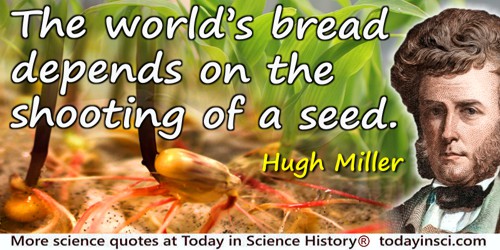
According to the poet, “The world’s bread depends on the shooting of a seed.”
In The Testimony of the Rocks (1857), 26. This is paraphrase from a poem by John Savery, 'A Corner in Wheat', which begins: “Our world depends for daily bread / Upon the shooting of the seed.” Its first stanza ends similarly: “Upon the shooting of a seed / Our world depends for daily bread.” The poem is collected in Memorial Volume: Selections from the Prose and Poetical Writings of the Late John Savary (1912), 44.
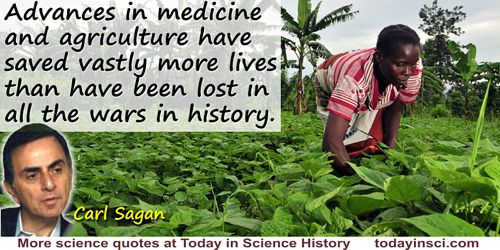
Advances in medicine and agriculture have saved vastly more lives than have been lost in all the wars in history.
The Demon-Haunted World: Science as a Candle in the Dark (1996), 11.
Agriculture is something like farming; only farming is doing it.
Agriculture is the backbone of the livelihood security system of nearly 700 million people in the country and we need to build our food security on the foundation of home grown food.
In 'Interview: We need to build our food security: MS Swaminathan', The Economic Times (11 Feb 2010), on economictimes.indiatimes.com website.
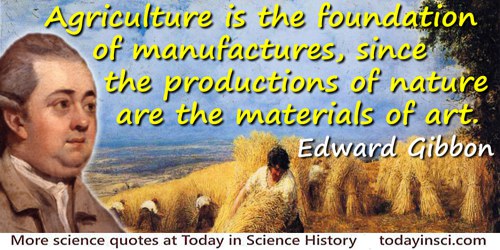
Agriculture is the foundation of manufactures, since the productions of nature are the materials of art.
In The History of the Decline and Fall of the Roman Empire (1841), Vol. 1, 33.
Agriculture not only gives riches to a nation, but the only riches she can call her own.
As quoted in Edwin Davies (ed.), Other Men's Minds, Or, Seven Thousand Choice Extracts on History, Science, Philosophy, Religion (1800), 18.
And God said, “Let the earth put forth vegetation, plants yielding seed, and fruit trees bearing fruit in which is their seed, each according to its kind.” And God saw that it was good. And there was evening and there was morning, a third day.
— Bible
(circa 725 B.C.)
Ask a follower of Bacon what [science] the new philosophy, as it was called in the time of Charles the Second, has effected for mankind, and his answer is ready; “It has lengthened life; it has mitigated pain; it has extinguished diseases; it has increased the fertility of the soil; it has given new securities to the mariner; it has furnished new arms to the warrior; it has spanned great rivers and estuaries with bridges of form unknown to our fathers; it has guided the thunderbolt innocuously from heaven to earth; it has lighted up the night with the splendour of the day; it has extended the range of the human vision; it has multiplied the power of the human muscles; it has accelerated motion; it has annihilated distance; it has facilitated intercourse, correspondence, all friendly offices, all dispatch of business; it has enabled man to descend to the depths of the sea, to soar into the air, to penetrate securely into the noxious recesses of the earth, to traverse the land in cars which whirl along without horses, to cross the ocean in ships which run ten knots an hour against the wind. These are but a part of its fruits, and of its first-fruits; for it is a philosophy which never rests, which has never attained, which is never perfect. Its law is progress. A point which yesterday was invisible is its goal to-day, and will be its starting-point to-morrow.”
From essay (Jul 1837) on 'Francis Bacon' in Edinburgh Review. In Baron Thomas Babington Macaulay and Lady Trevelyan (ed.) The Works of Lord Macaulay Complete (1871), Vol. 6, 222.
By the end of the next century, the “greenhouse effect” may increase temperatures worldwide to levels that have not been reached for at least 100,000 years. And the effects on sea level and on agriculture and other human activities are likely to be so profound that we should be planning for them now.
In 'Temperatures Rise in the Global Greenhouse', New Scientist (15 May 1986), 110, No. 1508, 32.
Darwin recognized that thus far the civilization of mankind has passed through four successive stages of evolution, namely, those based on the use of fire, the development of agriculture, the development of urban life and the use of basic science for technological advancement.
In The Science Matrix: The Journey, Travails, Triumphs (1992, 2012), 86.
Developing countries can leapfrog several stages in the development process through the application of bio-technology in agriculture.
In Arbind Prasad and Jagdish Prasad, Development Planning for Agriculture: Policies, Economic Implications, Inputs, Production and Marketing (1994), 93.
Essentially all civilizations that rose to the level of possessing an urban culture had need for two forms of science-related technology, namely, mathematics for land measurements and commerce and astronomy for time-keeping in agriculture and aspects of religious rituals.
From The Science Matrix: The Journey, Travails, Triumphs (1992, 1998), Preface, x.
Farm animals feel pleasure and sadness, excitement and resentment, depression, fear, and pain. They are far more aware and intelligent than we ever imagined … They are individuals in their own right.
In preface contributed to Amy Hatkoff, The Inner World of Farm Animals (2009), 12-13.
For the Lord your God is bringing you into a good land—a land with brooks, streams, and deep springs gushing out into the valleys and hills; a land with wheat and barley, vines and fig trees, pomegranates, olive oil and honey; 9 a land where bread will not be scarce and you will lack nothing; a land where the rocks are iron and you can dig copper out of the hills.
— Bible
New International Version, Bible, Deuteronomy 8, 7-9.
He that would look with contempt on the pursuits of the farmer, is not worthy of the name of a man.
He who appropriates land to himself by his labor, does not lessen but increases the common stock of mankind. For the provisions serving to the support of human life, produced by one acre of inclosed and cultivated land, are … ten times more than those which are yielded by an acre of land, of an equal richness lying waste in common. And therefore he that incloses land and has a greater plenty of the conveniences of life from ten acres than he could have from a hundred left to nature, may truly be said to give ninety acres to mankind.
In John Locke and Thomas Preston Peardon (ed.), The Second Treatise of Civil Government: An Essay Concerning the True Original, Extent and End of Civil Government (Dec 1689, 1952), 22.
I always rejoice to hear of your being still employed in experimental researches into nature, and of the success you meet with. The rapid progress true science now makes, occasions my regretting sometimes that I was born so soon: it is impossible to imagine the height to which may be carried, in a thousand years, the power of man over matter; we may perhaps learn to deprive large masses of their gravity, and give them absolute levity for the sake of easy transport. Agriculture may diminish its labour and double its produce; all diseases may by sure means be prevented or cured (not excepting even that of old age), and our lives lengthened at pleasure even beyond the antediluvian standard. Oh! that moral science were in as fair a way of improvement; that men would cease to be wolves to one another; and that human beings would at length learn what they now improperly call humanity!
Letter to Dr Priestley, 8 Feb 1780. In Memoirs of Benjamin Franklin (1845), Vol. 2, 152.
If agriculture goes wrong, nothing else will have a chance to go right in the country.
Quoted as “He had a strong belief” in Journal of Plantation Crops (2002), 30-33, 72. Also in Combating Hunger and Achieving Food Security (2016), 86, ending with wording “in our country”, referring to India.
If farm ecology and economics go wrong, nothing else will go right in agriculture.
In 'Science and Shaping the Future of Rice', collected in Pramod K. Aggarwal et al. (eds.), 2006 International Rice Congress: Science, Technology, and Trade for Peace and Prosperity (2007), 5.
In a hundred and fifty years the United States has lost one third of its topsoil. And I think about two hundred fifty million acres are turning into desert because of overgrazing and other mismanagement.
From interview collected in Pamela Weintraub (ed.), The Omni Interviews (1984), 82.
In a sense, the fossil fuels are a onetime gift that lifted us up from subsistence agriculture and eventually should lead us to a future based on renewable resources.
In Hubbert's Peak: The Impending World Oil Shortage (2001), 160.
It be urged that the wild and uncultivated tree, hitherto yielding sour and bitter fruit only, can never be made to yield better; yet we know that the grafting art implants a new tree on the savage stock, producing what is most estimable in kind and degree. Education, in like manner, engrafts a new man on the native stock, and improves what in his nature was vicious and perverse into qualities of virtue and social worth.
From paper 'Report of the Commissioners Appointed to Fix the Site of the University of Virginia', included in Annual Report of the Board of Visitors of the University of Virginia for the Fiscal Year Ending May 31, 1879 (1879), 10. Collected in Commonwealth of Virginia, Annual Reports of Officers, Boards, and Institutions of the Commonwealth of Virginia, for the Year Ending September 30, 1879 (1879).
It is a very strange thing to reflect that but for the invention of Professor Haber the Germans could not have continued the War after their original stack of nitrates was exhausted. The invention of this single man has enabled them, utilising the interval in which their accumulations were used up, not only to maintain an almost unlimited supply of explosives for all purposes, but to provide amply for the needs of agriculture in chemical manures. It is a remarkable fact, and shows on what obscure and accidental incidents the fortunes of possible the whole world may turn in these days of scientific discovery.
[During World War I, Fritz Haber and Karl Bosch invented a large scale process to cause the direct combination of hydrogen and nitrogen gases to chemically synthesize ammonia, thus providing a replacement for sodium nitrate in the manufacture of explosives and fertilizers.]
[During World War I, Fritz Haber and Karl Bosch invented a large scale process to cause the direct combination of hydrogen and nitrogen gases to chemically synthesize ammonia, thus providing a replacement for sodium nitrate in the manufacture of explosives and fertilizers.]
Parliamentary debate (25 Apr 1918). In Winston Churchill, Richard Langworth (ed.), Churchill by Himself: The Definitive Collection of Quotations (2008), 469.
by Winston Churchill, Richard Langworth
Land that is left wholly to nature, that has no improvement of pasturage, tillage, or planting, is called, as indeed it is, “waste”.
In John Locke and Thomas Preston Peardon (ed.), The Second Treatise of Civil Government: An Essay Concerning the True Original, Extent and End of Civil Government (Dec 1689, 1952), 25.
Let the farmer for evermore be honored in his calling, for they who labor in the earth are the chosen people of God.
In Tryon Edwards (ed.), A Dictionary of Thoughts: Being a Cyclopedia of Laconic Quotations (1891), 11.
Mr Justus Liebig is no doubt a very clever gentleman and a most profound chemist, but in our opinion he knows as much of agriculture as the horse that ploughs the ground, and there is not an old man that stands between the stilts of a plough in Virginia, that cannot tell him of facts totally at variance with his finest spun theories.
— Magazine
The Southern Planter (1845), 3, 23.
My sense is that the most under-appreciated–and perhaps most under-researched–linkages between forests and food security are the roles that forest-based ecosystem services play in underpinning sustainable agricultural production. Forests regulate hydrological services including the quantity, quality, and timing of water available for irrigation. Forest-based bats and bees pollinate crops. Forests mitigate impacts of climate change and extreme weather events at the landscape scale.
In 'Forests and food security: What we know and need to know', Forest News online blog by the Center for International Forestry Research (20 Apr 2011).
Natural history is not only interesting to the individual, it ought to become a NATIONAL CONCERN, since it is a NATIONAL GOOD,—of this, agriculture, as it is the most important occupation, affords the most striking proof.
From Introduction to a Course of Lectures on Natural History: Delivered in the University of Pennsylvania, Nov. 16, 1799 (1800), 12.
Our highest claim to respect, as a nation, rests not in the gold, nor in the iron and the coal, nor in inventions and discoveries, nor in agricultural productions, nor in our wealth, grown so great that a war debt of billions fades out under ministrations of the revenue collector without fretting the people; nor, indeed, in all these combined. That claim finds its true elements in our systems of education and of unconstrained religious worship; in our wise and just laws, and the purity of their administration; in the conservative spirit with which the minority submits to defeat in a hotly-contested election; in a free press; in that broad humanity which builds hospitals and asylums for the poor, sick, and insane on the confines of every city; in the robust, manly, buoyant spirit of a people competent to admonish others and to rule themselves; and in the achievements of that people in every department of thought and learning.
From his opening address at an annual exhibition of the Brooklyn Industrial Institute. As quoted in biographical preface by T. Bigelow to Austin Abbott (ed.), Official Report of the Trial of Henry Ward Beecher (1875), Vol. 1, xiv.
Our world depends for daily bread
Upon the shooting of a seed.
Upon the shooting of a seed.
In 'A Corner in Wheat', Memorial Volume: Selections from the Prose and Poetical Writings of the Late John Savary (1912), 44. The quoted lines begin the first stanza, which ends similarly: “Upon the shooting of a seed
Our world depends for daily bread.”
Our world depends for daily bread.”
Peace means creative giving, making a contribution to the betterment of our own people and to the betterment of people throughout the world. And who better understands that than the men and women of American agriculture?
'Remarks to Farm Leaders Participating in the “Salute to Agriculture”' (7 May 1971), Public Papers of the Presidents of the United States: Richard M. Nixon (1972), 627.
The advancement of agriculture, commerce and manufactures, by all proper means, will not, I trust, need recommendation. But I cannot forbear intimating to you the expediency of giving effectual encouragement as well to the introduction of new and useful inventions from abroad, as to the exertions of skill and genius in producing them at home.
Early suggestion for awarding patent protection. In First Annual Message to Congress on the State of the Union (8 Jan 1790).
The chief problem of the commercial farmers is overproduction. The chief problem of the low-income farmers is poverty.
In Public Papers of Nelson A. Rockefeller: Fifty-Third Governor of the State of New York (1959), Vol. 1, 1206.
The discovery of agriculture was the first big step toward a civilized life.
In Evolution and Ethics (1947), 79.
The feudal model of agriculture collided, first, with environmental limits and then with a massive external shock – the Black Death. After that, there was a demographic shock: too few workers for the land, which raised their wages and made the old feudal obligation system impossible to enforce. The labour shortage also forced technological innovation. The new technologies that underpinned the rise of merchant capitalism were the ones that stimulated commerce (printing and accountancy), the creation of tradeable wealth (mining, the compass and fast ships) and productivity (mathematics and the scientific method).
In 'The End of Capitalism Has Begun', The Guardian (17 Jul 2015) (online).
The first steps in Agriculture, Astronomy, Zoology, (those first steps which the farmer, the hunter, and the sailor take,) teach that nature's dice are always loaded; that in her heaps and rubbish are concealed sure and useful results.
In Nature (1849), 36.
The first three men in the world were a gardener, a ploughman, and a grazier; and if any object that the second of these was a murderer, I desire him to consider that as soon as he was so, he quitted our profession, and turned builder.
The frost is God’s plough which he drives through every inch of ground in the world, opening each clod, and pulverizing the whole.
As quoted in Henry Southgate (ed.), Many Thoughts of Many Minds (1862), 237.
The gentleman [Mr. Taber] from New York says [agricultural research] is all foolish. Yes; it was foolish when Burbank was experimenting with wild cactus. It was foolish when the Wright boys went down to Kitty Hawk and had a contraption there that they were going to fly like birds. It was foolish when Robert Fulton tried to put a boiler into a sail boat and steam it up the Hudson. It was foolish when one of my ancestors thought the world was round and discovered this country so that the gentleman from New York could become a Congressman. (Laughter.) ... Do not seek to stop progress; do not seek to put the hand of politics on these scientific men who are doing a great work. As the gentleman from Texas points out, it is not the discharge of these particular employees that is at stake, it is all the work of investigation, of research, of experimentation that has been going on for years that will be stopped and lost.
Speaking (28 Dec 1932) as a member of the 72nd Congress, early in the Great Depression, in opposition to an attempt to eliminate a small amount from the agricultural appropriation bill. As quoted in 'Mayor-Elect La Guardia on Research', Science (1933), New Series, 78, No. 2031, 511.
The gold rush in Madre de Dios, Peru, exceeds the combined effects of all other causes of forest loss in the region, including from logging, ranching and agriculture. This is really important because we’re talking about a global biodiversity hotspot. The region’s incredible flora and fauna is being lost to gold fever.
As quoted by Rhett A. Butler in article 'Gold mining in the Amazon rainforest surges 400%' on monabay.com website (28 Oct 2013).
The land! That is where our roots are. There is the basis of our physical life. The farther we get away from the land, the greater our insecurity. From the land comes everything that supports life, everything we use for the service of physical life. The land has not collapsed or shrunk in either extent or productivity. It is there waiting to honor all the labor we are willing to invest in it, and able to tide us across any dislocation of economic conditions.
Advice during the Great Depression, placed in an advertisement, 'Henry Ford on Self-Help', Literary Digest (29 Jun 1932), 113, No. 12, 29, and various other magazines.
The most humble research scientist in the Department of Agriculture is at this time contributing more to this country than the most useful member of Congress.
Speaking (29 Dec 1932) as a member of the 72nd Congress, early in the Great Depression, in opposition to curtailing the agricultural appropriation. As quoted in 'Mayor-Elect La Guardia on Research', Science (1933), New Series, 78, No. 2031, 511. Also in A. Hunter Dupree, under subtitle 'Impact of the Great Depression' in Science in the Federal Government: A History of Policies and Activities to 1940, 344.
The oranges, it is true, are not all exactly of the same size, but careful machinery sorts them so that automatically all those in one box are exactly similar. They travel along with suitable things being done to them by suitable machines at suitable points until they enter a suitable refrigerator car in which they travel to a suitable market. The machine stamps the word “Sunkist” upon them, but otherwise there is nothing to suggest that nature has any part in their production.
From 'Modern Homogeneity', collected in In Praise of Idleness and Other Essays (1935, 2004), 131.
The ruthless destruction of their forests by the Chinese is one of the reasons why famine and plague today hold this nation in their sinister grasp. Denudation, wherever practiced, leaves naked soil; floods and erosion follow, and when the soil is gone men must also go—and the process does not take long. The great plains of Eastern China were centuries ago transformed from forest into agricultural land. The mountain plateau of Central China have also within a few hundred years been utterly devastated of tree growth, and no attempt made at either natural or artificial reforestation. As a result, the water rushes off the naked slopes in veritable floods, gullying away the mountain sides, causing rivers to run muddy with yellow soil, and carrying enormous masses of fertile earth to the sea. Water courses have also changed; rivers become uncontrollable, and the water level of the country is lowered perceptibly. In consequence, the unfortunate people see their crops wither and die for lack of water when it is most needed.
Statement (11 May 1921) by United States Department of Agriculture (USDA) concerning the famine in China in seven out of every ten years. Reported in 'Blames Deforestation: Department of Agriculture Ascribes Chinese Famine to it', New York Times (12 May 1921), 12.
/AdamsJohn(1735-1826)-Study500x250px.jpg)
The science of government is my duty. … I must study politics and war that my sons may have liberty to study mathematics and philosophy. My sons ought to study mathematics and philosophy, geography, natural history, naval architecture, navigation, commerce, and agriculture, in order to give their children a right to study painting, poetry, music, architecture, statuary, tapestry, and porcelain.
Letter to Abigail Adams, (1780). In John Adams and Charles Francis Adams, Letters of John Adams, Addressed to His Wife (1841), 68.
The sciences are taught in following order: morality, arithmetic, accounts, agriculture, geometry, longimetry, astronomy, geomancy, economics, the art of government, physic, logic, natural philosophy, abstract mathematics, divinity, and history.
From Ain-i-Akbery (c.1590). As translated from the original Persian, by Francis Gladwin in 'Akbar’s Conduct and Administrative Rules', 'Regulations For Teaching in the Public Schools', Ayeen Akbery: Or, The Institutes of the Emperor Akber (1783), Vol. 1, 290. Note: Akbar (Akber) was a great ruler; he was an enlightened statesman. He instituted a great system for general education.
The technologies which have had the most profound effects on human life are usually simple. A good example of a simple technology with profound historical consequences is hay. Nobody knows who invented hay, the idea of cutting grass in the autumn and storing it in large enough quantities to keep horses and cows alive through the winter. All we know is that the technology of hay was unknown to the Roman Empire but was known to every village of medieval Europe. Like many other crucially important technologies, hay emerged anonymously during the so-called Dark Ages. According to the Hay Theory of History, the invention of hay was the decisive event which moved the center of gravity of urban civilization from the Mediterranean basin to Northern and Western Europe. The Roman Empire did not need hay because in a Mediterranean climate the grass grows well enough in winter for animals to graze. North of the Alps, great cities dependent on horses and oxen for motive power could not exist without hay. So it was hay that allowed populations to grow and civilizations to flourish among the forests of Northern Europe. Hay moved the greatness of Rome to Paris and London, and later to Berlin and Moscow and New York. ... Great inventions like hay and printing, whatever their immediate social costs may be, result in a permanent expansion of our horizons, a lasting acquisition of new territory for human bodies and minds to cultivate.
Infinite In All Directions (1988, 2004), 135. The book is a revised version of a series of the Gifford Lectures under the title 'In Praise of Diversity', given at Aberdeen, Scotland.
The virgin fertility of our soils, and the vast amount of unskilled labor, have been more of a curse than a blessing to agriculture. This exhaustive system for cultivation, the destruction of forests, the rapid and almost constant decomposition of organic matter, together with the problems of nitrification and denitrification, the multitudinous insects and fungus diseases which are ever increasing with marvelous rapidity year by year, make our agricultural problem one requiring more brains than of the North, East or West.
In Farmer’s Leaflet 7: The Need of Scientific Agriculture in the South (1902). Reprinted in The Review of Reviews (1902), 25, 322.
There is waste going on in the business life of our people in many ways—waste both of resources and of opportunities. There is waste of energy due to insufficient occupation, because agriculture gives full employment for only six or seven months in the year. There is waste due to illiteracy, because ninety-four persons out of every hundred are uneducated. There is waste through ignorance of the ways of the civilized people, because we fail to utilize their accumulated asset of wisdom and experience. Waste is also going on through our imperfect acquaintance with the commonplaces of civilization and lack of correct business ideals and business standards in daily life. Mental energy is wasted in caste disputes and village factions. Capital is wasted because money is hoarded instead of being made available for productive purposes. There is waste of health because, although leading moral lives normally, men and women grow prematurely old for want of pride of person and attention to the elementary laws of health. The largest waste of all is the lack of capacity for cooperation, the difficulty of ensuring harmony, sympathy and oneness of feeling, in matters affecting the larger interests of the State.
Speech (3 Jun 1914), 'Address to the Mycore Economic Conference'. Collected in Speeches: 1910-11 to 1916-17: by Sir Mokshagundam Visvesvaraya (1917), 152-153.
There seem to be but three ways for a nation to acquire wealth: the first is by war, as the Romans did, in plundering their conquered neighbors—this is robbery; the second by commerce, which is generally cheating; the third by agriculture, the only honest way, wherein man receives a real increase of the seed thrown into the ground, in a kind of continual miracle, wrought by the hand of God in his favor, as a reward for his innocent life and his virtuous industry.
In 'Positions to be Examined', The Works of Benjamin Franklin Consisting of Essays, Humorous, Moral and Literary (1824), 241.
There will always be a psychological problem in the peasant’s soul: no one is born a Communist. In the Soviet Union farmers look in the barn for “their” horses even after they have given them to the collective.
As quoted in Editorial, 'The High Cost of Marx on the Farm', Life (23 Nov 1962), 38.
This remarkable [nuclear] energy is spreading its tentacles to almost all walks of life - be it power, agriculture, medicine, laser systems, satellite imagery or environment protection.
Interview in newsletter of the Raja Ramanna Centre for Advanced Technology (Oct 2001), online.
Under present conditions in India, agriculture gives a bare living, sometimes less than a living, to those who pursue that calling. … Industrial activity is everywhere regarded as a higher species of employment, and is decidedly more remunerative than agriculture.
In Reconstructing India (1920), 153-154.
Very old and wide-spread is the opinion that forests have an important impact on rainfall. ... If forests enhance the amount and frequency of precipitation simply by being there, deforestation as part of agricultural expansion everywhere, must necessarily result in less rainfall and more frequent droughts. This view is most poignantly expressed by the saying: Man walks the earth and desert follows his steps! ... It is not surprising that under such circumstances the issue of a link between forests and climate has ... been addressed by governments. Lately, the Italian government has been paying special attention to reforestation in Italy and its expected improvement of the climate. ... It must be prevented that periods of heavy rainfall alternate with droughts. ...In the Unites States deforestation plays an important role as well and is seen as the cause for a reduction in rainfall. ... committee chairman of the American Association for Advancement of Science demands decisive steps to extend woodland in order to counteract the increasing drought. ... some serious concerns. In 1873, in Vienna, the congress for agriculture and forestry discussed the problem in detail; and when the Prussian house of representatives ordered a special commission to examine a proposed law pertaining to the preservation and implementation of forests for safeguarding, it pointed out that the steady decrease in the water levels of Prussian rivers was one of the most serious consequences of deforestation only to be rectified by reforestation programs. It is worth mentioning that ... the same concerns were raised in Russia as well and governmental circles reconsidered the issue of deforestation.
as quoted in Eduard Brückner - The Sources and Consequences of Climate Change and Climate Variability in Historical Times editted by N. Stehr and H. von Storch (2000)
We are living in an age of awesome agricultural enterprise that needs to be interpreted. We find our simple faith in science dominated by the Religion of PhDeism under the reign of Data; so narrow in people and often so meaningless in context as to be worthless to the scientific farmer.
Letter to Joshua Lederberg (19 Apr 1970), Joshua Lederberg papers, National Library of Medicine (online). Hildebrand was a response to a Lederberg's letter published in the Washington Post (18 Apr 1970) about 'Ecology Has All Requisites of an Authentic Religion.' Note that Sam Murchid claimed this term PhDeism in another context in his diaries (as seen in diaries of 1964 and others).
We believe one magnificent highway of this kind [the Lincoln Highway], in actual existence, will stimulate as nothing else could the building of enduring highways everywhere that will not only be a credit to the American people but that will also mean much to American agriculture and American commerce.
From Letter (24 Sep 1912) to his friend, the publisher Elbert Hubbard asking for help facilitating fund-raising. In Jane Watts Fisher, Fabulous Hoosier: A Story of American Achievement (1947), 79.
We believe that biotechnology has a critical role to play in increasing agricultural productivity, particularly in light of climate change. We also believe it can help to improve the nutritional value of staple foods.
U.S. Senate Appropriations Committee. Hearing on the President’s FY2009 War Supplemental Request. (30 Apr 2009).
We can assuredly build a socialist state with modern industry, modern agriculture, and modern science and culture.
In The Wisdom of Mao (2002), 210.
We need a new vision for agriculture … to spread happiness among farm and rural families. Bio-happiness through the conversion of our bio-resources into wealth meaningful to our rural families should be the goal of our national policy for farmers.
In 'Science and Shaping the Future of Rice', collected in Pramod K. Aggarwal et al. (eds.), 206 International Rice Congress: Science, Technology, and Trade for Peace and Prosperity (2007), 8.
We need to learn the lessons of the real cost of production. We need to ask ourselves not just why organic prices are so high, but why conventional prices are so low.
We should look upon agriculture not just as a food-producing machine for the urban population, but as the major source of skilled and remunerative employment and a hub for global outsourcing.
In 'Science and Shaping the Future of Rice', collected in Pramod K. Aggarwal et al. (eds.), 206 International Rice Congress: Science, Technology, and Trade for Peace and Prosperity (2007), 8.
Weeds function as an unseen tax on the crop harvest.
From 'War on Weeds', Science (19 Apr 1946), 103, No. 2677, 465.
What shall be done with nature to reclaim
The herbless, treeless waste? those dead seas past,
Dried summer lands, deserts and “antres vast,”
The earth’s reproach, her barrenness and shame.
Can human toil and foresight help the same?
Science, of soils declares with grand forecast,
Last shall be first, and first shall be the last
To come to fruit in Irrigation’s name!
The herbless, treeless waste? those dead seas past,
Dried summer lands, deserts and “antres vast,”
The earth’s reproach, her barrenness and shame.
Can human toil and foresight help the same?
Science, of soils declares with grand forecast,
Last shall be first, and first shall be the last
To come to fruit in Irrigation’s name!
In 'Arid Lands', Poems of Expansion (1898), 108.
What we do see through geological time is the emergence of more complex worlds. ... [W]hen within the animal we see the emergence of larger and more complex brains, sophisticated vocalizations, echolocation, electrical perception, advanced social systems including eusociality, viviparity, warm-bloodedness, and agriculture—all of which are convergent—then to me that sounds like progress.
Life's Solution, 307. In Vinoth Ramachandra, Subverting Global Myths: Theology and the Public Issues Shaping our World (2008), 184.
When not protected by law, by popular favor or superstition, or by other special circumstances, [birds] yield very readily to the influences of civilization, and, though the first operations of the settler are favorable to the increase of many species, the great extension of rural and of mechanical industry is, in a variety of ways, destructive even to tribes not directly warred upon by man.
In Man and Nature, (1864), 93-93.
When the practice of farming spread over the earth, mankind experienced its first population explosion.
Epigraph in Isaac Asimov’s Book of Science and Nature Quotations (1988), 8.
When the state is shaken to its foundations by internal or external events, when commerce, industry and all trades shall be at a stand, and perhaps on the brink of ruin; when the property and fortune of all are shaken or changed, and the inhabitants of towns look forward with dread and apprehension to the future, then the agriculturalist holds in his hand the key to the money chest of the rich, and the savings-box of the poor; for political events have not the slightest influence on the natural law, which forces man to take into his system, daily, a certain number of ounces of carbon and nitrogen.
Reflecting on events of 1848.
Reflecting on events of 1848.
Familiar Letters on Chemistry (1851), 3rd edn., 483.
Who are the farmer’s servants? … Geology and Chemistry, the quarry of the air, the water of the brook, the lightning of the cloud, the castings of the worm, the plough of the frost.
From 'Farming' in Society and Solitude (1870). Collected in Emerson's Complete Works (1883), Vol. 7, 138.
With the introduction of agriculture mankind entered upon a long period of meanness, misery, and madness, from which they are only now being freed by the beneficent operation of the machine.
In The Conquest of Happiness (1930), 152.
Without an acquaintance with chemistry, the statesman must remain a stranger to the true vital interests of the state, to the means of its organic development and improvement; ... The highest economic or material interests of a country, the increased and more profitable production of food for man and animals, ... are most closely linked with the advancement and diffusion of the natural sciences, especially of chemistry.
Familiar Letters on Chemistry (1851), 3rd edn., 19.
Without the cultivation of the earth, [man] is, in all countries, a savage. Until he gives up the chase, and fixes himself in some place and seeks a living from the earth, he is a roaming barbarian. When tillage begins, other arts follow. The farmers, therefore, are the founders of human civilization.
Address to the Legislature of Massachussetts, Boston, On the Agriculture of England (13 Jan 1840). Collected in The Works of Daniel Webster (1851), Vol. 1, 457.
 In science it often happens that scientists say, 'You know that's a really good argument; my position is mistaken,' and then they would actually change their minds and you never hear that old view from them again. They really do it. It doesn't happen as often as it should, because scientists are human and change is sometimes painful. But it happens every day. I cannot recall the last time something like that happened in politics or religion.
(1987) --
In science it often happens that scientists say, 'You know that's a really good argument; my position is mistaken,' and then they would actually change their minds and you never hear that old view from them again. They really do it. It doesn't happen as often as it should, because scientists are human and change is sometimes painful. But it happens every day. I cannot recall the last time something like that happened in politics or religion.
(1987) --