 (source)
|
Willard Van Orman Quine
(25 Jun 1908 - 25 Dec 2000)
American logician and philosopher who is regarded one of the most significant philosophers in the later half of the 20th century.
|
Science Quotes by Willard Van Orman Quine (11 quotes)
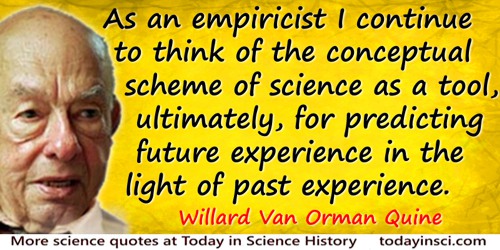
As an empiricist I continue to think of the conceptual scheme of science as a tool, ultimately, for predicting future experience in the light of past experience. Physical objects are conceptually imported into the situation as convenient intermediaries—not by definition in terms of experience, but simply as irreducible posits comparable, epistemologically, to the gods of Homer. For my part I do, qua lay physicist, believe in physical objects and not in Homer's gods; and I consider it a scientific error to believe otherwise. But in point of epistemological footing the physical objects and the gods differ only in degree and not in kind. Both sorts of entities enter our conception only as cultural posits. The myth of physical objects is epistemologically superior to most in that it has proved more efficacious than other myths as a device for working a manageable structure into the flux of experience.
— Willard Van Orman Quine
From A Logical Point of View (1953), 44. [Note: “qua” means “in the character or role of,” thus “qua lay physicist” means “in the role of lay physicist,” or perhaps even (?) “putting on my lay physicist hat.” —Webmaster]
It is the tension between the scientist’s laws and his own attempted breaches of them that powers the engines of science and makes it forge ahead.
— Willard Van Orman Quine
In Quiddities (1987).
Just as the introduction of the irrational numbers … is a convenient myth [which] simplifies the laws of arithmetic … so physical objects are postulated entities which round out and simplify our account of the flux of existence… The conceptional scheme of physical objects is [likewise] a convenient myth, simpler than the literal truth and yet containing that literal truth as a scattered part.
— Willard Van Orman Quine
In J. Koenderink Solid Shape (1990.), 16.
My position is a naturalistic one; I see philosophy not as an a priori propaedeutic or groundwork for science, but as continuous with science. I see philosophy and science as in the same boat—a boat which, to revert to Neurath’s figure as I so often do, we can rebuild only at sea while staying afloat in it. There is no external vantage point, no first philosophy.
— Willard Van Orman Quine
Ontological Relativity and Other Essays, pp. 126-127, Columbia University Press (1969).
Physics investigates the essential nature of the world, and biology describes a local bump. Psychology, human psychology, describes a bump on the bump.
— Willard Van Orman Quine
Theories and Things (1981), 93.
Science is neither discontinuous nor monolithic. It is variously jointed, and loose in the joints in varying degrees.
— Willard Van Orman Quine
…...
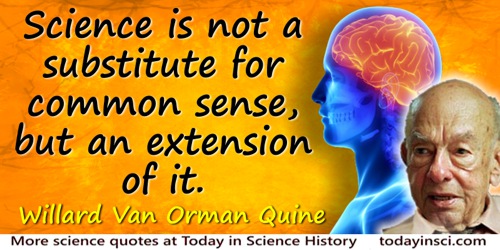
Science is not a substitute for common sense, but an extension of it.
— Willard Van Orman Quine
'The Scope and Language of Science' (1954), reprinted in The British Journal for the Philosophy of Science (1957), 8, 2.
Students of the heavens are separable into astronomers and astrologers as readily as the minor domestic ruminants into sheep and goats, but the separation of philosophers into sages and cranks seems to be more sensitive to frames of reference.
— Willard Van Orman Quine
Theories and Things (1981), 192.
The scientist is indistinguishable from the common man in his sense of evidence, except that the scientist is more careful.
— Willard Van Orman Quine
In 'The Scope and Language of Science' (1954), reprinted in The British Journal for the Philosophy of Science (1957), 8, 5.
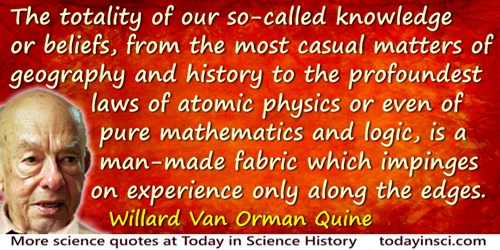
The totality of our so-called knowledge or beliefs, from the most casual matters of geography and history to the profoundest laws of atomic physics or even of pure mathematics and logic, is a man-made fabric which impinges on experience only along the edges. Or, to change the figure, total science is like a field of force whose boundary conditions are experience. A conflict with experience at the periphery occasions readjustments in the interior of the field. Truth values have to be redistributed over some of our statements. Reevaluation of some statements entails reevaluation of others, because of their logical interconnections—the logical laws being in turn simply certain further statements of the system, certain further elements of the field.
— Willard Van Orman Quine
'Two Dogmas of Experience,' in Philosophical Review (1951). Reprinted in From a Logical Point of View (1953), 42.
The word “definition” has come to have a dangerously reassuring sound, owing no doubt to its frequent occurrence in logical and mathematical writings.
— Willard Van Orman Quine
In 'Two Dogmas of Empiricism', From a Logical Point of View: Nine Logico-Philosophical Essays (1953, 1961), 26.
 In science it often happens that scientists say, 'You know that's a really good argument; my position is mistaken,' and then they would actually change their minds and you never hear that old view from them again. They really do it. It doesn't happen as often as it should, because scientists are human and change is sometimes painful. But it happens every day. I cannot recall the last time something like that happened in politics or religion.
(1987) --
In science it often happens that scientists say, 'You know that's a really good argument; my position is mistaken,' and then they would actually change their minds and you never hear that old view from them again. They really do it. It doesn't happen as often as it should, because scientists are human and change is sometimes painful. But it happens every day. I cannot recall the last time something like that happened in politics or religion.
(1987) -- 




