 (source)
|
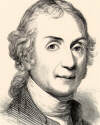
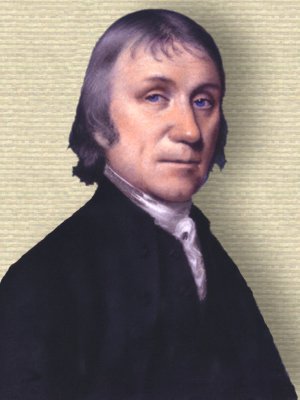
Joseph Priestley
(13 Mar 1733 - 6 Feb 1804)
English chemist, clergyman and political theorist who discovered the element oxygen.
|
[Title Page]
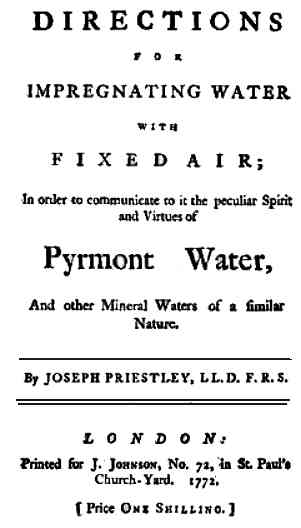
Impregnating Water with Fixed Air
Pyrmont Water,
And other Mineral Waters of a similar Nature,
By Joseph Priestley, L.L.D. F.R.S.
LONDON:
Printed for J. Johnson, No. 72, in St. Pauls Church-Yard, 1772.
[Price One Shilling.]
[Frontisiece]
TO THE RIGHT HONOURABLE
John Earl of Sandwich,
First Lord Commissioner
O F T H E A D M I R A L T Y,
&c. &c. &c.
M y L o r d,
THE favorable manner in which your Lordship, and other Lords Commissioners of the Admiralty, received my proposals [p.ii] for improving the water used at sea, by impregnating it with fixed air, demands my thanks, and those of the public in general; who will observe, with pleasure and gratitude, that whatever promises but the smallest advantage to them, with respect to so important a department in the state as that of your Lordship, is immediately attended to.
To render any future orders that your Lordship may be pleased to give for the trial of this medicated water, the more easily executed, and also to give it the chance of being [p.iii] more extensively useful, at land as well as at sea, I have drawn up the following easy directions for making it, and take the liberty to inscribe the publication to your Lordship.
My Lord,
Your Lordship’s
Most obedient
Humble servant,
JOSEPH PRIESTLEY
Leeds, 4th June 1772
The method of impregnating water with fixed air, of which a description is given in this pamphlet, I hit upon in a course of experiments, an account of which was lately communicated to the Royal Society; containing observations on several different kinds of air, with only a hint of the method of combining this particular kind of water or other fluids. Judging that water thus impregnated with fixed air must be particularly serviceable in long voyages, by preventing or curing the sea-scurvy, according to the theory of Dr. MacBride, and all the Physicians of my acquaintance concurring with me in that opinion, I made the first communication of it to the Lords of the Admiralty, who referred me to the College of Physicians; and those gentlemen being pleased to make a report favorable to the scheme, a trial has been ordered to be made of it on board some of his majesty’s ships. To make this process [p.2] more generally known, and that more frequent trials may be made of water thus medicated, at land as well as at sea, I have been induced to make the present publication.
Sir John Pringle first observed, that putrefaction was checked by fermentation, and Dr. MacBride discovered that this effect was produced by the fixed air which is generated in that process, and upon that principle recommended the use of wort, as supplying a quantity of this fixed air, by fermentation in the stomach, in the same manner as it is done by fresh vegetables, for which he, therefore, thought that it would be a substitute; and experience has confirmed his conjecture. Dr. Black found that in limestone, and all calcareous substances, contain fixed air, and the presence of it makes that what is called mild, and that the deprivation of it renders them caustic; Dr. Brownrigg farther discovered that Pyrmont, and other mineral waters, which have the same acidulous taste, contain a considerable proportion of this very kind of air, and that upon this their peculiar [p.3] spirit and virtues depend; and I think myself fortunate in having hit upon a very easy method of communicating this air (and in a much larger proportion than mineral waters contain it) to any kind of water, or, indeed, to almost any fluid substance. In short, by this method this great antiseptic principle may be administered in a variety of agreeable vehicles.
If this discovery (though it doth not deserve that name) be of any use to my countrymen, and to mankind at large, I shall have my reward. For this purpose I have made the communication as early as I conveniently could, since the latest improvements that I have made in the process; and I cannot help expressing my wishes, that all persons, who discover any thing that promises to be generally useful, would adopt the same method.
[p.5]
D I R E C T I O N S F O R
I M P R E G N A T I N G W A T E R
W I T H
F I X E D A I R.
IF water be only in contact with fixed air, it will begin to imbibe it, but the mixture is greatly accelerated by agitation, which is continually bringing fresh particles of air and water into contact. All that is necessary, therefore, to make this process expeditious and effectual, is first to procure a sufficient quantity of this fixed air, and then to contrive a method by which the air and water may be strongly agitated in the same vessel, without any danger of admitting the common air to them; and this is easily done by first filling any vessel with water, and introducing the fixed air to it, while it stands inverted in another vessel of water. That every part of the process may be as intelligible as possible, [p.6] even those who have no previous knowledge of the subject, I shall describe it very minutely, subjoining several remarks and observations relating to varieties in the process, and other things of a miscellaneous nature.
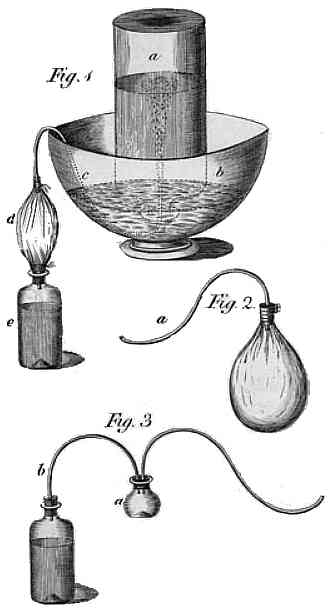
TAKE a glass vessel, a, fig.1, with a pretty narrow neck, but so formed that it will stand upright with its mouth downwards, and, having filled it with water, lay a slip of clean paper, or thin pasteboard, upon it. Then, if they be pressed close together, the vessel may be turned upside down, without danger of admitting any, (or, however, much) common air into it; and when it is thus inverted, it must be placed in another vessel ion the form of a bowl or bason, b, with a little water in it, so much as to permit the slip of paper or pasteboard to be withdrawn, and the end of the pipe c to be introduced.
[p.7] This pipe must be flexible. and air tight, for which purpose it is, I believe, best made of leather, sewed with wax thread, in the manner used by shoe-makers. Into each end of this pipe a piece of a quill should be thrust, to keep them open, while one of them is introduced into the vessel of water, and the other into the bladder, d, the opposite end of which is tied round a cork, which must be perforated, the hole being kept open by a quill; and the cork must fit a phial e, two thirds of which should be filled with chalk just covered with water.
THINGS being thus prepared, and the phial containing the chalk and water being detached from the bladder, and the pipe also from the vessel of water; pour a little oil of vitriol1 upon the chalk and water; and having carefully pressed all the common air out of the bladder, put the cork into the bottle presently after the effervescence has begun. Also press the bladder once more after a [p.8] little of the newly generated air has got into it, in order the more effectually to clear it of all the remains of the common air; and then introduce the end of the pipe into the mouth of the vessel of water, as in the drawing, and begin to agitate the chalk and water briskly. This will presently produce a considerable quantity of fixed air, which will distend the bladder; and this being pressed, the air will force its way through the pipe, and ascend into the vessel of water, the water, at the same time, descending, and coming into the bason.
When about one half of the water is forced out, let the operator lay his hand upon the uppermost part of the vessel, and shake it as briskly as he can, not to throw the water out of the bason and in a few minutes the water will absorb the air; and taking its place, will nearly fill the vessel as the first. Then shake the phial containing the chalk and water again, and force more air into the vessel, till, upon the whole, about an equal bulk of air has been thrown into it. Also shake the water as before, till no more of [p.9] the air can be inhibited. As soon as this is perceived to be case, the water is ready for use; and if it be not used immediately, should be put into a bottle as soon as possible, well corked, and cemented. It will keep however very well if the bottle be only well corked, and kept with the mouth downwards.
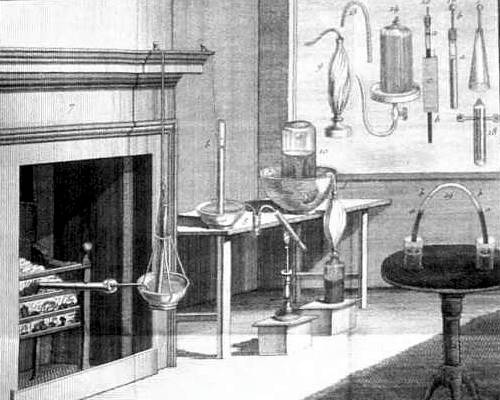
From French edition of his Experiments and Observations on Different Kinds of Air. (source)
1. The bason may be placed inverted upon the vessel full of water, with a slip of paper between them, and then both turned upside-down together; but all this trouble will be saved by having a larger vessel of water, in which they may be both immersed.
2. If the vessel containing the water to be agitated be large, it may be most convenient first to place it inverted, in a bason full of water, and then to draw out the common air my means of a syphon, either making use of a syringe, or drawing it out with the mouth. In this case, also, some kind of handle should be fastened to the bottom of the vessel, for the more easy agitation of it.
[p.10] 3. A narrow mouthed vessel is not necessary, bit it is the most proper for the purpose, because it may be agitated with less danger of the common air getting into it.
4. The flexible pipe is not necessary, though I think it is exceedingly convenient. When it is not used, a bent pipe, a fig.2 (for which glass is the most proper) must be ready to be inserted into the hole made in the cork, when the bladder containing the fixed air is separated from the phial, in which it was generated . The extremity of this tube being put under the vessel of water, the bladder being compressed, the air will be conveyed into it, as before.
5. If the use of a bladder be objected to, though nothing can be more inoffensive, the phial containing the chalk and water must not be agitated at all, or with the greatest caution; unless a small phial, a, fig.3, be interposed between the phial and the vessel of water, in the manner represented in the drawing. For by this means the chalk [p.11] and water that may be thrown up the tube b will lodge at the bottom of the phial a, while nothing but the air will get into the pipe c, and so enter the water. If the tube b be made of tin or copper, the small phial a will not need any other support, the cork into which the extremities of both the tubes are inserted being made to fit the phial very exactly.
6. The phial e, fig.1, should always be placed or held, considerably lower than the vessel a; that if any part of the mixture should be thrown up into the bladder, it may remain in the lower part of it, from which it may be easily pressed back again. This, however, is not necessary, since if it remain in the lower part of the bladder, nothing but the pure air will get into the pipe, and so into the water.
7. If much more than half of the vessel be filled with air, there will not be a body of water sufficient to agitate, and the process will take up much more time.
8. If the chalk be too finely powdered, it will yield the fixed air too fast.
[p.12] 9. After every process the water to which the chalk is put must be changed.
10. It will be proper to fill the bladder with water once a day, after it has been used, that any of the oil of vitriol which may have got into it, and would be in danger of corroding it, may be thoroughly diluted.
11. The vessel which I have generally made use of, holds about three pints, and the phial containing the chalk and water is one of ten ounces; and I find that about the quantity of a tea-spoonful of oil of vitriol is sufficient to produce as much air as will impregnate that quantity of water.
12. If the vessel containing the water be larger, the phial containing the chalk and the oil of vitriol should either be larger in proportion, or fresh water and oil of vitriol must be put to the chalk, to produce the requisite quantity of air.
[p.13] 13. In general the whole process does not take up more than about a quarter of an hour, the agitation not five minutes; and in nearly the same time might a vessel of water, containing two or three gallons, or indeed any quantity that a person could shake, be impregnated with fixed air, if the phial containing the chalk and oil of vitriol, be larger in same proportion.
14. To give the water as much air as it can receive in this way, the process may be repeated with water thus impregnated. This will be useful when the water is intended to be kept a long time; but, as much air may be communicated to water by a single process as will be generally agreeable. very nearly an equal bulk of air may be communicated to a quantity of water by one operation, and something more than an equal bulk by two, but very little will be gained by repeating it oftener; since, after some time, as much fixed air will escape from that part of the surface of the water which is exposed to the common air, as can be imbibed from within the vessel.
[p.14] 15. All calcareous substances contain fixed air, and any acids may be used in order to set it loose from them; but chalk and oil of vitriol are, both of them, not only the cheapest, but in all other respects the most effectual for the purpose.
16. It may be possibly imagined that part of the oil of vitriol is rendered volatile in this process, and so becomes mixed with the water, but it does not appear, by the most rigid chymical examination, that the least perceivable quantity of the acid gets into the water in this way; and if so small a quantity as a single drop of oil of vitriol be mixed with a pint of water (and a much greater quantity would be far from making it less wholesome) it might be discovered. The experiments which were made to ascertain this fact were made with distilled water, the disagreeable taste of which is not taken off, in any degree, by the mixture of fixed air. Otherwise, distilled water, being clogged with no foreign principle, will imbibe the fixed air faster, and retain a greater quantity of it then other water. In the experiments that were made [p.15] for this purpose I was assisted by Mr. Hey, a surgeon in this town, who is well skilled in the methods of examining the properties of mineral waters.
17. Doctor Brownrigg, who made his experiments on Pyrmont water at the spring head, never found that it contained so much as one half of an equal bulk of air; but in this method the water is easily made to imbibe an equal bulk. For it must be observed that a considerable quantity of the most soluble part of the air, is incorporated with the water, as it first ascends through it, before it occupies its place, in the upper part of the vessel.
18. The heat of boiling water, will expel all the fixed air, if a phial containing this impregnated water be held in it; but it will often require above half an hour to effect it compleatly.
19. If any person would chuse to make this medicated water more nearly to resemble genuine Pyrmont water, Sir John Pringle informs me, that from with to ten [p.16] drops of Tinctura Martis cum spiritu salis8 must be mixed with every pint of it. It is agreed, however, on all hands, that the peculiar virtues of Pyrmont, or any other mineral water which has the same brisk or acidulous taste, depend not upon its being a chalybeate2, but upon the fixed air which it contains.
But water impregnated with fixed air does of itself dissolve iron, as the ingenious Mr. Lane has discovered; and iron filings put to this medicated water make a strong and agreeable chalybeates, which hold the iron in solution by means of fixed air only, and not by means of any acid; and these chalybeates, I am informed, are generally the most agreeable to the stomach.
20. By this process may fixed air be given to wine, beer, and almost any liquor whatever: and when beer is become flat or dead, it will be revived by this means; but the delicate agreeable flavour, or acidulous taste communicated by the fixed air, and which is manifest in water, will hardly be [p.17] perceived in wine, or other liquors which have much taste of their own.
21. I would not interfere with the province of the physician, bit I cannot intirely satisfy myself without taking this opportunity to suggest such hints as have occurred to myself, or my friends, with respect to the medicinal uses of water impregnated with fixed air; and also of fixed air in other applications.
In general, the diseases in which water impregnated with fixed air will most probably be serviceable, are those of a putrid nature, of which kind is sea-scurvy. It can hardly be doubted, also, but that this water must have all the medicinal virtues of Pyrmont water, and some other mineral waters similar to it, whatever they be; especially if a few iron filings be put to it, to render it a chalybeate, like genuine Pyrmont water. It is possible, however, that in some cases, it may be desirable to have the fixed air of Pyrmont water, without the iron which it contains.
[p.18] Having this opportunity, I shall also hint the application of fixed air in the form of clysters3, which it occurred to me while I was attending to this subject, as what promises to be useful to correct putrefaction in the intestinal canal, and other parts of the system to which it may, by this channel be conveyed. It has been tried once by Mr. Hey above-mentioned and the recovery of the patient from an alarming putrid fever, when the stools were become black, hot, and very fetid, was so circumstanced, that it is not improbable but that it might be owing, in some measure, to those clysters. The application, however, appeared to be perfectly easy and safe.
Being satisfied that fixed air in not noxious per se, any more than heat, I hinted to some physicians of eminence among my acquaintance, that it might possibly be of use in the case of ulcerated lungs, if persons in that most deplorable situation would breathe as much as they found they could do of it, by holding their heads over vessels containing fermented mixtures, especially if, at the same time, they should [p.19] drink water, or other liquors impregnated with the same principle. Those gentlemen were pleased to think favorably of the proposal, and I am informed that the same ideas had occurred to other persons, and that in three cases in which the breathing of fixed air had been tried, it appeared to have been of great service. One patient intirely recovered. The method in which it was applied was putting chalk into oil of vitriol diluted with water, and breathing the fumes as they issued from the orifice of a funnel, which covered the vessel that contained the mixture.
Dr. Percival also informs me, that the sanies4 of cancers has been much sweetened by the application of fixed air, the pain mitigated, and a better digestion produced, so that a cure is almost expected. The cases are under the direction of a very able surgeon, who will, I doubt not, in due time, give the public a complete account of them. The same person has more than one directed patients laboring under an ulcerous sore throat to receive this air from [p.20] a mixture of salt of wormwood5 and juice of lemons, and the trial has been attended without inconvenience, and with manifest advantage.
I cannot help thinking that fixed air might be applied externally to good advantage in other cases of a putrid nature, even when the whole system was affected. There would be no difficulty in placing the body so that the greatest part of its surface should be exposed to this kind of air; and if a piece of putrid flesh will become firm and and sweet in that situation, as Dr. Macbride found, some advantage, I should think, might be expected from the same antiseptic application, assisted by the vis vitæ6, operating internally, to counteract the same putrid tendency. Some Indians, I have been informed, bury their patients, labouring under putrid diseases, up to the chin in fresh mold, which is also known to take off the fœtor7 from flesh meat beginning to putrify. If this practice be of any use, may it may not be owing to the fixed air imbibed by the pores of the skin in that situation? Following the plow is also an old [p.21] prescription for a consumption, as also is living near lime kilns. There is often some good reason for very old and long continued practices, though it is frequently a long time before it be discovered, and the rationale of them satisfactorily explained.
Being no physician, I run no risque by throwing out these random hints and conjectures. I shall think myself happy if any of them should be the means of making those persons whom they immediately concern, attend more particularly to the subject. My friend Dr. Percival has for some time been employed in making experiments on fixed air, and he is particularly attentive to the medicinal uses of it; and from his knowledge as a philosopher, and skill in his profession, I have very considerable expectations.
IN large vessels containing liquors in a state of fermentation, as at a public brewery or distillery, fixed air may be found in great plenty ready made, and if [p.22] water be poured from one vessel into another, held as near as possible to the surface of the fermenting liquor (by means of long handles) for about four or five minutes, it will acquire the acidulous taste of Pyrmont water; but as, in this case, the surface of the fixed air is exposed to the common air, and is considerably mixed with it, water will not imbibe so much of it by the process above described. The going out of a candle will be an easy method of ascertaining whether the fermentation be sufficiently advanced for this purpose.
1. oil of vitriol: sulphuric acid. ^
2. chalybeate: n. a chalybeate medicine or spring; adj. Impregnated or flavoured with iron, esp. as a mineral water or spring; relating to such waters or preparations.^
3. clyster: a medicine injected into the rectum, to empty or cleanse the bowels, to afford nutrition, etc.; an injection, enema. ^
4. sanies: a thin fetid pus mixed with serum or blood, secreted by a wound or ulcer. ^
5. salt of wormwood: an impure carbonate of potash, obtained from the ashes of wormwood. ^
6. vis vitæ: (Latin) vital force. ^
7. fœtor: an offensive smell; a stench. ^
8. Tinctura Martis cum spiritu sali translates literally as “Tincture of Mars with spirit of salt,” and is a pharmaceutical preparation from iron filings dissolved in spirit of salt (hydrochloric acid). Also known as Tincture of Sesquichloride of Iron. ^
Certain words in the original text were spelled in an archaic form, and have been left unchanged in the text as transcribed above: bason (basin), syphon (siphon), chymical (chemical), compleatly (completely), chuse (choose), intirely (entirely), risque (risk).
The popular modern spa resort of Bad Pyrmont is located on the River Emmer, a city now in the district of Hamelin-Pyrmont, in northern Germany, about 10 km west of the Weser. It was a resort as early as the fourteenth century.
Phyllis May Hembry writes in The English Spa that the mineral water of Pyrmont was a favorite of the Hanoverian George I, who acceded to the British throne in 1714. By 1717, Sir Isaac Newton, president of the Royal Society together with Dr John Bateman, president of the Royal College of Physicians, diplomatically commended the Pyrmont water. A Fleet Street druggist, Mr Burges, imported to London large quantities of bottled Pyrmont water, which increased in popularity. By 1730, the year’s sales included 64,375 three-pint bottles and 7,702 larger ones.


![Joseph Priestley quote: I have procured air [oxygen] ... between five and six times as good as the best common air that I have e](https://todayinsci.com/P/Priestley_Joseph/PriestleyJoseph-ProcuredThm.jpg)
- Science Quotes by Joseph Priestley.
- 13 Mar - short biography, births, deaths and events on date of Priestley's birth.
- Joseph Priestley: Adventurer in Science and Champion of Truth, by F W. Gibbs. - book suggestion.
- Booklist for Joseph Priestley.






