 (source)
|
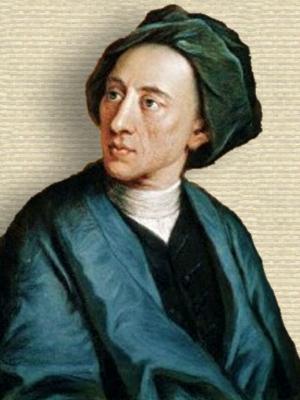
Alexander Pope
(21 May 1688 - 30 May 1774)
English poet whose early writings included a mock-heroic poem The Rape of the Lock (1712). His later work, an attempted systematic survey of human nature, Essay on Man (1733), provided many now familiar household quotations.
|
Science Quotes by Alexander Pope (42 quotes)
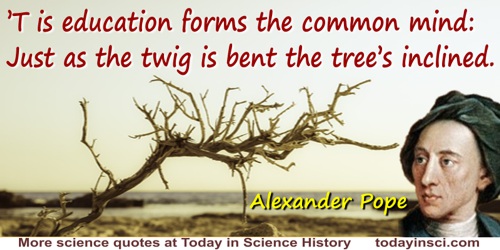
’T is education forms the common mind:
Just as the twig is bent the tree’s inclined.
Just as the twig is bent the tree’s inclined.
— Alexander Pope
'Epistle I: Of the Knowledge and Character of Man', The Works of Alexander Pope (1881), Vol. 3, 64.
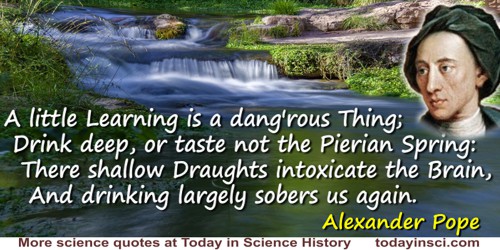
A little Learning is a dang’rous Thing;
Drink deep, or taste not the Pierian Spring:
There shallow Draughts intoxicate the Brain,
And drinking largely sobers us again.
Drink deep, or taste not the Pierian Spring:
There shallow Draughts intoxicate the Brain,
And drinking largely sobers us again.
— Alexander Pope
In An Essay on Criticism (Written 1709, published 1711), 14. (Written in 1709). Misquoted in The Monthly Miscellany; or Gentleman and Lady’s Complete Magazine (1774), as “Mr. Pope says, very truly, ‘A little knowledge is a dangerous thing.’” This latter version of the quote has, in modern times, been misattributed to Albert Einstein.
A wise physician, skill’d our wounds to heal, is more than armies to the public weal.
— Alexander Pope
Homer and Alexander Pope (trans.), The Iliad of Homer (1809), Vol. 2, 144.
Alike fantastic, if too new, or old;
Be not the first by whom the new are try'd,
Not yet the last to lay the old aside.
Be not the first by whom the new are try'd,
Not yet the last to lay the old aside.
— Alexander Pope
In An Essay on Criticism. With notes by Mr. Warburton (1749), 49.
All Nature is but Art, unknown to thee;
All Chance, Direction, which thou canst not see;
All Discord, Harmony, not understood;
All partial Evil, universal Good:
And, spite of Pride, in erring Reason’s spite,
One truth is clear, “Whatever IS, is RIGHT.”
All Chance, Direction, which thou canst not see;
All Discord, Harmony, not understood;
All partial Evil, universal Good:
And, spite of Pride, in erring Reason’s spite,
One truth is clear, “Whatever IS, is RIGHT.”
— Alexander Pope
'An Essay on Man' (1733-4), Epistle I. In John Butt (ed.), The Poems of Alexander Pope (1965), 515.
Atoms or systems into ruin hurl’d,
And now a bubble burst, and now a world.
And now a bubble burst, and now a world.
— Alexander Pope
From An Essay on Man (1734), Epistle I, lines 89-90. In An Essay on Man: enlarged and improved by the author. With notes by William Warburton (1745), 5.
Fine sense and exalted sense are not half as useful as common sense.
— Alexander Pope
'Thoughts On Various Subjects', The Works of Alexander Pope (1806), Vol. 6, 406.
First follow Nature, and your judgment frame
By her just standard, which is still the same:
Unerring nature, still divinely bright,
One clear, unchanged, and universal light,
Life, force, and beauty must to all impart,
At once the source, and end, and test of art.
By her just standard, which is still the same:
Unerring nature, still divinely bright,
One clear, unchanged, and universal light,
Life, force, and beauty must to all impart,
At once the source, and end, and test of art.
— Alexander Pope
#039;Essay On Criticism#039;, Miscellaneous Poems and Translations: by Several Hands (1720), 38.
Go, wondrous creature, mount where science guides.
Go, measure earth, weigh air, and state the tides;
Instruct the planets in what orbs to run,
Correct old Time, and regulate the sun;
Go, teach Eternal Wisdom how to rule,
Then drop into thyself and be a fool.
Go, measure earth, weigh air, and state the tides;
Instruct the planets in what orbs to run,
Correct old Time, and regulate the sun;
Go, teach Eternal Wisdom how to rule,
Then drop into thyself and be a fool.
— Alexander Pope
Quoted in James Wood Dictionary of Quotations from Ancient and Modern, English and Foreign Sources (1893), 125.
Go, wondrous creature! mount where Science guides,
Go, measure earth, weigh air, and state the tides;
Instruct the planets in what orbs to run,
Correct old Time, and regulate the Sun.
Go, measure earth, weigh air, and state the tides;
Instruct the planets in what orbs to run,
Correct old Time, and regulate the Sun.
— Alexander Pope
In An Essay on Man (1736), Epistle II, lines 19-22, 10.
Good sense, which only is the gift of Heaven,
And though no science, fairly worth the seven.
And though no science, fairly worth the seven.
— Alexander Pope
Moral Essays. Epistle iv. Line 43. In The Works of Alexander Pope (1824), Vol. 5, 385.
Good-nature and good-sense must ever join;
To err is human, to forgive divine.
To err is human, to forgive divine.
— Alexander Pope
In An Essay on Criticism (1749), 66. Note: first published anonymously in 1711 when Pope was 22 years old.
Heaven forming each on other to depend,
A master, or a servant, or a friend,
Bids each on other for assistance call,
Till one man’s weakness grows the strength of all.
A master, or a servant, or a friend,
Bids each on other for assistance call,
Till one man’s weakness grows the strength of all.
— Alexander Pope
In 'Epistle II: Of the Nature and State of Man', collected in Samuel Johnson (ed.), The Works of the Poets of Great Britain and Ireland: Vol. 6: The Whole Poetical Works of Alexander Pope,
Esq. (1800), Vol. 6, 374.
Here too all Forms of social Union find,
And hence let Reason, late, instruct mankind:
Here subterranean Works and Cities see,
There Towns aerial on the waving Tree.
Learn each small people’s Genius, Policies;
The Ants Republick, and the Realm of Bees;
How those in common all their stores bestow,
And Anarchy without confusion know.
And hence let Reason, late, instruct mankind:
Here subterranean Works and Cities see,
There Towns aerial on the waving Tree.
Learn each small people’s Genius, Policies;
The Ants Republick, and the Realm of Bees;
How those in common all their stores bestow,
And Anarchy without confusion know.
— Alexander Pope
In 'Epistle III', Essay on Man,: Being the First Book of Ethic Epistles (1734), 47.
Index-learning turns no student pale,
Yet holds the eel of Science by the tail.
Index-learning is a term used to mock pretenders who acquire superficial knowledge merely by consulting indexes.
Yet holds the eel of Science by the tail.
Index-learning is a term used to mock pretenders who acquire superficial knowledge merely by consulting indexes.
— Alexander Pope
The Dunciad (1728), Book 1, 279. Reference from The Oxford English Dictionary.
Isaacus Newtonus:
Quem Immortalem
Testantur Tempus, Natura, Coelum:
Mortalem
Hoc Marmor fatetur.
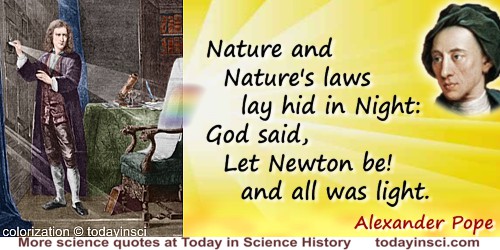
Nature and Nature's laws lay hid in Night:
God said, Let Newton be! and all was light.
Quem Immortalem
Testantur Tempus, Natura, Coelum:
Mortalem
Hoc Marmor fatetur.
Nature and Nature's laws lay hid in Night:
God said, Let Newton be! and all was light.
— Alexander Pope
Epitaph, XII, Intended for Sir Isaac Newton, in Westminster-Abbey. The Works of Alexander Pope, Esq (1797), Vol. 2., 403.
Know then thyself, presume not God to scan;
The proper study of Mankind is Man.
Plac'd on this isthmus of a middle state,
A being darkly wise, and rudely great:
With too much knowledge for the Sceptic side,
With too much weakness for the Stoic's pride,
He hangs between; in doubt to act, or rest;
In doubt to deem himself a God, or Beast;
In doubt his Mind or Body to prefer,
Born but to die, and reas'ning but to err;
Alike in ignorance, his reason such,
Whether he thinks too little, or too much:
Chaos of Thought and Passion, all confus'd;
Still by himself abus'd, or disabus'd;
Created half to rise, and half to fall;
Great lord of all things, yet a prey to all;
Sole judge of Truth, in endless Error hurl'd:
The glory, jest, and riddle of the world!
... Superior beings, when of late they saw
A mortal Man unfold all Nature's law,
Admir'd such wisdom in an earthly shape,
And shew'd a NEWTON as we shew an Ape.
The proper study of Mankind is Man.
Plac'd on this isthmus of a middle state,
A being darkly wise, and rudely great:
With too much knowledge for the Sceptic side,
With too much weakness for the Stoic's pride,
He hangs between; in doubt to act, or rest;
In doubt to deem himself a God, or Beast;
In doubt his Mind or Body to prefer,
Born but to die, and reas'ning but to err;
Alike in ignorance, his reason such,
Whether he thinks too little, or too much:
Chaos of Thought and Passion, all confus'd;
Still by himself abus'd, or disabus'd;
Created half to rise, and half to fall;
Great lord of all things, yet a prey to all;
Sole judge of Truth, in endless Error hurl'd:
The glory, jest, and riddle of the world!
... Superior beings, when of late they saw
A mortal Man unfold all Nature's law,
Admir'd such wisdom in an earthly shape,
And shew'd a NEWTON as we shew an Ape.
— Alexander Pope
'An Essay on Man' (1733-4), Epistle II. In John Butt (ed.), The Poems of Alexander Pope (1965), 516-7.
Know, Nature’s children all divide her care, The fur that warms a monarch warmed a bear.
— Alexander Pope
In 'Essay On Man', The Works of Alexander Pope (1871), Vol. 2, 403.
Know, Nature’s Children all divide her care;
The Furr that warms a Monarch, warm’d a Bear.
The Furr that warms a Monarch, warm’d a Bear.
— Alexander Pope
In 'Epistle III', Essay on Man,: Being the First Book of Ethic Epistles (1734), 40.
Learn Dulness, learn! “The Universal Cause
| “Acts to one End, but acts by various Laws.”
| “Acts to one End, but acts by various Laws.”
— Alexander Pope
In 'Epistle III', Essay on Man,: Being the First Book of Ethic Epistles (1734), 38.
Learn from the Birds what food the thickets yield;
Learn from the Beasts the physick of the field:
The Arts of building from the Bee receive;
Learn of the Mole to plough, the Worm to weave.
Learn from the Beasts the physick of the field:
The Arts of building from the Bee receive;
Learn of the Mole to plough, the Worm to weave.
— Alexander Pope
In 'Epistle III', Essay on Man,: Being the First Book of Ethic Epistles (1734), 47.
Learning is like mercury, one of the most powerful and excellent things in the world in skillful hands; in unskillful, the most mischievous.
— Alexander Pope
'Thoughts On Various Subjects', The Works of Alexander Pope (1806), Vol. 6, 406.
Lo! the poor Indian! whose untutor’d mind
Sees God in clouds, or hears him in the wind;
His soul proud Science never taught to stray
Far as the solar walk or milky way.
Sees God in clouds, or hears him in the wind;
His soul proud Science never taught to stray
Far as the solar walk or milky way.
— Alexander Pope
Essay on Man. Epistle I. Line 99. In Alexander Pope, Maynard Mack (Ed.), An Essay on Man (reprint of the Twickenham Edition of the Poems of Alexander Pope, 1982), 27.
by Alexander Pope, Maynard Mack - Poetry - 1982 - 186 pages
New, distant Scenes of endless Science rise:
So pleas'd at first, the towring Alps we try,...
So pleas'd at first, the towring Alps we try,...
— Alexander Pope
In An Essay on Criticism (1711), 15.
Now length of Fame (our second life) is lost,
And bare threescore is all ev’n that can boast;
Our sons their fathers’ failing language see.
And bare threescore is all ev’n that can boast;
Our sons their fathers’ failing language see.
— Alexander Pope
In An Essay on Criticism (1749), 64. Note: first published anonymously in 1711 when Pope was 22 years old.
One Science only will one Genius fit;
So vast is Art, so narrow Human Wit.
So vast is Art, so narrow Human Wit.
— Alexander Pope
An Essay on Criticism (1709), 6.
Order is Heaven’s first law.
— Alexander Pope
From An Essay on Man, Epistle 4, collected in William Roscoe (ed.), The Works of Alexander Pope (1824), Vol. 5, 173.
Our plenteous streams a various race supply,
The bright-eye Perch with fins of Tyrian dye,
The silver Eel, in shining volumes roll’d,
The yellow Carp, in scales bedropp’d with gold,
Swift Trouts, diversified with crimson stains,
And Pykes, the Tyrants of the wat’ry plains.
The bright-eye Perch with fins of Tyrian dye,
The silver Eel, in shining volumes roll’d,
The yellow Carp, in scales bedropp’d with gold,
Swift Trouts, diversified with crimson stains,
And Pykes, the Tyrants of the wat’ry plains.
— Alexander Pope
In poem, 'Windsor Forest', collected in The Works of Mr. Alexander Pope (1718), 51.
See dying Vegetables Life sustain,
See Life dissolving vegetate again.
All Forms that perish other forms supply,
By turns they catch the vital breath, and die.
See Life dissolving vegetate again.
All Forms that perish other forms supply,
By turns they catch the vital breath, and die.
— Alexander Pope
In 'Epistle III', Essay on Man,: Being the First Book of Ethic Epistles (1734), 39.
See skulking Truth to her old cavern fled,
Mountains of Casuistry heap’d o’er her head!
Philosophy, that lean’d on Heav’n before,
Shrinks to her second cause, and is no more.
Physic of Metaphysic begs defence,
And Metaphysic calls for aid on Sense!
See Mystery to Mathematics fly!
Mountains of Casuistry heap’d o’er her head!
Philosophy, that lean’d on Heav’n before,
Shrinks to her second cause, and is no more.
Physic of Metaphysic begs defence,
And Metaphysic calls for aid on Sense!
See Mystery to Mathematics fly!
— Alexander Pope
In The Dunciad, collected in The Poetical Works of Alexander Pope (1828), Vol. 3, 211.
See, plastic Nature working to this End,
The single Atoms each to other tend,
Attract, attracted to, the next in place,
Form’d, and impell’d, its Neighbour to embrace.
The single Atoms each to other tend,
Attract, attracted to, the next in place,
Form’d, and impell’d, its Neighbour to embrace.
— Alexander Pope
In 'Epistle III', Essay on Man,: Being the First Book of Ethic Epistles (1734), 38.
See, thro' this air, this ocean, and this earth,
All matter quick, and bursting into birth.
Above, how high progressive life may go!
Around, how wide! how deep extend below!
Vast chain of being, which from God began,
Natures ethereal, human, angel, man,
Beast, bird, fish, insect! what no eye can see,
No glass can reach! from Infinite to thee,
From thee to Nothing—On superior pow'rs
Were we to press, inferior might on ours:
Or in the full creation leave a void,
Where, one step broken, the great scale's destroy'd:
From Nature's chain whatever link you strike,
Tenth or ten thousandth, breaks the chain alike.
All matter quick, and bursting into birth.
Above, how high progressive life may go!
Around, how wide! how deep extend below!
Vast chain of being, which from God began,
Natures ethereal, human, angel, man,
Beast, bird, fish, insect! what no eye can see,
No glass can reach! from Infinite to thee,
From thee to Nothing—On superior pow'rs
Were we to press, inferior might on ours:
Or in the full creation leave a void,
Where, one step broken, the great scale's destroy'd:
From Nature's chain whatever link you strike,
Tenth or ten thousandth, breaks the chain alike.
— Alexander Pope
'An Essay on Man' (1733-4), Epistle I. In John Butt (ed.), The Poems of Alexander Pope (1965), 513.
Sir Isaac Newton, though so deep in algebra and fluxions, could not readily make up a common account: and, when he was Master of the Mint, used to get somebody else to make up his accounts for him.
— Alexander Pope
As recalled and recorded in Joseph Spence and Edmund Malone (ed.) Anecdotes, Observations, and Characters of Books and Men (1858), 132.
The nicest constitutions of government are often like the finest pieces of clock-work, which, depending on so many motions, are therefore more subject to be out of order.
— Alexander Pope
'Thoughts On Various Subjects', The Works of Alexander Pope (1806), Vol. 6, 406.
The Physician, by the study and inspection of urine and ordure, approves himself in the science; and in like sort should our author accustom and exercise his imagination upon the dregs of nature.
— Alexander Pope
The Works of Alexander Pope (1806), Vol. 6, 209.
This long disease, my life.
— Alexander Pope
'Epistle to Dr Arbuthnot' (1735). In John Butt (ed.), The Poems of Alexander Pope (1965), 602.
To Observations which ourselves we make,
We grow more partial for th' observer's sake.
We grow more partial for th' observer's sake.
— Alexander Pope
'Moral Essays', Epistle I, to Richard Temple, Viscount Cobham (1734). In John Butt (ed.), The Poems of Alexander Pope (1965), 550.
To teach vain Wits that Science little known,
T' admire Superior Sense, and doubt their own!
T' admire Superior Sense, and doubt their own!
— Alexander Pope
In An Essay on Criticism (1711), 13.
Trace Science, then, with Modesty thy guide,
First strip off all her equipage of Pride,
Deduct what is but Vanity or Dress,
Or Learning's Luxury or idleness,
Or tricks, to show the stretch of the human brain
Mere curious pleasure or ingenious pain.
First strip off all her equipage of Pride,
Deduct what is but Vanity or Dress,
Or Learning's Luxury or idleness,
Or tricks, to show the stretch of the human brain
Mere curious pleasure or ingenious pain.
— Alexander Pope
'Essay On Man', The Works of Alexander Pope (1751), Vol. 3, 31-32.
Who shall decide, when Doctors disagree?
— Alexander Pope
'Moral Essays', Epistle III, to Allen Lord Bathurst (1733). In John Butt (ed.), The Poems of Alexander Pope (1965), 570.
Who, foe to Nature, hears the gen’ral groan,
Murders their species, and betrays his own.
Murders their species, and betrays his own.
— Alexander Pope
In 'Epistle III', Essay on Man,: Being the First Book of Ethic Epistles (1734), 46.
Why has not Man a microscopic eye?
For this plain reason, Man is not a Fly.
For this plain reason, Man is not a Fly.
— Alexander Pope
An Essay on Man' (1733-4), Epistle I. In John Butt (ed.), The Poems of Alexander Pope (1965), 511.
Quotes by others about Alexander Pope (3)
Pope has elegantly said a perfect woman's but a softer man. And if we take in the consideration, that there can be but one rule of moral excellence for beings made of the same materials, organized after the same manner, and subjected to similar laws of Nature, we must either agree with Mr. Pope, or we must reverse the proposition, and say, that a perfect man is a woman formed after a coarser mold.
Letter XXII. 'No Characteristic Difference in Sex'. In Letters on Education with Observations on Religious and Metaphysical Subjects (1790), 128.
It did not last: the Devil howling “Ho, Let Einstein be,” restored the status quo.
Adding to earlier Epitaph by Alexander Pope for Isaac Newton, 'In Continuation of Pope on Newton', in J.C. Squire, Poems in One Volume (1926), 218.
[Misattributed] A little knowledge is a dangerous thing. So is a lot.
See the original quoted on the page for Alexander Pope, beginning “A little learning …”.
 In science it often happens that scientists say, 'You know that's a really good argument; my position is mistaken,' and then they would actually change their minds and you never hear that old view from them again. They really do it. It doesn't happen as often as it should, because scientists are human and change is sometimes painful. But it happens every day. I cannot recall the last time something like that happened in politics or religion.
(1987) --
In science it often happens that scientists say, 'You know that's a really good argument; my position is mistaken,' and then they would actually change their minds and you never hear that old view from them again. They really do it. It doesn't happen as often as it should, because scientists are human and change is sometimes painful. But it happens every day. I cannot recall the last time something like that happened in politics or religion.
(1987) --