 (source)
|
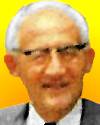
George Pólya
(13 Dec 1887 - 7 Sep 1985)
Hungarian mathematician remembered for a number mathematical solutions arising from physical sciences. He was also dedicated to supporting the teaching of mathematics, in particular stressing the importance of problem solving. His book on that subject, How to Solve It has been translated into many languages.
|
Science Quotes by George Pólya (27 quotes)
A great discovery solves a great problem, but there is a grain of discovery in the solution of any problem. Your problem may be modest, but if it challenges your curiosity and brings into play your inventive faculties, and if you solve it by your own means, you may experience the tension and enjoy the triumph of discovery.
— George Pólya
From Preface to the first printing, reprinted in How to Solve It: A New Aspect of Mathematical Method (2004), v.
A mathematician who can only generalise is like a monkey who can only climb UP a tree. ... And a mathematician who can only specialise is like a monkey who can only climb DOWN a tree. In fact neither the up monkey nor the down monkey is a viable creature. A real monkey must find food and escape his enemies and so must be able to incessantly climb up and down. A real mathematician must be able to generalise and specialise. ... There is, I think, a moral for the teacher. A teacher of traditional mathematics is in danger of becoming a down monkey, and a teacher of modern mathematics an up monkey. The down teacher dishing out one routine problem after another may never get off the ground, never attain any general idea. and the up teacher dishing out one definition after the other may never climb down from his verbiage, may never get down to solid ground, to something of tangible interest for his pupils.
— George Pólya
From 'A Story With A Moral', Mathematical Gazette (Jun 1973), 57, No. 400, 86-87
A teacher of mathematics has a great opportunity. If he fills his allotted time with drilling his students in routine operations he kills their interest, hampers their intellectual development, and misuses his opportunity. But if he challenges the curiosity of his students by setting them problems proportionate to their knowledge, and helps them to solve their problems with stimulating questions, he may give them a taste for, and some means of, independent thinking.
— George Pólya
In How to Solve It (1948), Preface.
Even fairly good students, when they have obtained the solution of the problem and written down neatly the argument, shut their books and look for something else. Doing so, they miss an important and instructive phase of the work. ... A good teacher should understand and impress on his students the view that no problem whatever is completely exhausted.
— George Pólya
In How to Solve It: A New Aspect of Mathematical Method (2004), 14.
I started studying law, but this I could stand just for one semester. I couldn’t stand more. Then I studied languages and literature for two years. After two years I passed an examination with the result I have a teaching certificate for Latin and Hungarian for the lower classes of the gymnasium, for kids from 10 to 14. I never made use of this teaching certificate. And then I came to philosophy, physics, and mathematics. In fact, I came to mathematics indirectly. I was really more interested in physics and philosophy and thought about those. It is a little shortened but not quite wrong to say: I thought I am not good enough for physics and I am too good for philosophy. Mathematics is in between.
— George Pólya
From interview on his 90th birthday. In D J Albers and G L Alexanderson (eds.), Mathematical People: Profiles and Interviews (1985), 245-254.
If the proof starts from axioms, distinguishes several cases, and takes thirteen lines in the text book … it may give the youngsters the impression that mathematics consists in proving the most obvious things in the least obvious way.
— George Pólya
Mathematical Discovery: on Understanding, Learning, and Teaching Problem Solving (1981), 129.
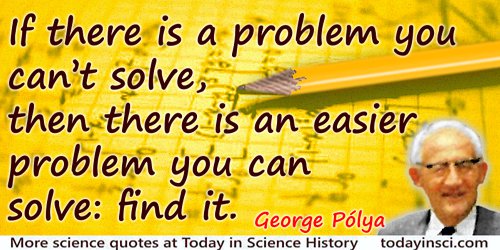
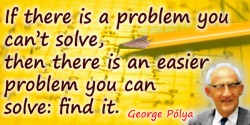
If there is a problem you can’t solve, then there is an easier problem you can solve: find it.
— George Pólya
Quoted in Preface, How to Solve It: A New Aspect of Mathematical Method (2004), xxi.
If you have to prove a theorem, do not rush. First of all, understand fully what the theorem says, try to see clearly what it means. Then check the theorem; it could be false. Examine the consequences, verify as many particular instances as are needed to convince yourself of the truth. When you have satisfied yourself that the theorem is true, you can start proving it.
— George Pólya
In How to Solve It: A New Aspect of Mathematical Method (2004), 15.
In order to translate a sentence from English into French two things are necessary. First, we must understand thoroughly the English sentence. Second, we must be familiar with the forms of expression peculiar to the French language. The situation is very similar when we attempt to express in mathematical symbols a condition proposed in words. First, we must understand thoroughly the condition. Second, we must be familiar with the forms of mathematical expression.
— George Pólya
In How to Solve It: A New Aspect of Mathematical Method (2004), 174.
Look around when you have got your first mushroom or made your first discovery: they grow in clusters.
— George Pólya
In How to Solve It: A New Aspect of Mathematical Method (2004), 225.
Mathematics is being lazy. Mathematics is letting the principles do the work for you so that you do not have to do the work for yourself
— George Pólya
In Marion Walter and Tom O'Brien, 'Memories of George Polya', Mathematics Teaching (Sep 1986), 116, 4.
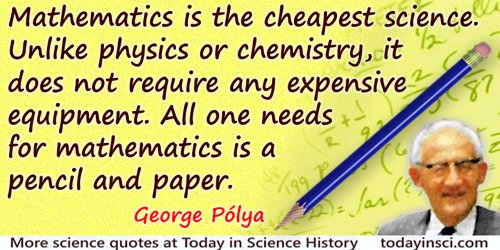
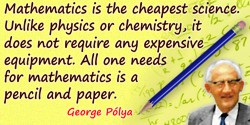
Mathematics is the cheapest science. Unlike physics or chemistry, it does not require any expensive equipment. All one needs for mathematics is a pencil and paper.
— George Pólya
Quoted in 'And Sometimes the Mathematician Wants a Powerful Computer', in Donald J. Albers and Gerald L. Alexanderson (eds.), Mathematical People (1985). In John De Pillis, 777 Mathematical Conversation Starters (2002), 193.
One of the first and foremost duties of the teacher is not to give his students the impression that mathematical problems have little connection with each other, and no connection at all with anything else. We have a natural opportunity to investigate the connections of a problem when looking back at its solution.
— George Pólya
In How to Solve It: A New Aspect of Mathematical Method (2004), 15.
Quite often, when an idea that could be helpful presents itself, we do not appreciate it, for it is so inconspicuous. The expert has, perhaps, no more ideas than the inexperienced, but appreciates more what he has and uses it better.
— George Pólya
How to Solve it: A New Aspect of Mathematical Method (1957), 223.
The elegance of a mathematical theorem is directly proportional to the number of independent ideas one can see in the theorem and inversely proportional to the effort it takes to see them.
— George Pólya
In Mathematical Discovery: On Understanding, Learning, and Teaching Problem Solving (1981). As cited, with no more details, in Yi Ma, An Invitation to 3-D Vision (2004), 228.
The first rule of discovery is to have brains and good luck. The second rule of discovery is to sit tight and wait till you get a bright idea.
— George Pólya
In How to Solve It: A New Aspect of Mathematical Method (2004), 172.
The future mathematician ... should solve problems, choose the problems which are in his line, meditate upon their solution, and invent new problems. By this means, and by all other means, he should endeavor to make his first important discovery: he should discover his likes and dislikes, his taste, his own line.
— George Pólya
How to Solve it: A New Aspect of Mathematical Method (1957), 206.
The open secret of real success is to throw your whole personality into your problem.
— George Pólya
How to Solve it: A New Aspect of Mathematical Method (1957), 207.
The teacher can seldom afford to miss the questions: What is the unknown? What are the data? What is the condition? The student should consider the principal parts of the problem attentively, repeatedly, and from various sides.
— George Pólya
In How to Solve It: A New Aspect of Mathematical Method (2004), 77
The traditional mathematics professor of the popular legend is absentminded. He usually appears in public with a lost umbrella in each hand. He prefers to face a blackboard and to turn his back on the class. He writes a, he says b, he means c, but it should be d. Some of his sayings are handed down from generation to generation:
“In order to solve this differential equation you look at it till a solution occurs to you.”
“This principle is so perfectly general that no particular application of it is possible.”
“Geometry is the science of correct reasoning on incorrect figures.”
“My method to overcome a difficulty is to go round it.”
“What is the difference between method and device? A method is a device which you used twice.”
“In order to solve this differential equation you look at it till a solution occurs to you.”
“This principle is so perfectly general that no particular application of it is possible.”
“Geometry is the science of correct reasoning on incorrect figures.”
“My method to overcome a difficulty is to go round it.”
“What is the difference between method and device? A method is a device which you used twice.”
— George Pólya
In How to Solve It: A New Aspect of Mathematical Method (2004), 208.
The world is anxious to admire that apex and culmination of modern mathematics: a theorem so perfectly general that no particular application of it is feasible.
— George Pólya
In 'A Story With a Moral', Mathematical Gazette (Jun 1973), 57, No. 400, 87.
There are many questions which fools can ask that wise men cannot answer.
— George Pólya
As quoted, without citation, in Howard W. Eves Return to Mathematical Circles, (1988), 84.
There was a seminar for advanced students in Zürich that I was teaching and von Neumann was in the class. I came to a certain theorem, and I said it is not proved and it may be difficult. Von Neumann didn’t say anything but after five minutes he raised his hand. When I called on him he went to the blackboard and proceeded to write down the proof. After that I was afraid of von Neumann.
— George Pólya
In George Pólya and Gerald L. Alexanderson (ed.) The Pólya Picture Album: Encounters of a Mathematician (1987), 154. Also footnoted in Matti Tedre, The Development of Computer Science: a Sociocultural Perspective (2006), 198, cited as from How to Solve It: A New Aspect of Mathematical Method (1957), xv.
To educate means to influence the whole personality of the student.
— George Pólya
Quoted as an epigraph, without citation, in Stanley Gudder, A Mathematical Journey (1976), xi.
To teach effectively a teacher must develop a feeling for his subject; he cannot make his students sense its vitality if he does not sense it himself. He cannot share his enthusiasm when he has no enthusiasm to share. How he makes his point may be as important as the point he makes; he must personally feel it to be important.
— George Pólya
Mathematical Methods in Science (1963, 1977), 1.
When introduced at the wrong time or place, good logic may be the worst enemy of good teaching.
— George Pólya
Quoted, without citation, in The American Mathematical Monthly (Mar 1993), 100 No. 3, 286.
Where should I start? Start from the statement of the problem. ... What can I do? Visualize the problem as a whole as clearly and as vividly as you can. ... What can I gain by doing so? You should understand the problem, familiarize yourself with it, impress its purpose on your mind.
— George Pólya
How to Solve It: a New Aspect of Mathematical Method (1957), 33.
See also:
- How to Solve It: A New Aspect of Mathematical Method, by George Polya. - book suggestion.
 In science it often happens that scientists say, 'You know that's a really good argument; my position is mistaken,' and then they would actually change their minds and you never hear that old view from them again. They really do it. It doesn't happen as often as it should, because scientists are human and change is sometimes painful. But it happens every day. I cannot recall the last time something like that happened in politics or religion.
(1987) --
In science it often happens that scientists say, 'You know that's a really good argument; my position is mistaken,' and then they would actually change their minds and you never hear that old view from them again. They really do it. It doesn't happen as often as it should, because scientists are human and change is sometimes painful. But it happens every day. I cannot recall the last time something like that happened in politics or religion.
(1987) --