 (source)
|
Plato
(c. 427 B.C. - c. 347 B.C.)
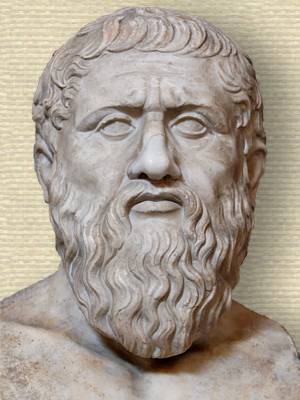
Greek philosopher who was a student of Socrates. Plato founded the Academy in 387 BC. He has been called the world's most influential philosopher.
|
“Unless,” said I [Socrates], “either philosophers become kings in our states or those whom we now call our kings and rulers take to the pursuit of' philosophy seriously and adequately, and there is a conjunction of these two things, political power and philosophic intelligence, while the motley horde of the natures who at present pursue either apart from the other are compulsorily excluded, there can be no cessation of troubles, dear Glaucon, for our states, nor, I fancy for the human race either. Nor, until this happens, will this constitution which we have been expounding in theory ever be put into practice within the limits of possibility and see the light of the sun.”
— Plato
From The Republic 5 473 c-e, in Paul Shorey (trans.), Plato in Twelve Volumes (1930, 1969), Vol. 5, 509.
“Yes,” he said. “But these things (the solutions to problems in solid geometry such as the duplication of the cube) do not seem to have been discovered yet.” “There are two reasons for this,” I said. “Because no city holds these things in honour, they are investigated in a feeble way, since they are difficult; and the investigators need an overseer, since they will not find the solutions without one. First, it is hard to get such an overseer, and second, even if one did, as things are now those who investigate these things would not obey him, because of their arrogance. If however a whole city, which did hold these things in honour, were to oversee them communally, the investigators would be obedient, and when these problems were investigated continually and with eagerness, their solutions would become apparent.”
— Plato
In The Republic 7 528bc, trans. R.W. Sharples.
Ath. There still remain three studies suitable for freemen. Calculation in arithmetic is one of them; the measurement of length, surface, and depth is the second; and the third has to do with the revolutions of the stars in reference to one another … there is in them something that is necessary and cannot be set aside, … if I am not mistaken, [something of] divine necessity; for as to the human necessities of which men often speak when they talk in this manner, nothing can be more ridiculous than such an application of the words.
Cle. And what necessities of knowledge are there, Stranger, which are divine and not human?
Ath. I conceive them to be those of which he who has no use nor any knowledge at all cannot be a god, or demi-god, or hero to mankind, or able to take any serious thought or charge of them.
Cle. And what necessities of knowledge are there, Stranger, which are divine and not human?
Ath. I conceive them to be those of which he who has no use nor any knowledge at all cannot be a god, or demi-god, or hero to mankind, or able to take any serious thought or charge of them.
— Plato
In Republic, Bk. 7, in Jowett, Dialogues of Plato (1897, 2010), Vol. 4, 331.
Socrates: Very good; let us begin then, Protarchus, by asking whether all this which they call the universe is left to the guidance of unreason and chance medley, or, on the contrary, as our fathers have declared, ordered and governed by a marvellous intelligence and wisdom.
Protarchus: Wide asunder are the two assertions, illustrious Socrates, for that which you were just now saying to me appears to be blasphemy, but the other assertion, that mind orders all things, is worthy of the aspect of the world…
Protarchus: Wide asunder are the two assertions, illustrious Socrates, for that which you were just now saying to me appears to be blasphemy, but the other assertion, that mind orders all things, is worthy of the aspect of the world…
— Plato
From 'Philebus', collected in The Dialogues of Plato (1875), Vol. 4, 70.
A free soul ought not to pursue any study slavishly; for while bodily labors performed under constraint do not harm the body, nothing that is learned under compulsion stays with the mind.
— Plato
From The Republic 7 536e, as translated by Paul Shorey (1930).
All of us Hellenes tell lies … about those great Gods, the Sun and the Moon… . We say that they, and diverse other stars, do not keep the same path, and we call them planets or wanderers. … Each of them moves in the same path-not in many paths, but in one only, which is circular, and the varieties are only apparent.
— Plato
In Plato and B. Jowett (trans.), The Dialogues of Plato: Laws (3rd ed., 1892), Vol. 5, 204-205.
An astronomer must be the wisest of men; his mind must be duly disciplined in youth; especially is mathematical study necessary; both an acquaintance with the doctrine of number, and also with that other branch of mathematics, which, closely connected as it is with the science of the heavens, we very absurdly call geometry, the measurement of the earth.
— Plato
From the 'Epilogue to the Laws' (Epinomis), 988-990. As quoted in William Whewell, History of the Inductive Sciences from the Earliest to the Present Time (1837), Vol. 1, 161. (Although referenced to Plato’s Laws, the Epinomis is regarded as a later addition, not by Plato himself.)
At the Egyptian city of Naucratis there was a famous old god whose name was Theuth; the bird which is called the Ibis was sacred to him, and he was the inventor of many arts, such as arithmetic and calculation and geometry and astronomy and draughts and dice, but his great discovery was the use of letters.
— Plato
In the Phaedrus. Collected in Plato the Teacher (1897), 171. A footnote gives that Naucratis was a city in the Delta of Egypt, on a branch of the Nile.
Do not … keep children to their studies by compulsion but by play. That will also better enable you to discern the natural capacities of each
— Plato
From The Republic 7 536e-537a, as translated by Paul Shorey (1930).
For it is obvious to everybody, I think, that this study [of astronomy] compels the soul to look upward and leads it away from things here to higher things.
— Plato
The Republic 7 529a ((5th-4th century B.C.), trans. P. Shorey (1935), Vol. 2, Book 7, 179-81. Another translation gives: “For everyone, as I think, must see that astronomy compels the soul to look upwards and leads us from this world to another.”
For we are dwelling in a hollow of the earth, and fancy that we are on the surface… . But the fact is, that owing to our feebleness and sluggishness we are prevented from reaching the surface of the air.
— Plato
In Plato and B. Jowett (trans.), The Dialogues of Plato: Republic (2nd ed., 1875), Vol. 1, 490.
He is unworthy of the name of man who is ignorant of the fact that the diagonal of a square is incommensurable with its side.
— Plato
Quoted by Sophie Germain: Mémorie sur les Surfaces Élastiques. In Robert Édouard Moritz, Memorabilia Mathematica (1914), 211
He who can properly define and divide is to be considered a god.
— Plato
Quoted by Francis Bacon, in Novum Organum. As translated by Joseph Devey in The Physical and Metaphysical Works of Lord Bacon Including the Advancement of Learning and Novum Organum (1808), 491.
I have hardly known a mathematician who was capable of reasoning.
— Plato
The Republic. In Anton Bovier, Statistical Mechanics of Disordered Systems (2006), 159.
If in a discussion of many matters … we are not able to give perfectly exact and self-consistent accounts, do not be surprised: rather we would be content if we provide accounts that are second to none in probability.
— Plato
Timaeus. Quoted in Robert J. Scully, The Demon and the Quantum (2007), 20.
If someone separated the art of counting and measuring and weighing from all the other arts, what was left of each (of the others) would be, so to speak, insignificant.
— Plato
Philebus 55e. Trans. R. W. Sharples.
If the study of all these sciences which we have enumerated, should ever bring us to their mutual association and relationship, and teach us the nature of the ties which bind them together, I believe that the diligent treatment of them will forward the objects which we have in view, and that the labor, which otherwise would be fruitless, will be well bestowed.
— Plato
…...
It was Plato, according to Sosigenes, who set this as a problem for those concerned with these things, through what suppositions of uniform and ordered movements the appearances concerning the movements of the wandering heavenly bodies could be preserved.
— Plato
Simplicius, On Aristotle's On the Heavens, 488.21. Trans. R. W. Sharples.
Knowledge and science is nothing but perception.
— Plato
Tr. i. 392; Theset. 160 D. As indexed in Alfred Day, Summary and Analysis of the Dialogues of Plato (1870), 380.
Let no-one ignorant of geometry enter.
— Plato
Said to have been inscribed above the door of Plato's Academy. As stated in A.S. Riginos, Platonica: the Anecdotes concerning the Life and Writings of Plato (1976), 38-40.
Mathematics is like checkers in being suitable for the young, not too difficult, amusing, and without peril to the state.
— Plato
As given in Scripta Mathematica: A Quarterly Journal Devoted to the Philosophy, History, and Expository Treatment of Mathematics (1950), 17, 185.
No physician, in so far as he is a physician, considers his own good in what he prescribes, but the good of his patient; for the true physician is also a ruler having the human body as a subject, and is not a mere money-maker.
— Plato
In Plato and B. Jowett (trans.), The Dialogues of Plato (1875), Vol. 3, 211.
Nothing without understanding would ever be more beauteous than with understanding.
— Plato
From 'Timaeus', St. III, 30b, in A E Taylor, Plato: Timaeus and Critias (2013), 27.
Now, when all these studies reach the point of inter-communion and connection with one another, and come to be considered in their mutual affinities, then, I think, but not till then, will the pursuit of them have a value for our objects: otherwise there is no profit in them.
— Plato
From The Republic, Book 7, Chap. 7, 531. As translated in The Dialogues of Plato (1871), Vol. 2, 367.
The excessive increase of anything causes a reaction in the opposite direction.
— Plato
The Republic
The ludicrous state of solid geometry made me pass over this branch.
— Plato
In The Republic, VII, 528. As translated by B. Jowett in The Dialogues of Plato (1871), Vol. 2.
The part of the soul which desires meats and drinks and the other things of which it has need by reason of the bodily nature, they (the gods) placed between the midriff and the boundary of the navel, contriving in all this region a sort of manager for the food of the body, and that there they bound it down like a wild animal which was chained up with man, and must be nourished if man is to exist.
— Plato
In Plato and B. Jowett (trans.), The Dialogues of Plato: Republic (3rd ed., 1892), Vol. 3, 492.
The qualities of number appear to lead to the apprehension of truth.
— Plato
The Republic 7 525b, trans. P. Shorey (1935), Vol. 2, Book 7, 161.
The science [geometry] is pursued for the sake of the knowledge of what eternally exists, and not of what comes for a moment into existence, and then perishes.
[Also seen condensed as: ``Geometry is knowledge of the eternally existent” or “The knowledge at which geometry aims is the knowledge of the eternal.”]
[Also seen condensed as: ``Geometry is knowledge of the eternally existent” or “The knowledge at which geometry aims is the knowledge of the eternal.”]
— Plato
The Republic of Plato Book VII, trans. by John Llewelyn Favies and David James Vaughan (1908), 251.
The sight of day and night, and the months and the revolutions of the years, have created number and have given us conception of time, and the power of inquiring about the nature of the Universe.
— Plato
In Timaeus section 47a, as translated by Benjamin Jowett (1871, 1959), 29. The translation by W.R.M. Lamb gives this passage as “The vision of day and night and of months and circling years has created the art of number and has given us not only the notion of Time but also means of research into the nature of the Universe.”
The various elements had different places before they were arranged so as to form the universe. At first, they were all without reason and measure. But when the world began to get into order, fire and water and earth and air had only certain faint traces of themselves, and were altogether such as everything might be expected in the absence of God; this, I say, was their nature at that time, and God fashioned them by form and number.
— Plato
In Plato and B. Jowett (trans.), The Dialogues of Plato: Republic (3rd ed., 1892), Vol. 3, 473.
There still remain three studies suitable for free man. Arithmetic is one of them.
— Plato
As quoted in James R. Newman, The World of Mathematics (1956), Vol. 1, 212. This is part of a longer quote from Republic, Bk. 7, in Jowett, Dialogues of Plato (1897, 2010), Vol. 4, 331. The longer quote begins “Ath. There still remain three studies…”, on the Plato Quotes page of this website.
They assembled together and dedicated these as the first-fruits of their love to Apollo in his Delphic temple, inscribing there those maxims which are on every tongue- “know thyself” and “Nothing overmuch”.
— Plato
In Protagoras 343ab, trans. W. R. M. Lamb, in Plato: Laches Protagoras Meno Euthydemus (1924), 197.
To apply an experimental test would be to show ignorance of the difference between human nature and divine.
— Plato
In Timaeus and Critias (1971), 95, as translated by H.D.P. (Desmond) Lee.
Trees and fields tell me nothing: men are my teachers.
— Plato
Phædrus. In Clifton Wilbraham Collins, William Lucas Collins, Plato (1879), Vol. 4, 62.
Vision, in my view, is the cause of the greatest benefit to us, inasmuch as none of the accounts now given concerning the Universe would ever have been given if men had not seen the stars or the sun or the heavens. But as it is, the vision of day and night and of months and circling years has created the art of number and has given us not only the notion of Time but also means of research into the nature of the Universe. From these we have procured Philosophy in all its range, than which no greater boon ever has come or will come, by divine bestowal, unto the race of mortals.
— Plato
…...
Whatever we Greeks receive from the barbarians, we improve and perfect; there is good hope and promise, therefore that Greeks will carry this knowledge far beyond that which was introduced from abroad.
— Plato
From the 'Epilogue to the Laws' (Epinomis). As quoted in William Whewell, History of the Inductive Sciences from the Earliest to the Present Time (1837), Vol. 1, 161. (Although referenced to Plato’s Laws, the Epinomis is regarded as a later addition, not by Plato himself.)
Wherefore also these Kinds [elements] occupied different places even before the universe was organised and generated out of them. Before that time, in truth, all these were in a state devoid of reason or measure, but when the work of setting in order this Universe was being undertaken, fire and water and earth and air, although possessing some traces of their known nature, were yet disposed as everything is likely to be in the absence of God; and inasmuch as this was then their natural condition, God began by first marking them out into shapes by means of forms and numbers.
— Plato
Timaeus 53ab, trans. R. G. Bury, in Plato: Timaeus, Critias, Cleitophon, Menexenus, Epistles (1929), 125-7.
Who is unable to count one, two, three, or to distinguish odd from even numbers, or is unable to count at all, or reckon night and day, and who is totally unacquainted with the revolution of the Sun and Moon, and the other stars … All freemen, I conceive, should learn as much of these branches of knowledge as every child in Egypt is taught when he learns the alphabet. In that country arithmetical games have been invented for the use of mere children, which they learn as pleasure and amusement … I … have late in life heard with amazement of our ignorance in these matters; to me we appear to be more like pigs than men, and I am quite ashamed, not only of myself, but of all Greeks.
— Plato
As translated by B. Jowett, in The Dialogues of Plato: Laws (1892), Vol. 5, 201-202. Quoted to compare scientific illiteracy in modern times and in Plato’s time, in Carl Sagan, 'The Most Precious Thing', The Demon-Haunted World (1996), 10.
Wisdom alone is a science of other sciences, and of itself.
— Plato
&039;Charmides, or Temperance,&039; in The Dialogues of Plato, translated by B. Jowett (1892) 3rd ed., Vol I, 25.
Wonder is the feeling of a philosopher, and philosophy begins in wonder.
— Plato
…...
Quotes by others about Plato (39)
The beauty of life is, therefore, geometrical beauty of a type that Plato would have much appreciated.
The Origin of Life (1967), xiii.
Every theory of love, from Plato down, teaches that each individual loves in the other sex what he lacks in himself.
Quoted in Values of the Wise: Humanity's Highest Aspirations (2004), 195.
[Plato] was the first to envisage the idea of timeless existence and to emphasize it—against reason—as a reality, more [real] than our actual experience…
Quoted in Robert J. Scully, The Demon and the Quantum (2007), 3.
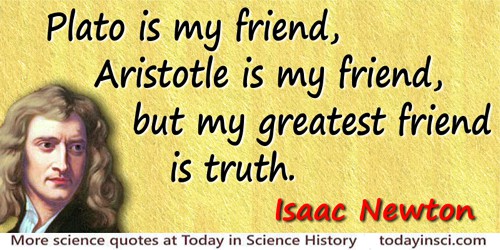
Amicus Plato amicus Aristoteles magis amica verita.
Plato is my friend, Aristotle is my friend, but my greatest friend is truth.
Plato is my friend, Aristotle is my friend, but my greatest friend is truth.
Written in the margin of a notebook while a student at Cambridge. In Richard S. Westfall, Never at Rest (1980), 89.
The thoughts of Plato and Machiavelli... don't seem quite enough armor for a world beset with splitting the atoms, urban guerrillas, nineteen varieties of psychotherapists, amplified guitars, napalm, computers, astronauts, and an atmosphere polluted simultaneously with auto exhaust and TV commercials.
This missing science of heredity, this unworked mine of knowledge on the borderland of biology and anthropology, which for all practical purposes is as unworked now as it was in the days of Plato, is, in simple truth, ten times more important to humanity than all the chemistry and physics, all the technical and indsutrial science that ever has been or ever will be discovered.
Mankind in the Making (1903), 72.
But, indeed, the science of logic and the whole framework of philosophical thought men have kept since the days of Plato and Aristotle, has no more essential permanence as a final expression of the human mind, than the Scottish Longer Catechism.
A Modern Utopia (1904, 2006), 14.
For the philosopher, order is the entirety of repetitions manifested, in the form of types or of laws, by perceived objects. Order is an intelligible relation. For the biologist, order is a sequence in space and time. However, according to Plato, all things arise out of their opposites. Order was born of the original disorder, and the long evolution responsible for the present biological order necessarily had to engender disorder.
An organism is a molecular society, and biological order is a kind of social order. Social order is opposed to revolution, which is an abrupt change of order, and to anarchy, which is the absence of order.
I am presenting here today both revolution and anarchy, for which I am fortunately not the only one responsible. However, anarchy cannot survive and prosper except in an ordered society, and revolution becomes sooner or later the new order. Viruses have not failed to follow the general law. They are strict parasites which, born of disorder, have created a very remarkable new order to ensure their own perpetuation.
An organism is a molecular society, and biological order is a kind of social order. Social order is opposed to revolution, which is an abrupt change of order, and to anarchy, which is the absence of order.
I am presenting here today both revolution and anarchy, for which I am fortunately not the only one responsible. However, anarchy cannot survive and prosper except in an ordered society, and revolution becomes sooner or later the new order. Viruses have not failed to follow the general law. They are strict parasites which, born of disorder, have created a very remarkable new order to ensure their own perpetuation.
'Interaction Among Virus, Cell, and Organism', Nobel Lecture (11 Dec 1965). In Nobel Lectures: Physiology or Medicine 1963-1970 (1972), 174.
The smallest particles of matter were said [by Plato] to be right-angled triangles which, after combining in pairs, ... joined together into the regular bodies of solid geometry; cubes, tetrahedrons, octahedrons and icosahedrons. These four bodies were said to be the building blocks of the four elements, earth, fire, air and water ... [The] whole thing seemed to be wild speculation. ... Even so, I was enthralled by the idea that the smallest particles of matter must reduce to some mathematical form ... The most important result of it all, perhaps, was the conviction that, in order to interpret the material world we need to know something about its smallest parts.
[Recalling how as a teenager at school, he found Plato's Timaeus to be a memorable poetic and beautiful view of atoms.]
[Recalling how as a teenager at school, he found Plato's Timaeus to be a memorable poetic and beautiful view of atoms.]
In Werner Heisenberg and A.J. Pomerans (trans.) The Physicist's Conception of Nature (1958), 58-59. Quoted in Jagdish Mehra and Helmut Rechenberg, The Historical Development of Quantum Theory (2001), Vol. 2, 12. Cited in Mauro Dardo, Nobel Laureates and Twentieth-Century Physics (2004), 178.
The influence (for good or ill) of Plato's work is immeasurable. Western thought, one might say, has been Platonic or anti-Platonic, but hardly ever non-Platonic.
The Open Society and its Enemies (1945).
How far the main herd of metaphysicans are still lagging behind Plato; and how, for near two thousand years, they were almost all content to feed on the crumbs dropt from Aristotle’s table.
Co-author with his brother Augustus William Hare Guesses At Truth, By Two Brothers: Second Edition: With Large Additions (1848), Second Series, 13. (The volume is introduced as “more than three fourths new.” This quote is identified as by Julius; Augustus had died in 1833.)
I suppose that I tend to be optimistic about the future of physics. And nothing makes me more optimistic than the discovery of broken symmetries. In the seventh book of the Republic, Plato describes prisoners who are chained in a cave and can see only shadows that things outside cast on the cave wall. When released from the cave at first their eyes hurt, and for a while they think that the shadows they saw in the cave are more real than the objects they now see. But eventually their vision clears, and they can understand how beautiful the real world is. We are in such a cave, imprisoned by the limitations on the sorts of experiments we can do. In particular, we can study matter only at relatively low temperatures, where symmetries are likely to be spontaneously broken, so that nature does not appear very simple or unified. We have not been able to get out of this cave, but by looking long and hard at the shadows on the cave wall, we can at least make out the shapes of symmetries, which though broken, are exact principles governing all phenomena, expressions of the beauty of the world outside.
In Nobel Lecture (8 Dec 1989), 'Conceptual Foundations of the Unified Theory of Weak and Electromagnetic Interactions.' Nobel Lectures: Physics 1971-1980 (1992), 556.
Plato compared the intellect to a charioteer guiding the powerful horses of the passions, i.e., he gave it both the power of perception and the power of control.
From Intelligence: Its Structure, Growth and Action: Its Structure, Growth and Action (1987), 2.
The safest general characterization of the European philosophical tradition is that it consists of a series of footnotes to Plato. I do not mean the systematic scheme of thought which scholars have doubtfully extracted from his writings. I allude to the wealth of general ideas scattered through them.
In Process and Reality (1929), 39.
The mathematical take-over of physics has its dangers, as it could tempt us into realms of thought which embody mathematical perfection but might be far removed, or even alien to, physical reality. Even at these dizzying heights we must ponder the same deep questions that troubled both Plato and Immanuel Kant. What is reality? Does it lie in our mind, expressed by mathematical formulae, or is it “out there”.
In Book Review 'Pulling the Strings,' of Lawrence Krauss's Hiding in the Mirror: The Mysterious Lure of Extra Dimensions, from Plato to String Theory and Beyond in Nature (22 Dec 2005), 438, 1081.
The soul seems to be a very tenuous substance … [and] seems to be made of a most subtle texture, extremely mobile or active corpuscles, not unlike those of flame or heat; indeed, whether they are spherical, as the authors of atoms propound, or pyramidical as Plato thought, or some other form, they seem from their own motion and penetration through bodies to create the heat which is in the animal.
As quoted in Margaret J. Osler and Paul Lawrence Farber (eds.), Religion, Science, and Worldview: Essays in Honor of Richard S. Westfall (2002), 169.
Now and then, in the course of the century, a great man of science, like Darwin; a great poet, like Keats; a fine critical spirit, like M. Renan; a supreme artist, like Flaubert, has been able to isolate himself, to keep himself out of reach of the clamorous claims of others, to stand “under the shelter of the wall,” as Plato puts it, and so to realise the perfection of what was in him, to his own incomparable gain, and to the incomparable and lasting gain of the whole world.
In Sebastian Melmoth (1908), 133-134.
When I first read Plato and came upon this gradation of beings which rises from the lightest atom to the Supreme Being, I was struck with admiration. But when I looked at it more closely, the great phantom vanished. … At first the imagination takes a pleasure in seeing the imperceptible transition from inanimate to organic matter, from plants to zoophytes, from these to animals, from these to genii, … and finally angels.
As quoted in Arthur O. Lovejoy, The Great Chain of Being: A Study of the History of an Idea (2011), 252.
The union of philosophical and mathematical productivity, which besides in Plato we find only in Pythagoras, Descartes and Leibnitz, has always yielded the choicest fruits to mathematics; To the first we owe scientific mathematics in general, Plato discovered the analytic method, by means of which mathematics was elevated above the view-point of the elements, Descartes created the analytical geometry, our own illustrious countryman discovered the infinitesimal calculus—and just these are the four greatest steps in the development of mathematics.
In Geschichte der Mathematik im Altertum und im Mittelalter (1874), 149-150. As translated in Robert Édouard Moritz, Memorabilia Mathematica; Or, The Philomath’s Quotation-book (1914), 210. From the original German, “Die Verbindung philosophischer und mathematischer Productivität, wie wir sie ausser in Platon wohl nur noch in Pythagoras, Descartes, Leibnitz vorfinden, hat der Mathematik immer die schönsten Früchte gebracht: Ersterem verdanken wir die wissenschaftliche Mathematik überhaupt, Platon erfand die analytische Methode, durch welche sich die Mathematik über den Standpunct der Elemente erhob, Descartes schuf die analytische Geometrie, unser berühmter Landsmann den Infinitesimalcalcül—und eben daß sind die vier grössten Stufen in der Entwickelung der Mathematik.”
One rarely hears of the mathematical recitation as a preparation for public speaking. Yet mathematics shares with these studies [foreign languages, drawing and natural science] their advantages, and has another in a higher degree than either of them.
Most readers will agree that a prime requisite for healthful experience in public speaking is that the attention of the speaker and hearers alike be drawn wholly away from the speaker and concentrated upon the thought. In perhaps no other classroom is this so easy as in the mathematical, where the close reasoning, the rigorous demonstration, the tracing of necessary conclusions from given hypotheses, commands and secures the entire mental power of the student who is explaining, and of his classmates. In what other circumstances do students feel so instinctively that manner counts for so little and mind for so much? In what other circumstances, therefore, is a simple, unaffected, easy, graceful manner so naturally and so healthfully cultivated? Mannerisms that are mere affectation or the result of bad literary habit recede to the background and finally disappear, while those peculiarities that are the expression of personality and are inseparable from its activity continually develop, where the student frequently presents, to an audience of his intellectual peers, a connected train of reasoning. …
One would almost wish that our institutions of the science and art of public speaking would put over their doors the motto that Plato had over the entrance to his school of philosophy: “Let no one who is unacquainted with geometry enter here.”
Most readers will agree that a prime requisite for healthful experience in public speaking is that the attention of the speaker and hearers alike be drawn wholly away from the speaker and concentrated upon the thought. In perhaps no other classroom is this so easy as in the mathematical, where the close reasoning, the rigorous demonstration, the tracing of necessary conclusions from given hypotheses, commands and secures the entire mental power of the student who is explaining, and of his classmates. In what other circumstances do students feel so instinctively that manner counts for so little and mind for so much? In what other circumstances, therefore, is a simple, unaffected, easy, graceful manner so naturally and so healthfully cultivated? Mannerisms that are mere affectation or the result of bad literary habit recede to the background and finally disappear, while those peculiarities that are the expression of personality and are inseparable from its activity continually develop, where the student frequently presents, to an audience of his intellectual peers, a connected train of reasoning. …
One would almost wish that our institutions of the science and art of public speaking would put over their doors the motto that Plato had over the entrance to his school of philosophy: “Let no one who is unacquainted with geometry enter here.”
In A Scrap-book of Elementary Mathematics: Notes, Recreations, Essays (1908), 210-211.
There is a certain way of searching for the truth in mathematics that Plato is said first to have discovered. Theon called this analysis.
…...
What is this subject, which may be called indifferently either mathematics or logic? Is there any way in which we can define it? Certain characteristics of the subject are clear. To begin with, we do not, in this subject, deal with particular things or particular properties: we deal formally with what can be said about any thing or any property. We are prepared to say that one and one are two, but not that Socrates and Plato are two, because, in our capacity of logicians or pure mathematicians, we have never heard of Socrates or Plato. A world in which there were no such individuals would still be a world in which one and one are two. It is not open to us, as pure mathematicians or logicians, to mention anything at all, because, if we do so we introduce something irrelevant and not formal.
In Introduction to Mathematical Philosophy (1920), 196-197.
Mathematics is the science of consistency; it is a picture of the universe; as Plato is said to have expressed the idea, “God eternally geometrizes.”
In 'The Poetry of Mathematics', The Mathematics Teacher (May 1926), 19, No. 5, 295.
The school of Plato has advanced the interests of the race as much through geometry as through philosophy. The modern engineer, the navigator, the astronomer, built on the truths which those early Greeks discovered in their purely speculative investigations. And if the poetry, statesmanship, oratory, and philosophy of our day owe much to Plato’s divine Dialogues, our commerce, our manufactures, and our science are equally indebted to his Conic Sections. Later instances may be abundantly quoted, to show that the labors of the mathematician have outlasted those of the statesman, and wrought mightier changes in the condition of the world. Not that we would rank the geometer above the patriot, but we claim that he is worthy of equal honor.
In 'Imagination in Mathematics', North American Review, 85, 228.
The value of mathematical instruction as a preparation for those more difficult investigations, consists in the applicability not of its doctrines but of its methods. Mathematics will ever remain the past perfect type of the deductive method in general; and the applications of mathematics to the simpler branches of physics furnish the only school in which philosophers can effectually learn the most difficult and important of their art, the employment of the laws of simpler phenomena for explaining and predicting those of the more complex. These grounds are quite sufficient for deeming mathematical training an indispensable basis of real scientific education, and regarding with Plato, one who is … as wanting in one of the most essential qualifications for the successful cultivation of the higher branches of philosophy
In System of Logic, Bk. 3, chap. 24, sect. 9.
These machines [used in the defense of the Syracusans against the Romans under Marcellus] he [Archimedes] had designed and contrived, not as matters of any importance, but as mere amusements in geometry; in compliance with king Hiero’s desire and request, some time before, that he should reduce to practice some part of his admirable speculation in science, and by accommodating the theoretic truth to sensation and ordinary use, bring it more within the appreciation of people in general. Eudoxus and Archytas had been the first originators of this far-famed and highly-prized art of mechanics, which they employed as an elegant illustration of geometrical truths, and as means of sustaining experimentally, to the satisfaction of the senses, conclusions too intricate for proof by words and diagrams. As, for example, to solve the problem, so often required in constructing geometrical figures, given the two extremes, to find the two mean lines of a proportion, both these mathematicians had recourse to the aid of instruments, adapting to their purpose certain curves and sections of lines. But what with Plato’s indignation at it, and his invectives against it as the mere corruption and annihilation of the one good of geometry,—which was thus shamefully turning its back upon the unembodied objects of pure intelligence to recur to sensation, and to ask help (not to be obtained without base supervisions and depravation) from matter; so it was that mechanics came to be separated from geometry, and, repudiated and neglected by philosophers, took its place as a military art.
— Plutarch
In John Dryden (trans.), Life of Marcellus.
The discovery of the conic sections, attributed to Plato, first threw open the higher species of form to the contemplation of geometers. But for this discovery, which was probably regarded in Plato’s tune and long after him, as the unprofitable amusement of a speculative brain, the whole course of practical philosophy of the present day, of the science of astronomy, of the theory of projectiles, of the art of navigation, might have run in a different channel; and the greatest discovery that has ever been made in the history of the world, the law of universal gravitation, with its innumerable direct and indirect consequences and applications to every department of human research and industry, might never to this hour have been elicited.
In 'A Probationary Lecture on Geometry, Collected Mathematical Papers, Vol. 2 (1908), 7.
The Greeks in the first vigour of their pursuit of mathematical truth, at the time of Plato and soon after, had by no means confined themselves to those propositions which had a visible bearing on the phenomena of nature; but had followed out many beautiful trains of research concerning various kinds of figures, for the sake of their beauty alone; as for instance in their doctrine of Conic Sections, of which curves they had discovered all the principal properties. But it is curious to remark, that these investigations, thus pursued at first as mere matters of curiosity and intellectual gratification, were destined, two thousand years later, to play a very important part in establishing that system of celestial motions which succeeded the Platonic scheme of cycles and epicycles. If the properties of conic sections had not been demonstrated by the Greeks and thus rendered familiar to the mathematicians of succeeding ages, Kepler would probably not have been able to discover those laws respecting the orbits and motions of planets which were the occasion of the greatest revolution that ever happened in the history of science.
In History of Scientific Ideas, Bk. 9, chap. 14, sect. 3.
Newton’s theory is the circle of generalization which includes all the others [as Kepler’s laws, Ptolemy’s theory, etc.];—the highest point of the inductive ascent;—the catastrophe of the philosophic drama to which Plato had prologized;— the point to which men’s minds had been journeying for two thousand years.
In History of the Inductive Sciences, Bk. 7, chap. 2, sect. 5.
This [the fact that the pursuit of mathematics brings into harmonious action all the faculties of the human mind] accounts for the extraordinary longevity of all the greatest masters of the Analytic art, the Dii Majores of the mathematical Pantheon. Leibnitz lived to the age of 70; Euler to 76; Lagrange to 77; Laplace to 78; Gauss to 78; Plato, the supposed inventor of the conic sections, who made mathematics his study and delight, who called them the handles or aids to philosophy, the medicine of the soul, and is said never to have let a day go by without inventing some new theorems, lived to 82; Newton, the crown and glory of his race, to 85; Archimedes, the nearest akin, probably, to Newton in genius, was 75, and might have lived on to be 100, for aught we can guess to the contrary, when he was slain by the impatient and ill mannered sergeant, sent to bring him before the Roman general, in the full vigour of his faculties, and in the very act of working out a problem; Pythagoras, in whose school, I believe, the word mathematician (used, however, in a somewhat wider than its present sense) originated, the second founder of geometry, the inventor of the matchless theorem which goes by his name, the pre-cognizer of the undoubtedly mis-called Copernican theory, the discoverer of the regular solids and the musical canon who stands at the very apex of this pyramid of fame, (if we may credit the tradition) after spending 22 years studying in Egypt, and 12 in Babylon, opened school when 56 or 57 years old in Magna Græcia, married a young wife when past 60, and died, carrying on his work with energy unspent to the last, at the age of 99. The mathematician lives long and lives young; the wings of his soul do not early drop off, nor do its pores become clogged with the earthy particles blown from the dusty highways of vulgar life.
In Presidential Address to the British Association, Collected Mathematical Papers, Vol. 2 (1908), 658.
Suppose then I want to give myself a little training in the art of reasoning; suppose I want to get out of the region of conjecture and probability, free myself from the difficult task of weighing evidence, and putting instances together to arrive at general propositions, and simply desire to know how to deal with my general propositions when I get them, and how to deduce right inferences from them; it is clear that I shall obtain this sort of discipline best in those departments of thought in which the first principles are unquestionably true. For in all our thinking, if we come to erroneous conclusions, we come to them either by accepting false premises to start with—in which case our reasoning, however good, will not save us from error; or by reasoning badly, in which case the data we start from may be perfectly sound, and yet our conclusions may be false. But in the mathematical or pure sciences,—geometry, arithmetic, algebra, trigonometry, the calculus of variations or of curves,— we know at least that there is not, and cannot be, error in our first principles, and we may therefore fasten our whole attention upon the processes. As mere exercises in logic, therefore, these sciences, based as they all are on primary truths relating to space and number, have always been supposed to furnish the most exact discipline. When Plato wrote over the portal of his school. “Let no one ignorant of geometry enter here,” he did not mean that questions relating to lines and surfaces would be discussed by his disciples. On the contrary, the topics to which he directed their attention were some of the deepest problems,— social, political, moral,—on which the mind could exercise itself. Plato and his followers tried to think out together conclusions respecting the being, the duty, and the destiny of man, and the relation in which he stood to the gods and to the unseen world. What had geometry to do with these things? Simply this: That a man whose mind has not undergone a rigorous training in systematic thinking, and in the art of drawing legitimate inferences from premises, was unfitted to enter on the discussion of these high topics; and that the sort of logical discipline which he needed was most likely to be obtained from geometry—the only mathematical science which in Plato’s time had been formulated and reduced to a system. And we in this country [England] have long acted on the same principle. Our future lawyers, clergy, and statesmen are expected at the University to learn a good deal about curves, and angles, and numbers and proportions; not because these subjects have the smallest relation to the needs of their lives, but because in the very act of learning them they are likely to acquire that habit of steadfast and accurate thinking, which is indispensable to success in all the pursuits of life.
In Lectures on Teaching (1906), 891-92.
It is curious to observe how differently these great men [Plato and Bacon] estimated the value of every kind of knowledge. Take Arithmetic for example. Plato, after speaking slightly of the convenience of being able to reckon and compute in the ordinary transactions of life, passes to what he considers as a far more important advantage. The study of the properties of numbers, he tells us, habituates the mind to the contemplation of pure truth, and raises us above the material universe. He would have his disciples apply themselves to this study, not that they may be able to buy or sell, not that they may qualify themselves to be shop-keepers or travelling merchants, but that they may learn to withdraw their minds from the ever-shifting spectacle of this visible and tangible world, and to fix them on the immutable essences of things.
Bacon, on the other hand, valued this branch of knowledge only on account of its uses with reference to that visible and tangible world which Plato so much despised. He speaks with scorn of the mystical arithmetic of the later Platonists, and laments the propensity of mankind to employ, on mere matters of curiosity, powers the whole exertion of which is required for purposes of solid advantage. He advises arithmeticians to leave these trifles, and employ themselves in framing convenient expressions which may be of use in physical researches.
Bacon, on the other hand, valued this branch of knowledge only on account of its uses with reference to that visible and tangible world which Plato so much despised. He speaks with scorn of the mystical arithmetic of the later Platonists, and laments the propensity of mankind to employ, on mere matters of curiosity, powers the whole exertion of which is required for purposes of solid advantage. He advises arithmeticians to leave these trifles, and employ themselves in framing convenient expressions which may be of use in physical researches.
In 'Lord Bacon', Edinburgh Review (Jul 1837). Collected in Critical and Miscellaneous Essays: Contributed to the Edinburgh Review (1857), Vol. 1, 394.
The opinion of Bacon on this subject [geometry] was diametrically opposed to that of the ancient philosophers. He valued geometry chiefly, if not solely, on account of those uses, which to Plato appeared so base. And it is remarkable that the longer Bacon lived the stronger this feeling became. When in 1605 he wrote the two books on the Advancement of Learning, he dwelt on the advantages which mankind derived from mixed mathematics; but he at the same time admitted that the beneficial effect produced by mathematical study on the intellect, though a collateral advantage, was “no less worthy than that which was principal and intended.” But it is evident that his views underwent a change. When near twenty years later, he published the De Augmentis, which is the Treatise on the Advancement of Learning, greatly expanded and carefully corrected, he made important alterations in the part which related to mathematics. He condemned with severity the pretensions of the mathematicians, “delidas et faslum mathematicorum.” Assuming the well-being of the human race to be the end of knowledge, he pronounced that mathematical science could claim no higher rank than that of an appendage or an auxiliary to other sciences. Mathematical science, he says, is the handmaid of natural philosophy; she ought to demean herself as such; and he declares that he cannot conceive by what ill chance it has happened that she presumes to claim precedence over her mistress.
In 'Lord Bacon', Edinburgh Review (Jul 1837). Collected in Critical and Miscellaneous Essays: Contributed to the Edinburgh Review (1857), Vol. 1, 395.
If Bacon erred here [in valuing mathematics only for its uses], we must acknowledge that we greatly prefer his error to the opposite error of Plato. We have no patience with a philosophy which, like those Roman matrons who swallowed abortives in order to preserve their shapes, takes pains to be barren for fear of being homely.
In 'Lord Bacon', Edinburgh Review (Jul 1837). Collected in Critical and Miscellaneous Essays: Contributed to the Edinburgh Review (1857), Vol. 1, 396.
Inspiration plays no less a role in science than it does in the realm of art. It is a childish notion to think that a mathematician attains any scientifically valuable results by sitting at his desk with a ruler, calculating machines or other mechanical means. The mathematical imagination of a Weierstrass is naturally quite differently oriented in meaning and result than is the imagination of an artist, and differs basically in quality. But the psychological processes do not differ. Both are frenzy (in the sense of Plato’s “mania”) and “inspiration.”
From a Speech (1918) presented at Munich University, published in 1919, and collected in 'Wissenschaft als Beruf', Gessammelte Aufsätze zur Wissenschaftslehre (1922), 524-525. As given in H.H. Gerth and C. Wright-Mills (translators and eds.), 'Science as a Vocation', Max Weber: Essays in Sociology (1946), 136.
Little could Plato have imagined, when, indulging his instinctive love of the true and beautiful for their own sakes, he entered upon these refined speculations and revelled in a world of his own creation, that he was writing the grammar of the language in which it would be demonstrated in after ages that the pages of the universe are written.
From Lecture (4 Dec 1854) delivered to the Gresham Committee and the members of the Common Council of the City of London, 'A Probationary Lecture on Geometry', collected in Collected Mathematical Papers of James Joseph Sylvester (1908), Vol. 2, 7.
Everybody is to some small extent a philosopher of mathematics. Let him only exclaim on occasion: “But figures can’t lie!” and he joins the ranks of Plato and of Lakatos.
Co-author with Reuben Hersh, in The Mathematical Experience (1981), xi.
The Italian Renaissance, though not medieval, is not modern; it is more akin to the best age of Greece. … No Italian of the Renaissance would have been unintelligible to Plato or Aristotle…. With the seventeenth century it is different: Plato and Aristotle, Aquinas and Occam, could not have made head or tail of Newton.
In History of Western Philosophy (1979, 2004) 484.
To be placed on the title-page of my collected works: Here it will be perceived from innumerable examples what is the use of mathematics for judgement in the natural sciences and how impossible it is to philosophise correctly without the guidance of Geometry, as the wise maxim of Plato has it.
Epigraph before title page, T. W. Körner, The Pleasures of Counting (1996).
 In science it often happens that scientists say, 'You know that's a really good argument; my position is mistaken,' and then they would actually change their minds and you never hear that old view from them again. They really do it. It doesn't happen as often as it should, because scientists are human and change is sometimes painful. But it happens every day. I cannot recall the last time something like that happened in politics or religion.
(1987) --
In science it often happens that scientists say, 'You know that's a really good argument; my position is mistaken,' and then they would actually change their minds and you never hear that old view from them again. They really do it. It doesn't happen as often as it should, because scientists are human and change is sometimes painful. But it happens every day. I cannot recall the last time something like that happened in politics or religion.
(1987) -- 





