 (source)
|
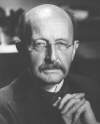
Max Planck
(23 Apr 1858 - 4 Oct 1947)
German theoretical physicist who introduced the quantum theory (1900), for which he was awarded the 1918 Nobel Prize for Physics. This assumes that energy is not infinitely subdivisible, but ultimately exists as discrete amounts he called quanta.
|
Science Quotes by Max Planck (71 quotes)
>> Click for Max Planck Quotes on | Absolute | Knowledge | Law | Nature | Research | Science | Thought | Truth |
>> Click for Max Planck Quotes on | Absolute | Knowledge | Law | Nature | Research | Science | Thought | Truth |
Eine neue wissenschaftliche Wahrheit pflegt sich nicht in der Weise durchzusetzen, daß ihre Gegner überzeugt werden und sich als belehrt erklären, sondern vielmehr dadurch, daß ihre Gegner allmählich aussterben und daß die heranwachsende Generation von vornherein mit der Wahrheit vertraut gemacht ist.
A new scientific truth does not triumph by convincing its opponents and making them see the light, but rather its opponents eventually die, and a new generation grows up that is familiar with it.
A new scientific truth does not triumph by convincing its opponents and making them see the light, but rather its opponents eventually die, and a new generation grows up that is familiar with it.
— Max Planck
In Scientific Autobiography and Other Papers, trans. F. Gaynor (1950), 33. Also seen paraphrased in shortened form as: Die Wahrheit triumphiert nie, ihre Gegner sterben nur aus. (Translated as “Truth never triumphs—its opponents just die out.” More loosely paraphrased as “Science advances one funeral at a time.”)

A scientist is happy, not in resting on his attainments but in the steady acquisition of fresh knowledge.
— Max Planck
The Philosophy of Physics. Collected in The New Science: 3 Complete Works (1959), 253.
Again and again the imaginary plan on which one attempts to build up order breaks down and then we must try another. This imaginative vision and faith in the ultimate success are indispensable. The pure rationalist has no place here.
— Max Planck
In Max Planck and James Vincent Murphy (trans.), Where Is Science Going? (1932), 215.

An experiment is a question which science poses to Nature, and a measurement is the recording of Nature's answer.
— Max Planck
'The Meaning and Limits of Exact Science', Science (30 Sep 1949), 110, No. 2857, 325. Advance reprinting of chapter from book Max Planck, Scientific Autobiography (1949), 110.
An important scientific innovation rarely makes its way by gradually winning over and converting its opponents. What does happen is that its opponents gradually die out, and that the growing generation is familiarized with the ideas from the beginning.
— Max Planck
Scientific Autobiography and Other Papers, trans. F. Gaynor (1950), 97. Quoted in David L. Hull, Science as a Process (1990), 379.
An indispensable hypothesis, even though still far from being a guarantee of success, is however the pursuit of a specific aim, whose lighted beacon, even by initial failures, is not betrayed.
— Max Planck
Nobel Lecture (2 Jun 1920), in Nobel Lectures in Physics, 1901-1921 (1998), 407.
An indispensable hypothesis, even though still far from being a guarantee of success, is however the pursuit of a specific aim, whose lighted beacon, even by initial failures, is not betrayed.
— Max Planck
From Nobel Prize Lecture (2 Jun 1920), 'The Genesis and Present State of Development of the Quantum Theory', Nobel Lectures, Physics 1901-1921 (1967), and on the nobelprize.org web site. This passage of Planck’s speech is translated very differently by James Murphy in 'Introduction: Max Planck: a Biographical Sketch', in Max Planck and James Murphy (trans.), Where is Science Going (1932), 24. See elsewhere on this web page, beginning, “The steadfast pursuance…”.

Anybody who has been seriously engaged in scientific work of any kind realizes that over the entrance to the gates of the temple of science are written the words: Ye must have faith. It is a quality which the scientist cannot dispense with.
— Max Planck
In Max Planck and James Vincent Murphy (trans.), Where is Science Going?, (1932), 214.
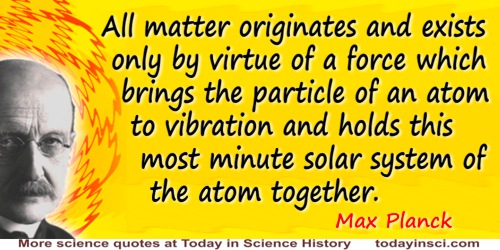
As a man who has devoted his whole life to the most clear headed science, to the study of matter, I can tell you as a result of my research about atoms this much: There is no matter as such. All matter originates and exists only by virtue of a force which brings the particle of an atom to vibration and holds this most minute solar system of the atom together. … We must assume behind this force the existence of a conscious and intelligent mind. This mind is the matrix of all matter.
— Max Planck
Lecture, 'Das Wesen der Materie' [The Essence/Nature/Character of Matter], Florence, Italy (1944). Archiv zur Geschichte der Max-Planck-Gesellschaft, Abt. Va, Rep. 11 Planck, Nr. 1797. Original German and this English translation, as in Gregg Braden, The Spontaneous Healing of Belief: Shattering the Paradigm of False Limits (2009), 334-35. Note: a number of books showing this quote cite it as from Planck’s Nobel Prize acceptance speech (1918), which the Webmaster has checked, and does not see this quote therein. The original German excerpt, and a slightly more complete translation is also on this web page, beginning: “As a physicist who devoted ….”
As a physicist who devoted his entire life to sober science, to the study of matter, I am sure that I am free from the suspicion of being considered a zealot. And so, according to my research of the atom, I say this: There is no matter in itself. All matter arises and exists only through a force that vibrates the atomic particles and holds them together to form the tiniest solar system of the universe. However, since there is no intelligent force or eternal power in the entire universe—mankind has not been able to invent the much-anticipated perpetuum mobile—we must accept a conscious intelligent mind behind this force. This spirit is the cause of all matter.
— Max Planck
From Lecture, 'Das Wesen der Materie' [The Essence/Nature/Character of Matter], Florence, Italy (1944). Archiv zur Geschichte der Max-Planck-Gesellschaft, Abt. Va, Rep. 11 Planck, Nr. 1797. English version using Google Translate, from the original German, “Als Physiker, der sein ganzes Leben der nüchternen Wissenschaft, der Erforschung der Materie widmete, bin ich sicher von dem Verdacht frei, für einen Schwarmgeist gehalten zu werden. Und so sage ich nach meinen Erforschungen des Atoms dieses: Es gibt keine Materie an sich. Alle Materie entsteht und besteht nur durch eine Kraft, welche die Atomteilchen in Schwingung bringt und sie zum winzigsten Sonnensystem des Alls zusammenhält. Da es im ganzen Weltall aber weder eine intelligente Kraft noch eine ewige Kraft gibt—es ist der Menschheit nicht gelungen, das heißersehnte Perpetuum mobile zu erfinden—so müssen wir hinter dieser Kraft einen bewußten intelligenten Geist annehmen. Dieser Geist ist der Urgrund aller Materie.” German excerpt from Gregg Braden, The Spontaneous Healing of Belief: Shattering the Paradigm of False Limits (2009), 334-35. There is also a different, slightly shortened, translation on this web page, beginning: “As a man who has devoted ….”
Before an experiment can be performed, it must be planned—the question to nature must be formulated before being posed. Before the result of a measurement can be used, it must be interpreted—nature's answer must be understood properly. These two tasks are those of the theorist, who finds himself always more and more dependent on the tools of abstract mathematics. Of course, this does not mean that the experimenter does not also engage in theoretical deliberations. The foremost classical example of a major achievement produced by such a division of labor is the creation of spectrum analysis by the joint efforts of Robert Bunsen, the experimenter, and Gustav Kirchoff, the theorist. Since then, spectrum analysis has been continually developing and bearing ever richer fruit.
— Max Planck
'The Meaning and Limits of Exact Science', Science (30 Sep 1949), 110, No. 2857, 325. Advance reprinting of chapter from book Max Planck, Scientific Autobiography (1949), 110.
Both religion and natural science require a belief in God for their activities, to the former He is the starting point, and to the latter the goal of every thought process. To the former He is the foundation, to the latter, the crown of the edifice of every generalized world view.
— Max Planck
Lecture, 'Religion and Natural Science' (1937) In Max Planck and Frank Gaynor (trans.), Scientific Autobiography and Other Papers (1949), 184.
E=hf.
— Max Planck
Formula describing the energy of a photon, in quantum theory, E=Energy, h=Planck’s constant, f=frequency of light.
Every hypothesis in physical science has to go through a period of difficult gestation and parturition before it can be brought out into the light of day and handed to others, ready-made in scientific form so that it will be, as it were, fool-proof in the hands of outsiders who wish to apply it.
— Max Planck
In Max Planck and James Vincent Murphy (trans.), Where Is Science Going? (1932), 178.
Experimenters are the shock troops of science … An experiment is a question which science poses to Nature, and a measurement is the recording of Nature’s answer. But before an experiment can be performed, it must be planned–the question to nature must be formulated before being posed. Before the result of a measurement can be used, it must be interpreted–Nature’s answer must be understood properly. These two tasks are those of theorists, who find himself always more and more dependent on the tools of abstract mathematics.
— Max Planck
'The Meaning and Limits of Exact Science', Science (30 Sep 1949), 110, No. 2857, 325. Advance reprinting of chapter from book Max Planck, Scientific Autobiography (1949), 110.
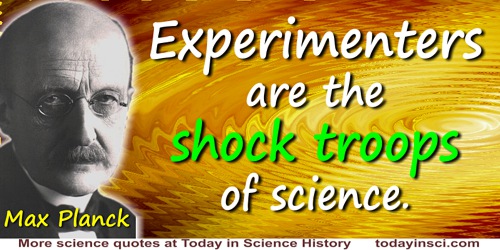
Experimenters are the shock troops of science.
— Max Planck
'The Meaning and Limits of Exact Science', Science (30 Sep 1949), 110, No. 2857, 325. Advance reprinting of chapter from book Max Planck, Scientific Autobiography (1949), 110.
Experimenters are the shocktroops of science.
— Max Planck
In Scientific Autobiography and Other Papers (1949).
Hitherto the principle of causality was universally accepted as an indispensable postulate of scientific research, but now we are told by some physicists that it must be thrown overboard. The fact that such an extraordinary opinion should be expressed in responsible scientific quarters is widely taken to be significant of the all-round unreliability of human knowledge. This indeed is a very serious situation.
— Max Planck
In Max Planck and James Vincent Murphy (trans.), Where is Science Going?, (1932), 66.
How do we discover the individual laws of Physics, and what is their nature? It should be remarked, to begin with, that we have no right to assume that any physical law exists, or if they have existed up to now, that they will continue to exist in a similar manner in the future. It is perfectly conceivable that one fine day Nature should cause an unexpected event to occur which would baffle us all; and if this were to happen we would be powerless to make any objection, even if the result would be that, in spite of our endeavors, we should fail to introduce order into the resulting confusion. In such an event, the only course open to science would be to declare itself bankrupt. For this reason, science is compelled to begin by the general assumption that a general rule of law dominates throughout Nature.
— Max Planck
Max Planck, Walter Henry Johnston, The Universe in the Light of Modern Physics (1931), 58.
I had always looked upon the search for the absolute as the noblest and most worth while task of science.
— Max Planck
'A Scientific Autobiography' (1948), in Scientific Autobiography and Other Papers, trans. Frank Gaynor (1950), 46.
I regard consciousness as fundamental. I regard matter as derivative from consciousness. We cannot get behind consciousness. Everything that we talk about, everything that we regard as existing, postulates consciousness.
— Max Planck
Quoted in The Observer (25 Jan 1931), 17. Cited in Joseph H. Fussell, 'Where is Science Going?: Review and Comment', Theosophical Path Magazine, January to December 1933 (2003), 199.
If E is considered to be a continuously divisible quantity, this distribution is possible in infinitely many ways. We consider, however—this is the most essential point of the whole calculation—E to be composed of a well-defined number of equal parts and use thereto the constant of nature h = 6.55 ×10⁻²⁷ erg sec. This constant multiplied by the common frequency ν of the resonators gives us the energy element ε in erg, and dividing E by ε we get the number P of energy elements which must be divided over the N resonators.
[Planck’s constant, as introduced in 1900; subsequently written e = hν.]
[Planck’s constant, as introduced in 1900; subsequently written e = hν.]
— Max Planck
In 'On the theory of the energy distribution law of the normal spectrum', in D. ter Haar and Stephen G. Brush, trans., Planck’s Original Papers in Quantum Physics (1972), 40.
If Einstein’s theory [of relativity] should prove to be correct, as I expect it will, he will be considered the Copernicus of the twentieth century.
— Max Planck
As quoted in Philipp Frank and Shuichi Kusaka, Einstein, His Life and Times (1947), 101.
It is never possible to predict a physical occurrence with unlimited precision.
— Max Planck
In 'The Meaning of Causality in Physics' (1953), collected in Max Planck and Frank Gaynor (trans.), Scientific Autobiography: and Other Papers (1949, 2007), 124.
It is not the possession of truth, but the success which attends the seeking after it, that enriches the seeker and brings happiness to him.
— Max Planck
In Max Planck and James Vincent Murphy (trans.), Where is Science Going?, (1932), 200.
It was not by any accident that the greatest thinkers of all ages were deeply religious souls.
— Max Planck
In Max Planck and James Vincent Murphy (trans.), Where is Science Going?, (1932), 168.
Looking back … over the long and labyrinthine path which finally led to the discovery [of the quantum theory], I am vividly reminded of Goethe’s saying that men will always be making mistakes as long as they are striving after something.
— Max Planck
From Nobel Prize acceptance speech (2 Jun 1920), as quoted and translated by James Murphy in 'Introduction: Max Planck: a Biographical Sketch', in Max Planck and James Murphy (trans.), Where is Science Going (1932), 23. This passage of Planck’s speech is translated very differently for the Nobel Committee. See elsewhere on this web page, beginning, “When I look back…”.
Modern Physics impresses us particularly with the truth of the old doctrine which teaches that there are realities existing apart from our sense-perceptions, and that there are problems and conflicts where these realities are of greater value for us than the richest treasures of the world of experience.
— Max Planck
In The Universe in the Light of Modern Physics (1931), 107.
My original decision to devote myself to science was a direct result of the discovery which has never ceased to fill me with enthusiasm since my early youth—the comprehension of the far from obvious fact that the laws of human reasoning coincide with the laws governing the sequences of the impressions we receive from the world about us; that, therefore, pure reasoning can enable man to gain an insight into the mechanism of the latter. In this connection, it is of paramount importance that the outside world is something independent from man, something absolute, and the quest for the laws which apply to this absolute appeared to me as the most sublime scientific pursuit in life.
— Max Planck
'A Scientific Autobiography' (1948), in Scientific Autobiography and Other Papers, trans. Frank Gaynor (1950), 13.
Nature prefers the more probable states to the less probable because in nature processes take place in the direction of greater probability. Heat goes from a body at higher temperature to a body at lower temperature because the state of equal temperature distribution is more probable than a state of unequal temperature distribution.
— Max Planck
'The Atomic Theory of Matter', third lecture at Columbia University (1909), in Max Planck and A. P. Wills (trans.), Eight Lectures on Theoretical Physics (1915), 44.
New scientific ideas never spring from a communal body, however organized, but rather from the head of an individually inspired researcher who struggles with his problems in lonely thought and unites all his thought on one single point which is his whole world for the moment.
— Max Planck
Address on the 25th anniversary of the Kaiser-Wilhelm Gesellschaft (Jan 1936). Quoted in Surviving the Swastika: Scientific Research in Nazi Germany (1993), 97.
Nothing is more interesting to the true theorist than a fact which directly contradicts a theory generally accepted up to that time, for this is his particular work.
— Max Planck
A Survey of Physics (1925).
Physical changes take place continuously, while chemical changes take place discontinuously. Physics deals chiefly with continuous varying quantities, while chemistry deals chiefly with whole numbers.
— Max Planck
Treatise on Thermodynamics (1897), trans. Alexander Ogg (1903), 22, footnote.
Religion belongs to the realm that is inviolable before the law of causation and therefore closed to science.
— Max Planck
In Max Planck and James Vincent Murphy (trans.), Where is Science Going?, (1932), 168.
Science cannot solve the ultimate mystery of nature. And that is because, in the last analysis, we ourselves are part of nature and therefore part of the mystery that we are trying to solve. Music and art are, to an extent, also attempts to solve or at least express the mystery. But to my mind the more we progress with either the more we are brought into harmony with all nature itself. And that is one of the great services of science to the individual.
— Max Planck
In Max Planck and James Vincent Murphy (trans.), Where is Science Going?, (1932), Epilogue, 217.
Science does not mean an idle resting upon a body of certain knowledge; it means unresting endeavor and continually progressing development toward an end which the poetic intuition may apprehend, but which the intellect can never fully grasp.
— Max Planck
In The Philosophy of Physics (1936). Collected in The New Science: 3 Complete Works (1959), 290.
Science enhances the moral value of life, because it furthers a love of truth and reverence—love of truth displaying itself in the constant endeavor to arrive at a more exact knowledge of the world of mind and matter around us, and reverence, because every advance in knowledge brings us face to face with the mystery of our own being.
— Max Planck
In Max Planck and James Vincent Murphy (trans.), Where is Science Going?, (1932), 169.
Science sets out confidently on the endeavor finally to know the thing in itself, and even though we realize that this ideal goal can never be completely reached, still we struggle on towards it untiringly. And we know that at every step of the way each effort will be richly rewarded.
— Max Planck
In Max Planck and James Vincent Murphy (trans.), Where Is Science Going? (1932), 139-140.
Scientific discovery and scientific knowledge have been achieved only by those who have gone in pursuit of them without any practical purpose whatsoever in view.
— Max Planck
The New Science (1959), 93.
That he [Einstein] may sometimes have missed the target in his speculations, as, for example, in his hypothesis of light quanta, cannot really be held much against him.
— Max Planck
From letter proposing the young Einstein as a member of the Royal Prussian Academy of Science. As quoted in Albert Einstein: A Documentary Biography (1956), 145. The letter was co-signed by Nernst, Rubens and Warburg.
The assumption of an absolute determinism is the essential foundation of every scientific enquiry.
— Max Planck
Physikalische Abhandlungen und Vorträge (1958), Vol 3, 89. Translated in J. L. Heilbron, The Dilemmas of an Upright Man (1986) 66.
The atheist movement declares religion to be an arbitrary illusion—devised by power-hungry priests—for the pious belief in a higher Power over us. At this point, it is not surprising that the atheist movement describes religion with only words of mockery. The atheist movement eagerly makes use of the advance of scientific knowledge. In apparent unity with the progress of science, atheism accelerates its subverting action on the peoples of earth in all social classes. In short, after a victory by atheism, not only all the most precious wealth of our culture would topple, but—what is worse—the prospects for a better future also fade.
— Max Planck
This is a loose translation by Webmaster. It has been gently rephrased for clarity, from a passage in Religion und Naturwissenschaft, Vortrag Gehalten im Baltikum Mai 1937 (1958), 7. The passage in the original German is prolix. The original German version of this quote can be found, together with a closer translation, elsewhere on this web page, beginning: “Under these circumstances….”
The entire world we apprehend through our senses is no more than a tiny fragment in the vastness of Nature.
— Max Planck
The Universe in the Light of Modern Physics (1931), 8.
The first and most important quality of all scientific ways of thinking must be the clear distinction between the outer object of observation and the subjective nature of the observer.
— Max Planck
In Max Planck and James Vincent Murphy (trans.), Where Is Science Going? (1932), 139.
The forces of nature, such as electricity for instance, were not discovered by men who started out with the set purpose of adapting them for utilitarian purposes. Scientific discovery and scientific knowledge have been achieved only by those who have gone in pursuit of it without any practical purpose whatsoever in view. … Heinrich Hertz, for instance, never dreamt that his discoveries would have been developed by Marconi and finally evolved into a system of wireless telegraphy.
— Max Planck
In Max Planck and James Vincent Murphy (trans.), Where Is Science Going? (1932), 138.
The fundamental principles and indispensable postulates of every genuinely productive science are not based on pure logic but rather on the metaphysical hypothesis–which no rules of logic can refute–that there exists an outer world which is entirely independent of ourselves. It is only through the immediate dictate of our consciousness that we know that this world exists. And that consciousness may to a certain degree be called a special sense.
— Max Planck
In Max Planck and James Vincent Murphy (trans.), Where Is Science Going? (1932), 138-139.
The goal is nothing other than the coherence and completeness of the system not only in respect of all details, but also in respect of all physicists of all places, all times, all peoples, and all cultures.
— Max Planck
Acht Vorlesungen (1910), 'Vorwort': 4. Translated in J. L. Heilbron, The Dilemmas of an Upright Man (1986), 51.
The highest
court is in the end one’s own conscience and conviction—that goes for you and for Einstein and every other physicist—and before any science there is first of all belief. For me, it is belief in a complete lawfulness in everything that happens.
— Max Planck
Letter from Planck to Niels Bohr (19 Oct 1930). As cited in J. L. Heilbron, The Dilemmas of an Upright Man: Max Planck As Spokesman for German Science (1987), 143.
The photons which constitute a ray of light behave like intelligent human beings: out of all possible curves they always select the one which will take them most quickly to their goal.
— Max Planck
In Scientific Autobiography and Other Papers (1968), 186.
The progress of science is an excellent illustration of the truth of the paradox that man must lose his soul before he can find it.
— Max Planck
In Max Planck and James Vincent Murphy (trans.), Where Is Science Going? (1932), 138.
The quantum hypothesis will eventually find its exact expression in certain equations which will be a more exact formulation of the law of causality.
— Max Planck
In Max Planck and James Vincent Murphy (trans.), Where is Science Going?, (1932), 143.
The researcher might be tempted again and again to abandon his efforts as vain and fruitless, except that every now and then a light strikes across his path which furnishes him with irrefutable proof that, after all his mistakes in taking one by-path after another, he has at least made one step forward towards the discovery of the truth that he is seeking.
— Max Planck
From Nobel Prize acceptance speech (2 Jun 1920), as quoted and translated by James Murphy in 'Introduction: Max Planck: a Biographical Sketch' to Max Planck (trans.), Where is Science Going (1932), 24. This passage of Planck’s speech is translated very differently for the Nobel Committee. See elsewhere on this web page, beginning, “The whole strenuous…”.
The spectral density of black body radiation ... represents something absolute, and since the search for the absolutes has always appeared to me to be the highest form of research, I applied myself vigorously to its solution.
— Max Planck
In Michael Dudley Sturge , Statistical and Thermal Physics (2003), 201.
The steadfast pursuance of one aim and purpose is indispensable to the researcher and that aim will always light his way, even though sometimes it may be dimmed by initial failures.
— Max Planck
From Nobel Prize acceptance speech (2 Jun 1920), as quoted and translated by James Murphy in 'Introduction: Max Planck: a Biographical Sketch' to Max Planck (trans.), Where is Science Going (1932), 24. This passage of Planck’s speech is translated very differently for the Nobel Committee. See elsewhere on this web page, beginning, “An indispensable hypothesis…”.
The Theory of Relativity confers an absolute meaning on a magnitude which in classical theory has only a relative significance: the velocity of light. The velocity of light is to the Theory of Relativity as the elementary quantum of action is to the Quantum Theory: it is its absolute core.
— Max Planck
'A Scientific Autobiography' (1948), in Scientific Autobiography and Other Papers, trans. Frank Gaynor (1950), 47.
The whole strenuous intellectual work of an industrious research worker would appear, after all, in vain and hopeless, if he were not occasionally through some striking facts to find that he had, at the end of all his criss-cross journeys, at last accomplished at least one step which was conclusively nearer the truth.
— Max Planck
Nobel Lecture (2 Jun 1920), in Nobel Lectures in Physics, 1901-1921 (1998), 407.
The whole strenuous intellectual work of an industrious research worker would appear, after all, in vain and hopeless, if he were not occasionally through some striking facts to find that he had, at the end of all his criss-cross journeys, at last accomplished at least one step which was conclusively nearer the truth.
— Max Planck
From Nobel Prize Lecture (2 Jun 1920), 'The Genesis and Present State of Development of the Quantum Theory', Nobel Lectures, Physics 1901-1921 (1967), and on the nobelprize.org web site. This passage of Planck’s speech is translated very differently by James Murphy in 'Introduction: Max Planck: a Biographical Sketch' in Max Planck and James Murphy (trans.), Where is Science Going (1932), 24. See elsewhere on this web page, beginning, “The researcher might…”.
The worth of a new idea is invariably determined, not by the degree of its intuitiveness—which incidentally, is to a major extent a matter of experience and habit—but by the scope and accuracy of the individual laws to the discovery of which it eventually leads.
— Max Planck
In Scientific Autobiography and Other Papers (1968), 109-110.
There can never be any real opposition between religion and science; for the one is the complement of the other.
— Max Planck
In Max Planck and James Vincent Murphy (trans.), Where is Science Going?, (1932), 168.
This is one of man's oldest riddles. How can the independence of human volition be harmonized with the fact that we are integral parts of a universe which is subject to the rigid order of nature's laws?
— Max Planck
In Max Planck and James Vincent Murphy (trans.), Where is Science Going?, (1932), 107.
Those [scientists] who dislike entertaining contradictory thoughts are unlikely to enrich their science with new ideas.
— Max Planck
Attributed. (If you know a primary source, please contact webmaster.)
Under these circumstances, it is not surprising that the atheist movement—which declares religion to be an arbitrary illusion, devised by power-hungry priests, and for the pious belief in a higher Power over us—has nothing but words of mockery, eagerly makes use of the advancing scientific knowledge, and in apparent unity with it, accelerates its subverting action on the peoples of earth in all classes. I need not discuss here in any more detail, that after its victory, not only all the most precious wealth of our culture would topple, but—what is worse—the prospects for a better future.
— Max Planck
In Religion und Naturwissenschaft, Vortrag Gehalten im Baltikum Mai 1937 (1958), 7. Translated by Webmaster, using online resources, and modifying punctuation). For a more easily understood version, more loosely translated, see the quote on this page beginning: “The atheist movement….”
from the original German: “Unter diesen Umständen ist es nicht zu verwundern, wenn die Gottlosenbewegung, welche die Religion als ein willkürliches, von machtlüsternen Priestern ersonnenes Trugbild erklärt und für den frommen Glauben an eine höhere Macht über uns nur Worte des Hohnes übrig hat, sich mit Eifer die fortschreitende naturwissenschaftliche Erkenntnis zunutze macht und im angeblichen Bunde mit ihr in immer schnellerem Tempo ihre zersetzende Wirkung über die Völker der Erde in allen ihren Schichten vorantreibt. Daß mit ihrem Siege nicht nur die wertvollsten Schätze unserer Kultur, sondern, was schlimmer ist, auch die Aussichten auf eine bessere Zukunft der Vernichtung anheim fallen würden, brauche ich hier nicht näher zu erörtern.”
We are in a position similar to that of a mountaineer who is wandering over uncharted spaces, and never knows whether behind the peak which he sees in front of him and which he tries to scale there may not be another peak still beyond and higher up.
— Max Planck
In Max Planck and James Vincent Murphy (trans.), Where is Science Going?, (1932), 200.
We cannot rest and sit down lest we rust and decay. Health is maintained only through work. And as it is with all life so it is with science. We are always struggling from the relative to the absolute.
— Max Planck
In Max Planck and James Vincent Murphy (trans.), Where is Science Going?, (1932), 200.
We have no right to assume that any physical law exists, or if they have existed up to now, that they will continue to exist in a similar manner in the future.
— Max Planck
Max Planck and Walter Henry Johnston, The Universe in the Light of Modern Physics (1931), 58. This is part of a longer quote also on this web page, which begins: “How do we discover…”.
What led me to my science and what fascinated me from a young age was the, by no means self-evident, fact that our laws of thought agree with the regularities found in the succession of impressions we receive from the external world, that it is thus possible for the human being to gain enlightenment regarding these regularities by means of pure thought
— Max Planck
Max Planck and Ch. Scriba (ed), Wissenschaftliche Selbstbiographie (1990), 9. Quoted in Erhard Scheibe and Brigitte Falkenburg (ed), Between Rationalism and Empiricism: Selected Papers in the Philosophy of Physics (2001), 69
When Archimedes jumped out of his bath one morning and cried Eureka he obviously had not worked out the whole principle on which the specific gravity of various bodies could be determined j and undoubtedly there were people who laughed at his first attempts. That is perhaps why most scientific pioneers are so slow to disclose the nature of their first insights when they believe themselves to be on a track of a new discovery.
— Max Planck
In Max Planck and James Vincent Murphy (trans.), Where Is Science Going? (1932), 177.
When I began my physical studies [in Munich in 1874] and sought advice from my venerable teacher Philipp von Jolly...he portrayed to me physics as a highly developed, almost fully matured science...Possibly in one or another nook there would perhaps be a dust particle or a small bubble to be examined and classified, but the system as a whole stood there fairly secured, and theoretical physics approached visibly that degree of perfection which, for example, geometry has had already for centuries.
— Max Planck
From a lecture (1924). In Damien Broderick (ed.), Year Million: Science at the Far Edge of Knowledge (2008), 104.
When I look back to … the long and ever tortuous path which led [to quantum theory], finally, to its disclosure, the whole development seems to me to provide a fresh illustration of the long-since proved saying of Goethe’s that man errs as long as he strives.
— Max Planck
From Nobel Prize Lecture (2 Jun 1920), 'The Genesis and Present State of Development of the Quantum Theory', Nobel Lectures, Physics 1901-1921 (1967), and on the nobelprize.org web site. This passage of Planck’s speech is translated very differently by James Murphy in 'Introduction: Max Planck: a Biographical Sketch' to Max Planck (trans.), Where is Science Going (1932), 23. See elsewhere on this web page, beginning, “Looking back…”.
When the pioneer in science sets forth the groping feelers of his thought, he must have a vivid, intuitive imagination, for new ideas are not generated by deduction, but by an artistically creative imagination.
— Max Planck
In Scientific Autobiography and Other Papers (1968), 109.
When you change the way you look at things, the things you look at change. [Dubious attribution]
— Max Planck
This is a quote included only to attach a caution about its authenticity. Webmaster came across this in a few places that fail to cite any source, for example, Bonnie Harris, Confident Parents, Remarkable Kids: 8 Principles for Raising Kids You’ll Love to Live With (2008), 15. Being in context of a non-science book raises an eye-brow, and the quote being stated with “As so-and-so said...” raises the other eyebrow. “As so-and-so said” seems a red flag for an author too lazy to check the source. So, if you know that a reliable primary source actually exists, please contact Webmaster. Meanwhile Webmaster suggests this is a quote of dubious authenticity. It appears in a few books published in recent years when quotes are readily grabbed from the web and spread virally without authentication. It is also called an “ancient Tao observation” by Wayne W. Dyer in A New Way of Thinking, a New Way of Being: Experiencing the Tao Te Ching (2009), Introduction, v.
Quotes by others about Max Planck (12)
People complain that our generation has no philosophers. They are wrong. They now sit in another faculty. Their names are Max Planck and Albert Einstein.
Upon appointment as the first president of the Kaiser Wilhelm Society, Berlin, formed for the advancement of science (1911).
Upon appointment as the first president of the Kaiser Wilhelm Society, Berlin, formed for the advancement of science (1911).
Upon Harnack’s appointment to be the first president of the Kaiser Wilhelm Society, Berlin, formed for the advancement of science (1911). As Quoted in Carl Seelig, Albert Einstein: A Documentary Biography (1956), 45.
Our national policies will not be revoked or modified, even for scientists. If the dismissal of Jewish scientists means the annihilation of contemporary German science, then we shall do without science for a few years.
Reply to Max Planck (President of the Kaiser Wilhelm Society for the Advancement of Science) when he tried to petition the Fuhrer to stop the dismissal of scientists on political grounds.
Reply to Max Planck (President of the Kaiser Wilhelm Society for the Advancement of Science) when he tried to petition the Fuhrer to stop the dismissal of scientists on political grounds.
In E. Y. Hartshorne, The German Universities and National Socialism (1937), 112.
Professor [Max] Planck, of Berlin, the famous originator of the Quantum Theory, once remarked to me that in early life he had thought of studying economics, but had found it too difficult! Professor Planck could easily master the whole corpus of mathematical economics in a few days. He did not mean that! But the amalgam of logic and intuition and the wide knowledge of facts, most of which are not precise, which is required for economic interpretation in its highest form is, quite truly, overwhelmingly difficult for those whose gift mainly consists in the power to imagine and pursue to their furthest points the implications and prior conditions of comparatively simple facts which are known with a high degree of precision.
'Alfred Marshall: 1842-1924' (1924). In Geoffrey Keynes (ed.), Essays in Biography (1933), 191-2
The longing to behold this pre-established harmony [of phenomena and theoretical principles] is the source of the inexhaustible patience and perseverance with which Planck has devoted himself ... The state of mind which enables a man to do work of this kind is akin to that of the religious worshiper or the lover; the daily effort comes from no deliberate intention or program, but straight from the heart.
Address (1918) for Max Planck's 60th birthday, at Physical Society, Berlin, 'Principles of Research' in Essays in Science (1934), 4-5.
In the temple of science are many mansions, and various indeed are they that dwell therein and the motives that have led them thither. Many take to science out of a joyful sense of superior intellectual power; science is their own special sport to which they look for vivid experience and the satisfaction of ambition; many others are to be found in the temple who have offered the products of their brains on this altar for purely utilitarian purposes. Were an angel of the Lord to come and drive all the people belonging to these two categories out of the temple, the assemblage would be seriously depleted, but there would still be some men, of both present and past times, left inside. Our Planck is one of them, and that is why we love him.
Address at Physical Society, Berlin (1918), for Max Planck’s 60th birthday, 'Principles of Research' in Essays in Science (1934, 2004), 1.
There is a story that once, not long after he came to Berlin, Planck forgot which room had been assigned to him for a lecture and stopped at the entrance office of the university to find out. Please tell me, he asked the elderly man in charge, “In which room does Professor Planck lecture today?” The old man patted him on the shoulder “Don't go there, young fellow,” he said “You are much too young to understand the lectures of our learned Professor Planck.”
In Barbara Lovett Cline, Men Who Made a New Physics: Physicists and the Quantum Theory (1987), 46.
After the discovery of spectral analysis no one trained in physics could doubt the problem of the atom would be solved when physicists had learned to understand the language of spectra. So manifold was the enormous amount of material that has been accumulated in sixty years of spectroscopic research that it seemed at first beyond the possibility of disentanglement. An almost greater enlightenment has resulted from the seven years of Röntgen spectroscopy, inasmuch as it has attacked the problem of the atom at its very root, and illuminates the interior. What we are nowadays hearing of the language of spectra is a true 'music of the spheres' in order and harmony that becomes ever more perfect in spite of the manifold variety. The theory of spectral lines will bear the name of Bohr for all time. But yet another name will be permanently associated with it, that of Planck. All integral laws of spectral lines and of atomic theory spring originally from the quantum theory. It is the mysterious organon on which Nature plays her music of the spectra, and according to the rhythm of which she regulates the structure of the atoms and nuclei.
Atombau und Spektrallinien (1919), viii, Atomic Structure and Spectral Lines, trans. Henry L. Brose (1923), viii.
It is a remarkable fact that the second law of thermodynamics has played in the history of science a fundamental role far beyond its original scope. Suffice it to mention Boltzmann’s work on kinetic theory, Planck’s discovery of quantum theory or Einstein’s theory of spontaneous emission, which were all based on the second law of thermodynamics.
From Nobel lecture, 'Time, Structure and Fluctuations', in Tore Frängsmyr and Sture Forsén (eds.), Nobel Lectures, Chemistry 1971-1980, (1993), 263.
“But in the binary system,” Dale points out, handing back the squeezable glass, “the alternative to one isn’t minus one, it’s zero. That’s the beauty of it, mechanically.” “O.K. Gotcha. You’re asking me, What’s this minus one? I’ll tell you. It’s a plus one moving backward in time. This is all in the space-time foam, inside the Planck duration, don’t forget. The dust of points gives birth to time, and time gives birth to the dust of points. Elegant, huh? It has to be. It’s blind chance, plus pure math. They’re proving it, every day. Astronomy, particle physics, it’s all coming together. Relax into it, young fella. It feels great. Space-time foam.”
In Roger's Version: A Novel (1986), 304.
The work of Planck and Einstein proved that light behaved as particles in some ways and that the ether therefore was not needed for light to travel through a vacuum. When this was done, the ether was no longer useful and it was dropped with a glad cry. The ether has never been required since. It does not exist now; in fact, it never existed.
In Asimov on Physics (1976), 85. Also in Isaac Asimov’s Book of Science and Nature Quotations (1988), 212.
In 1900 however, he [Planck] worked out the revolutionary quantum theory, a towering achievement which extended and improved the basic concepts of physics. It was so revolutionary, in fact, that almost no physicist, including Planck himself could bring himself to accept it. (Planck later said that the only way a revolutionary theory could be accepted was to wait until all the old scientists had died.)
(1976). In Isaac Asimov’s Book of Science and Nature Quotations (1988), 324.
We may be well be justified in saying that quantum theory is of greater importance to chemistry than physics. For where there are large fields of physics that can be discussed in a completely penetrating way without reference to Planck's constant and to quantum theory at all, there is no part of chemistry that does not depend, in its fundamental theory, upon quantum principles.
As quoted in Leonard W. Fine, Chemistry (1972), 537. Please contact Webmaster if you know the primary source.
See also:
- 23 Apr - short biography, births, deaths and events on date of Planck's birth.
- Where Is Science Going?, by Max Planck. - book suggestion.
 In science it often happens that scientists say, 'You know that's a really good argument; my position is mistaken,' and then they would actually change their minds and you never hear that old view from them again. They really do it. It doesn't happen as often as it should, because scientists are human and change is sometimes painful. But it happens every day. I cannot recall the last time something like that happened in politics or religion.
(1987) --
In science it often happens that scientists say, 'You know that's a really good argument; my position is mistaken,' and then they would actually change their minds and you never hear that old view from them again. They really do it. It doesn't happen as often as it should, because scientists are human and change is sometimes painful. But it happens every day. I cannot recall the last time something like that happened in politics or religion.
(1987) -- 





.jpg)
