 (source)
|
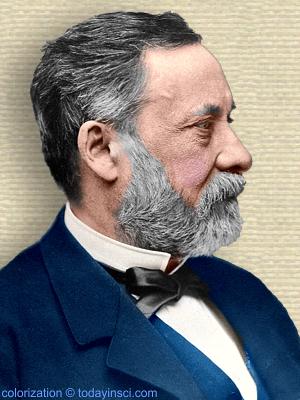
Louis Pasteur
(27 Dec 1822 - 28 Sep 1895)
French chemist who became a founder of microbiology. He created and tested vaccines for diphtheria, cholera, yellow fever, plague, rabies, anthrax, and tuberculosis.
|
Science Quotes by Louis Pasteur (67 quotes)
>> Click for Louis Pasteur Quotes on | Experiment | Life | Science | Work |
>> Click for Louis Pasteur Quotes on | Experiment | Life | Science | Work |
Dans les champs de l’observation le hasard ne favorise que les esprits préparés.
In the field of observation, chance favours only the prepared mind.
In the field of observation, chance favours only the prepared mind.
— Louis Pasteur
Inaugural Address as newly appointed Professor and Dean (Sep 1854) at the opening of the new Faculté des Sciences at Lille (7 Dec 1854). In René Vallery-Radot, The Life of Pasteur, translated by Mrs. R. L. Devonshire (1919), 76.
Il n’existe pas de sciences appliquées, mais seulement des applications de la science.
There are no such things as applied sciences, only applications of science.
There are no such things as applied sciences, only applications of science.
— Louis Pasteur
Address (11 Sep 1872). In Comptes Rendus des Travaux du Congrès viticole et séricole de Lyon, 9-14 Septembre 1872, 49.
La fermentation est … la vie sans air, c’est la vie sans oxygène libre
Fermentation is … life without air, it is life without free oxygen.
Fermentation is … life without air, it is life without free oxygen.
— Louis Pasteur
In 'Études sur la Bière', Section 6, 'Théorie Physiologique des Fermentation', Revue Scientifique (26 Aug 1876), 2nd Series, 11, No. 9, 214. This is described as “Pasteur’s famous aphorism, ‘Fermentation is life without oxygen’”, in Burton J. Hendrick, 'Some Modern Ideas on Food', McClure’s Magazine (Apr 1910), 34, No. 6, 667.
Le premier regard de l’homme jeté sur l’univers n’y découvre que variété, diversité, multiplicité des phénomènes. Que ce regard soit illuminé par la science,—par la science qui rapproche l’homme de Dieu,—et la simplicité et l’unité brillent de toutes parts.
Man’s first glance at the universe discovers only variety, diversity, multiplicity of phenomena. Let that glance be illuminated by science—by the science which brings man closer to God,—and simplicity and unity shine on all sides.
Man’s first glance at the universe discovers only variety, diversity, multiplicity of phenomena. Let that glance be illuminated by science—by the science which brings man closer to God,—and simplicity and unity shine on all sides.
— Louis Pasteur
Original French quoted in René Vallery-Radot, La Vie de Pasteur (1901), 209. Translation by Google translate, tweaked by Webmaster. The English version of the book, omits this passage, except for “Science, which brings man nearer to God.” In The Life of Pasteur (1902), Vol. 1, 194.
Sans laboratoires les savants sont des soldats sans armes
Without laboratories men of science are soldiers without arms.
Without laboratories men of science are soldiers without arms.
— Louis Pasteur
In French, quoted as “cette phrase mémorable de Pasteur” (this memorable expression by Pasteur) in Bulletin de la Société de Gynécologie et d'Obstétrique de Paris (1923), 205. In French and English, as an epigraph, in The Wellcome Research Institution and the Affiliated Research Laboratories and Museums Founded by Sir Henry Wellcome (1932), 3.
After death, life reappears in a different form and with different laws. It is inscribed in the laws of the permanence of life on the surface of the earth and everything that has been a plant and an animal will be destroyed and transformed into a gaseous, volatile and mineral substance.
— Louis Pasteur
Quoted in Patrice Debré, Louis Pasteur, trans. Elborg Forster (1994), 110.
All things are hidden, obscure and debatable if the cause of the phenomena is unknown, but everything is clear if its cause be known.
— Louis Pasteur
In Louis Pasteur and Harold Clarence Ernst (trans), The Germ Theory and Its Application to Medicine and Surgery, Chap. 2. Reprinted in Charles W. Eliot (ed.), The Harvard Classics:
Scientific Papers: Physiology, Medicine, Surgery, Geology (1897, 1910), Vol. 38, 384. Cited as read before French Academy of Science (20 Apr 1878), published in Comptes Rendus de l’Académie des Sciences, 84, 1037-43.
Analogy cannot serve as proof.
— Louis Pasteur
Qin Patrice Debré, Louis Pasteur, trans. Elborg Forster (1994), 260.
Are the atoms of the dextroacid (tartaric) grouped in the spirals of a right-hand helix or situated at the angles of an irregular tetrahedron, or arranged in such or such particular unsymmetrical fashion? We are unable to reply to these questions. But there can be no reason for doubting that the grouping of the atoms has an unsymmetrical arrangement with a non-superimposable image. It is not less certain that the atoms of the laevo-acid realize precisely an unsymmetrical arrangement of the inverse of the above.
— Louis Pasteur
Leçons de Chemie (1860), 25.
As I show you this liquid, I too could tell you, 'I took my drop of water from the immensity of creation, and I took it filled with that fecund jelly, that is, to use the language of science, full of the elements needed for the development of lower creatures. And then I waited, and I observed, and I asked questions of it, and I asked it to repeat the original act of creation for me; what a sight it would be! But it is silent! It has been silent for several years, ever since I began these experiments. Yes! And it is because I have kept away from it, and am keeping away from it to this moment, the only thing that it has not been given to man to produce, I have kept away from it the germs that are floating in the air, I have kept away from it life, for life is the germ, and the germ is life.'
— Louis Pasteur
Quoted in Patrice Debré, Louis Pasteur, trans. Elborg Forster (1994), 169.
As in the experimental sciences, truth cannot be distinguished from error as long as firm principles have not been established through the rigorous observation of facts.
— Louis Pasteur
Ésur la maladie des vers ásoie (1870), 39.
Away from their laboratories, physicist and chemist are but disarmed soldiers on a battlefield.
Hors de leurs laboratoires, le physicien et le chimiste sont des soldats sans armes sur le champ de bataille.
Hors de leurs laboratoires, le physicien et le chimiste sont des soldats sans armes sur le champ de bataille.
— Louis Pasteur
In article 'The Budget of Science', Revue des Cours Scientifiques (1 Feb 1868) and published as a pamphlet, Some Reflections on Science in France. Original French quote in René Vallery-Radot, La Vie de Pasteur (1900), 215. As translated in René Vallery-Radot and Mrs R. L. Devonshire (trans.) The Life of Pasteur (1902), 199. Also translated as “Outside their laboratories, the physicist and chemist are soldiers without arms on the field of battle.”
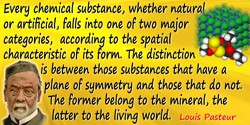
Every chemical substance, whether natural or artificial, falls into one of two major categories, according to the spatial characteristic of its form. The distinction is between those substances that have a plane of symmetry and those that do not. The former belong to the mineral, the latter to the living world.
— Louis Pasteur
Pasteur Vallery-Radot (ed.), Oeuvres de Pasteur (1922-1939), Vol. I, 331. Quoted in Patrice Debré, Louis Pasteur, trans. Elborg Forster (1994), 261.
Every living thing from a living thing.
Omne vivum ex vivo.
Omne vivum ex vivo.
— Louis Pasteur
Associated with Pasteur, perhaps because he popularized this as a motto, but it actually predates his birth. The Latin form is found attributed to William Harvey, for example, in O. v Boltenstern, Die neuere Geschichte der Medicin (1802), 109. Also attributed to Francesco Redi in Andrew Wilson, for example, in 'Science—Culture for the Masses', Science and Poetry: And Other Essays (1888), 31. Attribution to Pasteur can be found, for example, in F.G. Nagasaka, Robert S. Cohen, Japanese Studies in the Philosophy of Science (1998), 181.
Happy is he who bears a god within himself, an ideal of beauty, and obeys him: an ideal of art, an ideal of the virtues of the Gospel. These are the living springs of great thoughts and great actions. All are illuminated by reflections of the sublime.
— Louis Pasteur
Speech (27 Apr 1882) on his reception into the Académie Française, as translated in Maurice Benjamin Strauss, Familiar Medical Quotations (1968), 490.
Herrmann Pidoux and Armand Trousseau stated 'Disease exists within us, because of us, and through us', Pasteur did not entirely disagree, 'This is true for certain diseases', he wrote cautiously, only to add immediately: 'I do not think that it is true for all of them'.
— Louis Pasteur
Pasteur Vallery-Radot (ed.), Oeuvres de Pasteur (1922-1939), Vol. 6, 167. Quoted in Patrice Debré, Louis Pasteur, trans. Elborg Forster (1994), 261.
I am the most hesitating of men, the most fearful of committing myself when I lack evidence. But on the contrary, no consideration can keep me from defending what I hold as true when I can rely on solid scientific proof.
— Louis Pasteur
As quoted in René J. Dubos, Louis Pasteur, Free Lance of Science (1960, 1986), 76.
I do not forget that Medicine and Veterinary practice are foreign to me. I desire judgment and criticism upon all my contributions. Little tolerant of frivolous or prejudiced contradiction, contemptuous of that ignorant criticism which doubts on principle, I welcome with open arms the militant attack which has a method of doubting and whose rule of conduct has the motto “More light.”
— Louis Pasteur
In Louis Pasteur and Harold Clarence Ernst (trans), The Germ Theory and Its Application to Medicine and Surgery, Chap. 12. Reprinted in Charles W. Eliot (ed.), The Harvard Classics:
Scientific Papers: Physiology, Medicine, Surgery, Geology (1897, 1910), Vol. 38, 401-402. Cited as read before French Academy of Science (20 Apr 1878), published in Comptes Rendus de l’Académie des Sciences, 84, 1037-43.
I give them experiments and they respond with speeches.
— Louis Pasteur
in Patrice Debré, Louis Pasteur, trans. Elborg Forster (1994), 362.
I propose to provide proof... that just as always an alcoholic ferment, the yeast of beer, is found where sugar is converted into alcohol and carbonic acid, so always a special ferment, a lactic yeast, is found where sugar is transformed into lactic acid. And, furthermore, when any plastic nitrogenated substance is able to transform sugar into that acid, the reason is that it is a suitable nutrient for the growth of the [lactic] ferment.
— Louis Pasteur
Comptes Rendus (1857), 45, 913.
If I have sometimes disturbed our academies by somewhat livelier discussions, it is because I was passionately defending truth.
— Louis Pasteur
In Speech (27 Dec 1892) at the Golden Jubilee celebration for Pasteur's 70th birthday. As translated in Nature (1893), 47, 205. Note: Indeed, Pasteur had argued long and hard to convince his colleagues about his Germ Theory.
If it is a terrifying thought that life is at the mercy of the multiplication of these minute bodies [microbes], it is a consoling hope that Science will not always remain powerless before such enemies...
— Louis Pasteur
Paper read to the French Academy of Sciences (29 Apr 1878), published in Comptes Rendus de l'Academie des Sciences, 86, 1037-43, as translated by H.C.Ernst. Collected in Charles W. Eliot (ed.) The Harvard Classics, Vol. 38; Scientific Papers: Physiology, Medicine, Surgery, Geology (1910), 366.
If science has no country, the scientist should have one, and ascribe to it the influence which his works may have in this world.
— Louis Pasteur
Address at the Inauguration of the Pasteur Institute (14 Nov 1888). In René Vallery-Radot, The Life of Pasteur, translated by Mrs. R. L. Devonshire (1919), 443.
If the mysterious influence to which the dissymmetry of nature is due should come to change in sense or direction, the constituting elements of all living beings would take an inverse dissymmetry. Perhaps a new world would be presented to us. Who could foresee the organization of living beings, if the cellulose, which is right, should become left, if the left albumen of the blood should become right? There are here mysteries which prepare immense labours for the future, and from this hour invite the most serious meditations in science.
— Louis Pasteur
Lecture (3 Feb 1860), to the Chemical Society of Paris, 'On the Molecular Dissymetry of Natural Organic Products', reprinted in The Chemical News and Journal of Industrial Science (3 May 1862), 5, No. 126, 248.
In experimental science it’s always a mistake not to doubt when facts do not compel you to affirm.
— Louis Pasteur
…...
In that memorable year, 1822: Oersted, a Danish physicist, held in his hands a piece of copper wire, joined by its extremities to the two poles of a Volta pile. On his table was a magnetized needle on its pivot, and he suddenly saw (by chance you will say, but chance only favours the mind which is prepared) the needle move and take up a position quite different from the one assigned to it by terrestrial magnetism. A wire carrying an electric current deviates a magnetized needle from its position. That, gentlemen, was the birth of the modern telegraph.
Le hasard favorise l’esprit preparé
Le hasard favorise l’esprit preparé
— Louis Pasteur
Inaugural Address as newly appointed Professor and Dean (Sep 1854) at the opening of the new Faculté des Sciences at Lille (7 Dec 1854). In René Vallery-Radot, The Life of Pasteur, translated by Mrs. R. L. Devonshire (1919), 76.
In the fields of observation chance favors only the prepared mind.
— Louis Pasteur
In a lecture at the University of Lille, December 7, 1854.
It is characteristic of experimental science that it opens ever-widening horizons to our vision.
— Louis Pasteur
As translated in René J. Dubos, Louis Pasteur, Free Lance of Science (1950, 1986), 329.
It is precisely because I have studied and reflected that I have to-day the faith of a Breton; and had I studied and reflected more I should have the faith of a Breton’s wife.
— Louis Pasteur
Apocryphal - doubtful that Pasteur actually said this. There seem to be no first-hand documents to support it. Alleged reply to a student, who supposedly asked Pasteur how it was possible for a scientific man, who had studied and reflected so much, to remain a devout Roman Catholic. As given in Michael Peter Hill, 'Scientific Freedom', The Catholic's Ready Answer: A Popular Vindication of Christian Beliefs and Practices Against the Attacks of Modern Criticism (1915), 415. Translated from the German, and expanded, from the work of Franz Xaver Brors, Modernes A B C. It was Pasteur’s position that science and faith were not mutually exclusive.
Laboratory and discovery are related terms. Do away with laboratories, and the physical sciences will be become the image of the sterility of death.
Laboratoires et découvertes sont des termes corrélatifs. Supprimez les laboratoires, les sciences physiques deviendront l’image de la stérilité et de la mort.
Laboratoires et découvertes sont des termes corrélatifs. Supprimez les laboratoires, les sciences physiques deviendront l’image de la stérilité et de la mort.
— Louis Pasteur
In article 'The Budget of Science', Revue des Cours Scientifiques (1 Feb 1868) and published as a pamphlet, Some Reflections on Science in France. As translated in Patrice Debré and Elborg Forster (trans.), Louis Pasteur (2000), 143. Original French quote in René Vallery-Radot, La Vie de Pasteur (1900), 215. Note: Pasteur was fighting for a new laboratory building, but funding had been withdrawn—yet many millions were being spent to build an opera house. The full article, which was scorching, had been first sent to the newspaper, Moniteur in early Jan 1868, but it was declined as too politically controversial. Napoleon III was notified, and he was sympathetic. Other translations include: “Laboratories and discoveries are correlative terms. If you suppress laboratories, physical science will become stricken with barrenness and death.” In René Vallery-Radot and Mrs R. L. Devonshire (trans.) The Life of Pasteur (1902), 199.
Let me tell you the secret that has led me to my goal. My only strength lies in my tenacity.
— Louis Pasteur
Quoted in René Dubos, Louis Pasteur: Freelance of Science (1950). In W.I.B. Beveridge, The Art of Scientific Investigation (1953), 140.
Live in the serene peace of laboratories and libraries.
— Louis Pasteur
Advice to young scientists at celebration for Pasteur's 70th birthday, Sorbonne (27 Dec 1892). Nature (1893), 47, 205. Also quoted in Émile Duclaux, translated by Erwin F. Smith and Florence Hedges, Pasteur: The History of a Mind (1920), xxii.
My present and most fixed opinion regarding the nature of alcoholic fermentation is this: The chemical act of fermentation is essentially a phenomenon correlative with a vital act, beginning and ending with the latter. I believe that there is never any alcoholic fermentation without their being simultaneously the organization, development, multiplication of the globules, or the pursued, continued life of globules which are already formed.
— Louis Pasteur
In 'Memoire sur la fermentation alcoolique', Annales de Chemie et de Physique (1860), 58:3, 359-360, as translated in Joseph S. Fruton, Proteins, Enzymes, Genes: The Interplay of Chemistry and Biology (1999), 137.
No category of sciences exists to which one could give the name of applied sciences. There are science and the applications of science, linked together as fruit is to the tree that has borne it.
Il n’existe pas une catégorie de sciences auxquelles on puisse donner le nom de sciences appliquées. II y a la science et les applications de la science, liées entre elles comme le fruit à l’arbre qui l’a porté.
Il n’existe pas une catégorie de sciences auxquelles on puisse donner le nom de sciences appliquées. II y a la science et les applications de la science, liées entre elles comme le fruit à l’arbre qui l’a porté.
— Louis Pasteur
Original French in 'La Science en france: Pourquoi la France n’a pas trouvé d’hommes supérieurs au moment de péril', La Revue Scientifique de la France et de l’Étranger Revue des Cours Scientifique (22 Jul 1871), 2, No. 4, 74. Translation as given in Isaac Asimov and Jason A. Shulman (eds.), Isaac Asimov’s Book of Science and Nature Quotations (1988), 322. Another translation gives: “…there does not exist a category of science to which one can give the name applied science. There are science and the applications of science, bound together as the fruit to the tree which bears it.”
Nothing is lost and nothing is created in the operations of art as those of nature.
— Louis Pasteur
Pasteur Vallery-Radot (ed.), Correspondance de Pasteur 1840-1895 (1940), Vol. 1, 326. Quoted in Patrice Debré, Louis Pasteur, trans. Elborg Forster (1994), 90.
Preconceived ideas are like searchlights which illumine the path of experimenter and serve him as a guide to interrogate nature. They become a danger only if he transforms them into fixed ideas – this is why I should like to see these profound words inscribed on the threshold of all the temples of science: “The greatest derangement of the mind is to believe in something because one wishes it to be so.”
— Louis Pasteur
Speech (8 Jul 1876), to the French Academy of Medicine. As translated in René J. Dubos, Louis Pasteur, Free Lance of Science (1950, 1986), 376. Date of speech identified in Maurice B. Strauss, Familiar Medical Quotations (1968), 502.
Science advances through tentative answers to a series of more and more subtle questions which reach deeper and deeper into the essence of natural phenomena.
— Louis Pasteur
…...
Science brings men nearer to God.
— Louis Pasteur
Quoted in Kim Lim (ed.), 1,001 Pearls of Spiritual Wisdom: Words to Enrich, Inspire, and Guide Your Life (2014), 38
Science knows no country because knowledge belongs to humanity, and is the torch which illuminates the world. Science is the highest personification of the nation because that nation will remain the first which carries the furthest the works of thought and intelligence.
— Louis Pasteur
From banquet Toast (1876), at the International Congress of Sericulture, Milan, Italy, as translated in René Dubos, Louis Pasteur, Free Lance of Science (1960), 85. Banquet date identified in Maurice B. Strauss, Familiar Medical Quotations (1968), 519.
Science proceeds by successive answers to questions more and more subtle, coming nearer and nearer to the very essence of phenomena.
— Louis Pasteur
From Études sur la bière, Chap 6, Sec. vi. As translated by René J. Dubos, quoted and cited in Maurice B. Strauss, Familiar Medical Quotations (1968), 526.
Spontaneous generation is a chimera.
— Louis Pasteur
In 'Pasteur on Spontaneous Generation', Edinburgh Review, Or Critical Journal (Jan 1867), 125, 208. Cited from 'Sur les Corpuscules Organisés qui existent dans l’Atmosphere, Examen de la Doctrine des Génerations Spontanées', Annales de Chimie et de Physique (1862), 64.
The artificial products do not have any molecular dissymmetry; and I could not indicate the existence of a more profound separation between the products born under the influence of life and all the others.
— Louis Pasteur
Quoted in Joseph S. Fruton, Proteins, Enzymes, Genes: The Interplay of Chemistry and Biology (1999), 135.
The great art consists in devising décisive experiments, leaving no place to the imagination of the observer. Imagination is needed to give wings to thought at the beginning of experimental investigations on any given subject. When, however, the time has come to conclude, and to interpret the facts derived from observations, imagination must submit to the factual results of the experiments.
— Louis Pasteur
Speech (8 Jul 1876), to the French Academy of Medicine. As translated in René J. Dubos, Louis Pasteur, Free Lance of Science (1950, 1986), 376. Date of speech identified in Maurice B. Strauss, Familiar Medical Quotations (1968), 502.
The Greeks have given us one of the most beautiful words of our language, the word “enthusiasm” – a God within. The grandeur of the acts of men is measured by the inspiration from which they spring. Happy is he who bears a God within!
— Louis Pasteur
Speech (27 Apr 1882) on his reception into the Académie Française, as translated in Maurice Benjamin Strauss, Familiar Medical Quotations (1968), 490.
The only thing that can bring joy is work.
— Louis Pasteur
Vallery-Radot (ed.), Correspondance de Pasteur 1840-1895 (1940), Vol. 1, 293. Quoted in Patrice Debré, Louis Pasteur, trans. Elborg Forster (1994), 64.
The Sciences gain by mutual support.
— Louis Pasteur
Opening sentence of 'The Germ Theory: And its Applications to Medicine and Surgery', collected in The Harvard Classics: Scientific Papers: Physiology, Medicine, Surgery, Geology (1910), Vol. 38, 382. Cited as read before French Academy of Science (20 Apr 1878), published in Comptes Rendus de l’Académie des Sciences, 84, 1037.
The universe is a disymmetrical whole.
— Louis Pasteur
In René Vallery-Radot, The Life of Pasteur (1902), Vol. 1, 94.
The universe is an asymmetrical entity. I am inclined to believe that life as it is manifested to us must be a function of the asymmetry of the universe or of the consequence of this fact. The universe is asymmetrical; for if one placed the entire set of bodies that compose the solar system, each moving in its own way, before a mirror, the image shown would not be superimposable on the reality.
— Louis Pasteur
Rene Vallery-Radot, Vie de Pasteur (1900), 79. Quoted in Patrice Debre, Louis Pasteur, trans. Elborg Forster (1994), 78.
The universe is asymmetric and I am persuaded that life, as it is known to us, is a direct result of the asymmetry of the universe or of its indirect consequences. The universe is asymmetric.
Acknowledging the role of molecules that have stereoisomers, some the mirror image of the others, and microorganisms whose chemistry prefers only one of those forms.
Acknowledging the role of molecules that have stereoisomers, some the mirror image of the others, and microorganisms whose chemistry prefers only one of those forms.
— Louis Pasteur
Comptes Rendus de l'Académie des Science (1 Jun 1874). Reprinted in Oeuvres, Vol. 1, 361. In J.B.S. Haldane, Nature, 185, 87. As cited in Alan L. Mackay,The Harvest of a Quiet Eye (1977), 117. Pasteur's application of a microorganism with a chemical behaviour preferring a specific stereoisomer is in Sven Klussmann, The Aptamer Handbook (2006), 420.
There is no such thing as a special category of science called applied science; there is science and its applications, which are related to one another as the fruit is related to the tree that has borne it.
— Louis Pasteur
In Pasteur Vallery-Radot (ed.), Correspondance de Pasteur 1840-1895 (1940), Vol. 1, 315. Quoted in Patrice Debré and Elborg Forster (trans.), Louis Pasteur, (1994), 84.
These microscopic organisms form an entire world composed of species, families and varieties whose history, which has barely begun to be written, is already fertile in prospects and findings of the highest importance. The names of these organisms are very numerous and will have to be defined and in part discarded. The word microbe which has the advantage of being shorter and carrying a more general meaning, and of having been approved by my illustrious friend, M. Littré, the most competent linguist in France, is one we will adopt.
— Louis Pasteur
In paper read to the Académie de Medecine (Mar 1878). In Charles-Emile Sedillot, 'Influence de M. Pasteur sur les progres de la chirurgie' [Influence of Pasteur on the progress of surgery].
This marvellous experimental method eliminates certain facts, brings forth others, interrogates nature, compels it to reply and stops only when the mind is fully satisfied. The charm of our studies, the enchantment of science, is that, everywhere and always, we can give the justification of our principles and the proof of our discoveries.
— Louis Pasteur
As quoted in René Dubos, Louis Pasteur, Free Lance of Science (1960, 1986), 377.
To be astonished at anything is the first movement of the mind towards discovery.
— Louis Pasteur
In Louis Descour, trans. by A.F. & B.H. Wedd, Pasteur and His Work (1922), 16.
To demonstrate experimentally that a microscopic organism actually is the cause of a disease and the agent of contagion, I know no other way, in the present state of Science, than to subject the microbe (the new and happy term introduced by M. Sédillot) to the method of cultivation out of the body.
— Louis Pasteur
Paper read to the French Academy of Sciences (29 Apr 1878), published in Comptes Rendus de l'Academie des Sciences, 86, 1037-43, as translated by H.C.Ernst. Collected in Charles W. Eliot (ed.) The Harvard Classics, Vol. 38; Scientific Papers: Physiology, Medicine, Surgery, Geology (1910), 364.
To him who devotes his life to science, nothing can give more happiness than increasing the number of discoveries, but his cup of joy is full when the results of his studies immediately find practical applications.
— Louis Pasteur
As quoted in René J. Dubos, Louis Pasteur, Free Lance of Science (1960, 1986), 85.
Two contrary laws seem to be wrestling with each other nowadays: the one, a law of blood and of death, ever imagining new means of destruction and forcing nations to be constantly ready for the battlefield—the other, a law of peace, work and health, ever evolving new means for delivering man from he scourges which beset him. The one seeks violent conquests, the other the relief of humanity. The latter places one human life above any victory: while the former would sacrifice hundreds and thousands of lives to the ambition of one.
— Louis Pasteur
Address at the Inauguration of the Pasteur Institute. In René Vallery-Radot, The Life of Pasteur, translated by Mrs. R. L. Devonshire (1919), 444.
We affirm the neutrality of Science ... Science is of no country. ... But if Science has no country, the scientist must keep in mind all that may work towards the glory of his country. In every great scientist will be found a great patriot.
— Louis Pasteur
Address at the International Medical Congress, Palace of Industry, Copenhagen (10 Aug 1884). In René Vallery-Radot, The Life of Pasteur, translated by Mrs. R. L. Devonshire (1919), 399.
What hopes filled me when I discovered that there were laws behind so many obscure phenomena!
— Louis Pasteur
In Speech (27 Dec 1892) at the Golden Jubilee celebration for Pasteur's 70th birthday. As translated in Nature (1893), 47, 205.
When meditating over a disease, I never think of finding a remedy for it, but, instead, a means of preventing it.
— Louis Pasteur
From address (15 May 1884), to École Centrale des Arts et Manufactures, Paris. In Maurice Benjamin Strauss, Familiar Medical Quotations (1968), 451.
When you believe you have found an important scientific fact, and are feverishly curious to publish it, constrain yourself for days, weeks, years sometimes, fight yourself, try and ruin your own experiments, and only proclaim your discovery after having exhausted all contrary hypotheses. But when, after so many efforts you have at last arrived at a certainty, your joy is one of the greatest which can be felt by a human soul.
— Louis Pasteur
From Speech (14 Nov 1888) at the Inauguration of the Pasteur Institute, as translated in René Vallery-Radot and Mrs R.L. Devonshire (trans.), The Life of Pasteur (1915), 443.

Wine is the most healthful and most hygienic of beverages.
— Louis Pasteur
Études sur le Vin (1866), Vol 1, xx.
Without theory, practice is but routine born of habit. Theory alone can bring forth and develop the spirit of invention. ... [Do not] share the opinion of those narrow minds who disdain everything in science which has not an immediate application. ... A theoretical discovery has but the merit of its existence: it awakens hope, and that is all. But let it be cultivated, let it grow, and you will see what it will become.
— Louis Pasteur
Inaugural Address as newly appointed Professor and Dean (Sep 1854) at the opening of the new Faculté des Sciences at Lille (7 Dec 1854). In René Vallery-Radot, The Life of Pasteur, translated by Mrs. R. L. Devonshire (1919), 76.
Worship the spirit of criticism. If reduced to itself it is not an awakener of ideas or a stimulant to great things, but, without it, everything is fallible; it always has the last word.
— Louis Pasteur
Address at the Inauguration of the Pasteur Institute. In René Vallery-Radot, The Life of Pasteur, translated by Mrs. R. L. Devonshire (1919), 443.
You bring me the deepest joy that can be felt by a man [Pasteur himself] whose invincible belief is that Science and Peace will triumph over Ignorance and War, that nations will unite, not to destroy, but to build, and that the future will belong to those who will have done most for suffering humanity. But whether our efforts are or are not favored by life, let us be able to say, when we come near to the great goal, “I have done what I could.”
— Louis Pasteur
Speech at the Sorbonne, Paris, France (27 Dec 1892) where his 70th birth was recognized. His son presented the speech due to the weakness of Pastuer's voice. In René Vallery-Radot, The Life of Pasteur, R. L. Devonshire (trans.) (1902), Vol. 2, 297.
Young men, … Live in the serene peace of laboratories and libraries. Say to yourselves first:
“What have I done for my instruction?” and, as you gradually advance, “What have I done for my country?”
— Louis Pasteur
Acceptance speech (27 Dec 1892) when awarded a 70th birthday commemorative medal by the Academy of Sciences in the great theatre of the Sorbonne, as translated in René Vallery-Radot and Mrs R.L. Devonshire (trans.), The Life of Pasteur (1902), Vol. 2, 297-298. Pasteur addressed an audience that included “deep masses of students” and “boys from the lycées.”
Young men, have confidence in those powerful and safe methods, of which we do not yet know all the secrets. And, whatever your career may be, do not let yourselves become tainted by a deprecating and barren skepticism … Live … until the time comes when you have the immense happiness of thinking that you have contributed in some way to the progress and to the good of humanity.
— Louis Pasteur
Acceptance speech (27 Dec 1892) when awarded a 70th birthday commemorative medal by the Academy of Sciences in the great theatre of the Sorbonne, as translated in René Vallery-Radot and Mrs R.L. Devonshire (trans.), The Life of Pasteur (1902), Vol. 2, 297-298. Pasteur addressed an audience that included “deep masses of students” and “boys from the lycées.”
Young men, trust those certain and powerful methods, only the first secrets of which we yet know. And all of you, whatever your career, … do not allow yourselves to be discouraged by the gloom of certain hours which pass a nation.
— Louis Pasteur
Advice in Speech (27 Dec 1892) to young scientists at the Golden Jubilee celebration for Pasteur's 70th birthday. As translated in Nature (1893), 47, 205. Also translated as “Young men, have faith in those powerful and safe methods, of which we do not yet know all the secrets. And, whatever your career may be, do not let yourselves be discouraged by the sadness of certain hours which pass over nations.” By René J. Dubos, quoted and cited in Maurice B. Strauss, Familiar Medical Quotations (1968), 526.
Quotes by others about Louis Pasteur (18)
We may regard the cell quite apart from its familiar morphological aspects, and contemplate its constitution from the purely chemical standpoint. We are obliged to adopt the view, that the protoplasm is equipped with certain atomic groups, whose function especially consists in fixing to themselves food-stuffs, of importance to the cell-life. Adopting the nomenclature of organic chemistry, these groups may be designated side-chains. We may assume that the protoplasm consists of a special executive centre (Leistungs-centrum) in connection with which are nutritive side-chains… The relationship of the corresponding groups, i.e., those of the food-stuff, and those of the cell, must be specific. They must be adapted to one another, as, e.g., male and female screw (Pasteur), or as lock and key (E. Fischer).
Croonian Lecture, 'On Immunity with Special Reference to Cell Life', Proceedings of the Royal Society of London, 1900, 66, 433-434.
I have no patience with attempts to identify science with measurement, which is but one of its tools, or with any definition of the scientist which would exclude a Darwin, a Pasteur or a Kekulé. The scientist is a practical man and his are practical aims. He does not seek the ultimate but the proximate. He does not speak of the last analysis but rather of the next approximation. His are not those beautiful structures so delicately designed that a single flaw may cause the collapse of the whole. The scientist builds slowly and with a gross but solid kind of masonry. If dissatisfied with any of his work, even if it be near the very foundations, he can replace that part without damage to the remainder. On the whole, he is satisfied with his work, for while science may never be wholly right it certainly is never wholly wrong; and it seems to be improving from decade to decade.
The Anatomy of Science (1926), 6-7.
But when it has been shown by the researches of Pasteur that the septic property of the atmosphere depended not on the oxygen, or any gaseous constituent, but on minute organisms suspended in it, which owed their energy to their vitality, it occurred to me that decomposition in the injured part might be avoided without excluding the air, by applying as a dressing some material capable of destroying the life of the floating particles. Upon this principle I have based a practice.
'On the Antiseptic Principle in the Practice of Surgery', The British Medical Journal (1867), ii, 246.
HEART, n. An automatic, muscular blood- pump. Figuratively, this useful organ is said to be the seat of emotions and sentiments—a very pretty fancy which, however, is nothing but a survival of a once universal belief. It is now known that the sentiments and emotions reside in the stomach, being evolved from food by chemical action of the gastric fluid. The exact process by which a beefsteak becomes a feeling—tender or not, according to the age of the animal from which it was cut; the successive stages of elaboration through which a caviar sandwich is transmuted to a quaint fancy and reappears as a pungent epigram; the marvelous functional methods of converting a hard-boiled egg into religious contrition, or a cream-puff into a sigh of sensibility—these things have been patiently ascertained by M. Pasteur, and by him expounded with convincing lucidity.
The Collected Works of Ambrose Bierce (1911), Vol. 7, The Devil's Dictionary, 133-134.
A body of work such as Pasteur’s is inconceivable in our time: no man would be given a chance to create a whole science. Nowadays a path is scarcely opened up when the crowd begins to pour in.
Pensées d’un Biologiste (1939). Translated in The Substance of Man (1962), Chap. 6.
If Louis Pasteur were to come out of his grave because he heard that the cure for cancer still had not been found, NIH would tell him, “Of course we'll give you assistance. Now write up exactly what you will be doing during the three years of your grant.” Pasteur would say, “Thank you very much,” and would go back to his grave. Why? Because research means going into the unknown. If you know what you are going to do in science, then you are stupid! This is like telling Michelangelo or Renoir that he must tell you in advance how many reds and how many blues he will buy, and exactly how he will put those colors together.
Interview for Saturday Evening Post (Jan/Feb 1981), 30.
Specialists never contribute anything to their specialty; Helmholtz wasn’t an eye-specialist, but a German army doctor who invented the ophthalmoscope one Saturday afternoon when there wasn’t anything else to do. Incidentally, he rewrote whole chapters of physics, so that the physicists only know him as one of their own. Robert Mayer wasn’t a physicist, but another country doctor; and Pasteur, who made bacteriology, was a tanner’s son or a chemist, as you will.
In Fischerisms (1930), 7.
By teaching us how to cultivate each ferment in its purity—in other words, by teaching us how to rear the individual organism apart from all others,—Pasteur has enabled us to avoid all these errors. And where this isolation of a particular organism has been duly effected it grows and multiplies indefinitely, but no change of it into another organism is ever observed. In Pasteur’s researches the Bacterium remained a Bacterium, the Vibrio a Vibrio, the Penicillium a Penicillium, and the Torula a Torula. Sow any of these in a state of purity in an appropriate liquid; you get it, and it alone, in the subsequent crop. In like manner, sow smallpox in the human body, your crop is smallpox. Sow there scarlatina, and your crop is scarlatina. Sow typhoid virus, your crop is typhoid—cholera, your crop is cholera. The disease bears as constant a relation to its contagium as the microscopic organisms just enumerated do to their germs, or indeed as a thistle does to its seed.
In 'Fermentation, and its Bearings on Surgery and Medicine', Essays on the FloatingMatter of the Air in Relation to Putrefaction and Infection (1881), 264.
If Freud is not the Pasteur of mental illness, he is at least its Hippocrates.
In The Intelligent Man's Guide to Science: The Biological Sciences (1960), 723. Also in Isaac Asimov’s Book of Science and Nature Quotations (1988), 220.
In the 1860s, Pasteur not only applied his germ theory to create “Pasteurization,” rescuing France’s wine and vinegar industries, but also found both the cause and cure of silkworm disease, saving growers millions of dollars. When Napoleon asked the scientist why he had not legitimately profited by his findings, Pasteur replied: “In France scientists would consider they lowered themselves by doing so.”
In Jacques Cousteau and Susan Schiefelbein, The Human, the Orchid, and the Octopus: Exploring and Conserving Our Natural World (2007), 190.
[Karl F. Meyer was] the most versatile microbe hunter since Pasteur.
In 'Champion Among Microbe Hunters', Reader’s Digest (1950), 35–40. As quoted and cited in Mark Honigsbaum, '‘Tipping the Balance’: Karl Friedrich Meyer, Latent Infections,and the Birth of Modern Ideas of Disease Ecology', Journal of the History of Biology (2016), 49, 267.
L’oeuvre de Pasteur est admirable; elle montre son génie, mais it faut avoir vécu dans son intimité pour connaître toute la bonté de son coeur.
The work of Pasteur is admirable; it shows his genius, but it must have been experienced intimately to know all the goodness of his heart.
The work of Pasteur is admirable; it shows his genius, but it must have been experienced intimately to know all the goodness of his heart.
Epigraph in René Vallery-Radot, La Vie de Pasteur (1900), title page. English by Google translation, tweaked by Webmaster. Pierre Paul Émile Roux had indeed known Pasteur well, as one of his closest collaborators.
He [Louis Pasteur] imagined further experiments, to bring more light, for contradictions excited him to new investigations.
As quoted in René J. Dubos, Louis Pasteur, Free Lance of Science (1960, 1986), 76.
~~[Unverified]~~ [Louis Pasteur’s] … theory of germs is a ridiculous fiction. How do you think that these germs in the air can be numerous enough to develop into all these organic infusions? If that were true, they would be numerous enough to form a thick fog, as dense as iron.
Webmaster has not yet been able to verify this quote - and is very suspicious of it - but includes it to provide this cautionary note. It appears in several books, such as Rob Kaplan, Science Says (2001), 201-202, which cites “Professor of Physiology at Toulouse, The Universe: The Infinitely Great and the Infinitely Small (1872).” Webmaster has not yet found any information on Pierre Pochet as a 19th-century scientist, anywhere. A similar book title was found as The Universe: The Infinitely Great and the Infinitely Little (1870) but that author is Félix-Archimède Pochet, Director of the Natural History Museum at Rouen. This book, translated from the French, presents germs in the normal way, with no trace of the subject quote to be found in it. The Preface (dated 1867) begins, “My sole object in writing this work was…” implying it was totally authored by F.A. Pochet with no reference to taking over from earlier work by another person. It does, however, have this curious statement: “One of my learned colleagues at the Academy of Sciences lately brought out a similar work, but under a fictitious name,” which F.A. Pochet thought was a questionable practice, and did not provide any name of the individual involved. If you find more definitive information, please contact Webmaster.
Many successful investigators were not trained in the branch of science in which they made their most brilliant discoveries: Pasteur, Metchnikoff and Galvani are well-known examples. A sheepman named J.H.W. Mules, who had no scientific training, discovered a means of preventing blowfly
attack in sheep in Australia when many scientists had failed.
In W.I.B. Beveridge, The Art of Scientific Investigation (1957), 2.
Nicolle was one of those men who achieve their successes by long preliminary thought before an experiment is formulated, rather than by the frantic and often ill-conceived experimental activities that keep lesser men in ant-like agitation. Indeed. I have often thought of ants in observing the quantity output of ‘what-of-it’ literature from many laboratories. … Nicolle did relatively few and simple experiments. But every time he did one, it was the result of long hours of intellectual incubation during which all possible variants had been considered and were allowed for in the final tests. Then he went straight to the point, without wasted motion. That was the method of Pasteur, as it has been of all the really great men of our calling, whose simple, conclusive experiments are a joy to those able to appreciate them.
In As I Remember Him: The Biography of R.S. (1948). As quoted and cited in W.I.B. Beveridge, The Art of Scientific Investigation (1957), 11.
When I think of Miss Sabin’s work in the Medical School it seems to me that she has been an ideal university professor. Successful in teaching, productive in research, conscientious and cooperative in all routine duties of an administrative character. Following the admonition of Pasteur she has chosen to dwell in the serene peace of the laboratory and library, and in this environment has given her time and best energies to the work belonging to her position.
As quoted in Vincent T. Andriole, 'Florence Rena Sabin—Teacher, Scientist, Citizen', Journal of the History of Medicine and Allied Sciences (Jul 1959), 14, No. 3, (July 1959), 325. Cited as from W. H. Howell, 'Presentation to the University of the Portrait of Dr. Florence Rena Sabin', Bulletin of Johns Hopkins Hospital (1920), 31, 151.
What Pasteur and Langmuir believed—and what history has shown—is that both epidemiologists and laboratory scientists can make independent discoveries that have significant scientific impact, but collaboration across these disciplines has a synergistic effect, yielding public health data that are stronger than either discipline can provide alone
These words are not quoted directly from Walter R. Dowdle, but are a paraphrase of an explanation of an epigraph attributed to him: [“Alexander Langmuir was quoted in the early 1960s instructing incoming Epidemic Intelligence Service (EIS) officers that the only need for the laboratory in an outbreak investigation was to ‘prove their conclusions were right.’— Walter R. Dowdle (2011)”], to Chap. 9, M. Shannon Keckler, Reynolds M. Salerno, and Michael W. Shaw, 'Optimizing Epidemiology–Laboratory Collaborations' in Centers for Disease Control and Prevention, The CDC Field Epidemiology Manual (2018), 188. These authors paraphrased and expanded on a footnoted reference for which Dowdle was the corresponding author: “Langmuir’s point was not to denigrate the laboratory but to emphasize the power of an investigation based on a solid clinical case definition and established field epidemiologic principles,” in Walter R. Dowdle, Leonard W. Mayer, Karen K. Steinberg, Neelam D. Ghiya and Tanja Popovic (co-authors), 'CDC Laboratory Contributions to Public Health', Morbidity and Mortality Weekly Report, Supplements (7 Oct 2011), 60, 27. [This epigraph was complemented by another: “Sans laboratoires les savants sont des soldats sans armes.”. Without laboratories men of science are soldiers without arms. — Louis Pasteur (1923).]

See also:
- 27 Dec - short biography, births, deaths and events on date of Pasteur's birth.
- Louis Pasteur’s Discovery of Rabies Immunization - from Harper’s Weekly (1885)
- Louis Pasteur - The Modern Era of Immunization from CDC (1985)
- The Private Science of Louis Pasteur, by Gerald L. Geison. - book suggestion.
- Booklist for Louis Pasteur.
 In science it often happens that scientists say, 'You know that's a really good argument; my position is mistaken,' and then they would actually change their minds and you never hear that old view from them again. They really do it. It doesn't happen as often as it should, because scientists are human and change is sometimes painful. But it happens every day. I cannot recall the last time something like that happened in politics or religion.
(1987) --
In science it often happens that scientists say, 'You know that's a really good argument; my position is mistaken,' and then they would actually change their minds and you never hear that old view from them again. They really do it. It doesn't happen as often as it should, because scientists are human and change is sometimes painful. But it happens every day. I cannot recall the last time something like that happened in politics or religion.
(1987) -- 





