 (source)
|
J. Robert Oppenheimer
(22 Apr 1904 - 18 Feb 1967)
American theoretical physicist and science administrator.
|
Science Quotes by J. Robert Oppenheimer (30 quotes)
>> Click for J. Robert Oppenheimer Quotes on | Atomic Bomb | Knowledge | Science | World |
>> Click for J. Robert Oppenheimer Quotes on | Atomic Bomb | Knowledge | Science | World |

[About the great synthesis of atomic physics in the 1920s:] It was a heroic time. It was not the doing of any one man; it involved the collaboration of scores of scientists from many different lands. But from the first to last the deeply creative, subtle and critical spirit of Niels Bohr guided, restrained, deepened and finally transmuted the enterprise.
— J. Robert Oppenheimer
Quoted in Bill Becker, 'Pioneer of the Atom', New York Times Sunday Magazine (20 Oct 1957), 54.
[W]e have made a thing, a most terrible weapon, that has altered abruptly and profoundly the nature of the world. We have made a thing that, by all standards of the world we grew up in, is an evil thing. And by doing so, by our participation in making it possible to make these things, we have raised again the question of whether science is good for man, of whether it is good to learn about the world, to try to understand it, to try to control it, to help give to the world of men increased insight, increased power. Because we are scientists, we must say an unalterable yes to these questions; it is our faith and our commitment, seldom made explicit, even more seldom challenged, that knowledge is a good in itself, knowledge and such power as must come with it.
— J. Robert Oppenheimer
Speech to the American Philosophical Society (Jan 1946). 'Atomic Weapons', printed in Proceedings of the American Philosophical Society, 90(1), 7-10. In Deb Bennett-Woods, Nanotechnology: Ethics and Society (2008), 23. Identified as a speech to the society in Kai Bird, Martin J. Sherwin, American Prometheus: the Triumph and Tragedy of J. Robert Oppenheimer (2005), 323.
A discovery in science, or a new theory, even when it appears most unitary and most all-embracing, deals with some immediate element of novelty or paradox within the framework of far vaster, unanalysed, unarticulated reserves of knowledge, experience, faith, and presupposition. Our progress is narrow; it takes a vast world unchallenged and for granted. This is one reason why, however great the novelty or scope of new discovery, we neither can, nor need, rebuild the house of the mind very rapidly. This is one reason why science, for all its revolutions, is conservative. This is why we will have to accept the fact that no one of us really will ever know very much. This is why we shall have to find comfort in the fact that, taken together, we know more and more.
— J. Robert Oppenheimer
Science and the Common Understanding (1954), 53-4.
Bertrand Russell had given a talk on the then new quantum mechanics, of whose wonders he was most appreciative. He spoke hard and earnestly in the New Lecture Hall. And when he was done, Professor Whitehead, who presided, thanked him for his efforts, and not least for “leaving the vast darkness of the subject unobscured.”
— J. Robert Oppenheimer
Quoted in Robert Oppenheimer, The Open Mind (1955), 102.
Both the man of science and the man of art live always at the edge of mystery, surrounded by it; both always, as to the measure of their creation, have had to do with the harmonization of what is new with what is familiar, with the balance between novelty and synthesis, with the struggle to make partial order in total chaos.
— J. Robert Oppenheimer
Address at the close of the year-long Bicentennial Celebration of Columbia University (26 Dec 54). Printed in 'Prospects in the Arts and Sciences', Bulletin of the Atomic Scientists (Feb 1955), 52.
But when you come right down to it, the reason that we did this job is because it was an organic necessity. If you are a scientist you cannot stop such a thing. If you are a scientist you believe that it is good to find out how the world works; that it is good to find out what the realities are; that it is good to turn over to mankind at large the greatest possible power to control the world and to deal with it according to its lights and values.
Regarding the atomic bomb project.
Regarding the atomic bomb project.
— J. Robert Oppenheimer
From speech at Los Alamos (17 Oct 1945). Quoted in David C. Cassidy, J. Robert Oppenheimer and the American Century (2009), 214.
Common sense is not wrong in the view that is meaningful, appropriate and necessary to talk about the large objects of our daily experience …. Common sense is wrong only if it insists that what is familiar must reappear in what is unfamiliar.
— J. Robert Oppenheimer
In 'Uncommon Sense', collected in J. Robert Oppenheimer, Nicholas Metropolis (ed.) and Gian-Carlo Rota (ed.), Uncommon Sense (1984), 61.
Despite the vision and the far-seeing wisdom of our wartime heads of state, the physicists felt a peculiarly intimate responsibility for suggesting, for supporting, and in the end, in large measure, for achieving the realization of atomic weapons. Nor can we forget that these weapons, as they were in fact used, dramatized so mercilessly the inhumanity and evil of modern war. In some sort of crude sense which no vulgarity, no humor, no overstatement can quite extinguish, the physicists have known sin; and this is a knowledge which they cannot lose.
— J. Robert Oppenheimer
In Arthur Dehon Little Memorial Lecture (25 Nov 1947) to the Massachusetts Institute of Technology, 'Physics in the Contemporary World'. Collected in J. Robert Oppenheimer, The Open Mind (1955), 88.
Discovery follows discovery, each both raising and answering questions, each ending a long search, and each providing the new instruments for a new search.
— J. Robert Oppenheimer
In 'Prospects in the Arts and Sciences,' in Fifty Famous Essays (1964).
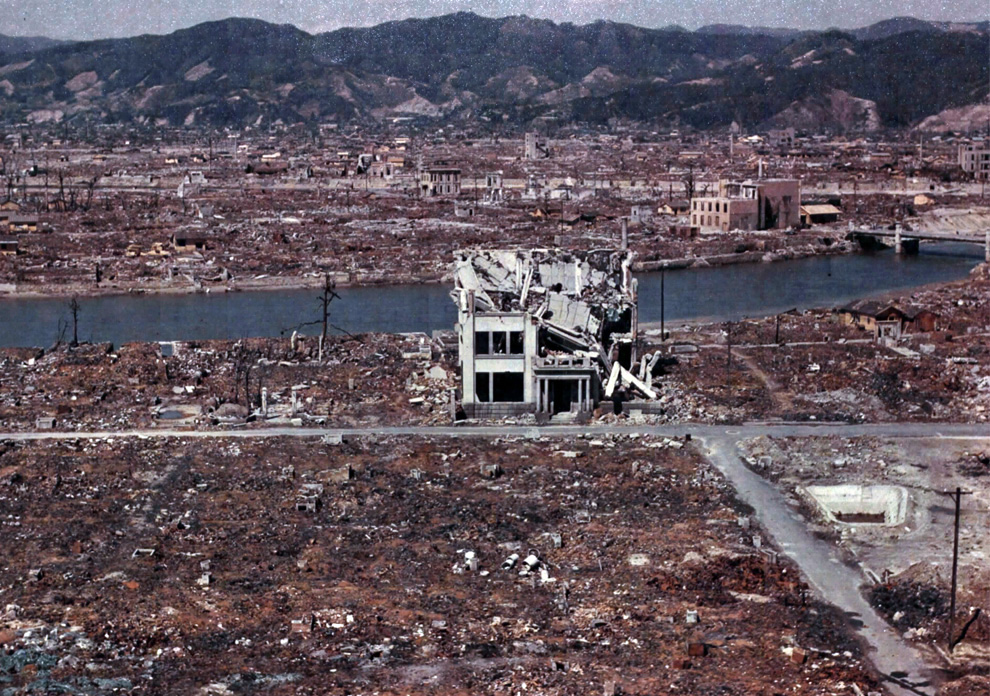
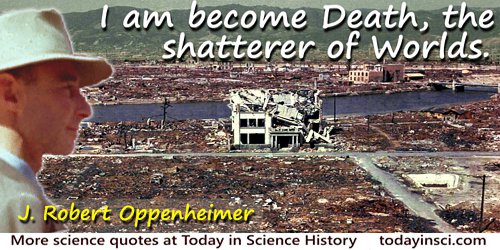
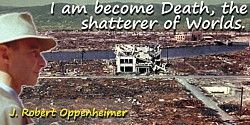
I am become death, The Shatterer of Worlds.
— J. Robert Oppenheimer
At the moment the first test atomic device exploded, Oppenheimer recalled a few lines from the 2,000-year-old Bhagavad Gita of India. This line is the most often quoted. In Abraham Pais and Robert P. Crease, J. Robert Oppenheimer: a Life (2006), 44. Also seen translated as “I am become Death, the destroyer of worlds.”
I think that the unity we can seek lies really in two things. One is that the knowledge which comes to us at such a terrifyingly, inhumanly rapid rate has some order in it. We are allowed to forget a great deal, as well as to learn. This order is never adequate. The mass of ununderstood things, which cannot be summarized, or wholly ordered, always grows greater; but a great deal does get understood.
The second is simply this: we can have each other to dinner. We ourselves, and with each other by our converse, can create, not an architecture of global scope, but an immense, intricate network of intimacy, illumination, and understanding. Everything cannot be connected with everything in the world we live in. Everything can be connected with anything.
The second is simply this: we can have each other to dinner. We ourselves, and with each other by our converse, can create, not an architecture of global scope, but an immense, intricate network of intimacy, illumination, and understanding. Everything cannot be connected with everything in the world we live in. Everything can be connected with anything.
— J. Robert Oppenheimer
Concluding paragraphs of 'The Growth of Science and the Structure of Culture', Daedalus (Winter 1958), 87, No. 1, 76.
If atomic bombs are to be added as new weapons to the arsenals of a warring world, or to the arsenals of nations preparing for war, then the time will come when mankind will curse the names of Los Alamos and Hiroshima. The people must unite, or they will perish.
— J. Robert Oppenheimer
Speech at Fuller Lodge when the U.S. Army was honouring the work at Los Alamos. (16 Oct 1945). Quoted in Kai Bird, Martin J. Sherwin, American Prometheus: the Triumph and Tragedy of J. Robert Oppenheimer (2005), 323.
If the radiance of a thousand suns
Were to burst at once into the sky
That would be like the splendour of the Mighty One …
I am become Death,
The shatterer of worlds.
Were to burst at once into the sky
That would be like the splendour of the Mighty One …
I am become Death,
The shatterer of worlds.
— J. Robert Oppenheimer
His thoughts in reaction to viewing the fireball of the Trinity test of the first atomic bomb at Alamogordo, N.M. (16 Jul 1945). Fragments from Sacred Hindu Epic, Bhagavad-Gita. Quoted in A. Berry (ed.), The Book of Scientific Anecdotes (1989), 175.
It did not take atomic weapons to make man want peace. But the atomic bomb was the turn of the screw. The atomic bomb made the prospect of future war unendurable. It has led us up those last few steps to the mountain pass; and beyond there is a different country.
— J. Robert Oppenheimer
Commencement address (1946). As quoted in book review (of Richard Rhodes, The Making of the Atomic Bomb), by William J. Broad, ‘The Men Who Made the Sun Rise', New York Times Book Review (8 Feb 1987), 39. Cited as from 'The Atomic Bomb and College Education' (1946), in Bartlett's Familiar Quotations (18th ed., 2014).
as quoted, without citation, in . Please contact Webmaster if you know a primary source.
It is a profound and necessary truth that the deep things in science are not found because they are useful; they are found because it was possible to find them.
— J. Robert Oppenheimer
Epigraph in Richard Rhodes, The Making of the Atomic Bomb (1986), 11.
Science starts with preconception, with the common culture, and with common sense. It moves on to observation, is marked by the discovery of paradox, and is then concerned with the correction of preconception. It moves then to use these corrections for the designing of further observation and for more refined experiment. And as it moves along this course the nature of the evidence and experience that nourish it becomes more and more unfamiliar; it is not just the language that is strange [to common culture].
— J. Robert Oppenheimer
From 'The Growth of Science and the Structure of Culture', Daedalus (Winter 1958), 87, No. 1, 67.
Taken as a story of human achievement, and human blindness, the discoveries in the sciences are among the great epics.
— J. Robert Oppenheimer
Epigraph in Richard Rhodes, The Making of the Atomic Bomb (1986), 8.
The frontiers of science are separated now by long years of study, by specialized vocabularies, arts, techniques, and knowledge from the common heritage even of a most civilized society; and anyone working at the frontier of such science is in that sense a very long way from home, a long way too from the practical arts that were its matrix and origin, as indeed they were of what we today call art.
— J. Robert Oppenheimer
Address at the close of the year-long Bicentennial Celebration of Columbia University (26 Dec 54). Printed in 'Prospects in the Arts and Sciences', Bulletin of the Atomic Scientists (Feb 1955), 52.
The great testimony of history shows how often in fact the development of science has emerged in response to technological and even economic needs, and how in the economy of social effort, science, even of the most abstract and recondite kind, pays for itself again and again in providing the basis for radically new technological developments. In fact, most people—when they think of science as a good thing, when they think of it as worthy of encouragement, when they are willing to see their governments spend substance upon it, when they greatly do honor to men who in science have attained some eminence—have in mind that the conditions of their life have been altered just by such technology, of which they may be reluctant to be deprived.
— J. Robert Oppenheimer
In 'Contemporary World', Bulletin of the Atomic Scientists (Feb 1948), 4, 67.
The open society, the unrestricted access to knowledge, the unplanned and uninhibited association of men for its furtherance—these are what may make a vast, complex, ever growing, ever changing, ever more specialized and expert technological world, nevertheless a world of human community.
— J. Robert Oppenheimer
'Science and the Common Understanding' (1954), 95. Reprinted in John Dewey and Julius A. Sigler, Classical Selections On Great Issues, Vol. 8, Science, Technology, and Society (1997), 35.
The powerful notion of entropy, which comes from a very special branch of physics … is certainly useful in the study of communication and quite helpful when applied in the theory of language.
— J. Robert Oppenheimer
From 'The Growth of Science and the Structure of Culture', Daedalus (Winter 1958), 87, No. 1, 67.
The scientist is not responsible for the laws of nature, but it is a scientist’s job to find out how these laws operate. It is the scientist’s job to find ways in which these laws can serve the human will. However, it is not the scientist’s job to determine whether a hydrogen bomb should be used. …
— J. Robert Oppenheimer
In A Passion for Science edited by L. Wolpert and A. Richards (1988).
The true scientist never loses the faculty of amusement. It is the essence of his being.
— J. Robert Oppenheimer
In The Peter Pyramid by Laurence J. Peter (1986).
There are children playing in the street who could solve some of my top problems in physics, because they have modes of sensory perception that I lost long ago.
— J. Robert Oppenheimer
…...
There is something irreversible about acquiring knowledge; and the simulation of the search for it differs in a most profound way from the reality.
— J. Robert Oppenheimer
In Physics in the Contemporary World (1949), 20.
There must be no barriers to freedom of inquiry. There is no place for dogma in science. The scientist is free, and must be free to ask any question, to doubt any assertion, to seek for any evidence, to correct any errors. ... Our political life is also predicated on openness. We know that the only way to avoid error is to detect it and that the only way to detect it is to be free to inquire. And we know that as long as men are free to ask what they must, free to say what they think, free to think what they will, freedom can never be lost, and science can never regress.
— J. Robert Oppenheimer
Life (10 Oct 1949), 136.
Today, it is not only that our kings do not know mathematics, but our philosophers do not know mathematics and—to go a step further—our mathematicians do not know mathematics.
— J. Robert Oppenheimer
'The Tree of Knowledge', Harper's Magazine (1958), 217, 55.
We knew the world would not be the same. A few people laughed, a few people cried. Most people were silent. I remembered the line from the Hindu scripture, the Bhagavad Gita: Vishnu is trying to pursue the Prince that he should do his duty and to impress him takes on his multi-armed form and says, “Now I am become Death, destroyer of worlds.” I suppose we all thought that one
way or another. There was a great deal of solemn talk that this was the end of the great wars of the century.
— J. Robert Oppenheimer
At the first atomic bomb test (16 Jul 1945), in Len Giovanitti and Fred Freed, The Decision to Drop the Bomb (1965), 197
When you see something that is technically sweet, you go ahead and do it and you argue about what to do about it only after you have had your technical success. That is the way it was with the atomic bomb.
— J. Robert Oppenheimer
From USAEC Transcript of Hearing Before Personnel Security Board (1954). Reproduced in Richard Polenberg (ed.), In the Matter of J. Robert Oppenheimer: The Security Clearance Hearing (2002), 46-47.
You can certainly destroy enough of humanity so that only the greatest act of faith can persuade you that what’s left will be human.
— J. Robert Oppenheimer
…...
Quotes by others about J. Robert Oppenheimer (10)
Dirac politely refused Robert’s [Robert Oppenheimer] two proffered books: reading books, the Cambridge theoretician announced gravely, “interfered with thought.”
Alvarez: Adventures of a Physicist (1987), 87.
Now we’re all sons-of-bitches.
Remark to Robert Oppenheimer immediately after the first atom bomb test explosion at Alamogordo. As quoted in Lansing Lamont, Day of Trinity (1966), 242.
There are 60 sub-atomic particles they’ve discovered that can explain the thousands of other sub-atomic particles, and the model is too ugly. This is my analogy: it’s like taking Scotch tape and taping a giraffe to a mule to a whale to a tiger and saying this is the ultimate theory of particles. … We have so many particles that Oppenheimer once said you could give a Nobel Prize to the physicist that did not discover a particle that year. We were drowning in sub-atomic particles.
Now we realize that this whole zoo of sub-atomic particles, thousands of them coming out of our accelerators, can be explained by little vibrating strings.
Now we realize that this whole zoo of sub-atomic particles, thousands of them coming out of our accelerators, can be explained by little vibrating strings.
Quoted in Nina L. Diamond, Voices of Truth (2000), 334.
I do not see how a man can work on the frontiers of physics and write poetry at the same time. They are in opposition. In science you want to say something that nobody knew before, in words which everyone can understand. In poetry you are bound to say ... something that everyone knows already in words that nobody can understand.
Commenting to him about the poetry J. Robert Oppenheimer wrote.
Commenting to him about the poetry J. Robert Oppenheimer wrote.
Quoted in Steven George Krantz, Mathematical Apocrypha Redux: More Stories and Anecdotes of Mathematicians (2005), 169
The reason Dick's [Richard Feynman] physics was so hard for ordinary people to grasp was that he did not use equations. The usual theoretical physics was done since the time of Newton was to begin by writing down some equations and then to work hard calculating solutions of the equations. This was the way Hans [Bethe] and Oppy [Oppenheimer] and Julian Schwinger did physics. Dick just wrote down the solutions out of his head without ever writing down the equations. He had a physical picture of the way things happen, and the picture gave him the solutions directly with a minimum of calculation. It was no wonder that people who had spent their lives solving equations were baffled by him. Their minds were analytical; his was pictorial.
Quoted in Michio Kaku and Jennifer Trainer Thompson, Beyond Einstein: the Cosmic Quest for the Theory of the Universe (1987, 1999), 56-57, citing Freeman Dyson, Disturbing the Universe (1979, 1981), 55-56.
I first met J. Robert Oppenheimer on October 8, 1942, at Berkeley, Calif. There we discussed the theoretical research studies he was engaged in with respect to the physics of the bomb. Our discussions confirmed my previous belief that we should bring all of the widely scattered theoretical work together. … He expressed complete agreement, and it was then that the idea of the prompt establishment of a Los Alamos was conceived.”
In 'Some Recollections of July 16, 1945', Bulletin of the Atomic Scientists (Jun 1970), 26, No. 6, 21.
I have always assumed, and I now assume, that he [Robert Oppenheimer] is loyal to the United States. I believe this, and I shall believe it until I see very conclusive proof to the opposite. … [But] I thoroughly disagreed with him in numerous issues and his actions frankly appeared to me confused and complicated. To this extent I feel that I would like to see the vital interests of this country in hands which I understand better, and therefore trust more.
After Teller paid tribute to Oppenheimer’s talents, especially his “very outstanding achievement” as the wartime organizer and director of Los Alamos, Teller continued his testimony to the Gray board hearings (28 Apr 1954) in the Atomic Energy Commission building, “In the Matter of J. Robert Oppenheimer.” The subject quotes were excerpted from Teller’s answers to their questions. As given in Robert Coughlan, 'Dr. Edward Teller’s Magnificent Obsession', Life (6 Sep 1954), 72-74.
There may be some interest in one of my own discoveries in physics, entitled, “A Method of Approximating the Importance of a Given Physicist.” Briefly stated, after elimination of all differentials, the importance of a physicist can be measured by observation in the lobby of a building where the American Physical Society is in session. The importance of a given physicist varies inversely with his mean free path as he moves from the door of the meeting-room toward the street. His progress, of course, is marked by a series of scattering collisions with other physicists, during which he remains successively in the orbit of other individuals for a finite length of time. A good physicist has a mean free path of 3.6 ± 0.3 meters. The shortest m.f.p. measured in a series of observations between 1445 and 1947 was that of Oppenheimer (New York, 1946), the figure being 2.7 centimeters. I know. I was waiting for him on the street.
In 'A Newsman Looks at Physicists', Physics Today (May 1948), 1, No. 1, 33.
We have an A-bomb … What more do you want, mermaids?
From testimony on 21 Apr 1954, In the Matter of J. Robert Oppenheimer: Transcript of Hearing Before Personnel Security Board, Washington, D.C., April 12, 1954, through May 5, 1954 (1954), 468. Rabi was objecting to the suspension of the security clearance of Robert Oppenheimer (his friend) stressing the “real positive record” and “tremendous achievement” and more that already documented his loyalty.
I found out at an early age that science is a haven for the timid, the freaks, the misfits. That is more true perhaps for the past than now. If you were a student in Göttingen in the 1920s and went to the seminar “Structure of Matter” which was under the joint auspices of David Hilbert and Max Born, you could well imagine that you were in a madhouse as you walked in. Every one of the persons there was obviously some kind of a severe case. The least you could do was put on some kind of a stutter. Robert Oppenheimer as a graduate student found it expedient to develop a very elegant kind of stutter, the "njum-njum-njum" technique. Thus, if you were an oddball you felt at home.
Answering the question, “Why did you choose science as your life’s work?” In 'Homo Scientificus According to Beckett," collected in William Beranek, Jr. (ed.)Science, Scientists, and Society, (1972), 135. Excerpted in Ann E. Kammer, Science, Sex, and Society (1979), 278.
See also:
- 22 Apr - short biography, births, deaths and events on date of Oppenheimer's birth.
- American Prometheus: The Triumph and Tragedy of J. Robert Oppenheimer, by Kai Bird, Martin J. Sherwin. - book suggestion.
- Booklist for Robert Oppenheimer.
 In science it often happens that scientists say, 'You know that's a really good argument; my position is mistaken,' and then they would actually change their minds and you never hear that old view from them again. They really do it. It doesn't happen as often as it should, because scientists are human and change is sometimes painful. But it happens every day. I cannot recall the last time something like that happened in politics or religion.
(1987) --
In science it often happens that scientists say, 'You know that's a really good argument; my position is mistaken,' and then they would actually change their minds and you never hear that old view from them again. They really do it. It doesn't happen as often as it should, because scientists are human and change is sometimes painful. But it happens every day. I cannot recall the last time something like that happened in politics or religion.
(1987) --