 (source)
|
Sir Isaac Newton
(25 Dec 1642 - 20 Mar 1727)
English physicist and mathematician who made seminal discoveries in several areas of science, and was the leading scientist of his era.
|
Science Quotes by Sir Isaac Newton (109 quotes)
>> Click for Sir Isaac Newton Quotes on | Action | Attraction | Body | Cause | Color | Colour | Effect | Experiment | Explanation | Force | God | Gravity | Heat | Hypothesis | Law Of Motion | Light | Matter | Motion | Nature | Orbit | Particle | Phenomenon | Philosophy | Planet | Principle | Proportion | Ray | Sun | Truth |
>> Click for Sir Isaac Newton Quotes on | Action | Attraction | Body | Cause | Color | Colour | Effect | Experiment | Explanation | Force | God | Gravity | Heat | Hypothesis | Law Of Motion | Light | Matter | Motion | Nature | Orbit | Particle | Phenomenon | Philosophy | Planet | Principle | Proportion | Ray | Sun | Truth |
![Isaac Newton Quote: like a boy playing on the seashore [pebbles]…whilst the great ocean of truth lay all undiscovered before me](https://todayinsci.com/N/Newton_Isaac/NewtonIsaac-SeashoreQuote500px.jpg)
…from the same principles, I now demonstrate the frame of the System of the World.
— Sir Isaac Newton
From Principia Mathematica, Book 3, as translated from the Latin by Andrew Motte, revised by William Davis, in The Mathematical Principles of Natural Philosophy (1803), Vol. 2, 159.
[1.] And first I suppose that there is diffused through all places an aethereal substance capable of contraction & dilatation, strongly elastick, & in a word, much like air in all respects, but far more subtile.
2. I suppose this aether pervades all gross bodies, but yet so as to stand rarer in their pores then in free spaces, & so much ye rarer as their pores are less ...
3. I suppose ye rarer aether within bodies & ye denser without them, not to be terminated in a mathematical superficies, but to grow gradually into one another.
2. I suppose this aether pervades all gross bodies, but yet so as to stand rarer in their pores then in free spaces, & so much ye rarer as their pores are less ...
3. I suppose ye rarer aether within bodies & ye denser without them, not to be terminated in a mathematical superficies, but to grow gradually into one another.
— Sir Isaac Newton
Letter to Robert Boyle (28 Feb 1678/9). In H. W. Turnbull (ed.), The Correspondence of Isaac Newton, 1676-1687 (1960), Vol. 2, 289.
Amicus Plato amicus Aristoteles magis amica verita.
Plato is my friend, Aristotle is my friend, but my greatest friend is truth.
Plato is my friend, Aristotle is my friend, but my greatest friend is truth.
— Sir Isaac Newton
Written in the margin of a notebook while a student at Cambridge. In Richard S. Westfall, Never at Rest (1980), 89.
Hypotheses non fingo.
I frame no hypotheses.
I frame no hypotheses.
— Sir Isaac Newton
From essay, 'General Scholium', appended to Andrew Motte (trans.), Principia (2nd ed., 1713). Also seen translated as: “I feign no hypotheses.” The latin word, “fingo” can also have the sense of devise, form, imagine, invent, contrive, conceive or fabricate. The respected science historian, I. Bernard Cohen gives an extensive discussion in 'The First English Version of Newton’s Hypotheses non fingo', Isis (Sep 1962), 53, No. 3, 379-388.
Numero pondere et mensura Deus omnia condidit.
God created everything by number, weight and measure.
God created everything by number, weight and measure.
— Sir Isaac Newton
On more than one occasion, Newton wrote these Latin words as his autograph, with his signature below. A photo of one example, dated “London 11 Sep 1722,” can be seen in I. Hargitta (ed.), Symmetry 2: Unifying Human Understanding (2014), 837. Reprinted from M. and B. Rozsondai, 'Symmetry Aspects of Bookbindings', Computers Math. Applic. (1989), 17, No. 4-6, 837. On this piece of paper, Newton dedicated these words to a Hungarian student, Ferenc Páriz Pápai Jr., whose album is now held by the Department of Manuscripts and Rare Books of the Library of the Hungarian Academy of Sciences (Shelf-number Tort. naplók, kis 8⁰ 6). The sentiment existed long before Newton used it. In the Bible, Wisdom of Solomon, 11:20, it appears as “Pondere, mensura, numero Deus omnia fecit,” (Vulgate) which the King James Version translates as “thou hast ordered all things in measure and number and weight.” Another Newton signed autograph with his Latin quote, dated 13 Jul 1716, sold (4 Apr 1991) for DM 9500 (about $31,000). See Dept of English, Temple University, The Scriblerian and the Kit-Cats (1991), 24-25, 230. A few years later, the sale (31 Mar 1998) of Newton's autograph cost the buyer $46,000. See Frank Ryan, Darwin's Blind Spot: Evolution Beyond Natural Selection (2002), 11-12. Other authors, including mathematicians, used the same Biblical passage. In Gilles Personne de Roberval's Aristarchi Samii de Mundi Systemate (1644), he frequently uses the abbreviation “P.N.E.M.” standing for “Pondere, mensura et mensura.” It was adopted as the motto of the Smeatonian Society of Engineers as “Omnia in Numero Pondere et Mensura.”
Qu. 31. Have not the small Particles of Bodies certain Powers, Virtues or Forces, by which they act at a distance, not only upon the Rays of Light for reflecting, refracting and reflecting them, but also upon one another for producing a great part of the Phænomena of Nature?
— Sir Isaac Newton
From Opticks, (1704, 2nd ed. 1718), Book 3, Query 31, 350.
Vacuum voco locum omnem in quo corpora sine resistentia movetur.
Vacuum I call every place in which a body is able to move without resistance.
Vacuum I call every place in which a body is able to move without resistance.
— Sir Isaac Newton
Original Latin from an unpublished line in a manuscript draft of additions and corrections to the second edition of the Principia held by Cambridge University Library, 'Definition II', MS Add 3965 sec 13 [53-94] Draft No. 3 Folio 422r. As quoted and cited in J.E. McGuire, Tradition and Innovation: Newton’s Metaphysics of Nature (1995, 2011), 139. English translation as given in Isaac Asimov and Jason A. Shulman (eds.), Isaac Asimov’s Book of Science and Nature Quotations (1988), 210.
A Vulgar Mechanick can practice what he has been taught or seen done, but if he is in an error he knows not how to find it out and correct it, and if you put him out of his road, he is at a stand; Whereas he that is able to reason nimbly and judiciously about figure, force and motion, is never at rest till he gets over every rub.
— Sir Isaac Newton
Letter (25 May 1694) to Nathaniel Hawes. In J. Edleston (ed.), Correspondence of Sir Isaac Newton and Professor Cotes (1850), 284.
Absolute space, of its own nature without reference to anything external, always remains homogenous and immovable. Relative space is any movable measure or dimension of this absolute space; such a measure or dimension is determined by our senses from the situation of the space with respect to bodies and is popularly used for immovable space, as in the case of space under the earth or in the air or in the heavens, where the dimension is determined from the situation of the space with respect to the earth. Absolute and relative space are the same in species and in magnitude, but they do not always remain the same numerically. For example, if the earth moves, the space of our air, which in a relative sense and with respect to the earth always remains the same, will now be one part of the absolute space into which the air passes, now another part of it, and thus will be changing continually in an absolute sense.
— Sir Isaac Newton
The Principia: Mathematical Principles of Natural Philosophy (1687), 3rd edition (1726), trans. I. Bernard Cohen and Anne Whitman (1999), Definitions, Scholium, 408-9.
Absolute, true, and mathematical time, in and of itself and of its own nature, without reference to anything external, flows uniformly and by another name is called duration. Relative, apparent, and common time is any sensible and external measure (precise or imprecise) of duration by means of motion; such as a measure—for example, an hour, a day, a month, a year—is commonly used instead of true time.
— Sir Isaac Newton
The Principia: Mathematical Principles of Natural Philosophy (1687), 3rd edition (1726), trans. I. Bernard Cohen and Anne Whitman (1999), Definitions, Scholium, 408.
Against filling the Heavens with fluid Mediums, unless they be exceeding rare, a great Objection arises from the regular and very lasting Motions of the Planets and Comets in all manner of Courses through the Heavens.
— Sir Isaac Newton
From Opticks: Or, A Treatise of the Reflections, Refractions, Inflections and Colours of Light (1718), 339.
All knowledge and understanding of the Universe was no more than playing with stones and shells on the seashore of the vast imponderable ocean of truth.
— Sir Isaac Newton
…...
All material Things seem to have been composed of the hard and solid Particles … variously associated with the first Creation by the Counsel of an intelligent Agent. For it became him who created them to set them in order: and if he did so, it is unphilosophical to seek for any other Origin of the World, or to pretend that it might arise out of a Chaos by the mere Laws of Nature.
— Sir Isaac Newton
From Opticks (1704, 2nd ed., 1718), 377-378.
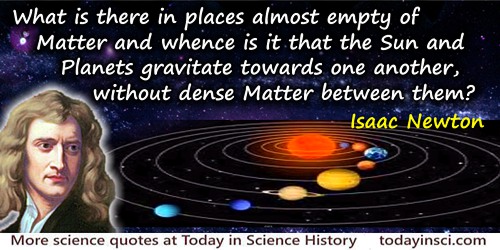
And for rejecting such a Medium, we have the Authority of those the oldest and most celebrated Philosophers of Greece and Phoenicia, who made a Vacuum, and Atoms, and the Gravity of Atoms, the first Principles of their Philosophy; tacitly attributing Gravity to some other Cause than dense Matter. Later Philosophers banish the Consideration of such a Cause out of natural Philosophy, feigning Hypotheses for explaining all things mechanically, and referring other Causes to Metaphysicks: Whereas the main Business of natural Philosophy is to argue from Phaenomena without feigning Hypotheses, and to deduce Causes from Effects, till we come to the very first Cause, which certainly is not mechanical; and not only to unfold the Mechanism of the World, but chiefly to resolve these and such like Questions. What is there in places almost empty of Matter, and whence is it that the Sun and Planets gravitate towards one another, without dense Matter between them? Whence is it that Nature doth nothing in vain; and whence arises all that Order and Beauty which we see in the World? ... does it not appear from phaenomena that there is a Being incorporeal, living, intelligent, omnipresent, who in infinite space, as it were in his Sensory, sees the things themselves intimately, and thoroughly perceives them, and comprehends them wholly by their immediate presence to himself.
— Sir Isaac Newton
In Opticks, (1704, 2nd. Ed. 1718), Book 3, Query 28, 343-5. Newton’s reference to “Nature does nothing in vain” recalls the axiom from Aristotle, which may be seen as “Natura nihil agit frustra” in the Aristotle Quotes on this web site.
And from true lordship it follows that the true God is living, intelligent, and powerful; from the other perfections, that he is supreme, or supremely perfect. He is eternal and infinite, omnipotent and omniscient; that is, he endures from eternity to eternity; and he is present from infinity to infinity; he rules all things, and he knows all things that happen or can happen.
— Sir Isaac Newton
The Principia: Mathematical Principles of Natural Philosophy (1687), 3rd edition (1726), trans. I. Bernard Cohen and Anne Whitman (1999), General Scholium, 941.
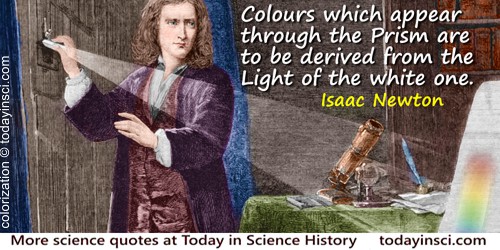
And if one look through a Prism upon a white Object encompassed with blackness or darkness, the reason of the Colours arising on the edges is much the same, as will appear to one that shall a little consider it. If a black Object be encompassed with a white one, the Colours which appear through the Prism are to be derived from the Light of the white one, spreading into the Regions of the black, and therefore they appear in a contrary order to that, when a white Object is surrounded with black. And the same is to be understood when an Object is viewed, whose parts are some of them less luminous than others. For in the borders of the more and less luminous Parts, Colours ought always by the same Principles to arise from the Excess of the Light of the more luminous, and to be of the same kind as if the darker parts were black, but yet to be more faint and dilute.
— Sir Isaac Newton
Opticks (1704), Book I, Part 2, Prop. VIII, Prob. III, 123.
And thus Nature will be very conformable to her self and very simple, performing all the great Motions of the heavenly Bodies by the Attraction of Gravity which intercedes those Bodies, and almost all the small ones of their Particles by some other attractive and repelling Powers which intercede the Particles. The Vis inertiae is a passive Principle by which Bodies persist in their Motion or Rest, receive Motion in proportion to the Force impressing it, and resist as much as they are resisted. By this Principle alone there never could have been any Motion in the World. Some other Principle was necessary for putting Bodies into Motion; and now they are in Motion, some other Principle is necessary for conserving the Motion.
— Sir Isaac Newton
From Opticks, (1704, 2nd ed. 1718), Book 3, Query 31, 372-3.
Are not all Hypotheses erroneous, in which Light is supposed to consist in Pression or Motion, propagated through a fluid Medium? For in all these Hypotheses the Phaenomena of Light have been hitherto explain'd by supposing that they arise from new Modifications of the Rays; which is an erroneous Supposition.
— Sir Isaac Newton
Opticks, 2nd edition (1718), Book 3, Query 28, 337.
As I am writing, another illustration of ye generation of hills proposed above comes into my mind. Milk is as uniform a liquor as ye chaos was. If beer be poured into it & ye mixture let stand till it be dry, the surface of ye curdled substance will appear as rugged & mountanous as the Earth in any place.
— Sir Isaac Newton
Letter to Thomas Burnet (Jan 1680/1. In H. W. Turnbull (ed.), The Correspondence of Isaac Newton, 1676-1687 (1960), Vol. 2, 334.
As in Mathematicks, so in Natural Philosophy, the Investigation of difficult Things by the Method of Analysis, ought ever to precede the Method of Composition. This Analysis consists in making Experiments and Observations, and in drawing general Conclusions from them by Induction, and admitting of no Objections against the Conclusions, but such as are taken from Experiments, or other certain Truths. For Hypotheses are not to be regarded in experimental Philosophy.
— Sir Isaac Newton
From Opticks, (1704, 2nd ed. 1718), Book 3, Query 31, 380.
Ax: 100 Every thing doth naturally persevere in yt state in wch it is unlesse it bee interrupted by some externall cause, hence… [a] body once moved will always keepe ye same celerity, quantity & determination of its motion.
— Sir Isaac Newton
Newton’s 'Waste Book' (1665). Quoted in Richard Westfall, Never at Rest: A Biography of Isaac Newton (1980), 145.
Bodies, projected in our air, suffer no resistance but from the air. Withdraw the air, as is done in Mr. Boyle's vacuum, and the resistance ceases. For in this void a bit of fine down and a piece of solid gold descend with equal velocity.
— Sir Isaac Newton
In 'General Scholium' from The Mathematical Principles of Natural Philosophy (1729), Vol. 2, Book 3, 388.
By such deductions the law of gravitation is rendered probable, that every particle attracts every other particle with a force which varies inversely as the square of the distance. The law thus suggested is assumed to be universally true.
— Sir Isaac Newton
In Isaac Newton and Percival Frost (ed.) Newton's Principia: Sections I, II, III (1863), 217.
By the act of generation nothing more is done than to ferment the sperm of ye female by the sperm of ye male that it may thereby become fit nourishment for ye Embryo: ffor ye nourishment of all animals is prepared by ferment & the ferment is taken from animals of the same kind, & makes the nourishment subtile & spiritual. In adult animals the nourishmt is fermented by the choler and pancreatic juice both wch come from the blood. The Embryo not being able to ferment its own nourishment wch comes from the mothers blood has it fermented by the sperm wch comes from ye fathers blood, & by this nourishment it swells, drops off from ye Ovarium & begins to grow with a life distinct from that of ye mother.
— Sir Isaac Newton
From 'Quæst 25' in Draft version of The Queries manuscript, Add. MS. 3970, folio 235 held by the University of Cambridge Library. As quoted and cited in R.W. Home, 'Force, Electricity, and Living Matter', from Margaret J. Osler and Paul Lawrence Farber (eds.), Religion, Science, and Worldview: Essays in Honor of Richard S. Westfall (2002), 113.
Centripetal force is the force by which bodies are drawn from all sides, are impelled, or in any way tend, toward some point as to a center.
— Sir Isaac Newton
The Principia: Mathematical Principles of Natural Philosophy (1687), 3rd edition (1726), trans. I. Bernard Cohen and Anne Whitman (1999), Definition 5, 405.
distinguish them into Absolute and Relative, True and Apparent, Mathematical and Common.
— Sir Isaac Newton
Do not Bodies and Light act mutually upon one another; that is to say, Bodies upon Light in emitting, reflecting, refracting and inflecting it, and Light upon Bodies for heating them, and putting their parts into a vibrating motion wherein heat consists?
— Sir Isaac Newton
Opticks (1704), Book 3, Query 5, 133.
Do not electric bodies by friction emit a subtile exhalation or spirit by which they perform their attractions?
— Sir Isaac Newton
As quoted in Roderick W. Home, Electricity and Experimental Physics in Eighteenth-Century Europe (1992), 103.
Do not great Bodies conserve their heat the longest, their parts heating one another, and may not great dense and fix'd Bodies, when heated beyond a certain degree, emit Light so copiously, as by the Emission and Re-action of its Light, and the Reflexions and Refractions of its Rays within its Pores to grow still hotter, till it comes to a certain period of heat, such as is that of the Sun?
— Sir Isaac Newton
Opticks (1704), Book 3, Query II, 135.
Do not the Rays which differ in Refrangibility differ also in Flexibity; and are they not by their different Inflexions separated from one another, so as after separation to make the Colours in the three Fringes above described? And after what manner are they inflected to make those Fringes?
— Sir Isaac Newton
Opticks (1704), Book 3, Query 2, 132-3.
Equations are Expressions of Arithmetical Computation, and properly have no place in Geometry, except as far as Quantities truly Geometrical (that is, Lines, Surfaces, Solids, and Proportions) may be said to be some equal to others. Multiplications, Divisions, and such sort of Computations, are newly received into Geometry, and that unwarily, and contrary to the first Design of this Science. For whosoever considers the Construction of a Problem by a right Line and a Circle, found out by the first Geometricians, will easily perceive that Geometry was invented that we might expeditiously avoid, by drawing Lines, the Tediousness of Computation. Therefore these two Sciences ought not to be confounded. The Ancients did so industriously distinguish them from one another, that they never introduced Arithmetical Terms into Geometry. And the Moderns, by confounding both, have lost the Simplicity in which all the Elegance of Geometry consists. Wherefore that is Arithmetically more simple which is determined by the more simple Equation, but that is Geometrically more simple which is determined by the more simple drawing of Lines; and in Geometry, that ought to be reckoned best which is geometrically most simple.
— Sir Isaac Newton
In 'On the Linear Construction of Equations', Universal Arithmetic (1769), Vol. 2, 470.
Every body perseveres in its state of being at rest or of moving uniformly straight forward, except insofar as it is compelled to change its state by forces impressed.
— Sir Isaac Newton
The Principia: Mathematical Principles of Natural Philosophy (1687), 3rd edition (1726), trans. I. Bernard Cohen and Anne Whitman (1999), Axioms, or Laws of Motion, Law 1, 416.
For it is not number of Experiments, but weight to be regarded; & where one will do, what need many?
— Sir Isaac Newton
In 'Mr. Newton's Answer to the Precedent Letter, Sent to the Publisher', Philosophical Transactions (1665-1678), Vol. 11 (25 Sep 1676), No. 128, 703.
For nature is a perpetuall circulatory worker, generating fluids out of solids, and solids out of fluids, fixed things out of volatile, & volatile out of fixed, subtile out of gross, & gross out of subtile, Some things to ascend & make the upper terrestriall juices, Rivers and the Atmosphere; & by consequence others to descend for a Requitall to the former. And as the Earth, so perhaps may the Sun imbibe this spirit copiously to conserve his Shineing, & keep the Planets from recedeing further from him. And they that will, may also suppose, that this Spirit affords or carryes with it thither the solary fewell & materiall Principle of Light; And that the vast aethereall Spaces between us, & the stars are for a sufficient repository for this food of the Sunn and Planets.
— Sir Isaac Newton
Letter to Oldenburg (7 Dec 1675). In H. W. Turnbull (ed.), The Correspondence of Isaac Newton, 1661-1675 (1959), Vol. 1, 366.
From this fountain (the free will of God) it is those laws, which we call the laws of nature, have flowed, in which there appear many traces of the most wise contrivance, but not the least shadow of necessity. These therefore we must not seek from uncertain conjectures, but learn them from observations and experimental. He who is presumptuous enough to think that he can find the true principles of physics and the laws of natural things by the force alone of his own mind, and the internal light of his reason, must either suppose the world exists by necessity, and by the same necessity follows the law proposed; or if the order of Nature was established by the will of God, the [man] himself, a miserable reptile, can tell what was fittest to be done.
— Sir Isaac Newton
…...
From what has been said it is also evident, that the Whiteness of the Sun's Light is compounded all the Colours wherewith the several sorts of Rays whereof that Light consists, when by their several Refrangibilities they are separated from one another, do tinge Paper or any other white Body whereon they fall. For those Colours ... are unchangeable, and whenever all those Rays with those their Colours are mix'd again, they reproduce the same white Light as before.
— Sir Isaac Newton
Opticks (1704), Book 1, Part 2, Exper. XV, 114.
Geometry is founded in mechanical practice, and is nothing but that part of universal mechanics which accurately proposes and demonstrates the art of measuring.
— Sir Isaac Newton
In Principia (1687), Preface, translated by Andrew Motte (1729), in Florian Cajori (ed.), Sir Isaac Newton's Mathematical Principles of Natural Philosophy (1934), xvii.
God [could] vary the laws of Nature, and make worlds of several sorts in several parts of the universe.
— Sir Isaac Newton
…...
He rules all things, not as the world soul but as the lord of all. And because of his dominion he is called Lord God Pantokrator. For 'god' is a relative word and has reference to servants, and godhood is the lordship of God, not over his own body as is supposed by those for whom God is the world soul, but over servants. The supreme God is an eternal, infinite, and absolutely perfect being; but a being, however perfect, without dominion is not the Lord God.
— Sir Isaac Newton
The Principia: Mathematical Principles of Natural Philosophy (1687), 3rd edition (1726), trans. I. Bernard Cohen and Anne Whitman (1999), General Scholium, 940-1.
He that in ye mine of knowledge deepest diggeth, hath, like every other miner, ye least breathing time, and must sometimes at least come to terr. alt. for air.
[Explaining how he writes a letter as break from his study.]
[Explaining how he writes a letter as break from his study.]
— Sir Isaac Newton
Letter to Dr. Law (15 Dec 1716) as quoted in Norman Lockyer, (ed.), Nature (25 May 1881), 24, 39. The source refers to it as an unpublished letter.
I cannot calculate the madness of people.
— Sir Isaac Newton
Attributed. As given, without citation, in Samuel Arthur Bent, Familiar Short Sayings of Great Men: With Historical and Explanatory Notes (1882), 422. Bent states it was Newton’s reply “When asked how high he thought South Sea stock would rise.” Also seen beginning with “I can calculate the orbit of a comet, but…” or “I can calculate the motion of heavenly bodies….” Note that in a letter to letter to Nicholas Fatio de Duillier (14 Sep 1724) Newton tells that he had himself “lost very much by the South Sea Company.” Lord Radnor is quoted as saying, “When Sir Isaac Newton was asked about the continuance of the rising of South Sea stock?—He answered, “that he could not calculate the madness of the people.” From Second Memorandum Book 1756 of Rev. Spence, in Samuel Weller Singer’s supplement to Rev. Joseph Spence’s collection of anecdotes, Anecdotes, Observations, and Characters, of Books and Men: Collected from the Conversation of Mr. Pope and Other Eminent Persons of His Time. (1820), 368. The South Sea Scheme is referenced in 'Mammon and the Money Market', The Church of England Quarterly Review (Jan 1850), 27, 142, stated without any quotation marks, that: Sir Isaac Newton, when asked what he thought of the infatuation of the people, answered that he could calculate the motions of erratic bodies, but not the madness of a multitude.
I do not define time, space, place, and motion, as being well known to all. … [However] it will be convenient to distinguish them into Absolute and Relative, True and Apparent, Mathematical and Common.
— Sir Isaac Newton
Scholium following opening section of Definitions, Philosophia Naturalis Principia Mathematica (1687) as translated from the original Latin, in Andrew Motte, Newton's Principia: The Mathematical Principles of Natural Philosophy (1729), Vol. 1, 9.
I do not know what I may appear to the world, but to myself I seem to have been only like a boy playing on the seashore, and diverting myself in now and then finding a smoother pebble or a prettier shell than ordinary, whilst the great ocean of truth lay all undiscovered before me.
— Sir Isaac Newton
First reported in Joseph Spence, Anecdotes, Observations and Characters, of Books and Men (1820), Vol. 1 of 1966 edn, sect. 1259, p. 462. Purported to have been addressed by Newton in the final year of his life (1727) to Chevalier Andrew Michael Ramsey (which conflicts with the Dictionary of National Biography article giving that he was in France at the time). Quoted in David Brewster, Memoirs of the Life, Writings, and Discoveries of Sir Isaac Newton (1855), Vol. 2, 407.
I find more sure marks of the authenticity of the Bible than in any profane history whatever.
— Sir Isaac Newton
As written by Bishop Richard Watson, this anecdote was relayed to him by his former teacher, Dr. Robert Smith, late Master of Trinity College, who was told by Newton, while he was writing his Observations on Daniel and the Apocalypse of St. John. Quoted in Richard Watson, 'An Apology For Christianity', Bishop of Landaff’s Sermons on Public Occasions, and Tracts on Religious Subjects (1788), 286. At the time of publication, the author was Lord Bishop of Landaff and Regius Professor of Divinity, University of Cambridge. 'Apology' was one in a series of Letters addressed to Ed. Gibbon, Esq (author of the History of the Decline and Fall of the Roman Empire first printed in 1776). Dr. Robert Smith (1689-2 Feb 1768) was a mathematician who helped to spread Isaac Newton’s ideas in Europe.
I have been much amused at ye singular φενόμενα [phenomena] resulting from bringing of a needle into contact with a piece of amber or resin fricated on silke clothe. Ye flame putteth me in mind of sheet lightning on a small—how very small—scale.
— Sir Isaac Newton
Letter to Dr. Law (15 Dec 1716) as quoted in Norman Lockyer, (ed.), Nature (25 May 1881), 24, 39. The source refers to it as an unpublished letter. Newton's comment relating the spark of static electricity with lightning long predates the work of Benjamin Franklin.
I have not been able to discover the cause of those properties of gravity from phenomena, and I frame no hypotheses; for whatever is not deduced from the phenomena is to be called a hypothesis, and hypotheses, whether metaphysical or physical, whether of occult qualities or mechanical, have no place in experimental philosophy.
— Sir Isaac Newton
Principia. In Isaac Newton, Andrew Motte and N. W. Chittenden, Newton’s Principia (1847), 506-507.
I have presented principles of philosophy that are not, however, philosophical but strictly mathematical—that is, those on which the study of philosophy can be based. These principles are the laws and conditions of motions and of forces, which especially relate to philosophy.
— Sir Isaac Newton
... It still remains for us to exhibit system of the world from these same principles.
I see I have made my self a slave to Philosophy.
— Sir Isaac Newton
Letter to Henry Oldenburg (18 Nov 1676). In H. W. Turnbull (ed.), The Correspondence of Isaac Newton, 1676-1687 (1960), Vol. 2, 182.
I use the word “attraction” here in a general sense for any endeavor whatever of bodies to approach one another, whether that endeavor occurs as a result of the action of the bodies either drawn toward one other or acting on one another by means of spirits emitted or whether it arises from the action of aether or of air or of any medium whatsoever—whether corporeal or incorporeal—in any way impelling toward one another the bodies floating therein. I use the word “impulse” in the same general sense, considering in this treatise not the species of forces and their physical qualities but their quantities and mathematical proportions, as I have explained in the definitions.
— Sir Isaac Newton
The Principia: Mathematical Principles of Natural Philosophy (1687), 3rd edition (1726), trans. I. Bernard Cohen and Anne Whitman (1999), Book I, Section II, Scholium, 588.
If I have done the public any service this way, ’tis due to nothing but industry and a patient thought.
— Sir Isaac Newton
From opening of letter to Richard Bentley (17 Jan 1692/3). Collected in Four Letters From Isaac Newton to Doctor Bentley, Containing Some Arguments in Proof of a Deity, (1756), 1.
If I have seen further it is by standing on the shoulders of giants.
[Original spelling: 'ye sholders of Giants.']
[Original spelling: 'ye sholders of Giants.']
— Sir Isaac Newton
Letter to Robert Hooke (5 Feb 1675-6).In H. W. Turnbull (ed.), The Correspondence of Isaac Newton, 1, 1661-1675 (1959), Vol. 1, 416. Note that Newton may have been using the quotation as used earlier by Robert Burton in The Anatomy of Melancholy (1624). In the early twelfth century, Bernard of Chartres made a similar statement: 'Pigmies placed on the shoulders of giants see more than the giants themselves.' For exhaustive treatment of the earlier sources of this aphorism, see Robert K. Merton, On the Shoulders of Giants (1965).
If the Humours of the Eye by old Age decay, so as by shrinking to make the Cornea and Coat of the Crystalline Humour grow flatter than before, the Light will not be refracted enough, and for want of a sufficient Refraction will not converge to the bottom of the Eye but to some place beyond it, and by consequence paint in the bottom of the Eye a confused Picture, and according to the Indistinctuess of this Picture the Object will appear confused. This is the reason of the decay of sight in old Men, and shews why their Sight is mended by Spectacles. For those Convex glasses supply the defect of plumpness in the Eye, and by increasing the Refraction make the rays converge sooner, so as to convene distinctly at the bottom of the Eye if the Glass have a due degree of convexity. And the contrary happens in short-sighted Men whose Eyes are too plump. For the Refraction being now too great, the Rays converge and convene in the Eyes before they come at the bottom; and therefore the Picture made in the bottom and the Vision caused thereby will not be distinct, unless the Object be brought so near the Eye as that the place where the converging Rays convene may be removed to the bottom, or that the plumpness of the Eye be taken off and the Refractions diminished by a Concave-glass of a due degree of Concavity, or lastly that by Age the Eye grow flatter till it come to a due Figure: For short-sighted Men see remote Objects best in Old Age, and therefore they are accounted to have the most lasting Eyes.
— Sir Isaac Newton
Opticks (1704), Book 1, Part 1, Axiom VII, 10-11.
Impressed force is the action exerted on a body to change its state either of resting or of moving uniformly straight forward.
— Sir Isaac Newton
The Principia: Mathematical Principles of Natural Philosophy (1687), 3rd edition (1726), trans. I. Bernard Cohen and Anne Whitman (1999), Definition 4, 405.
In experimental philosophy, propositions gathered from phenomena by induction should be considered either exactly or very nearly true notwithstanding any contrary hypotheses, until yet other phenomena make such propositions either more exact or liable to exceptions.
— Sir Isaac Newton
The Principia: Mathematical Principles of Natural Philosophy (1687),3rd edition (1726), trans. I. Bernard Cohen and Anne Whitman (1999), Book 3, Rules of Reasoning in Philosophy, Rule 4, 796.
In the beginning of the year 1665 I found the Method of approximating series & the Rule for reducing any dignity of any Bionomial into such a series. The same year in May I found the method of Tangents of Gregory & Slusius, & in November had the direct method of fluxions & the next year in January had the Theory of Colours & in May following I had entrance into ye inverse method of fluxions. And the same year I began to think of gravity extending to ye orb of the Moon & (having found out how to estimate the force with wch [a] globe revolving within a sphere presses the surface of the sphere) from Keplers rule of the periodic times of the Planets being in sesquialterate proportion of their distances from the center of their Orbs, I deduced that the forces wch keep the Planets in their Orbs must [be] reciprocally as the squares of their distances from the centers about wch they revolve: & thereby compared the force requisite to keep the Moon in her Orb with the force of gravity at the surface of the earth, & found them answer pretty nearly. All this was in the two plague years of 1665-1666. For in those days I was in the prime of my age for invention & minded Mathematicks & Philosophy more then than at any time since.
— Sir Isaac Newton
Quoted in Richard Westfall, Never at Rest: A Biography of Isaac Newton (1980), 143.
In the celestial spaces above the Earth’s atmosphere; in which spaces, where there is no air to resist their motions, all bodies will move with the greatest freedom; and the Planets and Comets will constantly pursue their revolutions in orbits … by the mere laws of gravity.
— Sir Isaac Newton
In 'General Scholium' from The Mathematical Principles of Natural Philosophy (1729), Vol. 2, Book 3, 388.
In want of other proofs, the thumb would convince me of the existence of a God.
— Sir Isaac Newton
Quoted in Kim Lim (ed.), 1,001 Pearls of Spiritual Wisdom: Words to Enrich, Inspire, and Guide Your Life (2014), 42
Inherent force of matter is the power of resisting by which every body, so far as it is able, perseveres in its state either of resting or of moving uniformly straight forward.
— Sir Isaac Newton
The Principia: Mathematical Principles of Natural Philosophy (1687), 3rd edition (1726), trans. I. Bernard Cohen and Anne Whitman (1999), Definition 3, 404.
Is not Fire a Body heated so hot as to emit Light copiously? For what else is a red hot Iron than Fire? And what else is a burning Coal than red hot Wood?
— Sir Isaac Newton
Opticks (1704), Book 3, Query 9, 134.
It is inconceivable, that inanimate brute matter should, without the mediation of something else, which is not material, operate upon and affect other matter without mutual contact … That gravity should be innate, inherent, and essential to matter, so that one body may act upon another at a distance, through a vacuum, without the mediation of anything else, by and through which their action and force may be conveyed from one to another, is to me so great an absurdity, that I believe no man who has in philosophical matters a competent faculty of thinking, can ever fall into it. Gravity must be caused by an agent, acting constantly according to certain laws; but whether this agent be material or immaterial, I have left to the consideration of my readers.
— Sir Isaac Newton
Third letter to Bentley, 25 Feb 1693. Quoted in The Works of Richard Bentley, D.D. (1838), Vol. 3, 212-3.
It seems probable to me that God, in the beginning, formed matter in solid, massy, hard, impenetrable, moveable particles, of such sizes and figures, and with such other properties, and in such proportions to space, as most conduced to the end for which He formed them; and that these primitive particles, being solids, are incomparably harder than any porous bodies compounded of them, even so very hard as never to wear or break in pieces; no ordinary power being able to divide what God had made one in the first creation.
— Sir Isaac Newton
From Opticks (1704, 2nd ed., 1718), 375-376.
It seems to me farther, that these Particles have not only a Vis inertiae, accompanied with such passive Laws of Motion as naturally result from that Force, but also that they are moved by certain active Principles, such as that of Gravity, and that which causes Fermentation, and the Cohesion of Bodies. These Principles I consider, not as occult Qualities, supposed to result from the specifick Forms of Things, but as general Laws of Nature, by which the Things themselves are form'd; their Truth appearing to us by Phaenomena, though their Causes be not yet discover'd. For these are manifest Qualities, and their Causes only are occult.
— Sir Isaac Newton
From Opticks, (1704, 2nd ed. 1718), Book 3, Query 31, 376-377.
Kepler’s laws, although not rigidly true, are sufficiently near to the truth to have led to the discovery of the law of attraction of the bodies of the solar system. The deviation from complete accuracy is due to the facts, that the planets are not of inappreciable mass, that, in consequence, they disturb each other's orbits about the Sun, and, by their action on the Sun itself, cause the periodic time of each to be shorter than if the Sun were a fixed body, in the subduplicate ratio of the mass of the Sun to the sum of the masses of the Sun and Planet; these errors are appreciable although very small, since the mass of the largest of the planets, Jupiter, is less than 1/1000th of the Sun's mass.
— Sir Isaac Newton
In Isaac Newton and Percival Frost (ed.) Newton’s Principia: Sections I, II, III (1863), 216.
Law 2: A change in motion is proportional to the motive force impressed and takes place along the straight line in which that force is impressed.
— Sir Isaac Newton
The Principia: Mathematical Principles of Natural Philosophy (1687), 3rd edition (1726), trans. I. Bernard Cohen and Anne Whitman (1999), Axioms, or Laws of Motion, Law 2, 416.
My Design in this Book is not to explain the Properties of Light by Hypotheses, but to propose and prove them by Reason and Experiments: In order to which, I shall premise the following Definitions and Axioms.
— Sir Isaac Newton
Opticks (1704), Book 1, Part 1, Introduction, 1.
Nature does nothing in vain when less will serve; for Nature is pleased with simplicity and affects not the pomp of superfluous causes.
— Sir Isaac Newton
In Isaac Newton and Andrew Motte (trans.), The Mathematical Principles of Natural Philosophy (1803), Vol. 2, 160. Newton's comment on his Rules of Reasoning Philosophy, Rule 1. Newton’s reference to “Nature does nothing in vain” recalls the axiom from Aristotle, which may be seen as “Natura nihil agit frustra” in the Aristotle Quotes on this web site.
No more causes of natural things should be admitted than are both true, and sufficient to explain their phenomena.
— Sir Isaac Newton
The Principia: Mathematical Principles of Natural Philosophy (1687), 3rd edition (1726), trans. I. Bernard Cohen and Anne Whitman (1999), Book 3, Rules of Reasoning in Philosophy, Rule 1, 794. Cause;Explanation;Principle;Phenomenon
No old Men (excepting Dr. Wallis) love Mathematicks.
— Sir Isaac Newton
Comment made by Newton to William Whiston. Quoted in Richard Westfall, Never at Rest: A Biography of Isaac Newton (1980), 139.
Now if Light be reflected, not by impinging on the solid parts of Bodies, but by some other principle; it's probable that as many of its Rays as impinge on the solid parts of Bodies are not reflected but stifled and lost in the Bodies. For otherwise we must allow two sorts of Reflexions. Should all the Rays be reflected which impinge on the internal parts of clear Water or Crystal, those Substances would rather have a cloudy Colour than a clear Transparency. To make Bodies look black, it's necessary that many Rays be stopp'd, retained, and lost in them; and it seems not probable that any Rays can be stopp'd and stifled in them which do not impinge on their parts.
— Sir Isaac Newton
Opticks (1704), Book 2, Part 3, Prop. VIII, 69.
Now, that this whiteness is a Mixture of the severally colour’d rays, falling confusedly on the paper, I see no reason to doubt of.
— Sir Isaac Newton
In 'Answer to some Considerations upon his Doctrine of Light and Colors', Philosophical Transactions (18 Nov 1672), 7, No. 88, 5100. The considerations were from Robert Hooke.
Oh Diamond! Diamond! thou little knowest the mischief done! [Apocryphal]
— Sir Isaac Newton
Purportedly a rebuke to his pet dog, Diamond, which, in Newton's absence, upset a candle and set alight the papers recording much of Newton's work and 'destroyed the almost finished labours of some years'. The only source for this is Thomas Maude, in his poem, Wensley-Dale; or, Rural Contemplation (1780) written a half-century after Newton's death. According to D. Gjertsen, in The Newton Handbook (1986), 177, Maude's story must be regarded as baseless since no corroboration of such a dog's action exists in the writings of Newton's associates at the time.
Our present work sets forth mathematical principles of philosophy. For the basic problem of philosophy seems to be to discover the forces of nature from the phenomena of motions and then to demonstrate the other phenomena from these forces. It is to these ends that the general propositions in books 1 and 2 are directed, while in book 3 our explanation of the system of the world illustrates these propositions.
— Sir Isaac Newton
The Principia: Mathematical Principles of Natural Philosophy (1687), 3rd edition (1726), trans. I. Bernard Cohen and Anne Whitman (1999), Preface to the first edition, 382.
Particular and contingent inventions in the solution of problems, which, though many times more concise than a general method would allow, yet, in my judgment, are less proper to instruct a learner, as acrostics, and such kind of artificial poetry, though never so excellent, would be but improper examples to instruct one that aims at Ovidean poetry.
— Sir Isaac Newton
In Letter to Collins (Macclesfield, 1670), Correspondence of Scientific Men (1841), Vol. 2, 307.
Philosophy is such an impertinently litigious Lady that a man had as good be engaged in Law suits as have to do with her.
— Sir Isaac Newton
Letter to Edmond Halley (20 Jun 1686). In H. W. Turnbull (ed.), The Correspondence of Isaac Newton, 1676-1687 (1960), Vol. 2, 437.
Pictures, propagated by motion along the fibers of the optic nerves in the brain, are the cause of vision.
— Sir Isaac Newton
In Opticks: or, a Treatise of the Reflections, Refractions, Inflections, and Colours of Light (3rd ed., corrected, 1721), 12.
Seeing therefore the variety of Motion which we find in the World is always decreasing, there is a necessity of conserving and recruiting it by active Principles, such as are the cause of Gravity, by which Planets and Comets keep their Motions in their Orbs, and Bodies acquire great Motion in falling; and the cause of Fermentation, by which the Heart and Blood of Animals are kept in perpetual Motion and Heat; the inward Parts of the Earth are constantly warm'd, and in some places grow very hot; Bodies burn and shine, Mountains take fire, the Caverns of the Earth are blown up, and the Sun continues violently hot and lucid, and warms all things by his Light. For we meet with very little Motion in the World, besides what is owing to these active Principles.
— Sir Isaac Newton
From Opticks, (1704, 2nd ed. 1718), Book 3, Query 31, 375.
Sir Isaac Newton and Dr. Bentley met accidentally in London, and on Sir Isaac’s inquiring what philosophical pursuits were carrying on at Cambridge, the doctor replied—None—for when you go a hunting Sir Isaac, you kill all the game; you have left us nothing to pursue.—Not so, said the philosopher, you may start a variety of game in every bush if you will but take the trouble to beat for it.
— Sir Isaac Newton
From Richard Watson, Chemical Essays (1786, 1806), Vol. 4, 257-258. No citation given, so—assuming it is more or less authentic—Webmaster offers this outright guess. Watson was the source of another anecdote about Newton (see “I find more sure marks…”). Thus, one might by pure speculation wonder if this quote was passed along in the same way. Was this another anecdote relayed to Watson by his former teacher, Dr. Robert Smith (Master of Trinity House), who might have been told this by Newton himself? Perhaps we’ll never know, but if you know a primary source, please contact Webmaster.
So then Gravity may put ye Planets into Motion, but without ye divine Power it could never put them into such a Circulating Motion as they have about ye Sun; & therefore, for this, as well as other Reasons, I am compelled to ascribe ye Frame of this Systeme to an intelligent agent.
— Sir Isaac Newton
Letter to Richard Bently (17 Jan 1693). 189.R.4.47, f. 5A, Trinity College Library, Cambridge.
The best and safest way of philosophising seems to be, first to enquire diligently into the properties of things, and to establish those properties by experiences [experiments] and then to proceed slowly to hypotheses for the explanation of them. For hypotheses should be employed only in explaining the properties of things, but not assumed in determining them; unless so far as they may furnish experiments.
— Sir Isaac Newton
Letter to the French Jesuit, Gaston Pardies. Translation from the original Latin, as in Richard S. Westfall, Never at Rest: a Biography of Isaac Newton (1983), 242.
The changing of Bodies into Light, and Light into Bodies, is very conformable to the Course of Nature, which seems delighted with Transmutations.
— Sir Isaac Newton
Opticks, 2nd edition (1718), Book 3, Query 30, 349.
The description of right lines and circles, upon which geometry is founded, belongs to mechanics. Geometry does not teach us to draw these lines, but requires them to be drawn.
— Sir Isaac Newton
From Principia Mathematica, Book 1, in Author’s Preface to the translation from the Latin by Andrew Motte, as The Mathematical Principles of Natural Philosophy (1729), Vol. 1, second unpaginated page of the Preface.
The instinct of brutes and insects can be the effect of nothing else than the wisdom and skill of a powerful ever-living agent.
— Sir Isaac Newton
From 'Query 31', Opticks (1704, 2nd ed., 1718), 379.
The latest authors, like the most ancient, strove to subordinate the phenomena of nature to the laws of mathematics.
— Sir Isaac Newton
From 'Auctoris Præfatio', Principia Mathematica (1687). As translated by Andrew Motte in 'Author’s Preface', The Mathematical Principles of Natural Philosophy (1729), Vol. 1, first page of the Preface, unpaginated. From the original Latin: “Cum Veteres Mechanicam (uti Auctor est Pappus) in rerum Naturalium investigatione maximi fecerint, & Recentiores, missis formis substantialibus & qualitatibus occultis, Phenomena Naturæ ad leges Mathematicas revocare aggressi sint : Visum est in hoc Tractatu Mathesin excolere quatenus ea ad Philosophiam spectat.”
The main Business of Natural Philosophy is to argue from Phænomena without feigning Hypotheses, and to deduce Causes from Effects till we come to the very first Cause, which certainly is not mechanical; and not only to unfold the Mechanism of the World, but chiefly to resolve these, and to such like Questions.
— Sir Isaac Newton
From 'Query 31', Opticks (1704, 2nd ed., 1718), 344.
The motions of the Comets are exceeding regular, are govern’d by the same laws with the motions of the Planets,… with very eccentric motions through all parts of the heavens indifferently.
— Sir Isaac Newton
In 'General Scholium' from The Mathematical Principles of Natural Philosophy (1729), Vol. 2, Book 3, 387.
The qualities of bodies, which admit neither intension nor remission of degrees, and which are found to belong to fill bodies within the reach of our experiments, are to be esteemed the universal qualities of all bodies whatsoever.
— Sir Isaac Newton
From Isaac Newton, Rules of Reasoning in Philosophy, Rule 3, as translated by Andrew Motte in The Mathematical Principles of Natural Philosophy (1803), Vol. 2, 160.
The seed of a tree has the nature of a branch or twig or bud. While it grows upon the tree it is a part of the tree: but if separated and set in the earth to be better nourished, the embryo or young tree contained in it takes root and grows into a new tree.
— Sir Isaac Newton
As quoted in Roderick W. Home, Electricity and Experimental Physics in Eighteenth-century Europe (1992), 112.
The Synthesis consists in assuming the Causes discovered and established as Principles, and by them explaining the Phænomena proceeding from them, and proving the Explanations.
— Sir Isaac Newton
From 'Query 31', Opticks (1704, 2nd ed., 1718), 380-381.
The wonderful arrangement and harmony of the cosmos would only originate in the plan of an almighty omniscient being. This is and remains my greatest comprehension.
— Sir Isaac Newton
…...
Therefore to the same natural effects we must, as far as possible, assign the same causes.
— Sir Isaac Newton
From Isaac Newton, Rules of Reasoning in Philosophy, Rule 2, as translated by Andrew Motte in The Mathematical Principles of Natural Philosophy (1803), Vol. 2, 160.
Therefore, the causes assigned to natural effects of the same kind must be, so far as possible, the same.
— Sir Isaac Newton
The Principia: Mathematical Principles of Natural Philosophy (1687), 3rd edition (1726), trans. I. Bernard Cohen and Anne Whitman (1999), Book 3, Rule. of Reasoning in Philosophy, Rule 2, 795.
This Excellent Mathematician having given us, in the Transactions of February last, an account of the cause, which induced him to think upon Reflecting Telescopes, instead of Refracting ones, hath thereupon presented the curious world with an Essay of what may be performed by such Telescopes; by which it is found, that Telescopical Tubes may be considerably shortened without prejudice to their magnifiying effect.
On his invention of the catadioptrical telescope, as he communicated to the Royal Society.
On his invention of the catadioptrical telescope, as he communicated to the Royal Society.
— Sir Isaac Newton
'An Account of a New Catadioptrical Telescope Invented by Mr Newton', Philosophical Transactions (1672), 7, 4004.
This most beautiful system of the sun, planets, and comets could only proceed from the counsel and dominion of an intelligent and powerful Being.
— Sir Isaac Newton
In The Mathematical Principles of Natural Philosophy (1729), Vol. 2, 388.
Those qualities of bodies that cannot be intended and remitted [i.e., qualities that cannot be increased and diminished] and that belong to all bodies on which experiments can be made should be taken as qualities of all bodies universally.
— Sir Isaac Newton
The Principia: Mathematical Principles of Natural Philosophy (1687), 3rd edition (1726), trans. I. Bernard Cohen and Anne Whitman (1999), Book 3, Rules of Reasoning in Philosophy, Rule 3, 795.
Thus far I have explained the phenomena of the heavens and of our sea by the force of gravity, but I have not yet assigned a cause to gravity. Indeed, this force arises from some cause that penetrates as far as the centers of the sun and planets without any diminution of its power to act, and that acts not in proportion to the quantity of the surfaces of the particles on which it acts (as mechanical causes are wont to do) but in proportion to the quantity of solid matter, and whose action is extended everywhere to immense distances, always decreasing as the squares of the distances.
— Sir Isaac Newton
The Principia: Mathematical Principles of Natural Philosophy (1687), 3rd edition (1726), trans. I. Bernard Cohen and Anne Whitman (1999), General Scholium, 943.
Thus you may multiply each stone 4 times & no more for they will then become oyles shining in ye dark and fit for magicall uses. You may ferment them with ☉ [gold] and [silver], by keeping the stone and metal in fusion together for a day, & then project upon metalls. This is the multiplication of ye stone in vertue. To multiply it in weight ad to it of ye first Gold whether philosophic or vulgar.
— Sir Isaac Newton
Praxis (c.1693), quoted in Betty Jo Teeter Dobbs, The Janus Faces of Genius: The Role of Alchemy In Newton's Thought (1991), 304.
To any action there is always an opposite and equal reaction; in other words, the actions of two bodies upon each other are always equal and always opposite in direction.
— Sir Isaac Newton
The Principia: Mathematical Principles of Natural Philosophy (1687), 3rd edition (1726), trans. I. Bernard Cohen and Anne Whitman (1999), Axioms, or Laws of Motion, Law 3, 417.
To derive two or three general Principles of Motion from Phænomena, and afterwards to tell us how the Properties and Actions of all corporeal Things follow from those manifest Principles, would be a very great step in Philosophy.
— Sir Isaac Newton
From 'Query 31', Opticks (1704, 2nd ed., 1718), 377.
To vary the compression of the muscle therefore, and so to swell and shrink it, there needs nothing but to change the consistency of the included ether… . Thus may therefore the soul, by determining this ethereal animal spirit or wind into this or that nerve, perhaps with as much ease as air is moved in open spaces, cause all the motions we see in animals.
— Sir Isaac Newton
From 'An Hypothesis explaining the Properties of Light, discoursed of in my several Papers', in Thomas Birch, The History of the Royal Society (1757), Vol. 3, 252. This was from Newton’s Second Paper on Color and Light, read at the Royal Society (9 Dec 1675).
Truth is ever to be found in simplicity, and not in the multiplicity and confusion of things.
— Sir Isaac Newton
'Fragments from a Treatise on Revelation'. In Frank E. Manuel, The Religion of Isaac Newton (1974), 120.
We are not to consider the world as the body of God: he is an uniform being, void of organs, members, or parts; and they are his creatures, subordinate to him, and subservient to his will.
— Sir Isaac Newton
From 'Query 31', Opticks (1704, 2nd ed., 1718), 379.
We are to admit no more causes of natural things than such as are both true and sufficient to explain their appearances.
— Sir Isaac Newton
From Isaac Newton, Rules of Reasoning in Philosophy, Rule 1, as translated by Andrew Motte in The Mathematical Principles of Natural Philosophy (1803), Vol. 2, 160.
What certainty can there be in a Philosophy which consists in as many Hypotheses as there are Phaenomena to be explained. To explain all nature is too difficult a task for any one man or even for any one age. 'Tis much better to do a little with certainty, & leave the rest for others that come after you, than to explain all things by conjecture without making sure of any thing.
— Sir Isaac Newton
Quoted in Richard S. Westfall, The Life of Isaac Newton (1994), 256.
Whatever things are not derived from objects themselves, whether by the external senses or by the sensation of internal thoughts, are to be taken as hypotheses…. Those things which follow from the phenomena neither by demonstration nor by the argument of induction, I hold as hypotheses.
— Sir Isaac Newton
As quoted in Ernan McMullin, 'The Principia: Significance For Empiricism', collected in Margaret J. Osler and Paul Lawrence Farber (eds.), Religion, Science, and Worldview: Essays in Honor of Richard S. Westfall (2002), 38.
Whence is it that nature does nothing in vain; and whence arises all that order and beauty which we see in the world?
— Sir Isaac Newton
Part of a longer quote by Newton that begins: “And for rejecting such a medium we have the authority…. See the full quote, and citation, elsewhere in the collection of Newton quotes on this web site. Newton’s reference to “Nature does nothing in vain” recalls the axiom from Aristotle, which may be seen as “Natura nihil agit frustra” in the Aristotle Quotes on this web site.
Who, by vigor of mind almost divine, the motions and figures of the planets, the paths of comets, and the tides of the seas, his mathematics first demonstrated.
— Sir Isaac Newton
English translation of the epitaph inscribed in Latin on the monument beside his grave in Westminster Abbey. Seen, for example as epigraph, without citation, in Morris Kline, Mathematical Thought from Ancient to Modern Times (1972), 342. The original Latin is, “Qui, animi vi prope divinâ, Planetarum Motus, Figuras, Cometarum semitas, Oceanique Aestus, Suâ Mathesi facem praeferente Primus demonstravit:” as given in Le journal des sçavans, pour l'année MDCCXXXI (Jul 1731), 438. The words “his mathematics” are missing from most quotes of this epitaph, but have been added by Webmaster for the Latin words “Suâ Mathesi” which are present in the verbatim epitaph.
Why there is one Body in or System qualified to give Light and Heat to all ye rest, I know no reason, but because ye author of the Systeme thought it convenient.
— Sir Isaac Newton
Letter to Bentley (10 Dec 1692). In The Works of Richard Bentley (1838), Vol. 3, 204.
You ask me how, with so much study, I manage to retene my health. ... Morpheous is my last companion ; without 8 or 9 hours of him yr correspondent is not worth one scavenger's peruke. My practices did at ye first hurt my stomach, but now I eat heartily enou' as y’ will see when I come down beside you. [On the value of sleep, and harm of eating poorly while intent on study.]
— Sir Isaac Newton
Letter to Dr. Law (15 Dec 1716) as quoted in Norman Lockyer, (ed.), Nature (25 May 1881), 24, 39. The source refers to it as an unpublished letter.
You sometimes speak of gravity as essential and inherent to matter. Pray do not ascribe that notion to me, for the cause of gravity is what I do not pretend to know, and therefore would take more time to consider of it.
— Sir Isaac Newton
Letter to Dr. Bentley (17 Jan 1692). In Four Letters from Sir Isaac Newton to Doctor Bentley (1756), 20.
Quotes by others about Sir Isaac Newton (257)
The highest reach of science is, one may say, an inventive power, a faculty of divination, akin to the highest power exercised in poetry; therefore, a nation whose spirit is characterised by energy may well be eminent in science; and we have Newton. Shakspeare [sic] and Newton: in the intellectual sphere there can be no higher names. And what that energy, which is the life of genius, above everything demands and insists upon, is freedom; entire independence of all authority, prescription and routine, the fullest room to expand as it will.
'The Literary Influence of Acadennes' Essays in Criticism (1865), in R.H. Super (ed.) The Complete Prose Works of Matthew Arnold: Lectures and Essays in Criticism (1962), Vol. 3, 238.
A number of years ago, when I was a freshly-appointed instructor, I met, for the first time, a certain eminent historian of science. At the time I could only regard him with tolerant condescension.
I was sorry of the man who, it seemed to me, was forced to hover about the edges of science. He was compelled to shiver endlessly in the outskirts, getting only feeble warmth from the distant sun of science-in-progress; while I, just beginning my research, was bathed in the heady liquid heat up at the very center of the glow.
In a lifetime of being wrong at many a point, I was never more wrong. It was I, not he, who was wandering in the periphery. It was he, not I, who lived in the blaze.
I had fallen victim to the fallacy of the “growing edge;” the belief that only the very frontier of scientific advance counted; that everything that had been left behind by that advance was faded and dead.
But is that true? Because a tree in spring buds and comes greenly into leaf, are those leaves therefore the tree? If the newborn twigs and their leaves were all that existed, they would form a vague halo of green suspended in mid-air, but surely that is not the tree. The leaves, by themselves, are no more than trivial fluttering decoration. It is the trunk and limbs that give the tree its grandeur and the leaves themselves their meaning.
There is not a discovery in science, however revolutionary, however sparkling with insight, that does not arise out of what went before. “If I have seen further than other men,” said Isaac Newton, “it is because I have stood on the shoulders of giants.”
I was sorry of the man who, it seemed to me, was forced to hover about the edges of science. He was compelled to shiver endlessly in the outskirts, getting only feeble warmth from the distant sun of science-in-progress; while I, just beginning my research, was bathed in the heady liquid heat up at the very center of the glow.
In a lifetime of being wrong at many a point, I was never more wrong. It was I, not he, who was wandering in the periphery. It was he, not I, who lived in the blaze.
I had fallen victim to the fallacy of the “growing edge;” the belief that only the very frontier of scientific advance counted; that everything that had been left behind by that advance was faded and dead.
But is that true? Because a tree in spring buds and comes greenly into leaf, are those leaves therefore the tree? If the newborn twigs and their leaves were all that existed, they would form a vague halo of green suspended in mid-air, but surely that is not the tree. The leaves, by themselves, are no more than trivial fluttering decoration. It is the trunk and limbs that give the tree its grandeur and the leaves themselves their meaning.
There is not a discovery in science, however revolutionary, however sparkling with insight, that does not arise out of what went before. “If I have seen further than other men,” said Isaac Newton, “it is because I have stood on the shoulders of giants.”
Adding A Dimension: Seventeen Essays on the History of Science (1964), Introduction.
And make us as Newton was, who in his garden watching
The apple falling towards England, became aware
Between himself and her of an eternal tie.
The apple falling towards England, became aware
Between himself and her of an eternal tie.
'Prologue' in Look Stranger! (1936), 11.
Mock on, mock on, Voltaire, Rousseau!
Mock on, mock on: 'Tis all in vain!
You throw the sand against the wind,
And the wind blows it back again.
And every sand becomes a gem
Reflected in the beams divine;
Blown back they blind the mocking eye,
But still in Israel's paths they shine.
The atoms of Democritus
And Newton's particles of light
Are sands upon the Red Sea shore,
Where Israel's tents do shine so bright.
Mock on, mock on: 'Tis all in vain!
You throw the sand against the wind,
And the wind blows it back again.
And every sand becomes a gem
Reflected in the beams divine;
Blown back they blind the mocking eye,
But still in Israel's paths they shine.
The atoms of Democritus
And Newton's particles of light
Are sands upon the Red Sea shore,
Where Israel's tents do shine so bright.
Notebook Drafts (c. 1804). In W. H. Stevenson (ed.), The Poems of William Blake (1971), 481.
I turn my eyes to the schools & universities of Europe
And there behold the loom of Locke whose woof rages dire,
Washed by the water-wheels of Newton. Black the cloth
In heavy wreaths folds over every nation; cruel works
Of many wheels I view, wheel without wheel, with cogs tyrannic
Moving by compulsion each other: not as those in Eden, which
Wheel within wheel in freedom revolve, in harmony & peace.
And there behold the loom of Locke whose woof rages dire,
Washed by the water-wheels of Newton. Black the cloth
In heavy wreaths folds over every nation; cruel works
Of many wheels I view, wheel without wheel, with cogs tyrannic
Moving by compulsion each other: not as those in Eden, which
Wheel within wheel in freedom revolve, in harmony & peace.
'Jerusalem, The Emanation of the Giant Albion' (1804-20), First Chapter, Pl.15, lines 14-20. In W. H. Stevenson (ed.), The Poems of William Blake (1971), 654-55.
May God us keep
From Single vision & Newton’s sleep!
From Single vision & Newton’s sleep!
Letter to Thomas Butt (22 Nov 1802). Collected in William Blake and Archibald George Blomefield Russell (ed.), The Letters of William Blake (1906), Vol. 1, 112.
In science, address the few; in literature, the many. In science, the few must dictate opinion to the many; in literature, the many, sooner or later, force their judgement on the few. But the few and the many are not necessarily the few and the many of the passing time: for discoverers in science have not un-often, in their own day, had the few against them; and writers the most permanently popular not unfrequently found, in their own day, a frigid reception from the many. By the few, I mean those who must ever remain the few, from whose dieta we, the multitude, take fame upon trust; by the many, I mean those who constitute the multitude in the long-run. We take the fame of a Harvey or a Newton upon trust, from the verdict of the few in successive generations; but the few could never persuade us to take poets and novelists on trust. We, the many, judge for ourselves of Shakespeare and Cervantes.
Caxtoniana: A Series of Essays on Life, Literature, and Manners (1863), Vol. 2, 329- 30.
When Newton saw an apple fall, he found
In that slight startle from his contemplation—
'Tis said (for I'll not answer above ground
For any sage's creed or calculation)—
A mode of proving that the earth turn'd round
In a most natural whirl, called 'gravitation';
And this is the sole mortal who could grapple,
Since Adam, with a fall, or with an apple.
In that slight startle from his contemplation—
'Tis said (for I'll not answer above ground
For any sage's creed or calculation)—
A mode of proving that the earth turn'd round
In a most natural whirl, called 'gravitation';
And this is the sole mortal who could grapple,
Since Adam, with a fall, or with an apple.
Don Juan (1821), Canto 10, Verse I. In Jerome J. McGann (ed.), Lord Byron: The Complete Poetical Works (1986), Vol. 5, 437.
Science would not be what it is if there had not been a Galileo, a Newton or a Lavoisier, any more than music would be what it is if Bach, Beethoven and Wagner had never lived. The world as we know it is the product of its geniuses—and there may be evil as well as beneficent genius—and to deny that fact, is to stultify all history, whether it be that of the intellectual or the economic world.
What is Science? (1921), 73.
In science, attempts at formulating hierarchies are always doomed to eventual failure. A Newton will always be followed by an Einstein, a Stahl by a Lavoisier; and who can say who will come after us? What the human mind has fabricated must be subject to all the changes—which are not progress—that the human mind must undergo. The 'last words' of the sciences are often replaced, more often forgotten. Science is a relentlessly dialectical process, though it suffers continuously under the necessary relativation of equally indispensable absolutes. It is, however, possible that the ever-growing intellectual and moral pollution of our scientific atmosphere will bring this process to a standstill. The immense library of ancient Alexandria was both symptom and cause of the ossification of the Greek intellect. Even now I know of some who feel that we know too much about the wrong things.
Voices in the Labyrinth: Nature, Man, and Science (1979), 46.
All revolutionary advances in science may consist less of sudden and dramatic revelations than a series of transformations, of which the revolutionary significance may not be seen (except afterwards, by historians) until the last great step. In many cases the full potentiality and force of a most radical step in such a sequence of transformations may not even be manifest to its author.
The Newtonian Revolution (1980), 162.
My Opinion is this—that deep Thinking is attainable only by a man of deep Feeling, and that all Truth is a species of Revelation. The more I understand of Sir Isaac Newton’s works, the more boldly I dare utter to my own mind … that I believe the Souls of 500 Sir Isaac Newtons would go to the making up of a Shakspere [sic] or a Milton… Mind in his system is always passive—a lazy Looker-on on an external World. If the mind be not passive, if it be indeed made in God's Image, & that too in the sublimest sense—the image of the Creator—there is ground for suspicion, that any system built on the passiveness of the mind must be false, as a system.
Letter to Thomas Poole, 23 March 1801. In Earl Leslie Griggs (ed.), The Collected Letters of Samuel Taylor Coleridge (1956), Vol. 2, 709.
All Science is necessarily prophetic, so truly so, that the power of prophecy is the test, the infallible criterion, by which any presumed Science is ascertained to be actually & verily science. The Ptolemaic Astronomy was barely able to prognosticate a lunar eclipse; with Kepler and Newton came Science and Prophecy.
On the Constitution of the Church and State (1830). In The Collected Works of Samuel Taylor Coleridge (1976), John Cohner (ed.), Vol. 10, 118, footnote 1 on Coleridge's annotation.
The sublime discoveries of Newton, and, together with these, his not less fruitful than wonderful application, of the higher mathesis to the movement of the celestial bodies, and to the laws of light, gave almost religious sanction to the corpuscular system and mechanical theory. It became synonymous with philosophy itself. It was the sole portal at which truth was permitted to enter. The human body was treated an hydraulic machine... In short, from the time of Kepler to that of Newton, and from Newton to Hartley, not only all things in external nature, but the subtlest mysteries of life, organization, and even of the intellect and moral being, were conjured within the magic circle of mathematical formulae.
Hints Towards the Formation of a more Comprehensive Theory of Life (1848). In The Collected Works of Samuel Taylor Coleridge: Shorter Works and Fragments (1995), H. J. Jackson and J. R. de J. Jackson (eds.), Vol. 11, 1, 498.
The scientist who recognizes God knows only the God of Newton. To him the God imagined by Laplace and Comte is wholly inadequate. He feels that God is in nature, that the orderly ways in which nature works are themselves the manifestations of God's will and purpose. Its laws are his orderly way of working.
The Human Meaning of Science (1940), 69.
[All phenomena] are equally susceptible of being calculated, and all that is necessary, to reduce the whole of nature to laws similar to those which Newton discovered with the aid of the calculus, is to have a sufficient number of observations and a mathematics that is complex enough.
Unpublished Manuscript. Quoted In Frank Edward Manuel and Fritzie Prigohzy Manuel, Utopian Thought in the Western World (1979, 2009), 493.
Newton supposed that the case of the planet was similar to that of [a ball spun around on the end of an elastic string]; that it was always pulled in the direction of the sun, and that this attraction or pulling of the sun produced the revolution of the planet, in the same way that the traction or pulling of the elastic string produces the revolution of the ball. What there is between the sun and the planet that makes each of them pull the other, Newton did not know; nobody knows to this day; and all we are now able to assert positively is that the known motion of the planet is precisely what would be produced if it were fastened to the sun by an elastic string, having a certain law of elasticity. Now observe the nature of this discovery, the greatest in its consequences that has ever yet been made in physical science:—
I. It begins with an hypothesis, by supposing that there is an analogy between the motion of a planet and the motion of a ball at the end of a string.
II. Science becomes independent of the hypothesis, for we merely use it to investigate the properties of the motion, and do not trouble ourselves further about the cause of it.
I. It begins with an hypothesis, by supposing that there is an analogy between the motion of a planet and the motion of a ball at the end of a string.
II. Science becomes independent of the hypothesis, for we merely use it to investigate the properties of the motion, and do not trouble ourselves further about the cause of it.
'On Some of the Conditions of Mental Development,' a discourse delivered at the Royal Institution, 6 Mar 1868, in Leslie Stephen and Frederick Pollock (eds.), Lectures and Essays, by the Late William Kingdon Clifford (1886), 56.
What a scale of improvement is comprehended between the faculties of a Fuegian savage and a Sir Isaac Newton.
R. D. Keynes, Darwin's Beagle Diary (1988), 223.
The mechanization of the world picture.
The Mechanization of the World Picture, trans. C. Dikshoorn (1961), 39.
Religious creeds are a great obstacle to any full sympathy between the outlook of the scientist and the outlook which religion is so often supposed to require … The spirit of seeking which animates us refuses to regard any kind of creed as its goal. It would be a shock to come across a university where it was the practice of the students to recite adherence to Newton's laws of motion, to Maxwell's equations and to the electromagnetic theory of light. We should not deplore it the less if our own pet theory happened to be included, or if the list were brought up to date every few years. We should say that the students cannot possibly realise the intention of scientific training if they are taught to look on these results as things to be recited and subscribed to. Science may fall short of its ideal, and although the peril scarcely takes this extreme form, it is not always easy, particularly in popular science, to maintain our stand against creed and dogma.
Swarthmore Lecture (1929), Science and the Unseen World (1929), 54-56.
[The tools that Newton gave us] entered the marrow of what we know without knowing how we know it.
From Isaac Newton (2003), 188.
There have been only three epoch-making mathematicians, Archimedes, Newton, and Eisenstein.
Attributed
Newton said, “If I have seen further than others, it is because I’ve stood on the shoulders of giants.” These days we stand on each other’s feet!
In 'You and Your Research', Bell Communications Research Colloquium Seminar, 7 Mar 1986.
This change in the conception of reality is the most profound and the most fruitful that physics has experienced since the time of Newton.
Refering to James Clerk Maxwell's contributions to physics.
Refering to James Clerk Maxwell's contributions to physics.
'Maxwell's Influence on the Development of the Conception of Physical Reality', James Clerk Maxwell: A Commemorative Volume 1831-1931 (1931), 71.
The cases of action at a distance are becoming, in a physical point of view, daily more and more important. Sound, light, electricity, magnetism, gravitation, present them as a series.
The nature of sound and its dependence on a medium we think we understand, pretty well. The nature of light as dependent on a medium is now very largely accepted. The presence of a medium in the phenomena of electricity and magnetism becomes more and more probable daily. We employ ourselves, and I think rightly, in endeavouring to elucidate the physical exercise of these forces, or their sets of antecedents and consequents, and surely no one can find fault with the labours which eminent men have entered upon in respect of light, or into which they may enter as regards electricity and magnetism. Then what is there about gravitation that should exclude it from consideration also? Newton did not shut out the physical view, but had evidently thought deeply of it; and if he thought of it, why should not we, in these advanced days, do so too?
The nature of sound and its dependence on a medium we think we understand, pretty well. The nature of light as dependent on a medium is now very largely accepted. The presence of a medium in the phenomena of electricity and magnetism becomes more and more probable daily. We employ ourselves, and I think rightly, in endeavouring to elucidate the physical exercise of these forces, or their sets of antecedents and consequents, and surely no one can find fault with the labours which eminent men have entered upon in respect of light, or into which they may enter as regards electricity and magnetism. Then what is there about gravitation that should exclude it from consideration also? Newton did not shut out the physical view, but had evidently thought deeply of it; and if he thought of it, why should not we, in these advanced days, do so too?
Letter to E. Jones, 9 Jun 1857. In Michael Faraday, Bence Jones (ed.), The Life and Letters of Faraday (1870), Vol. 2, 387.
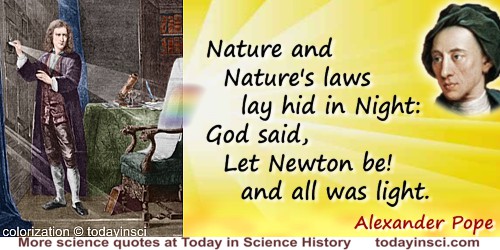
Isaacus Newtonus:
Quem Immortalem
Testantur Tempus, Natura, Coelum:
Mortalem
Hoc Marmor fatetur.
Nature and Nature's laws lay hid in Night:
God said, Let Newton be! and all was light.
Quem Immortalem
Testantur Tempus, Natura, Coelum:
Mortalem
Hoc Marmor fatetur.
Nature and Nature's laws lay hid in Night:
God said, Let Newton be! and all was light.
Epitaph, XII, Intended for Sir Isaac Newton, in Westminster-Abbey. The Works of Alexander Pope, Esq (1797), Vol. 2., 403.
From one sublime genius—NEWTON—more light has proceeded than the labour of a thousand years preceding had been able to produce.
Familiar Letters on Chemistry in Its Relations to Physiology, Dietetics, Agriculture, Commerce and Political Economy (3rd ed., 1851), 3.
During the century after Newton, it was still possible for a man of unusual attainments to master all fields of scientific knowledge. But by 1800, this had become entirely impracticable.
The Intelligent Man's Guide to Science (1960), 19.
You must not talk about “ain’t and can’t” when you speak of this great wonderful world round you, of which the wisest man knows only the very smallest corner, and is, as the great Sir Isaac Newton said, only a child picking up pebbles on the shore of a boundless ocean.
In The Water-babies (1886), 80.
Attention makes the genius; all learning, fancy, and science depend on it. Newton traced back his discoveries to its unwearied employment. It builds bridges, opens new worlds, and heals diseases; without it Taste is useless, and the beauties of literature are unobserved; as the rarest flowers bloom in vain, if the eye be not fixed upon the bed.
Pleasures, Objects, and Advantages of Literature (1855), 37.
Newton found that a star, examined through a glass tarnished by smoke, was diminished into a speck of light. But no smoke ever breathed so thick a mist as envy or detraction.
Pleasures, Objects, and Advantages of Literature (1855), 67.
The history of men of science has one peculiar advantage, as it shows the importance of little things in producing great results. Smeaton learned his principle of constructing a lighthouse, by noticing the trunk of a tree to be diminished from a curve to a cyclinder ... and Newton, turning an old box into a water-clock, or the yard of a house into a sundial, are examples of those habits of patient observation which scientific biography attractively recommends.
Pleasures, Objects, and Advantages of Literature (1855), 129.
...learning chiefly in mathematical sciences can so swallow up and fix one's thought, as to possess it entirely for some time; but when that amusement is over, nature will return, and be where it was, being rather diverted than overcome by such speculations.
An Exposition of the Thirty-nine Articles of the Church of England (1850), 154
It is a vulgar belief that our astronomical knowledge dates only from the recent century when it was rescued from the monks who imprisoned Galileo; but Hipparchus…who among other achievements discovered the precession of the eqinoxes, ranks with the Newtons and the Keplers; and Copernicus, the modern father of our celestial science, avows himself, in his famous work, as only the champion of Pythagoras, whose system he enforces and illustrates. Even the most modish schemes of the day on the origin of things, which captivate as much by their novelty as their truth, may find their precursors in ancient sages, and after a careful analysis of the blended elements of imagination and induction which charaterise the new theories, they will be found mainly to rest on the atom of Epicurus and the monad of Thales. Scientific, like spiritual truth, has ever from the beginning been descending from heaven to man.
Lothair (1879), preface, xvii.
I believe in logic, the sequence of cause and effect, and in science its only begotten son our law, which was conceived by the ancient Greeks, thrived under Isaac Newton, suffered under Albert Einstein…
That fragment of a 'creed for materialism' which a friend in college had once shown him rose through Donald's confused mind.
That fragment of a 'creed for materialism' which a friend in college had once shown him rose through Donald's confused mind.
Stand on Zanzibar (1969)
As three laws were good enough for Newton, I have modestly decided to stop there.
Commenting on Clarke's own three laws.
Commenting on Clarke's own three laws.
Profiles of the Future: An Enquiry into the Limits of the Possible (1962, rev. 1973), footnote, 21.
Newton's health, and confusion to mathematics.
28 Dec 1817, in Tom Taylor (ed.), The Autobiography and Memoirs of Benjamin Robert Haydon (1786-1846), intro. Aldous Huxley (1926), Vol. 1, 269.
I'm not smart. I try to observe. Millions saw the apple fall but Newton was the one who asked 'why.'
Quoted in New York Post (24 Jun 1965). In Alfred J. Kolatch, Great Jewish Quotations (1996), 38-39.
What a deep faith in the rationality of the structure of the world and what a longing to understand even a small glimpse of the reason revealed in the world there must have been in Kepler and Newton to enable them to unravel the mechanism of the heavens in long years of lonely work!
'Religion and Science', The New York Times (9 Nov 1930), Sunday Magazine, 1.
While Newton seemed to draw off the veil from some of the mysteries of nature, he showed at the same time the imperfections of the mechanical philosophy; and thereby restored her ultimate secrets to that obscurity, in which they ever did and ever will remain.
The History Of Great Britain, Containing the Commonwealth and the Reigns of Charles II. and James II. (2nd ed. 1759), Vol. 2, 450.
A million million spermatozoa,
All of them alive:
Out of their cataclysm but one poor Noah
Dare hope to survive.
And among that billion minus one
Might have chanced to be Shakespeare, another Newton, a new Donne—
But the One was Me.
All of them alive:
Out of their cataclysm but one poor Noah
Dare hope to survive.
And among that billion minus one
Might have chanced to be Shakespeare, another Newton, a new Donne—
But the One was Me.
'Fifth Philosopher's Song', Leda (1920),33.
The strangest thing of all is that our ulama these days have divided science into two parts. One they call Muslim science, and one European science. Because of this they forbid others to teach some of the useful sciences. They have not understood that science is that noble thing that has no connection with any nation, and is not distinguished by anything but itself. Rather, everything that is known is known by science, and every nation that becomes renowned becomes renowned through science. Men must be related to science, not science to men. How very strange it is that the Muslims study those sciences that are ascribed to Aristotle with the greatest delight, as if Aristotle were one of the pillars of the Muslims. However, if the discussion relates to Galileo, Newton, and Kepler, they consider them infidels. The father and mother of science is proof, and proof is neither Aristotle nor Galileo. The truth is where there is proof, and those who forbid science and knowledge in the belief that they are safeguarding the Islamic religion are really the enemies of that religion. Lecture on Teaching and Learning (1882).
In Nikki R. Keddie, An Islamic Response to Imperialism (1983), 107.
Newton was not the first of the age of reason. He was the last of the magicians, the last of the Babylonians and Sumerians, the last great mind which looked out on the visible and intellectual world with the same eyes as those who began to build our intellectual inheritance rather less than 10,000 years ago. Isaac Newton, a posthumous child born with no father on Christmas Day, 1642, was the last wonder child to whom the Magi could do sincere and appropriate homage.
In 'Newton, the Man' (1946). In Geoffrey Keynes (ed.), Essays in Biography, 2nd edition (1951), 311.
The stone that Dr. Johnson once kicked to demonstrate the reality of matter has become dissipated in a diffuse distribution of mathematical probabilities. The ladder that Descartes, Galileo, Newton, and Leibniz erected in order to scale the heavens rests upon a continually shifting, unstable foundation.
Mathematics in Western Culture (1953), 382.
It is possible that the deepest meaning and aim of Newtonianism, or rather, of the whole scientific revolution of the seventeenth century, of which Newton is the heir and the highest expression, is just to abolish the world of the 'more or less', the world of qualities and sense perception, the world of appreciation of our daily life, and to replace it by the (Archimedean) universe of precision, of exact measures, of strict determination ... This revolution [is] one of the deepest, if not the deepest, mutations and transformations accomplished—or suffered—by the human mind since the invention of the cosmos by the Greeks, two thousand years before.
'The Significance of the Newtonian Synthesis' (1950). In Newtonian Studies (1965), 4-5.
Scientific development depends in part on a process of non-incremental or revolutionary change. Some revolutions are large, like those associated with the names of Copernicus, Newton, or Darwin, but most are much smaller, like the discovery of oxygen or the planet Uranus. The usual prelude to changes of this sort is, I believed, the awareness of anomaly, of an occurrence or set of occurrences that does not fit existing ways of ordering phenomena. The changes that result therefore require 'putting on a different kind of thinking-cap', one that renders the anomalous lawlike but that, in the process, also transforms the order exhibited by some other phenomena, previously unproblematic.
The Essential Tension (1977), xvii.
Break the chains of your prejudices and take up the torch of experience, and you will honour nature in the way she deserves, instead of drawing derogatory conclusions from the ignorance in which she has left you. Simply open your eyes and ignore what you cannot understand, and you will see that a labourer whose mind and knowledge extend no further than the edges of his furrow is no different essentially from the greatest genius, as would have been proved by dissecting the brains of Descartes and Newton; you will be convinced that the imbecile or the idiot are animals in human form, in the same way as the clever ape is a little man in another form; and that, since everything depends absolutely on differences in organisation, a well-constructed animal who has learnt astronomy can predict an eclipse, as he can predict recovery or death when his genius and good eyesight have benefited from some time at the school of Hippocrates and at patients' bedsides.
Machine Man (1747), in Ann Thomson (ed.), Machine Man and Other Writings (1996), 38.
Fractal is a word invented by Mandelbrot to bring together under one heading a large class of objects that have [played] … an historical role … in the development of pure mathematics. A great revolution of ideas separates the classical mathematics of the 19th century from the modern mathematics of the 20th. Classical mathematics had its roots in the regular geometric structures of Euclid and the continuously evolving dynamics of Newton. Modern mathematics began with Cantor’s set theory and Peano’s space-filling curve. Historically, the revolution was forced by the discovery of mathematical structures that did not fit the patterns of Euclid and Newton. These new structures were regarded … as “pathological,” .… as a “gallery of monsters,” akin to the cubist paintings and atonal music that were upsetting established standards of taste in the arts at about the same time. The mathematicians who created the monsters regarded them as important in showing that the world of pure mathematics contains a richness of possibilities going far beyond the simple structures that they saw in Nature. Twentieth-century mathematics flowered in the belief that it had transcended completely the limitations imposed by its natural origins.
Now, as Mandelbrot points out, … Nature has played a joke on the mathematicians. The 19th-century mathematicians may not have been lacking in imagination, but Nature was not. The same pathological structures that the mathematicians invented to break loose from 19th-century naturalism turn out to be inherent in familiar objects all around us.
Now, as Mandelbrot points out, … Nature has played a joke on the mathematicians. The 19th-century mathematicians may not have been lacking in imagination, but Nature was not. The same pathological structures that the mathematicians invented to break loose from 19th-century naturalism turn out to be inherent in familiar objects all around us.
From 'Characterizing Irregularity', Science (12 May 1978), 200, No. 4342, 677-678. Quoted in Benoit Mandelbrot, The Fractal Geometry of Nature (1977, 1983), 3-4.
[P]olitical and social and scientific values … should be correlated in some relation of movement that could be expressed in mathematics, nor did one care in the least that all the world said it could not be done, or that one knew not enough mathematics even to figure a formula beyond the schoolboy s=(1/2)gt2. If Kepler and Newton could take liberties with the sun and moon, an obscure person ... could take liberties with Congress, and venture to multiply its attraction into the square of its time. He had only to find a value, even infinitesimal, for its attraction.
The Education of Henry Adams: An Autobiography? (1918), 376.
Laplace would have found it child's-play to fix a ratio of progression in mathematical science between Descartes, Leibnitz, Newton and himself
The Education of Henry Adams: An Autobiography? (1918), 491.
[Newton wrote to Halley … that he would not give Hooke any credit] That, alas, is vanity. You find it in so many scientists. You know, it has always hurt me to think that Galileo did not acknowledge the work of Kepler.
In I. Bernard Cohen, 'An Interview with Einstein', in Anthony Philip French (ed.), Einstein: A Centenary Volume (1979), 41. Cited in Timothy Ferris, Coming of Age in the Milky Way (2003), 94-95.
What Galileo and Newton were to the seventeenth century, Darwin was to the nineteenth.
A History of Western Philosophy (1945), 725.
I esteem his understanding and subtlety highly, but I consider that they have been put to ill use in the greater part of his work, where the author studies things of little use or when he builds on the improbable principle of attraction.
Writing about Newton's Principia. Huygens had some time earlier indicated he did not believe the theory of universal gravitation, saying it 'appears to me absurd.'
Writing about Newton's Principia. Huygens had some time earlier indicated he did not believe the theory of universal gravitation, saying it 'appears to me absurd.'
Quoted in Archana Srinivasan, Great Inventors (2007), 37.
… for it is very probable, that the motion of gravity worketh weakly, both far from the earth, and also within the earth: the former because the appetite of union of dense bodies with the earth, in respect of the distance, is more dull: the latter, because the body hath in part attained its nature when it is some depth in the earth.
[Foreshadowing Newton's Universal Law of Gravitation (1687)]
[Foreshadowing Newton's Universal Law of Gravitation (1687)]
Sylva Sylvarum; or a Natural History in Ten Centuries (1627), Century 1, Experiment 33. Collected in The Works of Francis Bacon (1826), Vol 1, 255.
According to their [Newton and his followers] doctrine, God Almighty wants to wind up his watch from time to time: otherwise it would cease to move. He had not, it seems, sufficient foresight to make it a perpetual motion. Nay, the machine of God's making, so imperfect, according to these gentlemen; that he is obliged to clean it now and then by an extraordinary concourse, and even to mend it, as clockmaker mends his work.
'Mr. Leibniz's First Paper' (1715). In H. G. Alexander (ed.), The Leibniz-Clarke Correspondence (1956), 11-2.
Anthropology found its Galileo in Rivers, its Newton in Mauss.
Referring to anthropologists W.H.R. Rivers and Marcel Mauss for revolutionizing theories of anthropology. In Structural Anthropology (1958), 159.
It is strongly suspected that a NEWTON or SHAKESPEARE excels other mortals only by a more ample development of the anterior cerebral lobes, by having an extra inch of brain in the right place.
Lectures on Physiology, Zoology, and the Natural History of Man (1819), 110.
I have no patience with attempts to identify science with measurement, which is but one of its tools, or with any definition of the scientist which would exclude a Darwin, a Pasteur or a Kekulé. The scientist is a practical man and his are practical aims. He does not seek the ultimate but the proximate. He does not speak of the last analysis but rather of the next approximation. His are not those beautiful structures so delicately designed that a single flaw may cause the collapse of the whole. The scientist builds slowly and with a gross but solid kind of masonry. If dissatisfied with any of his work, even if it be near the very foundations, he can replace that part without damage to the remainder. On the whole, he is satisfied with his work, for while science may never be wholly right it certainly is never wholly wrong; and it seems to be improving from decade to decade.
The Anatomy of Science (1926), 6-7.
The Commonwealth of Learning is not at this time without Master-Builders, whose mighty Designs, in advancing the Sciences, will leave lasting Monuments to the Admiration of Posterity; But every one must not hope to be a Boyle, or a Sydenham; and in an Age that produces such Masters, as the Great-Huygenius, and the incomparable Mr. Newton, with some other of that Strain; 'tis Ambition enough to be employed as an Under-Labourer in clearing Ground a little, and removing some of the Rubbish, that lies in the way to Knowledge.
An Essay Concerning Human Understanding (1690). Edited by Peter Nidditch (1975), The Epistle to the Reader, 9-10.
NEWTONIAN, adj. Pertaining to a philosophy of the universe, invented by Newton, who discovered that an apple will fall to the ground, but was unable to say why. His successors and disciples have advanced so far as to be able to say when.
The Collected Works of Ambrose Bierce (1911), Vol. 7, The Devil's Dictionary, 228.
Always preoccupied with his profound researches, the great Newton showed in the ordinary-affairs of life an absence of mind which has become proverbial. It is related that one day, wishing to find the number of seconds necessary for the boiling of an egg, he perceived, after waiting a minute, that he held the egg in his hand, and had placed his seconds watch (an instrument of great value on account of its mathematical precision) to boil!
This absence of mind reminds one of the mathematician Ampere, who one day, as he was going to his course of lectures, noticed a little pebble on the road; he picked it up, and examined with admiration the mottled veins. All at once the lecture which he ought to be attending to returned to his mind; he drew out his watch; perceiving that the hour approached, he hastily doubled his pace, carefully placed the pebble in his pocket, and threw his watch over the parapet of the Pont des Arts.
This absence of mind reminds one of the mathematician Ampere, who one day, as he was going to his course of lectures, noticed a little pebble on the road; he picked it up, and examined with admiration the mottled veins. All at once the lecture which he ought to be attending to returned to his mind; he drew out his watch; perceiving that the hour approached, he hastily doubled his pace, carefully placed the pebble in his pocket, and threw his watch over the parapet of the Pont des Arts.
Popular Astronomy: a General Description of the Heavens (1884), translated by J. Ellard Gore, (1907), 93.
Throughout his life Newton must have devoted at least as much attention to chemistry and theology as to mathematics.
In History of Mathematics (3rd Ed., 1901), 335.
Newton took no exercise, indulged in no amusements, and worked incessantly, often spending eighteen or nineteen hours out of the twenty-four in writing.
In History of Mathematics (3rd Ed., 1901), 358.
For other great mathematicians or philosophers, he [Gauss] used the epithets magnus, or clarus, or clarissimus; for Newton alone he kept the prefix summus.
In History of Mathematics (3rd Ed., 1901), 362.
Foreshadowings of the principles and even of the language of [the infinitesimal] calculus can be found in the writings of Napier, Kepler, Cavalieri, Pascal, Fermat, Wallis, and Barrow. It was Newton's good luck to come at a time when everything was ripe for the discovery, and his ability enabled him to construct almost at once a complete calculus.
In History of Mathematics (3rd Ed., 1901), 366.
The analytical geometry of Descartes and the calculus of Newton and Leibniz have expanded into the marvelous mathematical method—more daring than anything that the history of philosophy records—of Lobachevsky and Riemann, Gauss and Sylvester. Indeed, mathematics, the indispensable tool of the sciences, defying the senses to follow its splendid flights, is demonstrating today, as it never has been demonstrated before, the supremacy of the pure reason.
In 'What Knowledge is of Most Worth?', Presidential address to the National Education Association, Denver, Colorado (9 Jul 1895). In Educational Review (Sep 1895), 10, 109.
We hold these truths to be self-evident.
Franklin's edit to the assertion of religion in Thomas Jefferson's original wording, “We hold these truths to be sacred and undeniable” in a draft of the Declaration of Independence changes it instead into an assertion of rationality. The scientific mind of Franklin drew on the scientific determinism of Isaac Newton and the analytic empiricism of David Hume and Gottfried Leibniz. In what became known as “Hume's Fork” the latters' theory distinguished between synthetic truths that describe matters of fact, and analytic truths that are self-evident by virtue of reason and definition.
Franklin's edit to the assertion of religion in Thomas Jefferson's original wording, “We hold these truths to be sacred and undeniable” in a draft of the Declaration of Independence changes it instead into an assertion of rationality. The scientific mind of Franklin drew on the scientific determinism of Isaac Newton and the analytic empiricism of David Hume and Gottfried Leibniz. In what became known as “Hume's Fork” the latters' theory distinguished between synthetic truths that describe matters of fact, and analytic truths that are self-evident by virtue of reason and definition.
As explained by Walter Isaacson in Benjamin Franklin: An American Life (2004), 312.
I cannot anyhow be contented to view this wonderful universe, and especially the nature of man, and to conclude that everything is the result of brute force. I am inclined to look at everything as resulting from designed laws, with the details, whether good or bad, left to the working out of what we call chance. Not that this notion at all satisfies me. I feel most deeply that the whole subject is too profound for the human intellect. A dog might as well speculate on the mind of Newton. Let each man hope and believe what he can.
Letter to Asa Gray (22 May 1860). In Charles Darwin and Francis Darwin (ed.), Charles Darwin: His Life Told in an Autobiographical Chapter, and in a Selected Series of His Published Letters (1892), 236.
Descartes constructed as noble a road of science, from the point at which he found geometry to that to which he carried it, as Newton himself did after him. ... He carried this spirit of geometry and invention into optics, which under him became a completely new art.
A Philosophical Dictionary: from the French? (2nd Ed.,1824), Vol. 5, 110.
It is not therefore the business of philosophy, in our present situation in the universe, to attempt to take in at once, in one view, the whole scheme of nature; but to extend, with great care and circumspection, our knowledge, by just steps, from sensible things, as far as our observations or reasonings from them will carry us, in our enquiries concerning either the greater motions and operations of nature, or her more subtile and hidden works. In this way Sir Isaac Newton proceeded in his discoveries.
An Account of Sir Isaac Newton's Philosophical Discoveries, in Four Books (1748), 19.
Very few of us can now place ourselves in the mental condition in which even such philosophers as the great Descartes were involved in the days before Newton had announced the true laws of the motion of bodies.
'Introductory Lecture on Experimental Physics', 1871. In W. D. Niven (ed.), The Scientific Papers of James Clerk Maxwell (1890), Vol. 2, 241.
The generalized theory of relativity has furnished still more remarkable results. This considers not only uniform but also accelerated motion. In particular, it is based on the impossibility of distinguishing an acceleration from the gravitation or other force which produces it. Three consequences of the theory may be mentioned of which two have been confirmed while the third is still on trial: (1) It gives a correct explanation of the residual motion of forty-three seconds of arc per century of the perihelion of Mercury. (2) It predicts the deviation which a ray of light from a star should experience on passing near a large gravitating body, the sun, namely, 1".7. On Newton's corpuscular theory this should be only half as great. As a result of the measurements of the photographs of the eclipse of 1921 the number found was much nearer to the prediction of Einstein, and was inversely proportional to the distance from the center of the sun, in further confirmation of the theory. (3) The theory predicts a displacement of the solar spectral lines, and it seems that this prediction is also verified.
Studies in Optics (1927), 160-1.
In the year 1666 he retired again from Cambridge... to his mother in Lincolnshire & whilst he was musing in a garden it came into his thought that the power of gravity (wch brought an apple from the tree to the ground) was not limited to a certain distance from the earth but that this power must extend much farther than was usually thought. Why not as high as the moon said he to himself & if so that must influence her motion & perhaps retain her in her orbit, whereupon he fell a calculating what would be the effect of that supposition but being absent from books & taking the common estimate in use among Geographers & our seamen before Norwood had measured the earth, that 60 English miles were contained in one degree of latitude on the surface of the Earth his computation did not agree with his theory & inclined him then to entertain a notion that together with the force of gravity there might be a mixture of that force wch the moon would have if it was carried along in a vortex.
[The earliest account of Newton, gravity and an apple.]
[The earliest account of Newton, gravity and an apple.]
Memorandum of a conversation with Newton in August 1726. Quoted in Richard Westfall, Never at Rest: A Biography of Isaac Newton (1980), 154.
In 1684 Dr Halley came to visit him at Cambridge, after they had been some time together, the Dr asked him what he thought the Curve would be that would be described by the Planets supposing the force of attraction towards the Sun to be reciprocal to the square of their distance from it. Sr Isaac replied immediately that it would be an Ellipsis, the Doctor struck with joy & amazement asked him how he knew it, why saith he I have calculated it, whereupon Dr Halley asked him for his calculation without any farther delay. Sr Isaac looked among his papers but could not find it, but he promised him to renew it, & then to send it him.
[Recollecting Newton's account of the meeting after which Halley prompted Newton to write The Principia. When asking Newton this question, Halley was aware, without revealing it to Newton that Robert Hooke had made this hypothesis of plantary motion a decade earlier.]
[Recollecting Newton's account of the meeting after which Halley prompted Newton to write The Principia. When asking Newton this question, Halley was aware, without revealing it to Newton that Robert Hooke had made this hypothesis of plantary motion a decade earlier.]
Quoted in Richard Westfall, Never at Rest: A Biography of Isaac Newton (1980), 403.
And from my pillow, looking forth by light
Of moon or favouring stars, I could behold
The antechapel where the statue stood
Of Newton with his prism and silent face,
The marble index of a mind for ever
Voyaging through strange seas of Thought, alone.
Of moon or favouring stars, I could behold
The antechapel where the statue stood
Of Newton with his prism and silent face,
The marble index of a mind for ever
Voyaging through strange seas of Thought, alone.
'Residence at Cambridge', The Prelude, or, Growth of a Poet's Mind: An Autobiographical Poem (1850), Book 3, 57-58.
Thus died Negro Tom [Thomas Fuller], this untaught arithmetician, this untutored scholar. Had his opportunities of improvement been equal to those of thousands of his fellow-men, neither the Royal Society of London, the Academy of Science at Paris, nor even a Newton himself need have been ashamed to acknowledge him a brother in science.
[Thomas Fuller (1710-1790), although enslaved from Africa at age 14, was an arithmetical prodigy. He was known as the Virginia Calculator because of his exceptional ability with arithmetic calculations. His intellectual accomplishments were related by Dr. Benjamin Rush in a letter read to the Pennsylvania Society for the Abolition of Slavery.]
[Thomas Fuller (1710-1790), although enslaved from Africa at age 14, was an arithmetical prodigy. He was known as the Virginia Calculator because of his exceptional ability with arithmetic calculations. His intellectual accomplishments were related by Dr. Benjamin Rush in a letter read to the Pennsylvania Society for the Abolition of Slavery.]
— Obituary
From obituary in the Boston Columbian Centinal (29 Dec 1790), 14, No. 31. In George Washington Williams, History of the Negro Race in America from 1619 to 1880 (1882), Vol. 1, 400
As he sat alone in a garden, he [Isaac Newton in 1666, age 24] fell into a speculation on the power of gravity; that as this power is not found sensibly diminished at the remotest distance from the centre of the earth to which we can rise, neither at the tops of the loftiest buildings, nor even on the summits of the highest mountains, it appeared to him reasonable to conclude that this power must extend much further than was usually thought: why not as high as the moon? said he to himself; and if so, her motion must be influenced by it; perhaps she is retained in her orbit thereby.
View of Newton's Philosophy (1728), preface. In William Whewell, History of the Inductive Sciences (1847), Vol. 2, 166. Pemberton's narrative is based on firsthand conversations with Newton himself.
To use Newton’s words, our efforts up till this moment have but turned over a pebble or shell here and there on the beach, with only a forlorn hope that under one of them was the gem we were seeking. Now we have the sieve, the minds, the hands, the time, and, particularly, the dedication to find those gems—no matter in which favorite hiding place the children of distant worlds have placed them.
[Co-author with Dava Sobel.]
[Co-author with Dava Sobel.]
In Frank Drake and Dava Sobel, Is Anyone Out There? (1993), 236.
No one can read the history of astronomy without perceiving that Copernicus, Newton, Laplace, are not new men, or a new kind of men, but that Thales, Anaximenes, Hipparchus, Empodocles, Aristorchus, Pythagorus, Oenipodes, had anticipated them.
In The Conduct of Life (1904), 18.
That small word “Force,” they make a barber's block,
Ready to put on
Meanings most strange and various, fit to shock
Pupils of Newton....
The phrases of last century in this
Linger to play tricks—
Vis viva and Vis Mortua and Vis Acceleratrix:—
Those long-nebbed words that to our text books still
Cling by their titles,
And from them creep, as entozoa will,
Into our vitals.
But see! Tait writes in lucid symbols clear
One small equation;
And Force becomes of Energy a mere
Space-variation.
Ready to put on
Meanings most strange and various, fit to shock
Pupils of Newton....
The phrases of last century in this
Linger to play tricks—
Vis viva and Vis Mortua and Vis Acceleratrix:—
Those long-nebbed words that to our text books still
Cling by their titles,
And from them creep, as entozoa will,
Into our vitals.
But see! Tait writes in lucid symbols clear
One small equation;
And Force becomes of Energy a mere
Space-variation.
'Report on Tait's Lecture on Force:— B.A., 1876', reproduced in Bruce Clarke, Energy Forms: Allegory and Science in the Era of Classical Thermodynamics (2001), 19. Maxwell's verse was inspired by a paper delivered at the British Association (B.A.. He was satirizing a “considerable cofusion of nomenclature” at the time, and supported his friend Tait's desire to establish a redefinition of energy on a thermnodynamic basis.
Force, then, is Force, but mark you! Not a thing,
Only a Vector;
Thy barbèd arrows now have lost their sting,
Impotent spectre!
Thy reign, O force! is over. Now no more
Heed we thine action;
Repulsion leaves us where we were before,
So does attraction.
Both Action and Reaction now are gone.
Just ere they vanished,
Stress joined their hands in peace, and made them one;
Then they were banished....
Only a Vector;
Thy barbèd arrows now have lost their sting,
Impotent spectre!
Thy reign, O force! is over. Now no more
Heed we thine action;
Repulsion leaves us where we were before,
So does attraction.
Both Action and Reaction now are gone.
Just ere they vanished,
Stress joined their hands in peace, and made them one;
Then they were banished....
Reproduced in Bruce Clarke, Energy Forms: Allegory and Science in the Era of Classical Thermodynamics (2001), 20-21. In his parody of Shelley's Prometheus Unbound, Maxwell presents Newton's laws of motion updated into axioms of energy.
Know then thyself, presume not God to scan;
The proper study of Mankind is Man.
Plac'd on this isthmus of a middle state,
A being darkly wise, and rudely great:
With too much knowledge for the Sceptic side,
With too much weakness for the Stoic's pride,
He hangs between; in doubt to act, or rest;
In doubt to deem himself a God, or Beast;
In doubt his Mind or Body to prefer,
Born but to die, and reas'ning but to err;
Alike in ignorance, his reason such,
Whether he thinks too little, or too much:
Chaos of Thought and Passion, all confus'd;
Still by himself abus'd, or disabus'd;
Created half to rise, and half to fall;
Great lord of all things, yet a prey to all;
Sole judge of Truth, in endless Error hurl'd:
The glory, jest, and riddle of the world!
... Superior beings, when of late they saw
A mortal Man unfold all Nature's law,
Admir'd such wisdom in an earthly shape,
And shew'd a NEWTON as we shew an Ape.
The proper study of Mankind is Man.
Plac'd on this isthmus of a middle state,
A being darkly wise, and rudely great:
With too much knowledge for the Sceptic side,
With too much weakness for the Stoic's pride,
He hangs between; in doubt to act, or rest;
In doubt to deem himself a God, or Beast;
In doubt his Mind or Body to prefer,
Born but to die, and reas'ning but to err;
Alike in ignorance, his reason such,
Whether he thinks too little, or too much:
Chaos of Thought and Passion, all confus'd;
Still by himself abus'd, or disabus'd;
Created half to rise, and half to fall;
Great lord of all things, yet a prey to all;
Sole judge of Truth, in endless Error hurl'd:
The glory, jest, and riddle of the world!
... Superior beings, when of late they saw
A mortal Man unfold all Nature's law,
Admir'd such wisdom in an earthly shape,
And shew'd a NEWTON as we shew an Ape.
'An Essay on Man' (1733-4), Epistle II. In John Butt (ed.), The Poems of Alexander Pope (1965), 516-7.
Mainstream biology may be suffering from what I call 'Physics envy' in aiming to reduce life to nothing but well known, typically Newtonian principles of physics and chemistry.
'From the Editor's Desk', Frontier Perspectives (1991), 2, 3.
It is good to recall that three centuries ago, around the year 1660, two of the greatest monuments of modern history were erected, one in the West and one in the East; St. Paul’s Cathedral in London and the Taj Mahal in Agra. Between them, the two symbolize, perhaps better than words can describe, the comparative level of architectural technology, the comparative level of craftsmanship and the comparative level of affluence and sophistication the two cultures had attained at that epoch of history. But about the same time there was also created—and this time only in the West—a third monument, a monument still greater in its eventual import for humanity. This was Newton’s Principia, published in 1687. Newton's work had no counterpart in the India of the Mughuls.
'Ideals and Realities' (1975). Reprinted in Ideals and Realities (1984), 48.
The pre-Darwinian age had come to be regarded as a Dark Age in which men still believed that the book of Genesis was a standard scientific treatise, and that the only additions to it were Galileo’s demonstration of Leonardo da Vinci’s simple remark that the earth is a moon of the sun, Newton’s theory of gravitation, Sir Humphry Davy's invention of the safety-lamp, the discovery of electricity, the application of steam to industrial purposes, and the penny post.
Back to Methuselah: a Metabiological Pentateuch (1921), viii.
For FRICTION is inevitable because the Universe is FULL of God's works.
For the PERPETUAL MOTION is in all works of Almighty GOD.
For it is not so in the engines of man, which are made of dead materials, neither indeed can be.
For the Moment of bodies, as it is used, is a false term—bless God ye Speakers on the Fifth of November.
For Time and Weight are by their several estimates.
For I bless GOD in the discovery of the LONGITUDE direct by the means of GLADWICK.
For the motion of the PENDULUM is the longest in that it parries resistance.
For the WEDDING GARMENTS of all men are prepared in the SUN against the day of acceptation.
For the wedding Garments of all women are prepared in the MOON against the day of their purification.
For CHASTITY is the key of knowledge as in Esdras, Sir Isaac Newton & now, God be praised, in me.
For Newton nevertheless is more of error than of the truth, but I am of the WORD of GOD.
For the PERPETUAL MOTION is in all works of Almighty GOD.
For it is not so in the engines of man, which are made of dead materials, neither indeed can be.
For the Moment of bodies, as it is used, is a false term—bless God ye Speakers on the Fifth of November.
For Time and Weight are by their several estimates.
For I bless GOD in the discovery of the LONGITUDE direct by the means of GLADWICK.
For the motion of the PENDULUM is the longest in that it parries resistance.
For the WEDDING GARMENTS of all men are prepared in the SUN against the day of acceptation.
For the wedding Garments of all women are prepared in the MOON against the day of their purification.
For CHASTITY is the key of knowledge as in Esdras, Sir Isaac Newton & now, God be praised, in me.
For Newton nevertheless is more of error than of the truth, but I am of the WORD of GOD.
From 'Jubilate Agno' (c.1758-1763), in N. Callan (ed.), The Collected Poems of Christopher Smart (1949), Vol. 1, 276.
Isaac Newton was born at Woolsthorpe, near Grantham, in Lincolnshire, on Christmas Day, 1642: a weakly and diminutive infant, of whom it is related that, at his birth, he might have found room in a quart mug. He died on March the 20th, 1727, after more than eighty-four years of more than average bodily health and vigour; it is a proper pendant to the story of the quart mug to state that he never lost more than one of his second teeth.
In Essays on the life and work of Newton (), 4.
Facts and theories are different things, not rungs in a hierarchy of increasing certainty. Facts are the world's data. Theories are structures of ideas that explain and interpret facts. Facts do not go away while scientists debate rival theories for explaining them. Einstein's theory of gravitation replaced Newton's, but apples did not suspend themselves in mid-air pending the outcome.
'Evolution as Fact and Theory', in Hen's Teeth and Horse's Toes (1983, 1994), Chap. 19.
One day at Fenner's (the university cricket ground at Cambridge), just before the last war, G. H. Hardy and I were talking about Einstein. Hardy had met him several times, and I had recently returned from visiting him. Hardy was saying that in his lifetime there had only been two men in the world, in all the fields of human achievement, science, literature, politics, anything you like, who qualified for the Bradman class. For those not familiar with cricket, or with Hardy's personal idiom, I ought to mention that “the Bradman class” denoted the highest kind of excellence: it would include Shakespeare, Tolstoi, Newton, Archimedes, and maybe a dozen others. Well, said Hardy, there had only been two additions in his lifetime. One was Lenin and the other Einstein.
Variety of Men (1966), 87. First published in Commentary magazine.
It did not last: the Devil howling “Ho, Let Einstein be,” restored the status quo.
Adding to earlier Epitaph by Alexander Pope for Isaac Newton, 'In Continuation of Pope on Newton', in J.C. Squire, Poems in One Volume (1926), 218.
Bernard: Oh, you’re going to zap me with penicillin and pesticides. Spare me that and I’ll spare you the bomb and aerosols. But don’t confuse progress with perfectibility. A great poet is always timely. A great philosopher is an urgent need. There’s no rush for Isaac Newton. We were quite happy with Aristotle’s cosmos. Personally, I preferred it. Fifty-five crystal spheres geared to God’s crankshaft is my idea of a satisfying universe. I can’t think of anything more trivial than the speed of light. Quarks, quasars—big bangs, black holes—who [cares]? How did you people con us out of all that status? All that money? And why are you so pleased with yourselves?
Chloe: Are you against penicillin, Bernard?
Bernard: Don’t feed the animals.
Chloe: Are you against penicillin, Bernard?
Bernard: Don’t feed the animals.
In the play, Acadia (1993), Act 2, Scene 5, 61.
Newton advanced, with one gigantic stride, from the regions of twilight into the noon day of science. A Boyle and a Hooke, who would otherwise have been deservedly the boast of their century, served but as obscure forerunners of Newton's glories.
A Course of Lectures on Natural Philosophy and the Mechanical Arts (1845), 5.
Three apples changed the world, Adam's apple, Newton's apple, and Steve's apple.
[Tweeted tribute for Steve Jobs, co-founder the Apple computer company.]
[Tweeted tribute for Steve Jobs, co-founder the Apple computer company.]
In Fouad Ajami, 'The Arab World's Unknown Son', Wall Street Journal (12 Oct 2011).
There is a reward structure in science that is very interesting: Our highest honors go to those who disprove the findings of the most revered among us. So Einstein is revered not just because he made so many fundamental contributions to science, but because he found an imperfection in the fundamental contribution of Isaac Newton.
In 'Wonder and Skepticism', Skeptical Enquirer (Jan-Feb 1995), 19, No. 1.
I am putting together a secular bible. My Genesis is when the apple falls on Newton's head.
Quoted in interview by Tim Adams, 'This much I know: A.C. Grayling', The Observer (4 Jul 2009).
In the beginning (if there was such a thing), God created Newton’s laws of motion together with the necessary masses and forces. This is all; everything beyond this follows from the development of appropriate mathematical methods by means of deduction.
Autobiographical Notes (1946), 19. In Albert Einstein, Alice Calaprice, Freeman Dyson , The Ultimate Quotable Einstein (2011), 397.
Because a fact seems strange to you, you conclude that it is not one. ... All science, however, commences by being strange. Science is successive. It goes from one wonder to another. It mounts by a ladder. The science of to-day would seem extravagant to the science of a former time. Ptolemy would believe Newton mad.
In Victor Hugo and Lorenzo O'Rourke (trans.) Victor Hugo's Intellectual Autobiography: (Postscriptum de ma vie) (1907), 322.
The reason Dick's [Richard Feynman] physics was so hard for ordinary people to grasp was that he did not use equations. The usual theoretical physics was done since the time of Newton was to begin by writing down some equations and then to work hard calculating solutions of the equations. This was the way Hans [Bethe] and Oppy [Oppenheimer] and Julian Schwinger did physics. Dick just wrote down the solutions out of his head without ever writing down the equations. He had a physical picture of the way things happen, and the picture gave him the solutions directly with a minimum of calculation. It was no wonder that people who had spent their lives solving equations were baffled by him. Their minds were analytical; his was pictorial.
Quoted in Michio Kaku and Jennifer Trainer Thompson, Beyond Einstein: the Cosmic Quest for the Theory of the Universe (1987, 1999), 56-57, citing Freeman Dyson, Disturbing the Universe (1979, 1981), 55-56.
For the birth of something new, there has to be a happening. Newton saw an apple fall; James Watt watched a kettle boil; Roentgen fogged some photographic plates. And these people knew enough to translate ordinary happenings into something new...
Quoted by André Maurois, The Life of Sir Alexander Fleming, trans. by Gerard Hopkins (1959), 167. Cited in Steven Otfinoski, Alexander Fleming: Conquering Disease with Penicillin (1993), 1.
But the strong base and building of my love
Is as the very centre of the earth,
Drawing all things to 't.
Is as the very centre of the earth,
Drawing all things to 't.
Character Cressidus to Pandarus in play Troilus and Cressida (c.1601), Act 4, lines 200-202. In Troilus and Cressida (1811), 92.
As true as steel, as plantage to the moon,
As sun to day, at turtle to her mate,
As iron to adamant, as earth to centre.
As sun to day, at turtle to her mate,
As iron to adamant, as earth to centre.
Character Troilus speaking to Cressida, in play Troilus and Cressida (c.1601), Act 3, lines 352-354. In Troilus and Cressida (1811), 72.
Taking mathematics from the beginning of the world to the time when Newton lived, what he had done was much the better half.
As quoted in Edmund Fillingham King, A Biographical Sketch of Sir Isaac Newton (1858), 97, stating this was Leibniz’s reply “when asked at the royal table in Berlin his opinion of Newton.” No source citation was given, although all the next quotes that followed had footnotes. The lack of citation leaves the accuracy of the quote unverified. If you know a primary source, please contact the Webmaster.
Notwithstanding all that has been discovered since Newton’s time, his saying that we are little children picking up pretty pebbles on the beach while the whole ocean lies before us unexplored remains substantially as true as ever, and will do so though we shovel up the pebbles by steam shovels and carry them off in carloads.
From 'Lessons from the History of Science: The Scientific Attitude' (c.1896), in Collected Papers (1931), Vol. 1, 47.
In reality the origin of the notion of derivatives is in the vague feeling of the mobility of things, and of the greater or less speed with which phenomena take place; this is well expressed by the terms fluent and fluxion, which were used by Newton and which we may believe were borrowed from the
ancient mathematician Heraclitus.
From address to the section of Algebra and Analysis, International Congress of Arts and Sciences, St. Louis (22 Sep 1904), 'On the Development of Mathematical Analysis and its Relation to Certain Other Sciences,' as translated by M.W. Haskell in Bulletin of the American Mathematical Society (May 1905), 11, 407.
There was yet another disadvantage attaching to the whole of Newton’s physical inquiries, ... the want of an appropriate notation for expressing the conditions of a dynamical problem, and the general principles by which its solution must be obtained. By the labours of LaGrange, the motions of a disturbed planet are reduced with all their complication and variety to a purely mathematical question. It then ceases to be a physical problem; the disturbed and disturbing planet are alike vanished: the ideas of time and force are at an end; the very elements of the orbit have disappeared, or only exist as arbitrary characters in a mathematical formula
Address to the Mechanics Institute, 'An Address on the Genius and Discoveries of Sir Isaac Newton' (1835), excerpted in paper by Luis M. Laita, Luis de Ledesma, Eugenio Roanes-Lozano and
Alberto Brunori, 'George Boole, a Forerunner of Symbolic Computation', collected in John A. Campbell and Eugenio Roanes-Lozano (eds.), Artificial Intelligence and Symbolic Computation: International Conference AISC 2000 (2001), 3.
[Newton is the] British physicist linked forever in the schoolboy mind with an apple that fell and bore fruit throughout physics.
As given in Patricia Fara, Newton: The Making of Genius (2004), 192.
Socrates said, our only knowledge was
“To know that nothing could be known;” a pleasant
Science enough, which levels to an ass
Each Man of Wisdom, future, past, or present.
Newton, (that Proverb of the Mind,) alas!
Declared, with all his grand discoveries recent,
That he himself felt only “like a youth
Picking up shells by the great Ocean—Truth.”
“To know that nothing could be known;” a pleasant
Science enough, which levels to an ass
Each Man of Wisdom, future, past, or present.
Newton, (that Proverb of the Mind,) alas!
Declared, with all his grand discoveries recent,
That he himself felt only “like a youth
Picking up shells by the great Ocean—Truth.”
From poem, 'Don Juan,' (1822), canto 7, verse V. In Lord Byron, Don Juan: Cantos VI, VII and VIII (1823), 67.
We think of Euclid as of fine ice; we admire Newton as we admire the peak of Teneriffe. Even the intensest labors, the most remote triumphs of the abstract intellect, seem to carry us into a region different from our own—to be in a terra incognita of pure reasoning, to cast a chill on human glory.
In Estimates of Some Englishmen and Scotchmen (1856), 411-412
Charles Darwin [is my personal favorite Fellow of the Royal Society]. I suppose as a physical scientist I ought to have chosen Newton. He would have won hands down in an IQ test, but if you ask who was the most attractive personality then Darwin is the one you'd wish to meet. Newton was solitary and reclusive, even vain and vindictive in his later years when he was president of the society.
From interview with Graham Lawton, 'One Minute with Martin Rees', in New Scientist (12 Dec 2009), 204, No. 2738.
We pass by imperceptible gradations from the brute to the savage and from the savage to Euler and Newton.
In 'Esquisse', Oeuvres, Vol. 6, 346. As cited by Frank Edward Manuel, Utopian Thought in the Western World (1979, 2009), 492.
By the year 2070 we cannot say, or it would be imbecile to do so, that any man alive could understand Shakespearean experience better than Shakespeare, whereas any decent eighteen-year-old student of physics will know more physics than Newton.
'The Case of Leavis and the Serious Case’, Times Literary Supplement (9 Jul 1970), 737-740. Collected in Public Affairs (1971), 95.
In science its main worth is temporary, as a stepping-stone to something beyond. Even the Principia, as Newton with characteristic modesty entitled his great work, is truly but the beginning of a natural philosophy, and no more an ultimate work, than Watt’s steam-engine, or Arkwright's spinning-machine.
Co-author with his brother Augustus William Hare Guesses At Truth, By Two Brothers: Second Edition: With Large Additions (1848), Second Series, 46. (The volume is introduced as “more than three fourths new.” This quote is identified as by Julius; Augustus had died in 1833.)
It is no way derogatory to Newton, or Kepler, or Galileo, that Science in these days should have advanced far beyond them. Rather is this itself their crown of glory. Their works are still bearing fruit, and will continue to do so. The truths which they discovered are still living in our knowledge, pregnant with infinite consequences.
Co-author with his brother Augustus William Hare Guesses At Truth, By Two Brothers: Second Edition: With Large Additions (1848), Second Series, 251. (The volume is introduced as “more than three fourths new.” This quote is identified as by Julius; Augustus had died in 1833.)
The aether: Invented by Isaac Newton, reinvented by James Clerk Maxwell. This is the stuff that fills up the empty space of the universe. Discredited and discarded by Einstein, the aether is now making a Nixonian comeback. It’s really the vacuum, but burdened by theoretical, ghostly particles.
In Leon Lederman and Dick Teresi, The God Particle: If the Universe is the Answer, What is the
Question (1993, 2006), xiii.
The great Sir Isaac Newton,
He once made a valid proclamation,
That the forces equal to a nominated mass,
when multiplied by acceleration
That was the law of motion.
He once made a valid proclamation,
That the forces equal to a nominated mass,
when multiplied by acceleration
That was the law of motion.
From lyrics of song Sod’s Law.
My view, the skeptical one, holds that we may be as far away from an understanding of elementary particles as Newton's successors were from quantum mechanics. Like them, we have two tremendous tasks ahead of us. One is to study and explore the mathematics of the existing theories. The existing quantum field-theories may or may not be correct, but they certainly conceal mathematical depths which will take the genius of an Euler or a Hamilton to plumb. Our second task is to press on with the exploration of the wide range of physical phenomena of which the existing theories take no account. This means pressing on with experiments in the fashionable area of particle physics. Outstanding among the areas of physics which have been left out of recent theories of elementary particles are gravitation and cosmology
In Scientific American (Sep 1958). As cited in '50, 100 & 150 years ago', Scientific American (Sep 2008), 299, No. 3, 14.
You have … been told that science grows like an organism. You have been told that, if we today see further than our predecessors, it is only because we stand on their shoulders. But this [Nobel Prize Presentation] is an occasion on which I should prefer to remember, not the giants upon whose shoulders we stood, but the friends with whom we stood arm in arm … colleagues in so much of my work.
From Nobel Banquet speech (10 Dec 1960).
The landscape has been so totally changed, the ways of thinking have been so deeply affected, that it is very hard to get hold of what it was like before… It is very hard to realize how total a change in outlook Isaac Newton has produced.
From 'Newton and the Twentieth Century—A Personal View', collected in Raymond Flood, John Fauvel, Michael Shortland and Robin Wilson (eds.), Let Newton Be! A New Perspective on his Life and Works (1988), 241.
The test of science is not whether you are reasonable—there would not be much of physics if that was the case—the test is whether it works. And the great point about Newton’s theory of gravitation was that it worked, that you could actually say something about the motion of the moon without knowing very much about the constitution of the Earth.
From Assumption and Myth in Physical Theory (1967), 10.
If the apple hit Newton’s nose, Newton’s nose hit the apple.
In Orthodoxy (1908), 90.
One day in the year 1666 Newton had gone to the country, and seeing the fall of an apple, [as his niece (Mme Conduit) told me,] let himself be led into a deep meditation on the cause which thus draws every object along a line whose extension would pass almost through the center of the Earth.
From the original French, “Un jour, en l'année 1666, Newton, retiré à la campagne, et voyant tomber des fruits d’un arbre, à ce que m'a conté sa nièce, (Mme Conduit) se laissa aller à une méditation profonde sur la cause qui entraîne ainsi tous les corps dans une ligne qui, si elle était prolongée, passerait à peu près par le centre de la Terre,” in Éléments de Philosophie de Newton, Part 1, Chap. 3, in Oeuvres Completes de Voltaire (1785), Vol. 31, 175. Translation as given in an epigraph, in Charles W. Misner, Kip S. Thorn and John Archibald Wheeler, Gravitation (1970, 1973), 47. An alternate translation is: “One day in the year 1666, Newton went into the country, and seeing fruit fall from a tree (as his niece, Madame Conduit, has informed me), entered into a profound train of thought as to the causes which could lead to such a drawing together or attraction.” As given in Robert Chambers (ed.), The Book of Days: A Miscellany of Popular Antiquities in Connection with the Calendar (1888), Vol. 2, 757. (Note: Voltaire originally published his Éléments in 1738, but Webmaster could not find the above quote in it.)
Da Vinci was as great a mechanic and inventor as were Newton and his friends. Yet a glance at his notebooks shows us that what fascinated him about nature was its variety, its infinite adaptability, the fitness and the individuality of all its parts. By contrast what made astronomy a pleasure to Newton was its unity, its singleness, its model of a nature in which the diversified parts were mere disguises for the same blank atoms.
From The Common Sense of Science (1951), 25.
When Da Vinci wanted an effect, he willed, he planned the means to make it happen: that was the purpose of his machines. But the machines of Newton … are means not for doing but for observing. He saw an effect, and he looked for its cause.
From The Common Sense of Science (1951), 25.
A taxonomy of abilities, like a taxonomy anywhere else in science, is apt to strike a certain type of impatient student as a gratuitous orgy of pedantry. Doubtless, compulsions to intellectual tidiness express themselves prematurely at times, and excessively at others, but a good descriptive taxonomy, as Darwin found in developing his theory, and as Newton found in the work of Kepler, is the mother of laws and theories.
From Intelligence: Its Structure, Growth and Action: Its Structure, Growth and Action (1987), 61.
When we look back beyond one hundred years over the long trails of history, we see immediately why the age we live in differs from all other ages in human annals. … It remained stationary in India and in China for thousands of years. But now it is moving very fast. … A priest from Thebes would probably have felt more at home at the council of Trent, two thousand years after Thebes had vanished, than Sir Isaac Newton at a modern undergraduate physical society, or George Stephenson in the Institute of Electrical Engineers. The changes have have been so sudden and so gigantic, that no period in history can be compared with the last century. The past no longer enables us even dimly to measure the future.
From 'Fifty Years Hence', Strand Magazine (Dec 1931). Reprinted in Popular Mechanics (Mar 1932), 57, No. 3, 393.
Nec fas est proprius mortali attingere divos.
It is not lawful for mortals to approach divinity nearer than this.
It is not lawful for mortals to approach divinity nearer than this.
Last hexameter of the Latin verses, 'In viri praestantissimi isaaci newtoni opus hocce mathematico-physicum saeculi gentisque nostrae decus egregium' by which Edmond Halley expressed his admiration of Isaac Newton’s work. These were prefixed to Newton’s Principia, for which Halley supervised the publication. Translation as given in Peter Gay, The Enlightenment: The Science of Freedom (1996), 131.
Before Kepler, all men were blind, Kepler had one eye, and Newton had two eyes.
From Voltaire’s Notebooks (1952), 63. As translated in Peter Gay, The Enlightenment: The Science of Freedom (1996), 131. From the original French: “Avant Kepler tous les hommes étoent aveugles, Kepler fut borgne, et Newton a eu deux yeux.”
Sir Isaac Newton and Dr. Bentley met accidentally in London, and on Sir Isaac’s inquiring what philosophical pursuits were carrying on at Cambridge, the doctor replied—None—for when you go a hunting Sir Isaac, you kill all the game; you have left us nothing to pursue.—Not so, said the philosopher, you may start a variety of game in every bush if you will but take the trouble to beat for it.
From Richard Watson, Chemical Essays (1786, 1806), Vol. 4, 257-258. No citation given, so—assuming it is more or less authentic—Webmaster offers this outright guess. Watson was the source of another anecdote about Newton (see “I find more sure marks…”). Thus, one might by pure speculation wonder if this quote was passed along in the same way. Was this another anecdote relayed to Watson by his former teacher, Dr. Robert Smith (Master of Trinity House), who might have been told this by Newton himself? Perhaps we’ll never know, but if you know a primary source, please contact Webmaster.
To mean understandings, it is sufficient honour to be numbered amongst the lowest labourers of learning; but different abilities must find different tasks. To hew stone, would have been unworthy of Palladio; and to have rambled in search of shells and flowers, had but ill suited with the capacity of Newton.
From 'Numb. 83, Tuesday, January 1, 1750', The Rambler (1756), Vol. 2, 154. (Italian architect Palladio, 1509-80, is widely considered the most influential in the history of Western architecture.)
No one must think that Newton’s great creation can be overthrown in any real sense by this [Theory of Relativity] or by any other theory. His clear and wide ideas will for ever retain their significance as the foundation on which our modern conceptions of physics have been built.
In 'Time, Space, and Gravitation', The Times (28 Nov 1919). Excerpted in David E. Rowe and Robert J. Schulmann, Einstein on Politics: His Private Thoughts and Public Stands on Nationalism, Zionism, War, Peace, and the Bomb (2007), 104.
Did Newton, dreaming in his orchard there
Beside the dreaming Witham, see the moon
Burn like a huge gold apple in the boughs
And wonder why should moons not fall like fruit?
Beside the dreaming Witham, see the moon
Burn like a huge gold apple in the boughs
And wonder why should moons not fall like fruit?
In Watchers of the Sky (1922), 193-194.
Heroes of physics, Argonauts of our time
Who leaped the mountains, who crossed the seas …
You have confirmed in uncomfortable places
What Newton knew without leaving his study.
Who leaped the mountains, who crossed the seas …
You have confirmed in uncomfortable places
What Newton knew without leaving his study.
Discours en Vers sur l’Homme (1734), Quatrieme discours: de la Moderation (1738). English translation as in J. L. Heilbron, Weighing Imponderables and Other Quantitative Science around 1800 (1993), 224.
The other book you may have heard of and perhaps read, but it is not one perusal which will enable any man to appreciate it. I have read it through five or six times, each time with increasing admiration. It will live as long as the ‘Principia’ of Newton. It shows that nature is, as I before remarked to you, a study that yields to none in grandeur and immensity. The cycles of astronomy or even the periods of geology will alone enable us to appreciate the vast depths of time we have to contemplate in the endeavour to understand the slow growth of life upon the earth. The most intricate effects of the law of gravitation, the mutual disturbances of all the bodies of the solar system, are simplicity itself compared with the intricate relations and complicated struggle which have determined what forms of life shall exist and in what proportions. Mr. Darwin has given the world a new science, and his name should, in my opinion, stand above that of every philosopher of ancient or modem times. The force of admiration can no further go!!!
Letter to George Silk (1 Sep 1860), in My Life (1905), Vol. I, 372-373.
The Newton of drift theory has not yet appeared. His absence need cause no anxiety; the theory is still young and still often treated with suspicion. In the long run, one cannot blame a theoretician for hesitating to spend time and trouble on explaining a law about whose validity no unanimity prevails.
In The Origins of Continents and Oceans (4th ed. 1929), trans. John Biram (1966), 167.
The ponderous instrument of synthesis, so effective in his [Newton’s] hands, has never since been grasped by one who could use it for such purposes; and we gaze at it with admiring curiosity, as on some gigantic implement of war, which stands idle among the memorials of ancient days, and makes us wonder what manner of man he was who could wield as a weapon what we can hardly lift as a burden.
In History of the Inductive Sciences (1857), Vol. 2, 128.
Physical investigation, more than anything besides, helps to teach us the actual value and right use of the Imagination—of that wondrous faculty, which, left to ramble uncontrolled, leads us astray into a wilderness of perplexities and errors, a land of mists and shadows; but which, properly controlled by experience and reflection, becomes the noblest attribute of man; the source of poetic genius, the instrument of discovery in Science, without the aid of which Newton would never have invented fluxions, nor Davy have decomposed the earths and alkalies, nor would Columbus have found another Continent.
Presidential Address to Anniversary meeting of the Royal Society (30 Nov 1859), Proceedings of the Royal Society of London (1860), 10, 165.
This quality of genius is, sometimes, difficult to be distinguished from talent, because high genius includes talent. It is talent, and something more. The usual distinction between genius and talent is, that one represents creative thought, the other practical skill: one invents, the other applies. But the truth is, that high genius applies its own inventions better than talent alone can do. A man who has mastered the higher mathematics, does not, on that account, lose his knowledge of arithmetic. Hannibal, Napoleon, Shakespeare, Newton, Scott, Burke, Arkwright, were
they not men of talent as well as men of genius?
In 'Genius', Wellman’s Miscellany (Dec 1871), 4, No. 6, 203.
We all know we fall. Newton’s discovery was that the moon falls, too—and by the same rule that we do.
Epigraph in Isaac Asimov’s Book of Science and Nature Quotations (1988), 112.
We then got to Westminster Abbey and, moving about unguided, we found the graves of Newton, Rutherford, Darwin, Faraday, and Maxwell in a cluster.
(1980). In Isaac Asimov’s Book of Science and Nature Quotations (1988), 294.
Simple as the law of gravity now appears, and beautifully in accordance with all the observations of past and of present times, consider what it has cost of intellectual study. Copernicus, Galileo, Kepler, Euler, Lagrange, Laplace, all the great names which have exalted the character of man, by carrying out trains of reasoning unparalleled in every other science; these, and a host of others, each of whom might have been the Newton of another field, have all labored to work out, the consequences which resulted from that single law which he discovered. All that the human mind has produced—the brightest in genius, the most persevering in application, has been lavished on the details of the law of gravity.
in The Ninth Bridgewater Treatise: A Fragment (1838), 57.
For some months the astronomer Halley and other friends of Newton had been discussing the problem in the following precise form: what is the path of a body attracted by a force directed toward a fixed point, the force varying in intensity as the inverse of the distance? Newton answered instantly, “An ellipse.” “How do you know?” he was asked. “Why, I have calculated it.” Thus originated the imperishable Principia, which Newton later wrote out for Halley. It contained a complete treatise on motion.
In The Handmaiden of the Sciences (1937), 37.
Well, evolution is a theory. It is also a fact. And facts and theories are different things, not rungs in a hierarchy of increasing certainty. Facts are the world’s data. Theories are structures of ideas that explain and interpret facts. Facts do not go away while scientists debate rival theories for explaining them. Einstein’s theory of gravitation replaced Newton’s, but apples did not suspend themselves in mid-air pending the outcome. And human beings evolved from apelike ancestors whether they did so by Darwin’s proposed mechanism or by some other, yet to be discovered … Evolutionists make no claim for perpetual truth, though creationists often do (and then attack us for a style of argument that they themselves favor).
'Evolution as Fact and Theory', in Hen’s Teeth and Horse’s Toes: Further Reflections in Natural History (1983), 254-255.
Newton was probably responsible for the concept that there are seven primary colours in the spectrum—he had a strong interest in musical harmonies and, since there are seven distinct notes in the musical scale, he divided up the spectrum into spectral bands with widths corresponding to the ratios of the small whole numbers found in the just scale.
In 'Light and Colour', Trevor Lamb and Janine Bourriau, Colour: Art & Science (1995), 72.
It seems as though no laws, not even fairly old ones, can safely be regarded as unassailable. The force of gravity, which we have always ascribed to the “pull of the earth,” was reinterpreted the other day by a scientist who says that when we fall it is not earth pulling us, it is heaven pushing us. This blasts the rock on which we sit. If science can do a rightabout-face on a thing as fundamental as gravity, maybe Newton was a sucker not to have just eaten the apple.
In 'Talk of the Town,', The New Yorker (3 Apr 1937). As cited in Martha White (ed.), In the Words of E.B. White (2011), 175.
Newton’s and Darwin’s world were different from the worlds of most men, and yet their worlds were not the world, but more and better than mine, as they had followed out further and better the teachings of the sense.
In Sir William Withey Gull and Theodore Dyke Acland (ed.), A Collection of the Published Writings of William Withey Gull (1896), xlviii.
Newton was the greatest creative genius physics has ever seen. None of the other candidates for the superlative (Einstein, Maxwell, Boltzmann, Gibbs, and Feynman) has matched Newton’s combined achievements as theoretician, experimentalist, and mathematician. … If you were to become a time traveler and meet Newton on a trip back to the seventeenth century, you might find him something like the performer who first exasperates everyone in sight and then goes on stage and sings like an angel.
In Great Physicists (2001), 39.
First, [Newton’s Law of Universal Gravitation] is mathematical in its expression…. Second, it is not exact; Einstein had to modify it…. There is always an edge of mystery, always a place where we have some fiddling around to do yet…. But the most impressive fact is that gravity is simple…. It is simple, and therefore it is beautiful…. Finally, comes the universality of the gravitational law and the fact that it extends over such enormous distances…
In The Character of Physical Law (1965, 2001), 33.
Why do I call [Isaac Newton] a magician? Because he looked on the whole universe and all that is in it as a riddle, as a secret which could be read by applying pure thought to certain evidence, certain mystic clues which God had laid about the world to allow a sort of philosopher's treasure hunt.
In 'Newton, the Man' (1946). In Geoffrey Keynes (ed.), Essays in Biography, 2nd edition (1951), 313.
[Isaac Newton] regarded the Universe as a cryptogram set by the Almighty—just as he himself wrapt the discovery of the calculus in a cryptogram when he communicated with Leibniz. By pure thought, by concentration of mind, the riddle, he believed, would be revealed to the initiate.
In 'Newton, the Man' (1946). In Geoffrey Keynes (ed.), Essays in Biography, 2nd edition (1951), 314.
The second law of thermodynamics is, without a doubt, one of the most perfect laws in physics. Any reproducible violation of it, however small, would bring the discoverer great riches as well as a trip to Stockholm. The world’s energy problems would be solved at one stroke… . Not even Maxwell’s laws of electricity or Newton’s law of gravitation are so sacrosanct, for each has measurable corrections coming from quantum effects or general relativity. The law has caught the attention of poets and philosophers and has been called the greatest scientific achievement of the nineteenth century.
In Thermodynamics (1964). As cited in The Mathematics Devotional: Celebrating the Wisdom and Beauty of Physics (2015), 82.
There being only one universe to be explained, nobody could repeat the act of Newton, the luckiest of mortals
As stated, without quotation marks, without citation, in Alexandre Koyré, 'The Significance of the Newtonian Synthesis', The Journal of General Education (Jul 1950), 4, 265.
Newton made a universe which lasted 300 years. Einstein has made a universe, which I suppose you want me to say will never stop, but I don't know how long it will last.
Speech (28 Oct 1930) at the Savoy Hotel, London in Einstein’s honor sponsored by a committee to help needy Jews in Eastern Europe. In Albert Einstein, Cosmic Religion: With Other Opinions and Aphorisms (1931), 32.
Napoleon and other great men were makers of empires, but these eight men whom I am about to mention were makers of universes and their hands were not stained with the blood of their fellow men. I go back 2,500 years and how many can I count in that period? I can count them on the fingers of my two hands. Pythagoras, Ptolemy, Kepler, Copernicus, Aristotle, Galileo, Newton and Einstein—and I still have two fingers left vacant.
Speech (28 Oct 1930) at the Savoy Hotel, London in Einstein’s honor sponsored by a committee to help needy Jews in Eastern Europe. In Albert Einstein, Cosmic Religion: With Other Opinions and Aphorisms (1931), 31.
As to the Christian religion, Sir, … there is a balance in its favor from the number of great men who have been convinced of its truth after a serious consideration of the question. Grotius was an acute man, a lawyer, a man accustomed to examine evidence, and he was convinced. Grotius was not a recluse, but a man of the world, who surely had no bias on the side of religion. Sir Isaac Newton set out an infidel, and came to be a very firm believer.
(1763). In George Birkbeck Hill (ed.), Boswell’s Life of Johnson (1799), Vol. 1, 524.
If Newton had flourished in ancient Greece, he would have been worshipped as a Divinity.
A remark overheard by Sir William Jones, as reported in James Boswell (ed.), The Life of Samuel Johnson (1824), Vol. 2, 112, footnote.
Newton’s laws of motion made it possible to state on one page facts about nature which would otherwise require whole libraries. Maxwell’s laws of electricity and magnetism also had an abbreviating effect.
In 'Man’s Place in the Physical Universe', Bulletin of the Atomic Scientists (Sep 1965), 21, No. 7, 16.
Nothing in the whole system of nature is isolated or unimportant. The fall of a leaf and the motion of a planet are governed by the same laws. … It is in the study of objects considered trivial and unworthy of notice by the casual observer that genius finds the most important and interesting phenomena. It was in the investigation of the varying colors of the soap-bubble that Newton detected the remarkable fact of the fits of easy reflection and easy refraction presented by a ray of light in its passage through space, and upon which he established the fundamental principle of the present generalization of the undulatory theory of light. … The microscopic organization of animals and plants is replete with the highest instruction; and, surely, in the language of one of the fathers of modern physical science, “nothing can be unworthy of being investigated by man which was thought worthy of being created by GOD.”
In 'Report of the Secretary', Seventh Annual Report of the Board of Regents of the Smithsonian Institution for 1852 (1853), 15.
Astronomy was not studied by Kepler, Galileo, or Newton for the practical applications which might result from it, but to enlarge the bounds of knowledge, to furnish new objects of thought and contemplation in regard to the universe of which we form a part; yet how remarkable the influence which this science, apparently so far removed from the sphere of our material interests, has exerted on the destinies of the world!
In 'Report of the Secretary', Annual Report of the Board of Regents of the Smithsonian Institution for 1859 (1860), 15.
My interest in Science had many roots. Some came from my mother … while I was in my early teens. She fell in love with science,… [from] classes on the Foundations of Physical Science. … I was infected by [her] professor second hand, through hundreds of hours of conversations at my mother’s knees. It was from my mother that I first learned of Archimedes, Leonardo da Vinci, Galileo, Kepler, Newton, and Darwin. We spent hours together collecting single-celled organisms from a local pond and watching them with a microscope.
From 'Richard E. Smalley: Biographical', collected in Tore Frängsmyr (ed.), Les Prix Nobel: The Nobel Prizes 1996 (1997).
The mechanical world view is a testimonial to three men: Francis Bacon, Rene Descartes, and Isaac Newton. After 300 years we are still living off their ideas.
In Jeremy Rifkin and Ted Howard, Entropy: Into the Greenhouse World (1980), 19.
I am a Christian which means that I believe in the deity of Christ, like Tycho de Brahe, Copernicus, Descartes, Newton, Leibnitz, Pascal ... like all great astronomers mathematicians of the past.
…...
It is therefore easy to see why the churches have always fought science and persecuted its devotees. On the other hand, I maintain that the cosmic religious feeling is the strongest and noblest motive for scientific research. Only those who realize the immense efforts and, above all, the devotion without which pioneer work in theoretical science cannot be achieved are able to grasp the strength of the emotion out of which alone such work, remote as it is from the immediate realities of life, can issue. What a deep conviction of the rationality of the universe and what a yearning to understand, were it but a feeble reflection of the mind revealed in this world, Kepler and Newton must have had to enable them to spend years of solitary labor in disentangling the principles of celestial mechanics! Those whose acquaintance with scientific research is derived chiefly from its practical results easily develop a completely false notion of the mentality of the men who, surrounded by a skeptical world, have shown the way to kindred spirits scattered wide through the world and through the centuries. Only one who has devoted his life to similar ends can have a vivid realization of what has inspired these men and given them the strength to remain true to their purpose in spite of countless failures. It is cosmic religious feeling that gives a man such strength. A contemporary has said, not unjustly, that in this materialistic age of ours the serious scientific workers are the only profoundly religious people.
…...
Watch the stars, and from them learn. To the Master’s honor all must turn, each in its track, without a sound, forever tracing Newton’s ground.
…...
I would trade all the advantages of humanity to be a fly on the wall when Franklin and Jefferson discussed liberty, Lenin and Trotsky revolution, Newton and Halley the shape of the universe, or when Darwin entertained Huxley and Lyell at Down.
…...
Come celebrate with me in song the nameOf Newton, to the Muses dear, for he
Unlocked the hidden treasures of truth …
Nearer the gods no mortal may approach.
Unlocked the hidden treasures of truth …
Nearer the gods no mortal may approach.
From final verse of his much longer 'Ode to Newton'. As translated from the Latin of the version in the first edition, by Leon J. Richardson. In Isaac Newton, Sir Isaac Newton’s Mathematical Principles of Natural Philosophy and His System of the World: Newton’s Principia: Motte’s Translation Revised (1934, 2022), xv. The Ode was prefaced to all three editions of Isaac Newton’s Principia, which Halley funded, edited and oversaw for its printing.
In a manner which matches the fortuity, if not the consequence, of Archimedes’ bath and Newton’s apple, the [3.6 million year old] fossil footprints were eventually noticed one evening in September 1976 by the paleontologist Andrew Hill, who fell while avoiding a ball of elephant dung hurled at him by the ecologist David Western.
Missing Links: The Hunt for Earliest Man
There is no need to worry about mere size. We do not necessarily respect a fat man more than a thin man. Sir Isaac Newton was very much smaller than a hippopotamus, but we do not on that account value him less.
…...
One had to be a Newton to notice that the moon is falling, when everyone sees that it doesn’t fall.
…...
The vortices of Descartes, gave way to the gravitation of Newton... One generation blows bubbles, and the next breaks them.
From Letter (29 Sep 1783) to Rev. William Unwin, collected in William Cowper and William Hayley (ed.), The Life, and Posthumous Writings, of William Cowper (1803), Vol. 3, 196.
Has Matter more than Motion? Has it Thought,
Judgment, and Genius? Is it deeply learn’d
In Mathematics? Has it fram’d such Laws,
Which, but to guess, a Newton made immortal?—
If so, how each sage Atom laughs at me,
Who think a Clod inferior to a Man!
Judgment, and Genius? Is it deeply learn’d
In Mathematics? Has it fram’d such Laws,
Which, but to guess, a Newton made immortal?—
If so, how each sage Atom laughs at me,
Who think a Clod inferior to a Man!
The Complaint: or, Night-Thoughts on Life, Death, and Immortality (1742, 1750), Night 9, 279.
The experimental investigation by which Ampère established the law of the mechanical action between electric currents is one of the most brilliant achievements in science. The whole, theory and experiment, seems as if it had leaped, full grown and full armed, from the brain of the “Newton of Electricity”. It is perfect in form, and unassailable in accuracy, and it is summed up in a formula from which all the phenomena may be deduced, and which must always remain the cardinal formula of electro-dynamics.
In James Clerk Maxwell, Electricity and Magnetism (1881), Vol. 2, 163
Archimedes, who combined a genius for mathematics with a physical insight, must rank with Newton, who lived nearly two thousand years later, as one of the founders of mathematical physics. … The day (when having discovered his famous principle of hydrostatics he ran through the streets shouting Eureka! Eureka!) ought to be celebrated as the birthday of mathematical physics; the science came of age when Newton sat in his orchard.
In An Introduction to Mathematics (1911), 37.
Much as I venerate the name of Newton, I am not therefore obliged to believe that he was infallible. I see … with regret that he was liable to err, and that his authority has, perhaps, sometimes even retarded the progress of science.
From 'Dr. Young’s Reply to the Animadversions of the Edinburgh Reviewers, on Some Papers Published in the Philosophical Transactions', collected in Thomas Young, George Peacock (ed.), Miscellaneous Works of the Late Thomas Young (1855), Vol. 1, 201.
“Wu Li” was more than poetic. It was the best definition of physics that the conference would produce. It caught that certain something, that living quality that we were seeking to express in a book, that thing without which physics becomes sterile. “Wu” can mean either “matter” or “energy.” “Li” is a richly poetic word. It means “universal order” or “universal law.” It also means “organic patterns.” The grain in a panel of wood is Li. The organic pattern on the surface of a leaf is also Li, and so is the texture of a rose petal. In short, Wu Li, the Chinese word for physics, means “patterns of organic energy” (“matter/ energy” [Wu] + “universal order/organic patterns” [Li]). This is remarkable since it reflects a world view which the founders of western science (Galileo and Newton) simply did not comprehend, but toward which virtually every physical theory of import in the twentieth century is pointing!
In The Dancing Wu Li Masters: An Overview of the New Physics (1979), 5.
The difference between an ordinary mind and the mind of Newton consists principally in this, that the one is capable of a more continuous attention than the other,—that a Newton is able, without fatigue, to connect inference with inference in one long series towards a determinate end; while the man of inferior capacity is soon obliged to break or let full the thread which lie had begun to spin.
In Lectures on Metaphysics and Logic (1860), Vol. 1, 178.
O’er nature’s laws God cast the veil of night,
Out blaz’d a Newton’s soul—and all was light.
Out blaz’d a Newton’s soul—and all was light.
Two-line poem, 'On Sir Isaac Newton', collected in Works of the Late Aaron Hill (1753), Vol. 4, 92.
Work done on any system of bodies (in Newton’s statement, the parts of any machine) has its equivalent in work done against friction, molecular forces, or gravity, if there be no acceleration; but if there be acceleration, part of the work is expended in overcoming the resistance to acceleration, and the additional kinetic energy developed is equivalent to the work so spent.
In William Thomson and Peter Guthrie Tait, Treatise on Natural Philosophy (1867), Vol. 1, 186.
In the index to the six hundred odd pages of Arnold Toynbee’s A Study of History, abridged version, the names of Copernicus, Galileo, Descartes and Newton do not occur … yet their cosmic quest destroyed the mediaeval vision of an immutable social order in a walled-in universe and transformed the European landscape, society, culture, habits and general outlook, as thoroughly as if a new species had arisen on this planet.
First lines of 'Preface', in The Sleepwalkers: A History of Man’s Changing Vision of the Universe (1959), 13.
Fortunate Newton…! Nature to him was an open book, whose letters he could read without effort.
In 'Foreword' to Isaac Newton, Opticks (1952), lix.
In one person he [Isaac Newton] combined the experimenter, the theorist, the mechanic and, not least, the artist in exposition.
In 'Foreword' to Isaac Newton, Opticks (1952), lix.
At the bidding of a Peter the Hermit many millions of men swarmed to the East; the words of an hallucinated person … have created the force necessary to triumph over the Graeco-Roman world; an obscure monk like Luther set Europe ablaze and bathed in blood. The voice of a Galileo or a Newton will never have the least echo among the masses. The inventors of genius transform a civilization. The fanatics and the hallucinated create history.
From Les Premières Civilisations (1889), 171. English in The Psychology of Peoples (1898), Book 1, Chap. 1, 204, tweaked by Webmaster. Original French text: “A la voix d'un Pierre l'Ermite, plusieurs millions d'hommes se sont précipités sur l'Orient; les paroles d'un halluciné … ont créé la force nécessaire pour triompher du vieux monde gréco-romain; un moine obscur, comme Luther, a mis l'Europe à feu et à sang. Ce n’est pas parmi les foules que la voix d’un Galilée ou d’un Newton aura jamais le plus faible écho. Les inventeurs de génie transforment une civilisation. Les fanatiques et les hallucinés créent l’histoire.”
If we evolved a race of Isaac Newtons, that would not be progress. For the price Newton had to pay for being a supreme intellect was that he was incapable of friendship, love, fatherhood, and many other desirable things. As a man he was a failure; as a monster he was superb.
Interview with J.W.N. Sullivan, Contemporary Mind, London, 1934. As cited in James Roy Newman, The World of Mathematics (1956), Vol. 4, 2222.
In the index to the six hundred odd pages of Arnold Toynbee’s A Study of History, abridged version, the names of Copernicus, Galileo, Descartes and Newton do not occur yet their cosmic quest destroyed the medieval vision of an immutable social order in a walled-in universe and transformed the European landscape, society, culture, habits and general outlook, as thoroughly as if a new species had arisen on this planet.
In The Sleepwalkers: A History of Man's Changing Vision of the Universe (1959), Preface, 13.
The classical example of a successful research programme is Newton’s gravitational theory: possibly the most successful research programme ever.
In Radio Lecture (30 Jun 1973) broadcast by the Open University, collected in Imre Lakatos, John Worrall (ed.) and Gregory Currie (ed.), 'Introduction: Science and Pseudoscience', The Methodology of Scientific Research Programmes (1978, 1980), Vol. 1, 48.
It would be difficult and perhaps foolhardy to analyze the chances of further progress in almost every part of mathematics one is stopped by unsurmountable difficulties, improvements in the details seem to be the only possibilities which are left… All these difficulties seem to announce that the power of our analysis is almost exhausted, even as the power of ordinary algebra with regard to transcendental geometry in the time of Leibniz and Newton, and that there is a need of combinations opening a new field to the calculation of transcendental quantities and to the solution of the equations including them.
From Rapport historique sur les progrès des sciences mathématiques depuis 1789, et sur leur état actuel (1810), 131. As translated in George Sarton, The Study of the History of Mathematics (1936), 13. In the original French: “Il seroit difficile et peut-être téméraire d’analyser les chances que l’avenir offre à l’avancement des mathématiques: dans presque toutes les parties, on est arrêté par des difficultés insurmontables; des perfectionnements de détail semblent la seule chose qui reste à faire… Toutes ces difficultés semblent annoncer que la puissance de notre analyse est à-peu-près épuisée, comme celle de l’algèbre ordinaire l’étoit par rapport à la géométrie transcendante au temps de Leibnitz et de Newton, et qu’il faut des combinaisons qui ouvrent un nouveau champ au calcul des transcendantes et à la résolution des équations qui les contiennent.” Sarton states this comes from “the report on mathematical progress prepared for the French Academy of Sciences at Napoleon’s request”.
Perhaps the most surprising thing about mathematics is that it is so surprising. The rules which we make up at the beginning seem ordinary and inevitable, but it is impossible to foresee their consequences. These have only been found out by long study, extending over many centuries. Much of our knowledge is due to a comparatively few great mathematicians such as Newton, Euler, Gauss, or Riemann; few careers can have been more satisfying than theirs. They have contributed something to human thought even more lasting than great literature, since it is independent of language.
Quoted in a space filler, without citation, in The Pentagon: A Mathematics Magazine for Students (Fall 1951), 11, No. 1, 12. Primary source needed (can you help).
Vous avez trouve par de long ennuis
Ce que Newton trouva sans sortir de chez lui.
Ce que Newton trouva sans sortir de chez lui.
In Letter to La Condamine, whose surveying expedition (after Newton’s death) had measured the arc at the equator. As Newton had calculated, the Earth was a flattened sphere, due to the effects of rotation and gravitational pull. Roughly translates as, “You have found by prolonged difficulty / What Newton found without leaving home.” In The Royal Society Newton Tercentenary Celebrations: 15-19 July 1946 (1946), 15. [Newton was born in 1642; the tercentenary celebration was delayed by WW II —Webmaster.]
To arrive at the simplest truth, as Newton knew and practiced, requires years of contemplation. Not activity Not reasoning. Not calculating. Not busy behaviour of any kind. Not reading. Not talking. Not making an effort. Not thinking. Simply bearing in mind what it is one needs to know. And yet those with the courage to tread this path to real discovery are not only offered practically no guidance on how to do so, they are actively discouraged and have to set about it in secret, pretending meanwhile to be diligently engaged in the frantic diversions and to conform with the deadening personal opinions which are continually being thrust upon them.
In 'Appendix 1', The Laws of Form (1969), 110.
The Einsteinian and the Newtonian vision of the world are two faithful reflectors of it: just as the two images, polarized in opposite directions, which Iceland spar shows us in its strange crystal both share the light of the same object.
In Einstein and the Universe; A Popular Exposition of the Famous Theory (1922), 239.
Children are told that an apple fell on Isaac Newton’s head and he was led to state the law of gravity. This, of course, is pure foolishness. What Newton discovered was that any two particles in the universe attract each other with a force that is proportional to the product of their masses and inversely proportional to the square of the distance between them. This is not learned from a falling apple, but by observing quantities of data and developing a mathematical theory that can be verified by additional data. Data gathered by Galileo on falling bodies and by Johannes Kepler on motions of the planets were invaluable aids to Newton. Unfortunately, such false impressions about science are not universally outgrown like the Santa Claus myth, and some people who don’t study much science go to their graves thinking that the human race took until the mid-seventeenth century to notice that objects fall.
In How to Tell the Liars from the Statisticians (1983), 127.
Nobody since Newton has been able to use geometrical methods to the same extent for the like purposes; and as we read the Principia we feel as when we are in an ancient armoury where the weapons are of gigantic size; and as we look at them we marvel what manner of man he was who could use as a weapon what we can scarcely lift as a burthen.
From Speech delivered at the Dejeuner, after the Inauguration of the statue of Isaac Newton at Grantham. Collected in Edmund Fillingham King, A biographical sketch of Sir Isaac Newton (1858), 105.
A monument to Newton! a monument to Shakespeare! Look up to Heaven—look into the Human Heart. Till the planets and the passions–the affections and the fixed stars are extinguished—their names cannot die.
In 'Noctes Ambrosianae: XXV' (Jun 1830), The Works of Professor Wilson of the University of Edinburgh: Noctes Ambrosianae (1865), Vol. 3, 55.
The efforts of the great philosopher [Newton] were always superhuman; the questions which he did not solve were incapable of solution in his time
In 'Eulogy on Laplace', Smithsonian Report (1874), 133.
The name of Sir Isaac Newton has by general consent been placed at the head of those great men who have been the ornaments of their species. … The philosopher [Laplace], indeed, to whom posterity will probably assign a place next to Newton, has characterized the Principia as pre-eminent above all the productions of human intellect.
In Life of Sir Isaac Newton (1831), 1, 2.
[Wolfgang Bolyai] was extremely modest. No monument, said he, should stand over his grave, only an apple-tree, in memory of the three apples: the two of Eve and Paris, which made hell out of earth, and that of Newton, which elevated the earth again into the circle of the heavenly bodies.
In History of Elementary Mathematics (1910), 273.
Bacon himself was very ignorant of all that had been done by mathematics; and, strange to say, he especially objected to astronomy being handed over to the mathematicians. Leverrier and Adams, calculating an unknown planet into a visible existence by enormous heaps of algebra, furnish the last comment of note on this specimen of the goodness of Bacon’s view… . Mathematics was beginning to be the great instrument of exact inquiry: Bacon threw the science aside, from ignorance, just at the time when his enormous sagacity, applied to knowledge, would have made him see the part it was to play. If Newton had taken Bacon for his master, not he, but somebody else, would have been Newton.
In Budget of Paradoxes (1872), 53-54.
Kepler’s suggestion of gravitation with the inverse distance, and Bouillaud’s proposed substitution of the inverse square of the distance, are things which Newton knew better than his modern readers. I have discovered two anagrams on his name, which are quite conclusive: the notion of gravitation was not new; but Newton went on.
In Budget of Paradoxes (1872), 82.
The thirteen books of Euclid must have been a tremendous advance, probably even greater than that contained in the Principia of Newton.
In Article 'Eucleides', in Smith, Dictionary of Greek and Roman Biology and Mythology (1902).
It is only in mathematics, and to some extent in poetry, that originality may be attained at an early age, but even then it is very rare (Newton and Keats are examples), and it is not notable until adolescence is completed.
In A Study of British Genius (1904), 142
Sir Isaac Newton, the supreme representative of Anglo-Saxon genius.
In Study of British Genius (1904), 49.
Newton and Laplace need myriads of ages and thick-strewn celestial areas. One may say a gravitating solar system is already prophesied in the nature of Newton’s mind.
In Essay on History.
O’er Nature’s laws God cast the veil of night, Out-blaz’d a Newton’s soul—and all was light.
In On Sir Isaac Newton.
The discoveries of Newton have done more for England and for the race, than has been done by whole dynasties of British monarchs; and we doubt not that in the great mathematical birth of 1853, the Quaternions of Hamilton, there is as much real promise of benefit to mankind as in any event of Victoria’s reign.
In 'Imagination in Mathematics', North American Review, 85, 228.
There is something sublime in the secrecy in which the really great deeds of the mathematician are done. No popular applause follows the act; neither contemporary nor succeeding generations of the people understand it. The geometer must be tried by his peers, and those who truly deserve the title of geometer or analyst have usually been unable to find so many as twelve living peers to form a jury. Archimedes so far outstripped his competitors in the race, that more than a thousand years elapsed before any man appeared, able to sit in judgment on his work, and to say how far he had really gone. And in judging of those men whose names are worthy of being mentioned in connection with his,—Galileo, Descartes, Leibnitz, Newton, and the mathematicians created by Leibnitz and Newton’s calculus,—we are forced to depend upon their testimony of one another. They are too far above our reach for us to judge of them.
In 'Imagination in Mathematics', North American Review, 86, 223.
It is not surprising, in view of the polydynamic constitution of the genuinely mathematical mind, that many of the major heros of the science, men like Desargues and Pascal, Descartes and Leibnitz, Newton, Gauss and Bolzano, Helmholtz and Clifford, Riemann and Salmon and Plücker and Poincaré, have attained to high distinction in other fields not only of science but of philosophy and letters too. And when we reflect that the very greatest mathematical achievements have been due, not alone to the peering, microscopic, histologic vision of men like Weierstrass, illuminating the hidden recesses, the minute and intimate structure of logical reality, but to the larger vision also of men like Klein who survey the kingdoms of geometry and analysis for the endless variety of things that flourish there, as the eye of Darwin ranged over the flora and fauna of the world, or as a commercial monarch contemplates its industry, or as a statesman beholds an empire; when we reflect not only that the Calculus of Probability is a creation of mathematics but that the master mathematician is constantly required to exercise judgment—judgment, that is, in matters not admitting of certainty—balancing probabilities not yet reduced nor even reducible perhaps to calculation; when we reflect that he is called upon to exercise a function analogous to that of the comparative anatomist like Cuvier, comparing theories and doctrines of every degree of similarity and dissimilarity of structure; when, finally, we reflect that he seldom deals with a single idea at a tune, but is for the most part engaged in wielding organized hosts of them, as a general wields at once the division of an army or as a great civil administrator directs from his central office diverse and scattered but related groups of interests and operations; then, I say, the current opinion that devotion to mathematics unfits the devotee for practical affairs should be known for false on a priori grounds. And one should be thus prepared to find that as a fact Gaspard Monge, creator of descriptive geometry, author of the classic Applications de l’analyse à la géométrie; Lazare Carnot, author of the celebrated works, Géométrie de position, and Réflections sur la Métaphysique du Calcul infinitesimal; Fourier, immortal creator of the Théorie analytique de la chaleur; Arago, rightful inheritor of Monge’s chair of geometry; Poncelet, creator of pure projective geometry; one should not be surprised, I say, to find that these and other mathematicians in a land sagacious enough to invoke their aid, rendered, alike in peace and in war, eminent public service.
In Lectures on Science, Philosophy and Art (1908), 32-33.
The greatest mathematicians, as Archimedes, Newton, and Gauss, always united theory and applications in equal measure.
In Elementarmathematik von höheren Standpunkte aus (1909), Bd. 2, 392.
Newton was the greatest genius that ever existed, and the most fortunate, for we cannot find more than once a system of the world to establish.
Quoted by F. R. Moulton, in Introduction to Astronomy (1906), 199.
Analysis and natural philosophy owe their most important discoveries to this fruitful means, which is called induction. Newton was indebted to it for his theorem of the binomial and the principle of universal gravity.
In Frederick Wilson Truscott (trans.) and Frederick Lincoln Emory (trans.), A Philosophical Essay on Probabilities (1902), 176.
It is a great pity Aristotle had not understood mathematics as well as Mr. Newton, and made use of it in his natural philosophy with good success: his example had then authorized the accommodating of it to material things.
In Second Reply to the Bishop of Worcester.
Doubtless the reasoning faculty, the mind, is the leading and characteristic attribute of the human race. By the exercise of this, man arrives at the properties of the natural bodies. This is science, properly and emphatically so called. It is the science of pure mathematics; and in the high branches of this science lies the truly sublime of human acquisition. If any attainment deserves that epithet, it is the knowledge, which, from the mensuration of the minutest dust of the balance, proceeds on the rising scale of material bodies, everywhere weighing, everywhere measuring, everywhere detecting and explaining the laws of force and motion, penetrating into the secret principles which hold the universe of God together, and balancing worlds against worlds, and system against system. When we seek to accompany those who pursue studies at once so high, so vast, and so exact; when we arrive at the discoveries of Newton, which pour in day on the works of God, as if a second fiat had gone forth from his own mouth; when, further, we attempt to follow those who set out where Newton paused, making his goal their starting-place, and, proceeding with demonstration upon demonstration, and discovery upon discovery, bring new worlds and new systems of worlds within the limits of the known universe, failing to learn all only because all is infinite; however we may say of man, in admiration of his physical structure, that “in form and moving he is express and admirable,” it is here, and here without irreverence, we may exclaim, “In apprehension how like a god!” The study of the pure mathematics will of course not be extensively pursued in an institution, which, like this [Boston Mechanics’ Institute], has a direct practical tendency and aim. But it is still to be remembered, that pure mathematics lie at the foundation of mechanical philosophy, and that it is ignorance only which can speak or think of that sublime science as useless research or barren speculation.
In Works (1872), Vol. 1, 180.
Newton could not admit that there was any difference between him and other men, except in the possession of such habits as … perseverance and vigilance. When he was asked how he made his discoveries, he answered, “by always thinking about them;” and at another time he declared that if he had done anything, it was due to nothing but industry and patient thought: “I keep the subject of my inquiry constantly before me, and wait till the first dawning opens gradually, by little and little, into a full and clear light.”
In History of the Inductive Sciences, Bk. 7, chap, 1, sect. 5.
Newton’s theory is the circle of generalization which includes all the others [as Kepler’s laws, Ptolemy’s theory, etc.];—the highest point of the inductive ascent;—the catastrophe of the philosophic drama to which Plato had prologized;— the point to which men’s minds had been journeying for two thousand years.
In History of the Inductive Sciences, Bk. 7, chap. 2, sect. 5.
We pass with admiration along the great series of mathematicians, by whom the science of theoretical mechanics has been cultivated, from the time of Newton to our own. There is no group of men of science whose fame is higher or brighter. The great discoveries of Copernicus, Galileo, Newton, had fixed all eyes on those portions of human knowledge on which their successors employed their labors. The certainty belonging to this line of speculation seemed to elevate mathematicians above the students of other subjects; and the beauty of mathematical relations and the subtlety of intellect which may be shown in dealing with them, were fitted to win unbounded applause. The successors of Newton and the Bernoullis, as Euler, Clairaut, D’Alembert, Lagrange, Laplace, not to introduce living names, have been some of the most remarkable men of talent which the world has seen.
In History of the Inductive Sciences, Vol. 1, Bk. 4, chap. 6, sect. 6.
Such men as Newton and Linnaeus are incidental, but august, teachers of religion.
In Essays: Education of the People.
This [the fact that the pursuit of mathematics brings into harmonious action all the faculties of the human mind] accounts for the extraordinary longevity of all the greatest masters of the Analytic art, the Dii Majores of the mathematical Pantheon. Leibnitz lived to the age of 70; Euler to 76; Lagrange to 77; Laplace to 78; Gauss to 78; Plato, the supposed inventor of the conic sections, who made mathematics his study and delight, who called them the handles or aids to philosophy, the medicine of the soul, and is said never to have let a day go by without inventing some new theorems, lived to 82; Newton, the crown and glory of his race, to 85; Archimedes, the nearest akin, probably, to Newton in genius, was 75, and might have lived on to be 100, for aught we can guess to the contrary, when he was slain by the impatient and ill mannered sergeant, sent to bring him before the Roman general, in the full vigour of his faculties, and in the very act of working out a problem; Pythagoras, in whose school, I believe, the word mathematician (used, however, in a somewhat wider than its present sense) originated, the second founder of geometry, the inventor of the matchless theorem which goes by his name, the pre-cognizer of the undoubtedly mis-called Copernican theory, the discoverer of the regular solids and the musical canon who stands at the very apex of this pyramid of fame, (if we may credit the tradition) after spending 22 years studying in Egypt, and 12 in Babylon, opened school when 56 or 57 years old in Magna Græcia, married a young wife when past 60, and died, carrying on his work with energy unspent to the last, at the age of 99. The mathematician lives long and lives young; the wings of his soul do not early drop off, nor do its pores become clogged with the earthy particles blown from the dusty highways of vulgar life.
In Presidential Address to the British Association, Collected Mathematical Papers, Vol. 2 (1908), 658.
[Herbert Spencer] has discovered a great law of evolution in nature, which underlies all phenomena, & which is as important & more comprehensive than Newton’s law of gravitation.
In letter to his mother, after reading (Jul 1861) Herbert Spencer, The Principles of Psychology (1855). Fiske called the book, “the profoundest work I ever read”. It ignited his enthusiasm for Spencer’s philosophy of evolution. As quoted in Milton Berman, John Fiske: The Evolution of a Popularizer (1961), 36-37.
Every man is ready to join in the approval or condemnation of a philosopher or a statesman, a poet or an orator, an artist or an architect. But who can judge of a mathematician? Who will write a review of Hamilton’s Quaternions, and show us wherein it is superior to Newton’s Fluxions?
In 'Imagination in Mathematics', North American Review, 85, 224.
Daniel Bernoulli used to tell two little adventures, which he said had given him more pleasure than all the other honours he had received. Travelling with a learned stranger, who, being pleased with his conversation, asked his name; “I am Daniel Bernoulli,” answered he with great modesty; “and I,” said the stranger (who thought he meant to laugh at him) “am Isaac Newton.” Another time, having to dine with the celebrated Koenig, the mathematician, who boasted, with some degree of self-complacency, of a difficult problem he had solved with much trouble, Bernoulli went on doing the honours of his table, and when they went to drink coffee he presented Koenig with a solution of the problem more elegant than his own.
In A Philosophical and Mathematical Dictionary (1815), 1, 226.
It has been said that no science is established on a firm basis unless its generalisations can be expressed in terms of number, and it is the special province of mathematics to assist the investigator in finding numerical relations between phenomena. After experiment, then mathematics. While a science is in the experimental or observational stage, there is little scope for discerning numerical relations. It is only after the different workers have “collected data” that the mathematician is able to deduce the required generalisation. Thus a Maxwell followed Faraday and a Newton completed Kepler.
In Higher Mathematics for Students of Chemistry and Physics (1902), 3.
Two extreme views have always been held as to the use of mathematics. To some, mathematics is only measuring and calculating instruments, and their interest ceases as soon as discussions arise which cannot benefit those who use the instruments for the purposes of application in mechanics, astronomy, physics, statistics, and other sciences. At the other extreme we have those who are animated exclusively by the love of pure science. To them pure mathematics, with the theory of numbers at the head, is the only real and genuine science, and the applications have only an interest in so far as they contain or suggest problems in pure mathematics.
Of the two greatest mathematicians of modern tunes, Newton and Gauss, the former can be considered as a representative of the first, the latter of the second class; neither of them was exclusively so, and Newton’s inventions in the science of pure mathematics were probably equal to Gauss’s work in applied mathematics. Newton’s reluctance to publish the method of fluxions invented and used by him may perhaps be attributed to the fact that he was not satisfied with the logical foundations of the Calculus; and Gauss is known to have abandoned his electro-dynamic speculations, as he could not find a satisfying physical basis. …
Newton’s greatest work, the Principia, laid the foundation of mathematical physics; Gauss’s greatest work, the Disquisitiones Arithmeticae, that of higher arithmetic as distinguished from algebra. Both works, written in the synthetic style of the ancients, are difficult, if not deterrent, in their form, neither of them leading the reader by easy steps to the results. It took twenty or more years before either of these works received due recognition; neither found favour at once before that great tribunal of mathematical thought, the Paris Academy of Sciences. …
The country of Newton is still pre-eminent for its culture of mathematical physics, that of Gauss for the most abstract work in mathematics.
Of the two greatest mathematicians of modern tunes, Newton and Gauss, the former can be considered as a representative of the first, the latter of the second class; neither of them was exclusively so, and Newton’s inventions in the science of pure mathematics were probably equal to Gauss’s work in applied mathematics. Newton’s reluctance to publish the method of fluxions invented and used by him may perhaps be attributed to the fact that he was not satisfied with the logical foundations of the Calculus; and Gauss is known to have abandoned his electro-dynamic speculations, as he could not find a satisfying physical basis. …
Newton’s greatest work, the Principia, laid the foundation of mathematical physics; Gauss’s greatest work, the Disquisitiones Arithmeticae, that of higher arithmetic as distinguished from algebra. Both works, written in the synthetic style of the ancients, are difficult, if not deterrent, in their form, neither of them leading the reader by easy steps to the results. It took twenty or more years before either of these works received due recognition; neither found favour at once before that great tribunal of mathematical thought, the Paris Academy of Sciences. …
The country of Newton is still pre-eminent for its culture of mathematical physics, that of Gauss for the most abstract work in mathematics.
In History of European Thought in the Nineteenth Century (1903), 630.
Thinking is merely the comparing of ideas, discerning relations of likeness and of difference between ideas, and drawing inferences. It is seizing general truths on the basis of clearly apprehended particulars. It is but generalizing and particularizing. Who will deny that a child can deal profitably with sequences of ideas like: How many marbles are 2 marbles and 3 marbles? 2 pencils and 3 pencils? 2 balls and 3 balls? 2 children and 3 children? 2 inches and 3 inches? 2 feet and 3 feet? 2 and 3? Who has not seen the countenance of some little learner light up at the end of such a series of questions with the exclamation, “Why it’s always that way. Isn’t it?” This is the glow of pleasure that the generalizing step always affords him who takes the step himself. This is the genuine life-giving joy which comes from feeling that one can successfully take this step. The reality of such a discovery is as great, and the lasting effect upon the mind of him that makes it is as sure as was that by which the great Newton hit upon the generalization of the law of gravitation. It is through these thrills of discovery that love to learn and intellectual pleasure are begotten and fostered. Good arithmetic teaching abounds in such opportunities.
In Arithmetic in Public Education (1909), 13. As quoted and cited in Robert Édouard Moritz, Memorabilia Mathematica; Or, The Philomath’s Quotation-book (1914), 68.
For several years this great man [Isaac Newton] was intensely occupied in endeavoring to discover a way of changing the base metals into gold. … There were periods when his furnace fires were not allowed to go out for six weeks; he and his secretary sitting up alternate nights to replenish them.
In 'Sir Isaac Newton', People’s Book of Biography: Or, Short Lives of the Most Interesting Persons of All Ages and Countries (1868), 256.
Newton lectured now and then to the few students who chose to hear him; and it is recorded that very frequently he came to the lecture-room and found it empty. On such occasions he would remain fifteen minutes, and then, if no one came, return to his apartments.
In 'Sir Isaac Newton', People’s Book of Biography: Or, Short Lives of the Most Interesting Persons of All Ages and Countries (1868), 250.
We have one of his [Newton’s] college memorandum-books, which is highly interesting. The following are some of the entries: “Drills, gravers, a hone, a hammer, and a mandril, 5s.;” “a magnet, 16s.;” “compasses, 2s.;” “glass bubbles, 4s.;” “at the tavern several other times, £1;” “spent on my cousin, 12s.;” “on other acquaintances, 10s.;” “Philosophical Intelligences, 9s. 6d.;” “lost at cards twice, 15s.;” “at the tavern twice, 3s. 6d.;” “to three prisms, £3;” “four ounces of putty, 1s. 4d.;” “Bacon’s Miscellanies, 1s. 6d.;” “a bible binding, 3s.;” “for oranges to my sister, 4s. 2d.;” “for aquafortis, sublimate, oyle pink, fine silver, antimony, vinegar, spirit of wine, white lead, salt of tartar, £2;” “Theatrum chemicum, £1 8s.”
In 'Sir Isaac Newton', People’s Book of Biography: Or, Short Lives of the Most Interesting Persons of All Ages and Countries (1868), 255.
On one occasion, when he was giving a dinner to some friends at the university, he left the table to get them a bottle of wine; but, on his way to the cellar, he fell into reflection, forgot his errand and his company, went to his chamber, put on his surplice, and proceeded to the chapel. Sometimes he would go into the street half dressed, and on discovering his condition, run back in great haste, much abashed. Often, while strolling in his garden, he would suddenly stop, and then run rapidly to his room, and begin to write, standing, on the first piece of paper that presented itself. Intending to dine in the public hall, he would go out in a brown study, take the wrong turn, walk a while, and then return to his room, having totally forgotten the dinner. Once having dismounted from his horse to lead him up a hill, the horse slipped his head out of the bridle; but Newton, oblivious, never discovered it till, on reaching a tollgate at the top of the hill, he turned to remount and perceived that the bridle which he held in his hand had no horse attached to it. His secretary records that his forgetfulness of his dinner was an excellent thing for his old housekeeper, who “sometimes found both dinner and supper scarcely tasted of, which the old woman has very pleasantly and mumpingly gone away with”. On getting out of bed in the morning, he has been discovered to sit on his bedside for hours without dressing himself, utterly absorbed in thought.
In 'Sir Isaac Newton', People’s Book of Biography: Or, Short Lives of the Most Interesting Persons of All Ages and Countries (1868), 257.
On the day of Cromwell’s death, when Newton was sixteen, a great storm raged all over England. He used to say, in his old age, that on that day he made his first purely scientific experiment. To ascertain the force of the wind, he first jumped with the wind and then against it; and, by comparing these distances with the extent of his own jump on a calm day, he was enabled to compute the force of the storm. When the wind blew thereafter, he used to say it was so many feet strong.
In 'Sir Isaac Newton', People’s Book of Biography: Or, Short Lives of the Most Interesting Persons of All Ages and Countries (1868), 248.
From the infinitely great down to the infinitely small, all things are subject to [the laws of nature]. The sun and the planets follow the laws discovered by Newton and Laplace, just as the atoms in their combinations follow the laws of chemistry, as living creatures follow the laws of biology. It is only the imperfections of the human mind which multiply the divisions of the sciences, separating astronomy from physics or chemistry, the natural sciences from the social sciences. In essence, science is one. It is none other than the truth.
From Cours d’Economie Politique (1896-97), as given in Archives Internationales d’Histoire des Sciences (1993), Issues 131-133, 67.
Newton has shown us that a law is only a necessary relation between the present state of the world and its immediately subsequent state. All the other laws since discovered are nothing else; they are in sum, differential equations.
In Henri Poincaré and George Bruce Halsted (trans.), The Value of Science: Essential Writings of Henri Poincare (1907), 87.
Every body continues in its state of rest or uniform motion in a straight line, except in so far as it doesn’t. … The suggestion that the body really wanted to go straight but some mysterious agent made it go crooked is picturesque but unscientific.
Paraphasing Newton’s First Law of Motion. In a Gifford Lecture delivered at the University of Edinburgh (1927), 'Gravitation: The Law', The Nature of the Physical World (1928), 124.
There Priest of Nature! dost thou shine, Newton! a King among the Kings divine.
In Translation of a Greek Ode on Astronomy: Written by S.T. Coleridge for the Prize at Cambridge, 1793, collected in The Poetical Works of Robert Southey (1829), 677.
Sir Isaac Newton, though so deep in algebra and fluxions, could not readily make up a common account: and, when he was Master of the Mint, used to get somebody else to make up his accounts for him.
As recalled and recorded in Joseph Spence and Edmund Malone (ed.) Anecdotes, Observations, and Characters of Books and Men (1858), 132.
There was a time, I can assure you, when he was possessed with the old fooleries of astrology; and another when he was so far gone in chemistry as to be
upon the hunt after the philosopher’s stone.
As recalled and recorded in Joseph Spence and Edmund Malone (ed.) Anecdotes, Observations, and Characters of Books and Men (1858), 159.
The pursuits of the greatest trifles may sometimes have a very good effect. The search after the philosopher’s stone has preserved chemistry; and the following astrology so much in former ages has been the cause of astronomy’s being so much advanced in ours. Sir Isaac Newton himself has owned that he began with studying judicial astrology, and that it was his pursuits of that idle and vain study which led him into the beauties and love of astronomy.
As recalled and recorded in Joseph Spence and Edmund Malone (ed.) Anecdotes, Observations, and Characters of Books and Men (1858), 159-160.
When I asked Sir Isaac how the study of the mathematics flourished in England, he said, “Not so much as it has done here; but more than it does in any other country.”
As recalled and recorded in Joseph Spence and Edmund Malone (ed.) Anecdotes, Observations, and Characters of Books and Men (1858), 160.
Mathematical studies … when combined, as they now generally are, with a taste for physical science, enlarge infinitely our views of the wisdom and power displayed in the universe. The very intimate connexion indeed, which, since the date of the Newtonian philosophy, has existed between the different branches of mathematical and physical knowledge, renders such a character as that of a mere mathematician a very rare and scarcely possible occurrence.
In Elements of the Philosophy of the Human Mind (1827), Vol. 3, Chap. 1, Sec. 3, 184.
The Opticks invites … the reader to roam, with great Newton as his guide, through the major unresolved problems of science and even the relation of the whole world of nature to Him who had created it.
From Isaac Newton, Opticks, Or, A Treatise of the Reflections, Refractions, Inflections (1730; Dover edition, 1979), Preface by I. Bernard Cohen, xviii.
Fortunate Newton, happy childhood of science! … In one person he combined the experimenter, the theorist, the mechanic—and, not least, the artist in exposition. He stands before us strong, certain, and alone: his joy in creation and his minute precision are evident in every word and
in every figure.
Describing the reader’s experience while perusing the Opticks. From Isaac Newton, Opticks, Or, A Treatise of the Reflections, Refractions, Inflections (1730; Dover edition, 1979), Forward by Albert Einstein, lix.
Newton’s passage from a falling apple to a falling moon was an act of the prepared imagination. Out of the facts of chemistry the constructive imagination of Dalton formed the atomic theory. Davy was richly endowed with the imaginative faculty, while with Faraday its exercise was incessant, preceding, accompanying and guiding all his experiments. His strength and fertility as a discoverer are to be referred in great part to the stimulus of the imagination.
In 'The Scientific Use of the Imagination', Fragments of Science: A Series of Detached Essays, Addresses, and Reviews (1892), Vol. 2, 104.
Newton turned naturally to astronomy because it was the subject of his day, and it was so because finding one’s way at sea had long been a practical preoccupation of the society into which he was born. It should be added, mischievously, that astronomy also had some standing because it was used very practically to cast horoscopes. (Kepler used it for this purpose…)
In 'The Creative Mind', Science and Human Values (1956, 1972), 7.
An apple falls in front of Newton, a pot boils before Papin, a flaming sheet of paper floats before the eyes of Montgolfier. At intervals a discovery bursts forth like a mine explosion in the deeps of science, and a whole ledge of prejudice crumbles, and the living rock of truth is suddenly laid bare.
In Victor Hugo and Lorenzo O'Rourke (trans.) Victor Hugo’s Intellectual Autobiography: (Postscriptum de ma vie) (1907), 323-324.
Newton[’s] Principia…is more biblical than just a text. It is the equivalent of Euclid’s elements. … These principles talk of the philosophy that is…exonerated by the success of application.
From review by an unnamed reader of Ernst Mach and Thomas J. McCormack (trans.), The Science of Mechanics: A Critical and Historical Exposition of Its Principles (1893), Google Books id=4OE2AAAAMAAJ.
The Principia Mathematica developed an overall scheme of the universe, one far more elegant and enlightening than any the ancients had devised. And the Newtonian scheme was based on a set of assumptions, so few and so simple, developed through so clear and so enticing a line of mathematics that conservatives could scarcely find the heart and courage to fight it.
In Entry 231, 'Newton, Sir Isaac', Asimov’s Biographical Encyclopedia of Science and Technology (2nd rev ed., 1982), 152.
Long ago it was said: If Tycho had had instruments ten times as precise, we would never have had a Kepler, or a Newton, or Astronomy.
In La Science et l’Hypothèse (1901, 1908), 211, as translated in Henri Poincaré and William John Greenstreet (trans.), Science and Hypothesis (1902, 1905), 181. From the original French, “Il y a longtemps qu’on l’a dit: Si Tycho avait eu des instruments dix fois plus précis, il n’y aurait jamais eu ni Képler, ni Newton, ni Astronomie.”
The science which investigates the action of Force is called, by the most logical writers, Dynamics. It is commonly, but erroneously, called Mechanics; a term employed by Newton in its true sense, the Science of Machines, and the art of making them.
As co-author with Peter Guthrie Tait. Opening paragraph, Chap. 1, Elements of Natural Philosophy (1872, 1902), 1.
Galileo Galilei and Isaac Newton…. The relationship between these very different personalities is like that of two complementary stages of a rocket. Galileo, the argumentative “wrangler” who demanded that the universe be examined through a telescope rather than by means of a philosophy book, provided the first liftoff, and Newton, the secretive mathematician who searched among his notes to find a mislaid proof for universal gravitation, put the world into orbit.
In 'Foreword', The Universe of Galileo and Newton (1964), 7.
Chemistry teaches us to regard under one aspect, as various types of combustion or oxidation, the burning of a candle, the rusting of metals, the physiological process of respiration, and the explosion of gunpowder. In each process there is the one common fact that oxygen enters into new chemical combinations. Similarly to the physicist, the fall of the traditional apple of Newton, the revolution of the earth and planets round the sun, the apparitions of comets, and the ebb and flow of the tides are all phases of the universal law of gravitation. A race ignorant of the nature of combustion or of the law of gravitation, and ignorant of the need of such generalisations, could not be considered to have advanced far along the paths of scientific discovery.
In 'The Discovery of Radioactivity: Radioactivity, a New Science', The Interpretation of Radium and the Structure of the Atom (4th ed., 1920), 1.
I should feel it a grave sense of loss (as you would) if a hundred years from now Shakespeare and Newton are historical fossils in the ascent of man, in the way that Homer and Euclid are.
In The Ascent of Man (2011), 329. Although printed within single quote marks, these words are presumably not verbatim, but only a narrative recollection of a conversation with the author (during WWII, in a taxi, about von Neumann’s Theory of Games).
His [Isaac Newton’s] observations of the colours of thin films [were] the origin of the next great theoretical advance, which had to await, over a hundred years, the coming of Thomas Young.
In 'Foreword' to Isaac Newton, Opticks: Or, A Treatise of the Reflections, Refractions, Inflections & Colours of Light. Based on the 4th Ed., London, 1730 (1952), lix-lx.
Perhaps ’twas an apple fell from a tree,
That inspired young Isaac, to see.
The law of gravity it sparked,
A breakthrough, it marked,
And physics was changed, eternally!
That inspired young Isaac, to see.
The law of gravity it sparked,
A breakthrough, it marked,
And physics was changed, eternally!
Text tweaked from an original limerick by Artificial Intelligence: ChatGPT. Newton image imagined by AI: midjourney. Both had prompts formed by Webmaster. (10 Feb 2023). The original limerick as output by AI was: “There was an apple, plucked from a tree,/That inspired Sir Isaac, to see,/The laws of motion it sparked,/A breakthrough, with a mark,/And physics was changed, eternally!” Webmaster made some edits for accuracy. “Perhaps 'twas…” since the falling apple story is likely just myth. Newton was indeed young at the time; not yet “Sir”. He realized that gravity crucially affects both a falling apple and the Moon falling around in orbit. The words “it marked” scan better. The rhyming, and clever final line are entirely from AI.
The Italian Renaissance, though not medieval, is not modern; it is more akin to the best age of Greece. … No Italian of the Renaissance would have been unintelligible to Plato or Aristotle…. With the seventeenth century it is different: Plato and Aristotle, Aquinas and Occam, could not have made head or tail of Newton.
In History of Western Philosophy (1979, 2004) 484.
Science is no longer what one man says. The likes of Newton, Pascal and Einstein may live again. But the need for intense specialization has combined with the need for huge facilities to make group work imperative. Los Alamos, Brookhaven, and the Institute for Advanced Studies are symbols of the change. The world of science is no longer a world of lonely geniuses. It is a collection of communities.
From Draft of Science Speech for Presidential Campaign (1960), held by the John F. Kennedy Presidential Library and Museum. Digital Identifier: JFKCAMP1960-0993-005.
Newton lay, quite carefree,In the shade of an apple tree. When one fell on his head, “What is this force?” he said,“Is it gravity teasing me?”
Caricature by AI: midjourney. Text by Artificial Intelligence: ChatGPT. Slight text edit and prompts by Webmaster. (14 Aug 2023)
In a grove lay Einstein one day,
’Neath an apple tree’s inviting display.
Hoped for insight anew,
Like old Newton’s big clue,
But the fruit gave no eureka away.
’Neath an apple tree’s inviting display.
Hoped for insight anew,
Like old Newton’s big clue,
But the fruit gave no eureka away.
Caricature by AI: midjourney, clipdrop. Text by Artificial Intelligence: ChatGPT. Slight text edit and prompts by Webmaster. (19 Aug 2023)
Newton lay 'neath a lofty palm tree,
When a coconut smashed on his knee.
“I realize so painfully,
The mystery of gravity.”
A coconut, not an apple, inspired his theory.
When a coconut smashed on his knee.
“I realize so painfully,
The mystery of gravity.”
A coconut, not an apple, inspired his theory.
Original idea by Webmaster, assisted by with Artificial Intelligence: ChatGPT.
I have given up newspapers in exchange for Tacitus & Thucydides, for Newton & Euclid; & I find myself much the happier.
From Letter to John Adams, (21 Jan 1812). Collected in J. Jefferson Looney (ed.), The Papers of Thomas Jefferson, Retirement Series, Vol. 4. (2007), 429.
Really great figures in science cast long shadows. During the eighteenth century men said: ‘That’s not the way Newton looked at it!’ And to-day men may say: ‘That’s not how Einstein looked at it!’ Authority is built up, and history takes the place of thought.
From Lecture (28 Nov 1957) in the Queen’s University, Belfast, 'Is the Study of its History a Brake on the Progress of Science', printed in Hermethena (1958), 19, 22.
I believe that until comparatively recent times, say a hundred years ago, few scientists would have regarded the word useful as applicable to their work. … If Euclid and Newton did scoff at utility, how useful their work now appears! Where would modern technology be without geometry, without dynamics, without the differential calculus?
From Lecture (28 Nov 1957) in the Queen’s University, Belfast, 'Is the Study of its History a Brake on the Progress of Science', printed in Hermethena (1958), 19, 31-32.
See also:
- 25 Dec - short biography, births, deaths and events on date of Newton's birth.
- Isaac Newton - Comments on his “Playing on the Seashore” Quote
- Isaac Newton - “Playing on the Seashore” illustrated quote - Medium 500px.
- Isaac Newton - “Playing on the Seashore” illustrated quote - Large 800px.
- Isaac Newton - context of quote “A change in motion” - Medium image (500 x 250 px)
- Isaac Newton - context of quote “A change in motion” - Large image (800 x 400 px)
- Isaac Newton - context of quote “In experimental philosophy” - Medium image (500 x 250 px)
- Isaac Newton - context of quote “In experimental philosophy” - Large image (800 x 400 px)
- Isaac Newton - context of quote “Standing on the shoulders of giants” - Medium image (500 x 250 px)
- Isaac Newton - context of quote “Standing on the shoulders of giants” - Large image (800 x 400 px)
- Isaac Newton - context of quote “Impressed force is the action” - Medium image (500 x 250 px)
- Isaac Newton - context of quote “Impressed force is the action” - Large image (800 x 400 px)
- Isaac Newton - context of quote “Inherent force of matter is the power of resisting…” - Medium image (500 x 250 px)
- Isaac Newton - context of quote “Inherent force of matter is the power of resisting…” - Large image (800 x 400 px)
- Isaac Newton - context of quote “Plato is my friend” - Medium image (500 x 250 px)
- Isaac Newton - biography from Famous Men of Science (1889)
- Isaac Newton - context of quote “Plato is my friend” - Large image (800 x 400 px)
- Isaac Newton - context of quote “Colours which appear through the Prism ” - Medium image (500 x 250 px)
- Isaac Newton - context of quote “Colours which appear through the Prism ” - Large image (800 x 400 px)
- Isaac Newton - context of quote “Nature does nothing in vain” - Medium image (500 x 250 px)
- Isaac Newton - context of quote “Nature does nothing in vain” - Large image (800 x 400 px)
- Isaac Newton - context of quote “No more causes of natural things should be admitted” - Medium image (500 x 250 px)
- Isaac Newton - context of quote “No more causes of natural things should be admitted” - Large image (800 x 400 px)
- Isaac Newton - context of quote “Truth is ever to be found in simplicity” - Medium image (500 x 250 px)
- Isaac Newton - context of quote “Truth is ever to be found in simplicity” - Large image (800 x 400 px)
- Isaac Newton - context of quote “Every body perseveres in its state of being at rest” - Medium image (500 x 250 px)
- Isaac Newton - context of quote “Every body perseveres in its state of being at rest” - Large image (800 x 400 px)
- Isaac Newton - context of quote “God, in the beginning, formed matter” - Medium image (500 x 250 px)
- Isaac Newton - context of quote “God, in the beginning, formed matter” - Large image (800 x 400 px)
- Isaac Newton - context of quote “The cause of gravity is what I do not pretend to know” - Medium image (500 x 250 px)
- Isaac Newton - context of quote “The cause of gravity is what I do not pretend to know” - Large image (800 x 400 px)
- Sir Isaac Newton’s Apple-Tree - debunking the myth, from Historic Ninepins: A Book of Curiosities by John Timbs (1869)
- Newton and the Dog - debunking the myth about Newton’s dog Diamond.
- Booklist for Isaac Newton.
 In science it often happens that scientists say, 'You know that's a really good argument; my position is mistaken,' and then they would actually change their minds and you never hear that old view from them again. They really do it. It doesn't happen as often as it should, because scientists are human and change is sometimes painful. But it happens every day. I cannot recall the last time something like that happened in politics or religion.
(1987) --
In science it often happens that scientists say, 'You know that's a really good argument; my position is mistaken,' and then they would actually change their minds and you never hear that old view from them again. They really do it. It doesn't happen as often as it should, because scientists are human and change is sometimes painful. But it happens every day. I cannot recall the last time something like that happened in politics or religion.
(1987) -- 






.jpg)