 (source)
|
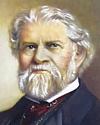
Simon Newcomb
(12 Mar 1835 - 11 Jul 1909)
Canadian-American astronomer and mathematician.
|
Science Quotes by Simon Newcomb (9 quotes)
Flight by machines heavier than air is unpractical and insignificant, if not utterly impossible.
— Simon Newcomb
(1902). Widely quoted, though always without a source, for example in Laura Ward and Robert Allen, Foolish Words: The Most Stupid Words Ever Spoken (2003), 68. If you know a primary print source to authenticate this quote, please contact Webmaster.
If my impressions are correct, our educational planing mill cuts down all the knots of genius, and reduces the best of the men who go through it to much the same standard.
— Simon Newcomb
The Reminiscences of an Astronomer (1903), 75.
One hardly knows where, in the history of science, to look for an important movement that had its effective start in so pure and simple an accident as that which led to the building of the great Washington telescope, and went on to the discovery of the satellites of Mars.
— Simon Newcomb
In The Reminiscences of an Astronomer (1903), Vol. 3, 128.
One of the most beautiful hypotheses ever propounded in physics is ... the Dynamical Theory of Gases
— Simon Newcomb
Speaking to the 491st Meeting (30 Jan1861), Proceedings of the American Academy of Arts and Sciences (1862), Vol. 5, 112.
Quite likely the twentieth century is destined to see the natural forces which will enable us to fly from continent to continent with a speed far exceeding that of a bird.
— Simon Newcomb
'The Outlook for the Flying Machine'. The Independent: A Weekly Magazine (22 Oct 1903), 2510.
The demonstration that no possible combination of known substances, known forms of machinery and known forms of force, can be united in a practical machine by which men shall fly along distances through the air, seems to the writer as complete as it is possible for the demonstration to be.
— Simon Newcomb
Side-lights on Astronomy and Kindred Fields of Popular Science (1906), 345.
The mathematician of to-day admits that he can neither square the circle, duplicate the cube or trisect the angle. May not our mechanicians, in like manner, be ultimately forced to admit that aerial flight is one of that great class of problems with which men can never cope… I do not claim that this is a necessary conclusion from any past experience. But I do think that success must await progress of a different kind from that of invention.
[Written following Samuel Pierpoint Langley's failed attempt to launch his flying machine from a catapult device mounted on a barge in Oct 1903. The Wright Brother's success came on 17 Dec 1903.]
[Written following Samuel Pierpoint Langley's failed attempt to launch his flying machine from a catapult device mounted on a barge in Oct 1903. The Wright Brother's success came on 17 Dec 1903.]
— Simon Newcomb
'The Outlook for the Flying Machine'. The Independent: A Weekly Magazine (22 Oct 1903), 2509.
The mathematics of the twenty-first century may be very different from our own; perhaps the schoolboy will begin algebra with the theory of substitution groups, as he might now but for inherited habits.
— Simon Newcomb
From Address before the New York Mathematical Society, Bulletin of the New York Mathematical Society (1893), 3, 107. As cited in G.A. Miller, 'Appreciative Remarks on the Theory of Groups', The American Mathematical Monthly (1903), 10, No. 4, 89.
https://books.google.com/books?id=hkM0AQAAMAAJ
1903
We are probably nearing the limit of all we can know about astronomy.
— Simon Newcomb
(1888). Widely quoted, though always without a source, for example in Astronautics & Aeronautics? (1981), 30. If you know a primary print source to authenticate this quote, please contact Webmaster.
See also:
- 12 Mar - short biography, births, deaths and events on date of Newcomb's birth.
 In science it often happens that scientists say, 'You know that's a really good argument; my position is mistaken,' and then they would actually change their minds and you never hear that old view from them again. They really do it. It doesn't happen as often as it should, because scientists are human and change is sometimes painful. But it happens every day. I cannot recall the last time something like that happened in politics or religion.
(1987) --
In science it often happens that scientists say, 'You know that's a really good argument; my position is mistaken,' and then they would actually change their minds and you never hear that old view from them again. They really do it. It doesn't happen as often as it should, because scientists are human and change is sometimes painful. But it happens every day. I cannot recall the last time something like that happened in politics or religion.
(1987) -- 




