 (source)
|
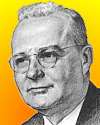
Thomas Midgley, Jr.
(18 May 1889 - 2 Nov 1944)
American engineer and chemist who discovered the effectiveness of tetraethyl lead (1921) as an antiknock additive for gasoline, and Freon (1930) as the refrigerant in for air conditioners.
|
Eliminating the “Knock” in the Automobile Engine
A report on Thomas Midgley's paper on the discovery of tetraethyl lead
as given at the American Chemical Society Pittsburgh Meeting (1922)
[This article shows the initial enthusiasm upon the discovery of the ability of tetra-ethyl lead to control the knocking in early vehicle engines using poorer grades of gasoline than can now be produced by modern refineries. Although at the time it seemed the answer to what had been a difficult problem to solve, it was eliminated from use in fuel starting in the 1970s. Even shortly after the first production began, there were health problems, and even deaths, of laboratory workers and production plant employees. As early as 1924, public health experts were expressing dire concerns over this chemical. Nevertheless, it was so useful, that until safer alternatives were found, it was added to fuel known as leaded gasoline for over four decades.]
The paper of Thomas Midgley, Jr., and T. A. Boyd on “The Chemical Control of Gaseous Detonation, With Particular Reference to the Internal Combustion Engine,” was one of broad appeal to the layman as well as to the chemist. It was sufficiently novel to interest the scientist and yet its utility and commercial significance were such as to attract the industrialist.
The work of the General Motors Research Corporation has had for its purpose the conservation and economic utilization of motor fuel and this particular study is an outgrowth of the problem of developing a more efficient type of internal combustion engine. Were it not for the phenomenon of “knocking,” which is well known to every motorist, the simple change from a low- to a high-compression motor would offer a very effective economy in fuel consumption, for by increasing the compression ratio there is a more efficient utilization of the energy content of the fuel. What is but a commonplace annoyance in the ordinary automobile engine becomes so intensified in the high-compression motor that there is not only a serious loss of power but often an actual damage to the engine parts.
The Anti-knock Compounds Midgley's investigations have definitely shown that the chemical composition of the fuel is a controlling factor in causing and preventing knocking. An accidental discovery indicated that the addition of a small quantity of iodine to a gasoline fuel greatly lessened the tendency for a higher-pressure engine to knock. It took 2 years of research to discover a second compound having similar properties and about a year more to discover a third. These researches, however, served as a basis to indicate the general nature of the compounds that would accomplish the desired purpose. They also indicated compounds that have the opposite effect—namely, to increase the knocking.
Most of the compounds that affect detonation are derived from about fifteen elements, of which some of the more important are I, Br, O, N, Se, Te, Sn and Pb. Some typical compounds which have been used are iodine, bromine, oxygen, isopropyl nitrite, aniline, diethyl selenide, diethyl telluride, tetra-ethyl tin and tetra-ethyl lead. Bromine, oxygen and isopropyl nitrite are accelerators and the others are anti-knocking compounds. Tetra-ethyl lead, the best of the compounds now known for this purpose, has about 1,500 times the power of benzene in preventing detonation. Recent investigation has shown nickel carbonyl to be an excellent anti-knock and the indications are that the corresponding compound of platinum will probably be even better.
A splendid demonstration of the efficiency of one of these compounds was effected by the experimental explosion of a small quantity of acetylene in a glass apparatus at atmospheric pressure. The addition of but one part of diethyl selenide to 800 of acetylene was sufficient to reduce the loud crack of the acetylene-air explosion to an almost inaudible puff.
But what was perhaps the most striking exhibit was a high-pressure gas engine, completely installed on the lecture platform. By means of a special apparatus connected to the engine cylinder it was possible to measure the detonating characteristics of the fuel. An electric light was so arranged in the circuit that as the knocking increased or decreased the lamp would burn brightly or dimly. When the engine was started and operated with ordinary gasoline a decided knock was distinctly audible throughout the hall. But true to predictions, a benzene fuel mixture did not cause knocking when used under exactly the same conditions. A gasoline fuel that knocked badly ceased immediately after very small amounts of the vapors of iodine or diethyl selenide were permitted to enter the breather of the motor. Similar demonstrations were made to show the efficiency of the other compounds, particularly of the tetra-ethyl lead mixture, which has already attained some commercial significance through its use in airplane and motor-boat engines.
These compounds, however, have not as yet been placed on the market, according to Mr. Midgley, for their full benefit cannot be derived until gas engines have been redesigned to operate at higher compression. The anti-knock compounds give little or no additional energy to a given volume of fuel, so that with the ordinary motor their use will not increase the mileage per gallon of fuel.
The most important aspect of these discoveries from the scientific viewpoint is the increased knowledge and new insight into the theory of catalysis.
- Science Quotes by Thomas Midgley, Jr..
- 18 May - short biography, births, deaths and events on date of Midgley's birth.
- More for Thomas Midgley, Jr. on Today in Science History page.
- 2 Feb - births, deaths and events on date ethyl gasoline first went on sale.
- Thomas Midgley and the Law of Unintended Consequences - article from Invention & Technology Magazine on Thomas Midgley's career in research, from which came the rise and fall of two chemicals with dangerous effects in the atmosphere.
- From the Periodic Table to Production: The Life of Thomas Midgley, Jr., by Thomas Midgley. - book suggestion.





