 (source)
|
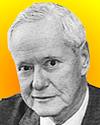
Robert King Merton
(4 Jul 1910 - 23 Feb 2003)
American sociologist who wrote Social Theory and Social Structure (1949), in which he coined the phrases 'self-fulfilling prophecy' and 'role model' that have entered everyday use.
|
Science Quotes by Robert King Merton (9 quotes)
[The] complex pattern of the misallocation of credit for scientific work must quite evidently be described as “the Matthew effect,” for, as will be remembered, the Gospel According to St. Matthew puts it this way: For unto every one that hath shall be given, and he shall have abundance: but from him that hath not shall be taken away even that which he hath. Put in less stately language, the Matthew effect consists of the accruing of greater increments of recognition for particular scientific contributions to scientists of considerable repute and the withholding of such recognition from scientists who have not yet made their mark.
— Robert King Merton
'The Matthew Effect in Science', Science (1968), 159, 58.
Most institutions demand unqualified faith; but the institution of science makes skepticism a virtue.
— Robert King Merton
Social Theory and Social Structure (1962), 547.
My decision to leave applied mathematics for economics was in part tied to the widely-held popular belief in the 1960s that macroeconomics had made fundamental inroads into controlling business cycles and stopping dysfunctional unemployment and inflation.
— Robert King Merton
Nobel Banquet Speech (1995). Collected in Tore Frängsmyr (ed.), Les Prix Nobel/Nobel Lectures/The Nobel Prizes.
Only when he has published his ideas and findings has the scientist made his contribution, and only when he has thus made it part of the public domain of scholarship can he truly lay claim to it as his own. For his claim resides only in the recognition accorded by peers in the social system of science through reference to his work.
— Robert King Merton
In The Sociology of Science: An Episodic Memoir (1977), 47. As quoted and cited in David A. Kronick, The Literature of the Life Sciences: Reading, Writing, Research (1985), 89. This has been summarized as a paradox “the more freely the scientist gives his intellectual property away, the more securely it becomes his property” by Mengxiong Liu, in 'The Complexity of Citation Practice: A Review of Citation Studies', The Journal of Documentation (1993), 49, No. 4, 372.
Science is public, not private, knowledge.
— Robert King Merton
In Robert King Merton and Matilda White Riley (eds.), Sociological Traditions From Generation to Generation: Glimpses of the American Experience (1980), 26.
The institutional goal of science is the extension of certified knowledge. The technical methods employed toward this end provide the relevant definition of knowledge: empirically confirmed and logically consistent predictions. The institutional imperatives (mores) derive from the goal and the methods. The entire structure of technical and moral norms implements the final objective. The technical norm of empirical evidence, adequate, valid and reliable, is a prerequisite for sustained true prediction; the technical norm of logical consistency, a prerequisite for systematic and valid prediction. The mores of science possess a methodologic rationale but they are binding, not only because they are procedurally efficient, but because they are believed right and good. They are moral as well as technical prescriptions. Four sets of institutional imperatives–universalism, communism, disinterestedness, organized scepticism–comprise the ethos of modern science.
— Robert King Merton
Social Theory and Social Structure (1957), 552-3.
The self-fulfilling prophecy is, in the beginning, a false definition of the situation evoking a new behavior which makes the originally false conception come true. The specious validity of the self-fulfilling prophecy perpetuates a reign of error. For the prophet will cite the actual course of events as proof that he was right from the very beginning. … Such are the perversities of social logic.
— Robert King Merton
In article, 'The Self-Fulfilling Prophecy', The Antioch Review (Summer 1948), 8, No. 2, 195-196. Included as Chap. 7 of Social Theory and Social Structure (1949), 181-195. Note: Merton coined the expression “self-fulfilling prophecy.”
We must examine the moral alchemy through which the in-group readily transmutes virtue into vice and vice into virtue, as the occasion may demand. … We begin with the engagingly simple formula of moral alchemy: the same behavior must be differently evaluated according to the person who exhibits it. For example, the proficient alchemist will at once know that the word “firm” is properly declined as follows:
I am firm,
Thou art obstinate,
He is pig-headed.
There are some, unversed in the skills of this science, who will tell you that one and the same term should be applied to all three instances of identical behavior.
I am firm,
Thou art obstinate,
He is pig-headed.
There are some, unversed in the skills of this science, who will tell you that one and the same term should be applied to all three instances of identical behavior.
— Robert King Merton
In article, 'The Self-Fulfilling Prophecy', The Antioch Review (Summer 1948), 8, No. 2, 195-196. Included as Chap. 7 of Social Theory and Social Structure (1949), 201.
We thus begin to see that the institutionalized practice of citations and references in the sphere of learning is not a trivial matter. While many a general reader–that is, the lay reader located outside the domain of science and scholarship–may regard the lowly footnote or the remote endnote or the bibliographic parenthesis as a dispensable nuisance, it can be argued that these are in truth central to the incentive system and an underlying sense of distributive justice that do much to energize the advancement of knowledge.
— Robert King Merton
In ''he Matthew Effect in Science, II: Cumulative Advantage and the Symbolism of Intellectual Property', Isis (1988), 79, 621.
 In science it often happens that scientists say, 'You know that's a really good argument; my position is mistaken,' and then they would actually change their minds and you never hear that old view from them again. They really do it. It doesn't happen as often as it should, because scientists are human and change is sometimes painful. But it happens every day. I cannot recall the last time something like that happened in politics or religion.
(1987) --
In science it often happens that scientists say, 'You know that's a really good argument; my position is mistaken,' and then they would actually change their minds and you never hear that old view from them again. They really do it. It doesn't happen as often as it should, because scientists are human and change is sometimes painful. But it happens every day. I cannot recall the last time something like that happened in politics or religion.
(1987) -- 




