 (source)
|
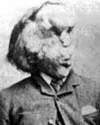
Joseph Merrick
(5 Aug 1862 - 11 Apr 1890)
English patient known as the “Elephant Man” because of severe facial disfiguration which also affected much of his body.
|
Obituary for Joseph Merrick,
the “Elephant Man.”
From Notes and Items in the Medical Mirror (1890)
[p.381] The doctor year in and year out sees no sadder sight than the various forms of monstrosities, the horrid things which now and then give the lie to the statement that “Nature makes no mistakes.”
The thought may enter the mind of the humane as to whether there ought not to be some legally established court in every community possessed of the power to determine the propriety of the prompt death of such creatures and yet while this would seem the more humane view, of course there comes up the great, strong and colossal thought “Thou shalt not kill.”
No one can ever say that the creature into whose nostrils has been breathed the breath of life should ever be denied that life though he may suffer in consequence of his infirmities.
The recent death of Joseph L. Merrick at the age of twenty-eight years, in London, who was known as the “elephant man,” born with a head more like that of an elephant than aught else, emphasizes in his life the beauty of a Christian pity and its power to alleviate human distress even in its most repulsive form. The Youth’s Companion of a recent date presents facts pertaining to this poor creature that are more than interesting. His personal deformity so separated him from his fellow-men that Job’s sorrow must have often furnished him words, “They abhor me, they flee from me. I am a brother to dragons. Wherefore is light given to him that is in misery and life to the bitter in soul.” By one of the cruelties of nature Joseph Merrick was born with an elephant’s head, yet strange as it seems this misshapen being had the gift of speech and was intelligent to the extent of being able to read and write and grew to maturity.
What sufferings he endured during his childhood no one will ever know, but after arriving at the age of maturity, with fully developed sensibilities and meeting the vulgar curiosity and aversion which he did upon all sides must have been hard to endure. All homes and all employments were shut against him and at last starvation drove him to hire himself to a London penny show. Here Dr. Frederick Treves met the “elephant man,” spoke kindly to him and undertook to arrange a home for him in the London Hospital. Neither this nor any other hospital would receive him. With a pathos hardly to be matched the poor creature begged that he might be put in a blind asylum. What grim humor did he manifest even in his sorrow when he asked to be put in a blind asylum where no one could see him.
The London police prohibited his exhibition by showmen on the ground of public decency, and this took away his one means of support. His only alternative was to pick up his living like a wild beast or die of neglect.
After a few months, thanks to his friend, good Dr. Treves, Merrick’s [p.382] case reached the public through the London Times.
The Prince and Princess of Wales, Mrs. Kendall and Mr. Gladstone interested themselves in a subscription for his benefit, and with the money thus secured an apartment was built for him in a remote wing of the London Hospital. Here, surrounded by books, flowers and gifts of kindness and taste, he passed between three and four years in privacy and comfort. The friends who had helped him came now and then to see him and he loved them all, but best of all Dr. Treves, whom, as he often said, was the first one to ever speak kindly to him.
No matter what Dr. Frederick Treves may accomplish in the surgical world, there will be nothing recorded that will redound more to his credit than that connected with the life and death of this poor outcast. And after all, the development and arousing in the heart the dormant affections of such a creature, is as grand a work as man can do, no matter to what profession he belongs.
- 5 Aug - short biography, births, deaths and events on date of Merrick's birth.
- The “Elephant Man” - from New York Medical Abstract (1886) - a summary of Dr. Treve’s medical description in the British Medical Journal.
- The Story of an Outcast - a compassionate article at the time of his death, from The Speaker (London, 1890).
- The True History of the Elephant Man, by Michael Howells. - book suggestion.
- Booklist for Joseph Merrick.





