 (source)
|
Sir Peter B. Medawar
(28 Feb 1915 - 2 Oct 1987)
English immunologist and author who was awarded a Nobel Prize for making skin grafts possible without tissue rejection.
|
Science Quotes by Sir Peter B. Medawar (53 quotes)
>> Click for Sir Peter B. Medawar Quotes on | Discovery | Evidence | Hypothesis | Imagination | Mind | Process | Scientist | Theory | Truth |
>> Click for Sir Peter B. Medawar Quotes on | Discovery | Evidence | Hypothesis | Imagination | Mind | Process | Scientist | Theory | Truth |

[A certain class of explanations in science are] analgesics that dull the ache of incomprehension without removing the cause.
— Sir Peter B. Medawar
In The Art of the Soluble: Creativity and Originality in Science (1969). As cited in New Scientist (16 April 2008), 198, 49.
[Scientists who think science consists of unprejudiced data-gathering without speculation are merely] cows grazing on the pasture of knowledge.
— Sir Peter B. Medawar
In The Art of the Soluble: Creativity and Originality in Science (1969). As cited in New Scientist (16 April 2008), 198, 49.
I cannot give any scientist of any age better advice than this: the intensity of the conviction that a hypothesis is true has no bearing on whether it is true or not. The importance of the strength of our conviction is only to provide a proportionally strong incentive to find out if the hypothesis will stand up to critical examination.
— Sir Peter B. Medawar
In Advice to a Young Scientist (1979), 39.
There is no such thing as a Scientific Mind. Scientists are people of very dissimilar temperaments doing different things in very different ways. Among scientists are collectors, classifiers, and compulsive tidiers-up; many are detectives by temperament and many are explorers; some are artists and others artisans. There are poet-scientists and philosopher-scientists and even a few mystics.
— Sir Peter B. Medawar
The Art of the Soluble: Creativity and Originality in Science (1967). Reprinted in Pluto’s Republic (1982), 116.

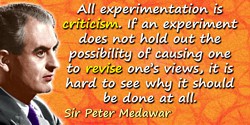
All experimentation is criticism. If an experiment does not hold out the possibility of causing one to revise one’s views, it is hard to see why it should be done at all.
— Sir Peter B. Medawar
In Advice to a Young Scientist (1979), 94.
Any scientist of any age who wants to make important discoveries must study important problems. Dull or piffling problems yield dull or piffling answers. It is not not enough that a problem should be “interesting.” … The problem must be such that it matters what the answer is—whether to science generally or to mankind.
— Sir Peter B. Medawar
From 'What Shall I Do Research On?', Advice to a Young Scientist (1979), 13.
Ask a scientist what he conceives the scientific method to be, and he will adopt an expression that is at once solemn and shifty eyed: solemn because he feels he ought to declare an opinion; shifty eyed because he is wondering how to conceal the fact that he has no opinion to declare. If taunted he would probably mumble something about “Induction” and “Establishing the Laws of Nature”, but if anyone working in a laboratory professed to be trying to establish the Laws of Nature by induction, we should think he was overdue for leave.
— Sir Peter B. Medawar
From a Jayne Lecture (1968), 'Induction and Intuition in Scientific Thought', printed in Memoirs of the American Philosophical Society (1969), Vol. 75. Lecture republished as Induction and Intuition in Scientific Thought (2009), 11. Also included in Peter Medawar, Pluto’s Republic (1984), 80.
Considered in its entirety, psychoanalysis won’t do. It is an end product, moreover, like a dinosaur or a zeppelin, no better theory can ever be erected on its ruins, which will remain for ever one of the saddest and strangest of all landmarks in the history of twentieth century thought.
— Sir Peter B. Medawar
From 'Further Comments on Psychoanalysis', The Hope of Progress: A Scientist Looks at Problems in Philosophy, Literature and Science (1973), 69.
Deductivism in mathematical literature and inductivism in scientific papers are simply the postures we choose to be seen in when the curtain goes up and the public sees us. The theatrical illusion is shattered if we ask what goes on behind the scenes. In real life discovery and justification are almost always different processes.
— Sir Peter B. Medawar
Induction and Intuition in Scientific Thought (1969), 26.
Every discovery, every enlargement of the understanding, begins as an imaginative preconception of what the truth might be. The imaginative preconception—a “hypothesis”—arises by a process as easy or as difficult to understand as any other creative act of mind; it is a brainwave, an inspired guess, a product of a blaze of insight. It comes anyway from within and cannot be achieved by the exercise of any known calculus of discovery.
— Sir Peter B. Medawar
In Advice to a Young Scientist (1979), 84.
For a scientist must indeed be freely imaginative and yet skeptical, creative and yet a critic. There is a sense in which he must be free, but another in which his thought must be very preceisely regimented; there is poetry in science, but also a lot of bookkeeping.
— Sir Peter B. Medawar
The Strange Case of the Spotted Mice and Other Classic Essays on Science (1996), 63.
Freudian psychoanalytical theory is a mythology that answers pretty well to Levi-Strauss's descriptions. It brings some kind of order into incoherence; it, too, hangs together, makes sense, leaves no loose ends, and is never (but never) at a loss for explanation. In a state of bewilderment it may therefore bring comfort and relief … give its subject a new and deeper understanding of his own condition and of the nature of his relationship to his fellow men. A mythical structure will be built up around him which makes sense and is believable-in, regardless of whether or not it is true.
— Sir Peter B. Medawar
From 'Science and Literature', The Hope of Progress: A Scientist Looks at Problems in Philosophy, Literature and Science (1973), 29.
Gentlemen, everyone in this room knows the difference between a live horse and a dead horse. Pray, therefore, let us cease flogging the latter.
— Sir Peter B. Medawar
(in conversation)
Haldane could have made a success of any one of half a dozen careers—as mathematician, classical scholar, philosopher, scientist, journalist or imaginative writer. On his life’s showing he could not have been a politician, administrator (heavens, no!), jurist or, I think, a critic of any kind. In the outcome he became one of the three or four most influential biologists of his generation.
— Sir Peter B. Medawar
Essay, 'J.B.S.', in Pluto’s Republic: Incorporating The Art of the Soluble and Induction and Intuition in Scientific Thought (1982), collected in The Strange Case of the Spotted Mice and Other Classic Essays on Science (1996), 87.
Heredity proposes and development disposes.
— Sir Peter B. Medawar
'Postscript: D’Arcy Thompson and Growth and Form'. From Ruth D’Arcy Thompson, D’Arcy Wentworth Thompson: The Scholar Naturalist 1860-1948 (1958), 225.
How have people come to be taken in by The Phenomenon of Man? Just as compulsory primary education created a market catered for by cheap dailies and weeklies, so the spread of secondary and latterly of tertiary education has created a large population of people, often with well-developed literary and scholarly tastes who have been educated far beyond their capacity to undertake analytical thought … [The Phenomenon of Man] is written in an all but totally unintelligible style, and this is construed as prima-facie evidence of profundity.
— Sir Peter B. Medawar
Medawar’s book review of The Phenomenon of Man by Teilhard de Chardin first appeared as 'Critical Notice' in the journal Mind (1961), 70, No. 277, 105. The book review was reprinted in The Art of the Soluble: Creativity and Originality in Science (1967).
Humility is not a state of mind conducive to the advancement of learning.
— Sir Peter B. Medawar
…...
I believe in “intelligence,” and I believe also that there are inherited differences in intellectual ability, but I do not believe that intelligence is a simple scalar endowment that can be quantified by attaching a single figure to it—an I.Q. or the like.
— Sir Peter B. Medawar
In Advice to a Young Scientist (1979), 25. Footnoted with reference to his own earlier review article of books about IQ, in which he stated “misgivings about whether it is indeed possible to attach a single-number valuation to an endowment as complex and as various as intelligence.” That review was titled 'Unnatural Science', in New York Review of Books (3 Feb 1977), 24, No. 1, 13,
I once spoke to a human geneticist who declared that the notion of intelligence was quite meaningless, so I tried calling him unintelligent. He was annoyed, and it did not appease him when I went on to ask how he came to attach such a clear meaning to the notion of lack of intelligence. We never spoke again.
— Sir Peter B. Medawar
In Advice to a Young Scientist (1979), 25, footnote 2.
If politics is the art of the possible, research is surely the art of the soluble. Both are immensely practical-minded affairs.
— Sir Peter B. Medawar
In 'The Act of Creation', a book review (of Arthur Koestler’s book, The Act of Creation) in New Statesman (19 Jun 1964). Collected in The Strange Case of the Spotted Mice and Other Classic Essays on Science (1996), 42. Also collected in Medawar’s The Art of the Soluble: Creativity and Originality in Science (1967), 7.
If the task of scientific methodology is to piece together an account of what scientists actually do, then the testimony of biologists should be heard with specially close attention. Biologists work very close to the frontier between bewilderment and understanding.
Biology is complex, messy and richly various, like real life; it travels faster nowadays than physics or chemistry (which is just as well, since it has so much farther to go), and it travels nearer to the ground. It should therefore give us a specially direct and immediate insight into science in the making.
Biology is complex, messy and richly various, like real life; it travels faster nowadays than physics or chemistry (which is just as well, since it has so much farther to go), and it travels nearer to the ground. It should therefore give us a specially direct and immediate insight into science in the making.
— Sir Peter B. Medawar
Induction and Intuition in Scientific Thought (1969), 1.
Is the Scientific Paper a Fraud?
— Sir Peter B. Medawar
'Is the Scientific Paper a Fraud?', The Listener (12 Sep 1963), 377-8.
It is … a sign of the times—though our brothers of physics and chemistry may smile to hear me say so—that biology is now a science in which theories can be devised: theories which lead to predictions and predictions which sometimes turn out to be correct. These facts confirm me in a belief I hold most passionately—that biology is the heir of all the sciences.
— Sir Peter B. Medawar
From Nobel Banquet speech (10 Dec 1960).
It is a common failing–and one that I have myself suffered from–to fall in love with a hypothesis and to be unwilling to take no for an answer. A love affair with a pet hypothesis can waste years of precious time. There is very often no finally decisive yes, though quite often there can be a decisive no.
— Sir Peter B. Medawar
Advice to a Young Scientist (1979), 73.
It is high time that laymen abandoned the misleading belief that scientific enquiry is a cold dispassionate enterprise, bleached of imaginative qualities, and that a scientist is a man who turns the handle of discovery; for at every level of endeavour scientific research is a passionate undertaking and the Promotion of Natural Knowledge depends above all on a sortee into what can be imagined but is not yet known.
— Sir Peter B. Medawar
The Times Literary Supplement (London), 1963 October 25 (p. 850)
It just so happens that during the 1950s, the first great age of molecular biology, the English schools of Oxford and particularly of Cambridge produced more than a score of graduates of quite outstanding ability—much more brilliant, inventive, articulate and dialectically skillful than most young scientists; right up in the Jim Watson class. But Watson had one towering advantage over all of them: in addition to being extremely clever he had something important to be clever about.
— Sir Peter B. Medawar
From the postscript to 'Lucky Jim', New York Review of Books (28 Mar 1968). Also collected in 'Lucky Jim', Pluto’s Republic (1982), 275. Also excerpted in Richard Dawkins (ed.), The Oxford Book of Modern Science Writing (2008), 186.
No scientist is admired for failing in the attempt to solve problems that lie beyond his competence. … Good scientists study the most important problems they think they can solve. It is, after all, their professional business to solve problems, not merely to grapple with them.
— Sir Peter B. Medawar
The Art of the Soluble: Creativity and Originality in Science (1967), 7.
People who write obscurely are either unskilled in writing or up to mischief.
— Sir Peter B. Medawar
From 'Science and Literature', Pluto’s Republic (1984), 52.
Psychoanalytic theory is the most stupendous intellectual confidence trick of the twentieth century and a terminal product as well—something akin to a dinosaur or zeppelin in the history of ideas, a vast structure of radically unsound design and with no posterity.
— Sir Peter B. Medawar
'Victims of Psychiatry', The New York Review of Books (23 Jan 1975), 21. Cited in David E. Stannard, Shrinking History: On Freud and the Failure of Psychohistory (1980), 150.
Scientific discovery is a private event, and the delight that accompanies it, or the despair of finding it illusory does not travel.
— Sir Peter B. Medawar
In Hypothesis and Imagination.
Scientific discovery, or the formulation of scientific theory, starts in with the unvarnished and unembroidered evidence of the senses. It starts with simple observation—simple, unbiased, unprejudiced, naive, or innocent observation—and out of this sensory evidence, embodied in the form of simple propositions or declarations of fact, generalizations will grow up and take shape, almost as if some process of crystallization or condensation were taking place. Out of a disorderly array of facts, an orderly theory, an orderly general statement, will somehow emerge.
— Sir Peter B. Medawar
In 'Is the Scientific Paper Fraudulent?', The Saturday Review (1 Aug 1964), 42.
Scientific reasoning is a kind of dialogue between the possible and the actual, between what might be and what is in fact the case.
— Sir Peter B. Medawar
Induction and Intuition in Scientific Thought (1969), 48.
Scientists are entitled to be proud of their accomplishments, and what accomplishments can they call ‘theirs’ except the things they have done or thought of first? People who criticize scientists for wanting to enjoy the satisfaction of intellectual ownership are confusing possessiveness with pride of possession. Meanness, secretiveness and, sharp practice are as much despised by scientists as by other decent people in the world of ordinary everyday affairs; nor, in my experience, is generosity less common among them, or less highly esteemed.
— Sir Peter B. Medawar
…...
Scientists are people of very dissimilar temperaments doing different things in very different ways. Among scientists are collectors, classifiers and compulsive tidiers-up; many are detectives by temperament and many are explorers; some are artists and others artisans. There are poets–scientists and philosopher–scientists and even a few mystics. ... and most people who are in fact scientists could easily have been something else instead.
— Sir Peter B. Medawar
'Hypothesis and Imagination', The Art of the Soluble (1967), 132.
Scientists should not be ashamed to admit, as many of them apparently are ashamed to admit, that hypotheses appear in their minds along uncharted by-ways of thought; that they are imaginative and inspirational in character; that they are indeed adventures of the mind.
— Sir Peter B. Medawar
In 'Is the Scientific Paper Fraudulent?', The Saturday Review (1 Aug 1964), 43.
Simultaneous discovery is utterly commonplace, and it was only the rarity of scientists, not the inherent improbability of the phenomenon, that made it remarkable in the past. Scientists on the same road may be expected to arrive at the same destination, often not far apart.
— Sir Peter B. Medawar
From review '[Arthur] Koestler’s Theory of the Creative Act: “The Act of Creation”', in New Statesman (19 Jun 1964). According to Michael Scammell in his biography (Koestler: The Literary and Political Odyssey of a Twentieth-Century Skeptic (2009), 491 and 654), Medawar eviscerated the book as “amateurish” with “overstretched metaphors” and “fatuous epigrams” while Koestler’s psychological insights were “in the style of the nineteenth century.” The review, with follow-ups, were reprinted in Medawar’s The Art of the Soluble: Creativity and Originality in Science (1967), 85-98.
The art of research [is] the art of making difficult problems soluble by devising means of getting at them.
— Sir Peter B. Medawar
Pluto's Republic (1982), 2.
The bells which toll for mankind are—most of them, anyway—like the bells of Alpine cattle; they are attached to our own necks, and it must be our fault if they do not make a cheerful and harmonious sound.
— Sir Peter B. Medawar
From sixth and last lecture in series of Reith Lectures titled 'The Future of Man' on BBC Home Service radio (1959). Text printed in the magazine, The Listener. Also collected in book form as The Future of Man. This was the concluding sentence of the last lecture.
The case I shall find evidence for is that when literature arrives, it expels science.
— Sir Peter B. Medawar
From 'Science and Literature', Pluto’s Republic (1984), 43.
The fact that scientists do not consciously practice a formal methodology is very poor evidence that no such methodology exists. It could be said—has been said—that there is a distinctive methodology of science which scientists practice unwittingly, like the chap in Moliere who found that all his life, unknowingly, he had been speaking prose.
— Sir Peter B. Medawar
Induction and Intuition in Scientific Thought (1969), 9.
The greater part of it, I shall show, is nonsense, tricked out with a variety of tedious metaphysical conceits, and its author can be excused of dishonesty only on the grounds that before deceiving others he has taken great pains to deceive himself. … it is the style that creates the illusion of content, and which is a cause as well as merely a symptom of Teilhard's alarming apocalyptic seizures.
— Sir Peter B. Medawar
Medawar’s acerbic book review of The Phenomenon of Man by Teilhard de Chardin first appeared as 'Critical Notice' in the journal Mind (1961), 70, No. 277, 99. The book review was reprinted in The Art of the Soluble: Creativity and Originality in Science (1967), 71. Medawar thus strongly contradicted other reviewers of the book, which he said was “widely held to be of the utmost profundity and significance; it created something like a sensation upon its publication in France, and some reviewers hereabouts called it the Book of the Year—one, the Book of the Century.”
The human mind treats a new idea the way the body treats a strange protein; it rejects it.
— Sir Peter B. Medawar
The Art of the Soluble (1967). Quoted in Colin J. Sanderson, Understanding Genes and GMOs (2007), 1.
The lives of scientists, considered as Lives, almost always make dull reading. For one thing, the careers of the famous and the merely ordinary fall into much the same pattern, give or take an honorary degree or two, or (in European countries) an honorific order. It could be hardly otherwise. Academics can only seldom lead lives that are spacious or exciting in a worldly sense. They need laboratories or libraries and the company of other academics. Their work is in no way made deeper or more cogent by privation, distress or worldly buffetings. Their private lives may be unhappy, strangely mixed up or comic, but not in ways that tell us anything special about the nature or direction of their work. Academics lie outside the devastation area of the literary convention according to which the lives of artists and men of letters are intrinsically interesting, a source of cultural insight in themselves. If a scientist were to cut his ear off, no one would take it as evidence of a heightened sensibility; if a historian were to fail (as Ruskin did) to consummate his marriage, we should not suppose that our understanding of historical scholarship had somehow been enriched.
— Sir Peter B. Medawar
'J.B.S: A Johnsonian Scientist', New York Review of Books (10 Oct 1968), reprinted in Pluto's Republic (1982), and inThe Strange Case of the Spotted Mice and Other Classic Essays on Science (1996), 86.
The scientific method is a potentiation of common sense, exercised with a specially firm determination not to persist in error if any exertion of hand or mind can deliver us from it. Like other exploratory processes, it can be resolved into a dialogue between fact and fancy, the actual and the possible; between what could be true and what is in fact the case. The purpose of scientific enquiry is not to compile an inventory of factual information, nor to build up a totalitarian world picture of Natural Laws in which every event that is not compulsory is forbidden. We should think of it rather as a logically articulated structure of justifiable beliefs about nature. It begins as a story about a Possible World—a story which we invent and criticise and modify as we go along, so that it ends by being, as nearly as we can make it, a story about real life.
— Sir Peter B. Medawar
Induction and Intuition in Scientific Thought (1969), 59.
The scientist values research by the size of its contribution to that huge, logically articulated structure of ideas which is already, though not yet half built, the most glorious accomplishment of mankind.
— Sir Peter B. Medawar
In The Art of the Soluble (1967), 126. Also 'Two Conceptions of Science', collected in The Strange Case of the Spotted Mice and Other Classic Essays on Science (1996), 70.
There is no spiritual copyright in scientific discoveries, unless they should happen to be quite mistaken. Only in making a blunder does a scientist do something which, conceivably, no one might ever do again.
— Sir Peter B. Medawar
In Pluto’s Republic (1976).
There is nothing distinctively scientific about the hypothetico-deductive process. It is not even distinctively intellectual. It is merely a scientific context for a much more general stratagem that underlies almost all regulative processes or processes of continuous control, namely feedback, the control of performance by the consequences of the act performed. In the hypothetico-deductive scheme the inferences we draw from a hypothesis are, in a sense, its logical output. If they are true, the hypothesis need not be altered, but correction is obligatory if they are false. The continuous feedback from inference to hypothesis is implicit in Whewell’s account of scientific method; he would not have dissented from the view that scientific behaviour can be classified as appropriately under cybernetics as under logic.
— Sir Peter B. Medawar
Induction and Intuition in Scientific Thought (1969), 54-5.
This whole period was a golden age of immunology, an age abounding in important synthetic discoveries all over the world, a time we all thought it was good to be alive. We, who were working on these problems, all knew each other and met as often as we could to exchange ideas and hot news from the laboratory.
— Sir Peter B. Medawar
In Memoir of a Thinking Radish: An Autobiography (1986), 135.
To be creative, scientists need libraries and laboratories and the company of other scientists; certainly a quiet and untroubled life is a help. A scientist's work is in no way deepened or made more cogent by privation, anxiety, distress, or emotional harassment. To be sure, the private lives of scientists may be strangely and even comically mixed up, but not in ways that have any special bearing on the nature and quality of their work. If a scientist were to cut off an ear, no one would interpret such an action as evidence of an unhappy torment of creativity; nor will a scientist be excused any bizarrerie, however extravagant, on the grounds that he is a scientist, however brilliant.
— Sir Peter B. Medawar
In Advice to a Young Scientist (1979), 40.
To deride the hope of progress is the ultimate fatuity, the last word in poverty of spirit and meanness of mind.
— Sir Peter B. Medawar
From The Hope of Progress (1973), 137. Medawar defends science against the attacks of critics who claim that science cannot enrich our lives.
Today the world changes so quickly that in growing up we take leave not just of youth but of the world we were young in. … Fear and resentment of what is new is really a lament for the memories of our childhood.
— Sir Peter B. Medawar
From 'On The Effecting of All Things Possible', Presidential Address to the British Association for the Advancement of Science, Exeter (3 Sep 1969). In Pluto’s Republic (1982), 336.
Twice in my life I have spent two weary and scientifically profitless years seeking evidence to corroborate dearly loved hypotheses that later proved to be groundless; times such as these are hard for scientists—days of leaden gray skies bringing with them a miserable sense of oppression and inadequacy.
— Sir Peter B. Medawar
From Advice to a Young Scientist (1979), 6.
You have … been told that science grows like an organism. You have been told that, if we today see further than our predecessors, it is only because we stand on their shoulders. But this [Nobel Prize Presentation] is an occasion on which I should prefer to remember, not the giants upon whose shoulders we stood, but the friends with whom we stood arm in arm … colleagues in so much of my work.
— Sir Peter B. Medawar
From Nobel Banquet speech (10 Dec 1960).
Quotes by others about Sir Peter B. Medawar (4)
I like to think that when Medawar and his colleagues showed that immunological tolerance could be produced experimentally the new immunology was born. This is a science which to me has far greater potentialities both for practical use in medicine and for the better understanding of living process than the classical immunochemistry which it is incorporating and superseding.
'Immunological Recognition of Self', Nobel Lecture, 12 December 1960. In Nobel Lectures Physiology or Medicine 1942-1962 (1964), 689.
Part of the appeal was that Medawar was not only a Nobel Laureate, but he seemed like a Nobel Laureate; he was everything one thought a Nobel Laureate ought to be. If you have ever wondered why scientists like Popper, try Medawar's exposition. Actually most Popperian scientists have probably never tried reading anything but Medawar's exposition.
'The Art of the Developable', New York Review of Books (Oct 1983). The first two sentences, slightly edited, were reprinted in A Devil's Chaplain (2004), 196.
I am ashamed to say that C. P. Snow's “two cultures” debate smoulders away. It is an embarrassing and sterile debate, but at least it introduced us to Medawar's essays. Afterwards, not even the most bigoted aesthete doubted that a scientist could be every inch as cultivated and intellectually endowed as a student of the humanities.
From 'Words of Hope', The Times (17 May 1988). Quoted in Neil Calver, 'Sir Peter Medawar: Science, Creativity and the Popularization of Karl Popper', Notes and Records of the Royal Society (May 2013), 67, 303.
Our laboratory work involved close contact with many non-clinical scientists. Sir Peter Medawar, 1960 Nobel Laureate, was a frequent visitor to our lab and to the hospital. He once commented, after visiting an early renal transplant patient, that it was the first time he had been in a hospital ward.
In Tore Frängsmyr and Jan E. Lindsten (eds.), Nobel Lectures: Physiology Or Medicine: 1981-1990 (1993), 556.

See also:
- 28 Feb - short biography, births, deaths and events on date of Medawar's birth.
- Advice to a Young Scientist, by Sir Peter Brian Medawar. - book suggestion.
- Booklist for Peter Medawar.
 In science it often happens that scientists say, 'You know that's a really good argument; my position is mistaken,' and then they would actually change their minds and you never hear that old view from them again. They really do it. It doesn't happen as often as it should, because scientists are human and change is sometimes painful. But it happens every day. I cannot recall the last time something like that happened in politics or religion.
(1987) --
In science it often happens that scientists say, 'You know that's a really good argument; my position is mistaken,' and then they would actually change their minds and you never hear that old view from them again. They really do it. It doesn't happen as often as it should, because scientists are human and change is sometimes painful. But it happens every day. I cannot recall the last time something like that happened in politics or religion.
(1987) -- 




