 (source)
|
Alexander George McAdie
(4 Aug 1863 - 1 Nov 1943)
American meteorologist who followed Benjamin Franklin in employing kites in the exploration of high altitude air conditions. He was second director of the Blue Hill Meteorological Observatory.
|
WHAT IS AN AURORA?
by Alexander McAdie
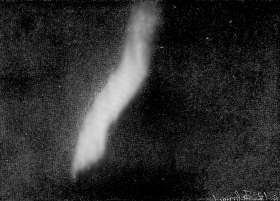
Photographed February 1, 1892, by Dr. Brendel, and sent by him to Mr. James P. Hall, and by him given to the author.
[p.874] On the first day of January, 1892, Dr. Brendel and Herr Raschen reached the Alten Fiord, Lapland, to remain several months, studying auroral displays and magnetic disturbances. Brendel succeeded in photographing the aurora, a very difficult thing to do, as all who have attempted it know. The deep reds which are so beautiful to the eye make little impression on the photographer's plates, and the light itself is generally feeble and flickering. Not unaptly have the quivering auroral beams been called “merry dancers.” Even the bright displays are hard to photograph, as we may see from an entry in General Greely's notebook on January 21, 1882. “A most beautiful aurora,” he says, “with intense light, at times sufficiently bright to cast my shadow on the snow. Rice exposed a sensitive plate without effect, but the constantly changing position of the aurora may have been the cause.”
But, some one will say, photographing an aurora, while interesting from a scientific standpoint, is not a very momentous matter to men or nations. And we make haste to answer that these auroral displays are linked with phenomena which have a very practical interest. Long before the now well-known relations of solar phenomena and terrestrial magnetism had been determined, Sir William Herschel thought he could from meager data detect evidence that the price of wheat was generally higher at times of few sun-spots. In later days we have Stanley Jevons tracing a connection between financial crises and sun-spots, and a host of writers tabulating the allied phenomena - of auroras, sun-spots, magnetic disturbances - and tracing in their periodicities a close relation to famines, commercial crises, and abnormal weather. What a wonderful achievement it would be to foresee the weal and woe of a decade!
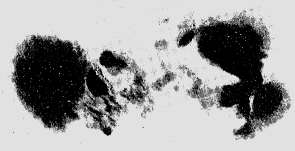
While such relations are conjectural, there is little doubt that auroras and solar and magnetic disturbances are closely linked. They do not come and go by chance. The astrophysicist knows that these phenomena will be very numerous in 1903. He knows that a similar condition will not again occur until 1915, the mean period being eleven years. How was this period discovered? Professor Langley tells us in his “ New Astronomy,” page 76:
It does not seem to have occurred to anyone to see whether they [sun-spots] had any regular period for coming or going, till Schwabe, a magistrate in a little German town, who happened to have a small [p.875] telescope and a good deal of leisure, began for his own amusement to note their number every day. He commenced in 1826, and with German patience observed daily for forty years. He first found that the spots grew more numerous in 1830, when there was no single day without one; then the number declined very rapidly, till in1833 they were about gone; then they increased in number again till 1838, then again declined, and so on, till it became evident that sun-spots do not come and go by chance, but run through a cycle of growth and disappearance, on the average about once in every eleven years. While amusing himself with his telescope, an important sequence in Nature had thus been added to our knowledge by the obscure Hofrath Schwabe, who indeed compares himself to Saul, going out to seek his father's asses and finding a kingdom.
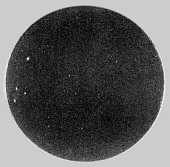
Once the sun-spot period was clearly established, it was only necessary to ransack chronological lists of auroras to find how intimately auroras and sun-spots were connected. Three patient investigators, Wolf, Fritz, and Loomis, soon proved that auroras were most frequent when sun.spots were most numerous. The next step was to find individual relations. One bright September morning thirty-seven years ago, Carrington and Hodgson, separately studying the face of the sun, saw a remarkable outburst near the edge of a great spot. For some days the magnetometers at Kew showed unusual perturbation, and for several nights magnificent auroral displays were seen over two continents. It was long thought that a violent magnetic disturbance occurred simultaneously with the outburst, but recent examination of the records disproves this. In 1872 Professor Young noticed a disturbance in the chromosphere in the neighborhood of a sun-spot, and upon asking the astronomers at Greenwich and Stonyhurst to examine their magnetic records, it was found that great disturbances had occurred about that time. Ten years later the astronomer at Greenwich sent out a message that read something like this: “Remarkable sun-spot now visible. . . . Area of whole spot, 247/100000 of the sun's visible surface.” Try to imagine what this means, and fancy yourself on the sun while that tremendous storm was in progress. We know that here on earth there was a magnetic storm with auroral displays that beggar description. Beginning a little before daylight on November 17, 1882, not a wire of the Western Union Telegraph Company could be used for three hours. The market quotations could not be sent. Late in the afternoon the trouble seemed to decrease, but at night there was a brilliant auroral display, and all telegraphic service was again interrupted. A very short circuit from Boston to Dedham showed the disturbance equally with other circuits. The cables to Europe and the wires to Chicago were alike unworkable. A message was sent from Bangor to North Sidney, seven hundred miles, by cutting out the regular batteries and allowing the energy of nature to have its own way. The current was just as strong as if a hundred cells had been at work. At Albany the switchboard was ignited; and in telephone offices generally the annunciators dropped continually. Switchboards and wires were burned at Chicago. Incandescent lamps were illuminated in St. Paul, and even in far San Francisco the telephone operators were nigh distracted. Over half of North America, across the Atlantic, and on over northern Europe, it seemed as if legions of ethereal demons were busy inciting electric and magnetic apparatus to strange and mischievous antics.
It so happened that about the pole that year were clustered representatives from twelve nations. The Russian international expeditions were at the Lena Delta and Nova Zembla; the Norwegian at Bossekop; the Dutch at Dicksonhavn; the German at Kingua Fiord; the Finnish at Sodankyla; the Swedish at Spitzbergen; the Danish at Godthaab; the Austro-Hungarian at Jan Mayen; and the British at Fort Rae. France had two stations in the antarctic region, and our own country had the well-known Lady Franklin Bay party under Greely, and the Point Barrow party under Ray.
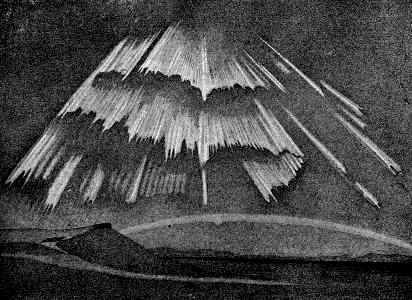
From the report of the Swedish expedition, “Aurora Boreales,” by Carlheim-Gyllenskiold.
November 14-19, 1882, was a period never to be forgotten by these arctic prisoners. While we at home saw the display of a decade, the observers of the frozen North, turning [p.876] their eyes southward or westward or eastward, saw visions glorious by as well as by night, and felt perhaps some measure of recompense for their isolation and peril. Coming out of their dark quarters, they were startled and at first blinded, and General Greely writes: “The curtain appeared at one time so near our heads that Gardner and Israel speak of having unconsciously dodged to avoid it.” In Ralston's diary is the entry: “The aurora appeared so low down that I raised my hand instinctively, expecting to bathe it in the light”; and Brainard relates a like impression. What a pity that under such conditions no electrometric apparatus was available! With Thomson water-dropping collectors and multiple-quadrant electrometers, records of the electrification of the lower air could have been obtained, and a few more threads raveled out from nature's tangled skein. Some observations of the potential of the air, made by Andrée, who was a member of the Swedish party at Cape Thordsen, Spitzhergen, seem to show that the electric potential diminished very rapidly during an aurora, and in fact became negative. As is well known, this same Andrée has lately attempted to reach the pole in an air-ship. Not the least valuable result of the adventure will be the increase in our knowledge of the electricity of the air in polar regions. We shall learn a little more about the height of auroras. We know now that while they are from fifty to seventy miles high in latitude 50°, the height decreases as we approach 68°. At Godthaab, Paulsen measured many with theodolites, and found that some were less than two fifths of a mile high. Hildebrandsson and others have seen auroras below the clouds. Such results lead us to believe that the time is ripe to suggest a new classification of auroral displays. It has been further noticed that the colorless and quiescent auroras were necessarily coincident with magnetic disturbances, while those of brilliant color and rapid change were. Many so-called auroras are probably what the Germans would call wetter-leuchten, and akin to silent lightning.
Our little planet unquestionably responds to solar disturbances. The intense auroral displays that occur simultaneously over continents are, one may think, answering signals to the messages flashed from the sun through the quivering ether. But we may also have our own little storms and [p.877] disturbances; and while appearances may be similar, the phenomena are of different origin. Some of the difficulties and discrepancies which have been met in tabulating sun-spot, magnetic, and auroral phenomena can be thus explained. One wise remark by Professor Young should not pass unnoticed. “The solar tumult,” he says, “may be the brother, and not the father, of our aurora.” But this much is plain: the phenomena are closely allied, and mastery of the terrestrial displays will enable us to reach out and attempt the conquest of the solar ones. It may be frankly said that the man of science feels that the aurora has baffled his scrutiny. Unlike lightning, this mysterious light is as harmless as it is beautiful. Weyprecht, who did so much to establish the circumpolar stations,watching from the deck of his ice-bound corvette, thus describes what he saw:
In the south a faint, scarcely visible band lies close to the horizon. All at once it rises and spreads rapidly east and west; . . . the waves of light drive on violently; . . . the edges assume a deep red and green color, and dance up and down; the rays shoot up more rapidly and become shorter; all rise together and approach nearer and nearer the magnetic pole. It looks as if there was a race, and each aspired to reach the pole first. The whole sky is in flames. Involuntarily we listen; such a spectacle must, we think, be accompanied with sound. But unbroken stillness prevails. No pencil can draw it, no colors can paint it, no words describe in all its magnificence the aurora of the coming storm.
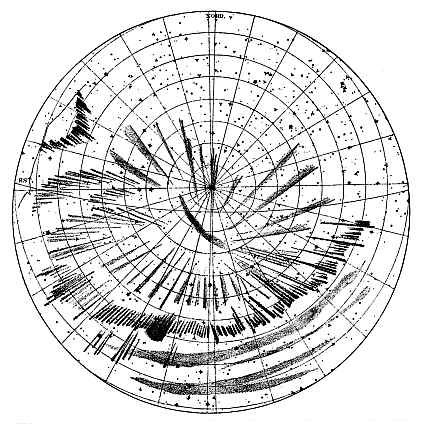
From the report of the Swedish expedition, “Aurora Boreales,” by Carlheim-Gyllenskiold.
In 1881-2 Lemstrom covered a hillside at Oratunturi with uncovered copper wire having at certain intervals discharging points. A powerful electric current was sent through this, and the peak of the hill at night, it was said, glowed with a pale-yellow or blue light. [p.878] None of the neighboring peaks were thus marked. This was an attempt at artificial production of the aurora, and may in some respects be fairly compared with Franklin's kite experiment with the lightning. Experiments elsewhere, however, have failed to give similar results. Tromholt, with similar apparatus and in high latitudes, and Vausseuat at the Pic du Midi de Bigorre, where an area of six hundred and forty square meters was covered with wire having fourteen thousand discharging points, obtained no artificial auroras.
One well-nigh forgotten experiment of the Faraday of America may he recalled. Joseph Henry in 1872 concentrated by a small concave mirror a beam of auroral light, and allowed it to fall upon a paper on which were written some letters with sulphate of quinine, and these became visible just as when illuminated by a discharge of electricity. He also noticed the effect upon a galvanometer needle during an aurora, observing that the needle was deflected, and that a like deflection was always observed “when a flash of lightning took place within the visible horizon of Washington.”
Finally, what has that most powerful pry of modern science, the spectroscope, revealed? It tells us what metals are flaming in distant worlds; what can it tell us of the aurora? When the light emitted by an incandescent gas is examined with a spectroscope, bright bands of lines are seen, and these are so characteristic that they serve to identify the substance. When the light passes through a gas, however, certain rays are absorbed, depending upon the intervening gas; and in the black lines are seen exactly where characteristic bright lines would have been. The aurora gives a spectrum something like that given by lightning, or rather like several lightning spectra superposed. One bright line is always present, but as many as eleven lines had been seen up to 1883. The Cape Thordsen observers ran the number up to thirty-two. Sixteen of these lines nearly coincide with air-lines, eight with the positive-pole spectrum of nitrogen, four with the nitrogen negative pole, and three with hydrogen lines. From spectroscopic evidence we should say that the aurora was a discharge of electricity in rarefied air. Lockyer has built up a spectrum almost identical with that of the aurora by taking low-temperature spectra of manganese, magnesium, lead, and thallium. It is not the auroral spectrum, however. Very recently Berthelot succeeded in condensing the new gas argon with benzine vapor, and obtained a magnificent green-and-yellow fluorescence under the influence of a gentle electrification. The spectrum was very much like that of the aurora, and it is suggested that through some combination of argon in the upper air under electrical influences an auroral appearance might result. This brings us to the views which have been put forward by Paulsen abroad and Bigelow at home. The former thinks that the aurora may be a luminous electrification of the upper air, brought about by the absorption of radiant energy of a certain character and alteration of the wavelength. The auroral light, then, would be a kind of fluorescence. Bigelow, independently of Paulsen, had suggested a similar explanation. He regards the aurora as a phosphorescence due to the transformation of vibrating energy by the air. In other words, certain motions of the ether, which we have no way of recognizing, are altered just enough to convert them into light.
Before leaving the question of the origin of the aurora, we should mention that occasionally in the southern part of the United States feeble sporadic displays are seen. These are now known to occur at times of great thunder-storm activity.
We have been called “children of the sun,” and there is truth as well as poetry in the designation. Year by year the man of science drags himself a little closer to the great central engine. When Faraday, in his mind's eye, saw lines of force traversing space, and when his great disciple Maxwell bequeathed to us the electromagnetic theory of light, men of science felt that a path had been staked out across the maze of solar mysteries. The sun no longer shone as a giver of heat and light only, for in the ether were nerve-like waves of every description. Children of the sun, we respond not only to the great periodic changes, but to every passing spasm and disturbance. Auroras are associated with solar change. In studying them we may fathom the secrets of the sun.
1 Astrophysicists look forward with interest to the opening of the new Yerkes Observatory of the University of Chicago. Already, at the Kenwood Observatory Professor Hale has photographed certain solar disturbances, attempting to identify them with magnetic disturbances. “It is yet premature,” he says, “to draw conclusions; but the magnetic disturbances seem to synchronize closely with spot activity.”"
- 4 Aug - short biography, births, deaths and events on date of McAdie's birth.
- Articles written by Alexander McAdie
- Theory and Practise of Frost Fighting - article by Alexander McAdie from Scientific Monthly (1915)
- Needless Alarm During Thunderstorms - article by Alexander McAdie from Century Magazine (1899).
- The Storage Battery of the Air - article by Alexander McAdie from Harpers New Monthly Magazine (1894).
- Muir of the Mountains - Alexander McAdie writing about John Muir in Sierra Club Bulletin (Jan 1916).
- Franklin's Kite Experiment With Modern Apparatus - article by Alexander McAdie from Popular Science (1897).
- Making the Weather, by Alexander G. McAdie. - book suggestion.





