 (source)
|
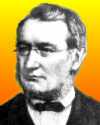
Robert Mayer
(25 Nov 1814 - 20 Mar 1878)
German physicist who had the idea of the conservation of energy before either Joule or Helmholtz and measured the mechanical equivalent of heat.
|
Julius Robert Mayer and
the Conservation of Energy
Excerpt from “The Century's Progress in Physics”
Harper's New Monthly Magazine (1897)
by Henry Smith Williams
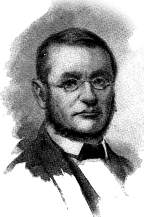
...In 1842, Dr. Julius Robert Mayer, practising physician in the little German town of Heilbronn, published a paper in Liebig's Annalen on “The Forces of Inorganic Nature,” in which not merely the mechanical theory of heat but the entire doctrine of the conservation of energy was explicitly if briefly stated. Two years earlier Dr. Mayer, while surgeon to a Dutch India vessel cruising in the tropics, had observed that the venous blood of a patient seemed redder than venous blood usually is observed to be in temperate climates. He pondered over this seemingly insignificant fact, and at last reached the conclusion that the cause must be the lesser amount of oxidation required to keep up the body temperature in the tropics. Led by this reflection to consider the body as a machine dependent on outside forces for its capacity to act, he passed on into a novel realm of thought, which brought him at last to independent discovery of the mechanical theory of heat, and to the first full and comprehensive appreciation of the great law of conservation. The great principle he had discovered became the dominating thought of his life, and filled all his leisure hours. He applied it to all the phenomena of the inorganic and organic worlds. It taught him that both vegetables and animals are machines, bound by the same laws that hold sway over inorganic matter, transforming energy, but creating nothing. Then his mind reached out into space and met a universe made up of questions. Each star that blinked down at him as he rode in answer to a night call seemed an interrogation point asking, How do I exist? Why have I not long since burned out, if your theory of conservation be true? No one hitherto had even tried to answer that question; few had so much as realized that it demanded an answer. But the Heilbronn physician understood the question and found an answer. His meteoric hypothesis, published in 1848, gave for the first time a tenable explanation of the persistent light and heat of our sun and the myriad other suns.
Yet for a long time his work attracted no attention whatever. In 1847, when another German physician, Hermann von Helmholtz, one of the most massive and towering intellects of any age, had been independently led to comprehension of the doctrine of conservation of energy, and published his treatise on the subject, he had hardly heard of his countryman Mayer. When he did hear of him, however, he hastened to renounce all claim to the doctrine of conservation, though the world at large gives him credit of independent even though subsequent discovery.
Meantime in England, Joule was going on from one experimental demonstration to another, oblivious of his German competitor, and almost as little noticed by his own countrymen. He read his first paper before the chemical section of the British Association for the Advancement of Science in 1843, and no one heeded it in the least. Two years later he wished to read another paper, but the chairman hinted that time was limited, and asked him to confine himself to a brief verbal synopsis of the results of his experiments. Had the chairman but known it, he was curtailing a paper vastly more important than all the other papers of the meeting put together. However, the synopsis was given, and one man was there to hear it who had the genius to appreciate its importance. This was William Thomson, the present Lord Kelvin, now known to all the world as among the greatest of natural philosophers, but then only a novitiate in science. He came to Joule's aid, started rolling the ball of controversy, and subsequently associated himself with the Manchester experimenter in pursuing his investigations.
But meantime the acknowledged leaders of British science viewed the new doctrine askance. Faraday, Brewster, Herschel – those were the great names in physics at that day, and no one of them could quite accept the new views regarding energy. For several years no older physicist, speaking with recognized authority, came forward in support of the doctrine of conservation. This culminating thought of our first half-century came silently into the world, unheralded and unopposed. The fifth decade of the century had seen it elaborated and substantially demonstrated in at least three different countries, yet even the leaders of thought did not so much as know of its existence. In 1853, Whewell, the historian of the inductive sciences, published a second edition of his history, and, as Huxley has pointed out, he did not so much as refer to the revolutionizing thought which even then was a full decade old.
The gradual permeation of the field by the great doctrine of conservation simply repeated the history of the introduction of every novel and revolutionary thought. Necessarily the elder generation, to whom all forms of energy were imponderable fluids, must pass away before the new conception could claim the field. Even the word energy, though Young had introduced it in 1807, did not come into general use till some time after the middle of the century. To the generality of philosophers (the word physicist was even less in favor at this time) the various forms of energy were still subtle fluids, and never was idea relinquished with greater unwillingness than this.
- Science Quotes by Robert Mayer.
- 25 Nov - short biography, births, deaths and events on date of Mayer's birth.
- Robert Mayer and the Conservation of Energy, by Kenneth L. Caneva. - book suggestion.





