 (source)
|
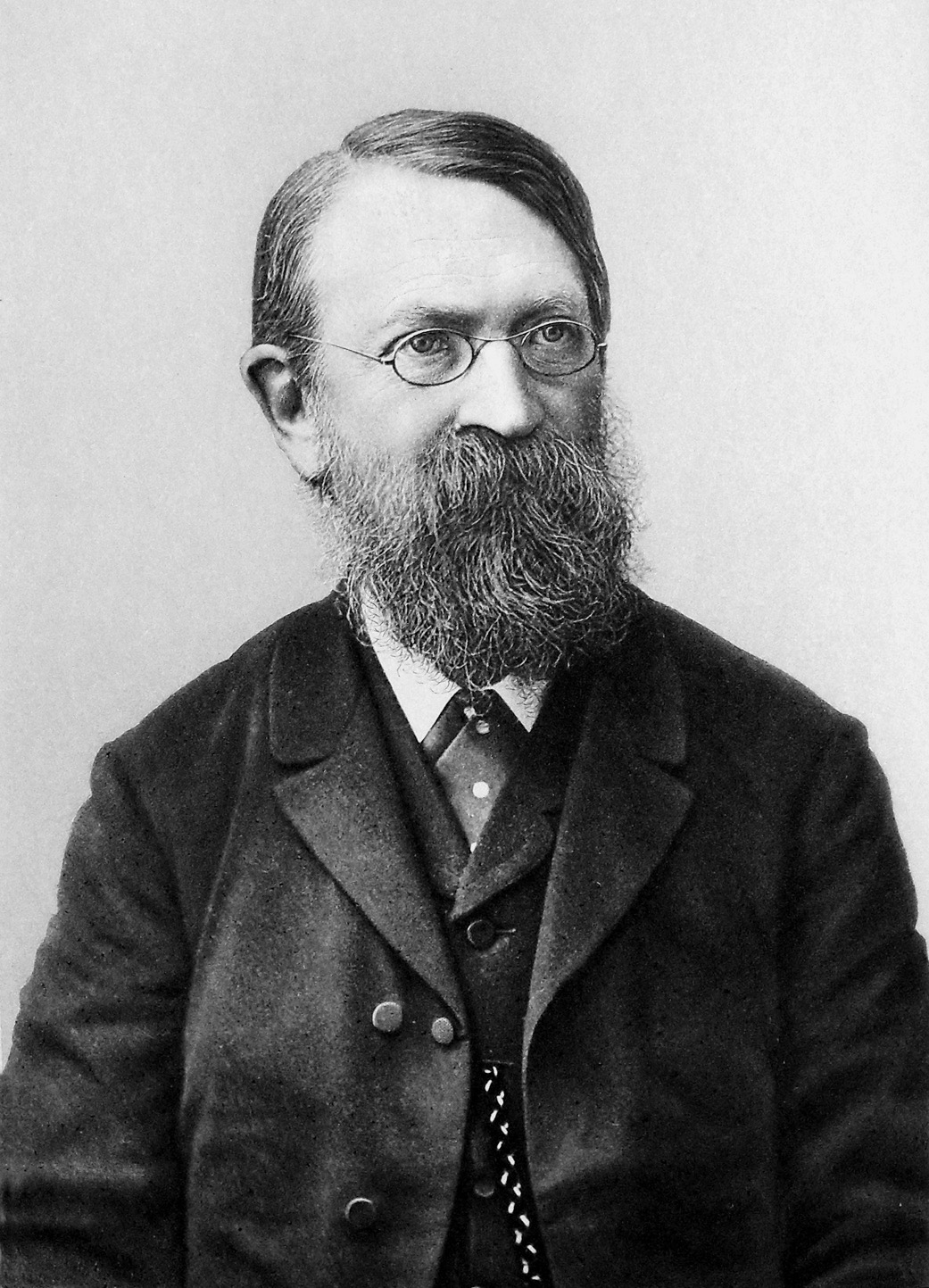
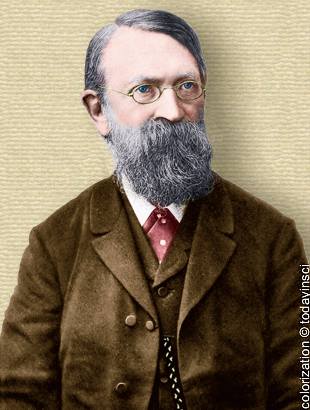
Ernst Mach
(18 Feb 1838 - 19 Feb 1916)
Austrian physicist and philosopher who established important principles of optics, mechanics, and wave dynamics. He introduced the “Mach number” for the ratio of speed of object to speed of sound is named for him.
|
Science Quotes by Ernst Mach (26 quotes)
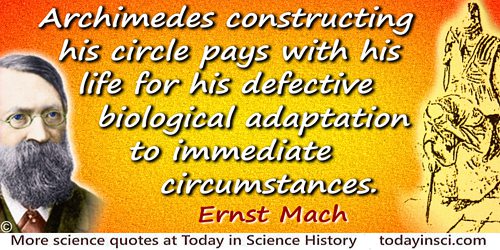
Archimedes constructing his circle pays with his life for his defective biological adaptation to immediate circumstances.
— Ernst Mach
In Ernst Mach and Thomas J. McCormack, Knowledge and Error: Sketches on the Psychology of Enquiry (1976, 2012), Chap. 4, 45. First published in German as Erkenntnis und Irrtum (1905). Translated from 5th edition (1926). The context is the legend that Archimedes was too engrossed in his work to pay attention to an invading Roman soldier, who killed him.
Atoms and molecules … from their very nature can never be made the objects of sensuous contemplation.
— Ernst Mach
In Ernst Mach and Thomas J. McCormack (trans.), 'Space and Geometry from the Point of View of Physical Inquiry', Space and Geometry in the Light of Physiological, Psychological and Physical Inquiry (1906), 138. Originally written as an article for The Monist (1 Oct 1903), 14, No. 1, Mach believed the realm of science should include only phenomena directly observable by the senses, and rejected theories of unseeable atomic orbitals.
Have you ever seen one?
— Ernst Mach
About the electron. As Mach called out from the audience, in German (“Hab’s aans g’sehn?”), at one of Ludwig Boltzmann’s lectures on atoms. This was Mach’s frequent retort upon any mention of the atom having electron orbits. He was a fierce critic and held that science should stick to only phenomena directly observable by the senses. This quote is seen widely, without citation. For example, in Daniel Greenberger, Klaus Hentschel and Friedel Weinert, Compendium of Quantum Physics: Concepts, Experiments, History and Philosophy (2009), 615.
I can accept the theory of relativity as little as I can accept the existence of atoms and other such dogmas.
— Ernst Mach
Professor of Physics at the University of Vienna, 1913, in The Book of Heroic Failures by Stephen Pile (1979).
I once knew an otherwise excellent teacher who compelled his students to perform all their demonstrations with incorrect figures, on the theory that it was the logical connection of the concepts, not the figure, that was essential.
— Ernst Mach
In Ernst Mach and Thomas Joseph McCormack, Space and Geometry (1906), 93.
If all the individual facts, all the individual phenomena, were directly accessible to us, as we ask for the knowledge of them; no science would ever have arisen.
— Ernst Mach
English translation by Webmaster from the original German, “Wenn uns alle einzelnen Thatsachen, alle einzelnen Erscheinungen unmittelbar zugänglich wären, so wie wir nach der Kenntniss derselben verlangen; so wäre nie eine Wissenschaft entstanden.” In Die Geschichte und die Wurzel des Satzes von der Erhaltung der Arbeit (1872), 30-31. Also found translated as “If all single facts, all separate phenomena, were as directly accessible to us as we demand that knowledge of them to be; science would never have arisen,” in Ernst Cassirer, The Problem of Knowledge: Philosophy, Science, and History since Hegel (1950), 108. Citing from
In nature there is no law of refraction, only different cases of refraction. The law of refraction is a concise compendious rule, devised by us for the mental reconstruction of a fact.
— Ernst Mach
In The Science of Mechanics (1893), 485-486.
In speaking of cause and effect we arbitrarily give relief to those elements to whose connection we have to attend … in the respect in which it is important to us. [But t]here is no cause nor effect in nature; nature has but an individual existence; nature simply is.
— Ernst Mach
In The Science of Mechanics (1893), 483.
It is the object of science to replace, or save, experiences, by the reproduction and anticipation of facts in thought. Memory is handier than experience, and often answers the same purpose. This economical office of science, which fills its whole life, is apparent at first glance; and with its full recognition all mysticism in science disappears.
— Ernst Mach
In 'The Economy of Science', The Science of Mechanics: A Critical and Historical Exposition of Its Principles (1893), 4.
It is utterly beyond our power to measure the changes of things by time. Quite the contrary, time is an abstraction, at which we arrive by means of the changes of things; made because we are not restricted to any one definite measure, all being interconnected.
— Ernst Mach
In Ernst Mach and Thomas J. McCormack (trans.), The Science of Mechanics: A Critical and Historical Exposition of Its Principles (1893), 224.
It would not become physical science to see in its self created, changeable, economical tools, molecules and atoms, realities behind phenomena... The atom must remain a tool for representing phenomena.
— Ernst Mach
'The Economical Nature of Physics' (1882), in Popular Scientific Lectures, trans. Thomas J. McConnack (1910), 206-7.
Of all the concepts which the natural inquirer employs, the simplest are the concepts of space and time.
— Ernst Mach
In Ernst Mach and Thomas J. McCormack (trans.), 'Space and Geometry from the Point of View of Physical Inquiry', Space and Geometry in the Light of Physiological, Psychological and Physical Inquiry (1906), 137. Originally written as an article for The Monist (1 Oct 1903), 14, No. 1, Mach believed the realm of science should include only phenomena directly observable by the senses, and rejected theories of unseeable atomic orbitals.
Physics is experience, arranged in economical order.
— Ernst Mach
'The Economical Nature of Physics' (1882), in Popular Scientific Lectures, trans. Thomas J. McConnack (1910), 197.
Recurrences of like cases in which A is always connected with B, that is, like results under like circumstances, that is again, the essence of the connection of cause and effect, exist but in the abstraction which we perform for the purpose of mentally reproducing the facts. Let a fact become familiar, and we no longer require this putting into relief of its connecting marks, our attention is no longer attracted to the new and surprising, and we cease to speak of cause and effect.
— Ernst Mach
In The Science of Mechanics (1893), 483.
Science itself, therefore, may be regarded as a minimal problem, consisting of the completest possible presentment of facts with the least possible expenditure of thought.
— Ernst Mach
Ernst Mach and Thomas Joseph McCormick (trans.), The Science of Mechanics: a Critical and Historical Account of its Development (1919), 490.
Strange as it may sound, the power of mathematics rests on its evasion of all unnecessary thought and on its wonderful saving of mental operations.
— Ernst Mach
As quoted, without source, in E.T. Bell, Men of Mathematics (1937), Vol. 1, l (Roman numeral 'l').
That scientific work should be more useful the more it has been used, while mechanical work is expended in use, may seem strange to us.
— Ernst Mach
From 'The Economy of Science' in The Science of Mechanics: A Critical and Historical Exposition of its Principles (1893), 488.
The aim of natural science is to obtain connections among phenomena. Theories, however, are like withered leaves, which drop off after having enabled the organism of science to breathe for a time.
— Ernst Mach
As quoted in Philipp Frank, Modern Science and its Philosophy (1949), 62, which cites Die Geschichte und die Wurzel des Satzes von der Erhaltung der Arbeit (1871) and English translation, History and Root of the Principle of the Conservation of Energy (1911).
The aim of research is the discovery of the equations which subsist between the elements of phenomena.
— Ernst Mach
In Popular Scientific Lectures (1910), 205.
The mathematician who pursues his studies without clear views of this matter, must often have the uncomfortable feeling that his paper and pencil surpass him in intelligence.
— Ernst Mach
From 'The Economy of Science' in The Science of Mechanics: A Critical and Historical Exposition of its Principles (1893), 489.
The mechanical speculations of the ancients, particularly of the Greeks, related wholly to statics. Dynamics was founded by Galileo.
— Ernst Mach
In The Science of Mechanics (1893), 128.
The student of mathematics often finds it hard to throw off the uncomfortable feeling that his science, in the person of his pencil, surpasses him in intelligence,—an impression which the great Euler confessed he often could not get rid of. This feeling finds a sort of justification when we reflect that the majority of the ideas we deal with were conceived by others, often centuries ago. In a great measure it is really the intelligence of other people that confronts us in science.
— Ernst Mach
In Popular Scientific Lectures (1910), 196.
They that know the entire course of the development of science will … judge more freely and more correctly of the significance of any present scientific movement than they who, limited in their views to the age in which their own lives have been spent, contemplate merely the momentary trend that the course of intellectual events takes at the present moment.
— Ernst Mach
In Ernst Mach and Thomas J.McCormack (trans.), The Science of Mechanics (1902), 7. As cited in George Sarton, 'The History of Science', The Monist (Jul 1916), 26, No. 3, 349.
Thought experiment is in any case a necessary precondition for physical experiment. Every experimenter and inventor must have the planned arrangement in his head before translating it into fact.
— Ernst Mach
'On Thought Experiments' (1897), in Erwin H. Hiebert (ed.), Erkenntnis und Irrtum (1905), trans. Thomas J. McCormack and Paul Foulkes (1976), 184.
Thought-economy is most highly developed in mathematics, that science which has reached the highest formal development, and on which natural science so frequently calls for assistance. Strange as it may seem, the strength of mathematics lies in the avoidance of all unnecessary thoughts, in the utmost economy of thought-operations. The symbols of order, which we call numbers, form already a system of wonderful simplicity and economy. When in the multiplication of a number with several digits we employ the multiplication table and thus make use of previously accomplished results rather than to repeat them each time, when by the use of tables of logarithms we avoid new numerical calculations by replacing them by others long since performed, when we employ determinants instead of carrying through from the beginning the solution of a system of equations, when we decompose new integral expressions into others that are familiar,—we see in all this but a faint reflection of the intellectual activity of a Lagrange or Cauchy, who with the keen discernment of a military commander marshalls a whole troop of completed operations in the execution of a new one.
— Ernst Mach
In Populär-wissenschafliche Vorlesungen (1903), 224-225.
To us investigators, the concept ‘soul’ is irrelevant and a matter for laughter. But matter is an abstraction of exactly the same kind, just as good and just as bad as it is. We know as much about the soul as we do of matter.
— Ernst Mach
'Die Geschichte und die Wurzel des Satzes von der Erhaltung der Arbeit' (1872). Trans. Philip E. Jourdain, History and Root of the Principle of the Conservation of Energy (1911), 48.
Quotes by others about Ernst Mach (2)
I even believe that those who consider themselves to be opponents of Mach barely know how many of his views they absorbed, in a manner of speaking, with their mother’s milk.
Translation from obituary, 'Ernst Mach', Physikalische Zeitschrift (1 Apr 1916), 102. Einstein was pointing out how Mach as a science philosopher had influenced and continued to exert upon generations of physicists. Originally written in German, the subject quote is a translation into English. There are slight variations in wording in other translations. For example: “I believe that even those who consider themselves opponents of Mach are hardly aware of how much of Mach’s way of thinking they imbibed, so to speak, with their mother’s milk.” From the original German text: “Ich glaube sogar, daß diejenigen, welche sich für Gegner Machs halten, kaum wissen, wieviel von Machscher Betrachtungsweise sie sozusagen mit der Muttermilch eingesogen haben.”
Science is, according to Mach, nothing but the comparison and orderly arrangement of factually given contents of our consciousness, in accord with certain gradually acquired points of view and methods. Therefore, physics and psychology differ from each other not so much in the subject matter, but rather only in the points of view of the arrangement and connection of the various topics.
Translation from obituary, 'Ernst Mach', Physikalische Zeitschrift (1 Apr 1916), 102. From the original German text: “Nach Mach ist Wissenschaft nichts anderes, als Vergleichung und Ordnung der uns tatsächlich gegebenen Bewußtseinsinhalte nach gewissen, von uns allmählich ertasteten Gesichtspunkten und Methoden. Physik und Psychologie unterscheiden sich also voneinander nicht in dem Gegenstände, sondern nur in den Gesichtspunkten der Anordnung und Verknüpfung des Stoffes.”
See also:
- 18 Feb - short biography, births, deaths and events on date of Mach's birth.
- Space and Geometry: In the Light of Physiological, Psychological and Physical Inquiry, by Ernst Mach. - book suggestion.
 In science it often happens that scientists say, 'You know that's a really good argument; my position is mistaken,' and then they would actually change their minds and you never hear that old view from them again. They really do it. It doesn't happen as often as it should, because scientists are human and change is sometimes painful. But it happens every day. I cannot recall the last time something like that happened in politics or religion.
(1987) --
In science it often happens that scientists say, 'You know that's a really good argument; my position is mistaken,' and then they would actually change their minds and you never hear that old view from them again. They really do it. It doesn't happen as often as it should, because scientists are human and change is sometimes painful. But it happens every day. I cannot recall the last time something like that happened in politics or religion.
(1987) --