 (source)
|
John Lubbock (Lord Avebury)
(30 Apr 1834 - 28 May 1913)
English banker, politician, naturalist and archaeologist who coined the terms Neolithic and Paleolithic.
|
Science Quotes by John Lubbock (Lord Avebury) (25 quotes)
>> Click for John Lubbock (Lord Avebury) Quotes on | Education |
>> Click for John Lubbock (Lord Avebury) Quotes on | Education |
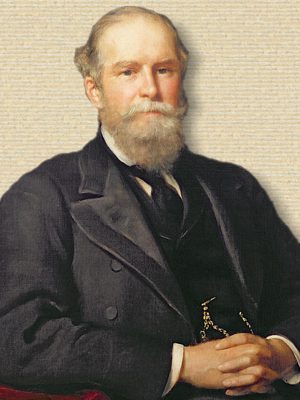
A day of worry is more exhausting than a week of work.
— John Lubbock (Lord Avebury)
The Use of Life (1895), 212.

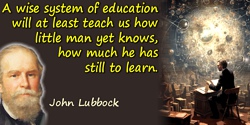
A wise system of education will at least teach us how little man yet knows, how much he has still to learn.
— John Lubbock (Lord Avebury)
The Pleasures of Life (Appleton, 1887), 132, or (2007), 73.
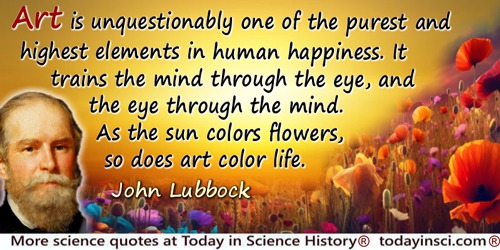
Art is unquestionably one of the purest and highest elements in human happiness. It trains the mind through the eye, and the eye through the mind. As the sun colors flowers, so does art color life.
— John Lubbock (Lord Avebury)
The Pleasures of Life (1887, 2007), 99.
Deprived, therefore, as regards this period, of any assistance from history, but relieved at the same time from the embarrassing interference of tradition, the archaeologist is free to follow the methods which have been so successfully pursued in geology—the rude bone and stone implements of bygone ages being to the one what the remains of extinct animals are to the other. The analogy may be pursued even further than this. Many mammalia which are extinct in Europe have representatives still living in other countries. Our fossil pachyderms, for instance, would be almost unintelligible but for the species which still inhabit some parts of Asia and Africa; the secondary marsupials are illustrated by their existing representatives in Australia and South America; and in the same manner, if we wish clearly to understand the antiquities of Europe, we must compare them with the rude implements and weapons still, or until lately, used by the savage races in other parts of the world. In fact, the Van Diemaner and South American are to the antiquary what the opossum and the sloth are to the geologist.
— John Lubbock (Lord Avebury)
Pre-historic Times, as Illustrated by Ancient Remains, and the Manners and Customs of Modern Savages, (2nd ed. 1869, 1890), 429-430.
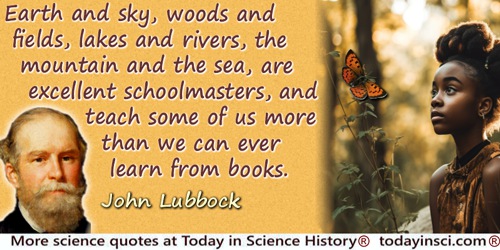
Earth and sky, woods and fields, lakes and rivers, the mountain and the sea, are excellent schoolmasters, and teach some of us more than we can ever learn from books.
— John Lubbock (Lord Avebury)
The Use of Life (1895), 70 or (2005), 66.
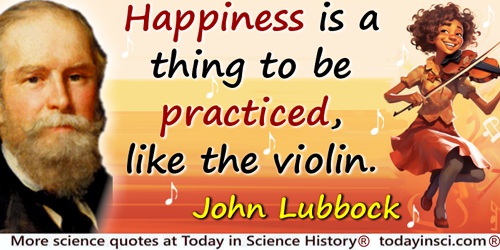
Happiness is a thing to be practiced, like the violin.
— John Lubbock (Lord Avebury)
The Use of Life (1895, 2005), 247.
I cannot, however, but think that the world would be better and brighter if our teachers would dwell on the Duty of Happiness as well as the Happiness of Duty; for we ought to be as cheerful as we can, if only because to be happy ourselves is a most effectual contribution to the happiness of others.
— John Lubbock (Lord Avebury)
The Pleasures of Life (1887, 2007), 7.
If we are ever in doubt what to do, it is a good rule to ask ourselves what we shall wish on the morrow that we had done.
— John Lubbock (Lord Avebury)
The Pleasures of Life (1887, 2007), 21.
If we succeed in giving the love of learning, the learning itself is sure to follow.
— John Lubbock (Lord Avebury)
The Pleasures of Life (1887, 2007), 73.
In truth, people can generally make time for what they choose to do; it is not really the time but the will that is wanting
— John Lubbock (Lord Avebury)
The Pleasures of Life (1887, 2007), 44.
Our ambition should be to rule ourselves, the true kingdom for each one of us; and true progress is to know more, and be more, and to do more.
— John Lubbock (Lord Avebury)
The Use of Life (1895, 1923), 260.
Our duty is to believe that for which we have sufficient evidence, and to suspend our judgment when we have not.
— John Lubbock (Lord Avebury)
The Use of Life (1895), 225.
Our great mistake in education is ... the worship of book-learning—the confusion of instruction and education. We strain the memory instead of cultivating the mind. … We ought to follow exactly the opposite course with children—to give them a wholesome variety of mental food, and endeavour to cultivate their tastes, rather than to fill their minds with dry facts.
— John Lubbock (Lord Avebury)
The Pleasures of Life (Appleton, 1887), 183-184, or (2007), 71.
Rest is not idleness, and to lie sometimes on the grass under trees on a summer’s day, listening to the murmur of the water, or watching the clouds float across the sky, is by no means a waste of time.
— John Lubbock (Lord Avebury)
In The Use of Life (1895), 66.
Savages have often been likened to children, and the comparison is not only correct but also highly instructive. Many naturalists consider that the early condition of the individual indicates that of the race,—that the best test of the affinities of a species are the stages through which it passes. So also it is in the case of man; the life of each individual is an epitome of the history of the race, and the gradual development of the child illustrates that of the species.
— John Lubbock (Lord Avebury)
Pre-historic Times, as Illustrated by Ancient Remains, and the Manners and Customs of Modern Savages, (2nd. ed. 1869, 1878), 583.

Sunsets are so beautiful that they almost seem as if we were looking through the gates of Heaven.
— John Lubbock (Lord Avebury)
The Use of Life (1895), 72.
The important thing is not so much that every child should be taught, as that every child should have the opportunity of teaching itself. What does it matter if the pupil know a little more or a little less? A boy who leaves school knowing much, but hating his lessons, will soon have forgotten all he ever learned; while another who had acquired a thirst for knowledge, even if he had learned little, would soon teach himself more than the first ever knew.
— John Lubbock (Lord Avebury)
[Elementary Education, Revised New Code (1871), Resolution.] Hansard's Parliamentary Debates (19 Jul 1872), vol. 207, 1463. Also in The Pleasures of Life (2007), 71.(Appleton, 1887), 183-184, or (2007), 71.
The whole value of solitude depends upon oneself; it may be a sanctuary or a prison, a haven of repose or a place of punishment, a heaven or a hell, as we ourselves make it.
— John Lubbock (Lord Avebury)
On Peace and Happiness (1909), 188.
We often hear of people breaking down from overwork, but in nine cases out of ten they are really suffering from worry or anxiety.
— John Lubbock (Lord Avebury)
The Pleasures of Life (1887, 2007), 13.
What we do see depends mainly on what we look for. ... In the same field the farmer will notice the crop, the geologists the fossils, botanists the flowers, artists the colouring, sportmen the cover for the game. Though we may all look at the same things, it does not all follow that we should see them.
— John Lubbock (Lord Avebury)
The Beauties of Nature (1893, 2009), 12.
What we see depends mainly on what we look for.
— John Lubbock (Lord Avebury)
In The Beauties of Nature (1893, 2009), 12. This is (slightly paraphrased) part of a longer quote on the John Lubbock Quotations page that begins, “What we do see depends…”.
When important decisions have to be taken, the natural anxiety to come to a right decision will often keep us awake. Nothing, however, is more conducive to healthful sleep than plenty of open air.
— John Lubbock (Lord Avebury)
The Pleasures of Life (1887, 2007), 87.
When we have done our best, we should wait the result in peace.
— John Lubbock (Lord Avebury)
The Pleasures of Life (1887, 2007), 18.
Where the untrained eye will see nothing but mire and dirt, Science will often reveal exquisite possibilities. The mud we tread under our feet in the street is a grimy mixture of clay and sand, soot and water. Separate the sand, however, as Ruskinn observes—let the atoms arrange themselves in peace according to their nature—and you have the opal. Separate the clay, and it becomes a white earth, fit for the finest porcelain; or if it still further purifies itself, you have a sapphire. Take the soot, and it properly treated it will give you a diamond. While lastly, the water, purified and distilled, will become a dew-drop, or crystallize into a lovely star. Or, again, you may see as you will in any shallow pool either the mud lying at the bottom, or the image of the heavens above.
— John Lubbock (Lord Avebury)
The Pleasures of Life (1887, 2007), 63.
Your character will be what you yourself choose to make it.
— John Lubbock (Lord Avebury)
The Use of Life (1895), 252.
Quotes by others about John Lubbock (Lord Avebury) (1)
The one who stays in my mind as the ideal man of science is, not Huxley or Tyndall, Hooker or Lubbock, still less my friend, philosopher and guide Herbert Spencer, but Francis Galton, whom I used to observe and listen to—I regret to add, without the least reciprocity—with rapt attention. Even to-day. I can conjure up, from memory’s misty deep, that tall figure with its attitude of perfect physical and mental poise; the clean-shaven face, the thin, compressed mouth with its enigmatical smile; the long upper lip and firm chin, and, as if presiding over the whole personality of the man, the prominent dark eyebrows from beneath which gleamed, with penetrating humour, contemplative grey eyes. Fascinating to me was Francis Galton’s all-embracing but apparently impersonal beneficence. But, to a recent and enthusiastic convert to the scientific method, the most relevant of Galton’s many gifts was the unique contribution of three separate and distinct processes of the intellect; a continuous curiosity about, and rapid apprehension of individual facts, whether common or uncommon; the faculty for ingenious trains of reasoning; and, more admirable than either of these, because the talent was wholly beyond my reach, the capacity for correcting and verifying his own hypotheses, by the statistical handling of masses of data, whether collected by himself or supplied by other students of the problem.
In My Apprenticeship (1926), 134-135.

See also:
- 30 Apr - short biography, births, deaths and events on date of Lubbock (Lord Avebury)'s birth.
- Ants, Bees, and Wasps: A Record of Observations, by John Lubbock. - book suggestion.
 In science it often happens that scientists say, 'You know that's a really good argument; my position is mistaken,' and then they would actually change their minds and you never hear that old view from them again. They really do it. It doesn't happen as often as it should, because scientists are human and change is sometimes painful. But it happens every day. I cannot recall the last time something like that happened in politics or religion.
(1987) --
In science it often happens that scientists say, 'You know that's a really good argument; my position is mistaken,' and then they would actually change their minds and you never hear that old view from them again. They really do it. It doesn't happen as often as it should, because scientists are human and change is sometimes painful. But it happens every day. I cannot recall the last time something like that happened in politics or religion.
(1987) -- 




