 (source)
|
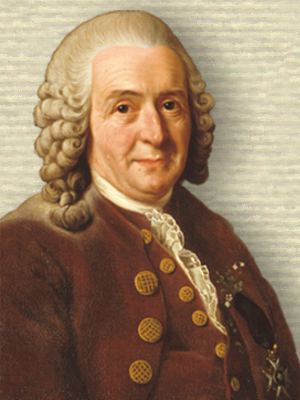
Carolus Linnaeus
(23 May 1707 - 10 Jan 1778)
Swedish botanist and explorer who established the first precise biological classification, with a uniform system for naming organisms by genera and species of organisms.
|
Science Quotes by Carolus Linnaeus (23 quotes)
>> Click for Carolus Linnaeus Quotes on | Animal | Classification | Genus | Species |
>> Click for Carolus Linnaeus Quotes on | Animal | Classification | Genus | Species |
Temporis fila.
Child of time.
A favourite expression of Linnaeus.
Child of time.
A favourite expression of Linnaeus.
— Carolus Linnaeus
Quoted in Tore Frängsmyr, 'Linnaeus as a Geologist', in Tore Frangsmyr (ed.), Linnaeus: The Man and his Work (1983), 143.
A herbarium is better than any illustration; every botanist should make one.
— Carolus Linnaeus
Philosophia Botanica (1751), aphorism 11. Trans. Frans A. Statfleu, Linnaeus and the Linnaeans: The Spreading of their Ideas in Systematic Botany, 1735-1789 (1971), 38.
A practical botanist will distinguish, at the first glance, the plant of different quarters of the globe, and yet will be at a loss to tell by what mark he detects them. There is, I know not what look—sinister, dry, obscure, in African plants; superb and elevated in the Asiatic; smooth and cheerful in the American; stunted and indurated in the Alpine.
— Carolus Linnaeus
Quoted in William Whewell, History of the Inductive Sciences (1847), Vol. 3, 355-356, citing ‘Philosophia Botanica’ (1751), 171.
All the species recognized by Botanists came forth from the Almighty Creator’s hand, and the number of these is now and always will be exactly the same, while every day new and different florists’ species arise from the true species so-called by Botanists, and when they have arisen they finally revert to the original forms. Accordingly to the former have been assigned by Nature fixed limits, beyond which they cannot go: while the latter display without end the infinite sport of Nature.
— Carolus Linnaeus
In Philosophia Botanica (1751), aphorism 310. Trans. Frans A. Stafleu, Linnaeus and the Linnaeans: The Spreading of their Ideas in Systematic Botany, 1735-1789 (1971), 90.
Botany is based on fixed genera.
— Carolus Linnaeus
Philosophia Botanica (1751), aphorism 209. Trans. Frans A. Stafleu, Linnaeus and the Linnaeans: The Spreading of their Ideas in Systematic Botany, 1735-1789 (1971), 64.
Fragments of the natural method must be sought with the greatest care. This is the first and last desideratum among botanists.
Nature makes no jumps.
[Natura non facit saltus]
All taxa show relationships on all sides like the countries on a map of the world.
Nature makes no jumps.
[Natura non facit saltus]
All taxa show relationships on all sides like the countries on a map of the world.
— Carolus Linnaeus
Philosophia Botanica (1751), aphorism 77. Trans. Frans A. Stafleu, Linnaeus and the Linnaeans: The Spreading of their Ideas in Systematic Botany, 1735-1789 (1971), 45.
Human beings, having, above all creatures, received the power of reason… need to be aware where nature is unaware. Nature reaches its culmination in humans, but human consciousness has not its essence in itself or nature.
— Carolus Linnaeus
As quoted in Carl Reinhold Bråkenhielm (ed.), Linnaeus and Homo Religiosus: Biological Roots of Religious Awareness & Human Identity" (2009), 83.
I well know what a spendidly great difference there is [between] a man and a bestia when I look at them from a point of view of morality. Man is the animal which the Creator has seen fit to honor with such a magnificent mind and has condescended to adopt as his favorite and for which he has prepared a nobler life; indeed, sent out for its salvation his only son; but all this belongs to another forum; it behooves me like a cobbler to stick to my last, in my own workshop, and as a naturalist to consider man and his body, for I know scarcely one feature by which man can be distinguished from apes, if it be not that all the apes have a gap between their fangs and their other teeth, which will be shown by the results of further investigation.
— Carolus Linnaeus
T. Fredbärj (ed.), Menniskans Cousiner (Valda Avhandlingar av Carl von Linné nr, 21) (1955), 4. Trans. Gunnar Broberg, 'Linnaeus's Classification of Man', in Tore Frängsmyr (ed.), Linnaeus: The Man and his Work (1983), 167.
In natural science the principles of truth ought to be confirmed by observation.
— Carolus Linnaeus
Philosophia Botanica (1751), final sentence. Trans. Frans A. Stafleu, Linnaeus and the Linneans: The Spreading of their Ideas in Systematic Botany, 1735-1789 (1971), 31.
Natural bodies are divided into three kingdoms of nature: viz. the mineral, vegetable, and animal kingdoms. Minerals grow, Plants grow and live, Animals grow, live, and have feeling.
— Carolus Linnaeus
'Observations on the Three Kingdoms of Nature', Nos 14-15. Systema Naturae (1735). As quoted (translated) in Étienne Gilson, From Aristotle to Darwin and Back Again: A Journey in Final Causality (2009), 42-43.
Nature does not make jumps.
— Carolus Linnaeus
In Philosophia Botanica (1751).
Nature's economy shall be the base for our own, for it is immutable, but ours is secondary. An economist without knowledge of nature is therefore like a physicist without knowledge of mathematics.
— Carolus Linnaeus
'Tankar om grunden til oeconomien', 1740, 406. Trans. Lisbet Koerner, Linnaeus: Nature and Nation (1999), 103.
Nomenclature, the other foundation of botany, should provide the names as soon as the classification is made... If the names are unknown knowledge of the things also perishes... For a single genus, a single name.
— Carolus Linnaeus
Philosophia Botanica (1751), aphorism 210. Trans. Frans A. Stafleu, Linnaeus and the Linnaeans: The Spreading of their Ideas in Systematic Botany, 1735-1789 (1971), 80.
Of what use are the great number of petrifactions, of different species, shape and form which are dug up by naturalists? Perhaps the collection of such specimens is sheer vanity and inquisitiveness. I do not presume to say; but we find in our mountains the rarest animals, shells, mussels, and corals embalmed in stone, as it were, living specimens of which are now being sought in vain throughout Europe. These stones alone whisper in the midst of general silence.
— Carolus Linnaeus
Philosophia Botanica (1751), aphorism 132. Trans. Frans A. Stafleu, Linnaeus and the Linnaeans: The Spreading of their Ideas in Systematic Botany, 1735-1789 (1971), 56.
Stones grow, plants grow, and live, animals grow live and feel.
— Carolus Linnaeus
Philosophia Botanica (1751), Introduction 1-4. Trans. Frans A. Statleu, Linnaeus and the Linnaeans: The Spreading of their Ideas in Systematic Botany, 1735-1789 (1971), 33.
The species and the genus are always the work of nature [i.e. specially created]; the variety mostly that of circumstance; the class and the order are the work of nature and art.
— Carolus Linnaeus
Philosophia Botanica (1751), aphorism 162. Trans. Frans A. Statfleu, Linnaeus and the Linnaeans: The Spreading of their Ideas in Systematic Botany, 1735-1789 (1971), 67.
The first step in wisdom is to know the things themselves; this notion consists in having a true idea of the objects; objects are distinguished and known by classifying them methodically and giving them appropriate names. Therefore, classification and name-giving will be the foundation of our science.
— Carolus Linnaeus
Systema Naturae (1735), trans. M. S. J. Engel-Ledeboer and H. Engel (1964), 19.
The names of the plants ought to be stable [certa], consequently they should be given to stable genera.
— Carolus Linnaeus
Philosophia Botanica (1751), aphorism 151. Trans. Frans A. Stafleu, Linnaeus and the Linnaeans: The Spreading of their Ideas in Systematic Botany, 1735-1789 (1971), 57.
There are as many species as the infinite being created diverse forms in the beginning, which, following the laws of generation, produced many others, but always similar to them: therefore there are as many species as we have different structures before us today.
— Carolus Linnaeus
Philosophia Botanica (1751), aphorism 157. Trans. Frans A. Stafleu, Linnaeus and the Linneans: The Spreading of their Ideas in Systematic Botany, 1735-1789 (1971), 63.
There are some viviparous flies, which bring forth 2,000 young. These in a little time would fill the air, and like clouds intercept the rays of the sun, unless they were devoured by birds, spiders, and many other animals.
— Carolus Linnaeus
Oeconomia Naturae, The Oeconomy of Nature. Trans Benjamin Stillingfleet, Miscellaneous Tracts Relating to Natural History (1775), revised edition, 1777, 119.
There is no generation from an egg in the Mineral Kingdom. Hence no vascular circulation of the humours as in the remaining Natural Kingdoms.
— Carolus Linnaeus
Systema Naturae (1735), trans. M. S. J. Engel-Ledeboer and H. Engel (1964), 20.
We admit as many genera as there are different groups of natural species of which the fructification has the same structure.
— Carolus Linnaeus
Fundamenta Botanica (1736), 159. Trans. Gunnar Eriksson, 'Linnaeus the Botanist', in Tore Frängsmyr (ed.), Linnaeus: The Man and his Work (1983), 86.
Yet man does recognise himself [as an animal]. But I ask you and the whole world for a generic differentia between man and ape which conforms to the principles of natural history, I certainly know of none... If I were to call man ape or vice versa, I should bring down all the theologians on my head. But perhaps I should still do it according to the rules of science.
— Carolus Linnaeus
Letter to Johann Gmelon (14 Jan 1747), quoted in Mary Gribbin, Flower Hunters (2008), 56.
Quotes by others about Carolus Linnaeus (13)
God created, Linnaeus ordered.
Quoting the witticism current in the late eighteenth century in 'The Two Faces of Linnaeus', in Tore Frängsmyr (ed.), Linnaeus: The Man and his Work (1983), 22.
Linnaeus had it constantly in mind:“The closer we get to know the creatures around us, the clearer is the understanding we obtain of the chain of nature, and its harmony and system, according to which all things appear to have been created.”
In 'The Two Faces of Linnaeus', in Tore Frängsmyr (ed.), Linnaeus: The Man and his Work (1983, 1994), 16. Quoted in David Weinberger, Everything is Miscellaneous (2007), 241.
God's Registrar.
[Referring to Carolus Linnaeus, who is also known as Father of Taxonomy.]
[Referring to Carolus Linnaeus, who is also known as Father of Taxonomy.]
In Heinz Goerke Linnaeus (1966) trans. by Denver Lindley (1973), 89, Title of Chapter 8.
Linnaeus and Cuvier have been my two gods, though in very different ways, but
they were mere schoolboys to old Aristotle.
Letter to W. Ogle (22 Feb 1882). In Charles Darwin and Francis Darwin (ed.), The Life and Letters of Charles Darwin (1896), 427.
The air of caricature never fails to show itself in the products of reason applied relentlessly and without correction. The observation of clinical facts would seem to be a pursuit of the physician as harmless as it is indispensable. [But] it seemed irresistibly rational to certain minds that diseases should be as fully classifiable as are beetles and butterflies. This doctrine … bore perhaps its richest fruit in the hands of Boissier de Sauvauges. In his Nosologia Methodica published in 1768 … this Linnaeus of the bedside grouped diseases into ten classes, 295 genera, and 2400 species.
In 'General Ideas in Medicine', The Lloyd Roberts lecture at House of the Royal Society of Medicine (30 Sep 1935), British Medical Journal (5 Oct 1935), 2, 609. In The Collected Papers of Wilfred Trotter, FRS (1941), 151.
Know thyself! This is the source of all wisdom, said the great thinkers of the past, and the sentence was written in golden letters on the temple of the gods. To know himself, Linnæus declared to be the essential indisputable distinction of man above all other creatures. I know, indeed, in study nothing more worthy of free and thoughtful man than the study of himself. For if we look for the purpose of our existence, we cannot possibly find it outside ourselves. We are here for our own sake.
As translated and quoted in Ernst Haeckel and E. Ray Lankester (trans.) as epigraph for Chap. 9, The History of Creation (1886), Vol. 1, 244.
Beware of old Linnaeus,
The Man of the Linden-tree,
So beautiful, bright and early
He brushed away the dews
He found the wicked wild-flowers
All courting there in twos.
The Man of the Linden-tree,
So beautiful, bright and early
He brushed away the dews
He found the wicked wild-flowers
All courting there in twos.
In 'Tycho Brahe', The Torch-Bearers: The Book of Earth (1925), Vol. 2, 174.
For Linnaeus, Homo sapiens was both special and not special ... Special and not special have come to mean nonbiological and biological, or nurture and nature. These later polarizations are nonsensical. Humans are animals and everything we do lies within our biological potential ... the statement that humans are animals does not imply that our specific patterns of behavior and social arrangements are in any way directly determined by our genes. Potentiality and determination are different concepts.
…...
Such men as Newton and Linnaeus are incidental, but august, teachers of religion.
In Essays: Education of the People.
The uncertain, unsettled condition of this science of Cetology is in the very vestibule attested by the fact, that in some quarters it still remains a moot point whether a whale be a fish. In his System of Nature, A.D. 1776, Linnæus declares, “I hereby separate the whales from the fish.” But of my own knowledge, I know that down to the year 1850, sharks and shads, alewives and herring, against Linnæus’s express edict, were still found dividing the possession of the same seas with the Leviathan.
The grounds upon which Linnæus would fain have banished the whales from the waters, he states as follows: “On account of their warm bilocular heart, their lungs, their movable eyelids, their hollow ears, penem intrantem feminam mammis lactantem,” and finally, “ex lege naturæ jure meritoque.” I submitted all this to my friends Simeon Macey and Charley Coffin, of Nantucket, both messmates of mine in a certain voyage, and they united in the opinion that the reasons set forth were altogether insufficient. Charley profanely hinted they were humbug.
The grounds upon which Linnæus would fain have banished the whales from the waters, he states as follows: “On account of their warm bilocular heart, their lungs, their movable eyelids, their hollow ears, penem intrantem feminam mammis lactantem,” and finally, “ex lege naturæ jure meritoque.” I submitted all this to my friends Simeon Macey and Charley Coffin, of Nantucket, both messmates of mine in a certain voyage, and they united in the opinion that the reasons set forth were altogether insufficient. Charley profanely hinted they were humbug.
In Moby Dick (1851, 1892), 128-129.
It is some systematised exhibition of the whale in his broad genera, that I would now fain put before you. Yet is it no easy task. The classification of the constituents of a chaos, nothing less is here essayed. Listen to what the best and latest authorities have laid down.
“No branch of Zoology is so much involved as that which is entitled Cetology,” says Captain Scoresby, A.D. 1820.
“It is not my intention, were it in my power, to enter into the inquiry as to the true method of dividing the cetacea into groups and families. * * * Utter confusion exists among the historians of this animal” (sperm whale), says Surgeon Beale. A. D. 1839.
“Unfitness to pursue our research in the unfathomable waters.” “Impenetrable veil covering our knowledge of the cetacea.” “A field strewn with thorns.” “All these incomplete indications but serve to torture us naturalists.”
Thus speak of the whale, the great Cuvier, and John Hunter, and Lesson, those lights of zoology and anatomy. Nevertheless, though of real knowledges there be little, yet of books there are plenty; and so in some small degree, with cetology, or the science of whales. Many are the men, small and great, old and new, landsmen and seamen, who have at large or in little, written of the whale. Run over a few:— The Authors of the Bible; Aristotle; Pliny; Aldrovandi; Sir Thomas Browne; Gesner; Ray; Linnæus; Rondeletius; Willoughby; Green; Artedi; Sibbald; Brisson; Marten; Lacépède; Bonneterre; Desmarest; Baron Cuvier; Frederick Cuvier; John Hunter; Owen; Scoresby; Beale; Bennett; J. Ross Browne; the Author of Miriam Coffin; Olmstead; and the Rev. T. Cheever. But to what ultimate generalising purpose all these have written, the above cited extracts will show.
Of the names in this list of whale authors, only those following Owen ever saw living whales; and but one of them was a real professional harpooner and whaleman. I mean Captain Scoresby.
“No branch of Zoology is so much involved as that which is entitled Cetology,” says Captain Scoresby, A.D. 1820.
“It is not my intention, were it in my power, to enter into the inquiry as to the true method of dividing the cetacea into groups and families. * * * Utter confusion exists among the historians of this animal” (sperm whale), says Surgeon Beale. A. D. 1839.
“Unfitness to pursue our research in the unfathomable waters.” “Impenetrable veil covering our knowledge of the cetacea.” “A field strewn with thorns.” “All these incomplete indications but serve to torture us naturalists.”
Thus speak of the whale, the great Cuvier, and John Hunter, and Lesson, those lights of zoology and anatomy. Nevertheless, though of real knowledges there be little, yet of books there are plenty; and so in some small degree, with cetology, or the science of whales. Many are the men, small and great, old and new, landsmen and seamen, who have at large or in little, written of the whale. Run over a few:— The Authors of the Bible; Aristotle; Pliny; Aldrovandi; Sir Thomas Browne; Gesner; Ray; Linnæus; Rondeletius; Willoughby; Green; Artedi; Sibbald; Brisson; Marten; Lacépède; Bonneterre; Desmarest; Baron Cuvier; Frederick Cuvier; John Hunter; Owen; Scoresby; Beale; Bennett; J. Ross Browne; the Author of Miriam Coffin; Olmstead; and the Rev. T. Cheever. But to what ultimate generalising purpose all these have written, the above cited extracts will show.
Of the names in this list of whale authors, only those following Owen ever saw living whales; and but one of them was a real professional harpooner and whaleman. I mean Captain Scoresby.
Opening of Chap. 32, 'Cetology', in Moby Dick (1851, 1892), 126-127.
One subject, however I shall insist upon; that is, to explode the Linnæan obscenity in his characters of the Bivalves; not only for their licentiousness, but also that they are in no ways the parts expressed. Science should be chaste and delicate. Ribaldry at times has been passed for wit; but Linnæus alone passes it for terms of science. His merit in this part of natural history is, in my opinion, much debased thereby; and I can compare these his terms only to Spintriæ [Roman erotic bronze tokens], in a valuable collection of Roman coins. I therefore with due submission recommend to that otherwise great naturalist, to change them, and expunge this reproachable obscenity from his works.
From Preface to Elements of Conchology or, An introduction to the Knowledge of Shells (1776), iv-v. [Costa is offended by nomenclature adopted by Linnaeus for features of the opening of certain bivalve shells. Based on corresponding parts of surface appearance, Linnaeus used terms distinctive to human female anatomy. Costa was determined to eliminate the indelicate terms. —Webmaster]
It is necessary to avoid the affected conciseness and quaint terms so much in fashion, and only to use the proper language and established terms. Linnæus, otherwise the great ornament of natural historians, is very blameable in this respect…I am the more desirous of fixing technical names, as the unjustifiable and very indecent terms used by Linnaeus in his Bivalves may meet their deserved fate, by being exploded with indignation; for
Immodest words admit of defense,
And want of decency is want of sense.
These my terms being adopted, will render descriptions proper, intelligible, and decent; by which the science may become useful, easy, and adapted to all capacities, and to both sexes.
Immodest words admit of defense,
And want of decency is want of sense.
These my terms being adopted, will render descriptions proper, intelligible, and decent; by which the science may become useful, easy, and adapted to all capacities, and to both sexes.
From Preface to Elements of Conchology or, An introduction to the Knowledge of Shells (1776), 108-109. [Note: the quotation comes from the fourth Earl of Roscommon. Benjamin Franklin also used this quote, but he was only repeating it, not originating it.]
See also:
- 23 May - short biography, births, deaths and events on date of Linnaeus's birth.
- Carl Linnaeus - from Famous Men of Science (1926)
 In science it often happens that scientists say, 'You know that's a really good argument; my position is mistaken,' and then they would actually change their minds and you never hear that old view from them again. They really do it. It doesn't happen as often as it should, because scientists are human and change is sometimes painful. But it happens every day. I cannot recall the last time something like that happened in politics or religion.
(1987) --
In science it often happens that scientists say, 'You know that's a really good argument; my position is mistaken,' and then they would actually change their minds and you never hear that old view from them again. They really do it. It doesn't happen as often as it should, because scientists are human and change is sometimes painful. But it happens every day. I cannot recall the last time something like that happened in politics or religion.
(1987) --