 (source)
|
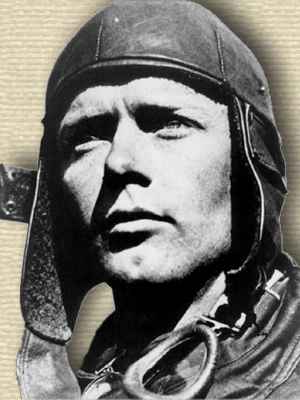
Charles A. Lindbergh
(4 Feb 1902 - 26 Aug 1974)
American aviator who is famous for making the first nonstop solo flight across the Atlantic (1927). Lindbergh left New York for Paris, carrying sandwiches and water. He fought fog, icing and drowsiness, and landed in Paris 33½ hours later after his 3,600 mile flight.
|
Science Quotes by Charles A. Lindbergh (21 quotes)
[I] grew up as a disciple of science. I know its fascination. I have felt the godlike power man derives from his machines.
— Charles A. Lindbergh
Quoted in 'Antiseptic Christianity', book review of Lindbergh, Of Flight and Life in Time magazine, (6 Sep 1948).
[Science] intensifies religious truth by cleansing it of ignorance and superstition.
— Charles A. Lindbergh
Quoted in 'Antiseptic Christianity', book review of Lindbergh, Of Flight and Life in Time magazine, (6 Sep 1948).
Decades spent in contact with science and its vehicles have directed my mind and senses to areas beyond their reach. I now see scientific accomplishments as a path, not an end; a path leading to and disappearing in mystery. Science, in fact, forms many paths branching from the trunk of human progress; and on every periphery they end in the miraculous. Following these paths far enough, one must eventually conclude that science itself is a miracle—like the awareness of man arising from and then disappearing in the apparent nothingness of space. Rather than nullifying religion and proving that “God is dead,” science enhances spiritual values by revealing the magnitudes and minitudes—from cosmos to atom—through which man extends and of which he is composed.
— Charles A. Lindbergh
A Letter From Lindbergh', Life (4 Jul 1969), 60B. In Eugene C. Gerhart, Quote it Completely! (1998), 409.
I feel the development of space should continue. It is of tremendous importance. … Along with this development of space, which is really a flowering of civilization toward the stars, you might say, we must protect the surface of the earth. That’s even more important. Our environment on the surface is where man lives.
— Charles A. Lindbergh
In 'Reactions to Man’s Landing on the Moon Show Broad Variations in Opinions', The New York Times (21 Jul 1969), 6.
I have seen the science I worshipped, and the aircraft I loved, destroying the civilization I expected them to serve.
— Charles A. Lindbergh
Quoted in 'Antiseptic Christianity', book review of Lindbergh, Of Flight and Life in Time magazine, (6 Sep 1948).
I have turned my attention from technological progress to life, from the civilized to the wild.
— Charles A. Lindbergh
In Autobiography of Values (1976), p. 358.
I think the light of science is so dazzling that it can be evaluated only by studying its reflection from the absorbing mirror of life; and life brings one back to wildness.
— Charles A. Lindbergh
In 'The Wisdom of Wilderness', Life (22 Dec 1967), 63, No. 25, 8.
I would much prefer to have Goddard interested in real scientific development than to have him primarily interested in more spectacular achievements [Goddard’s rocket research] of less real value.
— Charles A. Lindbergh
Letter to Harry Guggenheim of the Guggenheim Foundation (May 1936). As quoted in Robert L. Weber, A Random Walk in Science (1973), 67.
If I had to choose, I would rather have birds than airplanes.
— Charles A. Lindbergh
In 'Is Civilization Progress?', Reader’s Digest (Jul 1964).
If I were entering adulthood now instead of in the environment of fifty years ago, I would choose a career that kept me in touch with nature more than science. … Too few natural areas remain; both by intent and by indifference we have insulated ourselves from the wilderness that produced us.
— Charles A. Lindbergh
In 'The Wisdom of Wilderness', Life (22 Dec 1967), 63, No. 25, 10.
If we can combine our knowledge of science with the wisdom of wildness, if we can nurture civilization through roots in the primitive, man’s potentialities appear to be unbounded, Through this evolving awareness, and his awareness of that awareness, he can emerge with the miraculous—to which we can attach what better name than “God”? And in this merging, as long sensed by intuition but still only vaguely perceived by rationality, experience may travel without need for accompanying life.
— Charles A. Lindbergh
A Letter From Lindbergh', Life (4 Jul 1969), 61. In Eugene C. Gerhart, Quote it Completely! (1998), 409.
In honoring the Wright Brothers, it is customary and proper to recognize their contribution to scientific progress. But I believe it is equally important to emphasize the qualities in their pioneering life and the character in man that such a life produced. The Wright Brothers balanced sucess with modesty, science with simplicity. At Kitty Hawk their intellects and senses worked in mutual support. They represented man in balance, and from that balance came wings to lift a world.
— Charles A. Lindbergh
Speech, quoted in Leonard Mosley, Lindbergh (2000), 347. In 1949, Lindbergh gave a speech when he received the Wright Brothers Memorial Trophy.
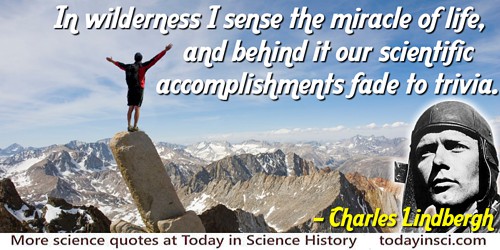
In wilderness I sense the miracle of life, and behind it our scientific accomplishments fade to trivia.
— Charles A. Lindbergh
Declaring a preference for contact with nature rather than with technology. In 'The Wisdom of Wilderness', Life (22 Dec 1967), 63, No. 25, 10.
My own lifetime spans the Wright Brothers' Kitty Hawk flight and manned-satellite orbiting.
— Charles A. Lindbergh
In 'The Wisdom of Wilderness', Life (22 Dec 1967), 63, No. 25, 8.
Now the American eagle is verging on extinction. Even the polar bear on its ice floes has become easy game for flying sportsmen. A peninsula named Udjung Kulon holds the last two or three dozen Javan rhinoceroses. The last known herd of Arabian oryx has been machine-gunned by a sheik. Blue whales have nearly been harpooned out of their oceans. Pollution ruins bays and rivers. Refuse litters beaches. Dam projects threaten Colorado canyons, Hudson valleys, every place of natural beauty that can be a reservoir for power. Obviously the scientific progress so alluring to me is destroying qualities of greater worth.
— Charles A. Lindbergh
In 'The Wisdom of Wilderness', Life (22 Dec 1967), 63, No. 25, 8-9. (Note: the Arabian oryx is no longer listed as extinct.)
Our emphasis on science has resulted in an alarming rise in world populations, the demand and ever-increasing emphasis of science to improve their standards and maintain their vigor. I have been forced to the conclusion that an over-emphasis of science weakens character and upsets life's essential balance.
— Charles A. Lindbergh
In 'The Wisdom of Wilderness', Life (22 Dec 1967), 63, No. 25, 9.
Our ideals. laws and customs should he based on the proposition that each, in turn, becomes the custodian rather than the absolute owner of our resources and each generation has the obligation to pass this inheritance on to the future.
— Charles A. Lindbergh
…...
Our survival, the future of our civilization, possibly the existence of mankind, depends on American leadership.
— Charles A. Lindbergh
From Of Flight and Life (1948), 37. Also quoted in a Review of this book, 'Antiseptic Christianity', Time magazine, (6 Sep 1948) 52, 70.
The construction of an analogue computer or a supersonic airplane is simple when compared to the mixture of space and evolutionary eons represented by a cell.
— Charles A. Lindbergh
In 'The Wisdom of Wilderness', Life (22 Dec 1967), 63, No. 25, 10.
Unless science is controlled by a greater moral force, it will become the Antichrist prophesied by the early Christians.
— Charles A. Lindbergh
Quoted in 'Antiseptic Christianity', book review of Lindbergh, Of Flight and Life in Time magazine, (6 Sep 1948).
We are in the grip of a scientific materialism, caught in a vicious cycle where our security today seems to depend on regimentation and weapons which will ruin us tomorrow.
— Charles A. Lindbergh
Quoted in 'Antiseptic Christianity', book review of Lindbergh, Of Flight and Life in Time magazine, (6 Sep 1948).
Quotes by others about Charles A. Lindbergh (3)
As for Lindbergh, another eminent servant of science, all he proved by his gaudy flight across the Atlantic was that God takes care of those who have been so fortunate as to come into the world foolish.
Expressing skepticism that adventure does not necessarily contribute to scientific knowledge.
Expressing skepticism that adventure does not necessarily contribute to scientific knowledge.
'Penguin's Eggs'. From the American Mercury (Sep 1930), 123-24. Reprinted in A Second Mencken Chrestomathy: A New Selection from the Writings of America's Legendary Editor, Critic, and Wit (2006), 167.
Kidney transplants seem so routine now. But the first one was like Lindbergh’s flight across the ocean.
In interview with reporter Gina Kolata, '2 American Transplant Pioneers Win Nobel Prize in Medicine', New York Times (9 Oct 1990).
I know two people who have found it [the secret of success]. … Getting ready. Getting prepared. There were Edison and Lindbergh,—they both got ready before they started. I had to find that out too. I had to stop for ten years after I had started; I had to stop for ten years and get ready. I made my first car in 1893, but it was 1903 before I had it ready to sell. It is these simple things that young men ought to know, and they are hardest to grasp. Before everything else, get ready.
From Henry Ford and Ralph Waldo Trine, The Power that Wins (1929), 147. Often seen paraphrased as “Before everything else, getting ready is the secret of success,” for example, in Connie Robertson (ed.), The Wordsworth Dictionary of Quotations (1998), 129.
See also:
- 4 Feb - short biography, births, deaths and events on date of Lindbergh's birth.
- Charles A. Lindbergh - context of quote “In wilderness I sense the miracle of life” - Medium image (500 x 250 px)
- Charles A. Lindbergh - context of quote “In wilderness I sense the miracle of life” - Large image (800 x 400 px)
- The Spirit of St. Louis, by Charles A. Lindbergh. - book suggestion.
- Booklist for Charles Lindbergh.
 In science it often happens that scientists say, 'You know that's a really good argument; my position is mistaken,' and then they would actually change their minds and you never hear that old view from them again. They really do it. It doesn't happen as often as it should, because scientists are human and change is sometimes painful. But it happens every day. I cannot recall the last time something like that happened in politics or religion.
(1987) --
In science it often happens that scientists say, 'You know that's a really good argument; my position is mistaken,' and then they would actually change their minds and you never hear that old view from them again. They really do it. It doesn't happen as often as it should, because scientists are human and change is sometimes painful. But it happens every day. I cannot recall the last time something like that happened in politics or religion.
(1987) -- 




