 (source)
|
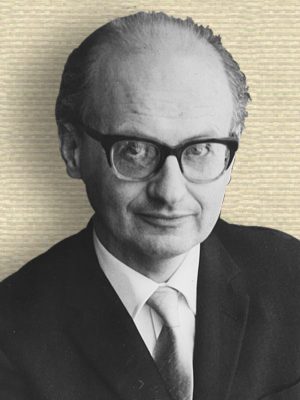
Imre Lakatos
(9 Nov 1922 - 2 Feb 1974)
Hungarian-British philosopher of science and philosopher of mathematics remembered for his development of the concept of methodology of scientific research programs and the use of this methodology in the rational reconstruction of science.
|
Science Quotes by Imre Lakatos (28 quotes)

Belief may be a regrettably unavoidable biological weakness to be kept under the control of criticism: but commitment is for Popper an outright crime.
— Imre Lakatos
In 'Falsification and the Methodology of Scientific Research Programmes', in I. Lakatos and A. Musgrave (eds.), Criticism and the Growth of Knowledge: Proceedings of the International Colloquium in the Philosophy of Science, London 1965 (1970), Vol. 4, 92.
Blind commitment to a theory is not an intellectual virtue: it is an intellectual crime.
— Imre Lakatos
In Radio Lecture (30 Jun 1973) broadcast by the Open University, collected in Imre Lakatos, John Worrall (ed.) and Gregory Currie (ed.), 'Introduction: Science and Pseudoscience', The Methodology of Scientific Research Programmes (1978, 1980), Vol. 1, 1.
Creative imagination is likely to find corroborating novel evidence even for the most 'absurd' programme, if the search has sufficient drive. This look-out for new confirming evidence is perfectly permissible. Scientists dream up phantasies and then pursue a highly selective hunt for new facts which fit these phantasies. This process may be described as “science creating its own universe” (as long as one remembers that “creating” here is used in a provocative-idiosyncratic sense). A brilliant school of scholars (backed by a rich society to finance a few well-planned tests) might succeed in pushing any fantastic programme ahead, or alternatively, if so inclined, in overthrowing any arbitrarily chosen pillar of “established knowledge”.
— Imre Lakatos
In 'Falsification and the Methodology of Scientific Research Programmes', in I. Lakatos and A. Musgrave (eds.), Criticism and the Growth of Knowledge: Proceedings of the International Colloquium in the Philosophy of Science, London 1965 (1970), Vol. 4, 187-8.
For centuries knowledge meant proven knowledge…. Einstein’s results again turned the tables and now very few philosophers or scientists still think that scientific knowledge is, or can be, proven knowledge. But few realize that with this the whole classical structure of intellectual values falls in ruins and has to be replaced.
— Imre Lakatos
In 'Falsification and the Methodology of Scientific Research Programmes', in I. Lakatos and A. Musgrave (eds.), Criticism and the Growth of Knowledge: Proceedings of the International Colloquium in the Philosophy of Science, London 1965 (1970), Vol. 4, 91-92.
If even in science there is no a way of judging a theory but by assessing the number, faith and vocal energy of its supporters, then this must be even more so in the social sciences: truth lies in power.
— Imre Lakatos
In Radio Lecture (30 Jun 1973) broadcast by the Open University, collected in Imre Lakatos, John Worrall (ed.) and Gregory Currie (ed.), 'Introduction: Science and Pseudoscience', The Methodology of Scientific Research Programmes (1978, 1980), Vol. 1, 9.
In degenerating programmes, however, theories are fabricated only in order to accommodate known facts.
— Imre Lakatos
In Radio Lecture (30 Jun 1973) broadcast by the Open University, collected in Imre Lakatos, John Worrall (ed.) and Gregory Currie (ed.), 'Introduction: Science and Pseudoscience', The Methodology of Scientific Research Programmes (1978, 1980), Vol. 1, 5.
Indeed, this epistemological theory of the relation between theory and experiment differs sharply from the epistemological theory of naive falsificationism.
— Imre Lakatos
In Radio Lecture (30 Jun 1973) broadcast by the Open University, collected in Imre Lakatos, John Worrall (ed.) and Gregory Currie (ed.), 'Introduction: Science and Pseudoscience', The Methodology of Scientific Research Programmes (1978, 1980), Vol. 1, 35.
It is not that we propose a theory and Nature may shout NO; rather, we propose a maze of theories, and Nature may shout INCONSISTENT.
— Imre Lakatos
In 'Falsification and the Methodology of Scientific Research Programmes', in I. Lakatos and A. Musgrave (eds.), Criticism and the Growth of Knowledge: Proceedings of the International Colloquium in the Philosophy of Science, London 1965 (1970), Vol. 4, 130.
It would be wrong to assume that one must stay with a research programme until it has exhausted all its heuristic power, that one must not introduce a rival programme before everybody agrees that the point of degeneration has probably been reached.
— Imre Lakatos
In Radio Lecture (30 Jun 1973) broadcast by the Open University, collected in Imre Lakatos, John Worrall (ed.) and Gregory Currie (ed.), 'Introduction: Science and Pseudoscience', The Methodology of Scientific Research Programmes (1978, 1980), Vol. 1, 68.
Kuhn … [like Popper] rejects the idea that science grows by accumulation of eternal truths. … But while according to Popper science is “revolution in permanence”, and criticism the heart of the scientific enterprise, according to Kuhn revolution is exceptional and, indeed, extra-scientific, and criticism is, in “normal” times, anathema. … The clash between Popper and Kuhn is not about a mere technical point in epistemology. It concerns our central intellectual values, and has implications not only for theoretical physics but also for the underdeveloped social sciences and even for moral and political philosophy.
— Imre Lakatos
In Radio Lecture (30 Jun 1973) broadcast by the Open University, collected in Imre Lakatos, John Worrall (ed.) and Gregory Currie (ed.), 'Introduction: Science and Pseudoscience', The Methodology of Scientific Research Programmes (1978, 1980), Vol. 1, 9.
Man’s respect for knowledge is one of his most peculiar characteristics. Knowledge in Latin is scientia, and science came to be the name of the most respectable kind of knowledge.
— Imre Lakatos
In Radio Lecture (30 Jun 1973) broadcast by the Open University, collected in Imre Lakatos, John Worrall (ed.) and Gregory Currie (ed.), 'Introduction: Science and Pseudoscience', The Methodology of Scientific Research Programmes (1978, 1980), Vol. 1, 1.
Mathematical proofs are essentially of three different types: pre-formal; formal; post-formal. Roughly the first and third prove something about that sometimes clear and empirical, sometimes vague and ‘quasi-empirical’ stuff, which is the real though rather evasive subject of mathematics.
— Imre Lakatos
In Mathematics, Science and Epistemology (1980), Vol. 2, 69.
No degree of commitment to beliefs makes them knowledge.
— Imre Lakatos
In Radio Lecture (30 Jun 1973) broadcast by the Open University, collected in Imre Lakatos, John Worrall (ed.) and Gregory Currie (ed.), 'Introduction: Science and Pseudoscience', The Methodology of Scientific Research Programmes (1978, 1980), Vol. 1, 1.
No experimental result can ever kill a theory: any theory can be saved from counterinstances either by some auxiliary hypothesis or by a suitable reinterpretation of its terms.
— Imre Lakatos
In 'Falsification and the Methodology of Scientific Research Programmes', in I. Lakatos and A. Musgrave (eds.), Criticism and the Growth of Knowledge: Proceedings of the International Colloquium in the Philosophy of Science, London 1965 (1970), Vol. 4, 116.
Our empirical criterion for a series of theories is that it should produce new facts. The idea of growth and the concept of empirical character are soldered into one.
— Imre Lakatos
In 'Falsification and the Methodology of Scientific Research Programmes', in I. Lakatos and A. Musgrave (eds.), Criticism and the Growth of Knowledge: Proceedings of the International Colloquium in the Philosophy of Science, London 1965 (1970), Vol. 4, 119.
Philosophy of science without history of science is empty; history of science without philosophy of science is blind.
— Imre Lakatos
In 'History of Science and Its Rational Reconstructions', PSA: Proceedings of the Biennial Meeting of the Philosophy of Science Association (1970), Vol. 1970, 91. (Compare Immanuel Kant, “Concepts without percepts are empty, percepts without concepts are blind,” on Immanuel Kant Quotes web page of this site.
Research programmes, besides their negative heuristic, are also characterized by their positive heuristic.
— Imre Lakatos
In 'Falsification and the Methodology of Scientific Research Programmes', in I. Lakatos and A. Musgrave (eds.), Criticism and the Growth of Knowledge: Proceedings of the International Colloquium in the Philosophy of Science, London 1965 (1970), Vol. 4, 134.
Scientists have thick skins. They do not abandon a theory merely because facts contradict it.
— Imre Lakatos
In Radio Lecture (30 Jun 1973) broadcast by the Open University, collected in Imre Lakatos, John Worrall (ed.) and Gregory Currie (ed.), 'Introduction: Science and Pseudoscience', The Methodology of Scientific Research Programmes (1978, 1980), Vol. 1, 4.
That sometimes clear … and sometimes vague stuff … which is … mathematics.
— Imre Lakatos
In Mathematics, Science and Epistemology (1980), Vol. 2, 69. This quote condensed from a longer quote which begins, “Mathematical proofs are…”, on the Imre Lakatos Quotes page of this website.
The Catholic Church excommunicated Copernicans, the Communist Party persecuted Mendelians on the ground that their doctrines were pseudoscientific. The demarcation between science and pseudoscience is not merely a problem of armchair philosophy: it is of vital social and political relevance.
— Imre Lakatos
In Radio Lecture (30 Jun 1973) broadcast by the Open University, collected in Imre Lakatos, John Worrall (ed.) and Gregory Currie (ed.), 'Introduction: Science and Pseudoscience', The Methodology of Scientific Research Programmes (1978, 1980), Vol. 1, 1.
The classical example of a successful research programme is Newton’s gravitational theory: possibly the most successful research programme ever.
— Imre Lakatos
In Radio Lecture (30 Jun 1973) broadcast by the Open University, collected in Imre Lakatos, John Worrall (ed.) and Gregory Currie (ed.), 'Introduction: Science and Pseudoscience', The Methodology of Scientific Research Programmes (1978, 1980), Vol. 1, 48.
The hallmark of scientific behaviour is a certain scepticism even towards one’s most cherished theories.
— Imre Lakatos
In Radio Lecture (30 Jun 1973) broadcast by the Open University, collected in Imre Lakatos, John Worrall (ed.) and Gregory Currie (ed.), 'Introduction: Science and Pseudoscience', The Methodology of Scientific Research Programmes (1978, 1980), Vol. 1, 1.
The history of mathematics, lacking the guidance of philosophy, [is] blind, while the philosophy of mathematics, turning its back on the most intriguing phenomena in the history of mathematics, is empty.
— Imre Lakatos
In Proofs and Refutations: The Logic of Mathematical Discovery (1976), 2
The positive heuristic of the programme saves the scientist from becoming confused by the ocean of anomalies.
— Imre Lakatos
In Radio Lecture (30 Jun 1973) broadcast by the Open University, collected in Imre Lakatos, John Worrall (ed.) and Gregory Currie (ed.), 'Introduction: Science and Pseudoscience', The Methodology of Scientific Research Programmes (1978, 1980), Vol. 1, 50.
The proving power of the intellect or the senses was questioned by the skeptics more than two thousand years ago; but they were browbeaten into confusion by the glory of Newtonian physics.
— Imre Lakatos
In Radio Lecture (30 Jun 1973) broadcast by the Open University, collected in Imre Lakatos, John Worrall (ed.) and Gregory Currie (ed.), 'Introduction: Science and Pseudoscience', The Methodology of Scientific Research Programmes (1978, 1980), Vol. 1, 8.
There is no falsification before the emergence of a better theory.
— Imre Lakatos
In 'Falsification and the Methodology of Scientific Research Programmes', in I. Lakatos and A. Musgrave (eds.), Criticism and the Growth of Knowledge: Proceedings of the International Colloquium in the Philosophy of Science, London 1965 (1970), Vol. 4, 119.
Thus a statement may be pseudoscientific even if it is eminently ‘plausible’ and everybody believes in it, and it may he scientifically valuable even if it is unbelievable and nobody believes in it. A theory may even be of supreme scientific value even if no one understands it, let alone believes it.
— Imre Lakatos
In Radio Lecture (30 Jun 1973) broadcast by the Open University, collected in Imre Lakatos, John Worrall (ed.) and Gregory Currie (ed.), 'Introduction: Science and Pseudoscience', The Methodology of Scientific Research Programmes (1978, 1980), Vol. 1, 1.
Where theory lags behind the facts, we are dealing with miserable degenerating research programmes.
— Imre Lakatos
In Radio Lecture (30 Jun 1973) broadcast by the Open University, collected in Imre Lakatos, John Worrall (ed.) and Gregory Currie (ed.), 'Introduction: Science and Pseudoscience', The Methodology of Scientific Research Programmes (1978, 1980), Vol. 1, 6.
Quotes by others about Imre Lakatos (2)
Lakatos realized and admitted that the existing standards of rationality, standards of logic included, were too restrictive and would have hindered science had they been applied with determination. He therefore permitted the scientist to violate them (he admits that science is not “rational” in the sense of these standards). However, he demanded that research programmes show certain features in the long run—they must be progressive. … I have argued that this demand no longer restricts scientific practice. Any development agrees with it.
In Science in a Free Society (1978), 15.
Lakatos (1978) coined the term immunization for a methodological decision to deflect a falsification from the hard core of a research program by making modifications in the protective belt.
In section, 'From Falsification to Methodological Caution', Ceteris Paribus in Conservative Belief Revision (2009), 71.
See also:
- Proofs and Refutations: The Logic of Mathematical Discovery, by Imre Lakatos. - book suggestion.
 In science it often happens that scientists say, 'You know that's a really good argument; my position is mistaken,' and then they would actually change their minds and you never hear that old view from them again. They really do it. It doesn't happen as often as it should, because scientists are human and change is sometimes painful. But it happens every day. I cannot recall the last time something like that happened in politics or religion.
(1987) --
In science it often happens that scientists say, 'You know that's a really good argument; my position is mistaken,' and then they would actually change their minds and you never hear that old view from them again. They really do it. It doesn't happen as often as it should, because scientists are human and change is sometimes painful. But it happens every day. I cannot recall the last time something like that happened in politics or religion.
(1987) -- 





